Around 57% of Gen Zers said they’d become internet in uencers if given the opportunity, said brands analyst Ellyn Briggs. Loyola’s current crop of students belongs to Gen Z, and two students in particular have found social media to be lucrative.
Lorenzo Barbagelata-Miller is a Loyola sophomore studying public relations with a minor in music business studies. He has 296.7k followers on the video-sharing platform TikTok, where he has amassed more than 26.5 million likes. He answers my Zoom call right before heading out for a beach day in Florida, and from his easy laugh and sunny disposition, it makes sense that followers often feel comfortable approaching him for photos.
Barbagelata-Miller monetizes his content with the help of a management team that sends him potential deals and brand o ers.
“I worked all through high school and college so far, and this is my job now,” Barbagelata-Miller said. “It’s de nitely giving me more than I thought it would.” His dream is to become a Ryan Seacrest-type interviewer, public relations professional, or late night tv host.
In his videos, Barbagelata-Miller lip-syncs rap songs, often dancing while dressed in suits. His brand deals mostly involve music promotion, and he says he has turned down o ers from unrelated companies like AI or skincare brands to keep his content authentic.
“Everyone’s like, ‘Why don’t you go back to California and pursue this career and not have to worry about tuition?’”
Barbagelata-Miller said, noting that he
Students
has thought about it.
Barbagelata-Miller says that the uncertainty of the future keeps him in college.
“Social media can all disappear,”
Barbagelata-Miller said, explaining that he is mindful of the sacri ces his parents made to help him attend college. “My mom always says, ‘To whom much is given, much is expected.’ at degree is my number one priority.”
Loyola has also in uenced the way Barbagelata-Miller approaches social media. Last spring he took a social media strategies course with Professor Aimee Alleman.
“ at class taught me so much about algorithms and the ins and outs of every
platform,” Barbagelata-Miller said.
During that semester he gained roughly 1,000 followers on Instagram and about 70,000 on TikTok.
Barbagelata-Miller isn’t the only Loyola student pursuing social media. Sophomore Fabiola Marrero studies advertising and business and has wanted to be a content creator since childhood. Unlike Barbagelata-Miller, however, her following has grown more recently.
Marrero currently has 2,664 followers on TikTok and 1,117 on Instagram.
When she appears on my screen, she’s wearing a sleek athletic tank top with her hair pulled into a tight ponytail. She answers questions with a self-assured
con dence that seems unshaken even during midterms season—something that makes sense for someone who regularly posts study and productivity content.
“I started taking social media really seriously last June,” Marrero said. “I was like, ‘Okay, I’m going to do things that motivate me to keep pushing forward.’ I had recently gone through a breakup, so that honestly really helped me, because I was so focused on myself.”
Recently, Marrero had the opportunity to work with the cosmetics brand CoverGirl on a brand trip to a social media bootcamp in Miami.
She submitted an audition tape to CoverGirl’s Latin America casting call.
Out of 500 applicants, she was one of three creators from Puerto Rico selected. Marrero has also collaborated with other brands, including Palo Ready and Gray Matter.
Much of Marrero’s content focuses on the gym and studying, often in Spanish and aimed at students with ADHD.
“I’m de nitely a business girl,” Marrero said. “My family has businesses, so I thought I would probably end up doing that.”
Originally, Marrero planned to follow that path, but she switched to advertising after meeting with a career counselor.
She credits Professor Je rey Ory with welcoming her into the communications program and says Intro to Mass Communication with Professor Lisa Collins helped her better understand social media algorithms. “ ere’s so much more to it though,” Marrero said. “Timing, audience, everything.” ose are aspects of social media she has largely learned on her own.
“Whenever I chose to switch to Mass Comm, it was way before I started doing TikToks,” she added.
Marrero hopes to one day open her own PR and advertising agency while continuing to create content that helps others.
“Obviously I haven’t gotten to the point where I’m making enough to be like, ‘Okay, I’m going to leave school,’” Marrero said. “But either way, having my degree has always been my dream.” Despite the possibility of turning social media into a full-time career, these two Loyola students remain committed to nishing their degrees, regardless of follower counts or ad revenue.
advocate for sanctuary policies in ongoing talks with the university
By Eloise Pickering ewpicker@my.loyno.edu
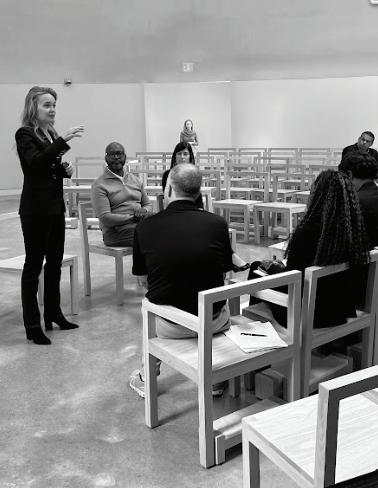
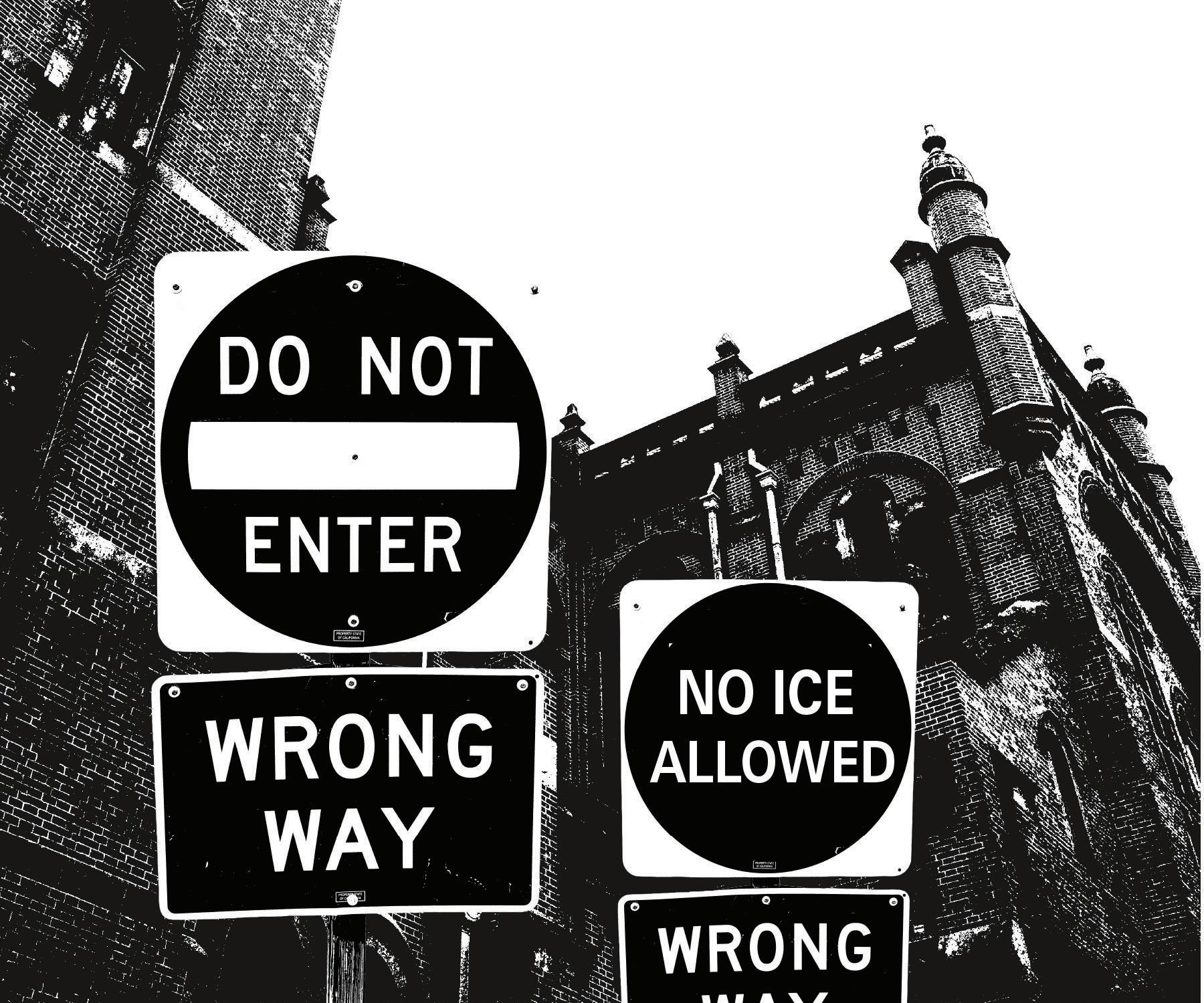
Some Loyola students are advocating for collaboration with Loyola University New Orleans administration regarding immigration concerns and implementing sanctuary policies on campus, however students feel that their ongoing efforts have been largely dismissed.
On Feb. 10, students delivered a letter to University President Xavier Cole outlining their concerns and requests for sanctuary policies, to which they received a response on Feb. 27.
“It’s a scary time in the world. Without any expressed protections for students, students wanted to have a conversation with administration and so we presented a letter with some policies that we would like to see at Loyola that would
make students feel safer,” said Juleea Berthelot, a Loyola sociology senior and member of Liberate and Unite New Orleans Students for a Democratic Society. e letter had eight explicit requests including public communication as to what constitutes a private space that Immigrations and Customs Enforcement is not permitted to enter, public communication showing the university’s commitment to the safety of their immigrant students, the utilization of Loyola’s messaging system if ICE is present on campus, the public refusal of cooperation between Loyola University Police Department and ICE, and classes to be conducted in a hybrid model if the Department of Homeland Security conducts another mass immigration e ort in New Orleans, similar to last December’s Operation Catahoula Crunch.
ese requests are in line with sanctuary policies, rather than deeming Loyola an explicit “sanctuary campus,” the students who handed in the letter have said.
e letter additionally welcomed a conversation with the university.
“We understand the potential di culties of implementing these policies and welcome an open dialogue between students and administration concerning our proposals,” the letter stated.
e response came on Feb. 27 from administration and Loyola’s Immigration Task Force, which was implemented in February of 2025.
Loyola sophomore and social media creator shows o a product for a video on March 16, 2026. Photo by Elise Beck.
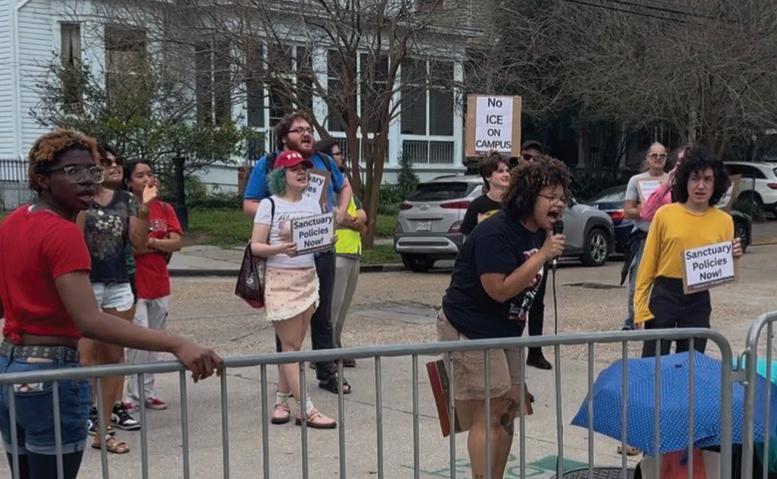
Loyola students, community members, and faculty protest on Calhoun Street on March 6, 2026. The students are advocating for immigrant sanctuary policies on Loyola’s campus. Eloise Pickering/The Maroon.
Catholic Student Community Night
The Catholic student community at Loyola is hosting a free dinner and fellowship night in the Magis Catholic Community Lounge. The event is on March 24th at 6:00 p.m. and it is open to all who are interested in learning more about the Catholic faith. For questions, reach out to Ken Webber at kweber@ my.loyno.edu
SGA tabling for candidates
Curious about who will be our next SGA president? Come to SGA tabling in The Peace Quad March 24th at 12:30 to 1:30 to meet the candidates and hear about their campaigns. Exercise your right to democracy on campus and get informed!
TAD begins Little Shop of Horrors
Little Shop of Horrors comes to Marquette Theater on March 19th and runs until March 28th. The show is described as a Sci-Fi horror comedy, love story, and doo wop rock musical. Tickets are available on Loyola's website for 20 dollars.
Loyola French Film Fest highlights Louisiana roots
By Lily Bordelon lmbordel@my.loyno.edu
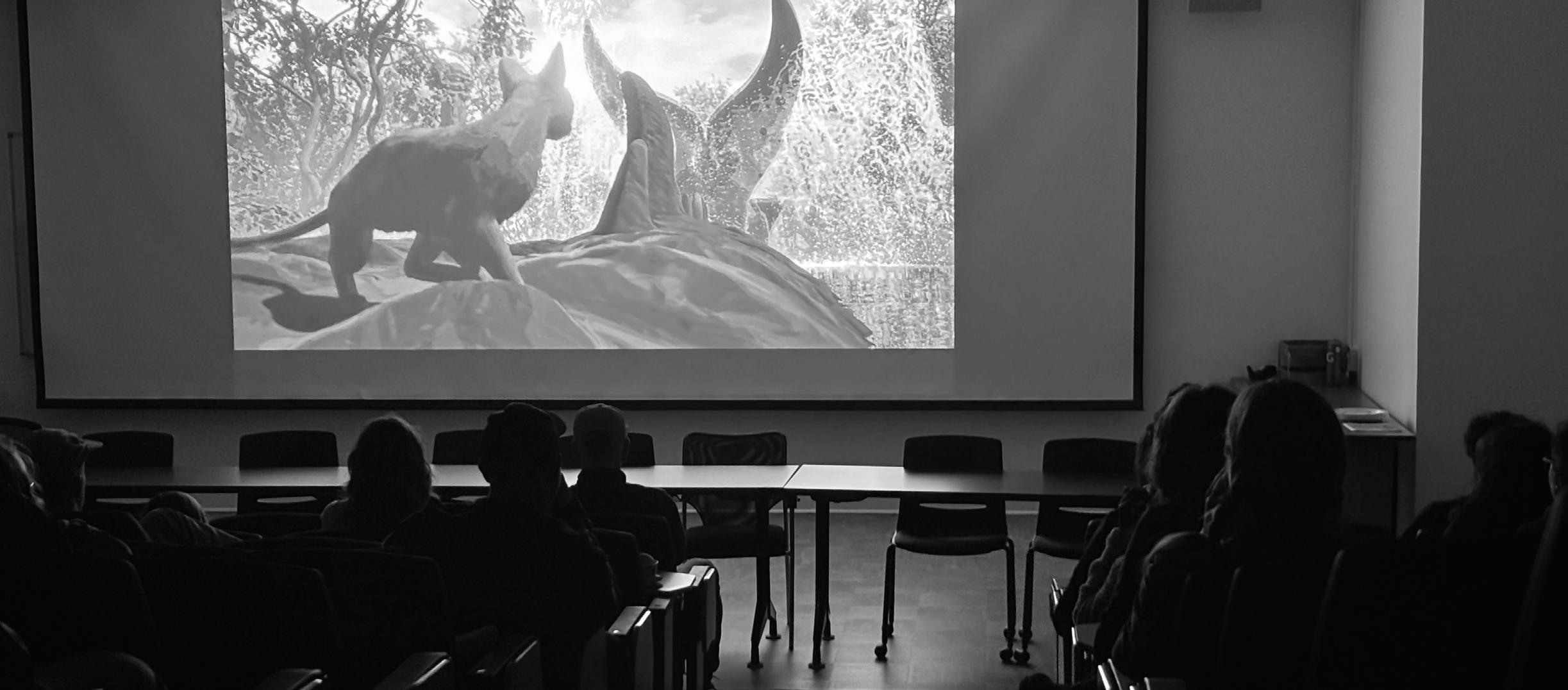
With March being national Francophonie month, Loyola is hosting its Francophone Film Festival alongside the New Orleans French Film Festival. However, unlike its New Orleans counterpart, every screening on campus will be free to Loyola students and the public.
“I think the public audience is different. We would like [Loyola’s French Film Festival] to benefit our student body,” said Leopoldo Tablante, a professor of Francophone studies.
Tablante explained the importance of New Orleans celebrating the French language. New Orleans was a francophone city until political prohibitions in the 1920s shifted the city to become English speaking.
“South Louisiana is a Francophone area of the world, so it makes sense to
have a Francophone movie festival here,” he said.
Additionally, Loyola’s festival aims towards celebrating the heritage of Francophone countries all around the world, especially countries that were colonized by Anglo-Saxon forces. The first two movies of the festivals have been French classics, but afterwards, Tablante focuses his efforts on acknowledging multiple cultures.
“When we talk about a Francophonie era, we are talking about diversity,” he said. “Very often I also try to make sure that those movies are directed by women, but this time we were not that successful.”
Tablante believes focusing on diversity also represents the interests of Loyola students, which includes addressing issues of gender, minorities, civil rights, and political struggles.
“I try to make it diverse in that sense,”
he said.
Tablante started Loyola’s festival in March 2024 as a means of getting the French studies program more traction while also being more involved with Loyola’s community.
“One of the things that we needed to do to create a little more activities and more action in the program was to create a French club and a cinema club,” Tablante said.
The first event was informal, with Tablante finding movies from the library and his own possession. After there had been a big turnout of students, Tablante decided to apply for a grant with Villa Albertine to show higher quality movies.
“I knew that we had to support it,” said Thibault Bladek, Director of Villa Albertine in New Orleans. “There's this motivation here, and anything we can do to support, we do.”
While Loyola’s screenings are free to
the public, Tablante stated that the New Orleans French Film Festival at the Prytania is more focused towards cinephiles that will make the theater sustainable income.
“I think their goal is to promote French cinema more with a current of interest that appeals to other audiences who actually pay money to go and watch those movies,” he said.
While the New Orleans festival is customized for cinephiles, Loyola also aims to create a cultural hub not only for students, but also for the city.
So far this year, the festival has screened L'armée des ombres, La passion de Dodin Bouffant, Flow, and Dahomey. They will screen two more movies next week to finish off the month: Quand vient l’automne and Soundtrack to a Coup d’Etat.
Red Bull makes cameo in Danna Center for NOEW
By Pablo Pineiro ppineiro@my.loyno.edu
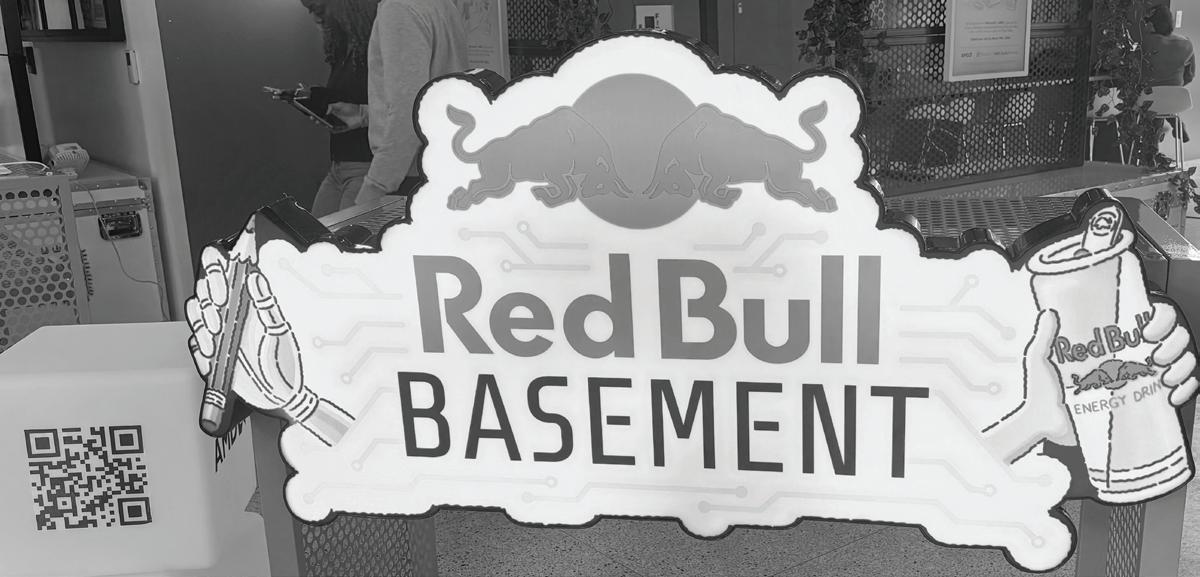
Red Bull’s entrepreneurial program, Red Bull Basement, came to New Orleans Entrepreneurship Week at Loyola University to get Loyola student ideas with the chance to win $100,000 and a trip to San Francisco.
Mass communications sophomore Macee Fielding, who was paid to help set up and take down the Red Bull Basement pop-up, stated that they were sup-
posed to give out Red Bull to participants but it fell through. Fielding suspected it was because Loyola’s campus is sponsored by Pepsi.
Fielding also gave her thoughts on the event, saying she felt “neutral” about it.
“I think it’s a great event and a great way for students and beyond to network with and hear from successful business owners/founders in the greater New Orleans area,” Fielding said.
Despite showing her appreciation for the event, Fielding also acknowledged
the stress it brought to students trying to travel through the Danna Center.
“I avoided the Danna Center during those few days because campus felt really overwhelming with NOEW and campus tours going on,” she said.
Remi Grady-Mullen, a music industry studies sophomore who worked with the Center for Entrepreneurship and Community Development as a production manager, expressed excitement about NOEW, showing appreciation for the team who helped organize the event.
“I got to work with an unbelievably exceptional team to pull off the event,” Grady-Mullen said. “Having the mayor and Tim Miller was a highlight, and there were so many amazing speakers who shared their work.”
Entrepreneurs who attended the New Orleans Entrepreneurs Week reflected on the lessons learned in the business world, and Loyola students gave their thoughts on the week-long event. Their businesses had opportunities to grow traction while at NOEW.
One of these businesses was Grayteful Hands Luxury Home Essentials, which sells plant-based cleaning products for the home. The brand prioritizes
selling natural scents, which she claims do not cause as many scent-induced migraines as synthetic smells.
Rayshawn Estelle, owner of Grayteful Hands Luxury Home Essentials, expressed excitement about the event and gave a message to aspiring entrepreneurs.
“I am hoping to get, I guess, a networking relationship to get a couple of tips on, you know, how to move forward as a small business owner as well,” Estelle said. “If you're thinking that the market is oversaturated in what you want to do, it's not. There's a placement out there just for you, but just be passionate and be persistent about what you're pursuing, and then eventually it's going to come to something.”
Lo Williams-Thomas, the founder of Zenistry Global, also tabled at NOEW. Before starting her business, Williams-Thomas worked for companies such as L’Oreal and Mary Tate as a cosmetic chemist, and while in the job, she noticed different products needed in the industry.
“I said, okay, I'm going to jump off my corporate job and create something that I think the industry needs. So I stopped
everything I was doing. I was working at BASF at the time, and I decided to be in the industry labs in 2022, and it's been great,” Williams-Thomas said. Williams-Thomas also expressed optimism about her business aspirations in the future, as well as why her company attended NOEW. She wished to increase their visibility and reach out to potential collaborators at the event.
“We're taking this to another level, and we're not just staying local,” said Williams-Thomas. “We're going to have economic growth, yes, but it's going to come in a global way.”
Kinkz Hair Products is another brand that is familiar with NOEW, tabled as well. The founder and CEO Alana Scott sells custom hair ties meant to help women embrace their natural hair. This year, Scott was able to give a talk at the summit.
Sydney—who works with Scott—talked about the event as someone working alongside the business owner .
“We love being a part of the community because we're local. And just showing more people our product and just getting more exposure for the people that we can market to,” she said.
Red Bull's sign promotes Red Bull Basement at New Orleans Entrepreneurship Week. Red Bull Basement is an entrepreneurial program that collects participant ideas. Lily Bordelon/The Maroon.
Francophone Film Fest's audience watches Flow in Bobet 332 on Tuesday. Loyola's Francophone Film Festival celebrates French-speaking countries around the world by screening movies produced by Francophonie filmmakers. Lily Bordelon/ The Maroon.
PUZZLES
59. "You got that right!"
63. Airport with many connecting ights
64. "I'm quirky like that," or, when parsed di erently, what can be said of 17-, 30-, and 48-Across
"It's all too much!"
10. Orch. performance
11. What spies often lead 12. Vibe
13. Recycling containers 18. ___ and desist 22. Insigni cant 24. French friend
Assistant Student Media Adviser: Gabriella Killett Vargas
CONTACT US
Main O ce - (504) 865 - 3535
Business O ce - (504) 865 - 3536
Adviser’s O ce - (504) 865 - 3295
Correspondence - maroon@loyno.edu
Letters to the Editor - letter@loyno.edu
Advertising - ads@loyno.edu
Website - www.loyolamaroon.com
Twitter - @loyola_maroon
Facebook - e Maroon
Instagram - @loyola_maroon
Our o ce is in the Communications/ Music Complex, Room 328.
Send mail to: e Maroon, Loyola University, Campus Box 64, 6363 St. Charles Ave., New Orleans, LA 70118
e Maroon is published every Friday. Unless otherwise noted, all content is copyrighted by e Maroon. All rights reserved. First copy free to students, faculty, and sta . Every additional copy is $1.00.
e Maroon is printed on 30 percent post-consumer recycled content.
TASK FORCE: Loyola responds to student requests
“The task force…serves as a cross-campus working group that reviews university policies, coordinates campus guidance, and helps ensure that students, faculty, and staff have clear information and access to appropriate resources,” said Director of Communications Julia LeBlanc.
According to the university response, the task force includes representatives from Student Affairs, Mission and Identity, Academic Affairs, LUPD, Marketing and Communications, General Counsel and the Office of the President.
It remains unclear who specifically serves on the task force and who students and faculty can contact with concerns. LeBlanc did not respond to this question in time for publication.
The email was divided into five sec-
tions which covered campus safety protocol, current campus status, support and resources, policies and ongoing review, and continued engagement.
“The Loyola Immigration Task Force remains attentive to campus climate and student concerns,” the email stated.
The task force says that they haven’t yet had any interaction with immigration enforcement on campus.
According to the response, “ the university continues reviewing policies and procedures to promote clarity and consistency, including: … identification of non-public spaces.”
Students had requested that the university publicly identifies private spaces, but has yet to receive direct follow-up on that concern.
“We are committed to ongoing dialogue and to supporting a community grounded in respect, compassion, and belonging,” the Immigration Task Force said.
According to LeBlanc, “Loyola must operate within applicable federal, state, and local laws while remaining guided by its Jesuit mission and commitment to the dignity, safety, and wellbeing of all members of the university community.”
She added that the Immigration Task Force meets regularly to review policies, coordinate communication, and ensure that the campus has access to clear guidance and resources.
“Now that we know this immigration task force exists but is seemingly doing nothing, we’re advocating for student and faculty representation on the task force because it’s just staff/administrators,” Berthelot said.
On March 6, students, community members, and faculty protested on Calhoun Street to ask for more support and clarification from university administration.
“Students were really angry with the response that we got from Dr. Cole and the Loyola University New Orleans administration,” Berthelot said.
A few members of Loyola’s American Association of University Professors chapter were also present at the protest in support of the students and their academic freedom. The members said that academic freedom includes freedom of thought, speech, and expression.
“Although individual AAUP members, the AAUP board, and the AAUP chapter at Loyola might agree or disagree with a perspective expressed on or off campus, the chapter recognizes and supports the right of students, staff, and faculty to think and speak freely,” the chapter said. Attendance at a protest does not necessarily convey agreement with all messages expressed by all speakers. Rather, it demonstrates a commitment to supporting First Amendment rights
and academic freedom, to learning from varied perspectives, and to engaging in discernment and dialogue.
Moving forward, the students are working in collaboration with faculty on a resolution that supports the original demands, as well as requesting faculty and student representation on the Immigration Task Force. This resolution would then be proposed at Faculty Senate.
In an interview with The Maroon about student concerns, Loyola University Minister for Social Justice Lindy Brasher said meaningful communication builds understanding, strengthens, and can help Loyola live its mission.
“Thoughtful communication can reduce fear, strengthen trust, and help the community respond with greater unity and care,” Brasher said.
Students give their opinion on war with Iran
By Amari Winchester abwinche@my.loyno.edu
As Loyola students settle into spring semester, they’re hit with the striking news about the United States and its conflicts with Iran. Some students think that the U.S. President Donald Trump and his administration are hypocritical when it comes to their statements regarding the attack on Iran, while others question the attack's justification at all.
On Feb. 28, 2026 the Supreme Leader of Iran Ayatollah Ali Khamenei, was killed as a result of a joint air strike by Israel and the United States of America. This caused a rift of political power in the country. Part of the justification for this strike was to dismantle Iran's potential nuclear power.
When commenting on the leader’s death, Trump claimed that this was a way for the Iranian people to take back their country and for a new form of government to replace its previous leader, referring to the protests that were already taking place in the country.
According to Loyola Political Science Professor Natasha Bingham, there were large-scale protests against the Iranian government by its citizens in December of 2025. The reason why these protests took place was because of things like corruption, high inflation, and dissatisfaction with strict political restrictions. These protests expanded into more political issues, which caused some citizens to demand government reform.
“The Iranian government responded with a widespread crackdown including mass arrests and reported use of live ammunition by security forces.” Bingham said. “ Authorities also restricted internet access nationwide to limit communication and media coverage.”
This led to many being arrested or killed during the crackdown.
This is the second time this year that the United States has either killed or taken a foreign leader. When asked about their opinion on the United States intervening in other countries,
Freshman History Pre-Law major Amy Estrada thinks that Trump is being hypocritical with the way he is going about things in Iran.
“He also pointed to Iran’s human rights abuses as a justification for this attack,” Estrada said. “[It’s] hypocritical considering our allegiance to Israeli Prime Minister Benjamin Netanyahu despite his government’s genocidal campaign against the Palestinian people”
Freshman filmmaking major Nimai Guhasarkar states that there's no real justification for the attack.
He goes on to say that while there is proof of Iran using nuclear energy, there is no real proof of them having a nuclear weapon of some kind. Guhasarkar also states that the country should be more focused on what's going on inside of it rather than outside of it.
“I feel like we need to stop,” Guhasarkar said. “There are so many internal problems. We just have to stop getting involved in everybody else in the world’s shit. You know?”
Estrada expressed concerns about how the attack could harm the United States’ reputation abroad.
“The U.S. often portrays other countries as backward or unstable, yet it is engaging in military aggression that is undoubtedly savage,” Estrada said. “This will create more division and disrupt an already fragile global peace.”
The Associated Press contributed to this report.
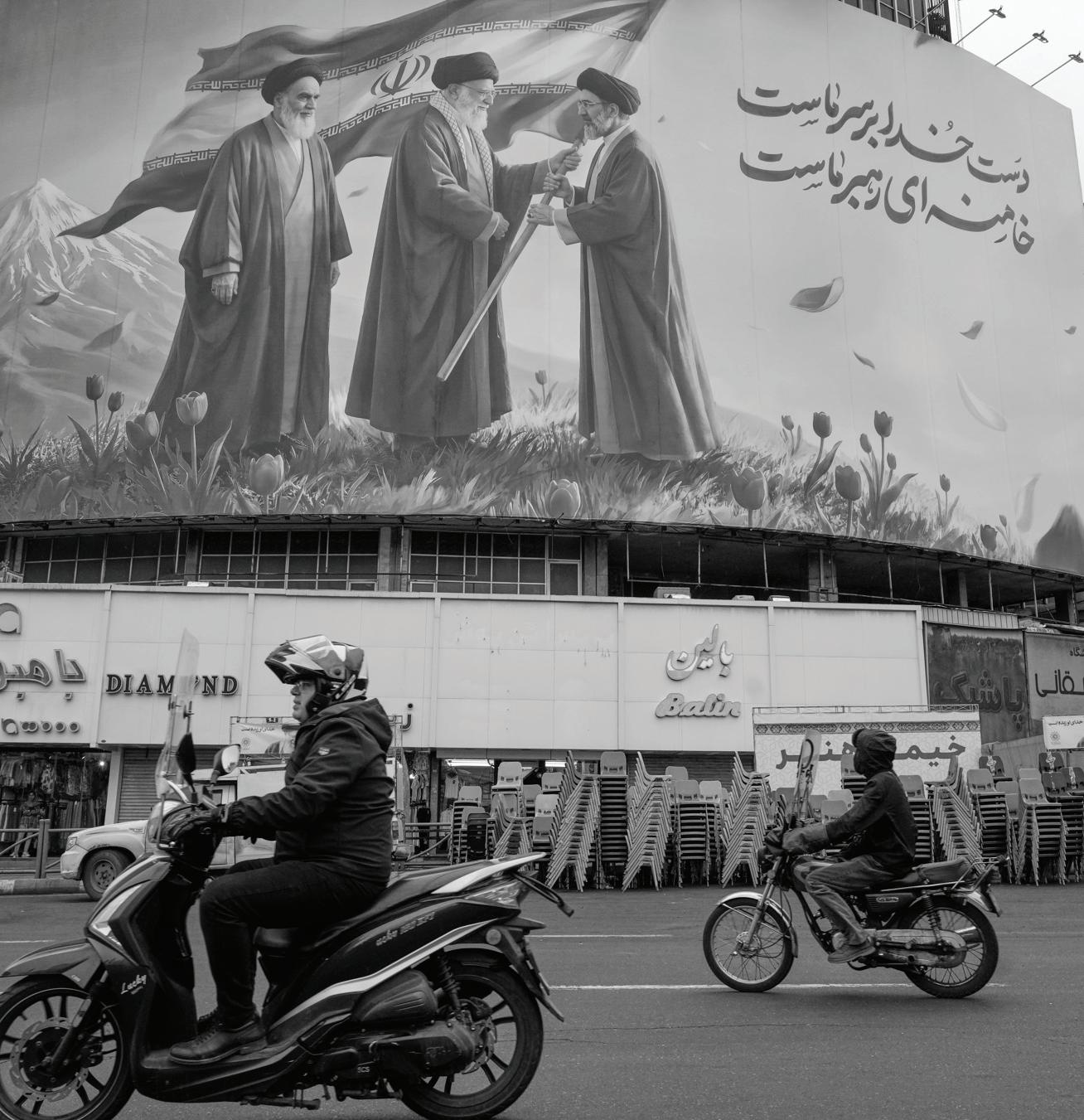
Billboard depicting Iran’s late Supreme Leader Ayatollah Ali Khamenei, center, his son and successor Ayatollah Mojtaba Khamenei, right, and the late revolutionary founder Ayatollah Ruhollah Khomeini in downtown Tehran, Iran, Tuesday, March 10, 2026. AP Photo/Vahid Salemi
Smoke and flames rise from buildings following an Israeli airstrike in Dahiyeh, Beirut's southern suburbs, Lebanon, Wednesday, March 11, 2026. AP Photo/Bilal Hussein
Smoke and flames rise from buildings following an Israeli airstrike in Dahiyeh, Beirut's southern suburbs, Lebanon, Wednesday, March 11, 2026. AP Photo/Bilal Hussein
LIFE AND TIMES
PHOTO STORY: Faces
of Super Sunday 2026, as seen through the Renz
Lens
Senator John Kennedy talks politics, personality, and Loyola love at Bookfest
By Finian Jones ffjones@my.loyno.edu
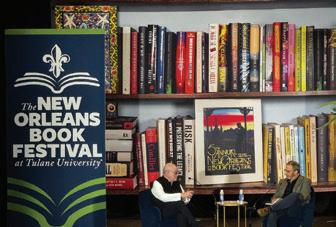
This year's New Orleans Book Festival saw a stacked roster of authors and important figures. A number of politicians spoke at various events, including John Kennedy, the Junior Senator from Louisiana. Journalist and Tulane professor Walter Isaacson shared the stage with the senator, and the two spoke on various matters - many political in nature, some personal. Isaacson began the conversation by asking Kennedy about his newest book, the bestselling “How to Test Negative for Stupid: And Why Washington Never Will”.
“You write a book and it's like birthing
a child, and you never know how people will receive it," Kennedy said regarding the writing process.
In the book, as well as talking politics, Kennedy writes about his pre-political life from his upbringing in Zachary, Louisiana, to his education at Vanderbilt and his time at the University of Virginia and Oxford. Isaacson asked about the development of the senator's bold personality and personal branding in his college years.
“Was it intentional that you were just saying, alright, I ain't going to be polished, I'm going to pretend not to be a UVA Oxford dude?”
In his reply, Kennedy said, “It's all about communication...I try to organize my thoughts, and I try to communicate
them in an honest way, but a memorable way. And some people like it and some people don't.”
Kennedy discussed current events with Isaacson, from the perspective of an insider to Washington politics. The senator briefly touched on the ousting of former Secretary of Homeland Security Kristi Noem, and her poor management of the Department of Homeland Security, in his opinion–as well as the phone call from U.S. President Donald Trump following the outbreak of this scandal.
“That night, about 9:30 p.m., I got a call from the president. He was mad as a mama wasp,” Kennedy said.
This moment made Kennedy certain that Noem would be fired.
After touching on questions about the border, the DHS and its agents, the two spoke on the conflict in Iran.
“Do you think, though, it's possible to achieve regime change by an air war?” Isaacson asked, to which Kennedy answered no.
Kennedy made it clear that he did not think the president would put boots on the ground in Iran.
“But if he puts boots on the ground, the thud you hear will be me faceplanting because I fainted,” Kennedy said.
Towards the end of the conversation, Isaacson asked Kennedy his thoughts on New Orleans at present, and where to go from here.
“I love New Orleans. The first thing
we have to do in New Orleans is get our finances,” Kennedy said.
Kennedy expressed his high opinion of former Mayor Mitch Landrieu’s administration, saying that he felt Landrieu “left the city in good shape.”
The senator called for a pragmatic approach to running New Orleans, focusing on strengthening infrastructure and keeping things running: “We've got to have safe drinking water. Just the basics.”
After the conversation, Kennedy engaged with some members of the audience in the front row, shaking hands and saying a few words. The senator was not taking questions, but when asked if he had a statement for Loyola, he replied, “I love Loyola.”
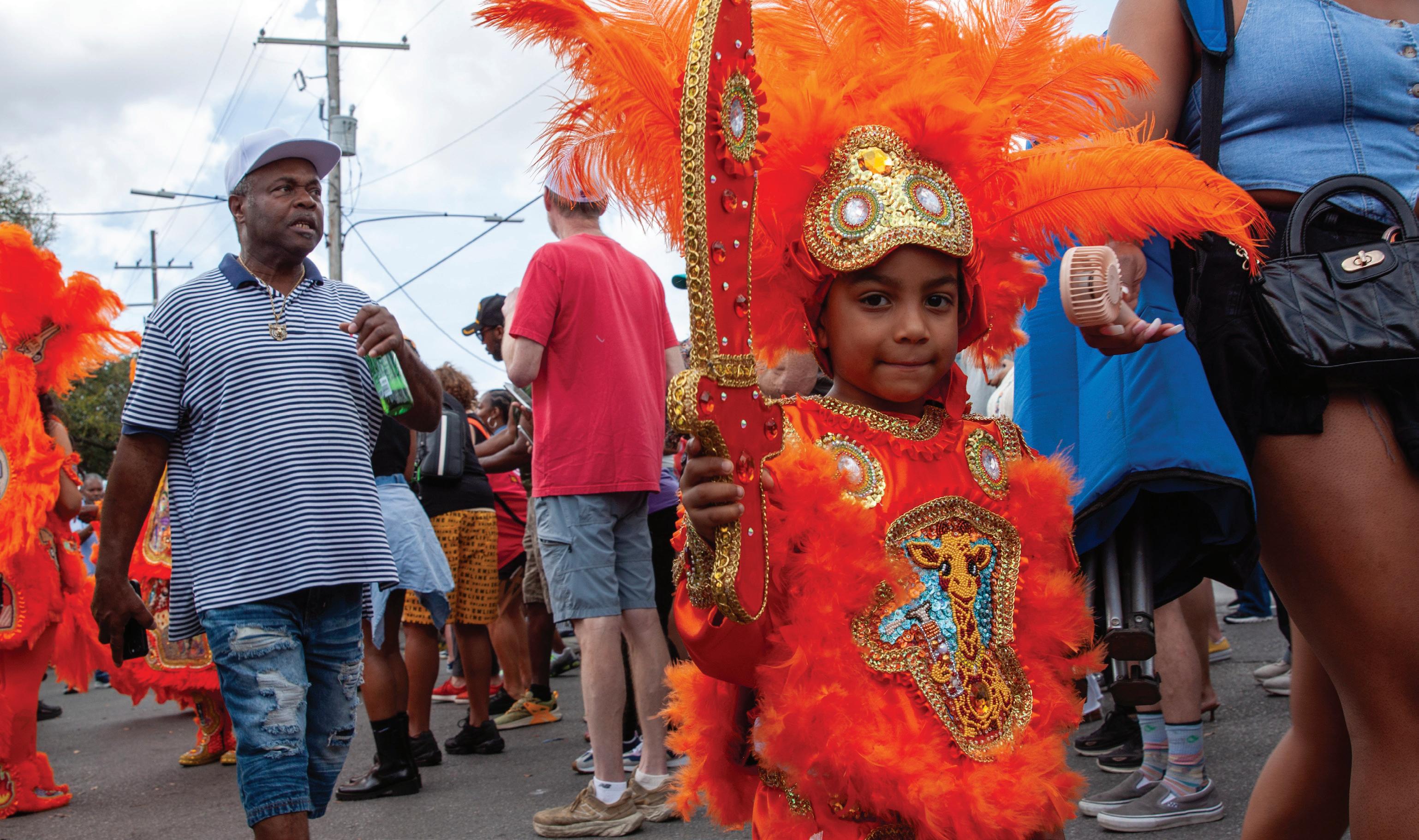
Kid and his mom clear the street for the rest of his group at the Super Sunday Parade on March 15, 2026. Sophia Renzi/The Maroon
Queen Taj Williams marches in the Super Sunday parade on Sunday, March 15, 2026. Sophia Renzi/The Maroon
Black masking Indain calls out to opposing group in hopes of getting them to move at the Super Sunday Parade on March 15, 2026. Sophia Renzi/the Maroon
LIFE AND TIMES
Loyola’s Theater Arts Closes Season with “Little Shop of Horrors”
By Valentina Russell varussel@my.loyno.edu
Loyola’s Theater Arts and Dance department has had quite a lineup this year for shows, and their final mainstage production is none other than “Little Shop of Horrors.” The musical follows main character Seymour, a poor guy who works in a flower shop. His luck takes a turn when he buys a Venus fly trap that has a thirst for blood. As you can expect, lots of craziness ensues.
“We work with a Season Selection Committee made up of outgoing seniors, faculty, and staff to choose the productions for our seasons. It's important to me that the students are actively involved in what stories we tell since it's such a big part of their educational experience,” said Loyola’s Theater Arts and Dance Department Chair, Helen Jaksch.
Things that are taken into consideration include: “What styles of plays haven't we done in a moment? What voices and viewpoints need to be highlighted? What would serve our students and community best right now?” Jaksch said.
Little Shop of Horrors will have Monica Renee Harris, A Loyola alumni making her directing debut for Loyola's Theatre Department.
“Directing LSOH has been extremely expansive for me as a theatre artist. It has given me the opportunity to take what I've learned, both in my time as a Loyola TAD student plus nearly 20 years of working in the performing arts, and pour it all into one of my favorite stories from theatre and cinema. My greatest reward has been seeing each student take ownership of their role. They are building their disciplines and stepping outside of their comfort zones. They are true collaborators in this process with me, learning and growing all the while. They're all so hardworking and fun-
loving; a winning combination for any project. I'm very lucky,” Harris said.
Paloma Mariategui, junior musical theater major and social media studies minor, is the understudy for Audrey, one of the principal characters and Seymour’s love interest.
“I have felt extremely included by having the same amount of time of rehearsal (running songs & blocking) as the principles. My favorite part is definitely making new friends, getting closer to old friends, and learning new techniques of learning so many parts in a show at the same time!” Marietegui said.
Savaughn Williams, freshman musical theatre major, is playing the role of Seymour.
“Throughout this process my favorite parts have been getting the show on its feet and singing the songs because this allowed for me to connect with the material on a deeper level and it allowed for me to make choices and experiment with different things,” Williams said.
When all of the interviewees were asked about the importance of live theater, the common thread was human connection. No matter what show, what night, or what crowd, live theater will always find a way to make you feel something. It has the power to make you forget about your troubles and enter a new world, one where man-eating plants and true love is possible (for better or for worse.)
Little Shop of Horrors opens on Thursday, March 19, and runs through March 28 at 7:30 p.m., with one matinee on Sunday, the 22.
New Orleans French Film Festival begins
By Olivia Sanyal ossanyal@my.loyno.edu
Mark your calendars for March 1924 to experience one of the longestrunning international language festivals celebrating the art of French cinema at the New Orleans French Film Festival.
Screenings will mostly be based at the Prytania Uptown, with other venues throughout the city as well.
The New Orleans Film Society is supported by a Community Arts Grant, happily made by the city of New Orleans as conducted by Arts New Orleans. This grant is supported by the Louisiana Division of the Arts, Department of Culture, Office of Cultural Development, and more.
Emerge yourself in a showcase of over 20+ French contemporary and classic films along with shorts that offer english subtitles that will give its audience members a new perspective and do what film does: inspire.
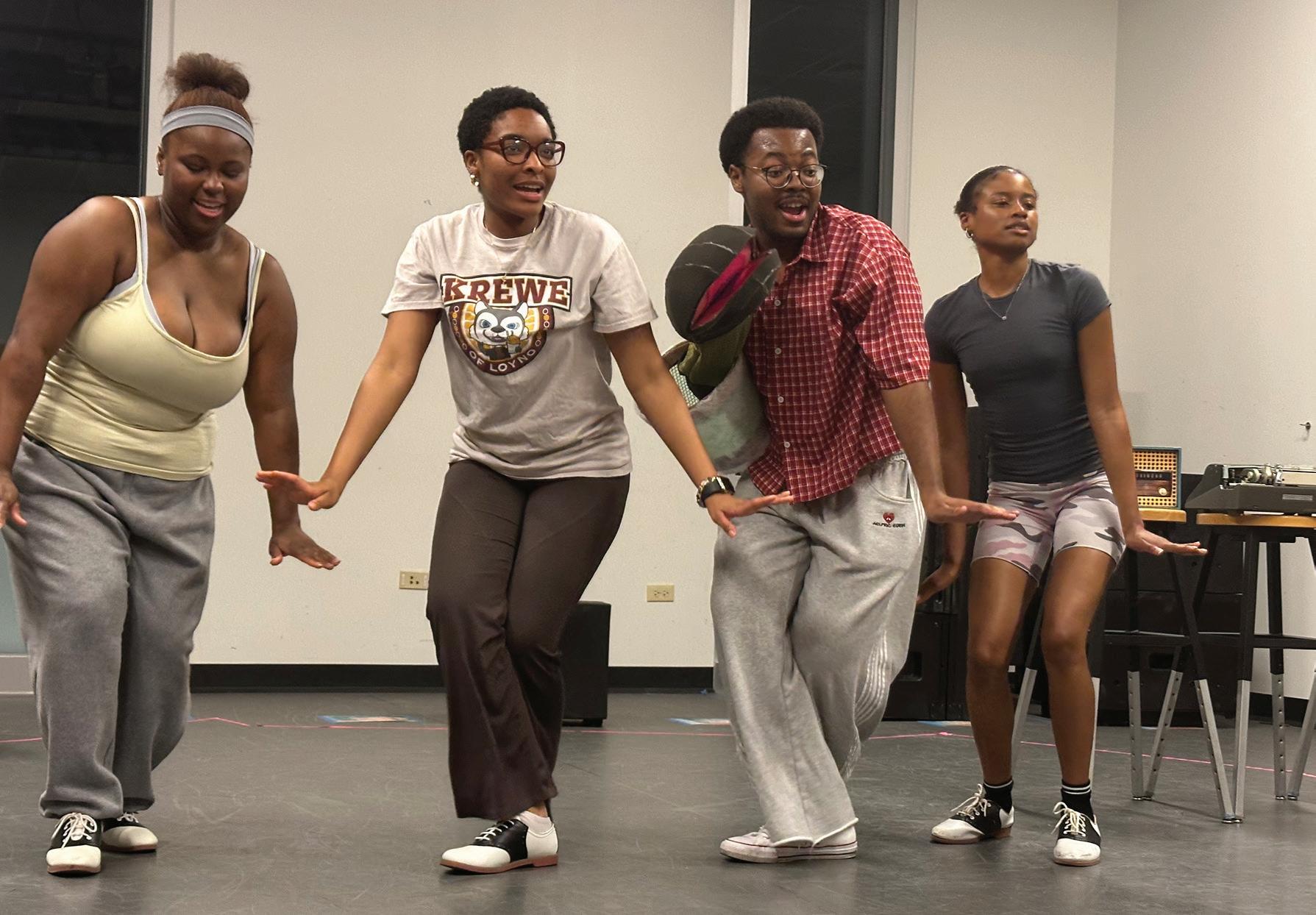
TAD students in a dance rehearsal for Little Shop of Horrors, courtesy of Valentina Russell.
Courtesy of New Orleans French Film Festival
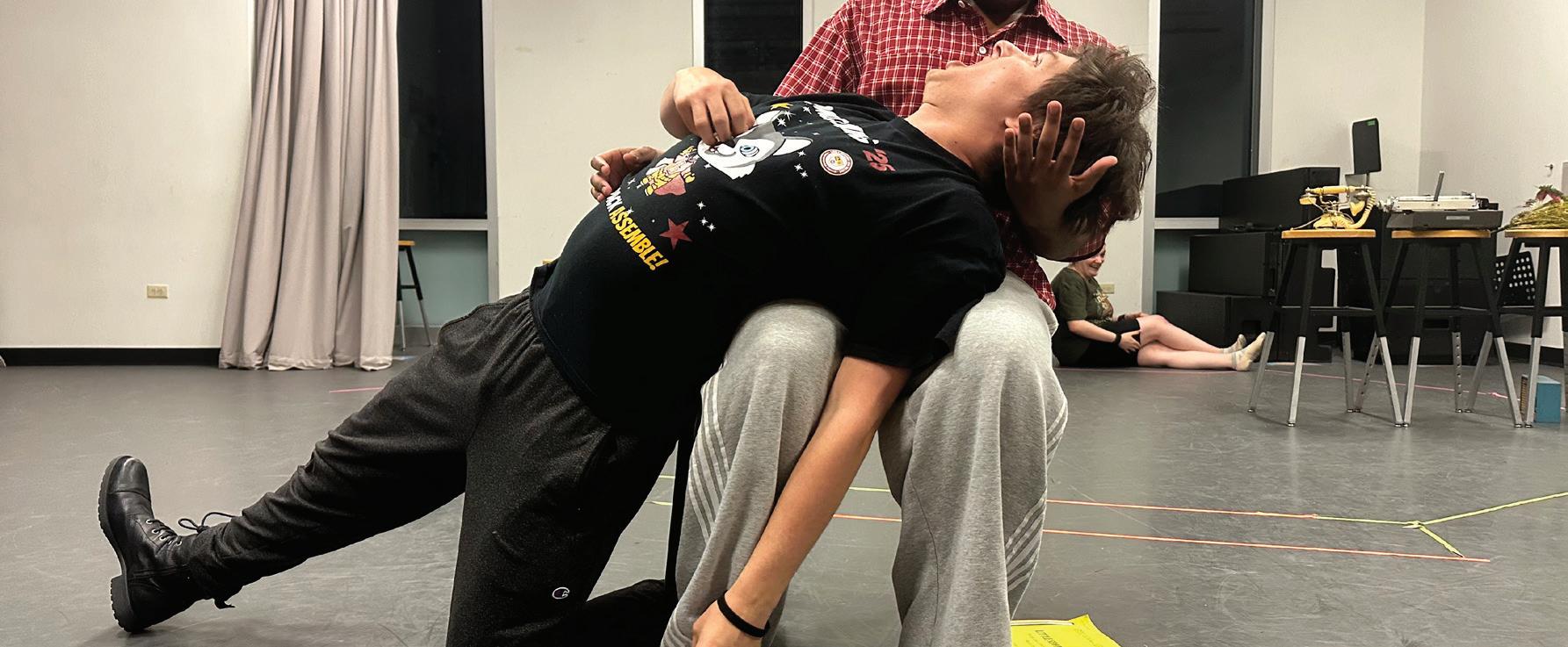
TAD students in a dance rehearsal of Little Shop of Horrors, courtesy of Valentina Russell.
Water disruptions impact campus life at Loyola University New Orleans
By Pablo Piñeiro Ramy ppineiro@my.loyno.edu
Since the start of the year, there have been ve major water pipe breaks, causing frustration among Loyola students and New Orleans residents.
e last boil water advisory was issued on the morning of March 9 and lifted the next day, more than 24 hours later. Loyola University Residential
Life sent out an email informing students about the advisory.
“Residents in the a ected area are advised not to drink, make ice, brush teeth, or prepare or rinse food with tap water,” the email said.
Smoothie King was also closed during this period, and Starbucks operated on a limited menu.
Senior political science and psychology major Reagan Daskalova, who
lives on the north shore but has a place in New Orleans, expressed concern regarding the boil water advisory.
“It is getting frustrating,” Daskalova said. “It a ects the school and its food options, it makes water more inaccessible, and has even resulted in the school needing to move to virtual operations.”
During a press conference after the boil water advisory was issued, New
Orleans Mayor Helena Moreno put pressure on the Sewage and Water Board to x the problem.
“I’m sick and tired of you telling me that these are old pipes and [that] it’s a multimillion dollar problem,” Moreno said. “Let’s get it done. Let’s get to work. Give me a plan.”
Daskalova said she had “mixed emotions” on Moreno’s remarks.
“ e city is in an economic crisis,
and because of this, it is not as simple as ‘coming up with a plan.’ e entire economic and political base of the city needs to be changed if we want to x these issues,” Daskalova said. “It is time that we change how these institutions function; the people need to hold them accountable, and our communities need to have control over them.”
After the city's fth pipe break, Helena Moreno pushes infrastructure overhaul
By Angelica Pineda acpineda@my.loyno.edu
Prior to New Orleans Mayor Helena Moreno’s inauguration, city infrastructure was the main focus of her campaign. At a recent talk at Loyola, she continued to drive that point forward.
On Feb. 28 Helena Moreno and her council expressed their current and future progress towards xing city infrastructure with community faith leaders and students at Loyola. At Loyola’s “Faith and City Leadership: Building a Shared Future” Moreno brought up the issue, addressing it as one of the city government’s “emergent priorities.”
During this part of the talk, Moreno continued to push the importance of progression in New Orleans.
“We are really leaning in because we’ve waited too long for improved basic services. So this means lighting repairs, sidewalk repairs, tra c lights working,” Moreno said. “Of course, public safety is a basic service and we have been improving public safety as well.”
One of the improvements she mentioned, lighting, has been a prevalent safety issue in New Orleans, speci cally along the I-10 service road. Moreno’s solution was the initiative “Lights On.”
According to Moreno, the city has repaired over 1000 lights in six weeks.
In an interview with Moreno after the event, she accredited the city’s rapid progress to in-house crews which are a part of the newly instated Infrastruc-
ture Coordinating Council, put in place by Moreno with the intention of “Super Bowl” progress. ese crews were meant to make improvements to the city with the same speed and e ciency of those made in preparation for the 2025 Super Bowl in New Orleans.
“To have these in-house crews they’re just deploying everyday, they’re just out there working. ey’re out there repaving, they’re xing the sidewalks. So, that's just a whole shift in model,” Moreno said.
District A Councilmember Aimee McCarron expanded upon the “shift in model” regarding the in house crews during an interview after the event stating,
“I've never seen any type of thing where there was this focus on in-house sta , and I think they’re a big part of it. We're moving fast on it because it's never been done in a really long time. is is how we’re going to work towards getting our street lights, xing our streets, those are the things we heard during the campaign,” said McCarron.
McCarron adds onto the intention of bettering the city for more than just the residents of New Orleans, but also to make it better for the students attending the universities in New Orleans.
“Hopefully, you know, if we’re working, our basic services are working, then you guys, many of you are not from New Orleans, and we want you to stay here after college. We want you to have a job. We want you to be able to say, ‘No I want to live in New Orleans because I can call
311 and my street will actually be xed.’ at’s what the city government is for,” said McCarron.
e current city government plans to continue their progress in New Orleans’ infrastructure and public safety with Moreno heading the e orts towards making New Orleans an "extraordinary city”
"It's just that constant pushing the ball forward and honestly I think that is what the people of this city really want and they deserve,” Moreno said. “ ey want a leader that is everyday going to be working for them.”
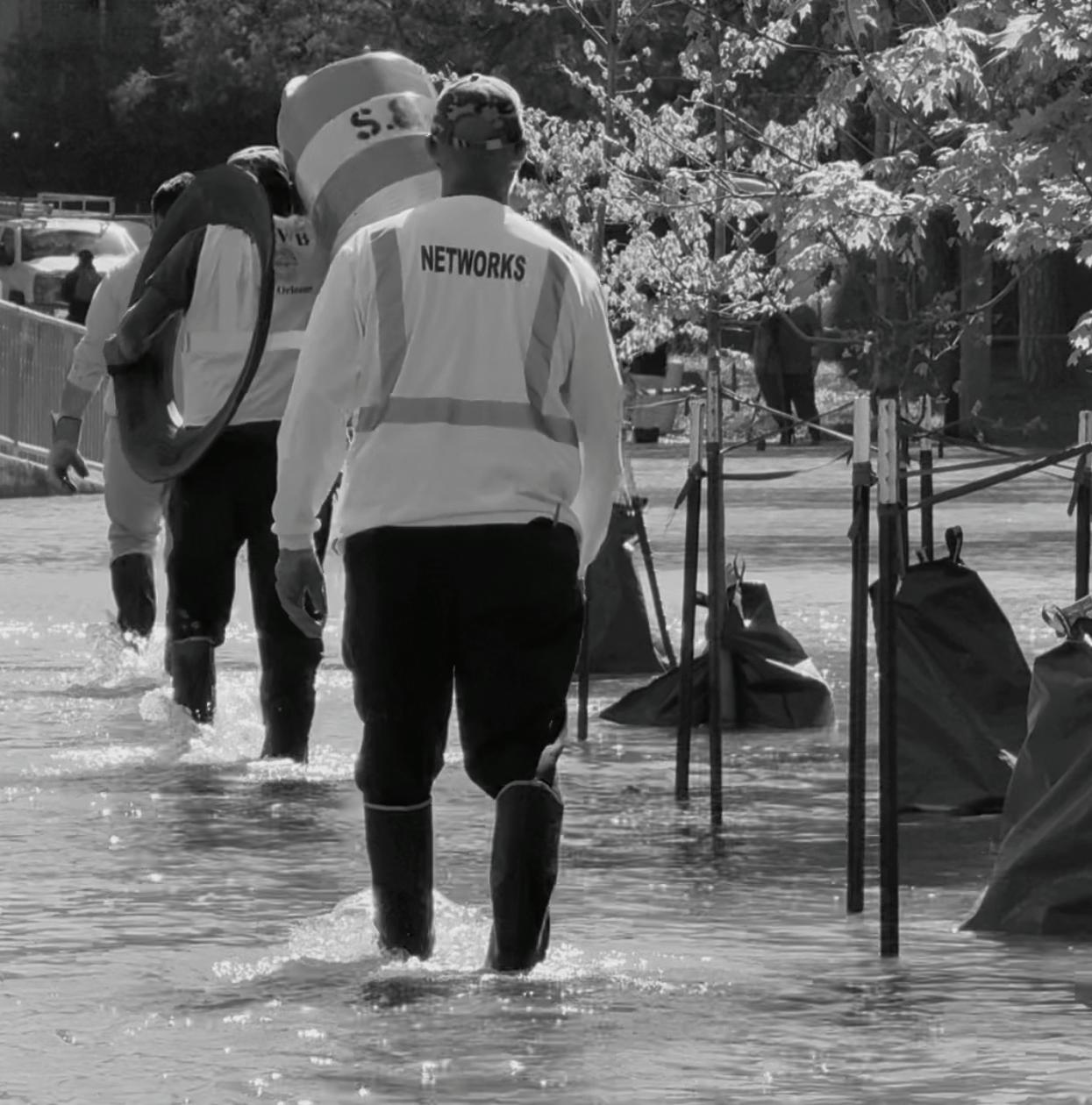
Sewage and Water Board workers walk near the scene of the broken water pipe on March 12. Sophia Renzi/The Maroon.
Helena Moreno speaking to students after the “Faith and City Leadership: Building a Shared Future” talk in the St. Ignatius Chapel on Feb. 28. Angelica Pineda/The Maroon
Photo of an excavator near Willow St & Audubon St. Sophia Renzi/The Maroon.
Chasing himself: Sergio Martinez Sanz rewrites Loyola record books
By Keri Smith klsmith1@my.loyno.edu
Records are meant to be broken, but it’s rare when the same athlete keeps doing the breaking.For Sergio Martinez Sanz, a sophomore computer science major from Madrid, Spain, the biggest competition this season hasn’t been the swimmers in the lanes beside him it has been himself.
After narrowly missing a program record by less than a second last year, Martinez Sanz entered this season motivated to close that gap. That determination paid off in November, when he set three program records in the 500-, 1,000-, and 1,650-yard freestyle events. He later returned at nationals and broke two of those marks again, continuing to push his own limits.
“After missing it last year by less than a second, it feels good to finally make those times,” Martinez Sanz said. “I also qualified for nationals with those swims.”
For Martinez Sanz, reaching that milestone was about more than just hitting a time. It marked a turning point in his confidence and validated the work he had been putting in behind the scenes.
“I’m proud to be one of the record holders for the school,” Martinez Sanz said. “I want to keep improving those times and supporting the team.”
His journey this season has not been without challenges. After taking time away from the sport due to personal reasons, returning to competition required both physical and mental adjustment. Martinez Sanz leaned heavily on the people around him to find his rhythm again.
“I think having the team we have, along with our assistant coach Jillian, has been one of the main reasons I reached this goal,” Martinez Sanz said.
The Loyola distance group, known for its demanding training style, became a key source of support. Distance swimmers often endure longer, more detailed practices, spending extended time in the water and pushing through fatigue without the same taper opportunities as sprinters.
“The support from everyone, especially my distance group, has meant everything,” Martinez Sanz said.
He described the group as more than just teammates, emphasizing the bond that developed through shared challenges.
“They’ve been there during tough times,” Martinez Sanz said. “Some-
times I didn’t feel comfortable at practice. Sometimes I was dealing with things outside the pool.”
That support extended beyond swimming, helping him navigate personal struggles and maintain his mental health throughout the season.
“They helped me through all of that,” Martinez Sanz said. “They’ve pushed me to my limits this entire year.”
Even in a competitive environment, Martinez Sanz said the team culture remains rooted in encouragement and accountability.
“They’re like my family,” Martinez Sanz said. “Even though we compete
Men's Track&Field
Mar. 21 at Belhaven Invitational Jackson, Miss.
against each other, we celebrate each other’s achievements.”
Balancing academics and athletics is another challenge Martinez Sanz has learned to manage over time. Having competed since he was five years old, he has developed routines that help him stay on track in both areas.
“The main thing is staying organized and on top of everything,” Martinez Sanz said.
He noted that maintaining proper rest, while difficult, plays a crucial role in sustaining performance both in the classroom and in the pool.
“Rest is really important too, even
Upcoming matches and games
Women's Track&Field
Mar. 21 vs. Mobile Segnette Field at 1:00 pm Mar. 21 vs. Tennessee Southern SSAC Tennis Roundup at 10:00 am
Mar. 21 vs. Tennessee Southern SSAC Tennis Roundup at 10:00 am
though it can be difficult,” Martinez Sanz said.
Looking ahead, Martinez Sanz remains focused on building off his success. With two more years of eligibility, he aims to continue lowering his times and making an impact at the national level.
“I want to keep breaking my records and help the team as much as I can,” Martinez Sanz said.
He also emphasized the importance of team goals, particularly in relay events, where collective performance becomes just as important as individual success.
“Relays are a big goal too,” Martinez Sanz said. “Those are the most fun, and I think we’re close to breaking those records as a team.”
For younger swimmers aspiring to reach a similar level, Martinez Sanz pointed to consistency and mindset as key factors.
“One bad practice or race doesn’t define you,” Martinez Sanz said.
He encouraged athletes to trust their preparation and focus on controllable factors when it matters most.
“Stay consistent. Trust your training. Rely on the people around you,” Martinez Sanz said. “When you step on the blocks, focus on what you can control.”
From falling just short of a record to rewriting multiple entries in the record book, Martinez Sanz’s season has become a story of persistence, growth, and resilience. With continued support from his team and a drive to keep improving, he is proving that his fastest swims may still be ahead of him.
Mar. 21 vs. Brenau Kenner, La at 1:00 pm
Sergio Martinez Sanz swimming during a lond distance competition. He has recently broke his own record. Courtesy of Catherine Steeter.
OPINION
Words lose meaning, Iranians lose daughters
By Dominic Smith djsmith@my.loyno.edu
When you hear the word ‘strike,’ you probably think of a number-limited mistake scheme in a game or sport. Alternatively, your mind may orient to the bright ash during a storm, soon to be followed by a thundering boom. However, if you were a parent just getting to work after dropping your daughter o to school in Minab, Iran, a ‘strike’ would be the Western corporate media term used to describe an indescribable loss.
After the U.S.’s archaic show of
moral depravity in Minab, – including a secondary strike (gamifying-ly referred to as a ‘double tap’) to kill remaining survivors, as well as emergency responders – news sources consistently reported with what must be an ill-intended use of ambiguous language. Amongst others, publishers like e New York Times, Wall Street Journal, and even the Associated Press ran headlines calling the brutal disregard for the life of these children just that –a ‘strike’. Over 160 people are reported to have died as a result of the attack, with numbers rising still, and dozens more injured. Many, if not most, of the most recent victims of Western imperialism were girls under the age of twelve, and reporting from the West will supply readers with little more than Orwellian doublespeak.
Had this issue of nonspeci c language been solely an isolated incident, there could exist some justi cation for these headlines. Maybe editors were simply so horri ed by this massive loss-of-life event that they simply could not interact with the idea of children dying at the hands of their own government. is is not the case, nor has it ever been for the United States or its media apparatus.
For years, independent journalists have documented the mainstream
media’s discrepancies in reporting. A simple glance at the Wall Street Journal can reveal inconsistencies in their portrayal of involved parties. When Iran launches an o ensive, the language used is not only ‘other’-ing, but deterministically condemning. On the side condoning neocolonialism, these same military attacks, though often much more brutal, are presented as unfortunately bad, but also somehow absolutely necessary. What necessitates the destruction of human life is often left to the reader to assume. If one, however, is regularly versed in popular media publications, the assumption is likely to be informed by the same regurgitated abstract rhetoric of ‘protecting democracy’ or ‘stopping the spread of extremism, Jihadism, communism, terrorism, etc.’.
To understand why exactly the derived perception of reality of everyday people even matters, we have to consider the phenomenon of manufactured consent. Manufactured consent relies on the premise that citizens of a nation are being controlled by the leaders/ruling class of that nation. Rather than controlling by means of force (such as in a fascist uprising), modern self-proclaimed democracies rely on the control that comes from controlling the beliefs, opinions, and ideologies of a citizen body, by means
Behind closed kennels
By Lily Bordelon
lmbordel@my.loyno.edu
e no-kill philosophy—a belief that a community should save every healthy or treatable animal rather than resorting to euthanasia—has shaped the state of shelters around the country, which face consistent overcrowding. is is exactly why I think it’s important to re-evaluate animal euthanasia and open up a necessary discussion of what we as a community can do to reach a morally palatable conclusion.
I talked with Je Dorson, Director and Founder of the Louisiana Humane Society, about the budget cuts that a ected our state’s Society for the Prevention of Cruelty to Animals; these were implemented after New Orleans faced a $220 million de cit. He told me what that could mean for the New Orleans community; the budget cuts have led to owners dumping their pets on the streets at an alarming rate, which, if ignored for a long period of time, can spark a wild re within the city.
is wild re, he explained, will come from dogs forming packs after being left
on the streets for some time, and with neutering and spaying prices going up, population control becomes all the more di cult. ese packs can lead to consistent dog attacks and further disruption in the city as well.
Talking to Dorson made me realize something: people consistently criticize euthanasia in shelters, but at the same time, there is little to no support that promotes the alternative.
e philosophy of keeping a 90% nokill rate in shelters, as Dorson explained, may seem to be the most ethical outcome, but there is so much more at play behind these kennels. How many dogs are stuck in painful situations because shelters are trying to uphold this statistic? Even more so, how many dogs on the streets are denied a spot in shelters because of this?
is is an incredibly complex issue, because there can be cases where shelters are full of animals that are still adoptable and healthy, leading to a stalemate. We are seeing this even more now because of a decrease in adoption rates after Covid, as well as an increase
of media regulation. It is of utmost importance that this is not regarded as a ‘conspiracy’ shrouded in secrecy. In reality, the publishing apparatus that is mass media contains systematic features that only allow U.S.-interest aligned rhetoric, ltering out anything that contradicts a ‘good guy’ portrayal of the nation. When the U.S. initiated the Vietnam War soon after WWII, media sources consistently regarded the U.S. involvement as nothing short of morally just – despite policy that then, and now, would be considered highly aggressive and with no regard for Indigenous peoples. e media is not only complicit in, but a key player, U.S. foreign strategy and therefore responsible for all deaths it enables the war machine to in ict.
When reporting of objective facts is reduced to a never ending slurry of euphemisms, half-truths, and blatant omission of key details, it ceases to be reporting, rather embracing fairy-tale recounts of real-world events. Oftentimes, reporters will oat the idea of protecting the reader, sparing them all the ‘gory’ details. But when domestic tax revenue funds the military, and by extension, the extermination of 150+ mostly children, do we deserve protection from this reality? Or, is there maybe a more sinister root cause for this constant ood of mis- and disin-
formation?
Whatever the answer to those questions most closely resembles the truth, you can be sure you will not be reading about it in our mainstream media. So then, what can we do? Surely there exists some practical solution to everyday readers of the media. While I do not have an answer, community involvement is paramount in these times. Going out and interacting with others will show you that you are not alone, you are not crazy – the world is. If we cannot x it right away, most pressing is to prevent it getting worse. German journalist and author Elizabeth Noelle-Neumann’s concept of the ‘spiral of silence’ highlights the dangers of remaining silent in these times. Her theory, derived from witnessing the atrocities of a fascist Nazi regime, states that individuals are likely to self-supress their opinions or beliefs when they feel that they will be outcasted or alone. When perception of public opinion is allowed to be shaped by mass media, as it is, it’s easy to feel as if those of us who care are the odd ones out. We must resist the social pressuring placed on us to comply and witness these atrocities without qualms or concerns.
I’m giving up my phone!
in shelter intakes.
Even when adoption rates are high, dogs nearing the ends of their lives due to age or other components are often overlooked. Euthanasia isn’t absolutely necessary in their cases, so many times, they spend their remaining time in shelters.
So, what can we do in the situation where dogs are both lling cages and streets? e simplest answer is to adopt, of course, but this has become a bigger problem with dog breeding. People are able to choose the breeds they want, and others, of course, make much more money than shelters as a result. e system cannot be taken down simply by crying “adopt, don’t shop!” to people who make a pro t o of it. is problem persists due to lack of regulation by the United States Department of Agriculture, making it easy for breeding to take over as standard.
However, this doesn’t mean that we can’t put this into practice as a community. People can take up roles as fosters, even hospice fosters, to open up more space in shelters. is is an e ort we need to take up as a city, especially while we are facing budget cuts and monetary issues with rescue services. If you’re thinking about getting a new furry friend any time soon, really consider looking at nearby shelters rather than breeding farms, because, more often than not, you may even see your dream breed in one of these shelters.
I suppose what I’m trying to say is that we as a group have the power to help shelters out so that they don’t have to resort to euthanasia for animals that do not need it. We can donate and focus our e orts on clearing dumped animals from the streets.
However, if we don’t play a part in animal aid, we cannot be so quick to judge euthanization, because at the end of the day, how many more options are there for these pets? If we don’t try to beat the system, we have no right to criticize those trying to work around it.
By Mary Bozeman mbozema@my.loyno.edu
Most people I know give something up for lent.
Whether it be sweets, cursing, coffee, gossiping, or anything else “addiciting,” people nd something they don’t think is good for them and they make a change. What am I giving up for lent you may be wondering, I am giving up screen time…no I’m not giving up my phone as a whole I don’t think I could live. I’m just trying to spend my free time not on a device yet instead doing something, productive.
Everyone is addicted to their phones. Whether it be a message from your mom, a funny video on Instagram,, or your Uber Eats delivery, we almost always glued to our phones. is isn’t always a bad thing. Screen time can often be reading a book on your phone, having an important zoom meeting, and more. Yet screen time can also negatively affect us all as it leads to becoming distant with the actual living people around you, and even damages our mental health. Watching everyone else's lives on our phones can be fun and make us feel like we're best friends with our favorite celebrities, though it also makes us insecure about our own lives wishing we had more. We often nd ourselves viewing other peoples fancy trips, fun night lives, and more. But why do we nd ourselves so obsessed with other people while most of the time what they display almost always isn't the full truth?
As a society, we need to work on spending less time on our devices and more time connecting with the people who are actually around us,. You may be wondering, “Ella ,you spend 80% of your time with your phone in your face, why should we listen to you?”
Yes this is true, but nobody's perfect!
Sometimes I get so caught up in social media that I forget I’m a real person with REAL HUMAN FRIENDS. No, not just the ones I text every day but also
the ones who are most of the time sitting right next to me as I scroll through TikTok. But what are some ways to spend our free time if they're not on our phones or watching TV?
e simplest things can get us o of our phones and “reconnecting with nature”. Taking a walk is a great way to stay o of our phones. As Loyola students we live next to one of the most beautiful parks in New Orleans, Audubon. Sometimes just getting a breath of fresh air, or power walking when upset can be a perfect way to clear our heads and just breathe.
Another thing to do when bored is nding a hobby if you don’t have one already, whether it be coloring, learning an instrument, bedazzling things, working out, baking, the list goes on.
Finding something fun that you can replace screen time with is key to a healthy and happy life. Lastly, reading and journaling are great things to do when we have the time. Reading is a great way to escape from the outside world, and no I don’t mean reading instagram comments, or an online book, I mean going to the library checking out a book and genuinely reading its words written on the page. Journaling also is a great way to rant, and just ll time with thinking rather than scrolling.
Overall I’m not going to preach that we all should never be on our phones, that's almost impossible in today's world, but I am going to say we should try to become more connected outside of our devices. Will I ever be able to get anywhere without my phone's apple maps? No, but that's a story for another time.
I don’t care if you’re religious or not, try giving up something this month that you feel doesn’t bene t your life and instead is just a distraction keeping you from reaching your goals. I hope whatever you choose bene ts you in some type of way. We’ll see how long I last with less screen time!
Gabrielle Conway/The Maroon
Loyola student pets dog while volunteerin at Zeus' Rescusg. Eloise Pickerings /The Maroon
EDITORIAL
Care without clarity isn’t care at all
When Loyola announced the start of the Immigration Task Force in February of 2025, it sounded like the kind of response students had been asking for. It suggested movement, attention, maybe even protection. On paper, the structure is there, administrators, campus police, mission leaders, legal counsel, all gathered to respond to an issue that has become increasingly real for students across campus and the country.
But for many students, that announcement came and went quietly. Since then, the silence has been louder than the response.
Right now, Loyola asks students to trust that something is being done behind the scenes. But trust is hard to hold onto when you don’t know what’s actually happening. Students don’t know how often the task force meets, what policies it has reviewed, or whether any new protections are even being considered.
ere’s no clear way to reach the group, no consistent updates, no real sense of what has changed since its creation. For students whose lives are already shaped by uncertainty, that lack of clarity feels like being left in the dark.
And in a moment like this, darkness doesn’t feel safe.
at uncertainty is re ected in what student leadership is hearing as well. When asked about student understanding of the task force, Student Government Association President Nicholas Keen said that there is currently “limited student awareness regarding the specific role and function of the University’s Immigration Task Force.”
While the Task Force plays an important role, Keen noted that its work is “not widely visible to the general student body,” even as it reviews policies and prepares institutional responses to immigration-related issues.
He added that this lack of visibility is not necessarily due to a lack of e ort, but rather the nature of the group itself, which operates within legal and administrative frameworks that do not always translate into clear, student-facing communication.
Still, for students, the distinction matters less than the outcome: they don’t
know what protections exist or how decisions are being made.
Keen also pointed to the resources that are currently available to students, including the Center for International Education, the Stuart H. Smith Law Clinic and Center for Social Justice, and the University Counseling Center, which offers trauma-informed and multilingual support. SGA, he explained, has worked to help direct students toward these resources and facilitate conversations when concerns arise.
But access to resources is not the same as clarity from the institution itself.
Loyola’s identity is built on Jesuit values, especially cura personalis, care for the whole person. It’s a phrase the university uses often, one that shows up in mission statements, speeches, and even in classes. But what does that actually look like when students are worried about something as serious as immigration enforcement?
Lindy Brasher, Loyola university’s minister for social justice, frames it as something much deeper than general support.
“Within Ignatian spirituality, cura personalis calls us to care for the whole person by attending to the full reality of each student’s life,” Brasher said. at reality, she explains, isn’t just academic, it’s emotional, familial, legal, and communal.
For immigrant students, those layers aren’t theoretical. ey show up in everyday life, in conversations with family and in the news. Brasher emphasizes that care, in this context, means more than acknowledging that reality. It means walking with students through it.
“Immigrant students are not problems to be solved but persons whose lives re ect both resilience and grace,” she said.
But care that you can’t see or understand starts to feel a lot like absence.
e university has o ered at least one clear procedure: if someone claiming to represent a government agency approaches campus, students should contact Loyola University Police, who will verify credentials and legal authority. But for students thinking about worst-
case scenarios, it doesn’t answer the bigger question, what will Loyola actually do to protect them before it gets to that point?
Because these situations don’t unfold slowly or predictably. ey happen fast, sometimes in a matter of minutes, often without warning. Immigration enforcement has, in recent years, been carried out in ways that feel abrupt and, at times, aggressive, people taken from homes, from campuses, from everyday spaces where they once felt safe. In 2025, Palestinian activist and Columbia University graduate Mahmoud Khalil was taken into custody by federal agents despite being a lawful permanent resident. His arrest didn’t happen in some distant, abstract setting. It happened in student housing, in a place that was supposed to feel secure.
Moments like that don’t leave time to think through procedures or wait for institutional responses. ey raise an unsettling reality: if something like this were to happen here, would Loyola be ready?
Loyola can’t simply declare itself a sanctuary campus without consequences. Federal funding, including nancial aid that many students depend on, could be at risk. e university is operating within legal and nancial boundaries that aren’t easy to ignore. Brasher acknowledges that balance as part of a larger process of discernment.
“ e work is not about choosing between values and constraints,” Brasher said, “but about faithfully navigating their intersection in a way that re ects the Gospel.”
But navigating does not mean hiding it.
When asked how Loyola could improve transparency, Keen pointed to a “clear opportunity for the university to strengthen transparency and student understanding regarding the Immigration Task Force and its work.”
He emphasized the need for increased student-facing communication about its role, as well as “clear, accessible updates that translate legal and administrative processes into student-relevant information.”
HOWLS & GROWLS
HOWL to Leprechaun
GROWL to
Broken printers
HOWL to Eid
GROWL to The wind
HOWL to
G2 07 black pens
GROWL to
ICE
Editorial Board
Editor in Chief
Eloise Pickering
Managing Editor for Print
Mary Ella Hastings
Pre-Content Director
Alana Frank
Post-Content Director
Callie Honeycutt
Campus News Editor
He also noted that while formal student representation on the Task Force may present challenges, “there are still meaningful ways to incorporate student voice.”
If concerns grow, Keen said SGA is prepared to advocate for increased representation and ensure those concerns are brought to university leadership. at matters because Loyola already prioritizes student representation across many institutional committees. e question now is whether that same commitment can extend to an issue that directly a ects student safety and well-being.
Students aren’t asking Loyola to make itself a national headline or challenge federal policy. If anything, there’s an understanding that some level of discretion matters. Brasher points out that protecting students sometimes means not drawing unnecessary attention to them, emphasizing that “respecting privacy and protecting students from additional vulnerability re ects a deep respect for human dignity.”
Still, discretion should not come at the cost of communication.
Because right now, it’s not clear whether Loyola is doing everything it can, or just what it feels safe doing.
And that uncertainty matters. It shapes whether students feel like they belong here, whether they trust the institution that’s supposed to support them, whether “care for the whole person” is something they actually experience or just something they hear.
What students are looking for isn’t unrealistic. ey want to understand what the Immigration Task Force is actually doing. ey want clearer communication about policies that a ect their safety. ey want to know where they stand.
More than anything, they want to feel like they’re not navigating this alone.
Loyola has taken the rst step by recognizing the issue. But recognition is only meaningful if it leads somewhere.
Because at a school that prides itself on caring for the whole person, care shouldn’t feel hidden.
And right now, it does.
Lily Bordelon
Campus News Editor
Stella Perdue
Worldview Editor
Pablo Pineiro-Ramy
Assistant Worldview Editor
Angelica Pineda
Life and Times Editor
Elise Beck
Assistant Life and Times Editor
Olivia Sanyal
Sports Editor
Kerieyaunta Smith
Opinion and Editorial Editor
Imadnisa Siddiqui
Breaking News Editor
Natalie omas
e Wolf Editor
Laura Welles
Senior Sta Photographer
Sophia Renzi
Assistant Photo Editor
Pharrell Every
Design Chief
Makayla Parker
Social Media Manager
Mabel Regalado-Hernandez
Social Media Manager
Carlos Andrade
Social Media Manager
Maria Touzard
Copy Editor
Mark Michel
Newscast Editor
Christopher Nesbit
Lead Anchor
Dessadra Tezeno
EDITORIAL POLICY
The editorial on this page represents the majority opinions of The Maroon’s editorial board and does not necessarily re ect the opinions of Loyola University.
Letters and columns re ect the opinions of the authors and not necessarily those of The Maroon’s editorial board.
The Maroon does not represent the opinion of administration, sta and/or faculty members of Loyola.
Letters are subject to editing for length, grammar and style. Please limit submissions to 400 words. Submissions are due no later than 4 p.m. the Sunday before publication. Please send all submissions — The Maroon, 6363 St. Charles Ave., Box 64, New Orleans, LA 70118.
Email us your letters — letter@ loyno.edu.
Submissions may also be made online at www.loyolamaroon.com.
Makayla Praker/The Maroon
Endless possibilities —just down the street.
The same personalized support. The same hands-on learning experience. All new possibilities for your career.
Explore versatile programs at Loyola College of Law.
Juris Doctor – full time, part time, and evening programs