For a greater Loyola | Issue 12 | Loyola University New Orleans | Since 1923 | Apr. 17, 2026 | loyolamaroon.com
Louisiana gas continues to rise, concerning commuter students By Alana Frank anfrank@my.loyno.edu
Gas prices in Louisiana have climbed to an average of $4.14 per gallon over the past year, making it more expensive for Loyola University New Orleans students to get to campus and, for some, changing how often they choose to be there. The increase, reported in recent data from the American Automobile Association and the U.S. Energy Information Administration, reflects a steady rise tied to inflation, global oil markets and supply disruptions. But for Loyola commuters, those national trends show up in a much more personal way, weekly gas totals, longer commutes and tighter budgets. Carlos Andrade, a sophomore biology pre-health major who commutes from Chalmette and Maroon social media manager, said he has watched his gas costs rise in real time. “I’ve seen my gas go from like $30 or $35 to $42, and the other day it was $52,” Andrade said. “I don’t really know what’s happening, but it’s getting crazy out here.” Andrade drives about 14 miles each way to campus five days a week. While he said he still comes to class because he has to, higher gas prices are starting to affect the choices he can control. “If I had the choice to come
to campus or not, I’d probably choose not to go just to save gas,” Andrade said. That tradeoff, between saving money and being on campus, is becoming more common as prices stay high. According to AAA and the U.S. Energy Information Administration, gas prices have steadily increased over time due to changes in crude oil prices, global demand and ongoing geopolitical tensions. For commuters, the impact goes beyond just money. Andrade said driving to campus adds stress to his day, especially when com bined with unpredictable traffic and rising costs. “You get less sleep because you have to leave earlier, and then gas is high, so it’s just something else you have to worry about,” he said. Gabriella Pavon, a sophomore psychology major who commutes from Kenner, said the cost of gas has doubled compared to what she used to pay. “I miss the days where I could fill up for $25,” Pavon said. “Now it’s anywhere from like $45 to $55, and it’s insane.” Pavon, who drives about 15 to 17 miles each way to campus, said rising gas prices now factor into every day decisions, even outside of class.
“Gas is something I really take into consideration now,” she said. “Even if it’s just to hang out with a friend, I don’t really have the money to just be blowing my gas for no reason.” She added that com muting itself has become morestres ful over time. “I have to wake up at least an hour before my class because traffic can take 45 minutes to an hour,” Pavon sa i d . “It’s stressful because you’re worried about being late, and you’re constantly dealing with traffic.” Pavon said the impact goes beyond school and affects her daily life. “Sometimes I want to go to something, but I’ll look at my tank and be like, I don’t really have the money right now,” Pavon said. “It’s not even about if I want to go anymore, it’s about if I can afford the gas.” Students who live closer to campus experience rising gas prices differently, but still feel the impact in their daily routines. Madison Kearns, an international business and marketing senior at Loyola, said even with a shorter commute, gas costs still add up over time, especially when balancing school, work and other responsibilities. “Even if you’re not driving far every day, it still catches up to you,” Kearns said. “You don’t really realize how much you’re spending until you have to keep filling up.” Kearns said rising prices have made her more aware of how often she chooses to drive.
“I definitely think twice now before going somewhere,” she said. “It makes you plan your days more and cut back on extra trips.” The data for this story combines national fuel price reports from AAA and the EIA with interviews from Loyola students about their commuting habits, gas spending and daily routines. Together, the data and interviews show how a national economic trend is shaping the everyday college experience. As prices remain high, some students are adjusting by limiting extra trips, budgeting more carefully or thinking about moving closer to campus. But for many commuters, the impact goes beyond budgeting, it changes how they experience college day to day. “Like, how are you supposed to enjoy
your life and be like, ‘yeah, I’m going to come to your event,’ when you’re worried about gas?” Pavon said. “You end up not going because of it.”
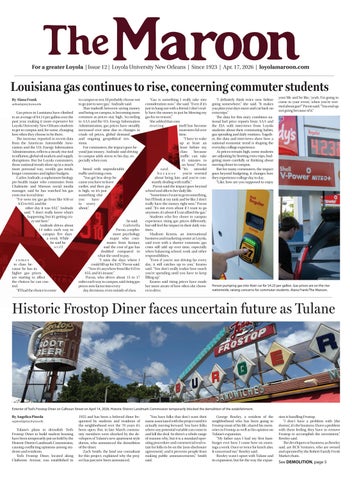
Person pumping gas into their car for $4.23 per gallon. Gas prices are on the rise nationwide, raising concerns for commuter students. Alana Frank/The Maroon.
Historic Frostop Diner faces uncertain future as Tulane
Exterior of Ted’s Frostop Diner on Calhoun Street on April 14, 2026. Historic District Landmark Commission temporarily blocked the demolition of the establishment.
By Angelica Pineda acpineda@my.loyno.edu
Tulane’s plans to demolish Ted’s Frostop Diner to build student housing have been temporarily put on hold by the Historic District Landmark Commission, causing conflicting opinions among students and residents. Ted’s Frostop Diner, located along Claiborne Avenue, was established in
1955 and has been a beloved diner frequented by students and residents of the neighborhood over the 70 years it’s been open. But, in late March community members were shocked by the developers of Tulane’s new apartment style dorms, who announced the demolition of the diner. Zach Smith, the land use consultant for this project, explained why the project has just now been announced.
“You have folks that don’t want their name associated with the project until it’s actually moving forward. You have folks where any potential variable can come in and kill the deal. So there’s a whole range of reasons why, but it is a standard operating procedure and commercial real estate for folks to be on the [non-disclosure agreement], and it prevents people from making public announcements,” Smith said.
George Rowley, a resident of the neighborhood who has been going to Frostop most of his life, shared his memories in Frostop as well as his opinion on Tulane’s expansion. “My father says I had my first hamburger ever here. I come here six mornings a week. Once or twice for lunch also. It concerned me,” Rowley said. Rowley wasn’t upset with Tulane and its expansion, but for the way the expan-
sion is handling Frostop. “I don’t have a problem with [the dorms], it’s the business. I have a problem with them feeling they have to remove Frostop to accomplish the investment,” Rowley said. The developers or business, as Rowley said, are RCR Ventures, who are owned and operated by the Robért Family Fresh Market chain.
See DEMOLITION, page 5