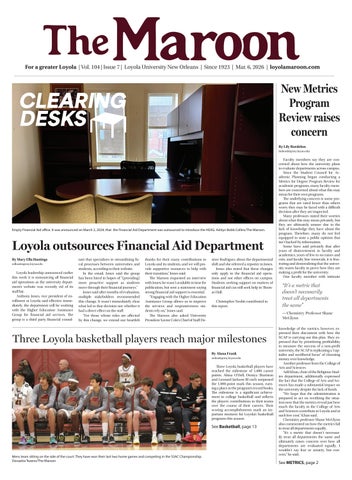

Loyola outsources Financial Aid Department
By Mary Ella Hastings mlhastin@my.loyno.edu
Loyola leadership announced earlier this week it is outsourcing all financial aid operations as the university department’s website was recently rid of its staff list.
Anthony Jones, vice president of enrollment at Loyola said effective immediately, the department will be working with the Higher Education Assistance Group for financial aid services. The group is a third party financial consul-
tant that specializes in streamlining fiscal processes between universities and students, according to their website.
In the email, Jones said the group has been hired in hopes of “(providing) more proactive support as students move through their financial journeys.”
Jones said after months of evaluation, multiple stakeholders recommended this change. It wasn’t immediately clear what led to that decision nor whether it had a direct effect on the staff.
“For those whose roles are affected by this change, we extend our heartfelt
thanks for their many contributions to Loyola and its students, and we will provide supportive resources to help with their transition,” Jones said.
The Maroon requested an interview with Jones; he wasn’t available in time for publication, but sent a statement saying strong financial aid support is essential.
“Engaging with the Higher Education Assistance Group allows us to improve the services and responsiveness students rely on,” Jones said.
The Maroon also asked University President Xavior Cole’s Chief of Staff De-
siree Rodriguez about the departmental shift and she referred a reporter to Jones. Jones also noted that these changes only apply to the financial aid operations and not other offices on campus. Students seeking support on matters of financial aid can still seek help in Thomas Hall.
Christopher Nesbit contributed to this report.
Three Loyola basketball players reach major milestones
By Alana Frank anfrank@my.loyno.edu
Three Loyola basketball players have reached the milestone of 1,000 career points. Alissa O’Dell, Deniya Thornton and Leonard Jackson III each surpassed the 1,000-point mark this season, earning a place in the program’s record books. The milestone is a significant achievement in college basketball and reflects the players’ contributions to their teams over the course of their careers. Their scoring accomplishments mark an important moment for Loyola’s basketball programs this season.
See Basketball, page 13
New Metrics Program Review raises concern
By Lily Bordelon lmbordel@my.loyno.edu
Faculty members say they are concerned about how the university plans to evaluate departments across campus.
Since the Student Council for Academic Planning began conducting a Metrics for Degree Program Review for academic programs, many faculty members are concerned about what this may mean for their own programs.
The underlying concern is some programs that are rated lower than others worry they may be faced with a difficult decision after they are inspected.
Many professors stated their worries about what this may mean privately, but they are ultimately unsure due to the lack of knowledge they have about the program. Therefore, many do not feel equipped to state a public opinion that isn’t backed by information.
Some have said privately that after years of disinvestment in faculty and academics, years of few to no raises and cuts, and faculty line removals, it is frustrating and demoralizing that the university wants faculty to prove how they are making a profit for the university.
One faculty member with intimate
“It’s a metric that doesn’t necessarily treat all departments the same”
— Chemistry Professor Shane McGlynn
knowledge of the metrics, however, expressed their discontent with how the SCAP is carrying out this plan. They expressed that by prioritizing profitability to measure the success of a non-profit university, the SCAP is replicating a “capitalist and neoliberal focus” of choosing money over knowledge.
Another professor from the College of Arts and Sciences
Adil Khan, chair of the Religious Studies department, additionally expressed the fact that the College of Arts and Sciences has made a substantial impact on the university despite the lack of funds.
“We hope that the administration is prepared to act on rectifying the situation now that the metrics reveal just how much the faculty in the College of Arts and Sciences contribute to Loyola and at such low cost,” Khan said.
Chemistry professor Shane McGlynn also commented on how the metrics fail to treat all departments equally.
“It’s a metric that doesn’t necessarily treat all departments the same and ultimately raises concern over how all departments are evaluated equally. I wouldn’t say fear or anxiety, but concern,” he said.
See METRICS, page 2
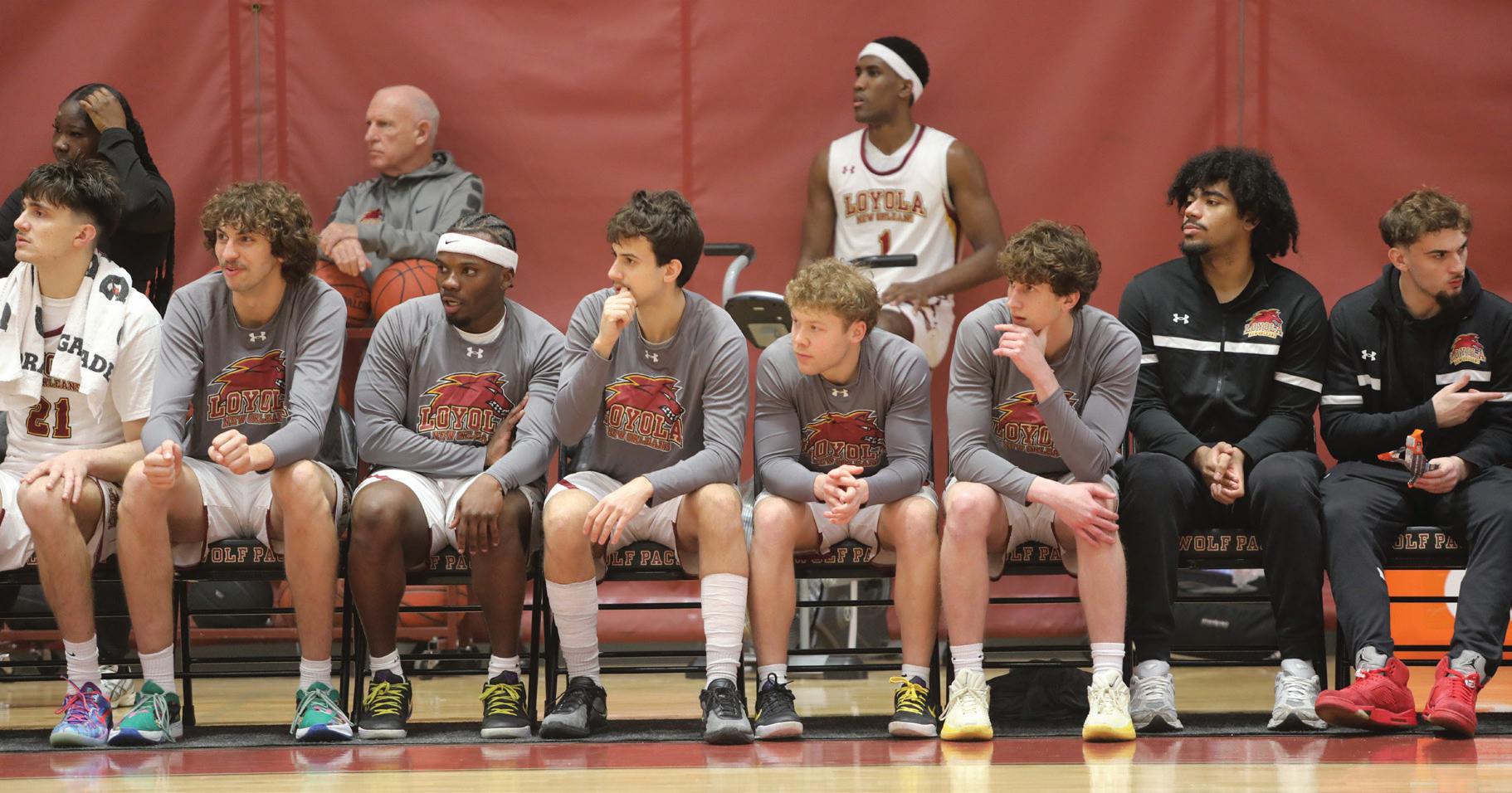
Mens team sitting on the side of the court. They have won their last two home games and competing in the SSAC Championship. Dessadra Tezeno/The Maroon
Empty Financial Aid office. It was announced on March 2, 2024, that the Financial Aid Department was outsourced to introduce the HEAG. Ashlyn Bobb Collins/The Maroon.
Loyola’s Rocky Horror had cast shivering with antici…pation
Show helps Loyola Film Club fundraise
By Valentina Russell varussel@my.loyno.edu
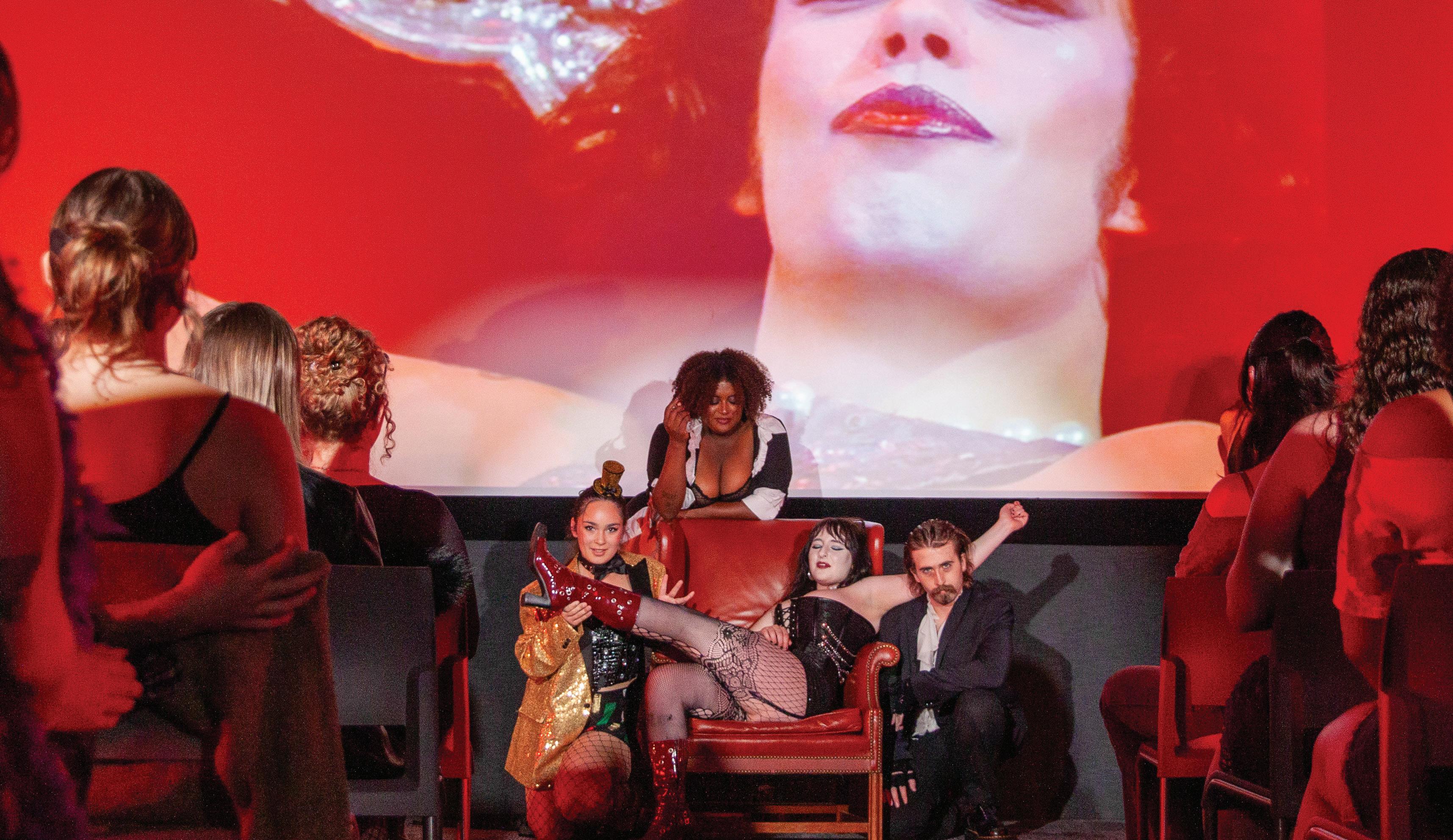
As the iconic red lips appear on the silver screen, cheering blends with intro music as Loyola Film Club students enter for their annual Rocky Horror Picture Show performance.
The event involves a live shadow cast of students recreating the cult classic as it plays on a large projector behind them. Part of what makes the event interactive are prop bags that come with the purchase of your ticket. The bags include
items, such as a noise maker, a newspaper, and more, to pull out during specific movie points to add to the atmosphere.
The event took place on February 27 and 28 in the Communications Complex. It first began back in 2024. Abigail Robins, President of the Film Club as well as a senior film and Mass Communications major, started the tradition her sophomore year.
“I started the Rocky Horror shadow cast with my roommate Janssen. He brought me on because I have a background in theater, and this kind of stretches over the boundaries of film into that theater lane,” Robins said.
This year, she played the role of Janet.
Aside from actors, members of the film club also helped behind the scenes.
Kassidy Pattain, sophomore film major
who acted as Columbia last year and worked in costuming this time around. She was drawn to the production by the vibrant community.
“Initially I had actually never seen the show or the movie before joining the cast last year but after watching it, it was so camp and it’s so important for the time, and it’s just really nice to be a part of something that’s still impacts generations of people today– even if it’s on a small level at the university, it’s a cultural phenomenon for the gay community and that itself was really important to me,” Pattain said.
This was Taylor James, a senior musical theater major and business administration minor’s, first year involved in the production, and she also played the role of Columbia. She shared how the pro-
cess included meeting twice a week for a few hours, watching the movie several times, and running the scenes.
“My favorite part of the production was getting to meet new people and make new connections! Every person in this process was so cool and so supportive in this crazy and amazing process. I’m so excited to build on the amazing friendships that I made during this production!” James said.
Robbins, now a senior, had the goal of creating a space outside of the traditional classroom setting where film students are able to create and learn, without stress. They have various events throughout the semester, but Rocky Horror is a fan favorite. She described this annual showing as “the most organic interdepartmental event (hosted by students
for students) that I have had the pleasure of being a part of. Over the past 3 years, I’ve met so many amazing people in all types of majors, so I hope this continues to be an aspect for years to come,” Robbins said.
According to Robbin’s, the ticket sales from the event funds the club for the entire academic year. This allows the Film Club to host events such as workshops, Oscar watch parties, and to compete in various film race festivals, among other things. Anyone, regardless of major, is encouraged to join. The production calls for actors, lighting teams, props, costumes, front of house, and camera departments.
University Senate approved Metrics Program
Continued from front
On the other hand, Roger White, an associate professor of Political Science, explained that he understood what the SCAP was trying to accomplish with the metrics. He believes that it is necessary for the organizations in the university to be reviewed to ensure they are performing well.
“We have to make sure that we're academically sound, but we also have to make sure that we're organizationally sound,” he said.
White explained that Loyola being a nonprofit organization doesn’t mean
that there aren't incoherencies in some organizations.
“Our accredited agencies take a close look at that,” he said.
However, White also acknowledged that this process may not be the best way to ensure that Loyola is organizationally sound.
“I understand what they were doing. Whether or not they did it the best way, I'm not confident to judge,” he said.
To respond to faculty concern, Provost Thomas Chambers wanted to emphasize that the metrics program was developed by a faculty committee, the SCAP, and was approved by the University senate with 22 yays, nine nays, and three abstentions.
“There has been, and will continue to be, ample opportunity for faculty to communicate on the program review process,” Chambers said.
The Metrics for Degree Program Review was approved by the University Senate on Jan. 22. The SCAP listed some metrics they considered during their recent initial review: Contribution Margin, Student Course Credit Hours per Faculty Full-Time Equivalent, and Headcount Stability.
According to the update letter sent by Chambers after the completion of the initial reviews, programs rated in the lowest 25% of metrics according to their
guidelines would be identified for further investigation. Chambers acknowledged that the metrics cannot capture the complexity of work in some programs, so the SCAP will consult the programs before making recommendations.
Sarah Allison, the Faculty Senate Director, did not respond to a request to comment.
Loyola’s American Association of University Professors refrained from responding as of now.
Loyola University New Orleans logo
Cast performs Rocky Horror Picture Show with a shadow class with students in the audence. Sophia Renzi/The Maroon
PUZZLES
1. "___ Dress for Less" (discount chain)
3. Annual Spring festival at Loyola
Land in "Adventure Time"
Devoured
Fertility treatment, abbr.
Retro "Cool!"
18. Cotton or Nylon, to Brits
Barbie or Ken 22. Common black bird 23. Beowulf's language, abbr. 24. Oval O ce directive, abbr.
25. ___ in (choose to participate)
27. Liberal arts degree, abbr.
29. Time out, abbr.
31. DNA forensics tool, abbr. 33. Celebs need this for their image 34. Austin Powers' lost groove 36. Zero, in Tennis
38. Paci c Ocean, abbr.
39. Standard error, abbr.
40. University of Arizona, abbr.
41. Overpowered, abbr.
42. Letters on red octagon
43. Opposed to yes
45. "Carpe diem" for millennials
47. Vinyl record
49. Letter afterthought
50. Emergency Room, abbr.
51. Little white lie
53. "Law & Order: ___"
55. Aliens travel in this
57. Los Angeles, abbr.
58. Rachael Ray's cooking oil
60. e country we are in, abbr.
61. Uniqlo sister brand
62. Light Yagami's alias, in "Death Note" or one of the puzzle creators
64. Neon on the periodic table
65. " ere is," in Portuguese
66. "the," in Madrid
67. New Hampshire, abbr.
DOWN
1. Forecast precipitation
2. Emerald City, minus one T
4. Ice Bucket Challenge disease, minus its rst letter
5. Brit Marling Net ix drama, cancelled after 2 seasons
6. Medical procedure, abbr.
7. Dunder Mi in regional manager, in a 2005 sitcom
9. Paid leave for Vacay, abbr.
11. "Test tube baby" procedure
12. "Dewdrop" author Gray
16. "Captain ___" (1986 Michael Jackson role)
17. 21 Savage Grammy winner (2018)
19. "Super Mario ___"
20. Ro-__ (healthy-looking cheeks)
26. ___-menstrual syndrome
27. "Row, Row, Row Your ___"
28. 2017 heavyweight champ Anthony
29. "Habits" Singer __-ve Lo
30. Original Version, abbr
32. Transit planning org, abbr.
34. e parade where you could've caught a Heated Rivalry shoe!
35 Greek musician and poet but also a Mardi Gras parade
36. Spotted beetle... and this puzzle's theme
37. Aristotle's appeal to credibility
44. Divisive pizza topping or one of the puzzle creators
46. Local Purchase Order, abbr.
47. Acquire knowledge
48. Penalty box, in hockey slang
51. Boston's __-way park
52. Catch in a net
54. Nashville's __ University
56. "__ Fu Fighting"
57. Battery element, abbr.
59. "__ come on..."
62. Greek org. near "the boot," abbr.
63. Dentist's "open wide" sound
For weekly puzzle answers, visit our Website via the QR code:

STAFF LIST
Editorial Board
Editor in Chief - Eloise Pickering
Managing Editor - Mary Ella Hastings
Pre-Content Director - Alana Frank
Post-Content Director - Callie
Honeycutt
News Editor - Lily Bordelon
News Editor- Stella Perdue
Worldview Editor - Pablo Piñeiro
Life & Times Editor - Elise Beck
Asst. Life & Times Editor - Olivia
Sanyal
Sports Editor - Keri Smith
Opinion/Editorial Editor - Imad
Siddiqui
Breaking News Editor - Natalie omas
Copy Editor - Mark Michel
Senior Sta Writer - Dominique
Campbell
News Consultant - Mark Michel
e Wolf Director - Laura Welles
Senior Sta Photographer - Sophia Renzi
Photo Editor - Ashlyn Bobb Collins
Asst. Photo Editor - Pharrell Every
Social Coordinators - Mabel
Regelado-Hernandez, Carlos Andrade
Broadcast Producer - Cecilia Calderín
Lead Anchor - Dessadra Tezeno
Newscast Editor - Christopher Nesbit
Design Chief - Makayla Parker
Newsletter Writer - Rodrigo Delgato
Distribution Manager - Sophia Renzi
Contributors
Alyvia Pierson, Keily Martinez Pereira, Chandler Giallo, Dutch Buckley, Katherine Leslie, Claire Kerr, Alyssa Jones, Cae Nguyen, Nicholas Parrella, Angelica Pineda, Anistin Murray, Sabrina Huynh, Finian Jones, Erin Lovato, Valentina Russell, Claire Schmit, Joshua Fletcher, Lonniesha Carroll, Patricia Boyett, Amari Winchester, Nikolai Huilgol, Maria Touzard, Vaishnav Desabhatla, Claire Schmit, Xavier Buckley-Wilson, James Wyrtzen, Claire Kerr,
Sales Manager: Emily Keller
Sales Representative: Carrie Adams
Olsen
Student Media Adviser: Michael Giusti
Assistant Student Media Adviser: Gabriella Killett Vargas
CONTACT US
Main O ce - (504) 865 - 3535
Business O ce - (504) 865 - 3536
Adviser’s O ce - (504) 865 - 3295
Correspondence - maroon@loyno.edu
Letters to the Editor - letter@loyno.edu
Advertising - ads@loyno.edu
Website - www.loyolamaroon.com
Twitter - @loyola_maroon
Facebook - e Maroon
Instagram - @loyola_maroon
Our o ce is in the Communications/ Music Complex, Room 328.
Send mail to: e Maroon, Loyola University, Campus Box 64, 6363 St. Charles Ave., New Orleans, LA 70118
e Maroon is published every Friday. Unless otherwise noted, all content is copyrighted by e Maroon. All rights reserved. First copy free to students, faculty, and sta . Every additional copy is $1.00.
e Maroon is printed on 30 percent post-consumer recycled content.
our Maroon Sta ! Meet the Marooner video series on Instagram:

Crossword by Kira Phillips and Olive Riley/ e Maroon
CAMPUS
Theater for the Culture hosts second
annual Black History Month showcase
By Pharrell Every pjevery@my.loyno.edu
“We decided to implement real original stories and poems, and also our favorite classics like [...] Within this approach, we got to build community and uplift them in a way where they could celebrate being Black in a space and not necessarily only the struggle that brought us here, but the joy, artistry, humor, vulnerability, and brilliance that define us today,” Stanfield said.
Theatre arts and physics liberal arts junior Gabrielle Stanfield is one of the founders of Theater for the Culture and serves as the current president. Initially the event was going to be a historical catalog of speeches and pieces from the Civil Rights Movement. However, considering the current political climate, the executive board decided they wanted to do something that students needed to see now, and that is based on current events.
Stanfield believes that the showcase was beautiful because of all of the talent and work that went into it.
“There were so many Black hands uplifting, promoting, and organizing this project that I couldn’t help but be proud of Theater For the Culture producing this showcase and of Taylor Griffin being the director and executing the vision effortlessly,” she said.
Under the direction of musical theater junior Taylor Griffin, she challenged the artists to answer: ‘what does Black storytelling look like to you?'
"I couldn’t help but be proud of Theater For the Culture producing this showcase."
Gabrielle Stanfield Theatre arts and physics liberal arts junior
“Overall, I am extremely proud of the showcase. The creatives who performed
were so patient and understanding during this whole process and I couldn't have wished for better artists to represent Black voices on campus,” she said.
As a Black musical theater major, she firmly believes that the arts are a major part of the expression and recognition of Black history. She also believes that it is imperative, now more than ever, to promote and support work by Black creatives.
“The Loyola community is rich in diversity and culture and each and every single student deserves to feel and be represented. Showcases and events such as last night's do a great job at celebrating and appreciating the students that make Loyola, Loyola," Griffin said.
As for the future of the Black History Month showcase, Theater for the Culture will continue their annual tradition of hosting this event, and they hope to do so for many more years to come. Griffin encourages students from all over campus to reach out to TFC with any artistic ideas that they may have.
One of the performers, senior theater major Nala Aolani Scaife, recited a monologue from the play For Colored Girls Who Considered Suicide by Ntozake Shange.
“I was proud of my performance because it gave me a chance to revisit something I had done in one of my first shows at Loyola. But more importantly, the attentiveness and energy that I, and all the other performers, received from the audience was incredibly heartwarming,” Scaife said.
One of her standout moments in the performance was when she had to give another Black woman a rose, and after the show she came to Scaife with love and gratitude.
“I really hope I made her day because she made mine,” said Scaife.
Scaife believes that the showcase, along with other cultural events, is very important to the Loyola communitybecause it is an opportunity for students from different backgrounds to connect, and it opens the door for students to empathize with one another.
As a graduating senior, the showcase left her with high hopes for the future generation of scholars here at Loyola.
"I want everyone who attends Loyola to have such a beautiful, diverse experience filled with communal love and kindness."
Nala Aolani Scaife Senior theatre major
“I want everyone who attends Loyola to have such a beautiful, diverse experience filled with communal love and kindness. I love my school and the students in it,” Scaife said.
Hip-Hop and R&B sophomore Jayden Nelson, whose artist name is JAYSINGS, shares a lot of similar sentiments regarding the showcase and his performance, which was Take me to your River by Leon Bridges.
“I felt great about my performance. I am really proud of myself and it is the first time I've really felt comfortable on stage. I have been getting many compliments on my performance and I am starting to realize how much emotion I can make people feel with my voice,” Nelson said.
For Nelson, the showcase is central to celebrating Black history because it gives students an opportunity to honor their ancestors by carrying on their legacies and acknowledging the hardships they faced for the sake of helping our generation.
As it pertains to the Loyola community, he finds the showcase valuable because it creates a space where, for certain, Black people will not be shut out.
“I feel the showcase is important to the Loyola community because we as Black people are often shut out of white spaces, especially in theater. So having
this space to represent ourselves is very important,” Nelson said.
The audience also feels similarly about the performance as the people who were a part of it.
Ava Buckley-Wilson, a senior theater arts major, greatly enjoyed the performance, saying, “I appreciated the different artistic styles that were presented throughout it as the audience was able to experience the range of Black creativity through their interactions with gospel, monologues, rap, and original pieces.”
Buckley-Wilson also found the performances to be interesting from both the presentation of work by Black creatives and artists and also the fact that Loyola students were invited to express how they feel about their Blackness.
“Throughout the showcase, the audience was reminded that history is not a static distant mode but active in our present—that there’s a certain interaction taking place whether we are aware of it or not, where we are informed by history and also, in some way, history is informed by us,” said Buckley-Wilson.
For her, the showcase conveys that Black people are not a monolith but are instead very diverse, with a variety of forms of expression that come from an array of experiences. It also contextualizes what Black joy looks like by acting in conversation with the audience.
Buckly-Wilson is also really excited about the future of the showcase, and she’s even more excited about what the future of the event holds for the artists that participate in it.
“I am excited that the showcase will take place in the future, as it allows for Black creatives to celebrate the achievements of Black artists and it makes more space for Black students to share their projects, songs, and poetry. It’s a wonderful reminder of community on campus and I’m glad Theatre For The Culture will continue on with the event,” Buckley-Wilson said.

NOEW returns to Loyola’s campus
New Orleans Entrepreneurship Week will return to Loyola University New Orleans for its second year, with city wide events running March 9-14 and a two day flagship summit in the Danna Center on March 12-13. The summit will feature over 100 speakers across 50+ sessions, including keynotes, workshops, pitch competitions, and panels. Registration is free and students can pick up a badge at the front porch of the Danna Center. More information is available at NOEW.org
Tulane and Loyola host career fair
Tulane University and Loyola University New Orleans held their joint Spring Career Fair on Tuesday, March 3, in the Lavin-Bernick Center for Student Life at Tulane, where students connected with over 50 employers offering internship, part-time, and full-time positions. Employers ranged from the New Orleans Saints and Pelicans to the Federal Bureau of Investigation, Ochsner Health, and WVUE FOX 8. The career fair returns in the fall semester. Loyola students can find the Career Development Center on the first floor of Monroe Library or at career@loyno.edu.
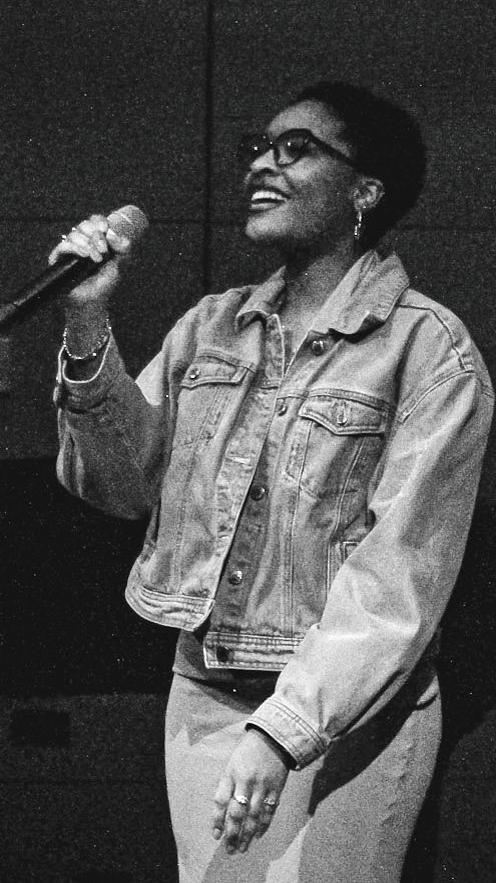
Freshman Mia Chase performs as balck history month showcase last week. Theater for the Culture hosted the Black History Month showcase to celebrate Black History Month Pharrell Every/ The Maroon
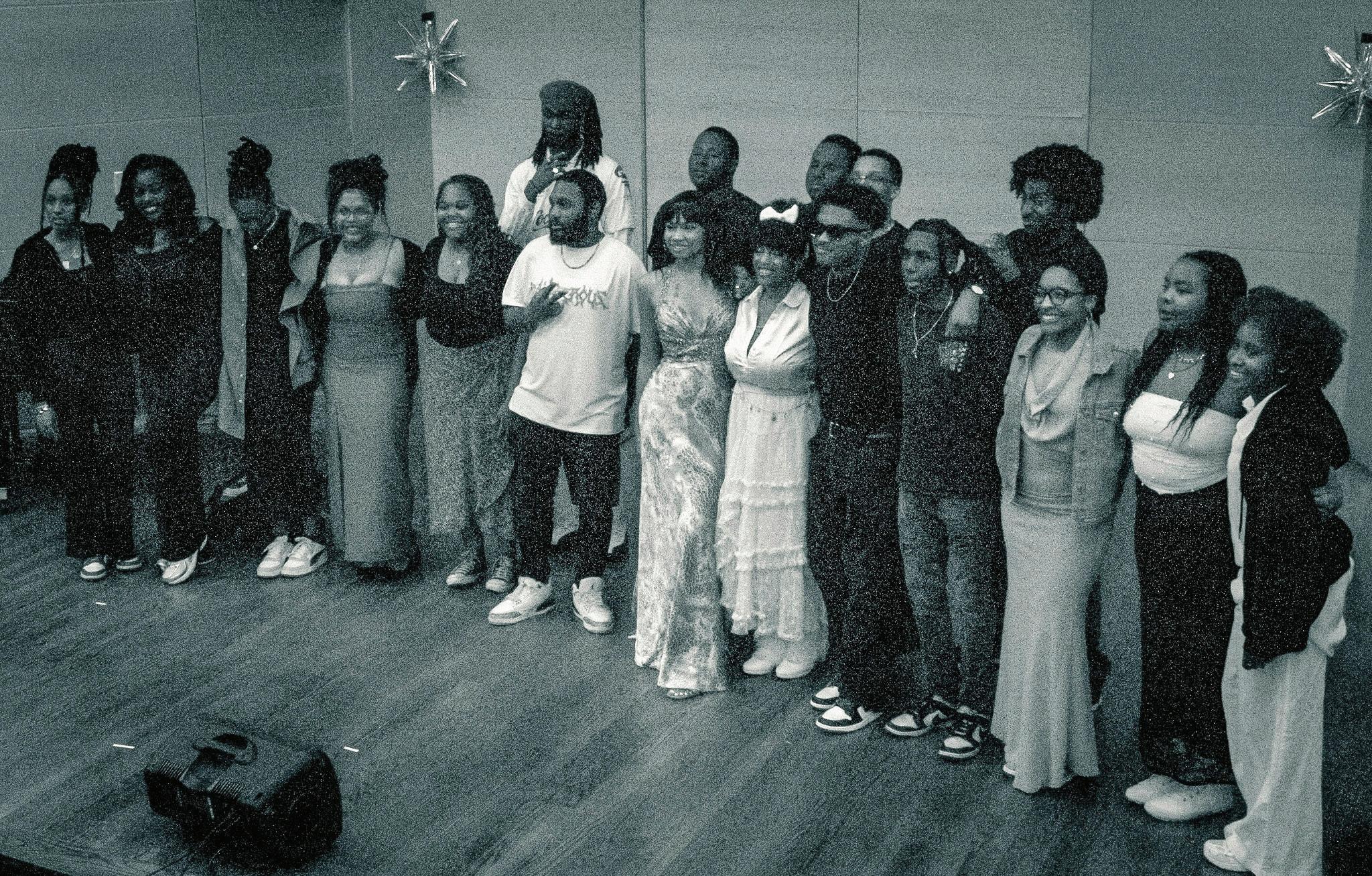
Performers from the Black History Month Showcase pose after the show. Theater for the Culture hosted the Black History Month showcase to celebrate Black History Month Pharrell Every/The Maroon

Aubrey Logan brings performance, industry insight to Loyola's jazz festival
By Elise Beck erbeck@my.loyno.edu
Celebrated trombonist and jazz vocalist Aubrey Logan is looking forward to teaching workshops at Loyola's jazz festival, as she brings skill and music business smarts to the university.
Logan will perform at Loyola’s 56th Annual Jazz Festival on March 7. Logan is looking forward to teaching workshops, which she will be leading on March 6 from 1-2 p.m. and March 7 from 12:30-1:30 p.m.
Logan will play her trombone during the clinics, which are free and open to the public, and attendees may ask questions.
“I went to festivals like this when I was in high school and I know how students feel, and what they’re thinking,” Logan said.
Logan explained that educating as an artist is different from being a band teacher at a school.
“I will say the same things that their band directors say, and then the kids say “oh yay” and the band directors roll their eyes because they say that every day and the kids don’t listen to them,” Logan joked.
“But, I am there to answer bigger questions because they get enough music education all day.” Logan said.
By “bigger,” Logan is referring to industry-wide standards.
“I like to get down to the practical side
of how to survive in the music industry.”
Logan said, explaining that learning the business side of the music industry has been challenging to her as a creative.
Logan will also be focusing on practical questions about playing music.
“I have like 14 steps to learn a song and perform it confidently.” She said, explaining that an hour per workshop is all she needs to communicate this to students.
Logan is also looking forward to answering student questions about her music career.
“I really like it when the students have researched me a little bit beforehand, because then they come with better questions. I do like to open the floor to questions. In almost all cases, somebody else has the same question as you,” Logan said.
Logan’s accomplishments include winning the Audience Choice Award and Jury’s First Place Award in 2009 at the world-renowned Shure-Montreux Jazz Festival in Switzerland. A couple of years ago, she released “Aubrey Logan and her Bigger Than Average Band.” (An album aptly named, as there were upwards of 30 musicians in the recording room.)
Students may recognize Logan’s work with music collective postmodern jukebox, a swing group that Logan covered Taylor Swift’s “Bad Blood” with in 2015.
The public also is invited to attend Logan’s performance, which will take

place at 4:30 p.m. in the Louis J. Roussel Performance Hall, in the Communications/Music Complex, 6363 St. Charles Avenue. She will be accompanied by the award-winning Loyola Jazz Ensemble, and the Crescent City Collective, Loyola’s jazz vocal group, also will be featured at the concert, according to a press release from Loyola.
Logan noted that she collaborated
with Gordon Towell, coordinator of Jazz Studies at Loyola, in making the setlist for the performance.
Towell said he is excited to bring Logan to Loyola – for her immense talent, her ability as a younger artist to connect with the students, and because of the sheer fact that she is playing music in a genre in which women are greatly underrepresented.
“Jazz has been a man’s world for all these years,” he said. “We need to break down those walls. We can’t go back and change the past, but we can hopefully influence the future. Without women’s voices, we are missing a big chunk of the music.”
Speaking on her role as a woman in jazz, Logan said “I don’t care that I’m a girl. I have a great time with the ladies in this industry. I have a great time with the boys in this industry. ” Her advice for any woman in male dominated areas is to “Be excellent. Be what you’re created to be, do your thing.”
When it comes to expressing oneself as a woman in the industry, she asks women to be more unapologetic. “Women kind of have this tendency to sometimes say ‘hey, I’m sorry, but this is my opinion.’ Don’t do that.” Logan asserted.
In addition to the clinics with Logan, various school bands will perform in 30-minute slots in Roussel Hall on March 6 and 7, followed by a clinic with faculty members to hone the pieces on which they are currently working.
“I hope to entertain and not just tickle nerdy brain cells, although I am interested in doing that too,” Logan said.
Tickets to the Aubrey Logan show on March 7 are $21 for all attendees. For more information or to purchase tickets to see the concerts featuring Halloran and Logan, and to RSVP for the faculty jazz concert, visit https://cmm.loyno. edu/loyola-presents.
Bridgerton season four indulges Benedict’s yearning
By Amari Winchester abwinche@my.loyno.edu
This contains spoilers for the new season
Dearest gentle reader, this new season of Bridgerton is one that was very anticipated by its viewers, myself included, for a multitude of reasons. The first reason is that we are officially in the halfway point in the Bridgerton franchise. Meaning, it's a turning point for the show as a whole. Secondly, this season focuses on Benedict Bridgerton, a fan favorite and a hopeless romantic. So I feel like I speak for everybody when I say, it's about damn time we got this season.
The season itself felt familiar, not just because it's a Bridgerton story, but because this is also a Cinderella story at heart. As a kid I loved the different versions of The Cinderella Story, like the ones with Selena Gomez or Hilary Duff. The reason why these movies were so popular was because they gave us a new perspective on the tale while making its own story. This season is going to hold up for the same reason. It gives the viewer a wave of nostalgia while standing on its own.
For those who don’t know, the hit Netflix show “Bridgerton”, based on the book series by Julia Quin, is a show that takes place in a fictional version of the British recency era. Both the book and the show focus on the Bridgerton family and the rest of the members of high society.
One of my favorite aspects of this season is its emphasis on the working class. I've always found that part of the Bridgerton world interesting. Because yes, a part of the show is the spectacle of seeing these rich families go about society. But
why don’t we have more insight about the people who help these families go about their lives? This new perspective gave us viewers the understanding on why Benedict and Sophie's relationship was so controversial. It made seeing them together in the end much more impactful. So not only was it a refreshing decision, but it was a needed one.
Speaking of Sophie, she was truly one of the standout characters this season.
Played by the beautiful Yerin Ha, the story of this character was a heart breaking one. Sophie is forever stained by the circumstance of her birth, something that she had no control over. As a result of Araminta (played by Katie Leung) she is stamped as a maid. It hurts to see how those parts of her life are constantly held against her. The fact that she was an illegitimate child living without her mother.
The fact that she was forced to become a maid by Araminta who was just keeping her around after her fathers death so she could steal their money. Because of this situation with Benedict, she doesn’t even have a sense of job security anymore. But it's admirable to see her not only overcome those marks on her life not only because she chooses love , but because she also chooses herself as sees that she deserves happiness too. It was also satisfying to see her become part of society like she always deserved to be. I'm excited to see more from her in future seasons.
My only main gripe with this season is that I feel like Araminta got away with way too much in the end. Araminta was not only abusive to Sophie, but she stole the money that belonged to Sophie and by extension the Penwood family. For all that she did, Araminta basically got a slap of the wrist.
And while I appreciate Posy Li’s character (played by Isabella Wei) for going against her mother and helping Sophie I just wish her character did more in the story too.
Another standout character of this season is one and only Francesca Bridgerton played by Hannah Dodd. The tragedy of episode seven of this season really showed the strength of Francesca as a person and Dodd as an actress. I’m not going to lie to y’all, this episode made me cry MULTIPLE times. It was seeing Francesca trying to hold it all together on a day that she shouldn’t have been the one to do that. It was seeing her forced to an examination that only confirmed her worst fears: that she wasn’t pregnant. t not only confirmed her doubts of being a good wife, but to her, she now has nothing to remember John by.
You’d think, “At least she has John's cousin Michaela,” but she ends up leaving too. Michaela leaves because she ends up having feelings for her late cousin’s wife. Which is for sure going to have an impact on their relationship when it comes to Michaela and Francesca's season.
While his time was short on the show, John Stirling, played by Victor Alli, truly was an example of how being loved is to be seen. He was the one that rearranged music exactly how Francesca wanted it. He was the one who didn’t care about having children with her, John just wanted Francesca to her fullest capacity. Not only did we see Francesca lose her husband, but we saw her lose one of the few people who saw her. And the fact that to her, she doesn't have anything to remember him by, is truly the most tragic part about her story this season.
Another thing that I noticed about
this season was its theme of change. Throughout the story, we see these characters that we’ve known for so long go through different stages in their lives. Lady Danbury removing herself from society, Penelope retiring her alias as Lady Whistledown, the Monrich family cementing their places in high society, Gregory and Hyacinth entering adulthood, and even Lady Bridgerton, who is starting to move on from her late husband. Earlier I said that this season is the turning point of the show. If you had to ask me, this means that we are probably going to see fewer siblings that are married than we already do, because eventually we are going to get Gregory and Hyacinth's seasons.
And while this is me being hypothetical, if it were to happen, I feel as though this season was a good way to introduce a new era of the show as a whole. The story was captivating, it was lively in some ways, but subtle in others. It knew when to hit you with the emotion, while also knowing when to make you swoon at the romance. This author thought that season four was truly something needed and I hope that they handle the rest of these seasons with the same care.


Aubrey Logan, jazz vocalist and saxophonist. Courtesy of Aubrey Logan
Graphic by Makayla Parker
Bridgerton season 4 poster, courtesy of Netflix
LIFE AND TIMES
“Wuthering Heights”? More like Wuthering Plights!
By Stella Perdue swperdue@my.loyno.edu
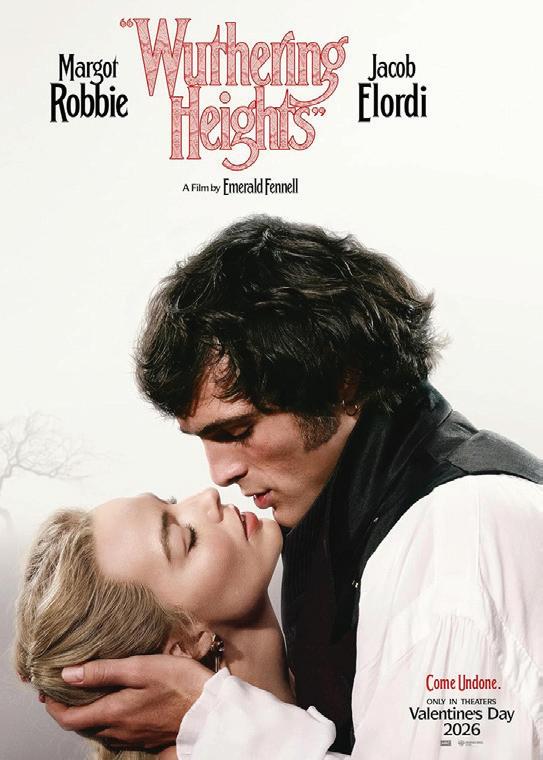
Emerald Fennell needs to put her camera down. e lmmaker known for “Saltburn” and “Promising Young Woman” tried her hand at adapting one of the most nuanced pieces of media, Emily Brontë’s classic novel Wuthering Heights, and failed miserably.
e lm focuses too much on aesthetics and lacks substance entirely. It looks good, but there is nothing there. Not to mention the obvious: Margot Robbie cannot play a sixteen-year-old, and Ja-
cob Elordi is a white man from Australia, not a Romani person. And the two don’t even have sexual chemistry.
From the moment I heard about the movie, I knew I wouldn’t like it for reasons I’ll get into, but I still had a glimmer of hope. I thought the “Wuthering Heights” title indicated some sort of meta moment, like a lm aware of itself–perhaps it would be a commentary on someone interpreting the novel for the rst time? Alas, I was so, so wrong.
I love this book. It is a masterclass in Gothic literature and deserves its classic status in the canon, so as a person forever entranced by Brontë’s prose and as a literature student, I have much to say.
For those who are unaware, Wuthering Heights is a commentary on race, class, and generational trauma. e form of the novel is set up in a haunting, gothic manner–Catherine haunts Heathcli and her ghostly presence is forever a reminder of his forsaken potential. is is not a love story. is is about two characters, foils of one another, who are so deep into the moral black there is no way to resolve it, so the book’s only hope for resolution is its next generation. (Mind you, Fennell cut the entire second half from the movie. I was so upset that I made my rst ever one star review on Letterboxd).
Cathy was a complex, deluded, cowardly brat. Heathcli was subjected to plethoras of violence and rejection in his
childhood, never healed from it, so he perpetuates that violence in adulthood. Fennell’s adaptation barely scratches the surface of any of these themes.
Instead of becoming an inherently horrible human being (beckoning important questions on the ever-present nature vs. nurture problem) Heathcli is given the “toxic bad boy” trope treatment. He’s toxic so the audience is supposed to love him–they are supposed to forget about his assault and mistreatment of Isabella (his wife), and consider their scenes erotic, consensual. I couldn’t help but wonder if Fennell was trying to turn Heathcli into a version of Mr. Darcy that’s into BDSM or something.
A huge problem I have is that Heathcli is not meant to be white in the novel and that is a major reason for his being discriminated against and subjected to structural violence by Catherine’s brother, Hindley.
If someone is going to adapt this story, the bare minimum would involve not casting a white man. Fennell couldn’t even do that. Why? She loves Jacob Elordi too much, so much so that she was willing to let representation fall by the wayside. Once again, Fennell favors aesthetics over substance–the aesthetics in question being Elordi’s abs.
Now, if you know anything about Emerald Fennell, it’s that she has to make literally everything about sex. Don’t call me
a prude–I’m not one, I swear, I just think that there is a time and place for eroticism in lm. Wuthering Heights is not the time nor the place. Every other scene was trying to be erotic in some way but came o as cringe or disgusting. Fennell was trying to do weird sensual imagery with food, but there was no philosophy behind it, so every attempt fell at.
In one scene, someone is baking and cracking eggs. e camera focuses on the egg yolk and the gooey whites. In another, Cathy pokes a jello sh at the dinner table. ese scenes made literally no sense and didn’t even get a laugh from me. It was like Fennell was trying to reheat her own Saltburn nachos in the ickiest way possible. It wasn’t experimental, nuanced, or avant garde–it was just abject in a laughable way.
More on that, the BDSM and kink stu was entirely misplaced and made no sense. Two characters that were originally depicted as god-fearing, mumbling comedic relief, were instead showcased a la S&M by Rihanna in a wooden shed. It, again, made no sense. I don’t think the Georgians got down like that.
e scene with Isabella made me the angriest. In the book, Isabella is a literal innocent child subjected to sexual assault by Heathcli . Fennell fetishizes her in the movie, turning her into some sort of submissive who willingly wears dog collars and barks. It was so distasteful
and disheartening to see.
e score by Charli XCX was good, but putting “House” in the rst scene elicited many silent giggles from me in the theater. e costumes were misplaced as well. Margot Robbie looks like Holiday Barbie or a Twin Peaks employee wearing milkmaid costumes. I think it would be in Fennell’s best interest to write a heartfelt apology to the Brontë estate. I bet a trillion bucks that Emily is rolling over in her grave. So are literary scholars everywhere.
Fairgrounds Race Course and Slots presents "clash of colleges" race
By Mary Ella Hastings mlhastin@my.loyno.edu
Clash of e Colleges Twilight Races, presented by Pepsi, will be at the New Orleans Fairgrounds on March 14. e event starts at 3:00 p.m with a series of 10 thoroughbred horse races.
e Brats, a progressive polka New Orleans band, will perform near the Beer garden from 4:00 - 7:00 p.m.
e races will be followed with a Where Y’acht party on the 4th oor of the clubhouse from 8:00 - 11:00 p.m. e event is all ages, and costs $20 for general admission and $30 for Grandstand clubhouse tickets. Tickets are available on Ticketmaster or at the door until sold out.


Jockey rides horse at the fair grounds, photo courtesy of New Orleans Fair Grounds
Jockeys ride horses at the fair grounds, photo courtesy of New Orleans Fair Grounds
courtesy of IMDB
















NOPD changes its policy to allow more cooperation with ICE
By Pablo Piñeiro Ramy ppineiro@my.loyno.edu
The New Orleans Police Department changed a decade-long policy to allow more cooperation with Immigration and Customs Enforcement. For a decade, NOPD policy barred officers from complying with immigration detainers. The policy had drawn accusations by Republicans that New Orleans was a “sanctuary city.” The new NOPD policy requires officers to
remand people with “detainers” to ICE if local jails won’t hold them.
M. Isabel Medina, a professor at Loyola University New Orleans College of Law, explained what a detainer is in law enforcement.
“The detainer is something that usually ICE, the Department of Homeland Security, issues to a state or county… asking them to detain a noncitizen that is in their custody,” Medina said.
In December, Republican Attorney General Liz Murrill wrote a letter to
Superintendent Anne Kirkpatrick urging her to change the policy.
“I look forward to working with you and NOPD to ensure its policies and actions comply with state law,” Murrill said. “At this time, I recommend that you immediately direct NOPD officers and staff to fully cooperate with ICE and [Customs and Border Protection].”
Medina believes this new policy might change the relationship between immigrant communities and the NOPD.
“The problem with these policies is that they impair the ability of police to actually [stop] crime,” Medina said.
“You want communities that are willing to interact with the police, that are willing to report to the police, that are not actively hiding from the police… These are policies that could affect the willingness to report crimes.”
New Orleans mayor Helena Moreno defended the NOPD’s decision, saying that the policy change stems from an effort to comply with state law.
“Because of the state law change… the attorney general wanted to ensure that the NOPD was following law by reflecting that in their policies," Moreno said.
However, Moreno also said that the NOPD “will never sign a cooperative agreement to join in on immigration enforcement.”

Loyola students frustrated by government shutdown effects
By Dominique Campbell ddcampbe@my.loyno.edu
The U.S. government has suspended the Global Entry program as a partial government shutdown continues.
The announcement was made after the Department of Homeland Security said Saturday, Feb. 27 that they planned to shut down both the Global Entry program and the Transportation Security Administration’s PreCheck program. Eventually, DHS made the decision to cancel the TSA PreCheck closure.
Global Entry is a United States Customs and Border program that allows travelers to use expedited kiosks at airports in the United States when they return from abroad
“As staffing constraints arise, TSA will evaluate on a case-by-case basis and adjust operations accordingly,” DHS said.
Amid the changes to both programs, there has been chaos across the country at the nation’s airports as a result of the partial government shutdown. The partial shutdown began Feb. 14. The shutdown stems from Congress not being able to agree to continued funding for the Department of Homeland Security.
The disruptions to both security programs came in the midst of a winter storm that was already bound to affect air travel. With both programs in limbo, travelers can expect delays in security lines.
There have been no specific studies
done to show how the use of both security programs either speeds up travelers’ times in the security lines or slows it down.
“Shutdowns have serious real world consequences,” Department of Homeland Security Secretary Kristi Noem said.
Noem also stated that she would take away courtesy escorts from members of Congress at airports during the partial government shutdown as well.
Airlines for America, a trade group representing major carriers, issued Saturday, Feb. 27 stating, “It’s past time for Congress to get to the table and get a deal done.”
The organization also criticized the announcement by DHS saying that the issuance was “ extremely short notice to travelers, giving them little time to plan accordingly.”
Loyola’s student community is a patchwork made up of both students from the United States and students from abroad. When it comes to this piece of policy temporarily inconveniencing not just the general public but students from Loyola, one would have to wonder about the immediate impact it could have on not just the everyday traveler, but the students on Loyola’s campus.
Nursing student Lauren Richards expressed concern about how the shutdown could affect students at Loyola, especially those who live abroad.
“I think with how everything is right now, with Global Entry now being suspended, it could be seen as challenging for students in our community to navigate travel,” Lauren said. “It’s disheartening."
Senior Audry Gilbert was very passionate about the idea that students in the Loyola community should be able to travel without fear of an inconvenience.
“[The suspension] makes students in our community feel unsafe. People should be able to move about without fear,” Gilbert said. “It makes Loyola feel like less of a community, because let’s be honest, what’s a community if you’re not sure that you’re going to be able to make it back safely to said community.”
Junior Izzy Gruner said, “This situation makes it extremely difficult for students to travel back and forth, especially if they are at the end of their Visa and they are attempting to renew it, it’s not always a guarantee at this time.”
Gruner also agreed with Gilbert on the idea that it is not necessary to keep the program suspended.
The Associated Press contributed to this report.

New Orleans Police Department superintendent Anne Kirkpatrick, with members of police command staff during a press conference at police headquarters in New Orleans, Monday, Jan. 5, 2026. David Grunfeld/The Times-Picayune/The New Orleans Advocate via AP

O’Dell, Thornton and Jackson hit 1,000-point milestone
By Alana Frank writeremail@loyno.edu
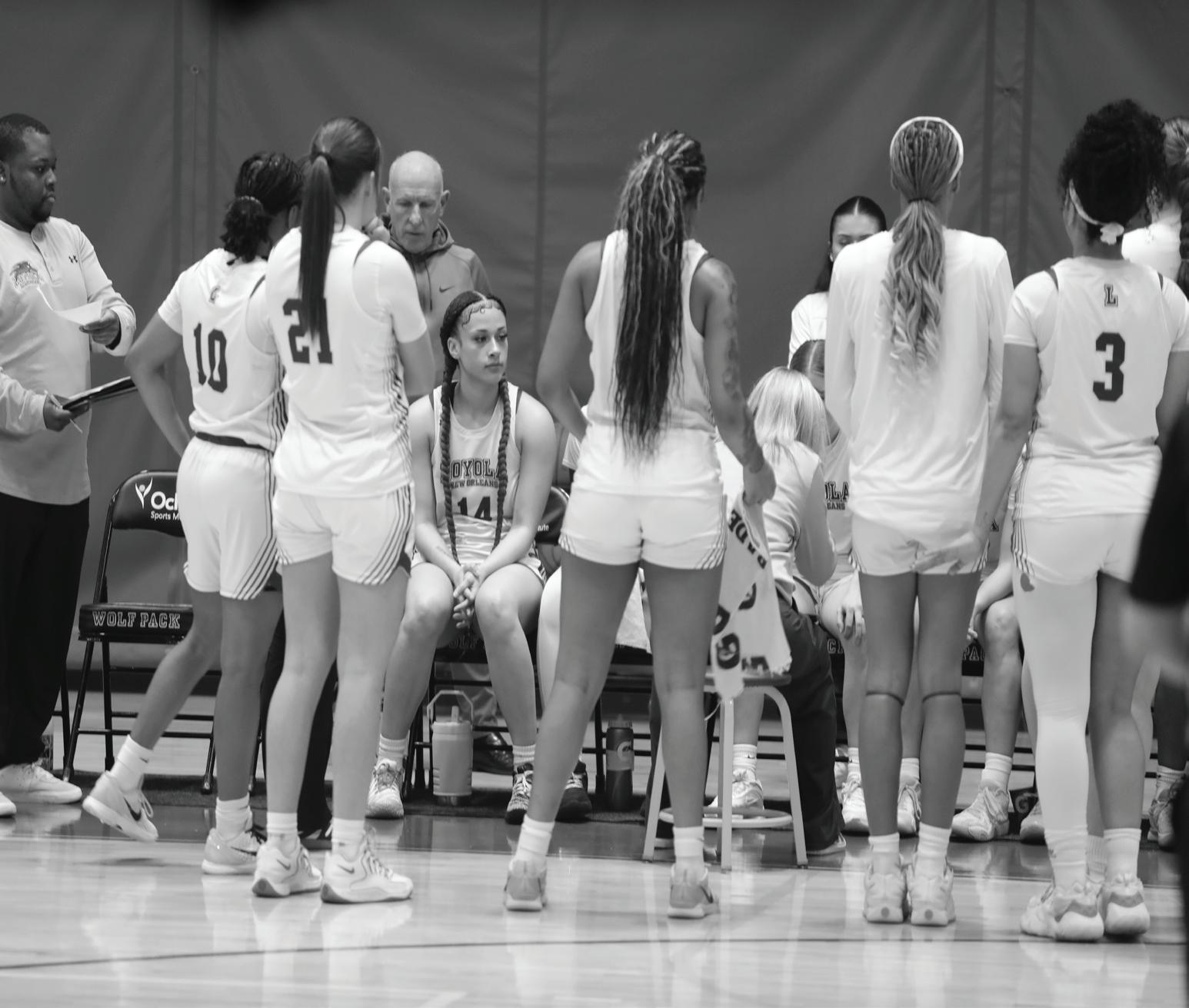
As Loyola's Wolf Pack pushes through postseason play, three basketball players have reached one of the sport’s most respected milestones, and they did it within two weeks of each other.
Juniors Alissa O’Dell, Deniya Thornton, and senior Leonard Jackson III, each scored 1,000 career points this season, cementing their names in Loyola’s record books. The rare achievement highlights not only individual talent, but years of consistency, discipline and teamwork at the collegiate level.
Reaching 1,000 career points is widely considered one of the toughest milestones in college basketball. Unlike high school, where seasons are longer and competition levels vary, college athletes face shorter seasons and limited playing time. To score 1,000 points, a player must average double digits for multiple seasons while staying healthy and academically eligible. It demands longevity, focus and consistent scoring year after year.
Men's Swimming
Mar. 06
NAIA National Championship Elkhart, Ind
Men's Baseball
Mar. 06
RV Abraham Baldwin Tifton, Ga 1:00 pm.
For Thornton, hitting 1,000 at the college level felt especially meaningful.
“Reaching 1,000 points has been a great honor,” Thornton said. “It was something I did in high school, but I realized doing it in college was a different level that I can gladly say I reached.”
Thornton said she intentionally tried not to obsess over the number as it approached.
“I tried not to think about it a lot because I didn’t want it to affect my regular ways of playing,” she said. “But once I realized I was 13 points away, I knew I would get it that game.”
She credits her teammates for making it possible long before the milestone moment.
“Way before the 1,000 points, all the teammates I have had did a great job at finding me and hitting me to score,” Thornton said. “That game specifically they were more excited than me honestly, and I think it’s what pushed me to reach the milestone.”
O’Dell shared a similar sense of gratitude and reflection.
“Reaching 1,000 career points means
everything to me,” O’Dell said. “It represents years of hard work, early mornings, late nights, and the support of so many people who believed in me. It’s more than just a number. It’s a symbol of growth, perseverance and dedication to the game.”
She began to realize the milestone was within reach midway through the season.
“At first, I tried not to focus on it too much because I didn’t want it to distract from team goals,” she said. “But as the games went on and the numbers got closer, it definitely became more real and exciting.”
Like Thornton, O’Dell said that the accomplishment was a team effort.
“Basketball is a team sport, and I wouldn’t have reached this milestone without them,” she said. “They set great screens, made the extra pass, pushed the pace and constantly encouraged me. Their trust and unselfishness created scoring opportunities.”
O’Dell added that one of the biggest challenges throughout her career has been balancing academics and athlet-
ics. Managing practices, games, travel and schoolwork required discipline and strong time management, lessons she said helped her grow mentally stronger.
For Jackson, the milestone carried extra weight. Unlike his teammates, he never reached 1,000 points in high school.
“This is a special moment for me,” Jackson said. “I never got the opportunity to get it in high school, so getting it in college is definitely an accomplishment for me.”
He said the reality of the milestone did not fully set in until January after the team’s game against Southern University of New Orleans, when he realized he was within striking distance.
“To be honest, I never thought that I was this close to reaching 1,000 points,” Jackson said. “It just never crossed my mind.”
Once he was within 100 points, however, his teammates made it a collective mission, especially as Senior Night approached.
“My teammates were all in with it, assisting me in any way they could,” Jackson said. “Whether it was getting extra
Upcoming games
Women's Tennis
Mar. 06
NAIA National Championship Elkhart.Ind
Men's Tennis
Mar. 06 vs. Our Lady of the Lake New Orleans, La at 3:00 pm.
Men's Track & Field
Mar. 06
NAIA National Championship Elkhart, Ind
shots or getting open looks in the game, my teammates were always there for me. When it came time to do it on Senior Night, everyone knew what time it was.” While Loyola has celebrated 1,000-point scorers before, having three players reach the milestone within two weeks of each other is uncommon and highlights the strength and depth of this year’s teams.
Women's Track & Field Competitive Cheer
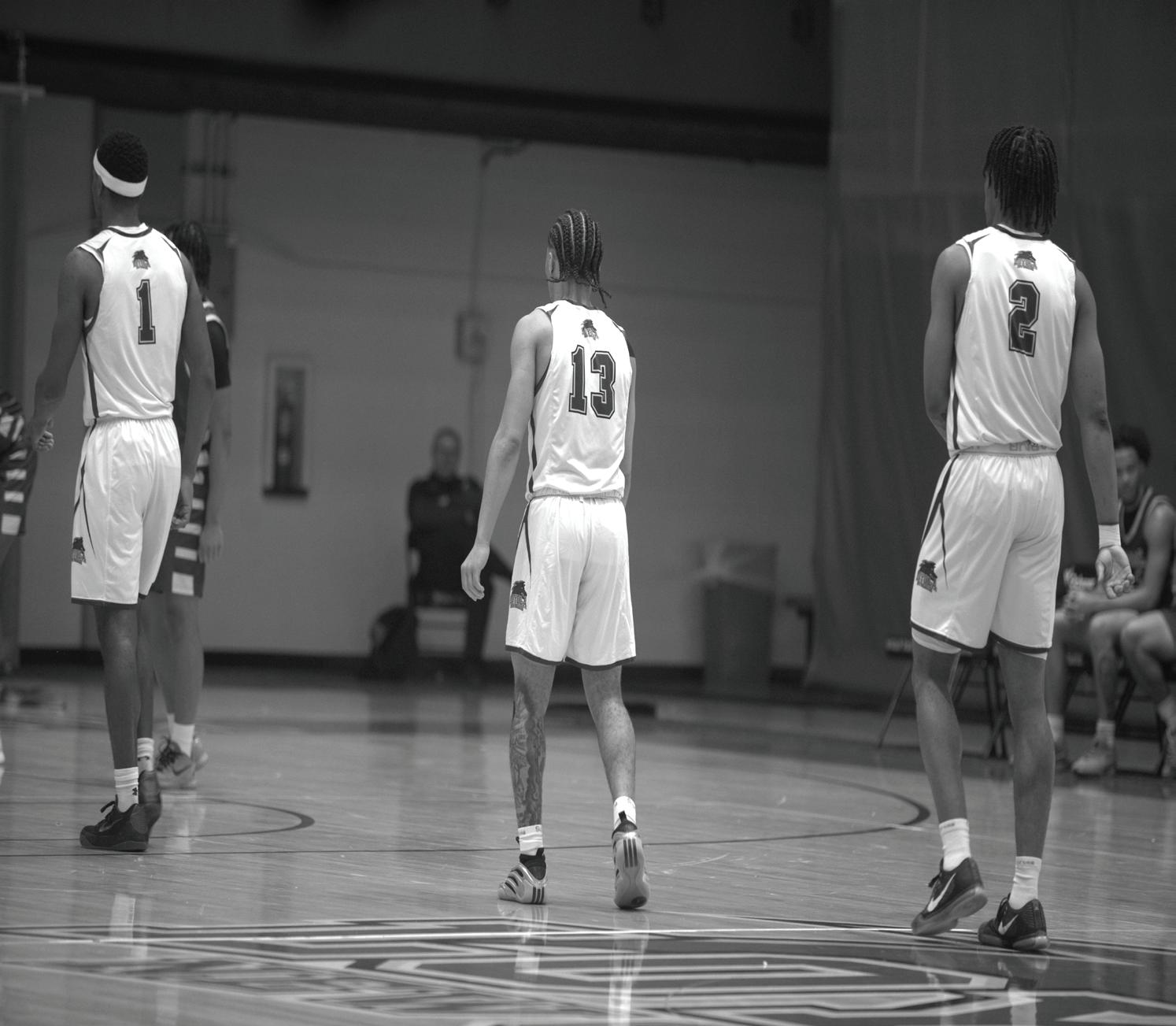
Leonard Jackson, Kameron Johnson, and Zachary Lee playing at The Den. Jackson has recently made 1,000 career point at Loyola. Dessadra Tezeno/The Maroon
The womens basketball team in the side court during a part time .Alissa O'dell and Denyia Thorntin have recently scored.1,000 career points. Keri Smith/The Maroon
Two gold medals. One persistent hierarchy
By Imadunisa Siddiqui isiddiqu@my.loyno.edu
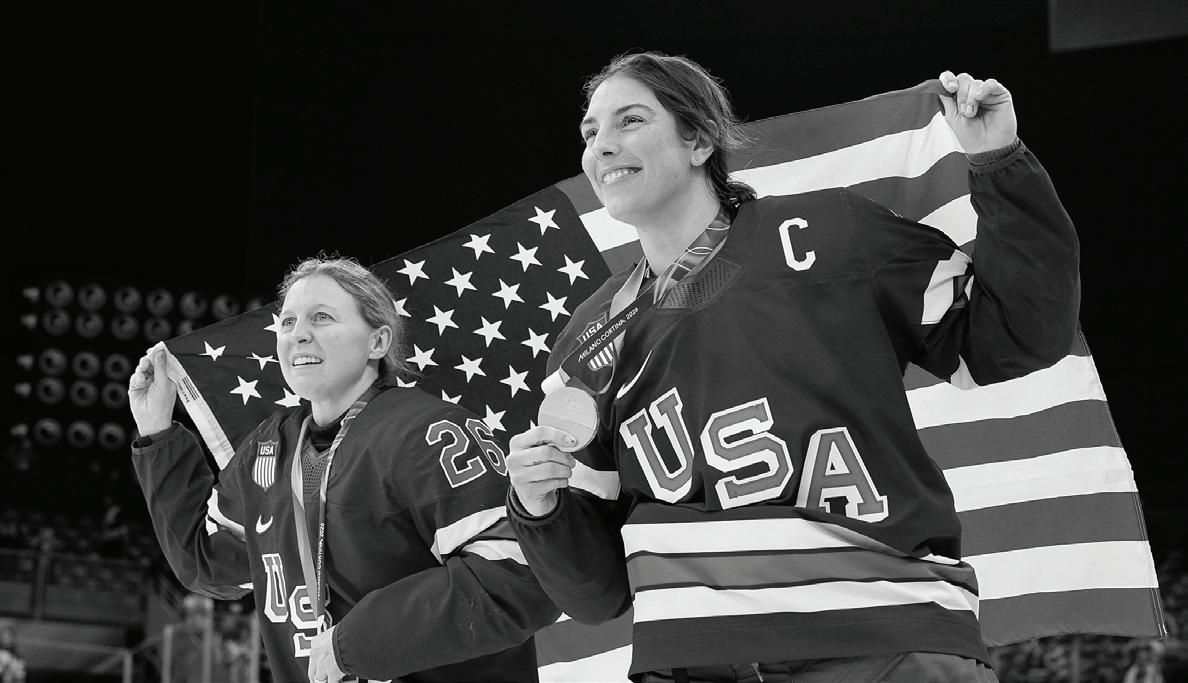
When both Olympic U.S. hockey teams won gold, it should have been uncomplicated: two teams, two victories, one nation celebrating excellence. Instead, what lingered was a joke.
When U.S. President Donald Trump quipped that he would be impeached if he did not invite the women’s team, it was framed as harmless humor. But humor reveals hierarchy. Beneath the laughter was an assumption: celebrating men is expected, celebrating women is political.
That reflex is not isolated. It is part of a broader cultural pattern feminism has been naming for decades.
Feminism, at its core, is about dismantling asymmetry, the idea that men are the default and women are the variation. It asks why women’s achievements are treated as symbolic, while men’s are treated as natural. Why women must manage tone, clothing, and likability alongside competence.
I learned this long before I read feminist theory.
I went to an all girls high school. In that space, I was surrounded by women who made one another stronger. If one of us stumbled in debate practice, another stepped in and carried the argument forward. If one doubted herself, another
reminded her she belonged. Leadership did not look unusual. Authority did not feel borrowed. Strength was not something we had to justify.
Before competitions, our coach would remind us, hair neat, skirts appropriate, voices firm but not too firm. At the time, I was frustrated. Judges were supposed to evaluate logic, not appearance. But she knew what we would face. She knew that girls are often judged for intensity in ways boys are not.
Inside our school walls, we practiced power without apology. Now, sitting in college classrooms discussing early remarks of sexism in philosophy, I feel grateful. Grateful that before stepping into coeducational spaces where hierarchy still hums quietly beneath discussion, I knew what it felt like to belong completely. I wish every woman experienced that kind of safety at least once, a room where ambition is not softened, where strength is mirrored back to you.
That experience shapes how I see moments like the hockey joke.
It also shapes how I see the Hughes family dynamic. The Hughes family is one of the most well-known families in modern hockey with brothers Quinn, Jack, and Luke Hughes all playing in the National Hockey League and their mother, Ellen Weinberg-Hughes, a former women’s hockey player and longtime
coach in the sport. When a mother who coaches women’s hockey defends her sons’ behavior, it is easy to call it hypocrisy. But feminism teaches us something more complicated. Gender inequality persists partly because women are emotionally intertwined with the men who benefit from it. There is love, pride, and loyalty. There is the instinct to protect your child before you critique the system. Sexism rarely has a distant villain. It lives in proximity.
And yet proximity does not erase structure.
Feminist Michelle Rosaldo described what she called global asymmetry, the disproportionate assignment of value and authority to men. Even when outcomes are equal, meanings are not. Both hockey teams can win gold, yet only one victory feels inevitable.
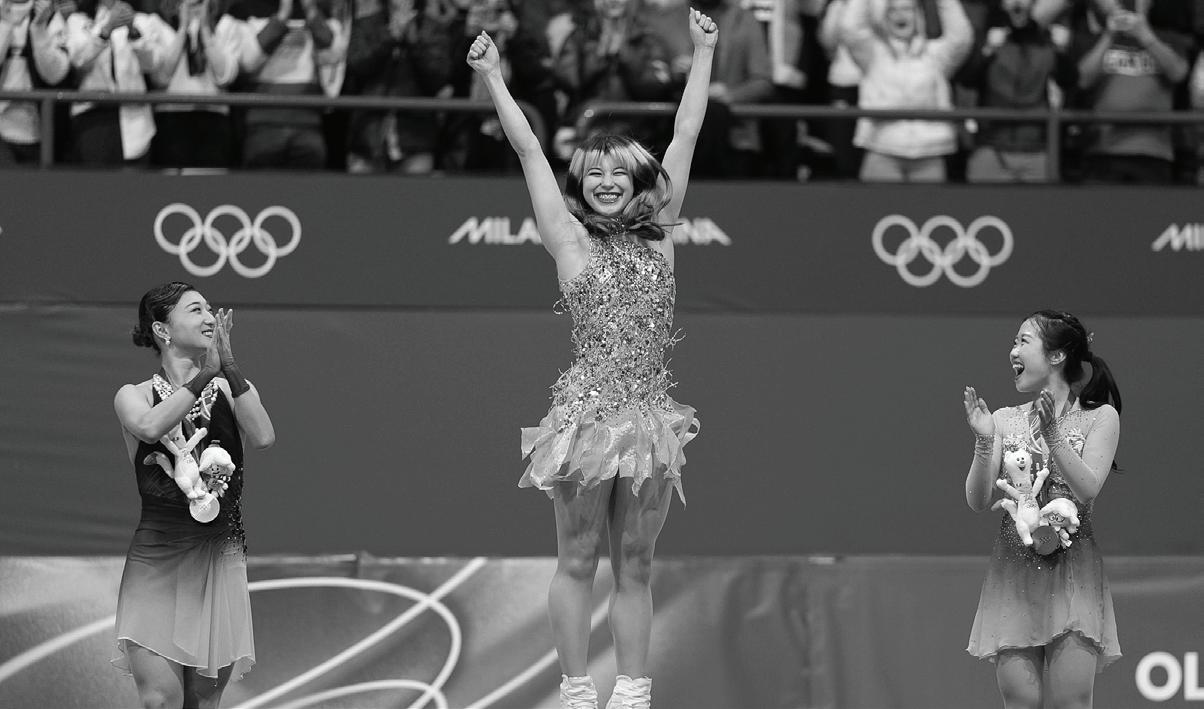
Look at Olympic history: Serena Williams redefined dominance in tennis, yet her body and temperament were scrutinized more than her skill. Simone Biles revolutionized gymnastics, performing skills no other woman could match, yet faced criticism when prioritizing her mental health. Megan Rapinoe led the U.S. women’s soccer team to victory and demanded equal pay, becoming both a champion and a lightning rod.
Trailblazers are rarely allowed to simply exist as athletes. They become symbols, controversies, debates.
The wage gap persists. Women in the United States still earn, on average, less than men for comparable work, with disparities widening for women of color. The Women's National Basketball Association continues to generate talent that rivals the NBA in skill and dedication, yet players are paid a fraction of what male athletes earn. These disparities are defended with market logic, but markets themselves are shaped by cultural valuation. When women’s sports are treated as secondary, investment follows that assumption.
Sexism is not just about attitudes. It is about valuation and valuation is global.
When we talk about Iran, nuance matters. The Women, Life, Freedom
movement emerged after the death of Mahsa Amini, a young woman detained for allegedly violating dress codes. Schoolgirls removed their headscarves in protest. Some were killed. That is not liberation.
But feminism in the United States must also resist oversimplifying Iran as a backdrop for Western moral superiority. American leftist feminism sometimes assumes liberation looks one specific way, unveiled, secular, Western. Yet feminism, at its heart, is about agency.
subject to regulation.
When a political joke frames celebrating women athletes as optional, it echoes that same hierarchy. It suggests that women’s excellence is negotiable. I think back to my high school often. I think about the sound of girls arguing fiercely about policy, unafraid of being called emotional. I think about how we clapped for one another without hesitation. I think about how, if one woman could not do it, another woman could. That is feminism at its most power-
A woman choosing to cover herself can be as much an expression of autonomy as a woman choosing not to. Liberation is not defined by fabric. It is defined by choice.
Liberation is not violence in the name of saving women. Liberation is the absence of coercion, whether that coercion comes from the state, from culture, or from expectation.
The spectrum of sexism stretches from subtle calibration in debate rooms to lethal enforcement in authoritarian regimes. They are not equivalent in severity, but they share a root assumption, that women’s bodies and behaviors are
ful, not just critique, but creation. The creation of spaces where women do not have to shrink.
Both hockey teams won gold. That fact should stand alone.
Feminism asks for nothing more radical than this, that women’s victories be treated as victories, not as political statements. That women’s autonomy be respected whether expressed through speech, sport, or self presentation. That every girl grows up knowing what it feels like to belong in her own strength. That is not a demand for special treatment.
It is a demand for symmetry.
Entertainment over substance

By Maria Touzard jmstouzar@my.loyno.edu
As consumerism and technology continue to rise and root themselves globally, the matter of finding meaning through the endless amounts of hollow entertainment becomes an even more significant issue. Social media, sensationalism, and reality shows have been taking over society for the last few decades, creating an era where individuals are constantly looking to be entertained. This active seeking of entertainment is not one that comes with a desire to truly acquire anything from the media consumed, but a now seemingly instinctual form of distraction.
Through the consuming wave of escapism that has infested these last generations, works of real substance, media with actual soul, have been left in the background, as this continuous search for entertainment leaves no room for true analytical thinking.
Though all sorts of media are regularly shoved down our throats, whether we like it or not, it would not be fair to say that each and everyone of these works is absolutely shallow. There is still some light in this vastly deep pit of distraction we have created. Yet, if you take a mo-
ment to let what you consume sink in, if you truly analyze the information being given to you, you’ll find that most of the time, it does not offer space for critical thinking nor does it introduce any sort of meaning or substance to your life. Entertainment is now created in masses, and almost exclusively for passive, active consumption.
A prime example of these ever-present escapist tendencies is that of what “booktok” and social media have popularized in the literary world. Tiktok is filled with reviews, recommendations and opinions in literature. It is important to note that there are some great creators with a lot of useful, thoughtful, philosophical insights. Yet, the content that always remains with the highest interactions is that of creators that explore literature created for mass consumption with little to no necessity for any thinking further or deeper than what is merely on the pages read. I like to think of these books as the equivalent of spending hours scrolling on social media, where you consume a lot of shallow, meaningless information given to you, only to never think about it again.
For those who still doubt that this is truly happening, I tried out a little experi-
ment with some people around campus. I gave the following list of names: Annie Ernaux, Mario Vargas Llosa, Colleen Hoover, Svetlana Alexievich. Out of these lists, 3 are winners of the Nobel Prize in Literature, one writes toxic romance books. I then asked if any of these was a familiar name. Most answered only knowing of Colleen Hoover. Now, I am not passing judgement on the fact that people do not recognize Nobel Prize winners, as not everyone keeps tabs on these prizes or on the literary world. However, it is most appalling for an author with weak narratives and lack of range in plot and genres to be more popular and recognized than those awarded with the highest achievement one can earn in literature.
This idea is not an easy one to digest, faced with the harsh truth that we have all fallen for the trap of entertainment is a rather unsightly reality. However, it is most important to be able to recognize our short-comings, for how can things possibly change if the truth is avoided due to fear of discomfort? Now more than ever, it is absolutely necessary to think twice not only about the media you consume, but why you consume it.
Photo courtesy of AP Photo /The Maroon
From left to right, silver medalist Kaori Sakamoto of Japan, gold medalist Alysa Liu of the United States, and bronze medalist Ami Nakai of Japan, jump on the podium to receive their medals after competing in the women's free skate program in figure skating at the 2026 Winter Olympics, in Milan, Italy, Thursday, Feb. 19, 2026. (AP Photo/ Stephanie Scarbrough)/The Maroon
Makayla Parker/The Maroon
The Maroon
March 6, 2026
When politics become noise, democracy su ers
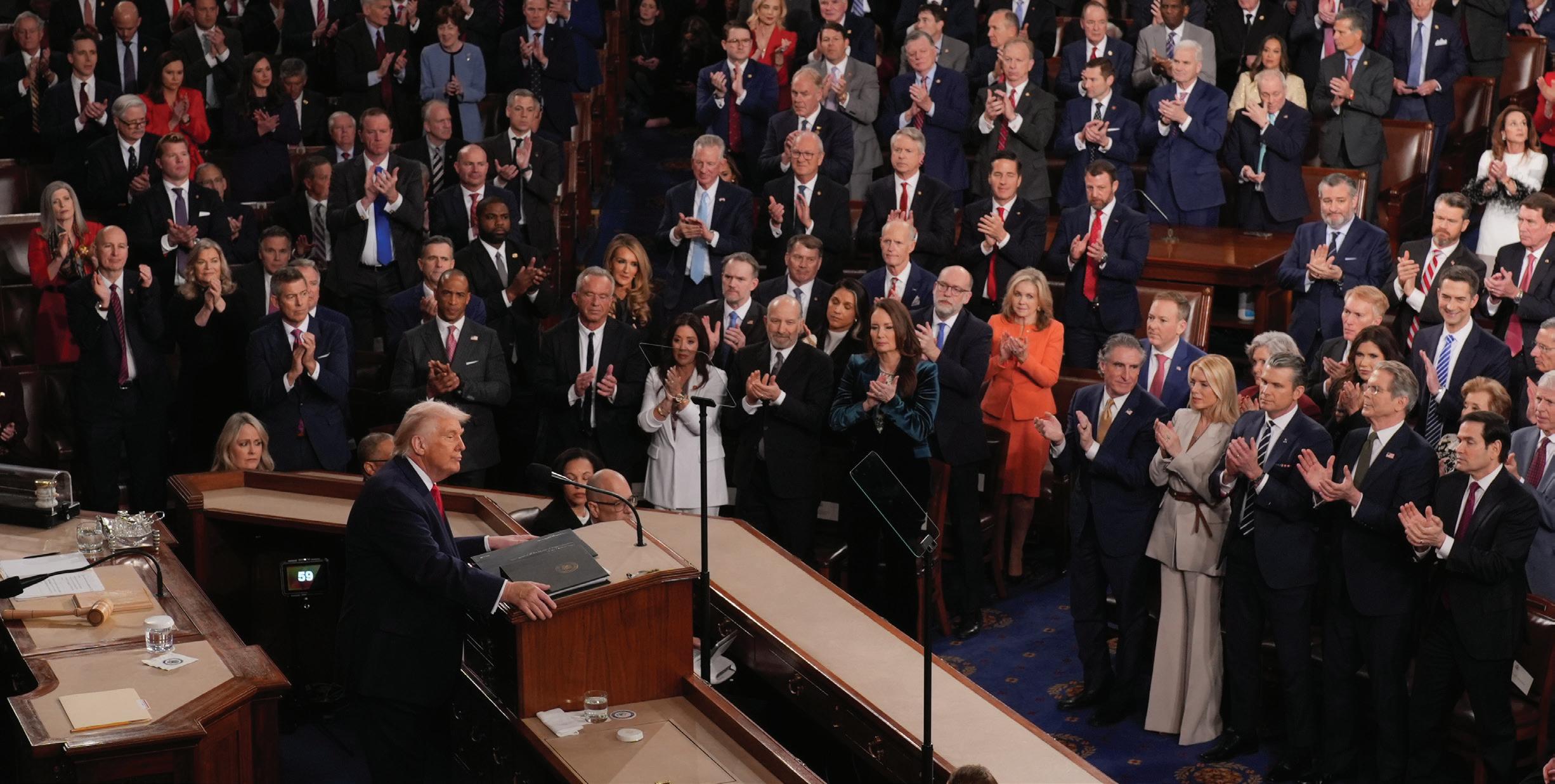
Every year, the State of the Union is supposed to o er clarity to the American people. It should explain where the country stands and where it is headed. is year, however, the address from U.S. President Donald Trump felt distant from reality.
Part of the problem is that many Americans are already exhausted by politics.
e constant scandals, partisan conict, and political spectacle have made it di cult for people to stay engaged. Eventually, politics begins to feel like white noise.
And when politics becomes noise, people stop listening, reading, and fall into a trap of ignoring politics overall. at may be the most dangerous outcome of all.
When people feel frustrated or angry about politics, the easiest response is to ignore them. Scrolling past political news or disengaging completely can feel like a way to protect one's peace of mind. But apathy does not protect citizens. In many ways, it protects the people already in power.
If citizens stop paying attention, accountability weakens.
Leaders no longer feel pressure to explain decisions or respond to public concerns. Silence becomes permission and history shows that when people give up hope in the face of wrongdoing,
Editorial Board
Editor in Chief
Eloise Pickering
Managing Editor for Print
Mary Ella Hastings
Pre-Content Director
Alana Frank
Post-Content Director
Callie Honeycutt
Campus News Editor
Lily Bordelon
Campus News Editor
Stella Perdue
Worldview Editor
Pablo Pineiro-Ramy
they allow that wrongdoing to continue. Ignoring injustices does not neutralize it. In many ways, surrendering to indi erence allows it to grow.
is is exactly why speeches like the State of the Union matter.
is was the longest State of the Union in modern history, yet Trump managed to say a lot while saying very little.
Length is not leadership. A long speech does not automatically provide answers. At more than an hour and fteen minutes, the address should have o ered direction and reassurance. Instead, many people were left with the same basic questions:
Are groceries actually cheaper? Is rent more a ordable? Why does everyday life feel harder, not easier?
e answers to those questions are fairly clear. Groceries are not cheaper.
Rent is not cheaper.
Insurance costs continue to rise, and many people are still struggling under the weight of student loan debt. Wages have not kept pace with the rising cost of living. For many Americans, simply keeping up with basic expenses has become more di cult.
At the same time, billions of dollars continue to be allocated toward foreign con icts while many people at home struggle to a ord housing, healthcare, and other necessities. is raises another question: if life at home is becoming
Assistant Worldview Editor
Angelica Pineda
Life and Times Editor
Elise Beck
Assistant Life and Times Editor
Olivia Sanyal
Sports Editor
Kerieyaunta Smith
Opinion and Editorial Editor
Imadnisa Siddiqui
Breaking News Editor
Natalie omas
e Wolf Editor
Laura Welles
harder for so many people, what exactly are these policies abroad meant to accomplish?
e speech also repeated a familiar claim: strength, success, and “no new wars.” at phrase is often used to suggest restraint in foreign policy. However, modern warfare does not always involve formal declarations. Proxy con icts, arms transfers, and indirect involvement in foreign wars can still draw the United States into military engagement.
is contradiction becomes even more visible when looking at how the United States speaks about human rights abroad.
American leaders often condemn authoritarian governments for violating the rights of their citizens. In Iran, the “Woman, Life, Freedom” protests erupted after the death of Mahsa Amini, a 22-year-old Kurdish Iranian woman who died in police custody after being arrested by Iran’s morality police for allegedly violating the country’s strict hijab laws.
Her death sparked nationwide protests led largely by women and young people demanding bodily autonomy and political freedom. Many were met with arrests, violence, and in some cases death.
Americans were right to condemn those actions.
However, the United States has also been involved in wars and interventions
Senior Sta Photographer
Sophia Renzi
Assistant Photo Editor
Pharrell Every
Design Chief
Makayla Parker
Social Media Manager
Mabel Regalado-Hernandez
Social Media Manager
Carlos Andrade
Copy Editor
Mark Michel
Newscast Editor
Christopher Nesbit
that have destabilized entire regions. Iraq remains politically fragile. Afghanistan returned to Taliban control after two decades of U.S. involvement. Libya continues to struggle with political fragmentation. ese examples raise dicult questions about whether military intervention actually produces the democratic outcomes it promises.
It is often easier to criticize the actions of other governments than to examine the consequences of our own policies.
Avoiding that examination has another consequence: when attention is focused outward, problems at home can quietly slip into the background.
For years, there has been public discussion about the “Epstein les” and the powerful individuals connected to Jeffrey Epstein.
Many people are frustrated by the lack of transparency surrounding these cases. People want to believe that wealth and political in uence do not place someone above the law.
Regardless of whether someone supports Trump or opposes him, this concern about accountability is widely shared.
When investigations appear incomplete or unresolved, public trust in institutions begins to weaken.
Democracy cannot function on selective outrage. When politics becomes noise, people stop listening.

HOWLS & GROWLS
HOWL to Feminist philosophy
GROWL to National guard
HOWL to Study abroad
GROWL to .03 pens
HOWL to Chick- l-a sauce
GROWL to Watered down co ee
HOWL to Journalism
When people stop paying attention, accountability weakens. Leaders feel less pressure to explain their decisions or respond to the concerns of the public. Silence can quickly become permission. Citizens do not need to enjoy politics, but they do need to pay attention to it. Political decisions a ect everyday life, whether related to the economy, national defense, healthcare, education, or the cost of living.
Being frustrated with politics is understandable. Being angry about political hypocrisy is also reasonable.
But completely ignoring politics creates greater risks for democracy. e solution is not blind loyalty to political leaders, nor is it total cynicism. e solution is engagement.
Citizens can demand transparency when scandals arise and ask di cult questions about foreign intervention and domestic policy.
Perhaps the most important lesson from this year’s State of the Union is not about the length of the speech or the rhetoric used.
Instead, it is a reminder that democratic accountability depends on people continuing to pay attention.
Even when politics is frustrating, ignoring it entirely is what truly threatens democracy.
EDITORIAL POLICY
The editorial on this page represents the majority opinions of The Maroon’s editorial board and does not necessarily re ect the opinions of Loyola University. Letters and columns re ect the opinions of the authors and not necessarily those of The Maroon’s editorial board.
The Maroon does not represent the opinion of administration, sta and/or faculty members of Loyola.
Letters are subject to editing for length, grammar and style. Please limit submissions to 400 words. Submissions are due no later than 4 p.m. the Sunday before publication. Please send all submissions — The Maroon, 6363 St. Charles Ave., Box 64, New Orleans, LA 70118.
Email us your letters — letter@ loyno.edu.
Submissions may also be made online at www.loyolamaroon.com.
President Donald Trump gives his State of the Union address to a joint session of Congress, at the Capitol in Washington, Tuesday, Feb. 24, 2026. (AP Photo/J. Scott Applewhite)/ The Maroon






Endless possibilities —just down the street.
The same personalized support. The same hands-on learning experience. All new possibilities for your career.



Explore versatile programs at Loyola College of Law.









Master of Arts in Health Law & Administration ·
Juris Doctor – full time, part time, and evening programs


Master of Arts in Environmental Law