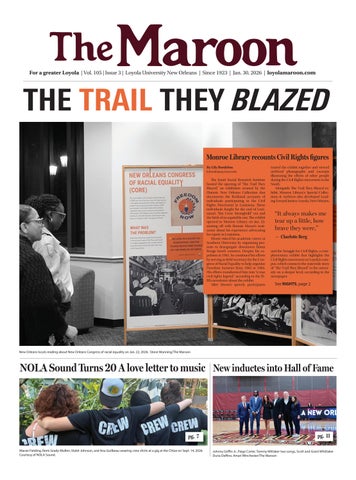
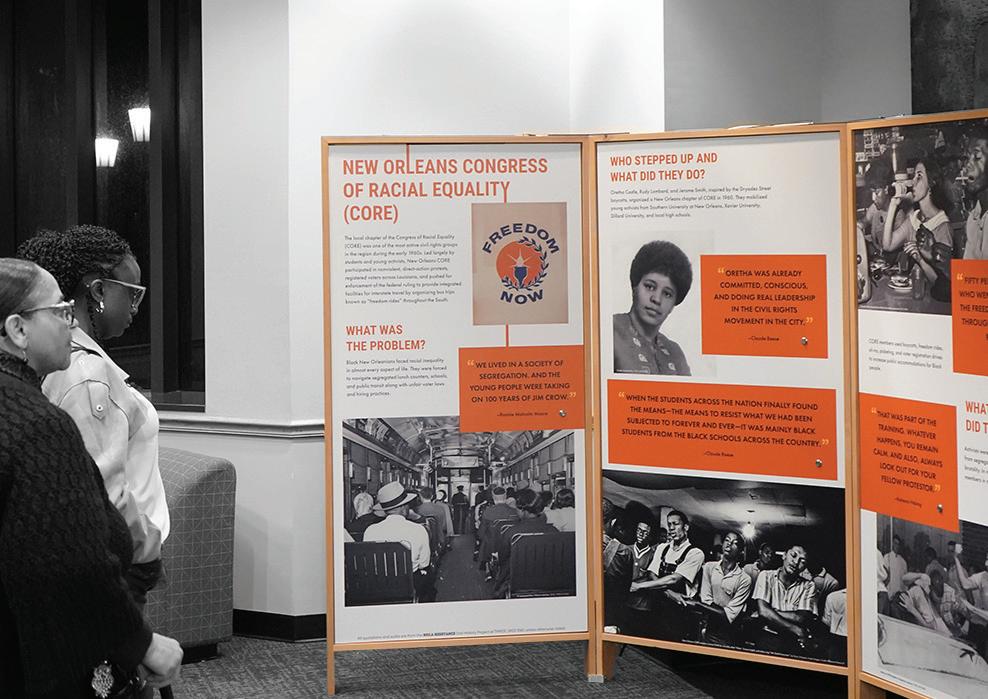
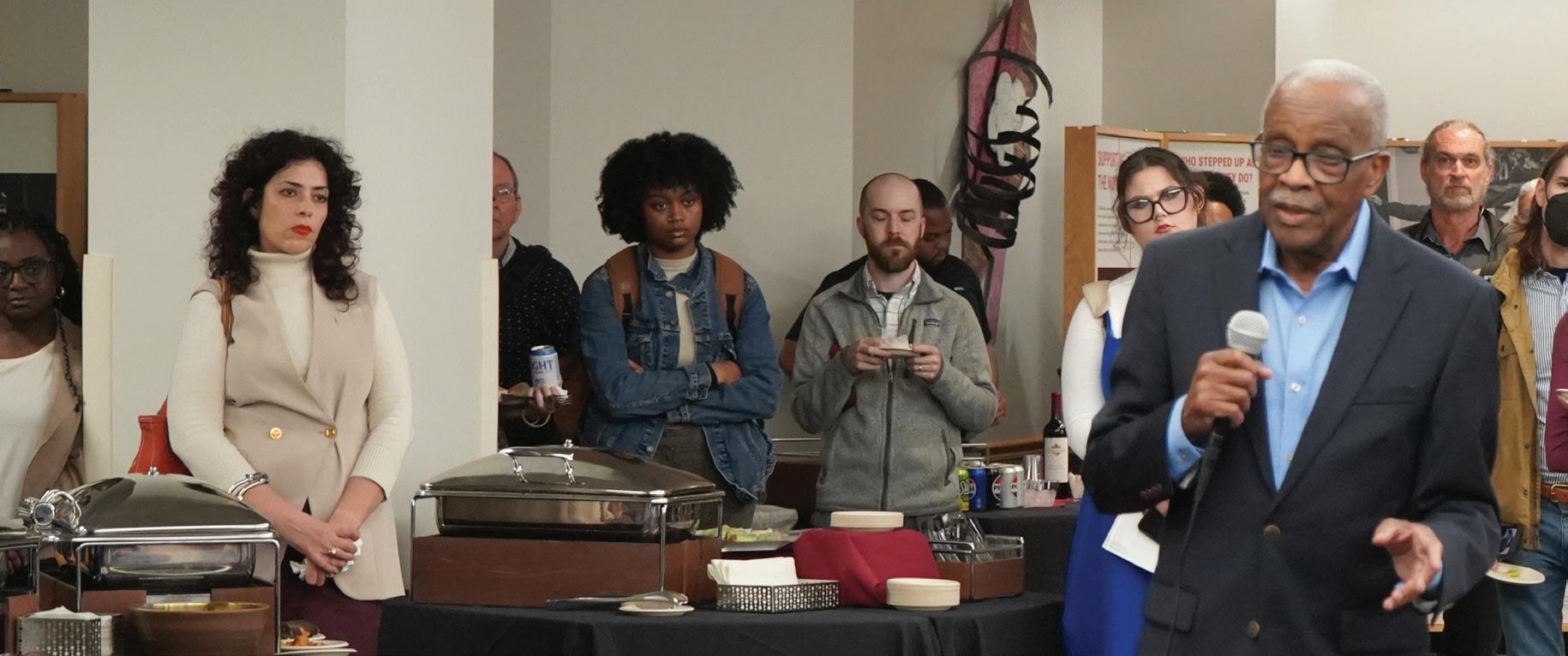
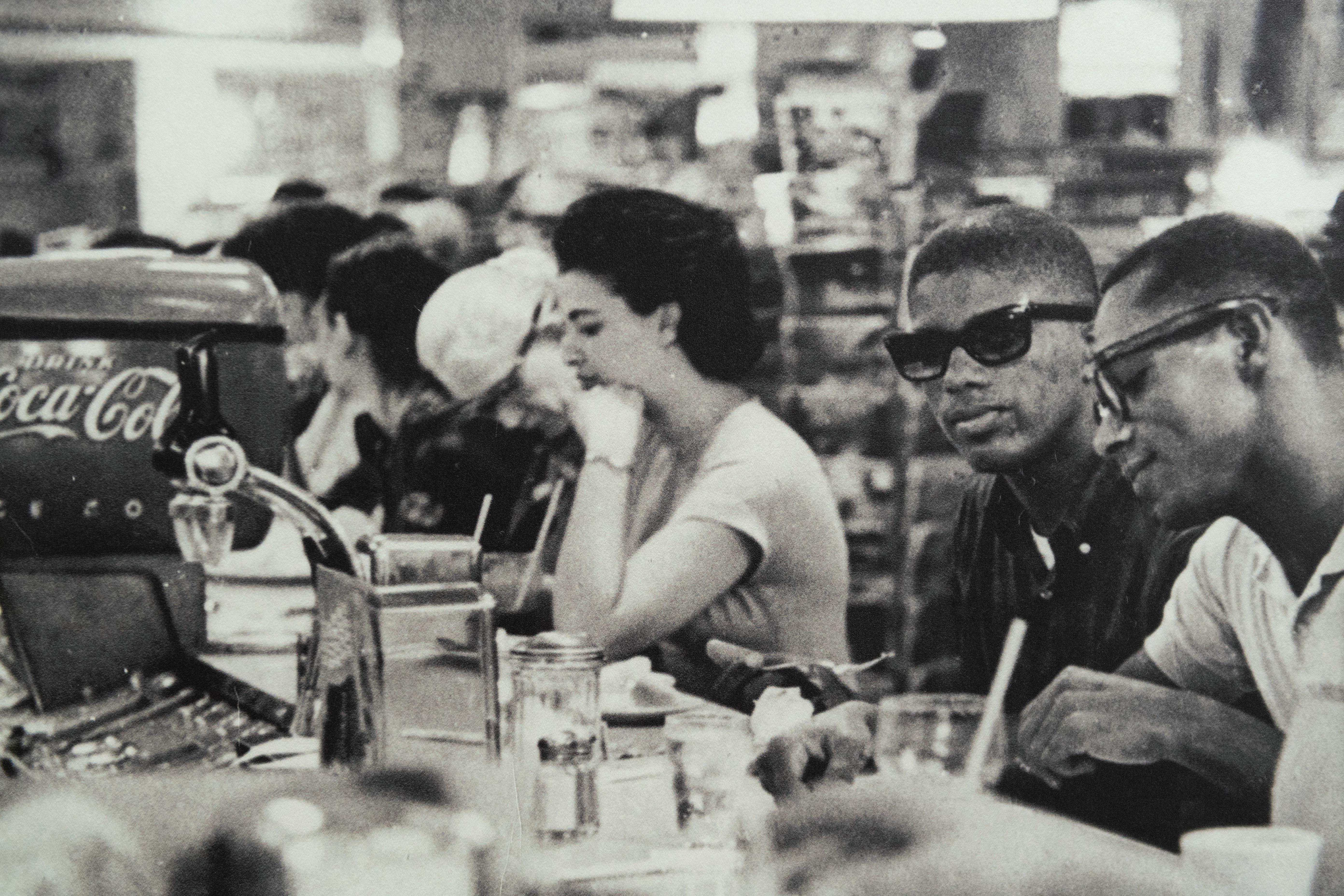
e Jesuit Social Research Institute hosted the opening of “ e Trail ey Blazed,” an exhibition created by the Historic New Orleans Collection that documents the rsthand accounts of individuals participating in the Civil Rights Movement in Louisiana. ese individuals fought for the end of Louisiana’s “Jim Crow Stronghold” era and the birth of an equitable one. e exhibit opened in Monroe Library on Jan. 22, starting o with Ronnie Moore’s testimony about his experience advocating for equity in Louisiana.
Moore risked his academic career at Southern University by organizing protests to desegregate downtown Baton Rouge lunch counters. Despite his expulsion in 1961, he continued his e orts by serving as eld secretary for the Congress of Racial Equality to help organize Freedom Summer from 1963 to 1965. His e orts transformed him into “a true civil rights legend,” according to the JSRI’s newsletter about the exhibit.
After Moore’s speech, participants
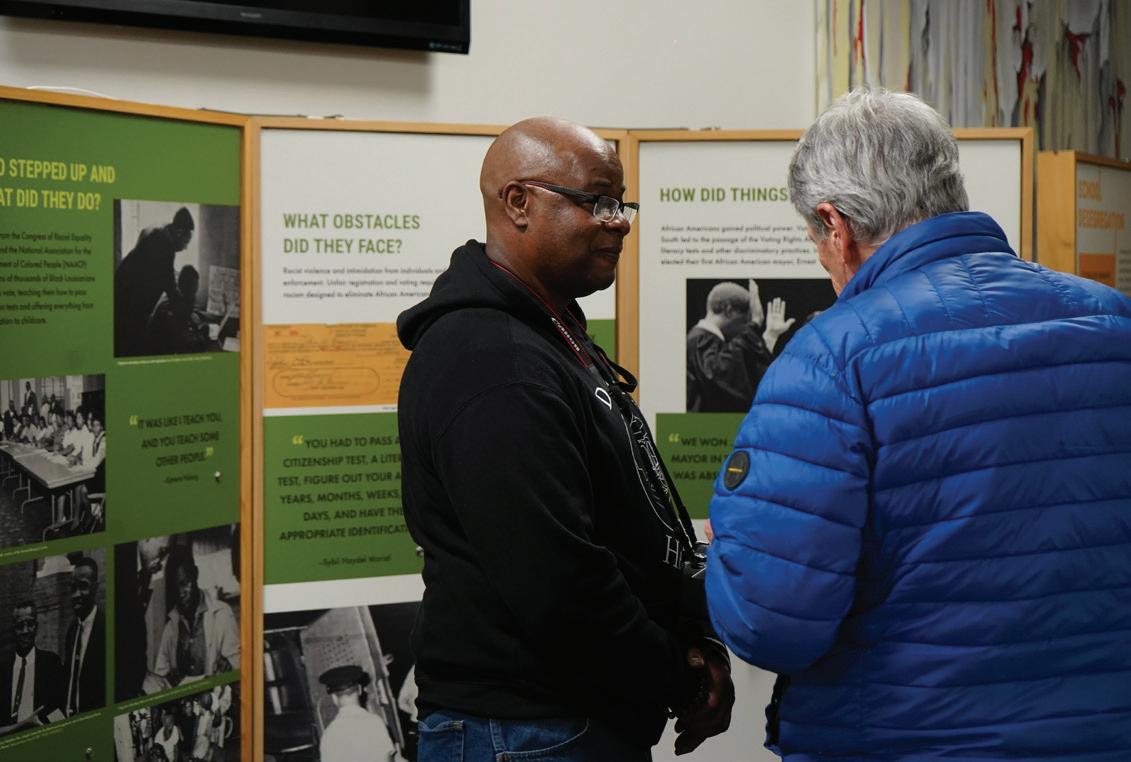
toured the exhibit together and viewed archived photographs and excerpts illustrating the e orts of other people during the Civil Rights movement in the South.
Alongside e Trail ey Blazed exhibit, Monroe Library’s Special Collections & Archives also developed Leading Toward Justice: Loyola, New Orleans,
“It always makes me tear up a little, how brave they were,”
— Charlotte Berg
and the Struggle for Civil Rights, a complementary exhibit that highlights the Civil Rights movement on Loyola’s campus, which connects the statewide story of “ e Trail ey Blazed” to the university on a deeper level, according to the newspaper.
See RIGHTS, page 2
New inductes into Hall of Fame
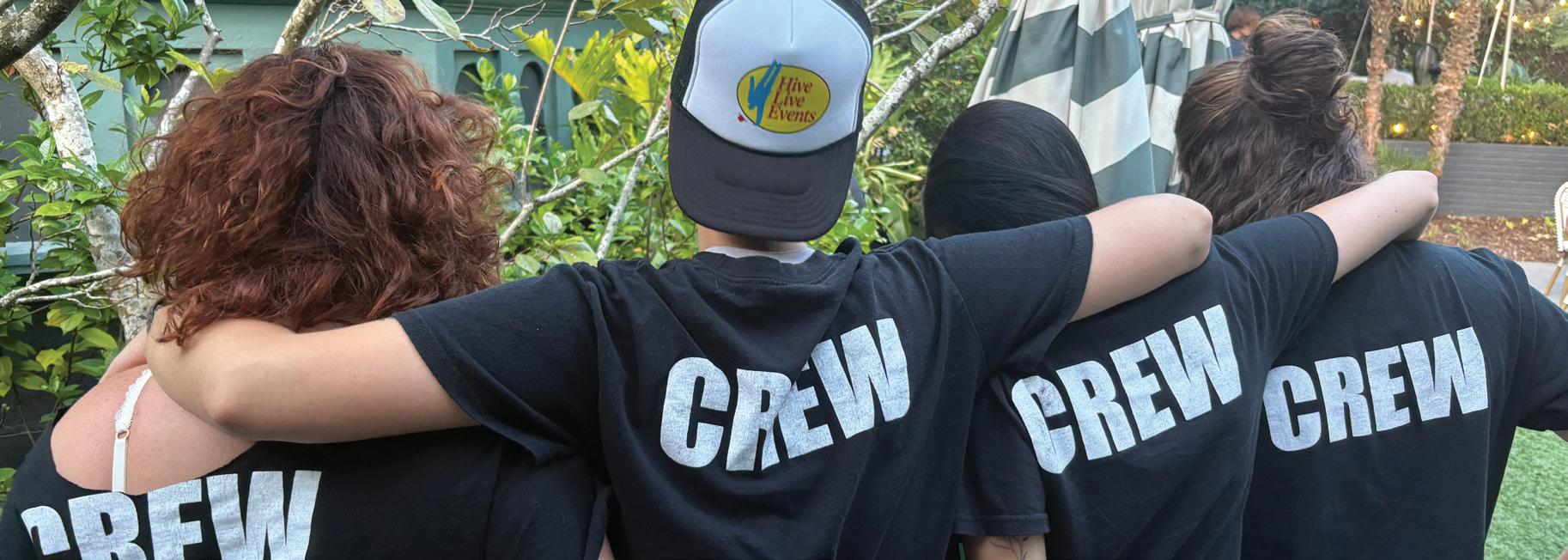
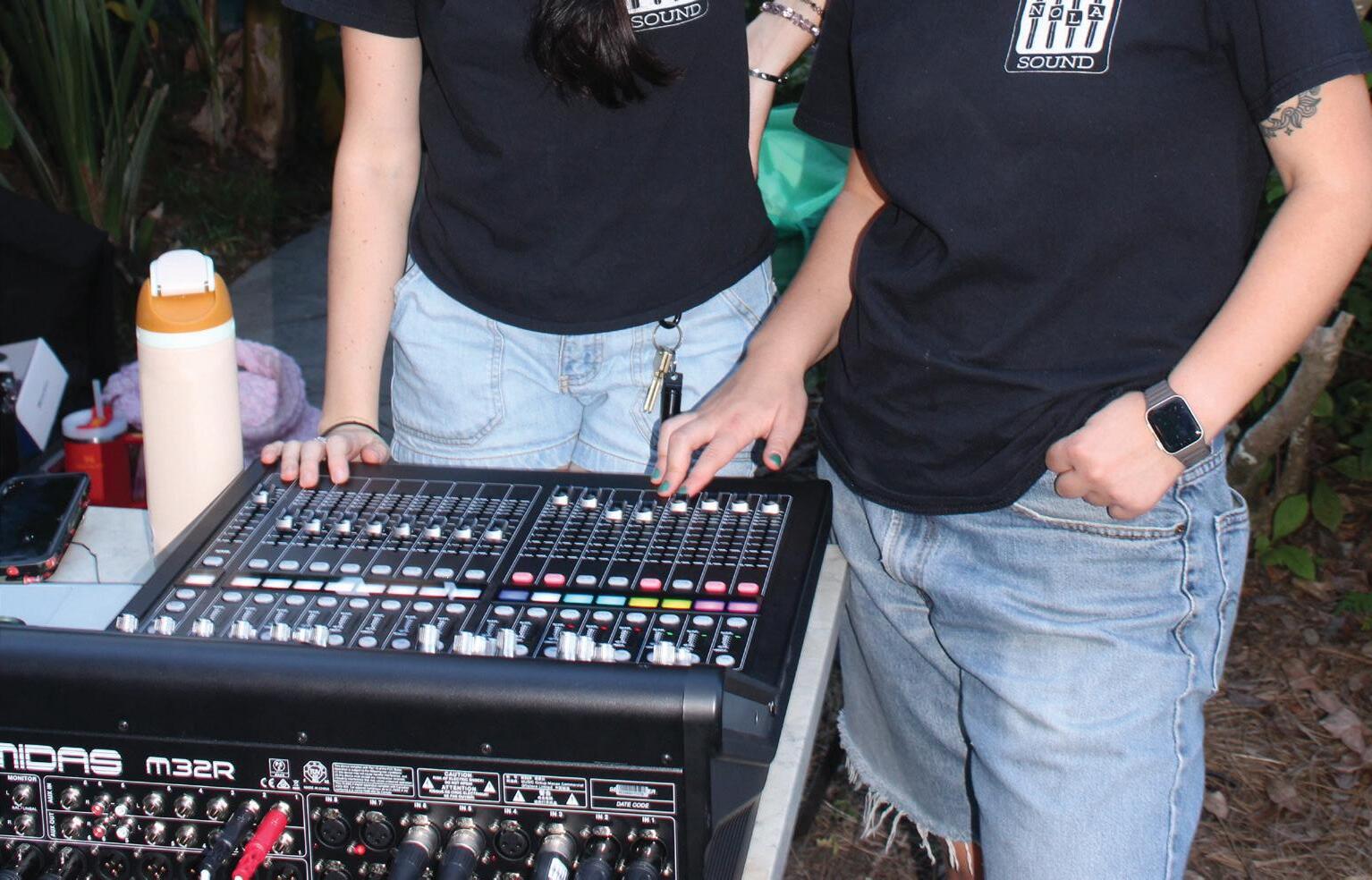
Macee Fielding, Remi Grady-Mullen, Violet Johnson, and Ana Guilbeau wearing crew shirts at a gig at the Chloe on Sept. 14, 2026. Courtesy of NOLA Sound.
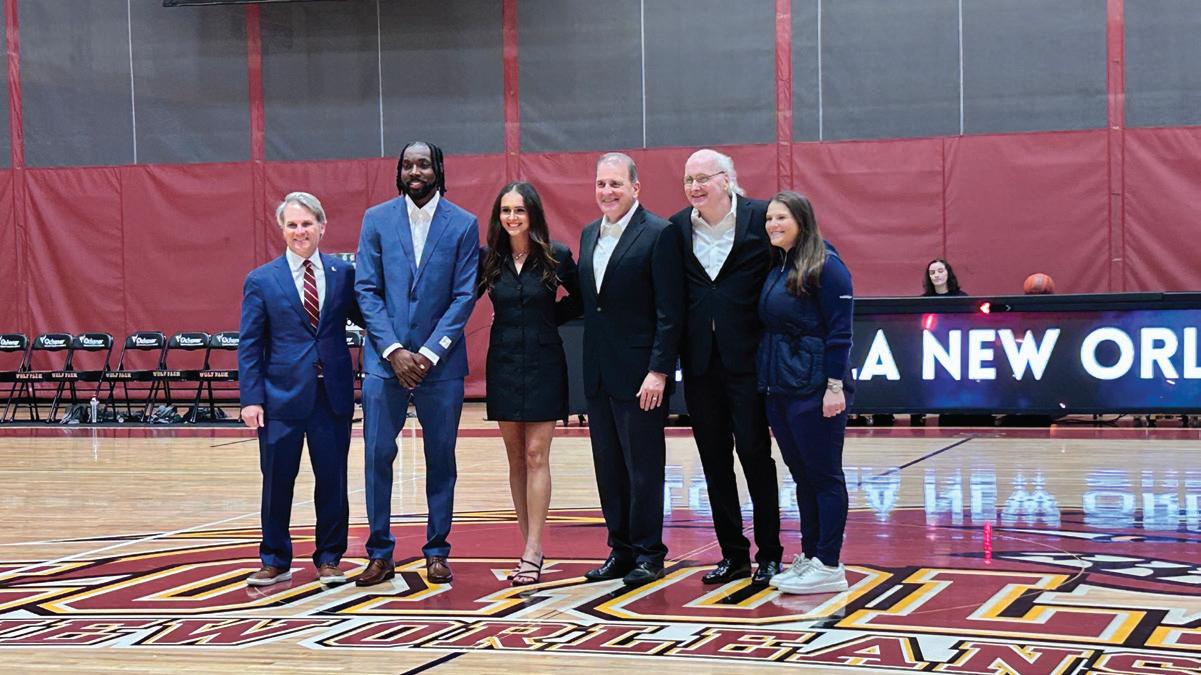
Johnny Gri n Jr., Paige Carter, Tommy Wittaker two songs, Scott and Grant Whittaker Duria Del no. Amari Winchester/The Maroon
New Orleans locals reading about New Orleans Congress of racial equality on Jan. 22, 2026. Stone Manning/The Maroon
The importance of Residential Assistants on campus
By Claire Schmidt cischmit@my.loyno.edu
Moving into the dorms is oftentimes college students’ first experience living on their own. Suddenly, they are completely responsible for their own well-being: waking up in time for class, eating healthily, maintaining the cleanliness of their space, and more. The role of a Residential Assistant is to ease students into this transition; to give them guidance and to provide them with a community to support them.
RAs are responsible for decorating their floors, holding monthly meetings to discuss residential information, establishing an open line of communication between themselves and the residents, and encouraging a sense of community amongst residents of their floor.
Community Director of Uptown Hall, Carly Hill, expresses her gratitude for RAs’ contributions to campus communities.
“Resident Assistants play a pivotal role in shaping the residential experi-
ence. They serve as one of the primary sources of information, support, and connection for students. As both peers and trained student leaders, RAs help students feel supported as they navigate college life,” she said.
According to Hill, her own experience as an RA when she was in college inspired her to pursue a career as a community director. As a community director, she collaborates with RAs daily.
“My current RA team continues to inspire me and is a major reason I remain passionate about this work,” Hill said.
Beginning on Aug. 1, RAs moved into their halls and began preparing for the arrival of their residents. In order to create a welcoming environment, they decorated their floors—posting nametags on each resident’s door, flyers introducing themselves as the floor’s RA, and creating informational bulletin boards.
When entering one of the dorms on campus, students can see the efforts made by RAs to create a welcoming and familiar space for their residents. The walls are covered in colorful decorations,
with many floors having themed bulletin boards and nametags.
Throughout the semester, RAs are tasked with keeping up with their residents by holding monthly meetings, but also by establishing weekly “floor traditions.” These traditions are a chance for residents to bond with their RAs and other residents of their floor.
“For me, it’s Sundays at 7 p.m., and every one of my residents knows that, if they have a question, I’m going to be in the lobby doing homework,” said August Bay, a senior studying Religious Studies and an RA in Uptown Hall.
Bay is very passionate about making sure that the activities they plan for their residents are fun and educational. Last semester, they made a habit of making treats or drinks for each monthly meeting.
“I was making horchatas and teas—I made my own apple cider for them, coring the apples,” they said.
Bay explained that their bond with their residents is what drove them to put so much effort into hosting events and
reaching out to residents.
“I don’t think I could be a good RA without the residents who live on my floor and the connections we are able to build with each other. Seeing them respond to my enthusiasm makes me even more enthusiastic,” Bay said.
“I don’t think I could be a good RA without the residents who live on my floor and the connections we are able to build with each other.”
— August Bay RA for Uptown 2nd Floor
Not only do RAs bond extensively with their residents, but they also form close friendships with their coworkers. Gabi Salinas, in her junior year studying political science and music performance, is an RA in Uptown Hall.
According to Salinas, her favorite part of the job is the community she’s built with the other RAs.
“All the RAs are pretty close, because we only have about 32 on campus, so we all know each other very well,” Salinas said.
While the benefits of free room and board are benefits to the RA position, the sense of community and belonging found in the dorms is what makes the job so rewarding for RAs.
“Honestly, my biggest regret is not applying at the end of my freshman year to be an RA. I’ll tell the people I’m close with: if this is something you think you could do, apply in a heartbeat,” Bay said.
RIGHTS: Monroe Library recounts Civil Rights figures
A few students who work in the Special Collections and Archives, including junior Charlotte Berg and senior Erin Lovato, caught wind of the event and decided to attend and view these archives from the Civil Rights movement.
Berg reflected on one of her favorite archives, which centered around the New Orleans Four, four girls that ended up desegregating New Orleans Public Schools.
“It always makes me tear up a little, how brave they were,” she said. “It's an important testament because, you know, most of them are younger than most of [our] grandmothers… it's kind of a reminder that it wasn't that long ago.”
Lovato, on the other hand, stated that she got the most out of Moore’s reflection, especially when taking his advice to wake up and keep one’s mind “on mercy and justice.”
Lovato also explained her admiration for the consistency of Moore’s work, from him going back to places he visited at 14 years old to reaching out to communities to encourage them to prioritize justice.
“This is the first time I've really heard someone who's very active in civil rights movement speak in person, and just like hearing about how he's been
doing this for 70 years… it's really impactful,” she said.
Lovato also expressed her appreciation that Loyola decided to add this exhibit to the library, especially because of its connections to the students.
“It was so amazing learning about how New Orleans desegregated New Orleans, and it's the breadth of it here, but also specifically at Loyola, like within our community of students,” she said.
Junior Yeva Guthrie also attended the reception after going to Jolanda Taylor’s other events and hearing about the exhibition from them. Guthrie expressed curiosity about the exhibit due to her dedication to promoting black experiences at Loyola, as seen in her creation of Theatre for the Culture.
“I really love how much change I've seen since I've been here,” she said. “Seeing how much change has happened with advocacy to see black voices, and to not just glimpse into parts of the history, but do installments like these… I thought that it was just beautiful to be doing something like that.”
Guthrie found so much value in the exhibit because of the individuals participating in it and believes that this involvement makes the experience seem much more realistic.
“It's not just words. You're getting the
names to the faces, and it makes it seem more personal,” she said. “I think that's the main issue that we're having is that a lot of people hear about these names, but they don't know the people. And it doesn't connect them to the history if they're not inclined to learn about it in school.”
“It always makes me tear up a little, how brave they were”
— Charlotte Berg junior history major; works in the Special Collections and Archives
These students believe that this exhibit is one that many other students should experience before it closes on April 18 because of its deep connection to the Civil Rights movement, especially regarding Loyola students of that time and other black voices.
“I really hope people actually look at the exhibit, especially students,” Bergsaid.
A local New Orleans photographer talking to a member of the uptown community on Jan. 22, 2026. Stone Manning/The Maroon.
Dr. Ronnie Moore talking to the crowd about his experience during the civil rights movement. Stone Manning/The Maroon.
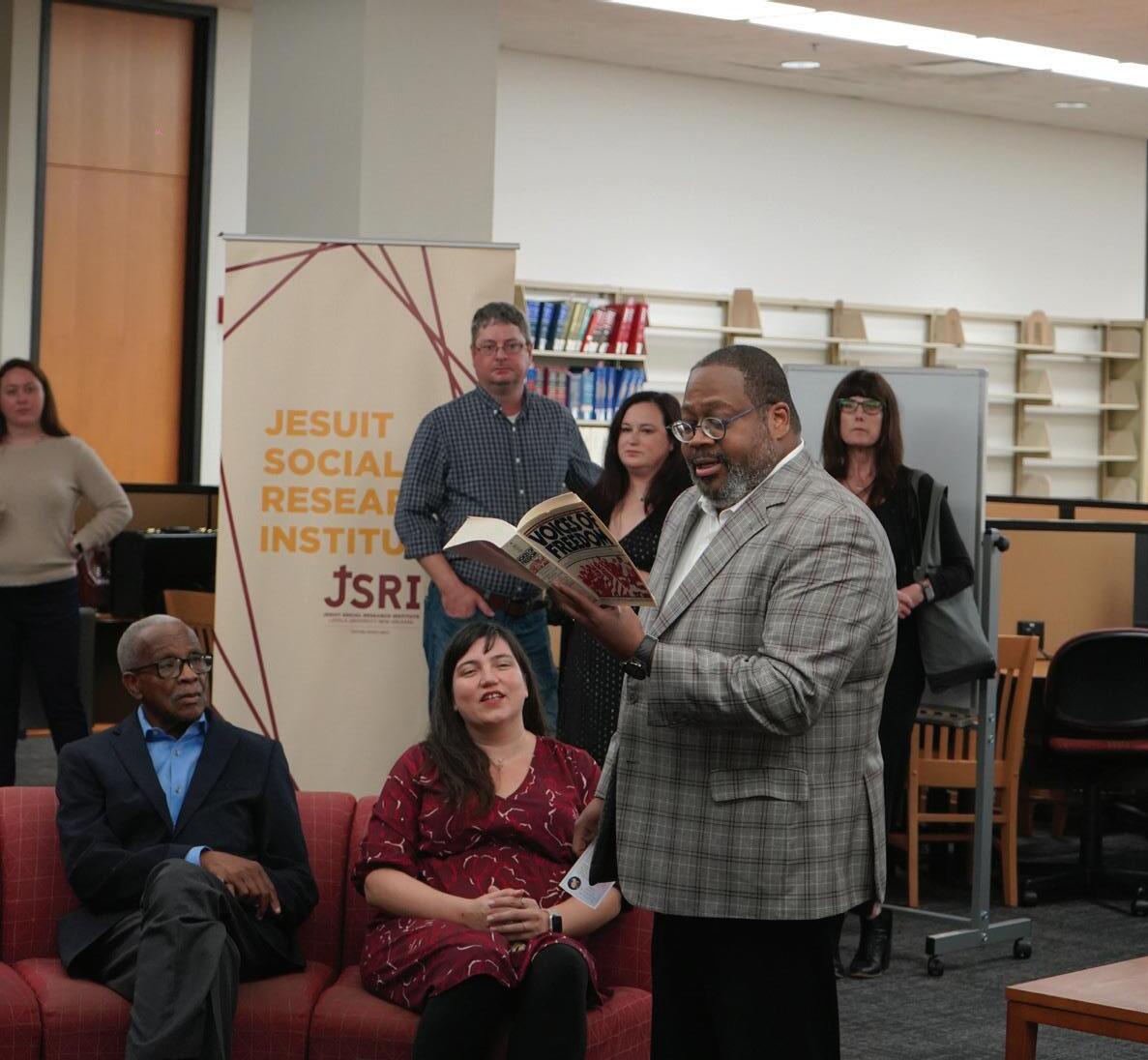
Dr. Xavier Cole reads an excerpt from "Voices of Freedom" by Henry Hampton and Steve Fayer on Jan. 22, 2026. Stone Manning/The Maroon.
Jan. 30, 2026
PUZZLES
Across 1. 1998 space-themed song by the Beastie Boys
9. McDonald’s seasonal pork-based sandwich
10. Historically denoting someone of Slavic origin within Hungary
11. _, _, i, o, u, and sometimes y
12. e names of the di erent organizations that put on Mardi Gras parades
14. Individual Contributor, abbr.
16. e “Boy aquarium” North American league, abbr.
18. “I” in German
19. A female deer
20. Slang for gossip
22. Impressionism was a late 19th century __ movement
24. Slang for Tiny guitar
25. 2000s Teen drama set in California “ e ___”
26. Death of a star
29. Liking someone’s vibe, text slang abbr.
30. Local Knowledge, abbr.
31. Actor ___ somerhalder
32. International Baccalaureate, abbr.
33. Owner’s Equity, abbr.
34. e City of Angels, abbr.
35. Mocking or w-__
36. Tallest BTS member at 5’11”
38. e phonetic sound commonly used at the end of meditation
39. “Monroe is so hot that it needs __.__.”
41. “Nurseries” for newborn stars
45. Beer made with warm fermentation
47. A male bovine
48. Disney show “ at’s __ Raven”(2003)
49. America’s Essential Hospitals, abbr.
51. Priviledged kids or “___ babies”
53. “ My magnum __-us”
54. “Special Agent __-O” (2009) Disney Cartoon
55. Famous Song by Nicki Minaj on Pink Friday 2
56. Sweet in Japanese
58. An atom with an electrical charge
59. NLE Choppa song “ ____(s) Me Out” (2023)
60. 90s electronic furry toy
62. A cocktail with vodka, Cointreau, and cranberry juice
63. Franchise with Darth Vader
Down
1. Ice sport involving skates and a puck
2. No Reaction, abbr.
3. Another word for gratuity
4. Editorial Board, abbr.
5. Connecticut, abbr.
6. Opposed to bottom
7. Information Technology, abbr.
8. Fast food chain specializing in chicken sandwiches
9. Star Wars live action series featuring “baby yoda” but replace the second “a” with an “o”
12. To retain in one’s possession
13. Currency used in Germany
15. Mardi Gras’ o cial sci- parade which rolled this past weekend
17. A su x of verbs having a fr quentative force
18. Indiana University, abbr.
20. Tulane University, abbr.
21. e rst three vowels: _ _ _ O, U
22. Clothing Brand __ Taylor
23. A telecommunication medium for transmitting moving images and sound, abbr.
26. A xed luminous point in the night sky
27. Nickname of the famous Australian Olympic breakdancer
28. It makes up everything
37. e three letters that come after “L” in the English alphabet
38. “Bear” in Spanish
40. Navy Environmental and Preventive Medicine Unit, abbr.
42. Pre x meaning external
43. Alpha Sigma Sigma, abbr.
44. “Date” in German
46. e at green things on trees that turn yellow and fall o in Autumn
50. e green substance secreted by ghosts in Ghostbusters
52. American rock band, including lead vocalist/guitarist Marc Roberge
54. Opposed to o
55. “Floss” without the “o”
57. Irritable Bowel Syndrome, abbr.
59. “Beer” in Hungarian
61. YouTube, abbr.
62. California, abbr.
For weekly puzzle answers, download e Loyola Maroon
Assistant Student Media Adviser: Gabriella Killett Vargas
CONTACT US
Main O ce - (504) 865 - 3535
Business O ce - (504) 865 - 3536
Adviser’s O ce - (504) 865 - 3295
Correspondence - maroon@loyno.edu
Letters to the Editor - letter@loyno.edu
Advertising - ads@loyno.edu
Website - www.loyolamaroon.com
Twitter - @loyola_maroon
Facebook - e Maroon
Instagram - @loyola_maroon
Our o ce is in the Communications/ Music Complex, Room 328.
Send mail to: e Maroon, Loyola University, Campus Box 64, 6363 St. Charles Ave., New Orleans, LA 70118
e Maroon is published every Friday. Unless otherwise noted, all content is copyrighted by e Maroon. All rights reserved. First copy free to students, faculty, and sta . Every additional copy is $1.00.
e Maroon is printed on 30 percent post-consumer recycled content.
Crossword by Kira Phillips and Olive Riley/ e Maroon
Uptown laundry malfunctions
By Eloise Pickering ewpicker@my.loyno.edu
Residential life and facilities have worked to ensure the clothing dryers in Uptown Hall are largely functional after over half of the machines were out of order this past week.
On Jan. 26, residential life contacted the laundry service provider after 17 out of the 28 Uptown Dryers were reported as non-functional. By Jan. 27, almost all of the dryers were working again. According to Director of Residential Life Chris Rice, these issues arose largely due to misuse.
“The dryers are experiencing different issues, but many are related to user error,” Rice said.
While the Uptown laundry room has been regarded as better than some of Loyola’s other residential buildings’ services, some students are skeptical that user error is the sole cause for the dryers malfunctioning.
“Facilities using [misuse] as an excuse for their terrible dryers is … unacceptable,” said Akinseye Quinones, a sophomore marketing and finance major.
According to Rice, the laundry service providers and manufacturers are not related to the machines being out of order, but rather the dryers being overfilled.
“Dryers require adequate space in the drum to operate and dry clothing properly. When machines are overfilled, it can cause them to shut down or malfunction,” Rice said. “To help prevent these issues, students should avoid overloading dryers.”
Rice also advises that students submit a work order through Loyola’s housing and dining portal to ensure that appliances can be repaired in a timely manner.
Quinones lived in Biever Hall his freshman year, and said that “Uptown is definitely better than the Biever experience” in regards to laundry, due to the overall quality and quantity of the machines.
While he prefers Uptown to Biever, Quinones believes that there’s more that Loyola should be doing for their students’ living experience.
“There was absolutely no guidance on how to use [the dryers] if that is [their] excuse,” Quinones said. “Loyola has to do better for its students. There is effort but not enough execution."
Loyola Confess to Fizz: a timeline of campus communication
By Joshua Fletcher jjgfletch@my.loyno.edu
Students Engage with Anonymous Forums
Under veils of secrecy, Loyola students have been using anonymous platforms to engage with one another, whether that be through gossip or humor.
Fizz, a campus-based social media app marketed around sharing information anonymously, took root at Loyola University around February 2025, and since then has continued to affect student life in negative–as well as positive–ways.
The Introduction of Fizz at Loyola
In November 2024, a new Instagram page, “fizzloyno” was created. The account advertised Fizz, a relatively new platform that various univer-
sities used as an anonymous forum for students. Once the page got a certain amount of followers, Fizz launched at Loyola in the spring.
Due to the specific guidelines of Fizz and the fact that it’s a systemized social media platform, mean-spirited comments are intended to be censored to prohibit specifically identifying students in negative ways. This policy aims to discourage cyberbullying and personal attacks. However, this does not completely erase the issue of cyberbullying.
Students
Recognize the Flaws and Positives of Fizz
Students tend to recognize bullying more with Fizz than its predecessor, Loyno_Confess.
The core difference with Fizz is the ability to add photos to posts. This means that students could have their names identified, as well as photos of them too.
“If you didn't know the person's name,
that was fine. Now you can add a picture of a person, and now we know exactly who they are,” said junior philosophy pre-law major Keyshawn Crawford.
Other students had different thoughts, citing humor as a positive aspect of Fizz.
“I think [Fizz is] funny, but at the same time, some posts, it depends on the classification of the bullying because I feel there's a lot of bullying going on,” said freshman psychology major, Alexis Gnatenco.
Students recognize that this can be an issue and some wish it had better moderation.
“If there's something up there that's really personal or that's just, like, not appropriate … or that could, like, really interfere with someone's life, I think that you should be able to get that taken down really easily,” junior history major Abi Gallagher said.
While students acknowledge that there are harmful aspects of these platforms, they also recognize that part of the appeal is anonymity.
“I think the worst part is everyone's anonymous, but that's also the best part at the same time because no one knows who it is, but that means that students are comfortable saying anything,” Gnatenco said.
Fizz, however, is not the first anonymous platform to have this influence at Loyola. Loyno_Confess, an Instagram account active well before Fizz’s introduction to Loyola, was also used for similar reasons.
Usage of Loyno_Confess
Loyno_Confess was popularized way before Fizz existed on campus. Students would submit their confessions through an anonymous Google Form. These submissions would be posted by the admins of the page.
Whether it be crushes, inside jokes, callouts, or personal secrets, students were posting and engaging. Many confessions just stated how excited they
were to check the page to get a good laugh or engage in some drama.
“I felt like we had a place to go to talk about things we couldn't talk about in person. Sometimes it got out of hand and everything, but at the end of the day, it gave us a place to talk,” Crawford said.
Students’ Problems With Loyno_Confess
While a fair share of the student body remained engaged with the page, problems began to arise. Some students started to take issue with the anonymous admins of the page. Specifically, their choices to post certain confessions.
Some confessions would mention allegations of sexual misconduct. These posts would generate a lot of engagement and conversation, but some students were beginning to grow concerned.
Many believed these allegations were too serious for Loyno_Confess as the page was known for humorous and generally lighthearted content–like Fizz is now.
“I think that there was a big difference between posting some jokes about Loyola, students writing stuff out for their friends, and posting more serious accusations about students,” Gallagher said.
Loyno_Confess is
Abandoned
The original Loyno_Confess page no longer exists. There has been no confirmation on why the page was deleted.
A new Loyno_Confess account launched in October 2024, but it got less engagement than the original and would stop posting completely in November 2024, right before talks of Fizz’s launch began.
Stella Perdue contributed to this story.
Proposed Metrics for Degree Program ac-
cepted in Faculty Senate meeting
By Lily Bordelon lmbordel@my.loyno.edu
Faculty members expressed their worries regarding the new Proposed Metrics for Degree Program during their Faculty Senate meeting where the Provost and Senior V.P. for Academic Affairs Thomas Chambers explained more about the program and its plans to increase the university’s revenue.
According to Chambers, one of the program’s goals is to identify programs with a higher contribution margin percentage and invest Loyola’s resources into recruiting for those programs, which Chambers believes will increase revenue. For the programs that do not rate well in this process, the Standing Committee on Academic Programs will
review the programs again and see what other than numbers should be considered.
“SCAP will ask, ‘how would you grow your program?’ This review process seeks to increase enrollment in all of our programs and thereby increase overall revenue,” Chambers said.
With this explanation, faculty members, including Justin Nystrom, chair of the history department, felt more assured about the metrics plan and began to agree that the program was necessary. Nystrom stated that at the heart of this program is the intention to increase revenue to make necessary investments in raises that keep up with the cost of living and maintenance to prevent situations like the hot water event from last year from occurring again.
“I felt that the program review was probably necessary going into this— some sort of program review—because we can't make good decisions without good data,” Nystrom said. “We actually have made poor decisions in the absence of good data in the past.”
However, Nystrom added his concerns about the possibility of programs being cut because of these new reviews.
“Hopefully this program review will not lead to any sort of cuts because faculty and staff at Loyola have been working incredibly hard for years without pay raises to keep the idea and mission of Loyola afloat,” he said.
Nystrom also acknowledges that the review process is only one part of the plan to increase revenue, and what is done with the data collected will be
much more valuable to the progress.
“My big question in all of it will be how we go about working with the data that these program review metrics yield. Having seen it up close, I can tell you that this is not easy work,” Nystrom said. “The metrics alone are like a thermometer telling us the temperature. What we do with that knowledge will be more defining.”
Chambers additionally expressed his gratitude for the transparency and cooperation from the faculty during this process, especially after their initial concerns.
“I want to thank the faculty on SCAP and in the Senate for using shared governance to shape metrics and a process that will improve our university,” Chambers said.
Graphic by Makayla Parker/The Maroon.
Broken dryers in Uptown Hall laundry room. Sophia Renzi/The Maroon.
WORLDVIEW
Trump's immigration crackdown led to drop in US growth rate last year
By e Associated Press
President Donald Trump's crackdown on immigration contributed to a year-to-year drop in the nation's growth rate as the U.S. population reached nearly 342 million people in 2025, according to population estimates released Tuesday by the U.S. Census Bureau.
e 0.5% growth rate for 2025 was a sharp drop from 2024's almost 1% growth rate, which was the highest in two decades and was fueled by immigration. e 2024 estimates put the U.S. population at 340 million people.
Immigration increased by almost 1.3 million people last year, compared with 2024's increase of almost 2.8 million people. If trends continue, the annual gain from immigrants by mid2026 will drop to only 321,000 people, according to the Census Bureau, whose estimates do not distinguish between legal and illegal immigration.
In the past 125 years, the lowest growth rate was in 2021, during the height of the coronavirus pandemic, when the U.S. population grew by just 0.16%, or 522,000 people and immigration increased by just 376,000 people because of travel restrictions into the U.S. Before that, the lowest growth rate was just under 0.5% in 1919 at the height of the Spanish u.
Births outnumbered deaths last year by 519,000 people. While higher than the pandemic-era low at the beginning of the decade, the natural increase was dramatically smaller than in the 2000s, when it ranged between 1.6 million and 1.9 million people.
Lower immigration stunts growth in many states
e immigration drop dented growth in several states that traditionally have been immigrant magnets.
California had a net population loss of 9,500 people in 2025, a stark change from the previous year, when it gained 232,000 residents, even though roughly the same number of Californians already living in the state moved out in both years. e di erence was immigration since the number of net immigrants who moved into the state dropped from 361,000 people in 2024 to 109,000 in 2025.
Florida had year-to-year drops in
both immigrants and people moving in from other states. e Sunshine State, which has become more expensive in recent years from surging property values and higher home insurance costs, had only 22,000 domestic migrants in 2025, compared with 64,000 people in 2024, and the net number of immigrants dropped from more than 411,000 people to 178,000 people.
New York added only 1,008 people in 2025, mostly because the state's net migration from immigrants dropped from 207,000 people to 95,600 people.
South Carolina, Idaho and North Carolina had the highest year-overyear growth rates, ranging from 1.3% to 1.5%. Texas, Florida and North Carolina added the most people in pure numbers. California, Hawaii, New Mexico, Vermont and West Virginia had population declines.
e South, which has been the powerhouse of growth in the 2020s, continued to add more people than any other region, but the numbers dropped from 1.7 million people in 2024 to 1.1 million in 2025.
“Many of these states are going to show even smaller growth when we get to next year,” Brookings demographer William Frey said Tuesday.
e e ects of Trump's immigration crackdown
Tuesday's data release comes as researchers have been trying to determine the e ects of the second Trump administration's immigration crackdown after the Republican president returned to the White House in January 2025. Trump made a surge of migrants at the southern border a central issue in his winning 2024 presidential campaign.
e numbers made public Tuesday re ect change from July 2024 to July 2025, covering the end of President Joe Biden's Democratic administration and the rst half of Trump's rst year back in o ce.
e gures capture a period that re ects the beginning of enforcement surges in Los Angeles and Portland, Oregon, but do not capture the impact on immigration after the Trump administration's crackdowns began in Chicago; New Orleans; Memphis, Tennessee; and Minneapolis, Minnesota.
in Minneapolis.
e 2025 numbers were a jarring divergence from 2024, when net in\ ternational migration accounted for 84% of the nation’s 3.3 million-person increase from the year before. e jump in immigration two years ago was partly because of a new method of counting that added people who were admitted for humanitarian reasons.
“ ey do re ect recent trends we have seen in out-migration, where the numbers of people coming in is down and the numbers going out is up,” Eric Jensen, a senior research scientist at the Census Bureau, said last week.
How the population estimates are calculated
Unlike the once-a-decade census,
which determines how many congressional seats and Electoral College votes each state gets, as well as the distribution of $2.8 trillion in annual government funding, the population estimates are calculated from government records and internal Census Bureau data.
e release of the 2025 population estimates was delayed by the federal government shutdown last fall and comes at a challenging time for the Census Bureau and other U.S. statistical agencies. e bureau, which is the largest statistical agency in the U.S., lost about 15% of its workforce last year due to buyouts and layo s that were part of cost-cutting e orts by the
White House and its Department of Government E ciency.
Other recent actions by the Trump administration, such as the ring of Erika McEntarfer as Bureau of Labor Statistics commissioner, have raised concerns about political meddling at U.S. statistical agencies. But Frey said the bureau's sta ers appear to have been “doing this work as usual without interference.”
“So I have no reason to doubt the numbers that come out,” Frey said.
Louisiana enters its rst year without any Planned Parenthood locations
By Dominique Campbell ddcampbe@my.loyno.edu
As the new year begins, Louisiana has ushered in a new chapter in its history with the closure of both of its Planned Parenthood locations last fall.
Women’s reproductive care is limited with the closure of both locations after Louisiana made some changes to its reproductive care laws.
Chasity Matthews, executive director of the Louisiana Abortion Fund, spoke with e Maroon about the rami cations that will a ect not just New Orleans, but the entire state.
e Louisiana Abortion Fund (formerly the New Orleans Abortion Fund) is a community fund that assists the community in overcoming the economic and geographic barriers erected to
prevent them from accessing abortion care.
eir mission statement, as provided by their website, states: “By providing low-barrier nancial support for abortions and support for travel and childcare, we invest in the community’s liberation. e fund works to center Black people, Indigenous communities, people of color, queer folks, and immigrants, because we know that when the most marginalized among us are free, we will all be free.”
e Louisiana Abortion Fund’s work is rooted in the principles of reproductive justice as de ned by SisterSong.
“ e human right to maintain personal bodily autonomy, have children, not have children, and parent the children we have in safe and sustainable communities,” according to the SisterSong
website.
Matthews listed the variety of services provided by the organization.
“It is important to note that Planned Parenthood services at those locations included cancer screenings, birth control, HIV, Pap and HPV tests, pregnancy testing, gender-a rming care, miscarriage management, ultrasounds, and assistance for out-of-state abortions,”
Matthews also talked about why she thinks these Planned Parenthood locations were important.
“Reproductive justice is comprehensive. It is about abortion and creating safe and healthy communities where we can all live, raise children, and care for our families (in whatever form we deem is right for us) in safe, healthy, and whole communities,” Matthews said.
With Louisiana being included in a
list of southern states that are experiencing a maternity and infant mortality crisis, the erasure of reproductive services poses a new threat to the declining population of the state.
Loyola senior Christopher Pouncy weighed in on the possible e ects of the closure of both centers in the state.
“I believe the closure of Louisiana’s two Planned Parenthood locations will signi cantly limit access to reproductive healthcare, particularly for low-income individuals and communities of color,” Pouncy said.
Pouncy also talked about the possible e ects that these closures might have on students in the state and in the Loyola community speci cally.
“Students who relied on Planned Parenthood for a ordable and con dential reproductive healthcare will now have
fewer options nearby, increasing stress and barriers to care,” Pouncy said.
Pouncy also mentioned how these closures might urge students in the community to voice their concerns over the growing lack of access to reproductive care.
“Loyola is a community that values social justice and public service, so these closures may heighten campus conversations around healthcare access, policy, and advocacy,” Pouncy said. “It could motivate greater student engagement but also create a sense of concern and frustration about the direction of reproductive rights and healthcare availability in Louisiana.”
Federal agents make a tra c stop on a U.S. citizen as they provide their identi cation including a passport and drivers license, Tuesday, Jan. 27, 2026,
"Live music is so important": Re ections from NOLA Sound co-presidents
By Nicholas Parrella nrparrel@my.loyno.edu
If there is live music happening at Loyola University, there is a large possibility that NOLA Sound has something to do with it. is year, the organization is celebrating 20 years of student led live music in New Orleans.
“NOLA Sound is a live sound company that focuses on sound and lights to help promote and support live music in smaller spaces” said co-presidents Remi Grady-Mullen and Violet Johnson.
e organization is student run but also operates through Wolf Moon Entertainment, a student run nonpro t entertainment organization a liated with Loyola’s College of Music and Media.
Michael Girardot, co-founder of NOLA Sound and member of New Orleans based rock band e Revivalists re ected on 20 years of operation.
“In 2006 some classmates and I started helping the University Programming Board and other campus organizations
put on concerts using knowledge we’d learned in our music technology classes,” he said. “Over the next year the organization took shape and eventually became the rst Entrepreneurial Unit within the music industry department.”
Girardot emphasized that 20 years of NOLA Sound “is a testament to all the hardworking students, faculty, and administrators” that have kept it going.
e current leaders, Grady-Mullen and Johnson, both joined NOLA Sound as freshmen and took over during their second semester. Grady-Mullen didn’t have much experience with live sound.
“When I toured Loyola as a high schooler, my tour guide was running NOLA sound.” Grady-Mullen noted, before explaining that they were too scared to get involved due to their lack of sound tech experience. “I just sort of wrote it o and then it just fell into my lap. It’s kinda like a rst love.”
Alternatively, Johnson came to Loyola with a heavy background in music, stating that she had experience working in
music production and playing music, so she decided to explore live sound.
Today, she runs the majority of the technical aspects of the club while Grady-Mullen focuses on the business side of things.
“We got into this by just showing up,” Grady-Mullen said. “You can really only learn by doing." Running live music events is not an easy feat, the pair noted, especially while focusing on studies and maintaining a social life.
“At the end of the day, we’re just college students, still actively learning day by day, guring things out as we go, and doing our best,” Grady-Mullen said. “It’s all about nding balance and not freaking out.”
Grady-Mullen and Johnson explained that tech is an extremely male dominated eld, and at the start of their time here, it was clear that NOLA Sound was no exception. Both technicians are working vigorously to show that all people have a place here. Both technicians agree that the opportunities presented to them
through this organization are vital and have played crucial roles in their success in the industry.
Meeting musicians, professors, and other sound engineers has allowed them the opportunity to “make so many connections and talk to people.”
rough being a part of NOLA Sound, Johnson worked at the Freret Street Festival and got a job at Gasa Gasa.
“ e resources at Loyola have been amazing for us,” Johnson said.
is past weekend, the duo worked the 38th Annual Folk Alliance conference at the Sheraton. Jonathan McHugh, chair of music industry studies at Loyola weighed in on 20 years of service and NOLA Sound’s recent work:
“Professor Mike Twillman and I love working with Remi and Violet and the NOLA Sound team as they are talented, eager, and passionate about getting meaningful real-life work experience.
eir tireless work at the 38th annual Folk Alliance conference was exceptional,” McHugh said.
e team ran both nights of the event for over 30 performers.
“NOLA sound has such a great heritage… We are excited to ramp up our practical learning company Wolf Moon Entertainment to have NOLA sound as the longest running entrepreneurial entity in our group and we look forward to the next twenty years!” he added.
NOLA Sound is open to all students regardless of major and both leaders put emphasis on passion over experience.
“It can be very daunting to get into it… and everybody, when you’re learning, wants to tell you you're doing the wrong thing,” Grady-Mullen said, before adding, “We want people to learn, we want people to come in not knowing anything.”
“We can learn together.” they added.
After 20 years of operation, Johnson and Grady-Mullen feel one thing will always reign true.
“Live music is so important… People crave intimacy and connection, they need it.” ey said.
REVIEW: Loyola performers shone in "Susannah," yet the plot disappoints
By Erin Lovato emlovato@my.loyno.edu
Content warning: this review contains mentions of sexual assault.
e Loyola Opera eatre performed “Susannah” recently, and it was the rst full length opera production I've ever attended. For me, it was a new way to see the kind of talent that lives at Loyola.
An interesting choice was made for the casting of this production, which I’ve never experienced from a Loyola production before.
Every character was played by a current Loyola student, except for Reverend Olin Blitch, who was played by Matthew Curran, a Loyola ‘97 alum.
“Susannah” was written by Carlisle Floyd, and debuted at Florida State University in 1955. “Susannah” takes place in the ctional town of New Hope Valley, Tennessee.
e story opens in the middle of a community square dance. is is where we meet our main character Susannah, played by Faith Adams, who is instantly singled out as a irt.
is immediate characterization sets
the stage for the central con ict of the story: Susannah is caught bathing in a creek by the church elders when they go looking for a new baptism spot.
Rather than the church elders acknowledging their desire for Susannah, they claim she purposefully tried to seduce them.
is is when Susannah’s personality, who was a kind, young woman full of dreams and ambitions, shifts in the story. She becomes resigned and completely forgets about her dream to leave New Hope Valley. I feel like this kind of thing would motivate her more to leave, wouldn't it? Unfortunately it does not. So, she stays and resigns to her fate, rather than getting out of there.
In Act II, Susannah is continuously pressured to make a public confession of her sins, even though she is completely innocent.
e character that is heavily pushing this confession is Reverend Blitch and after a tense conversation, he pressures Susannah to sleep with him.
By exploiting his position in the community, his perceived “connection” to God, and the age di erence between them, Susannah succumbs to his forceful desire.
roughout the story, Susannah is targeted because of the desire the men in her community feel for her. Even when it culminates in sexual assault, she is still blamed for the incident. Furthermore, after Susannah’s brother kills the Reverend Blitch for his actions towards Susannah, her life does not change.
It disappointed me that Susannah was not able to play an active role in her own revenge. Blitch is shot in the creek where Susannah was initially caught bathing.
By writing Susannah as the person to kill the man who took her innocence in the creek where it was stolen from her, the ending would have been more impactful. Instead, she is forced to defend herself and her brother's choices from the townspeople.
She is transformed into a character with no ambition, no desires, and is resigned to the will of the men around her.
Even with the phenomenal singing and convincing performances from the cast, the plot did not strike me as particularly meaningful, and is de nitely a product of its time.
While I understand that the whole point is that Susannah is innocent and set up to be the scapegoat in this fabri-
cated witch hunt, I do not think that the sexual assault was used meaningfully.
Sexual assault is often used as a shortcut for character development, or to make the con ict in a story more dramatic. “Susannah” is guilty of this kind of writing.
After Susannah’s assault, the story does not take time to truly acknowledge
the kind of abuse she has experienced through the 2.5 hour production, only using it to develop Blitch’s character by showing his guilt.
e opera’s ending, which leaves Susannah in the same old house, in the same small town, and severely more traumatized, was profoundly disappointing, to say the least.
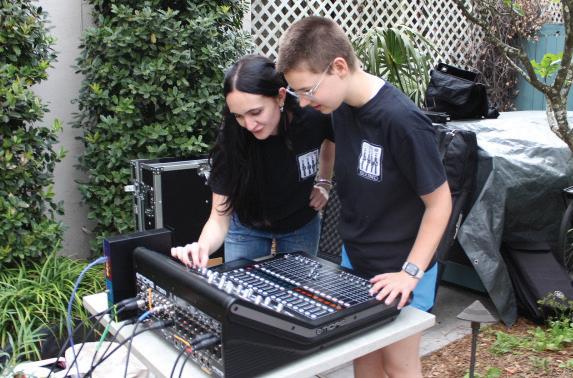
Johnson and Grady-Mullen working at an event at on March 23, 2025. Photo courtesy of Ana Guilbeau.
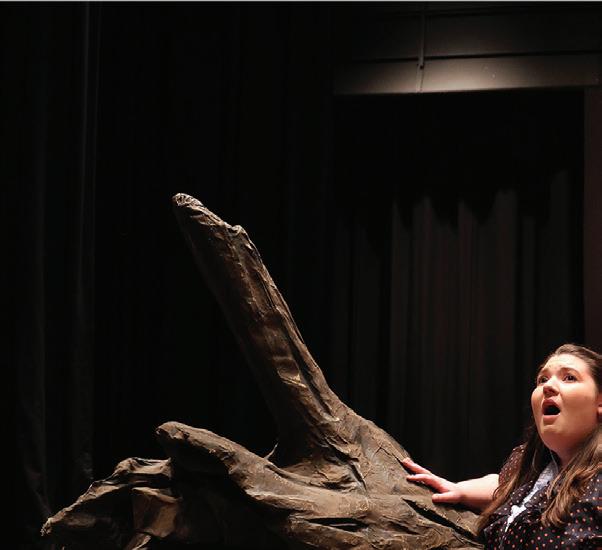
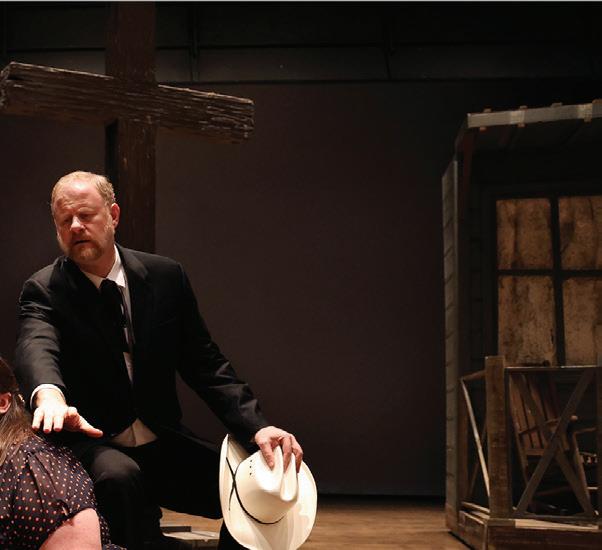
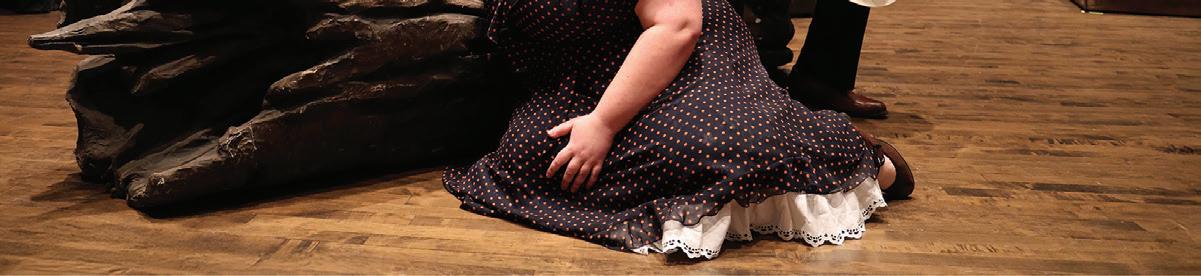
Performers in "Savannah". Photo courtesy of Jess Joy.
Johnson and Grady-Mullen working an event Sept. 14, 2025. Photo courtesy of Macee Fielding.
Design students create costumes for "RouxGaRoux" krewe in Chewbacchus
By Elise Beck erbeck@my.loyno.edu
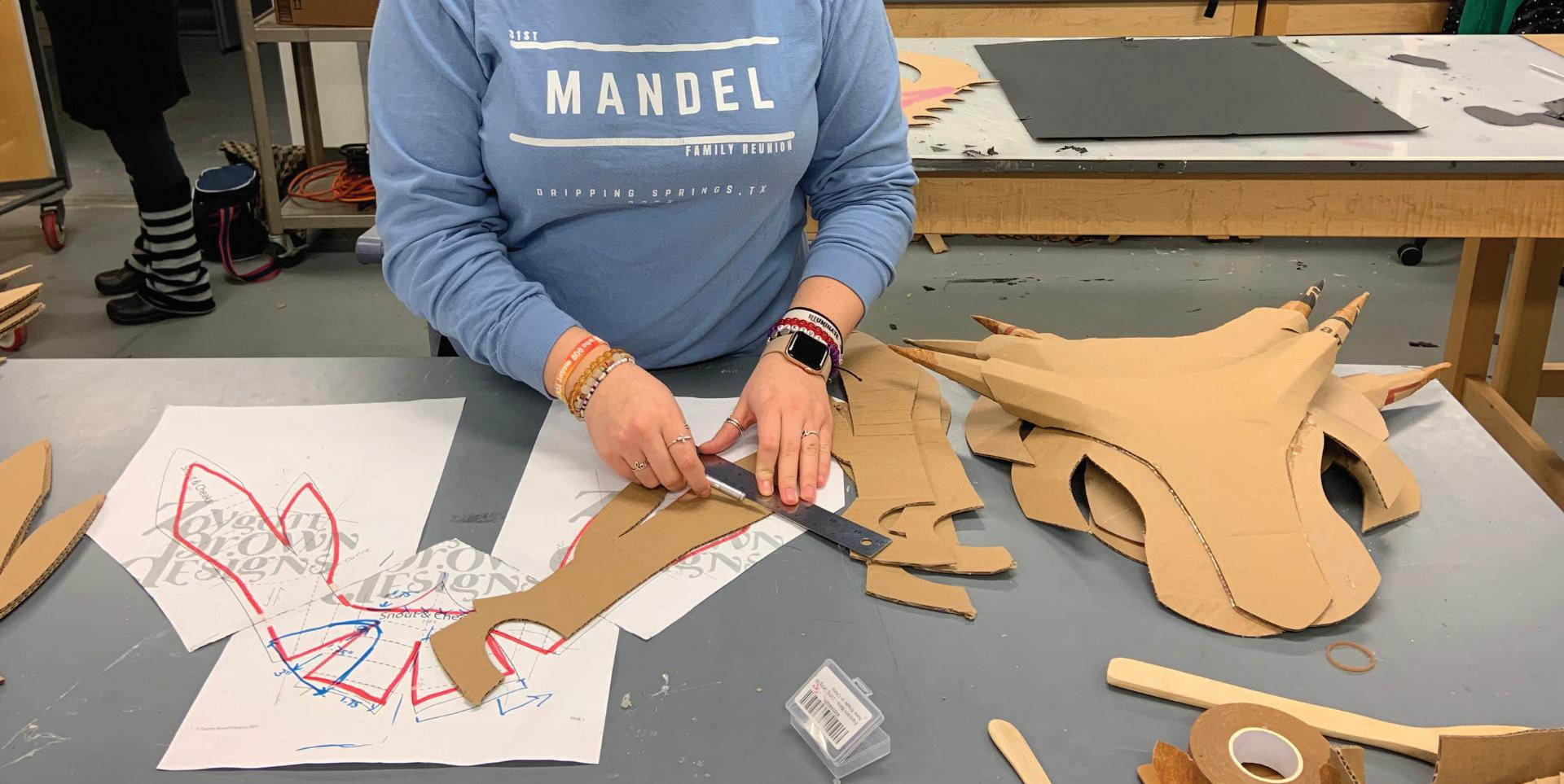
Two Loyola design students had their works used as costumes for “RouxGaRoux”, a new walking krewe in the Intergalactic Krewe of Chewbacchus.
“Having our students participate in the parade is incredibly valuable – not only as a hands-on learning experience but also as a powerful recruitment tool,” said Daniela Marx, an associate professor and chair of the Design Department at Loyola.
Students in Intro to Design re-
searched the Rougarou and sketched their costume ideas.
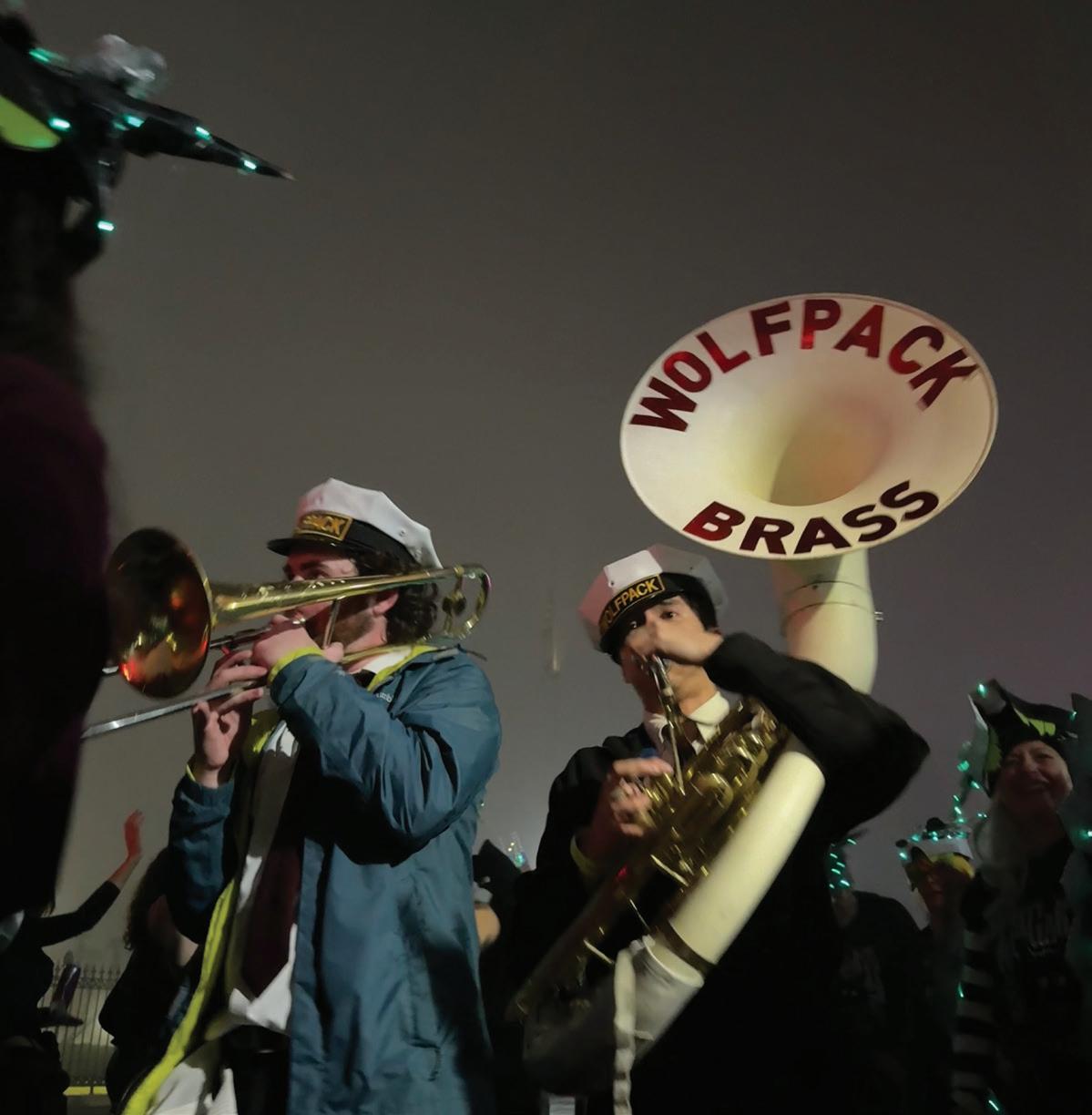
Student Arin Dingledine designed a wolf-like headpiece, and Angelina Mandel designed a three dimensional Rougarou face with wearable shields. Loyola’s second-line band, Wolfpack Brass, also marched with RouxGaRoux.
The entry fee for the students to walk was paid for by the College of Music and Media, and Dean Sheryl Kennedy Haydel and other faculty members walked with the students, according to a press release from the College of Music and Media.
REVIEW: Hadestown brings 1920s jazz and greek gods back to the Saenger
By Valentina Russell varussel@my.loyno.edu
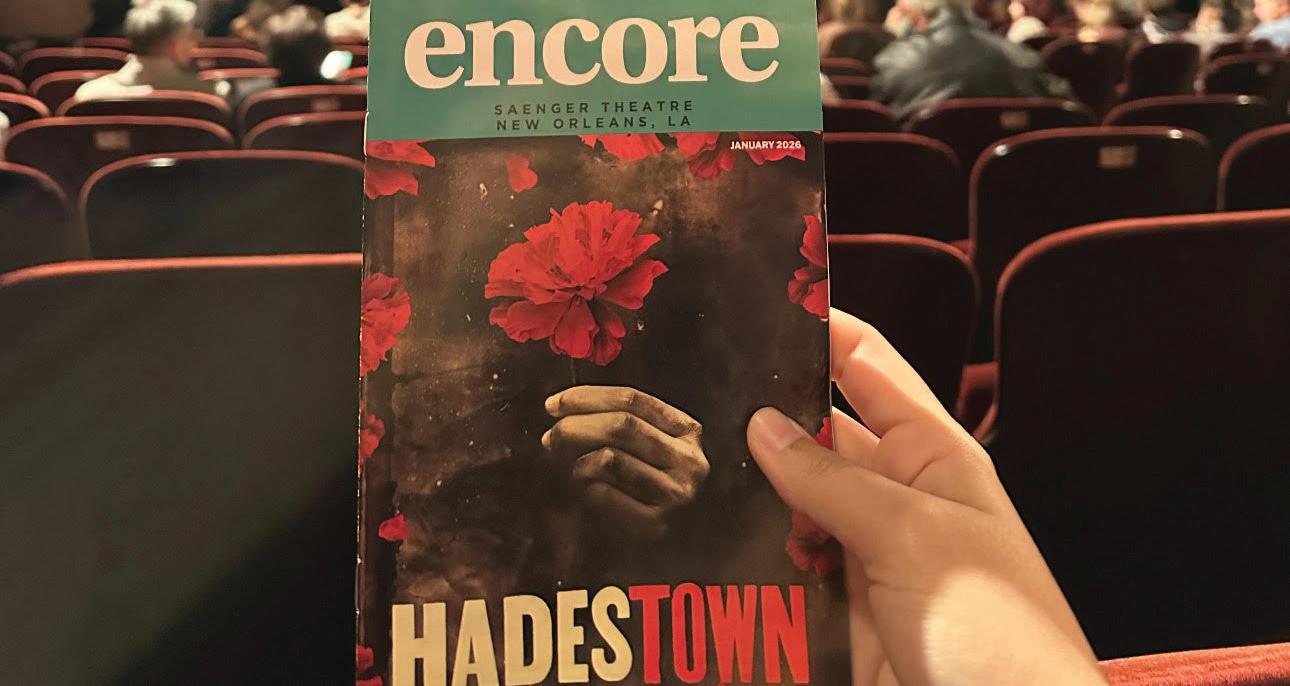
I recently watched one of my favorite musicals, Hadestown, at the Saenger Theater. The Tony-award winning show tells the tale of Orpheus and Eurydice, a Greek myth, in a new way.
Set in Depression Era New Orleans, the show blends Broadway Tunes with the city’s beloved jazz.
The atmosphere in the theater I attended twice was nothing short of electric.
People dressed in their finest clothes, cosplays, or show-specific merchandise filed in. You could hear attendees share stories in line with their history with the show. Conversations floating in the air of first times, returning audiences, dear memories bringing the show to life before the overturn even began.
The Saenger Theater is beautiful as always, with celestial ceilings and statues
decorating the balconies.
As for the show itself, this touring cast was phenomenal. Since I went two nights in a row, I got the honor of seeing Miracle Myles and Jose Contreras as Orpheus.
Both bring different creative freedom to the role so effortlessly. Myles had this wide eyed, head over heels approach that makes you believe in love again, while Contreras truly played into the optimistic poet, and made you see the world through Orpheus’ eyes.
The rest of the main cast was jaw dropping and I left the theater in tears both nights.
Some highlights from the show for me were “Living it Up on Top”, “Hey Little Songbird”, and “How Long”. The vocals and acting made me forget that I was seeing a musical on stage and not viewing a Greek tragedy first hand.
I was curious going in to see how the set would differ from the Broadway version.
The touring cast performs without the elevator and turn tables that the show is known for, but this does not take away from the performance in the slightest. Instead, the moments usually associated with these two devices are replaced with choreography and a foggy exit/entrance symbolizing Hadestown placed in the stage left wing.
For the iconic moment at the end (spoiler ahead), Eurydice is lifted into the air as if in a coffin instead of dropping, which I personally liked just as much as the original Broadway version.
As a theater lover, I will take any chance to go watch live theater, and Hadestown is no exception. In a world where Artificial Intelligence and screens are taking over, it is now of utmost importance to go out and support the arts. Live theater gives you an experience that is not transferable to a screen.
The buzz in the lobby, the laughter
during the show, the tears at the end, and meeting the cast afterwards (which I got to do, they were all so sweet!) makes live theater unforgettable.
The Saenger Theater especially is a great place to see shows, not only due to the architecture and show choices, but with their student discounts for day-of tickets.
Live theater is something everyone should experience in their lifetime, so be sure to go see the rest of the Broadway New Orleans season and other local productions!
Stella and the city: Loyno late nights brings "Soft" and "Pyschedelic" sounds
By Stella Perdue swperdue@my.loyno.edu
On Friday night, I thought I wasn’t going to go anywhere at all, but then I got invited to Folk Alliance International by a friend.
I had no idea what it was or what it entailed until I was pleasantly surprised by door-to-door concerts and engaging performances from Loyola musicians I’d never heard of. If you are as clueless as I was, Folk Alliance International is a nonprofit arts
organization founded in 1989 with the special focus of bringing artists and fans of the folk genre together to celebrate music from all over the world. Artists and industry leaders have the ability to network with one another and the conference seeks to preserve the folk
genre in its entirety.
Every year, Folk Alliance hosts a conference in a different city. Luckily for New Orleans–and me, surprisingly–-this year it landed at the Sheraton hotel.
It is extremely difficult to get me to go to the French Quarter in freezing
temperatures when it isn’t for the Zulu Parade, but my interest was piqued. The Sheraton is a massive four-star hotel, and immediately on arrival, I noticed this event
Freshman Angelina Mandel works on her Chewbacchus costume in intro design. Photo provided by the College of Music and Media.
Loyola students and faculty walking in Chewbacchus on Saturday, Jan. 24, 2026. Sophia Renzi/the Maroon.
Wolfpack brass performers walking in Chewbacchus on Jan. 24, 2026. Sophia Renzi/ the Maroon.
The playbill for Hadestown at the Saenger theater. Valentina Russell/The Maroon.
Leading Toward Justice: Loyola, New Orleans, and the Struggle for Civil Rights.
Historic New Orleans Collection in partnership with Loyola University
New Orleans J. Edgar and Louise S. Monroe Library present The Trail They Blazed traveling exhibit in conjunction with Leading Toward Justice: Loyola, New Orleans, and the Struggle for Civil Rights at Loyola University New Orleans Monroe Library January 22 – April 19, 2026.*
*Leading Toward Justice will exhibit all of 2026
EXHIBITS ON THE FIRST, SECOND, AND THIRD FLOORS OF THE LIBRARY.
Opening reception
◦ January 22, 2026
◦ 5 p.m. – 7 p.m.
◦ Monroe Library, First Floor
Featured speaker
Dr. Ronnie Moore, Fr. Louis J. Twomey, SJ Legacy Scholar in Residence, Jesuit Social Research Institute, 2024 Loyola Honorary Degree Recipient.
Four new inductees welcomed to hall of fame
Amari Winchester abwinche@loyno.edu
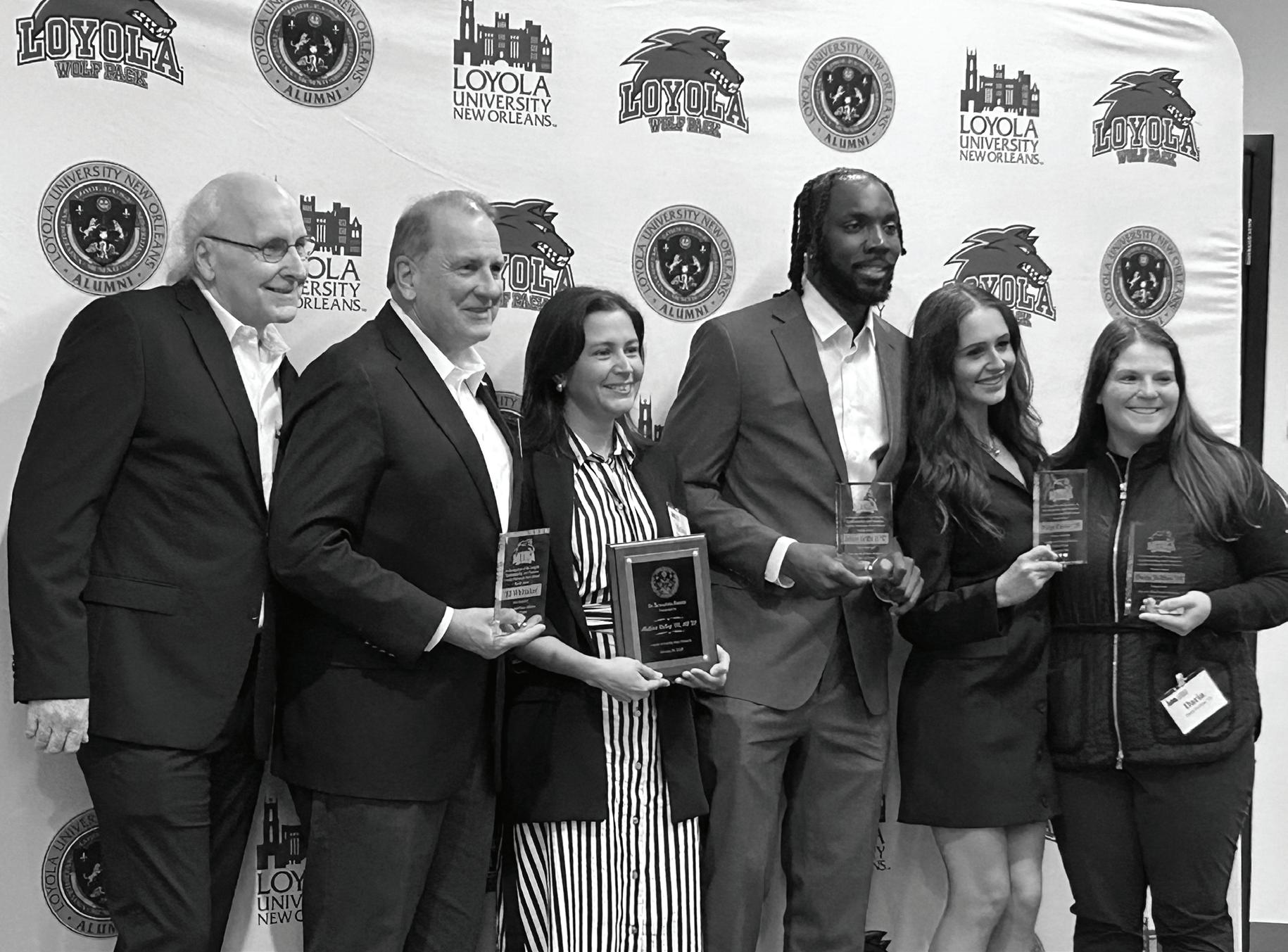
Former Loyola student athletes inductees Paige Carter, Daria Delfino, Johnny Griffin Jr., and Tommy "TJ" Whittaker became official members of the Wolf Pack Hall of Fame for their historic contributions to their respective sport.
Carter for her efforts in swimming, Delfino for her efforts in golf, and both Griffin Jr. and Whittaker for their respective efforts in basketball.
Alongside them Melissa Ridley, the Assistant Dean for Student Services, was honored with the “St. Sebastian” award for her efforts in supporting the student athletes on campus.
Carter is the first swimmer in Wolf Pack history to be inducted into the school's Hall of Fame. Her numerous accomplishments include three podium finishes, being the runner up in the 400-yard medley in 2019 and in 2020, and holding third place in the 500-yard freestyle in 2018.
With her efforts, the Loyola Woman’s swim team got sixth place in the National Association of Intercollegiate Athletics meets overall in 2018 and 2019, and held her own individual scores at the National Association of Intercollegiate Athletics in 2019 and 2020, with the 1,650-yard freestyle and the 500-yard freestyle. With these meets she scored fourth and fifth place respectively in these meets. She also gained eighth place in the 500-yard freestyle in 2018.
This was very early on in the swim
program's career, so this set Carter apart in being a star player, making her a unanimous vote when it came to choosing her for this year's class. During her speech she was grateful for her family, her friends, and the coaches here at Loyola for making her the swimmer that she is today.
Delfino is the first woman to be individually inducted into the Hall of Fame’s golf division, although she was already inducted into the Hall of Fame as a part of her 2019 golf team. Delfino was always a respected golfer, but her senior year was the most notable.
She finished second place at the Cambrian Ridge course for the Southern States Athletic Conference championship. Then later on, she helped Loyola place ninth at the NAIA tournament with her own individual win in 13th place.
She also has four tournament wins. These wins took place at 2015 Freed-Hardeman Invitational, the 2017 Tennessee Wesleyan University Spring Invitational, the 2018 Women's Roadrunner Invitational and the 2019 Wolf Pack Spring Invitational.
When it was time for her to speak, she gave a speech talking about her time at school. How she had such a deep connection with not only the campus, but the people as well. When asked about that impact, this is what she had to say
“Loyola is just the foundation of my life,” Delfino said. “ The older I get the more grateful I am…”
Even with his short time at the school, Griffin Jr.made his mark. After transferring to Loyola for his junior and senior year from Chicago State, he became one of the best rebounders in wolf pack history.
Loyola rugby begins recruiting for program’s first season
By Keri Smith klsmith1@loyno.edu
Loyola University New Orleans’ rugby program has begun traveling to recruit prospective students as part of its ongoing effort to build team rosters for future seasons.
Coach Ryan Fitzgerald has visited high schools, youth rugby clubs and regional tournaments across Louisiana and nearby states. The recruiting trips are intended to identify students interested in playing rugby at the collegiate level while attending Loyola.
Recruiting activities have focused on regions where youth and club rugby programs are established, as well as areas where the sport is developing. During these visits, the coach observes matches and training sessions and meets with players who may be eligible for future enrollment.
He has also met with high school coaches, club organizers and athletic coordinators during recruiting trips. These meetings are used to share information about Loyola’s rugby program and the university’s academic offerings. Building relationships with regional programs allows for continued communication with potential recruits and their coaches.
Loyola rugby operates as a club sport under the university’s student life and recreational sports structure. The team
competes against other collegiate club programs and is funded through a combination of university support, student fees, and fundraising. Participation is open to enrolled students who meet eligibility requirements set by the club and its governing organizations.
Rugby participation at the collegiate level has increased nationwide in recent years, with more high schools offering the sport. This growth has led many universities to expand recruiting efforts for club rugby programs. Loyola’s travel-based recruiting reflects this broader trend among collegiate club teams.
According to rugby socials and the athletic website the current recruiting cycle is expected to continue throughout the academic year. Prospective students who express interest may remain in contact with the program through email, campus visits or future tournaments.
As recruiting efforts continue, the rugby program will use the information gathered from travel and outreach to finalize future rosters. The process is intended to ensure that enrolled students interested in rugby have the opportunity to participate once they arrive on campus.
After he graduated from Loyola, Griffin Jr. developed a professional career in basketball in Canada and Slovakia. He also played for the Kokomo Bobkats in The Basketball League's 2025 season.
As Griffin Jr. received his award, he mentioned how he was grateful for his brothers for introducing him to the school.
“Coming here was probably the best decision as far as my basketball career,” Griffin Jr. said. “It put me on a path to play overseas and to at least be close to one of my goals.”
Whittaker is getting his recognition by the institution for his efforts in the older era of Wolf Pack athletics. He was inducted for his efforts in the win of the 1945 national championship game.
After his life at Loyola, he played semi pro basketball and minor league baseball. After a career ending injury, he co-founded Lake Castle Private School, where he served as a math teacher and the athletic director before passing in 1991. To accept the award in his place were his sons, Scott and Grant Whittaker.
He averaged 9.8 boards per game, averaged 15 points his first year, and 14.3 in his second season. In total he collected 606 rebounds in his career. He also helped his team to go to the NAIA postseason tournament, and even though the team did continue in the competition, Griffin Jr. still received honorable mentions for his efforts.
Rugby program looking for social media manager
By Keri Smith klsmith1@loyno.edu
As the rugby program continues to grow on and off the field, the coaching staff is looking to add a social media manager to the team. The role will focus on capturing game day moments, highlighting student athletes, and sharing the culture of the program across platforms. Students with a passion for sports and digital media are encouraged to be involved. If interested reach out on the teams instagram @loynorugby
Tommy Wittaker two sons Grant and Scott, Melissa Ridley, Johnny Griffin Jr., Paige Carter, and Daria Delfino posing with hall of fame trophies. The have been recently inducted into Loyola University's Hall of Fame. Amari Winchester/The Maroon
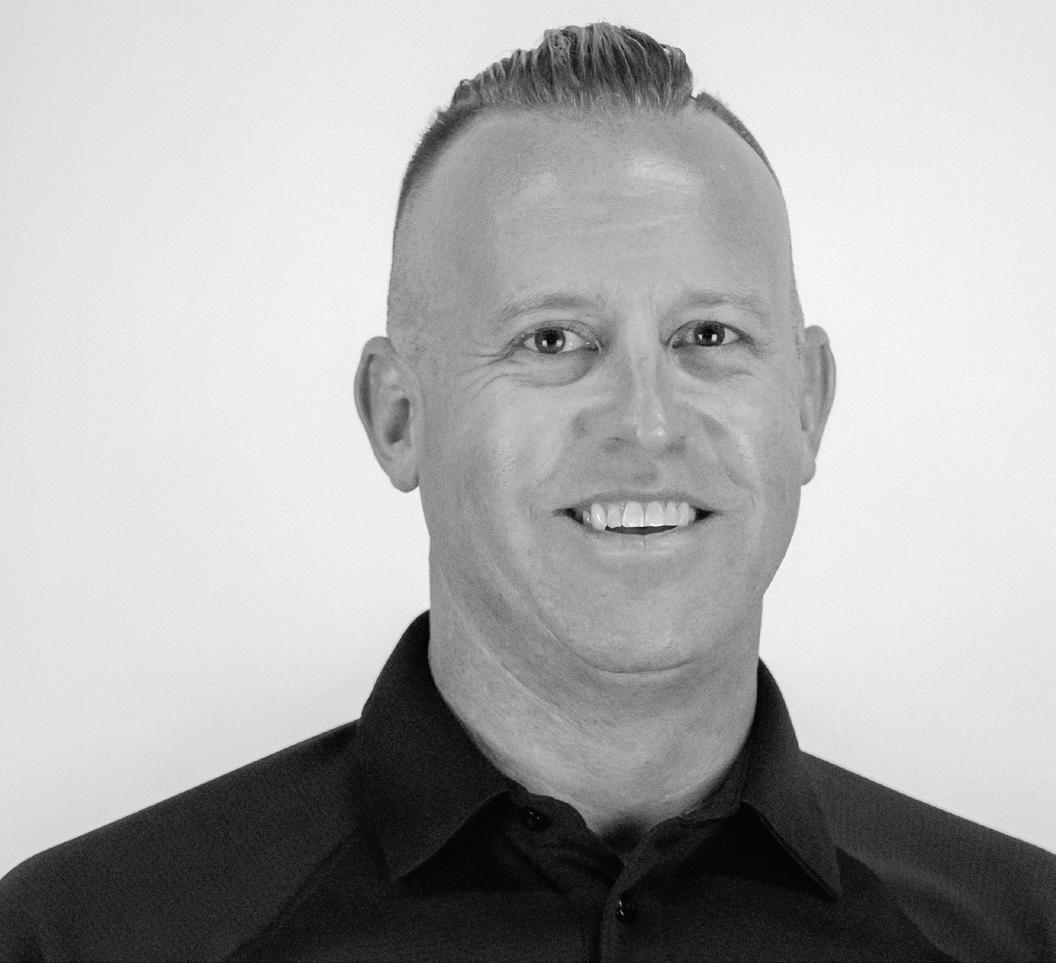
Headshot of Ryan Fitzgerald. He is the rugby head coach traveling to commit player to the team. Courtesy of Loyola University New Orleans Athletic department
HUGE DEAL: Kota Dosa and other bands captivate
Continued from p.8
was a huge deal: there were people from all walks of life constellated around the decorated, ambient lobby. I felt out of place compared to the immensely stylish musicians. For some perspective, the Sheraton has multiple different elevators–one for each floor.
The “Loyno Late Nights” sets were on the eighth floor. The hallways were narrow, each door leading to another con-
cert. With the simple turn of a knob, you could step into a different world filled with fresh takes on the folk genre. As soon as I entered the room dedicated to Loyola, I was entranced by a glowy purple light accompanied by the psychedelic sounds of Kota Dosa.
Kota Dosa was incredible. They’re a band with roots in New York, New Orleans, and Oregon, citing The Doors as one of their inspirations. Immediately, that was clear. Their ability to seamless-
ly blend genres together was noticeable off the bat: rock, folk, jazz–a horn solo, even. At one point, this other musician named Steve Poltz–a guy with long silver hair and a wide-brimmed hat, unaffiliated with Loyola–got up and started playing with them. “I tested positive for positivity,” he sang into the mic with a trill. The entire crowd started chanting in response. The chant was corny so I didn’t participate, but I can appreciate the hype of it all.
The next set was from Not Related Band, a folk act starring three Loyola students: Lily Waguespack, Louisa Saakian, and Jerney Jackson. Their set was a duo act with Lily and Louisa–Lily singing and playing acoustic guitar, and Louisa whipping out three different instruments. They played a mix of covers and originals, at one point with Louisa taking the mic. Her singing was soft and despairingly beautiful, like an emotional whisper.
Following Not Related was the band DIZZY!, consisting of Izzy Gruner (Loyola ‘27) and her brother David. Izzy was on keyboard, and her voice was utterly captivating. The duo’s combined stage presence was insane, with songs like “Retail” capturing the endless fatigue of late stage capitalism. As someone privy to alternative pop, I thoroughly enjoyed their set.
The Maroon
Jan. 30, 2026
OPINION
2016: A year that still echoes
By Imad Siddiqui isiddiqu@my.loyno.edu
I was 10 years old in 2016, in 5th grade, and my biggest responsibility should've been remembering to bring my Harry Potter book to school or my rainbow loom set. Instead, I was keeping up with the most chaotic year in modern pop culture and politics.
Most of my cultural education happened in the backseat of my cousins’ car. Drives meant Views on repeat, “One Dance” blasting through speakers to the point each lyric became engraved in my mind, “Childs Play” playing while I watched my cousin go word for word as she was reciting the bridge. I was wondering if we were actually going to go to The Cheesecake Factory. Kanye West was unraveling the internet with The Life of Pablo, and I didn’t know what any song meant, but I knew “Ultralight Beam” meant something serious because no one ever skipped it. Beyoncé’s Lemonade wasn’t just an album. Who is Becky? Why did everyone suddenly become an expert analyzing elevator footage? It was dissected like a national event. Frank Ocean reappeared with Blonde and at ten I couldn’t explain why “White Ferrari” made everyone emotional. Rihanna dropped ANTI. Iconic. I didn’t fully understand what any of it meant, but I knew it mattered, because everyone older than me, and everyone online, acted like it did.
Pop culture in 2016 wasn’t background noise. It was everywhere.
When “I Don’t Wanna Live Forever” came out in December, it somehow felt as if a pop culture god had personally asked me as a fifth grader what two artists I love and granted me a wish. That song was MY WORLD. I loved Zayn Malik. I loved Taylor Swift. Hearing their voices together felt monumental. Music
didn’t just exist; it happened. And then there was the internet, no longer just funny videos and scrolling. Social media in 2016 stopped being purely fun and started becoming heavy, those effects linger today. Memes and trends start moving at lightning speed, like they do in the status quo. Kylie Lip Kits sold out in seconds, proving that Instagram could turn desire into demand instantly. Stranger Things debuted, and suddenly Netflix wasn’t just something you watched, it was culture itself.
But reflecting on the past ten years the biggest shift didn’t come from pop
culture alone. It came from politics. Donald Trump was elected president in 2016, and suddenly politics wasn’t something reserved for adults or news. It was everywhere, on Twitter, on Facebook, in memes, at dinner tables. What seemed like distant issues unfolding in the background were happening in real time, online, mixed in with a couple of album drops and viral videos.
Somehow, I was absorbing all of this at 10 years old. I grew up in a world where political awareness wasn’t optional. While other generations eased into political consciousness, mine was
dropped into it mid-scroll. I remember it becoming real in middle school, the week before the election, when my school held a mock election to teach us how voting worked. It felt harmless at first, but then the principal announced the results over the loudspeaker. I heard Trump’s name, and I remember the shock, not just that he had won our mock election, but how many of my classmates voted for him. Adults called him “good.” Meanwhile, this was the man promising a Muslim ban. “Muslim ban” are two words that sent shivers down my spine as a 10-year old first gen-
eration American. I knew my family was here legally. I knew we were “safe” on paper. And still, I was scared.
And now, at 19, I look around and my heart breaks. I think about 5-year-old Liam Conejo Ramos, who was taken by ICE alongside his father in Minnesota as he returned home from preschool, in a country he and his family came to seeking safety. I think about Renee Good, Alex Pretti, Geraldo Lunas Campos, and the many more innocent lives that have been taken away or wrongfully accused. I think about how politics didn’t just enter my life early, it arrived with consequences, and it taught me far too young that safety in this country has always been conditional.
Now, I’m a college sophomore, still following many of the same conversations, Trump, ICE, protest, power, just with more vocabulary and academic language to back it up. What’s strange is not that I’m still paying attention. It’s that I’ve always been paying attention.
So when people mention how so much has changed since 2016, I believe them. It’s because I never knew a world without it. I didn’t slowly grow into a politically charged, hyper-connected society.
Now, when I scroll past friends posting about 2016, I still think about car rides, overheard conversations, songs I didn’t fully understand yet but memorized anyway. I remember how that year quietly shaped how I experience culture, politics, and the internet.
And even with all of that, I’m grateful for the awareness it gave me. Growing up in that moment taught me how to pay attention. To read between the lines of what I consume, to question what’s being sold to me as normal, and to sit with complexity instead of turning a blind eye. I grew up learning how culture and power move together.
Letter: professor association committees declare support for immigrant communities
By
American Association of University Professors Executive Committees at Loyola University New Orleans and Tulane University
The American Association of University Professor (AAUP) chapters at Loyola University New Orleans and Tulane University declare our support for the international and immigrant students, faculty, and staff, and their families at our universities and by extension the larger immigrant community of the greater New Orleans metropolitan area. The recent aggressive dispersal of federal immigration agents into and across our city and its neighboring communities has stoked fear, uncertainty, hardship, and distress in the lives of many.
As AAUP faculty, we are compelled to call attention to these hardships and express concern for the members of our communities directly impacted by the federal deployment. These operations, the tactics deployed by agencies like Immigration and Customs Enforcement (ICE) and Customs and Border Protection (CBP), and the harsh treatment of our city’s immigrant community undermine the preservation of universal human rights.
The Loyola AAUP chapter is dedicat-
ed to Catholic, Jesuit values, which assert that “every migrant is a human person who, as such, possesses fundamental, inalienable rights that must be respected by everyone and in every circumstance” (Caritas in Veritate, 62).
The Tulane AAUP chapter is dedicated to Tulane’s mission to foster equitable communities and uphold the dignity and rights of all people. The safety and
“The safety and well-being of immigrant and international students, faculty, and staff are essential to our academic community.”
well-being of immigrant and international students, faculty, and staff are essential to our academic community. Protecting the rights of immigrants is inseparable from our responsibility to promote justice, support vulnerable populations, and ensure that every member of our community can learn and work without fear.
The Loyola and Tulane AAUP chapters also recognize the critical role that immigrants have long played in the history of New Orleans. For centuries, our city has been a destination for people from different places. Immigrants have helped fashion our city’s unique cultural identity, created businesses and institutions, built families and homes, and worked to restore our community in the aftermath of devastating natural disasters. Especially important in this regard are the efforts of immigrants from Honduras, Mexico, and other countries from South America, Central America, and the Caribbean who aided in rebuilding the city in the immediate aftermath of Hurricane Katrina in 2005.
We urge federal, state, and city officials to use restraint as federal immigration agents operate in our city, and we call on the larger Loyola and Tulane communities to explore meaningful and tangible avenues to support the students, faculty, and staff whose families, homes, livelihoods, and safety are being threatened by current federal actions. Most importantly, we want the entire Loyola, Tulane, and New Orleans communities to know: you belong here, you are valued, and you are loved.
Marquette Hall on April 9. Tanesha Taylor/The Maroon
Makayla Parker/The Maroon
AI can't compete with authentic voice
By Lonniesha Carroll llcarrol@my.loyno.edu
When artificial intelligence first emerged as a marketing tool, I felt threatened. Not by replacement—by the idea that others might think AI could replace the core work we do as communicators. The more I watched professionals lean on AI without critical thought, the clearer it became: artificial intelligence is exactly what its name suggests. It lacks
the real intelligence, emotion, and originality that define exceptional communication.
AI saves time. That's its job. But it cannot—and should never—create the authenticity that audiences actually trust.
Real storytellers, writers, and strategists are irreplaceable. We carry credentials that machines cannot: lived experience, cultural understanding, emotional intelligence, and the ability to connect with audiences on a human level. AI can
support our work by organizing ideas, drafting frameworks, and handling administrative tasks. What it cannot do is deliver the message with strategy, tone, timing, and truth.
When marketing messages all pass through the same AI tools, the result is often generic, hollow, and sometimes factually flawed with hallucinations, clichés, and quiet mistakes that erode trust. Efficiency may increase, but credibility suffers.
This is why authenticity matters more than ever in marketing communications. Authentic voice means bringing real human perspective to every message, shaped by lived experience, values, and context. Audiences don’t respond to perfect copy; they respond to stories that feel real and relatable. Brands that sound like everyone else ultimately sound like no one.
Your background, your perspective, your way of seeing the world—these
cannot be replicated. That's not something to protect less; it's something to protect more. Tone, cultural awareness, and emotional intelligence are what build lasting brand trust. These come from human discernment, not algorithmic patterns scraped from the internet. There are many instances where AI works and where it fails. AI makes sense for brainstorming, organizing, summarizing, and drafting—freeing your energy for what machines cannot do: verify accuracy, fact-check sources, inject your voice, and ensure ethical representation. The moment professionals rely on AI without critical thinking, they lose the very skills that make them valuable.
Communicators entering this field have a responsibility: fact-check, verify, control the narrative, and ensure your final work is credible and unmistakably yours.
I think that the future belongs to human leadership.
The future of communications and marketing is faster, yes. Technology will evolve constantly, yes. But machines glitch, trends fade, and AI tools go out of style. Real human stories keep growing, adapting, and connecting across time. The message is simple: You control AI. AI does not control you.
Communications professionals must remain at the center of this work, using technology as a tool while maintaining authority over meaning, ethics, and creativity. Let machines handle the busy work. Your job is to protect your authentic voice, share real stories, and build connections only humans can forge. Because in a world of generic content, authenticity isn't a luxury. It's the competitive advantage that no algorithm can ever replicate.
What the fall of Saks Fifth Avenue says about American retail
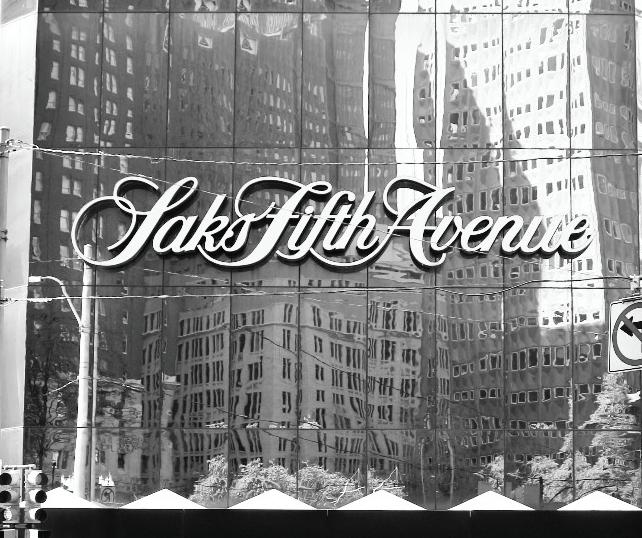
People walk along Smithfield Street in downtown Pittsburgh past the Saks Fifth Avenue department store on Thursday, Oct. 6, 2011. (AP Photo/Keith Srakocic)
Once iconic symbols of luxury, they are now disappearing before our eyes. Saks Fifth Avenue’s bankruptcy represents more than just the fall of an iconic brand, but a turning point in luxury retail.
Saks Fifth Avenue's bankruptcy did not come out of left field for people keeping an eye on the brand. With mounting debt, questionable corporate expansion, and a shopping landscape dominated by online storefronts, large retail storefronts have taken the hardest hits. Back in the good old days, when department stores were the gateway to high fashion
and luxury, shopping was an experience, with a curated vibe of exclusivity from store to store. Now, today's consumers would rather trade in this selective shopping experience for digital convenience, delivered right to their front door.
Saks Fifth Avenue's fall is just one example of an industry struggling to keep up with a constantly evolving definition of retail and luxury.
Unlike other company bankruptcies, the closure of stores like Saks Fifth Avenue represents more than the loss of a place to shop. When Forever 21 shut down, I knew I could get the same cheap, accessible clothes on a multitude of other platforms and stores. These flagships aren’t fast fashion like that, but symbols of fashion institutions, shaping how consumers experience fashion and shopping. An example of this is Saks' infamous window displays. Destinations within themselves, these displays were a touristic attraction without even walking in the store, spreading brand awareness and drawing crowds for a shared luxury retail experience.
Now looking into the future, it's difficult to see what this means for luxury retail and what will now define that shopping experience. These brands need to shift their experience to attract this new market of consumers, implementing new tactics like visual storytelling, resembling their window displays on social media. It's keeping their brand and staying true to themselves, just with a modern twist.
A lot of luxury labels have shifted
to selling through selectivity in direct-to-consumer models, favoring brand-owned boutiques with limited drops to maintain an air of exclusivity and luxury. This is positive when it comes to controlling pricing, inventory, and the narrative that department stores used to own.
As luxury shopping grows into a personal and digital space, these dynasty brands need to adapt, or they are at risk of becoming irrelevant in this industry.
We can’t solely blame the downfall of Saks Fifth Avenue on a changing market, but corporate decisions and financial mismanagement also played a crucial role. After years of expansion that accumulated debt, the company was left vulnerable when the sales weren't equaling the cost of these new developments.
Loyal vendors and designers were met with delayed payments while stores couldn’t maintain inventory. This isn’t the first time luxury retail was met with bad business, but without strategic insight and preparation, these companies can falter all the way to bankruptcy.
When these stores close, the damage goes farther than meeting a quota or correcting a balance sheet. These flagship locations were not just retail spaces, but landmarks and cultural symbols of fashion itself. Fifth Avenue has boosted the American shopping experience, creating a new market in our system surrounding luxury experiences and shared moments of admiration. Many young people fell in love with fashion through these unattainable spectacles that left
them with something to work toward. I never wanted to go to Disneyland growing up, just the New York City fashion district, where I could look in awe at all of the clothing and accessories that I hoped to one day call my own.
Losing the spectacle that is fashion through these immersive retail experiences is a warning of a changing world. Nostalgia and legacy aren’t enough anymore for these luxury brands, but an experience like no other is still a part of human nature; they just need to find that for this new generation of consumers. The fall of Saks Fifth Avenue marks the end of an era, but the beginning of an opportunity for reinvention that only a high-fashion brand can do.
“As luxury shopping grows into a personal and digital space, these dynasty brands need to adapt, or they are at risk of becoming irrelevant in this industry.”
— Callie Honeycutt
Makayla Parker/The Maroon
The Maroon
Jan. 30, 2026
Pharrell Every/The Maroon
HOWLS & GROWLS
HOWL to protesting
GROWL to ICE
HOWL to Harry Styles
GROWL to bitter co ee
HOWL to Krewe du Vieux
GROWL to Uptown dryers
HOWL to student government
GROWL to dry king cake
Respecting student voice is Loyola's greatest strength
Universities often speak about empowering students.
Fewer actually follow through. At a time when student voices at many institutions are overridden or treated as symbolic rather than taken seriously,
Loyola University New Orleans deserves recognition for doing something simple: respecting its Student Government Association.
When universities genuinely respect student self-governance, they a rm that students are active participants in shaping their own community.
Loyola’s continued recognition of SGA as an autonomous, representative body re ects an understanding that aligns directly with its Jesuit mission.
At many schools, student voices are treated as symbolic, but easy to ignore when real decisions are being made.
When students are actually allowed to govern themselves, it changes the entire relationship between the school and the people who attend it.
Students are not just paying tuition and showing up to class. ey are the
Editorial Board
Editor in Chief
Eloise Pickering
Managing Editor for Print
Mary Ella Hastings
Pre-Content Director
Alana Frank
Post-Content Director
Callie Honeycutt
Campus News Editor
Lily Bordelon
Campus News Editor
Stella Perdue
Worldview Editor
Pablo Pineiro-Ramy
ones living on campus every day, taking online courses, and commuting to school.
ey walk the halls, eat in the dining hall, attend events, notice problems, and feel the impact of university decisions in real time. A student government run by students understands the campus in a way faculty and administrators simply
“A student government run by students understands the campus in a way faculty and administrators simply can't. ”
— The Editorial Board The
Maroon
can’t. Not because they don’t care, but because they don’t live it. at’s what makes student government so important. It gives students a real voice in shaping the place they call
Assistant Worldview Editor
Angelica Pineda
Life and Times Editor
Elise Beck
Assistant Life and Times Editor
Olivia Sanyal
Sports Editor
Kerieyaunta Smith
Opinion and Editorial Editor
Imadnisa Siddiqui
Breaking News Editor
Natalie omas e Wolf Editor
Laura Welles
home for four years. When decisions are made with students instead of for them, the result is a community that feels more responsive and fair.
Loyola’s respect for its student government re ects this understanding. Instead of treating SGA as a formality, the university allows it to function as an actual representative body. at trust matters. It shows that Loyola believes students are capable of responsibility, leadership, and thoughtful decision-making; values that align closely with its Jesuit mission to educate the whole person and prepare students to serve others.
Student government is not perfect, and it isn’t supposed to be. Learning how to lead means making mistakes, debating ideas, and guring things out along the way. But that’s the point. When students are given real responsibility, they gain real experience.
Faculty and administrators bring experience and long-term perspective. Students bring immediacy. ey know what’s working, what’s frustrating, and
Senior Sta Photographer
Sophia Renzi
Assistant Photo Editor
Pharrell Every
Design Chief
Makayla Parker
Social Media Manager
Mabel Regalado-Hernandez
Social Media Manager
Carlos Andrade
Copy Editor
Mark Michel
what needs to change because they are experiencing it right now. A university is strongest when those perspectives work together, not when one is dismissed.
In a time when higher education often feels transactional, degrees exchanged for tuition, Loyola’s respect for student-led governance stands out. It reminds us that education is about more than academics. It’s about learning how to participate in a community, speak up for yourself and others, and take responsibility for the world around you.
If Loyola wants to continue forming engaged, thoughtful leaders, respecting student government is not just a nice gesture. It’s essential. For choosing to trust the students who live on this campus every day, Loyola deserves real credit.
“Student government is not perfect and it isn't supposed to be. Learning how to lead means making mistakes, deabting ideas,and figuring things out along the way. But thats the point. When students are given real responsibility, they gain real experience .”
— The Editorial Board
The Maroon
EDITORIAL POLICY
The editorial on this page represents the majority opinions of The Maroon’s editorial board and does not necessarily re ect the opinions of Loyola University.
Letters and columns re ect the opinions of the authors and not necessarily those of The Maroon’s editorial board.
The Maroon does not represent the opinion of administration, sta and/or faculty members of Loyola.
Letters are subject to editing for length, grammar and style. Please limit submissions to 400 words. Submissions are due no later than 4 p.m. the Sunday before publication.
Please send all submissions —
The Maroon, 6363 St. Charles Ave., Box 64, New Orleans, LA 70118.
Email us your letters — letter@ loyno.edu.
Submissions may also be made online at www.loyolamaroon.com.