CLIL PROJECT - TEACHER'S GUIDE Great Time 3: UNIT 10 SUBJECT:
Science/Nutrition
TOPIC:
Keep Healthy
DRIVING QUESTION:
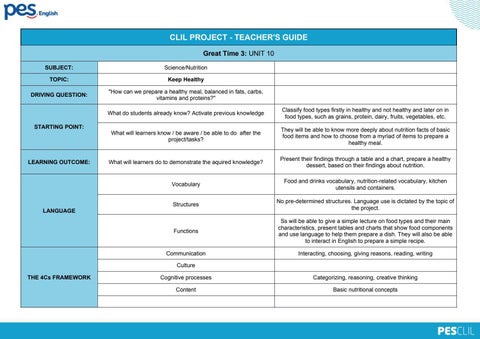
"How can we prepare a healthy meal, balanced in fats, carbs, vitamins and proteins?" What do students already know? Activate previous knowledge
Classify food types firstly in healthy and not healthy and later on in food types, such as grains, protein, dairy, fruits, vegetables, etc.
What will learners know / be aware / be able to do after the project/tasks?
They will be able to know more deeply about nutrition facts of basic food items and how to choose from a myriad of items to prepare a healthy meal.
What will learners do to demonstrate the aquired knowledge?
Present their findings through a table and a chart, prepare a healthy dessert, based on their findings about nutrition.
Vocabulary
Food and drinks vocabulary, nutrition-related vocabulary, kitchen utensils and containers.
Structures
No pre-determined structures. Language use is dictated by the topic of the project.
Functions
Ss will be able to give a simple lecture on food types and their main characteristics, present tables and charts that show food components and use language to help them prepare a dish. They will also be able to interact in English to prepare a simple recipe.
Communication
Interacting, choosing, giving reasons, reading, writing
STARTING POINT:
LEARNING OUTCOME:
LANGUAGE
Culture THE 4Cs FRAMEWORK
Cognitive processes
Categorizing, reasoning, creative thinking
Content
Basic nutritional concepts
A. PRE-TASK
1. As work in groups of six or seven. Each one from the group should choose one or more food items (every group must have at least some fruit, a drink, a type of oil, a type of bread/cereal, a type of meat/eggs, a type of vegetable and a dairy product). They will find out about its basic composition: percentages of proteins, carbohydrates, and fat. Additionally, they can search about vitamins and other nutrients the item might present. Based on this primary research, the group will create a table and then classify each food according to its main compost.
PLAN
2. Is will now search on what makes a meal healthy: What is considered a balanced meal, what items to choose and what items to avoid. Using their findings and the ingredients from the table they have just made, ss will prepare a healthy breakfast menu, in which they should explain why the items were chosen. Their choices should be made based on the nutritional facts of the food items.
B. TASK
The groups should present their menu to the class, including explanations about the nutritional facts of each food item chosen. It should be illustrated with at least one picture of each food item or with snacks/dishes made with the ingredients they chose. They can make their presentation using any preferrable format: A poster, a power point presentation, a handout of the menu to all their classmates, etc. (Teachers should clarify that, despite the format chosen, all presentations should be visually appealing, having at least the pictures mentioned and the table that ss created).
POST-TASK (OUTCOME)
Tips on how to do it
To put in practice what they just learned, ss will prepare a fruit salad, made with some of the healthy items that appeared in their presentations. It is up to the teacher to decide how to best conduce this activity, substituting or changing anything they find to be necessary. They can also previously teach new food items, containers and utensils which will be used in this task.
→ Ingredients (may vary according to the size of the class, availability of items, students' preference, etc.): 3 bananas, 3 apples, 3 oranges, a small papaya, a package of strawberries, a cluster of grapes, 500ml of natural yogurt, 200 ml of honey. →Utensils needed: Cutting boards, kitchen knives/peelers*, a large bowl, a large spoon/wooden soon/spatula; serving cups or bowls; teaspoons. → Mode of preparation: chop all fruits into small cubes. Put them into the bowl. Add the natural yogurt and the honey and mix it all with a large spoon or spatula. Serve individually in small bowls or cups. →Preferably, this task should be done at once with the whole class, in a kitchen or an area with a large table. The teacher can split the class in small groups and each one of them will be responsible for bringing to class an ingredient. These groups can also be responsible for peeling and chopping the fruits. *All utensils should be prepared beforehand, and children should be supervised if there is any handling of knives or other sharp objects. An alternative is to ask ss to bring all fruits already chopped from home.