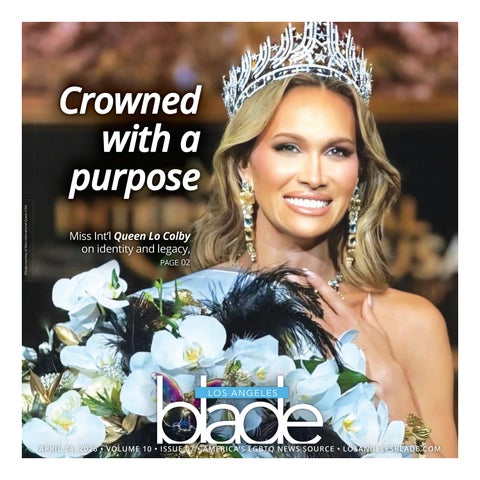
Los Angeles Blade, Volume 10, Issue 07, April 24, 2026

Page 1


Crowned with a purpose: Advocate & Miss International Queen USA 2026

Lo Colby opens up about the emotional yet resilient journey to being crowned Miss International Queen USA 2026, and the powerful mission she’s just getting started on

Fresh off a monumental win, Lo Colby steps into this conversation with the same grace and strength that captivated the judges and audience alike. In our candid interview with Colby, she reflects on the pivotal moment of being crowned Miss International Queen USA 2026, sharing the raw emotion, surprise, and grounding presence of those who were her biggest cheerleaders when her dream came to fruition.

Throughout our conversation, Colby opens up about the years of preparation, perseverance, and self-belief that led to this victory. Representing Los Angeles with pride, she speaks to the power of chosen family, the lessons forged through resilience, and her steadfast commitment to advancing transgender economic empowerment. Both genuinely thoughtful and deeply personal, Colby’s story reveals not just a titleholder. We get a glimpse of a purpose-driven advocate that she is, determined to create real and much-needed change.

First off, congratulations! What was going through your mind in the moment you were crowned Miss International Queen USA 2026?

Honestly, I was in complete shock when Mimi Marks announced my name. I had never experienced a moment where every emotion was happening all at once.

What I remember most clearly is looking over at Zhane Dawlings, and she said to me, “You did it.” That moment helped ground me. Everything suddenly felt real when I went in to hug her. It was overwhelming in the best way possible, and it’s a moment I will cherish for the rest of my life.

Can you tell us a bit about your journey leading up to this moment? What inspired you to compete?

This journey actually started a few years ago. Todd Montgomery and Kimmie Kim from Miss International Queen USA approached me while I was competing in a drag pageant. That moment really lit a spark in me. It made me realize that a dream I had admired for so long might actually be possible.

At the time, though, I knew I wasn’t ready yet. I made the decision to wait until the 2026 competition so I could fully prepare myself. Once I was accepted as an official contestant, I went into full training mode. I treated it like preparing for the Olympics with weekly runway coaching, interview and Q&A training, and a lot of personal work on building my confidence and stage presence.

Allowing myself that time to grow made all the difference.

You represent the City of Angels. How has Los Angeles shaped who you are today?

I moved to Los Angeles with the dream of becoming a successful working drag performer in West Hollywood. Over time, this city gave me so much more than that dream; it gave me community. I found myself surrounded by incredibly talented artists and performers who eventually became my chosen family. Being in that environment pushed me to grow creatively and personally.

Los Angeles taught me that grit, hard work, and believing in your vision can take you further than you ever imagined. Your platform focuses on transgender economic empowerment. What inspires you to advocate on this issue?

I’ve experienced firsthand what it feels like to walk into a room or an interview and know that people may already have assumptions about you. Sometimes those unconscious biases can create barriers before you even have the chance to show who you are professionally.

Because of that, I worked incredibly hard to make sure my skills, experience, and work ethic speak for themselves. But I also recognize that many transgender people face disproportionate discrimination and inequality in the workplace.

That’s why I’m passionate about advocating for economic empowerment. Trans people bring valuable perspectives, resilience, and creativity to professional spaces, and I want organizations to recognize the incredible contributions our community can make.

You’ve spoken about the wage gap affecting transgender women. What are some of the biggest obstacles you’ve personally seen or experienced?

Before we can even talk about the wage gap, we have to acknowledge the barriers transgender people often face just trying to enter the workforce.

Unconscious bias is a major factor. People may make assumptions based on how someone looks, presents, or even sounds. But there are also very practical challenges, like navigating legal name or gender marker changes.

I remember early in my transition when my legal name had not yet been updated. I went into an interview where the way I was presenting didn’t match the name on my documents, and the room immediately filled with confusion. Instead of focusing on my professional experience or qualifications, the conversation shifted toward my gender identity. While uncomfortable, I stood in my truth and used it as a way to educate those I was interacting with. A lot of these obstacles can be resolved with the proper education within organizations.

For folks who may not fully understand this issue, why is economic empowerment such a critical part of trans advocacy?

Economic empowerment is foundational because financial stability impacts every aspect of someone’s life. When transgender people have equal access to employment, fair wages, and career advancement, it creates opportunities for housing stability, healthcare access, and long-term security.

Historically, transgender women, especially trans women of color, have often been portrayed in very narrow ways in the media, which has contributed to stigma and limited opportuni-

ties in professional spaces.

By focusing on economic empowerment, we help shift that narrative. It allows transgender people to thrive and to build meaningful careers.

What are some concrete changes you hope to push for during your reign?

One of my goals is to collaborate with LGBTQ+ organizations to expand career development programs for transgender individuals. That includes mentorship opportunities, professional networking, and career readiness training.

I also want to encourage companies and organizations to implement more inclusive hiring practices and workplace education programs. Sometimes change starts with giving people the tools and understanding to create a more supportive environment.

Through my platform, I hope to help create partnerships between community organizations and businesses so that more transgender individuals can access meaningful employment opportunities.

How do education, career access, and entrepreneurship all play a part in closing this gap?

These three elements work together to create long-term economic and financial security.

Education provides the foundation, whether that’s formal education, professional training, or skill development. Career access ensures that transgender individuals actually have the opportunity to apply those skills in the workplace.

Entrepreneurship is another powerful pathway. Many transgender people have built successful businesses when traditional workplaces were not welcoming. Supporting trans entrepreneurs helps create financial independence and can also open doors for others within the community.

What advice would you give to transgender folks who are navigating similar challenges in professional spheres?

My biggest advice is to never underestimate the value of your voice, your experience, and your perspective.

There will be moments when you feel like you have to work twice as hard to prove yourself, but your authenticity and resilience are strengths. Surround yourself with a community that supports your growth, and don’t be afraid to advocate for yourself.

Most importantly, remember that you belong in every room you walk into.

Pageantry centers in on beauty and performance. How do you balance your flawlessness with advocacy?

Pageantry may highlight beauty and performance, but at its core, it’s about platform and purpose.

The stage allows you to capture people’s attention, but what you do with that attention is what truly matters. For me, beauty and advocacy are not separate. When people see confidence, elegance, and professionalism on stage, it opens the door for meaningful conversations about the issues that matter to our community.

Advocacy meets action: Weho City Council candidate Jonathan Wilson intends to lead with purpose

Jonathan Wilson shares on his decision to run for West Hollywood City Council, highlighting advocacy, representation, and a vision for meaningful change

At a critical moment for West Hollywood and cities across the United States, Jonathan Wilson comes forward with a candidacy for West Hollywood City Council that is grounded in advocacy and a crystal-clear call for change. In our conversation, Wilson reflects on the decision to enter public office as a necessary response to widening divides, shifting political realities, and the urgent necessity for leadership that is both responsive and representative. His perspective is founded on years of navigating spaces where identity and opportunity aren’t always aligned, fueling a commitment to ensure that more voices are not just included, but actually heard and addressed.

Drawing from his experiences as a Black and queer Angeleno, as well as his work across corporate, civic, and community spheres, Wilson speaks to the power of identity as both a lens and a responsibility. He approaches leadership with an emphasis on accountability, innovation, and equity, from addressing public safety to the always-evolving priorities of LGBTQ+ communities. The result is a clear portrait of a candidate focused on practical solutions, intentional inclusion, and structural change that moves beyond rhetoric to deliver real, much-needed impact.

You’ve described your decision to run as a moment where you realized meaningful change  requires stepping up. What in particular made this the right time for you to throw your hat  in the race?

At this time, when our country is so divided, and there are increasing barriers to support our California residents at a state level, I believe that now is the time for me to help my community and residents in the City of West Hollywood. I can best accomplish that by stepping up and becoming involved as an elected official in my local West Hollywood City Council.

This November election will be pivotal for the future of our residents. While I applaud our City  Council on various levels, I believe that there are key perspectives that will be lost when two prominent City Council members term out.

That provides me with an opportunity to help place more focus on the needs of our residents, attract more businesses and workers to our great city, and increase safety. It pains me to see businesses close and drive by an increasing number of empty storefronts. It hurts to hear residents say they feel like they can’t afford to live in the city any longer and to read the headlines about people being attacked on the street.

If elected, you’d become the first Black City Council member and the first Black  LGBTQ+ councilmember in Los Angeles County. Can you describe from your perspective the sheer significance of this?

West Hollywood has never had a Black City Council member.

The significance is about the diversity of voices. Having a seat at the table. But this isn’t about race;  it’s about the representation of the diverse residents in my community and helping all people within my community. I just happen to be Black.

While I’m not hanging my hat on being the black voice, it does add a bit more flavor to what I  can offer as a City Coun-

cil member. I’m also the only candidate operating a for-profit company, and I’m in the process of building a family through surrogacy. My family journey creates a unique perspective because I’m not just thinking about myself, I’m thinking about what’s right for families with kids who live in this great city

Studies show that leading organizations perform better when they have diverse perspectives at the top. For the City of West Hollywood, the top of our government is the City Council – and that’s where I believe I can make the most impact.

While it’s unfortunate that a Black City Council member has never existed in a city that is known for its progressive politics, I believe I am the right person at this moment in our history,  who happens to be Black.

How have your identities as a Black & queer Los Angelino shaped your understanding of  leadership and representation?

This is a tough one because throughout my life, I have been one of a few. This goes all the way back to being one of two or three people in my AP and Honors classes at Palisades High School  -- Pali High. Even though the school was diverse at the time, I was still the odd man out.

I have also worked with a variety of Fortune 100 and 500 companies on projects as a management consultant for Accenture and Deloitte Consulting. There were very few executives of color at some of these organizations, and rarely any Black LGBTQ executives.

There is a unique experience that many LGBTQ people of color share within mainstream  LGBTQ spaces that also seems to parallel that of non-LGBTQ spaces. That is – their voices are muted. Do I think that Los Angeles and WEHO are significantly more accepting of people of color and LGBTQ people than many other parts of our country? Yes! However, there is still work to be done.

What experiences in your personal journey would you say most prepared you to run for  public office?

Great question. I’ve always been involved in leadership positions -- in high school and college,  in business organizations where I worked, and for non-profits where I’ve volunteered. Specific to West Hollywood, I have been part of the Social Justice Advisory Board (originally the Social  Justice Task Force) for over five years. I am a current member and past board member of the West Hollywood Chamber of Commerce. And, I have helped influence/lead key initiatives for the City as it relates to small business initiatives and advocating for residents.

I see a gap in the leadership of our great city, and I really want to serve. I want to help make things better. I also really believe and live by President Obama’s quotes, “We are the change that  we seek” and “We are the change that we have been waiting for.” I was waiting to see someone who understood what businesses needed while also addressing the needs of residents. And now I  believe that person must be me.

You’ve highlighted public safety as one of your key issues. What does “public safety that  works” look like for

folks in West Hollywood?

I have developed a lot of respect for our Sheriff’s department, security ambassadors, and our  city staff who collectively work to provide our public safety.

For me, “public safety that works” involves a couple of things -- one that focuses on continuous process improvement, and another that focuses on technology enablement. We must improve efficiency in our processes and update them with modern technology to support those processes.

How does that pertain the public safety? I’ve seen people walk out of the sheriff’s department without making a report because of the long wait. In addition, the City Council approved a drone system several years ago, and it has not yet been implemented. Why can’t our city launch a simple drone initiative? That boils down to proper planning, processes, and execution.

There are many processes and technology solutions that can be implemented without requiring a significant amount of funds. I’m happy to get more granular, but the bottom line is that we can do better in protecting our city.

We also need more eyes, watching and reporting.

How will you go about fostering stronger trust between the community and law  enforcement?

This is an excellent question because it boils down to trust. Transparency and simplified reports for the public can really assist with trust. I review reports regularly that are presented at the  Public Safety meetings, and they don’t really inform the public on what they need to know to stay safe. We’re not focused on metrics that matter. As a data person, I think we need a live dashboard with metrics the public can view – and in plain language they can understand. We can also consider developing a Community Task Force that is focused on solutions that help to build trust.

I recognize that law enforcement may feel underappreciated. At the same time, they don’t do themselves any favors by providing inaccurate accounts of the true state of public safety in West Hollywood. My answer is to fix the problem –not mask it.

What creativity will you be taking to revitalize empty storefronts and support local  businesses?

West Hollywood primarily focuses on providing reports on the many restaurants, bars, retail shops, and hotels in our City. However, there are so many other industries that can also add value to our City. I believe we need to focus on creating incentives for a variety of industries to come to West Hollywood.

Christina Fialho is defying biphobia and rewriting policy

The Blade sat down with the ‘Rewrite the BiLine’ founder, who has advanced major protections for non-nuclear families and bi+ people

Bisexual people comprise nearly 60% of LGBTQ+ adults in the U.S., the Pew Research Center noted in 2024. So why — across film, television, news media, in conversations both within and outside the queer community — does bi representation remain either harmful or misleading, if not outright invisible?

As defined by the Bisexual Resource Center, “bisexual” and “bi+” are affirming labels that encapsulate the experience of having sexual and/or romantic attraction to more than one gender, and also include identifiers like pansexual and omnisexual.

Historically, on-screen portrayals of bi+ people have been largely negative. They are the greedy and unfaithful partner, a conniving seductress oozing with desire and little more, a straight woman trying to appeal to men, a closeted gay man holding onto a shred of propriety, a queer person who is not really queer after all.

“The stories we tell shape who gets seen and then who gets funded,” bi+ attorney and activist Christina Fialho told the Blade. “So when bi+ people only show up as villains, hypersexualized tropes, or not at all, decision makers start mistaking fiction for reality.”

Fialho has emerged as a leading changemaker for bi+ advocacy and advancement in Los Angeles. Near the end of 2023, she founded Rewrite the BiLine, an organization dedicated to countering biphobia and its proliferation in popular media with nuanced storytelling, local political advocacy, and cultural activations.

It all began with a report. Fialho was interested in studying the last three decades of U.S. news media and coverage on bi+ people, and found that from 2013 to 2023, only 6.67 percent of LGBTQ+ news coverage centered on bi+ communities, their stories, and their issues. The slate is blank — and this active erasure seeps into social conditioning and political rhetoric that make it difficult for bi+ people to thrive and advocate for their rights.

“I really believe that that invisibility isn’t accidental,” Fialho said. “It’s reinforced by legal, political, and philanthropic systems that still cling to a binary understanding of identity. And until that changes, bi+ communities are going to continue to be overlooked where it matters most in investment resources and power, and that has a direct effect on lived experience.

Today, Fialho released a follow-up report that looks at the continued shrinking of bi+ representation in public media since Trump’s second presidential term began last January. In the last year, bi+ people were represented in 2.3% of LGBTQ+ news coverage. The majority of these mentions focused on broad outlooks on bi+ people and the deficits they face — rarer still was a focus on their individual voices, layered stories and perspectives.

The Blade sat down with Fialho to discuss her personal story as a bi+ woman and community member and her bold and vocal advocacy that led to West Hollywood becoming the first city in Southern California to advance legal protections for non-nuclear families

One of Rewrite the BiLine’s focal points is humanizing bi+ people in film, TV and news media after years of mis-

characterization. How did those representations affect your journey of understanding your own bisexuality?

I didn’t know I was bi until later in life. Growing up, I didn’t have a word for my feelings. I think society and religion had built a culture that erased the word bisexual from the vocabulary that was in my reach. When I did start to hear it, it was often associated with a character on screen who was the villain, the cheater, the murderer. Sometimes we have to be the vampire, but that still didn’t help me identify myself in those characters.

I realized, had I seen more authentic bi+ representation on screen, I might have come out earlier to myself. Had there been cultural acceptance of bi+ people, especially in the 90s, I might have embraced myself completely at a younger age. So my hope with the work we’re doing at Rewrite the BiLine is to ensure that this next generation can grow up seeing themselves reflected on screen, on stage, and in the stories they read.

What you just said about binary understandings of community being so limiting and restrictive resonates, and I’m curious about how that applies to the protections you’ve fought for in West Hollywood. How did that partnership begin?

These local actions grew out of a simple truth that people in my community, our community, kept repeating: our families exist, whether the law acknowledges them or not. And I think for too long, non-nuclear families, including poly people, have been forced into invisibility. Coming out about your family, if you have a diverse family or relationship structure, can still carry real risk socially, professionally, and legally. But we came together as a community, organized, spoke up, and pushed for change.

I launched this campaign, really, about a year ago. I reached out to Councilmember Chelsea Lee Byers, who was the Mayor of West Hollywood last year. She’s also bi, and she’s been an incredible champion from day one. In May of last year, she introduced the update to the City of West Hollywood’s non-discrimination law to include diverse family and relationship structures. The council unanimously voted to explore this, and then earlier [this March], the City of West Hollywood actually took two actions

Note: Through Fialho’s and Councilmember Byers efforts and leadership, it will be unlawful in West Hollywood to discriminate against non-nuclear families starting on April 15. These protections apply to the realms of housing, business establishments as well as city facilities and services. The City is also currently developing a plan for recognizing plural domestic partnerships as a direct result of Fialho and Byers work.

What kind of precedent do you hope this sets for the rights of non-nuclear families and relationships across the country?

I think this is really a watershed moment for non-nuclear families. Cities are realizing that families come in many forms, and the law really should protect, not police, those relationships. I expect cities across California will adopt similar protections, and I hope and really believe that state law will eventually follow.

The state has an interest in protecting love and commit-

ment, not gatekeeping it. The state of California has long been a bellwether for civil rights, expanding the promise of equality through hard-won anti-discrimination laws. So lawmakers really should carry this progress forward by enacting statewide protections.

You’ve reported on diminishing bi+ representation in news media, but I also see a lot of positive social and political change happening with your efforts. Do you feel that it’s been easier, in recent years, for people to relate to and identify as bi+?

I do think that we’ve seen some positive bi+ representation on screen [like] Heartstopper, Heated Rivalry. There’s some good positive representation, and there still is a lot of negative bi+ representation being made on screen. And that really needs to change. It’s just uncreative writing.

But I think in terms of the local work here in West Hollywood and in Los Angeles, I’ve seen a huge change. The more that I’ve spoken out about my own identity, the more I’ve connected with other folks who have either revealed to me behind the scenes, “Hey, I’m also bi.”

I did an event in September last year with the City of West Hollywood for Bi Visibility Month, where we had a panel discussion on bi representation on screen. And a lot of the panelists like R.K. Russell, who was the first NFL active player to come out as LGBTQ+ — and he came out as bi — were on the panel, and he also came out later in life. So you start to hear your own story reflected in other people’s stories, and that makes you feel less alone and more empowered.

You mentioned that media representations made it difficult for you to come to terms with bisexuality in your earlier years. Right now, in 2026, what does that identity mean to you?

I feel really connected to the term bisexual because I want to embrace its history. I love the definition that Robyn Ochs came up with. I call myself bisexual, because I acknowledge that I have in myself the potential to be attracted romantically and or sexually to people of more than one gender, not necessarily at the same time, in the same way, or to the same degree. I also identify with the term pansexual, which is the sexual, romantic, or emotional attraction towards people regardless of their sex or gender identity, and I also identify with the term queer. I think there’s a lot of overlapping of terms that one person can identify with. But yes, bisexual — I mean, I started Rewrite the BiLine. I want to scream it from the mountain top!

Kristie Song is a California Local News Fellow placed with the Los Angeles Blade. The California Local News Fellowship is a state-funded initiative to support and strengthen local news reporting. Learn more about it at  fellowships.journalism.berkeley. edu/cafellows

West Hollywood Councilmember
CHELSEA LEE BYERS and Rewrite the BiLine founder CHRISTINA FIALHO are leading bi+ advocates in Los Angeles.
(Photo by Jonathan Moore)

Inside the lonely world of MAGA gay men

Pushback against community members who support Trump is not unusual

When Evan decided it was time to tell his boyfriend that he voted for Trump, he couldn’t get the words out. “I was stuttering for 20 minutes straight on the phone,” he told Uncloseted Media and GAY TIMES.

Once he finally worked up the courage, he was met with pushback: “He made fun of me. … He called me a racist and a white supremacist,” says Evan, a 21-year-old math major who lives in Long Island, N.Y.

That pushback isn’t unusual: According to a 2023 Pew Research Center survey, 83 percent of queer men typically vote Democrat. One key reason gay men swing left in 2026 is because of the Trump administration and MAGA-aligned politicians’ track record on LGBTQ issues. Since the start of Trump’s second term, his administration has terminated more than $1 billion worth of grants to HIV-related research,  removed the Pride flag from the Stonewall National Monument and  shut down the LGBTQ-specific option on the 988 youth suicide hotline.

Because of this, many of the fewer than one in five LGBTQ men who cast their ballot for Trump in 2024 face judgment for their political affiliation.

“People think that I hate myself for being gay, and that I’m a gay traitor. … I wish there were more gay conservatives or moderates,” says Evan, who requested to use a pseudonym due to fears over retaliation for his political views.

Nick Duncan, 43, can relate to Evan’s fears about being an open Trump supporter: “I mostly get hatred. I’ve never lost a conservative friend because I’m gay, but I’ve lost all of my gay friends because I’m conservative,” says Duncan, a hospitality executive who lives in Miami. “I’ve divorced myself from what I refer to as the Alphabet Mafia.”

Duncan says he feels so unwelcome by the LGBTQ community that he’s hesitant to attend certain queer events. “Nowadays, I would never go to a Pride event,” Duncan told Uncloseted Media and GAY TIMES. “I don’t feel that I would be safe.”

Despite these concerns, Duncan doesn’t hide his political views when looking for love. “I’m in a long-term relationship now, and when I have been on the dating market, I’m very open and upfront about [my political views]. So I think it just weeds out most people who would have an issue.”

For Evan, political differences have been a source of tension in his relationship even before he told his boyfriend who he voted for. “When I first met him, he asked me if I liked Trump. … He was kind of scaring me. So I said, ‘I don’t know,’” Evan recalls. “He said, ‘Good answer, because if you said yes, I couldn’t even talk to you.’”

Since revealing his conservative identity, Evan has had multiple arguments with his boyfriend about politics. “This guy, who I’ve been dating for almost a year, he’s way too far left. … The first proof is he thinks there’s more than two genders,” says Evan. “I tried telling him there were only two genders, and he got mad at me.”

Though Evan believes there are only two genders,  research suggests that gender is a spectrum allowing for multiple gender identities.

According to  a 2025 report from Pew Research Center, 71

percent of LGBTQ adults view the Republican Party as unfriendly toward LGBTQ Americans. Duncan thinks these critiques are unreasonable: “The Republican Party is not nearly as anti-gay as [leftists] believe,” he says. “The Trump administration has plenty of openly gay people in the administration, and Trump actually supported gay marriage before it was cool.”

Gay members of the Trump administration include Treasury Secretary Scott Bessent, as well as Tony Fabrizio, a pollster and strategist. Additionally, Trump did  tell the Advocate in a 2000 interview that though “the institution of marriage should be between a man and a woman,” he thinks amending the Civil Rights Act to grant the same protections to gay people that we give to other Americans is “only fair.”

But since then, Trump has appointed Supreme Court justices who have denounced marriage equality and Cabinet members with anti-LGBTQ track records,  including Pete Hegseth, Marco Rubio, and Pam Bondi.

Duncan says part of the reason he isn’t worried about Trump’s anti-LGBTQ track record is because he doesn’t view being gay as the most important part of his identity: “The most important part of who I am is as a father.”

Duncan is not alone: A 2020 report from the UCLA Williams Institute School of Law found that Republican lesbian, gay, and bisexual people are more likely to feel connected to other parts of their identities than their sexual orientations.

Evan doesn’t identify with the community at large and does not like to be referred to as “LGBTQ” or “queer.”

“I realized I’m normal. I’m not LGBTQ,” he says. “I’m just gay.”

Evan’s desire to be seen as “normal” rings of Vice President JD Vance’s 2024 comments on Joe Rogan’s podcast, where he said Trump could win the “normal gay” vote. During this same interview, Vance  suggested that parents of genderqueer children use their children’s identities as a rejection of having white privilege. Vance received significant backlash for these comments, with the Human Rights Campaign  responding to the vice president’s remarks over X.

For Chris Doane, 56, voting Republican is the only choice that makes sense, as he believes voting for a Democrat goes directly against his interests as a queer man. “Conservatives don’t want to murder gays. They want them saved,” he says. “Muslims vote Democrat, because if the Democrats win, they get to stay [in the U.S.], they get to take power, and they will

murder gays brutally with a smile on their face,” says Doane. Doane’s comments are unfounded and display racist stereotypes peddled by far-right American media: One  study from the Brennan Center for Justice compiled data from 1984 to 2020 and found that racial resentment is more prevalent on the right than on the left.

Doane was raised in a conservative family in Bryan, Texas, and isn’t out to his family because he fears that they won’t accept him. For him, voting Republican is part of his heritage. “I was told, ‘Don’t ever let Democrats in control. They’ll ruin our country,’” he says. “That’s pretty much what they did, and that’s why President Trump is working overtime to straighten it all back out.”

Though Doane and other gay Republicans hold a range of views, a common thread is a hesitancy around trans rights. So, they align more with the Trump administration, which has railed against the trans community with Trump’s  policies and rhetoric.

For example, Doane sees being able to transition as a matter of personal freedom but thinks gender-affirming care for trans kids is a step too far.

“When it comes to transgender, I have nothing against that. I just believe that when you make that transition, it should be at a point where your brain is fully developed … and you’re actually going to enjoy that transition,” he says.

He also holds the view that for a trans person to be accepted as their correct gender, they must fully physically transition. “If you’re gonna transgender, transgender all the way. If you’ve still got male parts on you, you don’t belong in the women’s dressing room.” However, research suggests otherwise, with a 2025 study indicating that policing bathroom access can lead to mental distress in trans youth.

Duncan has his own doubts.

“I disagree with the integration of gender ideology and radical wokeism into the LGBT community. You are free to live under any delusion you so desire. You’re not free to require me to live under your delusion as well,” he says. “But if somebody wants to live as a man or a woman, however it is, I firmly believe they have the right to do that. I would never get in the way of it.”

Duncan also believes that education about LGBTQ people should be limited in schools. He sees adolescence as a fundamentally confusing time, and believes an education about LGBTQ communities would “add on layers of confusion.” This belief seems to be in line with Gov. Ron DeSantis’s 2022 “Don’t Say Gay” bill, which has  banned education on gender identity and sexual orientation in Florida’s classrooms from pre-kindergarten  until the end of eighth grade, though there are exceptions for health lessons.

“It’s OK to tell kids that some boys like boys, some girls like girls, some people like both. But it just needs to be kept vague and general,” Duncan says. “However you are is OK. We don’t need to expose children to gay media because if you’re gay, you’re going to know.”

(This article is republished with permission from Uncloseted Media. It was written in partnership with Gay Times magazine.)

(Design by Soph Holland courtesy of Uncloseted Media)

When “election integrity” becomes voter suppression

Trump’s executive order would not stop fraud. It could stop eligible Americans, including many LGBTQ+ voters, from casting a ballot

On March 31, 2026, President Donald Trump signed Executive Order 14399 entitled: “Ensuring Citizenship Verification and Integrity in Federal Elections.” Who could oppose election integrity?

That is precisely why Americans should read beyond the title.

Beneath the falsely reassuring rhetoric, EO 14399 is an unprecedented attempt to place new federal barriers between millions of Americans and the ballot box. It doesn’t just tinker at the margins. It tries to rewire the entire machinery of mail-in voting — fast, through agencies that were never built for this job, on a timeline that virtually guarantees error.

What the Order Actually Does

The order does three major things. First, it directs the Department of Homeland Security — working through U.S. Citizenship and Immigration Services and the Social Security Administration — to build state-by-state “State Citizenship Lists” from federal databases, and transmit those lists to state election officials at least 60 days before every federal election. DHS must stand up this entire infrastructure within 90 days.

Second — and this is the part that should alarm every voter — it directs the U.S. Postal Service to issue rules within 120 days that would make USPS a gatekeeper for ballot delivery. Under the order, USPS “shall not transmit” mail-in or absentee ballots unless a voter is enrolled on a federally mandated state-specific participation list. Miss the list, miss your ballot.

Third, it escalates enforcement pressure by directing the Department of Justice to prioritize prosecutions of officials involved in distributing ballots to anyone deemed “ineligible,” and threatens to withhold federal funds from states that don’t comply.

A Solution in Search of a Problem

Supporters say this is simply about ensuring only citizens vote. But noncitizen voting in federal elections is already illegal — and federal criminal statutes, including 18 U.S.C. § 611 (voting by aliens) and 52 U.S.C. § 20511 (criminal penalties under the National Voter Registration Act), already exist to prosecute it. If the goal were simply to enforce existing law, there would be no need to rebuild the entire mail-in voting infrastructure from scratch.

The Brookings Institution has analyzed mail-in voting fraud and found it exceedingly rare, while documenting the significant access advantages mail-in voting provides — especially for working people, seniors, and disabled voters. You don’t respond to a low-incidence problem by building a nationalized gate that creates a far higher-incidence exclusion problem.

The Database Problem Is Real

Here is what gets lost in the political noise: federal databases are deeply imperfect. They contain gaps, mismatches, and outdated information — especially for people who have moved, changed names, naturalized, or had records created in different eras.

A joint investigation by ProPublica and The Texas Tribune found that SAVE — the federal immigration-status verification system at the heart of this order — has repeatedly produced false flags, including widespread misidentification of citizens born outside the United States. The U.S. Government Accountability Office has likewise flagged SAVE’s accuracy problems and the urgent need for meaningful error-correction mechanisms. Those safeguards don’t

exist yet. This order would tie voting access to that flawed system anyway.

A misspelled surname. A missing hyphen. A record that didn’t update when someone naturalized. In most settings, those are fixable administrative errors. In elections — where deadlines are real, and the burden falls on the voter — they become functional disenfranchisement.

Why LGBTQ+ Voters Are Especially at Risk

These barriers don’t fall evenly. They fall hardest on people whose lives are more likely to be out of sync with “official” records. And for LGBTQ+ Americans, that is not a hypothetical concern.

Consider transgender voters. The Williams Institute estimates that in 2024, more than 200,000 voting-eligible transgender people lacked ID documents fully reflecting their correct name and gender. EO 14399 is not a voter-ID-at-the-polls order — it is a record-matching order. And record-matching systems are precisely where mismatches become denials. A transgender voter may have updated their driver’s license but not their Social Security record. A former name in an older federal database could be enough to leave them off the list entirely.

And consider housing instability. The Williams Institute also reports higher rates of recent homelessness among transgender adults than among cisgender peers — and housing instability is one of the most common ways people fall out of sync with official records. When ballot delivery is driven by centralized lists and rigid deadlines, people who have moved, rebuilt, or stabilized after disruption are most likely to be missed.

The same risk extends to anyone whose life doesn’t fit neatly into a database: the college student who just moved apartments, the senior citizen who votes by mail because standing in line for hours is physically difficult, the veteran stationed overseas, the lesbian couple who recently changed their last names, the working parent who cannot take half a day off to vote in person.

What This Means for California

California has built one of the most accessible voting systems in the country. Every active registered voter receives a ballot by mail. Californians can vote from home, return ballots through drop boxes, or vote early in person. That system has meaningfully expanded participation — especially among young people, working people, disabled people, and communities historically excluded from politics.

EO 14399 strikes directly at that model. If implemented, it would allow Washington politicians and federal agencies to decide whether Californians are “eligible enough” to receive the ballot they have long been entitled to.

Why the Courts Are Already Pushing Back

The order is already in court. A coalition of Democratic-led states sued in federal court in Boston to block it, arguing it violates the Constitution and interferes with state election systems. The ACLU and partner organizations filed a separate challenge. Legal scholars across the political spectrum have concluded the order is likely unconstitutional.

PHONE 310-230-5266

E-MAIL arodriguez@losangelesblade.com

INTERNET losangelesblade.com

PUBLISHED BY Los Angeles Blade, LLC

PUBLISHER

ALEXANDER RODRIGUEZ

arodriguez@losangelesblade.com, 310-230-5266 x8080

EDITORIAL

NATIONAL EDITOR

KEVIN NAFF

kna @washblade.com, 202-747-2077 x8088

LOCAL NEWS REPORTER

KRISTIE SONG

ksong@losangelesblade.com

CONTRIBUTING WRITER

KAREN OCAMB

karenocamb@losangelesblade.com

CONTRIBUTORS

MICHAEL K. LAVERS, TINASHE CHINGARANDE, JOHN PAUL KING, LOU CHIBBARO JR., SUSAN HORNIK, JOE REBERKENNY, DANIEL ITAI, ISAAC AMEND, PETER ROSENSTEIN, TERRI SCHLICHENMEYER, JOE PHILLIPS, ANKUSH KUMAR, ESTEBAN RIOSECO, SAM KISIKA, ELVIS KAWEDO, HENRY CARNELL, DAWN ENNIS, AJ SLOAN

SALES & ADMINISTRATION

SALES EXECUTIVE

SHANA WONG SOLARES swong@losangelesblade.com, 808-386-0872

MARKETING DIRECTOR

STEPHEN RUTGERS

srutgers@washblade.com, 202-747-2077 x8077 NATIONAL ADVERTISING

RIVENDELL MEDIA sales@rivendellmedia.com, 212-242-6863

ADMINISTRATION

PHILLIP G. ROCKSTROH prockstroh@washblade.com, 202-747-2077 x8092 CREATIVE DESIGN/PRODUCTION

MEAGHAN JUBA production@azercreative.com DISTRIBUTION

CHRISTOPHER JACKSON, 562-826-6602

All material in the Los Angeles Blade is

Catherine McCafferty is ‘Pretty Gay’

The viral comedian and talk show host discusses building an online community for

If you’re queer and have used social media in recent years, odds are you’ve seen (and cackled at) a clip of the LAbased performer, Catherine McCafferty.

The comedian first gained attention through clips from her web series, Pretty Gay. A hybrid interview and dating show, it features our host chatting with LGBTQ+ celebrities while running them through the chaotic activities she has planned for their faux-date. It’s the embodiment of the cringe-humor McCafferty has perfected over the years, a humor she recently took international through her comedy special, (Not) That Bad, and that she continues to share online as Pretty Gay enters its fourth season on Patreon.

McCafferty perfectly maneuvers the chaos of cringe-comedy while still facilitating intriguing conversations of what queerness looks like for her ‘dates’ today. She sat down with the LA Blade to talk not only about Pretty Gay but how she developed this unique sense of humor, with the host beginning the conversation by explaining, “I was a little bit of a haunted child.”

“I had a deep sadness since I was born, and I still have that. But I do think that goes hand-in-hand with being a silly goose and being a comedian!” Catherine exclaimed, as the jovial host candidly described her lifelong struggles with mental health. She detailed her past with the lightness that fans know her for, speaking about growing up in Chicago and the compulsory heterosexuality that held her back from coming out until adulthood. It’s an issue that many face today; mainstream society dictates that heterosexuality is the only ‘right’ way to live, with girls especially being told that the only path to true happiness is one that ends with marrying a man. “I used to say that I was going to marry a man and watch him die, and then I would have a second life where I dated women!” Said McCafferty, discussing how she struggled to unlearn these toxic beliefs before coming out in her 20s. “When you’re holding on to something [like that] for so long, and then the dam breaks, it’s like… that [freedom] is just so abundant.”

It was through this self-discovery that McCafferty finally gained the confidence to begin her career as a standup in Chicago’s historic comedy scene. This was when she started considering what she wanted her comedy to be, content that would not only carry her trademark sardonic wit, but would have the LGBTQ+ community laughing right along with her.

Finally, she settled on making a series that would address a glaring issue millions of LGBTQ+ people struggle with today: being terrible at dating.

“I didn’t know how to go on gay dates, so [Pretty Gay] is kind of selfish,” joked Catherine as she described the early days of her web series. “We started like two years ago, and it’s really blown up. I feel so grateful!” Each episode follows Catherine as she goes on a date with an LGBTQ+ guest — usually a sapphic, non-male performer — with the subject trying to keep up with the host’s many segments. These range from trying out cheesy pick-up lines, to defending Catherine from imaginary spiders, to even calling the host’s real mother and asking for her blessing on their nonexistent relationship! This has proven to be an endlessly entertaining format, with Pretty Gay releasing on Patreon to a huge community of over 16,000 online fans.

her queer fans

“I feel so grateful for my Patreon community,” said the host as she raved about how much she loved her many supporters. “We’ve built a community where people are talking [with each other]...[having] a community of people who feel safe with me, it just feels so wild. It’s so cool.”

But it’s not just the format the has led to Pretty Gay’s widespread popularity While the series is stacked with impressive guests and comical moments, what really makes it such a stand-out is how it spotlights the parts of our queer community that most programs (including LGBTQ+ ones) won’t.

“Whenever you are part of a marginalized group, people are going to look at you as a monolith,” McCafferty explained. “It hurts young people who are just watching Heated Rivalry and Hunting Wives — I love that representation, but it’s very specific.” It’s a glaring issue that too many people ignore today; most mainstream queer characters are either cisgender, white, or conventionally attractive, with a majority being a mixture of all three. While these ‘digestible’ instances of queerness may have been vital when the media refused to acknowledge this community existed, modern viewers are long past these early days of inclusion. Yet it’s still rare to see queer people from marginalized backgrounds get the spotlight, meaning members of those intersections still suffer rampant ignorance despite an increased awareness of the LGBTQ+ community.

It’s an issue that McCafferty and her team are committed to fighting against, with the host explaining, “When we are casting a season, we cast a wide net, because there are really funny people who live in all different kinds of bodies, and they should have a platform!” It’s a representation that has led to stars like Cameron Esposito, Yazmin Monet Watkins, Vivian Wilson, and countless others featuring on Pretty Gay to discuss their experiences of being a queer person today. These are impactful discussions, but also immensely funny ones, with McCafferty emphasizing, “We want to have real conversations, but we also want to laugh! Like, [queer people] get to be dumb too — it’s not all just like crying, coming out, and not being accepted. Some of it is just running around a table, chasing each other, and just being silly.”

Through humor, Catherine makes her guests and viewers relax, offering a welcoming, all-inclusive respite to everyone watching the shenanigans on display. It’s this happiness-centric approach that allows for both important knowledge and joyful escapism, with McCafferty stressing, “My primary goal with Pretty Gay [is] to really just platform queer joy…that’s the space that I inhabit in my community and also in my comedy.”

And this platform is only growing, with each episode of Pretty Gay bringing more fans into McCafferty’s strange yet heartwarming world of bad first dates. As the show enters its fourth season, the host remains focused on offering the vital representation our community needs while still showing queer people as the full — and often very goofy — humans that we are.

Through Pretty Gay, Catherine McCafferty creates an online community of acceptance and unabashed joy that viewers can’t help but fall in love with. And if you ever want to join that community, Catherine is ready to welcome you in today — as long as you go on a date with her first, of course.

An acting legend meets his match in ‘The Christophers’

And they

both come out on top

Sir Ian McKellen may now be known as much for being a champion of the international LGBTQ equality movement as he is for being a thespian. Out and proud since 1988 and encouraging others in the public eye to follow his lead, he’s a living example of the fact that it’s not only possible for an out gay man to be successful as an actor, but to rise to the top of his profession while unapologetically bringing his own queerness into the spotlight with him all the way there. For that example alone, he would deserve his status as a hero of our community; his tireless advocacy – which he continues even today, at 86 – elevates him to the level of icon.

Those who know him mostly for that, however, may not have a full appreciation for his skills as an actor; it’s true that his performances in the “Lord of the Rings” and “X-Men” movies are familiar, however, this is a man who has spent more than six decades performing in everything from “Hamlet” to “Waiting for Godot” to “Cats,” and while his franchise-elevating talents certainly shine through in his blockbuster roles, the range and nuance he’s acquired through all that accumulated experience might be better showcased in some of the smaller, less bombastic films in which he has appeared – and the latest effort from prolific director Steven Soderbergh, a darkly comedic crime caper set in the dusty margins of the art world, is just the kind of film we mean.

Now in theaters for a limited release, “The Christophers” casts McKellen opposite Michaela Coel (“Chewing Gum,” “I May Destroy You”) for what is essentially a London-set two-character game of intellectual cat-and-mouse. He’s Julian Sklar, an elderly painter who was once an art-world superstar but hasn’t produced a new work in decades; she’s Lori Butler, an art critic and restoration expert who is working in a food truck by the Thames to make ends meet when she is approached by Sklar’s children (James Corden, Jessica Gunning) with a proposition. Hoping to cash in on their father’s fame, they want to set her up as his new assistant, allowing her access to an attic containing unfinished canvases he abandoned decades ago – so that she can use her skills to finish them herself, creating a forged series of completed paintings that can be “posthumously discovered” after his death and sold for a fortune.

She takes the job, unable to resist an opportunity to get close to Sklar – who, despite his renown, now lives as a bitter and unkempt recluse – for reasons of her own. Though his health is fading, his personality is as full-blown as ever; he’s also still sharp, wily, and experienced enough with his avaricious children to be suspicious of their motives for hiring her. Even so, she wins his trust (or something like it) and piques his interest, setting the stage for a relationship that’s part professional protocol, part confessional candor, and part battle-of-wits – and in which the “scamming” appears to be going in both directions.

That’s it, in a nutshell. A short synopsis really does describe the entire plot, save for the ending which, of course, we would never spoil. Even if it’s technically a “crime caper,” the most action it provides is of the psychological variety: there are no guns, no gangsters, no suspicious lawmen hovering around the edges; it’s just two minds, sparring against each other – and themselves – about things that have nothing to do with the perpetration of artistic forgery and fraud, but perhaps everything to do with their own relationships with art, fame, hope, disillusionment, and broken dreams. Yet it grips our attention from start to finish, thanks to Soderbergh’s taut directorial focus, Ed Solomon’s tersely efficient screenplay, and – most of all – the star duo of McKellen and Cole, who deliver a master class in duo acting that serves not just as the movie’s centerpiece but also its main attraction.

The former, cast in a larger-than-life role that lends itself perfectly to his own larger-than-life personality, embodies Sklar as the quintessential misanthropic art -

ist, aged beyond “bad boy” notoriety but still a fierce iconoclast – so much so that even his own image is fair game for being deconstructed, something to be shredded and tossed into fire along with all those unfinished paintings in his attack; he’s a tempestuous, ferociously intelligent titan, diminished by time and circumstance but still retaining the intimidating power of his adversarial ego, and asserting it through every avenue that remains open to him. It’s the kind of film character that feels tailor-made for a stage performer of McKellen’s stature, allowing him to bring all the elements of his lifelong craft in front of the camera and deliver the complexity, subtlety, and perfectly-tuned emotional control necessary to transcend the cliché of the eccentric artist. His Sklar is comedically crotchety without being doddering or foolish, performatively flamboyant without seeming phony, and authentic enough in his breakthrough moments of vulnerability to avoid coming off as over-sentimental. Perhaps most important of all, he is utterly believable as a formidable and imperious figure, still capable of commanding respect and more than a match for anyone who dares to challenge him.

As for Coel’s Lori, it’s the daring that’s the key to her performance. Every bit Sklar’s equal in terms of wile, she also has power, and yes, ego too; we see it plainly when she is deploys it with tactical precision against his buffoonish offspring, but she holds it close to the chest in her dealings with him, like a secret weapon she wants to keep in reserve. When he inevitably sees through her ploy, she has the intelligence to change the game – her real motivation has little to do with the forgery plan, anyway –and get personal. Coel (herself a rising icon from a new generation of UK performers) plays it all with supreme confidence, yet somehow lets us see that she’s as wary of him as if she were facing a hungry tiger in its own cage.

It’s after the “masks” come off that things get really interesting, allowing these two characters become something like “shadow teachers” for each other, forming a shaky alliance to turn the forgery scheme to their own advantage while confronting their own lingering emotional wounds in the process; that’s when their battle of wits transforms into something closer to a “pas de deux” between two consummate artists, both equally able to find the human substance of Soderbergh’s deceptively cagey movie and mine it, as a perfectly-aligned team, from under the pretext of the trope-ish “art swindle” plot – and it’s glorious to watch.

That said, the art swindle is entertaining, too – which is another reason why “The Christophers” feels like a nearly perfect movie. Smart and substantial enough to be satisfying on multiple levels, it’s also audacious enough in its murky morality to carry a feeling of countercultural rebellion into the mix; and that, in our estimation, is always a plus.

MICHEALA COEL and IAN MCKELLEN in ‘The Christophers.’ (Image courtesy of NEON)

I don’t see the point in a relationship

Life is short and I want to do whatever I want

Michael,

I’m 34, and after being on the dating scene for about 12 years, I’m coming to the conclusion that I don’t want to be in a relationship.

I don’t love hanging out with the same person over and over again. I don’t feel all gooey when I’ve been with someone for a while. I run out of things to say, and also, it just gets boring.

I like my space. I don’t like having to share the bathroom or have someone next to me all night, especially when they want to go to sleep holding me. I know that sounds like heaven to a lot of people but it just feels intrusive to me.

It’s a pain to have to compromise what I want to do. When I want to go someplace on vacation, or try a restaurant, or get up early to go to the gym, or sleep in, I don’t want to have to run that by someone else and get their OK. Life’s short. I want to do what I want to do.

I feel like we are constantly bombarded with the message to date and find a mate, but I don’t really see the point. I don’t think I’m an introvert—I have a lot of friends— but I also like to spend time by myself and not be accountable to anyone.

When I think about marriage, it seems like a very old-fashioned concept, developed for straight people who want to have children. Historically you needed one person to work and another one to stay home and raise the kids. And you needed to stay together to give your kids two parents and a stable home. I get that.

But if I’m not having kids, what’s the point? I don’t need a husband to have sex. I can and do hook up all the time. It’s so easy to find someone online. And I get to have a lot more variety when I’m single than when I’m dating. Even though my relationships are always open, when I am dating someone, I always hook up a lot less, because I have to worry about the boyfriend’s feelings being hurt if I hook up “too much.”

I know I sound unromantic and maybe selfish but this is how I see it.

My friends are all about having a boyfriend. They think I’m being ridiculous. Can I get another opinion?

Michael replies:

You make great points. Relationships do require us to give up some of our independence. They can feel stifling at times. And when the excitement of a new partner fades, things will at times feel “boring” in all sorts of ways, including sex. You can choose to avoid all of this by remaining single.

But relationships also give us tremendous overlapping opportunities to grow, including:

Being pushed to develop a clear sense of self : When we must constantly decide what we are willing to do or not do as part of a couple; and when our partner inevitably and frequently has interests, values, and priorities that conflict with ours, then we are challenged, over and over, to decide what is most important to us and how we want to live our lives.

Frequent opportunities to build resilience : All those old issues from our past that get us upset or riled up? We have to work through them so that we can stay (pretty) calm rather than losing our minds when our buttons are pressed.

Improving our ability to have hard conversations – and without rancor : Unless we’re able to disagree, speak up, or confront when it’s important to do so, we are going to twist ourselves into a pretzel striving to accommodate the other person. And being able to engage in tough talks in a loving way is necessary if we want to have a loving relationship.

Becoming a more generous person : You wrote that you like to have things your way. But part of life, whether or not we are partnered, involves being thoughtful, considerate, and willing to put someone else first at times. Great relationships require us to do all of these things regularly—and many of us find that contributing to the happiness of someone we care about can increase our own happiness.

Besides these ongoing challenges, relationships give us the experience of someone knowing us deeply, and knowing someone deeply. There can be great comfort in going through life with someone with whom we have this intimate connection, along with ongoing shared experiences of trust, support, comfort, and love. Long-term companionship is also an adventure: Can we keep the relationship vibrant and fun as we both keep changing over time?

If you choose to remain single: Many people play their friendships on the easy setting, keeping things pleasant, on-the-surface, and non-confrontational; and cutting people off when things aren’t going well. Hanging in there to deal with the rough stuff can lead to deeper, longer friendships, and plenty of personal growth.

I do have a question for you: I am curious what sort of relationships you saw growing up, and what your own relationship experiences have been.

Intimate relationships aren’t for everyone, and you get to decide what is right for you. But if your negative view of relationships is influenced by having witnessed or experienced intrusive or just plain awful relationships, maybe you want to do some work (therapy, for example) to heal from this stuff, rather than letting your past limit your future. A healthy relationship means being part of a couple while also remaining a vibrant individual, not being stifled, bored, and losing your independence.

( Michael Radkowsky , Psy.D. is a licensed psychologist who works with couples and individuals in D.C., Maryland, Virginia, and New York. He can be found online at michaelradkowsky.com. All identifying information has been changed for reasons of confidentiality. Have a question? Send it to michael@michael radkowsky.com.)

Going through life with a partner isn’t for everyone.

Broken Hearts Club

SAT, APR 25 | WEST HOLLYWOOD PARK

MODERATED CAST DISCUSSION • VIP MEET & GREET • INTERACTIVE GAMES • FOOD & BAR • BENEFITING PRIDE HOUSE LA–WEST HOLLYWOOD TICKETS ON SALE NOW - PRIDEHOUSELAWEHO.ORG/EVENTS 5:30PM • 647 N SAN VICENTE BLVD

Turn static files into dynamic content formats.

Create a flipbook
Los Angeles Blade, Volume 10, Issue 07, April 24, 2026 by Los Angeles Blade - Issuu