





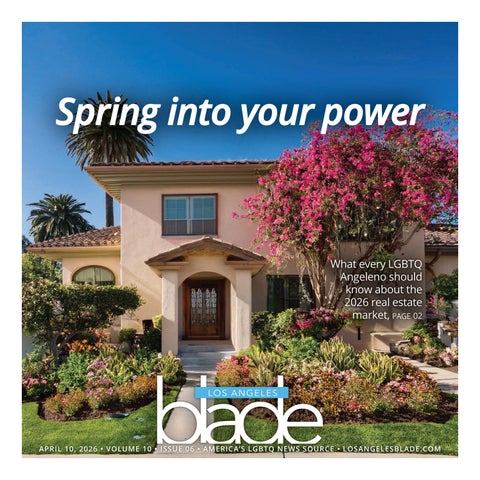
What every LGBTQ+ Angeleno should know about the 2026 real estate market
By JED INDUCTIVO
Let’s start with a number that should light a fi re under all of us: LGBTQ+ Americans own homes at a rate of 51% — compared to 71% for their straight, cisgender counterparts. That 20-point gap isn’t just a statistic. It represents generational wealth not yet built, neighborhoods not yet claimed, and futures not yet roote d.
Spring 2026 is a moment to change that.
Historically, spring is the most active real estate season of the year. Inventory rises. Buyers re-engage. Energy returns to the market. And Los Angeles, as always, operates with its own intensity.
Yes, the backdrop is complicated. Rising interest rates, an unsettled political climate, a war abroad, and oil prices rattling economic confi dence —the news is loud! A lot of people are sitting on their hands, waiting for clarity that may not come on any predictable schedule.
And yet: the Los Angeles market is still moving. As of spring 2026, the LA median home price sits at $1.1 million , up 7.1% year over year, and well-priced homes are still attracting serious buyers. If that number feels out of reach — it’s the median, not the entry point. Condos, townhomes, and emerging neighborhoods off er real footholds into ownership well below that fi gure, and with the right programs and team behind you, the door is more open than the headline suggests. Los Angeles is one of the most insulated real estate markets in the country. The concentration of wealth, industry, and sustained demand here creates a fl oor that most markets simply don’t have. We’ve weathered recessions, corrections, and uncertainty before — and the market has always found its footing.

Warren Buff ett famously said: “Be fearful when others are greedy, and greedy when others are fearful.” Right now, a lot of people are fearful. Which means, for the prepared buyer, this moment deserves serious attention.
Here’s the advice I give every client, regardless of orientation, identity, income, or background: the best time to buy is when you are ready. Not when rates drop. Not when the headlines soften.
Ready means three things:
• You have your reserves — down payment, cash to close, and a cushion beyond that
• The monthly payment genuinely works for your life — not just technically on paper, but sustainably
• You’re planning to stay 3–5 years or longer — because time in the market is what builds wealth
If all three are true? You’re ready. The season is secondary. The moment is now.
For LGBTQ+ homeowners in LA, this market may be quietly telling you something important. The equity you’ve built could be the key to your next chapter — trading up to a larger home, relocating to a neighborhood that better refl ects who you are, or leveraging that equity to purchase a second property and step i nto being a landlord.
That last option deserves a real conversation: being a landlord in Los Angeles is not simple. Rent control, tenant protections, and local regulations mean the numbers need to work before you commit. A good real estate advisor will walk you through the full picture honestly — the upside and the fi ne print.
First-time buyer? The path to homeownership in LA is more accessible than most people realize — it just requires the right team and the right information.
A combination of programs through NHS, Greenline, and City National Bank can stack to $85,000 in grants toward your down payment and closing costs. Many buyers never learn that these programs exist simply because no one tol d them.
Beyond that: buying a home is a team sport. Your real estate advisor, lender, title offi cer, escrow offi cer, and home inspector all matter. Every member plays a role in getting you across the fi nish line. The right agent doesn’t just fi nd you a home — they build and quarterback that team for you, from fi rst conversation to keys in hand.
Homeownership in Los Angeles is not impossible. It takes planning and a strategy built around where you are today. But that path exists — and it can be built for you, specifi cally.
See You at WeHo Pride
We’ll be at WeHo Pride this year — come fi nd us. We’ll have a full homebuying guide, on-the-spot consultations, and zero judgment. Just real talk about what’s possible for you in this market.
This community has always known how to claim space, make noise, and show up unapologetically. It’s time to put your name on a deed.
Your most powerful act of Pride? Owning the place you call home.
Jed Inductivo | Real Estate Advisor, Compass | JED.i Los Angeles

By KRISTIE SONG
It’s 1996 when Gary Boston, convinced by a coworker, tags along to a store on Manhattan’s Upper East Side where, together, they purchase matching sleek Bianchi performance bicycles and promise each other they will embark on the three-day AIDS fundraising ride from Boston to New York City.
From 1994 to 2002, several of these rides would crop up across the nation: first in California and New York City, then in Philadelphia, Washington D.C., Florida, Texas and Alaska. Known as the “AIDSRides,” organizers from Pallotta TeamWorks united cyclists, from novices like Boston to professional riders, for multi-day rides that raised money for LGBTQ+ centers and HIV/AIDS research and resources.
When the AIDSRides began, HIV/AIDS had become the leading cause of death for all Americans ages 25 to 44. Throughout its eight-year run, the AIDSRides amassed over $105 million to support critical services and medical developments as the epidemic continued to disproportionately ravage the country’s queer communities.
When Boston joined his first ride in ‘96, he had just come out as gay the year before. Navigating being out through the height of the epidemic was tumultuous, and he credits the Lesbian, Gay, Bisexual and Transgender Community Center — known as New York City’s queer “heart and home” — as the space that anchored him to safety and showed him what effective and powerful advocacy looked like.
“I felt this obligation to give back,” Boston told the Blade, in a recent phone call. “To pay homage to all of those folks who had come before and kept those of us who were yet to come out of the closet safe and provided a roadmap to how to give back to the community.”
Then, training commenced. Boston hadn’t been on a bike since he was a child and, now, he found himself at the mouth of Central Park to get into shape for the 275mile journey ahead. “It was really fun [and] a little scary,” Boston said, who recounted how cycling clubs would edge him and his colleague out with their rigorous speed and perfectly formed lines. “It’s terrifying coming upon them as a newbie biker. I think that first [training ride], we struggled to make a lap around Central Park, [which is] maybe six or seven miles.”
Slowly but surely, they improved, progressing into longer rides across the George Washington Bridge and into Rockland County. After completing this trek, Boston would complete it for several years before joining the first AIDSRide in Texas, his home state. This iteration, a weeklong excursion, was a meaningful homecoming for Boston: a chance to face and resist the stigmas that had followed him in his upbringing. “It wasn’t the most welcoming of places to have an event like this, so it was important for
me to go home and do that,” Boston said.
In 2000, after 4 years of continuous cycling and fundraising, Boston faced a ride that would have him putting his trusted Bianchi into storage for nearly 20 years: a seven-day behemoth of a ride in Alaska that he was “completely unprepared” for.
Cold, rainy, and arduous rides weren’t new for Boston, who had been evacuated during a massive wind and rainstorm on a cycling trip in Texas and had previously taken shelter in a New Haven stadium during a hurricane. Still, Alaska remained the most difficult memory. The wet snow and sleet seemed never-ending.
“It was cold at night, so you went to bed wet and cold, and you woke up wet and cold. It was really a struggle to get up and go each day,” Boston recounted. For years after, he observed that his fingertips would peel, almost like a sunburn, and he’d feel a lingering pain from the aftermath of exposure. This recurring shedding would bring, with sharp clarity, both the joy of being in community and the lasting bodily effects cyclists endured for their shared cause.
Boston recalls that, soon after this ride, he “burned out.” His job was also picking up, and his romantic relationship was taking off, making the draw of the rides more distant over the years. AIDSRides had also shut down, and from its ashes emerged AIDS/LifeCycle (ALC), which was first known as the California AIDS Ride.
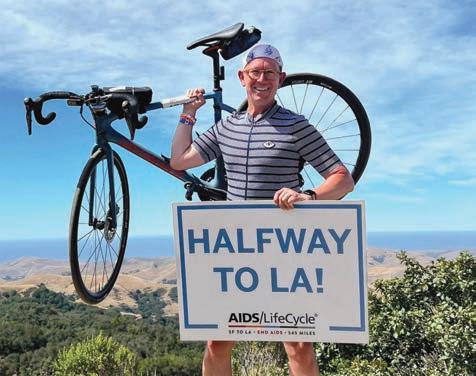
Just as friendship brought Boston to his first ride in New York City, friendship would rekindle his cycling in 2018. He returned to cycling and fundraising for HIV/AIDS with ALC, which brought cyclists from San Francisco to Los Angeles. This also marked a new chapter for Boston, who began to merge his passions for craft and knitting with his fundraising ambitions to support LGBTQ+ organizations and investment into HIV/AIDS research and resources.
Online, he is known as “Gary Knits, Gary Rides,” where he shares updates about his “craftvism.” Balls of yarn adorn his background in these videos, where he speaks to the camera with a personable and sincere warmth. In 2021, Boston began hosting knitalongs and crochetalongs: events that would bring together indie crafters for giveaways and projects to raise money for ALC. In 2022, he created “Destash4Good,” an online fiber auction where people could list their underused yarn for sale, providing low-cost ways for people to gather new materials and contribute to Boston’s fundraising efforts for ALC.
By the time ALC ended in 2025 due to declining ridership and mounting costs to put together the ride, Boston had raised over $225,000 to support the Los Angeles LGBT Center and the San Francisco AIDS Foundation. A phoenix of its own, ALC has seen a new ride emerge and evolve
from its legacy: Center Ride Out
This new expedition amplifies ALC’s community aspect, creating a joyous “queer summer camp” that whisks cyclists from L.A. through Riverside County to its final destination point: the San Diego LGBT Community Center. From Feb. 1 to Feb. 13, Boston hosted a round of “Destash4Good” to raise money for Center Ride Out’s community fund: a pool of scholarship funding that will support underrepresented riders and close the gap for people struggling to meet the $2,500 fundraising minimum.
In those two weeks, Boston raised just over $13,000, well over his initial goal of $10,000, to support the LGBTQ+ Centers as they battle federal attacks on funding and increased rhetoric that targets queer and trans community members. Boston is glad to see that Center Ride Out preserves ALC’s spirit: an unwavering commitment to showing up for those impacted by queer stigma, health injustice, and social prejudice that spanned three decades. Administrative neglect was rampant at the height of the HIV/AIDS epidemic, and advocates remain stalwart as that attitude remains pervasive today.
“We’ve got a whole new set of challenges,” Boston said. “[But] we’ve done this before. Let’s refocus and make things more accessible. Let’s get a whole new generation of grassroots activists out here raising money to be able to continue to support the community.”
To learn more about Boston and support his craftivism, you can find information on his Youtube page. Read more about Center Ride Out here.
Kristie Song is a California Local News Fellow placed with the Los Angeles Blade. The California Local News Fellowship is a state-funded initiative to support and strengthen local news reporting. Learn more about it at fellowships.journalism. berkeley.edu/cafellows.
In this interview, Pooya Mohseni reflects on her return to English, Sanaz Toossi’s Pulitzer Prize-winning play, a powerful exploration of language, identity, and the Iranian diaspora
By AJ SLOAN
In the world of theatre, few works authentically convey the complexity of lived experience quite like Sanaz Toossi’s English does. The play provides its audiences with five unique voices, each one shaped by migration, memory, and the often quiet and always personal negotiations of identity. English invites us into this world, where language takes on the dual roles of both a bridge and a barrier, where storytelling has borders to spotlight the shared humanity that exists beneath our differences. The play also upholds a deep reverence for Iranian culture, its resilience, and its elegance. This culture is properly portrayed not as a tired trope but as a collection of personal histories and emotional truths.
Equally significant is the space English creates for much-needed representation of the authentic varietal. In amplifying trans voices alongside those of the Iranian diaspora, English challenges narrow narratives and insists on a broader and more inclusive idea of belonging brought vividly to life by Pooya Mohseni in her portrayal of “Roya.” Our interview with Mohseni reflects that same soul. Ultimately, English dares us to consider not just how we speak, but how we listen.
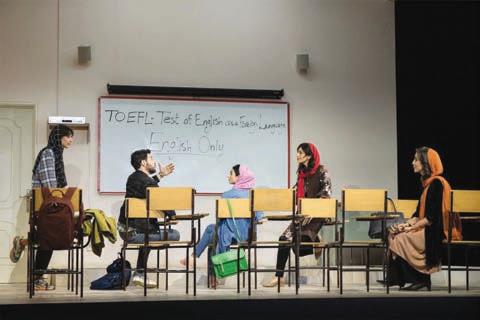
English has been described as a “quietly powerful” meditation on language and identity. What drew you back to the role of Roya for this production?
I’ve loved this play since I read it 8 years ago, and through its growth and its many productions that I’ve been a part of, that love has grown and deepened. Roya, specifically, is very special to me, as I see my grandmother and my mom in her, and her strength and class are for the books, so naturally, when I was asked to join the production at The Wallis, there was only one answer.
You originated the role of Roya on Broadway. How has your relationship to the character evolved since then?
As I said earlier, Roya is very special and somewhat personal to me, as I see the strength and struggles of the women I grew up around in her. But what Roya has done for me is push me and guide me to understand those women on a deeper level. That journey has allowed me to understand the women in my family better and grow as a human. I also would like to add
that Roya herself as grown, as we, the artists, have grown and evolved, and her strength, her vulnerability and her resolve have become more clear and specific and the character that is being seen at The Wallis is a more evolved and clear version of the character, which I’m very proud and grateful to get to share with our west coast audiences.
The play uses a fascinating linguistic device where Farsi is performed in American accents and English in Iranian accents. How did you approach that as an actor?
At first, it’s tricky, because as soon as you say a sentence in the wrong accent, you would think “no, that was Farsi!” or “did I say it right?” But in this production, our relationships with the text and the characters are so intimate that we don’t have to think about it because it’s become second nature to us. It comes down to clarity of thought and intention, and when you know what the character is trying to communicate, the accent, the right accent, follows.
Roya is navigating both personal and cultural transitions. What aspects of her journey resonate most deeply with you?
I’m an immigrant. I’m the daughter of an immigrant. My grandparents had other children who migrated. This distance, both culturally and geographically, is something I’ve been around since I was a child. I’ve heard the laments, I’ve seen the heartbreaks, and I’ve also seen the determination to keep hope alive. In short, I’ve grown up in a household, like many Iranian households, that either had a Roya or had different people who were parts of Roya, which has always been the force pushing me to make sure that my portrayal of Roya is done with love and authenticity.
How does English speak to the Iranian diaspora, particularly in a city like Los Angeles with such a large Iranian American population?
I believe the success and popularity of English has been in its specificity, which has also made it universal, for Iranians and beyond. Having shared it with many audiences before Los Angeles, I think people, specifically the Iranian diaspora, will see some of their own experiences and struggles in English and hopefully feel some validation that there is this award-winning, universally recognised play which honors their lives, their hardships, and their culture.
Playwright Sanaz Toossi has said the work is also a way to “scream” against the vilification of Middle Easterners. How do you feel this message lands with audiences today?
First: Sanaz is the Queen, and she’s my sister, and I love her with all my soul. Second: The circumstances that propelled Sanaz to write this play are still not only prevalent but have intensified and are even more center stage in 2026. I wholeheartedly believe that English is even more relevant now and will continue to be in the decades to come.
Despite its heavy themes, the play is also quite humorous at times. How do you balance humor with its more undeniable emotional undercurrents?
English is a sublime dramedy in its simplicity, in my opinion. The humor lies in its honesty, riding along the struggles and the heavier moments and thoughts that are expressed. Some people have called it a “comedy with a heart,” but I see it as a drama that also embraces the humor of everyday life and human struggles that we all face. When the balance is struck, the play flows beautifully like a wave that moves and exposes different wonders on a shore.
The play has been widely acclaimed since its 2022 debut. Why do you think it continues to resonate so strongly with its audiences today?
English is honest. It’s not flowery or preachy, and in its truth, through the experiences of its characters, it has connected with the critics and the audiences through all its productions. Audiences are smart, and they don’t like to be pandered to, and I believe that is why different audiences, across generations and backgrounds, have found something in our play that speaks to something personal in their lives. I think that will continue for many years to come.
As an Iranian American and a transgender artist, how do your identities inform the roles you choose and the stories you tell?
As Eve Ensler mentioned in the Vagina Monologues, being transgender is very similar to being an immigrant, because you’re treated, most of the time, like you don’t belong. I was treated that way at school when I was in Iran, and I was treated that way when I moved to New York, and in 2026, as an Iranian American who is also trans, all parts of my identity are under attack. I’ve never been asked to play the person next door, and while that has cut down on the number of things I’m given the opportunity to do, it has also freed me to be me: sassy, unique, and aware of the experiences that differ from mine. I was forced to find MY way because no other way was open to me. I love getting to play outsiders or characters who are outspoken, because I’ve had decades of training. So, having lived my life as me, I choose characters and projects which have heart, grit, and that I feel add something of value to the world, even if it’s just a laugh.
You’ve been open about your experiences with trauma and survival. How has storytelling served as a tool for healing in your life?
If you think about therapy, it’s basically storytelling. It has definitely been that way for me. Especially if the story has some personal connection, either to the Iranian side of me or the trans part of my identity. I’ve been fortunate to have worked on great stories that ring true to some part of me, and through finding the essence of the character, I have found my way through my own heart and soul. It feels strange to say that thousands of people have been witnesses to my therapy through the years, but it is kind of true, and I like to think it’s been not just therapeutic for me, but more like group therapy, shared between the viewers and me.
By JOE REBERKENNY
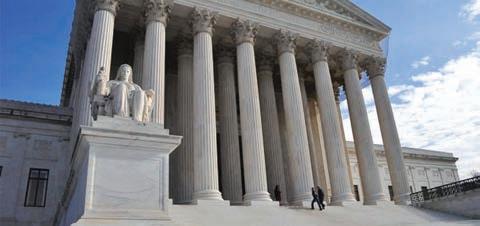
The U.S. Supreme Court on Tuesday ruled against a Colorado law that bans so-called conversion therapy for minors.
The justices last October heard oral arguments in Chiles v. Salazar. Today they ruled 8-1 in favor of Kaley Chiles, a Christian therapist who challenged the 2019 law.
In the case, which was heard by the justices in October 2025, Chiles successfully argued to the court that the law restricting this type of therapy was unconstitutional, leading to it being struck down.
The Supreme Court ultimately found that lower state and federal courts has “erred by failing to apply sufficiently rigorous First Amendment scrutiny,” ultimately reversing the widely discredited “medical” treatment that has support by a very narrow margin of mental health specialists — specifically religious and socially conservative ones. This is despite the fact that Colorado state officials have never enforced the measure in practice, and included a religious exemption for people “engaged in the practice of religious ministry.” The now moot law carried fines of up to $5,000 for each violation and possible suspension or revocation of a counselor’s license.
In the ruling, the court said the law, that specifically applies to talk therapy “impermissibly” interferes with free speech rights of Americans, and despite it being “regard[ed] its policy as essential to public health and safety, but the First Amendment stands as a shield against any effort to enforce orthodoxy in thought or speech in this country,” Justice Neil Gorsuch wrote for himself and seven other justices from across the ideological spectrum who overturned the low court’s ruling. He went on to add that the original ban “trains directly on the content of her speech and permits her to express some viewpoints but not others,” sending it back down to a lower court.
Only Justice Ketanji Brown Jackson dissented, which included an in depth summary of her departure from the other eight justices, explaining her fears about the verdict — and its eventual chilling effect on legislation that could attempts to restrict regulatory speech for religious attitudes— despite that these regulations are often made as a direct creation of years of essentially unanimous research, and are vetted though regulatory boards for specific jobs
“This decision might make speech-only therapies and other medical treatments involving practitioner speech effectively unregulatable,” Jackson wrote on page 32 of the 35-page opinion issued by court in response to her opposing eight members comments on the bench.
Since the ruling late Tuesday morning, a slew of LGBTQ+ advocacy groups, as well as groups promoting LGBTQ+ discrimination, have issued statements on the direct impact this will have across the country for LGBTQ+ people.
Democratic Senator, running for reelection in Colorado, John Hickenlooper issued a condemnation of the practice on his X account. “Conversion therapy is cruel and inhumane, plain and simple. This SCOTUS decision is dangerous for LGBTQ+ Americans,” Our LGBTQ+ community deserves safety, acceptance, and love. We won’t ever let up in our fight for a better nation.”
Conversion therapy is cruel and inhumane, plain and simple. This SCOTUS decision is dangerous for LGBTQ+ Americans.,” the
former Governor said on the platform. “Our LGBTQ+ community deserves safety, acceptance, and love. We won’t ever let up in our fight for a better nation.”
Polly Crozier, director of family advocacy at GLBTQ Legal Advocates & Defenders (GLAD Law), provided a statement to the Los Angeles Blade on the court’s decision.
“Today’s Supreme Court ruling limited Colorado s statute that preemptively shielded minors from conversion therapy, but it leaves open avenues for states to protect families from harmful, unscrupulous, and misleading practices that divide parents from their children and put LGBTQ+ youth at risk,” Crozier wrote, pointing to the overwhelming evidence on conversion therapy that argues this type of regulatory legislation is helping those suffering rather than harming. “The evidence is clear that conversion practices lead to increased anxiety, depression, and suicidality. This is a dangerous practice that has been condemned by every major medical association in the country. Today’s decision does not change the science, and it does not change the fact that conversion therapists who harm patients will still face legal consequences, and that family advocates, mental health practitioners, and all of us who care about the wellbeing of youth will continue working to shield LGBTQ+ young people and their families from this dangerous practice.”
Human Rights Campaign President Kelley Robinson, who leads the nation’s largest LGBTQ+ advocacy group, also provided a statement, calling the courts choice a “reckless decision.” The statement also points out how their own data (from the group’s philanthropic arm of the organization) was cited in Brown Jackson’s dissent in the amicus brief
“The court has weaponized free-speech in order to prioritize anti-LGBTQ+ bias over the safety, health and wellbeing of children,” her statement reads. “So-called conversion therapy’ is pseudoscience, not real therapy. It has been condemned by every mainstream medical and mental health association and harms families, traumatizes children, and robs people of their faith communities. It is cruel and should never be offered under the guise of legitimate mental healthcare. To undermine protections that keep kids and families safe from these abusive practices is shocking — and our children deserve better.”
Liberty Counsel, a nonprofit, tax-exempt Christian ministry that uses litigation to promote evangelical Christian values and limit LGBTQ+ protections, which was designated as a hate group by the Southern Poverty Law Center, was also cited in the court’s amicus brief, but in support of overturning the law.
“The U.S. Supreme Court’s resounding decision in Chiles v. Salazar is a major victory for the integrity of the counseling profession,” Mat Staver, founder and chairman of Liberty Council said today. “This ruling ensures the government cannot strip the First Amendment away from licensed counselors and dictate a state-mandated ideology between counselor and client. Talk therapy is speech, and the government has no authority to restrict that speech to just one viewpoint. Counseling bans can now be struck down nationwide so that people can get the counseling they need.”
GLAAD, one of the nation’s oldest non-profit organizations focused on LGBTQ+ advocacy and cultural change issued a
statement pon the verdict, emphasizing what multiple advocate groups have said — this decision will impact an already vulnerable youth population at an elevated high risk.
“The court once again prioritized malice over best practice medicine,” Sarah Kate Ellis, president and CEO of GLAAD said in a statement. “In the face of this harmful decision, we need to amplify the voices of survivors of this dangerous and disproven practice, and continue to hold anyone who peddles in this junk science liable.”
Truth Wins Out, an organization that works towards “advancing liberty and democracy through protecting the rights of LGBTQ+ people and other minorities” called out the court’s majority opinion for its potential for religious extremism and spread of disinformation.
“This ruling is a profound failure of both logic and moral responsibility that confuses ‘free speech’ with ‘false speech’,” Wayne Besen, the executive director of Truth Wins Out said in a comment. “It opens the door for quackery to flourish and allows practitioners of a thoroughly debunked practice to continue harming LGBTQ youth under a thin veneer of legitimacy.”
Adrian Shanker, the former Deputy Assistant Secretary for Health Policy at Health and Human Services under President Joe Biden who also led LGBTQ+ policy at the agency spoke about the detrimental impact this will have on rules and regulations within the healthcare field that are supposed to be inherently secular by nature.
“No matter what the Supreme Court decided today, it is irrefutable that conversion therapy is harmful to the health and wellbeing of LGBTQI+ youth,” Shanker told the Blade, continuing the Trump-Vance administration’s choice to no longer formally support LGBTQ+-inclusive policy. “That’s why in the Biden administration we advanced policies to safeguard youth from this harmful practice.”
In an consistently updated document started in 2018 that cites the major harms risks conversion therapy poses to LGBTQ+ people, the Trevor Project, the leading suicide prevention and crisis intervention organization for LGBTQ+ young people, included that the federal government’s own research proved the practice at best questionable and at worst deadly.
In a 2023 report entitled Moving Beyond Change Efforts: Evidence and Action to Support and Affirm LGBTQI+ Youth, the U.S. Department of Health and Human Services Substance Abuse and Mental Health Services Administration stressed that “[sexual orientation and gender identity] change efforts are harmful practices that are never appropriate with LGBTQI+ youth, and efforts are needed to end these practices,” the summary of the fight against conversion therapy in the U.S. reads.
More than 20 states and D.C. banned the widely discredited practice for minors prior to the Supreme Court’s ruling.
The Blade last October spoke to conversion therapy survivors after the justices heard oral arguments in the Chiles case.

















The real issue with the SAVE Act is not simply what the law says. It is how it will function in practice — and who will bear the burden
By EDWARD CAMPBELL
At its core, democracy depends on a simple premise: if you are eligible to vote, you should be able to do so. The right to vote in the United States has never been just about who is legally eligible. It has always been about who can realistically access the ballot.
The proposed Safeguard American Voter Eligibility (SAVE) Act puts that premise at risk — and for LGBTQ Americans, particularly transgender and nonbinary individuals, the threat is direct and concrete.
The SAVE Act would require Americans to provide documentary proof of U.S. citizenship — such as a passport or birth certificate — when registering to vote in federal elections. Supporters argue this is a necessary step to protect election integrity.
But the real issue is not simply what the law says. It is how it will function in practice — and who will bear the burden.
Under current federal law, eligible voters can register by attesting to their citizenship under penalty of perjury. The SAVE Act would replace that system with a documentation requirement.
That may sound like a technical adjustment. It is not.
It represents a fundamental shift — from a system where the government verifies eligibility, to one where individuals must produce specific documents to prove it. And not all voters are equally positioned to meet that requirement.
For transgender Americans, identity documents are often not consistent across systems. A person may have legally changed their name but not updated all records. Their birth certificate may not reflect their current identity. Their passport, driver’s license, and Social Security record may not fully align.
Updating these documents is not always straightforward. In some states, it requires navigating complex legal processes. In others, it may be restricted altogether.
None of this changes a person’s eligibility to vote. But under the SAVE Act, it could determine whether they are able to register — and whether their registration is accepted. This is not a hypothetical concern. It reflects the everyday reality of navigating identity systems that were not designed with LGBTQ people in mind.
Supporters of the SAVE Act emphasize that the law applies equally to everyone. Formally, that is true. But equal rules do not guarantee equal access.
For voters with straightforward documentation, the requirement may be manageable. For those whose records are inconsistent or difficult to obtain, it creates additional hurdles — delays, rejections, and uncertainty. That is how neutral policy produces unequal outcomes. And in the context of voting, those outcomes matter.
The SAVE Act may not result in voters being turned away in large numbers on Election Day. That is not how these systems typically work. The risk is more subtle — and more systemic. Registration applications get delayed or rejected. Confusion about what documentation is required discourages people from trying. Voters give up rather than navigate a bureaucratic maze. For LGBTQ Americans, a system where friction can become total exclusion.
For LGBTQ Americans already navigating barriers in healthcare, housing, employment, and basic legal recognition, this is one more arena where that friction compounds. Over time, that erosion of participation weakens the democratic process itself.
Election security is a legitimate concern. Policy should be grounded in evidence, not self-serving conspiracy theories. Federal law already prohibits noncitizens from voting, and there is no credible evidence of widespread noncitizen voting in federal elections. Existing safeguards — verification systems, database checks, and legal penalties — already address that risk.
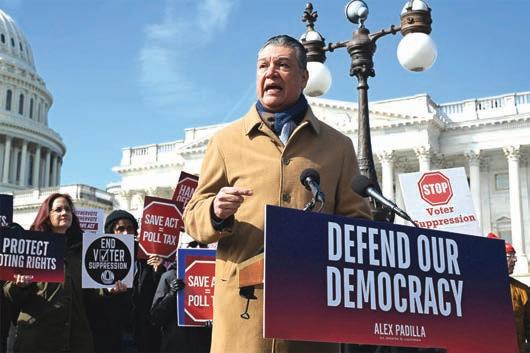
Sen. PADILLA (D-Calif.) speaks at a rally and press conference opposing the SAVE Act held outside of the U.S. Capitol on March 18.
The SAVE Act proposes a sweeping change to address a problem without evidence. In doing so, it risks disenfranchising large numbers of LGBTQ Americans, as well as women, Black, Indigenous, and people of color, low-income Americans, and young voters — the communities that have historically faced the greatest barriers at the ballot box.
For LGBTQ Americans, the SAVE Act is not just about election policy. It is about whether systems account for lived reality — or ignore it. The right to vote should not depend on whether your paperwork is perfectly aligned across multiple bureaucracies. It should depend on whether you are eligible.
That is the standard a functioning democracy should meet. And then it should make the act of voting as easy as possible for all eligible Americans.
The SAVE Act does none of that. Because the question it answers is not how we make elections more secure. It is, in practice, how we keep Americans from voting.
EDWARD CAMPBELL is a Los Angeles-based attorney, LGBTQ advocate, and civil rights activist with extensive experience in affordable housing finance and preservation. He has worked on housing policy at the federal, state, and local levels and is a longtime advocate for racial equity and democratic institutions.
PHONE 310-230-5266
E-MAIL arodriguez@losangelesblade.com
INTERNET losangelesblade.com
PUBLISHED BY Los Angeles Blade, LLC
PUBLISHER
ALEXANDER RODRIGUEZ
arodriguez@losangelesblade.com, 310-230-5266 x8080
EDITORIAL
NATIONAL EDITOR
KEVIN NAFF kna @washblade.com, 202-747-2077 x8088
LOCAL NEWS REPORTER
KRISTIE SONG ksong@losangelesblade.com
CONTRIBUTING WRITER
KAREN OCAMB karenocamb@losangelesblade.com
CONTRIBUTORS
MICHAEL K. LAVERS, TINASHE CHINGARANDE, JOHN PAUL KING, LOU CHIBBARO JR., SUSAN HORNIK, JOE REBERKENNY, DANIEL ITAI, ISAAC AMEND, PETER ROSENSTEIN, TERRI SCHLICHENMEYER, JOE PHILLIPS, ANKUSH KUMAR, ESTEBAN RIOSECO, SAM KISIKA, ELVIS KAWEDO, HENRY CARNELL, DAWN ENNIS, AJ SLOAN
SALES & ADMINISTRATION
SALES EXECUTIVE
SHANA WONG SOLARES swong@losangelesblade.com, 808-386-0872
MARKETING DIRECTOR
STEPHEN RUTGERS
srutgers@washblade.com, 202-747-2077 x8077 NATIONAL ADVERTISING
RIVENDELL MEDIA sales@rivendellmedia.com, 212-242-6863
ADMINISTRATION
PHILLIP G. ROCKSTROH prockstroh@washblade.com, 202-747-2077 x8092 CREATIVE DESIGN/PRODUCTION
MEAGHAN JUBA production@azercreative.com DISTRIBUTION
CHRISTOPHER JACKSON, 562-826-6602




By CHRISTIAN CINTRON
You don’t have to look far to support your local non-binary musician. Meet Ross Alan, who you’ve probably seen around town. They can easily be recognized by their stunning eyes, genteel demeanor, and killer fashion sense.
They’ve performed and sold out in venues nationwide, from Pete’s Candy Store in New York City and Davenport’s in Chicago to iconic Los Angeles stages like Hotel Café, The Viper Room, the Hard Rock Cafe Hollywood, and Whisky a Go Go. This year, they were nominated for an LA Blade Best of LA Award.
Alan is building toward their next chapter: a bold country-disco fusion project slated for 2026. They took some time to enlighten us about the spirit behind the rocker and give us a little insight and inside tea.
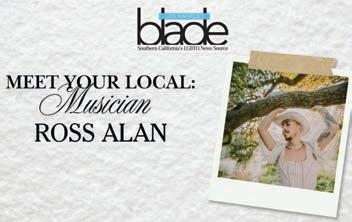
How did you get into music?
One day, as a kid, I sat down and watched Sister Act 2. There is a scene when Ryan Toby’s character hits his high note in their rendition of “Oh Happy Day,” and something changed in my soul and body. It was like all the atoms I’m made of woke up.
Now I’ve been making music for 15 years. To have such a specific and voracious moment like that. I knew, so young, that music was what I wanted to do. There was no surprise on my end that this is where I ended up. I mean, I can queue up the memory of me doing the choreography to “Oops I Did It Again” at my uncle’s wedding at the age of 10 or singing in our family garage while my stepdad worked on cars. Art is in my blood.
How long have you been performing?
I’ve been performing as Ross Alan for the last 6 years. I was performing before that under a different artist name for a decade, but I’ve toured domestically a good bit in the last 3 years or so. I am so excited to be getting all this new music from my upcoming record out and really getting the chance to shine on stage with it. Performing is where I feel the
most secure in what I’m doing as an artist.
What do you love about music/live performance in LA?
Well, LA is home now. I’ve lived in the Midwest and the South, and I spent years living in New York and Chicago. But performing in Los Angeles always feels safe because this is like my actual home. It feels like I can take bigger risks out in the bars, it feels like I can try new things, and still be embraced by my peers. I think everyone here is chasing their dream, knowing that everyone is straddling their own form of bravery in the pursuit of their goals. There is a vulnerability we all share, and that makes the art so much better.
What do you love about Los Angeles/ West Hollywood?
I’ve been in Los Angeles now for 5 years, and there is not a day that goes by that I don’t still smile on my commute. And from stupid stuff, right? Like palm trees lining a street, or a really gorgeous sunset backlit by the Hollywood neon horizon. I’m such a romantic, it makes sense that I’m a songwriter. There is just not a day that goes by that I don’t meet someone doing something cool or planning something amazing. My community is so sensational, and the environment of this city breeds serenity, innovation, and a level of togetherness I’ve never felt anywhere else.
What brought you to LA? Music! Fame! Hot people! Warmth!
No, honestly. I hate being cold, and moving here from Chicago was like the deepest exhale I’ve ever had in my life. I’ve wanted to live in Los Angeles since I was a kid - and not in a way that I understood. Like I knew I needed to be here, but I didn’t know why. And 30 years later, here we are, and I was right. Sometimes you just know where you’re meant to be, but you don’t know when. So sometimes you gotta just ride the ride.
What is your passion?
I think a younger version of me would have said music or art or something plain. But I’m approaching 35. I think my passion is creation for the intention of being perceived and being understood.
I think we all pursue our own alleyways of work, relationships, and expression in order to be understood. Not necessarily from outside parties, but even on our own. I pursue a deeper understanding of myself, my mu-
sic, and my purpose every day. I love that in a world filled with any and every resource known to man, we can use those tools to be seen and validated in our experiences. Those moments of realizing you aren’t alone are vital in my eyes, to know someone else hears you. I’m very passionate about making sure everyone feels heard and that empathy isn’t a lost art.
What’s a weird thing you learned about life from performing?
My mantra for every performance is “It might be the last night, but it is only one night.” You have to treat it like you will never get on the stage again. Leave everything up there: your sweat, your vulnerability, your art. It could be the last time you ever get to show people who you are and what’s important to you. But it is also only one night.
So if I flub with a lyric, or miss a step or mark - it’s okay. That’s the nature of live performance and being on a stage in front of an audience. I’m human, so mistakes are bound to happen. And it’s not letting those tiny slips get to you. Because I’m a perfectionist, I want every moment to go off as I planned it. But that’s not reality. So you really have to go in saying, “It might be the last night, but it is only one night.” Go hard, but be gentle.
Favorite spot in Los Angeles?
I have a few! Love a classic Griffith Observatory hike. I go to Los Globos in Silverlake pretty regularly for queer line dancing with Stud Country. The best breakfast burrito is Wake N’ Late in Hollywood. I swear by that place. I’ll walk the floral district in DTLA for any number of incredible blooms, and that is definitely a soul lift. Rustic Coffee in Santa Monica has the best sandwich in the world. You walk up to the airstream, order the chicken caprese - you’re so welcome. And lastly, I’d say the Hollywood Farmers Market on any given Sunday. Live music, talented local vendors, and fresh produce. Absolutely.
How has Los Angeles changed you?
It has made me more patient. It’s made me work harder. It makes me more and more queer every day. What a paradise.
What piece of advice would you give to your younger self?
You know who you are. Don’t let others scare you away from being exactly that. It’s your superpower.
If you could make one wish for Los Angeles, what would it be?
I could say so many things. Fortified infrastructure, improved disaster relief, mandatory driving classes, better systems of support for the unhoused population, removal of ICE in every fucking capacity, increased public transit availability, financial aid to small local businesses and the arts. I love this city. I want it to thrive.
What do you want for the queer community?
Above all, honestly? Safety. For my trans siblings, for my non-binary siblings. For our youth. For those in our community who don’t feel safe in their own homes. It’s been said so many times, but none of us are free until all of us are. So what are we doing about it? Being queer is not a luxury; it’s a privilege. I don’t want us to have to battle foreverbut the battle is not done. It’s so obvious that the battle isn’t over, and it really hurts seeing that so many people think that just because we got marriage equality and because I can wear a skirt in Los Angeles. I need those who have privilege to use it against the forces that wish us harm. Protect our community.
I’m talking to allies too. Because as Bad Bunny coined at the super bowl, “the only thing more powerful than hate is love”. And love is what the queer community is made of.
What do you look for in a person?
As I’ve gotten older, the bar has never been lower, but it’s also never been more serious. I look for prowess with communication. I look for independence and stability. I look for baseline physical attraction, and I look for a good sense of humor. The rest? It really doesn’t matter. I love so many different types of people, and the only real thing that matters is chemistry. The rest will work itself out if it is supposed to.
Celebrity crush?
I have so many. Laith Ashley, Justice Smith, Sophia Bush, Rachel McAdams, and Danny Ramirez. The list is long!
What is your favorite thing to do in your downtime?
Watch scary movies and rhinestone stage costumes for myself.
Follow Ross Alan on IG.

By JOHN PAUL KING
It’s been long lamented by fans of the late Stephen Sondheim – and they are legion – that Hollywood has hardly ever been successful in transposing his musicals onto the big screen.
Sure, his first Broadway show – “West Side Story,” on which he collaborated with the then-superstar composer Leonard Bernstein – was made into an Oscar-winning triumph in 1961, but after that, despite repeated attempts, even the most starry-eyed Sondheim aficionados would admit that the mainstream movie industry has mostly offered only watered-down versions of his works that were too popular to ignore: “A Little Night Music” was muddled into an ill-fitted star vehicle for Liz Taylor, “Sweeney Todd” became a middling entry in the Tim Burton/Johnny Depp canon, “Into the Woods” mutated into a too-literal all-star fantasy with most of its wolf-ish teeth removed, and we’re still waiting for a film version of “Company” – not that we would have high hopes for it anyway, given the track record.
Of course, most of those aficionados would also be able to tell you exactly why this has always been the case: erudite, sophisticated, and driven by an experimental boldness that would come to redefine American musical theater, Sondheim’s musicals were never about escapism; rather, they deconstructed the romanticized tropes and presentational glamour, turning them upside down to explore a more intellectual realm which favored psychological nuance and moral ambiguity over feel-good fantasy. Instead of pretty lovers and obvious villains, they showcased flawed, complicated, and uncomfortably relatable people who were just as messed-up as the people in the audience. Any attempt to bring them to the screen inevitably depended on changes to make them more appealing to the mainstream, because they were, at heart, the antithesis of what the Hollywood entertainment machine considers to be marketable.
To be fair, this often proved true on the stage as well as the screen. Few of Sondheim’s shows, even the most acclaimed ones, were bona fide “hits,” and at least half of them might be considered “failures” from a strictly commercial point of view – which makes it all the more ironic that perhaps the most purely “Sondheim” of the stage-to-screen Sondheim efforts stems from one of his most notorious “flops.”
“Merrily We Roll Along” was originally conceived and created more than 40 years ago, a reunion of Sondheim with “Company” book-writer George Furth and director Harold Prince, based on a 1934 play by George Kaufman and Moss Hart. Telling the 20-year story of three college friends who grow apart and become estranged as their lives and their goals diverge, it wasn’t ever going to be a feel-good musical; what made it even more of a “downer” was that it told that story in reverse, beginning with the unhappy ending and then going backward in time, step by step, to the youthful idealism and deep bonds of camaraderie that they shared in their first meeting. On one hand, getting the “bad news” first keeps the ending from becoming a crushing disappointment; but on the other hand, the irony that results from knowing how things play out becomes more and more painful with each and every scene.
The original production, mounted in 1981, compounded its challenging format with the additional conceit of casting mostly teen and young adult actors in roles that required them to age – backwards – across two decades; though the cast included future success stories (Jason Alexander and Giancarlo Esposito, among them), few young actors could be expected to convey the layered maturity required of such a task, and few audiences were capable of suspending their disbelief while watching a teenager play a disillusioned 40-year old. This, coupled with a minimalist presentation that left audiences feeling like they were watching their nephew’s high school play, turned “Merrily We Roll Along” into Sondheim’s most notorious Broadway flop –despite raves reviews for the show’s intricately woven score and the xtinging candor of its lyrics. Fast forward to 2022, when renowned UK theater director Maria Friedman staged a new revival of the show in New York. In the interim, “Merrily” had undergone multiple rewrites and conceptual changes in an effort to “fix” its problems, abandoning the concept of using young performers and opting for a more “fleshed-out” approach to production design, and the show’s reputation, fueled by a love for its quintessentially “Sondheim-esque” score, had grown to the level of “underappreciated masterpiece.” Inspired by an earlier production she had helmed
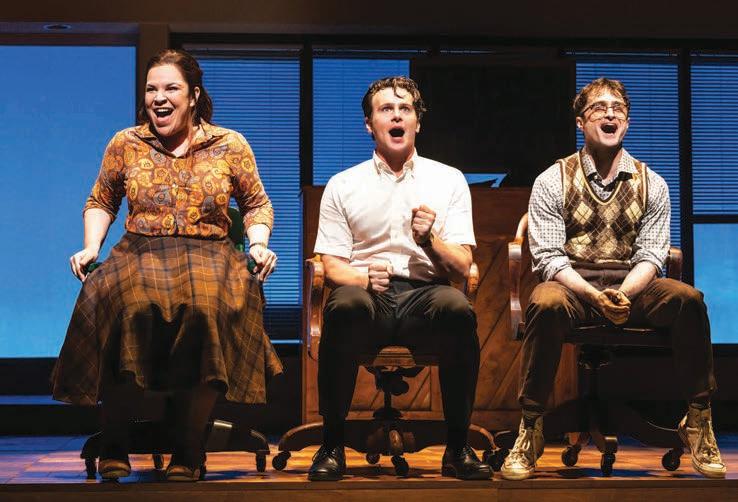
at home a decade earlier, Friedman mounted an Off-Broadway version of the show starring Jonathan Groff, Daniel Radcliffe, and Lindsay Mendez – and suddenly, as one critic observed, Sondheim’s biggest failure became “the flop that finally flew.” The production transferred to Broadway, winning Tony Awards for Groff and Radcliffe’s performances, as well as the prize for Best Revival of a Musical, in 2024.
Sondheim, who died at 91 in 2021, participated in the remount, though he did not live to see its premiere, nor the success that officially validated his most “problematic” work.
Fortunately, we DO get the chance to see it, thanks to a filmed record of the stage performance, directed by Friedman herself, which was released in limited theaters for a brief run last year, but which is now streaming on Netflix – allowing Sondheim fans to finally experience the show in the way it was designed to be seen: as a live performance.
Embracing the conventions of live theatre into its own cinematic ethos, this record of the show gives viewers the kind of up-close access to its performances that is impossible to experience even from the front-row of the theatre. The performances it gives us are impeccable: Groff’s raw and deeply deluded Frank Shepard, the ambitious composer who sells out his values and alienates his friends on the road to success and wealth; Radcliffe’s mawkishly loyal Charlie Kringas, who remains loyal to the dream he shared with his best friend until he can’t anymore; and Mendez’ heartbreaking perfection as Mary Flynn, the wisecracking good-time girl who rounds out their trio while concealing a secret passion of her own – each of them bring the kind of raw and vulnerable honesty to their roles that can, at last, reveal both the deep insights of Sondheim’s intricate lyrics and the discomforting emotional conflicts of Furth’s mercilessly brutal script.
Yes, it’s true that any filmed record of a live performance loses something in the translation; there’s a visceral connection to the players and a feeling of real-time experience that doesn’t quite come through; but thanks to unified vision that Friedman shepherded and instilled into her cast – including each and every one of the brilliant ensemble, who undertake the show’s supporting characters and embody “the blob” of show-biz hangers-on who are central to its cynical theme.
Honestly, we can’t think of another Sondheim screen adaptation that comes close to this one for embracing the raw truth that was always lurking just under the clever lyrics and creative rhyme schemes. For that reason alone, it’s essential viewing for any Sondheim fan – because it’s probably the closest we’ll ever get to having a “real” Sondheim film that lives up to the genius behind it.
By TERRI SCHLICHENMEYER
They’re among the world’s greatest love stories.
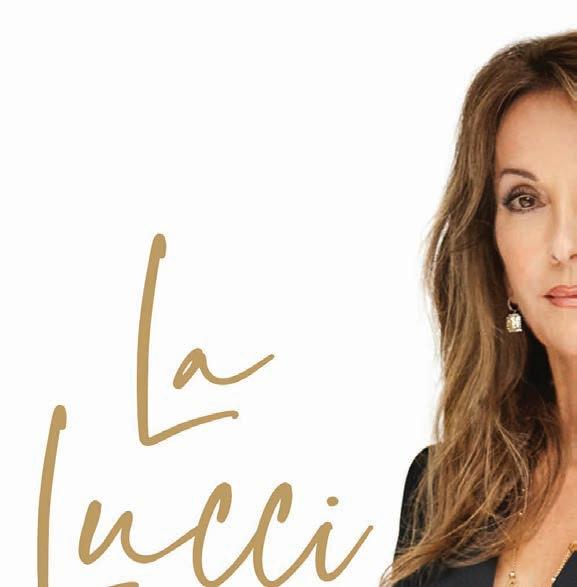
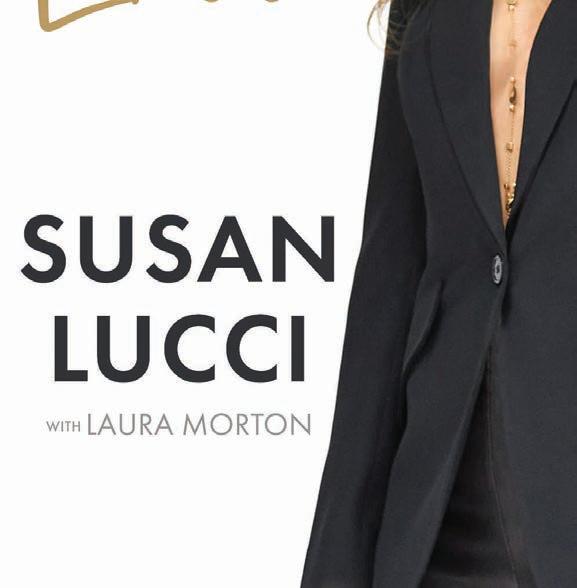
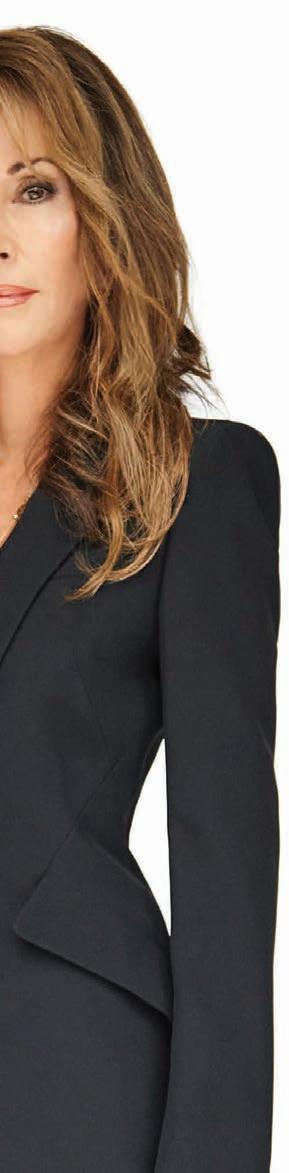
You know them well: Marc Antony and Cleopatra. Abelard and Heloise. Phoebe and Langley. Cliff and Nina. Jesse and Angie, Opal and Palmer, Palmer and Daisy, Tad and Dixie. Now read “La Lucci” by Susan Lucci, with Laura Morton, and you might also think of Susan and Helmut.
When she was a very small girl, Susan Lucci loved to perform. Also when she was young, she learned that words have power. She vowed to use them for good for the rest of her life.
Her parents, she says, were supportive and her family, loving. Because of her Italian heritage, she was “ethnic looking” but Lucci’s mother was careful to point out dark-haired beauties on TV and elsewhere, giving Lucci a foundation of confidence.
That’s just one of the things for which Lucci says she’s grateful. In fact, she says, “Prayers of gratitude are how I begin and end each day.”
She is particularly grateful for becoming a mother to her two adult children, and to the doctors who saved her son’s life when he was a newborn.
Lucci writes about gratitude for her long career. She was a keystone character on TV’s “All My Children,” and she learned a lot from older actors on the show, and from Agnes Nixon, the creator of it. She says she still keeps in touch with many of her former costars.
She is thankful for her mother’s caretakers, who stepped in when dementia struck. Grateful for more doctors, who did heart-saving work when Lucci had a clogged artery. Grateful for friends, opportunities, life, grandchildren, and a career that continues.
And she’s grateful for the love she shared with her husband, Helmut Huber, who died nearly four years ago. Grateful for the chance to grieve, to heal, and to continue.
And yet, she says of her husband: “He was never timid, but I know he was afraid at the end, and that kills me down to my soul.”
“It’s been 15 years since Erica Kane and I parted ways,” says author Susan Lucci (with Laura Morton), and she says that people still approach her to confirm or deny rumors of the show’s resurrection. There’s still no answer to that here (sorry, fans), but what you’ll find inside “La Lucci” is still exceptionally generous.
If this book were just filled with stories, you’d like it just fine. If it was only about Lucci’s faith and her gratitude – words that happen to appear very frequently here – you’d still like reading it. But Lucci tells her stories of family, children and “All My Children,” while also offering help to couples who’ve endured miscarriage, women who’ve had heart problems, and widow(ers) who are spinning and need the kindness of someone who’s lived loss, too.
These are the other things you’ll find in “La Lucci,” in a voice you’ll hear in your head, if you spent your lunch hours glued to the TV back in the day. It’s a comfortable, fun read for fans. It’s a story you’ll love.
‘La Lucci’
By Susan Lucci with Laura Morton c.2026, Blackstone Publishing | $29.99 | 196 pages




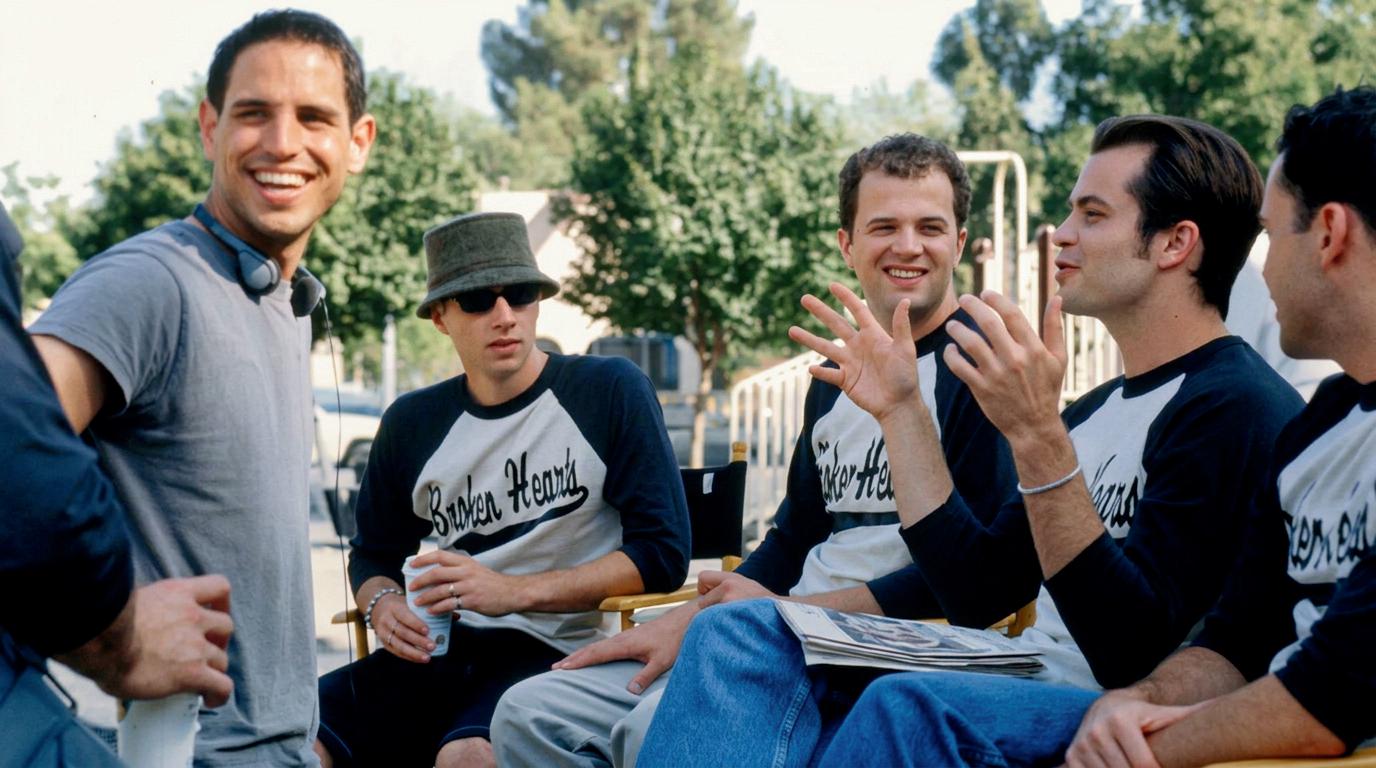
SAT, APR 25 | WEST HOLLYWOOD PARK



MODERATED CAST DISCUSSION • VIP MEET & GREET • INTERACTIVE GAMES • FOOD & BAR • BENEFITING PRIDE HOUSE LA–WEST HOLLYWOOD TICKETS ON SALE NOW - PRIDEHOUSELAWEHO.ORG/EVENTS 5:30PM • 647 N SAN VICENTE BLVD