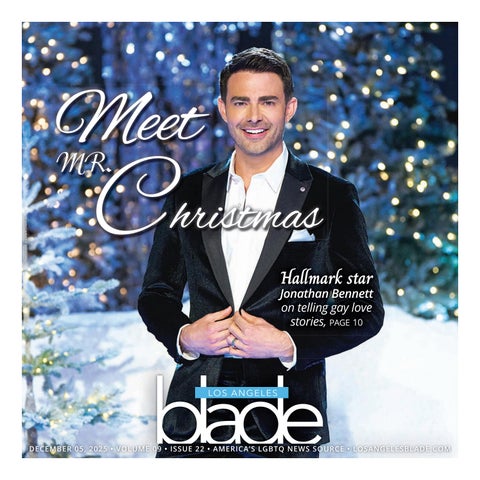
Los Angeles Blade, Volume 09, Issue 22, December 05, 2025

Page 1


Leather, legacy, and a little lust: Celebrating 25 years of LA Leather Pride

Marking its 25th year, LA Leather Pride is turning up the heat with a theme that blends nostalgia, desire, and community into one yummy leather-scented celebration.

Los Angeles is polishing its boots, tightening its laces, and prepping to cruise into its kinkiest convention of 2026. As LA Leather Pride gears up to celebrate its 25th anniversary, co-chairs Ayité Okyne and George Vasser are steering the community into a milestone year drenched in the scent of rawhide and unapologetic erotic imagination. But this anniversary marks more than a major celebration. It reflects the leather community’s longstanding role in expanding queer visibility, asserting the legitimacy of diverse sexual expression, and pushing LGBTQIA+ rights forward through fearless authenticity. Leather is more than a simple kink. For decades, leather has been a political act. It serves as a declaration of freedom and queer liberation.

This year’s theme, “Cruising - The Boulevard of Erotic Dreams,” pays tribute to the deep roots of cruising culture while also inviting a new generation to embrace the sensuality, solidarity, and radical self-expression that have defined Los Angeles’ leather legacy for decades. In so many ways, cruising, and leather culture as a whole, have always made space where queer people can boldly be themselves and on their own terms, way be-

fore mainstream society bothered to make room. We sat down with Okyne to talk cruising then and now, and just how erotic we can expect this year’s Boulevard to be. Buckle up. I hope you drive stick.

To start, what is Leather Pride for readers who may not know?

Leather Pride brings together people in the leather, fetish, and kink communities to celebrate our culture and shared identity. For many, leather and kink exist on the edges of what’s considered “mainstream,” so Leather Pride becomes a space of affirmation, much like LGBTQ+ Pride.

Los Angeles is one of the major centers for

celebrating leather and kink, and we’re proud of that history. This year marks the 25th anniversary of LA Leather Pride, and we’re thrilled to continue that legacy.

Can you take us through the process of organizing LA Leather Pride? What goes into preparation leading up to day one?

A surprising amount of work. We begin months in advance, planning, programming, securing sponsorships, and coordinating the various feeder contests in the LA area that send contestants to Mr. LA Leather. We also select and vet judges, promote the events, and host weekly planning meetings.

I joined the organization a few months ago and have focused on modernizing and making our operations more efficient. There’s a lot happening behind the scenes to make the experience seamless.

What inspired this year’s theme, “Cruising the Boulevard of Erotic Dreams,” and how did the references to Green Day’s “Boulevard of Broken Dreams” and Smokey Robinson’s “Cruisin’” come together?

From nickname to reality, the Rainbow District is made official by the City of West Hollywood

The mile along Santa Monica Boulevard from N. Doheny Drive to N. La Cienega Boulevard welcomes residents and visitors to come as they are By ALEXANDER RODRIGUEZ

Even in today’s political climate, we will not be hidden.

The vibrant stretch on Santa Monica Blvd of over 50 local businesses, representing the full spectrum of LGBTQ+ expression, from N Doheny Dr to N La Cienega, has had the loving nickname of the Rainbow District for decades. Well, now it’s official. From nightlife to restaurants to community organizations, the City of West Hollywood has formally designated the space as such, honoring the neighborhood’s legacy as a safe haven for the queer community and beyond.

In addition to making the name official, the Rainbow District is being launched with a full range of social media, including Instagram, TikTok, and Facebook, keeping the residents and visitors updated on all upcoming events and happenings in the neighborhood.  Long known as a beacon of acceptance, inclusion, and visibility, where everyone is

welcome, this iconic mile-long corridor is now formally recognized for what it has always been: a place where people from every walk of life can come together, be themselves, and celebrate the beauty of diversity.

City of West Hollywood Mayor Chelsea Lee Byers states, “For generations, the City of West Hollywood’s Rainbow District has been a place where LGBTQ+ people take their first steps into living openly, where the warm embrace of community is found at every turn, and where the joy of living out, loud, and proud fills the streets. The City’s official designation of the Rainbow District honors both the legacy and the future of this vibrant neighborhood, home to beloved entertainment venues, bars, and restaurants that have long served as cornerstones of LGBTQ+ life. Today, the Rainbow District is more alive than ever, and it will always stand as a beacon of hope, pride, and belonging and as a remind-

er that everyone deserves a place to celebrate joy, to be seen, and to be supported.”

The Rainbow District officially joins a nationwide list of iconic LGBTQ+ landmarks. West Hollywood will not be hidden amid political backlash and will continue to protect queer spaces, uplift queer voices, and foster a safe and joyful environment for all.

“This designation is not only a celebration, but it also serves as a promise,” said Visit West Hollywood President & CEO Tom Kiely. “A promise to keep LGBTQ+ spaces visible, valued, and vibrant for generations to come.

As the Rainbow District continues to evolve, it will remain a place where locals and visitors alike can connect through culture, creativity, and community. The City’s formal designation affirms its significance and highlights The Rainbow District as the ultimate playground for travelers seeking a unique, inclusive, and authentic experience.”

The theme came from several days of brainstorming. We wanted something fresh, sexy, and not overly political. We explored different words and ideas, and “cruising” emerged early on - it immediately brought to mind the Smokey Robinson song. Someone then remembered “Boulevard of Broken Dreams,” and we thought, why not combine the two? That’s how “Cruising the Boulevard of Erotic Dreams” was born. It captures nostalgia, sensuality, and a sense of possibility.

You mentioned wanting to avoid a political theme, yet expressions of sexuality often carry political weight. Can you speak to the relationship between sexual expression and today’s political climate? Absolutely. Anything queer is political by nature. Expressing our desires - our pleasure - is itself a revolutionary act. Leather Pride is inherently political simply by existing, but we also wanted this year’s theme to be unabashedly sexy. Pride is already political; this theme invites people to lean into the joy and sensuality that are also part of our culture.

The Rainbow District will be home to upcoming community events that include:

• Winter Market & Ice Skating Rink — December 2025

• Go-Go Dancer Appreciation Day — March 2026

• Harvey Milk Day — May 22, 2026

• WeHo Pride Weekend & the OUTLOUD Music Festival at WeHo Pride — June 5–7, 2026

Follow the Rainbow District on socials to discover local happenings, support small businesses, and be part of a neighborhood that celebrates every person for exactly who they are.

For more info: visitwesthollywood.com/ rainbowdistrict

• Free STD Screening & Treatment

• HIV Testing & Linkage to HIV care

• PrEP Services

SoCal gay couple alleges Uber driver refused them service and “chased” them with a bat

Los Angeles attorney Brian Breiter is assisting the couple with civil claims against the driver and Uber, calling into question queer safety on rideshare apps

(Note: The couple’s names have been kept anonymous by their attorney to avoid retaliation from Uber. They will be referred to as “J.” and “D.”)

On Saturday, Nov. 8th, J. and D. shared a kiss during their Uber ride in San Diego’s queer-friendly North Park neighborhood when, suddenly, their driver pulled off the freeway. When the couple alerted him that he had taken the wrong exit, the driver said he would be letting them out because he did not “support [their] kind,” according to J. It was at this point that J. began to record the interaction. In a 21-second clip provided to the Blade, J. and D. can be heard questioning the driver why they are being told to leave the vehicle when they had not yet arrived at their destination. Stranded in unfamiliar surroundings late at night, the couple responded in shock when the driver replied: “Because I don’t support you.”

In the video, J. asked explicitly: “You don’t support gay people?” to which the driver said: “No.”

J. and D. allege that after pulling over, the driver stepped out, retrieved a bat from his trunk, and cocked it back as if to strike them.

At this point, the couple bolted, frantically running while dialing for the police. They ducked behind cars, panicking and hiding while waiting for officers to arrive. “I haven’t experienced another time in my life where I would say that I really was in fear of dying,” D. told the Blade.

“We were just hiding there, hoping that we were going to survive at that point.”

Since then, the couple has sought out Los Angeles attorney Brian Breiter to represent them in a civil claim against the driver and Uber. Breiter explains that he is in the process of drafting the lawsuit, which includes claims of intentional infliction of emotional distress and civil assault against the driver as well as claims of negligent hiring, screening and training against Uber.

Breiter told the Blade that since his office sent a representation letter to Uber, there has been minimal contact from the company — no concessions, apology or accountability.

But, a spokesperson claims they have taken one concrete action in the case.

“Everyone deserves to feel safe, welcome, and respected when using Uber. Hate has no place in our society, and we do not tolerate any form of discrimination on the Uber plat-

form,” an Uber spokesperson wrote to the Blade. “As soon as this was reported to us, we banned the driver from the platform.”

While this bit of news has been “relieving” for J. and D., it does not necessarily signal Uber’s readiness to improve their hiring, screening or training guidelines to protect their LGBTQ+ riders. “Removing this one driver does not prevent this from happening again,” Breiter told the Blade. “Unless Uber implements meaningful safety measures and proper screening, LGBTQ+ passengers and the public at large remain at risk.”

In October 2023, Uber Mexico created an LGBTQ+ mobile training initiative to strengthen their non-discrimination policy — but it remains unclear whether this training has been implemented more widely throughout the platform.

LGBTQ+ safety on these rides continues to be an understated issue, and J. and D.’s stories are not singular. On online forums, queer people have long shared their experiences with harassment and discrimination based on their gender and sexual identities. They take to the internet to warn others, understanding that: when there is no systemic change, they

must rely on one another to be heard and to protect their communities.

Today, J. and D. do not feel safe using Uber or other rideshare apps. They are constantly reassessing and second-guessting their behaviors in public, for fear of violence. “We’re both very traumatized over this incident. [Recently] we went to dinner and we didn’t want to hold hands in public,” said J. “Because when we did kiss in the Uber, this man hate-crimed us and chased us down the street…It has just been really overwhelming and emotionally and physically draining.”

Kristie Song is a California Local News Fellow placed with the Los Angeles Blade. The California Local News Fellowship is a state-funded initiative to support and strengthen local news reporting. Learn more about it at fellowships.journalism. berkeley.edu/cafellows

LGBTQ+ community calls out Radio Korea over host’s homophobic comments; station acknowledges but skirts accountability

On Nov. 3rd, Radio Korea host Julie An claimed that “gay people began the spread of AIDS” on a talk show broadcast by the station By KRISTIE SONG

On Monday, Nov. 3rd, Radio Korea aired its regular morning talk show program, where one of its hosts, Julie An, discussed her lack of support for the LGBTQ+ community, citing her religious beliefs. She also went on to comment that gay people spread HIV and AIDS, and that conversation therapy —  which has been linked to PTSD, suicidality, and depression — is a viable practice. Clips of this have since been taken down.

Radio Korea offers Korean language programming to engage local Korean American and Korean immigrant community members. Its reach is broad, as Los Angeles is home to the largest Korean population in the U.S, with over 300,000 residents. As An’s words echoed through the station’s airwaves, queer Korean community members took to social media to voice their concern, hurt, and anger.   In a now-deleted Instagram post, attorney, activist, and former congressional candidate

David Yung Ho Kim demanded accountability from the station. Writer and entertainer Nathan Ramos-Park made videos calling out Radio Korea and An, stating that her comments “embolden” people with misinformation, which has the ability to perpetuate “violence against queer people.”

Community health professional Gavin Kwon also worries about how comments like An’s increase stigma within the Korean immigrant community, which could lead to increased discrimination against queer people and their willingness to seek health care.

Kwon, who works at a local clinic in Koreatown, told the Blade that comments like An’s prescribe being gay or queer as a “moral failure,” and that this commonly-held belief within the Korean immigrant community, particularly in older generations, strengthens the reticence and avoidance clients hold onto when asked about their gender or sexual ori-

entation.

“When you stigmatize a group, people don’t avoid the disease — they avoid care,” Kwon explained. “They avoid getting tested, avoid disclosing their status, and avoid talking openly with providers. Stigma pushes people into silence, and silence is the worst possible environment for managing any infectious disease.”

For weeks, Radio Korea did not offer a direct response to the public criticism. Its Instagram feed continued to be updated with shorts, featuring clips of its various hosts — including An.

On Friday, Radio Korea CEO Michael Kim released an official statement on the station’s YouTube page. In this video, Kim stated that An’s comments “included factual inaccuracies” and that the station “does not endorse or share the personal opinions expressed by individual hosts.” Kim also stated that Radio Korea “welcomes members of the LGBT com-

munity to share their perspectives” in order to deepen understanding through dialogue.  Afterwards, Kim continued that though he acknowledges the “pain” felt by queer community members, he concluded: “I don’t think Radio Korea needs to apologize for what was said any more than Netflix should apologize for what Dave Chappelle says, or any more than Instagram or TikTok should apologize for what people say on their platforms.”

Kim then offered a justification that An’s statements were “not part of a news report,” and that he was “disappointed” that David Yung Ho Kim, specifically, had been vocal about An’s comments. Kim stated that he was the first person to interview David in 2020 during his congressional campaign, and that he had provided the candidate a platform and opportunity to educate listeners about politics.

In a video recorded during the incident, an Uber driver can be heard asking two LGBTQ+ riders to exit his vehicle. (Screen capture/video courtesy Brian Breiter)

White House halts World AIDS Day recognition

For the first time since the global observance began, the U.S. government did not commemorate World AIDS Day on Monday.

World AIDS Day, first marked in 1988, has long served as an annual reminder of the ongoing effort to end an epidemic that has killed more than 44.1 million people worldwide and continues to disproportionately impact LGBTQ people, communities of color, and those in the American South. Yet the Trump-Vance administration declined to acknowledge the day this year, severing a symbolic but consistent tradition upheld by every president since Ronald Reagan.

The move comes despite the scale of the epidemic today. Approximately 1.2 million people in the U.S. are living with HIV, according to federal estimates, and about 13 percent — 158,249 people — do not know their status. Globally, the World Health Organization reports 40.8 million people were living with HIV at the end of 2024.

Presidents of both parties have historically used World AIDS Day to highlight progress, remember lives lost, and recommit to reducing disparities in prevention and treatment. Past administrations have also commemorated the day through displays of the AIDS Memorial Quilt — first created in 1987 and later spread across the National Mall and White House lawn. Today, the quilt includes the names of more than 94,000 people lost to AIDS on more than 47,000 panels.

This year’s silence from the White House follows several sweeping foreign aid rollbacks instituted by President Donald Trump after his 2024 inauguration. According to an October report by KFF, the administration enacted a “90-day review of foreign aid; a subsequent ‘stop-work order’ that froze all payments and services for work already underway; the dissolution of USAID, including the reduction of most staff and contractors; and the cancellation of most foreign assistance awards.”

These cuts have created significant funding gaps for nongovernmental organizations around the world — many of which work directly to prevent HIV transmission and expand access to lifesaving treatment.

The State Department dismissed criticism of the administration’s decision not to acknowledge World AIDS Day.

“An awareness day is not a strategy. Under the leadership of President Trump, the State Department is working directly with foreign governments to save lives and increase their responsibility and burden sharing,” deputy spokesperson Tommy Pigott said in a statement CNN first reported. “Earlier this year, we released a global health strategy aimed at streamlining America’s foreign assistance and modernizing our approach to countering infectious diseases.”

The U.S. historically played a central role in the global HIV response. Since 2003, the United States has been the

largest financial supporter of HIV/AIDS programs — primarily through President George W. Bush’s PEPFAR initiative, which has invested more than $110 billion into the fight to end the epidemic.

Despite overall declines in transmission, HIV continues to disproportionately affect racial and ethnic minorities, LGBTQ people, and men who have sex with men. More than half of new HIV diagnoses occur in the South.

The Centers for Disease Control and Prevention’s Ending the HIV Epidemic in the U.S. initiative focuses on the 48 counties, D.C., San Juan, Puerto Rico, and seven rural states that accounted for more than half of all new diagnoses in 2016 and 2017.

Advocates say the administration’s withdrawal from World AIDS Day — combined with its cuts to foreign and domestic health programs — risks reversing hard-won gains.

“Though new HIV infections declined 12 percent from 2018 to 2022, progress is uneven with Black people accounting for 38 percent of new diagnoses, Latino people accounting for 32 percent of new diagnoses and more than half (52 percent) of new HIV diagnoses were among people living in the South,” Jarred Keller, senior press secretary at the Human Rights Campaign, told the Washington Blade via email. “Cuts to CDC funding have driven HIV prevention resources to historic lows, stripping support from HIV-focused programs.”

Legal and public health experts echoed that concern, saying that there is a possibility to stop HIV/AIDS, but only if efforts are taken gradually over time.

“HIV is a preventable and treatable condition, but only if the research, organization, and effort continue to be a priority to those looking out for the health of Americans and people worldwide,” said Lambda Legal HIV Project Director Jose Abrigo.

JOE REBERKENNY

AIDS activists block road near White House

Upwards of 100 HIV/AIDS activists on Monday blocked an intersection near the White House and demanded the Trump-Vance administration fully fund PEPFAR. Housing Works, Health GAP, Treatment Action Group, AIDS United, ACT UP Philadelphia, and the National Minority AIDS Council organized the protest that took place at the intersection of 16th and I Streets, N.W. The activists then marched to Lafayette Park.

Activists since the Trump-Vance administration took offi ce in January have demanded full PEPFAR funding. Secretary of State Marco Rubio Jan. 28 issued a waiver that allowed PEPFAR and other “life-saving humanitarian assistance” programs to continue to operate during the freeze on nearly all U.S. foreign aid spending. HIV/ AIDS service providers around the world with whom the Washington Blade has spoken say PEPFAR cuts and the loss of funding from the U.S. Agency for International Development, which offi cially closed on July 1, has se-

verely impacted their work.

The State Department in September  announced  PEPFAR will distribute lenacapavir in countries with high prevalence rates. The fi rst doses of the breakthrough HIV prevention drug arrived in Eswatini and Zambia last month.

The New York Times in August  reported  Offi ce of Management and Budget Director Russell Vought “apportioned” only $2.9 billion of $6 billion that Congress set aside for PEPFAR for fi scal year 2025. (PEPFAR in the coming fi scal year will use funds allocated in fi scal year 2024.)

Bipartisan opposition in the U.S. Senate prompted the Trump-Vance administration in July withdraw a proposal to cut $400 million from PEPFAR’s budget. Vought on Aug. 29 said he would use a “ pocket rescission ”  to cancel $4.9 billion for HIV/AIDS prevention and global health programs and other foreign aid assistance initiatives

that Congress had already approved.

“Russell Vought, director of the Offi ce of Management and Budget, has defi ed the appropriations authority of Congress, slashing the budget for the program despite full funding enacted by lawmakers, stealing $1.6 billion despite the direction of Congress that PEPFAR be fully funded,” notes a press release that detailed Monday’s protest. “As a result, lifesaving treatment and prevention programs have closed across dozens of sub-Saharan African countries, while Vought has refused to release money ringfenced by Congress to save lives.”  Monday’s protest coincided with World AIDS Day.

The White House has not publicly acknowledged World AIDS Day. A State Department directive the New York Times obtained last week mandated employees and grantees “to refrain from messaging on any commemorative days, including World AIDS Day.”

HIV/AIDS activists attend a rally outside the White House on World AIDS Day. (Blade photo by Michael Key)

Victory Institute to honor President Biden

The LGBTQ+ Victory Institute on Friday will honor former President Joe Biden at its annual International LGBTQ+ Leaders Conference in D.C. Biden will receive the Chris Abele Impact Award in recognition of what the Victory Institute described as “his historic role in championing LGBTQ+ rights and for his leadership in achieving the most

LGBTQ+ inclusive administration in U.S. history.” Biden will be the award’s third recipient.

“President Biden has shown unwavering commitment to ensuring LGBTQ+ people can participate fully and openly in our democracy,” said Victory Institute President Evan Low in a press release. “From appointing a record number of LGBTQ+ leaders to reversing harmful policies and expanding civil rights protections, his administration set a new and necessary standard for what inclusive governance looks like.”

“And now, we’re seeing LGBTQ+ elected officials lead the way on everyday issues that are important to most Americans like groceries, housing, and lowering the costs of healthcare,” he added. “This award honors not only his achievements, but also the real impact these changes have had on LGBTQ+ Americans across the country.”

The conference will take place Dec. 4-6 at the JW Marriott Hotel in Downtown Washington, where more than 700

elected LGBTQ+ political leaders and human rights advocates are expected to attend.

Notable officials slated to participate include Massachusetts Gov. Maura Healey; Maine Gov. Janet Mills; Michigan Attorney General Dana Nessel; Hawaii Attorney General Anne Lopez; Arizona Attorney General Kris Mayes; U.S. Reps. Mark Takano (D-Calif.) and Robert Garcia (D-Calif.); Maine House of Representatives Speaker Ryan Fecteau; Mississippi state Sen. Fabian Nelson; San Antonio Mayor Gina Ortiz Jones; San Diego Mayor Todd Gloria; West Hollywood (Calif.) Mayor Chelsea Byers and Providence (R.I.) Mayor Brett Smiley. Transgender Spanish Sen. Carla Antonelli, former U.S. Ambassador to Bosnia and Herzegovina Eric Nelson, and Robert Biedroń, a gay member of the European Parliament from Poland, are slated to attend. Earlene Budd, a longtime trans activist in D.C., and D.C. Councilman Zachary Parker (D-Ward 5) are also expected to participate.

JOE REBERKENNY & MICHAEL K. LAVERS

Faith leaders denounce anti-trans attacks

This past Trans Awareness Week, 10 heads of diverse religious traditions issued a statement proclaiming that transgender, intersex, and nonbinary people are worthy of love, support, and protection. Led by Rev. Dr. Sofía Betancourt, president of the Unitarian Universalist Association, representatives from the Universal Fellowship of Metropolitan Community Churches, The Fellowship of Affirming Ministries, the Union for Reform Judaism, the Presbyterian Church, the Christian Church (Disciples of Christ), The Episcopal Church, the United Church of Christ, and Reconstructing Judaism called out the violent and systemic persecution of trans, nonbinary, intersex, and queer people–proclaiming that their faith and their humanity urged them to affirm that trans, intersex, and quere people are “sacred” and “holy.”

Their statement comes at a critical time. Over the past three months, Trump and his Cabinet’s anti-trans rhetoric has only intensified, with a report released late September by journalist Ken Klippenstein in which national security officers leaked that the FBI is planning to classify trans people as “extremists.” By classifying trans people as “Nihilistic Violent Extremists,” farright groups would have more “political (and media) cover,” as Abby Monteil reports for them, for anti-trans violence and legislation.

While the news is terrifying, it’s not unprecedented – the fight against trans rights and classification of trans people as violent extremists was included in Project 2025, and in the past several weeks, far-right leaders’ transphobic campaign has expanded: boycotting Netflix to pressure the platform to remove trans characters, leveraging anti-trans attack ads in the Virginia governor’s race and banning professors from acknowledging that trans people exist. In fact last month, two Republican members of Congress called for the institutionalization of trans people It seems that the government shutdown was predicated, at least partially, on Trump’s own anti-trans policies that were attached as riders in the appropriations bill.

It’s a dangerous escalation of transphobic violence that the Human Rights Campaign has classified as an epidemic. According to an Everytown for Gun Safety report published in 2020,

the number of trans people murdered in the U.S. almost doubled between 2017 and 2021. According to data released by the Gun Safety report from February 2024, 34 percent of gun homicides of trans, nonbinary, and gender expansive people remain unsolved

As Tori Cooper, Director of Community Engagement for the Transgender Justice Initiative for the Human Rights Campaign Foundation, this violence serves a purpose. “The hate towards transgender and gender expansive community members is fueled by disinformation, rhetoric and ideology that treats our community as political pawns ignoring the fact that we reserve the opportunity to live our lives full without fear of harm or death,” Cooper said

The faith leaders came out in this statement to affirm that it is their spiritual and human imperative to call out this escalating violence and protect trans, nonbinary, intersex, and queer people. The leaders acknowledge that historically and today, religion is used as a weapon of hate to degrade and deny the human dignity of LGBTQ+ peoples. The Supreme Court is hearing Chiles v. Salazar, a case about the constitutionality of a Colorado ban of conversion therapy for minors, with the majority of conversion therapy practices being faith based. And despite the Supreme Court declining to hear a case challenging the constitutionality of same-sex marriage conferred in Obergefell v. Hodges, efforts to end marriage equality remain ongoing with Katy Faust’s End Obergefell movement.

“During a time when our country is placing their lives under increasingly serious threat,” the statement reads, “there is a disgraceful misconception that all people of faith do not affirm the full spectrum of gender – a great many of us do. Let it be known instead that our beloveds are created in the image of God – Holy and whole.”

The faith leaders argue that commendation of LGBTQ peoples and religiously motivated efforts to deny their dignity and rights is not the belief of all faith communities, and far-right Christian nationalist communities and others who uphold homophobia and seek to exact it writ large in the United States do not speak for all faith leaders.

This is a critical piece of the statement and builds on historical precedence. During the 1980s AIDS crisis, when far-right Christian leaders like Jerry Falwell, one of the founders of the Moral Majority, stated that HIV was “God’s punishment” for LGBTQ+ people and indicative of a broader moral decline in America, affirming faith communities came out to affirm the dignity and divinity of queer people. As funeral homes and churches refused to prepare the dead and bury them, some faith communities stepped up to say that these homophobic leaders do not speak on behalf of all people of faith.

In 1985, the United Church of Christ General Synod urged its member congregations to claim and declare themselves “Open and Affirming,” in order to express their welcome and support for LGBTQ+ people, and two years later, the Church of the Brethren issued a statement titled “A Call to Compassion” where conference members urged member congregations to speak out boldly against discrimination, provide direct care to people with HIV/AIDS, and actively educate themselves and others to stop the spread of fear and prejudice surrounding the disease.

Just one year later, the Evangelical Lutheran Church in America Church Council issued a statement, “AIDS and Church’s Ministry of Caring,” which outlined the ways in which welcoming, ministering to and advocating on behalf of people with HIV/ AIDS is critical to their mission. Even the US Conference of Catholic Bishops, which earlier this month banned gender-affirming care at Catholic hospitals, issued a statement in 1987 calling discrimination against people with HIV/AIDS “unjust and immoral,” and denouncing the label of “innocent” or “guilty” patients.

Thus, the faith leaders’ statement this past week builds on a rich history of faith communities fighting the stigma that farright faith groups perpetuate about LGBTQ+ people and committing to action. What sets this latest statement apart is its decidedly interfaith heart, which speaks to the history of the Pride Interfaith Service in Washington, DC that was first started by a group of faith leaders and lay people who gathered at the AIDS Memorial quilt.

EMMA CIESLIK

Then-President JOE BIDEN speaks on the South Lawn of the White House on World AIDS Day 2024. (Blade photo by Michael Key)

Bubba Trump: the Prez and the infamous files

Comedian Allison Reese gives her thoughts on the news of the day

“Ask him if Putin has the photos of Trump blowing Bubba.” Much like the aforementioned  “Bubba,” I am blown away. A different kind of blown, but blown nonetheless! Last week,  leaked emails from child-sex trafficker and President Trump’s ex-bestie, Jeffrey Epstein, have been all over the internet. This email between Jeffrey and his brother, Mark, in particular, has been everywhere due to the email being fellatiocious1 in nature—   Fellatiocious1 [Fel-ay-she-oh-sh-es] Adjective — For the use of describing getting head.

It’s also gone viral because “Bubba” is a known nickname of former President Bill Clinton, husband of Trump’s foe and political opponent, Hillary Clinton. While it is huge news, I am not blown away by this being about Trump giving head to the former head of state, and known slut (derogatory), Bill Clinton. Although it is funny as hell.

I want to take a moment to urge us all as Americans to remember that Republicans are gay. They are as gay as my Home Depot-orange overalls from WildFang that have a lesbian custom-crafted Chappell Roan HitClip attached to them via carabiner. Republicans are usually the only kind of gay that it is a sin to be: shame-filled day-walkers who pretend to be straight “Christian” men who cause real harm to queer communities with their lies and their rightwing policies and ideologies. I call them day-walkers because they walk around in the daylight with their tradwives, their hell-gripped privilege, and “traditions,” then they traipse around at night in their true form looking for secret dick they wish to punish in the daytime. That and because I am pretty sure they suck blood — no homo! So yeah, IMO Republicans are HOMO. They are the only political party causing seismic events at Grindr every time they come to town. Piece it together: Trump doing gay shit?

One of the more Republican things he has done.

But what I am most blown by is how we bypassed the first part of that email that asserts that  Putin had blackmail on a sitting president.

“Ask him if Putin has the photos of Trump blowing  Bubba.” This is about the very same adversary that a bipartisan Senate concluded

had interfered with the 2016 presidential election in an effort to help Donald Trump win. Crazy how we can read that entire 11-word sentence. 11! Angel numbers! Make a wish! — and not first and foremost realize that the story there is not the GAYllatio2  GAYllatio2 [Gay-Lay-She-Oh!] [Sounds like RUFIO but gay] Verb — The act of receiving gay head onto a penis part.

On the flip side, kinda crazy that Trump being kinda gay would mend the political divide in  America and get people to pay attention. It’s the wrong kind of attention, but it’s somewhat in the right direction. Maybe we just ALWAYS have to couch an important piece of news with some fuck-ass salacious crap for the American public to finally pay attention. Do I have to tell you that Trump and the Saudi crown prince were sitting on the very couch that JD had fucked  when they dismissed the brutal killing of an American journalist, Jamal Khashoggi? Maybe if Trump posted hole on the main, then people would start to notice that we are in late-stage capitalism! Or maybe the Dems need to figure out how to make a TikTok about “6-7” for the  American people to finally see that the president and his administration are liars, ghouls, and rapists. At this point, I am down for whatever it takes to get people to see that he has only ever been for himself and sick billionaire friends.

But is a win, a win? Is getting Trump to look gay to his conservative base (societal bottoms)  (derogatory) the only way to get them to see that he has been a huge gross liar this whole time? Are the American people only going to care if they find out that there are boys and men also abused in the files? All I can do is continue to stay active in supporting my communities, continue to be active in politics, and pray for the victims regardless of gender, regardless of  race, regardless of whether or not they support Marjorie Taylor Meane1  Marjorie Taylor Meane1 noun; bitch — The nickname Trump shoulda gave given her. But he is stupid, and his brain doesn’t work. Besides, the gays deserve the nickname more.

In the name of the father, the son, the tia, Tamara, (sincere) Amen.

PHONE 310-230-5266

E-MAIL arodriguez@losangelesblade.com

INTERNET losangelesblade.com

PUBLISHED BY Los Angeles Blade, LLC

PUBLISHER

ALEXANDER RODRIGUEZ

arodriguez@losangelesblade.com, 310-230-5266 x8080

EDITORIAL

NATIONAL EDITOR

KEVIN NAFF kna @washblade.com, 202-747-2077 x8088

LOCAL NEWS REPORTER

KRISTIE SONG ksong@losangelesblade.com

CONTRIBUTING WRITER

KAREN OCAMB karenocamb@losangelesblade.com

CONTRIBUTORS

MICHAEL K. LAVERS, TINASHE CHINGARANDE, JOHN PAUL KING, LOU CHIBBARO JR., SUSAN HORNIK, JOE REBERKENNY, DANIEL ITAI, ISAAC AMEND, PETER ROSENSTEIN, TERRI SCHLICHENMEYER, JOE PHILLIPS, ANKUSH KUMAR, ESTEBAN RIOSECO, SAM KISIKA, ELVIS KAWEDO, HENRY CARNELL, DAWN ENNIS, AJ SLOAN

SALES & ADMINISTRATION

SALES EXECUTIVE

SHANA WONG SOLARES swong@losangelesblade.com, 808-386-0872

MARKETING DIRECTOR

STEPHEN RUTGERS srutgers@washblade.com, 202-747-2077 x8077

NATIONAL ADVERTISING

RIVENDELL MEDIA

sales@rivendellmedia.com, 212-242-6863 ADMINISTRATION

PHILLIP G. ROCKSTROH prockstroh@washblade.com, 202-747-2077 x8092

CREATIVE DESIGN/PRODUCTION

MEAGHAN JUBA production@azercreative.com DISTRIBUTION

CHRISTOPHER JACKSON, 562-826-6602

New ‘Lavender Scare’ is harming our veterans Out in

Seventy years after the first “lavender scare” drove LGBTQ Americans from public service, a second version is taking shape. Executive directives and administrative reviews have targeted transgender service members and veterans, producing a new wave of quiet separations and lost benefits.

The policy language is technical, but the result is personal. Veterans who served honorably now face disrupted healthcare, delayed credentials, or housing barriers that no act of Congress ever required. Once again, Americans who met every standard of service are being told that their identity disqualifies them from stability.

Out in National Security built the Trans Veterans State and Local Policy Toolkit to change that. The toolkit gives state and local governments a practical path to repair harm through three measurable actions.

First, continuity of care. States can keep veterans covered by adopting presumptive Medicaid eligibility, aligning timelines with VA enrollment, and training providers in evidence-based gender-affirming care following the World Professional Association for Transgender Health Standards of Care Version 8.

Second, employment, and licensing. Governors and boards can recognize Department of Defense credentials, expedite licensing under existing reciprocity compacts, and

National Security debuts trans policy toolkit

ensure nondiscrimination in state veterans’ employment statutes.

Third, housing stability. States can designate transgender-veteran housing liaisons, expand voucher access, and enforce fair-housing protections that already exist in law.

Each step can be taken administratively within 90 days and requires no new federal legislation. The goal is straightforward: small, state-level reforms that yield rapid, measur-

able improvement in veterans’ daily lives.

The toolkit was introduced during a Veterans Week event hosted by the Center for American Progress, where federal and state leaders joined Out in National Security to highlight the first wave of state agencies adopting its recommendations. The discussion underscored how targeted, administrative reforms can strengthen veterans’ healthcare, employment, and housing outcomes without new legislation. Full materials and implementation resources are now available at outinnationalsecurity.org/public-policy/toolkit, developed in partnership with Minority Veterans of America, the Modern Military Association of America, SPARTA Pride, and the Human Rights Campaign.

These are technical fixes, but they carry moral weight. They reaffirm a basic democratic promise: service earns respect, not suspicion.

As a policy professional who has worked with veterans across the country, I see this moment as a test of civic integrity. The measure of a democracy is not only who it allows to serve but how it treats them afterward.

The second “lavender scare” will end when institutions at every level decide that inclusion is an obligation, not an exception. The toolkit offers a way to begin.

For more information or to access the toolkit once it is public, visit outinnationalsecurity.org/toolkit

(Photo by Cheryl Casey via Bigstock)

Meet Mr. Christmas

Hallmark’s Jonathan Bennett on telling gay love stories for mainstream audiences

Jonathan Bennett believes there are two kinds of people in the world — those who love Hallmark movies and liars. And in Season 2 of Finding Mr. Christmas , which the Mean Girls star co-created with Ben Roy, Bennett is searching for Hallmark’s next leading man.

“It’s so fun for people because everyone in their life has someone they know that they think should be in Hallmark movies, right? The UPS driver, the barista at the coff ee shop, the dentist,” Bennett says. “So we’re testing their acting abilities, we’re testing who they are, but we’re also looking for that star quality — the thing that makes them shine above everyone else. It’s almost something you can’t explain, but we know it when we see it.”

Season 2’s cast includes a former NFL player for the Green Bay Packers, a few actors, and a realtor. The 10 men compete in weekly festive-themed acting challenges, one of which included having to ride a horse and act out a scene with Alison Sweeney. The contestants were chosen from a crop of 360 potential men, and Bennett gives kudos to the show’s Emmy-nominated casting director, Lindsay Liles ( The Bachelor , Bachelor in Paradise ).

“She has a tough job because she has to fi nd 10 guys that are going to be good reality television, but also have the talent to act, carry a scene, and lead a Hallmark movie eventually,” he says. To be the right fi t for a Hallmark leading man, Bennett singles out fi ve key characteristics: you have to be funny, charming, kind, have a sense of humor, and you have to do it all with a big heart.

GLAAD-award-winning The Groomsmen: Second Chances , which makes him a fi tting host. Among those movies are 2020’s Christmas House , which featured the fi rst same-sex kiss on the network and had a major impact on Bennett’s career as an openly gay man. “Hallmark’s been so great about supporting me in queer storytelling. But again, I don’t make gay movies for gay audiences. I make gay love stories for a broad audience, and that’s a huge diff erence, right? We’re not telling stories inside baseball that only the gay community will understand.”

He continues, “The backdrop of a Hallmark Christmas movie is very familiar to these people who watch. And so when you tell a gay love story, and you tell it no differently than a straight love story in that space, they’re able to understand. It’s able to change hearts and minds for people who might not have it in their lives.”

Of course, Finding Mr. Christmas wouldn’t be Finding Mr. Christmas without its signature eye candy — something Bennett describes as “part of the job” for the contestants. “I can’t believe Hallmark let me get away with this. I dressed them as sexy reindeer and put them in harnesses attached to a cable 30 feet in the air, and they had to do a sexy reindeer photo shoot challenge,” he says with a laugh. “This season is just bigger and bolder than last. People are responding to not only all the craziness that we put them through, but also comparing and contrasting the guys in their acting scenes when we do them back-t o-back.”

Season 1 winner Ezra Moreland’s career has been an early testament to the show’s success at fi nding rising talent. On seeing the show’s fi rst winner fl ourish, Bennett says, “Now to watch him out in the world, just booking commercial after commercial and shining as an actor and a model, I think the show gave him the wings to do that. He learned so much about himself, and he took all that into his future auditions and casting. He just works nonstop. I’ve never seen an actor book more commercials and modeling gigs in my life.”

Bennett has been a star of plenty of Hallmark movies himself, including the

While Hallmark has become a major staple of Bennett’s career, he started off wanting to be a Broadway actor. And before the fi rst season of Finding Mr. Christmas aired, Bennett took a break from TV to make his Broadway debut in Spamalot , replacing Michael Urie as Sir Robin and starring alongside Ethan Slater and Alex Brightman.

“That was my dream since I was fi ve years old – then I booked a movie called Mean Girls, and everything kind of changes in your life. You no longer become a person pursuing Broadway, you become a part of pop culture,” Bennett recalls. “And to be honest, when I hit 40, I was like, ‘I’m probably never going to get to live that dream.’ And that’s okay, because I got to do other dreams and other things that were just as cool but diff erent. So I honestly never thought it would happen.”

Bennett is still determined to make his way back on Broadway with the right role — he calls Spamalot the “best experience” of his life, after all — but he’s got another Hallmark show lined up with Murder Mystery House , which he co-created. The show was recently greenlit for development and intends to bring the Hallmark mystery movie to life. “It’s kind of like our version of The Traitors ,” Bennett admits.

Looking back on both seasons, Bennett says that what makes Finding Mr. Christmas stand out in the overcrowded reality TV landscape is that everyone involved makes it with heart: “This isn’t a show where you’re going to watch people throw drinks in each other’s faces and get into big fi ghts. The thing that has amazed me so much about this show, the more we’ve done it, is that every season, 10 guys come in as competitors, but they leave as a family and as brothers. That’s something you don’t get on any other network.”

Finding Mr. Christmas airs every Monday on Hallmark through December 20, with episodes available to stream on Hallmark+.

Hallmark’s JONATHAN BENNETT (Photo credit: Hallmark Creative)

Jason Caceres is the rising talent you can’t look away from – not that you’d want to

With three OUTtv series, festival awards, and charismatic energy, Caceres is becoming one of queer media’s most versatile characters

For actor Jason Caceres, the past few years have marked an intentional rise – one defined by a commitment to queer storytelling, a love of comedy, and a layered understanding of what representation in media means. With roles across multiple OUTtv series, including Boy Culture: Generation X, Open To It, and the upcoming Laid Bare, Caceres has become one of the network’s most recognizable and versatile emerging voices. He’s the kind of actor who can get a laugh with nothing more than an eye-roll, a perfectly timed one-liner, or a hair color choice that probably deserves its own content advisory. Born and raised in Miami to Cuban immigrant parents, Caceres grew up straddling two cultural worlds. This duality informs the emotional sensitivity he brings to his characters. “At home, I spoke Spanish, watched Telenovelas, ate croquettas and bocaditos,” he explains. “At school, I spoke English and ate mashed potatoes and mac and cheese. It helped broaden my horizons…”

To have grown up at this intersection, he says, is precisely what allows him to tap into a range of emotional registers on screen. “It’s given me a sense of empathy that I’m not sure I would’ve had otherwise.” That empathy is evident across his work, whether he’s leaning into camp absurdity or finding solitude in the quieter, more vulnerable scenes.

Caceres’s visibility extends well beyond television. He’s quickly becoming a fixture on the festival circuit, most notably at Cinema Diverse, the Palm Springs LGBTQ+ Film Festival, where he appeared in five programs this past year – an impressive feat even for longtime regulars. “As an openly queer artist, it’s always heartwarming to be received so well by my own community,” he tells the Blade. His long-standing relationship with the festival reflects not only local enthusiasm but also the deep resonance of his work with queer audiences seeking media that affirms their personal experiences and stories.

Still, it’s his turn as Princeton Martinez on Open To It that has captured the widest attention. Caceres’s portrayal is sassy and chaotic, yet he still manages to pull the character into unexpectedly vulnerable territory – a balance he intentionally cultivated when returning for Season 2. “Princeton has seen a lot of growth since the first season,” he says. “Season 2 sees Princeton struggle to grow into himself. We see heartbreak, we see insecurity, we see doubt, and we see love.”

One of the season’s most striking moments mirrored a moment from Caceres’s own life. “[Princeton’s] letting his guard down and, for the first time probably in his entire life, admits that he wants someone to love him the way Greg and Cam love each other,” Caceres recalls. The emotional truth of the scene surprised even him. “It struck me in a way I was not expecting … Right as Frank yelled ‘cut!’ I started bawling like

crazy. It was definitely an ‘art imitates life’ moment for me.”

Yet the versatility of Caceres is what truly defines both him and his growing career. As he tells the Blade, “At the end of the day, [Open To It] is a sex comedy that is meant to make you giggle.” He talks about the show with a mix of humor and self-awareness, fully conscious of the role he plays and the space the series occupies in queer culture. At the same time, he remains humble and genuinely grateful for his opportunities. He is quick to credit the queer creators who shaped his own awakening, including Boy Culture and director Allan Brocka. Now, with three OUTtv series to his name and Laid

Bare, a queer Agatha Christie-style murder mystery, on the horizon, Caceres has become part of that creative lineage himself. “When I moved to Los Angeles to pursue acting, I knew I wanted to lend my voice to the LGBTQ+ community,” he says. “I was starving for stories and characters that were like me.”

What unites his varied roles is a throughline of joy –  a willingness to portray queer characters as messy, hilarious, emotional, desired, and flawed. Caceres is bold, sexy, eclectic, and entirely his own. He is a rising talent whose presence signals exactly where queer storytelling is headed next.

Nia DaCosta and Tessa Thompson on the vital queer chaos of ‘Hedda’

The director and star of the sapphic thriller offer a new vision for what LGBTQ+ representation can be

No matter how much hateful rhetoric tries to silence LGBTQ+ communities, queer people will always fight tirelessly to ensure our stories are told. This is shown prominently in film and television; modern viewers are lucky to have an ample library of queer media to choose from. That’s not to say there haven’t been serious losses in this area, with organizations like GLAAD documenting how the rise in hateful rhetoric has exacerbated existing attempts to ban these important pieces of media. But whether it be in the cinema or online, marginalized creators continue pushing to have their projects be created today — and absolutely none of these creations are as deliciously diabolical as Hedda

An adaptation of Henrik Ibsen’s classic play, this story follows the titular housewife as she deftly manipulates anyone unfortunate enough to get caught in her orbit. Taking place over the course of a raucous house party, the 2025 version of this 1891 tale sees our ‘protagonist’ square off against 1800s gender norms, her inept husband, and the sudden re-emergence of her ex-girlfriend. Along with its jaw-dropping story of betrayal and intrigue, this complex adaptation seamlessly weaves various identities into a narrative that has been celebrated for more than 100 years. It effortlessly intertwines these historic themes with aspects of queerness and racism that audiences will know well, not only creating the best Hedda adaptation yet, but innovating what LGBTQ+ representation can look like today.

As someone renowned for injecting legendary franchises with much-needed nuance, Nia DaCosta knew how important it was to bring representation to Hedda — despite many people advising her against it. “[Speaking] as a Black woman, when you are not a white dude, your identity becomes a ‘complication,’” said the director, when discussing with the Blade what pushed her to translate this typically white, heterosexual character into a queer woman of color. “Something I get asked a lot is, ‘Oh, well Hedda is Black and queer — don’t you feel like that’s stacking too much on top of the film?’ And I respond, ‘Who you are is not too much.’”

It’s a sentiment that the film’s star, Tessa Thompson, completely resonated with. She shared with the Blade, “I think there is something so powerful about queerness [becoming] textural inside of a narrative,” raved the star, whose filmography is filled with projects like Dear White People and Passing that interrogate what true representation looks like in modern society. “Where we get to sort of normalize that and say this is a huge part of our identity, but it isn’t everything about us,” she continued. “Frankly, I wish that more filmmakers thought about that when they’re conceiving characters.”

It’s a conversation that has gone on for years among queer cinephiles: what is representation by and for LGBTQ+ audiences, and what is teaching non-queer viewers that gay people are also human beings? While it is (unfortunately)

still essential for movies to perform this kind of education, it’s led to many projects offering a digestible image of queerness that doesn’t actually reflect the experiences of queer people watching. This kind of portrayal has led to studios utilizing diverse identities as gimmicks, ‘complications’ in the narrative that must be maneuvered around rather than vital aspects of nuanced characters. It’s a harmful trend of hollow representation, and it’s one that Hedda combats in every single scene.

“[Hedda is] canonical material that’s been celebrated for centuries,” Thompson explained. “Obviously, that wasn’t from a queer perspective, wasn’t from the perspective of folks of color…and I think, in a way, what we’re trying to say is that our stories also should be canonical.” By using a story that has existed for so long and effortlessly imbuing themes of queerness and racism into it, this creative team showcased how identity doesn’t have to simply be a narrative ‘hook.’ Rather, by recognizing that these significant identities contribute to the larger personality of a character, it adds impressive complexity to make the story even more entertaining to watch. Thompson’s character is a devilish (if not outright evil) anti-hero who champions her intersectional identities while not performatively explaining to audiences the anguish of being a queer Black woman in the 1800s. This allows her many intricacies to truly shine, with the film refusing to reduce Hedda to the discriminations these identities could solicit and instead using them to further flesh out an already intoxicating character.

Nia DaCosta is an expert at weaving diverse identities into

stories not specifically focused on those identities (often to the outcry of conservative audiences). “You can’t think of identity as a complication,” she said, detailing how, whether it was Hedda or her foray into superhero cinema with The Marvels, she’s been alarmed at how reluctant so many filmmakers are to center marginalized identities in stories that aren’t about marginalized pain. “Don’t let anyone else tell you that it’s a complication or that it’s gonna make it too confusing or too complex. It’s not true, because we’re all valid, and we all deserve to be at the center of a story.”

By showing not only how easily such a classic tale can be revised with diverse themes but also how greatly improved it can be by them, DaCosta highlights how easily true representation can be accomplished today. Representation that doesn’t tokenize queer individuals or refuse to allow them outside of stories focused on the pains of being queer. Through her ideation and Thompson’s acting, she innovates cinema by offering a truly multi-dimensional portrayal of a queer person of color whose identity isn’t a complication or narrative tactic. And, when asked what she hopes for intersectional stories like this going forward, the Director ended the interview by saying plainly, “I want to see more of them.”

“There’s room for us in every kind of genre, every kind of storytelling. And we’re slowly cranking in that direction, but I think it’s a fight we have to keep having, and we have to keep being forceful about it, and we have to keep showing up in these spaces and planting our feet. That’s what I hope to see more people [doing]...coming in and planting their feet.”

A bad romance is brought to light in ‘300 Letters’

All is not as it seems on social media in gay ‘anti-romcom’

We’ve all known them. We’ve all watched those couples on our “friends” feed who seem to live a perfect life together; young, attractive, and devoted to each other, they present an aspirational image on social media, documenting their romance for friends, followers, and all the world to see. We can’t help but envy them, but at the same time, we can’t help feeling like it’s all just a little too good to be true – and inevitably, our instinct is eventually proven right by an abrupt and messy breakup that ends up being aired just as publicly as the rest of their relationship.

That’s the kind of couple that occupies the center of “300 Letters,” a self-described gay “anti-romcom” from Argentine filmmaker Lucas Santa Ana (“Memories of a Teenager”), which garnered acclaim on the festival circuit both in its native country and in the U.S. earlier this year. Now available for home viewing via Prime Video and other VOD platforms, it might just be the perfect alternative if you need a counterbalance to all the sugary sweet holiday romances that tend to dominate the seasonal content offerings.

It’s the saga of the one-year romance between Jero (Cristian Mariani) and Tom (Gastón Frías), an “opposites attract” couple who meet (on Grindr, of course), have great sex, and become a couple despite the differences in their status (Jero is a “masc”-presenting cryptocurrency bro, Tom a struggling queer radical poet) and their outlook on life; they move in together, building a relationship that – thanks to Jero’s popular social media profile – soon has its own fandom. Then, on their first anniversary together, Jero comes home from his Crossfit class with plans for the big celebration – only to find that Tom has packed up and moved

out, ending their relationship and leaving behind only a box of letters as an explanation.

Jero, blindsided and devastated, is at first resistant to the letters, but – at the urging of his best friend Esteban (Bruno Giganti), who believes it will help him move on – he decides to read them; the story they tell reveals that his couplehood with Tom was never as he had perceived it to be. Built on sex and maintained through performative routine, there had been an underlying agenda hidden beneath it from the beginning. As he continues the painfully eye-opening process of learning the truth, he is forced to question his own honesty in the relationship – all while holding on to an attachment that may have been a performance all along.

We’ll admit it sounds like a gimmicky premise, and also kind of a downer, but there’s a sensibility behind “300 Letters” that somehow overcomes those pitfalls.

Thanks to the conceit of learning the story through letters – sometimes out of order – we are gradually coaxed (along with Jero) toward our own conclusions and epiphanies as the details (and layers of complexity) become more clearly defined; it keeps us engaged through this gradual reveal, allowing time for the uncomfortable truths to sink in, and maintains a subtle sense of humor to keep the tone from being bogged down by melancholy.

According to Santa Ana, who also cowrote the film with Gustavo Cabaña, all of that is by design.

“I love romantic comedies and breakup movies, and I wanted to combine them while also talking about something that interests me within the LGBT world,” the filmmaker says of his movie. “We always talk about the discrimination we suffer

from outsiders, but we rarely think about the discrimination we inflict on ourselves due to the prejudices we carry. In ‘300 Letters,’ I wanted to explore this topic with a fun and relaxed perspective.” It pays off better than you might expect. Thanks to the carefully balanced screenplay and the performances of its two leading men, it manages to point out the mismatched couple’s faults, flaws, and foibles, while also making them both relatable. In the end, we definitely get the message: the assumptions we have about other people shape our perceptions of them in ways to which we are usually blind, and the prejudices we carry can become self-fulfilling prophecies when we only see what we are looking for. More than that, it’s a refreshingly candid and mature exploration of relationships – and yes, gay relationships in particular – which reminds us that every love affair has meaning and value, and that even a failed one is worth having if it helps you learn how to do better next time.

On the flip side, it’s easy to imagine some viewers finding both characters tiresome. Jero is charming, and he’s definitely sexy, but he’s undeniably mired in a comfortably conventional queerness that makes us more inclined to sympathize with Tom – who is, himself, perhaps equally as judgmental in his assumptions about others, and who seemingly has no qualms about gaslighting his partner,

but somehow still feels more “authentic” than Jero.

Fortunately, “300 Letters” is not the kind of movie that makes us choose between them. Instead, it invites us to see parts of ourselves in each of them, and in the end is really more about the “culture of presentation” – the obsession with projecting an appealing image, of seeking private validation through public display – than it is about holding up either of its protagonists for judgment. Instead, it leaves us to contemplate our own relationships in the light of self-awareness, never pulling the emotional punch that comes with loss and the grieving of a relationship, but somehow letting us see the wisdom that awaits us on the other side of it.

In the starring roles, Mariani and Frías are equally charismatic in their own distinctive way, capturing a chemistry that both “clicks” and doesn’t at the same time; Giganti also delivers a presence, subtly conveying his character’s unspoken role as the third point in a triangular relationship, There’s a deep complexity behind these characters that goes largely unspoken, but which emerges in their performances all the same; and if, in the end, the balance of our sympathies may have shifted more toward one of them than the other, that’s OK.

In Santa Ana’s deceptively breezy post-mortem of a break-up, that’s just how relationships go.

Cristian Mariani in ‘300 Letters.’ (Image courtesy of Cinephobia Releasing)

Turn static files into dynamic content formats.

Create a flipbook
Issuu converts static files into: digital portfolios, online yearbooks, online catalogs, digital photo albums and more. Sign up and create your flipbook.