









activist remembered for her fighting spirit
By KAREN OCAMB
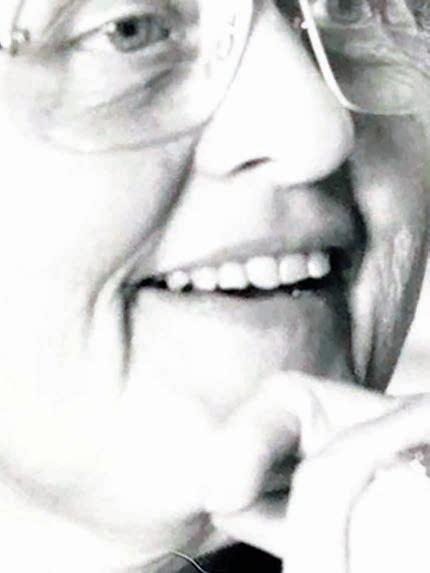
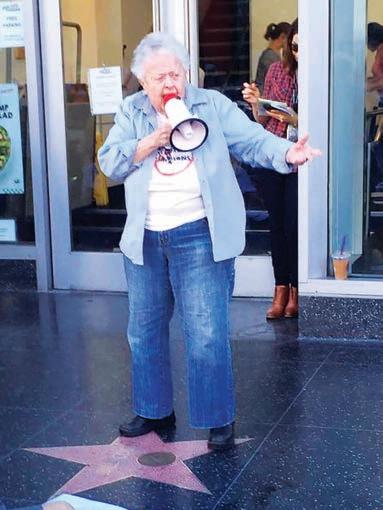
WEST HOLLYWOOD – Kick ass. If Ivy Bottini was pissed off at an injustice, you heard about it. The whole room heard about it. And by the end of her righteous rant, whether at a Stonewall Democratic Club meeting or before the West Hollywood City Council, even nonchalant shruggers applauded her passion. Time finally did what Bottini’s critics could not: her voice was silenced on Thursday, Feb. 25 at her daughter Lisa’s home in Florida. Ivy Bottini was 94.
Unlike other lesbian feminists of her generation, Bottini did not strike withering fear in the pants of men in power. Perhaps it was because she exuded a subliminal sense of caring and flashes of humor during even the fiercest of diatribes. She hated the old tropes that lesbians hated men and had no sense of humor — traits that made her accessible to those in need from 1950s and 1960s housewives newly aware of the traditional shackles of sexism to the desperate dying gay men deemed untouchable by government, society and often even family in the early days of AIDS.
Bottini’s power emanated from her authenticity. Discrimination burned Bottini to the core. She felt the pain. But she didn’t just jawbone about it; she translated the searing anger and pain from her own awakening into activism to alleviate the pain of others, becoming a freedom crusader for women, for LGBTQ people — for anyone suffering from oppression and internalized oppression sickness.
“Thousands of deaths and no one cares! No one cares – except us,” an emotional Bottini told Andy Sacher of the Lavender Effect about the early days of AIDS. “That was inhuman what was really happening to gay men. It was inhuman how they were demonized.”
Throughout her life, each heightened moment fraught with systemic classism, sexism, racism, homophobia and transphobia exploded into a personal epiphany, emerging in her artist’s conscious as empathy for others, especially in recent years, over the profound and ubiquitous discrimination experienced by transgender youth.
In a 2017 interview, Los Angles Blade publisher Troy Masters asked Bottini: “If your life were a book, what would the title be?”
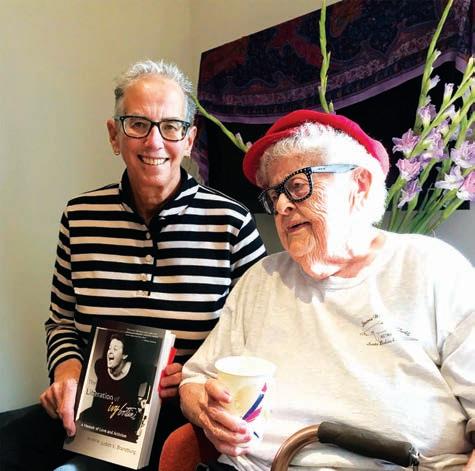
“Give ‘em Hell,” Bottini replied. In fact, the book about her life, as told to Judith V. Branzburg, Ph.D., has a more expansive title: “The Liberation of Ivy Bottini: A Memoir of Love and Activism.” It opens with a March 17, 2016 gathering at the West Hollywood Public Library where Bottini was being honored by Hollywood NOW and California NOW under the theme “The Unsinkable Feminist Spirit of Ivy Bottini” during a week of being honored for her life’s work. “I guess that since I was eighty-nine years old, people figured if they were inclined to honor me at all, they had better do it before I croaked,” she wrote.
Bottini’s history with the National Organization for Women was itself historic, helping found and led the first chapter of NOW in New York in 1968. The following year, she designed the national NOW logo at the request of then-NOW President Aileen Hernandez.
“We were challenging things that women had lived with for years, centuries, and never questioned. And here we were questioning some of the most basic beliefs about women,” Bottini said in a 2015 interview broadcast by MSNBC. “One of the things I thought about when I joined NOW was ‘maybe I’ll meet a real lesbian’ because I had no clue who was a lesbian. I thought I was the only one. And I thought the Women’s Movement can’t be for just straight women. It’s got to include lesbians. They’re women! Women are women — it doesn’t matter what your sexual orientation is.”
It was a long hard road to that revelation. Bottini was born on August 15,1926 to Long Island cab driver and former boxer Archie Gaffney and his “unhappy” housewife, Ivy. An only child, Bottini was an athletic tomboy with a penchant for art. Life was good until her father died in a car crash in 1944. Bottini was 18 and suddenly money was short. In an extremely lucky stroke for young women at the time, she got a full scholarship to the Pratt Institute of Art and Design to study advertising, graphic design and illustration.
After graduation, she worked in New York City art and advertising agencies, and following the inevitable plan for all women of the era, in 1952, she married the young man across the street, Eddie Bottini, had two daughters, Laura and Lisa, and silently struggled with her attraction to women.
“After falling in love with all my gym teachers—that was a clue—and with all other teachers in grammar school and then junior high and high [school], I really was struggling growing up with how I felt about girls and women,” Bottini told the Los Angeles Blade in 2019. “I was still falling in love with women quietly, silently.”
In 1955, Bottini got a job as an art director and illustrator at the Long Island newspaper Newsday. Eleven years later, in 1966, Newsday reporter Dolores Alexander told Bottini about

her an interview with Betty Friedan, whose book “The Feminine Mystique” “was all the rage.” Dolores took Bottini to a women’s meeting in New York City “and soon I was helping to found the first chapter of the National Organization for Women (NOW)” with Dolores. Bottini also joined national NOW where she served on the board for three years.
Meanwhile, Bottini finally mustered up enough courage to call an old closeted lesbian school friend to take her to a gay bar. Eventually, she asked a woman to dance. “That changed my life that evening. I just felt when I walked in there by myself, I felt like I had walked into my home, where I was supposed to be. So, over the next handful of years, I struggled,” she told the LA Blade.
By September 1968, “I just had had it,” living a secret double life. Ivy Bottini had a breakdown — that led to a breakthrough. “I was on the Long Island Railroad in a snowstorm coming back from a New York NOW meeting and when we got to Garden City, I just got off the train,” Bottini said. It was cold. Struggling, she found a payphone, called her psychiatrist, and through tears, explained her circumstances. “I can’t go home anymore. And he said, ‘sorry,’ and hung up. And so I yelled out—it was late at night—I yelled out ‘fuck you!’ I was so angry at him.” She called a friend in Levittown who took her in. She told her husband she couldn’t come home as long as he was there.
Eventually he left but they didn’t actually divorce until 1972. Bottini secured a condo on the Upper Westside. Her daughter Laura moved in with her while Lisa moved in with her dad. “My life became totally different in one fell swoop.” Bottini came out inadvertently in 1968. She was answering a question at a NOW/NY press conference when, without realizing it, she referred to herself as a lesbian. “I accepted that I was a lesbian and as I accepted this, my life changed considerably.”
That awareness led to action and intense interest from other NOW chapters in her consciousness raising groups. In 1969, Bottini put together a panel called “Is Lesbianism a Feminist Issue?” The place was packed. “Oh my god. I think I’ve hit sort of a nerve,” she said later.
CONTINUES ON PAGE 04
CONTINUED FROM PAGE 03
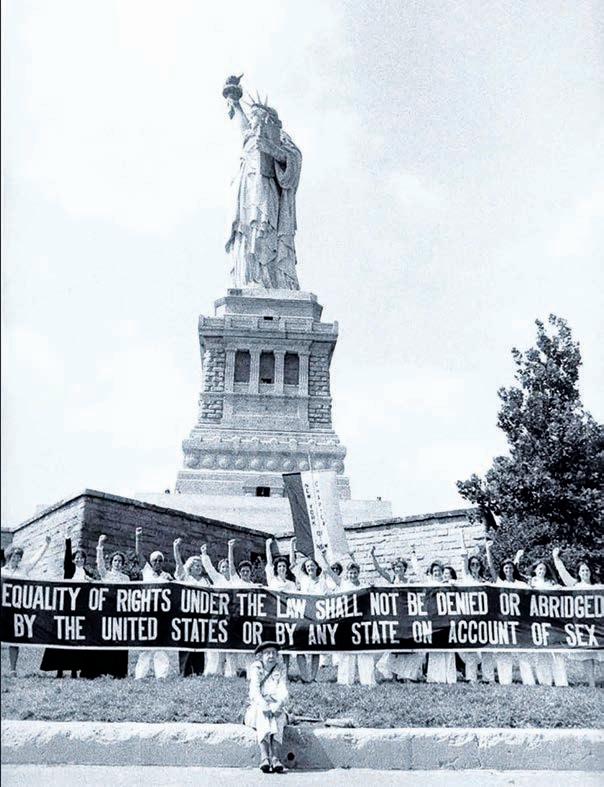
Bottini organized the infamous Aug. 10, 1970 NOW/NY three-hour takeover of the Statue of Liberty, unfurling a banner “Women of the World Unite!” from the base. She also organized the Aug. 26, 1970 Women’s Strike for Peace and Equality commemorating the 50th anniversary of the 19th Amendment granting women the right to vote.
That spectacular women’s march down Fifth Avenue drew an estimated 50,000 people. But it also signaled ugly trouble ahead. When Bottini handed out lavender armbands to show solidarity with the oppression of lesbians, feminist leaders such as Gloria Steinem accepted them but Betty Friedan, the “mother” of the feminist movement, threw the armband on the ground and twisted it with her heel.
“My point was, ‘How can you have a women’s movement and leave a huge amount of women out?’” Bottini later told the Los Angeles Times. “But Friedan just never got that. She doesn’t understand that lesbianism is the bottom line of the women’s movement. If you can’t get past the fear of being thought of as a lesbian, whether you are or not, then you never are really free…. Sexual politics is civil rights.”
Friedan called Bottini a “lavender menace” and plotted a “purge” of lesbians, maneuvering to get Bottini voted out of NOW leadership. The LA Times notes that in a subsequent 1973 Friedan essay in New York Times Magazine “smacked of downright paranoia; Friedan even claimed a woman was sent to seduce her and then blackmail her into silence while unnamed lesbians took over NOW.” Bottini left NOW and left New York for Los Angeles in 1971.
She shifted her focus to the growing Gay Liberation movement and turned her pain into insightful comedy and acting, studying at the famous Lee Strasberg Institute in Hollywood (before moving to West Hollywood in 1978). That yielded a lesbian feminist one-woman show called “The Many Faces of Woman” which she took on tour around the country for several years – two decades before Eve Ensler’s groundbreaking play The Vagina Monologues in 1994. “It showed the craziness that women face and society puts on them,” Bottini says in the MSNBC video. “I talked about things that many women are not supposed to talk about like menstruation and birth control and contraception, and the gynecologist visit and lesbian dates. I was breaking ground that no other comedian in this country was doing. I swear to you it’s true: nobody was doing what I was doing. And it was consciousness raising.”
While the 1970s generally associated with disco and sexual freedom, the era was also a hothouse for politics with civil rights turning into liberation movements, including Women’s Liberation and Gay Liberation after the Stonewall Rebellion. And Bottini was in the thick of it.
In 1976, America’s Bicentennial, she was hired as the Women’s Program Director at the Los Angeles Gay and Lesbian Community Services Center, which led to her long association with Center co-founder Morris Kight. In 1975, Kight co-founded the Stonewall Democratic Club, with Bottini joining shortly thereafter. Politicos were eying a significant change in the cultural landscape as evangelical Christian conservatives started speaking out against gay rights.
Then, in 1977, came the 10.0 earthquake. A new religious group called the Moral Majority, led by a publicity seeking Rev. Jerry Falwell and orange juice shill Anita Bryant, used their “Save the Children” crusade to overturn a gay rights ordinance in Dade County, Florida. The Christian Right, which had come to the fore through efforts to Stop the ERA [the Equal Rights Amendment] and overturn Roe v Wade which gave reproductive rights to women, was reborn as a loud and crass anti-LGBTQ grassroots political movement.
MECLA (Municipal Elections Committee of Los Angeles) was founded in 1977 as the nation’s first gay political action committee to press legislators on gay and lesbian rights, just as the “Save the Children” crusade was exported to California. Bottini and Kight organized the Coalition for Human Rights to fight the ugly anti-gay ballot initiative, championed by State Senator John Briggs whose anti-gay attempts had failed in the legislature. Proposition 6 proposed banning gays, lesbians and their supporters from employment in public schools.
The No on Proposition 6 campaign was formed, chaired by MECLA co-chair Diane Abbitt in the South and San Francisco Supervisor candidate Harvey Milk in the North. They hired the consulting firm of David Mixner and Peter Scott as campaign managers — and the managers hired Bottini to serve as the Southern California Deputy Director. Jeanne Córdova a second-wave feminist who also came out in 1968, was media director. Prop 6/Briggs Initiative was overwhelmingly defeated in November 1978, with help from Republican Gov. Ronald Reagan, who had been
convinced to oppose the measure.
After the Briggs Initiative victory, newly re-elected Gov. Jerry Brown made a number of historic gay appointments: Stephen Lachs to the LA Superior Court in 1979; Rand Schrader to the LA Municipal Court in 1980; and in 1981, Mary Morgan to the San Francisco Municipal Court and Ivy Bottini, 55, to the California Commission on Aging, the first “out” lesbian or gay person to be appointed to a California board or commission.
Bottini met successful real estate broker and 12 Step fixture Gail Wilson during the fight against the Briggs Initiative. Wilson and her gay partner held a conference during which they told the audience not to come out, just do your jobs. “I thought I was going to go through the roof because that’s exactly why we were being attacked — because they never thought we’d fight back,” Bottini told the LA Blade. “So, I was at odds with Gail. I got up and spoke and I didn’t mince any words. And I thought, ‘well, she’s gonna hate me for the rest of her life.’”
Instead, Wilson changed Bottini’s life. “She was a wonderful, magnanimous human being. And she said to me a month or so later, ‘what are you gonna do [with your life]’? I said, ‘well I don’t know. I guess I’ll go back to the Center.’ She said, ‘No, no, don’t do that. Go get your real estate license and come work with me in my real estate office. I said, ‘okay.’ I mean, you show me a door that’s open and I’m gonna walk through it, ya know?” Bottini became one of Wilson’s top sales brokers.
Meanwhile, the Moral Majority spawned other rightwing conservatives, who elected Reagan president in 1980. As a reward, Reagan gave the anti-gay haters administration posts and when a mysterious disease started killing gay men, they did nothing.
In 1982, Ken Schnorr, an old friend from Long Island, collapsed and died a week later. His mother called Bottini, freaked out about all the black and blue marks on his body, thinking the hospital hurt him.
“After Ken died, something said to me there is more to this than we see,” Bottini said. “So, for some reason, I just picked up the phone and called the CDC. I had never done that before. ‘Look, this just happened to my friend. Do you have any answers? The hesitancy at the other end of the line, the hemming and the hawing before they would say anything — I just knew it was bad.”
The CDC official explained the bruises as Kaposi sarcoma, usually found in elderly Jewish men. “And that was the explanation,” she said. “I got off and thought, ‘no, this doesn’t make sense because Ken was one of three first guys diagnosed with Kaposi in town, in West Hollywood, in L.A., and that started me on working to find out what the hell was going on. It was just horrible.”
Shortly after Schnorr’s death, Rep. Henry Waxman, aided by his gay deputy Tim Westmoreland, held the first congressional hearing on what was then called GRID — Gay Related Immune Deficiency – at the Gay Community Services Center on Highland Ave. “We all met in the lobby and under the stairs on the first floor,” Bottini said. “Waxman’s basic message was spread the word: nobody really knows how it’s passed.”
After a couple weeks with no action, Bottini decided to hold a town hall. She called Dr. Joel Weisman, Schnorr’s doctor, to help inform the community. “Nobody really had a clue. But I felt very early on that it was bodily fluids. That’s the only thing that made sense to me. Because if it was airborne women would be getting it, everybody would be getting it and that wasn’t happening,” Bottini said.
Fiesta Hall in Plummer Park was jam-packed. “It was all guys — and Dottie Wine (Bottini’s girlfriend) and I. And Joel talked about transmission and he believed it was bodily fluids, too. And I thought, ‘I’m not crazy.’”
The next year, in 1983, Bottini founded AIDS Network LA, the first AIDS organization in Los Angeles. It served as a clearing house for collecting and disseminating information. In 1984, Bottini helped co-found AIDS Project Los Angeles, now APLA Health.
Though the love remained, a three-year feud blew up between Bottini and Kight, who did not believe HIV/AIDS disease was transmitted by bodily fluids. Kight changed his mind just in time to reconcile and fight the 1986 Lyndon LaRouche Prop 64 AIDS quarantine initiative that would “put gay men behind chain linked fences.” Bottini was Southern co-chair for the statewide No on Prop 64 campaign; Córdova helmed media relations. The initiative went down to a stunning defeat and Bottini spent much of the rest of the 80s organizing marches, “die-ins” and protests to get funding and services for those impacted by the AIDS epidemic.
CONTINUES ON PAGE 06




















CONTINUED FROM PAGE 04
The work continued into the 1990s, interspersed with painting and Bottini receiving the Drama-Logue Award for “Best Performance” in her play, “Against the Rising Sea.” She also joined the City of West Hollywood’s Lesbian and Gay Advisory Board in 1999, serving as board co-chair for ten years. Her work there included bringing attention to domestic violence abuse in the LGBTQ community, helping focus attention on the crystal meth crisis, and supporting the annual Dyke March.
Bottini also conceived and spearheaded the first effort to provide affordable housing for gay and lesbian seniors, culminating in the founding of the nonprofit Gay & Lesbian Elder Housing in 2005. “I’d laid the groundwork by organizing the community and provided the leadership that resulted in obtaining a grant from the State to move forward with the housing project,” known as Triangle Square in Hollywood, Bottini said. And she kept at it, telling a rally in 2018 to “get off your asses” and vote!
Bottini grieved her beloved West Hollywood before health issues forced her to move to Florida. “What I think I am going to miss most is the camaraderie in the city and the access to the city council and that a very palpable vision could be fed into the city council and the city council would start to take it on and then come back to the community to make sure there’d be discussion,” Bottini said. “That doesn’t happen anymore but that’s what I will miss. I will miss walking down the street and knowing most everybody that I pass. Now I know hardly know one person.”
Asked how she’d like to be remembered, Bottini told the LA Blade: “I’d like to be remembered as someone who had a really good sense of humor and could find something funny or strange or out of the ordinary in just about everything I worked on. The early city was creatives. We’re not creative anymore — we’re not. We’re not creating anything.”
Bottini also appreciated being appreciated. At a packed book signing, “people came up to me and say things like ‘I’ve been watching what you do for 30 years.’ Or ‘you don’t remember me but 20 years ago…’ There were a lot of memories that came to me. I’m not saying I remembered everything they were talking about – the politics, the conscious raising, the comedy — but they did.” And always there were gay men who approached her and said, “we never met but you saved my life with that town hall.”
“I had no clue how I touched the people in the city. I can be kind of hard-nosed sometimes when I speak. Sometimes I’d come home and go, ‘oh, maybe I shouldn’t have said that.’ But none of that hit me” after the book signing.
“It was like this huge family reunion,” Bottini said. “They were remembering how I had change their life. And that was the reason that I was doing things. I was trying to save their lives. I saw the danger that we were about to get hit with while we were walking through [life]. And it was happening and we didn’t even know it — people’s lives were just being torn apart with deaths and children being taken away from lesbian mothers and…It was too much. I saw a tapestry of hurt and that’s what I was fighting. It all adds up to being able to live a life of safety and not live a life of fear.”
Friends react to Ivy Bottini’s death, on the day the House of Representatives passed the Equality Act
Rev. Troy Perry, Founder of MCC – Metropolitan Community Church (Ivy’s church), coFounder of Christopher Street West, longtime gay activist:
“She lived this incredible life. I mean, her history with the women’s movement, as well as the lesbian movement in America and the larger LGBTQ movement was just incredible. As far as I’m concerned, she was a real pioneer in making a difference than all of our lives. Both Ivy and Morri [Kight] were excellent spokespersons for our community. But she had a knack for being able to throw one-liners out, too, so she could quickly stop nonsense by saying something funny.
“People don’t realize — it took me having lesbians like Ivy who made me realize that women even had another layer than I did as a gay man. They could be smart as a whip, for example, and work for a bank but always hit that glass ceiling. The bank would say – and this actually happened with one of my church members — you know, we would love to make you a general manager. I mean, you’re a smart as a whip. You do all this, but you’re not married. She couldn’t say, ‘yes, but I’m a lesbian. I’m not going to leave.’ Because they were trying to say, ‘you’ll get married and you will have children and leave us. And we don’t want to invest in women.’ Or she’d say, ‘well, I’m a lesbian. I’m not going to get married.’ And they’d say, ‘Oh, we’re going to fire you.’ That was the difference right there. With gay men, we were not questioned much about our sexual health as much as you might think….One of our clergy, Frieda Smith, told me how she worked in a store and she ran their dark room developing photographs and her boss would sexually harass her. She really woke me up to things, too.
“Ivy should be remembered as a strong woman who have made a difference, not only in women and lesbian rights, but for all of us. And with NOW, she also was an incredible example of not giving up the fight, even if there’s an organization that doesn’t want you there.”
Dottie Wine: “Ivy Bottini stepped into my life a few weeks short of 46 years ago, at a NOW Consciousness Raising Conference in San Francisco. Things have not been the same since! She was a multifaceted difference-maker and spoke out when she observed injustices. She was a visionary who could see dangers before evident – think John Briggs and AIDS – and took action, often at great resistance from other community activists. She loved to mentor young people and others new to the addiction of activism and watch them claim their own power to make a difference. Never seeking accolades and recognition, both flowed her way as others recognized and appreciated her value to the many causes she impacted. So honored and proud to have experienced so much of life with Ivy. So much more could be said, but it will have to wait. Except, I love you, Ivy!”
Diane Abbitt, MECLA board co-chair, No on Prop 6 campaign co-chair, Equality California board co-chair: “No on 6 was the first time that our community was targeted by a statewide ballot initiative in any state. It was also the first time we came together as a community and organized and fought back. Ivy had a history of fighting back when she was in New York. Then NOW called her a ‘lavender menace’ and threw her out. She was always a grassroots person — she always wanted to fight for full equality for our community. And when you look at her life, that’s exactly what she did. That was who she was.”
Teresa DeCrescenzo, executive director of GLASS: “I’m devastated by the loss. It feels like the end of an era of a certain kind of activism, that Ivy represents. On a deeply personal level, she was my earliest political mentor. I was still in my 20s when we first met. She took me under her wing and taught me so much. At I time when I was still learning about oppression sickness, Ivy taught me not only about male privilege & white privileged, but about class privilege (in the context of the Gay Academic Union). Her wisdom and maturity saw me through many personal, political, and professional crises. I’ll miss her so much.
“We expect to have a ZOOM event soon, to honor Ivy. We’re also hoping to curate an exhibit of her art as soon as we can safely do so.”
Ruth Tittle, business leader, philanthropist, activist: “I have so many memories with Ivy. We served 12 years together on the WeHo Lesbian Gay Advisory board, ending around 2014/2015. Something that always stood out was Ivy’s drive for activism. She loved seeing the younger generations on the board. She was always telling them ‘we need to get in the streets!’ Since then, I venture to say that many off those younger generations have been ’in the streets.”
Robin Tyler, business leader, activist, comedienne, marriage equality plaintiff: “Ivy Bottini was a great lesbian feminist activist. I am sure that at the very minute she passed, her best butch buddy, Jeanne Cordova, reached down to help her up.”
Sue Sexton, Director of Development & Marketing at ONEgeneration, West Hollywood Lesbian and Gay Advisory Board member: “Ivy Bottini changed my life in ways too numerous to mention. It all really started around the year 2000 when she said to me after I ran into her at an event, ‘Kid, you need a mentor!’ I had known Ivy for a few years prior to that as an artist and as my landlord, and we had lost contact for a few years but after 2000 I started to spend more time with her and learned about her life as an activist. Little did I know that when I accepted her gift to be my mentor that I would gain a family member, a colleague, a confidant, a teacher, a trusted advisor and a dear, dear, dear friend.
“I find solace in knowing that the loved ones no longer with us and whom she introduced me to over the years have greeted her on the other side today. An army of LGBT activists who have waited patiently to be reunited with our wonderful friend. I feel an obligation to Ivy, to stay involved in the work to make this a better world.”
More tributes can be found at losangelesblade.com.
By BRODY LEVESQUE
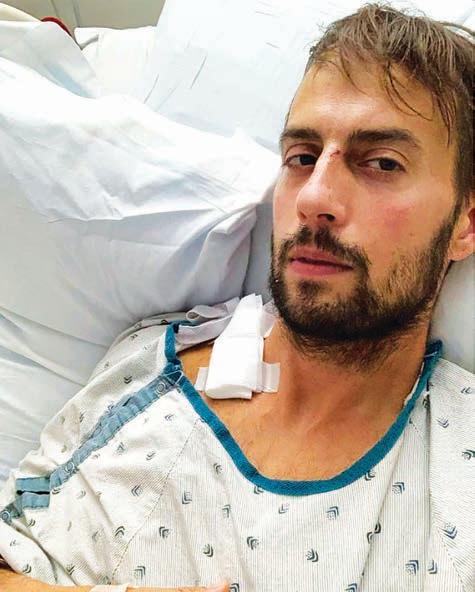
The dog walker who was gravely wounded in the violent theft of Lady Gaga’s two French Bulldogs last week issued a bedside statement from multiple Instagram accounts Monday. Thirty-year-old Ryan Fischer posted two photographs and wrote a lengthy post noting that he was “ still in recovery from a very close call with death,” and then expressed gratitude for all of the support he has received.
In his posts, he called out his family — including his mother and brother, who he noted fl ew to Los Angeles to be with him, Lady Gaga, his client and friend whose dogs were taken, along with a host of others.
A spokesperson for the Los Angeles Police Department told the Blade Monday that detectives still have no suspects in the crime.
Law enforcement sources, who spoke on the condition of anonymity, told the LA Times and other media outlets that investigators are still canvassing the area near the crime scene to obtain security video and are reviewing license plates of cars in the area at the time of the robbery. Detectives believe kidnapping the dogs was the motive but are not sure if the assailants knew the dogs belonged to the singer.
Meanwhile, a spokesperson for the Los Angeles Police Department told multiple media outlets Friday that the two French Bulldogs owned by Gaga, were turned over to LAPD offi cers Friday afternoon.
An unidentifi ed woman brought the dogs to the LAPD’s Olympic Community Police Station, just northwest of downtown, around 6 p.m, Friday, Capt. Jonathan Tippett, commanding offi cer of the LAPD’s elite Robbery-Homicide Division said.
The woman who brought them to the station appears to be “”uninvolved and unassociated” with Wednesday night’s attack, Tippett said, adding that it wasn’t immediately clear how she obtained the dogs.
A representative for the singer along with the detectives working the investigation went to the station and confi rmed that they were the missing dogs.
The singer on Friday repeated her off er of a $500,000 reward for the return of her dogs with no questions asked.
“ I continue to love you Ryan Fischer, you risked your life to fi ght for our family. You’re forever a hero,” she said on her Twitter and Instagram posts.


Equality California Institute launched a statewide bilingual campaign on Tuesday promoting COVID-19 vaccination, testing and safety guidance to LGBTQ+ Californians, in partnership with the California Department of Social Services and The Center at Sierra Health Foundation.
The public education and outreach campaign is a continuation of Equality California Institute’s ongoing efforts to connect LGBTQ+ Californians with the resources and support they need to navigate the COVID-19 crisis — including an online Help Center (covid19.eqca.org) and help line (323-448-0126), that was launched last May. A Spanish-language version of the Help Center will be launched in the coming weeks the organization announced in a press briefing Tuesday.
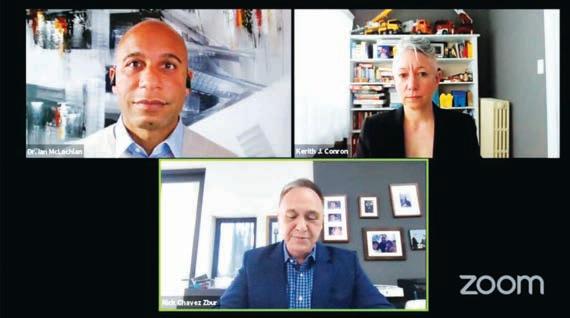
“We’ve made a lot of progress, and certainly I’m hopeful that we’re seeing light at the end of the tunnel with increased availability of vaccines, but the fact is the pandemic has had a devastating impact on our LGBTQ+ community,” Equality California Executive Director Rick Chavez Zbur said Tuesday’s briefing.
“Since the crisis began, we’ve been working with Governor Newsom’s administration and our partners in the California Legislature and Congress to ensure LGBTQ+ people have access to the resources they need. Now, we’ll be working with our community-based partners across the state to make sure every LGBTQ+ Californian knows when it’s their turn to be vaccinated, how to sign up for an appointment and the importance of getting vaccinated — so we can get our kids back in the classroom, reopen our economy and protect the most vulnerable members of our community.”
Nearly one year since California entered a State of Emergency to combat COVID-19, research shows that the ongoing global pandemic has had a devastating impact on the lesbian, gay, bisexual, transgender and queer+ (LGBTQ+) community — especially LGBTQ+ people of color. Last month, a study by the Centers for Disease Control and Prevention (CDC) also confirmed that underlying health disparities faced by LGBTQ+ people leave the community particularly vulnerable to the virus.
A recent study from the Williams Institute found that LGBTQ+ people of color are twice as

likely to test positive for COVID-19 than their non-LGBTQ+ white peers.
“The COVID-19 pandemic has highlighted underlying social inequalities that need to be remedied in order to promote long-term health for LGBTQ people, particularly LGBTQ people of color,” said Dr. Kerith J. Conron, Research Director at the Williams Institute.
LGBTQ+ people face higher rates of comorbidities such as HIV and cancer, are more likely to use tobacco products, are less likely to have health insurance and less likely to access care when they are sick out of fear of discrimination.
Members of the LGBTQ+ community are also overrepresented in the industries hit hardest by economic fallout, such as the food services and hospitality industries and the gig economy. And LGBTQ+ elders already faced isolation and were less likely to reach out for support before the crisis began.
Dr. Ian McLachlan, is an emergency medicine physician at Kaiser Permanente’s San Francisco Medical Center. Dr. McLachlan has been deeply involved Kaiser Permanente’s COVID-19 response, with a particular focus on promoting equity in the response. He is currently working at San Francisco’s mass vaccination site at Moscone Center.
“Trust and inclusion has been a huge, important issue for every frontline worker,” said Dr. McLachlan. “Next year will be the 40th anniversary since the definition of AIDS, and American healthcare looks totally different than it did 40 years ago — doctors older than myself will tell you that one of the biggest differences is diversity, and that diversity has already paid dividends.”
Equality California Institute’s new campaign will include direct outreach to LGBTQ+ Californians via email, text message and mail, as well as virtual town hall events, social media outreach and engagement in coordination with local community-based partner organizations. Equality California Institute’s online COVID-19 Help Center is available to LGBTQ+ Californians at covid19.eqca.org. Members of the LGBTQ+ community can receive direct support finding available vaccination and testing sites and accessing other resources via Equality California Institute’s help line by calling 323-448-0126.

In the week after the U.S. House voted to approve the Equality Act, state LGBTQ advocacy groups are expected to have a significant role as part of an upcoming campaign to convince senators to support the legislation to get it to President Biden’s desk.
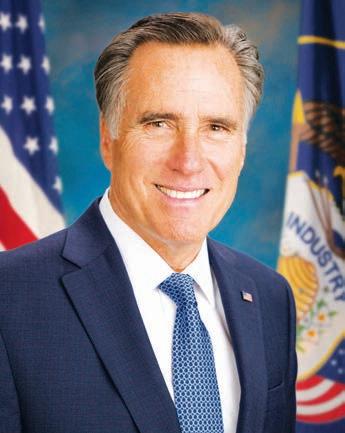
State equality groups — some of which are unable to endorse at the federal level, so less hampered by political affiliations than national organizations and lobbyists — are seen as local organizations able to represent constituents and have more personal influence on lawmakers, which would be key in winning over senators like Susan Collins (R-Maine) and Mitt Romney (R-Utah) in the effort to find 60 votes to end a Senate filibuster.
Fran Hutchins, executive director of Equality Federation, said Tuesday in an interview with the Washington Blade state groups would “have a huge role” in efforts to pass the bill, which would expand anti-discrimination protections for LGBTQ people under federal law.
By CHRIS JOHNSON | cjohnson@washblade.com
“When we’re thinking about who is our audience, really, for getting this passed, it’s going to be conservatives who are going to care a lot about what their constituents think about this,” the leader said.
Hutchins added members of the Equality Federation, which facilitates coordination among state advocacy groups, have for the past two years undertaken lobbying and education efforts on LGBTQ non-discrimination protections. Those efforts, Hutchins said, are expected to expand and continue this year in partnership with the LGBTQ group Freedom for All Americans.
“Many of the conversations about the Equality Act will be happening in D.C,” Hutchins said. “But, when it comes down to it, what senators care about is what folks back home think, and so, that’s going to be the role of state groups.”
Leaders of statewide groups who spoke to the Blade said they’ve already engaged with lawmakers who would be crucial for the support necessary to end the filibuster in the Senate.
Troy Williams, executive director of Equality Utah, said his organization has met with Romney, who has signaled in a statement to the Blade that he won’t support the Equality Act out of concerns for insufficient protections for religious liberty in the legislation.
“We have been impressed with Sen. Romney’s principled stand on the abuses of Donald Trump and his willingness to march with Black Lives Matter,” Williams said. “We have encouraged him to be a voice of reason to help bring people to the table from both sides. It would be ideal, and good for the country if the Equality Act could pass with bipartisan support. With the filibuster in place, it won’t move without it.”
Williams said Romney, similar to the position he’s made public, told Equality Utah he would require “some religious accommodations or clarifications” before supporting the Equality Act.
Another lawmaker Williams said Equality Utah has been in contact with is Sen. Mike Lee (R-Utah), who has introduced a measure that would weaken protections under Title IX of the Education Amendments of 1972 requiring schools to allow transgender kids to participate in sports.
“Sen. Lee’s staff only wanted to talk about transgender children in sports, and his position there is unfortunate,” Williams added. “Thankfully, here in Utah, we successfully defeated our transgender sports ban just last week.”
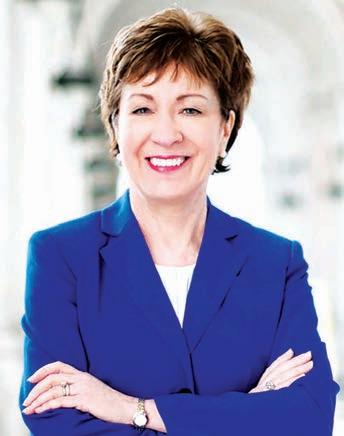
Matt Mooner, executive director of Equality Maine, said the last time his organization spoke with Collins on the Equality Act was in 2016, when all three of the senior staff met with her at her office in Washington, but the results weren’t positive.
“At that meeting she expressed a desire for changes to the language, but was unable to articulate what they were,” Mooner said. “Her LGBTQ policy staffer was also unable to articulate what those changes were in followup communications. When she signed on as a cosponsor to the bill in 2019, we assumed whatever language concerns she had previously had been resolved.”
Mooner pointed out Collins continues to fail to articulate the change she’s seeking, but “it does seem relatively clear that she isn’t planning to vote for the Equality Act in its current form.”
“All LGBTQ Americans should be free from discrimination, and LGBTQ Mainers shouldn’t lose their protections just by crossing state lines,” Mooner said. “It’s embarrassing that Sen. Collins is more than 15 years behind the people of Maine on something as simple as basic non-discrimination, and we urge her to catch up to the people she is supposed to represent.”
Mooner added Equality Maine is able to endorse candidates at the federal level. Although the Maine group stayed neutral in 2009 and 2014 when Collins was seeking reelection, the group in 2020 endorsed Democratic challenger Sara Gideon, who ended up failing to unseat Collins.
In terms of additional resources and programming, national groups and institutional funders are also expected to contribute additional resources to state groups as part of a forthcoming campaign on education and lobbying efforts for the Equality Act.
One insider said the LGBTQ donor community is working on building up Equality Utah, Equality Ohio and Equality Florida to “help lift up local voices and constituents to share lived experience.”
“The nexus of LGBTQ rights has always been at the state and local level,” the insider said. “Our first rights were won there. They are the first responders of our movement. And even after any federal legislation, the defense of those rights will start there.”
Hutchins said the good news about state groups is they don’t require a significant amount of resources to conduct outreach.
“Communications firms and lobbying firms cost a lot of money,” Hutchins said. “It doesn’t cost a lot of money for folks to make calls to their representatives. It doesn’t cost a lot of money…to build those relationships with folks to influence legislators, faith groups and parent groups and things like that.”
At the end of the day, finding 10 Republican votes for the Equality Act to overcome a filibuster would be a significant challenge even with a grassroots campaign with state advocacy groups at the forefront.
Malcolm Lazin, executive director of the Philadelphia-based Equality Federation, said he’s “out of the loop” about anything at the state level when asked about efforts to convince Sen. Pat Toomey (R-Pa.) to support the Equality Act.
“At best, it appears that there are no more than six Republican senators that would support the bill — insufficient to reach 60,” Lazin added. “My best guess is that passage will occur when Democrats eliminate or revise the filibuster. The latter seems more likely.”
Rachel Levine’s testimony in the U.S. Senate on Thursday marked the historic first time an openly transgender person had taken part in a confirmation hearing for a presidential appointment, but also featured attacks against transgender youth and implicit animosity to her gender identity.
Sen. Rand Paul (R-Ky.), drawing on right-wing animus toward Levine filling social media, made his views toward a transgender nominee clear by simply stating the phrase “genital mutilation” with an inflection at the start of his questioning.
“American culture is normalizing the idea that minors can be given hormones to prevent their biological development and their secondary sexual characteristics,” Paul lamented.
Questioning Levine about youth undergoing gender transition, Paul condemned changing social norms and the idea minors should take hormones “to prevent their biological development and their secondary sexual characteristics.”
By CHRIS JOHNSON | cjohnson@washblade.com
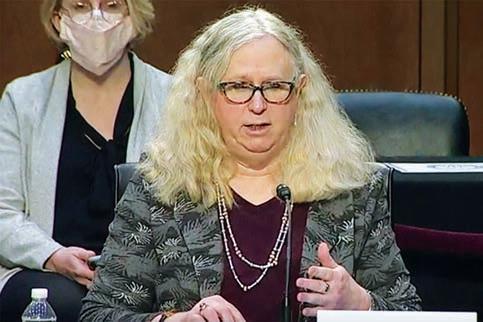
Levine, however, remained poised and politely informed Paul transgender medical issues are “complex,” and said she would look forward, if confirmed, to coming to his office to work with him and discuss the issues.
“Transgender medicine is a very complex, and nuanced field,” Levine said. “And if confirmed to be assistant Secretary of Health, I would certainly be pleased to come to your office and talk with you and your staff about the standards of care and the complexity of this field.”
But Paul wouldn’t let up, accusing Levine of having “evaded the question,” and criticized her for a previous statement in which she, according to Paul, said she’s “willing to accelerate the protocols for street kids.” Conjuring tales of a teenager who transitioned, then detransitioned, and other youths “making decisions to amputate their breasts, or to amputate their genitalia,” asked Levine if minors “should be involved” in making these decisions.
Levine, however, stood firm and repeated her previous response about transgender medical issues being complex.
Paul, a physician himself, called for entering into the record Levine didn’t answer the question, then continued with an additional diatribe about transgender youth.
“We should be outraged that someone’s talking to a three-year-old about changing their sex,” Paul concluded.
Coming to Levine’s defense was Sen. Patty Murray, chair of the Senate Committee on Health, Education, Labor & Pensions, who admonished Paul to treat nominees before the committee with respect.
“It is really critical to me that our nominees be treated with respect and that our questions focus on their qualifications and the work ahead of us, rather than ideological and harmful misrepresentations like those heard from Sen. Paul earlier,” Levine said.
Ruben Gonzales, executive director of LGBTQ Victory Institute, also condemned Paul’s hostility to Levine on transgender youth in a statement, saying the questioning demonstrates he “does not deserve to hold public office.”
“His remarks echo the talking points of the same organizations who said gay men deserved AIDS and that LGBTQ people should be criminalized,” Gonzalez added. “He explicitly attacked vulnerable trans youth for his own perceived political gain and it was a disgrace. Dr. Levine is an extremely qualified nominee whose experience can help America effectively tackle this pandemic, but he took this opportunity to give voice to hate groups instead.”
Aside from Paul, the questioning from senators — Democratic or Republican — stayed away from transgender issues and sought clarification on how her work as Pennsylvania secretary of state would translate to the role she’s seeking as assistant secretary for health. Levine, in her opening statement, which was halted momentarily by microphone difficulties, sought to demonstrate her qualifications for the role with examples of her long medical pedigree, such as being a professor of pediatrics and psychiatry at the Penn State College of Medicine.
“Throughout my medical career I’ve been particularly invested in health issues that are at the intersection of physical and behavioral health and I brought that expertise to public health and addressing substance use disorders,” Levine said. Sen. Patty Murray (D-Wash.), chair of the Senate Health, Education, Labor & Pensions
Committee, paid heed in her opening statement to the historic nature of Levine’s confirmation hearing.
“I’ve always said our government should represent the people it serves and the nomination of Dr. Levine, who would make history as the highest ranking openly transgender official in the U.S. government, brings bring us a step closer and making sure that that happens.”
Murray also praised Levine’s background as Pennsylvania secretary of health, saying she “established herself as a trusted voice to the people of Pennsylvania.” Among Levine’s accomplishments Murray cited was establishing guidelines for opioid prescriptions, education for medical students, treatment for opioid overdoses, combatting eating disorders, as well as health equity for the LGBTQ community.
The assistant secretary of health oversees the department’s key public health offices, a number of presidential and secretarial advisory committees, 10 regional health offices across the nation, and the Office of the Surgeon General and the U.S. Public Health Service Commissioned Corps.
Joining Levine as a fellow nominee during the confirmation hearing was Vivek Murphy, whom President Biden has nominated for U.S. surgeon general after having served in the role during the Obama administration.
Raising LGBTQ issues in a positive way was Sen. Tammy Baldwin (D-Wis.), the first out lesbian elected to the U.S. Senate, who asked Levine about improving LGBTQ health equity. In response, Levine said data collection is key, noting under her watch Pennsylvania became the first state to collect data on whether coronavirus patients identify as LGBTQ.
“It is critically important that we include questions about sexual orientation and gender identity in our data collection,” Levine said. “That would include many studies done by health and human services in the CDC. And I think that as we get more data than we understand more about these health disparities and then we can develop the appropriate policies in order to address them.”
Other Republicans during Levine’s confirmation hearing didn’t bring up anything about her being transgender, but one chose as a battleground her response to coronavirus as Pennsylvania secretary of health.
Sen. Richard Burr (R-N.C.), top Republican on the committee, faulted Levine for testing strategy, vaccine rollout and nursing home deaths he said occurred under her watch or shortly thereafter in Pennsylvania.
“Along with testing challenges last spring, your state failed to adequately protect nursing home residents from the virus, and is making unacceptable mistakes in the vaccine distribution process,” Burr said. “Pennsylvania ranks as one of the most dangerous states for long-term care residents battling COVID-19.”
Asked by Burr how Levine can give assurances she won’t repeat problems he cited in Pennsylvania, Levine stood firm and suggested those issues were the result of a lack of guidance from the Trump administration.
“We had challenges with testing, we had challenges with contact tracing, etc.,” Levine said. “We have a lack of personal protective equipment, and as most other states do that were impacted in the spring. I think that the nation’s response has improved significantly and under President Biden’s leadership and his strategic plan and task force.”
Sen. Roger Marshall (R-Kansas) took issue with her approach to the coronavirus in terms of treating rural and urban counties, saying treating them the same “didn’t quite make sense.” However, Levine defended her approach, highlighting the reopening of businesses with a red, yellow, and green coded system depending on the persistence of coronavirus in different counties.
Sen. Bob Casey (D-Pa.), introducing Levine at the confirmation hearing, had a different take on her approach to the coronavirus, praising her for the response and pointing out she was confirmed three times by a Republican-controlled state Senate in Pennsylvania.
“When COVID-19 came to our state, Dr. Levine’s leadership was marked by clear sciencebased, communication, and her daily briefings, her early action or collaborative style and her calm, were recognized by the medical community, as well as leaders on both sides of the aisle,” Casey said.
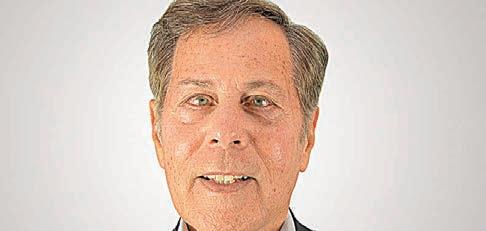
PETER ROSENSTEIN
is a longtime LGBTQ rights and Democratic Party activist. He writes regularly for the Blade.
By PETER ROSENSTEIN
Founded in 1973, CPAC has morphed from a conservative organization into a meeting of co-conspirators, seditionists, and insurrectionists and those cheering them on — politicians whose acts of sedition now represent the base of the Republican Party.
Some call it TPAC, the Party of Trump. This group fails to acknowledge Trump caused the party’s losses in the 2018 midterms, lost the White House and caused the loss of two Georgia Senate seats. The problem for the reasonable Republicans remaining is they know they can’t win with Trump and can’t win without his voters. This should be good news for Democrats.
I first met some conservative operatives after meeting Terry Dolan in a D.C. gay bar. He co-founded NCPAC in 1975 with Charlie Black and Roger Stone. It was an organization that got its start with direct mail solicitations. Terry lived by the motto “The shriller you are, the better it is to raise money.” At the time we were both in the closet; the difference being I had worked for Bella S. Abzug (D-N.Y.) who first introduced the Equality Act in 1974 and was working for the Carter administration and would soon come out. Terry worked for rabidly anti-gay candidates and spoke out against the LGBTQ community even while going to gay bars in Dupont. He never did come out before dying of AIDS in 1986. His organization died off not long after Terry died.
Years later I was to learn more about the conservative movement and CPAC when they moved into offices down the hall from my office on H Street in D.C. I would go out for drinks with their then executive director. I talked about CPAC with some of the leaders of the Log Cabin Republicans when there was still some sanity in that group. Today both groups are living in an alternate universe. They support politicians who are blatant liars, sexists, racists, and homophobes. Log Cabin recently boasted that their statement against the Equality Act was inserted into the Congressional Record by the insane Jim Jordan (R-Ohio) and came at the initiation of QAnon Congressperson Marjorie Taylor Green who their Georgia group is close to and supportive of. What alternative universe is that from?
The speakers at CPAC all seem to reside in that alternate
universe. They believe in alternate facts getting their information from FOX and NewsMax. They appear to buy into any conspiracy presented whether from QAnon or just plain liars, racists, sexists and homophobes like Donald Trump, Josh Hawley and Ted Cruz. The insanity reached a point this year when former Vice President Mike Pence and Senate Minority Leader ‘Moscow’ Mitch McConnell wouldn’t attend CPAC because they were afraid of being booed out of the room. CPAC attendees wheeled a gold statue of Trump into the ballroom to bow down to their idol. Never mind their idol may soon end up in jail for tax evasion and fraud.
It all seems otherworldly but this is a majority of today’s Republican Party. Tom Cotton (R-Ark.) denounced the $15 minimum wage, suggesting he could go along with a $10 minimum in his state only learning after his speech that Arkansas has already approved an $11 minimum wage. Ted Cruz, sounding totally deranged screaming at the audience, joked about COVID and his trip to Cancun as if millions of the Texans he represents aren’t still suffering from the worst disaster they have ever seen, and thousands have died from COVID. Cruz’s jokes about masks were cheered and the Orlando Sentinel reported “At one point CPAC organizers were booed and met with chants of ‘freedom!’ when they asked the crowd to comply (with wearing masks).” This in Florida, which has seen nearly two million coronavirus cases and 31,000 deaths.
Meanwhile, back in the real world, Democrats in the House of Representatives passed a $1.9 trillion stimulus package to move the country forward from the pandemic. It contains money to open schools, help state and local governments to balance their budgets to avoid layoffs of teachers, nurses, and other first responders. It has money for the unemployed to buy food and pay their rent, and for small businesses to remain afloat and pay their employees.
If Democrats stick together and don’t have their usual circular firing squad they can take advantage of what is happening at CPAC to win more Senate and House seats in the mid-term elections. Republicans are giving us this chance let’s make the most of it for the American people.
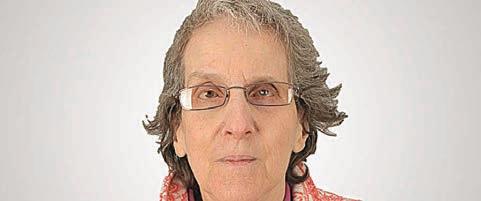
By KATHI WOLFE
I thought poets were stuffy bards on Mount Olympus with no connection to the passions, provocations or language of earthly mortals. Until, in the 1970s, I came home from college for the winter holidays. Like many, I was appalled by the commercialization of not only the Christmas season but of society at large, and furious at the ongoing Vietnam War. One evening, I found a poetry book, “A Coney Island of the Mind,” by Lawrence Ferlinghetti in my parents’ bookcase.
“Christ climbed down/from His bare tree/this year,” Ferlinghetti wrote in the poem from the collection “Christ Climbed Down,” “and ran away to where/no intrepid Bible salesmen/covered the territory/in two-tone cadillacs.”
From that moment on, I knew that good poets, like rock stars, are practitioners of provocation: great poems speak directly to our hearts and minds, and infiltrate our DNA.
Ferlinghetti, a renowned poet, died on Feb. 22 at 101 at his San Francisco home. For decades, he was the proprietor of City Lights, the San Francisco bookstore and publishing house. Ferlinghetti wrote dozens of books from his first collection “Pictures of the Gone World” published in 1955 to the novel “Little Boy” published in 2019.
“A Coney Island of the Mind” has been carried in backpacks and read aloud accompanied by jazz by generations of queer and hetero students and still-hip elders. It has been translated into nine languages and is one of the best-selling poetry books in history.
City Lights, as a bookstore and publisher, from the get-go has nurtured writers and readers. It’s been a place where authors could meet, talk, and find community. Since the 1950s, it has published writers and poets who would receive little or no attention from mainstream publishers. It fostered the work of the authors and artists who became known as the Beat Generation. Like millions of acolytes, I visited City Lights when I was in San Francisco. It felt like being on holy ground. Long before people talked about being an ally or hetero grandmas marched in gay pride parades, City Lights published queer writers. Ferlinghetti became famous after he published gay poet Allen Ginsberg’s poetry collection “Howl and other Poems” in 1956.
In “Howl,” a political manifesto, Ginsberg writes explicitly of gay sex “who let themselves be fucked in the ass by saintly motorcyclists” and of “who were burned alive in their innocent flannel shirts of Madison Avenue.” In 1957, Ferlinghetti was arrested. He was charged with “willfully and lewdly” printing “indecent writings.” In a significant victory for the First Amendment, Ferlinghetti was acquitted. The judge ruled that “Howl” wasn’t obscene because it “had redeeming social importance.”
City Lights also published “Lunch Poems,” the acclaimed and beloved poetry collection by gay poet Frank O’Hara. His poem “The Day Lady Died” (written after the death of Billie Holiday) will move you to tears. His poem called “Poem,” an outpouring of love to Lana Turner, will sweep you off your feet with joy. Yet, O’Hara, as his friend queer poet John Ashberry said were dashed off “at odd moments.” Without Ferlinghetti’s careful attention and nurturing, we might not have “Lunch Poems.”
In 1979, Maryland’s tenth Poet Laureate Grace Cavalieri traveled to San Francisco. There, she interviewed Ferlinghetti in his loft above City Lights for Radio Paris. He was “sitting cross-legged,” Cavalieri, producer of the public radio show (recorded at the Library of Congress), emailed the Blade. He “was so connected to his Italian heritage that he was writing a book on Italian women feminists,” Cavalieri said. “At 60 years of age, he was immersed in social action and making significant change.”
Ferlinghetti turned poetry haters into poetry lovers, Clarinda Harriss, who taught English for decades at Towson University, told me. He transformed the “reading-resistant” into “‘give us more poetry people,” she said.
Sarah Browning is the former executive director of Split This Rock, a poetry organization that works for justice. “We built Split This Rock on his shoulders,” Browning told me.
The group was modeled on City Lights as being “a gathering place – for writers, thinkers and activists,” she said, “and one that was welcoming of queer people from the outset.”
Thank you, Lawrence Ferlinghetti, for your passion, provocation, and poetry! R.I.P.
ADDRESS
8237 Blackburn Avenue Ste. 201, Los Angeles, CA 90048
PHONE 310-230-5266
E-MAIL tmasters@losangelesblade.com
INTERNET losangelesblade.com
PUBLISHED BY Los Angeles Blade, LLC
PUBLISHER
TROY MASTERS tmasters@losangelesblade.com 310-230-5266 x8080 (o), 917-406-1619 (c)
SALES & MARKETING
SALES EXECUTIVE
ALEJANDRO CERVANTES alejandro@losangelesblade.com 925-768-1447
ROMAN NAVARRETTE roman@losangelesblade.com 310-435-3022
PALM SPRINGS ACCOUNT EXEC BRAD FUHR, 760-813-2020. brad@gaydesertguide.com
NATIONAL ADVERTISING
RIVENDELL MEDIA sales@rivendellmedia.com, 212-242-6863
MARKETING DIRECTOR
STEPHEN RUTGERS srutgers@washblade.com, 202-747-2077 x8077
EDITORIAL CONTRIBUTING WRITER
KAREN OCAMB karenocamb@losangelesblade.com
NATIONAL EDITOR
KEVIN NAFF kna @washblade.com, 202-747-2077 x8088
INTERNATIONAL EDITOR
MICHAEL K. LAVERS mlavers@washblade.com
EDITOR AT LARGE BRODY LEVESQUE California CONTRIBUTORS
ERNESTO VALLE, YARIEL VALDÉS GONZALEZ, PARKER PURIFOY, CHRISTOPHER KANE, AUSTIN MENDOZA, JOHN PAUL KING, JOEY DIGUGLIELMO, CHRIS JOHNSON, LOU CHIBBARO JR., MARIAH COOPER, REBEKAH SAGER, JON DAVIDSON, SUSAN HORNIK, CHANNING SARGENT, SAMSON AMORE, CHRISTOPHER CAPPIELLO, MICHAEL JORTNER, DAN ALLEN, SEAN SHEALY, SCOTT STIFFLER, RHEA LITRÉ CREATIVE DESIGN/PRODUCTION AZERCREATIVE.COM
DISTRIBUTION
CHRISTOPHER JACKSON, 562-826-6602
All material in the Los Angeles Blade is protected by federal copyright law and may not be reproduced without the written consent of the Los Angeles Blade. e sexual orientation of advertisers, photographers, writers and cartoonists published herein is neither inferred nor implied. e appearance of names or pictorial representation does not necessarily indicate the sexual orientation of that person or persons. Although the Los Angeles Blade is supported by many ne advertisers, we cannot accept responsibility for claims made by advertisers. Unsolicited editorial material is accepted by the Los Angeles Blade, but the paper cannot take responsibility for its return. e editors reserve the right to accept, reject or edit any submission. A single copy of the Los Angeles Blade is available from authorized distribution points, to any individual within a 50-mile radius of Los Angeles, CA. Multiple copies are available from the Los Angeles Blade o ce only. Call for rates. If you are unable to get to a convenient free distribution point,



In the heady days before COVID-19 precautions shuttered the clubs and bars that were home away from home for many of us, drag queens counted on those man caves for the lion’s share of their income—and we relied on them as healing truthtellers, whose acid-tongued observations made “reading for filth” among the most crowd-pleasing arrows in their queeny quivers.
But when these wise men in wigs have their own troubles to bear, who among us will walk a mile in their heels, and point them to the light?
Broadcasting from his home base on the East Coast with a message as custom-made as the best-fitting wig you’ve ever worn comes Roy Tomko, whose IGTV show—“Reading the Queen”—is not another Tik Tok drag show. There are no lipsynchs or death drops. But there are drag queens, and there is death. More precisely, life after death, as Tomko uses his gifts as a psychic and spirit medium, to, as the title implies, read his drag queen guests.
Having made its debut in late November 2020, “Reading the Queen” is a product of our pandemic era. Although Tomko had been aware of his heightened perceptions from childhood, it was not, his website notes, “until recent major shifts in the world (COVID-19) that inspired Roy to focus his gift to help others.”
And if you’re going to help others, why not start with giving a little leg up to our drag artists, who’ve spent the past year devoid of their usual platforms for expression? For those familiar with the reality TV formula that “Reading the Queen” uses as a structural template (think “Long Island Medium”), Tomko’s focus on drag talent puts a refreshingly candid, anything goes spin on the proceedings—as does his own identity as a gay man whose unabashedly “sensitive” nature amplifies the self-confidence necessary to put his queens at ease. The resulting banter between out, gay host and out-there guest anchors the show in Must-See territory, with occasional OMG moments where the reality of accepting all of this as reality gets, well, frickin’ real.
That said, detractors and debunkers determined to deny anything happening here other than intuition and wishful thinking will find no shortage of straws to grasp at—but as the metaphor implies, even when bundled, straws have a way of slipping through the firmest of fists.
That’s the Blade’s way of saying believe it or not. We watched quite a few installments of “Reading the Queen,” and the only thing we can say for sure is that drag queens have unusually well-calibrated bullshit detectors that we’ve yet to see go off during or after a reading.
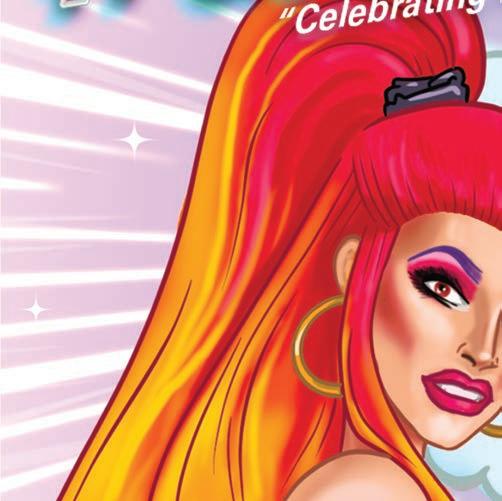
In fact, raves via many a queen’s social media are plentiful. Rhea Litre, after her reading, said to the Los Angeles Blade, “OMG. My eyes have been completely opened. I used to be so afraid of the spiritual world, but that was just because I was afraid of it. I think once you remove fear from a situation, you can understand it a bit more. At least that’s what happened to me! Roy is a true professional and I absolutely adore him.”
Asked about any paranormal fallout, Litre noted no incidents of significance after the fact, but did tell us the experience confirmed her intuition upon moving to Las Vegas, and talk of her late grandfather during the reading with Roy has colored
By SCOTT STIFFLER
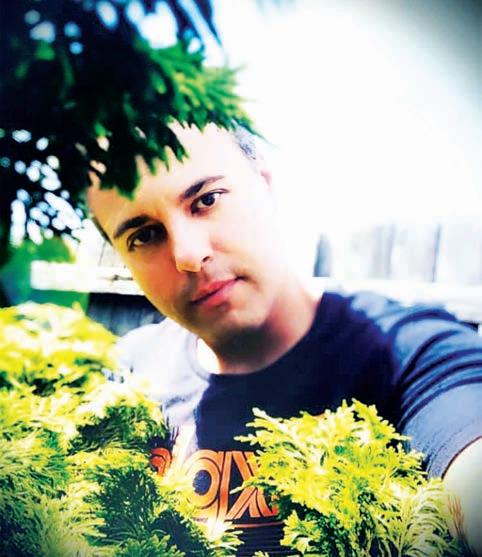
her perception of their relationship.
“I felt such weird energy around when I moved my granddad’s stuff into my house,” recalled Litre. “I think he just wanted me to know he was there. Ever since the reading, I feel his spirit but it’s nice. I wear his necklace everyday. I feel closer to my granddad more than ever.”
The Blade recently spoke with Tomko about the unique alchemy of “Reading the Queen,” but started with a discussion about coming out, coming into his own.
Los Angeles Blade: Not to sound crass right out of the gate, but what are you, Roy Tomko? I mean, how do you define your own abilities, in terms of using them to help others?
Roy Tomko: I identify as a psychic [spirit] medium. I believe that most mediums are psychics, but a lot of psychics are not always mediums. A medium is someone who can connect with a loved one that has crossed over to the other side. So when you do a mediumship reading, you are communicating with a loved one that has passed, and providing a healing message of love from the spirit to their sitter.
A psychic reading is when someone is coming to you for guidance, for predictions, to kind of see what might be going on in their life: Can you feel into a situation that’s happening? Could you give me a prediction, could you o see where an outcome might be? And a lot of times, I don’t go more than a six-month prediction time zone, because we all have our own free will, and the free will, of course, guides [and can change] the path of that individual.
Blade: Are there any similarities between coming out as an LGBTQ+ and coming out as a person with special abilities, aka
Tomko: I never hid who I was, as far as my sexuality. I embraced it, and was very fortunate to have very loving parents who empowered me, who stood behind me, and propelled me—and I’m 100 percent grateful to have that upbringing… The thing was, I just felt I could not come out twice within the same time frame, with two different things. So I was very, very selective with who I told about my gifts. When I finally did come out and start to tell people, I will be honest with you: I think people accepted my being gay [more easily] than my being a psychic medium. And the reason for that is because, I feel, people have their own religious belief. People don’t always see this as a very open or welcoming experience. People are also very afraid of the unknown, or afraid that someone might find something out about you that no one else would know, because of your ability. That’s when they get frightened and back away; So I did lose [friends] when the initial rollout happened.
Blade: That’s unfortunate, that people think, “Oh, here comes Roy down the hall. He’s gonna know what I did last night by the time he gets here.” Is that the case, or are we just projecting?
Tomko: I don’t have it on all the time. No psychic medium should walk around, open, 24/7, reading every Peter, Paul, and Mary.
I ask permission at the beginning of a reading. I say, “Do you allow me to connect with you?” When I get permission, that is when we go ahead with the reading.
Blade: When we initially spoke, you recalled how the idea for “Reading the Queen” came during a group viewing of “RuPaul’s Drag Race” during which you all wondered what it would be like if you did a reading with RuPaul. The idea stuck, and you consulted your spirit guides, then woke up the next morning and…
Tomko: And I was like, “Oh, my God. I’m gonna reach out to a couple of people and see what happens. So Call Her Six, I love her aesthetic, everything about her, and I felt a connection with her. I sent her a message on Instagram. She responded. She was like, “Let’s hop on a call, let’s do it and [after the reading] she said to me, “Honey, I’m the start but let me tell you, that ball’s gonna go rolling and you’re going to be on fire—and it’s just progressed [from there, the first reading, November 2020].
Blade: Besides the fact that they are biologically programmed to give good interviews, what makes the drag queen angle of your show unique?
Tomko: They are more free-spirited. It allows for a more fun, unconventional way of reading… When you blend these two worlds together, the spirit world and the LGBTQ+ community, it’s just a beautiful thing, and I’m just very touched by it. I’d like to do more work with the LGBTQ+ community, where I can provide more healing… But at the end of the day, these guests of mine, these drag queens, are just normal individuals. You take the makeup off, and it’s just another person sitting in front of you who’s looking for a message.”
‘Let’s
Despite unsympathetic characters, you’ll appreciate book’s fitting end
By TERRI SCHLICHENMEYER
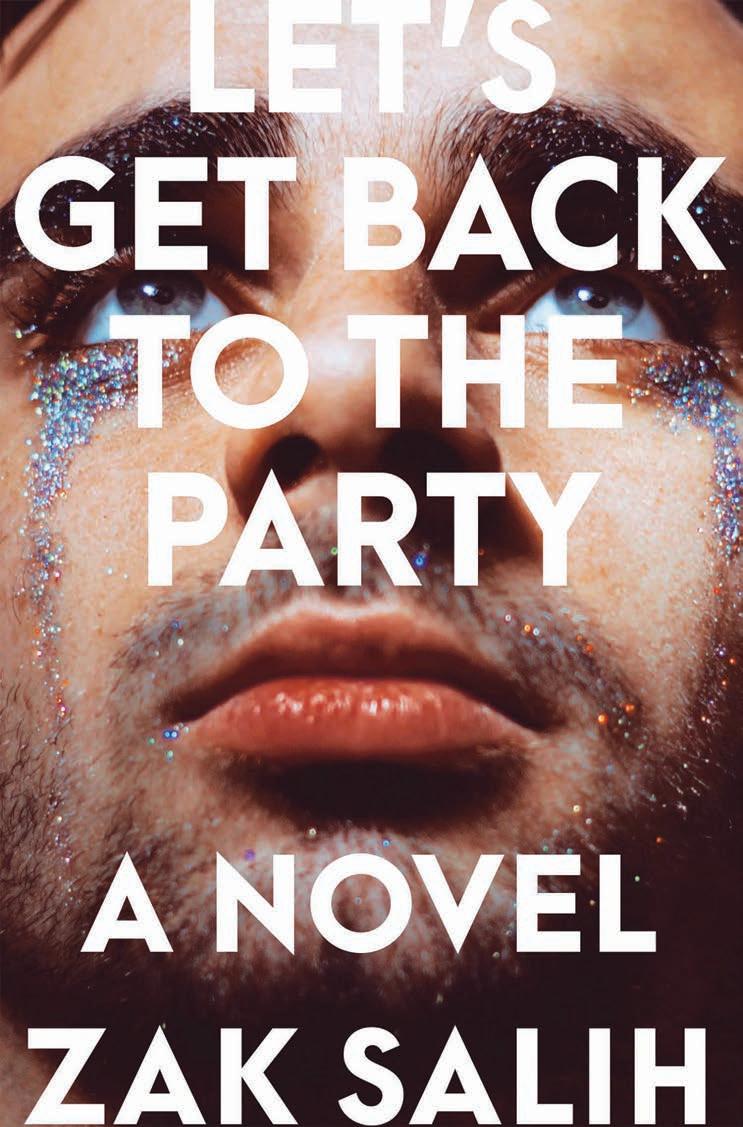
By Zak Salih
The place is filled with balloons.
They’re floating near the ceiling, strings just out of reach for now, some on the floor. The lights seem to be on a “twinkle” setting and there are candles carefully nestled in centerpieces, so the entire room sparkles from corner to corner. The guest of honor isn’t there yet, but you are and in “Let’s Get Back to the Party” by Zak Salih, you already wish you hadn’t come.
Sebastian Mote hadn’t seen Oscar Burnham in a decade, not since they were kids, but the guy across the room at the wedding reception sure looked like Oscar. If it was, Sebastian wondered if Oscar would he remember him, or their once-close friendship, or afternoons together in the basement and the things they did to one another?
Oscar Burnham was truthfully more interested in a cruising app than he was in rekindling a boyhood friendship. Sebastian was every bit as boring as Oscar remembered; he was probably one of those queens whose only focus, now that gay marriage was legal, was to have a husband and a bunch of obnoxious kids. It irritated Oscar that he was forced to exchange phone numbers with Sebastian, and lame promises to hang out soon.
Soon. More like not-soon, since Oscar was busy with someone he met when an app-date didn’t show up. Sean Stokes was an older man, a writer, and though Oscar professed to dislike reading, he was captivated by Sean’s explicit tales of queer life before Oscar was even born. He couldn’t get enough of Sean – and vice versa, apparently, because Sean asked for Oscar’s stories and it eventually became clear that Sean’s next book would be about Oscar.
There was no denying that Oscar’s ghosting hurt Sebastian, but he rather expected it. Instead, he threw himself into a friendship with a young student at his school, daring to let himself become obsessed with 17-year-old Arthur. It was painful, hopeful, and something he could never admit to anyone else.
Least of all, his boyhood pal, Oscar.
At first browse, “Let’s Get Back to the Party” can seem long and wordy. It hangs on the lives of two men who are mostly not very likable, to themselves or to one another, and how they hold on to their history with fingernails on one hand, pushing each other away with the other hand. You’ll want to shake them, but the thing is, it’s hard not to want to watch them make their own lives worse: this novel is a little schadenfreudey, but with a degree of sympathy .
The sympathy wins, as author Zak Salih shows sides of both Sebastian and Oscar that neither character would admit, and reasons why each becomes contemptuous with the other. The truth, for one of them, is a devastating shocker that slams the brakes on the tale but alas, getting there takes a while; you’ll want to ride that wave to this book’s fitting end.
And in that end, “Let’s Get Back to the Party” really pops.

By JOHN PAUL KING
Going into Sunday’s Golden Globes presentation, you already knew the Hollywood Foreign Press Association would be doing damage control.
One week before, the Los Angeles Times published a scathing investigative report that called into question – yet again – the legitimacy of the influential organization behind the awards, citing the body’s lack of diversity, its oft-questioned ethical and financial practices, and its penchant for bestowing its honors on the films and shows whose studios had done the best job of wining and dining its members.
If that were not enough, in the days leading up to the awards the HFPA was blasted by the Time’s Up organization (along with many prominent Hollywood voices) on social media for omitting several strongly favored Black-led films from this year’s top categories. Finally, on the very morning of the ceremony, the charity ran a full-page paid ad in the Times proclaiming the fact that, out of the HFPA’s 87 members, not a single one is Black.
So, as the 78th Golden Globes began, the HFPA had a lot more on its agenda than simply handing out trophies in a ceremony that has come to be seen as the most significant precursor to the all-important Oscars; it also had to make a convincing case for itself as the sole arbiter of who gets those influential trophies. Whether or not they succeeded might well have turned out to be irrelevant, by the end.
For anyone who tuned in to NBC’s bicoastal awards broadcast without having heard or seen anything about the controversy, things might not have seemed that different, at first. Hosts Tina Fey and Amy Poehler were in fine form, and if their sly banter contained a considerable amount of humor at the expense of the HFPA’s sketchy reputation, that was nothing unusual – after all, poking fun of the Globes has always been a Hollywood pastime.
nominees for Best Director – a category that has previously only included five women in its entire history. Zhao took the win, becoming the first Asian-American female to do so.
The sole Black winner among the television categories was John Boyega, awarded Best Supporting Actor in a Series for his performance in “Small Axe.” The only other Black nominee, Don Cheadle (for his role in “Black Monday”), lost to Jason Sudeikis (“Ted Lasso”), whose self-effacing acceptance speech was one of the evening’s most markedly humanizing moments.
As for LGBTQ representation, many of the categories featured films that included LGBTQ characters, storylines, and performers. In the awards for television, the most obvious nod to queer audiences was the win by “Schitt’s Creek” for Best Comedy Series, and by its beloved star Catherine O’Hara for Leading Comedy Actress. Ryan Murphy’s “Ratched,” which had received nods for out actresses Sarah Paulson and Cynthia Nixon, failed to score a win.

On the movie side, Murphy’s screen version of the Broadway musical “The Prom,” about the fight for queer inclusivity at a high school, also ended the evening empty-handed, as did “Two of Us,” a lesbian-themed French drama up for Best Foreign Language Film category. But there were wins too; the aforementioned acting honors for “Billie Holiday” and “Ma Rainey” came for films that incorporated the bisexuality of their real-life subjects; “The Life Ahead,” which featured a significant trans character, won for Best Song; and Rosamund Pike took the award for Best Actress in Comedy/Musical for playing a lesbian grifter in “I Care a Lot.”
As things went on, though, it would have been impossible for anyone not to take note of the seriousness with which the evening was occasionally hijacked by such moments as the introduction of Spike Lee’s children, Satchel and Jackson, as “Golden Globe Ambassadors,” or the sudden appearance of three high-ranking HFPA members to offer a thinly disguised mea culpa in the form of a pledge to move the organization toward “a more inclusive future.” These gestures, marked with a level of pomp that made them feel all the more perfunctory, did little to encourage confidence in the organization’s sincerity. Far more effective were the awards themselves. While no Black-led films made the cut in the nominations for Best Motion Picture Drama (that award went to the Chloé Zhaodirected “Nomadland”), some did take prizes in other major categories.
Both of the Leading Performance categories in Motion Picture Drama went to Black winners. Andra Day was named Best Actress for her powerful performance as the titular jazz icon in “The United States vs. Billie Holiday,” a film that documents the decades-long persecution of Holiday by the American government over her anti-racist song “Strange Fruit.” The Best Actor prize, in a win that felt both inevitable and well-deserved, was posthumously awarded to Chadwick Boseman for his searing star turn in “Ma Rainey’s Black Bottom.”
The Best Supporting Actor award went to Daniel Kaluuya, for his work in “Judas and the Black Messiah.” Among the competitors he beat out was Leslie Odom Jr., nominated for his performance as Sam Cooke in the Regina King-directed “One Night in Miami.” King joined Zhao and Emerald Fennell (“Promising Young Women”) as one of three female
The biggest gay victory of the evening, arguably, was reserved for out film legend Jodie Foster, who not only won Best Supporting Actress for her performance in “The Mauritanian,” but gave viewers the treat of seeing her share an enthusiastic kiss on the couch with wife Alexandra Hedison before launching into her acceptance speech. It was perhaps the most memorable, and certainly the most unequivocally triumphant, among many such spontaneous, intimate surprises during the broadcast.
It’s that kind of unexpected authenticity that ultimately saved the Golden Globes, at least in the moment, from its sins. In a broadcast stripped of its usual lavish trappings by the necessity of producing a scaled-down-for-COVID version of one of Hollywood’s most excessive celebrity parties, what gradually became apparent was how little the Globes themselves – or any of the industry’s other self-congratulatory awards – actually matter in a world enveloped by much bigger concerns. The movie stars, like the rest of us, were viewing from home; watching them negotiate the awkward fumbles and technical mishaps of the Zoom-style interface that is now painfully familiar to us all, seeing the way their unfiltered reactions mirrored our own, recognizing the tenderness and affection we share with our loved ones in the private moments we saw them share with theirs –these glimpses of common humanity felt far more significant than any of the accolades being awarded. The egalitarian sentiment they evoked, unintended and unforeseen, far overshadowed the heavy-handed efforts made by the HFPA to save face for its missteps. Make no mistake though – those missteps matter. The Golden Globes have a long way to go before they can prove the sincerity of their stated intention to create a more diverse membership and promote a more inclusive industry. Last Sunday’s fumble of an awards show may have been elevated, in spite of itself, by the human element that crept in around its edges, but that’s not enough to get the HFPA off the hook.