What can an owners corporation do when an overseas owner stops paying levies?
Page 8 | Tisher Liner FC Law
Can an owners corporation neglect the building because a maintenance plan is not mandatory?
Page 22 | Horizon Strata Management Group Is it usual for a strata manager to charge fees annually in advance?
Page 20 | SOCM
About Us
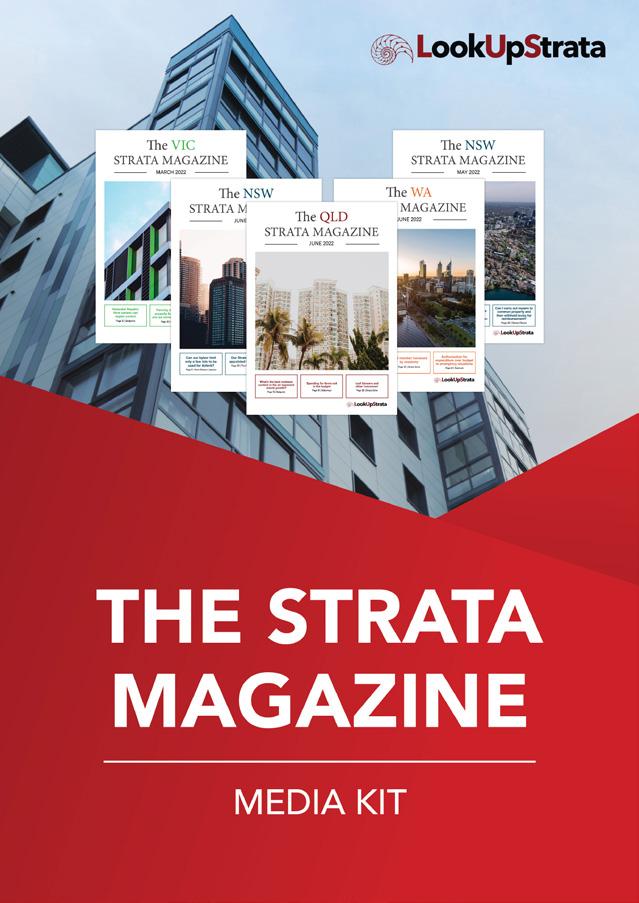
Welcome to the latest issue of The LookUpStrata Magazine!
For over a decade, LookUpStrata has been Australia’s premier resource for everything related to strata living. Our mission is to keep strata communities informed and connected, providing thousands of lot owners, strata managers, and professionals with reliable, unbiased, easy-to-understand information to help you solve your strata problems and make informed decisions.
The VIC Strata Magazines, published monthly, are just one of the many ways we’re dedicated to supporting you. They’re packed with articles from industry experts and include our comprehensive printable strata directory.
Beyond these pages, we also offer:
• Q&A Service: Our team of leading strata specialists answer hundreds of your questions every month, which helps shape the magazine topics we cover.
• Newsletters: Our weekly newsletters deliver timely updates on legislative changes and the latest strata news straight to your inbox.
• Webinars: Join our founder, Nikki Jovicic, for weekly webinars where she hosts and partners with industry experts to discuss key topics.
• The LookUpStrata Directory: A free resource that showcases hundreds of trusted strata service professionals nationwide. You’ll find it at the end of every magazine and on our website.
• Website: Find all our resources, articles, and news in one convenient location, accessible 24/7.
Subscribe now at no cost. To enjoy unrestricted access and connect with our strata community simply click here
Stay Connected - follow us on LinkedIn, Facebook, and YouTube.
Thank you for being a vital part of what makes our community so vibrant and trusted.
Nikki Jovicic Managing Director I Founder lookupstrata.com.au
Contents
4 Does office bearer insurance give committee members too much protection?
Tyrone Shandiman, Strata Insurance Solutions
6 Number one for service, quality and funding stability
Lannock Strata Finance
8 What can an owners corporation do when an overseas owner stops paying levies?
Phillip Leaman, Tisher Liner FC Law
10 Smokers keep your smoke out of my space!
Phillip Leaman, Tisher Liner FC Law
12 When AGM minutes are wrong, what are the strata manager’s obligations?
Alex Smale, Melbourne Owners Corporation Services
14 Can owners corporation funds be used for gifts and social events?
Joel Chamberlain, Horizon Strata Management Group
16 Can an owners corporation elect committee members as a group?
Ben Quirk, TOCS
18 Key advocacy priorities shaping the future of strata communities
Chris Irons, Owners Corporation Network
20 Is it usual for a strata manager to charge fees annually in advance?
Alex McCormick, SOCM
22 Can an owners corporation neglect the building because a maintenance plan is not mandatory?
Joel Chamberlain, Horizon Strata Management Group
24 Are owners corporations required to modify common property doors for accessibility?
Hedley Gaudin, Australian Owners Corporation Management (AOCM)
26 If accidental common property damage leads to theft, who bears the cost?
Tyrone Shandiman, Strata Insurance Solutions
Thanks to our sponsors
Does office bearer insurance give committee members too much protection?
Does office bearer insurance give committee members unfair protection compared to lot owners?
Most committee members have office bearer insurance that the lot owners fund through their levies. It appears this cover protects committee members if someone challenges their decisions or actions. As a result, it can feel like committee members can say almost anything, while ordinary lot owners do not have the same legal protection. Is this imbalance fair, and does office bearer insurance allow committee members to act with less accountability than other owners?
The goal of the insurance isn’t to favour committee members but to ensure that people feel comfortable volunteering for these roles.
Office bearer insurance isn’t intended to give committee members more rights than other owners or create any kind of imbalance. The cover exists because committee members assume personal liability risks when they volunteer to make decisions on behalf of the scheme. Owners aren’t exposed to those same legal responsibilities, which is why the insurance is tied to the role rather than the individual.
It’s also worth noting that office bearers liability policies include exclusions — for example, some policies exclude defamation — so the protection isn’t unlimited. In addition, many owners may have some level of personal liability cover under their contents or landlord’s insurance policy, and they should check with their insurer to see what protection they already have.
The goal of the insurance isn’t to favour committee members but to ensure that people feel comfortable volunteering for these roles without facing unreasonable personal risk.
Mention this offer when requesting a quote from us, and we will provide a discount off our standard fee for service of $250 (GST Inc) for buildings with 10-25 lots or $500 (GST Inc) for buildings with more than 25 lots for the first year you insure with Strata Insurance Solutions
To redeem this offer email a copy of your current policy schedule to Strata Insurance Solutions within 1 month of the publication of this magazine Your policy can expire any time in the next 12 months However we can only provide quotes 30 days prior to the expiry of your policyif your policy is not due now, we will schedule a quote at the appropriate time To ensure we apply this offer to our quotes, please specifically mention you would like to redeem the "LookUpStrata Special Offer"
HEFTY COMMISSION TO YOUR STRATA MANAGER Take the test todaysee how much you can save.
What can an owners corporation do when an overseas owner stops paying levies?
How can an owners corporation recover unpaid fees from an overseas owner?
We are an owners corporation of 11 single storey villa units. One owner leases their lot and lives and works overseas. The owner has not paid their levies for the 2025 calendar year. They do not respond to any communication, and have not provided a current residential address. What options does the owners corporation have to recover unpaid levies in these circumstances?
Once you have a reliable source of contact, service can be addressed and the usual process for levy recovery undertaken.
Where it is difficult to serve a lot owner (where service is required), an application for substituted service can be made, provided you have some form of contact details. Service can be effected on the email address for the party, if you require. Otherwise, searches can be undertaken to determine whether other contact information can be obtained. Once you have a reliable source of contact, service can be addressed and the usual process for levy recovery can be undertaken.
Phillip Leaman | Tisher Liner FC Law ocenquiry@tlfc.com.au
Expert Owners Corporation Lawyers
Smokers keep your smoke out of my space!
Did you know only 12% of Victoria’s adult population smoke. That leaves the rest of the population trying to avoid second hand smoke.
Luckily for non smokers the model rules for Owners Corporations was changed in 2021 in an effort to address smoke drift in apartments
What’s the rule?
1.4 Smoke penetration
A lot owner or occupier in a multi-level development must ensure that smoke caused by the smoking of tobacco or any other substance by the owner or occupier, or any invitee of the owner or occupier, on the lot does not penetrate to the common property or any other lot
What do you do if there is a problem?
If a lot owner you can make a complaint to your Owners Corporation about the person The Owners Corporation should follow the dispute resolution process
Ultimately if the matter is not resolved, next stop is the VCAT seeking an order about the smoke
But does VCAT actually do anything?
Yes, in orders made in July 2024 in the matter of Moravski v Giazis and another (VCAT OC1595/2023) the Tribunal made the following orders in response to a complaint about smoking in an apartment against both the tenant and the lot owner:
1. The First Respondent for so long as she resides at the Unit must not smoke any tobacco or other substance on the balcony of the Unit and must not permit any other person to do so.
2. The Second Respondent for so long as they are the registered proprietor of the Unit must ensure that no smoke caused by the smoking of tobacco or any other substance in the Unit penetrates the adjoining lot
What do you need to prove?
You need to prove that smoke is penetrating into common property or a lot, this is normally through the balcony or through ventilation Sometimes it can also go down the hallway and under the door
It also needs to be more than a once off issue
What’s the catch?
It can take a while to go through the VCAT process and get a determination There may be little relief during that period Other alternatives should be pursued where cost effective That may mean installing door stoppers and other improvements to prevent the smoke drift between lots
What role does the Owners Corporation have?
Owners Corporations should assist with the dispute resolution process and take steps to that are reasonable to help prevent smoke drift between common property and private lot space If smoke is entering common property they should consider taking action against the lot owner for the benefit of all lot owners
What other remedies can be sought?
It’s possible to obtain an order for damages but there is no scope for damages for “pain and suffering”
A civil penalty up to $1100 can be sought by the Owners Corporation for a breach of the rules However I am not aware of such a penalty being imposed on any person I understand VCAT has order a civil penalty once, for $100 (when the Act capped the amount at $250) and that was for conduct relating to music being too loud and the occupier turning the volume up again after they turned it down at the request of Police
Senior member Vassie in 2017 said “the imposition of a civil penalty is a serious matter that should only be contemplated when there has been a failure to comply with a Tribunal order that a person refrain from breaching a rule or when there has been a more than usually serious breach of a rule “
Given the changes in 2021, we are of the view that the attitude of the Tribunal should be different and they should be more willing to impose a civil penalty. However, we will need to wait for a decision.
Phillip Leaman, principal of the Owners Corporations practice group of Tisher Liner FC Law and his very experienced team can provide assistance to Owners Corporations, committees, lot owners and managers in a range of Owners Corporations legal matters We have substantial experience in taking actions against builders, building surveyors, architects and plumbers for original building defects on common property and private lot property
We also act for lot owners and Owners Corporations in respect to Owners Corporation governance and assisting managers and committees
We believe Owners Corporations want to maintain peaceful, functional living environments for owners Our mission is to provide a fresh perspective on resolving legal disputes and to inspire Owners Corporations to achieve outcomes that preserves the value of assets and restores harmony. We are expert Owners Corporations lawyers. For advice or assistance, please contact Phillip Leaman.
Our Blogs
To see a list of matters we ’ ve been successful in or to access our OC information resources, please visit our website or sign up to our blog.
Disclaimer: This article is not intended to, nor should it be relied on as a
When AGM minutes are wrong, what are the strata manager’s obligations?
Are incorrect AGM minutes and voting procedures a breach of strata legislation?
Our AGM was held by teleconference. For electronic meetings, is the strata manager required to record the meeting? Should the manager clearly call for votes in favour of and against each resolution, and how should votes in electronic meetings be properly conducted and recorded?
A lot owner submitted a written resolution before the AGM and asked the manager to record the exact wording both at the meeting and in the minutes. The resolution wording was clear and required no correction, but the minutes recorded it inaccurately and not in line with the owner’s instructions. The minutes included incorrect statements made by the manager about a specific required undertaking. These errors have since been identified and can be proven.
In these circumstances, is the strata manager required to correct and reissue the minutes, and do these issues amount to a breach of the Act?
If the AGM takes place via teleconference, there is no requirement to record it.
For voting at a meeting, the Owners Corporation Act 2006 notes that “a person may vote on a resolution of the owners corporation at a meeting by a show of hands or in another prescribed manner, unless the meeting resolves otherwise”. Assuming this is a simple show of hands vote, there is no further direction on how it should be conducted. A common practice in Victoria is for managers to ask if there are any objections or abstentions to the motion. If there are none, the vote has passed.
Incorrectly conveying or minuting a proposed resolution is not a breach of the Act specifically, though depending on the degree of error, it could be argued that the manager
is not fulfilling section 122 of the Owners Corporation Act 2006. This section states that a manager must act honestly and in good faith. You could therefore put in a formal complaint against the manager.
The minutes form a record of the owners corporation. Therefore, they should be accurate. If the manager acknowledges the error, best practice is for them to send corrected minutes to all owners. If the manager does not agree that there is an error in the minutes, they need to be confirmed as accurate at the next meeting. Members of the owners corporation will be able to vote on whether they are accurate at the next AGM.
Alex Smale | Melbourne Owners Corporation Services alex@mocs.com.au
Building Better Owner Engagement
Strong owner engagement plays a key role in the smooth running of any strata scheme. When owners feel informed and understand the reasons behind decisions, they are more likely to participate constructively, support necessary works and trust the advice provided by their strata manager. Many challenges faced in strata including meeting delays, disputes or resistance to expenditure arise not from disagreement, but from a lack of clarity. Clear, consistent communication helps owners understand risks, compliance obligations and long -term planning considerations, leading to more productive discussions and better outcomes for the scheme as a whole.
How QIA Group Can Help
QIA Group supports strata managers with plain -English reports and educational fact sheets designed specifically for owners. Our materials explain complex compliance and planning issues in a clear, accessible way, helping to reduce confusion and improve engagement. By providing owners with understandable information, strata managers can facilitate more informed conversations and smoother decision-making.
Can owners corporation funds be used for gifts and social events?
Can we use owners corporation funds to purchase a gift for our building manager or fund our end of year get-together?
Yes, but for transparency, it is important to document these expenses correctly.
In short, yes. However, expenses like this must be properly documented to create transparency. The owners corporation should allocate an appropriate amount of funds in your proposed budget, which is then submitted to the Annual General Meeting for review and voting by owners. This affords owners the opportunity to consider where their fees will go and make an informed decision.
The Committee must then be diligent in spending the funds to ensure they fit within the agreed budget. This creates a transparent environment for all owners.
Joel Chamberlain | Horizon Strata Management Group joel.chamberlain@horizonstrata.com.au
A Refreshing Approach to Strata Management
Experienced and Professional Owners Corporation Managers in Melbourne
At Horizon Strata, we make sure the job gets done properly without all the fuss.
Owners Corporation management requires expert knowledge as well as forward logical thinking to allow residents to live harmoniously, and owners to have peace of mind.
Horizon takes great pride in operating under these principles. This allows us to provide premium and transparent management for any strata-titled property.
Together with the day to day running of your Owners Corporation we provide comprehensive services which support owners through some of the most difficult & complex projects.
We are experienced in handling:
• Combustible Cladding
• Building Defects
• Financial Management
• Insurance Matters
Horizon does not take commissions or rebates from any supplier or Insurance provider. Our buildings under management range from 20 to 400 Lots so you can be assured we have the capability to manage your Owners Corporation, no matter the size.
Can an owners corporation elect committee members as a group?
Must committee nominees be voted on individually rather than elected as a group?
At an AGM, do nominees for the committee need to be voted on individually, or can they be elected together as a single group or block?
The short answer is yes.
Under the Owners Corporations Act 2006 (the Act) and related guides for Victorian strata, committee nominees should be voted on individually rather than simply elected en bloc as a “group slate”.
What the law says about committee elections under the Act / OC Regulations
• Section 100 of the Act requires that, for an owners corporation with 10 or more lots, a committee must be elected at each AGM.
• Membership rules: a committee must have between 3 and 7 members (unless members resolve by ordinary resolution to expand to a maximum of 12). Only one person may be elected from each lot.
• Nominations: any lot owner (or their proxy) may nominate before or at the AGM for election as a committee member.
• Voting: Voting rules at general meetings apply. Voting is by lot (or lot-entitlement, depending on the resolution). Each lot gets one vote.
Importantly and relevant to the question, independent commentary on the process describes that “each nominee candidate must have a separate election vote.”
Thus, when there are multiple nominees, the standard practice is that owners must vote for each candidate individually. If there are more candidates than positions, the candidates with the most votes are elected (up to the number of committee spots).
What
about “block” or “group slate” voting?
There is no provision in the Act or best practice that authorises a “block vote” (i.e. a single resolution or single vote in favour of a preselected group of candidates) to elect multiple committee members at once.
Voting guidelines note that a “slate” approach is not appropriate:
Moreover, the guidance under “Voting and ballot guidelines” indicates that for ordinary resolutions, votes are cast on a show of hands or ballot, with each lot casting its vote(s) for the relevant motion. Therefore, if there is more than one candidate, each candidate’s election must be a distinct motion or resolution.
Legal/Practical Significance & Risks of Block Voting
• If the OC attempted to elect a committee via a slate or block vote, this could be challenged on the basis that the election did not comply with the proper process of individual candidate elections.
• The principle of “one person, one vote per lot” and “one committee member per lot” would be undermined if a block slate allowed overwriting those protections (e.g. favouring one lot by giving them multiple committee seats).
Conclusion
Yes — under the OC Act 2006, committee nominees at an AGM should be voted on individually rather than as a block (group) slate. There is no statutory provision for a “slate-vote” for multiple candidates, and authoritative commentary on committee elections confirms that each candidate must
Helping the strata community navigate
their
building concerns
BUILDING CONSULTANCY
• Defect reports and forensic engineering
• Scope of works
• Dilapidation and risk surveys
• Dispute mediation and expert witness
• Contrator procurement and cost validation
• Construction management
• Capital works funds / maintenance plans
• Digital capability
• Façade assessments
REPAIR SOLUTIONS
• Emergency make safe
• Fire water damage restoration
• Leak detection
• Contamination response
• Building repairs
• Cost validation services
• Digital capability
Key advocacy priorities shaping the future of strata communities
With so much change in strata, what are the next big advocacy priorities for owners and committees?
There is a lot of change happening in strata at the moment, from new technology and AI tools to reforms around insurance, building standards and compliance. It can feel overwhelming to keep up with everything.
What are the big advocacy battles on the horizon for strata communities? Where should owners and committees focus their energy next to have the most impact, whether that is on legislation, insurance, building safety, fairer governance, or something else?
Think about what you need to reasonably do to ensure your investment is protected and enhanced.
I always take the view that strata is about business-like relationships and business-like transactions. You’ve spent maybe upwards of a million dollars, perhaps a lot more in some cases, to be part of this strata scheme. Keep that in mind.
Ask yourself, “What is it that I need to reasonably do as an owner to ensure my investment is protected and, in an ideal world, is enhanced over a period of time?”
Chris Irons | Owners Corporation Network chris.irons@ocn.org.au
Finance without the Fights
Real Choices. Real Support.
Hybrid Loans that give owners choice and committees control
Flexible funding and exceptional support every step of the way Defect Rectification Insurance Premiums Refurbishment Litigation Green Initiatives
Is it usual for a strata manager to charge fees annually
in advance?
How should a strata manager’s fees be calculated when management payments appear to overlap?
Our owners corporation (OC) engaged a new strata manager who applied the annual management fee at the start of the engagement. Six months after the OC paid the previous year’s fee, the manager has asked owners to pay an additional six months’ fee.
It appears to be a duplication of the agreed yearly fee paid in advance. This has caused confusion about the manager’s total fees.
I also have concerns about the manager’s financial record keeping. The chairperson, who has other properties managed by this manager, told owners the new fees would be lower than the previous manager’s, but then signed the owners corporation up to a higher fee than advised. How can owners check that the correct amount is being paid?
The management contract should be very clear on payment terms and fees.
There are a few elements to unpack here. The first principle is always the same –the signed contract of appointment is the only document that matters for an owners corporation paying the manager. The key parts of that contract for this context are:
• Date of commencement
• Remuneration elements
• Management fee inc. GST
• Disbursements fee inc. GST
• Let’s set aside insurance commission and any as-incurred Professional Services fees at this point, as they don’t appear to be the subject.
• When the remuneration is paid
• E.g., quarterly in advance, monthly in arrears, etc.
The management contract should be VERY clear on these items, regardless of whether it is a management-industry body template agreement or a customised contract.
For example, you should be able to easily read the contract and confirm that your engagement commenced on 1 April 2025, paying $5,000 in management fees, $2,000 in disbursement fees, and this is paid monthly in arrears.
It is very unusual for a manager to ask (and then be paid) for a full year’s remuneration in advance. Even more unusual is that, halfway through, the manager is now seeking an additional 6-month payment of fees. It seems they are asking for a total of 18 months’ payment after only 6 months’ engagement. I can’t imagine how the contract wording could support this. Generally, payments are either monthly or quarterly, which helps maintain the client’s cash flow and means the client is only paying for work as they go, rather than being at risk of prior payment and without leverage if the standard of service is poor.
Without having the physical contract document, I can’t add much more. Certainly, any concern about the financial record-keeping or the appropriateness of the budget would require a deeper review of the finances. As a starting point, ask the manager for a copy of the contract.
Alex McCormick | SOCM alex@socm.com.au
Excellence Transparency Partnership
Contact SOCM for a free and confidential assessment of your owners corporation functions, or a formal proposal for your management needs.
W socm.com.au E info@socm.com.au T 03 9495 0005
OWNERS CORPORATION MANAGEMENT SERVICES
At SOCM, we have developed an approach that focuses on delivering personalised service of the utmost quality and demonstrating exceptional professionalism in every aspect of our work. Our impressive property portfolio and positive testimonials serve as evidence of our position as a top Owners Corporation Management company in Victoria. We consistently maintain this position by prioritising comprehensive communication and promptly responding to our clients’ needs.
ACCOUNTING & FINANCIALS
COMMISSION FREE INSURANCE
DOCUMENTATION
MEETINGS & BALLOTS
LEGISLATIVE ADVICE & GUIDANCE
MAINTENANCE
“SOCM has provided an extensive service in Owners Corporation Management for more than a decade.”
Can an owners corporation neglect the building because a maintenance plan is not mandatory?
Does an owners corporation have responsibilities for long term maintenance even without a maintenance plan?
I bought my unit in 2024 and noticed the building was run down. The same owners corporation manager has managed the scheme for decades. The scheme has only dealt with issues as they arise, with no regular maintenance checks or planned maintenance.
I have arranged inspections, and they identified major works, including roof replacement, a redesigned and new drainage system, re-rendering of the building, fence replacement, and ongoing major plumbing issues, along with other defects. The building is a tier 3 building from around the 1960s.
I understand that this tier of building has no mandatory requirement for a maintenance plan, but is the owners corporation responsible for long term maintenance, or does the responsibility sit with the owners for not requesting a maintenance plan?
Does your owners corporation bear responsibility, or are the owners at fault for not implementing a maintenance plan? The answer is one and the same.
There is a fundamental requirement for an owners corporation to repair and maintain common property. Section 4 of the Owners Corporation Act 2006 sets this out. This has been in place since the Act was introduced, regardless of the size or tier of your owners corporation.
Maintenance Plans were also available, but not mandatory for many smaller owners corporations, even under the previous structure with prescribed or non-prescribed buildings. Unfortunately, this is to the detriment of many neglected older and/ or smaller buildings like yours, which have received only reactive maintenance over the years. In my view, legislation should be introduced requiring all owners corporations to have and implement a plan to avoid situations such as this.
Does your owners corporation bear responsibility, or are the owners at fault for not implementing a maintenance plan? The answer is one and the same. The owners corporation comprises all owners, so it doesn’t matter how you frame it. The real question is, how will you move forward and address the historic maintenance issues?
Irrespective of the fact that a tier 3 owners corporation doesn’t need to have a maintenance plan, my advice would be to pay an appropriate consultant to prepare one and implement it as soon as you can. Of course, as you have indicated, you are aware of several large ticket items that are due, so the consultant should include them in your plan for immediate or future work.
Once you implement the plan, there will be a significant increase in your levy contributions, but it provides you with a clear path to remediating long overdue work and will add value (in time) back into your building for the future. Whilst a last resort, your owners corporation should consider utilising a
strata loan to fund immediate and expensive works. Sometimes, when a lot of costly work needs immediate attention, a strata loan can help you get it done without having to raise tens of thousands from owners at once, when some may not have these funds set aside. The alternative is to raise funds over time, which could prolong the serious work, leading to further deterioration and higher costs. Consider a balance between the additional cost of a strata loan and leaving the work until you can pay for it through your maintenance plan. The risk here is that it will likely be more expensive by the time you get there.
These challenges can be difficult to manage. The task is daunting, so it’s important to plan your approach to achieve the desired and most cost-effective outcome.
Joel Chamberlain | Horizon Strata Management Group joel.chamberlain@horizonstrata.com.au
READ MORE HERE
Are owners corporations required to modify common property doors for accessibility?
What can owners do if a common property exit door is difficult to use due to accessibility issues?
My apartment opens onto a common hallway that leads to a garden area and then gated access to the street. My only practical exit from the building to reach the car park is via a fob-activated door.
The hallway is air conditioned and unvented, which creates pressure on the exit door. Combined with the door closer, it is very difficult to open and often requires two hands or assistance. I use a walker and have a condition that causes muscle weakness. I have raised this issue with the owners corporation (OC), but they have not been helpful.
What options are available to address accessibility issues where common property doors are difficult to use?
Separate from outcomes on the smoke/fire doors compliance, consider your rights under the Disability Discrimination Act.
Some hallways can be pressurised. This is more likely in fire exit stairwells for emergency exiting. Often, this only activates in an emergency, when the positive pressure keeps smoke, heat, and potentially fire out of the stairwell. The pressure enables doors into the area to open easily but to remain closed when not in use.
From your description, it sounds like these doors could be smoke and/or fire doors. The fire services contractor would provide service reports to the OC at each scheduled inspection. Ask the OC to have the fire services contractor review and advise on whether the hallway and its doors comply with both the fire/smoke door safety standards and building code standards.
Owners can request access to documents via the OC Manager. Request a copy of the last scheduled service report and any additional specific inspection undertaken, which will detail any faults or non-compliance for fire safety.
It is very common for smoke &/or fire doors throughout buildings, and their auto closers to move slightly out of alignment or tolerances from regular use and become non complaint, requiring realignment adjustments.
For these reasons, the fire services contractor is probably the best contractor to initially advise, although a builder or building inspector familiar with door compliance could also assist.
Given the concerns raised and potential hazards, the OC should be undertaking this check for its own proactive maintenance and risk mitigation. Should the OC refuse to review the hallway door (s) to ensure they meet standards and comply, you may need to engage these services yourself.
It would be reasonable for the OC to agree to indemnify you against an agreed cost for a report should the doors be found to be non compliant.
Separate from concerns or outcomes on the smoke/fire doors compliance, consider your rights under the Disability Discrimination Act (DDA).
In the case Anne Black v Owners Corporation OC1-POS539033E [2018] VCAT 185, a precedent was set in VCAT and then the Victorian Supreme Court. An OC manages and controls access to and use of common property can be considered to be providing a “service” for the purposes of the Equal Opportunity Act. This results in OC’s being subject to the general prohibition on disability discrimination in services; and a positive duty to make any “reasonable adjustments”.
In the mentioned case, the OC argued they would allow the applicant to do/access works if she paid. The Supreme Court’s framing of the issues made it clear the dispute was not merely about permission, but that the adjustments were the OC’s responsibility.
Regardless of whether the building complied when constructed, the discrimination framework allowed for a requirement on the OC to make adjustments or modifications so the resident could access and use the building.
This ruling has seen many OC’s install, at their own cost, ramps, push button automated doors and other accessibility modifications to common property as a reasonable adjustment.
You can request assistance to support your use of the door with disabilities, so you can fully use it in the same way and with the same ease as any other resident or visitor. A reasonable adjustment may involve the OC installing a push button automation for the door.
Ask your carers and support services advisers. An occupational health therapist could provide a report and guidance on your home access, which you could submit to the OC for consideration.
Hedley
Gaudin | Australian Owners Corporation Management (AOCM) hedley.gaudin@aocm.com.au
If accidental common property damage leads to theft, who bears the cost?
Who pays to replace stolen letterboxes after accidental damage to common property?
Our complex is made up of four single one bedroom units. A delivery truck reversed into the front wooden fence, knocking down our letterboxes. We contacted the delivery company about the damage. Later that day, someone stole the four strata letterboxes while they were lying on the ground.
Who is responsible for the cost of replacing the letterboxes? Should each owner pay individually, or is this a common property expense given the letterboxes were damaged and left vulnerable due to the initial incident?
You could argue that the loss of the letterboxes arose as a consequence of the initial incident, given that the impact created the opportunity for their removal.
Based on the information provided, the letterboxes were dislodged and left unsecured as a result of the delivery truck impacting the front fence. While the subsequent theft occurred later the same day, you could argue that the loss of the letterboxes arose as a consequence of the initial incident, given that the impact created the opportunity for their removal.
Without making any determination as to liability (which is ultimately a legal matter), it is reasonable for the owners corporation to include the replacement cost of the letterboxes together with the fence damage in its demand to the delivery company or their insurer, outlining the sequence of events and timing.
If recovery from the delivery company is unsuccessful or delayed, the alternative option would be to lodge a claim under the strata insurance policy for the damaged common property (including the letterboxes, if insured), with the insurer then able to pursue recovery from the delivery company via subrogation.
Separately from any insurance claim or recovery action against the delivery company, responsibility for the letterboxes will depend on whether they are common property. If the letterboxes are located on common property, they would generally
be the owners corporation’s responsibility to maintain. Conversely, where a letterbox is located wholly within an individual lot boundary, it is typically regarded as lot owner property and the responsibility of that owner to maintain.