Mark your calendars! The 2026 League of Nebraska Municipalities Utilities/Public Works Section Annual Conference is scheduled for Jan. 7-9 at the Embassy Suites in Lincoln. In addition to the wonderful opportunities to share time and information with colleagues, there are some important educational opportunities.
The last several years, this conference was approved for an average of up to 17.5 wastewater operator hours and 15 water operator hours! We expect similar approval this year.
Check your inbox next week for the Utilities/Public Works Section Annual Conference program and registration information.
On Jan. 7, the conference kicks off with an optional Preconference Seminar: Maintenance, Maintenance, and More Maintenance! Ignoring regular maintenance can quickly become an almost insurmountable financial nightmare. This session will focus on maintenance policies and practices (designed for 5 water credit hours and 5 wastewater credit hours) This is a “standalone” session. Preconference Seminar attendees do not have to register for the entire conference.
On Jan. 8-9, share time with your
1335 L Street
Lincoln, NE 68508
(402) 476-2829
info@lonm.org
colleagues and learn how to better manage your utility and public works departments:
• Failure to Train Your Employees. What Can Happen?
• New and Innovative Health Insurance Options for Municipal Employees
• Lead Line Replacement Inventory and Replacement Update
• Asset Management Plans that Actually Make Sense.
• The Devastating Effects of Rechargeable Batteries on Solid Waste, Drinking Water, and Wastewater Systems
• The Sustainability of Your Municipality if Directly Related to Your Utility Maintenance
• Funding For Dead and Dying Trees
• PFAs in your Water, Wastewater, and Landfill
• The Importance of Bicycle Transportation to Your Municipality
• Data Centers and Bit Coin Mining: How to Integrate Into Your Municipal Electric Load
• Hey!! Someone is Messing With the Meter. What Can I Do?
• Enhanced Health Care Options For Municipal Employees
• Abandoned Buildings and Your Utility
• Colossal Workplace Accidents That Can Be Avoided
• Clean Water Act and Safe Drinking Water Act Updates
• Municipal Utility and Public Works Legislative and Regulatory Update: Whether you have a water, wastewater, electric, natural gas, street, recreation or other department, the Nebraska Legislature has a tremendous effect on how you do business. Do not miss the latest information on legislative and regulatory activities.
• And much, much more! There will be water, wastewater, and engineering credits available for many of these sessions. Do not miss this great opportunity!
Lash Chaffin Utilities Section Director Jackson Sash Utilities Field Representative
SAFETY/HEALTH CORNER
Small Community, Big Noise: Why hearing protection deserves more attention in municipal utilities
By Jackson Sash, Utilities Field Rep./Training Coordinator
Most people do not think of small communities as noisy places. From the outside, they seem quiet, steady, and predictable, with a pace of work that rarely resembles the rush of industry. But anyone who has spent time inside a municipal shop, a water or wastewater plant, or on the edge of an electric yard knows that the noise tells a different story. The truth is that operators in even the smallest communities are surrounded by equipment capable of slowly and permanently damaging their hearing, often without any moment of pain or warning. Noise exposure is one of the most overlooked safety issues in local utilities, precisely because it hides in plain sight. It is familiar, it is routine, and after a while it becomes the soundtrack of the job. Water and wastewater plants are a good place to start. Walk into a building with high service pumps running and you will notice how workers almost always raise their
voice to talk, even if they do not consciously realize it. Aeration blowers hum at a steady pitch that feels harmless, yet that constant output is among the most common sources of long-term exposure. Operators sometimes describe these machines as background noise, but inside the ears the vibration is anything but background. The tiny structures responsible for detecting sound take a beating hour after hour, day after day, until the operator eventually realizes that conversation in crowded rooms has become harder or that tinnitus has started ringing in the quiet moments after work. That slow decline often began with years of standing near equipment that did not seem loud enough to be a real safety concern.
Wastewater work brings its own set of hazards. Jet trucks and vacuum trucks hit sharp noise peaks whenever the pumps spool up or the hose is under heavy load.
Portable pumps used to manage bypasses at lift stations can be just as loud, especially when operators are close enough to adjust valves
or check discharge lines. These sounds often feel temporary. The task might only take ten minutes, so grabbing hearing protection can feel unnecessary or inconvenient. But the damage from repeated short bursts adds up. Many operators do not notice the harm until they have worked through dozens of wet mornings, clearing lines or responding to alarms, with the equipment roaring only a few feet away.
Electric crews have their own relationship with noise, especially during storm season. Chainsaws, hydraulic buckets, generators, and even the rumble of an aging line truck contribute to the overall exposure. In some municipalities, the electric department is small enough that
Continued on page 3
Small Community, Big Noise
Continued from page 2
a single person may respond to outages alone, working between downed branches or damaged poles with little time to think about PPE beyond the most immediate hazards. In those moments, hearing protection becomes one more thing to grab, and it sometimes loses out to urgency.
What ties all these environments together is the culture of small crews. When only one or two people are responsible for most of the work, habits settle deep. Many
operators learned from mentors who did not wear hearing protection themselves. Noise was just part of the job, as ordinary as wet boots or cold hands. Even today, operators often describe the shop as “not that loud” compared to true industrial settings. Yet the collection of small exposures from grinders, air compressors, impact wrenches, portable generators, weed trimmers, and mowers creates a steady strain on hearing. Shops and garages in communities of a few hundred people can easily reach levels that
safety professionals would classify as hazardous.
Landfills are no different. The dozer blade pushing cover soil, the compactor working a fresh layer of waste, and the frequent use of skid steers and loaders all create sound levels that climb higher than they appear from a distance. Workers often step out of equipment cabs without realizing how loud the environment really is. And because landfill tasks change quickly throughout the day, workers are
Continued on page 4
Small Community, Big Noise
Continued from page 3
constantly moving between quiet and noisy areas, which can make hearing protection feel optional rather than essential.
The difficulty with noise is that the injury is invisible. There is no chemical burn, no cut, no bruise, no near miss that jolts someone into new habits. Instead, hearing loss arrives slowly and permanently. It shows up in the way operators start turning the television louder in the evening or in how they begin missing parts of conversations on the job. By the time ringing ears become common or by the time a hearing test comes back with an unexpected decline, the damage has already been done. While technology and medicine can assist, nothing can restore natural hearing once it is gone.
The good news is that preventing this kind of injury is simple, inexpensive, and effective. Most municipalities already have earmuffs or foam plugs in their shops, though many discover during safety reviews that the protection is scattered, old, or hard to find when needed. The challenge is not a lack of equipment but a lack of
habit. When crews start keeping hearing protection in trucks, in tool bags, on keychains, or beside equipment controls, it becomes part of the natural workflow instead of a special step. Newer operators tend to adopt good habits quickly when they see coworkers wearing PPE without hesitation, and many veteran operators who resisted the idea at first end up becoming strong advocates once they experience the comfort and clarity modern hearing protection provides.
Municipal utilities are excellent at addressing the hazards they can see. Operators know how to approach trenches, handle chemicals, work around electricity, and navigate icy ground. Noise is trickier because it never announces itself as a threat. It is simply present. And yet it may be the most permanent injury many operators face over a lifetime of
service. Giving hearing protection the same respect as other forms of PPE is not about meeting a rule or satisfying a checklist. It is about preserving the long-term wellbeing of the people who keep these communities running.
Small municipal utilities may be built on quiet dedication, but that does not mean the work environment is quiet at all. Recognizing and addressing noise exposure is one of the simplest and most meaningful steps a community can take to protect the operators who show up every day, year after year, to keep the water moving, the wastewater flowing, the lights on, and the services steady. Hearing is easy to lose and impossible to replace. Protecting it is not complicated. It just requires one simple decision, made again and again, in the noisy places where small communities' work truly happens.
Check out the League’s Facebook page at www.facebook.com/leaguene. Be sure to “Like” us.
Engineering a world where everyone thrives.
The Wastewater Lagoon: One of the most misunderstood pieces of small municipal infrastructure
By Jackson Sash, Utilities Field Rep./Training Coordinator
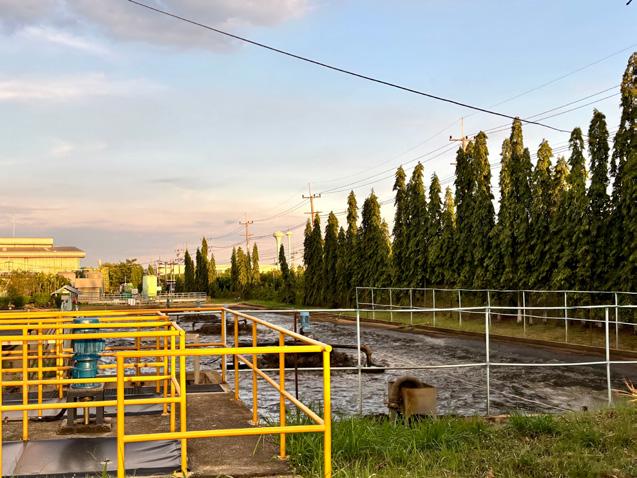
Across Nebraska, when you drive past the edge of a small municipality and see a quiet stretch of blue or green water behind a chain-link fence, it rarely draws much attention. To most people it looks like a pond or a wide ditch, something functional but ordinary. The wastewater lagoon is one of the most common treatment systems in rural communities, yet it is also one of the least understood. Many residents know it exists only in the vaguest sense, and some elected officials view it as a simple holding basin rather than a carefully balanced biological system. But operators know better. Lagoons may be calm on the surface, but they are constantly working, digesting, settling, and transforming everything that flows into them. The science of how they work is steady, but the conditions that allow them to work well are anything but simple. A lagoon begins with biology, not machinery. Unlike mechanical plants that rely on blowers, clarifiers, filters, and pumps, a lagoon uses sunlight, temperature, and naturally occurring microorganisms to break down waste. When the system is functioning as intended, each cell forms its own quiet community of bacteria, algae, and other life that together reduce organic material and pathogens. In the summer months when the water is warm and sunlight is generous, this dance of oxygen production and consumption becomes almost rhythmic. Algae create oxygen during the day, the bacteria use that oxygen to break down waste, and the cycle repeats
itself across thousands of square feet. It is a natural partnership that, when conditions are right, requires very little mechanical assistance. But what most people do not see is how sensitive that balance can be. A lagoon that works beautifully in July can struggle in February. Cold water slows biological activity dramatically, especially in deeper cells. Wind patterns shift how oxygen moves through the surface. Ice cover complicates circulation. Even the type of incoming waste changes from season to season, as infiltration rises or falls and residents use different cleaning products. Because lagoons operate mostly through natural processes, an operator must understand not only the chemistry of the water but also the personality of the system itself. No two lagoons behave quite the same, even if they were designed from the same set of drawings.
One misconception operators hear often is that lagoons “treat themselves.” The truth is that lagoons demand constant observation, even if they lack the moving parts of a mechanical plant. Sludge must be monitored and measured, not ignored until a problem appears. Short circuiting between cells must be identified and corrected. Stormwater inflow must be addressed before it dilutes the system beyond its capacity. Even the vegetation along the banks matters more than most people realize. Grass that grows too tall can block wind flow and reduce oxygen transfer at the surface, while vegetation left unmanaged can hold rodents or damage the embankment. A lagoon is a living
system surrounded by an earthen structure, and neither one can be overlooked without consequences. There is also a widespread belief that lagoons are outdated technology. Many small communities worry that a lagoon system reflects poorly on their municipality, as though equipment is the measure of progress. But lagoons remain one of the most cost effective and dependable forms of wastewater treatment available to small populations. They require fewer staff, have lower energy demands, and are forgiving enough to handle the wide day-to-day variations seen in rural communities. A properly designed and maintained lagoon can meet regulatory requirements for decades with far fewer resources than a mechanical plant. It is not outdated at all. It is appropriate, sustainable, and well suited to the realities of small municipal budgets. Still, lagoons are not without their challenges. As permit limits tighten, operators face increasing pressure to remove nutrients that lagoons were never originally designed to address. Ammonia in cold weather has become one of the most difficult issues for many communities, especially those with older or deeper systems. The lagoon may be
Continued on page 6
The Wastewater Lagoon
Continued from page 5 operating by its natural rules, but the regulations it must meet are based on rules that did not always consider how slow biological processes become in winter. Operators often find themselves doing everything possible, from adjusting flow between cells to watching the weather closely, while hoping for conditions that let the biology catch up. Many municipalities eventually explore modifications such as partial mixing, baffles, or additional cells, but each solution carries a price tag that can overwhelm a small utility budget.
Perhaps the most overlooked part of a lagoon’s story is how quietly it serves the community. Few residents understand that their wastewater is treated by a combination of sunlight, time, and naturally occurring organisms working together behind a simple fence. They do not see the early morning frost on the embankments when an operator walks the perimeter checking for leaks, or the long summer afternoons spent battling algae blooms and cattails. They do not watch the slow but steady rise of sludge over the years, or the careful planning
required before a dredging project. Lagoons do not have the impressive structures or noise of mechanical plants. Their work happens silently, consistently, and largely without recognition.
But operators know the truth. A lagoon is not just a body of water. It is an engineered ecosystem that depends on the experience and attentiveness of the people who care for it. It represents both simplicity and complexity, durability and fragility, all at once. For many Nebraska communities it is the backbone of their wastewater
Continued on page 7
Classifieds
For Sale
2003 GMC C7500 with Salt/Sand Spreader Body. https://www.publicsurplus.com/sms/list/ current?orgid=361015
• Condition: FAIR
• 2003 GMC C7500 C7C042 Chassis & Cab
• Stainless steel Henderson Salt/ Sand Spreader body (new in 2013/2014)
• Force American Hydraulic over Electric controller for spreader (installed in 2019)
• Cab/Chassis purchased new by municipality; and used as a salt spreader truck by Street Maintenance Division
• Vin: 1GDM7E1C73F518624
• GVWR 29,000 LB
• 2,290 + Hours / 26,370 + Miles
• Runs and spreader works
• Fuel tank has a leak
• Decals/logos on body will be removed
City Administrator. The City of Burwell is accepting applications for the position of City Administrator. The City of Burwell is the county seat of Garfield County and has approximately 1,200 residents. Burwell is located seven miles from the Calamus Reservoir in Central Nebraska. The municipality owns, operates, and provides electric, water, and wastewater services to its residents. Law enforcement is under the direction of the County Sheriff’s Department. This position requires comprehensive knowledge of municipal finance, expertise in city, state, and federal laws, regulations and guidelines, strategic planning, and supervisory skills. Individuals should possess a degree in a related field and/or possess a level of education that together with experience and training gives the required knowledge and experience to perform the duties as City Administrator. This person serves the community at the direction of the Mayor and City Council. Salary is negotiable based on experience
Continued on page 8
The Municipal Lagoon
Continued from page 6
system, and it will remain so for years to come. Understanding lagoons means understanding the communities they serve. They are designed to match the pace of small municipalties where infrastructure must last,
budgets must stretch, and residents trust that the essential services will continue quietly in the background. When a lagoon does its job well, no one notices. That is the sign of a system that is working exactly as intended.
Ideas Transform Communities
At HDR, we’re helping our clients push open the doors to what’s possible, every day.
Utilities Section Newsletter
Safety on slippery roads
By Lash Chaffin, Utilities Section Director
As the temperatures lower and fall precipitation increases, there is an increased chance of vehicles sliding on road surfaces. A common phenomenon, known as black ice, can wreak havoc for drivers from the first cold weather in October to the last freeze in May. According to the Nebraska Department of Transportation, black ice is a thin glaze of ice on the road that may not be visible. When unaware drivers traveling at a high rate of speed hit a portion of the roadway that has black ice, it may cause them to lose control of their vehicle completely. Even if you're a careful driver, black ice can cause you to slide unexpectedly. Some things can be done to make this less likely to happen.
First of all, check the condition of your tires. According to a study done by the National Highway Traffic Safety Administration, nearly 10% of all vehicle accidents are due to tires that are in poor condition. To check for the proper tread on a tire, place a quarter upright into one of the big grooves in the tire tread. If the top of George Washington's head is flush with the tread, there is about 1/8-inch of tread left which is just adequate for winter driving. Any less than 1/8-inch tread requires replacement. When the temperature is approaching freezing and there has been any slight precipitation, it may be a good idea not to use cruise control in your vehicle as you are naturally not as attuned to road conditions when you have put acceleration on automatic.
Lower your speed and be alert to
the road conditions and traffic if any precipitation or even a recent heavy fog might have left a roadway slick. When you reduce your speed, you can react to any changes in the road surface. If your vehicle does hit a patch of black ice and starts to slip or skid, it's much easier to keep it under control. Be aware of your vehicle's performance, as you may feel your car slightly slip or skid as you travel. If you begin to slide or skid, stay calm and resist the temptation to slam on the brakes or turn your steering wheel sharply. To correct a slide, your vehicle tires need to be moving freely. You need to turn into the slide, which means you steer the vehicle in the direction of the slide. When the vehicle's rear drifts to the right and the front points to the left,
you would turn right to straighten the vehicle and then straighten the wheel as the vehicle begins to straighten.
Be aware of other travelers who may not be adjusting to the road conditions. Alertness and good defensive driving can prevent many collisions. Follow other vehicles at a safe distance, so you can react quickly if they start to slide and/or if you hit an icy patch. Although black ice can be found on any road surface, it is more likely to occur in underpasses, shady areas, bridges, and overpasses. People are usually more likely to use safe driving measures when it is snowing or sleeting, but it's a good idea to also be on the lookout for the less obvious dangers of black ice on the roadway.
Classifieds
Continued from page 7
and qualifications and includes competitive benefits. Interested candidates should contact the City Office at 404 Grand Avenue (PO Box 604), Burwell, NE 68823 or phone 308-346-4509. Completed application along with a cover letter and resume should be mailed or delivered to the city office address above or emailed to cityofburwell@ nctc.net and will be accepted until the position is filled. The City of Burwell is an equal opportunity employer.
Village Superintendent. The Village of Campbell is seeking a qualified and experienced individual for the position of Village Superintendent. The Superintendent will be responsible for day-to-day
operations of the Public Works Department, which includes water, water-waste, streets, and parks. This role ensures our Village operates efficiently and safely. Qualifications include: ability to obtain and maintain a Nebraska Water Operators License Class 4 minimum; ability to obtain and maintain a Nebraska Commercial or non-commercial applicators license with category 09; and a valid driver’s license. To apply, please submit a letter of interest and resume to the Village of Campbell, PO Box 215, Campbell, NE 68932 or Campbell Clerk's office. A full job description is available at the Clerk’s office. The Village of Campbell is an equal opportunity employer.
Utilities Section Newsletter
2025/2026 Training calendar
Visit our website for a complete list of workshops and conferences.
2025
November
Nov. 25
December
Backflow Workshop
Auditorium, Stuart
Dec. 9 Water Operator Training Workshop Joe Hampton Conference Center, League Office, Lincoln
Dec. 11 ......... Water Operator Training Workshop ........................... Community Building, 3rd Fl, Columbus
2026
January
Jan. 7-9 ......... Utilities/Public Works Section Annual Conference.... Embassy Suites, Lincoln
Jan. 27 .......... Water Operator Training Workshop ........................... Holiday Inn, Kearney