
Co-Editors-In-Chief
Kirklyn Moore ‘25
Livi Van Steenberg ‘25

Co-Editors-In-Chief
Kirklyn Moore ‘25
Livi Van Steenberg ‘25
About Us:
Social Media Editor
Ella Coons ‘25
Web Editor
Molly Gorham ‘25
Staff
Johnny Bailey ‘25
Bo Farnsworth ‘25
Mary Frances Forbes ‘25
Sydney Murray ‘25
Jada Olende ‘25
Colby Wiedower ‘25
Caroline Wood ‘25
Mason Merkle ‘26
Marlon Yates ‘26
Mia Cutrell ‘27
Gabi Flohr ‘27
Advisor
Mr. Zack Adcock
Cover Photography by Marlon Yates
The Lodge and gryphonlodge.com are dedicated to serving as an unbiased and authentic voice for the students of St. George’s Independent School. We at the Lodge strive to be an open forum for student expression, to act in the best interests of the student body and to embody the principles of journalistic excellence. The Lodge is affiliated with the Tennessee High School Press Association, the National Scholastic Press Association and the Journalism Education Association. The Lodge is funded by donors and St. George’s Independent School and is published seasonally during the school year by aPrintis.com. The Lodge prints and distributes 200 copies of each issue to 700 students and faculty on the St. George’s Collierville campus. Bylines indicate the primary writer(s) of each article, and additional contributors are indicated in the shirttail. All of our content is written, edited, and designed by our staff unless otherwise clearly stated. The Lodge provides free advertising for student clubs, events and activities and paid advertisements for local businesses. The Lodge welcomes letters to the editor and article submissions. To submit a letter, article or request for advertising, email our staff at thelodge@sgis.org.

If you have attended any assembly since Mr. Luke Pruett became the head of school, it’s no secret that he believes that the 20242025 school year will be the best year in St. George’s history.
So what does the “Best School Year in St. George’s History” look like to him?
“I hope it means a lot of joy and freedom,” Mr. Pruett said.
He wants students to feel supported during this school year whether it’s in academics, athletics, the arts or the outdoors. These are the four pillars of excellence that construct St. George’s student life, and hold extreme importance to Mr. Pruett; he wants to see St. George’s succeed across all aspects rather than just focusing on one. His goal is for every student
we help support them,” she said.
Mrs. Rubín de la Borbolla has expressed her excitement for the St. George’s community this school year and wants to support the students with all the activities the school has to offer. She believes that student leadership is vital to creating an amazing school year.
Trusting in the students and uplifting their ideas and visions for their school is a trait that the St. George’s community prides itself on.
“It’s always more fun when the students have the ideas and then we help support them.” - Mrs. Heidi Rubín de la Borbolla
involved with a sports team, the arts, regular academic classes or outdoor activities on campus to feel like they are growing with the people around them and are being supported by their peers.
Mrs. Heidi Rubín de la Borbolla, upper school English teacher and English department chair, is headed into her 21st year of teaching at St. George’s. She shares Mr. Pruett’s vision regarding uplifting the student body.
“It’s always more fun when the students have the ideas and then
“I think we have a remarkable group of student leaders who I trust with my whole heart,” Mr. Pruett said. “[St. George’s has] the best faculty and staff and administrators anywhere, and we’ve been given a year where we get to be in school [with] beautiful campuses.”
As the St. George’s community goes past the first-quarter mark of the 2024-2025 school year, these points from Mr. Pruett have been seen almost every day with his engagement throughout all three campuses.
Seeing such success, he plans to keep this momentum going through the winter and spring, not just the fall.
Mr. Pruett finds pacing ourselves to be extremely important. His goal is not to have the best
first month, best October, or even best fall semester ever — his goal is to make every day great in order to build the best year ever.
“I think a ton in seasons now,” he said.
Instead of the traditional work quarters, Mr. Pruett plans how the community is going to organize based on the world around it. He focuses on the details rather than broad strokes.
As St. George’s goes through the fall season, Mr. Pruett feels the school as a whole is positioned for success in various areas.
“[St. George’s has] so many areas where we’re really strong this year.” Mr. Pruett said.
He has a lot of faith and trust in the current students at St. George’s, when it comes to both the middle and upper school. Whether it’s the prefects, the captains of our sports teams, or arts specialists, Mr. Pruett believes that our school across all three campuses is well represented with great student leaders.
As an incredible supporter of the current student body, Mr. Pruett feels that this school year can be so great due to the areas where stu-
dents and faculty have been consistently strong but also the areas of student life that are experiencing growth.
One of those is with the student government with
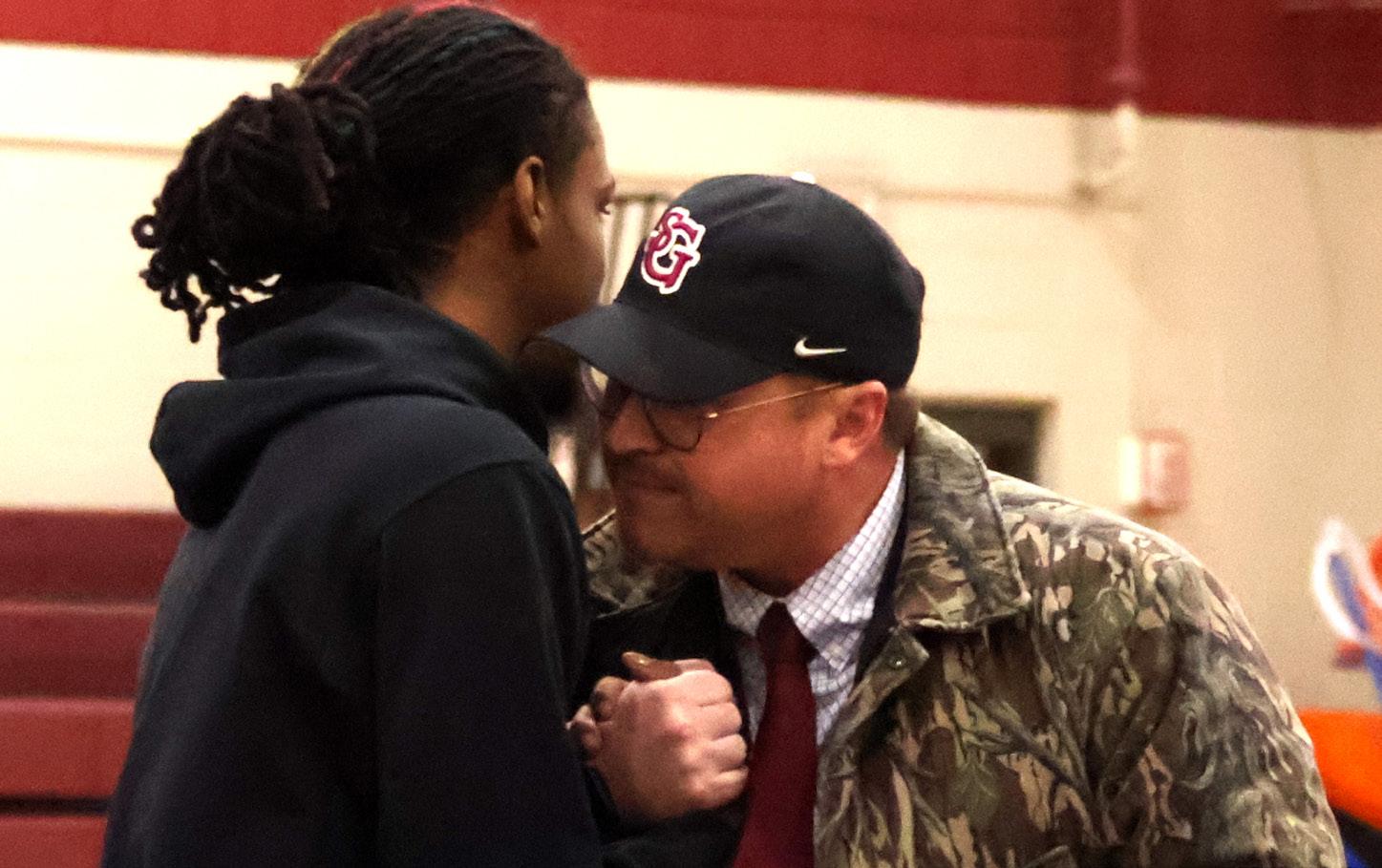
In one of the biggest surprises in school history, Memphis Grizzlies star Ja Morant showed up. Through the collaboration of Varsity Basketball Coach Dee Wilkes, Gorham, and Mr. Pruett, Morant stepped
“I just don’t see any reason why it can’t be the best year ever.” - Mr. Luke Pruett, Head of School
leaders such as senior Social Vice President Wilson Young and junior Legislative Vice President Jackson Juckett, both of whom expressed their excitement about this year. They mentioned how they feel Mr. Pruett’s energy has brought life to the St. George’s community.
“I think that has been the biggest thing: his energy has transformed this space in such a unique way,” Young said.
One of the most obvious ways the St. George’s community has seen Mr. Pruett’s energy in action is his willingness to be in front of the school to bring people together. Whether it’s bringing out the drum to excite the student section at St. George’s soccer games, or introducing his “Pillars of Excellence” awards during chapel, Mr. Pruett continues to find ways to shine a bright light over the student body.
Juckett also mentioned how Mr. Pruett’s love for St. George’s was clearly seen last year with how quickly he made an impact on the school.
“Obviously, [Mr. Pruett] loves St. George’s a lot,” Juckett said.
Throughout the first month of school, the student government has been highly involved with creating a lively and engaging school environment.
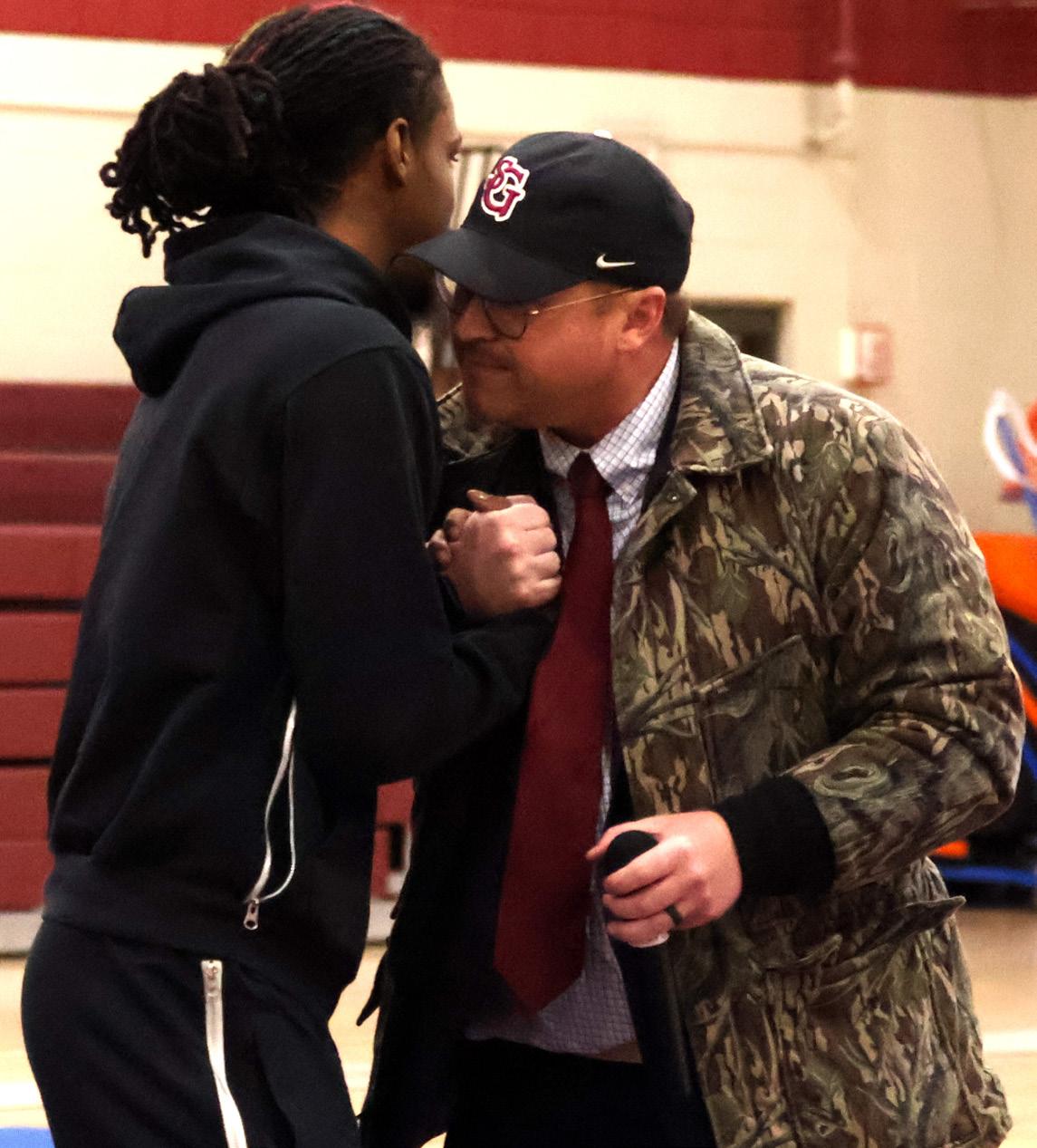
Specifically, during homecoming week, the St. George’s student government went all in for spirit week by bringing together the community with spirit days and other activities, in comparison to previous years. The homecoming week hype reached its peak when Mr. Pruett and Student Body President Molly Gorham hosted the pep rally.
onto Jeff Ruffin Court. Despite the rain putting a damper on the festivities, the entire St. George’s community made the most of the rainy evenings.
All of this sounds great, but does the best year come without issues?
“Best doesn’t mean easy, best means good and great [but] it also means that as obstacles occur, you utilize your guides, you utilize your friendships and you dig deep within your core to become even stronger,” Mr. Pruett said.
He knows that even when things are going well, we as a school are
going to run into obstacles at some point and we have to overcome them and keep going. When those moments happen, Mr. Pruett steps up to address those issues
Mr. Pruett also is thinking long-term about how to have amazing school years long-term to help make this a school that fully strengthens the students. As a school that brings in students from 50 zip codes, St. George’s is reaching out to many in the Memphis community, but despite seeing this growth, there is a certain size that St. George’s wants to maintain.
“There is some strategic growth that we want to do,” said Mr. Pruett.
Mr. Pruett’s vision is that St. George’s feels small as a school so that students grow close with their fellow students, fellow artists, and teammates, to be able to build meaningful relationships with them.
He sees St. George’s as a big place but not in terms of having a lot of people — this is due to having meaningful and important students, teachers, and alumni who all
have come through St. George’s. So finding the balance of managing a physically small school size makes it possible for every person involved with St. George’s to make meaningful contributions that build a larger school community.
Going into her senior year, Young wants St. George’s to be like a home.
“I think for me it’s a place that you walk in and everybody has a smile on their face [and] I really want [St. George’s] to feel like a home,” she said.
It is clear that many at the St. George’s Collierville campus like Young, who has been here since Pre-K, and teachers like Mrs. Heidi Rubin de la Borbolla, who has been at this school for more than 20 years, feel excited and energized like Mr. Pruett for what is coming to St. George’s this year whether its inside or outside of the classroom.
“I just don’t see any reason why it can’t be the best year ever,” he said.
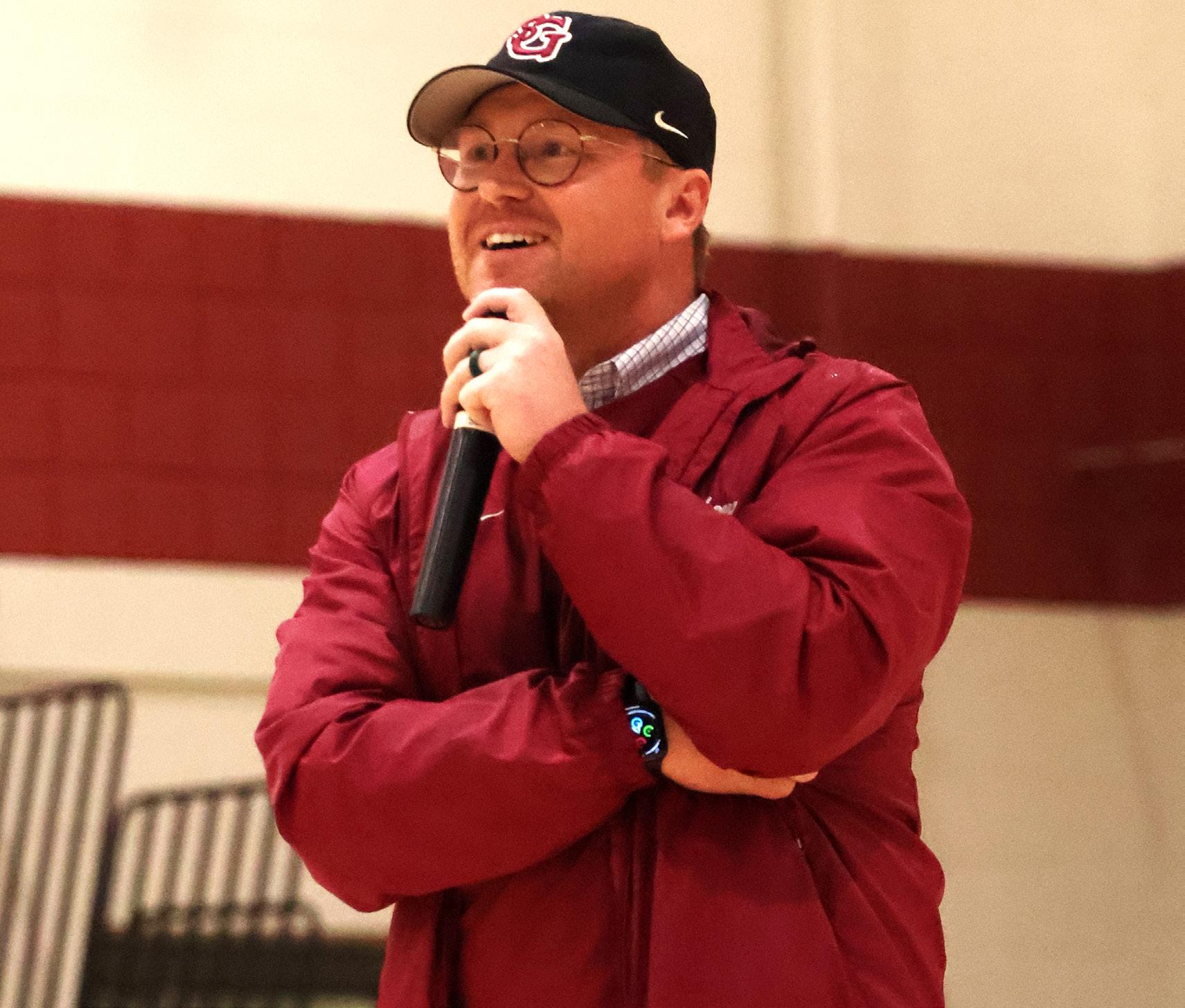
Mr. Pruett speaks to the crowd before the homecoming court.

By Gabi Flohr
Photography by Marlon Yates
In a city of legends like Elvis and Ja Morant, another name has painted itself into history: Spicy, a 15-year-old graffiti artist, has left his own rebellious mark on the streets of Memphis.
“Everybody in the city knows his name,” the founder of the local graffiti crew, Memphis or Die (MOD), who requested to remain anonymous, said.
Three years ago, Spicy was just a bored kid sneaking into a Germantown park bathroom, marker in his trembling hand as he tested his first tag on the back of a stall door.
What began as a simple sketch quickly evolved into a secret hobby.
Unlike most graffiti artists, Spicy skipped the typical practice phase and immediately vandalized public property. This impulsive leap marked the start of his journey in the graffiti community.
He became one of the original MOD crew members and befriended many other graffiti artists in the small, clandestine Memphis community.
MOD began with a graffiti photographer constantly invited to paint by artists, deciding to connect them instead.
graffiti missions and risking your freedom.”
“I don’t paint, so I just put them in a group chat with other people,” said the creator of MOD. “They just kind of made their own crew.”
This approach contrasts with older crews in town, which often require hazing like painting trains naked to prove commitment.
Brandon Marshall, a graffiti artist turned professional muralist with deep ties in the local scene, said, “Crew is everything. They’re the people you trust to have your back when you’re carrying out
This sense of belonging resonates with Codak Smith, who moved to Memphis in 1997 with nine years of graffiti experience.
“As far as I know, I was the first real writer in Memphis,” Smith said.
He was already part of a few crews before joining the Thoughts Manifested crew in 1998, maintaining a solid connection with them even after moving across the world to Florence, Italy.
“A crew creates a bond between artists. Typically, you gravitate towards like-minded writers that want

to accomplish similar things with their art.” Smith said, “These are still my close friends to this day, well over 20 years later.”
For Spicy, his crew became like a second family. His parents slept peacefully every night, unaware of his double life. How would they react knowing he was constantly planning missions with his crew, spray painting downtown walls every night, and putting himself and drivers in harm’s way while sprinting across busy highways to tag overpasses?
Mrs. Allison Webb, Artist in Residence and Fine Art Depart-
ment Chair at St. George’s, said, “People who tag places without permission… there’s an inherent understanding of the consequences. It’s not a secret that if you steal something, you’ll get in trouble.”
The thrill of doing something illegal took over Spicy’s life, and he’s not alone.
“It definitely becomes an obsession. People get jobs [where] they can work different hours, so they can stay up all night spray painting things,” the MOD founder said.
What started as a secret hobby developed into something more. Spicy pushed boundaries and ignored self-preservation.
In just three years, Spicy has accumulated around a thousand tags across Memphis—more than most graffiti artists manage in an entire career. He did this without even being able to drive.
“It didn’t matter if I was just going up to the gas station,” Spicy said. “I could be going on a walk around the block; I’d have a marker on me.”
At times, he would tag right in front of police officers, almost daring them to stop him. They never did.
“I honestly don’t want to say
that I think they should be on top of their job,” Spicy said, “I didn’t get arrested in the act, so I’m happy that they weren’t.”
The only places off-limits to his vandalism were cars, houses, small businesses, and churches. But when it came to the government, there were no boundaries.
On June 15, 2024, he began a bold game with the Tennessee Department of Transportation (TDOT), which is responsible for maintaining roads and removing vandalism from interstates and highways.
Spicy returned to tag the same
spot off I-240 again and again. Each time TDOT painted over his work, he responded with the same ‘catch me if you can’ attitude.
As the tug-of-war escalated, TDOT’s concerns grew.
Regional Communications Officer Nichole Lawrence emphasized the dangers involved: “The Interstate is inherently dangerous and a safety issue. This is exponentially hazardous during the night when most vandalism takes place. Graffiti can cause accidents as people try to read the work while driving distracted. Not to mention, TDOT staff [are] placed in unsafe conditions to clean/paint over the graffiti.”
He wrote, “I always come back TDOT,” next to one of his tags. It quickly got buffed or painted over.
Spicy returned to tag, “I told you, TDOT, I always come back.”
“Honestly, we all told him to chill out,” the creator of MOD said. “[But] he just kept going.”
In a bold move, he returned again, taunting TDOT with the words, “Come and stop me.” With the help of the Memphis Police Department, they did just that.
Unbeknownst to Spicy, TDOT
installed a trail camera since he kept giving advance notice that he’d keep coming back. Photos of his face were captured and posted on the MPD Facebook page and FOX13, offering a cash reward for information.
His identity was revealed through an anonymous online tip.
After years of wondering how he’d get caught, it finally happened on August 20, 2024. “I was hoping it’d be something cool like getting caught in the act, but nah, [the police] just came to my house…[and] arrested me, so
of artistic expression.
On platforms like Reddit and Facebook, Memphians stand divided; some view his graffiti as an entertaining scavenger hunt, while others are frustrated that their tax dollars are spent on its removal.
Some people have even contacted MPD, saying they should refocus on the “real crime” happening in the city—like homicide or robbery—not a teenager who likes writing on walls.
Mr. Rodney Bright, former Germantown Deputy Police Chief and current Director of
“It’s not a secret that if you steal something, you’ll get in trouble.” - Mrs. Allison Webb
I’ve been charged with a felony,” Spicy said.
His arrest marked the official end of his unofficial career and sparked a broader debate about how the city and its residents perceive this controversial form
Operations, Safety and Security at St. George’s, understands why it’s so important for law enforcement to handle non-violent crimes like this, which some may find easy to ignore.
“If we take care of the little
things, oftentimes you may be able to have a positive impact on people going down a path to other things or just getting caught up with the wrong group,” Mr. Bright said.
Mr. Bright believes the most effective way to reach young people is through teachable moments and educational programs in school.
“When we can avoid some felony or real criminal charge, I think we need to take advantage of those opportunities. Sometimes there’s not much choice, though,” Mr. Bright said.
Spicy’s case will inevitably require a criminal charge, which, according to MPD, will cost Tennessee over $6,500 in taxpayer dollars. Mr. Bright also acknowledges the efforts of the city of Memphis to embrace street art.
“There are places you go downtown or go to Midtown where people have been allowed to do a mural and things like that,” said Mr. Bright, “That’s part of the character of Memphis.”
An example of the city em-

bracing street art was a graffiti festival called Soul Food, founded by Mr. Brandon Marshall, who also goes by Nosy, in 2014. Paint Memphis, a non-profit organization, sponsored the event.
“Our festival was about a bunch of friends coming together to paint in public, with permission, so we didn’t have to hide in an abandoned building. And we can showcase our art form as legitimate,” Mr. Marshall said.
It consisted of 95% graffiti artists, most of whom Mr. Marshall connected with while traveling the country on a Greyhound bus, sleeping on couches.
After two years, Mr. Marshall chose to part ways with Paint Memphis for taking control of what he had created with his friends.
“When we parted ways, they used an email list, which they built behind my back, of my contacts and continued off the momentum from my event to make their own festival,” Mr. Marshall said. “They paint a lot of walls for free, not paying the artists.”
Soul Food became Paint Memphis, the annual one-day mural festival celebrating street art and community engagement. This event invites local and national artists to create large-scale murals in designated areas throughout the city.
Mr. Marshall doesn’t believe that the people in charge of Paint Memphis are as qualified as he was while he was running Soul Food.
“If I had a coding festival and had a bunch of amateur website builders make me websites for businesses in town for free, I would be a jerk. In the same way, the people who run Paint Memphis are in no way qualified to curate a mural festival. That’s why none of the best mural artists or graffiti writers in town paint for them,” Mr. Marshall said.
The few graffiti artists who attended Paint Memphis didn’t come to support the event itself but to participate in the Tag Battle, a new activity added at the end of the festival organized by a local paint shop owner.
Cameron Hill, a featured artist with Paint Memphis, argues that

the event is about something other than the artists making a lot of money.
“Most mural festivals have the same concept — it’s exposure
Memphis to do it for free for them with out-of-town artists.”
“I am glad street art is more accepted there now. I just hope the current climate still acknowl-
“I see this as being given a second chance.” - Spicy
for the artist. Basically, a free billboard advertising your work and it brings in more potential clients,” Hill said.
While the festival provides opportunities for some artists to connect with clients, it can also make it more difficult for local artists to secure similar opportunities.
“A lot of the walls [Paint Memphis] paint are walls that people have asked me what I would charge for mural work,” said Brandon Marshall. “I tell them the price, and often they back out and wait for Paint
edges and pays tribute to the culture that opened the door, graffiti,” Smith said.
Spicy’s journey illustrates how graffiti transcends spray paint and thrill; it is a form of communication. It’s how artists speak to each other and everyone who sees their work, each tag and mural saying, ‘I was here.’
“I see this as being given a second chance right now, not going to juvie. I don’t want to be out here committing crimes when they could’ve just kept me in juvie or whatever they wanted to do with me. I’m not even
jaywalking,” Spicy said.
Today, his parents and those around him see a different person than the one who once thrived in shadows and secrecy—no longer a reckless and obsessive kid sneaking out to paint walls, but a young man who is now safe and content with being a cheerleader on the sidelines.
“If nothing was to get painted over or cleaned off, everything fades at one point… on ditches, little marker tags, on trains. It doesn’t matter. It’s all a matter of time to figure out how it’ll all go down,” Spicy said.
He will not be known forever, and he knows that. Graffiti may be temporary, fated to fade away, but the stories it tells of rebellion, bonds, and the community it creates are what last.
So don’t get frustrated the next time you’re stopped by a train, but take a moment to appreciate the graffiti. The art on that train may not last forever, but the legacy of this subculture will.
By Ella Coons
Photos courtesy of Ms. Ashley Lott
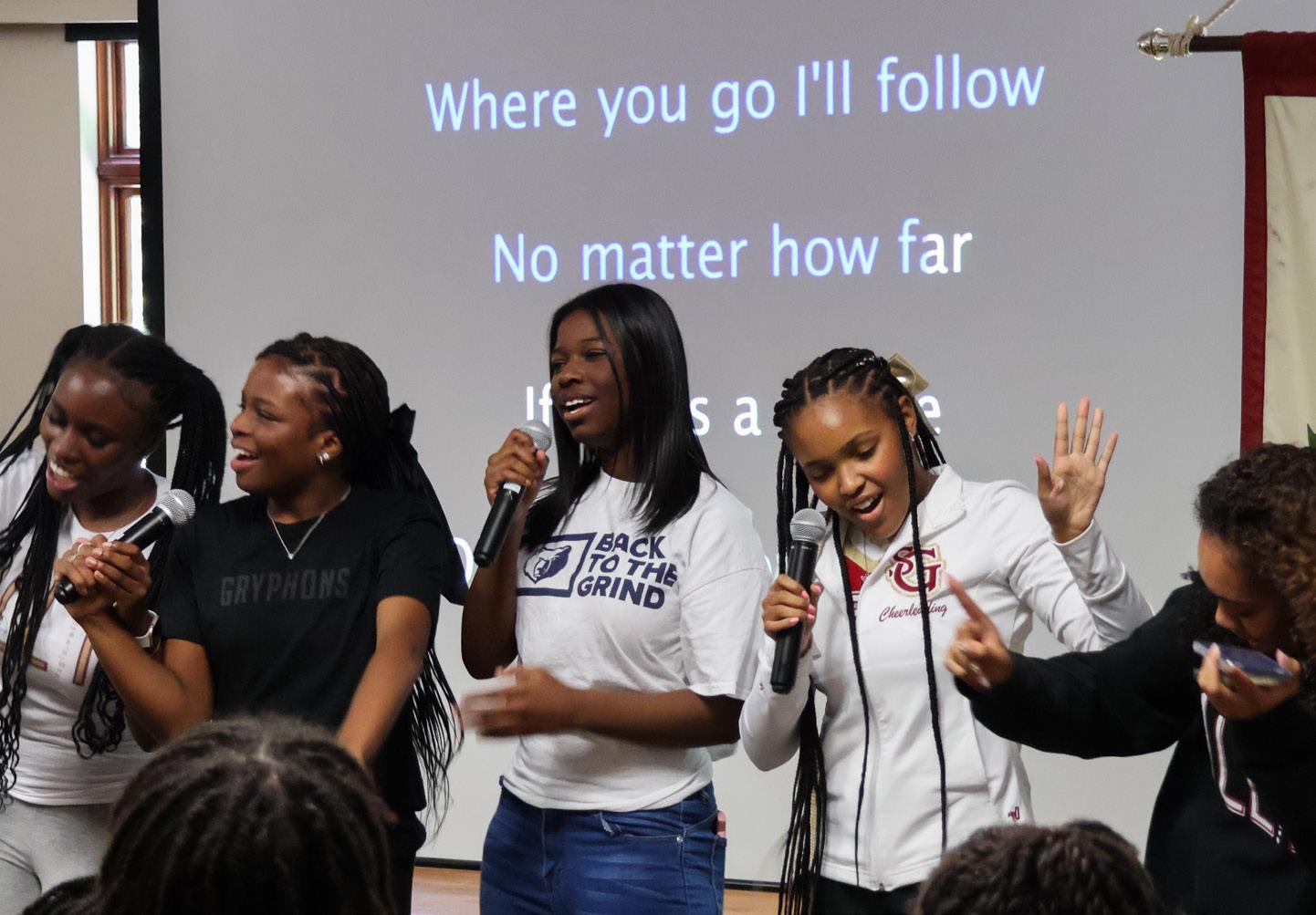
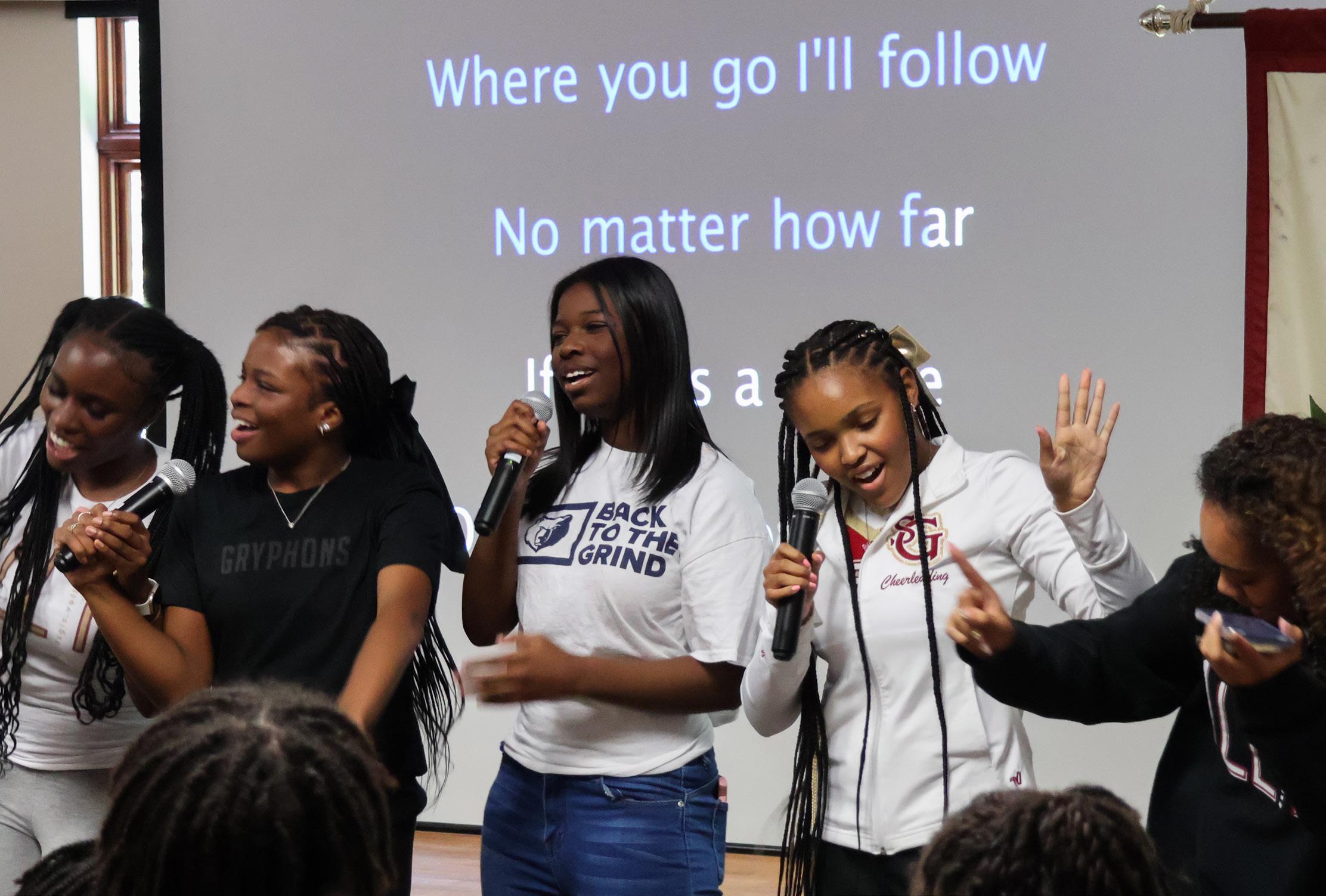
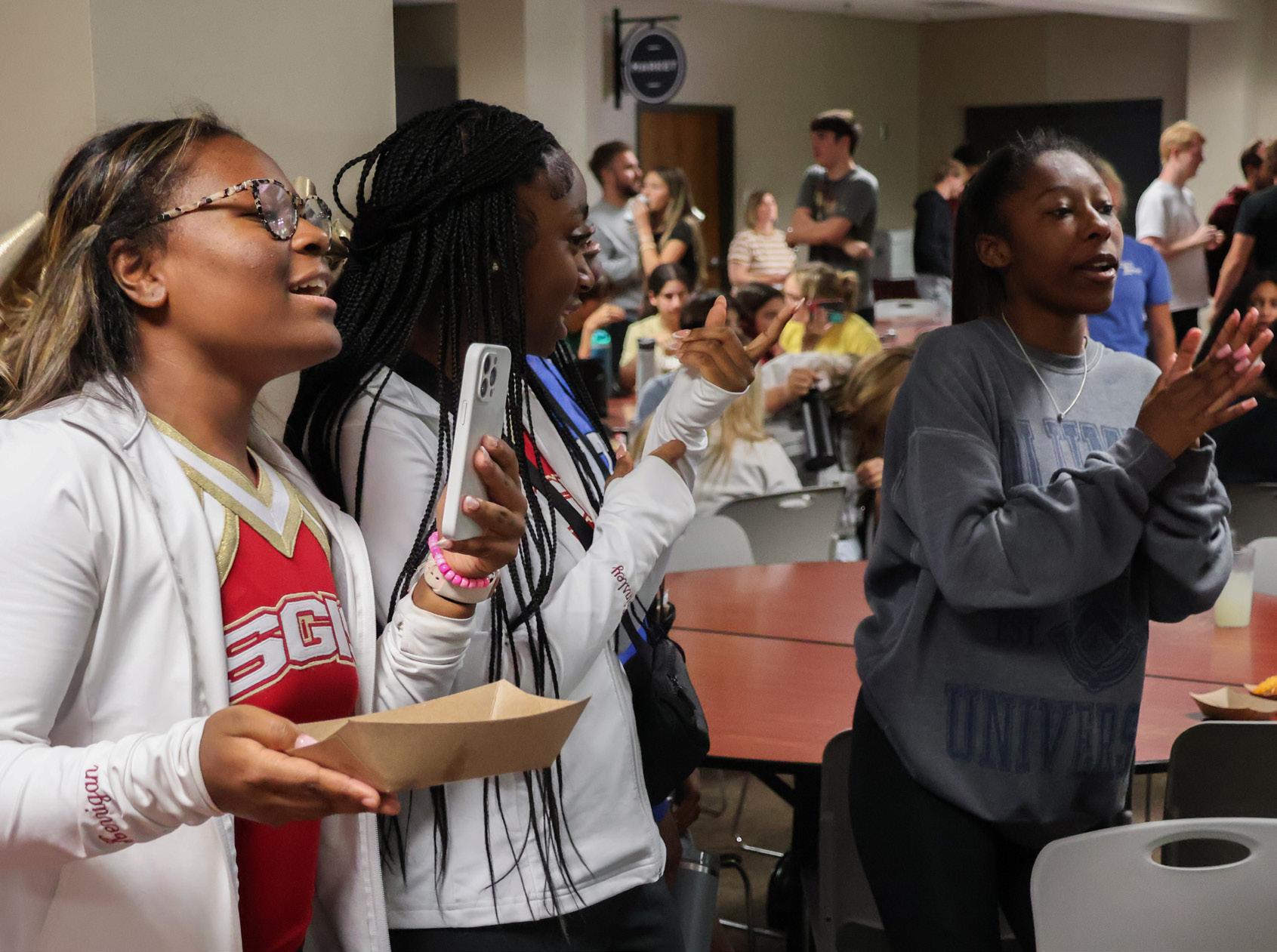
You may have heard music pumping from the lunchroom once a month and thought, “what is happening?” That music is from Karaoke Friday, a new community event created by Mr. Luke Pruett, Head of School.
As many students know, our head of school can be a bit spontaneous. That spontaneity created Karaoke Fridays, which have quickly become a lunchtime favorite for students in all grades.
In the dining hall, Mr. Pruett began to thank Chef Charles for lunch that day and said that the first Karaoke Friday would
happen the next week and would be organized by Ms. Ashley Lott, Education Support Specialist.
“I walked in the dining hall and [Mr. Pruett] said, ‘hosted by Ms. Lott.’ And I think he might have been kidding, I’m not really sure. But those of you that know Ms. Lott know that Ms. Lott doesn’t do anything half, she goes all in. So, I planned it,” Ms. Lott said.
From Mr. Pruett’s perspective, he saw Ms. Lott take charge after mentioning the new event.
“She brought all the structure to it. So next thing I know, she has sent out a sign up, and has scheduled with tech, and then we
were just off and running.” Pruett remarked.
And plan it she did. Ms. Lott sent out an email to the school on Tuesday, August 20 detailing the rules for the event as well as creating posters. She managed to get information on social media as well as through email and filtered through songs that students wanted to perform.
“I’m just kind of that organizational part,” she said.
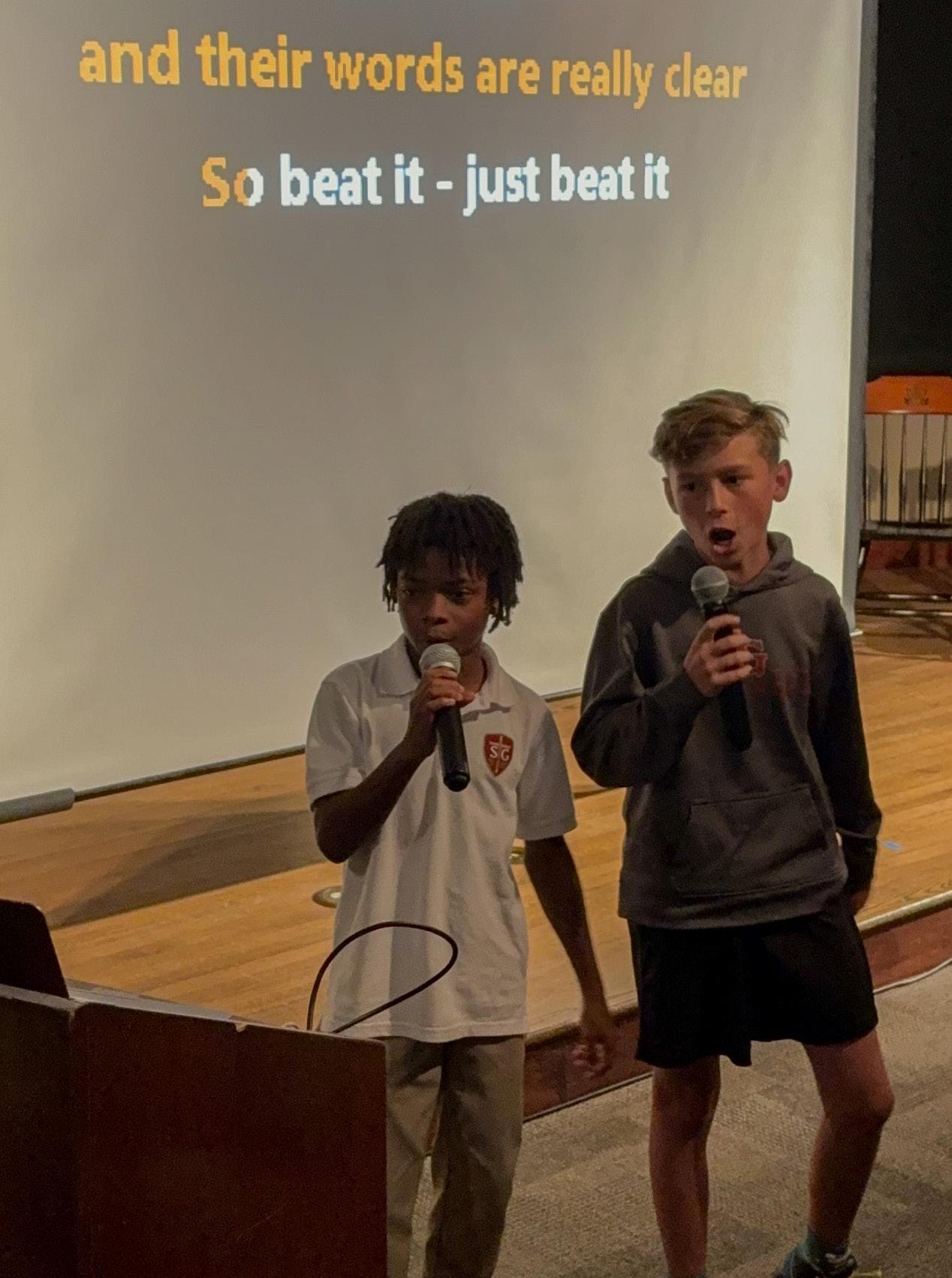
After the first event, Karaoke Fridays were a hit. Students loved performing and watching their peers perform. Eighth grader Will Cochran loved being up on stage
at the middle school lunch singing “Party in the U.S.A.” with his seventh grade peers Rivers Fisher and Watson Patterson.
“We were being like leaders,” Cochran said of the experience.
First performing on a whim, Cochran would love to sing at the next Karaoke Friday and already has his next song planned out.
Destiny Steward, a sophomore, has performed at both of the Karaoke Fridays thus far, both solo and with friends.
The first time, she sang “Best Part” by Daniel Caesar and H.E.R. with a group of friends. The second time, she sang “Can
We Talk” by Tevin Campbell alone.
Steward acknowledged that getting up on a stage in front of most of the upper school can be scary, but also rewarding.
“The first time I really wanted to do karaoke was to get out of my comfort zone,” Steward said.
She described her first time singing as shaky and mentioned that she was nervous, but after seeing and hearing everyone cheer for her and her friends, she felt more at ease.
Homer Beaudoin, a senior, also felt brave enough to jump up on stage. His case is a little different, however. Beaudoin plays in a band called The Contradictions and is used to a crowd. But, he felt more nervous this time.
“[It was] a little more nerve-wracking than performing in front of an audience you don’t know because… you’re more vulnerable for judgment because if you’re playing in front of people you don’t know, then you’re not gonna have to see them again,” Beaudoin said.
Singing “The Night Begins to Shine” by B.E.R. with his sister, Helen, Beaudoin understands why some people may choose not to perform. However, he will most certainly be performing again and perhaps choose a more commonly known song.
So why Karaoke Fridays? Why do students just randomly gather in the lunchroom to sing? Mr. Pruett may have an answer.
“I think it started so randomly that my initial answer would just be to bring some folks joy. But I think it’s become a place for people to be able to express themselves.”
Karaoke Fridays have become a place for students to assert themselves in the community. People are just able to have fun. They’re able to forget about school for a moment and just be together.
“We all came together as a community. I feel like it was a very beautiful moment. Like we didn’t have to feel like anybody was judging. It was just more of a fun kind of thing.” said Stewart.
Karaoke Fridays are here and likely here to stay. Set to occur approximately every month in the lunchroom, be on the lookout for an email from Ms. Lott detailing
all of the rules and how to enter yourself or a group of friends to sing. And remember to have fun with everyone, even if you’re scared.
The next Karaoke Friday is holiday themed and is scheduled to take place on Friday, December 6.

By Kirklyn Moore
Photography by Marlon Yates
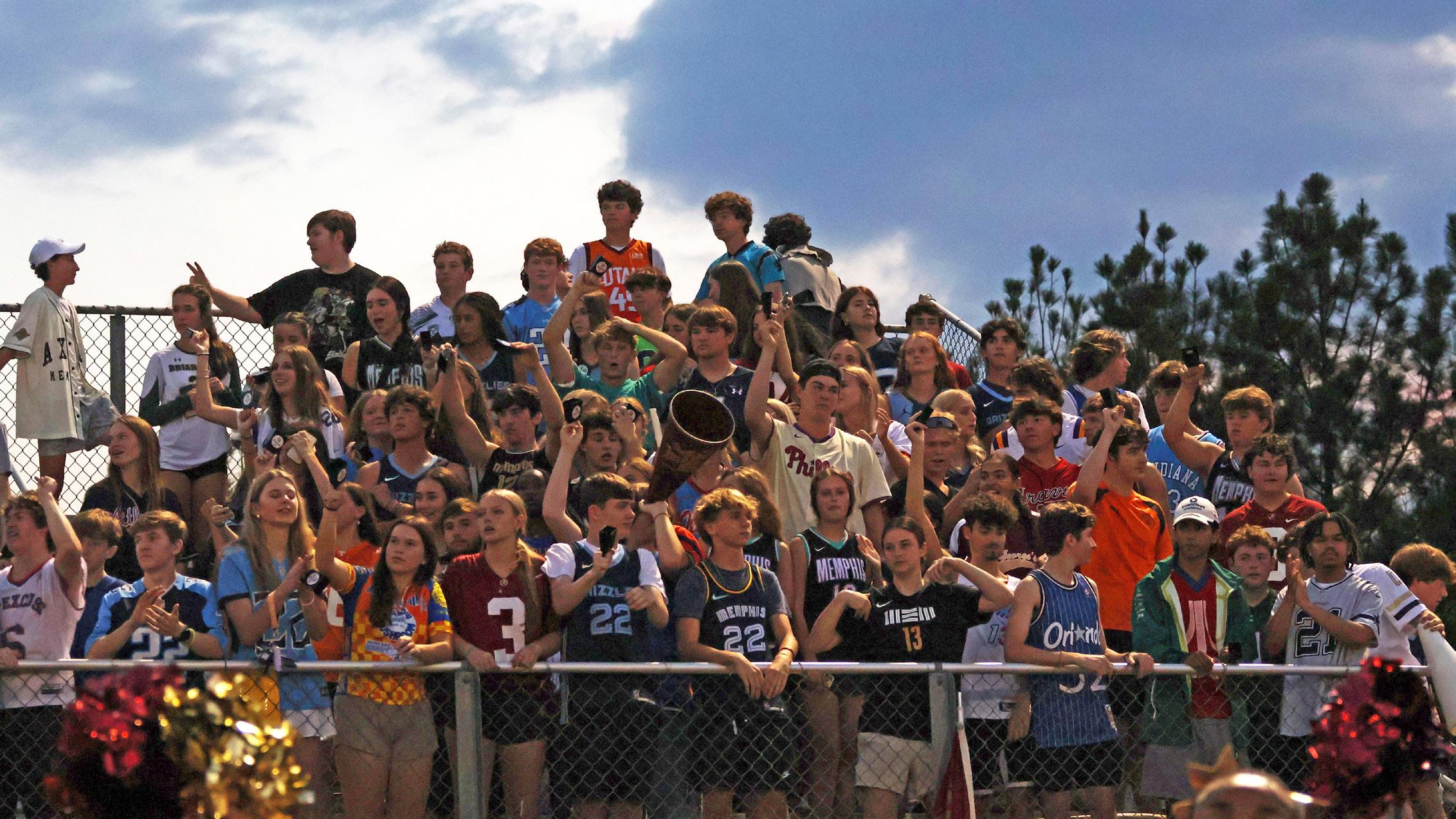
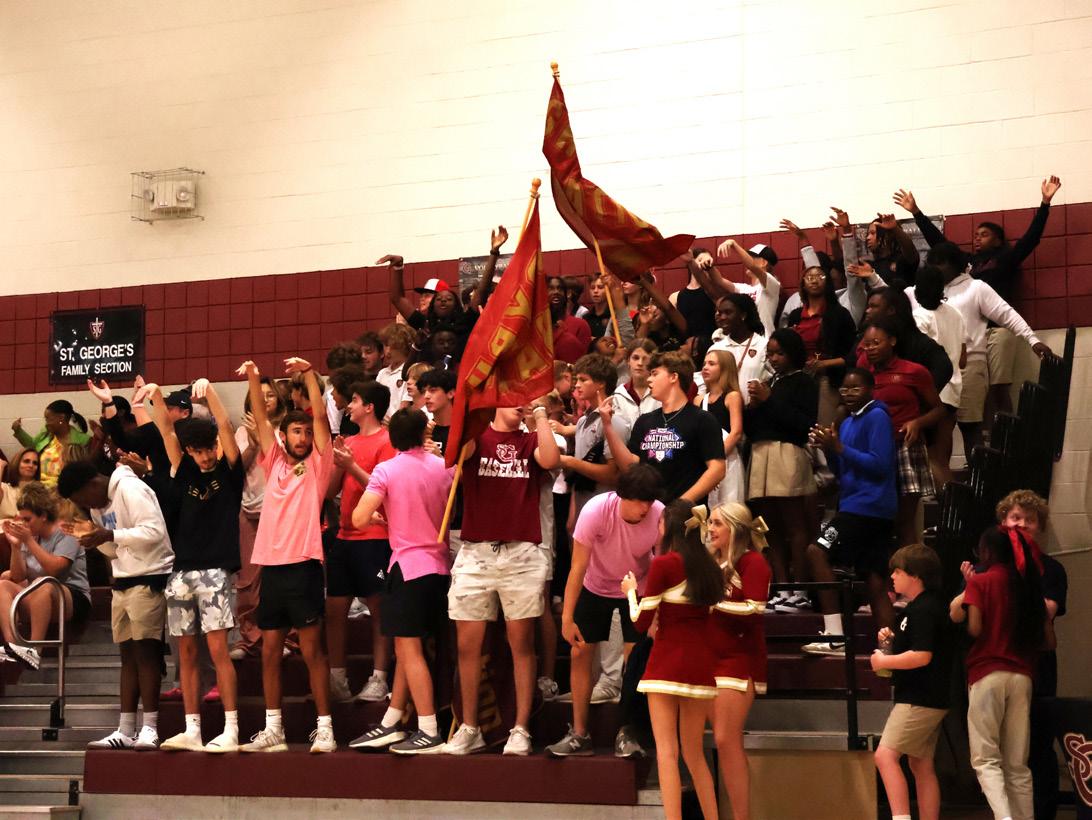
If you’ve attended St. George’s sports games you will notice that the student attendance varies across sports. Football games often have many boisterous students filling up its student section while cross country brings very few student spectators.
What brings students to a game? Many might assume that the student body finds football the most interesting, but that is not the case.
According to a poll of the Bleacher Creatures, a group of St. George’s students that promote our games and run the student sections, there is a disconnect between what sports they find the most entertaining and which sports events students show up to most.
Only four of the 11 students polled responded that football was the most entertaining, but only one student named football/cheer as the sport they think the most students attend.
Sports such as volleyball that have a quick pace and have tension-filled moments where the audience are forced to hold their breath are entertaining to many. However, they lack the student attention that football has somehow obtained each year.
Junior and varsity volleyball player Ally Bjorkman acknowledges the sport’s lack of student attention despite its spectator-friendly nature.
“I feel that volleyball’s under-appreciated... It’s definitely a really fun sport to watch. It’s got a quicker pace and there’s always something happening,” Bjorkman said.
A sport’s entertainment through action-packed moments is still an important factor in attracting students to attend. Freshman Sophie Garlington makes a point to attend volleyball games because of this.
“There’s a lot of action. [There’s] It’s never really any rest moments... It’s just really entertaining to watch,” Garlington explained.
Possibly in part because of the short attention span of today’s high school students, sports with a slower
pace and a lack of tense, backand-forth competition bring less of a student fan base.
Mrs. Paige Garrett, Assistant to the Athletic Director for Internal Operations, corroborates this point, explaining that the nature of the sport may affect the size of a student section.
“It’s hard to watch a cross country runner unless you’re going to watch them cross the finish line,” Mrs. Garrett said.
This is a factor that naturally brings a lesser student turnout. Even so, many find it important to support the student athletes on the cross country team, so understanding other factors that bring more students to games is essential.
Another element of a sport that affects student attendance is whether the sport is indoors or outdoors. While a sport being played outdoors implies that rainy game days bring hard conditions for a high school student to withstand, they are much favored by the student body.
Senior and Bleacher Creature Sarah Brunson feels that a sport being outdoors is a huge factor in its amount of student attendance.
“You can obviously yell a lot more when you’re outside versus when you’re inside, and I feel like you’re farther away from the refs so that you won’t get in trouble,” Brunson said.
The idea of inside and outside voices comes into play with students feeling that they can be louder and scream in support of their teams when they are not forced to watch in an enclosed space.
Furthermore, within a gym compared to a large football stadium, parents and adults seem closer to some students, which further limits them from yelling chants such as “you can’t do that” to the opposing team and referee as you would at a football game due to the fear of a disappointing the adult next to you.
“Whenever it’s outdoors, people feel like they can be louder because it’s not enclosed... [For]
indoor sports, the student section is usually pretty close to the parents, so it’s not always as loud,” Bjorkman said.
While all these factors affect the turnout of students to a sport’s games, the biggest piece to why students show up to some games over others is that sport’s student section’s energy or atmosphere.
Atmosphere plays an integral role in high school sports for multiple reasons. One is that it affects how the players play.
“The players feed off of the student section. It energizes the space, helps create an atmosphere where the players feel supported,” Mrs. Garrett said.
Bjorkman agreed, saying, “At the end of the day [volleyball is] more of a game of which side wants it more, and that sort of comes from energy... [The student section] helps energize people on the court more, which helps us perform better at some times.”
A student section can bring adrenaline to players on the field, track or court and provide the necessary energy for a better play. This means that a better student atmosphere can bring wins, attracting more students to watch that team win.
Specifically for sports such as cross country, the extra energy a student section can bring to difficult, draining races can be so important to student athletes such as senior runner Tyler Bergin.
“It allow[s] me to reach my full potential while racing,” Bergin said.
Thus, showing up to a sporting event whenever possible is essential as it could immensely support our student-athletes on those teams.
The atmosphere of a sport’s game or its student section is also so important because it’s what primarily drives the student body to attend games.
St. George’s Athletic Director Ms. Michelle York acknowledged its role in the student attendance to sports games with the specific example of volleyball.
“I think the atmosphere can play a lot into [turnout]. Like one thing that we did last year was that we added music and an announcer to the volleyball games, and all of the sudden people started coming because it was a fun environment,” Ms. York stated.
The improvement of a sport’s games atmosphere or a sport’s student section’s atmosphere directly affects the size of the student supporters at games, and this fact does not go without note.
St. George’s recognizes the importance of the atmosphere of a student section with the longstanding group of leaders, the Bleacher Creatures, who bring spirit items to sports games, attend games and remind and encourage others to come to sporting events.
The Bleacher Creatures’ spirit items add to the atmosphere of student sections for many students as it creates a sense of unity among student fans.
“If [a student] didn’t show up fully in theme, then they can have a lei that was passed out or the beans just to shake and show that you have school spirit, so it makes it a lot more united,” Brunson said.
Even from the outside looking in, people can see the effect of spirit items passed out by Bleacher Creatures into the fun around sports games.
“I think that that’s fun when you can token something special in the student section that everybody can rally behind,” Mrs. Garrett said.
The tradition of gifting the student section with items to show their support for St. George’s teams adds to the excitement around attending a game. Similarly, the traditions of the pushup board and students’ speaker at football games bring a
united, loud student section.
“It gives you something to look forward to, and it just brings up the spirit a lot more because you get excited to do those kinds of things,” Brunson said.
Brunson explained that these traditions create something fun to expect at every game that keeps students engaged and excited.
Sophomore Carter Ruffin agreed with that idea.
“I think it just makes it more fun, more stuff and just cheering. It’s more interactive,” Ruffin said.
The possibility of inclusion of a student or their friends in these traditions adds further excitement and fun to the atmosphere around football games.
Why do these traditions not show up in other sports’ events?
When Mrs. Garrett was asked this question, she pointed out that it’s likely due to what students are exposed to.
“They see it in football games. You see it on television... The idea hasn’t been born to do it during soccer games. [It’s] not prevalent in what you see,” Mrs. Garrett said.
The ideas have been conceptualized for football because of American culture and media.
According to Gallup’s “Football Retains Dominant Position as Favorite U.S. Sport” by Jeffrey M. Jones, forty-one percent of U.S. adults say football is their favorite sport to watch while baseball and basketball essentially tie for second at 10% and 9%, respectively.
Additionally, “Football Sundays” is a term often used by Americans across social media
platforms, and there is a huge audience for college football and the NFL alike.
“American football is such a big thing in our culture. Everybody watches it on Sundays and everything, so people feel more inclined to go to football games,” Bjorkman said.
American media often depicts American football. Different TV shows or movies when depicting the typical high school experience will likely include an exciting football game if any sports game, and this only makes sense.
When asked why football is the most popular sport for St. George’s students to attend, Ruffin stated, “The American way – kind of tradition. That’s just probably the most popular sport in America.”
In general, Americans prefer football by a landslide, and the media Americans are exposed to has been targeted toward our nation’s interests.
Consequently, American football has been prioritized, so a greater number of ideas on how to make spectating games more fun have been conceptualized by colleges and high schools around the country and shared through the internet. For that reason, football at St. George’s has attracted students with an expectation to entertain them with a lively atmosphere.
The elements of a sport and American media’s effect on our school make up why a football game’s student section might be more substantial than at a water polo match. These are essential to understand in order to attract more students to other sports’ games where our players need that support and extra energy from a crowd of their peers.
Greater student attendance often leads to better performance and added joy for our student athletes, so keep that in mind when deciding if you want to show up to the cross country meet with your friends.
“I really appreciated people showing up because it was nice to hear people’s voices in the race,” Bergin said.
Bo Farnsworth contributed to this story.
By Mia Cutrell Illustrations by Sydney Murray
This year, St. George’s introduced a new athletic handbook.
Now, student athletes and their families have a new place to look to for answers to questions and clarity on expectations.
According to Athletic Director Michelle York, who was integral to the handbook’s creation, it was made as a way to communicate student expectations and make them clearer.
“Anytime you can provide clear communication to families and to students… It helps in the success of the programs. It helps to support our coaches. It helps provide clarity of expectations,” Mrs. York said.
The handbook functions as a compendium of expectations about practice responsibilities, game responsibilities and academic responsibilities, and an

swers frequently asked questions.
It also makes sure expectations are consistent across all sports in order to eliminate confusion for students who play multiple sports and their families.
It ensures all sports are managed equally despite the level and gender of players.
The coaches also have their own coach handbook that clari-
Coach Haley Gilmore is the new student athlete support specialist, a position introduced this year to foster a greater connection between the academic and athletic sides of St. George’s.
Coach Gilmore believes by explaining the academic expectations for student athletes, the handbook supports that connection.
“I think it’ll help students see individual accountability.”
- Coach Nick Whicker
fies their expectations as well.
According to Coach Nick Whicker, who assists with varsity soccer and teaches middle and upper school wellness classes, prior to the handbook’s creation, there was definite uncertainty about the academic expectations for student athletes.

“It’s been about four or five years since there’s been a standard or a specific expectation that the students had to achieve grade wise in order to participate in athletics. So I think there was definitely a lot of uncertainty”
Coach Whicker said.
“I think the concept came out of a desire for there to be more fluidity across the boardwalk… [and] wanting to make sure that student athletes knew that they were students first,” Coach Gilmore said.
In order to do this, the handbook explained academic ineligibility as a way to ensure that student athletes are supported and held accountable academically.
The handbook states, “Any failing grade (F) or two D’s at mid-semester or at the semester’s end, or an incomplete (I) not

made up within 7 days of the semester ending will render a student-athlete INELIGIBLE.”
Ineligible athletes will not be able to participate in athletic programs. If a student is already on a team, they will still be considered a team member and expected to attend practices and games at the coach’s discretion, but will not be allowed to miss school for practice or trips.
The intention is not to kick out students with poor grades but to motivate and prevent them from becoming ineligible in the first place.
“It’s about support and prevention. I don’t anticipate there being a lot of people who are ever ineligible,” Mrs. York said.
There is also a support system in place for students that are considered to be “at risk” for academic ineligibility.

“I think the school does a great job of providing all the resources that a kid’s going to need to be able to participate… I think the school does a great job of not saying, ‘Good luck. You’re on your own,’ but really coming alongside the student athlete to try to support them in the best way possible, in and out of the classroom,”Coach Whicker said.
At-risk students will have regular check-ins carried out by the student athlete support specialist, Coach Gilmore, the education support specialist, Mrs. Lott as well as other advisors and administrators.
“It’s not a gotcha moment… There’s literally no way anyone could not know that they’re creeping towards that point,” Coach Gilmore said.
Ineligibility also ensures that student athletes that want to play sports at the college level are able to meet the National Collegiate Athletics Association (NCAA)’s Academic Standards for Initial-Eligibility.
“The bigger picture is just making sure everybody understands what it’s going to take for them to be eligible at the next level… [in] this case, it’s no Fs, and you can’t have more than two Ds, because we know… that’s going to drop your GPA below what an NCAA requirement would be.” Mrs. York said.
According to the NCAA academic standards, in order for a student athlete to be eligible for division I athletics, they must have at least a 2.3 grade-point average among other requirements.
In the opinion of sophomore Lily Wener, who participates in cross country and track, the ineligibility system also works as a way to motivate student athletes to work hard on their schoolwork.
“I think it’s good because it gets me to make sure that my grades are up, and it gives me a timeline of when I should check and how it helps me throughout the school year to make sure I’m on task,” Wener said.
For Coach Whicker, ineligibility can help remind student
risk has shrunk. So I’m cautiously optimistic that the trend will continue,” Coach Gilmore said.
While academics and athletics are both considered two of St. George’s “pillars of excellence,” the handbook and the concept of ineligibility make it clear that they are not of equal importance.
“I’m cautiously optimistic that the trend will continue.”
- Coach Nick Whicker
athletes of how their actions affect not just them, but their teammates as well.
“I think it’ll motivate students more. I think it’ll help students see individual accountability, but also team accountability, that if they’re not putting the work in the classroom, it’s not just affecting them, but it could be affecting their teammates if they’re ineligible to play,” Coach Whicker said.
According to senior Amir Wilson, the prefect of the athletics, becoming ineligible can help teach students important lessons on responsibility and prevent them from doing similar things in the future.
“It makes [ineligible students] know that they need to get their stuff in on time so they don’t do it again the next month. I think it’s great,” said Wilson.
But with the first academic checkpoint having happened recently, are all of these things working? Have the at risk student athletes improved academically? It seems like it.
“We don’t have the data, necessarily… but I do know that from week to week, the list of students that’s actually on the report of those that qualify for at
The handbook says “academic achievement takes precedence over athletic participation” and “competition in upper school athletics is a privilege and not a right.”
In other words, student athletes are students first and foremost, and their ability to participate in extracurricular activities, including athletics, is not a given thing and can be taken away due to their actions.
“You earn the right to be a member of a team based on the choices that you make, that can be in jeopardy because of your academic choices… Everything, again, is about consequences and choices, handling that responsibility and understanding sometimes you just have to live with the results of an action,”
Coach Gilmore said.
With these expectations and protocols being made clear, student athletes will hopefully be able to achieve a balance and be able to do well in athletics while succeeding academically.
According to Wener, being stable academically is essential in order to be a successful athlete, and in order to be successful academically, it is important to find this balance.
“If you don’t have the good grades, you’re not going to be able to do sports,” Wener said.
“I think that if you want to get in college, you have to have both and be able to find a balance between them.”


By Molly Gorham
Illustrations by Kirklyn Moore
The role of prefect has been around at St. George’s for what seems like forever, with a new group of students being selected each year. Being a prefect is commonly referred to as one of the highest honors a St. George’s student can receive, but why? Although the title of prefect sounds quite promising and formidable, many students often feel that prefects fall short in their endeavors. But then again, what is even expected of them?
Prefects can often be found reading scriptures and prayers in chapel or assisting with carpool alongside the varsity cheerleaders at the lower campuses. While these behaviors are great, finding a connection between these activities and their assigned roles is difficult. This year, there were nine prefects selected, and, contrary to what many members of our community have seen in previous years, they established their own titles rather than being assigned one.
As soon as the prefects and their roles were announced, people noticed the absence of the prefect of the arts. Not everyone felt positively about the change. With the arts being a Pillar of Excellence, our school theater program currently riding a high and the recent naming of St. George’s as an Arts Rich School of Merit by the Tennessee

Arts Academy, seeing a group that is supposed to personify the student body and the values that our school upholds leave out an essential element of our identity was hurtful to many who felt that they had been snubbed.
Another bold difference in this year’s prefect group is that they were chosen through votes cast by the student body and faculty, with anyone showing interest in the job being put on the ballot.
At the end of the voting period, the nine students with the most votes were automatically accepted as prefects. No further questions asked. Last year, candidates were interviewed and chosen by faculty alone to ensure the process was unbiased and that the chosen students would be a good fit. Because of the switch this year, it is difficult to claim that these same standards were upheld.
When we look at the prefects, it is obvious that every year they are a diverse group with varying academic, athletic and artistic talents. They undoubtedly embody and go above and beyond what it means to be a St. George’s student. However, for years on end, students have felt the prefects are just that: incredible students who have titles without any added responsibilities and expectations.
It’s understood that the prefects tend to work “behind the scenes”

as advocates for the student body, but I feel that it may be too “behind the scenes.” During my time at St. George’s, there hasn’t been much communication between the Prefects and the student body, and no change has seemed to come from their work, at least none that I am aware of. It’s difficult to work as an advocate for a group when you don’t have a direct and methodical way to get their input, which there doesn’t seem to be. Because of this, the negative perception that prefects don’t do anything is created. There are multiple elements to a community and gears that must turn for a machine to work, however logistically the prefects don’t have any power. They can make suggestions, but that seems to be where their authority ends.
As the 2024 student body president, I’ve felt that throughout the year I have had to take on some of, what I believe, should be the prefect’s responsibilities. For example, the planning of what many call the “Ja Morant Pep Rally” was completely left up to the student government. From brainstorming, setting up, and even deciding what prefects who participated said and did. Everything was left up to us. Although pep rallies are of student governments jurisdiction, there are areas where certain prefects in areas that align, are expected to

chime in.
This is not to say that the prefects aren’t valued members of our community, but for a while, it has seemed like they haven’t reached their full potential, and this year, we have too great of a group to continue to allow that to happen.
With the arrival of Mr. Pruett, Head of School, countless things around our school have been changing as St. George’s enters a new era. Enrollment is increasing, our athletics are thriving, we are winning academic awards left and right and engagement amongst each other as a community is better than ever before. There is no reason the prefects shouldn’t follow this trend and enter a revamp, especially since they strive to appeal to the ever-changing demographics and perspectives of our community. If administration began to give the Prefects as much responsibilities and power as they give student government, the Prefects could do some incredible things with their newfound freedoms and begin to bridge the disconnect that many have been experiencing.
However, until these things are entrusted to them, suggestions become actions and better communication is brought forth, I worry that the Prefects will continue to get lost in the background, and the lines surrounding their roles in our community will continue to blur.
OPINION SECTION POLICY: The Lodge opinion section is a venue for the free expression of the student views at St. George’s Independent School. The opinions represented in this section are those of the authors alone and do not necesarily reflect those of the Lodge staff or of the St. George’s community at large. The Lodge strives to be an open forum for the thoughtful and deliberate exchange of comment and criticism and therefore welcomes letters to the editor. Letters to the editor will be printed in the opinion section of the newspaper, should not exceed 300 words and must be signed and accompanied by a verifiable email address. These letters will not be printed if the content is judged obscene, violates the privacy of others or encourages physical disruption of school activities.

By Mary Frances Forbes and Jada Olende
Illustrations by Kirklyn Moore
The word “prefect” is Latin for “leader”, and the practice of having Prefects is not unique to St. George’s; their presence is particularly common in boarding schools and has been for quite some time. In many of these schools, prefects are regarded as the highest leaders among the student body.
Prefects are also deeply embedded into the history and structure of the Collierville Campus, having been introduced by former head of school, Mr. Bill Taylor, to the first group of seniors to walk our halls in 2006.
Mr. Taylor’s vision for this select group of students was for them to be distinctly different from student government. Prefects have never campaigned for their positions, therefore they most directly represent who the student body and faculty believe to embody the values of our school. The title held by each prefect has also never been directly assigned by the head of school; instead, the group meets with the head of school to discuss the role for which they would be best suited. The role itself is intentionally student-centered. Since the founding of the prefects back in 2006, they have operated in the background. Think of it like the United States government: if the student government is the executive branch in that their work is external, visible, and varies on a year-by-year basis, then the prefects are more like the legislative branch, essential to behind-the-scenes operations and part of a larger continuity.
We are the link between the student body and the Head of School, and because of this, much of our work can get lost in

the shuffle. It is easy to assume that, because we are not explicitly inquiring with the student body as prefects about what they would like to be changed about the school, it doesn’t happen at all. It is true that we don’t put on our prefect hats when trying to identify problems because that would be ineffective. Instead, we listen and talk to our peers as people, hearing their ideas and expressing them to the administration, who have proven to be highly receptive. Sure, this is not as transparent as the work done by other leaders in the community, but the roles were intentionally designed this way.
Making a change, impacting the community, and leaving a legacy are the primary goals of any leader in a position of power. So what makes the Class of 2025’s Prefects any different? Our passion for upholding their ideals and ambitions, as individuals and as members of a larger community.
Prior to attaining our titles, the prefects believed their position entailed going anywhere and everywhere we were needed. Quickly, we realized that it’s not about quantity but putting forth quality. When looking back at past prefect groups, it is easy for incoming leaders to think there is a bar to exceed. In reality, this position is one of tending after a seed planted in the many different sectors of our community.
Going from a student to a prefect, there was a large shift in perspective regarding the logistics of it all. As a student, it was easy to pin the prefects as useless, but, in actuality, the bulk of all they do is done behind the scenes. The prefects strive to implement their change so seamlessly that it does not disrupt the sacred culture rooted so deeply in our community.

Additionally, it is critical to separate change from initiatives because, in some cases, change will happen in a smaller quantity over a longer period of time, whereas initiatives are in the public eye and tangible in a sense. Though in no case are either more important than the other.
Griffin Davis, our Prefect of School Spirit, exhibits this concept well. Davis’ tangible initiatives, being a Bleacher Creature, speaking at pep rallies, and keeping the student body informed about upcoming events are all part of a larger goal of creating change; specifically, leveling the playing field between various student events in terms of how much attention they receive. Davis’ prefect title clearly warrants a higher number of actual appearances, but it also creates an opportunity for an impact to be left on the community.
Our Prefect of Academics Corrinne Cowan has fewer avenues for initiatives, given that academics are not as event-centered as school spirit. Cowan is a member of a number of academic extracurriculars and has even hosted events at our lower school campuses with the STEM club. Through this initiative, Cowan works towards a change in the way students view academics, starting with younger students in hopes that this view will carry over into future years at our school.
Representation. That is the purpose of the prefects, and that is why our positions change each year. because demographics change each year, and perspective changes each year. The key to adjusting to all of these aspects of representation is growth. It is great to recognize weaknesses within leadership; however, it is admirable to address them.
One aspect of this year’s prefect

group that is a glaring issue is the absence of the Prefect of the Arts.
In May, after the prefects were announced, we met with Head of School Mr. Luke Pruett, Director of Counseling and Student Well-Being Ms. Kim Finch, and Head of Student and Alumni Affairs Mr. Timothy Gibson, who collectively serve as our advisors for the year. During this meeting, we worked to decide our Prefect titles, which was not an easy task.
We deliberated for over an hour, and even when we reached the end, we couldn’t see a scenario where both the arts and academics were represented. It came down to a sacrifice that had to be made, but this doesn’t mean the arts are entirely forgotten.
The prefects have settled into our positions this year, and we are quickly learning that coming across hardships and conflicts is inevitable. But what will set this class of prefects apart is our ability to overcme adversity. One thing we are excited to practice this year is transparency, especially because that seems to be the number one disconnect between the student body and the prefects.
We are constantly looking for ways to advance the student body in each and every category we cover and in order to do that effectively we look forward to growing our communication levels so that the student body and the prefects remain on the same page at all times.
It’s easy to get caught up in the events handled by the student government– who doesn’t love fun activities like prom, pep rallies, and spirit weeks? However, in a functioning community, there are gears that must turn, and whether or not you see these gears turning, it still happens.
By Mary Frances Forbes
had just gotten my driver’s license when I moved from my Collierville suburb to the center of downtown Memphis. Very soon after the move, my dad sat me down at the kitchen table in front of a map of the city.
“These are the streets to avoid; if you find yourself traveling north or south, you’re headed towards a death zone,” he told me, pointing to places scattered across the diagram of the city, formally introducing me to the new way I’d see my home. I had been ecstatic about moving downtown, now things seemed more bittersweet. Being a Memphian is complex. There is so much to love about this city, which only makes the sting of our gun violence problem that much more intense.
2023 was a record-breaking year for homicides in Memphis, says WREG Memphis, with an estimated 352 to 398 victims. As of June 7th of this year, there have been 156 homicides. Even on National Gun Violence Awareness Day, 13 individuals were shot, ten of whom died, according to an article by Action News 5; there seems to be no end to this violence.
There are a lot of assumptions about exactly where this issue is concentrated, like it only happens in the “bad parts of town”. Despite what people may believe, there is no “safe space.” I learned this truth when on September 19th, 2024, there was a shooting less than a block from the gated community where I live.
Gun crime has also taken to the roads, specifically the interstate. In June of this year, four children and their father were shot in a road rage incident on I-240, surviving the shooting but sustaining multiple injuries.
According to Action News 5, the victims noted that upwards of 20 bullets were fired, an unexpectedly high number for a crime committed in a moving car. How did the attacker fire so many bullets at once? A Glock switch.
Glock switches are small attachments used to convert a Glock handgun into a machine gun that can fire up to 1,200 rounds per minute. Glock switches are illegal under state and federal laws, yet Memphis has reported a surplus of incidents involving the attachment, some of which have been 3D printed. The punishment for possessing a modified handgun is that of a Class E felony, the most minimal of felony charges.
Shootings aren’t the only way the city is affected by its gun problem. There were an estimated 362 cars broken into in Memphis in 2023, says The Globe and Mail, which law enforcement suggests are motivated by a search for guns. My car was one of those 362.
At the time, I was living in an apartment a mile from the neighborhood I live in now. There, I kept my car parked in a private parking lot that was somewhat secure. I was away at a summer college program when I got a call from my mom informing me that my driver’s side window had been smashed and the contents of my car had been ransacked.
The culprits made away with a mere eight dollars in change; the cops said they were sure that guns were the primary target. Their assertion was based on truth, as a proposed 2,124 guns were stolen from vehicles in Memphis last year according to Action News 5.
While I wasn’t financially ruined by this break-in, the tone of the summer program I was attending shifted drastically; I wanted to be at home, I wanted to know I was safe. A new fear was instilled within me: even in places with gates, security guards, and cameras, the plague of violence rages on.
It’s not that Memphis isn’t trying to solve the issue — in fact, it’s quite the opposite.
The Memphis City Council placed three gun-related referendums on our ballots this year. The first pro-
posed that we require individuals to have permits to carry a firearm, the second that we institute a red flag law, or a law preventing those considered dangerous from purchasing firearms, and the third that we ban the sale and possession of assault weapons within city limits. All three measures were passed overwhelmingly, each with an 80 percent majority. It is abundantly clear that Memphians yearn for change. But desiring change is one thing, achieving change is another.
Memphis has beens met with vigorous opposition since this legislation was first proposed. Two Republican Tennessee government officials threatened to withhold the city’s sales tax if the referendums were placed on the ballot. Thankfully, these threats have since been dispelled, as withholding sales tax is illegal and because Shelby County has “home rule status,” which grants our government a broader level of autonomy and lawmaking abilities. Because of this status, certain Memphis laws may be contradictory to the state’s laws as long as they positively impact the city.
Calling these proposed laws contradictory is an understatement. This year, the Tennessee government passed two major gun-related bills: one lowering the permitless-carry age from 21 to 18, another granting teachers the ability to be armed on school campuses, despite fervent protests. Coincidentally, the first of the two was passed within the same week as the Nashville Covenant School shooting.
The state’s threats are not the only obstacles the city council is facing. Since the election gunrights groups have brought forth lawsuits to the city of Memphis, each to keep the measures from being enforced.
If we move to put these referendums into law, Memphis
will be punished. Even if it isn’t withholding our sales tax, it will be something else. They won’t let us win. This is the chorus that echoes through the city, certain of its defeat.
In the process of writing this story, there have been two shootings within a half mile of where I live: one on September 19th, the other on October 19th outside of the Arrive Hotel on Main Street. The night of the latter shooting, I called my dad to talk about the best route for me to take on my way home. He told me more streets to avoid, like Main Street, which had been previously designated as a “safe zone” in my mental diagram of the city. I wondered about the future of the city; if the safe zones are no longer safe, where will I go?
After figuring out the best way home, my dad ended the call quickly. I tried to ask him if he knew what had happened and if anyone had been hurt. He told me he just didn’t have it in him to discuss it. His exhaustion with the constant terror was palpable, which only added to the distress I had been feeling for months.
I am tired.
I’m tired of my friends who live in the suburbs not being able to come to my house because of where I live. I’m tired of feeling like I’m going to be shot every time someone passes me on the interstate. I’m tired of having to think about the fact that if I turn onto the wrong street my life could be at risk. No 17-year-old should have to live in fear.
Regardless, I keep moving. I remember the streets not to turn on, to avoid upsetting people on the roads, to accept the fact that my friends can’t come to my place. As Memphians, we all keep moving. We continue to be resilient because that is what has gotten us through it all.
We’ve all heard almost all of our friends’ ACT scores — in fact, you can probably name some of them off the top of your head. 28. 31. 35. 36.
St. George’s is a school that’s known for its competitive academic program, and with that comes incredibly intelligent students with lofty goals and achievements. This can lead to an atmosphere of academic competition that can be motivating while at the same time feeling stressful and discouraging.
With the upcoming pressure of college application deadlines for us seniors, the negative side of this atmosphere at St. George’s becomes more clear. The privacy screen around academics has almost completely deteriorated. Every college application requires excellence in four areas: their GPA, their transcript, their ACT or SAT test score, and their writing skills. Essays are only mentioned if they seem to carry weight, but grades and test scores have become conversation starters.
This year, it feels like more seniors are curious where their grades rank among their peers’. No matter the class, after every test or quiz, you’ll find at least one discussion about what people scored. If your score doesn’t seem to be at the top, then it must not be worthy of appreciation, even if it’s an A- or B. What most of us seem to forget is that across the country, a C is average. You don’t want to believe you’re less than another student, but scoring lower than your peers seems to imprint just that.
Knowing your peers’ grades enables you to fall into the tragedy of comparison. You start to feel like an imposter, a daft student amongst intellectual
geniuses. Applying to college only makes it worse.
Hearing of friends applying to Ivy Leagues while you’re just aiming for some state schools or small universities tends to make you feel less — knowing that your peers have gotten accepted into highly prestigious schools such as Columbia or MIT while you feel stuck with the crowd, going to a more common school with what feels like the entirety of Memphis can promote a distorted self-image.
When submitting your application, you can only imagine a table of admissions officers judging your resumé and transcript next to the soon-to-be valedictorians’. Students whose schedules have been filled with AP and honors classes, extracurriculars, and volunteer opportunities for the last four years while you’ve been just trying to stay afloat.
It’s easy to assume you could never be chosen because there are too many better options, but in reality, you could have worse grades than one of our best students and still be up with some of the greatest students in the country.
That’s not really the point, though.
No matter what, it feels like our worth is rooted in our academic standing — we can’t be complex and have interests that are central to our identity. Despite the tightknit nature of our community, it feels like no one knows each other anymore. It becomes easy to judge people, being secretly grateful their scores are lower than yours when half of the time you aren’t even applying to the same schools; someone going to Arkansas is not going to affect someone going to UCLA, yet it feels like anyone with a higher grade must be a threat. Somehow, a 0.03-point difference in GPA feels like doomsday. Why?
Mostly, it’s a product of attending such an academically rigorous
school. We have been taught, despite the “Pillars of Excellence” that are so harped upon, that ultimately grades are the only things that matter. There’s no real reason for someone who wants to major in journalism to take AP Biology, but there’s pressure from all sides to keep up the rigor so that our GPAs don’t fall. College guidance counselors tell you to think of what admissions boards will think, parents tell you not to slack off in your last year. Everything we hear is that we’re still in high school, our transcripts still matter, we can’t just “coast.”
And it doesn’t stop there.
Friends turn dismissive. You can’t take an arts class for passion — it’s always easy, it’s your break period.
If it’s not AP, it might as well be a study hall.
I mean, it’s just a GPA sinkhole.
Having an “easy schedule,” that is, taking less than three AP classes while also balancing Specialized Independent Studies, college applications and extracurriculars, is almost a failure in and of itself. It’s not acceptable to have Bs in APs, but it’s better than having all As in standard level courses.
You just can’t win.
No one cares about individual tastes and preferences. What business does someone who wants nothing to do with STEM majors have feeling guilty that they aren’t taking high level calculus? Why is there so much shame in taking a course load that doesn’t feel like you’re drowning?
Why do we only feel like we’re trying when we’re pushed to our breaking point?
There needs to be a reframing of the narrative — others’ successes are not your failures. Your friends are not your competition.
In order to escape the cycle of stress and burnout, you have to realize that anyone who gets off on intellectual superiority is only bragging about it so much because they are equally as insecure as you. They announce their scores because they
need the validation — we all do.
The shift isn’t going to come with a course change or a big class meeting about sharing scores. We’ve been told not to compare our entire lives, but we still crave the feeling of having the highest grade, the best GPA, getting into the best college.
The best fit is not necessarily going to be the most academically rigorous, and you shouldn’t choose a school based on how it’ll look to other people. If you get into Harvard but your heart is calling you to Michigan State, by all means, become a Spartan. The only reason to care about acceptance rates and prestige is the warped sense of validation it provides because everyone will know you’re smart if you go to one of the big, important schools. Right?
Wrong. None of that matters. Your high school classmates will not care about where you went three days after we graduate — you’re the one who has to live with that choice for the next four years. Is a temporary feeling of validation really worth that much?
No matter what you think, no amount of praise and recognition is ever going to be enough. A higher grade won’t fill a void left by a lack of true connection and understanding with other people.
Success and failure are not a relative game, at least not to other people. It’s like a swim meet — yes, there are people who are going to finish before you; there will also be people who finish after you. That isn’t necessarily what matters, though. Every great swimmer will tell you this: it is a race against your personal best. You don’t look at the people in the other lanes, because all it does is slow you down.
So stop checking beyond your lane lines. Focus on finishing the race.
STAFF EDITORIALS represent the opinion of The Lodge’s editorial board. Letters to the editor in response to the editorial are encouraged. The 2024-2025 Editorial Board is: Kirklyn Moore, Livi VanSteenberg, Ella Coons and Molly Gorham.