A
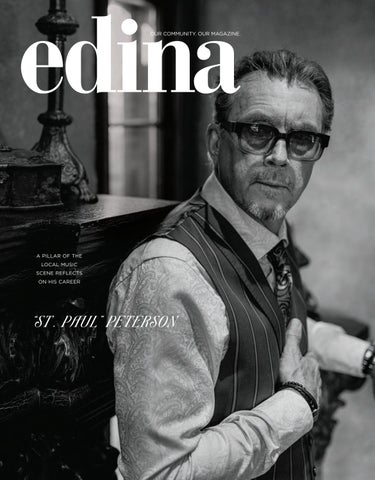
PILLAR OF THE LOCAL MUSIC SCENE REFLECTS ON HIS CAREER

“ST. PAUL” PETERSON

GOLDEN VALLEY, EDEN PRAIRIE, MINNETONKA, PRIOR LAKE AND PLYMOUTH


![]()
A
PILLAR OF THE LOCAL MUSIC SCENE REFLECTS ON HIS CAREER

“ST. PAUL” PETERSON


Welcome to our arts and culture issue. This month, we celebrate the endeavors of the creators in our community. I’m excited for readers to delve into the life of Paul Peterson, whom I first met at a Rotary Club of Edina meeting. He was the club’s president at the time and would start every meeting by serenading us. Another person sitting at my table asked me, “You do know who he is, don’t you?” I replied, “Paul Peterson.” “No,” they said. “That’s ‘St. Paul’ Peterson. He used to play with Prince.” And then it clicked. He’s the guy in the orange suit in Purple Rain! But he’s not the type to boast about it. He is more likely to chat about his podcast or his work at the Church of St. Patrick–Edina. Our writer Jennifer Pitterle beautifully captures how music has influenced Peterson’s life (page 27).
We also delve into the history of another local icon, the Westgate Theater. While the building is no longer standing, its legacy endures. Author Jon Gaspard has penned a book that chronicles how the theater gave Harold and Maude its cultclassic status by screening it for two years straight. The quirky comedy went from a critical and commercial flop to a beloved phenomenon all because of this one theater and its devoted community (page 14).
Speaking of quirky, one of my favorite memories from my grad school days in London was a Sunday afternoon of adventure. I went out for a walk with my friends Gwladys and Aarty. The afternoon began on Tottenham Court Road, where we ducked into a Cornish pasty shop. Wall-to-wall glass cases with pasties in probably more than 20 flavors. “What is a pasty?” Gwladys asked. The shopgirl replied, “It’s a savory pastry the miners used to eat. Try one!” I don’t remember the shop’s name, but I’ll never forget the bacon, chicken and leek pasty I had. Its deliciousness was unparalleled. Fueled by that buttery, savory pocket of joy, we broke into an impromptu dance and skipped across the city from Oxford Circus down Regent Street, through Picadilly Circus and over the bridge to Waterloo. That long walk was fueled by some serious pasty power. From that day on, whenever I go out, I make it a point to try a dumpling from any cuisine I encounter. A calzone, a pierogi, a samosa, a wonton; if it is dough wrapped around something, I am in. Which got me thinking: What if I took you, Dear Readers, on a dumpling tasting spree around Edina and Linden Hills (page 32)?
I hope this issue brings you inspiration to sing, to create and to plan your own dumpling tour.

On the Cover: Paul Peterson, page 27


VOL. 21 NO. 8
March 2026
PUBLISHER
Susan Isay
EDITOR
Feroza Mehta
MANAGING CREATIVE DIRECTOR
Renée Stewart-Hester
MANAGING EDITOR
Hailey Almsted
DIGITAL EDITOR
Madeline Kopiecki
COPY EDITORS
Kellie Doherty and Sherri Hildebrandt
STAFF WRITERS
Mollee Francisco, Emily Gedde, Jennifer Pitterle, Alexandra Tostrud and Paige Udermann
CONTRIBUTING WRITERS
Sarah Davis, Emily Deutschman, Taylor Ellingson, Daniel Green, Gregory Rich, Twila Singh, Kelly Smith, Maureen Millea Smith, and Laura Westlund
DIGITAL INTERN
Claire Krieger
EDITORIAL INTERNS
Diane Meyer and Avery Vrieze
EDITORIAL ADVISORY BOARD
Daphne Edwards, Edina Public Schools ; Greg Hoyt, Gather Venture Group ; Shelly Loberg, Edina Chamber of Commerce ; Nicole Meehan, Edina Education Fund ; Rebecca Sorensen, 50th & France Business Association ; Kelly Vickers, Zimmer Design ; and Annette Wildenauer, Design Mode Studios
SENIOR MANAGING ART DIRECTOR
Sarah Dovolos
ART DIRECTOR
Allison Nolden
ASSOCIATE ART DIRECTOR
Jamie Klang
GRAPHIC DESIGNER
Yaz Lo
LEAD STAFF PHOTOGRAPHER
Chris Emeott
PRODUCTION DIRECTOR
Brittni Dye
PRODUCTION MANAGER
Lisa Stone
PRODUCTION COORDINATOR
Mimi Coz
SENIOR ACCOUNT EXECUTIVES
Laura Bjorgo, Cynthia Hamre and Sara Johnson
ACCOUNT EXECUTIVES
Rochita Chatterjee and Gina Neumann
PRESIDENT Pete Burgeson
To subscribe to Edina Magazine , please visit localmedia.co. For customer service inquiries, please contact hello@localmedia.co, or call 612.208.6248. ©Local LLC 2026. All rights reserved.


Top:
This installation is part of a book launch at 9 Mile Gallery. The Lion recreates artwork in Tina Wilcox’s The Conscious Kingdom
Bottom:
Gregory Rich and guest

Sing-songy rhymes and three unusual friends are some of the delightful features in Lizzy the Pizzly, a debut picture book by Edina author Meghan DesLauriers. It’s perfect for the toddler in your life.
Lizzy is on the hunt for another pizzly bear just like her. As Lizzy ventures through the forest on her grand search, she bumps into three unique friends. Although they aren’t exactly who she’s looking for, she ends up being OK with being the only pizzly bear. Lizzy is reminded that at the end of the day, our oneof-a-kind characteristics are what makes us so grand.
Jess Fuentes is a co-owner of Wild Rumpus Books in Linden Hills. Find this title and more at wildrumpusbooks.com.


Art gallery exhibitions can feel intimidating, especially for those without a background in fine art. The thought of attending a gallery event may seem daunting, but as a gallerist, I want to emphasize that these events are not tests. They’re an opportunity to support the creative process, enjoy the experience and learn something new.
To help ease the nerves and encourage conversation, here are three questions you can ask at an art exhibition to deepen your engagement with the artwork:
1. What inspired the use of color in this piece?
2. Can you tell me about the process behind creating this artwork?
3. How does this piece connect to the artist’s previous works or their overall vision?
These simple questions open the door to meaningful dialogue and a richer understanding of the art you’re experiencing.
Gregory Rich is the owner of 9 Mile Gallery at The District Edina. Learn more at thedistrictedina.com.
For 84 years, the Westgate Theater at the intersection of France Avenue and Sunnyside Road brought Hollywood to Morningside. It opened in 1935 with Lady Tubbs, starring Alice Brady and Douglass Montgomery. The theater was a genuine community center, with a room for bridge and other card games as well as the stylish theater designed by Perry E. Crosier with Liebenberg and Kaplan, an architectural firm that built many of the Twin Cities’ prominent early movie theaters.
The Westgate featured popular matinees like Charlotte’s Web and Herbie, the Love Bug on school holidays. Along with entertaining locals, the Westgate hosted actors and actresses. Tippi Hedren, the star of The Birds , grew up near the theater and visited for the premier. Academy Award winner Ruth Gordon and Golden Globe nominee Bud Cort made appearances during anniversaries of the interminable run of Harold and Maude, which you can read more about in our feature on page 14.
The final film shown at the theater was The Late Show with Art Carney and Lily Tomlin. After the movie theater closed in 1977, the building remained an impressive art deco geometric silhouette, across the street from the neon and Streamline Moderne style of Convention Grill, until it was razed in 2019.
Contributed by Laura Westlund, an arts writer and editor in the Twin Cities.


A new spot for coffee, community and conversation opens near Pentagon Park.
By Avery Vrieze
Nestled under The Finch apartment building in Edina, the green landscape around the entrance and friendly sign leading up to The Lobby Coffee & Leisure’s door sets the tone for the earthy, cozy feel inside.
Opening in July, this is The Lobby’s second location; the original being on Water Street in Excelsior. Owners Catherine and Tyler Nelson chose the new spot for its proximity to Fred Richards Park and the Nine Mile Creek Regional Trail, tucked just behind the building. “The park was the biggest thing,” says Latif Kamara, director of operations. “But also, there is a built-in clientele. We would be considered an amenity to The Finch.”
In front of the coffee bar sits a long wood booth built into the wall with several tables for ample seating. Natural light streams through the windows, bringing a warm feel to the space, perfect for chatting, studying
or working. As a company, Kamara says The Lobby focuses on being a welcoming place to sit and sip. It places a special emphasis on the for-here cup, using ceramic mugs for lattes and glass cups for iced beverages over the usual paper cup. When people ask for a for-here cup, Kamara says it allows them to enjoy their drink and the atmosphere.
“We have smoothies, teas, chai, matcha, and then we have sandwiches,” Kamara says. The shop prides itself on its seasonal menu. In the fall, it was known for its Brown Butter Banana Bread Latte, far more popular than its Pumpkin Spice Latte, Kamara says. In the spring, past drinks included the popular Cereal Milk Latte. This past winter, The Lobby partnered with a local honey provider to create a Hot Honey Latte.
Each sandwich at the shop is handcrafted and made to order, something the shop prides itself on. Try a Sausage Breakfast Sandwich on a brioche bun, or try a panini, available after 11 a.m., served with kettle chips or a kale salad. “We make everything to order. So I would say that sets us apart from other places. Doesn’t make us better or worse, just sets us apart,” Kamara says.
In addition to made to order sandwiches, The Lobby partners with Patisserie 46 in Minneapolis. Try a scone infused with Earl Grey tea and black currants, or a delicious gluten-free brownie.
According to Kamara, The Lobby has three values: hospitality, education and information. Along with the for-here cup format, it leans into the aesthetics of both the Edina and Excelsior spaces. At the Edina location, the coffee bar’s woodsy warmth—defined by paneled wood and blue accents—offers a striking contrast to the shop’s gray doors and white concrete walls, creating an inviting spot for a midday pick-me-up.
“We have a lot of remote workers,” Kamara says. “So we offer a space that is affordable and very aesthetically pleasing.”
The Lobby Coffee & Leisure
thelobbycoffee.com
@thelobbycoffee_and_leisure


4801 Woodhill Way – Edina
$1,750,000
Welcome to this beautifully maintained walkout rambler nestled on a spacious .66 -acre lot in the highly sought-after Sunnyslope neighborhood. Enjoy the outdoors with a large, private backyard, cozy firepit, and screened porch — perfect for relaxing or entertaining. Inside, the main-level primary suite offers comfort and convenience, complemented by a dedicated main floor office — ideal for working from home. The open layout provides excellent flow for everyday living and entertaining. An additional upper-level en suite bedroom is perfect for guests, in-laws, or a private retreat. The fully finished walkout lower level features a custom bar, spacious family room, and two well-sized bedrooms. This home blends comfort, functionality, and outdoor charm — a rare find in a coveted location.


Conzemius’ debut album blends emotion, ethereal sound and poetry.
By Mollee Francisco
The music has long flowed through Jill Conzemius’ veins, but for the first time, her voice and her words are joining for the world to hear. In August, Conzemius, who uses her last name as her stage name, released her debut EP Of the Water, a collection of deeply personal songs with an ethereal indie vibe. She describes her music as lyricism that floats with a beat. “There is beauty in this world, and I translate it,” she says.
The southwest Minneapolis resident says the music, which has been featured on The Current, couldn’t have come any earlier than it did. “It took some life actually,” Conzemius says. “You can’t rush depth and soul. This is the time. It feels right.”
Conzemius likes to say that there was an incubation period for her art. “There was a time that life’s challenges demanded all of my attention and effort,” she says. “But I had to live in those moments. I needed that for my own songs to come to life.”
Conzemius was the sort of toddler that toted a toy boombox and mic around her childhood home. Wherever there was music playing was where one could find her. “It’s been a known thing in my life,” she says. As she grew up, Conzemius joined choirs and bands. Then she found work recording vocals for singer-songwriters in many genres, including soulful Americana and Motown. And while the work was good, it felt more like she was doing impressions of other musicians instead of defining her own sound. “It ended up confusing me as an artist,” she says. “I began to wonder ‘What is Jill’s voice?’” The answer to that question can be found on Of the Water. “It tells the story of softness and chaos after healing. There is beauty in emotion,” she says.
Of the six songs on the album, Conzemius says the title track is the most personal. “It’s about self-acceptance [and] swimming through the depths of who you are,” she says. “My songs are full of metaphors. I like the simplicity of keeping it poetic.”
Since her youth, Conzemius has kept notebooks and journals to jot down her thoughts and poetry. Now, her phone serves the same purpose, holding lines for future use. That future isn’t far off. After releasing her debut EP, Conzemius is preparing to share more of her music with the world in late spring. “I want to do this forever,” she says. “I want to create this art and feed it for as long as I can.”
Conzemius conzemiusmusic.com @conzemius_music


John Gaspard is retelling a remarkable chapter of movie history in his new book, Held Over: Harold and Maude at the Westgate Theater. It’s the story of how Edina’s Westgate Theater kept a film alive and helped transform it into a cult classic after the rest of the industry wrote it off. Released in 1971, Harold and Maude was controversial for its time because of the romantic relationship between its two main characters. The dark comedy follows Harold (Bud Cort), who is obsessed with death, and Maude (Ruth
Gordon), a free-spirited 79-year-old he meets at a funeral. While Harold fixates on mortality, Maude adores life. Over the course of the film she teaches him how to live fully and find joy. We caught up with Gaspard to learn about his inspiration for the book and how the legacy of the Westgate Theater lives on.
What attracted you to Harold and Maude’s run at the Westgate Theater? The simple truth is that I found the confluence of the
right movie at the right theater at the right time to be an inherently interesting story. If I wrote this book for anyone, I wrote it for myself to read and enjoy.
What makes this story so interesting for readers today? It’s a testament to the power of grassroots enthusiasm and word-ofmouth marketing. When Harold and Maude was first released, the film was a box-office disappointment in most cities. It opened
An area author resurrects the story of how a bygone theater made box-office history.

Written by Emily Gedde

and closed in two weeks in downtown Minneapolis despite strong local reviews. Harold and Maude’s success at the Westgate was driven by repeat viewers who loved it.
How did you research the book? I looked into both the history of the movie as well as the history of the theater. I was fortunate enough to chat with several of the people who offered first-hand knowledge. This included Nancy Saslow, granddaughter of the theater’s
founder, Carl Fust; William (Randy) Greene, assistant manager at Westgate during the run of Harold and Maude; Doug Strand, the legendary “Super Fan” who saw the film 165 times; and Henry Owen, whose wife organized the small protest against the film’s long run.
In addition to those personal accounts, I drew heavily on local archives and historical resources, including the Edina Historical Society and the Minnesota Historical Society and newspapers.com.
Middle: Westgate Theater’s auditorium circa 1935. (From
Ruth Gordon receiving a commemorative plaque at Westgate Theater in 1973 as part of the first anniversary of Harold and Maude.
Did you encounter any unexpected details? One of the most surprising discoveries was learning about the history of Westgate itself. When I worked there in 1975, the place was tired and worn. I had no idea that it was once a showplace with a grand and opulent opening in 1935, founded by a visionary musician named Carl Fust, who planned for it to have a stage for an orchestra and a club room for local meetings.
Another interesting tidbit was the fact that such a beloved film didn’t turn a profit until more than 10 years after its release. Ruth Gordon herself recalled that when she received her first profit check for $50,000, she almost threw it away, thinking it was one of those sweepstakes from Reader’s Digest.
How did Westgate Theater and its audience play a role in reshaping the legacy of Harold and Maude? The theater gave the film a second chance. This relentless enthusiasm resulted in Harold and Maude running for 115 weeks, breaking the all-time Minnesota record previously held by The Sound of Music (95 weeks). The run created so much buzz that Paramount Studios began using the Westgate’s success as a centerpiece of national advertising campaigns when rereleasing the film in other cities. In essence, Westgate provided the proof-of-concept that the film was a hit, forcing the rest of the country to pay attention.
Why do you think this story matters? For the Edina community … it chronicles the history of a beloved local institution and neighborhood resource that is now gone. It reminds us of a time when the neighborhood movie theater was a central part of people’s lives. It’s a tale deeply rooted in the Morningside neighborhood, chronicling everything from its founder Carl Fust to the residents, who protested the film’s long run because they missed having variety.
The book combines film history with local nostalgia. How did you include that balance, and were you aiming for a certain tone? The book includes dedicated sections to the Westgate before Harold and Maude and the Westgate after Harold and Maude, ensuring the neighborhood theater is as much a character in the book as Harold or Maude. The tone I aimed for was one of enthusiastic, personal discovery. I wanted the reader to feel like they were coming along for the ride,
sharing my own excitement, especially when recounting the chaotic and thrilling two-year anniversary celebration in 1974.
What do you hope readers take away from the book? I hope readers are reminded of the power of passionate fandom and word-ofmouth in supporting art that might otherwise be overlooked. As former Westgate manager Ralph Watschke said, after the film ran 1,957 times at his theater: “I’m looking forward to seeing it again.” I hope the book makes readers want to revisit or discover this enduring classic themselves.
Below: John Gaspard’s book cover was designed by Author Elevator. It is available wherever books are sold.


Faribault Mill is where history, craft and stubborn optimism are woven together.
Written by Feroza Mehta — Images courtesy of Faribault Mill
Paul Mooty stands at the bottom of a concrete stairwell in the basement of Faribault Mill in Faribault, Minnesota. An antique scouring line, a machine that used to clean raw wool until the 1950s rests in the corner. Dye vats capable of turning 500 pounds of wool into a myriad of colors stand in the room. The walls are still faintly stained blue from dye that once ran through floodwater. It is the place where, in March 2011, Paul nearly turned around and left.
Seven feet of water had filled this basement just months prior. The plumbing didn’t work. There was a limited electrical system. Chemical residue lingered on the floor, and their guide, Dennis Melchert, who worked at the mill for 30 years and was living in a house on the property, warned Paul not to touch anything. “That was my introduction,” says the Edina resident and vice-chairman of the board of Faribault Mill. “I was thinking, ‘What am I doing here? This place is a mess.’”
At the time, the company was called Faribault Woolen Mill. It had been closed for two years. Its 175,000-square-foot factory, perched along the Cannon River about 50 minutes south of the Twin Cities, was silent. It’s been said that once upon a time, half the blankets in America came from this mill. When Paul saw it in 2011, it felt abandoned, waterlogged and destined for dismantling. Paul had arrived almost by accident, invited by a college roommate whose father was touring the property. He rode down with


Our top agents provide in-depth market insights, local expertise, and targeted strategies to showcase your property and connect buyers with the lifestyle they desire.

David Johnson 612-889-7793

Cari Ann Carter 612-926-9999

Eric Smedsrud 952-221-9299

Jude
952-240-4890
952-240-4903

Heidi Barcelow 612-232-9777

612-803-8129

Rene Roos 952-261-6356


Gary & Sue Wahman 952-334-4663


952-201-4758

612-434-3836 NMLS # 2256721


681623

John Everett 952-221-5464

Amy & Ali Deckas 612-735-7430

Scott & Michele Skjei 612-414-3213

Megan Brinkman 612-802-5057

Hendricks 612-735-2729

Krieter 612-719-0665

Kristin Smith 612-965-0030

Hanson 612-414-2466


the group, which meant he couldn’t leave early. “If I’d driven myself, I probably would have,” he says.
Instead, Paul stayed for the full two-hour tour. Melchert walked Paul through the building and shared the mill’s story. Founded in 1865, just after the Civil War, Faribault Woolen Mill operated in the same building since 1892. It had been powered first by horses, then by river-driven hydraulic power and eventually by electricity. During World Wars I and II, odds were high that an American soldier carried a Faribault blanket. Under the Klemers and later the Johnson family, the mill survived the Great Depression, innovated washable and mothproof wool, and became woven into the daily lives of the community.
This story inspired Paul, and after the tour, he drove home and told his wife Jean, “‘What a disaster. But what a cool story. What a special place,’” he says. He was torn between the ruin and the history behind the brand. That got him thinking about the possibility of bringing the mill back to life. Melchert, Paul sensed, was hoping someone would come along and save the mill. “Things happen for a reason,” he says. He thought about the mill for weeks before calling his cousin, Chuck Mooty. The Edina resident and former CEO
of International Dairy Queen took a look at the factory and saw its potential. “On March 8, 2011, I walked down those basement stairs. Six weeks later, on April 22, Chuck and I had a signed letter of intent to buy the mill’s assets,” Paul says.
What they bought was a gamble. When the Mootys acquired the assets, they didn’t know if the machines worked. Everything was still there, the dye vats, scouring lines, spinning frames, looms and an archive of patterns. “We bought it and said, ‘All right, let’s see what happens.’ The first day of business was July 5, 2011. Five employees showed up,” Paul says.
Among those employees were Melchert and Avinash Bhatnagar. They reached out to former workers—people who knew the machines, the rhythms and the quirks of wool manufacturing. By the end of the year, the mill employed 40 people, 37 of whom were former employees, including one woman who had worked there for 63 years, Mary Boudreau. “A lot of that knowledge is gone in this country. We were lucky,” Paul says.
Millions of dollars in renovations were immediate and extensive: a new boiler, repaired electrical and plumbing systems, flood mitigation and building repairs. The basement where Paul once wanted to flee now houses essential infrastructure. Wool arrives

already scoured, but the process remains largely intact: dyeing, spinning into yarn, drying, weaving and finishing all exist under one roof. Scrap wool is ground back into fiber and reused. The mill operates as a rare one-stop shop for American wool manufacturing.
Equally powerful was the brand itself. Faribault Woolen Mill was 144 years old when the Mootys took over. “People spend a lifetime building a brand name,” Paul says. “We started the 100-yard dash more than halfway down the track.” Classic designs like the mill’s three-stripe blanket, made since the 1920s, returned first. Large orders followed, including a 100,000 unit run for JCPenney and contracts to supply the U.S. Army and Navy.
National attention arrived quickly. Media outlets such as The Wall Street Journal and international broadcasters from as far away as Japan took notice of a shuttered American mill coming back to life. In 2017, the company was invited to the White House for its Made In America Showcase. When the


call came on a Friday, asking them to be in Washington by Monday morning, Paul knew exactly who to bring along with him.
“I walked out to the plant and grabbed [Boudreau],” he says. Boudreau was the weave shop lead and master weaver. “I said, ‘They want us at the White House. I can’t imagine a better representative than you.’ She asked, ‘What will I wear?’ It was only the second time in her life she had flown. When she passed away some years later, she was buried wearing a Faribault Mill sweatshirt,” he says.
Moments like that underscore how Paul sees his role. “We’re not owners in the traditional sense,” he says. “We’re stewards. It’s not about us. It’s about the company.” He speaks often of the families who ran the mill for
generations and the workers who gave and continue to give their lives to it. Former president of the company, Pete Johnson, told Paul he couldn’t drive past the mill after it closed; it hurt too much. When it reopened, he was overjoyed his family’s legacy would live on.
Today, Faribault Mill is 100 percent American made. “Period. Full stop,” Paul says. The company continues to innovate, expand its supply chain and even operates a cotton mill in Maine to balance seasonal production. It purchased Brahms Mount in 2022. It was that acquisition that prompted the name change from Faribault Woolen Mill to Faribault Mill. Yet the heart of the business remains here in Minnesota. The company merged with CircleRock in 2020, and
Left: Faribault Mill’s Edina High School Varsity Letter Throw Blanket is a fixture in many homes and is often spotted at outdoor games.
Top right: Mary Boudreau worked for the company as a master weaver for decades. When the White House called to invite Faribault Mill to its Made In America Showcase in 2017, Paul Mooty asked Boudreau to attend. She stands beside former CEO Tom Kileen.
Bottom right: Mary Boudreau at a loom weaving an American Flag Wool Throw.


millions of dollars worth of new machines were purchased. The company’s president and CEO is Ross Widmoyer, and Paul is now vice-chairman of the board. The Mooty family are still part owners of the company. The building is owned by Paul and Jean, and is on the National Register of Historic Places.
“When you pull in here, you feel the history,” Paul says. He looks around the factory room at the old, original brick walls. “If these walls could talk,” he says. He pauses, smiles and then says, “Hopefully, they keep talking for another 160 years.”
Faribault Mill
faribaultmill.com
@faribaultmill


A PILLAR OF THE LOCAL MUSIC SCENE REFLECTS ON HIS CAREER.
Longtime Edina resident Paul Peterson was born into music. His parents, Jeanne Arland Peterson and Willie Peterson, met while working in the Minneapolis music scene— Willie as an orchestrator, arranger and commercial jingle writer; Jeanne as a pianist and organist for WCCO Radio, the Minnesota Twins and various jazz ensembles. “My boyhood home in Richfield holds such musical significance, not only for our family but for the Minnesota music community,” Paul, now 61, says. “It’s seen more rehearsals than I can count over more than 70 years.”
Paul’s father, Willie, died when he was 4. Paul and his four siblings—Linda, Billy, Patty and Ricky—helped their mom keep the family’s musical spirit alive. All five of them (and many of their children in the next generation) have had successful music careers and still often perform together. “I gravitated toward instruments because that’s just what we did at our house,” Paul says. He attended Richfield’s Academy of Holy Angels and started taking piano lessons from the nuns there at a young age.
During and after high school, Paul worked a series of music jobs, often playing with bands at local restaurants and other venues. Did he ever consider a different path or pursue a college degree? In short: no. “I always knew what I was going to be doing. I’ve been doing it since the minute I was born,” Paul says.
Shortly after Paul graduated from Holy Angels in 1983, a friend heard about some upcoming auditions for The Time—Prince’s ensemble project, which longtime collaborators Jimmy Jam and Terry Lewis were leaving. There was an opening on the keyboard. “I was on vacation and had to hurry home and learn the songs for the audition,” Paul says. He met the Purple One himself at the second callback. “I finished playing, and he came over to me and walked me to a whole bunch of swatches for clothing,” Paul says. Prince told him to pick out a suit. When he asked what it was for, Prince answered, “For the


says. “Minneapolis was one of the greatest places to cultivate artistry.”
Paul spent much of the 1980s in Prince’s camp, spending lots of time at Paisley Park in Chanhassen and playing with The Time, then with The Family, a subsequent Prince ensemble that was built around Paul. He was christened “St. Paul” by Prince. “I still wear that nickname as a badge,” he says. “The college of Prince taught me about performance, marketing, production and songwriting—it was an incredibly valuable time for me.”
The Family, Prince’s Paul-centered band, stayed together for a few years and recorded the original version of Nothing Compares 2 U, which would go on to become a mega-hit for Prince and then-up-and-coming Sinéad O’Connor. As in most real families, however, things weren’t always sunny. “I was not very happy with my paycheck, and I had two different major labels courting me at the time,” Paul says. “I ended up taking a deal with MCA Records and leaving Prince. He and I didn’t have a relationship for quite a few years after that.”
Paul spent the next many years focusing on his own projects. He released his eponymous
solo debut in 1987 and several albums thereafter. As a sought-after touring and session musician, he played with Peter Frampton, Kenny Loggins, Donnie Osmond, the Steve Miller Band and many other notables.
In the mid-1990s, Paul reached out to Prince to bury the hatchet, and he reunited with many original members of The Family— most recently under the name fDeluxe—to play Prince hits and other original tunes together. The subsequent years have seen a mix of collaborations with the Paisley Park crew and Paul’s solo and familyrelated ventures.
Since Prince’s death in 2016, Paul and his pals have found creative ways to honor their late mentor and keep his local legacy alive, performing the music that brought them all together. “Prince really recognized what the world needed and presented opportunities to musicians who might not necessarily have gotten those opportunities,” Paul says. “I miss him.” He jokes that Prince would probably hate many of the musical tributes that continue to roll in. “He’d say, ‘Quit singing my songs, man!’” Paul says.
“St. Paul” in Edina
When Paul’s mother, Jeanne, passed away a
few years ago, he and his wife, Julie, moved back into his childhood house in Richfield. But before that, they’d called Edina home for decades. He says they couldn’t imagine raising their now-adult daughters, Kelly and Taylor, anywhere else. “We love how homey Edina is. We love the school district, the community itself and all of these tight-knit neighborhoods. People genuinely care about each other here,” Paul says. He says working in music afforded him a flexible schedule that let him be present for his kids’ important moments, from soccer games to prom. Paul is an active member of the Rotary Club of Edina and served as its 2024–25 president.
Right: Paul Peterson was discovered by Prince at the age of 17, and was hired as the new keyboard player for The Time. The album Ice Cream Castle debuted at the same time as Prince’s movie, Purple Rain and that’s Paul Peterson on the keyboard. Next time you hear Jungle Love or The Bird, remember an Edina musician was on the keys. After The Time disbanded in 1984, Prince gathered the remaining members of the band and formed The Family with Paul as the lead singer.


He teaches music at several local studios and schools, and initiated a music festival sponsored by the Rotary Club of Edina last summer. He hosts the popular Music on the Run podcast, in which he interviews musicians from all backgrounds—including many former Prince colleagues. He released a new solo album, Break on Free, in 2022 and performs now with his primary band, St. Paul and the Minneapolis Funk All Stars.
He’s also the director of music and liturgy at the Church of St. Patrick–Edina, a place that holds a lot of meaning. “I’ve been so blessed and have had an incredible career, and it’s not over yet,” Paul says. “I’m grateful every Sunday morning that I get to come to church and play the 9-foot Steinway to give glory to God.”
Those dual images of Paul—in an orange suit on the set of Purple Rain, or playing liturgical music in an Edina church—coalesce to make a picture of the singular life of “St. Paul.”
Paul Peterson
paulpeterson.com
@stpaulpeterson


Written by Feroza Mehta — Photos by Chris Emeott
If it’s wrapped in dough and packed with flavor, we are there in a heartbeat. The Merriam-Webster Dictionary defines a dumpling as, “a casing of dough enclosing a typically savory filling, such as meat or seafood and cooked usually by boiling, steaming or pan-frying.”
Edina and Linden Hills are blessed with an abundance of restaurants with countless permutations and combinations of global dumplings. There are bao, calzones, dumplings, empanadas, gyoza, pasties, potstickers, samosas and many more. On this tour, what unites these portable bites of culture is how each put their own twist on traditional recipes while staying true to their culinary roots. Whether baked, fried or steamed, these dumplings prove that good things really do come in small, delicious packages. You don’t need a passport to take a culinary trip around the world—instead, enjoy these eight varieties to begin your adventure.
These Chinese steamed buns are a distinct type of dumpling because they are fluffy and made with leavened dough. And the filling is not entirely encased in dough. But this difference makes it a rich culinary experience because it gives the dish a pillowy
and bread-like texture. Puttshack has tasty Nashville Hot Bao Buns that have cayennemarinated house fried chicken, chipotle aioli and rainbow slaw. puttshack.com
Calzone in Italian means “trouser leg.” It gets that fun name from its shape. Some people think a calzone is just a folded pizza, but it differs from its pizza pie cousin because of how it’s prepared and its fillings. A calzone is made from salted bread dough and fillings are typically cured meats, mozzarella and ricotta cheese. Once it’s all folded up, it gets baked in the oven. Folding it over makes a sealed pocket. The sauce should never be inside the calzone. It’s meant to be dipped into a sauce, usually marinara. Davanni’s has more Americanized calzones, but they are served with a side of marinara sauce. Editor’s Pick: The Works. davannis.com
Dumplings or jiaozi are usually boiled or steamed and have an unleavened wrapper that is thicker than gyoza or other similar looking delights. Master Noodle and Big Bowl both have tasty braised short rib dumplings and chicken and vegetarian options. Editor’s Pick: soup dumplings or xiao long
bao, which are steamed and have a little bit of broth inside. Find them on Master Noodle’s menu as Steamed Pork Juicy Buns. bigbowl.com; masternoodleusa.com
Empanada means “wrapped in bread” in Spanish. Cahill Bistro, an Ecuadorian restaurant in west Edina, is nestled into a strip mall near the intersection of Cahill Road and West 70th Street. It offers pain fried corn dough stuffed with either braised beef (Empanadas de Carne) or fresh vegetables (Empanadas Vegetarianas). Both iterations are served with roasted tomato salsa and crema casera. Martina in Linden Hills has a more fusion take on the empanada, which is stuffed with creamed leeks and Gorgonzola and served with chimichurri sauce. cahillbistroedina.com; martinarestaurant.com
Tucked away in a strip mall in west Edina is Cahill Bistro. Its empanadas are served with crema casera and roasted tomato salsa.


These Japanese dumplings come from the Chinese jiaozi. But the main thing that sets them apart is that they have thinner wrappers, a garlic flavor and are usually pan fried on the bottom to get crispy before being steamed to complete the cooking process. They are traditionally made with pork and cabbage, and you can find them at AMA Sushi, Coconut Thai, Nakamori Japanese Bistro (which has vegetarian options), Raku and Yumi. For the Nepali momos, their preparation is slightly different. They’re first steamed and then panfrield. Muddy
Tiger has vegetarian and chicken momos. amasushimn.com; coconutthaimn.com; muddytiger.com; nakamorimn.com; rakumn.com; yumisushibar.com
Historically, the pasty was the lunch of choice for miners. It is compact, easy to carry and hearty enough to keep a person full for hours. When miners from Cornwall settled in the Iron Range and Michigan’s Upper Peninsula, they brought this beloved and hearty handheld meal with them. There are sadly no restaurants in our readership area
Above: Muddy Tiger chef Jyotiee Kistner steams momos before panfrying them to complete the cooking process. Customers can order vegetarian (encased in green dough) and chicken flavors.
Right: Puttshack puts an Asian fusion spin on bao with its Nashville Hot Bao Buns. Fried chicken is marinated with cayenne and served with chipotle aioli and rainbow slaw.
that serve these deliciously British pockets of goodness. However, Kowalski’s Markets and Lunds & Byerlys stock Pasty Oven’s version of this tasty treat. The company is based in Michigan’s Upper Peninsula. They come in two flavors: beef, pork and ruta baga, and beef and pork. lundsandbyerlys.com
These fried dumplings are called and are similar to dumplings or except they are fried. They have a thicker wrapper than gyoza. Big Bowl has braised short rib potstickers as well as chicken and vegetarian varieties. Master Noodle has fried beef and pork options. masternoodleusa.com
The term samosa comes from the Middle Persian word sambosag gular pastry. It can come in many different shapes, including a flat triangle, a cone or even a crescent. Raag has a delicious potato and pea samosa made in the Punjabi fashion, which is a pyramid. Two samosas are served alongside mint chutney and tamarind sauce. raagindiancuisine.com


Sophia Grotkin and Heather Chakirov have practiced law together for over a decade. They attribute their longstanding partnership to their complementing strengths and mutual commitment to practicing law in areas that serve families during the most sensitive times of their lives.
Over time, they realized, given the nature of their work, a traditional law firm setting was not as approachable as it could be. That’s where Grotkin + Chakirov LLC was created. The firm was established to provide boutique-style estate and guardianship services where community members receive legal help in a professional yet supremely comfortable environment.
The practice offers full spectrum estate planning; fiduciary; guardianship and conservatorship; probate; adoption; relationship agreements; and trust administration and litigation services. “Our team provides a full circle approach to law, meaning we look at the full range of needs of our clients, even if it is not in an area we directly work in, and we meet those needs whether through our own services or connections with other excellent professional partnerships,” Chakirov says.
Grotkin + Chakirov makes its legal offerings accessible through its broad spectrum of services and with an understanding of sometimes uncommunicated client needs. “We practice in the same community we live in, so we have personal knowledge of the legal issues that our clients face,” Grotkin says. “This puts us in an optimal position to be especially helpful.”
When reflecting on what makes the practice stand out from other firms, Grotkin and Chakirov agree. “We have made a particular commitment to empowering families to take control of decision-making for their own lives and legacy,” Chakirov says. “Our clients appreciate that we don’t push; we guide. They know that our input is genuine and practical, not a sales pitch, ever, and our relationships are ongoing—often reaching multiple generations. Our clients know we take that trust very seriously.” Grotkin says.
As individual lawyers and as a firm, the team has been selected as Super Lawyers and Rising Stars as well as Best Lawyers and Law Firm since Grotkin + Chakirov’s inception. 7400 Metro Blvd., Suite 252, Edina 952.800.4550 gcestatefirm.com

Edina Library offers an interactive introduction to musical instruments.
Spark creativity, curiosity and a love of music in your little ones. Toddlers, along with their families, are invited to explore the world of classical music and interact with various instruments at Edina Library’s Petite Concerts.
From 10–11:30 a.m March 12, families can gather at the
library for a hands-on musical experience designed for young ears and minds. The event is facilitated by earlychildhood music specialists and is a collaboration between the library and Breaching Concerts LLC.
To register, go to hclib.org. —Feroza Mehta
03.02, 03.09 and 03.23
Puzzle Tournament
Assemble your team of four players to compete in a puzzle competition, held in a bracket format over the course of three Monday evenings from 6–7:30 p.m. at the Edina Senior Center. Children are welcome to compete with an adult, and teams are $40. edinamn.gov
03.06
Books and Boogie Dance Party
Join the Jolly Pops, a children’s music and entertainment group, from 5–6 p.m. at the Early Learning Center, and enjoy a dance party with your child. The event is free and open to the public. thejollypops.com
03.07–03.08
Mid-Winter Concert
Enjoy music from the Edina Chorale at various times, located at the Calvary Christian Reformed Church. Ticket prices vary, and the concert is for all ages. edinachorale.org
03.14
Jumpstarting Creativity
Adults can join experts from the Loft Literary Center from 1–2:30 p.m. at the Edina Library to get their creative writing juices flowing. hclib.org
03.24
Pour Painting
Instead of a paintbrush, this class teaches those ages 14 and older new techniques to create an acrylic pour painting on wood from 6:30–8 p.m. at the Edina Art Center. The program is $50. edinamn.gov
03.30
Paint and Sip–Pinstripes
Ages 13 and older can join a local artist for a guided art class to create a northwoods sunset scene on a slice of wood from 6–8 p.m. at Pinstripes Edina. Admission is $40. paintandsipmn.com
Compiled by Diane Meyer and Avery
Vrieze
To have your event considered: email edinamag@localmedia.co by the 10th of the month three months prior to publication. Please note that some events may have changed since these pages went to print. Please visit affiliated websites for updates.


Denis Plaster’s love of photography is shared by his daughters Elena and Mya Plaster. Last November, Denis and Mya were strolling along Centennial Lakes Park when they stumbled upon a pictureperfect scene. “We found this spot with a great reflection on the lake. When she lined up her shot, I noticed how nice the composition of her photo was,” says Denis, who used to enter the Images of Edina contest every year.
This photo was his first submission in a decade. Eagle-eyed readers may remember several of Denis’s photos in our pages. To see his children enjoy the same hobby was a full-circle moment for him. “That ‘proud dad’ moment was the inspiration behind my photo of her,” he says. —Feroza Mehta

Photographer: Denis Plaster
Title: Aspiring Photographer Equipment: iPhone 15 Pro
Location: Centennial Lakes Park Category: People Award: Honorable Mention
To view other Images of Edina photo contest winners, visit edinamag.com.


