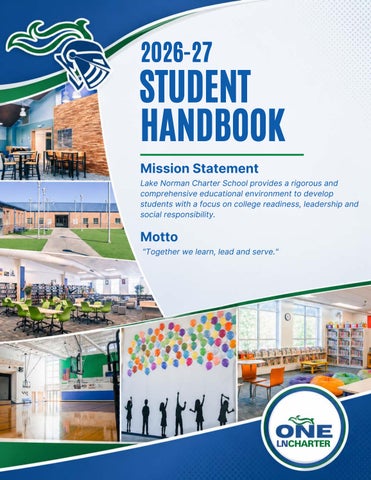
2026-27
STUDENT HANDBOOK Mission Statement Lake Norman Charter School provides a rigorous and comprehensive educational environment to develop students with a focus on college readiness, leadership and social responsibility.
Motto "Together we learn, lead and serve."
TABLE OF CONTENTS
Vision and Mission
01
Introduction/Superintendent Welcome Message Our Purpose Our Core Values LNC Commitment to Students, Parents and Staff Diversity and Inclusion School Management Board of Education Administration LNC Honor Code
All School Operations
02
AGENCY COOPERATION AMERICANS WITH DISABILITIES ACT ASBESTOS HAZARD EMERGENCY RESPONSE ACT (AHERA) ARTIFICIAL INTELLIGENCE (AI) ATHLETIC BOOSTERS ATTENDANCE POLICY Special Note Concerning Attendance at the Beginning of the School Year Compulsory Attendance Law Reporting School-Related Activities Make-up Work for Absences Maximum Number of Absences High School Absence Policy and Attendance Recovery CAMPUS RESTRICTIONS COMMUNICATION CONFERENCES CRISIS PLAN/EMERGENCY PROCEDURES CURRICULUM DAMAGE/DESTRUCTION OF SCHOOL PROPERTY DELIVERIES DISCIPLINE POLICY DRESS CODE Statement of Principles Standard of Appearance for Students EDUCATIONAL FIELD TRIP POLICY EMERGENCY CONTACT INFORMATION EPIDEMIC/PANDEMIC PROCEDURES EXCEPTIONAL CHILDREN AND 504 PROGRAM Section 504 Policy Prohibiting Discrimination Against Students w/ Disabilities Evaluation and Placement Review of the Student’s Evaluation Procedural Safeguards/Hearing Rights Discipline of Students with Disabilities
Click any of the SECTIONS listed above to jump to the correct Handbook page
TABLE OF CONTENTS
All School Operations (cont.) EXTRA-CURRICULAR CODE Academic Policy Eligibility and Participation Guidelines Fan Expectations Policy Substance Abuse Policy FAMILY EDUCATIONAL RIGHTS AND PRIVACY ACT (FERPA) HARRASSMENT/BULLYING AND NON-DISCRIMINATION POLICY Sexual Harassment Additional Policy Violations Verbal/Physical Confrontation How to File a Complaint HOMEWORK INCLEMENT WEATHER PROCEDURE MEDIA/PHOTOGRAPHIC RELEASE AUTHORIZATION MCKINNEY-VENTO (HOMELESS STUDENTS) SUPPORT NARCOTICS, ALCHOLIC BEVERAGES AND OTHER DRUGS PARENT AND FAMILY INVOLVEMENT PARENT/STUDENT APPEAL POLICY PARENT TEACHER ORGANIZATION (PTO) PUBLIC RECORDS REQUEST RELEASED TIME FOR RELIGIOUS INSTRUCTION SCHOOL PICTURES SCHOOL SAFETY SCHOOL TELEPHONES SEARCH AND SEIZURE POLICY Authority to Conduct Searches and Seizures Personal Searches Use of Metal Detectors Locker/Desk Searches Search of a Student Motor Vehicles Search of Electronic Devices Search Using Trained Dogs SERVICE ANIMAL POLICY Definitions Use of a Service Animal on School Property by Students/Employees Presence of a Service Animal on School Property Use of a Service Animal on School Property by Visitors Liability Exclusion of a Service Animal from School Property Appeals STAFF AND STUDENT RELATIONSHIPS STAKEHOLDER EXPECTATION GUIDE STUDENT BEHAVIOR CODE Definitions Class I Offenses Class II Offenses Class III Offenses
Click any of the SECTIONS listed above to jump to the correct Handbook page
TABLE OF CONTENTS
All School Operations (cont.) STUDENT SUPPORT POLICY STUDENT TECHNOLOGY POLICY Expectations for Use of School Technology LNC Honor Code and Technology Safety, Identity, Privacy and Security Internet Safety TESTING TEXTBOOKS TITLE IX POLICY TRANSPORTATION Volunteer Drivers Student Drivers USE OF CONTACT INFORMATION VIDEO, BOOKS, AND SUPPLEMENTARY MATERIALS VIDEO MONITORING/SURVELLIANCE CAMERAS Use of Video Recordings VISITORS WALKING ON MAIN CAMPUS WITHDRAWAL POLICY
Elementary Supplement
03
ACADEMIC STANDARDS Student Performance Communication BIRTHDAYS CARPOOL Morning Carpool Afternoon Carpool Late Pick-up Policy EARLY DISMISSAL POLICY FIELD TRIPS HONOR ROLL LOST AND FOUND LUNCH MAKE-UP WORK FOR ABSENCES MEDICATIONS Sick Child PERSONAL ELECTRONIC DEVICE POLICY PROBLEM RESOLUTION RECESS SCHEDULE CHANGES SCHOOL SCHEDULE STUDENT PROGRESS TARDY POLICY TOYS VOLUNTEERS WATER BOTTLES
Click any of the SECTIONS listed above to jump to the correct Handbook page
TABLE OF CONTENTS
Middle School Supplement
04
ACADEMIC STANDARDS Grading Scale Academic Performance Communication Academic Concern Suggestions CARPOOL Morning Carpool Afternoon Carpool Carpool Rules PERSONAL ELECTONIC DEVICE POLICY DISMISSAL POLICY EARLY DISMISSAL GUM HALL PASSES HONOR ROLL LOCKER ASSIGNMENTS LOST AND FOUND LUNCH MEDICATIONS PROBLEM RESOLUTION PROGRESS REPORTS SCHEDULE CHANGES SCHOOL SCHEDULE TARDY POLICY TUTORING WATER BOTTLES
High School Supplement
05
ACADEMIC INTEGRITY ACADEMIC STANDARDS Promotion Grading Scale Academic Performance Communication Academic Concern Suggestions CARPOOL Morning Carpool Afternoon Carpool Carpool Rules CPCC/DUAL ENROLLMENT PERSONAL ELECTRONIC DEVICE POLICY
Click any of the SECTIONS listed above to jump to the correct Handbook page
TABLE OF CONTENTS
High School Supplement (cont.) DISCIPLINE POLICY (HS) Definition of Consequences Involvement of Law Enforcement Leaving Campus Without Permission DISMISSAL POLICY Early Dismissal DRIVER’S EDUCATION CLASSES EDUCATIONAL FIELD TRIP POLICY HIGH SCHOOL CREDIT OPTIONS POLICY Credit By Demonstrated Mastery (CDM) Appeals Credit Options HIGH SCHOOL GRADUATION REQUIREMENTS Required Core Classes Additional Required Classes Graduation Ceremony Participation HONOR STUDENT DESIGNATION LOCKER USE LOST AND FOUND LUNCH MEDICATIONS PARKING PASS PRIVILEGES CPCC Dual Enrollment Parking Policy PROGRESS REPORTS PROBLEM RESOLUTION SCHEDULE CHANGES SCHOOL SCHEDULE TARDY POLICY TRANSCRIPTS TUTORING
Click any of the SECTIONS listed above to jump to the correct Handbook page
VISION & MISSION
Message from the Superintendent Dear LNC Families, Welcome to a new school year at Lake Norman Charter! As your Superintendent, I want to take a moment to thank you for your continued partnership and the vital role you play in our school community. Family engagement—whether through volunteering, attending school events, or supporting your students' learning at home—is one of the most important factors in student success. Your time, energy, and presence make a real and lasting difference. I am especially grateful to our students and families for consistently living our mission by serving others and leading with integrity both inside and outside of school. Our stakeholders shared thousands of hours of their time and talents volunteering this past school year, and that type of commitment to our core values strengthens not only our campuses but our greater Lake Norman community. At LNC, we believe in the power of working together. When families, staff, and students are united, we create an experience where every student is seen, supported, and given the opportunity to reach their full potential and share their unique gifts. Thank you for being an essential part of the LNC family. Here's to a great year ahead!
Warm regards,
Shannon Stein, Superintendent
Ms. Shannon Stein LNC Superintendent
INTRODUCTION This Student Handbook replaces all prior versions of this document; however, it is not allinclusive and may be amended as policies change. This handbook has been designed to offer you a reference to pertinent information you might need this school year. Familiarity with the contents should help you be better prepared. Throughout the year, you may need to refer to this handbook. We encourage you to ask whenever you have questions. Two-way communication is essential to a smooth operation and school year. The terms “Lake Norman Charter,” “LNC” and “school” all refer to the Lake Norman Charter elementary, middle and high schools collectively, and are used interchangeably throughout this Student Handbook.
OUR PURPOSE To meet school objectives, LNC provides: A challenging academic environment A focused classroom size with effective student-to-teacher ratio in core classes A strong discipline and honor code A strong, cooperative environment Professional accountability The school’s curriculum is centered on creative problem solving, critical thinking, research skills and presentation. This environment produces self-directed students who are capable of being competitive in a 21st century world. The educational focus of LNC is to provide a motivating environment designed to allow students to learn in accordance with their needs and abilities. The combination of small class sizes, a safe school environment and the highest quality teachers provides an excellent learning environment. The high school offers only a college-prep pathway (North Carolina Future-Ready Course of Study) consisting of Standard, Honors and AP classes.
OUR CORE VALUES We develop partnerships between and among school, parents and community. We provide a rigorous college preparatory program that allows our students to be successful at their college of choice and beyond. We develop self-directed learners who take ownership of their academic success. We actively support student contributions to the community through service opportunities and environmental stewardship. We expect all stakeholders to accept personal accountability for upholding the LNC Honor Code and LNC Stakeholder Expectation Guide. We promote extracurricular activities that enable students to develop self-confidence, school spirit and leadership skills. We promote and embrace an understanding of individual and cultural diversity. We communicate openly to foster an atmosphere of trust and safety.
LNC COMMITMENT TO STUDENTS, PARENTS AND STAFF LNC is committed to helping each student maximize individual potential, develop self-confidence and explore personal interests. LNC is committed to recruiting and hiring faculty members who are dedicated to their profession; teachers who are skilled in their fields of instruction and work hard to maintain an atmosphere of mutual respect between teacher and student. LNC is committed to developing and preparing students to be responsible citizens and leaders through their involvement in community projects. LNC relies on a spirit of cooperation between students, parents, staff, administration, community and the board of education to create a supportive learning environment for all. LNC promotes academic clubs, activities and competitions. Student participation in such activities promotes academic rigor, problem solving skills, self-confidence and a sense of personal accomplishment. LNC encourages athletic endeavors where appropriate, which we believe promote physical vigor, school spirit, sportsmanship and a sense of personal accomplishment.
DIVERSITY AND INCLUSION Lake Norman Charter School (LNC) is committed to fostering an environment that respects and values the experiences and strengths of a diverse and inclusive community of students, parents, staff and board of education. Such differences include abilities/disabilities, race, color, ethnicity, gender identity, gender nonconformity, age, religion, language, sexual orientation, socioeconomic status, national origin, political affiliation and more. We believe that cultivating an inclusive learning environment that is free of hostility, intimidation or marginalization of any groups creates shared understanding, awareness and the opportunity to contribute positively to our local and global communities.
SCHOOL MANAGEMENT LNC is a non-profit corporation with operations overseen by a board of education. The board meets monthly to oversee the legal, financial, governance and strategic issues of the school’s operation. Board members serve for staggered terms and new board members are selected through a nomination process. The school’s superintendent is responsible for all day-to-day operations of the elementary school, the middle school and the high school. The superintendent reports directly to the LNC Board of Education.
LNC BOARD OF EDUCATION OFFICERS: Craig Randall, Board Chair Jeff Flanagan, Vice Chair Joana Sampson, Secretary Andrew Palladino, Treasurer
BOARD MEMBERS: Nicole Benford Erick Bowen Landon Eustache Jorge Gonzalez, THRIVE Committee Chair Derik Screen, Future Ready Committee Chair
BUILDING ADMINISTRATION
Ms. Melanie Latza Principal, Elementary West
Ms. Michelle Holland Principal, Elementary East
Ms. Ashley Moore Asst. Principal, Elementary East
Mr. Nicolas Carlascio Principal, Middle School
Mr. Mark Maleck Principal, High School
Mr. Peter Fusco Asst. Principal, Middle
Mr. Marcus Funchess Asst. Principal, High
LNC ADMINISTRATION
Mr. Scott Abel Director of Facilities
Mr. Lon Chang Director of Technology
Ms. Sara Lay Director of Community Relations
Dr. Cherie Graham Director of Academics
Mr. Matt Schlegel Athletic Director
Ms. Lori Hughes Exceptional Children’s Coordinator
Ms. Hayley Wilson Director of Business Services
LNC HONOR CODE In compliance with LNC’s mission to learn, lead and serve, all members of the LNC community are expected to display good manners, show respect for others and their property, be honest, reliable and conform to the highest standards of behavior by following the LNC Honor Code. Furthermore:
Student Responsibilities All LNC students are required to: Read and sign the LNC Honor Code. Support and promote the LNC Honor Code and follow all LNC policies, procedures and guidelines. Be honest in all academic and social endeavors. Act with courtesy and consideration in all interactions with students, parents, faculty and staff at school and in the community. Treat school facilities and property with care and respect. Treat personal property and others’ property with respect. Uphold the LNC Honor Code while participating in all curricular and extra-curricular activities and interacting within the community as a representative of LNC. Report to a staff member any knowledge of academic dishonesty by another student, such as receiving an unsolicited copy of another student’s work or answers.
Parent Responsibilities All LNC parents are required to: Read and sign the LNC Honor Code and LNC Stakeholder Expectation Guide. Support and promote the LNC Honor Code and follow all LNC policies, procedures and guidelines. Model the values and expectations required of students. Trust the administration and staff to work in the best interest of their students, including investigating concerns without parental presence. Not provide excessive assistance on homework or projects.
Staff Responsibilities All LNC staff members are required to: Meet the expectations of the “Portrait of an LNC Educator”. Support and promote the LNC Honor Code and the Knights Standard. Model and uphold high expectations both academically and behaviorally. Be fair, firm and consistent.
Board Responsibilities All LNC board members are required to: Read and sign the LNC Honor Code. Support and promote the LNC Honor CodeBOARD and follow all LNC policies, procedures and guidelines. MEMBERS: Model the values and expectations required of students. Nicole Benford Be fair, firm and consistent. Jorge Gonzalez, THRIVE Committee Chair
Gray Morris Derik Screen, Future Ready Committee Chair
ALL SCHOOL OPERATIONS
AGENCY COOPERATION School authorities are commonly asked by law enforcement agencies, Social Services, Child Protection Agencies and others for permission to speak to our students as part of their investigative procedures. It is the position of Lake Norman Charter to cooperate with these requests. If a student is suspected of illegal behavior or activities while at school or school-sponsored activities, LNC administration reserves the right to notify local law enforcement. Additionally, LNC is not required and may not contact a parent if any agency makes contact with their student due to safety reasons.
AMERICANS WITH DISABILITIES ACT Lake Norman Charter does not discriminate against any person on the basis of disability in admission or access to the programs, services, activities of the school, or in the treatment of individuals with disabilities or any aspect of operations. The school does not discriminate on the basis of disability in its hiring or employment practices. This notice is the Americans With Disabilities Act (ADA) of 1990 and Section 504 of the Rehabilitation Act of 1973. Questions regarding the ADA and Section 504 may be forwarded to the school office.
ASBESTOS HAZARD EMERGENCY RESPONSE ACT (AHERA) The US Environmental Protection Agency’s (EPA) Asbestos Hazard Emergency Response Act requires all schools to inspect building materials for the presence of asbestos. AHERA excludes schools from the inspection requirement if the school was constructed after October 12, 1988, and has a signed statement from the architect or project engineer responsible for constructing the school stating that no asbestos-containing building materials were specified for use in construction of the school. LNC has been provided such a statement, and is, therefore exempt from the requirement to conduct an asbestos inspection. The EPA requires us to annually notify you that we are aware of the AHERA regulation, and that we are in compliance. The Management Plan is available for your review during normal school hours.
ARTIFICIAL INTELLIGENCE (AI) Lake Norman Charter is committed to maintaining academic integrity and dedicated to upholding academic integrity by ensuring that all student work reflects each individual’s genuine effort and understanding. The misuse of artificial intelligence (AI) to produce work presented as original undermines the educational process and is considered an academic integrity violation. LNC has provided an AI Honor Code which is posted in every LNC classroom for every student’s reference. Prohibited Actions Submitting work generated wholly or partially by AI tools without explicit direction from the instructor. BOARD MEMBERS: Using AI tools to complete homework, essays, research papers, projects, or any assignments Nicole Benford without explicit direction from the instructor. Jorge Gonzalez, THRIVE Committee Chair Employing AI to paraphrase or rephrase existing content without explicit direction from the Gray Morris instructor. Derik Screen, Future Ready Committee Chair Generating content that is discriminatory, harassing, or offensive towards others based on race, gender, religion, nationality, disability, or any other characteristic.
Generating inappropriate content that is misaligned with the educational environment and school policies on acceptable language and content. Circumventing school internet filters or engaging in cyberbullying/harassment using AI tools. Acceptable Use Students may use AI tools for learning and exploration purposes with instructor approval and proper acknowledgment. If AI tools are used for any part of an assignment, students must clearly indicate which parts were generated or assisted by AI in accordance with teacher directions. Education and Support The school will provide resources and guidance on proper research and citation practices. Teachers will include discussions on the ethical use of AI in their curriculum to ensure students understand the implications of misuse. By adhering to this policy, students will contribute to a culture of honesty, integrity and academic excellence. Remember that academic integrity is not just a set of rules imposed by school; it reflects your character and commitment to personal growth. Failure to comply with the school’s expectations on AI usage will result in an academic integrity violation.
ATHLETIC BOOSTERS LNC has an Athletic Boosters program to support our athletic endeavors. The objectives of this organization shall be: To enthusiastically support all Lake Norman Charter athletic programs. To lend all possible support, both moral and financial, to athletic programs. To promote the interests of Lake Norman Charter through its athletic programs. To create and uphold a feeling of fellowship in the Lake Norman Charter community. To recognize Lake Norman Charter athletes’ accomplishments through a student recognition/ scholarship program.
BOARD MEMBERS: Nicole Benford Jorge Gonzalez, THRIVE Committee Chair Gray Morris Derik Screen, Future Ready Committee Chair
ATTENDANCE POLICY Attendance in school and participation in class are an integral part of academic achievement and the teaching/learning process. Regular attendance develops patterns of behavior essential to professional and personal success in life. Regular attendance by every student is mandatory: “Every parent, guardian or other person in this state having charge or control of a child between the ages of seven and sixteen (who is enrolled in a public school in grades K-12) shall cause the child to attend school continuously for a period equal to the time which the public school to which the child is assigned shall be in session…” N.C. Gen.Stat. § 115-C-378. An absence is defined as missing half of any class period or more. Missing more than half of the instructional day will count as a “whole day absence” per state guidelines. For every absence, students must bring a note from home stating the student’s name, date(s) of absence, reason for absence and parent/guardian signature. Notes for elementary school students may be emailed or given to the child's teacher and the front office. At the middle school, these notes are to be given to the student’s first period teacher during the morning. High school students should deliver these notes to the main office before school. It will be the responsibility of the administration to determine if the absence is excused or unexcused. Students must bring in a note or have an e-mail sent by their parent/guardian for their absence to be considered excused. Students are expected to attend school daily. When a student accumulates 10 or more consecutive days of absences, he/she will be withdrawn from LNC in accordance with state policy. Learning opportunities are missed that cannot be replaced through make up work when students are absent from school. In accordance with state policy, absences from school will be excused for the following reasons: Illness/injury (Please keep your children home until they are 24 hours fever-free with no medication. A physician must certify absences of three or more consecutive days in duration. Failure to submit appropriate documentation will result in an unexcused absence.) Quarantine Death of an immediate family member Medical or dental appointments (a note from the physician/dentist office is required to verify the appointment) Excused absence for educational trips can be requested by submitting an electronic form available in Schoology. (Educational trips must be preapproved 10 days in advance.) Please note that educational absences are granted very rarely and only apply to grade level-specific, NC Standard Course of Study-driven experiences. For example: The family of a fourth grader may request an educational leave on a Friday to go to a North Carolina location to interview a mayor MEMBERS: for his/her North Carolina research project.BOARD In this case, the curriculum (fourth grade social Nicole Benford studies is the study of North Carolina) drives the request. Family vacations, business trips, family Jorge Gonzalez, THRIVE Committee Chairto make a visits and other outings do not meet this strict definition of educational leave. The form Morrisis located on Schoology in the LNC2HSP, Request for Absence for Valid Educational Gray Opportunity Derik Screen, Future Ready Committee Chair LNC2MSP and LNC2ESP groups’ Resources section.
Court or administrative proceedings Religious observance (per State policy, students are allowed a minimum of 2 excused absences per academic year. Please notify the attendance secretary in advance with the specific religious observance and the dates involved.) College Visit/Service Learning Opportunities (provide proof of visit (i.e. e-mail or letter from college/organization) - 3 per school year for grades 8-12 college visits) SPECIAL NOTE CONCERNING ATTENDANCE AT THE BEGINNING OF THE SCHOOL YEAR Charter schools are funded in large part based on the number of students attending during the first day of school. LNC’s funding is reduced for every day a student is absent (regardless of reason). For this reason, LNC will closely monitor absences and will require documentation excusing them (i.e. letter from medical provider, etc.). In past years, the school has faced decreased funding because students have not returned to school at the beginning of the year because of family vacations and for similar reasons. The Office of Charter Schools has clarified that a charter school may treat unexcused failures to attend as a withdrawal. If a student (new or returning) fails to attend at any point during the first 20 days of school, without prior approval, LNCS reserves the right to treat the absence as a withdrawal and to offer the student’s enrollment slot immediately to a student on the waiting list. COMPULSORY ATTENDANCE LAW REPORTING The building principal will notify parents and take all other steps required by N.C. Gen. Stat. § 115C378 for excessive absences from school. After a student has accumulated three unexcused absences, the building principal or his/her designee shall notify the parent/guardian of the student’s excessive absences. After not more than six unexcused absences, the building principal shall notify the parent/guardian that he/she may be in violation of the Compulsory Attendance Law and may be prosecuted if the absences cannot be justified under the established attendance policies of the state and LNC. Once the parents are notified, the school counselor may work with the student and his/her family to analyze the causes of the absences and determine the most effective steps to eliminate the problem. The building principal shall confer with the student and his/her parent/guardian to determine whether the parent/guardian has been notified of the student’s absences and has made a good faith effort to comply with the law. If the building principal determines that the parent/guardian has not met his/her obligations, the building principal or designee may notify local law enforcement and/or the Director of Social Services of the county where the student resides. Evidence that shows that the parent/guardian was notified and that the student has accumulated 10 absences which cannot be justified under the board’s established attendance policies shall constitute a primaMEMBERS: facie case that the student’s parent/guardian BOARD is responsible for the absences. If the buildingNicole principal determines that the parent has met his/her Benford obligations, the building principal may file a complaint with the juvenile court counselorChair indicating that Jorge Gonzalez, THRIVE Committee the student is absent habitually from school without a valid excuse. Gray Morris
Derik Screen, Future Ready Committee Chair
SCHOOL-RELATED ACTIVITIES The following school-related activities will not be counted as absences from either class or school: School-initiated and scheduled activities Field trips sponsored by the school Competitions sponsored by the school School athletic events requiring early dismissal from school Students will complete assignments missed for these reasons. Each teacher will determine when work is to be made up. The student is responsible for finding out which assignments were missed and completing them within the specified time period. MAKE-UP WORK FOR ABSENCES Students are responsible for, and are permitted to, make up all work missed during absences. All work must be submitted within five (5) school days following the student’s return to school, regardless of the length of the absence or the reason. Extensions beyond this five-day window may only be granted by an administrator in cases of documented hospitalization, verified medical conditions with homebound status, or other formalized exceptional circumstances (e.g., approved Section 504 or IEP accommodations). Students are responsible for proactively determining which assignments, quizzes, and exams were missed by consulting with teachers or reviewing materials posted in Schoology or other designated platforms. If a student was absent on the day an assignment was due or a test/quiz was scheduled, they are expected to submit the assignment or complete the test/quiz on the day they return to school. In order to ensure timely assessment of learning and prevent misuse of the make-up policy, students who are absent for more than 10 school days must meet with administration and a counselor to develop a make-up work pacing plan. Failure to adhere to the recovery timeline or make-up plan will result in zeroes for the outstanding assignments. Students who are absent due to a school suspension will be provided the same fiveday make-up window upon their return. MAXIMUM NUMBER OF ABSENCES At the elementary and middle school level, any student with 20 or more absences—excused or unexcused—in one or more classes during a school year is subject to failure of the grade. For high school-level coursework, students who accumulate 20 or more absences in any class over the course of the school year may be ineligible to receive credit for that course. While certain absences may be classified as “excused” for documentation purposes, all absences BOARD MEMBERS: represent missed instructional time and may negatively affect academic progress. Families should Nicole Benford understand that excused absences do not remove a student's responsibility to recoverChair missed Jorge Gonzalez, THRIVE Committee learning. Gray Morris
Derik Screen, Future Ready Committee Chair
High School Absence Policy and Attendance Recovery Requirements At the high school level, any student who accumulates 20 or more absences in a class—regardless of whether the absences are excused or unexcused—will be required to complete an Attendance Recovery plan. This plan is designed to mitigate the academic impact of missed instructional time and ensure students stay on track for course credit and mastery. While North Carolina law (N.C. Gen. Stat. § 115C-378) requires schools to distinguish between excused and unexcused absences for compulsory attendance enforcement, Lake Norman Charter evaluates total absences as an academic integrity issue. Excessive absences—excused or not— interfere with instruction and undermine our ability to maintain consistent academic standards and credit eligibility. To recover missed instructional time, students may be required to participate in one or more of the following supports: After-School Detention (ASD) for academic recovery Summer Attendance Recovery Prescheduled Before/After School sessions with teacher Failure to meet attendance recovery expectations may result in the loss of credit for the course in accordance with LNC’s academic policies.
CAMPUS RESTRICTIONS LNC students are not allowed on a campus that they are not assigned to during school hours and/or during the dismissal process unless supervised by an LNC staff member or for an approved reason. Permission can be granted by either an LNC teacher or an administrator.
COMMUNICATION When the need arises, school staff will contact the primary parent/guardian contact as listed in the student’s account in Infinite Campus. Families should make sure to appropriately designate who that contact is using their Infinite Campus parent portal or complete the Student Information Update form if there is a change. It is the primary parent/guardian’s responsibility, not LNC’s, to communicate with other pertinent family members regarding school issues. LNC must be made aware of any court orders that would limit or suspend communication with a legal guardian/parent.
CONFERENCES A conference is an opportunity for a student’s parent(s) or guardian(s) to meet to discuss a student’s progress. At the elementary school level, conferences with your child’s teacher will be arranged and held during the first quarter. At the middle school level, conferences will be held during the first quarter with an entire team of teachers and should be MEMBERS: requested through the grade-level Team BOARD Leader. At the high school level, drop-in conferences will be held at the end of first quarter; Nicole Benford conferences with an entire team of teachers could beGonzalez, requestedTHRIVE through Committee the student’sChair counselor or Jorge administration. Additionally, conferences may Gray be requested Morris at any time by contacting the student’s teacher. Every attempt will be made to schedule a conference as soon as possible. The two-way Derik Screen, Future Ready Committee Chair communication brings out more facts and creates better understanding of the student’s progress. The parents and teachers together form an ideal partnership to help the student.
CRISIS PLAN/EMERGENCY PROCEDURES LNC has a Crisis Plan/Emergency Procedures Manual that is distributed to every staff member. Training is provided on all emergency procedures. Drills are conducted regularly throughout the school year. Please contact the school office if you or your parent/guardian have questions about our Crisis Plan/Emergency Procedures.
CURRICULUM LNC follows the North Carolina State Future-Ready Curriculum. Teachers supplement the standard state curriculum with innovative practice and greater depth of knowledge. The core classes offered for all middle and high school students include language arts, mathematics, foreign language (HS), science and social studies. At the elementary school, students will have blocks of time dedicated to literacy and math instruction. In addition, science and social studies will be an integral part of the curriculum that incorporates reading, writing, vocabulary and math skills. In addition to the core academics, your child will participate in physical education, art, music, media, and STEM (science, technology, engineering and math) each week.
DAMAGE/DESTRUCTION OF SCHOOL PROPERTY A student shall not intentionally cause or attempt to cause substantial damage, as determined by school officials, to school property or steal or attempt to steal school property either on school grounds or during a school activity, function or event off of school grounds. Damage or theft involving school property will result in disciplinary action up to and including exclusion from school. Families are required to pay for the property that the student has damaged or destroyed. Students who have outstanding fines may be prohibited from all non-required activities (i.e. athletics, dances, parking, field trips, etc.)
DELIVERIES To protect the integrity of the classroom environment, we do not accept the delivery of flowers or gifts for students in the main office. Parents who deliver items for students (lunches, homework, athletic equipment, technology devices, etc.) should be aware that we only call students to the office to retrieve these items at lunch and after school. LNC will not accept deliveries from restaurants and/or delivery services (i.e. Door Dash, GrubHub, etc.).
BOARD MEMBERS: Nicole Benford Jorge Gonzalez, THRIVE Committee Chair Gray Morris Derik Screen, Future Ready Committee Chair
DISCIPLINE POLICY Effective discipline is imperative to the success of the school: it is helping a student adjust to the requirements of his/her environment rather than punishment for his/her not having adjusted; it is turning unacceptable conduct into acceptable conduct; and it is not humiliating or embarrassing. The ultimate, unique achievement of good discipline is self-discipline on the part of the student. Each teacher/team has a plan for managing student behavior that incorporates effective strategies consistent with the purpose and principles established by board policies regarding student behavior. Teachers are encouraged to seek positive, innovative and constructive methods of correcting and managing student behavior in an effort to avoid repeated misbehavior and suspension. Consequences for violating handbook policies or teacher/team standards or rules may include, but are not limited to the following: Parental involvement Isolation or time-out for short periods of time Behavior improvement agreements (contracts) Individual or small group sessions with an administrator Silent lunch (MS) Detention during lunch or before/after school Exclusion from extracurricular activities Suspension or exclusion Lake Norman Charter is not required to engage in progressive discipline. Some offenses are so serious they warrant more severe consequences including, but not limited to, immediate expulsion. LNC policies and procedures for discipline of students (including students with disabilities) shall be consistent with state and federal laws and regulations. The Student Behavior Code sets parameters for addressing inappropriate student behavior and is found at the end of the handbook. Nothing in the procedure is intended to nor does it in any way impose any additional liabilities, requirements or obligations on the board or the school beyond those liabilities, requirements and obligations imposed by applicable law.
DRESS CODE STATEMENT OF PRINCIPLES Lake Norman Charter School has a mission to provide an educational environment that develops students with a focus on college readiness, leadership and social responsibility. The board of education has, in partnership with school administration, adopted a student dress code to assist administrators, teachers, students and parents in fulfilling this mission by creating a safe, inclusive, equitable and positive K-12 educational environment conducive to student learning and achievement. The policy provides guidelines, standards and enforcement procedures for student dress at all of our campuses during the school day and during other school-related BOARD MEMBERS:activities.
Nicole Benford Jorge Gonzalez, THRIVE Committee Chair Gray Morris Derik Screen, Future Ready Committee Chair
The values encompassed in the student dress code are as follows:
Students should enjoy a positive and safe learning environment that promotes their physical, social and emotional health. Student attire should not interfere with any aspect of the educational process, school safety, the health or safety of any student or teacher, or contribute to a hostile or intimidating atmosphere for any student or teacher. In line with all of Lake Norman Charter’s policies, the student dress code policy should be based on equitable educational access, and not differentiate based on students’ race, gender, religion, sexual orientation, national origin, immigration status, physical, mental, or educational disability, gender expression, socioeconomic status, body type or body size. All students should be able to dress comfortably for school without fear of intimidation, harassment or oppression from their peers. There should be limited disruptions to the learning process and no unnecessary barriers to school attendance. Parents are asked to partner with the school to monitor student attire to help adhere to the guiding principles set forth in this policy. Building principals may use their discretion in implementing the dress code and may make reasonable accommodations on the basis of the nature of a particular school event. Any expectations that are outside of the regular dress code due to a special event will be clearly articulated to both students and families prior to the event. As it is impossible to express a dress code that covers every imaginable alternative of student dress, when questions arise about the suitability of a particular outfit or article of clothing, we will be guided by the aims for the dress code as clarified in the points above. STANDARD OF APPEARANCE FOR STUDENTS Basic Principle: Clothes must be worn with opaque (non-see through) fabric in the front, back, and on the sides that, when standing or walking, covers and conceals a student’s undergarments, buttocks, private areas and midriffs. All items listed in the “must wear” and “may wear” categories below must meet this basic principle. Students Must Wear (while following the Basic Principle) All of the Following: An opaque Top with continuous coverage (including undergarment straps) from the shoulders to the waistband in the front and the back; and A Bottom (pants, jeans, skirts, shorts, leggings, sweatpants, etc.); and Shoes that are appropriate for any applicable physical activity. Students May Wear (while following the Basic Principle): Hats on designated days. On those designated days, hats should not interfere with the ability to identify the face of any student. Students may not put the hood of any piece of clothing on during class. Staff members reserve the right to ask students to remove hats to uphold academic integrity. Religious headwear. BOARD MEMBERS: Students May Not Wear: Nicole Benford Violent language, symbols or images including hate speech, obscenity, profanity or Jorge Gonzalez, THRIVE Committee Chair pornography. Gray Morris Images or language depicting or promoting use of Future drugs, alcohol, tobacco or any illegal Derikthe Screen, Ready Committee Chair item/activity. Accessories that could be considered dangerous or could be used as a weapon.
Items that are not traditionally considered apparel. See-through clothing without opaque, compliant covering underneath. Pajamas, swimwear or exposed undergarments. In kindergarten through 8th grade, any shoes without a backing. Strapless tops. Clothing that exposes a bare midriff. Open backed tops. Face paint, eye black or a mask Clothing reasonably likely to create a substantial disruption to the educational process. No costumes and costume accessories unless a designated spirit day. Enforcement: Any school dress code enforcement actions should minimize the potential loss of educational time. Staff concerns about student attire should be discussed discreetly and privately to the extent practicable. Students in violation of the dress code will be provided two options to comply with the dress code during the school day: Students will be asked to remove the problematic item or to put on their own alternative clothing, if already available at school, to comply with the dress code for the remainder of the school day; or If necessary, students’ parents/guardians may be called during the school day to bring alternative clothing for the student to comply with the dress code for the remainder of the school day. Further, a student who violates the dress code may be subject to the Lake Norman Charter Discipline Policy and Student Behavior Code.
EDUCATIONAL FIELD TRIP POLICY The teachers, staff, administration and board of education of the Lake Norman Charter School believe that numerous educational opportunities exist beyond the classroom. Therefore, it is appropriate for the administration and board of education to allow field trips that provide educational benefit and/or character educational value to its students. The teachers, staff, administration and board have a responsibility to ensure all safety measures are met. For the purposes of this policy and related procedures, an educational field trip is defined as any LNC organized or sanctioned event that occurs at any location other than the primary school campus. Educational field trips involving students, teachers and/or staff are considered schoolsponsored and, therefore, must meet all approval guidelines. Athletic and academic competitions are covered separately in the “Athletic & Academic Participation BOARD MEMBERS: Policy.”
Nicole Benford Jorge Gonzalez, THRIVE Committee The following criteria must be met in order to provide a school-sponsored educationalChair field trip: Gray Morris Derik Screen, Future Ready Committee Chair
Educational field trips should only be recommended by teachers and staff where the majority of the activity is related to educational programs and curriculum. No field trip will be considered that does not contain educational value to the students. Every attempt should be made by planners in scheduling off-campus activities in a manner that creates the least impact to regularly scheduled school operating days for all voluntary trips. Likewise, compulsory trips should be scheduled for efficiency. No correspondence of any kind, verbal or written, is to be distributed by anyone from the school or a parent acting as a representative of the school regarding a field trip until approval has been given by the administration. All educational field trips must be requested in writing on the current school-approved Educational Field Trip Request Forms. All educational field trips must be approved, in writing, by the administration no later than ten days prior to the event. The decision will be forwarded to the appropriate teacher and/or staff member by the building principal. All documentation pertaining to the field trip must be submitted with the “Educational Field Trip Request Form.” Team leaders/department chairs and the building principal will work with the superintendent to negotiate terms of all educational field trips once approval has been given. Preliminary information (cost, available dates, etc.) regarding the trip may be requested. No deposits will be made prior to administration approval of a trip. All contracts must be negotiated and signed by the superintendent of the school or appropriate building principal or board chair in the absence of the superintendent. No other staff member is authorized to sign a contract or otherwise legally bind the school. No educational field trip will be considered that is organized for the purpose of participating in water activities (i.e., swimming, boating, etc.). Exceptions to this criterion must be approved by the administration. No alcoholic beverages will be consumed by anyone on any educational field trip. Field trips should not be scheduled to personal residences. No field trip will include destinations of the homes of administration, teachers, staff, parents or students. No objectionable material (i.e. music or magazines containing profanity, presentation of movies or other media containing inappropriate adult material or rated above the age of the participating students by recognized ratings agencies) will be permitted on any field trip. The safety of our students, coaches, teachers, staff, administration and families must be considered during periods of heightened awareness. Therefore, any overnight athletic or academic competition trip will be cancelled if the National Homeland Security Threat Advisory code is imminent at the time of departure. If a trip is in progress and the alert status goes to imminent, the coaches, teachers, staff and any other chaperones will immediately return to the school, or other safe location, with the students. It is the responsibility of the planners and the school’s administration to verify that all scheduled activities are in compliance with insurance liability regulations. BOARD MEMBERS: It is undesirable for student(s) to be excluded participation in any compulsory field trip Nicole from Benford due to economic limitations. Requests for financial consideration be submitted Jorge Gonzalez, THRIVEshould Committee Chair to the superintendent, who will guide them through applying for assistance by completing the Gray Morris federal Economically Disadvantaged form andScreen, will work with families discuss options Derik Future Ready to Committee Chairbased on their status.
All field trips must use LNC Parent/Guardian Field Trip Permission Forms. Completed and signed permission forms are to be collected by teachers and staff. An approved list of participants is to be created and the list and forms will then be reconciled by the trip’s planners prior to departure. No student can participate in any off-campus educational field trip without presenting a properly completed permission slip prior to departure. Prior to departing school, a roster of students is to be placed in all utilized vehicles. Throughout the trip, these are to be used every time students disembark and re-embark the vehicles to ensure all students have returned to the vehicles. All field trip requests should include alternative plans for students who commit serious offenses that mandate immediate exclusion from the event. Transportation provided by administration, teachers and/or staff or by parents and guardians of LNC students is also governed by a separate policy but all other aspects of this policy remain in force. All destinations and activities must be completely defined and described in the approval request documents. Administration reserves the right to alter or eliminate individual activities and still grant approval for the request. Incomplete requests will not be given full consideration until the outstanding issues are fully developed and resolved. No LNC student will be permitted to arrive late or leave a field trip early except in the case of an emergency or unless requested by a member of the LNC staff for disciplinary reasons. All students must remain with the group for the entire duration of the field trip and return back to LNC. Due to the responsibilities of a chaperone to supervise the students in their care, we are not able to accommodate bringing additional children that are not in the designated class or course. Students are expected to comply with all instructions both before and during the field trip experience. In particular, students must not be in possession of either over-the-counter or prescription medication at any point during the trip because of safety reasons and will face potential disciplinary consequences for violating school rules. Background checks will be conducted on all parents/guardians for overnight field trips. LNC administration reserves the right to prohibit participation based on conviction. These rules must be strictly adhered to in order to ensure the safety and well-being of our students, teachers and staff. This policy is intended to provide significant guidance for the creation, approval and oversight of field trips but in no way is it to be considered all-inclusive. Good judgment is expected of all teachers and staff members when planning and conducting field trips. Violation of any of these criteria will result in appropriate disciplinary action as determined by the school’s administration.
EMERGENCY CONTACT INFORMATION Families are expected to update emergency contact information yearly or whenever changes occur. BOARD MEMBERS: A form is available at www.lncharter.org for this purpose. If parents are out of town, please contact Nicole Benford the office to let them know who the responsible party will be while they are traveling.
Jorge Gonzalez, THRIVE Committee Chair Gray Morris Derik Screen, Future Ready Committee Chair
EPIDEMIC/PANDEMIC PROCEDURES LNC aims to prepare for extraordinary situations that may arise during an epidemic or pandemic period. During such times, LNC’s goal is to protect the health and safety of the students, staff and visitors as well as safeguard our learning continuity and fulfill our community duty to public health. Epidemic or pandemic situations often require quick decisions to fulfill these goals. During such circumstances, the administration has the right to implement certain protocols that are consistent with applicable government mandates or recommendations including, but not limited to, those issued by the State of North Carolina, the Department of Public Instruction and the Centers for Disease Control. If wearing a mask is deemed a required protocol, the mask must align with CDC guidelines (two or more layers of washable/breathable fabric, completely cover mouth and nose, fit snugly against the sides of the face without gaps, and not have vents). If there are questions regarding LNC’s guidelines for safe operations and/or mask wearing, families should contact the District Healthcare Coordinator (Rebecca Shipman; rshipman@lncharter.org).
EXCEPTIONAL CHILDREN AND 504 PROGRAM The primary purpose for Exceptional Children programs is to ensure that students with disabilities develop mentally, physically and emotionally through the provision of an appropriate and individualized education in the least restrictive environment. Exceptional Children are students who are unable to have all of their educational needs met in a regular classroom setting without special education or related services. Exceptional Children programs and services are identified as both instructional programs and instructional support services, depending upon the educational needs of an individual student. The Individual Education Program (IEP) states in writing the special education programs and services to be provided to each Exceptional Children student. Parents of Exceptional Children should provide all student records, along with the latest IEP documentation, to the school’s Director of Student Services during the registration process so that the school can ensure that resources and accommodations are in place once school begins. Special services will be rendered to those students who hold prior exceptional certification from another school or qualify for a 504 Plan or IEP. Parents should contact the school's counselor with questions regarding a student's performance or special needs assessment. Federal Law: Parental Rights Regarding Section 504 of the Rehabilitation Act of 1973 Section 504 of the Rehabilitation Act of 1973 is a nondiscrimination statute that prohibits discrimination and is designed to assure that disabled students have educational opportunities and benefits equal to those provided to non-disabled students. Under Section 504 an eligible student is a student who: 1) has a record of having, or 2) is regarded as having a physical or mental impairment that substantially limits a major life activity such as learning. It is the policy of Lake Norman Charter not to discriminate on the basis of disabilities in its educational programs, activities or employment BOARD MEMBERS: practices as required by this Act. For more information regarding Section 504 or a copy of LNC’s 504 Nicole Benford antidiscrimination policy, please contact your child’s counselor.
Jorge Gonzalez, THRIVE Committee Chair Gray Morris Derik Screen, Future Ready Committee Chair
SECTION 504 POLICY PROHIBITING DISCRIMINATION AGAINST STUDENTS WITH DISABILITIES Section 504 of the Rehabilitation Act of 1973 prohibits discrimination against persons with a disability in any program or activity receiving federal financial assistance. Section 504 defines a person with a disability as anyone who: 1. has a mental or physical impairment that substantially limits one or more major life activity such as caring for oneself, performing manual tasks, walking, seeing, hearing, speaking, breathing, learning and working; 2. has a record of such impairment; or 3. is regarded as having such an impairment. Lake Norman Charter School acknowledges its responsibility under Section 504 not to discriminate in policies and practices regarding its personnel and students. No discrimination against any person with a disability shall be permitted in any program or practices in the school. Under Section 504, LNC has the responsibility to identify, evaluate, and if the student is determined to be eligible under Section 504, to provide free appropriate public educational services. If the parent or legal guardian disagrees with the determination made by Lake Norman Charter School or believes their child has been discriminated against based on disability, they have a right to a hearing with an impartial hearing officer. Requests for hearings for issues regarding evaluation, placement, or for issues relating to alleged discrimination must be made in writing to the school’s superintendent within 30 days of the alleged violation. EVALUATION AND PLACEMENT Any student who, because of handicap, needs or is believed to need special education, accommodations, or related services in order to receive a free appropriate public education shall be referred by a parent, teacher, or school administrator to either an IEP Team or the Intervention Team for identification and evaluation of the student’s individual needs. The Section 504 Committee/Intervention Team shall be composed of persons knowledgeable about the student’s school history, the student's individual needs, the meaning of evaluation data, and the placement options. The student's parent or legal guardian shall be notified of the Section 504 Committee meeting at least 10 calendar days prior to the meeting and invited to participate. A meeting may be held with less notice if the parent or legal guardian gives a written waiver of the notice period. The Section 504 Committee shall consider all relevant information about the student gathered from a variety of sources to determine whether he/she is disabled under Section 504. Information may include, but is not limited to, reports or letters BOARD from physicians, observations from parents, teachers, MEMBERS: school personnel, results of standardized tests, etc. The Section Nicole Benford 504 Committee shall follow the requirements of 34 C.F.R. § 104.35. The Section 504 Gonzalez, Committee THRIVE shall determine whether the student Jorge Committee Chair is disabled under Section 504, and, if so, develop a written Gray Morris educational plan describing the accommodations, services or programs that are appropriate meet Ready the student's individual Derik Screen,to Future Committee Chair educational needs.
The student's parent or legal guardian shall be notified in writing of the Section 504 Committee's decisions. The school’s administration shall develop forms that govern the evaluation, planning, and notification process undertaken by the Section 504 Committee REVIEW OF THE STUDENT'S EVALUATION The Section 504 Committee shall meet at least annually to review the student's progress and continued eligibility under Section 504. In addition, prior to any significant change in placement, a reassessment of the student's needs shall be conducted. PROCEDURAL SAFEGUARDS/HEARING RIGHTS Right to Due Process. A parent or legal guardian who disagrees with the identification, evaluation, contents or implementation of a Section 504 plan shall have the right to request a hearing on the issue. The process for students covered under IDEA (Individuals with Disabilities Education Act) is driven by state and federal statutes and is explained in the North Carolina Department of Public Instruction's Parents' Rights Handbook. Requesting a Due Process Hearing. The Section 504 hearing process is a two-step procedure. The first step involves a school-level review by the school's Section 504 coordinator (in consultation with the superintendent) of the issues raised by the student's parent or guardian. If the parent/guardian remains dissatisfied after the school-level review, s/he can request a hearing before an independent hearing officer. Step 1: School-Level Review. For students covered only by Section 504, a request for school-level review must be made within 30 days of the Section 504 team's action or any failure of the school related to the implementation of a student's Section 504 plan. The request must be made in writing, must explain the reasons why the review is requested, and must be sent to the school's building principal. The request is not deemed timely unless it is received within the 30-day deadline. The school's Section 504 coordinator (in consultation with the superintendent) will review the situation and render a decision in writing to the parents within ten (10) school days of receipt of the written request for a school-level review. Step 2: Appeal to the Superintendent. If the grievance is not resolved in Step #1, the parent/guardian may appeal the principal’s decision in writing to the superintendent. The appeal must be made within five (5) school days following the receipt of the principal’s decision. A written response to both the parent/guardian and principal will be made within ten (10) school days of receipt of the written request. Step 3: Request for Independent Hearing. If, upon receiving the results of the school-level review, the parent/guardian remains dissatisfied, the parent/guardian may request an independent review within five (5) business days of the date of the school-level review decision. The request must be made in writing, must explain the reasons why the review is requested, and must be sent to the school's superintendent. The request is not deemed timely unless it is received within the five-day BOARD MEMBERS: deadline. Nicole Benford
Jorge Gonzalez, THRIVE Committee Chair
Hearing Officer and Costs. Lake Norman Charter appoint a hearing officer who is not an Graywill Morris employee of the school to preside over the hearing issue Future a decision. TheCommittee hearing officer shall be Derikand Screen, Ready Chair familiar with the requirements of Section 504. The school is responsible for the compensation of the hearing officer. The school is not responsible for the cost of parent/guardian's legal counsel or any other parent representatives or parent-secured witness.
Parent Participation and Representation. A parent has the right to participate, speak and present information at the hearing and to be represented by legal counsel or any other type of advocate or representative of their choice at their expense. If a parent is to be represented by an attorney at the hearing, he or she must inform the school's superintendent and the hearing officer of that fact in writing at least ten (10) business days prior to the hearing date. Failure to notify the school's superintendent and the hearing officer of that fact in writing may cause the hearing date to be delayed. Scheduling and Pre-Hearing Procedures. The hearing officer shall attempt to schedule the hearing within 45 days of the parent's request for hearing. The hearing officer may conduct a pre-hearing conference (by telephone or other means) to identify and, if disputed, determine the issues for hearing. The hearing officer will also identify the date the parties will exchange witness lists, proposed exhibits, and pre-hearing memoranda. This exchange shall occur no later than five (5) business days prior to the hearing. Either party may prohibit the introduction of any evidence at the hearing that has not been disclosed to that party at least five business days before the hearing. Conduct of Hearing. The hearing shall be conducted in an informal, non-adversarial manner. Formal rules of evidence and civil procedure do not apply. The hearing officer is not required to entertain any legal evidentiary objections to the admissibility, authenticity, or probative value of either oral testimony or documentary exhibits offered at the hearing. In the exercise of his or her discretion, however, the hearing officer may reasonably limit testimony and introduction of documentary exhibits for reasons of relevance. The hearing officer may consider any relevant evidence that is of a kind commonly relied on by reasonably prudent persons in the conduct of serious matters. The hearing shall be limited to issues raised in the hearing request, and the hearing officer shall exclude any issues that are not related to identification, evaluation, placement or implementation under Section 504. Issues arising more than 30 days prior to the request for a school-level review may not be heard. Recording. The hearing will be audio recorded by the school. The parent may obtain a copy of the recording at his or her request. The parent may also make his or her own audio recording of the hearing. Format for Presentations. Each party will be afforded up to 2.5 hours to present their case, including presentation, direct examination, cross-examination and argument. The parties may also submit any reports, evaluations, correspondence, notes or any other documents that may support their positions and that the hearing officer will admit at his or her discretion. The party seeking relief bears the burden of persuasion and the burden of proof. The hearing officer will begin the hearing with introductory remarks, addressing the purpose for the hearing, determining whether parties have complied with disclosure requirements, identifying any BOARD MEMBERS: stipulations on the record, identifying the issueNicole for theBenford hearing on the record, and reminding the parties of time limits. Jorge Gonzalez, THRIVE Committee Chair
Gray Morris
The hearing officer will provide an opportunityDerik for each party Future to present evidence throughChair calling of Screen, Ready Committee witnesses and referencing exhibits. In his or her discretion, the hearing officer may ask questions of a witness. The party requesting the hearing will present his or her evidence first, followed by the responding party. A party may choose to reserve a portion of its time for closing or rebuttal.
After all evidence has been presented, the hearing officer may ask for closing statements. The hearing officer may, in his or her discretion, request that the parties submit written closing statements within a specified number of days after the hearing. The hearing officer will conclude the hearing, address the timeline for a decision and make a statement on the record that the hearing is concluded. Hearing Officer Decision. Within thirty (30) days of the conclusion of the hearing, the hearing officer will issue a written decision with findings of fact and conclusions of law. The hearing officer must confine his or her orders and rulings to those matters that involve identification, evaluation or placement of children under Section 504 and to the provisions of the regulations implementing Section 504. A hearing officer may not award attorneys' fees, other monetary relief or reimbursement as a part of relief granted to a parent. The decision of the hearing officer is binding on all parties. Withdrawal of Request for Hearing. If a parent makes and then withdraws a request for a schoollevel review or a subsequent request for an impartial hearing under Section 504, that withdrawal bars a future hearing as to any issues older than 30 days at the time of a new request for a schoollevel review. DISCIPLINE OF STUDENTS WITH DISABILITIES Introduction: The discipline, suspension, expulsion, and/or exclusion of students with disabilities is governed both by federal law (Individuals with Disabilities Education Act (“IDEA”) and/or Section 504 of the Rehabilitation Act) and its implementing regulations and by state law (N.C. Gen. Stat. § 115C-391 and § 0115C-238.29F(d)(5)) and its implementing regulations. The purpose of this policy is to provide guidelines for school administrators to use in disciplining students with handicaps, disabilities, and/or special needs as those terms are defined in the federal and state laws mentioned above. Disciplinary Sanctions of Students with Disabilities Resulting in In-School Suspensions: As a general rule, a student with a disability may be assigned to in-school suspension as a sanction if that is the sanction that would be applied to nondisabled students and the student is afforded the opportunity to continue to appropriately progress in the general curriculum, continue to receive the IEP services or Section 504 accommodations, and continue to participate with nondisabled students to the extent the student would in his or her current placement. Short-Term Suspensions First Ten Days. As a general rule, students with a disability may be suspended for up to ten (10) school days in a school year to the same extent and for the same misconduct that nondisabled students would be suspended for a violation of the Student Behavior Guidelines. Such short-term suspensions are not considered a “change in placement,” and no special education or Section 504 procedures are required. Regular due process procedures for shortterm suspensions apply to both non-disabled disabled students. BOARDand MEMBERS:
Nicole Benford Jorge Gonzalez, THRIVE Committee Chair Gray Morris Derik Screen, Future Ready Committee Chair
Cumulative Short-Term Suspensions Totaling More Than 10 Days Duty to Determine Whether Cumulative Short-term Suspensions Might Constitute a “Change in Placement.” If a school administrator is considering a short-term suspension of a student with a disability and the total number of days suspended in the school year will exceed ten (10) school days, the administrator shall determine whether the cumulative effect of those suspensions would be considered a “change in placement” based on the factors listed below. After the first ten days of suspension (regardless of whether deemed to be a “change in placement” or not), the school must provide educational services such that the student will continue to progress appropriately in the general curriculum and toward achieving the goals of his/her IEP. Factors for Determining Whether Cumulative Short-term Suspensions are a “Change in Placement”: The length of the suspensions: The longer each suspension, the more the cumulative total should be viewed collectively as a “change in placement.” If the average length of all short-term suspensions would be more than five (5) days, then the proposed suspension should be considered to be a “change in placement.” The total number of days a student is suspended: There is no specific number of cumulative short-term suspension days that constitutes a “change in placement.” More than 15 days in the same school year should be considered a “change in placement.” Depending upon the total circumstances, less than 15 short-term suspension days might also be such a “change in placement.” The proximity of the suspensions to each other: If the short-term suspensions come close together, they should more likely be viewed as a “change in placement.” If, conversely, they are spaced throughout the school year, the short-term suspensions are less likely to be deemed a “change in placement.” The similarity of the misconduct: If the student is being given repeated short-term suspensions for the same or similar form of misconduct, the short-term suspensions may be viewed collectively as a “change in placement.” Conversely, if the incidents are dissimilar, the cumulative short-term suspensions are less likely to be deemed a “change in placement.” Cumulative Short-Term Suspensions – Not a “Change in Placement”: If, based on the above criteria, the administrator determines that the cumulative effect o the additional proposed short-term suspension is not a “change in placement,” then s/he shall so notify the student’s parent(s) of that determination. If the parents have not already been given a copy of the North Carolina Parents’ Rights Handbook during the current school year, the administrator shall provide a copy at the time of this communication. The administrator may then implement the proposed shortterm suspension. The administrator, in consultation with the student’s special education teacher and any other appropriate persons, shall determine what educational services a to be provided during the short-term suspension to comply with the standard set forth BOARD MEMBERS: above. In no instance may such Nicole services be less than what a similarly-situated Benford nondisabled student would receive. Jorge Gonzalez, THRIVE Committee Chair
Gray Morris Derik Screen, Future Ready Committee Chair
Cumulative Short-Term Suspensions – Constitute a “Change in Placement”: If, based on the above criteria, the administrator determines that the cumulative effect of the additional short-term suspension is a “change in placement,” then the appropriate team shall meet within ten (10) school days of the proposed suspension to determine whether the conduct is a manifestation of the student’s disability. Long-term Suspensions (>10 days), Expulsions, and Exclusions Notice of Misconduct and Due Process Rights. If a student is alleged to have committed an offense under the Student Behavior Guidelines, the school administration may recommend a long-term suspension, expulsion, and/or exclusion. The school administration is directed to develop notice forms to be provided to the student and his/her parent(s) that will inform them in writing of the alleged violation; the provision(s) of the Student Behavior Guidelines alleged to have been violated; the proposed penalty; their rights to a hearing before an impartial hearing officer; and their rights that accompany such a hearing. Such notice shall be given to any student (disabled or not) who has been charged with a violation that would draw a long-term suspension. The school administration shall also provide the parent(s) with the appropriate Section 504 or IDEA notice of parents’ rights if that has not been done during the current school year. Weapons and Drug Offenses. If the student is accused of possessing a weapon that could inflict serious bodily injury or of knowingly possessing or using illegal drugs, drug derivatives (cannabinoids), or of selling or soliciting the sale of a controlled substance, the school administration may (in addition or in lieu of a long-term suspension, exclusion, or expulsion) recommend that the student be placed in an interim alternative setting determined by the IEP or Section 504 team for up to 45 school days pending any appeals. The 45-day interim alternative placement may be implemented for a drug or weapon offense even if the appropriate team determines the misconduct was a manifestation of the disability. Note: If the student is eligible under Section 504 only, see the provision below relating to drug and alcohol offenses. Violent Behavior. If the student is accused of violent behavior and the superintendent believes that the student is dangerous to him/herself or others, nothing in this policy precludes the school from taking available legal action in addition to the disciplinary actions available under this policy. Manifestation Determination. Because a long-term suspension or expulsion is defined to be a “change in placement,” the school shall follow the manifestation determination process set forth below. The 45day interim alternative placement may be implemented for a drug or weapon offense even if the appropriate team determines BOARD the misconduct was a manifestation of the disability. MEMBERS: Standard Due Process Procedures. Nicole Benford Students with disabilities have a right to the same dueTHRIVE processCommittee procedures Chair and appeals as Jorge Gonzalez, non-disabled students relating to proposed long-term suspensions. Gray Morris
Derik Screen, Future Ready Committee Chair
Protection for Students Not Yet Eligible for Special Education Services. Under IDEA and its implementing regulations, a student who has not yet been identified as a student with a disability must be provided the procedural rights and safeguards of the IDEA if the school had “knowledge” of the student’s disability prior to the incident that precipitated the disciplinary action. “Knowledge” of the disability is presumed if: The parent(s) notified school officials in writing (unless the parent is illiterate) that the child is in need of special education; The parent has requested a special education evaluation in writing; The child’s behavior or performance demonstrates the need for special education services; or The student’s teacher or other professional staff has expressed concern about the student’s behavior or performance in accordance with the procedures for the referral of a student for special education and/or Section 504 evaluation. If the school had no knowledge (as defined above) of the student’s disability at the time it initiated a disciplinary action and the parent requests an evaluation after the incident, the student shall be subject to discipline as a non-disabled student. The evaluation shall be conducted on an expedited basis. If it is determined that the student has a disability and is in need of special education, the IEP Team shall then determine whether the misconduct was a manifestation of the student’s disability. Once that determination is made, the same rules apply as if the manifestation was made at the time of the incident. Manifestation Determination Process: The school shall follow the following process for an eligible student when (1) a student is to be suspended for more than 10 consecutive days; (2) the superintendent concludes that a series of short-term suspensions constitutes a “change in placement,” or (3) a student is recommended for exclusion. Relevant members of the appropriate team shall determine whether the student’s conduct is a manifestation of his/her disability by undertaking a manifestation determination process. The same process shall be followed for both IDEA-eligible students and those covered only under Section 504. Within ten school days of the proposed suspension constituting a “change in placement,” the school, the parent and relevant members of the appropriate team (as determined by the parent and the school) must review all relevant information in the student’s file, including the student’s IEP or Section 504 plan, a current BIP, any teacher observations and any information provided by the parents to determine: if the conduct in question was caused by, or had a direct and substantial relationship to, the student’s disability; or if the conduct in question was the direct result of the school’s failure to implement the IEP or Section 504 plan. The administration is directed to develop appropriate worksheets to guide this process. BOARD MEMBERS: If the appropriate team determines thatNicole the student’s misconduct is not a manifestation of the Benford student’s disability, the team shall provide theGonzalez, parents a copy of the determination worksheet Jorge THRIVE Committee Chair and appropriate notice of procedural rights. suspension may be implemented subject to Gray The Morris normal procedural due process rules. Except for the requirement thatCommittee certain services be Derik Screen, Future Ready Chair provided after the tenth day of suspension, the student may be subject to the same disciplinary consequences and treatment as similarly situated non-disabled students.
If the student’s misconduct is determined to be a manifestation of his/her disability, then the suspension may not be implemented. The team should review the student’s IEP, Section 504 Plan, and/or BIP to determine the continued appropriateness of the student’s educational planning documents and make changes if appropriate. If the team determines that the conduct is a manifestation of the student’s disability, then the team shall undertake the following steps that address a functional behavioral assessment and behavior intervention plan: 1. If the IEP team or Section 504 team has not conducted a functional behavioral assessment and implemented a behavioral intervention plan (BIP) for the student before the conduct resulting in the proposed suspension, the appropriate team shall meet within 10 business days of the proposed suspension to begin the functional behavioral assessment and to develop a BIP to address the student’s behavior. If a BIP exists prior to the proposed suspension, the appropriate team member shall review the BIP (not necessarily in a formal meeting) and its implementation to determine if modifications are necessary. If one or more of the team members believe that modifications are needed, the appropriate team shall meet to consider the request to modify the BIP and its implementation. If not, the team does not have to meet and the BIP will continue to be implemented as written. 2. A functional behavioral assessment is a method for identifying and assessing factors that reliably predict a problem behavior. The assessment may include interviews with teachers and others who have worked with the student, descriptive observations of the student’s behavior and the completion of behavioral checklists. The assessment involves identifying, if possible, when problem behaviors occur; the causes of each such behavior; and the kinds of interventions that have a positive impact in managing and/or minimizing such behaviors. It also includes a functional analysis of the student’s disability to determine how, if at all, it affects the student’s behavior. 3. A behavioral intervention plan is a separate document that includes interventions (both positive and negative) that will be used to manage the student’s behavior in the school setting and benchmarks to determine when the appropriate team might need to meet to assess the effectiveness of the BIP. Special Rule Applicable to Section 504-only Students Involved in the Use of Alcohol or Illegal Drugs and Drug Derivatives Students who are disabled under Section 504 may be disciplined to the same extent as nondisabled students for the use of alcohol or illegal drugs and drug derivatives.
LNC EXTRA-CURRICULAR CODE
BOARD MEMBERS: Academic Policy Benford Extra-curricular activities include ANY athleticNicole team, MS/HS club leadership positions, or clubs that Jorge Gonzalez, THRIVE Committee Chair represent LNC in competition. Gray Morris Derik Screen, Future Committee Chair To be eligible to tryout and remain eligible to participate for any sport,Ready extra-curricular competition, or club leadership role at LNC, the student must meet the following criteria;
HIGH SCHOOL STUDENTS: No grade of an “F” and a cumulative grade point average of 2.0 or higher (weighted) for the previous semester. For example, students planning to participate in fall/winter sports or activities will have their eligibility determined by their second semester report card from the previous school year. For spring participation, eligibility will be based on the first semester. The first semester is determined by combining the grades from Quarter 1, Quarter 2, and the midterm exam. The second semester is determined by combining the grades from Quarter 3 and Quarter 4. MIDDLE SCHOOL STUDENTS: Must maintain a grade of 70% or higher in all of their courses as reflected on the student’s last nine week quarter report card. The grade requirement will be waived for students with an IEP (Individualized Education Plan) or LEP (Limited English Proficiency Plan), provided that (1) the goals outlined in the IEP/LEP are being met and (2) the student has no failing grades. Parents and students are responsible for monitoring their grades and academic progress throughout the year via Schoology and communication with teachers. All rising 9th students who intend to participate in a fall sport are granted eligibility for the first semester of their freshman year, regardless of their academic performance in middle school. Following the conclusion of the first semester, continued eligibility will be determined based on Semester 1 grades in accordance with the LNC Extra-curricular policy. SUMMER SCHOOL: May be used to regain eligibility, but only for students who have failed a course during the academic year. All courses must be approved by LNC administration and NCAAaccredited. The coursework must be completed prior to the start of the fall season. Eligibility and Participation Guidelines To maintain the integrity and commitment expected within our athletic programs, the following policies have been established and must be adhered to by all student-athletes: Enrollment Requirement for Participation All students must be enrolled full-time at Lake Norman Charter to be eligible for participation. Transfer Student Participation A student transferring from another NC public school in 10th, 11th, or 12th grade must contact both the coach and the athletic director prior to trying out for a sports team or participating in workouts. In accordance with NCHSAA regulations, transfer paperwork must be completed and submitted before the student can participate.
BOARD MEMBERS: Disciplinary Standards for Participation Nicole Benford Students must maintain good disciplinary standing throughout duration of their respective Jorge Gonzalez,the THRIVE Committee Chair sport season or co-curricular activity. If a student is Gray suspended Morrisfor any reason, their eligibility to remain a member of the team or club may be reviewed Derik and revoked byFuture the coach or administration. During the Screen, Ready Committee Chair suspension, the student is not permitted to participate in or attend any sport or co-curricular events.
Any violations of the school's behavior policy will be reviewed by the administration and may result in probation or removal from the team or club. Attendance Requirement for Athletic Eligibility To remain eligible for athletic participation, students may not miss more than nine full days during the previous semester. A full day is defined as missing more than half of a student’s LNC academic schedule. This policy applies to both middle and high school students and includes all absences, regardless of whether they are excused or unexcused. The administration may grant special consideration in cases of extenuating circumstances. Additionally, each coach or club leader has the authority to establish an attendance policy that must be adhered to in order to remain on the team or in the club. This policy will specify the maximum number of excused missed practices a participant may have before being asked to leave the team or club. Same-Day Participation Requirement To be eligible for participation, a student must be present for at least half of their LNC academic schedule (i.e. on-campus classes). At the middle school, students must be in attendance until at least 11:30 am or arrive by 11:30 am and be present for the remainder of the day. Any student who is absent from or removed from school for more than half of the school day on the day of a contest is ineligible to participate in that day’s athletic event. Athletic Participation Forms All required paperwork must be submitted before the start of each sports season tryout, including a current physical (conducted within one year of tryouts). Age and Eligibility Requirements Student-athletes who turn 19 years of age on or before August 31st of the current school year are ineligible to participate. Additionally, no student-athlete may participate at the high school level for more than 8 consecutive semesters, beginning with their first entry into 9th grade or their first participation on a high school team, whichever occurs first. Voluntary Withdrawal or Dismissal from a Team Any student-athlete who voluntarily quits a team, except for medical reasons, may forfeit their eligibility to participate in LNC athletics for up to one year, as determined by the administration. This one-year ineligibility period also applies to any athlete who is dismissed from a team by a coach or by the administration. Ejection from a Game Any student-athlete who is ejected from a game will be ineligible to participate in a minimum of two subsequent games. Additionally, the student-athlete will be required to complete a sportsmanship course before regaining eligibility. BOARD MEMBERS:
Nicole Benford Sports Participation Commitment Jorge Gonzalez, THRIVE Committee Chair Student-athletes are required to complete their current sport season in its entirety before Gray Morris participating in a new sport. This includes regular season practices, and postseason Derik Screen, Futurecompetitions, Ready Committee Chair activities. This policy is designed to promote accountability, respect for teammates and coaches, and the development of a strong work ethic.
Team-Specific Rules and Expectations In addition to the general athletic policies set forth by the school, individual coaches may implement additional team rules, expectations, and athlete contracts. These supplemental guidelines are established to support team culture, discipline, and performance. All student-athletes are expected to understand and comply with these rules as a condition of team participation. Coaches may enforce stricter, but not more lenient, policies. Uniform and School Issued Equipment Responsibility The student-athlete is financially responsible for any lost, damaged, or stolen uniforms/school issued equipment. Failure to comply with the above policies may result in disciplinary action, including but not limited to suspension from athletic activities, removal from the team, or ineligibility for future sports participation. There are no appeals granted to the Eligibility and Participation Guidelines Fan Expectations Policy Demonstrate positive support for all players, coaches, officials, and event staff at all events. Refrain from making derogatory remarks about officials, players, coaches, or event staff. Remember that events are for students, not adults. Treat everyone with respect, including players, coaches, fans, and officials. Avoid "coaching" your student from the sidelines. Refrain from using abusive, obscene, or profane language or gestures. Show good sportsmanship by applauding efforts, both in victory and defeat. Cheer FOR our team, not AGAINST opponents. Fans/parents are not to be on the sidelines during athletic contest unless they are officially part of the coaching staff. Fans/parents should not approach the coaching staff before, during or directly after an athletic contest. Familes of student athletes are expected to serve 10 hours of volunteer time at the school annually. Ensure that any accompanying spectators (e.g., family or friends) follow these rules. If ejected from a contest for improper conduct, you will be required to leave the LNC campus. Lake Norman Charter Extra-Curricular Substance Abuse Policy The use and/or possession of tobacco, alcohol, illegal drugs, vaping, electronic cigarettes, and performance-enhancing products, are prohibited. If an LNC faculty/staff/administration is made aware of an LNC student club participant or athlete potentially violating this policy on or off campus, the following process will occur: BOARD MEMBERS:
Nicole Benford School officials will notify the student’s parent/guardian in a timely manner once a potential Jorge Gonzalez, THRIVE Committee Chair violation is reported. Gray Morris The athletic director and/or principal will proceed with dueFuture diligence to determine the Chair validity of Derik Screen, Ready Committee the reported violation.
The athletic director will facilitate a meeting of the student, the parent/guardian, and the principal to discuss consequences. If the student is found to have violated the Substance Abuse Policy, the following penalties will be imposed: First Offense: (student athletes): The student-athlete will be suspended from active team participation for two calendar weeks. During this time, they must attend all practices and games but may not take part in any activities (club participants): The student will be suspended from participating in the club’s competitions, meetings, and organized activities for the next four school weeks The athletic director/principal has the ability to reduce the suspension if the student completes an approved educational or service-based program, related to the violation. Second Offense: (student athletes): The student athlete will be suspended from participation on any athletic team for one calendar year. (club participants): The student will not participate or hold a leadership position for any club for one calendar year. Review Process: Parents or guardians may request an appeal of the decision. If requested, a review board will be convened and will issue a resolution within three school days. The student will remain ineligible during this period but will have the opportunity to address the board. The athletic director/club advisor will sit in on the appeal to answer any questions but will not be a voting member. Athlete Review Committees will consist of: Two coaches who have never coached this student athlete One non-coaching staff member Club Participant Review Committees will consist of: Three faculty members who have not directly supervised the student in a club
FAMILY EDUCATIONAL RIGHTS AND PRIVACY ACT (FERPA) The Family Educational Rights and Privacy Act (FERPA) is a federal law that governs the maintenance of student records. Under that law, parents of students or students, if they are at least 18 years of age, have both the right to inspect records kept by the school about the student and the right to request that the school correct inaccuracies in the records. Requests to review student records should be made in writing to the superintendent. The superintendent will schedule the review as BOARD early as possible but in no case later than 45 days fromMEMBERS: the date of the request. The review will take Nicole Benford place in the main office or a designated location and a school official qualified to interpret student THRIVE Chair records will be present at the review. LNC mayJorge allow Gonzalez, copies of the reviewCommittee to be available after the Gray Morris review and may charge a fee for copies. Access to the records by persons other than the parent or Derikprior Screen, Future Ready Committee Chair LNC an eligible student is limited and generally requires consent by the parents of the student. board policy governs all the rights of parents or students under FERPA. Lake Norman Charter classifies the following as directory information:
Student’s name Participation in officially recognized activities and sports Weight and height of members of athletic teams Current grade level Pictures of students or groups of students that do not contain other identifying information School officials may be required to release this information to any person without the consent of the parent or the student unless families opt out yearly. A survey will be sent out at the beginning of the school year providing options for families to determine, what, if any, information will be shared. If a family fails to complete the surveys, the information will be classified as directory information until the beginning of the next school year. Parents or eligible students who wish to request the school amend a student record should write the building principal, clearly identify the part of the record that they want amended and specify why it should be amended. If the school decides not to amend the record as requested by the parent or eligible student, the school will notify the parent or eligible student of the decision and advise them of their right to a meeting with the superintendent. If the school still decides not to amend the record, the parent or eligible student has the right to place a statement with the record setting forth his or her view about the contested information. Complaints about failure of the Lake Norman Charter School to comply with the Family Educational Rights and Privacy Act (FERPA) may be made, in writing, to FERPA Office, Department of Health and Human Services, 600 Independence Avenue S.W., Washington, DC 20201.
HARASSMENT/BULLYING AND NON-DISCRIMINATION POLICY Lake Norman Charter School (LNC) is committed to maintaining a safe, orderly and caring educational and professional environment that is free from harassment, bullying, and discrimination. Bullying is the persistent, unwelcome, unwanted and deliberate conduct toward another person with the intent to make that person feel uncomfortable or unsafe. Therefore, LNC prohibits discrimination and harassment in its educational, disciplinary and employment decisions and actions based on an individual’s protected classification under federal law, including antisemitism as defined in G.S. 12-3.2, and provides equal opportunities for all members of the LNC community. The following factors may not form the basis for educational or disciplinary actions: race; color; religion, including belief and non-belief; sex, including but not limited to BOARD MEMBERS: pregnancy, childbirth, or related medical condition, and Nicole Benford parenting; Jorge Gonzalez, THRIVE Committee Chair sexual orientation; Gray actual or perceived gender identity, including butMorris not limited to Derik Screen, Future Ready Committee Chair gender expression, transition status (including but not limited to physical transition),
transgender status, and gender nonconformity; age; national origin; physical or mental disability; political affiliation; veteran status; and genetic information Violations of this policy may result in sanctions up to and including suspension or exclusion for students, and appropriate school and legal action against parents or campus visitors. SEXUAL HARASSMENT Employees, students, parents, board members, or campus visitor are prohibited from: Making any unwelcome verbal, nonverbal or physical harassment of a student, employee, parent, board member or campus visitor; Making unwelcome sexual advances to another employee, student, parent, board member or campus visitor; Making unwelcome requests for sexual favors, whether or not accompanied by promises or threats with regard to the employment or academic relationship; Engaging in verbal or physical conduct of a sexual nature with an employee, student, parent, board member or campus visitor that may threaten or insinuate, either explicitly or implicitly, that the individual’s submission to, or rejection of, the sexual advances in any way: Influences his or her grades, participation in or access to academic programs, class standing or other educational opportunities; Engaging in verbal or physical conduct of a sexual nature that: Has the purpose or effect of substantially interfering with an employee’s ability to do his or her job, or with a student’s ability to learn or participate in a class; or Creates an intimidating, hostile or offensive work or academic environment; Committing any act of assault or indecency, sexual assault or public sexual indecency whether on LNC property or in connection with any LNC sponsored activity; Continuing to express sexual interest in another employee, student, parent, board member or campus visitor after being informed that the interest is unwelcome (reciprocal attraction is not considered sexual harassment); Engaging in other sexually harassing conduct at school or at a school-sponsored function, whether physical or verbal, including but not limited to, commentary about an individual’s body (or body parts), sexually degrading words to describe an individual, sexually offensive comments, sexually suggestive language or jokes, innuendos, and sexually suggestive objects, books, magazines, computer software, photographs, cartoons, pictures or calendars.
BOARD MEMBERS: ADDITIONAL POLICY VIOLATIONS Nicole Benford Administrators and/or staff who disregard or fail to report allegations of harassment have been Jorge Gonzalez, THRIVE Committeethat Chair reported to them by the person who is the subject the harassment are in violation of this policy Grayof Morris and subject to disciplinary action. Derik Screen, Future Ready Committee Chair
VERBAL/PHYSICAL CONFRONTATION Lake Norman Charter will not tolerate verbal and/or physical confrontations that threaten or are perceived as being threatening to its staff members, students, parents, prospective parents, board members or any other guest of the school. LNC staff members may not be approached on school grounds, at other school-sponsored events or in public during non-school hours in a negative fashion to discuss school-related administration issues. The result of this type of confrontation will be reviewed by the LNC administration and/or the LNC board of education to determine a proper course of action. Recommended action may include probation for the person(s) involved or exclusion of the person(s) from LNC property and all LNC-sponsored events. HOW TO FILE A COMPLAINT If the bullying/harassment is occurring within LNC, a student should speak to a teacher or school counselor about his or her concern. To file a formal complaint, the complainant should complete the LNC Bullying/Harassment form, sign the complaint and file it with the counselor or school administrator. Forms are available from either the school counselors and/or building administrator. Complaints of bullying will be investigated by the LNC administration in a confidential manner and as expeditiously as possible. Any student who knowingly provides false information will be subject to appropriate disciplinary action, up to and including academic suspension or expulsion for students. Retaliation against a student for filing a harassment complaint or participating in the investigation of a complaint is strictly prohibited and will result in appropriate disciplinary action.
HOMEWORK LNC recognizes the importance of homework in supplementing classroom instruction and furthering the goals of the educational program. Homework reinforces learning and stimulates independence, responsibility and self-direction. Homework assignments should provide practice and strengthen skills that have already been taught in class. In addition, homework assignments should improve a student’s ability to work independently. Assignments should be reasonable in the amount of time necessary to complete the tasks. Homework is discussed in class to allow students the opportunity to ask questions and receive clarification on problems they find difficult. All student work should be completed in a neat and timely manner. Using another’s work, as well as giving one’s work to another student, is considered a violation of the LNC Honor Code and will result in disciplinary action. Homework at the elementary school will be commensurate with your child’s age/grade level and will provide practice with skills students are learning in class. Schoology and your child’s planner will be your parent resource for homework expectations and assignments. Our goal will be to only give homework that is of quality directly tied to the instruction in the classroom and that further repetition BOARD MEMBERS: leads to true understanding and comprehension.
Nicole Benford Gonzalez, THRIVE Committee Chair Teacher collaboration is encouraged to ensureJorge that the amount of time required to complete Morris homework assignments is appropriate, taking Gray into consideration students’ developmental maturity Derik Screen, Future Ready Chairalso and the total amount of homework assigned by the team and electives staff. Committee Teachers should take into consideration the difference in technological resources of students and their parents/guardians when making assignments.
INCLEMENT WEATHER PROCEDURE The safety of our students and staff is our first concern when deciding if our school must close or have its opening delayed due to inclement weather. We will do our best to make a decision by 5:30 am if our normal schedule will be changed. School schedule changes are announced on our website, Schoology, social media and local television stations and their radio affiliates in the case of inclement weather or other unforeseen emergencies. The voice mail in the main office at the school is also updated to reflect any unplanned changes to the schedule and a message will be sent out to families via email.
MEDIA/PHOTOGRAPHIC RELEASE AUTHORIZATION LNC students may be photographed or taped, either visually or orally, by LNC school personnel, media personnel or others authorized by the school for the purpose of education, public relations or any other purposes deemed necessary by LNC. Students may have their name and/or image included on the LNC website. Parents may opt out of having their student participate in media releases and on the school website by contacting the registrar at each campus.
MCKINNEY-VENTO (HOMELESS STUDENT) SUPPORT The McKinney-Vento Act is designed to address the challenges that homeless children and youths have faced in enrolling, attending, and succeeding in school. Under the McKinney-Vento Act, State educational agencies (SEAs) must ensure that each homeless child and youth has equal access to the same free, appropriate public education, including a public preschool education, as other children and youths. Homeless children and youths must have access to the educational and related services that they need to enable them to meet the same challenging State academic standards to which all students are held. In addition, homeless students may not be separated from the mainstream school environment. SEAs and local educational agencies (LEAs) are required to review and undertake steps to revise laws, regulations, practices, or policies that may act as barriers to the identification, enrollment, attendance, or success in school of homeless children and youths. If you believe that your student(s) meet these qualifications, please contact the local (LNC) Homeless Liaison, Michael Porter (mporter@lncharter.org) for more information about applying and potential supports. Dispute Resolution Policy Once the initial application for support services is received by LNC’s Homeless Liaison, a decision will be shared with the family about qualification within five business days. If the parent/guardian or unaccompanied youth disagrees with a school’s decision of either placement or support, they may file a request for dispute resolution. The liaison will provide a McKinney-Vento Dispute Appeal form to be completed by the parent/guardian or unaccompanied youth within two business days upon receipt of Written Notification of Decision, which will start the appeals process. BOARD MEMBERS:
Nicole Benford The parent/guardian or unaccompanied youth Jorge shouldGonzalez, refer to theTHRIVE LNC’s Parent Grievance Policy Committee Chair regarding timelines and follow the process as Gray outlined. If the parent/guardian or unaccompanied Morris youth remains unsatisfied with the decision after following all Future the local schoolCommittee grievance procedures, Derik Screen, Ready Chair
they may make a final appeal to the NCState Coordinator for the Education of Homeless Children and Youth. More information on that process can be can be found by going to: North Carolina Homeless Education Program (https://hepnc.uncg.edu/)
NARCOTICS, ALCOHOLIC BEVERAGES AND OTHER DRUGS LNC is dedicated to maintaining a drug-free campus. It is strictly prohibited to possess, sell, use, transmit, conspire to transmit or distribute, or be under the influence of any narcotic drug, hallucinogenic drug, amphetamine, barbiturate, nicotine, marijuana, “counterfeit drugs”/drug derivatives (i.e. herbal supplements, Delta 8/9, Kratom, etc.), alcoholic beverage, inhalant or intoxicant of any kind, or any controlled substance as defined by applicable law (except as prescribed by a physician); or use, possess, or distribute any drug paraphernalia, all of which for the purposes of this section will hereafter be called “prohibited substances.” On school grounds, this policy applies: During, immediately before, and immediately after school hours. At any other time when the school is being used by any group. At a school activity, function or event, including buses. Violation of this policy will result in immediate suspension and possible further disciplinary action including the possibility of exclusion from school. Law enforcement officials will be notified when any substance is found that is suspected to be one that is illegal. Any substance that is believed to be a prohibited substance confiscated by an administrator or other school official shall be turned over to the appropriate law enforcement agency for proper identification. Administrators should request a signed affidavit from the law enforcement agency attesting to the results of the test. In no event shall an administrator request or accept the return of any prohibited substance into his/her possession. The report of the law enforcement agency attesting to the nature of any confiscated substance shall be sufficient evidence for the purpose of due process suspension hearings.
PARENT AND FAMILY INVOLVEMENT LNC strives to maximize community and parent involvement in as many areas as possible. Parents are expected to serve 10 hours per school year volunteering (i.e. Serve10). However, if volunteering in a classroom, visits should be scheduled in advance with the teacher in order to keep classroom disruptions to a minimum. We also ask that parents contact teachers in advance to schedule a conference.
PARENT/STUDENT APPEAL POLICY When a parent or student has a non-disciplinary school-related concern, he or she should first seek resolution by contacting the classroom teacher involved. If the issue remains unresolved, the parent or student should contact the grade’s team lead at the elementary/middle schools or the department chair at the high school.
BOARD MEMBERS: If the issue remains unresolved, the parent or student may appeal first to the building principal and Nicole Benford finally the superintendent. Administration has the responsibility attemptCommittee to contact the parent and Jorge Gonzalez,to THRIVE Chair student within two (2) school days and reach aGray decision on the matter within five (5) school days of Morris when contact is made. Should a decision not be reached within five (5) school days, communication Derik Screen, Future Ready Committee Chair will be made to the parent and student as to when a final decision will be made.
If the issue remains unresolved, the parent or student has a right to pursue an appeal to the board of education. An appeal to the board of education must be filed in writing to the board chair, with a copy to the superintendent, within twenty (20) school days of communication of the superintendent’s decision. After that date, the right to appeal is forfeited. The appeal should concisely state the background of the action appealed, as well as the specific grounds upon which the action is claimed to be in error. As answer to the appeal, the LNC superintendent and administrative team will provide to the board chair a written timeline of events related to the appeal, as well as an explanatory statement. Both statements will be provided to all members of the board of education. Within ten (10) school days of the date of the written appeal to the board of education, the appealing party will be notified of where and when the appeal will be heard. The hearing will take place at the next available regularly scheduled board meeting. The board reserves the right to call a special meeting prior to the next regularly scheduled board meeting to hear the appeal. All appeal hearings will be held in closed session. The appealing party and the LNC superintendent and/or administrators will be provided time to state their cases. Other attendees may be allowed at the board’s discretion. All attendees will be bound by closed session confidentiality in any discussions related to the matter of the appeal and outcomes of any subsequent meetings. Board members will be provided the opportunity to ask questions for clarification. Following the hearing, the board of education will meet in executive session (voting board members only) to discuss the appeal and make a decision. The board’s decision is final. The appealing party and the superintendent will be notified of the decision promptly. In all appeals to the board of education, it shall be the duty of the board to see that proper notice is given to all parties concerned. Any disciplinary appeals will be addressed by following the procedure outlined in the Student Handbook under “Student Behavior Code.”
PARENT TEACHER ORGANIZATION (PTO) LNC has an outstanding PTO and is always looking for parent volunteers. The PTO raises funds for the school and provides countless volunteers. Our school could not be successful without our dedicated PTO. Parents can contact the following PTO presidents about volunteering with the respective PTOs: Ashley Landman, High School PTO President (HSPTO@lncharter.org), Katrina Screen, Middle School PTO President (MSPTO@lncharter.org), Erin Myers/Heather Smith, Elementary East PTO President (ESPTOEAST@lncharter.org) and English Smith, Elementary West PTO President (ESPTOWEST@lncharter.org)
BOARD MEMBERS: Nicole Benford Jorge Gonzalez, THRIVE Committee Chair Gray Morris Derik Screen, Future Ready Committee Chair
PUBLIC RECORDS REQUESTS Lake Norman Charter reserves the right, per North Carolina law, to charge a fee for reproducing materials as part of a public records request to the school. The school will also charge a “special service charge” for requests involving extensive use of information technology resources, which will include the labor costs of the personnel providing these services. An estimate of expense will be provided before responding to the request so prepayment can be secured before documents will be produced. All requested information will be provided in written format and will either be faxed or is the responsibility of the requesting party to pick up.
RELEASED TIME FOR RELIGIOUS INSTRUCTION I. PURPOSE AND AUTHORITY This policy is adopted pursuant to G.S. 115C-218.75(p) and G.S. 115C-407.45, which requires the board of directors of every North Carolina charter school to adopt a policy authorizing a principal to excuse a student's absence to attend released time for religious instruction. This policy also implements the related excused-absence and make-up-work provisions of G.S. 115C-379. Nothing in this policy is intended to endorse, sponsor, or affiliate the School with any religious organization or curriculum. The School's role is limited to administering excused absences in accordance with State law. II. DEFINITIONS 1. “Released time religious instruction” means religious instruction offered by a private entity (the “sponsoring entity”) during the school day, off School property, that a student attends in lieu of regularly scheduled instruction. 2.“Sponsoring entity” means the private organization that develops and conducts the released time religious instruction. III. WEEKLY TIME ALLOTMENT The School has elected to make available up to one hour of released time religious instruction per week. No student shall be excused from a scheduled core academic course to attend released time religious instruction unless the School's daily schedule makes this unavoidable, in which case the School shall work with the family to identify an alternative time slot where practicable. Consistent with G.S. 115C-407.45(b)(6), the Principal shall not authorize excused absences totaling more than nine hours of released time religious instruction per quarter. IV. CONDITIONS OF PARTICIPATION Participation in released time religious instruction is voluntary. A student's absence to attend released time religious instruction shall be excused only if all of the following conditions are met: A. Parental Consent BOARD MEMBERS: The student's parent or legal guardian has completed and signed the School's standard Released Nicole Benford Time Consent Form (Attachment A) prior to the student's first absence for this purpose. The consent Jorge Gonzalez, THRIVE Committee Chair form shall provide notice that the parent or guardian — not the School — is responsible for arranging Gray Morris transportation to and from the location where released time religious instruction occurs.
Derik Screen, Future Ready Committee Chair
B. Attendance Documentation For each day the student is absent to attend released time religious instruction, the student's parent or guardian shall provide the School with written documentation affirming that the student attended. The School shall not treat the absence as excused for any day for which this documentation is not received. C. Make-Up Work A student attending released time religious instruction is responsible for making up all schoolwork missed during the absence, consistent with G.S. 115C-407.45(b)(3). In turn, and consistent with G.S. 115C-379(b1), the student's teacher(s) shall give the student a reasonable opportunity to make up any tests, assignments, or other work missed. “Reasonable opportunity” means the following, unless a longer period is necessary to accommodate a documented disability or an extended absence: The teacher shall identify the missed work and communicate it to the student (or, for elementary students, to the parent/guardian) no later than the school day following the absence. The student shall have no fewer than five (5) school days from the date the work was missed to complete and submit make-up work, absent an agreement between the teacher and student/parent for additional time. A student who submits make-up work within this period shall not be penalized solely for the lateness of the submission caused by the released time absence. D. Use of Public Funds No State or local funds shall be expended to facilitate a student's attendance at released time religious instruction, other than de minimis administrative costs associated with implementing this policy (for example, staff time spent processing consent forms and attendance documentation). E. Location; Use of School Facilities Released time religious instruction shall not be conducted on School property, except to the extent the School has adopted a separate, religion-neutral facility use policy that makes School facilities available to community groups generally, and the sponsoring entity is permitted to use School facilities on the same terms as any other community group under that policy. F. Transportation and Supervision Transportation to and from the location of released time religious instruction is the sole responsibility of the sponsoring entity, the parent or legal guardian, or the student, as applicable. The School assumes no responsibility for the student's transportation, supervision, or safety once the student has been signed out to attend released time for religious instruction, and resumes responsibility only upon the student's return to School property or a School-sponsored BOARD MEMBERS: activity.
Nicole Benford Jorge Gonzalez, THRIVE Committee Chair Gray Morris Derik Screen, Future Ready Committee Chair
G. Sponsoring Entity Obligations Before a sponsoring entity's course may be included in the School's released time program, the sponsoring entity shall agree in writing to do all of the following: Maintain accurate attendance records for participating students and make those records available to the School upon request to verify a student's attendance; Provide the School, upon request, with a copy of the course syllabus; Assume supervisory responsibility for, and liability arising from, students while they are in the sponsoring entity's care, and provide the School with reasonably satisfactory evidence of liability insurance or an indemnification agreement covering that responsibility. V. NEUTRALITY School administrators and staff shall not, in their official capacities, encourage or discourage a student's participation in released time religious instruction, and shall administer this policy in a manner neutral to the religious content or denominational affiliation of any sponsoring entity's course. VI. ADMINISTRATION The Principal (or designee) is responsible for day-to-day administration of this policy, including maintaining consent forms and attendance documentation, coordinating scheduling with sponsoring entities, and ensuring teachers are aware of students' participation for purposes of the make-up work provisions of Section IV.C. VII. NON-ENDORSEMENT Adoption of this policy, and the School's administration of excused absences under it, does not constitute the School's endorsement of, agreement with, or sponsorship of any religious organization, sponsoring entity, or curriculum. Legal references: G.S. 115C-407.45; G.S. 115C-379; G.S. 115C-218.75(p); S.L. 2026-41 (2026 Current Operations Appropriations Act).
BOARD MEMBERS: Nicole Benford Jorge Gonzalez, THRIVE Committee Chair Gray Morris Derik Screen, Future Ready Committee Chair
SCHOOL PICTURES School pictures will be taken once during the school year to be placed in the school yearbook. Additional pictures may be purchased at that time. If a student desires to not have their picture in the yearbook, their parent should submit the request in writing to the main office of the respective school.
SCHOOL SAFETY Lake Norman Charter puts the safety of our students and staff as our paramount goal and responsibility. As such, we have safety procedures in place, which include conducting regular drills to ensure that all individuals are prepared in the event of an emergency. Additionally, we partner with the Town of Huntersville to provide a school resource officer (SRO) to provide both educational opportunities (i.e. OHANA (formerly DARE), staff training, classroom participation, etc.) and protection. Our SRO also works with school staff to annually review our safety procedures. It is important parents know that any threat communicated toward the school, its students, or staff, through any means, regardless of the context, situation or credibility, will be taken seriously. Those making the threat will be held accountable to the fullest extent of the law and appropriate consequences will be applied. We ask our families to please take a moment to discuss this with your students.
SCHOOL TELEPHONES Office phones are not to be used by students except in the case of an emergency. Messages will only be delivered in case of emergency, as it disrupts the instructional environment. Students cannot be called from class to receive a phone call. Students should not use classroom phones unless given permission by a teacher or an announcement is made to allow students to call home due to schedule changes.
SEARCH AND SEIZURE POLICY The board of Lake Norman Charter School is committed to the maintenance of order and discipline in the schools and to the safety and welfare of students, staff, and visitors. Building administrators and their designees are authorized and responsible for investigating anti-social behavior and other conduct that may violate board policies, school standards or rules. School authorities have the right to search individuals and their possessions, including all areas on campus, school buses, personal property, computers, electronic devices and vehicles brought onto school property or to schoolsponsored events when there is reasonable suspicion that a student may be in violation of school policy or law. Student lockers are the property of LNC and may be searched at any time without prior cause or notice. LNC is a drug-free campus and as such, reserves the right to utilize local law enforcement to conduct random canine searches.
BOARD MEMBERS: Nicole Benford Jorge Gonzalez, THRIVE Committee Chair Gray Morris Derik Screen, Future Ready Committee Chair
All students and employees, including students alleged to have engaged in misconduct, are expected to respond fully and truthfully to any questions or issues raised in the course of a school investigation and any other related proceedings. AUTHORITY TO CONDUCT SEARCH AND SEIZURES School administrators have the authority to conduct reasonable searches and seize materials in accordance with this policy for the purpose of maintaining a safe, orderly environment and for upholding standards of conduct established by the board of education or the school administration. This policy does not apply to investigations conducted by law enforcement officials. Reasonable suspicion that a student has unauthorized or illegal materials or has violated a law or school rule is required before an individual student will be singled out for a search. Reasonable suspicion is not required if a student freely, voluntarily, and knowingly consents and agrees to the search of his or her person or personal effects. Individualized suspicion is not required for random searches. As used in this policy, the term “unauthorized” means any item dangerous to the health or safety of students or school personnel, or disruptive of any lawful function, mission or process of the school, or any item described as unauthorized in school rules published and made available to the student. A student’s failure to permit reasonable searches and seizures as provided in this policy will be considered a violation of the expected standard or behavior and appropriate consequences may be imposed. PERSONAL SEARCHES A student’s personal effects (e.g., pockets, purse, book bag, etc.) may be searched whenever a school official has reasonable suspicion to believe that the student is in possession of illegal or unauthorized material as defined by the LNC Student Behavior Code. If the school officials have reasonable suspicion to believe that a student has on his or her person an item that is eminently dangerous to the student or to others, the student shall be isolated with appropriate supervision until law enforcement officials are called and become involved. LNC personnel shall not conduct searches requiring a student to remove more than his or her outer jacket, sweater, or similar outer garment. Strip searches shall not be conducted by LNC personnel.
BOARD MEMBERS: Nicole Benford Jorge Gonzalez, THRIVE Committee Chair Gray Morris Derik Screen, Future Ready Committee Chair
USE OF METAL DETECTORS A metal detector can be used to search a student’s person and/or personal effects whenever a school official has reasonable suspicion to believe that the student is in possession of a weapon. The search will be conducted in private, if appropriate and when feasible. A school is authorized to conduct general searches of students and their personal effects with a metal detector before a student can gain entry to the school campus or any school-sponsored extracurricular activities. The search must be conducted in accordance with procedures established by the superintendent or his/her designee. Prior to initiating general searches, the school must substantiate to the superintendent the need for general searches based upon a pattern or expectation of violence or destruction. Any metal detector search undertaken pursuant to this policy must be conducted by a school official. LOCKER/DESK SEARCHES Student lockers and desks are school property and remain at all times under the control of the school. Students, however, are expected to assume full responsibility for the security of their assigned lockers. Student lockers and desks may not be used to store illegal, unauthorized or contraband materials. Inspections of lockers and/or desks may be conducted by school officials for any reason consistent with LNC policies or rules at any time, without notice, and without reasonable suspicion. A student’s personal effects, such as backpacks, gym bags, or purses, may be searched only pursuant to guidelines for personal searches described above. SEARCH OF STUDENT MOTOR VEHICLES Students are permitted to park on school premises as a matter of privilege, not of right. The school retains authority to search a student’s motor vehicle at any time while it is parked on school property or at a school-sponsored event. SEARCH OF ELECTRONIC DEVICES Computers, tablets and other electronic devices provided by Lake Norman Charter School for student use remain the property of the school and may be searched at any time, for any reason, without reasonable suspicion, prior notice or consent. Because the ability to bring one’s own electronic devices onto campus is a privilege, not a right, doing so constitutes permission to search. Accordingly, a student’s personal electronic devices, including but not limited to a computer, tablet, telephone and other wireless communication devices brought onto school property, and their contents, including but not limited to text messages and digital photos, may be searched without cause and/or prior notice whenever a school official has reason to believe the search will provide evidence that the student has violated or is violating a law, LNC policy, the Student Behavior Code, or a school rule.
BOARD MEMBERS: If a student fails to make his or her electronic device(s) available for search, LNC may institute the Nicole Benford level of punishment appropriate for the suspected violation that led to theCommittee request to search Jorge Gonzalez, THRIVE Chair the device(s). Gray Morris
Derik Screen, Future Ready Committee Chair
SEARCH USING TRAINED DOGS All searches using trained dogs will be performed by and under the direct supervision of law enforcement officials. School officials may authorize law enforcement officials to have specially trained dogs sniff students’ lockers, desks, book bags, purses, gym bags, automobiles and other personal property at any time in an effort to detect the presence of prohibited substances and items on Lake Norman Charter School property. Authorities may search personal property in or about which trained dogs have detected prohibited substances or items and may seize such substances or items found as a result of these searches. Students shall be subject to consequences set forth in the Student Behavior Code for the possession of any prohibited items seized as a result of inspections by trained dogs and may also be subject to criminal prosecution. School officials must take all necessary steps to ensure that students are never present in areas where trained dogs are located and that the trained dogs at no point have contact with students. Trained dogs must at all times remain in the direct control of their canine handlers, who must be sworn police officers from local law enforcement agencies. School administrators will work with the appropriate law enforcement officials to designate and manage areas where the trained dogs are used to sniff. This policy shall be published in the Student Handbook. However, Lake Norman Charter has no obligation to notify students or obtain consent prior to conducting dog sniff inspections. Failure of LNC to notify any particular student or parent of the provisions of this policy or of the intention to use trained dogs to inspect a school or designated area inside or outside of a school does not constitute a defense to or waiver of any disciplinary consequences imposed as a result of the seizure of any contraband items pursuant to this policy.
SERVICE ANIMAL POLICY This policy addresses the use of service animals on LNC property by qualified individuals with disabilities. Lake Norman Charter School will make reasonable accommodations in its services, programs, or activities for qualified individuals with disabilities in accordance with requirements set forth under Title II of the Americans with Disabilities Act, Americans with Disabilities Act Amendments of 2008, Section 504 of the Rehabilitation Act of 1973, the Individuals with Disabilities Act, and state law. DEFINITIONS A “service animal” for purposes of this policy is any dog that has been individually trained to do work or perform tasks for the benefit of an individual with a disability (including, but not limited to, a BOARD MEMBERS: physical, sensory, psychiatric, intellectual or other mental disability). Nicole Benford Service animals do not include any other species of animal, whether wild or domestic, trained or Gonzalez, Committee Chair untrained -- except that a miniature horse will Jorge be permitted as a THRIVE service animal if reasonable Morris modifications can be made after assessing theGray specific factors listed in 28 C.F.R. § 35.136(i).
Derik Screen, Future Ready Committee Chair
The work or tasks performed by a service animal must be directly related to the individual’s disability or necessary to mitigate a disability. 28 C.F.R. § 35.104 provides examples of kinds of work or tasks that would qualify under this standard. Service animals do not include any animal whose sole function is to provide emotional support, wellbeing, comfort, companionship or similar therapeutic benefits or to act as a crime deterrent. LNC property includes all property owned and/or operated by LNC, including, but not limited to, school campuses and buildings, athletic fields, playgrounds, parking lots, bus stops, vehicles, school buses, activity buses and any other properties owned or operated by LNC. USE OF A SERVICE ANIMAL ON SCHOOL PROPERTY BY STUDENTS AND EMPLOYEES School administrators shall facilitate the introduction of an eligible service animal into the school environment. To promote a successful integration of the service animal into the educational program and to minimize unnecessary disruption, an employee or student with a disability who intends to bring a service animal to school during the school day shall abide by the following requirements: The employee, student or student’s parent must notify the superintendent in writing at least 10 school days prior to the date proposed to bring the service animal onto school property in order for administration to evaluate the request and respond to the requestor. To be valid, any such request must be accompanied by acceptable documentation of the service animal's training and the veterinarian's certification as discussed below. Requests from students shall be referred to the student's Section 504 or IEP team, which shall be responsible for determining whether to approve such a request. The student and his/her family must comply with this policy concerning the use of a service animal on LNC property. Appeals from a decision made by a Section 504 team or an IEP team not to allow a service are governed by the laws applicable to Section 504 and IDEA. The employee, student or student’s parent will work with school personnel to create a plan addressing the presence of the service animal (and handler, if applicable) during the school day. At minimum, a plan to integrate a service animal into the school environment will include or address the following: Appropriate training for school personnel and students regarding interaction with the service animal; Any necessary modifications to the educational program so that the employee or student with a disability may be accompanied by the service animal; and Consideration of the need for a handler other than the employee or student with the disability to control or care for the service animal. The service animal shall wear identification to provide adequate notice to students, school personnel and school visitors that the animal is a service animal and such identification shall include any applicable instructions (i.e. “Do not touch or pet”). The service animal must: be clean, well groomed, not have an offensive BOARDodor; MEMBERS: be treated for, and kept free of, fleas, ticks, and other parasites; Nicole Benford be able to walk or lie quietly beside theJorge handler without obstructing aisles, doorways, Gonzalez, THRIVE Committee Chair or other pathways; Gray Morris be spayed or neutered; Derik Screen, Future Ready Committee Chair be housebroken; not interfere with or disrupt the classroom or other educational activities;
not show aggression toward people or other service animals; and work calmly and quietly on a harness, leash or other tether. Owners of a service animal must provide annual proof that the service animal is up to date on all of its required vaccinations as determined by its veterinarian. That certification must be provided in writing by the veterinarian. Failure to provide this certification on an annual basis will result in the service animal being banned from LNC property. PRESENCE OF A SERVICE ANIMAL ON SCHOOL PROPERTY Under no circumstance may a service animal be on LNC property without prior approval pursuant to this policy. Upon approval of a service animal, an employee or student with a disability accompanied by a service animal must meet the following requirements for a service animal to be present on school property. A student or employee who is accompanied by a service animal must care for, control and supervise the animal. If a student is not capable of providing adequate care, control and supervision, the parent will be responsible for providing such care and supervision or for retaining a handler to do so. If an employee is not capable of providing adequate care, control and supervision, the employee will be responsible for retaining a handler to do so. If a student or employee requires assistance from a parent or handler to care, control and supervise the service animal while on school property, that individual must submit to a background screening, which may include a criminal history check in accordance with state law and any procedures established by the superintendent. The service animal must be on a leash or other mechanical restraint at all times. If mechanical restraint is not feasible due to the employee or student’s disability, the animal must be under other means of command controls deemed sufficient by the superintendent or designee. The service animal must have received all necessary vaccinations as required by state law. School personnel will not ask about the nature or extent of an individual’s disability in relation to the proposed use of a service animal. However, when not readily apparent to school personnel, the superintendent or designee may inquire as to (1) whether the service animal is required because of a disability and (2) what work or task the service animal has been trained to perform. Such inquiries may be made to confirm that the animal is a service animal and is rightfully present on school property. USE OF A SERVICE ANIMAL ON SCHOOL PROPERTY BY SCHOOL VISITORS A school visitor who is an individual with a disability may be accompanied by a certified service animal in accordance with all applicable state and federal laws and regulations and school policies. A service animal that is accompanying a school visitor may be properly excluded from school property for a reason(s) set forth in section F of this policy. BOARD MEMBERS:
Nicole Benford LIABILITY Jorge Gonzalez, THRIVE Committee Chair The school may hold the owner or handler of aGray service animal liable for any property damage caused Morris by the service animal. In addition, either the owner handler,Future or bothReady may be liable for personal DerikorScreen, Committee Chair injury caused by the service animal or related to the presence of the service animal on school property.
EXCLUSION OF A SERVICE ANIMAL FROM SCHOOL PROPERTY The superintendent or designee may exclude or remove a service animal from school property for the following reasons: The service animal poses a direct threat to the health or safety of others that cannot be eliminated by reasonable modifications; The service animal is out of control and the student, employee or animal’s handler does not take effective action to control it; The service animal is unclean or is not housebroken; The presence or behavior of the service animal fundamentally alters the service, program or activity of the educational environment; The service animal shows aggression towards people or other animals that disrupts the educational environment; or For any breach of the requirements of this policy. If the superintendent or designee determines that a service animal must be excluded from school property, the superintendent or designee will contact the family via phone or in person to inform them of the decision. This decision will take effect immediately upon initial notification. Additionally, the superintendent or designee must document the reasons for the exclusion in writing within five school days of the initial exclusion. If the superintendent or designee determines that an animal does not meet the definition of a service animal or that a service animal should be excluded for one or more of the reasons described in this section, the student’s Section 504 or IEP Team shall meet to consider and document whether the animal’s presence is necessary for the child to receive an appropriate education or to have equal access to the educational program and, if not, whether the child needs other aids and services or accommodations that can be provided by the school. APPEALS The superintendent or designee’s decision relating to a service animal may be appealed consistent with the School’s Grievance Policy. During the time of appeal, the service animal will remain excluded from school property until all appeals under that policy are exhausted. As stated above, appeals from Section 504 or IEP team decisions relating to service animals are governed by those laws, not the school's grievance policy.
STAFF AND STUDENT RELATIONSHIPS Lake Norman Charter prohibits relationships between faculty and students other than professional student/staff relationships for the intent of the academic process. Faculty members are to exemplify high moral and ethical standards in their relationships with students. Prohibited relationships include, but are not limited to, acts of dating, courting, sexual involvement and sexual harassment. MEMBERS: Involvement in such relationships will result in BOARD disciplinary action for both the student and staff Nicole Benford member.
Jorge Gonzalez, THRIVE Committee Chair Gray Morris Derik Screen, Future Ready Committee Chair
STAKEHOLDER EXPECTATION GUIDE Lake Norman Charter School strives to build a community where long-term relationships between students, teachers and parents enhance the learning process. We create an environment where each student is known well by his or her teachers and peers and is encouraged and challenged as an individual. Within our small, safe and friendly learning community, we expect standards of conduct appropriate both for an academic environment of high expectations and also to prepare our students for their future college of choice. Beyond academics, we strive to promote emotional and physical health, help develop stellar character and instill the highest interpersonal values. We believe that Lake Norman Charter School is enhanced by the diversity of its students, teachers and parents and that our school is strengthened by embracing and encouraging each individual within our community. We believe students learn best when they: Feel safe; Are known well and respected by their teachers and peers; Are challenged by high expectations; Receive assignments and homework that are challenging, relevant and grade-appropriate; and, Are encouraged to pursue a healthy range of activities outside the classroom. We believe educators teach best when they: Are empowered and trusted; Are respected and supported throughout the school community; Have the opportunity to influence the curriculum; Know and respect their students; and Communicate and partner with parents. We believe parents support the education and development of their student(s) best when they: Model positive communication to their student(s); Seek to resolve any school problems by working respectfully with school staff. Concerns and/or questions should be directed to the staff member most closely involved with the issue. If there is not a satisfactory resolution, parents should refer to LNC’s Parent/Student Appeal Policy as set forth in this handbook for guidance on the proper channels to follow. Help maintain the school’s appropriate authority and reputation with students and institutions outside of LNC by not making negative comments about LNC or school staff to their child(ren) or in the community, including on social media and Schoology; Share the school’s mission to develop leaders who are eager to serve and instill the highest interpersonal values by participating in school activities and being active partners in the Charter community; BOARD MEMBERS: Enforce mandatory student attendance (i.e. not scheduling vacations during school days or Nicole Benford during state testing and final exams); Jorge Gonzalez, THRIVE to Committee Chair Support the pursuit of academic excellence, allowing their student(s) take personal Graythem Morris responsibility for their work while encouraging by regularly monitoring their performance Derik Screen, Future Ready Committee Chair through the use of Schoology;
Stay informed and engaged on school matters by joining their student’s “Class of” and school’s LNC2HSP, LNC2MSP and/or LNC2ESP groups and staying attentive to school communications such as emails and newsletters; Support the school through the giving of time (Serve10) and participation in the school’s funding campaign; Maintain open dialogue with staff and administration and refrain from unauthorized taping (video or audio) without express permission of the students/staff involved; Ensure that their MS student and/or ES student is picked up no later than 4:00 pm each day from their respective campus out of regard for their safety; and Devote their full attention to safe transport during the carpool process, including not utilizing cell phones and other devices that might distract attention and following all carpool procedures and rules as communicated in the LNC Carpool Maps and Procedures. If a parent fails to comply with the expectations, depending on the severity of the issue, LNC reserves the right to invoke consequences for those involved which include but are not limited to: a meeting with the superintendent, loss of volunteer rights within the school or for field trips, limiting visitation on any or all campuses including during extracurricular events, loss of Schoology account/and or school social media privileges, or banning from any or all campuses. Additionally, LNC reserves the right to involve law enforcement and to cooperate with any legal investigation or prosecution.
STUDENT BEHAVIOR CODE All students are expected to demonstrate integrity, respect, responsibility, honesty and self-control. This expectation is directly related to the LNC board of education and school administration’s educational objectives for students to learn, to be responsible for their actions and accept the consequences for their behavior. Integrity, respect, responsibility, honesty and self-control are critical for establishing and maintaining a safe, orderly and inviting learning environment. Parents are expected to help model these expectations through their behavior and by agreeing to partner with LNC by signing and following the LNC Stakeholder Expectation Guide. This behavior code is not to be seen as all inclusive. The administration reserves the right to amend or add to these lists as unique situations arise. The administration further reserves the right to deviate from the stated disciplinary action(s) based on unique or aggravating factors. Please note that possession and use of cell phones by students is addressed in the Cell Phone Policy found herein. Failure to follow the instruction of a teacher, administrator or other school official and any conduct in violation of any written rule, policy or procedure or code of LNC will result in appropriate disciplinary measures.
BOARD MEMBERS: Nicole Benford Jorge Gonzalez, THRIVE Committee Chair Gray Morris Derik Screen, Future Ready Committee Chair
DEFINITIONS In School Suspension: students report directly to administration and stay current with assignments in an alternate location within the school building. Students who are placed in in-school suspension (ISS) may be required to turn over all electronic devices to the administration while they are in ISS. Short-Term Suspension: suspension from school, school activities and school grounds for a period of up to ten (10) school days. Long-Term Suspension: suspension from school, school activities and school grounds for more than ten (10) school days, but less than exclusion. Exclusion: Permanent suspension and exclusion from school, school activities and school grounds. Behavioral Contract: A behavioral contract is a voluntary agreement initiated by the school administration which may be offered to a student who commits a Level III offense which could otherwise result in a long-term suspension or exclusion hearing. A behavioral contract will not be offered to a student whose actions had the potential to affect the health, safety or welfare of other students or staff. Failure to agree to the contract or failure to comply with the specific criteria outlined within the contract would result in the regular school consequences being enforced. (NOTE: behavioral contracts will be offered at the discretion of administration. Behavioral contracts will not be offered upon request of a parent.) CLASS I OFFENSES Possible consequence: After school or lunch detention unless repeated behavior Tardies Littering on school property Repeatedly refusing to complete school assignments Repeatedly neglecting to bring notebook, pencil and/or other learning materials to class CLASS II OFFENSES Possible consequence: After school, lunch detention or in-school/short/long-term suspension Committing repeated Class I offenses Failure to comply with other assigned consequences Violation of the Student Technology Policy Failure to report an inappropriate behavior or action Repeatedly violating dress code expectations Deliberately disrupting the normal educational process in the school and school-sponsored activity Failure to attend an assigned class without a valid excuse, skipping school or cutting classes Use of profanity and/or an obscene gesture BOARD MEMBERS: Lying to or deliberately deceiving a teacherNicole or a staff member Benford Willfully leaving the classroom or school grounds without permission Jorge Gonzalez, THRIVE Committee Chair Inappropriate public displays of affection Gray Morris Failure to follow instructions of school staffDerik or school rulesFuture Ready Committee Chair Screen, Unauthorized or inappropriate use of any personal electronic device while on school property not associated with the educational process during normal school hours
Throwing objects in the classroom or on school grounds Repeated tardiness Use of inappropriate language Insubordination Failure to answer questions or respond appropriately to a faculty member Cheating and/or plagiarism (additional academic consequences may be issued) Possession and/or distribution of pornography Taking unauthorized or inappropriate photos or videos of another individual Bullying/harassment Any conduct committed off-campus that (a) if committed on campus would constitute a Class II offense and (b) has a reasonable relationship to school operations CLASS III OFFENSES Possible consequence: Suspension or possible disciplinary hearing for repeated and/or severe behavior which could include but would not be limited to a long-term suspension or permanent exclusion from attending Lake Norman Charter (LNC). Committing a combination of or repeated Class I, II and/or Class III offenses Trafficking, possessing and/or using tobacco/nicotine products on school property or at a schoolsponsored event including the use or possession of an electronic vaping device or paraphernalia. Stealing or possessing stolen property Threatening to physically harm or attack another student, staff member or adult on school property or at a school-sponsored event Threatening student or school safety Physically striking or attacking a student, staff member or adult whether as an individual act or with the assistance of others Possessing, handling, transferring or bringing a weapon, weapon facsimile (including a toy weapon; example – toy gun, toy knife) or ammunition on school property or at a schoolsponsored event Creating or encouraging other students to join in a disturbance, so as to cause the disruption of normal school operations Possessing, selling, exchanging, distributing, attempting to purchase, using or being under the influence of alcohol, illegal drugs, drug paraphernalia, or any substance purported to be an illegal drug, including substances that are not legal for a student to possess (i.e. Kratom, Delta 8/9, edible cannabinoid gummies), prescription medicine or alcohol on school property or at a schoolsponsored event. This includes distribution of or purposely taking more than the prescribed amount of medically necessary prescription medication. Touching or conduct perceived as sexual or inappropriate in nature or which is deemed offensive to that person Any incident of forcible or non-forcible sexual contact Damage/destruction/vandalism/arson of orBOARD trespassing on school property MEMBERS: Hazing Nicole Benford Gambling Jorge Gonzalez, THRIVE Committee Chair Theft Gray Morris Bomb threat/hoax, false alarms Derik Screen, Future Ready Committee Chair
Possession or use of explosives, fireworks, sparklers, smoke/stink bombs on school grounds or at a school-sponsored event The creation, use, or distribution of AI-generated deepfake images, videos, or audio that misrepresent, manipulate, or harm any student, faculty, or staff member is strictly prohibited. This includes deepfake content that is deceptive, defamatory, explicit, or used for harassment, bullying, or misconduct. Any conduct committed off-campus that (a) if committed on campus would constitute a Class III offense and (b) has a reasonable relationship to school operations Note: Any student who inadvertently possesses or finds a weapon or illegal substance or stolen property, which may subject the student to exclusion, may or may not be recommended for these sanctions if the student voluntarily surrenders the property to a school staff person prior to discovery by another person. This should be done as soon as the student realizes that he/she is in possession of the weapon or substance or stolen property. Lake Norman Charter and its employees shall follow applicable rules concerning the discipline of students who qualify under relevant special education laws. Building principals have the authority to suspend a student for up to ten (10) school days at a time (i.e. a Short-Term Suspension). There are no appeals for short term suspensions of 10 days or less. For Class III offenses, building principals may recommend a long-term suspension and/or exclusion, and/or participation in a behavioral contract. Decisions as to long-term suspensions and/or exclusion shall be made by an impartial hearing officer after appropriate written notice to the parties involved. The school's superintendent shall sit as hearing officer. In his/her absence, the board chair shall appoint a hearing officer. Student appeals from the decision of the hearing officer shall be heard by a panel of three board members, who shall be appointed by the board chair. Appeals should be made in writing and within ten (10) days of the decision to the board chair. The hearing of the panel will occur at a date to be determined by the board. Decisions of the board panel shall be final, and there will be no further appeal to the full board of education.
BOARD MEMBERS: Nicole Benford Jorge Gonzalez, THRIVE Committee Chair Gray Morris Derik Screen, Future Ready Committee Chair
STUDENT SUPPORT POLICY Lake Norman Charter is committed to a team-based decision making process to improve the academic performance of a student determined to need additional support based on his challenges in academics, emotional growth and/or social behavior (collectively referred to as “at risk”), especially during key transition times (i.e. elementary to middle school and middle school to high school). The academic performance and historical data of a potentially “at-risk” student will be reviewed by a transition plan team and, based on such review, the team will determine if a student is “at-risk” and recommend an applicable support plan. To facilitate this process, a transition plan team of educators may be selected by the building principal of the school which the identified student attends. The transition plan team may contain, but not be limited to, assistant principals, instructional personnel and instructional support personnel. This team will review an identified student’s performance data regularly to determine if he/she needs additional support to be successful. If the team finds a student to be in need of additional assistance, such team will complete an “At-Risk Student Identification” plan which will outline possible intervention strategies. The transition plan team will seek input, participation and communication from key stakeholders within the school and an identified student’s family in order to ensure alignment with and support the achievement of performance goals as determined by the school and by the state. Documentation of an identified “at-risk” student’s past performance concerns and intervention strategies will be shared each school year with that student’s current educational team.
BOARD MEMBERS: Nicole Benford Jorge Gonzalez, THRIVE Committee Chair Gray Morris Derik Screen, Future Ready Committee Chair
STUDENT TECHNOLOGY POLICY Lake Norman Charter technological resources, including access to the internet, school-owned devices and laptops, and other electronic devices, are provided for school-related purposes only. Before accessing these resources, users and their parents/guardians must agree to this policy, which ensures that such resources are limited to responsible, safe, honest, efficient, ethical, and legal activities that support learning and teaching. The use of LNC’s technological resources is a privilege, not a right; unauthorized or inappropriate use may result in revocation of that privilege and/or disciplinary action. This policy applies regardless of whether such use occurs on or off LNC property, and it applies to all LNC-owned and operated technological resources, including but not limited to devices, computer networks and connections, and the resources, tools, and learning environments made available by or on the networks and all devices that connect to those networks. Users and their parents/guardians assume responsibility for understanding and adhering to the policy and guidelines as a condition of using LNC technological resources. EXPECTATIONS FOR USE OF SCHOOL TECHNOLOGICAL RESOURCES LNC technological resources may only be used by those expressly authorized by LNC. Student behavior standards, including those prescribed in applicable board policies, the Student Code of Conduct and other regulations and school rules, apply to said resources. These rules are intended to clarify expectations for conduct but should not be construed as all-inclusive. Failure to follow these rules will result in disciplinary action, including revocation of user privileges. Willful misuse may result in disciplinary action and/or criminal prosecution under applicable state and federal law. School-owned devices and accessories issued for student use are exclusively the property of Lake Norman Charter and must be returned immediately upon withdrawal from LNC or at the request of any staff member. Failure to return the student-issued devices and accessories in accordance with the stated conditions may result in disciplinary action and/or prosecution for applicable crimes including, but not limited to, grand larceny. LNC HONOR CODE AND TECHNOLOGY The LNC Honor Code applies to all aspects of LNC, including care and use of school technological resources: RESPECT Students are expected to: Access, download, view, and create only trusted and approved content not in violation of federal, state, or local law, ordinance, school policy, regulation or the Code of Conduct and only as authorized by a staff member or administrator. Maintain the LNC pre-set software image. Violations include but are not limited to: changing the device name, operating system extensions, security, filtering, and/or monitoring software; taking apart the device; reconfiguring the software or hardware that controls access to the network and BOARD the MEMBERS: internet or any other electronic media; or enabling Accessibility/Assistive Touch features Nicole Benford (unless instructed to do so by a teacher, Administrator or the Technology staff). Jorge Gonzalez, THRIVE Committee Chair Avoid videotaping, audiotaping or posting material to social media of other students or staff Gray Morris without the expressed permission of those involved and/or for an assigned educational project. Derik Screen, Future Ready Committee Students who violate this expectation will face disciplinary consequences as outlined Chair by the LNC Behavioral Code.
RESPONSIBILITY Students are expected to: Bring a fully charged device to school each day. Students leaving devices at home will be required to complete assignments using alternate means (as determined by the teacher) or at home if alternate means are unavailable or not possible due to the nature of the assignment. Back up data and other important files regularly using cloud-based storage. LNC assumes no responsibility for loss of data from delays or disruption of service. Take exceptional care of school-owned equipment, including devices and accessories. Students must keep their devices and accompanying accessories clean, secure, in excellent working condition, and damage-free. Students are responsible for returning their devices and accessories in the same condition they were in when issued, aside from normal wear and tear. Users will be held responsible for any loss or damage caused by intentional or negligent acts in caring for technological devices while under their control. Report lost or stolen devices to a school staff member immediately. The student or parent/guardian is required to file a police report in all cases of stolen devices and submit a copy of it to LNC. Report damage to the Technology Department immediately. LNC staff and students will perform any routine maintenance or standard repairs to school-owned technology or send them out to be repaired. Periodic checks for physical damage and/or loss will also be conducted during the school year. Students and their families will be assessed fees for the costs of repair if damage is realized to their LNC device or accessories. Staff will advise the parent of requisite fees and will return the original device to the student upon payment of fees and completion of the repair. Loaner devices, when available, will be issued and collected at the discretion of the technology team. Additionally, The student and/or parent/guardian are liable for replacement costs of up to $900 per incident resulting from intentional damage, neglect, and/or catastrophic loss per LNC policy and as outlined in this document. Unsupervised or unsecured devices will be confiscated by staff, and disciplinary actions may be taken. All technical issues should be reported via e-mail to a member of the technology team. If a device is experiencing a technical issue or has unapproved changes or software, it will likely be restored, and information not backed up using cloud storage may be lost. HONESTY All users of school system technological resources are expected to comply with the requirements established in the Student Technology Policy. In particular, users are expected to: Comply with all applicable laws, including those relating to copyrights and trademarks, filesharing, confidential information, and public records. BOARD MEMBERS: Avoid plagiarism of Internet and other resources as defined in the Student Handbook. Nicole Benford Avoid unauthorized use of LNC or individual school names, logos, or trademarks. Jorge Gonzalez, THRIVE Committee Chair Act only as themselves. Students shall not Gray misrepresent or assume the identity of other users. Morris Refrain from attempting to gain unauthorized access to other devices, computer systems, Derik Screen, Future Ready Committee Chair infrastructure, or accounts, including “hacking” and engaging in other similar unlawful activities.
Respect the privacy of others. Students shall not view, use without permission, or modify files, communications, other data, ID or passwords belonging to other users without permission from the individual and a staff member or administrator. INTEGRITY Students are expected to: Avoid the use of technology for commercial activities unless explicitly permitted by a staff member or administrator. Demonstrate digital citizenship. If a student’s online behavior has a direct effect on school safety or is disruptive to the learning environment, the student may be disciplined in accordance with school policy. Report any security violation to a staff member or administrator. Students should not demonstrate the violation to other users. Any user identified as a security risk may be denied access. Avoid downloading, viewing, creating, or transmitting any material in violation of federal, state, or local law, ordinance, school policy, regulation, or the Code of Conduct. Practice technological transparency. Attempting to conceal the identity of one’s network (wireless or otherwise) device to any part of the LNC network (local area network “LAN,” wide area network “WAN,” or metropolitan area network “MAN”) is prohibited. Refrain from creating or using unauthorized networks, including, but not limited to, voice, data, IP, peer-to-peer or proxy networks. Maintain identifying labels (i.e. LNC, asset number and serial number) on LNC resources. Keep the warranty intact. Unauthorized individuals shall not attempt to perform any repair, installation, tampering, parts removal or replacement, reconfiguration or maintenance. This also prohibits families from bringing a school-issued device to a third-party vendor for any type of repair. SAFETY, IDENTITY, PRIVACY AND SECURITY To protect students while at school and home and to meet the Children’s Internet Protection Act (CIPA) requirements, access to the internet are filtered through a commercial filtering system. Students should report to a staff member or administrator any personal electronically transmitted attacks in any form made by others over the internet or Local Area Network (LAN). Violations of this nature may be grounds to involve law enforcement, per NC statute. Student devices will be subject to routine monitoring by staff members and administrators. While it is impossible to predict with certainty what information on the internet students may access or obtain, LNC personnel shall take reasonable precautions to prevent students from accessing material and information that is obscene, pornographic or otherwise harmful to minors. While off campus, parental monitoring is highly recommended. Lake Norman Charter is not responsible for the content accessed by users via their personal mobile telephone technology (e.g. 4G, 5G service). BOARD MEMBERS:
Nicole Benford Jorge Gonzalez, THRIVE Committee Chair Gray Morris Derik Screen, Future Ready Committee Chair
ACCEPTABLE USE AND INTERNET SAFETY POLICY In accordance with Children’s Internet Protection Act: Students must ensure that the device is free of nonacademic content in order to allow for sufficient space to meet educational requirements. Staff members and administrators may authorize students to use internet communication for instructional or school-related purposes only. The parent and student must consent to the student’s independent access to the internet and to monitoring of the student’s communications by school personnel. Also, if students require accounts in third party systems for school projects, parental permission will be obtained when necessary. Downloading, uploading, importing music and videos are allowed for instructional purposes only, so long as it does not violate copyright law or contain words or images that violate CIPA. File sharing, including air dropping of files, must be for instructional purposes and in accordance with teacher policy. Those who use school-owned and maintained technologies to access the internet at home are responsible for both the cost and configuration of such use. INTERNET SAFETY Introduction It is the policy of LNC to: (a) prevent user access via its technological resources to, or transmission of, inappropriate material on the Internet or through electronic mail or other forms of direct electronic communications; (b) prevent unauthorized access to the Internet and devices or programs connected to or accessible through the Internet; (c) prevent other unlawful online activity; (d) prevent unauthorized online disclosure, use or dissemination of personal identification information of minors; and (e) comply with the Children’s Internet Protection Act. Definitions Technology Protection Measure - The term “technology protection measure” means a specific technology that blocks or filters Internet access to visual depictions that are obscene, child pornography or harmful to minors. Harmful to Minors - The term “harmful to minors” means any digital picture, image, graphic image file or other visual depiction that: taken as a whole and with respect to minors, appeals to a prurient interest in nudity, sex or excretion; depicts, describes or represents, in a patently offensive way with respect to what is suitable for minors, an actual or simulated sexual act or sexual contact, actual or simulated normal or perverted sexual acts or a lewd exhibition of the genitals; and taken as a whole, lacks serious literary, artistic, political, educational, or scientific value as to minors.
BOARD MEMBERS: Child Pornography Nicole Benford The term “child pornography” means any visual depiction, including any photograph, video Jorge Gonzalez, THRIVE Committeefilm, Chair picture or computer or computer-generated image picture, whether made or produced by Grayor Morris electronic, mechanical or other means, of sexually explicit conduct, Derik Screen, Futurewhere: Ready Committee Chair
he production of such visual depiction involves the use of a minor engaging in sexually explicit conduct; Such visual depiction is a digital image, computer image or computer generated image that is, or is indistinguishable from, that of a minor engaging in sexually explicit conduct; or Such visual depiction has been created, adapted or modified to appear that an identifiable minor is engaging in sexually explicit conduct. Sexual Act; Sexual Contact The terms “sexual act” and “sexual contact” have the meanings given such terms in section 2246 of title 18, United States Code. Minor For purposes of this policy, the term “minor” means any individual who has not attained the age of 17 years. ACCESS TO INAPPROPRIATE MATERIAL To the extent practical, technology protection measures (or “Internet filters”) will be used to block or filter access to inappropriate information on the Internet and World Wide Web. Specifically, blocking will be applied to audio and visual depictions deemed obscene or to be child pornography or harmful to minors. Student access to other digital materials that are inappropriate to minors will also be restricted. LNC has determined that digital audio or visual materials that depict violence, nudity or graphic language that does not serve a legitimate pedagogical purpose are inappropriate for minors. LNC shall make a determination regarding what other digital matter or materials are appropriate for minors. LNC personnel may not restrict Internet access to ideas, perspectives or viewpoints if the restriction is motivated solely by disapproval of the viewpoints involved. Subject to staff supervision, technology protection measures may be disabled during use by an adult for bona fide research or other lawful purposes. Students shall: Notify an adult immediately in the event they receive an unsolicited contact or an inappropriate message. If a user accidentally accesses inappropriate material, he or she should immediately notify an LNC staff member or administrator. Participate in digital citizenship lessons about online safety, security, privacy, cyberbullying, etc. Practice good digital citizenship when it comes to using electronic mail, chat forums & social media, and other forms of direct electronic communications. IDENTITY Students shall: Use the username and password provided by LNC at all times to access their school-related accounts. BOARD MEMBERS: Make every effort to keep all passwords secure private. Nicoleand Benford Use their name in all educational activities Jorge that incorporate or the internet (e.g., Gonzalez,technology THRIVE Committee Chair distance learning, online distance learning,Gray etc.) Morris unless otherwise instructed by staff members or administrators. Derik Screen, Future Ready Committee Chair Use their full name in school-sanctioned discussion boards or e-mails. Use appropriate language and grammar when communicating electronically.
CONFIDENTIALITY OF PERSONAL INFORMATION Students shall not intentionally engage in the unauthorized disclosure, use or dissemination of personal identifying information regarding minors, including themselves. Staff members and administrators must not disclose on the internet any personally identifiable information (PII), private or confidential information concerning students without the written permission of a parent or guardian or an eligible student, except as otherwise permitted by the Family Educational Rights and Privacy Act (FERPA). Views may be expressed on the internet or other technological resources as representing the view of LNC or part of LNC only with prior approval by the superintendent or designee. PRIVACY Per school policy, LNC administrators or individuals designated by the superintendent may review files, monitor all communication and intercept e-mail messages to maintain system integrity and to ensure compliance with school policy and applicable laws and regulations. Devices are the property of LNC and are not subject to the same privacy expectations as private property. LNC has the right to monitor devices and user accounts to ensure that students comply with the terms of acceptable use. SECURITY All internet traffic, both on and off campus, will pass through content filtering. This filter will log all attempts to access inappropriate material. Repeated attempts to access unauthorized material may result in disciplinary action. School devices will receive antivirus and security updates from school servers. When instructed, students are expected to perform software updates. Users may not connect any personal technologies, such as devices and workstations, wireless access points and routers, printers, etc. to a school-owned and maintained local, wide or metro area network. Restrictions on devices will block the student from certain functions, such as accessing administrative software or installing certain programs. Any attempt to circumvent these restrictions, on or off campus, will be seen as a violation of this contract, and appropriate disciplinary action may be taken. EDUCATION, SUPERVISION AND MONITORING To the extent practical, steps will be taken to promote the safety and security of users of the school system’s online computer network, especially when they are using electronic mail, chat forums, instant messaging and other forms of direct electronic communications. It is the responsibility of all school personnel to educate, supervise and monitor usage of the online computer network and access to the Internet in accordance with this policy, the Children’s Internet Protection Act, the Neighborhood Children’s Internet Protection Act and the Protecting Children in the 21st Century Act. BOARD MEMBERS: The technology director or designated representatives shall provide age-appropriate training for Nicole Benford students who use the school system’s InternetJorge services. The training provided will be designed to Gonzalez, THRIVE Committee Chair promote the school system’s commitment to educating students in digital literacy and citizenship, Gray Morris including: Derik Screen, Future Ready Committee Chair
The standards and acceptable use of Internet services as set forth in the Student Technology Policy; Student safety with regard to safety on the Internet, appropriate behavior while online, including behavior on social networking websites and in chat rooms, and cyberbullying awareness and response; and Compliance with the E-rate requirements of the Children’s Internet Protection Act. Following receipt of this training, the student must acknowledge that he or she received the training, understood it and will follow the provisions of the Student Technology Policy. Procedures for the disabling or otherwise modifying any technology protection measures are the responsibility of the technology director or designated representatives. LNC personnel shall develop any regulations needed to implement this policy and shall submit any certifications necessary to demonstrate compliance with this policy. Legal References: Children’s Internet Protection Act, 47 U.S.C. 254(h); Neighborhood Children’s Internet Protection Act, 47 U.S.C. 254(l); Protecting Children in the 21st Century Act, 47, U.S.C. 254(h)
TESTING Lake Norman Charter follows the same testing procedures as all North Carolina public schools and is rated on the state accountability model. In addition, annual assessments are conducted using stateapproved tests. LNC administers at least one nationally-normed test annually to document individual and school progress compared to local, state and national norms.
TEXTBOOKS If a student does not return the exact book assigned to them at the beginning of the year, a replacement fee will be assessed. Damaged books will be assessed a replacement/repair fee. A student who does not pay his/her fees may be denied participation in sports, field trips, special school events, extracurricular activities, graduation ceremony and parking privileges (high school) until fees have been paid.
TITLE IX POLICY The school prohibits discrimination on the basis of sex and gender, including any form of sexual harassment as that term is defined under Title IX, in any education program or activity of the school. The school takes seriously all reports and formal complaints of sexual harassment. The school does not discriminate on the basis of sex and gender in its education programs or activities, including BOARD MEMBERS: admission and employment, in accordance with Title IX of the Education Amendments Act of 1972 Nicole Benford and federal regulations. Jorge Gonzalez, THRIVE Committee Chair
Gray Morris
Any person who would like to obtain a copy of the policy or who has questions should contact the Derik Screen, Future Ready Committee Chair school’s Title IX coordinator, Dr. Cherié Graham (cgraham@lncharter.org). Additional information about LNC’s Title IX policy and school trainings can be found by going to the school’s website at www.lncharter.org.
TRANSPORTATION The school encourages and supports student carpools. There are several independent contractors in our area that provide transportation for a fee. LNC does not endorse nor contract with any of these outside services. It is each parent’s responsibility to contact these companies directly to evaluate their services. LNC will not release students to ride share companies such as Uber, Lyft, etc. because of both the impact to carpool operations and the safety of students. LNC is not responsible for students or drivers’ actions while students are being transported by these companies. Duties and Responsibilities of Students on Activity/Field Trip Buses Obey the bus driver promptly concerning conduct on the bus. Observe classroom conduct rules, except for ordinary conversation with students in the same seat, while getting on or off and while riding on the activity bus. Distracting objects such as weapons, knives, chains, sticks, rocks, pets, etc. are not allowed on the activity bus. Be at the place designated to board the bus prior to and after the event. The driver is responsible for maintaining a schedule and will not wait for tardy students. Keep the bus clean, sanitary and orderly, and do not damage or abuse the cushions or other bus equipment. Students will be required to pay for damages. Eating is not permitted on the activity buses. In case of emergency, ask the driver to stop the bus. Do not use drugs, alcohol, tobacco or profane language on the bus. Wait until the bus has come to a complete stop before attempting to get on or off. Leave the bus only with the consent of the driver. Enter or leave the bus only by the front door except in case of emergency. Under N.C. Gen. Stat. § 115C-245, a student may be disciplined for misconduct on the bus or violating the instructions of the driver. The following are examples of misconduct: Fighting, smoking, drinking, using or possessing drugs, using profanity or refusing to obey the driver. Entering or leaving the bus without the permission of the driver. Refusing to be seated or not allowing others to be seated. Using the emergency exit when there is no emergency. Not leaving the bus at the right time or place. Delaying the bus schedule. Distracting the bus driver. Participating in any inappropriate behavior while riding the bus. Conduct in violation of the LNC Student Behavior Code. Repeated violations may result in out-of-school suspension or expulsion and permanent removal of BOARD MEMBERS: transportation privileges. Under N.C. Gen. Stat. § 115C-399, a student may be prosecuted for: Nicole Benford Willfully trespassing upon or damaging an activity bus. Jorge Gonzalez, THRIVE Committee Chair Entering an activity bus after being forbidden to do so. Gray Morris Refusing to leave an activity bus upon request.
Derik Screen, Future Ready Committee Chair
Unauthorized persons, including parents and guardians, are not permitted on activity buses without permission from administration. Activity bus rules and actions of bus drivers are for the safety of our students.
VOLUNTEER DRIVERS Lake Norman Charter (LNC) has a duty to establish safety standards for the operation of school vehicles and vehicles that transport students. All people driving a school vehicle or transporting students must have the appropriate license for the category or type of vehicle they are driving, a current, not suspended or expired, driver’s license and a good driving record. In addition, school buses, activity buses and/or insured and approved commercial motor coach carriers are the preferred choices for transporting students on field trips or for any other school-sponsored or related purpose or activity. Use of private vehicles or rental passenger vehicles driven by employees or volunteers to transport students for field trips, extra-class activities, special programs or any other purpose is permitted but is subject to the regulations set forth below. A current, not suspended or expired, regular driver’s license is required to drive any other type of non-commercial school vehicle or to drive any non-commercial vehicle that is transporting students. To drive a school-owned vehicle or any vehicle that transports students, the driver must have a good driving record, including but not limited to: Not more than one conviction or Prayer for Judgment Continued (PJC) for a moving violation within the past twelve months. Not more than three convictions and/or PJC’s for moving violations within the past five years and not more than five convictions and/or PJCs for moving violations ever. No conviction of Driving While Impaired (DWI) within the past five years and not more than one DWI conviction or PJC ever. No driver’s license suspension or revocation for moving violations within the past five years. No conviction of reckless driving conviction or PJC within the past five years. Not more than one conviction or Prayer for Judgment Continued (PJC) for a moving violation within the past twelve months. Not more than three convictions and/or PJC’s for moving violations within the past five years and not more than five convictions and/or PJCs for moving violations ever. No conviction of Driving While Impaired (DWI) within the past five years and not more than one DWI conviction or PJC ever. No driver’s license suspension or revocation for moving violations within the past five years. No conviction of reckless driving conviction or PJC within the past five years. Use of Vans Vans with a seating capacity of 11 or more, including the driver, may not be used for the transportation of students unless the vehicle meets the federal school bus safety standards (49 U.S.C. sec. 30101), the same standards that apply to school buses. Use of Passenger Cars and Minivans In the event students are to be transported in a passenger vehicle or minivan driven by a school employee or volunteer, the following rules apply: Documents Required. The driver and/or owner of the vehicle must produce the documents BOARD MEMBERS: listed below for the review and approval of the principal or assistant principal before Nicole Benford transporting students. Jorge Gonzalez, THRIVE Committee Chair A copy of Driver/Chaperone Statement; Gray Morris A copy of the owner’s “Insurance Identification card” orReady currentCommittee vehicle registration, Derik Screen, Future Chair a certificate of auto liability insurance or a current copy of the declarations page of the owner’s motor vehicle insurance policy, A current copy of driver's license from the driver(s).
Parent Permission Field Trips. Lake Norman Charter (LNC) field trip permission forms include information about the method of transportation and should be used to obtain parent permission for the use of cars or vans for a field trip. Extra-class Activities. The coach or activity sponsor shall obtain written permission for the transportation of students in private vehicles. One permission form may be used for the school year or the sports season. Other Transportation Needs. One permission form may be used for the school year or the length that the transportation services are to be provided. Emergencies. In an emergency, parent permission may be obtained by email, fax or (as a last resort) orally by telephone. Vehicle Inspection. A principal, assistant principal, other school administrator or a designee shall verify, at least annually, that any vehicle used to transport students: has a current, not expired, registration sticker on the license tag. has operational seat belts, and has child safety seat(s)/booster seat(s), if required due to the age (8 or younger) and weight (80 lbs. or less) of the student(s) being transported. Other Safety Standards. Passengers shall wear seat belts at all times while the vehicle is moving. In general, at least two students should ride with each adult. One-to-one transportation is prohibited. Drivers shall not eat food while operating a vehicle transporting students. Drivers shall not use a cellular telephone while operating a vehicle transporting students. This prohibition includes the use of any speaker phone or hands free device or equipment. The driver must agree to the following terms and conditions: To abide by the rules of the road and all other laws applicable to the safe operation of motor vehicles while engaged in volunteer driving of students. To certify that his/her N.C. Driver's license is not currently suspended or revoked and that his/her license has not been suspended or revoked within the last five years. To certify that he/she meets the driver’s history standards set forth in section B above. To agree that Lake Norman Charter (LNC) reserves the right to conduct and may conduct periodic and/or random driving record checks with the N.C. Department of Motor Vehicles regarding those persons who have been authorized to drive school vehicles and to transport students. To report to the building principal or the employee’s supervisor all convictions and/or PJC’s for moving violations. To report to the building principal all accidents or not occurring while volunteer BOARD (whether MEMBERS: driving) and any suspensions of a driver’s license or change in auto insurance which may Nicole Benford occur after the date of their application.Jorge Gonzalez, THRIVE Committee Chair To maintain auto liability insurance in an amount required by North Carolina law, $30,000 for Gray Morris bodily injury to one person, $60,000 forDerik bodily injury toFuture two orReady more persons and $25,000 Screen, Committee Chair in property damage coverage.
Auto Insurance Lake Norman Charter (LNC) agrees to provide secondary auto liability insurance for volunteer drivers, including school employees, volunteers and students. Drivers must agree to provide LNC, upon request, either an “Insurance Identification Certificate,” a “Certificate of Insurance” or a copy of the “Declarations page” of the driver’s auto insurance policy. In case of an insurance claim, the vehicle owner's automobile liability insurance applies before the Lake Norman Charter (LNC)’s insurance. Excess automobile liability insurance protection is provided under the Lake Norman Charter (LNC) comprehensive general liability insurance policy for authorized volunteer drivers transporting students in privately-owned vehicles on an approved school activity or function. This insurance is only for an amount in excess of the limit of liability provided by the vehicle owner's automobile liability insurance policy. Damage to the owner's vehicle is not insured by Lake Norman Charter (LNC). STUDENT DRIVERS This policy DOES NOT APPLY to students who drive their own, a parent’s or a friend’s vehicle to commute to and from school and to and from a school activity. This Policy DOES NOT APPLY to students who on their own arrange or agree to carpool with other students for commuting to and from school or school activities. Students who drive their own, a parent’s, a friend’s or a rental vehicle to and from school and school activities do so at their own risk. Lake Norman Charter (LNC) is not in any way liable or responsible for any negligent act or omission arising from or in any way out of a student’s operation of any vehicle to commute to and from school and school activities.
USE OF CONTACT INFORMATION Parents, guardians and others who obtain contact information (i.e., email addresses, phone numbers, etc.) by way of their volunteering at school or otherwise through their status as a parent/guardian of an LNC student should not disclose and/or utilize that information for any non-school-related purpose. For example, parent-volunteers who receive email addresses in order to organize a school activity should refrain from using that information for any non-school-related purpose.
VIDEO, BOOKS AND SUPPLEMENTARY MATERIALS Lake Norman Charter delegates the responsibility for selecting resources to the professional educators in the school. Teachers will follow these guidelines when using videos/movies in class: Any movie shown should directly relate to the curriculum goals and objectives. Teachers will preview all books/videos/movies/films prior to presenting them to students to BOARD MEMBERS: ensure that the materials are in line with both state curriculum and LNC standards. Nicole Benford ELEMENTARY SCHOOL: Movies will be “G” rated. Jorge Gonzalez, THRIVE Committee Chair MIDDLE SCHOOL: Parents will be required to sign a “video permission” form for each video/movie Gray Morris shown that is rated PG or above throughout the entire school year. Derik Screen, Future Ready Committee Chair HIGH SCHOOL: Students will be permitted to watch movies that are PG-13 or lower unless a parent sends a note to the high school office specifying their student’s viewing conditions.
VIDEO MONITORING /SURVEILLANCE CAMERAS Lake Norman Charter recognizes that the use of video monitoring/surveillance systems is warranted to maintain campus security, to increase student and employee safety, and to assist with the enforcement of the school’s policies and rules concerning student and employee conduct, safety and security. School buildings and grounds may be equipped with video monitoring devices, but such devices shall not be placed where there are reasonable expectations of personal privacy such as in locker rooms, changing rooms, nursing and health room areas or bathrooms. Only individuals authorized by the superintendent shall have access to video monitors or be permitted to operate the controls. LNC’s administration shall take appropriate steps to maintain secure access to the video equipment. USE OF VIDEO RECORDINGS Video recordings will only be utilized for official LNC business. A video recording of actions by students may be used by administrators or the board as evidence in any disciplinary action brought against students arising out of the student’s conduct on or about school property. The video surveillance recordings may not be used in connection with instructional observations of professional staff. This policy does not prohibit the administration from establishing other methods of videotaping lessons for the purpose of instructional observation. Video surveillance recordings of students, staff and/or others may be reviewed for the purpose of determining adherence to school policy and rules. Such recordings may be used to detect or deter criminal offenses that occur in view of the camera(s) and may be shared with law enforcement officials. Video surveillance recordings are considered proprietary and will be released to others only in accordance with applicable state and/or federal law or regulation. Due to the privacy rights of other students, video recordings may only be shared with staff members and/or authorized law officials.
VISITORS Parents and guardians are always welcome at our school. For the protection of our students and staff, all visitors are required to report to the main office of the respective school immediately when they come on campus. Visitors should sign in and put on a visitor’s badge before proceeding to any other part of the building. The visitor’s badge must be worn prominently at all times while on campus. Our staff has been instructed to stop visitors who are not wearing visitor’s badges and ask them to report immediately to the office. Other visitor requests will only be granted for educational purposes and must be approved by the building principal. BOARD MEMBERS:
Nicole Benford
WALKING ON TO MAIN CAMPUS Jorge Gonzalez, THRIVE Committee Chair Students who walk to school must enter school grounds via sidewalks on the front side of school Gray Morris (Old Statesville Rd./Hwy 115). Derik Screen, Future Ready Committee Chair
WITHDRAWAL POLICY A student forfeits his or her slot awarded for that academic year via the lottery selection process upon written withdrawal from Lake Norman Charter School or by making a request for records to be sent to another school for enrollment at that school. In addition, should a student fail to attend school on the first scheduled day of the current school year without any prior notice of absence to the school, LNC will make an attempt to contact the family or legal guardian to determine the reason for the student’s absence. Contact attempts will be made by both telephone and e-mail, using the contact information currently on file with LNC or provided by a new student during the registration process. If the student fails to attend school within 48 hours of attempted contact, the school will withdraw the student from LNC’s roster with no eligibility for re-enrollment for the remainder of the then-current school year. After withdrawal, a former student who desires to re-enroll at LNC will be required to follow the same application procedures and timelines as all other applicants for the next available lottery selection process.
BOARD MEMBERS: Nicole Benford Jorge Gonzalez, THRIVE Committee Chair Gray Morris Derik Screen, Future Ready Committee Chair
ELEMENTARY
ACADEMIC STANDARDS The following information is intended to help identify those students who are not performing at their current grade level. If ANY of the following criteria are NOT met, a team that includes the student’s teachers, parents and administration will meet during third quarter to review current interventions and create a plan as well as discuss a possible retention of the student if the necessary growth, attendance, test scores, report card, etc. are not met by the end of the school year. Criteria: A. Attendance Absences (excused and unexcused) that number 20 or greater for the academic year will put a student in consideration for retention. B. Academic Success in Core Classes: Students should have an average of a 3 or 4 in grades K-2 at the end of the school year. C. Student consistently and independently demonstrates an expanded understanding of concepts, skills, and processes taught in the quarter. For 3rd and 4th Grade: Academic Success in Core Classes All students must pass Language Arts, Math, Science and Social Studies. The class yearly academic average must be 60 or above to be considered passing. D. Academic Success on End of Grade Tests LNC standards require students to pass both the Math and Reading EOGs (with a 3, 4 or 5) in order to move to the next grade level. STUDENT PERFORMANCE COMMUNICATION On-going communication is very important to a successful school/home partnership. Schoology, our learning management system, will be the place for parents to find out all information about their child’s class and instructional day. Teachers will utilize Schoology as well as school email to communicate with parents throughout the year. In addition, we will send home communication folders on Wednesday of each week. These folders will provide you a glimpse into your child’s week with work samples and any other pertinent school information. Please send the folder back to school with your child on Thursday.
BOARD MEMBERS: Nicole Benford Jorge Gonzalez, THRIVE Committee Chair Gray Morris Derik Screen, Future Ready Committee Chair
ACADEMIC CONCERN SUGGESTIONS FOR HOME If you are concerned about your child’s academic performance, the following may help your child work to his/her potential. Read with your child nightly Review sight words and math facts nightly (K-2) Parent/guardian can monitor student performance through online access to Schoology (3rd and 4th grade). Parents may review topics being covered in class and other curriculum information on Schoology (K-4) Several LNC teachers offer off-site tutoring throughout the school year and summer. Please reach out to our counselor, Heather Crane at hcrane@lncharter.org Outside agencies also offer after-school tutoring programs to students who need assistance in any subject. Make sure your student is recording complete and correct assignments from each class in their agenda. Be sure that your student studies for large tests at least two to three nights prior to the actual test date. Studying for shorter blocks of time and reviewing notes on a daily basis helps students retain information and also helps form effective study habits. Have your student organize their notebooks and folders for each class. Ask your student to explain some of their notes, topics and material to you. Reviewing notes together keeps parents informed and will benefit the student as well.
BIRTHDAYS Students are not allowed to bring party invitations to school. Parents will have the option of participating in a PTO-driven classroom directory which will provide you contact information of families that opt to participate. This will allow you to invite students through email, text, or phone call. Deliveries of balloons, flowers, gifts, etc. are not allowed at school. LNC helps to recognize your child’s birthday by announcing their name on the morning announcements as well as special recognition in their class on their birthday (or the weekend closest to it). Summer birthdays are announced and celebrated during the last week of school. Many of you would like to bring in a sweet treat for your child’s class and while the thought is so nice for your child and their classmates, we have found that so many of our students have food allergies that include gluten, eggs, dairy, dye, wheat, peanuts, etc., that unfortunately each class would have several students who wouldn’t get a treat because of their allergies. As a result, we are requiring that you bring in an alternative to cupcakes, cookies, etc. Those alternative treats will be posted on your teacher’s Schoology group under the Resources tab. You may also want to consider an alternative to food such as stickers, special pencils, party favors (that the teacher may give out at the end of the BOARD school day). Please contact your child’s teacher beforeMEMBERS: bringing in treats to avoid more than one Nicole Benford person bringing in treats on the same day.
Jorge Gonzalez, THRIVE Committee Chair Gray Morris Derik Screen, Future Ready Committee Chair
CARPOOL MORNING CARPOOL - EAST CAMPUS Carpool begins at 8:05 am and concludes at 8:30 am or at such other time as deemed appropriate by the superintendent due to circumstances such as weather and provided that any change has been officially communicated to LNC families. Please do not arrive on campus until after 7:30 am. The gates will be closed and you will be blocking the fire lane prior to 7:30 am. At 8:30 am the gates to the carpool lanes will close and the gates to the parking lot will open. Please note that if the bell rings and your child is still getting out of their car in the carpool lane, they are not considered tardy. It is only once the gates close and a student arrives to the campus after 8:30 am that they are considered tardy to school. Being on time for school and maximizing the instructional time your child receives is crucial to their academic success. If you do arrive to school after 8:30 am, please park in a non-designated parking space and walk your child to the main office to sign in as tardy. We will escort your child to their classroom. Please know that we realize and understand that extenuating circumstances happen and an occasional tardy will result, however please make note of our tardy policy located in this Elementary Supplement. Lastly, when we are made aware by Huntersville Police that there is an accident in the area, we will hold tardies for an extended period of time. MORNING CARPOOL-WEST CAMPUS Carpool begins at 8:05 am and concludes at 8:30 am or at such other time as deemed appropriate by the superintendent due to circumstances such as weather and provided that any change has been officially communicated to LNC families. Please do not arrive on campus until after 7:30 am. At 8:30 am the carpool lanes will close and your child will be considered tardy. At this time, please park in a non-designated parking space and walk your child to the main office to sign in as tardy. We will escort your child to their classroom. Being on time for school and maximizing the instructional time your child receives is crucial to their academic success. Please know that we realize and understand that extenuating circumstances happen and an occasional tardy will result, however please make note of our tardy policy located in this Elementary Supplement. Lastly, when we are made aware by Huntersville Police that there is an accident in the area, we will hold tardies for an extended period of time.
BOARD MEMBERS: Nicole Benford Jorge Gonzalez, THRIVE Committee Chair Gray Morris Derik Screen, Future Ready Committee Chair
AFTERNOON CARPOOL - EAST CAMPUS Please do not arrive on campus before 2:45 pm for pick-up. This could result in a citation from the police due to blocking a fire lane. We cannot open the carpool gates sooner because we still have students playing during afternoon recess and they are in areas where cars drive. We also cannot back-up traffic onto Hambright Road as a result of arriving before 2:45 pm. Other than on early dismissal days, dismissal begins at 3:30 pm (12:00 pm on half days) at the elementary school. Please make sure your LNC-issued carpool tag is prominently displayed from your rearview mirror anytime while on campus. We will not allow students to be called with a self-made carpool tag or by name. Please park in our parking lot and go to the main office if you are in need of another carpool tag. You will then need to re-enter the carpool flow and retrieve your child through the regular carpool process. Students will not be dismissed from the office. Please also note that once your child is picked up from carpool or dismissed to Knights Kids, they may not re-enter the building for items left behind, including lunch boxes and jackets/coats. They may retrieve those items the following school day. Please be mindful of this and have an extra coat at home. AFTERNOON CARPOOL-WEST CAMPUS Please do not arrive on campus before 2:45 pm for pick-up. Other than on early dismissal days, dismissal begins at 3:30 pm (12:00 pm on half days) at the elementary school. Please make sure your LNC-issued carpool tag is prominently displayed from your rearview mirror anytime while on campus. We will not allow students to be called with a self-made carpool tag or by name. Please park in our parking lot and go to the main office if you are in need of another carpool tag. You will then need to re-enter the carpool flow and retrieve your child through the regular carpool process. Students will not be dismissed from the office. Please also note that once your child is picked up from carpool or dismissed to Knights Kids, they may not re-enter the building for items left behind, including lunch boxes and jackets/coats. They may retrieve those items the following school day. Please be mindful of this and have an extra coat at home.
BOARD MEMBERS: Nicole Benford Jorge Gonzalez, THRIVE Committee Chair Gray Morris Derik Screen, Future Ready Committee Chair
LATE PICK-UP POLICY To ensure student safety and allow for proper supervision at dismissal, parents and guardians are expected to pick up students promptly at the end of the school day. LNC carpool and supervision of students ends at 3:55 pm. Therefore, all students must be picked up promptly at dismissal unless they are enrolled in an approved after-school program. While we understand emergencies and extenuating circumstances, please make sure you have emergency contacts on file who are authorized to pick up your student in that event. We also ask that you call our front office immediately to let us know that someone else will be picking up your child or if you will be a few minutes late. We do have a Late Fee Policy that begins at 4:05 pm (12:35 pm on half days). This policy requires you to call us if picking your child up after 4:00 pm. Starting at 4:05 pm (12:35 pm on half days), a staff member will supervise children not picked up by the end of carpool at a rate of $1.00 per minute per child. The fee accrues until the child is picked up by a parent, guardian, or authorized pick-upperson. The pick up time is recorded on the late student log as documented by school staff and signed by the individual picking up the student. For example, if you are not able to pick-up your child until 4:30 pm, the cost would be $25.00. Payment will be accepted by either cash or check. PAYMENT Late fees should be paid within five (5) school days of the late pick-up date, unless arrangements have been made with the building principal. Failure to pay late fees within five (5) school days will result in the parent(s)/guardian(s) being restricted from participation in school-related activities, including but not limited to: Attending any events or extracurricular activities held during the school day or after school/evening (i.e. Knight of the Arts, school performances, Wax Museum, etc.) Attending events held by the PTO (i.e. Father-Daughter Dance, Mother-Son Glow Party, etc.) Joining your student for lunch Volunteering at school (i.e. class parties, serving lunch, Mystery Reader, Field Day, etc.) Chaperoning field trips These restrictions will remain in effect until the outstanding late fees are paid and could be referred to the collections at the administrators discretion but not before a period of 90 days. Non-payment will not affect a student’s right to attend school or participate in required academic programming. Repeated Late Pick-Ups Repeated late pick-ups place an undue burden on staff and may compromise student safety. If a student is repeatedly picked up late, in addition to the late fees accruing, a parent or guardian may: Be required to meet with school administration to review dismissal expectations and develop a plan to ensure timely pick-up. Be asked to enroll the student in an available after-school program to ensure appropriate BOARD MEMBERS: supervision. Nicole Benford Be restricted from additional optional activities, programs or further administrative Jorgeevents, Gonzalez, THRIVE Committee Chair action deemed appropriate by the school. Gray Morris
Derik Screen, Future Ready Committee Chair
LNC offers an afterschool program, Knights Kids, which registers students in the spring and summer for the following school year for those families who may have difficulty making afternoon carpool arrangements. Additionally, many after-school program vans pick-up students from our school if you see that you are having afternoon transportation issues.
EARLY DISMISSAL POLICY If a child needs to be dismissed before 3:00 pm, parents must come to the main office and sign students out. The student will be brought from the classroom to the office. In no case will a student be allowed to leave school with anyone except his/her parent or guardian unless the school has an email or note signed by the student’s parent/guardian. If the early dismissal is for a medical appointment, the student should bring a note from the medical professional to the office the next day for the absence to be considered excused. To preserve the integrity of the classroom environment, early dismissals will end promptly at 3:00 pm at the elementary school. Please schedule appointments accordingly and be mindful that students will not be dismissed after this time.
FIELD TRIPS We welcome parent chaperones on our field trips as they are vital to the safety of our students when off campus. Teachers will communicate on Schoology when field trips will occur and when they are in need of chaperones. Interested chaperones will be chosen through a lottery process. All chaperones will be asked to sign and adhere to the parent chaperone guidelines before each field trip. These guidelines are found under the Resources tab on each teacher’s Schoology group. Failure to follow guidelines will result in not being allowed to chaperone future field trips. To ensure the safety of our staff and students and the fidelity of our procedures, only parents who have been approved as chaperones are able to attend field trips. Parents who are not approved chaperones will not be allowed to join LNC or their child’s group if they show up at the field trip venue. This also includes LNC students who show up at the venue and did not pay for the field trip as a part of our LNC group and did not ride the bus with us to and from the venue. Field trip payments must be submitted by the due date. No late payments will be accepted. Once a payment for a field trip is made, no refunds will be issued. Students who require prescribed medication will not be able to attend field trips unless a Authorization of Prescription Medication form is completed, on file, and medication has been provided to our school nurse.
BOARD MEMBERS: Nicole Benford Jorge Gonzalez, THRIVE Committee Chair Gray Morris Derik Screen, Future Ready Committee Chair
HONOR ROLL In 3rd and 4th grades, special recognition is given to students each quarter for high academic achievement. Honor roll recognition is given for “A” Honor Roll (all A’s for a quarter) and “A/B” Honor Roll (at least one A and nothing lower than a B). Honor rolls are published in the LNC Knights News.
LOST AND FOUND Students are encouraged to leave valuables at home. At the elementary school, lost items will be placed on racks inside the gym. Parents may check the Lost and Found during school hours by first reporting to the main office. Unclaimed lunch boxes are disposed of weekly for sanitary reasons. Unclaimed articles of clothing will be donated to a charitable organization if not claimed within 30 days. Students are urged to label coats, gym bags, band instruments and lunch boxes. Valuable items (watches, rings, glasses, etc.) are kept in the office. Please check with the front office if you have lost something other than clothing.
LUNCH All students must arrive at school each morning with a lunch box that includes a lunch, snack, and water bottle. In the event that a student forgets their lunch at home, please drop off their lunchbox to the main office by 10:00 am. The school does not provide a full-service cafeteria. The LNC Parent-Teacher Organization (PTO) offers pre-ordered lunches for purchase as fundraisers. Notification will be made on Schoology as those options become available. Please be mindful that pre-ordered lunches will not be refunded when students are absent from school. If a parent would like to stop by the school to retrieve their pre-ordered lunch on those absent days, they must do so by 12:30 pm. LNC will not accept lunches from restaurants whether dropped off by parents or delivery services (i.e. DoorDash, GrubHub, etc.). As you pack your child’s lunch, please be advised that soft drinks are not allowed. We also ask our parents to support us and only allow children to have at a minimum one small treat a day as we all work to monitor sugar intake for a healthy student body at LNC. Please also make sure your child packs utensils and napkins as we do not have these items available.. Please note that we also have a limited supply of extra lunch items in the event a child forgets their lunch altogether. Lastly, if your child has a food allergy, please inform the teacher and the front office as soon as possible. We will make the necessary accommodations to provide a safe eating environment for all students. Parents are also welcome to occasionally have lunch with their child during the regularly scheduled lunch time. We ask that parents wait a month (from when school starts in August) before visiting for lunch to help your child learn the lunch procedures and make a healthy adjustment to being away from home. This also helps you as the parent make that adjustment as well, and lets your child know you are confident they are learning and safe inBOARD school while you are busy at work and/or home. Your MEMBERS: child’s designated lunch time will be shared onNicole their homeroom Benford Schoology group. Only parents/adult family members are allowed to visit for lunch. Younger siblings are not permitted to accompany Jorge Gonzalez, THRIVE Committee Chair parents due to limited seating/space as well asGray school safety-related issues. Morris
Derik Screen, Future Ready Committee Chair
MAKE-UP WORK FOR ABSENCES Make-up work will not be provided prior to or during a student’s absence. Upon the student’s return to school, all missed assignments will be shared. Students will be given up to five school days from their return date to complete and submit make-up work.
MEDICATIONS Prescription medications cannot be dispensed by the school or brought to school without a completed Authorization of Prescription Medication form signed by a physician. These forms are available on Schoology in LNC2ESP Group Resources folder. Medications must be brought to school in their original container and prescription number. Students may not have prescription medication of any form in their possession. A medical authorization form completed by a physician must be on file for Lake Norman Charter to administer prescription medication. The prescribing physician and parent must sign this form and return it to the school before medication can be given. If your student must have medication of any type, including over-the-counter drugs given during school hours, you have the following choices: You may come to school and give the medication to your child at the appropriate time(s). You may obtain a copy of an Authorization of Prescription Medication form from Schoology, the school nurse or front office staff. Take the form to your child’s physician and have him/her complete the form by listing the medications(s) needed, dosage, and number of times per day the medication(s) is to be administered. The form must be completed by the physician for prescription medications. The form must be signed by the physician and by you, the parent and/or guardian. Prescription medication must be brought to school in a pharmacy-labeled bottle which contains instructions on how and when the medication is to be given. Over the counter medications must be received in the original container, labeled with your student’s name, and will be administered according to the student’s weight. Self-medication and personal hand sanitizer are not permitted in the elementary school. SICK CHILD If you receive a call from the school that your child is sick and needs to be picked up, please arrive within a reasonable amount of time (no more than 30-45 minutes). Of course we cannot send sick students back to class, and our health room does not accommodate multiple sick children. The sooner they are in your care or taken to the physician, the sooner they will be healthy and able to return to school. If you are in a situation in which you cannot arrive within a reasonable amount of time, please have a back-up plan with emergency contacts on file with us giving permission to pickup your child. If you are called to pick up your child from school or if your child is absent due to a fever or other visible signs of sickness (vomiting, diarrhea, excessive coughing, pink eye, etc.), they must remain BOARD MEMBERS: home for 24 hours and be symptom free before returning to school.
Nicole Benford Jorge Gonzalez, THRIVE Committee Chair Please know we want your children here learning, laughing, and healthy! Thanks for your Gray Morris cooperation. Derik Screen, Future Ready Committee Chair
PERSONAL ELECTRONIC DEVICE POLICY Cell phones, iPads, iPods, virtual glasses, tracking tags & (any technology brought from home), smart watches, and tracking devices, including Apple/Android watches and watches with games, are not allowed at the elementary school. This includes the bus in the morning that transports students from the main campus to the ES campus as well as field trips.
PROBLEM RESOLUTION If a parent wishes to meet to resolve a classroom/student issue, please contact: First, the teacher Second, the team leader for that grade level Third, the elementary school principal Fourth, the superintendent
RECESS Students at the elementary school play outside for the majority of days; this includes during the colder months. Students must have a coat, hat, and gloves when the colder temperatures arrive. Please label these items with your child's name in case they end up in the Lost and Found. Please also note that students are not allowed to wear Crocs (with or without a backing), slides, flipflops, or any shoe without a backing to school. The purpose of this school-wide ES policy is to help our students stay safe when playing outside and while moving throughout the school building, especially in the event of an emergency. Please note that the majority of our student injuries at school are related to wearing Crocs and shoes without a backing. Parents will be contacted and asked to bring a change of shoes for students who wear Crocs or shoes without a backing to school.
SCHEDULE CHANGES Class assignments are determined in early summer and communicated to parents in July before school starts. Classes are balanced by ability, gender, diversity, and personality. Class changes are not allowed as we intentionally balance class sizes to maximize the instructional environment for all students.
SCHOOL SCHEDULE Elementary school hours are 8:30 am - 3:30 pm. 8:05 am – Carpool Drop-Off Begins (school doors will not open until this time) 8:30 am - Start of instructional day 3:30 pm - Dismissal begins 3:55 pm- Carpool Pick- Up Concludes 4:05 pm- Late fees begin BOARD MEMBERS:
Nicole Benford *It is extremely important that students are in Jorge their classrooms readyCommittee to begin their school day at Gonzalez,and THRIVE Chair or before 8:30 am and in attendance for the entire day when he or she is well. If students arrive after Gray Morris 8:30 am they must be brought to the office byDerik an adult and signed in Ready as tardy (oversleeping and bad Screen, Future Committee Chair traffic are not considered excused absences).
STUDENT PROGRESS For grades K-2, parents should review their weekly folders for work samples and communicate any questions or concerns with their child’s teacher through the student’s planner or on Schoology, our learning management system. For grades 3-4, parents should review their child’s grades on Schoology at the midway point of the quarter and communicate any questions or concerns with their child’s teacher.
TARDY POLICY Elementary school students are considered tardy when they arrive to campus after 8:30 am. Due to a rigorous curriculum and time restraints, announcements will begin when carpool ends and instruction will begin immediately after. It is disruptive to the incoming child and the students in the classroom when someone arrives late. At the elementary school, if a student is late, the parent is required to sign the child in at the main office. Being tardy for medical appointments is considered necessary and will be considered excused if a physician’s note is provided. If you are tardy because of a medical appointment, please bring a note from the physician’s office to the main office. Documentation should be provided within 48 hours or the tardy will not be considered excused. Repeated tardiness to school will result in the following disciplinary action: Tardy 4 will result in an e-mail notification/warning to the student’s parent(s). Tardies 5-6 will result in a parent conference with the school counselor and teacher. Tardies 7 and above will result in student disciplinary consequences. Tardies will be tracked by quarter and will reset at the beginning of each quarter.
TOYS Students are not allowed to bring toys to school. This includes trading or collector’s cards, stuffed animals, fidget toys, diaries, etc. All toys will be confiscated and may be picked up from the front office by a parent.
VOLUNTEERS At the elementary school, we welcome our volunteers; however, when helping in the classroom or with PTO events, volunteers are not allowed to bring other children with them, younger or older. Please know this is to ensure the academic integrity of the classroom environment as well as to support student safety. If you are unable to volunteer at the school due to other children, please reach out to our PTO as they have many at-home volunteer opportunities available throughout the year. Volunteer access may be limited if LNC Honor Code or Stakeholder Expectations are not met.
WATER BOTTLES Due to the safety of students as well as the maintenance of technology, furniture, and school tile BOARD MEMBERS: floors, only plastic refillable water bottles are allowed in the building. Metal, steel, and glass water Nicole Benford bottles are not allowed. They have caused injuries to Gonzalez, students, damages iPads and Chair furniture as Jorge THRIVE to Committee well as damage to the flooring in our building. Gray Morris
Derik Screen, Future Ready Committee Chair
MIDDLE SCHOOL
ACADEMIC STANDARDS The following information is intended to help identify those students who are not performing at their current grade level. If ANY of the following criteria are NOT met, a team that includes the student’s teachers, parents and administration will consider retention of the student. Criteria: A. Attendance Absences (excused or unexcused) that number 20 or greater for the academic year will put a student in consideration for retention. B. Academic Success in Core Classes All students must pass Language Arts, Math, Science and Social Studies. The class yearly academic average must be 60 or above to be considered passing. C. Academic Success in Elective Classes Students must pass at least 50% of their elective classes for the academic year. D. Academic Success on End of Grade Tests Students are expected to pass both the Math and Reading EOGs (with a 3, 4 or 5) in order to move to the next grade level. EOG scores are not the sole determinant of promotion or retention. GRADING SCALE Report card grades will be posted using a “letter grading” system. The Lake Norman Charter grading scale is as follows: 100-90
A
Excellent
80-89
B
Good
79-70
C
Fair
69-60
D
Needs Improvement
59-0
F
Unacceptable
ACADEMIC PERFORMANCE COMMUNICATION Information regarding students’ academic standing is communicated through parent/teacher BOARD conferences, report cards, email and Schoology. If youMEMBERS: or your parents/guardian have concerns that Nicole Benford you may be experiencing academic difficulties, it is recommended that you meet with your team of Jorge THRIVE Chair teachers early in the school year to allow ample time Gonzalez, for intervention. If a Committee middle school student is Gray Morris identified as being in danger of retention, a member of the LNC staff (grade level team leader) will Derik meeting Screen, at Future Ready Committee Chair contact your parent/guardian to arrange a retention the beginning of second semester.
ACADEMIC CONCERN SUGGESTIONS If you or your parent/guardian are concerned about your academic performance, the following may help you work to your potential. You and your parent/guardian can monitor your performance through online access to Schoology. Each teacher holds tutoring at least one day of the week. Typically students need to sign up with that teacher the day before the desired tutoring session. Outside agencies offer after-school tutoring programs to students who need assistance in any subject. Make sure you are recording complete and correct assignments from each class. Be sure that you study for large tests at least two to three nights prior to the actual test date. Studying for shorter blocks of time and reviewing notes on a daily basis helps students retain information and also helps form effective study habits. Organize your notebooks and folders for each class. Your parent/guardian could ask you to explain some of your notes, topics and material to them. Reviewing notes together keeps parents informed and will benefit the student as well.
CARPOOL MORNING CARPOOL Drop-off begins at 7:30 am at the middle school or at such other time as deemed appropriate by the superintendent due to circumstances such as weather and provided that any change has been officially communicated to LNC families. Please use the morning carpool procedures that have been distributed (please contact the office if you need one). PLEASE DROP-OFF ONLY IN THE DESIGNATED AREAS AND ALWAYS FOLLOW THE LNC CARPOOL GUIDELINES! AFTERNOON CARPOOL Other than on early dismissal days, dismissal begins promptly at 3:00 pm (middle school). It is important that all students report to the carpool area IMMEDIATELY when they are dismissed from school. Parents should follow the afternoon carpool procedures that have been distributed (please contact the school office if you need a copy). Students should be picked up only from the designated areas and follow all carpool guidelines. Please check the school’s website for specific carpool instructions. Student carpool supervision is provided while the carpool is operating (approximately 40 minutes after dismissal). Parents/guardians should make arrangements to have their students picked up by that time for their child’s safety. To help ensure a safe and efficient exit of cars from the campus, during afternoon carpool, all drivers exiting on Old Statesville Rd./Hwy 115 must turn right.
BOARD MEMBERS: At 3:40 pm, the gate will be closed and cars will be directed to the side lot for pick up. All students Nicole Benford must be picked up by 3:45 pm if they are not participating in after school clubs or athletics. Gonzalez, THRIVE Chair If a parent requests that their student walk offJorge campus to Huntersville RecCommittee Center or Huntersville Gray Morris Family Fitness and Aquatics, the student will receive a walker's pass, but must wait under the carpool Derik Screen, Ready Chair canopy for supervision purposes until 3:40 pm. When carpoolFuture officially ends,Committee students then can walk over to the off campus sites.
CARPOOL RULES The following rules were developed to help make carpool as efficient as possible: No food or drink. Students cannot use their cell phones during carpool. Students can go to the office with staff permission to use the office phone if needed. Listen for your assigned carpool number. Remain quietly seated until your number is called. Use only the designated crossing areas and obey the teachers on carpool duty. Middle school students who ride with a high school student who has parking privileges on campus may walk between campuses at the crosswalk with a school-issued walking pass. If a student misses their number being called, their rides must re enter the carpool line and attempt a 2nd time to pick up their student.
PERSONAL ELECTRONIC DEVICE POLICY In an attempt to model for students the importance of the appropriate use of electronic devices and consistent with State law (H959), LNC has adopted the following procedure for students who are found to be using them while on the middle school campus. 1st offense: The electronic device (phone, watch, etc.) will be held in the office for a parent/guardian or designated adult to retrieve. 2nd offense: The electronic device can be picked up in the office by a parent/guardian only and the student will be assigned an after-school detention. 3rd offense: The student will be assigned an after-school detention and the parent/guardian (only) may retrieve the electronic device after the ASD is served. Please make note that ASDs are only scheduled on Tuesdays and Thursdays each week. 4th & subsequent offenses: The student will receive increased disciplinary consequences which may include, but are not limited to, additional ASD assignment, parent conference, out-of-school suspension, etc. Students have access to the office phone during the school day for emergencies or illness. They are asked not to call home for non-emergencies such as forgetting work, their iPad, or musical instruments or to make social arrangements. Students who do own a cell phone/smart watch and choose to bring them to school are asked to keep them securely locked in their locker until after school hours to limit the disruption to the educational process. If a student needs to contact their parent/guardian, they should ask permission to report to the main office for assistance and refrain from using their own cellular device. This includes confirming carpool arrangements at the end of the day.
MEMBERS: If during state testing a student is found to be BOARD in possession of any unauthorized electronic device, it Nicole Benford will be reported to the Regional Accountability Office and the device will be held until their Jorge Gonzalez, THRIVE Committee Chair investigation is completed. Gray Morris Derik Screen, Future Ready Committee Chair
DISMISSAL POLICY Students will be dismissed via carpools or pre-arranged public transportation from the LNC campus. Students are only permitted to visit another LNC campus during the school day while under the supervision of LNC staff or following established procedures.
EARLY DISMISSAL Students will be permitted to leave campus early only with parental consent. Parents/guardians must sign students out in the main office. The student will be called from the classroom to the office. No student will be released directly from the classroom for any reason. In no case will a student be allowed to leave school with anyone except his/her parent or guardian unless the school has an email or note signed by the student’s parent/guardian. If the early dismissal is for a medical appointment, the student should bring a note from the medical professional to the office the next day for the absence to be considered excused. To preserve the integrity of the classroom environment, early dismissals will end at 2:30 pm at the middle school. Please schedule appointments accordingly and be mindful that students will not be dismissed after this time.
GUM At the middle school, gum will not be allowed on campus from 7:30 am-3:40 pm. This will ensure our facilities and furniture stay in great condition for all students. Violations of this policy will result in a Class I Offense from the Student Behavior Code.
HALL PASSES Students leaving a classroom during the school day MUST have the teacher’s permission and MUST have a hall pass to be outside the classroom in their possession. Hall passes must have the name of the teacher who authorized the student to leave the classroom. Students found outside the classroom without a hall pass will be returned to the classroom and appropriate disciplinary action will result.
HONOR ROLL At the middle school, special recognition is given to students each quarter for high academic achievement. Honor roll recognition is given for “A” honor roll (all A’s for a quarter) and “A/B” honor roll (at least one A and nothing lower than a B). Honor rolls are published in the LNC Knights News.
LOCKER ASSIGNMENTS Students will be assigned lockers by their homeroom teachers during the first week of school. The school’s PTO sells combination locks and students MUST use a school-issued lock. Each student’s BOARD MEMBERS: locker combination number must be recorded Nicole with theBenford main office. All lockers are considered to be the property of LNC and students should haveJorge no expectation ofTHRIVE privacy with respect Chair to locker Gonzalez, Committee contents. Therefore, the school reserves the right to search a student’s locker at any time without Gray Morris prior notification or approval. Any unauthorized item(s) found Future inside the lockers may be removed Derik Screen, Ready Committee Chair and held by the school. If any unauthorized item(s) are found which are in violation of the Student Behavioral Code, the parents/guardians and local law enforcement officials will be notified. Students are encouraged to keep their lockers locked at all times as LNC is not responsible for personal items that are stolen.
LOST AND FOUND Students are encouraged to leave valuables at home. At the middle school, lost items will be placed on racks outside of the MS office. Students may check the lost and found before and after school for lost items. Unclaimed lunch boxes are disposed of weekly for sanitary reasons. Unclaimed articles of clothing will be donated to a charitable organization if not claimed within 30 days. Students are urged to label coats, gym bags, band instruments and lunch boxes. Valuable items (watches, rings, glasses, etc.) are kept in the office. Please check with the front office if you have lost something other than clothing.
LUNCH The school does not provide a full-service cafeteria. Students should bring a lunch each day. In the event that a student forgets their lunch at home, parents may drop off their lunch to the main office by 10:30 am. Alternatively, the LNC Parent-Teacher Organization (PTO) offers pre-ordered lunches for purchase as fundraisers. Notification will be made on Schoology as those options become available. Please be mindful that pre-ordered lunches will not be refunded when students are absent from school. If a parent would like to stop by the school to retrieve their pre-ordered lunch on those absent days, they should contact the school office by 10:30 am to ask to have the student’s lunch held. LNC will not accept deliveries from restaurants and/or delivery services (i.e. Door Dash, GrubHub, etc.).
MEDICATIONS Prescription medications cannot be dispensed by the school or brought to school without a completed Authorization of Prescription Medication form signed by a physician. These forms are available on Schoology in the LNC2MSP group Resources folder. Medications must be brought to school in their original container. Students may not have prescription medication of any form, except inhalers and epi-pens (with authorization), in their possession or in their lockers on campus or on school-sponsored field trips. Students who violate this directive will face disciplinary action. Students must turn in their prescription medications at the main office and a designated staff member will administer medications provided all requirements are met. Families should arrange to pick up unused medication at the end of the school year. Students may not carry over the counter medications on their person at any time. Over the counter mediation cannot be dispensed by school staff without written parent/guardian consent. Parents/guardians may leave over the counter medication at the school office.
PROBLEM RESOLUTION
BOARD MEMBERS: If a parent or guardian wishes to meet to resolve a classroom/student issue, we encourage them to Nicole Benford contact: Jorge Gonzalez, THRIVE Committee Chair First, the teacher Gray Morris Second, the team leader for that grade level Derik Screen, Future Ready Committee Chair Third, the middle school administration Fourth, the superintendent
PROGRESS REPORTS Both parents/guardians and students are expected to actively monitor the student’s grades via the electronic resources available (i.e. Schoology), which allows families to review both student performance and attendance. Teachers regularly update student performance, which allows parents/guardians and students to partner with the school in ensuring that students are progressing satisfactorily. Notification will be sent out to LNC families at mid-quarter to remind them to check their student’s grades.
SCHEDULE CHANGES All requests for schedule changes must be made in writing to the middle school principal within the first ten (10) days of school. The requests will be reviewed and any changes will be made based on the educational reason for the requested change, student data and space availability in a class.
SCHOOL SCHEDULE The school day begins at 8:00 am. Your promptness at school each morning is expected. Students may begin arriving at 7:30 am and wait in the carpool area. Once students arrive on campus, they are not to leave the school grounds. Students may enter the buildings at 7:45 am. A bell will ring at 7:45 am indicating students may enter the building. Another bell will ring at 7:55 am indicating the students have five minutes to be in their classrooms. The school day ends at 3:00 pm. A bell will sound to indicate dismissal. Students should report immediately to the carpool area. Note: There is no supervision of students before 7:30 am or after 3:40 pm. Therefore, students cannot arrive prior to 7:30 am or stay past 3:40 pm as the school does not accept any implied responsibility for the supervision or safety of students if parents/guardians or students fail to adhere to these rules. 7:30 am – Students arrive 7:45 am – Students enter buildings 8:00 am – Classes begin 3:00 pm – Dismissal 3:40 pm – Supervision of dismissal ends *It is extremely important that students are in their classrooms and ready to begin their school day at or before 8:00 am and in attendance for the entire day when he or she is well. If a student arrives after 8:15 am without an appointment slip, they must be accompanied by a parent or guardian when signing in and will be counted as tardy. Students without an appointment slip who are not accompanied by a parent or guardian when signing in after 8:15 am will receive a disciplinary consequence.
BOARD MEMBERS: Nicole Benford Jorge Gonzalez, THRIVE Committee Chair Gray Morris Derik Screen, Future Ready Committee Chair
TARDY POLICY Middle school students are considered tardy if they are not in their classroom ready to work when the 8:00 am bell rings. As a carpool school, we understand that there can be delays caused by traffic; therefore, we have given consideration when developing the following consequences for repeated student tardies. Being tardy for medical appointments is considered necessary and will be considered excused if a physician’s note is provided. If you are tardy because of a medical appointment, please bring a note from the physician’s office to the main office. Documentation should be provided within 48 hours or the tardy will not be considered excused. Repeated tardiness to school will result in the following disciplinary action: Tardies 3 & 4 will result in an email notification/warning to the student’s parent(s)/guardian(s). Tardies 5 & 6 will result in after-school detention for each offense. Tardy 7 will result in a conference with parent(s)/guardian(s) Tardies 8 and above will result in out of school suspension Tardies will be tracked by quarter and will reset at the beginning of each quarter.
TUTORING Teachers are expected to offer student tutoring at least one morning or afternoon per week. Most teachers offer more than one day of tutoring each week. Students may be required to sign up for tutoring with a teacher. A tutoring schedule is posted in each classroom or in Schoology/syllabus.
WATER BOTTLES Due to the safety of students as well as the maintenance of technology, furniture, and school tile floors, only plastic refillable water bottles, without a straw, are allowed in the building. Metal, steel, and glass water bottles are not allowed. Only water is allowed in your students plastic refillable water bottle (no coffee, energy drinks, or soda). This will prevent sticky/messy situations that can cause injuries to students, damages to iPads/furniture, as well as damage to the flooring in our building. Violations of this policy will result in a Class I Offense from the Student Behavior Code.
BOARD MEMBERS: Nicole Benford Jorge Gonzalez, THRIVE Committee Chair Gray Morris Derik Screen, Future Ready Committee Chair
HIGH SCHOOL
ACADEMIC INTEGRITY Academic integrity violations include, but are not limited to, plagiarism, possessing another student’s work, giving your work to another student, using AI systems to generate work without the expressed permission of the instructor1, accessing information during an assessment, or using a device without permission. A grade of zero will be given for the assignment in question. In some cases, the teacher may also require the assignment to be redone without the opportunity to earn credit. Disciplinary consequences for academic integrity violations are cumulative2 and are as follows: 1st Offense: ISS and parent phone conference with administration 2nd Offense: ISS, required parent/student conference with administration, placement on academic probationary status3, and principal review required for continued eligibility for academic honor privileges 3rd Offense: OSS and loss of academic honor privileges4 4th Offense: Multi-day OSS and possible disciplinary hearing
1
See the AI Policy in the student handbook for guidance on acceptable use. Academic integrity violations are tracked across all courses throughout a student’s four years at LNC. 3 During the probationary period, a student’s eligibility for academic honors, recognitions, leadership BOARD MEMBERS: opportunities, honor societies, and other privileges tied to student conduct may be restricted and is Nicole subject to administrative review. The student may be Benford required to complete assigned interventions or restorative measures as determined by administration. Any subsequent integrity Jorge Gonzalez, THRIVEacademic Committee Chairviolation during this period may result in immediate lossGray of privileges Morris and additional disciplinary action. 4 Academic honor privileges may include membership in honorFuture societies, honor cords, schoolDerik Screen, Ready Committee Chair sanctioned field trips, and similar opportunities. 2
ACADEMIC STANDARDS Courses at the high school are taught in a year-long format, in a 7 period schedule. Each class that is successfully completed will earn a student 1 credit, for a possible total of 7 credits per year. Students also have the option of taking a study hall for one period throughout the school year, but are not awarded credit. In order to be promoted from 9th grade to 10th grade, a student must successfully complete 6 credits. This must include English I and NC Math I and at least one science or social studies credit (must include one of the following: Earth/Environmental Science, Biology, a physical science, World History, Economics & Personal Finance, and/or American History). In order to be promoted from 10th grade to 11th grade, a student must successfully complete 12 credits. This must include English I & English II, 2 math credits (NC Math I & either NC Math II or NC Math III) and 3 science/social studies credits (must include three of the following: Earth/Environmental Science, Biology, a physical science, World History, Economics & Personal Finance, and/or US History/American History). In order to be promoted from 11th grade to 12th grade, a student must successfully complete 18 credits., This must include English I, English II & English III, 3 math credits (NC Math I, NC Math II & either NC Math III or another advanced math), 1 year of a foreign language and 5 science/social studies credits (must include five of the following: Earth/Environmental Science, Biology, a physical science, World History, Economics & Personal Finance, and American History). Students who are not promoted may be denied participation in specific grade-related activities (i.e. prom, senior class trip, etc.). Students who do not meet graduation requirements will not be allowed to participate in the graduation ceremony; however, they will be afforded the opportunity to complete the remaining course work the following school year to earn their diplomas. Each year-long class is equivalent to one credit for high school coursework.
GRADING SCALE Report card grades will be posted using a “letter grading” system. The Lake Norman Charter grading scale is as follows: 100-90
A
Excellent
80-89
B
Good
79-70
C
Fair
69-60
D
59-0
F
BOARD MEMBERS: Nicole Needs Benford Improvement Jorge Gonzalez, THRIVE Committee Chair Gray Morris Unacceptable Derik Screen, Future Ready Committee Chair
ACADEMIC PERFORMANCE COMMUNICATION Information regarding students’ academic standing is communicated through parent/teacher conferences, report cards, email and Schoology. If you or your parents/guardian have concerns that you may be experiencing academic difficulties, it is recommended that you meet with your team of teachers early in the school year to allow ample time for intervention. ACADEMIC CONCERN SUGGESTIONS If you or your parent/guardian are concerned about your academic performance, the following may help you work to your potential. You and your parent/guardian can monitor your performance through the online access to the Infinite Campus Parent Portal. Each teacher holds tutoring at least one day of the week. Typically students need to sign up with that teacher the day before the desired tutoring session. Students can also request a teacher to pull them into their Knight Time classroom for additional academic support through Flex platform, or sign up for any tutoring or academic support offerings posted for Flex Days. Outside agencies offer after-school tutoring programs to students who need assistance in any subject. Make sure you are recording complete and correct assignments from each class. Be sure that you study for large tests at least two to three nights prior to the actual test date. Studying for shorter blocks of time and reviewing notes on a daily basis helps students retain information and also helps form effective study habits. Organize your notebooks and folders for each class. Your parent/guardian could ask you to explain some of your notes, topics and material to them. Reviewing notes together keeps parents informed and will benefit the student as well.
CARPOOL MORNING CARPOOL Drop-off begins at 7:15 am at the high school or at such other time as deemed appropriate by the superintendent due to circumstances such as weather and provided that any change has been officially communicated to LNC families. Please use the morning carpool procedures that have been distributed (please contact the office if you need one). PLEASE DROP-OFF ONLY IN THE DESIGNATED AREAS AND ALWAYS FOLLOW THE LNC CARPOOL GUIDELINES! AFTERNOON CARPOOL Other than on early dismissal days, dismissal begins promptly at 2:45 pm. It is important that all students report to the carpool area IMMEDIATELY when they are dismissed from school. Parents should follow the afternoon carpool procedure that has been issued (please contact the school office if you need a copy). Students should be pickedBOARD up onlyMEMBERS: from the designated areas and follow all Nicole Benford carpool guidelines. Please check the school’s website for specific carpool instructions. Student Jorge THRIVE Committee supervision will only be provided while the carpool is Gonzalez, operating (HS: approximately 30 Chair minutes), so Gray Morris parents should make arrangements to have their students picked up by that time for their safety. Screen, Future Ready Committee Chair To help ensure a safe and efficient exit of carsDerik from the campus, during afternoon carpool, all drivers exiting on Old Statesville Rd./Hwy 115 must turn right.
CARPOOL RULES The following rules were developed to help make carpool as efficient as possible: Use only the designated crossing areas and obey the teachers on carpool duty. For the safety of our students, parents should refrain from using cell phones while the carpool line is in motion. Middle school students who ride with a high school student who has parking privileges on campus may walk between campuses at the crosswalk with a school-issued walking pass.
CPCC/DUAL ENROLLMENT Students participating in dual enrollment through Central Piedmont Community College (CPCC) are expected to understand and honor the academic commitment of enrolling in college-level coursework. The following policy governs enrollment, course changes, withdrawals, and transcript reporting for all LNC students taking CPCC courses. Transcript Reporting Any CPCC course in which a student registers will be recorded on both: the student’s LNC high school transcript, and the student’s college transcript. Withdrawal / Drop and High School Transcript Impact If a student withdraws from a CPCC course or is dropped from a CPCC course for any reason and does not replace it with another course in the same semester, the student will receive an “F” on the LNC high school transcript. Exception: Medical or Compassionate Withdrawal An exception may be made if a medical or compassionate withdrawal is approved by CPCC. To be considered for this exception: The student/family must notify the high school counselor before the class ends. The CPCC appeal process must be completed and approved before the end of the grading period. If the appeal is not approved by that deadline, the “W” will remain an “F” on the LNC transcript until official approval/documentation is provided. Once documentation of CPCC approval is submitted to LNC, the student’s LNC transcript will be updated accordingly. Course Enrollment Expectations Students who enroll in CPCC courses are expected to remain enrolled for the full duration of the course. CPCC courses are college-level and inherently rigorous. BOARD MEMBERS: Courses may not be dropped due to difficulty alone.
Nicole Benford Jorge Gonzalez, THRIVE Committee Chair Gray Morris Derik Screen, Future Ready Committee Chair
Required Course Change Process Before dropping a CPCC course, students must: 1. Complete a Dual Enrollment Change Request Form, and 2.Meet with their LNC high school counselor. Failure to follow this process may result in transcript consequences and loss of support opportunities. Same-Semester Replacement Requirement If a student drops a CPCC course and does not replace it with another course in the same semester, the student will receive an “F” on the high school transcript. Progress Monitoring and Student Responsibilities Students enrolled in dual enrollment courses are required to complete: Quarterly check-ins, and Progress updates These check-ins allow the CCP Coordinator to monitor student progress and provide support when needed.
PERSONAL ELECTRONIC DEVICE POLICY In alignment with State law (H959) and our school’s mission to model responsible digital behavior, cell phones and all personal electronic devices (including smartwatches, earbuds/headphones, virtual glasses and other portable electronics) must remain off, out of sight, and unheard during all instructional time on campus. Expectations During Class Time: From bell to bell, students must follow their teacher’s procedure for phone storage. In most cases, this means the phone is placed in a clearly visible storage location (e.g., phone caddy) and powered off. Earbuds, headphones, smartwatches (ie. Apple Watch), iPods, virtual glasses and similar devices should not be worn or visible at any time during instructional periods. Students may not use personal devices during restroom breaks or hallway transitions during the instructional period. Permitted Use: Students may use their devices during class transitions and lunch. All use must remain appropriate and non-disruptive. If misuse occurs, these privileges may be revoked
BOARD MEMBERS: Nicole Benford Jorge Gonzalez, THRIVE Committee Chair Gray Morris Derik Screen, Future Ready Committee Chair
Additional Phones / Device Misuse: Students found in possession of an unauthorized secondary device ("dummy phone" or backup phone) or those who refuse to comply with phone storage procedures will face consequences beyond standard disciplinary steps, as this behavior will be considered a violation of LNC’s Honor Code for intentional deception. Teachers and administrators reserve the right to check for additional devices when misuse is suspected. Access to Communication: If a student needs to contact a parent/guardian during the school day for emergencies or illness, they may do so through the front office. Students may not call/text home during class or lunch for non-emergency issues (e.g., forgotten items, transportation changes, social arrangements, etc.). To maintain an environment focused on learning and aligned with our electronic device expectations, the following consequences will be enforced for violations of the school’s cell phone and personal device policy: 1st Offense The device will be turned in to the front office and held until a parent/guardian or designated adult retrieves it in person. A warning will be issued, and the incident will be documented. 2nd Offense The device will be held in the front office and may only be picked up by a parent or legal guardian. The student will be assigned After School Detention (ASD). Note: ASDs are held on Tuesdays and Thursdays only. 3rd Offense The student will be assigned After School Detention. The device will be held in the front office and may only be retrieved by a parent/guardian after the ASD is served. A parent meeting or phone conference may be scheduled to review the pattern of behavior. 4th Offense & Subsequent Violations The student will face escalating disciplinary action, which may include: Additional ASD assignments In-School Suspension (ISS) Out-of-School Suspension (OSS) for repeated BOARDdefiance MEMBERS: Parent conference with administration Nicole Benford Behavioral contract or tech usage agreement Jorge Gonzalez, THRIVE Committee Chair 30 Day Tech Ban Gray Morris
Derik Screen, Future Ready Committee Chair
30-Day Tech Ban If misuse continues beyond the third offense, or if the student is found to have intentionally brought a secondary (“dummy”) phone, used a device during restricted times (e.g., during assessments), or attempted to deceive staff, the student may be placed on a: 30-Day Technology Ban: The student will not be permitted to bring any personal technology to school during this time, including phones, smartwatches, earbuds, etc. Only the school-issued laptop may be used, and solely for academic purposes. Violating the tech ban may result in ISS or further suspension.
Lake Norman Charter High School Discipline Policy Lake Norman Charter High School is committed to maintaining a learning environment rooted in integrity, respect, responsibility, and self-control. Student behavior should reflect the high expectations set forth in the LNC Honor Code and align with the principles of academic and social responsibility. Disciplinary consequences are intended to be fair, consistent, and corrective in nature, focusing on student growth and accountability. While administration reserves discretion in determining appropriate consequences based on the severity and context of an incident, the following serves as a guide for common infractions and corresponding consequences. DEFINITIONS OF CONSEQUENCES Lunch Detention: Student eats lunch in a supervised environment while completing academic or behavior reflection work. After-School Detention (ASD): Supervised detention held on designated days; students may be required to complete assignments or behavior reflection activities. In-School Suspension (ISS): Student completes assignments in a designated room under staff supervision and loses regular class privileges for the day(s). Out-of-School Suspension (OSS): Temporary removal from school due to serious behavioral infractions. Long-Term Suspension: Removal from school for more than 10 school days, requiring administrative hearing. Expulsion: Permanent removal from Lake Norman Charter, subject to LNC Board of Education decision following due process. INVOLVEMENT OF LAW ENFORCEMENT Lake Norman Charter High School is committed to maintaining a safe and secure learning BOARD MEMBERS: environment. While most disciplinary matters will be addressed through the school’s internal policies Nicole Benford and consequences, the school reserves the right to notify law enforcement and press charges when Jorge Gonzalez, THRIVE Committee Chair a student’s behavior may violate local, state, or federal law.
Gray Morris Derik Screen, Future Ready Committee Chair
Examples of criminal offenses that may result in police involvement include, but are not limited to: Theft Affray (public fighting that causes alarm or disruption) Assault or fighting causing bodily harm Possession or distribution of drugs, alcohol, or paraphernalia Threats to school safety, including bomb threats or terroristic threats
LEAVING CAMPUS WITHOUT PERMISSION Lake Norman Charter High School maintains a closed campus policy, meaning students are not permitted to leave school grounds during the school day without proper authorization. This includes visiting vehicles in the student parking lot, walking off-campus, or accessing any non-designated spaces without express permission from school administration. CPCC Dual Enrollment Students Some LNC students are enrolled in dual credit courses through Central Piedmont Community College (CPCC) and may arrive late or leave early depending on their college class schedule. To ensure proper accountability and safety, the following expectations apply: All CPCC students must sign in and out, using the established procedure, each time they arrive late or leave campus early for their college class, even if they park in the CPCC lot adjacent to LNC. Students must be able to produce proof of enrollment and class schedule if requested. Students who do not have a CPCC class during Knight Time or adjacent periods (3rd/4th period) are required to remain in their assigned Knight Time classroom. CPCC is not an excuse to be absent. ALL STUDENTS need to be present in WEDNESDAY Knight Time Classrooms unless they have an in-person CPCC or NCSSM class during that time. Lunch & Free Periods During lunch and free periods, students are expected to remain in designated common areas while on-campus, including: The MPR Outdoor common spaces Knight’s Nook Other pre-approved indoor spaces Students are not permitted to go to the parking lot, their vehicles, or leave campus for lunch or other personal reasons unless approved by administration in advance.
BOARD MEMBERS: Nicole Benford Students will be dismissed via carpools or pre-arranged public transportation from the LNC campus. Jorge Gonzalez, THRIVE Committee Chair Students are only permitted to visit another LNC campus during the school day while under the Gray Morris supervision of LNC staff or following established procedures. Derik Screen, Future Ready Committee Chair
DISMISSAL POLICY
EARLY DISMISSAL Students will be permitted to leave campus early only with parental consent. Parents must sign students out in the main office. The student will be called from the classroom to the office. No student will be released directly from the classroom for any reason. In no case will a student be allowed to leave school with anyone except his/her parent or guardian unless the school has an email or note signed by the student’s parent/guardian. If the early dismissal is for a medical appointment, the student should bring a note from the medical professional to the office the next day for the absence to be considered excused. High school students who drive themselves to school must bring a note signed by the parent, including a contact number for the parent, to the office before school begins. A dismissal slip will be issued to the student after the parent has been contacted and the early dismissal has been verified. To preserve the integrity of the classroom environment, early dismissals will end at 2:15 pm at the high school. Please schedule appointments accordingly and be mindful that students will not be dismissed after this time.
DRIVER’S EDUCATION CLASSES LNC has contracted with an external service provider who holds driver’s education classes on LNC campus approximately four times during the school year. The state charges a fee, which will be collected on the first day of class. Students must be fourteen and a half prior to the first day of the instruction and interested students should sign up in the HS office. All LNC policy and procedure rules apply for classes held on campus. Any disciplinary issue can be grounds for a student to be dismissed from the class and a refund will not be provided. Middle school students are not permitted to attend driver’s education classes on the high school campus. To obtain a learner’s permit and/or maintain a driver’s license, you must have passed 5 of 7 classes the previous semester and bring the driver education certificate to the office. We will complete the driver’s eligibility certificate, which requires a parent’s signature. Please note that there is a 24-hour turnaround on this paperwork.
EDUCATIONAL FIELD TRIP POLICY At the high school, students are expected to follow the district policy for educational field trips, but additionally, must be in good academic and attendance standing in order to participate in any field trip. A weighted 2.0 GPA with no F’s for the previous quarter is required for all students attending any field trip. Students who have more than five absences by the end of 1st quarter, more than 10 absences by the end of 2nd quarter, or more than 15 absences by the end of 3rd quarter may not be allowed to attend any field trips. BOARD MEMBERS:
Nicole Benford Once a student reaches 20 absences, they willJorge not beGonzalez, allowed toTHRIVE participate in any field trips for the Committee Chair academic year. Gray Morris Derik Screen, Future Ready Committee Chair
HIGH SCHOOL CREDIT OPTIONS POLICY In an attempt to provide our students with as many opportunities as possible to be successful while attending Lake Norman Charter High School, several options are available for students to earn high school credit outside of traditional classes at LNC. CREDIT BY DEMONSTRATED MASTERY (“CDM”) Per the North Carolina State School Board Policy (GCS-M-001), Lake Norman Charter shall, based upon a body of evidence, offer a student credit for a course without completing regular classroom instruction and seat time. In order to qualify for credit, the student will be required to: Complete either the standard EOC or teacher-made exam, scoring a Level 4 or equivalent and; Provide an artifact which demonstrates knowledge and skills that are relevant to content standards. Each high school curriculum department will develop guidelines for the artifact work necessary to meet this requirement. AP and Health/PE courses are exempt from the credit mastery option. Students who are interested in applying for CDM for the upcoming school year must submit an application with their school counselor by January 31. Tests will be administered one time per year during the February statedesignated testing window. Students must meet state guidelines for EOC tests or receive a 90% or higher on a teacher-made exam. The required artifact must be turned in the day the student takes the test for review. A CDM review panel will review both the test data and the artifact to make sure that the student has met all requirements and demonstrated deep understanding to meet the required standards. The CDM review panel will be made up of one counselor, one administrator and two members of the department in which the course is being taken. Students will be notified by the end of the current school year if they have met the necessary requirements to receive credit for the course. APPEALS If a student or parent/guardian is in disagreement with the recommendations of the CDM review panel, they may appeal the panel’s decision in writing within 10 days of decision. The panel will review the appeal within 10 days of receipt of the appeal and collect any additional data requested by the panel. Final recommendations will be made within 10 days after appeals review.
BOARD MEMBERS: Nicole Benford Jorge Gonzalez, THRIVE Committee Chair Gray Morris Derik Screen, Future Ready Committee Chair
HIGH SCHOOL CREDIT OPTIONS All options must receive prior approval from the high school administration before beginning a course. During the academic year, only courses that are not available on campus will be approved. Families will be responsible for any and all costs associated with choosing an alternative credit option. Available options include: North Carolina Concurrent Enrollment Programs: LNC juniors and seniors who are 16 and older may take college level courses through the Career and College Promise Program where they would be eligible to receive both high school and college credit. Although tuition is waived for this program, students are responsible for any textbooks or additional fees associated with the class of their choice. Students are responsible for checking course availability, for their enrollment following the college’s procedures and any transportation to/from the campus. LNC will provide release time for students to attend classes for the Career and College Promise Program if the course is being held during the class time. For each course a student takes through the program, they will receive one (1) unit of either standard, honors, or advanced placement (AP) level credit on their LNC high school transcript depending on the course requirements. At the end of each semester, the college will issue grades to Career and College Promise Program students and their high schools and establish a transcript. For those who are interested in learning more about the Career and College Promise program, please go to: http://www.nccommunitycolleges.edu/sites/default/files/basic-pages/academicprograms/attachments/ccp_parent_faq_8.11.14v3.pdf North Carolina School of Science & Math IVC: Rising seniors have the opportunity to take IVC courses through a partnership with North Carolina School of Science of Math. Offerings are based on availability from NCSSM and scheduling occurs with coordination with the assistant principal. Regionally Accredited Private Course Options: There are several private schools and learning centers in the greater Charlotte area that offer both remediation and traditional coursework. For the purposes of accreditation, LNC will recognize Southern Association of Colleges and Schools (SACS) or any of its sister agencies. Students need to check with high school administration for approval and accreditation status of the institution before committing to taking a course. Students will not be allowed to leave campus during regular school hours to participate in this option.
BOARD MEMBERS: Nicole Benford Jorge Gonzalez, THRIVE Committee Chair Gray Morris Derik Screen, Future Ready Committee Chair
HIGH SCHOOL GRADUATION REQUIREMENTS Lake Norman Charter’s high school offers only a college preparatory curriculum and diploma track as outlined by the Department of Public Instruction. The standard graduation requirements and the standards are as follows: REQUIRED CORE AREA CLASSES 4 credits in English (English I, English II, English III, English IV) 4 credits in Mathematics (Math I, Math II, Math III, and one advanced math course) 3 credits in Science (Earth/Environmental, Biology, and a physical science) 4 credits in Social Studies (Econ. & Personal Finance, World History, U.S. History and Civic Literacy) 2 credits in same Foreign Language ADDITIONAL REQUIRED CLASSES 1 credit in Health/P.E. 1 credit in Fine Arts 2 additional credits in core areas (English, Math, Science, Social Studies) 3 general electives *10 community service hours per school year attended at Lake Norman Charter (40 hours total) *Successful completion of Leadership in Action In order to meet Lake Norman Charter and North Carolina State Board of Education graduation requirements, the REQUIRED CORE CLASSES (listed above) must be taken at either Lake Norman Charter, at the student’s previous school if a student has transferred into Lake Norman Charter, or through our approved Career & College Promise partnership with Central Piedmont Community College. Once a student has successfully passed and satisfied all of the listed graduation requirements and does not have any disciplinary actions pending, he/she will be required to graduate from Lake Norman Charter. Students who have attempted a required core class at Lake Norman Charter, but did not successfully pass the class, may re-take the class through a summer school program approved by the high school administration of Lake Norman Charter.
BOARD MEMBERS: Nicole Benford Jorge Gonzalez, THRIVE Committee Chair Gray Morris Derik Screen, Future Ready Committee Chair
GRADUATION CEREMONY PARTICIPATION Students who successfully complete the graduation requirements by the end of the regular academic year are eligible to participate in that year’s graduation ceremony. Students who complete the graduation requirements any time after the end of the regular academic year are eligible to participate in the next graduation ceremony. Students who graduate early will receive a high school diploma and assume the status of alumni. *Students who do not fulfill the service hour requirements or do not successfully complete Leadership in Action will still receive their high school diploma but will not be permitted to participate in the graduation ceremony.
HONOR STUDENT DESIGNATION High school students who are in the top 20% of their class after eight semesters of coursework will be designated as honor students. Honor students will wear gold cords at graduation to indicate their distinction.
STUDENT LOCKER USE Lockers are no longer automatically assigned to students. If a student would like to request a locker, they should speak with their Knight Time teacher, who will help facilitate the request. Locks are owned and configured by the school. Personal locks are not permitted on student lockers. All lockers remain the property of Lake Norman Charter and are subject to search at any time without prior notice or approval. Students should have no expectation of privacy regarding the contents of their lockers. Any unauthorized items found in lockers may be removed and held by the school. If items violate the Student Behavioral Code, parents and law enforcement may be notified. Students are encouraged to keep their lockers locked at all times. LNC is not responsible for any lost or stolen personal items.
LOST AND FOUND Students are encouraged to leave valuables at home. At the high school, lost items will be placed in the MPR. Students may check the lost and found before and after school for lost items. Unclaimed lunch boxes are disposed of weekly for sanitary reasons. Unclaimed articles of clothing will be donated to a charitable organization if not claimed within 30 days. Students are urged to label coats, gym bags, band instruments and lunch boxes. Valuable items (watches, rings, glasses, etc.) are kept in the office. Please check with the front office if you have lost something other than clothing.
BOARD MEMBERS: Nicole Benford Jorge Gonzalez, THRIVE Committee Chair Gray Morris Derik Screen, Future Ready Committee Chair
LUNCH The school does not provide a full-service cafeteria. Students should bring a lunch each day. In the event that a student forgets their lunch at home, parents may drop off their lunch to the main office. Alternatively, the LNC Parent-Teacher Organization (PTO) offers pre-ordered lunches for purchase as fundraisers. Notification will be made on Schoology as those options become available. Please be mindful that pre-ordered lunches will not be refunded when students are absent from school. If a parent would like to stop by the school to retrieve their pre-ordered lunch on those absent days, they should contact the school to ask to have the student’s lunch held. LNC will not accept deliveries from restaurants and/or delivery services (i.e. Door Dash, GrubHub, etc.).
MEDICATIONS Prescription medications cannot be dispensed by the school or brought to school without a completed Authorization of Prescription Medication form signed by a physician. These forms are available on Schoology in LNC2HSP group Resources folder. Medications must be brought to school in their original container. Students may not have prescription medication of any form, except inhalers and epi-pens (with authorization), in their possession or in their lockers on campus and on school-sponsored field trips. Students who violate this directive will face disciplinary action. Students must turn in their prescription medications at the main office and a designated staff member will administer medications provided all requirements are met. Families should arrange to pick up unused medication at the end of the school year. High school students may be in possession of over the counter medication for their own personal use at the discretion of their parents or guardians. Over the counter medication should be kept in their possession at all times and should not be shared with other students.
PARKING PASS PRIVILEGES Parking at LNC is not a right but rather a privilege and choice. To protect the health and safety of all our students and staff, student vehicles parked on school property are subject to search by any authorized school personnel or for any reason. At semester end, student drivers are required to be passing all of their classes and have at least a 2.0 semester G.P.A. Any out-of-school suspensions, multiple violations of the LNC Honor Code or Student Behavior Code, outstanding financial obligations, or failure to perform required community service or Leadership in Action may result in immediate loss of driving privileges for the remainder of the semester. Driving to school/parking pass privileges may be revoked for more than a semester if deemed BOARD MEMBERS: necessary by the LNC administration. Nicole Benford Student drivers are required to show their Jorge most recent reportTHRIVE card to Committee the office when Gonzalez, Chair requesting/renewing a parking pass. Gray Morris Student drivers are required to provide a copy ofScreen, proof of Future insurance for the car or carsChair they will Derik Ready Committee use while parking on campus.
Student drivers are required to have a valid driver’s license at the time the pass is issued. Student drivers are required to purchase a $50 per semester parking pass. Parking pass fees are non-refundable and non-transferable. There is a $10 charge to replace a lost pass. Parking passes will not be given to any student who has an outstanding financial obligation or has not completed all required community service hours or is not on track in Leadership in Action. If a student participates in a carpool, all students who are driving must meet the eligibility requirements and be registered with the high school office with proper documentation. Students who park on school grounds without a valid parking permit will face disciplinary consequences: 1st offense: 1 day after school detention assigned and $5 daily parking fee 2nd offense: 2 day after school detention assigned and $5 daily parking fee 3rd offense: suspension until a parent conference is held Students who fail to park in their assigned parking space, drive inappropriately and/or do not follow LNC Student Code of Conduct will face disciplinary consequences: 1st offense: 1 week of suspension of parking privileges 2nd offense: loss of parking pass for the remainder of the semester (no refund) 3rd offense: permanent loss of parking pass and other school related disciplinary consequences Each spring a lottery will be held, if necessary, to assign parking spaces for the following school year. Students must have all required documentation and a valid driver’s license when the pass is issued at the beginning of the school year. Students who do not meet all requirements at the time passes are issued will be placed at the bottom of the waitlist. CPCC Dual Enrollment Parking Policy Students who are dual enrolled at Central Piedmont Community College (CPCC) may utilize the CPCC Merancas campus parking lot by following CPCC’s established procedures for obtaining a valid parking pass. The use of a CPCC-issued parking pass is non-transferable. Students who lend, share, or sell their CPCC parking pass to another student will be subject to disciplinary consequences. Specifically: The dual-enrolled LNC/CPCC student who facilitates the unauthorized use of a CPCC parking pass will lose their LNC parking privileges for the remainder of the school year. Any student found using a CPCC pass issued to another individual will be ineligible to receive or request an LNC parking pass for one full school year.
BOARD MEMBERS: Students parking at CPCC are required to adhere to all CPCC Merancas campus rules and Nicole Benford regulations. Any violations may result in disciplinary from CPCC and/or LNC. Jorgeaction Gonzalez, THRIVE Committee Chair Students walking from CPCC to LNC must useGray the designated wooded path and cross at the Morris appropriate marked location. Students must avoid interfering with incoming outgoingChair LNC traffic, Derik Screen, Future Ready and Committee prioritize safety, and respect both CPCC and LNC property. Failure to do so may result in disciplinary consequences.
PROGRESS REPORTS Both parents and students are expected to actively monitor the student’s grades via the Infinite Campus Portal, which allow families to review both student performance and attendance. Teachers regularly update student performance, which allows parents and students to partner with the school in ensuring that students are progressing satisfactorily.
PROBLEM RESOLUTION If a parent wishes to meet to resolve a classroom/student issue, we encourage them to contact: First, the teacher Second, the department chair Third, the high school administration Fourth, the superintendent
SCHEDULE CHANGES Students and their parents should carefully select courses during the registration process, as the master schedule and faculty assignments are built based on these requests. The following policy is intended to minimize schedule changes and reinforce the importance of commitment to selected courses: Changes for Errors Only: Schedule changes are limited to errors such as incorrect placement, missing prerequisites, or graduation requirements. These must be addressed within the first week of school by contacting the student’s grade-level counselor. Restrictions on Preferences: Requests for changes based on teacher preference, class period preferences, or difficulty level will not be honored. Post-First Week Changes: After the first week, no changes are permitted unless initiated by staff for inappropriate placements. Extenuating circumstances may be reviewed by administration on a case-bycase basis. Commitment to Year-Long Courses: Course selections represent a year-long commitment. Students are expected to remain in their chosen courses unless specific exceptions apply, as outlined above.
SCHOOL SCHEDULE The school day begins at 7:45 am. Your promptness at school each morning is expected. Students may begin arriving at 7:15 am and wait either in the carpool area or the courtyard area. Once students arrive on campus, they are not to leave the school grounds. Students may enter the BOARD MEMBERS: buildings at 7:15 am. Another bell will ring at 7:40 am indicating the students have five minutes to be Nicole Benford in their classrooms. The school day ends at 2:45 pm. A bell will sound to indicate dismissal. Students should report immediately to the carpool area.Jorge Gonzalez, THRIVE Committee Chair
Gray Morris Derik Screen, Future Ready Committee Chair
Note: There is no supervision of students before 7:15 am or after 3:15 pm. The school cannot accept any implied responsibility for the supervision or safety of students if parents or students fail to adhere to these rules. If students are repeatedly dropped off before 7:15 am or left at school after 3:15 pm, parents will be contacted and notified of a violation of school rules. Students should not get out of their cars, either in carpool or the student parking lot, unless they have a previously scheduled meeting with one of their teachers. 7:15 am – Students arrive 7:15 am – Students enter buildings 7:45 am – Classes begin 2:45 pm – Dismissal 3:15 pm – Supervision of dismissal ends
TARDY POLICY High school students are considered tardy if not in the classroom at 7:45 am. Tardy students must report to the office for an “admit to class” pass. Being tardy for medical appointments is considered necessary and will be considered excused if a physician’s note is provided. If you are tardy because of a medical appointment, please bring a note from the physician’s office to the main office. Documentation should be provided within 48 hours or the tardy will not be considered excused. Tardy Accumulation and Impact on Attendance At the high school level, tardy accumulation and recovery will be handled separately from attendance recovery. Tardies will reset each academic quarter. Once a student exceeds three (3) tardies in any individual class period, every additional tardy will convert to one (1) tardy-based recovery requirement (10 minutes). Note: These recovered "absences" do not count toward the 20-absence limit that triggers attendance recovery and/or academic failure for the course. Tardy Recovery Requirements Every 3 tardies beyond the initial 3 per quarter in a specific class = 1 tardy-based recovery. Recovery requirement = 10 minutes per tardy (over 3 tardy threshold) Recovery can occur during ASD, CPCC Free periods or other school-approved recovery sessions Tardy recovery is tracked and enforced by class period Tardy recovery for the quarter needs to be completed no later than 2 weeks after the quarter closes or student will be assigned OSS for Failure to Comply. Notifications Students and families will be notified of their cumulative tardy totals at the end of each academic BOARD MEMBERS: quarter For Quarter 4, notifications will be sent by Nicole the endBenford of April
Jorge Gonzalez, THRIVE Committee Chair Gray Morris Derik Screen, Future Ready Committee Chair
Important Distinctions Tardy accumulation and recovery is completely separate from attendance recovery Tardy conversions do not contribute to the 20-absence threshold that may result in course failure or required attendance recovery Tardy patterns will be monitored for potential behavioral interventions or support needs Rationale This policy reflects the belief that punctuality is a core element of academic accountability and respectful learning environments. While habitual tardiness does not impact academic credit in the same way as class absences, it requires structured recovery to reinforce responsibility and preserve instructional integrity.
TRANSCRIPTS Official transcripts may be requested in person at the high school office and require 24 hours advance notice. Electronic transcripts will be provided free of charge and hard copies furnished by the school will be provided for a fee. Official transcripts for scholarship applications and final verification to colleges are free and will not count towards the first three transcript requests.
TUTORING Teachers are expected to offer student tutoring at least one morning or afternoon per week. Most teachers offer more than one day of tutoring each week. Students may be required to sign up for tutoring with a teacher. A tutoring schedule is posted in each classroom or in Schoology/syllabus.
BOARD MEMBERS: Nicole Benford Jorge Gonzalez, THRIVE Committee Chair Gray Morris Derik Screen, Future Ready Committee Chair