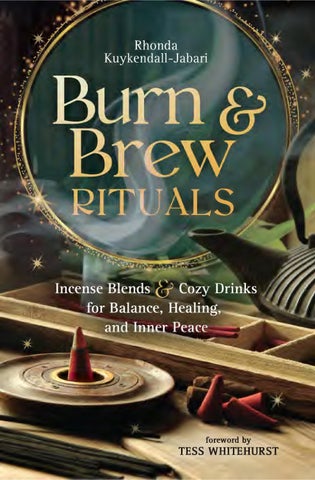
Burn and Brew Rituals, by Rhonda Kuykendall-Jabari

Page 1


Praise for Burn and Brew Rituals

“Rhonda Kuykendall-Jabari pours her entire spirit onto the pages of Burn and Brew Rituals, sharing decades of master-level knowledge on all things sipped, brewed, and burned. The perfect guide to going from practitioner to expert, Burn and Brew Rituals is a blueprint to understanding both the art and the practice. Each chapter shares a true-to-life burn and brew story and offers real-time instruction for merging personal choices with one’s practice. Burn and Brew Rituals is a must-have for reiki practitioners and anyone seeking game-changing knowledge on rituals and metaphysics.”

Love TaShia Asanti, award-winning journalist, Yoruba/Ifa priestess, and author of nine books

“Rhonda Kuykendall-Jabari is the kind of author who makes you want to hang out with them. Just reading the introduction and foreword about her life and influences was wonderful, and I hoped for more personal stories in the book. Perhaps her biography will be her next book! For her first one, she has included everything a practitioner needs for a safe, effective, and maturing magical experience. Not just for beginners, this book expands past novice and sharpens the skills no matter how long you’ve practiced.”

Melissa Cynova, author and cohost of Cardslingers Coast to Coast podcast

“Burn and Brew Rituals acknowledges, teaches, highlights, and gives us the tools to integrate our often-forgotten sense of smell into our healing tool kit. Aromas can trigger warm memories, ease us into peaceful sleep, relieve stress, and/or warn of illness. … Asante Sana [thank you], Rhonda Kuykendall-Jabari, for cataloging healing aromas, sharing tools to highlight and heighten, and offering strategies for healing with our sense of

smell forward. This book is quite the gem, for the kitchen, the living room table, and the bedside stand, all places where we can quickly put our hands on and find the lesson/scent needed for the moment. … This book is a unique offering, gifting us knowledge to strengthen those seams holding healing remedies. Those scents hidden in our aunties’ handkerchiefs, in our grandmothers’ bosoms, in our uncles’ clothes, in our fathers’ sheds, and of course in our older siblings’ rooms. The journey this book shares is one that sharpens our health tool kit, acknowledges culture, triggers memories, expands our universe of scents, and celebrates an undervalued sense of smell.”

Janette Robinson Flint, executive director at Black Women for Wellness

Burn & Brew RITUALS

About the Author

Rhonda Kuykendall-Jabari is a spiritual guide, ritualist, and healer with more than twenty years of hands-on experience in holistic wellness. She is a reiki master teacher, and she founded Wellness Uprising, a community-based healing and wellness studio. Rhonda holds a bachelor’s degree in spiritual healing along with certificates in Moonology, aromatherapy, and chakra balancing. Visit her at RhondaKuykendallJabari.com.

Burn & Brew RITUALS

Incense Blends & Cozy Drinks for Balance, Healing, and Inner Peace

Rhonda Kuykendall-Jabari

Burn and Brew Rituals: Incense Blends and Cozy Drinks for Balance, Healing, and Inner Peace

Copyright © 2026 by Rhonda Kuykendall-Jabari. All rights reserved. No part of this book may be used or reproduced in any manner whatsoever, including internet usage, without written permission from Llewellyn Worldwide Ltd., except in the case of brief quotations embodied in critical articles and reviews. No part of this book may be used or reproduced in any manner for the purpose of training artificial intelligence technologies or systems.

First Edition

First Printing, 2026

Cover design by Shira Atakpu

Interior illustrations by Llewellyn Art Department

Llewellyn Publications is a registered trademark of Llewellyn Worldwide Ltd.

Library of Congress Cataloging-in-Publication Data (Pending)

ISBN: 978-0-7387-8236-2

Llewellyn Worldwide Ltd. does not participate in, endorse, or have any authority or responsibility concerning private business transactions between our authors and the public.

All mail addressed to the author is forwarded but the publisher cannot, unless specifically instructed by the author, give out an address or phone number.

Any internet references contained in this work are current at publication time, but the publisher cannot guarantee that a specific location will continue to be maintained. Please refer to the publisher’s website for links to authors’ websites and other sources.

Llewellyn Publications

A Division of Llewellyn Worldwide Ltd. 2143 Wooddale Drive Woodbury, MN 55125-2989 www.llewellyn.com

Printed in the United States of America

GPSR Representation: UPI-2M PLUS d.o.o., Medulićeva 20, 10000 Zagreb, Croatia matt.parsons@upi2mbooks.hr

Disclaimer

Incense should be burned in a well-ventilated space. Inhalation of smoke can damage your respiratory system as well as trigger health problems in those with chronic conditions.

This book is not intended to provide medical or mental health advice or to take the place of advice and treatment from your primary care provider. Readers are advised to consult their doctors or other qualified healthcare professionals regarding the treatment of their medical or mental health problems. Neither the publisher nor the author takes any responsibility for any possible consequences from any treatment to any person reading or following the information in this book.

Dedication

I dedicate this book to my father, Andrew Lee Kuykendall Sr., who, even in his final days, taught me about grace, growth, and the quiet miracle of coming full circle.

When my parents separated, and eventually divorced, I was just five or six years old. From that point on, my perception of my father was filtered almost entirely through my mother’s lens. And let’s just say her commentary wasn’t always kind.

I didn’t see much of him as I grew up. Not that he was completely absent—we always knew where he lived. I’d see him on most Father’s Days and birthdays. Later, as an adult, if time allowed and I was willing to make the drive, I could usually find him at Christmas or Thanksgiving.

What was missing, though, was the kind of deep, everyday connection that comes from sharing a home during the formative years.

By the time he moved in with me in 2019, we were practically strangers. He was 85. I was 58. Two grown people, nearing the twilight of our lives, suddenly faced with the task of getting to know each other—truly know each other—for the first time.

I could tell from the jump that he held his brow-raised opinions about my “alternative” ways. No nine-to-five job. No church hat on Sunday. Just candles, cards, incense, and ancestral prayers rising like smoke into the rafters. He never came right out and said it harshly—he was too Southern and gentlemanly for that— but every now and then, I’d get one of those gentle nudges. “I sure wish you’d get to know Jesus,” he’d say. And I’d reply with a smirk, “Daddy, what makes you think I don’t already know Jesus?”

At first, there was tension—spiritual, generational, emotional. But as time passed and he bore witness to my work, the good it

was doing in the community, the respect I’d earned … something shifted. His judgment gave way to curiosity. Curiosity softened into quiet pride.

He saw the ancestors walking with me. He saw the people I helped. The needs met when the material world came up short. The way I lit candles, whispered incantations, moved energy. And while he may not have understood it all, he recognized something sacred in it. He even started encouraging my work. I’ll never forget when I first told him about this book. He nodded and said, “That’s good. People need to know—so they can come to understand, like I did.” Y’all, it brought tears to my eyes. He didn’t say a lot, but those words carried the weight of worlds.

He believed in this book. If I seemed distracted or discouraged, he’d ask, “How’s the book coming? When’s your next deadline?” Then—God bless him—he would gather his strength to operate as independently as he could for a few days, just to give me uninterrupted writing time. That was his way of showing love. Of standing with me.

And then came the clincher—the day he died. It was swift and sudden.

My oldest sister and I have always been like matching bookends, especially when things get critical. She’s the RN with a law degree. I’m the reiki practitioner with the ancestral oils and the incense blends. Different tools, same mission. When I arrived at Daddy’s bedside that day, he was unconscious. I was talking to him, prepping to offer reiki for whatever outcome the Creator had planned. While washing my hands, a nurse walked in and said, “You must be one of the daughters.”

I said, “Yes. I am.”

She asked, “Are you the RN or the reiki practitioner? He told me about you. He’s very proud of his children.”

Y’all. I fell apart. I was reduced to a sobbing child in that hospital bathroom.

He didn’t just mention me. He named me. He put my calling, my path, my work in the same breath as my sister’s brilliant medical career. He wanted me to know he saw me. Respected me. Approved of me. And in that moment, it was like every ritual I’d ever done had culminated in a blessing from my father’s lips.

So yes—this book is for him.

For Andrew Lee Kuykendall Sr., who started out unsure of my path but came to see the light in it. Who held space for me to become the healer, the teacher, and the magic-maker I was born to be. Who, in the end, stood beside me not just as my father, but as my elder and ally.

This work, Burn and Brew Rituals, is proof of what happens when we let spirit work in us and through us. I dedicate it to him, in the name of MotherFatherGoddess, our ancestors, and, yes, Jesus too. Because Daddy taught me that transformation is always possible.

He was my teacher to the very end.

A Magical Blessing for This Book

May every page in this book be a portal, A doorway to a deeper knowing, A mirror for healing, A flame that lights the way home.

May the hands that hold it feel held in return.

May the hearts that read it find themselves reflected, respected, and restored.

May the words, rituals, and recipes stir the sacred remembering that you are powerful, worthy, and already enough.

May the herbs speak.

May the smoke rise in wisdom.

May the brews warm your spirit and anchor your soul.

To the ancestors who walk beside us,

To the elements who dance within us,

To the guides, guardians, and grandmothers and grandfathers of light, Bless this book. Bless its journey. Bless the reader who dares to begin. And so it is.

Ase. Amen. It is done.

Contents

Foreword by Tess Whitehurst xv

Introduction 1

Part 1: Ritual Basics

Chapter 1: For Your Safety 7

Chapter 2: Set Your Sacred Space 13

Chapter 3: Set Your Intentions 31

Chapter 4: Your Core Burn and Brew Ritual 37

Part 2: Incense

Chapter 5: Know Your Incense Elements 43

Chapter 6: Create Your Own Aromatic Blends 73

Part 3: Brews

Chapter 7: Your Coffee Basics 81

Chapter 8: Your Tea Techniques 87

Chapter 9: Your Cocoa Delights 105

Part 4: Putting It All Together

Chapter 10: Your Daily Practice 117

Chapter 11: Abundance, Prosperity, and Manifestation 121

Chapter 12: Your Emotional Healing 135

Chapter 13: Your Meditative Moments 143

Chapter 14: Your Home: Room by Room 151

Chapter 15: Your Home: Evolving 157

Chapter 16: Your Seasonal and Holiday Celebrations 169

Chapter 17: Your Community Celebrations 215

Chapter 18: Sips and Sprinkles for Children 229

Part 5: Expanding Your Practice

Chapter 19: Your Divination Practices 245

Chapter 20: Your Planetary Work 263

Chapter 21: Your Moon Phase Work 277

Chapter 22: Your Moonwalk Through the Zodiac 283

Chapter 23: Tips and Tweaks for You 299

Final Reflections: Empowerment Through Ritual 305

Acknowledgments 307

Bibliography 311

Index 313

Foreword

Your life is about to get magical.

Sure, I mean what folks normally mean by “your life”— things like what you’re doing, your relationship dynamics, and your relative degrees of prosperity and success.

But even more importantly, I mean the immediate, experiential quality of your life, the one shining moment that is your now. Your inspiration, your enthusiasm, and your joy. Your sense of connection to the mystical, the mysterious, and the miraculous. Your actual life.

Yes, indeed. You’ve found your way to Burn and Brew Rituals, and now your life is about to get real magical, real quick. Lucky you.

Let’s rewind a little so I can tell you about how I met Rhonda. Many, many years ago—let’s see, almost two decades ago now— Rhonda and I found ourselves in a very tiny Energy Healing 101 class in Los Angeles’s South Bay. If I’m not mistaken, there were only three students in the class, and Rhonda and I were two of them.

Although I felt awkward and out of place, as so many of us often do in such situations, Rhonda was warm and friendly, helping me feel at home in the class right away. But her kindness

Foreword

didn’t stop there. Later, when she found out I had started a feng shui business, she interviewed me on her podcast and invited me to a healers’ networking event she had organized. When she heard my first book, Magical Housekeeping, was coming out, she hosted an author event for me at a performing arts center in her neighborhood. (And she bathed me in sage smoke before I presented to help me feel spiritually clear and empowered.)

Rhonda is the genuine article: a spiritual leader and teacher who holds sacred space for connection and community. She is wise, compassionate, and empathetic. Los Angeles can be a catty and competitive place, but not in Rhonda’s world. She sure shored up my confidence, and it was easy to see that she did the same for countless others as well.

In the years since, I have done my best to follow Rhonda’s example, in my own way, by facilitating spiritual community and helping other healers and authors feel comfortable and shine. And who knows how many of the people who experienced my Rhonda-inspired goodwill went on to emulate it, in their own ways, as well. Probably lots. Just imagine the good energy spreading—the ripples upon ripples, waves upon waves. Energy Healing 101, indeed. It’s astounding how such generosity of spirit can change the world.

Now, let’s get back to how magical your life is about to get.

When you pick up a book like this, what are you hoping for? I can tell you, exactly, in just five little words: a simple but profound shift. Simple as in doable and accessible, something you can immediately understand and implement. Profound as in something that changes the quality of your life in a deep, ineffable, lasting way.

Is the shift you will experience by reading Burn and Brew Rituals simple? Perfectly. Profound? Absolutely. Check and check. You did it, my friend. You found your book.

Rhonda is about to welcome you into her world, where she will teach you how burning herbs and resins while drinking an intentionally prepared warm beverage can improve every aspect of your life. It’s a meditation. It’s a ritual. It’s a self-care treatment. It’s a spell. It’s activism!

When you take time each day to awaken your senses and connect with spirit by engaging in this straightforward, versatile practice, you’ll feel fantastic right away. And over time, your inner peace and holistic well-being will deepen. You’ll feel more resilient, more inspired, and more on, more of the time. And you’ll always, in the back of your mind, be joyfully anticipating those blissful, restorative moments you spend with your cozy cuppa and your sacred smoke.

I leave you with Rhonda’s very own words from the pages ahead, in which she describes an experience very much like one you are about to have for yourself: “That day, sipping my coffee and surrounded by the curling smoke of intention, I learned to stop settling for crumbs and ask for the whole feast.”

Whitehurst Central California May 2025

Introduction

Welcome to burn and brew, a journey that encourages you to pause, reflect, and reconnect with yourself and your spirit guides through a daily ritual of mindfully burning aromatic incense and brewing a comforting drink of your choice. This book is an invitation to bring sacredness into everyday life, balancing your intentions with the natural rhythms around you. In these pages, you’ll explore the powerful alchemy of scent, taste, and energy as we work with nature’s elements: resins, herbs, flowers, and roots. This practice is designed to ground you, clear your mind, awaken your creativity, and support your healing and manifesting goals. By engaging all five senses, you will discover the beauty and power of creating your own sacred experience every day.

For me, the journey began a long time ago. I recall early mornings when Mom would line up all five of us in front of the sofa, our sleepy eyes blinking awake as we knelt side by side. She would lead us in prayer, her voice soft yet steady as she gave thanks, asked for mercy, and lifted praises to God’s holy name. Mom prayed for our safety. She asked God to supply our needs. She asked that we receive favor and blessings. As she spoke, her

emotions would rise, and by the end, tears glistened in her eyes. She’d gently wipe them away, lift each of us to our feet, and send us off to face the day, her words still lingering in the air like a quiet blessing.

Those mornings were my introduction to the power of ritual. And though I didn’t know it then, Mom planted seeds within me—seeds of intention, reverence, and devotion. Over time those seeds blossomed into what would become burn and brew, my way of bringing purpose and sacred pause into the day. Like Mom’s prayers, this practice now grounds me, reminding me that small, mindful rituals have a way of connecting to God, nurturing our spirits, and preparing us for whatever lies ahead.

Whether you’re a seasoned mystic, a kitchen witch in training, or simply magic-curious, this book is your cozy companion for grounding rituals, soulful introspection, and ancestral nourishment.

These pages invite you into a rhythm of release (burn) and restoration (brew). The tools are simple: herbs, teas, resins, spices, oils, and your own intuitive energy. The practices, however, run deep. Here you’ll find Moon phase rituals, zodiac-influenced rituals, seasonal ceremonies, personal stories, and spellwork all stirred together in the spirit of healing and reclamation.

This isn’t a rulebook—it’s a choose-your-own-spell book. Let your mood, the Moon, or the moment guide you. Some chapters are instructional; others are deeply personal. All are written to offer loving guidance and communal medicine. Take what serves. Tweak what doesn’t. Trust your inner compass. The only ingredient you truly need is presence.

Make this book yours. Annotate the margins. Dog-ear your favorite recipes. Add pressed herbs, altar photos, or notes about what worked and what didn’t. Let your burn and brew practice evolve with you.

So go ahead—light something meaningful, brew a cup of whatever your soul craves, and turn the page. Let the journey begin.

Part 1 Ritual Basics

Chapter 1 For Your Safety

I’m glad we’re friends because I have a story that’s a bit embarrassing but cautionary—and maybe even a little funny.

Several years ago, my reiki studio was housed in a tiny, drafty room that could not hold heat to save its life. This was especially challenging during aromatherapy sessions, because those require clients to disrobe. I was determined to make the space cozy and comforting, without breaking the bank. And, true to form, I leaned into my inner DIY goddess.

Inspired by a trending YouTube hack at the time, I decided to build a homemade terra-cotta pot heater powered by tea lights. I should have known better. I should have! My DIY heater worked surprisingly well at warming the room … until it didn’t.

One evening, as a client rested soundly on the table in a blissful post-reiki snooze, I glanced over at my creation and saw flames licking up the sides of the clay pots. Yes, beloveds: It was on fire!

I leapt into action, grabbed a nearby bowl of sand (thankfully part of my altar setup), and smothered the flames like a woman possessed. Then I poured water over the whole thing just to be sure. Crisis averted. No damage done. And would you believe, my client never even stirred. Slept right through it. That’s how good the energy in the room was. Reiki strong, flames and all.

Chapter 1

So take this as a lighthearted but serious reminder: When it comes to fire and ritual, there is no such thing as being too careful. Always honor fire as both sacred and unpredictable. And maybe, just maybe, leave the terra-cotta heater experiments to the survivalist YouTubers.

Burning herbs, resins, or incense can be deeply grounding. Fire holds transformative power, but it demands respect. A small spark left unattended can shift from mystical to dangerous in a heartbeat. Safety isn’t separate from the ritual; it is ritual. It invites presence, intention, and reverence for the elements you’re working with.

Even the materials you burn can impact your space. Some incense contains synthetics that may irritate your lungs or leave residue in the air. Choosing natural, high-quality herbs and resins deepens your spiritual connection and protects your health.

Setting Up Your Space for Safe Burning

Creating a safe and intentional space is important when preparing your burn and brew altar. Choose a stable surface for your burning tools, such as incense holders, charcoal burners, or firesafe dishes. Look for heat-resistant materials like ceramic, stone, or metal—these can handle high temperatures without melting or tipping, giving you peace of mind as you work. Keep the area clear and uncluttered. Flammable items like extraneous paper, flammable fabric, and plants should be removed from your workspace. A clean, dedicated space not only reduces fire risks but also enhances your focus, grounding your practice in intention.

Good ventilation is essential, especially when working with smoke-heavy ingredients like resins. Open a window, door, or both to encourage fresh airflow. This prevents the space from becoming overly smoky, keeping the environment pleasant and minimizing any potential irritation to your lungs.

Finally, be mindful of how you place your materials. If you’re burning larger items like bundles or palo santo sticks, use a heat-resistant dish on a bed of sand to catch any falling ash or embers. Adding sand or salt to the base of your burner also helps distribute heat evenly and keeps everything contained.

With these simple steps, you can create a safe, intentional, and harmonious space for your practice—one that allows you to focus fully on the transformative energy of your ritual.

Essentials for a Safe Practice

Having the right tools not only enhances your ritual but also adds an element of ease and safety to your practice. Here’s a safety checklist for no matter what you burn:

Base Layer: Placing a two-inch layer of sand or salt in your burner helps distribute heat evenly, prevents accidental burns, and catches any ash or embers. This is also helpful for putting out smoldering materials safely by simply covering them.

Surface: Always place burners on cast-iron pans, heatproof tiles, or trivets. Never place them directly on wood, glass, plastic, or a flammable surface.

Ventilation: Crack a window or open an exterior door to properly disperse particulate matter.

Chapter 1

Cool-Down Time: A charcoal disc can glow for 45 to 60 minutes. Treat the burner as hot for at least an additional 30 minutes after extinguishing before touching.

Heat-Resistant Dishes and Bowls: Ceramic, cast-iron, and metal dishes are ideal for holding hot charcoal or smoldering materials. Avoid using glass unless it’s specifically designed to withstand high temperatures, as it can crack from the heat.

Pet and Child Perimeter: Placing supplies waist-high can prevent tail-swipes and curious little hands. Also, small children and animals can be very sensitive to smoke, so put them in a separate room while burning incense.

Charcoal Discs: When burning resins, powdered or loose herbs, or incense, charcoal discs are a helpful tool. This is my favorite “go-to.” The detailed rituals in this book involve burning on charcoal. Choose high-quality, quick-light charcoal, which is specifically made for burning without releasing harmful chemicals. I prefer Swift Lite and Three Kings brands. Always place charcoal on a heat-safe surface, as it can get very hot. Never handle it with your bare hands.

Tongs, Spoons, and Tweezers: Handling burning herbs or hot charcoal is much easier and safer with metal tongs or tweezers. A regular silver spoon will get the job done. To add a bit of flair to my ceremonies, I use a small crystal alloy spoon. Use these tools to place or adjust your materials on the disc, avoiding accidental burns.

Safe Censers and Burners: For stick incense or cones, use holders that are stable and capable of collecting ash. On the rare occasion when I use sticks or cones, I stand them upright in my cauldron with about two inches of sand in the bottom. If you prefer an elegant touch, backflow incense burners are very nice.

Fire Extinguisher and Water Source: Although you’re likely working with small flames, it’s always wise to keep a fire extinguisher, a cannister of sand, and a large bowl of water nearby. This is in case a flame becomes too large or you accidentally tip something over. Having a quick way to extinguish the fire can prevent danger and accidental damage.

Mindful Protection

Safety and mindfulness are critical when working with burning materials during rituals. Always stay close to your materials while they burn. Before you leave the space, be sure everything is fully extinguished. Use your tongs to stir ashes or smother remaining embers in the cauldron with sand.

Do not burn incense if your respiratory system is compromised. You may instead choose to use less or lighter herbs. Also ventilate your space or work outdoors. Another option is to use smoke-free alternatives like essential oils and diffusers.

Storing Burn Elements

To keep your items fresh and safe, store loose and powdered herbs and resins in glass containers with lids, away from direct sunlight. Essential oils should be in glass cobalt bottles and stored in the dark or away from direct sunlight.

Simmering Thoughts

Sacred, Not Scorched

And that, my lovelies, is how we keep the magic lit without burning the house down.

I shared my little terra-cotta tea light fiasco not just to make you laugh (although if you chuckled, mission accomplished), but to remind you that magic without mindfulness is just mess. And we don’t do mess when we’re calling in spirit. We do intention. We do presence. We do grounded, grown-folk magic that honors the fire and respects the vessel holding it: you!

Fire doesn’t ask for your attention; it demands it. It is alive, ancient, and holy. When we burn herbs, resins, or sacred woods, we are not just making smoke. We are invoking change. We are transmuting. And that kind of power deserves a setup that says, “I respect this energy. I honor what I’m doing.”

So whether you’re burning on a stovetop trivet or in a cauldron full of sand, let safety be part of the spell. Let it be your declaration that you are serious about this work, about your space, and about your own well-being. Because your peace, your health, and your sacred breath matter more than any aesthetic moment or selfie-worthy altar.

And now that we’ve talked about fire, smoke, and how not to scorch your curtains in the name of spiritual elevation, let’s keep going. There’s so much more to explore, brew, burn, and become. But let this be your flame-lit reminder: Safety is essential. It’s sacred. It’s the quiet chant that underpins every ritual you’ll ever do.

Light wisely. Burn mindfully. And keep sand and water nearby, just in case.

Chapter 2

Set Your Sacred Space

Growing up in Los Angeles, the Land of the Beautiful People, in the ’60s and ’70s, I was surrounded by a culture in which style, beauty, and panache were currency to buy your way into a better life. Mom had four daughters and a son; she understood the importance of elegance and poise as keys to navigating life. I often wonder where she learned it, considering she came from a small farming town near Houma, Louisiana. To this day, at eighty-eight years young, her sense of style remains unmistakable.

Mom’s dresser was her own sacred space—a personal altar to beauty and self-care. An oval mirror with gilded edges framed a selection of carefully arranged beauty aids: brushes, combs, hair dressings, and cosmetics (I used to love those tiny little Avon lipstick samples). Each item was placed with intention. This was the altar where she performed her daily ritual of grooming and transformation.

The process was precise: First, a bath to cleanse and refresh. I can still smell Jean Nate and those multicolored dissolving gel bath oil beads. Next, anoint the body with baby oil (or Vaseline) and lotion, buffing the skin to a new copper penny shine. Then, facial moisturizer, always applied in upward strokes to prevent

Chapter 2

sagging, not forgetting the neck and décolletage. After that, makeup: eyeshadow and lipstick thoughtfully selected to match her outfit. Finally, she would brush and “fork” her hair into a perfectly rounded afro, all to the rhythm of whatever was playing on the radio (Wilson Pickett, Al Green, Johnny Taylor—you know the ones).

Her dresser served as a map for her daily regimen and my introduction to altars—a dedicated space to practice self-care, intention, and transformation. In fact, each of her daughters continues this tradition with a similar altar gracing our own homes. They stand fully adorned and stocked in our bedroom or bathroom. Just as she turned to her dresser to prepare for her nursing shifts each day, I am drawn to my altar for a sacred pause—a place to center, reflect, and prepare for what lies ahead.

A History of Altars

The concept of an altar is ancient and universal, spanning across continents, religions, and spiritual practices. Altars have served as focal points for ritual, worship, and connection with the divine in nearly every culture throughout history. Though the details may vary, the core purpose remains the same: intention, reverence, and connection.

Across many cultures and throughout history, the altar has been a sacred centerpiece. Just as the heart chakra unites the mundane and spiritual energy centers in the body, altars are places and spaces where the human and the divine worlds meet. In ancient Egypt, temple altars offered flowers, incense, bread, and wine to nourish gods and ancestors. In homes, smaller shrines bridged everyday life with the spiritual realm.

Indigenous cultures of the Americas shaped their altars directly from the land—stone circles, tree groves, and fires—

offering tobacco, herbs, and feathers to honor nature and the spirits that enliven it. In Hindu homes and temples, radiant puja mandirs bring together the warmth of incense, flowers, and fruits, daily welcoming deities into the rhythms of family life.

The ancient Greeks and Romans established altars in homes, temples, and public squares, ensuring that their gods were never far from civic and domestic life. In Chinese households, ancestral altars hold incense, candles, and photographs, weaving past and present into a continuous lineage of reverence. For Catholics and Christians, church altars and small prayer corners at home serve as quiet places of communion, where bread and wine, candles and icons, focus the faithful on divine mysteries.

African traditional religions honor ancestors and nature spirits at altars both indoors and out, forging bonds with the unseen forces that guide and protect. And in shamanic traditions, portable altars laden with stones, feathers, and other symbols invite the spirits to walk alongside the practitioner, balancing energies and bringing healing. In every culture, the altar is a living threshold between human intention and the sacred powers that shape our world.

The Role of Altars Today

Today, altars are not limited to formal religious or cultural practices. People around the world create personal altars as shrines for meditation, self-reflection, and setting intentions. These modern altars often blend traditions, incorporating elements like candles, crystals, photos, and personal mementos. Regardless of belief system or purpose, altars continue to serve as sacred spaces

Chapter 2

where individuals can pause, find connection, and draw meaning from the act of creating a designated space for ritual.

By understanding the deep-rooted history of altars across cultures, we recognize that creating a burn and brew altar isn’t merely about arranging objects; it’s about connecting to a tradition of reverence and honoring what is sacred. As you set up your own altar, you’re adding to a lineage that stretches back thousands of years—a practice that acknowledges the power of intention, the presence of the unseen, and the beauty of making everyday moments sacred.

Choosing an Altar Space

Before moving forward, make sure you review chapter 1, “For Your Safety.” There you’ll find suggestions for keeping your altar safe. Altars are sacred. But so is safety.

Trust your instincts when selecting a location for your altar. Let yourself be drawn to a space that feels both inviting and private, a place you’ll be glad to return to each day as you reconnect with your intentions. This doesn’t need to be grand or permanent—even a small arrangement on a table, windowsill, or shelf can hold deep meaning. What matters is that it brings you a sense of calm and grounding.

Look for a quiet corner away from distractions and, if possible, bathed in gentle natural light to keep you in tune with the rhythms of the earth. Make sure it’s away from anything that might disrupt its energy, such as strong drafts or piles of clutter. You want an area that feels clear and open, ready to receive the essence of your practice.

Once you’ve chosen your spot, prepare it lovingly. Clean the surface and remove anything that doesn’t belong. Wipe away

Set Your Sacred Space 17

dust, straighten what needs straightening, and open the windows for a moment to allow fresh air to circulate.

Before placing anything on your altar, pause and set a guiding intention. This can be as simple as stating, “May this space be a sanctuary for grounding, healing, and manifesting.” Let that quiet promise lead you as you begin to set up your space. As you place each object, remember that your altar is a living, breathing reflection of your inner world, a dedicated place to honor what matters most to you.

Grounding and Centering

Before setting sacred space or building your altar, it’s essential to ground and center your energy. Think of it like tuning an instrument before a performance. You’re not just arranging objects— you’re crafting a container for intention, healing, and spirit work. The energy you bring into that space sets the tone. If you’re scattered or overwhelmed while setting up your altar, it can become a reflection of that energy. If you’re rooted and centered, your sacred space will likely be a powerful vessel for alignment, transformation, and peace.

Grounding and centering help you release outside distractions and arrive fully in the present moment emotionally, physically, and energetically.

Use grounding when you’re feeling anxious, overwhelmed, scattered, or emotionally raw. It helps anchor your energy so you’re steady and stable—like a tree rooted deeply into the earth.

Grounding Methods

Visualization of Roots: Stand or sit comfortably. Imagine thick roots growing from the soles of your feet or the base of your spine, reaching deep into the earth.

Chapter 2

Feel the earth receive you. Feel yourself held and supported.

Physical Contact with Nature: Remove your shoes and let your feet touch the floor, bare earth, grass, sand, or stone. Walk slowly and mindfully. If inside, hold grounding stones like hematite, black tourmaline, or obsidian in your hands as you breathe deeply.

Body Check-In: Gently bring your awareness to your body. Focus on the sensations in your feet, legs, and lower body. Wiggle your toes. Move your focus upward as you roll your shoulders and soften your jaw. Notice the way your body feels in the space.

Centering Methods

Centering helps when you’re preparing to speak, lead, create, or perform ritual. It calls your energy back to yourself, like drawing all the scattered parts of your attention into one steady, radiant point. It’s the moment you become the eye of your own storm.

Breath Work: Inhale slowly for a count of four. Hold for four. Exhale for six. Repeat until your breath becomes smooth and your mind begins to quiet. Let your breath be your anchor.

Visualization of a Focal Point: Picture a glowing ball of light in your chest at your heart chakra (if you’re working from love) or solar plexus chakra (if you’re working from will and confidence). Let this light expand with each breath, guiding your focus inward.

Mantra or Meditation: Recite a centering phrase like “I am here. I am whole. I am ready.” Or “With every breath, I return to myself.”

Sit in Stillness: This prepares your inner self to engage with your altar from a place of clarity and grace.

Before you place a single crystal or light your incense, get grounded. Before you call in spirit, get centered. These simple practices are the pause between the noise of the world and the sacred work you are about to do. They establish your altar as more than a surface—it becomes a mirror of your readiness, your presence, and your power.

Suggested Items for Your Altar

Dressing your altar is an entirely personal act. Your tastes and preferences reign supreme. In chapter 1, I listed altar items for your safety. The following list of elements is here to help your spiritual workspace move in step with your personal energy. Feel free to select some, none, or all from this list.

Sacred Fire and Light

Candles (Taper, Tea Lights, Pillar): For fire, transformation, and illumination

Oil Lamps: Traditional flame to honor ancestors or divine presence

Incense: For prayers, offerings, and energetic clearing

Charcoal Burner: For loose herbs, resins, or powdered incense

Chapter 2

Air and Communication

Feathers: For spirit, messages, and breath

Bells or Chimes: To clear energy, mark ritual transitions, and call in spirit

Prayer Flags or Written Affirmations: To carry intentions into the ether

Water and Emotion

Vessel of Water: To invite emotional clarity and spiritual flow

Shells: For ocean energy, receptivity, and intuition

Blessed Waters: Moon water, Florida water, or rosewater to be used for blessing, anointing, consecrating, or cleansing

Earth and Grounding

Crystals and Stones: Any that feel good to you, or those with specific energies

Herbs and Dried Flowers: For spellwork, offerings, and natural energy

Salt: For purification and boundary-setting

Bowl of Soil or Sand: For stability, rootedness, and grounding

Spiritual Tools

Athame or Ritual Knife: For direction, energy cutting, or circle casting

Your Sacred Space 21

Wand or Staff: For channeling and directing energy

Pendulum: For divination and yes/no clarity

Tarot or Oracle Deck: For spiritual messages and reflection

Offerings and Devotion

Food Offerings (Fruit, Bread, Chocolate): For gratitude and communion

Drink Offerings (Tea, Water, Libation): For honoring ancestors and spirits

Coins or Currency: For abundance and wealth offerings

Fresh Flowers or Petals: For beauty, reverence, and living energy

Personal Items (Jewelry, Keys, Photos): Spiritual link to self or lineage

Seasonal or Ritual-Specific Items

Sun or Moon Symbols: For solar or lunar workings

Pumpkins, Acorns, Citrus, or Herbs: For seasonal or sabbat altars

Brew Ingredients: To be blessed before preparing for ritualistic consumption

Cauldron: Symbol of rebirth, transformation, and magical containment

Chapter 2

Cultural and Ancestral Connections

Photographs or Heirlooms: To honor ancestors and spiritual lineage

Statues or Symbols of Deities: Representation of spiritual allies or archetypes

Ancestral Cloths or Fabric: Colorful, nonflammable textiles that beautify and ground your altar in family and tradition

Sacred Text: For wisdom, guidance, and devotion

Energetic Anchors and Intentions

Journal or Notebook: To record insights, affirmations, or messages received

Intention Cards or Sigils: To charge symbols for manifesting

Affirmation Slips: Folded notes declaring what you’re calling in

Ritual Scrolls or Petitions: For release, healing, or manifestation work

Personalize Your Altar Elements

Every choice you make in the creation of your altar will carry your unique energy and intention, transforming a simple arrangement into something that feels deeply personal and alive. Let color guide you. Consider which hues resonate most with the energy you want to cultivate. I spend a lot of time working in the ether, so for grounding and stability, I use deep forest

“Rhonda Kuykendall-Jabari pours her entire spirit onto the pages of Burn and Brew Rituals, sharing decades of master-level knowledge on all things sipped, brewed, and burned.”

LOVE TASHIA ASANTI, award-winning journalist, Yoruba/Ifa priestess, and author of nine books

Improve Every Aspect of Your Life with Embers & Elixirs

Sharing dozens of simple recipes tailored to a variety of goals, Rhonda Kuykendall-Jabari helps you pair the sweet smoke of aromatic herbs and resins with comforting drinks like coffee, tea, and hot chocolate. Her book is far more than a collection of recipes—it’s also a heartfelt journey of self-discovery, blending personal stories, practical techniques, and spiritual insights.

• Learn the core principles of ritual and the power of setting intentions

• Discover the basics of incense and how to create your own blends

• Prepare beverages designed to complement your meditative sessions

• Explore planetary and astrological influences connected to the rituals

• Enjoy kid-friendly aromatherapy mists and beverages

Burn and Brew Rituals provides a clear road map to creating sacred spaces in your daily life. If you’re ready to quiet the chaos, unlock your inner wisdom, and transform your life through sensory rituals, this book is the unique, step-by-step guide you need.

RHONDA KUYKENDALL-JABARI (Los Angeles, CA) is a spiritual guide, ritualist, and healer with more than twenty years of hands-on experience in holistic wellness. She is a reiki master teacher and the founder of Wellness Uprising, a community-based healing and wellness studio. Rhonda holds a bachelor’s degree in spiritual healing along with certificates in moonology, aromatherapy, and chakra balancing. Visit her at RhondaKuykendallJabari.com.

$18.99 US Facebook.com/LlewellynBooks

X: @LlewellynBooks

Instagram: @LlewellynBooks

www.Llewellyn.com

Turn static files into dynamic content formats.

Create a flipbook