
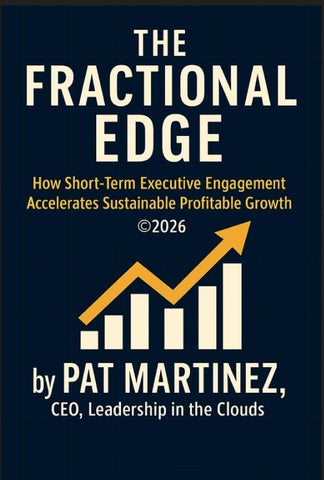
The Fractional Edge

Page 1


Table of Contents

›Introduction

›How to Use This Book

› Chapter 1: The Case for Fractional Executives in Mid-Market Growth

› Chapter 2: Where Fractional Leaders Create the Most Impact

› Chapter 3: Designing a High-ROI Fractional Engagement

› Chapter 4: Execution: From Day 1 to Measurable Wins

› Chapter 5: Making It Stick - Transition, Scale, and Value Creation

›Appendix A: Mid-Market Growth Diagnostic

›Appendix B: Core KPIs & Targets

›Appendix C: Sample Statement of Work (SOW)

›Appendix D: 90-Day Playbook Template

›Sample: 90-Day Implementation Plan - Fractional CFO

INTRODUCTION

Unlocking What's Possible

In more than three decades of working alongside CEOs, business owners, and leadership teams, I have witnessed a profound and accelerating shift in what organizations truly need to grow. Mid-market companies, those ambitious, resilient engines of our economy, stand at a crossroads. They are expected to innovate, scale, and compete at a pace once reserved for global enterprises, yet they must do so with far fewer resources and tighter margins. The stakes have never been higher, and neither have the expectations placed on their leaders.

As the CEO of Leadership in the Clouds, a management consulting firm dedicated to unlocking leadership capacity and strengthening business performance, I have spent my career helping organizations transform complexity into clarity. I've seen what happens when the right expertise arrives at the right moment: barriers fall, decision making sharpens, teams accelerate, and growth becomes not just possible, but sustainable. I've also seen the consequences of waiting too long to bring in that expertise, or hiring full-time executives before the organization is ready to absorb them.

It is in this gap between what growing businesses urgently need and what they can realistically support that Fractional Executives deliver extraordinary value.

Fractional leadership is not a trend. It is a strategic, pragmatic response to modern business realities. Privately owned and mid-market companies often require senior-level judgment to solve high-stakes problems, optimize systems, and propel growth, but they do not always need, or want, the long-term commitment, cost, or organizational disruption that comes with a full-time executive hire. Fractional Executives offer a powerful alternative: experienced leaders who step in quickly, focus deeply, execute decisively, and leave the company stronger than they found it.

In my work with clients across industries, I have seen Fractional Executives transform financial discipline, stabilize operations, rebuild revenue engines, develop leadership bench strength, and restore alignment at the top of the organization. They bring clarity when conditions are uncertain, confidence when decisions feel heavy, and momentum when performance has stalled. Most importantly, they build systems and capabilities that remain long after the engagement ends.

This book is designed to help CEOs, owners, boards, and rising leaders understand how to leverage fractional talent to accelerate profitable growth without the long-term burden of a full-time hire. You will learn where Fractional roles provide the greatest impact, how to design high-ROI engagements, and how to implement a disciplined 90-day framework that achieves meaningful results.

I hope that this book empowers you to approach growth differently: with precision, with courage, and with the confidence that the right leadership, delivered at the right time, can change the trajectory of your business.

Thank you for allowing me to share these insights, earned across years of experience, hard lessons, and extraordinary partnerships.

Let's unlock what's possible together. ~ Pat Martinez

Who is this book for: Owners, CEOs, Presidents, and Boards of mid-market companies (typically $10M–$250M) seeking disciplined, scalable growth.

How to Use This Book

1.Run the Diagnostic to identify your top growth bottlenecks.

2.Pick the right Fractional role aligned to those bottlenecks.

3.Time-box the engagement with clear outcomes, milestones, and a kill-switch.

4.Execute with a 90-day cadence and insist on capability transfer.

5.Lock in gains with governance, dashboards, and leadership training.

CHAPTER 1

The Case for Fractional Executives in Mid-Market Growth

Why Now

Mid-market companies are pressured by rising customer expectations, margin compression, talent shortages, and capital discipline. You need senior-level judgment, but not full-time and not forever. Fractional Executives provide targeted expertise to solve specific growth bottlenecks within months, not years.

Definition

A Fractional Executive is a seasoned C-suite operator engaged part-time and time-bound (e.g., 1–3 days/week over 12–24 weeks) to architect and execute critical initiatives. Think Fractional CFO / COO / CMO / CRO / CHRO / CIO, or a Fractional Integrator to align leadership and operating systems.

Core Advantages

• Speed & Focus: Rapid diagnosis and prioritization; no internal learning curve for politics.

• Expertise on Demand: Get specialized playbooks (e.g., pricing, pipeline, cash conversion, M&A; integration) exactly when needed.

• Risk Management: Clear deliverables and end date; no long-term salary/benefits burden; reversible commitment.

• Capability Transfer: Train your team while building enduring systems: process, dashboards, governance, rhythms.

• Cost Efficiency: Pay for outcomes, not overhead; avoid mis-hiring risk and six-figure severance.

When Is a Fraction Ideal?

• Inflection points: post-M&A;, entering new markets, after major customer loss, ERP/CRM transformation.

• Strategy-to-execution gaps: plans exist; operating cadence and accountability do not.

• Leadership gaps: vacancy coverage; upskilling a rising leader.

• "Stuck" metrics: flat revenue, slipping win rates, negative NPS, poor cash flow, weak forecast accuracy.

What Fractional Is NOT

• Staff augmentation for business-as-usual work.

• A substitute for a CEO/President.

• An open-ended consultancy with fuzzy deliverables.

Where Fractional Leaders Create the Most Impact

1)Fractional CFO: Profitable Growth Engine

• Outcomes: Cash flow stabilization, pricing & margin discipline, budget to forecast accuracy, capital allocation, bank confidence.

• Levers: Pricing waterfalls, product/segment profitability, working capital cycle (DSO/DIO/DPO), driver-based forecasting, CapEx hurdle rates, S&OP; financialization.

• Quick Wins: Stop-loss on unprofitable SKUs/customers, tighten credit terms, renegotiate freight, implement weekly cash war room.

2)Fractional COO: Execution & Throughput

• Outcomes: On-time delivery, lower COGS, quality improvement, scalable operations.

• Levers: Lean/TOC, S&OP;, capacity modeling, vendor performance, standard work, tiered huddles, visual management.

• Quick Wins: Constraint mapping, WIP reduction, service level restoration, supplier scorecards.

3)Fractional CMO: Demand Creation

• Outcomes: Pipeline coverage, CAC/LTV improvement, win-rate lift, and higher ARPU/expansion.

• Levers: ICP clarity, messaging, offer design, pricing & packaging, demand gen mix, attribution, lifecycle (awareness → expansion).

• Quick Wins: ICP refinement, offer simplification, retargeting, SDR enablement, conversion-rate optimization.

4)Fractional CRO: Revenue System

• Outcomes: Predictable bookings, forecast accuracy, sales productivity, short sales cycle, and expansion revenue.

• Levers: Territory design, comp plans, MEDDICC/BANT discipline, enablement, partner strategy, RevOps.

• Quick Wins: Pipeline audit, quota recalibration, forecast discipline, sales enablement launch.

5) Fractional CHRO: People & Culture

• Outcomes: Retention, talent density, bench strength, performance culture.

• Levers: Comp benchmarking, performance management, succession, L&D;, culture diagnostics, HRIS optimization.

• Quick Wins: Regrettable attrition root cause, comp equity fix, manager effectiveness training.

6)

Fractional

CIO/CTO: Technology & Data

• Outcomes: System reliability, data integrity, tech ROI, cybersecurity posture.

• Levers: Architecture rationalization, vendor consolidation, data governance, incident management, roadmap.

• Quick Wins: License audit savings, critical incident reduction, data quality improvement.

7)

Fractional

Integrator: Operating System

• Outcomes: Leadership alignment, execution rhythm, accountability.

• Levers: EOS/Scaling Up, L10 meetings, RACI, OKRs, cascading scorecards.

• Quick Wins: Meeting audit, RACI clarification, operating cadence launch.

Role-Specific KPI Targets

• CFO: Gross Margin +200–400 bps; DSO 15 days; Forecast Accuracy ≥ 90%.

• COO: OTIF ≥ 95%; Throughput +20%; COGS 3–5%.

• CMO: Pipeline Coverage ≥ 3×; CAC Payback ≤ 12 mo.; NRR ≥ 110%.

• CRO: Win Rate +5–10 pts; Forecast Accuracy ≥ 85%; NRR 110–115%.

• CHRO: Time-to-Productivity ↓ 30%; Regrettable Attrition ↓ 25%; Bench Coverage ≥ 80%.

• CIO/CTO: Critical Incidents ↓ 50%; Data Freshness SLA ≥ 95%; License Waste ↓ 20–30%.

Engagement Models

• Sprint: 8–12 weeks, 1–1.5 days/week — best for diagnostics + one major win.

• Program: 12–24 weeks, 1.5–3 days/week — best for multi-workstream change.

• Bridge: Interim coverage while hiring; 2–4 days/week for 8–16 weeks.

CHAPTER 3

Designing a High-ROI Fractional Engagement

Commercials & Risk Controls

Fixed-fee aligned to outcomes; milestone-based invoicing; weekly steering check-ins; kill-switch clause if off-track after Milestone 1. Include IP ownership, confidentiality, non-solicitation, and conflict of interest declarations.

Scoping the Engagement

• North Star first: Define 2–3 outcomes that matter most to the business in 90 days.

• Prioritize by impact/effort: Choose 3–5 initiatives max to maintain focus.

• Assign internal owners: Fractional leaders should teach, not do everything.

• Set the kill-switch: Define what "off-track" looks like at Week 4.

• Plan the exit: Start with the end in mind, what does "done" look like?

CHAPTER 4

Execution: From Day 1 to Measurable Wins

The 90-Day Operating Cadence

DAYS 0–10: SET THE TABLE

• Confirm North Star (e.g., "EBITDA +300 bps; Cash +$3M; NRR 110%").

• Data pack request: financials (12–24 months), pipeline, product mix, pricing, cohort retention, customer feedback, ops metrics.

• Stakeholder map; governance; communication plan; baseline dashboards.

DAYS 11–30: DIAGNOSTIC & DESIGN

• Gemba/ride-along (sales calls, floor walks, customer interviews).

• Identify value levers; stress-test with data.

• Prioritize 3–5 initiatives via impact/effort.

• Define owners, milestones, KPIs, and leading indicators.

DAYS 31–60: EXECUTE & PROVE

• Launch initiatives with weekly WBRs (Weekly Business Reviews).

• Remove blockers aggressively (policy, tooling, vendors).

• Ship early wins (e.g., pricing correction, WIP reduction, pipeline hygiene).

DAYS 61–90: SCALE & TRANSFER

• Institutionalize: SOPs, playbooks, huddles, dashboards.

• Train internal owners; finalize exit criteria

• Board-ready results: before/after metrics; lessons learned; next 2 quarters road map.

Example Initiative Stacks

CRO / CMO Stack:

1.ICP + Offer Simplification → shorten cycle length by 15–25%.

2.Pricing & Packaging Update → ARPU +10–15%.

3.Sales Qualification Rigor (MEDDICC) → win rate +5–10 pts.

4.Expansion Motion (CS + Sales alignment) → NRR 110–115%.

CFO / COO Stack:

1.Pricing Waterfall & Surcharges → GM +200–400 bps.

2.Working Capital War Room → DSO 15 days; cash +$2–5M.

3.Constraint Management → Throughput +20%; OTIF 95%+.

4.Vendor Rebase → COGS 3–5%.

CHAPTER 5

Making It Stick: Transition, Scale, and Value

Creation

Handoff Architecture

• People: Named owners with role scorecards; RACI for each initiative.

• Process: SOPs, checklists, and runbooks; tiered meeting cadence (daily/weekly/monthly/quarterly).

• Platforms: Dashboards (finance, revenue, ops, people); data definitions; audit trails.

• Performance: Targets locked in OKRs; incentive alignment.

Sustainability Mechanisms

• Quarterly Business Review (QBR): Strategy check; refresh road map.

• Metric Guardrails: If leading indicators slip, trigger recovery playbooks.

• Capability Uplift: Managers trained to coach using the same playbooks.

Exit Options

• Clean Exit: Systems running under internal leadership.

• Light Advisory: Monthly checkpoint with metric review for 1–2 quarters.

• Hire Full-Time: If justified, the fractional leader helps define the role, interview funnel, and onboarding.

Enterprise Value Impact

Higher quality of earnings, greater forecast credibility, faster growth durability — leading to better lender terms and higher exit multiples. Fractional work, done right, is both an EBITDA and a valuation play.

APPENDIX A

Mid-Market Growth Diagnostic (Rapid)

Use this to focus a fractional engagement.

Financial

• Trend lines: revenue, gross margin, EBITDA, cash.

• Product/customer profitability; price realization; discount leakage.

• Working capital (DSO/DIO/DPO), covenant headroom, forecast accuracy.

Revenue

• ICP clarity; pipeline coverage; win rate; sales cycle; NRR/GRR; churn reasons.

• Pricing & packaging; channel mix; partner productivity.

Operations

• OTIF; throughput; scrap/rework; supplier OTIF; capacity constraints.

• S&OP; maturity; inventory turns; quality escapes.

People

• Org clarity; pivotal roles; manager effectiveness; regrettable attrition.

• Compensation alignment; performance management cadence.

Technology & Data

• System reliability; data accuracy; analytics adoption; cybersecurity posture.

• Redundant tools; license waste; integration debt.

APPENDIX B

Core KPIs & Targets (Illustrative)

Finance

• Gross Margin: +200–400 bps

• Cash Conversion Cycle: 20–40 days

• Forecast Accuracy: ≥ 90%

Revenue

• Pipeline Coverage: ≥ 3× next-quarter target

• Win Rate: +5–10 pts

• NRR: ≥ 110%

• CAC Payback: ≤ 12 months

Operations

• OTIF: ≥ 95%

• Throughput: +15–30%

• COGS: 3–5%

• Defects: 30–50%

People

• Time-to-Productivity: 30%

• Bench Coverage (critical roles): ≥ 80%

• Regrettable Attrition: 25%

Tech

• Critical Incidents: 50%

• Data SLA (freshness/accuracy): ≥ 95%

• License Waste: 20–30%

APPENDIX C

Sample Statement of Work (SOW): Fractional

Executive

Purpose

Drive sustainable, profitable growth by improving pricing discipline, pipeline quality, and cash conversion over a 16-week fractional engagement.

Scope & Deliverables

• Diagnostic (Weeks 1–2): Findings report; prioritized initiative stack.

• Execution (Weeks 3–12): Pricing waterfall & discount governance implemented; ICP refinement and sales qualification playbook rolled out; Working capital war room; DSO reduction plan executed.

• Transfer (Weeks 13–16): SOPs, dashboards, training; RACI and ownership established; Final results & next-two-quarters road-map.

Time & Access

1.5–2.5 days/week; access to finance, sales, and ops leaders; system read-only analytics.

Success Metrics

GM +250 bps; Win Rate +6 pts; DSO 12 days; Forecast Accuracy ≥ 90%.

Commercials

Fixed fee with milestone billing (30%/40%/30%); kill-switch at Week 4; IP ownership to client; NDA; non-solicit; conflict disclosure.

D

90-Day Playbook Template (Fill-In)

North Star Outcomes (90 days): EBITDA + ______ bps; Cash + $______; NRR ______%

Top 3–5 Initiatives:

1.__________________________________________ (Owner: ____; KPI: ____; Milestones: ____)

2.__________________________________________ (Owner: ____; KPI: ____; Milestones: ____)

3.__________________________________________ (Owner: ____; KPI: ____; Milestones: ____)

4.__________________________________________ (Owner: ____; KPI: ____; Milestones: ____)

5.__________________________________________ (Owner: ____; KPI: ____; Milestones: ____)

Operating Rhythm:

• Daily: Tier-1 huddles (15 minutes); blockers.

• Weekly: WBR (metrics, decisions, escalations).

• Monthly: MBR (resource shifts, roadmap updates).

• Quarterly: QBR (strategy, targets reset).

Dashboards (Who / When): Finance | Revenue | Ops | People | Tech

Risk Log & Mitigations:

Risk — Probability — Impact — Mitigation Owner — Due Date

SAMPLE IMPLEMENTATION PLAN

90-Day Fractional CFO Plan

Engagement Length: 90 Days | Cadence: 1.5–3 days/week

Primary Objective: Strengthen financial performance and accelerate sustainable, profitable growth through improved cash flow, margin discipline, forecast accuracy, and capital allocation, without the need for a long-term, full-time CFO hire.

PHASE 1: Days 0–30: Financial Diagnostic, Clarity & Strategic Alignment

Objectives

•Build a complete, accurate financial picture.

•Identify profit and cash leakage.

•Benchmark existing financial operations and systems.

•Establish the company's financial North Star and critical KPIs.

•Build trust and alignment with the CEO and leadership team.

Deliverables

•Financial Health Diagnostic Report

•Pricing & Profitability Assessment

•Working Capital Analysis (DSO, DIO, DPO)

•12–24 Month Financial Baseline Dashboard

•90-Day Priority Initiatives Roadmap

•Forecast & Reporting Improvement Plan

Key Activities

Week 1: Foundation + Data Capture:

•Review historical financials (P&L;, balance sheet, cash flow).

•Request data: customer-level revenue, SKU margins, pricing, discounting, AP/AR aging, and inventory.

•Assess current accounting processes, ERP/finance systems, and reporting cadence.

• Reset or define North Star Metrics: EBITDA target, Gross margin target, Cash position and target, DSO/DIO/DPO goals, Forecast accuracy %.

Week 2: Margin, Pricing & Profitability Deep Dive:

• Conduct SKU/product profitability analysis.

• Identify low-margin or loss-making customers/products.

• Evaluate pricing structure: discount leakage, surcharges, contracts & renewals, price realization gap vs. list.

• Review COGS drivers and supplier terms.

• Assess labor cost structure and utilization rates (if service-based).

Week 3: Working Capital Analysis + Cash Stability:

• Perform end-to-end cash conversion cycle review (DSO/DIO/DPO).

• Identify bottlenecks in collections, billing accuracy, inventory turns, and supplier payment strategies.

• Evaluate debt structure, bank covenants, borrowing base, and headroom.

• Conduct risk review: cash burn, seasonality, concentration risk.

Week 4: Synthesis + Financial Roadmap:

• Prioritize 3–5 initiatives using ROI × Feasibility scoring.

• Define metrics, owners, milestones, and quick wins.

• Present the 90-Day CFO Plan to leadership or the Board.

• Align communication cadence (WBRs, cash calls, forecast reviews).

PHASE 2: Days 31–60: Execute, Improve Controllership & Drive Early Wins

Objectives

• Strengthen financial controls, discipline, and reliability.

• Improve cash flow quickly.

• Enhance pricing, margins, and financial reporting.

• Establish a repeatable forecasting engine.

Deliverables

• Cash War Room with weekly actions

• Margin Improvement Playbook

• New Forecast Model (driver-based)

• Monthly Close Acceleration Plan

• Vendor & Cost Optimization Plan

• AR Collections Strategy

Key Activities

Week 5: Launch CFO-Led Initiatives:

• Pricing Corrections & Margin Guardrails

• Cash Conversion Improvements (AR Focus)

• Forecast Model Rebuild

• Vendor/Contract Review

• Financial Operations Upgrade (close, accuracy, reporting)

Week 6: Cash & Margin Acceleration:

• Implement cash war room (daily/weekly cash prioritization).

• Lock in pricing governance: no unapproved discounting, new surcharge guidelines, floor prices/margin thresholds.

• Review underperforming vendors; renegotiate contracts (COGS impact).

• Shorten the monthly close cycle and establish cutoff discipline.

Week 7: Cost Structure Optimization:

• Analyze fixed vs. variable cost leverage.

• Identify SG&A; reduction opportunities without impacting growth.

• Review labor model, overtime, contractor usage.

• Assess CapEx pipeline using ROI thresholds.

• Validate inventory valuation, reserve practices, and obsolescence exposure.

Week 8: Midpoint Review + KPI Dashboard:

• Conduct mid-engagement review with CEO/Board.

• Report improvements: DSO change, Gross margin lift, Cash position improvement, Close cycle time, Forecast accuracy.

• Reset operational focus points for the next 30 days.

• Update dashboards and owner scorecards.

PHASE 3: Days 61–90: Scale, Systemize & Transition

Objectives

• Institutionalize financial rigor.

• Build the internal team's capabilities.

•Create systems that allow the company to sustain discipline after the Fractional CFO exits.

•Prepare final reporting and handoff.

Deliverables

•SOPs for Pricing, Forecasting, Cash, Close Cycle

•Executive Finance Dashboard (fully automated where possible)

•Budgeting & Planning Calendar

•Ownership Map (RACI)

•Two-Quarter Financial Roadmap

•Final CFO Report & Transition Packet

Key Activities

Week 9: Standardize & Embed:

•Finalize SOPs for: Billing, AR collections, AP payment cycles, Inventory cycle counts, Month-end close, Pricing approvals.

•Build a finance team capability plan (coaching or hiring needs).

•Implement KPI dashboards across departments.

Week 10: Strengthen Financial Strategy:

•Complete a 12–24 month scenario model (base, stretch, downside).

•Establish covenant monitoring and lender communication rhythm.

•Review capital structure and future funding options.

•Provide strategic pricing or product mix recommendations.

Week 11: Transfer Ownership:

•Conduct training with finance staff, managers, and the executive team.

•Transition recurring financial responsibilities.

•Validate internal competency for forecasting, reporting, cash management.

Week 12: Exit, Handoff & Post-Engagement Support:

•Present final CFO results: before/after metrics.

•Deliver the next-two-quarters' roadmap.

•Train the CEO and key leaders on forward financial visibility.

•Optional: Move to a light advisory cadence (monthly or quarterly check-ins).

CFO KPI Targets (Example)

Profitability

• Gross Margin: +200–400 bps

• EBITDA: +200–500 bps through pricing + cost optimization

Cash

• DSO: 10 to 20 days

• DIO: 5 to 10 days

• Cash Balance Increase: $500K–$3M (size dependent)

Forecasting & Financial Discipline

• Forecast Accuracy: ≥ 90%

• Monthly Close: 5 business days or less

• Pricing Realization: ≥ 95% of target

Operational Finance

• AP optimization: 10–20% improvement in terms

• Inventory health: lower obsolescence and shrinkage

• Compliance & audit readiness: fully documented controls

Pat Martinez

CEO, Leadership in the Clouds

“Unlocking leadership capacity for mid-market growth.”

Pat Martinez has spent more than three decades working alongside CEOs, business owners, and leadership teams to transform complexity into clarity. As CEO of Leadership in the Clouds, Pat helps mid-market companies leverage fractional executive talent to accelerate sustainable, profitable growth, without the cost or commitment of a full-time hire.

Turn static files into dynamic content formats.
Create a flipbook
The Fractional Edge by LITCBUS - Issuu