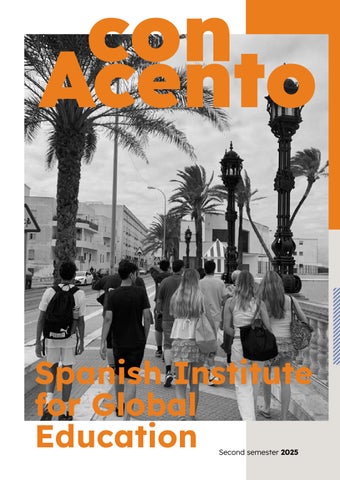
Acento con

![]()

MARÍA TERESA ALONSO Director
AMPARO GUTIÉRREZ
Marketing Manager
STAFF
Spanish Institute
CONTACT IN SPAIN
Spanish Institute for Global Education
Phone: (+34) 609 228 497
Email: info@spanishinstitute.net
EDITORIAL ADVICE AND PUBLISHING
LIOC Editorial

I”It is a pleasure to welcome you to this new edition of the magazine “Con acento” (With an accent), from the Spanish Institute for Global Education. A”
“space born from the desire to share who we are and what we experience at our school: experiences, lessons learned,
projects... stories that unite us beyond the classroom and beyond borders.
Many of you already know me, but let me introduce myself: my name is María Teresa Alonso, president of the Spanish Institute. In the hallways of our headquarters in Seville, and among” friends, many call me Macarena.
That closeness—the kind that is created when we share a language, a city, and a passion for teaching—is what we want to reflect in these pages.
This magazine is not just a newsletter, it is a window into the heart of our community. Here we celebrate collective achievements and build bridges between people who come from different places, but share the same purpose: to grow, discover, learn, and teach.
Throughout this issue, you will find student testimonials, course reports, images that capture the joy of learning, and reflections that invite you to dream of a more humane, more global education that is more connected to real life.
I invite you to read, pause at each story, perhaps recognize yourself in a shared experience, and above all, feel that you are part of this community that continues to grow with enthusiasm, professionalism, and dedication.
Thank you for joining us.
With affection and “accent,”
María Teresa Alonso
President of the Spanish Institute for Global Education
Letter from the Director
Semester Report
Beyond the Classroom: Voices and Perspectives of Our Students
Internship and Volunteer Project
Faculty Corner (CAPDELE)
Agenda, Upcoming Events
From January to July 2025, at the Spanish Institute for Global Education we experienced a semester full of activity, culture, and international encounters. Each group, class, and event reminded us why we believe in an education centered on human experience and real connections.
The return of a beloved group: St. Margaret (Hong Kong)
We opened the year with a visit from St. Margaret, from Hong Kong, for the second consecutive year. The 15 participants learned Spanish and lived with local youth thanks to a partnership with a school in Jerez.
They also enjoyed a cultural program with flamenco classes and a cooking workshop, activities that were highly valued by the group. Their curiosity and commitment left a very positive impression on our school.
The Study Abroad Spring program, from January to May, offered 22 students from Pitzer College and the University of Central Arkansas the opportunity to live with Spanish families, attend classes at local universities, and participate in internships or research. They significantly improved their Spanish language skills and, above all, grew in maturity, openness, and cultural understanding. Daily life, excursions, and integration into the city made this experience a complete learning process.
This semester, 23 teachers participated in CAPDELE, spread over three editions (May, June, and July). Exploring active methodologies—cooperative learning, implicit grammar, task-based approach—allowed teachers to share experiences and motivations. CAPDELE is establishing itself as a space for innovation and indepth training.


“Clases de Flamenco, Taller de Cocina y mucho más…”

Between May and June, we held a five-week program for university students with official credits. Rhodes College placed its trust in us for the third time, sending 16 students. The program began in Madrid and continued in Seville, with classes, cultural visits, and excursions to Granada, Cádiz, and other Andalusian cities. The students made remarkable progress in Spanish, and the experience was highly valued.
More than 90 participants took part in Faculty-Led programs.
• Gymnázium Ludka Pika (Czech Republic): 42 students enjoyed a comprehensive cultural program, participating actively.
•Rhodes College: 18 students traveled accompanied by two teachers, reflecting close institutional collaboration.
• University of Udine (Italy): 17 university students prepared for the B2 level, showing great maturity and commitment.
In July, young students participated in a Summer Camp with Spaniards in the mornings and Spanish classes and cultural activities in the afternoons. The combination allowed for an authentic and fun immersion.

Professional internships: connection with the world of work
66 students did internships in sectors such as health, ecology, marketing, education, and communication. With more than 80 collaborating companies and NGOs, these experiences offered real contact with the world of work and highly valued learning.
26 students followed an individual Spanish program. All of them achieved their goals, highlighting the personalized attention, teaching quality, and confidence gained in each session.
In March, we participated in the Forum of Education in Toronto, expanding our network with American universities. In addition, we made progress in collaborations with Turkey, the Netherlands, Italy, and Canada, consolidating the school’s international reach.
This semester has been deeply enriching. A diverse group of students reminded us of our mission: to grow together through education. The enthusiasm of the participants and the dedication of the Spanish Institute team made these months a unique experience.
Thank you to everyone who made it possible!
Our American students have crossed the Atlantic in search of more than just academic credits: an experience that will transform their view of the world. Thanks to SIGE, Seville, with its vibrant mix of history, art, everyday life, and tradition, has become their preferred destination for this educational adventure.
In this student gallery, we bring together the experiences of young people who have chosen this Andalusian city as the setting for their learning, not only in academic terms, but also in personal and cultural terms. Their testimonials offer us an intimate and diverse view of what it means to study abroad and how a stay in Seville can mark a turning point in their lives.


The influence of Spanish culture in New Orleans
Louisiana was colonized by the French and Spanish before becoming part of the United States, and both left a significant influence on New Orleans. Although the city is often associated more with French culture, the Spanish presence is very strong.
The iron balconies in the French Quarter are a clear example. After the fires of 1788 and 1794, the Spanish rebuilt much of the city, incorporating their architecture. So what many people today believe to be French actually has Spanish roots.
Another aspect is civil law, inherited from Rome and Spain, which governs Louisiana instead of common law as in the rest of the country.
Spanish culture is also evident in the cuisine, the streets, and everyday life. Being in Spain showed me how many connections there are with New Orleans. That’s why I feel at home here.
My two families: similarities and differences
I have two families: my birth family in the United States and my host family in Seville. Both are wonderful, although they have similarities and differences.
My Seville family consists of a mother, a father, and two sons, César and Jaime. They are supportive and loving, with values such as kindness, honesty, and integrity. This is similar to my family in the United States, which consists of my parents, my sister Lily, and me. Both families share the same values and everyone wants us to be happy.

The differences are in the children—two boys in Seville and two girls in my home—and in the language: in Spain I speak Spanish and in the United States, English. The schedules and meals are also different: in Seville, lunch is later and more abundant, and at home we eat dinner earlier and more abundantly. I am happy with my host family, although I also miss my own family very much.
Cathryn Sato

When I started thinking about living in another country, I knew it would be difficult. Not so much because of the language or not knowing anyone, but because starting a new life is never easy.
One of the first challenges was leaving my comfort zone. At home, everything is familiar, but in a new country, I had to adapt to different schedules and customs.
The routine affected me because I am very structured. It was also difficult to make friends when my vocabulary was limited; I often felt uncomfortable and insecure.
How did I overcome it? Not entirely, but I understood that it is normal to feel that way. I learned to accept the discomfort and use it as part of the learning process. Over time, each situation became more manageable.
My advice to others would be to step outside your comfort zone and see every interaction as an opportunity to discover and grow.

There, my diet was lighter, often tofu with vegetables.
During my studies in Seville, I began to understand the phrase, “family is what you make it.” My host family has become a second family to me, even though they are very different from my family in the United States.
In my country, my parents are separated and I don’t have any siblings. In my last year of high school, I lived with my father, who works a lot, while I was studying. That’s why I ate alone from Monday to Friday and we only had dinner together on weekends.
In Seville, I live with a woman and her two daughters. Sometimes they bring their dog, which is something new for me because my family doesn’t have a pet. I also live with Sarah, another student, with whom I usually share meals.
Although they are different, both families are important to me. I am very grateful for the hospitality I have received in Spain.
Elliana Milman
During my five weeks in Seville, I went on wonderful excursions to different cities in Spain. Many were to historical sites, such as the Alhambra in Granada, the mosquecathedral in Cordoba, and, in Seville, the Cathedral and the Alcazar.
The trip began in Madrid with a visit to the Royal Palace. I was impressed by the beauty of its ceilings and rooms, and the paintings in golden frames. I loved Madrid! In Seville, we visited the Cathedral, filled with paintings of Jesus and Mary, and climbed the Giralda. Although the walk was long, the bells and the view from the top were worth it. The Alhambra in Granada was my favorite excursion, especially its gardens with colorful flowers, which were relaxing and beautiful.
Catherine McClees

The influence of the Spanish Empire on the world
My visit to the Royal Palace in Madrid impressed me because it is a beautiful building and very different from what I know in the United States, where we don’t have kings.
The Spanish Empire was very influential and lasted almost 500 years. During the 19th century, it was very powerful. Queen Isabella I of Castile was very important in supporting Christopher Columbus on his voyages. Today’s large Spanish-speaking population still reflects the power that Spain had in the past.
Today, the kingdom no longer has as much power. King Felipe VI and Queen Leticia play a more symbolic role, although they remain important in international relations and in connecting with the people.
Avi Crosby


Every country has its own cuisine. In Spain, it is based on the Mediterranean diet, shared with Italy and Greece, but adapted in a unique way. Products from the Mediterranean Sea and olive oil are staples of Spanish cuisine.
Fish occupies a central place. Anchovies are very famous, as are squid, cuttlefish, marinated fish, and sardines. In addition, each meal usually includes carbohydrates, especially bread or rice. Meat is also important: pork is very popular, while beef is more expensive and less common.
As for drinks, wine and beer play a prominent role at the table. Among the most famous foods in Spain are paella, Iberian ham, croquettes, and all kinds of fried fish.
In conclusion, although it shares Mediterranean roots, Spanish cuisine is unique.
Auden Brummer
Sevillian culture
I want to talk about the role of family in Seville and compare it to my family in the United States. Here I live with my host mother and her daughter, in a singleparent household, just like in my country.
What has struck me most is the importance of sitting down at the table for meals. They always set the table and have everything ready. Eating here is like a ritual, a sacred moment.
In the United States, we also eat dinner together, but work schedules and fast food make it difficult. Here in Seville, people come home, relax, and sit down with their families.
I love the relationship with my host family and the conversations at the table. I have gotten to know my host mother very well and I really appreciate this family culture.
Cailyn Jordan


Gastronomic culture in Spain and comparison with
Spanish cuisine is very different from that of the United States. Here, the Mediterranean diet predominates, considered very healthy, with fish, meat, vegetables, fruit, bread, rice, cheese, and olive oil. Fish is essential, especially in the south, and I love sea bass, which is served whole.
Tapas are very popular: small dishes that are enjoyed with drinks in bars. Every day I try tapas and white wine. My favorites are paella and croquettes. In Seville, I visited restaurants such as Lobo López and La Santa, where I tried patatas bravas, shrimp, and homemade croquettes.
I was also surprised by the meal times. In the United States, breakfast is hearty and dinner is the most important meal. In Spain, breakfast is light, lunch is eaten later and is the main meal, while dinner is light and late.
The food in Spain is fresh, varied, and delicious.
Rachel Clarke

Since I arrived in Spain, many things have surprised me, but what has struck me most is the way people experience time here. Compared to other countries, where life is fastpaced, in Spain there is a more relaxed attitude, especially when it comes to meals, rest, and social life.
A clear example is the “sobremesa,” that moment after eating when people stay and chat and enjoy themselves. It’s a very human practice that fosters connection.
I was also surprised by the importance of local festivals and life in the squares. Finally, I really appreciate the balance between work and personal life, which has made me rethink my habits.
Arshia Miramini

Last Tuesday, I went to a jazz bar to listen to music and enjoy the atmosphere. Upon entering the Hotel Alfonso XIII, near Puerta Jerez, I was impressed by the beauty of the marble and the design of the entrance. I walked through the garden, wearing my new Spanish highheeled sandals, until I reached the bar.
couples: one was celebrating their thirtyfifth anniversary, and the other was on one of their first dates. I ordered a glass of white wine and talked to Jorge, the waiter, about New York and Seville.
Three men with a cello, guitar, and drums played a quiet melody. I loved the relaxed atmosphere, and this american bar did not disappoint.
The bar had stone tables, velvet chairs, a stage, and a bar. I sat between two Audrey Heidbreder

After-dinner conversation
In Spain, one food that has surprised me is croquettes. I didn’t think they would be so delicious and comforting.

They were a food from my childhood, but I had never tried them again before coming here.
I was surprised that they are delicious the next day. Also the flavor, because there are more types than I thought. I haven’t tried many, but the ones I did try were delicious. Croquettes are like hushpuppies in the southern United States.
They can also be made gluten-free; it’s not the same, but they’re not bad. The ingredients are simple: butter, ham, milk, salt, eggs, oil, onion, flour, bacon, and breadcrumbs.
From the moment my Spanish mother picked me up at the train station in Seville, I knew there was something different about Spanish culture. Having lived in the United States my whole life, I didn’t know what to expect, but what I discovered has been unique.

The idea of the “after-dinner conversation,” or conversation after eating, quickly became one of my favorite aspects. Sitting down after a meal and not leaving immediately has allowed me to connect with my Spanish family. I have learned about Santiago and everything the family does during the day.
The after-dinner conversation has allowed me to practice Spanish and has given me a great perspective on life here.
Dominic Cestero
I am Catholic and returned to the church a few years ago. At my university in the United States, I go to Mass near my residence. There are beautiful churches there, but nothing as old or grand as in Europe.
Visiting Seville Cathedral was incredible. I was impressed by its walls, columns, and stained glass windows with so many colors and details. Going inside was amazing. I took lots of photos, but none of them captured the magnitude, light, and beauty that I felt in person.
I also learned about its history. The cathedral was built on top of an old mosque, and the Giralda tower is a reminder of that past as a prayer tower. After the reconquest, it was consecrated for Catholic worship. Later, after an earthquake, it was rebuilt as a large Gothic cathedral, one of the largest in the world. For me, this visit brought together my religion, my interest in art, and the history of Spain in an unforgettable experience.
Morgan Drenser-Hagmann


In a park in Spain, I saw how a ball achieved what words sometimes cannot: bringing strangers together in seconds. There, I understood the invisible power of soccer to create community.
It is the most popular sport in the world and unique in its ability to bring people together regardless of language, culture, or origin. Even those who would never have met can share a game.
Soccer celebrates differences and combines them into a common event. Almost anyone can play or watch with someone else, and that’s the beauty of it.
At night, I see groups celebrating games, creating memories, and sharing joys or sorrows with their country. That sense of belonging is something much bigger than oneself.
Ethan Crump

I have learned that Seville has a problem with housing prices. Many people live with their parents after they turn 30. Part of the problem is tourist accommodations, many of which are illegal, which makes housing more expensive and difficult to buy.
Another problem is government taxes. I read an article that said taxes have risen seven and a half percent more than the Spanish economy and three percent more than employment. When taxes go up, people lose purchasing power.
I think the solution lies in a change in government policy. Taxes are necessary, but the government must also support its citizens.
Griffin Kennamer
As soon as I arrived at the train station in Seville, I had a feeling that I was going to like my new family. My host parents took me to a place that became my home, even if it was only for a month.
I remember the first time I saw the orange trees typical of Andalusia around the building. My room had everything I needed: a desk, a comfortable bed with colorful pillows, and a window overlooking the city.
I met my host siblings, two boys and a girl. Once, the girl gave me a little turtle from a Kinder egg.
During my first week, one of the boys asked me what my favorite city was. I said Madrid, and he smiled: “I’m sure you do.” And he was right.


I am an American student visiting Seville to learn about the culture, people, and history of Spain. I have been here for four weeks and although I spend most of my time in Seville, on weekends we travel to other cities.
We have been to Córdoba, Ronda, Cádiz, and Granada. The visit that impressed me the most was Granada, because of the Alhambra, an incredible Arab palace. I couldn’t believe it was built so many centuries ago.
I imagined living in it with its original architecture and colors. From the Alhambra, you can see the whole city; it was surreal.
In addition to its beauty, we learned about its history: residence of kings, Muslim city, and later conquered by the Catholic Monarchs. It is an incomparable place.
Maddie Kingsley
Galilea Letitia Lyons and Jasmine
Jauregui share how their professional internships, arranged through the Spanish Institute, marked a turning point in their education. Thanks to this opportunity, both students applied their knowledge in real-world contexts, strengthening their professional and personal development.
This summer I had the incredible opportunity to do an internship at Spanish Institute (Seville). It was a unique experience that allowed me to practice Spanish while improving my marketing skills. It was the perfect balance between my two majors: Communication Studies and Spanish.
The people I worked with were kind and welcoming. I worked closely with Amparo, the Senior Lead of Campus Marketing, who was always compassionate towards me. From day one, she guided me, encouraged me to use my creativity, and offered constructive feedback that helped me grow. My time in the office was not limited to computer tasks, but also became a space for language exchange. Interacting with native speakers in professional and personal conversations strengthened my confidence in Spanish.
One of the most rewarding things was the location. I had only visited Seville once before, but I was determined to return, and I’m glad I did. I lived in a beautiful and historic city while gaining practical experience in my career. Whether eating tapas, walking around Plaza de España, or watching a flamenco show, there was always something enriching to do.
The cultural immersion extended beyond the office. I attended cultural events with summer students, contributing content for social media. I was also encouraged to explore Seville as a creative part of the internship. I had the freedom to document my personal experiences and incorporate them into my work.
The city of Seville, with its history and charm, made it easy to fall in love with it, and Spanish Institute created a warm environment that I will always cherish.

My experience with Spanish Institute has been truly delightful and fundamental to my development during this internship.
In my first week in Seville, I took Spanish grammar and culture classes with Spanish Institute that not only improved my language skills, but also helped me adapt more easily to the professional and social environment of my internship. The teachers were very friendly and created a welcoming atmosphere that made learning a very positive experience.
After finishing my classes, I began my internship at Bioalverde, an organic farming NGO that is part of the prestigious Cáritas organization. I have been there for more than three weeks and it has been an incredibly enriching experience. I have learned about sustainable agricultural practices, such as ecological pest control, the identification of invasive species, and the management of various crops.
In addition, working in an organization that promotes social inclusion has been very meaningful to me. Spanish Internship and Volunteer Project Jasmine Jauregui The Institute helped plan the right
internship for my profile, in this case with Bioalverde, and also played a key role in preparing me for this experience. Without a doubt, it facilitated my linguistic and cultural adaptation in both the work and personal environments. My experience with Spanish Institute has been excellent, and I am very grateful to the entire faculty, who have guided me during this time.

Every year, when the classrooms of Spanish Institute for Global Education fill with voices passionate about teaching Spanish, we know that something special is about to happen. Between May and July 2025, we welcomed 23 teachers and future teachers from the United States, Italy, Poland, the Netherlands, Spain, and several Latin American countries, who participated in three editions of the CAPDELE course. This program, which has become one of our educational pillars, offers much more than an academic update: it is a space for meeting, inspiration, and professional renewal.
The CAPDELE course is based on a clear idea: teaching Spanish is much more than teaching grammar. During an intensive week, participants work with a practical approach based on active learning, meaningful interaction, and real use of the language.
Topics such as oral fluency from the outset, comprehensible input, cooperative learning, implicit grammar, the task-based approach, and formative assessment are addressed. Digital resources, classroom dynamics, critical thinking techniques, and strategies for making linguistic objectives visible are also explored.


One of CAPDELE’s great strengths is its sense of community. Each edition becomes a learning community where questions, approaches, and findings are shared. The sessions combine theory and practice, reflection and action, allowing participants to experiment with new ways of teaching and strengthen their role as guides and facilitators.
Beyond language, we reflect on empathy, creativity, confidence, and classroom management, making the course a space for professional and personal growth.
The diverse profiles—from young teachers to those with extensive experience—create mutual enrichment. Participants leave with concrete resources and a renewed vision of their impact in the classroom.
This year, in addition to the courses held, Spanish Institute has forged new international collaboration networks with institutions in the United States, Turkey, the Netherlands, Italy, and Canada, expanding the possibilities for future editions and reinforcing the program’s global reach.

Thank you all
CAPDELE would not be possible without the enthusiasm and generosity of those who believe that teaching Spanish is more than just transmitting a language: it is opening paths, building bridges, and constructing futures.
The Spanish Institute for Global Education is kicking off the 2025–2026 academic year with an agenda packed with activities, international meetings, and transformative experiences. As every year, our commitment to quality, educational innovation, and intercultural exchange is reflected in the events and programs we promote.
In September, we will participate in the EAIE Forum in Gothenburg (Sweden) from the 9th to the 12th, a key event for international education professionals. We will also be at Spanish Language Week organized by FEDELE from October 1st to 5th in Logroño. And we will close out the fall at ICEF Berlin from November 1st to 5th, strengthening our global alliances.
The big event will be the Vanishing Voices: The Future of Language Learning in Education Abroad International Seminar in Seville from October 12 to 15, 2025, organized in conjunction with Gateway International Group. It will bring together experts from US universities to rethink the role of language learning in international mobility.

The seminar will revolve around four sessions:
• Rethinking language commitment, with Professor Carmen G. Hernández (PhD).
• Artificial intelligence and language learning, with Professor David Becerra Alonso (Loyola University Andalusia).
• Program modalities and curricular strategies, by Myriam Monterrubio (Educational Counselor) at the University of Seville.
• Language and identity in global learning, with Professor Maria Alice Soriero.
In addition to the sessions, there will be cultural visits, spaces for reflection, meetings with students, and a collaborative publication project.
Added to this is the start of the fall Study Abroad program, which began on August 24 with students from Pitzer, Arkansas, and independent students. They will experience complete linguistic and cultural immersion: classes, excursions to Granada, Cordoba, Cadiz, and Ronda, flamenco workshops, cooking, and historical visits.
The CAPDELE program will have three editions: October (October 25–November 1), May (May 10–16), and July (July 5–11), with active methodologies focused on oral competence, cooperative learning, implicit grammar, and task-based teaching.
From Seville and with a global accent, we open the doors to a course full of encounters, innovation, and passion for language teaching.


Click on the button or scan the QR code to access all the information about the center.