LINK Kenton Reader - Volume 4, Edition 17 - March 20, 2026
Trump speaks to crowd in Hebron: ‘I love Kentucky!’
By Kenton Hornbeck
“There are more people working today than at any point in our country’s history,” President Donald Trump told a packed crowd at Verst Logistics on March 11.
He began his speech shortly before 5 p.m. after declaring, “I love Kentucky!” to a cheering audience.
Trump used the venue to discuss the economy, highlighting his administration’s tax policies and urging the expansion of American manufacturing.
The walls of the auditorium at Verst were covered in bottles and cans, a nod to the company’s warehousing and fulfillment operations. Behind the stage was an American flag made of white, red and blue cans, with a banner that read “Lower prices, bigger paychecks.”
Trump started his rally by highlighting the corporate tax cuts passed in the ‘One Big Beautiful Bill Act’ during the summer of
Continues on page 3
AI meets bourbon: General Thomas brand uses tech to customize bottles
By Kenton Hornbeck
Fort Thomas native Dan Gorman wanted to find a way to express his appreciation for his hometown. As a Kentuckian, he decided the best way was through bourbon — the signature spirit of the Bluegrass State.
Taking his cues from George Remus Bourbon, a brand he has long admired, Gorman launched General Thomas Bourbon in 2025 — his own brand named after the late General George Henry Thomas, a former Union Army commander and the namesake of the City of Fort Thomas.
To launch his brand, Gorman bought 20 barrels of premium 5-year-old bourbon
from a distillery, yielding about 4,500 bottles. The brand launched with two versions: A 99-proof, very small batch made by blending and proofing down 10 barrels and a single-barrel, cask-strength release.
For Gorman, bourbon embodies companionship. Offering a pour is traditionally seen as a sign of hospitality. It’s a spirit best enjoyed slowly, giving drinkers ample time to drum up conversations. Through starting a brand, Gorman wanted his bourbon and, by extension, Fort Thomas, to be a part of those intimate moments.
“I just really loved bourbon. It’s like one of those things that you have when you’re having friends over; it evokes companionship and good times to me. It’s like when I
Continues on page 4
Why humancentered thinking matters in entrepreneurship p6 Planning Commission denies zoning to major developer p7 Local partnership removes thousands of pounds of trash
Donald Trump speaks to the crowd at Verst Logistics on March 11, 2026. Photo by Ethan Bloomfield | LINK nky
General Thomas Bourbon founder Dan Gorman.
Photo provided | General Thomas Bourbon website
PRESIDENT & CEO Lacy Starling
EXECUTIVE EDITOR Meghan Goth
SPORTS EDITOR Evan Dennison
LINK nky Kenton Reader is published weekly by LINK Media LLC, 31 Innovation Alley, Covington, KY 41011.
Periodicals Postage Paid at Covington, KY.
POSTMASTER: Send address changes to LINK nky Kenton Reader, 31 Innovation Alley, Covington, KY 41011. ISSN 3064-7460
859-878-1669 | www.LINKnky.com
HAVE A TIP? News@LINKnky.com
WANT TO ADVERTISE? Marketing@LINKnky.com
WANT TO SUBSCRIBE?
Send a check for $58.30 ($55 non-auto-renewing rate plus 6% Kentucky sales tax) to LINK nky 523 Madison Avenue, 2nd Floor Covington, KY 41011 or scan this QR code below
Love what we're doing? Want to support public-interest journalism in Northern Kentucky? Make a tax-deductible donation to support our work. Scan the QR code below, or mail a check payable to the Northern Kentucky Community Journalism Fund to 50 East Rivercenter Blvd. Suite 431, Covington, KY 41011.
No part of this publication may be used without permission of the publisher. Every effort is made to avoid errors, misspellings, and omissions. If, however, an error comes to your attention, please let us know and accept our sincere apologies in advance.
Continued from page 1
2025, which included eliminating taxes on tips and overtime pay.
After talking about the ‘One Big Beautiful Bill,’ Trump touted tax cuts that allow Verst to expand its operations across the country.
“Perhaps most importantly to the workers here today, I’m also proud to announce that the Big Beautiful Bill offers no tax on overtime,” he said. “So you take home 20 or 30% more to those beautiful children or whoever you’re bringing it home to.”
He turned that message into a rallying cry to vote for Republicans in the upcoming midterm elections.
“They (Democratic Party) want to raise your taxes higher than they ever have before,” he said. “We have to win.”
Trump discussed the usual economic beats that affect Kentucky, including reaffirming his support for the coal industry. He mentioned several major investments planned for the state, such as Apple’s announcement of a $2.5 billion investment to produce iPhone screen cover glass at a Corning plant in Harrodsburg.
More than 30 minutes into the speech, someone in the stands behind the president appeared to faint.
“God bless our First responders,” Trump said.
“We were talking about Gavin Newsom, but maybe it’s not the best topic because it made that lady not feel so well,” the president continued.
During the speech, a second person in the crowd also needed medical attention. Celebrity physician Dr. Mehmet Oz, who was appointed by the president to serve as the administrator for the Centers for Medicare
& Medicaid Services, was also in attendance and helped care for both individuals, according to a LINK nky reporter who watched it happen.
Verst Logistics CEO Paul Verst later took the stage alongside Trump, where he thanked the president for the tax cuts passed through the ‘One Big Beautiful Bill.’ Moreover, he said eliminating tax on tips and overtime pay would positively impact Verst employees.
“President Trump, this is all possible because of your vision to make America great again,” Verst said.
Following his economic messaging, Trump criticized U.S. Rep. Thomas Massie of Kentucky’s Fourth Congressional District for voting against his legislative priorities. Trump openly expressed that he “did not like” Massie, using this sentiment to endorse Ed Gallrein, who is running against the incumbent congressman in the May primary.
“And now Thomas Massie is attacking a great Navy SEAL, Ed Gallrein,” Trump said. “He’s running against him in the primary. You know why? Because he’s (Massie) not doing right by our president.”
Trump also recognized three of Kentucky’s GOP Senate primary candidates: Kentucky Rep. Andy Barr, former Kentucky Attorney
General Daniel Cameron and entrepreneur Nate Morris. The candidates are in a heated primary to replace outgoing Sen. Mitch McConnell. A Trump endorsement would likely boost the recipient to the top of the pack in the primary.
Before Trump took the stage, Gallrein delivered his campaign pitch to the crowd.
“He’s joined the Democrats and ‘The Squad’ to block our president and our Republican Party,” Gallrein said.
Massie, who was first elected to Congress in 2012, has become a thorn in Trump’s side for opposing several high-profile policy initiatives of his administration.
Gallrein criticized Massie for voting against the ‘One Big Beautiful Bill Act’ — the administration’s flagship legislation of 2025. More recently, Massie co-sponsored a failed ‘War Powers Resolution’ with Democratic Rep. Ro Khanna of California that sought to halt U.S. military actions against Iran.
Massie was also the only Republican to co-sponsor the ‘Epstein Files Transparency Act’ — legislation that required the Department of Justice to publicly release all unclassified records, communications and investigative materials related to Jeffrey Epstein and Ghislaine Maxwell. Trump signed the bill into law on Nov. 19, 2025.
Dr. Mehmet Oz, administrator for the Centers for Medicare & Medicaid Services, helps care for one of two individuals who needed medical attention at President Donald Trump’s rally in Hebron on March 11, 2026. Photo by Ethan Bloomfield | LINK nky
Continued from page 1 have friends over, we share a bourbon — that’s what we do.”
Although General Thomas is a small craft brand, Gorman wanted it to stand out among the many bourbons lining local retail shelves. Gorman said he wanted each bottle of bourbon to be customizable, whether it was purchased at the store or given as a gift. To accomplish this, he enlisted the help of artificial intelligence.
Each bottle of General Thomas Bourbon features a unique QR code on its label that links back to its own webpage. When scanned, a 160-year-old photo of Thomas comes to life and speaks. AI gives the general a moving mouth and a deep, bellowing voice.
The portrait, which is the same one that adorns the front of each bottle, shares stories about his Civil War service, the history of Fort Thomas or the bourbon itself. In addition, the bottle also features a patent-pending customization option that lets buyers create a personalized message, which ensures that no two bottles offer the same digital experience.
“It creates a very interesting, immersive, fun, customizable experience for every single bottle, where, if you’re keeping the
bottle at home, you can put an interesting message on that bottle, whether it be a funny joke or the story of your home bar,” Gorman said. “You can let your guests listen to it. If you are giving it as a gift, that’s where it really shines, because you can customize it personally for the person you’re giving it to.”
To design the program, Gorman tapped 24-year-old Luke Weidner, a graduate of Highlands High School in Fort Thomas. Weidner, who is employed at startup Vertice AI, jumped at the opportunity.
“You would generally think that the people into bourbon wouldn’t be into AI, but it was just a fun project,” Weidner said. “Dan came to me, he had the idea for it. He’s like, ‘Hey, this could be a fun way to get people in and be a disruptor in the bourbon industry.’”
Typically, middle-aged men are the main consumers of bourbon, whereas AI usage is more common among younger people. Weidner said that the brand’s application of AI offers a novel way to bridge these two different demographic groups. From Gorman’s perspective, AI allows General Thomas a chance to tell bourbon drinkers his own story.
“It really makes it a lot of fun and very different from anything else that’s out there,” he said.
A few bottles of General Thomas Bourbon. Photo provided | General Thomas Bourbon
Grant to help improve traffic flow on several roads in Florence
By Kenton Hornbeck
U.S. Route 42, Mall Road and Ewing Boulevard in Florence will undergo traffic signal modernization thanks to a $3.7 million grant from the Kentucky Transportation Cabinet, or KYTC.
During a Florence City Council caucus meeting on March 3, Public Services Director Eric Hall explained that heavy traffic along Route 42, Mall Road and Ewing Boulevard — three of the busiest corridors in the city — has raised safety concerns and led to increased congestion.
To address this, Florence is considering investing in new, intelligent adaptive traffic signals to improve vehicle flow along these routes, reducing idling and increasing traffic efficiency. An analysis published by the Federal Highway Administration found that implementing adaptive traffic control systems can reduce travel time by more than 10% on average. This increases to 50% or more in areas with outdated or obsolete signal timing systems.
“This is a project we’ve been talking about for a long time,” Hall said. “I’m excited to finally see we’re at a place where — you could consider it a finish line at least — to get con
struction funding.”
Hall said Florence will install adaptive signals at 28 intersections across the city, from Ewing Boulevard to Mount Zion Road, including the jughandle intersection at Mall Road and the traffic signal outside the Florence Government Center.
Adaptive traffic signals differ from traditional fixed-timed lights in that they adjust in real time to traffic flow, Hall said. The system employs fiber-optic cables for signal routing and uses traffic-monitoring software to form a network that modifies the duration of green and red lights depending on congestion levels. Once implemented, Hall said the new system will help integrate
signal management and improve overall traffic coordination.
Additionally, the system will feature a tool to assist emergency responders. Police, fire and emergency management vehicles that communicate with signal systems when responders activate their lights during a call can influence the signals ahead of them. This technology is intended to enhance response times and lower the risk of collisions at intersections during emergencies.
Hall noted that Lexington has installed adaptive traffic control systems throughout some areas of the city.
“It basically just makes your street more ef-
fective,” Hall said. “So, if you’re sitting at an intersection and there’s nobody in the other street — it’s reading, it’s adapting to what’s going on and it makes traffic move quicker.”
Currently, many of the signals along Route 42 are managed by KYTC. Conversely, Florence operates the traffic signals along Mall Road, and one along Ewing Boulevard near the Florence Government Center.
“Would you explain a little bit more about, now that the construction funding is here, the design’s been done, we’ve been waiting for the final approval to start, what’s the process at this point as far as the bid and a timeline that you’re looking at where we might actually see some results from this?”
Council Member Diane Whalen asked.
Hall said that once the agreement is signed by Mayor Julie Metzger Aubuchon, the project will be advertised for contractor bids. After reviewing proposals and interviewing contractors, Florence will select a contractor, then hold a pre-construction meeting to set a timeline. If the project stays on schedule, it should be completed by the end of 2026.
The project will be largely funded by a KYTC grant, which covers roughly 80% of the cost. The remaining local share of the cost will be split between Florence and Boone County. Hall said the grant would cover the cost of the design and buildout.
The Florence City Building. Photo Provided | City of Florence via Facebook
Community Voices: Why a human-centered entrepreneurial mindset matters more than ever
By Zac Strobl
This Community Voices column is written by Zac Strobl, the director of Northern Kentucky University’s Center for Innovation & Entrepreneurship.
Northern Kentucky employers frequently express concerns about how to prepare the workforce for rapid changes, new technologies and, of course, artificial intelligence. When considering the future workforce, the solution isn’t simply to teach students to memorize facts or follow rigid instructions; it lies in teaching them to think like entrepreneurs.
The entrepreneurial mindset is not just for those launching startups; it is a way of approaching the world that emphasizes problem solving, communication, creativity, resilience, adaptability and ownership. In an era where many are concerned about AI taking their jobs, these human-centered skills are exactly what set individuals apart.
The entrepreneurial mindset helps people become more proactive, more confident in navigating ambiguity and better equipped to add value to any organization — and to embrace technology. Employers consistently tell us they want individuals who take initiative, communicate clearly, think
creatively and propose solutions. Entrepreneurship education builds these abilities.
One of the most important skill sets we teach is problem solving. Students learn to break down complex issues, understand root causes, explore creative solutions and test those solutions in the real world. This can lead to launching a business, developing a social enterprise such as a non-profit or improving processes at work. What matters is that we learn to take the initiative to solve problems we care about.
We encourage students to develop this mindset in two ways.
1. Opportunities for them to explore entrepreneurship directly: Students build revenue-generating businesses, work with real customers and experience the challenges of turning an idea into reality. Through our innovation and entrepreneurship courses, students acquire the necessary skills to
launch and grow their own ventures. Even if their business concept never launches, they learn valuable processes they can apply to future endeavors.
2. Applying entrepreneurial thinking within existing organizations: Startup internship programs offer excellent opportunities for students to learn firsthand from entrepreneurs and real teams. Not everyone wants to start a company, but every student benefits from learning to think like an entrepreneur. Today’s organizations need team members who can adapt quickly, communicate effectively, collaborate across teams and approach challenges with creativity to remain competitive in a world where AI is reshaping nearly every industry.
Students learn to view AI as a tool that can help them generate ideas, streamline workflows, enhance communication and accelerate problem solving. Entrepreneur-
thinkers don’t worry about whether technology will change their jobs; they focus on how to use that technology to create new value.
When students adopt this mindset, society benefits as well. We gain more individuals who take initiative, not just in business, but also in civic life. More people who improve processes, challenge outdated systems and build solutions when they see gaps. More people who don’t sit back and hope for a better world, but who take the impetus to make it happen.
The entrepreneurial mindset is vital, even for students who never launch a startup. It prepares them to thrive in their careers, strengthens their organizations and helps them adapt to a future none of us can fully predict. It helps build a region full of innovators, creators and problem solvers, which benefits us all.
The NKY Chamber, in partnership with BE NKY, brings together experts to explore how shifting demographics, accelerating technology and changing productivity trends are reshaping Northern Kentucky’s economy.
Zac Strobl. Photo provided | Northern Kentucky University
An entrepreneurial mindset should be human centered, Zac Strobl writes. Photo provided | Curated Lifestyle via Unsplash ial
Planning commission denies Fischer Homes Independence zoning
By Nathan Granger
The Kenton County Planning Commission has denied a zoning change for a 178-unit development from Fischer Homes on a tract of land in Independence off State Route 17. This is just north of the area where the new Publix grocery store is slated to open.
Both planning commissioners and Independence residents expressed concerns about the proposed development’s building density of roughly seven units per buildable acre in a March 5 meeting. Some commissioners were also concerned with how the developers aimed to use the city’s planned unit development, or PUD, zone to carry out the development plan. Maura Snyder, representing the City of Independence, made the motion to deny the change request, and the commission cast a 15- 2 vote in favor of the denial.
“I think there’s a design that can happen there,” said Commissioner Phil Ryan, but recommended the developers “back it off a bit.”
The planning commission’s decision serves as a recommendation to the Independence City Council. The developers can now either come up with a new development plan, seek another recommendation for a different zoning change or try to convince the city council to supersede the planning commission’s recommendation.
Located off Route 17 in Independence, the land is currently categorized under the city’s residential rural estate zone. Fischer made the ask through its LLC development subsidiary Grand Communities, which is tied to numerous real estate development projects in the region. Fischer doesn’t actually own the land but was hoping to develop it on behalf of the owners, who are hoping to sell it; there is an existing single-family home on the site. Both rural and suburban areas surround the land.
The development plan Fischer submitted to county planning professionals prior to the March 5 meeting called for 66 patio homestyle duplexes and 112 multi-family condos, a new water detention basin, 124 parking spaces and new streets with access onto Route 17. Oliver Road runs along the side of the land opposite to Route 17, but the development plan did not call for access onto that road.
Grand Communities dubbed the development Coppice Hollow. A coppice is a human-maintained grouping of tree shoots growing from a tree stump. The patio-home duplexes would have two to three bedrooms. The condos, on the other hand, would have two bedrooms and the units would be spread across 11 buildings. Grand Communities submitted renderings of both housing types to the county before the meeting.
Grand Communities gave estimated base prices for both housing types: between $215,000 and $280,000 for the condos, depending on their size, and between
A drawing showing the proposed layout of a Fischer Homes development off State Route 17, projected onto a screen at the March 5, 2026, meeting of the Kenton County Planning Commission. Drawing provided | Grand Communities, LLC.
$290,000 to $320,000 for the duplexes. Those prices do not represent any upgrades or amenities. County planning professionals later offered a more detailed analysis that broke down total monthly costs, including taxes, insurance and other ownership expenses if a buyer made a 20% down payment.
County planning professionals were not in favor of the zoning change for several reasons.
First, the units did not conform to the area’s recommended land use, which calls for low-density, single-family housing. The area was actually included in a 2007 Independence Small Area Study that had recommended the land for conservation
development: “The recommended land use is residential at a density of two point one to four dwelling units per net acre,” according to a written opinion from planning professionals. Fischer wanted to build seven per net acre.
Planners also found the sidewalk infrastructure inadequate, and the area is far from any public transit.
Finally, planning professionals noted that existing data on the housing situation in Northern Kentucky suggested the housing types were not income aligned. They cited a 2023 housing study from the Northern Kentucky Area Development District, which suggested there was an overabundance in Kenton County of the kind of housing
Fischer wanted to build in Coppice Hollow.
Several residents spoke out against the zoning change as well, expressing concerns about traffic and deterioration of the area’s rural character.
“This isn’t good for the community,” said resident Jacob March Bishop, expressing what many in the room felt about the development.
Ken Holliday, a commercial broker representing the family selling the land, argued the impending Publix opening signaled that increased-density developments were appropriate for the area’s burgeoning development.
“The Publix, that was the game changer,” Holliday said. “That’s what triggered developers to show up and have an interest in this area.”
Amanda Webb, who represented Grand Communities, made a similar argument, indicating there were higher-density, commercial areas to the south of the land. Webb described their development plan as a “good transition” out of the commercial area.
The planning commissioners had other concerns, aside from the density. Kareem Simpson, representing the City of Covington, didn’t like how the homes weren’t income aligned. Still others thought the request was a misuse of the PUD zone.
“They’re (PUD zones) intended to bring something unique,” said Edgewood Rep. Paul Darpel. “This isn’t unique.”
After some more discussion, the commissioners voted to deny the zoning change.
kenton county briefs
Pickett’s Corner bike ministry celebrates beginning of 4th year
Pickett’s Corner, a special ministry through Catholic Charities at the well-known Parish Kitchen in Covington, celebrated the beginning of its fourth year at the kitchen on March 7. Pickett’s Corner refurbishes donated bicycles and distributes them to people in need.
“This is the fourth year with Pickett’s Corner, and it has been a wonderful experience to see what it means to the community and to give the people transportation to help move their lives along, to have a better way to get around and improve themselves,” said Steve Wilmhoff, a volunteer. “Also, for me, I feel like I am a part of a team with the people working on bikes and the guests we serve. It has been a very enriching experience for me.”
Pickett’s Corner was founded in 2023, and since then, it’s distributed 1,138 bikes to people who use them to get to work, school and generally get around.
Bike distributions will operate out of Parish Kitchen on Madison Avenue through November. Distributions occur on the second and fourth Wednesdays of the month from 11 a.m. to 1 p.m.
If you’d like to help, you can donate a bike or volunteer by sending an email to pickettscorner23@gmail.com. Include your name, address and phone number to schedule a donation pick-up time.
You can also give monetary donations by visiting Pickett’s Corner’s online donation page.
Elsmere enters agreement with NKY SWAT
The council approved a municipal order that authorizes the city to partner in creating a specialized regional unit to respond to situations beyond the capabilities of local law enforcement and medical services.
Municipal Order 8-2026 replaces the city’s previous 2013 agreement and 2018 amendment. One Elsmere Police Department officer has been designated a member of the multi-jurisdictional unit as needed, according to Police Chief Russell Wood.
Several Northern Kentucky cities have recently joined or updated their interlocal agreement with the SWAT unit, including Alexandria and Southgate.
Covington
audit shows no general fund deficit… for now
Covington’s annual financial audit has come back clean for the third year in a row.
Additionally, fiscal year 2025, which concluded June 31, 2025, was the first time since fiscal year 2021 that the city’s general fund closed the fiscal year with revenues exceeding expenditures, meaning without a deficit. The general fund is the city’s primary fund, from which it pulls much of its operating budget.
“In the words of the former mayor (Joe Meyer), make sure you get a clean audit,” said Mayor Ron Washington at the Board of Commissioners meeting on Jan. 27, where auditing firm Barnes Dennig first publicly presented its findings to the city government.
Still, it remains to be seen if that will last, as much of the revenue replacement in the general fund’s finances came from the final remainders of COVID-19 emergency funding, which has to be spent by the end of calendar year 2026. Financial records from the city indicate that just over $6 million in revenue came from the COVID-19 funding in fiscal year 2025, and that money won’t be replenished once it’s spent.
The complete audit documents were not yet available at the January meeting, but Barnes Dennig CPA Daniel Damonte was far enough in the process at that point to inform the board of the firm’s “plan to issue an unmodified, clean opinion on both the financial statements and the major federal programs,” he said.
Cities are required to undergo audits from independent professionals every year. Although they’re not exhaustive, audits provide fresh eyes on how a city is managing its money and offer recommendations on effective bookkeeping and compliance with professional standards. Audits can also be useful in spotting the signs of missing money and fraud, although teasing out the exact nature of fraud and crime requires a more intensive audit called a forensic audit, which is only done under special circumstances.
Damonte explained what auditors look for during his presentation in January.
Barnes Dennig furnished its final audit report in late February, and the city’s finance department later released a full financial report for fiscal year 2025, which includes audit documents as well as internal analyses from the city, this month.
Besides the COVID-19 revenue replacement, another reason for the increase in general fund revenue was a total increase in occupational license fees, which is the technical term for taxes on payroll and net profits, of $4,094,340, most of which came from payroll taxes. Payroll tax revenue increased by about 15% from fiscal year 2024. Net profits taxes, on the other hand, actually decreased by about 2.3%.
The previous years’ shortfalls were largely due to declines in payroll tax collections, following the institution of work-fromhome policies during the pandemic, especially at the city’s larger employers, such as Fidelity. Payroll taxes are collected based on the location where work is completed, so if the employees worked for a Covington company but lived elsewhere, work-fromhome policies ensured tax revenue was collected outside of Covington.
In time, this led to a deficit in the city’s general fund, although other city funds that don’t rely on tax revenue were not affected. Since then, the city commission has re-apportioned emergency COVID-19 dollars and has introduced other cost-cutting measures to close the gap.
These days, work-from-home jobs are less common than they used to be, plus the city’s larger employers, including Fidelity, actually saw an increase in employees in fiscal year 2025, according to city financial records, which means more payroll tax revenue.
The general fund also saw a decline in expenditures by $1,152,904, which the city attributes to the cost-cutting measures it put in place. Yet, with the sun-setting of COVID-19 emergency funds, increasing tax revenue through economic development, such as the Covington Central Riverfront site, or CCR, will likely continue to be the city’s primary strategy in keeping the gap closed long term.
“We are working to make sure it will,” said Covington Finance Director Bre Gaffney.
The CCR site still ranks among the city’s top priorities, and the Board of Commissioners has come out in favor of a bill at the state level that would mandate payroll tax collection based on a corporate office’s location, rather than worker location. That bill is currently awaiting a Kentucky Senate committee assignment.
New bathroom coming to Barb Cook Park in Covington
A new pre-fabricated bathroom is coming to Barb Cook Park, which currently lacks public restrooms. The park is located across the street from Latonia Terrace in Covington.
before delivering it to the Covington Public Works Department. The department will then install the unit and necessary utility infrastructure. Keith Bales, Covington’s director of strategic infrastructure initiatives, put the total cost of the bathroom plus installation at $118,000.
Bales also stated pre-fab restrooms like this have a life cycle of 20 to 30 years.
“Boone County has utilized this company also for a concession stand,” Bales said. “They’re reputable; they have a very good product.”
Mayor Ron Washington asked why the city felt the restroom was needed, and Bales said the park is utilized enough to warrant the expense.
“This is a highly utilized park for basketball, playground, old people hockey,” Bales said. The hockey comment elicited laughter from the city commissioners. Bales added that the Parks and Recreation Department issued a lot of event permits for the parks on the weekend, so “something’s highly needed.”
The city hopes to have the bathroom up and ready by the summer.
Should Erlanger change its open records regulations?
Erlanger has formed a task force to consider whether to change its public records request regulations.
The task force is chaired by Council Member and former Mayor Tyson Hermes and met for the first time on March 10. No official actions took place at the meeting. Task forces are recommending bodies that can’t pass legislation, but Hermes believed exploring the topic was necessary in the face of the proliferation of AI technology and, as he argued, possible abuse of the current regulations.
“Ultimately, what I would like to see is that we develop some policy for the city of Erlanger to give us some rubric for the city clerk to be able to work off of,” Hermes said at the conclusion of the meeting.
The Elsmere City Council authorized the mayor to enter an interlocal agreement with the newly created Northern Kentucky Special Weapons and Tactics, or SWAT, unit at its meeting on March 10.
“We determine where the risk areas are in the city’s financials and perform more detailed procedures in those areas,” Damonte said. “We do get an understanding of internal controls … However, this was not an internal control audit.”
The unit will be constructed by Hunter Knepshield, a company out of La Grange in Oldham County. Documents submitted to the Covington Board of Commissioners put the price of the unit at $93,000. The company will construct the unit in its facility
Not everyone was convinced, though. A handful of residents attended the meeting and expressed worries that such proposals could be used to deny access to public records, which is guaranteed under the Kentucky Open Records Act.
“The law is what it is,” said resident Kevin Brinkman.
Hermes pointed to several concerns for
Playground equipment at Barb Cook Park in Covington. Photo provided | The City of Covington
The Elsmere City Council authorized the city to partner with the NKY SWAT unit at its meeting on March 10, 2026. Photo by Mildred Nguyen | LINK nky.
Volunteers at Pickett’s Corner on March 7, 2026. Photo provided | Catholic Charities
forming the task force.
The first is the use of AI programs, which can generate large amounts of text quickly and conceivably flood clerks’ offices with requests. Clerks are required to respond to every request, and the fear was that a high number of automated requests could become onerous for city workers, especially if the requests ended up not actually being from people genuinely seeking records.
Hermes argued this was more acute with requests for police department body camera footage than with city administration. The police department, which did not have a representative at the meeting, later confirmed with LINK nky that it dealt with AI-generated requests and that it was sometimes difficult to discern the purpose of the requests. Hermes gave some numbers for general government requests, and LINK is working to confirm the figures. We will update this story once we know more.
Other problems, Hermes said, were requests from attorneys that were never picked up and requests from bad actors attempting to gunk up city operations by making excessive requests.
Erlanger would not be the first city in Northern Kentucky to amend its records requests policies. Covington amended its record request ordinance last year, adding a mandate for requesters other than news organizations to prove their Kentucky residency. There have also been rumblings at the state level to change records laws in the form of House Bill 567, which is currently on the floor of the Kentucky House.
Sponsored by Republican Rep. Patrick Flannery, R-Olive Hill, HB 567 would change the state’s open records laws to allow a public agency’s records custodian to ask for a government-issued photo ID, like a driver’s license, to prove a records requestor’s residency. According to the Kentucky Open Records Act, a public agency can include state and local government officials, school districts and any organization that gets at least 25% of its funding from the state.
Flannery told the House State Government Committee at the end of February that the bill is a solution to local governments being “bombarded with AI chatbots” and other technology on open records requests, as a box can be checked claiming Kentucky residency “when there’s really no proof.”
HB 567 also changes the definition of a resident of the commonwealth to include a business entity with a physical location in Kentucky, rather than just having to be registered with the secretary of state.
Gracie Kelly, the director of government affairs for the Kentucky League of Cities who also attended the committee hearing, said Tennessee has a proof of identification requirement in its open records law. The organization represents more than 370 cities
and municipal agencies.
“The only new burden is now you have to show proof of residency,” Kelly said.
The Kentucky Open Government Coalition, which advocates for easier access to government records, submitted a letter in opposition to the bill to the committee ahead of a February meeting. Written by the coalition’s Co-Director Amye Bensenhaver, the letter pointed to Tennessee’s requirement. An open government coalition there argued that removing the requirement for public records requesters to show a driver’s license would reduce work for government employees, aid residents who do not want to mail or email a copy of their license because of privacy concerns, reduce the need for a government entity to handle personal information and more.
“While we anticipate threats to the open records and open meetings laws of equal or greater seriousness in the upcoming session, we are not prepared to yield to the proposal for an additional requirement on open records requesters, not to mention agency records custodians, when there is no evidence that the requirement enhances agency efficiency or advances the public’s right of access,” Bensenhaver wrote. “The experience of the handful of neighboring states that impose a residency requirement suggests otherwise.”
An ID requirement was not among the remedies Hermes pitched at the March 10 meeting. Instead, he pitched possibly requiring a nominal fee to disincentivize AI bots — currently records request respons-
INDUSTRIAL PROPERTY FOR LEASE
8,030 SF Total space, Built in 1989, Alarm system with cameras, Updated office finishes, 3 Bathrooms, 1 with shower, 15 Off–street parking places, 15 Off–street parking places, Double wide loading dock with 1 drive–in, Clear height 13’–4” – 16’–8”, Clear height 13’–4” – 16’–8”, Epoxy coated floors, 1 Phase power 400A, 240V, 3 Phase power 200A, 240V, 100% Climate controlled and insulated, 9 Blocks from downtown Cincinnati, Excellent access to 1–75, I–71, I–275, I–471, and Route 9, High visibility corner lot, Lease rate $8.75 SF/yr NNN, Term: 5 year.
Thomas J Parr tomjparr@outlook.com 859–468–8588
es carry a fee to offset printing costs and similar expenses, whereas emailed records are usually free — or granting the city clerk more leeway in declining requests.
Hermes insisted that he was “not trying to make the city do anything that’s not legal” or put the clerk at risk of running afoul of the law.
Still, people who attended the meeting had concerns.
“The whole idea behind the Open Records Act, as well as the Open Meetings Act, is transparency,” said attorney and former City Council Member Randy Blankenship. “So, it seems to me, if we’re talking about trying to limit what is to be produced, or to make it more difficult to have records produced, you’re actually violating the spirit of the law.”
Diana Niceley, a current council member who’s also running for mayor, thought the council and city government could be more generally transparent in its operations and communications, which, she argued, may have the effect of reducing the number of records requests made.
The task force tentatively set the date of its next meeting to April 14 at 5 p.m. You can keep up with meeting announcements for the task force, the city council and other city task forces at the City of Erlanger’s news page.
McKenna Horsley of the Kentucky Lantern contributed reporting to this story.
Full size laundry in condo. First floor covered, assigned parking. Beach towels, cart, chairs & 2 bicycles. Pricing & availability upon request.
For more info,contact: angie@earlfranksflooring.com
Stacks of records. Photo provided | W via Unsplash.
By Kenton Hornbeck
TLocal partnership removes thousands of pounds of trash from Ohio River shores
he Ohio River Valley Water Sanitation Commission estimates that roughly 394,000 pounds of trash were removed from the Ohio River in 2025.
As one of the United States’ largest rivers, the Ohio receives a disproportionate amount of industrial discharge, agricultural runoff and litter. To combat the ongoing pollution issue, environmental cleanup nonprofits like Living Lands & Waters take to the water, collecting trash from river shorelines and dredging up waste from beneath the surface.
Out of the hundreds of thousands of pounds of waste collected from waterways nationwide in 2025, approximately 17,000 pounds were gathered through multiple cleanup events coordinated by a partnership between Living Lands & Waters and Archer-Daniels-Midland, or ADM. The corporation has a larger campus in Erlanger at 1260 Pacific Ave., near the Cincinnati/ Northern Kentucky International Airport.
Last June, 30 participants from ADM’s Erlanger and Silver Grove campuses participated in a river cleanup that yielded thousands of pounds of waste. The cleanup was one of many the company has participated in over the past decade. The cleanups are wide-ranging, as volunteers focus on retrieving waste such as scrap metal, tires and discarded tools and electronic waste.
Lisa Roberts, an environmental director at ADM, told LINK nky that volunteers from ADM and Living Lands & Waters gathered
on 2944 Humbert Ave. in Cincinnati. Upon arrival, the volunteers boarded a barge and traveled south down the Ohio River, removing trash from the waterway and the shorelines of Kentucky and Ohio. The cleanup stopped upon reaching the Combs-Hehl Bridge near Fort Thomas.
Once completed, volunteers often stack dozens of full trash bags onto a barge. It is
then sorted into material categories, such as metal, rubber or general waste. After that, the items are transported away from the river to proper disposal or recycling sites. Items like scrap metal are often recycled, while general waste is sent to landfills.
Roberts said that for her and the volunteers, the cleanup was more than a teambuilding event, but a way to make a tangible difference in the community. Many of the
volunteers have participated in more than one local cleanup.
“It’s really nice to go out there and make that tangible impact,” Roberts said. “You pull up to the shoreline and you see all kinds of waste, and by the time you’re done, it’s all cleaned up, and we know that Living Lands & Waters will then take it, either dispose of it responsibly or recycle what they can. It gives you that sense of accomplishment.”
The partnership between her organization and Living Lands & Waters began in 2004, although the Greater Cincinnati cleanups started in 2015 after ADM’s purchase of the Wild Flavors’ Erlanger campus that year.
In 2022, ADM’s American River Transportation Company subsidiary donated a 750-horsepower towboat to Living Lands & Waters to help the organization transport barges and equipment up and down major waterways.
Living Lands & Waters founder Chad Pregracke previously touted the donation as a means to expand the organization’s capacity for river cleanups.
“The new tug will allow us to clean up hundreds of more miles of riverfront and remove millions of more pounds of garbage in the coming years,” Pregracke said in a news release.
Looking ahead to this year, Roberts said ADM and Living Lands & Waters are still deciding on dates and times for the annual cleanup, although she noted it will likely be in the late summer or early fall.
A photo from Living Lands & Waters Ohio River cleanup in October 2025. Photo provided | Living Lands & Waters via Instagram at Schmidt Boat Ramp
State advances bill that would add 4% fee to all alcohol sales
Kentucky is one step closer to getting a 4%-plus tax on all alcohol and THC beverages in the state under House Bill 9, formerly House Bill 612.
The bill would impose an additional 4% state regulatory license fee on gross receipts. If passed, it would be an extra 4% fee on all alcohol sold in Kentucky, affecting restaurants, bars, liquor stores and convenience stores. A new addition to the bill, since it was filed, also includes the extra 4% fee on THC beverages.
Combined with Kentucky’s 6% sales tax, the consumer would effectively pay 10% on their alcohol purchases. A $100 purchase today would bring you to $106 after the 6% sales tax. A $100 purchase under the bill would be $110.
In cities like Newport, customers already pay a 2% regulatory fee on alcohol sales. This means that if HB 9 passes, Newport customers would pay an extra 12% in fees.
“This proposal shifts a tax currently handled by roughly 300 distilleries and wholesalers onto nearly 10,000 retailers, bars, liquor stores and restaurants, many of whom lack the systems to implement it,” said Adam Blau, owner of The Gas Hole convenience store and The Liquor Box, a liquor store in Independence. Blau is also a
Fort Thomas City Council member.“It adds costs, administrative burden and credit card fees, while exposing new taxes to consumers and hurting Kentucky’s competitiveness without clear benefit to retailers or, most importantly, consumers.”
The first 10 bill numbers (HB 1 through HB 10) in Kentucky signal priority legislation chosen by the majority party or house leadership, meaning the change from HB 612 to HB 9 shows it is a priority bill. HB 9 passed the House on March 10, 63-31, and now just needs to pass the Senate.
If passed, it would take effect on July 1, 2027.
“It’s [going to impact] the corner store on the west end of Newport, it’s Jeff Ruby’s in Lexington, it’s Pompilio’s in Newport, it’s One Stop Liquor, it’s Kroger, it’s everybody,” said Kentucky Restaurant Association 2026 chairman and one of Pompilio’s owners, Joe Bristow, in February.
HB 9 is sponsored by Chair of House Applications and Revenue Committee Jason Petrie, a Republican from Elkton, Ky., Chair of the Licensing, Occupations and Administrative Regulations Committee Matthew Koch, a Republican from Paris, Ky. and Speaker of the House David Osborne, a Republican from Prospect, Ky.
Paul Kloeker manages and operates the
One Stop Fuel Mart BP Gas Station, which is associated with Bellevue’s One Stop Liquor Store on Donnermeyer Drive.
Kloeker said he likes to call HB 9 the “Reverse Robin Hood” bill.
“If enacted, it steals from the poor (consumer) and gives to the rich (corporate conglomerates),” he said. “Please reach out to your Kentucky state senator and tell them you oppose HB 9. This will hurt any bars, restaurants and retail stores across the state. Think of those small businesses.”
Blau questioned the state’s ability to administer and enforce the change, such as who will collect the tax, track compliance and follow up with thousands of retailers.
“We are already seeing difficulties with the tobacco licensing platform, despite it being a system businesses have used for years, the state has had to extend deadlines because implementation has been so problematic,” he said.
Another issue he questioned is credit card processing fees.
Blau said distillers and wholesalers generally do not accept credit cards, so this cost does not affect them. Retailers like his businesses however, rely heavily on credit card transactions and typically pay around
3% in processing fees. Any additional tax collected at the register increases the transaction total and therefore increases the fees for retailers.
So, why is the bill being proposed? One idea is to help the state’s distillers.
Distillers are currently taxed on sales. Under the bill, those taxes would effectively be eliminated. That tax system would end July 1, 2027, and be replaced by a tax per milliliter of alcohol contained in the beverage applying to: wholesalers, distributors, distillers, wineries, direct shippers and microbreweries.
“When I have issues with my business, I adapt, and I don’t ask for relief,” Blau said. “It is not the consumer’s responsibility to absorb the consequences of distillers overestimating the bourbon boom and overinvesting in expansion.”
The state is calling the bill revenue-neutral, meaning it will not generate any revenue for them going forward, based on how they developed the formula, essentially shifting the responsibilities of where the taxes are coming from. However, that would rely on the manufacturer’s price to the wholesaler remaining the same, and then on the wholesaler’s price to the retailer remaining the same.
A case of alcoholic beverages at a bottle shop. Photo by Rilla Paris | Unsplash
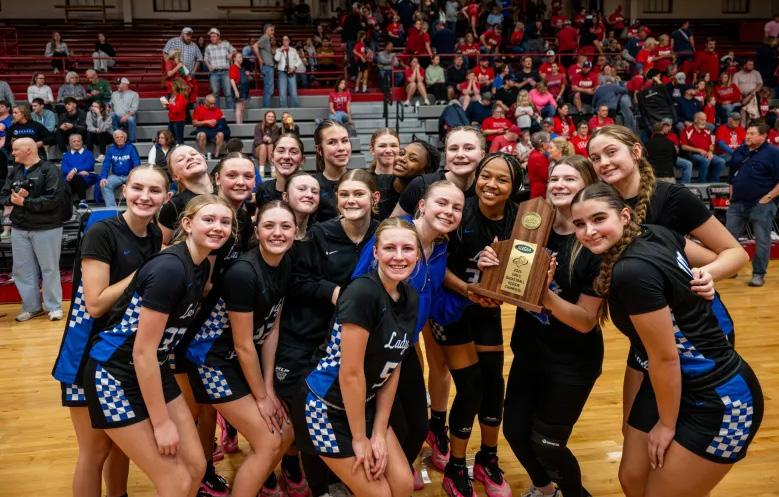
Notre Dame, Simon Kenton girls, Covington Catholic boys win region titles
Three region basketball champions were crowned from Northern Kentucky in postseason basketball tournaments.
Notre Dame prevailed in the 9th Region girls basketball tournament, taking down St. Henry, Highlands and Holy Cross in an overtime thriller in the championship.
Pandas Sarah Young was named tournament MVP while Joslyn LaBordeaux-Humphrey and Addie Lawrie made the All-Tournament team.
Simon Kenton won back-to-back girls 8th Region titles. Winning convincingly in all three contests over Eminence, Spencer County and Anderson County. Junior Brynli
Pernell earned tournament MVP honors, while eighth grader Angela Kabeya, Haylie Webb and Bella Ober made the all-tournament team.
Covington Catholic claimed the boys 9th Region title after cruising past Dixie Heights and Conner and defeating Ryle in the championship game. They won by an average of 37.3 points per game in the three contests. Cash Harney was named tournament MVP while Athens McGillis and Donovan Bradshaw made the All-Tournament team.
Beechwood, Covington Catholic win indoor track and field titles
Covington Catholic dominated the KHSAA Class 2A state indoor track and field meet at the Norton Healthcare Sports & Learning Center in Louisville on March 5.
The Colonels doubled up everyone, scoring 113 points and beating the field by 60 points with Bourbon County runner up at 53 points.
The 4×400 relay team of Rhett Blettner, Jack Fender, Jackson Germann and Joe Mayer claimed an individual title in a time of 3:34.18, as did Paul Klosinski in the pole vault 14-6). The Colonels had someone place in the top three in 13 of 15 events.
On March 3, Beechwood’s boys dominated the team scoring in the Class A meet with 88 points, Bishop Brossart finishing runner-up with 49 points.
Bishop Brossart’s girls finished runner-up to Lexington Christian Academy with 56 points. Beechwood’s girls finished fourth
with 40 points.
The Tigers had five state champions, Tyler Fryman in the 200 and 400 meters, Gannon Parke in the 1,600, Hudson Edwards in the 55-meter dash and the 4x800 relay team of Slaon Pangallo, Elijah Muck, Gannon Parke and Charlie Skeen.
Bishop Brossart’s Logan Blau claimed gold in the 55-meter hurdles.
In the girls 1A meet, Beechwood’s Caroline Nordman won the title in the 400. Bishop Brossart’s Ava Walters set a state meet record in the shot put with a throw of 42feet, 10.25 inches. Her teammate Anna Curtsinger won gold in the pole vault.
In the 3A meet on March 4, Simon Kenton’s Alexis Howard won two state titles, one of them setting a state record in the KHSAA Class 3A indoor track and field state meet at the Norton Healthcare Sports & Learning Center in Louisville.
Howard earned gold in both the long jump and triple jump, her 18-foot, seven-and-aquarter-inch jump besting the previous 3A record by nearly three inches set by West Jessamine’s Aly Doyle in 2024.
Cooper’s Paul Van Lanigham bagged another state title to his name, running a Class 3A state record in the 3,200 with a time of 9:09.49. He also finished runner-up in the 1,600, losing a fast race to St. Xavier’s Nick Sanders, the top three finishers setting state record times, Sanders in 4:05.43, Van Laningham in 4:07.88 and Lafayette’s Xavier Richardson in 4:08.37.
Conner’s Avery Vanlandingham won the gold in the 800, setting a time of 2:17.55.
Notre Dame’s Norah Barker finished third in the same race, the two separated by .45 hundredths of a second.
Cooper’s Ava Dunn claimed gold in the shot put shot put with a throw of 39-feet, 3.25 inches.
Northern Kentucky University atheletics director stepping down
Northern Kentucky University’s Athletics Director Christina Roybal, who has occupied the position since 2022, will step down
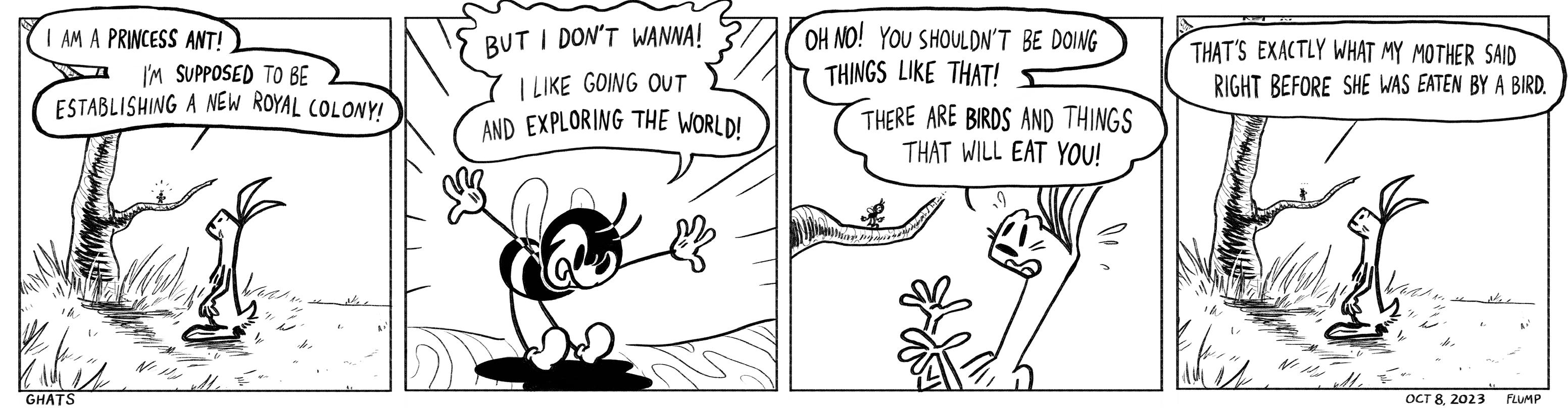
THE
WEEKLY COMIC by Andrew Buchanan
at the end of May, according to a university announcement, to “pursue other opportunities.”
“Christina has achieved what she came to accomplish and will complete her service at NKU on May 30,” according to a statement from University President Cady Short-Thompson. “Please join me in congratulating her on her success and thanking her for her service to NKU as our AD.”
Roybal’s tenure saw the addition of six new programs — men’s volleyball, stunt, men’s and women’s swimming, and men’s and women’s triathlon — as well as several notable hires of coaches and other athletic staff. She was the first Latina woman Division I athletics director in the university’s history. She formerly worked as an administrator at Fresno State and the University of Northern Iowa.
“The institution [NKU] as a public regional comprehensive institution is what really drew me into the position,” Roybal said shortly after taking on the role in 2022. “I know that for me personally that’s the type of student-athlete that I think is so special not just because their talents are amazing on the court or on the field, but they’re outstanding individuals who are doing great things in the classroom and even better things, brighter things, in our community.”
Specific information about what Roybal plans to do after she departs the university were not elicited in Short-Thompson’s announcement. The university has formed a committee to seek new candidates. The committee will be chaired by CFO Chris Calvert.
Christina Roybal is stepping down as athletics director at NKU. Photo provided
Notre Dame Academy claimed its fifth Ninth Region title in program history. Photo provided | Charles Bolton
Simon Kenton High School won back-to-back 8th Region championships. Photo provided | Marc Figgins
Covington Catholic High School claimed the 9th Region championship with a win over Ryle High School. Photo provided | Charles Bolton
Beechwood High School’s Tyler Fryman won two indoor state track and field titles at the KHSAA Class 1A state meet. Photo provided | KHSAA
New KY energy planner would be exempt from open records law under advancing bill
Ataxpayer-funded commission that the legislature is looking to for advice on energy policy would be exempt from Kentucky’s Open Records Act under a bill that a Senate committee approved March 11.
Senate Bill 100, sponsored by Sen Robby Mills, R-Henderson, would shield records and correspondence of the Energy Planning and Inventory Commission, or EPIC, which the Republican-controlled legislature created in 2024 to review utilities’ plans to retire fossil fuel-fired power plants.
The bill also removes Rodney Andrews, the director of the University of Kentucky’s Center for Applied Energy Research, from EPIC’s powerful executive committee and replaces him with the commission’s vice chair, currently Jeffrey Brock, a business manager and engineer for a subsidiary of Alliance Resource Partners. Alliance’s CEO is Republican megadonor and coal magnate Joe Craft.
The bill further reshapes EPIC’s executive committee by removing appointments made by Democratic Gov. Andy Beshear and giving them to Republican Attorney General Russell Coleman. It also significantly expands the powers of the commission’s executive director.
EPIC’s creation two years ago faced pushback from investor-owned utilities and environmental groups who argued it put up bureaucratic barriers to replacing outdated coal-fired power plants. The law creating EPIC declared that “the health, happiness, safety, economic opportunity and general welfare” of Kentuckians “will be promoted and protected” by operating fossil fuel-fired power plants. Republicans argued they wanted to prevent such power plants from retiring too soon.
EPIC, housed in the University of Kentucky’s Center for Applied Energy Research, is charged with reviewing requests made by utilities to retire fossil fuel-fired power plants before the requests are filed with the Kentucky Public Service Commission, Kentucky’s longstanding utility regulator.
Mills told members of the Kentucky Senate Natural Resources and Energy Committee that his bill would provide EPIC with more independence, the goal being for the commission to be a “go-to source for independent, data-driven analysis on Kentucky’s energy future.”
The committee’s 9-0 vote to advance SB 100 sets it up for a vote by the GOP-controlled Kentucky Senate.
“Not just reviewing what the utilities file, but proactively telling the legislature and the public where we stand and where we are heading,” Mills said about EPIC to lawmakers. “There’s not an independent voice that we need to advise us on energy. We talk to utilities. We talk to regulators. We never really get the right story.”
Open records controversy
Mills’ bill would create a broad exemption
in the state’s open records law for EPIC, allowing for “information, records, data, files, documents or correspondence” created by the commission “in the course of carrying out any of their responsibilities” to be exempt from disclosure.
Mills said the legislature has been working with “partial information” on energy policy and needed to ensure that proprietary information utilities were sharing with EPIC could be shielded. He said the “slight shield, limited shield” of the state open records law would mean “we’re not going to get the exact information that we need.”
Kentucky law already exempts proprietary business information from disclosure under the Open Records Act.
But environmental groups and the co-director of an open government advocacy group warned the broad exemption is unjustified and could allow the state commission to operate in secrecy. They said the current exemptions in the state’s open records law are adequate at protecting trade secrets and proprietary information.
“This bill ends up treating EPIC more like a private entity, rather than a public commission, even though it relies on public funding and performs public functions,” said Audrey Ernstberger, a lobbyist for the environmental legal group Kentucky Resources Council.
She said the open records law exemption could shield a broad array of records produced by EPIC including its procurements, contracts with outside consultants and data used by EPIC to create its reports and recommendations on energy policy.
“The ratepayers and the public have a right to discover the bases for the claims and assertions and the right to review these reports and studies and the data that underlie them,” Ernstberger said.
Amye Bensenhaver, a former Kentucky assistant attorney general and a co-director of the Kentucky Open Government Coalition, told the Lantern with the current exemptions in the state’s open records law, courts have “given deference” to state agencies and the entities they do business with.
“If someone has something to share with the state, and they can prove that it is truly confidential and proprietary and that it would create an unfair commercial advantage for a competitor, under existing law, they could deny access,” Bensenhaver told the Lantern. “I don’t know in this context how they could establish that every bit of business they do needs to be shielded from public disclosure.”
Reshaping EPIC’s power structure
Mills also addressed proposals in SB 100 that would remove Beshear’s appointments from EPIC’s powerful executive committee and give them to Coleman, saying it ensures “there is less politics in the room when we are discussing and making decisions on Kentucky’s energy future.”
Scottie Ellis, a spokesperson for Beshear, in a statement said Kentuckians should be “very concerned” by the legislation, calling it “the latest politically motivated and unconstitutional attempt to unlawfully strip appointments and authority away from a Democratic governor and send them to a Republican officeholder.”
She said the bill also limits transparency and oversight of EPIC by exempting it from the open records law, arguing the bill is “is a blatant attempt by Republicans to have full control and work behind the scenes, while keeping our people in the dark – something that the attorney general himself should see as unlawful and stand against.”
The GOP-controlled Kentucky Senate confirmed Beshear’s two appointments to EPIC’s executive committee, Eston Glover and Edward Holmes. It’s unclear what happens to their standing on EPIC’s executive committee if SB 100 becomes law.
The bill also substantially expands the power of EPIC’s executive director and establishes a fund where state appropriations could be placed to fund EPIC. EPIC named Eric King, a former University of Kentucky executive with ties to U.S. Sen. Mitch McConnell and electric distribution cooperatives, as its executive director last year.
SB 100 would empower EPIC’s executive director to have the sole authority to hire staff, contractors, make procurement decisions and request records from any state agency with a minimum 30-day for any state agency to comply with a request. Under the bill, EPIC’s executive director would also have the ability to intervene as a party in utility cases before the Kentucky Public Service Commission, either jointly or separately from EPIC’s executive committee.
King in an interview with the Lantern said he advised Mills about the proprietary nature of some of the data utilities could share but that it would “help us as a state for our policy setting” on various topics including the impacts of data centers and electricity affordability and reliability.
“Our focus is going to be on the policy going forward, but recognizing EPIC is in our infancy,” King said. “It’s convening all of the energy expertise and minds in one room to deliberate over these questions about whether or not we have adequate energy.”
He said he has not read the latest version of SB 100 and deferred to Mills on the intent and interpretation of various provisions in the bill. When asked about the open records exemption in SB 100, he said his understanding is that “you need to be very explicit about what you’re exempting and why you’re exempting it.”
“If there’s a need for me to clarify that as it relates to the ‘why,’ I think that’s easily found in our work plan and the data we’re trying to procure and why we are procuring it for the state,” King said. “As far as our processes and our conduct within EPIC, I think we are exclusively transparent in terms of the information we’re providing the state to make better energy decisions, not just folks in Frankfort but across the entire state.”
EPIC approved a plan in January to guide its actions on analyzing Kentucky’s electrical system, a seven-page document describing the plan as a result of substantive discussion “representing utilities, coal producers, natural gas suppliers, regulators and other stakeholders.”
The document emphasizes the need to study the state’s electricity demand, supply and transmission infrastructure, stating that EPIC would provide “factual analysis that informs policy decisions without prejudging which generation sources or strategies Kentucky should pursue.”
LEGAL NOTICE
The Kentucky Transportation Cabinet In accordance with KRS 176.051, Kentucky’s noxious weed law, the Kentucky Transportation Cabinet will control noxious weeds on state-owned right of way at the request of the adjoining property owner. The noxious weeds named in this law are Johnson grass (Sorghum halepense), Canada thistle (Cirsium arvense), Cutleaf Teasel (Dipsacus laciniatus) Nodding thistle (Carduus nutans), Common teasel (Dipsacus fullonum), Poison hemlock (Conium maculatum), Marestail (Conyza canadensis), Amur Honeysuckle (Lonicera maackii), Multiflora Rose (Rose multiflora) Japanese knotweed, (Polygonum cuspidatum), Spotted Knapweed (Centaurea stoebe) and Kudzu (Pueraria montana).
Persons who own property adjacent to state right of way and who are involved in eradication efforts on their property can submit a written application to the highway district office in their area. Contact information can be found at transportation.ky.gov/DistrictPages
A matrix of electric utility meters for Louisville Gas and Electric. Photo by Liam Niemeyer | Kentucky Lantern
Address: 101 Christine Court, Fort Wright
Price: $420,000
Bedrooms: Five
Bathrooms: Three
Square footage: 2,500
School district: Kenton County
County: Kenton
Special features: This five-bedroom Fort Wright home offers over 3,000 square feet of living space with two bedrooms on the main level and a full bathroom on each floor. The layout includes a first-floor office and finished recreation space in the lower level. Outside, an in-ground Gunite pool provides outdoor living space and the home is situated on a no-outlet street with convenient access to nearby shopping, schools and parks.
Five-bedroom home with pool
A look at this home’s family room.
A view of this home’s deck.
Kentucky now allows for Public Notices to be published digitally on LINK nky’s website. You can find public notices for the following organizations on our site at https://linkreader.column.us/search
PUBLIC NOTICE
The City of Newport adopted the following ordinance at its March 9, 2026, meeting: Ordinance O-2026-01, Closing and vacating part of Baderman Alley in the City of Newport. The Ordinance may be viewed on our website at www. Newportky.gov or at 998 Monmouth Street, Newport, KY.
CAMPBELL COUNTY
SCAN THIS QR CODE TO GO TO OUR DIGITAL PUBLIC NOTICE PAGE
• AJ’s Towing & Recovery
• Boone County Clerk
• Campbell County Clerk’s Office
• Campbell County District Court
• Campbell County Fire District #1
• Campbell County Fiscal Court
• Campbell County Planning & Zoning
• Campbell County Public Library
• Campbell County Sheriffs Office
• City of Alexandria
• City of Bellevue
• City of Cold Spring
• City of Covington
• City of Cresent Springs
• City of Crestview Hills
• City of Dayton
• City of Edgewood
• City of Elsmere
• City of Erlanger
• City of Florence
• City of Fort Mitchell
• City of Fort Thomas
• City of Fort Wright
• City of Highland Heights
• City of Independence
• City of Lakeside Park
• City of Ludlow
• City of Newport
• City of Ryland Heights
• City of Silver Grove
• City of Southgate
• City of Union
• City of Villa Hills
• City Of Walton
• City of Wilder
• City of Woodlawn
• Covington Public Independent Schools
• Cresent Springs Board of Adjustment
• Family Dollar Store
• Fort Mitchell Board of Adjustment
• Fort Thomas Independent Schools
• Highland Heights Planning & Zoning
• Joseph F Grimme, Campbell County
Master Commissioner
• Keating, Muething & Klekamp PLL
• Kenton County Fiscal Court
• Kenton County Joint Board of Adjustment
• Larry Dillon, Boone County Master Commissioner
• Northern Kentucky Port Authority
• Northern Kentucky Water District
• Planning & Development Services of Kenton County
• The Baker Firm PLLC
• The Hidden Chapter Bookstore LLC
The exterior of this Fort Wright home. Photos provided | Jean Paul with RE/MAX Victory + Affiliates
SUDOKU
Edited by Margie E. Burke
The
Edited by Margie E. Burke
ACROSS 1 One of the "back 40" 5 Make ____ (hurry)
Each row must contain the numbers 1 to 9; each column must contain the numbers 1 to 9; and each set of 3 by 3 boxes must contain the numbers 1 to 9.
34 Children's author Beverly DOWN 30 Incite ___ (dis- 46 Tighten, like a
35 Gallery piece 1 Org. for seniors turb the peace) jaw
36 Performed for 2 Burn a bit 31 Redgrave et al. 49 Select group the camera 3 Give a facelift to 33 Starr of song 50 Roman spirits
38 ___-Manuel 4 Bahrain or Dubai 34 Summer hrs. in 51 Indistinguishable Miranda 5 Weighty Chicago 52 Wiggle room
39 Way to make it? 6 Second largest 37 Right of 54 Small needle
42 Talk endlessly ocean passage case
45 California 7 Far from 40 Moved like a 55 Part of NBA: mission founder forward show horse Abbr. Junípero 8 Grow incisors 41 Cowpoke's pal 56 Minn. Neighbor
46 ___ in Charlie 9 Typo, e.g. 43 Nail at an angle 59 Hot or cold