




























































Pro-Palestine Jewish faculty speak out about the importance of anti-Zionist voices
Maria Cholakova
In April 2024, Concordia University announced the launch of its new task force, Standing Together against Racism and Identity-based Violence (STRIVE).
e task force aims to address “systemic discrimination, identity-based violence, and hate on campus and beyond,” according to the university’s website.
e antisemitism subcommittee, one of six committees under the task force, ceased operations in December 2025.
In an email to participants, the antisemitism subcommittee, led by Concordia professor Na ali Cohn, stated that the subcommittee has resigned due to the university’s refusal to publish individual reports for each subcommittee. Instead, a single collective report will be released representing the ndings and recommendations of all subcommittees.
“We have not given up on our intentions to pursue scholarly publication of our ndings so as to give voice to your experiences; however, this too seems to be in question,” Cohn wrote.
e Link reached out to Cohn for comment, but did not hear back in time for publication.
In an email to e Link, Concordia spokesperson Vannina Maestracci said that the subcommittee resigned a er it had submitted its report, “meaning that the work of its members was already done by then.”
“ e work of the Anti-Semitism Subcommittee will, of course, be included and inform the Final Report of the STRIVE Task Force,” Maestracci continued.
sors from across Canada who advocate for “social justice in support of an ethical life, whether de ned through religious observance or secular action.”
In a letter to Concordia’s O ce of Rights and Responsibilities, Gould wrote that the survey was “designed to show that Jews are experiencing antisemitism in and around protests against the Israeli genocide of Palestinians in Gaza.”
Gould added that the survey’s research will contribute to “the unfortunately large and growing project of confusing critiques of Israel with antisemitism.”
Quinn Johnson, a student who was granted a pseudonym for fear of academic repercussions, participated in a listening session for the antisemitism committee. ey told e Link that, while they felt they were asked leading questions, they did not feel as though they could not express their opinion.
“I believe that, in order for an antisemitism committee to work, people need to confront what makes them uncomfortable and what antisemitism is,” Johnson said.
Avni shares her peers’ opinion on the survey, adding that she felt it didn’t represent the diversity of Jewish experiences of antisemitism on campus.
“Personally, I've never experienced antisemitism on campus, framed in terms of Palestinian solidarity,” Avni said. “I have experienced antisemitism on campus through MAGA and white supremacy, and that was not re ected in any way through the survey.”


with Carr and E rosyni Diamantoudi, Concordia’s interim provost and VP of academics, to voice their disapproval of the IHRA de nition and urge the university not to con ate antisemitism and anti-Zionism.
“We wanted to make certain that the antisemitism subcommittee report included our perspective in it, and that's what we communicated,” Zilberstein said. “We submitted our own addenda, and that's the last that we've heard. We have no idea what the recommendations might be.”
JFN members are not the only faculty and sta who have criticized the IHRA de nition.
In a 2021 general assembly, 68 per cent of the Concordia University Faculty Association (CUFA) voted against its use.
In a statement found on CUFA’s website, which has since been taken down, the association stated that: “While CUFA opposes antisemitism and all forms of racism and hatred, the International Holocaust Remembrance Alliance’s Working De nition of Antisemitism poses a serious threat to academic freedom in our university. e IHRA de nition of antisemitism misconstrues antisemitism to include a broad range of criticism of the State of Israel."
Meastracci con rmed with e Link that, despite the antisemitism committee’s resignation, a nal STRIVE task force report has been compiled and the university “will be sharing a comprehensive set of strategies and next steps with the community very soon.” is is a developing story.













Maestracci further claried that since the formation of STRIVE, the task force’s mandate was to present a comprehensive set of recommendations and action plans.












Gould, Avni and Zilberstein said they all took the survey in good faith.














“Part of the concern that we've had is really making sure that [the] methodology, [...] the questioning re ects our experience,” Avni said.
NDP elects Avi Lewis as new leader



IHRA definition of antisemitism



























“ e delivery of a single Final Report is in keeping with this mandate as well as with the general practice of the university concerning similar task forces,” Maestracci said. “Members of each subcommittee were aware of this process and of the submission of a Final Report when they accepted to participate.”










In May 2024, Concordia president Graham Carr attended a House of Commons Standing Committee on Justice and Human Rights meeting to speak about antisemitism on Canadian university campuses.




A er su ering major losses in the last federal election, the New Democratic Party has elected former journalist and activist Avi Lewis as its new leader. Lewis described his campaign as an "anti-capitalist movement,” and promises to revive the oundering party, prioritize worker rights in the age of AI, end new oil and gas pipelines and projects, and explore government-owned, non-pro t grocery stores.











One of the recommendations presented at this meeting was the implementation of the International Holocaust Remembrance Alliance (IHRA)'s de nition of antisemitism in all levels of government, educational institutions, police services and human rights commissions.


All six subcommittees organized events, listening sessions and sent out surveys to their respective communities to gather data and testimonies to identify prejudice and identity-based discrimination at Concordia.

















e IHRA’s de nition of antisemitism has been criticized by 128 scholars, who have described it as aiming to “discredit and silence legitimate criticism of Israel’s policies as antisemitism.”



Since the release of the antisemitism subcommittee survey, however, some professors and interviewees have raised concerns about a perceived pro-Israel bias present in the survey.













Antisemitism vs anti-Zionism











Concordia professors


Kevin Gould, Shira Avni and Anya Zilberstein, are all members of the Jewish Faculty Network (JFN)'s Montreal chapter. e network consists of scholars and profes-












When asked if Concordia would adopt the de nition, Carr told Parliament that he would “consider it going forward.” Following this meeting, Concordia told e Link that the STRIVE subcommittee on antisemitism would evaluate whether the de nition needs to be implemented.














Airbnb lobbies for policy changes to short-term rental








No updates on the potential implementation of the IHRA de nition have been released as of yet.
In October 2025, JFN members met

U.S.-based rental giant Airbnb is urging local owners to pressure Mayor Soraya Martinez Ferrada into reducing regulation on short-term rentals in Montreal. Projet Montréal leader Ericka Alneus has said over 7,000 short-term rental units in the city could be returned to the rental market. She added that it’s “worrying” to feel the pressure building without “clarity from the mayor.” Martinez Ferrada wants to prohibit Airbnbs for commercial use but allow owners to rent their primary residence for up to 90 days per year.

Proponents say the boycott would serve as an extension of the CSU's BDS motions
Kara Brulotte
Concordia University’s Azrieli Institute of Israel Studies is being criticized by groups such as the Concordia Student Union (CSU) and Students for Palestine’s Honour and Resistance (SPHR) Concordia, who are pushing an academic boycott against the institute.
“ e institute uses this facade of academic syncretism, and it uses it as a spearhead for the Israeli-Canadian normalization of the pro ting of genocide through the education sphere and academia in general,” said an SPHR Concordia spokesperson who was granted anonymity for safety reasons.
sion of the Boycott, Divestment, Sanctions (BDS) motions the CSU adopted in 2025.
e institute is at odds with these motions, she argues, as well as section 16.1.6 of the CSU positions book, which asks for the university’s suspension of “programs and partnerships that facilitate and encourage the exchange with and normalization of Israeli academic institutions.”
campuses,” said CJPME VP Michael Bueckert.
Concordia deputy spokesperson Julie Fortier said in a statement to e Link that the university remains constant in its position against BDS and “campaigns of such a nature.” Fortier added that these campaigns are “contrary to the value of academic freedom upon which all universities are founded.”
“Singling out one of the university’s units for closure and its Director personally is unacceptable and creates a climate of intimidation and harassment, especially in light of the 10 April, 2025 attack against the Azrieli Institute,” Fortier said.


Since its establishment in 2011, the Azrieli Institute has remained a large part of Concordia’s relationship with Israel. It offers an Israel studies minor, a summer trip to Israel and maintains relationships with CSU external a airs and mobilization coordinator Danna Ballantyne

As a part of the CSU campaigns department’s e orts, the union partnered with SPHR Concordia to organize a teach-in on the in- stitute on March 27. e session was an opportunity for students to learn about why the CSU are calling for an academic boycott, according to Ballantyne. “ ese campaigns don't come from the top down,” Ballantyne said. “[With] much of the Palestinian solidarity organizing over the past few years, we're really looking to make sure that student involvement is front and centre of any decisions and publications that the CSU makes.”




She added that the university is committed to ensuring all its members can study and work in a safe and civil environment.







On the night of April 10, 2025, autonomous students vandalized the entrance to the institute, spray-painting the message “genocide institute” on its doors and breaking a window.




Azrieli Institute director Csaba Nikolenyi has also criticized the boycott, saying in a statement on Instagram that “academic boycotts are by de nition intolerant, illiberal and seek to silence freedom of thought and scholarly activity.”










Canadians for Justice and Peace in the Middle East (CJPME) said in a statement to e Link that they also support the call for an academic boycott of the Azrieli Institute. According to the non-pro t, the institute “whitewashes Israel’s crimes against the Palestinian people through the lens
Organizers of the teach-in say the March 27 event served as a way to raise more awareness about the Azrieli Institute, namely its minor in Israel studies. e SPHR spokesperson expressed their opposition to the university’s support of a program centred on studying Israel, a country currently committing genocide against the Palestinian people.


said the boycott of the institute would function as an extenof academia.”
Maria Cholakova
Concordia University spokesperson Julie Fortier has conrmed with e Link that the prayer rooms at Concordia will have to be shut down if Bill 9 gets signed into law.
In November 2025, the Coalition Avenir Québec (CAQ) government passed Bill 9, an expansion to Bill 21, the 2019 secularism legislation that seeks to limit public prayer and extend a ban on wearing religious symbols to daycare workers.
Bill 9 would require public institutions, including universities, to ban prayer spaces, unless municipally authorized, and prohibit public spaces from only o ering religious-speci c food menus.
“ e bill prohibits prayer spaces, so if it is adopted, we will have to comply with the law,” Fortier said.
Bill 9 would also expand on Bill 21’s restrictions by forbidding daycare workers from wearing face coverings and requiring individuals to “have their face uncovered” when receiving a service.
Now, Bill 21 is being challenged in the Supreme Court of Canada, with the court opening deliberation on the case on March 26.
Samy Kheli , president of Concordia University’s Muslim Student Association (MSA), said Concordia’s prayer rooms are currently open to students and will be until Bill 9 passes in the Quebec government.
In the meantime, Kheli said that MSA is working with the university’s administration, fellow religious groups on campus and the Multi-Faith and Spirituality Centre on how to handle the potential upcoming changes.
Religious freedoms across Canada
On March 23, the Supreme Court began a four-day hearing in Ottawa on a constitutional challenge to Bill 21.
e bill is being challenged by 13 groups, including the Canadian Civil Liberties Association, the National Council of Can-


“This issue matters because as a Palestinian, I can't stand by and watch as the university that I have to go to—because there are so few options for English speakers in Montreal to go to—directly profit from the industry of genocide,” the SPHR spokesperson said.




“ e boycott is a necessary tool to challenge the normalization of Israel’s system of colonialism, occupation, and apartheid on Canadian

According to Ballantyne and SPHR Concordia, another teach-in is planned for the beginning of the fall 2026 semester.
With les from Geneviève Sylvestre.
adian Muslims (NCCM), the World Sikh Organization of Canada and the English Montreal School Board.

Steven Zhou, NCCM’s media and communication lead, said the legal challenge is a turning point in their battle against the bill.
“Bill 21 [is] a second-class citizenship law, where people are forced to pick between their faith and their jobs,” Zhou said.



Zhou outlined that the Supreme Court lawsuit aims to challenge the “unfair, Islamophobic and unconstitutional” precedents the law is bringing to Quebec. He said the suit seeks clari cation and change regarding “how politicians can abuse the notwithstanding clause when they are passing laws.”


Civil liberties groups have also raised alarms about the bill, arguing it could criminalize peaceful protest and silence unpopular expression.




According to NCCM statistics, 73 per cent of Muslim women in Quebec have considered leaving the province due to Bill 21. Additionally, 45 per cent of Quebecers either oppose or do not support the bill.
Similar legislation around religious freedoms might also be adopted across Canada soon.


On the federal level, Bill C-9, the Combatting Hate Act, proposes amendments to the Criminal Code to “crack down on hate crimes and public intimidation,” as stated on the Government of Canada website.
However, religious groups have criticized Bill C-9 for its broad interpretation and unclear standards. eir concern is over the bill not clearly de ning the word “hatred”and about its removal of the religious exemption.




Despite criticism, the House passed the bill on March 25 and is moving to a vote in the Senate. Meanwhile, in Quebec, Bill 9 is now moving through the parliamentary committee stage, with the latest amendments being made on March 17.

Danna Ballantyne, the Concordia Student Union (CSU)’s external coordinator, believes that Bill 9 will be consequential for Muslim students.
“It's quite clear to those of us who are in these meetings that there will be individuals and groups on campus who will be waiting with bated breath to make complaints against Muslim students who are praying in the halls or holding events related to prayer,” Ballantyne said. Ballantyne added that the CSU is waiting to see if Bill 9 will be adopted before they make plans, but that in the meantime, concerns surrounding the bill are still very real.



With les from Matthew Daldalian. changes.”
“Our concern isn't just a loss of access to student spaces,” Ballantyne said. “It's also the way that Islamophobia is going to be really enabled through these policy













Sean Richard

Before Je Ewert was the president of the Canadian Prisoners’ Labour Confederation (CPLC), he began picking up work inside the federal prison where he was incarcerated.
“You have something to do, [to] keep busy during the day, you get out of the unit, you're not stuck in the cell,” he said.
According to Ewert, for many inmates, working is one of the few ways they can venture outside the cell regularly.
“In many prisons, if you’re not working, they lock you in your cell during the workday,” he said. “It’s another coercive e ect.”
Ewert primarily worked for CORCAN at rst, a special operating agency within the Correctional Service of Canada (CSC) that o ers employment to inmates throughout their sentence.
He was hired to build barriers for construction sites, but stopped when he no longer received bonus payments for working overtime, a er the Stephen Harper government eliminated them in 2013.
“It's hard, it's physically intensive labour,” Ewert said. “When they took the bonus pay, I said, ‘No, I'm not doing this anymore.’”
Payment under CORCAN still approximately follows the same rates that were introduced in 1981 under the CSC pay program by security level.
e 1998 Commissioner’s Directive under the Corrections and Conditional Release Act created a system for inmates to receive di erent levels of pay from A to D with di erent criteria.
Level A earners receive the highest pay at $6.90 per day, while level D earners get paid $5.25 per day. Only 4.6 per cent of the incarcerated population make level A pay, according to a 2023 report by the O ce of the Correctional Investigator, Canada’s federal prison watchdog.
Wages have also been a signi cant issue since Harper’s government implemented new room and board fees for prisoners in 2013, which amounted to a 30 per cent wage claw back. It also ignores that the original pay structure in 1981 was designed to account for room and board deductions.
Some experts believe that inmates don’t have a choice in deciding whether to work or not.
Jordan House is an assistant professor of labour studies at Brock University and co-authored Solidarity Beyond Bars: Unionizing Prison Labour.
House believes that inmates, like any other workers, possess economic incentives to nd work.
“Prisoners need income to buy personal hygiene products, to supplement their diets,” House said. “It also costs money to maintain community connections, to have phone calls or stamps to talk to friends and family.”
He also said that federally, working can o en be a part of an inmate’s release plan, meaning they may face pressure to continue working or risk compromising their release.
“In the federal system, the coercion is more roundabout, which is to say that work is a part of people's correctional plan,” House said. “Once they agree to work in a correctional plan, if they don't live up to that correctional plan, that can jeopardize their chance of parole.”
e problem is not necessarily the labour itself, House said, but rather the conditions in which this labour is conducted.
“ ere are all sorts of issues of occupational health and safety, of injuries, of death, even in some cases, workplace accidents,” he said. “ en there's just the fact of working under threat of punishment, frankly.”
House believes that since inmates don’t have an exit option, they are highly at risk of forms of mistreatment, abuse and unreasonable paces of work.
ese conditions also present issues for women and gender-diverse inmates.
Brianna Bourassa is a project manager for the B.C.-based Centre for Research into the Processes, Outcomes, and Impacts of Incarceration. Bourassa believes there are many challenges that women and gender-diverse prisoners face.
“Access to healthcare and access to gender reforming care are so challenging in prison,” she said. “Also, access to the material goods that you need for women, [such as] reproductive health items.”
Bourassa also said that, since there are a lot of inter-regional transfers—meaning transfers that happen between prisons—it makes it very di cult for incarcerated parents to remain in contact with their children.
Around two-thirds of incarcerated women in Canada are mothers, according to a 2017 study.
Bourassa also nds that, in her experience, many of the jobs available for inmates, such as sewing, cleaning or helping the elderly, are antiquated and aren’t always transferable a er release.
“It seems like it's more [about] lling time rather than actual-
ly supporting people and giving them skills for future employment,” she said.
Ewert added that most prison jobs don’t provide inmates with the con dence to nd employment a er being released, which can lead them to reo end.
“If you're sitting in prison for years on end, feeling like you're exploited, then you get out of prison, that's a terrible way to be,” Ewert said.
In May 2025, CORCAN announced the launch of their wild re program, where inmates would be trained to provide support, mop-up and patrol operations once wild res have been contained.
House said he worries that inmates will continue to be exploited there.
He added that a precedent has been set recently in the U.S., with critics arguing that California is overdependent on its inmates' re ghting program.
“I think there's going to be a temptation to squeeze prison labour in order to deal with some of these climate change issues,” House said.
Christopher Rootham is an adjudicator at the Federal Public Sector Labour Relations and Employment Board. In a 2024 preliminary decision responding to a constitutional challenge brought by the CPLC, Rootham said that prisoners do not have the same legal protections as other workers do, as they are not considered federal employees.
Ewert’s organization advocates for prisoners' rights to unionize and collectively bargain. He is currently being represented by the Ontario law rm Cavalluzzo and is taking the Treasury Board of Canada, which represents CSC, to court for this exclusion.
Ewert believes that gaining the right to collective bargaining will enable inmates to receive protections that will improve prisoner working conditions.
“In Canada, if you're a union member, you're entitled to the bare minimum wage,” Ewert said.
He said he also intends to bargain for workers to make a percentage of the CORCAN revenues on top of minimum wage.
“It needs to be done because you've got some of the most vulnerable members of society being treated abusively, in my opinion,” Ewert said. “We're being used to generate pro t for the corruption of Canada.”
Cléo Clamen
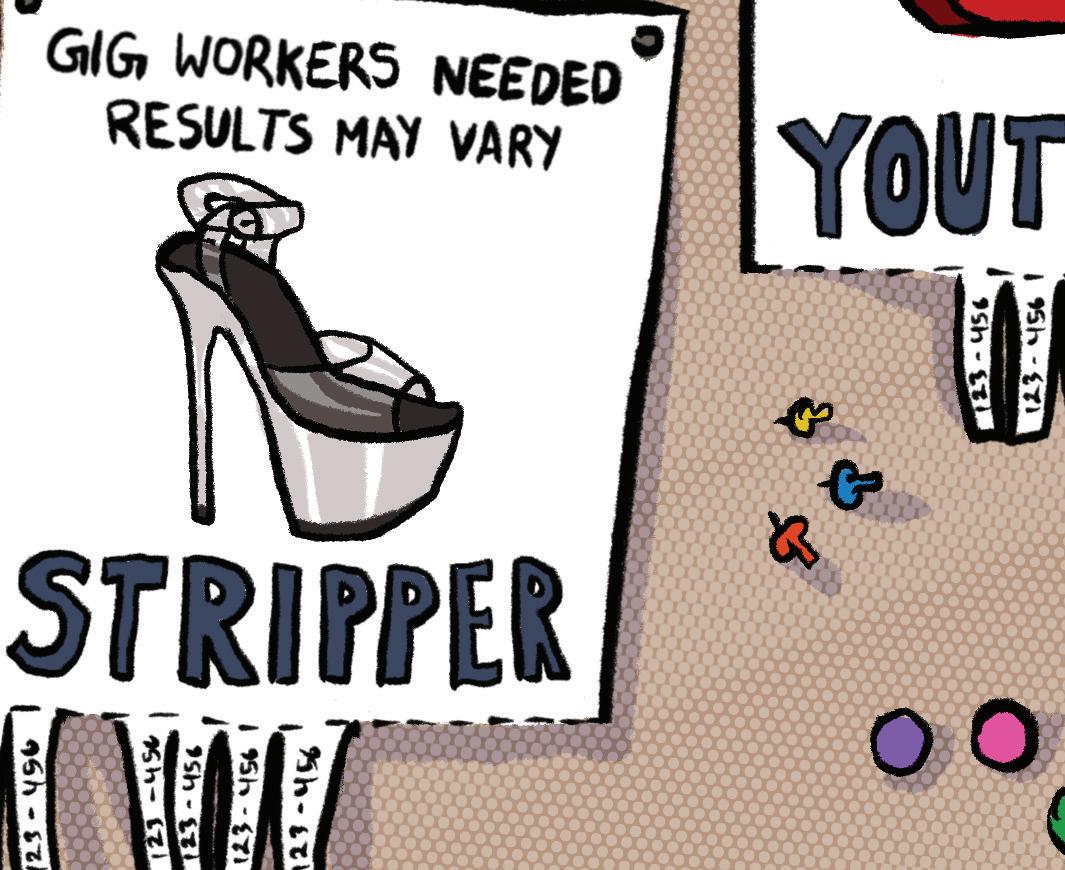
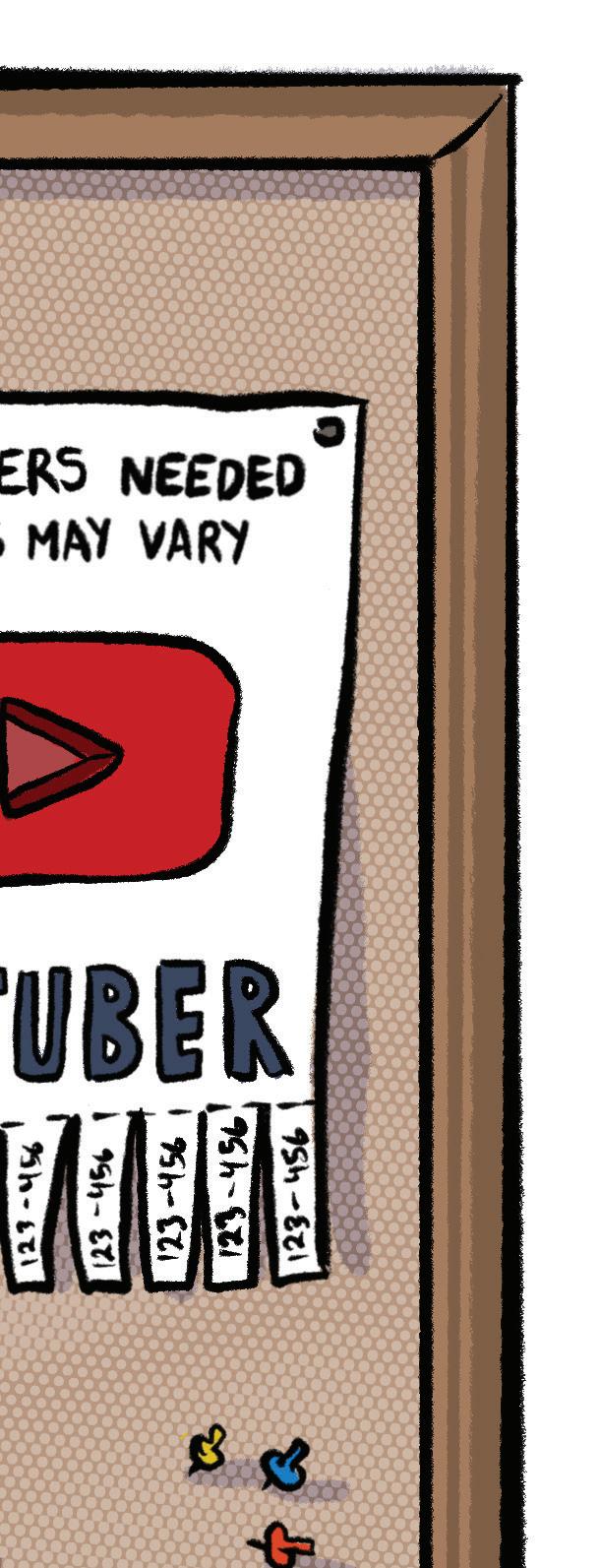
If you asked someone to name common university student jobs, sex worker, YouTuber and babysitter might not come to mind. But in today’s gig economy, as more Canadians rely on freelance work and youth unemployment is on the rise, many students are nding new ways to make ends meet in Montreal.
Shawn Grenier is a political science student at Université du Québec à Montréal and creator of the YouTube channel e Canvas.
eir channel focuses on art history, but their recent content has leaned into political art history and antifascism. Recent topics include the Bad Bunny Super Bowl hal ime show and historical antifascist self-portraits.
Grenier has been making videos for over seven years, but has only been able to earn a living for the past three to four years, mainly through ads, Patreon and contract work for larger media organizations.
Working full-time on YouTube gives Grenier the exibility to attend university, partake in volunteer work and work without a boss.
Gabrielle Lalande, a full-time stripper and recent Concordia University graduate who was granted a pseudonym for safety reasons, also appreciates the exibility that gig work o ers, especially for students.
“I was able to t random work schedules between my classes, allowing me to actually have enough money to live during my degree,” Lalande said. “Gig work is really nice when you don’t want to necessarily work a 9 to 5 or [if you] have other priorities in your life.”
Lalande has worked several gig jobs, including as a ranch hand and a maid. ey argue that students are pushed into gig work because many jobs now require signi cant education or an “extensive resumé.”
net can be very dangerous for strippers, given the physical nature of the job.
“Normally, when you receive a wage, it’s kind of part of the deal,” they added. “But we don’t get guaranteed anything and still have to work.”
Chloe Ennis is a student in Concordia’s child studies program and a part-time babysitter. Since August 2025, she has worked on call every few weeks to provide childcare services for a Montreal family.
“I was looking to make some extra cash, and so I looked on Facebook on a bunch of di erent groups for parents looking for babysitters,” Ennis said.
Ennis said that working as a babysitter has helped her pay some of her bills while maintaining her status as a full-time student. Still, according to her, the gig’s lack of stability presents clear challenges.
“Since it's not a regular [schedule], sometimes I have to decline because I have class,” Ennis said. “Or, there are a few times where I skip class in order to babysit for them all day because, well, I need the extra cash.”
She added that, because of inconsistent scheduling, gig work such as this is not ideal for students looking for quick cash.
“Someday I might be working for eight hours, and the next day would only be like three,” Ennis said. “Also, it can be hard to nd a family that meets all your criteria in terms of salary and hours and schedules, especially with class.”
Grenier echoed the sentiment that gig work income is o en inconsistent and unstable.
“I’m grateful for this job because I love it so much,” Grenier said. “But the income is very variable, and sometimes it’s very stressful because it’s so dependent on the algorithm.”
Grenier explained that YouTube payouts are based not only on view count. ey also hinge on how much advertisers are willing to pay to reach people in the countries where the views originate.
Copyright claims can also be a major issue for YouTubers. e copyright holder of a piece of media, such as a song or lm, can accuse a content creator of an alleged copyright violation and claim the entirety of a YouTube video’s income as their own.
In early February, Grenier received a copyright claim for a video that included short clips of a movie. Grenier attempted to appeal the claim, arguing that the video clips fell under transformative use. However, the nal say was given to the copyright holder.
“I worked two weeks on [the video], and I’m not getting paid for it,” Grenier said.
Gig workers in service industries have attempted to create safety nets by organizing together.
In Montreal, the Sex Work Autonomous Committee (SWAC) recently announced an upcoming May 23 strike for workers in strip clubs and massage parlours.
SWAC organizers say they are striking to demand the abolition of pay-to-work fees; the institution of employee status for sex workers, which would allow access to unemployment insurance and coverage from the Commission des normes, de l'équité, de la santé et de la sécurité du travail; and an end to unsafe working conditions.
“ e rst step is to dispel the illusion that we are self-employed,” SWAC said in their announcement. “In reality, we have an employer, and they have a legal obligation to provide us with safe working conditions, just like in any other job.”


However, they have said they have experienced many obstacles when it comes to job and nancial security.
“Money is completely up and down, and it’s a gamble every time you go into work, especially in the context of the strip club, where you have to pay to be there,” they said.


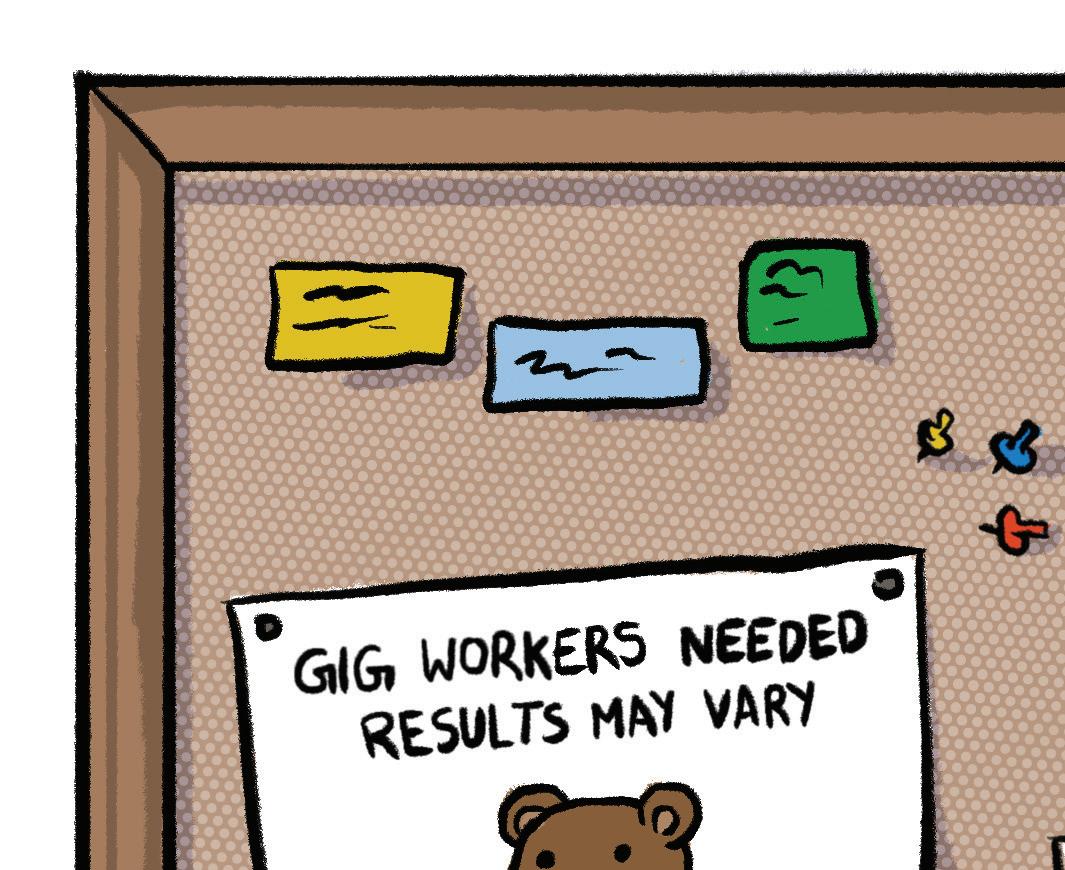

For Lalande, the biggest downsides of being a gig worker at a strip club is mismatched expectations and unexpected costs, especially as shi s o en run much a er the Metro closes.


“We are classi ed like independent contractors but treated like employees,” they said. ”Despite not getting an hourly wage, we have to listen to the management’s rules about what time we show up, what clothes we wear, how nude we get, amongst a bunch of other rules.”

Lalande argues that classifying strippers as gig workers rather than employees is a way for owners or managers to exploit them and avoid providing bene ts. ey explained that gig workers do not get a wage, sick leave or workers’ bene ts, adding that the lack of a safety


No matter who you are, there is a seat for you at the table at these Montreal centres
Aren da Costa Scarano
For over 20 years, Art Hives have been serving the Montreal community. In Notre-Dame-de-Grâce, a group of Hives has long been working to connect people in the neighbourhood and support those most in need of a place to belong.
While founded in Montreal, the Art Hives' map shows the network is expanding globally. ey are most densely located in North America, but locations have begun to pop up in Europe, Africa and South America.
With various ateliers around the neighbourhood, the NDG Art Hive always has something going on. But what purpose does it serve? According to the Art Hive’s website, their mission is to be an atelier where anyone can be an artist, regardless of skill, age, background or any other factor.
Marlo Turner Ritchie, one of the co-founders of the NDG Hives, said the network aims to create a low-barrier, accessible space for art-making.
“We’re free, and we’re accessible, so we’re low barrier. So many art spaces are paywalled, and so many people can’t afford them,” Ritchie said. “Art Hives are a place you can come to make art regardless of what position you’re in.”
likely friendships and the other ways that community blossoms.
“And what’s more, people learn to get along. People who have adversity with each other, who have arguments,” they said. “And I think that’s really important, for people who don’t get along to be able to be in the same space. It’s beautiful.”
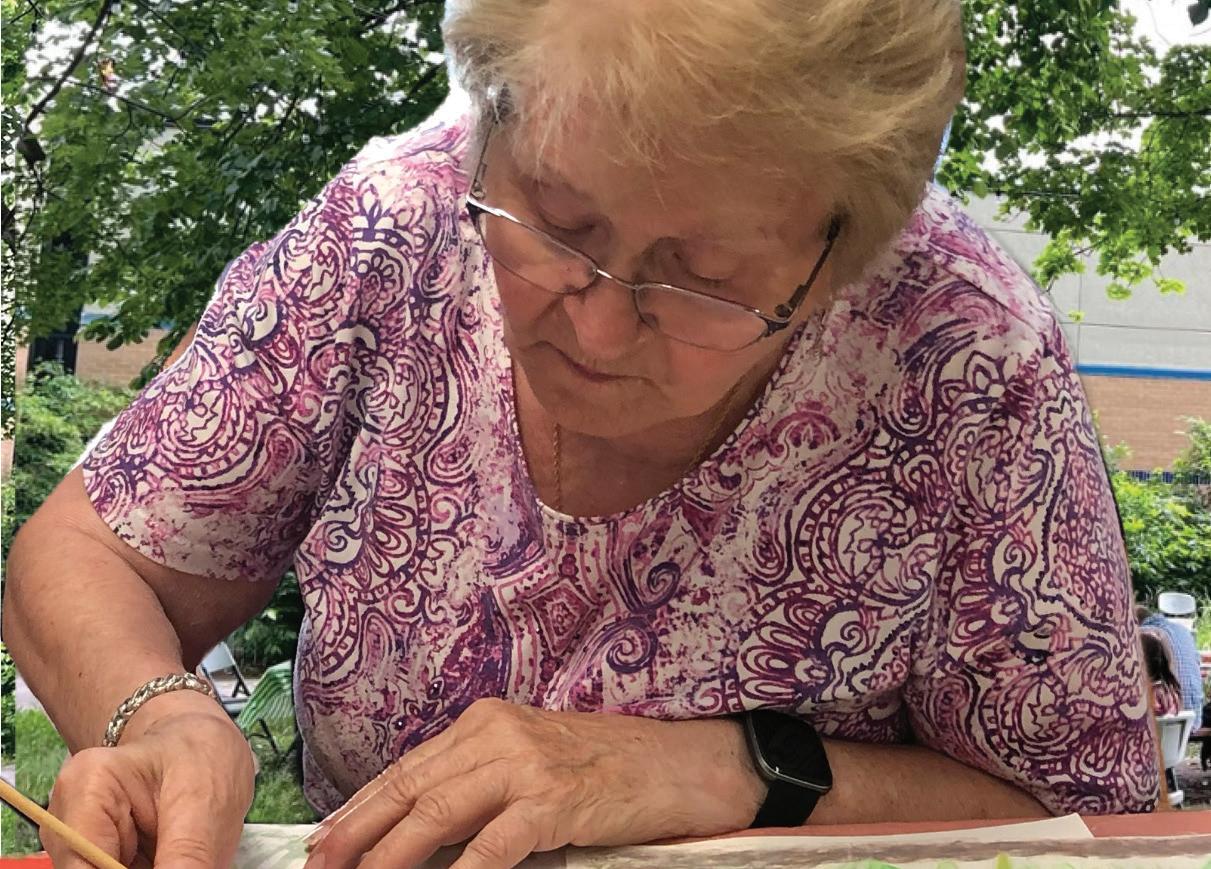
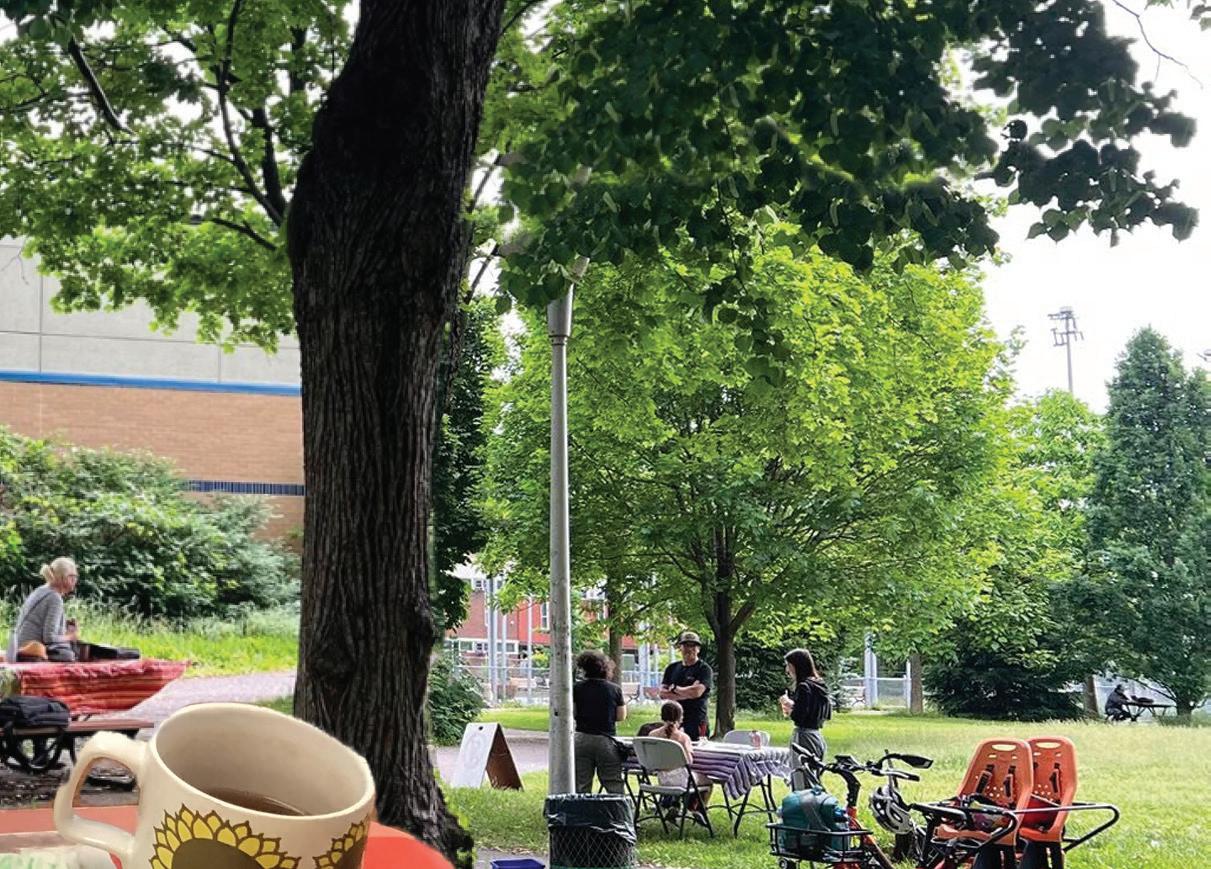
Giovanna Araujo Marimon is also a facilitator at the Hive, working primarily in the summer on their weekly park popups. She highlighted how, especially in an open space like a park, intergenerational connections form.
"We get families, elderly people, new immigrants, people who just so happened to be there. ey talk, they learn from each other,” Marimon said. “It’s one of my favourite parts, the intergenerational exchange.”
People may not realize that Art Hives began at Concordia University in the late 2010s. e network was founded by Janis Timm-Bottos, an associate art therapy professor.
e Hives were started as a way to help connect youth, especially new migrants who o en don’t have friends or family
when arriving on campus, and may struggle to form connections.
Analté Rodriguez-Diaz, an artistic wellness educator and head facilitator at one of the NDG Art Hives’ locations, wished more teens and young adults would get involved.
“We get a lot of kids and adults, but not many high-schoolers or university students,” Rodriguez-Diaz said, “and those are some of the people who need it the most.”
Marimon, who moved to Montreal from Brazil when she started at Concordia, re ected on the impact of these spaces.
“I wish I’d had something like this back home,” Marimon said, “and I hope someday there will be just as many Art Hives there as there are here.”
Ritchie shared a similar sentiment, saying they hope people know that the model is accessible to anyone interested in starting their own space.
“Anyone can start a Hive, and they should," Ritchie said. "I hope in the future we will see more places like this, across all continents, and that more people will know we exist and come visit us.”


Art Hive’s spaces are government-funded and aim to be radically inclusive, working to create a sense of home and safety for all. is includes accessibility for the elderly and disabled, sensitivity and de-escalation training for sta .
e Hives are o en located in low-income social housing buildings or pre-existing community centres in an e ort to serve those who need it most. Several of their locations are in Société d'habitation et de développement de Montréal’s elder-only buildings.

"It’s really important for [the elderly], because they don’t have as many opportunities to socialize," Ritchie said. "It gets them talking and doing something fun."
ships, not just teaching art.


members of their community.”


Jonah Doniewski, an art education student at Concordia University and a facilitator at an NDG Hive, noted that facilitators prioritize building relation-

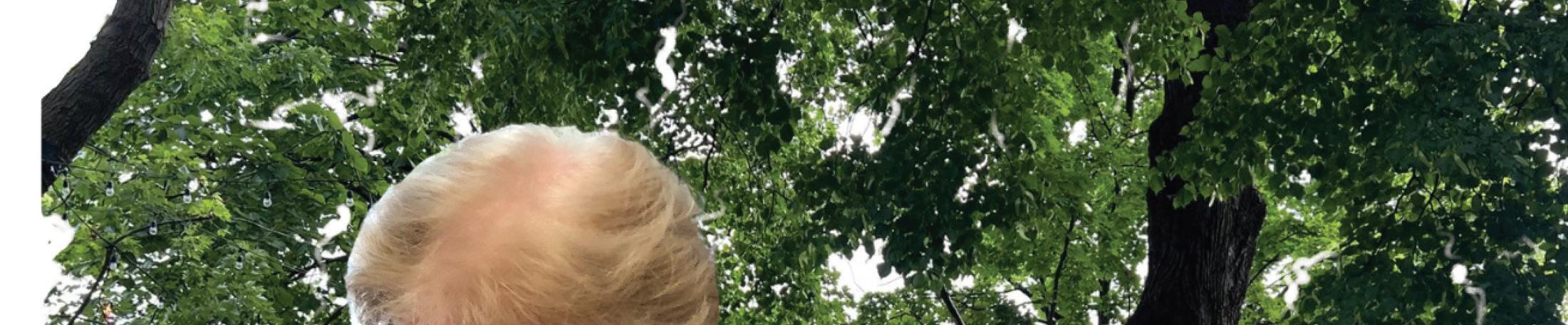
whatever that means for them.
Doniewski emphasized the impact that a group like this has on locals, sharing stories of un-



“I come in, I introduce myself to everyone, offer them coffee, tea, and ask about themselves,” Doniewski said. “It’s really important that we’re not just art teachers, but


Art Hives, at their core, are a form of community centre: a place for people to meet and form bonds they might never have expected to form. Unlike other art studios, there is no expectation of skill, or even of a final product. If they are open, anyone can walk in and just make art,


Ryan Pyke
@pykenotpike
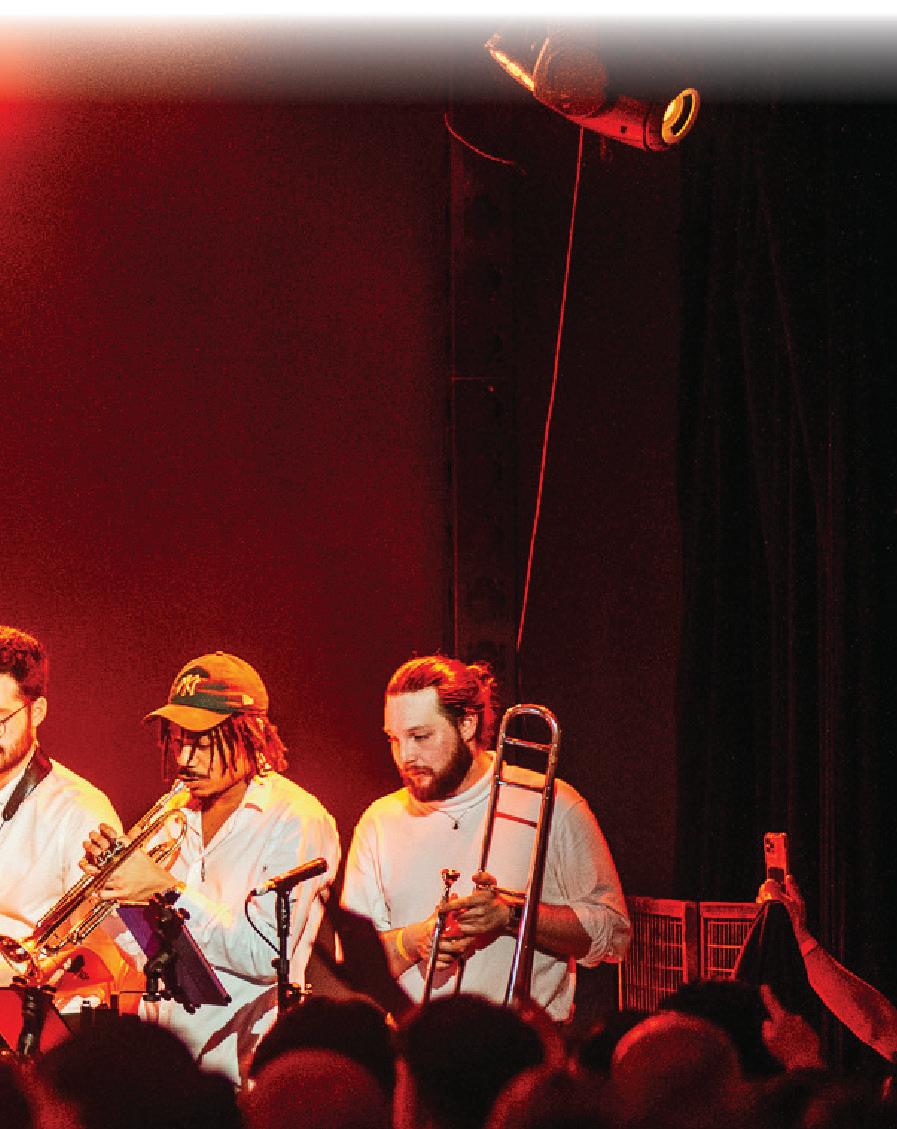
Dollhouse is an emerging Montreal-based band making their mark on the city’s music scene with their ethereal classical vocals layered over grungy instrumentals.
e seeds of the band were planted in the summer of 2024.
“I was feeling a little sad and lonely, and it was the summer," says the band's drummer, Emilio Leto. "So I was like, you know what? I’ll play drums to feel less sad and lonely."
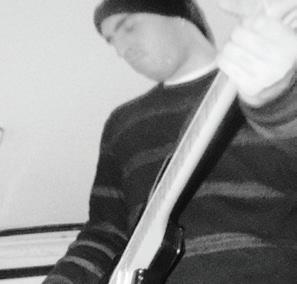
Leto soon found guitarist Radin Minouchehr through the Montreal musicians’ network on Facebook. e two jammed together a few times before deciding they wanted to start a band.
e lineup expanded when Leto met Sacha Suadiyeli at a McGill University club fair. ough Suadiyeli is primarily a guitarist, he plays bass in Dollhouse.
“I was like, if the guitarist doesn’t play as well as I play the guitar, I’m not going to join the band. But you got one of the best Montreal guitarists,” Suadiyeli says, referring to Minouchehr.
Once the three began playing together, they realized the band needed a singer. ey eventually discovered Nikita Riou on BandMix.

“We were blown away by Nikita’s BandMix covers,” Leto says.


e band initially struggled to reach Riou, even going as far as messaging her family members in an attempt to contact her, but their messages went unanswered.















A er they began looking at other options, Riou eventually heard about the band through her sister and connected with them.


The quartet blends unlikely influences into a sound of their own



The band’s songwriting process is highly collaborative.






























Leto and Minouchehr were immediately impressed by Riou’s freestyle vocals, but Suadiyeli was a bit skeptical about adding her to the mix at rst. She quickly came around during the second practice the four of them had together.
















Minouchehr will o en come in with a guitar ri , and the rest of the group builds around it. Suadiyeli sometimes restructures songs into sections more typical of jazz compositions, while vocals usually come last. ough Minouchehr frequently brings in the initial ideas, the process is rarely one-directional. ey aim to create timeless music.








“It just felt like [Riou] was not only a singer,” said Suadiyeli. “It felt like it was a singer in the band.”
e band’s name draws inspiration from the same novel that inspired Joy Division’s band name, House of Dolls ough their in uences di er widely, those di erences shape Dollhouse’s sound. Riou is a classical music major, while Suadiyeli listens to a lot of jazz and brings those elements into his playing. Minouchehr gravitates toward metal and punk, and Leto is more into rock.
“Most of the time we don’t like each other’s music, but when we play together we like what we make,” Minouchehr says. e mix of in uences gives the band its unique sound. Riou describes their sound as dark and atmospheric, while Minouchehr calls it dreamy alternative rock. Leto says listeners o en compare them to Evanescence.
Alasdair Schreyer-King, a frequent attendee of the band’s shows, highlighted Riou’s contributions to the band.
“I think Nikita’s operatic vocals are the most outstanding element of their sound, mostly because of how rare it is to see the product of such speci c training in the local scene,” Schreyer-King says.




“My personal biggest goal for every song is that, no matter how many times you listen to it, you can still listen to it one more time,” Minouchehr says.

































Suadiyeli sees this timelessness a bit di erently. He likes to think about how well a song will age.



“It’s very much about being able to nd something that does not only work because it was made right now,” Suadiyeli says.








my natural approach to it,” Riou says. As the band continues to play across the city, certain venues have become standouts. One of their favourites is L’Escogri e Bar. Leto says the venue stands out for how it treats performers, citing its good sound, easy booking process, welcoming greenroom and plenty of drink tickets.















For frequent showgoers like Schreyer-King, it’s in spaces like these that Dollhouse’s sound leaves its strongest impression.







“ eir sound is unique enough to distinguish from other bands in our scene as well as from all around the world,” he says. ere are some international elements to the band’s sound. One song’s intro is all in Russian, a nod to Riou’s roots. ere is also a ri that Minouchehr mentioned is very inspired by Persian music, speci cally in the incorporation of microtones. ese are distinct parts of their music, but Minouchehr emphasizes that these elements are not what make up their sound. He describes it as “a colour on the palette for a song that we’re trying to make.”
ough each band member is unique both in personality and music taste, all these varying elements come together to form a cohesive whole.









According to Minouchehr, the band has played 33 shows together so far. In their earlier days, they focused on performing as o en as possible to establish themselves in the scene. Now, Minouchehr says that they are most proud of their more recent shows.










“ eir songs are really well paced, with intuitive buildups and transitions and all that, which helps tons with live performances,” Schreyer-King says. at sense of structure carries into the band’s writing process. Lyrically, Dollhouse explores a wide range of themes, from philosophical re ections to politics and mental health. Riou o en writes the lyrics, though the other members contribute ideas.





Dollhouse has switched bassists since the writing of this article. eir new bassist is Anthony Filice.




























“Emilio (Leto) is actually quite a poetic man, and he sends me paragraphs worth of stu ,” Riou says.






Her process usually begins by listening to a track repeatedly and reecting on whatever has been occupying her mind that week.



“My life just very much in uences the writing process for me, so that’s just kind of been








Safa Hachi

For years, Montreal’s salsa scene has existed in fragments.
Patrons rotate through venues outside the downtown core, in recurring circuits, with the same bands and the same songs. If you knew where to go, you could nd it. If you didn’t, it wasn’t exactly looking for you either.
La Murga is trying to change that.
Founded in 2023 by Juan Felipe Quintero and Mateo Diaz, the Montreal-based collective brings together live salsa performance and vinyl DJ sets in a format that feels closer to how the music actually lives: social, accessible and built around movement.
Quintero describes arriving in Montreal and not finding a space that reflected the salsa culture he knew. He explains that while there were some events, the two felt disconnected from the city itself.
“It's not accessible for the people who are part of the Latin diaspora, that live in the city, that move within the city,” Quintero says. “It's not an urban thing, but salsa is an urban music.
That distinction, between salsa as an urban, social form and how it was being presented, became the starting point for the collective.
Quintero, who spent his teenage years in Cali, Colombia, came to Montreal to study music at Concordia University. He eventually shi ed from classical to jazz, and a er a year of playing across di erent scenes, one absence stood out.
“I wanted to play salsa, because I've played everything here,” Quintero says.
Diaz describes a similar realization, though it came from distance rather than absence. A er moving from Bogotá, Colombia, salsa became something he only recognized once it was no longer around him.
“You just had this void that you didn’t even know you had at the beginning,” Diaz says.
e two met through mutual connections and began building La Murga out of their shared feelings. Early events were informal and experimental, starting as jam sessions before evolving into more structured performances.
Diaz says the goal was to create something that could speak to multiple audiences at once.
“How can we make this a night that's attractive to the Montreal crowd, to people that haven't really been exposed or introduced to this genre? What about those who know and love it?” he says. at tension of wanting familiarity and discovery de nes the collective. Part of it comes down to format. A typical La Murga night moves between a live band and vinyl DJ sets, creating a continuous ow rather than separating performance from party.
Diaz explains that incorporating DJs also depends on responding to how people experience nightlife in the city.
“People are used to their events having a DJ now,” he says.
Diaz adds that the shi toward vinyl was intentional, rooted in the history of salsa as a club and collector-driven genre.
“Vinyl DJ sets of salsa were a huge thing,” he says. “We can also educate people on an older type of salsa.”
For Quintero, that structure isn’t just about the event’s programming but about holding space for di erent ways of listening. He frames it as a balance between those deeply invested in the genre and those encountering it for the rst time.
“ ere’s a ne line,” Quintero says.
Instead of simplifying the music, the approach is to trust that complexity can still connect with attendees.
“If a crowd that has never heard salsa in their lives heard really musically challenging salsa [...] they’re going to be attached immediately,” Quintero says.
David Ryshpan, a pianist with La Murga who has been part of Montreal’s Latin music scene for nearly two decades, sees that mix play out in the crowd.
“You have the old school salsa heads, the music nerds and then this whole other contingent of young Latinx people,” Ryshpan says. “ ese are people who would never cross each other otherwise.”
Ryshpan compares that energy to an earlier version of Montreal’s music scene. He describes walking past venues where the music would spill out into the street, pulling people in without much e ort.
“I feel like La Murga has that,” Ryshpan says. “Even if I go alone, I’m going to run into people.”
Quintero says he notices the same sense of continuity on stage.
“It feels like there’s people who are there always,” he says.
Inside the band, a similar exchange plays out through the ensemble’s intergenerational dynamic. At almost 23, Quintero leads a group that includes musicians older than him.
He explains that leading a salsa band requires a di erent kind of awareness, with more emphasis on structure and direction. Over time, that pressure has shi ed into something more collaborative.
“When I’m failing to give a cue, someone else picks it up,” Quintero says.
at collaboration has become one of the most meaningful parts of the project for him.
“ e biggest gi that it has given me is to build a little family of musicians,” Quintero says.
Behind the scenes, that same attention to structure carries into how the events are produced.

Katarina Vincent, La Murga’s logistics and production co-
ordinator, rst encountered the collective as an attendee. As a professional dancer, she was already familiar with Montreal’s salsa scene, but describes La Murga as lling a gap.
“It was revitalizing it in a way that I had been longing to experience,” Vincent says.
She now oversees the coordination of events, from venue logistics to technical production, with the goal of making the experience feel seamless for attendees.
“It’s a mix of planning and being adaptable in real time. The goal is that people don’t notice," Vincent says. "They are there to enjoy their experience, and I am there to ensure that it can be delivered."
Vincent says that creating an open and welcoming space is less about messaging and more about consistency in practice.
“We want people who didn’t grow up with this music to feel invited in,” she says. “We’re not trying to water anything down.”
For attendees like Bryan Li, that approach is immediately noticeable.
“La Murga is fun and exhilarating, and for an outsider to the music like me, it welcomes you in with open arms,” Li says.
He adds that even without dancing, the atmosphere keeps him coming back.
“It’s an event where you want to bring your friends to, and it’s a great place to make new friends,” Li says.
As La Murga approaches its third year, the project is expanding while maintaining its core approach.
Diaz says the focus moving forward is to bring the music back into more open and accessible spaces, like how Salsa is authentically played and enjoyed.
“It can start in a café, it can start in the street, it can start in a house,” Diaz says. “It’s meant to gather people, to connect people and to make people feel like they belong”.
at direction is already shaping what they’re working toward. Diaz mentioned the possibilities of hosting dance classes. Over the summer, the collective is planning a series of outdoor events and collaborations, alongside a fundraiser supporting ongoing crises in Cuba.
At the same time, Quintero is beginning to turn toward original material a er building out a large repertoire with the band.
“I feel like now I have a much more clear path of where I want to go sonically with the project,” Quintero says.
What started as an attempt to recreate something from elsewhere is now settling into something shaped by Montreal itself. For now, especially with summer around the corner, it’s something you have to experience in the room.

The collective’s next show is set for April 29 at La Sala Rossa.

Content warning: Suicide, substance abuse and brain disease. By now, most sports fans are aware of the danger and prevalence of concussions in professional sports. In fact, when fans see a big hit in the NHL or NFL, or watch a skier take a bad fall, their rst thoughts jump to potential head injuries.
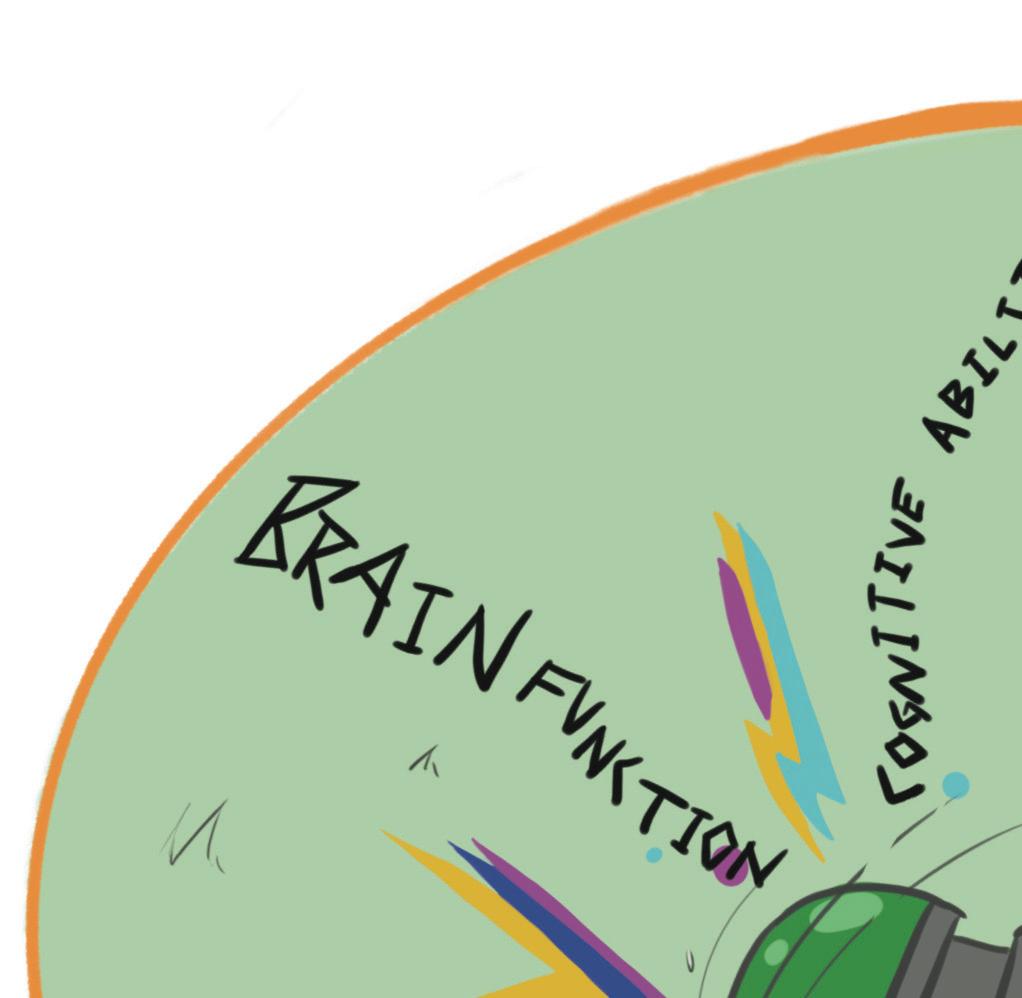
Concussions are a type of mild traumatic brain injury caused by a blow to the head, typically from a fall or, in the case of contact sports, a collision involving the head. Symptoms include headaches, nausea, vomiting, fatigue, blurred vision, confusion, dizziness and amnesia surrounding the event.
Athletes may feel compelled to play through head injuries for a variety of reasons, one of which can be pressure from coaching sta . But there are also issues with concussion detection, as Victoria D’Amours, a former competitive gure skater, can attest.
“If you break your ankle, your ankle’s going to be swollen and blue. ere is no denying that there is some sort of injury," D'Amours said. "But with a concussion, it's not symptoms that you can see."
However, data shows this is the equivalent of taking painkillers to " x" a broken leg.
As researchers working at Boston University’s CTE Center have found, the disease stems from repeated head injuries. us, while the big hits are most certainly brutal, true prevention should aim to limit cumulative head injuries over a career.
NFL players are certainly not the only ones at risk here. Combat sports, especially boxing, correlate signi cantly with CTE development later in life due to repeated injuries to the head.
Another study, concerned with English soccer players, found that concussions make up 7 per cent of all injuries in women’s international soccer, 5 per cent in women’s domestic, 3 per cent in men’s international, and 2 per cent in men’s domestic.
A er her second concussion, Parry started to notice the way the injuries a ected her play. ree months a er the incident, the team practiced the same drill where Parry had su ered the injury.
“My body genuinely had a reaction to it,” Parry said. “I don't want to point to a trauma response, but a bit like that. And I had realized that I'd been kind of holding back because of that fear of that injury happening again.”
D’Amours explained that this issue can also be prevalent at the youth level.
“ ere might be a tendency not to believe the kids, because there are symptoms that anyone could have for a variety of reasons,” D’Amours said.


It’s worth remembering that the prevalence of head injuries within sports discourse is relatively recent.




Concussions only became widely discussed in the early 2010s when the NFL saw a combination of lawsuits and former players committing suicide. Dr. Bennet Omalu was the rst person to observe chronic traumatic encephalopathy (CTE) posthumously in NFL players who had committed suicide in 2002.




By 2012, a er the suicides of multiple former players with autopsies showing they su ered from CTE, the NFL was facing a uni ed lawsuit of 80 concussion-related suits representing over 2,000 NFL players.



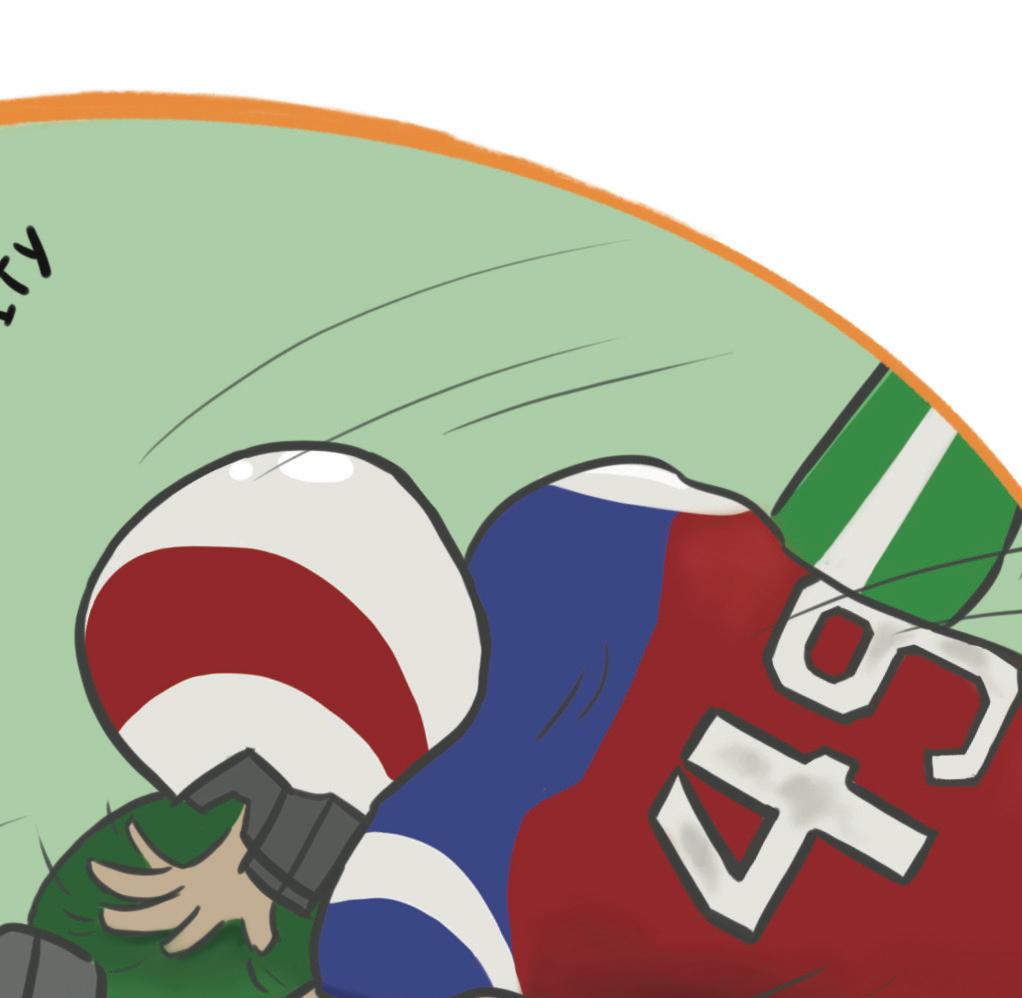
However, sometimes it's the athletes who push themselves into playing through injury. When asked for some advice D’Amours wished she could have given herself, or advice for athletes dealing with concussions, she put the importance of competitive sports into perspective.

“When you’re a growing athlete, all you care about is your sport,”





D’Amours said. "But there is a life a er sports, and while that was really important for me at the time, the life that you’re going to live once your sport is over is hopefully longer than the time you spent with your sport.”


D'Amours does not think that this means scaring young athletes by overstating the risks.

e players accused the league of negligence and failure to notify its players of the relationship between concussions and long-term brain injuries.

e league ultimately agreed to a US$765 million settlement. In 2016, a senior NFL o cial acknowledged the link between football and degenerative brain disorders, marking the rst time the NFL had acknowledged it.
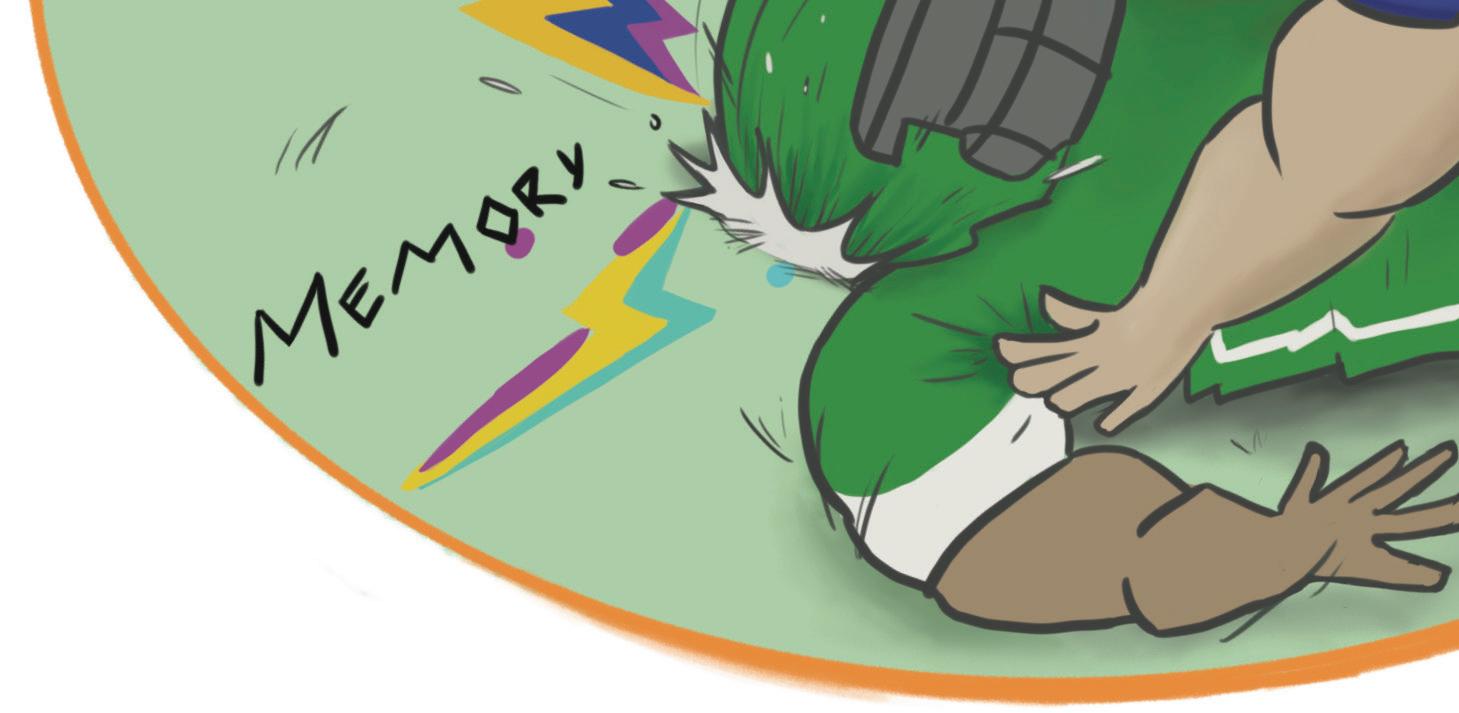
While it marked a major development, it seems disturbing that it took multiple NFL players committing suicide and having their brains studied for the NFL to acknowledge that smashing heads for a living may lead to permanent brain damage.
e discussion with head injuries in sports, however, is less about the concussions themselves and more about the long-term complications, mainly CTE.
CTE is a degenerative brain disease caused by repeated injuries to the head, which leads to the death of nerve cells in the brain. ere is no known cure and no de nite diagnostic test aside from posthumous diagnosis.
CTE’s symptoms include cognitive changes like memory loss and trouble thinking, behavioural changes such as impulsive and aggressive behaviour, mood changes including depression, emotional instability, suicidal thoughts and substance abuse, and movement symptoms like parkinsonism, balance and movement issues, and motor neuron disease.
In 2017, a study published in the Journal of the American Medical Association examined the brains of 111 deceased NFL players and found that 110 of them had CTE.
By 2022, the NFL and NFL Players Association nally agreed to update their concussion protocols, and by 2024, the NFL made changes to kicko s to reduce full-speed collisions and allowed players to wear guardian caps.
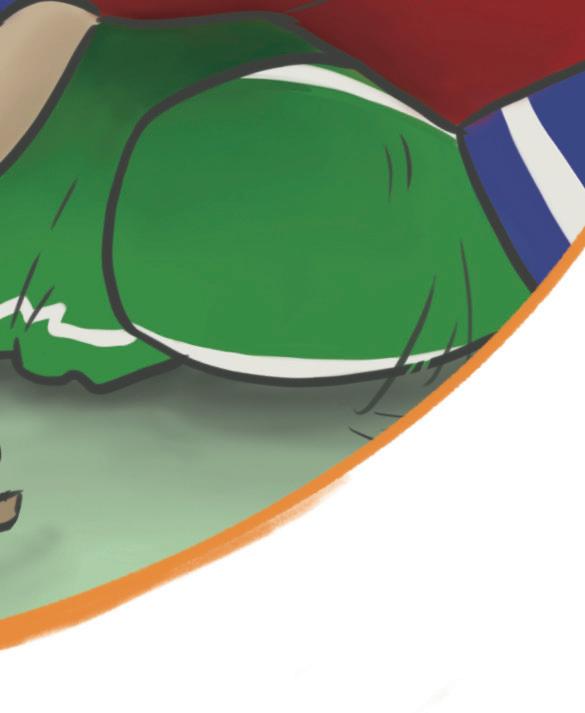
e NHL has an extensive concussion protocol as well, and broadened its Rule 48 (Illegal Check to the Head) in the 2011-12 season to "encompass all hits to the head."
ese problems are further complicated when acknowledging the pressures athletes face to "suck it up." An especially egregious example concerns former New York Giants head coach Brian Daboll, who interrupted quarterback Jaxson Dart's concussion protocols to ask if he was OK to keep playing.
Èvelyn Parry, a goalkeeper for the Concordia University women’s soccer team, has su ered two concussions in her career. She pointed out the stigma surrounding concussions in athlete culture and the response to head injuries.
“One thing athletes do, in every aspect of our life, is if we don't talk about it, it doesn't exist,” Parry said. “Concussions are kind of the same thing where there's a stigma about it, being that if I ignore it or don't really face the truth, then it's not true, it's not real.”
A recent poll found that 19.5 per cent of NFL players admitted to hiding concussion symptoms from a doctor while playing in the NFL, and 26 per cent of them had done so at lower levels of football.
is gets scarier when we take into account that CTE is also associated with getting a second head injury before the rst one was treated.




"I think we need to target our e ort into recognizing the signs and ensuring that the proper protocols are put in place, and that people are directed towards the right resources,” D'Amours said.


Unfortunately, it's not just contact and helmet sports that can put non-pro athletes at risk.

Adrien Chaput, former ag footballer for Marianopolis College, can attest to this. Chaput has experienced multiple head injuries playing both ag football and basketball, neither of which is typically seen as a heavy contact sport.
e numerous head injuries, including a couple of concussions, Chaput said, have had a lasting impact on his life, such as persistent dizziness and low-quality sleep.
Chaput also explained that just six months a er his rst concussion, he experienced what he thought was a small head injury, but “his symptoms returned in full force.” Later, he was diagnosed with post-concussion symptoms, which occur when concussion symptoms last longer than they normally do.
Chaput continues to struggle with these symptoms to this day.
“It limits my participation and ability to learn at the same level in sports and school," he said.
He also expressed frustrations with physicians’ attitudes towards concussions as a non-professional athlete.
“ ey kind of just brush it o , because there is nothing they can do,” Chaput said.
D’Amours’ experiences as a gure skater concur with Chaput’s.
“In reality, you can get a concussion just from falling on your butt,” D'Amours said.
While awareness around concussions has increased in recent years, athletes and experts still feel that proper protocols need to be more strictly followed once head injuries occur to ensure safety.
With les from Samuel Kayll.
Samuel Kayll
@sdubk24
Aer several months of searching, Concordia University has found its next director of Recreation and Athletics. Claude Morin, the current athletic director at Cégep André-Laurendeau, will take over the position on May 1, leading the program into a summer of development.
Morin played NCAA Division I hockey with Clarkson University and later enjoyed a 14-year professional career across Europe and North America. He says his time as a student-athlete prepared him well for his role as athletic director.
“I know exactly what it takes to be successful, what it takes to be a student athlete at that age, what they need to do, what they're hoping to accomplish,” Morin said. “So I think it's a great base to start with."
Morin welcomes the challenge of recruiting in the Réseau du sport étudiant du Québec, a conference rich with high-end talent. At André-Laurendeau, he helped the Boomerang bring home two national and 18 provincial titles, an organizational strength he aims to bring to the Stingers.
But Morin also wants to expand Concordia’s in uence beyond Quebec. He hopes to make Concordia a destination not only for provincial student-athletes but for national talent as well.
"I want to try to put Concordia at the top and make sure that everybody thinks about Concordia when it's time to apply to university, and that their life experience is going to be great,” Morin said.
Morin’s arrival comes at a crucial juncture for the Stingers organization. Seven of Concordia’s eight varsity programs made the playo s in 2025-26, with the women’s hockey team advancing to its h straight national championship. With strong teams in
place, the future looks bright for Concordia athletics.
The department also received a boost through student backing. After failing to pass in the fall, students voted in favour of an increase to Concordia Recreation and Athletics’ per-credit student fee levy from $2.92 to $4.19 at the Concordia Student Union elections.
However, the university still lags behind other Quebec institutions in areas like attendance and fan support. Jadynn Somerville, a guard for the Concordia women’s basketball team, pointed out the disconnect many students face when supporting the school’s teams.
“I think one of the biggest things we need to improve is the overall school culture around sports and getting more students to show up to games,” Somerville said. “Because the university is split between two campuses, I’ve noticed that a lot of students downtown don’t even realize how many teams we have or when we’re playing.”
Morin hopes to build the program around a uni ed front, with Stingers teams supporting each other and improved student participation. He says he wants to get the entire community involved in the department’s actions.
“I'd really like to survey students, student-athletes, regular students, also the whole community, sta and everything, and see what they want to have,” Morin said. “What do they have right now that they like? Where could we improve?"
Alice Fleming, a fellow guard for the women’s basketball team, supports Morin’s plans for the future.
“I think that having more support from the department would help all of the Stingers programs,” Fleming said.
O cially, Morin’s job doesn’t start for another month. But he already has big ideas, and he’s excited to get to work.
“It's a big challenge, but I'm ready for it,” Morin said. “I can't wait to get going and get to know the people we'll be working with and work for the whole community to make Concordia the best place possible.”

Trent Deschamps-Coinner
Asthe U.S. and Israel carry out their ongoing military operations against Iran, serious questions exist regarding Iran’s participation in the upcoming FIFA World Cup this summer. eir participation would already be a large ask under normal circumstances, but considering that the U.S. is one of the co-hosts of this summer’s World Cup, Iran's participation seems even more unlikely.
Israel and the U.S. began attacking Iran on Feb. 28. ey targeted key missile infrastructure, sites related to their nuclear program, oil and gas sites, killing Iran’s leader Ayatollah Ali Khamenei in the process.


achieved by the brave sons of Iran, was among the rst teams to qualify for this major tournament,” the statement added.
While Iran has since petitioned FIFA to move its games out of the U.S. and into Mexico, a FIFA spokesperson said they were looking forward to teams participating "as per the match schedule announced on 6 December 2025."
Iran has since banned its team from travelling to hostile foreign nations, so it looks like they will not attend the World Cup. is is just the most recent example of FI-

to their role in Russia’s invasion of Ukraine. ere was also, of course, the FIFA Peace Prize saga, essentially a glori cation ritual for Trump. Trump also had his fair share of antics go unpunished at last year's FIFA Club World Cup.
Even in other sports, the hypocrisy shown by global sporting bodies regarding what is and isn’t allowed has been astonishing. Russia has been banned from FIFA competition for quite some time now, yet FIFA has dismissed sanctioning Israel despite the pleas of multiple countries.












Last year, FIFA moved a Scotland vs. Belarus World Cup quali er out of Belarus due


In response, Iran has closed the Strait of Hormuz, the main conduit for about 20 per cent of the world’s oil and natural gas. As things stand now, more than 2,000 people (civilian and military) have been killed by American and Israeli strikes in Iran. Israel claims they plan to “intensify and expand” strikes on Iran, and the U.S. has extended a previously established deadline for Iran to open the Strait of Hormuz. If Iran refuses, the U.S. will begin striking Iranian power plants.


e Iranian team responded later that day with a statement, saying that the World Cup is an international event that is not governed by any individual country.
"Iran's national team, with strength and a series of decisive victories
Speaking of threats, U.S. President Donald Trump appeared to threaten the Iranian soccer team on March 12 through a Truth Social post: “ e Iran National Soccer Team is welcome to the World Cup, but I really don’t believe it is appropriate that they be there, for their own life and safety.”







is is far from FIFA’s rst moral failing. ey are, by all metrics, a disgusting and money-hungry “non-pro t” with corruption embedded at its very core. And honestly, I’m beyond fed up.

Ever since I was young, the World Cup has stood alone at the pinnacle of sporting competitions. However, FIFA has long since abandoned any pretense of hosting a fair global competition.

At this point, I truly believe the only opportunity for change is a large-scale boycott of the competition, or at least the games in the U.S.
A nancial hit to FIFA, despite its non-pro t status, is the only way they might consider doing anything that contradicts American interests at this point. As much as it pains me to say, if Mexico and Canada take a nancial hit alongside the United States, it would still be worth it to hit FIFA where it hurts.
Lastly, I hope that, if Iran is actually unable to attend the World Cup in any capacity, other teams and their fans will press the issue as the tournament progresses, if not participate in an outright boycott of the competition.
Samuel Kayll
Shailja Judge loves the calm before the storm.
She embraces it. She relishes the feeling of stepping onto the ice before a routine, the knowledge that she has supporters in the crowd. And she never lets the moment get in the way of her own enjoyment.
“You get on, it's go time. You hear the music play,” Judge said. “You have your two-minute warm-up, and seeing everyone in the crowd, your parents cheering for you, your friends and your family, I think that's the biggest motivator for me.”
Synchronized skating—or synchro, as some refer to it—involves a group of eight to 20 skaters performing turns, spins and jumps in perfect harmony. It emphasizes coordination, with routines hinging on a team’s ability to compete as a single unit.
Judge found her love for synchronized skating early, but it took external motivation and even a new sport to settle into the sport she would come to excel in. Growing up in Toronto, she started as a swimmer but was drawn to the rink while training at the local recreation centre. e rst day she stepped on the ice, however, she immediately wanted to quit.
“I was pushing with one foot, falling every three steps. It was just not what I wanted to do,” Judge said. “But every day a er school, [my mother] would bribe me with a treat or McDonald's. She’d say, ‘OK, today we'll do 15 minutes.’ She would take me to an open rink. We would skate 15 minutes, and I would get my treat a er.”
Judge gradually worked her way up to longer sessions, but soon realized that the solo format wasn't for her. So when she noticed a yer posted for synchronized skating tryouts, she immediately registered.
And Judge loved it.
She steadily advanced through the ranks from beginner to pre-juvenile, juvenile and junior. roughout the years, she transferred clubs and teams, but never lost the focus and discipline that synchronized skating instilled in her.
“Every year at the end of the season, sometimes I'm like, ‘Oh, maybe this is the year I quit,’” Judge said. “And then the season's done, and I get right back into it.”
Judge’s stretch with the highly decorated NEXXICE synchronized skating team in Burlington, Ont., was particularly fruitful. In three seasons with the club, her accolades included a gold medal and two silver medals at the Canadian National Skating Championships, as well as another silver medal at the 2023 World Skating Championships. At the moment, the World Championships represent the highest level of competition for synchronized skating. Despite including both men’s and women's singles as well as pair skating, synchro remains on the outside looking in.
ettes Synchronized Skating. Every time the Olympics roll around, she hopes to see her sport make an appearance.
"It kind of is in the back of our heads," Olarte said in an interview with NPR. "But when [an Olympic debut] gets brought up, we have this little hope."
In 2025, the International Skating Union (ISU) introduced Synchro 9. e new competitive category features nine skaters and aims to remove barriers to competition, pushing the sport onto the world stage.
Synchro 9 will make an appearance at the 2028 Winter Youth Olympic Games, furthering the hope that synchronized skating will make its way to the Olympics one day.
“We believe Synchro 9 will open new doors for athletes,

train ride back to Toronto, and immediately said yes.
“I was so excited. I almost started screaming on the train,” Judge said. “Because when I was younger, it was my dream team to skate on."
So the day a er she graduated high school, Judge packed her bags and headed to Montreal. She trained and acclimated herself with the team throughout the summer and began preparing for competitions with them during the fall and winter. e move wasn’t entirely skating-based, though.
“My parents told me, ‘If you're going to skate, you're going to do school,’” Judge said. “So I enrolled in Concordia [University], and I immediately fell in love with it. “
As an economics student, Judge balances her coursework with life as a high-level athlete, but the hard work and long training sessions don’t faze her.

audiences, and countries worldwide as we advance con dently toward its Olympic future,” ISU president Kim Jae-yeol said in a statement.
A er a few years with NEXXICE, Judge realized that she wanted more.
“We're really trying to push the sport to go to the Olympics,” Judge said. “So I would love to be part of a team that does go to the Olympics. at would be my ultimate goal.”
Carmela Mariz Olarte competes in synchro with Hayden-
When the opportunity to try out with Les Suprêmes in Montreal popped up, she jumped at the chance. A quick in-person audition in April 2025 was all it took for the club to o er her a spot. Judge got the acceptance call from Les Suprêmes on the
“When I was growing up, I was also skating and working at the same time. So I work better on a busier schedule,” Judge said. at coolness under re matters especially in a sport like synchronized skating, where small slip-ups can de ne a routine or even a tournament. Maintaining perfect composure takes not just physical strength, but mental strength as well.
“Early morning training, getting up, actually physically going to the rink, pushing through workouts, it's a lot of discipline,” Judge said.
During the season, the discipline paid o . e Les Suprêmes junior team won the Quebec Section Championships and nished second at the Canadian Championships, nishing just behind NEXXICE amongst all challengers. With third- and second-place nishes at the Lumière Cup in the Netherlands and Marie Lundmark Trophy in Finland, respectively, Les Suprêmes proved they could compete on the international stage.
When the announcement came, Les Suprêmes, alongside NEXXICE, were headed to Poland to represent Canada at the World Championships. Judge described the moment as the happiest she’d ever been.
“ ere was no goal of placing on the podium. ere was no goal of scores that we needed to get,” Judge said. “It was just having fun and doing what we wanted to do and performing our programs for the nal time.”
Les Suprêmes nished as the top Canadian team and fourth overall at the World Championships, another impressive result for Judge’s decorated career.
At home with a new club and with numerous major wins under her belt, the sky is the limit for life on the ice. But while Judge still carries her Olympic dreams, she’s never forgotten to cherish the experience.
“Something that my coaches say to me a lot is just live in the precious present,” Judge said. “Don't worry about what's next, what's to come. Just be in the moment.”
And for Shailja Judge, no moment is too big.

Marissa Guthrie
Being a teenager has always been hard, but coming of age in the post-COVID-19, social media era adds layers of pressure that previous generations could never imagine.
Yet, society’s response has been to blame the very people least responsible for the conditions they’re living in.
e physical and psychological upheaval of adolescence has remained broadly consistent across generations. What has changed is the environment in which teenagers now navigate it.
Although most COVID-19 restrictions were li ed around 2023, the sense of community disrupted by lockdowns never fully recovered for the generation that came of age during them.
A 2022 University of California, Santa Barbara survey found that less than 20 per cent of teens viewed society as a good place or as becoming a better place. is represented a 13 per cent drop from 2019.
Arti cial intelligence now presents a further complication, this time to education and career prospects.
ChatGPT generates homework answers immediately, calling into question the value of learning and education as a whole.






Social media brings the challenges of being a teenager to a public and largely unregulated arena, where content created by and consumed by teens with developing brains is displayed permanently to peers and, in many cases, the wider world.

But rather than interrogating the platforms that adults built and pro t from, older generations have dismissed teenagers as shallow or attention-seeking for using them.
Socializing in the post-COVID-19 era is also far more di cult than it was in previous decades.
The


A Public Health Agency of Canada report found that nearly one-third of Canadian adolescents report high psychological symptoms, while only about half report high life satisfaction, with problematic social media use linked to poorer mental health outcomes.




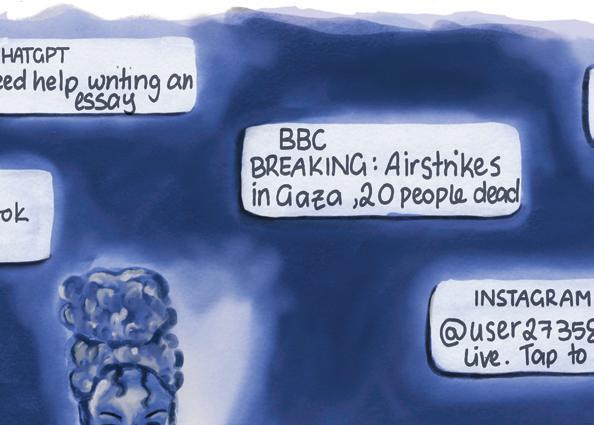
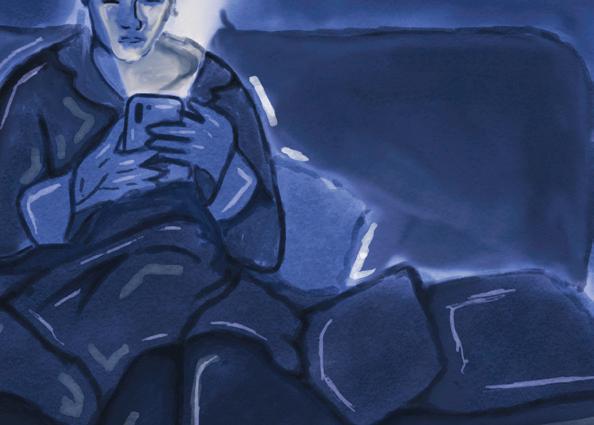
Around 30 per cent of high school students report using AI for school work, but this re ects accessibility, not moral failure. But this, again, is a technology released without meaningful regulation or guidance, adopted predictably by its youngest users, and then used as evidence of their failings.
Sydney Nethersole @marinoellle
spaces increasingly frame the body as something to constantly improve, with social media and dating apps reinforcing the idea that happiness and success come from looking better.
In male-dominated corners of the internet, this mindset has taken a more extreme form: looksmaxxing, where extremely dangerous behaviours and practices are not only accepted, but encouraged and celebrated.

Looksmaxxing spaces are presented as an encouraging and empowering corner of the internet to young, impressionable users who feel a lack of control over themselves or their lives, struggling with mental health issues.
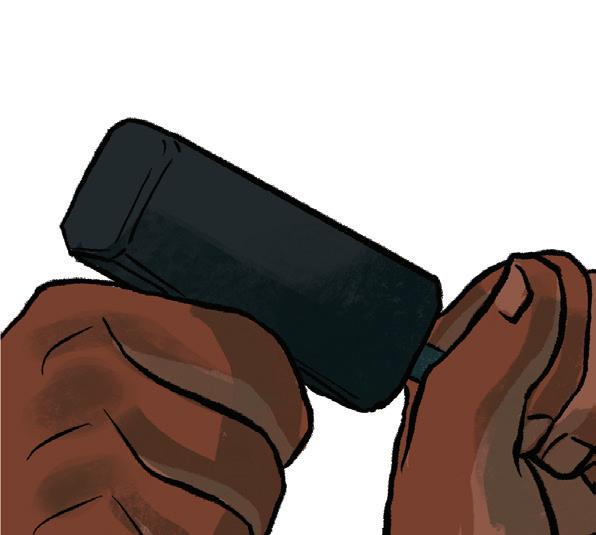
Looksmaxxing in uencers claim
that through more feasible, accessible at-home exercises and techniques, they can enact meaningful change in their own lives. However, these spaces harm far more than they help, further exacerbating mental health struggles while spreading misogynistic and racist ideology.
In these spaces, people constantly trade tips on “improving” themselves through extreme dieting, cosmetic procedures and steroid use.
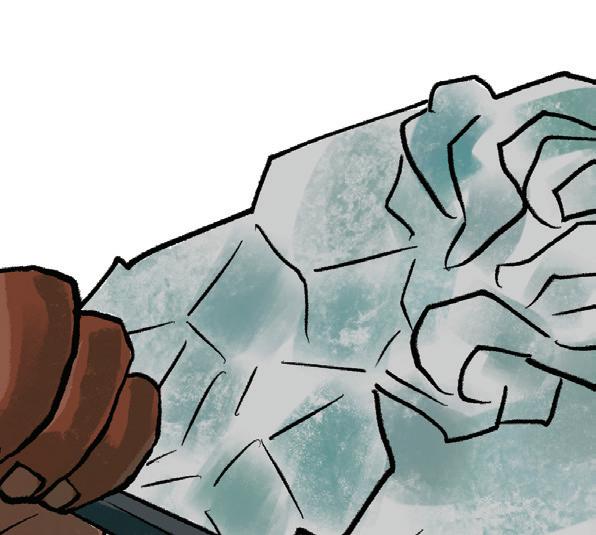


Looksmaxxing has its foundation in incel (short for "involuntary celibate") forums. But such spaces now exist on a variety of social media sites, with in uencers such as Clavicular, Androgenic and Hexumlite creating content on Instagram, TikTok, X and streaming sites such as Kick.


Beyond the classroom, AI’s displacement of workers makes the career landscape facing today’s teenagers more uncertain than ever, replacing many entry-level jobs and destroying the traditional promise of e ort being rewarded.

Alongside all of this, teenagers are processing existential pressures—climate change, the rise of fascism, geopolitical instability—while their brains are still undergoing significant neurological development.


e horrors of being a teenager have always been assuaged by the assurance from adults that things will be better in the future. But that advice doesn’t hold as much weight in a world where a better future seems unlikely, and a future at all is harder to promise.





e least society could do, in the absence of an easy answer, is stop treating the people living through these conditions as the ones responsible for creating them.
the incorrect justi cation being that the shape of the face will change, becoming more re ned as it heals.
Looksmaxxing spaces promote the idea that ascending to the highest possible level of attractiveness is one of the best ways to produce and enact change in one’s life.
Young boys and men post on looksmaxxing forums asking what they can do “to ascend.” is ascension is believed to result in increased wealth, social power and in uence, which is o en presented as something achieved through men exerting power over women.




In these spaces, women are not viewed as equal human beings that one can potentially have healthy, caring romantic and sexual relationships with, but rather as objects to be attained once one has self-improved enough.

In these spaces, in uencers discuss using steroids, following strict diets and using methamphetamines to suppress appetite, with all of these techniques being encouraged as ways to create a lean physique.






Other topics within looksmaxxing spaces focus on developing a more attractive, harmonious face.



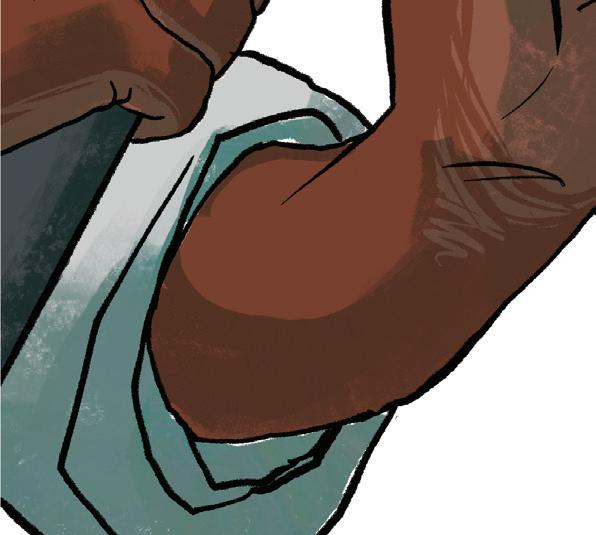
Hoping to achieve the “ideal” facial structure, men in the looksmaxxing sphere discuss everything from mewing, jaw exercises (such as chewing a speci c type of gum, for a speci c amount of time, in a speci c way), facial surgery and dangerous at-home practices, such as bonesmashing. Bonesmashing involves using a hammer to create micro-fractures along the jaw, with
In online forums and social media spaces centred on appearance and self-optimization, o en in unhealthy and dangerous ways, young men express hateful views about gender, race and equality. Women are reduced to terms like “foids,” while Anglo-Saxon features are treated as the standard for “ascension.” is is what makes looksmaxxing more than just another online trend. It re ects a broader moment where economic insecurity and limited opportunities make appearance feel like one of the few things people can control. When success feels out of reach, the body becomes the project, something to optimize when everything else feels unstable.










With an incessant focus on ascending to a higher level and achieving success, money and fame, looksmaxxing inuencers tell impressionable youth that these ideals are easily achievable through unhealthy, dangerous self-cultivation of the physical body.





ese spaces present themselves as a solution to young men’s problems—but they leave men more isolated, and chasing something they’ll never actually reach.
What began as a gesture of respect has become routine, disconnecting us from true reconciliation
Kassidy Jacobs
Land acknowledgments are everywhere now. You can nd them on university syllabi, public transit announcements, local government websites, and, heck, I've even seen one at the opening of a Taylor Swi concert. ey’ve become as routine as a legal disclaimer, and about as meaningful.
I’ve sat through countless events where a land acknowledgment was read so quickly that it was barely registered by anyone in the room, as if the words carried no weight whatsoever.
In theory, they’re meant to honour Indigenous nations. In reality, they’re o en over before they even start. e person reading it looks awkward and stumbles through pronunciations they never bothered to learn, and the audience—well, they’re already scrolling on their phones.
What began as a meaningful form of reconciliation has now become as routine as brushing your teeth in the morning. ese formal statements typically start with something along the lines of, “We are gathered here today on the land of the Kanien'kehá:ka Nation,” and at their core, are meant to acknowledge a history of atrocity and dispossession.
Yet these acknowledgments risk oversimplifying the deeply complex history between Canada and the Indigenous Peoples of Turtle Island. Recognizing only the land we’re standing on collapses centuries of colonization and abuse into a single sentence. ese statements have become purely symbolic with no concrete action behind them. ey’re comparable to your friend say-
ing, “Before I start this car, I am acknowledging that I stole it from my local car dealership,” and then just driving o .
Do you realize how stupid that sounds?
I don’t speak for all Indigenous Peoples, but I am speaking for many when I say that a land acknowledgment without direct change is about as useful to our nations as the Canadian penny: symbolic, but ultimately worthless.
A lack of direct change isn’t the only problem. e fad of land acknowledgments has become more of a public relations tactic, or a trend, if you will. Organizations adopt them to signal cultural awareness, but when the statement ends there, the whole spiel sounds more performative than sincere.
Meanwhile, Indigenous communities continue to face disparities in housing, healthcare, education and land rights. Half of my friends and family from the rez can’t even drink the water from their tap. It's an issue that I doubt crosses anyone’s mind while they’re waiting for the acknowledgment to wrap up.
If institutions truly want land acknowledgments to matter, the words have to be paired with initiative.
Now, this doesn’t mean that Indigenous Peoples are expecting all 2.47 billion acres of land in Canada to suddenly be given back. But something as small as mentioning ongoing treaty and land disputes during these acknowledgments helps make the speech feel a little more
genuine, and less like you’re being held at gunpoint to say it. e routine of recognition alone isn’t reconciliation. Of course, a land acknowledgment can be a great starting point, but when it ends there, it becomes just another box ticked before the real agenda begins.
Real change requires far more than a microphone and a pre-written speech.
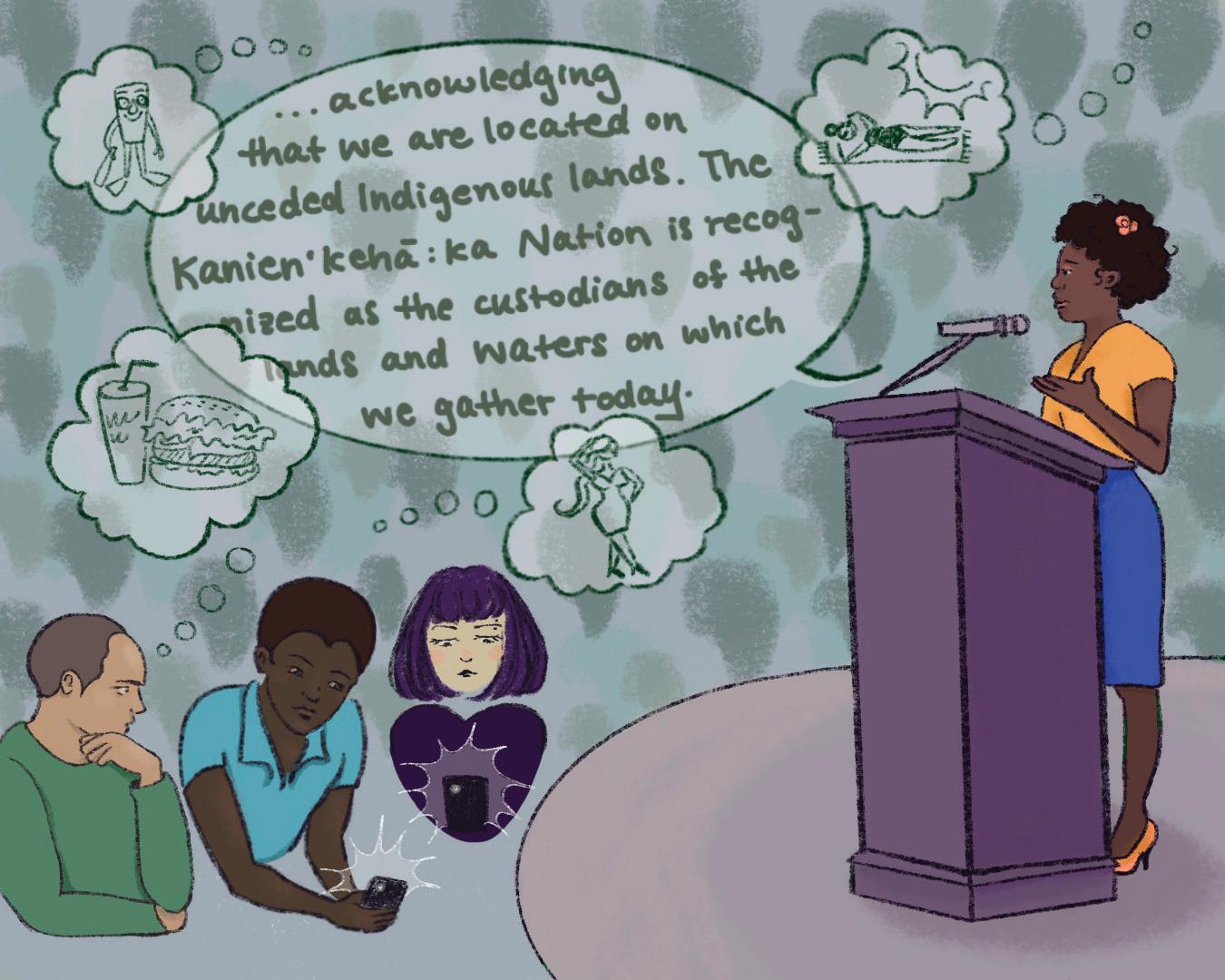
Noah Solomons
Overthe last month, I have twice encountered ocks of STM fare enforcement o cers in their natural habitat.


ey wait by exits of station platforms in large, loitering groups, stopping each exiting Metro passenger to verify their ticket or OPUS card with clunky, archaic (yet expensive-looking) scanning devices.









In the rst instance, I was getting o the Green Line at Saint-Laurent station and wasn’t sure what they were doing. I absentmindedly tried to permeate the loose wall of uniformed o cers and go on my merry way home. en, several STM o cers coalesced to form a barrier in my way and demanded that they look at my OPUS card. e whole process seemed a bit absurd, but I complied and only then went on my merry way home.

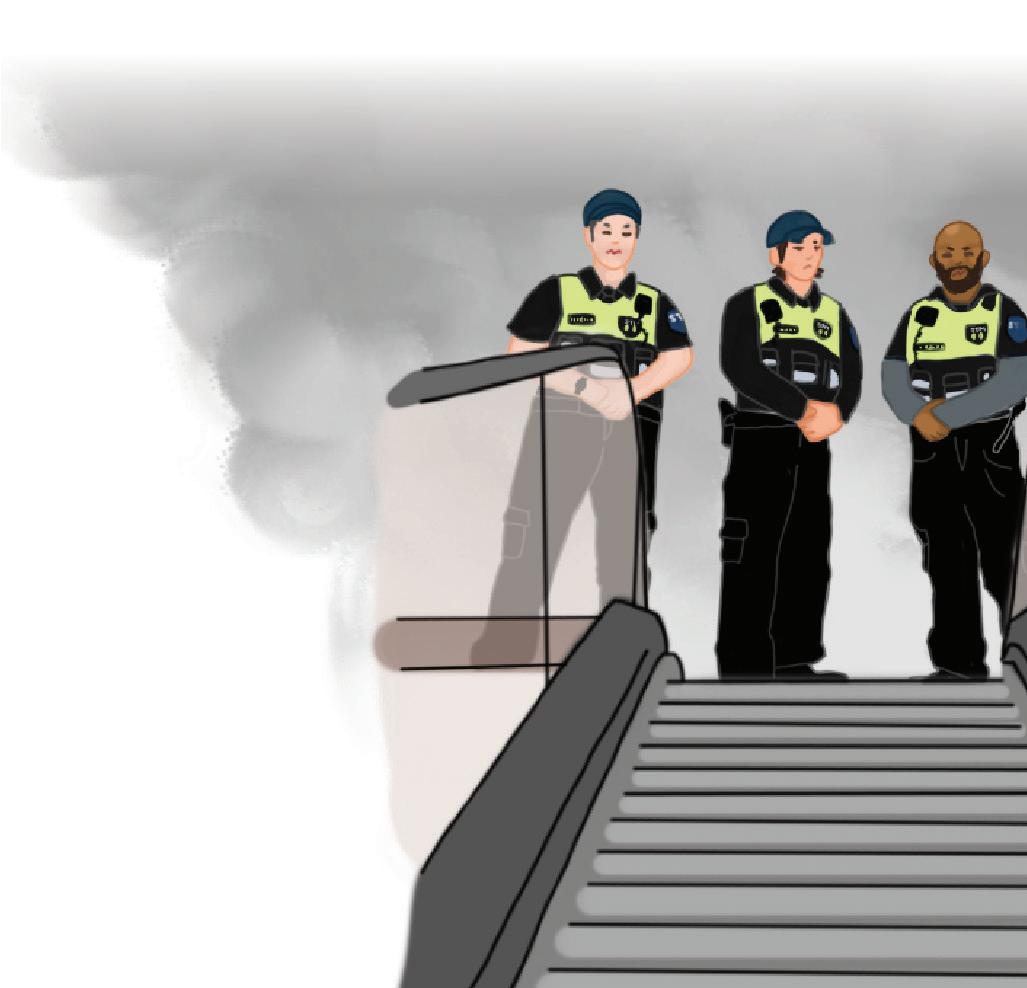
e second time, I encountered this strange ritual at Placedes-Arts station while boarding the Green Line, and was pleasantly ignored.

What struck me in both instances was the scale and chaotic nature of their operation. e sheer number of STM o cers involved in these operations was borderline ridiculous, and they seemed to rely on numbers to enforce fare veri cation rather than any sort of organized method or protocol.




If we think about these two questions in silos, the tension between the motives of public service and policing is clear. Imposing a policy that assumes fare evasion is engendered by contempt for public service undermines the very spirit of public service itself.



For many, fare evasion is a last resort; an act of desperation undertaken out of necessity. Treating it as a policing issue ignores these realities at best, and compounds them at worst.


Transparency is a key issue here. e strategy is framed as nancially necessary, yet the STM provides little operational transparency.

eir 2026 budget reports up to $56 million in project savings this year, and suggests that savings targets expected to be reached in ve years will instead be achieved in three. is is a very di erent tune from what STM representatives sang upon the rollout of the fare enforcement program.

they this program.

To be clear, I did not personally nd their conduct o ensive, disrespectful or unprofessional. I do not resent them for doing their jobs. However, the premise of the activity seemed sort of absurd. According to the Montreal Gazette, the deployment of fare enforcement o cers is part of a renewed e ort to crack down on fare evasion while ensuring “fairness and consistency” for its paying customers. In the Gazette’s coverage of the issue, it is suggested that the decision may have been precipitated by nancial pressures experienced by the STM in 2025.
I have a hard time believing that nes issued by STM o cers outweigh the labour costs of the fare enforcement operation.
e issue of the STM’s fare enforcement strategy raises important questions about the disbursement of nancial resources to public services (or lack thereof) and the role of public services writ large.
What role does public transit serve, and what does fare enforcement actually achieve?
I suppose the part of this whole charade that leaves a bad taste in my mouth is that, without transparency, none of this seems sincere. I do not object to the issuing of exorbitant nes as much as I resent the convoluted justi cation behind


If fare enforcement is about nancial necessity, the STM should report how much money is directly saved by the program. If it’s about deterrence, they should demonstrate how fare enforcement increases compliance. I also nd it curious that the proposed solution to this “fairness” de cit in public transit is randomized policing operations.
Is fare enforcement about balancing the books, providing “fairness and consistency” for paying customers, or something else? Whatever the answer, just tell the truth. I’m sure anyone who feels it necessary to risk a $500 ne for skipping a $3.75 fare can handle it.



















Student journalism does not exist to decorate campus life. It is not here to atter the university, recycle institutional messaging or pretend that student spaces are only valuable when they are convenient. A student newspaper exists because universities are full of power, contradiction and neglect. It exists because students deserve a press that takes those realities seriously.
For us, that is where a simple truth emerges: it is still cool to care.
As we close this volume, we do so knowing that none of this work happens by accident. A student paper only exists because people keep choosing to make it, question it, read it and care about it.
At a time when so much of public life pushes people toward passivity, strong journalism is important. At a time when media culture o en rewards detachment, student journalism asks people to care enough to pay attention and take student spaces seriously.
at belief has shaped e Link over the last few volumes. Past mastheads faced pressing problems within this paper, from burnout to questioning fairness, accountability and who could a ord to take part.
Part of that shi was the Contributor Freelance Fund, a payment system that would allow contributors and sta to be compensated for their work.
e fund was not a full solution to the pressures facing student media, but it mattered. It showed that e Link was trying to change not only what it published, but how it treated the people who made it.
Volume 46, Issue 12 Tuesday, March 31, 2026
Concordia University
Library Building, Room LB-717 1400 de Maisonneuve Blvd. W. Montreal, Quebec H3G 2V8
Editor: 514-848-2424 x. 7407
Arts: 514-848-2424 x. 5813
News: 514-848-2424 x. 8682
Business: 514-848-7406
Advertising: 514-848-7406

is year was not about starting over, but continuing the paper’s mission of advocacy. It was about providing care and accountability, about keeping our namesake and linking the student body to the issues that make up their institution.





It has meant reporting on limited-term teaching sta being pushed further into precarity under the logic of austerity. It has meant reporting on student union dysfunction and on election promises meant to speak to students’ material needs. at is not negativity. at is the job. It exists to ask the obvious question when nobody else will, and then the harder one a er that.
Informing students properly is not just telling them what happened at a meeting or what policy changed. It is to explain what kind of campus is being built around them, and for whom. It shows that the same university that talks about innovation can move ahead with technologies that raise real concerns about privacy and accessibility.
It is also about showing that student politics is not some side theatre, and that everyday conditions of student life— from food services to academic support to labour conditions—are never separate from larger institutional values. at work also means taking student spaces seriously as spaces worth defending.
Universities love the language of community—until community becomes inconvenient. ey celebrate diversity, belonging and student experience in brochures and campaigns. But the spaces where students actually make meaning together o en survive because students build them, sta them, protect them and insist on their value.
A student newspaper should recognize that. It should be able to cover not only rupture and scandal, but also the forms of collective e ort that make campus life livable in the rst place. ese stories are part of the full record of campus life. at is why upli ing voices at Concordia University cannot just be a slogan. Advocacy, at its best, is what happens when journalism is honest about who has power, who is asked to absorb the cost of institutional decisions and whose concerns are easiest to dismiss.



is matters even more now, because the conditions around journalism are getting worse, not better. e current media landscape rewards speed over care. Misinformation spreads easily because it is built to spread.
AI adds to this by ooding public life with convincing, contextless text and images that mimic the shape of information. e result is a weakening of public trust and a lowering of expectations. In that environment, student journalism becomes more important. It o ers something increasingly rare: reporting rooted in a real community, by people who are accountable to that community.
Journalism can still care about what happens in student spaces without treating that care as unserious. at is the point. Student journalism is not lesser journalism because it is campus-based; if anything, that proximity gives it more force.
And if journalism is changing this quickly, then journalism education has to change, too.
Journalism programs like Concordia's cannot assume students are entering the same profession they did a decade ago. ey need to prepare future reporters for a media environment shaped by AI, competing independent reporting and constant information warfare.
For e Link, this will soon mean providing students with stronger training in verifying information and reporting responsibly, as well as revising bylaws and assigning additional responsibilities to editors. At its best, student journalism is a place where people care enough to pay attention, and where that attention can still mean something.
So, as this volume ends, we leave with a clearer sense of what this paper should keep being: a place where people care enough to pay attention.
And for e Link, it has always been cool to care, since 1980.
The Link is published 12 times during the academic year by The Link Publication Society Inc. Content is independent of the university and student associations (ECA, CASA, ASFA, FASA, CSU). Editorial policy is set by an elected board as provided for in The Link 's constitution. Any student is welcome to work on The Link and become a voting staff member. Material appearing in The Link may not be reproduced without prior written permision from The Link Letters to the editor are welcome. All letters 400 words or less will be printed, space permitting. The letters deadine is Friday at 4:00 p.m. The Link reserves the right to edit letters for clarity and length and refuse those deemed racist, sexist, homophobic, xenophobic, libellous or otherwise contrary to The Link 's statement of principles.
BOARD OF DIRECTORS 2025-2026: Voting Members: Iness Rifay, Hannah Vogan, Alice Martin| Non-Voting Members: Maria Cholakova, Varda Nisar, Lory Saint-Fleur, Geneviève Sylvestre.
TYPESETTING by The Link PRINTING by Hebdo-Litho.
CONTRIBUTORS: Cléo Clamen, Sean Richard, Maria Cholakova, Kara Brulotte, Aren da Costa Scarano, Trent Deschamps-Coinner, Kassidy Jacobs, Noah Solomons, Marissa Guthrie, Sydney Nethersole, Lucía Castro Girón, Kasey Lamer, Halle Keays, Bianca Matei, Anika Yvette, Aahana Kitson
COVER: Andraé Lerone Lewis, Nicolas Tremblay, Naya Hachwa, Myriam Ouazzani
HOUSE ADS: Halle Keays, Panos Michalakopoulos
MESSAGE FOR VOLUME 47: We believe in you, good luck. We're sure you'll leave The Link better than how you found it.
Sincerely, your Volume 46 managing team.