






















CONCORDIAʼS INDEPENDENT PUBLICATION SINCE 1980





The university completed less than a quarter of its sustainability targets

In 2016, Concordia University’s Board of Governors enacted a sustainability policy, which it presented as a “mindset and a process that leads to reducing our ecological footprint and enhancing social well-being while maintaining economic viability.”
Ten years later, the policy has morphed into the Sustainability Action Plan (SAP), an initiative broken down in ve-year increments intended to lead the university to its 2040 climate goals. A new version of the action plan is underway for September 2026.
e topic began percolating at Concordia in 2003, when Sustainable Concordia became a student fee-levy group a er the university conducted an assessment of sustainability for its campus.
In 2007, that group became the Sustainability Action Fund (SAF), which is still an active fee levy group today. e SAF collected almost $400,000 in revenue in the 2024-25 academic year for sustainability projects at the university.
In 2017, work towards the action plan began with community consultations, which led to the action plan being divided into ve subsections with distinct sustainability objectives: sustainable food systems, zero waste, climate action, sustainability in research and sustainability in curriculum.
The development of the policy was “quite a multi-stakeholder process that took some time,” according to Cassandra Lamontagne, sustainability manager of Concordia’s Office of Sustainability.
“It was a big e ort that came from grassroots initiatives at the student level, and rose through the ranks and eventually became a point of topic that was seriously taken by the university,” Lamontagne added.
e rst ve-year plan ran from 2020 to 2025.
Now, according to Lamontagne, a new plan is being dra ed, keeping the successes from the previous edition, but tweaking and rethinking where the plan has failed. e dra ing committees—one for every subsection—comprise Concordia faculty and sta , the Concordia Student Union’s sustainability coordinator, and management members of relevant student-led initiatives on campus.
Students were able to vote until Feb. 22 this year on what proposed projects were of the highest priority to them.
Some of the proposed projects included retro tting the GuyDe Maisonneuve Building to reduce energy consumption, expanding the electric vehicle charging infrastructure, increasing the number of contracts awarded to Quebec and Indigenous vendors, and enhancing participation in on-campus biodiversity monitoring.
Some call it ‘greenwashing’
CSU sustainability coordinator Mia Kennedy said she believes the SAP is the reason why a lot of students enrolled at Concordia.
“It was such a public, broadly reported promise that it stuck with a lot of students,” Kennedy said.
She added that one of Concordia’s main promises, made in 2019, was to fully divest from fossil fuels by 2025. e university shi ed its divestment approach in 2023, opting to only divest from the top 200 publicly-listed fossil fuel companies, and still hold over $850,000 in fossil fuel stocks as of August 2025.
Kennedy is in the process of developing the next edition of the SAP and nds the experience rewarding but challenging.
“I have heard rhetoric that I don’t agree with, that I think is actively negative for students,” Kennedy said. “I have been invited into spaces to talk about food insecurity, and the reason those spaces have been created is to talk about student retention, not the well-being of students.”
Kennedy added that, in her experience, the university’s goal is not to increase the well-being of students, but to support students enough so that they stay enrolled.
She believes that Concordia could be “greenwashing,” a practice where an organization uses a false image of environmental responsibility as a marketing tactic to mislead consumers.
Kennedy said she wants to have conversations with the administration about how this could be xed.
Concordia is facing a period of nancial instability, with the latest budget update showing a projected decline in revenues necessitating “deep structural change.”
“Our administration is very communicative about the challenges we are facing as a university,” said Lamontagne on how Concordia’s nances may impact 2040 sustainability objectives.
Lamontagne said that a clearer portrait of how the university's financial situation will influence the implementation of the SAP will be drawn before the next five-year plan is launched in September.
“It is going to be very clear what is available to us, and we are going to make sure that translates into what goes into the plan,” she said. Still, that won’t stop Concordia from being ambitious and securing funding elsewhere to make sure they go “above and beyond,” Lamontagne added.
Fortier said that the university is performing a costing exercise alongside the prioritization exercise. A full four-year funding plan will be allocated to the projects when they are selected in the inclusion plan.
However, some projects are currently under consideration for the plan and may not be included in the nal version if there are “insu cient resources to allocate to them,” according to Fortier. Amidst this climate of austerity, Kennedy wishes that grassroots initiatives at the university were better supported.
“All these student-run organizations run on shoestring budgets, and they end up spending a lot of their really precious hours working just applying for grants,” Kennedy said. ”What drives them to do this work is their love for students, their love for the community, and [to] make sure that people are well fed and have access to basic resources.”



Lamontagne said that every subcategory has set long-term goals to be reached by 2040.





“ e idea is the context will change so much at the university in a 20-year span, the resources available will change, the technology will change, and the university will change,” she explained.



She added that, this time around, the committee has opted to create periodic plans to achieve long-term goals through shortterm strategies and targets.


e progress of every target is published on the O ce of Sustainability website. e university had set 28 targets for the rst ve-year plan, and managed to complete ve by its 2025 deadline, with a majority in the Sustainable Food Systems subcategory.































“Graham Carr makes more money than Mark Carney, and students are not able to put food on the table, and they are not able to a ord rent,”






STM workers likely to strike again in March


Kennedy said. “If students are in a nancially precarious situation where they need to select between food and tuition, they are obviously going to choose food.”










Lamontagne argued that the university is “fairly proud of what has been accomplished” and considers that a lot of the sustainability efforts have been attained in partnership with students, adding that Concordia has supported student-run initiatives financially through the action plan when it was possible to do so.


In 2024, Concordia received a gold rating from the Sustainability Tracking, Assessment and Rating System (STARS), as dictated by the Association for the Advancement of Sustainability in Higher Education (AASHE). The university scored 74.37 out of 100 points, and this certification will be valid through 2028.
STM maintenance workers will likely strike again in the rst week of March, following “stalled” negotiations between workers and management. e workers’ union says the STM has refused to come to the negotiating table for two weeks this month. is would be the h limited strike of the maintenance union since June 2025.











In the report, three categories were published with the status “not pursuing.” ose were A ordability and Access, Student Success, and Water Use.











AASHE de nes A ordability and Access as ensuring that education programming is a ordable to and inclusive of low-income and rst-generation students. Student Success is de ned as the institution ensuring that students succeed irrespective of economic status, gender identity, indigeneity or racial/ethnic identity.





“You could think of those long-term goals as part of a living plan at Concordia that will continue to adapt,” Lamonagne said. “ e lessons learned from the rst one are de nitely helping us in determining how we are going about the second one.”




Concordia’s deputy spokesperson Julie Fortier said that they could not pursue those categories because the university did not have the necessary data.

a deal struck between the Canadian and Chinese governments to allow tens of thousands of Chinese electric vehicles into Canada in exchange for a tari break on Canadian agricultural products.
From the campus bar to Loyola’s farm, the STIR program helps grassroots groups with funding and mentorship
Kara Brulotte

@kara.brulotte
The Concordia Food Coalition (CFC) is cooking up a storm with its Support, Training, Incubation and Resources program—known as STIR—to help grassroots food initiatives at Concordia University nd funding and support.
Since its inception in 2013, STIR has supported groups like Reggies, Mind.Heart.Mouth and CultivAction.
STIR offers food initiatives $2,000 in seed funding for equipment, labour, hiring professionals and direct support. The program provided $4,818 of funding to different food groups between October 2024 and September 2025, and $8,000 since October 2025.
“It's really extensive, and we're basically there to just help you get your project up and running in any way, shape and form,” said Elena Tresierra-Farbridge, CFC’s food systems coordinator.

bar to hire two students in photography and graphic design positions, which they say reinvests the money into the student community.
“ e STIR program has helped a lot with getting in touch with professionals and training people in our kitchen," Webb said, "and hopefully [to] help them move out of Reggies and into a more serious kitchen or culinary role."
One of Reggies' recent hires is Ben Redhill-Simard, the bar’s o cial graphic designer and uno cial creative director.
“When you're just kind of starting out with stuff like this, it feels like you're doing a lot of work for free," Redhill-Simard said. "So having the grant be there, it's a nice little chunk of change, for feeling like you're getting something done and you're getting rewarded for it."
ces at Concordia, over the summer, the STIR program faced the possibility of running out of funding, only being able to split $2,000 between the groups it supported in the spring of 2025, rather than being able to o er $2,000 to each group.
In August, the CFC applied for funding from the CSU’s Student Space, Accessible Education, and Legal Contingency Fund and received $25,100 for the STIR program and $4,900 for the CFC farmers' market.











is, along with the recent fee levy increase the group got this fall, raising its fee from 16 cents per credit to 32 cents, has allowed the CFC to continue helping student groups throughout the school year.




Concordia has a variety of initiatives that can help to develop food groups, such as the Sustainability Action Fund, a fee-levy group that supports sustainability in the Concordia community.





“Partnering with STIR and STIR providing grants, it keeps Reggies running," Webb said. "It keeps Reggies a place that people enjoy to come and grab food or study with their friends."

According to Tresierra-Farbridge, support includes communications, branding and fundraising, as well as connecting food groups with experts in areas they might need.






Reggies, the university’s campus bar, is among STIR’s recent aid recipients. The bar’s marketing manager, Goldie Webb, said the $500 received allowed the




STIR was designed to upli the smaller food initiatives on campus. According to Tresierra-Farbridge, these smaller initiatives o en have trouble meeting the requirements of these funding programs, such as having well-established funding sources or several years of nancial documentation.
e STIR program closed applications for winter participants on Jan. 8.


Kara Brulotte


Some@kara.brulotte
Concordia University sta and students are raising concerns with a 3,000-signature requirement a er the Hive Free Lunch program failed to collect enough signatures to bring its request to become a Concordia Student Union (CSU) fee levy group to a student vote.
As per the Policy on Fee Levy Applications, applicants looking to create a new fee levy must submit a petition signed by at least 3,000 undergraduate students to the student union to be eligible to run in CSU elections.
Certain CSU executives are questioning the requirement—including Loyola coordinator Aya Kidaei, who believes that though the signatures show necessary student interest in the group, the fee levy increase would be voted on by students anyway.
“Do they really need 3,000 signatures? Maybe not. at might be entirely too much,” Kidaei said. “I do think we need to nd a balance of how much we're asking from these groups."
e 3,000-signature requirement was put into place in September 2021, replacing the past requirement of 750 signatures, according to CSU general coordinator Vanessa Massot.
However, Kidaei claims that up until last week, the CSU website only listed 750 signatures as necessary for a new fee levy, leading to confusion among student groups.
“I would not be able to accept a petition with only 750 signatures, because it would be a violation of policy, which would make us liable,” Massot said. “But at the same time, it doesn't really feel great to not be able to honour something that's on our website.”
Collecting enough signatures is one of the many barriers Concordia groups can face when applying to increase or create a new fee levy.






“Low barrier. That's the name of the game with us, because everyone needs to start somewhere,” Tresierra-Farbridge said.



In light of the fall fee levy increase, the CFC’s rst since 2017, Tresierra-Farbridge hopes that STIR can eventually o er more funding and help larger and longer-term food accessibility projects.
With Concordia implementing cuts to student services like the shuttle bus to reach its target de cit of $31.1 million, Tresierra-Farbridge says the STIR program’s place as a stable community funding source is important.



Food insecurity is an ongoing issue at Concordia, with 67 per cent of students being either marginally, moderately or severely food insecure, according to a 2023 campus report.



Due to such a vast need for food resour-
“Our direction as the CFC is really gonna be [...] investing in the groups that exist, in new ideas, fresh ideas,” Tresierra-Farbridge said. “It seems the university's going through a lot, and we have to be resilient and lean on each other.”

Number of signatures and miscommunication confuse student groups
An application for a fee levy modi cation requires that a group provides an audit or review engagement prepared by an accountant, minutes of its last annual general meeting and its last published annual report, alongside other documents. According to Concordia Food Coalition (CFC) general coordinator Gabriela Lopes, the requirements can be confusing for applicants.
To apply for an increase, the fee levy policy states that groups need to provide “a description of the university unit that administers the fee,” a term that Lopes says she is still trying to nd a de nition for.
“Nobody knows. I asked four people,” Lopes said. “I went between the Dean of Students o ce and the CSU. I spoke to executives. I spoke to permanent sta . I spoke to the dean, and nobody knew what this meant.”
e CFC was able to succeed in their bid for a fee levy increase in the fall, but only a er the CSU council blocked two groups from reaching the ballot—something that group representatives at the time said they felt was due to political disagreement.
lunch to community members ve days a week and free dinner three days a week, while paying 11 employees, on a budget of around $200,000 a year, according to Silver.
“We're trying to nd as many ways as possible to get their funding up,” Kidaei said.
In September, the CSU awarded the Hive Free Lunch program $50,894 from its Student Space, Accessible Education, and Legal Contingency fund, a large fund the union can use “for speci c projects set out in the CSU bylaws.” is enabled the Hive to secure enough funding and to launch its free dinner program.
“But obviously they give away all their food for free, so they'll always need more funding to keep the service going,” Kidaei said.
Silver said that with a CSU fee levy, the program would be able to look beyond the day-to-day and start to think long-term.
“ at's something we desperately need but can't a ord,” Silver said.

“In my opinion, as an individual—not the view of the student union—they were voted against purely for political reasons," Massot said. "I took that as kind of a direct attack on democracy."



ere are 20 di erent active CSU fee levy groups, with each receiving funding through fees collected alongside students’ tuition.






e CFC receives 32 cents for every credit taken by Concordia undergraduate students, an amount which would be extremely helpful to the Hive Free Lunch program, says the program’s administrative coordinator Alanna Silver. e program currently provides free breakfast and









Silver added that the fee levy would help the program renovate its space on the Loyola campus, increase sta pay, expand dinner services to ve days a week and possibly o er grocery gi cards, among other initiatives.



e Hive Free Lunch program will once again apply in the fall to create a new CSU fee levy, according to Silver. “ e overall goal that I have is that no one goes hungry on this campus,” said Silver. “I want everyone on this campus to know that if they're hungry, they can come here even if they're not coming at a meal time.”











In the decades since a 14-day occupation in protest of racism, students are reclaiming Black visibility on and off campus
Lory Saint-Fleur @itsjustloryy
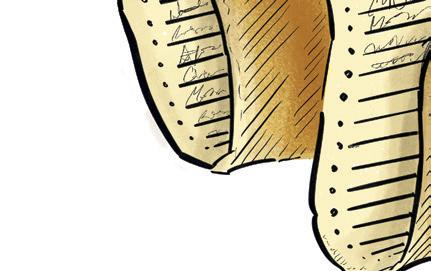
Onthis month 57 years ago, at what is now Concordia University, over 200 students occupied the ninth- oor computer lab of the Henry F. Hall Building for two weeks to protest institutional racism at the university.
is act of protest started on Jan. 29, 1969, and continued for 14 days until Feb. 11, costing the school—formerly Sir George Williams University—over $2 million in damages. Known as the Computer Riot, the demonstration brought national attention to racism in higher education and continues to in uence how the university makes amends with its past.
It all started in April 1968, when six Caribbean students accused Perry Anderson, an assistant professor of biology, of intentionally failing and giving lower grades to Black students.
Students brought the issue forward to the university’s administration, a er which the university created a hearing committee to investigate the allegations. Students did not approve of the committee representatives, leading to ongoing clashes between the administration and the student body.
On Jan. 28, 1969, student newspaper e Georgian—which later merged with Loyola News to form e Link—had handed over editorial control to student protesters, who published an issue known as e Black Georgian. e issue was centred on the ongoing racism at the university.
During the two-week-long student occupation, negotiations between the university and the students were ongoing.
On Feb. 11, it seemed that an agreement had nally been reached, but it quickly fell apart as students began to leave the Hall building to go home, believing an agreement had been reached. e university used this as an opportunity to call the police to expel the remaining protesters on the ninth oor.
e SPVM brutally arrested 97 students, and a re broke out, destroying the computer centre. Coralee Hutchison, an 18-year-old student from the Bahamas, received head trauma in icted by the police and later passed away.
For many in Montreal’s Black community, this event created a clear distrust and disconnect toward the university, reinforcing that institutional systems were not designed to protect them.
“Just the depth of what happened here should be known by all students, but definitely should be a core part of anything that the university talks about,” said Danayit Bobrowski, member of Concordia’s Pan African Student Union, Black Perspectives Office and anti-racism task force.
Bobrowski says that this was not the rst time Montreal’s Black community had been neglected.
From a history of slavery to restrictive immigration policies to labour discrimination, Black communities in Montreal have faced systemic barriers that limited their full participation in society.
According to the historical context published on Concordia’s website, in the early 20th century, migrants from the Caribbean faced policies that would only allow them temporary or low-status labour roles. Even
highly skilled newcomers were frequently underemployed due to racial bias in hiring practices.
Subsequently, the civil rights movements of the 1960s created a new generation of students who carried a heightened political awareness into Canadian universities.
“Sixty-nine was very much international at its core, and the Black liberation movement was global in its scope,” Bobrowski said. “‘Injustice anywhere is injustice everywhere’ was really a core principle of what the students were fighting for, and also very much tied to fighting where we're at [today].”
In the years following the Computer Riot, Black students created their own spaces within campus through cultural student associations and clubs. For clubs like the African Students Association, celebrating African culture and creating havens for Black students is a personal mission.
e university has made attempts to make amends with the Black community.
In October 2022, 53 years after the fact, Concordia released an official apology recognizing its own racism. In the same year, the university president’s Task Force on Anti-Black Racism released a comprehensive set of 88 recommendations under four different pillars to dismantle systemic barriers and foster a more inclusive campus.
e university has since published annual progress reports to track this work, including the creation of new resources and accountability mechanisms.
Some in the university community see much of this progress as symbolic.
Danna Ballantyne, external and mobilization coordinator at the Concordia Student Union (CSU), says the best mechanisms are consultation with marginalized students and investment into student initiatives.
“From a CSU standpoint, a lot of the work that should be done to make reparations has to do with allowing student representation in decision-making on issues that a ect the student body,” Ballantyne said.
One of the pillars the university implemented, called "Fostering Black Flourishing," was the starting point for what would later become the NouLa Black Student Centre.
Launched in Fall 2023, 'nou la,' meaning “we’re here” in Haitian Creole, o ers various services and resources aimed at fostering the collective success and well-being of Black students.
Teeanna Munro is the manager at NouLa and has been part of its installation since the very beginning in the summer of 2023. As a former Concordia student, Munro said she recognizes how much the university has evolved, while understanding that some gaps still need to be filled.
“Unless there’s a true decolonizing of the university, it can never, really, fully be welcoming,” Munro said. “[But] we’re here, we’ve been here, and we’re here again because of those from before.”
Since its implementation in 2022, every recommendation made by Concordia’s anti-racism task force has led to tangible projects with clear deadlines being set.
According to the university, part of the pillar of "Driving Institutional Change" includes public recognition through initiatives such as the installation of a commemorative plaque in the Hall building marking the 1969 Sir George Williams student protest, along with the development of expanded online historical and teaching resources about the event.
Additionally, in Fall 2025, the university added the Black and African Diaspora Studies in the Canadian Context minor, allowing students to learn more about the Black presence in Canada and its challenges. In Fall 2026, the university added a new certi cate option to respond to a di erent demographic of students.
However, Bobrowski says the a ermath is not all positive.
“I think the Computer Riot really set a precedent on the part of the administration on how to respond to student protesters,” Bobrowski said, pointing to on-campus policing, arrests during protests and the hiring of private security at the university.
“As we've seen since Oct. 7, increased militant student activism has been met with not just increased police presence, but a new aspect is increased private security presence and hyper surveillance,” Bobrowski continued.
A Concordia spokesperson previously told e Link that supplemental security sta ng was added a er reports of “aggressive behaviour, assault and vandalism” at demonstrations.
Ballantyne says the Computer Riot is a benchmark for student movements in the decades since.
“I think that the computer occupation was not the only time that such a strategy has been used by students to push demands, and historically it's been very e ective,” Ballantyne said. “We can't deny that, in a system where students have very limited power, that kind of organizing is incredibly e ective.”
With les from India Das-Brown and Matthew Daldalian.














Protestors and bystanders share concerns over police’s escalating use of tear gas in recent years
Mirren Bodanis @eyesofmirren
Andy Brunet, a Montreal-based photojournalist, recalls being tear gassed by police during a protest on Oct. 7, 2023. e experience, they said, was deeply traumatizing and made it di cult for them to continue working.
"It's di cult to open your eyes because everything burns," Brunet said. "It's like they're doing it on purpose, to try and scare you so you don't come back to cover protests.”
This wasn’t the last time police used tear gas on protestors, with documents obtained through an access to information (ATI) request revealing that the SPVM used “chemical irritants” 97 times in 2024, compared to 41 times in 2023. This rate is a 137 per cent increase.
Within this rise, many protesters characterise the SPVM’s tactics as oriented towards escalation, with dispersal via tear gas being the end goal.
Christopher Bahnan, a Concordia University student who has joined protests calling for Concordia to disclose and divest their holdings in companies involved in the genocide in Palestine over the past few years, said that, in their experience, police rarely attempt de-escalation.
“ ere's no e orts or policies towards de-escalation that they use,” Bahnan said. “And when they do, it is always accompanied by a cavalcade of cops on bikes who will storm and assault the students as they try to move away.”
Emerson Rheault, another Concordia student and activist, shared a similar sentiment.
“ ey o en use tear gas without warning or knowing that it's going to be very hard [for protesters] to run away and get to safety,” Rheault said. “It just feels like I’m trapped.”
Bahnan recounted an experience where the SPVM deployed tear gas in a con ned space with no direct escape route, during an anti-NATO protest in November 2024. Demonstrators were tear-gassed in a semi-enclosed underpass on Viger Ave. E. next to the Palais des congrès de Montréal.
At the same protest, police shot a round of tear gas through a car window, setting it on re. Although several media outlets and the SPVM itself originally claimed protesters caused the re, TVA journalist Hadi Hassin later revealed that the depleted round had set the vehicle ablaze.
Most recently, Amnistie internationale Canada Francophone announced that they’re assessing if the SPVM violated the international legal right to protest with its heavy deployment of chemical irritants at a protest against ICE-a liated security rm GardaWorld on Feb. 13.
Police protocol at demonstrations
According to Paul Chablo, a 30-year SPVM veteran and chairman of the Police Technology program at John Abbott College, the SPVM has procedures to determine the amount and type of force to bring to each event.
“[ ey’re informed by] what happened in other cities with similar protests, and what happened in other years,” Chablo said.
“Undercover o cers in ltrate these organizations and collect information.”
He argued that demonstrators have the responsibility to accept harm risks when police appear aggressive.
“By the time you get to the riot squad coming with shields and sticks and helmets are you going to stand there with your friends, and get in their way? Nobody in their right sense would,” said Chablo.
He cited examples like rowdy concerts or demonstrations against police brutality as situations where police are likely to bring extra force. e more the person resists, Chablo said, the more the police “can use force.”
Still, he claimed that there are hard limits on the way o cers will use tear gas.
“ e police will not—they never will—use any type of [chemical] agent on any children or families,” Chablo added.
Witness accounts reveal contradictions
On Aug. 9, 2025, SPVM riot police pushed protesters participating in a Rad Pride demonstration towards Émilie-Gamelin Place, where a family-oriented Latin dance event was taking place.
Jean-Philippe Forget was attending the dance event with his husband, 10-month-old and ve-year-old child when the SPVM red a tear gas canister that “landed right on my baby, like two inches from her face,” he testi ed in an interview with the CBC.
He further added that the gas covered his family, causing intense pain in his eyes and arms. His children began crying, and the family ed alongside the rest of the protesters.
Forget said that his ve-year-old is still very traumatized and “has been afraid of going into crowds and refusing to sleep alone ever since.”
With Forget’s family and numerous other attendees being exposed to the gas, an SPVM spokesperson told The Gazette that “strategic decisions were made taking into account public safety issues.”
A call for transparency from the SPVM
Rine Vieth, a PhD socio-legal researcher with Laval University, has been engaged in an ATI dispute with the SPVM in an attempt to acquire its contracts with tear gas suppliers.
A er sending an ATI request to the SPVM on April 5, 2025, Vieth was left without an answer for two months before receiving a response on June 10, 2025 stating that the SPVM’s non-answer should be "considered a refusal.” The refusal email came weeks after the 30-days response period mandated by national ATI regulations.
Following an appeal to the Commission d'accès à l'information, Vieth was eventually sent some documents in August which claimed that the SPVM “hasn’t used lachrymatory gas for several years” and that it “cannot provide any documents related to contracts, spending, and similar subjects related to chemical irritants” because it would violate regulations on withholding information that could reveal crime- ghting processes.
“Their reason was that they don’t want to turn it over to me be-
cause criminals could prepare if they knew what weapons the SPVM had,” Vieth said. “And my point there was to say, ‘Look, what if I give you a list of everything I’ve seen the SPVM publicly have?’"
Vieth added that the SPVM has held press conferences about the use of chemical irritants in the past.
"What are criminals preparing for if it’s been in the CBC?” Vieth said.
Debates on the ethics of tear gas usage
Vincent Wong is a law professor who co-authored a 2020 report on tear gas use for the University of Toronto.
e report identi ed several short and long-term health consequences associated with exposure to tear gas, including nausea, vomiting and permanent vision and breathing problems. Prolonged exposure can also lead to chemical burns in the throat and lungs, as well as respiratory failure.
Documented cases of harm resulting from people being shot directly by the canister include skull fractures, penetrating head and chest wounds and deep burns from canister heat.
Wong believes it important to push against the perception that tear gas is harmless and safe for use.
“ is perception is extremely problematic and has to do with the marketing of tear gas [by] colonial policymakers,” said Wong.
Wong quoted a 2023 international medical review by Physicians for Human Rights, which identi ed at least 100,000 people who have been injured by tear gas since 2016, and at least 14 people who have died.
In contrast, Chablo said that if people want to stay safe around riot police, “all they have to do is not to stay there.”
“Ninety-eight per cent understand this," Chablo said. "Now we get this 2 per cent that just want to be stupid, and they try, and they don't win."
Chablo said that responsible organizers should identify “agitators” to the police before the protest begins and remove them from their group, adding that protesters shouldn’t join demonstrations if they see “a bunch of troublemakers.”
Wong argued that this framework collapses the right to peaceful expression and assembly.
“[It] inherently authorizes dangerous force and that any resulting harm is foreseeable and therefore the victim’s fault,” Wong said. “ is erases scrutiny of whether the force was necessary, proportionate or even lawful in the rst place.”
Wong furthered that there is reason to believe that tear gas is never necessary at demonstrations.
“No amount of training or reform can render tear gas use by police reliably safe or justi able from an international human rights law perspective,” he said. “Tear gas and other crowd control chemical agents are inherently indiscriminate, a ecting o ending actors, peaceful protesters and vulnerable bystanders alike, and o en produce state-sanction terror in order to speci cally undermine freedom of assembly.”


Safa Hachi @safahachi
Sharmistha Kar’s textile practice brings handwork and machine processes into the same frame, with each stage demanding time, attention and labour.
Kar is an artist and PhD candidate in art education at Concordia University whose work centres on indigo and its colonial histories. Rather than approaching indigo as a neutral or decorative dye, her practice examines how extractive labour systems have shaped the material and how it can be worked with di erently today.
“ ere are huge di erences in gesture, in my hand, in space, in land,” Kar said, describing how di erent every project can feel. “Even growing the plant needs so much e ort and attention.” at awareness of e ort does not come from a single site of making, but from moving between di erent conditions, such as tending indigo herself, working in lab environments, and researching indigo’s violent history under colonial rule in India. For Kar, moving between these spaces brings the realities of labour into focus.
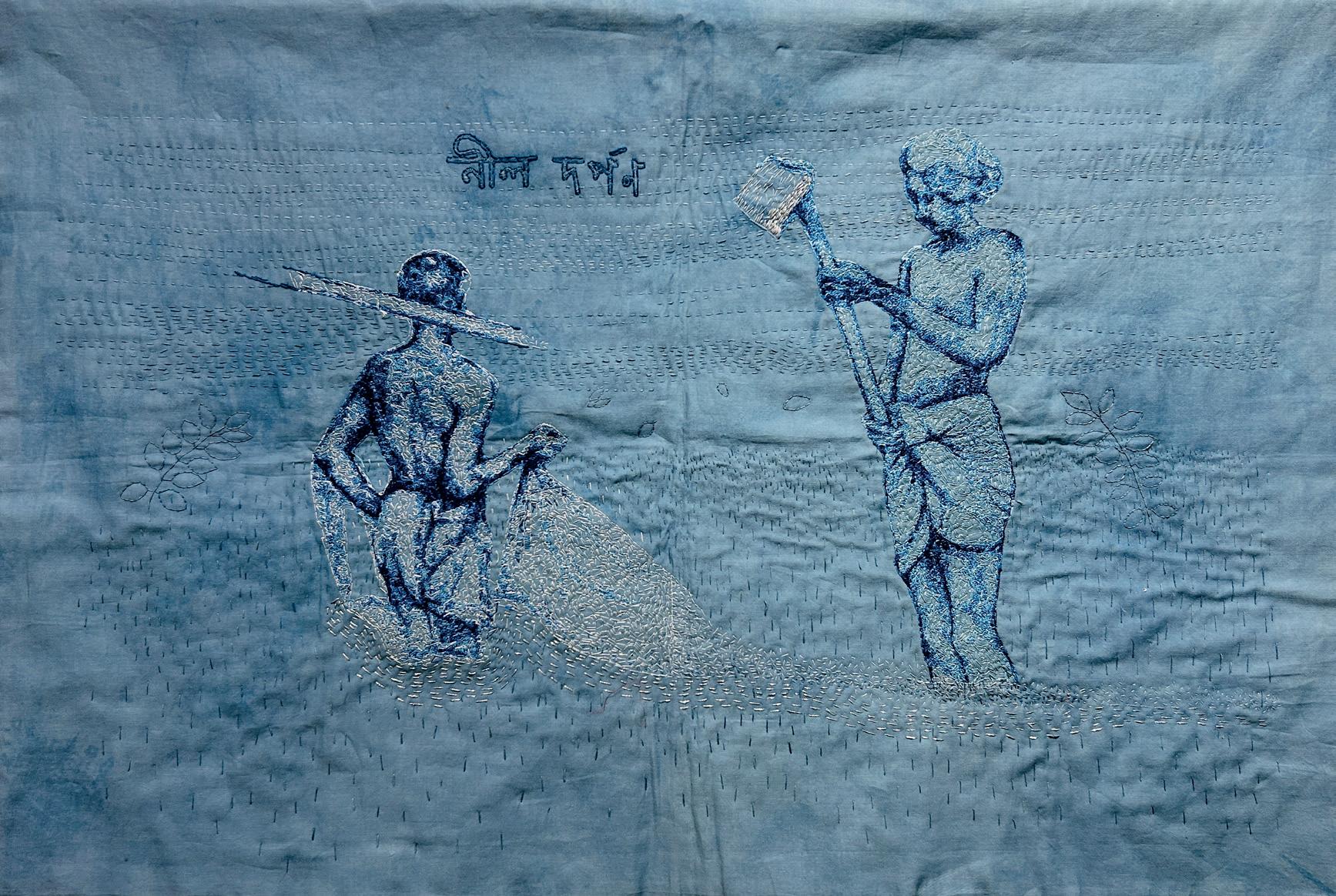
“ ey forced farmers to cultivate,” she said. Indigo production under British colonial rule relied on coercion and violence, culminating in the Indigo Revolt of 1859. Kar does not narrate that history in full; instead, it surfaces in her art.
“I wanted those emotions to be shown in a larger size,” Kar said. “ e grief, the control, the power.”
Kar draws many of these gures from archival photographs, which she redraws by hand before translating them into embroidery. Pencil marks give way to stitched lines, digital les to fabric surfaces.
Hands, eyes and tents recur throughout Kar’s work, each signalling a di erent relationship to indigo.
e eye, she explained, re ects the gaze, the tendency to admire indigo for its colour while remaining detached from the conditions that produced it. Tent imagery gestures toward labour and displacement, referencing temporary housing for workers and the instability tied to extractive economies.
Hands in Kar’s work point to care, repetition and physical e ort. ey re ect the time spent tending plants, drawing from archival photographs, stitching and embroidering. Even as her practice moves between handwork and digital processes, Kar resists the idea that labour disappears when machines are involved.
Gesturing toward the cursor on her screen, Kar drew the connection between digital and physical labour.
“ at is also [a] hand,” she said. “Even our cursor has a hand, and it’s also a human hour that I’m giving.”
at attentiveness to labour carries into how Kar works alongside others.
She has worked alongside artist Anindita Chakraborty, whose own practice intersects with textiles, memory and material research. Chakraborty describes their collaborations as unfolding slowly, guided by shared attention rather than efficiency or outcome.
“For us, collaboration is slow and attentive,” Chakraborty said. “It creates space to learn from one another and to stay engaged with the creative process.”
Textiles, Chakraborty added, o er room for conversation and experimentation, recalling moments where understanding emerges through repetition and proximity.
“When we work together, conversations naturally unfold,” Chakraborty said. “Or sometimes it’s the silent gestures that guide us.” at slowness mirrors the values Kar returns to in her own practice: labour that accumulates, care that cannot be rushed and attention that resists extraction.
Kar’s research has also taken her beyond India, allowing her to learn from other indigo-growing contexts, including Japanese indigo practices and farms in Kamouraska, Quebec. Each environment demands di erent forms of care. Japanese indigo can tolerate colder climates, while Indian indigo depends heavily on heat, sun and water.
“You have to be with the plant,” Kar said. “You have to give it water, look a er it.”
at sustained tending requires time, patience and physical endurance. ese demands sit in direct tension with indigo’s colonial past, when labourers were forced to produce the dye at scale under dangerous conditions.
Working with indigo in laboratory settings further complicated that relationship. Before dyeing, Kar was required to complete extensive safety training.
“I had to go through so many safety trainings before I made my rst dye,” she said. at level of protection stood in stark contrast to the historical conditions of indigo labour. Kar spoke about the emotional weight of handling the material while thinking about those who came before her.
“ ere was a huge emotional contrast for me,” she said. “When you read indigo’s history, there is written evidence that the people who handled and processed it were a ected physically. e smell reacted with the respiratory system, and it even a ected reproduction.”
Questions of visibility and accountability also emerged through Kar’s broader engagement with cra materials. She recalled a col-


had
league who had been gi ed an indigo dye kit but hesitated to use it because it contained no information about its origins.
“ ere was no information about who cultivated it, who processed it, or how those colours came into the box,” Kar said. at absence pushed Kar to think more deeply about cra ecology in her studies, the systems of labour, land and movement that make materials possible but o en remain unseen.
Others who have worked closely with Kar describe her practice as one grounded in sustained, hands-on engagement with material.
Geneviève Moisan, a fellow PhD student in Kar’s cohort, began working with Kar through shared supervision and later supported the material and technical aspects of her indigo research.
Moisan assisted Kar in working through di erent indigo dye kits, testing timings and maintaining the vats.
“We had a lot of fun testing di erent timings for the dyes and taking care of the vats together,” Moisan said. “My role was to support the work and her exploration of such a magical dye.”
For Moisan, working directly with indigo was central to understanding the research itself.
“I think it is important in a research-creation setting to work with the actual material components of one’s research,” Moisan said, “to better understand the di culties, struggles, but also the marvelling at such beautiful processes and why they have kept humans reaching for blues for centuries all over the world.”
Kar’s own experiences of these processes, such as movement and migration, inform her thinking about labour and place. Growing up, she moved frequently with her parents, watching how work structured everyday life.
“Coming from India and living on a di erent land makes me more conscious and sensitive to my physical presence,” Kar said. Kar’s PhD work brings these threads together through postcolonial theory, cra and art education. For her, education does not sit apart from making but emerges through sustained engagement with materials and their histories.
“Our approach now is just as important,” Kar said.
Despite the weight of indigo’s history, Kar’s practice remains rooted in the present tense of making. rough repeated gestures, sustained attention and time spent with the material, her work creates space to sit with that history without removing its weight.
She described this approach through 'Rafu,' a Farsi term meaning to mend.
“Talking about it is part of healing,” Kar said. “Working with indigo, for me, is a sense of repair.”
With les from Hannah Vogan.



At NouLa, student-led events and shared
In the relaxed, sometimes quiet, sometimes energetic space at NouLa Black Student Centre, Black students gather to make connections, cultivate community and create new relationships. ese events and the atmosphere they create are made possible by the work of student employees, who have their own meaningful experiences working and spending time at NouLa. e centre, located in H-773, opened in 2023 in the years a er George Floyd’s murder in 2020. From the beginning, its mission was rooted in creating a sense of safety and support for Black students navigating both campus life and structural barriers.
Yohanie Roseney, who has worked at the centre since its inception, describes NouLa as a space that exists beyond academic assistance.
“[We want to] create a space where students who [are] Black not only receive the help that they need to overcome structural barriers, but at the same time feel safe enough that they get the help that they need in general,” Roseney said. at intention is reinforced in the way students are welcomed into the space. Roseney emphasizes that NouLa is framed not as a service, but as something shared collectively.
“A space where [Black students] can simply be themselves without feeling like they’re taking up too much space,” she said. NouLa is a space that belongs to everyone who walks in, where students can feel comfortable and be in community and in connection.
It's a place that gives Black Concordia students the ability “to have a voice in how the space is being conducted,” according to Roseney.
At NouLa, you can nd students studying alone or together, talking to each other, eating, relaxing and spending time with their peers. e warm, welcoming atmosphere is shaped not only by the light- lled room and shelves of books students can borrow, but by the care and intention of the student employees who continuously work to make the space feel safe and nurturing.
Each semester, student employees plan events with an emphasis on quality over quantity. eir goal is not simply attendance, but depth of connection.
On Feb. 12, Mariama Kane, who has been working at NouLa since August 2025, hosted the rst-ever Find Your Match, an event centred on Black love and community in

Sydney Nethersole
all its forms. e event created a space for students to bond through conversation and a variety of games.
Kane explains that the purpose of the event was to allow students to enter without pressure and de ne their own connection.
“You come and nd whatever you wish to nd,” Kane said. e atmosphere was intentionally low-stakes, designed to bring people together and allow relationships to build naturally.
Mike Wabo, who has been working at NouLa since September 2025, describes the intention behind the evening as one grounded in ease rather than expectation.
“Putting people together to meet and letting whatever happens happen. No pressure,” Wabo said.
The evening drew roughly 25 students into a relaxed environment where new conversations and introductions unfolded naturally.
A week later, on Feb. 19, NouLa hosted Hot Takes, Part 2: What’s Love?
The format was simple: a variety of questions were posed, and students walked to either side of the room depending on whether they agreed or disagreed, and discussed and explained their opinions.
Roseney planned and ran the rst Hot Takes event in Oct. 2025, which focused more on controversial questions. But the resulting conversations and discussions continuously went back to dating. She had also noticed that students spending time at NouLa were frequently discussing love and relationships.
Roseney saw the Hot Takes event as a way to interrupt familiar patterns of agreement and create dialogue across di erences within the Black student community.
“Get out of our echo chambers and speak with other people from the Black community,” she said.
For Roseney, the event reinforces NouLa’s larger mission of community and belonging. Students are reminded that they can walk in, take up room and express themselves without hesitation.
“Come in here. You’re welcome here. is is also a place to express yourself,” Roseney said.
e conversations during the Hot Takes event spanned a variety of forms of Black love, including romantic, familial and platonic love, creating an environment where students could come and have intense, di cult discussions on these subjects.
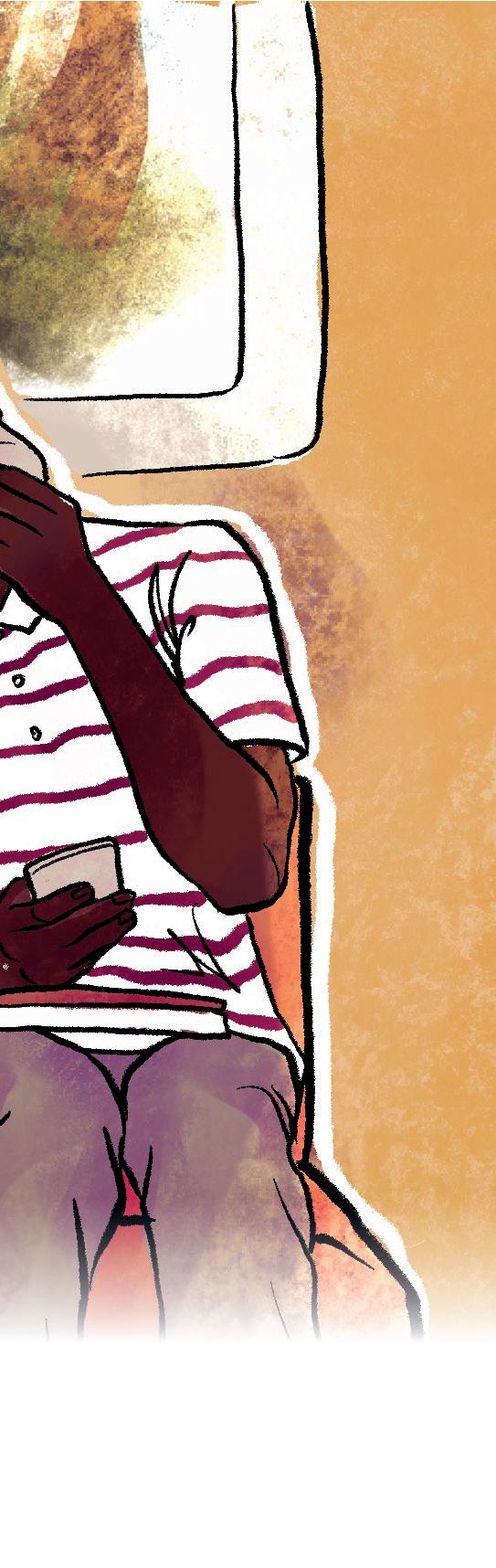
Roseney is intentional about how the space is structured. Questions are not shared beforehand, and the goal is conversation rather than argument or debate. The intention is not to win, but to unpack. At Hot Takes, questions range in intensity, moving from light prompts to more complex discussions.
Roseney moderates carefully, ensuring the room remains respectful while still allowing disagreement. At a time when conversations about dating and identity o en become polarized online, the event o ers space for nuance and face-to-face dialogue. ese events o en lead to conversations that are personal, sensitive and layered. ey allow Black students to articulate their experiences on campus in their own words—not only to discuss identity but also to celebrate it through shared understanding.
For Wabo, joining NouLa followed a deeper re ection on his own experience at Concordia.
“[I] became more aware of what it meant to be a Black student on campus,” he said, describing what led him to the centre. rough the careful planning of events like Find Your Match and Hot Takes, Roseney and Kane demonstrate how intentional student labour builds community.
University programming does not o en create room for discussions of both romance and friendship as equally signi cant forms of belonging. At NouLa, those conversations are treated as essential to identity and shared experience.
Wabo describes the centre as grounded in collective understanding.
“NouLa is about Black identity, common understanding, and love is a part of life,” Wabo said. “Being able to nd somebody who looks like you, and who understands the challenge that you go through every day, I think is important."
In an increasingly digital world, where connection is often filtered through online interactions and dating apps, NouLa’s events insist on physical presence. Students gather in the same room, speak directly to one another and build relationships without mediation.
Kane describes the centre simply.
“NouLa itself is just a place of love,” she said.
Within that love, whether romantic, platonic or communal, Black students are centred, supported and seen.

Staple neighbourhood bars remain the cornerstone of the city’s open mic culture


of strangers willing to listen.
Stage experience is what really makes an artist. A handful of staple Montreal bars have been the cornerstone of the city’s open mic culture today.

For decades, Bar Courcelle has been a gathering place for local aspiring musicians right in the heart of Saint-Henri. Despite neighbourhood changes and pandemic lockdowns, the bar continues to host open mic nights every Sunday.
Adrian (Curly) Micholuk, owner of Bar Courcelle, has witnessed the area’s transformation rsthand.
“It used to be that musicians could a ord to live here because it was a lot cheaper,” Micholuk said. “But in the past ve years, rent prices have skyrocketed. We used to be open late until 4 a.m., but now we end it at midnight so folks can catch the last metro.”
e gentri cation of the Saint-Henri neighbourhood has led to the bar’s current crowds coming from all over the city. e mix of neighbourhood regulars, newcomers and curious rst-timers is what gives these nights their unpredictable energy.
Frisco Lee, the eccentric on-and-o host of Courcelle’s open mic since 2014, has seen countless connections spark in the room.
“I’ve seen so many bands formed here over the years,” Lee said. “There’s musicians who meet each other and keep coming back, kids who wait until they’re 18 to come––since the pints are also cheap––and of course, the broke artists who’ve been here since forever.”

As Frisco re ected on special moments from past open mics, the answer arrived on cue. A man dressed in a full Gandalf costume walked through the door.
“ is! It’s happening right now!” Frisco said.
It’s these kinds of unplanned, unpolished moments that ll these bars with warmth and charm in the middle of winter.
Trasler recalls her rst experience stepping on a stage, which co-
incidentally was at Courcelle a few years back.
“I realized there isn’t much of a point to just performing and then leaving without listening to the other acts,” she said. “I thought I’d rst do it to just get exposure, but it’s not really worth it to just
do it for that.”
For many, the sustainability of Montreal’s artistic culture depends on mutual investment, where artists stay, listen and support
one another.
Having just moved to Montreal from Calgary to pursue music, it was folk singer-songwriter Annie Wilde's rst time



attending Courcelle.
“Montreal is kind of the music capital of Canada," Wilde said. "I think it’s de nitely important for spots like Courcelle

e performances that evening varied from stripped-back solo acts to a 10-minute harmonica set complete with audience participation. Performers demonstrated the range and openness of the space; regardless of genre or skill level, the room never lost
its warmth.
Across the city on the busy stretch of St. Denis St. in the Plateau-Mont-Royal sits Turbo Haüs, a landmark for Montreal’s live music community. Almost every young local musician has a story
or memory there, even touring artists.
For the past four years, Turbo Haüs has hosted its weekly Tuesday night open mics. Filling up the bar doesn’t seem to be an issue
for them, even on frigid February evenings.

For some performers, it’s about debuting a new song to an audience for the rst time, but for most, the open mics serve as a community of support.
Edward Laberge, a regular attendee and Saint-Henri resident, described the scene as deeply rooted in its surroundings.
“It’s a community within a community,” Laberge said. “His-

torically, it’s been more of a closed community here, or Verdun and Pointe-Saint-Charles, so I like to support the industries
and businesses that are around this area.”

Laberge works around the same block as the bar, so he stops by a er work on almost every Sunday night. at night, local singer-songwriter Madison Trasler had delivered a beautiful acoustic set on piano with a few original songs as well.


mics and pop in to play a couple of songs.
was really fun, kind of nerve-wracking, but de nitely fun. I think we’d absolutely do that again.”

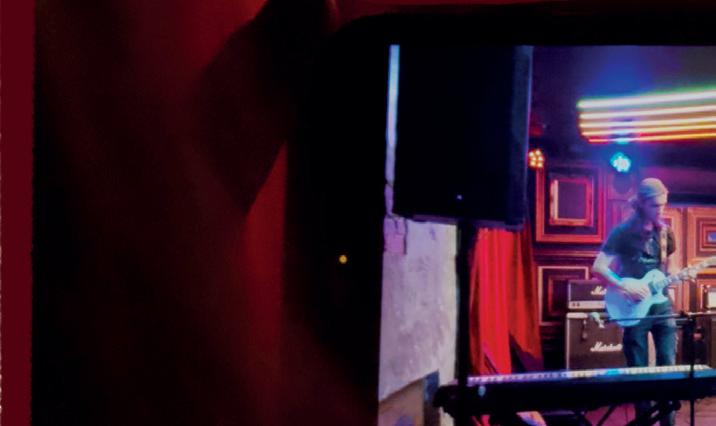
Sergio Da Silva, owner of Turbo Haüs, recalls how touring bands who stay at the hotel next door will hear about their open
“It’s these bands who should be playing in 500-600 people rooms who are coming to the open mic to have a few jams,” Da Silva said.
get conversations that lead them to unexpected connections. spontaneity

He has also seen folks who come in just for a pint get caught in
“It’s really the spontaneity of it that is the most fun,” he added.




Both Lee from Bar Courcelle and Mike Hand, host of Turbo Haüs, expressed a similar sentiment about their roles in sustaining these spaces.
“I can’t believe I get to do this. I feel so lucky to call this a job,” Lee said.
In rooms like these, there is a space for everyone, regardless of skill level, genre or reason for stepping on stage. Night a er night, this is how Montreal’s music culture is kept alive, one nervous performer at a time.



“Montreal has a lot of places for starting musicians," Lee said, "but as long as they hear about the place and come once, they’re sold."













Inside




Marla Lugert

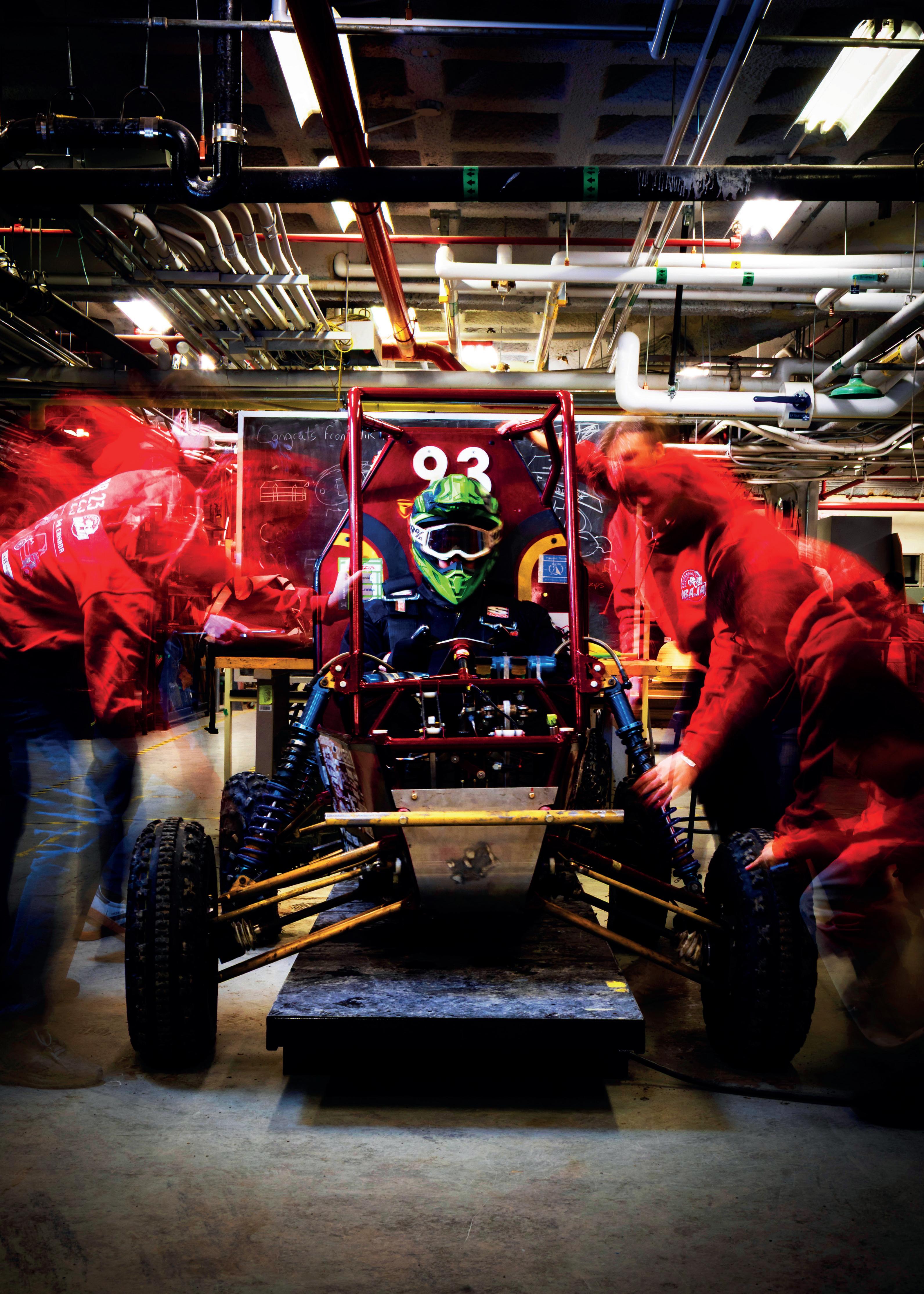
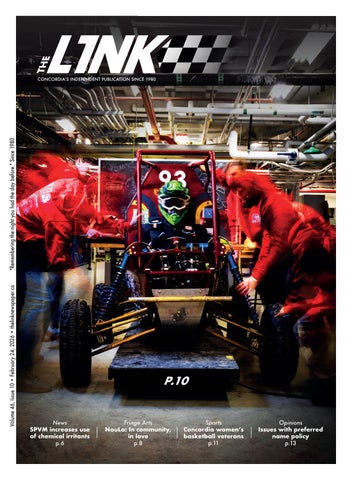
“ e Cage,” found in Concordia University’s Henry F. Hall building, a group of determined student engineers race against more than just time.
ese young innovators are preparing for international engineering competitions, where the di erence between rst and last place can come down to a singular bolt.
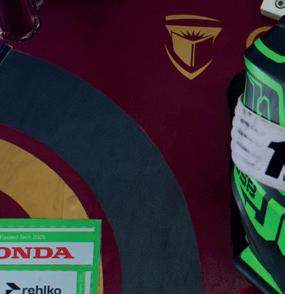
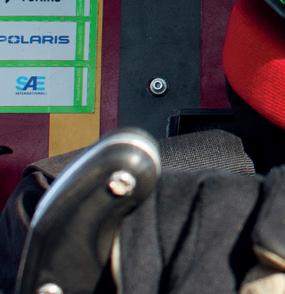
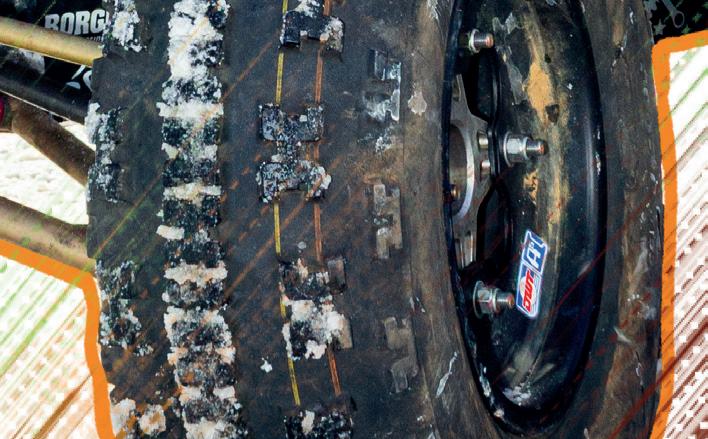
Students part of Concordia’s Society of Automotive Engineers (SAE) design and build vehicles to compete against hundreds of universities worldwide. e team competes in a variety of disciplines, like the Formula Electric competition and Baja o -road racing, and encourages students to work like an engineering rm rather than a school club.
e club is open to anyone and they’re always looking for students who have an interest in building cars. Sergio Baroud, a student engineer involved with the SAE, explained how simple it was to become a member of the team.
“My rst year, I was at Frosh and I saw the model of the car at a fair, I just started asking questions and I was interested. I went to the info section and got in,” he said.
Concordia’s team is part of the global network under SAE International, which is in charge of the Collegiate Design Series, an assortment of competitions that challenge students to design, build and test sophisticated machinery.
ese competitions di er greatly from traditional academic projects. Teams must manage their budgets, meet timely deadlines and defend technical decisions before expert judges. is student-run team is managed entirely by a group of skilled individuals who work collaboratively under many pillars. From mechanical to so ware engineers, there is a department for everyone.
e Concordia team has existed for more than 40 years, improving its vehicles year a er year. is continuity has allowed students to learn and evolve from past generations, taking lessons from the wins and losses of previous years to adapt their approaches to each competition.
Nehna Patel, the Concordia SAE VP external and the Baja racing team's business lead, noted that their preparations continue even a er the event ends.
“When we come back, we actually disassemble the car to make sure everything is OK or to analyze what went wrong,” Patel said. “ ere’s a lot of making sure things are going correctly and changing things so they don’t happen again.”
rough the years, this institutional knowledge has turned into one of Concordia’s team’s most valuable competitive advantages.
Under the Collegiate Design Series, the competition requirements stretch far beyond simply racing. All teams must submit detailed reports containing their designs and their complete cost analysis. ey must also pass technical inspections before they're given the green light to hit the track.
ese events test speed, endurance, e ciency and durability. Teams must ensure that their vehicles can withstand any challenges thrown at them, as a design that cannot be technically justi ed for their strong performance may lose points.
Preparations are completed months before the competition season to ensure that the vehicle will reach peak performance. During the design portion of the preparation, teams gather to work on design concepts, create models and perform various simulations. Every decision made must balance the weight, the cost and the manufacturability.
Once the designs have been completed, it is time to start manufacturing.
Students start assembling the systems and machine parts and running tests. It is common, expected even, to run into mechanical failures, with participants needing to run diagnostics to gure out what went wrong and how to improve the design before running the next test.
Students commit a lot of their time to the SAE. ey o en nd themselves juggling their coursework with nding enough time to spend at the workshop. As a result, leadership groups are created to help keep the work on track.
Beyond formal coordination, the team relies on practical systems, including maintaining a clean and orderly workshop.
“One of the main things we try to do is keep our space as clean as possible, because during assembly things get messy and we have a habit of dive-bombing to get the car made,” said Sam Hashemi Asl, Concordia’s Baja racing team captain.
On a technical level, members achieve skills that are only attainable through direct experience rather than by sitting through a lecture.
Baroud discussed the importance of using learned concepts in real-world situations.
“Studying alone does not give you that experience that you need to get into the work eld,” Baroud said. “ is helps to get really hands-on and be able to integrate yourself into the eld.” rough their work, students learn the principles of mechanical design, programming, electrical integration and aerodynamics, among others.


When it comes to transferable skills, students learn to manage budgets, integrate logistics and present technical adjustments, all while managing the pressure of competition. ese experiences help put students in real-world engineering scenarios, where projects may experience unplanned issues.
Patel remarked how the group’s attention to detail goes a long way in the success of the team.






“We’re actively marking things down and making sure that parts we take o the car are put in their own place so later we can either use them or change them to make them better,” she said.
Asl agreed, emphasizing the importance of organization.
“You learn quickly that if you don’t stay organized, you lose time, and in competition, time is everything,” Asl said.
Despite all the planning, unexpected setbacks still occur. Funding grows tight, mechanical parts fail and time always runs out quicker than expected.
However, the members make it a point to treat every issue, including mechanical failures, as a learning opportunity rather than a loss. rough recording every detail and step in the conception and building of the vehicle, students can nd the root of the problem and x it as quickly as possible.
For Concordia’s team, the greatest focus is data collection.
“Historically, a lot of our data has been qualitative, like a driver saying the car feels bumpy over a jump,” Patel explained. “Now we’re trying to bring back our data acquisition systems so we can get quantitative numbers on how the car performs.”
As competition season is currently in full swing, all members of Concordia’s SAE continue to test and rede ne their designs, in hopes of entering their best project yet.
At the last annual Épreuve du Nord winter competition hosted by the Université de Laval, the team managed to place h overall across six di erent dynamic events. ese included placing fourth in the two-hour endurance race, as well as second in the design presentation, displaying how their electrical systems survive winter conditions.

For students like Asl and Patel, all results push them to bolster their end objective.
“We’re always looking to better our car, no matter what,” Patel said.




At the end of the day, the SAE isn’t just building vehicles; they’re building engineers.



Four former Stingers will get the chance to display their skills this spring
Rayan Rekmani @raykmani
Playing football professionally is a dream for many. is spring, four players from the Concordia University Stingers football program have the opportunity to make that dream a reality. e next step on the path to the dra is the Canadian Football League (CFL) Combine. Long snapper Christopher Liberta, defensive back Jean-Sébastien Lamothe and o ensive lineman Damien Irep will compete at the Invitational and Provincial stages in pursuit of joining linebacker Loïk Gagné in
“I’ve been training for the past six years, dreaming about reaching this level. To actually be invited—it’s a blessing.”
Known for his versatility, Gagné has lined up at almost every defensive position and is a key player across multiple packages, even making an impact on special teams.
“You can describe me as a guy who can play multiple positions on defence," Gagné said. "Just someone who’s polyvalent and loves to have a chance to impact the game."
and communicator,” he said. “I learned how to hold myself and others accountable.”
On the o ensive side of the ball, lineman Irep brings a combination of raw athleticism and strategy. In the trenches, Irep’s game is built on physicality and power, traits he believes will translate well to the professional level.

Together, they represent a graduating class that has helped elevate Concordia’s presence on the national stage.





For Gagné, the invitation validates years of work.



“It means everything,” he said.





Bryanna O'Brien
Serena
“I’m excited to show how well I can move for my size,” Irep said. “I’m strong, I can move, I can nish blocks, I can pull. I believe that’s what will help me stand out.”



As an athletic therapy major at Concordia, Gagné approaches preparation with precision.



For Irep, the invitation represents both validation and ambition. His initial reaction was a mix of relief and excitement.
“It’s about being surgical with it,” he said. “It’s not just training hard. It’s recovering properly, studying film, taking care of your body.”







Gagné’s talents perfectly complement Lamothe’s adaptability and leadership on defence. Together, the dynamic duo represents Concordia’s defence in this coming dra .

“My rst thought was, ‘Damn, I did it.’ I wasn’t sure if I’d get the chance,” Irep said. “Seeing the invitation, I thought, ‘Alright, now I get to show my skills’.”


Lamothe’s experience everywhere on the eld allows him to impact the game wherever he plays. For him, the opportunity carries deep personal meaning.




Liberta’s journey to the Combine is perhaps the most unconventional. A walk-on long snapper coming from a Division III program, he earned his place through persistence in one of football’s most specialized and underrated roles.
“It’s just another chance to prove myself,” Liberta said.

“I’ve been playing football for a long time, and growing up, I never thought I’d have the opportunity to do this,” Lamothe said. “I’m very grateful to continue my career. To experience it with my teammates makes it even better. It’s a blessing.”




When Lamothe received the news, his thoughts immediately turned to the people who supported him along the way.
At a position where consistency is expected and mistakes are magni ed, the mental challenge is constant. Liberta emphasized his ability to stay calm and handle adversity as the decider between himself and other prospects.





“I was super happy, super grateful,” he said. “I thought about my family, my teammates, my girlfriend, my coaches, everyone who’s been with me throughout the journey. I think my younger self would be very proud."
When asked how he would describe himself to scouts, his answer re ected both personality and work ethic.





Lamothe credits his time at Concordia with shaping him beyond football.

“It helped me deal with adversity and become a better leader
“I’m old-school: rough hands, hard-working Italian,” Liberta said. “I’m going to outwork people.”
As draft season approaches, these four Stingers’ presence at the CFL combines signals more than individual success: it shows a football program capable of producing professional prospects, proving that Concordia football belongs in the national conversation.
As Concordia's veteran trio prepares to graduate, the team must replace more than just production
Tchida, Victoria Lawrence and Angela Batrla account for 53 per cent of the Concordia University women's basketball team's production. But their unseen work ethic and o -court leadership have had just as much of an impact on the team.
e departure of the three seniors at the end of the season will leave a signi cant void in a young squad still nding its footing.
" ey're de nitely very vocal o the court to keep us accountable," rookie Saydie Roy said. "Because at the end of the day, we want to win."
at will to win drives the team's work day in and day out.
"It's just to keep people accountable, to make sure that you're getting your shots up, that you're having your protein shakes, that you're doing the extra workouts," Roy said. "Especially Vic (Lawrence) and Serena (Tchida), because it is their last year. ey have nothing to lose. is is their last chance."
Tchida, the Réseau du sport étudiant du Québec (RSEQ) conference leader in points and rebounds per game, describes the trio's dynamic as a family, each playing a distinct role.
"I'm more like the calm leader. I'm like the mom of the whole family," Tchida said. "Victoria (Lawrence) is like the energy, the re of the team. And I think Angie (Batrla) is like a mix of both, but in a di erent way. She shows up when we need her to show up."
Tchida’s path to leadership was not straightforward. In her rst year, ve veterans graduated, propelling her into captaincy the following year. Injuries also forced her to lead from the sideline, including a brutal torn Achilles tendon in 2022-23.
"I went from being a rookie to being a captain. It was like a shock. I didn't ask for it, but I guess it found me," Tchida said. "During my injury, I learned the most about who I am and how to be a better leader."
ose leadership skills make Tchida an important in uence for young players like Roy, who are making the transition to university.
" ey're all very approachable,” Roy said. “If anything is happening in your personal life, basketball-wise or not, they are people I can go to and open up to very easily."
As for Lawrence—last year's RSEQ defensive player of the year and the conference’s current steals leader—she sets the tone with her defence, channelling her energy into every possession. It is not only her skill that stands out, but the example she sets in leading this team.
"I'm in the war, battling with my team," Lawrence said. "When they feed o me, it's like, ‘OK, you guys are turning up for me.’ It just feels good."
at leadership extends to pushing her teammates to match her intensity in practice, so it is then emulated in games.
“If I'm playing the way I'm playing and I see they're not matching my intensity, I'll de nitely get at them like, ‘Yo, let's go,’” she said. "My defence is de nitely an example of what good defence should be like."
Roy says watching Lawrence compete every day has changed how she approaches the game.
"It's just the way that they ght on the court. I nd it's really inspiring," Roy said. "When I get further in my basketball career, I hope that I can be as tough and aggressive as they are on the court."
O the court, however, the veterans’ ability to show up day in and day out for their teammates and hold a standard for themselves and others makes them integral to this squad.
In thinking about the veterans' role in her own journey, Roy hopes to honour what they have built.
"I just hope that I can do what the vets did for me and make
it as easy as possible for the next rookies, and just be a leaning shoulder if needed," she said.
As for their own legacies, Lawrence wants to leave behind an attitude.

"I hope I'm leaving them with just that dog in them: throwing your body out there, knowing the play is never dead and that defence de nitely wins games,” Lawrence said.
Tchida is thinking beyond Concordia. With professional aspirations, she hopes her success puts Quebec basketball on the map.


"I hope my legacy will be to show that there's talent in RSEQ, there's talent in Montreal, Quebec,” Tchida said. “I just hope that I'll continue to show the world, when I go pro, that there's talent here. Even with the lack of resources, we're still able to go far."






Samuel Kayll @sdubk24
The motto “team rst” lies at the heart of the Concordia University women’s hockey team. It’s the mentality that’s won them four Réseau du sport étudiant du Québec (RSEQ) championships and two national championships since head coach Julie Chu took over in 2015.
But Chu knows that she can’t control that mentality. e players need to buy in, setting the collective example and blueprint for success.
“We've had some really, really great alumni,” Chu said a er the Stingers’ 4-3 win over the Université de Montréal Carabins on Feb. 19. “ ere's a bunch of them in the stands today that have given back and really helped to shape who we are."
This season, the team’s seniors have come up clutch in a big way.
Forward and captain Jessymaude Drapeau sits tied for the national lead in points with 38. Meanwhile, forward Zoé ibault and forward-turned-defender Emilie Lavoie rank fourth in the RSEQ with 21 points each. Forwards Ekaterina Pelowich and Alexis Bedier have also contributed clutch points in their rst and second years with the team, respectively.
But at the centre of the team sits goaltender Jordyn Verbeek, the conference leader in wins and the backbone of the Stingers’ defence. A four-time Stingers Team First award winner, she embodies Concordia’s mentality to a T. And perfectly in character, Verbeek is quick to defer credit to her teammates for her success.
“ ey're super con dent, great players in front of me, and I trust that they're going to do what they need to do,” Verbeek said. “I just want to come up and do what I need to do for them and make the proper saves and make it easy for them.”
Drapeau expressed that it’s up to the team’s veterans to guide a younger roster through another playo run.
“It's an honour. I know I'm a leader,” Drapeau said. “I've built my leadership in the past few years, and we've been through so many obstacles, but also wins. So I know our leadership group, not only me, can help the young players in the next bit.”
Pelowich represents a unique position for the Stingers. A longtime star for St. omas University, she joined Concordia for her graduate season in the hopes of competing for a national championship. With the top seed in the RSEQ clinched, she has
a chance to do just that.
But Pelowich has added another crucial element: her energy and camaraderie. Her on-ice contributions and locker room presence have made her an immediate t within Concordia’s identity.
“From Day 1, she stepped out and has been incredible for us, has bought into our culture, has been able to be coachable, but then also has just been a really fun person to have around our team,” Chu said.
As the team begins its playo charge, Drapeau understands what the seniors’ experience represents. With a gauntlet ahead, she shoulders the load with her experience and versatility.
"We know how to handle that,” Drapeau said. “We've been through playo s. We've been through adversity. And we're just going to try to bring our leadership in the next few weeks and help the younger players play with con dence.”
While Chu is sad to see her stars move on, she’s thankful for everything they’ve contributed.
“ ey're really, really special, and we're really blessed to have had them in our program,” Chu said. “ ey're going to be sorely missed for sure.”
professional coaching leash is shorter than ever right now
Aylee Ahmadzadeh @ayleeazadeh
Seven months a er leading the Montreal Canadiens to the Stanley Cup Finals, Dominique Ducharme found himself out of a job. e message was loud and clear: the professional coaching leash is shrinking by the day.
When the Canadiens snuck into the Stanley Cup playo s during the 2020-21 NHL season, fans were nervous and eager to see how it would end.
A er a miraculous run to the Stanley Cup Finals, it seemed like Ducharme had at least bought himself some time. Yet a er a disappointing start to the following season, Ducharme was red and ultimately replaced with current head coach Martin St. Louis. e abrupt shi from an appearance in the nals to the dismissal of Ducharme proves how not even success can protect a career in pro sports.
Too o en, coaches aren’t a orded the opportunity to adjust or grow with a team, and the results show how costly that can be. is is a cycle familiar to every professional sports league. Continuity? Long-term planning? Forget it.
Not every NHL team operates the same way. A er winning a Stanley Cup with the Detroit Red Wings in 2008, Mike Babcock had established himself as one of the league’s top coaches. Fast forward to 2015, Babcock was hired by the Toronto Maple Leafs, believing he could lead them to a championship.
Toronto then struggled to convert regular-season success into anything past the rst round of the playo s, yet Babcock remained in place for several seasons. Despite mounting frustration from fans and reporters, the Maple Leafs stuck with him, hoping he would turn the team around.
Babcock was then red in 2019. His tenure demonstrates what can happen when a team decides to invest con dence in a coach, even under scrutiny.
A similar yet di erent story can be found overseas.
When Mikel Arteta took over at Arsenal F.C. in 2019, his early results were inconsistent, and viewers grew restless at the lack of
immediate improvement. e club chose to give him latitude to implement his system, and over the following seasons, Arteta built a young, competitive squad with a clear framework.
While approaches in hockey and soccer vary, Arsenal’s approach shows how giving room to operate can allow a coach’s vision to take hold.
Over the past seven NHL seasons, teams have red their head coach midseason 34 times. Over that same span, the Premier League has seen roughly 50 mid-season sackings, highlighting a grim similarity across the two sports.
Clearly, the Premier League isn’t known for restraint. Managers are hired with big expectations and red just as quickly. But Arsenal followed a new script, gave Arteta time to execute his vision, and now they’re contenders for a Premier League title.




e trend of ring coaches so quickly can do more harm than good. Franchises may want to see instant results, but constantly changing coaches can ruin the ow of a team and impact the chemistry that was built in their system. Arteta’s tenure highlights the beauty of giving a coach time to perfect their approach and how much it can help lead a team to the right direction.
e quick rings can also hurt the sports themselves. Constant change, no stability, and lack of trust in the leadership will hurt the progress of any team. In some instances a coach is not the right t, but a rash reaction a er a few games is unnecessary and immature. is process prioritizes short-term satisfaction over long-term success, sacri cing team growth and leaving no
opportunity for real progress.

e careers of both Ducharme and Babcock show the fragility of coaching jobs in the NHL. Some teams act quickly a er a few losses, while others allow coaches to adapt and grow.










Ducharme’s rapid dismissal and Babcock’s longer tenure illustrate two extremes: some franchises react instantly, while others ride out rough patches in hopes of long-term growth. Both approaches shape not only the coach’s career but also the team's identity.


As of the 2025-26 season, the Canadiens seem to have found a gem, enjoying plenty of success under Martin St. Louis. On the ip side, the Maple Leafs are still scrambling for a wildcard spot in the cutthroat Eastern Conference.



So coaches: work hard, win big and hope for patience—because apparently, patience is optional.


Cleo Clamen
Concordia University’s preferred name policy allows students to use a preferred name in place of their legal first name for “personal reasons.”
It applies to “all unofficial university documents and tools,” including student ID cards, class lists, Moodle, student records and exam rosters. The policy does not extend to transcripts, attestations of student status or diplomas, though students have previously reported inconsistencies in how this distinction is applied.
There are various reasons a student might wish to omit their legal first name.
deadname’s initial from my netname would require losing access to my Concordia account for up to 10 days—an unrealistic and disruptive option during the semester.
The most serious failure of the policy, however, lies within Concordia’s Health Services Clinic. According to conversations I’ve had with health service staff, unlike most academic platforms, the clinic defaults to a student’s legal name as the primary identifier, relegating the preferred name to a note buried within their file.
The result of this decision is that any interaction with the clinic could lead to getting deadnamed—a term used when someone is called by a name they no longer identify with.
This can happen on the phone or even during an appointment,


but the absolute worst situation, one that I have experienced firsthand, is when your deadname is called out into a waiting room filled with people.
For transgender students, the very process of accessing healthcare can already be extremely stressful, triggering or dysphoric. Accessing healthcare through Concordia’s Health Services Clinic hangs an additional sword over your head.


For transgender students, it is often not a preference but a necessity. As a transgender woman currently waiting to legally change my name, I rely on this policy to ensure the name used at Concordia reflects the name I use outside of it.


The initial portion of the name change process is extremely fast and relatively easy. The university responded to me within a few business hours. A brief, straightforward exchange of emails and a photo of one piece of legal photo ID was all that it took for my preferred first name to be implemented within the university. From there, my name was changed on all Concordia sites in a matter of days.
But, unfortunately, my praise of the name change policy in its current state largely ends there.



Changing my email address was a bit more complicated, as there are no clear instructions on the Concordia website. After being redirected to IT Services, my email was eventually updated. However, I was told that removing my
You anxiously wait to see if a name that may be a source of immense pain, trauma and dysphoria will be shouted out for everyone to hear. You look around to see if there’s anyone you know in the room who you will be outed to. And this process isn’t just triggering and emotionally harmful; it can out a transgender student and cause serious safety issues.







Automated emails from the clinic also default to the legal name, and I’ve not been provided a workaround.




Every other healthcare provider I have ever interacted with, including other university health clinics, had procedures to ensure that all files and communications existed under my preferred name. Concordia can do the same.







A preferred name policy cannot stop at the classroom door. If the university recognizes the legitimacy of chosen names in academic spaces, that recognition must extend to healthcare settings as well.
Until Health Services adopts a system that allows preferred names to function as primary identi ers, the policy remains incomplete and, for transgender students, actively harmful.

Andrae Lerone Lewis @shadowlerone
WheneverI listen to K-pop, I feel uneasy. It's not because of the astonishing soullessness of some tracks (though that certainly doesn't help), but because its popularity in the West is a constant reminder that white audiences will always nd ways to commodify Black culture while refusing to associate with it.
K-pop's liberal borrowing from Black culture is evident in the performances that mirror the choreographed routines of B2K and Destiny's Child, in the out ts that are li ed straight from TLC and in the poor imitations of Jay-Z's rap verses.
From their 2013 debut, journalists noted that BTS leaned into 1990s hip-hop aesthetics and rap structures in tracks like “No More Dream,” writing that the group was less of a traditional boy band and more as hip-hop-in uenced idols.
In interviews, RM, leader of BTS, has explicitly cited that rappers like Nas and Drake as formative in uences on his style. e inspiration is clear. Of course, K-pop groups bring their own take on the sound, sometimes for the better and sometimes for the worse.
To my ears, K-pop o en echoes an older pattern in American popular music.
In the 1950s, the U.S. music industry was segregated. Black artists were o en con ned to “race records” markets, while white performers recorded covers of their songs for broader distribution. White artists like Elvis Presley rose to national prominence performing music rooted in Black artistry. While some may erroneously argue that Elvis was simply inspired by music he liked, it is undeniable that he became synonymous with rock and roll, not the Black pioneers of the genre.
Black music sprouted from lived oppression at (neo-)colonial hands. Across genres, music has functioned as a form of resistance, testimony and community-building. From blues to hip-hop, it documents lived experience and articulates forms of survival within systems structured against Black people.
K-pop stands in stark contrast to that reality. Hyper-commer-
cialized, relatable in as much as it talks about generic human experiences, a large driver behind the genre's raison d'être is its function as a cultural export and as an economic engine.
Its rapid global expansion is the result of a concerted effort to expand South Korea's global influence. This so-called "soft power" drives interest in the country, and consequently, tourism and spending.
Much like Elvis before it, K-pop often profits off the innovation of Black artists and has cemented itself in the minds of many as the definition of the form.
K-pop gives white people permission to engage, appreciate and even celebrate Black music and culture without having to engage with the uncomfortable history of the repression of Black voices. It gives them permission to shake ass without being trashy and to rap without being seen as crass. It allows them to live out their gangster fantasy from the comfort of suburbia.

tural honours exposed the racial biases embedded in de nitions of “serious” art.
is isn't even getting into Black culture's historical association with debauchery and criminal activity.
Jazz bars were targets of police raids, rock and roll was demonized and rap lyrics are being entered as evidence in court. Hip-hop music has a history of being criminalized in North America. Rappers have and continue to be targeted by law enforcement because of the music's association with Blackness.
See, Blackness is, in the eyes of the law, criminal. is association is not new: this happened during all eras of Black resistance music, from slave songs to jazz. Even in Montreal, clubs and festivals that played hip-hop music were targeted and shut down due to their perceived association with gang violence.

For example, in 2017, girl-group MAMAMOO faced backlash for performing in blackface while covering a Bruno Mars song.







K-pop artist G-Dragon has also repeatedly worn cornrows and adopted hip-hop fashion aesthetics associated with Black culture.

Meanwhile, Black music is disparaged. Remember the outrage when Kendrick Lamar was awarded the Pulitzer Prize for Music in 2018? For some critics, the idea that a rap album could merit one of the highest cul-



only
In 2021, the Laval police force told the promoter of the LVL UP lab numérique et musique festival to cancel, arguing that cancelling the event was the only way to prevent further gun violence. at is what makes K-pop so unsettling to me. Black musical forms are policed when they emerge from Black bodies and neighbourhoods, yet celebrated when refracted through distance, polish and exportability. Innovation is criminalized at its source and commodi ed once sanitized. e pattern is not new.









Mischa-Elisabeth Clarke @mischaelisabeth
Where parental guidance once served as the most in uential force in young adult development, social media in uencers have now assumed that role in shaping young people’s perspectives. For years, in uencers have occupied the centre of cultural attention, shaping how young people dress, speak and understand themselves. But what they promote is a polished blueprint for sameness, and that blueprint narrows rather than expands sel ood.
With every new trend cycle, waves of young adults turn to in uencers in search of who they’re supposed to become next. Each new era arrives pre-packaged as a life to emulate. At the
centre of it are hundreds of posts addressed to a sweeping “we,” collapsing individuality into a collective identity. Although “we” can create the illusion of community, it also simultaneously reinforces the fear of exclusion.
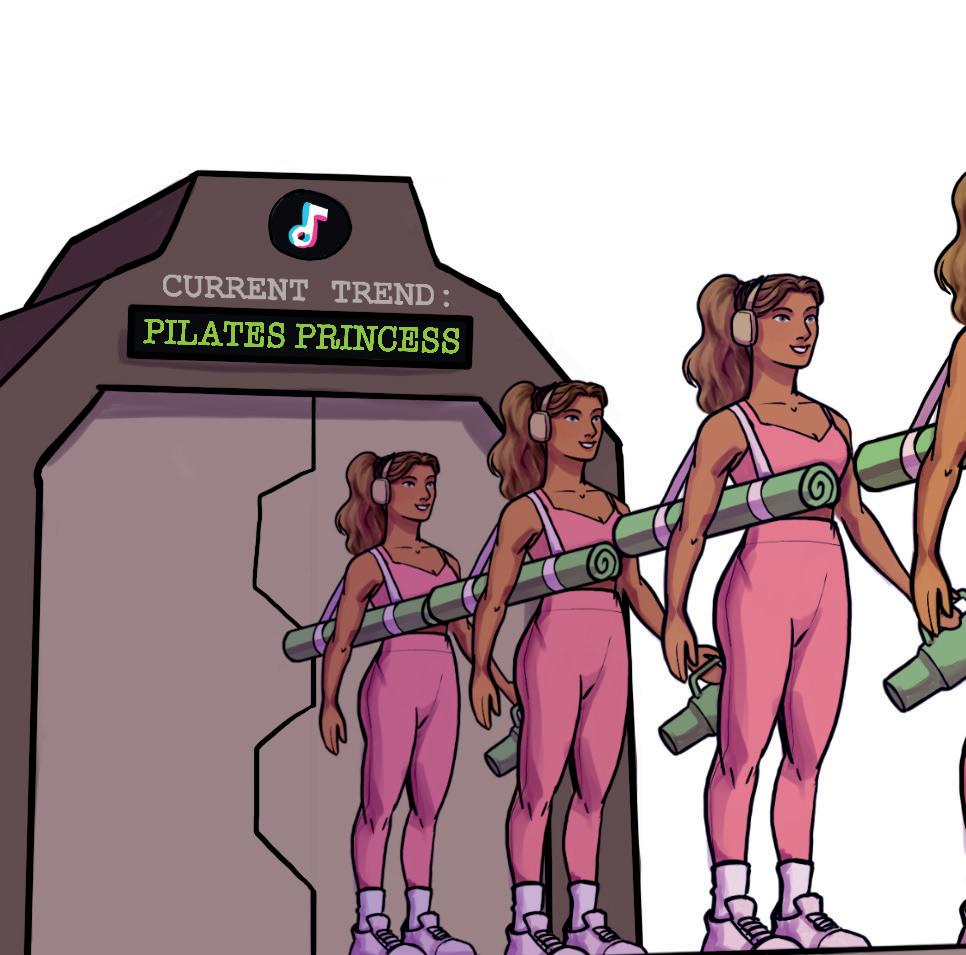
For teenage girls especially, that pressure to align has become a de ning feature of growing up online.
Fashion trends have always o ered young girls the opportunity to experiment with identity. However, with the heightened exposure social media provides and the ever-growing presence of in uencers inspiring various facets of life, young women nd themselves caught in repetitive cycles of outgrowing predetermined phases, over and over again.
Personal style still exists, but increasingly as a variation within narrow algorithmic boundaries. Subcultures that once thrived on distinction now blur together under the aesthetic language of


Historically, women have o en been the subjects of cultural conditioning.
Conduct manuals once dictated how a woman should behave, speak and think to remain socially viable. Early feminist movements dismantled those overt prescriptions, rejecting the idea that womanhood required a handbook.
Yet the handbook has quietly returned in digital form. ough the printed manuals have vanished, their spirit persists in the in uencer who packages lifestyle guidance as empowerment.
influence. Styles that once car-
ried clear artistic or ideological identities are softened to fit the dominant, monetizable
version of femininity.

rough in uencer content, we see women of all ages being directed towards an “ideal” clean archetype of womanhood. TikTok facilitates tight-knit communities around individual creators, and followers o en elevate these women to near-moral authority.



In this ecosystem, the in uencer has become a vessel of conformity, and with the incestuous nature of in uencing, many TikTok principles begin to overlap, broadening their reach of followers and spreading their conformist ideologies across communities. ough it is easy to be critical of the cycle of fashion trends, it is becoming increasingly imperative for our generation and the next to acknowledge what is at stake: sel ood.
Marissa Guthrie @marinoellle
Coming home for the holidays, summer, or even just a reading week can feel like stepping into a time capsule of your adolescence. For those who have moved out for university, it exposes an uncomfortable truth: growth is not always recognized by the people who rst de ned you.
Returning home a er months away can feel like you’re unintentionally method-acting versions of yourself you tried hard to outgrow. Around family, it’s easy to default into the roles we occupied during our most formative years; a er all, it’s those roles and relationships that made us who we are today. is tension is not rare. In 2021, more than one in three Canadians in their 20s and early 30s lived with a parent, according to Statistics Canada. Home, then, is not just where we come from. It is where many of us are still negotiating who we are. e problem is not that families refuse to see change. It is that family systems are built on memory.
Families rely on stability, on the version of you that existed within that space. Developmental psychologist Je rey Arnett describes the years between 18 and 29 as “emerging adulthood,” a period de ned by identity exploration and instability. University accelerates reinvention. It allows young adults to test boundaries, beliefs and identities without constant oversight. at growth may feel subtle from the inside, but it is transformative. When we return home, we feel the friction
This homogenization can also be seen at the corporate level, in the ing brands



way clothhave been ap-
proaching fashion. Stores that once felt visually and culturally different have begun
resembling one another.

e gradual erosion of self-de nition weakens our capacity for critique. If our formative years are spent internalizing aesthetic and behavioural prescriptions, we become less likely to recognize them as prescriptions at all.
e in uencer may not consciously intend to dictate how we live, but in uence is not neutral. Her livelihood depends on replication, on transforming her image into a template others feel compelled to adopt.

Personal growth should not be negotiable at the family dinner table

between who we were and who we are becoming.







Too o en, we resolve that friction by shrinking. We so en new boundaries. We mute opinions. We laugh at jokes we no longer nd funny. It feels easier to preserve family harmony than to risk disrupting it with proof of change. But that instinct comes at a cost; if adulthood means anything, it should mean integrating growth into every space we occupy.






Going home should not mean travelling back in time. It should mean evolution in shared space. Instead of retreating into old scripts, young adults owe it to themselves to renegotiate them. Growth does not have to threaten family bonds, but it should not be sacri ced to protect them either.

We owe it to ourselves to take up space, even at the dinner table.



















Power rarely introduces itself as power. It calls itself protection. For “identity.” For “survival.”
When the CAQ government tabled Bill 1, the Quebec Constitution Act, in 2025, former premier François Legault framed it as a way to protect what he describes as Quebec’s common values. ose values include the protection of the French language, state secularism, equality between men and women and the right to abortion. e bill also a rms Quebec’s use of the notwithstanding clause, allowing the government to override certain Charter rights without having to justify its decision.
But a constitution is not meant to protect the government, it is meant to protect the public from the government. A constitution should draw the line between authority and accountability. Bill 1 moves that line in the state’s favour.
Bill 1 would create a formal Constitution of Quebec. It would declare the province an autonomous national state and position its constitution as the “law of laws” within its borders. It would revise the Quebec Charter of Human Rights and Freedoms and recalibrate the balance between collective rights and individual protections. It would restrict certain publicly funded organizations from using public funds to challenge laws deemed fundamental to Quebec’s identity.
Human rights organizations have cautioned that the bill diminishes Quebec’s Charter protections, imposes new limits on fundamental rights and risks eroding the rule of law. More than 300 organizations have publicly condemned the bill, calling it a threat to democratic safeguards and access to justice.
Supporters call this autonomy. But autonomy without ac-
Volume 46, Issue 10
Tuesday, February 24, 2026
Concordia University
Library Building, Room LB-717 1400 de Maisonneuve Blvd. W. Montreal, Quebec H3G 2V8
Editor: 514-848-2424 x. 7407
Arts: 514-848-2424 x. 5813
News: 514-848-2424 x. 8682
Business: 514-848-7406
Advertising: 514-848-7406
countability shields those in power from scrutiny.
When governments restrict who can challenge laws and limit the avenues through which legislation is made, they reduce oversight. And oversight is not obstruction; it is democracy. Courts exist to review state action, while civil society exists to question it. Minority protections exist because majorities cannot always be trusted to protect everyone equally. ese mechanisms are safeguards, not inconveniences. Bill 1 narrows those safeguards.
By limiting publicly funded groups' ability to challenge certain laws in court and asserting that Quebec’s constitution takes precedence, the bill could make it harder for minority communities and institutions to contest government decisions.
When access to courts tightens, the majority does not feel it rst. Instead, the pressure clamps down on linguistic minorities defending institutions. It puts a stranglehold on communities that rely on constitutional protections when political processes fail them. e process surrounding the bill deepens those concerns.
A constitution should be shaped by the people who must live under it. It should emerge from broad consultation, open debate and collective ownership. Yet Bill 1 was tabled without prior public dra ing or participatory consultation, with hearings announced only a er the fact. For legislation that reshapes constitutional architecture, that sequence matters.
If a constitution is meant to check power, it should not be advanced through a process that concentrates it.
Last week, hundreds gathered in the Saint-Laurent borough to protest Quebec-based security contractor Garda
World’s ties to U.S. Immigration and Customs Enforcement, known as ICE. e demonstration was dispersed with pepper spray and tear gas, and human rights observers, like Amnistie internationale Canada Francophone, have raised concerns about whether the right to peaceful assembly was respected. e statute and the street are di erent arenas, but they expose the same question: how easily can power be challenged?
One arena concerns the right to judicial review. e other concerns the right to protest. Both are mechanisms through which the public holds the state accountable. Power does not become legitimate simply because it is written into law. It becomes legitimate when it accepts limits.
e Link believes those limits matter.
We believe rights must be enforceable, not symbolic. We believe minority protections cannot depend on who holds a majority in the National Assembly, and courts must remain accessible to those challenging the state. Constitutional change should be built with the public, not presented to them as a nished product.
A constitution should expand democratic participation, not narrow it. It should strengthen accountability, not shield authority. It should make it easier to defend rights, not harder.
Yet Bill 1 concentrates power while narrowing the tools used to challenge it, reshaping constitutional authority without meaningful public participation.
Constitutions exist to limit power. And when that limit weakens, it is not power that becomes vulnerable.
It is the public.
The Link is published 12 times during the academic year by The Link Publication Society Inc. Content is independent of the university and student associations (ECA, CASA, ASFA, FASA, CSU). Editorial policy is set by an elected board as provided for in The Link 's constitution. Any student is welcome to work on The Link and become a voting staff member. Material appearing in The Link may not be reproduced without prior written permision from The Link Letters to the editor are welcome. All letters 400 words or less will be printed, space permitting. The letters deadine is Friday at 4:00 p.m. The Link reserves the right to edit letters for clarity and length and refuse those deemed racist, sexist, homophobic, xenophobic, libellous or otherwise contrary to The Link 's statement of principles.
BOARD OF DIRECTORS 2025-2026: Voting Members: Iness Rifay, Hannah Vogan, Alice Martin| Non-Voting Members: Maria Cholakova, Varda Nisar, Lory Saint-Fleur, Geneviève Sylvestre.
TYPESETTING by The Link PRINTING by Hebdo-Litho.
CONTRIBUTORS: Aylee Ahmadzadeh, Bryanna O'Brien, Caroline Marsh, Cedric Gallant, Cleo Clamen, Evelyn Ho Lee, Halle Keays, Hannah Nobile, Kara Brulotte, Lea Joy Sabbaghian, Lory Saint-Fleur, Lordan Bennett, Lucía Castro Girón, Marisa Filice, Marissa Guthrie, Marla Lugert, Mirren Bodanis, Mischa-Elisabeth Clarke, Rayan Rekmani, Sehra Maloney, Sharmistha Kar, Sydney Nethersole, Hugo Genest
COVER: Andraé Lerone Lewis, Naya Hachwa, Myriam Ouazzani
CORRECTIONS FOR VOLUME 46, ISSUE 9: On p. 4, the article
“Climate committee urges Concordia to fully divest from fossil fuels” stated that the university has close to $830,000 invested in fossil fuel stocks as of August 2025. This is incorrect, it has over $853,000 invested in fossil fuel stocks. Additionally, on p. 8 in the article “A next step for sustainability at Concordia,” a quote was erroneously attributed to Xavier Ohnona. The Link regrets all above listed errors.