What is a Writ Petition?
How do you file one in Court?

Writ Petition is an order by a higher court to a lower court or courts directing them to act or stop them from doing an activity. Read on to know what writ petition is, how to file writ petitions in High Court or Supreme Court, how many types of writs petitions are there and their samples.
Writ Petition is an order by a higher court to a lower court or courts, directing them to do something or stop them from doing something. Writ is a form of written command in the nameof the court. It directs you to act in a specific way.
In the Indian legal system, you can file or draft a writ petition under Article 226 in the High Court and under Article 32 of the Indian Constitution in the Supreme Court. Article 32 and Article 226 of the Indian constitution elaborate on the process and meaning of the writ petition. Or else, at any point in time, you can consult an expert lawyer to draft a writ petition foryou.
You can also file a criminal or civil writ petition in the High Court or the Supreme Court, depending on the case matter. In case the High Court doesn’t give a suitable judgment, you can then submit the petition of the writ in the Supreme Court.
Know what a writ petition is, what are its types in the Indian Constitution, how you can file one in Indian High Court or Supreme Court, and the format of each writ with a sample.
www.lingayasvidyapeeth.edu.in Top Law College in Faridabad, Delhi NCR
What is a Writ Petition in High Court?
Writ in India is the formal order of the court directing the authorities if there is a violation of the Fundamental Rights by a government authority or body. You can file a writ petition in the Supreme Court under Article 32 of the Indian Constitution, whereas you can file the writ petition in High Court under Article 226 of the Indian constitution. You can also file Writ Petitions in India for a civil or a criminal act.
• You can file a criminal writ petition when the cause of action in relation to the criminallaw such as the right of accused, bail, etc.
• You can file a civil writ petition when someone commits a civil wrong such as IPR,taxes, etc.
Type of Writs in the Constitution of India
The Indian Constitution gives the power to the Supreme Court, where it issues Writ Petitions in India for the enforcement of any fundamental rights guaranteed under Article 32 of the Indian Constitution.
The power to issue a writ petition in India is primarily a provision - to the Right of Constitutional Remedies to every citizen and this right acts as a guarantor of all other fundamental rights in India.
There are five writ petition types in the Indian constitution, which you can file either before the High Court or Supreme Court such as:
✓ Habeas Corpus
✓ Mandamus
✓ Prohibition
✓ Certiorari
✓ Quo Warranto
www.lingayasvidyapeeth.edu.in
Top Law College in Faridabad, Delhi NCR
1. Habeas Corpus Writ Petition
The literal meaning of the term Habeas Corpus means, ‘you may have the body of.’ You can file this type of writ petition when a person is illegally detained. Meaning, if the court finds out that the person is illegally detained, then it can order for the release of that person. For Example:
• When one files writ petitions of Habeas Corpus in nature, then the court orders the authority to produce the detained person before him to examine whether he/she has been examined legally or illegally
• On conducting the examination, if the court finds that the person has been illegally detained, it can order for the release of the person
The scope of habeas corpus writ petition has been widened by the Supreme Court. Now you can also file it for the violation of fundamental rights of the prisoners (eg: Sunil Batra vs. Delhi Administration). The Supreme Court explains the meaning of the writ petition of Habeas Corpus very well in the case of P.S. SADASHIV SWAMI vs. STATE OF TAMIL NADU (AIR 1974 SC 2271)[1].
Thus, the features of the writ petition are as follows:
• Court has the authority to ask questions regarding the causes of detention of the detainedperson
• The court can issue a summon for the production of the detained person in the court
• If it is concluded that the detention of the person is illegal, it can order for the release ofthe person
One can file the writ petition of Habeas Corpus in any of the courts, be it High Court or the Supreme Court. Also, one can issue it under the following circumstances where:
• The person has been detained but has not been produced before the magistrate within 24hours of arrest
• The arrest has been made without any violation of law done by the person
• The arrest has been made for an unconstitutional law i.e. a law against the provisions ofthe Indian Constitution
• Detention is done with malafide intent, or with the intent to harm the persons
www.lingayasvidyapeeth.edu.in Top Law College in Faridabad, Delhi NCR
Who can file a writ of Habeas Corpus?
Generally, the person who is an illegal detainee files the writ of habeas corpus. To begin the writ process for filing a petition of Habeas Corpus, one can file it and issue it against any public authority or any particular individual. However, in certain cases, the court may allow other people to file a writ of habeas corpus on behalf of the detained person, who is their friend orrelative.
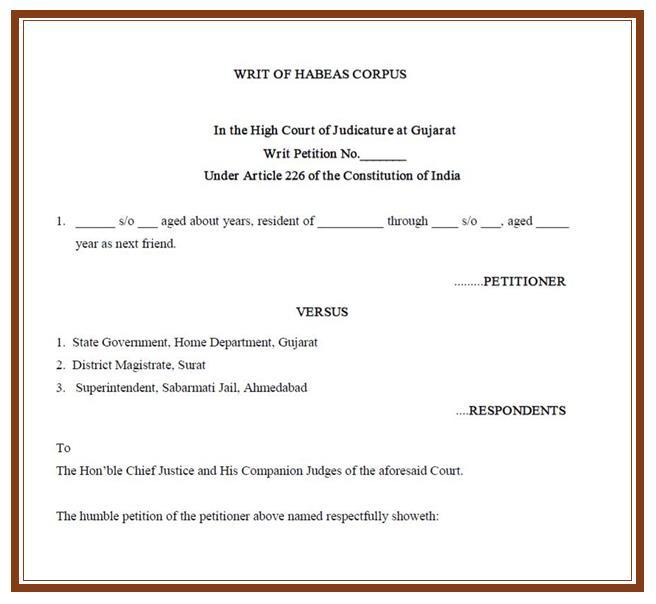
Format of the Writ of Habeas Corpus
www.lingayasvidyapeeth.edu.in Top Law College in Faridabad, Delhi NCR
2. Writ of Mandamus
Mandamus is a Latin word meaning ‘we command’. Mandamus is a court writ whereby the higher courts order the lower court, tribunal, forum or any other public authority to do any actwhich otherwise also falls under the purview of their duty.
"One issues the writ of mandamus when a public officer fails to perform his/her official duty or something which forms part of his/her official duty. Writ of Mandamus is a matter of graceand not a matter of right. But it is the discretionary power of the court to allow the writ of mandamus. This means - if the court thinks that there may have been a failure in performing the duty by the lower court or public authority, then the court may allow the writ of mandamus," says Advocate Ankit Sharma.
The essential requirements of the Mandamus writ petition for the court were described by the Supreme Court in the case of MANI SHOBHREJ JAIN vs STATE OF HARYANA (1977 (1) SCC486)[2]
The court laid down the following requirements of the writ of mandamus:
• There should be a legal right in existence
• The legal right should be enforceable by the court
• Enforcement of such a right must impose a responsibility of per on a person, publicauthority, corporation or government
• Such duty is of public nature
Writ of mandamus can be issued against the following :
• An individual or a private body
• If the duty which is the subject matter is discretionary and not mandatory
• It can be issued against the president or the governor of the state
• Against an acting chief justice
• To enforce a private contract
Legal Systems at the Nexus of Law and Society
www.lingayasvidyapeeth.edu.in Top Law College in Faridabad, Delhi NCR
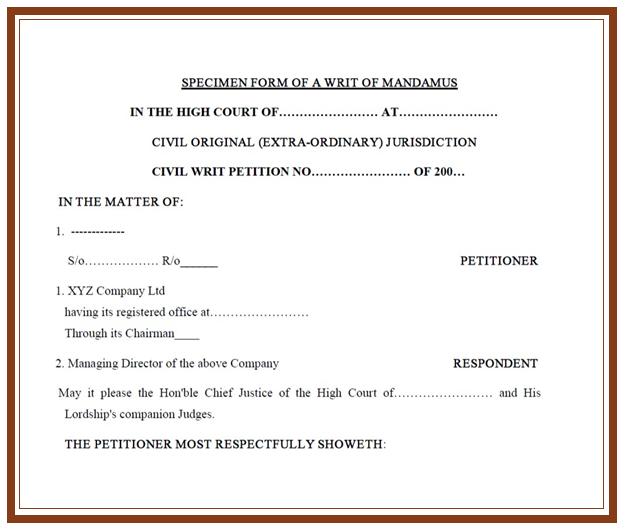
Format of the Writ of Habeas Corpus
3. Writ of Prohibition
As the name suggests, the writ of prohibition is a court petition issued either by the SupremeCourt or High Court to prohibit.
"When the lower courts including the tribunals, forums or any public authority (magistrate, commissions or any other judicial officers) do something which exceeds their jurisdiction, theSupreme Court or High Court prohibits them by issuing the writ of prohibition," says Advocate Ankit Sharma.
www.lingayasvidyapeeth.edu.in Top Law College in Faridabad, Delhi NCR
Prohibition writ for the court is issued to stop or put a stay on the power exercised by the authority and is commonly known as stay order. In India, a writ petition is issued against the proceedings going on in lower courts and in such proceeding, the lower court is exceeding its powers. Once the writ of prohibition is allowed either by the Supreme Court or in High Court theproceedings of the lower court come to an end.
The Supreme Court in the case of GOVIND MENON vs. UOI (AIR 1967 SC 1893)[3] laid down the conditions in which one can issue the writ of prohibition. The conditions by the court are:
• When there is an excess of jurisdiction, or
• When there is an absence of jurisdiction.
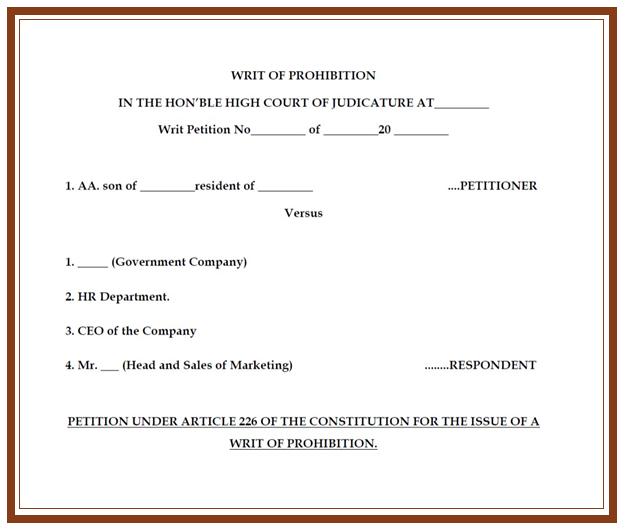
Format of the Writ of Prohibition
Top Law College in Faridabad, Delhi NCR
www.lingayasvidyapeeth.edu.in
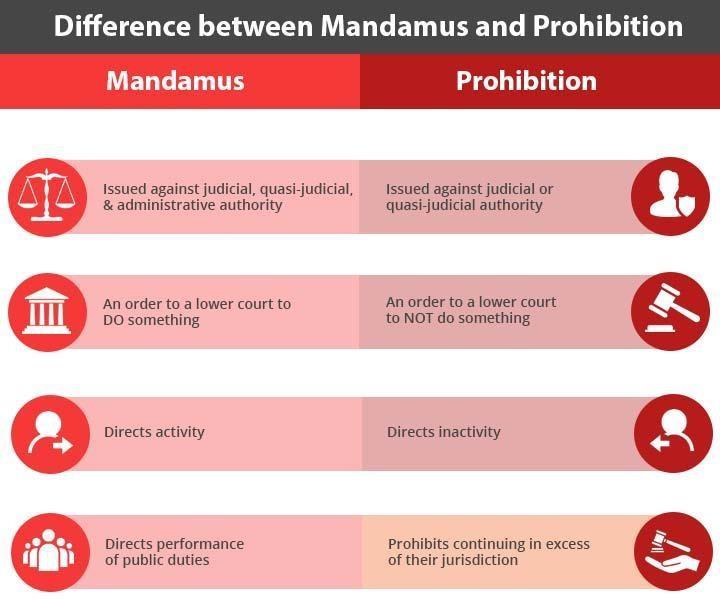
Difference between Mandamus and Prohibition
• The Writ of Mandamus, where the court like the High Court, directs the performance of an activity to a lower court. Whereas in the Writ of Prohibition, the higher court like theSupreme Court orders to stop doing something which is in excess of their jurisdiction.
• You can issue the writ of mandamus against any judicial, quasi-judicial and administrative authority. Whereas you can issue a writ of prohibition only against judicialor quasi-judicial authority and not against the administrative authorities.
www.lingayasvidyapeeth.edu.in Top Law College in Faridabad, Delhi NCR
4. Writ of Certiorari
In the literal sense, the word certiorari means, ‘to be certified’. One can issue the writ of certiorari by the Apex court for transfer of the matter to it or any superior authority for proper consideration. You can issue the writ of certiorari against the inferior court or tribunal. (eg: ahigh court writ petition can be issued against lower district courts).
In simple terms, one can issue the writ of certiorari when the subordinate courts or the quasi-judicial bodies act in:
• The absence of their jurisdiction, or
• Exceeds their jurisdiction or
• Fails to make use of their jurisdiction
In the case of STATE OF UP vs MOHAMMED NOOR (AIR 1958 SC 816)[4], the supreme court stated that one can issue the writ of certiorari. To mainly reform the jurisdiction-related mistakesof the inferior court or tribunal.
Subsequently, in another judgment of HARI VISHNU KAMATH vs. AHMED ISHAQ (AIR 1995SC 233)[5]. The Supreme Court held that one can only issue the writ of certiorari to correct theerrors apparent on the face of records, but not for the correction of an error of fact.
The Essential Condition for Writ of Certiorari:
• There should be court, tribunal or an officer having the legal authority to determine thequestion with a duty to act judicially
• Such a court, tribunal or officer must have passed an order acting without jurisdiction. Or in excess of the judicial authority vested by law in such court, tribunal or officer.
• The order could also be against the principles of natural justice. Or the order could contain an error of judgment in appreciating the facts of the case
www.lingayasvidyapeeth.edu.in Top Law College in Faridabad, Delhi NCR
Format of the Writ of Certiorari
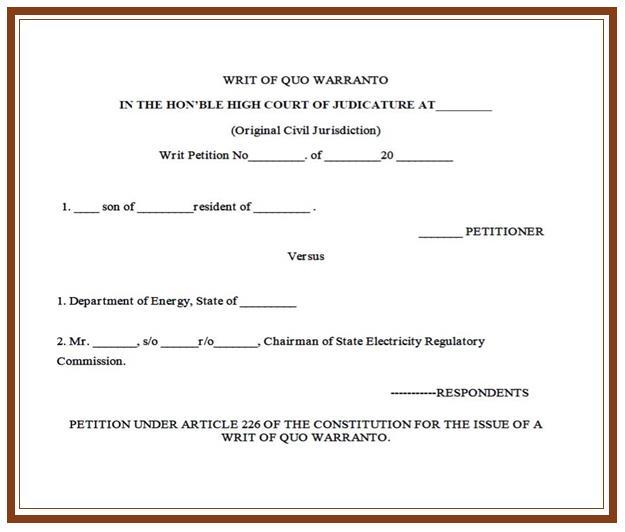
5. Writ of Quo-Warranto
Writ of quo warranto means a writ that you can be issued to restrain a person from acting in thecapacity of public office to which he/she does not have the entitlement. Here, the term Quo- Warranto means, ‘by what authority’ or, ‘on whose authority is one holding a public office’.
www.lingayasvidyapeeth.edu.in Top Law College in Faridabad, Delhi NCR
For example:
• There is a vacancy in the government and by giving a job to a 63-year-old person, theyfill that vacancy
• But since, the retirement age is 60 years, so in this case, one can file a writ of quo-warranto to remove such person from the public office
The supreme court in the case of UNIVERSITY OF MYSORE vs. GOVIND RAO[6] laid down therequirements of the petition of quo-warranto which are as follows:
• A disputed post must be the public post
• The post should be held by the person without any legal authority
• The office must be a substantive one and not merely the function or employment of aservant at the will and during the pleasure of another.
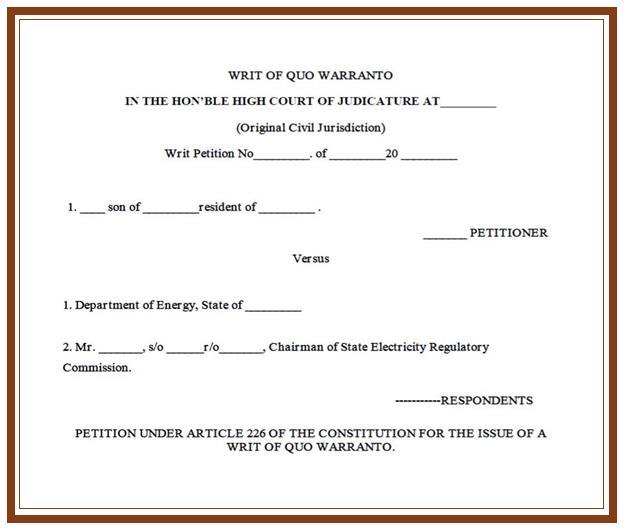
Format of the Writ of Quo-Warranto
www.lingayasvidyapeeth.edu.in Top Law College in Faridabad, Delhi NCR
Future-Proof Your Legal Career: Mastering In-Demand Skills
Lingaya’s Vidyapeeth stands as the premier choice for those passionate about the legal industry. With esteemed LLB, BA LLB, and LLM programs, we provide a comprehensive education that prepares students for successful careers.
Our faculty comprises experienced legal professionals who impart both theoretical knowledge and practical skills. Graduates emerge equipped with the expertise needed to navigate the complexities of the legal landscape and make a meaningful impact in the field.

www.lingayasvidyapeeth.edu.in Top Law College in Faridabad, Delhi NCR