
LIGHTS & SHADOWS
Masthead
Editor-in-Chief and Designer
Manuela Ludolf
Literary Submissions Editor
Brooke Lunsford
Assistant Editor
Hayden Jordan
Faculty Advisor
Professor Daryl Brown
Logo Graphic Designer
Izzy Smith
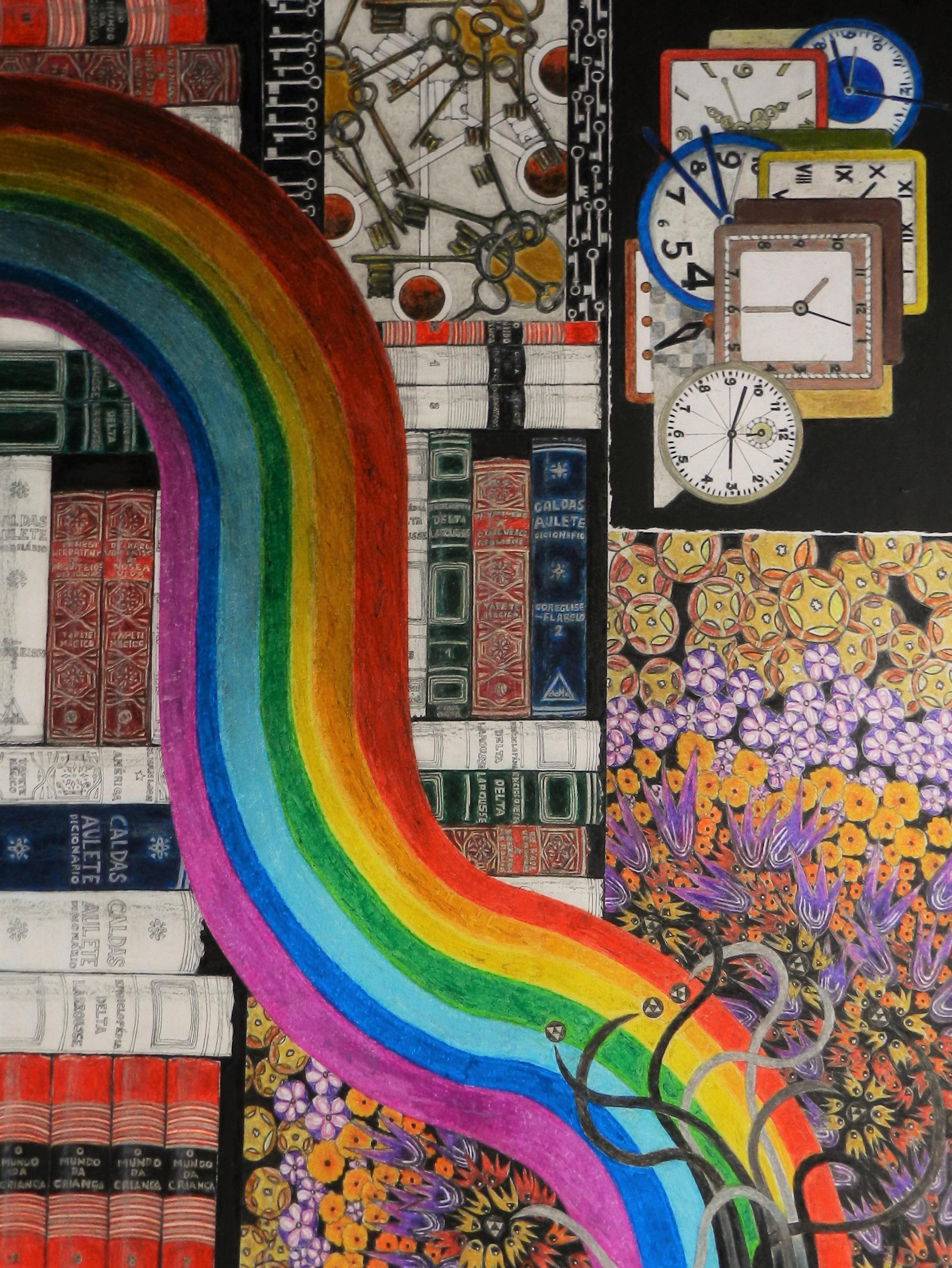
Cover Art
Reminiscências V. 50x65cm. 2019. by Marcelo Spolaor
Letter from the Editor
Chapter I: The Comfort of Knowing
The First Step by Anna Hilb
Ascension Day by John Stevens
A Desert Memory by Charles Michelson
Florence by Hannah Myrick
Rhythm and Roots by JaKyra Phillips
Hurricane Gilbert by Vinnette Gibson
Who Shall Thee Look For? by Shamori Thompson
by Rebekah Jent
Chapter II: The Discomfort of Not Knowing
Cast
by John Stevens
L&S Spotlight
Chapter III: The Discomfort of Knowing
Ceaseless Cotillion by John Stevens
Being From Memphis by Averie Yeager
Staying Woke by Eric Morris
Cicadas Sing by Adam Rausch
Clinging by My’Chyl Purr
Girlhood by Lauren Daniel
Liberation by Hannah Green
Mnemonic Devices by Katelee Smith
The Last Unanswered Phone Call by Samantha Robins
Nature’s Unrelenting Reign by Anna Hilb
Pendulum by Elvie Skinner
Nothing But a Man by Zane Turner
Broken by Elvie Skinner
Chapter IV: The Comfort of Not Knowing
Ms Jane’s House by Eric Morris
Candle by Savannah Andrews
A Depiction of All the Things I Allow to Take My Peace, in the Form of a Chair by Jessica Bullock
The Bucket Theory by Rebekah Callahan
Keats Riffs on Homer by Charles Michelson
Are You Washed in the Blood? by Katelee Smith
Dear Reader,
Letter from the Editor
Welcome to the Spring 2025 issue of the Lights & Shadows, the University of North Alabama’s literary journal. What you will experience now is an amalgamation of Southern art made possible by UNA and regional writers and artists.
The (Dis)Comfort of (Not) Knowing, this issue’s theme, can be read in four different ways, and those constitute the four chapters that represent the shift from innocence to maturity–as well as their coexistence.
The Comfort of Knowing opens this journal with the certainty of good times. There, you will delight in friendship and rest in contentment. There will be no fear of falling or uncertainty because you are comfortable with the surroundings you know. You may relate to this section when you find the good in tepid or sorrowful times or simply recognize the grandiosity of certain fulfillments such as love, friendship, and success. You can think about the ephemerous aspect of those in real life, but there, they are eternal.
The Discomfort of Not Knowing shifts the journey to the previous chapter’s polar opposite. There, you do not know a thing, and that frightens you. Where did time go? Where did people go? Where did you go? It does not matter how much you prepare because life will come back to you in a lightning strike when you thought it was an earthquake you were about to experience. Should you embrace the
unknown, or should you dive in despair?
In The Discomfort of Knowing you may ask yourself if it is better to know or not to know. When you grow up and discover yourself, your family, and the whole world as not as great as you imagined, what do you do? Suddenly, you know about heartbreak, poisoning genes, structural issues, and death. You contemplate whether ignorance was always the true bliss because what is outside is too much for your comfort, and you know there is nothing you can do.
The Comfort of Not Knowing ends this journal at the beginning of life, and it does so for the reader’s own nostalgia. There is where ignorance is bliss; there is where you are before The Discomfort of Knowing. You do not have a glimpse of tragedy when you are a child, and you rest in your mother’s arms until you fall asleep. Funny enough, there is where you have the devilish wish of uncovering every mystery you have ever encountered.
Your editing committee is proud to present this issue to you. By flipping this page, know you have arrived at the comfort of home, but recognize comfort is truly ephemeral and that you have to arrive in Chapter II. Then, be thankful for all the despair you do not currently experience and for all that you do or do not know so you can finally delight yourself in the revival of your youth.
Enjoy the journey.
All the best,
Manuela Ludolf Editor-in-Chief lightsandshadows@una.edu
L&S Award Winners
Best Prose
Are You Washed in the Blood? by Katelee Smith
Best Poetry
Salt Six Feet Under by Mark Smith
Best Artwork
The Return of the Purple Menace by Brandon Underwood
Chapter 1
The Comfort of Knowing
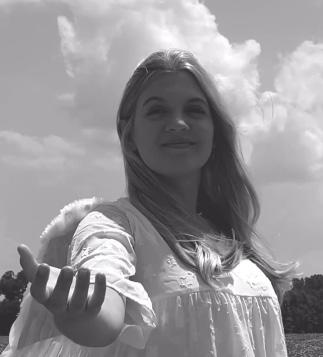
Goodnight by Brandon Underwood
The First Step
by Anna Hilb
As I stepped off the bus to shouts of, “GET IN LINE!! GET IN FORMATION NOW,” the blazing Georgia sun blinded me, and the sweat dripped down my spine. My head began to pound, and I thought to myself, “What have I done?” For what felt like an eternity, I stood in a rigid line with my army-issued duffle bag held high over my head. The boy behind me was crying hard, his sniffling and whimpering did nothing to alleviate the ache between my brow–a preview of how rough this journey would be.
After graduating from college with my bachelor’s degree in dietetics at age 20, I was uncertain about which path to take. Ready for a break from academics, returning for my master’s degree was not in my immediate future. I felt lost. A friend I knew from the campus recreation center had recently enlisted in the Army, and I wondered if the military could give me the direction I needed. This question led me to my first step towards enlisting. I went the next day and spoke with a recruiter in the local Army recruiting office. He said I, Susanne, the unsure graduate, would be a great candidate for officer training school, and with his help, I began the process of enlisting. It was this path that eventually brought me here to basic training, surrounded by unfamiliar faces and the pressure to succeed.
Determined to survive, I made a promise to myself not to be the one who gave up. What seemed like daily, someone else from my reception platoon threw in the towel and went home. The lack of sleep weighed on us all, and for me, even breathing felt like a burden. The drill sergeants stormed in at random, sometimes in the middle of the
night, making us perform drills or checks. With wake-up calls at 0500 every morning and added sleep deprivation, each day felt like I had run a mental marathon. But the barracks turned into my pseudo home; the female-only quarters brought me back to sharing a room with my younger sister Maria. She made her bed each morning with a precision my drill sergeants would be proud to inspect. Each bunk bed in the barrack had to be made perfect according to regulations, or we all suffered the consequences of a trainee’s failure.
Jennifer was on the bunk above me, her determined eyes and friendly smile put me at ease, and she became a fast friend as we pushed through the grueling weeks. We shared the struggle to make it through each day–from perfecting the bed-making to learning how to keep hairstyles within regulations. In moments of shared laughter and homesickness, she reminded me of Maria, who was finding her path in college. That connection grounded me in ways I hadn’t expected, and Jennifer was much further from home than me. She came from the middle of nowhere Idaho and enlisted the day after she graduated high school. Her family was not supportive of her decision, and about that, she said, “I signed the papers, so there was nothing they could do to stop me from going, but at least I left on a good note.”
My family, in contrast, was excited about my new journey. I cherished their support–especially when reading their letters and opening the bulging care package they had so carefully put together. The moleskin my mom tucked in the box helped me through many painful rucks and runs. I cried reading the letter my sister had penned in her blocky handwriting, expressing excitement about pictures she had seen of my training on a military Facebook page and saying she missed me at home. Even far from everything familiar, I was never truly on my own.
Three times a day, my platoon filed into the chow hall for meals, but even eating became an exercise in discipline. On some days we sat briefly, savoring a few bites, but on others, we barely had time to taste our food before it was time to move. The strict timing echoed
the unpredictability of training itself, teaching us to adapt, stay sharp, and keep going–even with something as simple as a meal. Adding to the tension, the Drill Sergeants circled around screaming out, “CHEW YOUR FOOD,” and “EAT FASTER.” On one of these occasions, I made the mistake of looking a Drill Sergeant in the eye; resulting in my entire platoon’s removal from lunch to stand in formation until lights out. While the punishment lit a flame of anger in me, the constant adaptation sharpened my endurance, something I’d rely on more and more.
One morning, we were woken up at 0330 for an eight-mile ruck. My eyes burned as I swung my legs over the side of my bunk, the floor’s icy chill cutting through my sleepiness. I reached for my boots–laced up the night before to save time–and shoved my feet into them. My ruck rested at the foot of my bed. Its weight dug into my shoulders as I hefted it into position, but I pushed the thought far away. As we lined up in formation, no one around me said anything, for it was too early for words. Nerves gnawed at my gut as the fear of failing the ruck prickled in my conscience. My mantra that morning was the repetition of, “Just keep moving, don’t be a quitter.”
“Fall in!” came the throaty yell of the Drill Sergeant. The first steps were always the hardest; then I settled into a rhythm, going numb to the activity. My breathing became meditation–inhale, exhale slowly, repeat. The incline rose at four miles with a steep hill, and my calves burned like fire with each step. The Soldier’s Creed replayed in my mind to distract me from the pain, “I am an American Soldier. I am a warrior and a member of a team.” Eventually, the cover of darkness faded away to a sweltering sun. At six miles, the pooling sweat trickled down my brow in a steady flow, and I wished for the cool, fresh air and the blissful darkness. The last mile stretched endlessly, every step marching me further into an exhausted state. When the command to halt was shouted, my throat tightened, relief washing over me like a wave. I had finished strong, we all had. Another hurdle leaped over, and I could not wait to cross the finish line.
Days in the field were different from our usual training, a gru-
eling mental and physical test. By day three of five, exhaustion clung to me, and the lack of showers took a toll on all of us. The stench, the dirt, sleeping on the ground, and the intense humidity left me hanging on by a thread. The field was a parody of the campouts and bonfires with friends back home, but the reminder was anything but comforting. My hair was getting matted, but the standard low bun hid the mess well enough. I didn’t mind being a little dirty; however, the layers of sweat, dirt, and face paint became like a grimy second skin. On the fourth morning, I woke up to a swollen spider bite on my thigh, and each step I took sent a pulsing pain down through my foot. It wasn’t a poisonous spider, so I kept my mouth shut and cleaned it with alcohol pads during the remaining days. I could suffer through a few days of pain to avoid getting recycled. No one wants the embarrassment of repeating training.
The bathroom situation was another unexpected test. As a girl, I had squatted in the woods during family camping trips or peed behind a car at a bonfire, but none of these prepared me for field bathrooms. Pooping in the woods surrounded by a whole platoon of virtual strangers, and mostly men? This sucked on a whole different level. My body didn’t care where we were, though, so I found a wide-based tree far enough from the group to offer me some privacy and squatted over the shallow hole dug with my entrenching tool. I prayed no one would take a walk by my hideout. The first time was uncomfortable and disgusting, but I adjusted, even cracking jokes about shitting in the woods during field training while going through Officer Candidate School (OCS).
Eating an MRE (meal, ready-to-eat) at the end of the day was hardly a relief. The plastic pouch held surprises I’d rather forget. Though trading with others for a pack of peanut M&Ms softened the disappointment. My first MRE was exciting, as my military-enthused uncle had a stash of them for when “shit hit the fan.” Realizing it was dry crackers, rancid-tasting beef stew, and plastic cheese, quickly cured me of any lingering enthusiasm. MREs were supposed to give us the
calories we needed to properly perform our training. However, after choking down a pouch of chili mac, I was considering starvation a more pleasant alternative.
When we hit the range, all my years of shooting skeet in the backyard of my grandparent’s house in South Alabama had paid off. I excelled in the range. The steady breathing, the calm in high-pressure situations, and the shooting felt like second nature. The process was almost technical. I controlled my breathing, waiting until the exhalation before firing off rounds into the targets. The key was to stay calm. That was manageable for me, for I had never been one to lose my cool. The prone position was my strong suit, my body able to lock into a stable position for the supporting rifle. Moving positions from prone to kneeling to standing was muscle memory by the end of training. The kickback from my issued rifle got the better of me once. The bruise left behind was a pulsing reminder to not get distracted. Here, I realized that while the physical challenges tested me, the skills I learned reminded me that I was capable, prepared, and ready for the next step.
As graduation neared, our daily training included ceremony practice. Soon, we’d be marching out from the woods to the field where everyone’s friends and family would be waiting. Smoke bombs would be going off as we left the tree line, adding a dramatic effect to our entrance. My parents and baby sister were making the trip, as I learned from their last letter. She was born only a few months before I shipped out, and I couldn’t wait to see how much she had grown. The day after graduation, Maria was joining me to drive me to my first station. The anticipation consumed me, making it a struggle to stay focused on finishing strong.
When the day arrived, we stood silently, everyone dressed in uniform and waiting for the signal to march. The eagerness to see my family after nearly three months made me feel giddy, though my body was exhausted. Victory Forge Week had zapped the last of my strength, and I was running on fumes. But, despite the fatigue, I stood tall, proud to have persevered to the end. Suddenly, the drill sergeant’s sharp com-
mand of “MOVE OUT!!” cut through my thoughts, snapping me to attention. With that signal, we started forward through the trees towards the open field. As we broke the tree line, colorful smoke grenades ignited, filling the air with plumes of vibrant color. Adrenaline surged through me, filling my body with renewed energy as I heard the crowd cheering in the distance. By the time I left this field, I would no longer be a new recruit–I would be a United States Army Soldier. Everything came into sharp focus as I emerged from the smoke. Once we reached our position on the field, I scanned the crowd for my mom and dad, spotting them in front of the stands. I let out a breath of relief at the sight, a quiet smile forming as I saw their familiar faces. Tears welled in my eyes, but I held them back. Each second was a test of patience as I stood in formation, wanting only to sprint towards them and finally hug them again. Just a few more minutes, and I would be free.
The commander’s voice echoed across the field as he commended the entire battalion for our bravery, dedication, and commitment. Pride swelled within me because I knew I had earned my place with blood, sweat, and tears. It wasn’t just about recognition; it was the culmination of every challenge I faced over the past ten weeks. Each sleepless night, each grueling ruck, each moment of doubt fell away as I stood with a newfound strength and resilience. Holding my rifle at attention, the surreal realization settled in: I was a United States Army Soldier.
“Charlie Company… DISMISSED.”
Ascension Day
by John Stevens
He waved his hand through the air like a wand changing the room into a painting.
The artist’s touch in recluse clothes changing the world into whimsy.
Brush stroked bolero un pas de deux
In three-quarter time Steeped in sweet perfume.
if I could create with a magic wand I would grow Into a Neruda Poem Esa vez era como nunca, y como siempre.
15
Vamos tan allí, donde nada está esperando; encontramos todo el esperar allí.
That time was like never, and like always. So we go there, where nothing is waiting; we find everything waiting there.

16
In the Eyes of the Beholder by Lacey Gross
A Desert Memory
by Charles Michelson
The rocks were shining in the sun, and there was a glimmer that could not be defined. That was always the way the stones shined. The heat as we looked upon some soft blue in the California desert was an inferno.
The steep slope of the rock face was like a mountain. Jagged, and of course, it was the middle of the day that we had embarked on our journey into the Anza Borrego. It was painted red and brown. As the light hit it, it became fiery orange. The All-American Girl Mine was not so much a mine as it was a giant dump site for blue kyanite. Its varying degrees of blue against the cooked earth were most striking and could be as penetrating as the blue sky above. We closely examined the ground for various samples. We picked up countless pieces of the blue rock, some larger than others. All were the quality one would expect to find in an abandoned mine.
It was the kind of heat where the drips of sweat formed instantly.
This was no ordinary heat. We smelled like pina colada. The use of sun-tan oil seemed counterproductive, but it served its purpose. The sun’s rays bore down like a wave.
Somehow, we managed to move all these rocks back to the car and return the car to the main road.
Off in the distance, we could hear men firing off guns. The drug cartels were not far from where we were, and they made their presence known. I was running a few minutes late; my previous meeting was over.
As we drove back to civilization, it felt like time had passed too
quickly.
Insufficient time was given, like the sand in the desert was being strained through a giant hourglass. It was as though the flash of the sun that day was telling me something. The smell of brush sage was still lingering in the car. It was a long ride from where we were in the desert. The destination was Coronado, a navy town. The Anza-Borrego is a combination of two aspects. The first is derived from the explorer Juan Bautista De Anza, and Borrego is Spanish for big-horned sheep.
I could only imagine what it must have been like to travel in the desert in 1774. Was it as hot as it was when I was in the desert with my father? Traveling to the land where these mineral samples were was tedious, as though we were walking a tight right. Sometimes, the road was not geared for vehicular travel. On one occasion, we almost got our car stuck.
These moments with my father in the desert are some of the most treasured. They, along with the mineral samples, are how the image of this man enters my mind.
He wears a sweatshirt in ninety-degree heat.
He wears a red band around his glasses to keep them in place. On top of his head, he wears a baseball cap with the Chicago Cubs logo.
It’s not as hot this time of year, but we are still dripping in direct sun. The lizard sticks out its tongue, perched on a rock beside me. With tiny fire ants, you must be very careful. The tarnished sand makes dust clouds as we trudge up to the site where fossil seashells are to be preserved. It’s frustrating, as you know that the best samples have been picked over by rock hounders too.
That’s why we call ourselves rock-hounders.
We yearn for connection, whether with the land or our flesh and blood. As I desired to get closer to the land, I was unaware I was becoming closer to my family.
Florence
by Hannah Myrick
The river flows near city streets so fair, Where memories fill the southern air, With cobblestone paths, and the sun ablaze, A quiet Sunday filled with praise.
Court and Cherry with bikers on, Tennessee and Seminary where dogs are drawn, The city’s shining people out, Leo’s roar is heard about.
The heart is beating loud and proud, Of Florence who keeps an ample crowd. I love this town with all my heart Born and raised, I dread to depart.
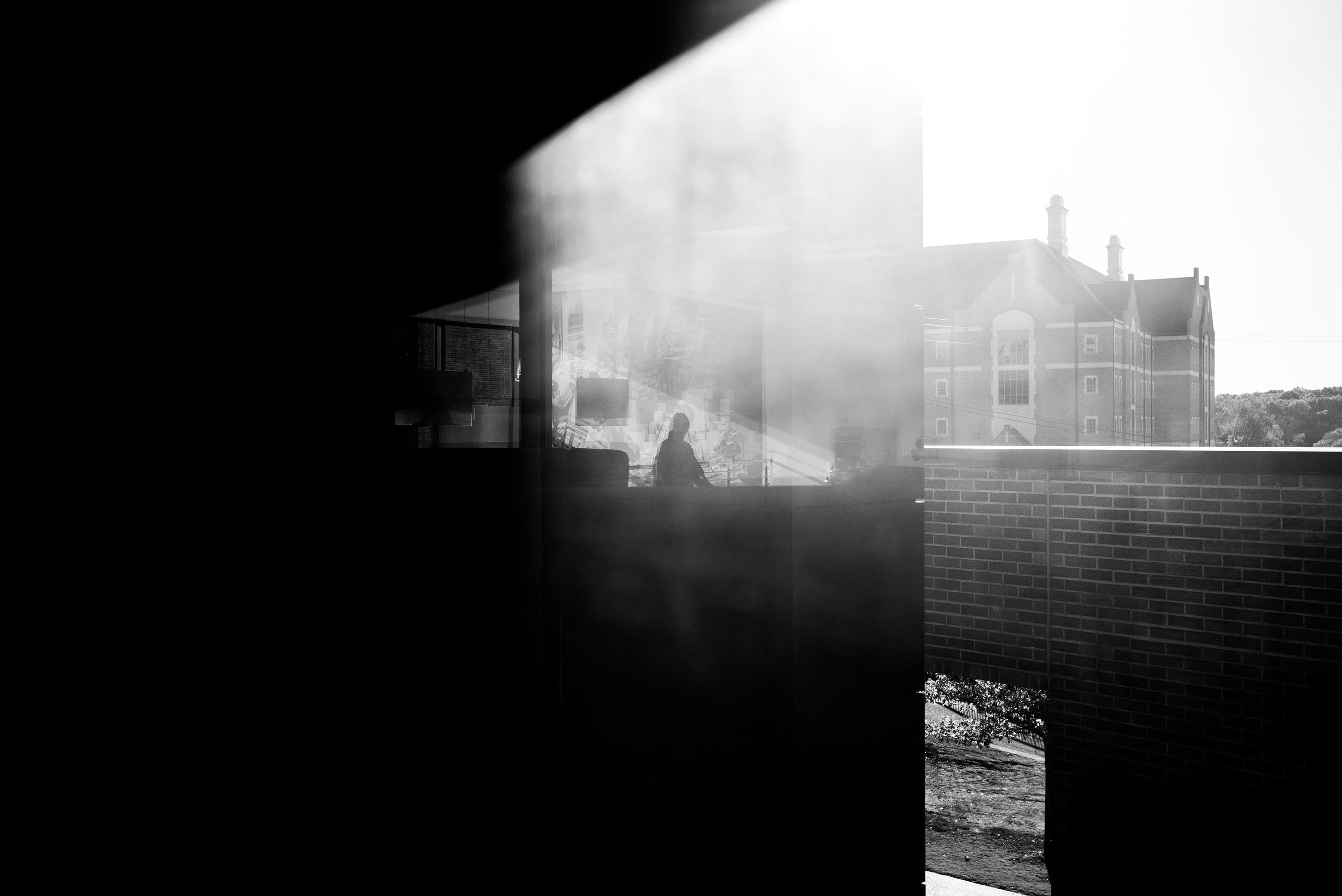
Untitled by Leon Ono
Rhythm and Roots
by JaKyra Phillips
Without glancing up, Louise calls out in the direction of the door chimes, “Welcome to Rhythm & Roots. Sit anywhere you’d like, and I’ll be right over.”
“Hey, Ms. Louise!” the woman greets her.
She returns the greeting with a warm smile and rushes over to grab her into a hug. “Hey, there, Pat! It’s been a month of Sundays. I almost didn’t recognize you with that cute new cut. It looks good!”
Patricia strokes her short pixie cut bashfully, “Oh, you know. Just thought I’d try something new.”
“How your momma ‘nem?” Louise asks, watching for any sign of an emotional tic.
Patricia grimaces, “Oh, she’s fine. Everyone’s good, considering…” Her eyes float away toward the floor.
Louise places a supportive hand on her shoulder. “I know how it is, sweetie.” In a lower voice, she says, “If you guys need anything, just let us know. Anything at all.”
“Thank you, Ms. Louise. We really appreciate it. For now, what I need is to get some of that good food in me.”
Louise nods, “What can I get for you? You want your usual?”
“Yes ma’am,” Patricia answers. “You know me well.”
Louise beelines for the kitchen, glancing at her husband across the way, her eyes dancing with a childlike giddiness, lingering on the salt and pepper sprinkles of his beard.
She reemerges with a full tray in tow and saunters to a table in the far corner of the restaurant. “We got George’s famous salmon croquettes and rice with a lemon remoulade for you, Sam, a summer salad with grilled chicken, pecans, and strawberries for the lady, and a hamburger with no tomatoes or onions and steak fries with poutine for Lil’ Anthony.”
He peered at her over the rim of his glasses. “Now, Ms. Louise, I’m not so little anymore.”
“Boy, I used to change your diapers. You’ll always be little to me,” she chuckled.
Beverly comments, “Louise, this looks amazing.”
“Well, you’ve got Georgie to thank for that.” She smiles warmly. “Enjoy your meal folks.”
She strides past two men, father and son, when one of them calls out, “Let me get a slice of that good ‘ole sweet potato pie!”
“I got you, Charlie! Coming right on up,” Louise responds.
The younger of the two adds, “And a side of fried green tomatoes to go. My wife’ll kill me if I don’t come home with some. ‘The baby’s craving ‘em,’” he says mockingly. They all burst out in hearty laughter.
George’s magnetic aura moves from table to table as he welcomes everyone, stopping when one of the regulars—to tell the truth, they were all regulars: friends, neighbors, church members, people they’d see on their everyday errand runs—asks, “Hey, what’s your secret man?”
George laughs, “Ah, man. You know I can’t tell you that. You and Della Mae’ll put me out of business. She’d give me a run for my money now!”
“Ain’t that the truth?!” the man agrees.
Laughter and chatter flow throughout the restaurant. Old friends catching up. Families sharing stories of their day. Couples
basking in each other’s presence. This place was as lively as it had ever been on a Saturday evening. Every weekend, the people from all over Atlantic Beach would come pouring in to feel that welcoming hospitality of George and Louise’s. The food came accompanied by a love and warmth that you just couldn’t get anywhere else. This was one of their few safe spaces left.
It was in danger of not being enough. It seemed like operations were slowing down every single day. Despite having every seat filled today, it was never enough and simultaneously too much. It took a lot to run one of the homiest family restaurants around town. It required a lot of courage, wisdom, and expertise, which they had; but they were growing older. They could barely handle the crowd on days like this. They definitely couldn’t handle it seven days a week. Not without any help. After cutting down the menu by a few of the less popular items, and even limiting the hours to a couple of days a week, they still found themselves struggling to manage and keep up with the times.
Louise walks Mr. and Mrs. Peters, the older couple that stays two doors down, over to the entrance, handing them a carryout plate. “Carry this home to the grandkids. I know those little ones got a sweet tooth. I remember how much they just loved my strawberry shortcake last time.”
The husband, Joe, regards, “Appreciate it. Though I also remember all that carrying on they did after, too. Made them happier than Cookie Monster in a bakery, only more hyper.”
Louise giggles. “I’ll take the blame. It has just the right amount of sweetness for us, but the children… they’re another story.”
Sharon, his wife, responds, “I know that’s right. Speaking of, where y’all kids?”
She comments, “Oh, they don’t get down here much anymore. Lives of their own, too busy since they grown now. You know Janelle just opened a new practice. She always has some big, new case. Uh, Michael’s got business up in New York. Last we seen him was just after
the wedding. And Lucy… I don’t know what that gal’s up to these days, but she’s over in Texas. Living her best life as she says.”
“You know kids these days. They run away from home and never look back,” Joe offers.
“I mean. Can you blame ‘em?” Louise asks. “Ain’t much left around here. That’s reason everyone is getting away while they can. Everything’s going down. The Black Pearl ain’t been the same in a minute.”
And they knew. From the saddened look on Louise’s face, they felt it too.
Sharon, attempting to encourage her, exclaims, “Well, y’all still here!” She declares excitedly, “As long as I can always stop in and get some of that delicious creamed corn, you always got a patron!”
“And they’ll have to pry that spatula from my cold, dead hands!” George yells behind them, as they turn to leave.
Waving off their last patrons, Louise smirks graciously, “We appreciate both of you guys. We really do. Take care now.”
George squeezes next to her, grabbing her waist to pull her into an embrace and presses a kiss upon her temple. He extends a hand, beckoning her toward the center table, now adorned with a single rose and candle stick. He gestures to an amazed Louise to take a seat as he pours her a glass of Sauvignon Blanc and Maker’s Mark for himself. He strides over to the vintage jukebox in the corner, and a soft jazz singer suddenly coos throughout the restaurant. Louise rests her head upon her hands as she admires her husband strutting over to her.
“May I have this dance, milady?” he asks.
She giggles, “I don’t know, Sir. What would my husband think?”
“I don’t know, but one dance wouldn’t hurt him. He’s such a lucky fellow. I’m sure he wouldn’t mind sharing the wealth.” George jokes.
Louise stands to take his hand. She falls into his arms and nes-
tles her head against his chest, melting perfectly into his embrace.
This had become their nightly routine. Sharing a candlelight dinner after a full day of catering to others. Her heart was full because of it. Tonight was a picture-perfect moment. If it all ended today, she couldn’t have asked for a better memory.
Louise glances around the room with tear-filled eyes, “You know… one of the most intimate things you can do with a person is share a meal. That was my favorite thing to do with George,” she giggled. “Whether we were staying in or going out, we just enjoyed spending that time together. We’d spend hours at a time, just searching for new recipes to try. Then, we’d go out and scavenge for ingredients. Fussing throughout the store over which brand of butter was better or which thing needed tweaking.
We’d stop by the liquor store because, of course, there were drinks involved. That man loves him a good bourbon.” She grinned and shook away a distant memory. “Then, we would dance around the kitchen while we were cooking and laugh about everything under the sun. I can’t tell you how many times we burned something up because we were too wrapped up in each other.” Janelle continued stirring the sweet potatoes and brown sugar mixture as she watched her mom drift off into memories. “And our nights out were even better. We just loved food, you know? We kept a list of restaurants we wanted to try. Then, every single week, we’d choose one at random. I’d get all dolled up in my sexiest dress—”
“Alright, now!” Lucille called from the other room.
“Your dad would put on one of his date night polos. My favorite was the black. Mmm. I loved it when that man was dressed all in black.”
“It didn’t even matter the restaurant. It could be the fanciest place or a regular ‘ole chicken joint. We’d still get dressed up for each other. And I swear we’d order everything on the menu. Just a hodgepodge of whatever they offered. Plus, drinks, of course.” Everyone
snickered. “Then, we’d swap plates back and forth, tasting a little bit of everything. Feeding each other.” A smirk spread across her face. “That’s why we opened this place, Rhythm & Roots. Because your father and I just loved to eat. And we’d cut a rug no matter where we were.” Louise drifted off into the distance.
“God, I miss that man,” she said. “I know, Mommy,” said Lucille softly as she joined them.
Michael followed, “We miss him too.”
Slowly, they inched closer, and she welcomed their embrace.
“I wish he could see all three of you together like this. Your dad loved you so much. More than anything, he wanted you guys to take over all of this.”
“That would’ve been good, except Lucy can’t cook to save her life,” Janelle joked.
“Oh, whatever!” said Lucille, flicking flour at her baby sister.
“Remember when we were little,” started Michael, “and we used to make breakfast on Sunday mornings? Lucy would go in there, call herself tryna help and we’d end up with soggy, lumpy grits…”
“Yeah, or she’d dump too much sugar in ‘em. Grits tasted like they were straight outta a candy factory,” said Janelle.
Pointing a finger at her siblings, Lucille yelled, “Hey! Y’all can get off of me. I was just trying to help.”
“Yeah, help send them to the hospital.” Louise laughed. “I remember your dad and I coming back in the kitchen trying to clean up behind y’all butts. He’d have to make the entire meal all over.”
Jazz music played in the background as they basked in memories. The room stilled as Louise spoke, “Too bad we have to sell this place.” A look of confusion graced the faces of each child.
“Sell it? Mom, what do you mean?” asked Michael.
Louise sat with a stoic look on her face.
“Mommy… say something,” coaxed Lucille.
She cleared her throat. “I’ve decided that it’s time to retire. I can’t do this on my own. Not without your father.”
“But Ma, you have us,” said Janelle.
“You guys have your own lives. Your own families to take care of. You don’t have time to watch over an old lady and a restaurant. Besides, if you did, you’d have been here a lot sooner.”
Lucille shook her head, determination in her voice. “Momma, you don’t have to do this alone. You’ve done enough for us. It’s our turn now.”
Michael looked at his sisters and nodded. “We’ve talked about it before, haven’t we? We’d always said we would step in when the time came. I can take over the business side of things. You know I’ve got the experience.”
Janelle chimed in, “And I can handle the cooking. Dad taught me enough to keep this place running, even if Lucy just sticks to pouring drinks.”
Lucille threw up her hands in playful defeat. “Okay, fine! I’ll leave the cooking to you, but I can help with everything else. Plus, you’re gonna need someone to keep this place lively.”
Louise’s eyes softened, her resolve weakening. “I don’t want to be a burden on y’all.”
Lucille moved closer, gently placing a hand on her mother’s. “Momma, you’re not a burden. You’ve always been the glue holding us together. Now let us hold you.”
Janelle squeezed her mom’s hand. “Besides, we could never let go of what you and Daddy built here. This place is home. Not just to us, but to our whole community. Dad was always talking about the need for more Black-owned businesses. We can’t let go of this one.”
Michael added, “We’ll make it work, Mom. We’ll figure it out, together.”
Louise wiped a tear from her eye and nodded, a small smile
creeping across her face. “You kids are something else.”
“Of course we are. You raised us,” said Janelle with a wink. They all shared a quiet moment, letting the weight of the decision settle in.
“So,” Michael started, “how about we make this place our project? All three of us, just like when we were kids—soggy grits and all.”
Lucille laughed. “I promise, no more candy-flavored grits.”
Louise chuckled softly. “Alright. If you’re all serious, we’ll keep Rhythm & Roots.”
Janelle grinned. “Good, because we’ve already got a long list of new recipes to try.”
Louise looked around at her children, feeling a deep sense of peace for the first time in a long while. “Your father would be so proud of you.”
The family embraced once more, the warmth of their shared memories filling the room. The soft jazz in the background continued to play, a comforting reminder of George’s spirit and love that would forever be rooted in their family and in Rhythm & Roots.

Mark Underwood on Flying by Brandon Underwoood
Hurricane Gilbert
by Vinnette Gibson
Hi Gilbert. Remember me?
I was there when you came on that dark September day. Uninvited and unwelcomed. We knew you were coming, and came you did, with a bang. We waited in anticipation and dread, gathering supplies and securing our homes. Knowing that you were coming with danger and wrath.
You came with fury unmatched. You roared through our cities, towns, and country places, demonstrating dominance that you rule the land and seas, the boats and trees intimidating them into submission and tossing them about like toothpicks and feathers.
Great and mighty trees uprooted themselves and bowed at your will. You howled like a wolf, ripping roofs from houses, snatching signs from shops, powerlines from poles and awnings from houses.
You moved in a path like a great bulldozer, transforming the landscapes, washing away dreams. And though we prepared and readied ourselves, you came with a purpose to show your power and might. You tossed outdoor furniture, cars and trucks, and airplanes. You were just a bully showing your power, showing your might, commanding control, making bare our plight.
But why so angry, dear Gilbert? I know. It’s the way you were. Acting like a child, spoilt to the core, throwing a tumultuous tantrum.
But even as you raged, we still did not cower. We huddled for
refuge and prayed against your destruction. With minds cautious, but without fear and without sorrow. And finally, a few moments of relief. You roared, raged, and stormed but then you began to wane.
Oh, dear Gilbert, we got a breather. We dared to peek out and breathe a sigh, but you turned around, gave us a second dose. But that’s okay because we understood. Just as you came, you had to show yourself out.
You left our island. Your roars softened, turning to growls, then from growls to grumbles, and grumbles to whispers, then silence. We breathed a sigh. Relief. We made it. Slowly, one, and then another, we opened our doors and windows to survey. No electricity, no telephone, but that’s alright, for running water, we had, and coal burning stove we used. Pots and pans and food in cans stored aplenty for days to come.
But Gilbert, who knew? You gave us a surprise, for though unkind to some, you were generous to others. Like Robin Hood, you took from the rich and gave to the poor. “Look, look,” they bellowed with glee, “I have a new TV; Gilbert gave it to me. I have a new luxury car; Gilbert gave it to me. I have a satellite dish; Gilbert gave it to me. My new diamond ring, Gilbert gave it to me.” It doesn’t matter that you broke store windows and tore down their doors. Many people got goods that you gave them for free.
So, Gilbert, I was unhappy with your presence for a moment or two, but I guess I must thank you that spite is not your only flair. For though you brought apprehension to some, you showed generosity, gave fortune to others. We treasured the notion of $10 for a bottle of beer. Weeks of drinking beer for water, the joy of eating canned corned beef daily for weeks upon weeks. Are you rolling your one eye, Gilbert?
Such good pleasure, dear Gilbert, strengthening bonds, bringing family members together, replacing television and videos with each other. Who would have thought it, oh mighty Gilbert, even in your anger, when you brought prosperity to some, you added music, dance, comedy, and laughter to all our lives. That was a great reprieve for the
damage you’ve done.
But just because we’re not mad anymore, doesn’t mean we want to welcome you back, Gilbert. Don’t expect thanks for your generosity, Gilbert, for it is our character to look at the bad but appreciate the good. So, Gilbert, my good ol’ friend, now that we are happy again, and we remember your brilliance, if you ever plan to visit once more, we want you to remember just this one thing. Please don’t.
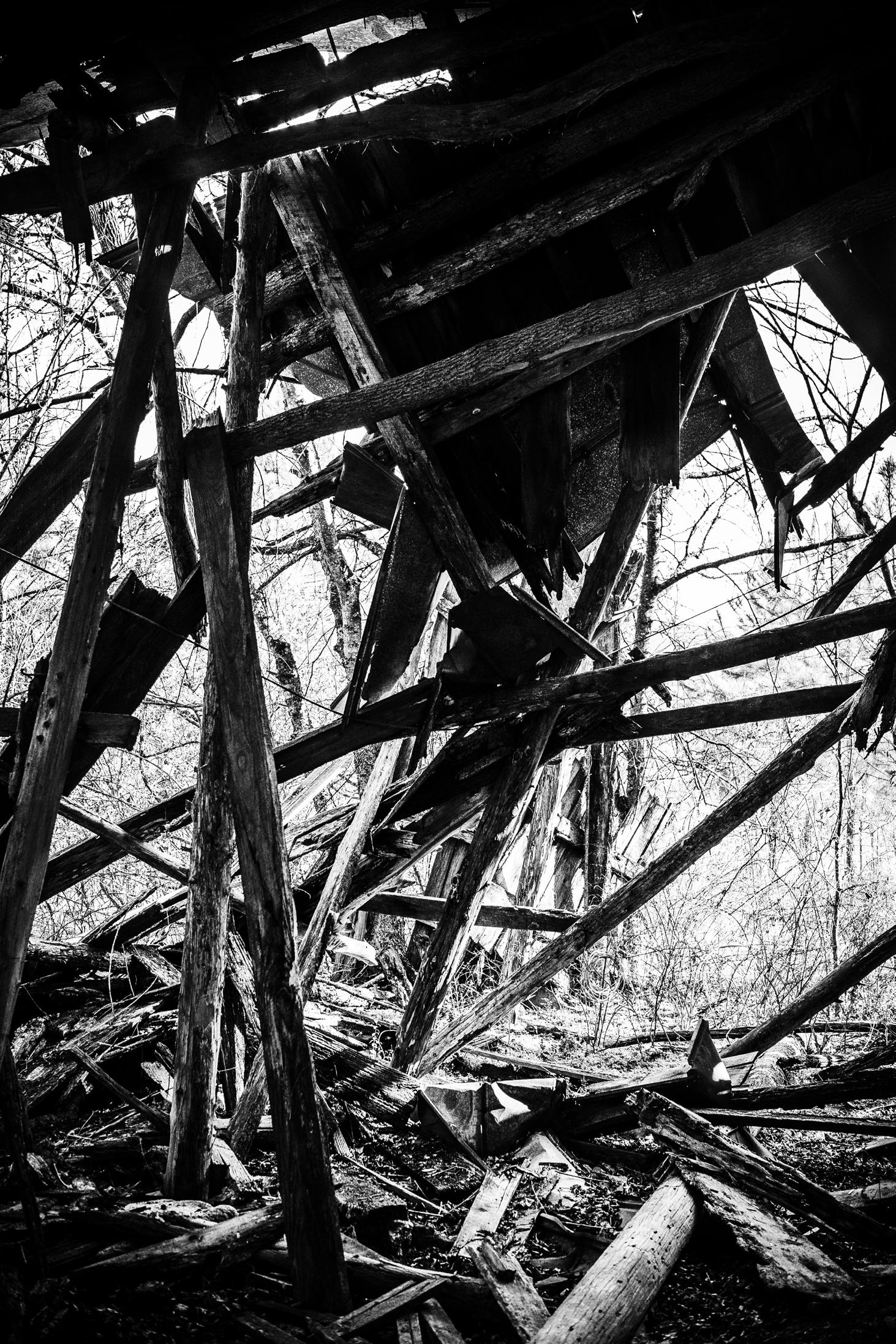
Fractured by Braden Potter
Who Shall Thee Look For?
by Shamori Thompson
One must seek out a friend to assist with a foe. To turn the tides of love and war for their home. Where their people work and room to roam, Living in peace never causes such a woe.
Wings above the peaceful sight, Lies a trouble like no other that shatters comprehension. One that grows and shrouds cities with blunder and tension. One that leads its victims to a dark light.
Yet, one must know who to seek out, In order to have assistance with such a scrimmage. One must understand that to seek one of such image, They must not hold themselves to doubt.
So, traveler, who shall thee look for?
Before the battle becomes a bloody war?
What’s at the Top
by Rebekah Jent
You grab onto the sharp rock, ignoring the bite of the stone into your chalked hands. Your chest aches, and your legs tremble as you rest. You begin to pull yourself up. The piece breaks in your hand and falls to the ground. You watch as it crashes down. Plink. Your breath hitches in your throat. The bottom is so far. Much farther than when you began. Is it only twenty-five feet tall? That should be nothing to you. You’re used to thirty and above, but that was indoor and not outdoor. Why did you decide to do this?
You’re not ready for this. Maybe you won’t ever be ready. Let go of the rock, you think to yourself. You need rest, and you can’t finish this.
Just as you are about to give up, familiar voices fill the air. Your friends! You forgot about them at the moment. You can do this! You’re so close! We’re so proud of you! Their shouting forces you to look up. Through the glare of the sun, you see them waiting for you. Not just waiting but hoping you will succeed. You catch their encouraging smiles and coaxing hand motions. You can do this. For them and for yourself.
You grip a new piece and test its strength. It will hold. You can do this. You pull yourself up above. Your arms scream in pain, but you can’t give up now. The rope holding you shifts by the movement. Your foot slips off the ledge. You stumble to hold on. It catches on a stone below your waist. You’re trapped until you move. You glance up. Three moves left. You breathe, even as your hands sweat and your body shakes. You can do this.
Your right hand rubs against the stone, looking for an edge. It locks around one right below the top of the hillside. You can almost touch your friends. Their shouts of encouragement win against the growing rush of wind in your ears. You’re so close to the end. You can do this.
Fighting against your natural judgment, you push your body upward. Your other leg finds a cranny large enough for your foot to step on. One more move, and you can grab the outstretched hands of your friends. This is the end. Starting over is not an option. Not when you’re this close.
Slick with sweat, your hand loses its grip on the ledge. You’re going to fall. You catch yourself at the last moment, crying out in relief. You must not fall. The rocks protrude out more here than at the bottom. Most people don’t make it all the way up. You’re special. You’re different. You can do this.
This motivates you for the final push. Your other hand stretches forward. You can almost latch on to your friend’s hand. Push. Push. Your fingertips brush the open palm. Come on. You can do this. You strain your body just a little bit more. Almost.
There! Your friend grips your tired hand, and everyone pulls you up. You barely notice the jagged edges scratching through your clothes to your skin. You don’t care. You made it to the top.
Your friends embrace you in a tight group hug. You lean on them, completely exhausted. They let you go after a while, and you collapse on the ground. The harsh winds freeze your wet skin, while rocks stab your back and legs. Could we just stay here a little longer? You breathe.
Take your time. We’ll stay here however long you need. Your friends sit beside you.
Chapter ii
The Discomfort of Not Knowing
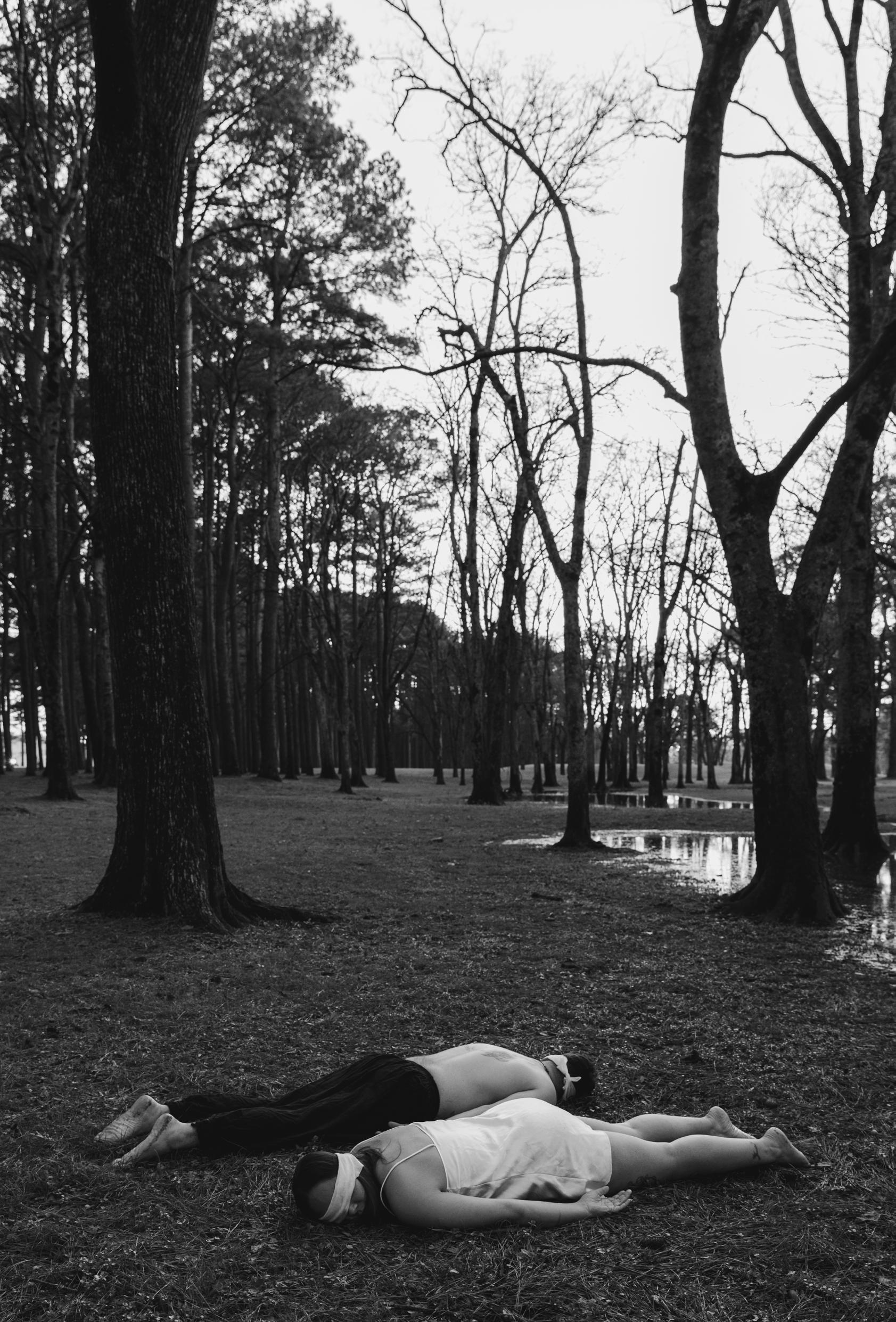
Sightless Reverie by Kaitilyn Jacobs
Cast of the Dice
by John Stevens
I reached to touch his shoulder,
A hastily made pencil sketch of a man.
A picture sat on the ledge by the window;
Handsome, dress blues, WWII, I guess.
Dark wavy hair and a broad smile,
Now, the disappearing shadow of the man lies before me.
His wife sat at the bedside chair leaning
To catch every breath
As if a lover’s kiss.
A worn Bible on her lap
Mementos of their love
Marking out the passages.
His dimming eyes shifted away from her
As I touched his shoulder.
A once muscular arm struggled to reach out
And stroke my forearm.
I glanced up at the IV fluids running into tired veins.
He mouthed incomprehensible words.
My hand on top of his.
The skin paper-thin and torn.
A
plumber?
A devoted father?
A leader of his community?
Inconsequential at this moment.
Tears welled in his wife’s eyes
Revealing an odd combination of denial and acceptance.
Emotions shaken
Like the toss of dice
Cast a lifetime ago
With numbers now revealed.
eurydice
by Dylan Keffer
my dearest, I have not forgotten you I grieve at the mere thought of you everything reminds me of you the sun’s warmth mimics your body’s heat pressed against mine and sparkling gems try their best to capture the beauty of your light emerald eyes yet, they cannot do it justice nothing could ever compare to you, my dear
I wait for the sweet sting of death to finally see you once again to hold you and never let go my dearest without you, this world could never be home
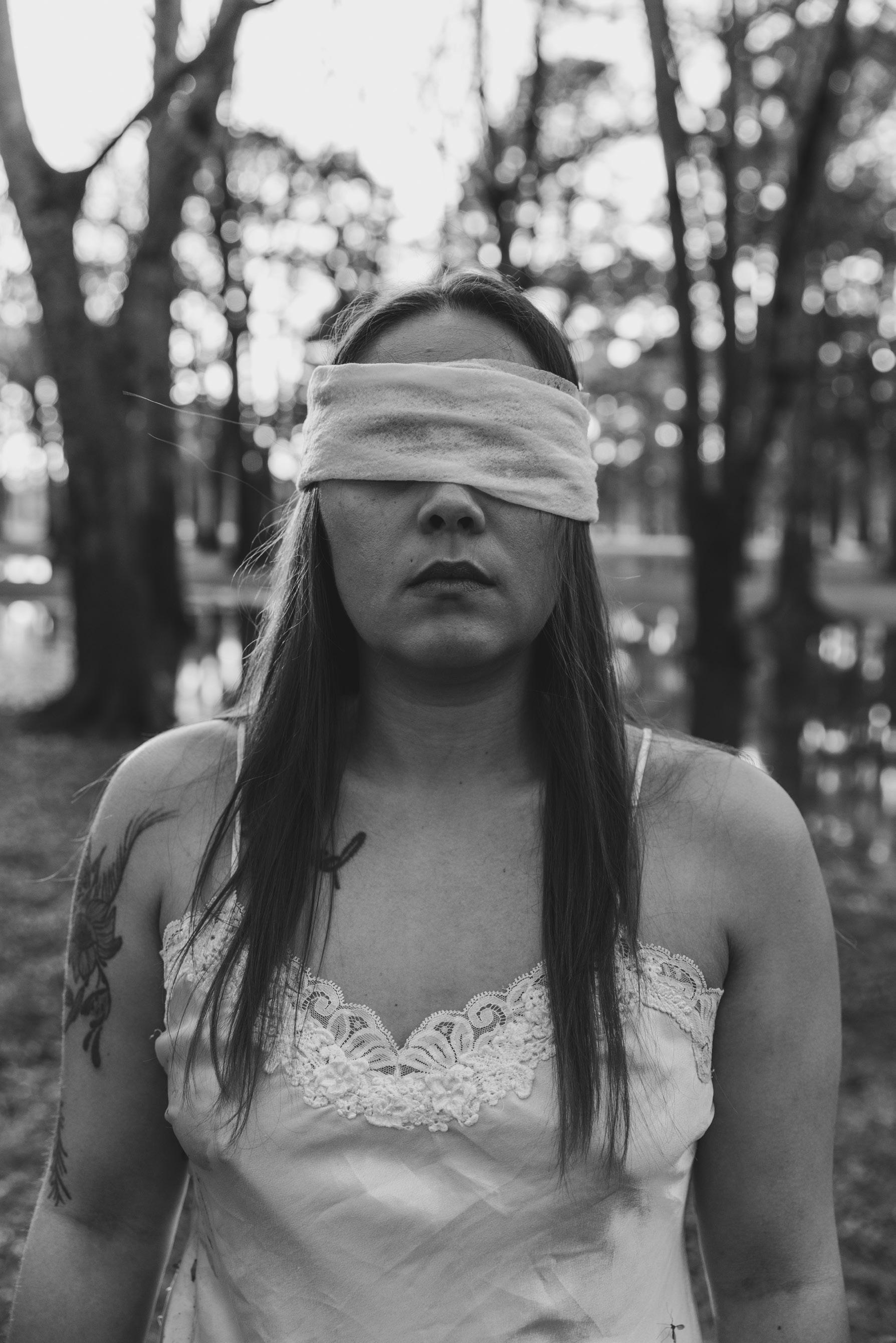
Veiled Perception by Kaitilyn Jacobs
Galaxies in Everyday Still Life
by Charles Michelson
I
Maybe every drop
Is a tear
But it holds within it
The stardust DNA of the Ancestors
Which have become infinitely Beautiful now
II
Days of you have slowly faded by
As though it is coming into clarity
A more well-rendered picture in the Darkroom
With the arm around me
Its moment burned like a flat iron
III
Coltrane is playing his sax
And I look out a window with tint
Of aqua and gray as water runs down
Catching up with earth
But oh, your whispers still fill the room
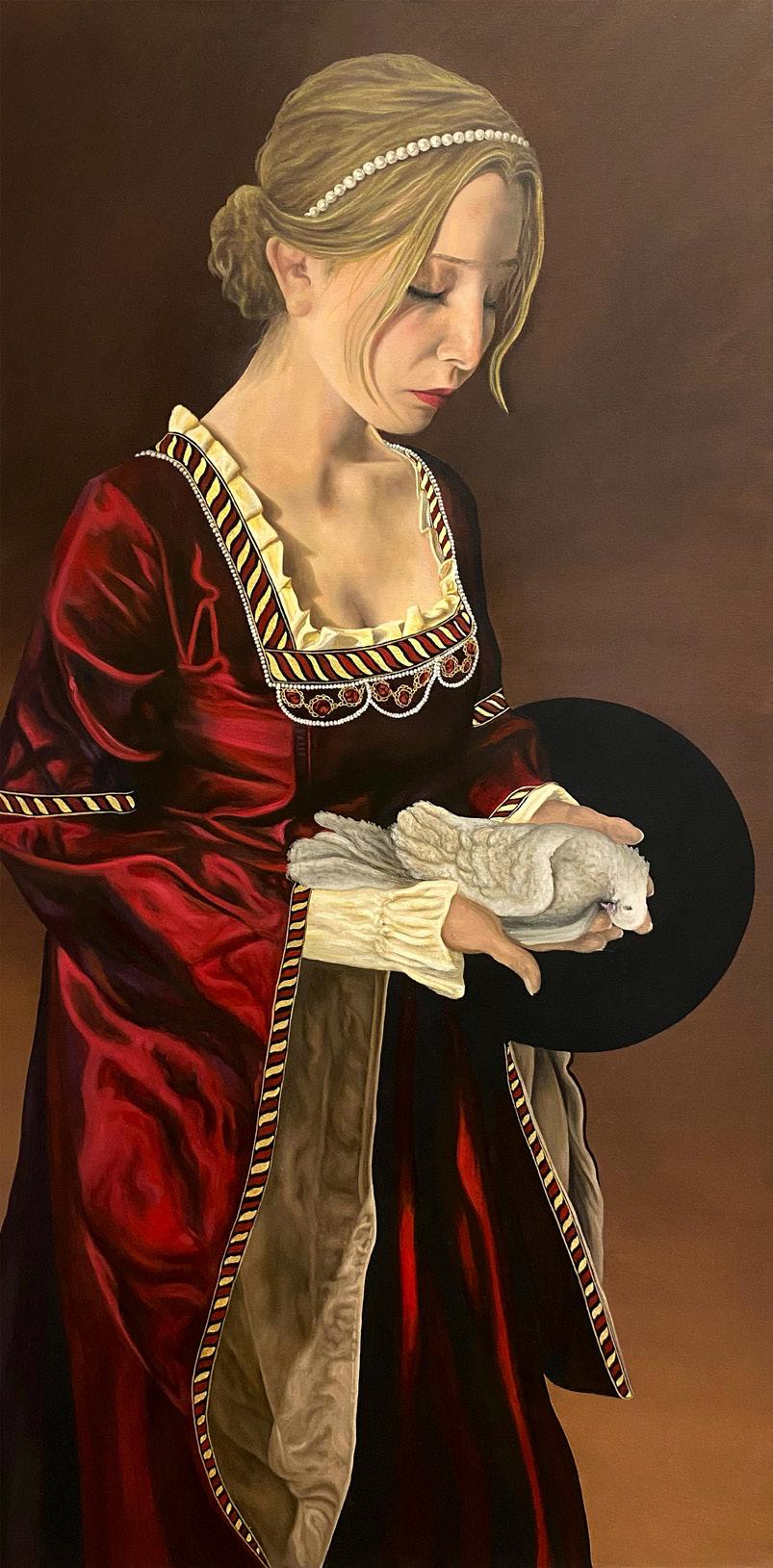
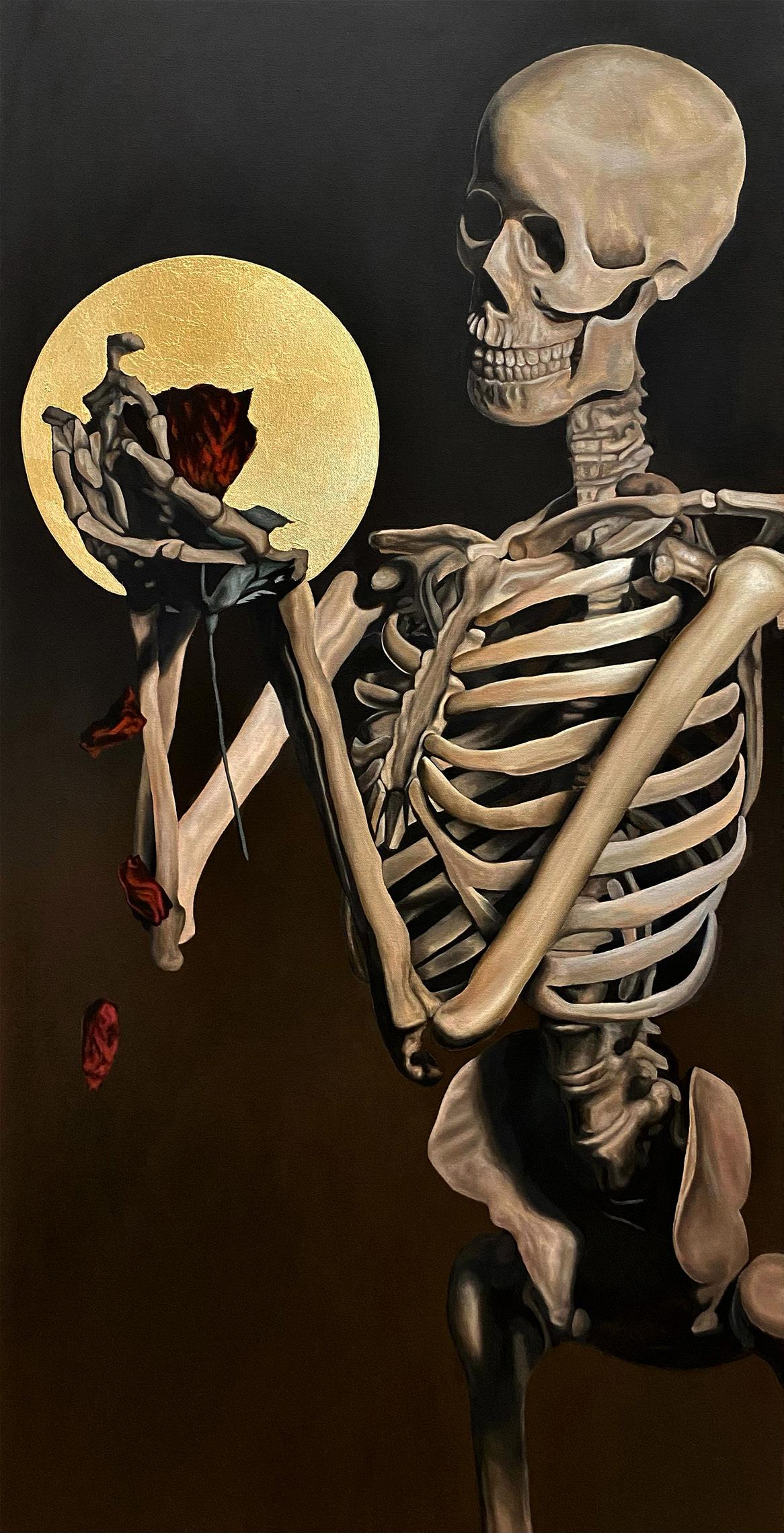
To Be Mortal by Lacey Gross
Goatee
by Natalie Franks
Don’t trust men with goatees.
I have heard it recently from the movie The Invitation, And it has been alluded to in poetry. There is something oddly foreboding about a man who wears a goatee with pride.
But,
What about before they grow the goatee? He didn’t have a goatee when we were younger. We were children.
But, He was old enough to know. I was 4, My sister was 6, I believe he was 10, But he could have been younger, Older than us, though.
Maybe I’m wrong. Maybe he didn’t know better.
But, The things we had to do felt wrong to me.
I was only 4.
Our family acts like it didn’t happen. Did it?
Do they know?
I don’t know anymore.
I constantly double-checked with my sister to ensure it wasn’t my imagination.
I’m angry.
He didn’t have a goatee then, But he grew one.
I still stay away from him,
Even though that was years ago. He hasn’t done anything since we moved away.
But still,
I don’t trust men with goatees.
Rekindling
by Dylan Keffer
the pastor looks into my fifteen-year-old eyes and prays as his hand touches my forehead. church. extend your hands to pray for this man who God is telling me that he will lead nations to the light of your kingdom. favor and blessings. let him be baptized and renewed in your Holy Spirit. do not let him waver but let him walk the straight and narrow path as you intended. glory to glory. this young man has a fire within him that cannot be quenched. the double portion of Elisha is upon him. Lord, we thank you for what you are doing for your people! and we thank you for this young man’s life! amen.
I sit and reflect years later. if only the wick of my candle would still burn as it did in my youth. I used to be excited about going to church, but now I oversleep because of work. the stress of life is so overwhelming that it hurts. depression is knocking at my door and God is quiet. He is still and I am questioning if He really is real. it is hard to light a candle when the weight of wax is hiding the spark of rekindling. the weight of all of this. pastor, where did I go wrong? what did I miss?
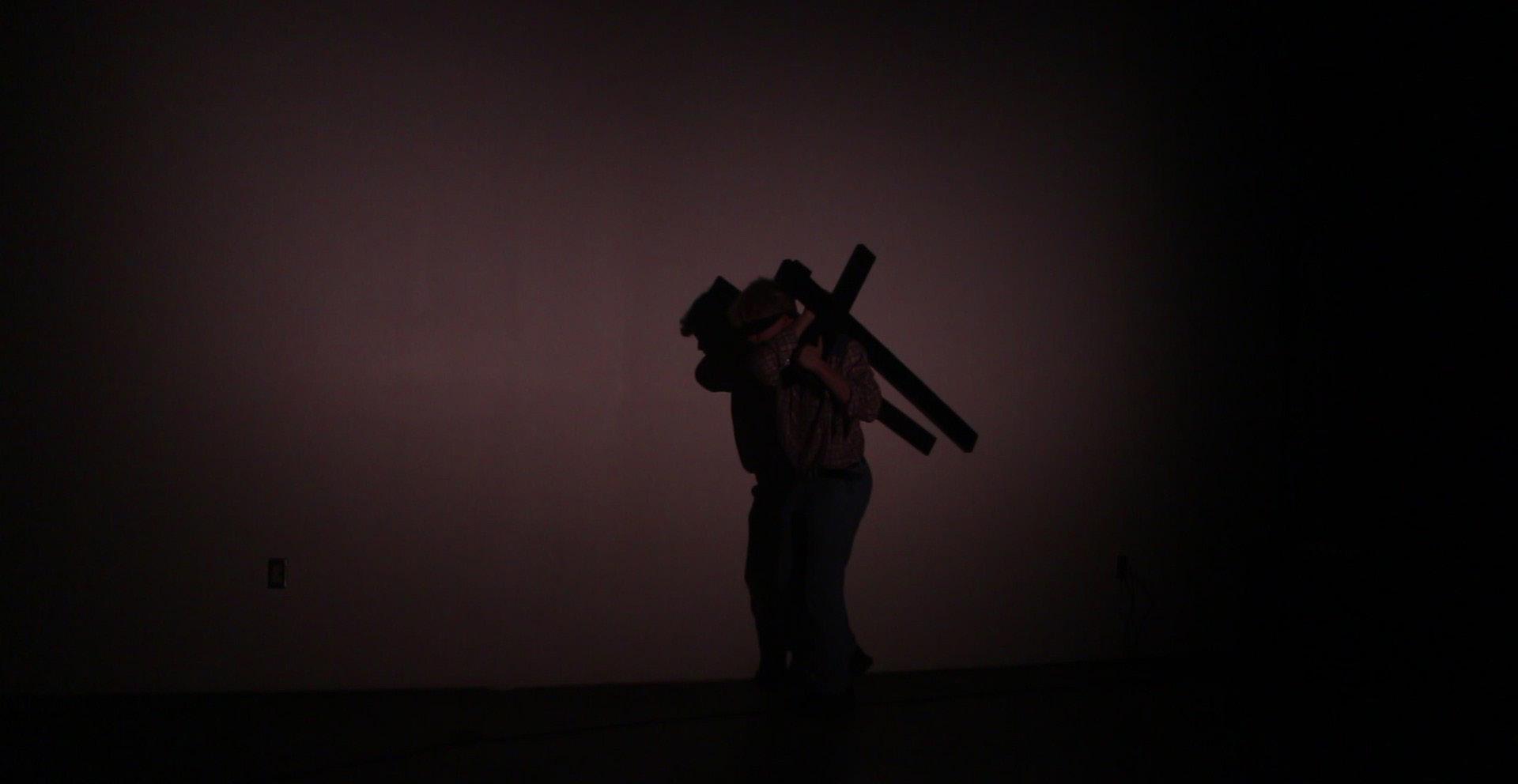
Almost Cut My Hair by Brandon Underwood
Dirt of Decay
by Jason Armstrong
The rolling hills surrounding the house now sprout trees and weeds instead of the previous century’s acres upon acres of fertile crops that fed both the plantation itself as well as the community around it. Behind a few groups of messy, unkempt bushes, one can barely make out the creaky, wrap-around porch lurking behind, slumping and peeling away from the house in a few areas. You might not expect Georgia high school legend and former All-American wide receiver, Charles ‘Speedy Cholly’ Jones, to be sitting in the dimly lit family room, looking out crusty, dirt-caked windows, drowning his sorrows in Wild Turkey. Cholly’s lifted ¾-ton diesel truck sits at the head of the long driveway, next to the rundown family house. Although the truck’s paint faded years ago, the engine runs far better than the new ones coming off the assembly line. Those four oversized tires form the base of Cholly’s own welding business, his latest career path since finishing college. This job and the derelict property around him are his only meaningful possessions, as his family has been gone for a few years now. The small inheritance was barely enough for him to cover the final semester of school.
This land has been in the Jones family for longer than even his parents could remember. Sitting on his father’s lap while he rode the tractor and mowed the endless rows or running through the acres— probably where he developed the speed that brought him his own little taste of gridiron fame—until his feet blistered, and climbing through, in, around, and over the various buildings and rusty pieces of equipment, this former Yellow Jacket does feel somewhat tied to this ground, regardless of its current state.
Cholly drinks a good bit more whiskey these days. Though he remains at the homestead, the only home he has ever known, he has more or less given up on making a go of the adjacent farm and is torn over selling his family acreage altogether, especially now that his entire family has all passed, and putting that money down to buy a new place closer to Atlanta for a corporate job, versus keeping his old place and struggling to get by.
Bourbon and brunettes are his only real weaknesses, the former is much less costly than the latter if you were to ask him, but it is only after a few shots that he can muster the courage to log into the dating apps he otherwise shuns when level-headed. Swallowing a few doses of liquid courage, Cholly swipes left and right and eventually settles on a sophisticated-looking blonde named Janice. 5’10’’, smallframed glasses, a former Division 1 volleyball player with a Masters in social work. He sends her a message and, not realizing her icon is green, is surprised by her quick reply. She lives in an ATL suburb and invites him out to a bar halfway between them.
One more shot for the road and Cholly heads out, not bothering to lock up the old house. Climbing up into his truck, he is pleasantly surprised by the handful of light-colored pheasants taking off from his lawn as he cranks up the loud turbocharged diesel. He heads down the driveway and leaves town on his way to the hastily scheduled date, taking the beautiful birds as a good omen for the night ahead.
Passing under the trees that connect overhead, his radio turns up on a country tune, he is a few miles down the country road when he sees Miss Molly on the roadside and pulls over. Although it will put him behind schedule, what are neighbors for? She has broken down on the side of the old country road and is struggling to fix her rig. Cholly peeks under her hood and realizes she is not going anywhere without first replacing the broken belt. Fortunately for her, she already dropped off all her horses and their big gooseneck back at her ranch before heading back out, so Cholly agrees to tow her old dually to his garage with his own truck and to swing by the parts store on their way
there.
Once they hitch up Molly’s truck, they turn around and head down the road. Cholly thought she might be interested in his recent find and told her first about tilling up an old musket action a few weeks back. When she shows no surprise, he goes on to tell her he is considering selling his old place, but Miss Molly is again not surprised.
“There is a lot more than that old gun part buried across that land of yours,” she says, “and you are not the first Jones to try and rid yourself of the property.”
She continues, starting in on the sordid history of the property from the late 1700s through the early 1900s, beginning with slaves working the originally rock-strewn fields, continuing through a pair of brutal, bloody Civil War battles. When she finally gets through her tales, culminated by her saying there were more than a few disappearances over the years, he was even more shocked to hear about the appearances, corpses, and partial bodily refuse being disgorged from the earth, seemingly being excreted by the past into the present. She mentions there are even rumors that the sinkholes on his property are rumored to connect to the North Wolf Island Harbor, a seaport that previously hosted slave ships, but that has since become a large modern seaport bustling with international trade activity; it stands just a handful of miles or so away from this very spot.
Miss Molly takes a deep breath as they pull past the faded wooden fence and continue past the freshly mowed half-acre of lawn leading up to the dilapidated two-story house.
“It has been years since I last saw this place. Can’t say as I approve of the lack of upkeep,” she advises.
The house itself is in dire need of paint, shutters dangling from the sides of the windows, half of which are broken or missing altogether. Out past the house, decaying carts, really nothing more than rusted axles and frames mixed with a few pieces of rotten wood, failed animal pens, and a long-collapsed slave quarters, show some of the history of
the place if one were inclined to look, including its time where his ancestors made a go of running the back plots for a few decades during and immediately after Reconstruction.
Pulling into the barn, he stops the truck, hops out, and nods at the back porch, where Miss Molly heads up to the back porch and flops onto the old couch. It only takes about twenty minutes to swap the belt, start the truck, and then ensure the battery is properly charging. Miss Molly is over his shoulder as he unclips the jumper cables. She thanks him, smiles, and proffers up a twenty-dollar bill, which he promptly refuses before she climbs into her cab, backs the truck out, and heads down the long driveway.
Dripping sweat from working in the sweltering barn, Cholly washes up and pops a top on a fresh beer. It is now pretty late, so he texts Janice, apologizing that he will not be able to make the trip after all. Instead, he grabs a pair of cold spare beers and then climbs up onto his old tractor next to the barn and sets them into his ‘custom’ two-cup cup holder. He starts up the reliable old diesel engine of his late-50s tractor. Its faded red paint always reminds him of his father, who died at just age 42, when Cholly was only 14 years old. His father collapsed after working one too many 14-hour days on this farm. He puts along, out past the well-worn path and among the overgrown crop rows. A handful of sinkholes dot the perimeter of the property, most of them on the country paths now overgrown with weeds. The property goes on for quite a ways, the back couple of acres ringing a murky pond, its depths covering maybe a quarter-acre in total area.
An hour later, he winds up at the old swamp in the back, where he grabs his old cane pole that has been cached in the same spot since he was five, tosses it out and cracks the top on his last beer, then sits down on a flat oak stump, kicking his feet up on a chunk of firewood. The pond is isolated and has an infrequent stream of foul-smelling bubbles, likely sulfurous in nature and byproducts of decades of sloughed pine needles mixed with agricultural run-off. A dark red clay rim forms its banks; nothing seems to have happened here in quite some time—oth-
er than regiments of mosquitoes living and dying.
Tucking his jacket behind his head and enjoying the last of his final beer, Cholly’s eyes start to close as he stares at the red eyes of a large possum eyeing him from across the opposite shore of the pond, maybe 50-60 yards away. He dreams of a new life in a new city with a new girlfriend, his old life far behind, but is instead awakened by a half-dozen squawking crows.
He slowly rises from his slumber and goes to head home, but, in the dark, trips on his way to the parked tractor. Looking down, he sees the twilight sparkling off the white of an adult skull, a fist-sized hole disturbing its back half. Stumbling back, he gains his composure, heads back to his tractor, and mashes its accelerator until he reaches the safety of his house. He calls Miss Molly first thing in the morning. After telling her that he found something strange out by the pond yesterday, she advises him that the library will have a bit more information. Cholly grabs his keys and heads off, stopping only for fuel and take-out on his way out.
After a day spent sifting through old library records, Cholly has learned that human remains seem to bubble onto the red clay bank every decade or two going back at least a century, where the local library’s records seem to end. He also learns more about the nearby harbor and its network of tunnels. These tunnels may or may not connect to his own plot of land, sufficiently piquing his interest, such that he heads back out to his truck and drives the few miles down the road to visit the harbor, where he immediately sees foreign cargo ships now flooding into the same ports occupied by slave ships a century and a half prior, their imported goods trucked across the long-since pavedover auction blocks.
The massive docks welcoming these ships are surrounded by considerably thick concrete walls, but out a few hundred yards beyond the wall boundaries, just before the channel opens up and starts giving rise to the jetties defining the end of the harbor, you can still see the muddy banks of the original port. There are a few small holes in these
banks, each not much larger than the size of a tortoise den, where folks used to sneak and smuggle through the underground passageways beneath. Though most of these tunnels have collapsed, the holes still visible are clearly marked with permanent ‘Stay Out’ signs, their steel posts mounted in concrete, for whatever purpose these signs might serve.
A state-of-the-art recreational park sports safe, kid-friendly playgrounds with padded equipment and cushioned bounce pits has replaced the horrific site from a century ago, where kidnapped people were once auctioned to the highest bidder. The holding pens were replaced by a series of businesses, most recently an ice cream stand offering dozens of different flavors. There are many roads heading inland from the seaport into the great state of Georgia, many of them multi-lane highways, but the oldest path now appears as only a pair of parallel deer trails. Though wagons carved the path a long time ago, only the ATVers prevent Mother Nature from completely covering it back over. A small sign designates the historical marker, which is located about twenty yards into the little trail, and designates the location as the entrance to the ‘Great Port of North Wolf Island,’ once the largest seaport in Georgia.
Cholly looks down at the sign and walks a few yards down the path. Looking further into the trail, he sees overgrowth, lots of red clay, and a few gigantic puddles, indicating it is likely swampland and therefore probably full of mosquitoes. Peering down into the closest puddle, Cholly sees the water is murky and the soil around it dark and sticky. Looking closer, he finds a chipmunk that did not make it out and apparently became something’s lunch.
“Enough adventure for a day, I have plenty of this nonsense at home,” he thinks before heading back to his truck.
Feeling a bit guilty for having missed their date the night before, he decides to seek forgiveness and calls Janice. He can tell from her voice that she is a bit disappointed at being blown off the night before. Cholly mentions helping his older neighbor, who was otherwise stranded, and quickly charms Janice into agreeing to meet up at
a local waterside bar twenty minutes away. Having been there many times during his playing days, he leverages its smaller-than-regulation volleyball net as a convenient hook to seal the deal.
Cholly drives his truck out of the harbor facility and merges onto the interstate. It is a smooth drive, at least as much as it can be for a crowded highway, and he pulls into a parking lot a half-hour later. After requesting an outside table from the hostess, he freshens up in the bathroom and grabs a beer while waiting for Janice to arrive. Ordering a second beer, he sees her car pulling into the lot in the open spot next to his truck and orders one for her as well.
Janice sees him sitting there on the balcony and walks up the steps, flashing him a big smile, and leans in for a hug. They sit down, order an appetizer, and start chatting, regaling each other with their respective day’s events. While Janice has been primarily focused on work and tells of the heart-breaking stories about foster kids, Cholly is drawn in by her giant heart. She seems to care for each of these kids as if they were her own. Feeling foolish, as his story suddenly seems far less important, he recounts his days working on the farm and seeing the harbor earlier in the day, though he leaves out the bit about the half-eaten chipmunk. Agreeing to split a large sampler platter, the next thirty minutes’ conversation makes the time disappear. It has been over a year since his last real relationship, and Cholly cannot seem to keep himself from staring into her gorgeous green eyes, dreading the minute the check ends their date. Their waiter appears and hovers over Janie’s shoulder just five minutes later. Cholly picks up their check and walks Janice out to their vehicles. Not anticipating the awkward goodbye with her, especially with them being parked side-by-side, Cholly is surprised when she leans in, kisses him warmly on the mouth, and then opens her own door and drives away, leaving him standing there wanting more.
Two dates on and Janice asks him about where he lives. She wants to see his place, so invites her over the next night. She pulls up the driveway and sees him sipping a beer on the porch. He offers her
one and after an hour of talking and drinking a few more beers each, she asks him to walk her around and show her the farm. They walk hand-in-hand for about a quarter mile before she has seen enough, the growing darkness and rustling in the bushes telling her it might be a good time to go. After they head back to the house, Janice mentions having to be up early for work, thanks him, and serves up a passionate kiss before heading over to her own truck.
Cholly wakes up at a reasonable hour the next morning and starts towing the mower deck around to knock down the highest weeds. After the lawn is finished, he starts repairing the shutters and finally adjusts the squeaky front door that had been torturing his ears for longer than he cares to admit. With Janice busy until the weekend, he plans to spend the next few days scraping, sawing, painting, and hammering whenever he is not out on a job. He is disappointed when she does not call or text him all night, but figures maybe she had something come up. When it continues through the next two days, he becomes concerned that she is not answering his calls or texts but, not knowing her friends or her address, tries to contact her through the dating app to no avail.
He eventually grows annoyed at Janice, figuring she probably moved on after seeing his crumbling house and rundown farm. He gives up on all the messages, texts, and calls and sends a final pleading email, hoping to hear back from her. His cute blonde has seemingly disappeared without notice. When it grows beyond a week without word from her, his hope finally fades away.
Without a date or any work scheduled, Cholly continues fixing up the house before he turns to the fields. He spends the next two weeks tilling, mowing, and cutting well into the twilight hours. It unfortunately seems that every issue mended results in a few new ones to fix. Like his father before him, Cholly continues to plod on, riding his tractor in long lines, back and forth across the near plots. When he finally gets these rows under control, he turns his efforts to the back plots. Straightening the house at night and in the early morning and
farming the rest of his waking hours, Cholly feels a renewed vigor he has not felt since his college days.
Working, then working, and working still more, he gives up on dating, at least for the short term, having grown disgusted over the last dating experience, and focuses only on the property. The house, though still spartan, has become quite livable and solid against the outside world, the near plots now looking presentable. Happy with his progress to date and with the fridge stocked full of groceries, Cholly takes the night off from his toils and pours himself a celebratory whiskey, the bourbon a solitary party to toast his progress. After a few bourbons, Cholly starts up his old tractor, climbs up, and begins meandering around the farm’s periphery. Deep in thought, he drives and drives until he sees the fuel gauge reading beneath a half-tank. Feeling the sudden urge to urinate, he pulls over at the pond and relieves himself next to an old live oak. He is suddenly overcome with exhaustion and feels drowsy, needing to sit down and rest for a minute.
Feeling himself falling, Cholly awakes submerged in mud. Blind, choking, and struggling for his feet, he paddles his legs and flails his arms until he bumps up against something solid. Gripping it with both hands, he finds that it is a thick tree root, which he uses to pull himself from the wet earth and slide onto firmer dirt. It is so tight that he cannot stand up, and he can barely crawl. Almost like being born, the red clay womb nearly drowned the life from him. Gaining his breath, Cholly clears the mud from his eyes and looks out to see darkness. It takes several minutes for his eyes to adjust to the near-blackness. Calling out for help, he is answered by his own garbled voice, trapped in an echo chamber of mud. The sour, damp air leads him to understand that he is underground.
Feeling his way along the walls, Cholly scoots and pulls and slides and eventually crawls. He works for several hours before coming into a larger opening, more of a main passageway. Standing up, he reaches all around and feels nothing but more mud. Dripping and slippery, Cholly shuffles along, pushing his body up to and then past
physical exhaustion. He passes out a few times and awakens each time with a start, then plods on even further. Cholly pushes through pain, exerting everything he has, and, just before passing again, he screams out, “Hello! Can anyone hear me?” but no answer comes.
Cholly falls against the wet clay wall, trying but failing to ward off sleep, and feels something solid by his hand. Pulling it out of the mud, he moves it around and looks at it for a few long seconds before realizing it is a human femur. Just before closing his eyes, he vows not to die in the tunnel like those before him.
Knowing he is gone, Miss Molly walks up to the door, calling out for anyone who might be inside; appearances matter after all. Glad for the sufficient silence, she proceeds back to the fields, slowly trekking through the rows. On and on she walks, going eventually on to the back lots and through the trees, onto banks of the pond. There, she looks down the bank and pleasantly smiles, happily observing the scene before her: claw marks tracing from the bank down to the edge of the pond, ten laser-straight lines in the sand, about the same width apart of the spacing between Cholly’s fingers. Twenty yards or so from the lines sits a partially decomposed female body, a wet line of dirty blonde hair trailing back toward the water’s edge, just another friendly gift from the pond. Beaming, Miss Molly scratches out the lines and nudges the body back into the water with her heeled boot. Satisfied with her work, she turns and heads back up the bank and begins her long walk back to the house. She makes her way up the steps and sits down on the same couch she had occupied just a week or two earlier and pours herself a tall glass of Cholly’s bourbon. Enjoying the burn, Miss Molly is thrilled that she can now inhabit the Jones’ land without interference, as Cholly was taking far too long for her liking. She lifts her glass and nods toward the old swamp, “A toast to you, Cholly. The place does not look too bad, but I am glad to be home, back where we belong.” The sun sets, and the whole moon shines bright, its light decaying in the pond’s waters.
At the same time, and just a few yards beneath, Cholly opens
his reddened eyes and struggles ahead, pushing through the mud and slowly but surely moving toward the source of the light.
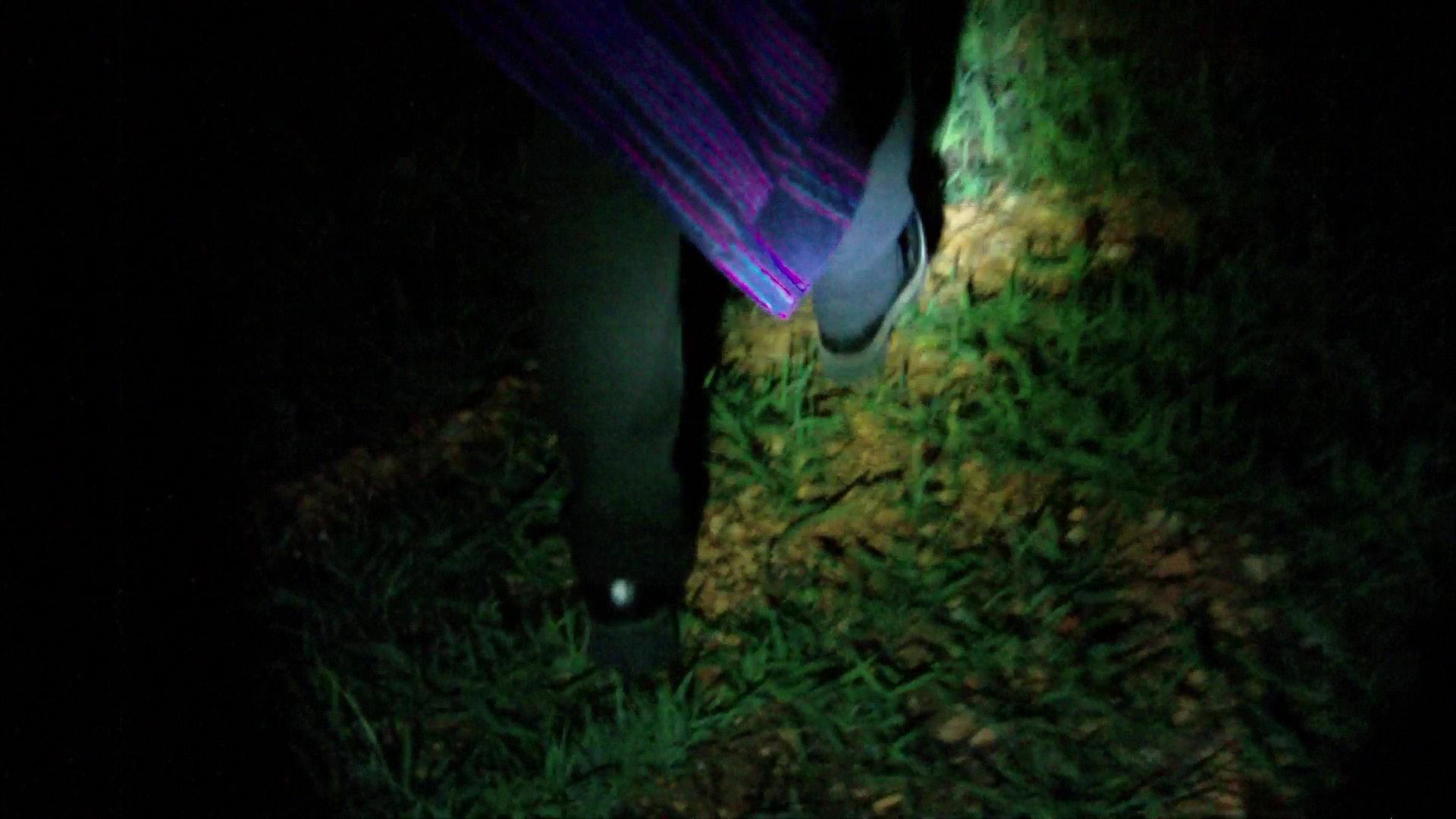
Menace Explores His Surroundings by Brandon Underwood
The Wanderer
by Toxey Chance
My name doesn’t matter
I’d forgotten it after so long
Years spent wandering
Searching for a place to belong
Going from here to there
Riding the rails
Never staying long
Always hoping
That one day
I’d finally belong
Yet
As the years wear on
As I travel alone
I fear I’ll always be on my own
But as the years drag on
As I grow old and start to gray
As the seasons wear on
I will carry on
Always looking For a place to belong
Where I’ll never be alone
A place where I’ll belong
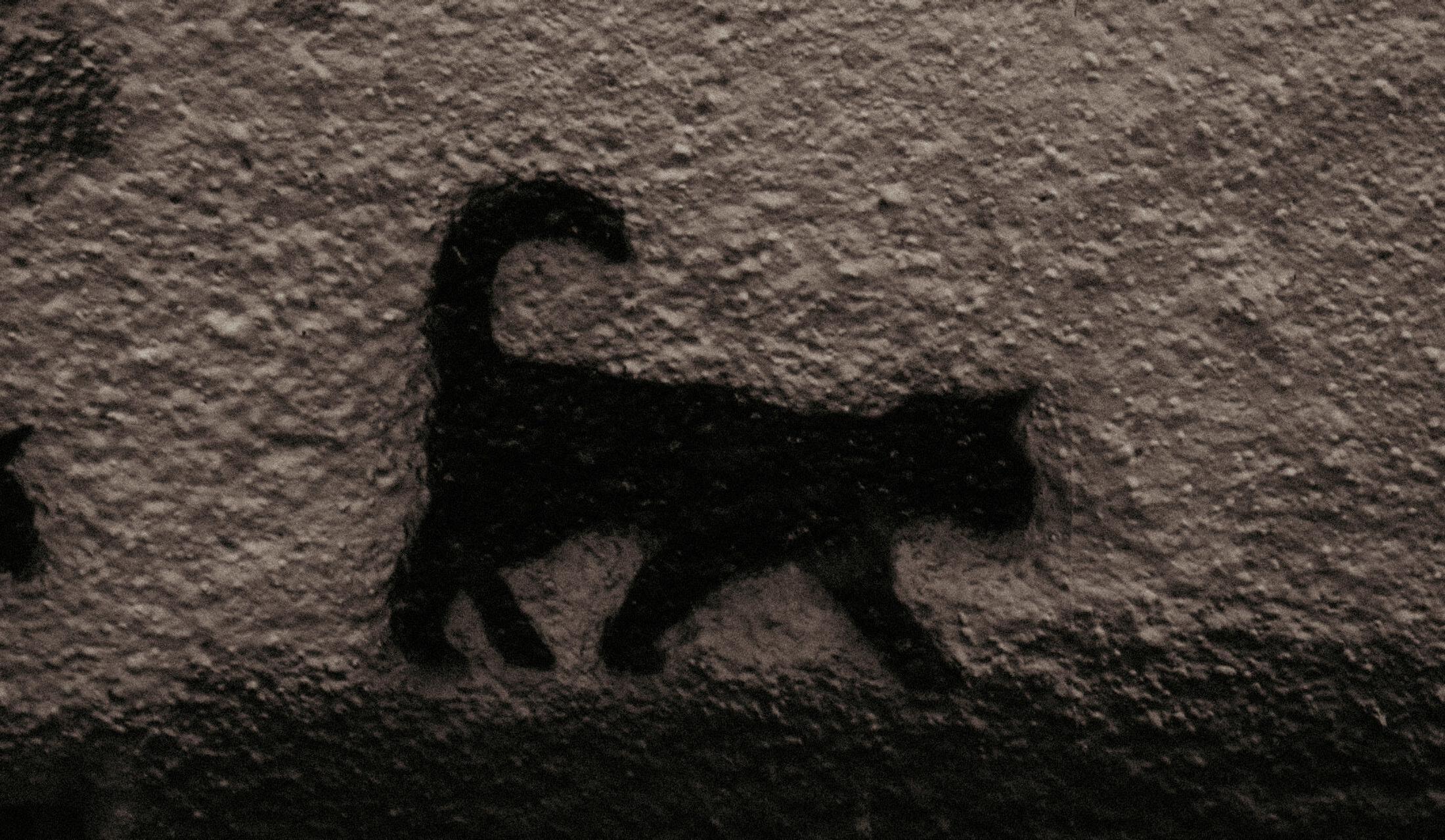
Superstition by Kaitilyn Jacobs
Salt Six Feet Under
by Mark Smith
I stand with one foot between the devil and a brutal grave
Drunk on blackberry moonshine with feet dangling off the cliff edge
I feel smaller than a pebble thrown into the grey sea foam
I feel tired, torn, weary, worn...
The harsh waves slam against the rock as winds increase even more
Everything feels cold as the chilly gusts sting my face and hands
Feeling sharp, stinging like her hands
Dark clouds conceal the angry sky
I consider diving, down into the depths below
Deep into the midst of the saline sea, pure instant peace
From this height, the water would hit like concrete
It would all be over
I will die in the darkness, the icy abyss below
I hear my mother’s voice; she is calling me back home
But I wonder as the thunder cracks and the storm builds
If this cliff is safer than my mother’s embrace
When can I close my eyes and rest?
When can I feel the calm of the fall?
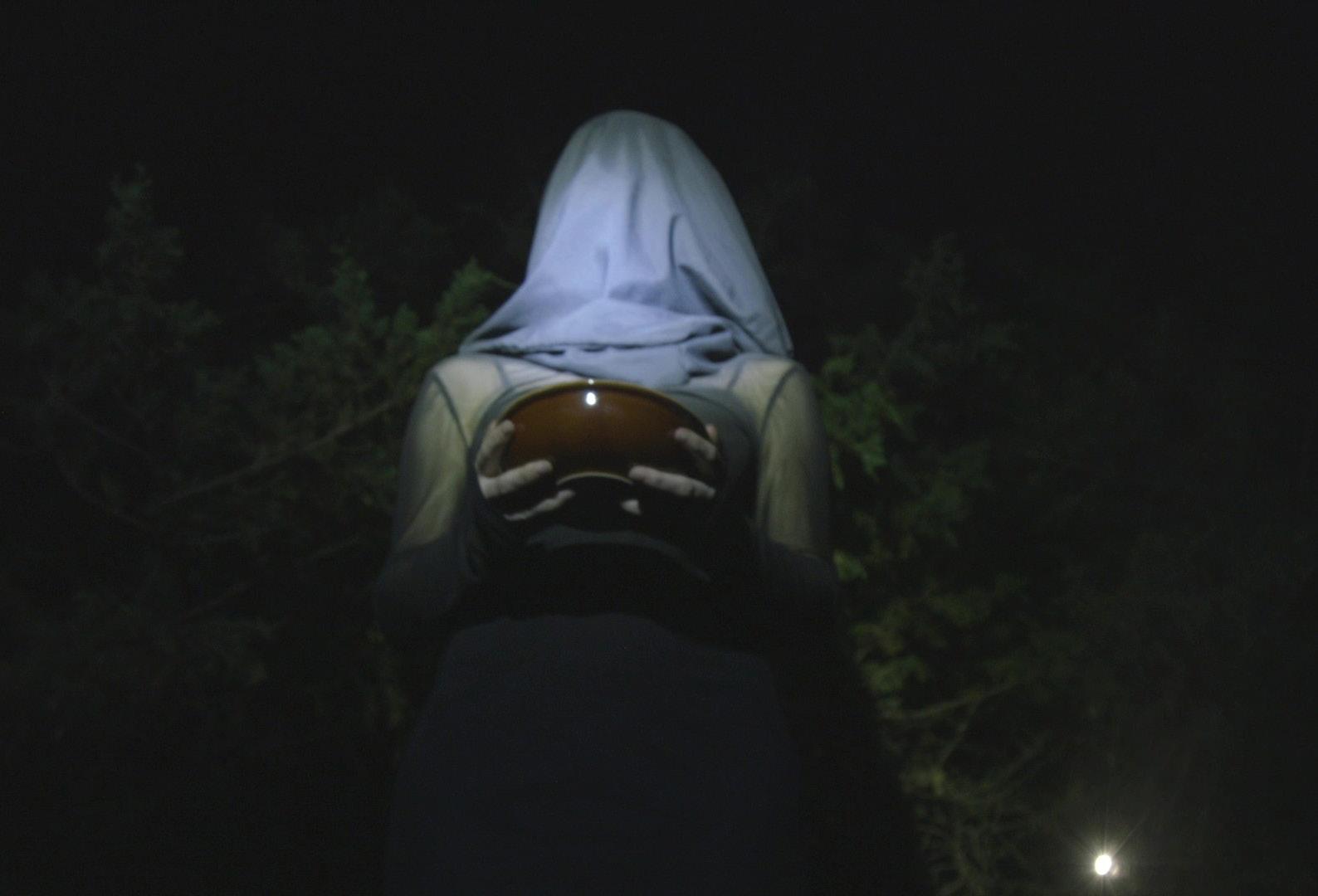
Bowl from My Kitchen by Brandon Underwood
The Storm
by Leah Littrell
The storm is coming. The sky darkens as the wind howls. The man is chopping wood for the fire. It’s getting colder, so his hands are burning with each swing of the axe. His back starts to ache as he lifts the axe over his head and slams it back down into the wood. He’s running out of time. He picks up the next piece of wood and puts it on the block. Sweat starts to bead on his eyebrows, then runs down his face as he swings. His legs ache as he bends over and picks up another piece of wood. He swings the axe once again over his head and into the wood. He feels a sharp pain in his hand. He looks down, grabs the splinter, and pulls it out. He wipes the blood on his pants and picks up another piece of wood. Hopefully, he’ll soon have enough to keep him warm. A few more pieces, and he can relax. His body burns as he cuts through these last pieces. As the last slice of wood hits the ground, his shoulders slump in relief. One task is done. He moves to the next project required for his survival. His weary legs ache as he bends over to pick up the wood. If only he had gotten a new wheelbarrow when he had the chance. The red one propped against the side of his shed won’t do with the rusted-out hole in the middle. If only he had prepared better. He quickly cuts off this line of thinking. Now is not the time for regrets. Now is the time for action. He must keep moving if he wants to survive. He carries the wood armful at a time into his cabin. Worry creeps into his chest each time he steps back outside and sees the sky a little darker. After he carries the last pieces of wood into the house, the man jogs out to his shed to grab the brown canvas tarp, along with nails and a hammer. He must cover as much of his cabin as he can. If only
he had patched these holes in the summer. No! No regrets. Only steps forward. Pinning the tarp against the cracked frame of his window, he starts pounding at the nail stuck in the wood. Over and over again, he swings. The wind beats against his back as the tarp is thrown wildly in the wind. When he feels the first snowflake on his skin, he knows that he has run out of time. The man slams the last nail into the wood and retreats into the house just as the barrage of icy snow hits the front door. Lighting his lantern, he looks around at his meager belongings and prays that he has enough food and supplies to keep him alive. It has to be enough. The storm is here.
Pg. 63
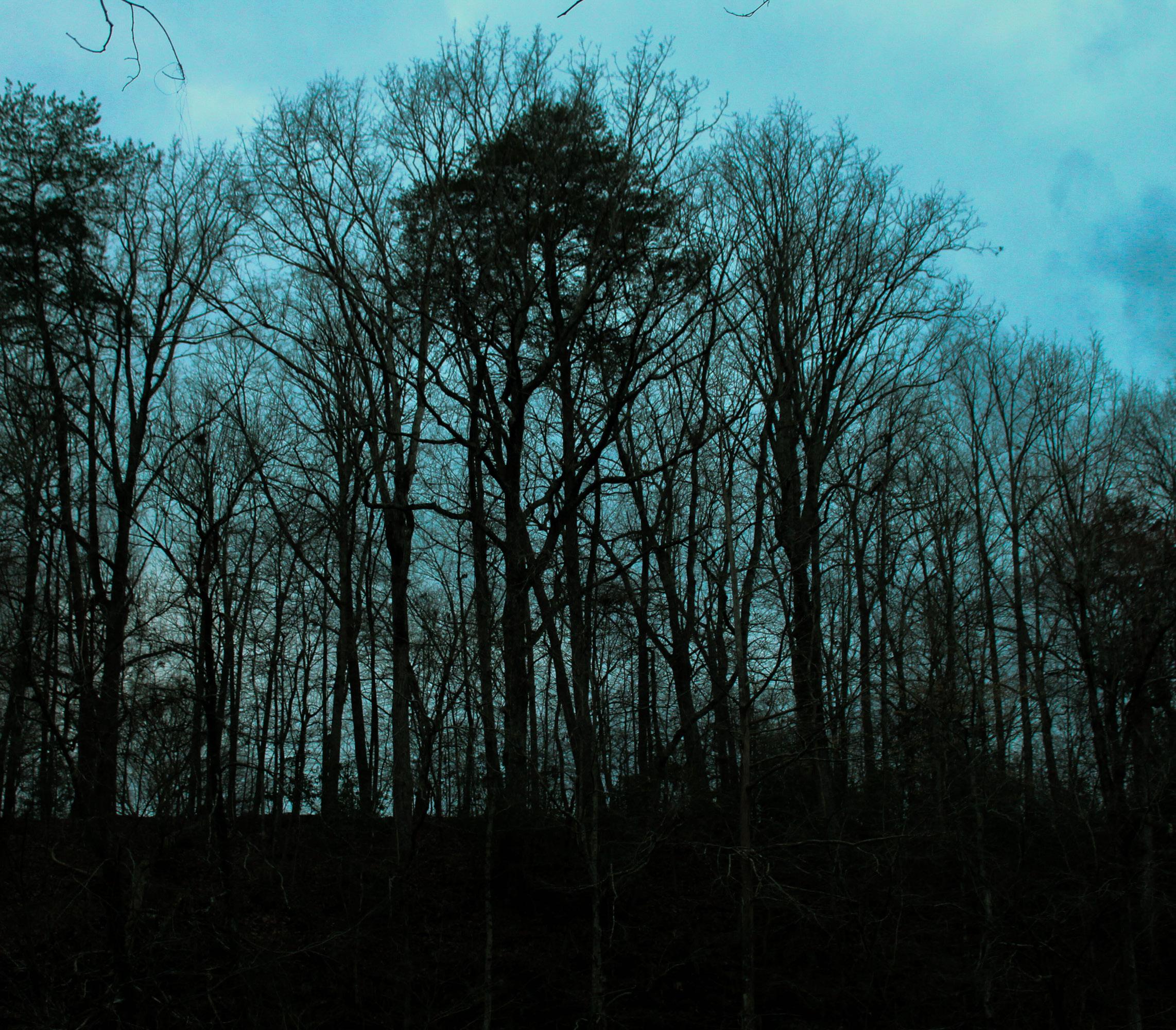
Forest in a Storm by Eli Rainey
L&S Spotlight
Poet Ashley Massey

Ashley Massey is a fourth-generation cattle farmer managing a small herd and land in beautiful Middle Tennessee, an entrepreneur with a successful indie jewelry brand offered online and in retail stores nationally and internationally, and a poet with publications in Beyond Words Magazine, Untelling Magazine, and The Red Branch Review. She is also the founder of a menstrual equity organization. She has worked as an instructor in the University of North Alabama’s Restorative Justice program held at Limestone Correctional Facility. She has additionally taught a correspondence course to men on Alabama’s Death Row. Her academic research focuses on carceral representations in Southern literature. She is a published writer and has volunteered teaching creative writing in a Tennessee county jail. She is a graduate of the University of North Alabama (M.A. English: American Literature, B.A. English: Literature) and the former Critical Prison Studies graduate assistant.
Interview
What was your biggest influence to put this poetry collection together?
I see writing poetry as a way to keep memory. This book is essentially a scrapbook of many familial as well as personal memories distilled into poems. Besides memory keeping, this collection also serves as a way to write to and through death and to turn harms into poems. This book was developed during a time of experiencing intense grief as my father suddenly passed away in 2021, a year when so many others were also facing immense loss. In the year following my father’s death, I also experienced the deaths of other family members, close friends, and pets. The losses plagued me, and I spent the next two years in survival mode, constantly feeling anxious about whether or not the next phone call I would receive would be telling me someone else had passed. I thought that during that time I did not write at all, that I was purposely hiding from writing, afraid of what may be released. But as I began to organize some poems I had written in my early 20s, I found dozens of notes in my iPhone that I had jotted down during those initial months after my father passed. Those notes turned into new poems that greatly influenced my poetry collection, resulting in a work that shares not just the pain that comes from death, but the growth and resilience that comes after too.
What role do farm-related language and the idea of city vs. countryside play in your poetry?
I think about the duality of city vs. country quite often as I was raised in the country but quickly left for the city right after high school. After sev-
eral years of living away from home, I found myself visiting our family farm whenever I had a spare moment. I realized it was the place I was most myself, so I ended up moving back to the farm around the same time I transferred to UNA to finish my undergraduate degree. The poem “The Returning” deals with this theme of leaving for the city and then returning back home through the image of Canadian geese that return to our same muddy cow pond year after year. In returning to the earlier theme of memory keeping, in a way the language I use is also a way to collect and archive things I have heard and learned on the farm. I realize that farms are becoming scarcer by the day, with Tennessee in particular losing 10 acres of farmland every hour, which will amount to over a million acres lost by the year 2040. This book is my way of standing firm in preserving not just what I have heard and learned on the farm, but also the farm itself.
The three following poems are featured in Massey's collection "Keep the gate open."
Keep the gate open
by Ashley Massey
Time is swallowed whole by Death. He does not stop to chew.
When He came down our driveway, flanked by barbed-wire fences, He didn't stop to admire the porch you had just swept off.
Momma and me had to swim through the mud, had to get scraped and cut. We know what they don't. That the creek will still rise. While the town will still remain stagnant like a festering pond overcome with green scum.
But I am not from the town. I am from these forty acres. And I will keep the gate open like you told me to. I will keep the time. I will keep waiting on you.
About “Keep the gate open”
What is particular about “Keep the gate open” that made you title the book with that name and place it as the last poem?
When given the opportunity, I like to share about my reasoning for not capitalizing the title, even though I am usually a stickler for those type of things. I purposely did not capitalize the full title because I see it as not an end but a continuation, much like how I choose to see my father’s death as not an ending but a continuation of his legacy and our memories of him. When I helped my dad on the farm, he would often need me to open the gate for him as he made his way on the tractor into a pasture. When he would say “keep the gate open” to me, it was usually followed by another request like, “keep the gate open and watch that the cows don’t get out.” There is almost an invisible ellipsis to the title, showing that death can catch us when things are not done, when we aren’t quite finished yet, when we have just swept the porch off, when we still have work to do…
Death is capitalized as a proper noun, why did you choose to personify it?
I think in a way by personifying Death it takes some of its power away, making it more like a person, maybe more understandable and maybe even more likely to be disempowered and defeated.
Can the metaphor of the gate being open refer to Death coming into the house to take someone to their forever “home?”
I think the meaning of the gates could definitely have multiple interpretations for the reader. It could mean Heaven’s gate, a prison gate, or an old rusty gate on a farm.
Rusting Here
by Ashley Massey
I want to melt down Iron City. Let the metal pour down the streets. Let it cover me. Let me rust there, by the train tracks. Let me be.
But that Iron City boy won't quit calling me. He likes that I haven't been rusted out in the rain, but I just haven't swallowed enough dirt yet.
I wonder how many other numbers he's got memorized, and if I'm the only one his eyes tell lies to.
I wonder if his thick, heavy voice will ever stop humming
in my head.
He says this town is killing him, when really, it's the booze. He says he loves me in the back of a stranger's truck, and I can't get enough.
But that was then, when fifteen and seventeen seemed like they had ten years between them, and it seemed like he wouldn't ever stop creeping back in like the kudzu.
About “Rusting Here”
The motif of rust and decay seems to symbolize the passage of time. Speaking from the present, is the speaker nostalgic, resentful, or a bit of both? I am curious about how the speaker will end up in relation to the city and the boy.
I think you are right to pair nostalgia also with a bit of resentment in this piece. I believe this piece really deals with feeling bad for someone who did not escape the negative influences, entrapments, and cyclical harms of their small town, but also feeling resentment that they tried to bring others with them into those cycles of harm. The metal/rust/decay imagery also definitely plays a part in this piece in thinking about the passage of time. I
believe this piece comes from wondering how a former partner may view a memory of a past relationship…has that memory been distorted by rust and decay? Or do they even recall the relationship at all?
How do the concepts of running out of time and being timeless battle in this poem?
There are some time jumps in this piece, with the speaker recalling memories and redefining those memories as a more seasoned adult, separated in both time and place from the southern, rural setting which previously held such a heavy, metallic grip on her. The lines “when fifteen and seventeen/seemed like they had ten years/between them” certainly speak to how when you are young, time seems to drag but also move so very quickly all at once. This is probably my most teenage angsty piece in the collection, and my hope is that the reader feels that angst, through the pacing of the poem and the constant back and forth through both time and southern spaces.
Is the city boy vs. country girl imagery a parallel to cityscapes and construction taking over farmland?
I could definitely see that as being something interesting to explore, and it certainly seems to creep in with symbols like kudzu which is an invasive plant known to pop up in places with recent construction/disturbances to the land. In this particular piece, the Iron City in the poem is an actual place on the Alabama/Tennessee line about thirty minutes from Florence. It is actually not really a city, but a very rural area. It was not always as rural though as there used to be a prominent railroad line there, and the place actually gets its name from an iron foundry that operated there in the 19th century. When I was growing up in Lawrence County, TN, there was a lot of wild stories about Iron City and how it was filled with lawlessness. There is even a film that was made about its reputation as a lawless place called Iron City Blues.
Little Rooster
by Ashley Massey
I buried my little rooster today and the cattle were silent, like they knew the smell of death and mourning.
They watched from the fence line as I covered his feathers in flowers and moved the dirt out of our way. Death is our familiar friend on the farm.
He moves with the coyotes, fighting the fog and the morning hunger. He creeps into the body alongside his friends: the parasites, bacteria, and diseases.
He watches with glee as you perform the back-breaking tasks that give life but slowly take yours: the feeding, hauling, scraping, worrying.
He's not a stranger but not welcome either. He took my little rooster and my dog and my cat and my friend and my Daddy. All in one year. And one day he will take me. But I won't go willingly.
About “Little Rooster”
What does the cattle’s silence represent from a human lens of grief and death? Especially when Death is presented as both a familiar friend and an unwelcomed presence.
I believe there are so many silences that surround grief, especially here in the South. People tend to overthink or not think enough about what to say when someone is grieving, sometimes only leaving silences in the place of showing more vocal and actionable care. It is difficult to know exactly the right thing to do or say when someone is experiencing grief, even though we are all familiar with death and loss. So, the cattle in this piece in a way reflect an audience to death and all the forms that audience can take: the funeral line visitors, the Facebook obituary readers, the thoughtful friend who sits with you as you cry, the cars that pull over for a funeral procession…all these silent participants to watching death and honoring loss.
The “feeding, hauling, scraping, worrying” tasks are performed by both the animals and humans of the farm, and they are presented as both life-giving and life-taking. Can a parallel to George Orwell’s Animal Farm be traced here? Whereas the book’s Farmer is Death and all the rest are the animals fated to labor?
I really appreciate that reading. It has been a while since I read Animal Farm and I do need to revisit it now as an adult, but certainly what is on my mind quite often is how to both care for animals while also using them as resources and sustenance. It is something I quite frankly really struggle with, especially as our animals grow older and I have to make decisions involving their care and whether to sell or keep them. These decisions are made even more difficult when coupled with grief as many of our older animals were also my dad’s. I think this piece in particular is also about the unequal balance of caretaking for others, whether it be animals or people, and how taking care of something or someone can result in taking away or losing something from ourselves.
Chapter iii
The Discomfort of Knowing

Flowers Coming Out of Your Head by Kaitilyn Jacobs
Ceaseless Cotillion
by John Stevens
The time went so quickly. Was it a waltz or ragtime stroke?
The orchestra played against my rage.
Horns, strings, reeds, and drums refused to yield to the stage.
And the tempo struck on driving the frenetic waltz.
We danced a scarecrow’s dance.
Ragged clothes and ragged limbs.
Bewildered bodies in palsied stance.
The maestro manipulated by an unyielding hand called a fiddler’s tune unrelenting. The dancer’s disorder cadence fraught fighting for rhyme and reason.
The creaking chorus line stumbled under seasons wrought.
So, age has brought us all a changeless lesson full of fury and reflexive reflection. The orchestra of life plays a relentless tune that never sounded so mellisonant as we waltzed ‘neath ceaseless season moon.
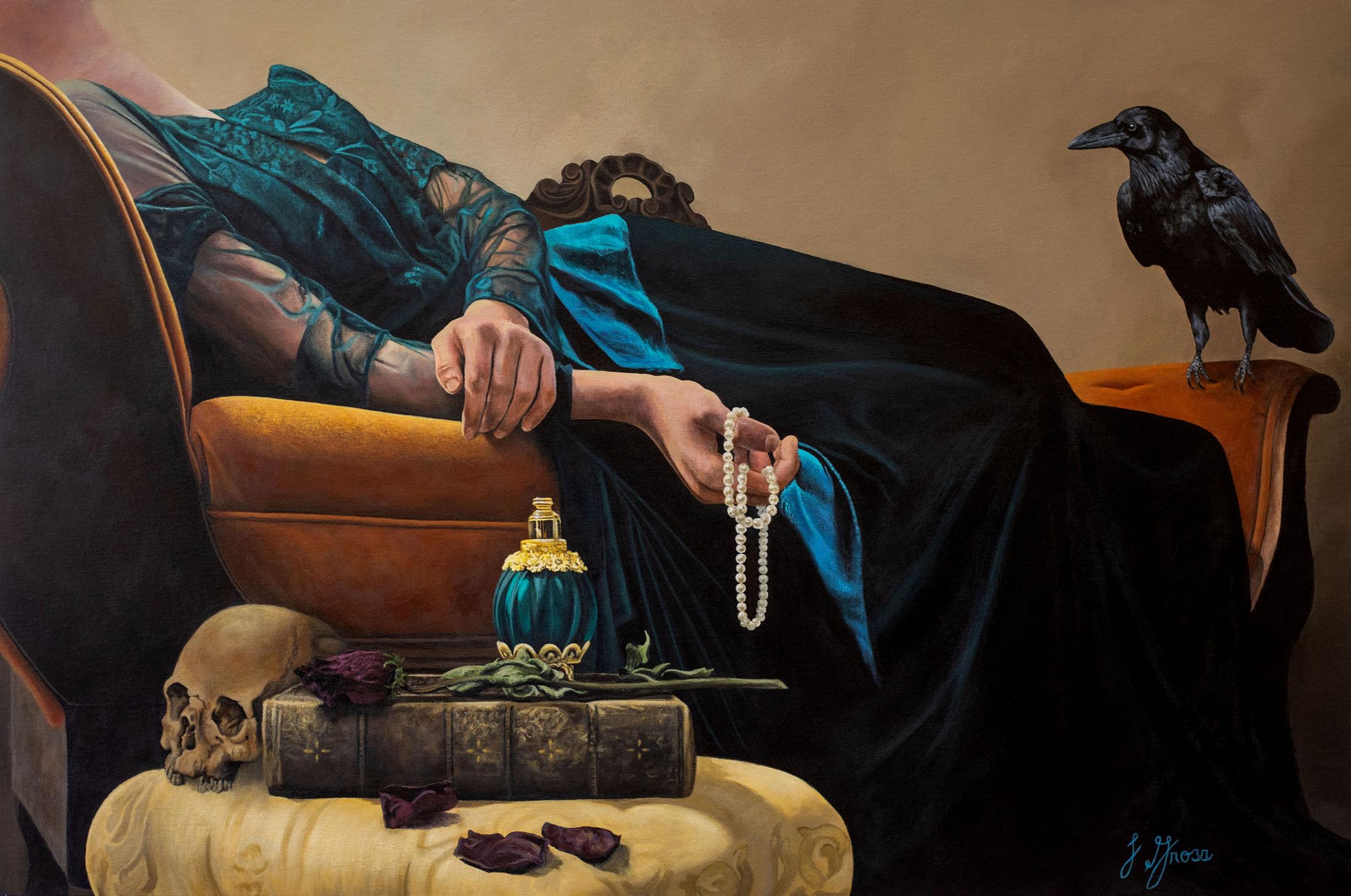
Memento Mori by Lacey Gross
Being from Memphis
by Averie Yeager
Memphis is a large city
That no one should pursue. It is no longer pretty Since all has gone askew.
The roads are riddled with holes While gangs roam the streets free. Police have zero control As safety is obsolete. Better not leave your car Alone in any one lot.
Someone will come with a bar
And steal all that you’ve got.
Memphis is a large city
That no one should pursue. It’s where they allow the guilty Walk free to torment you.
The Anti Philosophy by Brandon Underwood
Collin’s Light by Brandon Underwood
Staying Woke
by Eric Morris
The first time I heard Rage Against the Machine’s “Wake Up,” I was pissed. Like, big mad. I didn’t agree with it–any of it. And you have to remember, this was before the internet. That album wasn’t even on CD, at least not my copy; it was a cassette tape. So, you got this heavy metal band with a Mexican-American lead singer at a time when Rock n’ Roll is just finding its foothold again after whatever the fuck the Eighties were. And they’re talking hardcore shit about the American government, telling much different stories from what I’m learning in school, right? And it gets under my skin, like, who am I supposed to believe: my teachers and their textbooks, or the grungy guys with guitars and shit? But it sounded good, like, really good, and you just wanted to listen. And the more you listened, the more you realized that these guys were so passionate about what they were doing and saying, and then you thought, Is there something to this?
And, I don’t know, I was hooked. I put down my kiddie books and grabbed The Autobiography of Malcolm X and The Autobiography of Martin Luther King, Jr., and I stopped searching the newsstand for Nintendo Power and GamePro. Instead, I looked for Time and Newsweek. Bill Clinton took up most of the space in these magazines, having just won the election, and there was shit about the failure of Reaganomics, but what drew me in were these articles about the Gulf War, which was over but these writers were still going on about the defeated oil tycoon still in the White House and his self-interest in the Iraq-Kuwait conflict, and something started to change. Like, all this information I’m consuming, from my music to what I’m reading to what
I’m watching on TV, and it’s the first time I’ve witnessed true dissent. And it’s dissent toward our government, this monolith of an entity that I’m supposed to love with all my heart, right? Don’t we say the fucking Pledge every day before school? Allegiance to the Republic, yeah?
And so it goes that I was caught, surrounded by the professed patriotism of the conservative movement (Republicans had been in the Executive seat since the day I was born), the re-emergence of the Democratic party from the ashes of the Carter presidency, and the grassroots protests of those who claimed to see beyond the veil of beneficence that our leaders so proclaimed with unfathomable pride. And I’m like, eleven years old, just confused as shit by these damn hard rock musicians who have a problem with their—with my—government. Don’t even fucking get me started on these goddamn rappers claiming the cops are bad. Cops are heroes, right? The only thing less credible than a bunch of guitar-playing reprobates is a group of drug-dealing gangsters claiming to be victims of the good guys. Yet, I couldn’t shake the fact that they were telling me what’s real.
But here’s the rub: no, my opinions didn’t change overnight. In some ways, they still haven’t. What did happen was that my eyes were opened to new thoughts and new experiences from different perspectives and different walks of life. And we’re all searching for the same thing—the truth. And the truth is that our government A) does some pretty fucked up shit, and B) covers it up like cats in a litter box because as much as they try to bury it, it’s still visible, and it still fucking stinks. This is seen in a macro sense in all the needless wars we’ve fought and their thousands upon thousands of casualties, in a for-profit prison system that maximizes sentences for non-violent minority offenders, and in the disparities created in our education system via the division of school zones along racial and financial lines. These issues are not controversial by lack of evidence; they are issues that are pretty well open to anyone who wants to look at them.
…Which brings me back to the music and back to “Wake Up.” The music is what helps us ask the big questions. Were Malcolm X and
Martin Luther King, Jr. assassinated because they “turned the power to the have-nots”? And are movements like Black Nationalism squelched because their leaders are systematically eliminated? I don’t know the answers, but the questions eerily seem to coincide with Ice Cube’s claim that he’s got it bad cuz he’s Brown—along with Rosa Parks, Sandra Bland, Tamir Rice, Eric Garner, Mike Brown, Trayvon Martin, George Floyd, and the list goes on. The larger point is, as Zack de la Rocha screams in the song and in the title, it is time for us to wake up and see that things are not flowery and beautiful among certain populations, and speaking out against that status quo has historically made martyrs of men and women.
The part that’s so damn simple in all this is that no one has to agree on everything; we don’t need a clear definition of “systemic racism,” or “equity,” or “privilege.” All we need to understand is that something is amiss in the neighborhood. That’s all. We just need to be awake, and we need to stay woke. The power has to remain with the have-nots because, in the hands of the wealthy and powerful, it has been turned and used against us—all of us, yes, but mostly minorities and women if we’re being honest—and we’ve been too busy fighting the warsthat they tell us to fight, with and against each other. When the have-nots are in power, shit like racism and homophobia and (hopefully) misogyny will disappear because they only exist as obstacles to unity, placed by those who have a platform to control the narrative.
This is what the music is telling us, whether Rage Against the Machine or NWA, Black Sabbath or Nas, from “Fuck tha Police” to “Rich Men North of Richmond,” and from “The Message” to “Try That in a Small Town,” the one trick that the powerful have is to divide those who, if unified, could easily take “the power” back. What “taking the power” means to me is something I mentioned at the beginning of this diatribe, and that thing is deciding where to place my trust. Why shouldn’t I place my trust in those guitar-playing reprobates and those goddamn rappers? Any one of them could have grown up on my block, far removed from the private school kids who grew up in the gated
communities and went on to become councilpersons, representatives, and senators.
That’s why this music is so easy to get. Because, deep down, away from my bias and my breeding, I know what they say is true, and I know their experiences are real because they are the same experiences that folks across the country are having, from police harassment and brutality to being silenced for questioning authority. I can relate to at least one of those things, and the music is how we come together and ensure that, once awake, we stay that way.
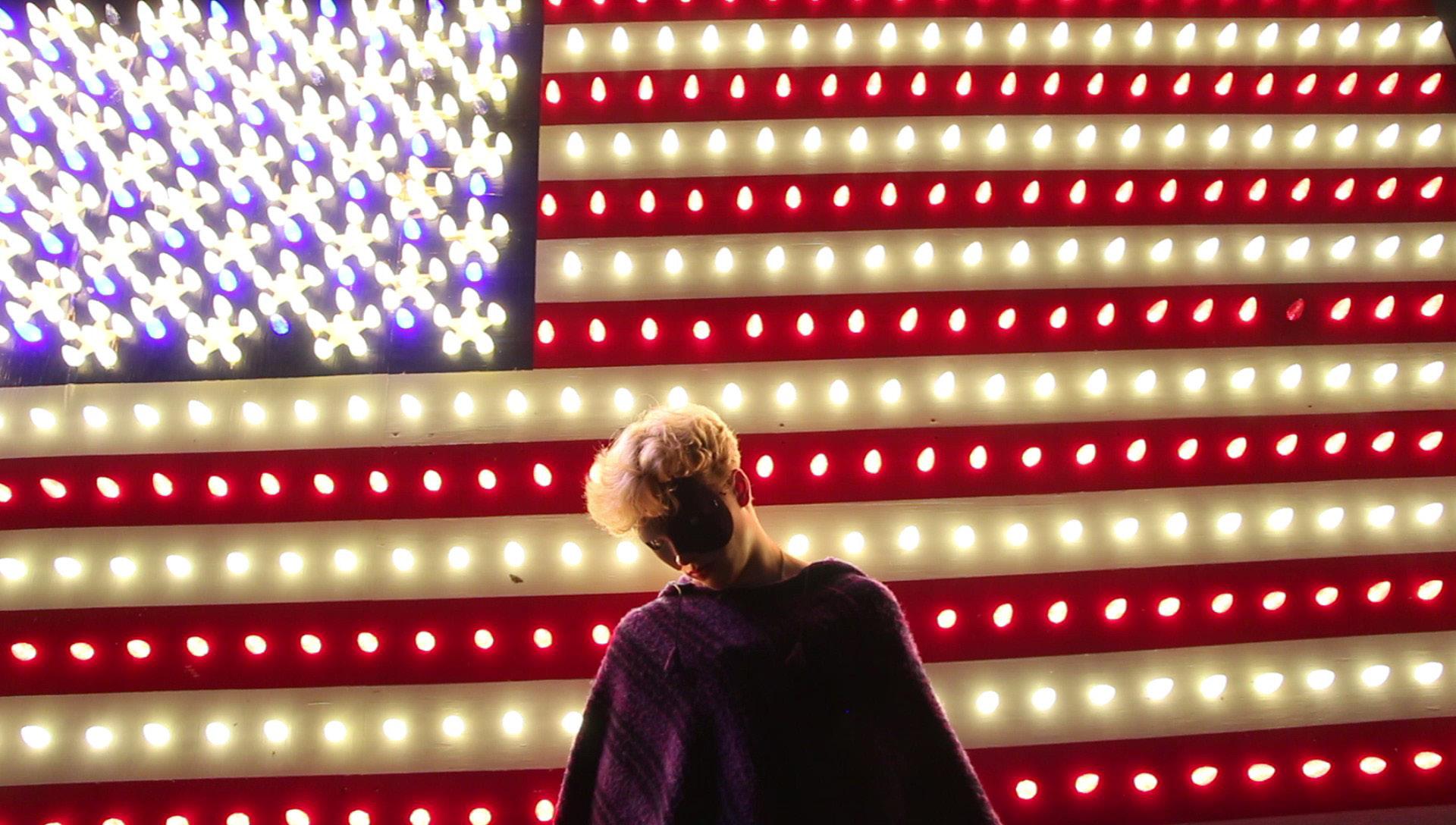
Return of the Purple Menace by Brandon Underwood
Cicadas Sing
by Adam Rausch
My knees are damp from the green creek.
My family is waiting beyond the garden.
County Road 41, I know where that leads.
Cicadas sing.
Pillars standing tall, despite the lightning.
I wonder if the house burnt twice is used to dying. There are rumors of a ghost-riddled bridge, burnt holes in the wood from all the kids.
Cicadas sing.
But there’s nothing left of the ghostly bridge.
The second floor of the house is through a ghostly stair. Cursed land—soaked with native blood, in silent reverence I sit and stare.
For the only things that sing around here are the damned cicadas and the singing river.
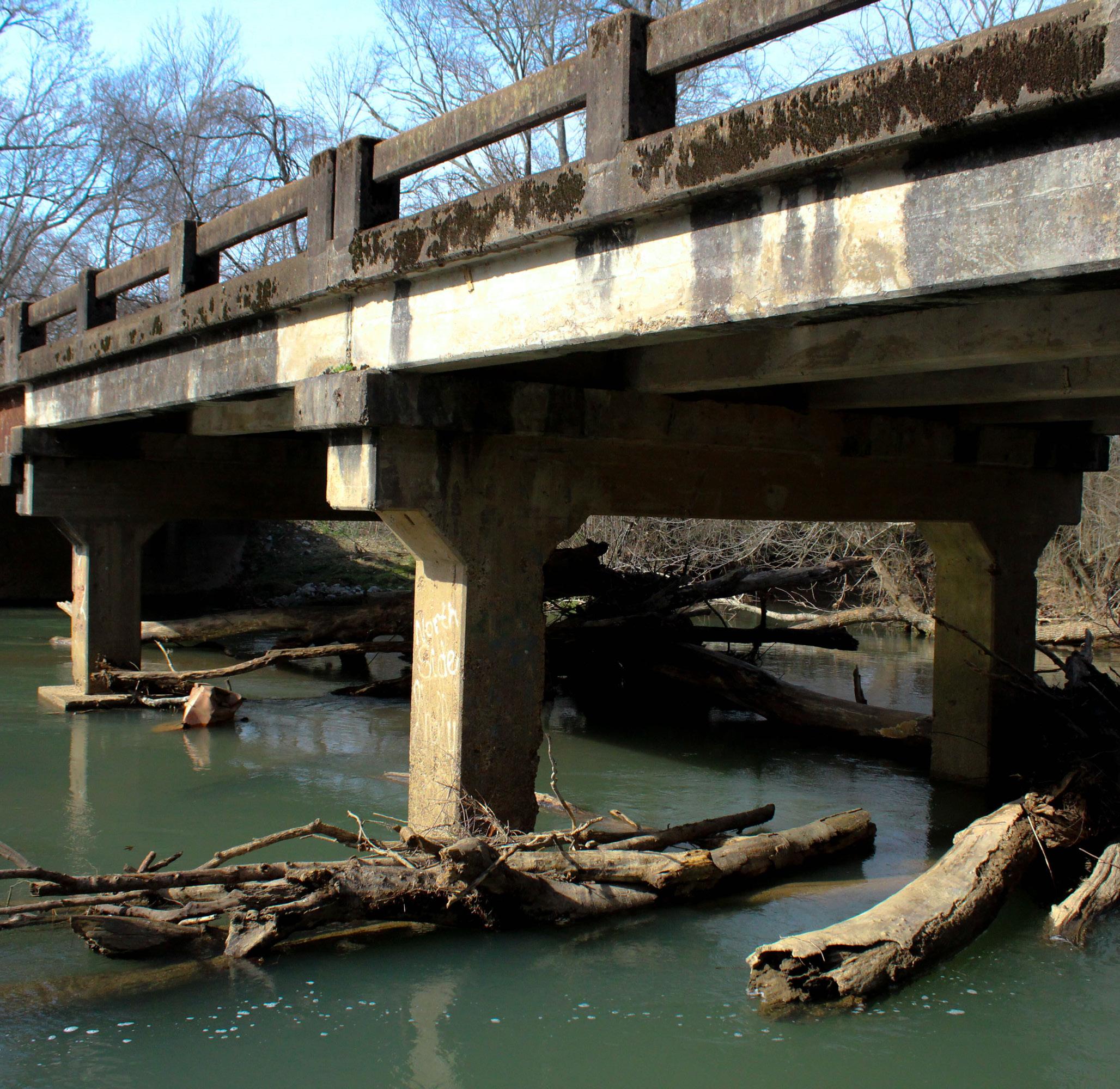
County Road 41 by Eli Rainey
Clinging
by My’Chyl Purr
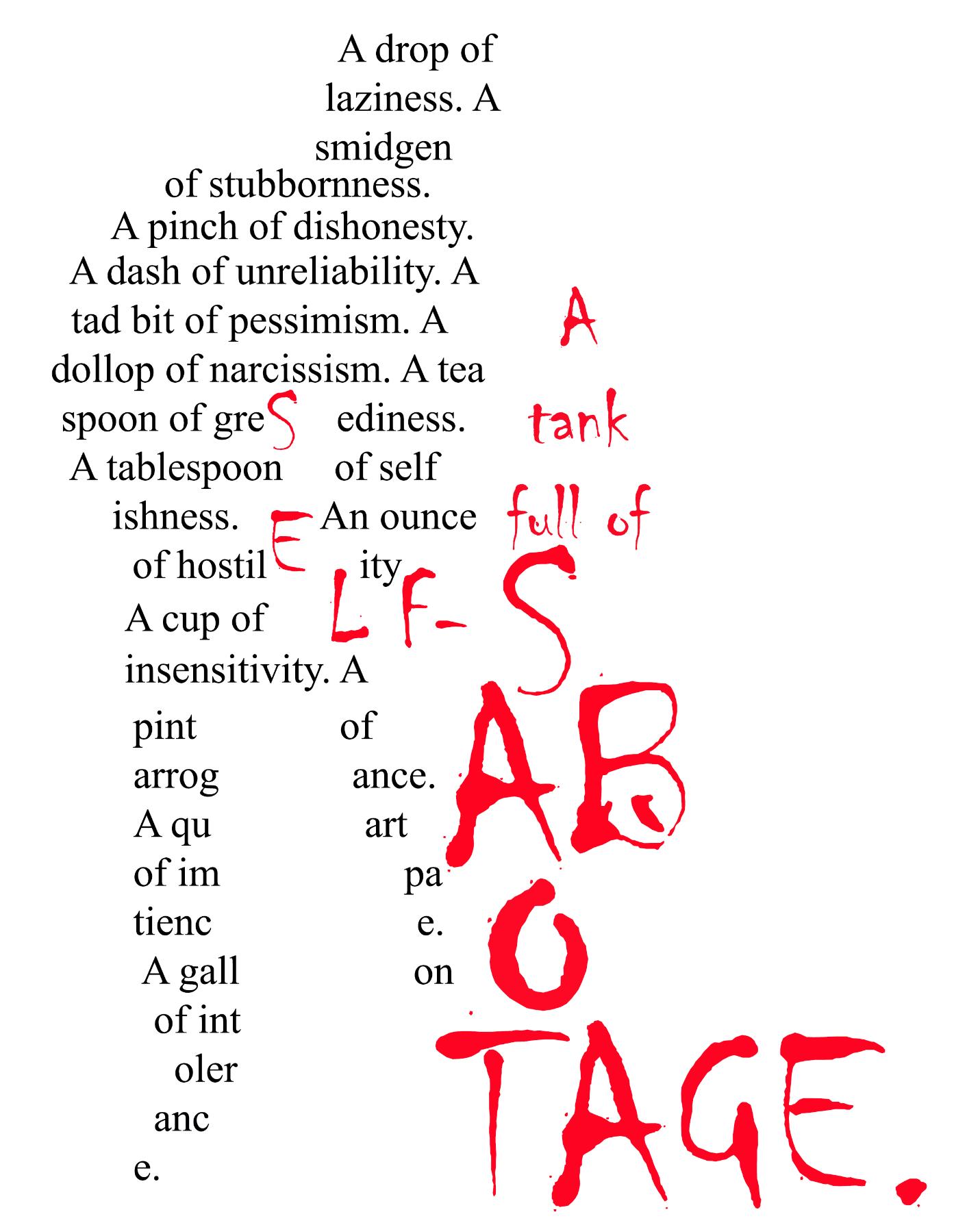
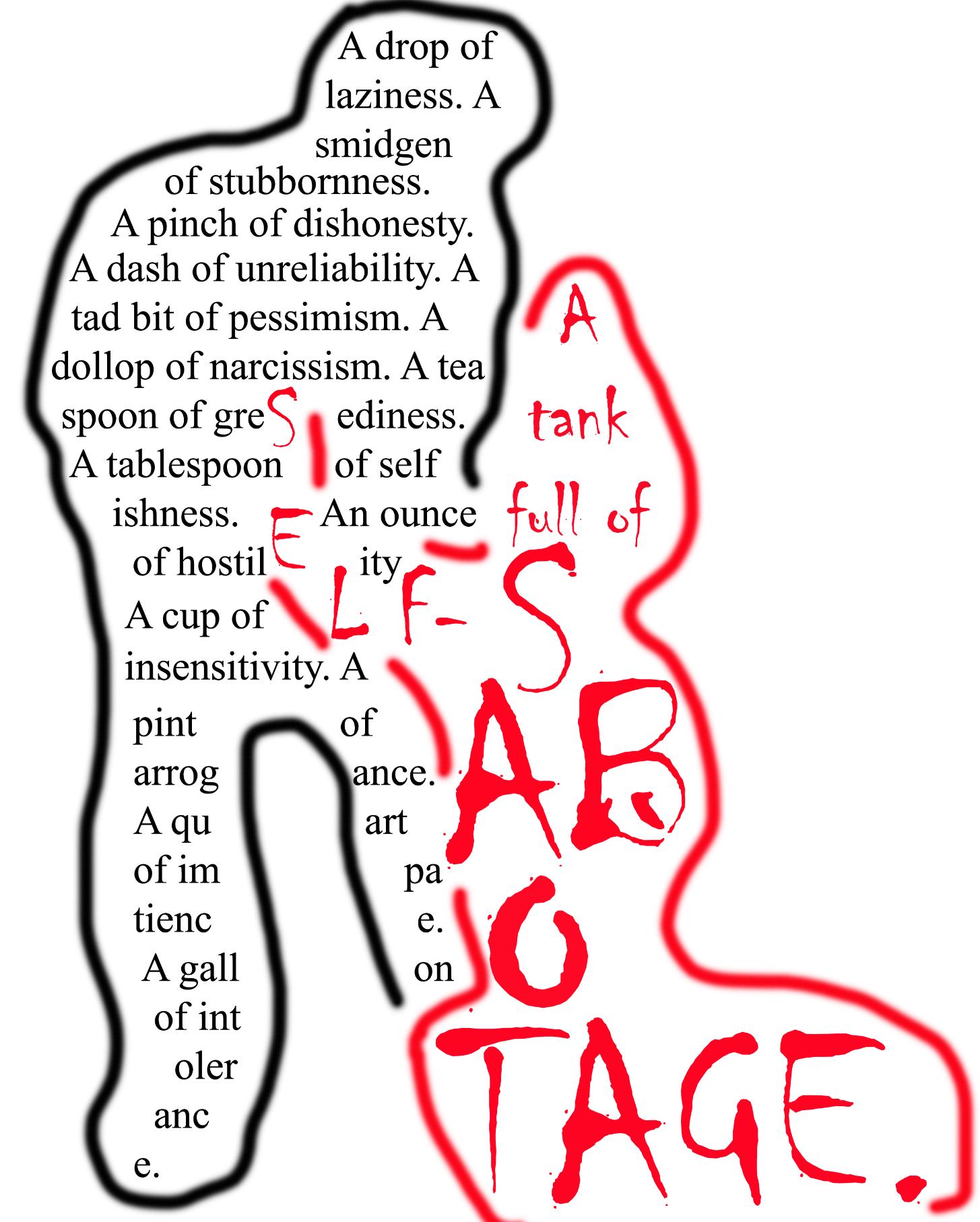
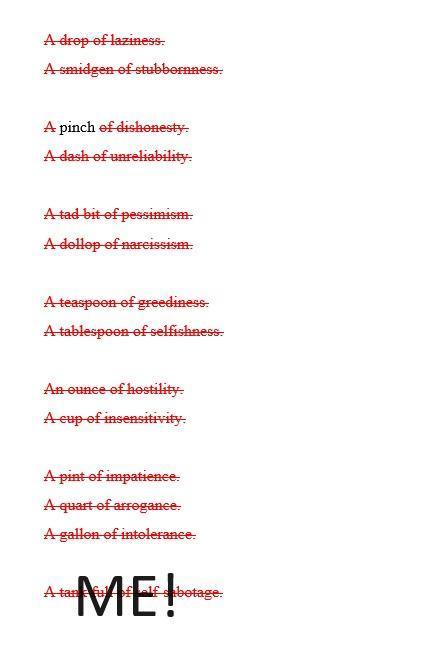
Girlhood
by Lauren Daniel
We were girls together. We rode our bikes in the heat of the summer sun, our toes and fingers pruned from a day spent in the pool, racing and playing mermaids.
I learned to tell secrets, you learned to listen, swearing secrecy with a lock and key only we could see. Hushed whispers about your first boyfriend from behind the locker door, bets placed that he would propose the day we graduate.
You married him in your hometown church. I attended your bachelorette party through photos on Facebook, and watched your wedding from the pews, rather than as your bridesmaid, a promise you made to me gone sour over the years, forgotten, like a ransom paid.
Liberation
by Hannah Green
Morning, noon, and night I fled
From wrath of man, my mortal dread
Abuse of power, lynching trees
What so-called ‘men of God’ are these?
Born into darkness, born to run
So I would not be dead so young
The things I’d seen, the fear I’d felt
As slave, I have no cry for help
For my own life, I advocate
The only way is my escape
As midnight strikes, I’ve little time
To leave this tyranny behind
The darkness as my only friend
The light adores and aids white man
My feet are bare, no thing I own
To me, there is no sense of home
Alone, I quest into the night
I pray I will not have to fight
So close I am, the train I see When candlelight shines behind me
My master seeks with vengeful hand I reach with all for Northern land
He races near, but not so nigh That I cannot still say, ‘goodbye’
The train begins to move in speed
Quicker still are feet in need
Though he may try, he tries in vain
A new-freed woman boards the train
Mnemonic Devices
by Katelee Smith
My mother is fond of blackberry drinks, having one for sorrow, another for habit’s sake.
And I, her pawn, always present for the take, constantly counting her bottles. They sprawl close to the table’s edge, the edge of a cliff where clouds of smoke trail by.
From the cigarette to the platform smoke engulfs me as I wait—
My hope is met by brittle fear.
The voices in my head I can’t help but hear, relentless again: “Like mother, like daughter, You’re always on the brink.”
And yet the train arrives—
“Where to miss?” chirps the conductor.
But I’m already vacant, the voices jeering as I take my seat.
“Where to miss?” he is annoyed this time. Snapping back, I sit, pensive smiles to show my contempt.
“Iuka,” I sigh.
Where the slaughter awaits.
Silhouette by Braden Potter
The Last Unanswered Phone Call
by Samantha Robins
As humans, we tend to take things for granted. We don’t realize all the things we are lucky to have and cherish until they are gone. And once it is gone, you are left in silence and complete devastation. I thought that I had learned what pain and loss was when my grandfather passed away. He was my whole world and my best friend, but unfortunately lost his battle to cancer in 2016. After his passing, I made a promise to myself to be there for my family and friends when they needed me most. I made a promise to drop everything I was doing to run to their side when they called for help. So, when I found out my best friend was diagnosed with leukemia, a type of cancer that affects the blood and causes the body to produce an abnormal amount of white blood cells, I promised if she ever called me, I would answer. Except when the final time came, and she called, I failed and broke my promise.
When I first moved to Alabama, I was a very shy and quiet kid. Because of this, I didn’t have a lot of friends and oftentimes sat by myself at lunch and recess. However, that quickly changed when I walked in on my first day of second grade. I remember walking straight to the teacher for directions on what to do and her introducing me to a little girl named Sydney Cunningham. Looking back, I realize she was my first best friend and showed me what true compassion looked like. As the years went by, we got closer and closer. There are very few moments I remember vividly from my life. My grandfather’s funeral, my brother graduating from basic training, my last moments as a highschooler before I walked across the stage, and the day a beautiful, caring girl
named Sydney Cunningham left this Earth.
It was the night of March 3, 2018. I was sitting at home in the living room with my parents watching one of the few shows I watched back then. As I am watching the show, I feel a buzz coming from my phone on the arm of the black leather couch I am relaxing on. I read Sydney’s name on my screen along with a picture of us together as her contact photo. I do not remember why, but for some reason I let the call go through. Maybe I did not have the energy to talk that day or I was so engrossed in the show I was watching. For whatever reason it may have been, I did not answer the phone. The first call was followed by another and while I grew more concerned, I stupidly let the call go through. I decided I would call her the next morning to check in on her and went to bed that night, not thinking anything of the calls.
It was the morning of March 4, 2018. I woke up and rolled over to look at my clock. It read 8:03 A.M., and I went to roll back over to get more sleep. I hated waking up early and decided to get some more sleep before my dance rehearsal later that day. However, as I begin to roll over, I feel my phone buzz with a notification. I decided to see who the notification came from and saw a text from a mutual friend that Sydney and I had shared.
Anna: Is it true?
Me: Is what true?
Anna: That Sydney passed away…
As soon as I read those words, my heart stopped. I couldn’t believe what she had just asked me and, me being the person I am, turned to my anger.
Me: Of course that’s not true! Why would you say something like that?
Just then, as I sent the message, I received another text from yet another mutual friend that Sydney and I had.
Eliza: I am so sorry about Sydney. If you need anything, I am always here for you.
In the moment it hit me that Sydney had truly passed away. I was overcome with a sense of grief I had only ever felt one time before, and I immediately broke down in tears. I spent the next two hours sobbing in bed as I grieved my best friend who had shown me so much kindness and compassion when no one else did. Around 10:15 A.M., I decided to freshen up in the bathroom and walk out into the living room like nothing happened. Something to know about me is that I never liked crying in front of people, and I would have rather sit in silencing pain than talk about what I was going through. I had made a plan that I would walk out to the living room, sit down, and watch TV to make it seem like everything was normal. However, my plan didn’t go as planned because my mom asked me to sit next to her as soon as I walked into the living room. What I didn’t know at the time was that my mom and dad had received a text from Mrs. Cunningham, Sydney’s mom, informing them that Sydney had passed earlier that morning. As soon as I sat down next to my mom, and she put her arm around me, I broke down again. My mom instantly knew that I had already found out and proceeded to hold me as I cried for the next few hours.
When I arrived at my dance rehearsal later that day, it felt like I was carrying tons of bricks on my back. I had begged my mom not to make me go to the rehearsal, but she said it would make me feel better and that it was mandatory. Me being the kid I was, I listened to her, got in the car, and walked into the dance studio. I instantly heard laughter and the sound of someone’s music blasting. I did not want to be there at all. How could people be happy at a time like this? When someone so gently and kind was taken away from the Earth when she was the least to deserve it! She deserved happiness and to live her life to the fullest! Not to be cursed with a sickness that slowly hurt her to the point of death!
I could not stand to look at everyone’s happy, smiling faces while I was drowning in grief. I excused myself from the rehearsal on the lie that I just needed to go get some water. As soon as the heavy door to the rehearsal room closed, I ran to the bathroom. I locked
myself in one of the small stalls and crumbled to the ground. I sobbed and sobbed until it felt like I could not cry anymore. I was not sure how much time had passed when I heard the bathroom door open. It was my dance teacher, and she was calling my name.
“Sam? Are you in here?”
She was met with silence. I did not have the courage to speak, so rather than saying anything, I let out a choked sob. She looked under the stall doors and saw me lying on the ground.
“Can you unlock the door, please? I need to make sure you are okay.”
I slowly got up off the floor and unlatched the door, letting it swing open as I stood there with my arms wrapped around myself. She asked me all the questions: Are you okay? Are you hurt? What happened? Do you want me to call your parents? I stayed silent the whole time until I could stop myself from crying. Rather than answer any of her questions, I responded in a way that kept her from knowing my pain.
“I am ready to go back to class now.”
Before she could respond, I was out the door and walking into the rehearsal. I ignored anyone giving me a funny or worried look. They could tell I had been crying, but I didn’t have the courage to speak, so I got back in formation and danced to the point of numbness.
While I had made a promise to always be there when someone I loved needed me and broke it, I embedded the promise into my head again and have never broken it to this day, and I never will. Anytime someone I love calls me, a sense of anxiety takes over me, and I pick up immediately. I could be in class, at work, or in a deep conversation with a stranger. It does not matter because I will always pick up now. You never know when the last time you see or talk to someone will be. It could be one minute or fifty years. It does not matter though, because you should treat every moment like it is your last with someone. Tell them you love them one last time. Take in their beauty one
last time. Realize how important they are to you one last time. Never let someone slip through your fingers without letting them know how important they are to you one last time. Always pick up the phone.
After Hours by Leon Ono
Nature’s Unrelenting Reign
by Anna Hilb
Cliffs stand tall, pointing like needles over the North Sea, I stand in shadows cast by their looming silhouette.
Fierce winds howl, relentless, cutting through the open air, A faceless cry bearing witness to the growing threat.
Little Crovie Village, my quaintly nestled home, Where no man sits idle, bracing for the brewing storm. My father anchors his boat against the sturdy quay, A prayer forms on his lips, I hear the unspoken plea, Please don’t take Little Crovie, our quaintly nestled home.
Heavy clouds gather, painting the skies in hues of gray, The roar of the stormy waters fills my heart with fear, Fragile homes shudder as the sea swells above our walls, I watch solemnly as Crovie is swept in the tempest, Nature is a fickle master, giving and taking away.
Somber in the aftermath, rising from the debris, The spirit of defeat plunders my broken home.
My father’s plea unanswered in the wake of the storm. The Crovie of my memories is shattered by the sea.
Pendulum
by Elvie Skinner
The blue gem is a pendulum
Swinging from the neck of a lamp, Suspended by a chain of gold. It doesn’t look as beautiful as it once had When it was draped around her neck. It shone in the lights of the city back then, But now I only see myself in its shine. Its lifelessness reflects the love it once held, Silenced by time.
If I could ever go back to those beautiful moments I would change everything just for that gem
To rest upon her neck once again.
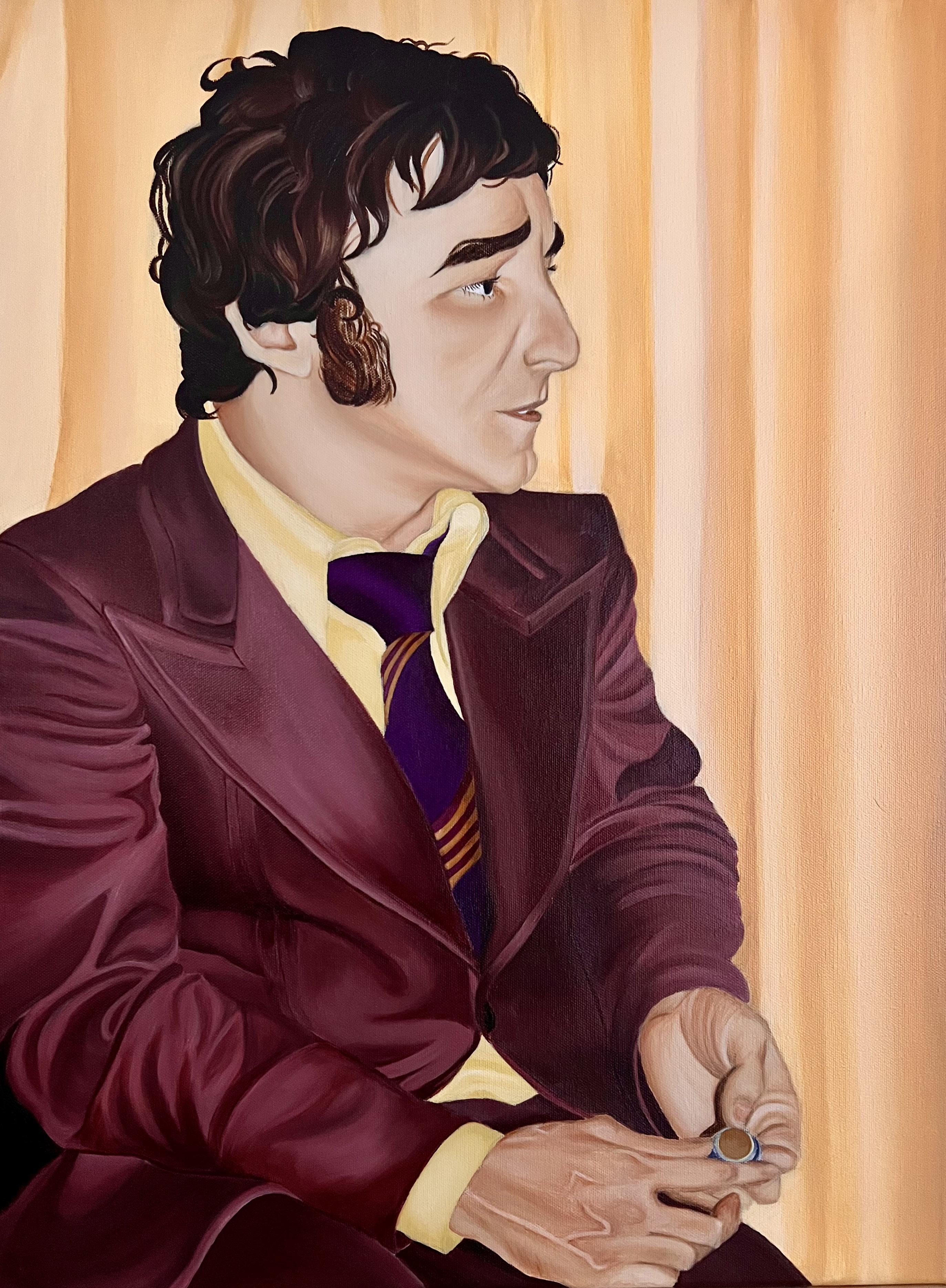
Marko in the Seventies by Sara Babic-Sternberg
Nothing But a Man
by Zane Turner
In the months and months of training, no one mentioned the feeling that’s overtaking me right now.
The type of pain that feels like you can never recover from.
That deep regret that stings like an open wound.
As she slips away, I feel her absence like never before.
My heart cracks and cries as she slips away.
(Pause, arm movement)
She’s falling out of view now, I can’t make out her features anymore.
But have I not dreamt of life without her?
(Get louder)
I long for her beauty, comfort, and warmth.
I see no peace without her.
My mind toys and tortures with this isolation.
Yet, I’ve spent my whole life dreaming of being away.
I’ve taken her for granted, I see that now.
I won’t do it again, I swear I won’t do it again
(Scared)
I am so scared without her.
The walls are closing in, and this capsule is quickly becoming my cage.
As my tears blur her image, I can’t catch my breath. She is my world. I’ll never doubt that again.
(Pause)
(Emotional, slow)
As I stare out into this void, I realize how much I miss her rolling waves.
The white sands of her beaches are no match for this cold abyss.
(Pause)
Without the soft calls of her songbirds, I can’t focus.
Without the cricket’s call, how can I be calm?
Without the soft patter of rain, how can I be expected to sleep?
My heart breaks without her rolling hills.
My lungs fail to fill without her open fields
I can’t see without her stunning sunsets
How am I possibly expected to be happy in her absence?
(Slow down)
Without her arms to nestle into.
Without the Earth to call mother, (Pause)
I sit in this cage, floating in space, nothing but a man.
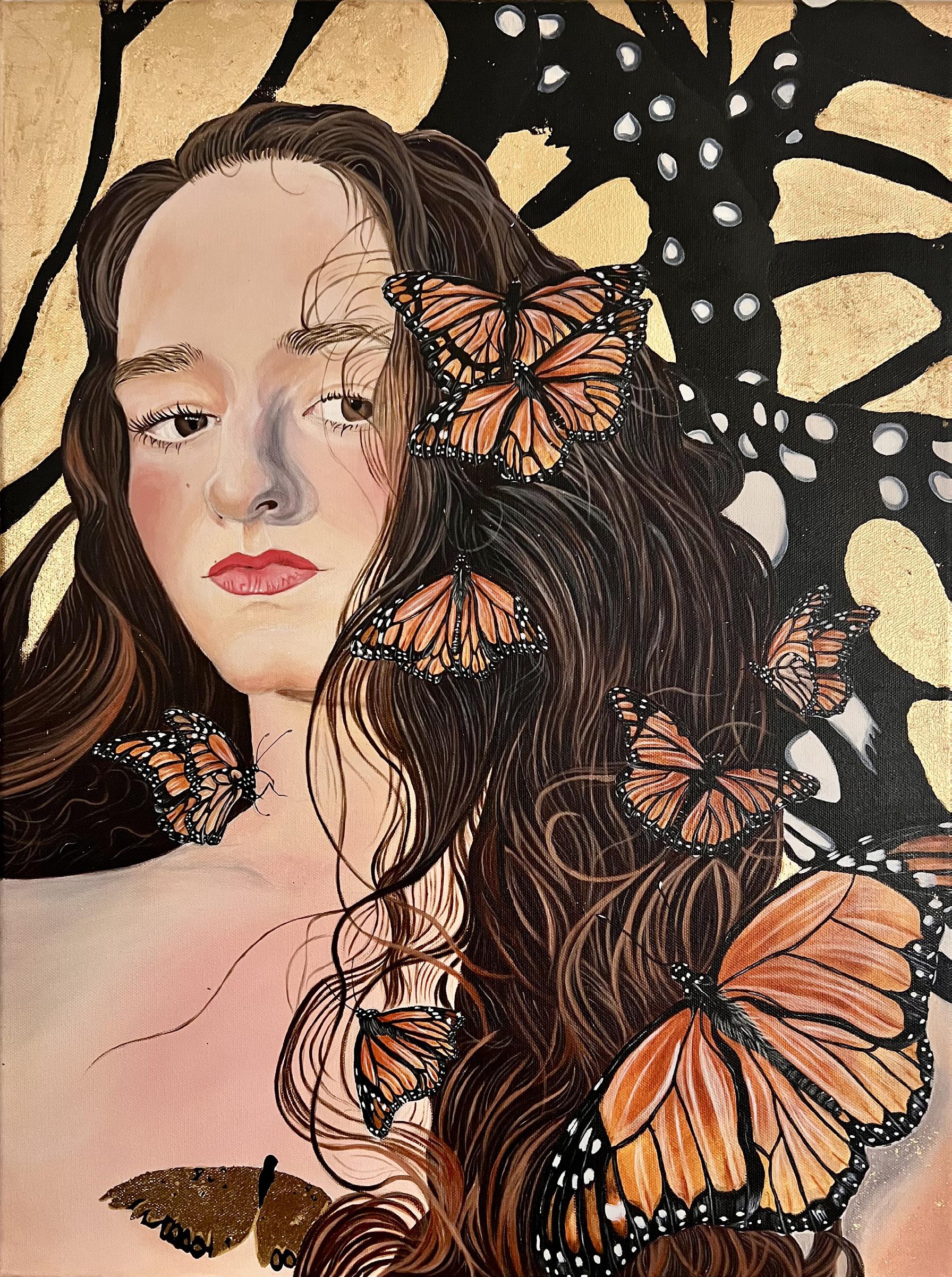
Transformation by Sara Babic-Sternberg
Broken
by Elvie Skinner
The music roars into my ear canals from the massive gaming headphones that keep my head in place. The screeching electric guitars and fierce pounding of drums may be causing severe hearing damage for me down the line, but the temporary pain now is worth not having to experience the emotional trauma that could be caused by taking the headphones off. At times like this, I never want to take them off.
Even through the blaring death metal, the crashing and yelling still penetrate my mind. It’s not like I have never heard these sounds before–they are fairly common at this point–but there are words spoken that I would never want to hear from the people uttering them. They are words that cause scars that I could imagine may never heal.
Are all marriages like this?
This fight started in the living room, right outside my bedroom door, for reasons that are unknown to me. Since my room is at the end of the only hallway connected to the living room, my escape route is cut off, leaving me in my auditory prison. Trying to cut through them at a time like this may lead them to turn their anger toward me, and that is something one of us may not leave unscathed. By now, their squabbling has moved into the adjacent kitchen, yet that is still risky as it has a clear view of the front door. I could try to slip out through the garage connected to the far side of the living room, yet the creaky floorboards in front of the door would give me away. It’s as if this house was designed for everyone to know where everyone was at any given time.
What a hellish existence it is.
A crash cracks through the barrier set up by the music. Whatever had been “knocked over” sounded heavy. I just hope that whatever it was does not impact dinner tonight. Whatever was cooking smelled incredible, and I need something other than music to lift my spirits.
The dog starts to bark.
It isn’t an angry or defensive bark that we hear whenever the delivery guy knocks on our front door or when a gunshot is heard on the TV. I can hear the anxiety in that bark. I can just imagine the poor guy’s entire body trembling out of fear. It’s not like we hit him or anything. It’s just that he seems to despise loud noises, even if they are the same ones that can be heard once every few weeks. Most people would get used to it by now, but somehow, a dog’s innocence is hard to corrupt.
Eventually, the barking stops; the yelling takes over. I go to turn my music up louder when I hear the distinct clink of paws and claws on hardwood, along with the soft patter of young feet. Someone softly knocks on the door. I take the headphones off and drape them over my shoulders, the music faintly emitting from the speakers. I open the door to find a frightened, shaking dog and an even more frightened little girl.
God, she was brave to venture out to save the dog.
The sounds of yelling adults wash over me, making my guts twist around themselves. It’s a sound that I hope I never fully get used to. I usher the girl and the dog into my room. They both hop onto my freshly made bed, the dog eventually settling itself into the girl’s crossed lap. She looks down at the animal, a single tear falling onto its head.
“They’ll be okay,” I say hopelessly.
The girl looks up and into my eyes, tears welling within. She is such a frail thing, almost as innocent as the poor dog in her lap. My brotherly instincts tell me to reach for her, give her a hug, and protect
her, but I know that she does not like that kind of affection. So, I sit in my desk chair across from her.
“Why are they like this?” she finally asks.
It was an expected question, one that I had asked myself more times than I could count yet could never find an answer for. All I can do is shake my head and avoid her gaze.
She should not have to experience this like I have.
After a few agonizing moments, I notice her looking at the headphones wrapped around my neck. The music is still playing loudly.
“What are you listening to?” she asks.
“It’s something that lets me escape at times like this. You probably wouldn’t like it.”
She reaches her hand out, palm up. With a smile, I remove the headphones and place them over her ears. Her eyes light up as the intense rock cuts out the horrifying yelling coming from the other room. She closes her eyes as the music takes her away, leaving me with the sounds of a broken home.
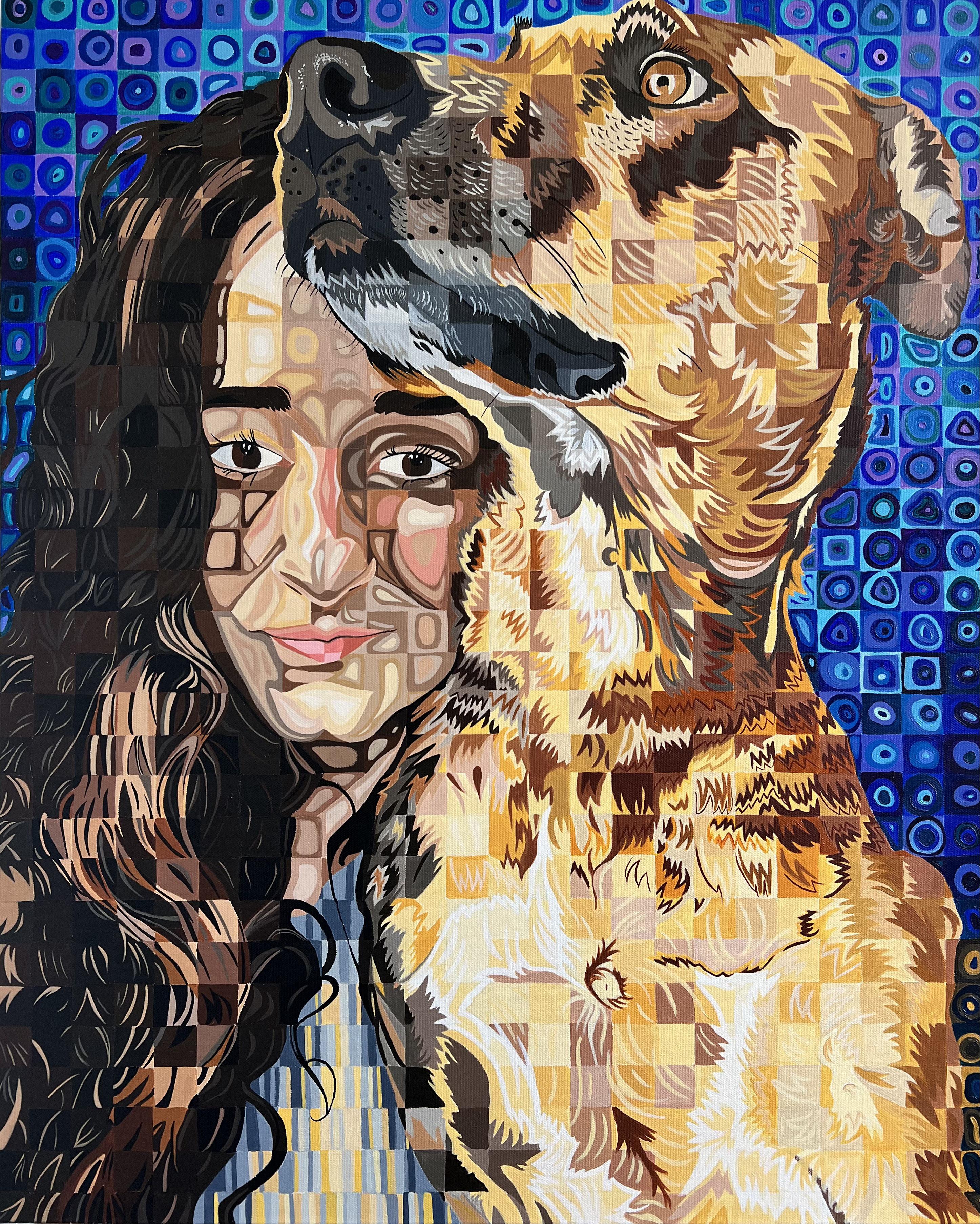
My Best Friend by Sara Babic-Sternberg
Chapter iv
The Comfort of Not Knowing
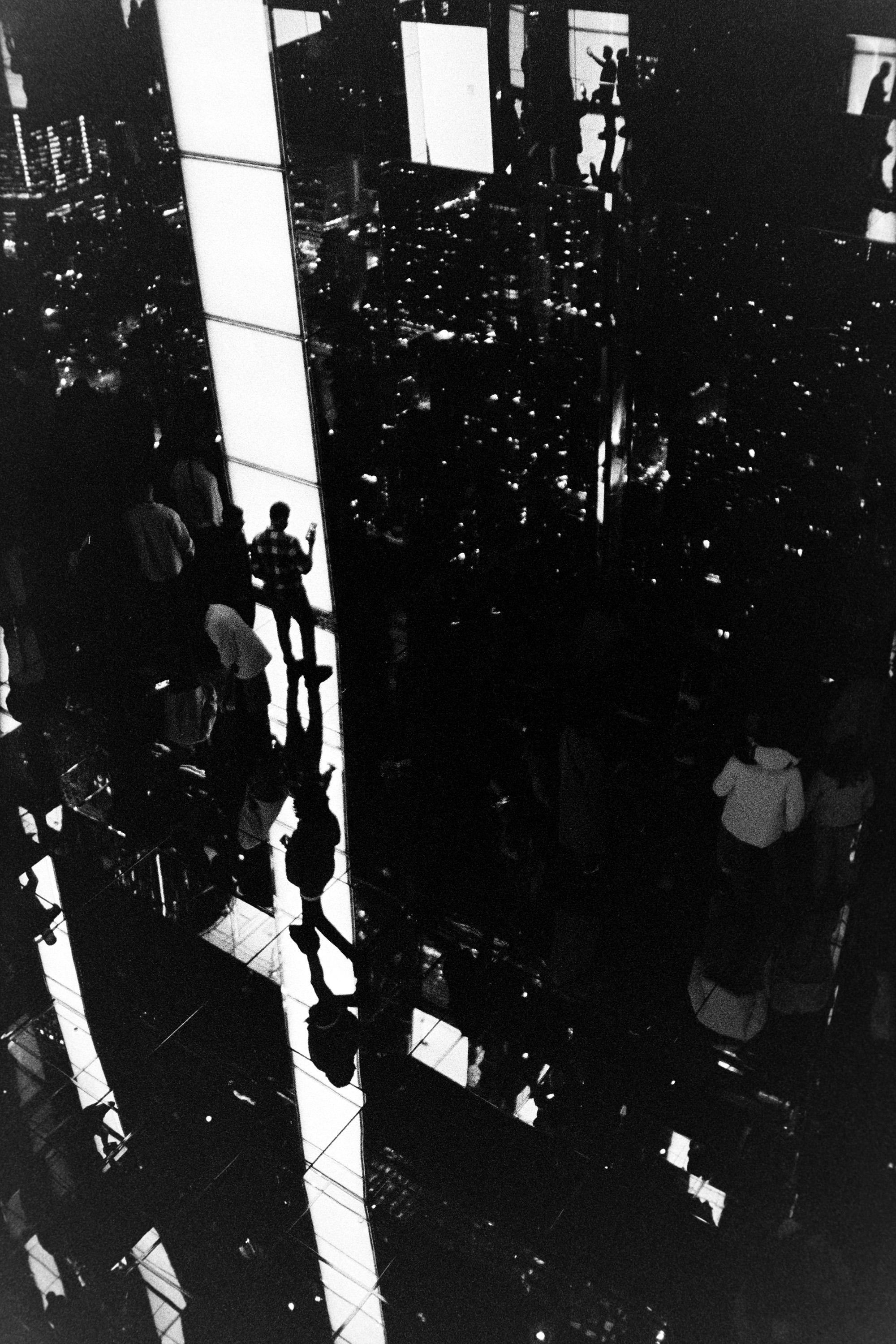
Summit by Leon Ono
Miss Jane’s House
by Eric Morris
Week 2
I don’t like my new neighborhood. I don’t like my new house either. It smells funny, like dust and mothballs. My room is okay. It’s bigger than my room at my real house, but there’s only one window and it’s nailed shut. Miss Jane tells me it’s to keep me safe. She doesn’t understand how much I hate the smell of mothballs. But I do like the window. I can see across the street and if I put my cheek up to the glass, I can see most of my neighbor’s yard. Miss Jane tells me not to do that because it makes her windows dirty. She says if I do it I’ll have to clean all the windows in the whole house. Sometimes I do it anyway. All the windows are nailed shut.
Yesterday I saw the neighbor riding his bike down the street. His name is Jimmy, or maybe Timmy. I know because he rode through Miss Jane’s flower beds instead of riding on the street, and Miss Jane yelled at him, “Jimmy (or Timmy), you stay out of my flowers! I’ll hang you yet!” Sally says it’s “inappropriate” to say that to a black boy. I don’t think she should say it to anyone. I think his name’s Jimmy. He rides his bike everywhere, even to school. I wish I could ride my bike to school, but Miss Jane takes me in her minivan. She says I’m too young to be trusted, but she takes Sally to school, too. Sally is bigger than me. She told me she goes to school with Jimmy. Sally is in eleventh grade. I’m in fourth. That’s seven years if you subtract 4 from 11.
I like to watch Jimmy whenever he is outside. Sometimes he rides his bike past the window, but sometimes he’s in his yard. He plays
basketball. I think he’s pretty good, and he can jump really high! I bet he could jump over my head. I don’t get to go outside much. Only to the back yard when Miss Jane wants me to help her pull weeds. Sally has to mow because Miss Jane says I’m too young to be trusted, but Sally always tells me she had to mow when she was in fourth grade. I don’t think Sally lived with Miss Jane when she was in fourth grade. I’d rather mow because Miss Jane has so many flowers, and all the bugs like to crawl around in the black dirt. Mister Richard says I’m a sissy because I don’t like bugs. He’s married to Miss Jane, but I don’t see him a lot. He works at night and goes fishing when he doesn’t work. He uses bugs to catch fish. I think I’m just as much a boy as he is, or Jimmy, or even my dad.
Week 5
Sometimes, Jimmy has friends over and they go to his backyard. I can’t see over the fence, but whatever they do smells funny. Not like mothballs, but I still don’t like it. Whenever Miss Jane smells it, she makes me go inside, even if I’m not done with the weeds. I guess that’s okay. She always tells Jimmy she’s going to call the police, but she never does. I don’t think you can go to jail for being outside without a grown-up. At my real house, I went outside all the time. Sometimes I went outside at night. Only when daddy looked really dizzy, though. I always did the wrong thing when he was dizzy, and he would get real mad at me. Momma always told me to go outside so he could get mad at her instead.
Sally says Miss Jane doesn’t like Jimmy because he’s black. I don’t know why that matters. She says that he’s smart and funny, and she likes to skip her classes sometimes to go watch him practice basketball. He’s the best one on the team, she says. Miss Jane won’t let her go to a game even though Jimmy promises he will have her home by 10. My bedtime is at 8:30. Miss Jane turns out all the lights. I can’t even have a lamp on because Miss Jane thinks I won’t go to sleep if I have a light. I’m too young to be trusted, she says. Sometimes I don’t go to sleep even in the dark. I miss my mom, and even my dad, too. I wish
he would stop drinking the stuff that makes him so mad at us. I know I would. I would do anything to be back at my real house with my real mom and dad.
Sally told me her dad drinks stuff, too. She calls it whiskey, but I don’t think it’s the same stuff because her daddy didn’t get mad at her. She told me he loved her more after he had been drinking. She asked me if I knew what sex was, and I said kind of. I know it’s something that people do when they love each other. Sally just started laughing, but then she started to cry and made me leave her room. I guess she misses her mom and dad like I do. It’s so boring in my room, though. There’s no TV, toys, or books, just my feelings journal the judge gave me. Miss Jane says that’s because I don’t have a permanent placement yet. She tells me soon I’ll have a new home, but she doesn’t know if it will be with mom and dad. Sally is on her third permanent placement because she’s not allowed to be in a house with teenage boys. I’m glad I’m not that old because I really like Sally. She’s very pretty and she uses grown-up words sometimes that make me laugh. And she talks to me when I’m sad and don’t want to write in my journal. Sometimes I cry, but I try not to because Mister Richard says that makes me a sissy.
I’ll miss Sally when she leaves. She tells me that she can’t wait to leave, and that hurts my feelings a little because she’s my friend. I don’t really have friends at my school. They think I’m weird because I just showed up one day and told them I’m not supposed to talk about my mom and dad. I have one friend that I see at lunch every day, but he’s not allowed to play with me after school. Miss Jane says I’m too young to be trusted with having people over. When I look out my window, I imagine that the people across the street will come home one day with a boy like me who needs a new family. Then maybe we can play together, at least until my permanent placement. Sally’s birthday is soon, and when she leaves, I won’t be able to talk to anyone but Miss Jane.
I asked Sally if she was happy to go see her mom and dad again, but she said she was not going to see them. I told her it was weird to not want to see your mom and dad, and she got mad at me. She told
me I only thought that because all my dad did was hit me. That hurt my feelings pretty bad. She told me she was sorry and that her dad had done some really bad stuff to her. I asked her why dads do mean things sometimes, and she said she didn’t know. Then she told me to stay sweet when I got older. I don’t know what that means. I’m not sweet, or a sissy. I want to be like Jimmy. He’s smart and funny and good at basketball. And he gets to ride his bike to school.
I wonder if anyone ever told Jimmy he was sweet. I bet they didn’t. My dad’s not sweet, either. Boys aren’t supposed to be sweet. They’re tough. When you’re not tough, the girls make fun of you and the boys push you and do mean things. Sally’s the nicest girl I know and she even said I was a “momma’s boy.” They wouldn’t say that if I showed them how tough I was. It’s my mom’s fault, really. She makes dad have to toughen me up so I won’t be a momma’s boy. Or a sissy. At least that’s what he says.
Week 7
The people across the street get into fights sometimes. Not like mom and dad, but they yell a lot. It’s usually late at night when I’m supposed to be asleep. The woman usually goes to the car and the man tries to stop her. She always leaves. I don’t ever hear Miss Jane and Mister Richard fighting. I guess they love each other more than the people across the street. Or mom and dad. That really makes me sad because I don’t want them to fight. When my mom and dad fight, he is usually the one that leaves. Then he comes back looking dizzy. Mom always says she’s scared of him, but she still fights with him. Maybe she wants him to get in trouble.
I asked Miss Jane if she thought my dad was bad, but she just told me it wasn’t her place to talk about that. I have a helper called a “guardian ad litem” that’s supposed to help me when we go to see the judge about going home or to get my permanent placement. They say I’m too young to talk in court, so the guardian ad litem will talk for me. I guess all the adults think I’m too young to be trusted. Maybe they think I’m stupid. Maybe momma’s boys make all the wrong choices.
That’s why I want to be tough, so people will listen to me and treat me like I’m smart enough to do things for myself.
I told Sally that I wasn’t going to be a momma’s boy anymore and that I was going to be tough like my dad. She said my dad was an asshole so I called her a bitch. I had never said that word before, but that’s what dad says when mom won’t stop making him mad. I had to go to my room for the rest of the night. Miss Jane told me I had to apologize to Sally, but I told her no because I don’t like how people think my dad is a bad person. I said I wasn’t sorry, but I really was. I felt really bad about hurting Sally’s feelings. I told her later that I was sorry because I wanted her to be my friend, and I didn’t want her to be mad at me when she got to leave. She said it was no big deal, but she gave me a hug and said she was sorry, too. I never want to fight with her again. That’s what grown-ups and mean kids do. But I don’t know how to make people think I’m tough if I don’t fight. I bet Jimmy has been in a lot of fights and that’s why everyone likes him.
Sally likes Jimmy a lot. She sneaks out to visit him sometimes. I don’t know how she figured out how to take the nails off the window without Miss Jane knowing. I caught her sneaking back in one time when I got up to use the bathroom and I heard noises. I opened her door and saw her climbing in the window. She made me promise not to tell, and I said I wouldn’t say anything if she’d tell me what she was doing. She told me that her and Jimmy hung out late at night sometimes. I asked her what they did together and she told me “stuff.” She said it was nothing I would understand. Of course not. I’m just a dumb kid. She said I don’t even know what sex is.
I don’t know why that makes me feel weird inside. I like Jimmy, and I like Sally. But I don’t like them liking each other. Sally only likes to do kid stuff with me. Like I’m her little brother or something. She does grown-up stuff with Jimmy, and she keeps it a secret. I thought we told each other everything. At least, I tell her everything. I’ve never even talked to Jimmy. I wonder if she’s ever even told him about me. Maybe if she did, we could be friends, but I don’t want to see them to-
gether because I don’t like the way it makes me feel. I think Sally knows because she always tells me I’m her favorite little guy. It doesn’t make me feel better.
Week 10
I really just want to go home. I don’t like Miss Jane’s house, and I don’t like not having any friends. I miss my mom and dad. Why does he have to hit us like that? Why can’t mom just stop saying things that make him mad? They don’t even think about me. They just fight and dad drinks stuff and they throw things. I just want to go home.
Sally left. We had her birthday party and the next day she came into the kitchen while we were having cereal and told us she was leaving. She didn’t ride with me and Miss Jane to school that day. When I got home from school, she was gone. She left a note on my pillow that said she would come back and check in on me. I tried not to cry, but I couldn’t help it. I miss her. I saw her a couple of days ago in Jimmy’s yard, but she didn’t come over.
Miss Jane says we’re supposed to go to court next week with the guardian ad litem. She said mom will be there, but probably not dad because he’s in another court. She said I may not get to see him for a while even if I do get to go home. I asked where he would live if he couldn’t live with me and mom, and she said that what he did was a crime and he may have to live in jail, even if me and mom forgave him. I don’t want that to happen, but Miss Jane says I can only talk in court if they ask me questions. Everything about the way grown-ups handle fights is silly. I haven’t talked to mom or dad since September, and it’s almost Thanksgiving. I might not even get to see dad for Christmas. I think sometimes that adults are really selfish. Mom and dad couldn’t stop fighting and the judge took so long to talk to us and Miss Jane won’t buy me things because I could be leaving at any time. I don’t know if they’d even miss me if I was gone.
Week 15
I've spent Thanksgiving with a new family. The judge said
mom wasn’t ready to “take the proper steps” to have us back in the same house. Dad wasn’t there. I started a new school. I tried to talk to a girl that reminded me of Sally, but she said to leave her alone and called me a freak. So I punched her and made her nose bleed. I don’t want to be at that new school or at the new house. I wanted to go home, but I don’t know anymore. I don’t really want to be anywhere.
It’s almost Christmas. No one is riding their bikes, or pulling weeds, or mowing the lawn. It doesn’t snow, it’s just cold. Miss Celia and Mister Jerry drink hot chocolate and tell us to give thanks for the Lord’s blessings, but I don’t see them. They say this time is about family, and that we’re a family, for as long as I need a family. I don’t want a family. Families let you down. Families don’t think about you. They pretend to be happy until they get mad, and then they do mean things to hurt everyone. Just like the kids at school. Just like Sally, who never came back. When I’m old enough, I won’t come back either.
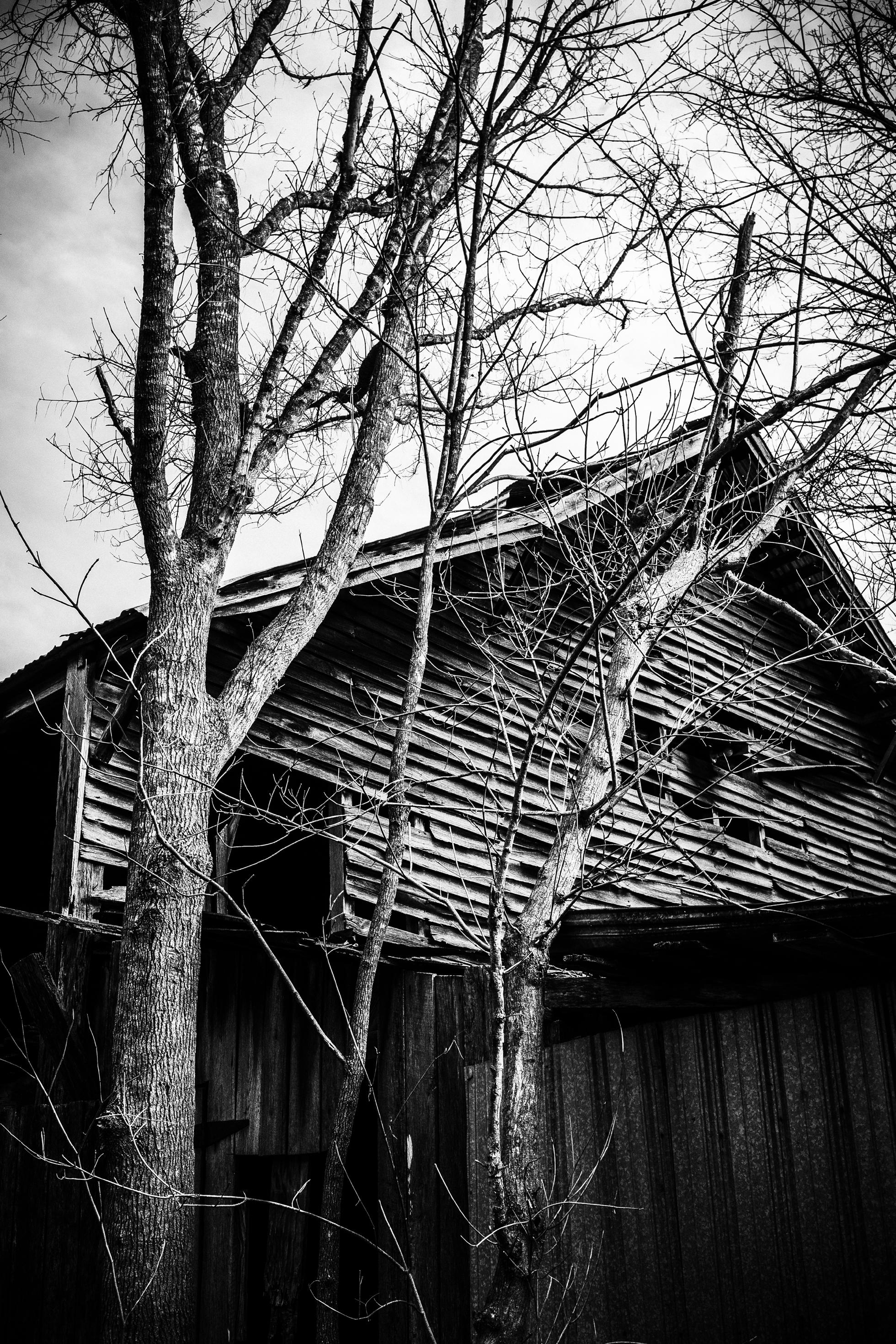
Pg. 117
Remnants by Braden Potter
Candle
by Savannah Andrews
Dancing flames,
Holding hands in the glow they create,
Kicking up puddles of wax.
Splashing about without a care of the possibilities. They do not know. They do not care. They will one day wither out.
Maybe they kick a puddle too hard, putting out their own fire. Maybe they grow old, the light slowly flickering away.
But for now, They dance.
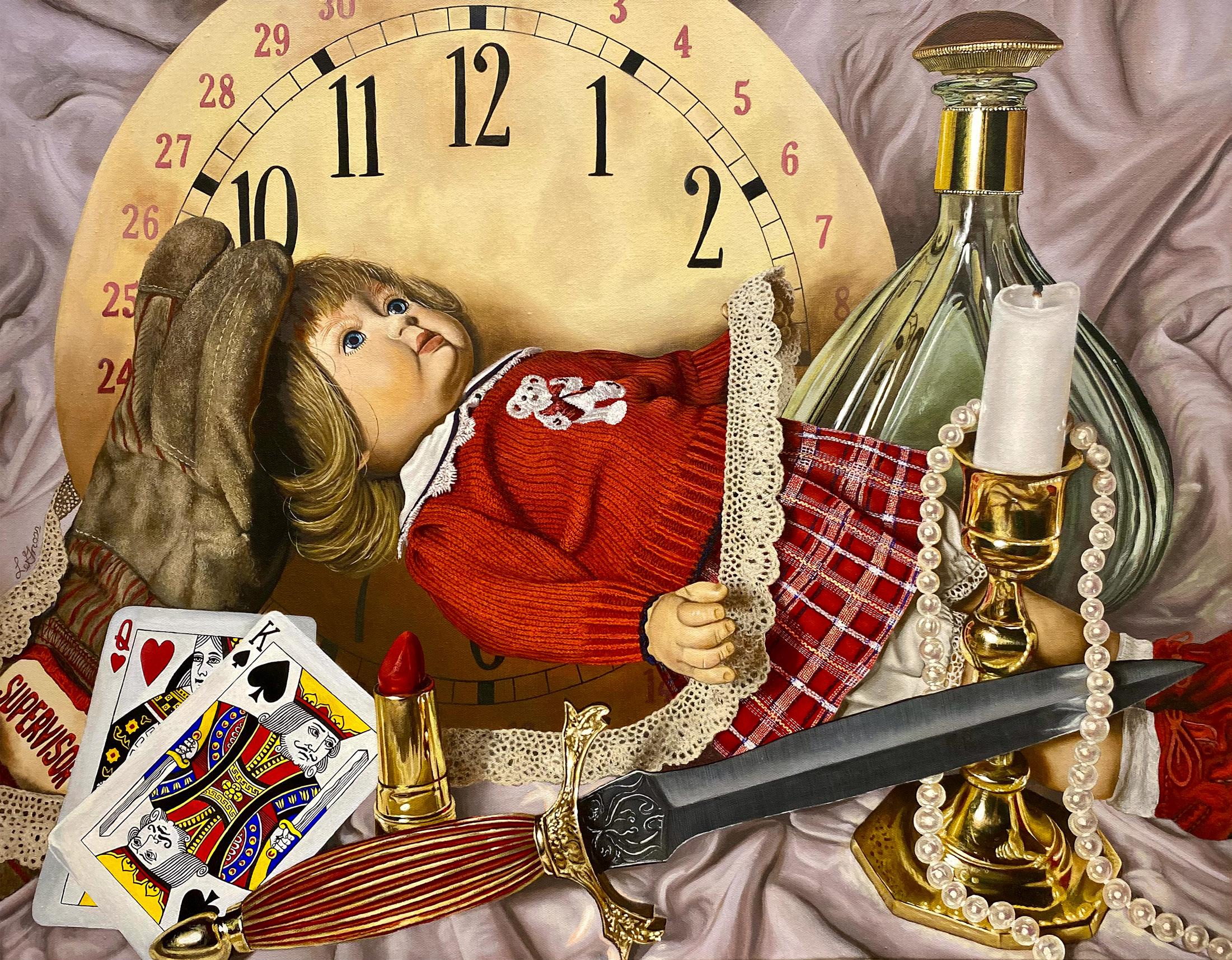
Pretty Porcelain by Lacey Gross
A Depiction of All the Things I Allow to Take My Peace, in the Form of a Chair
by Jessica Bullock
A chair, with a wooden frame and white cushion has been pasted to my floor in the same spot in my room since I moved in.
I have wrapped a blanket around its top, covered it in colorful cushions— have even contemplated putting it on the street for an unsuspecting soul, who wouldn’t know:
This chair doesn’t quite fit (in any place that is convenient), it is not nearly eye-catching enough to be considered an art choice, not nearly comfortable enough to be preferred, to even the floor, and is certainly not sentimental enough to tug on my heartstrings.
Still it sits, right at the foot of my bed mocking me, and my flaw of holding onto things “Just in case” is how I convinced myself to keep it.
“One day someone will want a place to sit.” They haven’t. They probably won’t.
Not there at least.
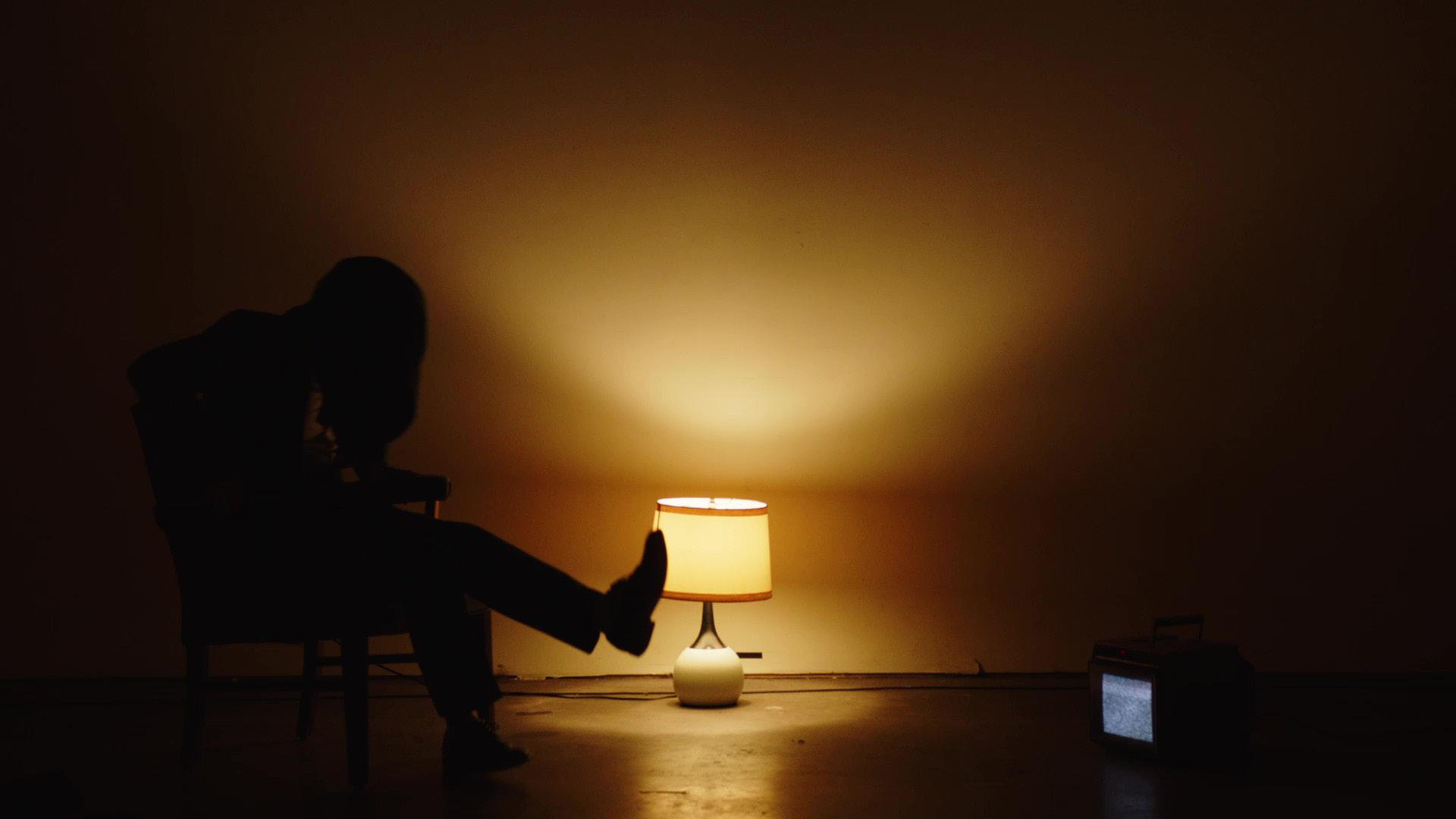
Made For Your Consumption by Brandon Underwood
The Bucket Theory
by Rebekah Callahan
My mom used to call me a summer child. I was born in the middle of an unbearably hot July, and every summer since I have learned that, I feel most at home wrapped up in a muggy, warm July embrace. My aunt got a pool years before my dad got one installed in our own backyard, so I savored days at her house surrounded by splashing water, sunburnt faces, and familiar laughter.
An empty chlorine bucket became my favorite pool toy. At three feet high and as thick around as the elm trees that grew in rows by the fence, it was the biggest bucket I had at my disposal to pretend with. I filled that bucket up with the pool water, dragging it through the shallow waters that came up right under my chin. I always stayed close to the steps, and so did my bucket. Careful to leave enough space so that the water wouldn’t overflow when I stepped in, I was perfectly content to sit in my water bucket as my siblings and cousins splashed beyond the steps.
No one understood my bucket quite like my grandfather. He delighted in the bucket pool and chuckled at what he saw as cleverness. Sitting near me on the steps, he would splash more water into the bucket, throw in toys, and tip the sides of it, entertaining me from the safety of my oasis.
I’ve been bringing buckets into pools ever since. Creating safety nets in big worlds is a craft that maybe only my grandfather ever perfectly understood in me. My friends, family, and accomplishments are things I sweep up and bring close to me, keeping them from float-
ing away. In a room of people, I have a safety bucket of four closest friends. In a competitive world of grades, internships, and achievements, I have a 4.0 and a stack of awards to hold onto.
Despite my best attempts at control, my grandfather floated right out of my safety circle when he passed the summer I turned sixteen. Only then did I recognize my bucket theory of life.
Keats Riffs on Homer
by Charles Michelson
I’ve Travel’d Realms’ And, Many States On Islands Wide Expanse That Homer Ruled Yet, I breathed Heard Chapman Speak Felt Skies When New Planets Swim Like Stout Cortez
Stare’d at Pacific Look’d at each other Upon a peak
Are You Washed in the Blood?
by Katelee Smith
The August air stuck to my skin like a tick–sucking the life out of me being bent down in the garden all morning. Mama puts me in charge of the flower garden every year–tilling, pruning, weeding–that’s always been my job. And I’ll do anything for Mama. This year we decided on chrysanthemums, oleanders, protea, asphodel, and sunflowers–sunflowers to attract the birds. They kill all the “clingers” as Mama calls them. Those Japanese beetles that just can’t help but seize Mama’s pretty flowers. Thankfully the heat wave killed most of the bugs, but Daddy ain’t too happy for Mama’s victory anyway. He don’t like flowers too much. He’s only worried about the cows and the corn field–“the field of gold” he calls it. But Mama would at least like to have a few flowers picked for the dinner table–the chrysanthemums would do. Bright red–the exact shade of the blood of Christ I like to think. She’ll love em.
“Shit—goddamn honeybees—”
“Opal! Honey, come put your best on for church–we’re late!” Mama hollered, waving my white cotton gown. I don’t dare cry at the pulsing in my finger, damn bee. They ain’t supposed to be this close to the farm, the hives are a few miles away as the crow flies–over on Mr. Shepherd’s land. We don’t go over there – he don’t like his lambs being spooked.
Pastor says not to work on the Sabbath day, but Daddy disagrees, “To hell with that rule during harvest season…” Sometimes you just got to ask the Lord for forgiveness, especially when it’s your Dad-
dy’s demands–obey thy father and mother, Jesus said. . . .
Mama shoos my brother Silas and me into the chapel between the back pews in the midst of Miss Mabel belting “Are You Washed in the Blood.” Mama takes pride in the fact that Silas and I are washed in the very blood of Jesus Christ–Daddy doesn’t seem to care too much, he ain’t a “church going man.” I really try to pay attention during the sermon, but Pastor is really scary at times–almost always yelling and slapping the Bible as if we are all in trouble–which I suppose we are, some of us anyway, eternal damnation and all. Today, a new guest pastor sits in the back pew—a snake handler all the way from north Alabama—we’ve never had one of those here before, but I’m eager to see why the Lord calls him to preach to snakes.
The altar is decorated with old Aunt Sally’s paper flowers. She’s not really my aunt, or anyone’s aunt for that matter–everyone just calls her Aunt Sally. She don’t have any kids–a lot of people think she’s crazy and should be in an asylum, but no one here in Cowarts can afford that “science shit” according to Daddy. I shouldn’t cuss. Mama said the Lord don’t like bad words. “It offends the Lord,” she says. My mama’s so smart–much smarter than my Daddy, but I ain’t allowed to say that to nobody but Mama.
The snake handler never did say why he preached to snakes today–just sat quiet in the back pew till altar call–eyes wandering, twitchin’. We are all a little lost, maybe he’s just trying to find his way in the dark. Maybe that’s it, maybe that’s why pastors come listen to other pastors–they don’t always know that the words they say are the word of God, so they got to find the word somewhere else. The problem with this, though, is that this pastor disturbed service today once altar call came.
The altar call brought up a few people today–ole Jim, but Daddy
and Mama says he’s a bootlegger so we didn’t join the few that prayed over him–him being sacrilegious and all. Nancy and her daughter, Frances. Frances used to come play with me every day, but her mama don’t let her come no more–and now Frances is always sick. Always pale, and her veins writhe under her skin like earthworms–my hair stands up just thinking about it. Her mama asks Pastor and the Lord to bless Frances, to cure her, to take her demons away–but Frances used to be just as fine as me, and I’m washed in the blood, you know? It wasn’t till her mama started locking her up at home that her color faded so.
By the end of altar call, Nancy was about dead herself–like little Frances–pale as a corpse. This new pastor came to the altar with a small wooden box, and suddenly this small wooden box gave birth to at least five or six snakes–rattlers, cottonmouths, even a little chicken snake. And that’s where the service ended. Mama grabbed Silas and me up by the arm and threw us out the church doors. Some women fainted, and had to be carried out by their husbands or sons. All the while this new preacher was going on and on about not being afraid and to welcome God as he will protect you from all your fears. I quite liked this sermon and was not afraid. I suppose I now know he does not preach to snakes, but with them. Love thy neighbor, even if they sleep outside. . . .
“Race you home Ope!” Silas chirped as he bolted down the chapel’s driveway.
I didn’t run after him–I learned my lesson the last time he tried to bait me. I ain’t ever had that many switches torn on me before. And I won’t ever have that many again. Especially not after Daddy’s had a few drinks on the chapel porch–he’s always lurking–you never see him coming, ole Daddy. It’s only on occasion that we hear a bottle or
two break during service, when Daddy’s getting real bad, Mama always shoos us out in a hushed tone on those days. We may not be in trouble with the Lord, but we know when we are in trouble with Daddy, and we know not to talk back or ask questions–unless we “are asking for a beating” Daddy says. That includes Ma.
I asked Mama if I could walk home from church today, which she usually says no to, but I told her I felt the Lord calling me today. “To follow in him, Mama.” I knew she couldn’t resist that in spite of what happened today–she couldn’t risk something bad happening and one of us fearing God cause the Bible says to not be afraid. “Go on baby,” she said. And I did. I walked to the bend in the old dirt path where the fork separates home and the roads to town, then I made my way down by the ole creek where the covered bridge sits–decaying ropes fraying from every beam post, each about ten foot long. I like to come here to the creek–think on all the people who may have given their life over the Lord here in this very creek bed.
I ended up at Mr. Sherman’s old pear orchard–and he must not keep up with the orchard no more–he’s gotten too old or too lazy, I guess. That’s a sin, you know, being lazy. Briars have taken over the picking rows and pears lay everywhere, rotting in the sod beds below. The hair in my nose curls and my saliva gets real thick–like I just took in a wooden spoon full of molasses–Mama always does this to Silas and me when we say the Lord’s name in vain–which ain’t too often. After the second or third time I spent gagging into the scrap bed, I decided it’s best to stay shut up than to “defy the Lord” as Mama says.
About a mile away into the orchard where Mr. Sherman’s pears meet Daddy’s corn, seven buzzards congregate there in the sky. Flying, cawing, serving God in unison–it really was something to see–watching them circle higher and higher, almost reaching the gates of heaven.
“They must like pears,” I shrugged.
I crouch down below one of Mr. Sherman’s old pear trees and gather a few in my gown–cradling the fruit–staining my whole front.
When I find those few pears that melt into my hand–their juice running down my forearm–I know those will make for the best ammunition. Their flesh is a putrid yellow now–the sun has almost cooked them through in the drought.
Buzzards are a lot like the devil you know? They only live to remind the living of their dead–that the living themselves are dying–and that we may all sit on the edge of damnation. On the edge of being hacked to death by the sins we partake in, day in and day out. They stare deep into me as if they could swoop me up and eat me whole. Hack the life out of me–my throat, a feast for them to gorge on. The seven poachers above tighten their circle–moving further East towards Daddy’s corn–guiding me home.
It is only then–as I follow the caw of the buzzards–that I begin to pester them–test their faith. One by one, I aim and throw the pears up towards God and one by one, them buzzards fall–or fly away–they mostly just fly away. I’m fighting the devil, I am. Sure am. With each buzzard gone, I shoo away the threat of the devil–the way Mama shoos away Daddy when he’s drunk. Again, that’s the power of the devil himself–to overcome a man like that–damn gluttons.
Despite my success shooing the devil away, my skin begins to crawl all over–as if ticks have invaded through my ears or fingernails and pushed their way deep into my skin–my body. The hair on my neck begins to stand up and my ears start to vibrate–sounds like there’s an old tractor engine deep down lodged in my head. My nose hairs twitch again–the smell of muddled wine–of smoldering blood–fills my lungs… and the buzz–the honeybee’s buzz only grows louder. Or is that flies? Before me, and the scarecrow crucified here in between the trinity of Daddy, Mr. Sherman, and Mr. Shepherd’s farms, lies a carcass–swarmed by honeybees. Or is it flies? The sweet nectar of flesh–the bloodied meat–has been taken over by bees, flies… and the maggots are already starting to form. And that buzz.
In the barbed wire at the crucifix’s feet tufts of white wool are trapped–it’s the lamb of God. The little lamb is fresh as baby Jesus,
couldn’t be more than a couple days old, but that don’t stop the maggots from gettin’ in… I guess it was flies after all. That’s when I hear it, that rattle. Gotta be at least ten rattlers, soundin’ like a choir like that. Turning around, I see em, one, two, three…eventually, I see about seven snakes altogether, even that little chicken snake.
“Don’t be afraid, Opie,” I hushed myself and did like Miss Mabel, I sang.