OCTOBER 2019
BoulderLifestylePubs.com
the 2019 Volvo XC60 AVAILABLE WITH A 400 HP PLUG-IN HYBRID ENGINE.
125 Alter Street, Broomfield www.sthvolvocars.com
the 2019 Volvo XC40 VOLVO SAFETY & LUXURY IN SMALL SUV FORM.
YOUR BOULDER DESIGN TEAM AT
IS PROUD TO ANNOUNCE
Your Wholesale, To-The-Trade, FF&E Product and Logistics Company. ARCHITECTS
CONTRACTORS
DESIGNERS
DEVELOPERS
LEARN MORE IN “LOCALLY OWNED” (303) 652-1727 Clients@DSInteriorSolutions.com DSInteriorSolutions.com
(303) 502-3306 Members@FRDesignCenter.com FRDesignCenter.com
5400 Spine Road, Suite A, Boulder
PETER BUREGA
1116 PEARL STREET | BOULDER CO 80302 | 303.444.7200 | SMITHKLEIN.COM FAMILY BUSINESS SINCE 1984 & 35 YEARS OF BUISNESS
BARB SILVERMAN Real Estate Advisor, CLHMS, GRI, CNE
My success in real estate revolves around a few key components: having a clear image of the client’s needs, knowledge of the market and integrity throughout the process . I pride myself on professionalism, expertise, and most importantly, my commitment to represent each of my client’s best interests and deliver unparalleled service. I believe that through honest ongoing communication with clients, daily attention to market details and competitively marketing a property, we can accomplish the goals our clients seek.
Contact one of our Boulder County Real Estate Experts today. 1050 Walnut Street, Suite 100 livsothebysrealty.com | 303.443.6161
Member of the Exclusive
#WeAreBoulder
2015 Pearl Street | Boulder, CO Mon - Fri 11am - 6pm Sat 11am - 5pm Call our Showroom at 303.442.6280 Visit us online at toddreed.com Follow us @toddreedjewelry
#thelifeyoulove
C R E AT E YOUR DREAM LIFE Pictured: 4789 Sunshine Canyon Drive, Boulder. $3,600,000 Listed by: Barb Silverman 303.886.5329
8195 NORTH 81ST STREET, LONGMONT
11858 BEGOLE CIRCLE, GOLDEN
2424 GINNY WAY, LAFAYETTE
OFFERED AT $2,750,000 Private Colorado Antique Field Airport. 4,776 sq ft home. 3,100 sq ft heated hangar. Absolutely gorgeous 35 acres with outstanding views of mountains & Long’s Peak.
OFFERED AT $1,350,000 Unobstructed views of Continental Divide. Enjoy hiking from your back door. Mountain peace within 20 minutes of Golden/Boulder.
OFFERED AT $1,285,000 Updated home backing to open space in amazing gated community, pool, playground, tennis courts and park! Beautiful outdoor space for entertaining.
Jim Bodin 303.884.4690
Alex Danneberg 720.937.4965
Hawk Vanek 303.912.7317
777 COUNTY ROAD 87J, JAMESTOWN
1850 22ND STREET #1, BOULDER
4115 GREENS PLACE, LAKE VALLEY
OFFERED AT $1,095,000 Peaceful Mountain Retreat. One-of-a-kind 3 bedroom, 3 bath home on 24+ acres with outstanding views. Beautiful finishes, energy efficient with solar.
OFFERED AT $850,000 Downtown living 1 block off of Pearl Street walk to CU, Boulder Trails, & 29th Street views of Sanitas. 3 bedrooms, 3 baths and completely remodeled.
OFFERED AT $789,000 Improved price! Lovely brick home in Lake Valley on a large lush lot. Classic floor plan with large family spaces. Well maintained, steps from the lake!
Michelle Bodin 303.884.4442
Alex Danneberg 720.937.4965
Barb Silverman 303.886.5329
Contact one of our Boulder County Real Estate Experts today. 1050 Walnut Street, Suite 100 livsothebysrealty.com | 303.443.6161
Member of the Exclusive
The Kalush Group Kristin Kalush started the Kalush Group five years ago with a vision to give a superior level of customer service and assist clients in finding solutions to their real estate needs and dreams. With the combination of living in Boulder for 30 years, passion for real estate and design, and the love of helping people, the Kalush Group has achieved great success.
Kristin Kalush
725 Timber Lane | $1,149,000 5-acre mountain retreat, 10 minutes from downtown
303.809.1717 kristin.kalush@compass.com
Completely renovated with modern finishes, light and bright throughout, wrap around decks, expansive views of the mountains and Pine Brook Lake.
Michelle Steiner Your home is life’s basecamp - it is where everyday adventure begins. My passion for real estate is driven by what it represents for my clients: a new beginning. As the top producer of all new agents in my very first year at Boulder’s largest real estate brokerage, I demonstrate consistent professional success by partnering with clients as though they are family. Relationships and results are very meaningful to me, and I bring two decades of expertise working side-by-side with people through some of their most challenging and rewarding life experiences. Whether you have lived here for 6 months or 60 years, you are part of the dynamic change that is becoming the Boulder County of today. Let’s create a vision for your life here and together we will make it happen.
Michelle Steiner 303.746.2047 michelle.steiner@compass.com Compass is a licensed real estate broker and abides by Equal Housing Opportunity laws. All material presented herein is intended for informational purposes only. Information is compiled from sources deemed reliable but is subject to errors, omissions, changes in price, condition, sale, or withdrawal without notice. No statement is made as to accuracy of any description. All measurements and square footages are approximate. This is not intended to solicit property already listed. Nothing herein shall be construed as legal, accounting or other professional advice outside the realm of real estate brokerage.
I can see a house when it has good bones and visualize its potential. 3500 Kirkwood played to my skills in establishing a vision for a project and my familiarity with construction.
My bag of tools: I offer my clients the familiarity of construction, a contractor’s rolodex, professional design and staging experience. Each project is an equation. How much will the bathroom remodel cost? Moving that wall? What about adding a garage? If you overspend, will you meet your goal?
3500 Kirkwood Place: Repurposing and Renovating There is a skill I’m fortunate enough to own and that’s vision. Identifying 3500 Kirkwood Place and its potential is no different than the vision I have for each client I represent in buying a home. Understanding their needs and tastes, matching it to the bones of a home, managing projects- this all comes with experience. Now, with Compass, I have the ability to help my clients manage small renovations and staging so you too can sell your home in its best light through Compass Concierge.
Cari Higgins Visit www.carihiggins.com for more information *3500 Kirkwood was not a Compass Concierge Project
Sell your home in its best light Compass Concierge helps you sell your home faster and for a higher price. From painting to flooring, Concierge transforms your home with zero upfront costs and no interest. Learn more at compass.com/concierge
Home must qualify under Compass Concierge guidelines.
Come visit our showroom and see how we can transform your home into one you are proud of.
ProudHouseStudio.com 720.242.7942 2805 Wilderness Place Suite 200 Boulder, CO 80301
LIFESTYLE LETTER
OCTOBER 2019 PUBLISHER
Andy Manz | amanz@lifestylepubs.com EDITOR
Ben Wiese | benjamin.wiese@lifestylepubs.com
Fashion Forward WHO DO WE LOOK TO WHEN WE’RE IN SEARCH OF SOMEONE FASHIONABLE? Most likely, someone just like us.
PUBLICATION DIRECTOR
Chantel Ellerington | chantel.ellerington@lifestylepubs.com CONTRIBUTING WRITERS
Brianna Blair, Carolyn Davidson, Kelly Ernst, Nathan Finneman, Kelli Ruhl CONTRIBUTING PHOTOGRAPHERS
For our annual fashion issue, we searched everywhere for inspiration. We trailed some friends to New York in search of where everyday life and fashion collided. We spent a day with a supremely creative jewelry maker. We learned the past,
Bailey Batchelor, Brittni Bell Warshaw, Nathan Finneman, Kylie Fitts, Ladd Forde, Kelsey Huffer, Michelle Tippmann
present, and future of tiki bars, kicked it with a passionate American single malt whiskey maker, explored the wondrous intersection of ecology and landscaping, and discovered a design studio attempting to change the entire building industry. We gleaned inspiration from each and every story we found. We gained new perspective on what it means to be be fashionable in multiple industries. We discovered the seemingly endless directions being “fashionable” can take a person. Ultimately, we decided that the cover belonged to a Boulder resident that was not only an exceptionally thoughtful individual with unusual life experience, but an individual that was just like anyone else.
CORPORATE TEAM CHIEF EXECUTIVE OFFICER Steven Schowengerdt
Liv Walker has traveled the world, building an impressive career for herself in the
CHIEF SALES OFFICER Matthew Perry
modeling world. She’s walked for British designer Richard Quinn. She’s been in
CHIEF FINANCIAL OFFICER DeLand Shore
a Tommy Hilfiger billboard featured in Herald Square. She was in a fashion show
ART DIRECTOR Sara Minor
that the Queen of England and Vogue Magazine editor Anna Wintour attended.
OPERATIONS DIRECTOR Janeane Thompson
And now, she’s furthering her education, hoping to figure out what’s next. Fashion never stops evolving, and hopefully neither do we.
EDITORIAL MANAGER Nicolette Martin AD MANAGER Chad Jensen REGIONAL SALES DIRECTOR Eric Williams WEB APPLICATIONS Michael O’Connell
ARIZONA | CALIFORNIA | COLORADO | CONNECTICUT | FLORIDA | GEORGIA IDAHO | ILLINOIS | KANSAS | MARYLAND | MINNESOTA | MISSOURI | MONTANA NEVADA | NEW JERSEY | NORTH CAROLINA | OHIO | OKLAHOMA | OREGON
Ben Wiese, Editor Benjamin.Wiese@LifestylePubs.com
SOUTH CAROLINA | TENNESSEE | TEXAS | VIRGINIA | WASHINGTON
514 W 26TH ST., KANSAS CITY, MO Proverbs 3:5-6
ON THE COVER Boulder-based model Liv Walker
PHOTOGRAPHY BY LADD FORDE 16
Boulder Lifestyle | October 2019
BoulderLifestylePubs.com
Boulder Lifestyle™ is published monthly by Lifestyle Publications LLC. It is distributed via the US Postal Service to some of the Boulder areas’ most affluent neighborhoods. Articles and advertisements do not necessarily reflect Lifestyle Publications’ opinions. No portion of this magazine may be reproduced in any form without written consent. Lifestyle Publications does not assume responsibility for statements made by advertisers or editorial contributors. Information in Boulder Lifestyle™ is gathered from sources considered to be reliable, but the accuracy of all information cannot be guaranteed.
ENVISION. PLAN. CREATE.
Finalist 2019 - CARE AWARDS for Remodeling Excellence by The Home Builders Association of Metro Denver
BUILDING WITH INTEGRITY SINCE 2004
INSIDE THE ISSUE OCTOBER 2019
FEATURES 42 Wrapped Around Her Finger The stunning beaded creations of Salihah Moore Jewelry
58 The Lawless Landscape of New York City Fashion A Glimpse into Cedar and Hyde’s Annual Buying trip
80 The Renaissance of Modern Tiki Navigating Island Cocktails with Grace
58 92
92 Parting Thoughts With Liv Walker
80
DEPARTMENTS
42
16
Lifestyle Letter
20 Good Times 32 Around Town 38 Driver’s Notebook 42 Trend Setter 68 Open House 74
Locally Owned
80 Hops & Vine 86 Local Limelight 92 Parting Thoughts 96 Lifestyle Calendar
I ND ULG E I N T H E CO LO R CR A Z E!
2425 CAN YON BLV D. | BO UL DER | 303.449.2626 WALT ERSANDHO GSE T T.COM
GOOD TIMES 1.
2.
3.
Colorado Music Festival's July 5th "Revolution and Freedom" Concert On a rainy day after The Fourth, LIV Sotheby's International Realty exclusively sponsored CMF's Revolution and Freedom concert at Chautauqua Hall. From Gershwin to Sousa to Tchaikovsky, Maestro Peter Oundjian directed a spectacular evening of musical mastery. comusic.org PHOTOGRAPHY BY JOHN NIMMO, JohnNimmo.com
4.
5.
1. Guests excitedly anticipating the show | 2. Enjoying CMF Corporate and Major Gifts Associate Louise Cristopher and LIV Sotheby’s Boulder Managing Broker Erin McDonald | 3. Proud sponsor representatives of the evening, LIV Sotheby’s Erin McDonald, Broker Barb Silverman, Director of Boulder Marketing Lisa Modica | 4. Post-show smiles | 5. LIV Sotheby’s family and friends
FLYING PRIVATE IS SIMPLE, JUST CALL US AND WE WILL TAKE CARE OF THE REST.
Whether flying private for business or personal, let Mountain Aviation show you the ease, effectiveness, and efficiency of private aviation in your life. National and International expertise, local Colorado touch and relationships. WE ARE ACTIVELY SEEKING THE FOLLOWING: Aircraft Owner Partners -Multiple jets and turboprop aircraft in our managed fleet of over 50 aircraft are available for immediate acquisition, ownership, and partnership. These aircraft are already flying on our FAA Charter Certificate and are available for immediate turnkey charter revenue benefit to Aircraft Owner partners with very low acquisition and transition costs. No prior aircraft ownership experience required. Call to set up a personalized review to determine the potential revenue and tax benefits of this opportunity for you. Summit Charter Clients - New opening of prepurchase block discount charter for select clients. Each account personalized to each client. Call to set up a review and proposal.
L D W
I
P
E
R
A T
R
O
Colorado Based
E
W
D
O
R
O
Visit MountainAviation.com or call 720-408-7426 Wi-Fi on board
20
Rocky Mountain Airport - 9656 Metro Airport Ave. Broomfield, CO
Boulder Lifestyle | October 2019
GOOD TIMES 1.
2.
3.
Jenni Kayne Boulder Pop-Up at Cedar & Hyde Mercantile On August 21st, the team at Cedar & Hyde welcomed locals to an exclusive in-store pop-up shop with California’s cult classic lifestyle brand, Jenni Kayne. As guests sipped on wine and nibbled on sushi from Boulder’s own, Japango the in-store pop-up shop featured luxe staples for fall wardrobe and in-home goods. Attendees also got a first glimpse of the Jenni Kayne sneaker line that recently launched. Missed the pop-up? Jenni Kayne opened a Denver Store at Free Market in Downtown Denver. PHOTOGRAPHY BY POPPY & CO.
4.
5.
6.
1. Poss Lambert Dalton, Nadia Moskver, store manager of Jenni Kayne Denver, Christie Lambert | 2. Beautiful evening | 3. A guest checking out new fall staples | 4. In conversation | 5. Jenni Kayne pop-up shop | 6. Locals
22
Boulder Lifestyle | October 2019
GOOD TIMES 1.
2.
Sip. Shop. Skin. Kristin M. Baird, MD, president of Dermatology Center of the Rockies in Longmont, partnered with Chelsea boutique in Boulder to discuss what's new in aesthetic treatments. An evening of shopping & talking with friends about the new neurotoxin, Jeuveau, Coolsculpting, and the launch of Cooltone to build and tone muscle. PHOTOGRAPHY BY TED HERON
4.
3.
5.
1. Lindsay French, Jamie Quisumbing, Raenell Wilkinson, Kristin Baird | 2. Jenna, Molli, Marina, Melanie, Christine, Kristin Baird | 3. Julie, Allison, Melanie, Kristin Baird, Angela | 4. Double rainbow! | 5. Eleanor, Kristin Baird, Allison
BOULDER BALLE T AND BOULDER PHILHARMONIC ORCHE S TR A
TICKET S: 303.449.1343
BOULDERPHIL .ORG/NU TCR ACKER
24
Boulder Lifestyle | October 2019
THANK SG IVING WE E KE ND
Fri, Nov. 29 at 2 pm | Sat, Nov. 30 at 2 & 7 pm | Sun, Dec.1 at 2 pm Macky Auditorium, CU Boulder
2600 30th Street, Suite 100, Boulder CO 80301 303-444-0664 | info@rinnovaskinandbody.com RinnovaSkinAndBody.com
GOOD TIMES 1.
2.
3.
There With Care's Red Carpet Adventure There With Care hosts an annual Red Carpet Adventure to support families facing the critical phase of a medical crisis. The event featured host Vic Levin and performers Clark Beckham, Zach Heckendorf, and Justin Kauflin, and included a delightful tasting dinner by the local Big Red F Restaurant Group. We are grateful to Title Sponsor Flatirons Subaru. PHOTOGRAPHY BY SAL DEVINCENZO, JANNELLE KNAUSS, MIKE OLIVER
4.
5.
6.
1. Beryl Stafford, Bobo’s Founder and TJ McIntyre, Bobo’s CEO accepting Inspiration Award | 2. Michael O’Brien and Marsha Beyer | 3. There With Care team | 4. Svein and Sara Groem | 5. Paula and Stephen Tebo at Vanity Cares | 6. Zach Heckendorf performing
Experience a Taste of Modern Japan in the Heart of Downtown Boulder
NEW
K I TC H E N H O U R S
Pearl Street Patio, Sake Bar and Whiskey Lounge
Sunday through Thursday 1 1 am – 1 0 pm Friday & Saturday 1 1 am – Midnight
E AT
Exceptional Sushi and Globally influenced Japanese Food
F O L LO W U S
JapangoRestaurant @JapangoSushi
DRINK
Largest Sake Selection in Boulder and Over 40 Craft Beers
CONNECT
1 1 36 Pearl St. Boulder, CO 303.938.0330 BoulderJapango.com
26
Boulder Lifestyle | October 2019
Listings 2601 3rd Street Trailhead | $1,639,000 Incredible opportunity to build on the last lot backing to open space! Amazing location nestled between the Mapleton Hill and Newlands neighborhoods, at the base of Sanitas. New Custom Home design available by Surround Architecture
3025 18th Street $2,395,000 | 4 Bed | 5 Bath | 2-car garage I PV Solar
504 Maxwell Avenue $1,425,000 | 3 Bed | 2 Bath
Stunning new build in Central Boulder within blocks to neighborhood park, Ideal market shopping center, Pearl Street and bike path.
Charming and renovated turn of the century Victorian in Mapleton Hill just blocks to trails, Ideal market shopping center and Pearl Street.
Julie Meko Serving Boulder for over 20 years Associate Real Estate Broker 303.931.6555 julie.meko@compass.com
Compass is a licensed real estate broker in Colorado and abides by Equal Housing Opportunity laws. All material presented herein is intended for informational purposes only. Information is compiled from sources deemed reliable but is subject to errors, omissions, changes in price, condition, sale, or withdrawal without notice. No statement is made as to accuracy of any description. All measurements and square footages are approximate. This is not intended to solicit property already listed. Nothing herein shall be construed as legal, accounting or other professional advice outside the realm of real estate brokerage.
GOOD TIMES 1.
2.
3.
Night of Hope When compassion, dedication, and commitment come together, it culminates in a Night of Hope. This event brings together Boulder County’s most impactful community members to recognize the ever-growing need for positive youth development within our population of greatest vulnerability: abused and neglected children. PHOTOGRAPHY BY ELLEN SAKANY
4.
5.
6.
1. Mother-daughter CASA duo Julia and Marilyn Hartig | 2. Voices for Children staff member Arlene Brugal and CASA Avram Saunders | 3. Sarah Sparks, Maria Gorecki, Jenny Schmidt, and Simon Sparks | 4. CASA Leonard Hortick, Board Member Jocelyn Diles, and CO CASA staff member Lily Sussman | 5. CASA Lon McGowan and Board President Steve Peterson | 6. Attendees raise their paddles in generous support
What are you thankful for?
Enjoy a Cur(ed)ated Thanksgiving this November Information and Orders :: www.CuredBoulder.com 28
Boulder Lifestyle | October 2019
Handpainted Hair Color 901 pearl st unit 101 boulder, co 80302 sweepbalayagebar.com 303 505 0187
balayage bar
GOOD TIMES 1.
2.
3.
MoM x FuN On September 4th, Month of Modern celebrated the 6th Annual Kick Off Party at The Dairy Arts Center! In addition to having FuN night with new and old friends, we got to meet and mingle with the artists and curators of the ‘Modern Habitat‘ exhibit at The Dairy! The exhibit enlisted various artists, architects and designers to explore concepts of ‘home’ and features: Will Day, Margie Criner, Davis Ar ney, Arch11, Sopher Sparn, Pyatt Studio, Renée del Gaudio, HMH Architecture + Interiors, and Workshop8 & Housefish. The exhibition runs from September 5 through October 13, 2019. PHOTOGRAPHY BY LISA DOANE PHOTOGRAPHY
4.
5.
6.
1. Premier Mortgage Group: Ariel Solomon, Lauren Piper, Portia Noel, Terri Wolf, Leah Alexis, Noel Bennett, Alicia Alpenfels | 2. Lauren Folkerts, Jeff Hindman, George Harrison | 3. Kyle Burds, Harvey Hine, Sara Taketatsu, Kong Yang | 4. Sheryl Hadley, guest, Andi Lawlor, Kristi Freeland | 5. Bobby Stuckey, Courtney Rowe, Ariel Solomon, Brandy LeMae | 6. Lauren Butts, Brandy LeMae
30
Boulder Lifestyle | October 2019
k k n i n r i DDr ink
Dr
ELEVATED • PREMIUM • REAL SPIRITS ELEVATED •• PREMIUM PREMIUM •• REAL ELEVATED REALSPIRITS SPIRITS
AWARD WINNING LINE OF READY TO DRINK COCKTAILS
AWARD WINNING LINE OF READY TO DRINK COCKTAILS
CocktailSquad theREADY Squad! CocktailSquad.com AWARD WINNING Join LINE OF TO DRINK COCKTAILS
CocktailSquad
CocktailSquad
Join the Squad!
Join the Squad!
CocktailSquad.com
CocktailSquad.com
AROUND TOWN a San Diego-based chef most recently known for her time as the executive chef and partner behind El Jardín, a regional Mexican restaurant in San Diego, and Top Chef Denver. Inspired by the regional cuisines of Mexico where her passion for food was first cultivated, El Jardín was an expression of Zepeda’s culinary journey as a chef. FlatironsFoodFilmFest.org
BOULDER COUNTY PARKS & OPEN SPACE SEEKS INPUT TO IMPROVE EXPERIENCE FOR VISITORS WITH DISABILITIES Boulder County Parks & Open Space seeks input from people with disabilities as well as
THE STRING CHEESE INCIDENT ANNOUNCE FINAL INCIDENTS OF 2019 THANKSGIVING WEEKEND
family, friends, and those who work with people with disabilities. Staff would like input from those who have visited county open space properties and those who have not. No names or other
The String Cheese Incident have announced
identifying information will be gathered. The sur-
that their final two incidents of 2019 will be at
vey will remain open until an adequate number
Denver’s new Mission Ballroom. The Denver Post
of surveys are received. All feedback and ideas
said the venue “is among the best-sounding rooms
collected will be used to improve the experience
in the city,” and added, “Denver finally has the
for visitors who have disabilities.
concert venue it deserves.” Tickets will be available
The survey is available at
for purchase using the “Mission Fair Ticketing” sys-
BoCo.org/OpenSpaceSurvey.
tem, a concept developed by the venue to ensure equal and fair access to tickets for all. SCI spent 2019 celebrating their 25th anniversary with several new single releases, a sold-out Electric Forest Festival, notable appearances festivals such as Peach Fest and Floyd Fest, a series of special shows across the country, a Colorado amphitheater run at Dillon Amphitheater and Red Rocks, and will continue with upcoming shows in Eugene, San Francisco, Oakland, Austin, Chicago and now Denver. SCI plan to use the first part of 2020 to focus on writing and will be back on the road in June. MissionBallroom.com/Fair
SEVENTH ANNUAL FLATIRONS FOOD FILM FESTIVAL KICKSOFF OCTOBER 10TH October 10-13, 2019 will bring the seventh Flatirons Food Film Festival to Boulder, a
Wednesday, October 30th, 8:00 pm, Devandra
carefully-curated smorgasbord of local, national
will be live at the Boulder Theater. Banhart emerged
and international films, speakers, art, and special
seemingly out of nowhere in 2002 with his first CD
events. This year’s festival features an exploration
collection, Oh Me Oh My…The Way the Day Goes By
into immigrants and international cuisine, includ-
the Sun Is Setting Dogs Are Dreaming Lovesongs
ing a Saturday night tribute to Diana Kennedy,
of the Christmas Spirit. The record was compiled
a British expatriate known by some as the Julia
by musician Michael Gira for his label, Young God,
Child of Mexico. The tribute will begin with a
from homemade recordings the itinerant Banhart
Mexican feast and end with a discussion with
had amassed while traveling the world.
James Beard semi-finalist Chef Claudette Zepeda, 32
DEVENDRA BANHART FEATURING BLACK BELT EAGLE SCOUT
Boulder Lifestyle | October 2019
FoxTheatre.com
CONTINUED >
3355 VISTA DRIVE 5,004 Finished Sqft The Vista Drive pavilion is situated in an up and coming luxury enclave in North Boulder. Custom built by MK Construction and exquisitely designed by Studio B, this remarkable residence showcases its superb craftsmanship and elegant finishes in a very distinguished modern style. Approachable from all sides in the open park-like setting of its lot, the dark exterior facade contrasts the white oak floors and daylight-filled soft interiors. This Boulder gem is the pinnacle of modern luxury with sophistication and location - centrally situated and surrounded by parks in every direction. JENNIFEREG B ERT.CO M | 3 03 . 619. 3 3 7 3
5 Bedrooms 4 Bathrooms 17,231 Lot SqFt $4,500,000
AROUND TOWN
(CON TI N U ED)
another Bcorp, Wefunder, to democratize investing in their company. “Our campaign enables anyone to become an investor for as little as $100,” says Co-founder Vincent Cobb. In addition to crowdfunding, they are raising equity to expand their mission-based company. Feel free to try their products 20% off during the month of October with code LOVE20. AkamaiBasics.com
BURNHAM LAW BRINGS ON COLORADO LOCAL, FORMER JUDGE RYAN KAMADA Burnham Law announced today the hiring of former District Court Judge Ryan Kamada.
CU FOOTBALL TAILGATE PARTIES RETURN TO BOULDER’S EMBASSY SUITES & HILTON GARDEN INN
Having served on the bench in the 19th Judicial District, Kamada brings a wealth of experience. During his appointment to the district court, Kamada handled a domestic relations and
Boulder’s Embassy Suites by Hilton and Hilton
dependency-neglect docket. Prior to joining the
Garden Inn Boulder are excited to kick off another
bench, Kamada was in private practice for ten
strong season of Buffs football with University of
years. His practice included a variety of areas
Colorado Boulder Football Tailgate Parties. Located
of litigation including dependency and neglect,
just a short walk from Folsom Field, the Hiltons on
family law, civil litigation, and criminal defense.
Canyon will host a tailgate party before each of
Kamada is a local graduate of Valley High School
the home CU Boulder football games for the rest
in Gilcrest, Colorado School of Mines (B.S.
of the 2019 season. The Hiltons on Canyon are the
Engineering-Mechanical), and the University of
official hotel sponsor for the University of Colorado
Denver Sturm School of Law (Juris Doctor).
Athletics Department and offer $5 underground
Says Burnham Law Founding Partner Todd
game day parking to the public.
Burnham: “I worked with Ryan Kamada prior to his
EmbassySuites3.Hilton.com
ascension to the bench. His work ethic and commitment to his craft have formed the basis for his lasting and well-earned reputation for excellence. Having him on board means our clients will now derive the benefit of an unparalleled breadth of talent: an in-house former judge, a handful of DA’s, Child Family Investigators, and seasoned attorneys. This mix of talent epitomizes our firm’s creed, Colorado Family Law: Elevated." BurnhamLaw.com
WINTER FOLK COMES TO COLORADO 12 Days. 40 Bands. Photography Expo. This February, the Winter Folk Music & Photography showcase will take place in Longmont, Colorado. This inaugural event will feature nationally touring
AKAMAI BASICS IS REVOLUTIONIZING PERSONAL CARE PRODUCTS & ROUTINES
Aijala & Ben Kaufmann (Yonder Mountain String Band), Josiah Johnson (The Head & The Heart),
Boulder startup & Bcorp Akamai Basics is
Esme Patterson, Willie Watson (Old Crow Medicine
calling BS on the personal care industry and
Show), Gasoline Lollipops, and many more in
changing it for the better. They offer revolution-
an intimate setting at The St. Vrain luxury venue.
ary, science-backed personal care products and
Passes available at FAFColorado.org.
recently ran a crowdfunding campaign through 34
musicians Brett Dennen, Mason Jennings, Adam
Boulder Lifestyle | October 2019
CUSTOM HOMES
●
RENOVATIONS
●
REMODELING
303.449.3076 | BOULDER, CO | COTTONWOODCUSTOMBUILDERS.COM
Our clients say it best “We have been with Bolder Insurance from the start, and wouldn’t have it any other way. Bolder Insurance takes care of all our insurance needs; cars, house, camper trailer, and now even renter ’s insurance for our oldest daughter. Brent and the staff are always responsive, and give strong advice on how we can protect our family and belongings. We love Bolder Insurance! BOBBY LEHMAN Personal Insurance Customer
Together We Can Make A Difference.
$10 DONATION
Client Focused, Individualized Solutions, Dedicated Team.
$10 WILL BE DONATED TO A LOCAL NON-PROFIT WHEN YOU GET A QUOTE ON YOUR PERSONAL OR BUSINESS INSURANCE
BOULDER 2575 PEARL ST LOUISVILLE 800 JEFFERSON AVE 3 0 3 . 4 4 9 . 9 5 9 5 | www.Bolderins.com www.BolderPrivateClient.com
(303) 499-7133 | boulderlaserdentist.com 2600 30th St. Ste 200 Boulder, CO 80301
INVESTED IN OUR PATIENTS WITH THE LATEST TECHNOLOGY Brand New Office
comfortable and relaxing environment
Excellent Dental Team
Solea Laser Treatment
Most fillings are done without the needle
3D Scan Of Your Teeth
Crowns can be delivered in a single visit
gentle hygienists and courteous front office staff
Air Polisher
Experienced
Veneers
open in Boulder for over a decade
Helps to almost eliminate sensitivity during cleaning appointments
Crowns Cosmetic Dentistry
Daniel N. Alleman, DDS The best care for you and your family.
Teeth Whitening
FREE IN-OFFICE WHITENING Mention Boulder Lifestyle Magazine and get free whitening after completing a Clear Correct (Invisible Braces) case with us
DRIVER’S NOTEBOOK
38
Boulder Lifestyle | October 2019
DRIVE REVIEWING THE LAMBORGHINI HURACAN EVO ARTICLE AND PHOTOGRAPHY NATHAN FINNEMAN
I
T IS HARD TO BELIEVE THAT LAMBORGHINI, ONE OF THE MOST NOTABLE CAR MANUFACTURERS IN THE INDUSTRY, ACTUALLY STARTED OUT AS A TRACTOR COMPANY IN 1948. Yet more than half a century later, they are known for producing some of the most elegant and powerful supercars in the world.
This month’s test drive is the all-new Huracan Evo.
I've never had quite the affinity for Lamborghini as I do for Ferrari. Maybe it was the colors, or maybe it was the sheer amount of them that always seem to be featured in Hip-Hop music videos. However, my opinion of this brand has been completely revamped after driving the HuracanEvo. At first glance, the body lines are alluring, evoking true luxury. Even stationary, this car screams speed; driving one amplifies the feeling exponentially. The interior is beautifully done with a touch screen interface that displays everything from vehicle telemetry to media preferences. The steering wheel is a motorsport lover’s dream with the Alcantara accents. Despite evoking a race car, it is still an approachable vehicle. The seats are incredibly comfortable and the outside visibility is impressive for a supercar. The starting procedure in this car alone is an experience in itself: the flip of a toggle switch feels like starting a jet engine. With the push of a button, the 630HP V10 comes to life. If there is one aspect about a car that I always yearn for, it's a proper exhaust note. If Lamborghinihas got one thing that sets them a bar above the rest, it is their engine exhaust note. This car quite possibly could be the best sounding supercar I have driven yet. The acceleration is brutally fast, the shifts are lightning quick, and the handling was superb. Perhaps the most surprising aspect of this car was the fuel consumption. This car gets better gas mileage than most trucks and SUVs. It's also a great car for driving enthusiasts; I could even do a cross-country trip with it. If you’re looking for a car that changes the perception of how a supercar should sound and drive, take the Huracan Evo for a spin. Just don’t say I didn't warn you when one ends up in your garage. Test drive today at Sill-Terhar Motors, 150 Alter St, Broomfield, Colorado. October 2019 | Boulder Lifestyle
39
E L E VAT E Y O U R S T Y L E A N D T H E WA Y Y O U L I V E . I N T E R I O R D E S I G N & C O N C I E R G E C O N S T R U C T I O N F R O M S TA R T T O F I N I S H
720-707-9257
LAURAIVERSONDESIGN.COM
DESIGN. BUILD. INSPIRE. 5365 Spine Rd Su. A2 Boulder | (720) 291-7918 | petracustombuilders.com
TREND SETTER
Wrapped Around Her Finger THE INSIDE LINE ON THE STUNNING BEADED CREATIONS OF SALIHAH MOORE JEWELRY
42
Boulder Lifestyle | October 2019
ARTICLE KELLI RUHL | PHOTOGRAPHY KELSEY HUFFER
FOR ARTIST AND DESIGNER SALIHAH MOORE, CREATING HAS ALWAYS BEEN A PART OF LIFE. Growing up the daughter of two Sufi Muslim artists, she was always surrounded by their creative energy and attributes the success of her own beaded designs to her connection to that same creative force. Initially drawn to beadwork through its combination of painting and sewing, she soon found that she loved the feel of the beads moving through her fingers, and the meditative repetition of “painting with the beads” to create beautifully unique pieces of jewelry and fashion. While beaded earrings are a staple of the artist’s Salihah Moore Jewelry line, she also creates stunning necklaces, wall hangings, wearable beaded pieces, and, coming soon to her lineup, a beaded bag. Moore
finds
inspiration
in
myriad
places. From textiles, folk art, independent designers, and furniture design to the incredible women in her life who she refers to as her “muses,” Moore channels this inspiration into what she calls color stories: “each beaded piece is like a painting [that comes] together through instinct and intuition.” Shoppers can find Salihah’s creations in shops across the country; Boulder’s Cedar & Hyde, Saint Claude in New Orleans, and General Store in San Francisco and Venice. On a typical day, Salihah can found blasting hip-hop in her studio, cooking up a delicious rice bowl, or taking an evening walk with her girls. It’s all in a day’s work for the creative force behind Salihah Moore Jewelry. CONTINUED >
October 2019 | Boulder Lifestyle
43
TREND SETTER
(CON TI N U ED)
THROUGH SALIHAH'S EYES: STEP 1: Pick the colors I want to use and pour some of the beads onto the bead mat to see how they work together. I move the loose beads together to play with how the colors respond and to see if any ideas come to mind. STEP 2: Put on the music of Tierra Whack. STEP 3: Thread a beading needle and begin to weave the glass beads together one at a time.
Salihah Moore
STEP 4: Switch it up with a podcast: Daniel and Jorge Explain the Universe. STEP 5: Keep beading! STEP 6: Take a look and evaluate if it’s working or if I need to change anything. STEP 7: There’s a part that’s not working; carefully, I take my finger clipping scissors and cut that part out. I replace it, bead-by-bead, with a new idea. STEP 8: Snack attack! I cut open an avocado and smother it with lemon juice, salt, pepper, and seaweed gomasio, accompanied by Simple Mills Farmhouse cheddar crackers. STEP 9: Turn on the Netflix television series Glow before getting back to the beads! STEP 10: Zone out a little and let the tiny donuts of glass weave between my fingers, allowing space for the colors to decide where the project is going. STEP 11: Take some pictures of the work in progress. STEP 12: Cozy up in my bed and look at the pictures I took; close my eyes and envision what to do next before drifting off to sleep. www.SalihahMoore.com | @salihahmoore
44
Boulder Lifestyle | October 2019
“EACH BEADED PIECE IS LIKE A PAINTING [THAT COMES] TOGETHER THROUGH INSTINCT AND INTUITION.”
CONTINUED >
Salihah Moore October 2019 | Boulder Lifestyle
45
TREND SETTER
46
(CON TI N U ED)
Boulder Lifestyle | October 2019
October 2019 | Boulder Lifestyle
47
Where Adventure Meets Relaxation Located in Ridgway, Colorado–central to countless seasonal outdoor activities, music festivals, skiing, hot springs, romantic getaways & more.
THROUGH MAY 31, 2019 ENJOY A 3-NIGHT STAY & RECEIVE THE 3RD NIGHT FREE.* BOOKING CODE “BLSTAY3PAY2” *Not to be combined with any other offer, applicable to new reservations only. Rates do not include taxes and fees & are subject to change. Black-out dates may apply.
SOLAR THERMAL HOT POOLS • FULL-SERVICE SPA • COMPLIMENTARY YOGA CLASSES • FOUR CORNER’S RESTAURANT & ROOFTOP SKY BAR • KIVA EVENT CENTER • ROMANTIC SUITES WITH FIREPLACES & HOT TUBS • SPECIAL EVENTS • FAMILY FRIENDLY
CHIPETA.COM • 304 S. LENA • RIDGWAY, CO • 800.633.5868
STAY TUNED!
TONED Strengthens & tones abdomen, buttocks & legs.
50% MORE
magnetic intensity than competing technology!
(303) 532-2810 Kristin M. Baird, MD
Raenell Wilkinson, MHA, CCMA Master Coolsculpting Technician With over 20 years of medical assistant experience and care coordination, Raenell offers a unique blend of experience as the Coolsculpting Certified Specialist. She has a passion for helping patients feel & look their best.
Medical | Surgery | Cosmetic | Spa
DermatologyOfTheRockies.com Longmont 1551 Professional Lane Estes Park 555 Prospect Avenue
Medical Director Kristin M. Baird, MD, is a recognized leader in medical and cosmetic dermatology and has been caring for the skin health of Boulder County for over a decade.
ARTICLE CAROLYN DAVIDSON PHOTOGRAPHY POPPY & CO. + DEHAN DAVIS PHOTOGRAPHY
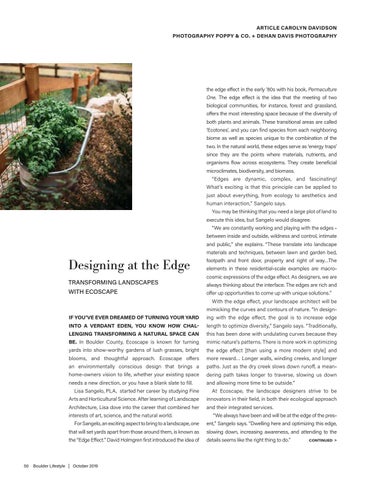
the edge effect in the early ’80s with his book, Permaculture One. The edge effect is the idea that the meeting of two biological communities, for instance, forest and grassland, offers the most interesting space because of the diversity of both plants and animals. These transitional areas are called ‘Ecotones’, and you can find species from each neighboring biome as well as species unique to the combination of the two. In the natural world, these edges serve as ‘energy traps’ since they are the points where materials, nutrients, and organisms flow across ecosystems. They create beneficial microclimates, biodiversity, and biomass. “Edges are dynamic, complex, and fascinating! What’s exciting is that this principle can be applied to just about everything, from ecology to aesthetics and human interaction,” Sangelo says. You may be thinking that you need a large plot of land to execute this idea, but Sangelo would disagree. “We are constantly working and playing with the edges between inside and outside, wildness and control, intimate and public,” she explains. “These translate into landscape materials and techniques, between lawn and garden bed,
Designing at the Edge TRANSFORMING LANDSCAPES WITH ECOSCAPE
footpath and front door, property and right of way…The elements in these residential-scale examples are macrocosmic expressions of the edge effect. As designers, we are always thinking about the interface. The edges are rich and offer up opportunities to come up with unique solutions.” With the edge effect, your landscape architect will be mimicking the curves and contours of nature. “In design-
IF YOU’VE EVER DREAMED OF TURNING YOUR YARD
ing with the edge effect, the goal is to increase edge
INTO A VERDANT EDEN, YOU KNOW HOW CHAL-
length to optimize diversity,” Sangelo says. “Traditionally,
LENGING TRANSFORMING A NATURAL SPACE CAN
this has been done with undulating curves because they
BE. In Boulder County, Ecoscape is known for turning
mimic nature’s patterns. There is more work in optimizing
yards into show-worthy gardens of lush grasses, bright
the edge effect [than using a more modern style] and
blooms, and thoughtful approach. Ecoscape offers
more reward… Longer walls, winding creeks, and longer
an environmentally conscious design that brings a
paths. Just as the dry creek slows down runoff, a mean-
home-owners vision to life, whether your existing space
dering path takes longer to traverse, slowing us down
needs a new direction, or you have a blank slate to fill.
and allowing more time to be outside.”
Lisa Sangelo, PLA, started her career by studying Fine
At Ecoscape, the landscape designers strive to be
Arts and Horticultural Science. After learning of Landscape
innovators in their field, in both their ecological approach
Architecture, Lisa dove into the career that combined her
and their integrated services.
interests of art, science, and the natural world.
50
“We always have been and will be at the edge of the pres-
For Sangelo, an exciting aspect to bring to a landscape, one
ent,” Sangelo says. “Dwelling here and optimizing this edge,
that will set yards apart from those around them, is known as
slowing down, increasing awareness, and attending to the
the “Edge Effect.” David Holmgren first introduced the idea of
details seems like the right thing to do.”
Boulder Lifestyle | October 2019
CONTINUED >
The Bench solution was created for space optimization + safety...an aesthetic tie-in to sleek architecture at the edge of open space + foothills.
October 2019 | Boulder Lifestyle
51
DESIGNING AT THE EDGE
(CON TI N U ED)
Local place intersecting with the world at large in the space of a mailbox.
52
Boulder Lifestyle | October 2019
'dragons blood' sedum
CONTINUED >
October 2019 | Boulder Lifestyle
53
DESIGNING AT THE EDGE
(CON TI N U ED)
Red brick detailing stitches together existing patio with new expansion + firepit
54
Boulder Lifestyle | October 2019
WARM + INVITING Whether remodeling, adding on, or building new, count on Melton for inspired architectural designs, unparalleled craftsmanship and a personalized customer experience. On time and on budget, we set the standard in residential construction. Let us craft a home that is distinctively yours.
MELTONDESIGNBUILD.COM | 303.473.9542 | 3082 STERLING CIRCLE BOULDER,CO 80301
MASSAGE - SKIN - NAILS & MORE
Pumpkin Spice and everything nice .
A full body exfoliation with our homemade blend of pumpkin, brown sugar, nutmeg and cinnamon Good enough to eat? Yes! But leave enough for the full neck, back and shoulder massage to round out this delicious experience.
303.302.3888 • concierge@truebloomspa.com • truebloomspa.com •
You deserve it, Pumpkin!
@truebloom_spa
EMS
Electrical Muscle Stimulation
Personal Training Studio ONE FREE SESSION + 3D Body Scan
Valued at $149. Book now! Only 8 spaces left.
Call or text
303.440.3441 to book
Lean, FIT and strong, in just
20 minutes
3151 Walnut Street, Boulder CO 80301
fittecboulderco.com
If humanity were but a wild beast, uninhibited and free, 58
Boulder Lifestyle | October 2019
New York City would be the beating red heart. CONTINUED >
October 2019 | Boulder Lifestyle
59
NEW YORK CITY FASHION
(CON TI N U ED)
The Lawless Landscape of New York City Fashion A GLIMPSE INTO CEDAR AND HYDES ANNUAL BUYING TRIP
ARTICLE KELLY ERNST | PHOTOGRAPHY MICHELLE TIPPMANN
AS GREAT AS IT IS TERRIBLE, NEW
Poised in lipstick and heels, not one will skips
YORK IS CONTINUOUSLY REGENER-
a beat in their curated appearances.
ATING ITSELF TO HOUSE AND FEED
We also heard from Lambert about the
For more on navigating New York City,
SOME OF THE WORLD’S MOST INSPI-
current movement in women’s fashion that
below are the taste-makers essential stops…
RATIONAL CREATORS.
mixes high with low, glam with comfort.
We trailed behind Cedar and Hyde
“I think it’s all rolled into women working
Mercantile as their team traveled into the
for themselves or for other women more
heart of the beast. We asked co-owner Poss
and no longer dressing for the approval of
Lambert a series of questions to better glean
men,” describes Lambert. Amen to that.
how to effortlessly navigate the lawless landscape of beauty and fashion of New York.
“We are seeing poof sleeved dresses with
HANGS | LES (the cool way to say Lower East Side) EATS | The Carlyle Hotel for a stiff martini and epic people watching
chunky sneakers, and lots of pleated trou-
While a bit of a cliche, one truly does find
sers with a fitted turtleneck and overcoat.
MUSE | Oroboro for clothing and accesso-
inspiration where you last think to look.
It’s as if women are going decades back,
ries, Cote A Coast for home goods
Lambert describes how she loves to watch
and re-creating their looks from those eras
older women. Lifelong navigators of the streets
as if they were the ones in charge. It’s really
CHILL | Aire Ancient Baths for an escape
and subways, they endure from decades past.
beautiful to watch and participate in.”
and soak
60
Boulder Lifestyle | October 2019
CONTINUED >
October 2019 | Boulder Lifestyle
61
NEW YORK CITY FASHION
62
Boulder Lifestyle | October 2019
(CON TI N U ED)
CONTINUED >
October 2019 | Boulder Lifestyle
63
NEW YORK CITY FASHION
64
Boulder Lifestyle | October 2019
(CON TI N U ED)
October 2019 | Boulder Lifestyle
65
DANCING GRAINS WOODWORKS bespoke modern furnishings 1 0 0 1 L e e H i l l D r i v e B o u l d e r | 3 0 3 . 5 0 1. 3 6 6 6 | d a n c i n g g ra i n s . c o m
PATIOS . OUTDOOR KITCHENS . FIRE FEATURES . WATER FEATURES . LIGHTING
Don’t be left out in the cold in your own backyard! Now is the time to begin planning for 2020! RSL Outdoor specializes in thoughtfully-designed outdoor living spaces, customized to your specific needs. Call today to have your space transformed, and start enjoying a healthier lifestyle in your own backyard.
303.772.4736 . RSLINC.NET . INFO@RSLINC.NET
OPEN HOUSE
68
Boulder Lifestyle | October 2019
A Mountain Marvel BRINGING DREAM HOMES TO LIFE WITH PETRA CUSTOM BUILDERS ARTICLE BRIANNA BLAIR | PHOTOGRAPHY KYLIE FITTS
ATOP A MOUNTAINSIDE IN LYONS,
Petra’s labor throughout the town to assist
COLORADO, SITS A HOME DESIGNED
with disaster relief. Weeks later, the team
FOR A WORLD TRAVELER AND A CLAS-
reassembled; in 16 months, the one-of-a-
SIC MINIMALIST. With its clean lines and
kind home was finished.
modern design, the house's global charm
“Charlotte’s modern mountain marvel
can be found in the custom cabinetry, hand-
is close to our hearts in that it was an
made and shipped in from Poland, tongue
incredible accomplishment to build such a
and groove wood ceilings, wall-to-wall win-
challenging project and so close to home,”
dows, and floating stone counters.
says Celeste Grow, Interior Designer for
In May 2013, Charlotte Grojean, a long-
Petra Custom Builders.
time partner architect and her husband, Stan
While the Strauss residence is magnif-
Strauss, teamed with Petra Custom Builders
icently modern, the look is softened by
to bring her dream home design to life. The
Grojean’s collection of antiques and vin-
home’s design was intentionally shaped to
tage Turkish rugs. The combination of “old
reduce the removal of the native sandstone
meets new” perfectly represents their love
and foliage and minimize the impact on the
of both forms of design.
natural landscape of the property. Three
months
later,
the
“By executing both design and construcColorado
tion in-house," says Grow, "there is a seam-
Floods struck. Jimmy Moore, the project’s
less transition between the collaborative
Superintendent, felt convicted to contribute
design process with the homeowner into the
to the restoration of his high school home-
building phase, ensuring the client’s vision is
town. He, along with the homeowners,
brought to life the way it was intended — from
decided to halt the project and disperse
the time it was just an idea.”
CONTINUED >
October 2019 | Boulder Lifestyle
69
OPEN HOUSE
(CON TI N U ED)
Working with Petra Custom Builders starts with an open line of communication that brings a vision to fruition. Says Grow, “We find that our collaborative approach to design and construction with our clients allows us the opportunity to provide the best conceivable product through the clear understanding of the vision we gain as a result of working alongside them throughout the process.” Each project, whether a remodel or custom home, is a collaboration with Petra Custom Builders and unique to the client’s lifestyle. “The distinctive quality of each of our projects is in the individuality of the homeowners we work with,” says Grow. “We take tremendous pride in gathering the inspiration for our designs from our homeowners’ lifestyles in an effort to enhance their lifestyles.”
Petra Custom Builders’ competitive edge comes from their customer service by establishing clear communication and building authentic relationships first. For more information Petra Custom Builders and the possibility of building your own home like Charlotte and Stan, please visit www.petracustombuilders.com.
70
Boulder Lifestyle | October 2019
October 2019 | Boulder Lifestyle
71
Trust Firuzeh to help you find your place in Boulder. As one of the top luxury realtors on the Front Range, I offer clients my expertise through my intimate knowledge of the Boulder County real estate market. My deep rooted connections within the community, paired with my fortitude, ethical standards and personable style, allow me to accommodate a broad range of clients. I welcome the opportunity to work with you for all of your real estate needs. The key is to empower buyers and sellers to make the right decisions through knowledge. The reality is that every client is investing in their future through real estate. A home is a space that impacts, shapes, and enriches an individual’s way of life. Drop me an email at firuzeh.saidi@compass.com
Featured Listings 224 Arapahoe Avenue $1,750,000 | 2 Bed | 2.5 Bath Stunning mountain-style bungalow free-standing condominium, with high end finishes in coveted, intimate 13 unit Park Gables community. Featuring an open floor plan perfect for entertaining and living. Gourmet kitchen with top of the line appliances. Radiant heat, beautiful 125-year-old reclaimed pine wood floors. Over $175,000 in buyer’s upgrades from the original design plan. The first unit to be on the market since built in 2014. Located at the base of Flagstaff Mountain and steps away from Boulder Creek, hiking trails bike paths and easy walking distance from Downtown.
Firuzeh Saidi 303.523.9289 firuzeh.saidi@compass.com www.forsaleboulder.com Compass is a licensed real estate broker and abides by Equal Housing Opportunity laws. All material presented herein is intended for informational purposes only. Information is compiled from sources deemed reliable but is subject to errors, omissions, changes in price, condition, sale, or withdrawal without notice. No statement is made as to accuracy of any description. All measurements and square footages are approximate. This is not intended to solicit property already listed. Nothing herein shall be construed as legal, accounting or other professional advice outside the realm of real estate brokerage.
RODWIN � SI<YCASTLE ARCHIT ECTURE � CONSTRU C TION
design [build] green 303.413.8556 rodwi narch. com s k yeas ti econ s truction .corn
LOCALLY OWNED
ARTICLE KELLI RUHL PHOTOGRAPHY POPPY & CO.
MEET THE
DISRUPTORS HOW JUDITH GOLDMAN'S FRONT RANGE DESIGN CENTER IS REVOLUTIONIZING THE BUSINESS OF BUILDING
“SIMPLE, YET RADICAL.” That’s the phrase Judith Goldman uses to describe her latest innovative endeavor: Front Range Design Center (FRDC). Launched as a sister company to her renowned design firm, Design Studio Interior Solutions, FRDC is a golden example of what Goldman does best: thinking outside of the box. She wants to “disrupt the building industry” by revolutionizing how trade professionals execute their projects namely, by streamlining the behind-the-scenes processes that often bog down building projects and allowing the pros to get back to doing what they do best. One of the greatest “pain points,” as Goldman deems them, of any given project, include finding, managing and delivering the product necessary to realize the client’s vision. The FRDC team can take care of everything product-related, not only offering a vast selection of residential, commercial and hospitality products, but also handling all logistics, from spec-ing, sign-offs, take-offs, and ordering, to receiving, storing and delivering. To put it simply, FRDC gets the product where it is needed, when it is needed.
74
Boulder Lifestyle | October 2019
CONTINUED >
October 2019 | Boulder Lifestyle
75
LOCALLY OWNED
(CON TI N U ED)
FRDC’s showroom features an expansive collection of carpet, flooring, countertops, hundreds of fabrics, several lines of cabinetry, two lines of Design Studio custom furniture, wall coverings, window treatments, and more. For commercial and hospitality projects, FRDC simplifies the selection process with product lines categorized into five price levels created to fulfill the furniture, fixture and equipment (FF&E) needs of a customer's budget. Between the relationships Goldman has secured with manufacturers around the world, her wholesale pricing, and enormous product spectrum, customers will be pressed to find as complete a package as FRDC. At FRDC’s core are nine highly experienced professionals with the expertise to help guide a project from start to finish. Beyond products and logistics, the team brings multiple “soft skills” to the table, each of which can be retained as needed throughout the project. Their team boasts a deep bench of experts capable of accommodating needs such as custom products, designing, drafting, space planning, and project management. Goldman’s goal is two-fold: to keep architects, builders, contractors, and designers “out of the weeds” throughout their projects by providing behind-the-scenes support and solutions; and to bring together the trade community to collaborate and ensure their shared client’s vision is fully realized. She wants to bring the full project team “to the table” to work in unison. Ideally, through FRDC trade, professionals can give and take work, pair up for specialized projects, and align for the benefit of the shared client. Goldman's vision is to build “an incredible alliance among those that want to add value to the building industry” and ”put Boulder on the map in a new way.” Front Range Design Center (FRDC) offers an integrative and innovative approach to helping building industry professionals execute their projects on-time, on-budget, and without the pain points. While the goal is to “disrupt the building industry,” Goldman wants to help build a foundation from which trade professionals across the country can excel, expand, and function together.
76
Boulder Lifestyle | October 2019
October 2019 | Boulder Lifestyle
77
You dream. We design. Imagine the possibililities.
mosaic
architects + interiors
Boulder | San Francisco | Santa Barbara | Napa mosaicarchitects.com | 303.247.1100
LANDSCAPE DESIGN
BUILD
MAINTAIN
303.447.2282 EcoscapeDesign.com
HOPS & VINE
The Renaissance of Modern Tiki
ARTICLE KELLY ERNST PHOTOGRAPHY BRITTNI BELL WARSHAW
NAVIGATING ISLAND COCKTAILS WITH GRACE WITH BOULDER'S JUNGLE BAR
BIRTHED AT THE DAWN OF WORLD
Don the Beachcomber was Raymond
come from a fine-dining background. No
WAR II, MATURING INTO ONE OF
Gantt’s inaugural Caribbean Tiki bar, and
member of the staff would have a prob-
AMERICA'S MOST ENDURING FORMS
an instrumental muse for Jungle. Founded
lem explaining the difference between a
OF ESCAPISM, AND CURRENTLY TAK-
in the 1930s, it was exactly the refuge
full-bodied Guyanese rum, distilled from
ING A RESURGENT BREATH WITHIN THE
people needed. Trader Vic, another well-
fermented molasses, and the pure cane
MODERN RENAISSANCE OF THE HIS-
known Tiki name, came into the scene
juice-based rum distinct of Martinique,
TORICAL COCKTAIL, THE ALL-AMERI-
shortly after, expanding the culture by way
slightly more elegant, grassy yet floral,
CAN PHENOMENON OF THE TIKI BAR IS
of the infamous Mai Tai.
with a noticeable dirtiness.
A CULTURAL ICON THAT IS BOTH FANTASTICAL AND GARISH. The industry is experiencing a new wave of consumer consciousness. Tiki, in gen-
The bars toted ambiance, flavors, and
Novotny explains further that because
rattan furniture that embodied a distorted
of the renaissance of the Tiki Bar, rum pro-
fantasy for something vaguely Polynesian– a
ducers in the islands are being afforded the
beloved, albeit gaudy, cultural fabrication.
opportunity to create classifications to stan-
eral, is having a harder time standing up
Jungle does an admirable job navigat-
to the demands of historicity, quality, and
ing the complex discourse surrounding
authenticity. Accordingly, Jungle, West Pearl
the history of cocktails embellished with
None of this reflection and forethought
Street’s newest island bar and landmark
patio furniture. A walk through their cock-
comes as a surprise. Novotny and his team
institution, has risen to the challenge.
dardize and characterize their production, a nod towards the vitality of the industry
tail menu is a walk through the history
have an uncanny ability to move honestly
While first and foremost a Tiki Bar, Jungle
of rum, a surprisingly misunderstood yet
through the crass characterization of island
exhibits a conscientious reflection of the
integral ingredient to the entire concept.
longing, creating an experience that feels
islands it represents and is an advocate for
Jungle explores the entire history, begin-
more like a vacation to the tropics than an
the artisanal spirits and food of the Carribean.
ning with the first evidence of distilling
escape from something sub-par.
Tiki itself is forever tethered to World War II.
cane juice into‘rhum’ starting in 200 B.C.
As war vets returned from the Pacific theatre,
in the kingdom of Gandhara.
American familiarity with Polynesian cultural
Jungle’s attention to detail from Tiki
motifs became a source of hazy fascination
history to the late-night Carribean bites
and, as a modern psychologist might retroac-
is not surprising. Jake Novotny, partner,
tively diagnose, post-traumatic escape.
and general manager, and his entire team
80
Boulder Lifestyle | October 2019
Jungle is a conscientious reflection of the islands it represents, an advocate for the artisanal food spirits of the Carribean, but first and foremost, a beloved Boulder Tiki bar. CONTINUED >
October 2019 | Boulder Lifestyle
81
HOPS & VINE
82
(CON TI N U ED)
Boulder Lifestyle | October 2019
October 2019 | Boulder Lifestyle
83
INVISALGN® BRACES / SMILE RESTORATION / WHITENING / NATURAL COSMETIC / LASER DENTISTRY
GET THE PERFECT SMILE YOUʼVE ALWAYS WANTED
Dr. Ania's state-of-the-art Boulder dental office offers comprehensive and cosmetic care for the whole family. With a gentle approach and individualized care, she not only considers her patients' oral health, but how their oral health relates to other aspects of their bodies and lives. Her biological dentistry practice includes wellness care, neuromuscular dentistry, and advanced cosmetic dental procedures. With Invisalign® and top-notch whitening services, Dr. Ania can painlessly and gently deliver that million dollar smile you've been longing for. Call Dr. Ania today for more information.
DR. ANIA MOHELICKI 2300 CANYON BLVD BOULDER, COLORADO 80302 303-443-0998 / WWW.DRANIA.COM
Peak Logo - 6/22/11to a life of isolation. At Peak ENT, our goal Hearing loss can lead is to provide appropriate assistance to treat your hearing loss and reconnect you with the people that matter most.
1
2
PE AK T H R O AT
PE AK
& VOICE CENTER
& VOICE CENTER
EAR
Nicole Lilly, Au.D.
NOSE
Broomfield 403 Summit Boulevard, Suite 204 Brighton 1606 Prairie Center Parkway, Suite 370 Golden 1030 Johnson Road, Suite 350
720.401.2139
|
peakentandvoicecenter.com
EAR
NOSE
T H R O AT
Samantha Ewing, Au.D.
LOCAL LIMELIGHT
86
Boulder Lifestyle | October 2019
The Man With The Plan AMERICAN SINGLE MALT WHISKEY IS ABOUT TO TAKE OFF, AND BOULDER’S VAPOR DISTILLERY IS AT THE FOREFRONT
ARTICLE ALLYSON REEDY PHOTOGRAPHY BAILEY BATCHELOR
CONTINUED >
October 2019 | Boulder Lifestyle
87
LOCAL LIMELIGHT
(CON TI N U ED)
IF YOU’RE GOING TO TACKLE NEW FRONTIERS, TACKLING NEW FRONTIERS IN WHISKEY IS ABOUT THE COOLEST FRONTIER YOU COULD PICK. Alastair Brogan, owner of Boulder’s Vapor Distillery, is doing that for American single malt whiskey, a spirit category that, until recently, has been woefully underrepresented here in the U.S. But he’s not doing it for the cool factor; his reasons are pure. The Scotsman just wanted to make the kind of single malt whiskey he loved in his native Scotland. “This was always my ambition,” Brogan says. “I’ve got a passion for single malt whiskey.” So after winning prestigious awards for Vapor’s gins and bourbons, Brogan and his team set their sights on making a world-class American single malt whiskey, a fairly new category ready to explode. Before it explodes, though, most of us need to learn what, exactly, an American single malt whiskey is. What’s the difference between that and what we’re used to from American whiskey makers, like, say, Jack Daniels? Or the single malt whiskies from around the world? (Most famously, Scotch.) Traditionally, most American whiskies have been made primarily from corn or rye. An increasing number of distillers, however, have been creating single malt whiskeys, made from 100 percent malted barley. The barley has more depth and complexity, giving the spirit a nuttier and malty flavor. Also, like champagne that must be made in a region of France, Scotch must be made in Scotland. So American single malt whiskey differs in that it must be made here in the U.S. Brogan got going in February 2015, when his 1,200-gallon copper pot still, specially made in Scotland, arrived in Boulder. Of course good whiskey, like healing a broken heart or waiting for the Bill & Ted reboot, takes time; it was less than a year ago that Vapor debuted its three expressions of American single malt whiskey: New American Oak (the gold standard), Peated Malt (smokier), and Port Cask (fruitier). The response has been great. The whiskeys are already winning awards, and, maybe more importantly, they’re making converts out of skeptical Scotch makers. “I’ve taken it over to Scotland to major distillers, and they’re praising what we’re doing,” Brogan says. The ingredients for whiskey are extremely brief and simple — water, barley, yeast, and the barrel used to age the whiskey — which means that the quality of each ingredient is inordinately important. Luckily, Vapor Distillery has one major advantage. “The water here in Colorado, and especially in Boulder, is spectacular. We use glacier snowmelt water for the processing and Eldorado water — voted the best municipal water in the world — to proof it down,” Brogan explains. They import the barley from the UK, because one, it’s what Brogan knows, and two, the Scots have mastered this over the past 400 years. “The Europeans are advanced when it comes to malted barley for whiskey -- like the Americans are good at the corns and the ryes,” he says. Another difference between the European single malts and the American is that here, the whiskey mostly goes into new oak barrels. “That is a colossal difference in the taste profile,” Brogan says. “Because of the barrel you get more of the oak flavor associated with bourbon, and you get a lot of the sugars from the caramelization of the oak. That’s why the American single malt whiskey will be a little sweeter.” Then — voila! — three or four years of aging in a semi-arid environment later, you get an American single malt whiskey. Or, in other words, a 92-proof, robust, highly sippable new frontier.
88
Boulder Lifestyle | October 2019
October 2019 | Boulder Lifestyle
89
90
Boulder Lifestyle | October 2019
CUSTOM HOMES
| REMODELS
O U T D O O R S PAC E S | C O M M E R C I A L
www. sl o an.bu i l d 7 2 0.4 5 9. 7 6 01
PARTING THOUGHTS
92
Boulder Lifestyle | October 2019
ARTICLE BEN WIESE + CHANTEL ELLERINGTON PHOTOGRAPHY LADD FORDE
LIV WALKER
Parting Thoughts HOW AND WHEN DID YOU
having this opportunity at a young age taught
BEGIN IN MODELING?
me so many skills — from how to conduct
When I was twelve-years-old I was scouted and signed by Donna Baldwin Agency in Denver. I started attending local castings
professional interactions to being flexible and adaptable in any situation.
where I was categorized as a “tween”— it was
WHAT ARE THE BIGGEST LESSONS
an awkward period, and I was never right for
YOU HAVE LEARNED THROUGHOUT
the job. But each casting I went into, I was a
YOUR MODELING CAREER?
little more sure of myself and polished.
I’m sure for most of my family, friends, and
Eventually, I started shooting with local
peers it looked seamless… but for me, it was
photographers and walking in local shows.
hard work… sometimes rewarding, sometimes
Working with Denver-area creatives taught
soul-crushing. I've learned that expressing
me to trust their visions and ideas.
gratitude to the people I've worked with makes
I developed a love for the art we created
them feel really good and makes me feel great. I
together and fell in love with the collaboration.
always made it a point to send thank you notes.
At fourteen, I was signed with my agencies in
Over the years, the entire process has
Los Angeles and New York City and began
become a rewarding ritual. Also, my mom
traveling every summer to work. In retrospect,
used to say after a shoot or a show, "If that's CONTINUED >
October 2019 | Boulder Lifestyle
93
PARTING THOUGHTS
(CON TI N U ED)
your last job, wasn't it phenomenal to have that experi-
WHAT HAS TRAVELING ACROSS
ence?" It's really made me appreciate everyone and every-
THE WORLD TAUGHT YOU?
thing I've done through modeling.
At first, I traveled everywhere with my mom. When I graduated from high school, with the support of my mom,
WHAT PROMPTED YOU TO ATTEND THE UNIVERSITY
dad, and little brother, I was ready to travel and live on
OF COLORADO AT BOULDER?
my own. At 18, that alone was very empowering. I also
During my senior year of high school, I went to New
learned my true value is not in how I look, but in how I
York City, London, and Paris for two different fashion
work with my fellow creatives. As my mom says, "skinny
months. After graduating I was totally motivated to be a
is not your skillset," which just means being relatable,
full-time model. After a summer stint in Spain, traveling
hardworking, and kind are the strengths I bring to set, the
and living in New York and London, I started to notice a
showroom, or to a runway.
change in my interests: I became more and more curious
People liked working with me because of who I am,
about the business of fashion, the amazing people I was
not just what I am. That translated no matter where I
meeting, and the worlds they had built.
was in the world.
When I saw the rewards these “Boss Creatives” received from accepting challenges and realizing their visions, I
HOW HAS YOUR UNDERSTANDING OF THE
wanted a piece of that. For many reasons, modeling was not
MODELING BUSINESS CHANGED OVER TIME?
providing a space for me to do the same. So, it’s no wonder
It’s important for me to acknowledge I’m hard on myself,
after seeing these people operate, I wanted to go to school.
and I didn't have the breakout success my agents had
I’m ready to find a direction I’m passionate to pursue at the
expected of me. When I was first signed in NYC and LA,
Leeds Business School at CU. I’m excited to find out what the
my agents said I was getting looks from fashion's most
future holds. I don’t know where it will take me, but knowing
exclusive casting directors. But through the years, as
where I’ve been, I feel good about where I’m headed.
those casting directors took good hard looks and ultimately passed on me, I learned it would be very difficult to
WHAT ISSUES ARE CLOSE TO
change their minds. For the longest time, I was convinced
YOUR HEART AND WHY?
my success was dependent on their approval.
The career path of a fashion model is very nontra-
During London Fashion Week Autumn/Winter '18 I
ditional. On one hand, a woman is supposed to be a
vibed well with designers who made me feel empowered,
globe-trotting muse, someone who is fascinating and
and in NYC during Spring/Summer '19 I hit my pocket
beguiling, and commanding of attention. In truth, the year
with designers who dressed “Boss” women.
I spent working as a full-time, traveling model was lonely, disempowering and rife with anxiety.
Looking back, I've met and worked with visionaries who have a lust for life, and who have found joy
Don't get me wrong, I am very grateful. But I wasn't
through leadership. It has molded the way I want to see
having the kind of success that I needed to get momen-
myself. I still love being a model and being in the middle
tum. I found myself at crossroads in modeling where I
of a creative hive. I don't think that will ever change, but
needed to either double-down or move on.
I will have different roles to play.
Maybe sensing my apathy, I actually had two agents say something along the lines of: "The problem with
WHAT ADVICE WOULD YOU OFFER A YOUNG
American girls is that you have too many options." That
PROFESSIONAL IN YOUR FIELD?
didn’t sit right with me. At that point, I felt I needed to take control over my life and my direction. I saw business school as my path forward. I feel strongly that women should always have choices and self-deter-
94
There are factors outside of your control, like certain industry physical standards you have to meet in order to work regularly and make enough money to sustain yourself. Also, luck has to be on your side.
mination. I support women, women-owned businesses,
Beyond that, you have to be self-motivated, deal well
young women, and their visions for success. As I progress
with constant rejection, have good representation, and a
through school, I will continue to focus my energy on being
great support system. If you have all of those things going
a "girl's girl" in the business world, looking for ways to pro-
for you, the best advice I can give is to express gratitude
vide opportunities and options for them.
and feel grateful for every experience.
Boulder Lifestyle | October 2019
When you find yourself in the legal system, uncertainty is not an option. Choose the attorney who has made the Courts her second home for over 25 years. THE LAW OFFICE OF CARE ENICHEN, LLC
The experience you need, the peace of mind you deserve. 7 years Deputy District Attorney I 16 Years Boulder County Court Judge I Criminal Defense and Family Law
Care Enichen, Attorney at Law Downtown Boulder, CO / Pearl St. Mall (303) 442-5566 | contact@carelawboulder.com www.carelawboulder.com
A PERSONAL APPROACH TO L AW
Only one floor matters . Yours. Our experts will help you find a floor you love, and you won’t pay more for it.
McDonald
HOME CARPET ONE &FLOOR
6367 Arapahoe Ave. | Boulder
®
| 303-449-0011 | www.carpetone.com October 2019 | Boulder Lifestyle
95
OCTOBER
LIFESTYLE CALENDAR
3
16
17
OPENING RECEPTION FOR FALL EXHIBITIONS 2019
BOULDER COUNTRY DAY SCHOOL OPEN HOUSE – FOR PRESCHOOL (AGES 2.5 AND ABOVE) AND KINDERGARTEN
WALTERS & HOGSETT FINE JEWELERS ESTATE JEWELRY BUYING EVENT
Boulder Country Day School
On October 17-18th, we will be actively
bitions, Adriana Corral: Unearthed/
Attending an Open House is a great
seeking to buy antique jewelry, signed
Desenterrado and Gretchen Marie
way to learn about Boulder Country
jewelry, gold and platinum jewelry,
Schaefer: Folding and Thrusting.
Day School, their academic and
diamonds and precious stones!
Opening
remarks
arts programs, as well as to have a
WaltersandHogsett.com
Director
David
Boulder Museum of Contemporary Art
The Fall 2019 Opening Reception will feature the opening of two exhi-
by
Executive Guest
chance to meet faculty, administra-
Curator Cortney Lane Stell, and the
tors and other prospective families.
exhibiting artists. Free event.
We welcome you to take a look.
BMOCA.org
Register below.
Dadone,
4
GET ENGAGED WEEKENDS: MEET KIMBERLY COLLINS
Walters & Hogsett Fine Jewelers
On Friday, October 4th from 3 PM - 6 PM celebrate color with a Gem Show
BoulderCountryDay.org
16 CBD OIL AND FOODS BY PROUD HOUSE STUDIO & CO. WITH BOULDER MEDICINALS Proud House Studio
Walters & Hogsett Fine Jewelers
18 THE NORTH FACE PRESENTS REEL ROCK 14 Boulder Theater
The REEL ROCK Film Tour, one of climbing's greatest celebrations, returns this fall with four new world premieres. BoulderTheater.com
19
featuring Kimberly Collins! Enjoy drinks,
Learn about Boulder Medicinals
bites, and a special Burgundy Wine
Hand Crafted CBD products as we
Tasting from Boulder Wine Merchant!
prepare food and drinks using CBD
October 4th-6th, stop in to say hello,
oil. October 16th 4:30-6:30 pm. Light
enjoy some beer, and mimosas.
refreshments will be served. RSVP
WaltersandHogsett.com
to margaret@proudhousestudio.com
Welcome to TEDxBoulder! This is our
by October 14.
12th TEDxBoulder mainstage event
15
ProudHouseStudio.com
and we pride ourselves with the qual-
BoulderMedicinals.com
ity of the event from ticket purchase
ADAPTIVE: FILM SCREENING CLIMBING LOTUS FLOWER TOWER
17
will give you a rose!). Our event is two
In 2018, Jim Ewing invited a professional
BOCO HIGH SCHOOL FAIR
musicians. It is inspiring, heartfelt,
Neptune Mountaineering
climber missing her left hand, Maureen
TEDXBOULDER: PRIDE & PREJUDICE
Macky Auditorium and Concert Hall
(no extra fees!) to when you exit (we 90 minute sessions of all live TED style talks from local speakers and
Boulder Country Day School
and a damn fun community event.
Beck, to accompany him in attempting
Free and open to the public. 70+
EventBrite.com
the first all-adaptive ascent of the über
public, private, and boarding schools
classic and deeply remote Lotus Flower
attending. All Boulder County middle
Tower (5.10+) in Canada's Cirque of the
school students and families wel-
Unclimbables. In "Adaptive", Jim and
come. No RSVP required.
Maureen hope to demonstrate that "dis-
BoulderCountryDay.org
abled" climbers are just differently—and
19 2019 WATERWAY CLEANUP TOUR Eben G. Fine Park
equally—abled. Don't miss us for this
Join United By Blue for a commu-
incredible event and film screening with
nity cleanup of Boulder Creek in
support from Sterling Ropes.
Ebin Fine Park! As part of our 2019
Facebook.com
Waterway Cleanups tour, we'll gather CONTINUED >
96
Boulder Lifestyle | October 2019
Edward Jones ranks highest Edward Jones ranks highest in investor satisfaction with in investor with full service satisfaction brokerage firms, full serviceto brokerage firms, according the J.D. Power according to the J.D. Power 2019 U.S. Full Service Investor SM 2019 U.S. Full Service Investor Satisfaction Study Satisfaction StudySM
Why? Because we’re built for listening. Why? Because we’re built for listening.
So you? So what’s what’s important important to to you? Contact me at (303)494-2310 to get started. Contact me at (303)494-2310 to get started.
Edward Jones - It’s Time for Investing to Feel Individual. Edward Jones - It’s Time for Investing to Feel Individual.
November is Homeless and Runaway Youth Awareness Month
Sleep Out on Nov. 7th
MKT-11677-A-AD-JDP MKT-11677-A-AD-JDP
Study based on responses from more than 4,629 investors who primarily invest one the 18 firms included in the study. The majority of the Studywith based onofresponses from more than 4,629 investors who primarily investwas withfielded one ofinthe 18 firms included in the study. The majority of the study December 2018. Your experiences may vary. Rating study was in December 2018. Your experiences may Rating may not be fielded indicative of future performance and may not bevary. representative may indicative of future performance and an may not be of representative of anynot onebeclient’s experience because it reflects average experiences ofresponding any one client’s experience because it reflects an average of experiences of clients. Visit jdpower.com/awards. of responding clients. Visit jdpower.com/awards.
Serban C Maracine, AAMS® Serban C Maracine, AAMS® Financial Advisor Financial Advisor 4800 Baseline Road C-105 4800 Baseline Road C-105 Boulder, CO 80303 Boulder, CO 80303 303-494-2310 303-494-2310
edwardjones.com edwardjones.com Member SIPC Member SIPC
to support youth facing homelessness Raise funds and awareness by sleeping out in downtown Boulder with other community members!
The moment I REALIZED MY TEACHER GETS ME.
Learn More: attentionhomes.org/sleepout
SEEN. KNOWN. LOVED.
Tours Daily Open Houses October 16th & November 2nd
Thank You Sponsors:
Preschool through Middle School
bouldercountryday.org
October 2019 | Boulder Lifestyle
97
OCTOBER
LIFESTYLE CALENDAR
25
31
CAT POWER - WANDERER TOUR 2019 WITH ZSELA
MUNCHKIN MASQUERADE
Boulder Theater
Each year, Downtown Boulder is
There are few voices more deeply
invaded by thousands of tiny ghosts
embedded in the iconography and
& goblins, dinosaurs & dragons,
mythology of American indie rock
fairies & princes, superheroes and
1300 Block of Pearl - 1300 Pearl St
than that of Chan Marshall. Under
animals of every size trick-or-treating
This great tradition is back again
the musical nom de plume of Cat
along Pearl Street. Recommended
this fall! Come see members of the
Power,
for children ages 12 and under.
CU Football Team, Golden Buffalo
music for nearly 25 years now and
Marching Band, the Spirit Squad, and
her prowess as a songwriter, a
other special guests before home
producer, and most notably—as a
football games at the Pearl Street
voice—has only grown more influ-
Stampede. Led by Stephen Tebo’s
ential with time.
with local organizations, businesses, and volunteers to clean up the creek banks and trail systems. EventBrite.com
24 PEARL STREET STAMPEDE
Marshall
has
Pearl Street Mall
released
BoulderDowntown.com
vintage 1948 fire truck, members of
We are always accepting sub-
the Golden Buffalo Marching Band
missions for events you'd like to
start performing at 7 p.m. on the 1300
see included in our Calendar sec-
block of Pearl Street (in front of the
tion. Submissions are accepted
County Courthouse).
via
BoulderDowntown.com
BoulderLifestylePubs.com.
the
Contact
Us
tab
at
Move with Boulder’s Best Pat Guyton Pilates Conservatory® is a boutique studio – home of Boulder’s best teachers. We offer custom private exercise programs that enhance atheletic performance, increase strength & flexibility, prevent injury and progress rehabilitation. Please inquire about mentorship if you are interested in joining our team.
(regularly$450)
$200 OFF 10-Pack Private Sessions (regularly$850) 98
Boulder Lifestyle | October 2019
$100 OFF 5-Pack Private Sessions
Featured Properties
1489 Sunset Boulevard 7 Bed 7 Bath $7,500,000
1810 Hillside Road 6 Bed 7 Bath $5,790,000
601 Baseline Road 5 Bed 4 Bath $3,950,000
907 7th Street 4 Bed 4 Bath $3,950,000
2550 Balsam Drive 4 Bed 4 Bath $2,595,000
440 Arapahoe Avenue 4 Bed 4 Bath $1,970,000
Recently Sold Properties
820 8th Street 5 Bed 7 Bath Sold For: $3,900,000
2468 Powderhorn Lane 5 Bed 4 Bath Sold For: $2,295,000
Award-Winning Boulder Realtor. Extraordinary Service. Unmatched Market Knowledge. Award-winning Boulder Realtor Zach Zeldner consistently delivers extraordinary service and unmatched market knowledge in one of the country’s most sought-after residential enclaves, right here in Boulder, CO. Backed by 15 years of experience, he is a consummate professional who always puts his clients first with unfailing integrity and discretion. Zach’s unique understanding of Boulder’s real estate market, neighborhoods, housing stock, school systems and amenities ensures that clients receive knowledgeable, full-spectrum guidance when buying or selling. As a Compass Founding Agent, Zach is aided in his quest for total client satisfaction by the renowned in-house marketing services, expansive reach and industry-leading technology of Compass, the country’s largest independent brokerage. Learn more at www.zachzeldner.com.
Zach Zeldner 720.480.7650 | zach@zachzeldner.com 3660 19th Street 6 Bed 7 Bath Sold For: $4,500,000
3122 9th Street 3 Bed 2 Bath Sold For: $1,475,000
Compass is a licensed real estate broker and abides by Equal Housing Opportunity laws. All material presented herein is intended for informational purposes only. Information is compiled from sources deemed reliable but is subject to errors, omissions, changes in price, condition, sale, or withdrawal without notice. No statement is made as to accuracy of any description. All measurements and square footages are approximate. This is not intended to solicit property already listed. Nothing herein shall be construed as legal, accounting or other professional advice outside the realm of real estate brokerage.