Ludwig van Beethoven (1770-1827)
Johannes Brahms (1833-1897)
Ludwig van Beethoven (1770-1827)
Johannes Brahms (1833-1897)
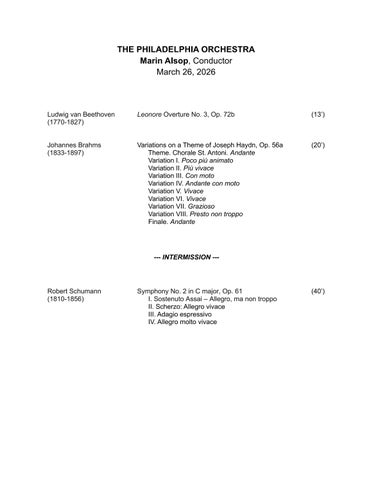
Marin Alsop, Conductor
March 26, 2026
Leonore Overture No. 3, Op. 72b (13’)
Variations on a Theme of Joseph Haydn, Op. 56a Theme. Chorale St. Antoni. Andante Variation I. Poco più animato Variation II. Più vivace
Variation III. Con moto Variation IV. Andante con moto Variation V. Vivace
Variation VI. Vivace
Variation VII. Grazioso Variation VIII. Presto non troppo Finale. Andante
--- INTERMISSION ---
Robert Schumann (1810-1856)
Symphony No. 2 in C major, Op. 61
I. Sostenuto Assai – Allegro, ma non troppo
II. Scherzo: Allegro vivace
III. Adagio espressivo
IV. Allegro molto vivace (40’)
Ludwig van Beethoven
Born in Bonn, probably December 16, 1770
Died in Vienna, March 26, 1827
The most famous of the four overtures that Beethoven wrote for his lone opera Fidelio, the so-called Leonore Overture No. 3, summarizes in the space of some 13 minutes the dramatic and emotional trajectory of the entire opera, from the dark depths of the orchestra to the ultimate triumph of the thrilling coda. In the midst of the Overture a trumpet sounds from the distance, just as it will in the crucial scene near the end of the opera announcing the arrival of the enlightened minister Don Fernando that secures freedom for the unjustly imprisoned political hero Florestan. The urgency of the Overture, especially of this signal of liberation, resonates with Beethoven’s own deeply held political beliefs.
Beethoven and Enlightenment Values Throughout his career, Beethoven was a fervent believer in Enlightenment values and found various ways to express them in his music, as he did in letters and other writings. He grew up during the American and French revolutions and experienced war firsthand when Napoleon’s troops invaded Vienna in 1805 and 1809. His first large composition, written at the age of 19, was an impressive 40-minute cantata for chorus, orchestra, and soloists commemorating the death of Emperor Joseph II, who had done a great deal to liberalize the Austrian empire in the 1780s. Enlightenment ideals would later find expression in the political messages of Fidelio, Egmont, and the larger humanistic vision of the Ninth Symphony.
Beethoven in fact recycled some of the Joseph Cantata music years later in Fidelio, a work he struggled with for years. The opera’s premiere in November 1805 (with the Leonore Overture No. 2) was unsuccessful for various reasons, some artistic and some political. For one thing, Napoleon’s troops had just invaded the city and they accounted for much of the audience. Beethoven revised the opera the next year, shortening its three acts to two, and for the new production wrote the Third Leonore Overture, a recasting of the earlier one, which also contains the trumpet call. (He wrote the First Leonore Overture in 1807, probably for a planned production in Prague that never materialized.)
In 1814, when Beethoven was at the height of his popular and critical success, he revised the opera yet again and wrote yet another overture, this one quite short, omitting the trumpet call, and, unlike the previous three, without any direct musical allusions to melodies in the opera. The most likely reason Beethoven ultimately substituted the Fidelio Overture that opens the opera as we know it today is that the Leonore Third in particular does such an effective job of conveying the dramatic sweep of the opera in purely orchestral terms he may have felt it lessened the power of the following theatrical representation. Donald Francis Tovey, the brilliant English music critic, argued that the revision of the Overture “profited in a fatal way, which raised it to one of the greatest instrumental works in existence, and at the same time ensured that it would absolutely kill the first act … it is about ten times as dramatic as anything that could possibly be put on the stage.”
A Closer Look Beethoven’s opera is today the best known of the once popular genre of “rescue operas.” Leonore, disguised as Fidelio, apprentices herself to the jailer, Rocco,
in the hope that she will be able to free her husband, Florestan, an unjustly condemned political prisoner. Although she is not even sure he is still alive, she heroically risks her life to save his. On orders from the evil Pizarro, she and Rocco descend to the dungeon to kill Florestan, but she reveals her identity, to the amazement of everyone, just as he is to die. At this moment the trumpet sounds in the distance, indicating the arrival of Don Fernando. It later became the custom in many productions of Fidelio, popularized by Mahler, Toscanini, and other conductors, to insert the Leonore Third Overture at this point. (In some instances, the addition serves the practical purpose of filling time as the scenery changes from the dungeon to the triumphal concluding scene outdoors where evil is exposed, Florestan liberated, and Leonore praised.)
The Overture begins with a slow descending scale that may relate in some way to Florestan’s imprisonment; in any case, out of this follows a theme alluding to his aria “In des Lebens Frühlingstagen” (In the springtime of my life), in which he sings of the price he paid for speaking the truth and envisions an angel resembling Leonore leading him to freedom in heaven. This theme is transformed later in the Overture, in the allegro section, and yet again in the triumphant presto coda that concludes the work. The trumpet call interrupts twice in the middle of the development section, separated by music derived from what the thankful Leonore and Florestan sing immediately after the trumpet announcing their salvation at the end of the first scene of act 2 (“Ach! Du bist gerettet! Grosser Gott!” [Ah! You are saved! Almighty God!]). A thrilling coda brings the Overture to a triumphant close.
Christopher H. Gibbs
Christopher H. Gibbs is James H. Ottaway Jr. Professor of Music at Bard College and has been the program annotator for The Philadelphia Orchestra since 2000. He is the author of several books on Schubert and Liszt, and the co-author, with Richard Taruskin, of The Oxford History of Western Music, College Edition.
Beethoven composed the Leonore Overture No. 3 in 1806.
The score calls for two flutes, two oboes, two clarinets, two bassoons, four horns, three trumpets (one offstage), three trombones, timpani, and strings.
Performance time is approximately 13 minutes.
Johannes Brahms
Born in Hamburg, May 7, 1833
Died in Vienna, April 3, 1897
The Variations on a Theme of Joseph Haydn, which Johannes Brahms composed at the age of 40, marked his entry into full orchestral maturity. Exactly 20 years earlier Robert Schumann had prophesized great things for him, hailing the young composer as the long-awaited heir to Beethoven. In a famous review titled “New Paths” (the last article Schumann wrote), he praised Brahms’s early pianos sonatas as “symphonies in disguise.” The wide attention and great expectations this elicited seem to have proved something of a burden.
Although Brahms was prolific, did not suffer from composer’s block, and even soon started composing a symphony, he found it a challenge to write purely orchestral works. He diverted some of his symphonic ideas into the ambitious Piano Concerto No. 1 in D minor and came closer to symphonies in two orchestral serenades. The First Symphony finally arrived in 1876, when Brahms was 43, but it was the Haydn Variations three years earlier that had given him greater confidence and set the decisive course for his magnificent four symphonies. The idea of a set of orchestral variations was unusual, although individual movements within earlier symphonies, such as the second in Haydn’s “Surprise” or the finale of Beethoven’s “Eroica,” offered models of sorts, as did great keyboard works by Bach, Beethoven, and Schubert.
Not By Haydn? Brahms wrote atop the autograph manuscript “Variations for Orchestra on a Theme of Jos. Haydn, Chorale St. Antoni.” Expert opinion, however, holds that Haydn did not write the Divertimento in B-flat (Hob. II/46) from which Brahms got the melody. In the early 1950s the eminent Haydn scholar H.C. Robbins Landon suggested the actual composer might have been Ignaz Josef Pleyel (1757–1831). In any case, the relevant melody within that work is labelled as the “St. Anthony” Chorale, which may have had some folk origin. Brahms seems not to have been sure whose tune it actually was, but he at least thought Haydn had used it as the second movement of the divertimento.
Brahms was among the most historically well informed and engaged of all great composers. One of his scholarly friends was the Haydn biographer Carl Ferdinand Pohl, who showed him several unpublished pieces supposedly by Haydn; from one of them Brahms copied out the “St. Anthony” Chorale. Several years later, in the summer of 1873, he decided to use it for a grand set of variations. His close friend Clara Schumann recorded in her diary on August 20: “In the morning I tried out with Johannes [his] new variations for two pianos on the ?-theme, which are entirely wonderful.” This statement, along with others, indicates that Brahms initially composed the Variations for two pianos, although an orchestral conception may nonetheless have been in mind from the start. After rumors spread about the piece he informed his publisher that they were “actually variations for orchestra.” He completed both versions that summer before his return to Vienna in September and they were published as Op. 56a and 56b.
Brahms conducted the premiere at the opening subscription concert of the Vienna Philharmonic in November 1873. The event was an important one for him as his only previous Philharmonic performance of a piece, the Op. 16 Serenade a decade earlier,
had not gone well. Now Edward Hanslick, the most powerful critic of the day and a staunch Brahms advocate, praised the Variations highly, as did others. Brahms conducted the piece often and its influence was felt by later composers who followed his example, including Antonín Dvořák’s Symphonic Variations, Edward Elgar’s “Enigma” Variations, and Arnold Schoenberg’s Variations for Orchestra.
A Closer Look No matter who wrote the original Divertimento from which Brahms got the theme (let alone who wrote the original tune), he closely followed the source, which was also a variation movement scored for a small ensemble consisting of two oboes, two horns, three bassoons, and serpent (a large bass-register woodwind instrument). Brahms begins his piece by using almost the same instrumentation to present the tune, which consists of a pairing of two five-measure phrases.
There follow eight variations of different speeds, moods, and character, but almost always with the same phrase and harmonic structure as the theme. The work ends with a grand finale that offers what is itself a miniature set of variations based on part of the original theme presented over a ground bass. This Baroque technique, also known as passacaglia or chaconne, would serve the composer 13 years later for the great final movement of his Fourth Symphony, his last orchestral work.
Christopher H. Gibbs
Brahms composed his Variations on a Theme of Joseph Haydn in 1873.
Brahms’s score calls for piccolo, two flutes, two oboes, two clarinets, two bassoons, contrabassoon, four horns, two trumpets, timpani, triangle, and strings.
Performance time is approximately 20 minutes.
Robert Schumann
Born in Zwickau, Saxony, June 8, 1810
Died in Endenich (near Bonn), July 29, 1856
“For several days, there has been much trumpeting and drumming within me (trumpet in C). I don’t know what will come of it.” The result of the inner tumult that Robert Schumann reported to his friend and colleague Felix Mendelssohn, in a letter of September 1845, was a symphony: the third of the four he would complete, though it was published as Symphony No. 2 in C major, Op. 61, in 1847.
Schubert as Catalyst The principal catalyst for Schumann’s return to symphonic composition in 1845 was almost surely a performance of Franz Schubert’s Symphony in C major (D. 944) on December 9 of that year, with the Dresden orchestra under Ferdinand Hiller. Schumann’s association with Schubert’s “Great” C-major Symphony dated back to the winter of 1838–39, when, during a trip to Vienna, he was introduced to the practically forgotten work by Schubert’s older brother, and quickly arranged for Mendelssohn to lead the Leipzig Gewandhaus Orchestra in the long overdue premiere. The newly excavated masterpiece had a lasting impact on Schumann, revealing to him that it was indeed possible to make an original contribution in a realm where Beethoven reigned supreme.
In his celebrated 1839 review of Schubert’s Symphony, Schumann described the work in superlatives the likes of which he had never before bestowed on a piece of instrumental music: “Here, apart from the consummate mastery of compositional technique, we find life in every vein, the finest shades of coloring, expressive significance in every detail, and the all-pervasive Romanticism to which Schubert’s other works have already accustomed us.” In addition to marveling at the Symphony’s “heavenly length,” Schumann also praised Schubert’s uncanny ability to “emulate the human voice in his treatment of the instruments.” Schumann would adopt both qualities as articles of aesthetic faith in his own Symphony in C major, especially in the magnificent valedictory hymn that crowns the finale.
Although Schumann completed the sketches for the Second Symphony in just two weeks toward the end of December 1845, he needed the better part of the following year to fill in the details. Indeed, he was still touching up the orchestration of the draft not long before the premiere, with the Leipzig Gewandhaus Orchestra under Mendelssohn’s direction, on November 5, 1846. As indicated by several entries in Schumann’s household account books, his labor on the Symphony was frequently interrupted by recurrent bouts of poor health. During the winter and spring months of 1846, Schumann made reference to severe headaches, fits of depression, anxiety attacks, and auditory disturbances.
Memories of a Dark Time As with so many of Schumann’s compositions, the Second Symphony lends itself to interpretation as an essay in musical autobiography. Schumann himself encouraged a reading of this kind. In a note to the composer and critic J.C. Lobe, he claimed that the new work “told a tale of many joys and sorrows.” Schumann offered a more detailed account of the Symphony’s personal connotations to D.G. Otten, founder of the Hamburg Musical Association: “I wrote the C-major Symphony in December 1845 while I was still half sick, and it seems to me that one can hear this in
the music. Although I began to feel like myself while working on the last movement, I recovered totally only after completing the entire piece.” Above all, Schumann confided to Otten, the Symphony reminded him of a “dark time,” symbolized musically “by the melancholy bassoon in the Adagio.”
The initial reaction to the Symphony was not entirely positive. According to reliable reports, the November 1846 premiere fell considerably short of the success that the composer had hoped for, despite concertmaster Ferdinand David’s assiduous drilling of the Gewandhaus violins on the finger-twisting passagework in the Scherzo and the perilously high trills in the Adagio. Before long, however, the critics were making the expected obeisances, comparing Schumann’s work to Mozart’s “Jupiter” Symphony and Beethoven’s Fifth.
A Closer Look The Second Symphony begins with a solemn chorale-like melody, stated quietly by the horns, trumpets, and trombones, and supported by a flowing counterpoint in the strings. Though presented simultaneously at the outset, these melodic strands are developed independently as the music unfolds, a process that Schumann invokes across the entire four-movement span of the Symphony. The initial motto in the brass puts in an unexpected appearance at the conclusion of the Scherzo, and comes in for spectacular treatment in the closing phase of the last movement. Similarly, the plaintive Adagio theme is swept up in the propulsive march rhythms of the first part of the finale. In a surprising turn of events, Schumann then transforms the march music into a gentler, more lyrical idea that he proceeds to combine with the first movement’s brass chorale. The expressive aim of this contrapuntal tour de force is unmistakable: In fusing “secular” song and “sacred” chorale melody, Schumann demonstrated how it might be possible to transcend both spheres, the mundane and the religious, through the medium of the symphony orchestra. Therefore the message of the Symphony is an eminently “modern” one, and indeed, it was not lost on later composers as diverse in stylistic orientation as Bruckner, Dvořák, and Tchaikovsky. While deeply rooted in the musical past, Schumann’s Second Symphony pointed confidently toward the future.
John Daverio
John Daverio was associate professor and chair of the Musicology Department at the Boston University School for the Arts and the author of Robert Schumann: Herald of a New Poetic Age.
The Second Symphony was composed from 1845 to 1846.
Schumann scored the work for two flutes, two oboes, two clarinets, two bassoons, two horns, two trumpets, three trombones, timpani, and strings.
Performance time is approximately 40 minutes.
Program notes © 2026. All rights reserved. Program notes may not be reprinted without written permission from The Philadelphia Orchestra Association.