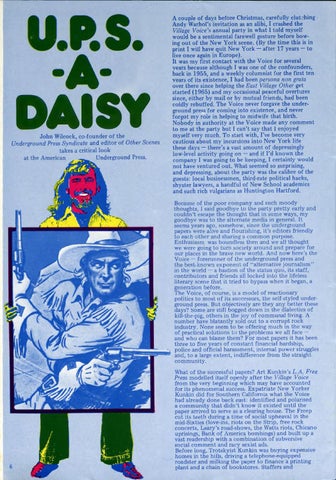
DAISY
John Wilcock, co-founder of the Underground Press Syndicate and editor of O ther Scenes takes a critical look at the American Underground Press.
A couple of days before Christmas, carefully clutching Andy Warhol’s invitation as an alibi, I crashed the Village Voice's annual party in what I told myself would be a sentimental farewell gesture before bow ing out of the New York scene. (By the time this is in print I will have quit New York — after 17 years — to live once again in Europe). It was my first contact with the Voice for several years because although I was one of the confounders, back in 1955, and a weekly columnist for the first ten years of its existence, I had been persona non grata over there since helping the East Village Other get started (1965) and my occasional peaceful overtures since, either by mail or by mutual friends, had been coldly rebuffed. The Voice never forgave the under ground press for coming into existence, and never forgot my role in helping to midwife that birth. Nobody in authority at the Voice made any comment to me at the party but I can’t say that 1 enjoyed myself very much. To start with, I’ve become very cautious about my incursions into New York life these days — there’s a vast amount of depressingly low-level activity going on — and if I’d known the company I was going to be keeping, I certainly would not have ventured out. What seemed so surprising, and depressing, about the party was the calibre of the guests: local businessmen, third-rate political hacks, shyster lawyers, a handful of New School academics and such rich vulgarians as Huntington Hartford. Because of the p oor com pany and such m oody thoughts, I said goodbye to the party p retty early and co u ld n ’t escape the tho u g h t th a t in som e ways, my goodbye was to the alternate media in general. It seems years ago, som ehow , since the underground papers were alive and flourishing, i t ’s editors friendly to each o ther and sharing a com m on purpose. Enthusiasm was boundless then and we all thought we were going to turn society around and prepare for our places in the brave new world. And now here’s the Voice — forerunner of the underground press and the best-known exponent of “ alternative journalism ” in the world — a bastion of the status quo, its staff, contributors and friends all locked into the lifeless literary scene th a t it tried to bypass when it began, a generation before. The Voice, o f course, is a m odel o f reactionary politics to m ost of its successors, the self-styled under ground press. But objectively are they any better these days? Some are still bogged dow n in th e dialectics of kill-the-pig, others in the joy o f com m unal living. A num ber have blatantly sold o u t to a c o rru p t rock industry. N one seem to be offering m uch in th e way of practical solutions to the problem s we all face — and who can blame them ? F or m ost papers it has been three to five years o f constant financial hardship, police and official harassm ent, internal pow er struggles and, to a large extent, indifference from the straight com m unity. What of the successful papers? A rt K unkin’s L .A . Free Press m odelled itself openly after the Village Voice from the very beginning which may have accounted for its phenom enal success. E xpatriate New Yorker Kunkin did for Southern California w hat the Voice had already done back east: identified and polarised a com m unity th a t d id n ’t know it existed until the paper arrived to serve as a clearing house. The Freep cut its teeth during a tim e of social upheaval in the mid-Sixties (love-ins, riots on the Strip, free rock concerts, Leary’s road-shows, th e W atts riots, Chicano uprisings, Bank o f America bom bings) and built up a vast readership w ith a com bination of subversive social com m ent and racy sexist ads. Before long, T rotskyist Kunkin was buying expensive hom es in th e hills, driving a telephone-equipped roadster and milking the paper to finance a printing plant and a chain of bookstores. Staffers and