_
‘ >• ‘
------
r n m ^ m 7r?A:-r
.
. ’.W. :• iv.’vXv
p#888B& i
iiiij
...
W imm IIII1 ;.v.v.;.v) ;!;*;J;Iv.'vX; vXxX.:-.;
W&r
................
:::iii;;;i^::::::::::i ^ ; .. .-coo
•Jw>>XXw!'X<wwa
P
Never tru st anyone over th irty ... Richard Neville, presently starring in the Broadway Follies of 1972, reports from New York on the current state of the revolutionary game. The publishers o f Screw, this c ity ’s funkiest and filthiest sex paper, are on the brink o f launching what they promise is "the most exciting publishing venture since Gutenberg” . I t ’s called ‘Mobster Times’ and its slogan is Crime Does Pay. Mobster Times believes that everyone adores criminals and intends to reassure readers that "o ur decade is just as crooked as the p ast. . . the same type o f crooks are running things now just as they have always done". Does Mobster Times lament this seeming truism? Indeed not, continues the handout, “ Mobster Times finds it admirable. How dull history would be w ithout mobjters like Napoleon Bonaparte, Julius Caesar, Josef Stalin, Huey Long and Lyndon Johnson. Do we want to run down that boring path towards ennui or does America wish to take her part in Western History as the great and bloody leader o f modern culture?” The paper plans to reveal the fine art o f how to bug someone else’s telephone and a regular series will outline details o f famous crimes “ step by wonderful step” . “ In other words, Mobster Times w ill glorify our exciting past in the way it deserves to be glorified.” Obviously i t ’s an almost sure fire journalistic success. Categorising Capone, Caligula, Henry Ford and LBJ as criminals does have an immediate, if superficial, shock appeal. And an ironic view o f history perhaps justifiessthe paper’s slogan. For many, crime does pay, and way above union rates. But Mobster Times is a shoddy, vicious escapade. Maybe i t ’s a small, and even logical step fo r the editors o f Screw, but it is a giant leap backwards for the Alternative Press. For to endorse crime and glamourise its figureheads is auto matically to sanctify violence. Crime w ithout bloodshed is like Bonnie w ithout Clyde; half-arsed and not the stu ff o f which headlines are made. When I questioned chubby, lovable, anti intellectual Screw co-editor, Al Goldstein about his forthcoming promotion o f pain
and his motive for “ legitimising” violence, he nodded quizzically, sighing “ I haven’t really worked that one out ye t.” He then showed me his cold new colt .32, purchased in Florida. A primed cross bow is secreted in the corner o f his living room and a Winchester stands by his office desk. New York, this visit, is to hear Jerry Rubin privately concede “ the Movement is in bad shape” while uptown Screw prepares to turn Tommy Guns into hip crucifixes. Naturally there were defensive mutterings from the staff about ‘revolu tionary violence’, which is really irrelevent to the concept o f Mobster Times, but the very mention o f Weatherman or Panthers seems to assuage people’s guilt about gun envy. In fact, the Panthers readjusted tactics after recognising shootouts weren’t winning the hearts and minds o f the people. Weatherman merely alienated the radical constituency, on top o f decimating themselves. Terror is some times essential, but Notting Hill just aint Algiers. It is one thing to boast “ We are all Vietcong” , and self flattery to believe it. Recognising that violence is the first law o f Gross National Product does not necessarily justify its use as a revolution ary weapon. Fighting fire always with fire ultim ately leaves nothing worth saving. Actually, the contemporary revival o f blood and guts fetishism has little to do with social purging or purification.. Whether its the faddish cinema o f Russell, Peckinpah, Kubrick and Brocolli or Hells Angels mythology or Womens Lib karate classes or tarring and feathering o f the scrofulous sado/maso comics in OZ, it is and always will be, the real obscenity. Maybe we’re all secretly hungering fo r a world war o f our very own, just like dad’s. In this context the blurb from Mobster Times is revealing: “ . . . the boring path towards e n n u i.. . ” So i t ’s come to th a t? . . . time to feather tickle our throats in preparation o f a grotesque second course; a bizarre admission o f over indulgence from that paradigm o f iniquity, the HQ, the very cockpant o f sexual revolution, Screw newspaper, New York, USA. Photograph:
Ehud Locker
“I f in the end it means only that Time becom es Time Out, Heath turns into Heffner, W imney goes organic, cheque books are m u lti coloured, Peter Stu yvesa n t gets stoned, the O Z musical replaces Fiddler on the R o o f and God Save the Queen is set to rock & roll, it was still fu n on the way. ”
New York, New York, the city that helped make it happen, w ithout which there w ouldn’t be an OZ. The city which published Kerouac, nurtured Ginsberg screaming o f his friends starving, hysteri cal, naked, where Wilcock, Mailer and others abolished the loneliness o f thousands with the Underground Press, where the Fugs chorused K ill For Peace, Kupferberg devised 1001 ways w ithout working, Lenny Bruce invented healthy humour and the Living Theatre begged for Paradise Now. Where Dylan connected with a collective consciousness, Warhol elevated prole art, Leary saw visions and the yippies burnt real live money. From where such energies fused w ith the sun and acid o f the West Coast, then jumped the oceans to make love w ith the Beatles UFO, art labs, IT and other hip totems, all since ponderously recorded by every tin pot sceney-bopper with a tape recorder, not excluding myself. Where is i t now, m y blue eyed one Where have they gone, m y darling young ones? There’s still a little action in town, especially fo r dealers necklaced with golden cocaine spoons, but i t ’s a hard cold rain down on the Lower East Side. M ort Sahl, looking like an account execu tive fo r after-shave, claims on telly talkathons that all the hippies have gone back to Mother America. No, no, they’re in the pastures consolidating energy, awaiting the next mass action, reply the indefatigable spokesman fo r the Woodstock dream. I visited Ginsberg whom I last saw chant ing mantras at London’s first Legalise Pot Rally. He’s currently high on his music poems improvised with Bob Dylan for an album soon to be released. It pains me to write this, as I behold him with such affection, but on reflection I feel his endless epic poem, Jessore Road, is push button passion on the sufferings o f Bangladesh refugees, which tells us what we already know but not how to deal with it. While Dylan is undoubtedly strumming away, it is Allen who is sing ing, with a voice no less strident for the fact that i t ’s flat. Continued on Page 49
DAISY
John Wilcock, co-founder of the Underground Press Syndicate and editor of O ther Scenes takes a critical look at the American Underground Press.
A couple of days before Christmas, carefully clutching Andy Warhol’s invitation as an alibi, I crashed the Village Voice's annual party in what I told myself would be a sentimental farewell gesture before bow ing out of the New York scene. (By the time this is in print I will have quit New York — after 17 years — to live once again in Europe). It was my first contact with the Voice for several years because although I was one of the confounders, back in 1955, and a weekly columnist for the first ten years of its existence, I had been persona non grata over there since helping the East Village Other get started (1965) and my occasional peaceful overtures since, either by mail or by mutual friends, had been coldly rebuffed. The Voice never forgave the under ground press for coming into existence, and never forgot my role in helping to midwife that birth. Nobody in authority at the Voice made any comment to me at the party but I can’t say that 1 enjoyed myself very much. To start with, I’ve become very cautious about my incursions into New York life these days — there’s a vast amount of depressingly low-level activity going on — and if I’d known the company I was going to be keeping, I certainly would not have ventured out. What seemed so surprising, and depressing, about the party was the calibre of the guests: local businessmen, third-rate political hacks, shyster lawyers, a handful of New School academics and such rich vulgarians as Huntington Hartford. Because of the p oor com pany and such m oody thoughts, I said goodbye to the party p retty early and co u ld n ’t escape the tho u g h t th a t in som e ways, my goodbye was to the alternate media in general. It seems years ago, som ehow , since the underground papers were alive and flourishing, i t ’s editors friendly to each o ther and sharing a com m on purpose. Enthusiasm was boundless then and we all thought we were going to turn society around and prepare for our places in the brave new world. And now here’s the Voice — forerunner of the underground press and the best-known exponent of “ alternative journalism ” in the world — a bastion of the status quo, its staff, contributors and friends all locked into the lifeless literary scene th a t it tried to bypass when it began, a generation before. The Voice, o f course, is a m odel o f reactionary politics to m ost of its successors, the self-styled under ground press. But objectively are they any better these days? Some are still bogged dow n in th e dialectics of kill-the-pig, others in the joy o f com m unal living. A num ber have blatantly sold o u t to a c o rru p t rock industry. N one seem to be offering m uch in th e way of practical solutions to the problem s we all face — and who can blame them ? F or m ost papers it has been three to five years o f constant financial hardship, police and official harassm ent, internal pow er struggles and, to a large extent, indifference from the straight com m unity. What of the successful papers? A rt K unkin’s L .A . Free Press m odelled itself openly after the Village Voice from the very beginning which may have accounted for its phenom enal success. E xpatriate New Yorker Kunkin did for Southern California w hat the Voice had already done back east: identified and polarised a com m unity th a t d id n ’t know it existed until the paper arrived to serve as a clearing house. The Freep cut its teeth during a tim e of social upheaval in the mid-Sixties (love-ins, riots on the Strip, free rock concerts, Leary’s road-shows, th e W atts riots, Chicano uprisings, Bank o f America bom bings) and built up a vast readership w ith a com bination of subversive social com m ent and racy sexist ads. Before long, T rotskyist Kunkin was buying expensive hom es in th e hills, driving a telephone-equipped roadster and milking the paper to finance a printing plant and a chain of bookstores. Staffers and
contributors, needless to say, were punching tim e clocks and living on sub-standard wages — if, indeed they were paid a t all. People w h o ’d lent m oney to the paper were blandly ignored, their loans never repaid. Inevitably th e staff finally fought back, splitting away to form a series of alternative papers, only one of which — John B ryan’s Open C ity ever presented a real alternative. (Bryan was done in, partly by lack of support from people who were still faithful to the Freep, b u t m ainly by rock superstar Leon Russell whose nude record ad brought the paper an obscenity bust. Russell n o t only refused any financial help, but declined to involve him self in the subsequent legal proceedings in any way). Som ething o f a similar nature happened fu rth er to the north with Max Scherr’s Berkeley Barb, which, along w ith the Freep, New Y ork’s EVO, A u stin ’sR ag, and M ichigan’s The Paper, constituted the initial m em ber ship of the U nderground Press Syndicate. Scherr, a forty-ish anarchist w ho’d been running a Berkeley bar during the emergence o f th e street scene in the early sixties, threw together his first Barb alm ost alone, peddled it in the streets him self and through its influence helped to bring about the cataclysm ic events which m ade the University of C alifornia’s Berkeley cam pus the center of student revolution. The Barb was, and still is, a hodge-podge of biased reporting, sexual anarchy, Black m ilitancy, activist politics, acid agitation and cynicism. It was usually the sloppiest-looking underground — and always the m ost fascinating. But Scherr, too, viewed success in old-fashioned term s: a fat bank account for himself, pittances for his em ployees. He was miserly, greedy and possessive and eventually m any of his staff, to o , peeled away to start a rival paper, the B erkeley Tribe, which never m atched its p a re n t’s interest or irreverence. (As a m atter of fact it was dow nright insular for a long tim e, disdaining help from or for people outside th e “ trib e ” ). No o th er underground oaper has ever m atched the financial success and public acceptance o f the Freep and the Barb, although EVO in its early days had probably the best chance of bridging the gap between the freek and straight com m unities, E V O ’s founder W alter Bow art was certainly the first of the new-style publishers to conceive of a visually revolutionary paper rath er than m erely using offset techniques to save m oney while producing the same linear predictable package th a t the straight press had offered since G utenberg. (Whatever happened to the idea o f under ground papers as “ a r t”? A handful o f N orth American papers — Oracle, Kaleidoscope, Georgia Straight, Logos, Harbinger, Nola Express, Astral Projection, O ther Scenes, Seed, Open C ity — have dabbled with the concept from tim e to tim e b u t it has more adherents in E urope with OZ, A m sterdam ’s Real Free Press and H otcha! the outstanding examples). With a few exceptions, the underground press in America has barely changed since its inception five years ago. All are honorable, all w orthy, all have integrity — b u t som ehow the spark faded long ago. Instead of working to develop a larger com m unity, m ost papers have decided to settle for the local freek scene: God knows, the job they do is im p o rtan t enough and the sacrifices m ost of their editors and staffs make to do it deserve respect, but som ehow the excitem ent and im agination is gone. Maybe i t ’s ju st the dow n period Am erica is going through. W hat m ajor changes th a t have com e ab o u t have som e tim es lessened the papers’ im pact: New Y ork’s oncegutsy R a t, as well as other scattered papers, was taken over by W om en’s Lib Liberation W orkshop who, w hatever the m erits of their case, have yet to prove themselves capable o f producing a paper relevant to the com m unity a t large, rather than one section of it. (Sure a paper run by males is male chauvinist; so far the papers run by females have been so excessively fem ale chauvinist th a t even wom en d o n ’t read them .)
Much the same criticisms can be made o f course about papers taken over by Gay Lib, Irish Nationalists, Israeli freedom fighters, transvestites and toenail biters. Nobody would deny that each has a “cause” of some sort to present, but diverting an existing paper’s audience solely to the specific problems of a splinter faction does mean less for their cause than they imagine. To some extent the split that has plagued the move ment from the beginning (and maybe every commun ity from the beginning o f time) has also polarised the papers. Should a corrupt society be challenged head on and fought at every opportunity? Or should it be ignored and circumvented until it becomes ineffective because o f its utter irrelevance? The problem came up at the very first Be-In in San Francisco’s Golden Gate Park in January 1965. Twenty thousand heads gathered to celebrate an emerging community that most o f the world learned about only at Woodstock three years later. But on that winter day in San Francisco, the altern atives were there for all to see: on the one side, Tim Leary, Ginsberg, the rock bands, the Oracle people.... on the other, Scherr and his Berkeley Barb, Jerry Rubin, Mario Savio’s Free Speech Movement. All grooved together, elated by the show o f strength and confident about the future. Beneath the surface agreements, however, were the arguments between the Oracle people (“Straighten out your own head, man; don’t confront the enemy and prolong the bad vibes; drop ou t” ) and the radical Berkeley community (“Who’s going to stop the racism, end the war, confront the killers so you people can afford the luxury o f dropping out?” ). Neither side realised the importance and necessity o f the other; both sides were right — and wrong. And since that day the situation has see-sawed, first with one viewpoint in the ascendancy, then the other. (Chicago, obviously, was the activist peak; Woodstock the time o f the doped-out freek). At present, dis illusioned with the obvious ineffectiveness o f protest and demonstrating, devastated by the tactical error o f Mayday, the activists are in disarray. Many have left the struggle, m ost o f those left go through the same m otions like robots. The spark has gone. The alternative press, obviously, reflects this mood — and seems unwilling to change (or incapable o f changing) it. The predominant theme in America today is theft, whether it be o f the public at large by bankers and aerospace chieftans, or with the super market and telephone company as victims. Everybody no matter what their social level, can rationalise stealing, which is just a way o f people insisting that they are not legally getting out o f the society what
they put into it, and merely intend to assist with more equitable distribution. What the alternative press can (and hopefully will) be doing, therefore, is to justify some o f these un familiar moral attitudes. As long as society maintains an “underprivileged” caste, for example, that caste has a right to help itself to a fair share. As long as politicians, o f whatever stripe, pretend to be serving the community rather than their selfish selves, papers should be ridiculing and discrediting them. As long as judges and prosecutors pretend there is some objective “justice” rather than using the law to keep the poor in their place, propaganda should stop at nothing to expose their hypocrisy and reveal the true nature o f their connections and interest. Technologically and journalistically, o f course, the alternative press has done tremendous things: five or six years after the first kids were starting campus papers with 2 0 0 dollars and a typewriter, there’s hardly a community in North America that doesn’t have its own alternative to the straight media. And this revolution is spreading rapidly throughout the rest of the world. The days when it took vast sums of money and influence to start a paper are gone for ever. In fact, it is theoretically possible already for anybody to acquire all the technological means to publish for a few hundred dollars. (Distribution is still the bottleneck, as it always was, but more channels will inevitably open up). Naturally the vultures have appeared on the scene, too. There will always be hustlers, in any sort of a commercially-oriented society, and it didn’t take long for the emergence o f hippie publishers who preferred to see a “market” rather than an audience for their wares. Rolling Stone’s Jann Wenner has so far served as No. 1 bogeyman for the hip culture’s purists, but he is not the first, and certainly w on’t be the last, to exploit the freek community. I don’t care much for RS’s-orientation myself, but as a vehicle for infor mation and as a reflection o f subculture mores, I find it superlatively interesting. Frendz, R ock, Creem, Fusion, Crawdaddy, Zigzag — they might all be much more honest, and produced by people whose tastes I share more closely, but the plain fact is that they just aren’t as amusing as Rolling Stone and, frankly, ve could all manage quite nicely without any cult propa ganda sheets if it’s revolution that w e’re truly into. But, o f course, that isn’t really the point. You could make out a good case that all these rock papers, and the sex papers, and scores o f other alternative media publications of almost every kind would scarcely have been possible if the underground press hadn’t come along first to pave the way. That is the major accomplishment of the young editors and writers who have fought, and are still fighting, for the right to publish unpopular views. Even the straight press has been influenced by alternative media techniques and within a few years will be totally infiltrated by a generation of writers and editors trained by the hippie press. The underground press itself has lost most of its shock impact, seen part o f its potential audience wooed away for profit, but nevertheless has planted robust seeds in the fertile soil of the future. And that brings up an important question. What is it that we hope for the future now that w e’re all five years older and presumably wiser? Do we still believe that we can change the society by force? Well, some still do — the Weathermen/women perhaps, and certainly some militant Blacks and IRA terrorists. But most o f us have reluctantly concluded that if violence IS the route, then this isn’t the most favourable time for our side. Do we still believe in a cultural revolution — a societal change brought about by the spread o f ideas? Certainly there’s evidence that this has had some effect if you consider that what used to be underground (personal and/or group “Liberation”, changed mores, protest, dope smoking, anarchist ideas) ha& become an
internationally accepted life style. The word anarchy has a habit o f popping up in every thing I say and write these days and that’s because I believe anarchy is the wave o f the future, not the anarchy o f constant turmoil and bomb-throwing, but the liberal dictionary definition: “Rejection o f all forms o f coercive control and authority”. Many o f my fellow publishers would undoubtedly agree that authority can only be granted, it cannot be assumed. The fact that authority does assume its right to coerce and enforce is irrelevant to the morality o f this argument. If you don’t vote because there is no candidate who even remotely represents your view point you are not morally bound to respect the decisions o f that candidate (or his cronies) whatever “democracy” demands. This viewpoint is bound to grow in popularity if only because it allows dissidents to rationalise their “anti social” attitudes. But more importantly it will grow because, for the first time in history, it has a sympathetic communications media through which to spread organically. Hopefully, then, that is the future role o f the alter nate media — the restoration o f some principles to a profession that until now seems to have preferred prostitution.
Yorkshire-born York’s now thinks of an expatriate
John Wilcock, publisher of New Other Scenes, himself as American.
IDEBUCKP1NTHER**
•TH ard Tim es
LIBERATION
sp e c k le d I
Guardian
extra
IVM IMS leviathan
RAT
San Francisco
d e p re s s d im e s
Ramparts ccioquy # R \T R iO T
THURSDAY
Z r v N in ia n v t ‘
CHS3S5HS
€ S H C R E f H C * S H E R E ! A F T E R N I N E T E E N H U N D R E O AND S E V E N T Y Y C A R S O f BLASPHEMY AG At HST C H R I S T . . . ALL THE S H A M E . ALL T H E G O U T . . . T H E Y CAN'T HIDE IT A N Y l o n g e r ; I T ' S T H E SCCONO
C OM I N C !
1 A M JA C K and ja c k
is m e
■■■Ml ARC ONE.. -*L Y o u A R E M E .. y o u ARE J A C « ... C E A S E
T O
E J T J S r.
"T * ^
W U .T K tE f to .
J
B E C O M E W W IJ J b ... B E C O M t A l£ ...
JA C K
f= C A S ^
H E 's a
*5 GOD/
GAS GAS
PSYCHEDELIC FASCISM / j T h e age o f P s y c h e d e lic S a ta n a n d h a v e “ T h o u S h a lt K ill!’’ a s a n a b s o lu te — if ■ F a sc ism , o f ‘v id e o c a m p iris m ’ I aVd h ig h s o c ie ty s p a n k —s p a n k u n a d v e rtis e d — c o m m a n d I f p a rtie s , o f d ia l-a -c o rp se a n d m e n t, o f th e k n ife m o v ie , living r o o m n e c r o p h ilia , o f th e b lo o d - f u c k m o v ie , th e evil w o rs h ip t h a t g o e s b e y o n d s n u ff-m o v ie — th e a g e o f th e c o v e r o f L o o k m a g a z in e , P s y c h e d e lic F a sc ism is h e re . o f b lo o d - s u c k in g d e a th c u lts T h e e x tr a c t s w h ic h fo llo w t h a t w o r s h ip b o t h o v e rle a f a re fr o m e x -F u g -E d S a n d e r ’s b o o k G od and T h e F a m ily : C h a rles M a n s o n 's D u n e B u g g y A t t a c k B a tta lio n
. -I1
G AS/
IK
• J
i
JU M P 1W’ JA C K FLA SK
10
In the early afternoon on August 8 ,1 9 6 9 , Charles Manson arrived at the Spahn Ranch, after a recruiting trip and pleasure jaunt to Big Sur and the Esalen Institute. Someone went on a garbage run for the evening meal. At the back of the movie ranch, they cooked dinner on the Coleman' four-burner camping stove. Everybody was delighted that Charlie was back.
Approximately an hour after the meal, Manson pulled Susan Atkins a.k.a. (also known as) Sadie Glutz aside and told her to get a knife and a change of clothes. Linda Kasabian had helped fix dinner, had helped to clean up, had walked to the front of the ranch and was standing by the Rock City Cafe set when Charlie came up and pulled her off to the end of the
boardwalk and told her to get a knife, and a change of clothing and her driver’s licgnsG. Patricia Krenwinkel a.k.a. Katie was already asleep coming down off an acid trip, when she was awakened and told to get a knife and a change of clothes. She didn’t really want to get up but she did, summoned bv the Devil.
Linda Kasabian got into the car, in the right front passenger seat. Sadie and Katie were in the back of the car. Also in the back of the car were a pair of red-handled bolt cutters and a long, coiled threequarter inch nylon rope. Tex Watson got into the car and the car backed away and then headed out down the dirt driveway toward the exit to the west, by the corral.
About halfway down the drive, Manson stopped them. He came over and stuck his head in the window on Linda’s side and said, according to Linda, “ Leave a sign. You girls know what to do. Something witchy.” Then Manson stood alone, watching the car drive off...Voityck Frykowski lay on the couch, in front of the fireplace, dozing off, zonked under
the pleasant influence of the moderate psychedelic, MDA. Past the desk and toward the back of the couch crept the death-minded butcher. Evidently Watson walked around, standing on the zebra skin, his back to the fireplace, and leveled the Wyatt Earp revolver at Voityck’s head. He motioned with his knife hand for Katie and Sadie to line up behind the
on the antique bed in her bedroom in the extreme southeast corner of the house, clad in full-length, white night-gown, reading, wearing her reading glasses, slightly stoned on the euphoric MDA. Tex told Sadie to go get a towel in the bathroom with which to tie up Frykow ski. Sadie went looking for the bathroom. She took a towel back to the couch by the fireplace and tied Voityck’s hands behind
his back with a loose knot. Frykowski was then made to lie down on his back, trapping his hands behind him. Sadie turned, crossed the hallway, walking west, and glanced into Sharon’s bedroom. Sharon, her stomach tanned and full of child, was lying in bed, propped up on pillows, her blonde hair down over her shoulders. She was wearing matching blue-yellow, floral-patterned bra and
couch, prepared to enact their helterskelter exactitude. Voityck woke up, stretched and asked, “ What time is it?” “ Don’t move or you’re dead.” “ Who are you?” “I’m the Devil. I ’m here to do the Devil’s business. Give me all your money,” said Tex Watson, tall and hairy, knife in one hand, gun in the other. Elegant Abigail Folger was lying alone
JUMPIN'JACK FLASH
panties. For jewelry, she had on her wedding ring and gold earpins. The lime green and orange sheets were pulled down. It was about 12.25 am. On the edge of the bed where the beautiful Sharon Tate lay sat Jay Sebring, clothed in black high-top boots and white pants with bldck vertical stripes. On his wrist was an opulent Cartier watch. They were
aY
armpit. Jay fell and Tex drop-kicked him in the bridge of the nose. Abigail Folger screamed. The sight of Jay Sebring lying on his side gave the former cotton picker, Charles Watson, instant credibility. “ All right, where’s the money?” Abigail said that her money was in
talking Sadie unfolded her Buck clasp knife and walked into Abigail Folger’s bedroom waving her weapon' Go out into the living room. Don’t ask any questions.” She did the same thing on the other side of the hall in Sharon’s bedroom. Sadie waved her knife at Jay and Sharon and they all walked out into the living room
her purse on the couch in the bedroom. Sadie stuck her knife up to Miss Folger’s back and marched her back into the bed room where Abigail opened up her black canvas shoulder bag and took out seventy two or seventy three dollars for the satanist. Sadie refused her offer of credit cards and they walked back into the living room.
confused and angry. Jay Sebring said, “ What’s going on?” “ Sit down!” Sebring refused to sit. When Tex told everybody to lie down on the floor on their stomachs atop some pillows near the fireplace, Sebring would not stand for that and said: “ Let her sit down, can’t you see she’s pregnant?” Then Sebring lunged for the gun and Tex
Tex then tied them around and around their necks with the nylon rope and threw the end of it over the white ceiling beam and told Sadie to choke the rope so that Abigail and Sharon had to stand up or else strangle. Jay’s unconscious body acted as a dead weight on the other end of the rope which was knotted around his neck. A large hematoma was swelling on
IN O f-TtN
his left eye. Tex told Katie to turn out all the lights in the house. This she did, according to Susan Atkins. Katie assumed choke duties on the end of the rope. One of the ladies asked, “What are you going to do with us?” Charles, the smug muscular boy from Copeville, had them trapped in his phoneless hamburger universe. “ You are
all going to die.” And again he told them that he was the Devil. Immediately the moans and shrieks and beggings rose up from the trussed victims. They struggled to get free. Tex ordered Sadie to kill Voityck Frykowski. Voityck lay quaking up and down, desperately trying to loosen the knot behind his back. Sadie raised her knife and, by her account, hesitated.
P A O V t i O N I B A G A I N THAT NO gO PO A M /V & O O P '
Voityck wrenched his hands free and reached up from the couch and grabbed hold of her hair and pulled herdow n, grabbing her knife arm. He hit her on top of the head and they fell against the end table to the left o f the sofa and rolled onto the stuffed chair. Sadie got her arm free and: stabbed blindly, one, two, three, four times, parallel down the front of his left leg. He
11
JUTAPZU JACK FLASH
turned toward the front hall as if to flee. She managed to stab him once in the back, but the knife hit bone. Then she stabbed him deeply in the right back lung. The skin surface widths of the wounds were three-quarter inch, the same as the width of the Bick knife. In the scuffle she lost her knife somehow. Still, Voityck staggered onward. Tex ran up, wrestled Frykowski around and shot him below the left axilla, the bullet lodging in his middle back. He shot him also through the front right thigh. Still he walked on. Tex shot again — the gun misfiring. Tex began to club his face1 scalp with the gun, holding it by the barrel. When Tex ran up to the hall door to get Voityck, Sharon and Jay and Abigail struggled to get free from the knots on their necks. Katie was holding the rope where it trailed down on the other side of t the beam. Abigail broke loose and headed for the back bedroom, where the door to the swimming pool led to freedom. Krenwinkel dropped the rope and gave chase. Abigail, taller and stronger, fought for her life. Meanwhile, Tex spotted the struggling Sebring and ran up. Stab, stab, stab, stab, four times Watson hacked him in the left back into the lung. The wounds were one-and-a-half inches wide on the surface, penetrating deeply. Tex kicked his face, then turned, his attention caught by the yells from Katie, his black velour turtleneck beginning to get bloody. He ran
12
up to Abigail , who was wounded only defensively at this point, in the hands and arms. Abigail surrendered. “ I give up. Take me.” He did, slicing her neck and smashing her head with the gun but. He stabbed her in various parts of her chest and abdomen. She clutched a gaping tear in her lower right stomach. She fell. Watson glanced up when he heard Voityck screaming near the front lawn. Tall Voityck stood up against the square wooden support post on the northeast corner of the porch and he tried to step from the flagstone onto the sidewalk, holding onto the post. His balance failed; he spun around the post and fell head first into the dirt. But then Voityck got to his feet and began to scream into the smog, down the canyon. Tex was out the front door in a reddog chop blitz and rode Frykowski to the ground, stabbing in the unprotected left side of his body. Frykowski suffered sixteen defensive wounds in his left lower arm trying to ward off the Devil. Fiftyone wounds Tex dealt to the spleen, abdomen, front, back, heart, left lung, right chest, hands. Inside the house Abigail somehow got
(old Sadie to kit! ■'!<>. Tex, I can’t kill her. you do it Katie? N o,T ex. you do it, but she 1 u willing enough to hold her. Tex sti I’bed her several limes in the left breast through the brassiere. Screams. Slabs. Aorta. Death. Then they all stabbed her, sixteen times, with both knives. To Sadie it was thrilling- “ It felt so good, the first time I stabbed her.” Then the R ile assassin vampire licked blood from her own fingers. But it wasn’t adventuresome enough for her.“We were going to mutilate them but we didn’t have a chance to .” Sadie later confided that part of the game plan included gouging out their eyeballs and smearing them against the walls. All of a sudden, Tex said, “ Get o u t.” The girls left and then Tex came out and proceeded to go berserk in a final dutiful circuit to check out death. He ran in a counterclockwise direction. He ran over to Abigail- chop chop chop. He ran over to the lifeless Frykowski who actually lay clutching the grass in his hand, with his left arm still perpendicular to the ground in death, where he crumpled. Tex used some of his football training on him. Then the hell-creep ran inside to arrange the tableau. Sharon seemed to Sadie more cut up than before, probably from Tex. Then Sadie got a towel. Sadie next went over to Sharon Tate and put her head on to her feet and careened toward the French doors to the pool, leaving a trail of blood, as Katie, who was standing guard over Sharon and Jay, chased after her, chopping. Abigail clawed at the shuttered door, smearing blood, to open it up. Abigail Folger got out of the house dripping upon the sidewalk leading to the pool. She ran left, splattering the grasen garden house in the grass. She almost reached the split-rail fence, past the pole light near the tall fir tree. Collapse. All the killers were out of the house, leaving Sharon, as yet untouched, and Jay Sebring, now dead, inside. Mrs. Polanski, unguarded, started toward the front door just as Katie Krenwinkel reentered the back door by the pool and walked into the living room. Sharon was crying for the life of her child. Sadie got her in a headlock. Tex told her it looked like Sharon, wanted to sit down. “ So I took her over and sat her down on the couch.” “ All I want to do is have my baby.” Sadie was worried that Sharon might get hysterical so she talked with her to calm her down, about how she had no mercy for her. Words, getting her attention. They killed Sharon last. Sadie later told a member of the family that Sharon Tate was the last to die because she “ had to watch the others die.” Sharon sat on the couch quietly. They waited a few minutes. It is not known what was done during that time. Finally it came. Sadie told Virginia Graham that she held Sharon’s arms back behind her. Sharon turned her head around and looked back at Sadie, beseeching her, “ Please don’t kill me, please don’t kill me. I don’t want to die.” She was crying. “ Please I’m going to have a baby.” Sadie replied, according to Graham, “ Look, bitch! I don’t care if you’re going tc have a baby. You’d better be ready. You’re going to die . . . ” Sadie to Graham“Then we killed a few minutes later.” In a final plea, Sharon begged Sadie to take the baby, the perfect unborn Richard Paul Polanski.
Sharon’s stomach to listen, kneeling on the floor by the velvet couch. Sadie picked Sharon up slightly off the floor and sat with Sharon’s head in her lap and embra ced her. Finally Sadie went over to the yellow towel used to tie V oityck’s hands and came back, obtained some blood from Sharon’s breast, walked to the front hall and knelt down to print PIG in blood type O-M. She turned, walked back into the living room, threw the towel toward the hearth and split. She left the door wide open and also she left, as she moved east off the porch, her two bare footprints in blood. One hundred and two stab wounds riddled the bodies. Thirty minutes, one stab every twenty seconds. Tex announced that they had to find a place to wash up. He pulled off Benedict left onto Portola Drive, just a block north of the street where Jay Sebring lived. It was over. Over for five sparks of the universe, butchered by some new form of programmed zombie spore. E d Sanders
2 0 0 0 M A IM IA C S The truth is that violence is not, in reality, beautiful or dynamic. It is banal. It is mundane. It is committed mostly by rather small minded people for pettv reasons. Why create myths about it? David S tu m Near the beginning o f the movie, Clara is persuaded to take a walk in the woods with Clyde, a hulking and dimwitted but handsome resident of Pleasant Valley acting as guide for the tow n’s centennial celebration. They reach a grassy, shade-checker- / ed clearing and sit down. After some r idle talk and necking, the grinning brute produces a large knife from J his pocket. “Ain’t that a beauty,” l]|BX&narks, “ Here feel that edge.” Clara gamely touches edge with her finger and it She becomes upset as she wJR the blood run down her hanck am calls Clyde an “oaf” and a “stupid bumpkin”. Clyde, knitting his brow in sym pathy, grasps the bleeding hand examines it, grunting at the tend' ness o f female flesh. Th?wa^is fi ips tu P ls fo rm s in to c '
produces the razor-edge blade and severs her thumb from the rest o f her hand.
onto a large table and pin her there as one of the crackers produces a large ax.
Cut to mayor's office in Pleasant Valley.
The mayor is fat and wears a string tie in the dogpatch style o f southern politics. He sits talking to two local crackers named Clem and Zeb, or something like that, about the big barbecue scheduled for that night. A com m otion is heard o ff camera and Clyde bursts in with the hyster ical Clara in tow. Clara’s hand is wrapped in a handkerchief, soaked with blood. Her face is contorted .with terror a A shock. *‘Bhe littHna here had an bles and the three d to offer assistance, othing happen e guest of rbecue,” notes
in ju re d m e m b e r t i g h tly '^ h d ; shocked face, ig g lin g a t h will not | 2000 Maniacs, f com which that scenests l . tV. t«i r last r is the most successful of a small will not 1 roup of renegade films whose sole pur pose is to satisfy die blood lust o f the i face. It wilt i it all. And we idience. There are no pretenses here. NoJ ion and curii > mil tiokey love. No gratuitous sex. None of Utt obnftlring, rieky avantgarde stuff. i as the fill Just blood, and lots o f it. I to be i Where other supposedly “ violent” ' i novies merely tease with super long shots A ade-outs and dinning angles, the “ blooc jf us es o f films are forthright and unflinc 'Jo pantywaist stuff here, if you want f it. Wer 1what a disemboweled person lookp t w6 ar you get to_ see exactly what it looks I arour ?lose up in glorious color. ch a glimpse of it. J H H dll accept violence j a6o J tT P U v joke 1about films, but it must be relevant, like i m ore of it. scenes. It must I>e integral. It musj/ rian t appeals choreographed. It must have “ me e “ what i t . must be tastefuF&S in . hat ^lollywood ■ ^ ^ ^ ^ ■ de” and “ The Wild Bunth? ''looks sex is J nevefreally aj H m e re spilling o f someone’s blood is women i ive, or men that low m otion, zooming rte a © soft focus, violins neras and SOTictimes backdrip music and flawl fess technii S tiM ttm s have B M jS H f lH I lythm s of death” . mon e o n liese, not e ^ s o a n d tn The truth is liat violence is not, in clumsy, average^] ' inj^eopi ality, beautifill or dynamic. It is banal. “ d.flinging thei It is mundane. It is committed mostly' IheF is over. ' know' rather small minded people for petty aake jokes bjica »we know inglyj ans. W hj®reate myths about it? that J fnd we The blood Jjaist movies treat violence are i in th at knov ee. i exactly thia Ipanner. Their attitude flood movies indulge us Tn the >that our fascination with gore anner. W e ^ y ^ e n co n lgtlLra tt merits a few films devoted entirely to orm . no punches pulled, no fUmjf’areip/ived period ^ ^ H n o v e the bilious taste. ically a t y our local seedy movie house. lie ( [understands fully our The audiences are y « n g , m ostly local lorror fasci: >n toward the graphic teenagers. They sit iiMheir jalopies after depiction of lan m utilation, and he know what is coming but the movies and drinljj|[eer or cheap wine i t h in k h e issiblv artnalK *foot onH i I r l nn 11I) (I I M*
“Put her out o f her misery,” the mayor tells the man with the ax who has leaped up onto the table, standing between the woman’s legs. The ax wielder giggles obscenely and swings the ax mightily. After hearing a sickening “chunk!” the camera frames a close up o f the face o f Clara, eyes bugging and mouth yawning open in ecstatic horror. Her head lolls to the right and eyes turn downward. Camera pulls back and we see what she is seeing: Her right arm is severed at the shoulder, blood gushing everywhere. Her eyes glass over and her face relaxes into a dazed expression. She is dead. “ N ot only is she the guest of honour at tonight’s barbecue,” the tonight’s [ con onvulse in mayor’s joke } grossest thing ------------ „ . t “ Yecch. The films are an initiation o f sorts for the local teens. If you can take this you can take anything. Get your older brother to buy a few six packs, borrow the family car, pick up the guys at the local where they hang out and drink a beer each on the way over. After the movie, you all agree that the movies were “ pretty goddam gross” I did you see that girl near us turn j 1 run laugh and I i the beer on 1 r to th here you i and they at’s jsting? ause it i Ter you you have to admitThat it was thing youyever saw. feS, the blood lust movies e a middle American phenomeno You ’t find them playing on 4 Street 5rno houses, but rather in th drive-ins passion pits” and movie hou s in (or justoutside of) the small towi _ _in_ Kansas, ____ Virginia and Arkansas. The a u H H H the local “ good old boys,“ greasers, I weekend hell-raisers and s t u d e M ^ p ^ p representatives. After all, the rated general release, so you djM lS M K f have to bring an adult along. Pretty soon, these movies will have had a ten-year nationwide run jM BW M I pretty damn long, no m a t t e i & i m M H look at it. Perhaps these mate underground classics not even recognized by the film goers. If you find a moral here, e power to you, but suffice it to to understand its culture.
Argus.
13
Back home in Berdoo we listened to the Yardbirds, Love, the Byrds, the Doors, Butterfield (in those days Elektra was a fine label) and the Airplane and got massively stoned. Rick would come back from San Francisco full of names like "Grateful Dead” , “ Country Joe & the Fish” and “ Quicksilver Messenger Service” and none of us quite believed that any thing could be as good as he said they were. Several months later doing “ The Perfumed Garden” from Big L. I played a track from Electric Music for the Mind and Body and Barry Melton’s guitar is still singing around in my blood somewhere. In those days “ Underground” really was and a guy with long hair was a friend and you knew he was on your side. Trips to UFO in jokey kaftans made out of bedspreads with beads and bells swirling on the chest and love swirling in the heart until you thought you’d choke with joy. The Floyd, the Softs,
At the beginning of 1967 when 1 was living in California the music was already on the move. The Beatles, Stones and Dylan we already knew well and loved but Butterfield was playing on the coast. Love and the Byrds were across the road from Lawrence Welk in Hollywood and Captain Beefheart and the Magic Band had caused shock and confusion among an audience that had come to the Whisky-a-Go-Go to see Them. Briefly and without understanding just why they seemed so damned mellow, I'd met the Airplane during the sessions that produced “ Surrealistic Pillow” . The next day a girl in River side laughed and told me about the pernicious weed and Rick, the singer with the Misunderstood, turned me on among the orange trees in the foothills of the San Bernidino Mountains.
My reaction to music has always come from the small o f my back and crept slowly up to the nape of my neck into my hair. I'm consumer, not critic, and when I’m asked what my interests are outside music I reply immediately “ Liverpool F.C” and there the list ends. The small o f my back first came under fire in the mid-fifties when I heard Little Richard and Fats Domino on AFN and realized that I could put away the Frankie Laine and Johnny Ray redords forever — this was what I had been waiting for. Between 1959 and 1967 my back had a lean time o f it, with only the occasional small thrill running up into the care fully brushed Kennedy-styled hair since '67 though the sensation has become pretty much o f a constant and it must be fair to say that during the past five years good popular music has had a greater influence on people’s lives than music has ever had before.
DAYS OF FUTURE PASSED
Since then, the music has changed and lost a lot of its innocence.
Arthur Brown were our heroes and Mick Farren and the Social Deviants the people we believed in. We sure were naive but it felt a whole lot better than the weight of the wisdom we’ve aquired since.
An overdose of gangsters....
This optimism comes from still getting that old time feeling in my back several times a week. It comes from the sixteen year olds who camp out for days at hyped-up festivals and radiate an amazing purity and from those who came each week from Feltham to raise hell at the BBC concert programmes — and it comes from knowing that, despite the gangsters, the music often soars free and unfettered. The gangsters may be getting the money — I suspect that they always will — but we’re getting the music and I know that we get the better of the bargain. No money could buy the feeling I get when the Faces walk on stage, when I talk with Robert Wyatt or listen to Loudon Wainwright or any of several hundred others. At 32 I'm an opinionated, cantakerous bag stuffed with rock ’n’ roll and lusting after more with a power ful passion. I know I'm going to get a lot more too and th at’s a good feeling in itself.
For a while we held the hustlers and gangsters at bay but now they’re back again — groovy gangsters who roll joints and wear shoulder length hair streaked and styled just so — but still gangsters. Some are East End, some Trad, arr Italy, others are public school, but they’re there and without them you go so far but no further. Accepting that it’s all show-biz again and that there is a foul and grimy machine into which good music and good people must be fed fo r us to hear and see it’s miraculous that so much good music comes out the other end even if few of the people make it out again. Mind you we are a self-concious and image concious market and they aim a vast torrent of stuff at us until it threatens to swamp us. The kids who buy Middle of the Road and Jonathan King buy them because they like the music — they sure as hell don’t buy J. King because he's sexy. The reasons why we buy records are more subtle, devious, complex and silly. Images, the right revolutionary or mystical posture, the right clothes, hair, equipment, friends, producers — it’s all im portant. We’re terrible suckers for packaging and hype and the gangsters must piss themselves laughing at us for all of our absurd pretensions. How long has it been that you felt really liberated, opened out, joyfilled by a band playing for you? After several hours sitting on a grubby floor you may have jum ped up and down with peace signs shouting “ More” a lot because, well, everybody does, don’t they? I often suspect that a lot of that is relief that it’s all over. Thank God for bands like the Faces, Brinsley Schwarz, Lindisfarne and others that give you a good time, unashamedly. I wish I could show you some of the abusive letters we got when the Faces first did Top Gear. “ Uncool” , they said and “ Sell-out” . There’s still despair in the air and a tragic lack of human contact but that's always been with us anyway. In the final analysis I feel optimistic though an unreasonable optimism perhaps but a real optimism never theless.
CAPRICORN GRAPHICS, Printers Designers, 39 Goodge Street, London W l. 01-637 1585 Illustration by John Hurt'ord
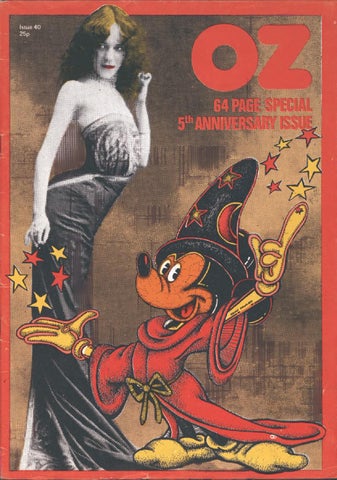
“One can alm ost hear the acne bursting fo rth w ith adolescent pride fr o m Oavid Widgery's yo u r as he proudly wrote: 'Private E y e is A n d re x pretending to be Kleenex, Tam pax pretending to bt ■ S g B P d f f lR n i When OZ was born in February 1967 anybody could see it was a bastard, and rather an unnatural one. Richard Neville, the surgeon, and his midwife, the lovely Louise, explain that it was intended as a cross between the New Statesman and Private Eye. To demonstrate this, it carried a long, respectful interview with Paul Johnson, then editor o f the Statesman, in the Statesman's most portenteous style, and a four-page take-off o f Private Eye. The author o f the cringing interview with Johnson ("The Statesman seems to have gone in fo r a jauntier, more personal style recently. Is this part o f a general policy?” ) was Alexander Cockburn. Cockburn: What would you regard as your great virtue? 16
Johnson: Well, I ’m very conscientious and responsible-minded, probably over-much . . . Cockburn: And your vice? Johnson: I ’m impatient, terribly impatient. Never had been such nakedness been revealed before - shocking! Readers o f OZ were probably relieved when Alexander next appeared as a regular contributoiyjiirthe New Statesman.^*$08 The four-page supplement on Private Eye included a b rilliant parody o f a Scarfe drawing which showed Private Eye eating its words. Thi s was a reference to the numerous apologies extracted from the Eye by the rigours o f the libel law, and although there was no particular exulta tion in Private Eye when OZ fell foul o f the obscenity laws, this first issue ushered in a certain coolness between the two mighty organs which has taken five years to disappear. What caused most irritation
I imagine, was rather a heavy piece demonstrating everything that was wrong w ith the Eye which would, by im p lic a H tion, not be wrong w ith OZ. The author o f this piece was David Widgery, still a teenager at the time and _ _ _ _ _ importance o f this h o u g h t. OZ, w ith all the intuitive wisdom o f a day old chicken, knew it was going to be better informed and less trivial than Private Eye\ politically, it would carry more weight; it would be morally superior and much more com mitted. Committed to what? Never mind, the details could be worked out later. OZ, like the Eye, mlight have no editorial policy, but it would definitely be very committed, if onlyrfo the idea o f being committed. Above all, there would be no more o f those filth y , public school
lavatory jokes. One can almost hear the acne bursting on David’s eager young face as he proudly wrote the punch-line to his denunciation o f poor old Private Eye: "Private Eye is Andrex pretending to be Kleenex; Tampax pretending to be Durex.” Wow! But why on earth shouldn’t Tampax pretend to be Durex, or Kleenex, or Andrex, if it feels like it? And who on earth is going to be taken in if it tries? Muddled, indignant, slightly hysterical, self-righteous, this note runs like a needle through the flabby soft heart o f OZ until at times it seems to be the only thing holding the magazine together. Often it is couched in the tough, terse language of the high-school revolutionary. The world is divided into workers and mother-fuckers. This planet is dying fast. The workers can’t wait. They want it now. Help! “ Every time you buy a bar o f chocolate someone in Ghana works a little harder and gets a lot poorer. E X P LO IT A T IO N !!” Never mind that most o f these statements are actually the reverse o f the truth, especially about chocolate and the Ghanian worker. Chocolate and Ghana sound like the sort o f things we ought to be getting indignant about and if wc are really interested in the truth, the truth o f the matter is that wc are not really all that fantastically interested in the Ghanaian economy, are we?
llwfi: VV-i
-jiff* i' • a
1
~ nc can read the same sort o f thing, en by over-excited, under-endowed middle class intellectuals posing as typic members o f the working class, in Socialist Worker, any day o f the week. Few bother to read it for the very good eason that it is not very interesting
Eventually, pomposity and selfimportance begin to show through the angry rhetoric and we see not the loveable idealist and libertarian we had imagined ... but another frustrated bureaucrat, wanting only to boss us around and organize us into systems according to his own notions o f how we should be organized. In OZ, the revolutionary’s function is. slightly different: rather than seriously urging us to overturn the economic structure o f society to his own advantage, he creates a stimulating atmosphere for looking at Ills
This statement is not intended as a sneer, still less as a hint that it is better or more important to overturn the structure o f society than it is to look at tits. Sexual fantasy is one o f the great liberating forces o f our time, at any rate, psycho logically. Far more than religion, it is now the opium o f the people, and who are we to deny the people their opium? It may be a bizarre commentary on our society that people can’t be sexually aroused w ithout first growing indignant about Ghanaian cocoa farmers, unemployed boiler-makers on the Clyde etc but it could be much worse. There are those who need to in flic t pain or humiliate their partner before being aroused, and it is less com plicated than the furry animal syndrome, whereby you need to dress up as a Teddy bear before you can fuck. It was not until Issue Six, with the arrival o f John Wilcock, that OZ found its identity as part o f the international underground. Henceforth, a large part o f
the editorial copy — and some o f the best features, including Dr Hipprocates, Honeybunch Kaminski, the Fabulous -Furry Freaks — were lifted straight from the Underground Press Syndicate. Two traditions remained peculiar to London OZ. The first was a crazily extravagant and adventurous idea o f colour printing, whereby whole issues were more or less illegible and cost £6,000 to print. The second was an editorial determination to include among all the SLURP SLURPS o f cartoon characters fucking, tne occasional article enquiring in a sober and articulate fashion what on earth it was all about. The great debate over what, if anything, OZ is about, did not really emerge until issues 31 and 32, when Richard Neville's historic “ A ll God’s children got de clap” was answered by David Widgery’s equally memorable “ Whistle while you wank” arguing that " to be dangerous to capital ism you have to do more than spell it with a K.” OZ 32 also carried a letter supporting Richard's main theme and postulating a new political alignment, the Aquarian PartySwhy kill the pigs when kissing them would do much more? ’” V A fter OZ 6, as the magazine developed an identity o f its own, Private Eye and the New Statesman wercTorgotten. So were satire and conventional left-wing politics, for the most part. Satire’s last fling was in OZ 11 (April 1968) with a four page supplement on the New States man which finally got the old Paul John son out o f its system. Later supplements .on the SUN etc - - were more shrieks o f pain than serious parody. 1
No doubt Socialist Worker would be delighted to print this sort o f solemn rubbish, just as plenty o f municipal sanitary inspectors would be delighted to assure a primary school audience that cleanliness, too, can be fun, but not a magazine which has the w it and acumen to publish Dr Hippocrates. Is the young man worried about the way he gets an erection every time he takes his clothes o ff, especially w ith other men present?; "T h ink o f making it with one o f the Johnson girls or recall a university cafeteria meal - the possibilities for tt'rn-offs are endless.” From being a bastard, OZ has become a violent schizophrenic but somehow something always emerges which, when it is legible, is refreshing, loveable and still innocent. This reviewer has probably made it plain that in the debate between the politicos and the freaks, between the killers and the kissers, the dynamic and pathetic traditions o f underground culture, he is heavily on the side o f the freaks, the kissers and the pathetic tradition. Perhaps I should take it further than that: in supporting the drop-out against the revolutionaries, I should make it plain that I actually dislike revolution aries. This is partly because o f their selfimportance and their seriousness, but mostly because o f their desire to exert power and influence events, which I find unforgiveable. Nevertheless, the most extreme quietist must admit that from the purely literary viewpoint they add a little salt to the kisses and sucks, a little opium or whatever to the hash, and OZ would not be so tasty or so stimulating w ithout them.
After OZ 11, We begin to see that wideeyed innocence which puts mockery to shame. There is an unmistakeable heroism about those who refuse to accept that they may be slightly ridiculous. OZ 25, for instance, carried reports on Scunthorpe and Morden, introducing its readers to the fu ll horror o f life outside the Land o f OZ, as if they had no experience o f it. The piece on Morden is especially touching to read in a magazine which started out with satirical aspira tions: “ Revolution has got to come,” wrote the Reverend Donald Reeves, bless his poor, silly old heart. “ The Church o f England has had a love affair with the working classes ever since the Industrial Revolu tion, but it has never been consummated. But if the Church o f England has any relevance atiall, it has got to lead the Morden revolution.” Sex, politics and religion — what more can anyone want? Perhaps less politics. Asa political correspondent, I am pain fu lly aware o f how little most people are interested in politics, and as OZ grows up, it seems to me to have been losing interest in politics. Many would say it has become more political, and certainly the political content has become more bombastic and humourless. But no intelligent magazine which took politics seriously could possibly allow ‘Tom Ludd’ to get away w ith this sort o f remark: "A revolution is essentially libertarian. Workers' Councils, the democratic con trol o f our environment, etc, it's essentially fu n .”
During the trial, I almost fe lt they had a point, when comparing the ostentatious, preposterous innocence o f the three men in the dock w ith the cold fanaticism o f Judge Argyle: if the paranoids in high places had been allowed to treat these three as criminals, locking them up for four years w ith the sights and smells and brutal stupidities o f prison life, then the establishment had really gone out o f its mind and it was time to act in self defence. But it was not the system, only a part o f it which had gone o ff the rails. Perhaps, in time, OZ w ill learn to love the system fo r the beautiful, incredibly complex thing that it is. Then OZ w ill realize what it is all about. Inspectors L u ff and Habershon, Judge Argyle and Lord Hailsham are as much misfits in the system as O Z ’s own beloved revolutionary pigs, although they are probably greater threats to the system than any revolutionaries. OZ has its own, fa irly important and entirely beneficial role to play inside the system, comforting and sustaining its drop-outs while feeding the fantasy existence o f many who remain inside. Most people, after all, don’t want to be liberated, although everybody likes to be assured that his servitude is voluntary. Those who love OZ must love the system, since OZ is one o f its most characteristic products. The only two pieces o f news which w ill make me take down my shot gun from the wall w ill be when I hear that OZ has been suppressed or that the fun-people from Upper Clyde Shipyards are taking control o f the country. 1
•
Freaks are n o t alone in responding mically determined class, and Freud to the needs our society creates in showed him the play thing of unconscious its mem bers; they are sim ply m ore emotional affects. But there still remains, for Jung and anyone who constructs an outspoken in their public rejection argument, a belief in a fraction of our o f conventional patterns. Drastically selves that can be appealed to by reason, dram atically freaks have begun to that can make moral choices. Jung devoted explore alternative life styles, philo life to carrying the candle, as he once sophies, religions, social and personal his dreamed the light of consciousness to be, relationships. In the process they forward in the storm of irrational forces have used drugs to influence the that swirls about us and drives us forward psyche, tried ascetic diets, m edita Yet he also respected the inner winds as sources of life and energy, even meaning tion, loud and rhythm ic som atic and purpose. music, controlled environm ents from encounter groups to multiLSD users have often discovered the m edia bom bardm ents; and too m any soothing effect of drawing and contem o ther experim ents to enum erate here. plating regular symetrical patterns that What all o f these thechniques have center on a dot and expand outwards into in com m on is th e tendency to look a circle within a square. This form often beyond rationalist verbal system s is found in the East; in India it is called a for direct experience o f life through mandala. Jung found himself drawing mandalas when he was trying to come to altered perceptions. One o f Jungs books has an apt title for this range of activity: M odern Man in Search of a Soul.
sm m
mm 1
M
M
"... a Jalse spirit o f arrogance, hysteria, wooly-i doctrinaire fanaticism, a purveyor o f shoddy si stuttering and Utopian humbug, f it only to be today. ” Matt Hoffman looks at the work o f C. G. Juns
Jung devoted his sixty year psychiatric career (1900-1961) to the study o f nonrational states of consciousness and un consciousness. He conceived of the ego (our self-awareness) as a very limited portion of our total selves, but a portion with the profoundly im portant faculty of free moral will. He sought to use what is best in the evoluti on of rational thought, but to take from that thought its false evaluation of its (own supremacy in the psychic world. We are not in Jung’s opinion, kings in our own castles when it comes to the activity of the mind; our ego self is more accurately describable as a member of a community that includes our emotions and instincts. Jung interpre ted, in more than tw enty volumes, the history of civilization as a series of o u t ward signs of the passing of the psychic reality of religious and mythical exper ience, and he saw these forces as still living within us"In the everyday world o f consciousness such things hardly exist; that is to say, until 1933 only lunatics would have been found in possession o f living fragments o f mythology. A fter this date the world o f heroes and monsters spread like a devastating fire over whole nations, proving that the strange world o f m yth had suffered no loss o f vitality during the centuries o f reason and enlightenment. I f metaphysical ideas no longer have such a fascinating effect as before, this is certain ly not due to any lack o f prim itivity in the European psyche, but simply and solely to the fact that the erstwhile symbols no longer express what is now welling up from the unconscious as the end result o f the development o f Christian consciousness through the centuries. This end-result is true antimimon pnuuma, a false spirit o f arrogance, hysteria, woolymindedness, criminal amorality, and doctrinaire fanaticism, a purveyor o f shoddy spiritual goods, spurious art, philosophical stuttering, and Utopian humbug, fit only to be fed wholesale to fhe mass man o f today. That is what the post-Christian spirit looks like. ” (Collected works, Jung, Vol 9, part II) Freaks, political and mystical, share a perception of the need for change in our society’s concept of the supremacy and the self-sufficiency of the individual. Kepler and Copernicus took the earth out of the center of the universe, Marx depicted the individual acting out the role of his econo 18
grips with a flood of spontaneous visionary material that burst upon his own consciousness beginning in 1912. ‘When I began drawing the mandalas, however, I saw that everything, all the paths I had been following, all the steps I had taken, were leading back to a single poin t — namely, to the m id point. It became increasingly plain to me that the mandala is the centre. It is the exponent o f all paths. It is the path to the centre, to individuation. ’ (Memories, Dreams and Reflections) Jung saw the mandala and the four sided figure as symbolic o f the unity of the whole self. He claimed that the Christian injunction that the kingdom of heaven is within you meant that we are
carrying within us the four gated city. (Jerusalem, in Blake’s imagery) the psychic concept o f wholeness. During those years, between 1918 and 19 2 0 ,1 began to understand that the goal o f psychic development is the self. There is no linear evolution; there is only a circumambulation o f the self. Uniform development exists, at most, only at the beginning; later, everything points towards the centre. This insight gave me stability and gradually m y inner peace returned. I knew that in finding the mandala as an expression o f the self I had attained what was for me the ultimate. Perhaps some one else knows more, but n o t I ’. (Mem ories, Dreams and Reflections) Jung explored a symbolic material
psychic impulses. When he seeks to throw o ff his Western heritage, he is cut loose, adrift in a strange land where everything he reaches for turns to something else in his hands. Drug highs turn into downers; Eastern religions turn into warring factionalized cults, even rock and roll music turns out, on closer inspection, to be a vehicle for ego-trips and emptyheaded repetitiousness
mm
nincledness, criminal amorality and hritual goods, spurious art, philosophical fe d wholesale to the mass man o f
Although Jung cannot save us from the pursuit of illusions, he does point out the danger o f venturing too far afield. He tells us in his autobiography (Memories, Dreams and Reflections) that all kept him sane during his own confrontation with the unknown fantasy world welling up within him was his solid domestic life and his professional work. W ithout them, he fears, he would have gone mad like Nietzsche. In his own analysis of patients, he often used Freudian and other wellknown therapeutic techniques before
extensively throughout his career. He moving onto his own ‘individuation’ began with modern dream interpretation rocess for confronting the unconscious, and gradually found parallels and aids to ome patients who did not have a predis understanding dreams in the symbolism of position towards encountering the inner astrology, Western and Chinese alchemy, world, he kept away from it. In fact, Jung Buddism, gnosticism, primitive religious coined the terms introvert and extrovert and social structures. These systems all in his classic study of psychological types seek to encompass man’s experience and and their a priori orientations, introvert relate it to the universe as a whole. They originally meaning the type of person seek to protray oneness and com plete oriented towards the inner world. ness. They are the opposite o f the com partmentalized Western classification Jung found another aid to constructive systems that work so well in the natural encounters with the psyche, one known science and leave us fragmented when we well to freaks working with his hands. try to understand and find meaning in The interpretation of one of his own our lives. dreams told him to build models in stone as he had done as a child. He did so, and found, for the rest of his life, a means of A dilema invariable arises for the understanding himself and placing himself student of symbolism, the follower of in the world in non-verbal fashion.
In modern speech we have taken fantasy to be something insubstantial and airy, ungrounded in experience and by nature untrue. Jung, and the freak o f today (the freak from his gut reaction to growing up in a world that so deprecates imagination) would probably agree with Blake as he pictures this state o f affairs. “A dark and unknown night, indefinite, unmeasurable, without end, Abstract Philosophy warring in enm ity against Imagination (Which is the Divine Body o f the Lord Jesus, blessed for ever.) ” (Jerusalem). Jung found in his own life, and in that of his patients, that the unconscious fantasy products are a blend of creation and destruction, of wholeness and painful frag mentation. His therapeutic techniques were directed towards distinguishing the dist ortions that the absolute nature of the unconscious can produce (as in the case of hostility projections based on inner fears) from the images of healing and compensation that the unconscious can also produce. Jung seemed to see the unconscious as terrible and divine, absolute and yet able to be influenced by conscious moral choice. He painted a picture that unified the religious and cultural history of the world, East and West, with the experience of our own time. An area of great interest today is Jdng’s investigation of parapsychology, the modern study of telepathy, prophecy, fortune telling, mind over matter, spirit ualism, and other apparantly non-physical phenomena. Jung examined the uncanny appropriateness of the answers given by the Chinese fortune telling book, the I Ching, and he found astrology to some times have a close correspondance with life. In fact he employed both these tools, the I Ching and astrology, as diagnostic aids in analysis of his patients. Jung chose not to understand these phenomena as presently unexplained but ultimately rationally explicable in terms of physical energies. Instead of searching for a causal relation that might transcend time and space (and such an explanation would be needed to explain precognition), he considered these events to be psychically related to the same process that creates fantasies in our minds. The laws of nature which are understood to be solely causally based would be amended by Jung to include the accidental variant, the chance factor, when we know w ithout cause what has happened or what will happen somewhere. There is no cause and effect at all; the event and our fantasy (in dream or whatever) of it simply mean the same thing. This is dealt with at length in Jung’s essay ‘Synchronicity: an Acausal Connecting Principle’ (Volume 8, Collected Works). Jung tells us here that Richard Wilhelm translates Lao Tze’s word ‘Tao’ (the name of the ineffable ground of the universe) as meaning. At this point in Jung’s thought there appears to be an attem pt to construct a unified picture of all experience, human and material. He postulates a relationship between the psychic world and all matter: not just that of the human brain. And what, in fact, is psychic life but the perception of meaning, the naming of the equivalence of concepts and fact? It is hard to follow Jung here, but he seems to be pointing towards a comprehensive understanding of the universe. And that is what, I imagine, a great many of us (freaks of nature, every one of us) are searching for.
CLASSIFICATION A1. SENSITIVE. AREA CODE:
XBBCZT/WATFORD/ASCOT/BARNET CODE NAME: FREEDOM
NOT FOR PUBLICATION UNDER ANY CIRCUMSTANCES
1. YOUTH The initial stage is to bring as m any young people as possible withiri the range of Movement propoganda. This is not too difficult irt Lomjon but is m uch more difficult in the provinces. It i | therefore necassary to set up a continuing grass-roots structure. How caw this be d o n e ’ RatSer cultur evolution must than impose an-organisation and personnel Upon a i m m u n i ty , it is The social 1 preferable that local organisations be, organic. However, it is necessary and des to identify potential com m unity m otivators. The followirtfiis a Viable capit means o f accom plishing this. J E K V rSsfcyer
1 I f A ■} F ifew
2-,p0Li
becom e more com m itted. At this stage of ^ socialist and libertarian dem ocracy will ■ e d at. In short, it is considered th at a c e d ^ ^ s o litic a l revolution in this society, [g e o is m d ly structure m ust be attacked ivide m o w jjtio n for the su p p la n tin g ^ f the ■cracy of theV seole. E l"
3 FORCES . Stage One. Small advance team ~ » s* & eh ers tp .n d s i t l e a s ? f ^ ; (i-) info\ fey: The agency will be resjftjsib le for the weeks in selected comm ' to: Jffir J{ptdgr& n , at the police and arm ed forces Revolution can 1) Prepare reports on tSflltudas a n ti institu tio n s in o n ty b cc u r w the governm ent no longer can c o n t^ fcth e arm ed and com m unity; any dissenting or r ^ tio n s : p tt i ty d e s exp^sst!#inJ6H Bl ’ >JL“ Police forces o f the State. The Governm ent is very carera^Lp indoctrinand school papers; attitudes afe the m em bers o f these forces. It w ould be the fu n c tio n 3 fe|h e social tensions e x p re s B j submerged inform ation agency to counter-act this indoctrination by regSfc 2) Book hall f o ^ o n c e r ^ H I ■selected “nailing of radical and libertarian propaganda to Police C ollegesSfd fly-posting and ri»flettini rm ?^. ^ orces colleges. This can be presented as another point o f view. for accom odationT»kConce ‘Jb B L 110 c*o u *3t that pressure w ould be put upon the agency by the 3) Percentage o f tic iS jk d istrib u te gh local grouj thoritips so care should be taken th at no police action is possible Balance sold at door (ld l|o ric e ) “Uion o f activities o f agency personnel or by m aterial beinq "■.decent’’ under the Post Offices Act. Stage Two: The concert: R o lt-n ro u p s With p o l i t i c a l ^ t® «. in musi (although no to extent th a t m uSksuffersL Movement speaker- ' J ac^s Confrontation, (b) D em onstrations to general issues and local issues 3 % mined % research. Guer jraeth ittg sjm ply by happening. They are evidence of T heatre Groups. L i t e r a t u s It is vitffljfcat theljSjBakers be avm lelp to keep social tension alive. The police over-react and any local person who w ants to speak wf&ktheiTLUif the transform ed'into a radical. “A Yippie is a hippie who has do w ant to discuss anything it should be jsfcgible toTOM tify potential - 'h e head by a policem an” . The most im p o rtan t thing in com m unity m otivators who will be in v ited lK L sm all m eetinq to be held IVe as mudS^BjlSjM overage as possible and to have our two days after the concert. 'w s a r J fy p .Any violence should be pointed out as th e direct (_.jk ed police attack. Care should be taken to get Stage Three: The day after the concert, the p o litic a ^ fc u p will discus . -. special g ro u p p o lic e ln their busses before police attack the reactions to the concert and the persons who h a v e o ^ n invited tt m action. If possfcle, the link up should be shown. (In static demos, the small mebting. Two persons of this group will rem ainy% the the special group police will pick o u t the people they intend to attack com m unity for ong week. Their purpose will be to e s ta b lis h ^ c ta c t and tiiis is n o tic e |b le :t© anyone watching). through a series of small meetings w ith local people in order 'Or /JL) IJu l inform ation dissem ination on a regular and established baS F m a X in g Operations: (c),Eyety possible m ethod o f obtaining finance 2) encourage the Formation o f local dissent groups should be used. Th& e include: ...3) w ork out support basis for establishm ent o f groups. Particular ) D onations from "liberals” for “ liberal” operations. M oney can also , encouragem ent is to be given to form ation of local underground newsle siphoned o ff from these operations for other purposes. japers^ijasiM d^coap.ftiic.suppojrf is to be offered but n o t for less than 2J^»ofits frc w degling. three m onths. Local people are to be m ade to feel that they will 3) P fW ts fro m rip-offs books, records and cassettes etc . . . ^ receive su p p o rtjro m established groups in L ondon and other large In g e n e r ^ m o n e y should be obtained from operations th a t are in centres and are to fje invited to L ondon for indoctrination (See th em selv es^v o lu tio n ary and righteous. . .‘J §P ^c>ilintlQ(:trination for Cotpcnurtity M otivators"). Bank robberies, etc. are n o t appropriate means of financing operations at this stage. However it m ust be em phasized that this is n o t for any X P ^nL thA foregoing, it should be clear th at this is an initial program m e reasons o f bourgeois m orality. When the stage of arm ed re sistan c e'!-, for establishing a com m unications netw ork w ithin the U.K. for the the incursions o f the capitalist state upon the liberty o f the people ii j<i._ prpppgating_of..the.underground values of dope, rock ’n ’ roll and reached, then arm ed robbery.becam es not only appropriate as a means ^ .f u p k in g in the streets. This is backed up by the establishm ent o f local o inance but becom es a m eans of propoganda and encouraqem ent in — W io vdiLneceasarily. com e into confrontation w ith authority itself. V
PROPAGANDA A L L IS PHONY
Now York
Cotogno A ttiliate OHicos
Amsterdam
Romo
OuDlin
Bevorly Hills Brossols
r t r ^ “b
Pans
CoponhoQon M u n ic h
2 0 /3 Cuxxou S tre e
London, v<1.
Mr
B a rn e t,
Dear
cbeaT
f f i s r ^ L S ^
^
S
a E
T
t o
S
IV E J S S E S S E ®
^ ^ pat
1 7 - e a t iv c
on
paper
S0 »
^
+ o l my v r it in e ^ n e v restaurant c o n c e p t^ ^ The
o h j e c t o ^ y
■ * £ \£ T l»
r e g a r d in g
a n
c o U c agu e
o : *•
in g
th o u g h ts
w o r k in g
on
^
^
0
agcncxes.
in g
c o n iy c u o n ^ ,,
R E S T A U R A N T C O M P L E X - C R E A T IV E P R O P O S IT IO N : The object o f my w riting to you is to put on paper some creative thoughts which I have had regarding a new restaurant concept. R A T IO N A L E : Looking at the London restaurant scene the general indications are that the Italian Tratto ria situation has reached its zenith. The film w orld and the creative advertising com m unity thrive on fantasy. We believe in this respect th at it w ould be possible to create fo r these people a 'fantasy' restaurant/N ight C lub com plex. I believe that if one can attract showbusiness, the heavy business/playboy element w ill fo llow . F L U E R S D U M A L S : The creative theme which w ould be fo llow ed through in every aspect w ould be B L A C K . E X A M P L E : Extensive use o f smoked galss, B L A C K — leather, P .V .C ., velvet, plastic, Coloured staff.
T H E B O A R D : To pursue, or for th at m atter, emphasise any sort o f negro involvem ent w ould be politically unwise. I feel, however, th a t it w o uld be w orth considering the appointm ent of one coloured D irector. Berry G ordy (M o to w n ) w ould be a logical choice. J O IN IN G G IF T : Members joining the club w ould receive a gift fro m the management. This w ould be a small piece of gim m ickry. Gucci keyring specially designed, black w ritin g paper w ith a w h ite 'P ental', m ild ly erotic black giant sized postcards to send to their friends, giant black ashtray,Fleurs du Mals A fte r Shave and to ile t water fo r w om en. These might be sold together w ith soap, etc. w ithin the club. Members w o uld be sent presents on their birthdays. A black rose fo r the w om en, black pens fo r men. B O U T IQ U E : I believe also that we should include a boutique w ithin the com plex which w ould sell nothing but black clothes, shoes, hats, belts, etc., also specially designed and exclusively produced Fleurs du Mals merchandise, i.e. soap, after shave, etc.
It is a fact proven by Mr Hugh H efner’s not inconsiderable success, that untouchable sex attracts men. I w ould not suggest that the girls who serve the customers should be dressed as bunnies. W hat I do believe is that we should have exquisite coloured 'waitresses’, picked for their appearance and in telli gence. Black Jack will be the house game. O nly Black & W hite and Johnnie Walker Black Label Whisky will be served. All crockery and glass w ill be black. Wherever possible, black fo o d w ill be served, i.e. Caviar, Coq au vin, Black berry Sorbet, etc. etc. In the main restaurant I w ould like to see a cage built into the walls which w ould run com pletely round the restaurant. The cage w ould either be shielded fro m the restaurant by bars or tw o-w ay smoked glass. A black panther w ould circulate w ithin this cage. There w ould be certain 'alcoves' which should be designed specifically for in tim ate conversation In these alcoves it w ould be possible to select the music which you require, either soul, pop or classical. O nly black coffee w ill be served, w ith , o f course, black sugar. There w ould be black soap, towels and paper in the to ta lly black loos. Black velvet w ould be the house drin k. If it was technically possible, the to p flo o r o f the com plex should be devoted to an out-of-door situation. In other words, it w ould be a roof-to p restaurant which could be opened to the stars during the summer by an autom atically controlled sliding smoked glass roof. There w ould be a certain am ount o f black fauna and flo ra, w ith cages containing blackbirds, black macaws and maybe even black monkeys. I th in k it might well be amusing to have bats somewhere in the animal situation. We could also have black mambas and cobras.
O P E N IN G P A R T Y : The p u blicity fo r the com plex is self-generating. We would wish to publicise the com plex on an international level, arranging in-depth pieces in the Sunday Times Colour Supplem ent and m ajor international media. The theme that we w ould propogate is th at Britain has produced an entirely new concept in today entertainm ent terms. This type o f operation is basically something th at could only really occur in Las Vegas. W hat one is saying in effect is th at London has for some tim e been the international arbitor o f 'fashion' and we believe th at the tow n is sophisticated enoughtto accept such a revolutionary en tertainm ent concept. One could, o f course, devote ten pages to the publicity and launch o f the club but at his p o int, this w ould seem superfloous. One w ould obviously invite every major coloured figure in the w orld to atten d the opening and Ella Fitzgerald, fo r exam ple, could arrive on a black horee. Only black cars w ould be allow ed to park and everybody w ould be asked to dress in black. We w ould arrange fo r a heavy contingent o f showbusiness personalities and international names. Obviously, when the com plex was established and shown to be highly profitable and, as it were 'in the black', the form ula could be extended to the N orth o f England and rapidly developed in Europe. Membership, o f course, w ould be d iffic u lt to obtain and extrem ely expensive.
P R IV A T E R O O M S : Restaurants in the U .S .A . and France freq uen tly have private rooms fo r hire. I suggest th at Fleur du Mals should do the same. There m ight well be fo u r or five o f varying sizes all named after the Seven Deadly Sins — i.e. The G lu tto n y R oom , The Greed R o o m , The Envy R oom , etc.
Such a project is obviously going to cost. We have access to certain funds and I believe such a proposition m ight prove attractive to your com pany. I am confident that the finance aspect o f this situation should not represent any particular problem but I w o uld obviously welcom e your views . . .
.
v ie v s . * •
T H E B A R : Superb in every detail. Maybe coffins to sit around Specially designed bar stools w ith backs like tractor seats.
o ta i. « w
yo«
f
\
!l i . .
*___ ^ L L IS PHONY
-certainly.
p PIATIONS
21
? fromGindumytbolofjji meansthecelestial musician, andit’s ascore fromanon-existentfilm.
(Paid Advertisement)
A BITOF THE OTHER B IT IN F O R M A T IO N S E R V IC E
C O M M U N IT Y M U S IC / B IT M A N
B IT one o f the firs t "underground help services" is still here, just about! It is still trying to be a 2 4 hour, 7 days-a-week in form atio n, crisis, advisory and referral service. It is trying to prove th a t it is possible fo r an organisation to be run w ith o u t directors, figure heads, sleeping partners; w ith o u t com m ittees, "super vision, or controls. A p a rt fro m the 1 0 0 0 people a week w ho make use of us, we are also still needed as a stim u lus or spur to others to start similar organisations throughout this country and the rest of the w orld (the latest being in A uckland, N ew Zealand). We do this through our 'in fo sheets', B IT M A N , benefit concerts and C O M M U N IT Y M U S IC . Although broke ourselves, "There is a convincing a ir o f poverty about B IT , applying to bo th the place its elf an d the people who run it. The regular workers receive a token pa ym en t th at is fa r below subsistence, they wear m ostly clothes that they have been given an d eat whenever fo o d a p pears. . . " from article b y 'graham ' in B IT M A N 4. we raised £ 5 0 8 .9 0 last year fo r other "C o m m u n ity A id G roups" (plus £ 5 1 0 fo r U C S ). " In trying to increase o u r sphere o f com m unication we came in contact w ith B IT IL o n d o n ) who are invaluable to us. We began to feel p a rt o f a scheme o f things. When we o u tlin e d ou r plans to B IT , th ey o ffe re d th eir support an d ran a b e n efit concert fo r us, which provided £ 3 0 . . . " T O U C H (Dundee) in fo sheet, Dec 1971. H owever, we are all tw o -w ay processes and cannot give o u t m ore than is p u t in. If you w ould like in fo on a new film , play, a jo b, a fla t, names o f solicitors, doctors, dentists, in fo on communes, 'busts', alternative structures/newspapers/magazines e t c . then unless someone else gives us this in form atio n and bread/m oney to pay our expenses, we w o n 't be able to help you w ith yo u r requests or be around when you need us. The 'alternatives' to our present society are (h op efu lly) based on respect of oneself and others, an increased sensitivity and awareness of the effect o f one's actions/thoughts on others and m u tu al self-help. W ith o u t the latter w e have nothing. " . . . S E A R C H is a co m m un ity pro ject (N O T just " h ip " underground trendies in the wake o f O Z ). . . One of m y main arguments against the present "underground" is th at it is very much a middle-class drop-out affair. I bleieve the notion "alte rn a tive society" is p o litically, culturally and sociologically a red herring: Radical Sub-Culture — Yes, hope fu lly !; A ltern ative Society — N o t fo r a long, long tim e. If present groups/organisations w orking towards im provem ent in social conditions can combine the H O N E S T Y and A G G R E S S IV E E N E R G Y o f the working class w ith the IN F O R M A T IO N and E D U C A T IO N A L B E N E F IT S so far restricted to the m iddle class, then we may have the beginnings o f a new class less culture (R IC H A R D N E V IL L E O N L A T E N IG H T L IN E U P -W H A T A F U C K IN J O K E !) M any o f the so-called "und er ground" elements are so obviously m iddle class and self-centered that they waste most o f th eir tim e! Th erefore fo r any C O M M U N IT Y A ID G R O U P to concentrate on incense, p o t, womens lib, communes, gay lib. Lord o f the Rings, abortions ”
141 Westbourne Park Road, London W 1 1 1BQ. 0 1 -2 2 9 8 2 1 9
etc etc w ith o u t relating to the rest of the co m m un ity w ould be negative and sad (and boring). L IV E R P O O L F R E E S C H O O L is the way the "underground" should be going: we're all fu ckin ' people you know! A ll these factions eg. blacks, gay lib, womens lib, freaks etc miss one im po rtant point: th at, although the system may indeed hit th em in special ways, the repression/alienation is C O M M O N to everyone: E V E N yer so-called capitalist/pigs etc ie. E V O L U T IO N not R E V O L U T IO N (revolution is ou t o f the question, a meaningless word, except fo r self-deluded middleclass trendy radicals!) PEO PLE N O T C A T E G O R IE S ! R IS E A B O V E T H E C LA SS S Y S T E M ! Bernard, Search, 9 3 Abingdon St, B lackpool, Lancs.
a b e n efit fo r the people who came there b y charging 7 /6 a head an d then to use the p r o fit in the same way as the Electric. / contacted various agents, groups, etc., to suggest th at the musicians m ight dig to p lay to a large audience that hadn 't been screwed a t the do or — th at the groups could m ake this possible b y playing fo r expenses a n d good vibes . . . " — Roger Cross w riting in IT /7 3 , 12-25 Feb, 1970. but like so m any o f our ideas/ideals 'Im p lo sio n ' has slowly been taken over by the "n ew establishm ent" (Jeff D exter, Ian Knight, H u w Price, Penny McLucas, Rufus Harris), w ho seem to care little about 'our' survival. We fin d , fo r esample, the "principal trio 's " close involvm ent w ith the m usic/entertainm ent industry very, very, disturbing, especially in view o f the am ount o f m o n e y/ influence/pow er they no w exercise over w h at was once " o u r" music We believe th a t w ith such support scene: J e ff D exter, dj, manager o f it is possible fo r C o m m u nity A id A M E R IC A (w ho record fo r Warner Groups to continue to: — Bros), frien d o f Ian Samuels (pro (a) set up housing and fo o d co-ops, ducer at Warner Bros — which is part youth clubs, pre-school play groups, o f K inney . . . " which is owned by free schools, adventure playgrounds, K inney H olding C orpo ration , which clubs fo r the elderly, arts labs, street has allegedly its board meetings w ith newspapers etc (b) take over cinemas, theatres, youth consecutive translations into Sicilian. clubs, church halls, and tr y to provide — UPS V o l 2 , no 18); H u w Price , creative alternatives to th e boredom part o f N E M S agency w ith A M E R IC A / and m ono to ny o f life th a t exists in F A M IL Y etc on its books; tan Knight, so m any o f our cities. part of The R ainbow Th eatre where A ll o f these activities help improve 'F a m ily ' and 'A m erica' recently played. the q u a lity o f life and help create Rufus Harris, w ho isn't disturbed by a change in values th a t w ill hopefully the trio's business interests but who did try (unsuccessfully) to prevent make the functions o f C o m m u nity the new members of Release from A id Groups, as we kn ow them today, superfluous. discussing Im plosion w ith Ian at B IT However, w ith o u t financial support, and fin a lly Penny McLucas, about w hom all we kn o w is th a t she doesn't today's C o m m u n ity A id Groups w o n 't even get o ff the ground or w ill consider "us" w orth circulating w ith collapse when the first bills start Im plosion hand-outs, "as we w o u ld n 't believe them a n y w a y !" Y e t there coming in. IM P L O S IO N was, in the beginning, set up to provide such was a tim e when Im plosion was worried financial support, about the outside comm ercial "the E lectric Cinema. . . was the first interests o f its w orking group and organisation th a t used a regular en ter Roger Cross in particular:tainm ent scene to raise bread to be ". . . A n o th e r p o in t that Roger raises given away. . . we w anted the p ro fit th at needs clarifying is the question to be k e p t m oving in the co m m un ity . o f his working fo r an o th er d u b as a lo t o f bread was given aw ay to exist w e ll. . . A s contact w ith him m ight ing scenes . . So I g o t £ 1 0 0 from the have y e t fu rth er distractions, p a rtic E lectric to start a m usic/film s/free ularly as it w o uld have been w ith a m ark et scene a t the Roundhouse. / m ore com m ercial organisation." g o t a contract w ith them fo r 6 fo rt IM P L O S IO N reply to article b y Roger nightly concerts starting in June and Cross, I T / 7 5 13-26 March, '70. called it Im plosion — / w an ted it to be Th e iron y is th a t Roger Cross now w orks.for the R ainbow Theatre w ith
Ian K night!! " . . . (5) P olitically, I th in k the concept of an 'alternative', under ground' society is reactionary in th at it by d efin ition admits and accepts the existence o f an estab lishm ent 'straight' society. It is elitist in m any o f its attitudes, bougeois in its self-conscious "separatism " fro m norm al working class life, and anti-revolutionary in that it thinks alternatives can be set up parallel to the establishm entthis is often an a rty -fa rty dream — the establishment has the wealth and therefore the guns and w ill only tolerate alternatives as long as they are harmless and channel o ff o th er wise m ilita n t energies (eg the fate o f the 'alternative' in the Bogside). A n y w ay, th ere’s no reason why we shouldn't w o rk in each others interests as long as we're careful to remember w h at those interests are . . M ike Evans, M U S IC L IB E R A T IO N F R O N T , 70 Huskisson St, Liverpool 8 , Lancs. We still believe th a t th e original aims o f 'Im plo sion ' can be made to w o rk fo r the benefit o f C o m m u n ity A id Groups and fo r th a t reason C O M M U N IT Y M U S IC has been started fro m the 'ashes o f Im plosion'. C O M M U N IT Y M U S IC w ill try to help musicians establish th eir independence and self-respect, at the same tim e getting a reasonable return fo r their creative activities. In this we w ill w ork closely w ith M U S IC L IB E R A T IO N F R O N T and th eir a n ti—Agency; Colleges and S tud en t Unions; as well as all other Prom oters, Agencies and Record Companies w h o are prepared to give C o m m u n ity A id Groups and musicians a 'fa ir deal'. A lthough we are not, at this stage, a managementagency, we w ill be happy to p u t prom oters in touch w ith groups/ agencies and vice-versa. A t the m om ent we are looking fo r any "n am e" w h o w ould like to help us? You can help n o w by contacting us or yo u r local 'aid group' and fin d ing out w h at their needs are (at the m om ent B IT needs m oney — we only have enough le ft fo r another 6 weeks cheap supplies o f duplicating paper, stencils, envelopes, unused stamps, etc . . .) Y ou can also support us by subscribing to B IT M A N (2 5 p /5 0 £ single , issues, £ 1 .2 0 /S 3 fo r six issues and supporting all C O M M U N IT Y M U S IC concerts. A fu ll list of 'C o m m u n ity A id Groups’ can be obtained fro m B IT (enc sae).
THINGS YOUR TEACHER TO TELL YOU
D ick Leitsch opens up the gay history book a n d discovers a fe w pages missing.
(_>IOjthe last day* of the 19th Century, .'Prince Maximilian Egon zu Fustenberg gave a party for the other notables o f the Second Reich. While the Kaiser sat in the seat of honour V - and watched, General Count Dietrich ; . s von Hulsen-Haeseler, chief o f the . Reich’s military cabinet, danced into • the room wearing a pink tutu and a , rose’gdf-land in his hair. Me pirouetted and swirled several times around the IT - room to tremendous applause. Then, i while taking his bows before the \ Kaiser’s chair, he dripped to the floor, dead o f a heart attack. Con cerned “sister” carried him to his bedroom, where his body was left while the party continued down stairs. • . The neiit morning the thought occurred to hfe»iends that it just wouldri?( Inappropriate to bury a neral of Max srank in a pink tutu, gor mortis had already set in and it was reportedly quite a chore to get him out of the tutu and into his uniform. Everyone did agree, how ever, that he had dancied divinely” . At that time, the whole Second Reich wjis being run by a gay circle. They m & ndf have run it very well, but they pid a bit better than the predominately heterosexual Third Reich. The Kaiser.Was straight (though some say n o t), but his best friend, Prince Phillip zu Eulenberg, was sleeping with Count von Moltke, the military commandant of Berlin. Three Counts, all-of the Kaiser’s aides-de-camp, the Kaiser’s private secretary and the court chamberlain were all gay. So were the King of Wuttenberg (whose lover was a mechanic), the King o f Bavaria (in love with a coachman), and Lidwig Vicktor, the brother o f the Emperor Franz Joseph, whose death helped start World War 1. Ludwig was madly in love with a masseur from Vienna who called him “ Luzi-Wuzi” . Unless the school you went to taught history much differently than my school did, you probably weren’t told all o f this, and maybe even now
you don’t think it’s very important. Maybe not, but it’s no less im portant than information you were given, such as Catherine the Great s promis cuity, Louis XV’s affairs, and the gossip o f historians about whether or not Elizabeth I deserved the title o f “The Virgin Queen” , Rather than arguing over whether Lizzie had affairs with her men friends or not, it might be worthwhile to investigate whether she might have been a drag queen or a lesbian. Homosexuals, like everyone else, need people to identify with. We need heroes, homosexuals who have “ made it” , to show what we can do if we try. We are doubly handicapped in the search: first, many o f those who could qualify as gay heroes cop out by being closet queens, and secondly, wnen a homosexual does make it, the world that has accepted him prefers to ignore or deny his homosexuality. Gertrude Stein is an example. She lived openly with her lover, Alice B. Toklas, for many years. She had many admirable traits. She practically discovered Picasso and most o f the other greats of modern art, and she almost invented modern American writing. While she did write and publish a n o t very good lesbian novel, her later poetry, plays, novels and short works directly or indirectly influenced every great American writer of the last thrity or forty years. Kr \ Now she and Alice are both dead. The Museum o f Modem Art wants their fabulous collection o f paintings and Miss Stein’s writing is constantly coming back into vogue. Books and articles about these two groovy girls are constantly being published, but most of them ignore the central facts of their lives; their homosexuality and their love for one another. Poor Alice, devoted lover, has been relegated to various roles by these biographers, roles ranging from “ secretary” to “companion” to “ housekeeper” .
We need heroes to show what mem believe a little more harassment now bers of our group can achieve and to will make any difference? serve as models for the young. Increased interest in homosexual Straights point with scorn at drag heroes and homosexual history would help solve the identity crisis so queens and flamboyant types, and they seem to love to ridicule homo many homosexuals feel by bringing sexual in-fighting. What if they knew home the realization that we are not that one o f the first governors o f “ freaks” , but part o f a group that New Amsterdam was a full-fledged has always existed and contributed its bit toward civilization and culture. drag queen (his portrait, in drag, hangs in the N.Y. Historical Society Museum). Who could be more flamboyant than Jean Cocteau, But such an interest would do far Oscar Wilde or poor Richard II? And more than just help homosexuals as far as bitch-fights are concerned, make a better adjustm ent. Many in the straight world like to believe that Leonardo da Vinci and Michelangelo carried on one that would put “ file we are some sort o f strange eruption on the face o f the earth that will just Boys In The Band” to shame! vanish if they close their eyes and wish hard enou^i. Others think they Promiscuity and “ trade” are nothing new, either. Giovanni Bazzi was so can solve the “ problem” o f our lecherous th at history has almost existence with more laws, more lost his real name, and even the most police, more harassment. uptight scholars and art historians refer to him as “II Sodoma” , nick A study of history would show them name he picked up because of his that their approach has been tried favourite pastime. Richard Wagner since the Jews first got back from was happy enough to play “ trade” to the Babylonian Captivity and it Ludwig o f Bavaria, who helped him hasn’t worked yet. The Chicago cops get started in the music business. think the way to deal with homo sexuals ii to constantly raid gay bars. N ot all gay historical figures have The first such raid I ever heard of been praiseworthy. Some of the gay was staged in London in 1820, and those arrested were paraded through Popes were particularly awful, and it is rum ored that Goering was gay. As the streets and pelted with garbage. straights have to acknowledge Hitler, Over the years, the means o f raiding Stalin, Eichmann and other unpleas bars and the punishments have changed, b u t gay bars have outlasted ant types, so I suppose we can afford to admit to the skeletons in our all o f the laws and enforcers of the closets. law.
Voltaire lived near a cruisy street in Paris, and was curious about the homosexuals he saw. He and a friend decided to get blow jobs one night, and did, later comparing notes. A few weeks later, Voltaire met his friend, who said he had tried it once again. Voltaire cautioned him; “Careful, my friend. One time a searcher for knowledge; twice, a sodomist!” If street cruising has been going on that long, can anyone
Schools offer courses in American History, parochial schools provide religious history, and there are courses for Negroes to learn of their backgrounds and traditions. But nobody could teach homosexual history, even if Yale wanted to offer a course and William Buckley would perm it it. There simply are no books and no experts. Homosexual organizations and the gay press must encourage such studies. Until we find our past, we won’t have much future. Zi .
.
.
•
.
.
.
.
.
.
.
fS ra S f g
I.
PhotoaraDh: Claude Sauvaaeot
$ tยง Jl i . ,v ,< > & '
27
c tt J tin t&
o -
Chris Hardy reviews T im othy Leary’s "Jail Notes" (Douglas Books - cheap)
Leary made a noise once, and as a con sequence got busted twice, ending up in jail on a twenty year “ p o litica l" sentence. He has since escaped and had various diversions in Africa and Europe, but while in jail he put this book together, ‘Jail Notes’ Everyone knows something about him, the acid freak who believed in his acid experience, as against his (then) habitual one, and who, w ith the aid o f his (then) station in life, persevered in publicising this chemical plus accompanying rituals, cosmic order and delights until he disappeared from the public ear. He is one o f that group o f Americans (Olson and Watts are others) who, through a combination o f academic knowledge and status with a romantic myth-hungry imagination, succeed in roaming the world, pockets and heads loaded, absorb ing a thousand cultures and writing a book a year, in order that we may listen to and maybe even believe in, their words. Like Ginsberg in his introduction Leary seems a bit old fashioned sometimes. He continuously argues his attitude, that is, his religion, however secretly, and marshalls the facts and authorities from his voluminous and flashing brain. How ever again like Ginsberg, he has a power ful, intelligent energy pushing his words out, and one reads them easily, joyfully even, sometimes. ‘Jail Notes’ contains a load o f anecdotes, quotes (prison records, bible, C. Wilson mostly) and sermons, from various o f the seven jails he mentions being put in. Concluding the book are two chapters, one about the Joujouka tribal bands o f Morocco, and the other about tripping w ith his wife Rosemary. The former is an adulation o f Morocco, and in particular o f the stoned drummers, flute players and one knock-out fiddler o f the Joujouka tribe, who can now be heard on record, produced by the late Brian Jones. These people are, naturally enough, very appealing to Leary, and, by appending these ecstatic words to the quite different, staccato, notes from jail we get a heavier effect from both. The Joujouka, with their abidance by kif, Pan and rhythm music, have an “ Im print system” which Leary (as he sees it) had to find for himself, using acid to dynamite the ground layer o f karmic and environmental habit/dross. The Moroccan trip also includes vignettes that ‘place’ Leary; he spends his time drifting from one Burroughs/Brion Gysin scene to another. An
For the prison section Leary uses a, sorne-
times rather fey, Berrymanesque style. The detailed reproduction o f action, filtered through this vocabulary, often makes for active and enlivening com munication: There are many different stories - o f crowds, games, people, incidents, and o f jail; "Heavy metal gloom overhangs this griefy place. Guards walk through it grimly, coughing filte r cigarette smoke fo rty hour week. Faces not happy” . The ideas and lectures and advice, on acid, on ontology, society and all the rest, are packed down amongst the people, so that the crowded life o f mind and skin, behind bars, gets over. Leary has always been an ‘acid saddhu’ (as against your ordinary acid head); a teacher o f a sort o f esotericism now widely popular, drawing on everything from the Vedas, Zen and Blake to nuclear physics: a man who got such a ‘religious’ h it o ff acid that he was adapted
sufficiently moody, of all /
to deal with the up and down nature dope. Its good to f ancient and sacred thoughts again. Even though Leary has his own form o f the soteriological systems, he Has the words at His fineer-
tips, and gets it down clearly. The image o f jail is the image o f man’s primary experience o f life; one o f lim itation. Leary puts the case for his somewhat notorious key to this cage with the conviction o f a doctor who believes in a biochemical one, and an individual drug cure for each personality. Acid changes the senses and inhibits habitual reactions or knowledge. Thus the blinkers o f Karma and viewpoint are broken. He’s a Bhakr?., a body freak, a love freak, finding numerous delights along his rosy path to Liberation. Though he espouses Zen he also grasps, holds and preaches, chemical categories, a sort o f empirical mysticism come alchemy: He enjoys personal existence and is happy to believe in definitions, and cures. The book, being broken up into three, a o f images
which work together like a poem, WWi\ emanating the feeling o f Leary’s M r fjfj consciousness. I t ’s a mysterious e ffo rt and the subject and purpose is an emotional and spirituaf one, w ith no exhortations to arms. There are also beautiful things to sense, good things to think, and some amazing stories.
7
>
fl
r
'If
o
w
i
A
Schradan Giftgas reviews Tariq A li’s new book, “ The Coming British Revolution” (Jonathan Cape 95p)
i I t ’s rather a gruesome task to have to review Tariq Ali's “ The Coming British Revolution” . First and foremost because i it means you have, to read it, and secondly I because putting down Tariq A li is an easy iand socially acceptable pastime, for a ^variety o f incorrect and unpleasant reasons. Since the days o f the V.S.C. Mr Ali has been ridiculed and lampooned from many quarters; Private Eye’s Tariq Ali Baba, to the Grove G raffiti “ Tariq A li is Vanessa Redgrave in drag” (which is a mortal insult to transvestites). But in the majority o f cases the racism lying behind the criticism is extremely thinly disguised; there may even be “ English man, Irishman and Tariq A li” jokes for all I know. To be a Pakistani T rot in ! public stirs up all sorts o f insect life. i So to avoid miscontructions I shall lim it my criticism to T.A. as a member and spokesman o f the International Marxist Group. In any case to judge from the ■* book, that covers 99% o f him, it reads as if it were ghost written by Mandel. The book starts from the premise that the capitalist world is today in a state o f pre-revolutionary crisis and that revolution is on the cards again fo r the first time since 1945. Very true, but i t ’s probably the only true observation in the book. Given the truth o f its premise, the only . sound reason fo r w riting such a book is to make a contribution to the understand ing o f our situation; some theoretical, strategic and tactical suggestions that might help in the making o f a world revolution, and avoiding past "mistakes” . Instead we are treated to a complete run down o f one o f the old brands o f T ro t skyism (I.M .G .’s brand) complete with the sordid history o f the collapse o f the Trotskyist International, and the ritual denunciation o f the other brands (I.S. and the S.L.L. in this country). To be sure he is less (though only slightly less) jargon ndden than many o f his comrades; and he doesn’t have the philistinic approach o f so many Trots. He is percep tive and articulate on several points, but the sum o f these parts is that same “ brand o f practical and theoretical impotence ' o f which it has been said “ Forty years o f counterrevolution separate these groups from the Revolution since this is not 1920 they can only be wrong (and they were already wrong in 1920).” In the chapter on “ The New Youth ' Radicalization” he concentrates solely
on the student movement o f the ’60's and on the V.S.C. No mention o f youth subcultures, the Underground, skinheads because th ey’re not a political pheno menon. And earlier on in the book he states that the “ British Bourgoisie could not survive fo r long unless it dominated a significant section o f (the working class) ideologically.” The point that the British Working Class is dominated mainly by its own ideology o f the family, which disarms it politically by reflecting i t ’s aspirations w ithin the family, escapes him. As does the fact that the whole “ youth problem” the subcult ural crisis, is part o f the collapse o f this ideology, and that to politicize revolt w ill be a most im portant step in breaking the political domination o f middle class ideology.
It seems that the present state o f dissarray among the “ Underground" Left is going to bring flocks o f Leninist vultures to pick the carcass and offer goodies like a national or even inter national organization, committees, membership cards and all to the poor lost lambs. If we can’t produce our own effective non-hierarchical organizations then perhaps we deserve it.
Whatever happened to th e 0 : school kids, those debauched and depraved moppets who conspired to produce Oz 28? Have they now sunk into a life o f sin and shame, become the lost souls that the m oral fascists of England assume they and every child in the country w ould become once tainted w ith O z. W hat particular bogeyman o f our bourgeoise society has grabbed them . H ow m any are vegetables, pimps, junkies, prostitutes, homosexuals, criminals? H o w m any have tried to co m m it suicide.'how many have syphillis, tried to fly from an upstairs w in dow . H ow m any have had to be placed in Brostal, prison, homes o f correction, or mental hospitals. H ow m any are dead? Tw o o f them , whom we see quite frequently, V iv Berger and The Incredible B radford, did a quick check, the results o f w hich, apart from the fact th a t they are all probably seasoned dope smokers, would surely gladden the heart of Mary " I th ink the sentences were about right” Whitehouse. They are all alive and well and function ing in a sensible manner. One is doing an early morning bread delivery, another has joined th e civil service. Robb Douglas is doing social w o rk, several are still at school, being prefects and doing A levels, others are at U niversity or A rt School. Trud i, w ho w rote W eek-End DropO ut, penned us a little note: "Sure I sympathise w ith much o f w h at the Underground press stands fo r. But as fo r O z, its guiding principle has always been fu ck fo r fu c k ’s sake, rather than fo r anything more valuable. E ntertaining, amusing it may freq uen tly be, but artistically, politically etc it has always been pretty non-constructive. I t ’s a nice hippies comic, bu t I ’d like to th in k there’s m ore to the w o rld than comics." Charles Shaar M urray w h o was side swiped by Judge A rgyle fo r calling Led Zeppelin fu ck music, has become one o f the props o f th e London music press, being a contributing editor o f Cream and a w riter o f an endless stream of record reviews and articles fo r O z, In k , and IT as well as working on a couple o f rock books and completing a journalist's course at H arlow Tech. Steve Lavers is trying to start up a magazine and all o f them in fact, seem to be continuing to display the energy and initiative which brought them to O z in the first place. As fo r V iv , cross fertilizer of Rupert Bear and R ob ert C rum b, he is swimming pro m in en tly in the uneasy sea o f Children's Rights ("Children are n o t allow ed any representation in the system — w h y should they obey any o f its laws?) Bradford, w ho w rote Headmaster of the Year, has become a w ell-know n underground personality. His name frequently appears in IT and Styng, and one day, if he manages to get his facts just a little straighter, w ill make a good gossip colum nist.
in
Acid is still w ith us in case you h a d ' forgotten — the fo llow ing incident and plea w ill bring a sentim ental tear and a sigh to your mandraxed cheeks: • Dear Brothers and Sisters, I have been busted w ith w hat even tually may prove to be 1 4 0 0 tabs o f LSD. This is a simple appeal for help and courage. I shall be fighting the case on a basis of no gu ilty intent, th a t this is a m atter o f conscience in which I believe acid is a holy sacrament which greatly assists the individual in cleansing him self of selfishness and the various m illion inhibitions bestowed upon us by an authoritarian, moralistic society. I shall be calling sufficient evidence to show th a t I was no t m otivated by personal p ro fit but lived as an equal in a comm une where the am bition was the growth o f the com m une, giving substance to an alternative society . . . Bill D w yer. Early this year tw enty one persons — eight women and thirteen m en - m et a t 4 0 E H o lland Road, W. 14. to discuss h o w best to bring some substance to the ideal o f a free, co operative an d loving way o f life in which, in varying degrees, they had believed. They decided th at, in a voluntary and optio nal m anner, they w ould co ntrib ute h a lf o f w hat they earned to establish as soon as possible communes - in both c ity and co un try — to cater fo r the d ifferen t and varying aspirations o f all. A ll were conscious th at this was no opting o u t o f society b u t, rather, a serious e ffo rt to p lay a p a rt in the new civilisation which has already
inspired thousands o r people in tne U n ited States and elsewhere. This revolutionary togetherness arose ou t o f the bust in fhe com m une on the 2 8 th Decem ber last. We had been criticised some tim e previously b y a frien d from C alifornia who said that w ith a ll the thousands o f freaks in England no serious e ffo rt seemed to be attem p te d to care in tim ately for one another, to provide a viable alternative to the coercive and insensitive society in which we still live. Our friend b rought w ith him a q u an tity o f sunshine acid which was light years ahead o f anything we had
ever had before. A c id m ade to one standard — perfection, acid made on a com m une which was p a rt o f a growing b rotherho od o f hippies, acid m ade w ith love. Som e o f us soon discovered the true use o f L S D — th at it is a too! b u t n o t an end. L ike a hatchet you m ay, co rrectly used, chop w ood or, carelessly used, chop o f f your foot. A c id is a love machine, helps people to turn on to life. B ut love needs people an d acid is valuable in turning people on to onS another. Particularly in view o f the trem en dous breakthrough th at is necessary to reject conventional society with its selfishness, an ti-life philosophy an d corruption from the cradle (the m other slapping baby's hand after it plays w ith its sex organs, fo r example) We d o n 't th ink we are going to have an y easy victory w ith the forces we are struggling against b u t we do think we can start no w building a decent an d b e autifu l society for our kids and ourselves to live in. A n y o n e who wishes to discuss these m atters w ith us is welcom e to call a t the address above n a m e d . . . Bill is calling fo r people who w ill witness as to the beneficial effect of acid on th eir lives. A n y o n e interested call a t or w rite to 40 E H olland Road, London W .14. Tel: 6 0 2 4 0 2 7 .
w ill have to start up th eir own liberation fro n t. F R E E D O M , the U nderground renta-revolution co-ordinating and help service has moved from its p retty house in th e co un try at Ascot, to another p retty house in the coun try, location top secret. Stan the Man still has his finger firm ly on the b u tto n and remains the most dynam ic man in the business. For A N Y revolutionary problem just contact the boys at F R E E D O M . W rite to 3 9 Balderton B rown H art Qdns London W il fo r Seamus Brady's A rm s and the M en, the inside story of one of the m ore sordid episodes leadingup to the current Ulster crisis. Enc 50 p + p & p. Pictured below is the cover o f the last O Z , carefully disguised as a San Francisco comic book. Thousands of potential readers were deceived by this device and the results o f the deception now lie stacked up in the corner o f our new offices in the IN K building at 19 G reat N ew p o rt Street. A nyone w ho thought th a t Oz 3 9 hadn't appeared y e t, tu rn to our
David Solom on also, is interested in accounts of how acid and grass, particularly the latter, etc have increased yo u r capacity fo r w o rk or pleasure in w o rk, or interested you in new form s of constructive activity of whatever sort. W rite to him c/o O Z . If you don’t w an t to use your name, anonym ously.
While we were in the midst of moving fu rn itu re and unsold back issues at IN K the other day, a Jesus freak materialised on the stairs. He had the well scrubbed look o f the fanatic or M orm on and it qu ickly came o u t th a t he was on the other side o f the barri cades at the Festival o f Light. He and others of his group wanted to have a revolutionary chat w ith Oz staff over lunch some tim e, to discuss ways o f understanding each others position. I o ften get the impression th a t these radical right wing Christians w ho appear so freq uen tly these days w anting to turn us on to the Lord and thus help us in our predicam ent, are really desperately pleading fo r us to help them . . . never has Christian in ferio rity com plex been bigger, and the Jesus freaks are the m ost extrem e m anifestation o f this neurosis. His eyes pleaded love, sym pathy, under standing and masochism. I could fin d nothing pleasant to say to him so he probably enjoyed the conversa tio n . He d id n 't agree th a t the words of S t Paul had brought m ore misery te ,th 9 world than the words of any other single man — th at as a hom o sexual I had nothing to thank the Christian religion fo r — th a t the bible's absurd teachings on love and marriage ran contrary to human beings natural feelings and desires — he did say th at he had been a hom o sexual once. Once? Had he then undergone aversion therapy? N o, a conversion experience, whatever th at was. A nd now he was a happy heterosexual? Yes. A nd th at was better? Oh yes. H o hum . I’ m not interested in helping Christians. They
subscription and back issues page and get yo u r copy o f the tackiest Oz in years, before th ey're pulped. I hear th a t Oz has at last been accepted in several prisons as suitable cell reading m atter - Oz 3 9 has made an appearance in gaols as far apart as Pentonville and Parkhurst, being allowed in by the screws under the mistaken belief th a t it was a horror comic. We apologise fo r the increase in price. Fo r yo ur extra five pence you get sixteen more pages o f a sort, and less advertising. W hat you w ill get fo r yo ur extra bread n ext tim e I scarcely dare to contem plate.
A fte r m any letters o f protest which cast doubts upon the cred ibility of D r J his colum n has been tem porarily shelved w hile he reads up on his medical textbooks and M arjorie Proops. A n extract fro m Michael G inley's letter follows: D r J diagnoses a fissure in ano — by post this tim e — in a female sodomist, before covering him self by suggesting syphilis o r constipation as possible alternatives to account for bleeding from the rectum. In all cases where blood issues fro m the body orofices - whether the anus, penis, vulva, m outh, nose, ear or eye, A D O C T O R M U S T BE C O N S U L T E D A T O N C E . In tern al bleeding can arise fo r m any reasons a n d no chance■
should ever be taken w ith this sym ptom . N otw ithstanding the patient's sexual predispositions in this case the bleeding c o u ld also arise from untreated haemorrhoids or even carcinoma o f the colon and in the latter case p a rticu larly rapid atten tio n b y experts is essential. / take the m ost violent exception to D r J's advice th a t this p a tie n t should apply anaesthetics to this bleeding as a ll these do in isolation is to paralyze the sym ptom whilst allow ing the condition to fester m errily away. S tu d aerosol in p articular is o n ly a m ild anaesthetic a n d con tains nothing in the way o f antiseptic o r antibiotics, it is p u rely fo r desensitising the glans penis to p rolong sexual intercourse. ■ . . The piece ab ou t V D is com pletely erroneous being nothing b u t com plete bullshit from start to finish and containing n o t a w o rd o f truth. F irst o f a ll syphilis is n o t particularly rare an d along w ith non-congenital urethritis, gonorrhoea an d infestation (crabs e tc) its treatm ent constitutes the bulk o f the venerotogist's work. Secondly, the disease is usually passed about in ordinary intercourse an d n o t b y sodomy though it is true th a t one can get syphillis o f the rectum . I t can in fact turn up anywhere th a t the conditions o f warm th and moisture are available — the m outh is another possibility as a result o f fellatio or cunnilingus. The m ost serious VD is the incurable lym phogranulom a inguinale which is viral, tw o more types called granuloma an d chancre are p re tty bad b u t bacterial and curable - once diagnosed an d this a in 't easy a t a ll — w ith antibiotics. There is a suggestion th at these three last are m ainly passed ab ou t by sodomists because o n ly men seem to get th em ! So I th ink I ’d be inclined to rank syphilis a fte r these three in terms o f d ang er. . . There is however rather too much distortion and m isinform ation in the straight press these days w ith o u t having some in Oz as w ell I Those people who w rote in about bad trips and difficulties encountered after smoking, I suggest you contact Release, of w ait u n til the D r J colum n is resumed. Jim Anderson
A fte r some nagging fro m friends, I w ent to the last perform ance o f Lindsay K em p’s "Turquoise Panto m im e" at the M ercury Theatre. I wish I had gone earlier and had seen it a num ber o f times. "Turquoise Pantom im e" originated at the Edinburgh Festival in 1 9 6 7 when it w b s taken o ff after playing fo r three performances to audiences counted on the fingers of one hand. Rem em ber 19677 We w eren 't ready fo r this show then b u t it sure hits home now. The show is an acid-sexual trip th at attacks and involves the audience. The effect is th a t o f Performance. Isle o f W ight and W alt Disney rollec into one. K em p purses his lips and becomes an obscene D onald Duck tarted up in an old H arlequin costume. H e pirouettes across the rubbish strewn stage and decaying Venice makes its last fin al plop into the oil-slicked non bio-degradable sea. In " A im e i Vous B ach", he gives his heart to the audience and then increasing the subtlety to Angry Brigade proportions, hands o u t his liver pancreas kidneys and shit fille d bowels. We to o k his heart; can we reject the rest o f the pulsating system th a t supports our rom antic fantasies? A ll this is done in m im e. Kemp supplies the broad strokes and you add the details. Th e audience is involved and creating w h at is going on in a fashion seldom experienced G od gets a going over in "A d am and E ve" in such a w ay th a t if H e had any hu m anity. He w ould break up w ith laughter and ad m it He was wrong.ln "L a d y Burlesque", we get a going-over fo r our sexual attitudes and while it is hilarious, every male chauvinist should feel his cock shrivel up and surrender. The whole thing is, o f course, very homosexual, sort of an acid-queen version o f T im e O u t (if yo u kn ow what I m ean). Kem p is supported by Orlando just in case anyone is not afraid of V irg inia W oo lf. O rlando is a middle-aged, hairy, bald chorus p rl w ith to rn black-net stockings, a fixed smile and strangely penetrating eyes. I found out later th a t O rlando is blind. W ell, his blind eyes help other poeple to see. " I f I could imagine Jean G en t in gender-fuck drag, it w ould be O rlan d o ", said
The Students Advice M ovem ent has been set up as a m edium fo r all yo u th organisations to w o rk w ith and through. We also w an t co n tri butors in and o u t o f school for finance and support in numbers. We hope to have one or tw o contribu tors in each school to fo rm a com m ittee who w ill receive inform a tion and literature to be distributed (to y o u ). The way we hope to do this is to have an office where people can ring fo r inform ation and advice once we are on our feet. H op efu lly w e w ill start a library available fo r everybody to use, and a magazine run by you. Fo r the present (and we hope fo r a short)
tim e we are operating via p o s t. . . S .A .M ., c/o IN K , 19 G t N ew p ort S treet, London W C 2 H 7JE . You d o n 't have to be a student to dislike the mass produce^ child our schools despatch. PLE A SE C O N T R IB U T E in facts and money. We have no m oney b u t during the next m onth we hope to raise enough to pay fo r our ow n offices. W hat we really need is your help. R em em ber we cannot give more than you put in . Become involved and although there are no member ship fees try hard to give what you can or anything you th in k w ill raise m oney — ‘Miss a meal for S A M '.
Is it rolling Ken? A tip o f the hat and a fond farewell to form er 0 2 man Ken Petty who died in Morocco late last year. Jean-Paul Sartre. For some tim e. I've been hoping someone w ould come up w ith a British version o f th e "C ockettes". This is it, only better and m ore acid and n o t so nem butal. Th e troupe is o ff to Glasgow to do "Salom e". When they return in a few weeks, I w ant to see them again. Warren
fu c k (fuk) v. fucked, fucking, fucks. — tr .
IT 's Nasty Four, Joy Farren, Paul Lewis, J. Edward Barker and M ick Farren, should be getting their turn at titilla tin g the O ld Bailey sometime soonish. Their com ic book Nasty Tales N o 1, the perverse object in question, is even now dragging them through th e due and in fin ite ly tedious process o f the law. A ll o f which costs plenty — so all donations gratefully received by IT at 11a Berwick S t., W1.
1. Vulgar. To have
sexual intercourse with. 2. Vulgar Slang. To deal with in an aggressive, unjust, or spiteful manner. 3. Vulgar Slang. To mishandle; bungle. Usually used with up. — intr. 1. Vulgar. To engage in sexual intercourse. 2. Vulgar Slang. To meddle; inter fere. Used with with. — n. 1. Vulgar. An act or instance of sexual intercourse. 2. Vulgar Slang. A partner in sexual inter course. [Middle English fucken\ a Germanic verb originally meaning “ to strike, move quickly, penetrate” (akin to or per haps borrowed from Middle Dutch fo k k en , to strike, copulate with); details uncertain owing to lack of early attestations. See The A m e rica n H eritag e D ic tio n a ry o f the In g lit h peig- in Appendix.*] T l a nguage , H o u g h to n M ifflin . 196V
1
> --------------------------------------------------
& *w i
mj t
tw i i m n m st
MT
■ iin 32
Screw
B A C K ISSUE E X T R A V A G A N Z A The follow ing issues are available in very lim ite d numbers only. First come, first served. There w ill be no second chances. The scarcity o f these issues w ill necessitate a certain price rise: they w ill cost 50 p per copy, plus 3p Postage an d Packing each. Please realise that there are litera lly only tens o f each issue, an d the first letters in w ill get w hat copies there are. Please m ark on yo ur voucher an alternative choice in case stocks have run out. O Z 2: Interview w ith M ark Lane; saggy B rit ish boobs. (Purists an d/o r puritans must fo r give the sexist aberrations o f early issues.) O Z 4: Solden gold trip le cover by Michael English; M a rtin Sharp T a ro t cards. O Z 5: Flow er power strikes! Th e gigantic poster th a t almost broke the com pany. O Z 6: Bumper fun bonus — John Wilcock's Other Scenes; M cLuhan, John Peel et al..
The issues listed b elow are a ll available in relatively un lim ited supplies. A snip at their unique bargain price, each o f these OZes can be yours fo r a m ere 20 p , plus a n o th er 3p fo r Postage an d Packing.
You've read ab ou t it I You've heard a b o u t i t / You've b a ttle d for it in t the streets/ B u t have you actually read it? In a hum iliating scene last m onth Scotland Yard's Obscenity Squad fin a lly retu rn ed the last rem aining copies o f O Z 2 8 - th e Schoolkids Issue, the mag that cost the British tax payer £ 1 0 0 ,0 0 0 . We C annot Send This Issue Through Th e Post Under A n y Circumstances.
O Z 18: Tablo id fo rm at — It's Fingerlickin' G ood. Y ipp ie R eport.
However, even the ludicrous provisions o f the Obscene Publications and Post O ffice Acts cannot prevent O Z 2 8 being legally and freely ob tained b y anyone who cares to come to ou r o ffice a n d get it. N o to rie ty , ra rity an d k in d red events have in evitably upped the price o f this issue: F o r longhairs, freex an d the ideologically sound the mag w ill cost 50p. F o r academics librar ians an d wholesale dealers in pornography there w ill a be charge o f £1. H urry, hurry, get yo un w hile the stocks la s tlll
O Z 19: Groupies. D r G probes V iv Stanshall. th e first English appearance o f D ylanology. O Z 20: Hells Angels. The author o f this piece is still in hiding. O Z 24: The B eautiful Freaks and Honeybunch Kam inski — th e real little yu m m y herself. O Z 26: Candy D arling and H ollyw oo d's best hung stud.
O Z 7: Bob D ylan cover. Y ou loved the poster, now get in to the words behind it. O Z 8: Most unreadable ever. A n o th e r plunge into financial chaos. Infam ous mis-spelt Guevara poster. O Z 17: D o n 't let your chick blow yo ur balls. O Z 21: Eight page comic freak o u t, w ith an ad on th e fro n t cover. O Z 22: 'T h e most suave O Z ever'. Final M a rtin Sharp cover. O Z 23: Hom osexual O Z — p re-G L F . Rescued only recently fro m Scotland Y ard's obscene warehouse. O Z 25: Hippie A trocities. W allow in filth as Leper rapes Virgin. 6 0 packed pages.
I I I
F o r those who are wondering why, in the m idst o f this avalanche o f back issues, the usual offers o f books, T-shirts an d other paraphanalia are conspicuous in their to ta l absence, here is an explanation: O ur M a il Order D e p t has reached m ore than capacity as i t deals w ith mounds o f letters a ll requesting something from the stores. To give them a chance to catch up w ith the backlog, an d m ore especially to ensure that no-one who writes in is dissapointed, there w ill be a M a il Order M o ra to riu m for this issue. Those who are aw aiting their goods, please bear w ith us; those who w ant to grab Tshirts, badges o r whatver, please w ait till O Z 4 1 , h o t from the presses in March, when the regular servicd w ill be resumed.
O Z S U B S C R IP T IO N D E P T ., 19, G T . N E W P O R T S T R E E T , L O N D O N W C2 Enclosed is m y cheque/postal order/cash for £..
Please let me in on this last ever chance to score a year's subscription! 12 issues) to O Z at the old rates o f £ 2 .4 0 . A ll copies w ill arrive in a plain brown envelope.
1
I I
O Z 27: A cid O Z . The m indbending facts. O Z 29: Fem ale Energy. G erm aine and cohorts parade their thing - when she still had balls. O Z 30 : Fu n , Travel and A dventure. O Z 31: Yippies. Richard N eville pontificates, in the days when he to o still had balls. O Z 37 : D ouble pack — A ng ry and H orny. O Z 38 : T o live or n o t, and the latter seems much more lik ely. G et th e horrible facts. O Z 39: The one th a t got away. Masquerad ing as a West Coast com ic, this is the prettiest issue yet.
B A C K ISSUE E X T R A V A G A N Z A OZ, 19, G T . N E W P O R T S T R E E T . L O N D O N WC 2 Enclosed is m y cheque/postal order/cash fo r £ ............................................. Please send me:
I
Special L im ited 'First Com e — First Served' Issues O Z 2 , O Z 4 , O Z 5 , O Z 6 , O Z 7 , O Z 8, O Z 17, O Z 2 1 , O Z 2 2 , O Z 2 3 , O Z 25.
I
Please send me a foreign subscription — 12 issues fo r £ 3 .0 0 only (US S 7 .0 0 ) — m ailed to me any w ay th a t you can get it here.
I
U n lim ited Issues: O Z 18. O Z 19 , O Z 2 0 , O Z 2 4 , O Z 2 6 , O Z 2 7 , O Z 2 9 , O Z 3 0 , O Z 3 1 , O Z 37
I
O Z 3 8 , O Z 39 .
In case the mag(s) I asked fo r are unavailable, this is w hat I'd lik e ......................
I
N A M E ........................................................................................................................ A D D R E S S ..............................................................................................................
ARE YOU ADVENTURO US If so, you must no t miss the chance to make exciting new friends o f the opposite sex. W rite — S .I.M . (O Z /2 ), Braemar House, Queens Road, Reading. G L O S S Y S E X M A G A Z IN E S 5 fo r £ 2 . Adults o n ly . U no btain able fro m shops. Suit all interests. A R C A D E R E C O R D IN G C IR C U IT , London N 2 2 5A G .
B O O K S , Mags, Stim ulators, Sex Aids, Contact mag, etc. 10p and name and address fo r lists, brochures, etc or call to Books and Belts, 61 Lodge Lane, Leeds 11.
AD ULTS ONLY Meet sexy birds, g3y men and kin ky couplet through a magazine w ith nationw ide circulation. Price o n ly 50 p U nattached girls wishing to meet men can advertise free. Send fo r Advertisem ent forms now. Personal Colum n, D e p t O , 19 N ew p ort C ou rt, Leicester Square, London W C2. C O M P U T E R D A T IN G ? D o n 't move un til you've tried the U —Com pute date selector, exclusive to Elaine Introductions. 3p stamp brings free details. Elaine (D ep t O Z ) Berry Lane, B lew burv. Berks.
Th e W hite Panther Party wants free paper. A n y suggestions please contact: Box W PX , 1 l a Berwick Street, London W 1.
E X C IT IN G S EX O F F E R S II Pictures — All guaranteed unre touched, uncensored, young female nudes. Bundles, each containing at least 2 0 0 d ifferen t, £1 plus 20p p & p. Books — 'English Sex Techniques’ — Covers'all the oral and intercourse positions in real life action photos (unretouched). Cover price £ 5 .2 5 our price £ 1 .5 0 . 'Nature Girls' — Unretouched, packed cover to cover w ith naked girls. Seductive women as they really are with nothing shielded, obstructed or masked. Cover price £2, our price £1. 'Swedish Sex Models' — an uncensored look at tw o 'Swedish' blue-movie queens. Cover price £ 1 .5 0 , our price
£1Also. Black and White Sex C lim ax, Buxom Striptese Expose, Swedish sex kittens. Porno Expose, (Confessions o f a blue movie star), £1 each or all 4 books at £3. Sexfriends — Britains largest contact and w ife swapper mag. Cover price £1 - Sample copy 60p. Vibrators - A pprox 8 ” long, 2" circ. Just £ 1 .2 0 post free. W hy pay more? Nude Playing Cards - Sexual Ecstasy in pictures. Full colour, full figure shots. £1 a pack. ZO Books. 4 9 Lynw ood Close, London E 18 1 DP.
---------G IA N T E N L A R G E M E N T S 2 4 " by 2 0 " fro m your ow n photos. Send any prin t, slide or neg. w ith £ 1 .4 0 (cheque, P.O. or Money Order) payable to Y arw ood, at 8 Blackburns Mews, London, W1. 0 1 -4 9 2 0 9 9 8 . Originals and print returned w ith in three days. M A N T O M A N ' — free Gay Maga zine w ith your first order!! Finest Selection o f M ale/M ale G A Y PO R N O in Europe. Choose from 100's of Magazines and 8 m m colour Films. Send fo r your F R E E Catalogue today. L U X P U B L IC A T IO N S , PO Box 1 0 269, A M S T E R D A M , H O L L A N D . (Use 2 A ir Mail Stamps for Holland).
ftU YAAASfcA-Uf WITH HAWS6NSATIANS M o r e s p ic e ! M o r e variet y! More e x c ite m e n t! Sex has m o re to o ffe r th e n you im a g in e W e cater for s o p h is tic a te s by s u p p ly in g e v e ry th in g n e e d e d to increase the in te n s ity of sexual pleasure S c ie n tific a lly d e s ig n e d and m e d ic a lly a p p ro v e d , these aids can also o v e rc o m e the m in o r p ro b le m s of p h y sic a l in c o m p a t ib ilit y w h ic h p re v e n t o n e partner or the o t h e r e n jo y in g c o m p le te fu lfilm e n t W e have an e x te n s iv e range, in c lu d in g item s never b e fo re a v a ila b le in th is c o u n try .
6 8 , Mulgrave S t., Liverpool,
Harmony tj
January 20 th 19 72. Dear S C U M . Just a bit o f advice. G et some lavatory paper, some strong carbolic soap and try hard to clean your fo u l a n d filth y minds. I t w ill be a hard jo b , but try and persevere. W ith u tte r disgust
Leo G radw ell.
^ O Z 4 0 . O Z is Published and Printed by O Z Publications In k L td .. February 1 9 7 2
19, Great N ew p o rt Street, London W C 2. Tel. 8 3 6 -8 3 9 5
For FREE c o p y o f illustrate d B ro chu re " H a r m o n y " w rite to : R oom 3 T H E P E L L E N C E N T R E , 1 a West Green Road. Totten ha m , L ondon, IM 1 5 or call personally 1 0 a rn 6 p rn. in c lu d in g Saturdays Closed T hursday 2 p m (near Seven Sisters U n d e r g ro u n d ;
AUSTRALIA ISREEAID
£145
FAR EAST
lllHIE
W ORD
PENGUINS® recom m end to OZ readers a selection of recent titles
The new Firstly, two film tie-ins ju st hitting the London scene: A C lo ck w o rk O range by A nthony Burgess (25p) and Alexander Solzhenitsyn’s O ne D ay in the Life of Ivan D en iso vich (25p). Then we should mention that the reprint of T h e Life and T im e s o f P riva te Eye 1961-71 edited by Richard Ingram s (£1.50 , A llen Lane The Penguir Press hardcover £2.50) is now available in response to huge demand. Mervyn Peake join s Penguins again w ith hi? com ic novel Mr P y e (40p) and Graham Greene is on fine form in T ra v e ls W ith M y A u n t (35p). George Melly records the whole pop scene in R ev o lt into S ty le (40p) w hile Jack Kerouac’s classic On the Road (40p) charts the beat generation’s beginnings. In rather more serious vein is John Hersey’s unforgettable narrative H iroshim a (30p), b uilt round the experiences of six survivors of the holocaust, now reissued in Modern Classics.
NEW MUSICAL EXPRESS never lets you down! VIV STA N SHA LL's only one of the regular names in N M E these days. It's become a thinking music paper with the widest and brightest reporting in the business. Like 5,0 00 words of selfanalysis from M A R C BOLAN. A GRACE SLICK exclusive. CAROLE KING. ROD STEW ART. YES. M A G G IE BELL. PINK FLOYD. Dr. J O H N . TH E M E LLO TR O N in use. Solid album and singles coverage. The Charts. Plus the nation's only weekly 8page guide to the best of pop and rock. W e’re also out a day earlier, and cheap and yours at 6p. Try us.
T h e new N ew M u s ic a l Ex p re ss
CK & ROLL ian future is understandable — , we might just win next week — topian past is harder to swallow re just ain’t no such animal. , . Davies is one of the Grand Eccentrics o f rock and roll, and he is very precious to us all. $ $ £ 5 Buy this album. “ You can keep all your Zm Q smart m odem writers E m m * me Wimam Shakespeare k<*q>:aii
smart Jues, modern painters ft Ray’s t'll take Rembrandt, ur
m p m Vtnci s m and * ulsory
Gainsborough/'
M usw eltH jli home. The mates drapi Some of thi looks — after beards and tieat home there, they belong, which makes for a American cop-outs. An Ray has been listening to of a lot — the music on this recordls studiedly eclectic and full o f stylistic cross references. Like the Beatles, he chooses to frame each song in a specific musical setting. It’s a bit slick to say that Muswell Hillbillies takes you on a guided tour o f British life and American music, but it almost sums it up. “20th Century M an" is the opening cut, and it gives both Ray and everybody else a chance to show o ff their new tricks. That com bination o f acoustic rhythm and slide guitars over a driving beat that we’ve learned to love on Rod Stew art’s albums ushers in Ray telling us all about what’s wrong with the 2 0 th century. “I was born in a welfare state Ruled by bureaucracy Controlled by civil servants A nd people dressed in grey . . . ” then in comes Brother Dave to add a modal harmony fresh out of The Young Tradition"G ot no privacy Ont nn hhortv
!, no'classt no1 * fey* subversive xy baby to u-" d m a y ^
’s most s heavily _ country harmonies, aracter is an ageing, retired labourer, fucked over all his life by unions and employers alike. "He was just a workin man, ” Ray tells us, "He loved | with his heart, he worked with his hands. The title cut tells of a kid simultaneously proud o f his London heritage, determined! to keep his cockney pride despite elocution lessons, but simultaneously hankering for old West Virginia and dreaming of "the Black Hills that I ain’t ever seen. ” The TV age creates nostalgia for things never experienced. Muswell Hillbillies is the nicest album of the last few weeks, and a great start to the Kinks’ renaissance on RCA records after seven years with Pye. The instru mental work is certainly better than I’ve ever heard from the Kinks before, especially Dave Davies’ lead guitar. Lyrically, Ray has once again performed the impossible and surpassed himself, though his pathological clinging to a
WHOIS
This quiz supposedly covers the five years of Oz’s existence The lengthy list that precedes it should get memories surging, and the questions that follow will hopefully utilise some of those reawakened energies. There will be no prize for a correct set of answers, except for the inevitably increased self-esteem, and for those obsessed, the relevant truths can be found in the column that succeeds the questions. Magical Mystery Guests: A walk down memory lane . . . Mai ‘Organ’ Evans; Steve Abrams; Edward Paisnel; Michael Argyle; Jann Wenner; Chay Blyth; Joe Orton; Ralph Nader; Herbert Marcuse; Pete Best; Stuart Sutcliffe; Kelaher; Ronnie and Reggie Kray; Lesley Hornby; Martin Cole; R. Crumb; Red Rudi; Danny the Red; Peter Fram pton; Suzy Creemcheese; Neal Cassady; Pete Hain; Mary Wilson; George Lazenby; Marianne Faithfull; Alan Aldridge; TV Mama; Bernadine Dohm ; O tto Muhel; Ernest Bond aka Cmdr X; Dr Hip Pocrates; Tommy; Edward de Bono; Mick Farren; John Peel; Kenny and Cash; George Melly; Monty Python; Jonathan Miller; D.I. Luff; Tariq Ali; Germaine Greer; Andrew Lloyd Webber; Buttons; Lord Sutch; A suffering old dear in Wolver hampton; Stoneground; John Cluchette; Richard Brautigan; Bill Graham; Brian Epstein, Andrew Kerr; Tricky Dicky Neville; Alice Pollock; Danny La Rue; Ken Russell; Nimmo; Lord Gnome; Joe Cahill; Sid Rawle; Chris Searle; Robert Pitman; Huey Newton; Barbara Hulanicki;Helen Gurley Brown; Ricki Farr; Sewell; David Medalla; Miles; Nicholas Roeg; Mark Rudd; Curt Le May; Vito Genovese; Melvyn Belli; Betty Shabazz; Myra Hindley; Muhammed Ali; Lin Piao; Ronald Laing; Lenya; Stanley Kubrick; Fleeta Drumgo; Fanya Jordan; Jan Palach; Otis Redding; Eltfa Mohmmed; Angelo Dundee; Dubcek, Solzhenitsyn; Dave Dellinger; sundry Hoffmans; David Frost; John Hopkins . . .
1 Just a few quotes to start with. Fill in the gaps in the first couple and just work out who or what the rest are about. ’Two’s com pany, ’s a crowd’ ‘The Lord giveth, the . . . . taketh away’ My stomach cannot take the sight of two hairy hedonists spreading the gospel of peace as they vibrate all the way to the bank . . . ’ ‘Goddam the motherfucker . . .1 4 heart attacks and he had to die on my week. . 'It gives pornography a bad name'
2
38
Certain books, as in people, are supposedly “ meaningful” . Which one’s are opened by these lines: (a) Filipinos come quick; coloured men are built abnormally large (their wang is is like a baby’s arm with an apple in it); ladies with short hair are lesbians; if you want to keep your man, rub alum on your pussy. (b) As children we were always proud of two things: our father’s wonderful Scottish accent, and our m other’s maiden name. (c) Hernia,hernia, hernia, hernai, hernia, hernia, hernia, hernia, hernia, hernia, hernia, hernia, hernia, HERNia, hernai, HERNia, hernia, hernia, hernai, hernia HERNia, HERNia, hernia, hernia, hernia, hernia, hernia, hernia, hernia.
3
Who or what are: China, aka god, Moon Unit, Amerika and Zak and why are they of interest?
5
What were Grace and Abbie trying to do to Tricia when they all fell out at
4
Beatles Korner: How many recordings of ‘Yesterday’ have there been: 32/54/75/119 How was ‘Helter Skelter’ Sharon Tate’s swan song. Who was Sexy Sadie? ‘I’d love to turn you on . . . ’ ‘My love will turn you on . . . ’ — Changes for John. When was the first and who was the second? How does who sleep . . . and who , ‘never sive me your m oney’? When T.Rex weren’t the ‘new Beatles’ etc, who did Marc Bolan play with then?
4 £ j r i
i
W .
6
Two rock stars smashed their choppers and only one lived; another one got pushed. Who were they?
(a) Which Rolling Stone released a single? (b) Which Rolling Stones album cover had to be changed . . . and why?
8
Everyone can recite the list of late greats, but le t’s have it one more time and just for interest, what substances or otherwise were they using when they moved on? Pen any four from five.
13
What was missing from Mick Jagger’s Performance (but later emerged in Amsterdam), and what did James Fox gain form his?
14 15
1
8
Who said this. On the one side I was exuberantly delighted to find myself in possession of boundless supplies o f (the drug) and on the other I was enraged with mankind for having invented the substance that had ruined my life and I wanted to take my revenge by poisoning as many people as I could? Tim Leary / Owsley Stanley III/ Aleister
Who does whom think she is?
Give the Fabulous Furry Freak Brothers their first names, and their major contribution to the freak philosophy.
9
What were these before . . . ? Twiggy Baba Ram Dass Wavy Gravy Malcolm X Betty Shabazz and El Hadi Malikel Shabazz
Who recently let down the side on Morning Cleoud?
16 17
20
Who drove the bus for Kesey and earlier on, the car for Kerouac?
Name the Companions o f the Ring.
1
0
Which of these is the odd victim out? RFK, Martin Luther King, L’il Bobby H utton, Rudi Dutschkc, Andy Warhol, Malcolm X . . .
11
Fill out the figures, and answer to this equation: The Mangrove + OZ + Belfast + Catonville + Chicago + the Panthers all divided by Jake and Ian = ?
‘The Pope wears red socks! Who said that?
12
What connection have a hotel in Cambridge and three manilla envelopes?
21
Where was Desolation Hill, where were the two Garden Parties, plenty of Phun, and when did Shelley meet the butter flies?
LJH A T'S
-
-
•
>►
f u n d
. i l A B e r w i c k : S T . L x y ' . ii
rooftOflQeesi ro / M'srr? t a le s oesceN ny
f f e A S T y TPiLES H A S ' ' what w ill Become SAVE EDb)fKt)(/Wy% O P O S WHEN BEEN B U S T E D ! PAUL N+JOs/ £DWfiftO’S IN NtCIC? 5HICK. ENDIN6 YOKE FOUNDS ^ C 7"oH w o e rtRL
.
JZ
-3 _
So.H E
rtj iC
oti
T^ n q ^ (M a h a r ‘Shi M a h e sh ) Y ° 9 r ! Jo h n a n d Y o k o L e n n o n / Janis J o p lin o n ex P resident E is e n h o w e r / O C a lc u tta (2 ) L e n n y B ruce: H o w T o T a lk D ir t y a n d In flu e n c e P eople , W h o D oes She T h in k She Is ri / T o m W o lfe : K a n d y K o lo re d T a n g erin e F la k e S tre a m lin e B ab y (3 ) C h ild re n o f G ra c e S lick an d Paul K a n tn e r / F ra n k Z a p p a / A n ita an d A b b ie H o ffm a n / M a u ree n S ta rk ie (4 ) 1 1 9 / C harles M anson had it as his th e m e song / T h e M a h a ris h i / 1 9 6 7 . Y o k o / P aul. A la n K le in / S te ve P ereg rine T o o k (5 ) S p ik e th e P res id e n tia l tea p a rty w i and D u a n e A llm a n . F ra n k Z a p p a . (7 ) C h a rlie W a tts (7 b ) Beggars b a n q u e t — th e g r a ffiti rid d e n la v a to ry w a ll was to o m u c h fo r D ecca. (8 ) J o p lin o n sm ack / H e n d r ix o n M a n d r on c o c a in e a nd a m o to r b ik e / B rian Jones on d rin k 'n ' drugs a n d a s w im m in g p o o l / J im M o rris o n o n a lc o h o l, a n d , so th e y say. th e o d d d o w n e r. (9 ) L esley H o rn s b y / R ic h a rd A lp e r t / M a lc o lm L it t le / M r a n d M rs M a lc o lm X ( 1 0 ) M a lc o lm X . s h o t dead in 1 9 6 5 . A ll th e o th ers g o t th e irs in 1 9 6 8 ( 1 1 ) Ian Paisley. T h e R ev. ( 1 2 ) Justice M e lfo r d S teven so n w h o tr ie d b o th H ouse d e m o n s tra to rs and P res c o tt an d P u rd ie . ( 1 3 ) Jagger's co c k was c u t o u t an d F o x d iscovered re lig io n . ( 1 4 ) M a ry W h ite h o u s e ( 1 5 ) Phineas F re w h e e lin F r a n k lin a nd F a t F re d d ie ' ?.°o7’ ? ? e v a n d d °P,e are easier th a n tim e s o f n o d o p e a nd p le n ty o f m o n e y . (1 6 ) S a m w is e , F ro d o , Legolas, G im li. G a n d a lf, A ra g o rn , M e rr y , P ip p in . ( 1 7 ) 9 + 3 + 4 + 9 + 8 + 2 1 d iv id e d b v 2 = P ri' ( 1 8 ) A le is te r C ro w le y D ia ry o f a D o p e F ie n d ', 1 9 2 2 . ( 1 9 ) T e re n c e H is co c k ( 2 0 ) N ea l Cassady ( 2 1 ) Isle o f W h ite '7 0 , C ry s ta l Palace S p rin g an d A u tu m n '7 1 , W o rth in g '7 0 H y d e I F u c k in g th e b u lle t w o u n d in his t h r o a t, a c c o rd in g to P aul K rassner. ( 2 3 ) T h e reb el's pa p e r p ro d u c e d in th e great IT s p lit o f O c to b e r 1 9 6 9 . ( 2 4 ) 2 J o h n C lu c h e tte a n d F le e ta D ru m q o M ic h a e l H iz z o n e r A rq v le Q C . '
<D*1C*UD
II £
»*. a w e . u e r
Criticisms o f 'flippancy', irresponsibility’ and the like followed last issue's piece on the demon dope cocaine. Notwithstanding our postscript, many people fe lt that the drug received an overfavourable handling. Here, hopefully to satisfy all concerned, is an extended investigation o f cocaine, its properties, its source and its popularity.
Cocaine: Pharm. A narcotic, bitter, crystalline alkaloid obtained from cocoa leaves: used as a surface an aesthetic. Cocaine was the first, and for m any years, the best local anaesthetic. A lthough m odern m edecine has replaced it w ith the less toxic Novocaine, it was generally used for dentistry, eye, ear, nose and throat surgery. T he Coca L eaf: Several varieties o f the brow n or green'coca bush reaching heights of betw een six and 18 feet, grow b o th wild and cultivated on the Am azonian side o f the Andes at heights of 4,000 to 6,000 feet. A staple o f the S outh Am erican Indian’s life for m any centuries, there are records o f the Incas w orshipping the leaf fourteen centuries ago. Probably for the same reasons th at their descendants use it regularly today: it increases endurance and disguises the sym ptom s of fatigue caused by low oxygen levels at such heights. The to ta l w orld need for
I sm elled the sharp sickly-sw eet odour o f the cocaine. M y palm s were dripping sweat.
I was quivering like a jo ke r in the h o t seat a t the first jolt. I tried to open m y talc dry m outh. I co u ld n ’t. / was paralysed. I could fe e l a h o t ball o f p u k e racing up fro m m y careening guts. I saw the green stinking p u k e rope arch in to the black m o u th o f the waste basket.....
ASl
m edical cocaine is betw een 200 and 500 tons o f the leaf; statistics from Bolivia and Peru estim ate a yield of 12,000 to 15,000 tons — the m ajority o f w hich is the leaf, chewed by some 8 m illion people. In a diet of maize, dried m eat and potatoes, coca has becom e vital to the Indians to sustain them in their tough everyday existance. Im portation: The cocaine th at arrives in Am erica and England is produced either as an alkaloid pow der or as a m ore w ater-soluble hydrochloride, and results from a process o f washing the crushed leaves and percolating them w ith solvents and other chemicals. Its use has been frow ned on for a t least 400 years when Christian missionaries saw the devil in it (presum ably because it slightly lightened the burden th a t they were placing on the unhap p y Indians) and it w as outlaw ed in the colonies. T oday its m anufacture is restricted to govern m ent authorised pharm aceutical com panies. Latest H om e O ffice statistics
in their rep o rt to the UN, 1970, reveal th a t in th a t year a m ere 200 grams of the dope w ere seized. As a Class A drug, it carries penalties o f u p to 15 years inside. In the States, w here you can be fined 25,000 dollars and jailed for life, official seizures of cocaine rose 1,500% in the same year. A ddiction?: Cocaine has yet to be proved w holly addictive in the same way as heroin. O f the tw o types of addiction — physical and psychological — it is the latter w hich is induced to the greater extent. Tolerance and physical dependance do n o t seem to be a com m on occurance, b u t its euphoriant quality m akes for a poss ibility o f heavy psychological dependance. As William Burroughs has observed — you'll snort coke, go right across tow n to score some m ore, then come right hom e and go to bed if you can’t find any. Properties and effects: Cocaine is one of the strongest central nervous system stim ulants known. It is thus m edically and pharm acologically opposite to heroin and other opiates w hich are depressants to the senses. Stim ulation first hits the cortex — higher brain centres - and m akes the user restless and active, in m ind and body - w hich feelings will last for the short tim e the drug has its effect. Like w ith speed, you can stay up all
night w ith continual doses, and the appetite lessens. A cocaine high will m ake you feel confident, and powerful. W ithdrawal from a heavy cocaine h abit can be severe —paranoia, depression and exhaustion can all occur. If things get really bad there are hallucinations — things crawling over your body — and y ou'll be sick. D eath is possible through choking, and if the cocaine is injected into the bloodstream , th ere ’s a good possibility o f a h eart attack. As far as th e nose is concerned, heavy use, around a quarter ounce per day, will destroy the m ucus mem brane. Price: Cocaine is still a status drug for w hite westerners. Retailing at som ewhere around £20 per gram, by w hich tim e i t ’s been heavily ‘stepped o n ’ to increase bulk and lower potency, i t ’s hardly the drug for the quid deal purchaser. R ock Stars, as usual, have propagated its ifse, and the hip world follows hard on their heels. For a cocaine dealer, if he can amass enough to b u y in, the drug can be highly lucrative. An ounce can cost around £ 2 5 0 —300, split in to 30 'grams' of £20 each, his profits can be excellent. A nd m ost dealers will purchase in kilos; the only way, say m ost exper ienced dealers, to get the pure stuff — at least for yourself.
I fe lt like the top o f m y skull had been crushed in. I t was like I had been blow n apart and all that was left were m y eyes. Then tin y prickly fe e t o f ectsasy started dancing through me. I heard m elodious bells tolling so ftly inside m y skull. I lo o ked dow n at m y hands and thighs. A thrill shot through me. Surely th ey were the m o st beautiful in the Universe. I fe lt a Superm an's surge o f power, Illustrations b y the b e au tifu l Peter T ill
43
**AFKR TtK STRIAG RUFUS...** Danae Brook talks to Rufus Collins, form er m em ber of The Living Theatre. The Living Theatre o f New York was Rufus Collins’s family for a decade. When it splintered into fragments, in Berlin, 1969, he decided to get himself and four of his friends to India to rest from the up against the wall politics of living theatre and learn a new way to get to people that did not involve verbal violence and Yippie tactics. Early in 1970, due to the sustained efforts and considerable inheritance of an ex member and life friend o f the Living Theatre, Olivier Boelen, Rufus was able to go to the University of Shantineketan, 100 miles from Calcutta, with four other erstwhile members of the Living Theatre: Alexander van der Linden, his wife Diana and her five year old son David, Leo Treviglio and Axel Hippolyte. Three other members of the Living Theatre came and went during the eighteen months the group spent in India. It is possible they buckled under the rigorous disciplines imposed by the serious study of Hathayoga and Kathakali temple dancing. Now, the company is at the Dance Centre in Floral Street, Next to the warehouses of Covent Garden, rehearsing their sadhana, (working meditation). This, their life ritual, is to be practised every day, the play of their experience in the East. They call it 'Lila the Divine Game’. Its creation began just at the time the first Bangla Desh crisis arose. On the 2nd and 3rd of September, 1971, they gave two performances in Calcutta as benefits for Bangla Desh, and returned to England just as war broke out.
Rufus says: "T he difference betw een Lila and what was done in the Living T heatre is a m atter of structure, and changed environm ent. Real environm ent is that in w hich one exists oneself, and that is what has to change before any other can be effective. "T he Lila com pany cannot be considered as part of the Living T heatre as it was, because the interest of the Living T heatre was in changing the environm ent outside them first, then they themselves changing as a result of changing the environm ent. This com pany functions in com pletely the opposite way. We believe one has to change oneself “ It is necessary to take an interior, m editative trip, and to concentrate on the rebuilding of what has been torn down, the planning of what is to come. " If you spend your life destroying what exists it takes up so m uch energy that you lose touch with w hat you want to put in as a replacem ent.
The artist m ust decide to w hich group he belongs. I felt I should w ork w ith the artist w ho changes himself, and by the very nature of th at change and being able to com m unicate it, changes others and the environm ent around him ."
■
j
k
The play itself is a prayer, its spiritual signifi cance that all prayers becom e one, th at we are all one, that the journey to enlightenm ent is a singular experience and the ultim ate realiza tion of m an’s aloneness is the m om ent of m ortality understanding o f m ortality. There is an extraordinary sequence at the end of the play, w hen the audience has been taken through the m editations, yoga asanas (positions), cleansing rituals, the sacred songs o f the Bauls and dance of the Kathakali, to the Final Song, the words of w hich run like this: "In the last days A t the end o f your life Give up work, family and wife You will see pall bearers Coming to bury you And you will be left w ith Only your Self inside you." It explains the philosophy which made Rufus turn away from the form s already used by the Living T heatre throughout Europe and America, the shock confrontations, the screaming harangue, the obessed monologue, the career ing from love to hate to love w ith less un d er standing than there should have been and less compassion. It explains why Rufus now detaches himself from the original aims of the Living Theatre, to say: “ In this play I don n o t think that we are taking steps to enlightm ent in the same way as Paradise Now, but rather steps to prepare for the tim e we click into ourselves. We have none of us yet succeeded in w hat we set out to do. We have begun a trip in a direction which we hope will produce a desire for change.” While in India they changed their life-style considerably. They stopped using heavy drugs: "Chem icals only produce for a short'tim e in a blinding speed and use of energy, the kind of
intensive vision th at we are now learning to build the body to support, w ithout the break ing down of cells which the stronger chimicals, such as LSD produce. "We have been into as strong a self-discipline as we could support. I still d o n ’t think it was strong enough. Certainly we took upon o u r selves new sorts of disciplines th at we had not practiced before, in so far as we m ade a formalized study o f Hathayoga, singing and K athakali tem ple dance. It dem ands trem en dous physical discipline but the physical excercise is the instruction of the b o d y so that it can begin spiritual investigation, demanding just as m uch strength. They rose at 5.30. The cleansing rites required the opening o f bowels, vom iting, pouring water through the nasal canals. T hen th ey w ould practice yoga before breakfast. A fter breakfast there w ould be Kathakali dance, after lunch a siesta from the intolerable heat, and after that m ore yoga and Indian singing. In the evening they studied. R ufus explains: "In the Hathayoga excercises ' we learned to put a string down the back of the m outh through the nose, opening the canals, cleaning out the m ucus m em branes, to increase the intake of oxygen. When one got over the initial idea o f passing string through your nose, and the difficulty of finding the right passage, which does take a b it of time, you get used to it. It doesn’t b other you. First you make yourself vom it - a nother cleansing excercise, done by drinking six glasses of warm w ater in succession and then sticking your middle finger down your th ro at to induce vom itting. All these are excercises to system atically energize all parts of the body. “T hey are not as alien to the W estern physique as one m ight think. ‘Yoga’ m eans ‘u n io n ’. It is n o t considered ‘excercise’. H athayoga is taken from a m ore primal source. It is part excercise, part ‘asanas’ w hich lead to m editation and to the higher states of conciousness. They are positions assumed by the body, and can be either seated or standing. H athayoga has it
down to about 106 asanas I believe, although there were originally thousands. "In ord er to train our m inds along w ith our bodies we studied from the University's extensive library w hich covered the philoso phical tenets of Hinduism , Buddhism , Indian Mysticism, T antric m ysticism and m usic.” They did n o t find any one particular guru or religion to cleave to. "T hat is still accepting a form alized kind o f religion. I think it is best for man to find his own ritual. One m ust give life a meaning. Make life a sacred a c t.” T hey have been in a hard school for a long tim e b u t I think they learnt much. Each of those people I knew as a raving political dope freak has returned w ith a peace of m ind and tranquillity that the past tw o years has n o t brought to many.
stale cosmic cosmetics The God squad. There are two ways for God to here now for the disappear. One is because he’s dead, and libidinai left? There so is all moral feeling and cosmic co comes a point when it herence. The other is because he’s been must either flag, become completely integrated back into the something else, or make tangible world which is his tissue and was some kind of linkup his origin before he lost his head in the clouds. He’s often dead for those who with workpeople’s talk about him most, and particularly politics. Objections to for those who make a living out o f him. the political plunge Kierkegaard, a phenomenally serious are weighty, but ulti Christian circa 1848, called G od’s mately those objections custodians “ cannibals” , but they’re define precisely the only timid nibblers. I don’t know much most valuable aspect about God, but I gather that an impor to the freak’s contribu tant part of the semioriginal idea was to tion to politics. Bureaucracy, leadereat him. Not believing in him, but believing in whatever it was that made it worship, a mechanistic view o f the necessary to think him up, I ’ve chewed human heart these are the very it over and eaten it, and now all I’m features o f political life which cry interested in is doing something with the out for the freak’s refining anger, which will mean ten times more if administered within the political group, trade union, tenants’ associa tion or whatever.
You may feel that working class people are as bigoted about your lifestyle and values as middlers are. But the source o f this bigotry is different, and so, therefore, is the possibility of dissolving it. The middlers are on a permanent tight rope between self-repression and self-gratification. They’ve traded their wholehearted, risky now for a colourless but (they think) guaranteed then. Their own feel ings are the biggest danger to this plan, and the reason that freaks are felt as a threat is because their vibrations call to the numbed heart in the mortgaged cellar. The betteroff, more class-confident middlers and uppers are quite willing to be half-enchanted with hippiedom. They can pick up useful portents and patents for the fashion and entertainment industries, if nothing else. But working class resentment o f freaks, as o f students, is because the whole movement, however rebellious, looks suspiciously like a minority privilege. In our incense they smell some o f tomorrow’s exploiters — and who can say they’re not right? The magical transference is happening all the time. Since the workers have to work, or at any rate that is how they perceive it — and many, price-pressed to overtime, work as long and hard as the Victorians — our anti-work ideology, though universal in intent, sounds like sponging. The answer is not compromise but equalisa tion- the difference between ‘the right not to work’ and ‘the right not to work more than 20 hours a week’ is, firstly feasibility and, secondly, about ten million potential allies. It is also the difference between anarchism and socialism. All rights must be rights for all. The right not to work at all can only, for our generation at least, be a right for some and an imposition on the rest: Less obvious than sheer commercial desertion, but more insidious in leading us back into resignation, are the bringers of conformist mysticism tarted up in 44
ornament and gaseous good intentions. But if you shun organization in favour of the inner light, how come you are willing to be part o f the credibility-wrapping for the most highly organized bailiffsin the game? The Church of England are the largest landowners in the realm. They weren’t content to inherit the earth — they made sure to get the title deeds. There must be some connection between the housing problem, and the homeless problem and the tremendous profits in land over the last decade. G od’s accoun tants have got it taped. I’ll believe in Christianity when Christians occupy St Pauls and Westminster Abbey and demand a rise for G od’s creatures out of the church millions. A word about pornography. It is clear that it is not pornography that offends, much as the emergence around it of
DOING MY JIG
energy it’s produced. Those who use his cloudy, alienated name to justify positions they’re taking in this world are simply showing how poorly they’ve digested him. T hat’s why they keep bringing him up. Why associate yourself with two thousand years of repression, manipulation and enchanting architec ture just for the sake o f underwriting one proto-revolutionary moment in the history of colonial Rome- the point of which anyway is that, like the archi tecture, it belongs to everybody w ithout labels? Bring the revolution home w ithout collapsible historical telescopes; let precedents go. You won’t call yourself a communist because you don’t want to be associated with Russia, yet you’ll call yourself a Christian in spite of the holy roman empire, the crusades, the inquisition, the presentday churchhypocrisy industry and the fact that Stalin himself got his education from Christian theologians. The rightward-drifting righteous are trying to neutralize the libidinai left by appealing to its susceptibility to ritual,
serious social satire. What, after all, is pornography (a question the moralisers never ask — they rely on devil-conjuring assumptions)? It is fantasy. If the fantasy is twisted, look to the reality endured by the fantasizer. That is where the evil lies. Thus pornography comes of age when, taken closer to its root, it becomes satirical, and then socially critical, as in Oz. But the extraordinarily primitive minds of the rightchuss cannot distinguish between fantasy and reality. They are so fixated on pornography that its symbolism Becomes a reality more concrete, to them, than reality itself. In focussing on fantasy sex and fantasy violence and speaking of them as if they were real, the rightchuss are parallel to the tellyviewer who protests about the showing of a Vietnamese prisoner being shot. The agitation is all about whether it should be shown, and the consequent irrelevant debate is a Freudian dreamwork, its function being, by concentration on the symbol, to avoid consciousness of the reality to which the symbol refers with all the problems that would entail. What we are seeing when we witness an antimoral pollution rally is collective self-repression in action. They
wish a t all costs to avoid recognition of their own sexuality, threat to the delicate balance of family life. The semidetached family, prism of the hierarchic commercial state, represents the stability, the tw enty five year lease on love, for which they have traded spontaneity and selfhood. It is already standing safely dead in its harness o f insurance and pocket money, fees and fears, barterings of one fuck for a saucepan, two for a hairdo, and they don’t want it suddenly running away with them.
advertising campaigns and the incontinent shit pouring from their industrial arseholes. It is their refusal to rationalize public ' transport and make it free and plentiful so as to starve the private car, and their refusal to mandate the electric car, for fear of denting the profits of the crucial m otor industry. It is their inability to arrange full (part-time, highly paid) employment except as an adjunct to hysterical industrial growth. These are the real obstacles.
The ecological crisis is a much more serious topic than the porn, and, some claim makes workpeople’s politics look mean and stale. But first, are you sure you aren’t one of those who scruples not to use a whole galaxy to excuse personal inertia? — ‘I can’t get worked up about unemployment because it’s tiny compared
By all means let’s put ecology at the head o f our banner, but don’t imagine we’ll ever get a rational policy towards our soil from profiteers. For they too, like the rightchuss, take symbols for reality as a way of avoiding the latter. The ecological crisis is not, to them , a crisis of the earth but only one of public relations. So millions are spent in Amerika
with the fate o f the planet’. What are you doing about the planet, then? ‘Oh . . . not driving a car, which I can’t afford at the moment anyway, fortunately; hating plastic; and hoping.’ You, me and the cosmos — that is the class-transcending view from the middle and would-be middleclass right through from the library of romantic picture stories to the most rarified ether of freakdom. The great central stratum , the area of socialeconomic conflict, is wondrously trans parent. And yet it is the real source of most human tensions, which we experience, in the guts and the stars. However, giving you the benefit of the doubt, let’s say you are genuinely con cerned about the planet. What then? The answer, boring to recap, is the same- it needs a complete social/economic change. Balls to the politicians who tell us that it is our greed which causes overconsump tion, yet who ceaselessly strive to stimu late ever greater consumption for the sake of profit and the notional economy. No, my friend, it is not your chocolate wrapper and mine which is devastating \the vasty deep. It is their sales campaigns,
not on clearing up the shit but on adcampaigns to persuade the public that such and such a company has an ecologi cal heart. At the same time, ecologists are told that they have ‘overstated their case’, as if they were putting in an extra vagant claim for travelling expenses. Their case, forsooth. So it’s back to the political arena for ecological as well as all other reasons. But a word first about ‘materialism*. A further reason sometimes given for avoidance of workpeople’s politics is that the workers are as materialistic as the middlers, simply want a bigger stake in the proceeds of capitalism. There is confusion here. There is a tacit acceptance of the opposition of materialist and spiritualist aims. But this supposed con test is only the double-vision o f alienation, a division of the human heart into its concrete case and its abstract image. Whatever you think spirit is, it cannot be opposed to matter. Matter is its body, not some alien casing. Spirit is the stress in m atter. All concepts, including the most spiritual, originate in the tangible world — just look up the source o f your
favourite spiritual terminology. The crucial contests of our world are not between spirit and m atter but between individual gain and collective gain, and between shortsighted material ism and visionary materialism. However bureaucratized and atrophied the workers’ struggle, there is still a world o f difference between a strike, which embodies in some form the mutuality of men, and personal careerism. Pyramid-climbing necessarily entails competitiveness. My gain must be your loss, and the higher I advance, the fewer equals I can afford. Hence my privatism, my self-distancing from other people, my invention of a personal ‘superiority’ to justify my ambitions. But a strike, for all its possible distortions, is still a sharing of struggle and prospects, and leads to different experience and different conclusions. It is the root of human m utuality But more than that- a strike is also a more daring, more spiritual act than mere rational selfdefence. It is a real seizing of the time; a breaking of the hold of routine; a leap from being acted-upon to acting; a supplanting of mechanical, imposed time by subjective, created time.
But how? How to be involved? Well there are tw o routes — com plem entary, n o t alternative. One is to join a political group. You may find them bureaucratic, philistine, imaginationless — b u t w hy give them the com plim ent of thinking them unshakable? The purpose of your joining would be as m uch to open them o u t as to clue yourself in. Learn everything they know th at you d o n ’t, and have com passion on their shortcom ings. If they hide behind abstract phrases and leaders, set them right. W hatever you find to be an obstacle in them is probably just w hat impedes them in their attem pts to reach the workers; so[ insist on your ‘naive’ criticisms till you get real answers, and you will already have m ade yourself useful. The other route is through involvem ent in your place of work (however reluctantly adopted). When you finally, or interm ittently, have to get a job, get one w ith other people rather than on your own, and w ork for a boss rather than yourself. I t ’s better to w ork for som eone you can resent and resist than to schiz yourself by being your own capitalist slavedriver. Being ‘cu ltu ral’ and urban-verbal, m ayber y o u ’re m ore likely to m eet your em ploym ent W aterloo in an office, shop or school rather than a factory or building site. And here, among th e w hite collar workers, there is a trem endous and ripe job to be done, though one often shortsightedly scorned or neglected by the politicos. T hat job is to m ake the clerkly throng aware th a t it is p art of the working class. I t ’s n o t as close to the m achinery as ‘th e y ’ are, but i t ’s close enough. But here, abruptly, I m ust cease, for classical theory does n o t prescribe for the w hite collar masses. From their struggle itself, leavened with freaky stim ulus, will come new theory, new prospects. Be there. Be part of it. Louis Jigsaw 47
n S
□
m
n*
!£3
□ £ S5 H“
D
>
APPLE QJ •
crime does pay Never Trust Anyone Over T hirty: Continued from Page 5 Another attempt at cross fertilisation, is John and Yoko on David Frost with street group David Peel, plus Jerry Rubin cheerfully banging the bongos. The gesture magnificent, the sound horren* dous. While the spectacle o f a tamed Rubin on Frost has prompted incessant debate among local politicos, their partnership over the rally to free John Sinclair was undeniably successful. Only the next few months can tell whether their rabble rousing w ill eliminate Move ment cynicism, or underline it. Allen, write us a new Howl, not to the inhuman complacency and chromium vulgarity o f the fifties, but to the hyper human confusions and contradictions o f the seventies; a dream blurred by the traffic jam o f bandwaggons, a Movement threatened by junk but itself unthreatening to the traditional citadels o f power and madness, a culture which has not levitated Wall Street, but merely length ened the hair o f its brokers.
bowed down by the old kind o f motives, then while carving inroads isn’t as exciting as blowing up the fortress, i t ’s still better than not even bridging the moat.
future OZes. Tim othy Leary’s recent letter on the ‘Americanisation o f the Movement is, like previous pronouncements, a bewilder ing m ixture o f bullshit, banality and brilliance. (For “ America” , read "capital’.’ ) Greed, power, and competiveness are still the great contaminators, and by no means exclusively American. Do revolu tionary leaders wish to destroy the system, or run it themselves? Now that sex editors romanticise mobsters, are hallucinogens and mysticism parallel springboards into mini dictatorships? The recent reprint o f Psychedelic Fascism in IT and the tales o f Mel Lyman and Charles Manson, are virtual re-enactments o f the last days o f the Third Reich, where Herman Goering was resplendent at fancy dress orgies, sniffing cocaine and brooding over astrology charts.
Now i t ’s time to grow te e th .lt the Underground is to develop beyonc mammoth exercise in merchandising, it must anchor its instinct in action. OZ, if i t ’s not to repeat-eat-eat itself, should link closely w ith community programmes, especially the unglamourous Bits and Street Aids, Claimants’ Unions, court actions, school insurrections, Radical Alternatives to Prison, stirrii the big city and relate freshly to strik work-ins and Third World aspirations
Anyway, sensing that my own ambival1 philosophic manic depressions are not particularly constructive, I ’ve fifljN H lfa b b a tic a l from OZ, although persevering as an outside contributor. A fter this stint in New York, helping to reconstruct the idiocies o f the Old Bailey for the o ff Broadway stage, and a brief ^Fappearance fo r a drugs battle, I plan a ‘ contemplative rest and an African adventure. (Another crackpot on the bench, may impose a further alternative) i t ’s because there’s so much potent play power around — which Jim, Felix and I were personally succoured by during the brief gaol days - that I ’m disappointed we haven’t yet devastatingly harnessed it. There are enough radical reactors to begin a Fourth W.*rid, but everyone’s still fighting over where to put the flag.
; to I generate OZ int
Not that the achievements are nil. The campuses crackled and smoked fo r awhile, until everyone settled down to their Phd’s. A t least the boysgre being brought back home, guns still ablazing, but how we ^ gonna keep them down o ff the. rse after th ey’ve seen Saigon? Tho’ have been given the courage to own way, sidestepping toil for ends, risking their pensions fo r a poetry and adventure. Cannabis helped; instilling what the psychia love to term amotivation: “ loss o f in conventional goals and the devi ment o f a kind o f lethargy” . W h ffrr; shouldn’t mean human furniture,ifijijf an aid to a hopefully inspiring perspective. Lives, relationships, and p r e c r h H B H K have been shattered and rebortljb|ttin#,k movements o f liberation for women and children. And e ve g B H E mass o f society grinds on, ma shuffling to a new kind o f mul
concerned with promoting anything m uclpR cepi a d v e ^ ir ^ .T p h u r editors B ? a d y sound like Lew Gj&tim. On I other hand, as they say in Times editor ials, OZ's special quality is not to close its pages to all but revolutionary cat chism. It should remain a collective inspiration, and profits, if any, dribbled l— t o the community, but w itho ut ammitment to a s[ irty ’ line, ,’s gallant ambiti to be every hard •nger from the arc m ilita n t’s m aunt, sacrifices lour, suprise and with m; while uncon ted, are contused and catch-
OZ has recently, alas, slackened its search for new talent, leaning too heavily on its ial Effects, mistaking the tradition ditorial electicism for sloppy dards, tolerating, sometimes, hysterical, propaganderish rubbish.After five years o f English OZ, thousands I been affected by the surfaces o f counter ure, who by the essentials? What are essentials? For answers, please turn to
| f in the end it means only that ames Time Out, Heath turns ler, Wimpy goes organic, aoks are m ulti coloured, Peter i t gets stoned, the OZ musical. ^Fiddler on the Roof and God )ueen is set to rock ’n ’ roll; ^s fun on the way.
49
Jerome John G arcia legend in hisown time for his guitar vocal and composition work with the Grateful Dead has recorded a solo album Personal •Original • Unique.
(And then he kissed A ROCK & ROLL GAME Contrary to media persuasion and management propaganda, R ock & R o ll stars ■ are Human beings. They are often fallible, they are often foolish. They are often predjudiced, ignorant and just plain dumb. 'G ods’, ‘Superstars’ and ‘Geniuses’ they may be, but frankly we mourn the days when rock musicians were paid to play their music and not to preach gospels or expound philosophy. Here, then, for your entertainm ent, are tw enty quotes selected by Felix Dennis and Charles Shaar Murray from previously published interviews with people in the R ock & R oll business. Each quote has four alternative origins. Only one is correct. The continuations, answers and acknowledgements for source material are to be found on pages 56 and 57.
“ Fucking groupies . . . I'm telling you, the next one that pushes herself at me, I ’m going to piss all ^ over her. Just piss all over her . . .
D ea n F o rd o f M arm alade
J o h n O sb o rn e o f B la c k S a b b a th
J e ff B eck
“ I probably made millions, but I ain’t never seen any of it.”
P.J. P ro b y
Joe C ocker
B o D id d le y
N o e l R e d d in g
“ I feel sexless on stage — I ’m neither man nor woman. A lot of people think I ’m terribly butch . . . ”
M arsha H u n t
M arc B o la n
A lic e C o o p e r
J o n a th a n K in g
“ I ’m warming up to the idea of an assylum.”
M arianne F a ith fu li
J a m e s T a y lo r
C a p ta in B e e fh c a r t
John Lennon
“ I laugh at ’em. I laugh at those parlor-pink revolutionary kids going around saying ‘I am a revolutionary by trade’. Bullficking pukie. They haven’t any idea what it is, man. They should go watch a newsreel of the last three days of Budapest, and think it over.”
J o h n n y Cash
J u lie F elix
D a vid C ro sb y
R o n a ld H ay gun
J u n e M illin g to n o f F anny
The Silent Majority Speaks
Dear 0 2 , It is quite apparent th a t O Z 39 is w ith o u t doubt the worst ever magazine you have issued! Though I once sympathised, this seems to tally senseless rubbish. A n y analysis o f your magazine w ould show th at its sense o f fun, reality even, has steadily deteriorated since the first issue... If there was as much fu n in your magazine a s death images then there might at least seem to be some hope. Wishing you wished love, David Taylo r. 3 R in g o ld A venue, Ramsgate, Kent.
Dear Richard, You were billed as an "independent voice" in the Evening Standard and as far as th a t paper was concerned, that is w hat you were. B ut the question th at kept occuring to me when I read your last colum n is how independent you are really. You have become identified w ith a life-style not only in the minds o f the straights! bu t also in the minds o f th ou sands o f young people w ho have an image of you as a sort of hippy hero. A nd you do influence their thinking, like it or not. I th ink you w ould agree that heroes, hippy or otherwise, are no t good things. T h e y come too close to leaders and in our society, leaders are power-figures. The ego involvem ent o f the heroes o f our sub-culture is all too apparent. The songs about peace and love and righteous anger do no t compensate fo r the brutal attacks upon the people through the involvem ent o f the same heroes in capitalism. Che Guevara boutique disgusts me but it does not anger me as much as, say, A pple Corps or the structure o f T im e O u t. I d o n't th in k th at you want
54
Dear Sir, I refer to yo ur chart " T h e Medical Effects of M ind-altering Substances", O Z 3 5 wherein R om ilar is classed as a narcotic along w ith opium etc. and a load o f analgesics. This as anyone who has taken R om ilar properly knows is absolute fucking nonsense of the first degree and no t a single one o f the properties shown against its name has any relevance to its reality. I d o n 't kn ow anything about the chemical effects o f R on the CNS or any other IMS bu t let me assure you th at it gives a spiritual turn-on so revealing that I was sorely disappointed when I came to try LS D some years later; and fu rtherm o re th a t after seven years o f sometimes intensive R -tripping I am apparently none the worse and even holding down a good job in international financial adm inistration after doing my four years on the road including a year's begging in India. So much fo r your 'im paired' this and th at, addiction, w ithdraw al symptoms, etc. A nd let me tell yo u there’s a set of international R-freaks who w o u ld n 't be seen dead in London who w ould read your article w ith ridicule and under standing and wonder w h y the m ystery o f the story o f R om ilar should remain always unknown except to the chosen few; how
probably no t have w ritte n w hat to be a hero and that you did had you know n all ' is adm irable. But factors involved in G L F 's 1you are a voice th a t opposition to this book. You did r speaks not only in the not kn ow , fo r exam ple, th at the "ghetto " bu t outside it Times had refused to prin t a letter ' as w ell. There are not calling fo r the publishers to w ith many voices who can speak draw this book. This letter was I fo r us and those fe w should signed by A n th o n y G rey, no t allow themselves the Charlotte W olf, Michael self- indulgence o f purely Schofield, D.J. West and others personal opinion. Certainly none o f whom are members of i no t in the co n te xt o f a G L F and all o f whom have a kcolum n in a straight public reputation th a t does not newspaper. There are allow facile im pu tation o f 1three things in your fascist book-burning. l a s t ^ colum n I w o uld like to Th e struggle o f gay people is say something a b o u t.(1 ) Y ou r no more im po rtant than the anecdote about the freak being struggle of any other oppressed run over in Kings Road and your people but a great deal o f the in ability to look around to se6 if direct support you received he was O K . In an earlier piece, during the Oz trial was from gay you attacked C hristianity and I people (snd no t just G L F ). I agreed w ith most o f w hat you w ould th ink th at because o f this said. There is in C hristianity a and because the issues are parable about a G ood Sam aritan. im po rtant to the w hole o f society, There are great sim ilarities you w ould take care before between th at parable and the th ro w ing out so casually the o ff story you to ld. Fran kly, I prefer hand com m ent you made. Have the Christian one in case I ever you ever been to a G L F meeting? get h it by a car in the Kings (3) Y ou r idea fo r a Freaks Road. (2) Y ou r remarks about Gay U nited Party. It is a good idea, but you th ro w it in and almost Liberation Fron t and the book th ro w it away. It doesn't sound by David Reuben. Y ou w ould
Gunther and Bernt brought it fro m Germ any to the vision o f Kevin and Dave on th e steps of St Martins in Septem ber '6 4 and the ensuing tw o weeks shook the centre of London and o f several universes so hard th a t the fu zz were scared o u t o f th eir wits by the miracles th a t were going on . . . I kid you n o t, these were the real happenings th a t drew out powers from the air and the earth to transmute minds, to wake the living dead and tu rn the whole w orld on. . . A nd it's been going on on and o ff like that ever since w ith the R group hither and th ith e r. Some died, others survived and always new initiates, right up to last weekend when w ith Kevin the Earl o f R om ilar I tripp ed in a Bat-cave deep down dank and dark below the Him alayas in a hidden corner o f Nepal w ith a couple o f Tibetan kids — got to per-per-interpenetrate to the central point. For th e best tripin in the w orld, go down in the batcaves o f Nepal w ith R om ilar and ganga. Words cannot describe it. Bye Bye. D r R om ilar,
West Pakistan.
all th at im po rtant to you and ye t it w ould be easier at this p o int in tim e to make th a t good idea a powerful reality w ith your involvem ent than w ith o u t it. You have been instrum ental in the form ation o f tw o voices of dissent and lib erty in this country (O Z and IN K ). But now it appears th at your personal involvem ent is ending. Nothing wrong w ith that. Perhaps you w ant to th in k fo r a tim e and then devote your energies to yo ur idea of Freaks U nited. G ood. But somehow I get the impression that you th ink th a t something is dead because you are weary; th at something has lost its purpose because you have lost interest. Th at is not so good. N o t good fo r you and no t good fo r us. The personal struggle fo r you has been enormous bu t when you most needed it you received th e love and active support of m any thousands o f people. (Some of those people received fines and now have crim inal records fo r supporting you — th ey were at your trial - were you at theirs? D id you m ention the farce of their trials in your columns?) T o become part o f a collective
Dear O Z , T o put it m ildly, O Z seems to have lost all sense o f direction. For me, O Z reached a high-point in nos 3 3 and 34. I w ould describe those as com plete. T o be quite fran k, if O Z is going to produce more crap of the sort th a t makes up the appalling no 39. then it
should cease pu blication, and give away the m oney it costs to bring ou t an issue, to com m unity uses. T h a t w ould be a great pity because O Z D O E S have a role to play am i could be used to propagate some really radical ideas/actions instead o f the wishy-washy crap th a t by and large fills its pages no w . . . Ads in the last three issues have made up between a fifth and a quarter o f the magazine. I th in k th at's O B S C E N E ! Y o u r frien d, Nigel G rey-Turner. The M anor House, Riverlane, Richm ond-uponThames.
Dear O Z , Grass was whore we started. But we all kn ow grass isn't really hip any m ore. If you w an t to be in, the drug o f choice is cocaine. N o w I remember the first tim e I was ever offered C. I was p retty shocked. T h a t was w h at made it so fin e. O f course C doesn't shock anybody anym ore. So if every body is doing C it takes some thing heavier to enjoy th at illicit edge. (Read all about it in your last issue.) It's the underground version o f keeping up the the Jones. A little m orphine, a little smack. Just a little snort. So we have esculation. Well what do you know? We always denied it vehem ently when people said smoking grass led to using the harder stuff. It needn't have, bu t it did. W hat do we do? A d m it th at we were wrong? Give up our self indulgence and ego trips? W hy? Because our cities are getting sick and our friends are dying? P rohibition w o n t w o rk. Straights m aking speeches and passing laws about a problem th ey d o n 't understand w o n 't solve it. We are the ones who helped create the problem . We turned our children on. We w rote and sang about how delightful dope was. A nd it was. B ut we d id n 't kn o w the price. (I d id n 't th in k th a t death could really
touch me or anyone I loved.) N o w we have all seen it. As St. Joan said, "D eath isn't just not being stone dead." 1 d o n 't have to describe the casualties. Plenty of people in the underground could do a better job than I can. W hy d o n 't they? T h ey say they are working tow ard a better society. I th in k they w ould fin d that the kids are ready to listen. They haven't suffered from an overdose of piety the w ay we did. A 17 year old kid I kn ow says he doesn't w ant to listen to one more conversation about any body's acid trip . Is he right? Is the drug talk getting just a little boring? M aybe the tide can be turned before London winds up like New Y o rk , where cops ride shot gun fo r the H . dealers and take their cu t o f the action. You say it can't happen here? I pray to God th a t you are right. Fran Landesman. 8 D unca n Terrace, L o n d o n N 1.
twoot) consciousness is a hard and personally b itter struggle but it is a struggle towards freedom . I hope you w ill continue to struggle w ith us and use your talents and love for the liberation o f yo u r self and all the sisters and brothers. Love Warren. P.S. If you do decide to go and w ork in Uganda, I hope you start in the villages and not in the Presidential Palace.
Dear O Z , I thought o f you the other day and realised, sadly, th a t you have nothing to say. Once affection ately yours. R ook Ashover.
Dear O Z , A factio n in our school has started a m ovement against the barbaric inhum anities perform ed by the headmaster and his puppet staff. A t least one, usually tw o students, are beaten across the buttocks every week. I t is usually the same boys w ho are beaten. (W ith in fo u r years fo u r boys have received the fo llow ing number of strokes, one boy 3 9 strokes, one
3 2 strokes, one 31 strokes and another 28 strokes.) This figure r can often escalate as the head- master often exem plifies certain boys fo r having "lon g hair" (hair is no t allowed to touch the collar) and fo r quashing any slight rebellious attitude taken by th * boys. Recently one boy refused th e cane bu t was fo rc ib ly l beaten by the head and was held down by the deputy head and the boy's father. Th e boy tried to stop the headmaster and his hand was cut. The severe bruising he received on his buttocks lasted fo r almost three weeks. One boy w ho was in his first term o f his first year received six strokes, which fo r an eleven year old is obviously em otion ally disturbing. Since this he has been "transfered" (euphemism fo r expulsion used by the headmaster). A fte r receiving a caning the boy is forced to shake hands w ith the headmaster. When boy refused to do this and com m ented, " It's the first tim e I had m y hand in shit fo r years" he was removed. The results o f caning create even
more anim osity than is already present w ith in th e school. Bruises which are always sustained often last fo r a firtnight or more. I f anyone else feels strongly in opposition to corporal punish m ent and is in favour o f starting a national m ovem ent against caning w ould th ey please w rite to th e address below. Sim on Miles and James Lister, M o u n t V ernon Lo dge, L o n d o n Rd. R e tfo rd , N o tts. Dear O Z , Having read N o 3 8 I fin d m yself doubting the sincerity and honesty o f the whole O Z 'enterprise'. M y co ntem p t was sparked o ff, in itia lly by a rem ark ably trivial occurance. A friend rem arked th a t a fram e or tw o had been censored from the strip cartoon, "H o n e yb u n ch ". We checked w ith the original in an Am erican 'Z a p ' com ic and he was right. You may say th at cutting bits ou t o f a strip comic means nothing, never-the-less the fact th a t O Z has started censoring whether to save space or (I dread to th in k ) protect the public, throws the validity o f the entire magazine into jeopardy. O Z has
lost its guts - w hat else do you censor? Y o u r articles have become very 'acceptable' these days. Th e magazine th a t once spanned all strata o f thought and ideas is now exclusively m iddle brow . M ost o f the features could have been w ritte n by one man (they're not are they?). Yours fa ith fu lly (U G H ) C. Newcom be, 2 8 B ra d m o re Way, B ro o km a n s P ark, H a tfie ld , Herts. Dear O Z , Less talk and more action. Chris Dawson. 4 B ris to l S tre e t, C olne, Lancs.
D ear D ir ty M in d e d S cum , In y o u r q u ie t m o m e n ts does i t n o t ever s trik e y o u th a t i t is a p r e tty vile w ay o f m a k in g m o n e y to p r in t a n d d issem inate f i l t h ? H a rd ly a m a n !y w ay to liv e ! Y ou m u s t be m e n ta lly , m o ra lly a n d p h y s ic a lly very u n w h o le so m e as / have said degenerates. Y o u r p ro p e r sphere is a b r o th e l o r liv in g o n im m o ra l earnings enough to m a ke d e c e n t men vo m it. L. Gradwell 6 8 M usgrave S tre e t, L iv e r p o o l 8.
= E y “ I haven’t seen w f her in 2 years . . . In the old days. Beautiful. Used to wipe herself with the American flag after doin’ it. And the way she dropped acid lying naked on old Fats Domino records. . . ”
Pete Townshend on Suzy Cree m cheese
Yoko Ono on Cynthia Lennon
Frank Zappa
Scott MacKenzie
Charles Manson
Mel Lyman
Pigpen McKernan
Jerry Lee Lewis
Giorgio Gomelsky
Bill Haley
Jerry Garcia
Van Morrison
Mick Farren on Germaine Greer
“ I believe in what George Harrison says, that you can change the world ■writVi Iawo ”
Rock and Roll owes me a living.
“ That bullshit ass/ about the people’s music, man, where’s that at? It wasn’t any people that sat with m while I learned to play the guitar. If the people think that way they can fucking make their own music
“ Mickie Most, let me tell you about him . . . all he wants to do is make hit records and all I want to do is play my m usic.”
Jim m y Page
'o o n e
“ You know, English people have a very big thing towards a spade. Everybody in England still sort o f thinks that spades have big dicks.”
Isaac Hayes
Eric Clapton
“I think Enoch is the man. I’m all for him. This country is overcrow ded. The immigrants should be sent hom e.”
R o d S te w a r t
G in g e r B a k e r
“It will give me great pleasure to tell the public that Mick Jagger is not God Jnr.”
Charlie Watts
B ill G ra h a m
D onovan
J e ff Beck
Chuck Berry
Taj Mahal
K ennyL ynch
B ia n c a R o s a Jagger
D .H . L a w r e n c e
1) 2) 3) 4) 5) 6) 7) 8) 9) 10)
John Osborne (R olling S to n e 1971) Bo Diddley (M elody M aker 1971) Marsha H unt (Zigzag 1969) John L ennon ( ‘The Beatles G et Back ’ 1969) David Crosby (R o llin g S to n e 1970) Dylan on Baez (Fusion 1 9 69) Frank Zappa (1 9 6 7 - q u o ted in R o c k 19 70) Pigpen (Zigzag 1970) Jerry Garcia (Zigzag 1970) Je ff Beck (Zigzag 1969) ____________ UOOQ B U l J O j n j
uaiujM kuuqop
jD q u m is m v #
Bimoq pinvQ
u d j Kq
qog
£aU)UVJOfl[ lnDd
W M
SH3M SNV su H O
11) Eric C lapton (R olling S to n e 196 7) 12) R od Stew art (IT . 1970) 13) Bill Graham (R olling S to n e 1970) 14) Allen Klein a bout the Beatles (R olling S tone 1969) 15) C ountry Joe (R olling S to n e 1971) 16) Janis Joplin (J.J. H er L ife & Times b y D. Landau 1971) 17) L ittle Richard (Zigzag 1969) 18) Paul M cCartney ( ‘The Beatles G et B a c k ’ 1969) 19) Bob Dylan (1965 - q u o te d in The A ge o f R o c k 1970) 20) Caroline Coon (M elody M aker 1971)
ouo ot/ox
uosuurjfj aSaoaQ
Hdssn}j uoaq
iCajsaug smig
}uaautj\ auaf)
<(-aidncu3
s(pijom
aq;
uib j ,,
,,'a jq Am IP ja q p a j qoBiq SuuBaM uaaq baj - p p saaaA 3aij sbav j ’aouis pqoBf ja q p a j qoBp b psq aA j’v
l(-suBjjBia uiaqi joj Avoqs b oq •ui auioo Aaq^ sb ^jodjiB aq^ ; b Asjd uaq3 puB a[doad aq; qB anosaa pua BJtjBtg cq sauB[d puas pjnoqs a/v\„
m om —
xupudfj iwip
utjdop snwp
UV pautuioynfl
sint>(7 sa/tjv
puvqaig 3/7717
„ • • • aoBjaqiq azuojq aqi m j -qoau Xui punoj SuiSuBq suBad puB rncqpq Am puncuB qB sumbas ibas ‘sSaj ‘s Aui uMop SuiguBq quid • • • jnji^nBaq puB pjo sjbbA u i j ,;
U O S U J O ff l U l f
k u ° H * p p na
u 'J ia s q
ajq usq} aioui
jb ^s b
Suiaq aAcq
jpm .1
uo;x d j
U iO £
sojg snoajqStq at /7 uo zojOBds iiqg
J/01/S BOVJQ
aop iCujunoQ
sagoag at/ 7 uo utajsdg unug
utajH uagv
(i-uoxijq pq^ aqq *(uop I p q ‘MauSy a q q I ' ' ' adAq b si Bauauiy ui uorpqoAaj q p o A aqj,,,
saaf) aag at// uo poom&us fjsqog
^ s m a jq o a d itaq } p s
paina 1 1%o z ?aS 1 ; (upinoqs Aq/v\„
The three ‘R’s
REEDING KITING & REVOLUSHUN “Schools will soon go the way o f the workhouse and other institutions designed to keep the poor in their place. Not only are they not doing the job they set out to do, they are breeding all sorts o f dis satisfactions that an already strained society cannot cope with . . . " Peter Buckman considers the failure of compulsory education in Britain
Compulsory education has recently become as much a matter for argument as involve ment in foreign wars. It used to be something everyone took for granted as a Good Thing, like increased pensions. Most people still think of schooling as a great benefit, a sort o f philosophers' stone that w ill turn society to gold. If everyone is forced to learn to read and write, the argument goes, not only does everyone have an equal chance of succeed ing, but society w ill go on im proving, and we'll all stagger one step further along the road to the Better Tomorrow. But Tomorrow looks like pretty bad news. The pursuit of progress turns out to be a mass suicide pact. And all compulsory education has done is to lay down the shining tracks that lead to that particular Tomorrow. As with the railways, to tear up the tracks and start again is
too expensive. Either they get blown up — which is uglikely — or they rot away. It is the rot that is becoming more and more obvious. Kids at school have always voted w ith their feet. Most accept the fact that the law requires them to spend at least ten years inside an institution. Truancy has always been a problem , however, and at the m om ent it's quite dramatic: one kid in fo ur stays away in some big cities, including London. Violence in the classroom has always been a problem too, but recently it's got huge publicity. We are still a long way from the American situation where there is a cop on du ty in the class — to protect the teacher, w h a t* else? — but you w o u ld n 't th ink so to hear the pro fessionals at it. But violence and truancy aren't the root problems w ith schools. As institutions they sim ply aren't doing the job expected of them , which is to turn out kids educated enough to keep the wheels going ever faster. Schools aren 't teaching their pupils — j or, to be fair, enough o f their pupils — anything they w ill later fin d of use in leading a fu ll ad ult life. Th ey are not providing the kind o f skills society is supposed to need, because society isn't sure w hat it does need any more. U nem ploym ent amongst school leavers, let alone university graduates, has never been higher: w hat kind of argum ent is that fo r ten years o f training? Schools haven't brought about a more equal society, as our V icto rian fo re fathers promised. Has the balance of power changed in 15 0 years? Class distinctions may have levelled ou t so th at everyone can call themselves m iddle class, but there is still a divisioi
between those w ho give orders and those who take them . Necessary, some may thing. But how many givers of orders are lining up in the dole queues alongside those who have taken orders for generations? Schools haven't even eradicated illiteracy. H alf the school population leaves (at the m om ent) at 15. O f these, a substantial prop ortio n forgets how to read w ithin three years. Some people have blamed lax teaching. I blame a society th a t produces little Worth reading, th a t makes reading a pointless acquisition. Whatever the cause, the basis of schooling was supposed to be teaching kids to read and w rite. A nd it's fallen down on that. We have to distinguish "edu cation " and "schooling". Everybody learns from watching w hat goes on around them. Most learn from their friends, or families, or their gang, or tribe, or co m m un ity. When society was an open thing, when the basis o f life was the village which, amongst all its obvious disadvantages, at least took care of its own (unless they were radicals, or witches, or likely to get them into tro u b le ), when, in short, everybody knew about everybody else, as in the underground, then everybody learnt fro m everybody else. There was no division between learning and living. "E d u ca tio n " — the pursuit of what interests you, the acquisition of knowledge and skills — was not something you got in school. It was all around you. Com pulsory schooling changed all
th at, to the po int when kids think their "edu cation " is finished when they leave school. You learnt what you were told to learn, in the manner in which the teacher laid it down fo r you. Of course there was, and still is, scope fo r you to wander off on your own, bu t basically schooling, as a com pul sory institutio n, did tw o things: it kept kids o ff the streets, and it taught them at an early age to accept the governing hierarchy th a t would rule their adult lives. T h a t is, of course, still true o f school. Kids have always know n, and perhaps resented it. Even now they are not able to do much about it. The Schools A ction Union may have splendid ideas and certainly has aroused some strong feelings. But w h at is wrong w ith the system isn't cured by having tw o pupils on a Schools Council, or by abolishing the wearing of uniforms. O f course S A U stands fo r m ore than that, and I d o n 't want to do them an un necessary injustice. What they apparently refuse to see, in their arrogant and dogmatic way, is that the whole system of compulsory education has got to go. Tinkering w ith it is m erely reform ist. A n y idea o f telling people what to learn and how to learn it — m arking them according to your standards, not theirs - is counter-revolutionary. N ow this is an attitu de that is gaining ground amongst adults. T h a t some people are prepared to th in k of compulsory education as evil — are prepared to w ork out details o f how education could be freed from schooling — that is the great change
designed to keep the poor in their place. We are entering a time when they are useless. Not only are they n ot doing the job they set out to do, they are breeding all sorts of dis-satisfactions that an already strained society cannot cope with. Equally important, there are soon going to be more and more adult unemployed — even if they're called "leisured". If a 30-hour week soon becomes normal, what are people going to do all day? You could have 24-hour television, or football, or bingo. What you can't have is adults attending the kind of institutions schools have become. And yet they'll want to learn — to pursue their interests — their "education" at their own pace. To allow them to do so, society w ill have to become de schooled. Compulsory education will be abolished, and it w ill be as illegal to ask about someone's schooling as it is now to ask about their race or politics, when Schools, as places where you are considering them for a job. People w ill learn more from living than forced to spend ten years or from a set curriculum that was more o f your life, don 't work. designed by robots. Education What's more, they are proving w ill be freed from the grip o f the too expensive, which is perhaps the strongest reason fo r thinking educationalists. And that w ill be they w ill soon go the way o f the the beginning of something workhouses and other institutions entirely different. For a change.
in the last five years. M any people still th ink you are attacking the foundations of socialism, or whatever ism they happen to believe in, when you attack schools. I w rote a satire, in the fo rm of a story of the takeover of a sch'ool by its pupils, called "Playground". It included in it a lot of games kids and adults play — and when I read it in places, we played the games, w ith good results. But the takeover of the school in the book collapses because the oldest kids want to tell the youngest rfow to behave. A nd the youngest take no notice. N ow this was an attack on the whole concept o f dogmatism, compulsion, or whatever most people regard as necessary means to an end. The book got attacked on m any grounds, but to m y surprise it was the underground critics w ho seemed to take most exception to it. Indeed the best review I got was in the "T im es Educational S up plem en t", and worst in "T im e O u t"! Perhaps this was because o f the fo rm the book to o k , which some found d iffic u lt. But I suspect it was more because the im p lic it message in it is " Y o u can't tell people how to learn. It doesn't w o rk ." A nd that makes anyone in the com m unications business very unhappy indeed.
59 Thanksgiving D ay Class, 1899, a t the W hittier School, Virginia: "Reaching o u t the hand o f assistance to the lowest an d m ost needy o f the Master's c h ild ren ."
i t sua e islT * ,JOR A T T H O S E
f l T ALL STARTED A SHORT SIX MONTHS W AGO. A FRIEND HAD INVITEDME TV ONE c f THOSE STREET" TYPE MOVIES UjHEN . ----------------
PgM PlH(r THIM w in s I ,
g 1/ CA N T & E T O VE R
sune, Jimmy
( F 7\ \
JO SINK
f]
stayed
in
fed
late, in t o
the
n e x t
J/n(MllH(r — TyiNK/MS-. S IN F U L THOUGHTS I KNOW;THOUGHTS OF JIM'S B O D Y f "
TO THINK . . . I ONCE H A P
m s a \ Ia T t& v-A ie
GCOD-LOOKJNG 6vy,BUT,\
i f &,
crush on
V THAT ^mi/T~ frOVLBft { ,, .
so L O W ...\ ^ r ^ _ 6 c C O St’EF.'/J
/ S T IL L HAVE H U OLD
IT 'S S E E N
LISTEN, I 'L L
PHONE N u m e / i ..........
SO LONG
3 5 F&GHT
MAyBE IF I COULD T A L K TO H I M . . .
s in c e
uoe 'V E
seen OTH& ■■■ AR E
HMMMM..
you usiening-, DEAREST?
OV5F?/nhoie ARC y o u ' u CHRIST' THIS CHICK'S GOT A QE&IAH H A R P -O N for n e 'lf,
o
OH Q U IC K iy Q U IC K L Y ,
my JAMBS, l I T C H TOR
yO U R
U jA f Z M
W D T W m 1tXJC.RU
DON'T you ( is
mmBEH ? w e E f t , O H ..W E USED
7D8£ IN THE sa m e home
&OCH W S THE C 'tx & m N G - o f A WONKfifVL T IM E M both oup
x w i? u v e s .
Ifn r /H c UIOVU) HAVE Mr^7 THCUSfl T—' / BE'
In b u ^ o n e s HAPpipesVpoes
To t come era y. evefty DAy 'wA* A T R IA L - for oup L e v a .. . m o th er, w u y w r you J 05r s+yovE-
C/WE A A IO /IS A C T R E S S OU0 W I 6 H T 1 .
'm l l ,£A LIY, yoo C M JU ST GrO ANt>
pvocym&is TORAU i C A R S '!
AA0 w r fitfes «R DAP, 700 yov'LLKleje/L OHv& s v \ h d L
fl/M & / fo lly expec
Z/1e p TW£ A1UP~ * frH E N lf H T AFT eA TH £ PfiCM/efiS, <//M
O /, I BDO ClK«AU »OKUC I K IlUTOr / V fS S IT T # ftO HUIII, »| H *e «e
tyAftfi)£D/-m e R ii/y & e ceRamOny u**s myoujn id e a .Aw ey 77/ f a u t h o r it y
vesreD (/v (ve, / oecLAes
w /v r/A/ L Bus: |fi^ R Vvev E /J W ' fu J y™ . 8WSS7
l S \aAE Uifl< PEC ORDET) FFO/l 1*1 BJECoWED O /l p o s te r ity / ( LIKF m s .J M 'Z i
SUNG€RS l M0N<s£(ZS> MHo mould tesipoy fwrmtNG- vew
oft t»FF€(deNT//y
MoUrTcov^my r / ^ s w r w t/L)WEMWe >tv e M one y
fiemEAr, m w e CUT OURSELVES OFF COMPLETELY
m>M meovKipe UXXJ-D.
U *V £ R APE P M
from VA^»ys"S£xftorrs, tue’fte SttUQE R>R 7W£ N E X T 10 y& R S <
BY THAT Time, -JIM/MVJ WVIOft. SMOU0 BE ABOUT PGM h e h ■- ^ i L j H A f s m m h sftfty/
il lnc*it Reolly Dull?
61
first met OZ early in 1967. In those days it was square, upright, dressed mainly in black and white and told satirical stories out o f the corner of its mouth. It had the confidence which comes of being utterly unknown and an innocence which it d id n 't hesitate to exploit. It was prone to rather unsuccessful parodies o f its elders and fond o f what it thought were brilliant attacks on the moralism and alcoholism o f the British cultural Left. But, beneath the fauxnaivete and the inadequately disguised ambition, was an intuitive radicalism and a directness and a friendliness which was in violent contrast to the pomposity and straightforward lying of most o f its contemporaries. With the exception of the young International Times, which even at that time was exhibiting a remorseless lack of taste, and the small, stout and ill-tempered Black Dwarf, which often shouted at it incomprehensibly, OZ was alone. Everyone else was either patronising or hostile and united in a m ore or less critical adm iration fo r the status quo. O Z had expected its distant grannies and great-uncles on Fleet S treet to gloat over every set-back.But it hadnt antipated the resentment o f m any people it had sneakingly and later it fe lt misguidedly, admired. The intellectual weeklies, the new aged satirists, the media radicals and, above all, the socialist L e ft w ith its carefully achieved dowdyness and its organisational cunning, treated O Z w ith a curious distain. Indeed it was as much as a reaction against this polite but icy disapproval that O Z first assumed the calculated visual excesses, the typographic flam boyance and acquired its considerable skill at insolence. A t this early age to o come the brief but intense affair w ith Swinging London and the beginning o f O Z's form idable intake o f substances. A nd here to o to discerning eye was the early evidence o f the hallucinations, and the falling down in the street which were to herald O Z's later tragic instability.
A t th at tim e O Z was to provide, if no t the first or the best one o f the fiercest and most compelling cries o f rejection of the choice offered the young w ithin welfare capitalism. It seldom said exactly w hat they thought bu t it did express how they fe lt. W ith a voice alternatively cracked w ith passion and hoarse w ith j laughter, O Z devoted itself to the destruction of those com fortable m yths we had been brought up to cherish; the m yths of the Cold W ar, o f the disappearance o f poverty, o f the in co rru p tib ility and virtue o f the courts and police, o f the worthyness of the schools and universities, of the existence of democracy. O Z to ok an early interest in the Am erican war in In do China, the j police regimes o f our N ato Allies and the facts of an unendurable poverty and homelessness. A nd though O Z himself seldom attended the m ovements which grew to express a rejection of those m yths the M ay Events, the student sit-ins, the squatting and the demonstrations against the V ietn am War were increas ingly part o f its life.
But th e gloaters o f Right and L e ft who viewed O Z's 'depravity' w ith a barely concealed co ntem p t were to see it, in its m iddle years develop a remarkable fo llow ing among young people. A nd fo r them , O Z was almost alone in fu lly expressing the energy and im agination w ith which they were reacting against the banality and restrictions o f urban life; o f home, w o rk and school; o f a fu ture illum inated by m oon launch roVal gymkanas and the dole. Th eir chaotic kicking against a long career as an life obedient roducer and onsumer was ' m irrored in O Z's chaos.
It w ould o f course be misleading to portray O Z as a stern political critic poring over maps o f capitalism. It insisted on an almost annoying fle x ib ility , one would meet it one m onth passionately enthusiastic about flying saucers and the next buried in Lenin. O Z's personality was so co ntrad icto ry that m any feared a serious instability of character. But O Z ’s ow n style expressed a desire to begin an alternative to the nightmare of the present now. O Z was attem pting to prom ote a cultural uprising, his attack on society was not m erely cerebral but displayed in the fu n k o f its colour and music and the sheer delight o f boogying along alive and free. Indeed even at this stage of his life m any of O Z 's enemies, their own lives a cage of postponed pleasures and supressed desires, found O Z 's mere existence an outrage. O Z him self, on good days, still fe lt there was space and tim e to experim ent w ith new ways of living and loving each other. But other mornings when the attem p t to both bring into being a new culture and then defend it p o litically was to o much, O Z could be heard to moan that it was 70% crap anyway and he w ould sit, in | an insoluble gloom, com plaining that he could hear nothing but cash registers in his ears.
a
K
O Z's insomnia and occassional depression was still concealed from all but close friends and in the famous series of trials (soon to be re-issued as a Com m em orative Retrospective T rib ute 22 A lbu m Set) O Z was again to show its flam boyance, courage and organising a b ility . But although it bore the trial w ith stamina, and at times relish, the strain was considerable. O Z had fin ally stufribled rather than charged across those who co ntrol society. In his increas ingly frequent serious moments, O Z regretted that its ideas about sex and education had not been more carefully thought out and its old desire to shock had not been linked to a m ovement which could actually organise. It was forced to accept what it had always kn ow n , th at although the state depends on myths, it is not an illusion itself and th at there must be a m aterial basis for ; fe e minds. O Z was still prepared to look visionary but m any of its old friends were m ore anxious to carp at its mistakes than develop its ideas. T o survive O Z had been obliged to become notorious, to make use of a fam e it actually despised and suffer the chorus o f sell ou t fro m a m ovem ent itself in a surly stagnation. A nd O Z 's longstanding romance w ith Karl M arx was increasingly causing both parties pain. Th e friendship had always been platonic but M arx became increasingly physically demanding and O Z fo un d itself still incapable o f surrendering to such a stern even masochistic lover. It became increasingly obvious in his last years that m any of his I most deeply held ideas had rebounded. The m ovement O Z had tried to express had been towards, not an altered fo rm o f work and government, but the disappearance o f both. But now th at glimpse o f the fu ture was overshadowed by the instability o f the present to any longer provide w ork, housing or a half-w ay decent standard o f living. O Z was sym pathetic but external to that fight. The Revolution which had m eant to O Z the possibility o f an altered and a freer relationship between man, woman and nature had become a euphemism fo r the bounding o f certain West London police officers. T h e music which had powered O Z 's w ild dance was busy, either paro d y in g or consoling itself, half buried under unreadable PhD's and nctuousDJs. O Z w ould be seen, half grum py, half p ity fu l at its old daunts being bought by a new generation o f long hairs w ho had inherited the culture O Z had fought fo r but who were squandering it, allowing in their own groovy passivity and doing w hat had been exciting five years ago as a reactionary routine now. A lm ost an exile w ith in the Underground and in the impossible situation of becoming a symbol fo r a generation, O Z was still snubbed by a L e ft who seemed to refuse to adm it they had anything to learn. A nd O Z ’s old and final source of power, the phallic self-confidence of its Australian y o u th , was, it realised p a infully, fin ally counter-revolutionary. O Z could no longer wave its cock when in doubt. A sexual politics had come out, people were orgainisng against the fa m ily , against the sexual training and sexual guilt th a t crushed women and hobbled m en. The last part o f O Z's life was spent in a whistful m elancoly. O Z had been exhausted fin a lly by demands which he could never begin to fu lfil and he would talk bright eyed o f the irresponsibility o f his yo uth . He was h appiest: among friends reminiscing and he w ould ta lk o f the old days w ith a bewilder el tenderness. O Z had grown hardened outside, but inside hu rt by denunciations of movements it had helped to bring in to being. The circumstances o f O Z's tragically early death remain unclear. W hether O Z is dead, of suicide or sexual excess, or w hether O Z is alive and operating undel a series o f new names is unclear at the m om ent. W hat is clear is th at O Z bizarrely and fo r a short period expressed the energy of a lot o f us. We regf its passing.
ACCU5EP SUMS UR■~j Being the adventures of a young man whose principal interests are rape, ultra-violence and Beethoven.
E A N W U IL E -IN
f j^ N D
& A C K
IN
V E E T N A M
T U E U K
. . . \
tT A M L L Y K U B R I C K S
A Stanley Kubrick Production A CLOCKW ORK ORANGE" Starring Malcolm McDowell Patrick Magee • Adrienne Corri and Miriam Karlin • Screenplay by Stanley Kubrick Based on the novel by Anthony Burgess • Produced and Directed by Stanley Kubrick i ui „ e P rod uce rs Mo» L Roao and s. U v-noii • From W arner Bros A Kinney Company Released by Columbia-Warner D istributors Ltd • Original Soundtrack recording on W arner Bros. K46127.
A V A IL A B L E F R O M J A N . 2 3
NOW SHOWING ft & t'
©
Leicester Sq. 439 0791
Prr S 1210 2 55 S'*0 8 30 Fndays 4 Saturdays 11.20p.m. Sundays: 2.50 5.35 8.20 no
ONE W ILL -B E A D M IT T E D A F T E R TH E FILM S T A R T S .
O D E RECORDS
AtM
records t tapes
A M L S 6/010