
Pietà or Dead Christ Supported by Angels painting by Giovanni Bellini, Rimini Museum: A historical, political and religious manifesto. A reading proposal.
Introduction.
In the period between 1400 and 1470 most of the Italian Lordships are seduced and involved in the complex and delicate "Byzantine question", the Christian east represented by the Empire of Byzantium is in serious military difficulties, the same capital Constantinople is about to fall besieged by the Ottoman army.
The Italian Courts are very attentive to the evolution of events for commercial and dynastic reasons, despite the strong interest, the initial requests for help from the Byzantine imperial family will not be reflected, no army will move its forces to the rescue of the army of the heirs of the Holy Roman Empire
These are years in which the political actions and diplomatic journeys of the main representatives and the members of the Byzantine Court have followed one another unceasingly, the appeals to forge new alliances have extended to all Western European Courts and again to the Italian Lordships; fall Constantinople it becomes essential to defend Mistrà, the last stronghold of the Empire, perched in retreat in the Greek region of the Peloponnese and thus avert the expansion of the Ottomans towards the east.
The Church of Rome is committed to continuous monitoring and constant observation of the complicated situation. The Byzantine imperial family, the Paleologists, questions the Pope directly to obtain his support so that the pontiff works persuasively and finds allies ready to send their armies to the aid of Byzantium troops. Pope Martin V and his successors will work hard and will work to tackle the issue, because they foresee two very important objectives; on the one hand, the possibility of recomposing the painful schism between the Catholic Church and the Orthodox Church, and on the other the possibility of blocking the advance of Islamic forces.
(To understand how much the issue of reconciliation with the Eastern Church is still contingent and urgent for the Catholic Church, almost 600 years later, we note the recent meetings held in Bari in July 2018 by Pope Francis with the Orthodox patriarchs).
The House of Malatesta.
Rimini and the Malatesta family are deeply linked to these events and fully involved. Cleopa Malatesta, Malatesta de 'Sonetti’s daughter and cousin of Sigismondo Pandolfo, married Theodore II Paleologo member of the Imperial family and legitimate heir to the throne of Byzantium, under approval and blessing of Pope Martin V
Sigismondo Pandolfo Malatesta himself, following the marriage, officially related in dynastic line with the imperial family, left with his army to the rescue of the Byzantine military forces and fought against the Ottomans in Peloponnese for more than 2 years from 1464 to 1466, at the express request of Pope Pius II.
CC BY-NC 4.0 license - Author: Franco Facondini (Rimini- Italy) email: facondini.f@libero.it
Bellini's painting of the Pietà
Bellini's Pietà was created in this historical, religious and geo-political context, so it is in this context that we propose our reading.
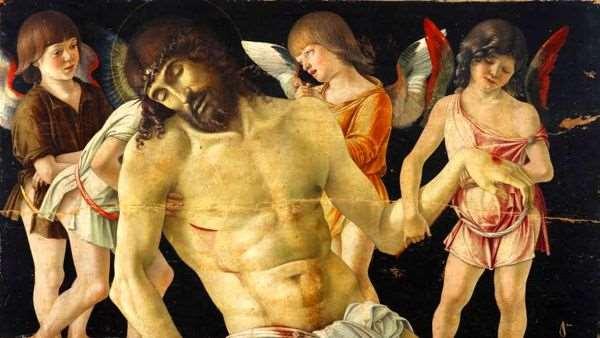
Introduction: All the proposed indications, which refer to the painting, will be provided by taking the observer's point of view as a basis, for example; the angel holding the hand of Christ is the fourth angel on the right, Christ bends his head to the left and the angel with his arms crossed is the first angel on the left.
The uniqueness of the characterization of the angels.
A unique painting in several respects, one of these is the marked characterization and representation of the angels who guard Jesus.
Each angel wears a particular dress, the clothes differ in style and colour, even the necklines are different. Three dresses have sleeves, one has no sleeves (the fourth on the right) and is supported by straps held by cameos.
The fourth angel's dress (the one holding the hand of Jesus) has another particular feature, better visible to the naked eye than in the photo; it has a golden band at chest height that can be seen emerging from under the dress and disappearing under the right armpit. It is a band not so high because already at the height of the crease of the arm, under the cameo, it is no longer visible.
CC BY-NC 4.0 license - Author: Franco Facondini (Rimini- Italy) email: facondini.f@libero.it
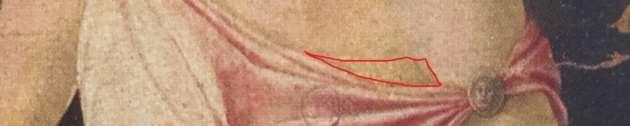
This photo shows the detail of the golden band that emerges from under the dress.
Do angels wear real clothes? Are they dressed in a recognizable style?
The first angel on the left wears a simple brown suit compatible with the fashion of the time (1400), the second angel (who embraces and supports Jesus) has a white dress of which we can see few details, the third and fourth angel on the right they have clothes that can be traced back to a previous style, in use in the ancient Rome.
If we accept this hypothesis we can make a first important observation starting from the observation of the last angel on the right (the one holding the hand of Jesus). If she wears a sleeveless dress held up by shoulder straps fixed by cameos, if she wears a chest strap, if she dresses in Roman style, then we are faced with the representation of a female figure. In fact, women in ancient Rome used to wear a chest band as a bra.
Are angels female or male?
The issue of the sex of angels was a hotly debated topic in Byzantium even during the difficult period when the empire felt the pressure and threat of the Ottoman conquest. In memory of this situation to this day, in Italy, the way of saying that "discussing the sex of angels" is equivalent to discussing useless things and wasting time that would be better used for something else
In Byzantium, the quarrel as to whether the angels were male or female was a serious matter and a painting of recognized Byzantine iconographic inspiration could certainly consider the issue.
Three male and one female angelic figures.
What would a female figure do next to Jesus and who does she represent?
By shifting attention to the third angel we seem to have found the answer to this question. The third angel (with his hands clasped behind Jesus) is well illuminated, the light catches him in full face, he stands in a central position in an important place next to Jesus, has a dress with iridescent reflections and holds in his hand something not well defined, his face is characterized by a particular shape and physiognomy of the eyes.
Unlike many other coeval paintings of the same subject, in Bellini's Pietà, angels have specific and well-groomed faces, do not have ideal and uniform faces, but rather each has its own and precise features, so much so that seeing even one of their faces we can say with certainty that "this is Bellini's piety", that is, we can recognize them.
CC BY-NC 4.0 license - Author: Franco Facondini (Rimini- Italy) email: facondini.f@libero.it
To identify the characters of an ancient painting it is usually used to compare the faces with other faces of painted figures, contemporary and recognizable because they are documented, then try to find similarities a bit as we do between brothers.
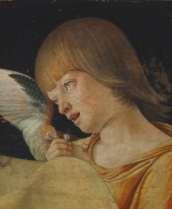
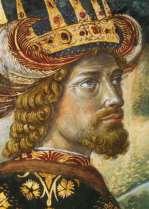
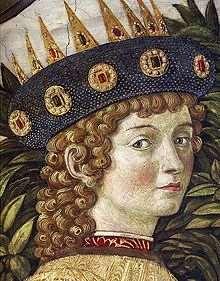
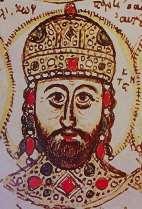
Here we have placed a series of design of around 1440, which represent starting from left to right: 1) The third angel of Bellini's painting 2) the (presumed) portrait of John VIII Palaeologus 3) the (presumed) portrait of Demetrius Paleologo and 4) the true portrait of Constantine XI Paleologo.
The objective fact that the third angel is placed almost in the centre of the painting, the closeness to Jesus, the Roman-style iridescent dress (perhaps made of fine linen?) attest to the importance of the third angelic figure. In 1440 the Paleologists were one of the most distinguished families in the known world, the last Byzantine Imperial family, the only true heir of the Holy Roman Empire. At the head of the family was Manuele II Paleologo emperor, husband of Elena Dragaš. They will have 11 children: John VIII, Theodore II, Constantine XI, Demetrius, Thomas, ...
We have seen the supposed portraits of John VIII and Demetrius, and the 'certified' portrait of Constantine XI, but which of the members of the Palaeologus family could be depicted as an allegory among the angels of Bellini's painting?
Probably the closest Palaeologus to the Malatesta family, the only related: Tommaso II Paleologist, husband of Cleopa Malatesta, despot of Mistrà, cousin - acquired by Sigismondo Pandolfo
The third and fourth angel: a Royal Family portrait.
Some concrete clues support the hypothesis that the third and fourth angels of Bellini's painting depict the imperial couple: Thomas II Paleologo and Cleopa Malatesta.
Let's see them:
* The wings of the third and fourth angel cross gently (perhaps to allude to the spousal union?);
* the clothes of the third and fourth angel are the only ones in ancient Roman style (the Byzantium empire is the only legitimate heir of the Holy Roman Empire);
CC BY-NC 4.0 license - Author: Franco Facondini (Rimini- Italy) email: facondini.f@libero.it
* the clothes of the third and fourth angel are the only ones iridescent (maybe made of silk or fine linen), this would mean that they belong to an imperial dynasty;
* the last clue requires a premise;
Premise:
The marriage of Tommaso II Paleologo and Cleopa Malatesta was the beginning of a rather troubled and stormy union, full of ups and downs. The respective families and especially Pope Martin V who had arranged the wedding awaited with hope and confidence the arrival of an heir. Since Celopa Malatesta was in all respects a noblewoman of the State of the Church, if a male child had been born from the union of the Imperial couple, the Eastern Roman Empire would have been inextricably linked to the Papal States.
Cleopa and Tommaso Paleologo will have a daughter Elena, but they will lose their second son (perhaps male) who will never come to light.
The fourth clue recalls this dramatic event, to notice it we need to change our perspective as observers. Returning to Bellini's painting we look at the fourth angel who will support the hand of Jesus (for us now Cleope).
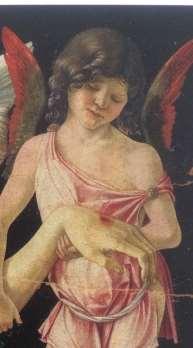
We need to shift our perspective and not focus on how the angel holds Christ’s hand, but on what the hand of Jesus does. We could see that Jesus places his hand on the small bulging belly of the angel. The hand of Jesus seems to bless the belly of a pregnant girl. Maybe he's blessing Cleopa's future heir?
The subtle optical illusion is enlarged by the continuity of the line created by the fingers of Jesus with the white cord that surrounds the red dress.
In ancient Rome women used to wear a gold ring on their little finger, of which there is no visible trace in the hands of the fourth angel, who however holds the little finger in a very particular way. The same angel then has a face compatible with a female face, also considering the hairstyle and the large black ringlets that fall on the bare shoulders.
- End of the first part –
https://it.wikipedia.org/wiki/Piet%C3%A0_(Giovanni_Bellini_Rimini) https://it.wikipedia.org/wiki/Museo_della_citt%C3%A0_di_Rimini
CC BY-NC 4.0 license - Author: Franco Facondini (Rimini- Italy) email: facondini.f@libero.it