![]()


A tribute to the skill and dedication that illuminate the game.


Creating a premier athletic & recreation campus.


We may be on opposite sides of I-270, but ADS associates in our new Headquarters and Engineering and Technology Center are working toward the same vision. We want to advance quality of life through sustainable solutions to water management challenges.
At ADS, we safeguard our environment and communities by protecting and managing water, the world’s most precious resource. Advanced Drainage Systems is proud to support the Memorial Tournament presented by Workday.
Scan to learn what happens to rain once it hits the ground.

BY BOB BAPTIST
Thanks to the Play Strong program at Nationwide Children’s Hospital’s, a young girl discovers that healthy eating habits result in feeling better
36 THE CAPTAINS CLUB
The distinguished group that guides the Memorial Tournament presented by Workday
40 SMOOTH OPERATOR
CAPTAINS
BY DAVID SHEDLOSKI
CLUB SERIES:
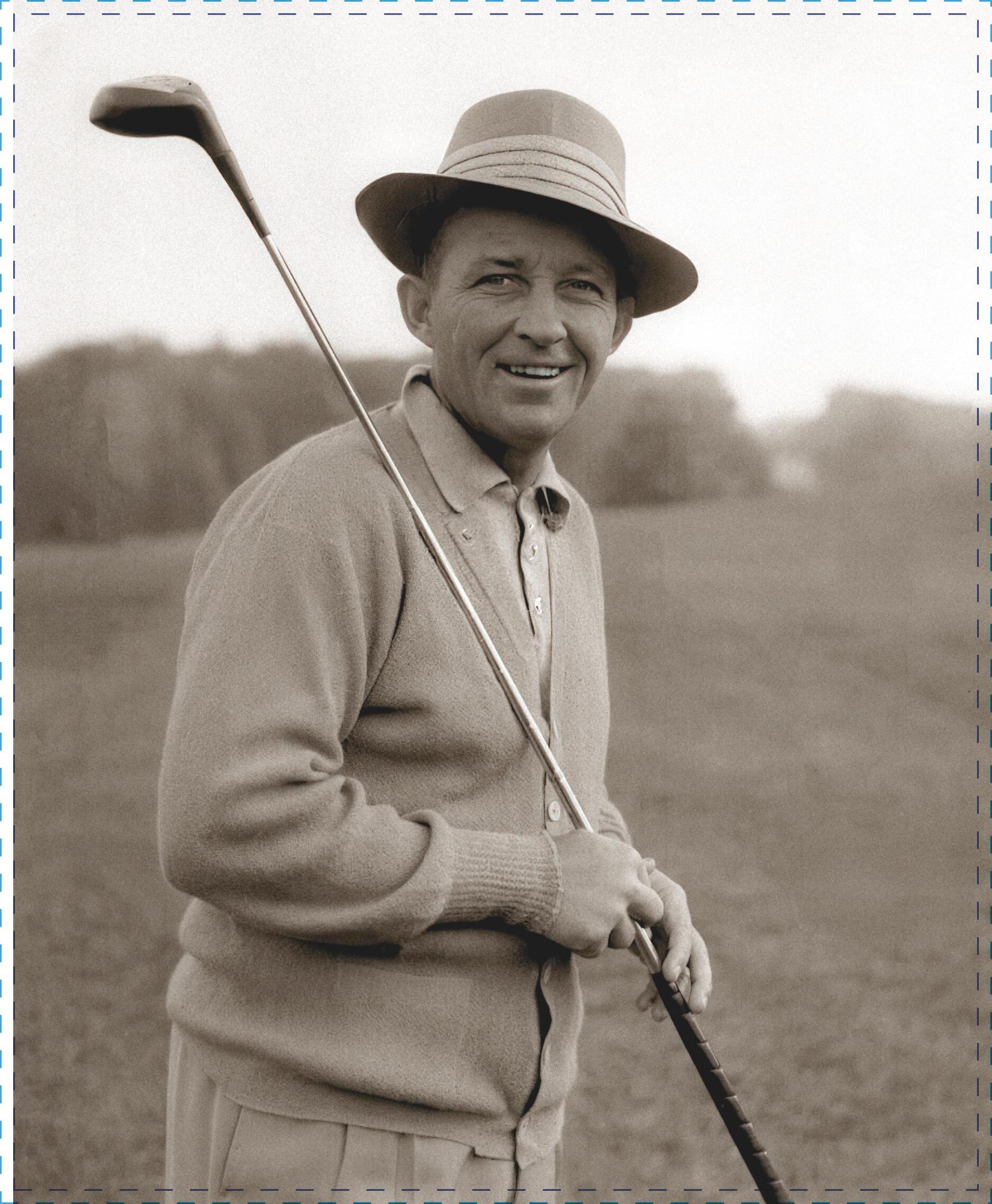
Bing Crosby was renowned as an entertainer, and he knew how to hit the right notes in golf, too
48 MAN OF CONTROL BY
JAIME DIAZ
It wasn’t an easy road, but David Graham became a major champion and Hall-of-Fame player through determination and toughness
72 THE MAN WHO MASTERED IT ALL BY
ALEX MICELI
Allan Robertson might very well have been the greatest golfer who ever lived prior to the advent of modern golf
ON THE COVER:
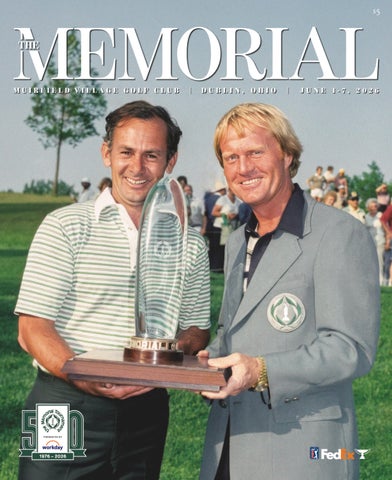
David Graham accepts the Memorial Tournament trophy from host Jack Nicklaus following his 1980 victory; Graham returns to Muirfield Village in 2026 as the Tournament Honoree.
CREDIT: Memorial Tournament Archive
BACKGROUND PHOTO CREDIT: PGA TOUR/Getty Images

BY JOHN STREGE
Well versed on all things golf—especially those that include the names Nicklaus and Palmer—David Shedloski, editorial director of The Memorial, has forged an award-winning career as a golf journalist
90 METEORIC RISE
BY GARY VAN SICKLE
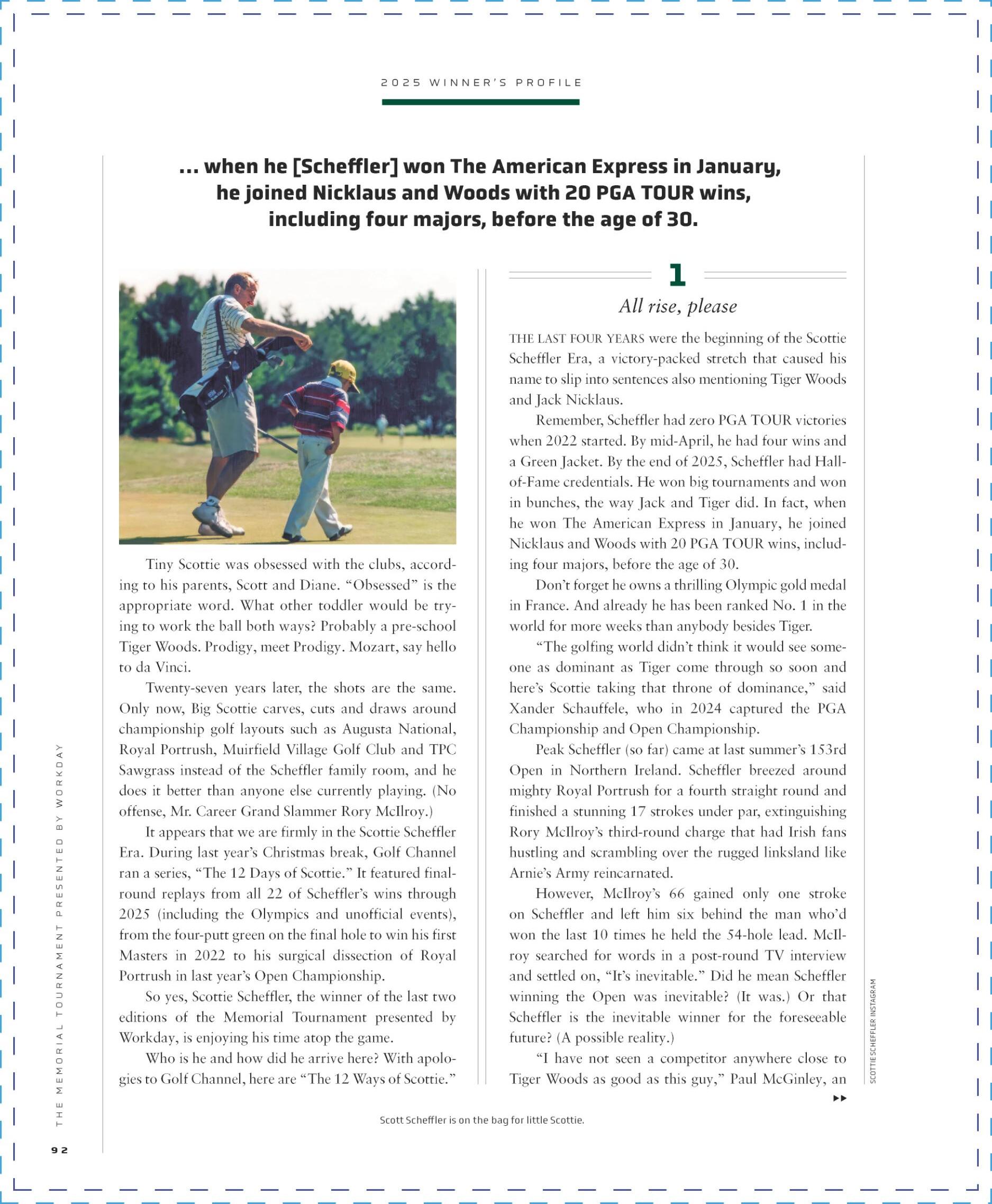
Four major championships, back-to-back Memorial titles, No. 1 in the world for longer than anyone but Tiger … there’s no end in sight for Scottie Scheffler’s ascension
110 MEMORIAL MEMORIES
BOOK EXCERPT:
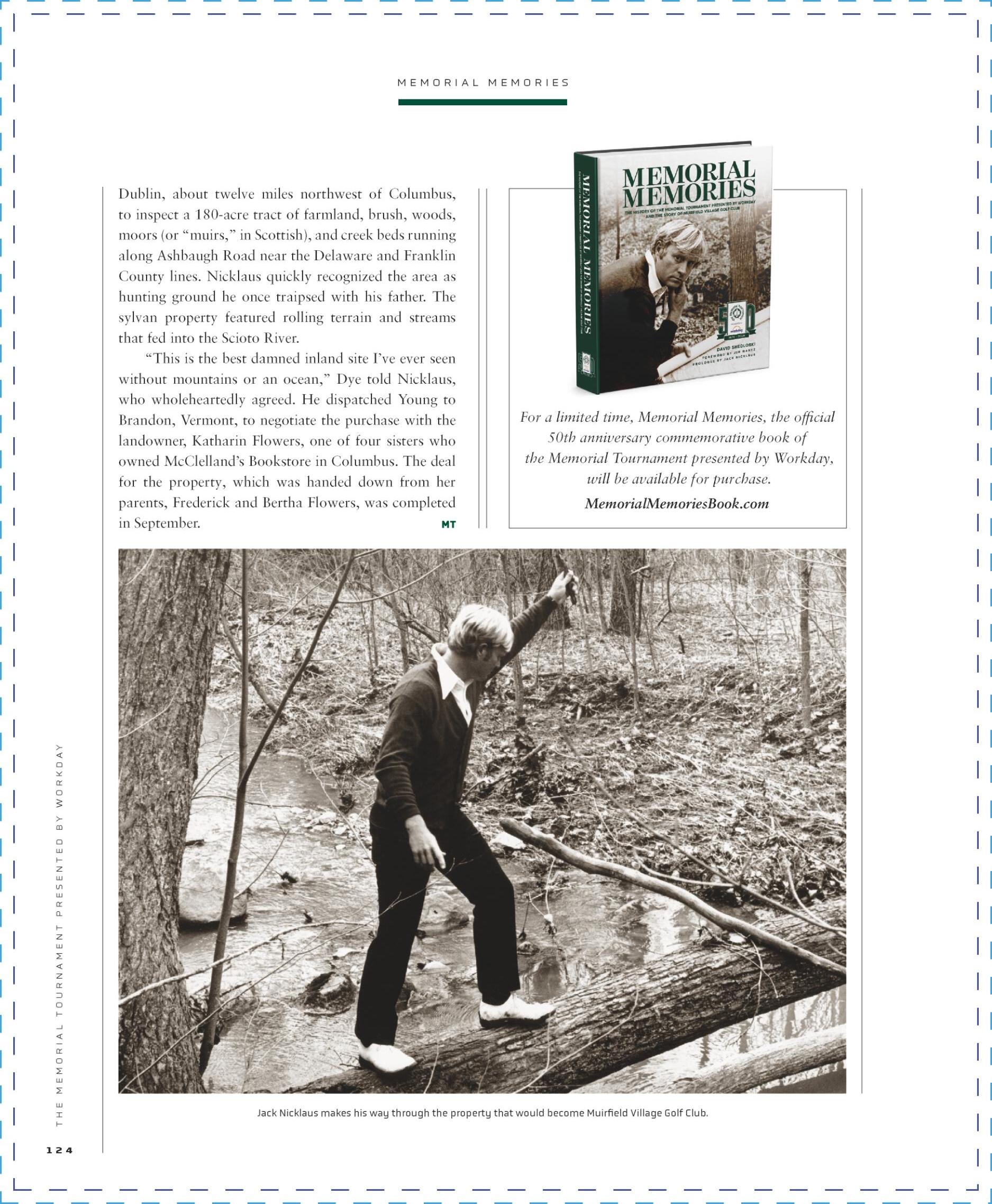
A young Jack Nicklaus, inspired by the Masters Tournament, made his dream of hosting his own premier event in his hometown of Columbus a reality 50 years ago
126
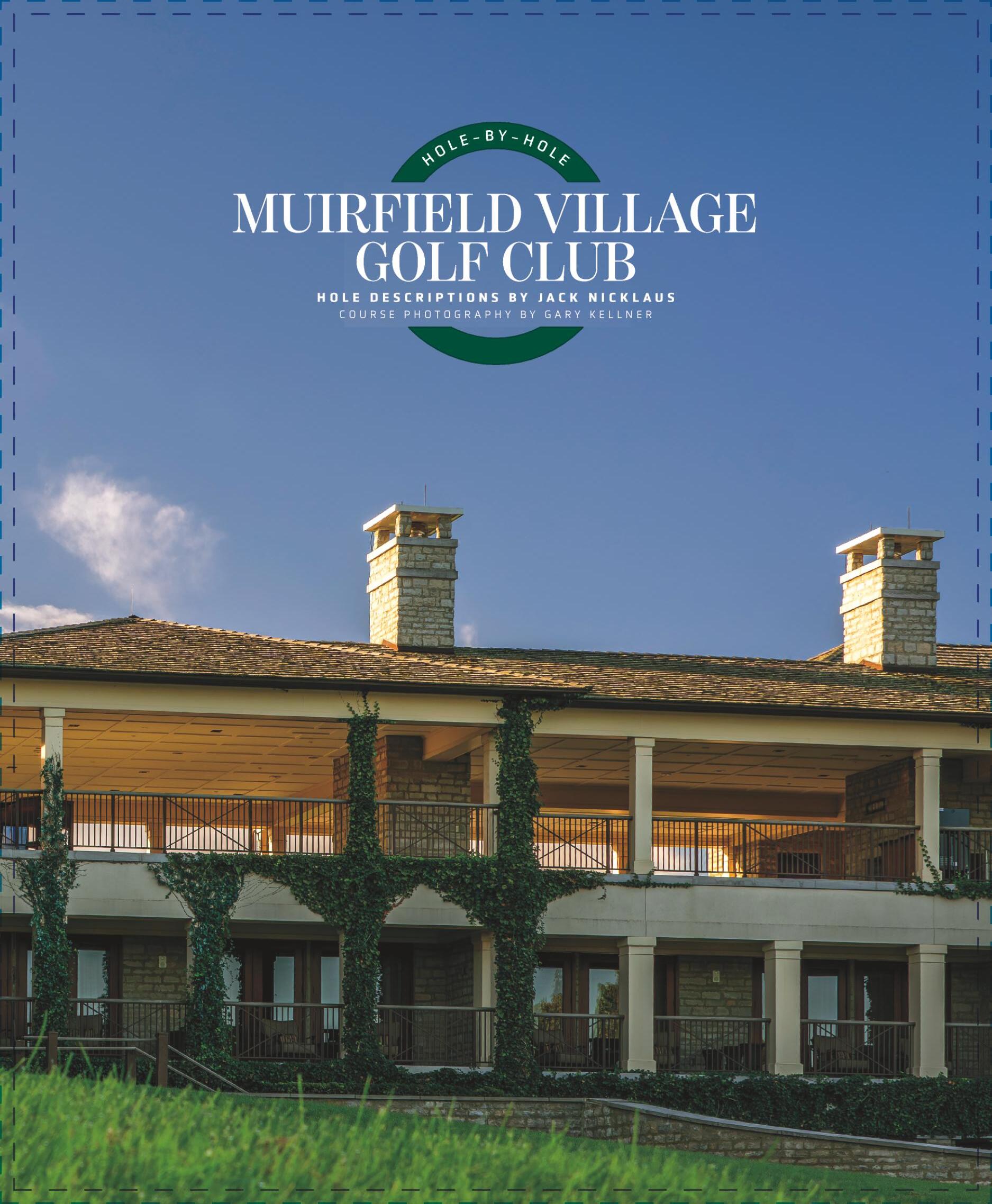
MUIRFIELD VILLAGE GOLF CLUB HOLE-BY-HOLE
HOLE DESCRIPTIONS BY JACK NICKLAUS
The Memorial Founder and Host reviews the strategy of each hole
166 MAKE IT THREE IN A ROW BY BOB BAPTIST
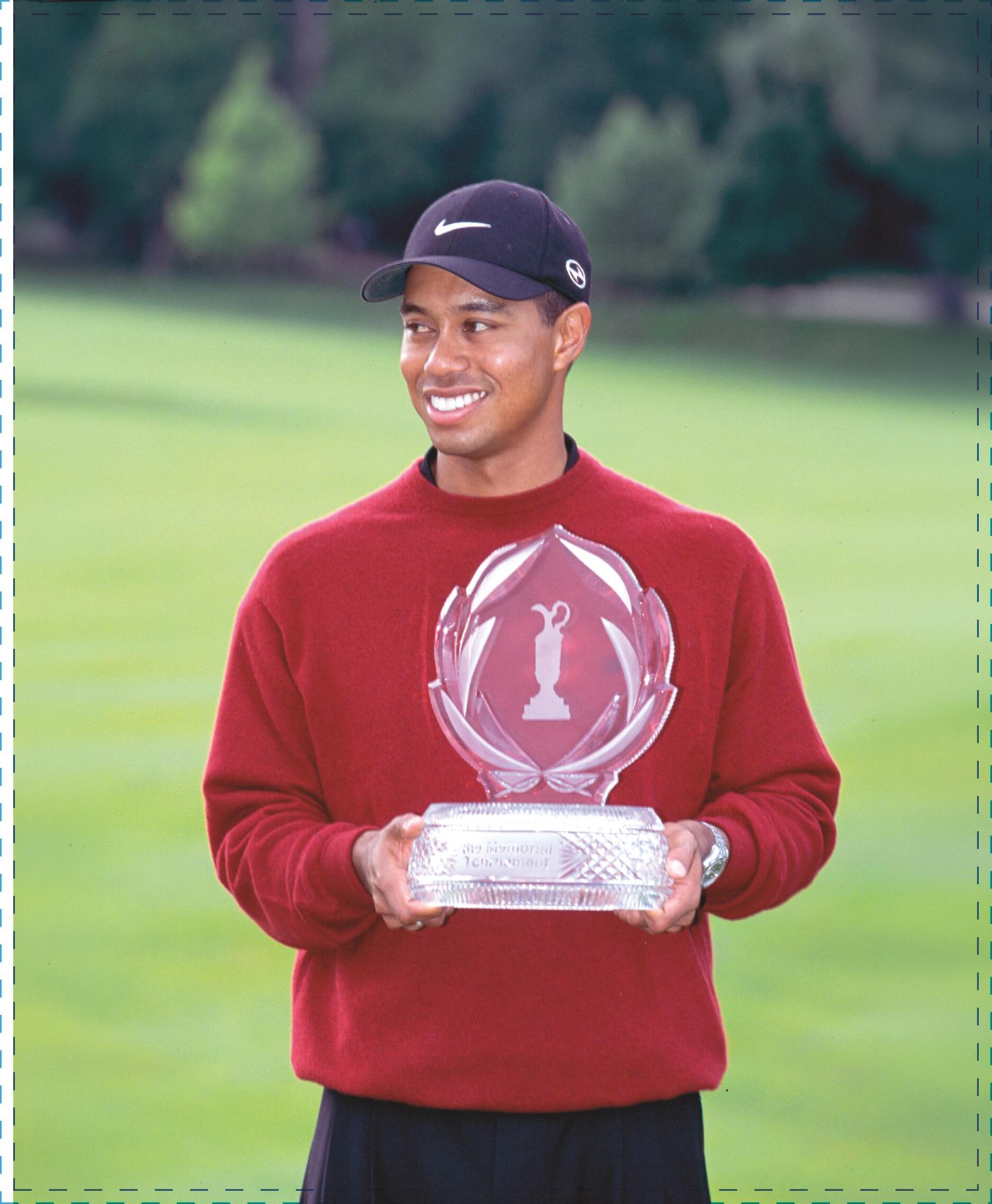
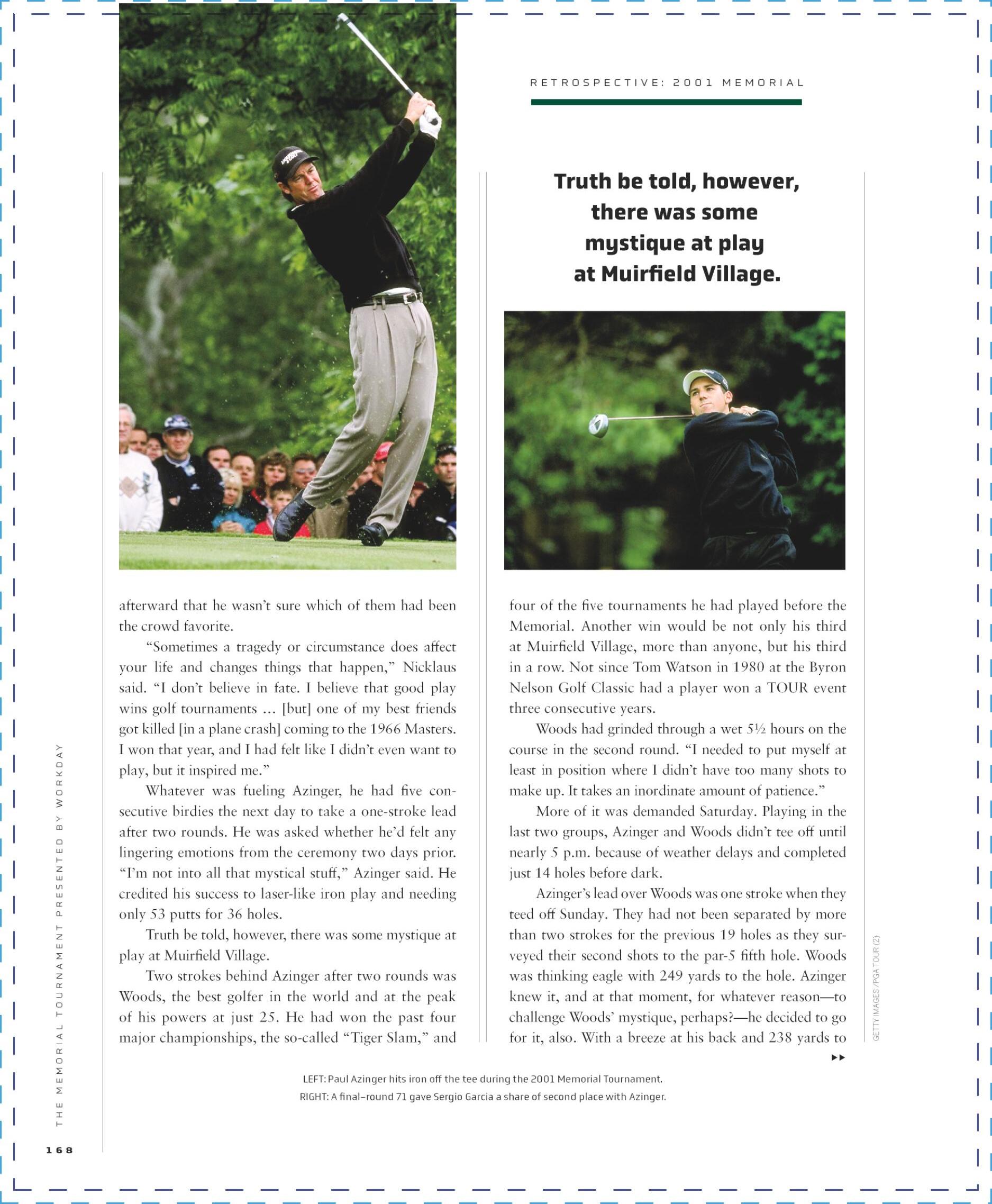
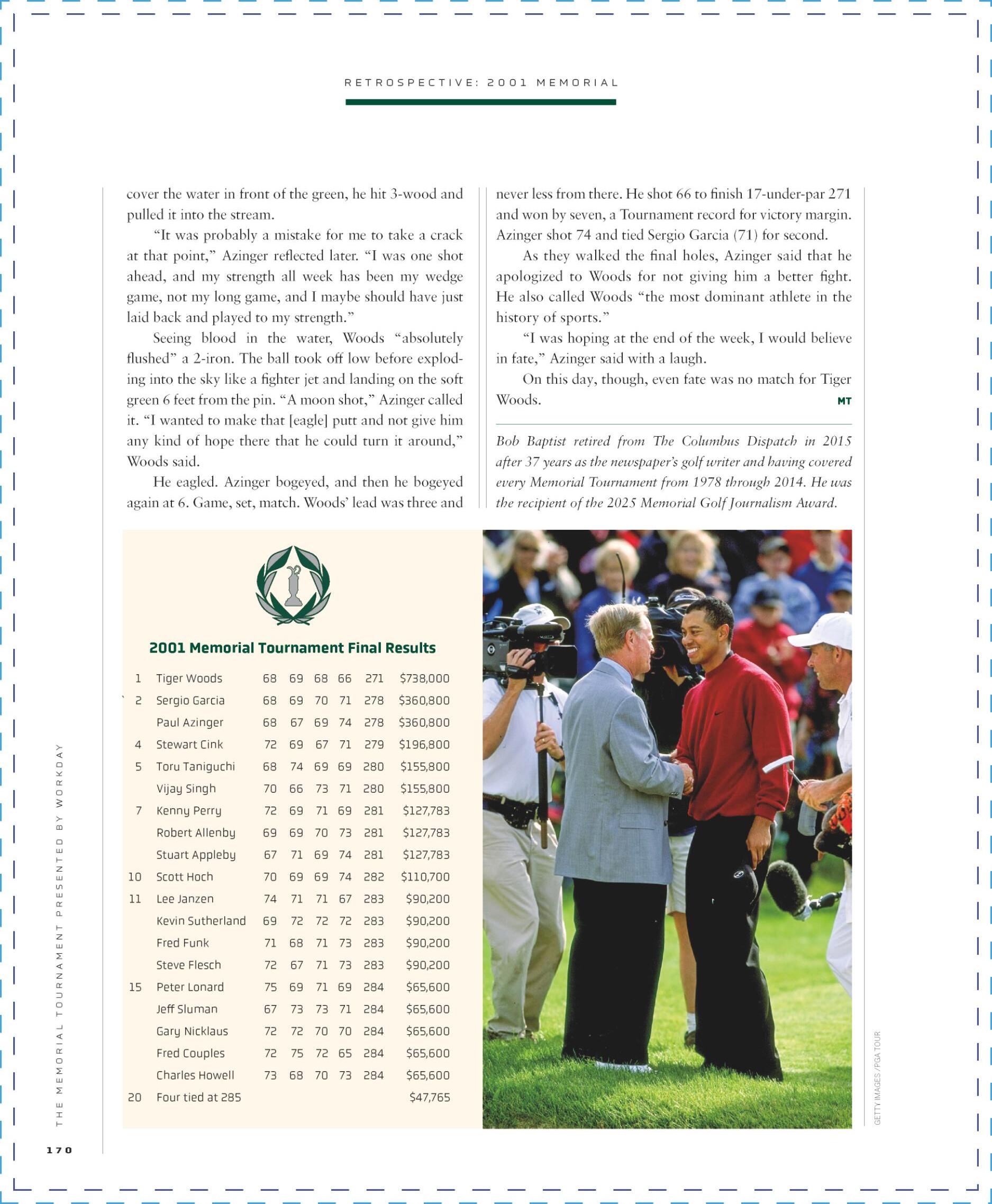
Paul Azinger, the 1993 Memorial Tournament winner, came this close to a repeat before losing to Tiger Woods in the middle of his PGA TOUR domination
172 THE MOST MEMORABLE MASTERS BY DAN O’NEILL
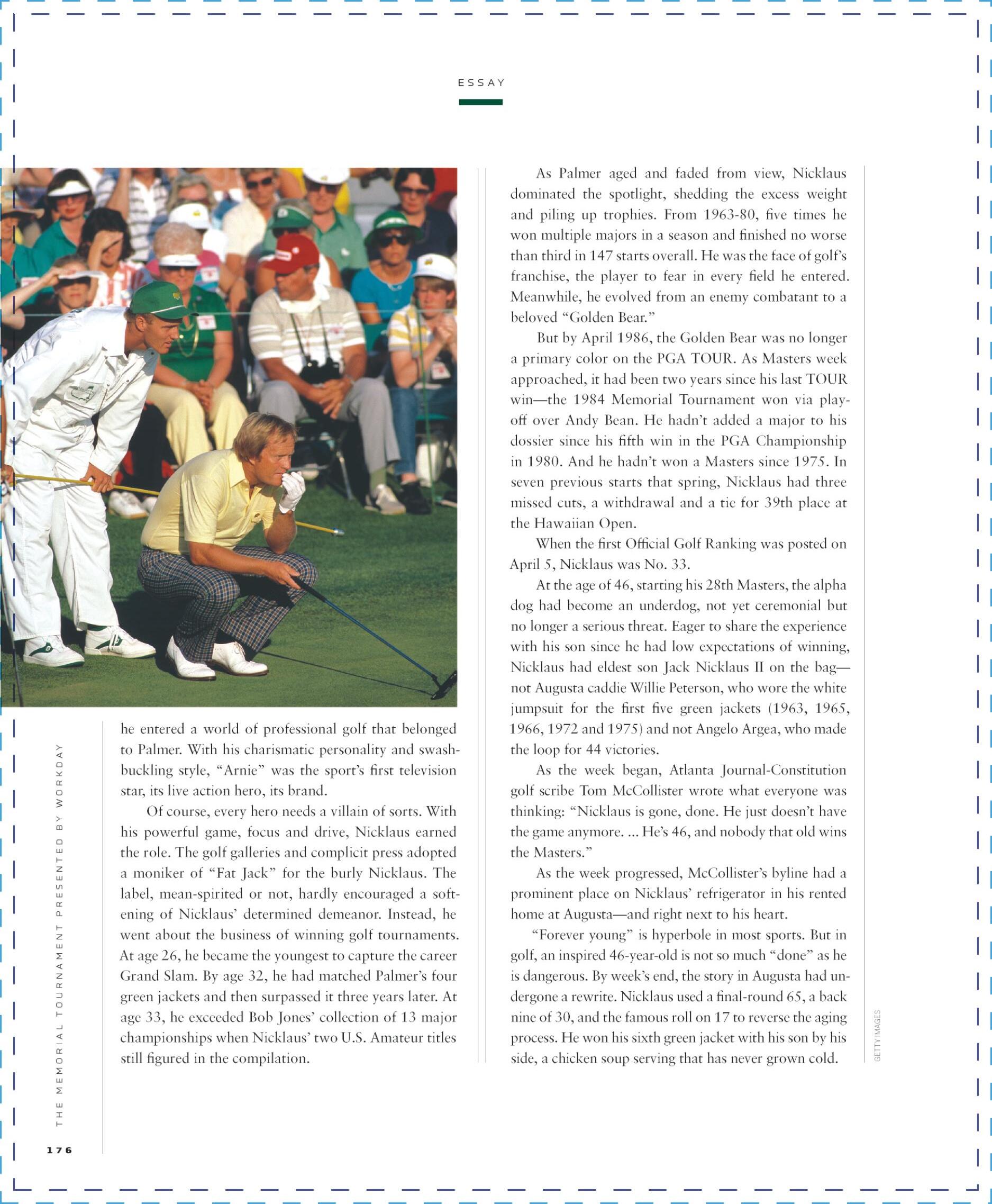
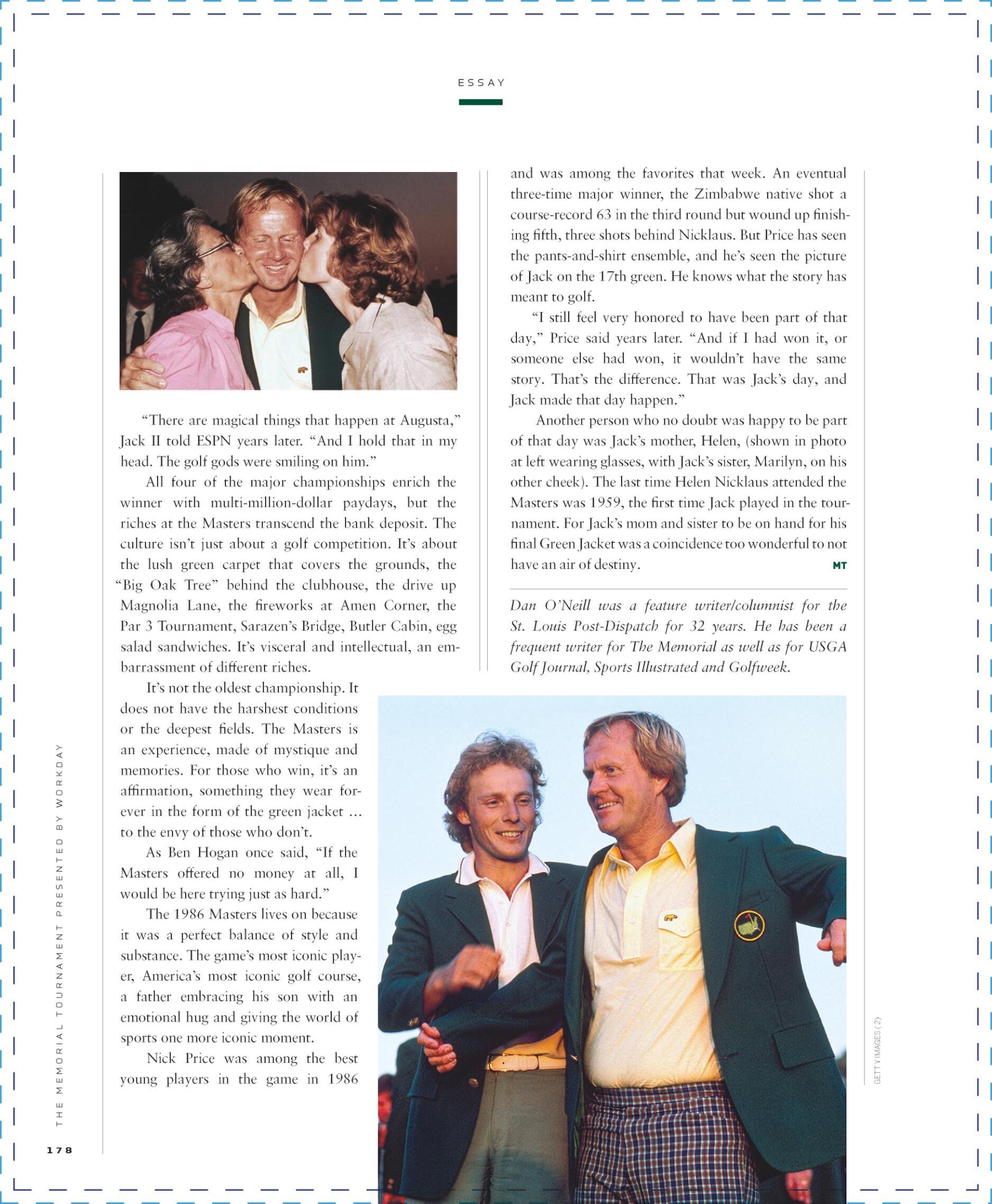
It’s been 40 years since Jack Nicklaus won his sixth green jacket in the 1986 Masters, and yet it remains one of the most popular and talked about victories in the annals of the game, a win that touched generations
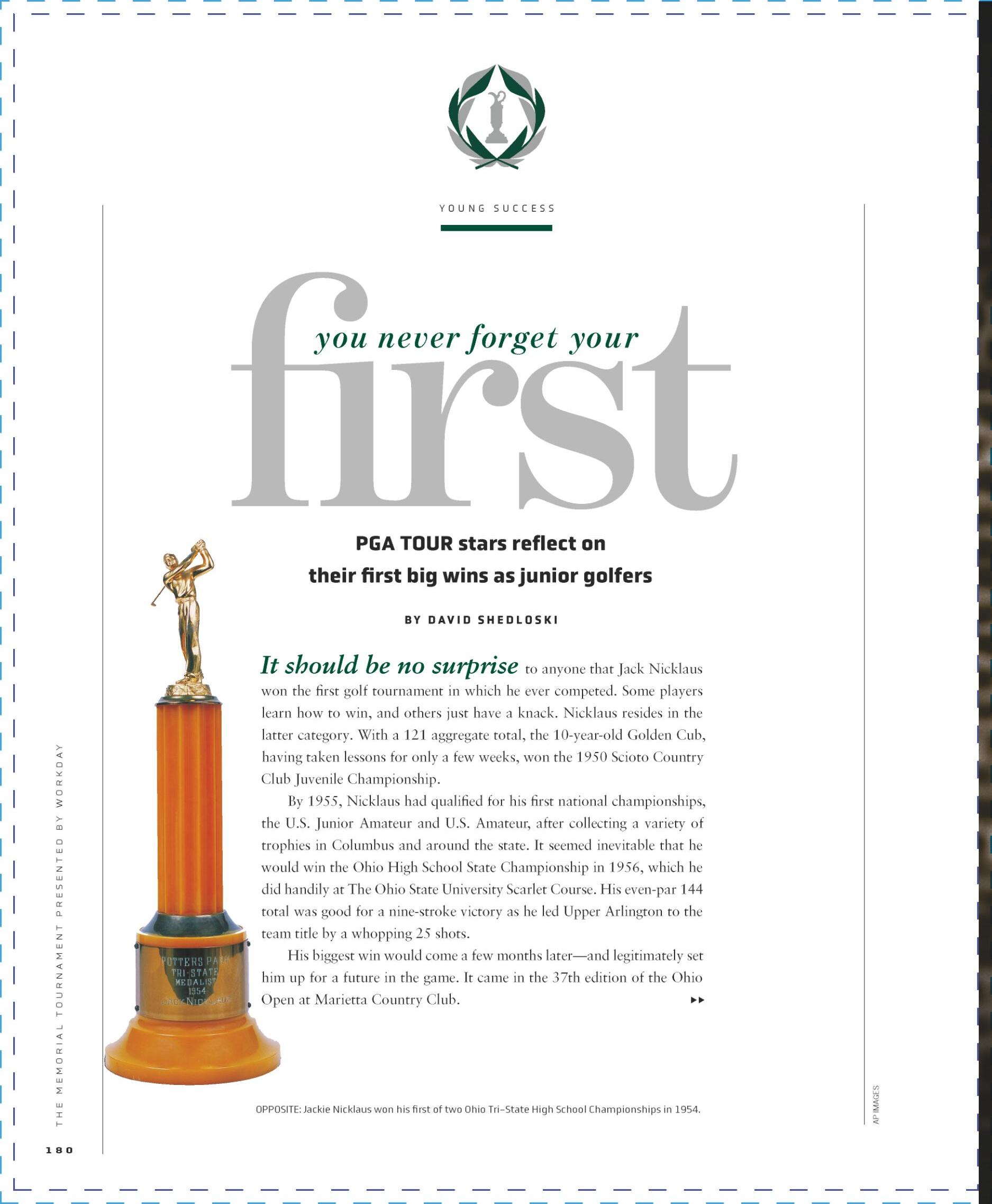
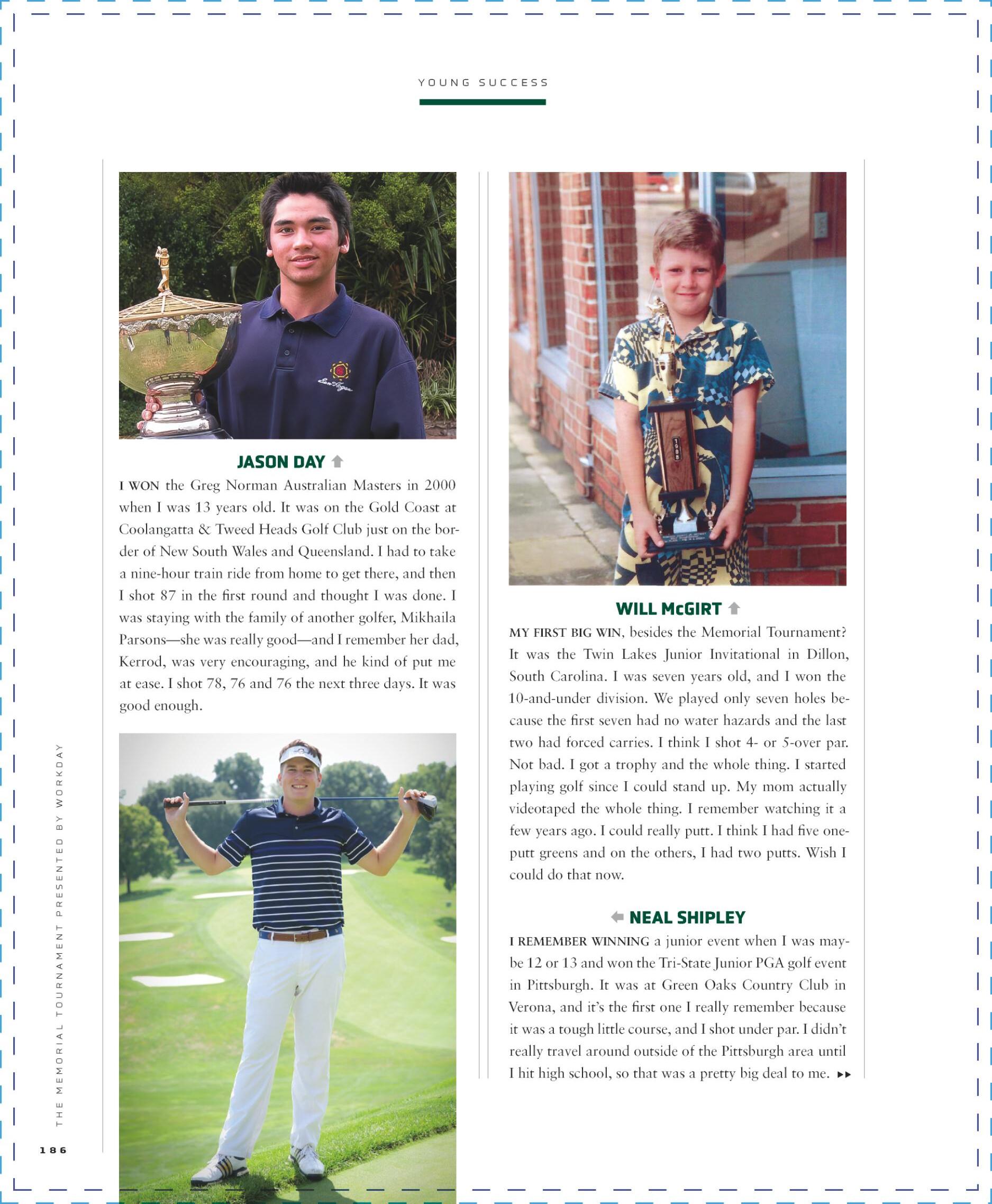
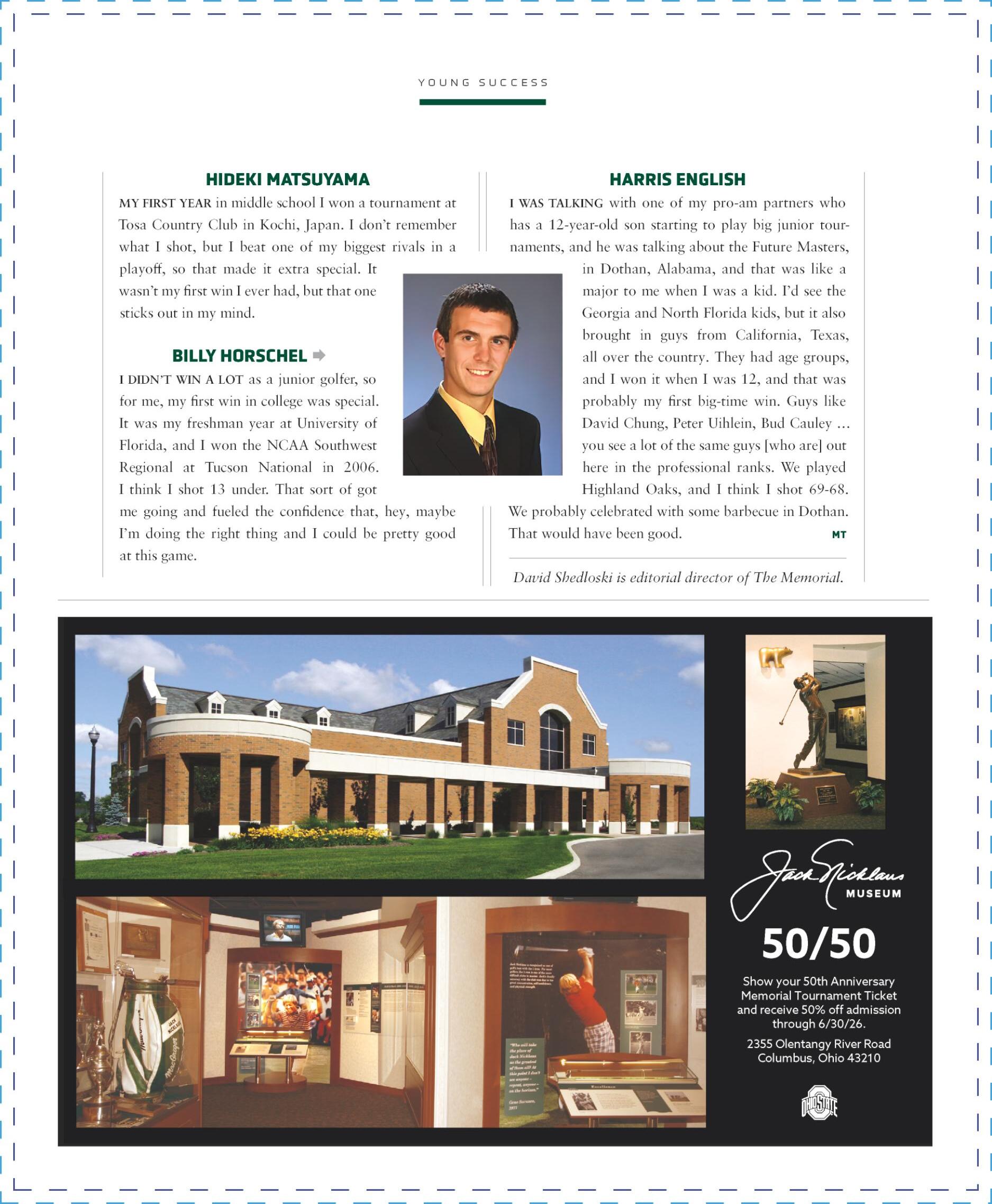
180 YOU NEVER FORGET YOUR FIRST BY DAVID SHEDLOSKI
PGA TOUR players reflect on their first big wins as junior golfers

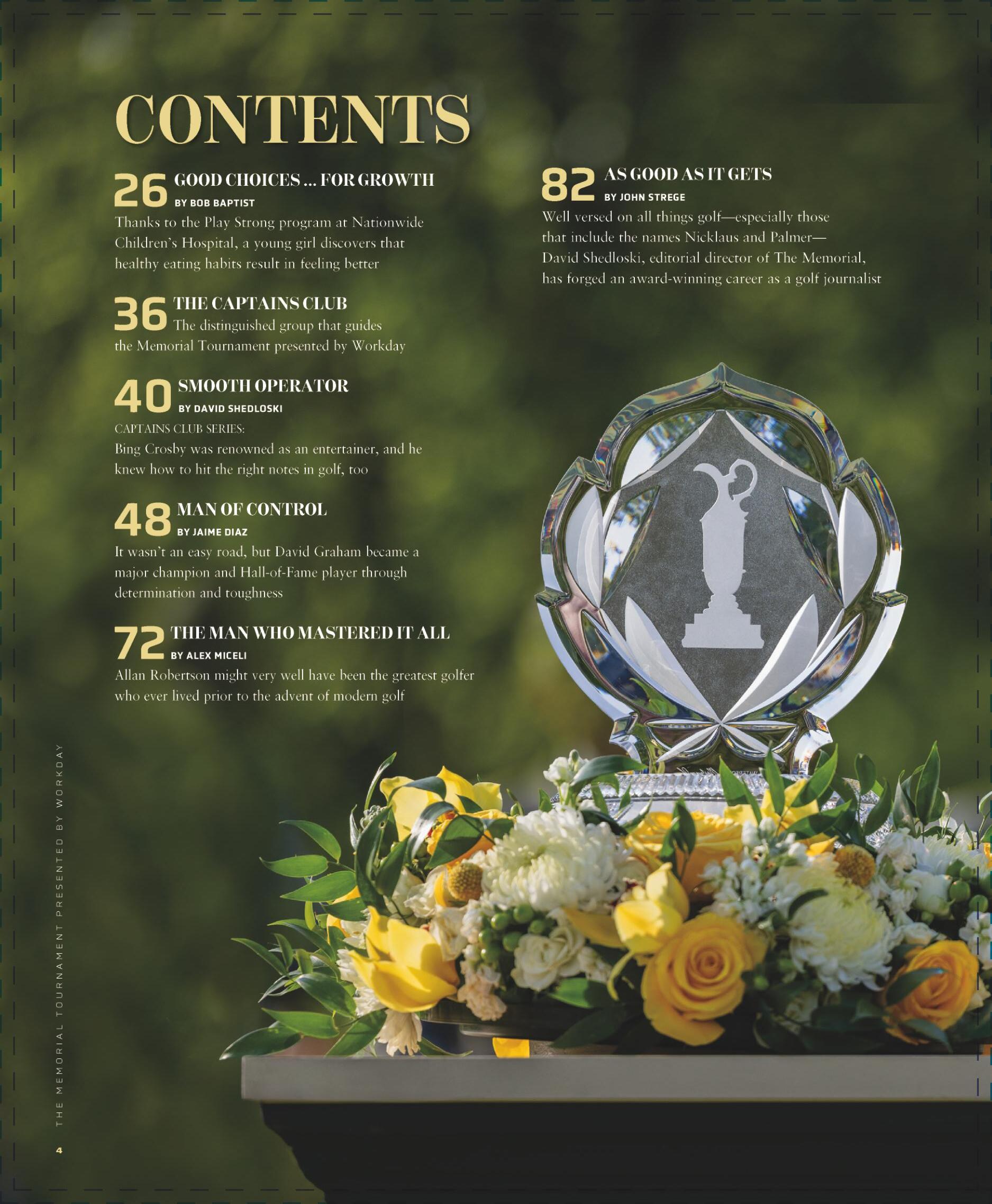
THE MEMORIAL TOURNAMENT PRESENTED BY WORKDAY 50TH ANNIVERSARY TROPHY
For 2026, Waterford Crystal has created a special trophy commemorating the Memorial Tournament’s golden anniversary. The Claret Jug, symbolizing Muirfield Village Golf Club’s homage to Muirfield in Scotland—where Jack Nicklaus won The Open Championship in 1966—has been uniquely toned in gold for one year.


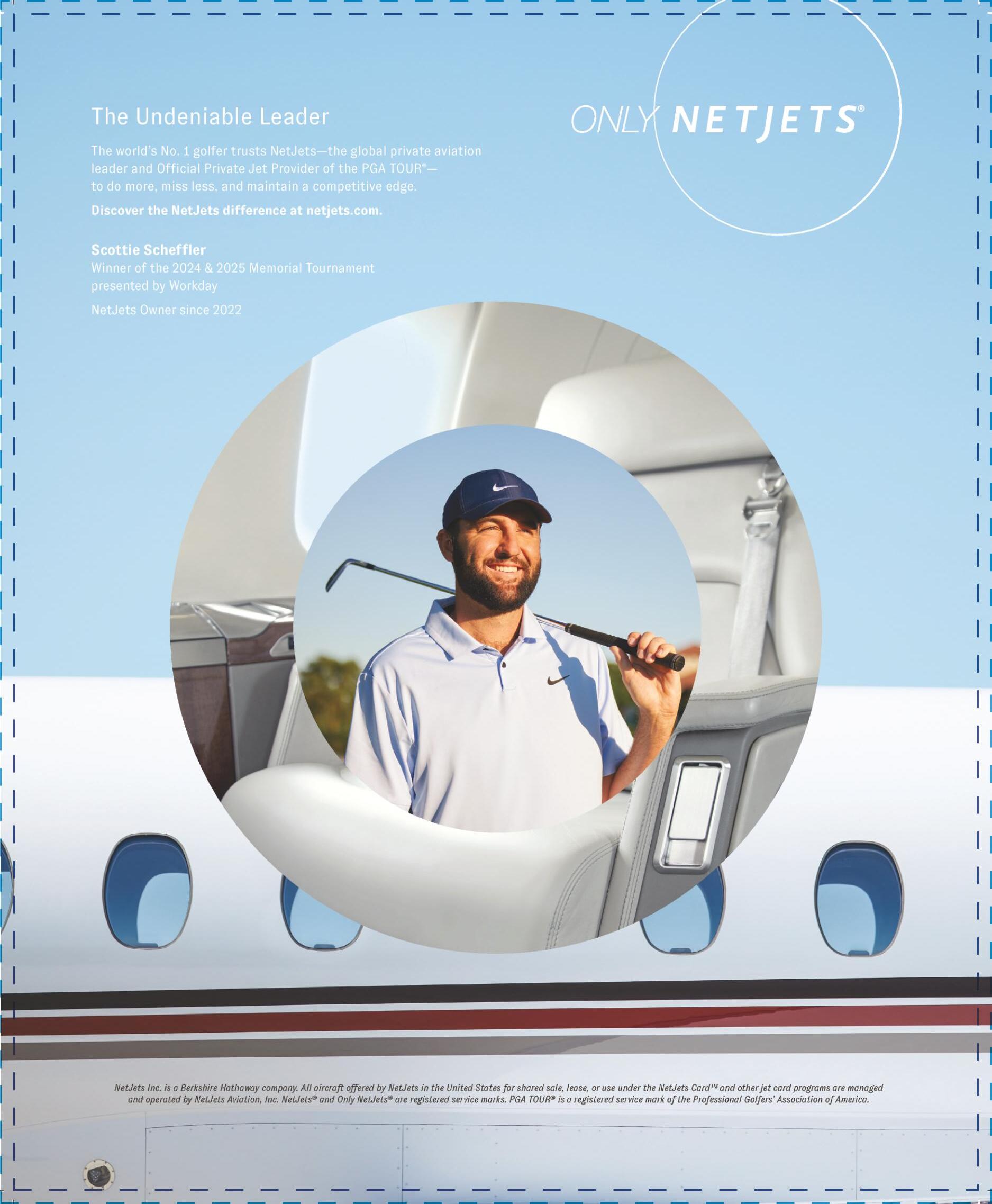
The world’s No. 1 golfer trusts NetJets—the global private aviation leader and Official Private Jet Provider of the PGA TOUR®— to do more, miss less, and maintain a competitive edge. Discover the NetJets difference at netjets.com.
Scottie Scheffler Winner of the 2024 & 2025 Memorial Tournament presented by Workday NetJets Owner since 2022


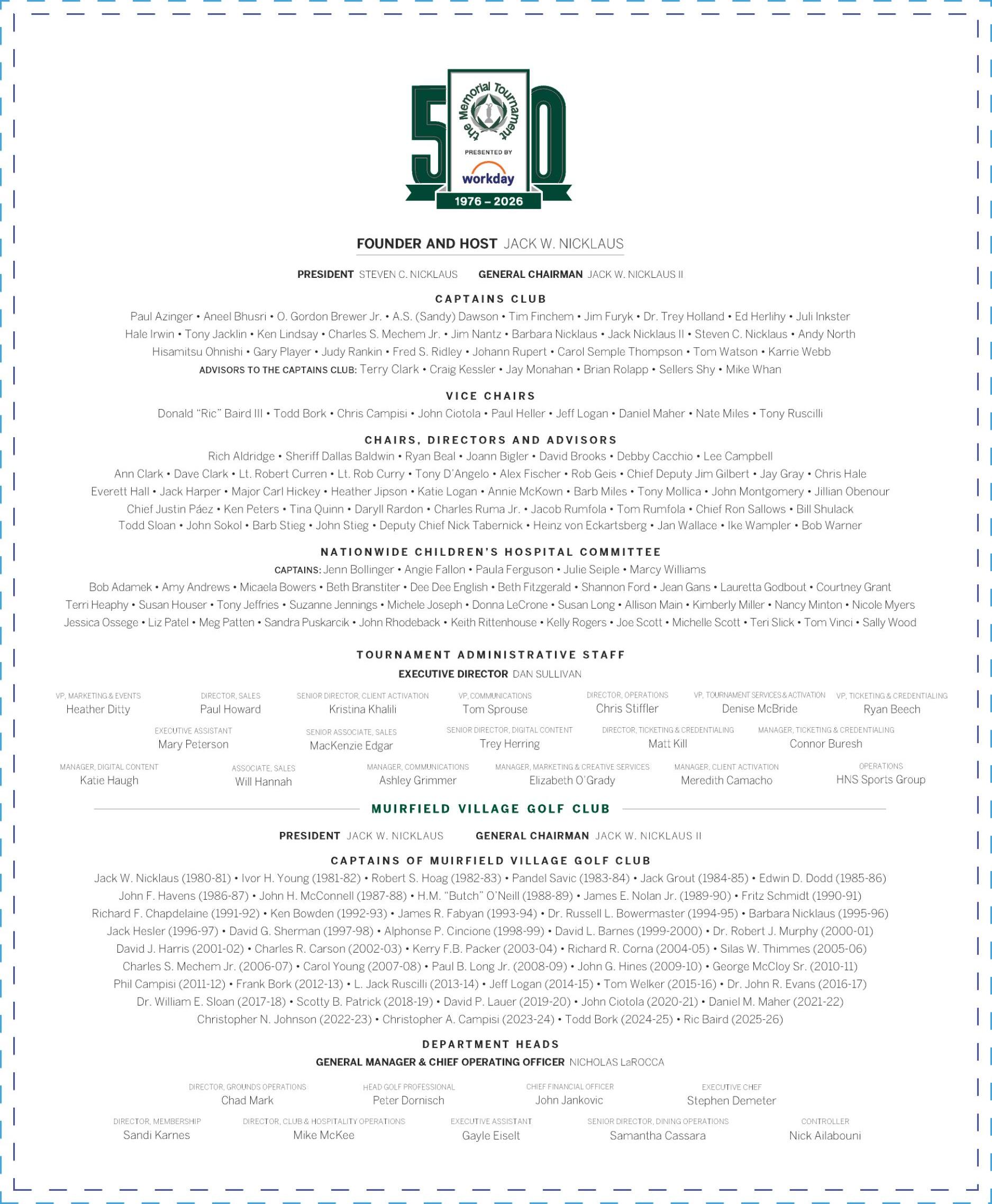
FOUNDER AND HOST JACK W. NICKLAUS
PRESIDENT STEVEN C. NICKLAUS GENERAL CHAIRMAN JACK W. NICKLAUS II
CAPTAINS CLUB
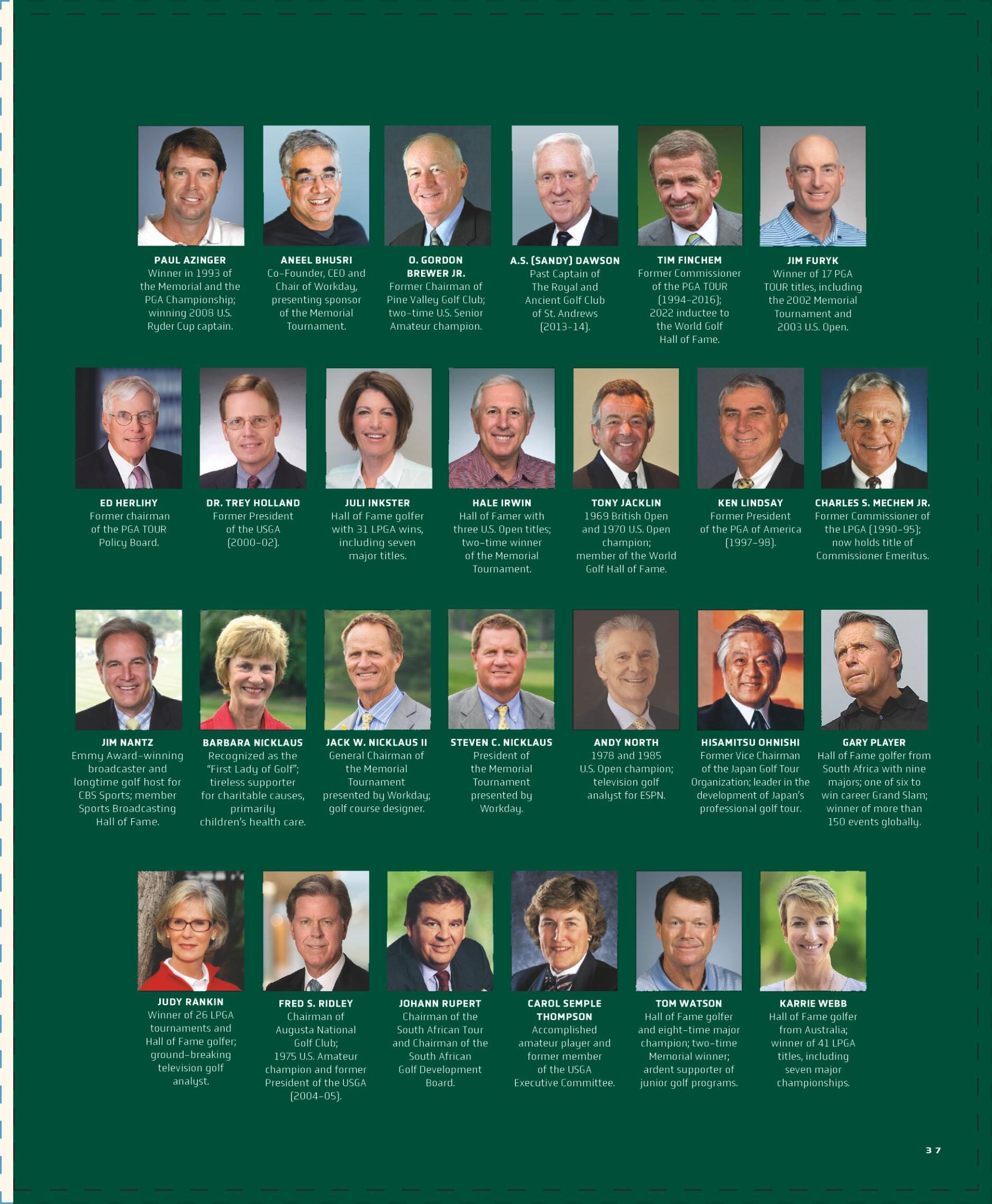
Paul Azinger • Aneel Bhusri • O. Gordon Brewer Jr. • A.S. (Sandy) Dawson • Tim Finchem • Jim Furyk • Dr. Trey Holland • Ed Herlihy • Juli Inkster
Hale Irwin • Tony Jacklin • Ken Lindsay • Charles S. Mechem Jr. • Jim Nantz • Barbara Nicklaus • Jack Nicklaus II • Steven C. Nicklaus • Andy North
Hisamitsu Ohnishi • Gary Player • Judy Rankin • Fred S. Ridley • Johann Rupert • Carol Semple Thompson • Tom Watson • Karrie Webb
ADVISORS TO THE CAPTAINS CLUB: Terry Clark • Craig Kessler • Jay Monahan • Brian Rolapp • Sellers Shy • Mike Whan
VICE CHAIRS
Donald “Ric” Baird III • Todd Bork • Chris Campisi • John Ciotola • Paul Heller • Jeff Logan • Daniel Maher • Nate Miles • Tony Ruscilli
CHAIRS, DIRECTORS AND ADVISORS
Rich Aldridge • Sheriff Dallas Baldwin • Ryan Beal • Joann Bigler • David Brooks • Debby Cacchio • Lee Campbell
Ann Clark • Dave Clark • Lt. Robert Curren • Lt. Rob Curry • Tony D’Angelo • Alex Fischer • Rob Geis • Chief Deputy Jim Gilbert • Jay Gray • Chris Hale
Everett Hall • Jack Harper • Major Carl Hickey • Heather Jipson • Katie Logan • Annie McKown • Barb Miles • Tony Mollica • John Montgomery • Jillian Obenour
Chief Justin Páez • Ken Peters • Tina Quinn • Daryll Rardon • Charles Ruma Jr. • Jacob Rumfola • Tom Rumfola • Chief Ron Sallows • Bill Shulack
Todd Sloan • John Sokol • Barb Stieg • John Stieg • Deputy Chief Nick Tabernick • Heinz von Eckartsberg • Jan Wallace • Ike Wampler • Bob Warner
NATIONWIDE CHILDREN’S HOSPITAL COMMITTEE
CAPTAINS: Jenn Bollinger • Angie Fallon • Paula Ferguson • Julie Seiple • Marcy Williams
Bob Adamek • Amy Andrews • Micaela Bowers • Beth Branstiter • Dee Dee English • Beth Fitzgerald • Shannon Ford • Jean Gans • Lauretta Godbout • Courtney Grant
Terri Heaphy • Susan Houser • Tony Jeffries • Suzanne Jennings • Michele Joseph • Donna LeCrone • Susan Long • Allison Main • Kimberly Miller • Nancy Minton • Nicole Myers
Jessica Ossege • Liz Patel • Meg Patten • Sandra Puskarcik • John Rhodeback • Keith Rittenhouse • Kelly Rogers • Joe Scott • Michelle Scott • Teri Slick • Tom Vinci • Sally Wood
VP, MARKETING & EVENTS
Heather Ditty
DIRECTOR, SALES Paul Howard
ASSISTANT Mary Peterson
TOURNAMENT ADMINISTRATIVE STAFF
EXECUTIVE DIRECTOR DAN SULLIVAN
SENIOR DIRECTOR, CLIENT ACTIVATION Kristina Khalili
Tom Sprouse
Chris Stiffler
muirfield village golf club
PRESIDENT JACK W. NICKLAUS GENERAL CHAIRMAN JACK W. NICKLAUS II
CAPTAINS OF MUIRFIELD VILLAGE GOLF CLUB
Denise McBride
Ryan Beech
Jack W. Nicklaus (1980-81) • Ivor H. Young (1981-82) • Robert S. Hoag (1982-83) • Pandel Savic (1983-84) • Jack Grout (1984-85) • Edwin D. Dodd (1985-86) John F. Havens (1986-87) • John H. McConnell (1987-88) • H.M. “Butch” O’Neill (1988-89) • James E. Nolan Jr. (1989-90) • Fritz Schmidt (1990-91) Richard F. Chapdelaine (1991-92) • Ken Bowden (1992-93) • James R. Fabyan (1993-94) • Dr. Russell L. Bowermaster (1994-95) • Barbara Nicklaus (1995-96) Jack Hesler (1996-97) • David G. Sherman (1997-98) • Alphonse P. Cincione (1998-99) • David L. Barnes (1999-2000) • Dr. Robert J. Murphy (2000-01)
David J. Harris (2001-02) • Charles R. Carson (2002-03) • Kerry F.B. Packer (2003-04) • Richard R. Corna (2004-05) • Silas W. Thimmes (2005-06) Charles S. Mechem Jr. (2006-07) • Carol Young (2007-08) • Paul B. Long Jr. (2008-09) • John G. Hines (2009-10) • George McCloy Sr. (2010-11) Phil Campisi (2011-12) • Frank Bork (2012-13) • L. Jack Ruscilli (2013-14) • Jeff Logan (2014-15) • Tom Welker (2015-16) • Dr. John R. Evans (2016-17) Dr. William E. Sloan (2017-18) • Scotty B. Patrick (2018-19) • David P. Lauer (2019-20) • John Ciotola (2020-21) • Daniel M. Maher (2021-22) Christopher N. Johnson (2022-23) • Christopher A. Campisi (2023-24) • Todd Bork (2024-25) • Ric Baird (2025-26)
DEPARTMENT HEADS
GENERAL MANAGER & CHIEF OPERATING OFFICER NICHOLAS LaROCCA


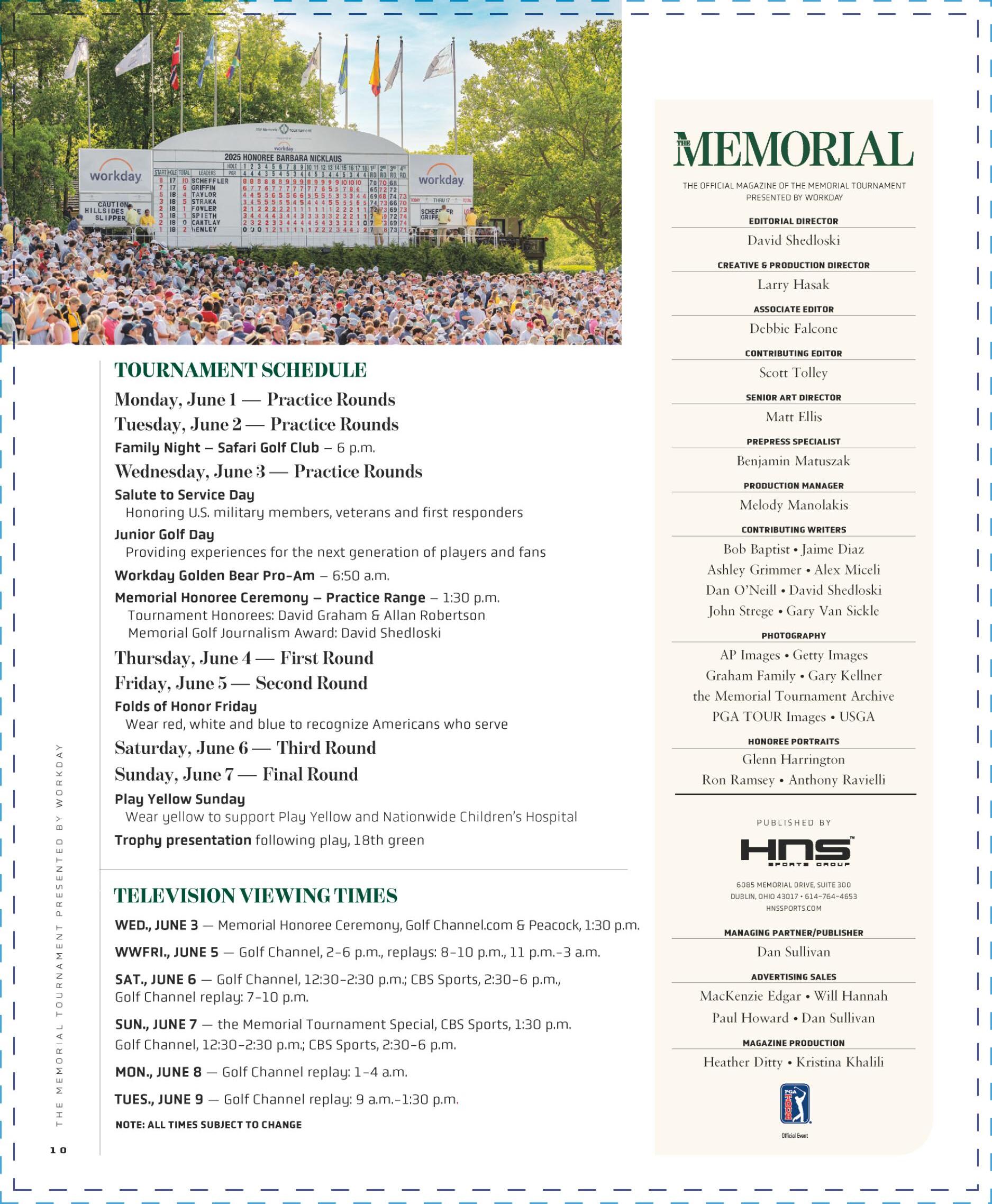
Monday, June 1 — Practice Rounds
Tuesday, June 2 — Practice Rounds
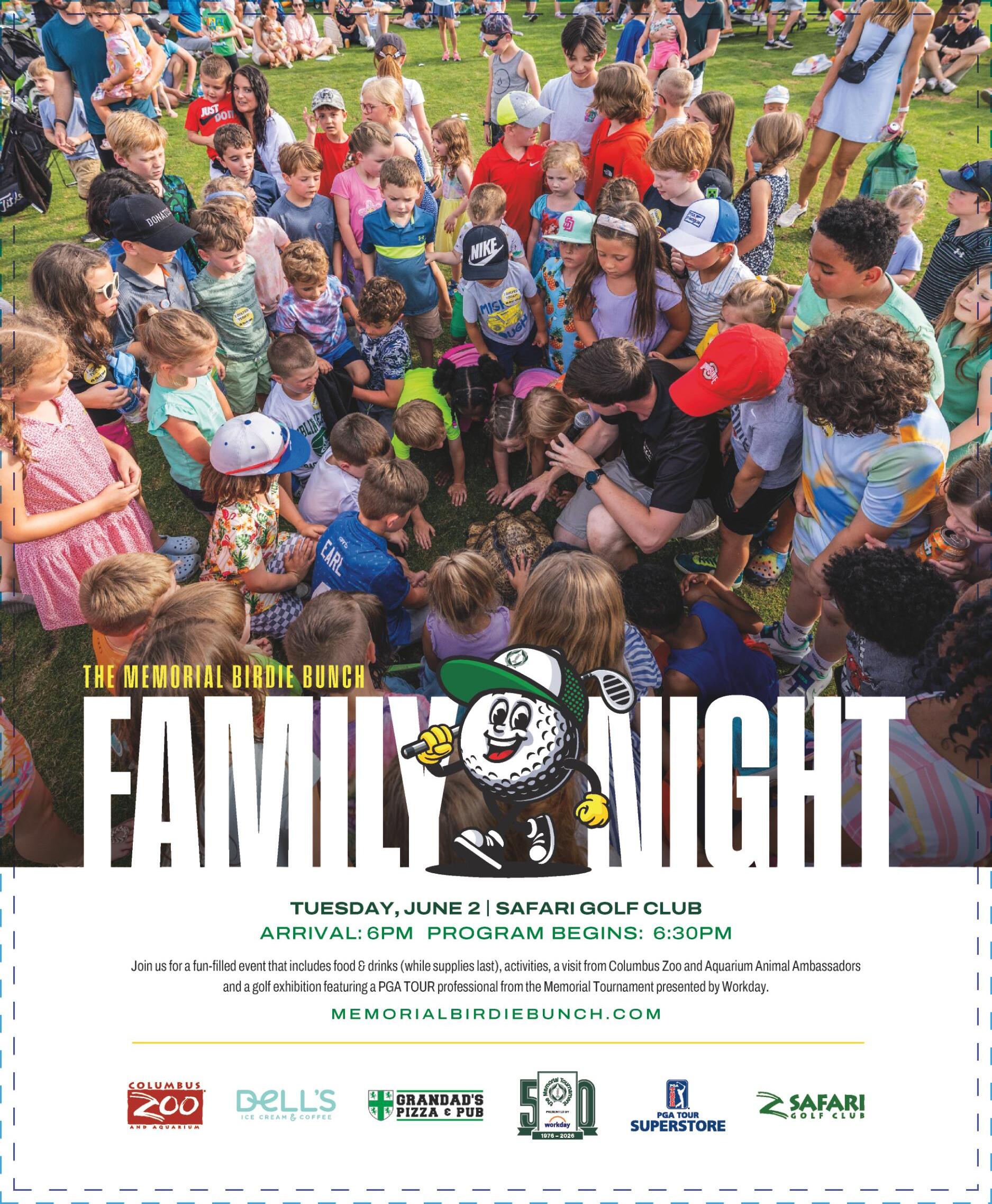
Family Night – Safari Golf Club – 6 p.m.
Wednesday, June 3 — Practice Rounds
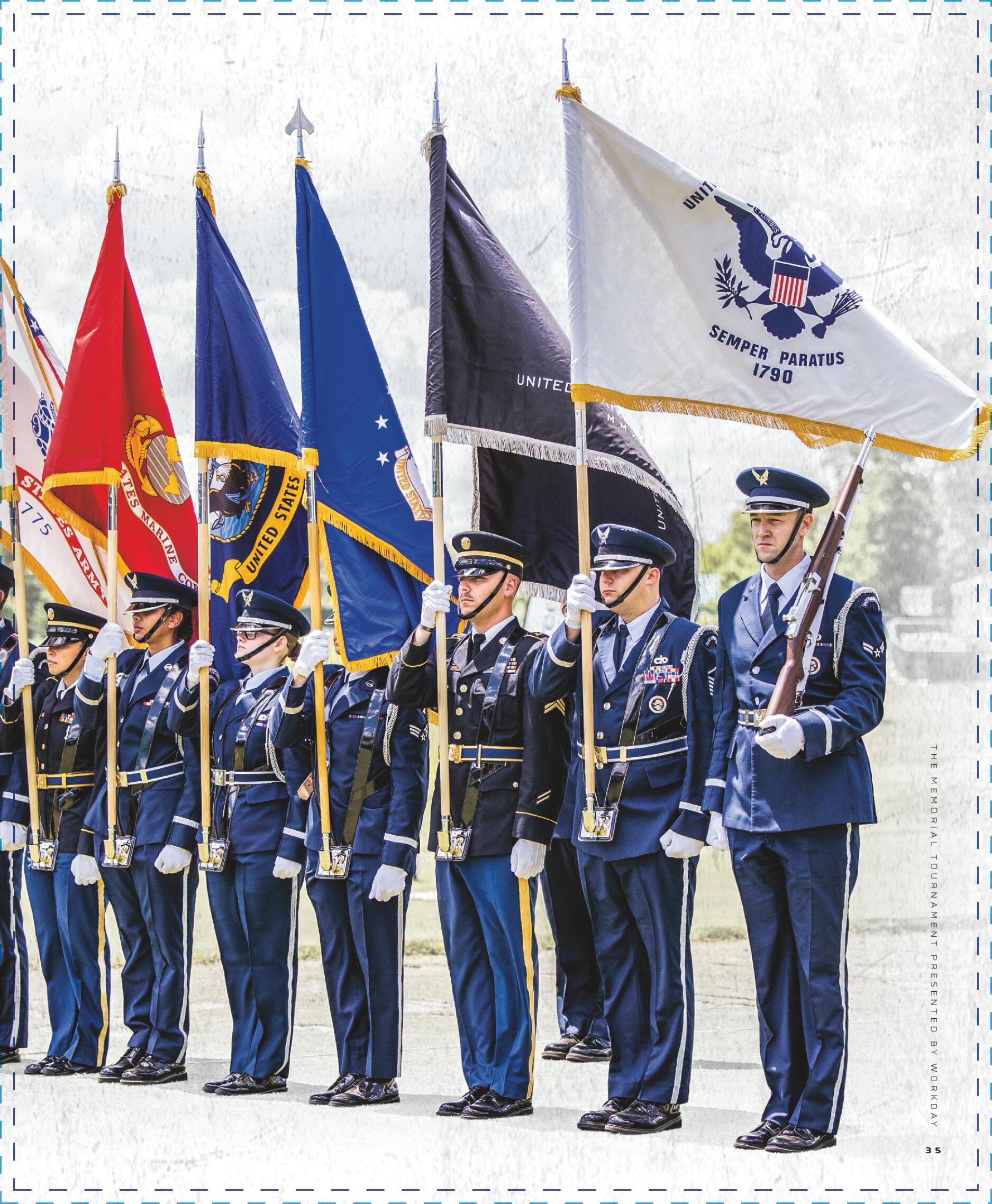
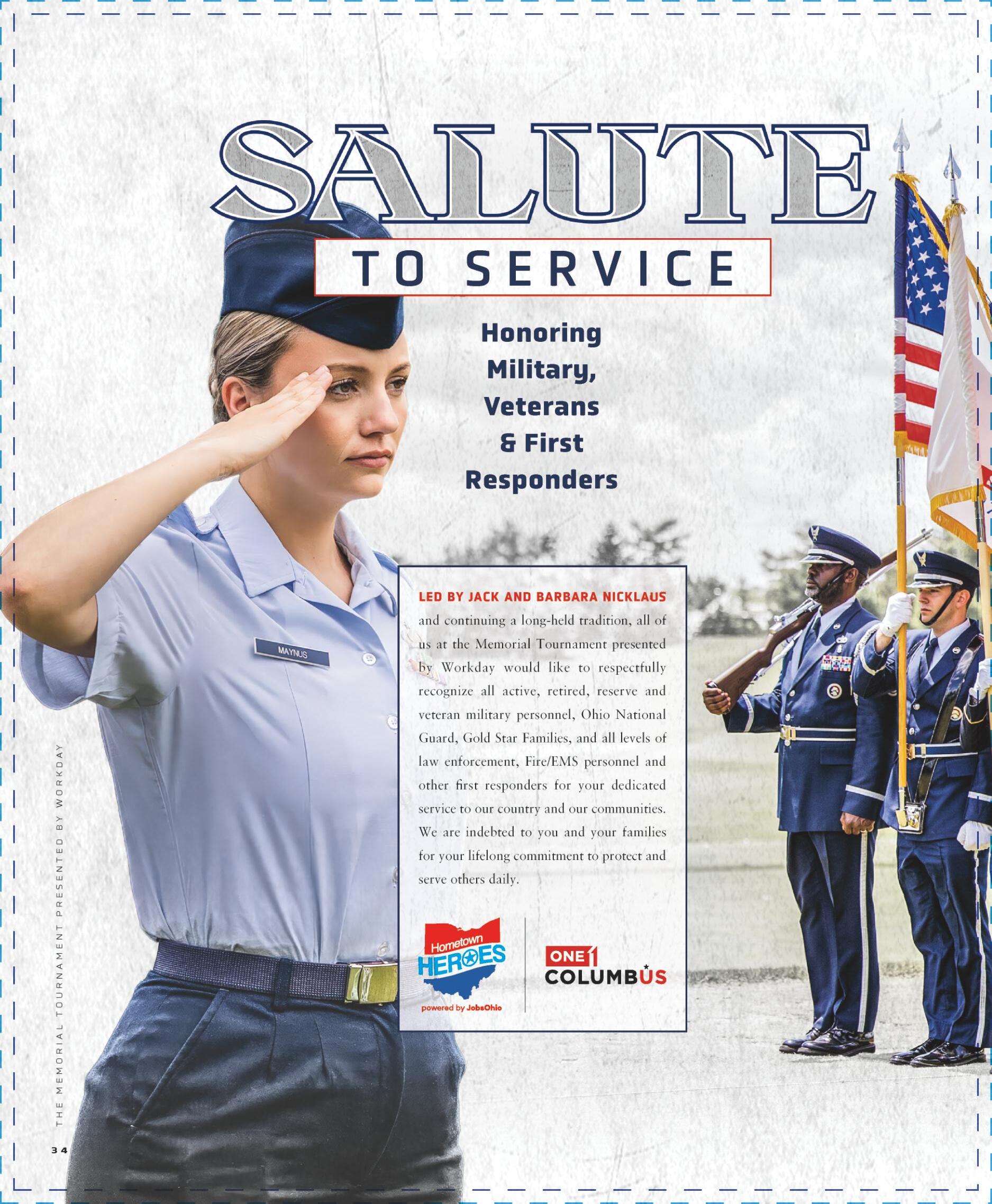
Salute to Service Day
Honoring U.S. military members, veterans and first responders
Junior Golf Day
Providing experiences for the next generation of players and fans
Workday Golden Bear Pro-Am – 6:50 a.m.
Memorial Honoree Ceremony – Practice Range – 1:30 p.m.
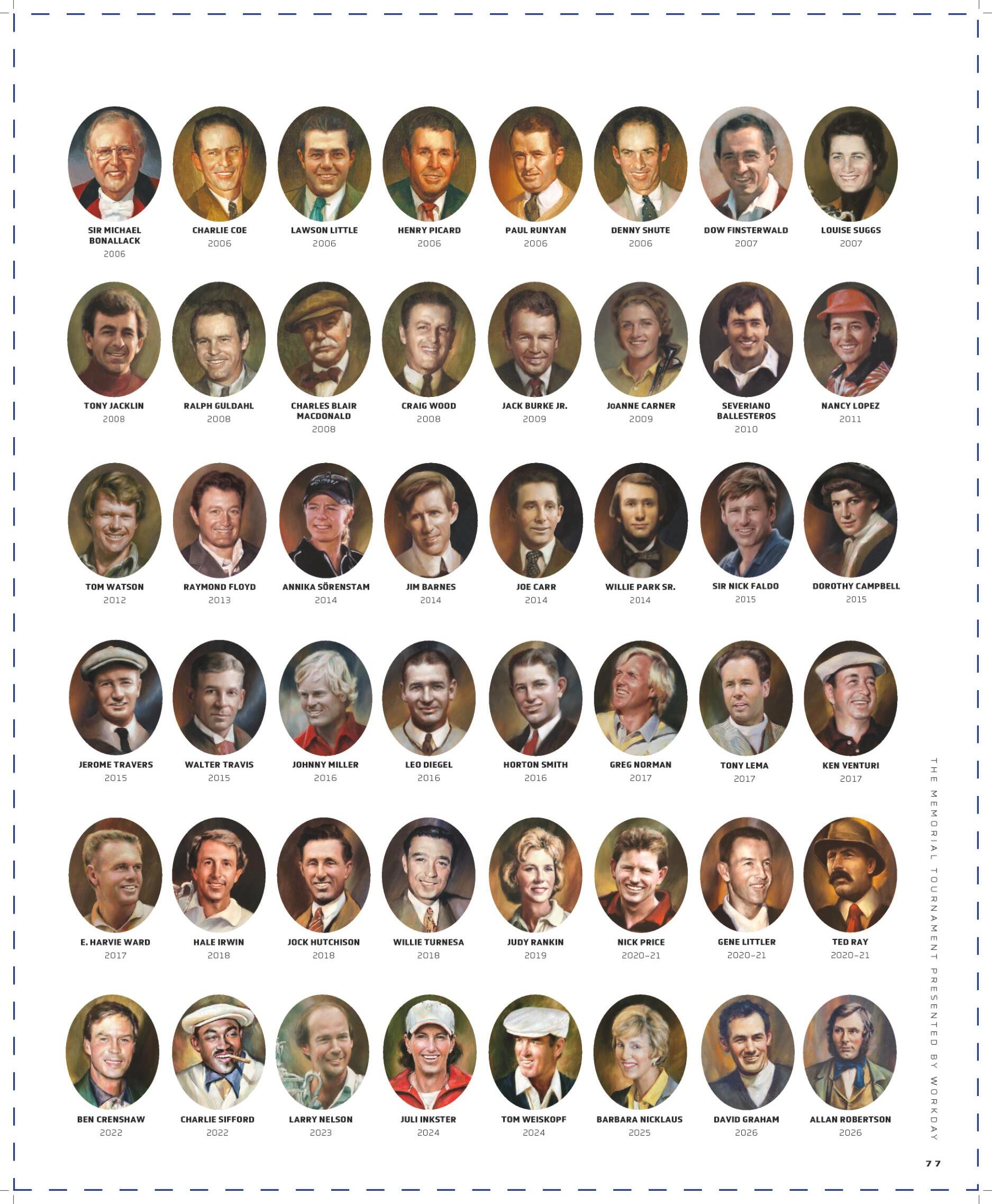
Tournament Honorees: David Graham & Allan Robertson
Memorial Golf Journalism Award: David Shedloski
Thursday, June 4 — First Round
Friday, June 5 — Second Round
Folds of Honor Friday
Wear red, white and blue to recognize Americans who serve
Saturday, June 6 — Third Round
Sunday, June 7 — Final Round
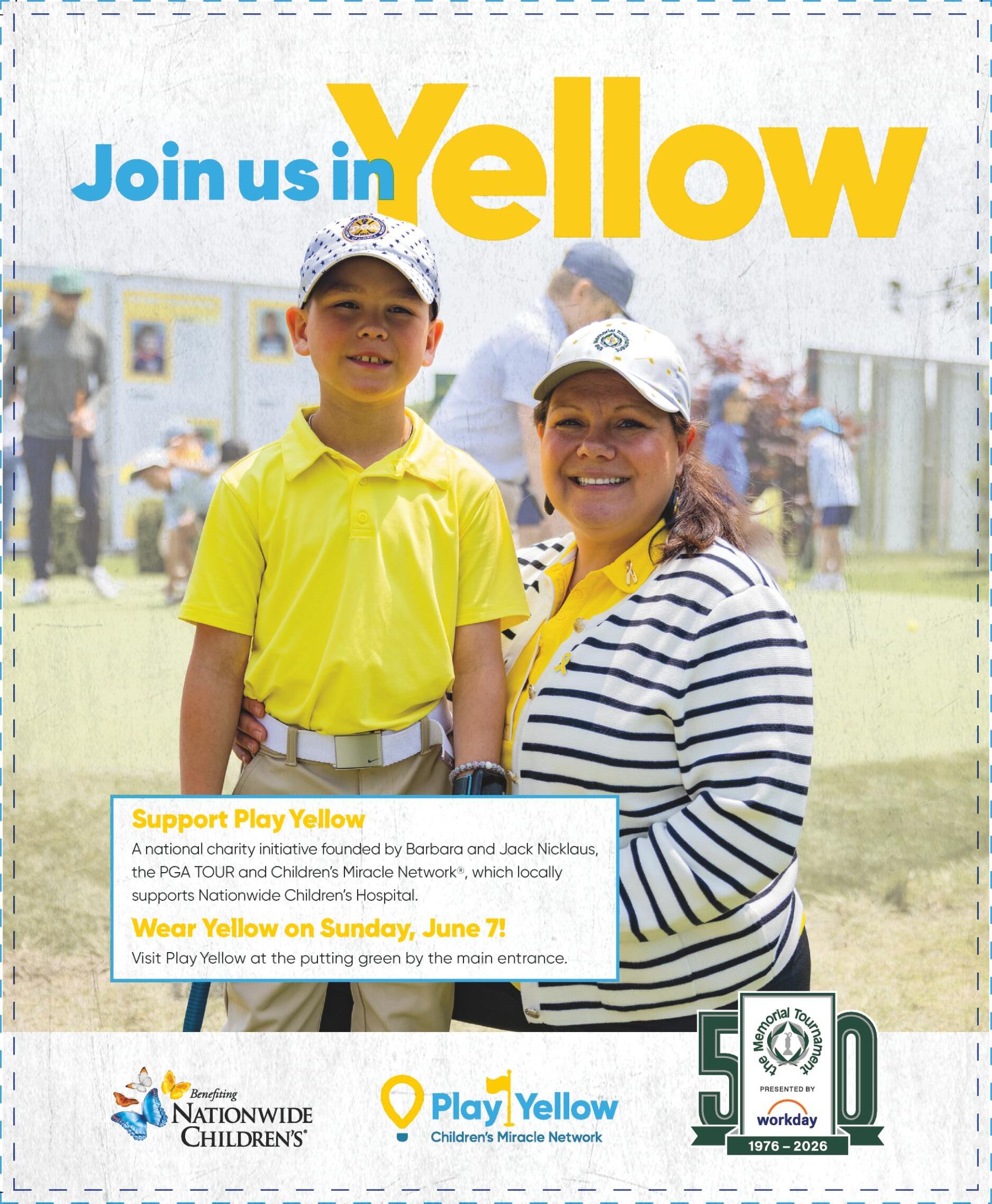
Play Yellow Sunday
Wear yellow to support Play Yellow and Nationwide Children’s Hospital Trophy presentation following play, 18th green
WED., JUNE 3 — Memorial Honoree Ceremony, Peacock & GolfChannel.com, 1:30 p.m.
THURS., JUNE 4 — Golf Channel, 2-6 p.m., replays: 7-11 p.m., midnight-4 a.m.
FRI., JUNE 5 — Golf Channel, 2-6 p.m., replay: 9 p.m.-1 a.m.
SAT., JUNE 6 — Golf Channel, 12:30-2:30 p.m.; CBS Sports, 2:30-6 p.m.; Golf Channel replays, 9 p.m.-1 a.m.; 3-7 a.m.
SUN., JUNE 7 — the Memorial Tournament Special, CBS Sports, 2 p.m.
Golf Channel, 12:30-2:30 p.m.; CBS Sports, 2:30-6 p.m.; Golf Channel replays, 8:30 p.m.-12:30 a.m., 2:30-6 a.m.
EDITORIAL DIRECTOR David Shedloski
CREATIVE & PRODUCTION DIRECTOR Larry Hasak
ASSOCIATE EDITOR Debbie Falcone
CONTRIBUTING EDITOR Scott Tolley
ART DIRECTOR Matt Ellis
PREPRESS SPECIALIST Benjamin Matuszak
PRODUCTION MANAGER Melody Manolakis
CONTRIBUTING WRITERS
Bob Baptist • Jaime Diaz
Ashley Grimmer • Alex Miceli
Dan O’Neill • David Shedloski
John Strege • Gary Van Sickle
PHOTOGRAPHY
AP Images • Getty Images
Graham Family • Gary Kellner the Memorial Tournament Archive
PGA TOUR Images • USGA
HONOREE PORTRAITS
Glenn Harrington
Ron Ramsey • Anthony Ravielli
BY
Dan Sullivan
ADVERTISING SALES
MacKenzie Edgar • Will Hannah
Paul Howard • Dan Sullivan
MAGAZINE
Heather Ditty • Kristina Khalili


SITTING IN OUR KITCHEN , atop the cabinets near our phone, are three wooden signs given to my wife Barbara and me over the years. On the left is one that pays homage to Barbara and says, “They call me Mimi, because I’m too cool to be Grandma.” The middle sign says, “Love You More.” Enough said. And then on the far right is a sign that probably gives us the most frequent chuckle:
“The first 50 years of marriage are always the hardest!”
Barbara and I passed that milestone almost 16 years ago, but it remains a good reminder of the foundation we built—and continue to build upon.
You might say the same about the Memorial Tournament presented by Workday, as we celebrate its 50th anniversary. I won’t say the first 50 years were the hardest, but I will say we are proud of the foundation we created and will always continue to build upon it.
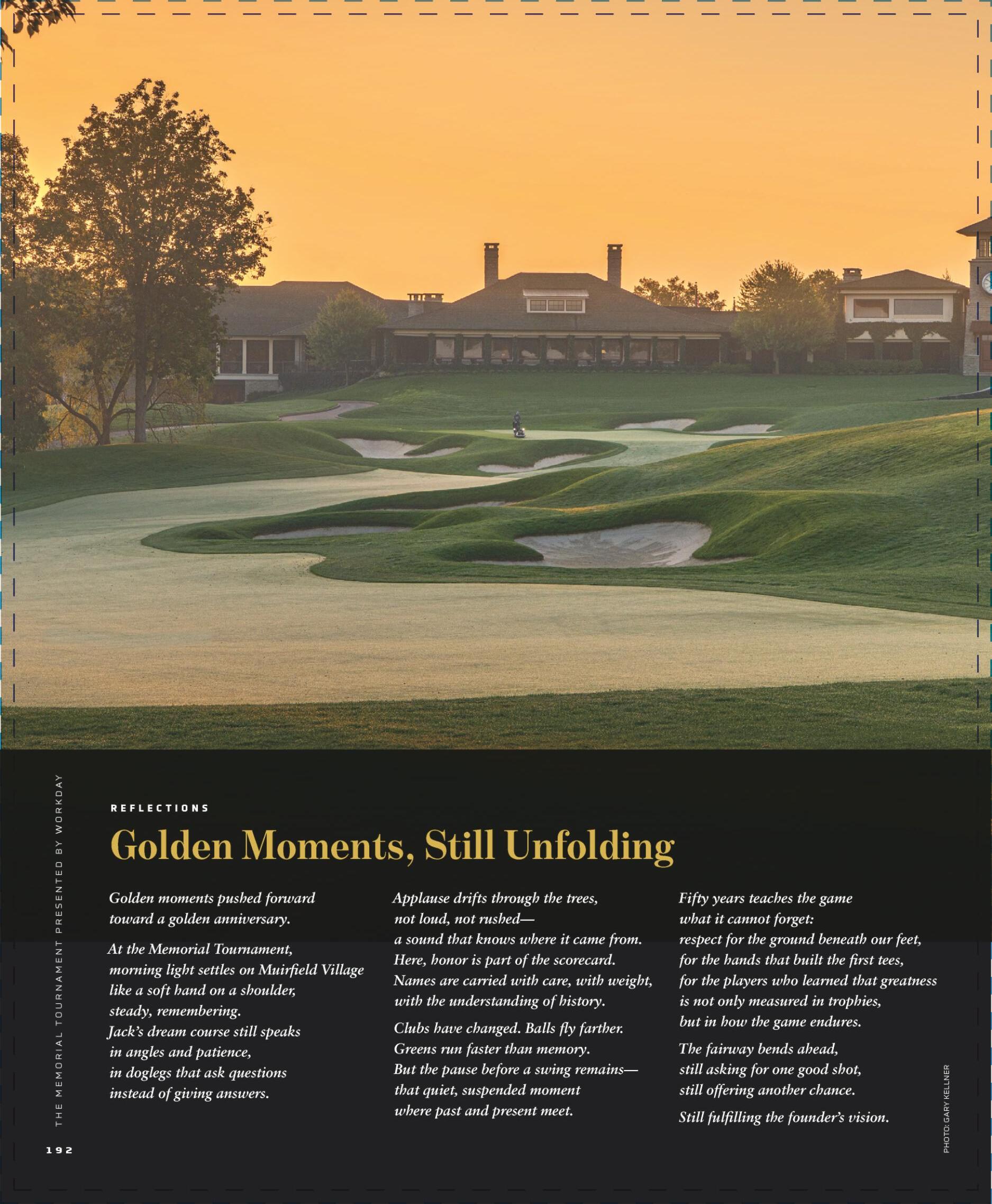
Sometimes I have to step back, shake my head, and grin at how far the Memorial Tournament has come—from a thought, a dream discussed 60 years ago on the hallowed grounds of Augusta National Golf Club, to today’s reality as one of the PGA TOUR’s elite events.

Let’s rewind a bit.
The 1966 Masters was one I almost didn’t play. The day before my opening round, I learned that close friends Bob and Linda Barton, along with James and Jeretta Long—who were flying from Columbus to Georgia to watch me—were killed in a plane crash over Tennessee. Bob was one of my closest friends. We played golf together, hunted, fished. I was heartbroken and nearly withdrew from that Masters. But Bob’s sister, Margie, convinced me to play. I dedicated that week to my friends and was blessed to win a second straight Green Jacket and third overall.

It was also that week I sat down with my high school friend Ivor Young and talked about how special it would be to bring a golf course like Augusta National—and a tournament like the Masters—to our hometown of Columbus.
Columbus has always been the intersection of the most important parts of my life. It was and will always be home. The people there are lifelong friends. Bringing tournament golf to Columbus, and creating Muirfield Village, was something I wanted to do for them.
Ivor set out to find the right piece of land. After looking at nearly a dozen sites, he chose one where I had walked as a boy with my father.
That became our canvas for Muirfield Village. Then came the blueprint for the Memorial Tournament.
The Masters was an inspiration. I wanted the Memorial to reflect what the founders of Augusta National envisioned— particularly co-founders Clifford Roberts (chairman of the club from 1931 through 1976) and Bob Jones, my father’s idol and my childhood hero.
Their vision, and mine, was simple: To honor the game of golf.
From the name of our tournament to the creation of the Captains Club—of which Mr. Roberts was an original member— I wanted the Memorial Tournament to represent the best of golf while paying tribute to those who stood as the giants in the game and who helped shape it.
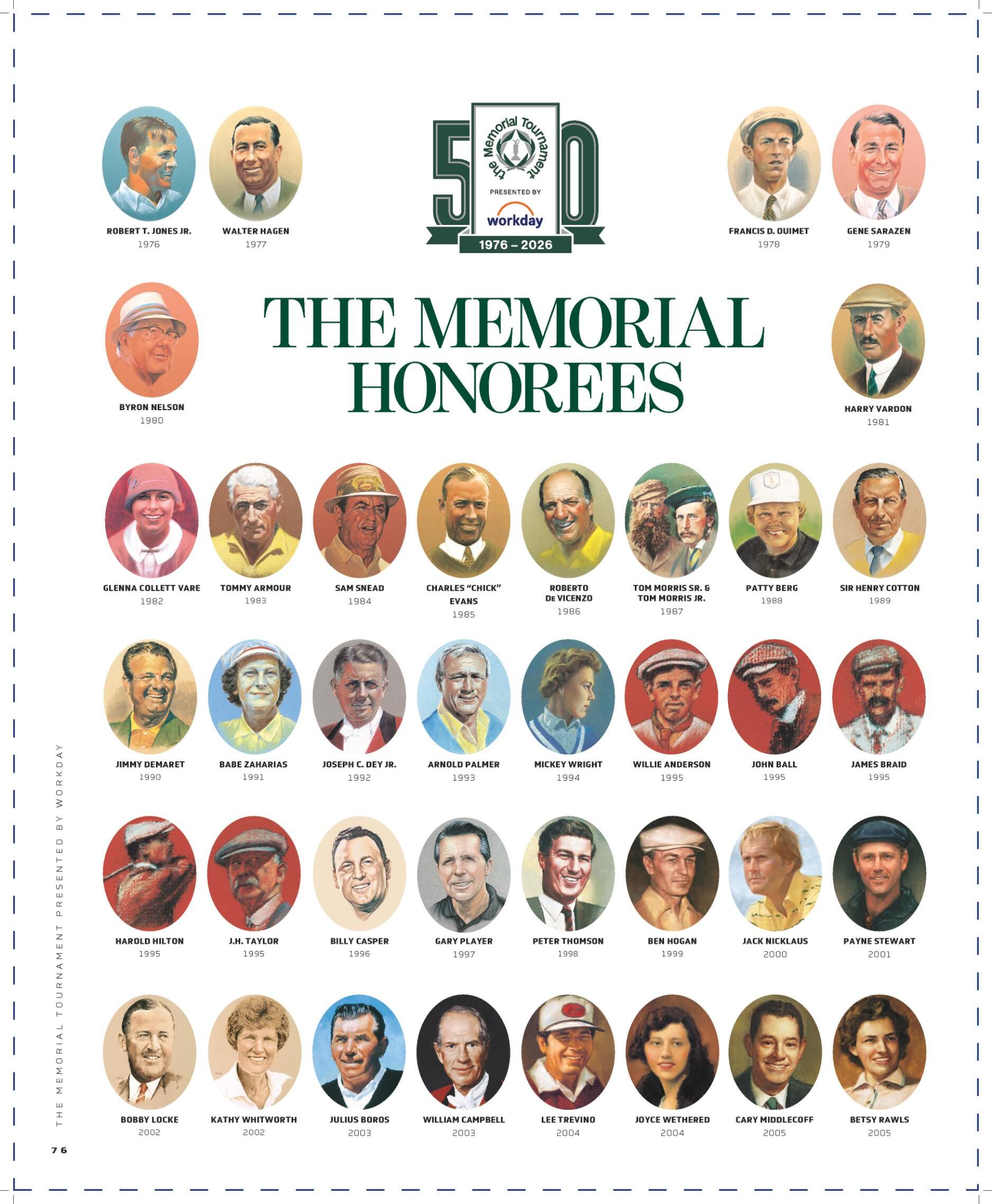
From our first Honoree in 1976, Bob Jones, to this year’s Honoree, David Graham.
While Muirfield Village and the Memorial were my gifts to Central Ohio, I have always believed golf is a global game—meant to be shared and celebrated worldwide. David Graham represents that spirit as well as anyone.
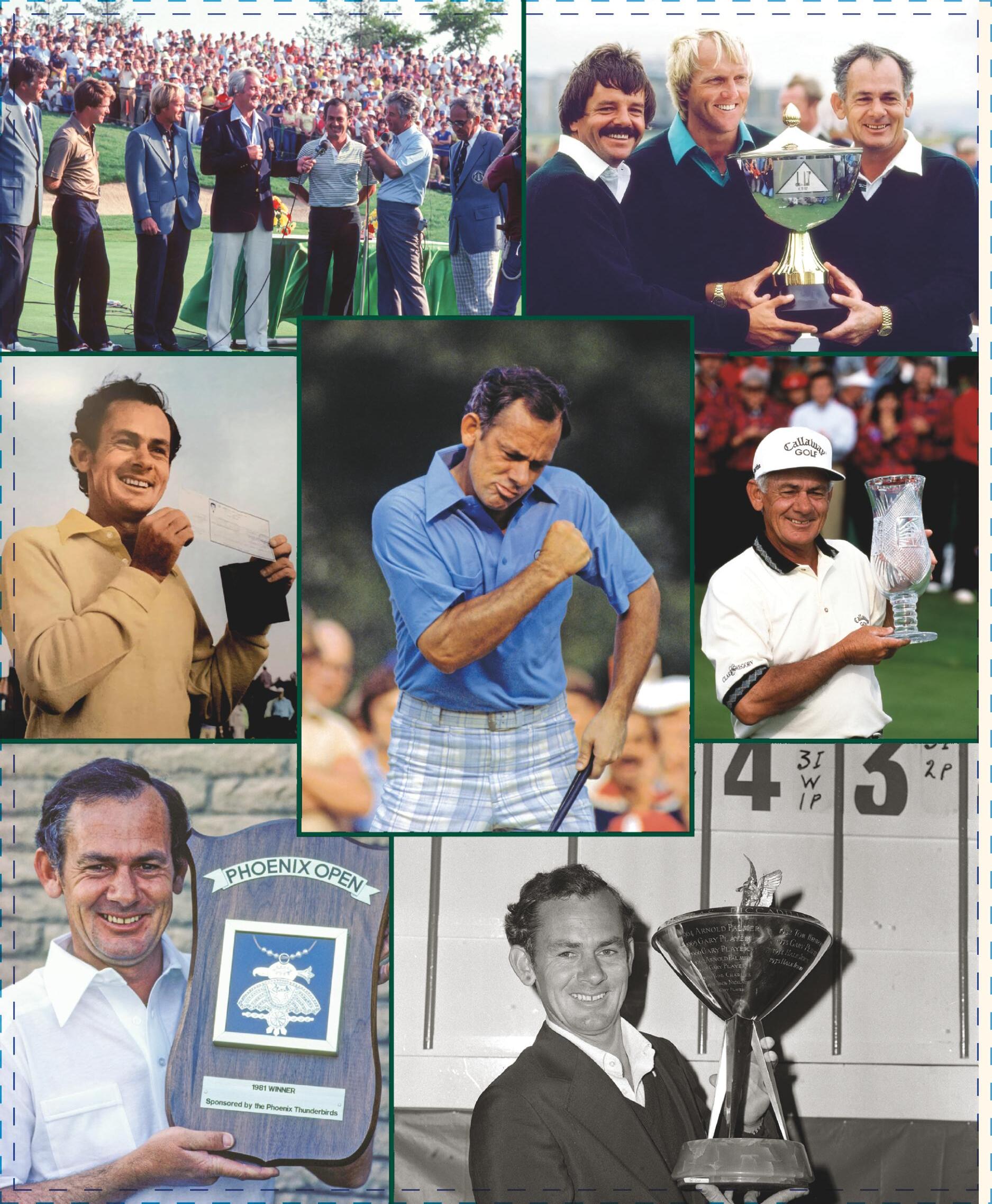
A native of Melbourne, Australia, David helped elevate golf ’s international presence. Inducted into the World Golf Hall of Fame in 2015, he was a strong, tenacious competitor and a tremendous ball-striker. He won eight times on the PGA TOUR, including the 1979 PGA Championship at Oakland Hills and the 1981 U.S. Open at Merion.
Sandwiched between those victories, David—who became a member at Muirfield Village in the late 1970s—won the 1980 Memorial Tournament. He closed with rounds of 67-70-70, including birdies on three of the final four holes, to edge Tom Watson by a stroke. His 8-under 280 broke the tournament scoring record set by some guy named Nicklaus in 1977.
At 34, David became our first international winner. Today, he is one of 11 non-Americans to win the Memorial, representing nine different countries.
After his victory, David was gracious—and a bit prophetic—saying the Memorial “could quite possibly become the most
significant golf tournament in the world in years to come.”
David, I hope, in many ways, we’ve lived up to those words.
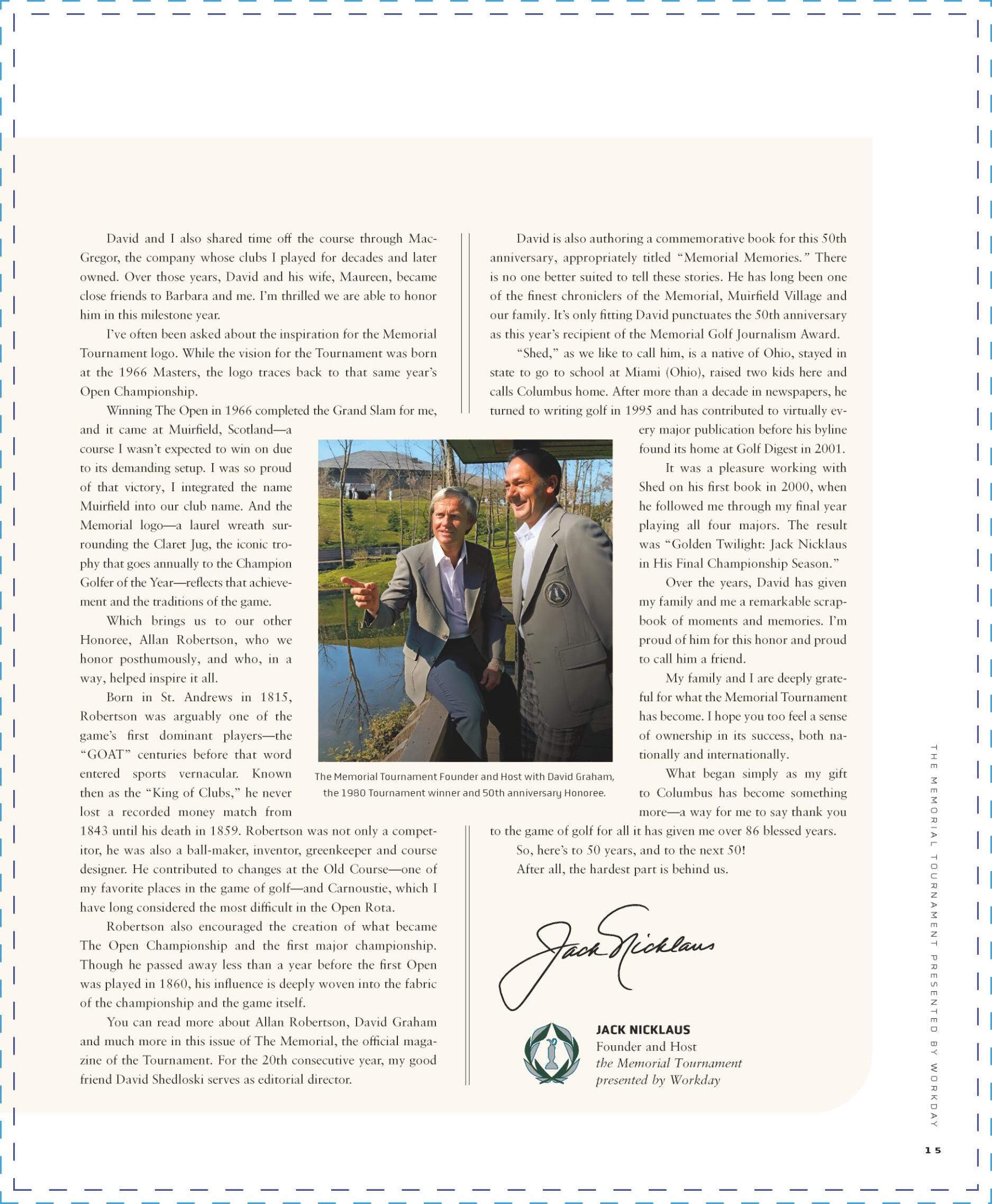
David and I also shared time off the course through MacGregor, the company whose clubs I played for decades and later owned. Over those years, David and his wife, Maureen, became dear friends to Barbara and me. I’m thrilled we are able to honor him in this milestone year.
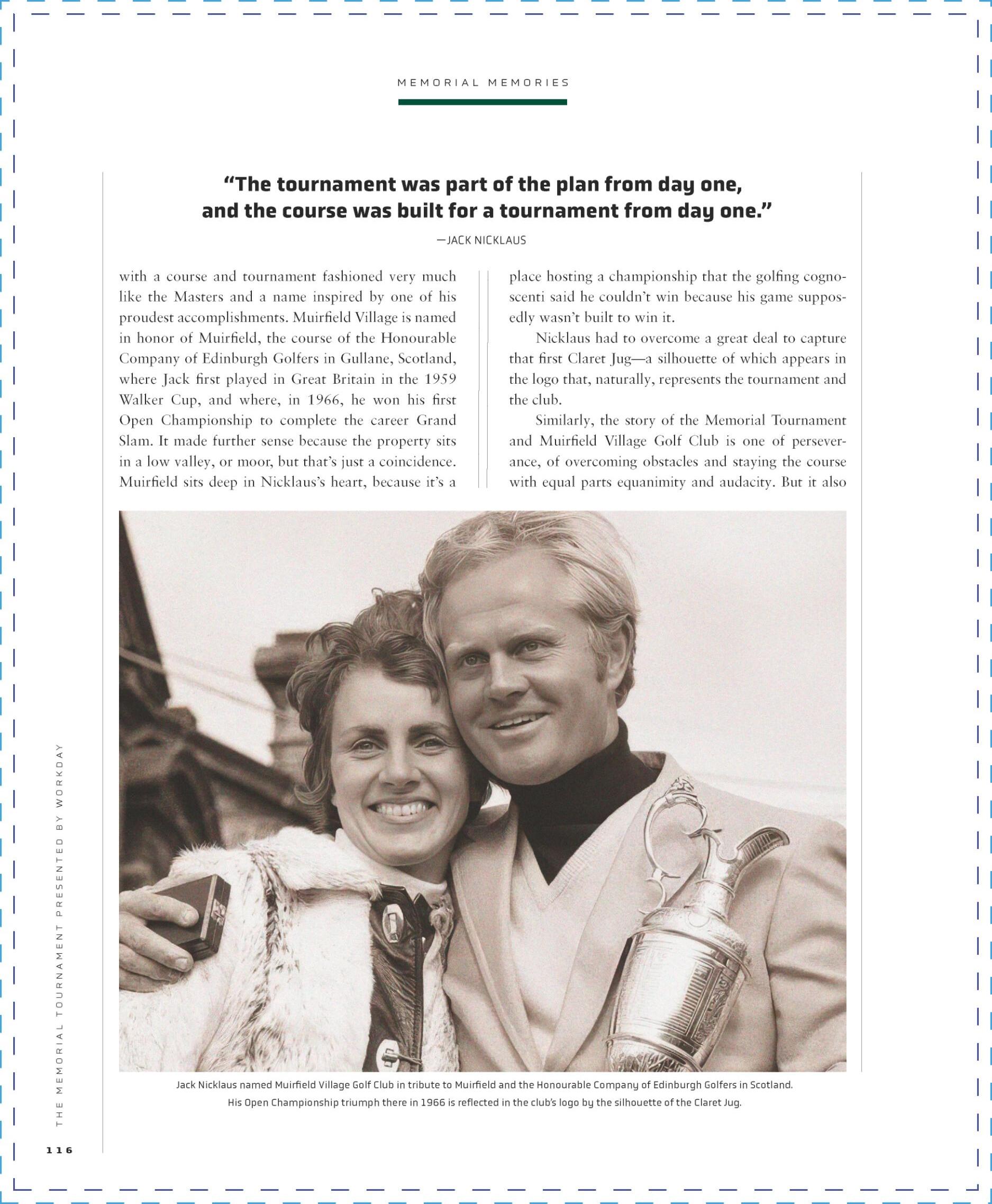
I’ve often been asked about the inspiration for the Memorial Tournament logo. While the vision for the tournament was born at the 1966 Masters, the logo traces back to that same year’s Open Championship.
Winning The Open in 1966 completed the Grand Slam for me, and it came at Muirfield, Scotland—a course I wasn’t expected to win on due to its demanding setup. I was so proud of that victory, I integrated the name Muirfield into our club name. And the Memorial logo—a laurel wreath surrounding the Claret Jug, the iconic trophy that goes annually to the Champion Golfer of the Year—reflects that achievement and the traditions of the game.
Which brings us to our posthumous Honoree, Allan Robertson, who, in a way, helped inspire it all.
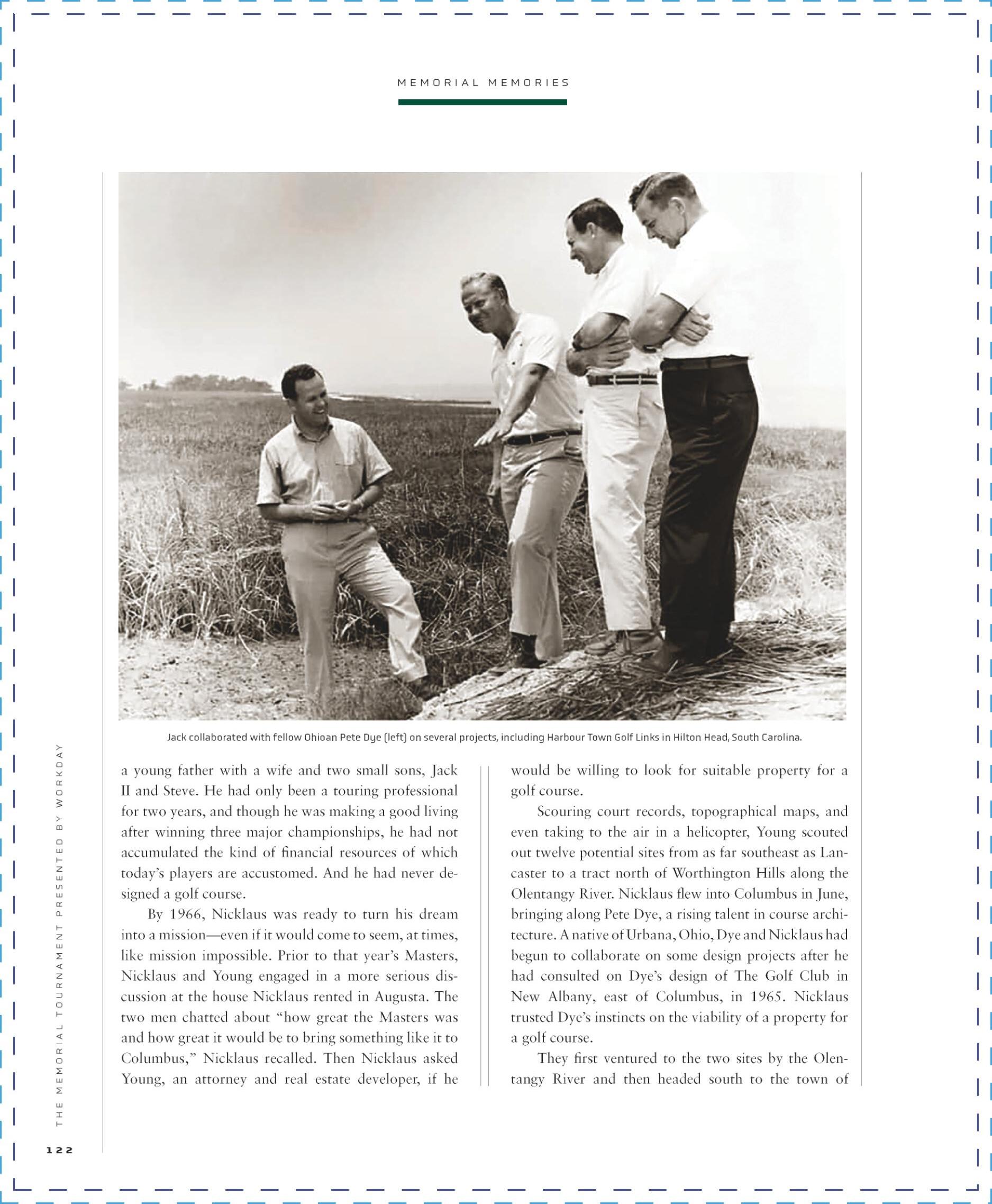
Born in St. Andrews in 1815, Robertson was arguably one of the game’s first dominant players—the “GOAT” centuries before that word entered sports vernacular. Known then as the “King of Clubs,” he never lost a recorded money match from 1843 until his death in 1859. Robertson was not only a competitor, but also a ball-maker, inventor, greenkeeper, and course designer. He contributed to changes at the Old Course—one of my favorite places in the game of golf—and Carnoustie, which I have long considered the most difficult in the Open Rota.
tournament magazine. For the 20th consecutive year, my good friend David Shedloski serves as editorial director.
David is also authoring a commemorative book for this 50th anniversary, appropriately titled “Memorial Memories.” There is no one better suited to tell these stories. He has long been one of the finest chroniclers of the Memorial, Muirfield Village and our family. It’s only fitting David punctuates the 50th anniversary as this year’s recipient of the Memorial Golf Journalism Award.

“Shed,” as we like to call him, is a native of Ohio, stayed in state to go to school at Miami (Ohio), raised his two kids here and calls Columbus home. After more than a decade in newspapers, he turned to writing golf in 1995 and has contributed to virtually every major publication before his byline found its home at Golf Digest in 2008.
It was a pleasure working with Shed on his first book in 2000, when he followed me through my final year playing all four majors. The result was “Golden Twilight: Jack Nicklaus in His Final Championship Season.”
Over the years, David has given my family and me a remarkable scrapbook of moments and memories. I’m proud of him for this honor and proud to call him a friend.
My family and I are deeply grateful for what the Memorial Tournament has become. I hope you too feel a sense of ownership in its success, both nationally and internationally.
What began as my gift to Columbus has become something more—a way for me to say thank you to the game of golf for all it has given me over 86 blessed years.
Robertson also encouraged the creation of what became The Open Championship and the first major championship. Though he passed away less than a year before the first Open was played in 1860, his influence is deeply woven into the fabric of the championship and the game itself.
You can read more about Allan Robertson, David Graham and much more in this year’s issue of The Memorial, the official
JACK NICKLAUS Founder and Host
the Memorial Tournament presented by Workday


BASED IN MARYSVILLE, OH FOR OVER 150 YEARS


jobsohio.com

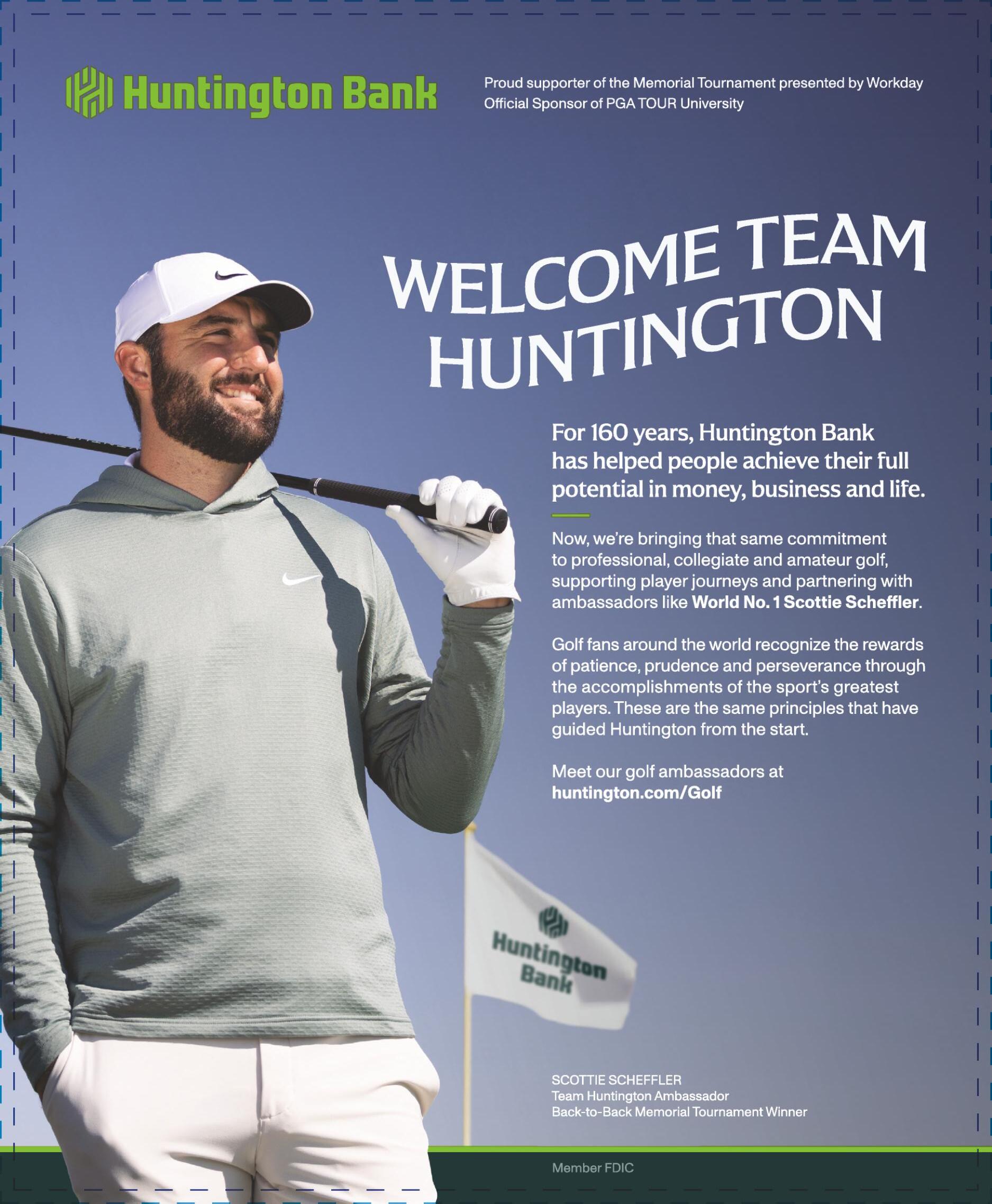
For 160 years, Huntington Bank has helped people achieve their full potential in money, business and
Now, we’re bringing that same commitment to professional, collegiate and amateur golf, supporting player journeys and partnering with ambassadors like World No. 1 Scottie Scheffler.
Golf fans around the world recognize the rewards of patience, prudence and perseverance through the accomplishments of the sport’s greatest players. These are the same principles that have guided Huntington from the start.
Meet our golf ambassadors at huntington.com/Golf


From EVERYDAY LIFE to championship Sunday, memorable moments are built with people and purpose. Worthington Enterprises and Worthington Steel are proud to support the Memorial Tournament presented by Workday and the moments that bring us together and make us STRONG FOR GOOD .


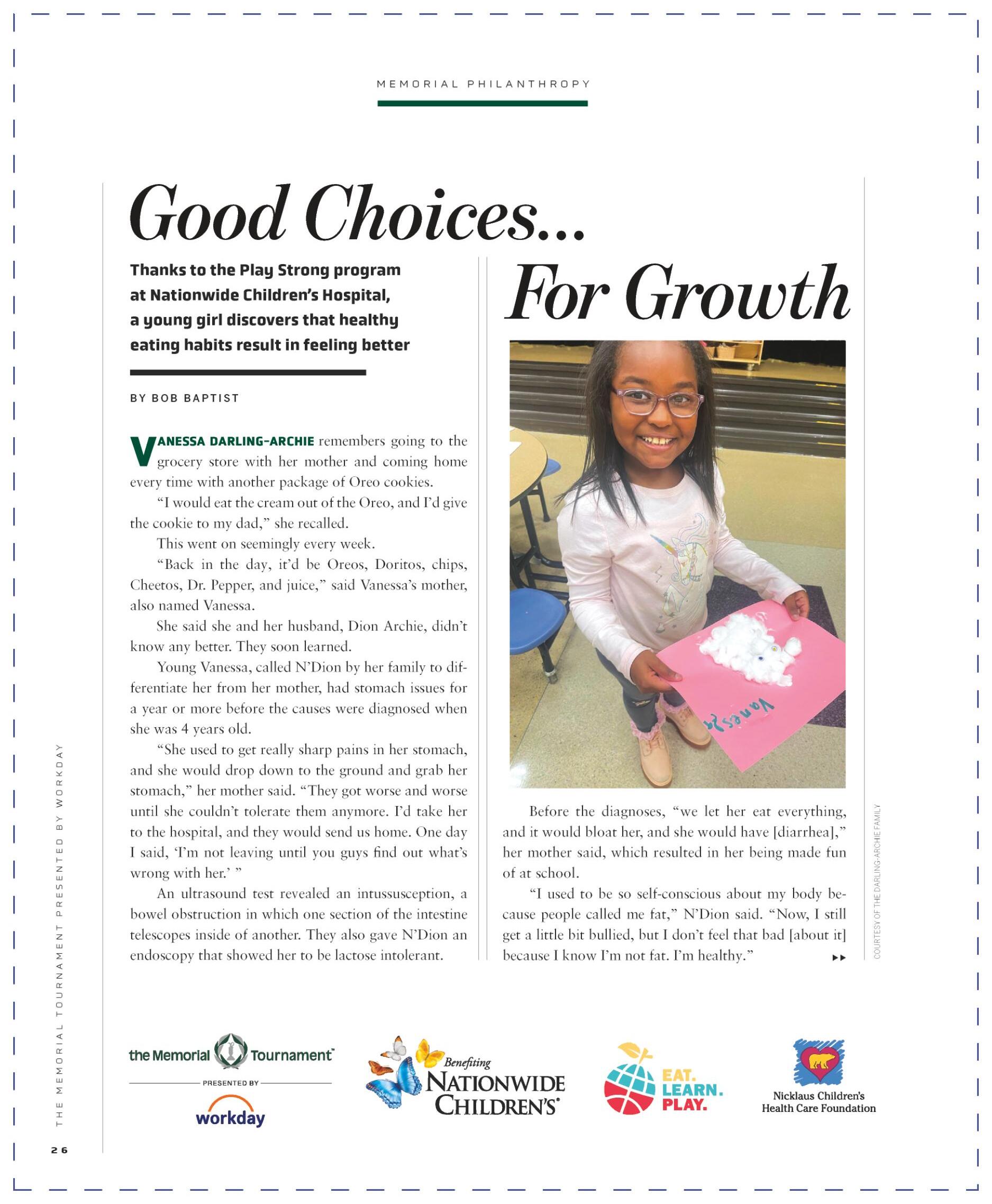
Thanks to the Play Strong program at Nationwide Children’s Hospital, a young girl discovers that healthy eating habits result in feeling better
BY BOB BAPTIST
DARLING-ARCHIE remembers going to the grocery store with her mother and coming home every time with another package of Oreo cookies.
“I would eat the cream out of the Oreo, and I’d give the cookie to my dad,” she recalled.
This went on seemingly every week.
“Back in the day, it’d be Oreos, Doritos, chips, Cheetos, Dr. Pepper, and juice,” said Vanessa’s mother, also named Vanessa.
She said she and her husband, Dion Archie, didn’t know any better. They soon learned.
Young Vanessa, called N’Dion by her family to differentiate her from her mother, had stomach issues for a year or more before the causes were diagnosed when she was 4 years old.
“She used to get really sharp pains in her stomach, and she would drop down to the ground and grab her stomach,” her mother said. “They got worse and worse until she couldn’t tolerate them anymore. I’d take her to the hospital, and they would send us home. One day I said, ‘I’m not leaving until you guys find out what’s wrong with her.’ ”
An ultrasound test revealed an intussusception, a bowel obstruction in which one section of the intestine telescopes inside of another. They also gave N’Dion an endoscopy that showed her to be lactose intolerant.


Before the diagnoses, “we let her eat everything, and it would bloat her, and she would have [diarrhea],” her mother said, which resulted in her being made fun of at school.
“I used to be so self-conscious about my body because people called me fat,” N’Dion said. “Now, I still get a little bit bullied, but I don’t feel that bad [about it] because I know I’m not fat. I’m healthy.”

Nationwide® was founded on the principle of protecting what’s most important to people, and were committed to offering a wide breadth of coverage tailored to your family’s evolving needs. Whether you’re teeing off on a new chapter or navigating life’s bunkers, Nationwide is here to support you every step of the way.
We’re so much more than a caddie. We’re your trusted partner.
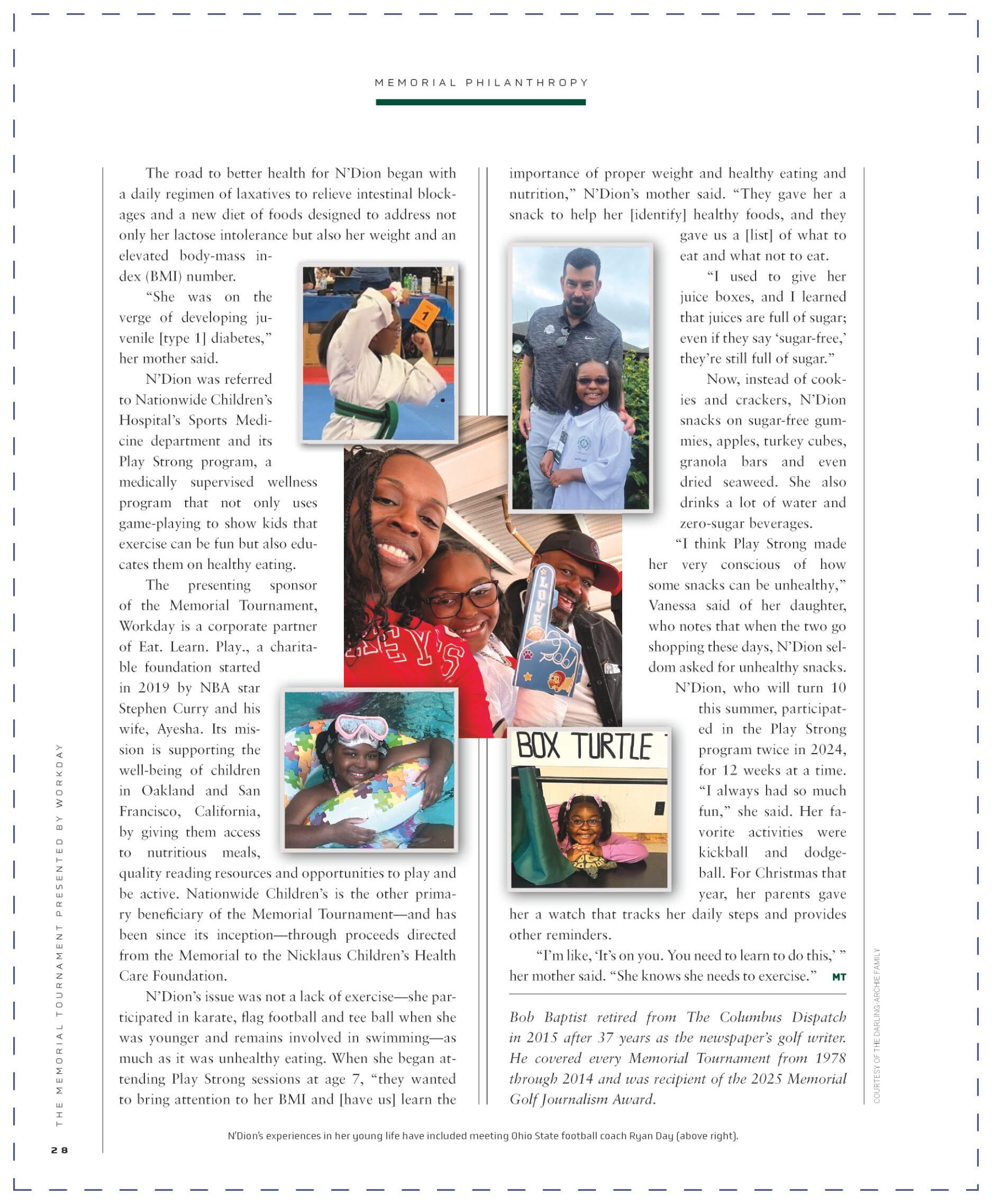
The road to better health for N’Dion began with a daily regimen of laxatives to relieve intestinal blockages and a new diet of foods designed to address not only her lactose intolerance but also her weight and an elevated body-mass index (BMI) number.
“She was on the verge of developing juvenile [type 1] diabetes,” her mother said.
N’Dion was referred to Nationwide Children’s Hospital ’s Sports Medicine department and its Play Strong program, a medically supervised wellness program that not only uses game-playing to show kids that exercise can be fun but also educates them on healthy eating.

importance of proper weight and healthy eating and nutrition,” N’Dion’s mother said. “They gave her a snack to help her [identify] healthy foods, and they gave us a [list] of what to eat and what not to eat.


“I used to give her juice boxes, and I learned that juices are full of sugar; even if they say ‘sugar-free,’ they’re still full of sugar.”
Now, instead of cookies and crackers, N’Dion snacks on sugar-free gummies, apples, turkey cubes, granola bars and even dried seaweed. She also drinks a lot of water and zero-sugar beverages.
“I think Play Strong made her very conscious of how some snacks can be unhealthy,” Vanessa said of her daughter, who notes that when the two go shopping these days, N’Dion seldom asked for unhealthy snacks.

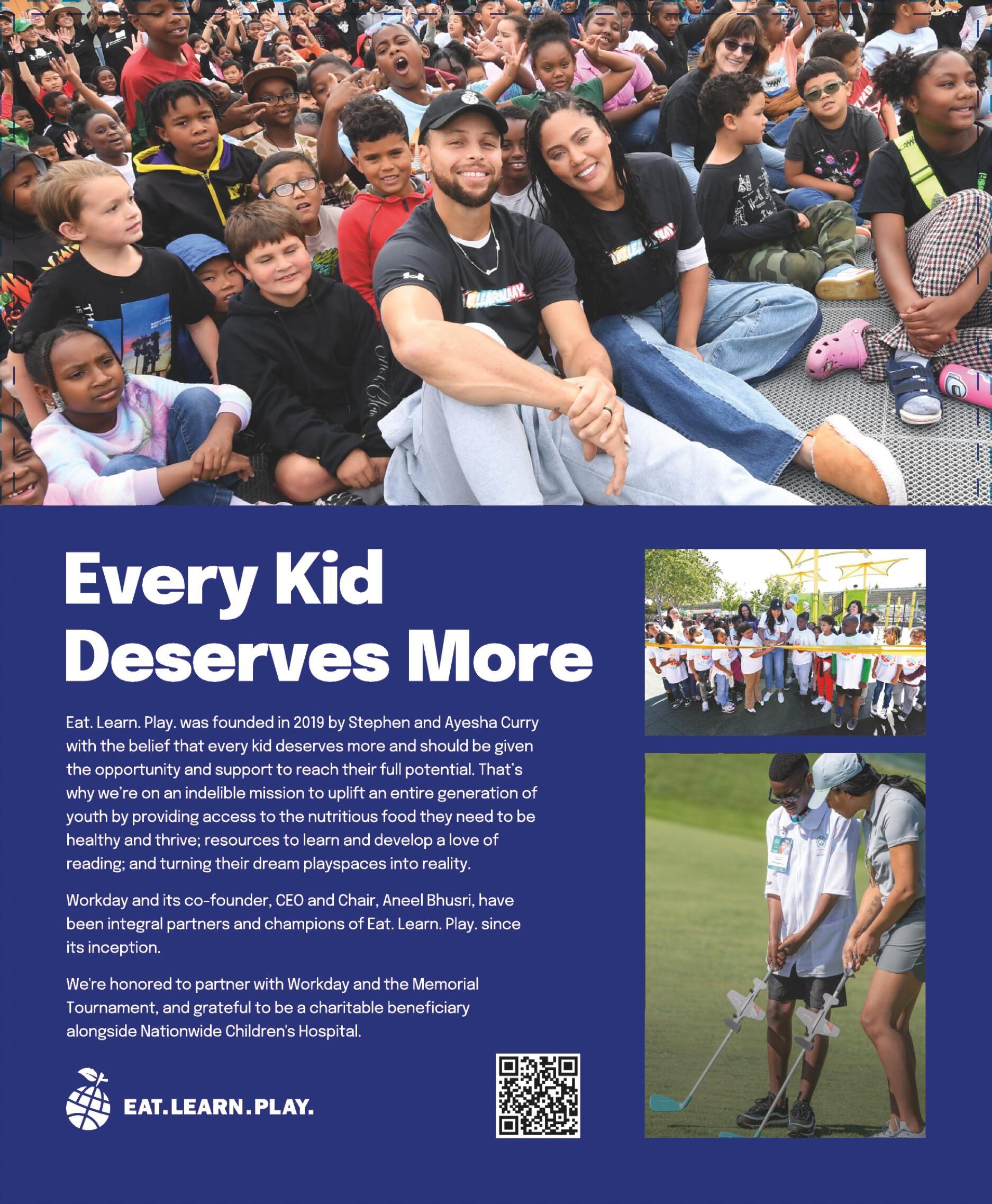
Workday, the presenting sponsor of the Memorial Tournament, is a corporate partner of Eat. Learn. Play., a charitable foundation started in 2019 by NBA star Stephen Curry and his wife Ayesha. Its mission is supporting the well-being of children in Oakland and San Francisco, California, by giving them access to nutritious meals, quality reading resources and opportunities to play and be active. Nationwide Children’s is the other primary beneficiary of the Memorial Tournament—and has been since its inception—through proceeds directed from the Memorial to the Nicklaus Children’s Health Care Foundation.
N’Dion’s issue was not a lack of exercise—she participated in karate, flag football and tee ball when she was younger and remains involved in swimming—as much as it was unhealthy eating. When she began attending Play Strong sessions at age 7, “they wanted to bring attention to her BMI and [have us] learn the

N’Dion, who will turn 10 this summer, participated in the Play Strong program twice in 2024, for 12 weeks at a time.
“I always had so much fun,” she said. Her favorite activities were kickball and dodgeball. For Christmas that year, her parents gave her a watch that tracks her daily steps and provides other reminders.
“I’m like, ‘It’s on you. You need to learn to do this,’ ” her mother said. “She knows she needs to exercise.” MT
Bob Baptist retired from The Columbus Dispatch in 2015 after 37 years as the newspaper’s golf writer. He covered every Memorial Tournament from 1978 through 2014 and was recipient of the 2025 Memorial Golf Journalism Award.


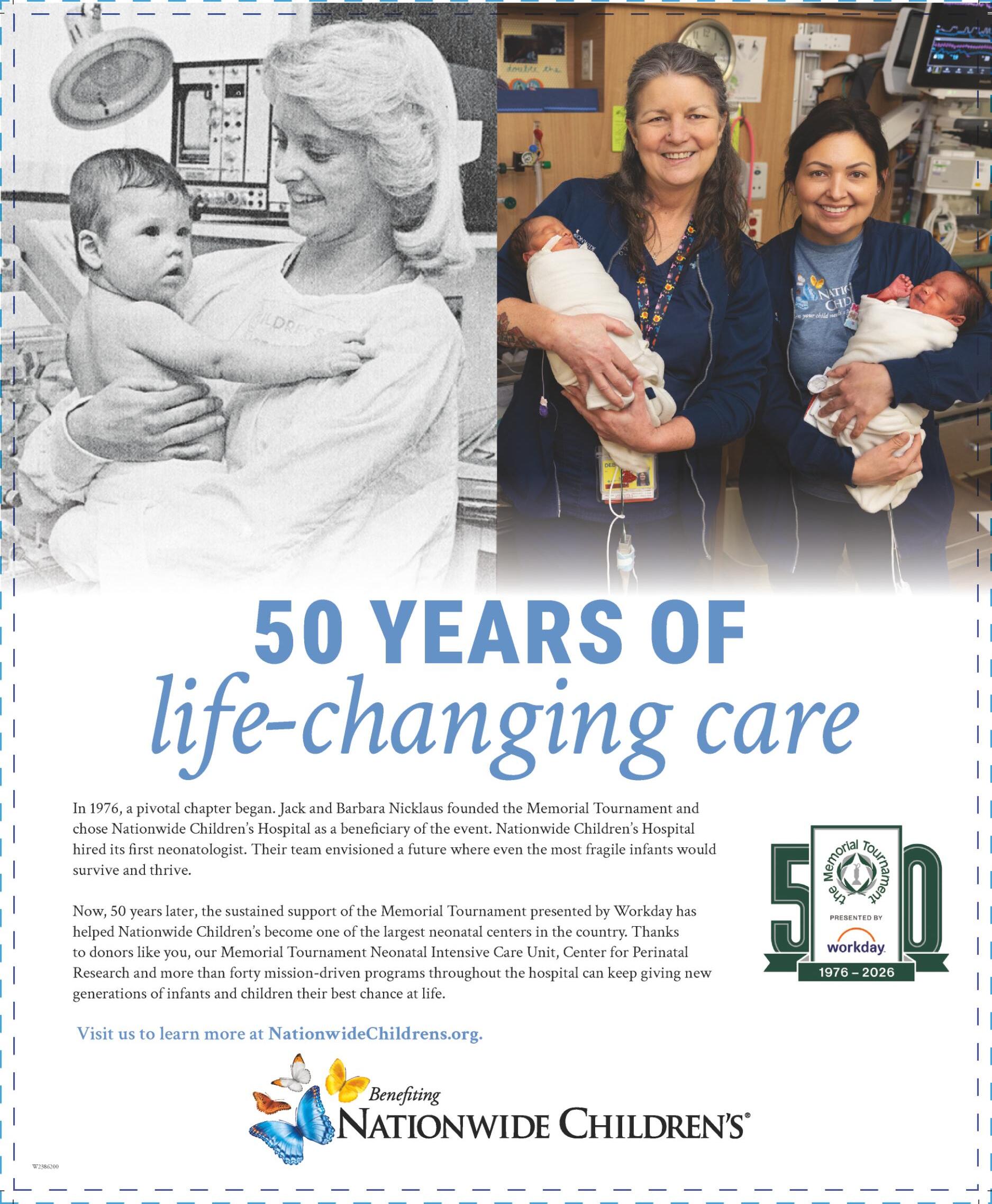
In 1976, a pivotal chapter began. Jack and Barbara Nicklaus founded the Memorial Tournament and chose Nationwide Children’s Hospital as a beneficiary of the event. Nationwide Children’s Hospital hired its first neonatologist. Their team envisioned a future where even the most fragile infants would survive and thrive.
Now, 50 years later, the sustained support of the Memorial Tournament presented by Workday has helped Nationwide Children’s become one of the largest neonatal centers in the country. Thanks to donors like you, our Memorial Tournament Neonatal Intensive Care Unit, Center for Perinatal Research and more than forty mission-driven programs throughout the hospital can keep giving new generations of infants and children their best chance at life.
Visit us to learn more at NationwideChildrens.org.


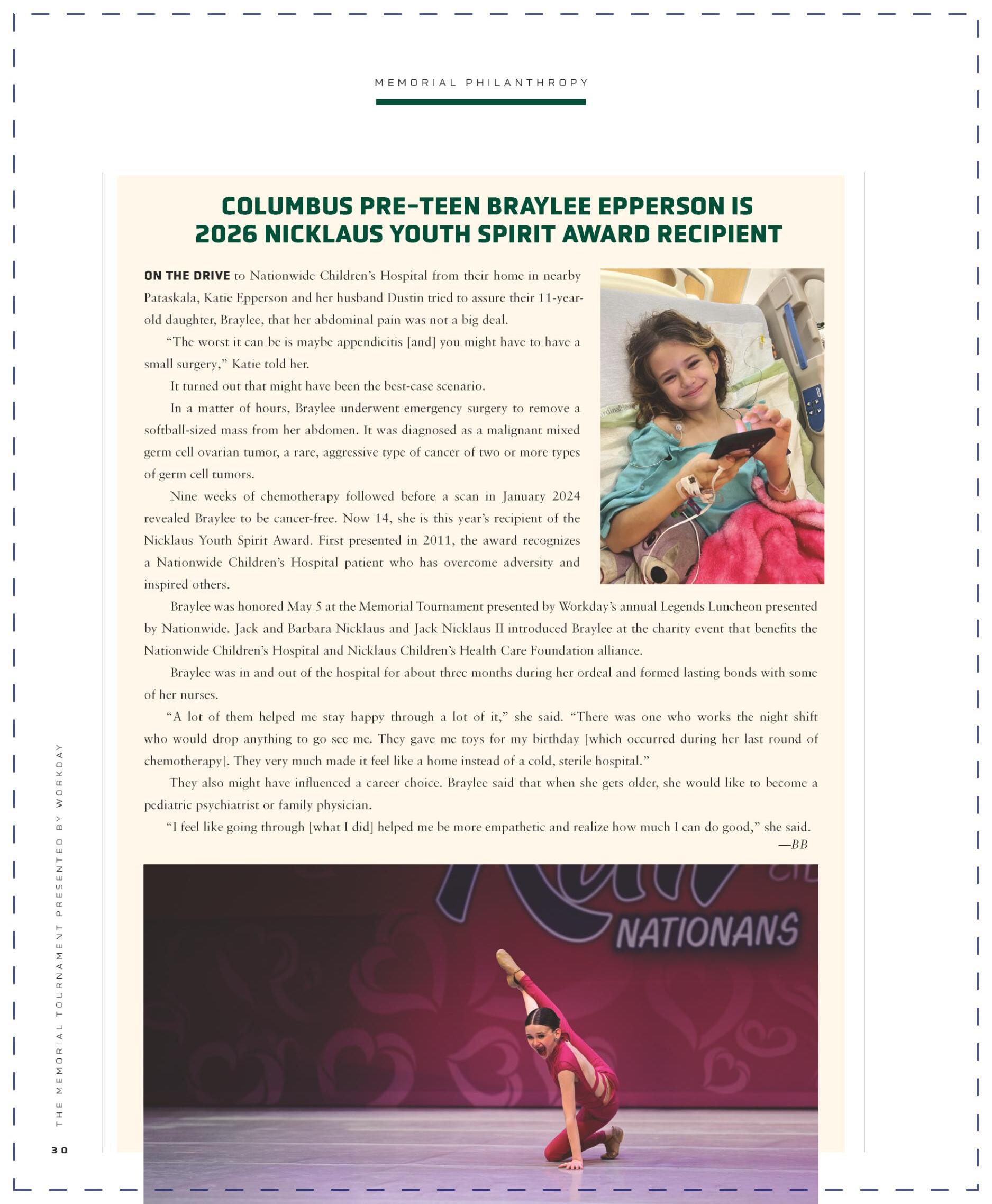
ON THE DRIVE to Nationwide Children’s Hospital from their home in nearby Pataskala, Katie Epperson and her husband Dustin tried to assure their 11-yearold daughter, Braylee, that her abdominal pain was not a big deal.
“The worst it can be is maybe appendicitis [and] you might have to have a small surgery,” Katie told her.
It turned out that might have been the best-case scenario.
In a matter of hours, Braylee underwent emergency surgery to remove softball-sized mass from her abdomen. It was diagnosed as a malignant mixed germ cell ovarian tumor, a rare, aggressive type of cancer of two or more types of germ cell tumors.
Nine weeks of chemotherapy followed before a scan in January 2024 revealed Braylee to be cancer-free. Now 14, she is this year’s recipient of the Nicklaus Youth Spirit Award. First presented in 2011, the award recognizes a Nationwide Children’s Hospital patient who has overcome adversity and inspired others.

Braylee was honored May 5 at the Memorial Tournament presented by Workday’s annual Legends Luncheon presented by Nationwide. Jack and Barbara Nicklaus and Jack Nicklaus II introduced Braylee at the charity event that benefits the Nationwide Children’s Hospital and Nicklaus Children’s Health Care Foundation alliance.
Braylee was in and out of the hospital for about three months during her ordeal and formed lasting bonds with some of her nurses.
“A lot of them helped me stay happy through a lot of it,” she said. “There was one who works the night shift who would drop anything to go see me. They gave me toys for my birthday [which occurred during her last round of chemotherapy]. They very much made it feel like a home instead of a cold, sterile hospital.”
They also might have influenced a career choice. Braylee said that when she gets older, she would like to become a pediatric psychiatrist or family physician.
“I feel like going through [what I did] helped me be more empathetic and realize how much I can do good,” she said. —BB


www.deloitte.com

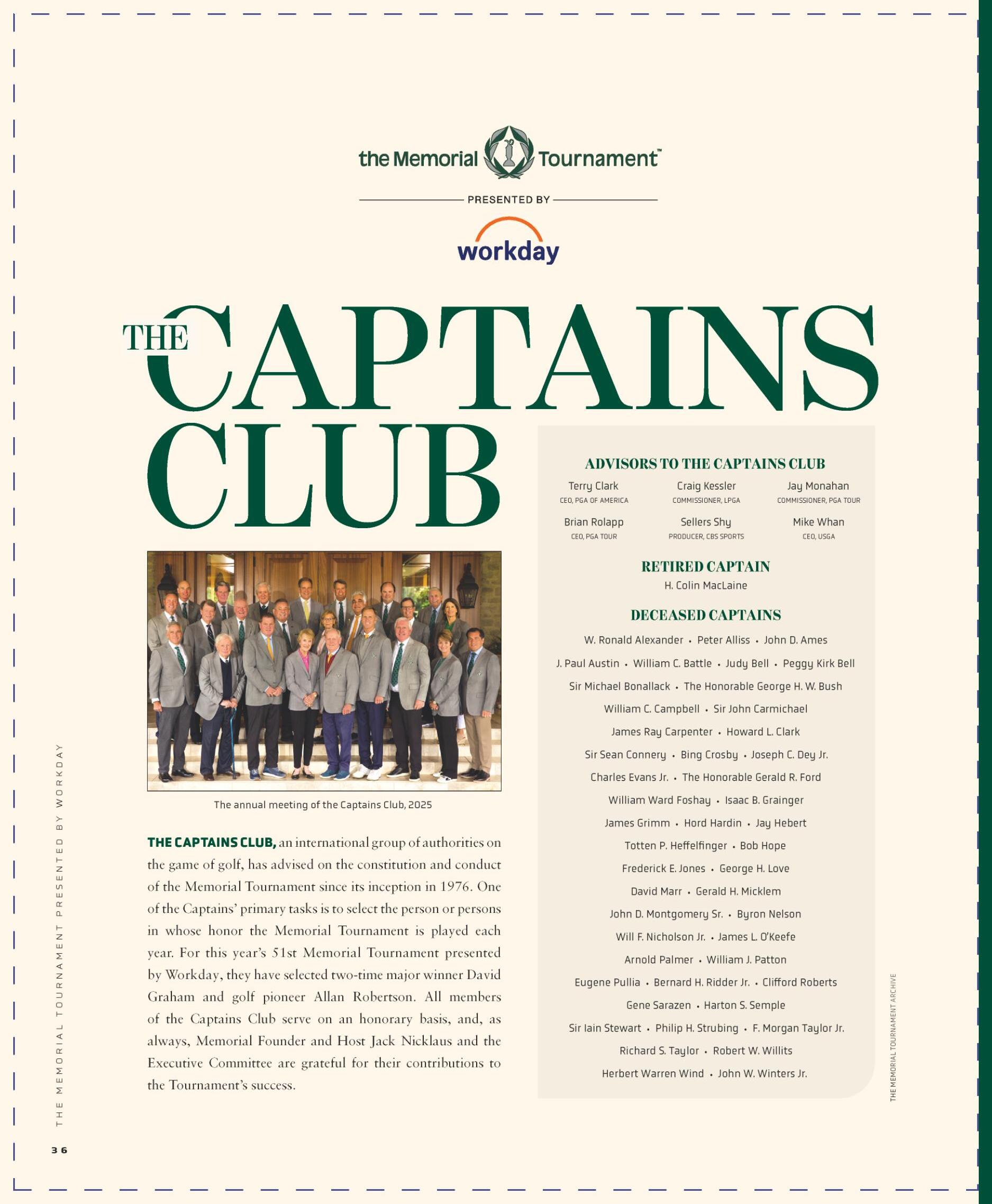
The annual meeting of the Captains Club, 2025
THE CAPTAINS CLUB, an international group of authorities on the game of golf, has advised on the constitution and conduct of the Memorial Tournament since its inception in 1976. One of the Captains’ primary tasks is to select the person or persons in whose honor the Memorial Tournament is played each year. For this year’s 51st Memorial Tournament presented by Workday, they have selected two-time major winner David Graham and golf pioneer Allan Robertson. All members of the Captains Club serve on an honorary basis, and, as always, Memorial Founder and Host Jack Nicklaus and the Executive Committee are grateful for their contributions to the Tournament’s success.
ADVISORS TO THE CAPTAINS CLUB
Terry Clark CEO, PGA OF AMERICA
Craig Kessler COMMISSIONER, LPGA
Brian Rolapp CEO, PGA TOUR Sellers Shy PRODUCER, CBS SPORTS
RETIRED CAPTAIN
H. Colin MacLaine
DECEASED CAPTAINS
Jay Monahan COMMISSIONER, PGA TOUR
Mike Whan CEO, USGA
W. Ronald Alexander Peter Alliss John D. Ames
J. Paul Austin • William C. Battle • Judy Bell • Peggy Kirk Bell
Sir Michael Bonallack • The Honorable George H. W. Bush
William C. Campbell Sir John Carmichael
James Ray Carpenter Howard L. Clark
Sir Sean Connery • Bing Crosby • Joseph C. Dey Jr.
Charles Evans Jr. • The Honorable Gerald R. Ford
William Ward Foshay • Isaac B. Grainger
James Grimm • Hord Hardin • Jay Hebert
Totten P. Heffelfinger • Bob Hope
Frederick E. Jones • George H. Love
David Marr • Gerald H. Micklem
John D. Montgomery Sr. Byron Nelson
Will F. Nicholson Jr. • James L. O’Keefe
Arnold Palmer • William J. Patton
Eugene Pullia
• Bernard H. Ridder Jr. • Clifford Roberts
Gene Sarazen • Harton S. Semple
Sir Iain Stewart • Philip H. Strubing • F. Morgan Taylor Jr.
Richard S. Taylor • Robert W. Willits
Herbert Warren Wind • John W. Winters Jr.

PAUL AZINGER
Winner in 1993 of the Memorial and the PGA Championship; winning 2008 U S. Ryder Cup captain.

ED HERLIHY
Former chairman of the PGA TOUR Policy Board.

ANEEL BHUSRI Co-Founder, CEO and Chair of Workday, presenting sponsor of the Memorial Tournament.

DR. TREY HOLLAND Former President of the USGA (2000-02).

JIM NANTZ Emmy Award-winning broadcaster and longtime golf host for CBS Sports; member Sports Broadcasting Hall of Fame.

BARBARA NICKLAUS
Recognized as the “First Lady of Golf”; tireless supporter for charitable causes, primarily children’s health care.

JUDY RANKIN Winner of 26 LPGA tournaments and Hall of Fame golfer; ground-breaking television golf analyst.

O. GORDON BREWER JR. Former Chairman of Pine Valley Golf Club; two-time U.S. Senior Amateur champion.

JULI INKSTER Hall of Fame golfer with 31 LPGA wins, including seven major titles.

JACK W. NICKLAUS II General Chairman of the Memorial Tournament presented by Workday; golf course designer.

FRED S. RIDLEY Chairman of Augusta National Golf Club; 1975 U.S. Amateur champion and former President of the USGA (2004-05).

A.S. (SANDY) DAWSON Past Captain of The Royal and Ancient Golf Club of St. Andrews (2013-14).

HALE IRWIN Hall of Famer with three U.S. Open titles; two-time winner of the Memorial Tournament.

STEVEN C. NICKLAUS President of the Memorial Tournament presented by Workday.

JOHANN RUPERT Chairman of the South African Tour and Chairman of the South African Golf Development Board.

TIM FINCHEM Former Commissioner of the PGA TOUR (1994-2016); 2022 inductee to the World Golf Hall of Fame.

TONY JACKLIN 1969 British Open and 1970 U.S. Open champion; member of the World Golf Hall of Fame.

ANDY NORTH 1978 and 1985 U.S. Open champion; television golf analyst for ESPN.

CAROL SEMPLE THOMPSON Accomplished amateur player and former member of the USGA Executive Committee.

JIM FURYK Winner of 17 PGA TOUR titles, including the 2002 Memorial Tournament and 2003 U.S. Open.


KEN LINDSAY Former President of the PGA of America (1997-98).


HISAMITSU OHNISHI Former Vice Chairman of the Japan Golf Tour Organization; leader in the development of Japan’s professional golf tour.

TOM WATSON Hall of Fame golfer and eight-time major champion; two-time Memorial winner; ardent supporter of junior golf programs.

KARRIE WEBB Hall of Fame golfer from Australia; winner of 41 LPGA titles, including seven major championships.


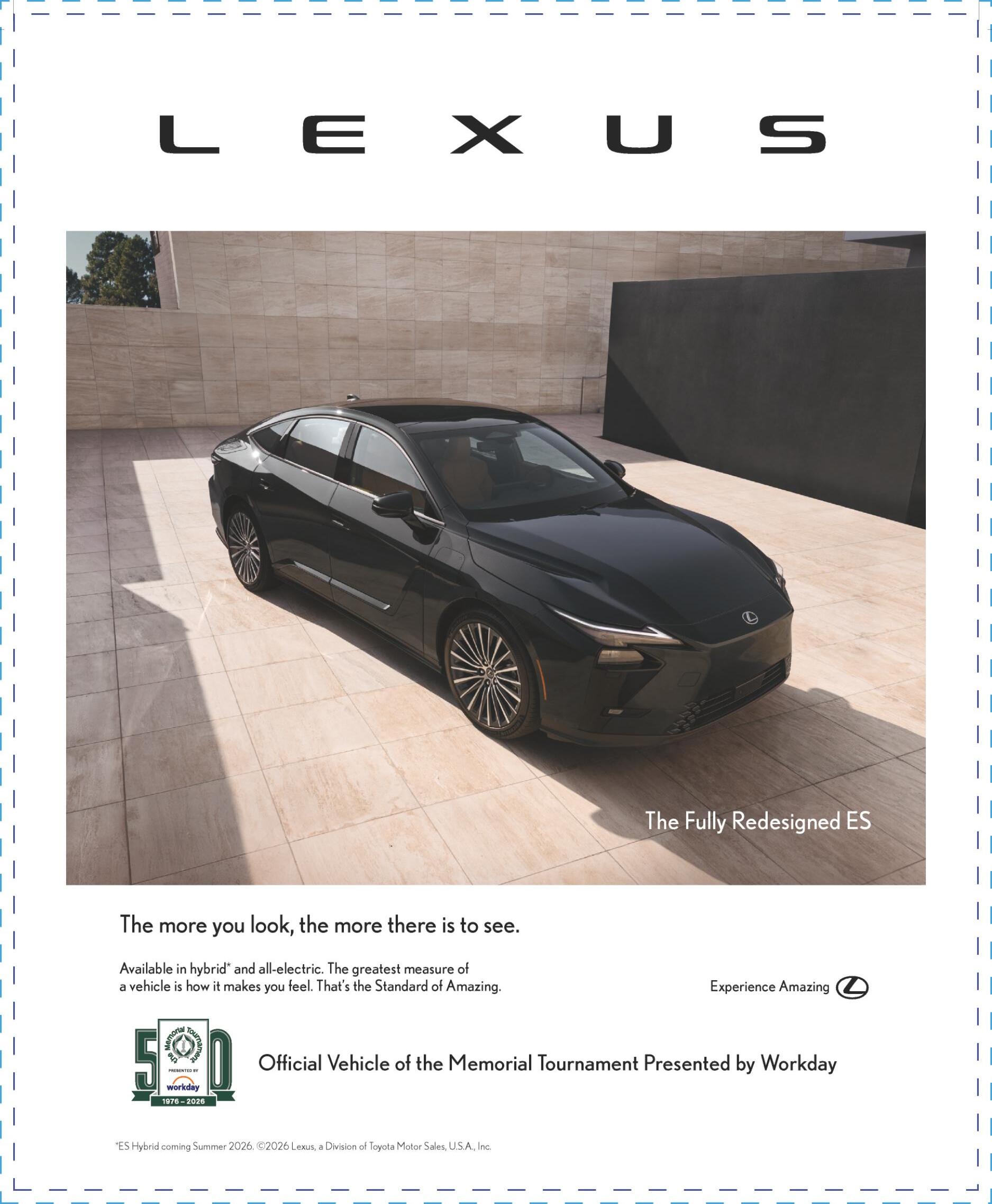
The more you look, the more there is to see.
Available in hybrid* and all-electric. The greatest measure of a vehicle is how it makes you feel. That’s the Standard of Amazing. Experience Amazing
Bing Crosby was renowned as an entertainer, and he knew how to hit the right notes in golf, too
BY DAVID SHEDLOSKI
Editor’s note: This is the third in a series of stories celebrating the first members of the Captains Club of the Memorial Tournament presented by Workday.
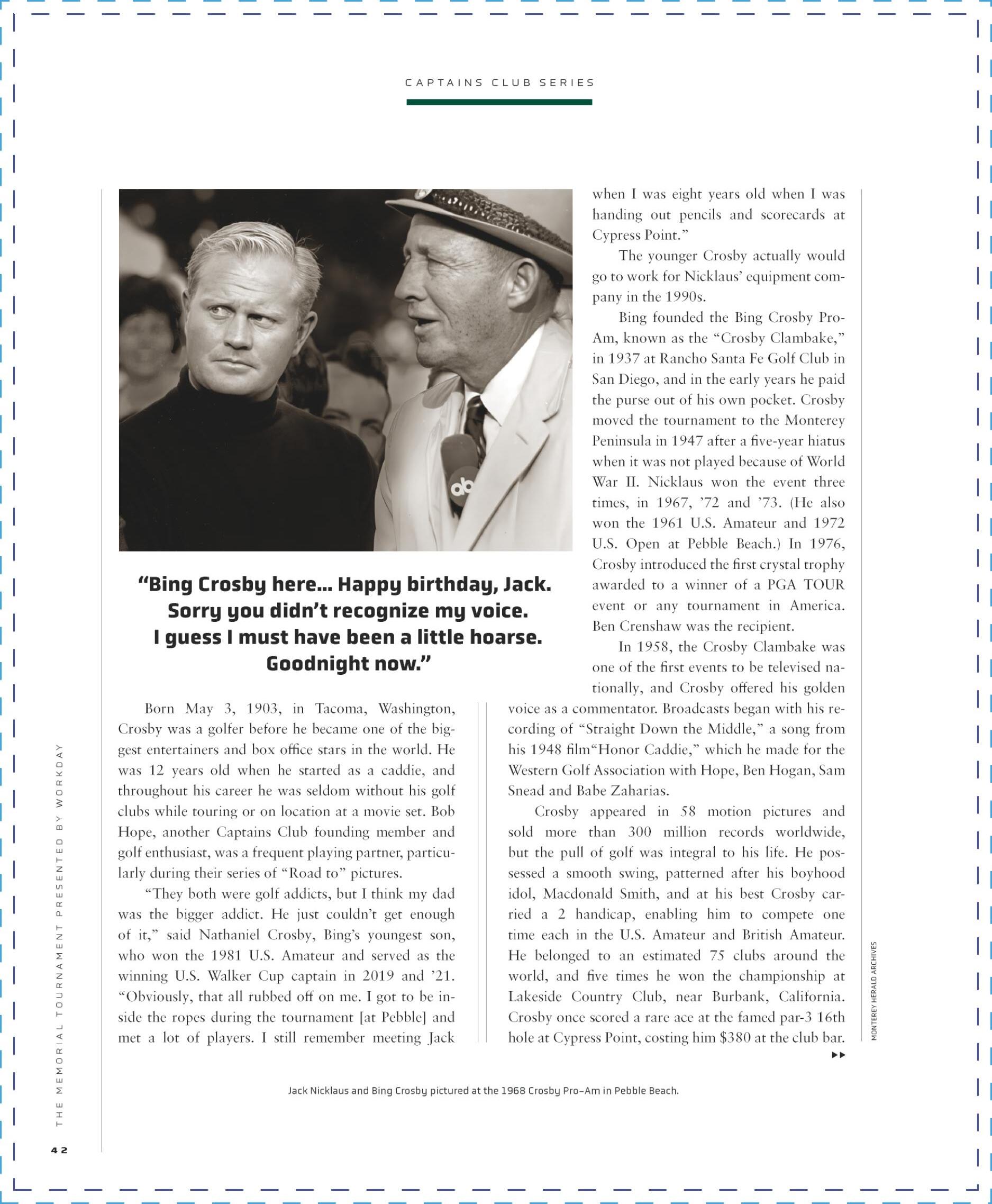
ALMOST WITHOUT FAIL for most of his career, Jack Nicklaus played in the Bing Crosby National Pro-Am in Pebble Beach, California, now known as the AT&T Pebble Beach Pro-Am. This led to a close relationship between the legendary crooner and the Golden Bear.
Most years, Nicklaus’ birthday, January 21, fell during tournament week, an occurrence that didn’t escape the tournament host. On one of those occasions, the phone in Nicklaus’ room at The Lodge at Pebble Beach rang rather late in the evening. A longtime golf friend was on the other end, calling from the cocktail bar. He then handed the phone to another friend who wanted to say hello. In a smooth baritone voice the man sang Happy Birthday to Jack, who was stumped why this person was singing to him at that time of night.
When the song ended, Nicklaus asked a bit brusquely, “To whom am I speaking, please?”
Pause. “Bing Crosby here,” came the reply. “Happy birthday, Jack. Sorry you didn’t recognize my voice. I guess I must have been a little hoarse. Goodnight now.”
Nicklaus would say later that he wanted to “slide into a crack in the ground and disappear.”
Few celebrities loved the game more and did more for it than Harry Lillis “Bing” Crosby Jr. Among his contributions, emblematic of his respect and affection for Nicklaus, was his brief stint as a founding member of the Memorial Tournament’s Captains Club.


“Bing Crosby here... Happy birthday, Jack. Sorry you didn’t recognize my voice. I guess I must have been a little hoarse. Goodnight now.”
Born May 3, 1903, in Tacoma, Washington, Crosby was a golfer before he became one of the biggest entertainers and box office stars in the world. He was 12 years old when he started as a caddie, and throughout his career he was seldom without his golf clubs while touring or on location at a movie set. Bob Hope, another Captains Club founding member and golf enthusiast, was a frequent playing partner, particularly during their series of “Road to” pictures.
“They both were golf addicts, but I think my dad was the bigger addict. He just couldn’t get enough of it,” said Nathaniel Crosby, Bing’s youngest son, who won the 1981 U.S. Amateur and served as the winning U.S. Walker Cup captain in 2019 and ’21. “Obviously, that all rubbed off on me. I got to be inside the ropes during the tournament [at Pebble] and met a lot of players. I still remember meeting Jack
when I was eight years old when I was handing out pencils and scorecards at Cypress Point.”
The younger Crosby actually would go to work for Nicklaus’ equipment company in the 1990s.
Bing founded the Bing Crosby ProAm, called the “Crosby Clambake,” in 1937 at Rancho Santa Fe Golf Club in San Diego, and in the early years he paid the purse out of his own pocket. Crosby moved the tournament to the Monterey Peninsula in 1947 after a five-year hiatus because of World War II. Nicklaus won the event three times, in 1967, ’72 and ’73. (He also won the 1961 U.S. Amateur and 1972 U.S. Open at Pebble Beach.) In 1976, Crosby introduced the first crystal trophy awarded to a winner of a PGA TOUR event or any tournament in America. Ben Crenshaw was the recipient.
In 1958, Bing’s event was one of the first to be televised nationally, and Crosby offered his golden voice as a commentator. Broadcasts began with his recording of “Straight Down the Middle,” a song from his 1948 film“Honor Caddie,” which he made for the Western Golf Association with Hope, Ben Hogan, Sam Snead and Babe Zaharias.
Crosby appeared in 58 motion pictures and sold more than 300 million records worldwide, but the pull of golf was integral to his life. He possessed a smooth swing, patterned after his boyhood idol, Macdonald Smith, and at his best Crosby carried a 2 handicap, enabling him to compete one time each in the U.S. Amateur and British Amateur. He belonged to an estimated 75 clubs around the world, and five times he won the championship at Lakeside Country Club, near Burbank, California. Crosby once scored a rare ace at the famed par-3 16th hole at Cypress Point, costing him $380 at the club bar.
In an interview with Golf Digest, Crosby once said, “In the battle against par or against your opponent, you

“In the battle against par or against your opponent, you can’t think about much else, and the result for me at least is good therapy. For me, golf has been kind of a passport to relaxation and happiness.”
—BING CROSBY
can’t think about much else, and the result for me at least is good therapy. For me, golf has been kind of a passport to relaxation and happiness.”
His dedication to the game did not go unnoticed. In 1978, the U.S. Golf Association presented its highest honor, the Bob Jones Award, to Crosby and Hope in recognition of their distinguished sportsmanship. That same year, Crosby was inducted into the World Golf Hall of Fame.
While Hope would make several appearances in the Memorial Tournament pro-am, Crosby never had a chance to play Muirfield Village Golf Club. On the eve of the inaugural Memorial in 1976, Crosby was rushed
to the hospital and underwent a surgical procedure after a piece of meat got lodged in his throat during a dinner at the Columbus Club.
Crosby died of a heart attack on October 14, 1977, at the age of 74 just minutes after completing a round of golf at La Moralega Golf Club near Madrid, Spain. Upon learning of her husband’s death, Kathryn Crosby told reporters, “I can’t think of any better way for a golfer who sings for a living to finish the round.” MT
David Shedloski is editorial director of The Memorial.


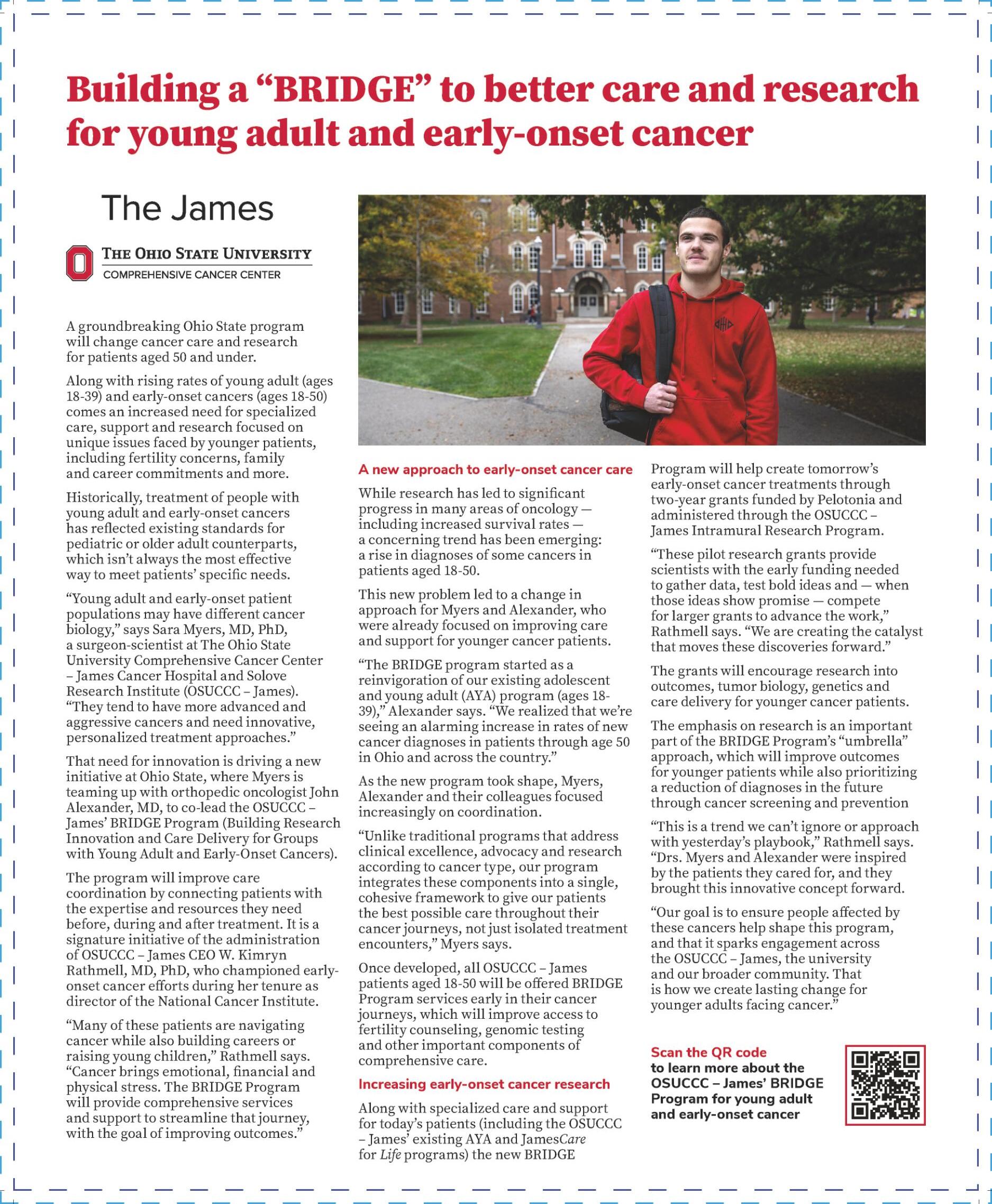
A groundbreaking Ohio State program will change cancer care and research for patients aged 50 and under.
Along with rising rates of young adult (ages 18-39) and early-onset cancers (ages 18-50) comes an increased need for specialized care, support and research focused on unique issues faced by younger patients, including fertility concerns, family and career commitments and more.
Historically, treatment of people with young adult and early-onset cancers has reflected existing standards for pediatric or older adult counterparts, which isn’t always the most effective way to meet patients’ specific needs.
“Young adult and early-onset patient populations may have different cancer biology,” says Sara Myers, MD, PhD, a surgeon-scientist at The Ohio State University Comprehensive Cancer Center – James Cancer Hospital and Solove Research Institute (OSUCCC – James).
“They tend to have more advanced and aggressive cancers and need innovative, personalized treatment approaches.”
That need for innovation is driving a new initiative at Ohio State, where Myers is teaming up with orthopedic oncologist John Alexander, MD, to co-lead the OSUCCC –James’ BRIDGE Program (Building Research Innovation and Care Delivery for Groups with Young Adult and Early-Onset Cancers).
The program will improve care coordination by connecting patients with the expertise and resources they need before, during and after treatment. It is a signature initiative of the administration of OSUCCC – James CEO W. Kimryn Rathmell, MD, PhD, who championed earlyonset cancer efforts during her tenure as director of the National Cancer Institute.
“Many of these patients are navigating cancer while also building careers or raising young children,” Rathmell says. “Cancer brings emotional, financial and physical stress. The BRIDGE Program will provide comprehensive services and support to streamline that journey, with the goal of improving outcomes.”

While research has led to significant progress in many areas of oncology — including increased survival rates — a concerning trend has been emerging: a rise in diagnoses of some cancers in patients aged 18-50.
This new problem led to a change in approach for Myers and Alexander, who were already focused on improving care and support for younger cancer patients.
“The BRIDGE program started as a reinvigoration of our existing adolescent and young adult (AYA) program (ages 1839),” Alexander says. “We realized that we’re seeing an alarming increase in rates of new cancer diagnoses in patients through age 50 in Ohio and across the country.”

As the new program took shape, Myers, Alexander and their colleagues focused increasingly on coordination.
“Unlike traditional programs that address clinical excellence, advocacy and research according to cancer type, our program integrates these components into a single, cohesive framework to give our patients the best possible care throughout their cancer journeys, not just isolated treatment encounters,” Myers says.
Once developed, all OSUCCC – James patients aged 18-50 will be offered BRIDGE Program services early in their cancer journeys, which will improve access to fertility counseling, genomic testing and other important components of comprehensive care.
Increasing early-onset cancer research Along with specialized care and support for today’s patients (including the OSUCCC – James’ existing AYA and JamesCare for Life programs) the new BRIDGE
Program will help create tomorrow’s early-onset cancer treatments through two-year grants funded by Pelotonia and administered through the OSUCCC –James Intramural Research Program.
“These pilot research grants provide scientists with the early funding needed to gather data, test bold ideas and — when those ideas show promise — compete for larger grants to advance the work,” Rathmell says. “We are creating the catalyst that moves these discoveries forward.”
The grants will encourage research into outcomes, tumor biology, genetics and care delivery for younger cancer patients.
The emphasis on research is an important part of the BRIDGE Program’s “umbrella” approach, which will improve outcomes for younger patients while also prioritizing a reduction of diagnoses in the future through cancer screening and prevention
“This is a trend we can’t ignore or approach with yesterday’s playbook,” Rathmell says. “Drs. Myers and Alexander were inspired by the patients they cared for, and they brought this innovative concept forward.
“Our goal is to ensure people affected by these cancers help shape this program, and that it sparks engagement across the OSUCCC – James, the university and our broader community. That is how we create lasting change for younger adults facing cancer.”
Scan the QR code to learn more about the OSUCCC – James’ BRIDGE Program for young adult and early-onset cancer


It wasn’t an easy road, but
became a major champion and Hall-of-Fame player through determination and toughness
BY JAIME DIAZ
DAVID GRAHAM may not be a giant in golf history, but his flinty profile cuts through the mists of time in sharper relief than many players who won more. Especially at his best, the driven underdog from Down Under projected the most vital element in tournament golf—control.
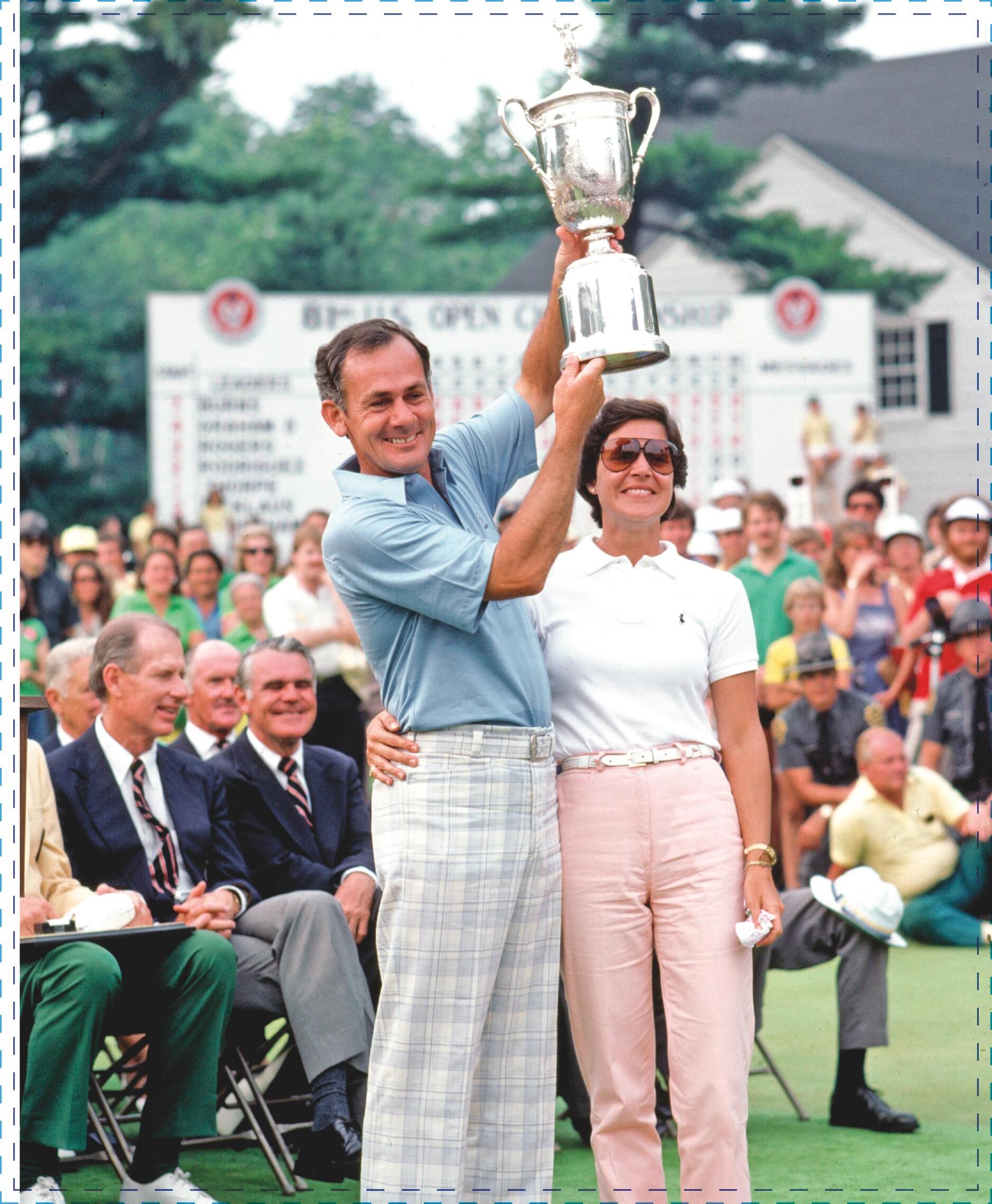
Think back to the final round of the 1981 U.S. Open. Graham, lean and straight-backed, tracing the triumphant footsteps of Ben Hogan and Lee Trevino along Merion’s exacting finish as he won by three. Hogan himself phoned to tell Graham his closing 35-32–67 was the finest round of golf he’d ever seen.
Externally, Graham’s performance at Merion was all about ball control—he hit every green in regulation but for three well-guided approaches that barely trickled into fringe. Internally, a serenely locked-in self-control freed him to meet the moment.
“At Merion, my state of mind all week was remarkably relaxed,” remembers Graham, now 80, reliving the moment over breakfast at Preston Trail Country Club near his home in Dallas. “After my first-round 68,
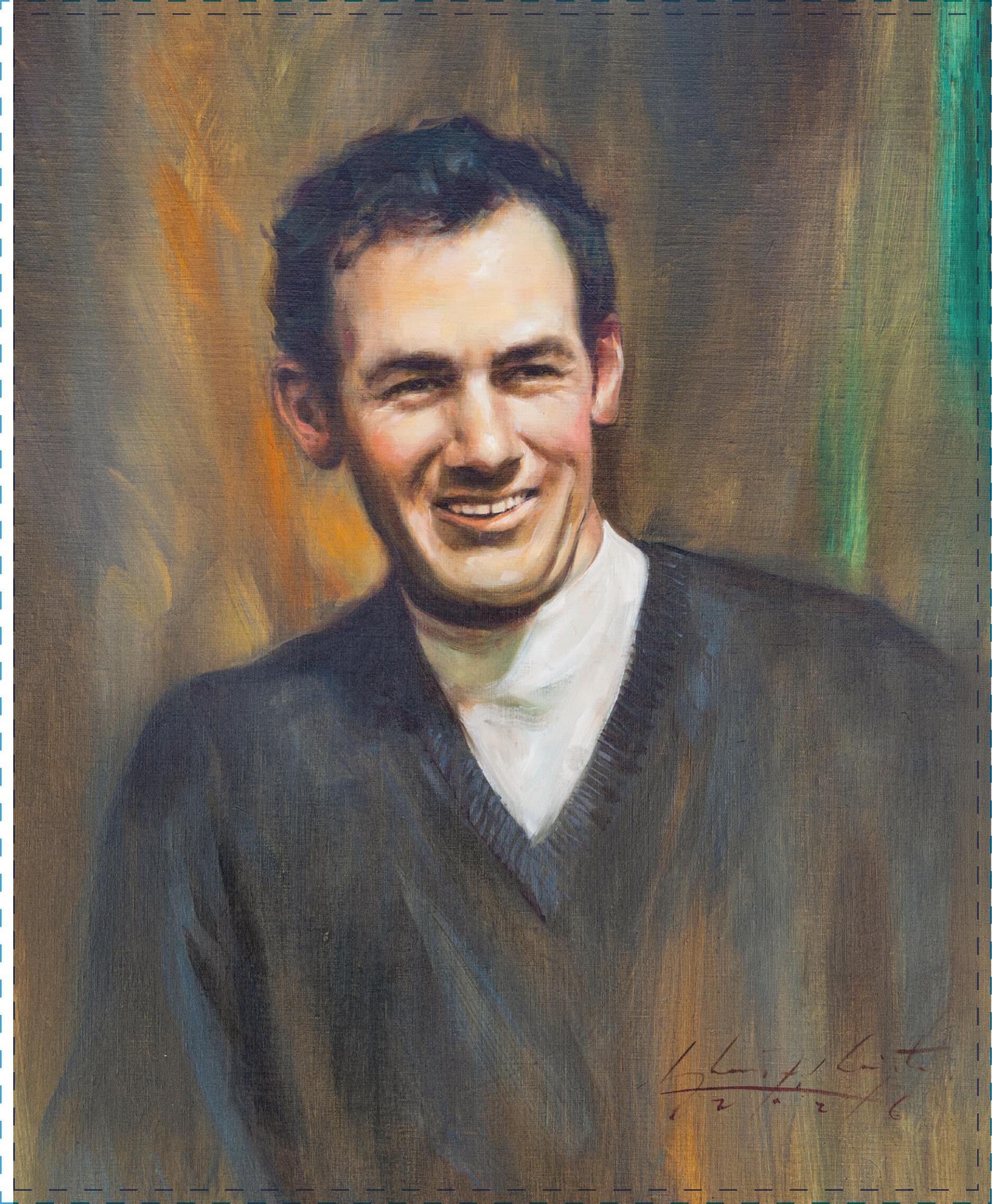
PORTRAIT BY GLENN HARRINGTON

“As a boy, David learned what it took to get through some tough times. As a golfer, when things got harder, that’s when he got better.” —BRUCE DEVLIN
Ben Crenshaw and I decided to take off to get in a round at Pine Valley, the kind of thing I had never done at a major championship. Playing in the last group on Sunday, I never got tense. All day, the club felt good in my hands, my rhythm stayed smooth, and my pre-shot routine was on repeat. I even played the same ball the whole round.”
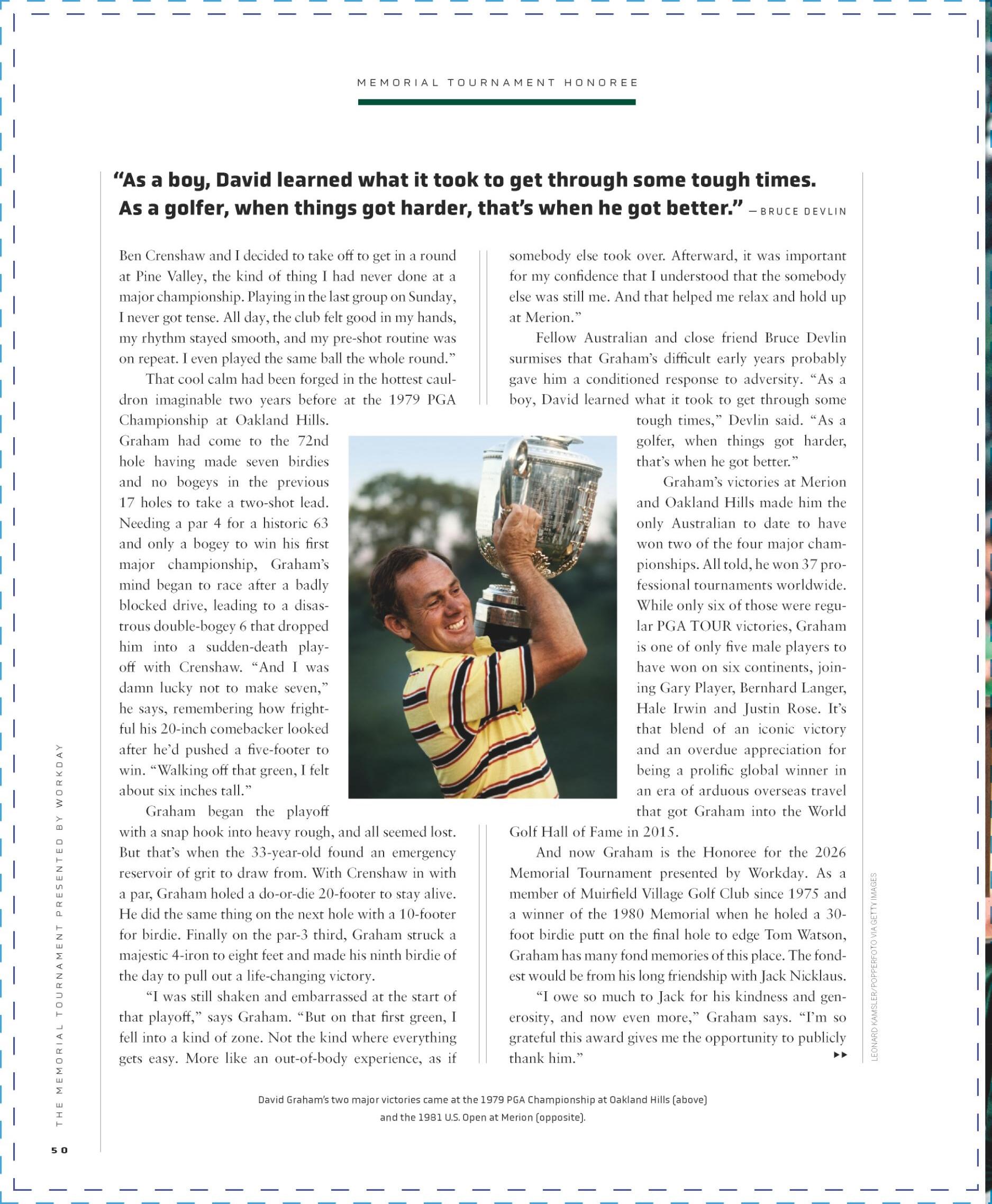
That cool calm had been forged in the hottest cauldron imaginable two years before at the 1979 PGA Championship at Oakland Hills. Graham had come to the 72nd hole having made seven birdies and no bogeys in the previous 17 holes to take a two-shot lead. Needing a par 4 for a historic 63 and only a bogey to win his first major championship, Graham’s mind began to race after a badly blocked drive, leading to a disastrous double-bogey 6 that dropped him into a sudden-death playoff with Crenshaw. “And I was damn lucky not to make seven,” he says, remembering how frightful his 20-inch comebacker looked after he’d pushed a five-footer to win. “Walking off that green, I felt about six inches tall.”
somebody else took over. Afterward, it was important for my confidence that I understood that the somebody else was still me. And that helped me relax and hold up at Merion.”
Fellow Australian and close friend Bruce Devlin surmises that Graham’s difficult early years probably gave him a conditioned response to adversity. “As a boy, David learned what it took to get through some tough times,” Devlin said. “As a golfer, when things got harder, that’s when he got better.”

Graham began the playoff with a snap hook into heavy rough, and all seemed lost. But that’s when the 33-year-old found an emergency reservoir of grit to draw from. With Crenshaw in with a par, Graham holed a do-or-die 20-footer to stay alive. He did the same thing on the next hole with a 10-footer for birdie. Finally on the par-3 third, Graham struck a majestic 4-iron to eight feet and made his ninth birdie of the day to pull out a life-changing victory.
“I was still shaken and embarrassed at the start of that playoff,” says Graham. “But on that first green, I fell into a kind of zone. Not the kind where everything gets easy. More like an out-of-body experience, as if
Graham’s victories at Merion and Oakland Hills made him the only Australian to date to have won two of the four major championships. All told, he won 37 professional tournaments worldwide. While only six of those were regular PGA TOUR victories, Graham is one of only five male players to have won on six continents, joining Gary Player, Bernhard Langer, Hale Irwin and Justin Rose. It’s that blend of an iconic victory and an overdue appreciation for being a prolific global winner in an era of arduous overseas travel that got Graham into the World Golf Hall of Fame in 2015.
And now Graham is the Honoree for the 2026 Memorial Tournament presented by Workday. As a member of Muirfield Village Golf Club since 1975 and a winner of the 1980 Memorial when he holed a 30foot birdie putt on the final hole to edge Tom Watson, Graham has many fond memories of this place. The fondest would be from his long friendship with Jack Nicklaus.
“I owe so much to Jack for his kindness and generosity, and now even more,” Graham says. “I’m so grateful this award gives me the opportunity to publicly thank him.”

“I was a terrible student … who sat in the back of the class and dreaded being called on. I was very introverted.” —DAVID GRAHAM
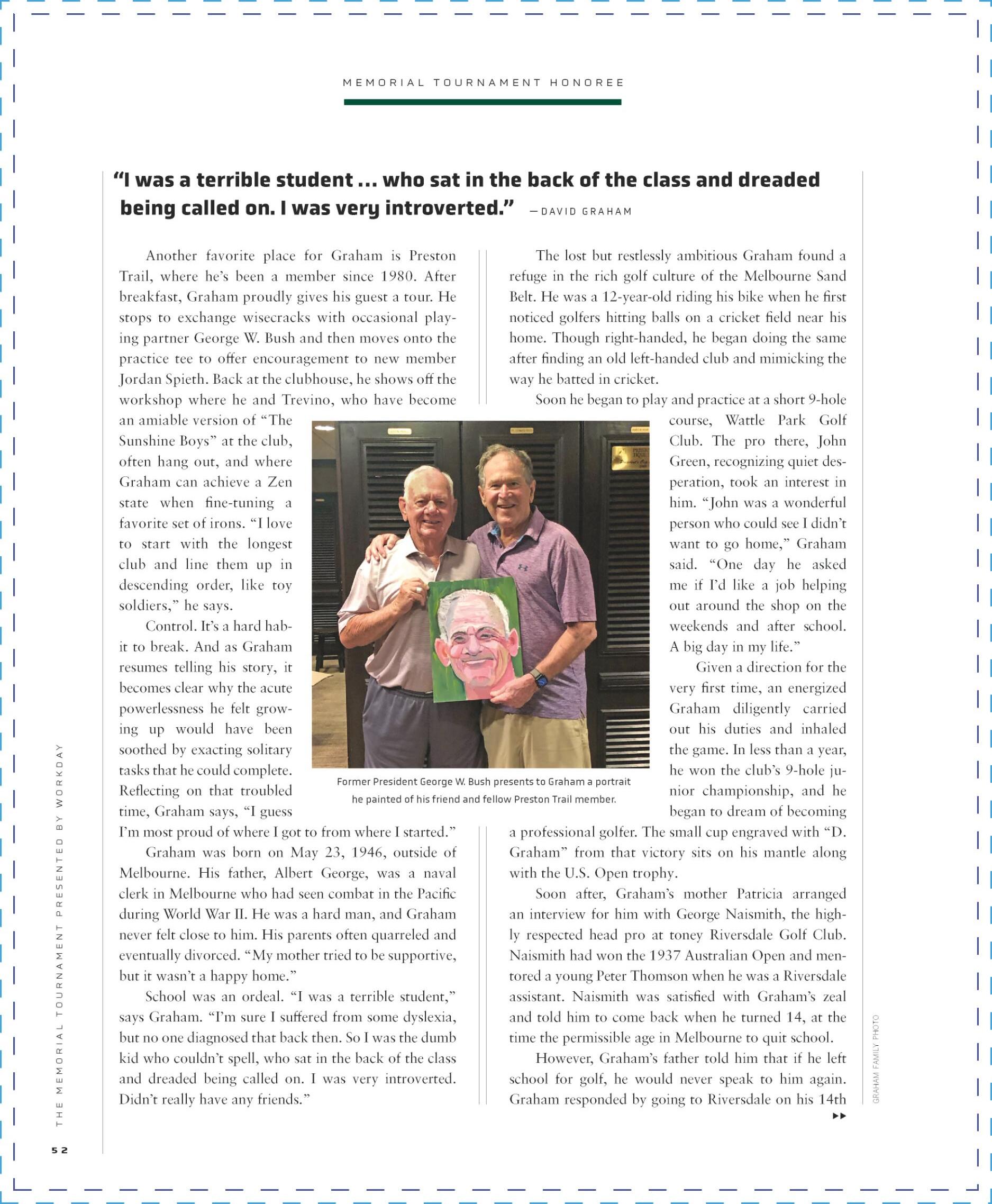
Another favorite place for Graham is Preston Trail, where he’s been a member since 1980. After breakfast, Graham proudly gives his guest a tour. He stops to exchange wisecracks with occasional playing partner George W. Bush and then moves onto the practice tee to offer encouragement to new member Jordan Spieth. Back at the clubhouse, he shows off the workshop where he and Trevino, who have become an amiable version of “The Sunshine Boys” at the club, often hang out, and where Graham can achieve a Zen state when fine-tuning a favorite set of irons. “I love to start with the longest club and line them up in descending order, like toy soldiers,” he says.
Control. It’s a hard habit to break. And as Graham resumes telling his story, it becomes clear why the acute powerlessness he felt growing up would have been soothed by exacting solitary tasks that he could complete. Reflecting on that troubled time, Graham says, “I guess I’m most proud of where I got to from where I started.”
Didn’t really have any friends.”
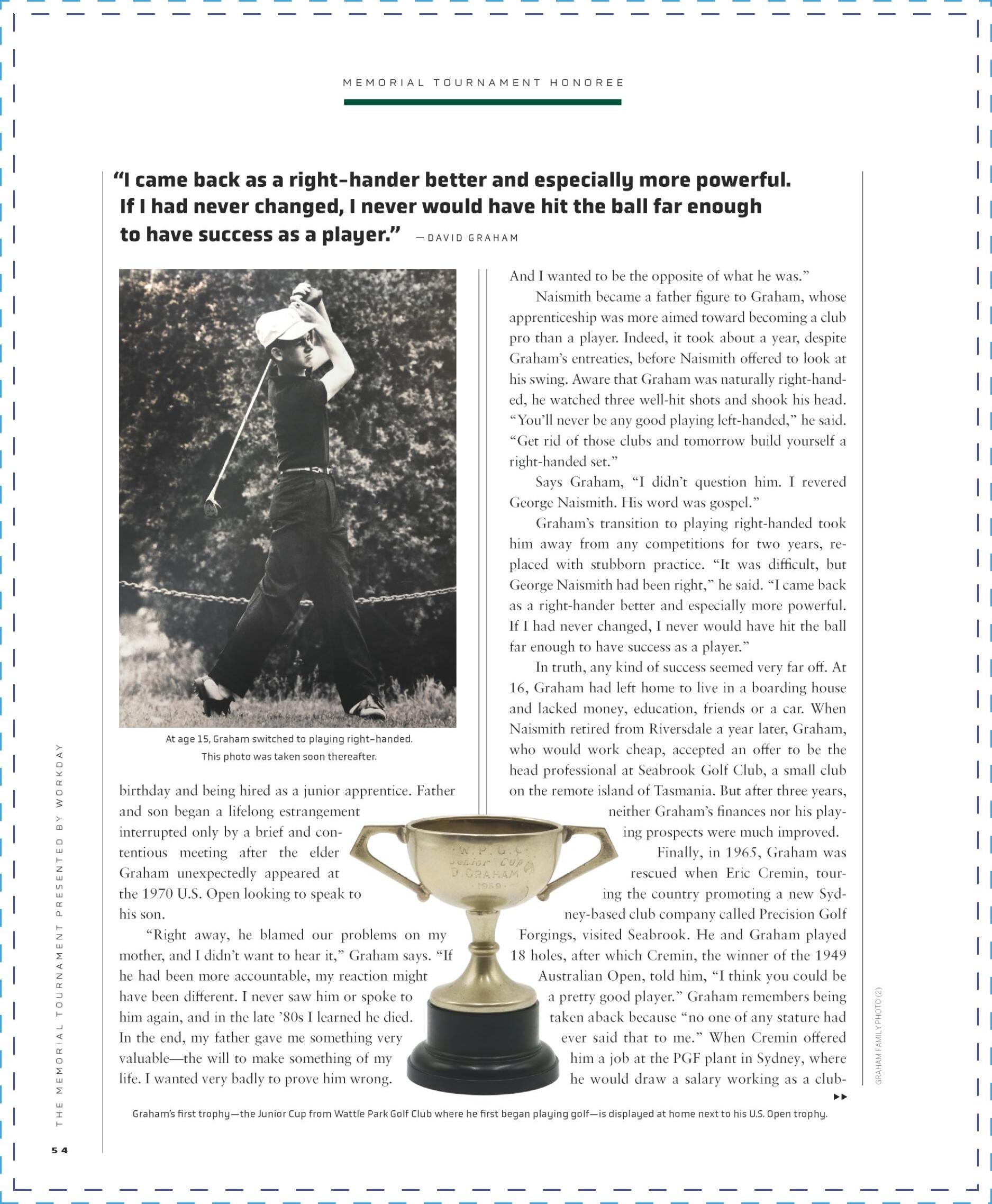
The lost but restlessly ambitious Graham found a refuge in the rich golf culture of the Melbourne Sand Belt. He was a 12-year-old riding his bike when he first noticed golfers hitting balls on a cricket field near his home. Though right-handed, he began doing the same after finding an old left-handed club and mimicking the way he batted in cricket.

Graham was born on May 23, 1946, outside of Melbourne. His father, Albert George, was a naval clerk in Melbourne who had seen combat in the Pacific during World War II. He was a hard man, and Graham never felt close to him. His parents often quarreled and eventually divorced. “My mother tried to be supportive, but it wasn’t a happy home.”
School was an ordeal. “I was a terrible student,” says Graham. “I’m sure I suffered from some dyslexia, but no one diagnosed that back then. So I was the dumb kid who couldn’t spell, who sat in the back of the class and dreaded being called on. I was very introverted.
Soon he began to play and practice at a short 9-hole course, Wattle Park Golf Club. The pro there, John Green, recognizing quiet desperation, took an interest in him. “John was a wonderful person who could see I didn’t want to go home,” Graham said. “One day he asked me if I’d like a job helping out around the shop on the weekends and after school. A big day in my life.”
Given a direction for the very first time, an energized Graham diligently carried out his duties and inhaled the game. In less than a year, he won the club’s 9-hole junior championship, and he began to dream of becoming a professional golfer. The small cup engraved with “D. Graham” from that victory sits on his mantle along with the U.S. Open trophy.
Soon after, Graham’s mother Patricia arranged an interview for him with George Naismith, the highly respected head pro at toney Riversdale Golf Club. Naismith had won the 1937 Australian Open and mentored a young Peter Thomson when he was a Riversdale assistant. Naismith was satisfied with Graham’s zeal and told him to come back when he turned 14, at the time the permissible age in Melbourne to quit school.
However, Graham’s father told him that if he left school for golf, he would never speak to him again.

“I came back as a right-hander better and especially more powerful. If I had never changed, I never would have hit the ball far enough to have success as a player.”
—DAVID GRAHAM

Graham responded by going to Riversdale on his 14th birthday and being hired as a junior apprentice. Father and son began a lifelong estrangement interrupted only by a brief and contentious meeting after the elder Graham unexpectedly appeared at the 1970 U.S. Open looking to speak to his son.
“Right away, he blamed our problems on my moth er, and I didn’t want to hear it,” Graham says. “If he had been more accountable, my reaction might have been different. I never saw him or spoke to him again, and in the late ’80s I learned he died. In the end, my father gave me something very valuable—the will to make something of
my life. I wanted very badly to prove him wrong. And I wanted to be the opposite of what he was.”
Naismith became a father figure to Graham, whose apprenticeship was more aimed toward becoming a club pro than a player. Indeed, it took about a year, despite Graham’s entreaties, before Naismith offered to look at his swing. Aware that Graham was naturally right-handed, he watched three well-hit shots and shook his head. “You’ll never be any good playing left-handed,” he said. “Get rid of those clubs and tomorrow build yourself a right-handed set.”
Says Graham, “I didn’t question him. I revered George Naismith. His word was gospel.”
Graham’s transition to playing right-handed took him away from any competitions for two years, replaced with stubborn practice. “It was difficult, but George Naismith had been right,” he said. “I came back as a right-hander better and especially more powerful. If I had never changed, I never would have hit the ball far enough to have success as a player.”
In truth, any kind of success seemed very far off. At 16, Graham had left home to live in a boarding house and lacked money, education, friends or a car. When Naismith retired from Riversdale a year later, Graham, who would work cheap, accepted an offer to be the head professional at Seabrook Golf Club, a small club on the remote island of Tasmania. But after three years, neither Graham’s finances nor his playing prospects were much improved.

Finally, in 1965, Graham was rescued when Eric Cremin, touring the country promoting a new Sydney-based club company called Precision Golf Forgings, visited Seabrook. He and Graham played 18 holes, after which Cremin, the winner of the 1949 Australian Open, told him, “I think you could be a pretty good player.” Graham remembers being taken aback because “no one of any stature had ever said that to me.” When Cremin offered him a


“That’s when I began to give playing the game every inch of myself. … I hit every shot like my life depended on it. My only thought was, ‘Do your best, do your best, do your best.’ ”
—DAVID GRAHAM
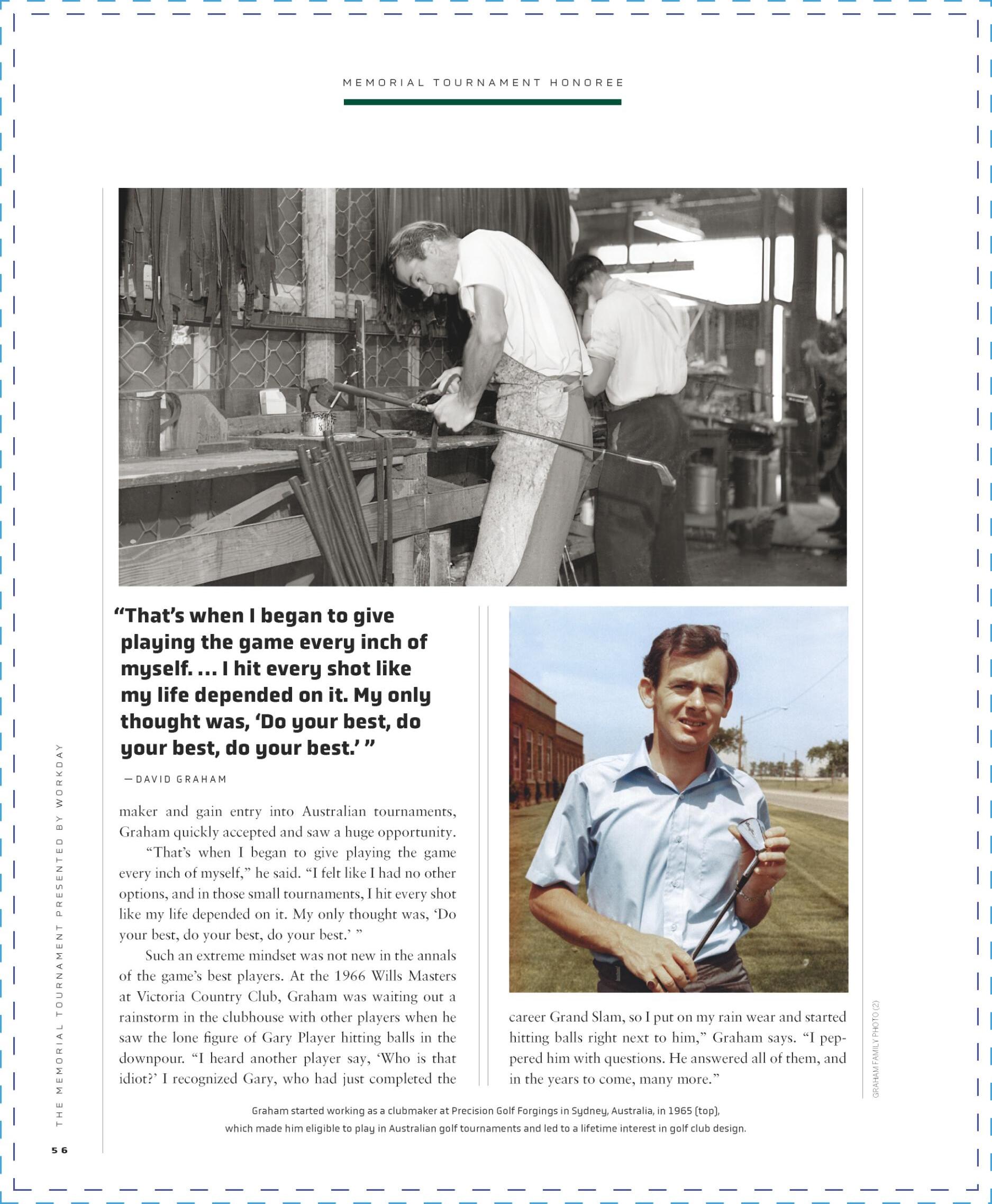
job at the PGF plant in Sydney, where he would draw a salary working as a clubmaker and gain entry into Australian tournaments, Graham quickly accepted and saw a huge opportunity.
“That’s when I began to give playing the game every inch of myself,” he said. “I felt like I had no other options, and in those small tournaments, I hit every shot like my life depended on it. My only thought was, ‘Do your best, do your best, do your best.’ ”
Such an extreme mindset was not new in the annals of the game’s best players. At the 1966 Wills Masters at Victoria Country Club, Graham was waiting out a rainstorm in the clubhouse with other players when he

saw the lone figure of Gary Player hitting balls in the downpour. “I heard another player say, ‘Who is that idiot?’ I recognized Gary, who had just completed the career Grand Slam, so I put on my rain wear and started


hitting balls right next to him,” Graham says. “I peppered him with questions. He answered all of them, and in the years to come, many more.”
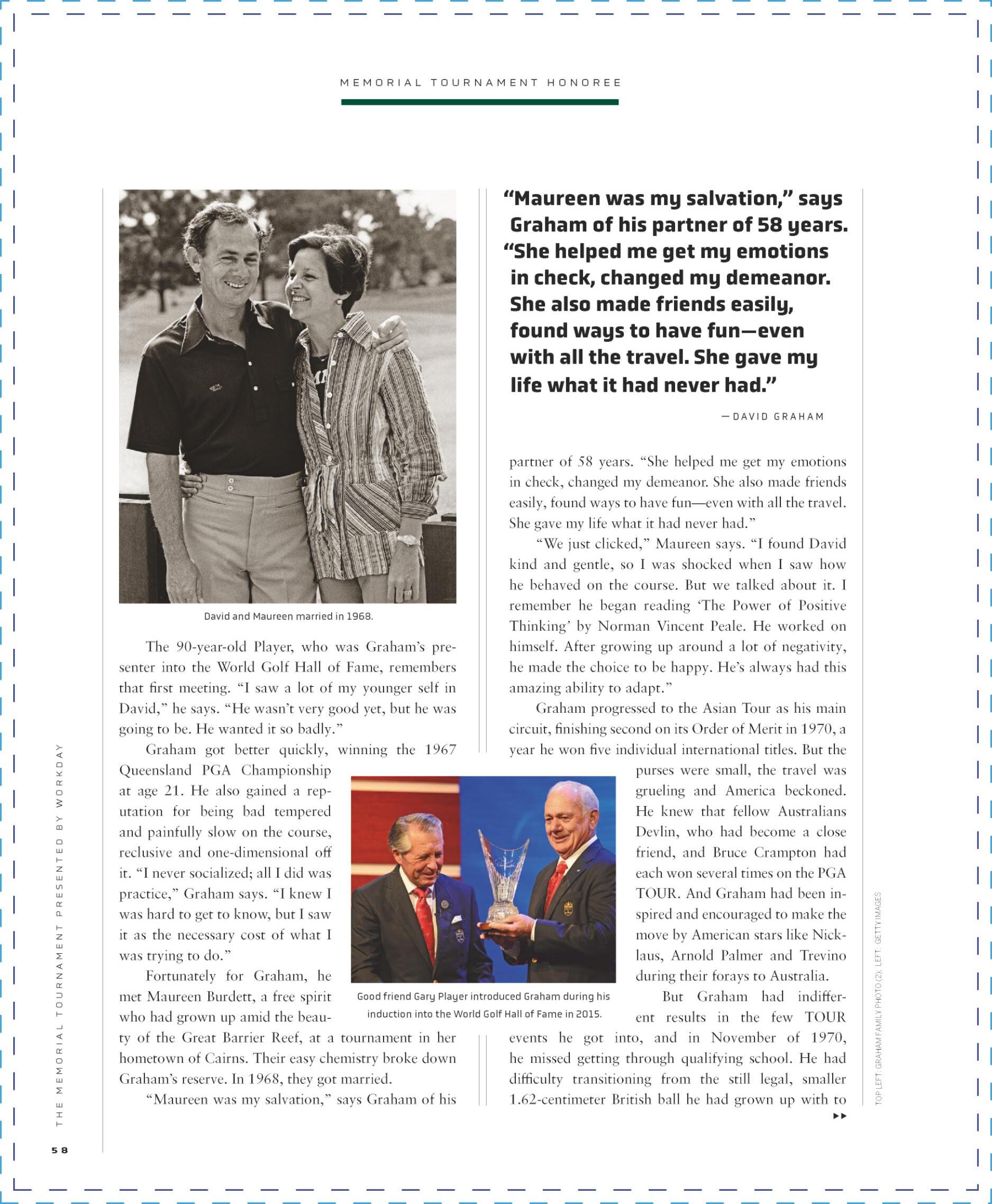
The 90-year-old Player, who was Graham’s presenter into the World Golf Hall of Fame, remembers that first meeting. “I saw a lot of my younger self in David,” he says. “He wasn’t very good yet, but he was going to be. He wanted it so badly.”
Graham got better quickly, winning the 1967 Queensland PGA Championship at age 21. He also gained a reputation for being bad tempered and painfully slow on the course, reclusive and one-dimensional off it. “I never socialized; all I did was practice,” Graham says. “I knew I was hard to get to know, but I saw it as the necessary cost of what I was trying to do.”
“Maureen was my salvation,” says Graham of his partner of 58 years. “She helped me get my emotions in check, changed my demeanor. She also made friends easily, found ways to have fun—even with all the travel. She gave my life what it had never had.”
—DAVID GRAHAM
of Cairnes. Their easy chemistry broke down Graham’s reserve. In 1968, they got married.
“Maureen was my salvation,” says Graham of his partner of 58 years. “She helped me get my emotions in check, changed my demeanor. She also made friends easily, found ways to have fun—even with all the travel. She gave my life what it had never had.”
“We just clicked,” Maureen says. “I found David kind and gentle, so I was shocked when I saw how he behaved on the course. But we talked about it. I remember he began reading ‘The Power of Positive Thinking’ by Norman Vincent Peale. He worked on himself. After growing up around a lot of negativity, he made the choice to be happy. He’s always had this amazing ability to adapt.”

Fortunately for Graham, he met Maureen Burdett, a free spirit who had grown up amid the beauty of the Great Barrier Reef, at a tournament in her hometown
Graham progressed to the Asian Tour as his main circuit, finishing second on its Order of Merit in 1970, a year he won five individual international titles. But the purses were small, the travel was grueling and America beckoned. He knew that fellow Australians Devlin, who had become a close friend, and Bruce Crampton had each won several times on the PGA TOUR. And Graham had been inspired and encouraged to make the move by American stars like Nicklaus, Arnold Palmer and Trevino during their forays to Australia.
But Graham had indifferent results in the few TOUR events he got into, and in November of 1970,


he missed getting through qualifying school. He had difficulty transitioning from the still legal, smaller 1.62-centimeter British ball he had grown up with to the larger 1.68 cm American ball, which didn’t go as far and was less forgiving. The larger ball combined with the lusher conditions of most PGA TOUR courses dictated a more aerial game than Graham’s technique was suited for.
The performance got Graham some attention and a few sponsor’s exemptions on the PGA TOUR. He became a full member when he made it through the 1971 qualifying school. But moving to South Florida and playing a more manageable schedule didn’t change his fortunes in America, and after missing the cut at the Colonial in May of 1972, he asked Devlin for a frank assessment of his game.
“Bruce is such a gentle soul, but he didn’t hold back,” Graham says. “Basically, [he said I needed] to quit hitting the low hook that didn’t hold firm greens, I needed to weaken my grip, stand closer to the ball and swing more upright. Also had to shorten my clubs and change their lie angle.” For a tour player, the overhaul meant almost as dramatic a change as Graham had made with Naismith.

The week following Q School, after Crampton, Thomson and Kel Nagle passed on the chance to represent Australia in the World Cup in Buenos Aires, Graham was chosen to team with Devlin. Inspired by the big stage, Graham finished second by one stroke to Roberto De Vicenzo for the individual title as he and Devlin won the team competition by 10 strokes.
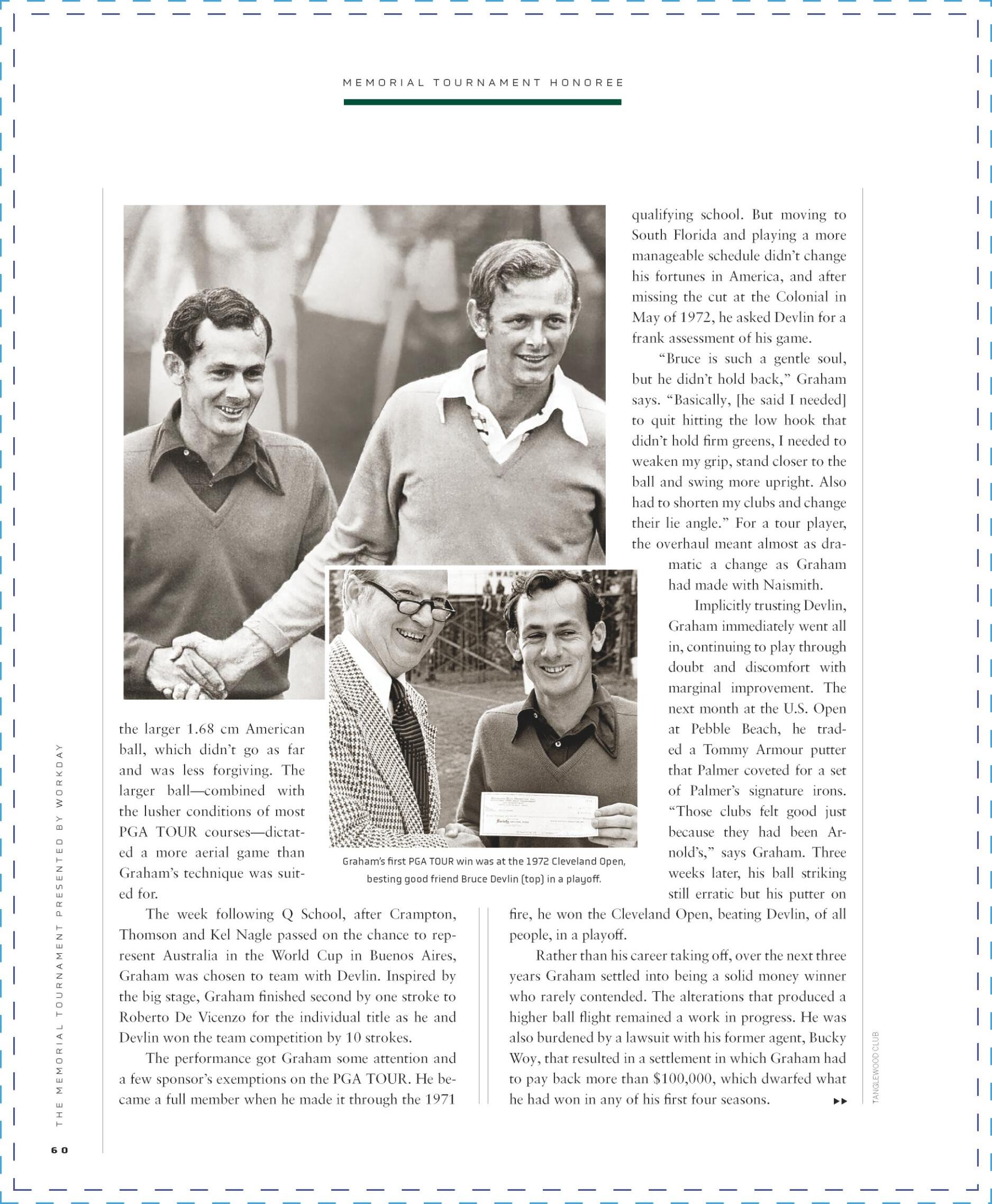
Implicitly trusting Devlin, Graham immediately went all in, continuing to play through doubt and discomfort with marginal improvement. The next month at the U.S. Open at Pebble Beach, he traded a Tommy Armour putter that Palmer coveted for a set of Palmer’s signature irons. “Those clubs felt good just because they had been Arnold’s,” says Graham. Three weeks later, his ball striking still erratic but his putter on fire, he won the Cleveland Open, beating Devlin, of all people, in a playoff.
Rather than his career taking off, over the next three years Graham settled into being a solid money winner who rarely contended. The alterations that produced a higher ball flight remained a work in progress. He was also burdened by a lawsuit with his former agent, Bucky


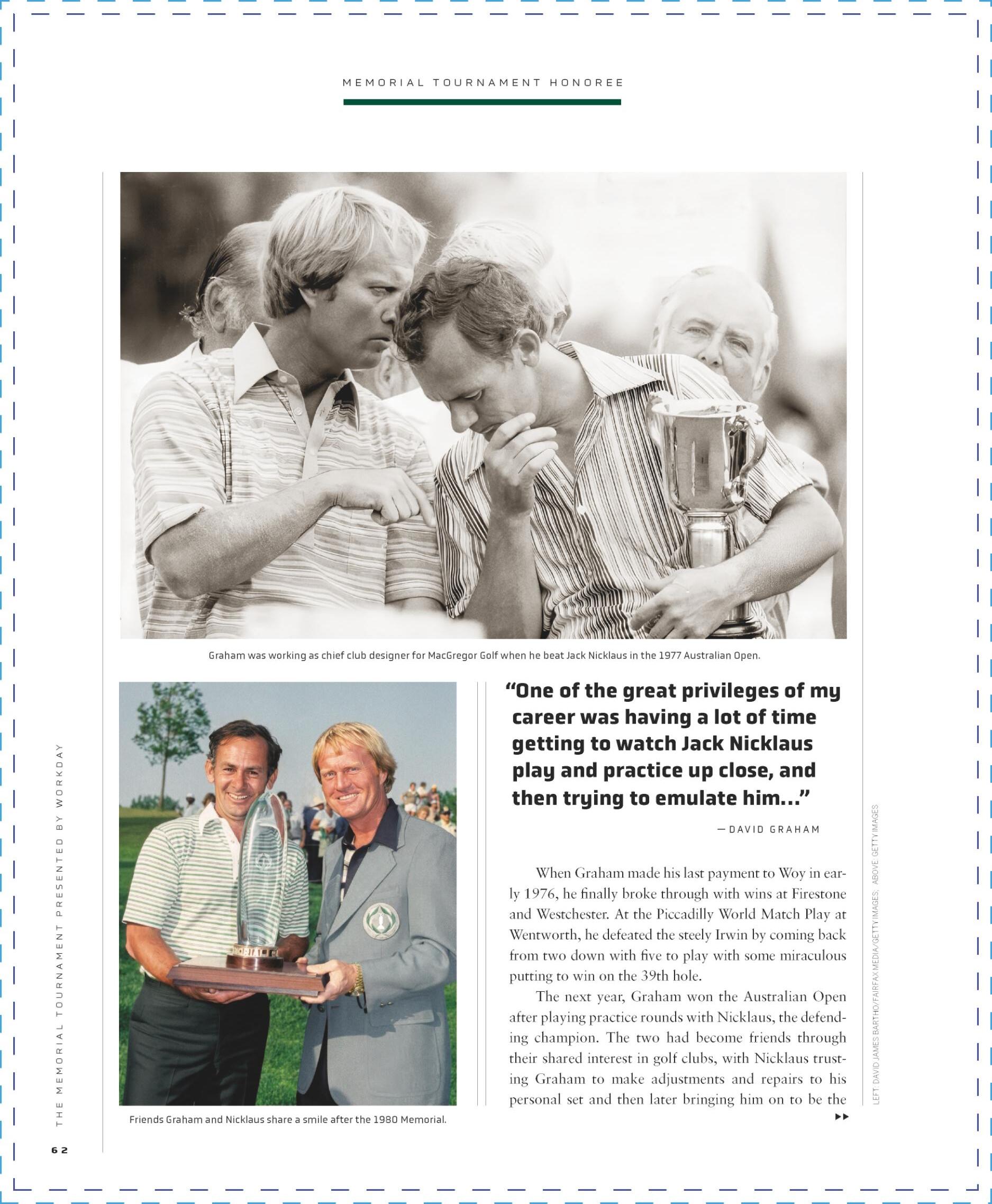
“One of the great privileges of my career was having a lot of time getting to watch Jack Nicklaus play and practice up close, and then trying to emulate him…”
—DAVID GRAHAM
Woy, that resulted in a settlement in which Graham had to pay back more than $100,000, which dwarfed what he had won in any of his first four seasons.
When Graham made his last payment to Woy in early 1976, he finally broke through with wins at Firestone and Westchester. At the Piccadilly World Match Play at Wentworth, he defeated the steely Irwin by coming back from two down with five to play with some miraculous putting to win on the 39th hole.
The next year, Graham won the Australian Open after playing practice rounds with Nicklaus, the defending champion. The two had become friends


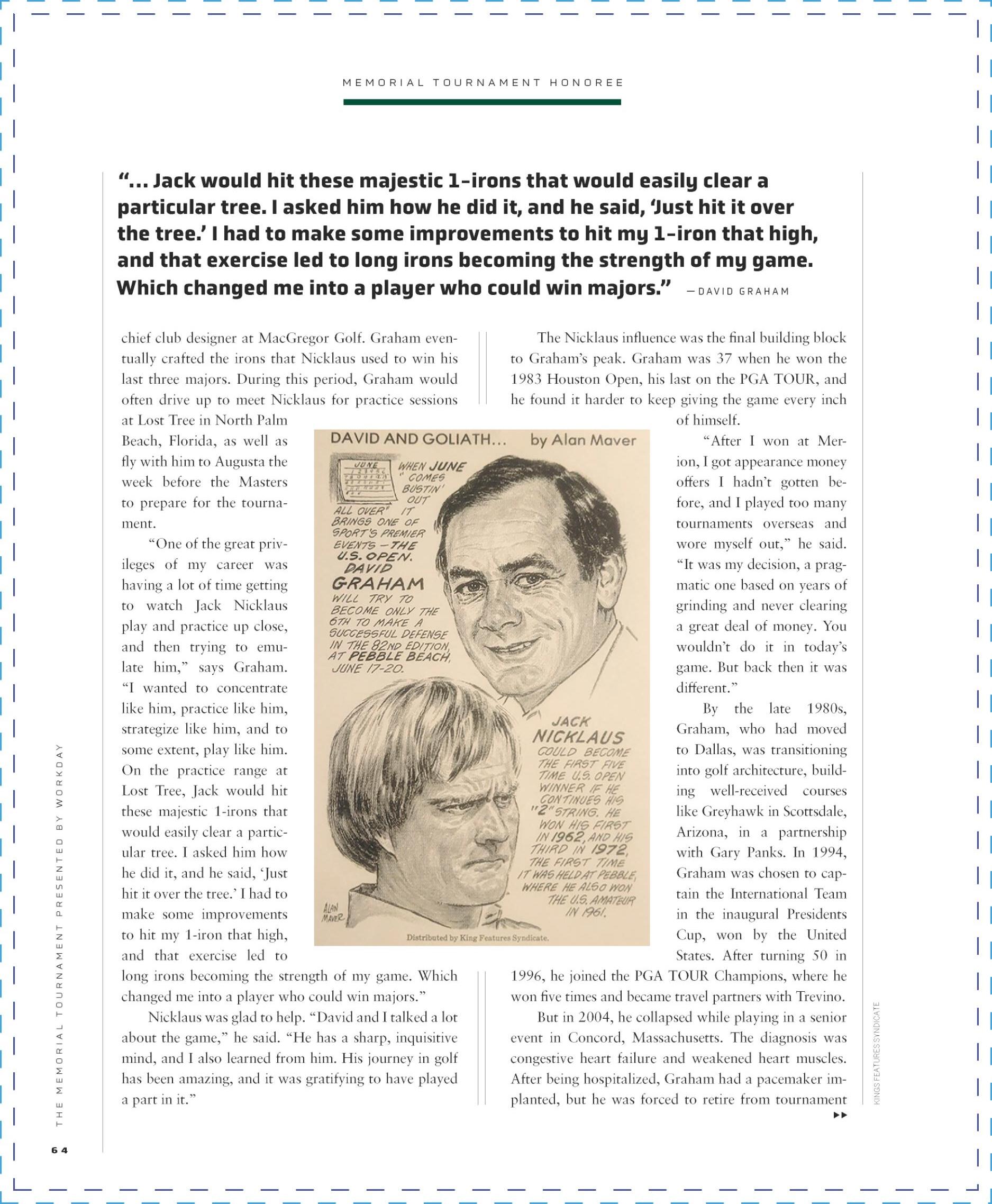
“… Jack would hit these majestic 1-irons that would easily clear a particular tree. I asked him how he did it, and he said, ‘Just hit it over the tree.’ I had to make some improvements to hit my 1-iron that high, and that exercise led to long irons becoming the strength of my game. Which changed me into a player who could win majors.” —DAVID GRAHAM
through their shared interest in golf clubs, with Nicklaus trusting Graham to make adjustments and repairs to his personal set and then later bringing him on to be the chief club designer at MacGregor Golf. Graham eventually crafted the irons that Nicklaus used to win his last three majors. During this period, Graham would often drive up to meet Nicklaus for practice sessions at Lost Tree in North Palm Beach, Florida, as well as fly with him to Augusta the week before the Masters to prepare for the tournament.
“One of the great privileges of my career was having a lot of time getting to watch Jack Nicklaus play and practice up close, and then trying to emulate him,” says Graham.
“I wanted to concentrate like him, practice like him, strategize like him, and to some extent, play like him. On the practice range at Lost Tree, Jack would hit these majestic 1-irons that would easily clear a particular tree. I asked him how he did it, and he said, ‘Just hit it over the tree.’ I had to make some improvements to hit my 1-iron that high, and that exercise led to long irons becoming the strength of my game. Which changed me into a player who could win majors.”
mind, and I also learned from him. His journey in golf has been amazing, and it was gratifying to have played a part in it.”
The Nicklaus influence was the final building block to Graham’s peak. Graham was 37 when he won the 1983 Houston Open, his last on the PGA TOUR, and he found it harder to keep giving the game every inch of himself.

Nicklaus was glad to help. “David and I talked a lot about the game,” he said. “He has a sharp, inquisitive
“After I won at Merion, I got appearance money offers I hadn’t gotten before, and I played too many tournaments overseas and wore myself out,” he said. “It was my decision, a pragmatic one based on years of grinding and never clearing a great deal of money. You wouldn’t do it in today’s game. But back then it was different.”
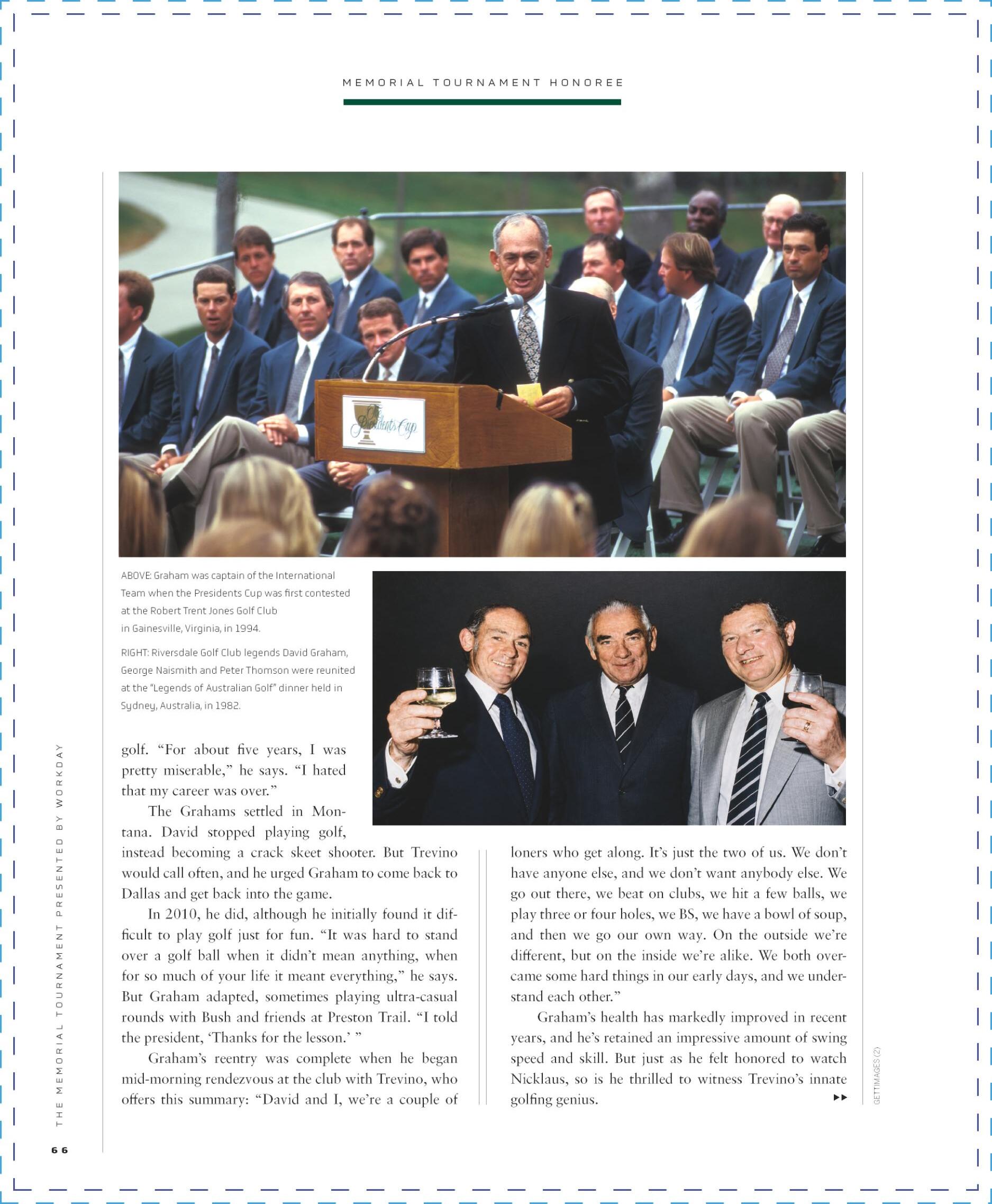
By the late 1980s, Graham, who had moved to Dallas, was transitioning into golf architecture, building well-received courses like Greyhawk in Scottsdale, Arizona, in a partnership with Gary Panks. In 1994, Graham was chosen to captain the International Team in the inaugural Presidents Cup, won by the United States. After turning 50 in 1996, he joined the PGA TOUR Champions, where he won five times and became travel partners with Trevino. But in 2004, he collapsed while playing in a senior event in Concord, Massachusetts. The diagnosis was

A milestone year honoring the game, the skill and the legacy built across five decades.


congestive heart failure and weakened heart muscles. After being hospitalized, Graham had a pacemaker implanted, but he was forced to retire from tournament golf. “For about five years, I was pretty miserable,” he says. “I hated that my career was over.”
The Grahams settled in Montana. David stopped playing golf, instead becoming a crack skeet shooter But Trevino would call often, and he urged Graham to come back to Dallas and get back into the game.
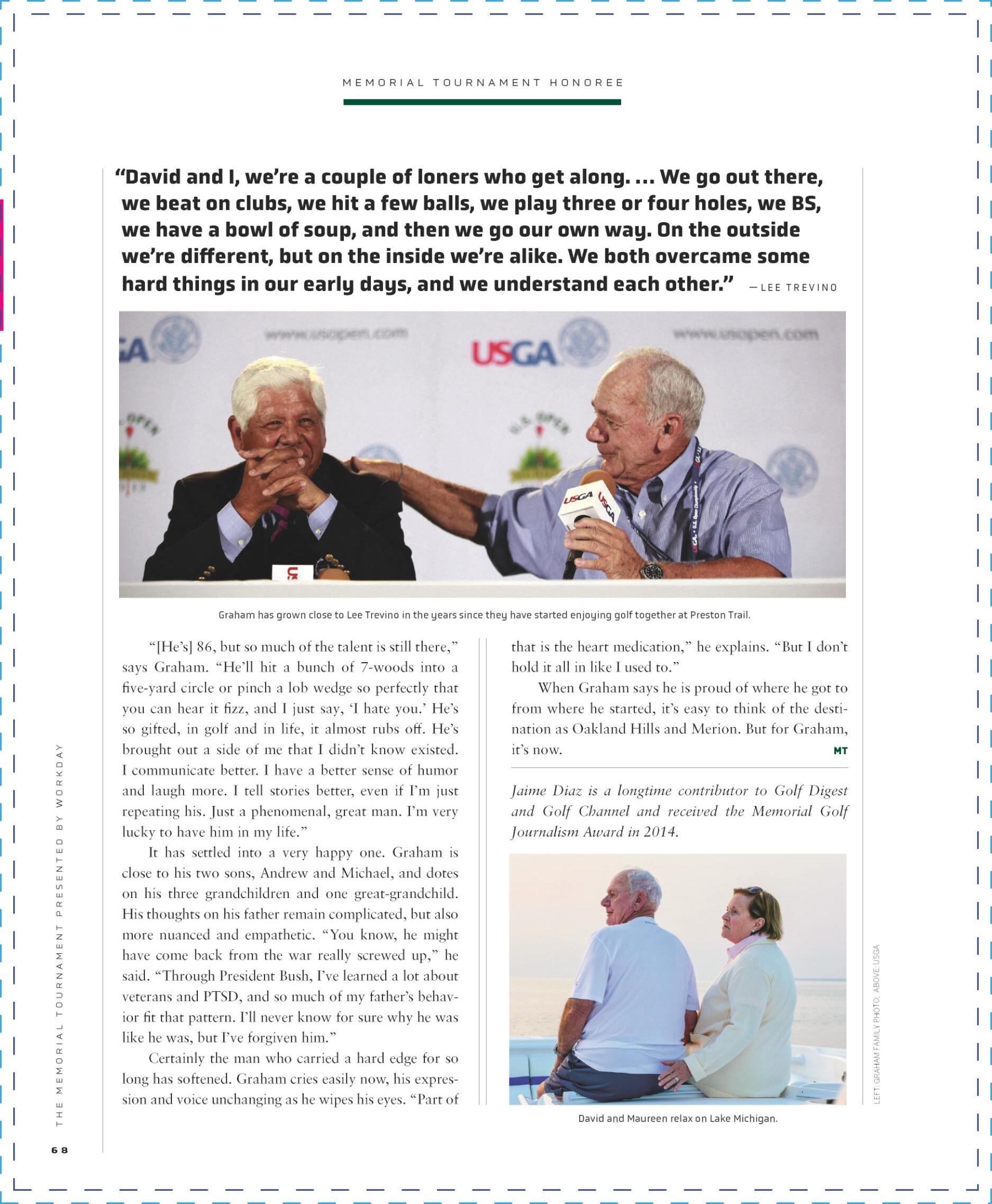
In 2010, he did, although he initially found it difficult to play golf just for fun. “It was hard to stand over a golf ball when it didn’t mean anything, when for so much of your life it meant everything,” he says. But Graham adapted, sometimes playing ultra-casual rounds with Bush and friends at Preston Trail. “I told the president, ‘Thanks for the lesson.’ ” Graham’s reentry was complete when he began mid-morning rendezvous at the club with Trevino, who offers this summary: “David and I, we’re a couple of loners who get along. It’s just the two of us. We don’t

have anyone else, and we don’t want anybody else. We go out there, we beat on clubs, we hit a few balls, we play three or four holes, we BS, we have a bowl of soup, and then we go our own way. On the outside we’re different, but on the inside we’re alike. We both overcame some hard things in our early days, and we understand each other.”
Graham’s health has markedly improved in recent years, and he’s retained an impressive amount of swing

“David and I, we’re a couple of loners who get along. … We go out there, we beat on clubs, we hit a few balls, we play three or four holes, we BS, we have a bowl of soup, and then we go our own way. On the outside we’re different, but on the inside we’re alike. We both overcame some hard things in our early days, and we understand each other.”
—LEE TREVINO

speed and skill. But just as he felt honored to watch Nicklaus, so is he thrilled to witness Trevino’s innate golfing genius.
“[He’s] 86, but so much of the talent is still there,” says Graham. “He’ll hit a bunch of 7-woods into a five-yard circle or pinch a lob wedge so perfectly that you can hear it fizz, and I just say, ‘I hate you.’ He’s so gifted, in golf and in life, it almost rubs off. He’s brought out a side of me that I didn’t know existed. I communicate better. I have a better sense of humor and laugh more. I tell stories better, even if I’m just repeating his. Just a phenomenal, great man. I’m very lucky to have him in my life.”
It has settled into a very happy one. Graham is close to his two sons, Andrew and Michael, and dotes on his three grandchildren and one great-grandchild. His thoughts on his father remain complicated, but also more nuanced and empathetic. “You know, he might have come back from the war really screwed up,” he said. “Through President Bush, I’ve learned a lot about veterans and PTSD, and so much of my father’s behavior fit that pattern. I’ll never know for sure why he was like he was, but I’ve forgiven him.”
Certainly the man who carried a hard edge for so long has softened. Graham cries easily now, his expression and voice unchanging as he wipes his eyes. “Part of
that is the heart medication,” he explains. “But I don’t hold it all in like I used to.”
When Graham says he is proud of where he got to from where he started, it’s easy to think of the destination as Oakland Hills and Merion. But for Graham, it’s now. MT
Jaime Diaz is a longtime contributor to Golf Digest and Golf Channel and received the Memorial Golf Journalism Award in 2014.


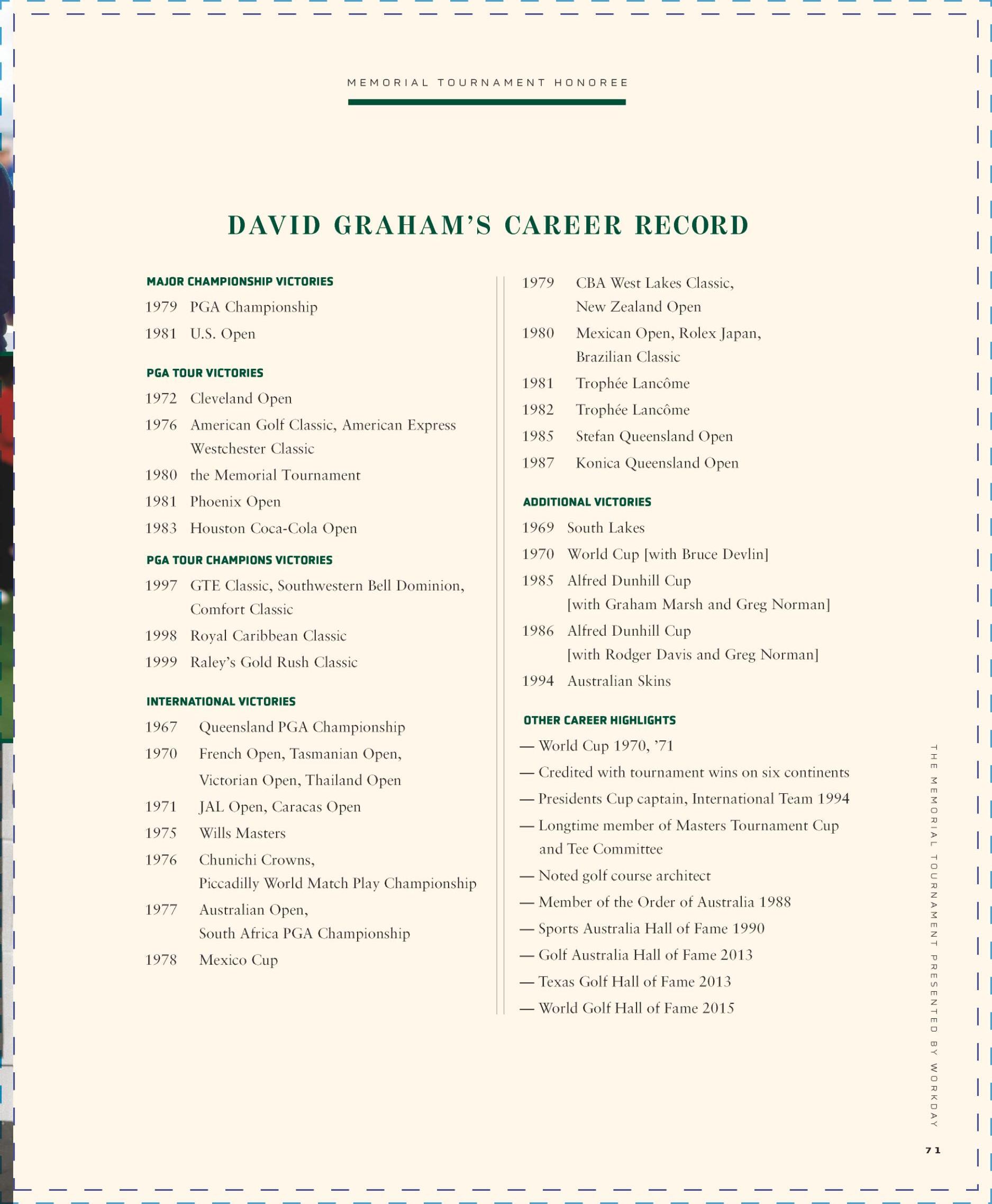
MAJOR CHAMPIONSHIP VICTORIES
1979 PGA Championship
1981 U.S. Open
PGA TOUR VICTORIES
1972 Cleveland Open
1976 American Golf Classic, American Express Westchester Classic
1980 the Memorial Tournament
1981 Phoenix Open
1983 Houston Coca-Cola Open
PGA TOUR CHAMPIONS VICTORIES
1997 GTE Classic, Southwestern Bell Dominion, Comfort Classic
1998 Royal Caribbean Classic
1999 Raley’s Gold Rush Classic
INTERNATIONAL VICTORIES
1967 Queensland PGA Championship
1970 French Open, Tasmanian Open, Victorian Open, Thailand Open
1971 JAL Open, Caracas Open
1975 Wills Masters
1976 Chunichi Crowns, Piccadilly World Match Play Championship
1977 Australian Open, South Africa PGA Championship
1978 Mexico Cup
1979 CBA West Lakes Classic, New Zealand Open
1980 Mexican Open, Rolex Japan,
Brazilian Classic
1981 Trophée Lancôme
1982 Trophée Lancôme
1985 Stefan Queensland Open
1987 Konica Queensland Open
ADDITIONAL VICTORIES
1969 South Lakes
1970 World Cup [with Bruce Devlin]
1985 Alfred Dunhill Cup [with Graham Marsh and Greg Norman]
1986 Alfred Dunhill Cup [with Rodger Davis and Greg Norman]
1994 Australian Skins
OTHER CAREER HIGHLIGHTS
— World Cup 1970, ’71
— Credited with tournament wins on six continents
— Presidents Cup captain, International Team 1994
— Longtime member of Masters Tournament Cup and Tee Committee
— Noted golf course architect
— Member of the Order of Australia 1988
— Sports Australia Hall of Fame 1990
— Golf Australia Hall of Fame 2013
— Texas Golf Hall of Fame 2013
— World Golf Hall of Fame 2015
Allan Robertson might very well have been the greatest golfer who ever lived prior to the advent of modern golf
BY ALEX MICELI
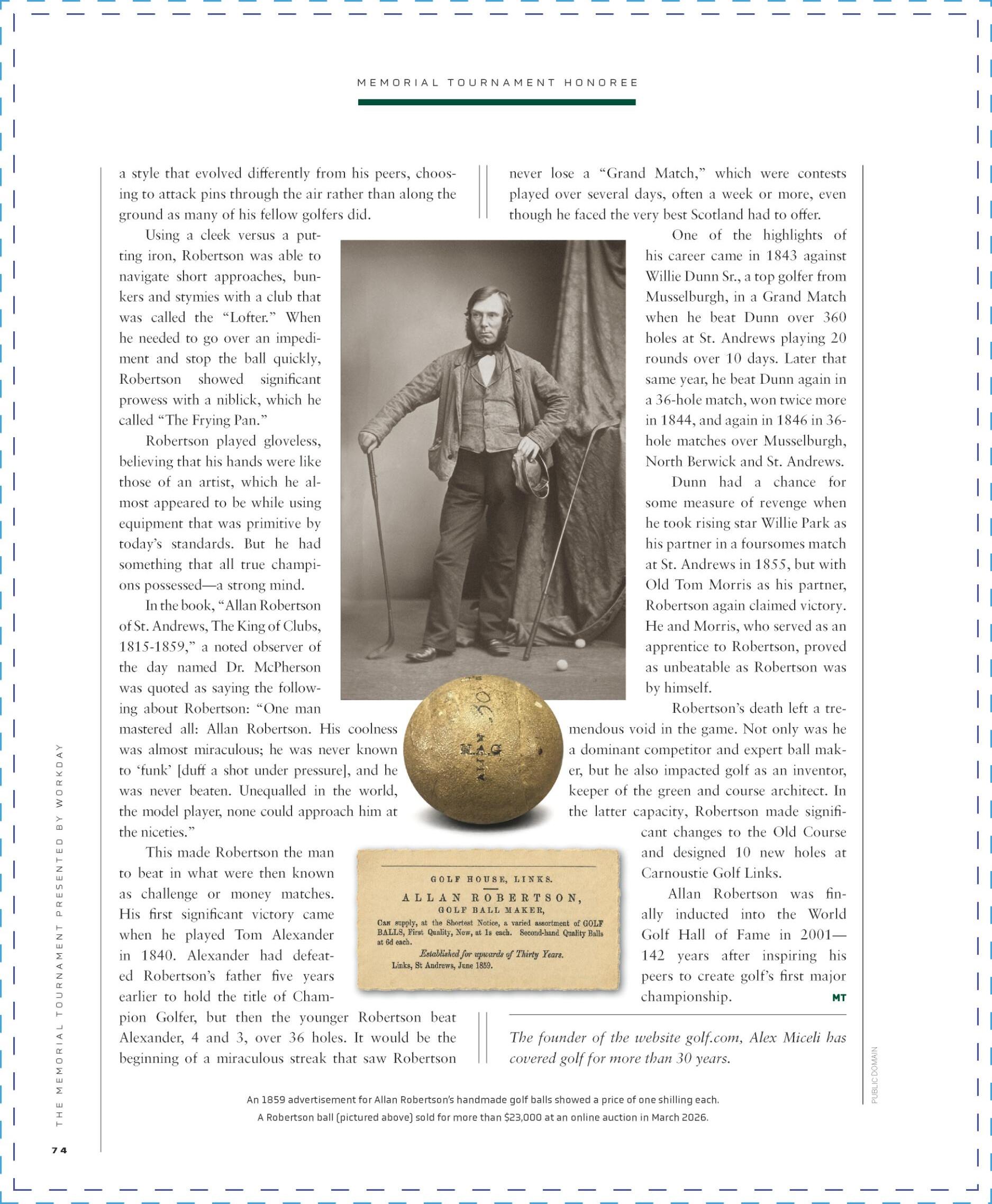
THE FIRST MAJOR CHAMPIONSHIP in golf was conducted in 1860 at Prestwick Golf Club in Scotland. Willie Park Sr. was the winner and earned the title of “Champion Golfer of the Year.”
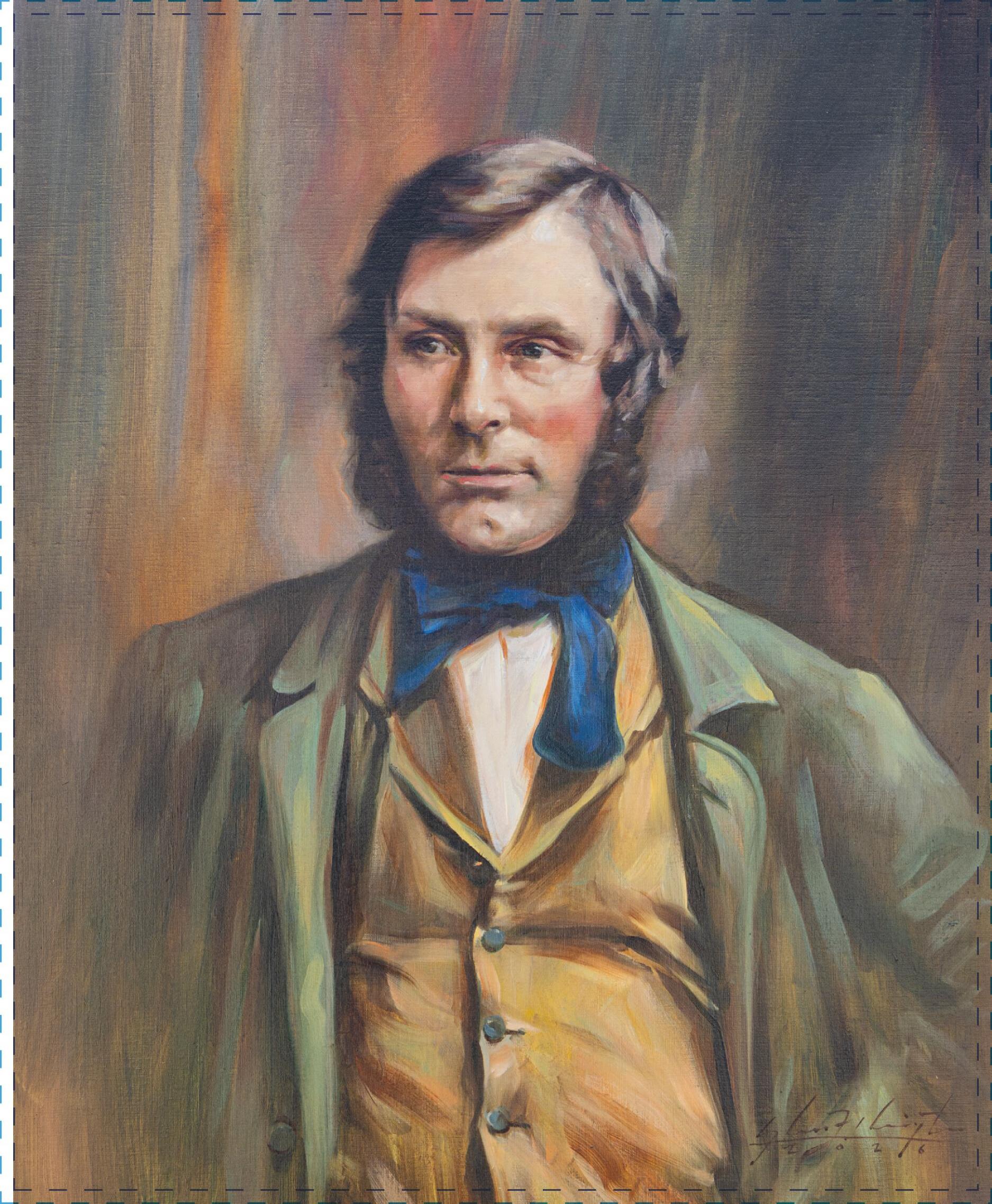
Just a year earlier, the man who would have been the prohibitive favorite, who had been recognized as golf’s dominant player, its “Champion Golfer,” passed away at the age of 43. The loss of St. Andrews native son Allan Robertson hit the Scottish golfing world hard and was the impetus behind the establishment of the first Open Championship, and, thus, the beginning of major championships.
Born September 11, 1815, Robertson, christened by the same reverend who christened another golfing legend, Old Tom Morris, six years later, became known as the “King of Clubs,” because he never lost a money match from 1943 until his death on September 1, 1859, in St. Andrews after an attack of jaundice. Robertson lived in the middle of town off North Street and spent most of his formative years playing golf with those whose last names included Morris, Forgan, Hutchison, Gourlay, Herd, Auchterlonie and Anderson. The men from those families dominated golf for most
of the middle to late 1800s and won numerous Open Championships while establishing St. Andrews as the Home of Golf.
Golf was in the Robertson family genes. Allan’s father, Davie, was a weaver, ball maker and caddie, and he handed down his love of golf and the art of making featherie balls to his son. Allan’s featheries were stamped simply with “ALLAN” in all caps and were coveted by the best players of that time. While known for his mastery as a ball maker, Robertson became the class of competitive golf in Scotland, with

a style that evolved differently from his peers, choosing to attack pins through the air rather than along the ground as many of his fellow golfers did.
Using a cleek versus a putting iron, Robertson was able to navigate short approaches, bunkers and stymies with a club that was called the “Lofter.” When he needed to go over an impediment and stop the ball quickly, Robertson showed significant prowess with a niblick, which he called “The Frying Pan.”
Robertson played gloveless, believing that his hands were like those of an artist, which he almost appeared to be while using equipment that was primitive by today’s standards. But he had something that all true champions possessed—a strong mind.
In the book, Allan Robertson of St. Andrews, The King of Clubs, 1815-1859, a noted observer of the day named Dr. McPherson was quoted as saying the following about Robertson: “One man mastered all: Allan Robertson. His coolness was almost miraculous; he was never known to ‘funk’ [duff a shot under pressure], and he was never beaten. Unequalled in the world, the model player, none could approach him at the niceties.”
never lose a “Grand Match,” which were contests played over several days, often a week or more, even though he faced the very best Scotland had to offer.


This made Robertson the man to beat in what were then known as challenge or money matches. His first significant victory came when he played Tom Alexander in 1840. Alexander had defeated Robertson’s father five years earlier to hold the title of Champion Golfer, but then the younger Robertson beat Alexander, 4 and 3, over 36 holes. It would be the beginning of a miraculous streak that saw Robertson

One of the highlights of his career came in 1843 against Willie Dunn Sr., a top golfer from Musselburgh, in a Grand Match when he beat Dunn over 360 holes at St. Andrews playing 20 rounds over 10 days. Later that same year, he beat Dunn again in a 36-hole match, won twice more in 1844, and again in 1946 in 36hole matches over Musselburgh, North Berwick and St. Andrews.
Dunn had a chance for some measure of revenge when he took rising star Willie Park as his partner in a foursomes match at St. Andrews in 1855, but with Old Tom Morris as his partner, Robertson again claimed victory. He and Morris, who served as an apprentice to Robertson, proved as unbeatable as Robertson was by himself.
Robertson’s death left a tremendous void in the game. Not only was he a dominant competitor and expert ball maker, but he also impacted golf as an inventor, keeper of the green and course architect. In the latter capacity, Robertson made significant changes to the Old Course and designed 10 new holes at Carnoustie Golf Links.
Allan Robertson was finally inducted into the World Golf Hall of Fame in 2001— 142 years after inspiring his peers to create golf ’s first major championship. MT
The founder of the website golf.com, Alex Miceli has covered golf for more than 30 years.


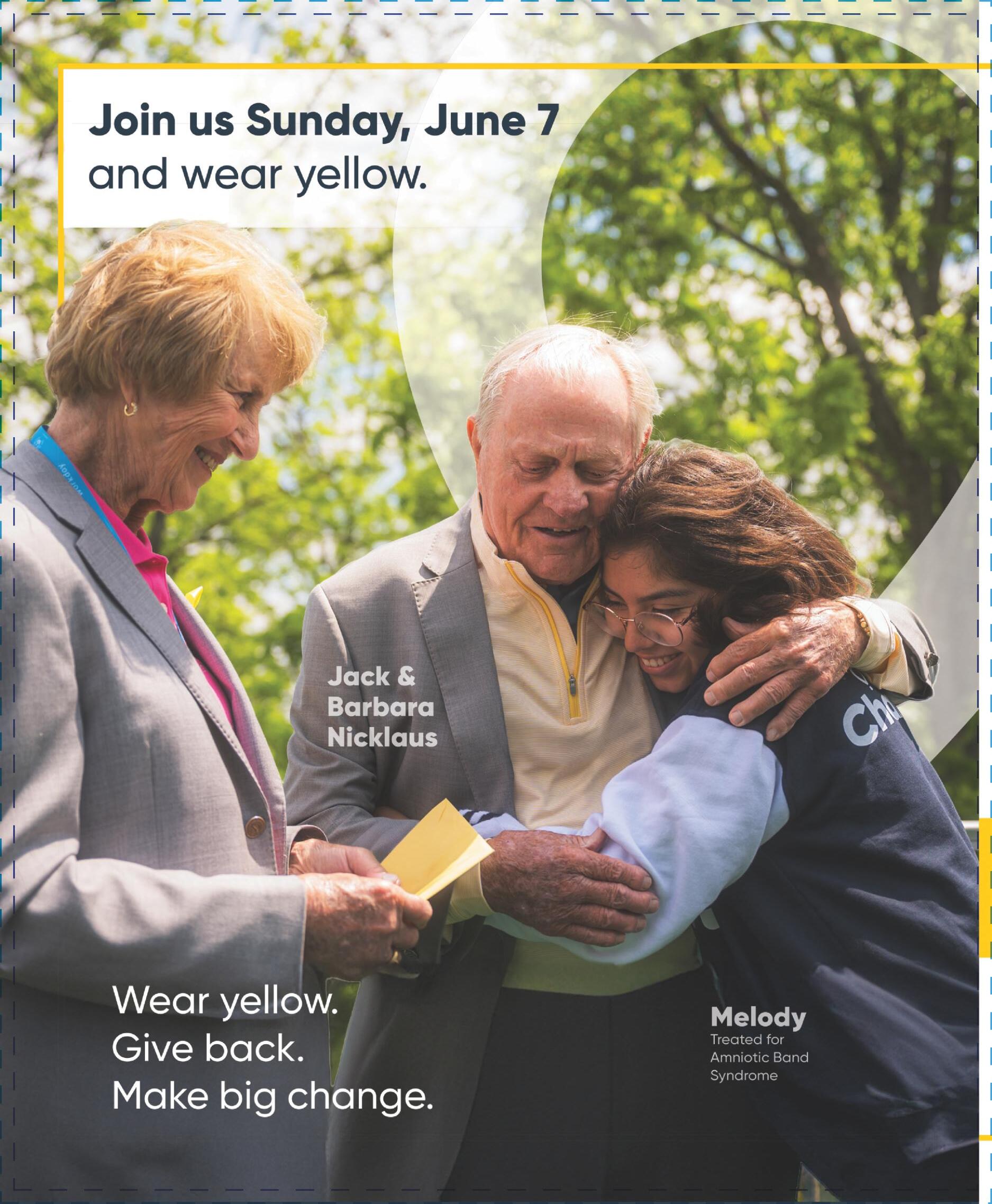
Join us Sunday, June 7 and wear yellow. Jack & Barbara Nicklaus


Wear yellow. Give back. Make big change.


Unite with Children’s Miracle Network®, Jack and Barbara Nicklaus and the PGA TOUR in turning your passion for golf into a force for good.
Play Yellow invites golfers, tournaments and fans to turn their passion for the game into life-changing care. Every dollar raised goes directly to Children’s Miracle Network supporting our network of hospitals across the U.S. and Canada, ensuring every child has the opportunity to grow up strong and get back to being, well ... kids!

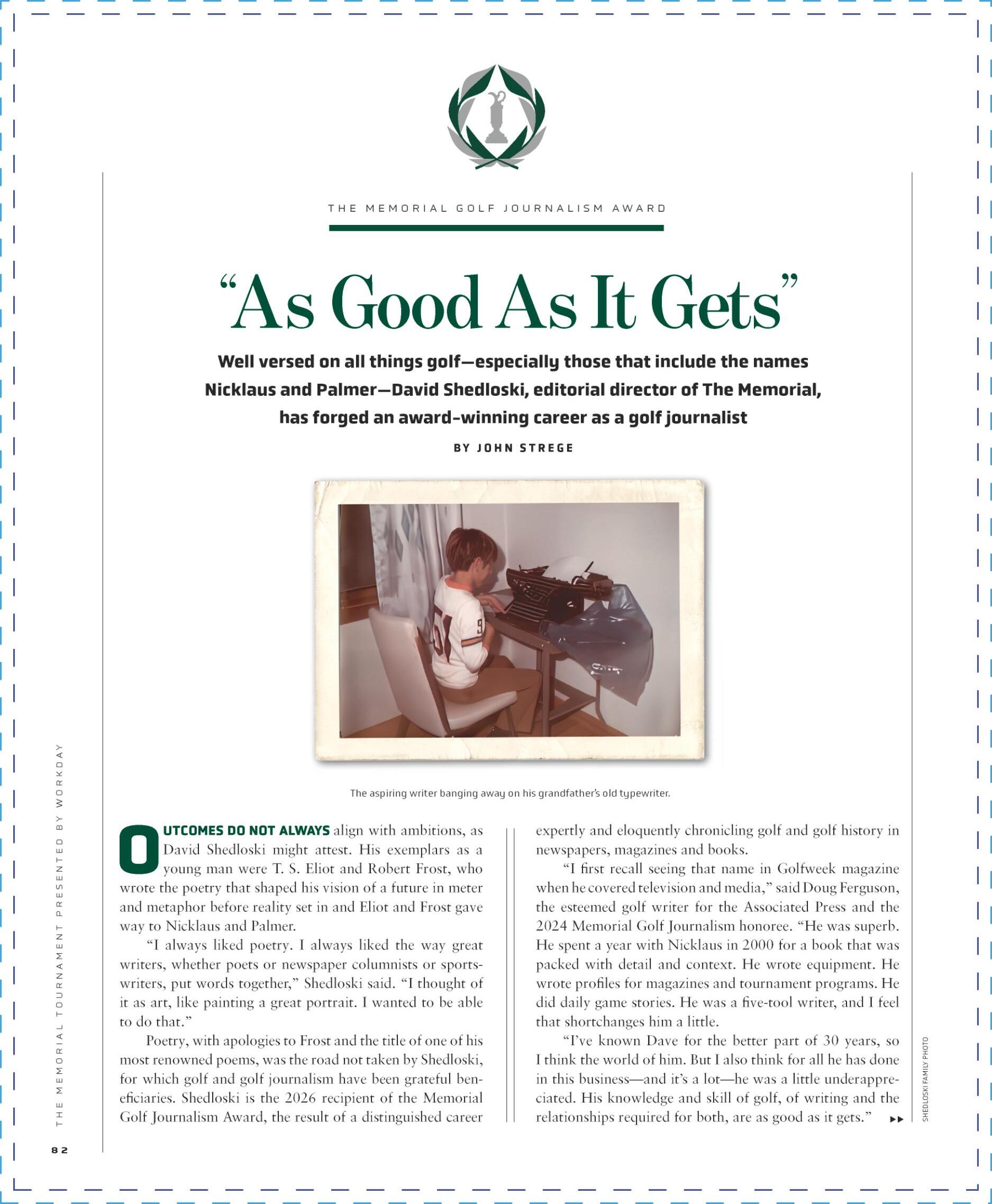
Well versed on all things golf—especially those that include the names Nicklaus and Palmer—David Shedloski, editorial director of The Memorial, has forged an award-winning career as a golf journalist
BY JOHN STREGE

OUTCOMES DO NOT ALWAYS align with ambitions, as David Shedloski might attest. His exemplars as a young man were T. S. Eliot and Robert Frost, who wrote the poetry that shaped his vision of a future in meter and metaphor before reality set in and Eliot and Frost gave way to Nicklaus and Palmer.
“I always liked poetry. I always liked the way great writers, whether poets or newspaper columnists or sportswriters, put words together,” Shedloski said. “I thought of it as art, like painting a great portrait. I wanted to be able to do that.”
Poetry, with apologies to Frost and the title of one of his most renowned poems, was the road not taken by Shedloski, for which golf and golf journalism have been grateful beneficiaries. Shedloski is the 2026 recipient of the Memorial Golf Journalism Award, the result of a distinguished career
expertly and eloquently chronicling golf and golf history in newspapers, magazines and books.
“I first recall seeing that name in Golfweek magazine when he covered television and media,” said Doug Ferguson, the esteemed golf writer for the Associated Press and the 2024 Memorial Golf Journalism honoree. “He was superb. He spent a year with Nicklaus in 2000 for a book that was packed with detail and context. He wrote equipment. He wrote profiles for magazines and tournament programs. He did daily game stories. He was a five-tool writer, and I feel that shortchanges him a little.
“I’ve known Dave for the better part of 30 years, so I think the world of him. But I also think for all he has done in this business—and it’s a lot—he was a little underappreciated. His knowledge and skill of golf, of writing and the relationships required for both, are as good as it gets.”


Bernard
O.B. Keeler
Henry
Grantland
Bob
Ronald
Lincoln
Renton
Michael

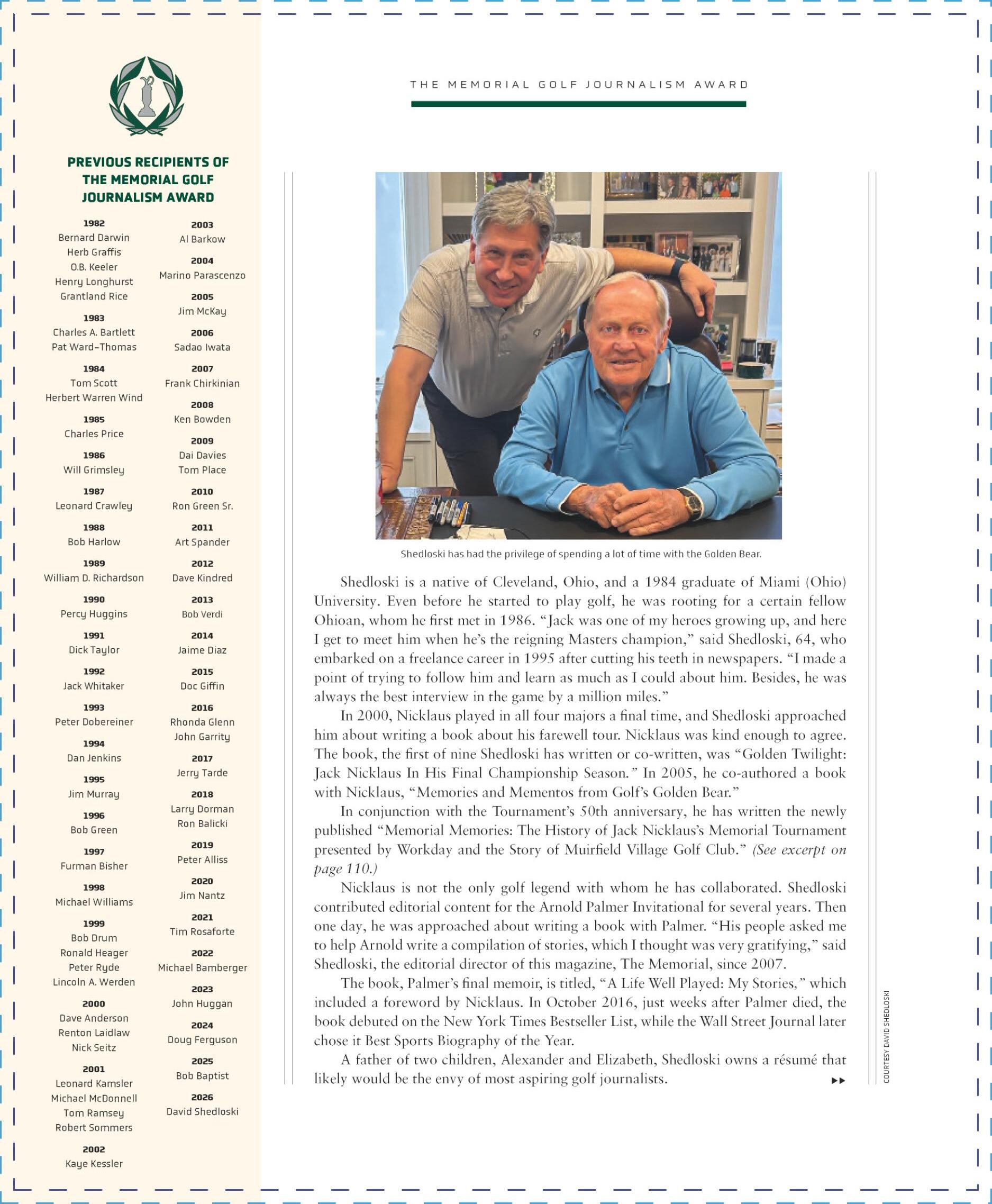
Shedloski has had the privilege of spending a lot of time with the Golden Bear
Shedloski is a native of Cleveland, Ohio, and a 1984 graduate of Miami (Ohio) University. Even before he started to play golf, he was rooting for a certain fellow Ohioan, whom he first met in 1986. “Jack was one of my heroes growing up, and here I get to meet him when he’s the reigning Masters champion,” said Shedloski, 64, who embarked on a freelance career in 1995 after cutting his teeth in newspapers. “I made a point of trying to follow him and learn as much as I could about him. Besides, he was always the best interview in the game by a million miles.”
In 1999, Nicklaus announced that his 2000 season would be the last year in which he would play in all four major championships. Shedloski approached him about writing a book about his farewell tour, and Nicklaus was kind enough to agree. The book, one of eight Shedloski has written, was Golden Twilight: Jack Nicklaus In His Final Championship Season. In 2005, he co-authored a book with Nicklaus, Memories and Mementos from Golf’s Golden Bear.
In conjunction with the Tournament’s 50th anniversary, he has written the newly published Memorial Memories: The History of Jack Nicklaus’ Memorial Tournament presented by Workday and Muirfield Village Golf Club. (See excerpt on page 110.)
Nicklaus is not the only golf legend with whom he has collaborated. Shedloski contributed editorial content for the Arnold Palmer Invitational for several years. Then one day, he was approached about writing a book with Palmer. “His people asked me to help Arnold write a compilation of stories, which I thought was very gratifying,” said Shedloski, the editorial director of this magazine, The Memorial, since 2007.
The book, Palmer’s final memoir, is titled, A Life Well Played: My Stories, which included a foreword by Nicklaus. In October 2016, just weeks after Palmer died, the book debuted on the New York Times Bestseller List, while the Wall Street Journal later chose it Best Sports Biography of the Year.
A father of two children, Alexander and Elizabeth, Shedloski owns a résumé that likely would be the envy of most aspiring golf journalists.


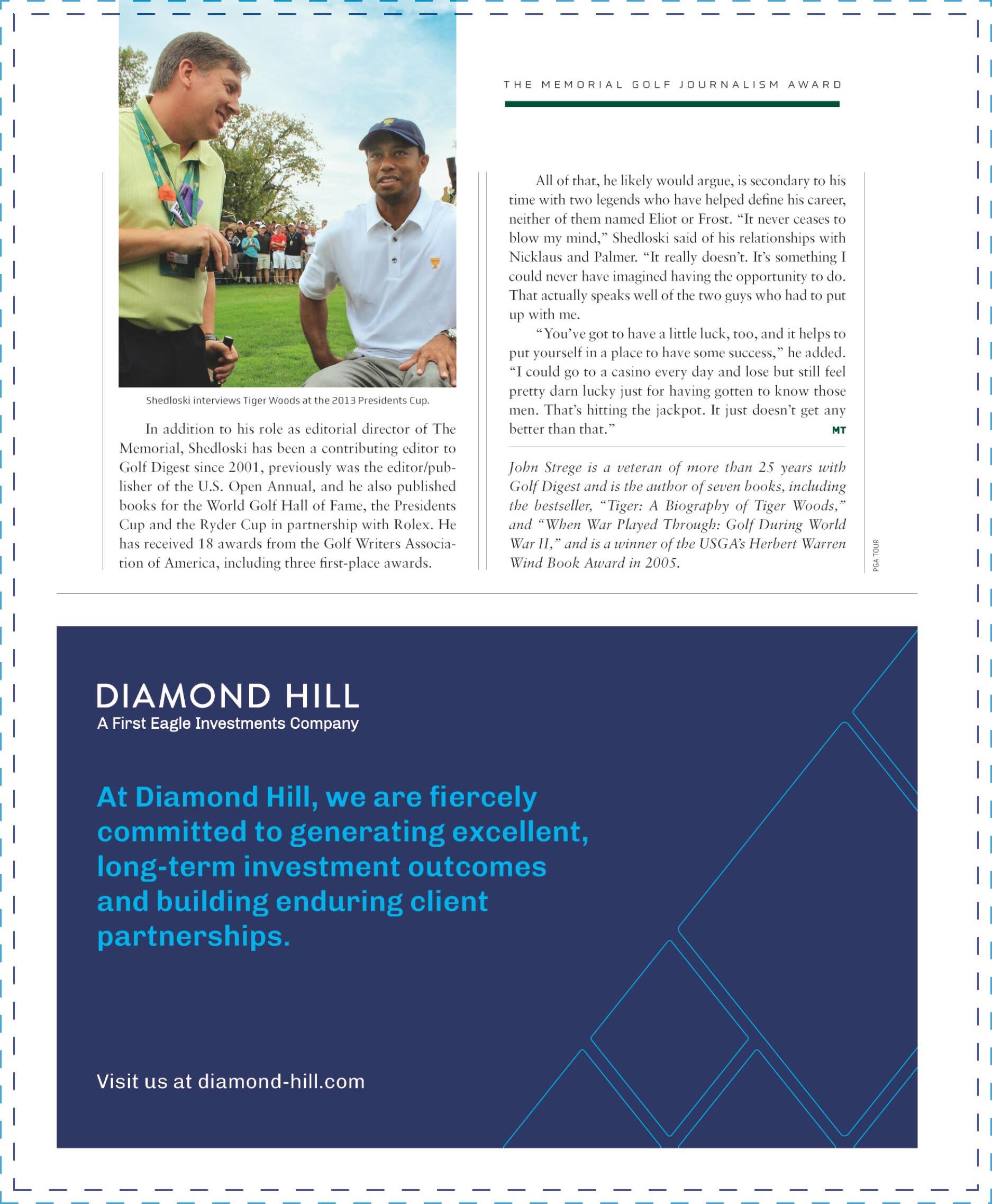
In addition to his role as editorial director of The Memorial, Shedloski has been a contributing editor to Golf Digest since 2001, previously was the editor/publisher of the U.S. Open Annual, and he also published books for the World Golf Hall of Fame, the Presidents Cup and the Ryder Cup in partnership with Rolex. He has received 18 awards from the Golf Writers Association of America, including three first-place awards.
All of that, he likely would argue, is secondary to his time with two legends who have helped define his career, neither of them named Eliot or Frost. “It never ceases to blow my mind,” Shedloski said of his relationships with Nicklaus and Palmer. “It really doesn’t. It’s something I could never have imagined having the opportunity to do. That actually speaks well of the two guys who had to put up with me.
“You’ve got to have a little luck, too, and it helps to put yourself in a place to have some success,” he added. “I could go to a casino every day and lose but still feel pretty darn lucky just for having gotten to know those men. That’s hitting the jackpot. It just doesn’t get any better than that.” MT
John Strege is a veteran of more than 25 years with Golf Digest and is the author of seven books, including the bestseller, “Tiger: A Biography of Tiger Woods,” and “When War Played Through: Golf During World War II,” and winner of the USGA’s Herbert Warren Wind Book Award in 2005.
“I’m always committed to an amazing experience, and so is Germain Lexus.
That’s why I’m proud to call Lexus the official car of the Memorial Tournament presented by Workday.” - Jack Nicklaus


Four major championships, back-to-back Memorial titles, No. 1 in the world for longer than anyone but Tiger … there’s no end in sight for Scottie Scheffler’s ascension
BY GARY VAN SICKLE
ANEW JERSEY TODDLER celebrated his third birthday in 1999 one day after Payne Stewart celebrated winning the U.S. Open on the final green at Pinehurst No. 2 in Pinehurst, North Carolina.
It was kind of a big deal.
The kid’s birthday, that is. Stewart’s victory, too.
That 3-year-old was Scottie Scheffler. It was a big-deal day because his parents’ birthday gifts included a toddler-sized set of oversized plastic golf clubs.
That might be all you need to know to understand Scheffler. Because Tiny Scottie was soon using those clubs to hit ping-pong balls around the family’s Montvale home. He liked to hit the spinny balls and curve them into rooms. A slice into the bedroom, maybe. A draw into a laundry hamper. Does the toilet count as a water hazard? Kids have imaginations.
… when he [Scheffler] won The American Express in January, he joined Nicklaus and Woods with 20 PGA TOUR wins, including four majors, before the age of 30.

Tiny Scottie was obsessed with the clubs, according to his parents, Scott and Diane. “Obsessed” is the appropriate word. What other toddler would be trying to work the ball both ways? Probably a pre-school Tiger Woods. Prodigy, meet Prodigy. Mozart, say hello to da Vinci.
Twenty-seven years later, the shots are the same. Only now, Big Scottie carves, cuts and draws around championship golf layouts such as Augusta National, Royal Portrush, Muirfield Village Golf Club and TPC Sawgrass instead of the Scheffler family room, and he does it better than anyone else currently playing. (No offense, Mr. Career Grand Slammer Rory McIlroy.)
It appears that we are firmly in the Scottie Scheffler Era. During last year’s Christmas break, Golf Channel ran a series, “The 12 Days of Scottie.” It featured finalround replays from all 22 of Scheffler’s wins through 2025 (including the Olympics and unofficial events), from the four-putt green on the final hole to win his first Masters in 2022 to his surgical dissection of Royal Portrush in last year’s Open Championship.
So yes, Scottie Scheffler, the winner of the last two editions of the Memorial Tournament presented by Workday, is enjoying his time atop the game.
Who is he and how did he arrive here? With apologies to Golf Channel, here are “The 12 Ways of Scottie.”
All rise, please
THE LAST FOUR YEARS were the beginning of the Scottie Scheffler Era, a victory-packed stretch that caused his name to slip into sentences also mentioning Tiger Woods and Jack Nicklaus.
Remember, Scheffler had zero PGA TOUR victories when 2022 started. By mid-April, he had four wins and a Green Jacket. By the end of 2025, Scheffler had Hallof-Fame credentials. He won big tournaments and won in bunches, the way Jack and Tiger did. In fact, when he won The American Express in January, he joined Nicklaus and Woods with 20 PGA TOUR wins, including four majors, before the age of 30.
Don’t forget he owns a thrilling Olympic gold medal in France. And already he has been ranked No. 1 in the world for more weeks than anybody besides Tiger.
“The golfing world didn’t think it would see someone as dominant as Tiger come through so soon and here’s Scottie taking that throne of dominance,” said Xander Schauffele, who in 2024 captured the PGA Championship and Open Championship.
Peak Scheffler (so far) came at last summer’s 153rd Open in Northern Ireland. Scheffler breezed around mighty Royal Portrush for a fourth straight round and finished a stunning 17 strokes under par, extinguishing Rory McIlroy’s third-round charge that had Irish fans hustling and scrambling over the rugged linksland like Arnie’s Army reincarnated.
However, McIlroy’s 66 gained only one stroke on Scheffler and left him six behind the man who’d won the last 10 times he held the 54-hole lead. McIlroy searched for words in a post-round TV interview and settled on, “It’s inevitable.” Did he mean Scheffler winning the Open was inevitable? (It was.) Or that Scheffler is the inevitable winner for the foreseeable future? (A possible reality.)
“I have not seen a competitor anywhere close to Tiger Woods as good as this guy,” Paul McGinley, an
Scott Scheffler is on the bag for little Scottie.


We’re transforming the entire commercial insurance lifecycle, from prospecting to placement, to ensure business owners find protection quickly and easily.


Irishman and former European Ryder Cup captain, gushed on Golf Channel’s “Live From” show at Royal Portrush. “That’s how high the bar is. As time goes on, he might prove to be a better one.”
THE THOROUGH FOLKS at Augusta National Golf Club seldom get anything wrong, so Scheffler was surprised at the 2021 Masters when the calligraphy scoreboard for fans near the first fairway incorrectly listed Scottie’s hometown as Las Vegas. Scott asked his son if he should have it corrected to Ridgewood, New Jersey.
“I don’t think I’ve ever been to Ridgewood,” the younger Scottie Scheffler said.
“You were born there,” his dad responded, adding, “I know, I was the one who brought you home.”
The Schefflers, who also have three daughters, moved to Dallas when Scottie was 6 years old after Diane landed a job with a prestigious area law firm.
THE MOST IMPORTANT THING to know about Scheffler is his lineup card: One, faith; two, family (wife Meredith, son Bennett and newborn Remy); three, golf.
He is not chasing the number 18 (Nicklaus’ record total of professional major wins) or any other number. He is simply working as hard as he can in order to execute and perform at his highest level. And it’s proven to be a very high level. Scheffler loves the challenge of competition. Winning isn’t everything for him, however, and the way he compartmentalizes golf and keeps it in perspective surprised many before last summer’s Open Championship at Royal Portrush.
“A lot of people make it to what they thought was going to fulfill them in life, and you get there, you get to No. 1 in the world, and they’re like, ‘What’s the point?’ ” Scheffler said. “That’s something I wrestle with on a daily basis. Why do I want to win the Open Championship
2026 — 1 (to date)
The American Express 2025 — 6
Procore Championship
BMW Championship
The Open Championship (major) the Memorial Tournament presented by Workday
PGA Championship (major)
CJ Cup Byron Nelson
2024 — 7
TOUR Championship
Travelers Championship the Memorial Tournament presented by Workday
RBC Heritage
Masters Tournament (major)
THE PLAYERS Championship
Arnold Palmer Invitational presented by Mastercard 2023 — 2
THE PLAYERS Championship
WM Phoenix Open
2022 — 4
Masters Tournament (major)
World Golf Championships-Dell Technologies Match Play
Arnold Palmer Invitational presented by Mastercard
WM Phoenix Open
so badly? I don’t know, because if I win, it’s going to be awesome for two minutes. Then we’re going to the next week. I love the challenge. I love being able to play this game for a living. It’s one of the greatest joys of my life, but does it fill the deepest wants and desires of my heart? Absolutely not.”
Being a father and a husband and sharing their faith is what gives him joy. Not everyone understood, but Nike, one of Scheffler’s main sponsors, struck the right tone with a win ad after Royal Portrush. It featured two pictures. One showed Scheffler in his follow-through position with the message, “But another major never hurt.” The other was a picture of Scheffler and 1-yearold son Bennett playing on a green. The caption: “You have already won.”


IT WAS ONLY A FEW QUESTIONS into the winner’s press conference at the Open Championship last July before Scheffler was asked about being compared with Tiger. He doesn’t like those questions, because he doesn’t consider them relevant.
“I think they’re a bit silly,” Scheffler said. “Tiger won what, 15 majors? This is my fourth. I just got onefourth of the way there. Tiger stands alone in the game of golf.”
Scheffler is a late bloomer compared to Tiger’s path. Woods won 10 of his 15 majors in his 20s. Scheffler, who turns 30 in June, had five after Royal Portrush. Woods completed the Career Grand Slam at 24. Scheffler still has an empty spot on his bingo card for the U.S. Open. Woods won a U.S. Open by 15 strokes, a Masters by 12 and an Open Championship by 8. Scheffler’s four major titles were by three (with
a four-putt on the final Masters green), four, five and four strokes, in chronological order. Those are sizable victory margins but not Tiger-sized. He does share a record with Tiger for winning PGA TOUR Player of the Year honors four years in a row.
Don’t wait for the Next Tiger. Instead, enjoy the First Scheffler.
PARDON THE CONTINUED COMPARISON shopping but Golf Channel analyst-historian Brandel Chamblee thinks most of us are tying Scheffler to the wrong legend.
“Tiger’s record emulated Jack’s more closely than anybody else, but Scottie Scheffler’s swing emulates Jack’s more closely than anybody else,” Chamblee said. “Watching Scottie play is like Jack eerily coming back to life in front of our eyes. Nobody put the club in the


“In transition, both Jack and Scottie have strong grips, shut faces, massive right-side bends and massive rotations with the lower body,” Chamblee explained. “Their lower bodies begin to move toward the target before their upper bodies finish the backswings. They keep their bodies closed in transition to ensure they hit the inside part of the ball. They rotate late, so massively and so quickly that they control the release with the rotation of their bodies, not by flipping their hands. “So Scottie has a lot of pent-up force waiting to be unleashed, and that’s exactly why his left foot has to get the hell out of the way. His transition and Jack’s are unlike anybody else’s in the game. It’s the reason they’re the most reliable ball-strikers on the planet.”
6 Taking the bait
THE BUDDING SCHEFFLER sports empire is starting small. Scheffler is part of the group that owns the Texas Lone Stars Angling Club, a professional fishing-league franchise that won the Sports Fishing Championship title in Mexico last October. The Lone Stars caught and released 41 striped marlin and one blue marlin to snag the championship. Like Scheffler hadn’t done enough winning already.
Would crediting him with seven wins in 2025 sound fishy? Maybe, but he also bought into the Texas Ranchers, a Major Pickleball League (MPL) franchise. Yes, pro pickleball really is a thing.


position that Jack did, and nobody puts the club in the position that Scottie does today. They’re absolutely identical at the top and so are their releases.”
Chamblee can run down a checklist of similarities. Both players have upright swings with relatively neutral grips, and both have flying right arms in the backswing and a shallow, stable release pattern.
7 Man at work
ZACH JOHNSON remembers his first impression of Scheffler in 2021. Johnson, a two-time major champion, was one of Steve Stricker’s vice captains for the Ryder Cup later that year. It was at a PGA TOUR stop in an early round—Johnson isn’t sure which tournament—but Scheffler played early in the morning around 8, Johnson said, while he teed off around 2.
Bridge PArk’s LARGEST music & street festival is back! Join us after the Memorial Tournament presented by Workday for live music, games, food, drinks, Local vendors and FREE fun for the entire family. Learn more at Forefest.com.


Johnson finished his round, hit a few putts, then went to the training table to get worked on. Before he was done, Scheffler showed up and was waiting for the table. They shared the same trainer at the time.
“I asked Scottie, ‘What are you still doing here?’ ” Johnson recalled. “He said, ‘Oh, I just needed to get some work in.’ I thought, ‘This guy is dumb. He’s putting that much work in on a tournament day?’ After that, I started to notice the amount of work he put into his game every day. It was impressive. And then lo and behold, next year happened.”
The following spring, Johnson and Scheffler made the Waste Management Phoenix Open cut on the number, were paired together and teed off on the back nine for Saturday’s third round.
“Scottie made a 40-footer on 18, our ninth hole, to get to 7 under, then shot 2 under on the front [for 62] and went on to win the tournament,” Johnson said. “What I witnessed in those 18 holes, I hadn’t seen anyone do with the exception of one other individual.”
Does that individual’s first name rhyme with Liger? Johnson was asked. He grinned. “It does,” Johnson said.
EVEN THOUGH SCOTTIE SCHEFFLER won a U.S. Junior Amateur title, was named the Phil Mickelson Freshman of the Year at Texas and helped the Longhorns win three Big 12 titles, Scheffler was not an obvious future superstar. One reason was his physical change. Scheffler was 5 feet 1 inch, 100 pounds in eighth grade. By the middle of his college career, he stood 6-3, 200 pounds, a stunning growth spurt.

“The ground was in a different place for him every day for a few years,” joked Chamblee, also a Texas alum.
Besides adjusting his swing to this new altitude, Scheffler also took school seriously.
“He did kind of sneak up on us,” said Chamblee, “but come to find out, he was getting a business degree [at Texas’ prestigious McCombs School of Business] while playing golf. I can promise you, Tiger wasn’t doing that. Phil Mickelson wasn’t doing that. Ben Crenshaw wasn’t doing that. Scottie wanted to know what it was like to be an elite student.”
Scheffler graduated in 2018, won two Korn Ferry Tour titles in 2019—including the Nationwide Children’s Hospital Championship in Columbus—and reached the PGA TOUR in 2020, when he gave a glimpse of things to come by finishing 19th at the Masters and fourth at the PGA Championship at Harding Park.
“I CAN’T HELP BUT THINK THAT WE ARE ON AN INEVITABLE MARCH TOWARD ONE OF THE GREATEST CAREERS IN GOLF HISTORY.”
—BRANDEL CHAMBLEE
THE WORLD’S NO. 1 GOLFER is incredibly normal. His favorite restaurant is the popular chain Chipotle Mexican Grill. Now that Scheffler is famous for his golf and for appearing in the comedy, “Happy Gilmore 2,” he has to be careful.
“There are two Chipotles I eat at when I’m home— only one, anymore,” Scheffler said. “There’s one near Southern Methodist University’s campus near where I grew up. If I go to that Chipotle now, it would be very difficult for me. There’s another one in a different part of town that if I go there, nobody recognizes me, ever.”
Laughing, he adds, “I’m not going to tell you where it is.”

RANDY SMITH, Scheffler’s long-time coach, believes Scheffler has a special underrated, indefinable skill.
“He has this ability to see the break on a green from the fairway,” Smith told Mark Immelman on his “On The Mark” podcast. “Sure, he plays practice rounds, but he reads the green from 185 yards out like he reads a 30-foot putt. He always knows exactly what the greens do. With a lofted club, he’ll play the break off the pin, and if it’s going to spin back 10 feet, he knows which way that ball will move.
“I watched dang near every shot he played [at Royal Portrush]. You could just see the way he looks into the theater of the green and the information he’s taking from it. He sees those things; he won’t admit to it.”
11
Size doesn’t matter
THIS COULD BE SOMETHING or this could be nothing, but Scheffler’s shoe size is the same as Tiger’s—11½.
CHAMBLEE AGAIN on Golf Channel’s “Live From” show after Scheffler’s Open Championship victory: “I can’t help but think that we are on an inevitable march toward one of the greatest careers in golf history.”
Inevitable is a strong word. But if the shoe fits. MT
A frequent contributor to The Memorial, Gary Van Sickle has covered golf since 1980 for several news outlets, including Golf World and Sports Illustrated.


BY ASHLEY GRIMMER

AT A TOURNAMENT where history matters as much as the score, Scottie Scheffler found himself at the center of both.
With his four-shot victory in the 50th edition of the Memorial Tournament presented by Workday, Scheffler became only the second player in Tournament history to receive the coveted Nicklaus handshake in consecutive years, a feat previously accomplished only by Tiger Woods, who won his third straight Memorial 25 years ago and went on to capture the title at Muirfield Village Golf Club five times overall.
Scheffler’s win was his third in four starts in 2025, a dominant stretch that included titles at the CJ Cup Byron Nelson and the PGA Championship at Quail Hollow Club in Charlotte. By claiming his 16th career PGA TOUR win with his second straight Memorial victory, Scheffler joined an elite group, including Sam Snead, Jack Nicklaus and Woods, as one of the players to reach the milestone the fastest.
Muirfield Village Golf Club presented a demanding four-day test as a rain-softened start gave way to firm
ABOVE:
fairways and fast greens. “We didn’t have two days alike, and your champion is the one who manages all those conditions,” Nicklaus said.
As the only player to break par in all four rounds, “Scottie managed them,” Nicklaus added.
Through the first three rounds, Scheffler showed control, posting back-to-back 70s before a bogey-free 68 on Saturday gave him the outright lead after 54 holes. Scheffler forged a one-stroke lead over Ben Griffin, who was seeking to follow up his win from the prior week at the Charles Schwab Challenge. The duel on Sunday between the two men reached a crucial point at the par-5 11th hole. After his only bogey of the day at the 10th— his first in 40 holes—reduced his lead back to one shot, Scheffler answered with a 15-foot birdie putt while a stunned Griffin then missed from four feet to restore a two-shot cushion. The lead swelled to four after Griffin suffered back-to-back bogeys at Nos. 12 and 13.
Griffin made a spirited charge down the stretch with a 12-foot eagle at the par-5 15th and a follow-up birdie


from 25 feet on the par-3 16th, but Scheffler never waivered. He capped off Muirfield’s arduous closing trio of holes with three pars to successfully defend his title and win the $4 million first prize. The native Texan won for the ninth straight time with a 54-hole lead, closing with a 70 and 10-under 278 total.
Griffin ended up with a 73 and 6-under 282 aggregate score. He had held the first-round lead with a 65, two strokes better than Collin Morikawa, and he shared the second-round lead with Canada’s Nick Taylor at 7-under 137. Scheffler was three back after 36 holes.
The cut came in at 5-over 149, at the time the highest 36-hole cut score of the season on TOUR, with 57 players among a field of 72 making the weekend.
In a year when the Tournament honored Barbara Nicklaus, wife and anchor to Founder and Host Jack Nicklaus, it was fitting that Scottie gave a nod of gratitude to his own wife, Meredith.
“My wife is my biggest supporter,” Scheffler said coming off the 18th. “She is my best friend. This is our life out here on the road, and it’s been a lot of fun. We’ve had some special memories at this Tournament and I definitely couldn’t do it without her.”
It’s not hard to draw comparisons between Scheffler and Nicklaus: their family values, competitive consistency and excellence at Muirfield Village. Scheffler’s second title felt less like a surprise and more like a confirmation.
“Scottie, he didn’t play, for him, spectacular golf,” Nicklaus said. “He played what he should do. He played good, solid, smart golf and, you know, three 70s and a 68, that’s pretty good golf under the conditions that were out there.
“That’s what the best player in the world does.”
In the end, Scheffler received the handshake from Nicklaus that he had hoped for, and, in case baby needs a new pair of shoes, that cool $4 million. “It means a lot to shake his hand and win this Tournament,” Scheffler added, “with all the history here and what Mr. Nicklaus means to golf.”
MT
Ashley Grimmer is manager, communications, for the Memorial Tournament.

CELEBRATE RESPONSIBLY ®


A young Jack Nicklaus, inspired by the Masters Tournament, made his dream of hosting his own premier event a reality 50 years ago
BY DAVID SHEDLOSKI
Editor’s note: The following is an excerpt from the just-published book, Memorial Memories: A history of Jack Nicklaus’s Memorial Tournament presented by Workday and Muirfield Village Golf Club
The book was written in conjunction with the celebration of this year’s 50th anniversary of the Memorial Tournament and to commemorate the rich history of Muirfield Village dating back 60 years ago to the first land purchase on which a large part of Muirfield Village stands today.
This excerpt is from Chapter One: “It Starts With A Dream,” which recounts the period of time in the early1960s when a young Nicklaus, only a few years into his professional career, began thinking about creating a world-class golf course in his hometown of Columbus, Ohio, that could host a top-notch professional golf event.
ANYONE WHO EMBARKS on an enterprise that, fundamentally, puts the proverbial cart before the horse is almost certainly doomed to failure. Jack William Nicklaus happens to be an exception. And exceptionally so.
When his idol, Bobby Jones, revealed in 1931—not even a year removed from his Grand Slam conquest—that he was planning to create a golf club in Augusta, Georgia, Jones explained that his ambition was “to build a golf course that may probably be recognized as one of the great golf courses of the world” with “a representative group of members from throughout the world.” Holes he designed with architect Alister MacKenzie were meant to replicate, loosely, some of the famous holes Jones had played throughout his career. It wasn’t until late 1933, more than a year after he opened Augusta National Golf Club, that Jones and co-founder Clifford Roberts decided to host an invitational tournament.


... the fact is that Muirfield Village Golf Club would not exist without Nicklaus’s burning desire to host a golf tournament.
That event, the Masters, was the inspiration behind Nicklaus’s desire to hold a tournament of similar high quality in his hometown of Columbus, Ohio. “We started with the idea of a tournament for the people of Columbus who had supported me,” Nicklaus explained.
“I’ve always loved the Masters. I’ve always loved what it meant to golf,” he went on. “And I’ve always loved Jones’s position in the game, his doing something for the game.”
Not that a golf course for this erstwhile “Masters of the North” was an afterthought. But the fact is that
Muirfield Village Golf Club would not exist without Nicklaus’s burning desire to host a golf tournament. And the Memorial Tournament could not exist, could not be the resounding success it has become, without the masterpiece that is the course at Muirfield Village, a course that Nicklaus once said, “reflects what has happened in my life, what golf means to me.”
Jones couldn’t have said it any better.
Jack made one thing clear before even a single edition of the Memorial Tournament had been conducted. The two entities, Memorial Tournament and Muirfield Village, were existentially intertwined at conception,

dual enterprises that were two sides of a single coin more valuable to him than any amount of money— a sentiment he would express time and again and prove with significant investment of his personal treasure. No other distinguished place on earth, not even Augusta National or the Old Course at St. Andrews, was made in such fashion. Longtime Columbus Dispatch sports editor and Nicklaus confidant Paul Hornung described the enterprise as “a two-part dream.” It goes without saying that the golf course had
to come first, but Nicklaus approached his eventual creation with its ultimate purpose foremost in his mind. Indeed, that was its purpose, even with an international membership that was simply interested in enjoying the high-quality golf course and amenities. “The tournament was part of the plan from day one, and the course was built for a tournament from day one,” Nicklaus told Hornung in the 1985 book, The Story of Muirfield Village Golf Club and The Memorial Tournament. Like Augusta National was for Jones, Muirfield
NOTLONG AFTER Jack Nicklaus struck upon the appropriate name for his proposed club— Muirfield Village—his attention turned to the details of the club logo, which, by extension, also would represent the eventual Memorial Tournament logo. As with most things related to his ambitious enterprise, Nicklaus took the lead in the conceptualization of the iconic symbol.
Nicklaus and his core development group began discussing the sub ject during a meeting at LaScala, a fine Italian restaurant in Dublin, Ohio. Nicklaus revealed that he had received permission from Keith MacKenzie, secretary of the R&A, to use a silhouette of the Claret Jug—or “The Golf Champion Trophy” as it is proper ly known at its home in St. Andrews, Scotland—in the Muirfield Village logo. Of course, Nicklaus won the Claret Jug three times, the first in 1966 at Muirfield, in Scotland, the home of the Honourable Company of Edinburgh Golfers. That victory gave him the first of three complete cycles of the career Grand Slam.
had to be the central element to the logo. In the final iteration, the iconic trophy appears backwards in deference to and respect for the R&A.
Bill Sansing, a marketing advisor who joined the Nicklaus team in 1971, suggested that, given the memorial theme, it would seem appropriate to encircle the Claret Jug with traditional laurel leaves. The dark evergreen leaves have been a symbol of honor, victory, and remembrance dating to the days of ancient Greece and Rome, adorning the heads of athletic victors and military heroes. Sansing added his own sketches to a napkin to illustrate how it might look.

A Dallas native who died in 2020 at the age of one hundred, Sansing took the scribbles back to Texas and paid a young artist named Jimmy Hill four hundred dollars to create a finished form. And that work is exactly the image that endures to this day.
As the group dined, Nicklaus began sketching out versions of the Claret Jug on a napkin, noting that it
The primary design of the Claret Jug along with laurel leaves are used for both the club and the tournament, with distinctions for each, another reminder that they are intertwined in history.


“The tournament was part of the plan from day one, and the course was built for a tournament from day one.”
—JACK NICKLAUS
Village is an ode to Nicklaus’s experiences in the game with a course and tournament fashioned very much like the Masters and a name inspired by one of his proudest accomplishments. Muirfield Village is named in honor of Muirfield, the course of the Honourable Company of Edinburgh Golfers in Gullane, Scotland, where Jack first played in Great Britain in the 1959 Walker Cup, and where, in 1966, he won his first Open Championship to complete the career Grand Slam. It made further sense because the property sits in a low valley,
or moor, but that’s just a coincidence. Muirfield sits deep in Nicklaus’s heart, because it’s a place hosting a championship that the golfing cognoscenti said he couldn’t win because his game supposedly wasn’t built to win it.
Nicklaus had to overcome a great deal to capture that first Claret Jug—a silhouette of which appears in the logo that, naturally, represents the tournament and the club.
Similarly, the story of the Memorial Tournament


At NEST Capital, clients and their families come first, guided by shared values, thoughtful planning, and a long-term perspective. Our mission is to help strengthen financial prosperity and simplify wealth management, to help clients live with more freedom.
Our a��liated advisory practices operate under a unified culture and service model, supporting individuals and families across generations with personalized, disciplined guidance. We also provide a collaborative nest for experienced financial advisors and practices seeking alignment, support, and sustainable growth.


“IT IS THE STORYBOOK OF MY LIFE,” SAID JACK SIMPLY. AND IT NEARLY DIDN’T GET BEYOND “ONCE UPON A TIME.”
and Muirfield Village Golf Club is one of perseverance, of overcoming obstacles and staying the course with equal parts equanimity and audacity. But it also is a story of giving back—in charitable initiatives and contributions to golf and community, giving that comes not only from Jack but also from Barbara Nicklaus and their family.
“It is the storybook of my life,” said Jack simply. And it nearly didn’t get beyond “once upon a time.”
JACK NICKLAUS had been a professional golfer for barely more than a year before he began pondering whether his hometown could adequately accommodate and support an annual golf tournament.
Columbus had been home to a tour event, the Columbus Invitational, for three years starting in 1946. In those days, the PGA of America managed tournaments through its Tournament Bureau. The list of winners was short but of quality—Byron Nelson, Bobby Locke, and Lloyd Mangrum. The PGA then brought its flagship event, the PGA Championship, to Scioto Coun-


“The impetus for it was the support Columbus gave the PGA Championship. They sold more tickets than any prior PGA. That solidified the thought that Columbus would support an annual tournament.”
—IVOR
try Club in 1950. Relative unknown Chandler Harper emerged with the title while a golfing newcomer, tenyear-old Jackie Nicklaus, roamed the locker room seeking autographs.
The answer to Nicklaus’s question was delivered unequivocally in 1964 when the 46th PGA Championship was contested at Columbus Country Club. Central Ohio fans lavished weeklong support. Practice rounds drew record crowds exceeding five thousand people—a massive number in that era. Attendance during the four championship rounds was off the charts, including a record 17,500 for the final round. Undoubtedly, the fact that defending champion Nicklaus and his chief rival, reigning Masters champion Arnold Palmer, were vying for the title and were paired together the last day fueled tremendous interest. Bobby Nichols, enjoying an inspired week on the greens, played the spoiler, winning by three over golf’s leading stars.
The following summer, the young Golden Bear began to discuss the idea of hosting an annual golf tournament with his father, Charlie, and friends Ivor Young and Pandel Savic, and he also shared his thoughts with Hornung. Except for Ohio State University football, there was a notable dearth of major sporting events in Columbus.
“The impetus for it was the support Columbus gave the PGA Champi-
onship,” Young, a longtime Nicklaus friend from their days as junior golfers at Scioto, said a few years after Muirfield Village opened. “They sold more tickets than any prior PGA. That solidified the thought that Columbus would support an annual tournament.”
Consider where Jack was in his life and career at the time the idea was first germinating in his fertile mind. He was a mere twenty-four years old. He was a young father with a wife and two small sons, Jack II and Steve. He had only been a touring professional for two years, and though he was making a good living after winning three major championships, he had not accumulated the kind of financial resources of which


today’s players are accustomed. And he had never designed a golf course.
By 1966, Nicklaus was ready to turn his dream into a mission—even if it would come to seem, at times, like mission impossible. Prior to that year’s Masters, Nicklaus and Young engaged in a more serious discussion at the house Nicklaus rented in Augusta. The two men chatted about “how great the Masters was and how great it would be to bring something like it to Columbus,” Nicklaus recalled. Then Nicklaus asked Young, an attorney and real estate developer, if he would be willing to look for suitable property for a golf course.
Scouring court records, topographical maps, and even taking to the air in a helicopter, Young scouted out twelve potential sites from as far southeast as Lancaster to a tract north of Worthington along the Olentangy
River. Nicklaus flew into Columbus in June, bringing along Pete Dye, a rising talent in course architecture.
A native of Urbana, Ohio, Dye and Nicklaus had begun to collaborate on some design projects after he had consulted on Dye’s design of The Golf Club in New Albany, east of Columbus, in 1965. Nicklaus trusted Dye’s instincts on the viability of a property for a golf course.
They first ventured to the site along the Olentangy River and then headed south to the tiny town of Dublin, about twelve miles northwest of Columbus, to inspect a 180-acre tract of farmland, brush, woods, moors (or “muirs,” in Scottish), and creek beds running along Ashbaugh Road near the Delaware and Franklin County lines. Nicklaus recognized the terrain as hunting ground he once traipsed with his father. The sylvan


property featured rolling terrain and streams that fed into the Scioto River.
“This is the best damned inland site I’ve ever seen without mountains or an ocean,” Dye told Nicklaus, who wholeheartedly agreed. He dispatched Young to Brandon, Vermont, to negotiate the purchase with the landowner, Katharin Flowers, one of four sisters who owned McClelland’s Bookstore in Columbus. The deal for the property, handed down from her parents, Frederick and Bertha Flowers, was completed in September. MT
David Shedloski is the Editor of THe Memorial, the office magazine of the Memorial Tournament presented by Workday
HOW TO ORDER THIS BEAST OF A BOOK


HOLE
DESCRIPTIONS


4.1604.128 8TH 7TH


4.0934.153 T6TH 10TH
THE FIELD WILL HIT 3-wood or driver off the tee and then play a mid- to short iron into the green. Accuracy is a premium here because of the creek on the right that runs all the way up to the green.


THE TEES OFFER A VIEW of the creek bed that runs up the left side of the fairway and eventually fronts the green. The play off the tee is a long iron or 3-wood for position, although some players will play driver. The green feeds into the water, which wraps around the right side, but the middle is softer and flatter so the left side of the green is the preferred play.


Expires July 5, 2026. Normal restrictions apply.

4.8564.742 17TH 16TH
A CREEK SPLITS THE FIFTH HOLE, forcing a decision off the tee. The large majority of players will hit the ball down the fairway on the left side, probably with a 3-wood. There will be the occasional player who will challenge the water and take it up the right, leaving himself with a short iron into the green. Have at it! It is there for the taking, if you want it, but know the penalty is severe. The green is small and narrow, protected by a bunker front left and two smaller ones on the right. The more aggressive you get, the tougher the third shot. If you lay it back for a wedge third shot, you are looking right up the green. If a player gets too aggressive and goes long, the pitch is over a bunker to a green running towards the water.

DEPENDING ON THE WIND, this might be the first hole where most of the players in the field go with driver. Remember, the course mostly plays downhill, so 7,500 yards translates to something closer to 7,200 or 7,300 yards. The optimal tee shot is right of the first bunker on the left and short of the second bunker on the right, leaving a short iron over the water to a green that slopes gently back to front.

THIS TEE SHOT DEMANDS a drive in between the four fairway bunkers. There is an opening at the front of the green for those going for it in two, but that could leave you with an up-and-over putt to the left side of the green. I think it is bit more fun to play the hole that way, though perhaps a little more difficult.

The Jack Hanna Legacy Cup returns July 13, 2026 — bringing together a memorable day of championship golf at Safari Golf Club in support of wildlife conservation. Play, connect, and make an impact while enjoying one of Central Ohio’s most scenic and sustainably managed courses.
REGISTER NOW


3.0743.084 13TH 11TH
THE TEE SHOT SHOULD BE about a 6- or 7-iron for most of the players—maybe an 8-iron, depending on where the pin is located. Recovery from any of the bunkers framing the green can be difficult.
Fold of honor AD #144

MOST PLAYERS IN THE FIELD will hit a driver or 3-wood, depending on how aggressive they want to be off the tee. The length of the green along the right, playing down to the water, makes for an interesting approach shot. You have the water front and right of the green. If your approach goes long, you’re left with an awkward chip from the back running toward the water.


4.3234.167 2ND 1ST
IF YOU LOOK AT CLUB SELECTION off the tee at Muirfield Village Golf Club, you might play driver twice on the front (Nos. 6 and 7), and likely five or six times on the back—beginning here. You want to hit the ball to the right of the left fairway bunker. There is fairway that runs around to the back right of the green, with a bunker situated in the middle to complement two bunkers left of the green. There are five pin positions the PGA TOUR can choose from: front, middle-right,
and middle-back-center.

PLAYERS FACE THE CREEK on the left and bunker on the right for their tee shot. If you fit a driver between the two and hit it long, you can get home in two. If played as a three-shot par 5, you might go hybrid, iron and wedge into the green. The green is bowl-like, meaning if you miss it long or to the right, the chip is a little more severe coming down the hill into the green. Hit the green in two, and there are a lot more opportunities for eagles here.


support the Memorial Tournament presented by Workday


3.3193.153 T6TH 2ND
DEPENDING ON THE PIN, the choice here is either a short iron into the left side of this two-tiered green or take one more club to find the right side of the green. Obviously, the tee shot must cover the large lake which guards the front and right side. The back bunker is no bargain and is not a place you want to be.


4.0314.101 10TH 13TH
TREES DOWN THE LEFT of this narrow fairway, just past the bunker on the left, make for a greater challenge on the second shot. Four bunkers guard the right, left and rear of this large green.


THIS MAY BE ONE OF THE BEST risk-reward short par-4s in the game of golf. It is a drivable par 4, but the penalties are obviously severe. Most would play a long iron off the tee, and a 9-iron or wedge into the green. The punishment is obvious, with the potential of missing into the water up the right, or putting the ball into the bunkers on the left, which
up-and-down. It’s


THE CREEK BED ON THE LEFT, as well as the four bunkers on the right, come into play off the tee. The water hazard fronting the right side of the green, plus two little bunkers between the water and the green, provide a challenge. It is a tough chip from the left of the green or behind it. We will see a lot of eagle and birdie chances here, but also a fair amount of 6s and 7s.

3.1173.165 T3RD 8TH
AFTER WE REDESIGNED THE HOLE prior to the 2013 Presidents Cup, it just didn’t play as we envisioned or what the Memorial field liked. The green wouldn’t hold shots, especially on the back left. It turned out that the left side mistakenly pitched away from the tee, and that should not have been the case. To correct this, during a 2020 renovation, we took eight inches of depth from the middle of the green and added eight inches to the left. Now, although golfers are using the same club as before, the green runs toward them and not away from them and thus holds shots better. More recently, fairway was added to the front right, giving players a bail out and an optional way into the green.


WITH FEWER THAN 20 YARDS between the fairway bunkers, precision off the tee is key. If you get into those bunkers, you’ve got a little work left. A small creek runs in front of the green to penalize approaches that come up short. Three bunkers protect the left and right side of the putting surface. But it’s the tee shot that presents the challenge here.

A STRONG DOGLEG RIGHT, the finishing hole will have most of the players going with 3-wood off the tee to leave themselves a middle to short iron into a green that has a bit of a false front and is guarded by bunkers front and left. But the players have to avoid the creek on the left as well as bunkers on the right in the corner of the dogleg.

Kids in Central Ohio are facing more challenges every day. First Tee – Central Ohio is a youth organization that promotes character development in kids and teens through the game of golf.
Our classes make learning golf fun, while empowering kids and teens to navigate life’s challenges with resilience, self-confidence and inner strength.
Because we know what’s inside doesn’t just count; it changes the game.
Register, donate or volunteer at tftco.org or scan the QR code.
Special thanks to our friends at the Memorial Tournament presented by Workday and

25 YEARS AGO...
RETROSPECTIVE: 2001 MEMORIAL
Paul Azinger, the 1993 Memorial Tournament winner, came this close to a repeat before losing to Tiger Woods in the middle of his PGA TOUR domination
BY BOB BAPTIST
LESS THAN TWO YEARS after he died in a plane crash, Payne Stewart was feted as the 2001 Memorial Tournament Honoree. Among those sharing their memories of Stewart was Paul Azinger, maybe Stewart’s best friend on the PGA TOUR.
It was a time for reflection. But by the end of the week, Tiger Woods once again proved that it was his time, too.
Stewart may be the most deserving golfer never to win the Memorial. He played it 18 years in a row and finished in the top 10 seven times, and second or third five times. Four of those came in a span of five years. The last of those was his best chance, in 1993, when he had a one-stroke lead with one hole to play and was denied by the most memorable shot in tournament history. From the deep bunker left of the 18th green at Muirfield Village Golf Club, Azinger holed out for birdie. Stunned, Stewart missed his 8-foot downhill putt for par. He missed again from two feet and finished third.
Azinger had tears in his eyes that day. Eight years later, he did again as he saluted his friend on the same green where he’d beaten him. The last thing on his mind was the 26th Memorial that began the next day. Azinger had been out of competition for six weeks and did not feel prepared. Then he shot 68 in the first round, two strokes off the lead. The fans loved it. Azinger had played the round with Memorial Founder and Host Jack Nicklaus and joked
OPPOSITE: Tiger Woods holds the Memorial Tournament trophy for the third straight year.


afterward that he wasn’t sure which of them had been the crowd favorite.
“Sometimes a tragedy or circumstance does affect your life and changes things that happen,” Nicklaus said. “I don’t believe in fate. I believe that good play wins golf tournaments … [but] one of my best friends got killed [in a plane crash] coming to the 1966 Masters. I won that year, and I had felt like I didn’t even want to play, but it inspired me.”
Whatever was fueling Azinger, he had five consecutive birdies the next day to take a one-stroke lead after two rounds. He was asked whether he’d felt any lingering emotions from the ceremony two days prior.
“I’m not into all that mystical stuff,” Azinger said. He credited his success to laser-like iron play and needing only 53 putts for 36 holes.
Truth be told, however, there was some mystique at play at Muirfield Village.
Two strokes behind Azinger after two rounds was Woods, the best golfer in the world and at the peak of his powers at just 25. He had won the past four major championships, the so-called “Tiger Slam,” and
Truth be told, however, there was some mystique at play at Muirfield Village.

four of the five tournaments he had played before the Memorial. Another win would be not only his third at Muirfield Village, more than anyone, but his third in a row. Not since Tom Watson in 1980 at the Byron Nelson Golf Classic had a player won a TOUR event three consecutive years.
Woods had grinded through a wet 5½ hours on the course in the second round. “I needed to put myself at least in position where I didn’t have too many shots to make up. It takes an inordinate amount of patience.”
More of it was demanded Saturday. Playing in the last two groups, Azinger and Woods didn’t tee off until nearly 5 p.m. because of weather delays and completed just 14 holes before dark.
Azinger’s lead over Woods was one stroke when they teed off Sunday. They had not been separated by more than two strokes for the previous 19 holes as they surveyed their second shots to the par-5 fifth hole. Woods was thinking eagle with 249 yards to the hole. Azinger knew it, and at that moment, for whatever reason—to challenge Woods’ mystique, perhaps?—he decided to go for it, also. With a breeze at his back and 238 yards to

cover the water in front of the green, he hit 3-wood and pulled it into the stream.
“It was probably a mistake for me to take a crack at that point,” Azinger reflected later. “I was one shot ahead, and my strength all week has been my wedge game, not my long game, and I maybe should have just laid back and played to my strength.”
Seeing blood in the water, Woods “absolutely flushed” a 2-iron. The ball took off low before exploding into the sky like a fighter jet and landing on the soft green 6 feet from the pin. “A moon shot,” Azinger called it. “I wanted to make that [eagle] putt and not give him any kind of hope there that he could turn it around,” Woods said.
He eagled. Azinger bogeyed, and then he bogeyed again at 6. Game, set, match. Woods’ lead was three and
never less from there. He shot 66 to finish 17-under-par 271 and won by seven, a Tournament record for victory margin. Azinger shot 74 and tied Sergio Garcia (71) for second.
As they walked the final holes, Azinger said that he apologized to Woods for not giving him a better fight. He also called Woods “the most dominant athlete in the history of sports.”
“I was hoping at the end of the week, I would believe in fate,” Azinger said with a laugh.
On this day, though, even fate was no match for Tiger Woods.
Bob Baptist retired from The Columbus Dispatch in 2015 after 37 years as the newspaper’s golf writer and having covered every Memorial Tournament from 1978 through 2014. He was the recipient of the 2025 Memorial Golf Journalism Award.
Gary

ESSAY

It’s been 40 years since
won his sixth green jacket in the
and yet it remains one of the most popular— and talked about— victories in the annals of the game,
BY DAN O’NEILL
OPPOSITE: This iconic image captures the Golden Bear’s 18-foot putt on 17 green at Augusta National in 1986.

First of all,
it’s the pants—plaid, Sansabelt design, the beltless polyester trousers with the elastic waist that were somewhat still stylish in the 1980s. No one who saw them then, or has seen them since, can forget those pants. If golf had a uniform, pants like that would be mandatory. Then there was the canary yellow shirt—seemingly coordinated to the mop of hair on Jack Nicklaus’ head. The shirt was a wardrobe salute started years earlier honoring the courage of a young fan, 13-year-old Craig Smith, who succumbed to cancer in 1971.
And of course, it’s the stance—bent at the waste, eyes on the ball and its final destination, tongue squeezing through determined teeth, that huge MacGregor putter held aloft, as if pulled from the stone like Excalibur. The magic is anticipated, inevitable.
Augusta National Golf Club has walls filled with miraculous moments, but among the stories to take place there, the one that unfolded on a sunkissed Sunday in 1986 has no equal. The portrait of Nicklaus and his 18-foot putt, framed by Augusta’s 17th green, is one of the sports’ brightest images, a Norman Rockwell memory. You’ll find it hanging in more bars and pro shops than any other golf has produced.
It stands like Muhammad Ali hovering over Sonny Liston, like Kirk Gibson hobbling around the bases, like flag-draped U.S. Olympic hockey goalie Jim Craig searching for his dad. The image of Nicklaus and what occurred that Sunday is a great American standard, a priceless artifact, a gift that keeps on giving.
Jack Nicklaus had won 17 major championships before that day. He has produced many other thrills and highlights during a sterling career in golf, but if a picture is truly worth a thousand words, the 1986 Masters is his Gettysburg Address.
“It’s actually the first thing anybody brings up,” Nicklaus told the Masters Journal. “And half the people that bring it up weren’t even alive before I won it.”
They’ve seen the pants, the putter, the picture. Forty years later, Nicklaus’ watershed moment still resonates for a number of reasons. “Gosh, that Masters is emblazoned in everyone’s memory,” said two-time Masters champion Ben Crenshaw. “So many things come to mind, the shots he hit and making every putt with that oversized putter. I think it’s so memorable because there was more drama than any other Masters, and because of the fact that Jack just took over and made it his tournament.”
Golf has many other landmarks, inspirational performances and historical outcomes. They hang like ornaments from the game’s ancestral tree.
Like Francis Ouimet’s 1913 U.S. Open victory— a David-and-Goliath encounter, with a 20-year-old

amateur beating the most celebrated practitioners in the world. The events at Brookline, Massachusetts, elevated the game on a national scale.
Ben Hogan’s victory in the 1950 U.S. Open championship was a triumph of guile and gallantry, orchestrated just 16 months after Hogan’s near-fatal car accident. In the category of comebacks, Arnold Palmer’s 1960 U.S. Open charge at Cherry Hills had all you could want—a popular paragon, a dramatic turnabout and an “Army” of constituents marching along. Palmer’s final-round heroics secured his only U.S. Open title and, in the process, reduced a record-setting performance by Nicklaus, a 20-yearold amateur, to sidebar status.
In recent years, golf has embellished the scrapbook with more sensational snapshots. In 2019, Tiger Woods rose from the ashes of career-cluttering surgeries and salacious headlines to capture a fifth green jacket at age 43. Fourteen years after his fourth win in 2005, no one had a Woods win on their Augusta Bingo card.
Overshadowed by Woods through much of his career, Phil Mickelson contributed his own geriatric gem, capturing the 2021 PGA Championship at Kiawah Island less than a month before his 51st birthday. “Lefty” became the oldest player ever to claim a major championship—a win for the aged.
And along with the isolated triumphs are wondrous compilations—Bob Jones’ “Improbable Quadrilateral” in 1930; Woods’ remarkable “Tiger Slam” of 2000-2001; Byron Nelson’s 18 wins in 1945, including 11 in a row. Each achievement is an heirloom in golf ’s treasure chest. Where Nicklaus’ 1986 Masters ranks among them is a matter of opinion more than verifiable fact. And yet, as all the framed prints and video replays confirm, the ’86 Masters-piece maintains a special place on the shelf, both for those who were there and those “who weren’t even alive.”
The explanation begins with Nicklaus himself—at least his public persona. As he transitioned from a spectacular amateur career in the early 1960s,

he entered a world of professional golf that belonged to Palmer. With his charismatic personality and swashbuckling style, “Arnie” was the sport’s first television star, its live action hero, its brand.
Of course, every hero needs a villain of sorts. With his powerful game, focus and drive, Nicklaus earned the role. The golf galleries and complicit press adopted a moniker of “Fat Jack” for the burly Nicklaus. The label, mean-spirited or not, hardly encouraged a softening of Nicklaus’ determined demeanor. Instead, he went about the business of winning golf tournaments. At age 26, he became the youngest to capture the career Grand Slam. By age 32, he had matched Palmer’s four green jackets and then surpassed it three years later. At age 33, he exceeded Bob Jones’ collection of 13 major championships when Nicklaus’ two U.S. Amateur titles still figured in the compilation.
As Palmer aged and faded from view, Nicklaus dominated the spotlight, shedding the excess weight and piling up trophies. From 1963-80, five times he won multiple majors in a season and finished no worse than third in 147 starts overall. He was the face of golf’s franchise, the player to fear in every field he entered. Meanwhile, he evolved from an enemy combatant to a beloved “Golden Bear.”
But by April 1986, the Golden Bear was no longer a primary color on the PGA TOUR. As Masters week approached, it had been two years since his last TOUR win—the 1984 Memorial Tournament won via playoff over Andy Bean. He hadn’t added a major to his dossier since his fifth win in the PGA Championship in 1980. And he hadn’t won a Masters since 1975. In seven previous starts that spring, Nicklaus had three missed cuts, a withdrawal and a tie for 39th place at the Hawaiian Open.
When the first Official Golf Ranking was posted on April 5, Nicklaus was No. 33.
At the age of 46, starting his 28th Masters, the alpha dog had become an underdog, not yet ceremonial but no longer a serious threat. Eager to share the experience with his son since he had low expectations of winning, Nicklaus had eldest son Jack Nicklaus II on the bag— not Augusta caddie Willie Peterson, who wore the white jumpsuit for the first five green jackets (1963, 1965, 1966, 1972 and 1975) and not Angelo Argea, who made the loop for 44 victories.
As the week began, Atlanta Journal-Constitution golf scribe Tom McCollister wrote what everyone was thinking: “Nicklaus is gone, done. He just doesn’t have the game anymore. ... He’s 46, and nobody that old wins the Masters.”
As the week progressed, McCollister’s byline had a prominent place on Nicklaus’ refrigerator in his rented home at Augusta—and right next to his heart.
“Forever young” is hyperbole in most sports. But in golf, an inspired 46-year-old is not so much “done” as he is dangerous. By week’s end, the story in Augusta had undergone a rewrite. Nicklaus used a final-round 65, a back nine of 30, and the famous roll on 17 to reverse the aging process. He won his sixth green jacket with his son by his side, a chicken soup serving that has never grown cold.

“There are magical things that happen at Augusta,” Jack II told ESPN years later. “And I hold that in my head. The golf gods were smiling on him.”
All four of the major championships enrich the winner with multi-million-dollar paydays, but the riches at the Masters transcend the bank deposit. The culture isn’t just about a golf competition. It’s about the lush green carpet that covers the grounds, the “Big Oak Tree” behind the clubhouse, the drive up Magnolia Lane, the fireworks at Amen Corner, the Par 3 Tournament, Sarazen’s Bridge, Butler Cabin, egg salad sandwiches. It’s visceral and intellectual, an embarrassment of different riches.
It’s not the oldest championship. It does not have the harshest conditions or the deepest fields. The Masters is an experience, made of mystique and memories. For those who win, it’s an affirmation, something they wear forever in the form of the green jacket … to the envy of those who don’t.
As Ben Hogan once said, “If the Masters offered no money at all, I would be here trying just as hard.”
The 1986 Masters lives on because it was a perfect balance of style and substance. The game’s most iconic player, America’s most iconic golf course, a father embracing his son with an emotional hug and giving the world of sports one more iconic moment.
Nick Price was among the best young players in the game in 1986
and was among the favorites that week. An eventual three-time major winner, the Zimbabwe native shot a course-record 63 in the third round but wound up finishing fifth, three shots behind Nicklaus. But Price has seen the pants-and-shirt ensemble, and he’s seen the picture of Jack on the 17th green. He knows what the story has meant to golf.
“I still feel very honored to have been part of that day,” Price said years later. “And if I had won it, or someone else had won, it wouldn’t have the same story. That’s the difference. That was Jack’s day, and Jack made that day happen.”
Another person who no doubt was happy to be part of that day was Jack’s mother, Helen, (shown in photo at left wearing glasses, with Jack’s sister, Marilyn, on his other cheek). The last time Helen Nicklaus attended the Masters was 1959, the first time Jack played in the tournament. For Jack’s mom and sister to be on hand for his final Green Jacket was a coincidence too wonderful to not have an air of destiny.
MT
Dan O’Neill was a feature writer/columnist for the St. Louis Post-Dispatch for 32 years. He has been a frequent writer for The Memorial as well as for USGA Golf Journal, Sports Illustrated and Golfweek.


Fischer Homes introduces refined, design-forward living at Bridge Park in Dublin, hio. Call/text 614.610.4201 or visit fischerhomes.com
Over 40 years of experience building architecturally refined homes with enduring craftsmanship.
Known for elevated finishes, flexible layouts, and homes designed to live beautifully. Customize your dream home ar our Design Studio, offering an array of finishes to choose from.
Privately owned and purposefully selective, focusing on quality, scale, and design integrity.


Enjoy a walkable neighborhood within Bridge Park, with endless activities right outside your door — walk to Fore!Fest, The Dublin Market at Bridge Park, and numerous annual events.
Located on Dale Drive and Larimer Street near fine dining, shops, North Market Bridge Park, hotels, rooftops, and recreation.


Featuring the Tustin by Fischer Homes, a sophisticated three-level townhome design with attached two-car garage.


YOUNG SUCCESS

you never forget your
PGA TOUR stars reflect on their first big wins as junior golfers
BY DAVID SHEDLOSKI
It should be no surprise to anyone that Jack Nicklaus won the first golf tournament in which he ever competed. Some players learn how to win, and others just have a knack. Nicklaus resides in the latter category. With a 121 aggregate total, the 10-year-old Golden Cub, having taken lessons for only a few weeks, won the 1950 Scioto Country Club Juvenile Championship.
By 1955, Nicklaus had qualified for his first national championships, the U.S. Junior Amateur and U.S. Amateur, after collecting a variety of trophies in Columbus and around the state. It seemed inevitable that he would win the Ohio High School State Championship in 1956, which he did handily at The Ohio State University Scarlet Course. His even-par 144 total was good for a nine-stroke victory as he led Upper Arlington to the team title by a whopping 25 shots.
His biggest win would come a few months later—and legitimately set him up for a future in the game. It came in the 37th edition of the Ohio Open at Marietta Country Club.
OPPOSITE: Jackie Nicklaus won his first of to Ohio Tri-State High School Championships in 1954.


ABOVE AND OPPOSITE:
Jackie Nicklaus, as he was called at the time, was making such a name for himself that he was invited to play in an exhibition with Sam Snead at Urbana Country Club on Saturday, July 28. That happened to coincide with the second round of the Ohio Open. Warren Grimes, an Urbana businessman and a friend of Snead’s, sponsored the exhibition. Grimes arranged to fly Nicklaus in a Beechcraft D-18 from Marietta to Urbana after Nicklaus shot a morning 1-under 70 to climb into contention amid a field largely populated by professionals. Among the contestants was Toledo’s Frank Stranahan, a two-time British Amateur champion and own-
Jittery in the presence of Snead and a large crowd at the course owned by the family of Pete Dye, who would become one of golf ’s most celebrated architects, Nicklaus still managed to shoot 72 to Snead’s 68. The experience had a profound effect on Jack—at least temporarily. Nicklaus had begun to emulate Snead’s smooth, rhythmic swing during the exhibiand it carried over to the next day. In the morning, after being flown back to Marietta, the youngster fired an almost flawless 7-under 64 that included a pair of eagles. It was the lowest round of the tournament by five shots. He closed with a 72 to win the title by two with a 282 total. Not only did Nicklaus become the tournament’s youngest winner, but he was just the third amateur to triumph. One of the other two men was
When he returned to Columbus with the trophy, Nicklaus sought out his teacher, Jack Grout, at Scioto. The story goes that Grout feigned surprise, asking Jack, “Where’d you get that?” Nicklaus responded, “Didn’t you hear?” Grout couldn’t keep a straight face. “Of course I heard,” Grout said, “and I’m so proud of you. This is the start of a great career.” Indeed, it was. That win, 70 years ago, proved the most significant in Nicklaus’ early development as a champion golfer. Of that triumph, Nicklaus wrote in his autobiography, ‘My Story’, that, “before that win I had always liked golf a lot, but not more than football, baseball, basketball, tennis, track, table tennis—anything I could compete at. By the summer of 1957, I had fallen totally in love with golf. … The game totally consumed me.”
Like Nicklaus, just about any professional golfer you ask can recall the first truly big win in his life. Even if some of the details have now escaped him, the occasion is emblazoned in his memory. In the following pages, PGA TOUR players share their stories of early glory.

I THINK I HAVE a little trophy for something I won when I was eight years old, but the biggest thing for me, when I was 12, I finished top 10 in the England 16s, which qualified me to play in the England under 18s at the age of 12. At the time I felt like that was just, wow. From there I won the England under 16s and the under 18s when I was 14. So I guess those are the sort of the two things I look back in my amateur career and remember. Age 14, I had a golden year. Yeah, I peaked when I was 14.

I REMEMBER WINNING some events as a kid at 8, 9, 10 years old, but the first big one that kind of got me to every other big event, got me on all the team stuff, was the Western Junior in 2013. I’ll never forget that. My dad was on the bag. That was everything right there. It was in Indiana at Meridian Hills Country Club, and I hadn’t really played much outside of California. I don’t remember what I shot [editor’s note: 271], but I played well, obviously. The funniest story from that week was they had a long drive contest on the 10th hole, a par 5, and I chunked my driver. So every day when I walked up on the 10th tee [that week], I’d look at my divot, and I birdied that hole every day.


I DIDN’T WIN a whole lot as a kid, but the one win that really stood out was winning the national championship in Norway. I think I was still 16 at the time, and I shot 26-under par and won by five shots. It was at Tyrifjord Club, about an hour and a half from Oslo. I think third place went to Kristoffer Reitan at 13 under So I played some awesome golf.


I WON the Greg Norman Australian Masters in 2000 when I was 13 years old. It was on the Gold Coast at Coolangatta & Tweed Heads Golf Club just on the border of New South Wales and Queensland. I had to take a nine-hour train ride from home to get there, and then I shot 87 in the first round and thought I was done. I was staying with the family of another golfer, Mikhaila Parsons—she was really good—and I remember her dad, Kerrod, was very encouraging, and he kind of put me at ease. I shot 78, 76 and 76 the next three days. It was good enough.


MY FIRST BIG WIN, besides the Memorial Tournament? It was the Twin Lakes Junior Invitational in Dillon, South Carolina. I was seven years old, and I won the 10-and-under division. We played only seven holes because the first seven had no water hazards and the last two had forced carries. I think I shot 4- or 5-over par. Not bad. I got a trophy and the whole thing. I started playing golf since I could stand up. My mom actually videotaped the whole thing. I remember watching it a few years ago. I could really putt. I think I had five oneputt greens and on the others, I had two putts. Wish I could do that now.
I REMEMBER WINNING a junior event when I was maybe 12 or 13 and won the Tri-State Junior PGA golf event in Pittsburgh. It was at Green Oaks Country Club in Verona, and it’s the first one I really remember because it was a tough little course, and I shot under par. I didn’t really travel around outside of the Pittsburgh area until I hit high school, so that was a pretty big deal to me.


Rumpke is bringing a state-of-the-art recycling facility to Columbus that will be unlike any other. The more than $100 Million private investment will feature a 223,000 square-foot resource center, green, sustainable design elements such as Artificial Intelligence, a living green roof, and will be opening this summer. The facility, the largest of its kind in North America, will advance recycling capabilities in the region, while enhancing education endeavors and neighborhood relations.
MY FIRST YEAR in middle school I won a tournament at Tosa Country Club in Kochi, Japan. I don’t remember what I shot, but I beat one of my biggest rivals in a playoff, so that made it extra special. It wasn’t my first win I ever had, but that one sticks out in my mind.
I DIDN’T WIN A LOT as a junior golfer, so for me, my first win in college was special. It was my freshman year at University of Florida, and I won the NCAA Southwest Regional at Tucson National in 2006. I think I shot 13 under. That sort of got me going and fueled the confidence that, hey, maybe I’m doing the right thing and I could be pretty good at this game.

I WAS TALKING with one of my pro-am partners who has a 12-year-old son starting to play big junior tournaments, and he was talking about the Future Masters, in Dothan, Alabama, and that was like a major to me when I was a kid. I’d see the Georgia and North Florida kids, but it also brought in guys from California, Texas, all over the country. They had age groups, and I won it when I was 12, and that was probably my first big-time win. Guys like David Chung, Peter Uihlein, Bud Cauley … you see a lot of the same guys [who are] out here in the professional ranks. We played Highland Oaks, and I think I shot 69-68. We probably celebrated with some barbecue in Dothan. That would have been good. MT
David Shedloski is editorial director of The Memorial.


Golden moments pushed forward toward a golden anniversary.
At the Memorial Tournament, morning light settles on Muirfield Village like a soft hand on a shoulder, steady, remembering.
Jack’s dream course still speaks in angles and patience, in doglegs that ask questions instead of giving answers.
Applause drif ts through the trees, not loud, not rushed— a sound that knows where it came from. Here, honor is part of the scorecard. Names are carried with care, with weight, with the understanding of history.
Clubs have changed. Balls fly farther. Greens run faster than memory.
But the pause before a swing remains— that quiet, suspended moment where past and present meet.
Fifty years teaches the game what it cannot forget: respect for the ground beneath our feet, for the hands that built the first tees, for the players who learned that greatness is not only measured in trophies, but in how the game endures. The fairway bends ahead, still asking for one good shot, still offering another chance. Still fulfilling the founder’s vision.

A hub of innovation, business growth & the arts.