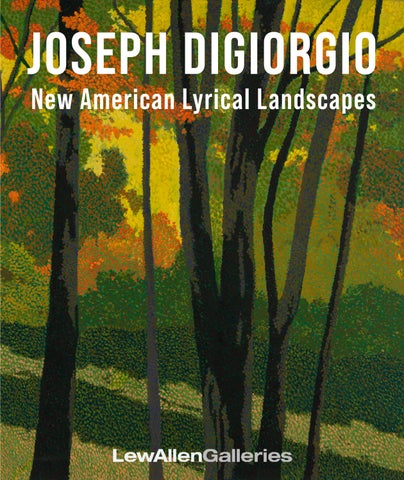
JOSEPH DIGIORGIO
New American Lyrical Landscapes

Untitled #85-6
1985, oil on canvas, 36 x 48 in

New American Lyrical Landscapes : J OSEPH D I G IORGIO
In the autumn of 1975, the Whitney Museum of American Art mounted a landmark exhibition entitled The Traditionalists. Curated by Marcia Tucker, then the Curator of Painting and Sculpture at the Whitney and later the founder of the New Museum in New York, with a reputation for challenging institutional norms, the show explored representational imagery as an enduring current in American art. Amidst a decade defined by the “new art” movements of Minimalism and Pop, Tucker chose a monumental, multi-panel work by Joseph DiGiorgio, Yosemite Lake, to serve as the opening visual salvo. DiGiorgio’s work was not a mere return to the landscape; it was a radical reconstruction of it.
By merging the push-pull dynamics of the New York School with a signature meticulous, atomized technique, DiGiorgio asserted that the American wilderness could still be a site of profound psychological and spiritual inquiry. For today’s contemporary viewer, DiGiorgio’s original declaration still resonates with a renewed urgency. His work is more than a painting; it is a profound, hand-built visual and intellectual sanctuary—a tangible claim on enduring beauty and focused concentration.
To the casual observer, DiGiorgio is often categorized as a Neo-Pointillist—a label that is convenient, but ultimately imprecise. While his canvases are composed of countless rhythmic dots, a technique that inevitably recalls the scientific rigor of the 19th century French postimpressionist Georges Seurat, the comparison is only superficial. Seurat’s Pointillism was an exercise in optical physics—a laboratory attempt to reduce the behavior of light to a repeatable formula. DiGiorgio, conversely, practiced what Walter Thompson, the art historian and critic who authored the artist’s definitive 1988 retrospective catalog, identified as a ‘processoriented, labor-intensive’ method of achieving ‘complex and subtle coloration.’
For DiGiorgio, color was seen as light, and light as color. This perspective is echoed by Julie Sasse, former Chief Curator at the Tucson Museum of Art, who viewed DiGiorgio fundamentally as a colorist whose work transcended Neo-Pointillism. Sasse argues that his practice was a deliberate melding of the aesthetic principles of Color Field painting, the romanticized naturalism of the Hudson River School, and the use of over-all lighting of Luminism to infuse the picture, and correspondingly oneself, in the glow of nature, similar to the ideas of the Transcendentalists—utilizing a meticulous dot-system not as a scientific formula, but as a

Untitled 91-3 1991, oil on canvas, 60 x 72 in
vehicle for a grander American landscape tradition. As Thompson further noted: “(DiGiorgio’s) version of the Pointillist technique – keeps us from even thinking of intruding ourselves inside one of his perfected and untrampled worlds. His love affair with the American landscape is a personal reverie or meditation, as inviolable as a poem. We may witness but not trespass.” DiGiorgio lived and worked in a gritty loft at 269 Bowery in New York City. This studio—an industrial space where icicles cascaded from the ceilings in winter—served as the unlikely birthplace for his lush, warm masterpieces. Though his studio was a spartan, focused environment, DiGiorgio was an active and sociable New Yorker who regularly hosted friends


Untitled #84-7 (triptych) 1984, oil on canvas, 72 x 146 in
and traveled widely with his patron, Dan Leach, the major collector of contemporary art and the artist’s lifelong companion. Leach’s accounts serve as an essential bridge, illuminating how the artist’s disciplined focus in his urban space allowed him to intensely conjure the vast, pristine landscapes they explored together. Through his rigorous commitment to his work, DiGiorgio lived in the grit to capture grace, imagining new realities akin to those he had visited in his extensive travels.
DiGiorgio’s project is anchored in his artistic lineage. He was born in Brooklyn in 1930 to Italian immigrant parents and received his formal training at Cooper Union under Morris Kantor—an influential painter whose style evolved from realism to incorporate Cubist and Abstract Expressionist currents. This provided him a foundation in technical expressiveness. However, it was his time in Hans Hofmann’s renowned classes in Provincetown that proved transformative. the importance of the pictorial surface. This influence is evident in DiGiorgio’s early 1950s work, characterized by broad strokes and grand gestures. However, by the early 1970s, his mark-making evolved into what he termed a ‘modular dash.’ When viewed from a distance, these myriad marks coalesced into a shimmering pattern reminiscent of moiré. This evolution in scale was counter-intuitive. As Sasse noted: “The bigger [his work] got the smaller his brush strokes got. So he just kind of went this opposite direction, instead of big canvases with big paint, [the brushes] got little.” He did not simply paint a view; he authored a world, utilizing the dot as a fundamental building block of a private cosmology.
This world-building process was driven by what DiGiorgio described as an ‘ethical imperative’ and a ‘monastic discipline.’ At the zenith of his career, he admitted to a ‘total obedience to the all but dictatorial role of the dot.’ During this phase, every element—from the vast sky to the intricate branches of trees—was built with dots precisely uniform in size and character. For DiGiorgio, the act of painting was a painstaking struggle against the void of the blank canvas. This density creates a visual vibration, a mark-making system layered, transparently, on top of the basic image-making process.
In an era of instant digital reproduction—where images are generated without effort and consumed without pause—the power of these canvases lies in their sheer weight of time. They function as defiant artifacts of human endurance because they cannot be skimmed or summarized; they are the physical record of thousands of hours of manual labor. Every dot represents a deliberate, human choice, making the painting a testament to the artist’s lived presence rather than a mere mechanical reproduction of a view.

Central to DiGiorgio’s work is a masterful manipulation of perspective. He frequently places the viewer in what is described by Thompson as an “indeterminate zone”, a vantage point that is neither on the ground nor in the sky. This floating vantage point offers a conservationist approach to nature, a technique of protection: by removing the viewer off the ground plane, the spectator hovers, a witness to nature who has no physical effect on it. This intentional act ensures the landscape remains closed to all forms of visitation except that of visual contemplation. The viewer is allowed to inhabit the space through the gaze alone, creating a psychological distance—a purely visual invitation to transcend mere observation and become visual meditation. One sees the world as it exists in the sanctuary of the mind—composed, ordered, pulsating, and perfectly preserved.
Prospect Park 93-28 1993, oil and pastel on paper, 29.5 x 41.5 in

California Series #88-6
1988, oil on canvas, 60 x 72 in

California Series #88-4 1988, oil on canvas, 60 x 72 in
In DiGiorgio’s California Series, this floating perspective reaches a cinematic peak. The viewer is positioned along a sheer cliffside, looking down at the stark, beautiful collision of land and ocean. This is a landscape that feels eternal—rendered with an untouched, sweeping, panoramic clarity. The perspective itself is so extreme— as if the viewer has been thrown off the cliff and now finds themself safely suspended in mid-air—that it commands the sense of a cinematic event.
While this aerial viewpoint feels common today through the ease of cinematic photography, DiGiorgio’s meticulous, particulate system offers a profound sense of presence that transcends such mediated experiences. The power of this system lies in the sophisticated interplay between the ”modular dash” and the specific gestural mark. It is a fundamental misunderstanding to view the dots as mere technical repetitions; instead, they function as an atmospheric container for the sensorial qualities of the environment.
In these works, a viewer might identify and return to a specific, gestural blade of grass or the rugged texture of a rock face, but the eye never rests upon a single dot. Because the eye is forced to move constantly across numerous points, the image resists becoming a static record. In this sense, the painting behaves as the landscape itself: it is an environment to be lived in, demanding an active engagement rather than a momentary glance. The dots are not distinct from the brushstrokes; they are another form of gesture, akin to brushstrokes, that allows color to vibrate rather than sit flat. This creates a singular, unified cosmology where the sky and the deepest shadows are composed of the same elemental particles, offering a quality of deep reverie that functions not as a reproduction of a place but rather as a window into a living world imagined by the artist.
Joseph DiGiorgio’s legacy is assured by his inclusion in the permanent collections of over forty major institutions. Ultimately, his approach transcends simple categorization, and as Sasse reminds, “DiGiorgio, still no matter what, saw himself as an abstract painter not a landscape artist.” As a consummate New Yorker, DiGiorgio’s legacy extends beyond his art. He pioneered New York’s Artist in Residence (A.I.R.) Regulations, enabling artists to reside in commercial spaces and cultivating the City’s permanent creative life.
DiGiorgio’s work offers a resplendent beauty and a vision of an unblemished natural world. In his canvases, the forest never loses its leaves, the turquoise sky never dims, and the

“chromatic joy” of the American landscape is preserved in a shimmer of dots. The artist has not simply provided a window for the viewer to look through; he has constructed an idyllic universe. It invites viewers to become witnesses of the infinite. Here it is evident that his early focused discipline was the essential precursor to his later intuitive freedom—a journey that moved from the precision of the dot to a liberated, gestural mastery of light. Ultimately, it is this synthesis of rigorous idealism and atmospheric revelation that offers the viewer a true path to the sublime.
To acquire a DiGiorgio today is to acquire a piece of intimate and private territory—a section cut through a meticulously created world. Standing before these works, one is reminded of what it is to truly see: to be suspended in a moment of pure color and light, to float in that ‘indeterminate zone’ where the landscape becomes eternal.
-DANIEL ZEESE
Untitled #84-6 1984, oil on canvas, 48 x 72 in

Untitled #98-9 1998, oil on canvas, 42 x 54 in

Untitled #98-6, 1998, oil on canvas, 42 x 54 in

New York State Series #98-3
1998, oil on canvas, 42 x 54 in

Untitled #98-2 1998, oil on canvas, 42 x 54 in

Oregon Series #95-5
oil on canvas, 59.75 x 71.75 in

Oregon Series #95-14, 1995, oil on canvas, 54 x 42in

Prospect Park #92-49 1992, oil pastel on paper, 29.5 x 41.5 in

Prospect Park #93-27 1993, oil pastel on paper, 29.5 x 41.5 in

Southwest Series #33-87, 1987, oil pastel on paper, 29.5 x 41.5 in

Southwest Series #2, n.d., oil pastel on paper, 29.5 x 41.5 in

Southwest Series #36-87, 1987, oil pastel on paper, 29.5 x 41.5 in

Southwest Series #48-87, 1987, oil pastel on paper, 29.5 x 41.5 in


Untitled (diptych), n.d. oil pastel on paper, 29.5 x 82 in

Oregon Series #94-8, 1994, oil on canvas, 59 x 71 in

1994,
Oregon Series #94-4
oil on canvas, 60 x 72 in
1995,

Series
Oregon
#95-16,
oil on canvas, 42 x 54 in

Oregon Series #94-11 1994, oil on canvas, 60 x 72 in

Untitled n.d., oil on canvas, 42 x 54 in

Untitled n.d., oil on canvas, 42 x 54 in

Untitled n.d., oil on canvas, 42 x 54 in

Untitled #20-1 2000., oil on canvas, 42 x 54 in

Untitled n.d., oil on canvas, 42 x 54 in

4-99
oil on canvas, 42 x 54 in
Untitled
Joseph DiGiorgio (1930–2000)
Selected Solo Exhibitions
2010: Joseph DiGiorgio: Selections from the Dan Leach Collection, Louis Carlos Bernal Gallery, Pima Community College, Tucson, AZ
2004: Bendheim Gallery, Greenwich Arts Council, Greenwich, CT
2000: The New York City at Night Series, Kouros Gallery, New York, NY
1998: The Prospect Park Series, Robert Steele Gallery, New York, NY
1997: The Prospect Park Series, Everson Museum of Art, Syracuse, NY
1997: The Southwest Series, Tucson Museum of Art, Tucson, AZ
1996: The Prospect Park Series, University of Arizona Museum of Art, Tucson, AZ
1995: The Oregon Series, O’Hara Gallery, New York, NY
1995: The Prospect Park Series, Prichard Art Gallery, University of Idaho, Moscow, ID
1994: Waterfalls, Harris Gallery, Houston, TX
1992: Landscapes, Hunterdon Art Center, Clinton, NJ
1992: The Atmosphere Series, Michael Walls Gallery, New York, NY
1991: Painting of the American Landscape, Bergen Museum of Art and History, Paramus, NJ
1990: The Alabama Series, Monty Stabler Gallery, Birmingham, AL
1988–89: The Grand Canyon (Traveling Exhibition): de Saisset Museum, Santa Clara, CA; Tucson Museum of Art, AZ; Museum of Northern Arizona, Flagstaff, AZ; Canton Art Institute, OH
1988: Ten Works, Michael Walls Gallery, New York, NY
1988: California Series, Shoshana Wayne Gallery, Santa Monica, CA
1987: The Southwest Series, Ruth Siegel, Ltd., New York, NY
1986: Recent Paintings and Works on Paper, Harris Gallery, Houston, TX
1985: The Prospect Park Series, New Drawings, Nina Freudenheim Gallery, Buffalo, NY
1985: Landscapes, William Sawyer Gallery, San Francisco, CA
1980: The Oceanside Series, A.M. Sachs Gallery, New York, NY
1976: The Pond, Green Mountain Gallery, New York, NY
1975: Joe DiGiorgio, Michael Walls Gallery, New York, NY
Selected Group Exhibitions
2007–08: An Eclectic Eye - Selections from the Dan Leach Collection, Tucson Museum of Art, AZ
2006–07: The Grand Canyon: From Dream to Icon, Tucson Museum of Art, AZ
2003: Prospects: Contemporary Landscapes, University of Arizona Museum of Art, Tucson, AZ
1995: A Romantic Impulse, O’Hara Gallery, New York, NY
1993: Art and the Law (Traveling Exhibition), Kennedy Galleries, New York, NY
1987: American Artists in China, Beijing Art Museum and Shanghai Art Museum
1984: New Vistas: Contemporary American Landscapes, The Hudson River Museum, Yonkers, NY
1975: 1975 Biennial Exhibition: Contemporary A American Art, Whitney Museum of American Art, New York, NY
1973: New American Landscapes, Vassar College Art Gallery, Poughkeepsie, NY
Selected Bibliography
2010: Joseph DiGiorgio: Selections from the Dan Leach Collection (Catalog), essays by David Andres and Dan Leach.
2000: Roberta Smith, “Joseph DiGiorgio, 69, Landscape Painter,” The New York Times, June 12.
1997: Margaret Regan, “Canned, Ungrand Land,” Tucson Weekly, Sept. 11–17.
1988: John Russell, The New York Times, Oct. 21.
1987: Gerrit Henry, “DiGiorgio’s Romance with Landscapes,” Artspeak, Sept. 1.
1984: New Vistas: Contemporary American Landscapes (Catalog), essay by Janice C. Oresman.
1982: John Yau, Art in America, March.
Public Collections
Achenbach Foundation, California Palace of the Legion of Honor, San Francisco, CA
Art Museum of South Texas, Corpus Christi, TX
Art Museum of Southeast Texas, Beaumont, TX
Beach Museum of Art, Kansas State University, Manhattan, KS
Bergen Museum of Art & Science, Paramus, NJ
Birmingham Southern College Visual Arts Center, Birmingham, AL
Boca Raton Museum of Art, FL
Community Fine Arts Center, Rock Springs, WY
de Saisset Museum, Santa Clara University, CA
El Paso Museum of Art, TX
Everson Museum of Art, Syracuse, NY
Georgia Museum of Art, University of Georgia, Athens, GA
Hockaday Museum of Art, Kalispell, MT
Hunter Museum of American Art, Chattanooga, TN
Jule Collins Smith Museum of Fine Art, Auburn University, AL
Loeb Art Center, Vassar College, Poughkeepsie, NY
Louisiana Art and Science Museum, Baton Rouge, LA
Mobile Museum of Art, AL
Montgomery Museum of Art, AL
Morris Museum of Art, Augusta, GA
Museum of Art, Nova University, Ft. Lauderdale, FL
Museum of Art, SUNY Albany, NY
Museum of Texas Tech University, Lubbock, TX
New Mexico State University Museum of Art, Las Cruces, NM
Newark Museum of Art, NJ
Palos Verdes Art Center, Rancho Palos Verdes, CA
Prichard Art Gallery, University of Idaho, Moscow, ID
Samuel Dorsky Museum of Art, SUNY New Paltz, NY
San Angelo Museum of Fine Arts, TX
San Diego Museum of Art, CA
Scottsdale Museum of Contemporary Art, AZ
Sheldon Museum of Art, University of Nebraska, Lincoln, NE
Stark Museum of Art, Orange, TX
Tampa Museum of Art, FL
The Columbus Museum, Columbus, GA
The Hudson River Museum, Yonkers, NY
The Maslow Collection, Marywood University, Scranton, PA
The Museum of Art & History at McPherson Center, Santa Cruz, CA
The New York Public Library Print Collection, NY
The Ogden Museum of Southern Art, New Orleans, LA
Tucson Museum of Art, AZ
University of Arizona Museum of Art, Tucson, AZ
University of Maine Museum of Art, Orono, ME
Virginia Center for the Creative Arts, Sweet Briar, VA
Wiregrass Museum of Art, Dothan, AL