LEVEL FIVE ARTIST COOPERATIVE BRUSSELS 2022
1
2 CONTENT WATCH YOUR STEP 5 A year of recalibration SUPPORTIVE ENVIRONMENT 8 What does Level Five do COOP 9 How is Level Five organised (...) The foundation for a cooperative artistic environment STUDIOS 19 What is involved in providing space (...) Towards a durable artist studio infrastructure PROGRAMME 27 Elements that a supportive environment (...) From one to another, flourishing artistic practices COLLABORATIONS 40 reaching out to build a foundation (...) A network to support artists on the long-run FINANCIAL REVIEW 46 A sustainable economy? STEPPING STONES 48 Towards a durable artisitc environment
3
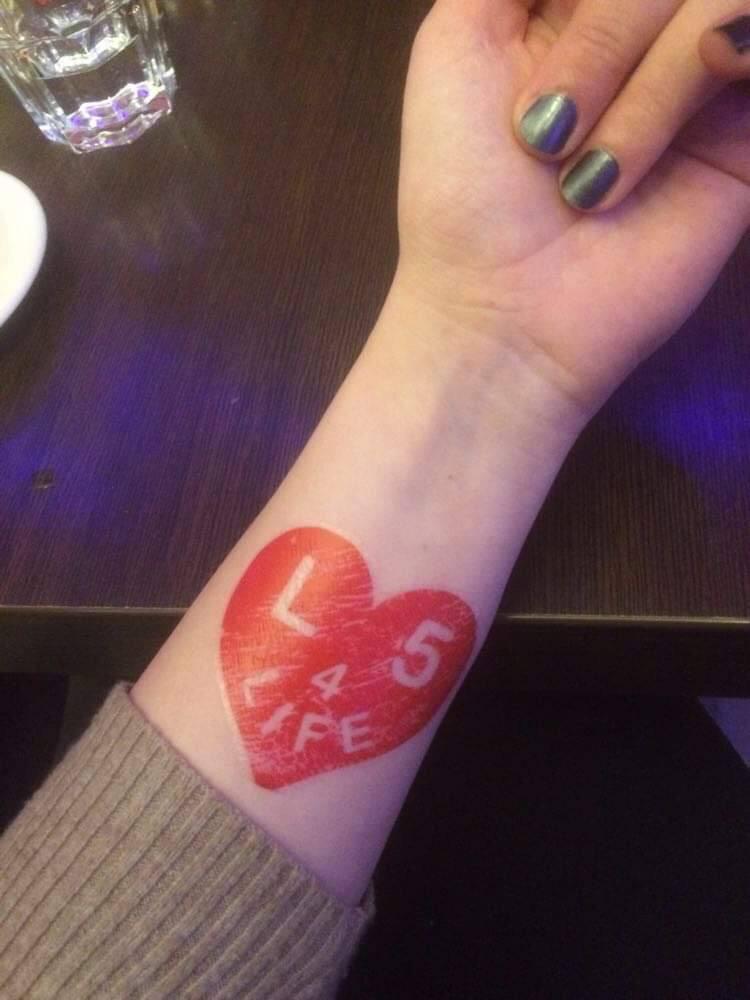
Sticker Tattoo ‘L5 4 LIFE’ made by David Bernstein
4
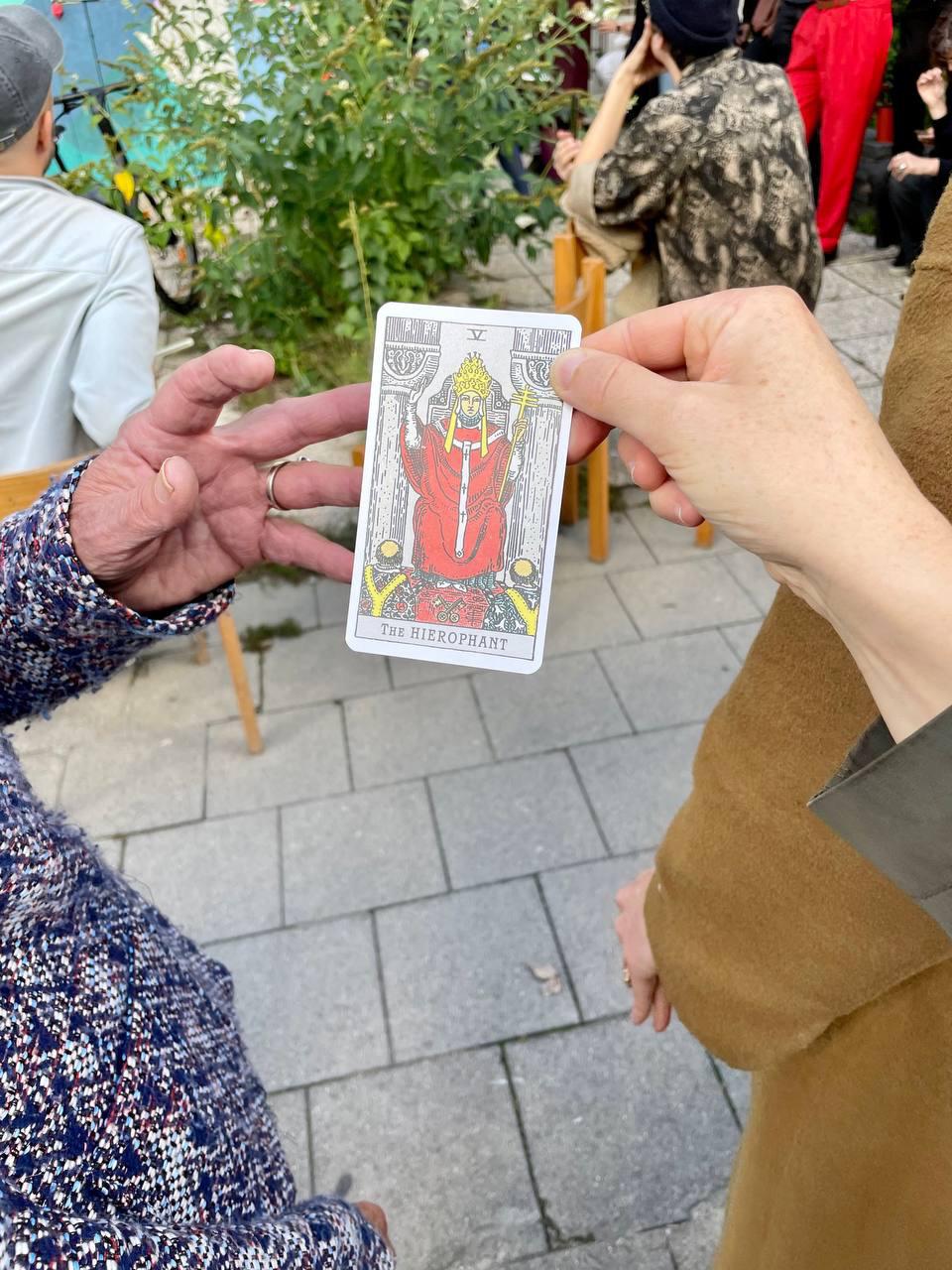
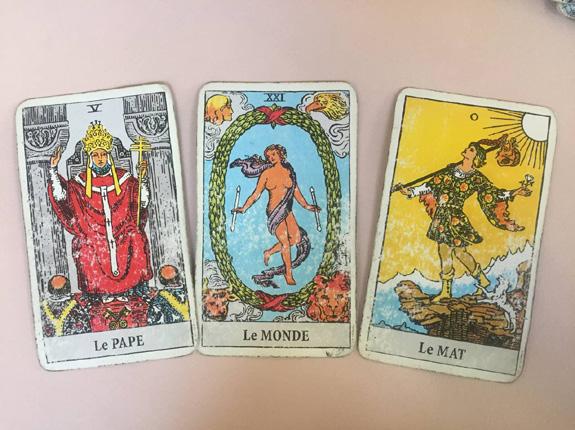
Tarot card of ‘the hierophant’ (aka politician) part of the reading during the opening of VO.
WATCH YOUR STEP
“Watch your step!” is advice we took to heart last year. Moving from one location to three locations was a big step taken; carrying the load of more bricks and concrete while at the same time longing to relate to each other within this new constellation. It was a year of recalibration. As a collective we showed strength in the ability to make do, and plasticity in our ability to reshape and allow new relations in. As an organisation we proved to be a solid foundation while leaving space to organically reshape our form from within.
We are working the soil in order to plant the seeds for a more sustainable environment for artistic practices. One of the foundations for this is long-term studio space, but more importantly is the support and care that is needed to maintain a cooperation. The current circumstances we are operating in are unstable. In order to find stable ground we have to move on, therefore: tread carefully, watch your step, but move without fear.
5
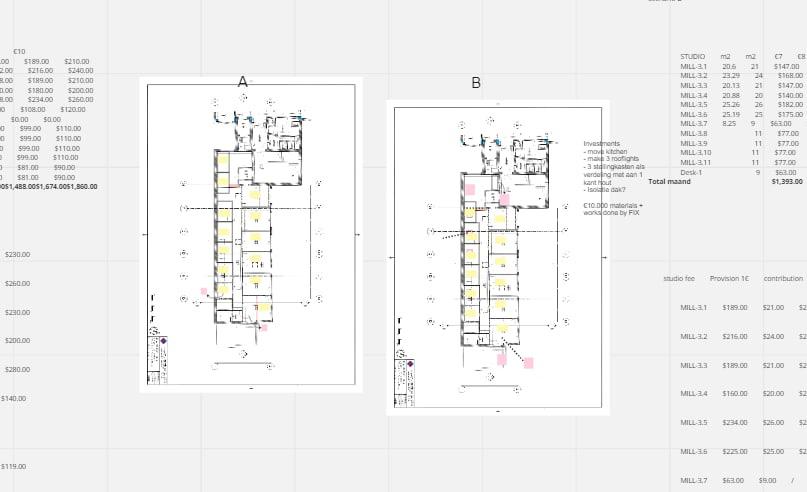
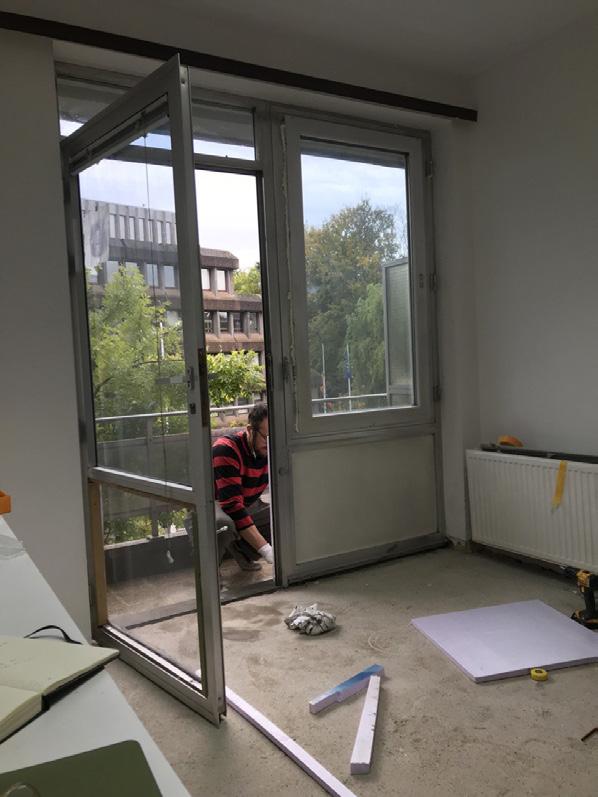
6 MAY JANUARY JUNE FEBRUARY
SEPTEMBER OCTOBER
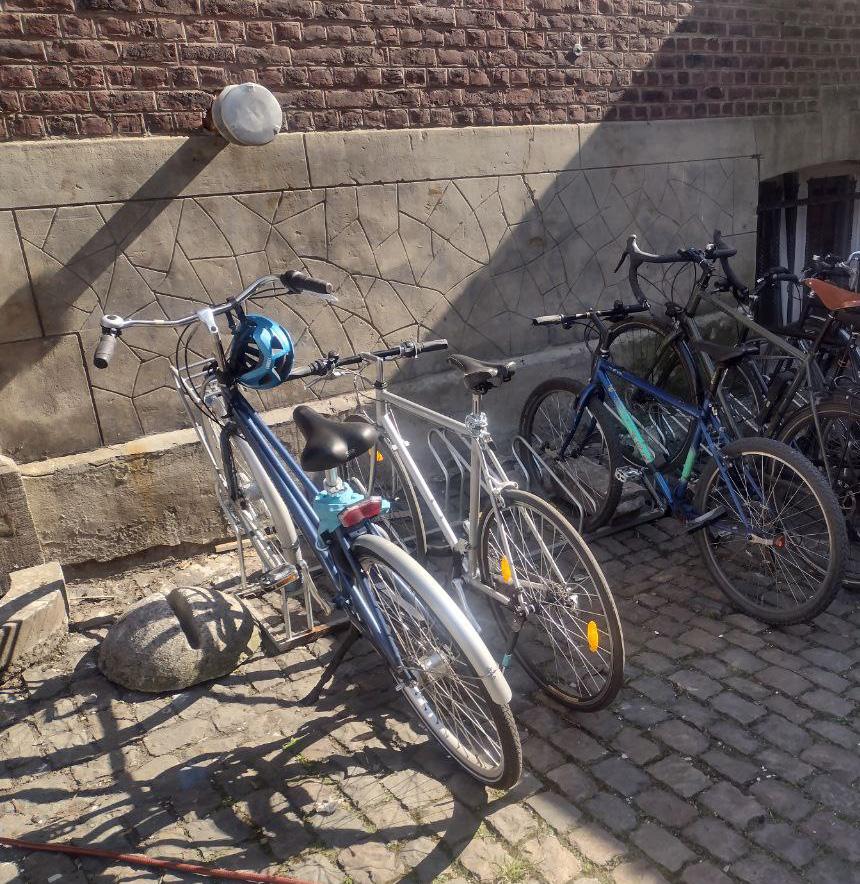
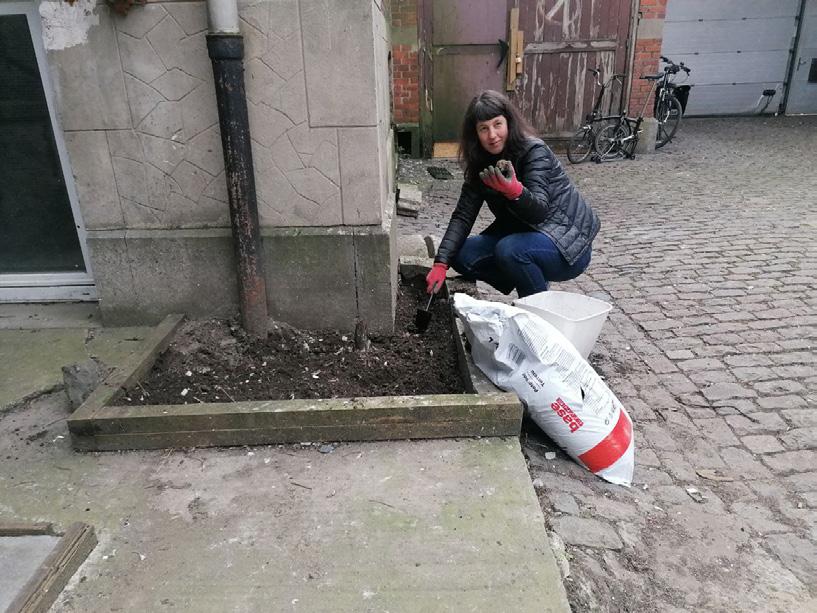
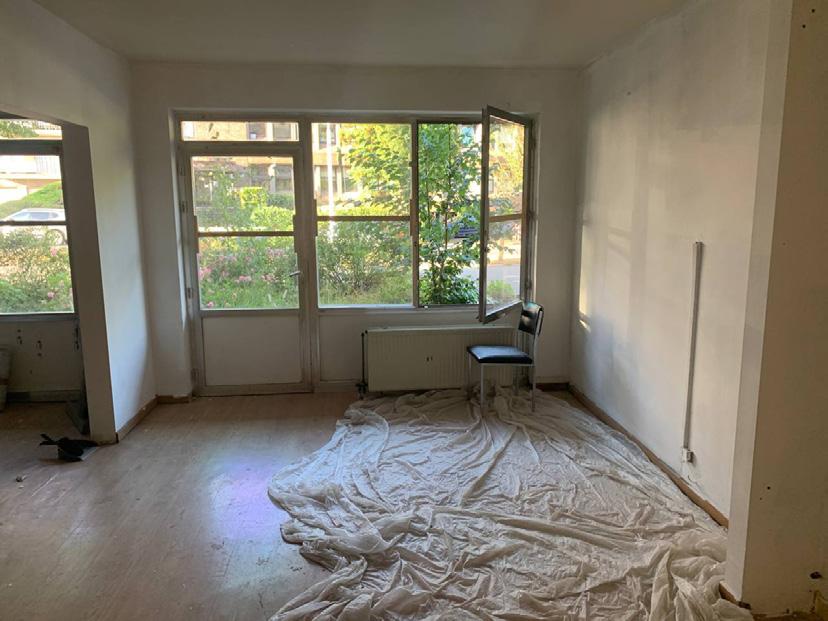
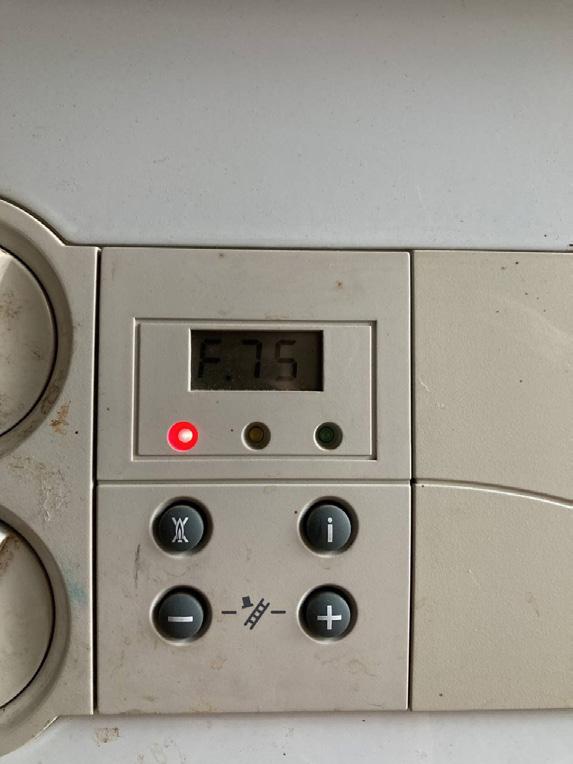
NOVEMBER JULY AUGUST DECEMBER
APRIL
SUPPORTIVE ENVIRONMENT
Level Five is an artist cooperative committed to developing artistic practices in Brussels. We do this by providing space for artists1 and a supportive environment for their work through artistic development programmes and advocacy for artists.
Established by artists in 2019, Level Five currently runs 3 studio buildings across 3 Brussels municipalities, providing artist studios for more than 100 artists. We are advocating for -and working towardsa durable infrastructure for artistic practices in Brussels. We further support artists through our cooperative culture, enabling them to be sustainable and resilient.
Vision — Our vision is to establish a sustainable infrastructure for artistic practices in Brussels, in perpetuity, and to propagate a supportive artistic environment.
Mission — to make space for artistic practices and to develop the resources and practices to sustain a supportive artistic environment.
providing affordable studio space to a wide range of artists;
offering resources to develop their practice; and
being an effective advocate for artist studio spaces;
1. We use artists in a broad sense and host a diversity of artistic practices: visual arts, performative arts, theatre, architecture, film, writing and curating. Our focus is on artistic practitioners that aim to spend the most of their time on developing their artistic practice.
8
•
•
•
COOP MEMBERS
Level Five is a member organisation. Our vision, mission and actions gain validity because those concerned are engaged in the organisation as members. A critical mass that can be a generous voice for all artists in Brussels.
In 2021 we introduced the possibility of being a member without making use of a studio (affiliated). It is exactly the potential of Level Five to advocate for the support of artistic practices in Brussels that could be the reason for this membership, but there could also be other ways of participation within and support from the Level Five community that we have not managed to work out in 2022. A membership ideally should not only answer to a direct individual benefit of the member, but rather a support of the member to a general cause. The affiliated membership is something we should develop further to find out how this form of membership could support artists and artistic practices in Brussels.
A membership for each member is €60 a year, from this the accounting, administrational and office costs of the organisation is covered (see Financial). Our main membership is based on those who make use of a studio at Level Five. These members contribute another €20 per month which is allocated in the following way: half is repurposed in the specific locations: €5 goes to location responsibles, and €5 goes to the location budget. The other half is invested in the coop: €5 goes to the artistic programme, and €5 goes to savings/ collateral (see Financial).
9
These active members, in contrast to affiliated members, are considered part of the General Assembly (GA) and therefore have voting rights. The board indicated that this might lead to difficulties in decision making and procedural obligations of a VZW; in attendance of the GA and in signing official documents. This is something that has remained unresolved and should be reformulated with changing the statutes in 2023. It was appreciated that the informal organisational structure of Level Five already hosts deliberation and collective direction in decision making (see Organisation, in particular Council and FORUM). A change on who voting members are on paper might not impact the horizontal and collective set up of Level Five. For one because deliberation and collective direction of the lifeform and related practices are not a concern of the formal paperwork. Secondly, because one could ensure that the voting members are representative of and informed by the collective.
At the start of 2023 Level Five had a total of 102 active members and 9 affiliated members.
COORDINATOR
Rob Ritzen (0.6FTE)
In 2022 the contract of the coordinator was continued in September. After two contracts of a definite period — two times, one year `20 and `21 — the employer is obliged to provide a contract of indefinite duration. Rob is assigned as general coordinator of Level Five, responsible for the administrative, financial, and consultation (Council, FORUM) tasks, alongside coordination of collective use, maintenance and development of spaces as well as community work, advocacy, communication and artistic programme; all in assistance and support
10
of the location responsibles and members in different formations, depending on the project or task at hand.
In 2021 it was signalled that it would be necessary for the organisation, and of great benefit to the community, to attract a second half-time coordinator. We also encountered the difficulty to find funding for this as such. The support of the VGC currently covers the costs for one half-time employee. The VGC advised us to diversify our funding income, but we have not succeeded to start with that in 2022. COCOF seems to be the most logical to request funding, but to apply through this administrative body we would need to double our juridical statutes to an ASBL alongside a VZW. Another obstacle for this line of funding is the emphasis on presentation and mediation which would allow for project funding, but not for our work as an organisation as such. Likewise on the level of the ‘Kunsten Decreet’ we should apply for project subsidies (for example for artistic support and development programmes), but perspective on structural funding for our working as an atelier organisation seems to be limited since this function is considered a concern of local level. It was thought there would be possibilities in the subsidy Boven Lokaal but after review this seemed very difficult for a Brussels based organisation to fit in the requirements, and it was evident that applying for this through UFO was more suited. If the subsidy of UFO would be granted this could definitely help to in part support the working and programme of Level Five.
11
TRAINEE
In 2022 we were happy to welcome Mariana as the first trainee of Level Five through Erasmus+ funding. We formulated a description of the traineeship, the goals, and trajectory. She got to learn Level Five thoroughly from the start joining in the meetings on different levels of the organisation and at each location. Helping out with the communication and production of the opening of VO we got to know her as someone who takes the initiative and has a good intuition for how to play a mediating role within a collective. For the project Working the Ground, a collaboration with SB34, she took charge of the development of the content, (pre)production, and communication, showing her capacity to work autonomously onlarger projects over a long duration. The other part of the traineeship was —on the initiative of Jesse van Winden— to develop the connections with artist-run spaces in Brussels. The format of a bike tour was further developed and two editions were organised by Mariana in the time of her traineeship.
Level Five will welcome another trainee, Cecilia Larese, in the coming year via the Eramus+ programme. It would be interesting to develop the traineeship programme further and see what educational programmes fit with Level Five. This would allow for a great dynamic between learning and developing the organisation.
12
Mariana Pecháčková (September `22– February `23)
LOCATION RESPONSIBLES
VM - Timmy van Zoelen
VO - Alasdair Asmussen Doyle & Hélène Petite
VV - Eitan Efrat & Sirah Foighel Brutmann
From 2022 we work with location responsibles. At each location preferably two members are appointed as responsible and will get a remuneration in the form of a discount on their studio. The amount of the remuneration is based on the amount of the members of the location, €5 of the €20 monthly contribution goes to the locations responsibles. It is not the task of the location responsible to do all the work, but rather to be the motor for self-organisation and care that is needed at each location.
In principle the assignment of location responsibles has been proven helpful to have a more direct point of contact for the members at each location. It also delegates some responsibilities and tasks that are location specific, which lightens the workload of the coordinator. Still, there is a need to work out the specific tasks and responsibilities of the location responsibles in order for them to operate more autonomously. The intention is there to write a manual, but this was not yet realised. Another parameter that needs to be formulated is in what way and for how long location responsibles are to be assigned.
LOCATION ASSEMBLIES
Location assemblies are held on a monthly basis at each location with the active members there (i.e. everyone who makes use of a studio at that location). The assembly is called together on the initiative of the location responsibles. The aim of the location assemblies is to self-govern and equally divide the labour for the maintenance of their workspace.
13
Alasdair Asmussen Doyle, Batsheva Ross, Bianca Baldi, David Bernstein, Eitan Efrat, Elke Van Der Kelen, Graham Kelly, Helen Dowling, Hélène Petit, Kevin Gallagher, Paoletta Holst, Sirah Foighel Brutmann, Timmy van Zoelen
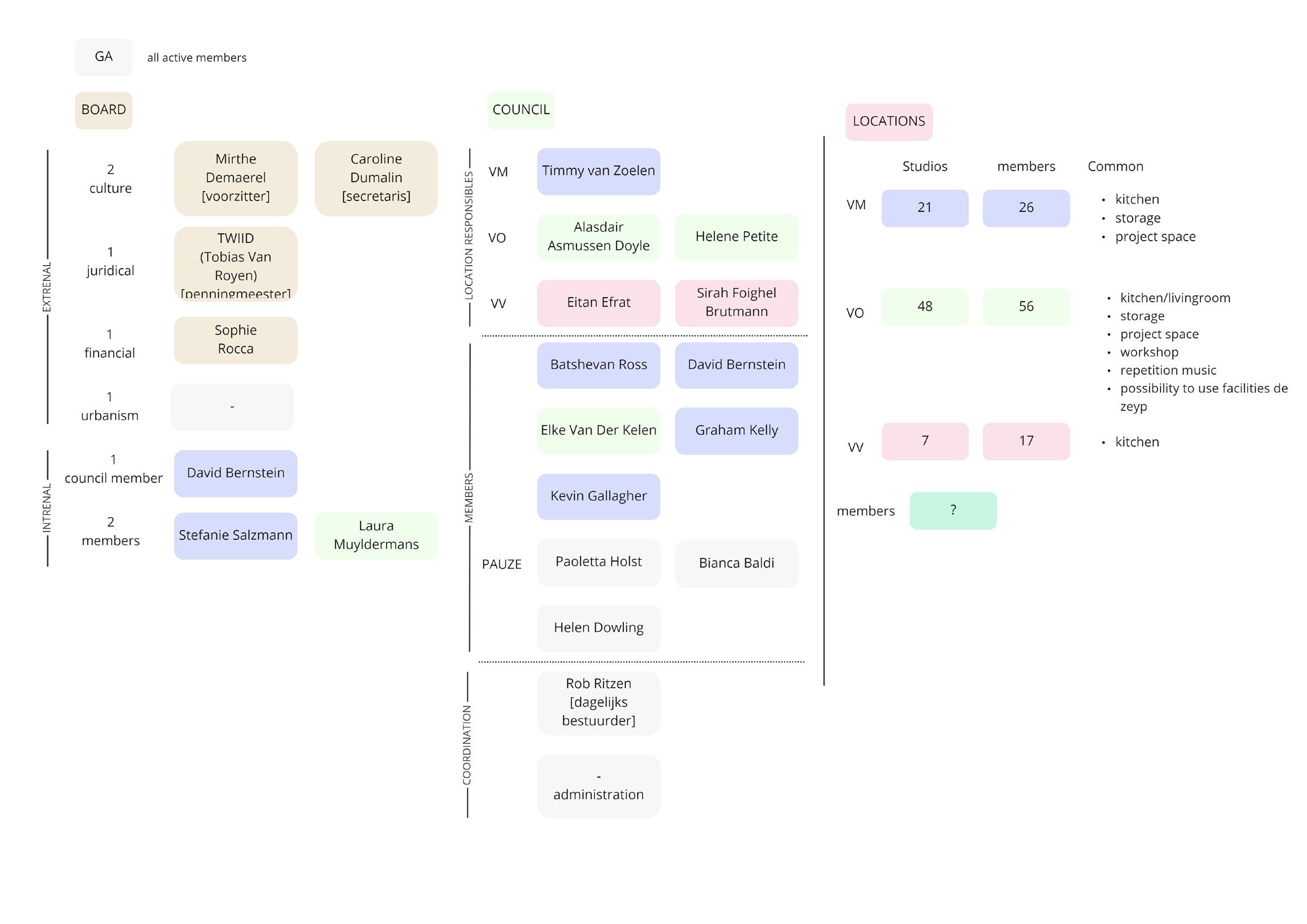
The council has been restructured in 2022 to correspond to the new configuration of Level Five. In order for every location to be represented in the council the location represponsibles also participate in the council. As such the council is composed of the coordinator, the location responsibles, and members of different locations who engage to be in the council (also see fig.1 below).
For the moment there are no formalities on how long and in what way a member, apart from location responsibles and the coordinator, joins the council. Neither is there a target number of council members considered. The current council could be assigned to draft a protocol for this in the coming year. There is awareness of balanced representation in gender assigned at birth.
The role of the council remains concerned with the continuation and reflection of the overall organisation of all the locations and the community. They are responsible for organising the FORUM and meet monthly on the 15th.
FORUM
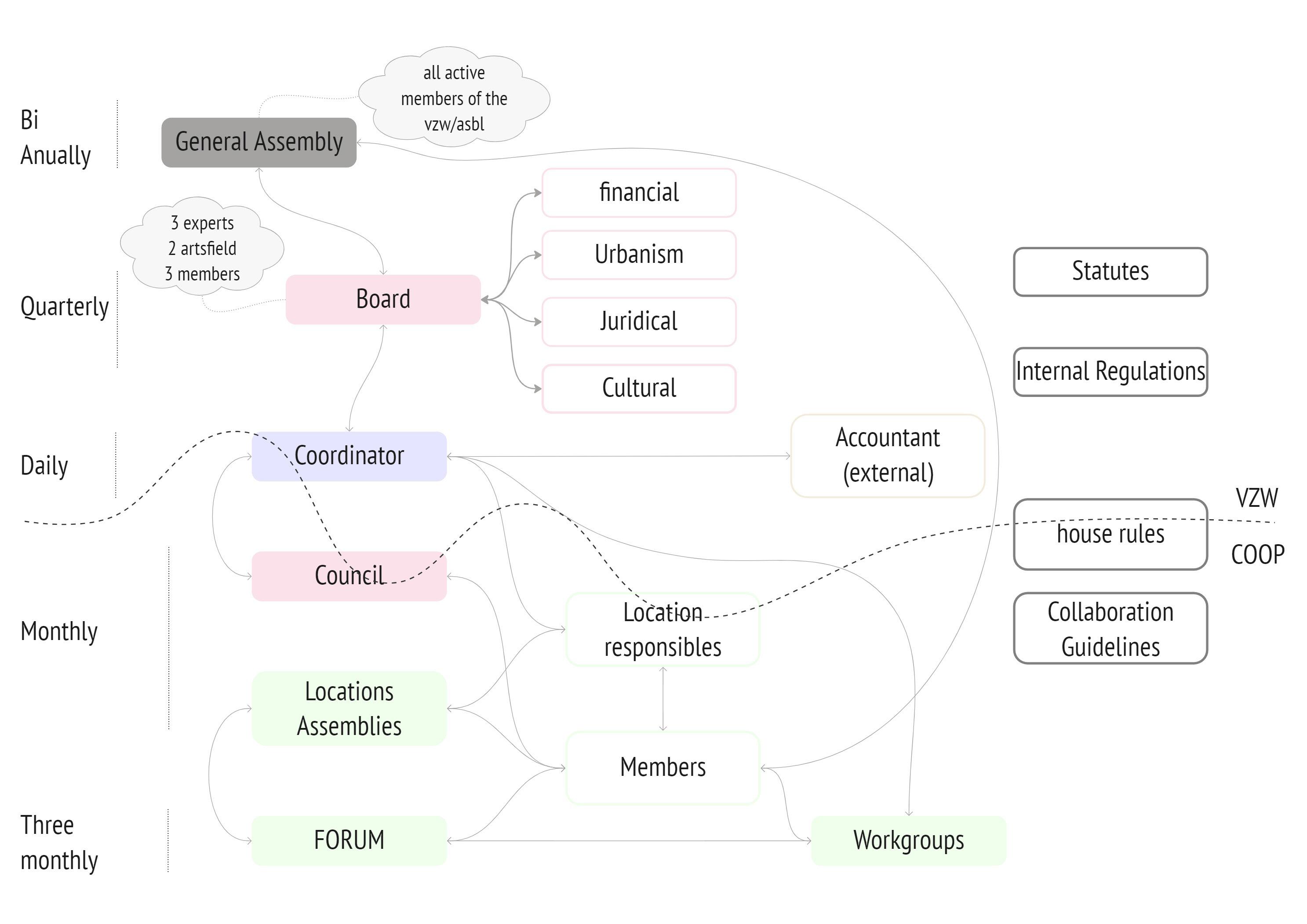
From 2022 the FORUM is held every 3 months (March (GA), June, October (GA), December) on the 5th of the month. The FORUM is called together by the council and has the function to bring members up-to-date about the organisation, discuss and reflect on the organisation and the community.
14
COUNCIL
15
fig.1 organisational chart Level Five
BOARD
Caroline Dumalin, David Bernstein, Laura Muyldermans, Mirthe Demaerel, Stefanie Salzmann, TWIIID
In 2022 a new board was installed. Positions in the board are assigned for two years and can be extended one time for two years. The board is formed along the following parameters. Five external and three internal board members. The internal board members are composed of one representative from the council and two representatives from the members. The representative of the council is chosen amongst the council members. The representatives of the members are chosen from the general assembly. The external members of the board are composed of the following profiles: two cultural professionals, one juridical, one financial, one urbanism.
The board was established because there was a need for a supportive frame in which Level Five could develop further. Although the deliberative structure within Level Five is quite sturdy, there was the need for more diversification in the kind of profiles that were in the board, previously the board consisted only of artists involved in Level Five, and a solid specialised knowledge and experience base to fall back on. In the several meetings the board had during the year their relation to- and role within the more informally organised structure of Level Five came back as a discussion point, for example: Who are the voting members and in the general assembly? This is one of the things to work out in the coming year: A trajectory that reconsiders and reformulates the statutes to reflect the basic working and ensure the continuation of Level Five. A proposal could for example be discussed in the GA of October and a final version voted upon in the GA of next year.
16
As such the role of the board is really to ensure the legal obligations and good governance of the VZW. In addition, there is some resonance between the council who is more involved in the everyday working of Level Five and the board who could give guidance in the issues that present themselves, and introduce and prepare Level Five to achieve its long term goals.
GENERAL ASSEMBLY
The general assembly (GA) is held once a year and serves as the formal gathering where the organisation and finances are evaluated and approved. The GA is organised by the board. Its function is to evaluate the previous year and look forward to the coming year.
17
fig.2 flow between formal organisation (VZW) and members cooperation.
THE FOUNDATION FOR A COOPERATIVE ARTISTIC ENVIRONMENT
Building a new world in the shell of the old. We are only just beginning to work the ground for something we hope could be a foundation. A foundation on which there is time and space to experiment, develop, and share artistic practices. This asks something from each of us individually, but it also requires some support to enable a frame for us to work within.
18
(...)
STUDIOS
COORDINATION
From late 2021 and into 2022 we expanded in both size and number. We evolved from one location of 2.000m2 with 84 artists and 34 artist studios to 102 artists in 71 individual and shared artist studios on a total of 3.700m2, at three locations (Van Meyel, Van Overbeke, Van Volxem), in three different municipalities (Molenbeek, Ganshoren, Forest) in the Brussels Capital Region. We are providing an important infrastructure for artistic practices in Brussels. An occupancy rate at an average of 95% shows how much studio spaces remain in demand, and how valued they are by artists.
While we were able to house the artist from our former location, we are unable to give enough stability to them. This has several combined reasons that may differ from location to location: the terms of use are short(er), the rental prices are higher, and the infrastructure is less qualitative and therefore demanding.
Van Meyel (VM) had an agreement for only one year (December `21-`22) and then moved to a three months notice, given at the end of February `23. We are looking to relocate the 30 artists from this location in spring. Although the location provided a landing ground for our move, and hosted several public events throughout the year, some studios are not ideal and the overall infrastructure is quite rough.
In Van Volxem (VV) the spaces were more or less ready to use but the base rental price is higher which is pressing for the artists that
19
have a studio there. In return the ongoing rental contract provides relative comfort and security to stay for a longer period.
Van Overbeke (VO) is a particular case because it was part of a collaboration with the VGC in the frame of their ‘Plan Atelier’ although a security in time of use of three years is written in the contract this also means there is no way of ending the contract before, although it was brought forward that our organisation could not hold such a commitment, there seemed to be no alternative. We and the VGC themselves were confronted with this when, due to a mistake by the contractor during the refurbishment, the works had to be stopped because of the release of particles of asbestos. This brought the different parties involved in a deadlock for two months. Which also led to the postponement of the start of use of the site until June. It also has to be said that the efforts of the VGC to resolve this problem were admirable, and the lessons learned valuable for all parties involved.
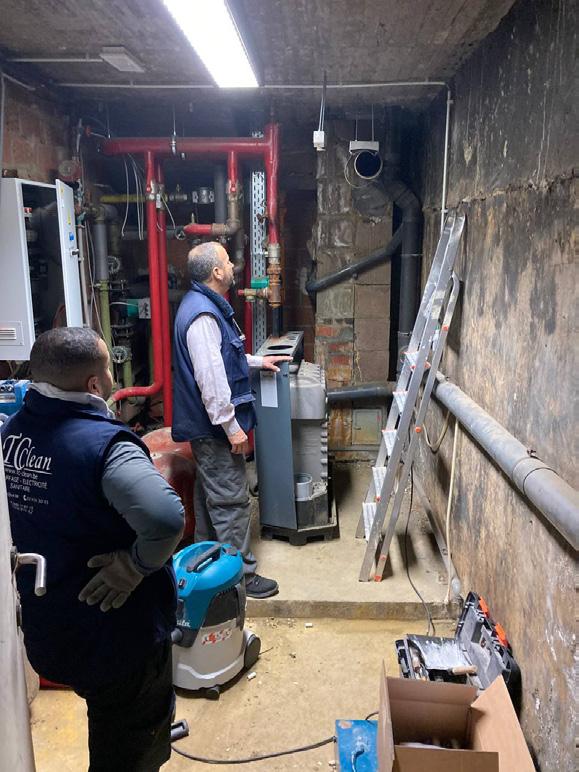
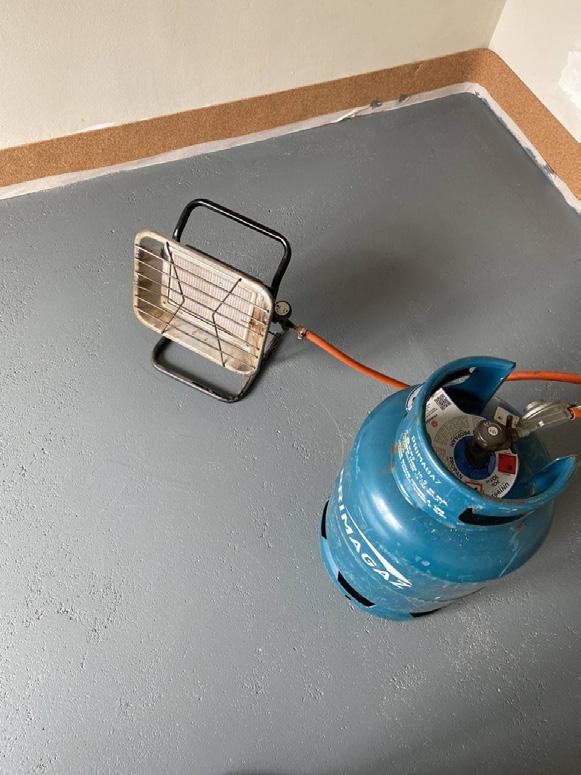
All-in-all the location is suitable but we can say that the investments in time and budget are too great for the relatively short period of use. Even though there was an investment made to make the building ready for use, the infrastructure is still minimal and quite rough and demanding. This continues to cause problems a year onwards with a central heating system that is not stable enough to guarantee a comfortable temperature to work in during the winter months. This, together with a high rent 2 that was agreed between the VGC and the owner, but signed and paid by Level Five, we can say that there is an unbalanced benefit to the owner.
20
2. Level Five keeps the rent low for the artists; the income margin becomes very low when high rents need to be paid. With rising cost of utilities (in the first instance included in the m2 price) this not only puts at risk the organisation but also brings under pressure affordability for artists.
The heroes of this story are the artists that kept their belief in the potential of the location and remained engaged and resilient even though there were (too) many hurdles along the way. We hope to provide the right support and environment for them in the coming year. A very special thanks has to go to fellow member Laura Muyldermans who was a great support in guiding us through the trajectory of making the space ready to use, from taking part in negotiations to helping out to arrange permits, without her it would definitely not have come to a good conclusion.
The unpleasant prospect though is that we are faced with increasingly short-term occupancies, which could mean that every year we will have to search, make ready for use and/or to move to a new location. The pressure on the organisation’s coordination is particularly great which in turn destabilises the community and disrupts the continuous and stable development of artistic practices, which is the reason why we exist in the first place.
Another great worry is the instability of energy prices. The sites we manage do not meet the standards of energy efficiency. With the short periods of use it does not make sense to invest largely in the issues this causes. We thus avoid many interventions and try to keep to affordable, practical solutions. Despite the rise in energy cost we managed to stay within our estimates for 2022, we had sealed contracts with a fixed price for a year in December 2021, but also managed to lower our consumption in the last months of 2022.
21
WAITING LIST
Our waiting list has been steadily growing. At the beginning of 2022 we had 213 people on our waiting list which grew over the year to 302 artists who are all looking for a studio within Level Five. In the same timespan we were able to provide a studio to 51 people on the waiting list. A special mention should be given to the event where we were able to host on short notice several members from a location with self-organised artist studios which had to leave their premises almost instantly.
We had planned to update the waiting list in 2022 to make sure we have an actual view on artists looking for a studio, since some might have moved on to find a studio somewhere else. This was unfortunately not realised. Even though the registration form is digital, the administration of the waiting list depends on too many manual steps, which apart from being laborious, also gives room to errors and loss of oversight of valuable information. Two improvements should be a priority in the coming year: Those registered should be able to access and update their information. Automation of the registrations and yearly confirmation of registration.
Even though some older inscriptions might be obsolete we can still see that with a growth of 140 registrations (total on the waiting list end of the year minus beginning of the year, plus the those that were allocated) not only shows how much studio spaces are in demand in general, but also how valued a studio within the community of Level Five is in particular.
22
ALLOCATION
We were able to provide a studio to 51 people that were on the waiting list. While the majority of the artists that were in our former location moved to one of the three locations, some did not. In particular the location of Van Overbeke enabled us to make more space available for artists in 2022. In addition to this there were numerous shares and sublets during the year. Our newsletter to communicate with the waiting list proved to be a valuable tool; many sublets were arranged through this system.
Sublets and the format of a shared deskspace have always been an accessible and flexible way to meet the needs for a space to work, be it temporarily. They should be considered as valuable assets for members as well as people who are on the waiting list.
Our allocation policy for individual studios has remained the same. A space opens up, the space is communicated within the current members first. This enables members to move to other and more suitable studios along the way. If there is no interest in the member pool, the next step is to communicate the availability to the waiting list. Those registered can respond and make a visit, thereafter they mention if they are interested or not. Those interested are listed and the one longest on the waiting list will be allocated to the studio.
Because of the difficulties experienced in allocating studios to members in VM and the foresight that we would need to allocate many studios at once for VO location, an allocation policy was formulated specific to the allocation of studios in a new location.
Since moving from one building to another is part of our community
23
we feel an obligation to first house the artists that will lose a studio in this process. This also catches on to the idea that at a new location there should be a small group of members that have had a studio at a previous location before. This helps to ensure that there is a transfer of knowledge and practices from Level Five to the new members. It provides overlaps in connections to the wider community so that no location becomes an island.
For VO we asked people who were registered on the waiting list to apply for a studio at that location. In the application there were some extra parameters, such as age, that would help to curate a balanced group (see point C in the guidelines below for example). An allocation commission went through all the applications and tried to find the best solution for the majority of the artists applying. The composition of this commission can change every time for a new location, but always consist of two artist members, the coordinator/location representative/ board member, and someone appointed external to Level Five.
The main guidelines for the allocation are:
• A. Duration of registration.
• B. Match practice with the studio space.
• C. Plurality of practices and artists in the building.
There is always the possibility to add criteria to the selection of the artists for a location. For VO for example we saw the possibility to provide studio space with disabled access on the ground floor. We announced this in the application process and made an effort to communicate the open call to relevant organisations and communities.
The outlines of an allocation are there. These are quite clear, can
24
serve for allocation in most instances, and allows some flexibility in communicating preference and prioritisation according to our needs. In different discussions it was brought forward that we should work on reaching broader and diverse audiences for our waiting list in order to remain committed to being an accessible space for artistic practices. An action point here could be to clearly communicate this allocation policy on our website, this would be possible with the development of a new website in 2023. Another is reaching out to the different art schools of Brussels for example, to ensure a younger generation gets to know Level Five, feels connected to its mission and welcomed to join.
COMMITMENT
Recognizing that the art world can often feel like an exclusive territory for the privileged few, as an organisation, Level Five is committed to work towards accessibility, plurality, and equity.
Always lingering is our wish to formulate guidelines for collaboration. A document in which we can formulate on the one hand some core values and on the other some practical tools to promote mutual support and cooperation. This year we organised an introductory workshop to these kinds of documents – charters, code of conduct, … – and started to work on a podcast episode on this topic. We still need to start up the writing of an initial draft for our own guidelines of collaboration. Coming year could be a momentum for this, for example organising a session in the summer to really start putting something on paper. The knowledge that these documents are not set in stone and that their role is rather to facilitate a continuous reflection and ongoing conversation that has to prove its worth in practice, will help to overcome the fear of being the first to put the pen on an empty paper.
25
(...)
TOWARDS A DURABLE ARTIST STUDIO INFRASTRUCTURE
We know transitional use will always be part of artist studio infrastructure and understand its benefits, but in order to create a durable infrastructure for artistic practices in the city we need to move towards freehold contracts, community land trust, or long-term use contracts with governments. Only in this way we can ensure a stable offer of accessible studios and a supportive environment for artistic practices in Brussels.
26
PROGRAMME
PEER TO PEER TO PUBLIC
Despite the reconfigurations throughout the year we managed to continue a strong programme for the community and the public.
UFO Visitors programme — Postponed from November 2021 to March 2022 due to covid measures. The visitors programme was organised together with Cas-Co Leuven in collaboration with Kunstenpunt. We invited six international curators to visit Leuven and Brussels for four days.
Level Five organised a guided tour to different arts initiatives (Nadine, rile*, KOMPLOT, and Globe Aroma) in Brussels, where we got a brief introduction to their work. 13 artists of Level Five got one or two visits by the visiting curators within this programme.
The visitors were:
• Marie Braad, program coordinator and project manager for studio and residency programs Art Hub, Copenhagen, Denmark
• Valentijn Byvanck, director, Marres House for Contemporary Culture, Maastricht, Netherlands
• Marie de Gaulejac, curator and head residency programme Triangle, Marseille, France
• Šimon Kadlčák, coordinator residency programme Brno House of Arts, Brno, Czech Republic
• Johanna Markert, curator Anorak, Berlin, Germany
• Vasiliki Sifostratoudaki, artist, founder and curator Yellow Brick, Athens, Greece
27
28
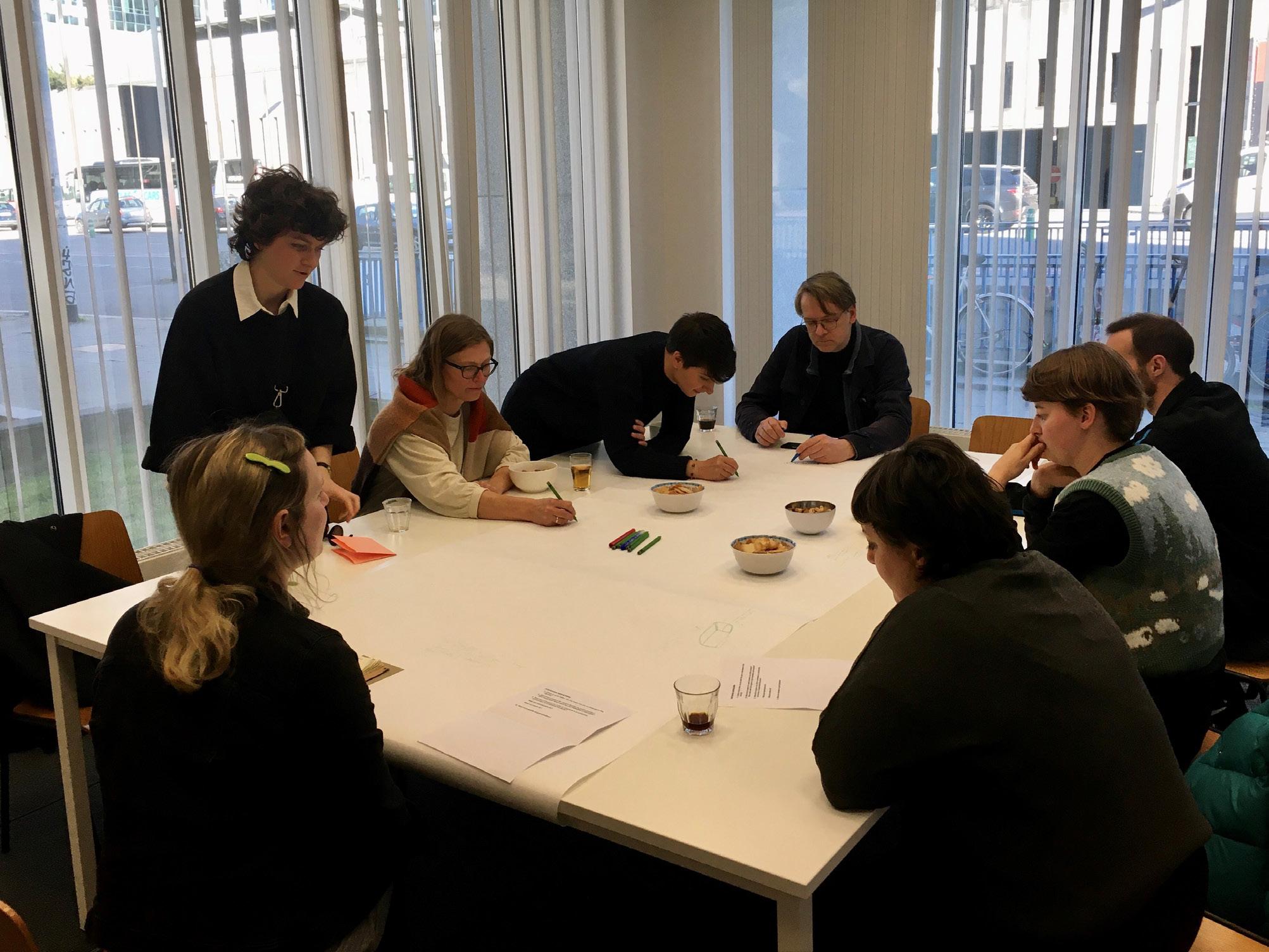
UFO public programme, one of the five tables discussing the questions proposed by Danielle van Zuijlen.
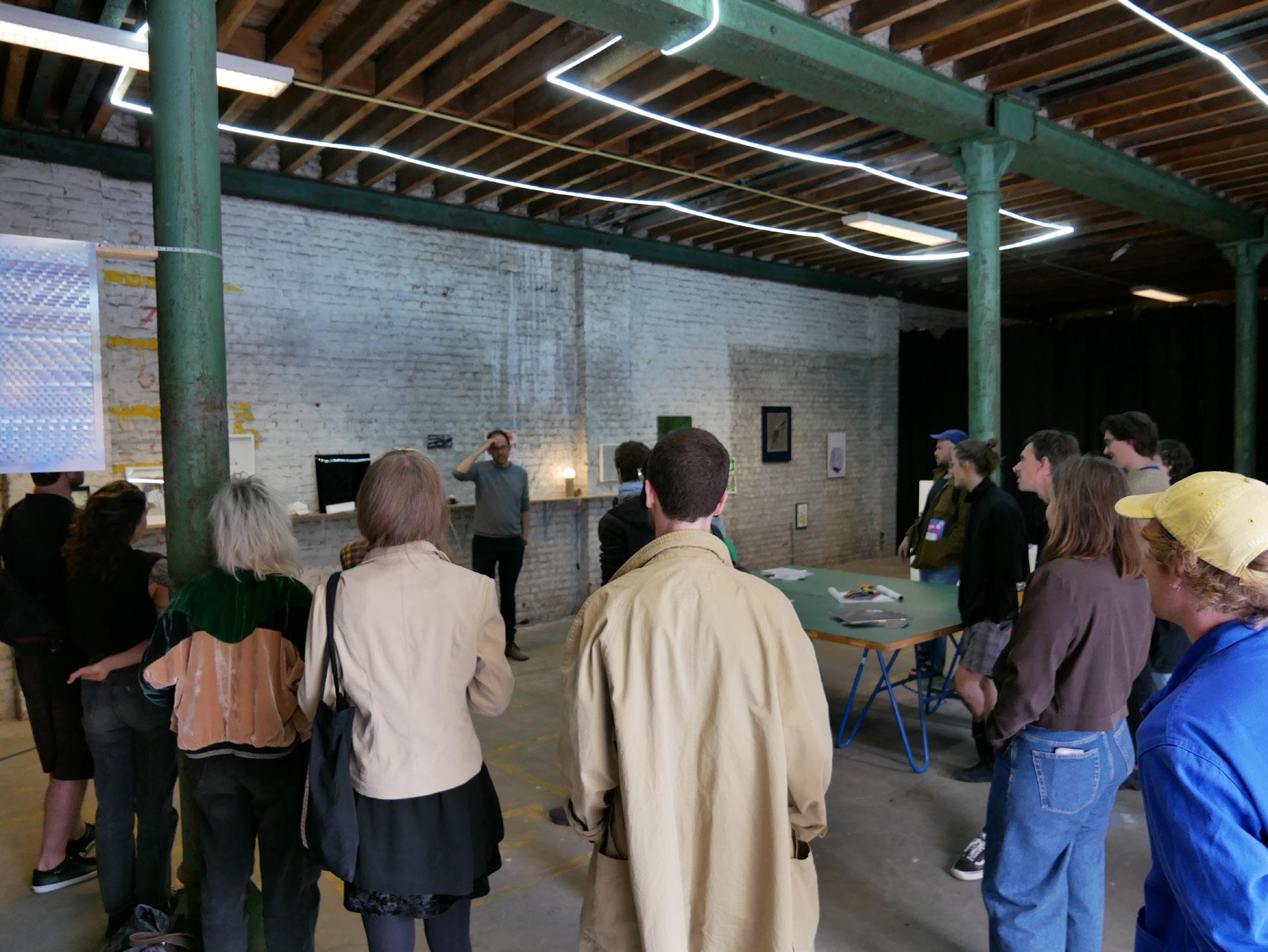
Presentation of the Salon Sale 2022.
UFO public programme — Together with Cas-co and Kunstenpunt
we also organised a public moment in Brussels. A keynote introduction by Danielle van Zuijlen (Kunsthal Gent, NUCLEO) on Infrastructures of care and support for (and by) artists started an afternoon of valuable exchanges of ideas and experiences between artists and the international guests on how artists and artist-focused organisations can create a supportive environment for artistic practices.
Parcours Maritime — Van Meyel participated in the atelier parcours of Molenbeek which this year focused on the neighbourhood of this location. We opened up our doors for two days to welcome visitors to present Level Five and a small presentation of works by artists working in VM.
Salon Sale — is an initiative to support artists as well as our cooperative. Each year members can contribute a work for the Salon Sale exhibition and online platform on our website. Part of the revenue goes to the artist and part in support of Level Five. In 2022 there was a Salon Sale exhibition at VM in spring during Art Brussels. Again, the format proved to be a success in bringing the work of artists of Level Five together in one display. Contrary to the expectations, with the art fair being next door in Tour & Taxis, visitor numbers were not so high. Still several artists sold their work. The Salon Sale remained until after the Open Studios so could also be visited during this moment.
Open Studios — This was actually the first Open Studio that we organised since the start of Level Five. We did some attempts in earlier years but due to Covid we had to cancel the 2020 and 2021
29
editions. We held an infamous internal Open Studios in 2019, which also resulted in virtual sessions on sharing artistic practices during Covid lock down regulations in 2020, driven by Olaf Winkler and titled ‘How Do You Do.’
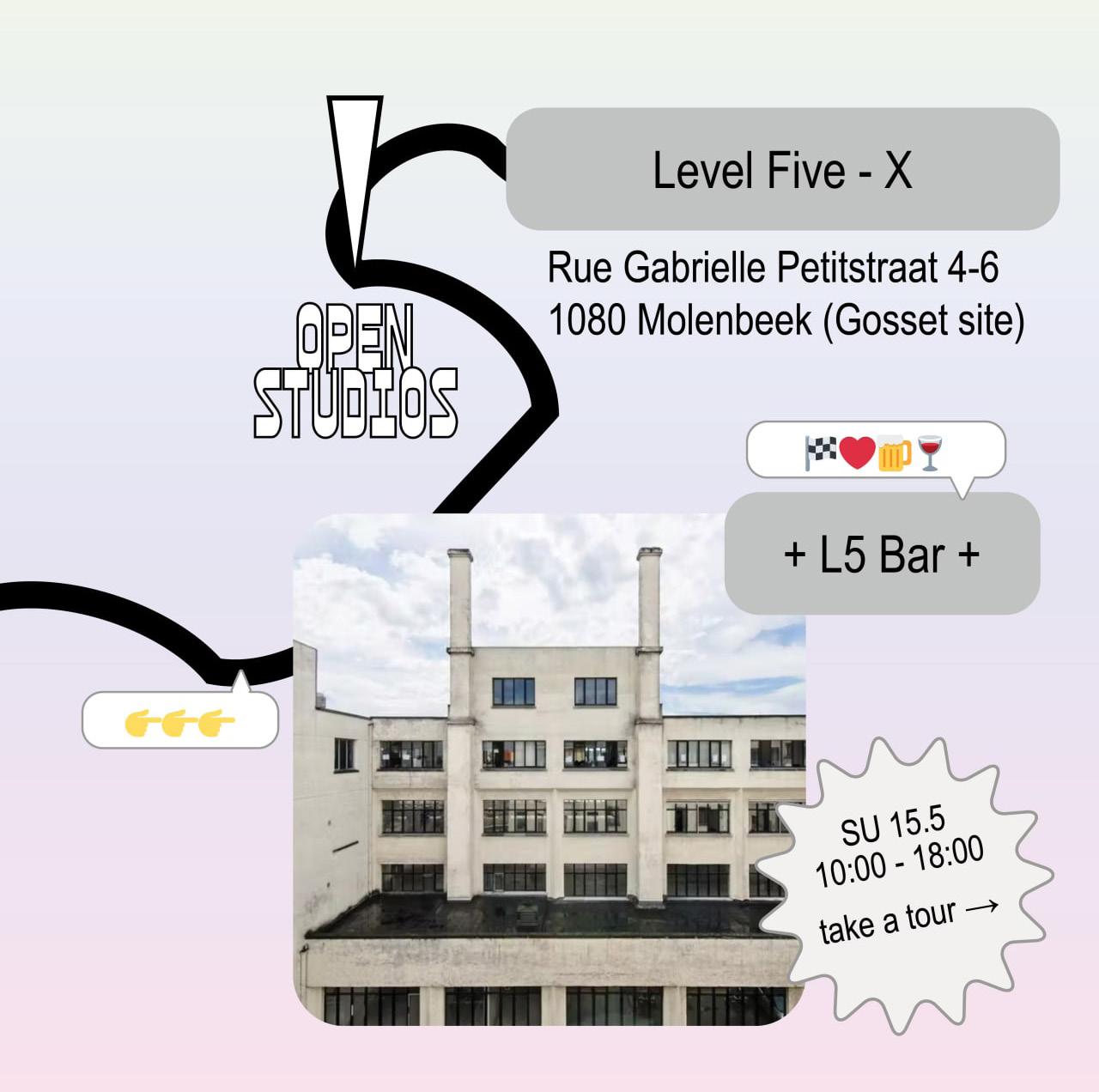
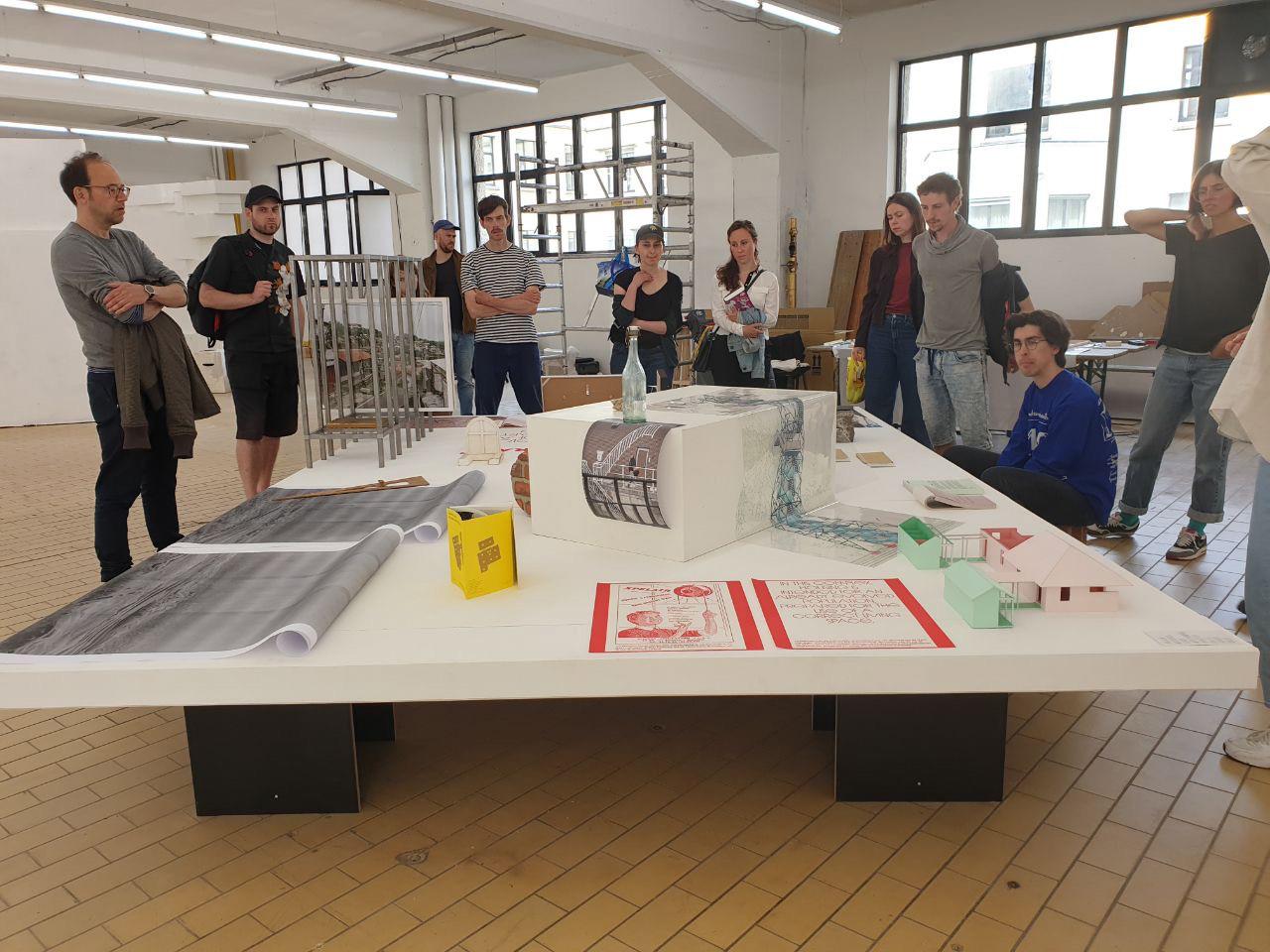
In 2022 we finally made it to organise Open Studios at almost all of our new locations. Because of a delay in making ready-for-use the VO location we had to find a substitute location for the group of artists that was already allocated a studio there. We managed to get the HISK exhibition space at the Gosset site for one month for those who wanted to participate in the open studios.
In VV artists made a small collective display of works in the shared desk space and showed films by artists at that location in a dedicated space. In VM a couple of studios were opened, but engagement beforehand was not so great. The Salon Sale was still on show. Also here a dedicated space showed films by artists from that location.
The most impressive development happened in the Gosset site where the group of VO artists really managed to build up a full scale and balanced display of each of their works. It was very admirable that a group of artists managed to bring this together in such a way without knowing each other beforehand, and while they were confronted with a delay of the projected use of their studio at VO. It contributed to forming a community towards occupying the VO building together. Also in this location the films of VO artists were shown in a dedicated space.
The film programme as such was organised with a lot of care, which can mostly be attributed to Emma van der Put. The collection of
30
31
Collective installation by Paoletta Holst, Sophia Holst, Laura Muyldermans, Jolien Naeyaert for Open Studios.
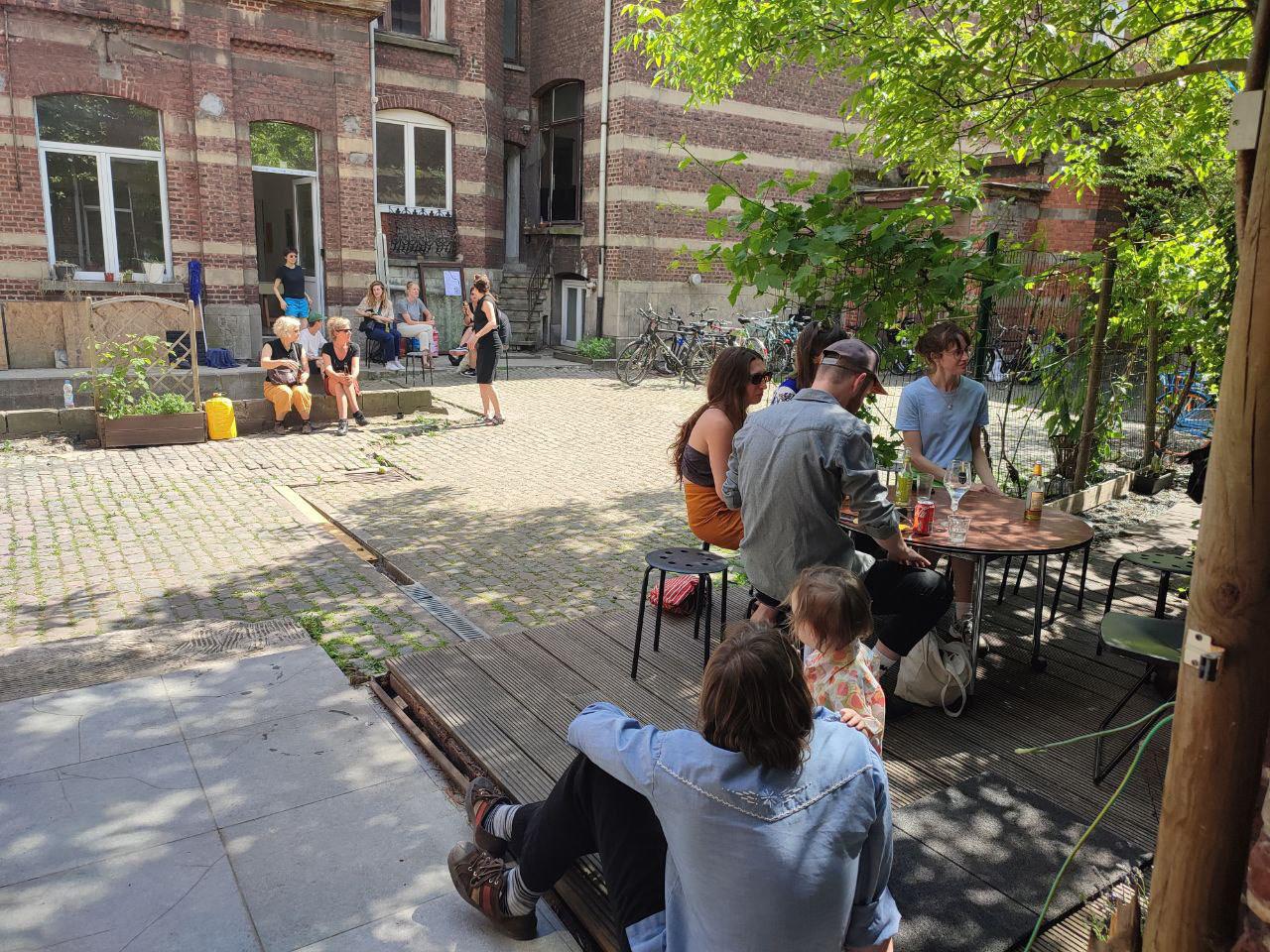
The courtyard of VM during the Open Studios 2022.
films was even made available online via our website, which allowed people to see the films in full beforehand or afterwards.
The overall Open Studios was communicated as a route that one could take by bike, public transport, or even by foot. Our own communication worked quite well in this regard with people visiting several locations. We mostly used Instagram and some printed material at the locations itself.
We inscribed VV and VM also as locations on the Atelier in Beeld website which brought a broader public to visit us. For the VO location at the Gosset site it was too late to register, but people got to know about this site when visiting one of the other locations. It was considered important to organise an internal Open Studio visit for ourselves beforehand.
With the pressure of finding new locations and moving it was a while ago that we could have these kinds of exchanges while they are very valued by the artists. Moving also meant that the community was separated over different locations and some did not visit one or the other location and lost contact with the artists there. In addition there were many new members to Level Five with the new group formed for VO so it was important for them to get to know the artists at the other locations and become familiar with the community of Level Five. It was a great moment to get introduced to the work of the new members. After a whole day of brief introductions to their work by each artist going from location to location, a fun evening of dancing was organised on a boat on the canal of Brussels. It was a good moment to bring everyone together again.
32
a.pass end presentations — The depot and basement of VM was used by Chloë Janssens and Vera Sofia Mota, participants of a.pass, to develop their end presentations. The last two days of the month their presentations were open to the public. They were well visited and people could hang around in the courtyard because of the good weather. Food made by an a.pass participant was available in the kitchen.
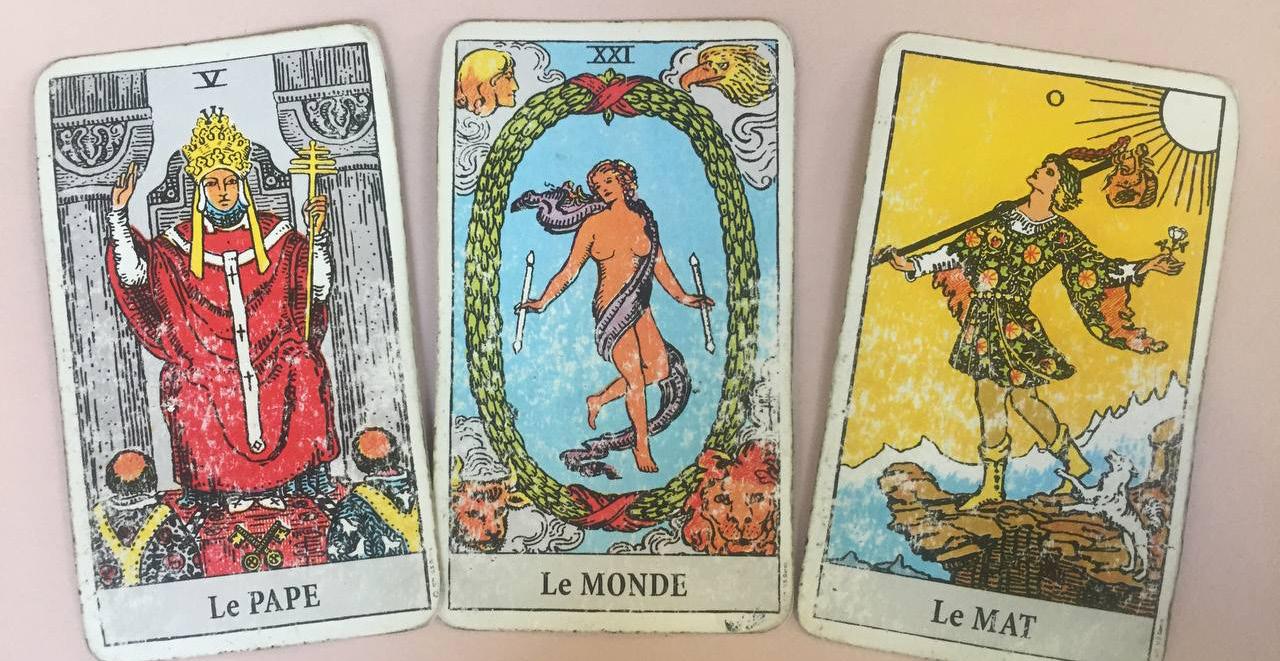
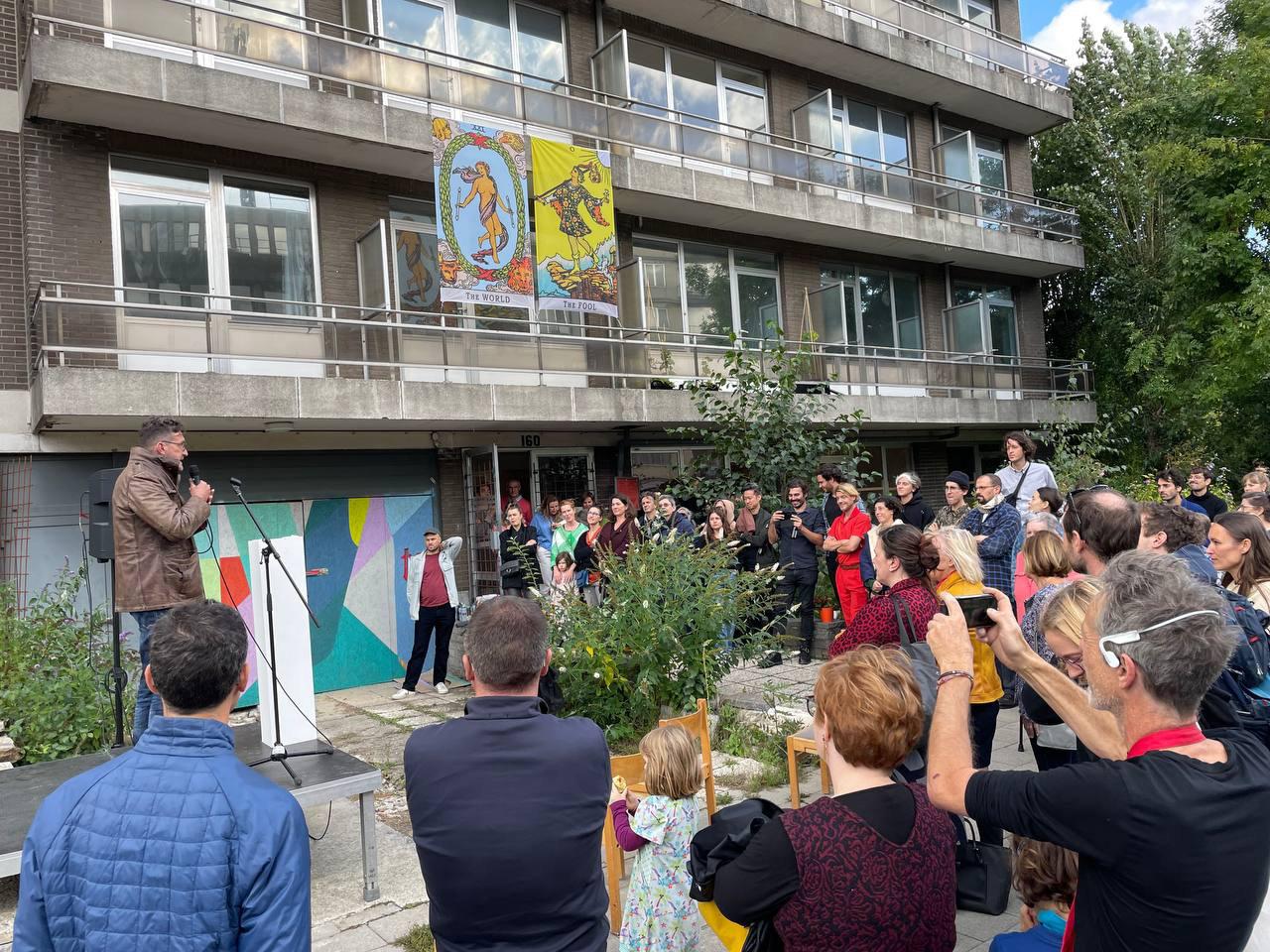
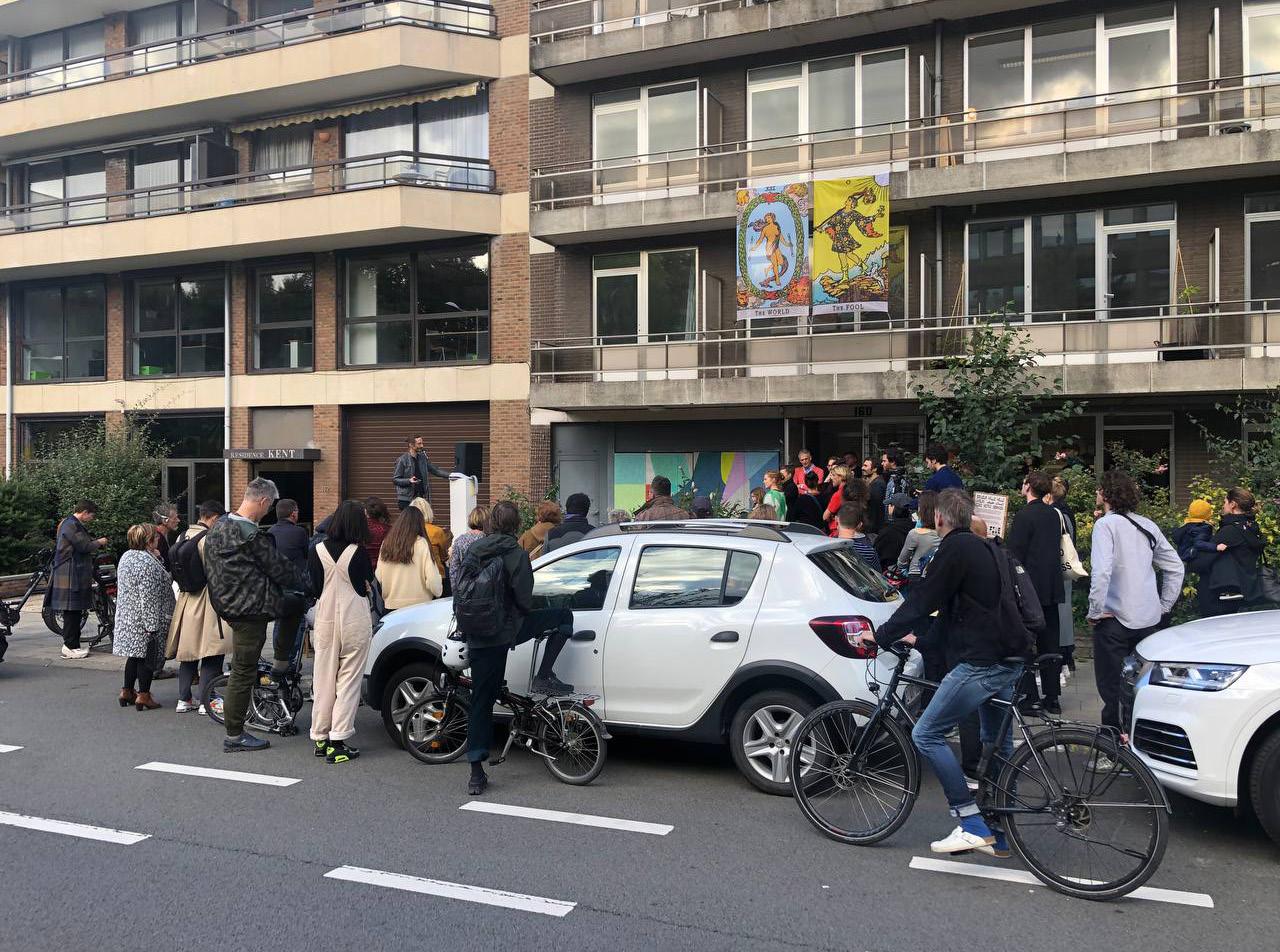
Opening VO — At the start of the cultural season we held an official opening of the new location in Ganshoren, VO. We commissioned artist and member Francesca Grilli to read the tarot cards on a question that was formulated by the members, ‘How can we, artists together with politicians, create an ecologically and socially sustainable future for art practices in Brussels?’ For the opening the cards were printed on large flags and hanging from the façade of the building. Performer Benno Steinegger re-enacted the reading of the tarot cards.
“[…] The fool (the artist) is looking to the world and open to a new future. Yes, I can jump into this future […] has the vision but does not have the power to change the structure alone. The hierophant (the politician) has the ability to break down the structure but especially the power to build up a new structure to support visions of the future […] but both are needed for the world to come”
There was a short speech by the alderman of Dutch language affairs, Philippe Beghin, and a speech by Pascal Smet, VGC board member for Culture. Afterwards the building and the studios were open for the public and the neighbourhood to visit. There was a lot of interest
33
34
Benno Steinegger performing the tarot reading by Francesca Grilli during the opening of VO.
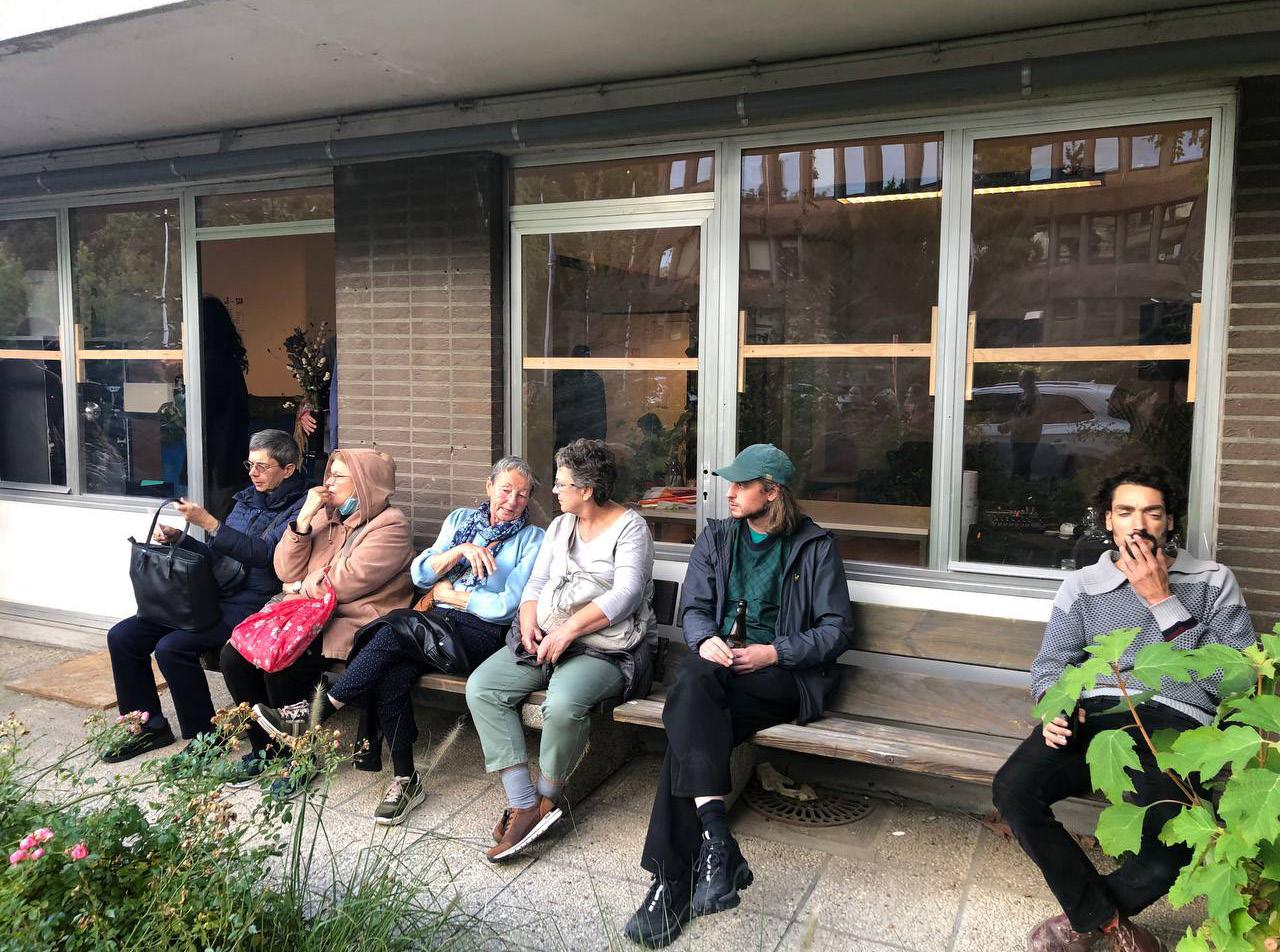
Artists and Neighbours sitting in front of the building during the opening at VO.
and people in the neighbourhood were genuinely happy that there was artistic activity brought to this location. To celebrate and value the persistence and engagement of the members in the trajectory towards the opening we organised a dinner for all the members and had some music performances by members until late in the night.
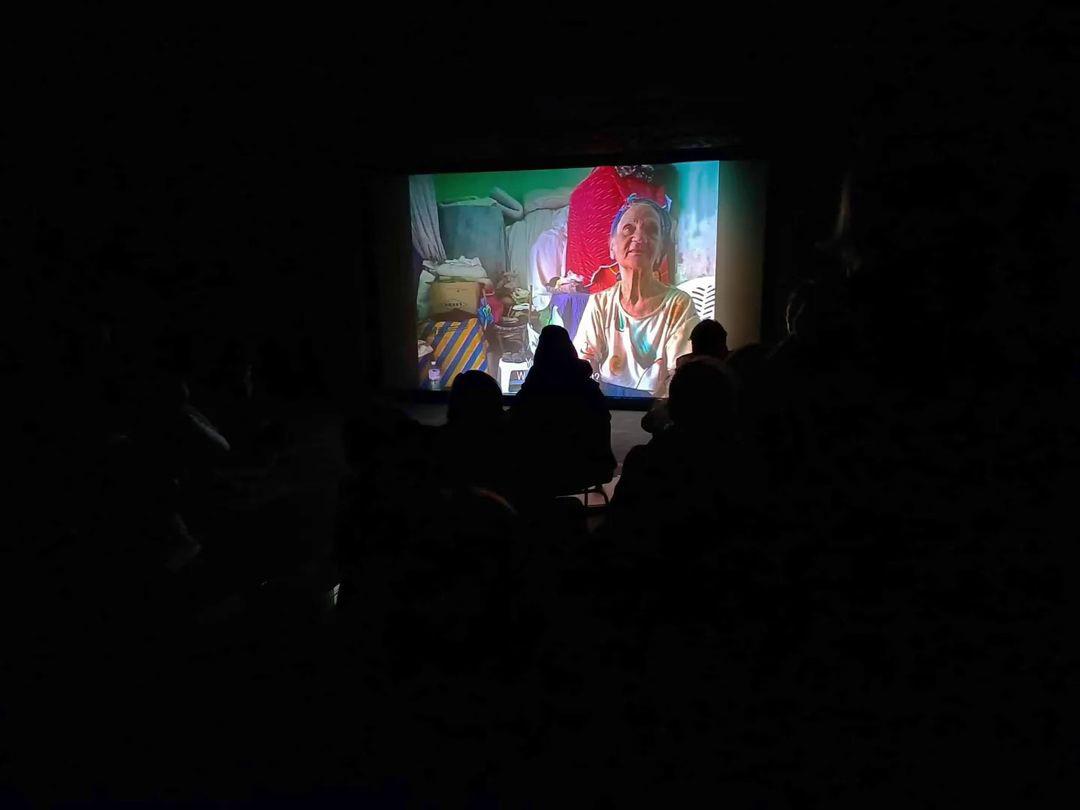
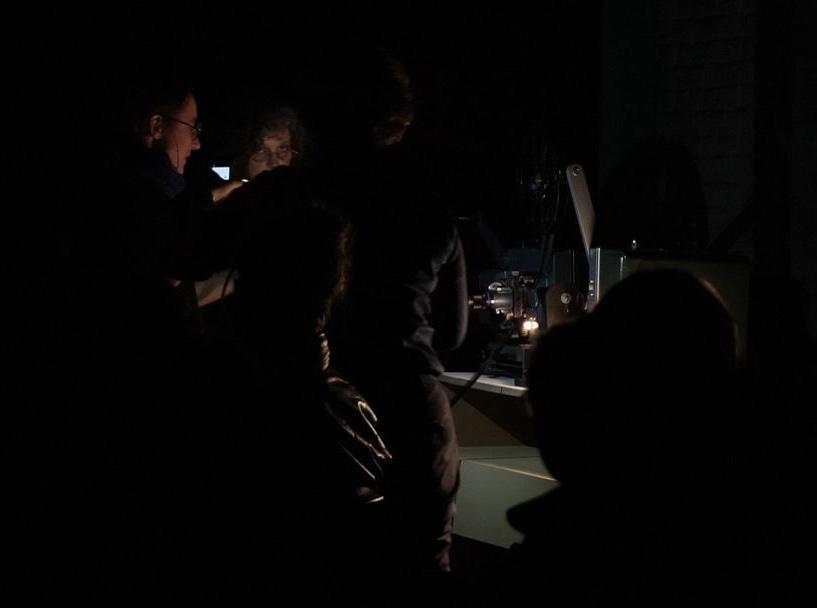
Blue Screen — A screening program focusing on film and video works by visual artists. The program is initiated by Chloé Malcotti and Emma van der Put and takes place at Level Five. It functions according to a relay principle, the current artist invites the following. Chloé and Emma carefully curate films around the work of the proposed artist, allowing for unexpected encounters and relations. After a series of online screenings in 2021 (due to covid measures) this year they could continue in real life. They successfully applied for a micro-project grant from the VAF in the name of Level Five. This allowed for a series of four new evening programmes. Blue Screen #4 with Katja Mater and works by Els Van Riel, Sarah Pucill, Maika Garnica and Ans Mertens; Blue Screen #5 with Fairuz Ghammam and works by Eduardo Kac, Tacita Dean, Hannes Böck; Blue Screen #6 with Adina Ionescu-Muscel and works by Rosa Aiello, Alasdair Asmussen Doyle, and Luke Sieczek, Caryn Cline, Jon Behrens.
Blue Screen #7 with Stéphanie Roland and works by Bas Jan Ader, Marjolijn Dijkman and Toril Johannessen. Blue Screen started an Instagram account in 2022 @levelfivebluescreen, which has gained 260 followers to date.
35
36
Mounting the film ‘As much Time as Space’ (2017) by Katja Mater on the projector during Blue Screen #4
Watching the film ‘Oumoun’ by Fairruz and El Moïz Ghammam during Blue Screen #5
Silver Screen — The collective term for the screenings that are self-initiated at Level Five. In November Rune Petersen presented Raabjerg (2021), a film that explores the changing landscape of northern Jutland in Denmark.
Working the Ground (Workshops) — Together with SB34 we applied for the cultuurculture funding that encourages collaborations between organisations operating in the different language communities. The first workshop ‘Starting a Code of Collaboration’ revolved around codes as generative documents that enable practices, reflection and conversation on what is needed for a supportive environment. The workshop was developed and hosted by Jacopo Buccino. For the second workshop we invited Anne Rayet to work through ‘Legal and Fiscal Guidelines for Art Workers.’ In 2023 the Working the Ground trajectory will continue with a visitors programme inviting curators from all regions of Belgium to visit artist at Level Five and SB34.
Radio Level Five — A podcast run by Level Five members. The radio hosts conversations, discussions, sound works, writings, soundscapes and other cool stuff related to our community. Although the workgroup was less active in 2022 the episodes remain available on our website and most common podcast platforms. An episode on codes of conducts was produced but is still to be finished.
Art school student visits — We get many requests from art schools to visit Level Five. For us it is important to introduce students and teachers to the attitude and principles of Level Five and for the students it is interesting to visit studios of artists outside of the context of the art academy. There is a gap between studying in art school
37
and developing an artistic practice afterwards. Level Five can provide an insight and understanding that an artistic practice is dependent on many factors to flourish; that a supportive environment of peers is as important as the occasional exhibition, and that relative autonomy could actually be gained by collective action. In 2022 students of the following Belgium art schools were introduced to Level Five and visited studios of artists: LUCA Gent, KASK, La Chambre, Arba-ESA. Several art schools internationally find it important to visit Level Five with their students while being in Brussels for example: St. Joost School of Art & Design (Breda, NL), KABK (The Hague, NL), PTAC (Rennes, FR).
Community get togethers — The shift from being in one location to several brings the need for extra attention and programming of community activities. Apart from the programming of collective activities such as Open Studios, informal meet ups are relevant to exchange experiences on a personal level. This year we found a rhythm in organising a get-together before thesummer slowdown and one festive event before closing the calendar year. This year Halloween dinner was reanimated, a specialty of the members Perri and Kevin and a notable tradition for members and friends of Level Five.
WINONA — A project space run by Henry Andersen, Charlie Usher and Bryana Fritz started up in 2022. They organised six exhibitions: ‘Refined Sugar’ with Mekhitar Garabedian, Margeaux Schwarz, Emile Rubino; ‘Front Lighting, Back Channel’ with Francesca
Hawker and Theo Livesey; ‘Times, Times, Times.’ by Benedikt Bock; ‘Conversation Pit’ by Marina Pinsky; ‘Blood and Guts in Grad School’
by Kathi Hofer; ‘Gates’ by Anna van der Ploeg and David Daniels.
38
(...)
FROM ONE TO ANOTHER SUPPORTING ARTISTIC PRACTICES
What is needed for these spaces to support our artistic practices? How do we ensure that this being together contributes to personal and artistic growth? Reproducing Level Five every day involves cleaning, maintenance, groceries, administration, ... — the less glamorous aspects of life. If care and time for these tasks is invested in equity, a supportive environment can arise for each to take initiative, develop, and exchange artistic practices amongst equals.
39
COLLABORATIONS
Municipalities — Moving from Brussels centre to three different municipalities we made an effort to introduce ourselves to the municipal governments and organisations.
In Forest we met up with the cultural policy coordinator Aurélie Duchateau, and we also have regular contact with WIELS arts centre.
In Molenbeek we participated in the parcours d’atelier and the cultural policy coordinator Tjorven Vanden Eynde visited VM. We also collaborated with many local businesses along the way.
In Ganshoren we reached out to alderman Magali Cornelissen and Philippe Beghin. We held an information evening for the neighbourhood and the opening festivities were widely communicated within the municipality. We have good contact with cultural policy coordinator Philippe Debroe. We met up and introduced Level Five to the cultural centre La Villa. With cultural centre De Zeyp being our neighbour we developed a collaboration from the start. They are very open in providing us and the artists with space. If needed they can contact Jill Tersago to see for availability.
It is important for us to be embedded in the municipalities where we operate. We look forward to further developing these collaborations and to connecting with the other municipalities. As was indicated in the report ‘Atelier Beleid op Maat van Brussel’ written by Rob Ritzen and Dries Van de Velde on request of the VGC, reaching out toand bringing together the 19 municipalities is crucial in formulating
40
oherent atelier policy and constituent in rolling out a durable infrastructure for artistic practices in Brussels Capital Region. In a way this is already happening because the alderman of Dutch language culture in Elsene, Els Gossé, invited us to present Level Five and is willing to search for possibilities, via the administration of urbanism for example, for Level Five to find a location in Elsene.
UFO Platform for studio organisations — As part of UFO, a network of atelier organisations in Flanders and Brussels, Level Five participates in monthly meetings where we share and discuss the working of ateliers organisations and the position of our organisations within the city and the larger cultural landscape in Belgium with the other member organisations: De Tank (Brugge), Nucleo (Ghent), Vonk (Hasselt-Genk), Morpho (Antwerp), Cas-co (Leuven).
Apart from the visitors programme of Level Five and Cas-co there were two more visitor programmes organised by UFO. In spring by Vonk and Morpho, in autumn by Nucleo and De Tank. These also included a public moment with exchanges with the visitors on international opportunities for artists.
Together we worked on a dossier in the subsidy line ‘Boven Lokaal’ which is focused on cultural collaborations within Flanders and Brussels across municipal and regional borders. This obviously lends itself for the opportunity to formalise and develop the collaboration that is present within UFO. The dossier was submitted in November 2022, by April 2023 we will know if it has been granted. This will allow UFO to attract its own coordinator and roll out a programme that will support the functioning of studio organisations and the development of visual artists. Part of the artistic programme, such as open (studio)
41 a c
days, artist portraits, city talks and visitor programmes, can then be supported by UFO. It will also enlarge and give visibility to Level Five and help to sensitise different sectors and policies on the importance of affordable workspace for artists in the urban context.
Brussels Kunsten Overleg — Since 2021 Level Five has been a member of BKO. In 2022 we participated in their general assembly for the first time and introduced our organisation to the other members. Since the majority of BKO are larger presentation institutes, Level Five can bring forward the importance of space for artistic practice in balance with space for presentation. In addition, it can represent the concerns of artists and advocate for their place within the Brussels art field. We were part of several thematic meetings throughout the year, such as the workgroup Energy and Infrastructure.
The Constellation — A network that brings together Hiros, Zinnema, Bâtard, Argos, Volta and Level Five in offering support to the associated artists of Beursschouwburg. The Constellation also serves as an explorative collaboration between the different organisations. Which overlaps can we find and how can we support each other? On the initiative of Beursschouwburg we come together every quarter and share what is on our minds. Thinking about what we could bring in, and at the same time would be valuable for our members. We focus on bringing about exchanges between the associated artists of Beursschouwburg and Level Five.
Brussels Artist Run Network — An informal exchange between different artists run spaces. Mostly running through a newsletter and a Telegram group. A couple of times a year a bike tour is organised along several spaces in order to get to know each other.
42
Goethe Institute — We hosted the creative duo ZEBU from Berlin
which is active in the field of illustration, painting and screenprinting. They worked in one of our studio spaces for one month preparing for an exhibition during the Grafixx illustration festival in Antwerp.
Continental — The city of Brussels issued an appeal for the temporary use of the Continental building at Place Brouckere. After a compulsory visit, we asked if contacts could be shared among visitors so that collaborations could emerge. This will allow smaller organisations to collaborate and have a better chance of submitting a good dossier. This is how we were contacted by Arteos asbl. Together with them, we worked on a proposal for the temporary use of the building. Level Five is projected to occupy two floors and be involved in the general management and programme of the building. With the resulting proposal we were invited for an interview. The decision between the candidates will be announced in the first half of 2023.
Brussels 2030 — We participated in the worksession Territoire/ Ruimte, a discussion platform and workgroup towards the formulation of a proposal for the candidature of Brussels to be the cultural capital of Europe in 2030. At the moment Architecture Workroom
Brussels is leading the trajectory proposing the activation of a space in the summer of 2023 as a prefiguration of a ‘future space’ and the potential of Brussels 2030. We are not sure how to participate in this, although it would definitely be of benefit to bring Level Five forward and to advocate for the need for space for artistic practices. It would ask a lot of energy to participate, with a move in the foresight this might be too much for us to take up.
43
VUB/Cosmopolis, WELCOMIN — Is a three years project, inspired by Permanent. Though only in a few cases community ownership or long-term occupations are realised, the ambition of WELCOMIN is to investigate the potential of long term/collectively owned infrastructures, going as much as possible beyond temporary occupations and the precarious settings and lifestyles these imply. VV is part of a case study in Brussels, a conference will be organised in spring 2023 around the site of the Marais.
Fairground — At the end of 2021 to the beginning of 2022 we were part of a collective attempt with several non-profits from socioeconomic and cultural sectors to buy a large premise that used to be a textile factory and was turned into a coworking space. Level Five would have been interested in a space on the ground floor of about 800m2 that could host about 10 to 15 artists. Unfortunately, the project was discontinued. We learned a lot from the trajectory and keep in contact with Fairground for future projects.
La Grande Tablée des communs bruxellois — We participated in a study on urban commons initiated by Brussels Environment and Brussels Economy and Employment. I was supported by Communa, CLTB, EcoRes and EQUAL. The study is aimed at understanding the needs, difficulties and ambitions of the commons in the Brussels Capital Region.
44
A NETWORK TO SUPPORT ARTISTS ON THE LONG-RUN
Apart from the care amongst each other we are reaching out and building up a network to support our cooperative as such and the artistic field at large. Through our cooperation we rethink the organisational and economic structures of the arts, rework considerations of what it is to be artists, and rehearse potential fair practices that could materialise within the city, amongst fellow inhabitants. As such we develop an understanding of what we stand for and how we see ourselves, which prepares us for solidarity and coalitions with others in different situations but similar struggles.
45
(...)
Analysis of income for 2021-2022
46 2021 2022 InvestmentgrantCoreprogrammegrants Exceptional Covid grants €0 €30k €60k €90k €120k
RentsreceivablesProject specific grant Otherincome 2021 2022 €0 €50k €100k €150k €200k Studios Programmes Admin €150k Analysis of expenditure for 2021-2022
FINANCIAL REVIEW
This was an exceptional year due to moving from one to three premises, which brought in investments grants but also a lot of costs. In addition, there was an increase in energy costs, which had an impact on our prospective income from some locations.
Income from studios represents 63.32% of Level Five’s revenue, with occupancy in the studios continuing at over 95%. Grants represented 34.77% of income, while other income represented 1.9%.
In addition to grants received which were restricted to specific projects, The Flemish Community Commission continued to recognise the work of Level Five by providing core funding totalling €58.000 towards the basic coordination of the organisation.
Income/expenditure snapshot
47
Income 2022 (€) 2021 (€) +/Rents receivables 128.323 91.930 39.58% Project specific grant 10.300 7.900 30.38% Core programme grants 58.000 30.000 93.33% Investment grant — 50.000 n.a. Exceptional Covid grants 2.163 10.500 n.a. Other income 3.865 3.664 -8.51% Total income 202.651 193.994 — Expenditure 2022 (€) 2021 (€) +/Studios 164.326 152.645 7.65% Programmes 6. 281 8.192 -23.32% Admin 36.408 24.689 47.46% Total expenditure 207.015 185.526 —
STEPPING STONES
“Watch your step!” is advice we took to heart last year. Moving from one location to three locations was a big step taken; carrying the load of more bricks and concrete while at the same time longing to relate to each other within this new constellation. It was a year of recalibration. As a collective we showed strength in the ability to make do, and plasticity in our ability to reshape and allow new relations in. As an organisation we proved to hold as a support structure while leaving space to organically reshape our form from within.
We are working the soil in order to plant the seeds for a more sustainable environment for artistic practices. One of the foundations for this is durable studio space, but more importantly is the support and care that comes with cooperation. The current context we are operating in is an unstable balance but in order to trod stable ground we have to move on.
Coming year we will find ourselves moving out of one of the three locations again. We hope to find a more stable solution for the artists there. Nevertheless this year might also be the moment to consolidate the relations in the community through shared activities and programmes. The basic elements of our programme are sketched out; Open Studios, Visitors Programme, Blue Screen, ... and there is room to develop it further.
Organisationally we will take some steps to form a stable ground in order to support a durable future for our cooperative. A first step might be to reformulate the statutes by the board. The council can
48
develop the internal documents and guidelines further which will enable an accessible and shared understanding of Level Five. With a bit of luck we could be able to appoint a second half-time coordinator which will bring more support and dynamic in the work of coordinating the administrative and artistic aspects of the organisation. Location Responsibles can formulate their tasks and bring them into practice. Enough things to work on reinforcing the supportive frame that is already there is one of the main efforts to be taken. We will continue to stumble upon obstacles for which we need to find ways to work with or around them. With all the shared experience we have we can be sure beautiful practices will evolve out of these new encounters. watch your step, without fear.
49
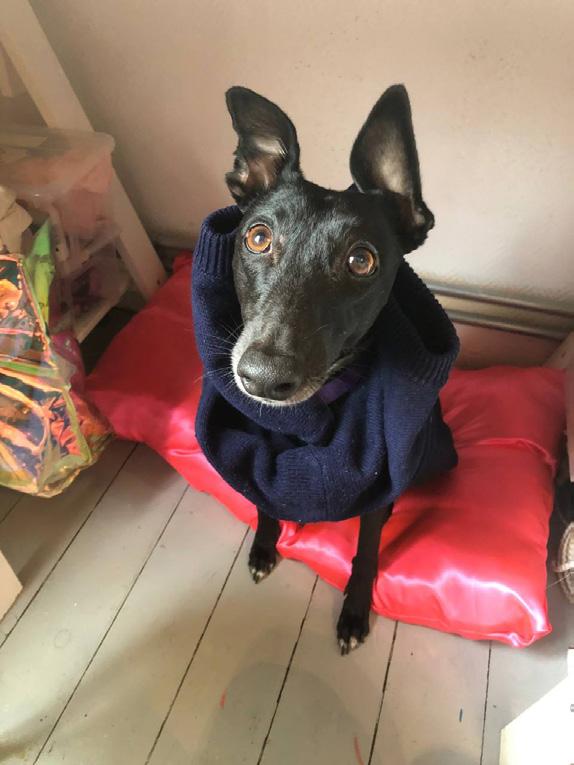
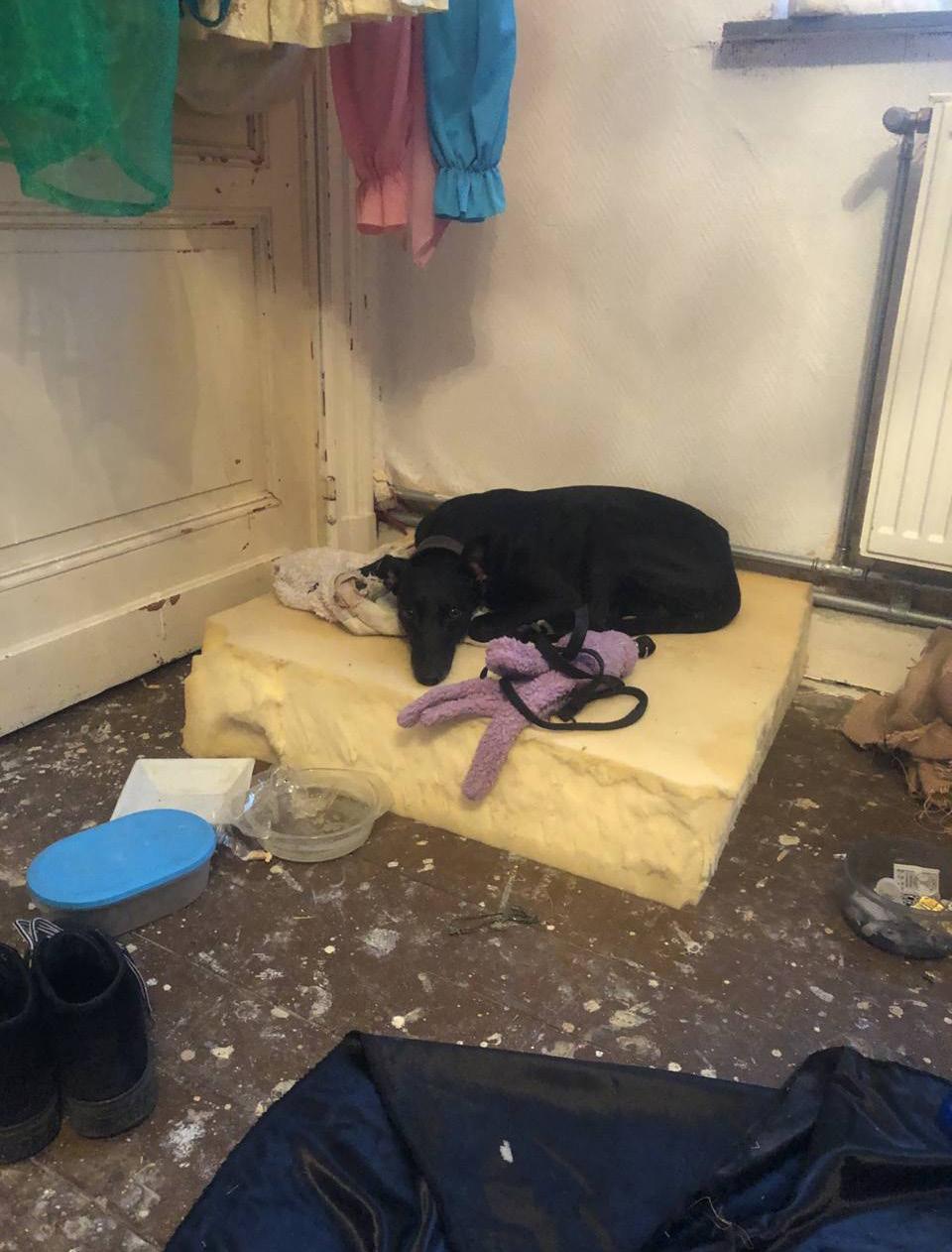
Laynee long time supporter of artists, honourable member and mascotte of Level Five.