Viewpoints
The Newsletter of the Licensing Executives Society (U.S.A. and Canada), Inc.
Vol. XXVI No. 4
December 2018
Get Involved – It Will Change Your Life
tion, learn from each other, and discuss the unique IP situations that U.S. (Department of Defense) DOD contractors are faced with. In other words, the power of “collective knowledge.” It was the best career move that I ever made. Not only did it create a cadre of friends, that to this day still communicates and shares knowledge and experiences with each other, but it advanced my career in ways that I could never have imagined. I would not have been able to recover from a layoff at my last company in 2016 when they were bought out and they gave us two days’ notice, had it not been for the business relationships that were cultivated as a result of LES.
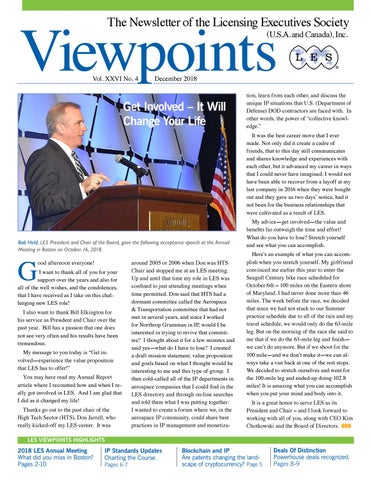
Bob Held, LES President and Chair of the Board, gave the following acceptance speech at the Annual Meeting in Boston on October 16, 2018.
G
ood afternoon everyone!
I want to thank all of you for your support over the years and also for all of the well wishes, and the condolences, that I have received as I take on this challenging new LES role!
I also want to thank Bill Elkington for his service as President and Chair over the past year. Bill has a passion that one does not see very often and his results have been tremendous. My message to you today is “Get involved—experience the value proposition that LES has to offer!”
You may have read my Annual Report article where I recounted how and when I really got involved in LES. And I am glad that I did as it changed my life! Thanks go out to the past chair of the High Tech Sector (HTS), Don Jarrell, who really kicked-off my LES career. It was
around 2005 or 2006 when Don was HTS Chair and stopped me at an LES meeting. Up and until that time my role in LES was confined to just attending meetings when time permitted. Don said that HTS had a dormant committee called the Aerospace & Transportation committee that had not met in several years, and since I worked for Northrop Grumman in IP, would I be interested in trying to revive that committee? I thought about it for a few minutes and said yes—what do I have to lose? I created a draft mission statement, value proposition and goals based on what I thought would be interesting to me and this type of group. I then cold-called all of the IP departments in aerospace companies that I could find in the LES directory and through on-line searches and told them what I was putting together. I wanted to create a forum where we, in the aerospace IP community, could share best practices in IP management and monetiza-
My advice—get involved—the value and benefits far outweigh the time and effort! What do you have to lose? Stretch yourself and see what you can accomplish.
Here’s an example of what you can accomplish when you stretch yourself. My girlfriend convinced me earlier this year to enter the Seagull Century bike race scheduled for October 6th – 100 miles on the Eastern shore of Maryland. I had never done more than 46 miles. The week before the race, we decided that since we had not stuck to our Summer practice schedule due to all of the rain and my travel schedule, we would only do the 63-mile leg. But on the morning of the race she said to me that if we do the 63-mile leg and finish— we can’t do anymore. But if we shoot for the 100 mile—and we don’t make it—we can always take a van back at one of the rest stops. We decided to stretch ourselves and went for the 100-mile leg and ended-up doing 102.8 miles! It is amazing what you can accomplish when you put your mind and body into it. It is a great honor to serve LES as its President and Chair – and I look forward to working with all of you, along with CEO Kim Chotkowski and the Board of Directors.
LES VIEWPOINTS HIGHLIGHTS
2018 LES Annual Meeting What did you miss in Boston? Pages 2-10
IP Standards Updates Charting the Course. Pages 6-7
Blockchain and IP Are patents changing the landscape of cryptocurrency? Page 5
Deals Of Distinction Powerhouse deals recognized. Pages 8-9
Viewpoints BOARD OF DIRECTORS President & Chair Robert F. Held Chief Executive Officer Kimberly Chotkowski Past-President & Past-Chair Bill Elkington President-Elect & Chair-Elect Gary Fedorochko Secretary Kevin Spivak Treasurer Mike Pellegrino
DIRECTORS Eric Victory Leslie Millar-Nicholson Rachel Kreppel Jim Bratton Annie Gauthier Louise Levien Annemarie Meike Gillian Fenton Matthew McNeill Scott Williams Counsel: Paul A. Roberts
2018 Boston Meeting Recap
A
revolution of ideas, networking and education inspired more than 700 attendees at the 2018 LES Annual Meeting in Boston. Advancing Innovation through a Renewal of Trust was the opening plenary 2018 Annual Meeting in a fireside chat format featuring Walter Copan, NIST, and Andrei Iancu USPTO, see Page 4.
Work Smart: How to Negotiate Your Compensation, brought to us by the Women In Licensing Committee (Chair, Soody Tronson), hosted a facilitated discussion on salary negotiations with featured speaker Alex Howley. Look for more on that in the March 2019 issue. IP Protection in the Age of Blockchain presented a panel of experts discussing patents and new uses for cryptocurrencies, see Page 5. Spotlight plenaries targeted to each business sector gave a deep dive into various business trends. One all-star panel discussed Us or Them: Who is Going to Set Standards for Licensing? They highlighted how owners of intellectual property and their lawyers are on the front lines of developing voluntary licensing standards, see Pages 6-7. Members are encouraged to join a Standards Committee to help set those standards. Visit: www.lesusacanada.org/page/lesstandards.
The Deals of Distinction Awards highlighted five teams that worked together to make our world a better place; read more about these fascinating deals on Pages 8-9. Jim McCarthy was recognized with the LES President’s Exemplary Service Award, see his spotlight on Page 12. Chapter Cup Awards were a fun addition to the Welcome Reception, recognizing the importance of the Local Chapters, see Page 10. Educational add-on courses also offered CLE credit to many attendees. A noteable workshop led by Gillian Fenton was Career Paths for Dealmakers: A Ladder or a Jungle Gym? It included a Headshot Photo Booth available to all attendees.
Boston-themed networking events kicked off with the All Things Boston Welcome Reception featuring a tour of Boston. Monday evening took us to an LES Supper Club-type of “not so Gala” where we honored Louise Levien as the recipient of the 2018 Frank Barnes Mentor Award. On Tuesday evening signature cocktails from each sector were available for sampling; they helped the crowd loosen up for a hilarious Sector Feud Game patterned after Family Feud. LES is famous for these fun and lively events that allow attendees to grow their network through shared experiences. Check out meeting photos on the LES website: www.lesmeetings.org/am18/photo-gallery/
Membership inquiries and contact changes should be sent to:
Thanks To The 2018 Annual Meeting Team!
membership@les.org
Editorial inquiries and contributions should be addressed to: Editor Carla J. Blackman carla@designinterface.com or Editorial Director Gillian Fenton The quarterly newsletter is published by Licensing Executives Society (U.S.A. and Canada), Inc. and is available online at www.lesusacanada.org. Views expressed in articles are solely those of the respective authors.
ARTICLE DEADLINES FOR QUARTER 1 LES VIEWPOINTS: FEBRUARY 6, 2018 Copyright ©2018 Licensing Executives Society (U.S.A. and Canada), Inc.
Thousands of volunteer hours went into the Annual Meeting by these members: Lalit Gaur, Seema Basu, Michael Fluhler (Meeting Chair), Kevin Spivak, RK Narayanan and Karthika Perumal (Program Chair). Not shown: Scott Williams, Gary Fedorochko, David Powsner, Efrat Kasznik, Nikki Kennedy, Richard Magid, Gillian Fenton, Vincent Bergeron, Robert Jung, Mike Perham, David Rikkers, Ana Lopes, Lewis Stark, Nadine From, Justin Lewis, Ian DiBernardo, Robin Corwin, Janis Elsner, Soody Tronson, Nick Baciu and Trevor Blum.
.
LES Leadership In Action
Connecting and Inspiring the Intellectual Capital Community Incoming President Bob Held accepts nomination from PastPresident Bill Elkington.
Table of
CONTENTS
LES President’s Speech ...................1 Annual Meeting Recap ...................2 Board of Directors & Leaders............3 The 2018-2019 LES Board of Directors. Row 1, left: Kevin Spivak, Bill Elkington, Bob Held, Gary Fedorochko; Row 2: Annemarie Meike, Gillian Fenton, Louise Levien, Leslie Millar-Nicholson, Rachel Kreppel; Row 3: Kimberly Chotkowski, Jim Bratton, Eric Victory, Scott Williams, Matthew McNeill and Mike Pellegrino.
Fireside Chat: Innovation ..................4 Blockchain and IP.............................5 Setting Licensing Standards............6-7 Deals of Distinction Awards..........8-9 Local Chapter Cup Awards................10 LES Chapter Meetings..............10-11 McCarthy Member Spotlight..........12 Frank Barnes Mentor Award...........14
Recently LES CEO Kim Chotkowski spoke at the International Import Expo in Shanghai about the importance of IP and Licensing.
IP Standards: Elkington Interview........14 IP Standards: FRAND Q&A ................15 CLP Q&A Tanya Moore....................16 LES Education Update...................17 LES New Members..........................18
At the LES Annual Meeting in Boston, Kim Chotkowski (right) welcomed Andrei Iancu, USPTO (left) and Walt Copan, NIST (center). Both men were featured speakers at the opening plenary session.
LES Annual Meeting Photos............19 Thanks to Exhibitors and Sponsors.................................11 & 20 3 | December 2018
Opening Sesson: Advancing Innovation Through A Renewal Of Trust
3 Questions, 2 Government Leaders & 1 Fireside Chat 2018 Annual Meeting
By Renee McMullen Following the initial discussion, both directors were asked to specifically highlight the initiatives they’re working on to improve the innovation ecosystem and the intellectual property regime.
For the USPTO, Director Iancu highlighted two endeavors, one regarding Section 101 subject matter and providing guidance to the 8,500 examiners who work with the agency. He outlined that better clarity on how analysis should be performed is needed, noting that it may not necessarily be a claim-by-claim analysis, but rather a category one. There also needs to be an effort to determine what categories of matter should be excluded. Additionally there is an initiative around inter partes reviews and post-grant reviews (IPRs/PGRs).
Fireside Chat with Bill Elkington (left), Andrei Iancu and Walter Copan.
T
he opening session of the 2018 LES Annual Meeting was held discussion style at the Marriott Copley Place in Boston. Two government leaders with key ties to the work and mission of LES Andrei Iancu, Director of the US Patent and Trademark Office (USPTO) and Dr. Walter Copan, Director of the National Institute for Standards and Technology (NIST), joined Bill Elkington, LES Past-President, to share their views and agency initiatives for intellectual property (IP). The first question Elkington posed was comprehensive in scope and set the tone for a thoughtful response from both Iancu and Copan. What are the problems that need to solved, what goals need to be achieved, and what are the government policies that need to be taken forward in the American ecosystem and the IP regime?
Within NIST, Dr. Copan is excited about the ROI initiative and its goal to accelerate and streamline the transfer of technology from the country’s federal laboratories and the federally-funded research and development occurring at our nation’s universities. He believes that, “We have an opportunity as a country to drive stronger innovative ecosystems, not in just the traditional places, but across the country. We need to unlock more innovation ecosystems.” He noted the “tremendous potential” across the country as the conversation around the ROI of American innovation continues. Directors Iancu and Copan concluded the session by outlining ways LES could help their agencies. Both agree that the Society has the ability to advocate for updates to policy with legislators in Congress, as well as shaping the continuing dialog around the importance of intellectual capital and the innovation ecosystem to the American economy. Specific methods highlighted by both gentleman included continuing to have meetings such as the Annual Meeting to continue discussions on this topic.
Both gentlemen stressed the importance of innovation to the United States economy. Dr. Copan noted that it is no coincidence that the USPTO and NIST are both part of the Department of Commerce. He noted that “both organizations are essential to the growth of America and to maintain global competitiveness in the face of increasingly-organized and well-capitalized and focused competition globally.”
Publishing opinion editorials (i.e. op-eds) was cited as a tactic to bring the importance of clearly-defined predictable lines of what IP/IC means to the economy to the attention of our legislators and judiciary branch of U.S. government. Iancu concluded, “The communication through all methods should be clear and succinct, with a strong message. It should instill hope to the American people that through the vitality of our innovation system and the strength and reliability of our intellectual property we will continue to evolve as a nation.”
Dr. Copan noted that he is pleased with the LES’ engagement in the ROI of unleashing American innovation, as well as its initiatives around standards. He noted that “Standards are ultimately the common language of commerce. As we drive greater efficiencies in commerce, standardization efforts among the intellectual capital community will continue to drive growth, clarity and reduce the friction as deals are struck.” Standardization, policies, return on investment (in innovation and intellectual property) and growing/maintaining a STEM workforce were all themes discussed for these two commerce and innovationfocused government agencies.
Fireside Chat audience listens intently.
Photos by Carla J. Blackman
4 | LES Viewpoints
Iancu noted that the IP-intensive industry commands about 40% of the U.S. economy and about 40% of jobs. He iterated that in order to make sure we have appropriate IP protections that drive the information economy, “our IP laws and systems need to be reliable and predictable.” Not only do rights need to be clear, but the owner of said rights must be able to rely on the right, know that it can survive challenge, and that the boundaries are clear.
IP Protection In The Age Of Block Chain
By Meredith Holmes with reporting by Carla J. Blackman
ost people associate blockchain with Bitcoin, the first digital currency. Blockchain was created to enable Bitcoin about 10 years ago, but the technology now supports many other kinds of business applications—mostly “ledger” systems, such as global accounting and digital music distribution. Blockchain’s dynamic growth raises questions: How will IP rights evolve in this new environment? What influence do cryptocurrency developers and exchanges have? How can this new way of working with data be reconciled with proprietary protection and licensing? What aspects of blockchain technology may be targets for licensing in the future?
A panel of experts at the October 2018 LES Annual Conference in Boston dealt with some of these questions and discussed the implications of blockchain for IP. Ian G. DiBernardo, partner at Stroock & Stroock & Lavan, convened and moderated the panel. Also participating were (from left): Daniel Bork, CTO of IPwe, Inc.; D.J. Nag, InnovAito, LLC; Jason Cohen, CEO of Big Data Block and CTO of IP Coin Group; Alex Lee, Xanadu Big Data, LLC; and Michael Pelligrino, Pellegrino & Associates, LLC. Introduction
Ian DiBernardo introduced session topics—blockchain basics, use case examples, the patent landscape, proprietary vs. open blockchains, and patents and fundraising. He pointed out, “Blockchains have been used to underpin cybercurrencies like bitcoin, but many other possible uses are emerging.” These include “smart” contracts, trade agreements, payments, digital identity, IP innovations, and technology solutions, such as large-scale data processing. What is Blockchain, and How Does it Work?
Jason Cohen defined blockchain as a “…database that is shared across a network of computers, or ‘nodes.’ A blockchain is not centralized; unlike traditional ledgers, it does not exist in one central location, and no single person is the “master.” Each node is an administrator, and the entire network verifies and reconciles every transaction every ten minutes. A transaction could involve almost any kind of information: identity management, crowd funding, a “smart” contract, or cryptocurrency.
Alex Lee discussed the dramatic increase in blockchain-related patents—a jump of nearly 700 percent in the past three years. There are at least 820 organizations or individuals listed as assignees on blockchainrelated patents and patent applications, signaling potential for increased licensing and litigation across industries. Sharing results of his search of the U.S. Patent and Trademark Office database, Lee found more than 1,200 published patent applications regarding blockchain innovation as of third-quarter 2018. Applicants include some of the world’s biggest corporations, including IBM, Bank of America, Mastercard, Walmart, TD Bank, Intel, and American Express. China and the U.S. dominate the global blockchain patent landscape. In 2017, China accounted for more than half of all blockchain patent applications. Pointing to headlines in CB Insights, Cr ypto News, and Forbes, Lee said that blockchain startups are big news. A total of $1.3 billion in venture capital has been raised for 220 prospective blockchain startups, most of which are financial services and e-commerce businesses. However, raising large amounts of venture capital does not appear to guarantee patent generation. Among the 220 prospective blockchain startups, ShoCard had the most patents (16) and raised only $2 million, while BitFury Group raised $90 million and had only three patents.
DJ Nang contended that “blockchain is an enabler to our industry,” saying patents can be created as an asset class in “smart contract” blockchain applications. Mike Pellegrino observed that the current blockchain boom is similar to the dot com boom of the late 1990s. People are beginning to realize that blockchain can be used wherever an immutable record is needed. Investors and companies are waiting to see what happens, which will likely be a blend of proprietary and public use. The session ended with questions from the audience and a lively discussion.
Joseph Daniele (left) trades cards with Ian DiBernardo after the session.
5 | December 2018
To deal with trust issues, blockchains set tests, called consensus models, for the computers that seek to join and add records to the chain. Cohen explained how consensus and reward mechanisms are built into the system. “To add a block to the chain, nodes must demonstrate that they have done ‘work’ by solving an increasingly difficult computational puzzle, a process, called ‘mining.’ In return for their work, members can receive rewards—tokens for instance, or bitcoins,” he said. Depending on the context, there are degrees of blockchain security. A corporation might build trust by permitting only employees to join a network. Daniel Bork drew the distinction between “public permissionless blockchains,” that enable anyone who downloads the software to put work on that node, and “closed permission blockchains,” that grant users an identity.
Blockchain and IP, Patents and Fundraising
Photos by Carla J. Blackman
M
LES Lawyers Pitch Voluntary Licensing Standards By Gregory Glass, Managing Editor, IP Asia
2018 Annual Meeting
O
wners of intellectual property and their lawyers are on the front line of developing voluntary licensing standards, members of a panel discussion said at the LES 2018 Annual Meeting in Boston this month.
LES has established subcommittees to draft Panelists from left: Aaric Eisenstein, VP-Licensing Strategy, Personalized Media Communications; Lee Cheng, Chief standards in eight difLegal Officer, eForCity Corp.; Roman Buhler, National Director, Madison Coalition; and Moderator Jeff Bartholomew, Shareholder Robinson Waters & O’Dorisio, P.C. ferent areas, including IP licensing, FRAND dards, Cheng said. “The most important licensing, IP valuation and IP protection in the or search functionalities that are ubiquitous set of standards that needs to be shaped is across e-commerce. supply chain. At issue in the panel discusaround what constitutes reasonable royalties. “And then, we started getting multiple claims sion was the work of the subcommittee on There’s a very strong need to decrease fricasserting [essentially] the same functionality. IP licensing, which LES has charged with tion in licensing discussions with prospective We were told, at the time, that everyone’s just developing a standard for parties’ interactions licensors and asserters. Rational standards writing checks [to make the claims go away],” in licensing intellectual property to enhance should drive returns for legitimate licensors he said. “In 2005, Amazon coughed up US$40 efficiency and trust and reduce the need for and rights holders.” million for a license for a shopping cart patent. additional litigation and legislation and reguModerator Jeff Bartholomew, a shareI thought it was absurd, but I kept being told lation in this field. holder at Denver law firm Robinson Waters that everyone’s just paying.” Much of the distrust sown in the field and O’Dorisio, noted that NPEs are not the Cheng says that as an internet retailer of comes from the steady drumbeat of lawsuits only players “who act unreasonably and with electronics products, Newegg’s profits margins from non-practicing entities in the United some abuse.” were thin. “We just couldn’t afford to pay States; lawyers from each side shared their exAaric Eisenstein, vice president of licensing serially that kind of money, so we developed a periences with the licensing efforts of NPEs. strategy at Personalized Media Communicastrategy to fight back against the abusive asser-
6 | LES Viewpoints
Lee Cheng, chief legal officer at eForCity, a Los Angeles-based retailer of premium electronics accessories, said that his first experience with what he termed “abusive assertions” came as chief legal officer of internet computer and electronics retailer Newegg in 2005.
“I’m a corporate lawyer, and I spent the first half of my legal career assiduously trying to avoid the insides of courtrooms,” Cheng said. “If I did my job right, my clients would never get sued and never go to court. So imagine to my great surprise when I got to Newegg and a bunch of patent claims started landing on my desk. I scratched my head and said to myself, ‘Why are we getting sued? We don’t make anything. We’re an internet retailer.’” That’s when Cheng says he realized that patents could be granted for things like the online shopping carts, drop-down menus
tion of patents, and we were very successful.”
Cheng says the company fought some 35 claims, taking about a dozen of them to court. “Along with a handful of other companies, I think we helped drive some parity in terms of licensing litigation,” he said.
“We’re all familiar with some of the worst types of abuses and abusers. These are folks who send out thousands of demand letters to mom-and-pop stores and to coffee shops and whatnot,” Cheng said. “And they would just ask for a couple thousand dollars or they would threaten these small businesses with the cost of litigation. They were just trying to make the claims and to get licensing revenue based purely on the threat of litigation as opposed to any substantive merit to the patent or the assertion.” The success of NPEs came about largely because there was a lack of licensing stan-
tions (PMC), a Houston-area inventor-owned patent licensing company, said that he largely agreed with Cheng, but emphasized that abuse goes both ways. “I think Lee and I are in violent agreement on almost everything,” he said. What I heard was a well-reasoned and cogent argument against abusive behavior. And that’s really the nut of the whole thing. If I’ve got 50,000 demand letters that I’m sending out to momand-pop coffee shops, and I’m saying pay me $2,500 or I’m going to drag you into court, people are rightly upset about that,” he said. “The scenario that I deal with, as the licensor of a patent portfolio, is the opposite end of that same spectrum.”
Eisenstein works for a “mom-and-pop business” as well, he said. “Pop is John Harvey, with close to a hundred patents and 3,500 Continued on Page 7
Standards Continued frrom Page 6
His frustrations about claims come from a different perspective than Cheng’s, he says. “We put together the patent portfolio, and mom-and-pop contact somebody they think is infringing the patents,” Eisenstein says. “You can guess what happens. Deafening silence on the other end. Do you consider that to be abusive? Maybe not. But how about this: When we send out a package, it has information about the company, has our contact information, we’ve got claim charts for exemplary products, we’ve got a prosecution history that dates back to 1981. It’s so heavy, you can barely lift the package. There’s every bit of information you could possibly want to know about our patents, our company and why you should want to do a deal with us. And we get no response.” Eisenstein then recounted a meeting with a company’s general counsel in which the lawyer told him that the only way he was able to allocate resources to responding to such a package was when he received a scheduling order from the court. Eisenstein says the general counsel was saying “sue me, please.”
Bartholomew said that, in a nutshell, is the objective of the LES Licensing Standards Committee and the Licensing Standards Initiative in general. “There are now over 30 states that have enacted what we call bad faith demand letter legislation. They are not uniform in any sense. You always worry about patchwork legislation. People are trying to do business across state lines, and this just creates a mess.” Roman Buhler, national director of the Madison Coalition, a Washington-based organization which is seeking an amendment to the U.S. Constitution designed to curtail the ability of the federal government to make regulations without Congressional approval, said that the current political climate in Washington has made passing legislation in the states a more attractive option. “It’s very, very hard to get the majority of the House [of Representatives], 60 votes in the Senate and a presidential signature, so people tend to go after reform at the state level, and you get a patchwork,” Buhler said. “The question for the community that’s interested in having enforceable and effective and reasonable patent laws is, how do you engage the federal government?” Buhler said. “The risk is that you get a law that is statements of intent without any detail. And then, the details end up getting worked out by regulatory agencies, and the current state of regulatory law is that there is no firm regulatory law. President A can issue a set of regulations which mean one thing. The next president comes along and issues a new set of regulations, and you have a completely different system. The end result of federal legislation without safeguards is a fluctuating patent environment, which isn’t good for anybody, because you can’t predict what your property rights are going to be in two or four or eight or 10 years. That is not optimum for investment.” “We think practitioners
and the people in the business are motivated and capable of coming up with our own voluntary consensus standards that would apply to people who want to sign up to the standards for business conduct in the fields of intellectual property management,” Bartholomew said. “That’s what was behind the LES Standards Initiative. But what happens after we get a standard approved [by the American National Standards Institute]? How do we get industry players to adopt these standards, instead of leaving it to the status quo?” Cheng said he believes industry will adopt the standards easily, once they’re shown it will save them money and reduce their litigation costs by signing on. Eisenstein hopes for the same kind of broad adoption of LES standards. “If somebody walks into court and says ‘I sued Company A yesterday,’ the judge is going to ask if he tried to work it out using the LES Standards. And if that somebody says no, the judge is going to say ‘Quit clogging my courtroom, go talk to each other and, if you can’t work it out, come back in six months. But first, try to work it out yourselves.’ That’s the level of adoption I’d really love to see.” Buhler suggested that inaction on the party of rights holders and lawyers could result in exactly the opposite of what they would like to see happen. “If a consensus begins to emerge on particular standards, and if people perceive that if they don’t do something voluntarily, some other kind of standard is going to be enforced, that is when, in my experience, people really get interested in signing on to voluntary standards.”
Audience listens to the Licensing Standards panel discussion.
7 | December 2018
“If you can’t have an initial conversation, then I would argue that’s abusive behavior as well,” Eisenstein said. “What I’d like to see, and what we’re working on in the LES Standards Initiative, is the elimination of abusive behavior. It doesn’t matter if you’re a practicing entity, a non-practicing entity, a patent user, a patent owner. Get rid of abusive behavior. Try to get the gamesmanship out of things. We’re not going to fix the fact that going to court is expensive, but we’re trying to get an alternative method of resolving a patent issue, where good faith people can sit down and have a conversation about whether or not there is a valid patent, whether or not it’s
infringed and, if so, what it ought to be valued at and what payment ought to be made.”
Photos by Carla J. Blackman
claims. They’ve been licensed to companies like Panasonic, Toshiba, Sony, Cisco, Scientific Atlanta, you name it. Real players, real amounts of money, over decades. These were folks who gave real consideration for the patents. John is the quintessential small American inventor [who has] patents on everything from digital rights management to decryption to digital tuning, software downloads, e-commerce, you name it. We’ve got all kinds of patents.”
Deals of Distinction Awards 2018
2018 Annual Meeting
LES Honors Deals That Showcase Innovation And Collaboration By Gregory Glass and Carla Blackman
L
ES named five licensing deals as its 2018 Deals of Distinction at its 2018 Annual Meeting in Boston. Two of the deals had participants from India, including one involving a low-cost, temperature-tolerant vaccine and one involving mobile phone handsets. IUGI Sector Deal The Industry, University, Government Interface (IUGI) deal went to the Serum Institute of India and the National Institute of Allergy and Infectious Diseases, which is part of the U.S. National Institutes of Health (NIH).
“The idea behind this project is that disease and the ability to cure it doesn’t really stop at any particular border,” said Steve Ferguson, a senior advisor at NIH. “Particularly, the issue of rotavirus is an important issue in the United States and in other areas of the world, where it is life-threatening. We’re very pleased through this international partnership to have a vaccine come forward.” Jagdish Zade, deputy director of the Serum Institute, said that the vaccine has reduced the price of rotavirus treatment from US$60 to US$1, and has made it available throughout the world. “The Serum Institute had the technology for this, and NIH provided the science for this project. Joining the science and technology [resulted in] this vaccine being prepared and [being made] commercially available,” Zade said.
Consumer Products Sector Deal The Consumer Products Sector award went to Ericsson and Micromax.
“After years of negotiation and litigation, these two parties entered into a standards essential patent license that provided access to Ericsson’s cellular technology globally. This deal also demonstrates increased respect for IPR in India,” said Lewis Stark, a New York-based partner for royalty audit and contract compliance at Prager Metis CPAs, who presented the award on behalf of the LES consumer products sector committee. “We started negotiating with Micromax over a patent license in 2009, and started litigation with Micromax in 2013, so it’s been a long time coming for this deal,” said Patricio Delgado, vice president of FRAND compliance at Ericsson. “The reason it’s special is because the impact of having India truly respect IPR and contribute back to the further development of cellular technology.” Delgado specifically praised the Delhi High Court for its role in the process. “There’s been some commentary on India and whether it respects IPR, and I think the Delhi High Court really treated us fairly. Even though it took a while in the court system, we felt like it was an even-handed process,” he said.
The vaccine has been approved by the World Health Organization and the government of India.
Micromax is one of India’s largest handset vendors.
More on Page 9
Consumer Product Sector Winner
Serum Institute of India and The National Institute of Allergy and Infectious Diseases
Ericsson and Micromax
8 | LES Viewpoints
Photos by Carla J. Blackman
IUGI Sector Winners
IUGI Sector Leaders: Adrian Cyhan and Michele Gunness Photo from left: Adrian Cyhan, LES; Steven Ferguson, NIH, Jenish Patel, NIH; Jagdish Zade, Serum Institute of India, Sameer Naik, Serum Institute of India; and Michele Gunness, LES IUGI Sector leader.
From left: Louis Stark, PragerMetis and LES Consumer Products Leader and Patricio Delgado, Ericsson.
Continued from Page 8
Life Sciences Deal
Life Science Sector Winner
The winning deal in the Life Sciences sector was between Pieris Pharmaceuticals and AstraZeneca, who cooperated on the preclinical development of antibody mimics to treat respiratory diseases. This life-enhancing deal brings together a worldwide preclinical alliance for “Next Generation of Therapeutic Proteins” to treat respiratory diseases. PRS-600 Inhaled Anticline IL-4 Alpha Receptor for Treatment of Asthma is a deal between Pieris Pharmaceuticals and AstraZeneca. Pieris has the option to co-develop PRS-060 and two additional compounds in the U.S. for CON% of the U.S. margin. AstraZeneca has rights to four additional Anticalin compounds. There was a $57.5 million payment in up front and near term milestones. In addition to the commercial significance of this deal (top 10 biotech licensing deal in 2017), the complexity of the alliance terms and license grants to accommodate for co-development activities make this a distinctive deal.
Pieris Pharmaceuticals and AstraZeneca Presented by: Jim McCarthy and Andy McGee, Sector Leaders Photo from left: Moustapha El-Amine, AstraZeneca: Jim McCarthy, LES LSS and Stephen Yoder, Peris Pharmaceuticals.
CEEM Sector Winners
CEEM Deal In the Chemicals, Energy, Environment and Materials (CEEM) sector, LES recognized the partnership between Lightbridge and Framatome in the commercialization of nuclear fuel technology. A U.S.-based Enfission joint venture with Lightbridge and Framatone was launched in January 2018. It brought together Lightbridge Corporation’s years of advanced fuel R&D, and Framatome’s nuclear fuel engineering and production services to develop the innovative fuel.
The partnership that developed the Lightbridge Fuel believes it will provide significant, near-term benefits: increased power output; longer fuel cycles and plant lifetimes; reduced proliferation risk; and improved accident response.
High Tech Deal The High Technology Sector Deal recognized Blockstack’s US$50 million Token pre-sale to more than 800 investors including, Union Square Venture, Winklevoss Capital, Lux Capital and F-Prime Capital Partners.
Lightbridge, Framatome and Enfission Rahul Das, (presenter) Xinova and LES CEEM leader (left), Lawrence Mercier, Enfission, LLC; Gary Mignogna, Framatome; Seth Grae, Lightbridge and Enfission; Jim Malone, Enfission; Andrey Mushakov, Enfission; Bob Freeman, Framatome; and Tim Kinn, (presenter) ExxonMobile and LES CEEM Leader.
High Tech Sector Winner
Photos by Carla J. Blackman
Founded in 2013, Blockstack has been building a decentralized blockchain architecture for publishing on the internet, one designed around user control. In late 2017, Blockstack raised $50 million through the sale of 440 million tokens. The sale attracted leading investors to fund Blockstack’s particular vision for a decentralized web built on blockchain technology. High Tech Sector Leader, Efrat Kasnik said, “The award was given to this deal because it represents both technological innovation (digital assets created on the Blockchain network) as well as innovation in funding.”
Blockstack
High Tech Sector: Presented by Efrat Kasznik, Sector Leader From left: Sachin Patodia, Devonshire Investors (Fidelity); Elizabeth Thys, Blockstack and Efrat Kasznik, Foresight Valuation and LES High Tech Leader.
9 | December 2018
In a deep dive workshop, Elizabeth Thys from Blockstack and Sachin Patodia of Devonshire Investors discussed the dynamics and outcome of this deal as a new funding vehicle in the blockchain ecosystem with moderator Efrat Kasnik.
LES Chapter Cup Awards 2018
2018 Annual Meeting
LES Chapter Award winners: Presenter Louise Levien, VP of Local Chapters (left), Ray Van Dyke, Washington D.C.; Jonathan Hance, Houston; Ron Laurie, Silicon Valley; Stephen Kabakoff, Atlanta; Tanya Moore, Seattle; Justin Lewis, San Francisco; and Joshua Slavit, Philadelphia.
Chapter Awards—Presented to the chapters each year at the annual meeting (based on the performance of the chapters over the past year—September 1-August 31) 1. Most Creative Chapter Event—Houston—Chair: Chris Johnson and Past-Chair: D.C. Toedt 2. Excellence in Chapter Leadership—Atlanta—Chair: Stephen Kabakoff 3. Highest Attendance at Chapter Event—Montreal who had 85 attendees—Nicholas Betram and Martin Couillard (Past Chairs- Veronique Bougie and Christine Martens) 4. Most Chapter Events—Silicon Valley with 10 events—Ron Laurie and Lawrence Udell 5. Chapter Cup (Large Chapter)—highest number of new members by a chapter with at least 100 members—18 new members Washington D.C.—Chair: Raymond Van Dyke
6. Chapter Cup (Small Chapter)—highest number of new members by a chapter with less than 100 members—14 new members Seattle—Chairs: Tanya Moore and Tandi Collisson Awards 1 and 2 are based on nominations submitted in advance. The nominees are reviewed by a committee made up of the current and incoming East and West Chapter Directors on the Board of Trustees.
Special Recognition was made for chapters who have relaunched in 2018: LES Philadelphia Chapter LES San Diego Chapter
LES San Francisco Chapter LES New Jersey Chapter
LES Orange County Chapter
LES Philly Relaunches Chapter
10 | LES Viewpoints
L
ES Philly Chapter is back! After a three-year hiatus, LES Philly held a Relaunch Networking Mixer on September 27 at the Harvest Radnor. Over 45 attendees reconnected, and heard about LES past, present, and future programs from CEO Kim Chotkowski. They also learned about LES Philly’s plans for 2018-2019. There was a short program that covered local initiatives with Philly Startup Leaders, biotech sector, Attendees listen to LES Philly Chair Harry Vartanian. and Philly Tech Week.
Meeting attendees mix and mingle at the Harvest Radnor.
The board of committee for the LES Philly Chapter consists of Harry Vartanian, Senior Patent Agent at Volpe and Koenig, Simone Temporal, Ph.D., Licensing Associate, Office of Technology Transfer at The Children’s Hospital of Philadelphia, Shival Virmani, at Western Digital*. There is more to come! LES Philly’s next event on December 4th will feature speakers from Osage University Partners and Rittenhouse Ventures, two local venture capital firms, who will highlight their 2018 deals, as well as their forecast for 2019.
LES Washington D.C. Chapter Event by Raymond Van Dyke, Greater Washington, D.C. and Virginia Chapter Chair
T
he Greater Washington D.C. chapter of the Licensing Executives Society had its 2018 Patent Damages Symposium, which featured a distinguished panel of experts for a discussion on patent issues, with a particular focus on recent Supreme Court and Federal Circuit rulings that impact the method and process of assessing patent infringement damages. The panel shared their views and experiences on the changing nature of patent litigation and the direction infringement damages will take in future cases. Topics included extraterritorial damages, apportioning lost profits, the entire market rule, surveys, citation analysis, regression and relevant case law. The panelists included: Steve Crenshaw, Cooley LLP; Stephen Holzen, Stout Risius Ross; John Jarosz, Analysis Group; Jeff Stec, Berkeley Research Group; Jennifer Vanderhart, Analytics Research Group. Afterwards, the Chapter had a cocktail reception, and then a featured speaker. The evening speaker, Frank Cullen, Vice President for U.S. Policy at the U.S. Chamber of Commerce Global Innovation Policy Center, a director of the GIPC’s domestic IP policy advocacy and research programs, provided an overview of GIPC and the broader Chamber’s IP principles and policy priorities. He also discussed the many issues of interest to IP stakeholders across industry sectors. With nearly 20 years of service as a senior congressional staffer, combined with extensive private sector experience, Cullen has a unique perspective on how today’s IP policy debates are playing out and the potential impacts changes to IP policy may have for the creative and innovative industries that depend on a strong IP system to flourish in the global economy in the digital age.
MANY THANKS TO OUR LES 2018 ANNUAL MEETING SPONSORS! PLATINUM SPONSOR
Networking Break
GOLD SPONSORS
Member Networking Lounge & Relaxation Center
Padfolio Journals BILL ELKINGTON 2018 LES President and Chair
Conference Pens
Chairman’s Suite
Hotel Keycards
SILVER SPONSOR
LES Board of Directors Dinner
Opening Day Registration Refreshments
BRONZE SPONSORS
Mobile App
Bar Sponsor “Sunday Night Football with CEEM”
Lanyards LES Supper Club
High Technology Sector Luncheon & Networking Break
Digital Tote
We hope you can join us for the 2019 Annual Meeting | October 20-23, 2019 at the JW Marriott Phoenix Desert Ridge Resort & Spa. Contact sponsors@les.org for special rates and customized packages on 2019 sponsorship opportunities.
11 | December 2018
We could not have completed a successful event without your support.
LES Member Spotlight Q & A With Jim McCarthy, Winner Of The Inaugural President’s Exemplary Service Award Jim McCarthy played a pivotal role in creating the “Global Life Sciences Royalty Rates and Deal Terms Survey,” now used by licensing professionals worldwide. McCarthy has volunteered on the survey committee since the inception of the project in 2006. He was honored for his contributions to LES at this year’s Annual Meeting in Boston. By Meredith Holmes
J
im McCarthy is Senior Vice President, Corporate and Business Development at Rockwell Medical, Inc., where he leads business planning and development and international licensing activities. McCarthy has held leadership roles in the life sciences industry for 30 years and has worked on international licensing projects in 34 countries. He has been an active LES member for 20 years. A Certified Licensing Professional, McCarthy received his M.B.A. from Indiana University and his B.S. in physical therapy from SUNY Upstate Medical Center. He is a Vietnam infantry veteran. Established this year, the President’s Exemplary Service Award is the highest honor LES gives to an intellectual capital management professional and recognizes an LES volunteer who has made an outstanding contribution to the health, vibrancy, and well-being of the Society.
Q:
12 | LES Viewpoints
How did the Global Life Sciences Survey come about? A: Jim: In 2006, the LES Board of Trustees
got the idea of doing a royalty rates survey and ran a request for volunteers in Viewpoints. I submitted my name and participated in a teleconference with four members of the LES Board of Trustees. I made some suggestions and observations, drawing on my experience as head of a marketing group at Bristol-Meyers Squibb and soon found myself leading the project. I pulled together a team, and the first decision we made was to focus on the life sciences. At the launch of the first survey in 2008, Rob McInness, of LESI presented himself to help with an international version of the survey. We realized almost immediately that it would make sense to do one global survey. So, since then, all the Life Sciences surveys have been international.
Q:
filing requirements, so comparable deal data
founding chairperson and mentor, basically helping it happen. Over the 12 years we’ve been doing the survey, I’ve gone from being father, to godfather, to grandfather. I’ve had stellar teams of LES volunteers helping me. In fact, one of those team members, Beth Gildea, will be assuming the role of Survey Chair. Three individuals have been pillars of this 12-year effort: Ben Bonifant developed the structural framework, co-chaired several surveys, and took the helm when I was out for lung surgery; Rob McInness has been integral to the survey’s success; and the late Deni Zodda, a recruiting champ, led survey methodology for eight years.
High Tech sector adopted the concept and
What is your role with the survey? A: Jim: I think you could call me the
Q:
How does the survey benefit LES members? A: Jim: Our guiding principal is, By LES
members for LES members. The Global Life Sciences survey provides members involved in licensing, business development, and deal making with information not routinely available through other sources. And the phrase “not routinely available” is important. Most deal information databases come from public SEC filings. Companies are required by law to disclose the terms of “material” deals— those big enough to affect their financials— with the SEC. But many industry deals are not material and don’t get reported. So, a survey of deals completed by LES members captures highly relevant terms and rates not available elsewhere. The survey data put people in the ballpark, gives them an idea of reasonable terms and rates. Call it a reliable reference, a sanity check for all both parties. The global nature of the survey is important, too. In many countries there are no legal
are skimpy or non-existent. An interesting outcome and benefit to members: the LES now does its own survey.
Q:
What led you to a career in biomedical business development and international licensing? A: Jim: When I was ready to go to graduate
school, I wanted to stay in the life sciences. An opportunity in a business management
training program came up with Bristol-Meyers Squibb that made this possible. Because
I had a science background, I worked closely with pharmaceutical research and develop-
ment, but was involved from a business standpoint in new product introductions. So I was
always bridging the gap between science and
business. I had a number of roles doing that— marketing, marketing research, and business planning—and as a result, I have evolved as a generalist. This is a good fit for business
development, where you wear several differ-
ent hats. This was not a planned evolution, but it was a natural one.
Q:
What do you do outside of work and LES? A: Jim: I’m active in Point Man Ministries,
a Christian-based organization that helps
combat veterans adjust to civilian life. All of
us volunteers have been there and understand the scars that come from combat duty. We
help vets make peace with the past. My other
pastime is going on silent, Jesuit retreats. I go for three days at a time, about twice a year—
no computer, no cell phone, no talking. I also enjoy mountain-climbing in Colorado. Every summer I climb two “fourteeners”—14,000foot-high mountains.
The LES President’s Exemplary Service Award: Comments Excerpted From Bill Elkington’s Remarks At The 2018 LES Annual Meeting his is the first time we are making the LES President’s Exemplary Service Award. Its purpose is to honor LES volunteers who have made an outstanding contribution to our professional society—to its health, vibrancy, and well-being. Before I get to the award itself, I want to talk for a moment about LES and what it is. LES is a community of volunteers seeking to improve the practice of licensing and intellectual capital management and to help one another along the way. The operative words here are “community” and “help.” We are here to help one another and to build a community that supports our fellow members and society at large. I’d like to read a few quotes from some pretty smart people on the subject of service and volunteerism. Aristotle said, “What is the essence of life? To serve others and do good.” Winston Churchill offered, “We make a living by what we get, but we make a life by what we give.” Mahatma Gandhi wrote, “The best way to find yourself is to lose yourself in the service of others.” William Shakespeare concluded, “The meaning of life is to find your gift. The purpose of life is to give it away.” Today, we honor Jim McCarthy for his tireless work for many years on the life sciences royalty rate and deal terms survey. This survey is unique in the life sciences industry and is invaluable to licensing people and intellectual capital management people around the world. It is the definitive reference point for establishing royalty rates in licensing transactions large and small. When webinars are held to go over the latest version of the survey, hundreds
of people show up. Many people are members of LES solely because the only way they can legally and ethically get a copy and use it is to be a member.
It is created by members for members. And Jim has been the motive force in the original development and the coordination of the survey work since its inception. There are many people who have contributed to the survey (which is updated typically every two years). And so I also want to thank them for all their hard work alongside Jim. In my view and in the view of many in our society, Jim is one of the truly spectacular volunteers in LES, and we are deeply grateful that he has chosen and continues to choose this community to make his own.
Thank you, Jim, from the bottom of my heart. Thank you for your generosity, your perseverance, your patience, and the many hours of your labor that you have freely given to us. Thank you for your friendship and help to me and so many others. Thank you for your exemplary service to the LES community.
Photos by Carla J. Blackman
T
Bill Elkington presents the LES President’s Exemplary Service Award to Jim McCarthy.
LES 2018 Annual Report
Annual Meeting Committee planning for Phoenix, AZ - October 2019.
13 | December 2018
Take a look at the Annual Report available on-line at http://www.lesusacanada. org/?page=annualreports
Setting The Standard For Intellectual Capital Management U.S. News & World Report talks with LES’ Bill Elkington on why intellectual capital management and standardization is critical for 21st century MBA programs and business
L
ES Immediate Past-President and Past-Chair Bill Elkington has served in leadership roles on the LES board for the past several years. U.S. News & World Report Reporter Ilana Kowarski recently spoke with Elkington, who detailed why it’s important for MBA students to focus on the management of ideas and knowledge—also known as intellectual capital management—when pursuing courses of study in operations, both quality control and production. The questions and answers below were pulled from a transcript of the full interview prior to editing and publication. Read the full October 8th article in U.S. News & World Report titled “5 Things to Know about an MBA in Production or Operations Management.” U.S. News & World Report: “In your mind, why do MBA students concentrating in operations and production need to know about intellectual capital management?”
Elkington: “A production or operations management curriculum that doesn’t discuss intellectual capital management is incomplete. Understanding how to protect trade secrets and shield original business ideas from competitors is a key component of being an effective operations manager.” “It’s important to realize that 80 percent of the equity value of a publicly traded company today is in its intellectual capital. So the future of such a company depends on the safeguarding of its intellectual capital.”
Louise Levien Honored With Mentorship Award
U.S. News & World Report: “Are there limitations on the future career possibilities for students that concentrate in the area of operations and production?”
Elkington: “A degree in this field offers abundant career flexibility and can lead to a high salary. A common misconception about production or operations management careers is a concern that pursuing these courses of study will lead to lower salaries and more limited career options than specializing in money management disciplines like finance and accounting. I think MBA students think that finance and accounting are where they’re going to make the most money, and operations and production are where you’re going to make the least money. That’s simply not so.” U.S. News & World Report: “What types of careers does an MBA in production or operations management make possible?”
Elkington: “Managing operations functions include managing factories, managing manufacturing processes, managing quality, and managing supply chains. Understanding all these areas is a great way to prepare to manage a company’s products and services, which could easily lead to general management of a profit and loss center. Understanding how these several areas of operations work can be fundamental to managing any manufacturing based business.” U.S. News & World Report: “What are some of the key considerations in intellectual capital management?”
14 | LES Viewpoints
Elkington: “Risk mitigation and value creation, preservation, and enhancement are a couple of the central concepts. How efficiently do you translate R&D and other types of investments into sales and profits? How good are you at identifying and implementing new valueenhancing business models? It may be important to create a dashboard to keep track of how well you are managing your intellectual capital. But look, we are just beginning to sort these ideas out. We are in the early stages of creating the discipline of intellectual capital management, similar to where we were 70 years ago during the development of the quality management field. Don Drinkwater, LES Foundation President (right), presented Louise Levien, Ph.D, CLP, with the Frank Barnes Mentor Award at the LES 2018 Annual Meeting in Boston on October 15. Levien, a longtime LES member and retired leader at ExxonMobile, received the award during the LES Supper Club dinner at the Boston Marriott Copley Place. Levien was honored for the time and energy she has spent mentoring her peers. She serves on the LES Board of Directors, as well as, a volunteer mentor for MD Anderson’s Venture Mentoring Service (VMS Houston).
”The British Standards Institute (BSI) developed an early quality management standard, which has now morphed into the globally recognized ISO 9001 Quality Management Standard. These days, quality management is a key area of academic study, which had its beginnings in BSI’s early work. LES Standards is creating early versions of intellectual capital management standards that will in like fashion form the foundation of the emerging field of intellectual capital management.”
Q&A With LES FRAND Licensing Standards Committee Co-Chairs Matteo Sabattini And Brian Scarpelli
I
n October, LES announced the establishment the FRAND Licensing Standards Committee, focused on the creation of an industry-wide, consensus-based business process standard that promotes an efficient and broadly-applicable FRAND (Fair, Reasonable and Non-Discriminatory) standard-essential patents (SEP) licensing process. LES spoke with FRAND Licensing Standards Committee Co-Chairs, Matteo Sabattini and Brian Scarpelli, about this new committee and its role within the Society:
What is the importance of this committee? Matteo Sabattini:: “The FRAND Licensing Standards Committee will create an industrywide, consensus-based business process standard for businesses and professionals who engage in the practice of licensing standardessential patents (SEPs) on fair, reasonable and non-discriminatory (FRAND) terms.”
Brian Scarpelli: “By bringing together industry experts across various industries and practitioners who engage in the licensing of SEPs on FRAND terms, the committee can collaborate on industry practices for this important area of the innovation ecosystem and find ways to increase efficiency and reduce costs.”
What is the importance of standards, in general? Matteo Sabattini: “Open, consensus-based standards represent a vital part of the industrial ecosystem. Standards have been shown to lower barriers to entry, reduce costs, achieve broad interoperability, enhance collaboration and, ultimately, benefit society. Business process standards have been instrumental in creating common guidelines that are, in some cases, widely used and accepted. They have also helped businesses of all sizes achieve compliance through best practices.”
Why is this important to you, either personally, professionally, or both? Matteo Sabattini: “FRAND licensing is a fundamental and integral component of innovation that has guaranteed the success of the standardization process and has allowed many industrial ecosystems to thrive. Highly complex technical standards require significant, risky upfront investments. The success of technical standards involves vibrant participation from a diversity of stakeholders including technology developers and innovators, and broad market adoption of the standard on a global scale. FRAND licensing guarantees a fair return on investment for those who voluntarily contribute their technologies into a standard while providing implementers and users of the standard access to the necessary technology. The FRAND Standard, developed by practitioners for practitioners, will serve the needs of SEP licensees and licensors in a pragmatic way that benefits all stakeholders.”
Brian Scarpelli: “FRAND licensing is essential to innovation in today’s business world and future IoT-driven verticals, particularly for small business startups. By providing consensus guidance on the FRAND licensing process, all stakeholders can enjoy greater efficiency as they build and use standards to innovate.”
What would you say to someone wanting to know more? Matteo Sabattini: “Get involved now. Participation and discussion with peers from the industry is the best way to make sure the standard we are developing benefits from broad expertise across different verticals and different business models, achieves wide adoption and translates to practical value in the real world. FRAND licensing is not industry-specific, especially in an era of technology convergence. LES standards are tools for anyone involved in managing, transacting, licensing or generally dealing with IP matters, from the most seasoned licensing professional to those brand new to the practice. Participation provides a dual benefit to participating enterprises and the licensing community: while enhancing the quality and reach of the developed standards, participating members
Matteo Sabattini
will be exposed to a range of different practices across, and know-how from, different verticals.”
Brian Scarpelli: “Our goal is to have broad, open participation by a diverse group of participants to develop a standard that will achieve industry-wide recognition and adoption. We encourage all interested parties to join the LES Standards program and the committee so we can leverage the input of all stakeholders from across verticals and different business models, both those familiar with SEP licensing, as well as those that are new to the game.”
About The LES FRAND Standard Committee Co-Chairs The committee’s co-chairs are LES Standards Program members Matteo Sabattini, director of IP policy at Ericsson, and Brian Scarpelli, senior global policy counsel at ACT|The App Association. Matteo is currently responsible for IP rights policy and advocacy and promotion at standard defining/setting organizations (SDOs/SSOs), industry fora, trade associations, governmental agencies, etc. He has expertise in technology and IP-related matters, and his background combines business, policy and technical skills. Brian is responsible for legal and policy advocacy on a diversity of issues impacting small business software development and high tech companies, including standards, competition, and intellectual property.
Get Involved in the LES FRAND Standard Committee To become a member of the LES Standards program and FRAND Licensing Standard Committee, visit https://www. lesusacanada.org/page/lesstandards. LES Standards members interested in joining the FRAND Licensing Standard Committee can register on the LES website here and take advantage of Committee activities and meetings. View the LES FRAND Standard Committee members here: www.lesusacanada.org/page/frandmembers
15 | December 2018
Brian Scarpelli: “In developing a standard, the Committee’s goal is to achieve consensus on efficient industry negotiation practices that promote licensing of SEPs in a way that benefits all stakeholders—whether they be licensors or licensees of SEPs, individual inventors or innovating businesses, internal practitioners or outside professionals.”
Brian Scarpelli
Certified Licensing Professionals, Inc. (CLP):
T
By Cynthia Allen
An Interview With Tanya Moore, CLP Board Of Governors, President And Chair
he Certified Licensing Professional (CLP) program is a professional designation intended to distinguish those who have demonstrated experience, proficiency, knowledge and exposure to licensing and commercialization of intellectual property through active involvement in patenting, marketing, valuation, IP law, negotiation, business development and intellectual asset management. The program began in 2008, and more than 800 individuals from the United States, Canada, and countries throughout the world currently hold the CLP credential, which is earned by meeting established eligibility requirements and passing the CLP exam, which is offered throughout April and October each year. Tanya Moore is serving as Chair of the CLP Board of Governors in 2019. She is also Past-President of LES (U.S.A. and Canada). Below, Tanya shares her thoughts and experiences regarding the CLP program, as well as her goals for her tenure as Chair.
What is your licensing/IP background? I’ve spent half of my high tech career in IP and licensing. I’d like to think the most interesting and exciting half.
I joined the IBM corporate IP group in early 1997 after many years in software development and OEM Tanya Moore sales at the company. It was the year our organization achieved $1B in IP income for the first time. IBM was the gold standard for IP licensing at the time, and it was an exhilarating time to be a part of the journey. I had amazing opportunities to work on all sorts of deals, including multi-billion and extremely complex transactions. There simply wasn’t a better or a more fun place to learn from the most experienced team in the IP tech world. We moved mountains for the company. Truly.
By 2004, I left to join the Microsoft corporate IP licensing team just six months after it was created. Our charter was to define and build a multi-faceted, strategic IP licensing organization by partnering with key executives and organizations across the company and to create a proactive licensing practice. It took nine years to rival my IBM experience, but we did that and more. In 2013, I left to lead the Microsoft Dynamics business development team focusing on strategic partnerships and growing business app platforms through IP asset acquisitions and in-licensing. Upon leaving Microsoft, I was pleased to be able to share my expertise with a number of smaller clients and companies.
16 | LES Viewpoints
What unique professional experiences do you bring to the CLP Board of Governors? I have been very fortunate in my career to be at the center of a lot of pioneering in IP and licensing. I’ve worked with and learned from some extremely talented individuals. Additionally, I’ve worked with and on a number of Boards for many years. I hope to be able to continue sharing my experience and, more
importantly, my enthusiasm for our profession with my Board colleagues. You initially earned the CLP credential in 2008. What first prompted you to earn the credential, and what motivates you to maintain it through recertification?
I was a charter member of CLP when it was first created. Having met the experience requirements, I was “grandfathered in” with the initial wave of LES colleagues. CLP is a valuable credential which establishes IP licensing as a serious, professional practice.
By being associated with CLP, as a senior member of this community, I hope to act as a mentor and role model for those starting in their career in this profession. Industry heavyweights continuing to seek the certification lends it more credibility in supporting the community that supported us as we learned the ropes.
Tell us about a time you have had the opportunity to market your CLP credential. I’m happy and proud to have the CLP certification. I would have welcomed CLP being available to me at an early stage in my career. Had I worked for companies lesser known for their IP licensing practices, once again, CLP would have been invaluable in establishing my credibility and breadth of knowledge among peers and with clients.
What has your time on the Board meant to you so far? It has given me the opportunity to work alongside amazing people with fascinating backgrounds. I’ve learned so much from their different viewpoints. Our work is all about elevating and giving back to our profession, and that’s incredibly rewarding.
What are some of the projects or goals you would like to complete during your tenure as Chair? Our Board and its leadership has been working for some time on ways to strengthen the CLP credential and broaden its value to a wider audience. I will continue to build and expand on that work. Watch the space for announcements in the coming year.
2018 LES Education Wrap Up:
LESU In Chicago And Annual Meeting In Boston To the LES Community, LES Education is ending 2018 on a high note. We had two very strong events: LES University North in Chicago and classes at the LES 2018 Annual Meeting. It was a lot of hard work, with a lot of hours put in by a number of people, but in the end it was all worth it! I would like to give a special “thank you” to a number of people who were instrumental in ending 2018 the right way: 1. Kelli Baxter, Susan Houchins, Renee McMullen, and Lethia Kelly— These four women, and the entire DMG/Virtual Team really helped me out as I was getting things organized starting from the moment we returned from San Diego. 2. Matthew McNeill and Paul Stewart—Matthew and Paul worked all summerlong to ensure that our classes were engaging and meaningful. 3. Kimberly Chotkowski—As our CEO, Kim provided the needed guidance and direction to ensure that we were headed in the right direction. She was there to answer questions and provide support as we were coming down the homestretch. THANK YOU ALL!! In September, LES University was in Chicago. The law firm of Brinks Gilson & Lione was gracious enough to act as the host site; a remarkable facility! What a week. We started with IP Business Basics course and ended with Advanced Course: IP Licensing for Business Development.
The classes were amazing. There was such student engagement throughout all the different modules that the days flew by, and Friday came much too quick. We had such a positive response to our time in Chicago that we gained a couple new members and had several attendees join us in Boston for the Annual Meeting. If there is a higher compliment than that I am unaware of it! We ended the 2018 Education Offerings in Boston at our Annual Meeting. As is the tradition Education kicked off the weekend activities with two amazing classes: Negotiation Skills and IP Business Basics. Both classes were well attended and well received!!! The 2018 Annual Meeting was concluded with a CLP Exam Review course. After a long week at the Meeting I was impressed with the energy and engagement that I saw during the course. 2019 is projected to be an even better year for Education. We will be in Austin, Boston, Vancouver, and Washington, D.C. just to name a few cities. With the energy and enthusiasm for education that was displayed in San Diego, Chicago, and Boston I have no doubt that this will be one of our best years in recent history. If you have questions regarding Education please don’t hesitate to email me. If there is a particular course you are interested in, contact me at any time. Whatever it may be I am always here to help and listen to our Members. Sincerely, Mark Keagle, Director of Education, e-mail: mkeagle@les.org
17 | December 2018
LES New Members Bart Emery Student University of Colorado, Leeds Schools of Business
Adriana Luedke
Susan Forbes
Jia Ning Luo
Thomas Gallant Regional Director, Americas TechInsights
Nathanael McCurley
Strategic Intellectual Property Leader WL Gore & Associates, Inc.
Noah Goodman Director, Business Development Seres Therapeutics
Shareholder Volpe and Koenig, P.C.
Lee Cheng
Joseph Hanrahan
Chisom Regan Akanno
Student University of North Texas Health Science Center System College of Pharmacy
Darlene Babcock
Director Brinig Taylor Zimmer, Inc.
Brandon Blackwell
Shareholder Wolf, Greenfield & Sacks, P.C.
Stuart Broyles
Attorney at Law Managing Counsel-West Coast The Webb Law Firm
Marck-Arthur Clerveau Innovation Manager MedStar Institute for Innovation
Morgan, Lewis & Bockius LLP
Managing Partner Daedaluls IP, LLC Sarah Hibbard General Counsel EpicentRx
Karin Immergluck
Executive Director, Office of Technology Licensing Stanford University
William Cottrell
Director and Associate General Counsel Lockheed Martin Corporation Technology Transfer Officer City University of Hong Kong Shenzhen Research Ins
Hasan Rashid
Chief IP Counsel HEVC Advance LLC
Georgios Sabatakos
Director, Business Development Zoetis
Randy Schoen
Partner Thomas Horstemeyer LLP
Licensing Associate Georgia State University
Victor Segura
Wesley McMichael
IP Counsel VH Segura Law Firm PLLC
Peter Moller
Tejas Shah
Saanika More
Samantha Skains-Menchaca
Sr. Valuation Analyst Pellegrino & Associates, LLC
CEO HEVC Advance LLC
Attorney Moore & Van Allen PLLC
Licensing Specialist Rush University Medical Center
Jie Tan Owner Jie tan
Tushar Murthy Biotechnology Analyst Cour Pharma
Christopher Taylor
Phan Nguyen
Conatus Pharmaceuticals
The University of Texas MD Anderson Cancer Center
Lee Jacobs
Rosa Osman
Director, Licensing Honeywell Aerospace
Innovation Sourcing Manager Clorox Services Company
Alejandro Tortoriello
Lynn Crow
Terrence Joyce
Frederic Papillon
Shival Virmani AGC Western Digital
Catherine Cuff
Mark Kaufmann Chief Financial Officer Ardelyx, Inc.
Justin Perry Manager StoneTurn Group
Licensing Manager Raytheon Company Girard Courteau Senior Patent Agent The J. David Gladstone Institutes Senior Licensing Associate The Methodist Hospital Research Institute Student Temple University Beasley School of Law John Davis Partner Wood Herron & Evans
James DelSordo
Owner Argus Legal, PLLC
Senior Consultant Foresight Science & Technology, Inc.
Jordan Larsen
Senior Officer, Intellectual Property Management Canadian Space Agency
Technology Transfer Specialist NASA
Elizabeth Powers
JM Lee Associate Director Sanofi
Haripriya Ramu
Innovation Fellow MD Anderson Cancer Center
Andrew Wahba
Counsel Miles & Stockbridge P.C.
Vivienne Williams CEO Cellix Ltd.
Counsel Turner Boyd LLP
Ryan Wong Student York University Osgoode Hall Law School
Licensing Associate UCSF
18 | LES Viewpoints
LES Members on the Move Patricia Smink Rogowski was recognized as Attorney of the Year by the Lehigh Lawyers Alumni Association on May 21, 2018. She is Principal of Rogowski Law LLC, a firm founded in March 2017. She also has 31 years of experience as an intellectual property attorney in Wilmington, Delaware.
David Duski: Joined BDO USA LLP in Chicago. He is a Director in its Forensic Investigation and Litigation Services group and leader of its intellectual property consulting practice. David has extensive experience providing dispute resolution services for cases encompassing a broad array of industries. He has also provided financial and economic consulting for attorneys and corporate clients. Continued on Page 17
2018 Annual Meeting
Photos From The
Photos by Carla J. Blackman
2018 LES Annual Meeting—Boston
19 | December 2018
2018 LES EXHIBITORS
LES 2018 Annual Meeting
LES wishes to thank our longtime supporters of this year’s 2018 Annual Meeting Our success is in part due to your continued commitment and participation each year and we send special recognition to our 2018 Exhibitors. Visit their websites and support these wonderful industry leaders. We look forward to seeing you all in Phoenix October 20-23, 2019 at the JW Marriott Desert Ridge.
Certified Licensing Professionals (CLP) www.licensingcertification.org
Pellegrino & Associates, LLC www.pellegrinoandassociates.com
Invotex IP www.invotexip.com
RoyaltyStat www.royaltystat.com
www.lesusacanada.org PRV Interpat www.prv.se
PatentSight GmbH www.patentsight.com
20 | LES Viewpoints
Gridlogics Technologies Pvt. Ltd. www.patseer.com
CPA Global www.cpaglobal.com