Léonie Jacqmin PORTFOLIO
I. presentation
curriculum vitae 5
II. learning by doing
10 12 14 16 18 22
on the roof bellastock the scary machine come back from abroad construction sites found materials
internship in a timber company construction festival scenography workshop scenography exhibition participatory projects objects design
III. design projects
the right scale
28 30 32
neighborhood continuity Neve Sha’anan (1) professional experience upside down
collective housing in a urban context, Paris construction, thermic analysis
collective housing in a suburban context, Stockholm
collective housing in a suburban context, Brussels floating infrastructure for a student competition, Lille 34 36 38 44 46 48
neighborhood enclosure lavoir Gare d’eau
pedagogical shelter for refugees, Tel-Aviv material center, Leuven
IV. narrative projects
52 54 58 66
Schaerbeek-Forming cultivated soils De Singel
exploration by drawing, Seine-et-Marne, France open spaces, Brussels
Along the Vogelzang valley
landscape diploma project, Brussels-Flanders territories of more-than-human beings, Antwerp
content
architecture internship in a office, Paris
urban strategy about immigration, Tel-Aviv scenography proposal for an Open Call exhibition, Copenhagen 26
2226 exemplary building Neve Sha’anan (2) industrial contest
I. presentation 4
Léonie Jacqmin
independant architect
Contact
+33 7 86 33 47 50
jacqmin.leonie@gmail.com
Languages
French - native
English - C1
Spanish - B2
Dutch - B1
Swedish - A1
Software
Autocad - full proficiency
Revit - basics
Sketchup - intermediate
Photoshop - intermediate
Illustrator - intermediate
Indesign - full proficiency
Microsoft office - full proficiency
Travels
Argentina Balearic Belgium
Bolivia Canada Canarias Corsica Denmark Egypt England
Finland France Gabon Germany Greece Ireland Israël Italy
Morocco Netherlands Norway
Poland Portugal Reunion island
Sardinia Senegal Sicily Spain
Sweden Switzerland Turkey
Interests
construction, ecological materials/ design, hand drawing, feminist, post-colonial & queer studies, healing & care in collective practices, body experiences, performances, storytelling
Other
Car driving license
education
2020-2022 2022 2021 2020
Master Architecture School La Cambre-Horta, ULB, Belgium
20182023
Erasmus exchange Architecture School of Stockholm (ABE) of KTH, Sweden
Bachelor degree Ecole Nationale supérieure d'Architecture de Paris-Belleville, France
on going free lance collaboration - Atelier Veldwerk, Sint-Pieters-Leeuw, Belgium
* following up of the collective housing gardens in Eksterhof
* gardening for a plot at the h3h Biennale in Oosterhout
free lance illustration - exhibition at DeSingel, Antwerp, Belgium
* hand drawings collecting stories about more than-human beings in and around the buildings
* roofing with earthen tiles, fermented coatings with nettles
* joisting of a mezzanine, installation of network ducts
* straw bale insulation, lime plaster covering outside facades, wood work
construction volunteering - for a horticultural greenhouse, Châteaudun, France
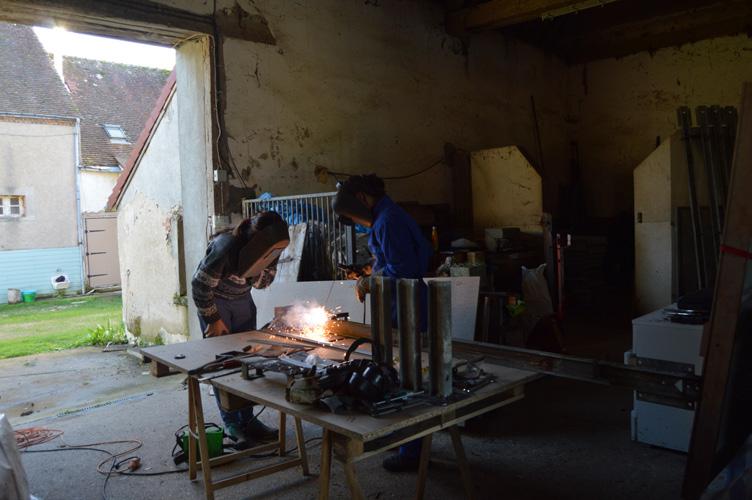
* welding assemblages for the pillars of the greenhouse structure
gardening volunteering - Espace-test agricole Graines de Paysans, Anderlecht
* tillage, sowing, transplanting, weeding, picking organic vegetables
construction volunteering - for a music, scenography festival Horst, Vilvorde, Belgium
* recycled wood structure for a round stage
competition participation - Mini Maousse, Cité de l’Architecture et du patrimoine, Paris
* design for an ecological and floatting architecture
Open Call - Leth&Gori architects, Copenhagen
* design for an exhibition scenography
5-month architecture internship - JOLY&LOIRET office, Paris
* competition for a school in stone, earth and straw in Paris
* building permit for collective housings project
* building permit for earth workshop
* administrative applications, tender for public projects
scenography project for the "a year abroad" exhibition in ENSA-PB, Paris
* visual design for the poster
* design and building of the wooden scenography
participation in the suspended structure festival "Cime city" by Bellastock, Evry, France
* 3 days handmade building festival with re-used materials, parachute canvas, slacklines, ropes
1-month architecture internship, F.Pin & C.Bizouard, Montreuil
* extension of a private apartment, plan drawing
* site report for a restaurant/ bar renovation
* consultation file for building companies
participation in the earth festival "La ville des terres" by Bellastock, île St Denis, France
* 3-days handmade building festival with bricks of raw earth, rags, spun
worker internship at CMB-Belliot carpenter company, Voulx, France
* laying of the frame, insulation, cover, earthen tiles, stone masonry
volunteering at the participatory site of the square Marin, Paris, France
* made of recycled materials, in collaboration with Oïkos
Baccalaureat scientific and european with honors, lyçée E. Bezout, Nemours (77), France 2019 2015 - 2018 2015 experiences 2019 2018 2017 2016
construction volunteering - for a residential houses, Twiza network, France
Jamais sans ma visseuse feminist atelier in mixité choisié La-Bastide-de-Sérou . France
credit Lola Vandereycken
II. learning by doing 6
learning by doing
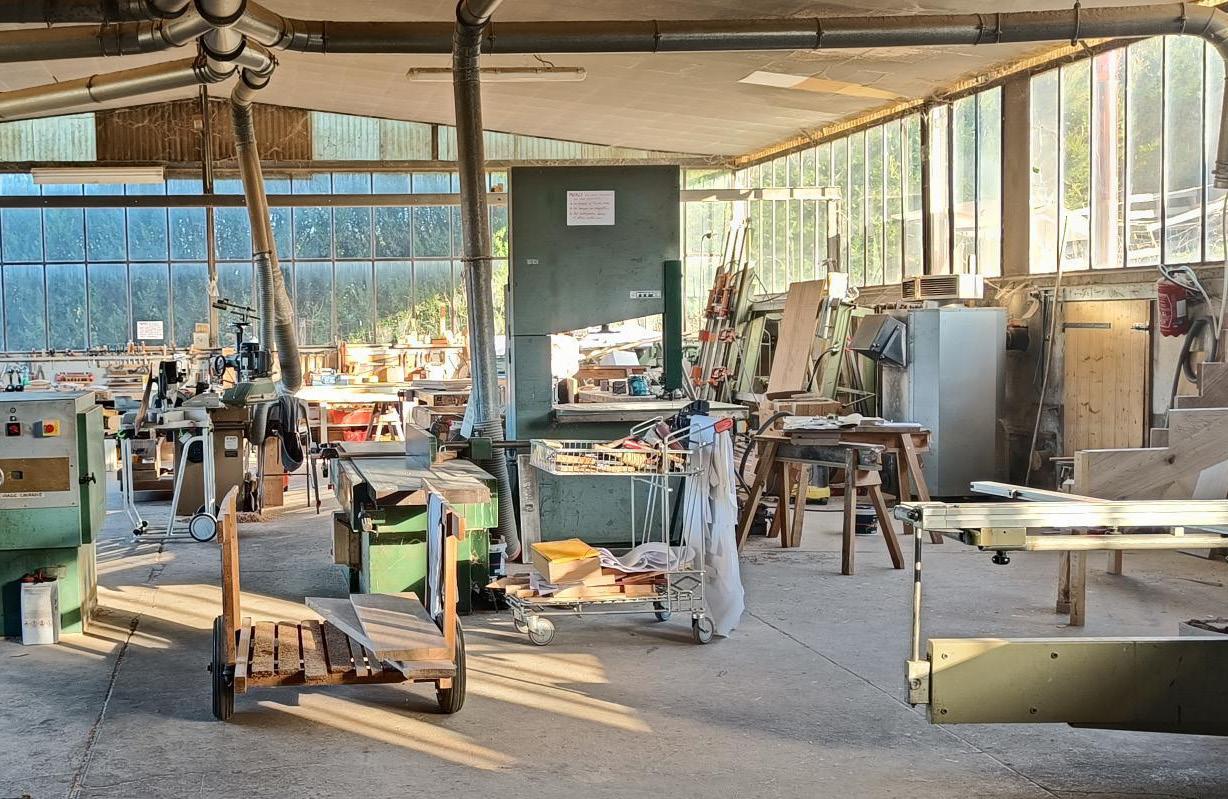
II. learning by doing 8
on the roof
internship in a timber company
September 2016
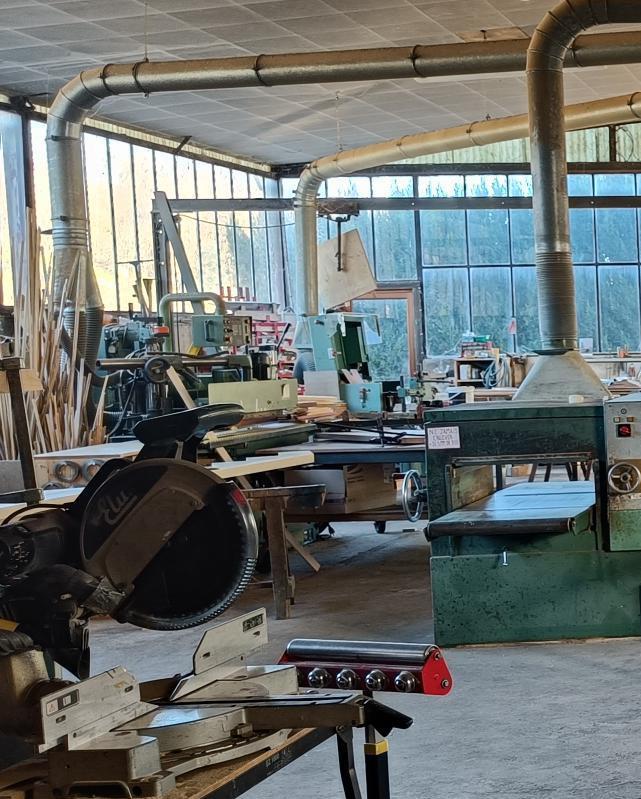
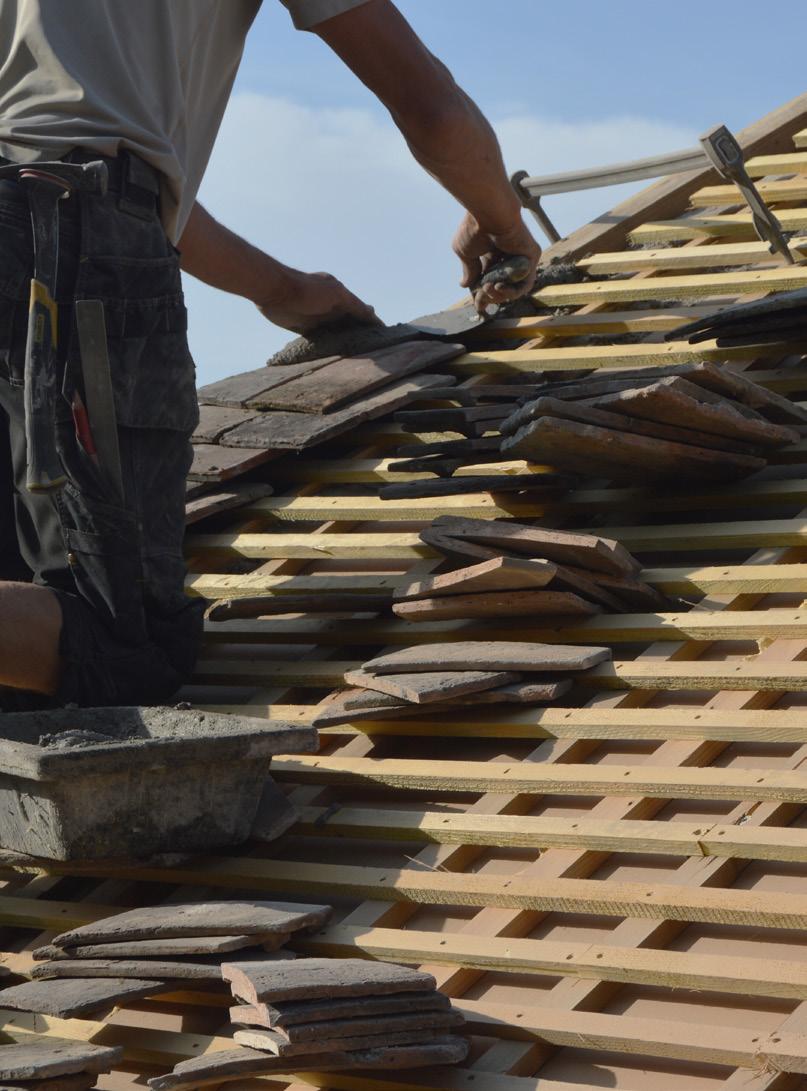
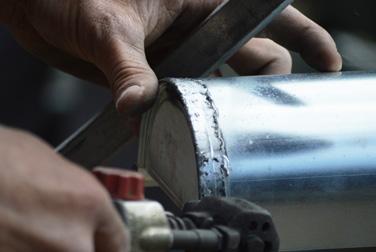
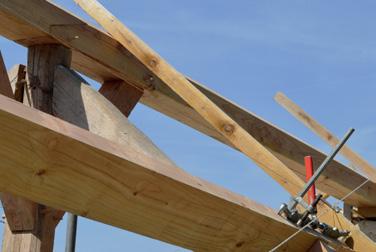
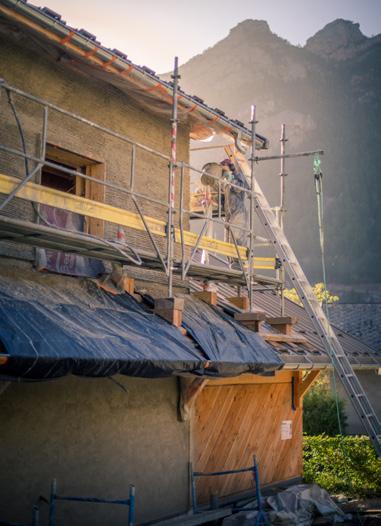
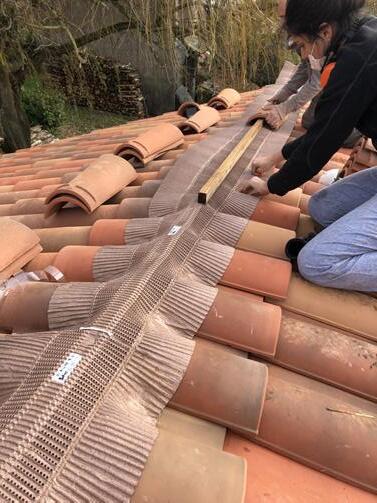
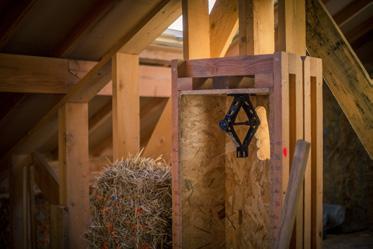
This internship took place in a timber company working on the renovation of an old barn to make it habitable. After having put down all of the old structure a new traditional frame was installed. Sandwich panels were assembled for the insulation and then the old tiles were reused. Because of the scale of the company and the construction site, the workers knew different techniques such as preparing wooden pieces, masonry assemblages, manipulating many tools as well as organizing the whole construction site. It gave me a strong concern about learning directly the know-how thanks to practical experiences. Furthermore, the company works with wood all along the process, from its raw aspect to the final pieces. This control of every step allows a valorization of the wood in all of its aspects. It was inspiring regarding to the architectural process where a good knowledge of all the fields allows coordination and economy of means.
 left_laying tiles on the roof up _assemblage of the new frame down_welding of the gutter
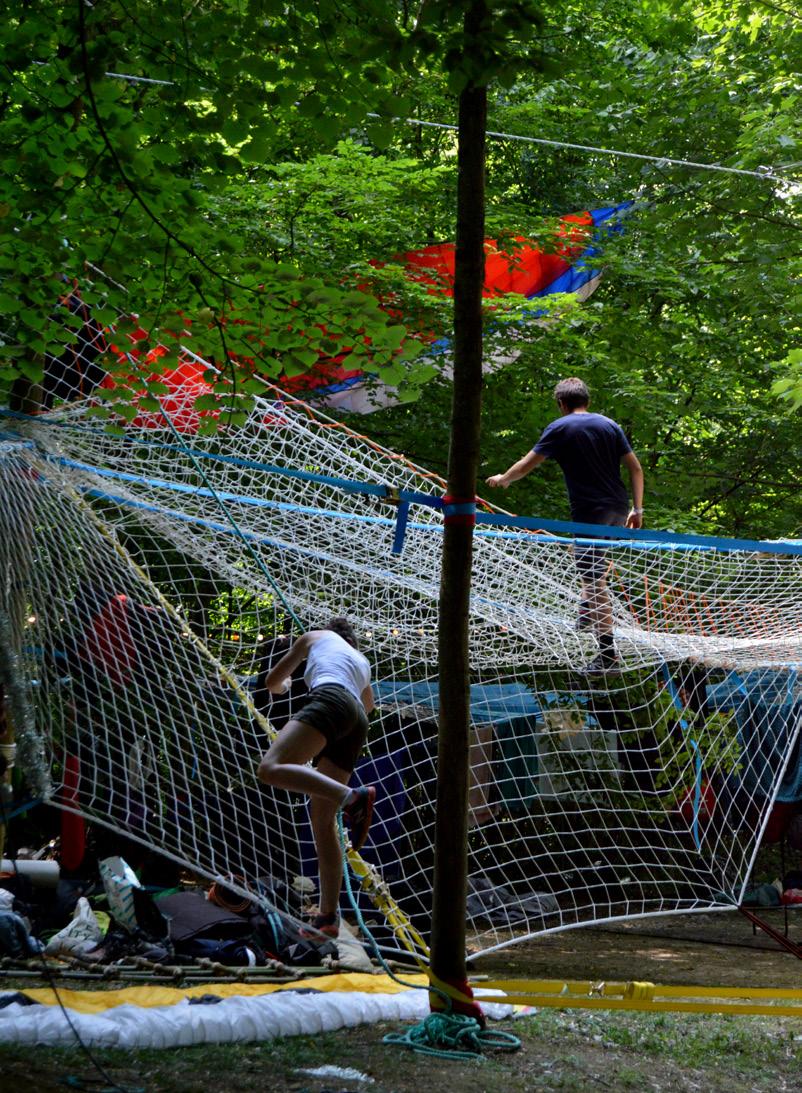
Cime city . July 2018 10
bellastock
experimental construction festival
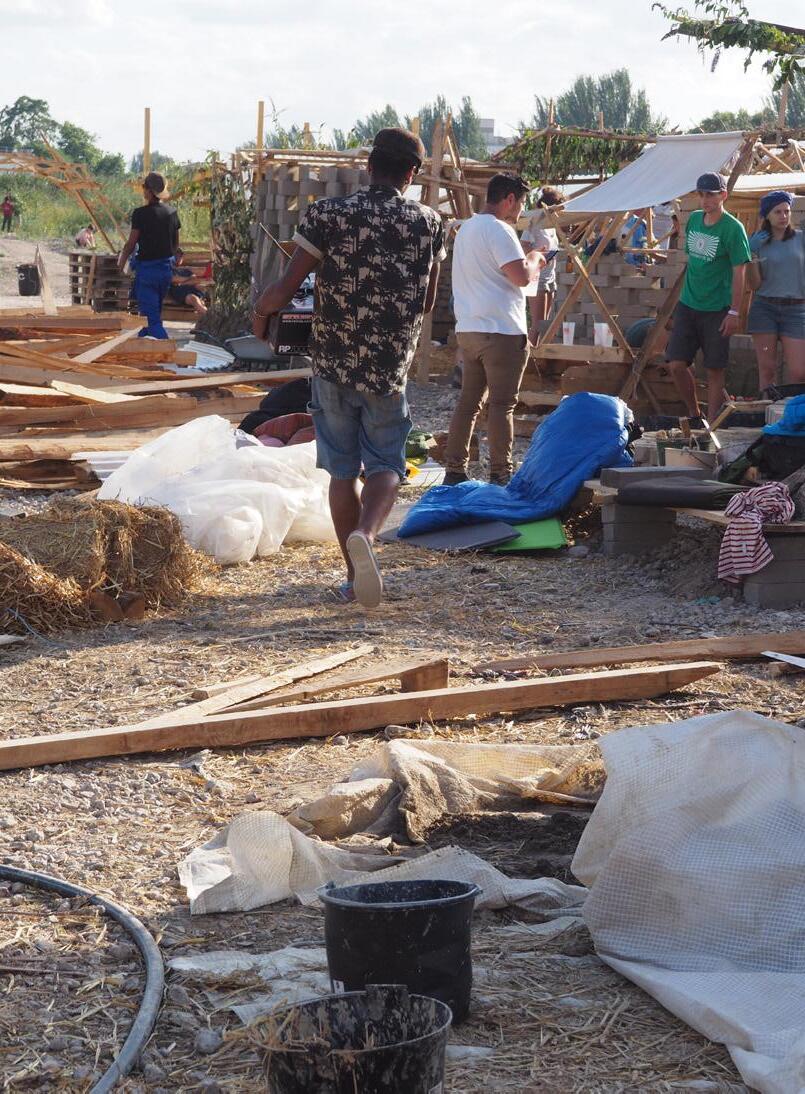
July 2017/ July 2018
The Bellastock Festival is organized every year thanks to an association of the same name which promotes the valorization of places and their resources. The association is known for the reusing of materials by developing a network for the circular economy in the construction field. The four-day festival gathers around 500 participants interested in these questions to build an ephemeral city with recycled materials. Each year, one material, one structural technique, or even a requirement is highlighted and becomes the theme of the festival in a specific site. In 2017, the earth was chosen through different aspects such as pisé, raw earth bricks, straw, and earth mix... in the context of extracted soils from the Grand Paris construction sites. While in 2018, the suspended structures generated a city in the trees with parachute canvas, slacklines, and ropes to question the sustainable management of forests and exploitation of wood. One day of the festival is open to the public and dedicated to lectures and exchanges around the topic of the year.
la Ville des Terres . July 2017
II. learning by doing 12
the scary machine
scenography workshop
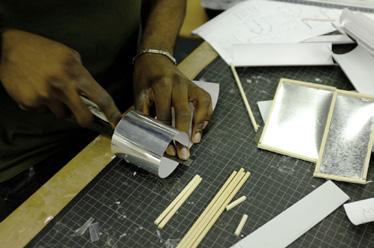
April 2018
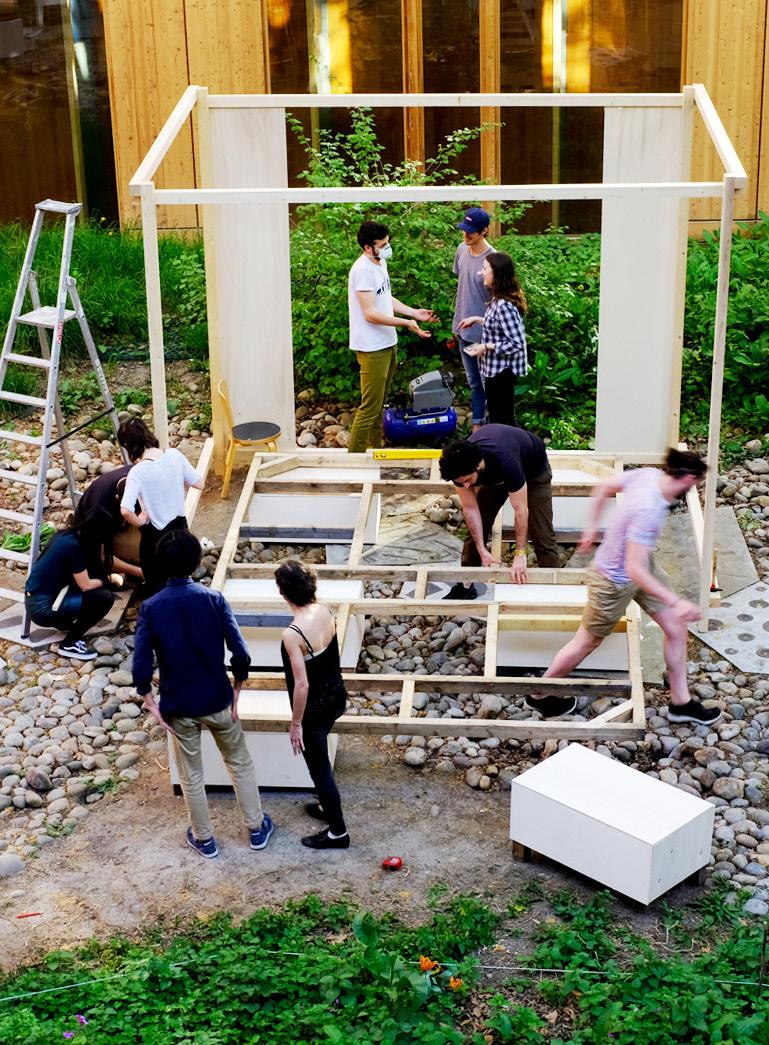
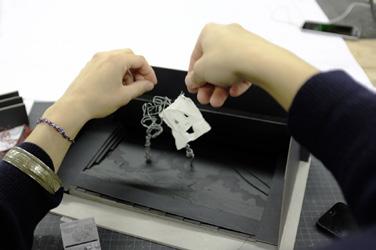
The scary machine was a workshop organized to reveal the presence of a ghost in the courtyard of our school in Paris. This project was driven by Arnold Pasquier a filmmaker in collaboration with the wooden workshop of the school, combining scenography as well as construction. The filmmaker had already in mind a storyboard but we were free to decide how to realize this mysterious apparition. Two people were shoot to appear as a hologram on the stage operating as a magic lantern. This concept of the magic lantern has a historic evolution that we adapted within the setting of the courtyard. The structure of the cube was made out of wood, and rotary panels on the sides were made of fabric and mirrors playing with reflection and subtle movements. As the show was planned to happen only one evening, we thought about how this structure could evolve through time. It became a new table for having lunch for the school’s students.
left_assemblage of the structure up _exprimentations with models credit Arnold Pasquier (film director)
1. lime plaster_La-Roche-de-Rame
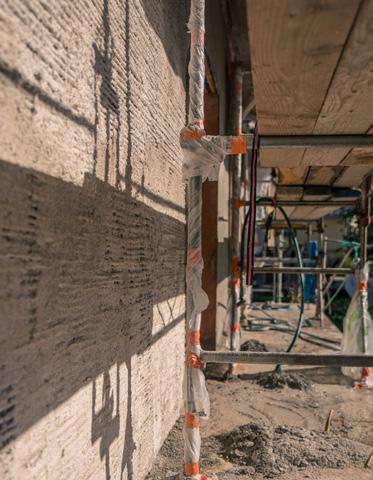
credit Emilie Sevino-Aluco
2. compression of straw bales_La-Roche-de-Rame credit Emilie Sevino-Aluco
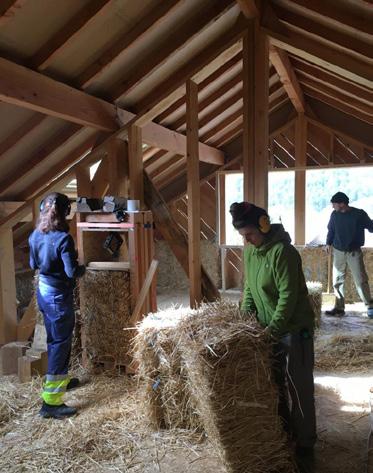
3. yourt structure_Bergerac
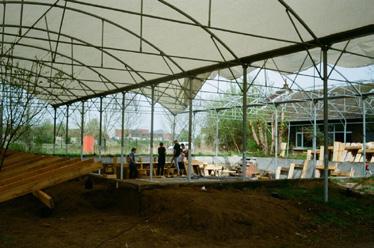
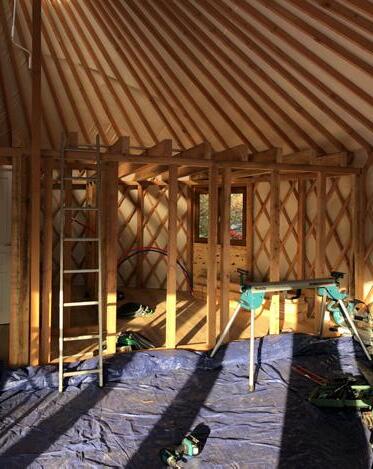
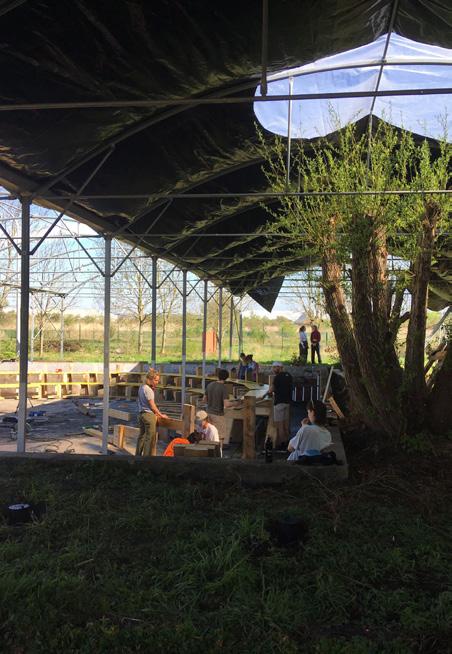
4. digging trenches for pipeline_Bergerac
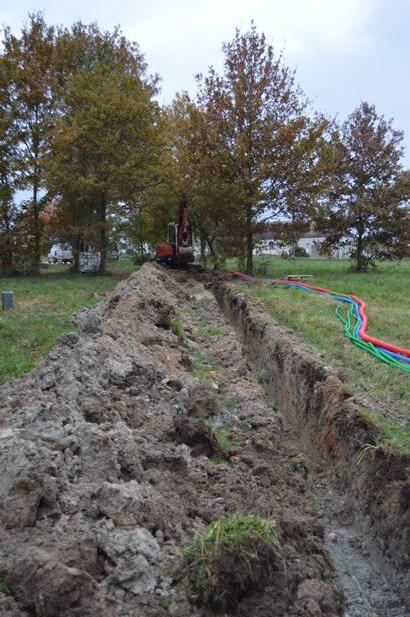
5. wooden stage_Horst workshop_Vilvorde
6. wooden stage_Horst workshop_Vilvorde
7. wooden stage_Horst workshop_Vilvorde
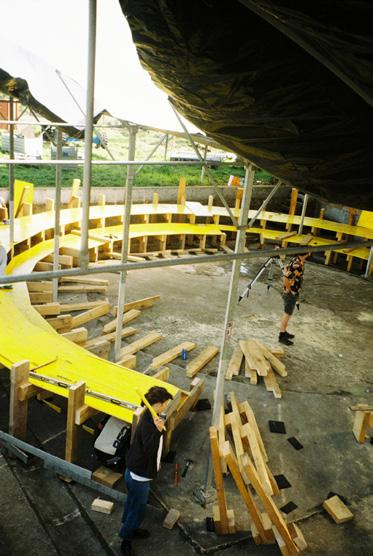
8. rain protection on the roof_Foix
9. welding reuse pillars_Moulin Bleu
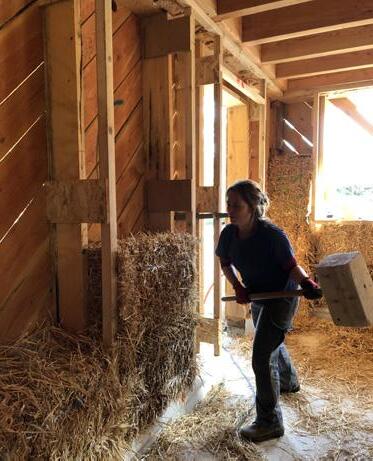
10. compression of straw bales_La-Roche-de-Rame
11. lime plaster_La-Roche-de-Rame
credit Emilie Sevino-Aluco
12. compression of straw bales_La-Roche-de-Rame
1 2 4 5 3 6 8 9 10 7 11 12
construction sites
participatory projects
October-December 2022
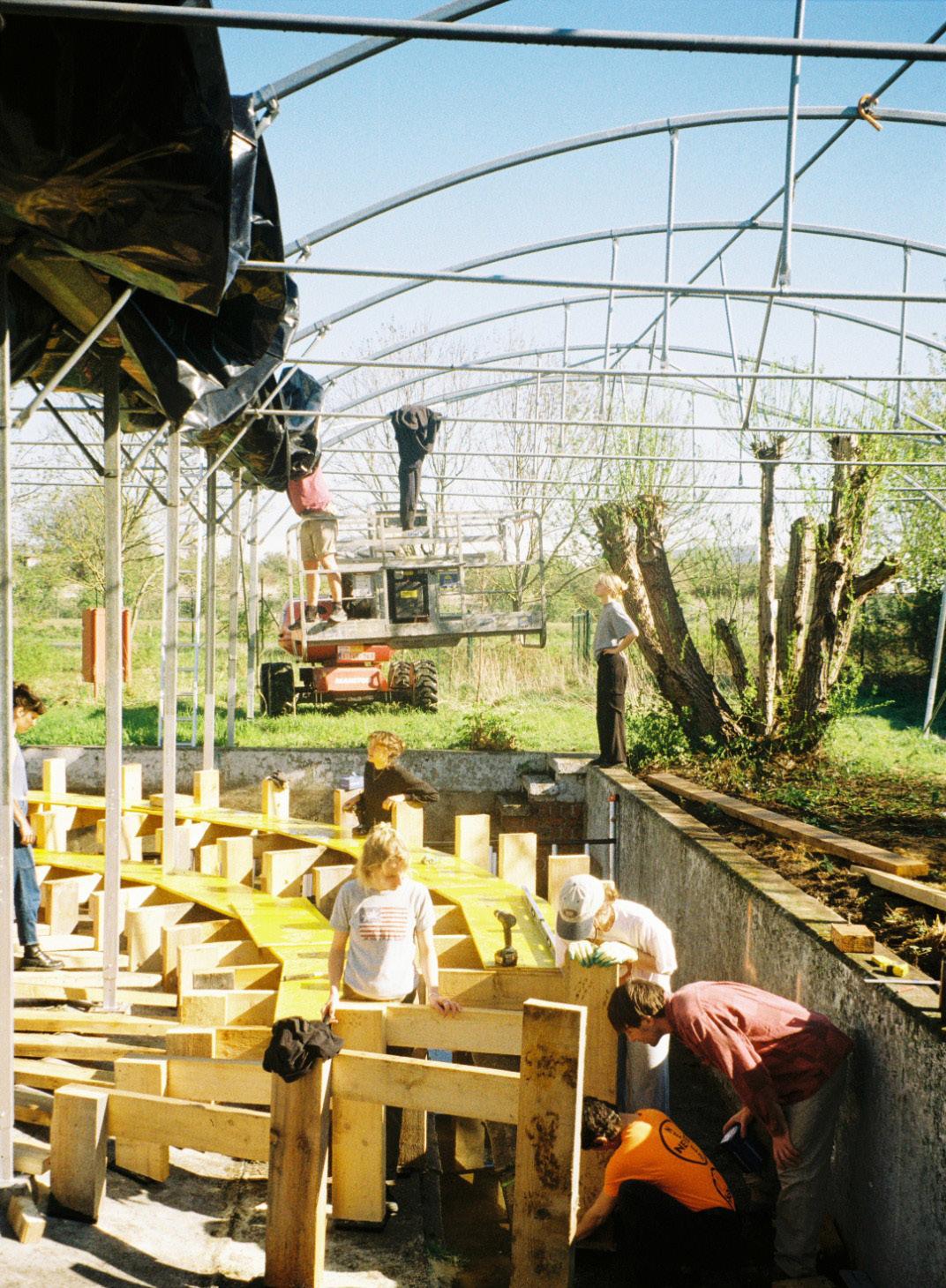
After the theoretical effort of the thesis, I was longing for more practical experiences, to get involved physically in construction projects. These projects were chosen regarding two main interests: the collective organization of designing/living (cooperative) and the materials used (reuse, biobased). Indeed alternative ways of building are linked to alternative ways of living which question belonging to a place, subsistence activities, and relations to other beings both humans and non-humans within the place. I have been living with communities, family, friends mostly in rural contexts dealing with different matters such as real estate development, tourism, agriculture, cultural, political gatherings. By learning new techniques I also learned the story of the materials, their provenance, their appropriation, and their changes through time.
build up of the wooden stage Horst . Vilvorde . April 2022 credit Kobe de Greef
II. learning by doing 16
La casa de la Roche
cooperative of inhabitants
October 2022
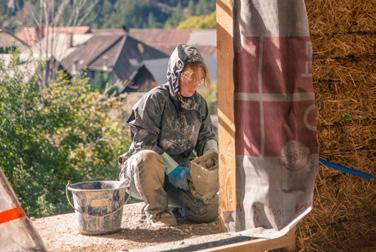
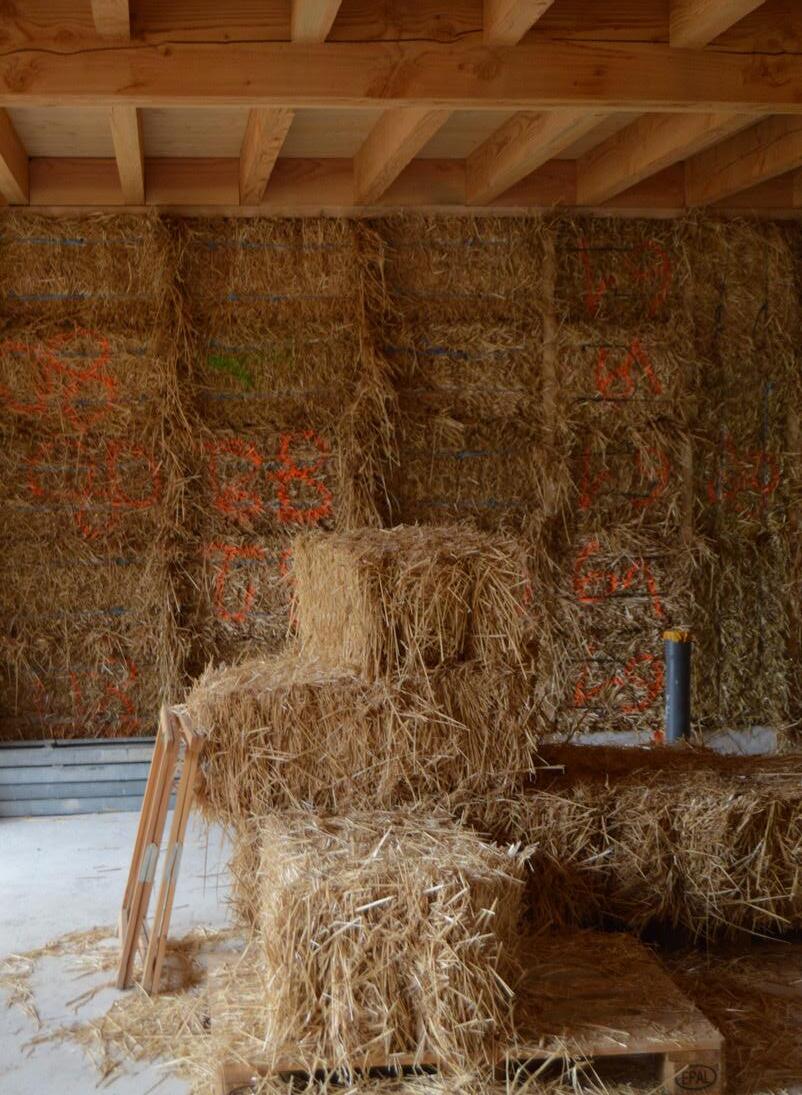
Here is a project original thanks to the team leading it as well as his legal status. La casa de la Roche is organized through a cooperative of inhabitants who are currently building a shared house. Meant for five households and professional ateliers (jewelry, architecture office, music instrument), half of the house is shared with common spaces (living, kitchen, storages, bathrooms). The households vary from 20 to 40 square meters with also different intimacy (some have a little kitchen and a living). The cooperative bought the plot and owns the house, the inhabitants are managers/ partners of the house. This legal arrangement blocks real estate speculation since there is no private property and no profit if the cooperative happens to dissolve.
left_straw wall filling up_laying of lime plaster from inside/outside views credit Emilie Sevino-Aluco
II. learning by doing 18
found materials
daily life objects
ongoing
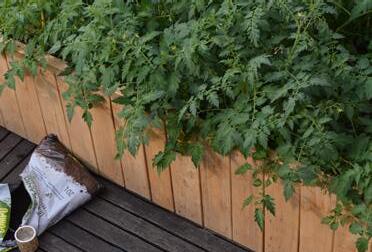
Some other construction projects were more related to object design and handcraft. I have been curious to investigate the transformation of found materials (wood, metal, fabric) to create something used in daily life. The manipulation of materiality could lead to certain shapes being more or less convenient, more or less stable, and more or less aesthetics. There are ongoing experiments. Here is a wooden box to cultivate vegetables on a roof terrace made out of palettes, stones, branches, earth, and plants collected in Brussels. And a cubic candle holder made out of reused steel to get to know the properties of bending and welding metal.
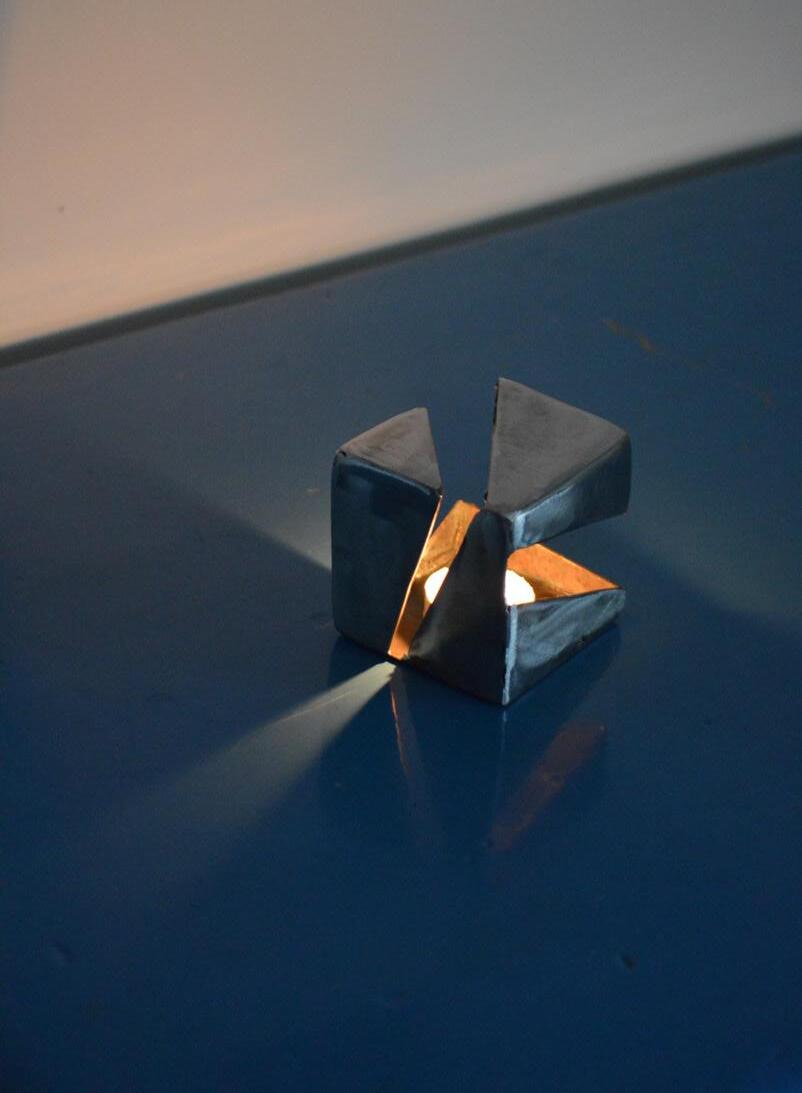
bottom_wooden box for vegetable garden right_reused steel candle holder
III. design projects
design projects
20
model of the material center projet in Leuven
neighborhood enclosure
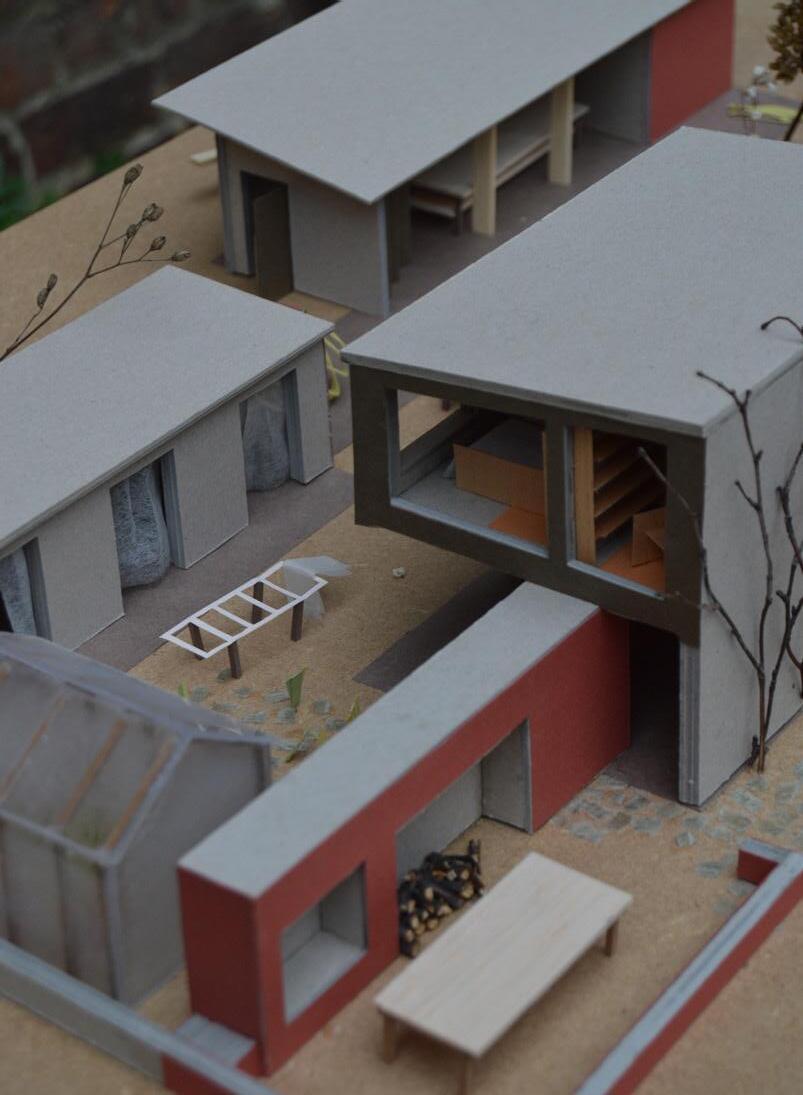
collective housings, Brussels
From October to January 2021
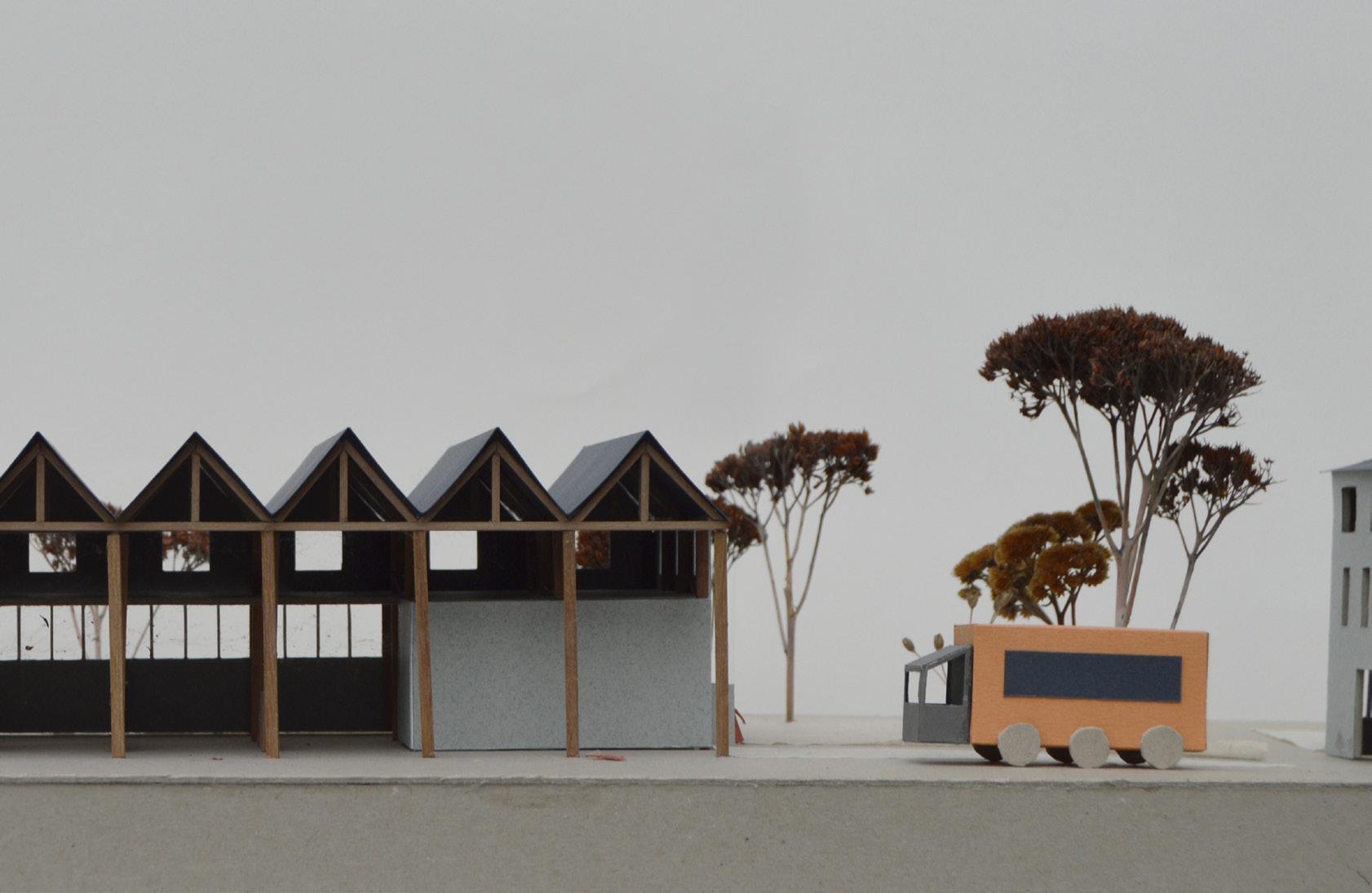
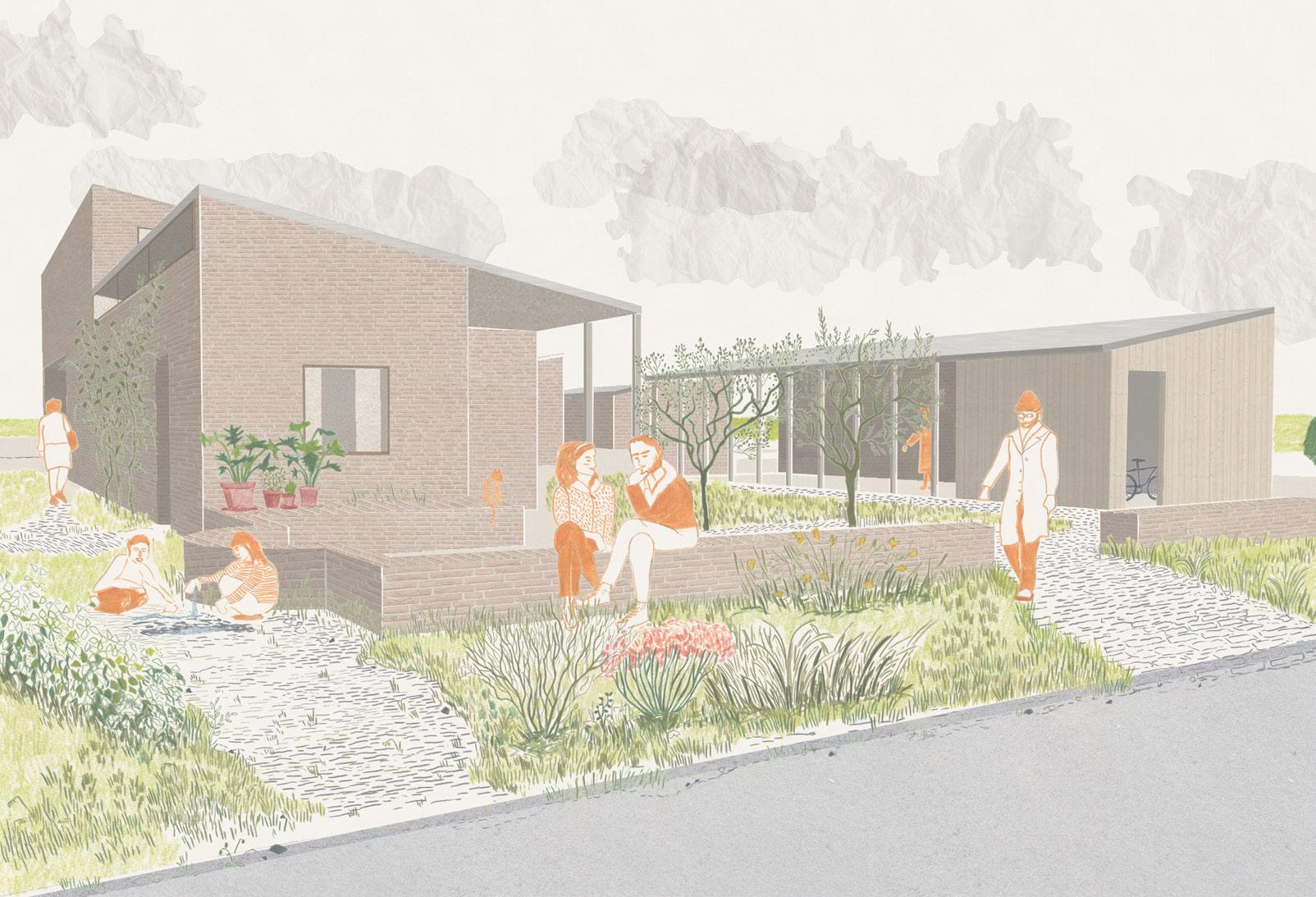
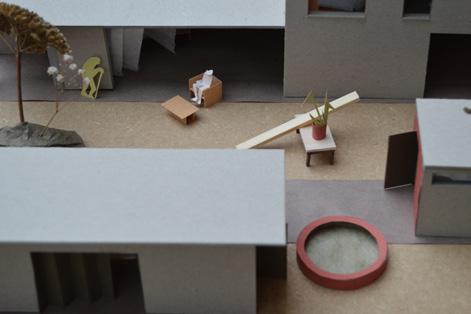
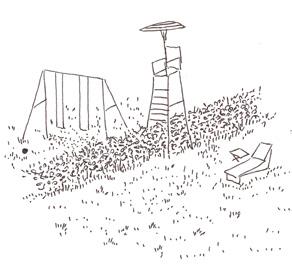
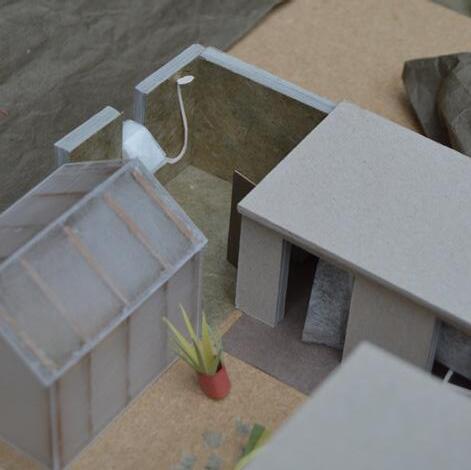
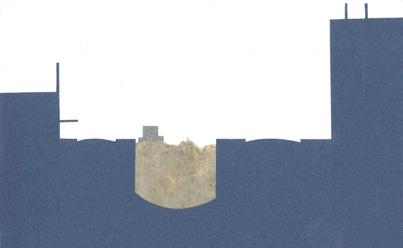
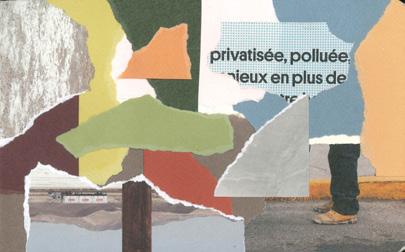
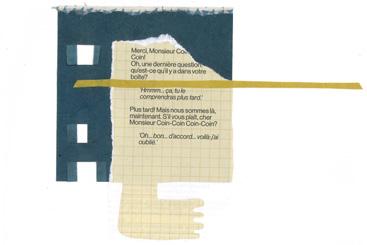
By questioning: how the enclosure could gather neighbors instead of being a privative boundary? We investigate how hospitality could take place in a suburban housing estate. In Krainem, east of Brussels, the fields are meeting the last fragments of the city through individual housings, supermarkets, or other parking. First with urban rules implemented in the whole housing area (bocage, wall, and haha) and then directly from the home unit with shared services such as common laundry, bike shelters, vegetable gardens, green housings, and barbecue. The shared spaces could be used by all the inhabitants such as a workshop building. The back and front of the houses are blurred, and the gardens create continuity from the street to the fields as well as providing intimacy between the different housing units.
left page_collage from the street right_pictures of scenes in the model
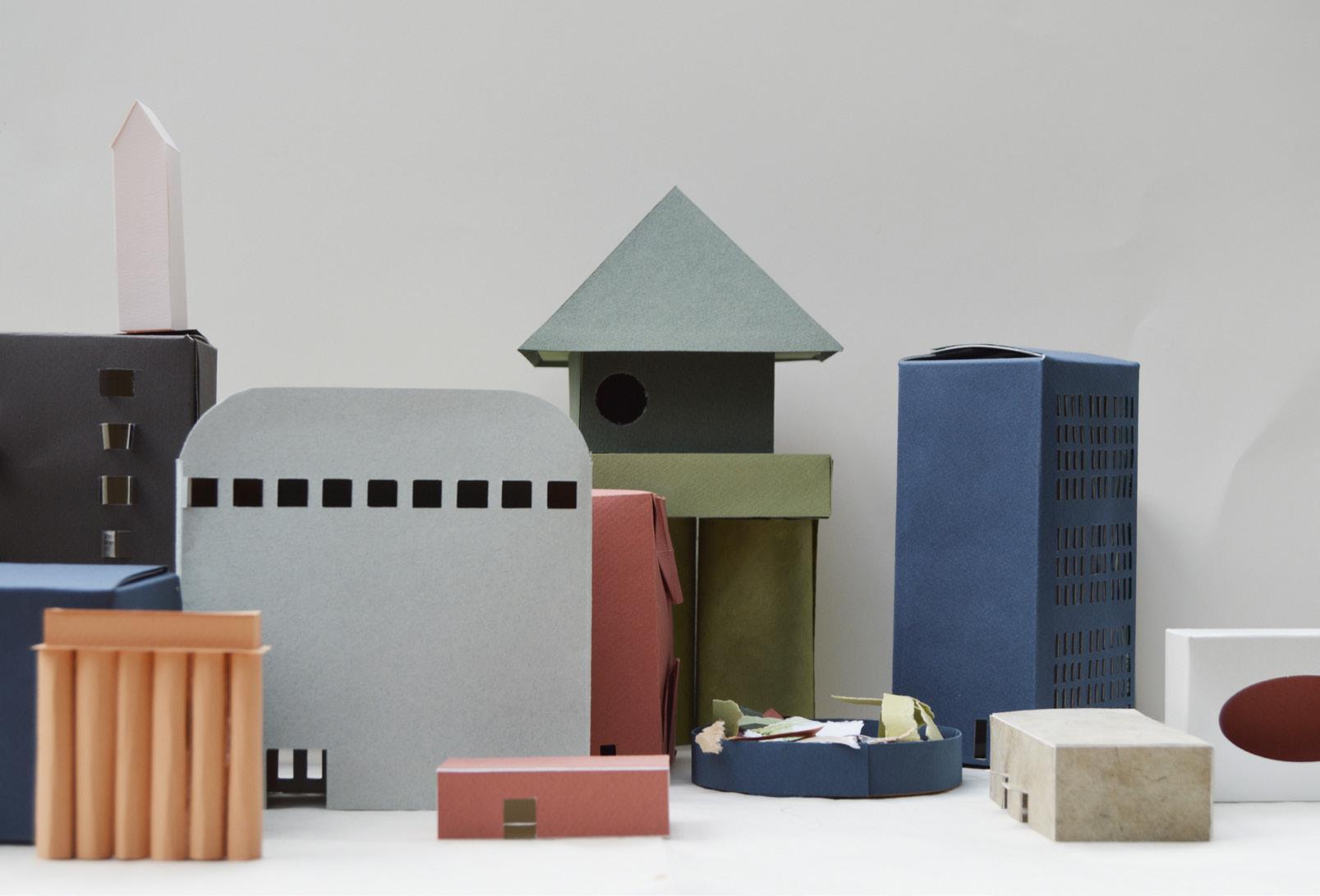
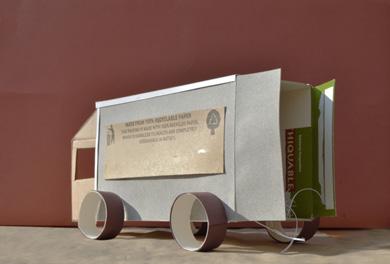
tampon box ice cream cover tea box soap box
Maïzena box toilet paper rolls tofu box
industrial contest
material center, Leuven
June 2021
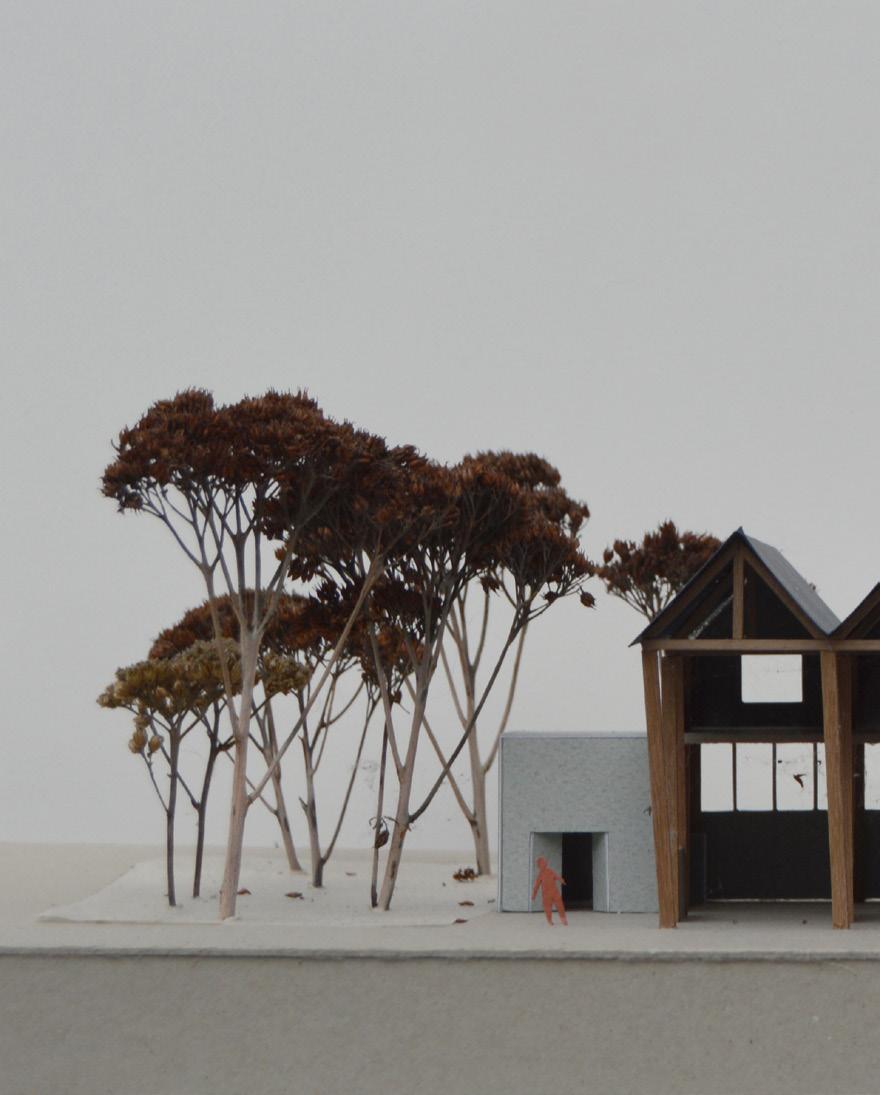
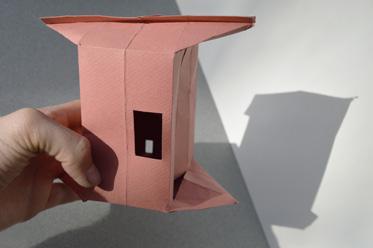
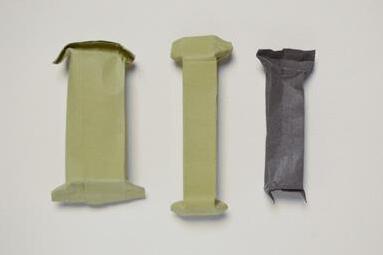
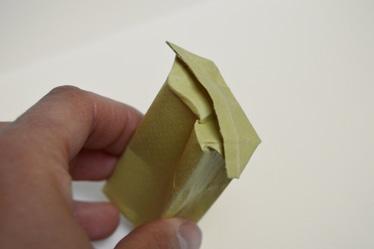
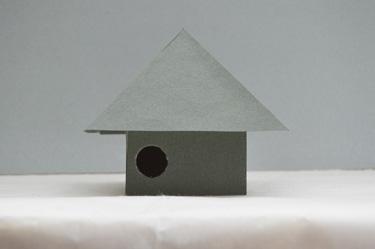
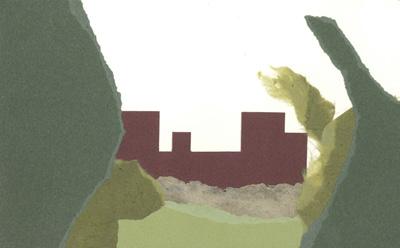
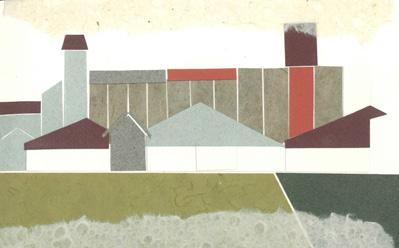
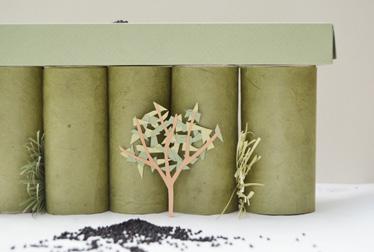
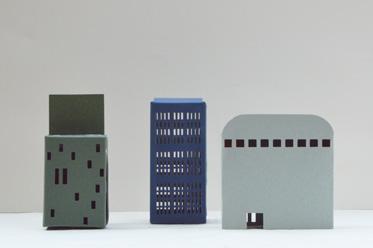
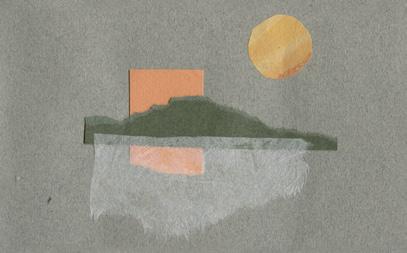
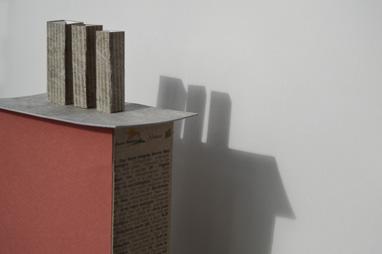
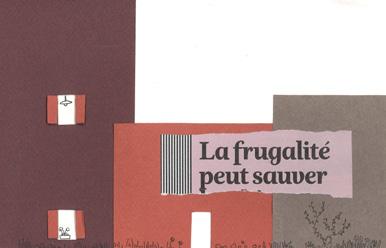
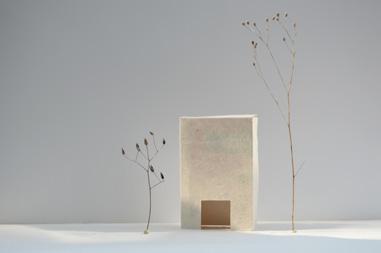
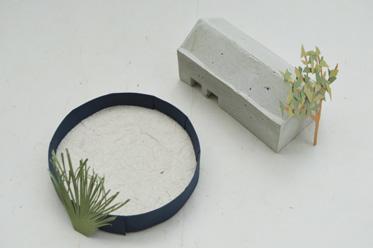
Thanks to a methodology of ‘one drawing and one model a day’, the architecture studio MicroMegaLab collects ideas through different scales from the urban overview to small details picked on site. I chose to focus on industrial buildings, by questioning their relations to the city, their surroundings, and their shapes. To do so, I am using cardboard packages to build the models and pages from magazines to compose the collages.
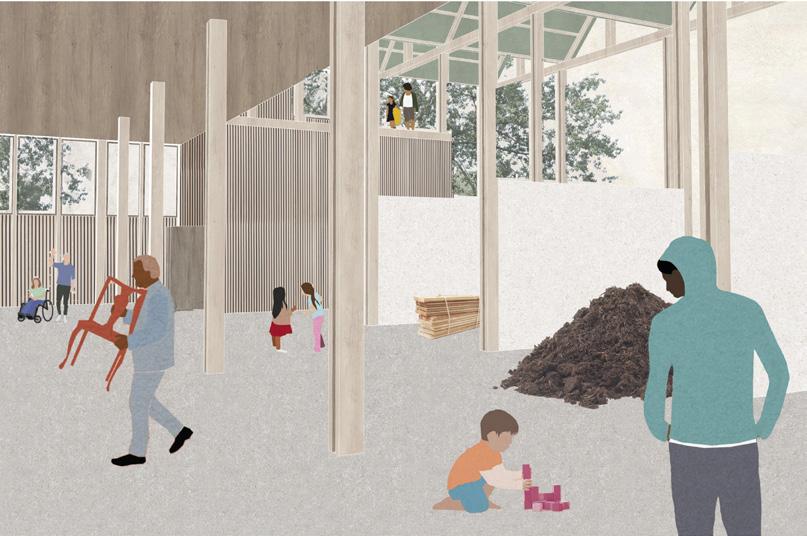
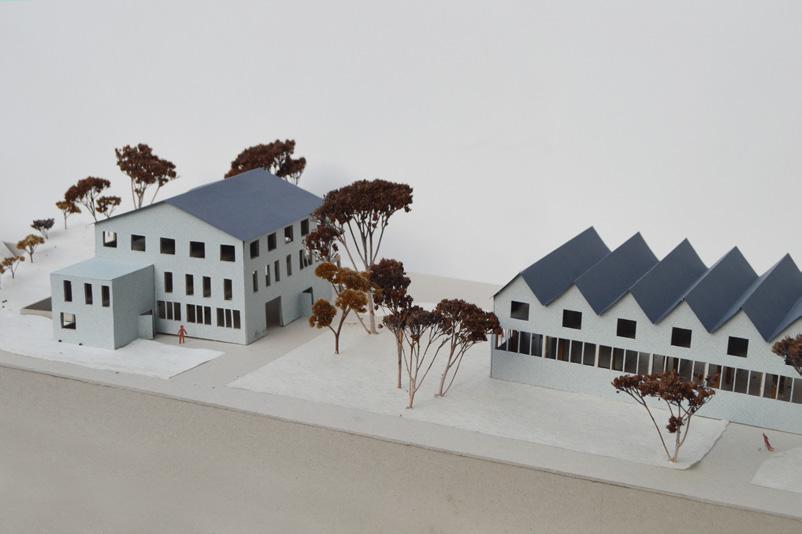
The project is located North of Leuven in between the railways, the Dyle River, and an industrial area. The site was chosen to look at the ‘back’ of the city, where trucks are parked, and where we let the grass grow. Standard workers ’houses and a village of bungalows are also located next to the chosen plot. How to encourage mixing functions within the industrial area and the housing street, outside of the already constituted city? The project will become medium-sized public equipment to collect materials from the industries nearby and share the production of energy to reuse in the daily life of the inhabitants. At the same time, an urban strategy will open pathways, and gateways to cross the railways, the water, and the industrial area. This landscaping promotes the already existing biodiversity on site.
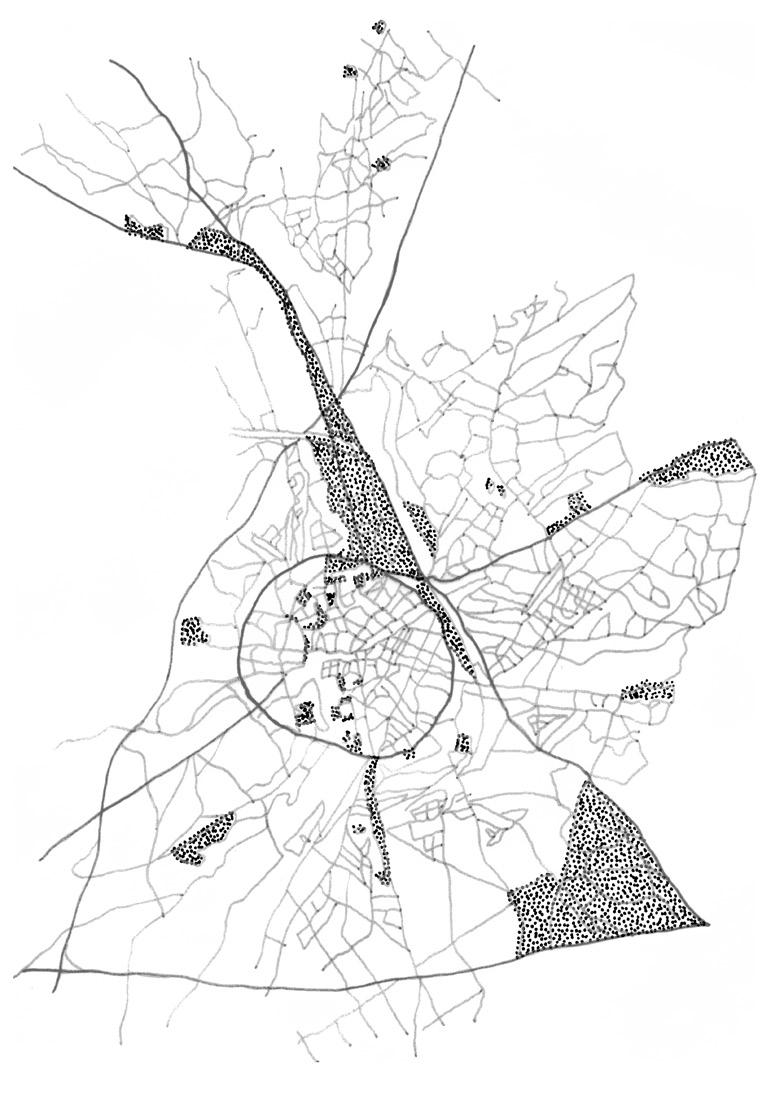
left page and middle_shape and volumes experimentations with package and papers
 location of the industrial sites in Leuven
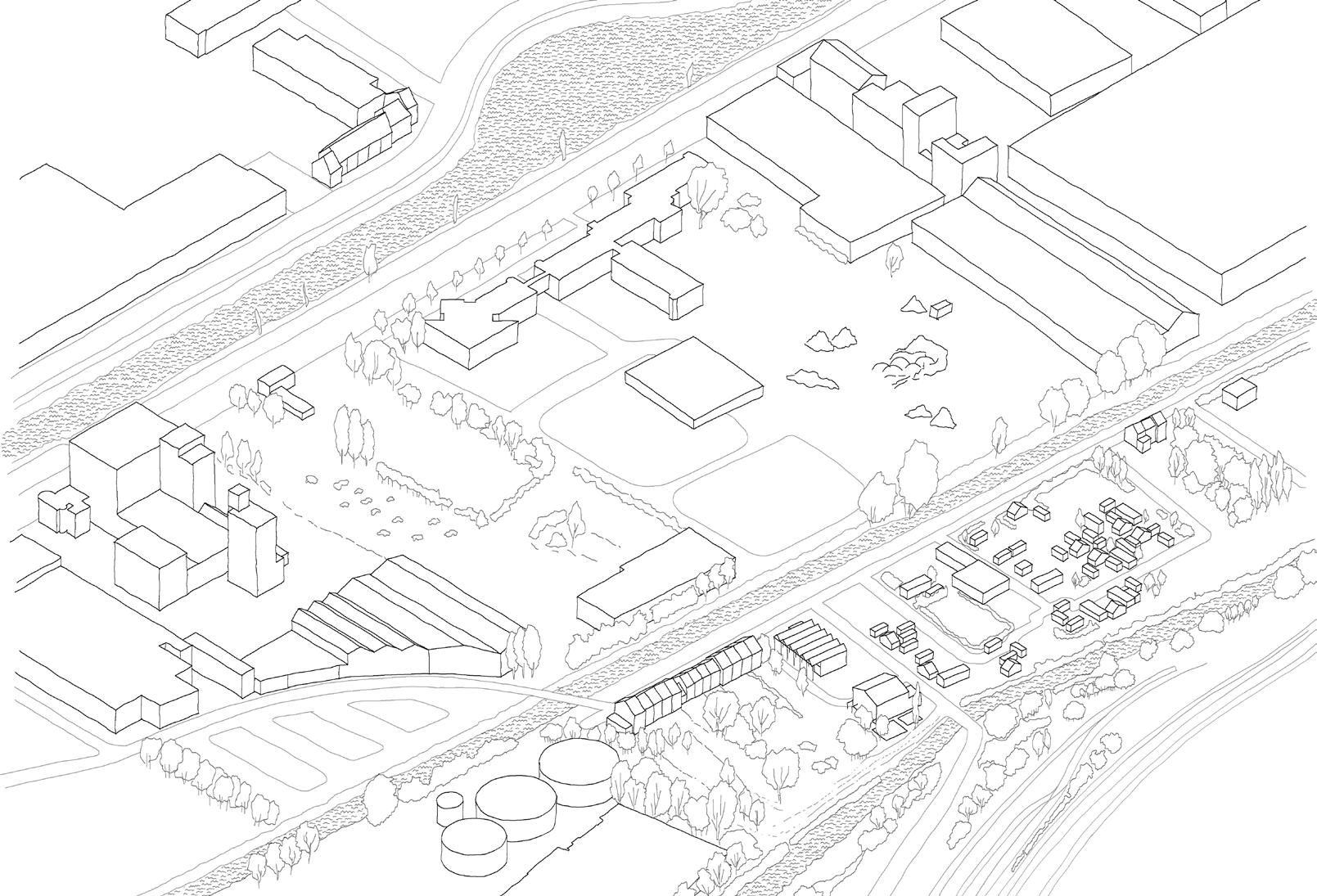 axonometric view of the industriel site along the Dyle
up_perspective inside the sorting center bottom_picture of the model right page_detail of the workshop building
III. design projects 28
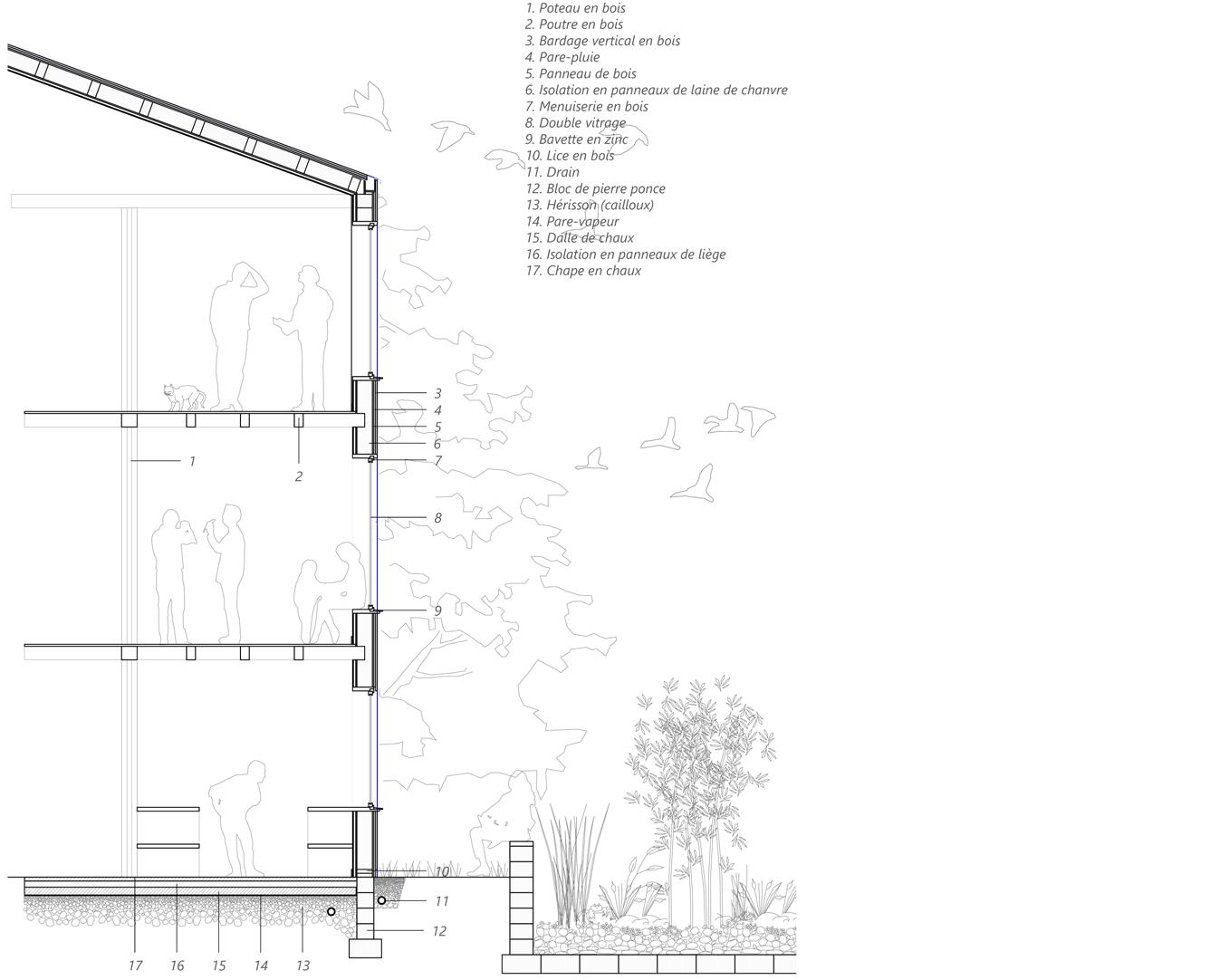
III. design projects
III. design projects 30
upside/down
scenography exhibition, Copenhagen
Open Call, January 2020
upside down is a proposal installation that turns down the sky to the ground and the other way around, as a vertical layering. The stones are hung to the ceiling to compose a heavy atmosphere. While the ground is covered by a light paper cloud. The landscape line, all around the room is the horizontal landmark. The raw materials are in opposition to the abstract composition of each layer. This abstraction relates to our unstable future which will need to connect to concrete matters in a way to survive.
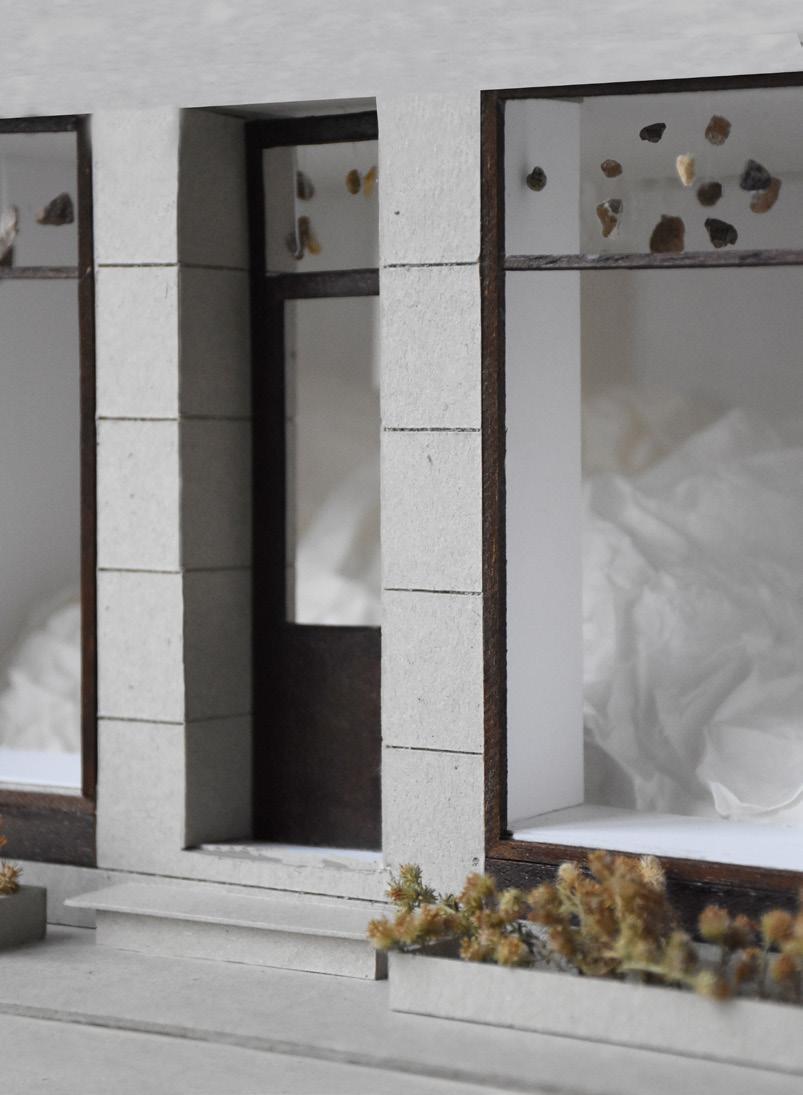
Time temporalities are taken into account: daily activities of the office could happen in the middle of the cloud which becomes illuminated by night. The exhibition plays with opposing concepts such as the conscious and the dream.
How to stay aware of the upsetting heavy situation? how to keep a creative/ poetic mind (as a living space designer) in an environmental crisis?
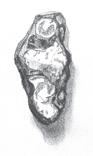 up_stones hanging from the ceiling right page_picture of the model from the street
III. design projects 32
professional experience
internship at the JOLY&LOIRET office, Paris
September to January 2020
This internship of several months in the JOLY&LOIRET office, made me focus on the use of bio-based materials such as stone, earth, wood, and fiber (straw, thatch...) as a way to promote a sustainable building process.
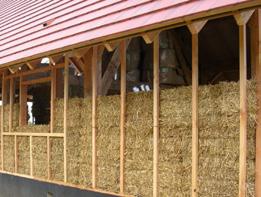
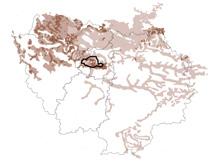
JOLY&LOIRET office takes the social evolution of the program into consideration as well as lowtech systems to keep the building reacting to its environment and evolving with time.
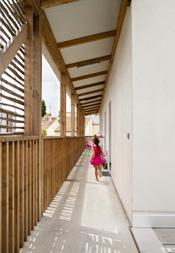
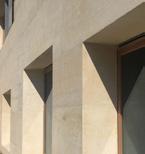
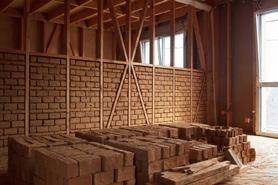
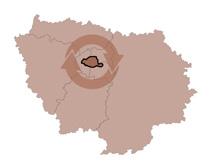
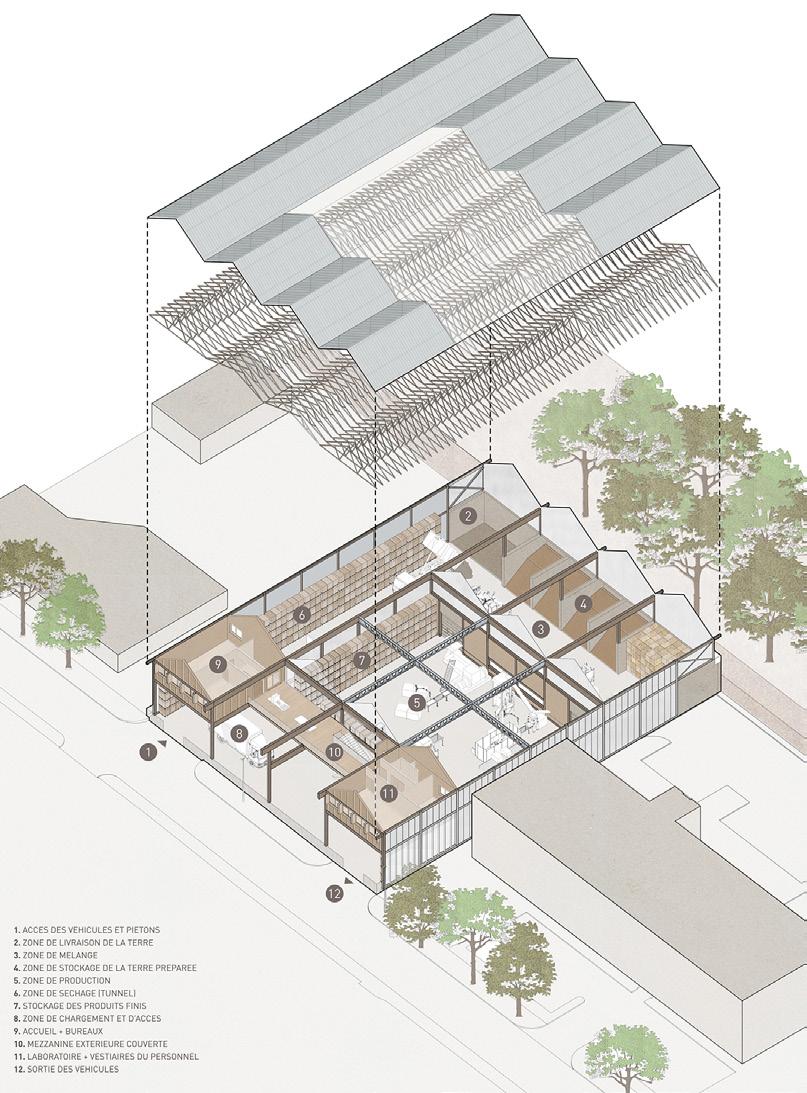
The project Cycle Terre is a workshop building using earth from construction sites in Paris. This earth is meant to become materials for future constructions such as bricks, plaster... It is reconsidered the huge potential of a material that is already on site.
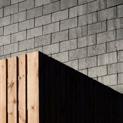
By facing a professional architectural practice, I learned from the complexity of the design process but mostly how creative and resourceful the project could become when connected to surrounding opportunities.
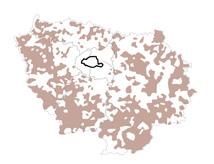
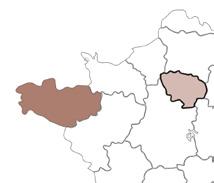
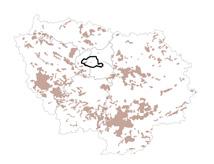
up_sources of the materials right_uses inside the earth workshop
stone straw
slate roof
“ The Gare d’eau is interesting because there is a whole historical context. Cities looked away a lot from the water because they saw it either as something useful for commerce or as something dirty because it was a vector of disease.“
Laurence, sociologist & inhabitant of the Gare d’eau
lavoir Gare d’eau
floating infrastructure, Lille
student competition, Janvier 2021
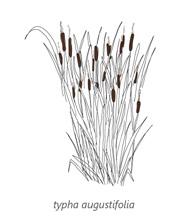
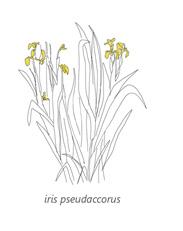
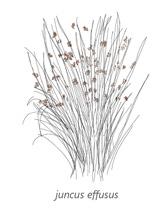
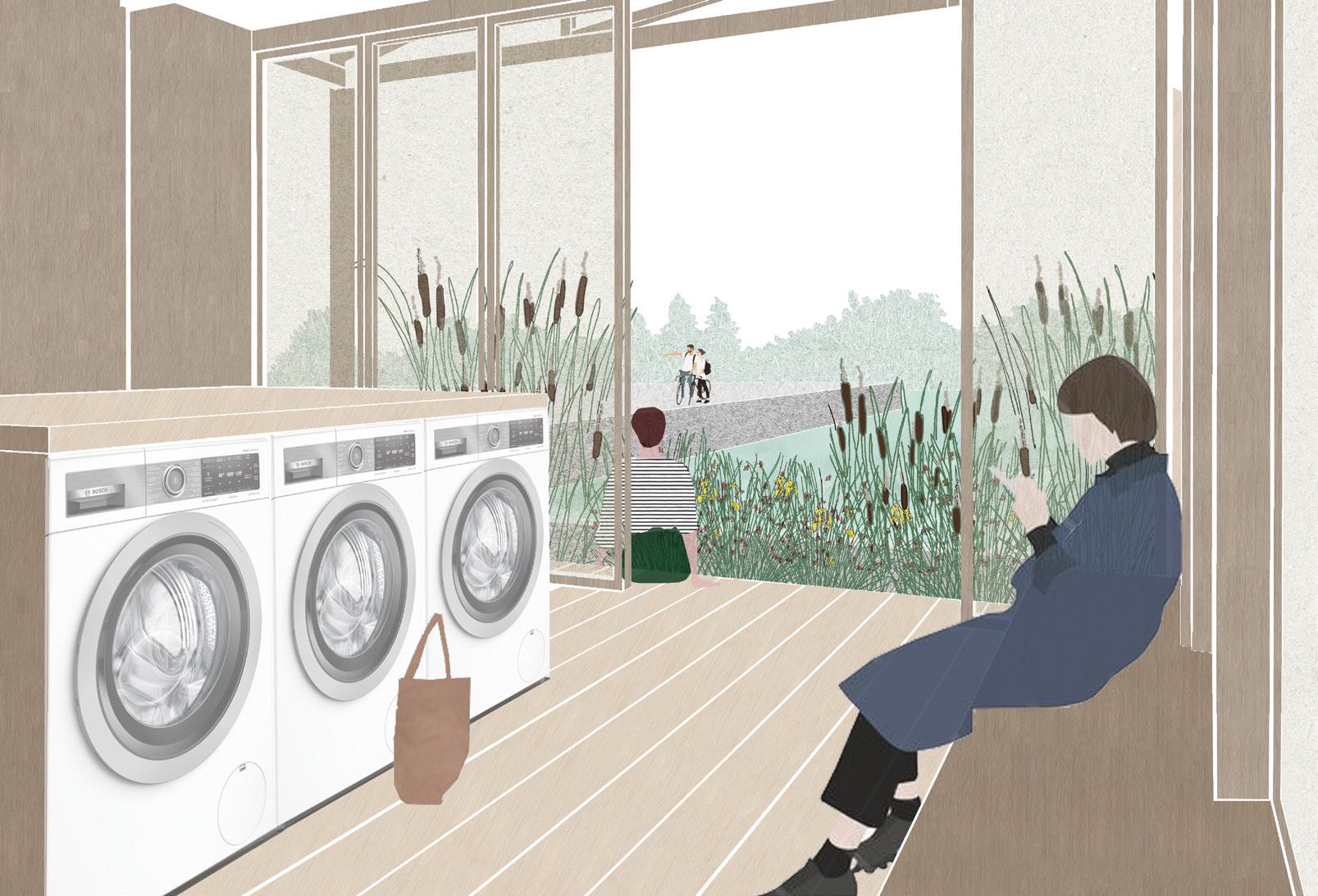
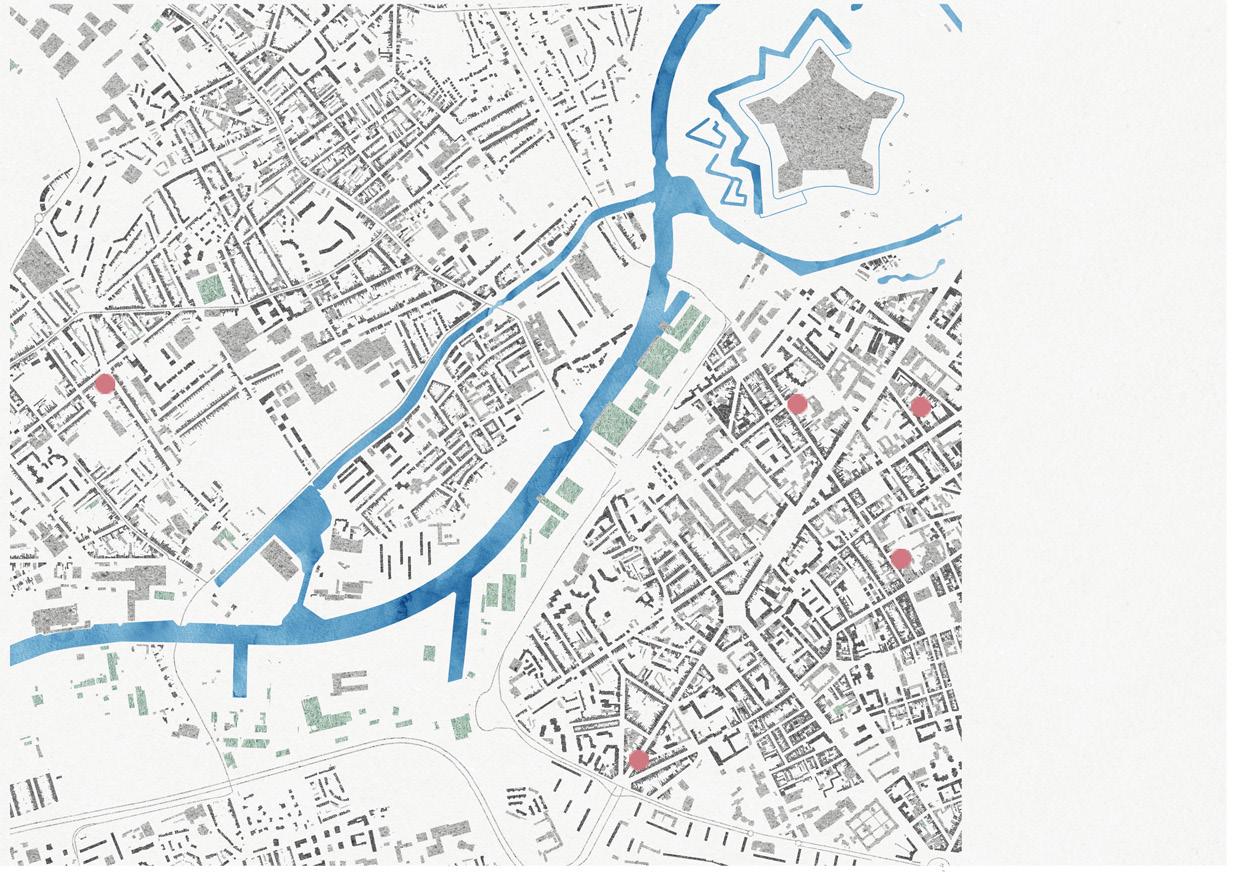
The Deûle is a northern river, crossing the city of Lille, and almost all of which has been channeled. Its balance has been strongly impacted by dense river transport as well as by the release of heavy metals from the industries. Initiatives have been implemented recently to improve its biological potential. The project is going into the same dynamic by offering a floating module to clean the polluted water of the Gare d’eau in Lille. The module sanitizes polluted water to supply a neighborhood laundromat. This public equipment emphasizes the working past of the Bois Blancs island. Inhabitants are thus legitimized facing the new influence of the Euratechnologie center. A shared daily facility that could also serve the inhabitants from the barges. The module deals with both social and ecological concerns, by making the ritual of the laundry support raising awareness about the Deûle ecosystem. It is therefore a laboratory in the physicochemical sense of sanitation by plants but also educational thanks to the visibility of the process by the inhabitants. The inhabitants coming to wash their clothes could enjoy a peaceful time in the floating garden.
COURTRAI DUNKERQUE
VERS
la Deûle port de plaisance de Wambrechies
gare de triage de Lille-Délivrance
zone industrielle des Ansereuilles
zone industrielle de Marquette-les-Lille
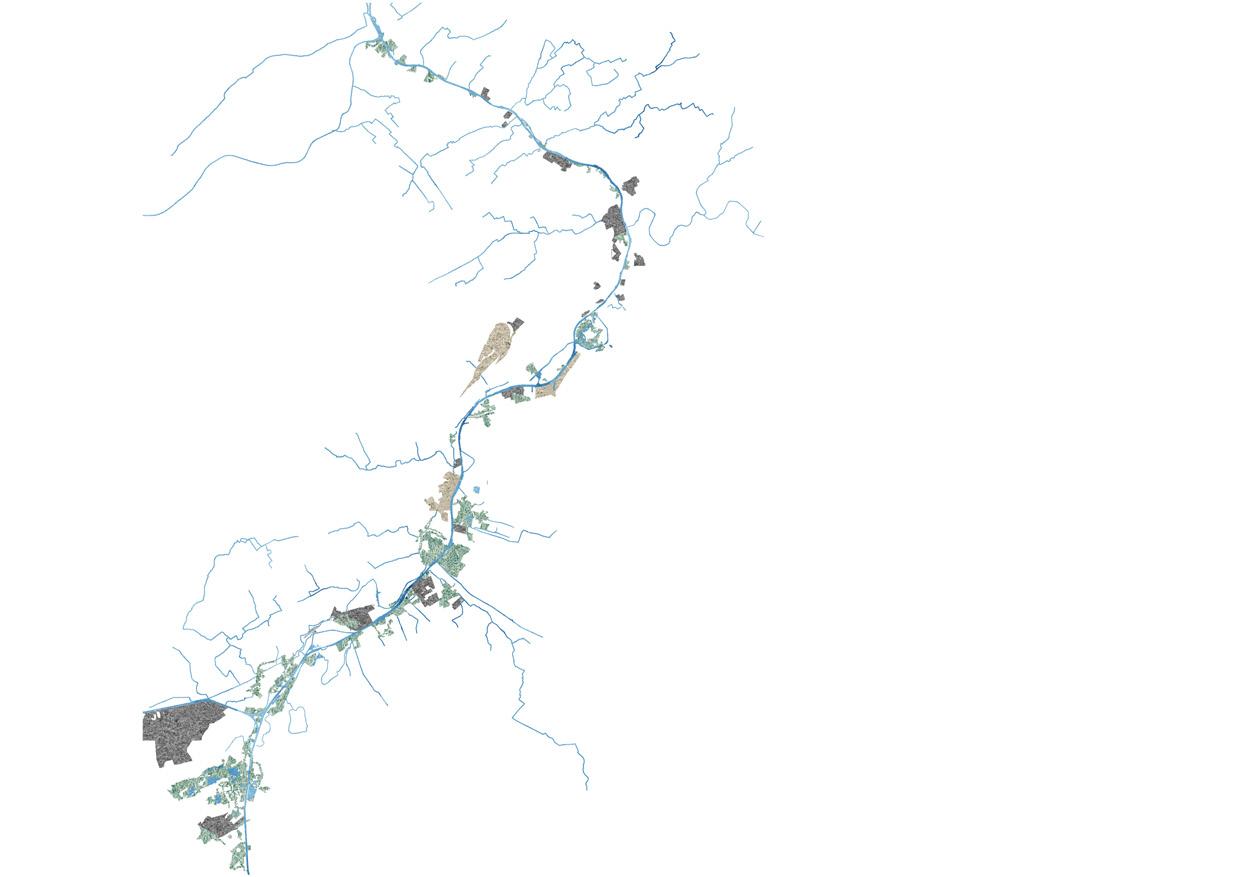
left page_collage inside the lavoir left_territorial map along the Dyle up_plants cleaning the water
IV. narrative projects 36
narrative projects cultivated soils . spring 2020
IV. narrative projects 38
cultivated soils
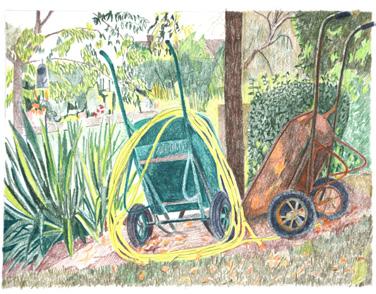
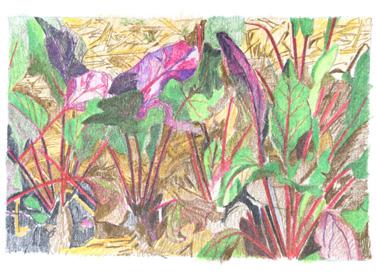
exploration by drawing March to June 2020
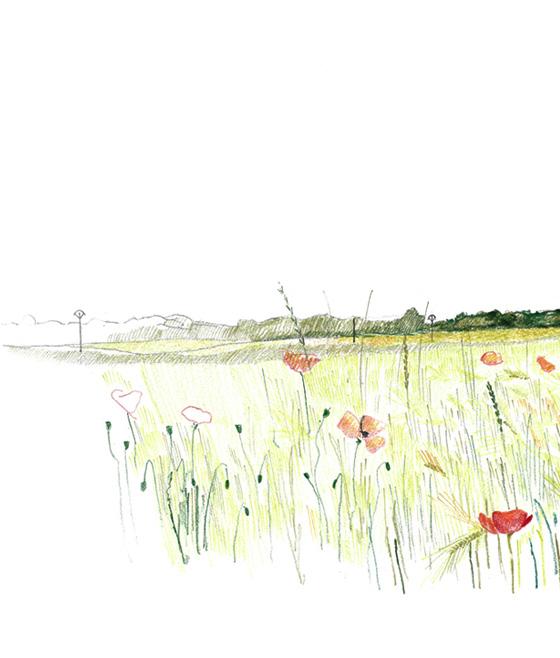
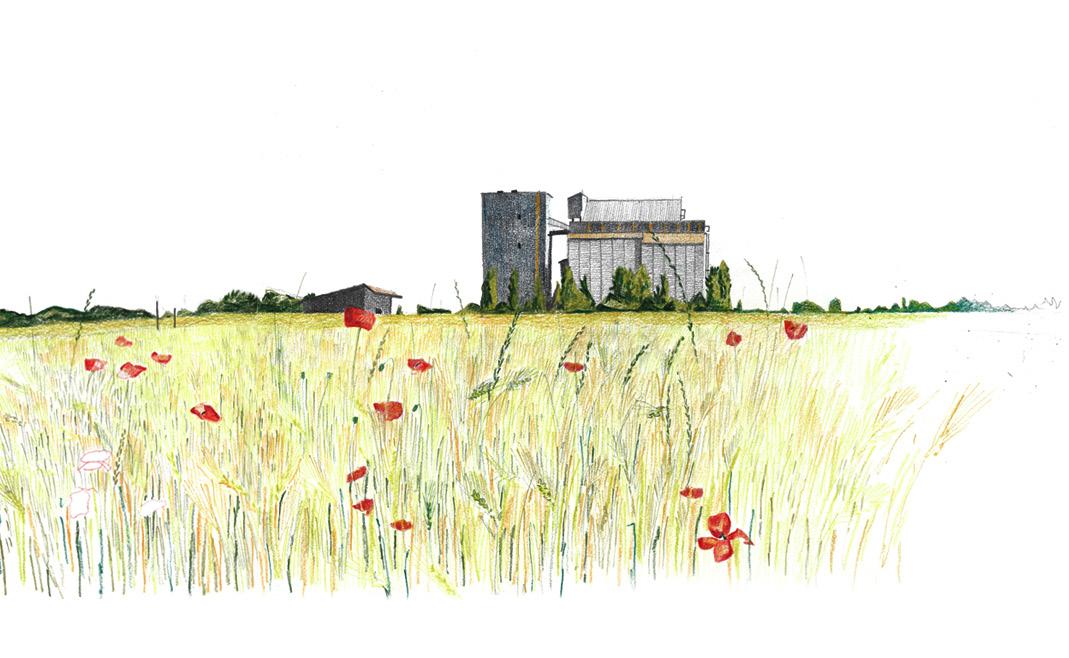
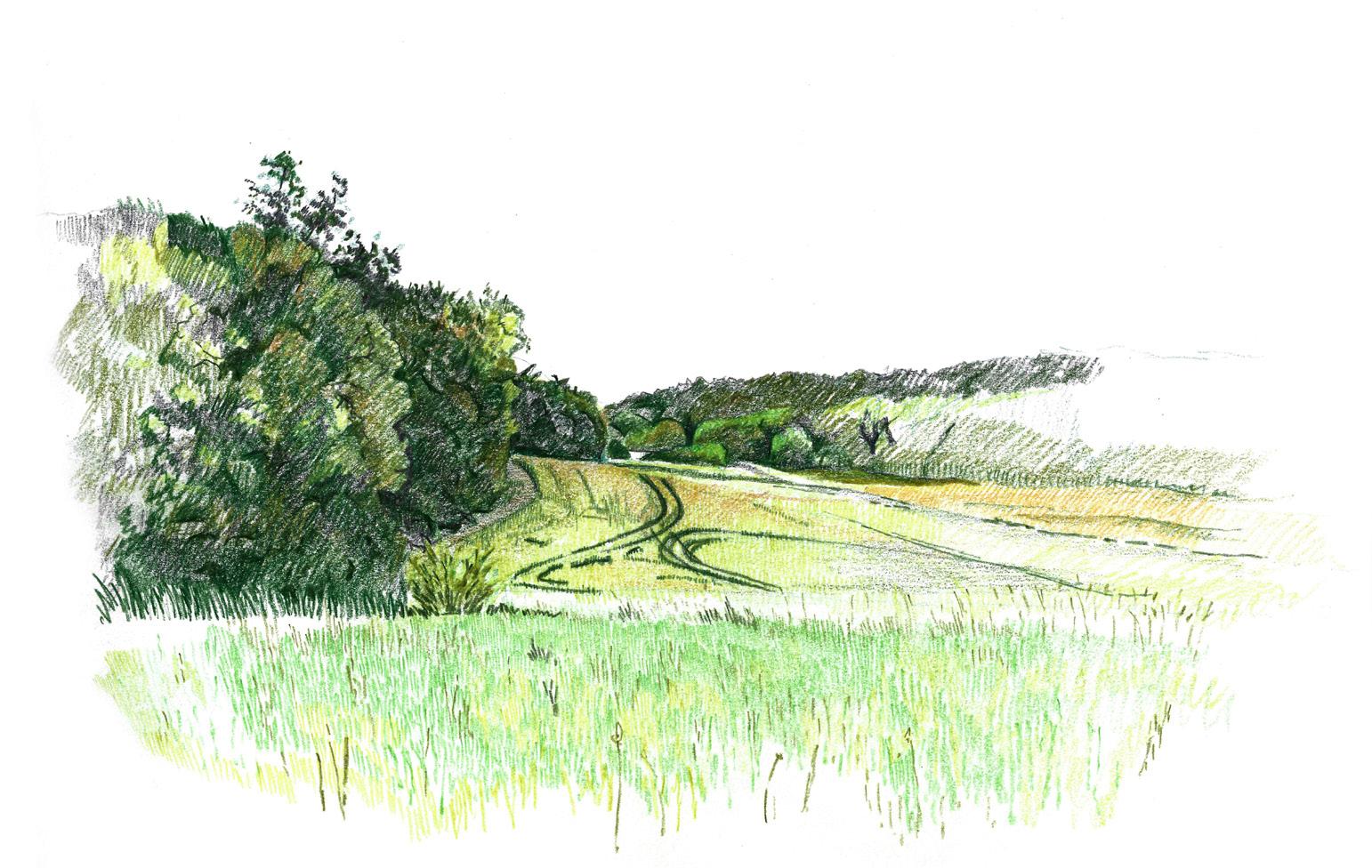
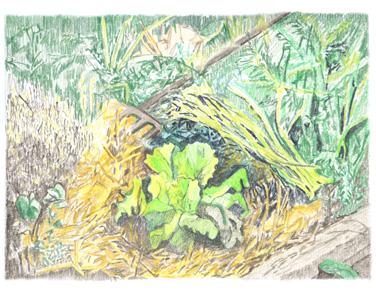
left page_in the fields left_agriculture infrastructure for seed storage below_details in the vegetable garden
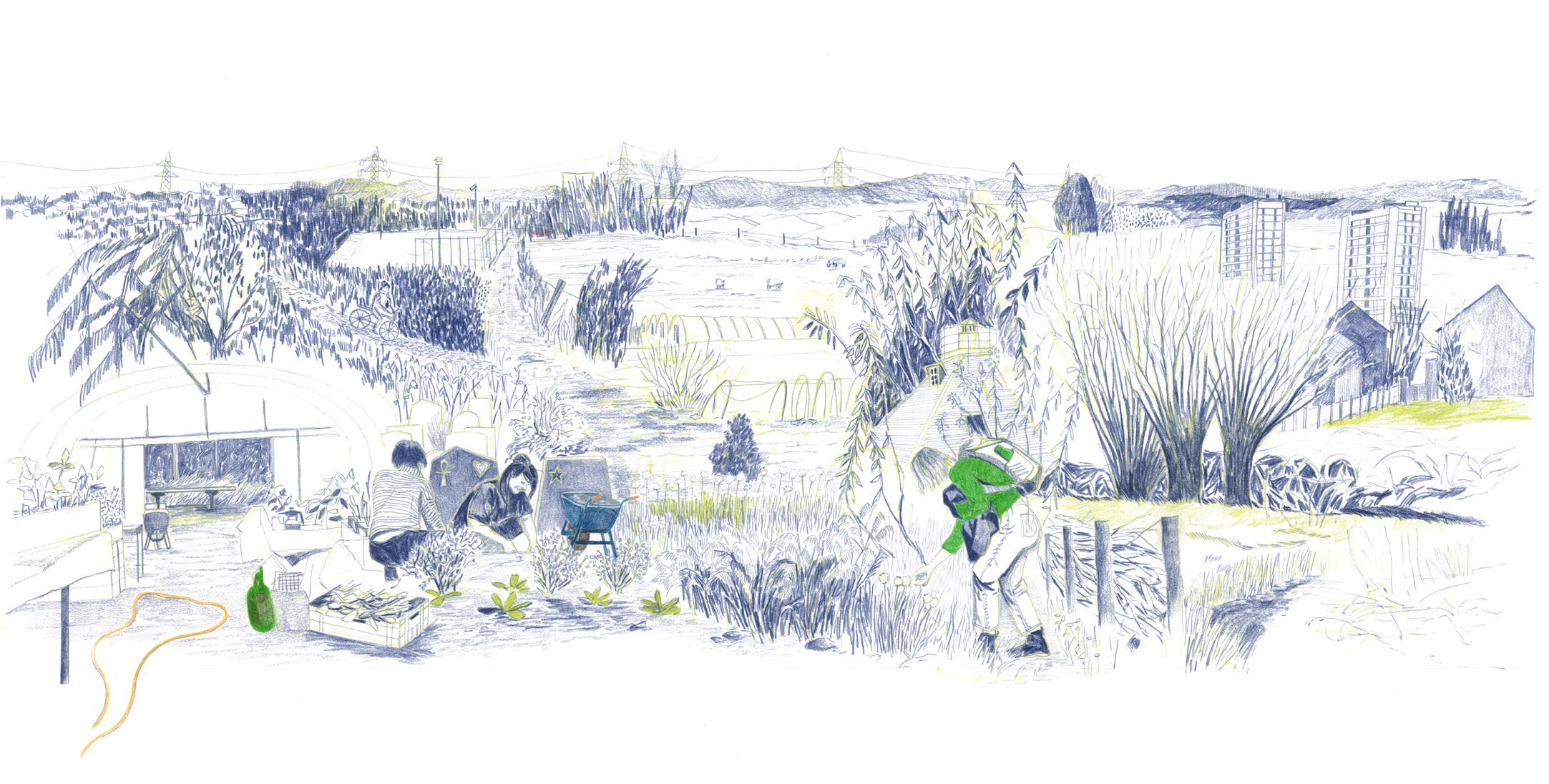
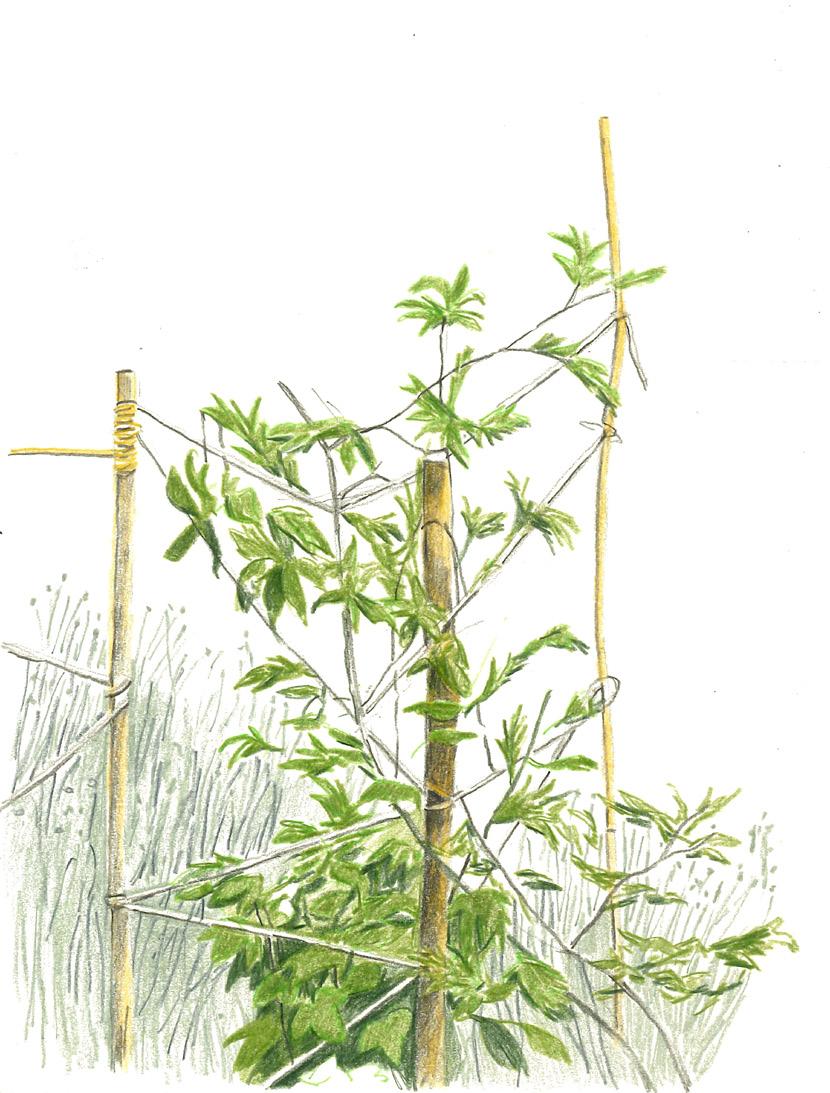
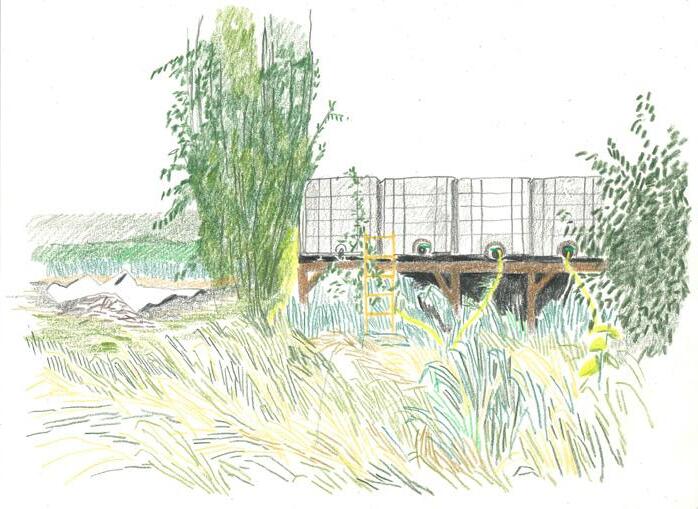
The two series grouped under the title of ‘cultivated soils’ confront the domestic universe of the vegetable garden, the ideal of food self-sufficiency in the making, with the established world of modern intensive conventional agriculture. From southern Seineet-Marne, essentially cereals (wheat and barley), are based on largescale mechanized exploitation of the soil. A heap of beets or slurry at the edge of a field, and the silhouette of silos on the horizon are all common infrastructural landmarks. Confronting another series centered on the density of animal and plant species within a vegetable garden. Insects, flowers, foliage, and vegetables are the details of a universe with multiple strata and corners, testifying to active biodiversity. My attachments go through these familiar places both in the garden and over the agricultural horizon, to question interdependence with the living world.
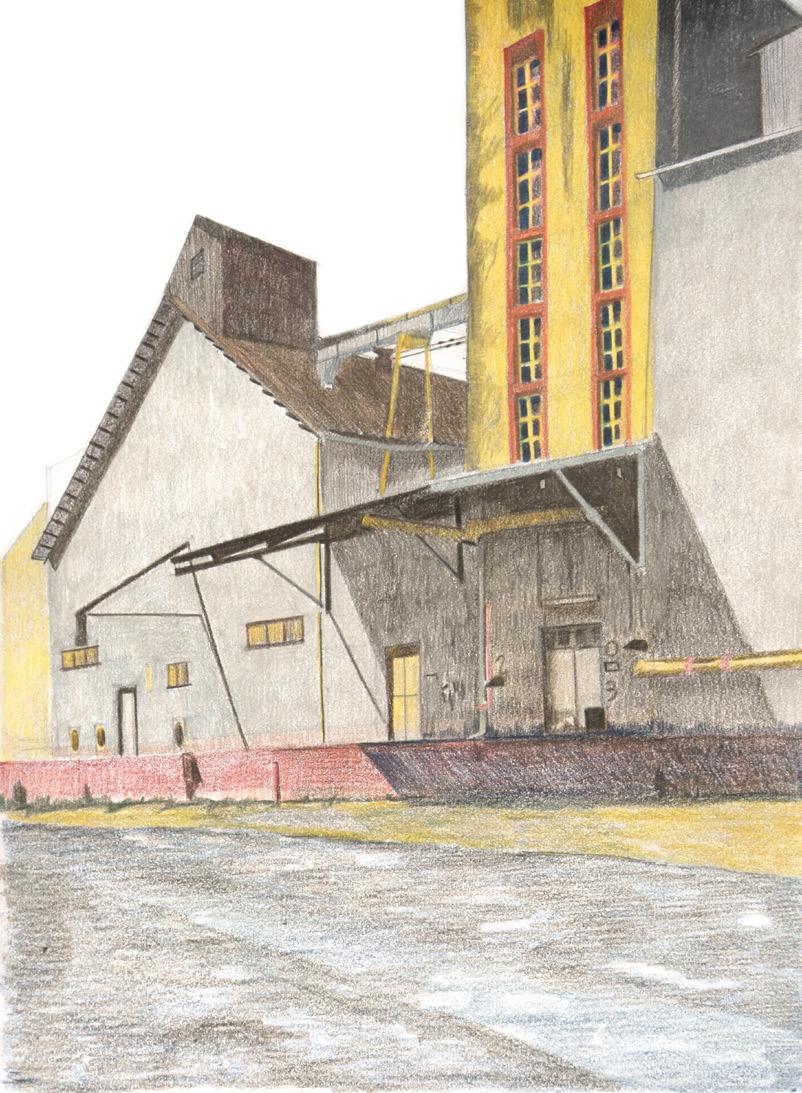
IV. narrative projects 40
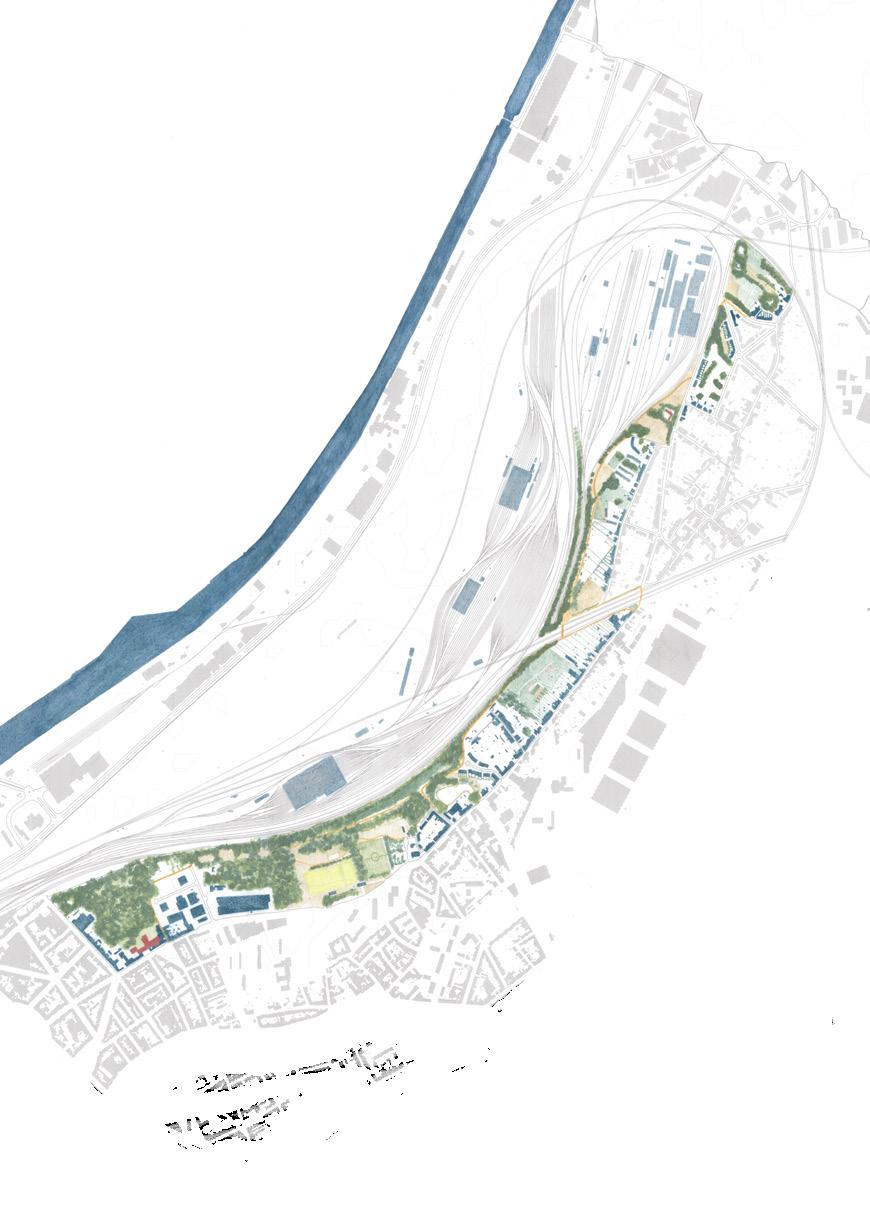
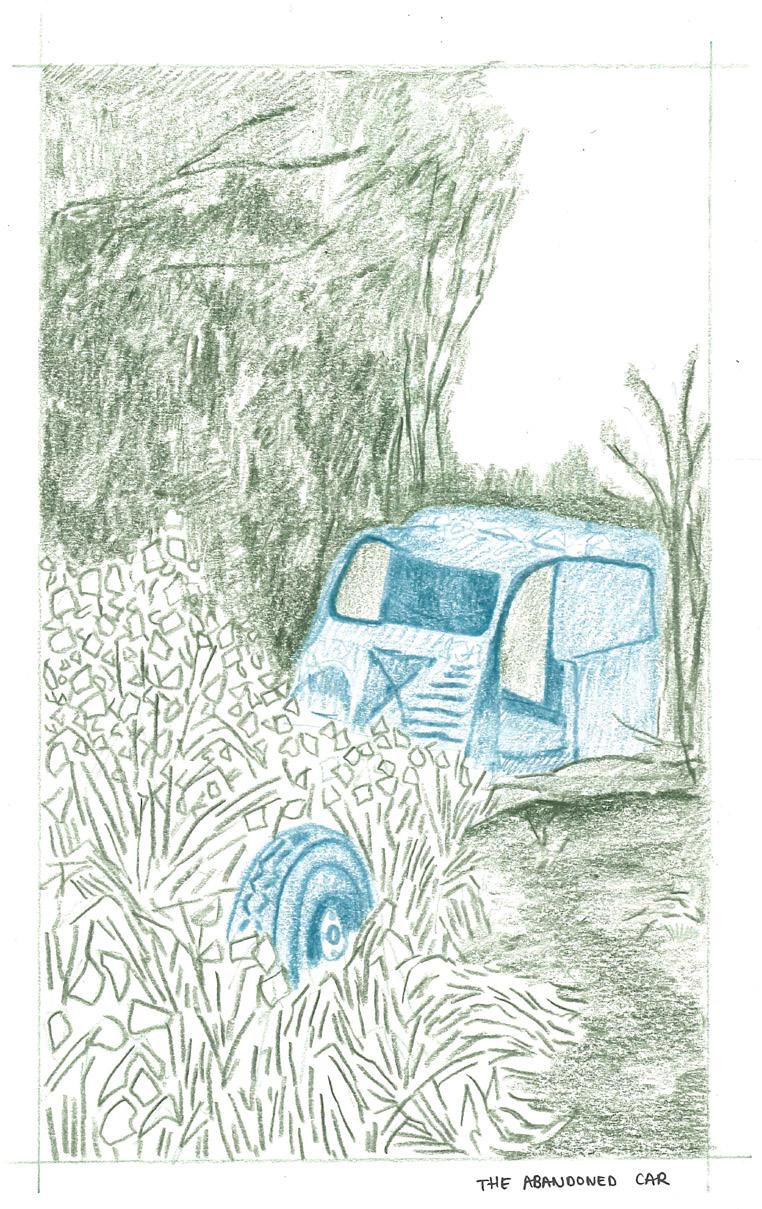
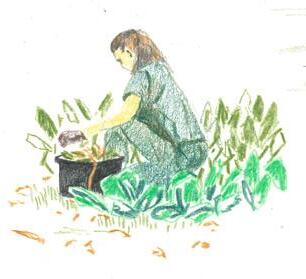
left_water storage for the vegetable gardens right_territorial map of continuous open spaces right page_some actors and the abandonned car
Schaerbeek-Forming
open spaces,Brussels
September to December 2021
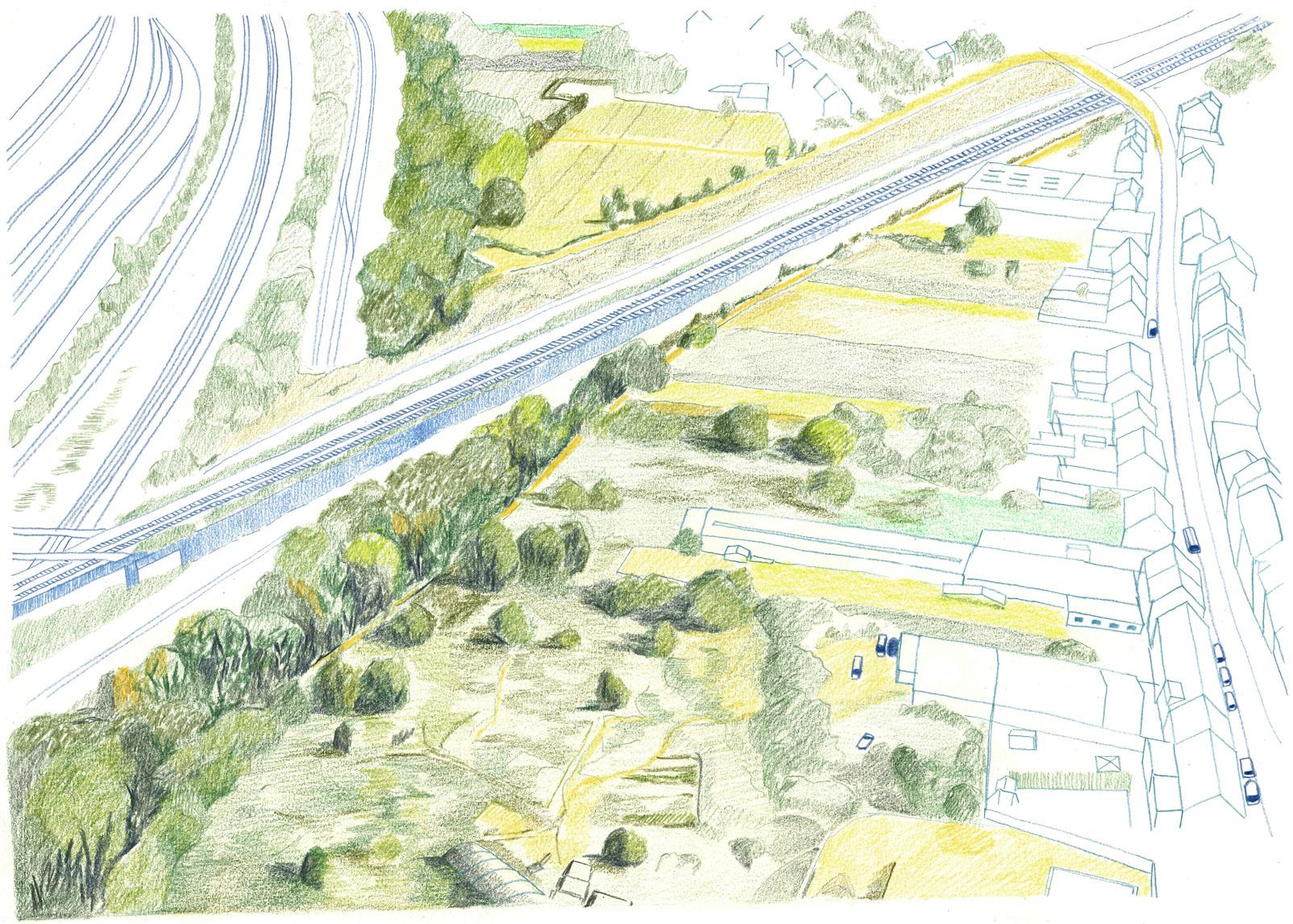
The project from the margins is giving attention to the open spaces following the railways of Schaerbeek Forming, north of Brussels, and actors playing roles in their transformation. This territory has been defined by the radical development of the railways, constrained by strong boundaries. To the south, there is a quite dense area of housing in Schaerbeek and Evere. To the north, Haren is a periurban context, previously agricultural where the famous endive was created. This landscape approach draws the existent struggles, and attachments happening on the site in a way to bring back to the surface an abundant collective memory, to tell the varieties and qualities of the place’s stories. In between the urban Brussels and a more rural context in Haren, these forgotten or hidden stories are those from the annexed lands. Ecology is so understood as a network of considerations between humans and more than humans inhabiting the same place.
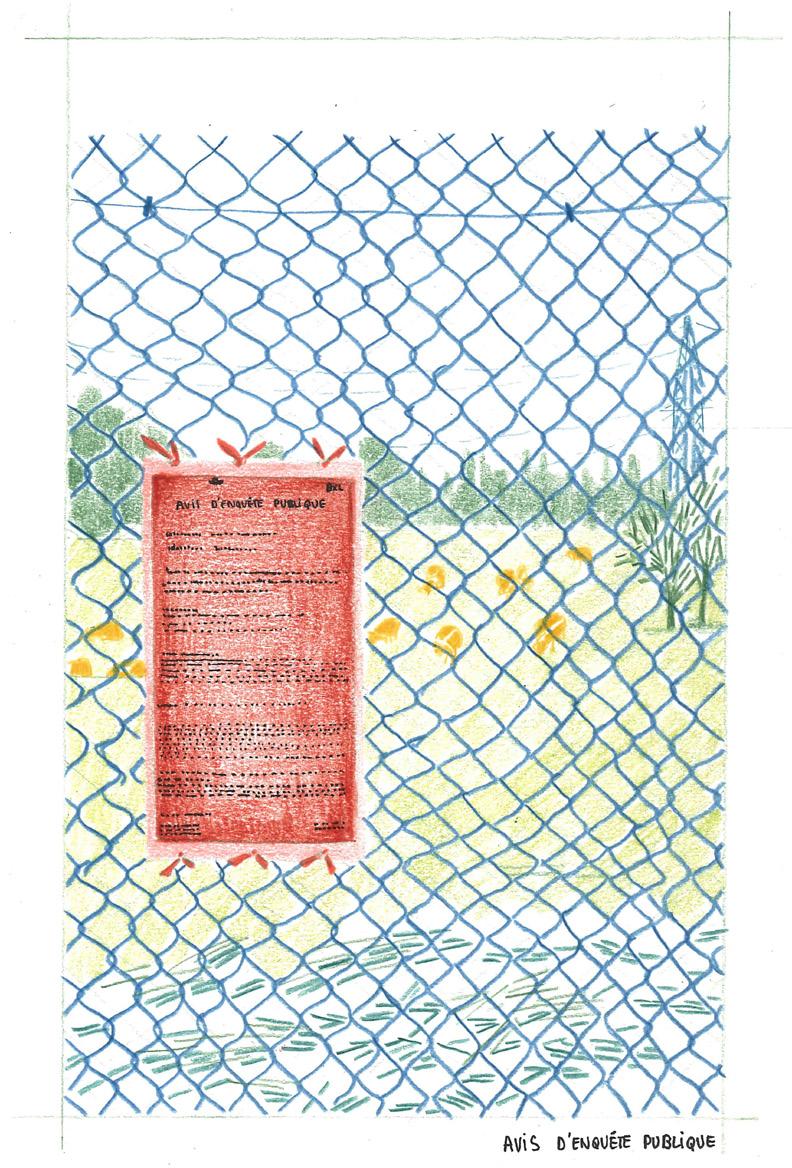
left_avis d’enquête publique for real estate management right page_axonometric view of the territory over Haren station
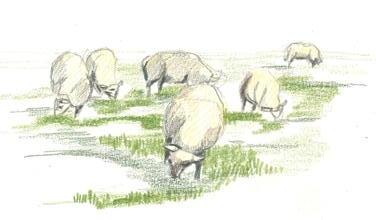
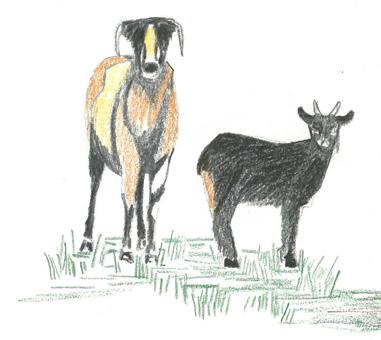
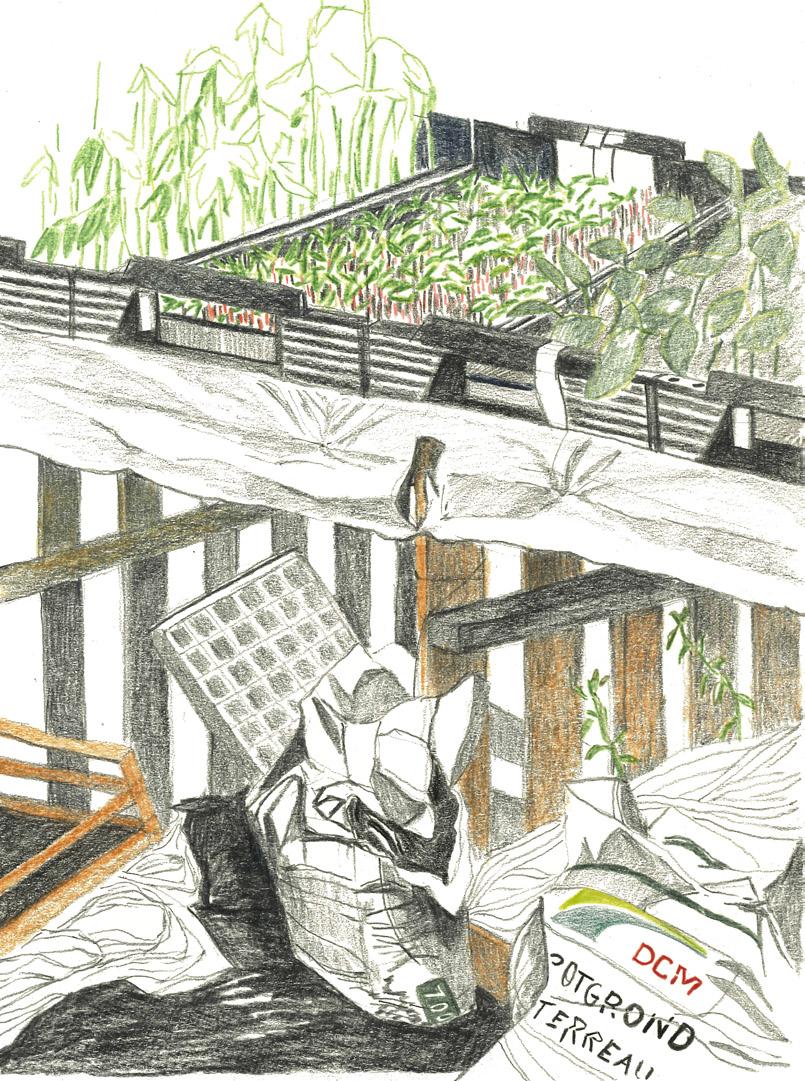
From a broader view, in association with the general map, the perspective drawings show places where intricate stories happen between species, different temporalities, and appropriation. Such as the abandoned car that could become a game for kids. Or the sheep meadow where a red poster indicates a potential project of a housing complex, the pasture facing the real estate promotion. The stories talk about invisible uses or in negotiation, struggles happening on the ground.
Getting closer to the site of Haren highlights the status of this annexed territory. Linked to Brussels for practical reasons, industries and the port have developed rapidly around the village, as some locals continue to call it. The workshops and warehouses of Infrabel, manager of the Belgian railways, take the place of former fields. This predatory approach had even stronger impacts on the culture of the place. Weakening agricultural know-how and making the social crucible vulnerable. Indeed, Haren is nevertheless composed of heterogeneous stories, vegetable gardens, meadows, and wasteland. A precious hybridity that makes flourishing biodiversity possible.
IV. narrative projects 44
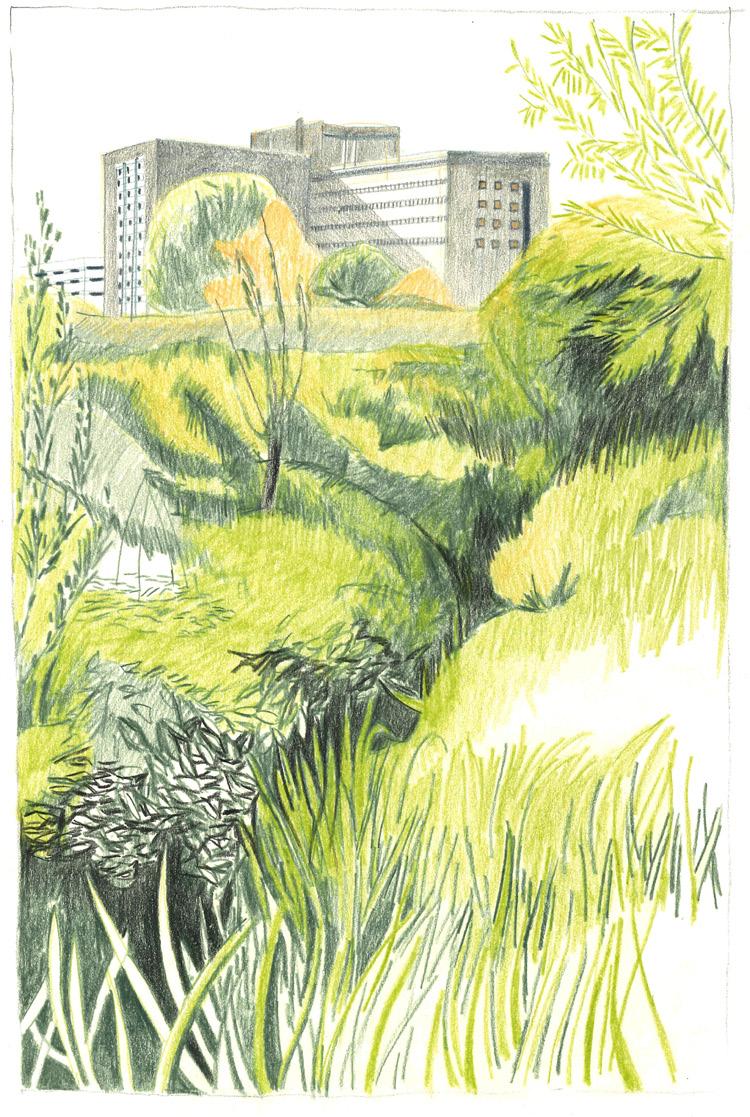
left page_sowing in the greenhouse right page_the stream of the Vogelzangbeek
Along the Vogelzang valley
at the border between Flanders-Brussels diploma project, March to May 2022
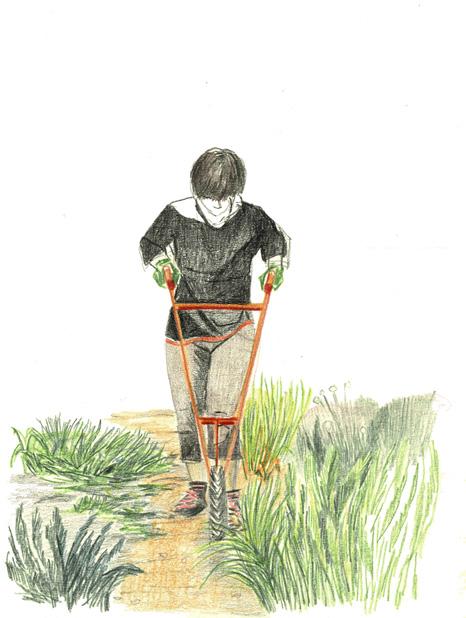
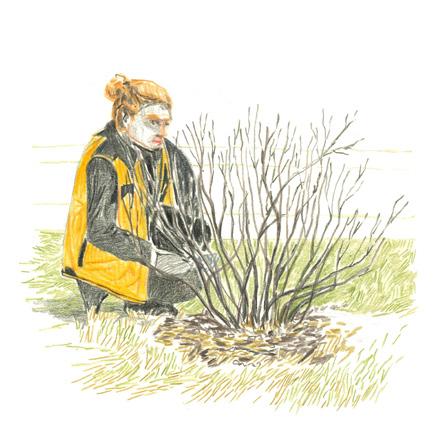
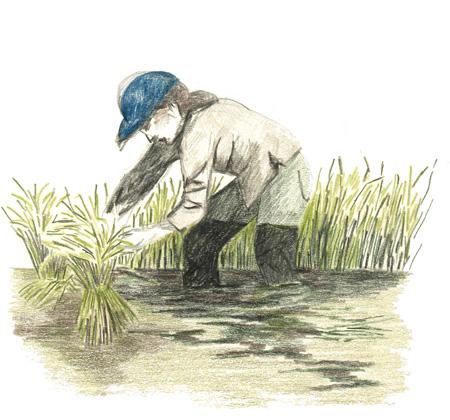
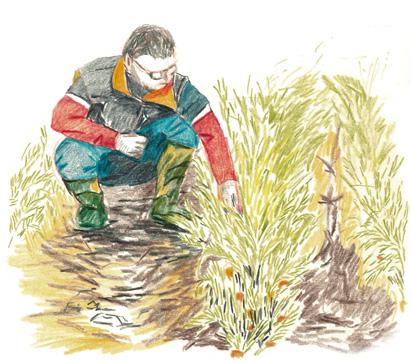
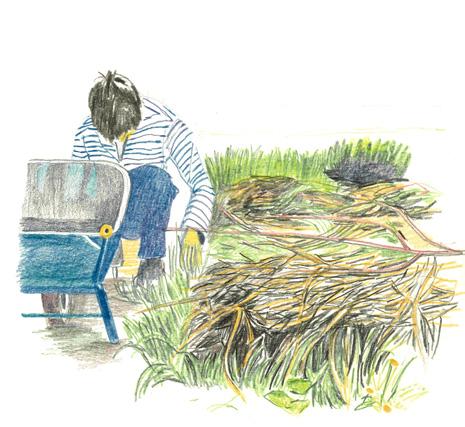
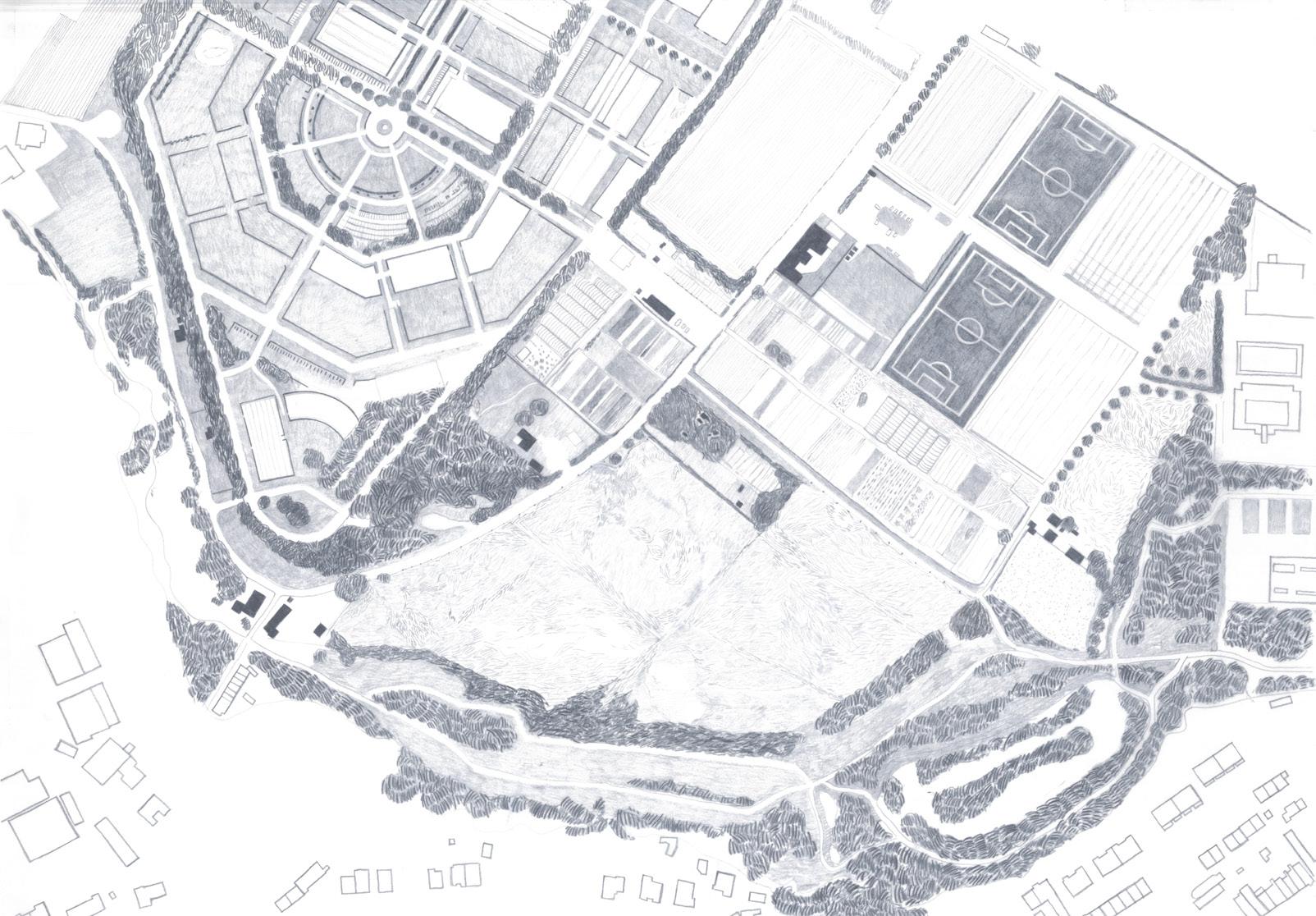
The project process focuses on an exploratory dimension from the territory to the plot, from the landscape composition to farming gestures along the Vogelzang valley. This valley results from the passage of the Vogelzangbeek stream which is also the administrative limit between Flanders and BrusselsRegion. This border questions the urban expansion, the rural resistance, and the specificities of urban agricultures. It is facing the emptiness we often talk about as architects when we deal with open or green spaces. The caring that farming has for the ground gives another perspective on this emptiness. Between the rural history of Pajottenland, the agricultural techniques, and the complex pattern of Brussels’ urban development. Back and forth between agriculture, urban planning, landscape, and architecture reveal an assemblage of spaces and actors. How could these uses coexist? How to imagine hybrid intricacies between them? Maybe by their frictions, their overlapping, their complementarities.
IV. narrative projects 46
left page_gardening gestures right page_map of the different spaces qualities
IV. narrative projects
48
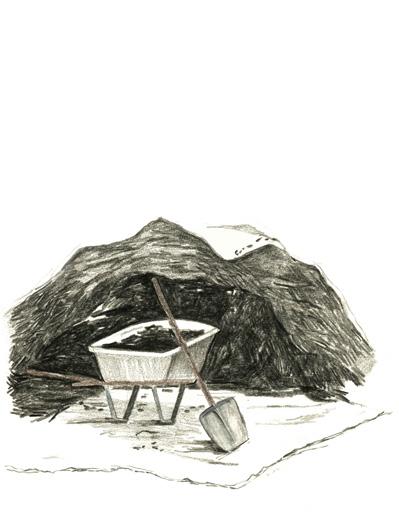
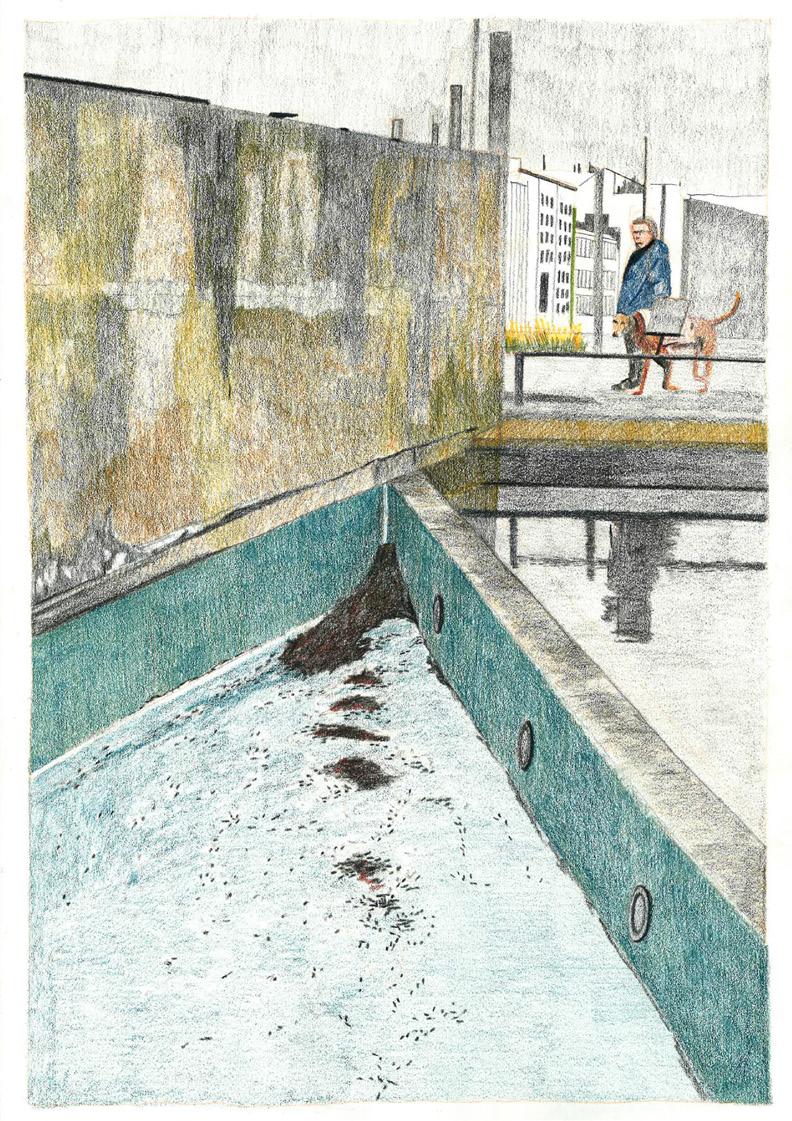
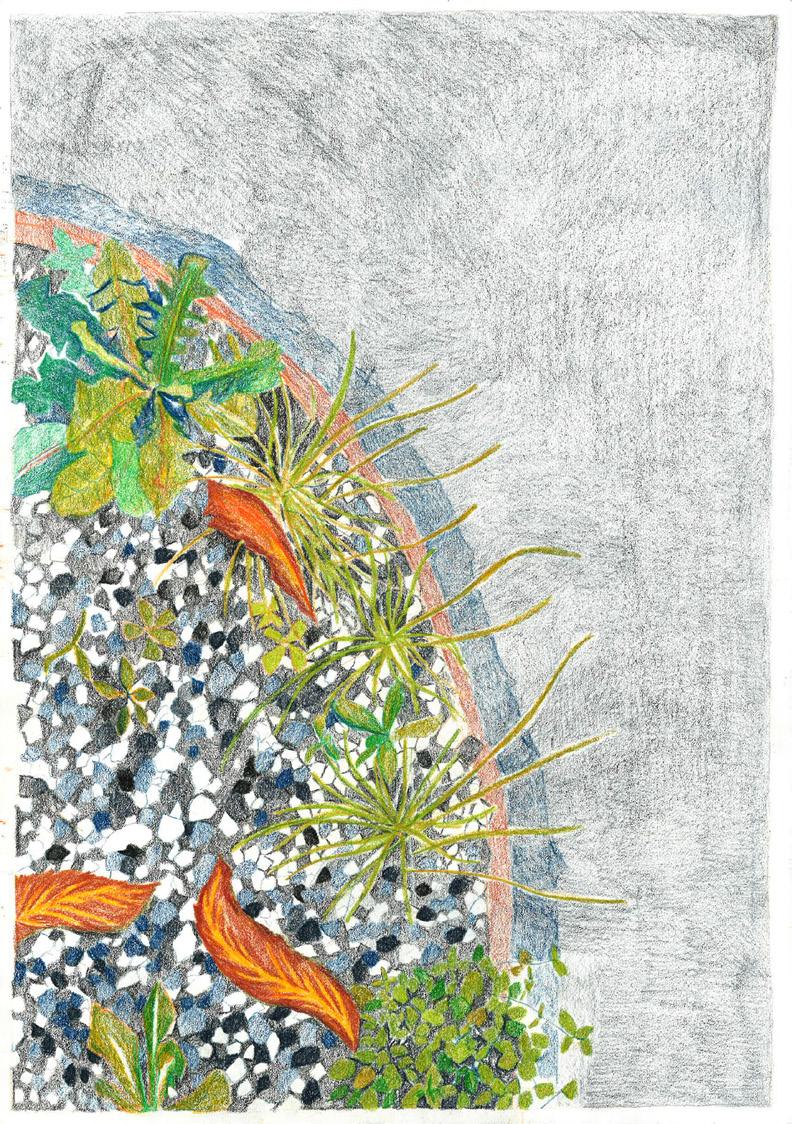
humus decomposition in a corner
more-than-humans
architecture exhibition at de Singel, Antwerp
September 2022 to June 2023
This series of drawings look at some scenes taking into account more-than-humans around the emblematic building of De Singel in Antwerp. In the context of a general exhibition about the living world in architecture, these couple of drawings show the place-making of lichens, bacteria, algae, weeds, birds, insects, and other mammals. A corner of the pool basin is taken over by leaves becoming compost. The holes in the tar allow glimpses of weeds as well as a new porosity with water and air. The turtles of the neighbors are finding a new home among the algae. The droppings of an animal marking its territory on top of a concrete wall.
ground opening in the parking lot
Léonie Jacqmin portfolio 2023