www.tablewareinternational.com
2023
May
TableWare INTERNATIONAL HoReCa





Welcome to the May/June issue of HoReCa magazine, from the same team who bring you Tableware International. This issue is choc-a-block with lots of great content including a chat with Bonna’s general manager Erbil Aşkan. We feature some lovely images from the really interesting Futura collection, designed using AI intelligence which took its inspiration from Renaissance art – a first for a producer from Türkiye, the company says. You’ll find more on page 28.
Welcome to the latest issue of HoReCa, brought to you from the Tableware national team. Now that we are o cially in Q4, it will be interesting to see how 2022 will end up comparing to 2021. Despite a cost- of-living crisis unveiling itself (in the UK at least), there remains a degree of optimism that – actually – people will seek to escape the overhanging fruits of doom and gloom. And if they have ex tra money to spend, it will be spent on hospitality and enter tainment. Good news for venues and good news for suppliers. But let ’s wait to see how the next few months transpire. Af ter the trauma of the past number of years, the sector is steeled for whatever the economy has to throw at it.
Meanwhile, Ambiente’s Thomas Kastl, who you are all no doubt familiar with, talks to us about the future of the HoReCa hall for the 2024 show. Not forgetting, of course, that Ambiente takes place earlier than usual, running from 26-30 January. See what he has to say on page 38.

We chat to Lifetime Brands Europe too who tell us about their sector-friendly collections, particularly Mikasa Hospitality – see what they have to say on page 32.

This issue of HoReCa, therefore, has lots of new products, industr y opinions and trends to sink your teeth into, including a super inter view with master sommelier Matthieu Longuère who is now wine development manager at the acclaimed Le Cordon Bleu London. He gives us some real insight into what makes wine sing, and yes, the glass really does have a par t to play. One of the key things I wanted to know was, when it comes to the glass – does it really matter if its handmade or manufactured?
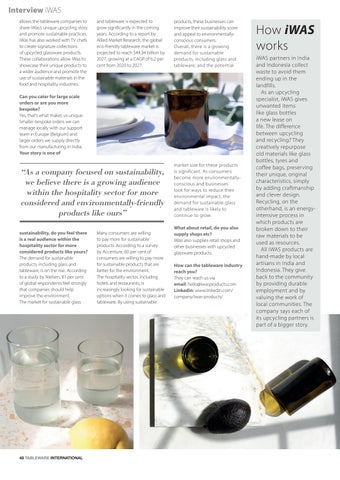
We also introduce you to the team from iWas on page 48 with co-founder Nico De Wilde giving us some insight into how they turn unwanted items into upcycled must-haves, with their glassware of particularly interest to the hospitality sector. You can read more on page 46.
“Not always,” Matthieu told me. “The main di erence is nancial. I rst look at the thick ness of the glass and the way the di erent par ts are joined. Some manufactured glasses look very clumsy, some you would not even notice.” You can read more from him on page 22.

The NRA Show takes place in Chicago this month and we have a preview of just a few of the key tabletop suppliers attending the show on page 50. By all accounts, it’s a great show for anyone serious about supplying to the sector. Meanwhile, on page 52, our expert columnist Valda Goodfellow gives some insight into what her clients are asking for these days and she is quite delighted to report in a change in pace!
And on top of that, we talk with designer Richard Brendon on page 44. Richard is really passionate about making his bone china collection in Stoke-on-Trent so we learn more from him.

All this, and plenty more!
We also hear some interesting sector opinions in our Vie wpoints pages on 30, while Wilmax give us some insight into their vast assor tments on page 18. Bolsius Professional bring us up to speed on one of their must-have collections for the hospitality sector on page 24 while our friends at Ambiente give us an update on the HoReCa hall on page 28. All this and much more!



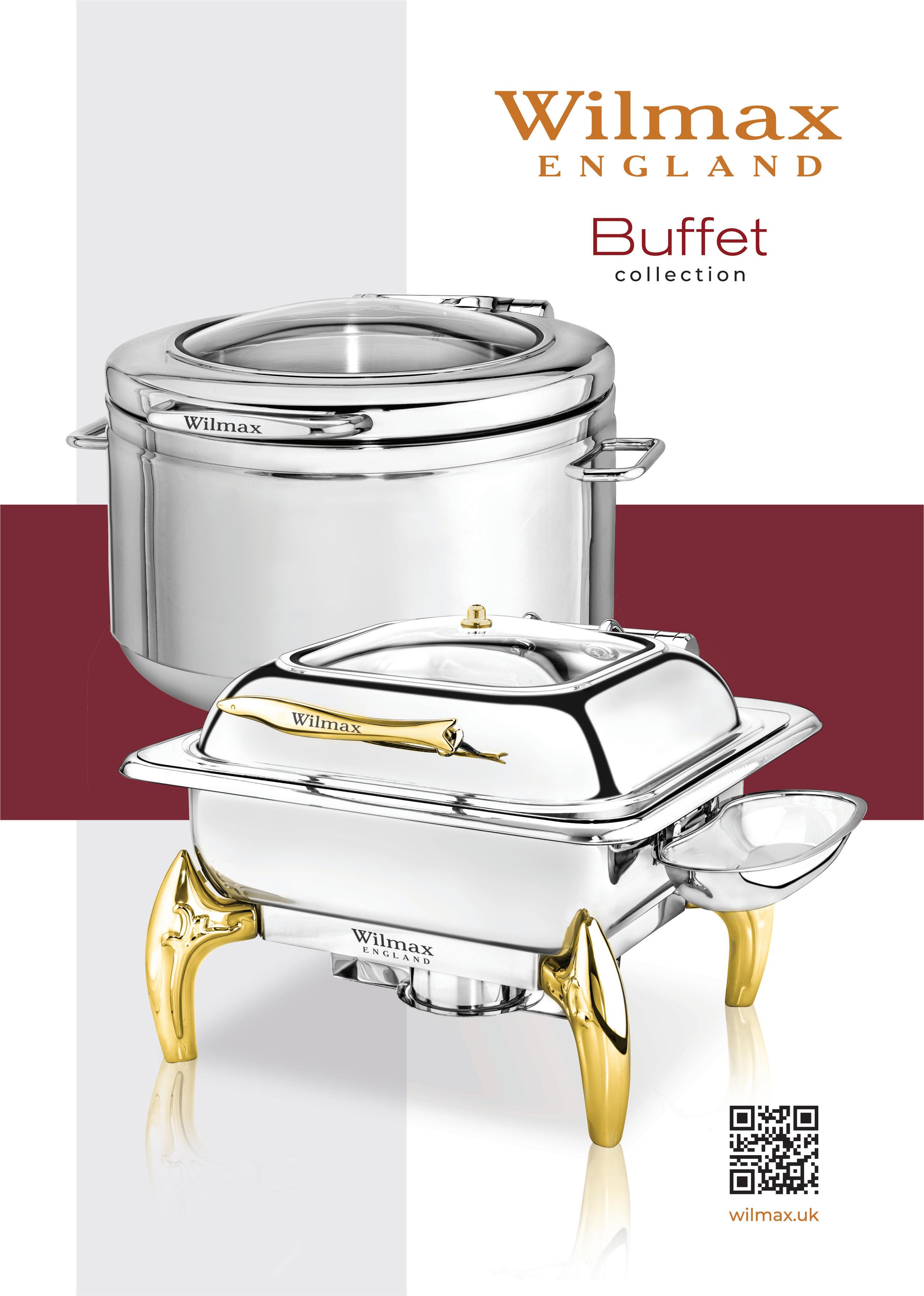
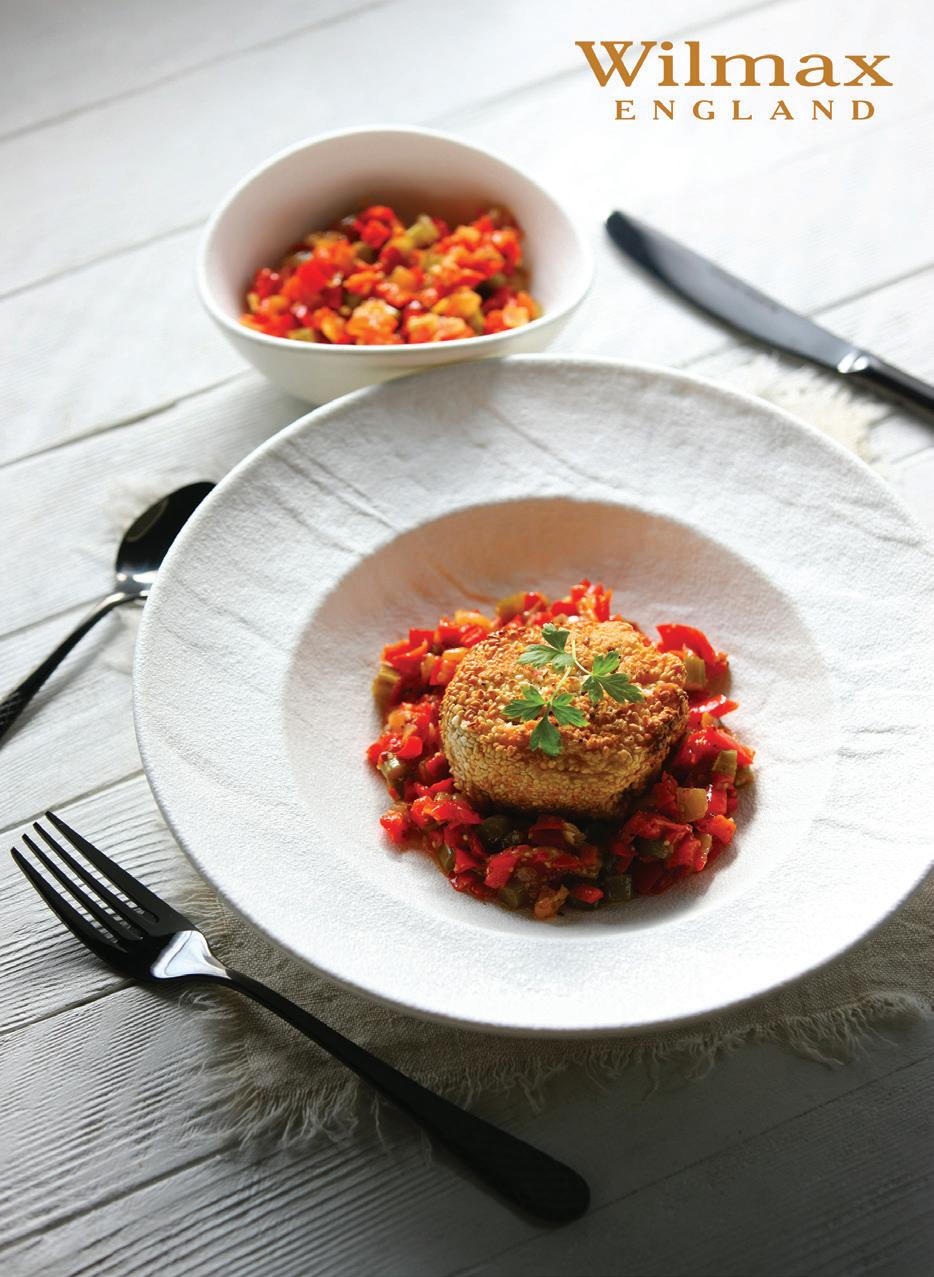
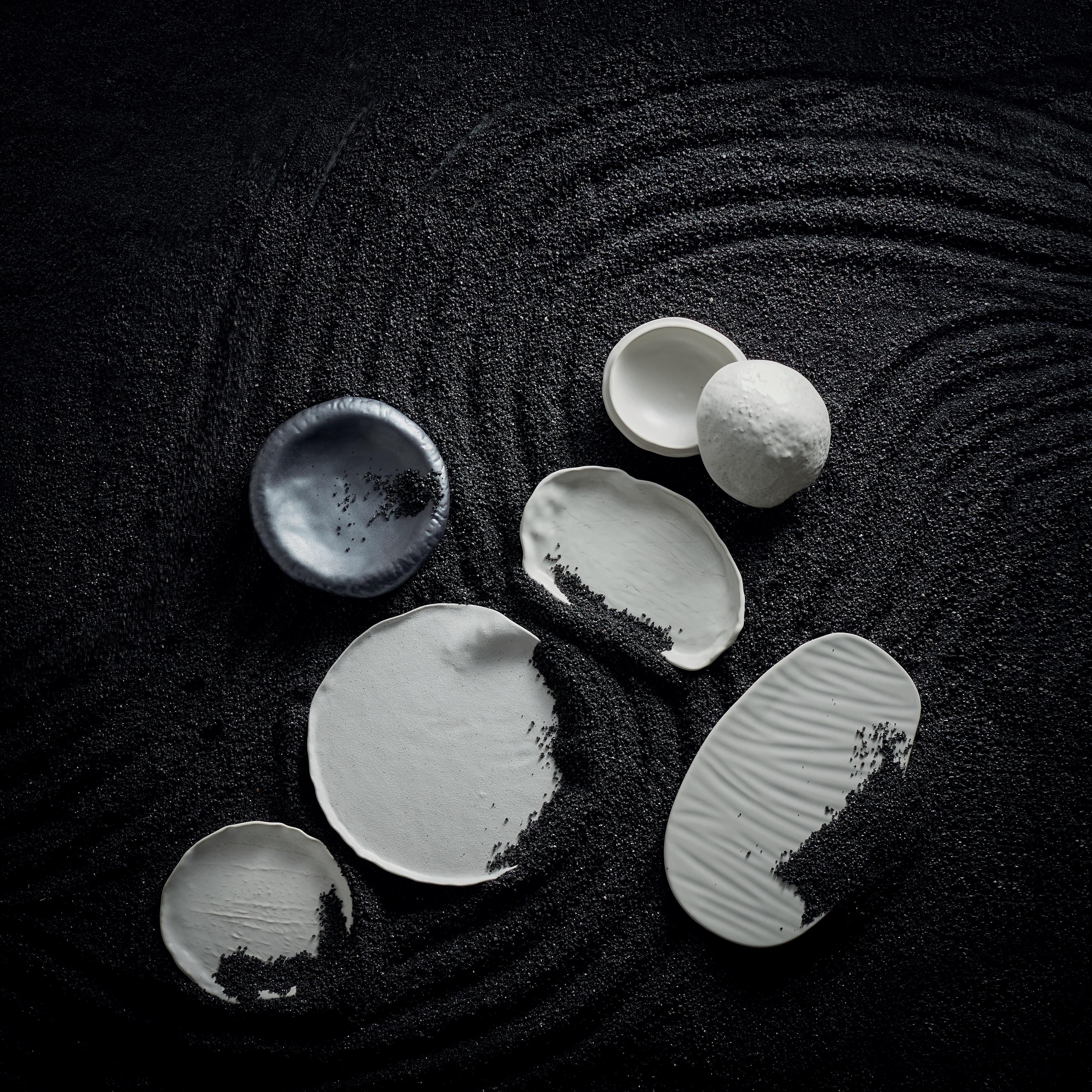
Wilmax, who are more than familiar with creating specialist collections for the hospitality sector, has added the Whitestone range of vitrified porcelain to its offering. Inspired by natural stone textures, this collection brings a refined opulence to the table. The collection includes an array of product choices from rectangular, square, and round plates for serving aperitifs and main courses to salad bowls, serving dishes, and much more. Turn to page 32 where you’ll find more white tableware.
SEB Professional has brought all of its brands together with the opening of its new Experience Centre. This includes products from WMF Professional Coffee Machines, Schaerer and Curtis as well as from WMF Professional Hotel Equipment and HEPP. A training centre for product and coffee expertise round off the offering at the 700-square-metre showroom.
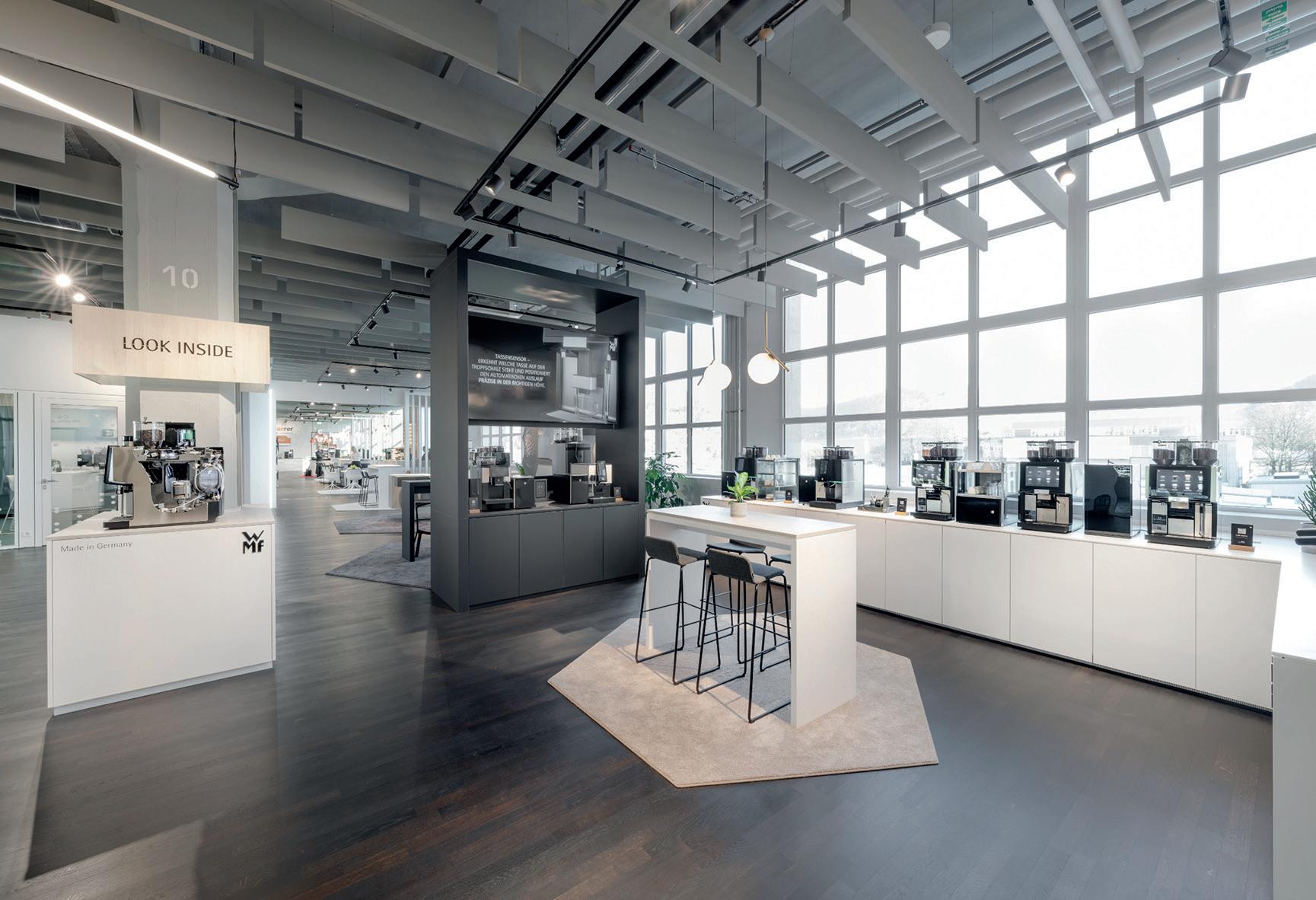
Martin Zouhar, executive vice president SEB Professional Coffee Machines says: “The SEB Professional Experience Centre is far more than just exhibition space. It is an experience centre, offering wide-ranging possibilities to exchange ideas. Meetings with national and international customers, internal team meetings and events, product presentations or press events – the list of possible uses is long and varied. We see the SEB Professional Experience Centre as a key element in our future communications strategy.”

The team at G&G Goodfellows has been expanded with four new employees joining the ranks.
Paula Déridet, Nick Baxter and Leon Hoquee-Cott join as business development managers, while Luke Lane takes on a role of marketing executive.
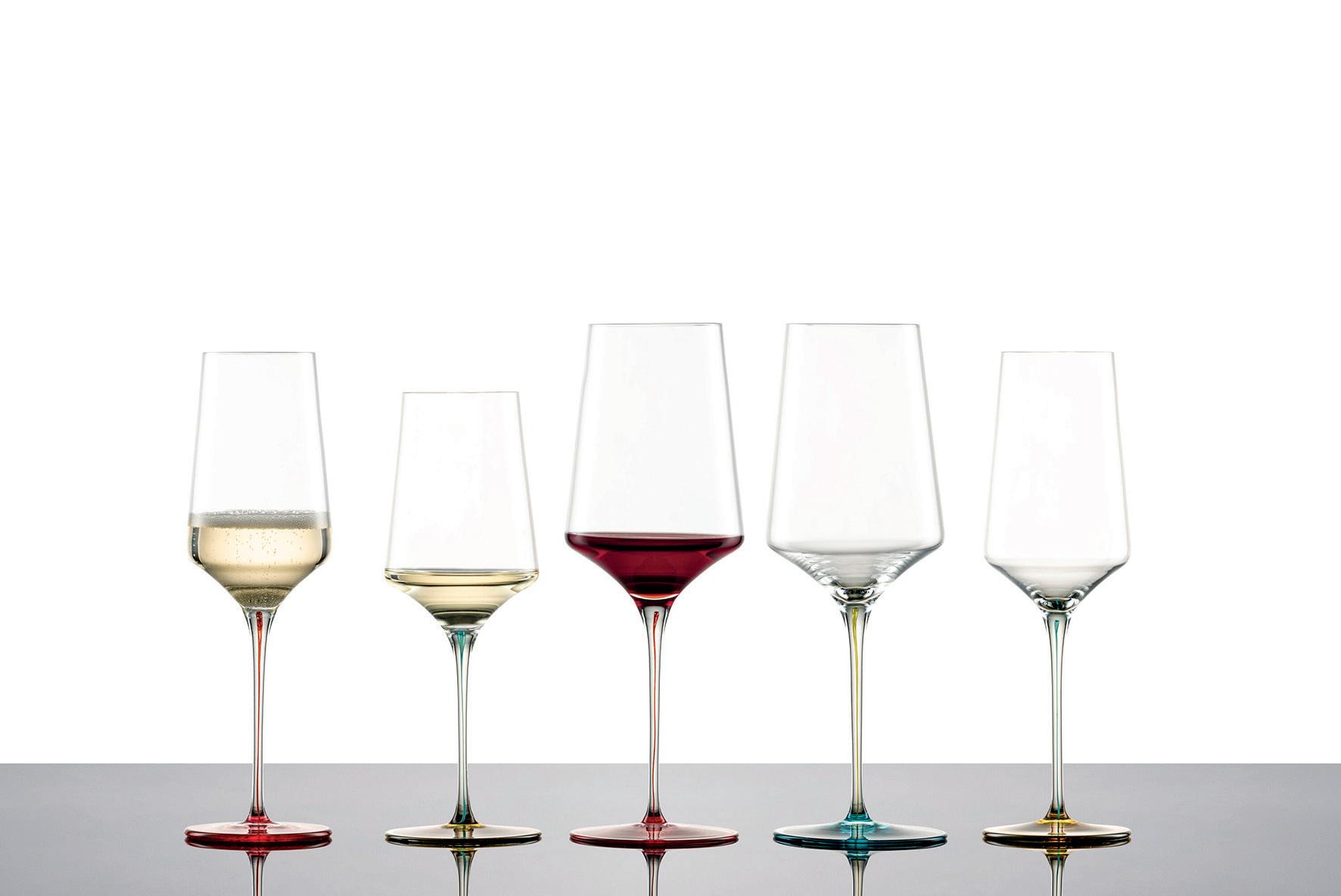
Zwiesel Glas is celebrating two new awards – the first for being one of the most popular brands in Germany, and another for the company’s outstanding design quality.
The company was chosen as a winner in the Life & Living Award 2023, as voted for by more than 50,000 consumers.
"We are particularly pleased with the award because our customers have expressed their satisfaction and trust in us. The award also confirms the importance of outstanding service in the areas of brand
experience and customer loyalty and how well Zwiesel Glas has mastered this," says company owner Prof Dr Andreas Buske.
Secondly, Zwiesel Glas was named winner in the Product Design - Kitchen and Household cagetory at the Iconic Awards: Innovative Interior 2023 for the design of its Ink series.
The prize is awarded annually by the German Design Council and sees itself as a "trend barometer for the interior design industry".
the brand has to offer.



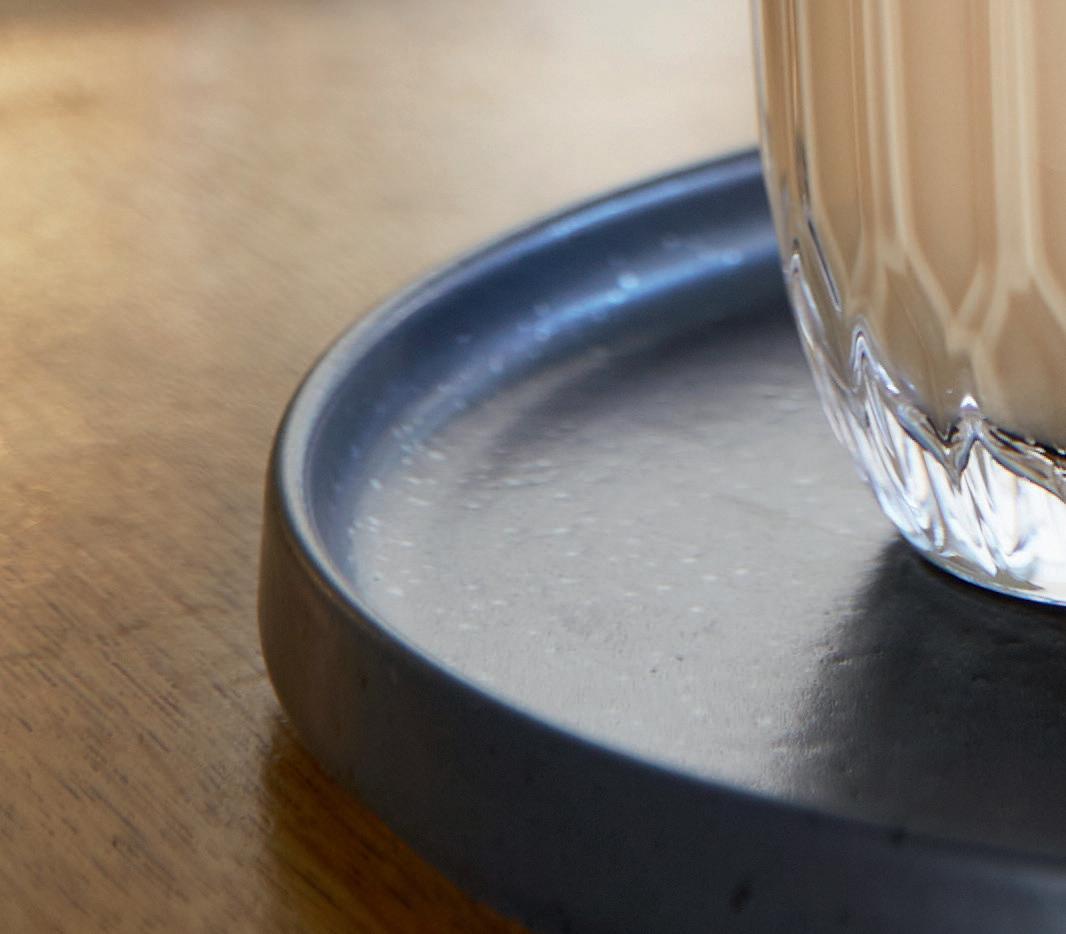
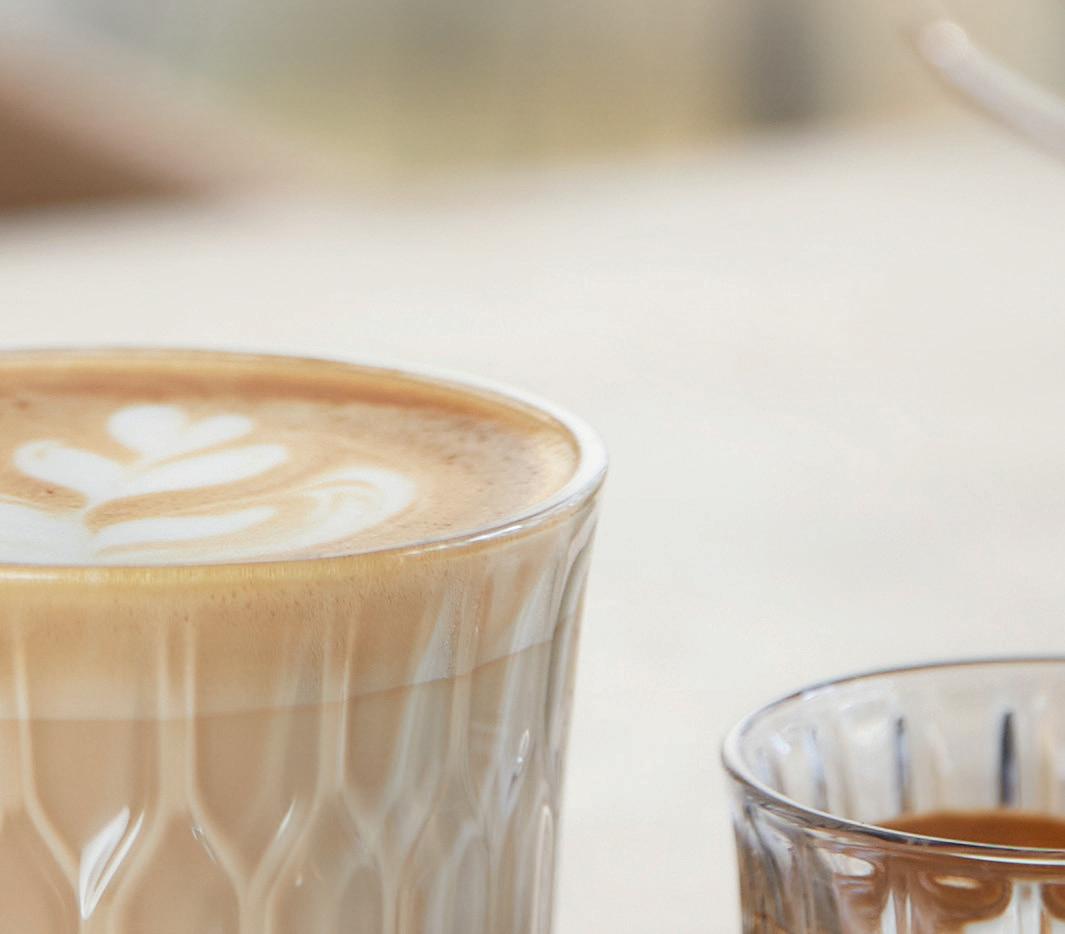
The new TR UE FL AV OUR Barista Collection from WMF Profes sional. A real cr ystal glass innovation for enjoying coffee specialities and more.
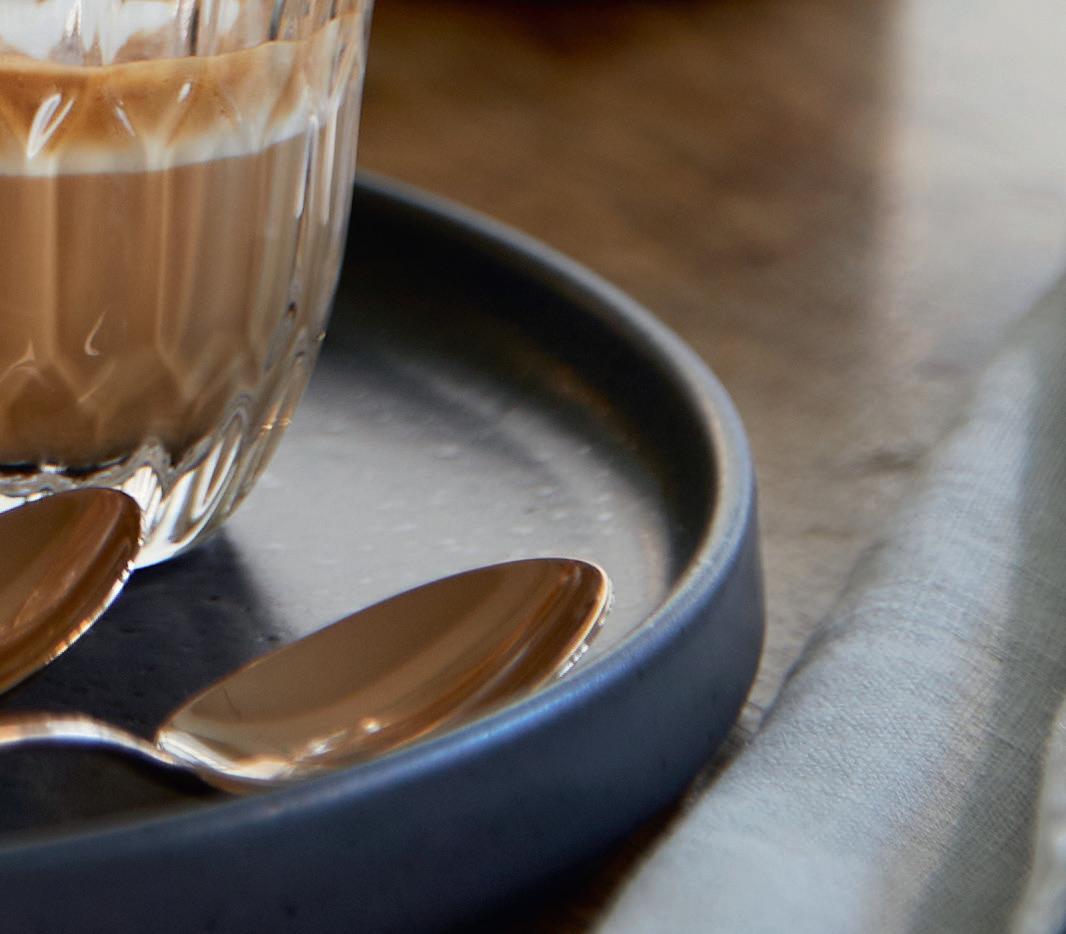
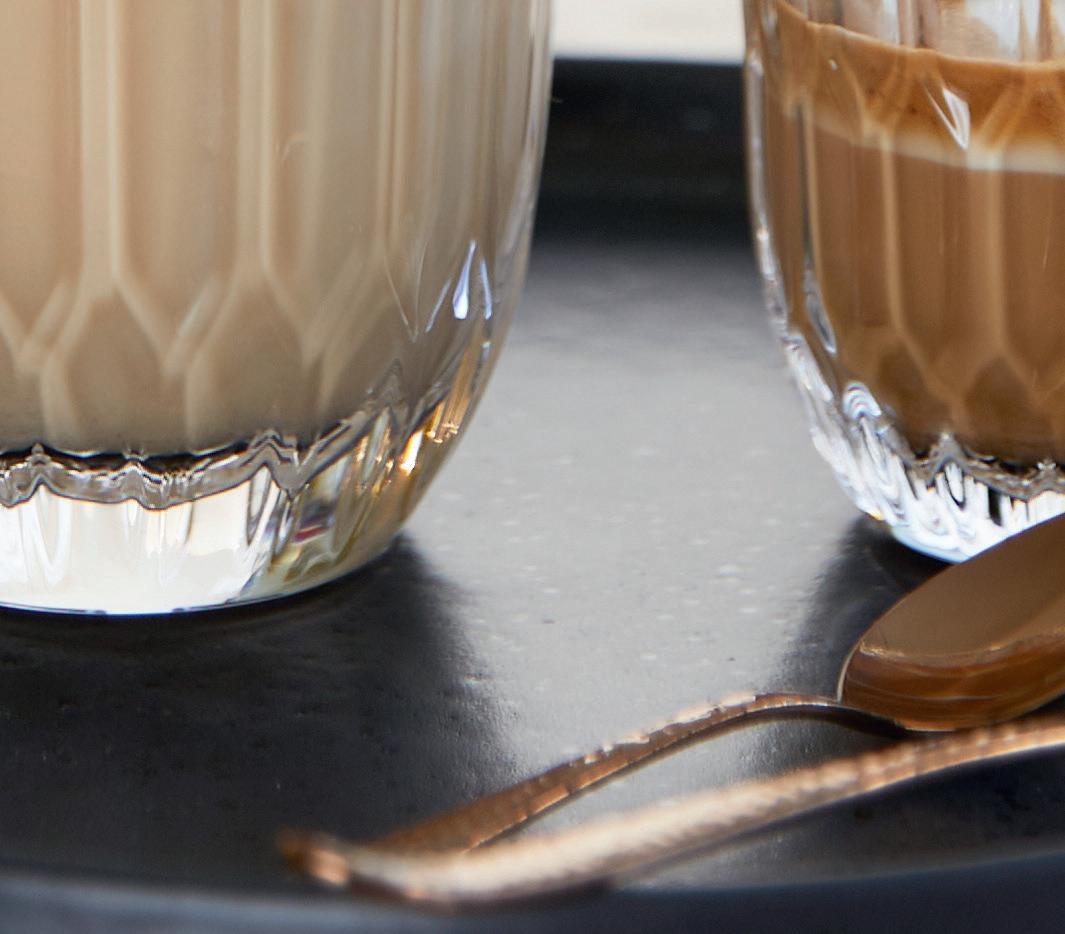
Four glasses, exclusively developed with WMF coffeeologists for the food servic e and hotel industry. The innovative way to se rve hot drinks .




The Arcturus Group will exhibit at a selection of upcoming hospitality trade fairs. After exhibiting at Internorga in Hamburg in March, followed by Hospitality Innovation Planet in Madrid – the team will go on to exhibit at The Hotel Show Saudi Arabia in September, and HOST Milan in October. The group with its brands Sambonet, Paderno, Arthur Krupp, Rosenthal, Ercuis and Raynaud says they make every effort to attend the most important global HoReCa trade fairs with a full range of dinnerware and cookware. Their goal? To meet all the needs of hotel and professional customers.
The JW Marriott in Goa recently placed an order with Lazzaro for 27,520 pieces to be used in the various F&B outlets. The order includes pieces from the La Mer Collection and a textured range – Linea.
The La Mer Collection is inspired by the sea. This range should work particularly well for the hotel as it is near Vagator Beach. It offers chefs the opportunity to elevate their plating techniques and create unique and visually stunning presentations of their dishes in a range that reflects the costal surroundings.
Bonna is working on the construction of a logistics center at Pazaryeri with a capacity of 25,000 pallets.
WMF Professional has partnered with star chef Sandra Scheidl for the Culinary meets Art event. Culinary meets Art is a creative culinary format which takes place in cities such as Innsbruck, Salzburg, Graz and Vienna. It brings together people with an affinity for gastronomy and art with a varied program including a fine dining menu and live painting in an exclusive event location. Scheidl uses the Synergy porcelain series.
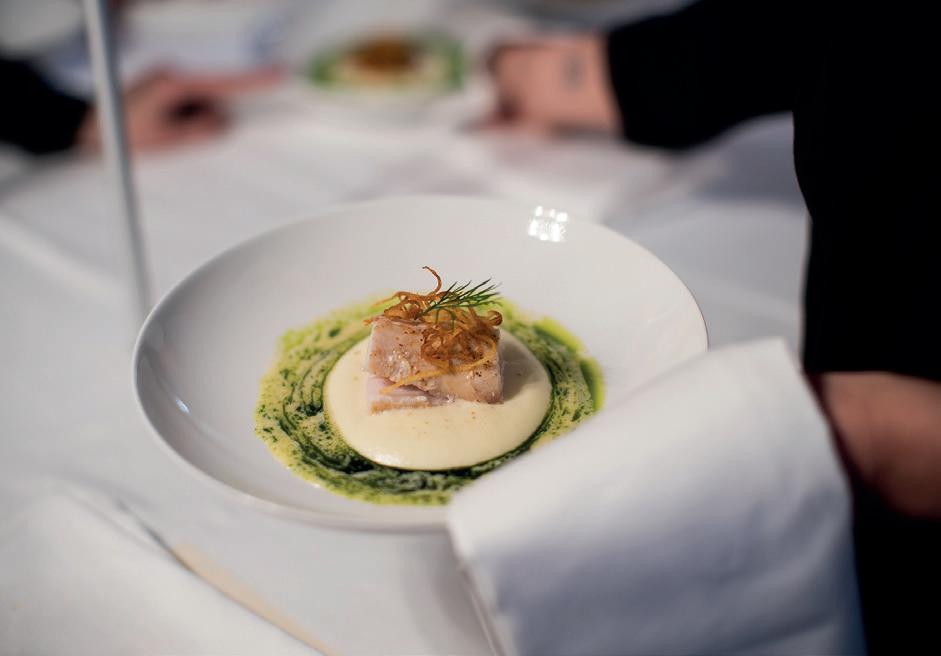
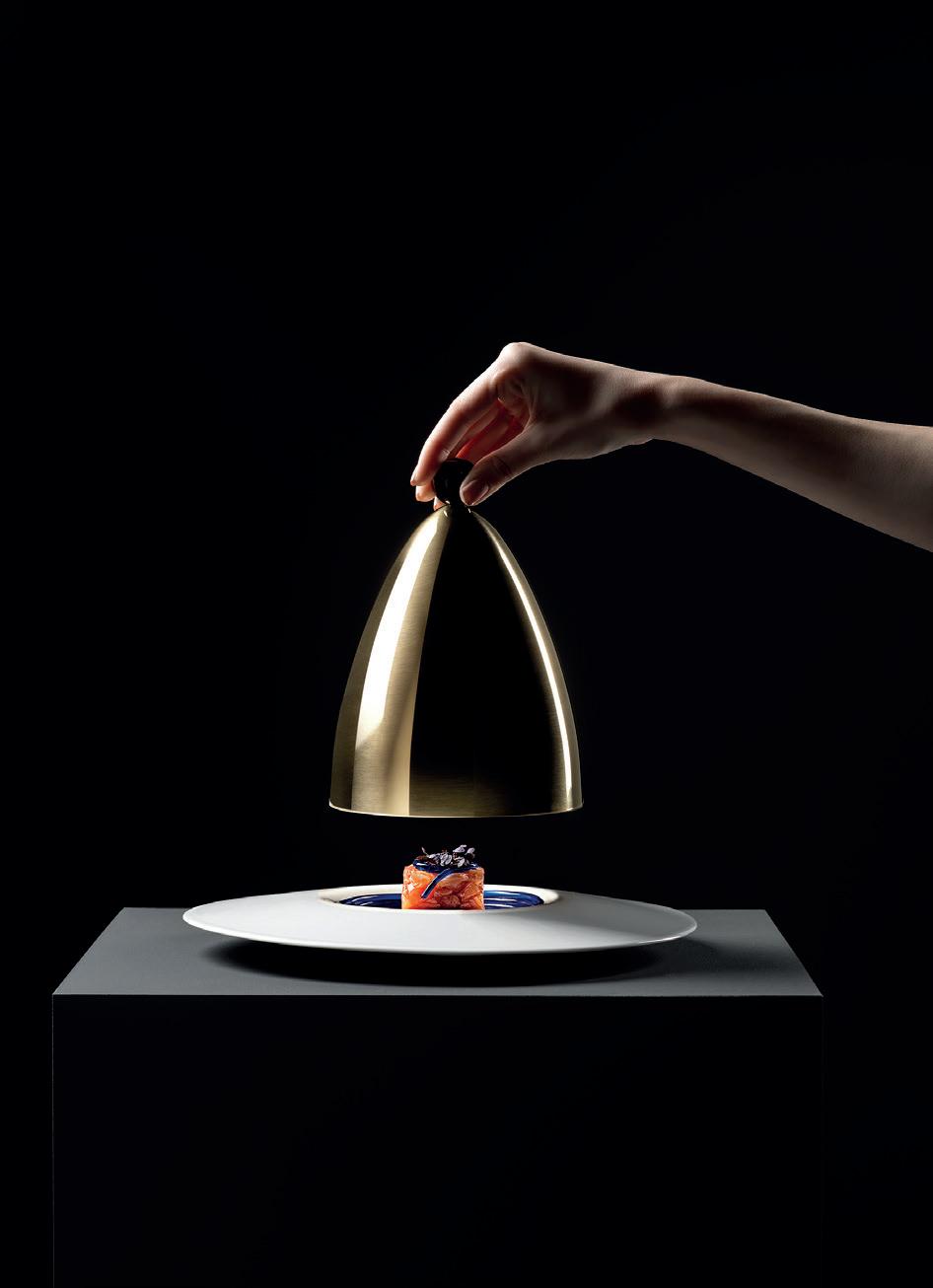
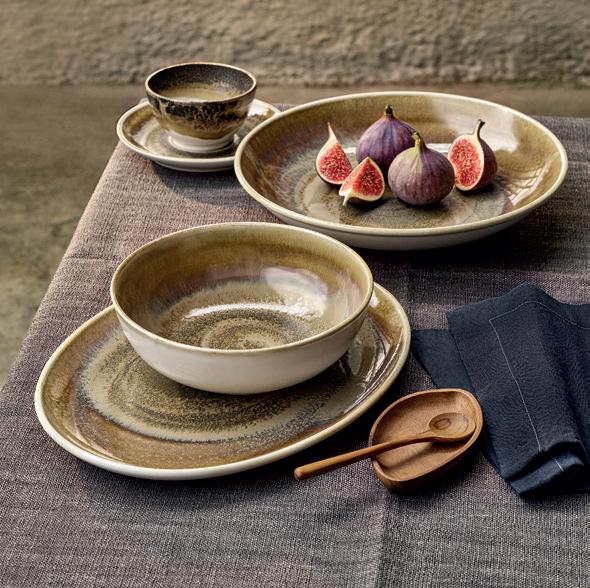
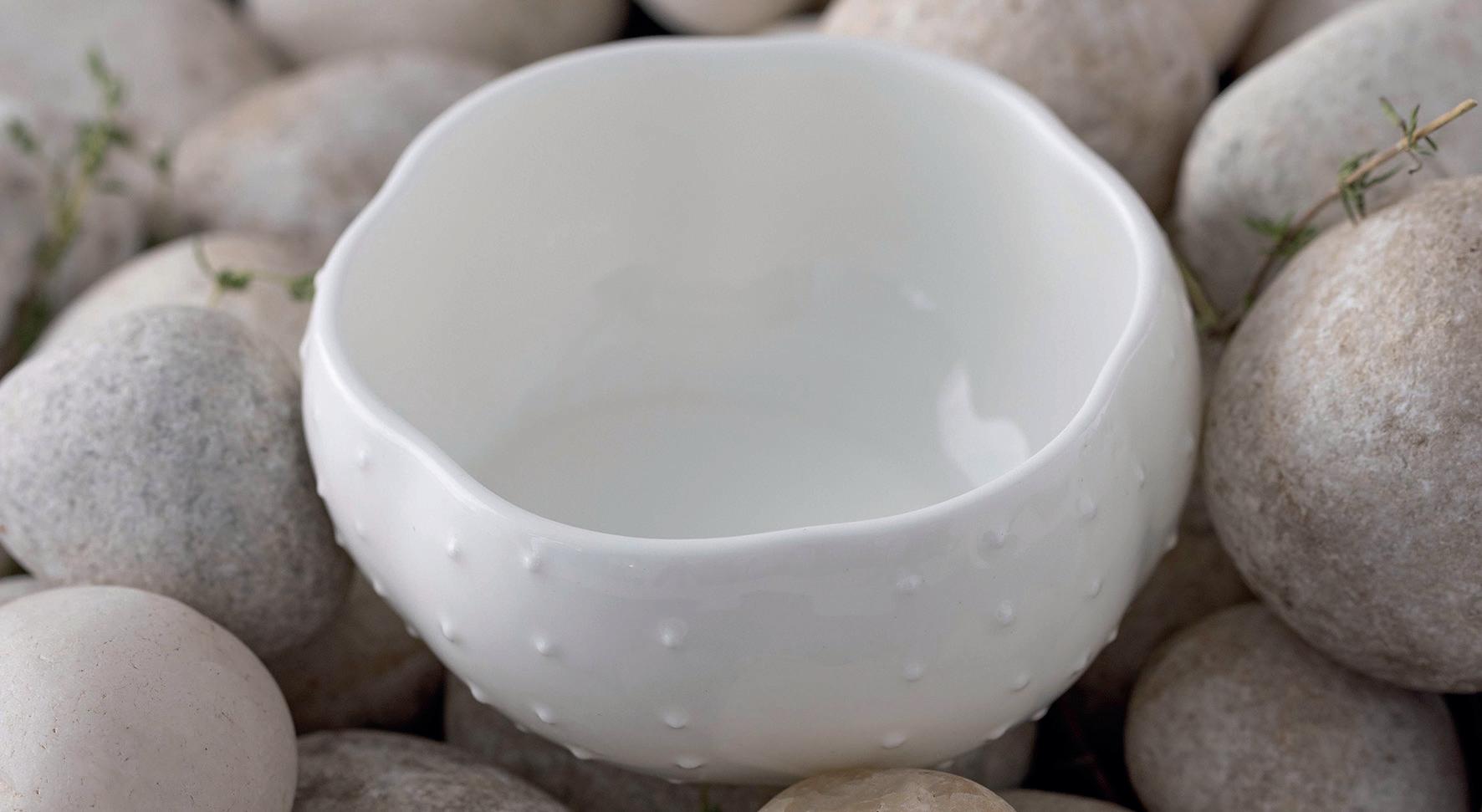
BHS Tabletop has launched Heart&Soul – a new casual dining brand. The gastro-porcelain brand consists of handmade pieces from vitrified china and its launch means BHS Tabletop is expanding both its brand and material portfolio. The unique porcelain items handmade for Heart&Soul are made of vitrified china – a material that offers colour effects as well as tactile decorations.
Riedel is developing a new glass, created specifically for English Sparkling Wines, following a series of tasting workshops with leading producers.
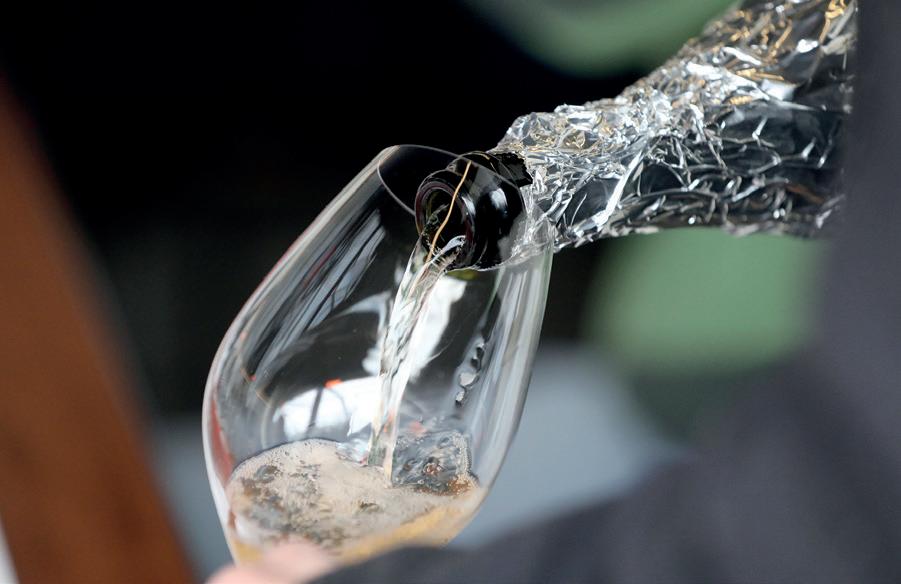
On a quest to discover the perfect Riedel glass that allows English Sparkling Wine to be best enjoyed, the brand’s 11th generation CEO, Maximilian Riedel and the Riedel UK team visited wineries in January to conduct wine glass development workshops.
The Riesling shape in the recently launched Riedel Veloce range was selected as the most suited at each session. This glass will now see some adaptations to create the Riedel English Sparking Wine glass, including a nucleation point that will be added to the glass to improve the way in which the glass manages the mousse, and the text ‘English Sparkling Wine’, that will be added to the base before the glass is launched to the market in just a few months time.
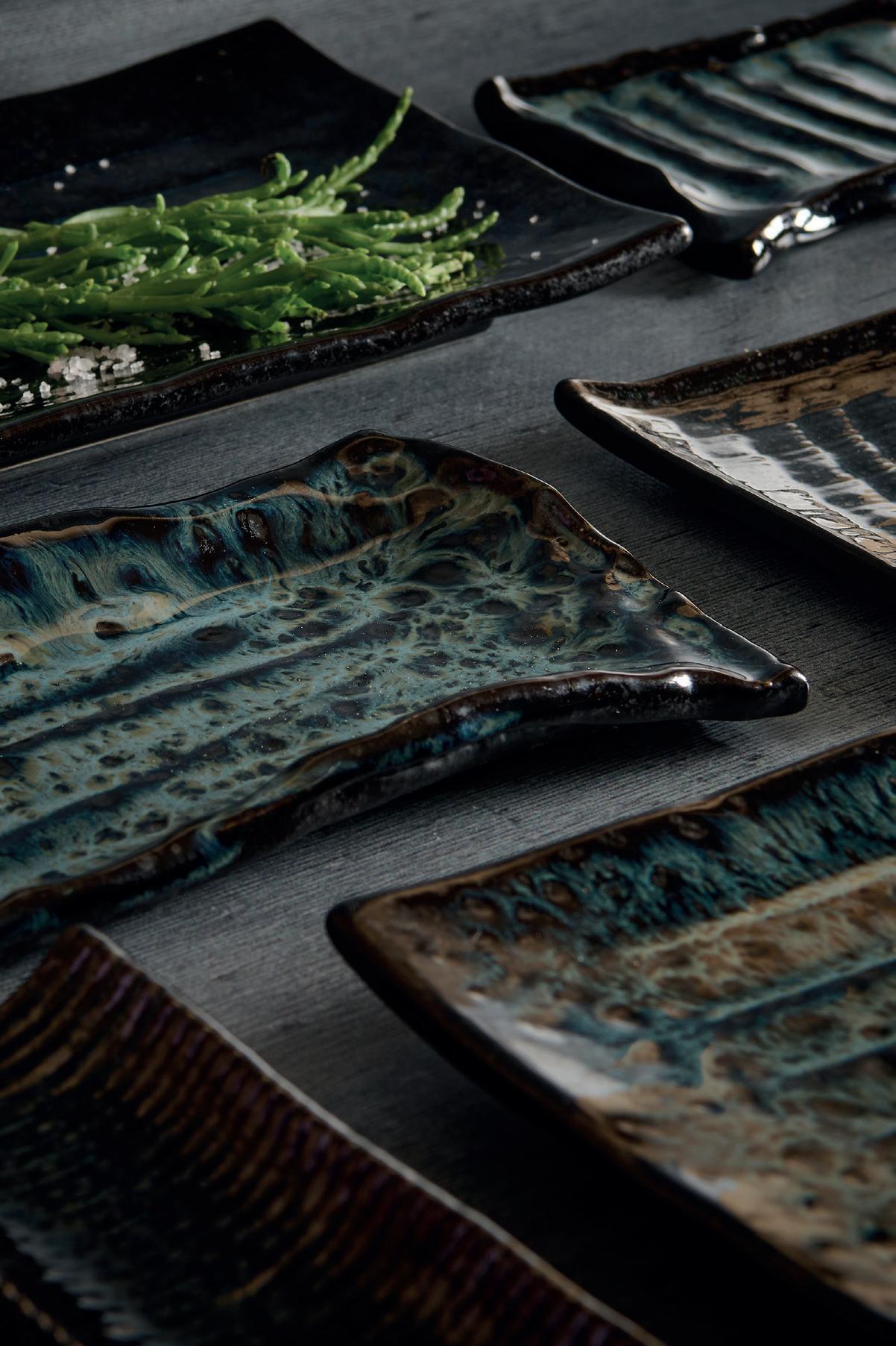
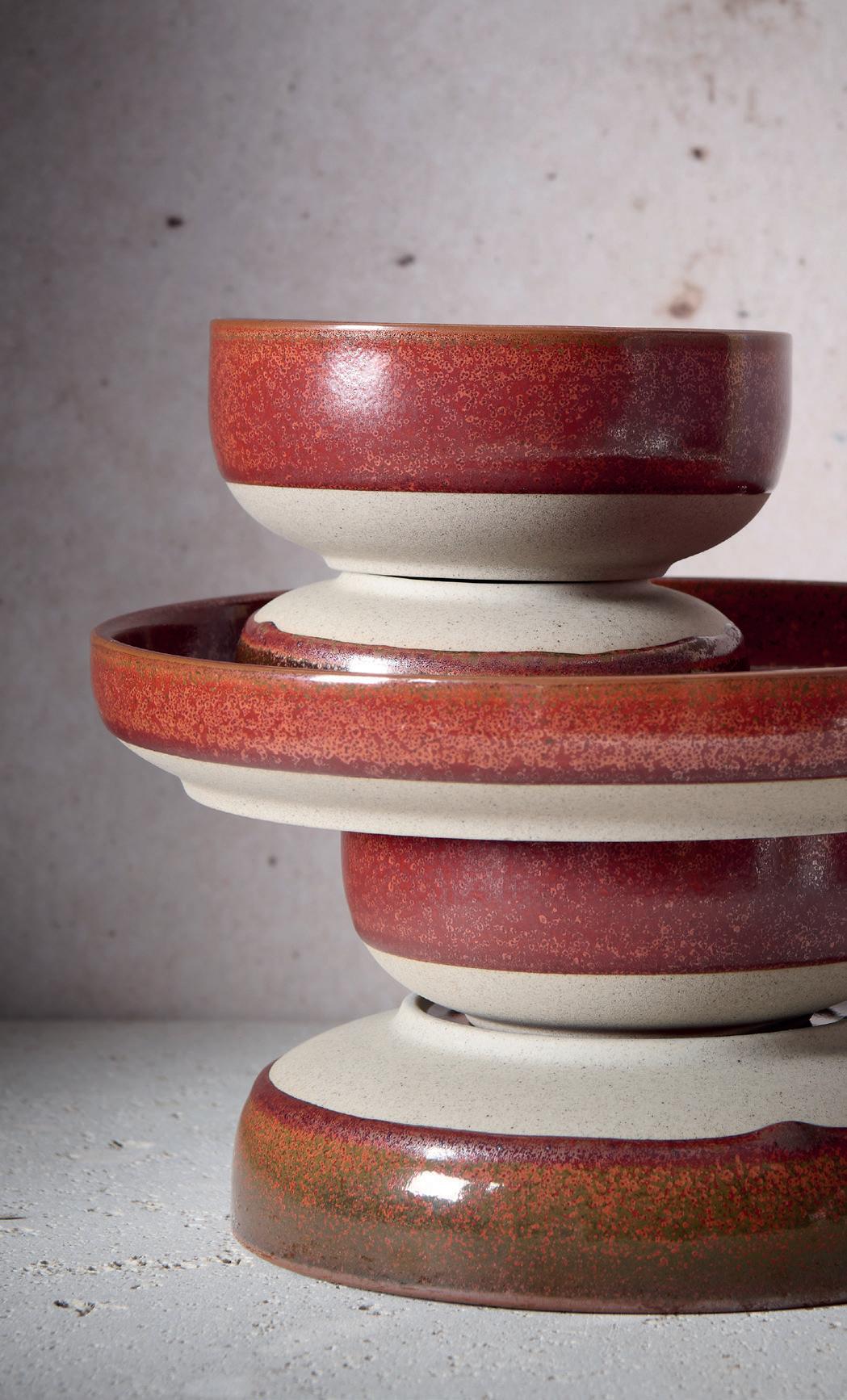
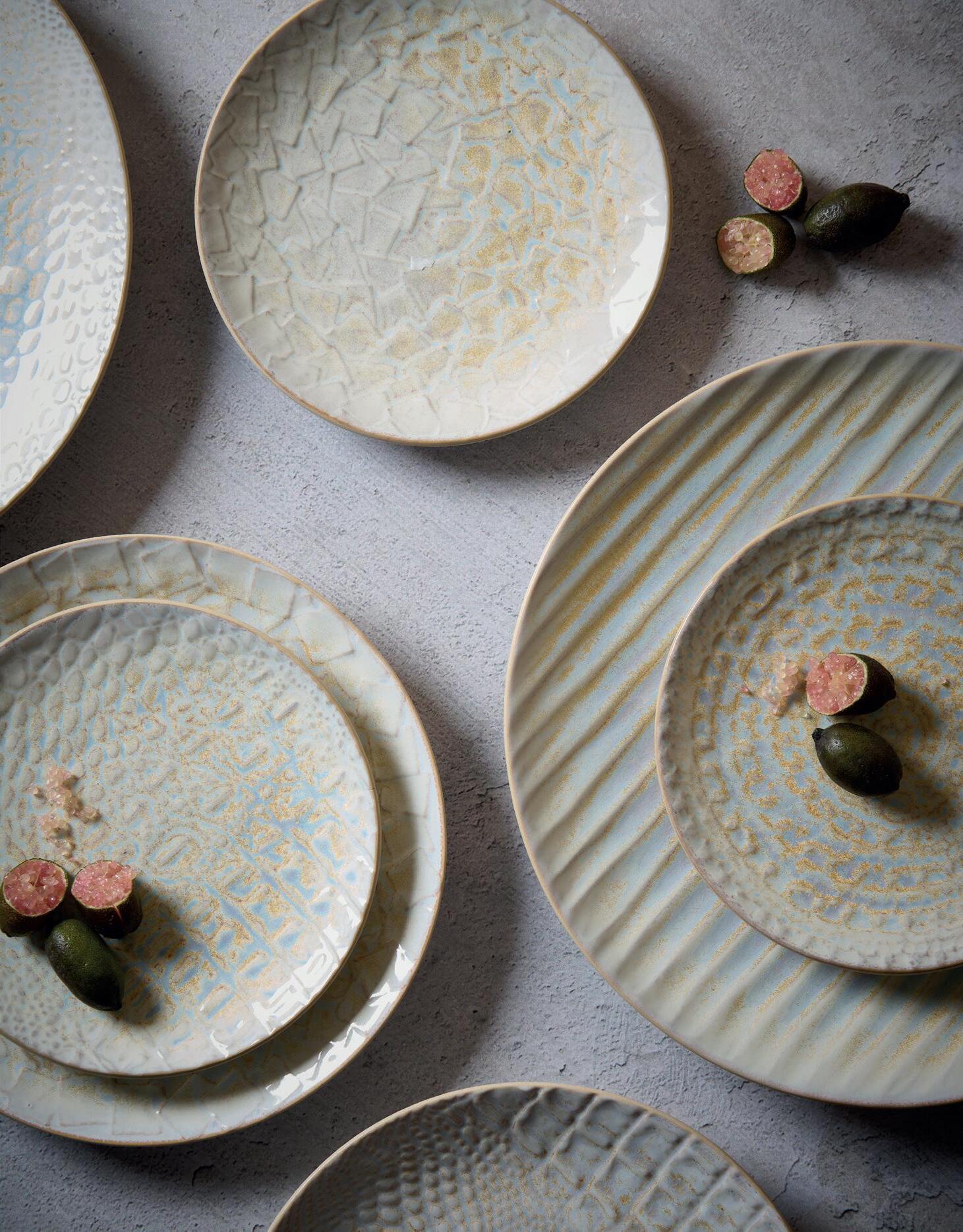
RAK Porcelain’s newest collection – RAK Earth – takes you on a culinary voyage through time to discover the origins of pottery and the influences of the seven seas. Using an exclusive, patented, matte glazing process developed by the RAK Porcelain Research and Development department in Ras-Al-Khaimah (UAE), the collection gives off the appearance of authentic terracotta and clay while keeping the smooth non-porous surface and mechanical resistance of porcelain. The range consists of four series Tero, Argila, Baantna and Ghera which feature 94 different products with each one of them being available in a variety of hand-applied décors, thus offering a total of 612 different tableware options.
www.rakporcelain.com
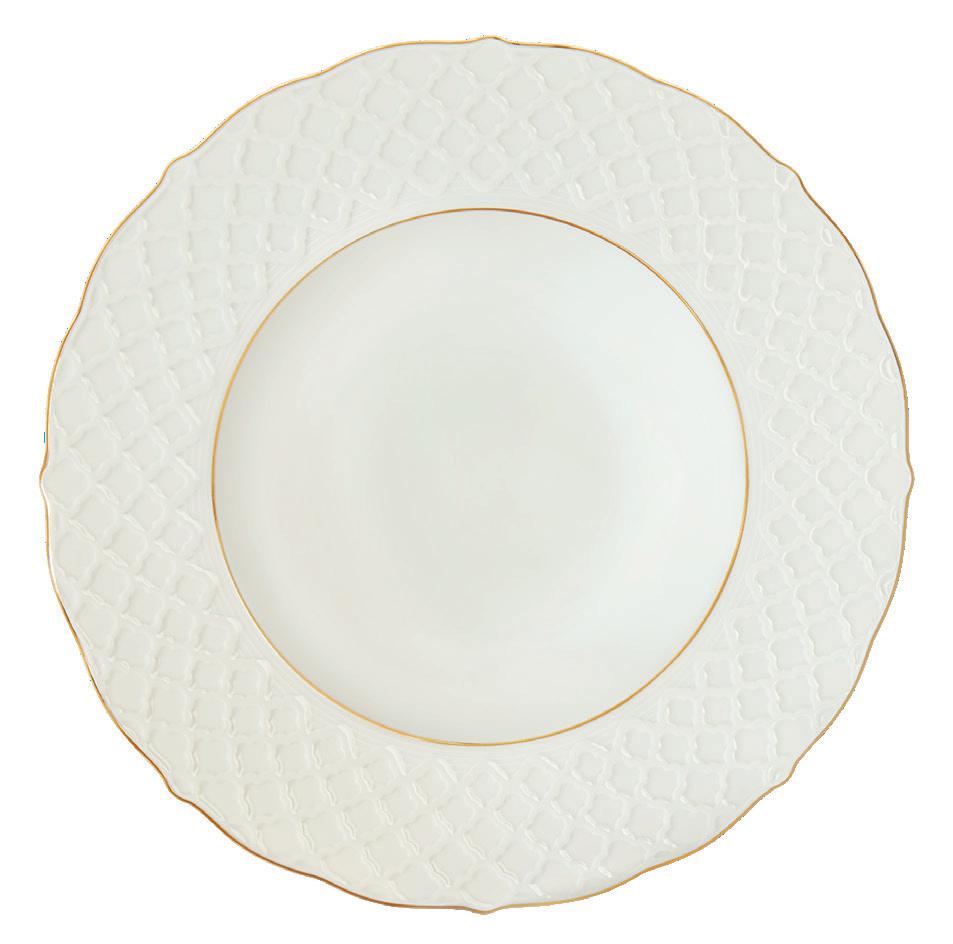
Porcel say their two newest releases – Empire Gold and Empire Silk – are an excellent choice for HoReCa. With a beautiful and elegant contour, both collections are mainly white. While Empire Gold features a fine golden line around the edge, Empire Silk adds a unique texture by the use of biscuit. These characteristics render them feasible to dishwasher use, as well as easier to combine with other Porcel collections or event room decorations.
www.porcel.com
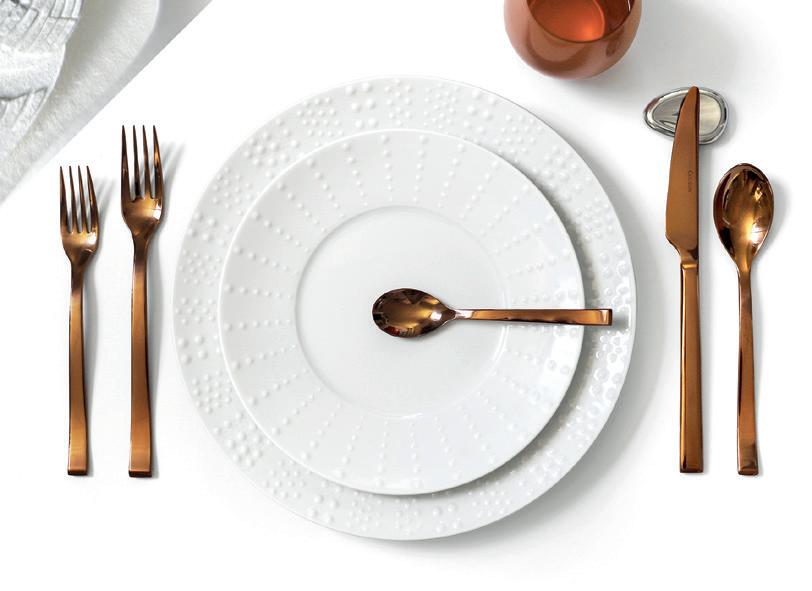
From the Couzon brand, new colourways are now available in the Side PVD flatware collection. Side’s carefully designed pieces are perfectly balanced for a unique and enjoyable culinary experience. The collection is now available in black, gold and copper PVD, which brings a new aesthetic to the collection.
www.amefa.com
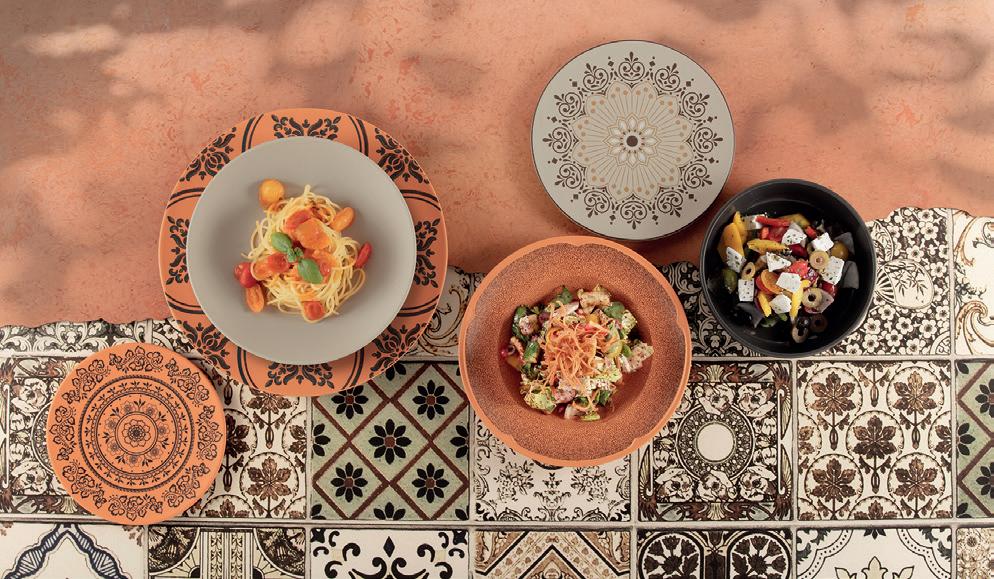
Brought to you by United Tables, the Nivo range from Fortessa positions itself as artisanal inspired dinnerware. With simplified shapes, Nivo provides a refined look through beautiful glazes in moon and metallic as well as through aesthetic material combinations of stoneware and glass.
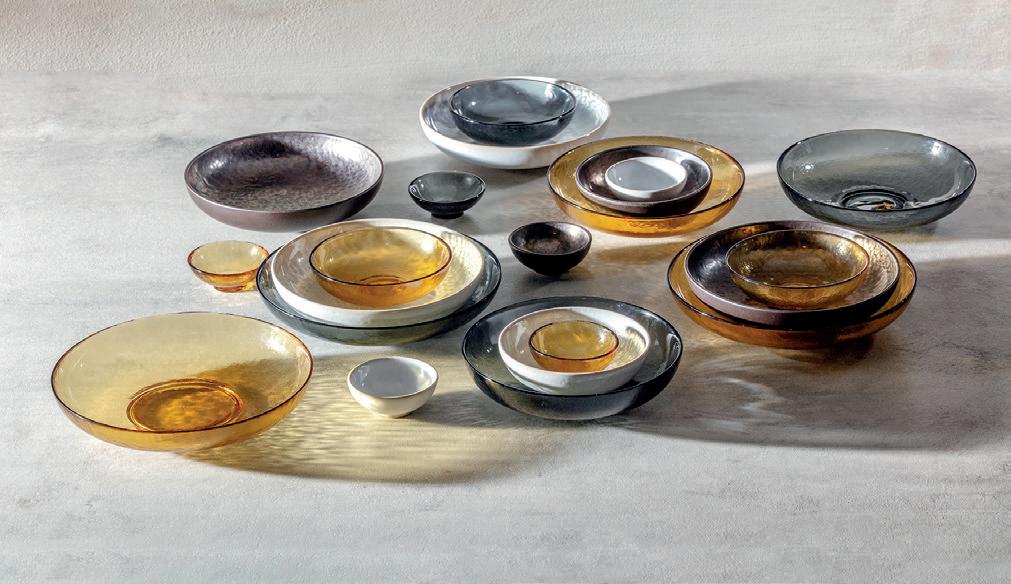
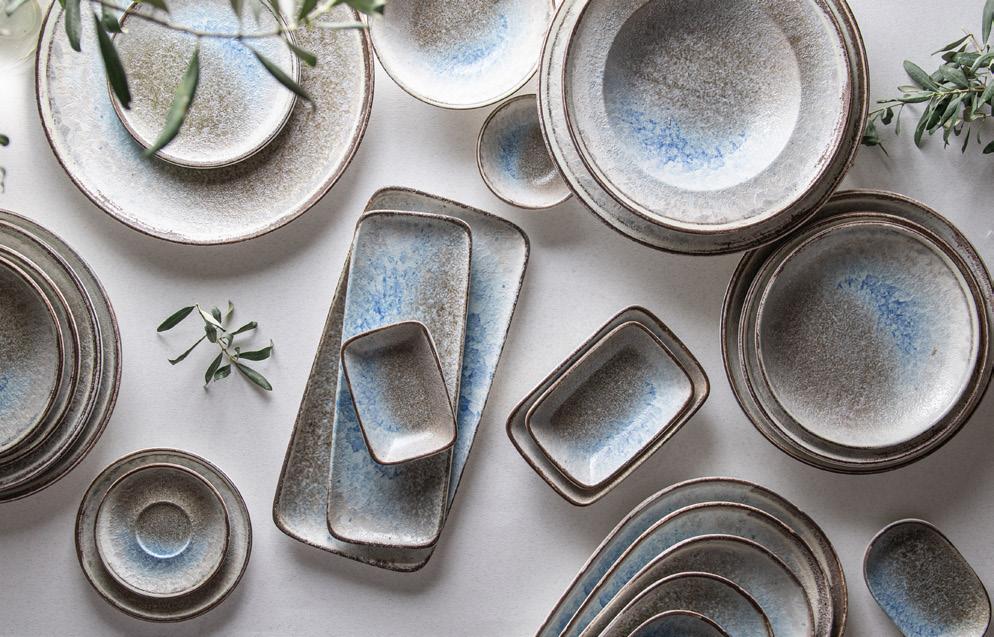
www.united-tables.de
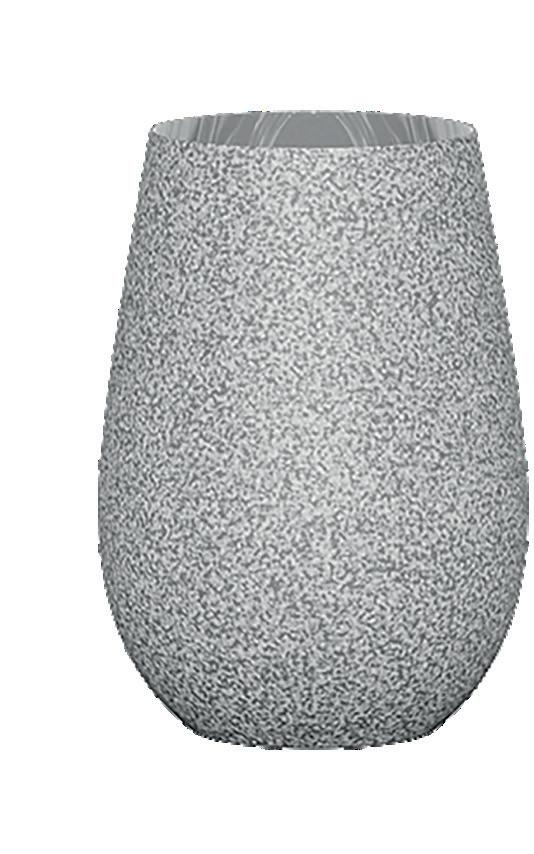
From Stölzle, the Stones series is notable for its realistic appearance and unique touch. No fingerprints are left on the glassware which provide easy handling, and look fantastic too – a musthave at home, as well as for the catering industry.
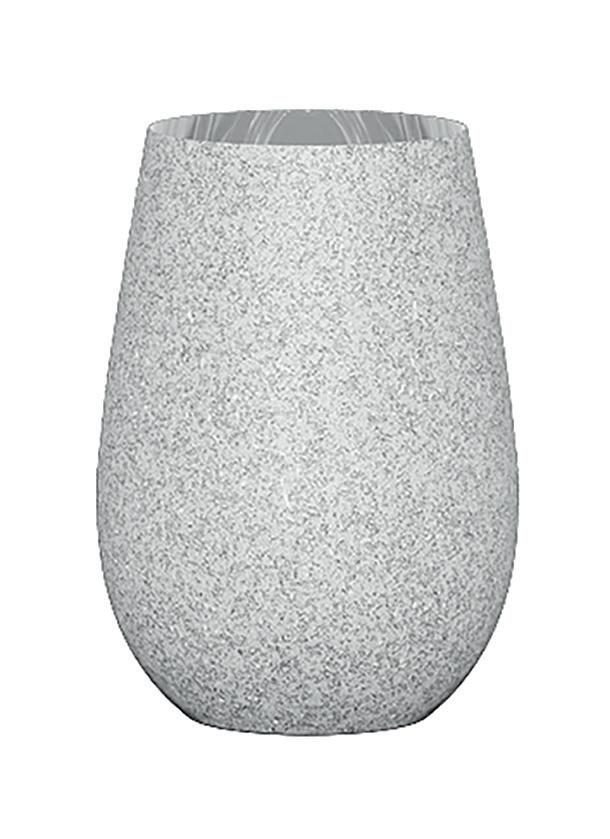
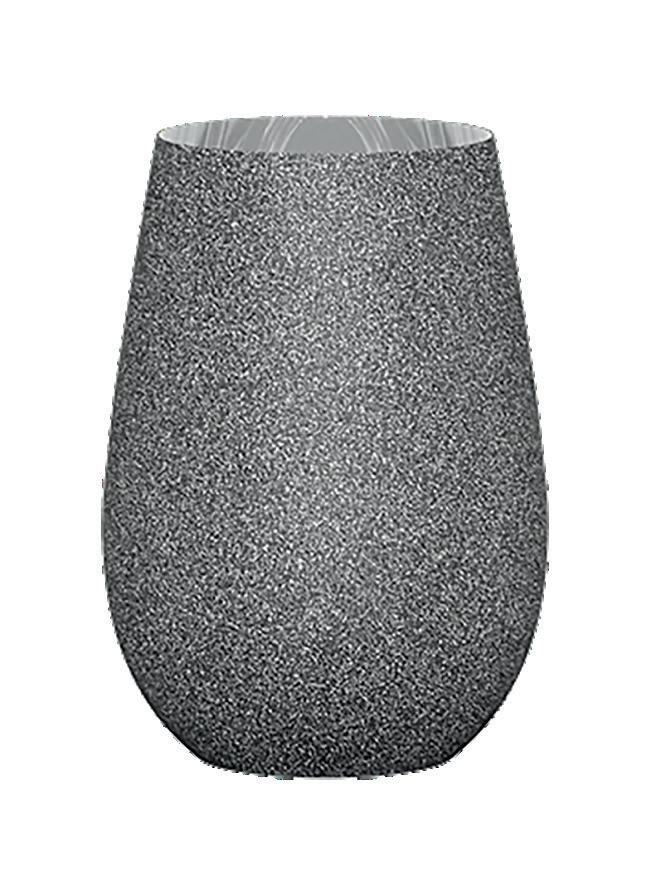
stoelzle-lausitz.com
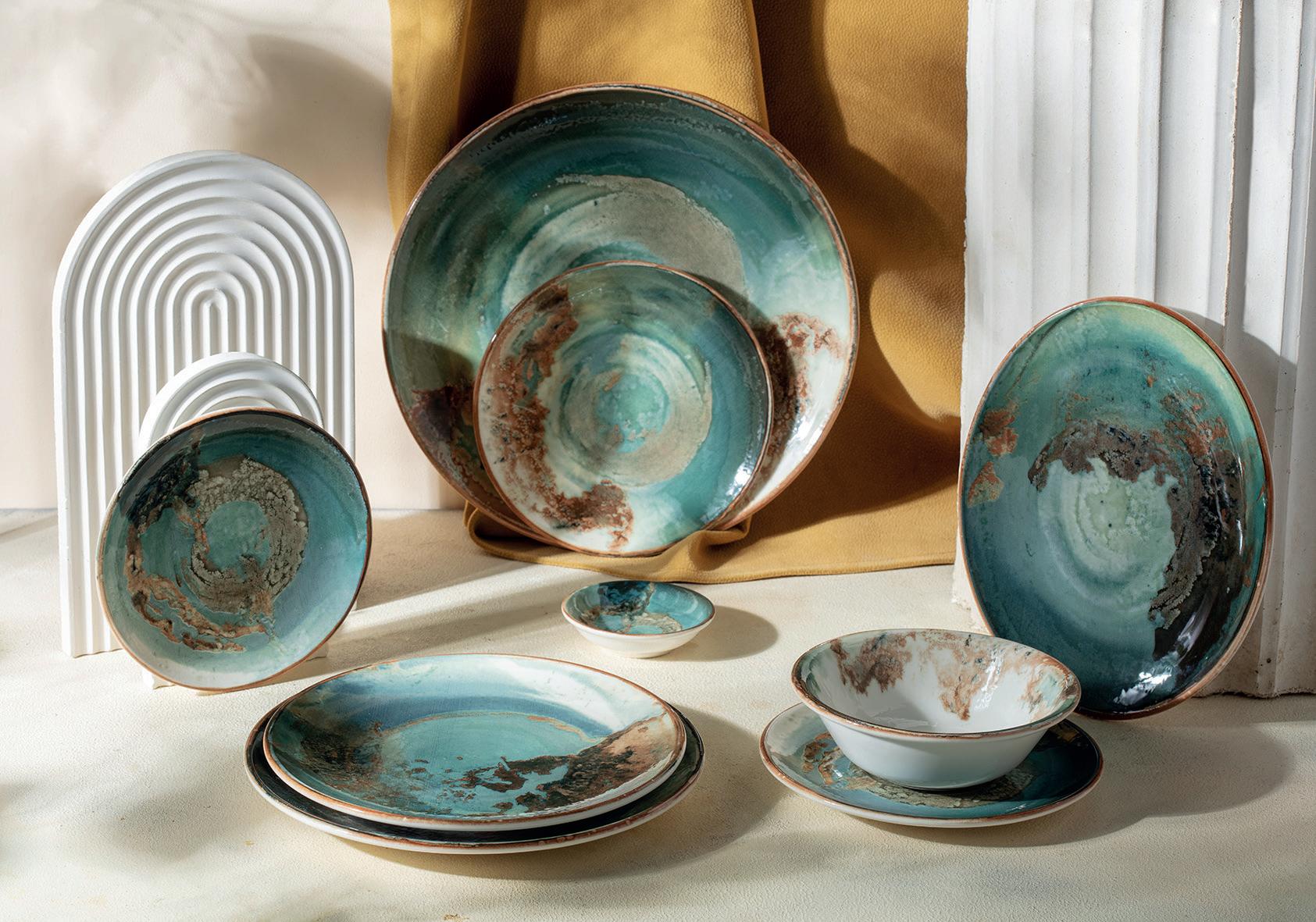
Delta, ID Fine’s new range of fine china tableware, takes its inspiration from the elemental forces of water and earth with a rich and vibrant colour palette of dark turquoise tones. Each piece features a reactive effect that creates a unique and eye-catching design, while its compatibility with Asian cuisine makes it the ideal choice for food lovers who want to explore new flavours and textures.
www.idfine.com.tr
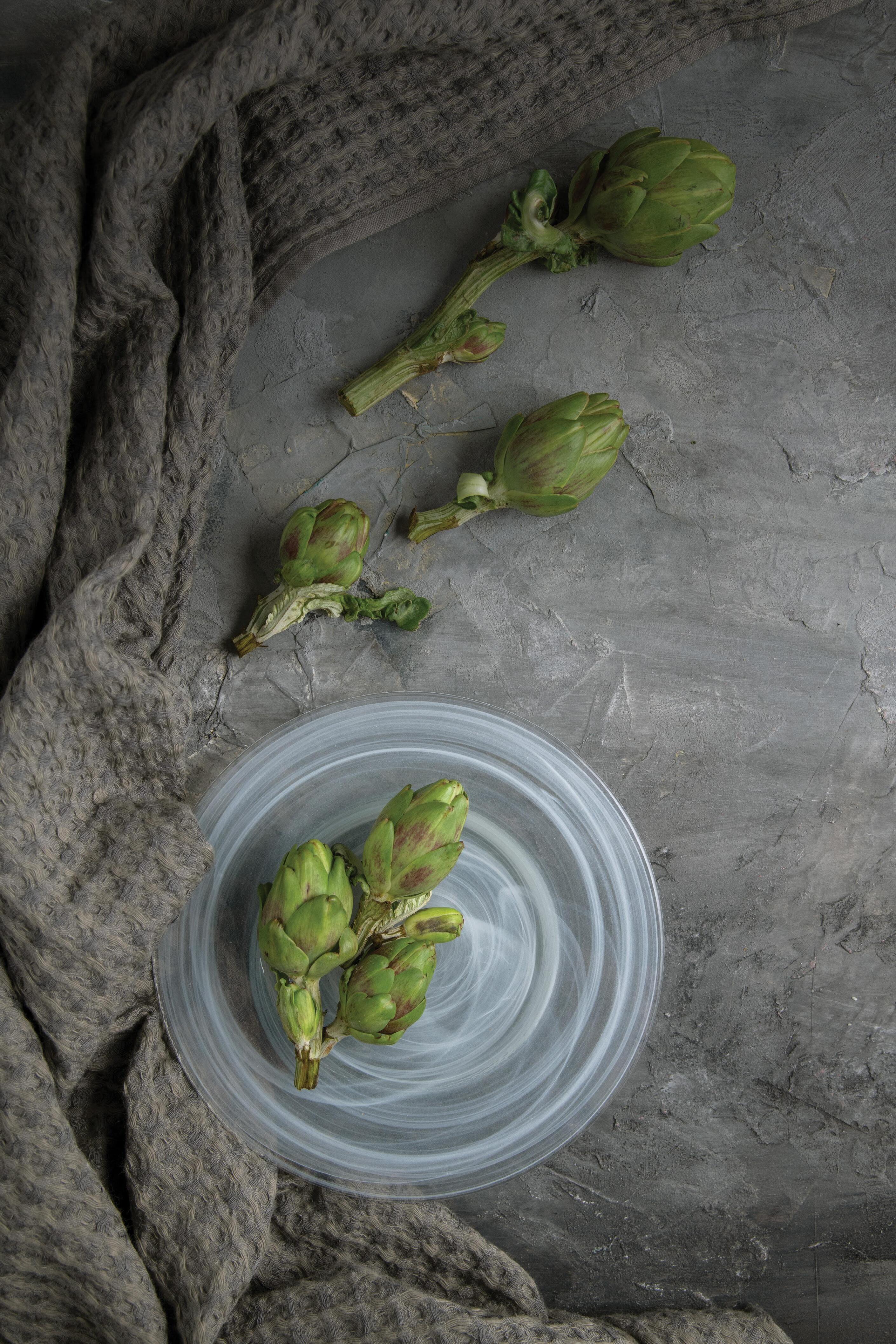

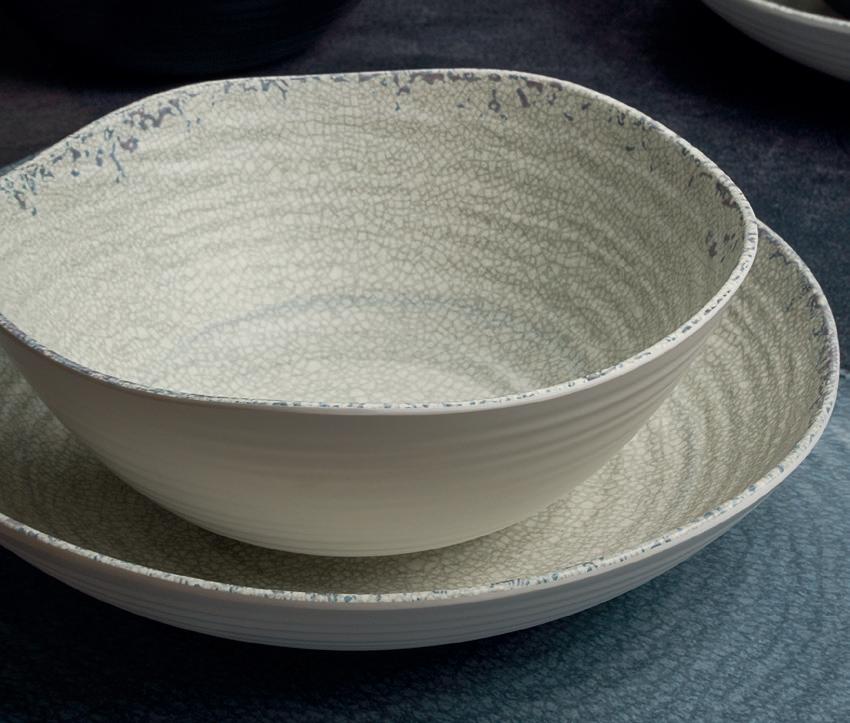
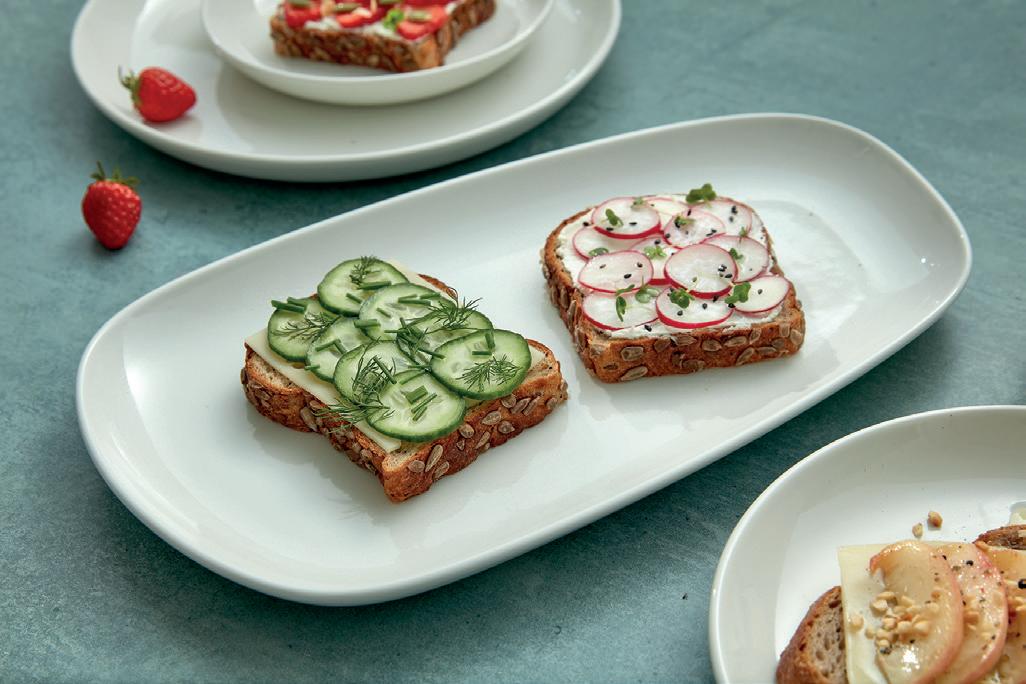
Steelite’s recent launches include Nordic from the Steelite Performance range and Pompeii Buffet by Steelite Creations. The Nordic region (above) has become synonymous with Chef’s skills in developing dishes utilising the very best local ingredients and presenting them in a sympathetic and contemporary manner. Meanwhile, Creations Pompeii Buffet (below) has been designed for both hot and cold, this melamine collection provides high-quality design with versatility among foodservice presentations. www.steelite.com.
Arthur Krupp has increased its catalogue by adding eight additional porcelain and stoneware collections to its assortment.
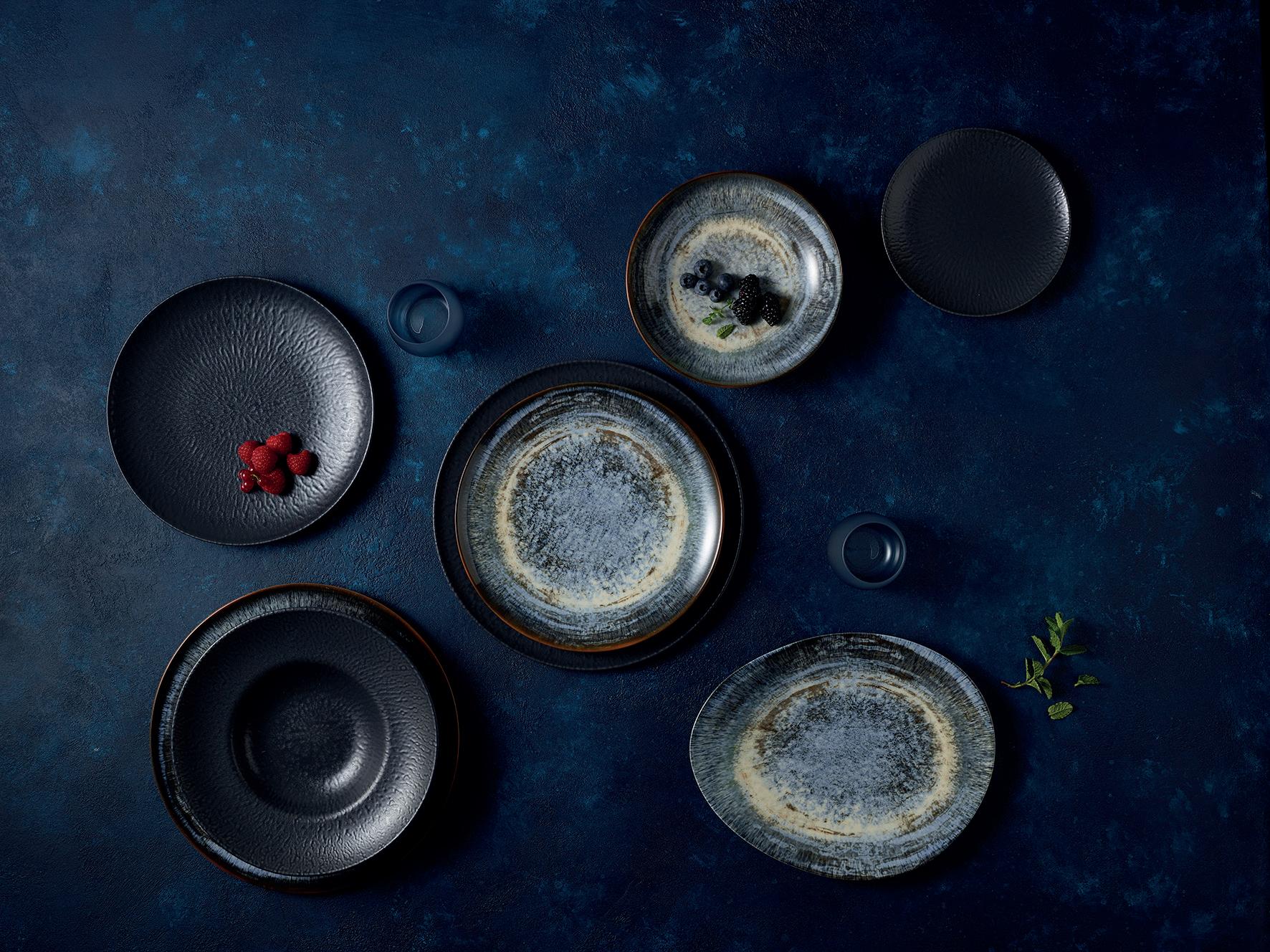
Along with stainless steel and PVD cutlery, the brand – part of the Arcturus Group – offers the HoReCa sector a great choice of high-quality porcelain, stoneware and melamine accessories.
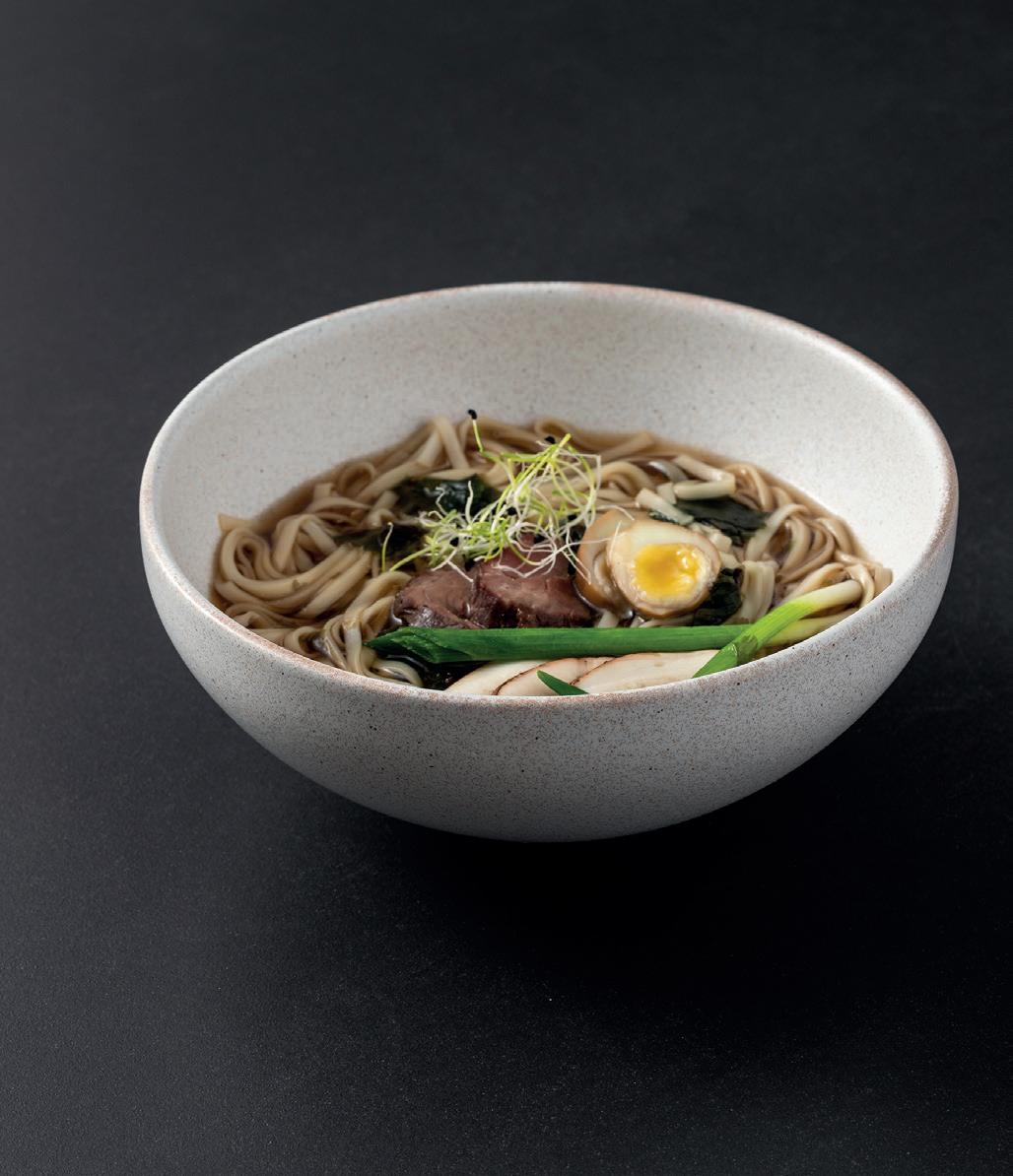
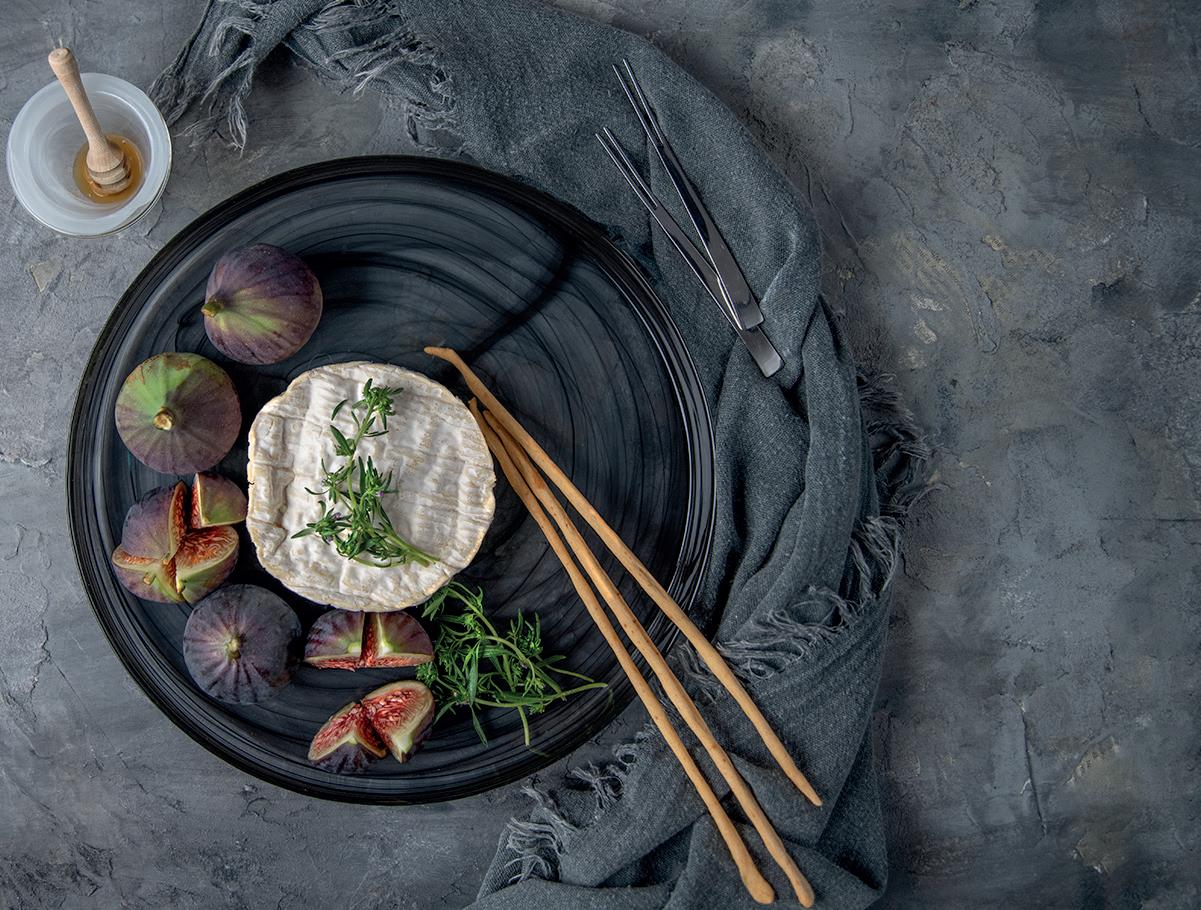
www.arthurkrupp.com
The Playground brand’s Nara collection now boasts new glazes with an on-trend powdery rosé and white. The brand says these softer colourways allows for a more feminine table setting against the collection’s masculine design.
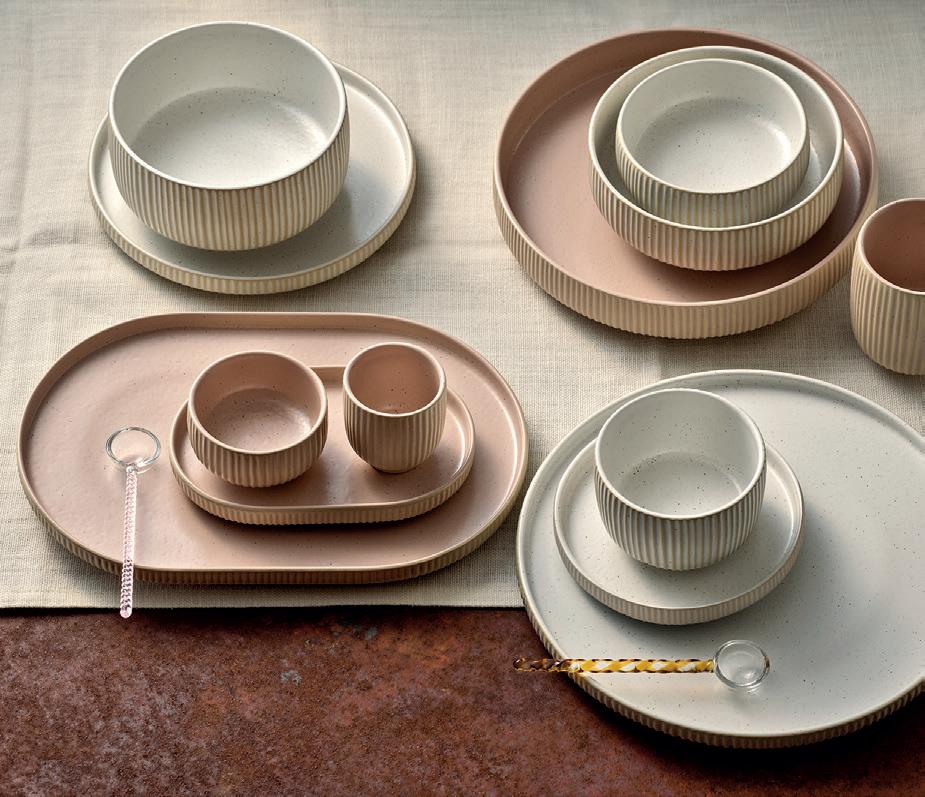
www.bhs-tabletop.com
ArdaCam says its glassware collections aimed at the HoReCa sector are “completely innovative and completely new”.
“We bring glass products to the table, breaking the ‘only porcelain on the table rule with our HoReCa collections,” says CEO Damla Önen. www.ardacam.com
contemporary
www.costanova.pt

In the heart of Turin, the well-known Del Cambio – a restaurant since 1757 - has recently included a new line of Rosenthal porcelain in its tableware. The dinnerware has been tailor-made specifically for the Michelin-starred chef Matteo Baronetto to suit the service demands of this exclusive location. Maria Theresia, one of the iconic shapes in the history of the German brand, has been customised with a double rim - gold and Piedmont blue - for an unique, elegant and distinctive charm.
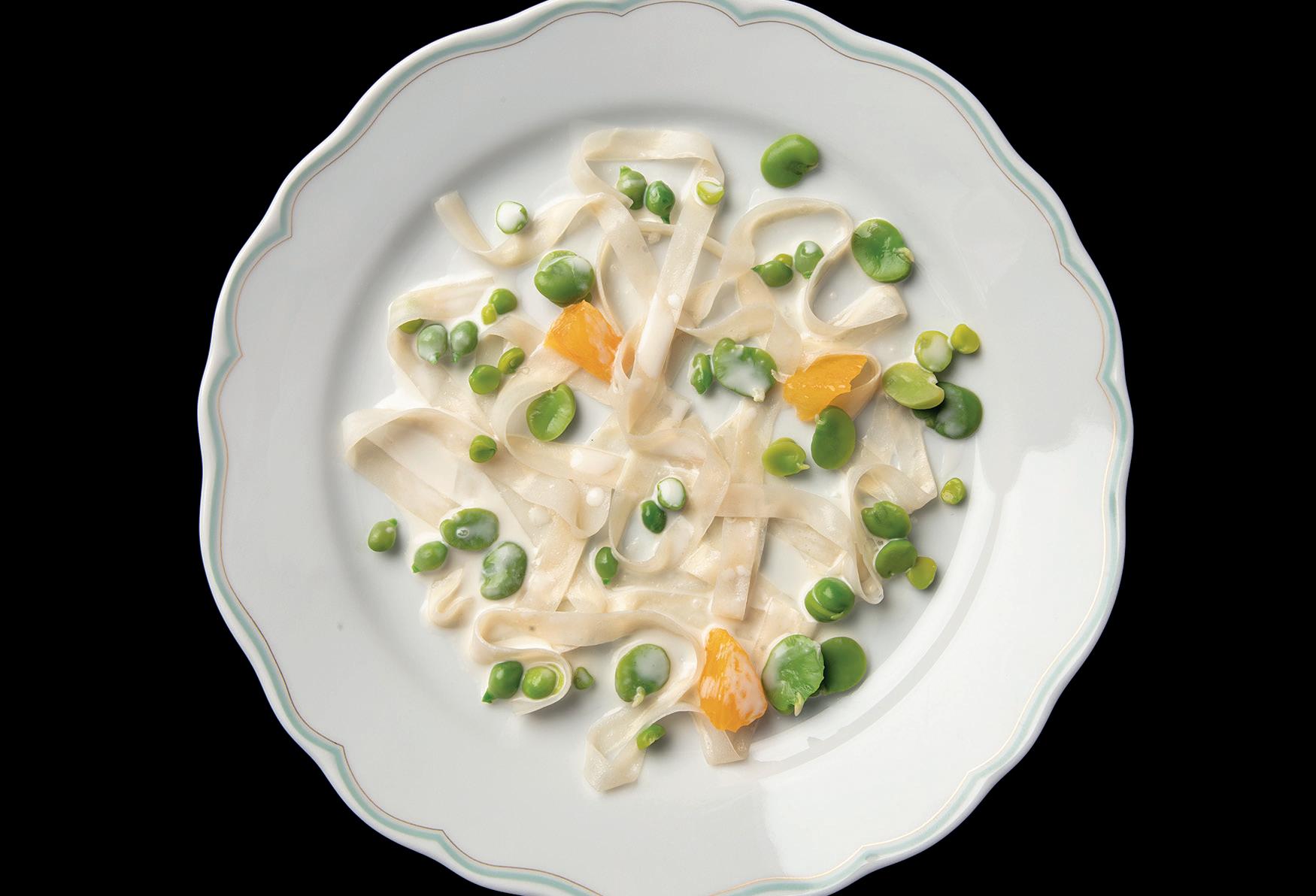
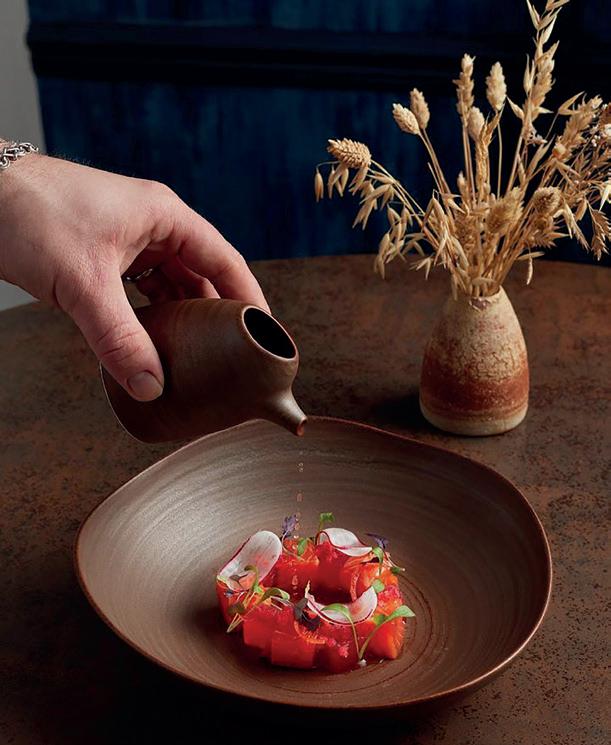
We highlight top-tier products on tables, in excellent venues, across the globe...
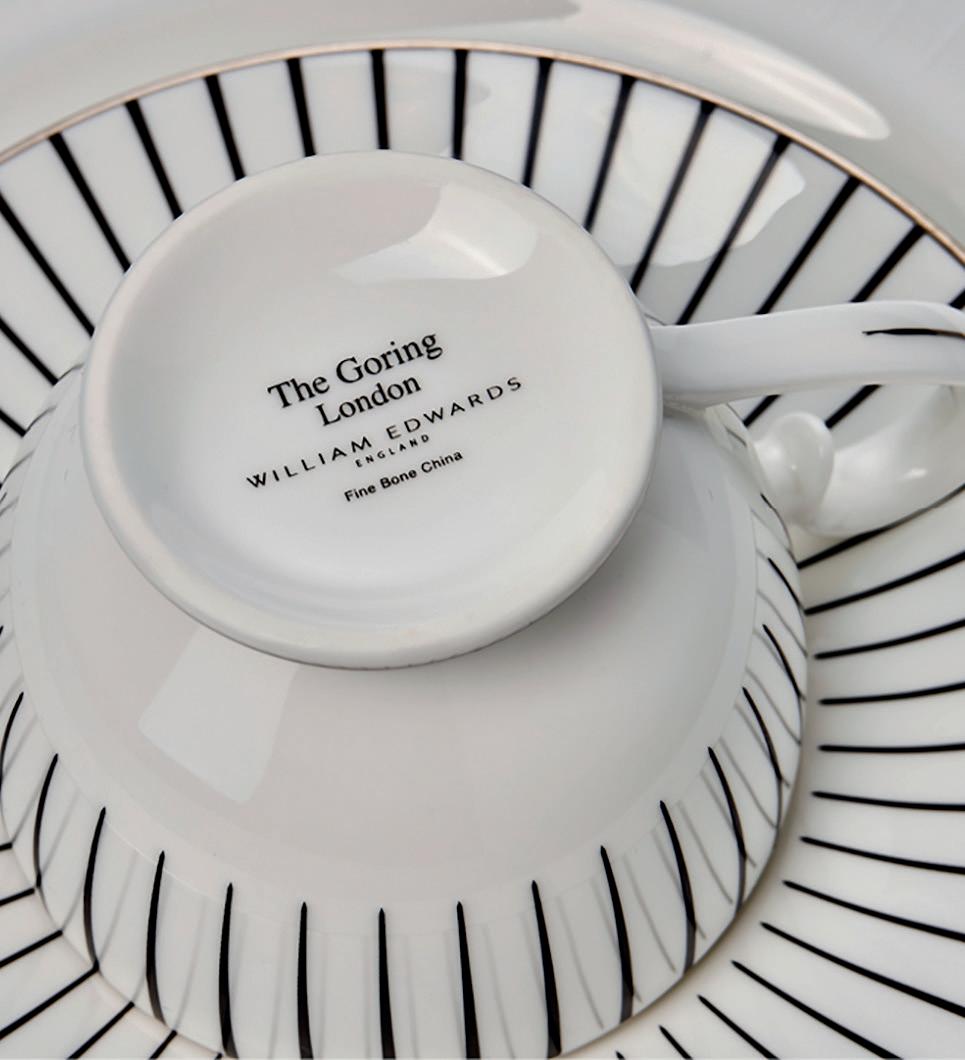
A favourite of lords, ladies and the royal family, The Goring –the only hotel in London with a royal warrant – has another string to its bow; it uses bespoke William Edwards. Since being awarded a Michelin Star, the hotel’s dining room hosts a space of impeccable service with a touch of British wit, enhanced by William Edwards bespoke.

If you’re a fan of Portuguese cusine, you’re likely a fan of chef João d´Éça Lima. And chef João d´Éça Lima just so happens to be a fan of Mesa Ceramics. Known as the guardian of regional Portuguese recipes which he researches, studies and, most importantly, then cooks, the chef enhances his meals by plating them on some of Mesa Ceramic more playful collections.
This Marche plate from Jacques Pergay –pictured here with food by Adam Smith, from his restaurant Woven by Adam Smith at Cowarth Park Hotel (Ascot) – is a favourite with chefs. “This plate really sums up the Michelin touch,” says Valda Goodfellow of G&G Goodfellows who distribute the brand. “A plate of such delicacy of design and application, it looks almost too fragile to us.”
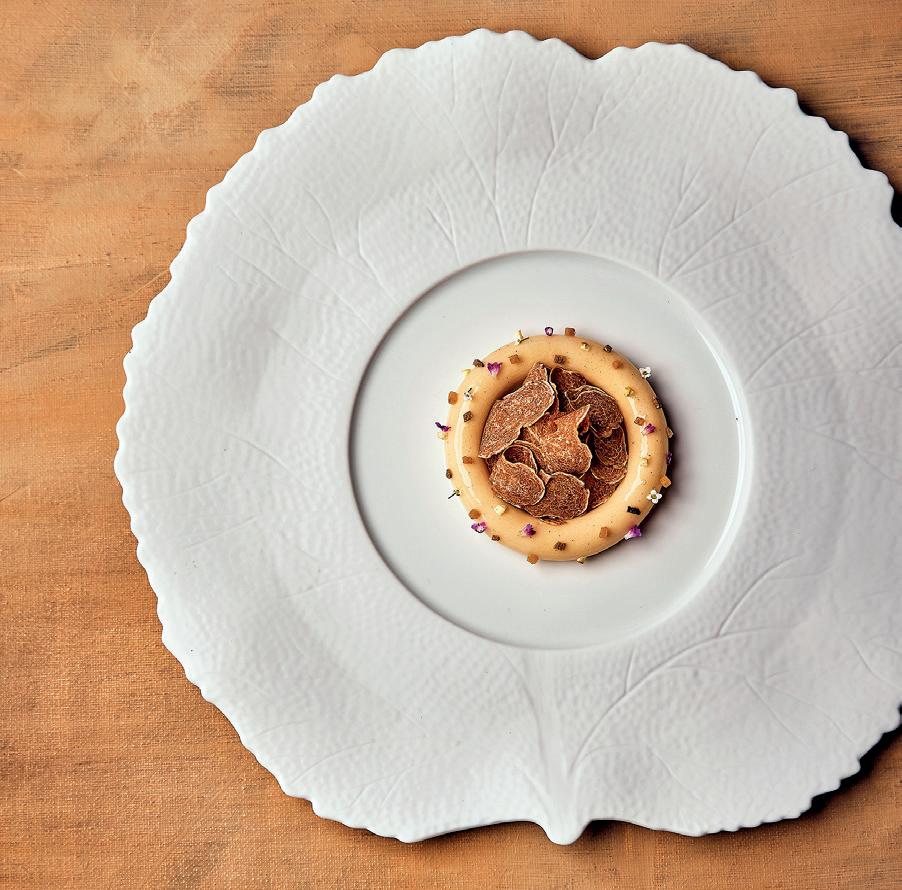
“I’ve been working with Steelite for 20 plus years and not once has Steelite sat still, every season a must-have range has been designed that sits perfectly with my restaurant, my food and my customers.”
Simon Hulstone, head chef at The Elephant, Torquay on why he works with Steelite.

How much time do you spend collaborating with the hospitality sector when it comes to designing new collections/products?
proHeq: It is essential for us to work very closely with the professionals when developing new products. Our whole range is developed specifically for professionals and we make it a priority to collaborate with various user groups from the hospitality sector, be it during the creation of the design concept, when defining the portfolio or for product testing in real world conditions.
Zwiesel Glas: It usually takes two years from the idea to the launch. A new design goes through several optimisation sampling steps, from hand to machine samples. These samples are then used to carry out oenological tests and surveys to find the optimal design.
ArdaCam: The hospitality industry has unique needs and requirements when it comes to design, the products must provide
both the aesthetic and functional aspects of a space. This path may involve conducting extensive research and analysis to gain a deep understanding of the industry, its trends, and the preferences of its target audience. Collaborating with the hospitality sector when designing new collections or products can be a challenging, yet rewarding, experience. We spend as much time as we can completing all of these processes to create perfect products.
Fine Dining & Living: We sell directly to owners, chefs and waiters. We get feedback from them in our showroom or at the customer’s premises. We also get huge amounts of feedback from the dealer channel. We use this information to work on offering our customers the best and most complete range possible.
Arcturus Group: When designing new collections, the company – and therefore each brand belonging to our group – must consider the distribution channel of the project, as we operate
in both horeca and retail sectors. Some product ranges are crosscutting, for example cutlery and dinnerware, while others must be developed according to certain key drivers that are specific to the target channel. Specifically for hotel and restaurant, our staff of in-house design centre, manufactur ing engineers and sales team, work together and talk constantly with several experts operating in this sector, to develop ad hoc projects that meet the real needs of this business. For example, we can exclusively anticipate that we have been working for months on a major project that we will
Steelite: I don’t tend to collaborate directly with agents in the hospitality industry in general as I prefer to do my own research into trends and forecasting. This allows me to develop ranges which have a mass appeal across many diverse markets, enabling a global reach and away from any potential adverse agendas or bias. It also allows me to develop ranges which, whilst pushing boundaries, are also factory-friendly and therefore profitable to manufacture. I do this by talking to as many different types of operators as I can, often visiting them in their own markets and putting myself in the place
From whether there is too much of the same thing on the market to how much time they spend collaborating with the hospitality sector, we hear from key industry professionals on how they are approaching business...


of their customer. I look at the overall experience and what would delight the customer and what I could do to effect or enhance that experience through tabletop design. Decades of experience then come into play to create an end result that achieves that outcome whilst pushing the factory a little, but not so much as to introduce inefficiencies.
Utopia: We recognize the importance of collaborating with the hospitality sector when designing new collections and products. We engage with industry professionals to gain insights into the latest trends, customer preferences, and

market demands. For example, we conduct market research, attend industry trade shows, and seek input from chefs, restaurateurs, and other hospitality professionals. This helps us to create products that not only meet the functional needs of the industry but also reflect the latest design trends and customer preferences.
Collaborating with the hospitality sector is a critical component of our product development process. We aim to spend as much time as necessary to establish effective collaboration and develop designs that meet the evolving needs of the hospitality sector.
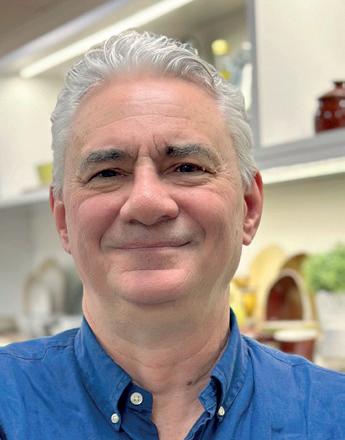
Zieher: We always try to listen to our customers and partners, not only regarding new products, so that we get their complete assessment of their respective market.

This helps us developing future solutions that match the demands of the market as well as the high standards we uphold regarding quality, exclusivity and design.
Most of the time we cannot go into too much detail with customers since we do not want to spoil the surprise of the new product. But there are sometimes cases where a customer has a specific demand then we cooperate very intensely to get them what they desire.
There are murmurings that there is ‘too much of the same thing’ available to the hospitality sector at the moment, would you agree with this? Is there enough new, original design out there?
proHeq: Absolutely! There is still a lot of innovation potential in the market, both in terms of design and functionality. Our new hot beverage glasses TRUE FLAVOUR are a testament to this, for example.
Steelite: The nature of the business means that the hospitality sector is always hungry for innovation regardless of how much new product is out there. That said, it is unfortunate that many manufacturers seem comfortable with copying successful ideas, rather than pursuing their own design direction. This is

unfortunate as doing that usually means joining a race to the bottom through oversupply of essentially the same thing. In fact, it is doubly unfortunate as Ceramics is a uniquely versatile medium capable of executing a very diverse creative language and is a medium which therefore offers great opportunities to innovate.
Arcturus Group: This kind of flattering does indeed seem to happen, particularly in the entry-level segment. But this does not apply to premium brands like ours, because, quite simply standing out is exactly our duty! Rosenthal for example, has a strong identity that has featured the brand since 1879, thanks to its vocation for design and the collaboration with the Maison Versace as well, and also with its search for decorative materials and techniques and the setting of new stylistic trends. The same goes for Raynaud and its French manufacturing tradition, which pursues classic themes but places them in the most original and contemporary luxury. For Sambonet, “The Art of Table” that characterises the history of the brand is combined with technical and technological research for shapes, finishes and colours. All these elements have make us something unique compared to other players.
Zwiesel Glas: Our most successful goblet series have a lifespan of 20-30 years. Accordingly, the design language is both unique
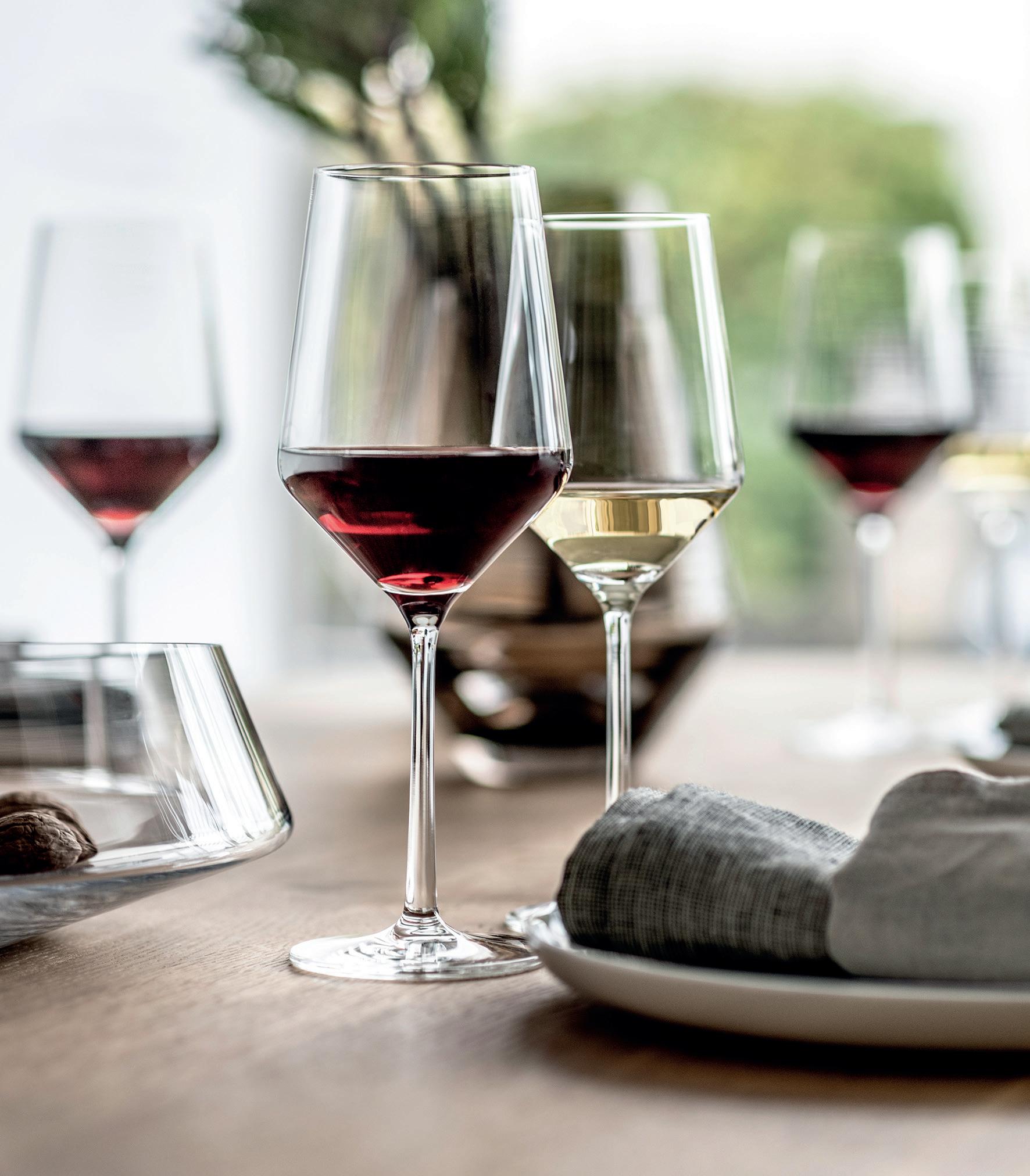
and not too loud. It is important not to miss out on developments and trends, while at the same time guaranteeing the usual quality standards (see above) of our customers. One is always on the lookout for new designs, whereby the right time of release is decisive for acceptance.
ArdaCam: In fact, we took an innovative step by thinking exactly like this and entering the sector with glass products. Our glass products will go well with classical porcelain products and
to stand out with unique designs that do not yet exist. Then again, for collections that are common on the market, we try to always be innovative through offering the best choice of materials. As we are always looking for new materials, we were the first that brought out durable porcelain and reactive glaze, copies quickly followed.
Utopia: The hospitality industry is always evolving, so there is a constant need for new and innovative products that meet its changing needs. While there may be some similarity in design across different product lines, we believe that there is always room for new,
sector. So we say a big hello to the whole sector and continue on our way without slowing down. With us, there will be enough original designs out there.
Bonna: There are certain trends in the industry. However, as Bonna, although we follow the trends closely, we are always looking for what we can do differently. For example, our artificial intelligence collection Futura has been a very original collection in this sense. It is also a first in the sector for our country. From this point of view, we can say that innovations continue as well as products designed in line with trends.
Fine Dining & Living: Many tableware products are often the same along the market. Yet we try
As a leading supplier to the hospitality sector, we invest heavily in research and development to ensure that our products are not only functional but also reflect the latest design trends. We work closely with industry professionals to gain insights into emerging trends and customer preferences, and we use this information to inform our product development strategy.
The HoReCa sector is diverse and dynamic, and different customers have unique needs and preferences. Our product portfolio includes a wide range of products that cater to different segments of the hospitality industry, from fine dining to casual eateries. We offer a broad range of materials, finishes, and designs, ensuring that our customers have access to a variety of options to suit their individual requirements. We are committed to innovation and constantly strive to create products that meet the evolving needs of our customers.
Zieher: It is a dynamic process that starts with design companies like ours, who create and manu-


facture exclusive products, that enter the market as worldwide novelties. But once the products are released, the successful series especially are copied faster and faster, which leads to the impression that there might be too much of a kind. But sometimes if you take a closer look, you might spot the quality difference between the original and the copy.
That aside, of course, no idea or design stays new forever, which is why we try to present novelties twice a year. So, I would say if there is enough of a design out there, it is no longer new or original.
Which of your collections is currently most in-demand in the professional sector?
proHeq: With both our brands we offer a wide range of collections across various product groups, so it is hard to name just one collection. For WMF I would highlight the STYLE LIGHTS range, which captures the modern lifestyle and trends very well, with a variety of materials and products. In terms of cutlery we currently see a lot
of interest in WMF JUWEL which boasts a unique diamond-like design of the handle. For HEPP at the moment our classic collection BAGUETTE seems to be quite sought after.
Zieher: Glow, our first buffet system with integrated lighting introduced last year made an impact and is on the rise. However, it will have to do so for quite a while to reach the heights of our evergreen Skyline.
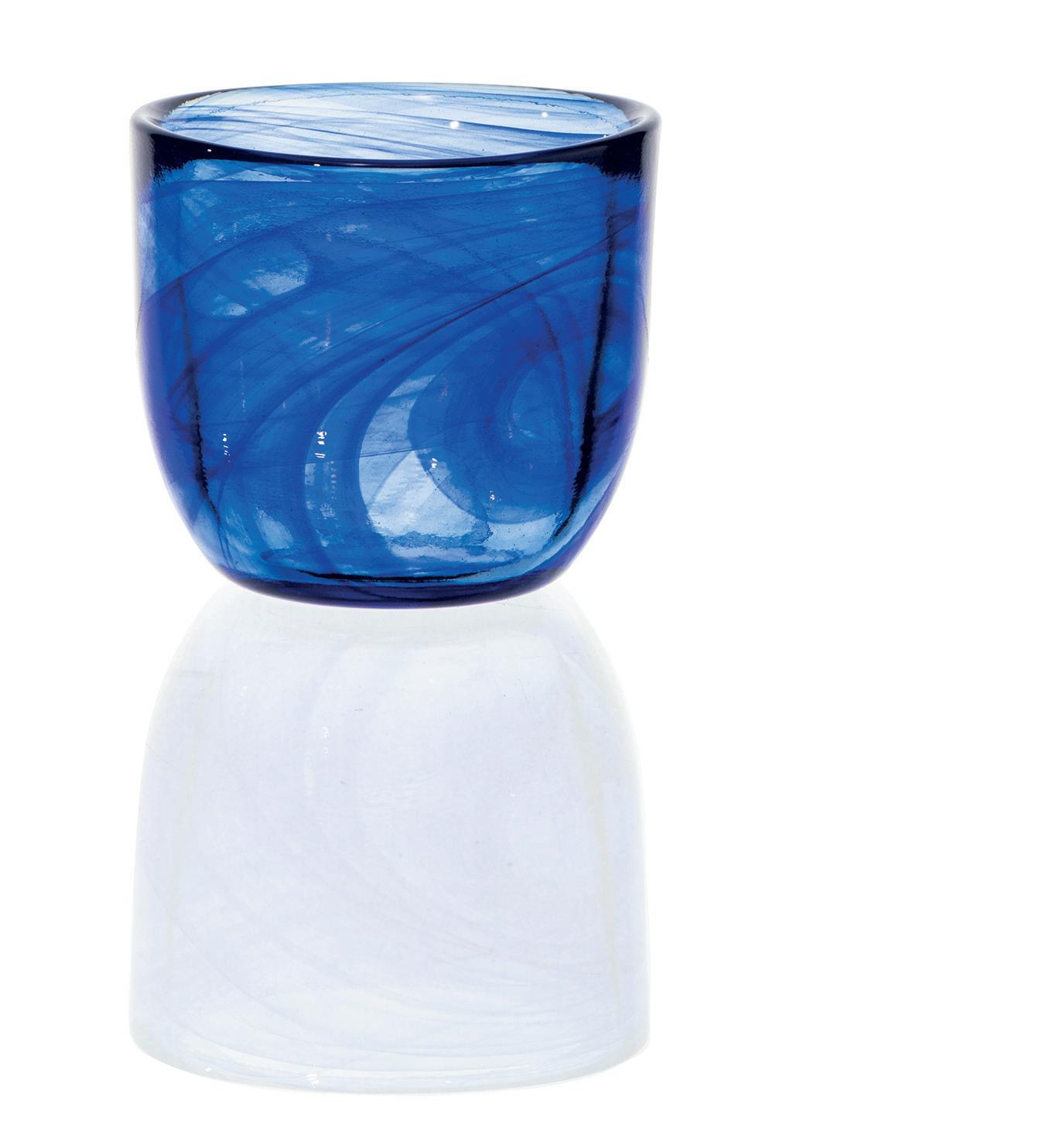
Zwiesel Glas: Belfesta is one of our most popular series. For almost 20 years, the glasses have stood out on very many laid tables and captivate with their striking design. There are stemware for many different types of wine and various tumblers from cognac to long drinks, as well as carafes and decanters.
Utopia: It has to be our new flagship collection, Murra, which is incredibly versatile with five colourways across 25 shapes, giving operators great opportunity to mix and match to create really striking table presentations. On top of that it’s a very hard-wearing collection, making it ideal for the job at hand in hospitality. Our latest Murra oven-totableware pieces have really taken off. At the same time, peripheral pieces such as dip pots, ramekins and sauce boats are all in high demand as chefs and restaurateurs look to mix and match these key pieces as part of the service.
ArdaCam: We produce products that will make a difference according to the sector and bring us to mind when seen. In this context, our most demanded and favourite products are Ola, Estonia, Hollow, Atlas for now. We continue to produce collections based on this feedback and many soon-to-be popular products are waiting in line!
Fine Dining & Living: For Fine2Dine the most popular ranges are Ceres, Usko and Nova. Aside from that we already get a lot of interest in our new collection coming out in May, “Umi”. For our CHIC brand, we are selling Perla, Livelli, Nobile and Verso the most. These are timeless and very clean collections loved by higher end enterprises.
Arcturus Group: If we consider our tableware brands, the focus is undoubtedly on medium/high level mise-en-place for Sambonet, high-level for Rosenthal, as well as luxury for the French brands Ercuis and Raynaud. For Paderno, there is a uniform demand for the full range of the catalogue, covering every area of the back-of-thehouse department.
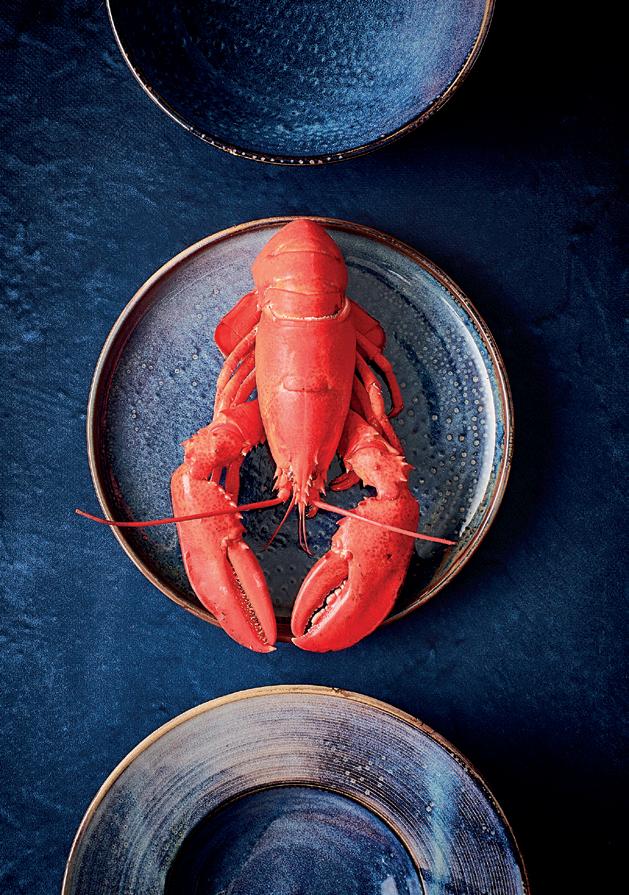
Steelite: Undoubtedly that is the Craft range. Now in its twelfth year of production, it continues to be hugely popular because of the emotional response it elicits. The Craft range is traditional yet contemporary, timeless yet timely, familiar yet visually exciting. It has qualities which play to longterm key trends of authenticity, artisanship, individuality, and an honest respect for materials. Menu agnostic and globally ubiquitous, it really is a product of its time.
Designing for professional use versus designing for consumer, what are the differences?
Arcturus Group: Regarding porcelain – strength, stackability, range of sizes and shapes are the key factors demanded and essential to
meet the functional requirements of hospitality sector. In the cutlery business, on the other hand, what makes the difference is undoubtedly the continuity over time of the availability of a specific cutlery model, as opposed to a limited edition for a few years. In hotels, but even in restaurants of a certain level, the supply rollout has regular turnover and it requires this type of reliability from us as manufacturers. Furthermore, for all products for professionals, we must always consider the intensive use and durability that this industry needs.
proHeq: Professionals know what they want and they have various specific requirements for the products. Next to design, high functionality is key as well as durability and uncompromising quality. During their lifetime, professional table top products are used over and over again, they are transported, stacked, go through thousands and thousands of dishwashing cycles and still have to look and feel like new for the next guest. It is very exciting task searching for the perfect combination of quality, functionality and design and being able to set standards that reach well beyond the professional field.
ArdaCam: We think that designers need to consider the overall aesthetic and branding of the product when designing for professional use versus consumer use. Professional products may need to align with the branding and image of the business or organization, while consumer products may need to appeal to a broader range of individuals and be designed with a more universal aesthetic.
Bonna: The gastronomy sector, which is on the rise all over the world, offers dynamic, creative and original experiences every day. Today, with the changing conditions, the interests and expectations of consumers have also changed. At Bonna, we try to be a part of this change and transformation with our innovative approach that we have adopted since the first day we stepped into the sector. With our expert designers, we always follow trends closely and create our collections in line with these trends. In our collections we have prepared for professional use, we consider the needs of professionals and chefs in the food and beverage industry, together with the design.
Fine Dining & Living: When choosing new collections, we always look at the quality of the material first, only after that does design comes into play. While for home purposes a nice-looking stoneware collection is more than enough, for the hospitality sector a more durable material is needed. Aside from that user-friendliness and measurements are two pillars we take into account.
Steelite: The differences in design approach are quite wide, although in some respects they overlap too. Any ranges for professional use need to be designed with key features in mind. These ranges are bought with the intention that the operator will make a profit from their use. Therefore, durability, ease of use, longevity, trend compliance and positive visual effect on plated food are hugely important. Ranges for consumer consumption don’t necessarily need to function in the same way and certainly wouldn’t need to be viewed as an investment from which to make a profit. Therefore, these can be more flamboyant and more fast-fashion lead. However, in either case, the emotional attachment the end user has for the product goes a long way to ensure its success.
Utopia: We understand that designing for professional use is very different from designing for consumer use. Firstly, professionals require products that are durable and can withstand heavy usage and frequent cleaning.
Secondly, professionals need products that can be used in a variety of settings, from fine dining to casual eateries. We design our collections to be stylish, versatile and functional, ensuring they are suitable for as many contexts as possible.
Thirdly, professionals often have specific requirements for their products, such as stackability and ease of storage, as well as resistance to breakage. We take these into account during the design process to ensure that our HoReCa products meet the needs of our professional customers.
Finally, professionals often require a wide selection of shapes and sizes which are not needed by consumers. That’s why our new Murra collection has no less than 25 different shapes. We work hard to expand ranges and make tailored pieces to match the needs of our hospitality customers.
Zieher: Usually professional items tend more towards durability whereas the consumer product is more likely to be aesthetically designed. The key to our success is actually combining those two important aspects, because in our line of business centred around versatile buffet systems, the professionals need to be able to easily handle Zieher items every day to create unique consumer experiences. The exclusive design of our products combined with lighting options supports our partners at this task.
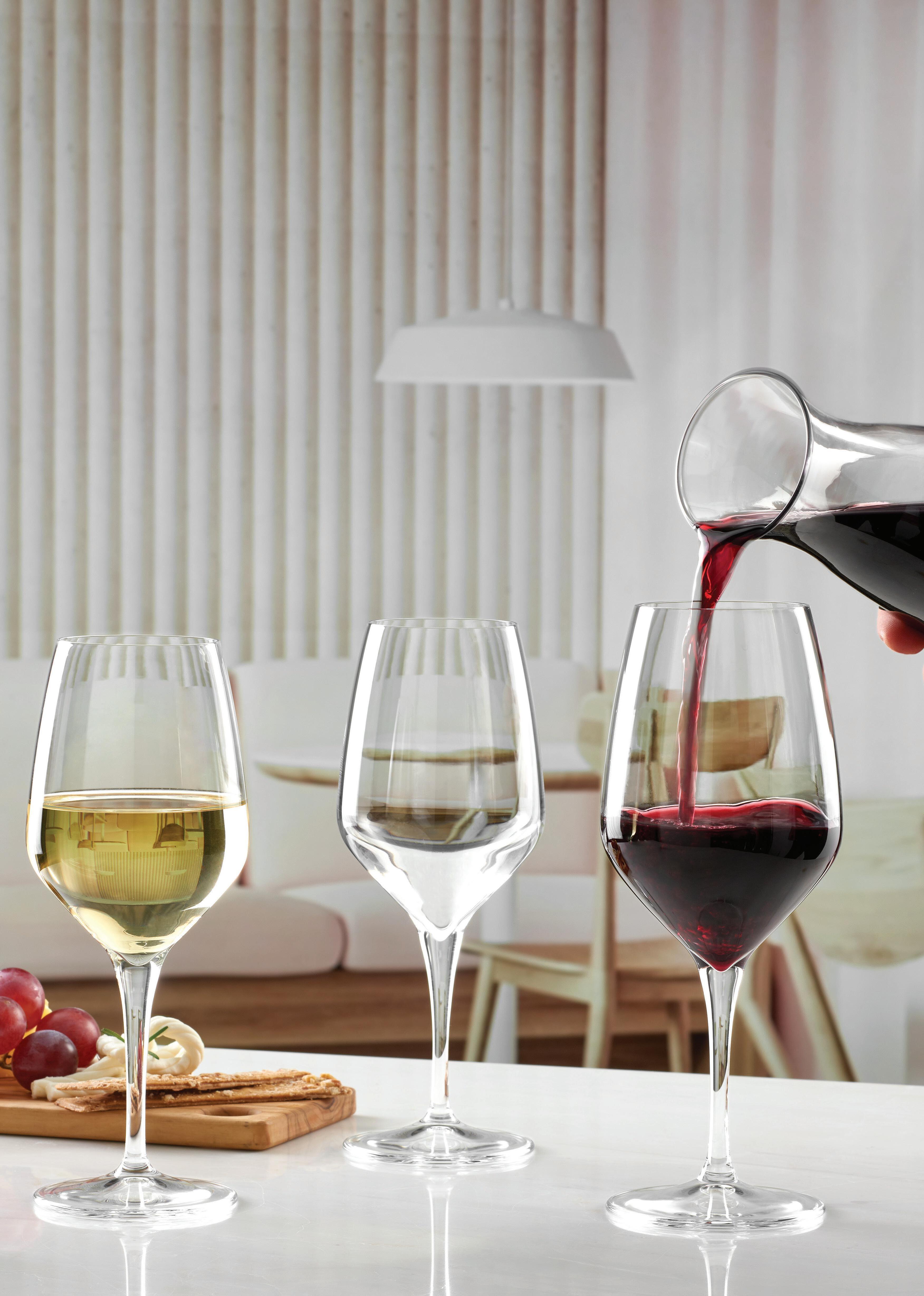
Zwiesel Glas: For the catering industry, the focus is not only on appealing/contemporary designs but also on functional aspects. For example, rack suitability for easy handling in the dishwasher, calibratability in accordance with legal requirements, filling quantities to match the grape varieties and much more.
The end consumer, on the other hand, makes more intuitive and emotional decisions, often based on purely aesthetic criteria. Here, designers can use colour and form in a more playful way.









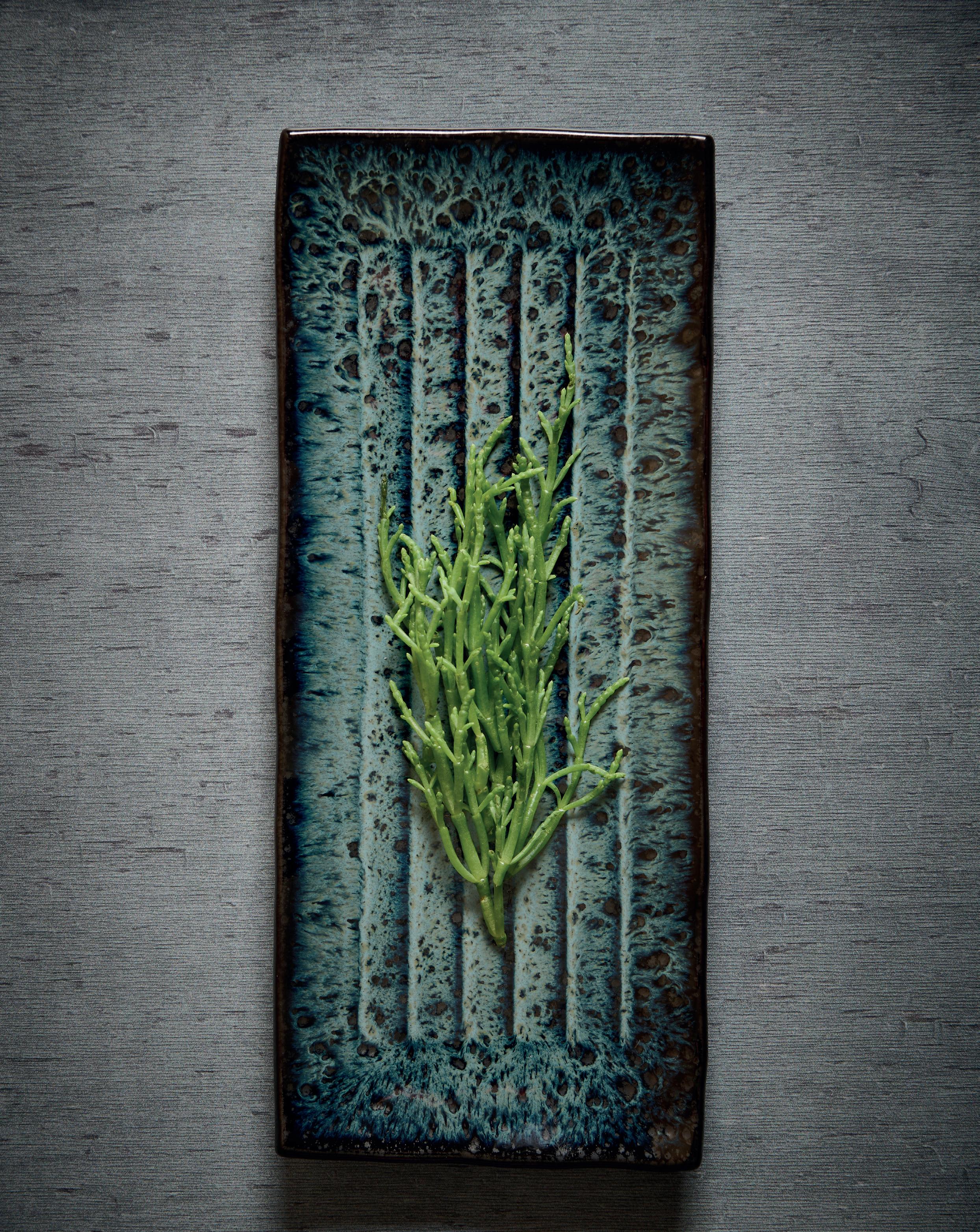
Umi, a collection inspired by the finest Japanese cuisine, is brought to you by Fine2Dine, a brand created by Fine Dining & Living.
Designed as a canvas to allow Japanese food sing, Umi is made of strong, durable porcelain boasting a vivid colour palette born from a reactive glaze that makes every piece unique. The collection includes plates, serving dishes, bowls and even a sake pourer, presenting chefs with an ideal starting point in their quest to create an authentic Japanese dining experience.
www.fine2dine.com
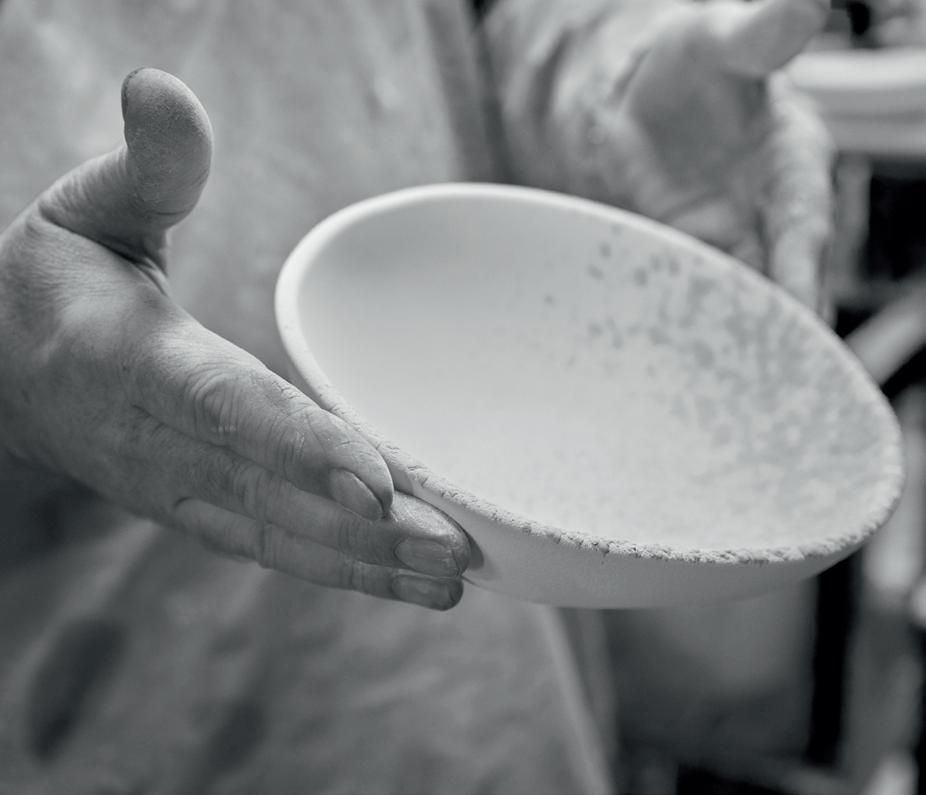
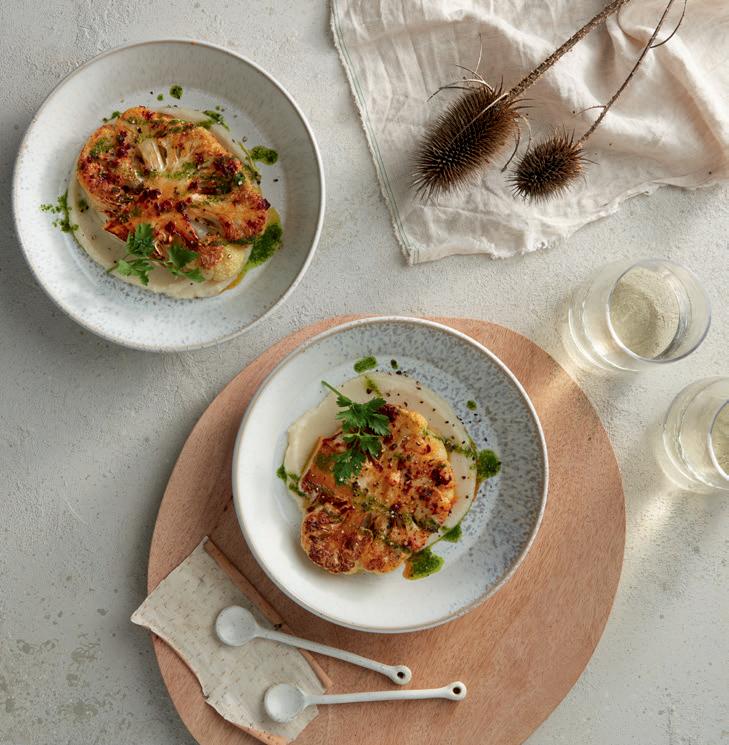
With a new collection designed by AI technology, a commitment to being as sustainable as possible, and a sales team dedicated to ensuring Bonna’s products are to the fore in venues across the globe, the company continues to see is star rise.
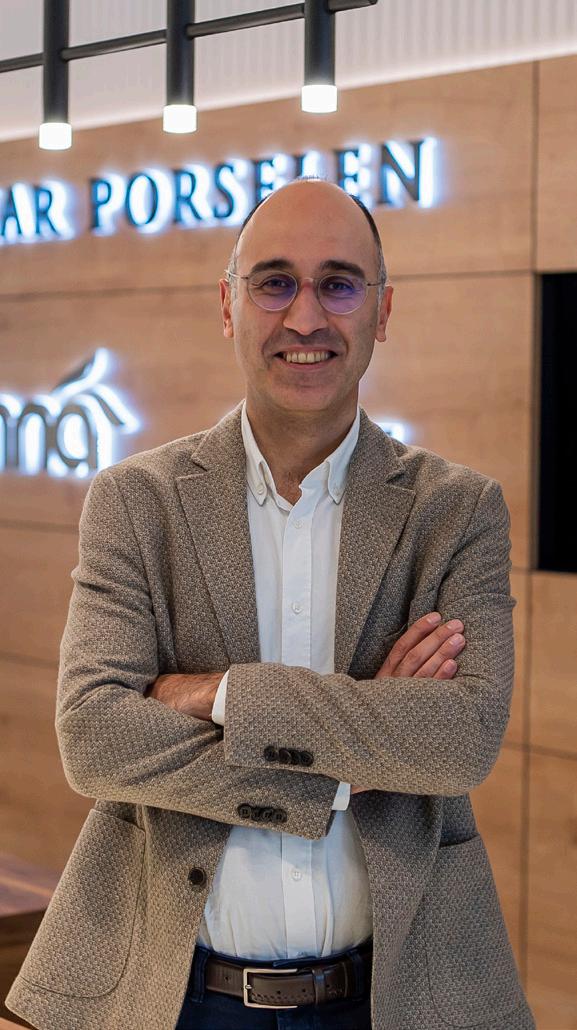
HoReCa speaks with general manager Erbil Aşkan…
Amongst Bonna’s new launches are the Ground and Futura collections. Ground is a modern take on traditional Turkish porcelain, featuring 87 per cent recycled material.
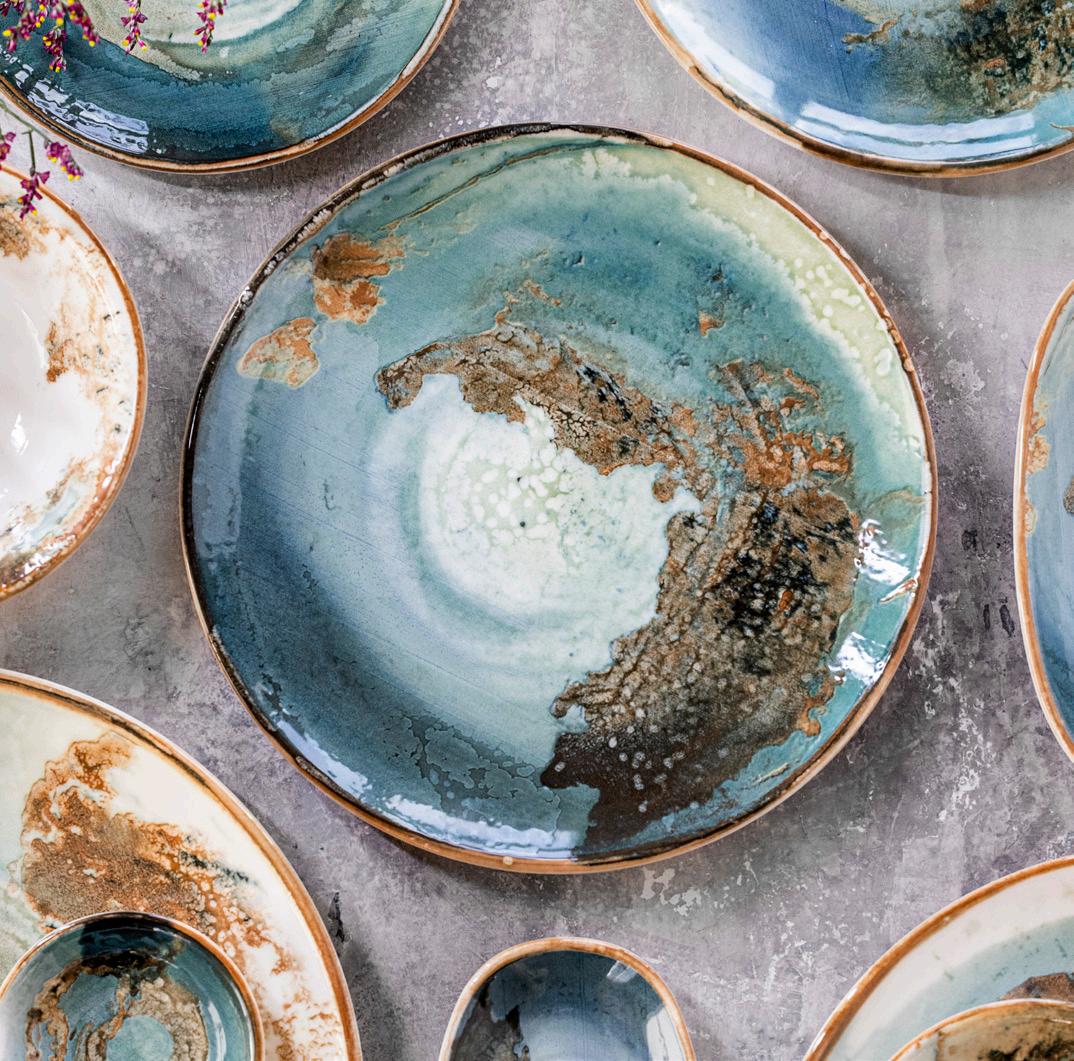
Meanwhile, Futura – designed by artificial intelligence for the first time in Turkey – is inspired by Renaissance architecture and today’s modern design. The union of artificial intelligence with porcelain, and the fact that it is on sale as a collection, reflects Bonna’s modern vision
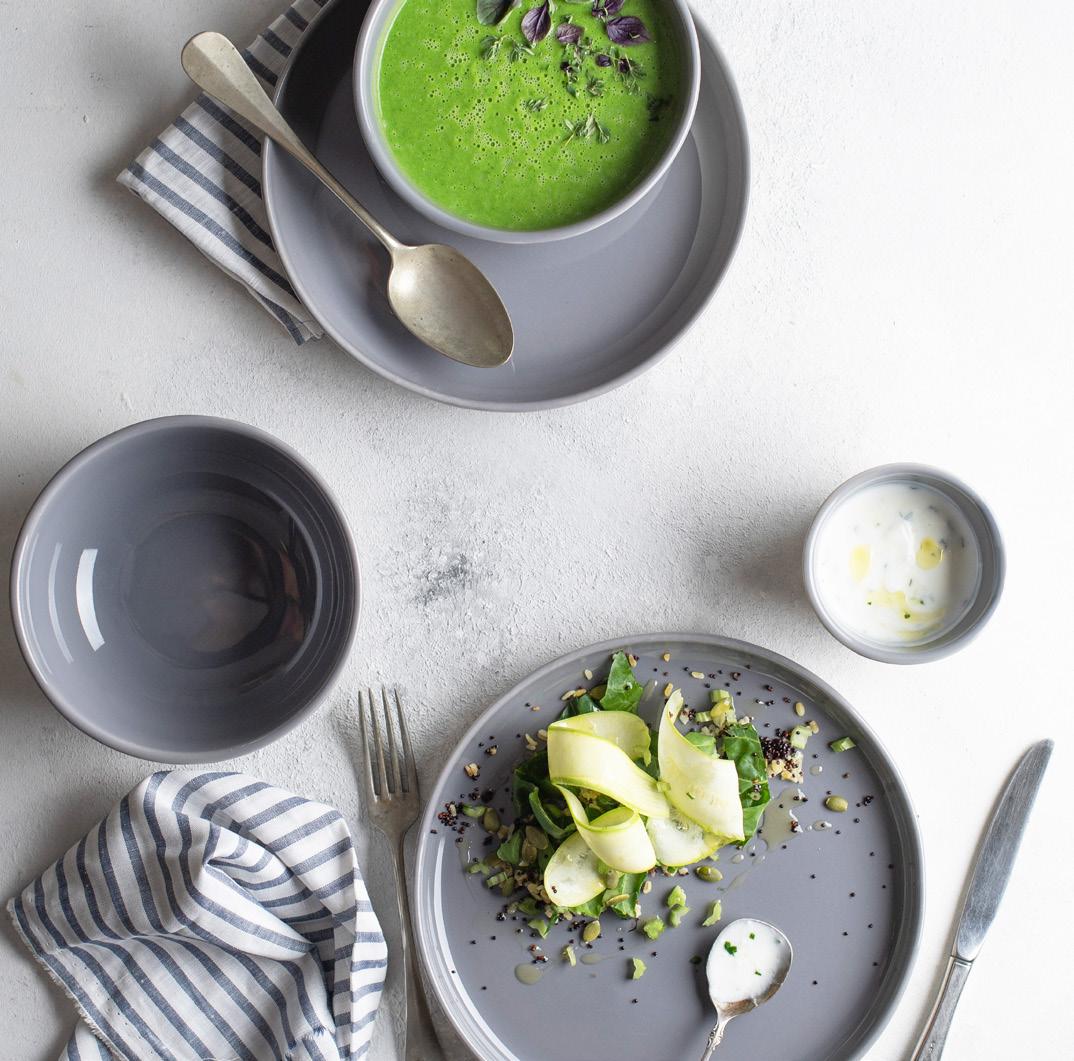 Ground
“Ensuring that the products arrive in perfect condition and on time, can be a major challenge”
Has the hospitality sector changed much since you first began Bonna, and if so, how has it changed?
The hospitality sector has definitely evolved since Bonna first began. With the rise of social media and the demand for unique dining experiences, there is a greater emphasis on creativity, sustainability, and customisation.
Sustainability is at the forefront of Bonna’s product design and manufacturing processes. We use environmentally friendly materials and production methods, such as recycling water and reducing energy consumption, to create ecofriendly collections.
What is trending in the hospitality sector currently? Is bowl culture still popular?
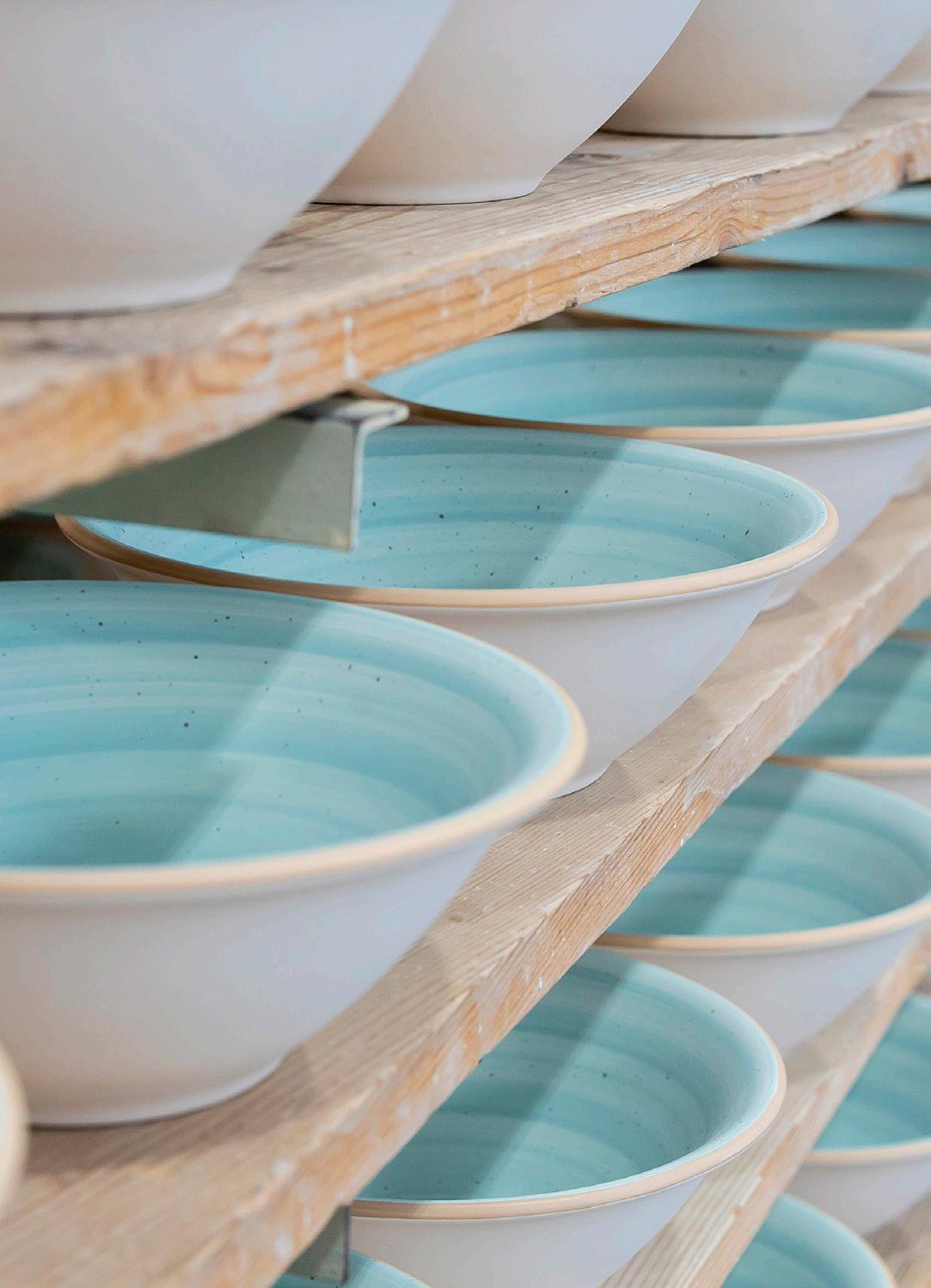
The hospitality sector is currently focusing on sustainable and eco-friendly solutions, as well as providing unique and personalized dining experiences. Bowl culture is still popular, as it offers versatility and flexibility in serving different dishes.
What are the biggest challenges Bonna is encountering supplying global hospitality venues?
Sustainability is really important to Bonna, how do you create eco-friendly collections?
One of the biggest challenges Bonna is encountering is the transportation and logistics of fragile and heavy ceramic products. Ensuring that the products arrive in perfect condition and on time, can be a major challenge.
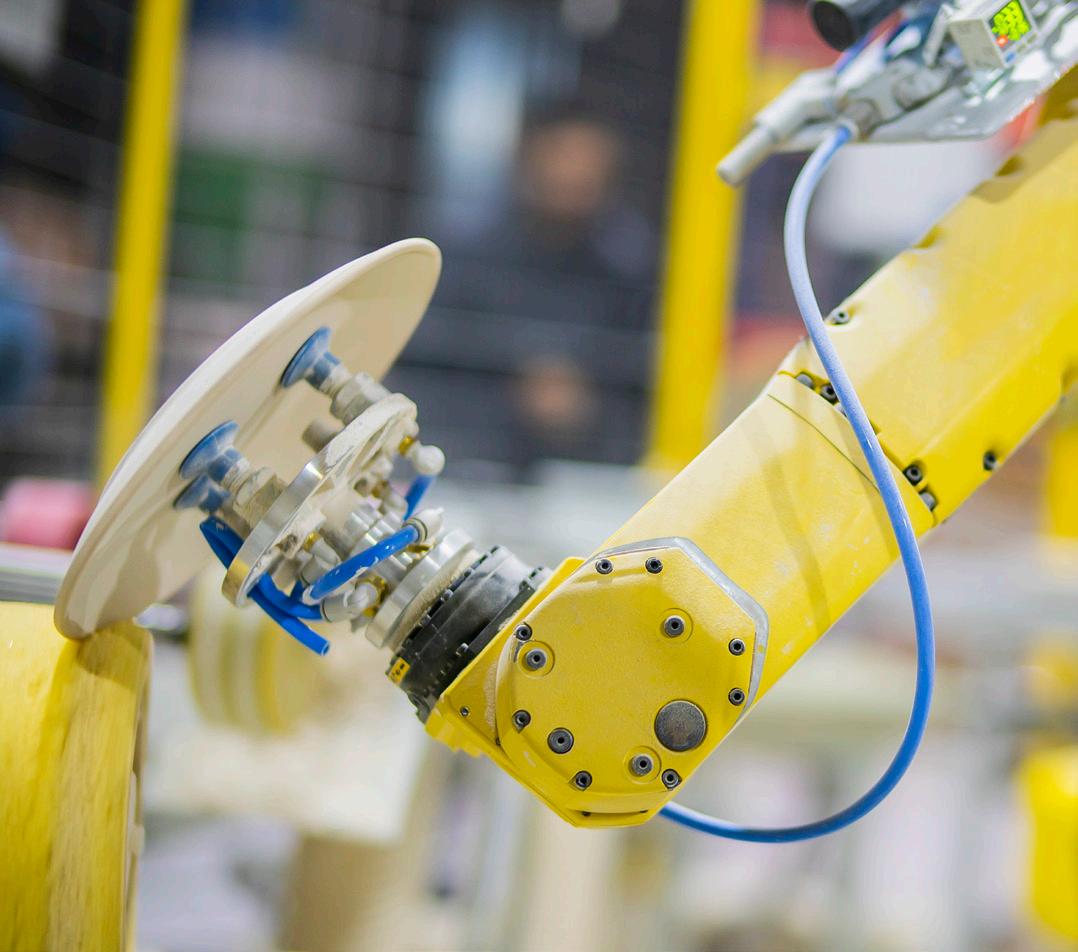
International trade shows such as Host Milano, Ambiente Frankfurt, and Hotel Show Dubai are all important dates in Bonna’s diary.
Do you supply to the US market?
Yes, Bonna supplies to the US market. We have a team dedicated to serving our US clients and ensuring that they receive the best possible service and product quality.
What sales markets are performing strongest for Bonna, currently?
Bonna is currently experiencing strong sales performance in the Middle East, Europe, and Asia.
What makes Bonna different from other manufactuers and suppliers from Türkiye?
Bonna’s commitment to quality and attention to detail sets us apart from other manufacturers and suppliers in Türkiye. We also offer a wide range of products that cater to different styles and preferences, and we work closely with our clients to ensure that they receive the best possible service and products.
www.bonna.com.tr
One of Bonna’s newest collections, Futura, has been designed by AI technology taking inspiration from Renaissance architecture.
“Sustainability is at the forefront of Bonna’s product design”
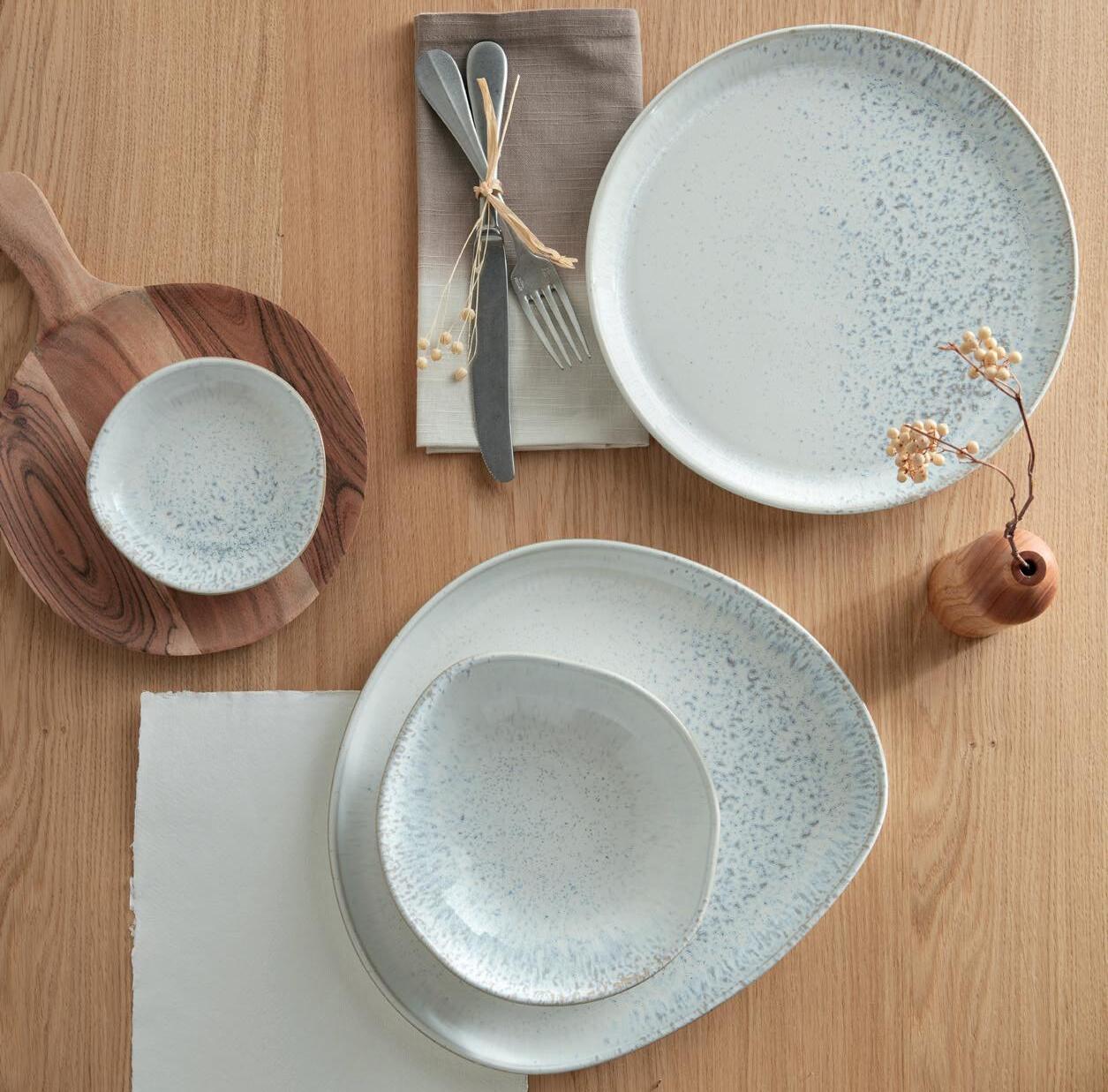
White Tears is a minimalist collection that brings a new perspective to classical white porcelain. Each piece is completely white, featuring both mate and glaze finishes, which give it a fresh and precious look.
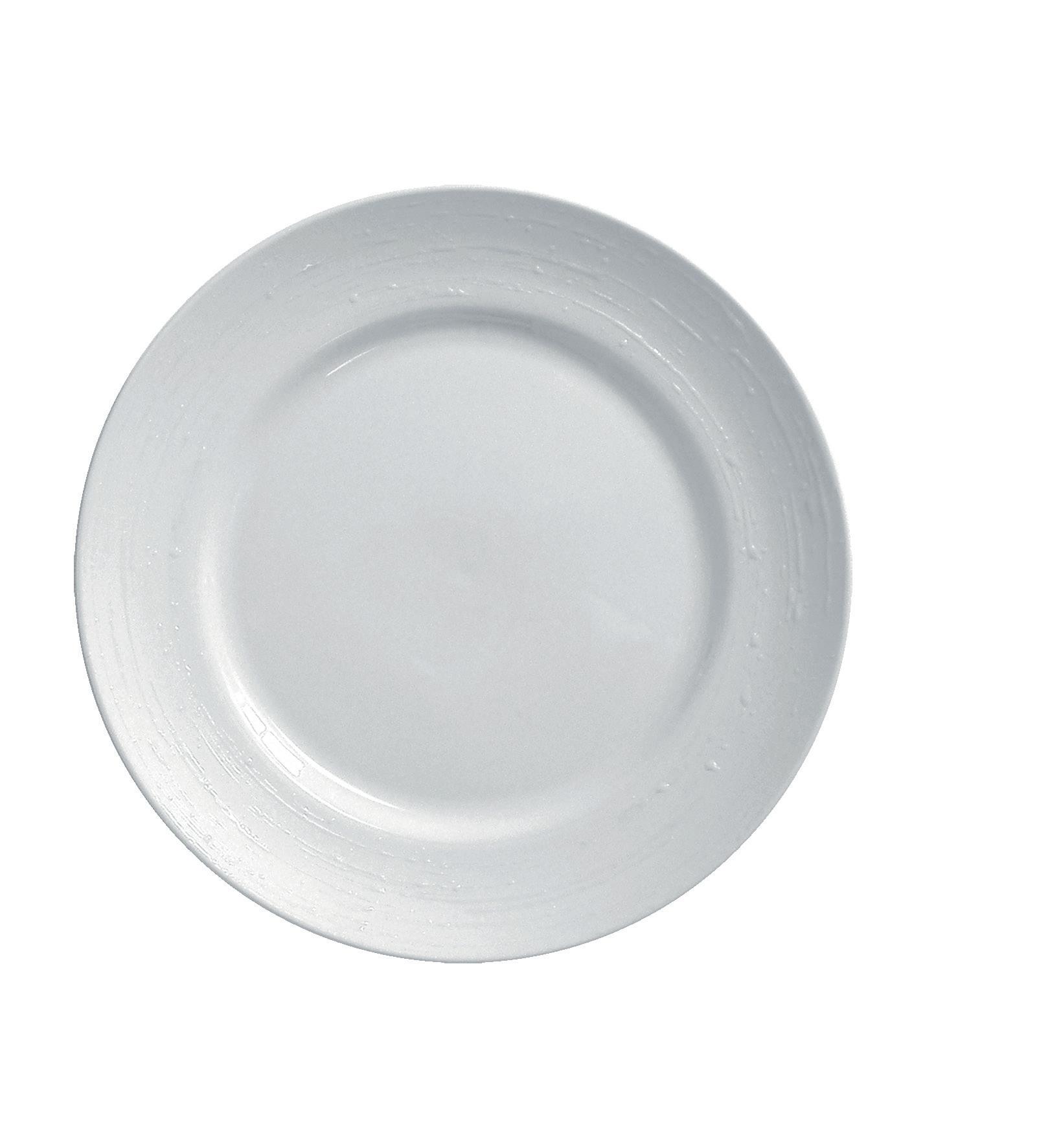
RAK Porcelain’s Spectra impresses with elegant lines which have been carved in RAK Porcelain’s noble bone china. Carved lines adorn round flat plates with rim, coupe plates, gourmet plates, oval platters, bowls, cups and saucers.
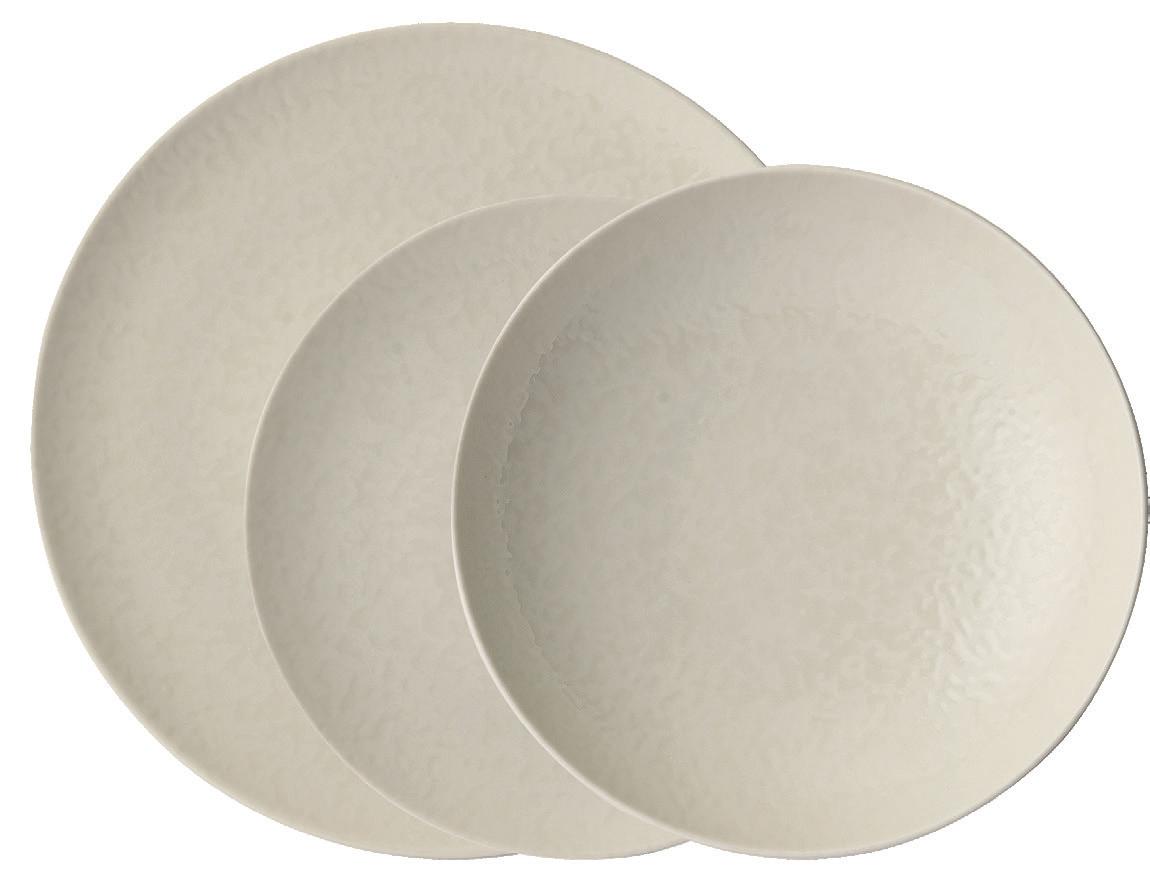
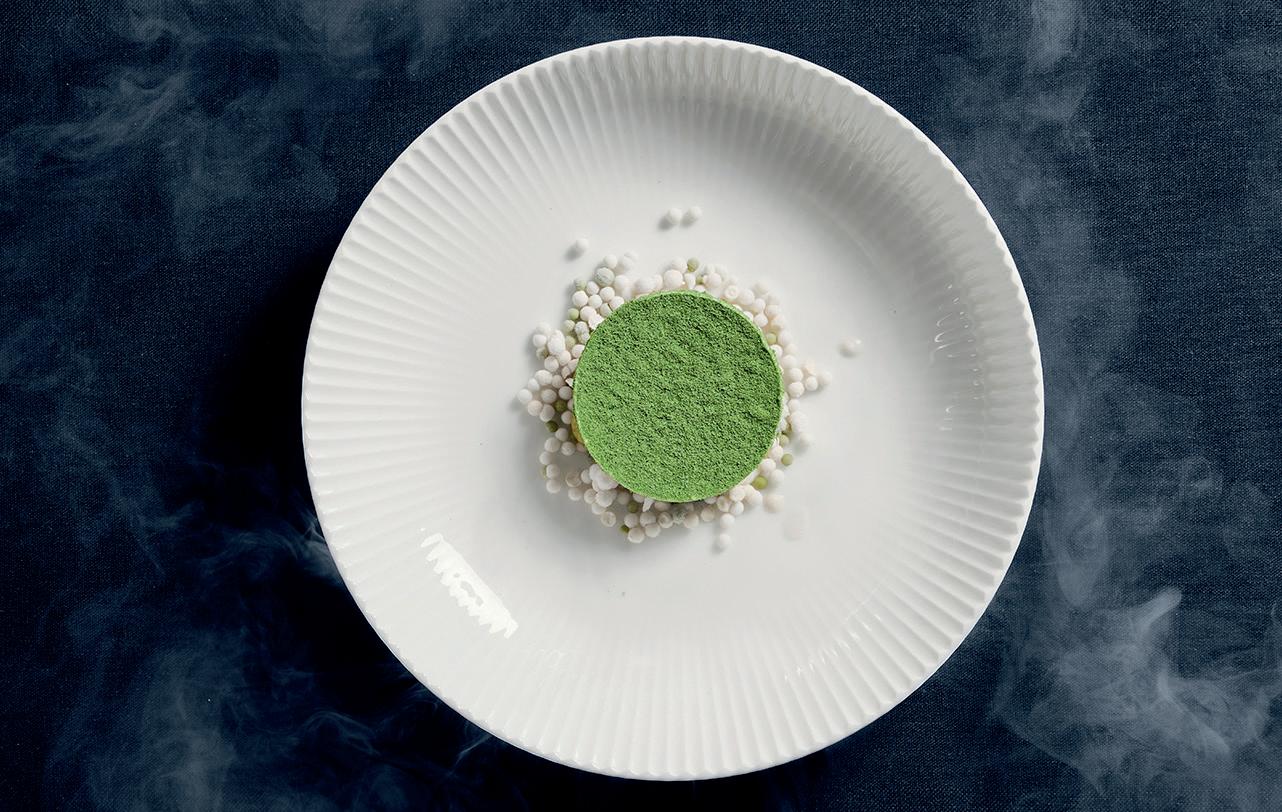
Arthur Krupp’s Eclipse Day boasts glossy accents, delicate tactile contrasts and functionality while Perla from the Chic brand (made of the unique formula SiloxiHT which consists of a blend of quality materials, which allows the product to be thinner, more durable, lighter in weight and more translucent than any porcelain product)
is described as a symbol of innovation with elemental natural beauty combined with updated styling.
Inspired by post-modern architecture, LSA International’s TIER is a collection of mouth-blown vases and lanterns stacked, geometric shapes. Available in cased grey, cased white and clear glass, the contemporary sculptural forms may be used with flowers and foliage or displayed as a decorative object. From Mesa Ceramics comes Prints, a white range with a twist while Narumi’s award-winning Rydges captures the dynamism of nature while exuding an elegance perfect for fine dining rooms in luxury hotels and resorts.
Meanwhile, the Foam series from Nikko , meanwhile, is characterised by beautiful forms with irregular curves.

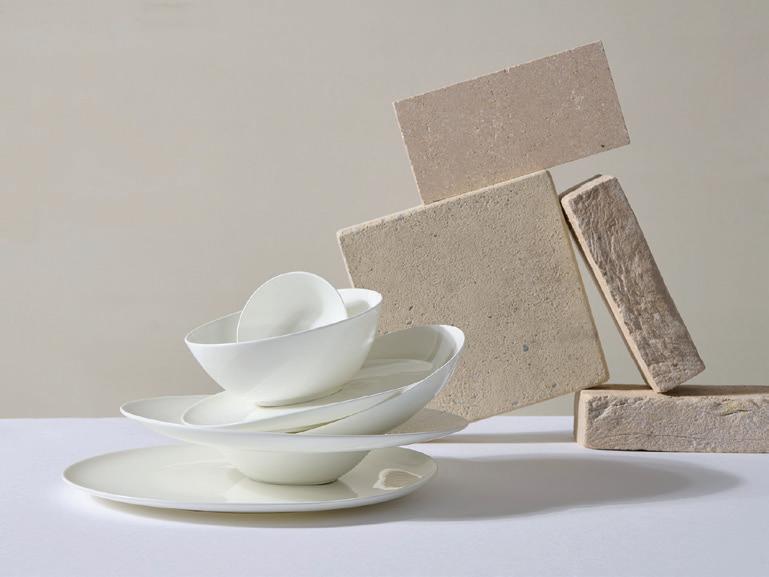
With white tableware choices still proving a popular option for chefs and restauranteurs, we shine a light on some pearly white tableware






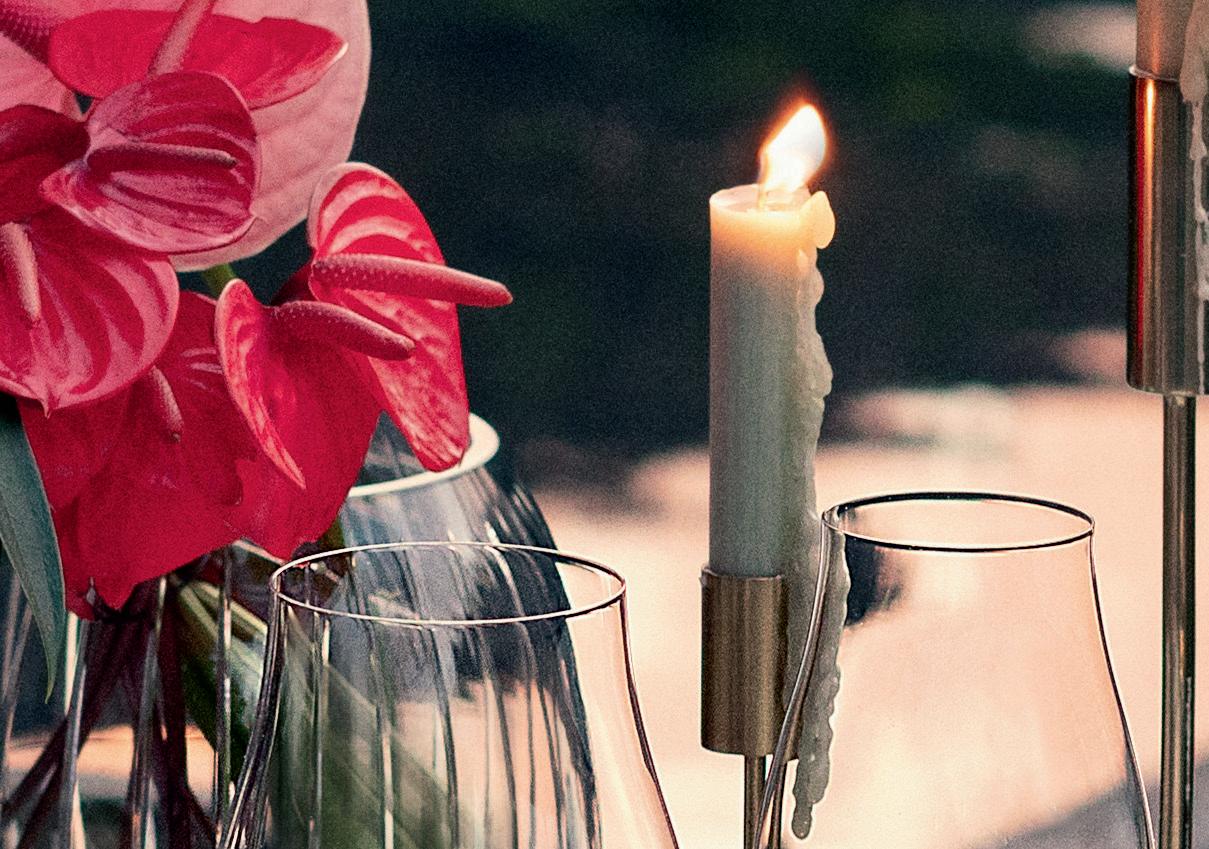
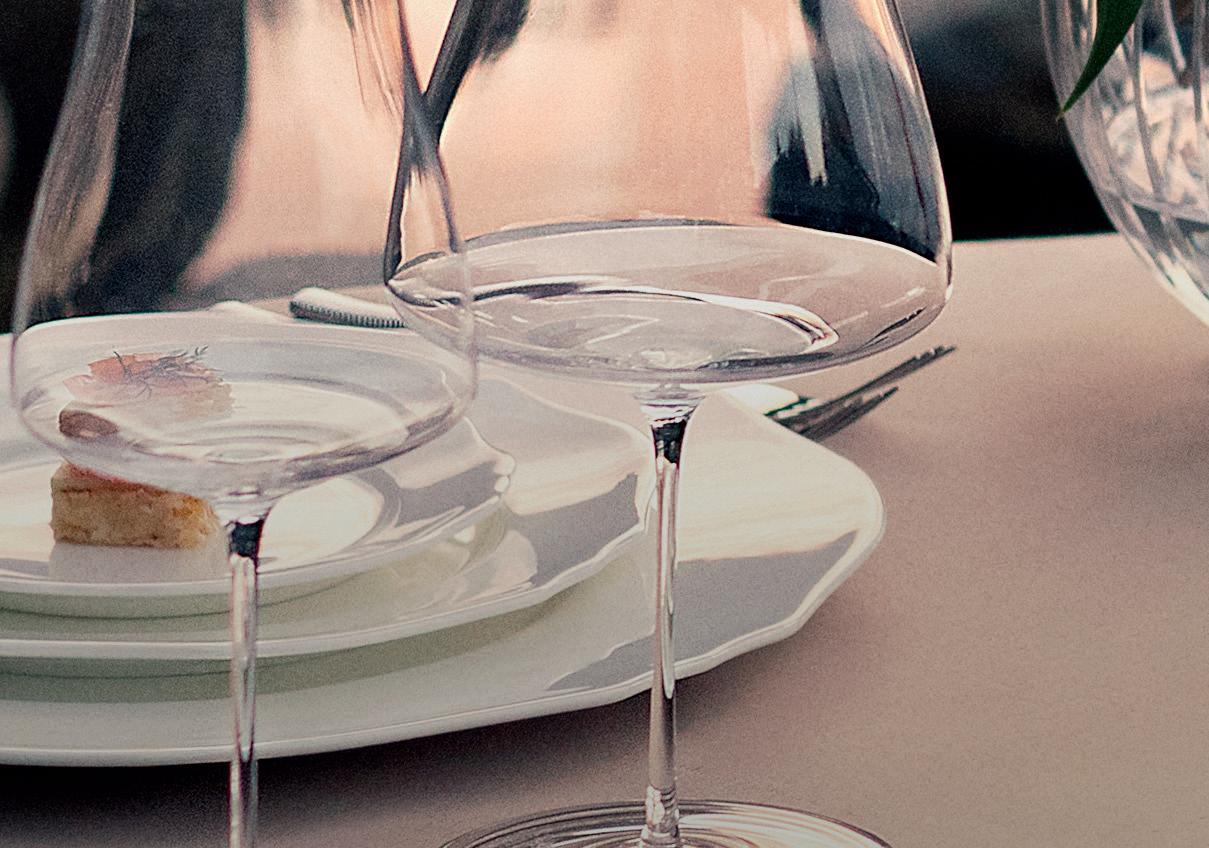
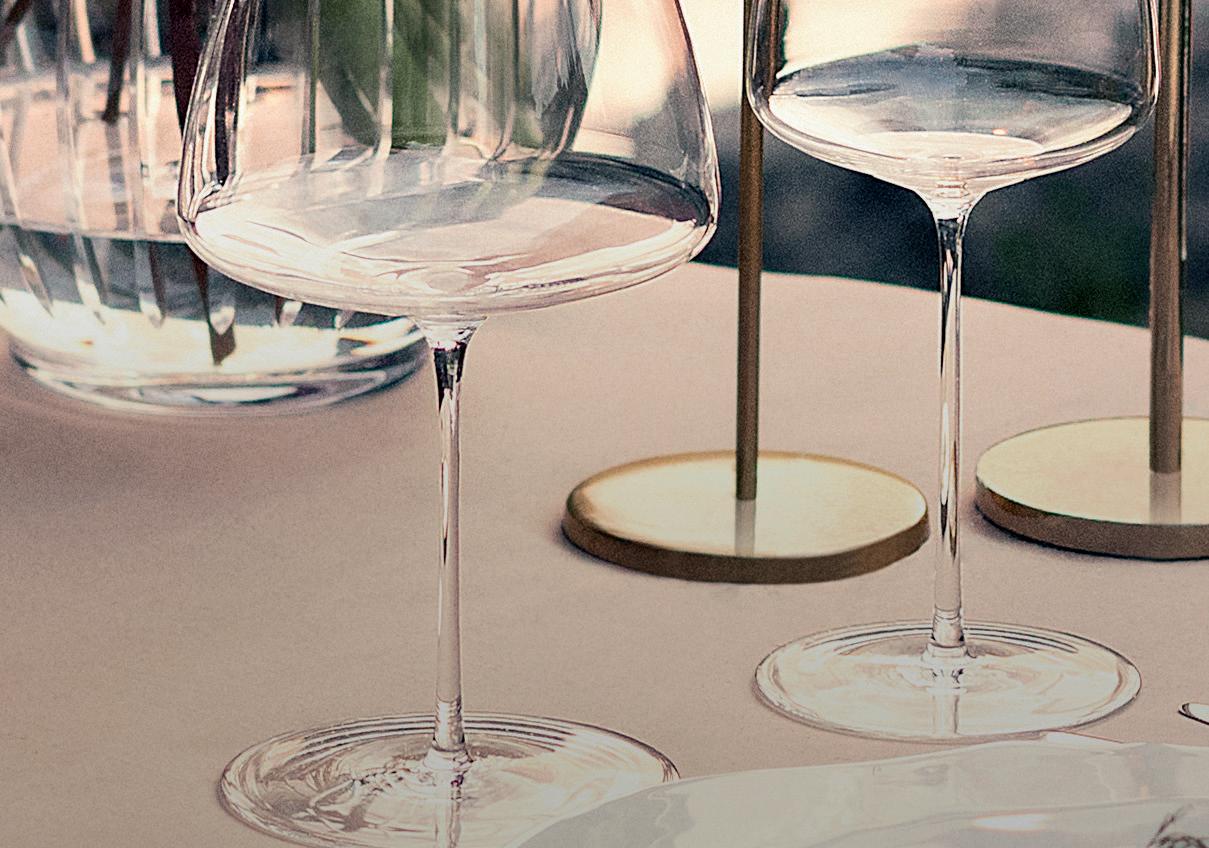




Priding themselves on offering a wide selection of innovative and exciting products to the HorReCa market, Lifetime Brands Europe has worked closely with the sector for more than a decade.
“We appreciate that although aesthetics is key, the most important attribute when selecting a product for any type of venue is durability. All our products are designed with the latest trends and consumer insights in mind whilst being fit for purpose,” Claire Budgen, commercial and marketing director says.
This past January marked the launch of the much-anticipated Mikasa Hospitality, a collection of porcelain and stoneware alongside cutlery and glassware –a one-stop-shop for the tabletop.
A dedicated team has ensured each product surpasses industry
standards. From sourcing the very best sustainable materials to design and rigorous testing, this range has everything you need in terms of quality, durability and design. “Those who invest in Mikasa Hospitality can be assured that every item has been built to last,” Claire adds.
All of the porcelain is vitrified and, as such, is some of the strongest dinnerware available. Mikasa Hospitality uses a commercial glaze for their porcelain production to give a stronger, scratch-resistant surface with a non-porous finish, making the porcelain dinnerware resistant to stains and odours.
“Our fully vitrified stoneware has been designed and developed to withstand the rigours of hospitality environments. It’s the heavy clay composition that is treated at very high temperatures
to give the different designs their particular strength and appealing rustic look,” Claire reveals. “As a result of these processes not only can we offer lifetime edge chip guarantee, but the products also become impervious to water absorption in commercial dishwashers and are freezer and microwave safe. And it is not only performance we have considered, each collection is also made to work well in a kitchen in terms of space saving and stacking.”
In addition to their dinnerware collections, the Mikasa Hospitality range also extends to cutlery. With options made from 18/8 grade steel, the cutlery is rust resistant, durable and promises lasting shine. Of course, there is glassware too with Claire pointing out the reliability and competence of the brand’s glassware has been tested by leading inspection agencies.
“Free from lead or any other pollutants or toxins, our crystal glassware is glasswasher safe and crafted for long lasting brilliance. Mikasa Hospitality is a brand you can trust,” Claire adds.
Behind the scenes Lifetime Brands Europe has everything you need to keep a busy kitchen running too. For those who strive for perfection Taylor’s thermometers, scales and timers will never fail to impress.
Endorsed by Michelin Two Star Chef Michel Roux Jr., precision is everything for Taylor. This brand prides itself on stretching the boundaries of expectation, with products centred on innovation and accuracy including thermometers which leave smaller puncture holes in meat to retain juices and appearance
From front of house to behind the scenes, Lifetime Brands Europe is offering the hospitality industry a complete propositionArtesa Artesa
while ensuring meat is cooked to perfection.
MasterClass is another brand chefs turn to. The Cast Aluminium range is a firm favourite with caterers of all sizes. Not only do these dishes deliver outstanding cooking performance but they also work as stylish serveware. Both award-winning and bestselling, this range proves that you can benefit from a solid dish that is surprisingly lightweight and easy to handle. In fact, it has all the cooking benefits of cast iron, without the hefty weight or price tag. These dishes are made from high-grade aluminium and are reinforced by a double scratch-proof layer that acts as a non-stick too, better still these dishes include a self-basting lid to retain all those flavourful liquids and juices.
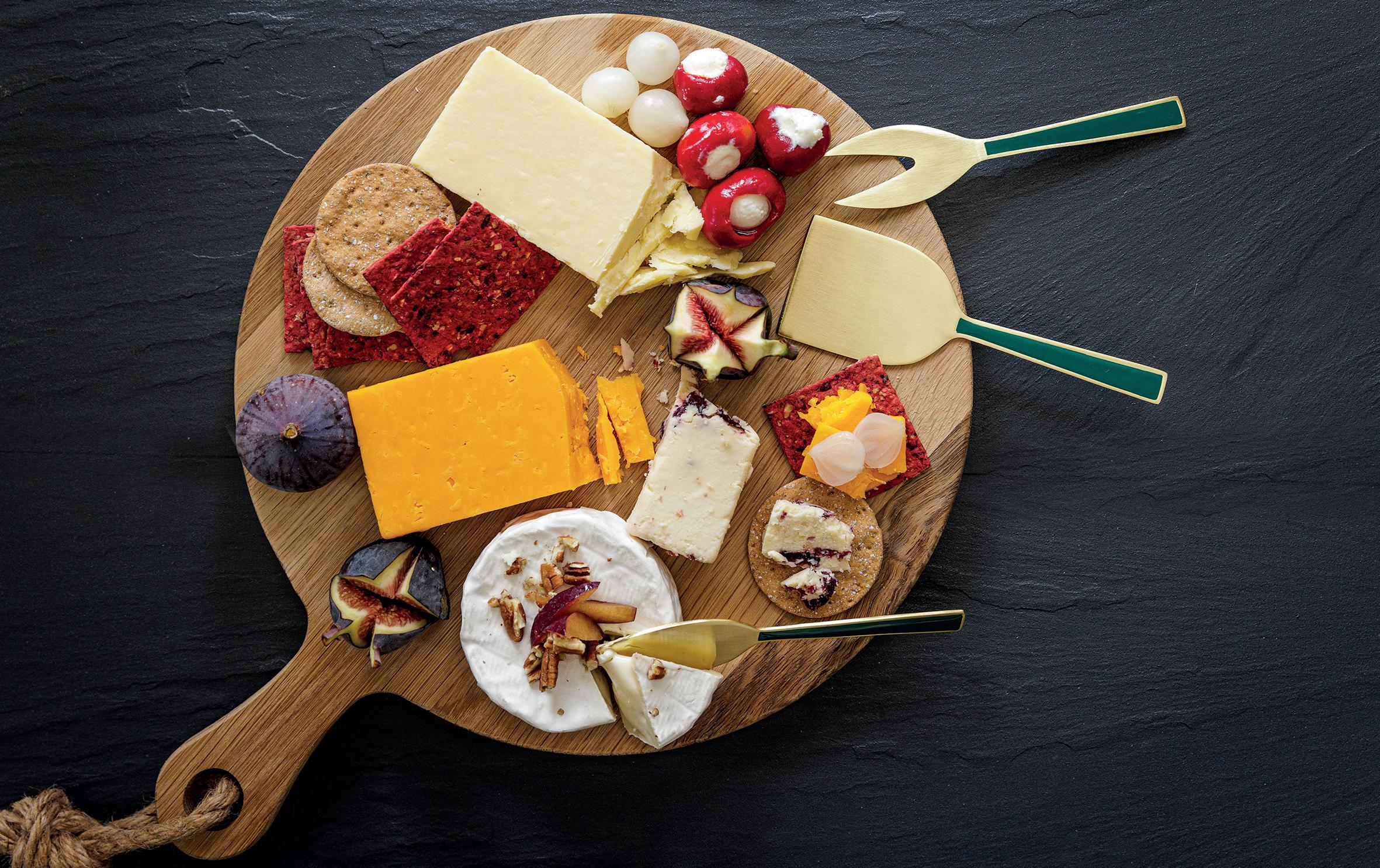
When it comes to serveware, Artesa is the ultimate brand. The collection has everything needed to make a statement, from rustic wooden serving boards and elegant slate platters to tiered serving stands to showcase the finest afternoon tea spread. Or add a sparkle to any table with stunning shaped
shakers and mixers to wine stoppers and markers, champagne buckets to ice cube trays.
For all tea and coffee servers, there is La Cafetiere. Pisa continues to be a bestseller and with three new colours added to the range, this demand shows no signs of dissipating. Renowned for its ease of use and superior performance,
calming pastel pink are all on trend and easy to place in any setting.
And lastly, there is London Pottery. These teapots in several finishes and colours are desired around the world.
dishes and brass finished cheese knives or serve food on trendy mini copper saucepans for an unrivalled gastropub experience.
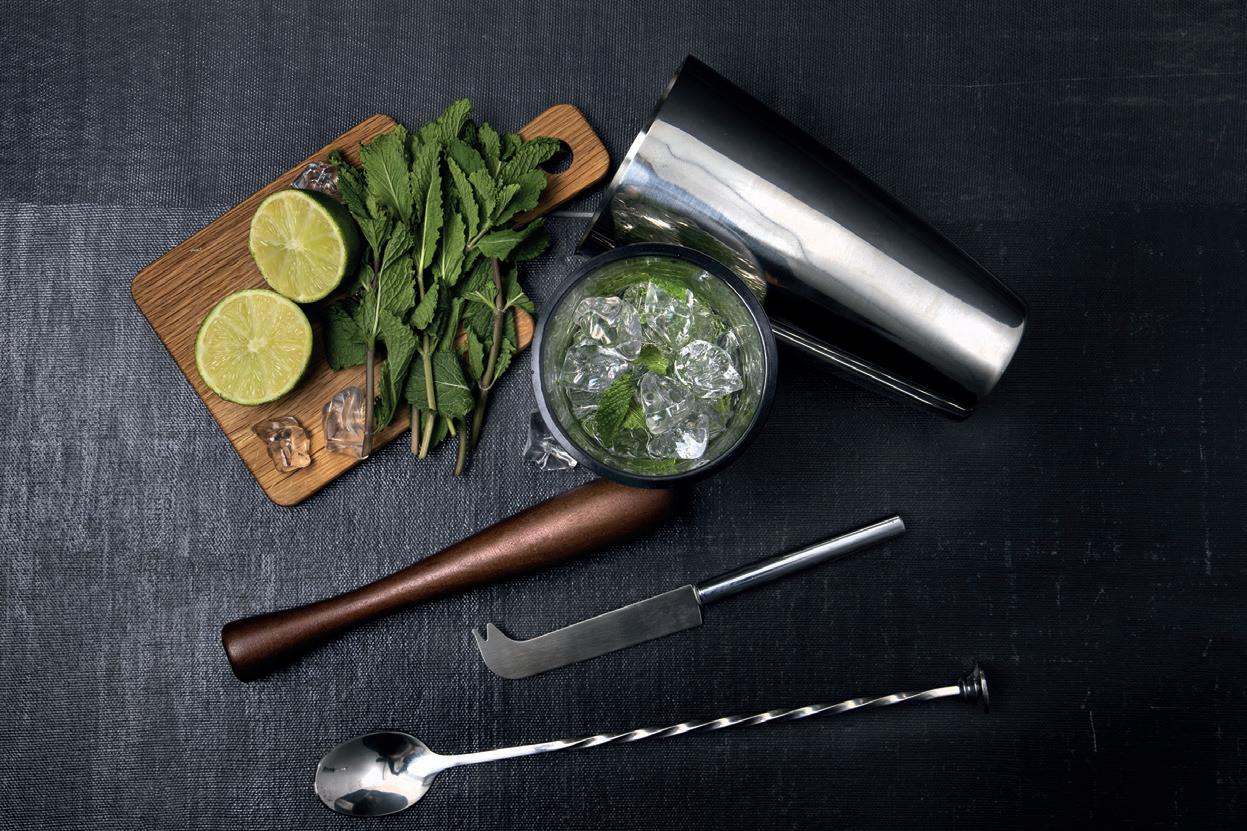
Next is the BarCraft range where buyers can choose from a vast range of quality products suited to all barware needs, think cocktail
these French press coffee makers are crafted from heat-resistant borosilicate glass encased in a sturdy, stainless steel frame for extra durability. They also feature a natural beechwood handle that gives a vintage retro feel. The new classic cream, striking navy and
“We have taken the best of British and redesigned it so each teapot boasts the style and quality which you come to expect from such an iconic brand; with unique features including drip free spouts, stainless steel filters and lids that are designed not to fall off when pouring. It sounds simple, but it makes these pots superior,” Claire reveals. “We have 1000s of products which are fit for the HoReCa market, visit our dedicated Food Service Showroom in Birmingham. We are confident there will be plenty to inspire,” she finishes.
“Those who invest in Mikasa Hospitality can be assured that every item has been built to last”BarCraft Mikasa Mikasa Mikasa Mikasa
I have a background as an educated chef and waiter, with quite a few years of experience in wine and mixology. For the past 25 years, I have worked in senior management positions with some of the largest producers of glass and tableware. And for the past seven years I have managed my own consultancy and design house in table and kitchenware.
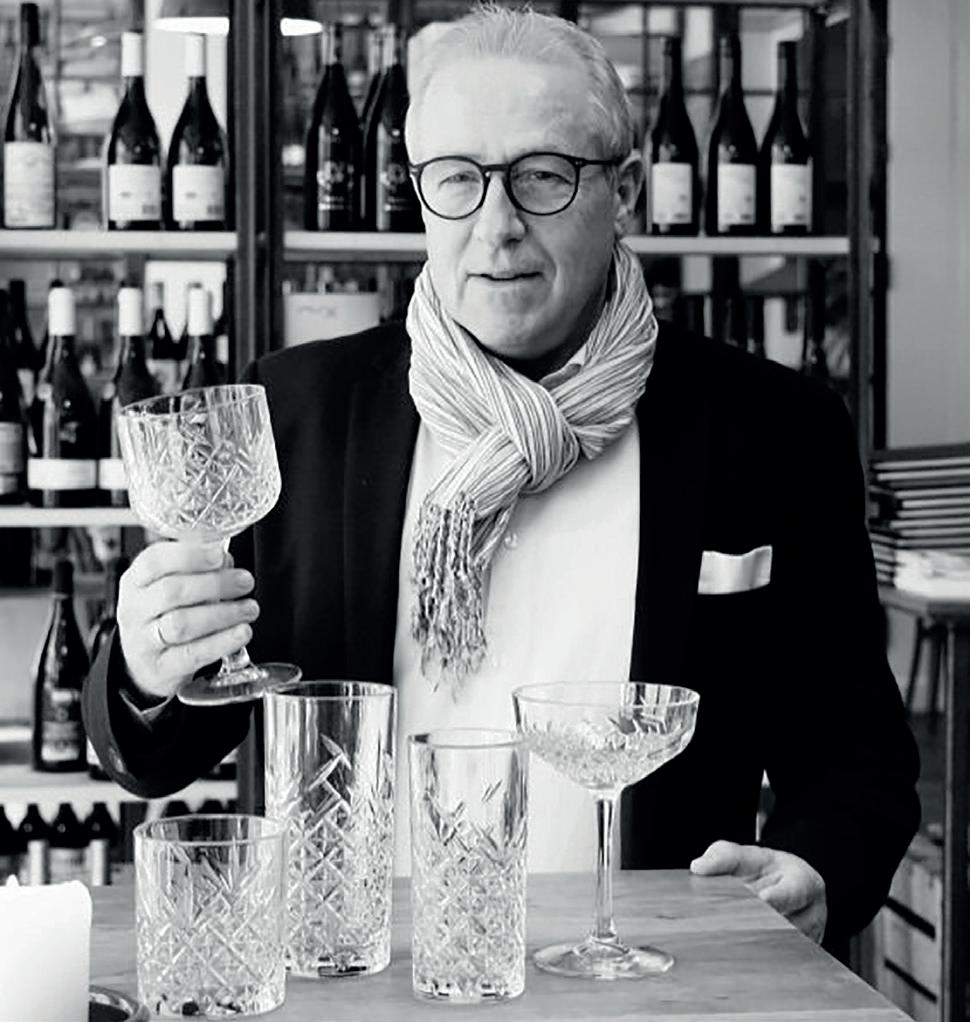
Even with all of my past experiences, I am still surprised by how little focus and attention most operators give tableware. I’m not sure if it’s because of a lack of knowledge about the actual products, or if it’s because the decision makers haven’t realised that tableware is one of the best profit makers in their operation.
By choosing the proper and correct tableware, they can not only elevate their food and drink presentations to new levels, which in turn increases their turnover – but they can also save quite a lot of money on breakage in their operations.
Some operators even say they are using their tableware as a key part of creating the right ambience and atmosphere. However, most are – for some reason – not there yet. Over and over again we see tableware being one of the last things to get selected in the opening or renovation process of a business.
My experience tells me the more focus we have on the design of tableware, as well as the handling and use of it, the more we can get tableware integrated in the presentations, concepts and
décor of the business. Through this, beverage presentations can be made better, as well as more efficient, and it will be possible to minimise tableware breakage.
In today’s world, the demands on us as operators or suppliers to the industry are perhaps tougher than ever before. No matter what type of business we are in, we no longer just sell food and drinks or vehicles to transport food and drinks from point A to point B. We sell experiences and the tools to create them.
So, in general, we can say that it doesn’t matter if you own or run a company canteen, a large catering operation, a bar, a café, a hotel or restaurant. Tableware does not, and should not, have to be just an expense. It can, and actually should, be one of the best profit makers in your business. What other purchase can you make that can give a 300 to 400 times (on average) return of investment during its lifespan?
However, in order to get to that point, it’s necessary to have a clear view of what expression you want for your tableware, as well as having an idea of the wear and tear your tableware has to endure during operations. You cannot and should not expect your suppliers to control this process. You have to control the process yourself. Only you know what is best for your business, your suppliers can only give advice. Choosing a proper manufacturer for your tableware is just as important as choosing a proper local supplier.
Since the purchasing price of tableware is far from controlling the sales price of the servings arranged
on the tableware, the more creative the plating or drink presentations, the higher the sales price of the servings! So most often (if you have staff that are creative) it makes good sense to look away from the purchasing price of the tableware and look more at the design and possibilities of the tableware and from there calculate your margin based on the sales price.
In today’s foodservice industry, we have managed to remove many of the old rules and regulations. Porcelain does not have to be white. Glass does not have to be used solely for the drinks that they are named after – dry martini, champagne etc. Other materials than glass can be used for drink presentations and other materials than porcelain and ceramics can be used for food presentations – glass, metal, wood or even stone, just to mention a few.
The important feature today is that the guests have to have the best possible experience, no matter what kind of price range the businesses they visit are in. At the same time, the outlets and operation should use the tableware as a proactive sales tool. For example, changing to a nicer wine glass when a guest purchases a more expensive wine or serving small starters on stone, wood or glass, in special menus or features. All small measures that help lift the total dining or drinking experience of the guests.
Sometimes it’s highly beneficial, or in some cases strictly necessary, for the operation to look away from the design and elegance side of the products and instead
prioritise more practical features like stackability, durability and practical handling of the tableware. This is especially the case when it comes to businesses or operations with a heavy wear and tear on their tableware. This does not mean that they can completely forget about the look of the products, the first impression still counts for as much as 20 to 25 per cent of the total experience.
In today’s foodservice industry, these is a fast-growing interest in the environment (meaning sustainability and circular economy) from both companies as well as private guests. This puts a new dimension to the feature of the tableware and table setting in the industry.
The owners or operators now have to take the production, the raw materials and even the production location of their tableware into consideration when choosing their table and glassware. Not only does it count in the environmental rating of the business, that the business has a strong environmental profile and chooses to work with environmental or circular food and nonfood products is also becoming more and more important to a growing number of the guests of the operations. At the same time, manufacturers must change their production as well as the raw materials used in the actual products to more sustainable or circular solutions. This can also be turned into a sales and marketing tool, if it’s done in the proper way –but more about that another time! www.jeffco.dk
Designer, innovator and chef – Jesper Efferbach, founder of Jeff&Co Group – has worked with brands such as Bonna, Paşabahçe and ArdaCam to name a few. Here, he advises on why tableware shouldn’t be the last thing restauranteurs think of….












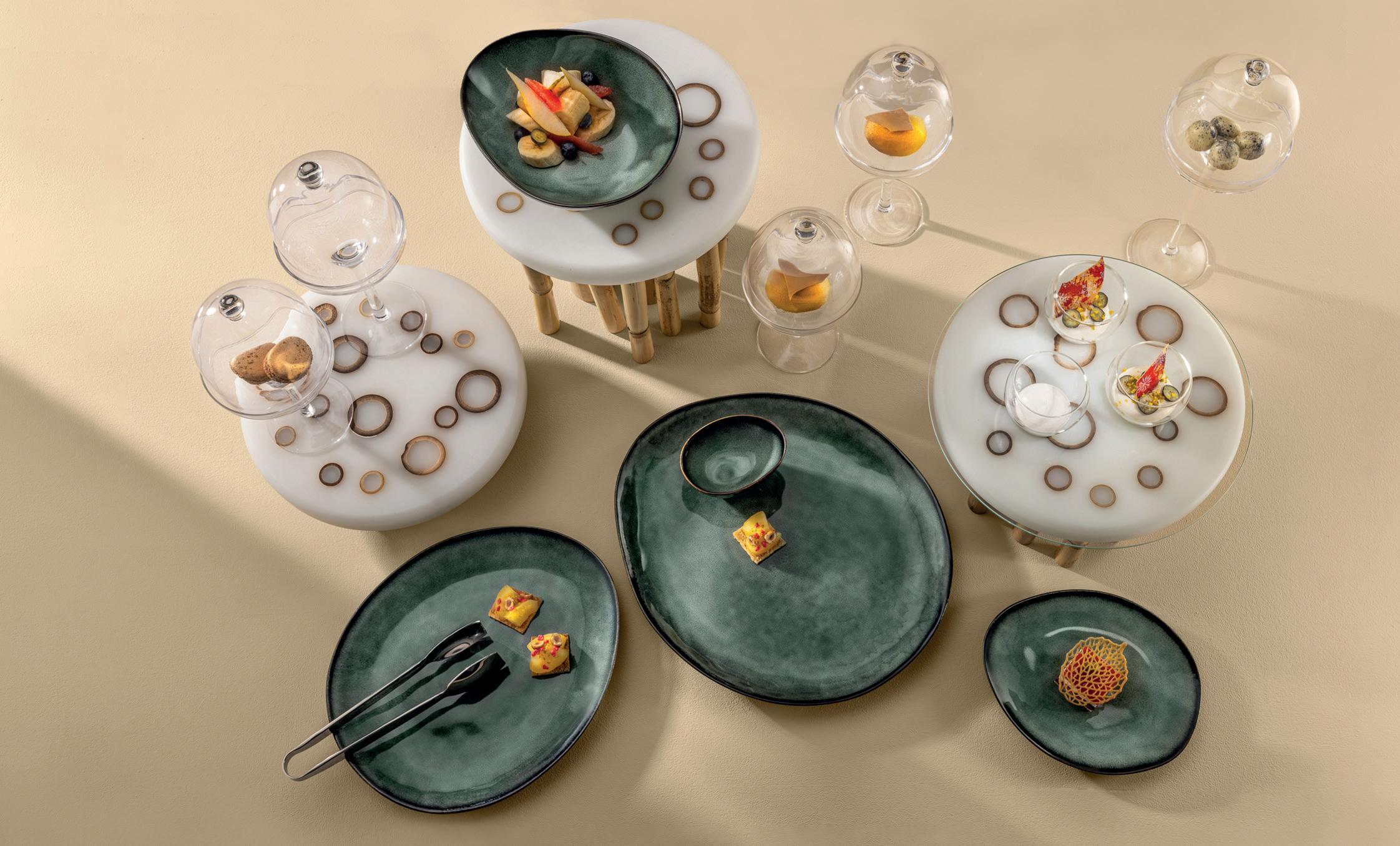
Sagano boasts bamboo poles in different diameters, set in a white resin. Here, the visible rings on the top of the display create diversified, almost graphical, effects.
Zieher points out that each display is one-ofa-kind and absolutely unique but work harmoniously together.
To protect the surfaces, but also to arrange food directly onto the displays, glass plates can be placed on top and can be quickly and easily replaced by Zieher.
www.zieher.com
Zieher has elevated food presentation once again, taking inspiration from the raw beauty of nature. Two unique staging options are made possible with the Sagano and Stomp! buffet displays
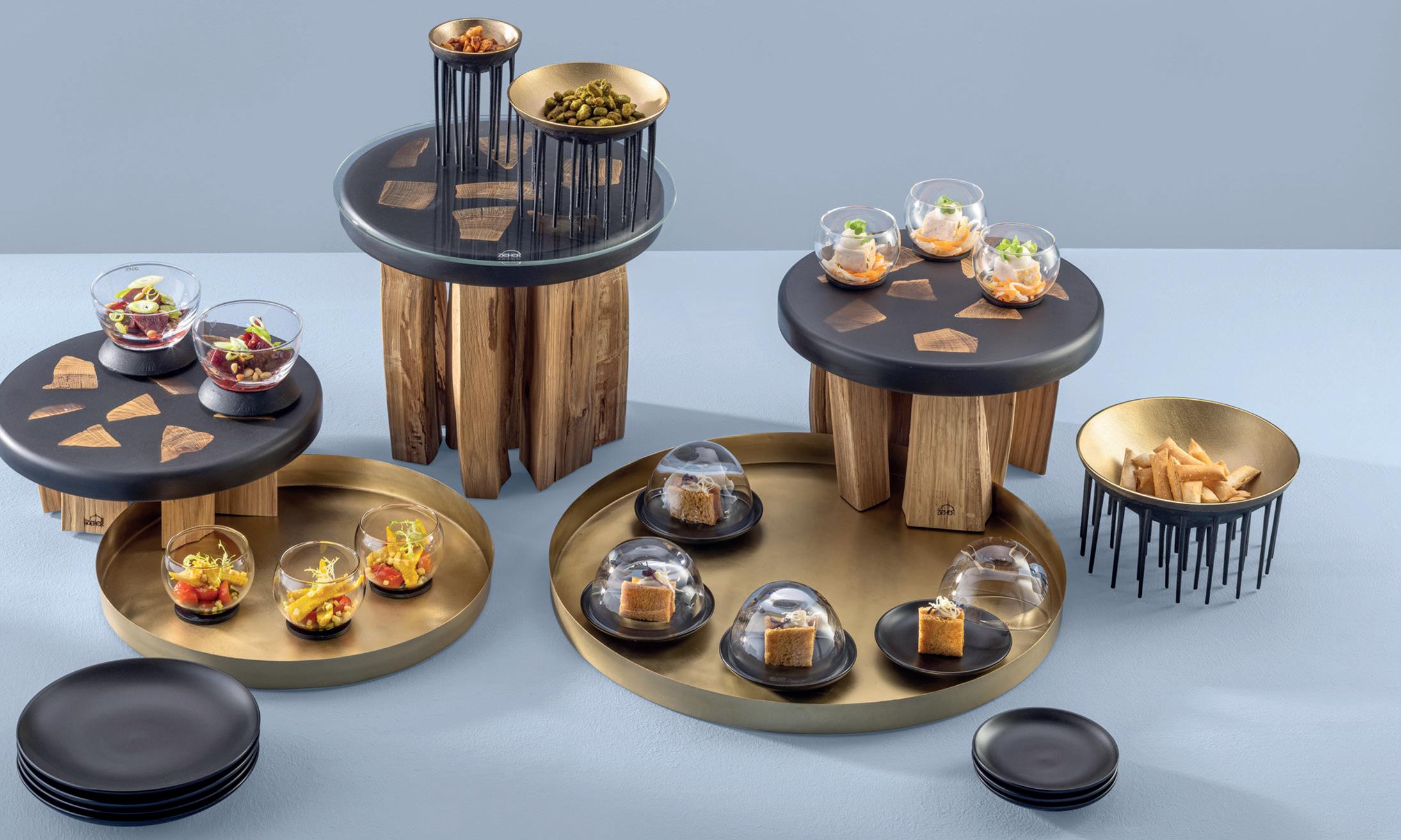
Pieces of solid oak wood, split by an axe, carefully oiled and individually arranged form the basis of Stomp!. These natural elements are then cast in anthracite. The silk matt finish of the dark coloured resin forms a harmonic contrast to the oiled oak wood. The combination of Stomp! with items made from solid brass gives maximum impact in hospitality settings.
www.zieher.com
In retrospect, how would you sum up Ambiente 2023?
We experienced a fantastic comeback with the consumer goods fairs Ambiente, Christmasworld and Creativeworld taking place simultaneously for the first time. After a break of more than two years due to the pandemic, we consciously carried out a new concept – with great success. The turnout was overwhelming! The simultaneous date combined the strengths of the fairs and created enormous synergy effects from which the 154,000 trade buyers benefited. With 170 participating nations, the internationality was higher than ever before, both on the exhibitors’ and visitors’ side. The successful start to the fair was confirmed by a terrific visitor satisfaction rate of 94 percent.
to get to, so the dining halls did not have the same momentum as kitchenware in hall 8 for example. Will Messe Frankfurt be taking those comments on board for 2024?
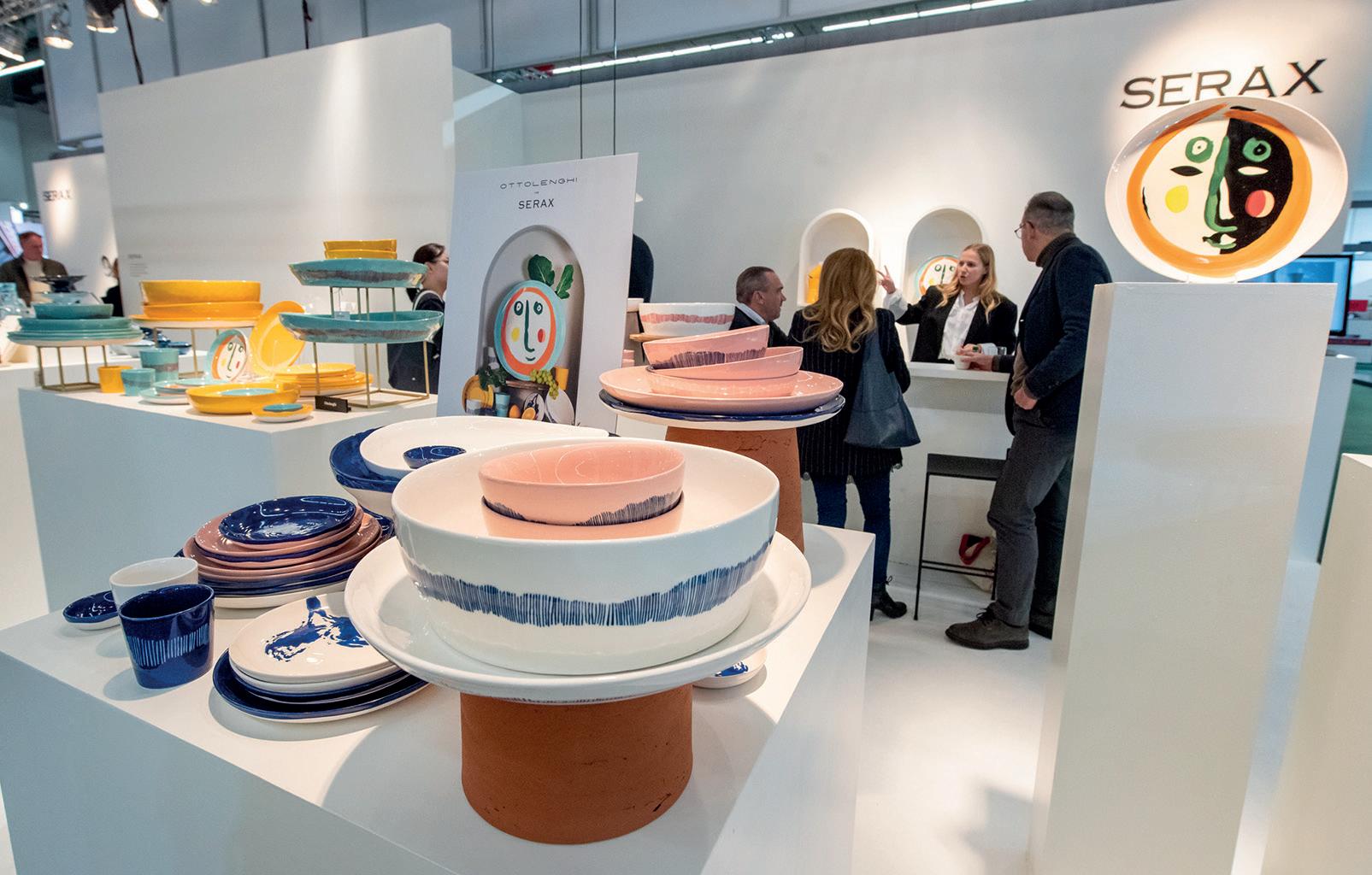
The entire western part of the Messe Frankfurt Exhibition Centre has been devoted to the dining segment. We thus created the global hotspot for the entire industry, especially for the segments kitchen and household as well as for tableware. With our own hospitality hall 11.0, we have mapped the entire glass, porcelain and ceramics segment in the wide and depth of the market in three hall levels. The stringent round tour between the halls 8, 9, 11 and 12 ensures short distances, the best orientation and optimum structures. In addition, the positioning between the Portalhaus, the train station and the Galleria offered three entrances to the western area with direct access to the target halls. The concept “trade fair of short distances” was a great success and worked fantastically well here. The deadline
for the early-booking discount for the upcoming Ambiente ended a few days ago. The feedback from customers who have already exhibited this year was very positive. In addition, many brands have reported back that they definitely want to be part of the fair again next year.
What were overall thoughts on the HoReCa hall? You
to be able to occupy areas that have not yet been used. Although we were already fully booked this year and all hall levels were occupied, we still have some square meters in the halls, for example in the routing, which we can activate and thus exploit our growth potential – and this especially for new exhibitors. Hospitality is, and remains, a strategic growth area for Ambiente. This does not exclude
were at maximum capacity for 2023, will you perhaps look at expanding HoReCa for 2024?
Hall 11.0 received an incredibly positive response and achieved an extremely high level of satisfaction – 93 per cent of the exhibitors were satisfied with the new hospitality hall. For 2024, we are now working on an optimised hall plan in order
For 2024, the HoReCa Academy will be positioned outside Hall 11.0, which organisers say will give them additional space in the hall for new exhibitors. They will also offer individual focus days for the HoReCa Academy, completely rethinking the programme.
an expansion of the programme in hall 11, but also outside of it. Thus, the offer will also be conceptually supplemented by hospitality exhibitors to be found in other dining hall levels.
Critically speaking, what did you think worked particularly well for the HoReCa hall and what are Messe Frankfurt looking at potentially changing for 2024?
We had our own hospitality hall now for the second time and this directly after the pandemic break and, despite all that, it shone as the most satisfied hall level. This shows the new approach works – within the dining area as
With plans afoot for Ambiente 2024 – HoReCa speaks with Thomas Kastl, director Ambiente Dining, about how the HoReCa hall will be developed...
Exhibitors had some thoughts in the most recent issue of Tableware International on the position of halls 11 and 12 – some felt they were too far away, and difficult
“The entire western part of the Messe Frankfurt Exhibition Centre has been devoted to the dining segment”
well as in the overall construct of the three fairs. Hall 11 is centrally located between the product groups Table, Modern Kitchen & Baking and Cook & Cut and offers plenty of space for targeted exchange between exhibitors and visitors. The specialised trade buyers benefited from the strong synergy effects. Perhaps just a few examples: target groups from the areas of interior design, concept decoration and contract business were able to make ideal use of the offer and felt picked up by the event. For the strategic growth area of commercial buyers from the B2B2B business, a whole new cosmos opened up – a huge range of offers and inspirations. The area of “Back of House” has not yet been taken up quite as much in the hall at the present time. We would like to expand this segment in the Cook & Cut area in Hall 8. The
interplay of the pure table segment supplemented by everything to do with buffets worked perfectly – let it be current lifestyles and trends or menu cards and table lighting with LED. Hospitality is the platform for innovations in the consumer goods market. The important meta theme of sustainability was strongly reflected here with environmentally friendly innovations and hospitality concepts. There was a big overlap with our a programme “Ethical Style”: the Ethical Style Spot in the Galleria showed curated products from the dining area that combined sustainability and design. The special area “Circular Materials for Future Dining”, curated by Prof. Dr. Sascha Peters, managing director of the Zukunftsinstitut HAUTE INNOVATION, encouraged a future-oriented table culture with organic, recyclable raw materials. And at the HoReCa Academy, renowned industry experts addressed sustainability from various perspectives and provided fresh impulses for the trade.
Let’s talk about the HoReCa Academy too. Firstly, it was a particularly lovely set up – but what about the speakers and content? Was it busy? Will you be changing anything about the Academy?
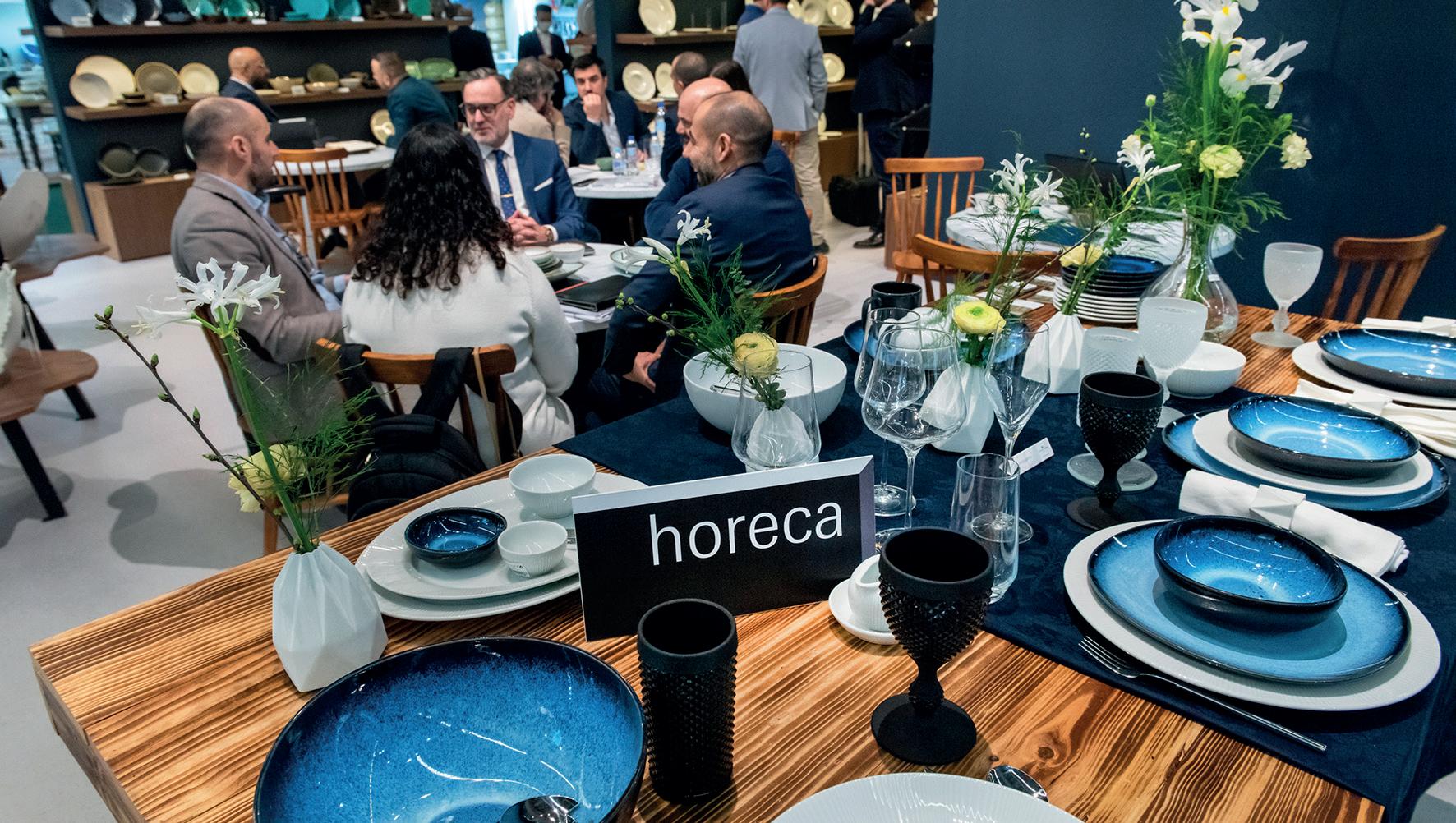
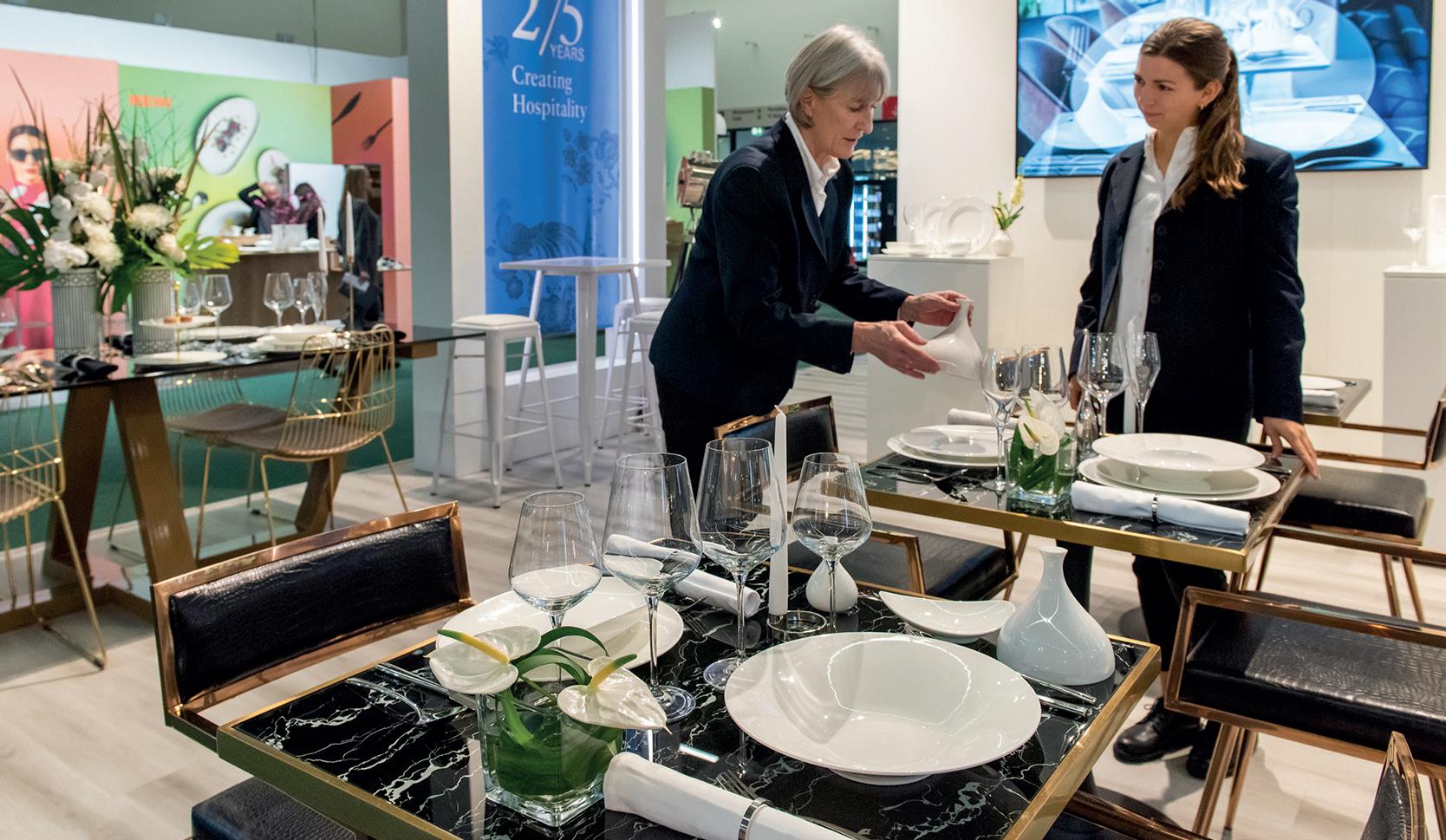
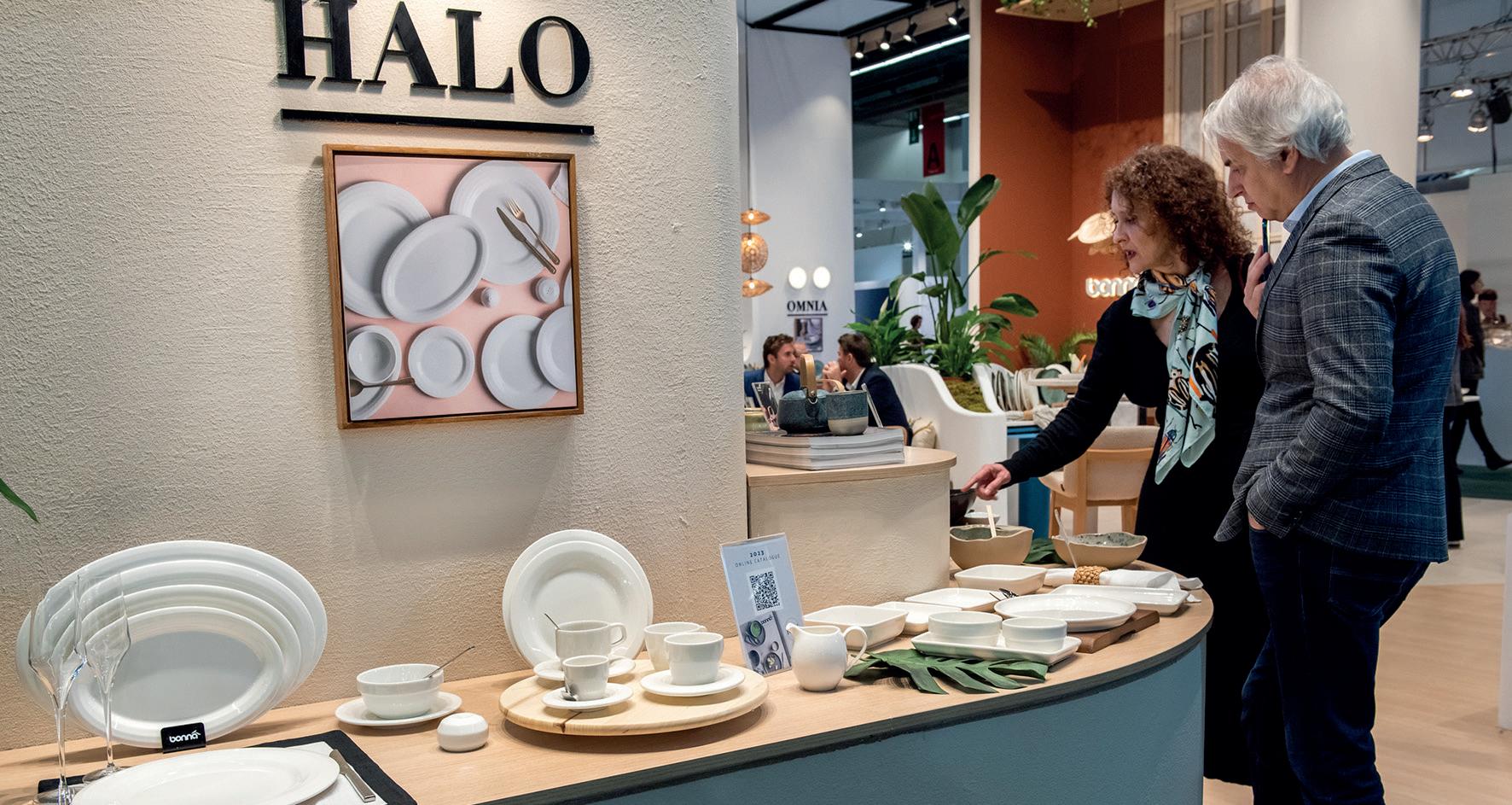
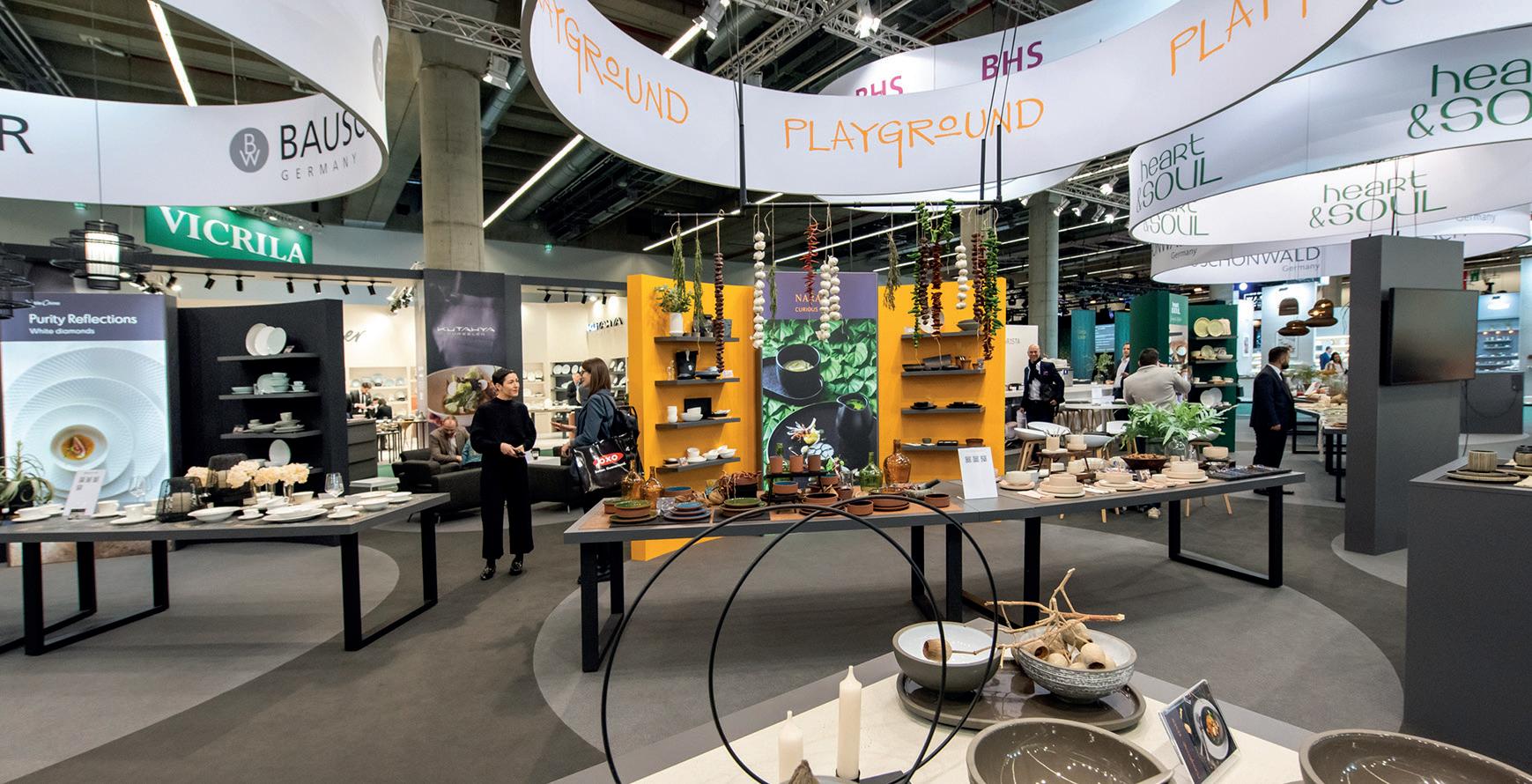
The HoReCa Academy in this form existed for the first time before the pandemic in 2020. We tested the concept again this year and clearly noticed that the industry has developed further. The hospitality industry, in particular, was strongly affected by the pandemic and has suffered enormously in the last three years. The exhibitors in the hospitality hall 11.0 were the first to confirm for the 2023 event –
the programme. In addition, we will invest more in studies created especially for the event. Let us surprise you, there will be a whole new offer here.
Finally, what would you say to exhibitors who did not attend this year but who are considering booking for 2024? It was exciting to see that customers who did not exhibit this
Ambiente 2024 will run from 26 January –30 January, 2024.
this clearly reflects the longing in the industry for the live trade fair experience after a break for more than two years. Many customers were very much looking forward to meeting exhibitors again. In terms of personal exchange, an extreme catch-up effect was noticeable. For 2024, we are already in the middle of planning and in the process of revising the concept and aligning it more specifically to the needs of the visitors. For example, we will position the HoReCa Academy outside hall 11.0, which will give us additional space on this hall level for new exhibitors. And – I can reveal this much already – we will concentrate the offer on individual focus days and completely rethink
year were on site and came to see Ambiente. The radiant power of this fair is clearly there and no one wanted to miss Ambiente. Some of them have already signalized their desire to return and definitely want to be back for the event in 2024 – this time as a proper exhibitor. Our biggest challenge now is to meet all these requests. We are the platform and the global hub of the industry – we have been in the past and we will be again in 2024. So, if you haven’t registered yet, please do so promptly. Space is – unfortunately – not infinite and we receive numerous registrations every day. As you can see, preparations for 2024 are already running at full speed.
93% of exhibitors were satisfied with the new hospitality hall.
“Hospitality is, and remains, a strategic growth area for Ambiente”
Mouth-blown from 100 per cent recycled bottes, MIA drinkware, serveware and decorative pieces have a subtly fluted texture and green tint. The MIA collection also features bowls in a variety of shapes and sizes.
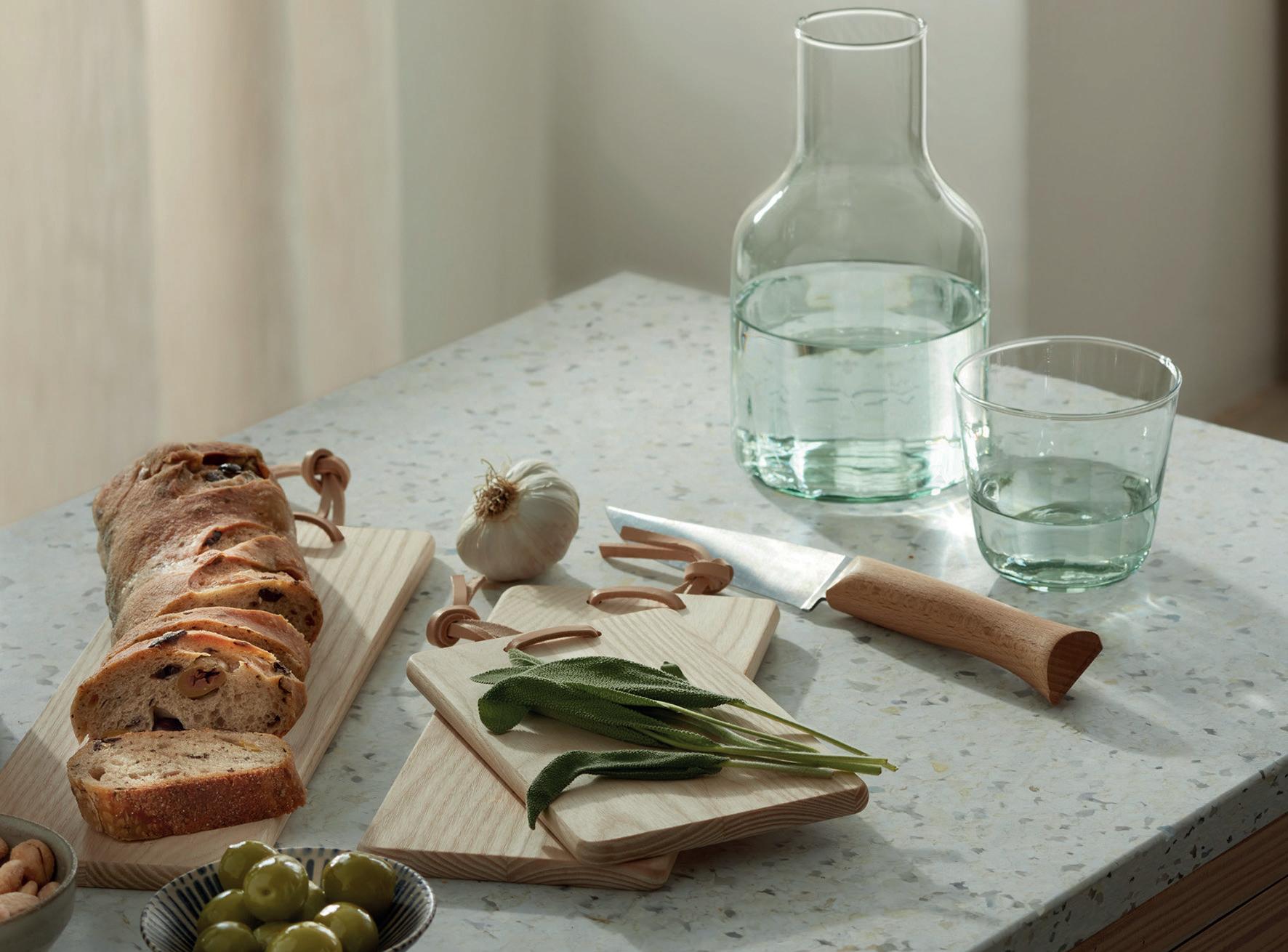
www.lsa-international.com
Products which are produced more sustainably, or offer a longer lifespan, are now a deliberate, considered choice for many hospitality venues. We look at a number of options …
An alternative to disposable cutlery, Leaves is specifically designed for those onthe-go. Amefa has optimised the disposable cutlery in size, thickness, and weight. Leaves is resistant and durable while also being reusable and recyclable. The set comes in a prewashed pouch with napkin, ready for instant use.
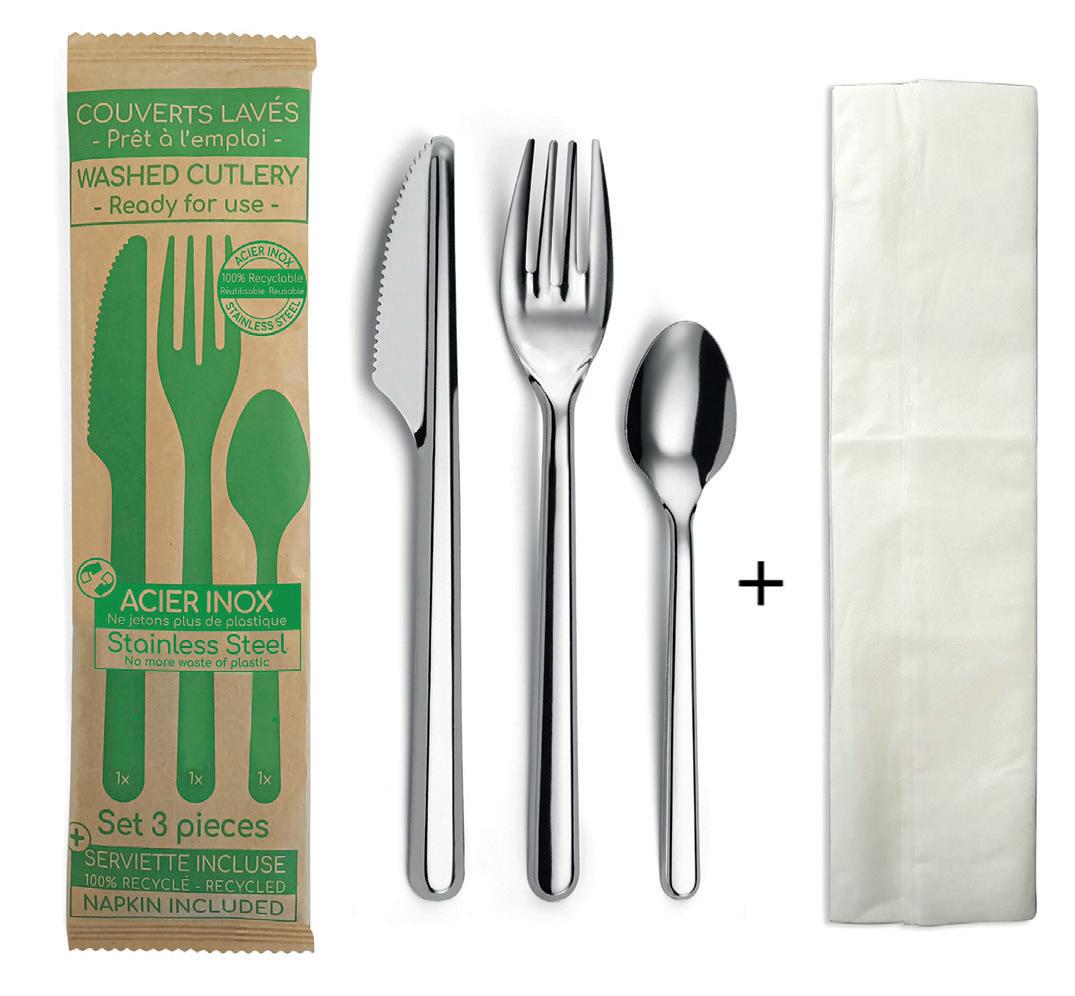
www.amefa.com
Fine 2 Dine offer customers a two-year chipping warranty. They want to show that their products can really cope with the rigours of restaurant liffe and they will gladly provide a new article in exchange if needs be. This is the case for several Fine2Dine collections. The chipping warranty applies, for instance, to Ceres, Escura, Munduk, Nova, Usko and many others.
www.fine2dine.com
In 2023 Costa Nova introduced Festa collection. Blending the one-use forms of the past and ecological sustainability alternatives came the eco-friendly Festa. Made of Ecogres, a proprietary composition of clay and recycled materials, the essence of the green economy highlights the ingenuity and endless combinations that are perfect for any food presentation.
www.costanova.pt


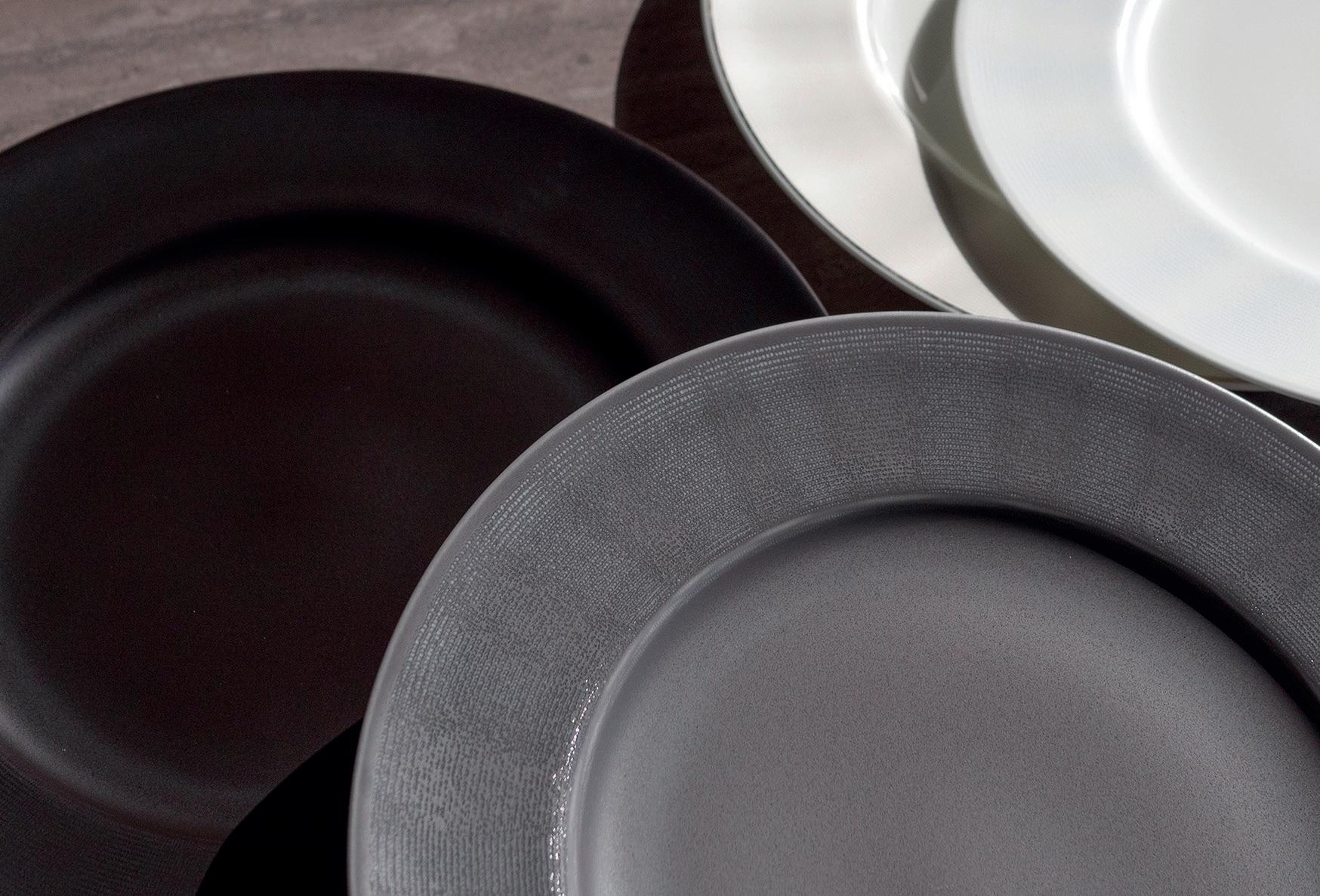
Nikko says it is moving away from the conventional model of selling out tableware, adopting a Paas (product as a service) model in which the function of tableware is continuously sold to users. The brand will collect tableware that has been used for many years in restaurants and hotels, and although there are no cracks, chips, or other damage, the patterns and gold edging has become faded, so they will re-colour them. By transforming and reproduction them, they aim to establish a model that can be used even longer.
www.nikkoceramics.com
www.utopia-tableware.com
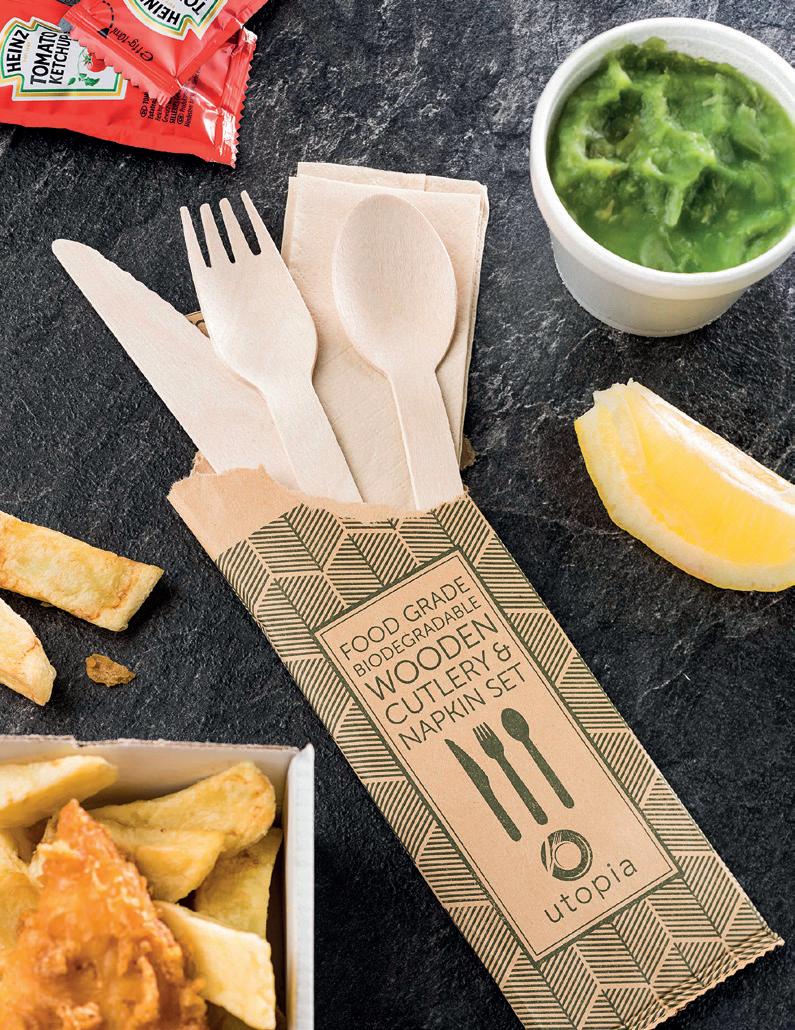
Utopia carries a range of ecofriendly, disposable wooden cutlery. Designed for practicality and sustainability, the range is made from 100 per cent FSC certified birch. The precision cut, attractive cutlery is strong enough for just about every eating occasion. The spoon and fork feature curved working areas while the knife has a serrated edge for easier cutting.
The range is available as individual packs of knives, forks and spoons as well as combination packs including utensils and napkins, handily packaged together in a recyclable brown paper bag.
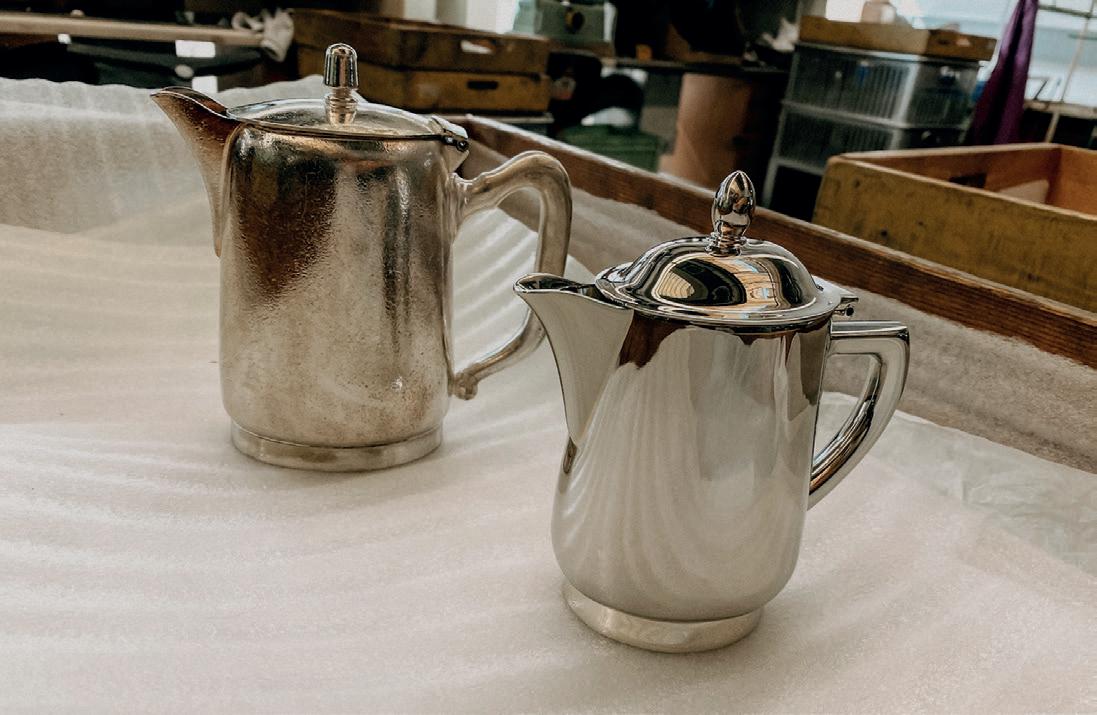
Don’t buy new, refurbish. That’s the message coming from HEPP’s service workshop. Being able to remanufacture silverware makes a decisive contribution to a long service life and is particularly economical and sustainable, the HEPP team points out. Considering the long period of use of silverware, cost savings of up to 50 percent are possible. In the HEPP service workshop, cutlery is thoroughly polished every day, handles are patiently reattached to jugs or cutlery parts are lovingly engraved.
www.hepp.de
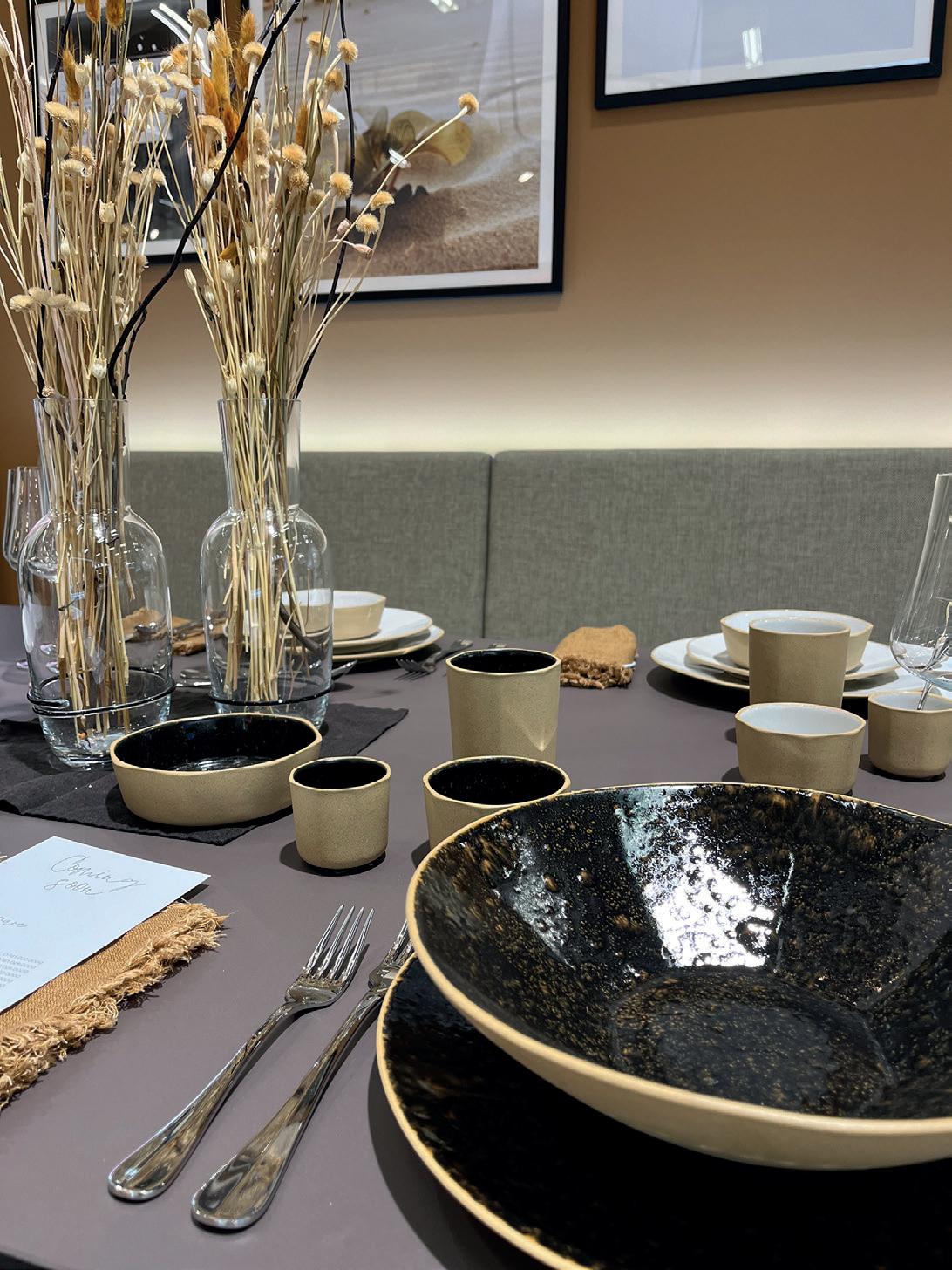
Terra Nova from Fortessa is made from recycled ceramic material. The collection combines the aesthetics of a natural, sustainable material with a modern design. Creating beautiful contrasts between the powdery appearance of the ceramic material and the glossy glazed surfaces in white and dark brown.
www.united-tables.de
For their part, Lazzaro has introduced a new engineered range known as Duraedge – a lightweight range with enhanced durability and longevity. All products with Duraedge mark come with a lifetime chip warranty. The longer the plate lives, the better for the environment! The brand says their plates are lighter than normal too –Duraedge’s 27cm dinner plate weighs less than 575gms, for example.
lazzaro.in
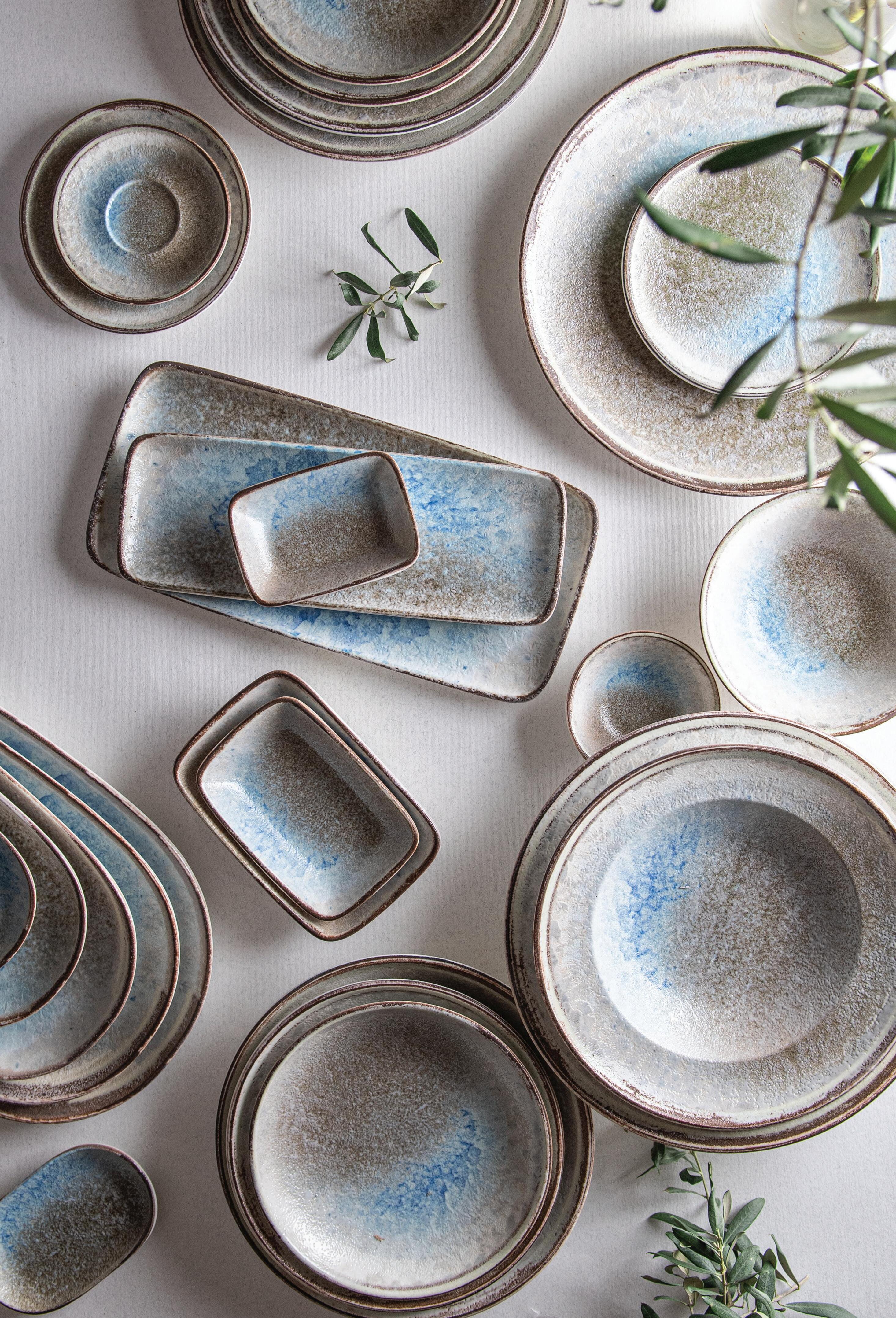


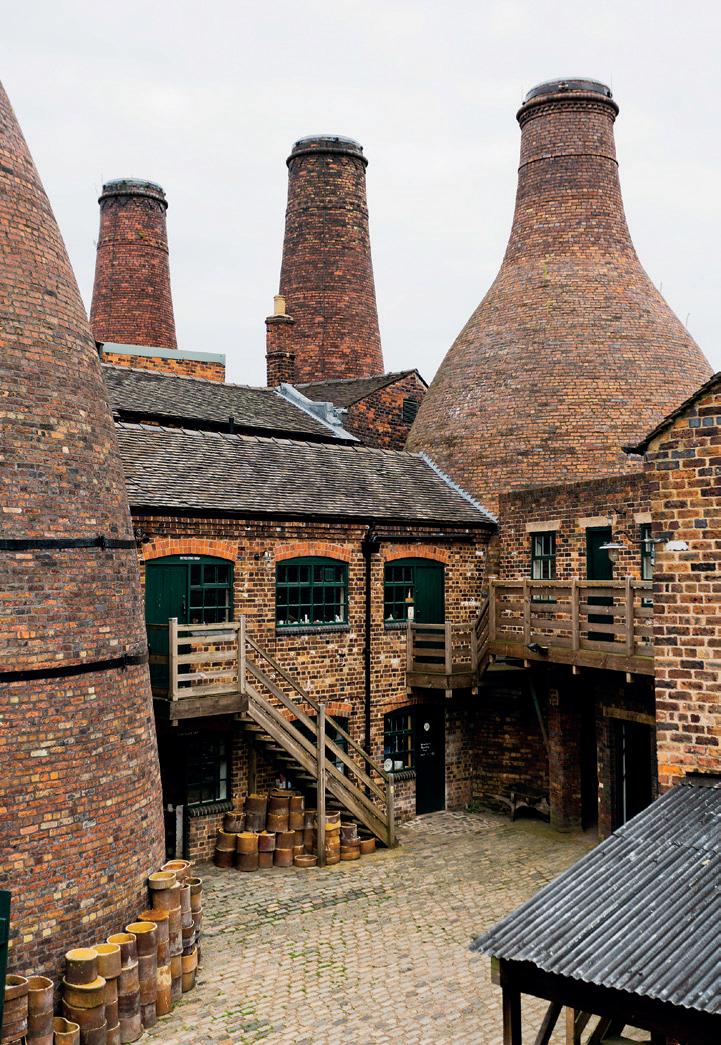
Passionate about keeping the flame of the British ceramics industry alive, Richard Brendon is a designer for the future. High-end clientele like The Peninsula London, The Connaught and Gleneagles challenge him to create new, inventive glass and tableware collections, all the while protecting the age-old craftspersonship found in Stoke-on-Trent. HoReCa’s editor Mairead Wilmot learns more…
“The backbone of our business, and what stands us out from the rest, is our marriage between the two, so I couldn’t possibly pick! Whilst creating beautiful products is paramount to us, we don’t ever allow aesthetic to take away from function, so it really is a true partnership that will ultimately ensure our products last a lifetime in the home.”
It’s been a year for Richard Brendon. Over the course of the past 12 months, the designer has secured three of his largest contracts since his brand launched 10 years ago. “The last 12 months have been amazing… and although unpredictable, it’s ultimately been extremely exciting and successful,” he tells HoReCa.
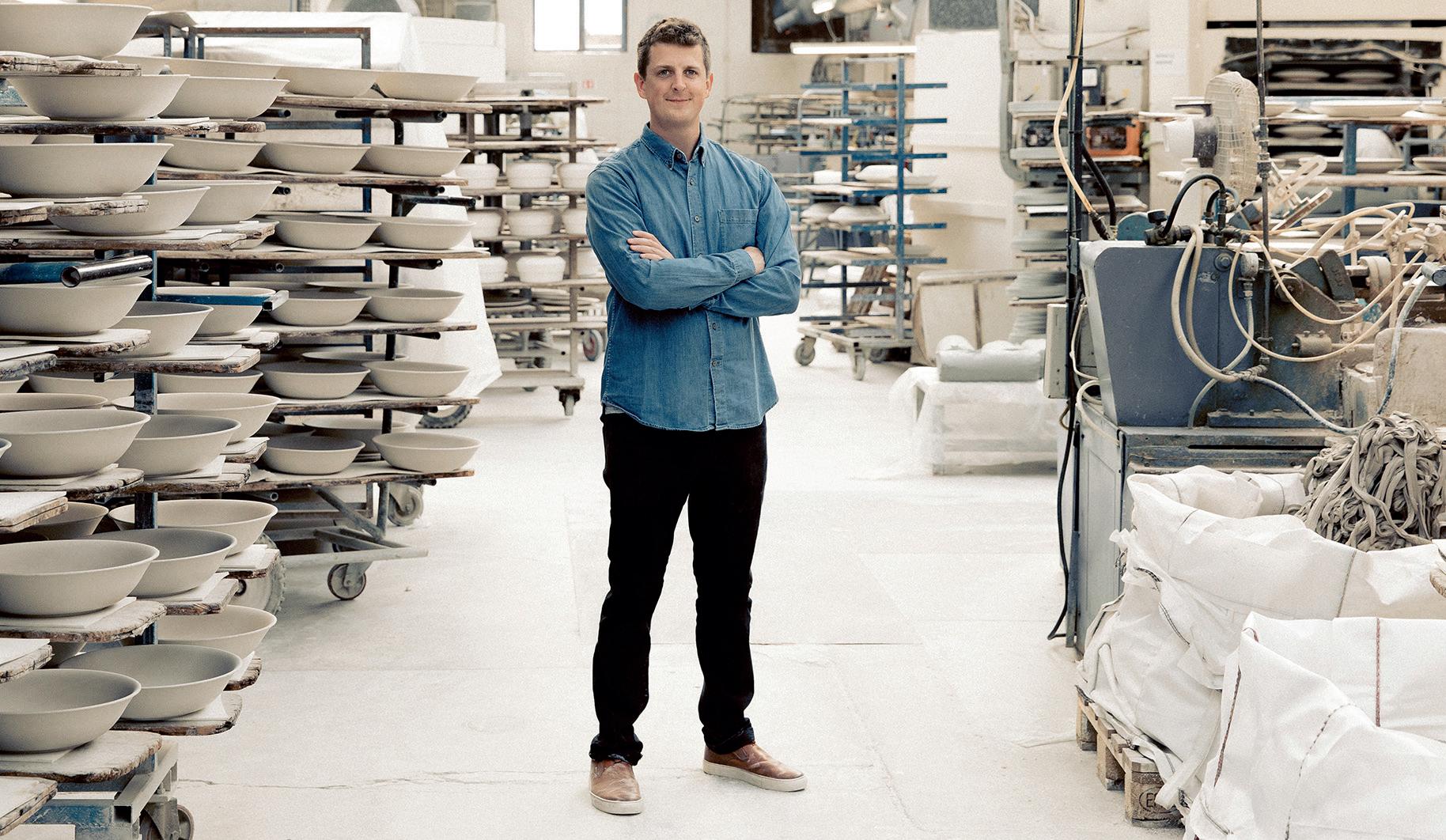
Along with winning major contracts, Richard and his team have spent time ironing out any kinks which arose thanks to the pandemic and the war in Ukraine.
“We’ve put a lot of work and effort into improving our supply chain, as the pandemic and war in Ukraine exposed some weaknesses that we hadn’t realised previously, but I’m pleased to say
it’s really paid off and our supply chain is now very robust. We’re busier than ever and in a very important period of growth, with many exciting things to come.”
Passionate about the industry as a whole, Richard’s designs have not just connected with buyers, but with consumers too. And perhaps more importantly, he is committed to the regeneration of the British ceramics industry. His bone china collections, for example, are made in Stoke-onTrent but he is keenly aware that it’s a vastly reduced workforce which could be Stoke’s downfall over anything else.
“One of the great benefits of producing our bone china in Stoke-on-Trent has meant we haven’t encountered the material
sourcing difficulties we may have done if we were producing abroad. The challenges in Stoke are more because of a very limited workforce that has rapidly dwindled over the past 50 years or so. Regenerating the ceramic industry in Stoke is of utmost importance to us as a brand, and the work we’re managing to put back into this heritage industry is continuing to grow. It’s our long-term goal to make the British ceramics sector a real powerhouse again by inspiring younger people with a creative passion to enter the industry.”
Conversely, the designer –who creates collections for both hospitality and retail – believes the supply chain issues and high energy prices which have
“There’s a real variety, and it depends on the client’s needs. We have a beautiful and wide-ranging selection of ready-to-go collections, which are hugely popular with retailers and direct-to-consumer and they come with the added benefit of being immediately ready. However, it’s often important to clients to have a bespoke design to correspond with their brand and story, particularly for new openings and brands requiring much higher quantities, such as hotels. We
dogged the industry, particularly the glassware sector, has led to a stronger, more confident trade which also happens to be the most competitive it’s ever been.
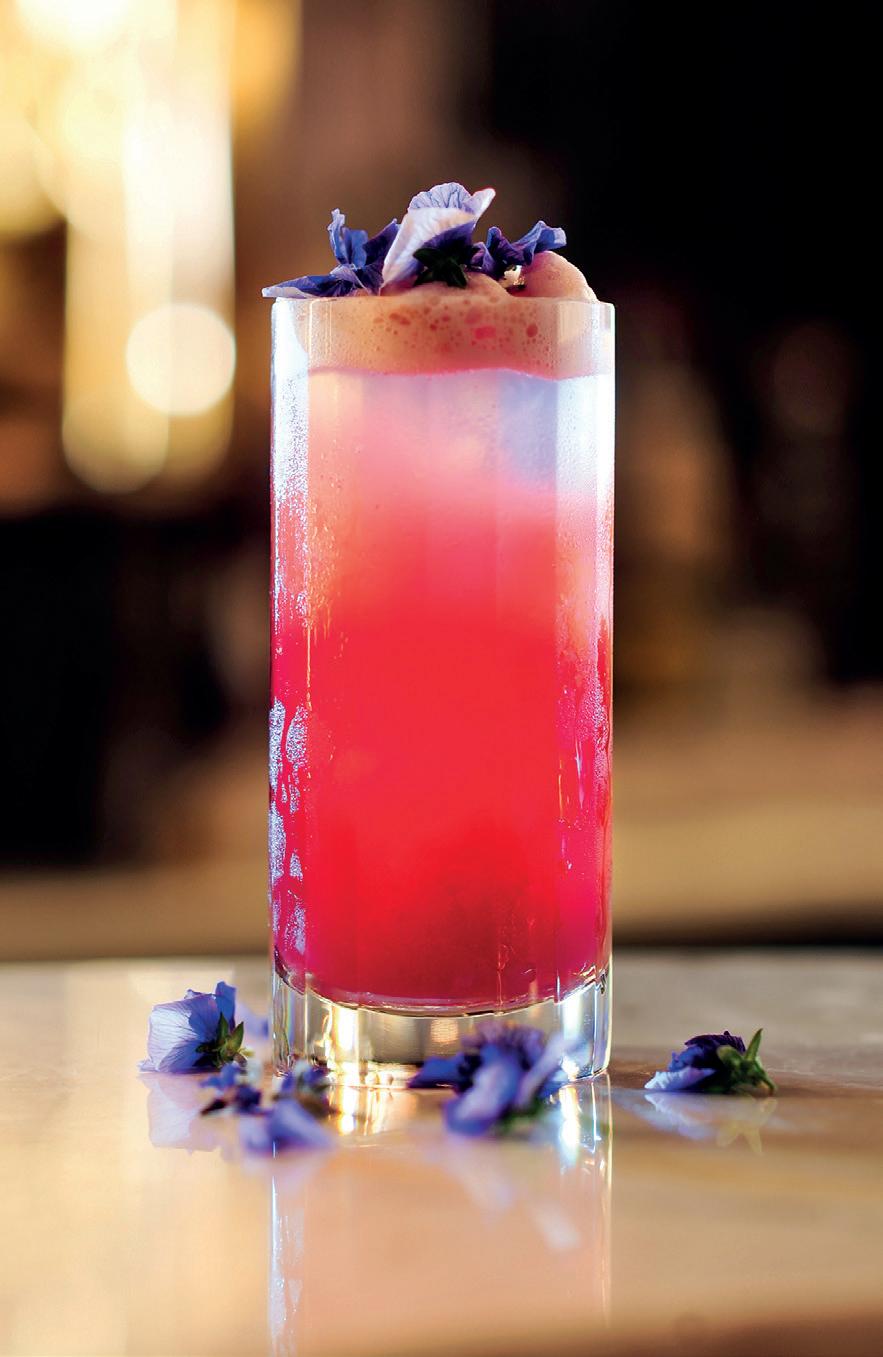
“The tabletop sector is a much more diverse space than it was ten years ago; from luxury fashion houses to the high street, multiple brands have expanded into the homeware space,” Richard confides. “There’s plenty of room for everyone, especially with the growing attention consumers are now paying to the home, but it’s definitely much more competitive than ever before.”
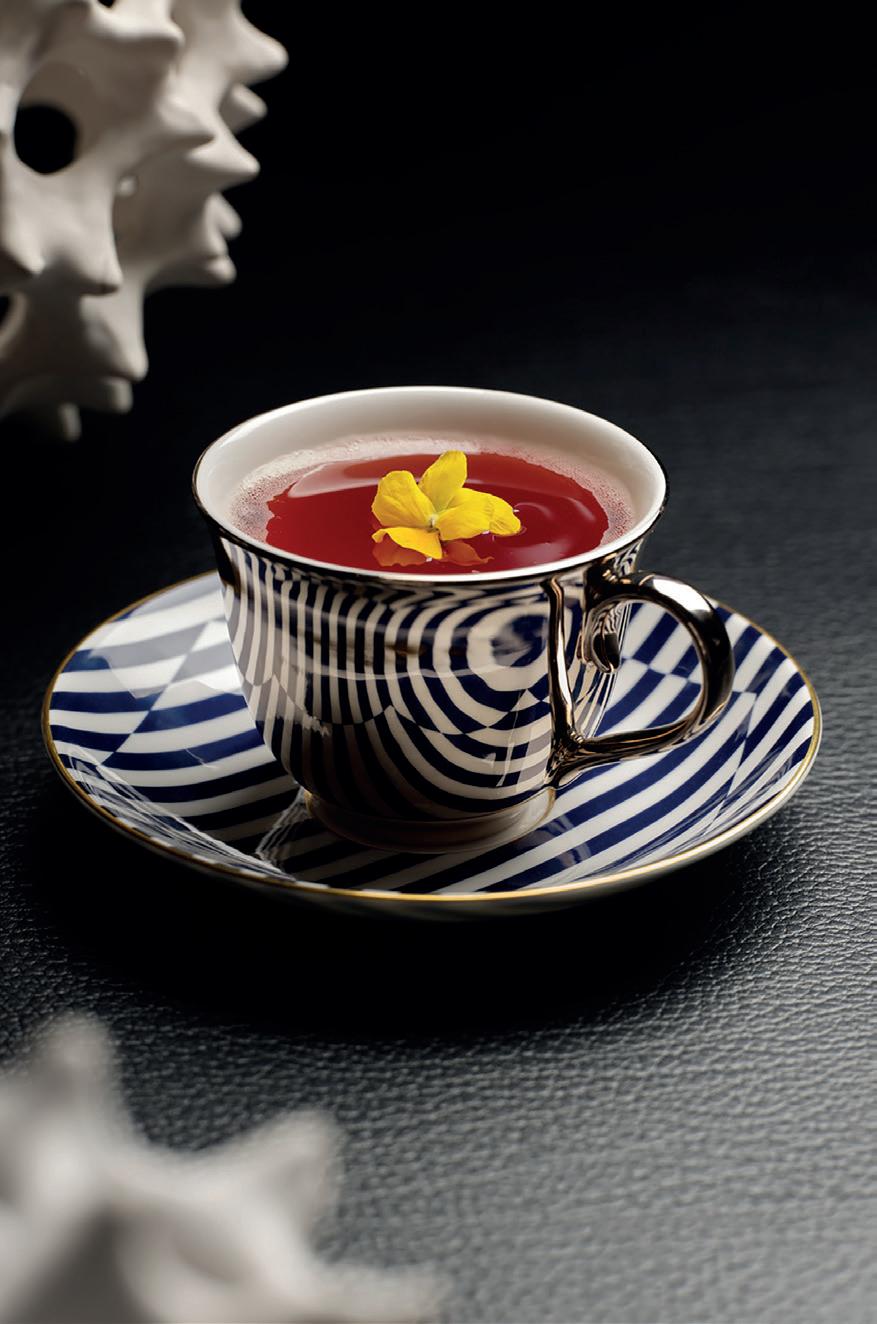
One of Richard’s most recent projects – Concertina – has been for The Peninsula London, a newly opened five-star venue on the heart of Belgravia. The collection’s décor was inspired by hotel lobby’s architecture. Interestingly, Richard and his team created a footed teacup for Concertina which meant restoring a foot turning machine
to allow for the making of the brand-new teacup shape.
“We were absolutely delighted to be chosen to create a bespoke pattern for The Peninsula London. It’s without doubt one of the most significant openings in London this year, if not this decade, and we are so proud to be involved. The Concertina pattern takes inspiration from the interior architecture of the lobby; a space of true grandeur and elegance, it was important that the pattern reflected this. The design brings together cues from the grand fluted columns alongside the graceful, octagonal details in the coffered ceiling, whilst the bone china shapes are inspired by English tea and coffee ware from the 19th century. We created new shapes specifically for this project, including a footed teacup. This involved sourcing a foot turning machine which needed restoration just for this project, to originate a brand-new teacup
tend to do much more bespoke work with our bone china rather than our crystal, as it’s relatively simple to decorate existing shapes with new, custom patterns. However, we can also do custom glassware, whether adding simple monograms or indulging in more creative projects involving painting glassware for truly unique products. This is something we’ve had a lot of fun doing with Ago Perrone at The Connaught, and for The American Bar at Gleneagles.”
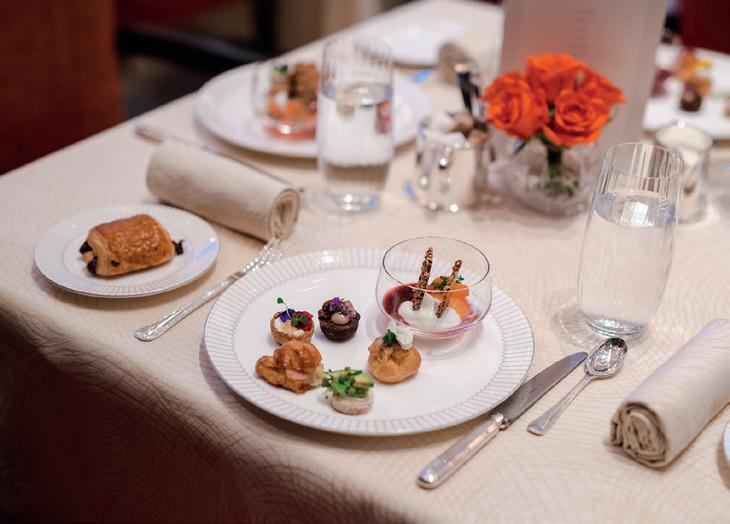
shape – something that hasn’t been done in Stoke-on-Trent in a very long time.”
Expanding on the inspiration for Concertina, Richard tells us: “Once we saw the design plans for The Peninsula London and the historic inspiration behind the iconic Belgravia site, it was clear that this mix of heritage and innovation should be reflected in the bone china we produced. We picked out the linear quality of the architectural details, combined it with a contemporary take on the classic teacup shape, and used real gold to give a luxurious feel that is very ‘Peninsula’.”
While designing for retail and direct-to-consumer is a ‘significant’ part of the Richard Brendon business profile, so too is creating for hospitality. So, how does that influence the way Richard designs?
“As a brand, we pride ourselves on marrying aesthetic with function, and therefore every single product we create stands on the backbone
of practicality and functionality. A common misconception is that the fine appearance of bone china means it lacks strength… on the contrary, it’s the strongest ceramic, and far stronger than porcelain due to its unique composition. This is particularly useful in the HoReCa sector, as our pieces are much less prone to chipping than those made of other materials and will therefore keep their beautiful appearance for a much longer time.”
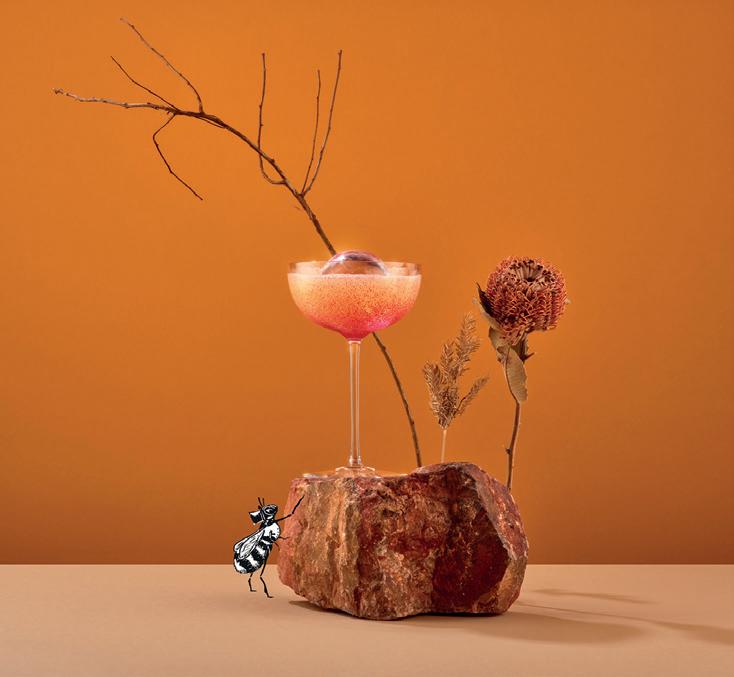
For Richard Brendon fans, there is plenty coming down the line to excite, although the designer remains tight-lipped on what exactly that is!
“We’re extremely busy with our hospitality projects, but also have two very exciting bone china launches coming later this year. One is a collaborative collection and something we’ve been wanting to do for a long time, so we’re very excited to unveil it in the autumn!”
Richard is recognised for his glassware and bone china designsAs more and more hospitality settings look at reducing their environmental impact, one supplier has its heart set on making upcycled glassware the norm but with the added bonus of supporting local communities in India and Indonesia. Nico De Wilde, co-founder of iWas, explains more to HoReCa’s Mairead Wilmot about the company’s unique setup...
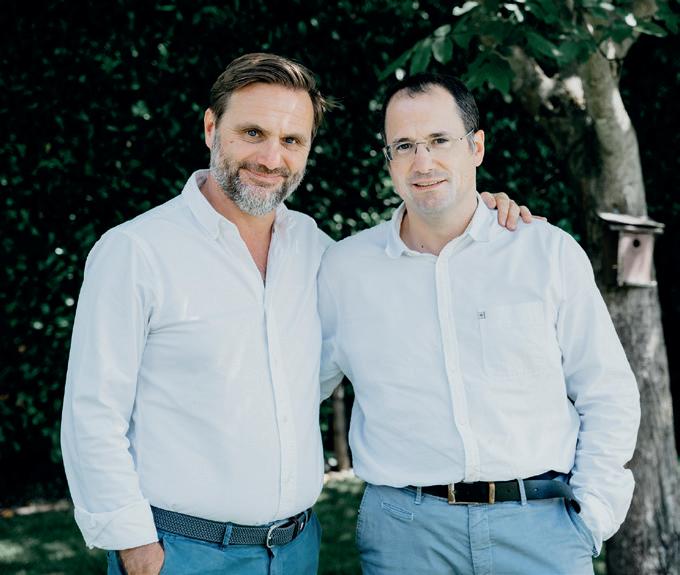
Nico, tell us about iWAS and the ethos of the company?
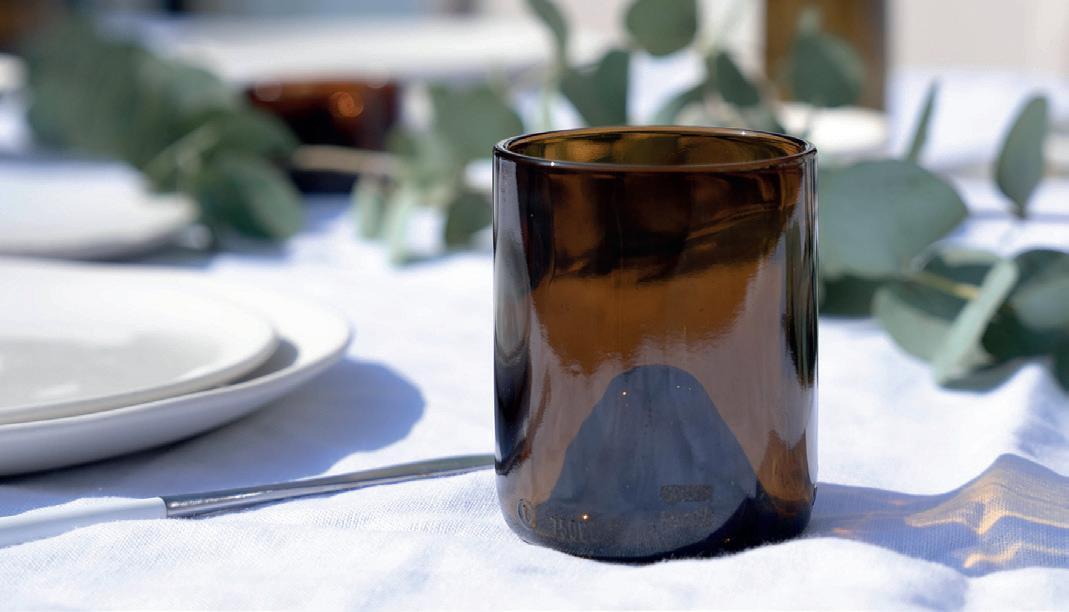
Forget out with the old, in with the new, we make the old new again by upcycling waste to musthaves. By adding value without adding new waste or spilling energy. We recreate and design a new purpose for each object, while maintaining its unique and authentic characteristics.
What sort of products do you produce and how are they made?
We specialise in upcycled glassware. We have our own unique setup with our boutique hand-made production. What
makes us unique is that we own the production facility in India, we support our local workers and we operate from Europe with our design and support team. So the HoReCa sector and tableware companies can come to us for their assembly of a unique collection of upcycled glassware and or OEM collaboration.
How do you work with the hospitality sector?
iWas products are commonly used in the HoReCa sector as an alternative to traditional glassware. Some examples of our products being used in hospitality are
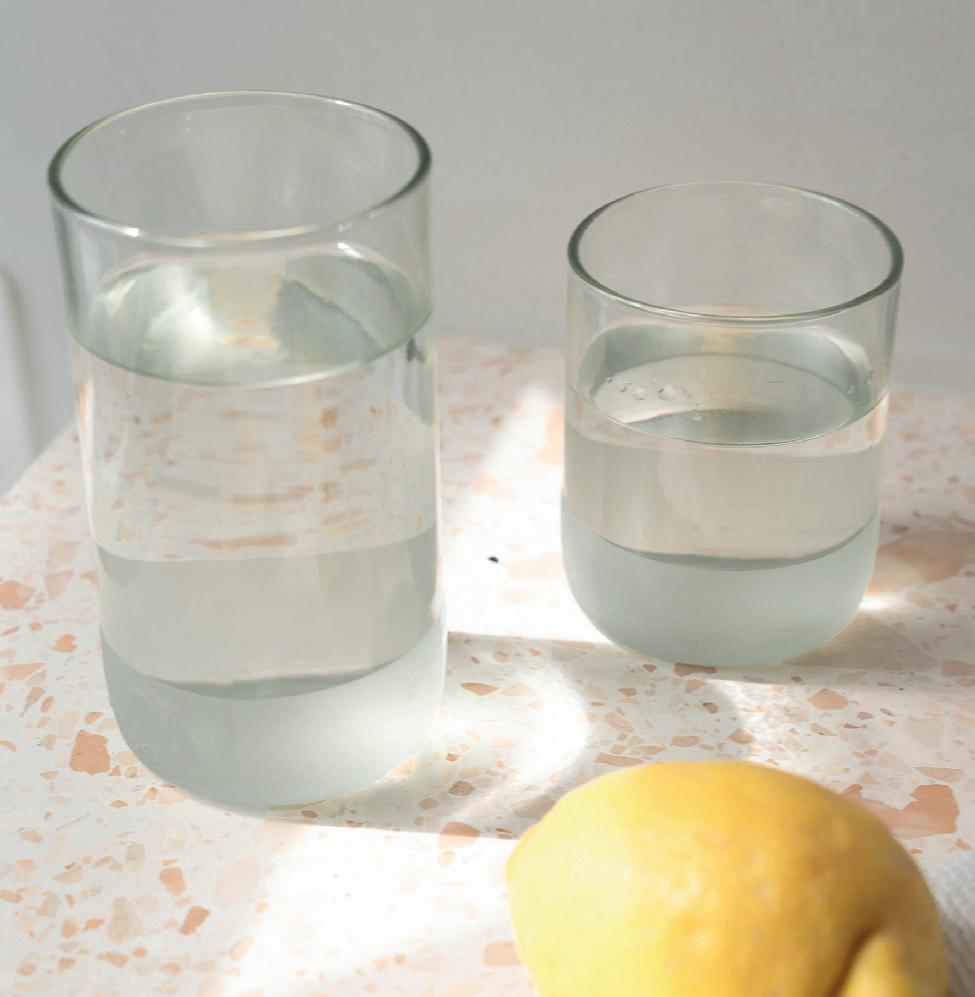
water and drinking glasses, vases, carafes, serving bowls. We can cater for both large scale orders and bespoke orders, depending on the needs of the customer. As a company focused on
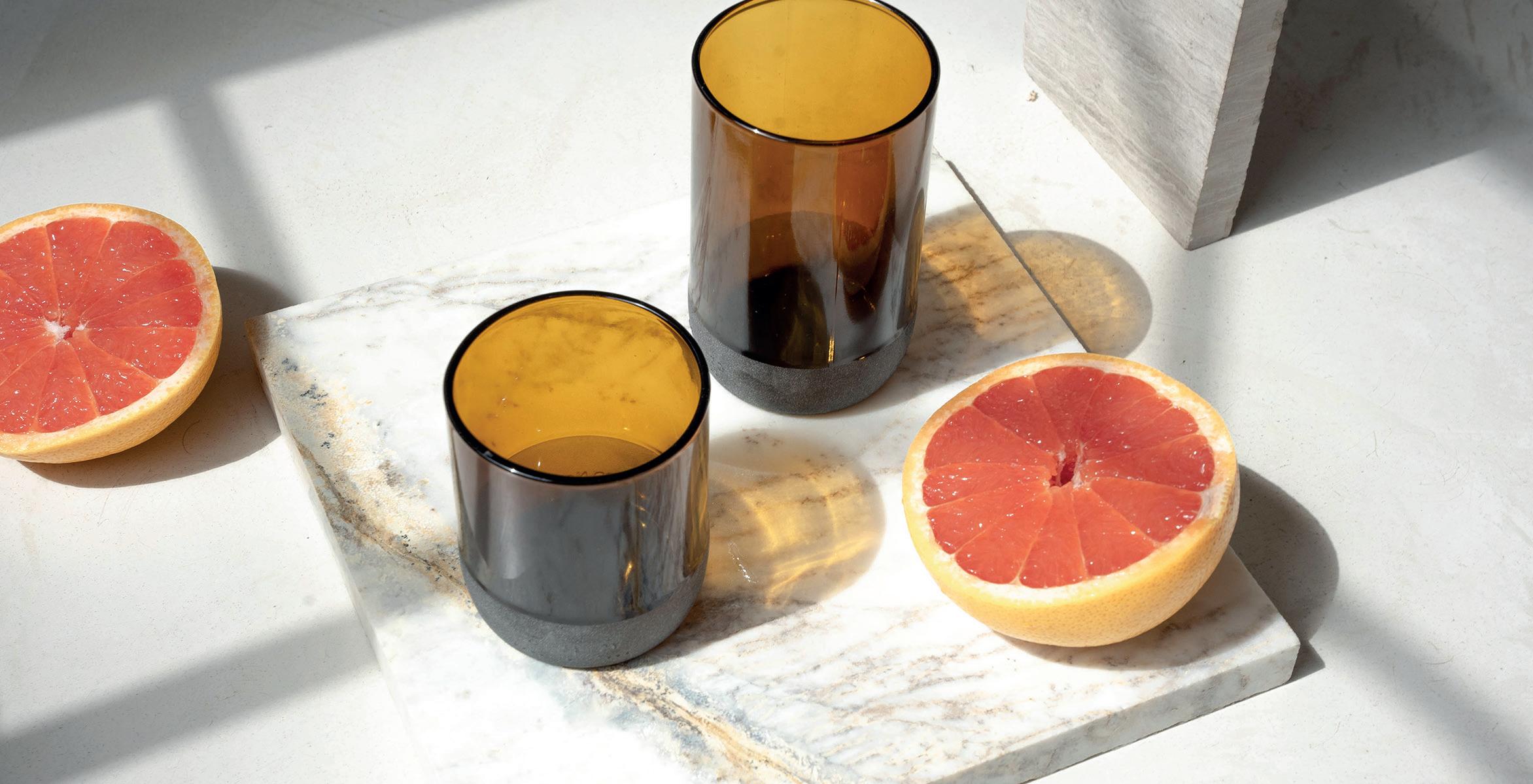
Give us some examples of iWas products being used in the HoReCa sector?
iWas has already provided many boutique hotels, such as Yalo in Ghent, with a unique collection of
sustainability, we believe there is a growing audience within the hospitality sector for more considered and environmentallyfriendly products like ours.
upcycled glassware products for their rooms and restaurant. The hotels help promote iWas’s sustainability story by providing customers with leaflets or flyers explaining that they are drinking from environmentallyfriendly glasses.
iWas has also created bespoke collections for some tableware companies, providing them with a unique collection of upcycled glassware products that they can offer to their own customers. This
“The market for sustainable glass and tableware is expected to grow significantly in the coming years”
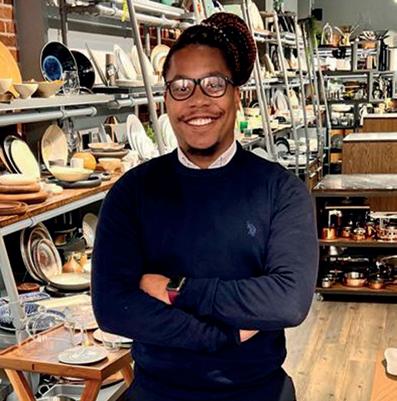
Smaller bespoke orders iWAS can manage locally with its support team in Europe (Belgium) while larger orders they supply directly from their manufactory in India.Two of iWas’s four co-founders Nico De Wilde with Dries Moens
allows the tableware companies to share iWas’s unique upcycling story and promote sustainable practices. iWas has also worked with TV chefs to create signature collections of upcycled glassware products. These collaborations allow iWas to showcase their unique products to a wider audience and promote the use of sustainable materials in the food and hospitality industries.
Can you cater for large scale orders or are you more bespoke?
Yes, that’s what makes us unique. Smaller bespoke orders we can manage locally with our support team in Europe (Belgium) and larger orders we supply directly from our manufacturing in India. Your story is one of
and tableware is expected to grow significantly in the coming years. According to a report by Allied Market Research, the global eco-friendly tableware market is projected to reach $44.34 billion by 2027, growing at a CAGR of 6.2 per cent from 2020 to 2027.
products, these businesses can improve their sustainability score and appeal to environmentallyconscious consumers. Overall, there is a growing demand for sustainable products, including glass and tableware, and the potential
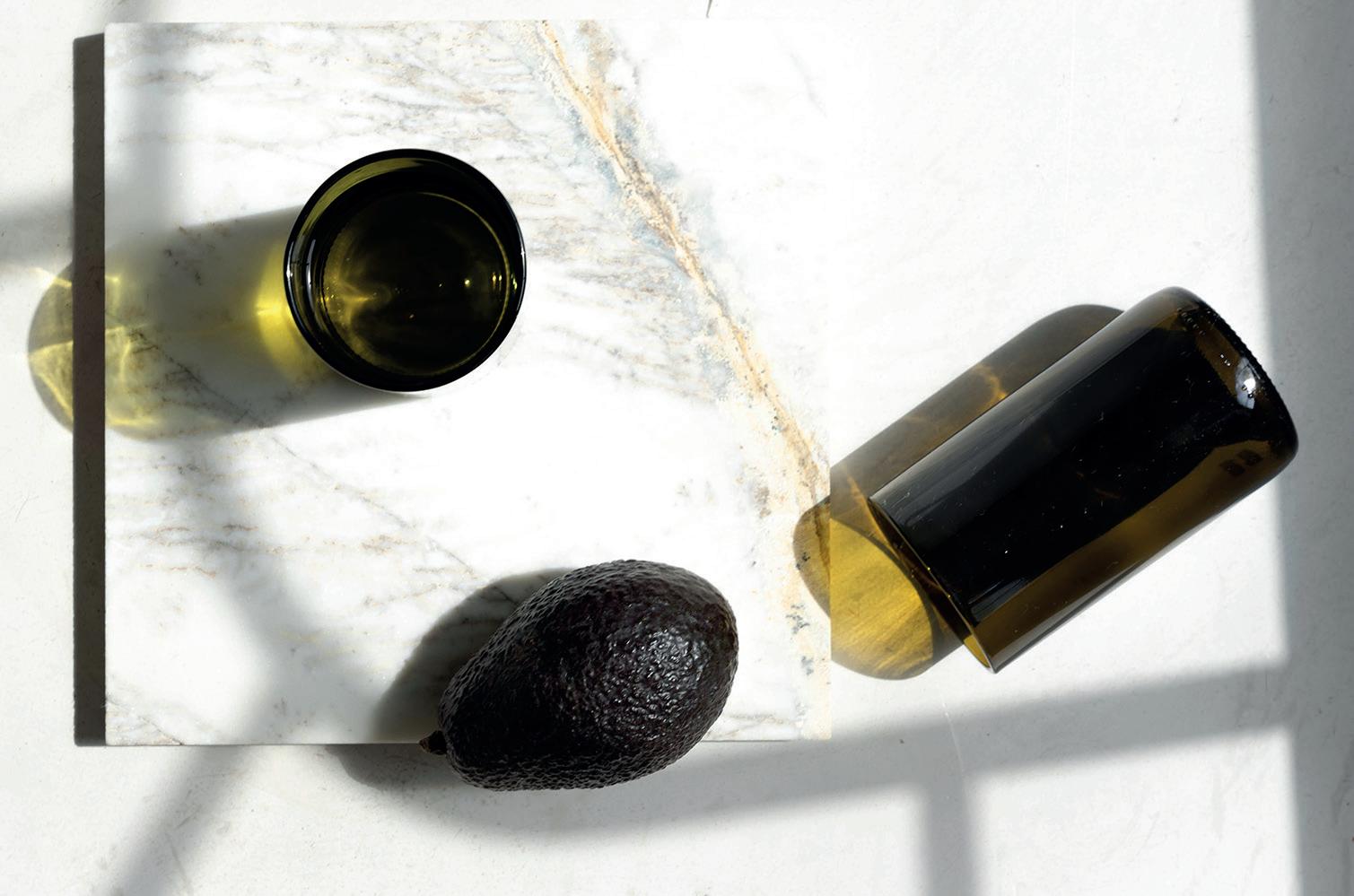
iWAS partners in India and Indonesia collect waste to avoid them ending up in the landfills.
sustainability, do you feel there is a real audience within the hospitality sector for more considered products like yours?
The demand for sustainable products, including glass and tableware, is on the rise. According to a study by Nielsen, 81 per cent of global respondents feel strongly that companies should help improve the environment. The market for sustainable glass
Many consumers are willing to pay more for sustainable products. According to a survey by Accenture, 60 per cent of consumers are willing to pay more for sustainable products that are better for the environment. The hospitality sector, including hotels and restaurants, is increasingly looking for sustainable options when it comes to glass and tableware. By using sustainable
market size for these products is significant. As consumers become more environmentallyconscious and businesses look for ways to reduce their environmental impact, the demand for sustainable glass and tableware is likely to continue to grow.
What about retail, do you also supply shops etc?
iWas also supplies retail shops and other businesses with upcycled glassware products.
How can the tableware industry reach you?
They can reach us via email: hello@iwasproducts.com Linkedin: www.linkedin.com/ company/iwas-products/
As an upcycling specialist, iWAS gives unwanted items like glass bottles a new lease on life. The difference between upcycling and recycling? They creatively repurpose old materials like glass bottles, tyres and coffee bags, preserving their unique, original characteristics, simply by adding craftmanship and clever design. Recycling, on the otherhand, is an energyintensive process in which products are broken down to their raw materials to be used as resources.
All iWAS products are hand-made by local artisans in India and Indonesia. They give back to the community by providing durable employment and by valuing the work of local communities. The company says each of its upcycling partners is part of a bigger story.
“As a company focused on sustainability, we believe there is a growing audience within the hospitality sector for more considered and environmentally-friendly products like ours”
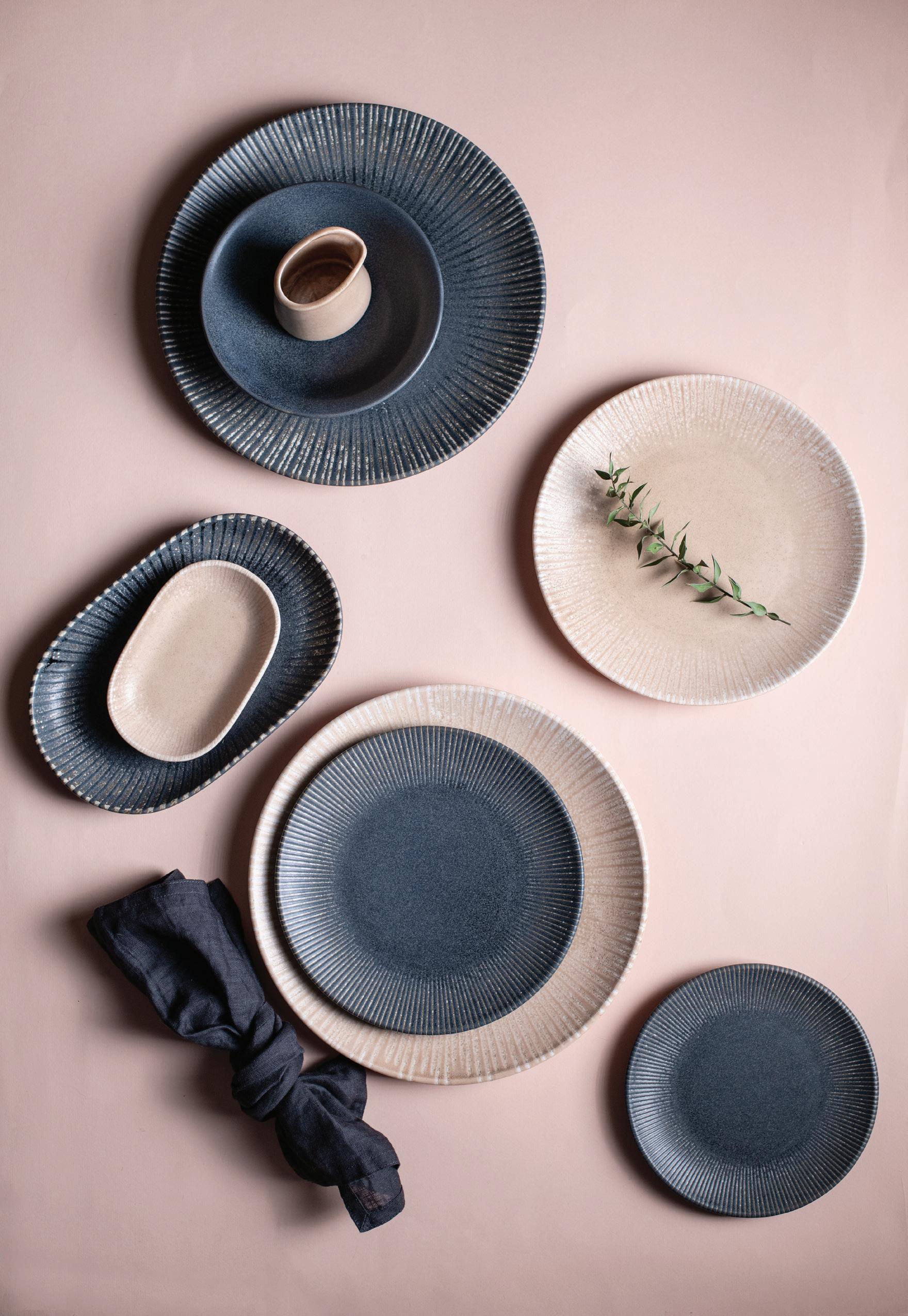
The National Restaurant Association Show (NRA Show) brings together the essentials for the hospitality sector from business-boosting technology to the latest menu trends and of course, the tableware industry is represented in force. We highlight some key exhibitors…
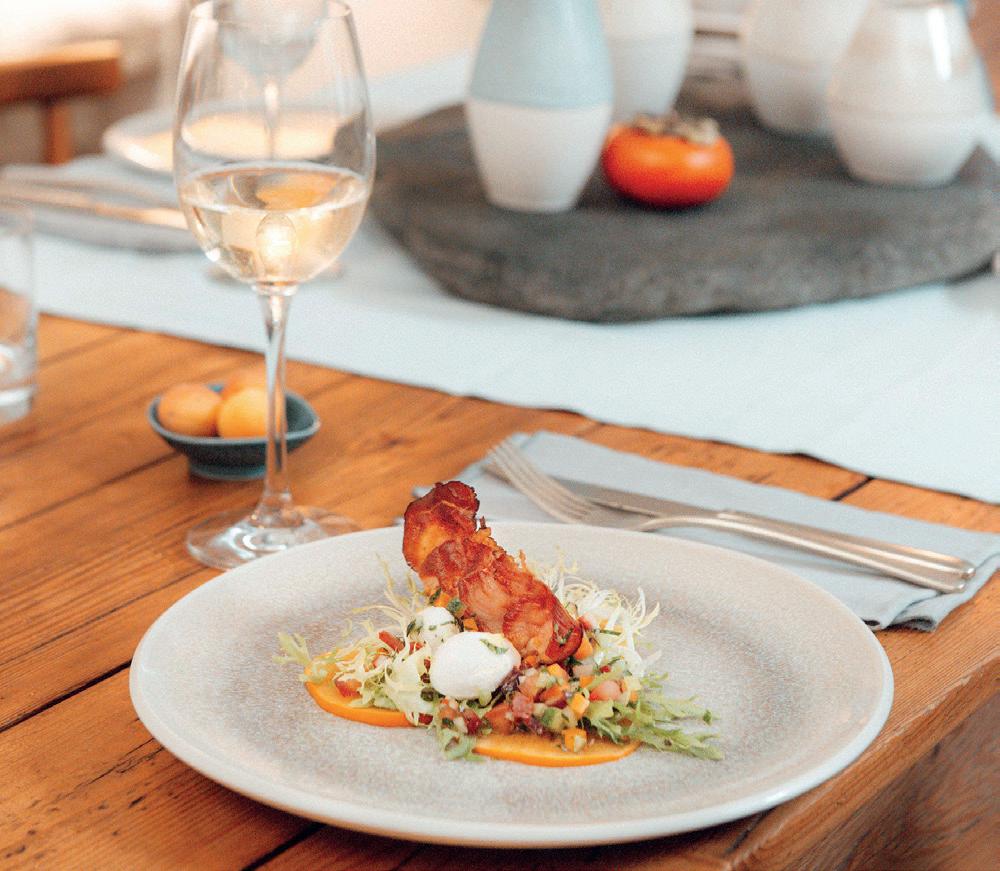
What? National Restaurant Association Show 2023 When? 20 – 23 May 2023 Where? McCormick Place, Chicago
North Building – 8253
Exhibiting at this year’s NRA Show for the first time, Fine Dining & Living boasting an array of porcelain tableware ideal for hospitality. At the show they will be presenting two hospitality brands – Fine2Dine and CHIC. Fine2Dine is aimed at those looking for something different and on trend, while CHIC offers timeless elegance for any occasion.
The company says that it has noticed at fairs such as Ambiente and Maison&Objet that there is growing interest in the company from American clients.
www.finediningandliving.eu
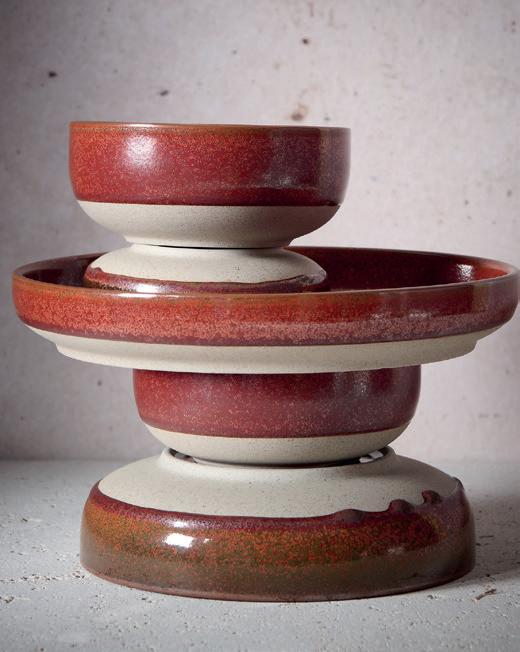
North Building – 7225
Rosenthal Sambonet USA, the American division of Italian Arcturus Group based in Randolph, New Jersey. In this prestigious setting, strategic for HoReCa sector, the group will show the novelties for each brand, and a special selection for B2B customers. The group will feature both a medium-high level mise-en-place offer with Sambonet flatware and Rosenthal porcelain, and Paderno World Cuisine professional cookware. rosenthal-hotel-restaurant.com
North Building – 6612
Steelite International will exhibit at the NRA show presenting an array of top-tier brands such as RCR Cristalleria and William Edwards with collections like Fizz, Sultan’s Blue and Hive. www.steeliteinternational.com
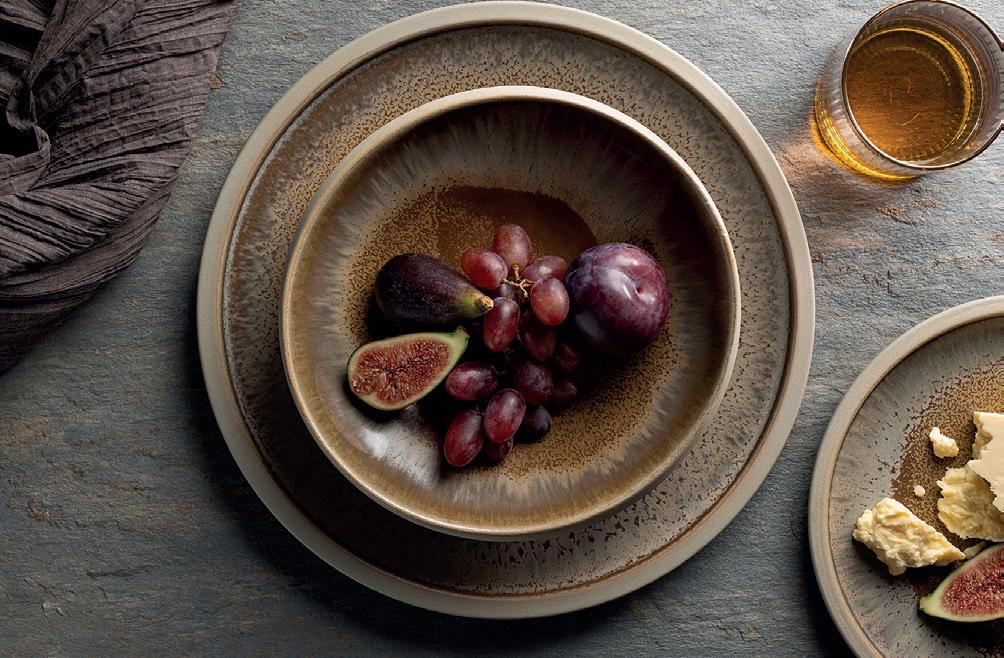
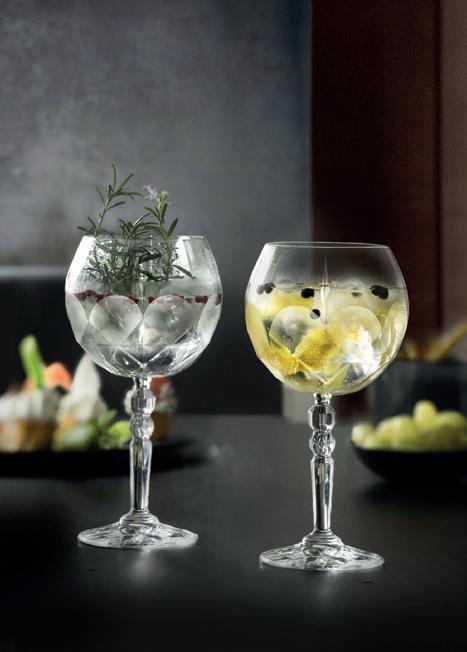
North Building – 7607
At this year’s NRA show Utopia will be showcasing its new venture in the USA in collaboration with Steelite USA and Paşabahçe. Attendees will get a chance to experience Utopia’s latest designs, including the stunning Enigma tableware collection. Also on display will be the Raffles glassware collection. Available in a range of popular glass styles including tumblers and hiballs, martini glasses, coupes and Nick and Nora, this handmade fine cut crystal collection evokes the fun and joie de vivre of the roaring twenties. www.utopia-tableware.com
Amefa will be exhibiting at NRA. They will be at booth 7453 (north building). During the fair the team will be on hand to show you their extensive assortment and latest food service novelties, from new flatware styles to high quality steak knives.
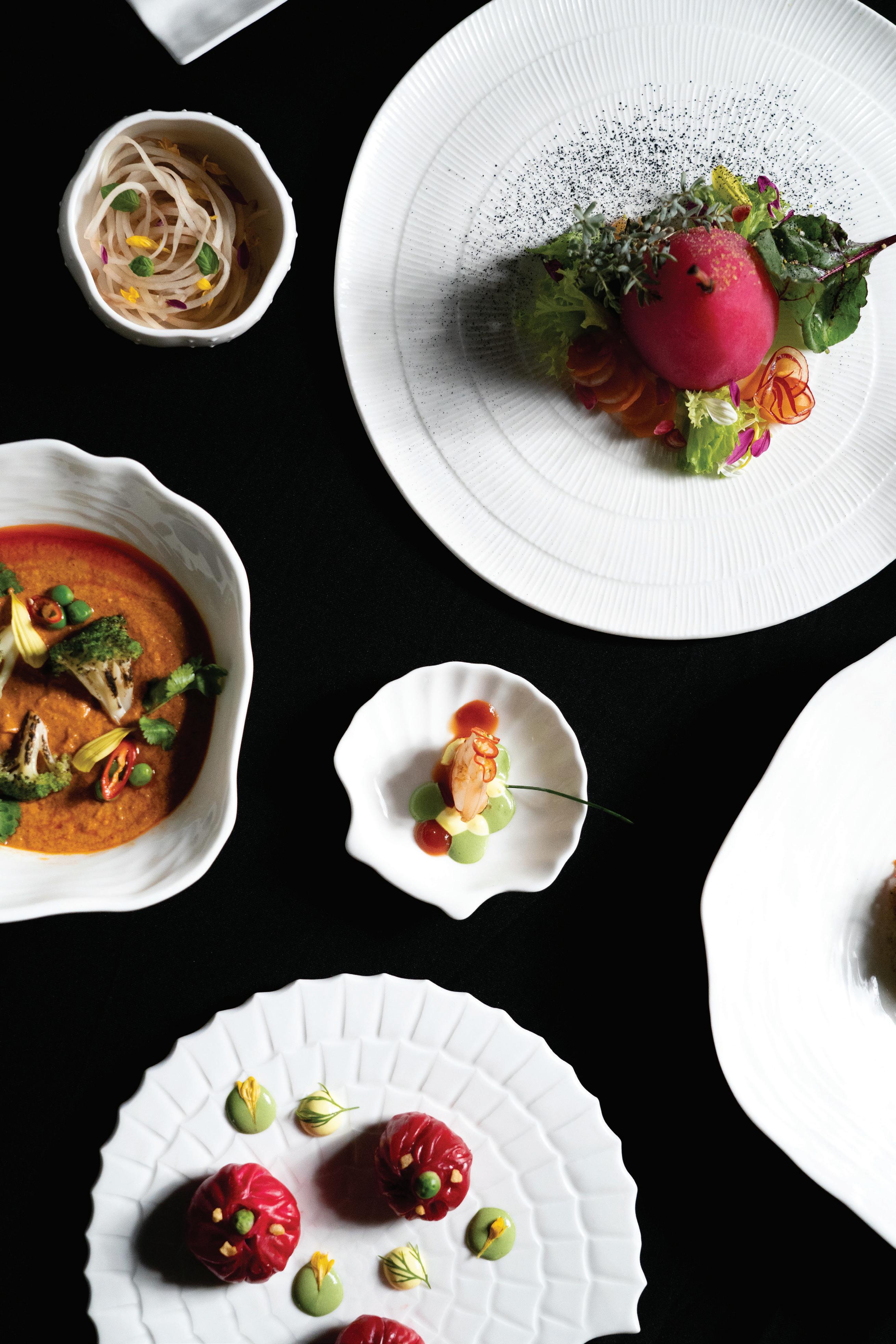
“For the first time in a long time, we are being asked for ranges that can work together to provide a look that is ultra-coordinated,” says Valda Goodfellow as she deep dives into what chefs and restaurateurs are looking for right now…

Founded by Paul and Valda Goodfellow, G & G Goodfellows is a highly creative design & Distribution Company with an amazing showroom in Little Portland Street. Offering a truly hands-on service, Goodfellows passion is to bring new and exciting, bespoke food presentation concepts to the UK’s culinary scene. As well as offering a wide variety of the world’s best branded tableware, kitchen equipment, clothing and machines, Goodfellows also collaborates closely with UK craft producers for totally unique products. It works with all sizes of restaurant and catering projects, happy to supply anything from an individual plate to a full restaurant concept.
There must be something in the air. You get one client saying they want to change direction and you think, “that’s great, here’s someone who will shake things up”. Then along comes another, and another, and you start to think, “wow, there is something really happening here!”.
Over the past couple of weeks in our manic showroom in central London, we have had a stream of amazing clients bringing us their projects. From cruise liners to city behemoths, and everything in between. We have had a world of talent with fresh ideas on how they see their restaurant concepts expressed through tableware.
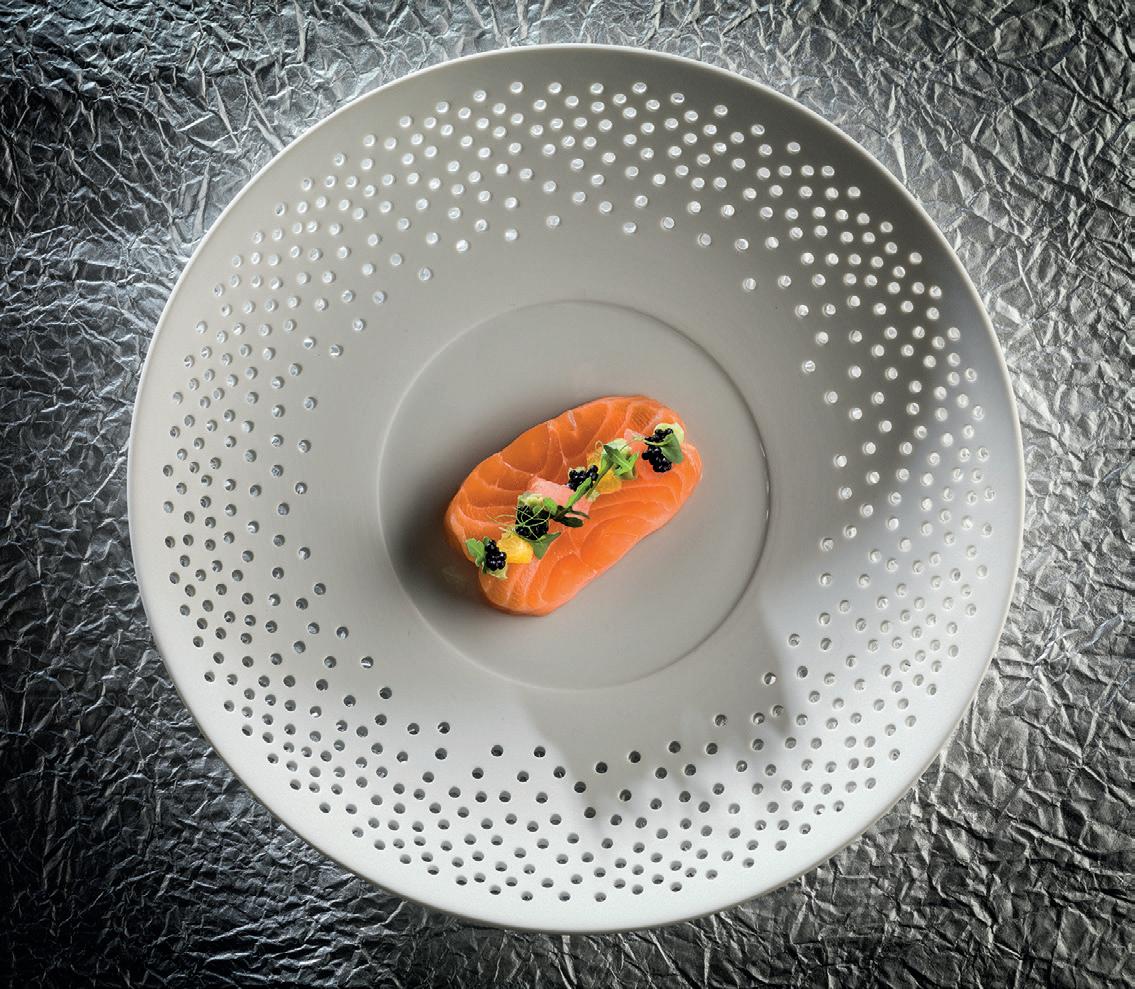
So, what’s changed?
Well, for a long time now, we have been masters of the eclectic – mixing different ranges and materials to provide interest and surprise – using different shades of reactive glaze stoneware mixed with bright white
porcelain mixed with wood and glass. We have created unique tablescapes for every cuisine from French bistro to Nikkei (Peruvian ingredients shaped by Japanese techniques), we have worked on them all. It is great fun and extremely inspiring to work
We are really lucky to work with such people and every day feels like a school day because we are learning about what is developing in the restaurant scene right now.
But what about the tableware?
with talented culinary minds who can pick up on the current psyche to bring something new to the restaurant scene.
Even if they use traditional dishes, they do it in such a way that makes it feel fresh and very now. I am thinking of Claude Bosi who recently opened Socca in London has created a modern classic that is a real joy to experience. Tradition, mixed with a modern twist, to make it feel of the moment and a pure joy to experience.
Well, these new ideas are bringing a fresh look at how to put a concept together, and for the first time in a long time, we are being asked for ranges that can work together to provide a look that is ultracoordinated. It feels really strange to be looking for things that run largely through one range but once you see it together on the table, it looks like very chic; like the equivalent to a Chanel suit.
Whether it is haute cuisine or casual dining, we will be seeing
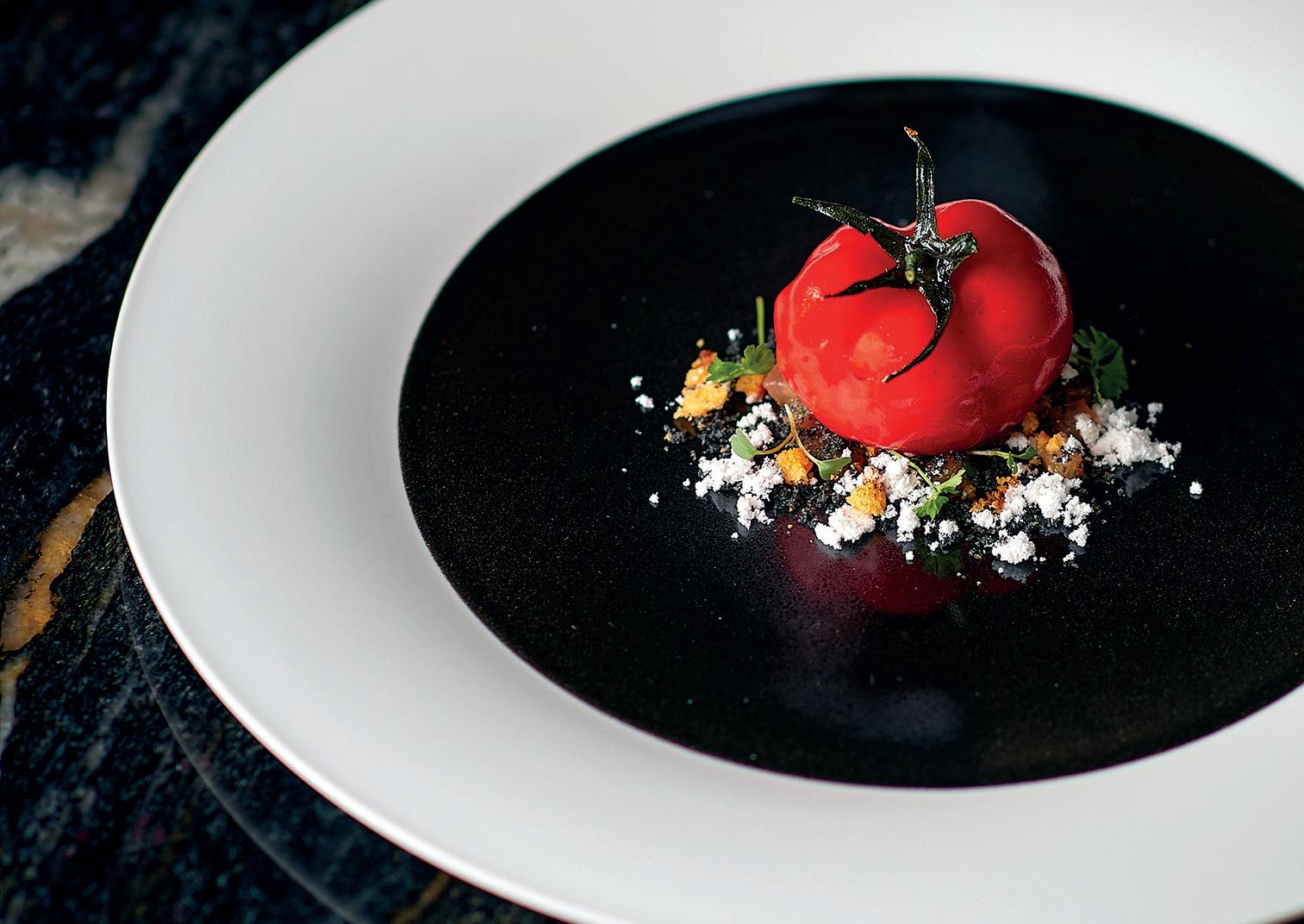
“Claude Bosi who recently opened Socca in London has created a modern classic”Ceilo, Hering Berlin Obsidian, Hering Berlin
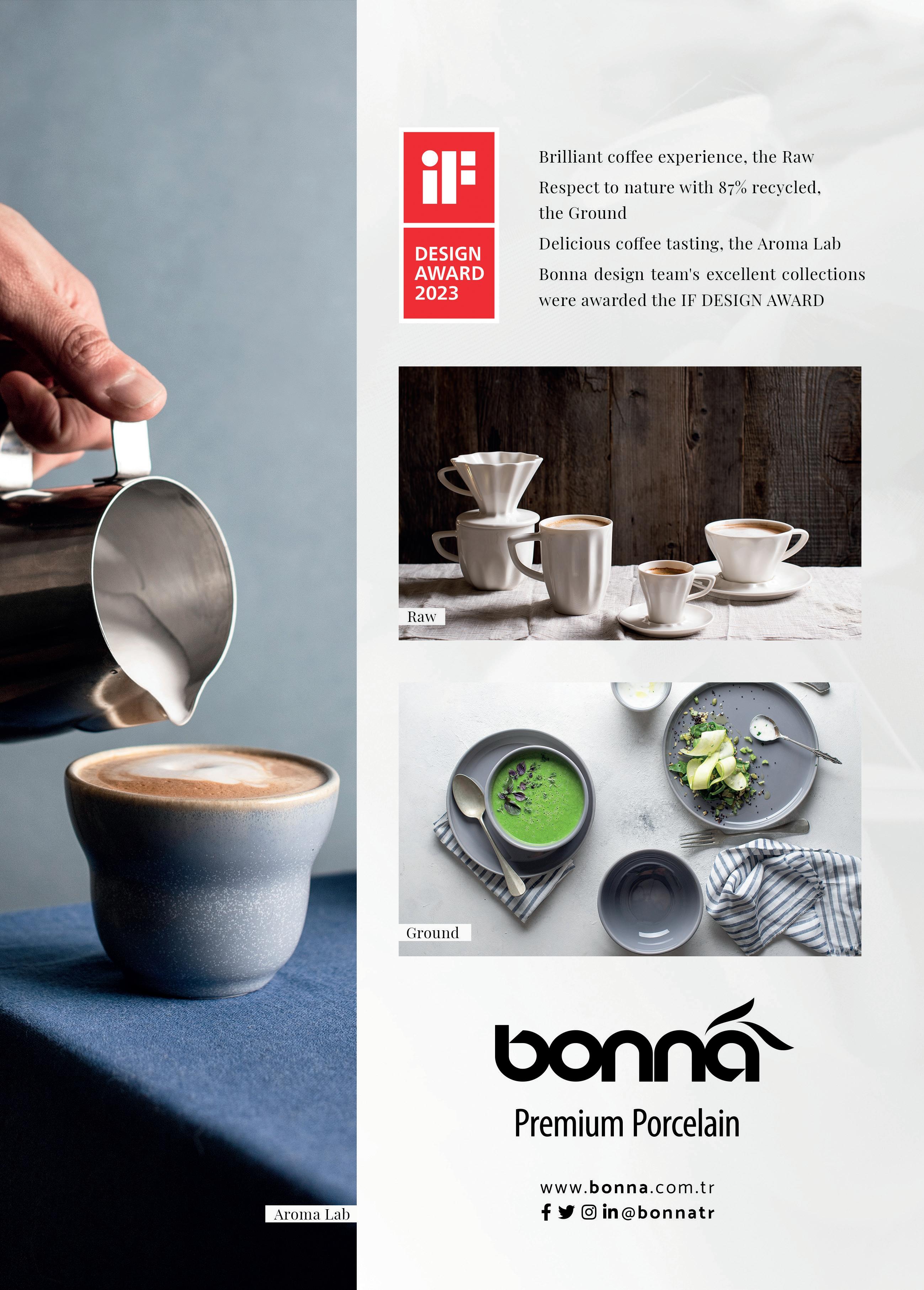
G&G Goodfellow has launched a new range of in-house designed products with pieces in both wood and silver. We highlight the range…
Focus on wood
Goodfellow & Goodfellow Ltd has launched in-house designed wood products aimed at filling a creative niche for small, food-specific and bespoke items.
The select range involves using the fractal burning technique to create unique and natural patterns in the wood then finishing with coloured acrylic, as shown here in the mini board for a taco stand. Each product can be bespoked to suit personal tastes, or selected from the stocked range in standard colours and finishes. The majority of wood used is sourced locally from the surrounding Northumberland/ Durham area, through tree surgeons who work with fallen/ damaged tress. Some exotic woods are used for specific design effects and these are also sustainably sourced.
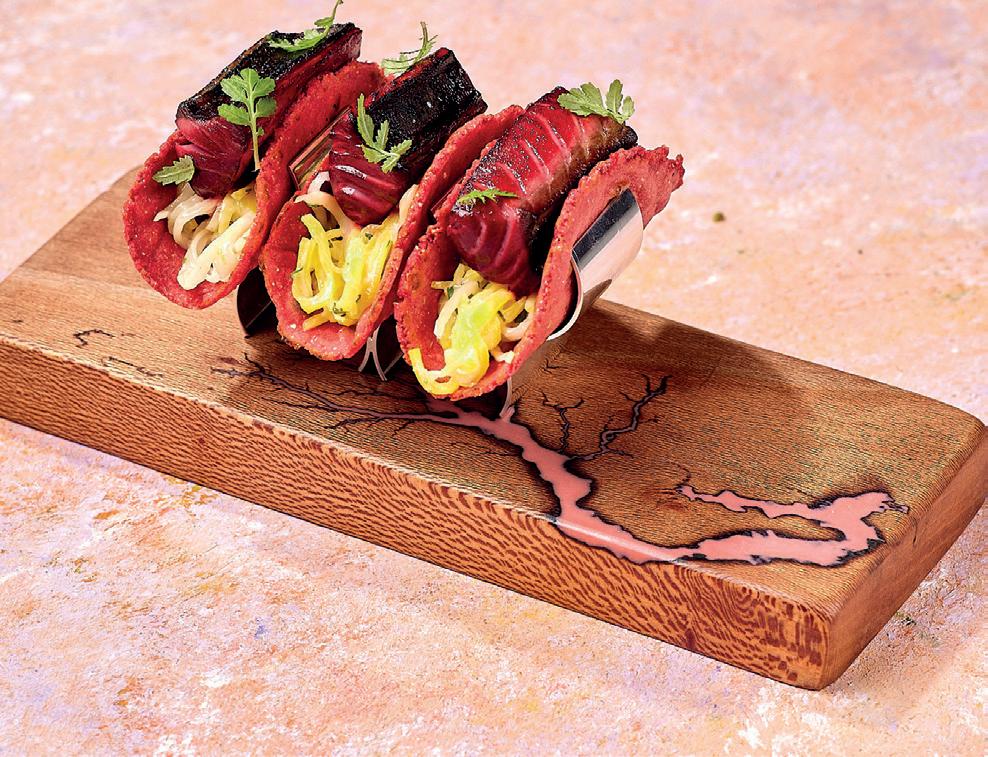
The G&G team has also developed a range of new silver products aimed at the trend towards elegant dining. They have used their usual innovative flair to design this mini taco stand in silver, proving that elegant does not just apply to classical cuisine but can be interpreted in a modern way for today’s multi-cultural tastes.
Other products in the range include souffle pots, petit fours trays and tiered seafood stands.
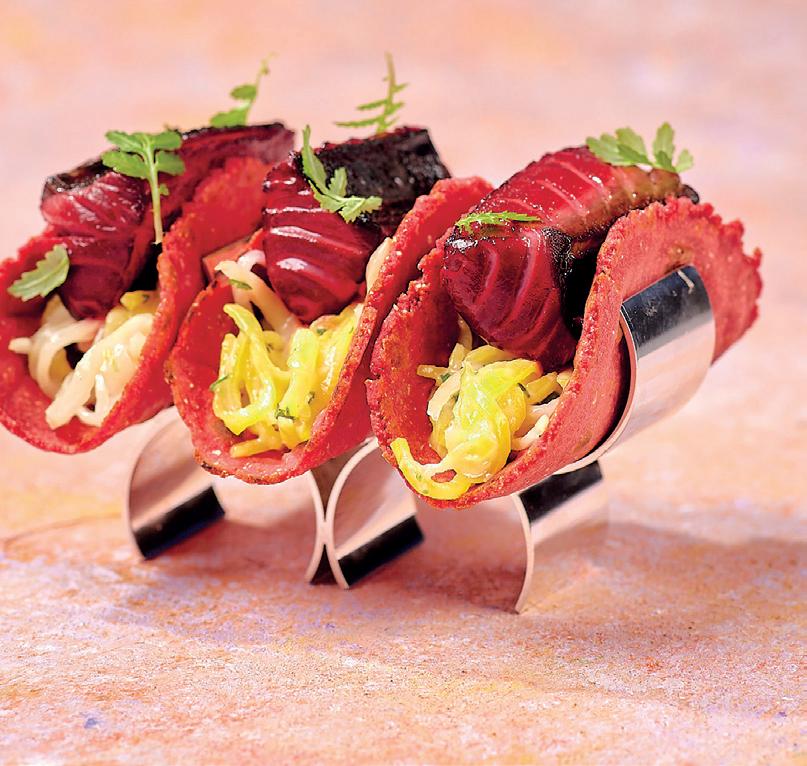
this approach trickle through the restaurant landscape, feeding new ideas and creating new themes.
Let us look at luxury dining first. One of the best examples of this ‘suited’ tableware approach would be to use what I think is one of the most beautifully-designed brands, Hering Berlin. Created by Stefanie Hering, Hering Berlin is the connoisseur’s choice for luxury dining porcelain. The ranges use different textures, with graduations of circular effects on the rim of the Pulse plates; or the seductively smooth touch of the Velvet range finish to create depth and variation. When you add Cielo into the mix, a whole new dimension emerges, with its hand-crafted ‘holes’ in the rim dancing in the light to create shadows and a see-through effect. Seeing the effect of the suite together on the table and then unfold during the course of a meal; it is easy to understand why this brand is a clear favourite with chefs throughout the world.
Even Hering Berlin will agree that it is good to punctuate the tableware story with surprise elements but there is no need to go beyond the brand and
potentially spoil the effect. With its Silent Brass, Obsidian and the new Emerald ranges, you can add points of colour without losing the texture on the rim. This is an ingenious way to carry a story through the table dressing, which does not stop at plates and bowls. There are cups and platforms which provide endless possibilities to complete an entire brand-led concept.
For casual dining, my go-to brand would be Costa Nova, as they
perfectly sized bowls, you can satisfy almost every menu requirement from dips to salads. To create a very chic but interesting table from this range, I would opt for the Latitude Black which has a beautiful offwhite exterior for a sharp and classy contrast. With texture on the exterior, it is also very tactile. If you want to break up the tableware story with further contrast but keep within concept, I would add the contrasting colourway of Dune Path which has the same exterior as Latitude Black but with a tonal glaze on the inside.
really think about how items from different ranges can be used to sit together as a concept. Where sharing food is involved, there is no better place to start with the hugely adaptable Notos range, which lends itself to a suiting approach through its cleverly designed ‘tray’/lids which work together or separately. They have even thought to create height on a table with a stand for the trays to sit in. With an impressive list of
Seeing the mix together, makes for a very modern yet relaxed table.
As with Hering Berlin, Notos is very much designed with chefs in mind, so the food is always the star for which the tableware is the perfect stage.
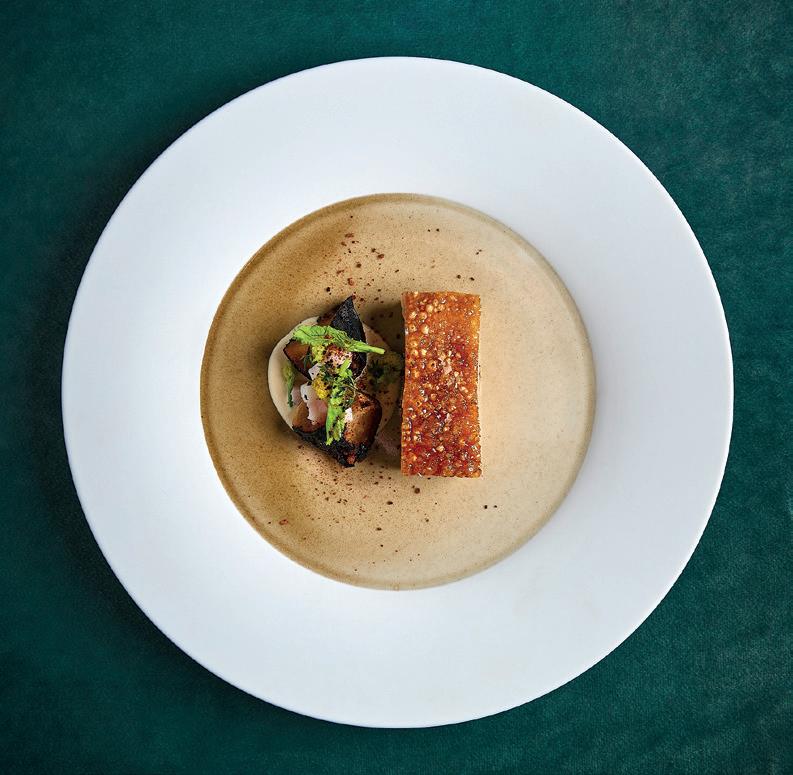
Whilst there will always be demand for the perfect mix of different shapes, ranges and effects – for now, I am finding this new approach so very ‘suite’.
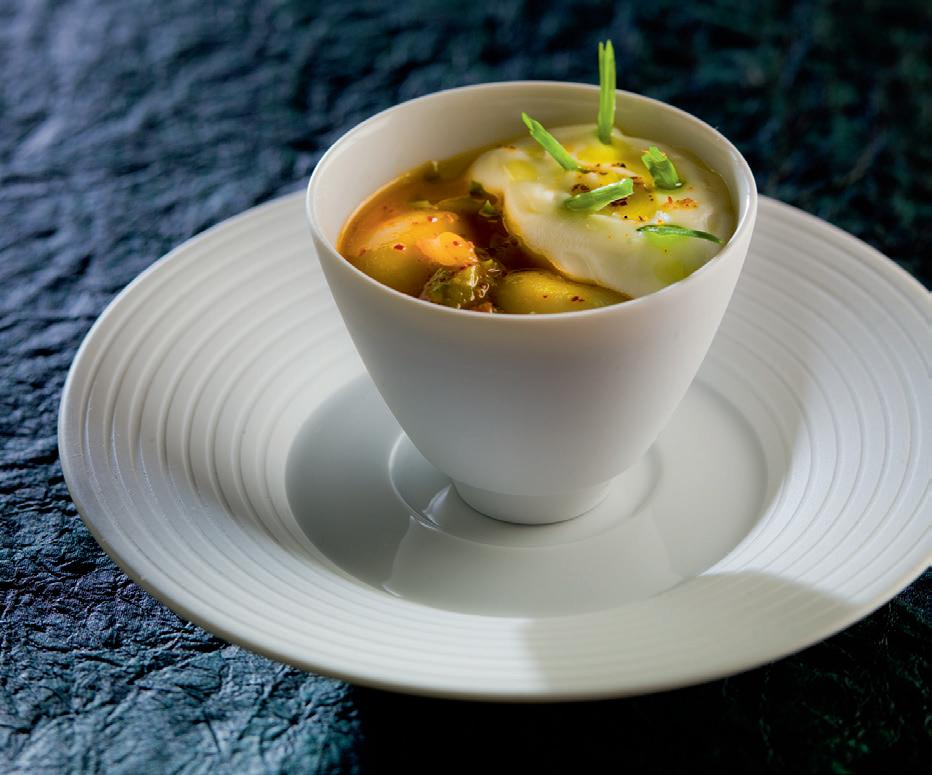
“For casual dining, my go-to brand would be Costa Nova”
En ha nce s us ta inabilit y w it h B ru s f ro m S te lton! By c hoos in g B rus , you contribute to re ducin g p la sti c was te, t ra nspo rtatio n costs , a n d e ne rg y consumptio n compa re d to t ra ditiona l b ot tle d water. We a re ext re mely p ro u d of t hi s exc itin g a dditio n to Stel to n , a n d we h op e o u r s parklin g e nt hu si as m w il l m ake a n i mp re ss io n o n you Make a d i erence w it h t h e B ru s carbonato r— joi n t h e g re e n revo lution! www.s te lton .c om
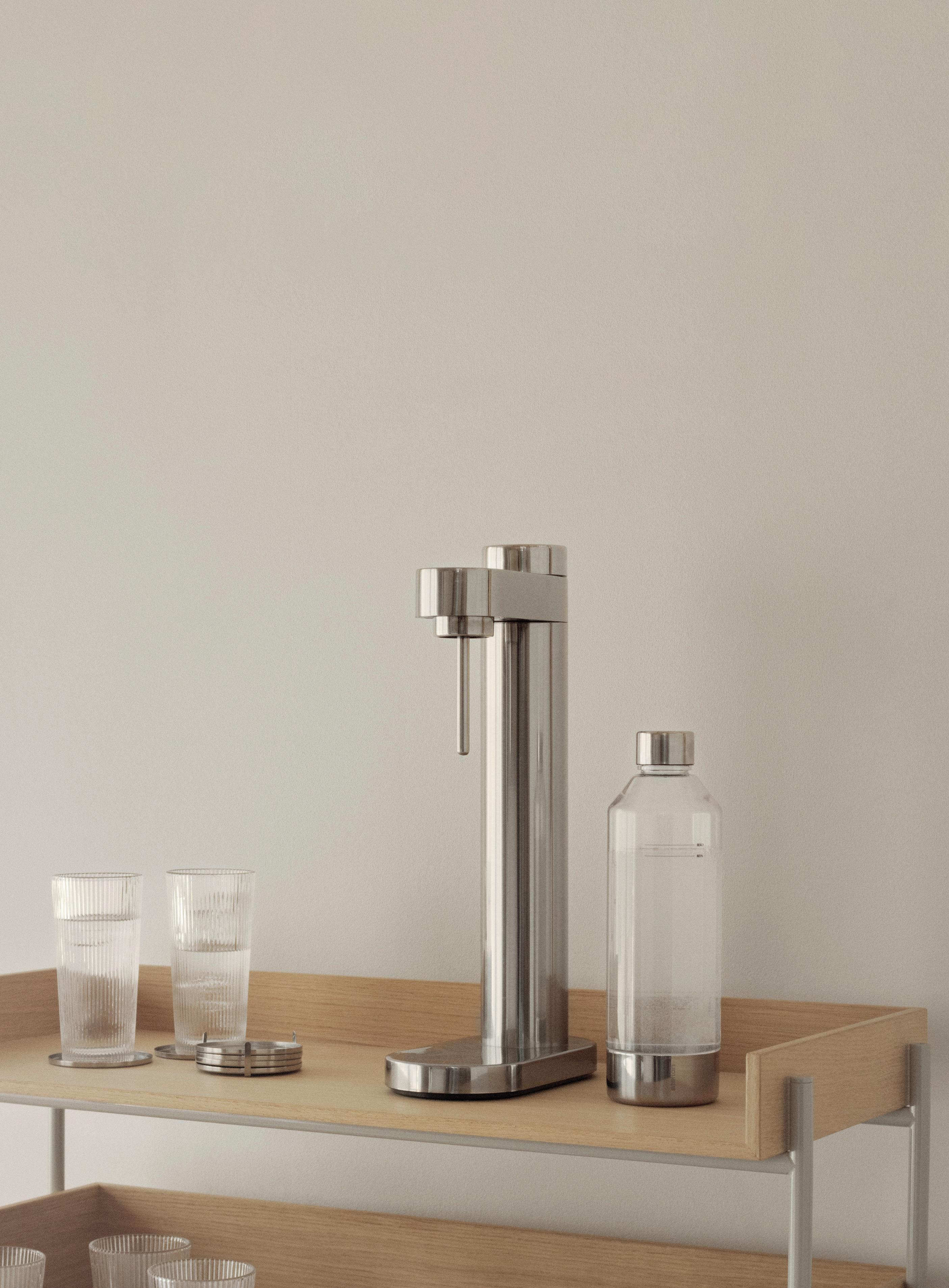 De sign : Sø re n Re fsgaard