Belonging as a framework for justice: Photovoice techniques for abolitionist design perspectives in
K-12 learning environments
June 2024
Leila Jackson
Applied Research Consortium Fellow ‘24
Masters of Landscape Architecture ‘24, University of Washington
project team
Leila Jackson
Applied Research Consortium (ARC) Fellow ‘24
Masters of Landscape Architecture ‘24, University of Washington
B Sanborn
ARC Firm Advisor
Design Research Leader + Principal DLR Group
Christopher Campbell
ARC Faculty Advisor
Associate Teaching Professor + Associate Dean for Students, College of Built Environments, University of Washington special thanks
Without whom this work would not have been possible.
Ian Duncan
Freshman English students
Julie Parrett
Ken Yocom
Jim Beckett
Helen Ho
Rachel Ogimachi
Derek Richardson
land acknowledgement
This research and writing was conducted on the present and ancestral lands of the Duwamish, Puyallap, Suquamish, Tulalip, Muckleshoot, Nations. We gratefully honor these indigenous communities and their continued stewardship of these lands and waters on which this dialogue took place. message from the author
This work is deeply rooted in principles of abolition justice, which walked hand-in-hand with efforts to dismantle ongoing systems of settler-colonialism that we participate in by living and working on these lands, and in all indigenous lands, as visitors and settlers. This work was written as we continue to bare witness to an ongoing, extreme settlerviolence and genocide in the Gaza strip following October 7th, 2023. For each day that follows, may we better articulate our roles as academics, activists, and built environment professionals in radical solidarity with all oppressed people. Free Palestine.
aboutThis research was conducted from 2023-2024, as part of the Applied Research Consortium (ARC) Fellowship with the College of Built Environments at the University of Washington and DLR Group, an integrated design firm and a leading practice in the industry of K-12 design. The following research contributes to DLR Group’s internal practice and should impact the firm’s knowledge on conducting research and engagement around belonging and engaging K-12 community members. It is crucial to acknowledge the constraints of adopting abolitionist theory in a forprofit design practice, not limited to the expectations and values of client relationships. This body of work offers several degrees of action that designers can take to adopt a more abolition-oriented practice within the constraints of a capitalist context.
Abolition is...
“not some distant future but something we create in every moment when we say no to the traps of empire and yes to the nourishing possibilities dreamed of and practiced by our ancestors and friends.”
Be longing Ab olition
– Eric A. Stanley, Captive Genders: Trans Embodiment and the Prison Industrial Complex, p 36
positionality
My interests in the topics of belonging have ultimately been shaped by my childhood as a racialized student in a predominantly white public school district in the Seattle area, in the early 2000s. My academic experience was never isolated from the reality of how my identities, and those of my siblings and my few Black classmates, systemically challenged our ability to participate, succeed and belong in learning environments in nonabstracted ways. Racial profiling, inequitable disciplinary action, and a lack of representation in authority figures, were some of the ways that our academic experiences differed from our white peers. These realities were synchronously shaped by other intersecting identities, including gender, queerness, socio-economic backgrounds, disability, and/or religion.
In my adulthood, I observed my younger siblings navigate the similar challenges, while reflecting on my own experiences with a more complex understanding of racial justice in our country and our schools. I channeled these experiences as an advocate and supporter of “No cops in schools” campaigns across the United States and Canada and racial justice organizing in and outside of the classroom. Thus sense of belonging in schools has been deeply shaped from a history of structural oppression and a perspective of social justice.
To topics of sense of belonging and K-12 design, I bring a lens of abolition feminism, with the understanding that that we must take a intersectional and structural approach to dismantling systems of oppression that include the the school-prison nexus and the prison-industrial complex. I also draw from perspectives of data feminism to guide how designers can engage with communities in the pursuit of knowledge generation. When working with communities around data that concerns lived experience, we must arrive with the understanding that data is a form of power and strive to engage it in just ways.
Abstract
This research offers photovoice methods as a means for designers to adopt abolitionist perspectives in professional practice relevant to K-12 design. In existing literature, photovoice methods have been utilized to engage student sense of belonging. Separately, abolitionist theory has been adopted and applied in design contexts in order to identify opportunities for designers to engage in goals associated with racial justice and restorative justice. This work contributes a unique application of photovoice methods for abolitionist design perspectives, with the intention of centering student belonging in a K-12 design process. Doing so can fulfill goals from abolition such as disrupting the school-prison nexus – a phenomenon that highlights the symbiotic relationships between schools and prisons, and ultimately leads to disproportionate academic and belonging outcomes for racialized and otherwise marginalized students.
In order to demonstrate these relationships, concepts from abolitionist theory were applied to a design process in professional practice. This approach is intended to encourage designers to disrupt power structures and
What might sense of belonging disrupt within the context of the school-prison nexus?
hierarchies embedded in K-12 design processes and center design responses that are reparative. Reparative design responses thoughtfully address a plurality of belonging experiences that include marginalized students. Photovoice methods were identified as a tool with the capacity to center these principles and uncover student sense of belonging for design feedback. The methods were tested in a multiday, student-engaged, photovoice study at a high school located in a Seattle suburb. The results successfully demonstrated how photovoice could begin transforming the design process by delivering insights into spatial experiences relevant to the schoolprison nexus. Photovoice represents one element of a larger effort to adopt a more liberation-oriented architectural practice. However, it is focused on in this study for its potential to make tangible lived belonging experience investigation for K-12 designers and more broadly, engage student participants in accessible co-design processes.
Key words: sense of belonging, abolition, K-12 learning environments, photovoice, participatory design, school-prison nexus
Belonging as a framework for justice is an applied research exploration on how an abolitionist theory can inform a social-justice oriented design practice rooted in its engagement methods. This research project engaged high-school students through a photovoice curriculum to better understand the nuanced experience of belonging, with a critical lens towards top-down design approaches in education environments.
Objectives
Apply theory from abolitionist perspectives to the professional practice of designing K-12 learning environments
Demonstrate photovoice as a designer research and engagement tool, that can help build insight around student sense of belonging
Surveyed 250+ built environment professionals at DLR Group to better understand how sense of belonging is currently being approached in professional practice
Synthesized an application of abolitionist perspectives in design and its relevance to the design of school environments through a literature review
Performed a student-engaged photovoice study on sense of belonging to test photovoice methods as an engagement of abolitionist design perspectives
Developed a photovoice engagement toolkit to share with designers how to build insights around sense of belonging for design applications, through studentengaged activities
Methods
Photovoice methods were used as a tool for studying place-based belonging at individual and community scales. An abolitionist lens, pushes this methodology to center community (and individual) agency.
As photovoice is integrated into the design process, designers should respond to photovoice insights in restorative ways with a complex understanding of student belonging.
photovoice
Photovoice is a visual research methodology that invites community participants to document their lived experience through photography, driven by a prompt. Then participants further reflect upon their experiences as individuals and groups through photo reflections, discussion and activities. This method invites the participants into the roles of researchers and analysts in the process of interpreting their own lived experience.
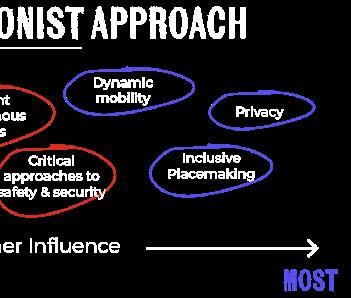
an abolitionist design framework
This work adopts perspectives from Abolitionist theory to inform how designers can adopt a more liberationoriented practice that engages sense of belonging. From this lens, two goals are centered:
Undermining Power Structures & Hierarchies | Dismantling the hierarchical relationship between designers and communities, as to abolish the processes of power and exclusion in creating spaces of belonging.
Mending the Transgression of “Not Belonging” | Unpacking socio-spatial relations that determine who belongs and who does not. Offering design responses that respond to a plurality of belonging experiences from a reparative perspective.
“Take 8-10 pictures of places in the school where you feel like you belong and places in the school where you do not belong.”
A photo-elicitation prompt is followed by a series of activities to understand pluralistic sense of belonging and explore potential design responses:
Documenting and co-analyzing place-based sense of belonging
Photovoice prompt is given to students, to complete before next gathering
Developing a consensus around a plurality of experiences
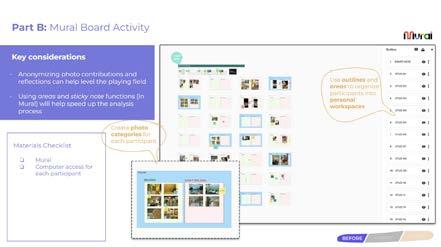
Using a digital collarboation space (Mural) to share images and co-analyze spaces of belonging/not belonging as a group
Envisioning new learning environments as spaces of belonging
Sketching and collaging exercises where student-generated photos served as base layers for iterating future spaces of belonging
Communicating photovoice insights with designers
An exit survey for students, and a reflection to from designers to better understand what types of insights around belonging can we learn from a process like this
In
March 2024, a studentengaged
photovoice study on sense of belonging took place at a local high-school
We collaborated with an educator at a local high school to integrate a photovoice study into a Freshman English class curriculum. Of the 85+ who participated in the activities through their class, 23 students opted into this study and are sharing the images and insights they produced through the activities with this ARC project.
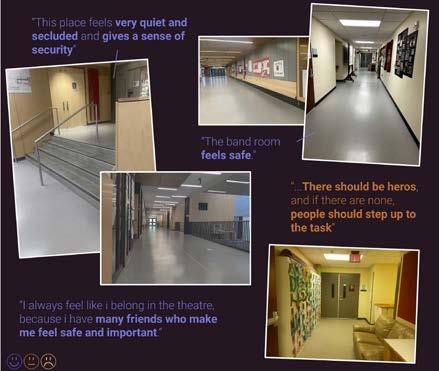
Places of belonging
Over the course of three class sessions (per class group of students) student contributors produced: 65 student generated photographs showing spaces of belonging and not belonging around their school; 20 sketch iterations illustrating future spaces of belonging within their school; and 22 collage illustrations and written reflections to further explore - what is belonging to me?
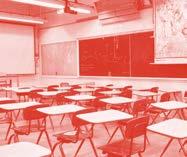
Some images omitted to protect identity of the school and students.
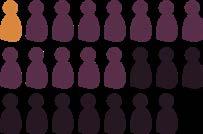
Male 10x
Female 12x
Unidentified 1x
23 students (14-15 y/o) across three classes participated
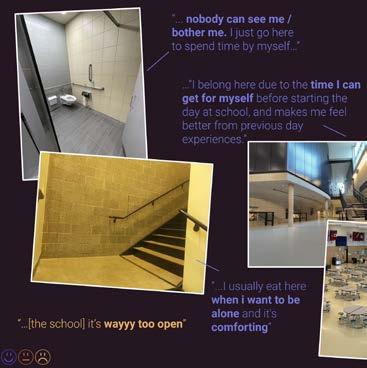
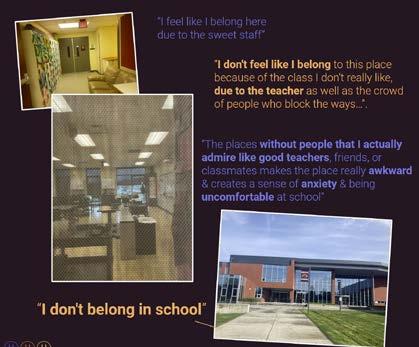
Places of not belonging
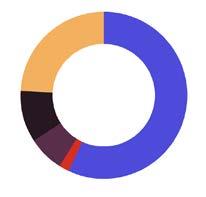
*School-wide racial-demographics 2022-23
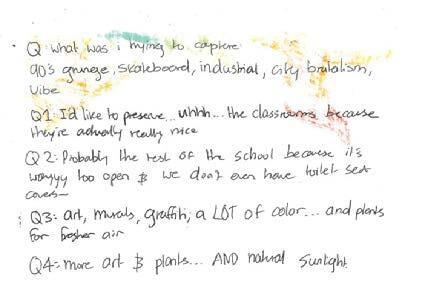
“…[I
was trying to capture] 90’s grunge, skateboard, industrial, city brutalism, vibe. I’d like to preserve… uhhh…the classrooms because they’re actually really nice.”
This student identifies the importance of a unique aesthetic identity in contributing to their sense of belonging at school, particularly one that is more informal.
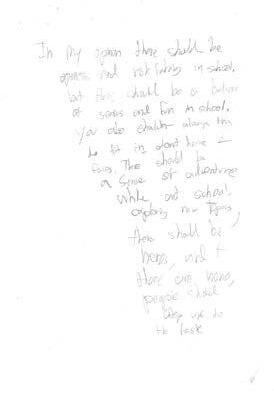
“...There should be heros, and if there are none, people should step up to the task”
This student calls for some emergent leadership in their school community.
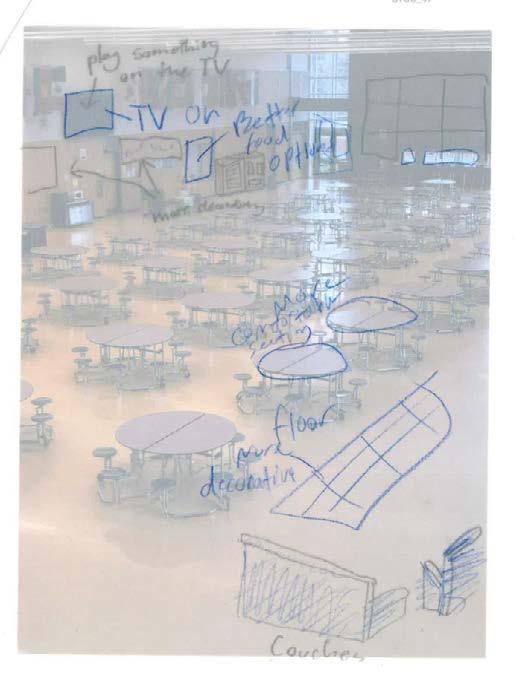
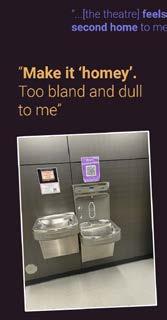
“TV on; Better food options; more comfortable seating; more decorative floor; couches”
A cafeteria could be improved if it felt more like a living room, with a working TV and comfortable lounge seating.
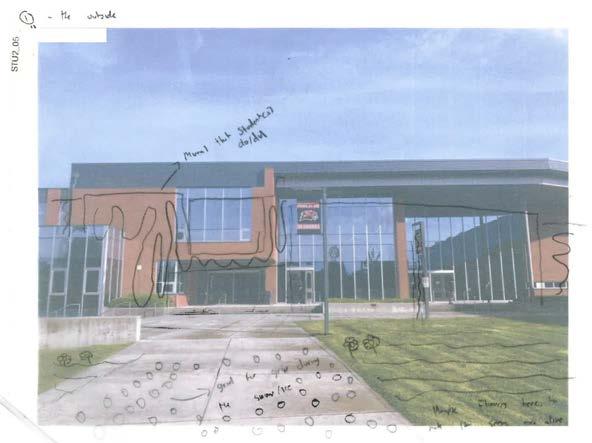
“Mural that student do/did; grip during the snow/ice; Maybe flowers here to make it seem more alive”
This student specifically describes a mural created by students - and a need for student autonomy in placemaking at their school
Trace Paper #1
Trace Paper #2
Base Image
Multiple layers of trace allowed students to iterate ideas collaboratively over a selection of student-generated images that served as the base layers.
Findings
Through qualitative coding and a close reading of student-generated photos, sketches, collages and reflections, insights on placed-based sense of belonging emerge.
safety
Safety was strongly associated with privacy and the use of smaller, intimate spaces. Safety also was mentioned in relation to an absence of the noise and chaos associated with passing periods and mobility concerns throughout student’s daily routines. On the positive side, students associated safety with positive student/teacher relationships, friendships and hobbies.
privacy
Student’s expressed a critical need for privacy and generally a positive association with places they could spend time alone in. Spatial “openness” was frequently mentioned as a a negative contributor to belonging.
relationships
Relationships between staff and students were mentioned as an essential component of belongingwhere spaces associated with favorite teachers or staff members were considered to generate positive sense of belonging. Classes that were considered “stressful” garnered negative sense of belonging for their associative learning spaces.
autonomy
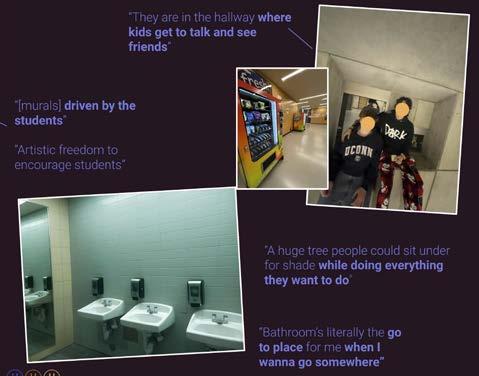
Autonomy was associated with spaces where students had unique social freedoms such as chatting in the hallway, as well as spaces and opportunities where they were invited to participate in placemaking. There seemed to be a lack of programmed student-autonomous spaces in the school, where bathrooms were frequently mentioned as contentious social and autonomous spaces.
representation
& familiarity
In this context, representation was associated with the desire for visible representation and inclusion of marginalized groups including Indigenous and LGBTQ+ representation. Familiarity was expressed through an overwhelming desire to create an environment that resembled a home (i.e. demonstrated interest in indoor plants, soft lighting, comfortable seating, food and drink option, and small, private spaces).
These insights are not specifically meant to generate definitive, overarching conclusions about the nature of student belonging, or sense the study site, but instead demonstrate the level of student feedback that can be achieved through these methods.
78% images displaying outdoor spaces represented positive sense of belonging
14/19 students believe indoor plants and greenspaces will improve their sense of belonging
19% images displaying lack of belonging mentioned crowdedness
22% images displaying positive sense of belonging included food or places to eat.
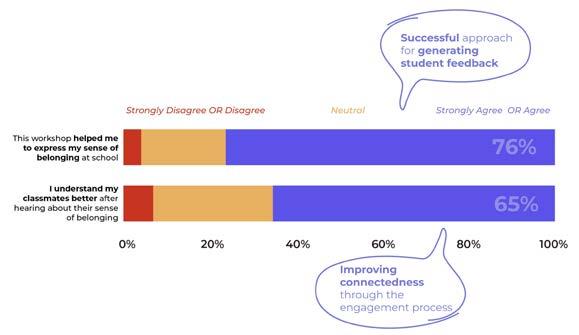
A successful approach for generating student feedback for designers, and fostering belonging through the process
*72 survey respondents. Exit survey for 2024 Photovoice Sense of Belonging study.
how experience belonging school?
privacy
do we experience belonging in school?
A toolkit was created to guide designers on engaging K-12 students around topics of sense of belonging & design using photovoice
what
The toolkit (see Appendix) offers an overview of activities, processes and best practices for engaging high-school aged students around their lived experience and sense of belonging for relevant applications in K-12 architectural design. The strategies explored are intended to build agency for community stakeholders through long-term engagement throughout the design process.
A sequence of “photovoice” and art-based engagement strategies with a focus on lived experience investigation who
These strategies were developed with high-school aged students in mind, but can be relevant to other age groups and stakeholders in the K-12 school community
when
The strategies are most effective in early planning, pre-design stages with emphasis on continued collaboration throughout the design process where K-12 design project communities
why
These strategies were developed with the goals of dismantling hierarchical processes between designers and communities by inviting community members in to accessible processes of deep engagement that lead to sense of belonging, design, and advocacy outcomes.
Excerpt pages from the toolkit. Belonging as a framework for justice: Tools for engaging K-12 students around topics of sense of belonging & design.
Belonging as a Framework for Justice an essay
Introduction
Sense of belonging is a topic that professionals in the design community are increasingly more interested in. Much of the research on spatial belonging derives from the social sciences, particularly in the disciplines of geography, environmental psychology and sociology. While there are many nuances to understanding belonging, it can generally be defined as, “a subjective feeling that one is an integral part of their surrounding systems, including family, friends, school, work environments, communities, cultural groups, and physical places,” (Hagerty et al., 1992 in Allen et al., 2021, p. 88).
Accessing belonging is an important component for integration and success into society. However, it is complicated for particular individuals and groups. Scholars recognize how sense of belonging interacts with social justice (Schein, 2009) and a “politics of belonging” (Walls, 2023; Yuval-Davis, 2006) – which describes the construction and maintenance of boundaries that includes some people and excludes others (Yuval- Davis, 2006, p. 204). Within society broadly, lack of access to belonging disproportionately affects groups that have been historically marginalized in mainstream cultures. This places an emphasis on sense of belonging for Black and Indigenous people who have faced systemic exclusion through disposession and state-sanctioned violence (Allen et al., 2021, p 89).
In public educational settings, belonging is further complicated by the expectation of egalitarianism and the reality of how a politics of belonging shapes student experience (Walls, 2023). For students these barriers include a spectrum of inflexible to highly flexible ways of belonging (p.4). Formal governance practices including attendance zones and standardized test scores are inflexible conditions that determine student belonging or membership in a school community. Cultural norms or behavioral policies, like dress codes and disciplinary practices are moderately flexible conditions. Finally, practices and expectations that shape student agency such as behavioral participation and attendance are highly flexible ways students experience or gain access to belonging. The politics of belonging ensures that a student who is marginalized, or disadvantaged by even the most highly flexible of conditions, may struggle to access belonging. Thus, belonging is a social justice issue, where one’s ability to access it is not always equal to that of their peer’s.
Belonging as a framework for justice is an applied research exploration aimed at addressing some of these inequities through the design process. This research project has explored how an adoption of abolitionist perspectives can inform a liberation- oriented K-12 design practice, rooted in participatory engagement. The study portion that succeeded this exploration, engaged high-school students through a photovoice curriculum to better understand the nuanced experience of belonging, with a critical lens towards top-down design approaches in education environments.
What follows is a review of concepts that ground the theoretical framework of this work. They include an application of abolition to K-12 design; the impact of the school-prison nexus on student sense of belonging; and lastly, photovoice methods as a way for designers to adopt abolitionist perspectives in professional practice. On the topic of abolition and the design of K-12 learning environments, this document is not intended to puport anything “new”. Instead, I engage thinking stewarded by generations of oppressed people across the world and their liberatory efforts to divert from the tyranny of white supremacy and statesanctioned violence.
In the following, I articulate the need for abolitionist design perspectives and the crucial role of “sense of belonging” in its adoption in K-12 spaces. Abolitionist perspectives are explored as a lens for both understanding what student belonging entails, and how belonging can be approached through K-12 design. First, I begin with an overview of abolitionist theory and its relevance in K-12 spaces by way
of the school-prison nexus. As I move to the need for abolitionist perspectives in design and its application, I center two goals that emerge from abolition: undermining power structures & hierarchies, and mending the transgression of “not belonging”, through a restorative justice response. Lastly, I offer photovoice methods as an opportunity for designers to engage with these theories by introducing a deep investigation of lived experience with opportunities to engage participants in accessible co-design processes.
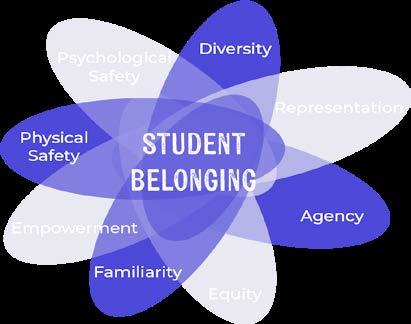
Dimensions of student belonging. Leila Jackson. 2024
Abolition, Carceral Cultures & K-12 Environments
Abolition is a call for the end of forced labor and carceral punishment, and for radical transformations towards a world free from prisons and policing (Davis, 2003). Abolition is intimately tied to anti-racism especially in the context of the United States, where the presence of carceral punishment and forced labor has historically laid the infrastructure for racialized violence in the pursuit of capitalist, colonialist agendas (Davis 2003; Loury, 2008).
This research specifically draws from abolition feminism, which has been largely shaped by the perspectives of scholars and activists including Angela Davis (2003; 2022), Ruth Wilson Gilmore (2022), Erica Meiners (2011; 2022), and Mariame Kaba (2021). Abolition feminism offers approaches to dismantling carceral practices at the intersections of racism and gendered violence oppressions (Davis et al., 2022). In place of prisons and policing, abolition feminists center a politics of compassion and care through a practice of restorative justice (Kaba, 2021). While abolition generally centers efforts to challenge what scholars refer to as the “carceral state,” or punitive practices and infrastructures like prisons and policing, abolitionist theorists have more broadly called for the dismantling of all conditions that create the need for such measures (Kaba, 2021; Gilmore, 2017).
Abolition is about abolishing the conditions under which prison became the solution to problems, rather than abolishing the buildings we call prisons”
– Ruth Wilson Gilmore (2020)
Abolitionist theorists recognize how the culture of incarceration and policing permeates our everyday lives, creating a “carceral culture”. Carceral cultures are everyday practices that normalize punishment and isolation as a response to complex social problems. This phenomenon operates any time we, “try to address the problem by removing the person from our community, marking them out as fundamentally different from the rest of ‘us’ and by distancing ourselves from them,” (Lamble, 2021). There are opportunities for countering carceral cultures, and thus practicing abolition in the infrastructures we interact with daily, including education (Shange, 2019) , healthcare (Wahbi & Beletsky, 2022)), community safety (Chua et al., 2023), and our everyday social interactions with others (Lamble, 2021).
The school-prison nexus
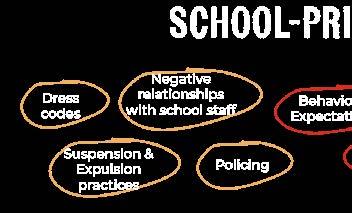
One locale of this discourse is K-12 learning environments - the study site for this research. While K-12 learning environments are not traditionally understood as justice infrastructure1, the relevance of these spaces to abolitionist thought becomes evident through phenomena such as the school-prison nexus, or the more well-known “school-to-prison pipeline”. These phenomena describe how schools, through active and passive mechanisms, oftentimes uphold the harmful outcomes of the carceral justice system (Annamma et al., 2023; Krueger, 2010; Shange, 2019). The “school-to-prison pipeline” is defined by the way American education systems disproportionately steer Black and brown youth towards the criminal justice system (Kim et al., 2010, p.2). Suspension and expulsion disciplinary practices, on-campus arrests, and lower graduation rates are all conditions within the school-to-prison pipeline that disproportionately impact Black students and have long-term adverse impacts on their lives and ultimately,
1 “Justice Infrastructure” is defined here by the Justice Civic work sector at research collaborator and architecture firm, DLR Group. Justice Civic architectural work includes spaces such as youth and adult secure treatment facilities and public safety facilities.
their sense of belonging (Krueger, 2010). These conditions reflect the reality of mass incarceration in the United States, where incarceration rates are amongst the highest internationally, and jails and prisons are disproportionately filled with Black and Latinx individuals (Loury, 2008, p. 6).
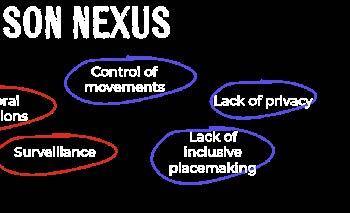
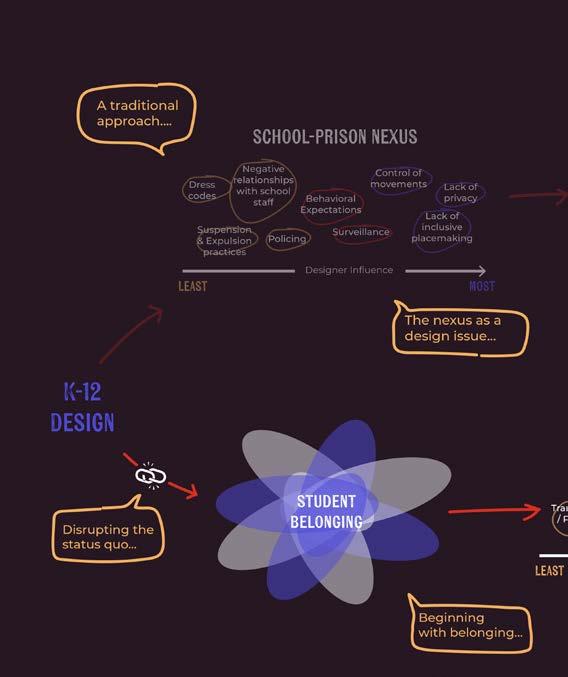
For the purpose of this research, we’ll center the concept of “school-prison nexus”. The term derives from the “school-to-prison pipeline”, with the nuanced understanding that more than serving as a pathway towards incarceration, schools become carceral spaces themselves due to the presence of constant surveillance, monitoring & policing, and generally the control of individual bodies (Krueger, 2010). The nexus often operates in more covert, or passive ways (dress codes, behavioral expectations in common spaces, etc.). Related to the school-prison nexus are the normative practices in schools that determine expectations like where individuals can and can’t move, what they can wear, and ultimately who they can “be’’.
An important component of how the school-prison nexus manifests is by the reproduction of power within educational settings. Stovall (2018) describes how ‘school’ (not to be conflated with ‘education’), “rewards students for order and compliance, which should also be considered part and parcel of the larger projects of settler colonialism and white supremacy/racism,” (p. 51). With this understanding, Stovall positions school as a form of state-sanctioned violence (p.53). Structural power is embedded into school environments, and catalyzed through authority figures, behavioral expectations and particular design decisions.
What does it have to do with designers?
The nexus highlights the potential impact designers can have by calling attention to the spatial conditions and experiences that contribute to carceral cultures in education. Krueger (2010) argues that space is, “invaluable to interrogate the physical manifestations of educational policies and practices that increasingly push poor and non-white students into the criminal justice system,” (p. 387). These are spaces that are highly securitized and policed. The insights that emerge from studies on how youth experience securitized school space demonstrate that the nexus directly impacts a young person’s adult life as, “safety protocols and codes that strengthen and legitimize structures of social inequalities [are internalized],” (p.404). Spatial conditions, particularly those that limit agency and privacy for students not only contribute to the nexus, but are critical to student belonging. Designers are tasked with understanding belonging from the perspective of these nuanced experiences of agency and safety. This includes navigating the sometimes
conflicting perceptions of what makes students feel safe vs. what might make them feel controlled – both of which have an impact on their belonging.
The school-prison nexus highlights the need for abolitionist perspectives in education (Meiners 2011; Meiners & Winn, 2010; Stovall 2018), which emphasizes a need for abolitionist perspectives in the design of learning environments as well. Scholar and anti-violence worker, Beth Richie identifies:
“The work for prison abolition is at once a policy issue, a community accountability issue, a family issue, and an issue that must be understood to be deeply personal. It is about health, neighborhood, the environment, U.S. position in global markets, youth empowerment, spirituality, the upcoming election, interpersonal relationships, identity politics, and many more things.”
(Richie in Meiners, 2011, p. 551).
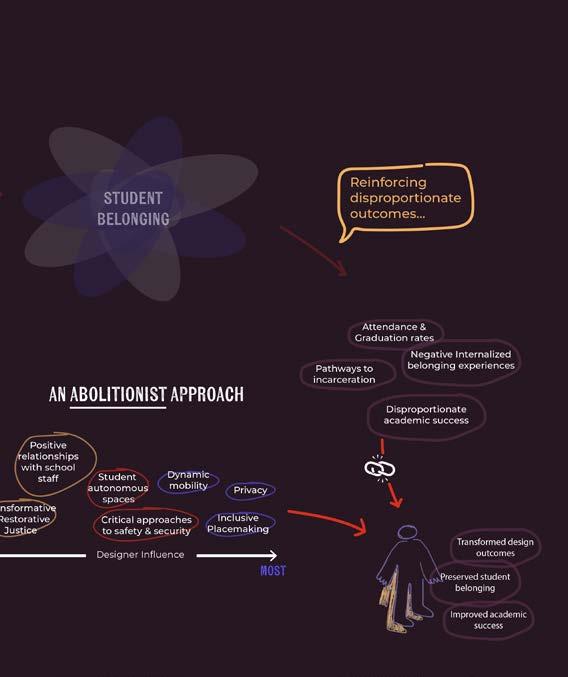
To this notion, I would add that the work for prison abolition is a design issue. One that considers the designer’s role in the creation of all carceral spaces, and one that engages sense of belonging as an abolitionist goal and as a design outcome.
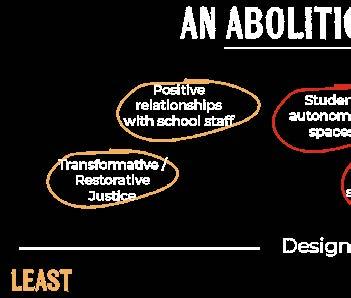
A designer’s role in the school-prison nexus and an alternative abolitionist approach to K-12 design. Leila Jackson. 2024.
The transgression of “not belonging”
So far we have introduced abolitionist concepts to K-12 learning environments, including defining the school-prison nexus and identifying its relevance to designers. Next, we will further explore the impact of the school-prison nexus on student sense of belonging.
A key understanding for designers is the inherent connection between how everyday carceral logics begin to impact belonging. Where belonging is tied to feelings of inclusion, acceptance and psychological safety, (Allen et al., 2021, p. 92, p. 88 ), a carceral culture normalizes patterns of exclusion and isolation (Lamble, 2021). The environment of control that the school-prison nexus creates has a profound impact on sense of belonging because of the limitations that are created to fostering student agency and generally, a sense of self. As aforementioned, these environments are assembled by authority figures, behavioral expectations and the physical school environment– all of which interact with student belonging.
Positive and negative relationships between students and school staff (educators and administrative personnel) and school safety staff (“school resource officers” or police personnel in schools) impact student belonging in diverse ways, as agency, safety and familiarity are affected (Riley, 2022; Walls, 2023; Krueger 2010 p. 401). Broadly, authority figures set expectations for behavioral participation in learning environments that can create barriers to student belonging (Walls, 2023,
p.4). Lamble (2021) describes the instance of a student being excluded from a classroom by a teacher for ‘misbehaving’ as a reflection of a carceral culture - a response of isolation, that negatively informs belonging. Tangentially, interpersonal relationships with educators and administrative figures in school settings has been known to shape student belonging. In a student-engaged study of sense of membership at school (Walls, 2023), students’ interpersonal relationships with teachers emerged as a main theme impacting their membership.
The physical manifestation of the school-prison nexus also impacts sense of belonging, where limitations to agency and privacy are reflected in the built design. The architectural design of hallways, passages and other transitory spaces, informs how students are meant to move through the school in an ‘orderly’ manner. The experience of surveillance and lack of privacy is made tangible with an adoption of safety design standards, such as Crime Prevention Through Design (CPTED), that emphasize surveillance, territoriality and defensible space. These design features condition racialized (Black and brown) students, who are the most policed on school campuses (Krueger, 2010, p. 385), with the notion that they are not trusted; that they do not have agency; and thus that they do not belong. As the lack of privacy and agency in traditional K-12 design becomes normalized, the transgression of “not belonging” emerges.
While the reality of the school-prison nexus reflects a lack of belonging through agency and autonomy, scholars in education tell us that fostering belonging can be achieved through valuing accountability and self-advocacy for students in education settings (Steinitz Holyoke, 2022, p. 242). This operates in the extended responsibility of the educator to teach children how to grow in a community and engage as part of a collective (p. 215). Stenitz Holyoke (2022) speaks to a restorative justice approach to belonging, a strategy that is deeply engaged in the history of abolition (Kaba 2021).
K-12 design, the school-prison nexus & belonging. Leila Jackson. 2024.
Abolition & Design
We have complicated the role of school environments in contributing to the schoolprison nexus and ultimately shaping student belonging. Now, we will explore how designers can contribute to this discourse through an integration of abolitionist design perspectives and a focus on belonging.
Within the context of architectural design, practitioners are implicated in calls for dismantling institutions that reproduce systemic racism, because their disciplines directly support and/or unwittingly reinforce these hierarchies, dispossessions and exclusions. Limited academic scholarship exists on the explicit relationship between abolition and design. Such has included design applications to traditional abolitionist texts including W.E.B. Du Bois’s “Abolition Democracy” (DelSesto, 2023); links between design and policing practices (Fathallah & Lewis, 2021); and restorative justice design (Toews et al., 2022; Buren, 2017).
Additionally, community-generated expertise from designers engaging with racial justice and abolition emerged organically following the 2020 response to the lynching of George Floyd, and contribute to the body of knowledge associated with abolitionist perspectives in design. These include but are not limited to the Design Justice Demands written by Design as Protest (DAP collective), the Field Notes on Design Activism series by Places Journal, and other projects that demonstrate how built environment design professionals play a substantial role in upholding harmful
systems of policing and carceral punishment (Fathallah & Lewis, 2021). To this body of knowledge, this research distinctly contributes the role of sense of belonging and participatory design methods towards its application, as an abolitionist designer’s just response. For the purpose of centering abolitionist goals, I draw from two principles of abolitionist theory: an interrogation of power and hierarchy and a practice of restoration that disrupts the school-prison nexus.
An interrogation of power and hierarchy
First, abolitionists acknowledge the inherent need to undermine power structures & hierarchies. Abolitionist geographer, Ruth Wilson Gilmore (2017) states that liberation is achieved through the abolishment of “hierarchy, dispossession, and exclusion that congeal in and as group-differentiated vulnerability to premature death”. She acknowledges the way that regimes oriented around these injustices lead to extreme disproportionate outcomes for particular groups. Liberation must include a dismantling of these hierarchies.
To professional practice, hierarchy is defined by several stakeholder relationships constrained by socio-political, capitalist contexts. They include: the relationship between designers and the communities for which they are designing; the power dynamics between clients and stakeholders (education institutions to students/ educators); tax payers to public institutions, and potentially others. For this context we will focus primarily on the relationships between the designers and the communities for which they are designing, but with an acknowledgment of how these adjacent hierarchies influence the design of educational settings.
In order to operate within the limitations of a capitalist industry, the design profession often ascribes to an subconscious validation of expertise hierarchywhere architects are expected to have a master ability to understand and design for the human experience. To varying degrees, design firms interact with communities through engagement and co-design processes, which may challenge this designer bias and expertise. However these engagements are not habitual to every design firm or team’s process. Often times, these engagements are supplemental premiums determined by client and stakeholder expectations and resources.
When these expectations are lacking, the role of designers becomes problematized and harmful power structures emerge between designers and the communities for which they are designing. In turn, designers contribute to a carceral culture
by ultimately “determin[ing] what social metrics to surveil, analyze, and change,” (Fathallah & Lewis, 2021) through a design project. Though this may lead to the creation of spaces, such as what manifests within the school-prison nexus, designers are “neither accountable for nor impacted by their actions’ outcomes on the targeted communities”.
Restructuring power elements within the design process and recentering communities is essential to abolishing the processes of power and exclusions that determine spaces of belonging. This goal can be achieved throughout the design process. As designers arrive in community spaces, this begins with a selfinterrogation where designers must commit to elevating the design voice of communities and abolishing the notion that designers are the experts entering communities. Next, designers must facilitate a democratization of the design process by recentering communities as agents of change within their own lives, rather than simply future users of a designed space. Throughout an abolitionist design process, the design profession should emerge transformed, as designers dismantle the hierarchies they would typically yield and reinforce. These transformations for designers and communities cannot occur through any onetime engagement with communities, but through a long-term commitment to a transformed design process that thoughtfully integrates the design voice of marginalized community members.
A practice of restoration
At its core, abolition centers restoration of individuals to participate fully in society. A design process that centers abolitionist goals, should do just that.
Earlier, we introduced the transgression of “not belonging” that occurs within the context of the school-prison nexus. This transgression is associated with spatial experiences of not-belonging in an environment with nuanced tensions of safety, control and agency. Through an abolitionist perspective, architects have the opportunity to mend this transgression through design and the design process.
Engaging communities in meaningful exploration of their lived experiences and desired outcomes around belonging is how designers can respond to this transgression. Delsesto (2023) applies W.E.B. Du Boi’s “abolition democracy” to a design context. He explains that creating new worlds through design requires,
“new ways of producing knowledge about social realities that people face and the possibilities they imagine; that is participatory and collaborative approaches to understanding and transforming existing conditions that help to enable people’s strengths and creative powers, not simply respond to deficits,” (p. 261). This notion alludes to the need for centering design methods that are empowering, and accessible for community participation and collaboration.
Designers must be intentional and critical about who to invite into this process, considering voices for whom socio-political conditions complicate the context of belonging and uphold this transgression. Designers must also create the conditions for a deep investigation of lived experience that extends beyond a surface level engagement process to center authenticity and accountability. Lastly, designers can center “reparative” design solutions. Reparative solutions asks designers to not only disrupt a typical process but to also work differently in order to change design outcomes as to not reproduce the same results of the school-prison nexus. Designers must grapple with questions that may contradict the status quo, for example: How do student insights around privacy and autonomy contradict or intersect with design standards and frameworks for relational safety? The use of CPTED is just one example that warrants future exploration on the topic.
Thus, an adoption of abolitionist principles in design, is actualized through a process of inclusion, critical positionality on behalf of the designer, deep investigation, co-analysis of design insights, and an investigation of reparative solutions. What emerges is a transformed design process and industry. The practice that is being proposed here is distinct from an equitable design approach, because rather than centering equity in internal practice (AIA, 2022) , an adoption of abolitionist principles centers capacity building, agency and empowerment throughout the design process.
UNDERMINING POWER STRUCTURES AND
UNDERMINING POWER STRUCTURES AND
HIERARCHIES
HIERARCHIES
MENDING THE TRANSGRESSION OF “NOT BELONGING” MENDING THE TRANSGRESSION OF “NOT BELONGING”
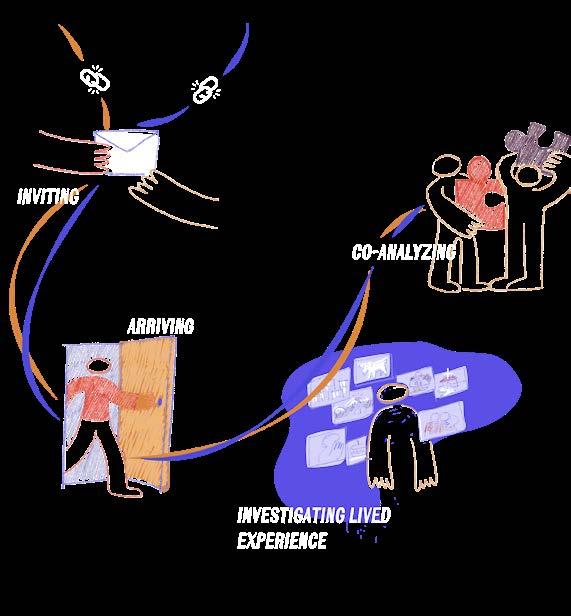
A design process that draws from principles of abolition, by centering community agency and restoration. Leila Jackson. 2024.
Inviting
Inviting voices for whom socio-political conditions complicate the context of belonging
Arriving
Unpacking designer bias and committing to elevating community members as experts and designers themselves
Investigating Lived Experience
A deep investigation of the lived experience of communities.
Co-Analyzing
Democratizing the design research process and recentering participants in a nonextractive ways
Repairing
Center “reparative” spatial and experiential solutions. This looks like, challenging standard practices to center nuanced experiences of safety, agency and belonging that are driven by investigated lived experience
Exiting
Designers emerge transformed, through self interrogation and a dismantling of the hierarchies designers yield and reinforce. Communities emerge as agents of change
Photovoice methods for abolitionist perspectives
With an understanding of abolitionist perspectives in K-12 design, and the experience of the school-prison nexus and its impact on belonging, this work seeks to offer photovoice methods as a tool for designers to engage student belonging with a critical, abolitionist lens.
An abolitionist design process requires designers to engage in a deepened community engagement process. Precedents for a more thorough and just engagement process exist through community-engaged design, but are not explored in this paper. The framework proposed in this paper makes its distinction through the adjacent goals of (1) fostering “reparative solutions” that challenge standard practices and consider nuanced experiences of safety, and (2) cultivating agency, or empowering community members as agents of change.
Participatory Action Research (PAR) methods can achieve these goals. PAR is a research methodology that centers research subjects, or in the case of designers (design communities), as tasked with the documentation, interpretation or analysis of their lived experience. These actions aid communities to take a leading role in actionable outcomes that can better articulate the role of the designer. Cahill (2007) characterizes PAR by commitments to democratize the research process; place an emphasis upon knowledge from below; center the lived experience as the starting point for investigation; and push for genuine accountability (p. 268). Social designer, researcher and activist Sarah Fathallah (2021) advocates for participatory methods for designers specifically. They claim that in a design context, these methods help to shift power dynamics in ways that break down traditional knowledge roles and build capacity for participants.
PAR is particularly effective with children and youth (Shamrova & Cummings, 2017) because it is known to deliver belonging outcomes. An effective belonging study will challenge existing age-based power imbalances (p. 406), create a ground for developing and strengthening a sense of connectedness and belonging to a community (p. 403), and help youth participants become agents of change within their own community (p.405).
On Photovoice
PAR can be practiced through a variety of methods including surveys, focus groups and more creative approaches like photovoice and drama techniques (Shamrova & Cummings, 2017, p.401). For the purpose of this research, I will focus on photovoice methods.
Photovoice is a visual research methodology that invites community participants to document their lived experience through photography, driven by a prompt. Then participants further reflect upon their experiences as individuals and groups through photo reflections, discussion and activities. This method invites the participants into the roles of researchers and analysts in the process of interpreting their own lived experience. Participant-generated images can be useful in understanding community values and facilitating reflection on daily experiences. Paired with group discussions, photovoice helps to develop co-constructed meanings and shared community experiences.
Photovoice has been particularly effective for belonging studies around youth and school behaviors (Walls 2023; Stack and Wang 2018), and has led to several studentengaged photovoice studies on belonging (Walls, 2023; Stack & Wang 2018; Locke et al., 2023, Duran 2019). It is also useful for designers, because it reflects a spatial understanding of belonging that can help identify design opportunities. Ultimately, photovoice is uniquely capable for studying belonging, engaging youth and serving the process of designers.
It is important to note, that a pure application of photovoice does not define an abolitionist approach. However, designers can use photovoice as a starting point for lived experience investigation, coupled with a more complete adoption of an abolitionist design process.
Conclusion
In the previous pages I have explored how principles derived from abolition can guide designers in efforts towards a liberatory design praxis. I began with an exploration of space (K-12 learning environments and the school-prison nexus) and concluded with an exploration of methodology (photovoice for abolitionist design perspectives). Belonging is a framework for justice, when we when we take the opportunity to center the lived experiences of marginalized people in actionable ways.
The journey throughout this project has been an effort to spatialize my values within the built environment, and perhaps selfishly, uncover my own sense of belonging within a profession that I often feel at odds with and isolated from. At many points in this process I’ve asked myself whether these ideas are truly meant for designers, and more importantly, if I am doing justice to abolitionist theory by suggesting its application in this industry. However, my hope is that this work inspires reflections of what it means to be a designer for myself and for anyone else reading this.
References
AIA. 2022. “Architect’s Role in Creating Equitable Communities,” 2022.
Allen, K.-A., Kern, M. L., Rozek, C. S., McInerney, D. M., & Slavich, G. M. (2021). Belonging: A review of conceptual issues, an integrative framework, and directions for future research. Australian Journal of Psychology, 73(1), 87–102. https://doi.org/10.1080/00049530.2021.1883409
Annamma, S. A., Cabral, B., Harvey, B., Wilmot, J. M., Le, A., & Morgan, J. (2023). “When We Come to Your Class … We Feel Not Like We’re in Prison”: Resisting Prison-School’s Dehumanizing and (De) Socializing Mechanisms Through Abolitionist Praxis. American Educational Research Journal. https:// doi.org/10.3102/00028312231198236236.
Buren, D. V. (2017, November). Deanna Van Buren: What a world without prisons could look like | TED Talk. https://www.ted.com/talks/deanna_van_buren_what_a_world_without_prisons_could_look_ like
Cahill, C. (2007). The Personal is Political: Developing new subjectivities through participatory action research. Gender, Place and Culture : A Journal of Feminist Geography, 14(3), 267–292. https://doi. org/10.1080/09663690701324904
Chua, C., Linnemann, T., Spade, D., Syedullah, J., & Maher, G. (2023). Police abolition. Contemporary Political Theory. https://doi.org/10.1057/s41296-023-00640-6
Collins, C. (2021, January 29). Toolkit: The Foundations of Restorative Justice | Learning for Justice. Learning for Justice. https://www.learningforjustice.org/magazine/spring-2021/toolkit-thefoundations-of-restorative-justice
Davis, A. Y. (2022). Abolition. Feminism. Now. Haymarket Books.
Davis, A. Y. (Angela Y. (2003). Are prisons obsolete? Seven Stories Press.
DelSesto, M. (2023). W.E.B. Du Bois and Designs for Abolition Democracy. Design and Culture, 15(2), 255–265. https://doi.org/10.1080/17547075.2023.2218743
Duran, A. (2019). A Photovoice Phenomenological Study Exploring Campus Belonging for Queer Students of Color. Journal of Student Affairs Research and Practice, 56(2), 153–167. https://doi.org/1 0.1080/19496591.2018.1490308
Fathallah, S. (2021, March 22). The Case for Participatory Methods in Design Research. Pollinator: The Bloom Works Blog. https://medium.com/pollinator/the-case-for-participatory-methods-indesign-research-9ca23ac55cd8
Fathallah, S., & Lewis, A. D. S. (2021, April 26). Abolish the Cop Inside Your (Designer’s) Head. Design Museum Everywhere. https://designmuseumfoundation.org/abolish-the-cop-inside-your-designershead/
Gilmore, R. W. 2017. Abolition Geographies and the Problem of Innocence. Futures of Black Radicalism, (1st ed.). Verso.
April 17 2020, J. P. /. (n.d.). Ruth Wilson Gilmore on Covid-19, Decarceration, and Abolition. Haymarketbooks.Org. Retrieved January 8, 2024, from https://www.haymarketbooks.org/blogs/128ruth-wilson-gilmore-on-covid-19-decarceration-and-abolition
Gilmore, R. W. (2022). Abolition Geography: Essays Towards Liberation. Verso Books.
Kaba, M. (2021). We do this ’til we free us: Abolitionist organizing and transforming justice. Haymarket Books.
Kim, C. Y., Losen, D. J., & Hewitt, D. T. (2010). The school-to-prison pipeline: Structuring legal reform (1st ed.). University. https://doi.org/10.18574/9780814749197
Krueger, P. (2010). It’s not just a method! The epistemic and political work of young people’s lifeworlds at the school-prison nexus. Race, Ethnicity and Education, 13(3), 383–408. https://doi.org/ 10.1080/13613324.2010.500846
Lamble, S. 2021. Practising everyday abolition. Abolishing the Police. Dog Section Press. (In Press)
Locke, L. A., Bardhoshi, G., Swanston, J., & Nam, S. (2023). “I Don’t Want to Be Stereotyped”: A Study with Latinx High School Students Informed by Photovoice. Journal of Latinos and Education, 22(5), 2051–2069. https://doi.org/10.1080/15348431.2022.2086130
Loury, G. C. (2008). Race, incarceration, and American values. MIT Press.
Meiners, E. R. (2011). Ending the School-to-Prison Pipeline/Building Abolition Futures. The Urban Review, 43(4), 547–565. https://doi.org/10.1007/s11256-011-0187-9
Meiners, E. R., & Winn, M. T. (2010). Resisting the school to prison pipeline: the practice to build abolition democracies. Race, Ethnicity and Education, 13(3), 271–276. https://doi.org/10.1080/136133 24.2010.500832
Riley, K. (2022). Compassionate Leadership for School Belonging. UCL Press. https://doi.org/10.14324/111.9781787359567
Schein, R. H. (2009). Belonging through Land/Scape. Environment and Planning A: Economy and Space, 41(4), 811–826. https://doi.org/10.1068/a41125
Shamrova, D. P., & Cummings, C. E. (2017). Participatory action research (PAR) with children and youth: An integrative review of methodology and PAR outcomes for participants, organizations, and communities. Children and Youth Services Review, 81, 400–412. https://doi.org/10.1016/j. childyouth.2017.08.022
Shange, S. (2019). Progressive Dystopia: Abolition, Antiblackness, and Schooling in San Francisco. Duke University Press. https://doi.org/10.1215/9781478007401
Stack, M., & Wang, F. (2018). Students’ Perceptions of Belonging: A Photovoice Participatory Action Research Project. Canadian Journal of Action Research, 19(1), 48–66. https://doi.org/10.33524/cjar. v19i1.375
Steinitz Holyoke, E. (2022). Layered Pedagogies of Instruction and Restorative Justice: A Kindergarten Case Study of Community and Belonging. Perspectives on Early Childhood Psychology and Education, 6(1). https://doi.org/10.58948/2834-8257.1007
Stovall, D. (2018). Are We Ready for ‘School’ Abolition?: Thoughts and Practices of Radical Imaginary in Education. Taboo (New York, N.Y.), 17(1), 51–61. https://doi.org/10.31390/taboo.17.1.06
Toews, B., Van Buren, D., & Jacobs, G. (2022). Participatory restorative justice design: Creating space for restorative justice by centring the voices of those impacted by harm. The International Journal of Restorative Justice, 5(3), 392–416. https://doi.org/10.5553/TIJRJ.000140
Walls, J. (n.d.). The Politics of Belonging and Implications for School Organization: Autophotographic Perspectives on “Fitting In” at School—Jeff Walls, Karen Seashore Louis, 2023. Retrieved September 12, 2023, from https://journals.sagepub.com/doi/10.1177/23328584221139766
Wahbi, R., & Beletsky, L. (2022). Involuntary Commitment as “Carceral-Health Service”: From Healthcare-to-Prison Pipeline to a Public Health Abolition Praxis. The Journal of Law, Medicine & Ethics, 50(1), 23–30. https://doi.org/10.1017/jme.2022.5
Wong, B. (2023). Exploring the spatial belonging of students in higher education. Studies in Higher Education, 1–13. https://doi.org/10.1080/03075079.2023.2243285
Yuval-Davis, N. (2006). Belonging and the politics of belonging. Patterns of Prejudice, 40(3), 197–214. https://doi.org/10.1080/00313220600769331