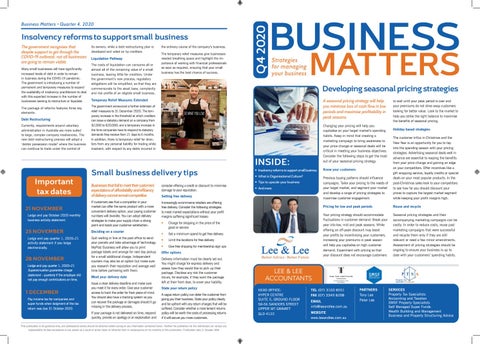
Insolvency reforms to support small business The government recognises that despite support to get through the COVID-19 outbreak, not all businesses are going to remain viable. Many small businesses will have significantly increased levels of debt in order to remain in business during the COVID-19 pandemic. The government is introducing a number of permanent and temporary measures to expand the availability of insolvency practitioners to deal with this expected increase in the number of businesses seeking to restructure or liquidate. The package of reforms features three key elements:
Debt Restructuring Currently, requirements around voluntary administration in Australia are more suited to large, complex company insolvencies. The new debt restructuring process will adopt a ‘debtor possession model’ where the business can continue to trade under the control of
its owners, while a debt restructuring plan is developed and voted on by creditors.
Liquidation Pathway The costs of liquidation can consume all or almost all of the remaining value of a small business, leaving little for creditors. Under the government’s new process, regulatory obligations will be simplified, so that they are commensurate to the asset base, complexity and risk profile of an eligible small business.
the ordinary course of the company’s business. The temporary relief measures give businesses needed breathing space and highlight the importance of working with financial professionals as soon as required, ensuring that your small business has the best chance of success.
Q4 2020
Business Matters Quarter 4, 2020
Strategies for managing your business
Developing seasonal pricing strategies
Temporary Relief Measures Extended
A seasonal pricing strategy will help you minimise loss of cash flow in low periods and maximise profitability in peak seasons.
The government announced a further extension of relief measures to 31 December 2020. The temporary increase in the threshold at which creditors can issue a statutory demand on a company from $2,000 to $20,000; and a temporary increase in the time companies have to respond to statutory demands they receive from 21 days to 6 months. In addition, there is temporary relief for directors from any personal liability for trading while insolvent, with respect to any debts incurred in
Changing your pricing will help you capitalise on your target market’s spending habits. Keep in mind that creating a marketing campaign to bring awareness to your price change or seasonal deals will be critical in meeting your business objectives. Consider the following steps to get the most out of your seasonal pricing strategy.
Important tax dates 21 NOVEMBER Lodge and pay October 2020 monthly business activity statement.
25 NOVEMBER Lodge and pay quarter 1, 2020–21 activity statement if you lodge electronically.
28 NOVEMBER Lodge and pay quarter 1, 2020–21 Superannuation guarantee charge statement - quarterly if the employer did not pay enough contributions on time.
1 DECEMBER Pay income tax for companies and super funds when lodgment of the tax return was due 31 October 2020.
Businesses that fail to meet their customers’ expectations of affordability and efficiency of delivery cannot remain competitive.
consider offering a credit or discount to minimise damage to your reputation.
If customers see that a competitor in your market can offer the same product with a more convenient delivery option, your paying customer numbers will dwindle. You can adopt delivery strategies to make your supply chain a strong point and boost your customer satisfaction.
Increasingly e-commerce retailers are offering free delivery. Consider the following strategies to meet market expectations without your profit margins suffering significant losses:
• Insolvency reforms to support small business
Know your customers
• What is Organisational Culture?
Previous buying patterns should influence campaigns. Tailor your pricing to the needs of your target market, and segment your market and develop a range of pricing strategies to maximise customer engagement. Pricing for low and peak periods
Reuse and recycle
Your pricing strategy should accommodate fluctuations in customer demand. Break your year into low, mid and peak seasons. While offering an off-peak discount may boost your profits by incentivising your customers, increasing your premiums in peak season will help you capitalise on high customer demand. Experiment with pricing so that your discount does not encourage customers
Seasonal pricing strategies and their accompanying marketing campaigns can be costly. In order to reduce costs, reuse past marketing campaigns that were successful and recycle them only if they are still relevant or need a few minor amendments. Assessment of pricing strategies should be ongoing to ensure your business is up to date with your customers’ spending habits.
Deciding on a courier Quit waiting in line at the post office to send your parcels and take advantage of technology. MyPost Business will allow you to print postage labels and arrange for next day pickup for a small additional charge. Independent couriers may also be an option but make sure you research their reputation and average wait time before partnering with them. Meet your delivery date Issue a clear delivery deadline and make sure you meet it for every order. Give your customer access to track the order for their piece of mind. You should also have a tracking system so you can recover the package or damages should it go missing in the delivery process. If your package is not delivered on time, respond quickly, provide an apology or an explanation and
• Tips to upscale your business • And more
Setting free delivery
•
Charge for shipping in the price of the good or service
•
Set a minimum spend to get free delivery
•
Limit the locations for free delivery
•
Give free shipping for membership sign ups
Offer options Delivery information must be clearly set out. You might charge for express delivery and assess how they would like to pick up their package. Disclose any risk the customer incurs, for example, if they want the package left at their front door, to cover your liability. State your return policy A vague return policy can deter the customer from giving you their business. State your policy clearly and be upfront with any return charges that will be suffered. Consider whether a more lenient returns policy will be worth the costs of processing returns if it will secure you more customers.
This publication is for guidance only, and professional advice should be obtained before acting on any information contained herein. Neither the publishers nor the distributors can accept any responsibility for loss occasioned to any person as a result of action taken or refrained from in consequence of the contents of this publication. Publication date 21 October 2020
Holiday based strategies The customer influx in Christmas and the New Year is an opportunity for you to tap into the spending season with your pricing strategies. Advertising seasonal deals well in advance are essential to reaping the benefits from your price change and gaining an edge on your competitors. Offer incentives like a gift wrapping service, loyalty credits or special deals on your most popular products. In the post-Christmas sales look to your competitors to see how far you should discount your prices to capture the largest market segment while keeping your profit margins high.
INSIDE: Small business delivery tips
to wait until your peak period is over and your premiums do not drive away customers looking for better value. Look to the market to help you strike the right balance to maximise the benefits of seasonal pricing.
LEE & LEE ACCOUNTANTS HEAD OFFICE: HYPER CENTRE SUITE 5, GROUND FLOOR 50-56 SANDERS STREET UPPER MT GRAVATT QLD 4122
TEL (07) 3103 8551 FAX (07) 3349 8208 EMAIL info@leeandlee.com.au WEBSITE www.leeandlee.com.au
PARTNERS Tony Lee Peter Lee
SERVICES Property Tax Specialists Accounting and Taxation SMSF Property Specialists Self Managed Super Funds Wealth Building and Management Business and Property Structuring Advice
Business Matters Quarter 4, 2020
Business Matters Quarter 4, 2020
Mitigating conflicts of interest
What business structure suits your business?
Conflicts of interest are often a trigger for workplace tension and gossip, reducing productivity and damaging employee relations.
Tips to upscale your business Set realistic and actionable goals Businesses should set realistic and actionable small goals which they can work towards, rather broad goals which provide no direction. Setting broad and unrealistic goals is demotivating and makes any progress made seem insignificant. Every person in the business should be given a target to meet over a reasonable timeline which contributes towards achieving a larger goal.
Establishing standardised and automated processes Small businesses can make the mistake of ‘doing things as they come’ but this means that as business grows, adjusting to high scale tasks is difficult. To avoid this, business should standardise all processes of work. Any individual placed into a role should be able to follow standardised procedure and yield a product which is of similar quality to the previous one. Investing money into automation tools is worthwhile for this procedure. This can include automating management of social media, email, and customer relationships. Both of these will contribute to creating structures which support growth.
Identify competitive strengths and weaknesses Recognising the strengths and weaknesses of one’s business is essential. Strengths will allow businesses to hone in on unique qualities they possess which give them a competitive advantage. Weaknesses will reveal which areas require growth so that changes can be made before upscaling takes place.
Network Businesses should continue to develop relationships with service providers, sales channel partners, suppliers and customers. Keeping an open mind about partnerships or potential collaborations could open up different avenues of business growth.
Common examples of conflicts of interest in business include:
communicated to employees verbally and reenforced through discussions.
•
Recommending a friend or family member for a job position.
•
Employers not disclosing that a candidate being considered for a job is a friend or family member.
A good code of conduct will reflect the culture and values of the business, provide information on how workers can expect to be treated and how they are expected to behave. It should be accessible to all employees, be well organised and comprehensive but also easy to understand. This can be achieved by providing situational examples, answering common questions workers may have, and avoiding technical or legal jargon that may be confusing.
•
An employee starting their own business that provides similar products or services, especially if a non-compete agreement has been signed.
•
Working for a competing company.
•
Posting to social media about the business’ failures.
•
Romantic relationships between an employee and their supervisor.
•
Accepting a favour or gift beyond the agreed amount from a client.
There are four types of organisational cultures.
•
Clan Culture: Focussed on collaboration between teams to form a family-like relationship.
•
Adhocracy Culture: Focussed on creativity and innovation and open to continual change.
•
Market Culture: Focussed on achieving goals through competitive drive amongst employees.
•
Hierarchy Culture: Focussed on
obligations of the business
•
•
You have complete control of your business Your business assets and liabilities are not separate from your personal assets and liabilities Personally liable for debts and
•
Members not liable for company’s debt (only liable if you breach legal obligations)
Partnership •
Share control and management of business
•
•
Each partner pays tax on the share of net partnership income each receives
Complex business structure plus Extensive documentation and record-keeping
•
Wider access to capital
•
Minimal reporting requirements + Inexpensive to set up
•
Requires more documentation
Sole Proprietorship •
Low-cost structure
directly to the corporation
Company •
Separate legal entity from its owners - all profit, tax, and legal liability is
Trust •
Expensive set-up and operation
•
Formal trust deed outlining operation required
•
Trustee responsible for yearly administrative tasks
Entering a partnership: pros and cons
What is Organisational Culture?
Organisational culture is multifaceted, it consists of the shared values, beliefs and norms in the workplace, and determines employee interactions as well as customer interactions.
This will reflect into all facets of your business, so you should spend time understanding the implications of each structure.
•
The best way to avoid conflicts of interest in the workplace is to establish a code of conduct that clearly outlines the standards and expectations of the business. It should cover details of business policies and list everyone it applies to, including employers and employees, board members, management, officers, and contractors. This code of conduct should be
Understanding what organisational structure is can help with making decisions about your business in all areas.
An important decision to make before you start a business is what structure your business will run under.
formal procedures and guidelines and maintaining power structures. The organisational culture reflects in all aspects of the business. It can help with determining which potential employees may be more suitable than others and the way that those in leadership positions communicate with employees. The way a business communicates and interacts with their customers is also influenced by organisational culture. Businesses may desire friendly and informal relationships, or formal and reserved relationships. Communication methods may also change, such as preferring email interaction as opposed to utilising chat functions. Of course, the culture of an organisation can have overlap of the different types. More important than focussing on one type of culture, is recognising what works best for your business and trying to foster values and norms that embody that.
Whether you are in the business game already or setting your sights on a new business venture, starting a partnership may be a high-yielding decision.
Consider the following advantages and disadvantages before starting or joining a partnership:
If a partner wishes to resign from the partnership, it is relatively simple to dissolve the partnership and recover their share.
Advantages
Disadvantages
A partnership business structure is an incorporated business with 2-20 owners. The individual owners work together to achieve the goals of the business; sharing responsibility and profits.
A partnership structure is easy and inexpensive to set up. Unlike operating as a sole trader, there is increased opportunity for income splitting, more capital available and higher borrowing capacity.
Partnership laws vary depending on your state or territory. There are two types of partnerships - general and limited.
Working as a team can also provide more perspective than working as an individual. High performing employees can also be made partners.
This type of business structure carries unlimited liability, meaning the business owners are liable for the debts of the business and are subject to reasonably cover what is owed or risk seizure of their personal assets.
A general partnership is where all partners are equally responsible for the day-to-day management of the business. Whereas, a limited partnership has at least one general partner who is responsible for controlling the day-to-day operations and is liable for the debts and obligations of the business. The passive partners in this type of partnership are called limited partners. Limited partners generally contribute a defined amount of capital, and their liability is limited to the amount of capital that is contributed.
From a tax perspective, partnerships do not need to pay tax on their income. Each partner pays tax on the share of the net partnership income they receive. Superannuation is a responsibility of the individual partner, as partners are not considered employees. Additionally, there is limited external regulation and reporting requirements. Removing partners is generally straightforward. The only condition is that at least two partners are left in the business.
Each partner is responsible for the debts and liabilities of the business (with the extent depending on the type of partnership) including the actions of other partners. This can cause disputes and friction among partners, resulting in unfavourable circumstances. For example, one partner may have a differing vision or a different opinion on administrative control or profit sharing for the business compared with the other partners. Although the process of adding and removing partners is simple, partners will most likely need to value partnership assets which can be expensive.
We are here to help Make use of us! This guide is merely a starting point, designed to help you identify areas that might have a significant impact on your personal and business planning. We are always pleased to discuss matters with you and advise in any way we can.