


Theme III: Theme IV:
Theme V:
Theme I: Theme II: Theme VI:

Theme III: Theme IV:
Theme V:
Theme I: Theme II: Theme VI:
We are thrilled to present to you Leadership Roundtable’s report on the discussions and recommendations developed during the 2024 Catholic Partnership Summit. The Catholic Partnership Summit brings together Catholic leaders from across the Church to address the most pressing leadership and management challenges and opportunities of our times.
Our theme of “Expanding the Tent: Young Adult Leadership and Co-Responsibility in the Catholic Church” reflects a unifying concern across all sectors of the Church for the engagement and leadership of young adults as part of a co-responsible Church culture.
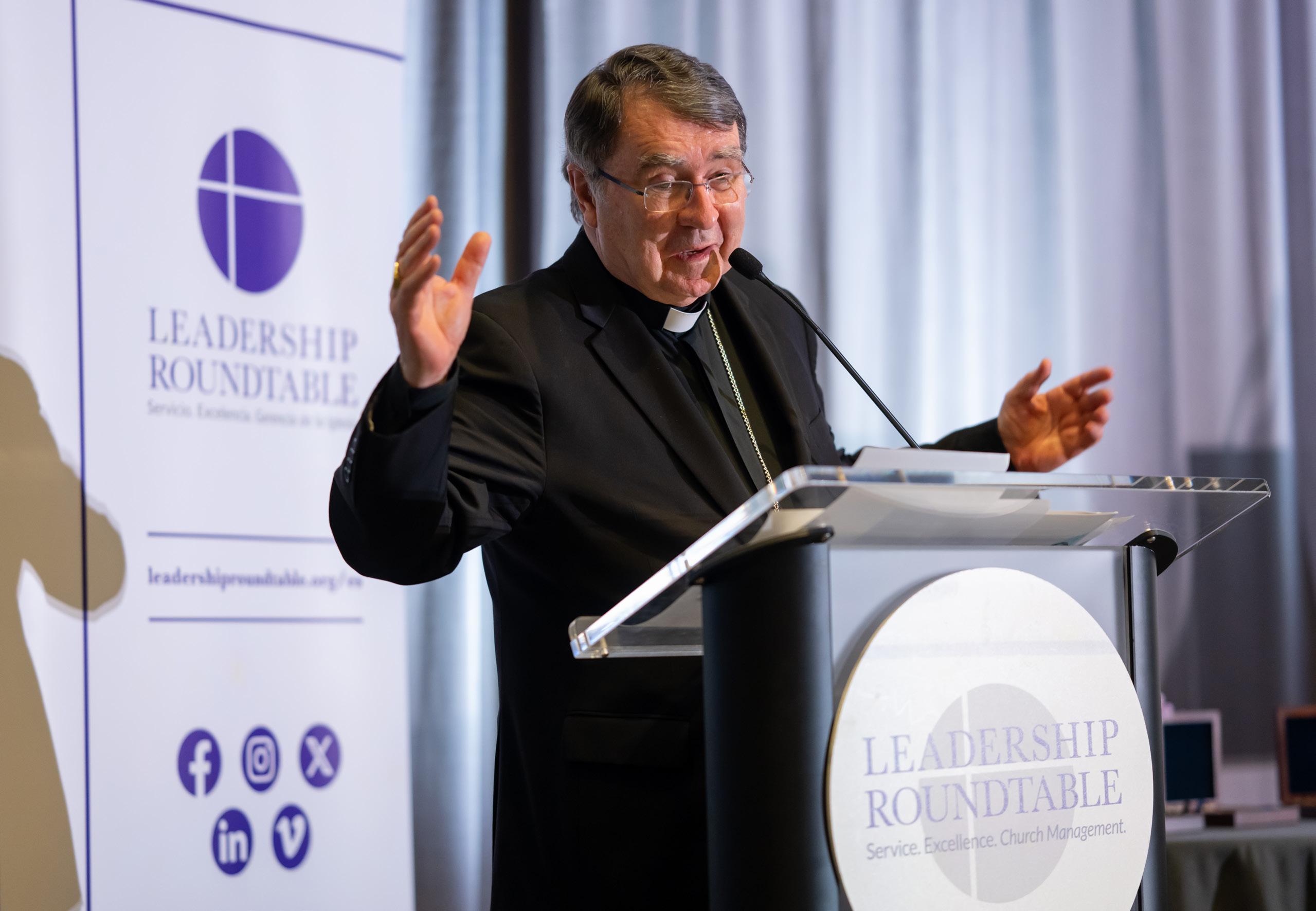
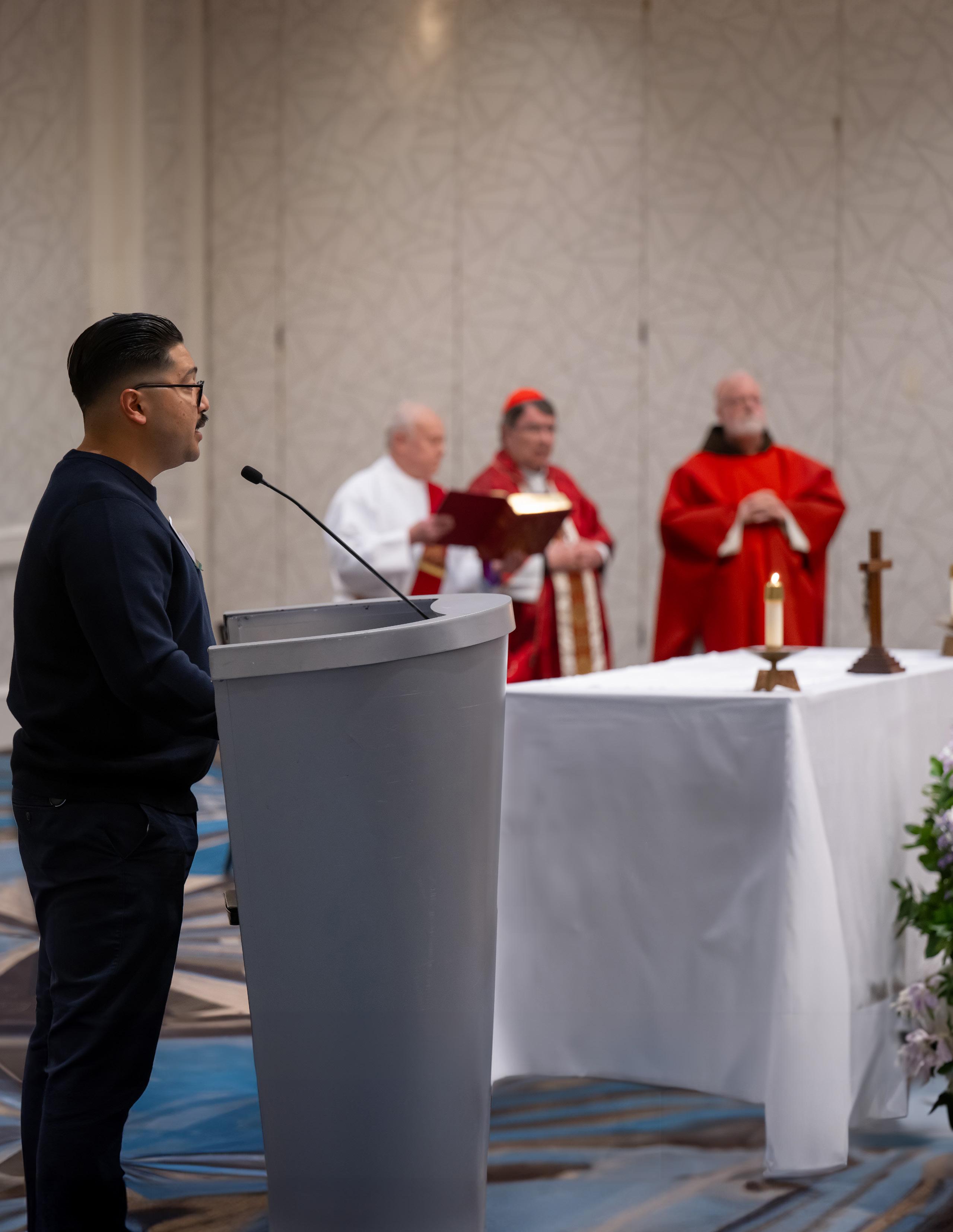
This year, we achieved a historic milestone by welcoming the largest contingency of young adults to date at a Catholic Partnership Summit — 75 of the 275 leaders from across the U.S. and Europe were younger than age 40. We sought to make the Summit a gathering by, with, and for young adults, involving them in every step of the process with the help of a Young Adult Advisory Committee. United in faith, participants began the Summit with Mass, celebrated by Cardinal Christophe Pierre, apostolic nuncio to the United States, with a homily offered by Cardinal Seán O’Malley, OFM Cap., archbishop of Boston. Young adults played an active role throughout the Summit, serving on every panel of experts, and taking part in conversations at every roundtable alongside cardinals, bishops, university presidents, philanthropists, and leaders of national Catholic organizations.
The Summit facilitated synodal conversations around the unique challenges and opportunities facing young adults. In this report, you will find summaries of the six central themes that emerged from the panels and data gathered at each table, which produced the accompanying list of actionable recommendations for each theme. We share them in the spirit of synodality, having listened to young adults’ concerns and hopes for the Church. At the Summit, Leadership Roundtable made several commitments to promote young adult leadership in the Church, and we are pleased to share those in this report.
We hope this report serves as a resource for your parish, diocese, or Catholic organization as you minister with young adults in fulfillment of the mission of the Catholic Church.
Sincerely,

Elizabeth McCaul Co-chair of the Board


Joseph D. Regan Co-chair of the Board
Throughout the Summit there was a recognition that:
• Young adults are protagonists in the Catholic faith.
• The challenges faced by young adults today are not the same as those faced by prior generations.
• Lived expressions of faith outside the parish walls are important practices in the lives of young adults, and present opportunities for the Church to build bridges between parish life and where young adults are actively engaged.
• Synodality has opened a door to engage with young adults in honest dialogue on difficult issues that have led some to leave the Church.
• Accountability is a key element in rebuilding trust with young adults.
• Young adults were raised and live in a digital world, and the Church must embrace, understand, and minister within digital culture.
• Mental health is a topic the Church needs to be aware of, and actively seek avenues to support, for all members of the faith community.
• In a time when many still bear wounds from the Church and trust remains broken, the way to share and live our faith today is with a synodal style of listening, dialogue, and encounter.
• There is not a one-size-fits-all approach when engaging and ministering with young adults.
• Belonging is deeply important to young adults and directly impacts their affiliation with the Catholic Church.
• Declines in attendance and affiliation of young adults with the Catholic Church are not necessarily indicators of their spirituality, but rather are indicators of institutional commitment.
• Young adults want to learn from those who are older than them, but also have wisdom to offer the Church now, as young adults.

During the synodal conversations, participants adhered to the following guidelines to ensure productive and respectful discussions.
1
Listen to understand — Remain as fully present as possible and limit distractions. Listen to understand what is being said, not to refute the other person’s argument.
2
3
Speak from the heart — Share from your own experience. Avoid closing off yourself and not contributing to the wisdom of the group.
Speak to be understood — Avoid long stories or complicated examples with a lot of detail. Instead, aim to be succinct. Do all that is possible to facilitate the comprehension of others.
4
5
Be open to growth — Be willing to participate and engage in the hard work of selfreflection. Enter into each process beginning with humility.
Stay curious — Lean into nonjudgmental inquiry. Remain open to hearing other or differing perspectives. Refrain from the inclination to fix others. Return to wonder.
6
7
Honor time and shared voice — Please give everyone an opportunity to speak once before speaking again. We encourage you to be attentive to your contribution and be mindful that everyone has an opportunity to share.
Take the learnings, leave the stories — Respect the privacy of others. Please do not share personal stories or identifying features once we close this circle. Treat the information sensitively and honor the trust that has been built.

Claudia Avila Cosnahan Mission and Partnerships Director, Commonweal
Sr. Nathalie Becquart, XMCJ Undersecretary, Synod of Bishops
Maria Fernanda Benavides Student, Tulane University
Geoffrey T. Boisi Founder, Leadership Roundtable
Michael Brough Executive Partner, Leadership Roundtable
Bishop Arturo Cepeda Auxiliary Bishop of Detroit
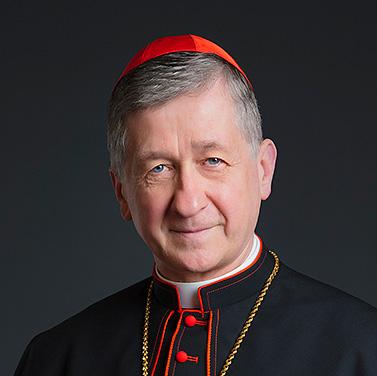
Cardinal Blase Cupich Archbishop of Chicago
Niru De Silva* Director of Retreats, FOCUS
Vicente Del Real* Founder, Iskali
José Manuel De Urquidi Founder and CEO, Juan Diego & Co.
Cardinal Timothy M. Dolan Archbishop of New York
Jill Fisk Director of Mission Services, Catholic Health Association of the United States
Cecilia Flores*
Executive Director, Catholic Volunteer Network
Craig Ford
Assistant Professor of Theology and Religious Studies, Saint Norbert College
Anna Gordon*
Program Director, Initiative on Catholic Social Thought and Public Life, Georgetown University
John Grosso
Digital Editor, National Catholic Reporter
Paul Jarzembowski
Associate Director for the Laity, United States Conference of Catholic Bishops
Anna Johnson
North America Senior Program Manager, Laudato Si' Movement
Susan King
Member, Leadership Roundtable Board of Directors
Tracey Lamont
Director, Loyola Institute for Ministry and Associate Professor, Religious Education and Young Adult Ministry, Loyola University New Orleans
Diana Marin* Young Adult Mobilization Program Manager, Catholic Climate Covenant
Patrick Markey
Managing Partner, Leadership Roundtable
Colin Martinez Longmore*
Communications and Social Media Coordinator, NETWORK
Sr. Teresa Maya, CCVI
Senior Director for Theology and Sponsorship, Catholic Health Association of the United States
Caitlin Morneau
Director of Restorative Justice, Catholic Mobilizing Network
Ashley Morris* Director of Black Catholic Affairs, Archdiocese of Atlanta
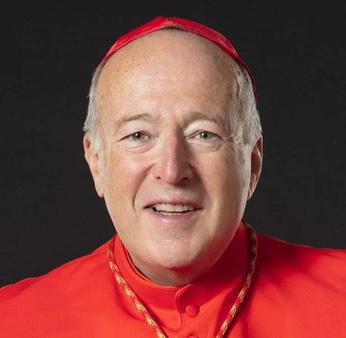
Cardinal Seán Patrick O’Malley, OFM Cap. Archbishop of Boston
Josh Packard
Vice President of Strategy, National Catholic Education Association
Stephanie Peddicord President, Goodfaith
Nicole Perone*
National Coordinator, ESTEEM
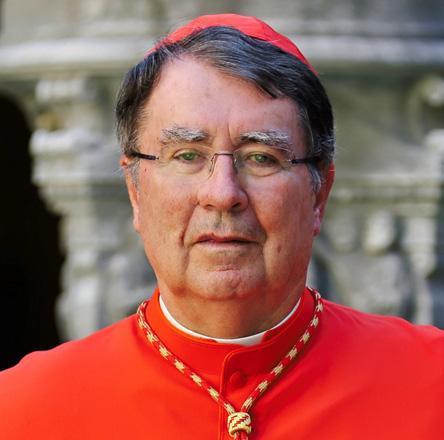
Cardinal Christophe Pierre Apostolic Nuncio to the United States
Kelli Reagan Hickey* Director of Formation, Francesco Collaborative
Rob Roa* Director of Recruitment, Jesuit Volunteer Corps
Kim Smolik Executive Partner, Leadership Roundtable
Nicholas Stein*
International Director, Bon Secours Young Adults
Fr. Agustino Torres, CFR Founder, Corazón Puro
* Members of the Young Adult Advisory Committee
The 2024 Catholic Partnership Summit, held February 28 through March 1, 2024, invited more than 275 leaders — including 75 young adults — to welcome the Holy Spirit’s guidance as they considered “Expanding the Tent: Young Adult Leadership and CoResponsibility in the Catholic Church.”
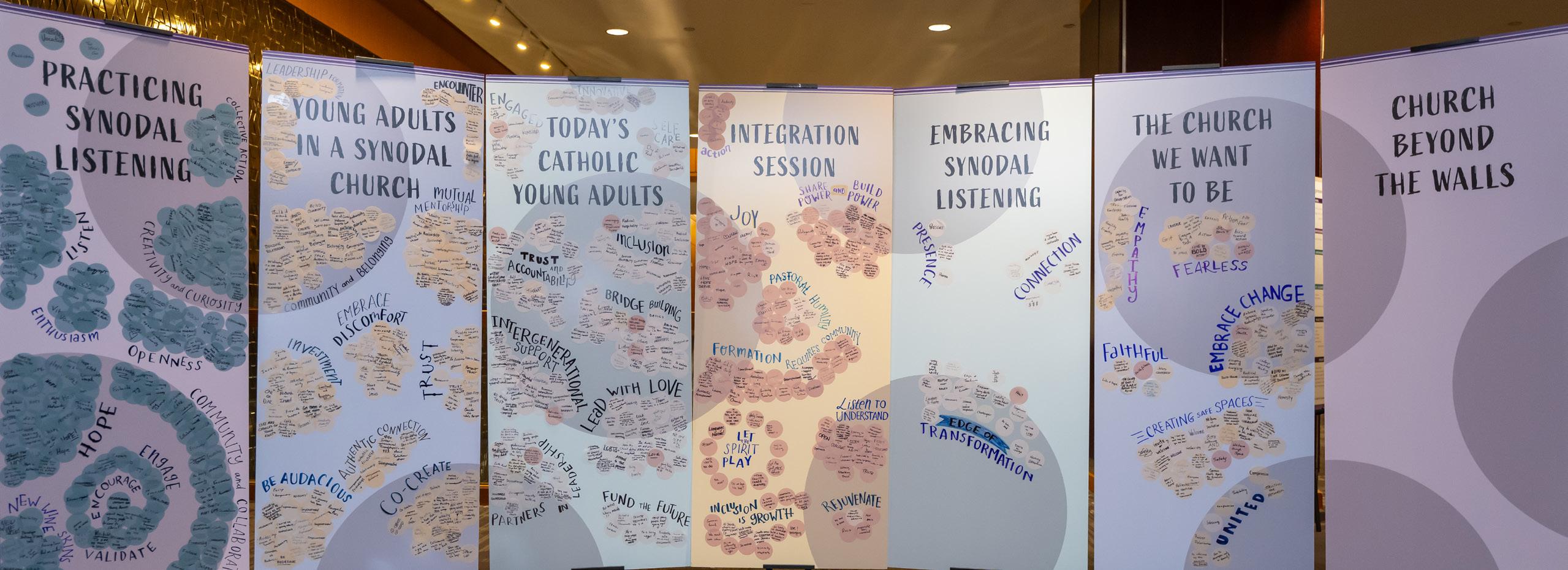
From the start, participants were invited to enter into listening and speaking as a spiritual practice, to lean into the conversations, visualize transformation and impact, and consider how they and the Church could take action, through a process of Synodal Conversation Circles.
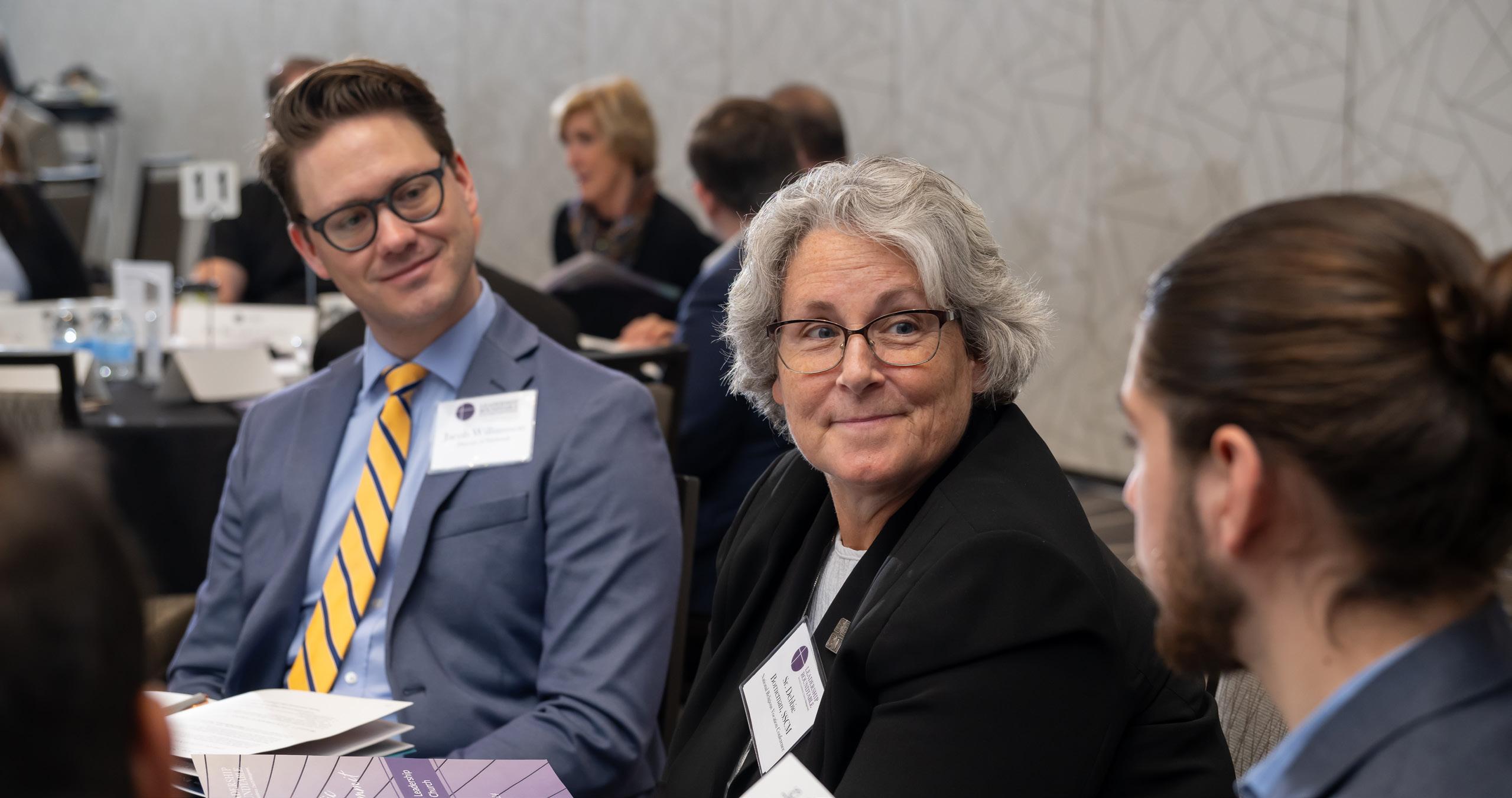
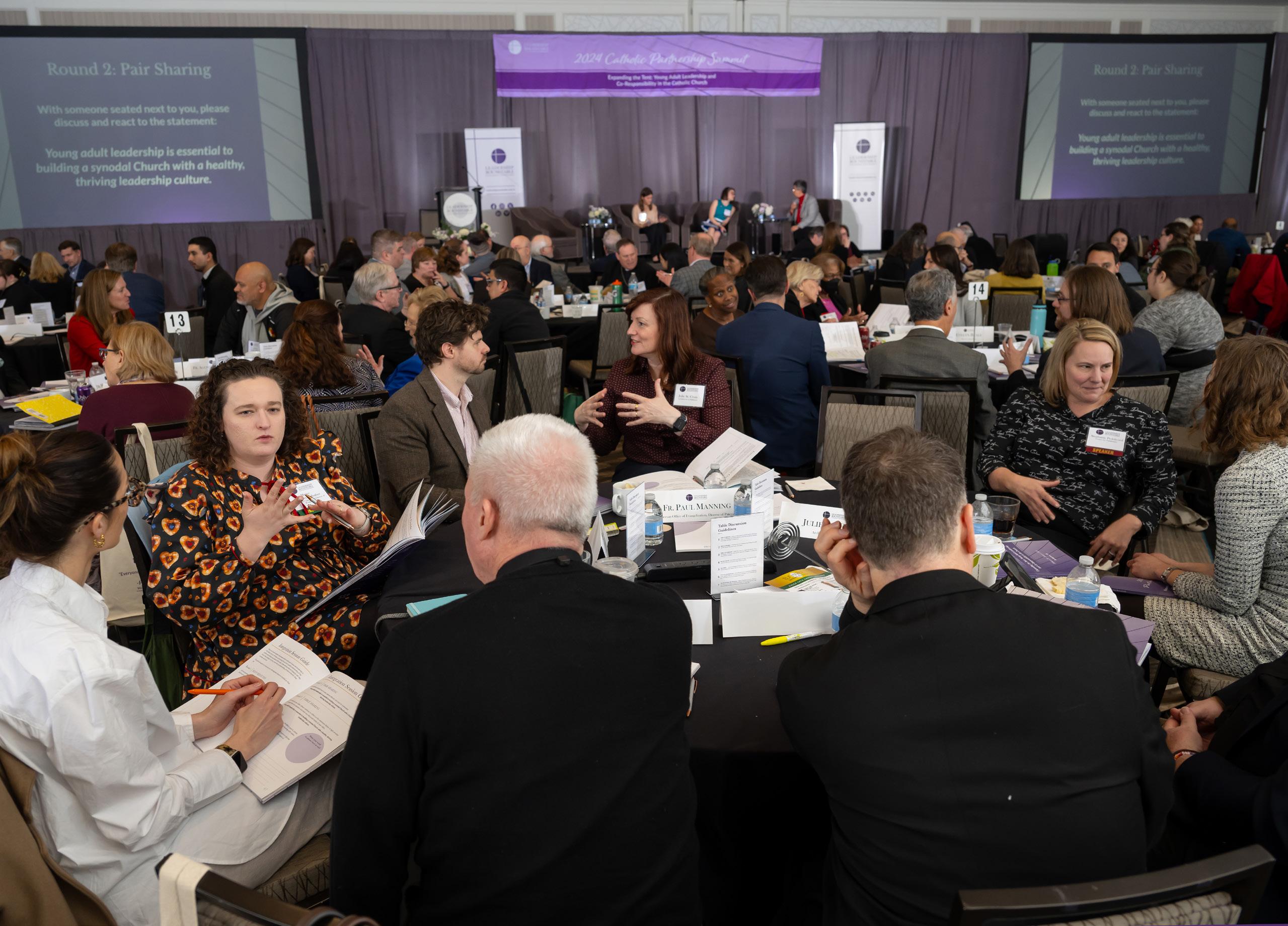
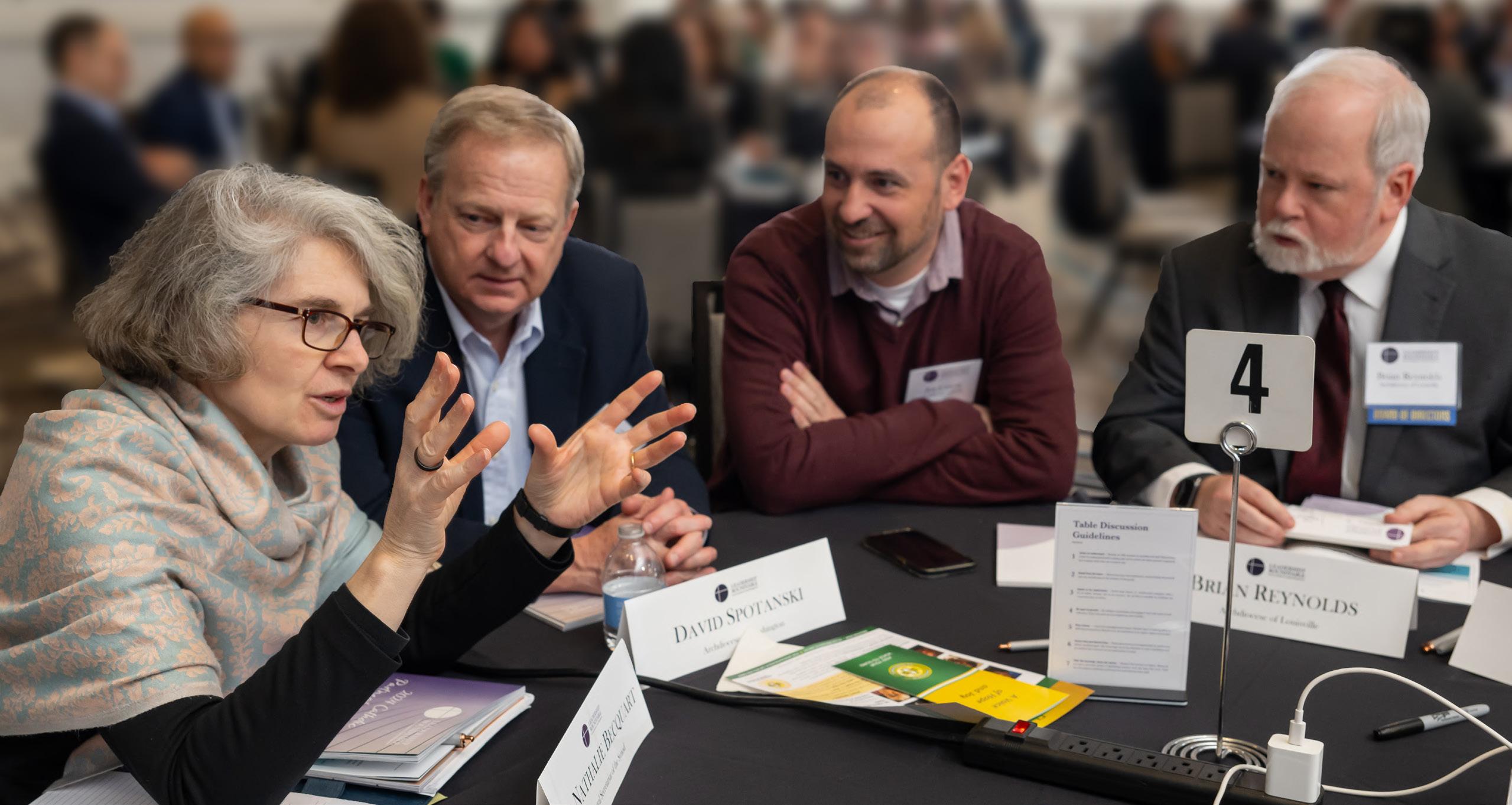
Seated at round tables, each circle modeled the practices used in Rome during the Synod on Synodality, engaging in periods of silent reflection, sharing in pairs, and taking turns listening and dialoging around the table, to discern where the Spirit is leading the Church on its journey together with young adults.
Throughout the event, as participants heard from expert speakers and engaged in circle conversations, six central themes emerged. Several threads wove throughout each, including the importance of rebuilding trust through relationships, authenticity and openness in encounter, and a desire to find belonging in the Church.
This executive summary contains major themes that emerged from Summit speakers and small group discussions.
A co-responsible leadership culture includes young adults in decision-making roles and acknowledges their passion and capacity to contribute to the mission of the Church. Beyond existing structures, the Church is called to support young adult leaders by identifying and leveraging their strengths as part of a co-responsible leadership model. For example, it is essential to ensure young adults are involved in leading initiatives specifically targeted at their age group, but also in other capacities that align with their strengths and interests. By elevating and supporting young adult leaders, we recognize their pivotal role as the present and the future of the Church.
To engage and retain young adults, the Church is encouraged to try new approaches that resonate with their lived-faith experiences and how they connect spiritually with the Church, such as through ministries centered on justice and the corporal works of mercy. By actively working to become a “third space,” beyond the home and work, where young adults can build community with others, and by forming priests and homilists to strengthen their preaching to connect with the realities young adults face today, the Church can address them directly and engage them in faith life.
Young adults face many complex challenges, particularly mental health issues of anxiety, isolation, stress, and depression. Proactively addressing these
issues includes offering compassionate pastoral care, forming leaders to recognize and respond to those in crisis, and fostering a community that uplifts and assists young adults facing challenging times. Creating a healthy environment by destigmatizing mental health through initiatives and resources that are easily accessible, such as through social media and other digital spaces, ensures the Church can be a source of support for young adults in a time of need.
Young adults who have taken part in the Synod on Synodality have begun to gravitate back toward the Church and its ministries because, for many, it’s the first time they’ve felt the Church and its leaders truly listen to them. Across generations, people want to be heard, but greater formation in synodal listening and spaces where individuals can feel safe to share their views are needed. Providing synodal leadership formation to leaders that teaches how to listen to understand, versus respond, as well as creating avenues to ask questions and offer feedback are key steps to fostering the authentic conversations that have begun to draw young adults back to the Church.
As people, we understand each other through conversation and shared experiences. Building skills in emotional intelligence, actively avoiding tokenism, and practicing conversations in the spirit, as defined through the Synod on Synodality, will support leaders as they work to truly listen to, and build relationships with, young adults in their faith community.
Leaving space through silence and reflection for the Holy Spirit to lead is often difficult in our fast-paced, results-oriented culture. It is important for leaders to recognize that young adults and their relationship to the Church are not a problem to be solved, but rather they are individuals for whom they should prayerfully discern how the Holy Spirit is calling the Church to support and accompany them. As part of their discernment, Church leaders are being called to take the time to learn about young adults and the realities they face in today’s world, such as unique financial and social pressures, and reflect on how they can be conscious of those realities when making decisions. This can also include seeking to learn from other denominations or faiths that are successfully engaging young adults.

Genuinely welcoming young adults in the Church requires rethinking how we view, minister to, and lead together with young adults. Young adults are not a monolith, so it is vital to develop ministries and leadership opportunities that value their life experiences, backgrounds, and talents, and that do not silo them amongst themselves. It’s also important to consider critically how a faith community defines and practices hospitality, and where it can make changes that ensure young adults and others on the margins feel they belong. Looking to the success of campus ministries can help faith communities find new ways to engage young adults through things like opening spaces for remote work, providing low-cost housing, or offering a broader range of time for the sacraments and faith formation.
Many young adults find themselves overworked, overcommitted, overwhelmed, and seeking support through major life transitions. The Church can support its young adult employees by ensuring they receive competitive compensation, professional development, and access to paid family leave. Creating a compassionate environment where young adults can seek judgment-free help in times of crisis, such as offering access to resources for housing, food, and even addiction counseling, can provide this support, as well as adapting ministries and leadership meetings to respect the competing demands on young adults — such as providing child care or offering flexible meeting times or platforms.
One of the strengths of the Catholic Church is that it is home to individuals from various generations, cultures, ethnicities, and faith traditions. The Church must honor and embrace the vast diversity amongst the people of God and amongst young adults. By carefully selecting the language and images used in communications to be representative, the Church can foster a more inclusive and welcoming community. And by ensuring leaders receive training in intercultural competency, adopting bilingual or multilingual communications and liturgies, and avoiding language that is too insider or that marginalizes, the Church can create a leadership culture that is truly co-responsible.
Accountability is of paramount importance to young adults, especially within global institutions like the Church. To cultivate a culture of accountability, the Church must acknowledge past leadership failures and actively seek reconciliation with those harmed through restorative justice practices. By establishing a leadership culture that welcomes questions, embraces honest feedback, and is open to considering changes, the Church fosters accountability. Transparency is a cornerstone of this approach, requiring leaders to be open about the challenges facing the faith community, inviting dialogue, and keeping members informed about the actions being taken and the reasoning behind it. By prioritizing accountability in this way, the Church can rebuild trust and ensure its continued relevance for
young adults.
Young adults desire to trust the Church yet also seek to be trusted in significant leadership roles. To restore mutual trust, it is essential for the Church to recognize and harness the expertise of young adults in various leadership capacities, such as leading synodal conversations. It must also embrace changes that work to promote greater co-responsibility, transparency, and accountability in leadership, such as new pastoral approaches and revised organizational structures, processes, and procedures.
Restoring trust involves facilitating young adults in their discernment as they seek to understand where God is leading them in their career, personal life, or faith. Reorganizing diocesan offices of vocations to offer support to more people than just those considering the priesthood, as well as offering spiritual direction, and access to resources like retreats, mentorship, and alumni networks, will allow young adults to respond to the movement of the Holy Spirit in their lives. By providing support of their discernment, the Church will help rebuild young adults’ trust in the institution as a resource in their time of need.
To engage young adults, the Church must focus on building bridges between traditional structures and the spaces where young adults are actively engaging in their faith. Valuing and understanding the passion to serve others that drives many young adults, such as by partnering with local nonprofits whose missions intersect with Catholic Social Teaching, the Church can encounter young adults in the environments where they currently choose to express their faith. By also seeking to learn from the successes and failures of the schools, campus ministries, and parishes that serve young adults, the Church can establish an integrated pathway for young adults to remain engaged throughout various phases of their lives.
Young adults today are digital natives, immersed in an online world that extends beyond websites and newsletters. Digital culture is a dynamic ecosystem that fosters a unique form of connection and offers a constant exchange of information through social media, prodigious numbers of interactive communities, and unique jargon. Parishes, dioceses, and organizations must embrace digital culture by investing
in ongoing training for leadership and staff with the aim to develop digital awareness. Creating engaging digital strategies to meet young adults where they are active in the digital world involves shifting the focus from older mediums like print and PDF, to content like apps and video, as well as creating a strong online presence through websites, social media, and online spaces that complement in-person gatherings.
A Church that strives to accompany, welcome, and include young adults is one that provides spaces for individuals from various generations to engage with one another. By creating opportunities for young adults to develop meaningful friendships, mentorships, and connections with people of various ages, the Church can help bridge generational gaps, and help individuals overcome the biases and misconceptions often associated with different generations.
Including young adults at the decision-making table does not always require someone else to give up
their place. Within the Body of Christ, each person, regardless of age, has a purpose, and the Church is incomplete without their contributions. Being proactive about leadership succession, assessing structures to ensure age and cultural diversity is present, and creating mentorship opportunities between an individual leaving a leadership role and the one assuming it, Church organizations can both ensure a pathway to leadership for young adults and also foster co-responsibility and commitment to shared mission.
Young adults want to be protagonists in their faith — they want to help build a better world by living their faith, and in turn, build a healthier Church. They seek guidance and often ask for accompaniment as they continue to understand, question, and challenge the Church and their faith. Accompaniment is not a topdown relationship, but one of mutuality, that recognizes that each has something to offer the other. Promoting mentoring opportunities and support networks, utilizing Jesus’ approach on the road to Emmaus, and actively supporting those who walk with young adults by freeing up their time and offering resources, are vital ways the Church can support the mentorship and accompaniment of young adults.
As a global Catholic Church, Pope Francis has called us to embark on a synodal journey not unlike the one in the Gospel of Luke. We are being asked to welcome strangers and listen to those we encounter — to their concerns, hopes, joys, and sorrows — and journey with them in faith and in life.
In a time when many still bear wounds from the Church and trust remains broken, the only way to share and live our faith today — in this world, in our society — is with a synodal style of listening, dialogue, and encounter.
The ongoing Synod on Synodality has revealed much of what weighs on the hearts of Catholics and what gives them hope. Among the concerns raised is the future of the
Church, and particularly the role for young adults in that Church.
We are reminded when we read the Gospels that in the heart of his ministry, Jesus was himself a young adult. He was a young man of only about 33 years when he was crucified. Scholars believe that many of his followers, the founders of our Church, were young adults as well.
Despite being a Church founded largely by young adults, today’s Catholic Church is a place where many young adults have expressed a desire to belong — suggesting that for them, it is a place where they do not truly feel welcome.
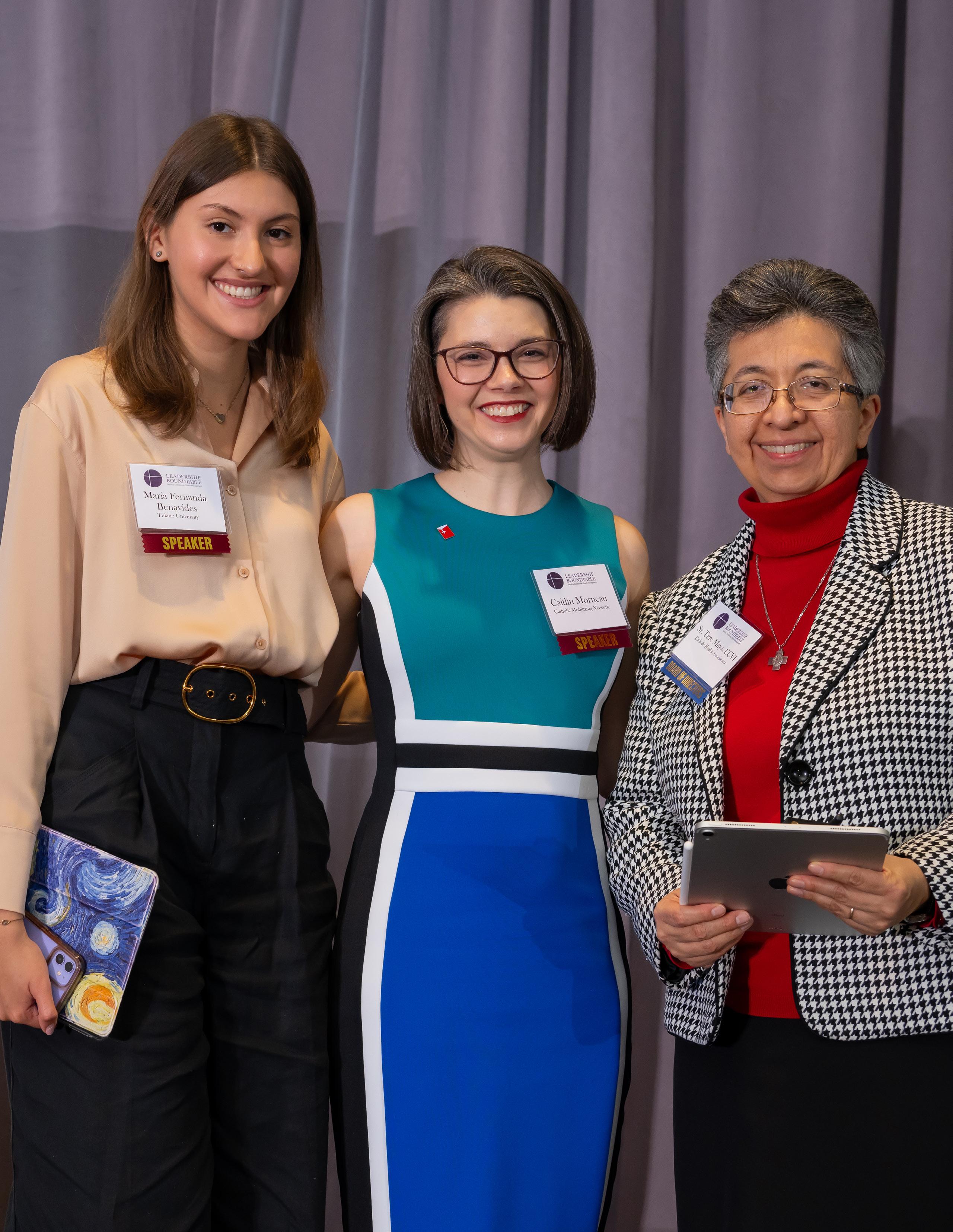
While there are young adults who have chosen to leave the Church, the young adults who remain connected to the Church actively live their faith in various ways, including service and advocacy. In the October 2023 General Assembly of the Synod on Synodality, delegates affirmed the need for a preferential option for young people and echoed the call first heard during the 2018 Synod on Young People, Faith, and Vocational Discernment for leaders to listen to and accompany young adults.
“A synodal Church needs to be a listening Church and this commitment has to be translated into practice,” the Synodal Church in Mission Synthesis Report stated. “The synodal culture needs to become more intergenerational, with spaces for young people to speak freely for themselves, within their families, and with their peers and pastors, including through digital channels.”
The 2024 Catholic Partnership Summit sought to better understand the realities, journeys, and spiritual desires of today’s young adults, particularly in the context of leadership. The gathering welcomed leaders from across the Church to listen and learn from young adults and those who minister with and to them, and engage in discussions of difficult topics such as belonging, trust, coresponsibility, and lived faith.
Young adults were present on every panel and were seated at every table. Roughly ⅓ of all who attended were younger than 40 years of age. An advisory committee of ten young adults, representing a variety of leading Catholic organizations and dioceses across the U.S., also mentored, guided, and helped Leadership Roundtable define the sessions and methodology of the Summit. Their leadership helped ensure the issues that matter to young adults, those that weigh on their hearts, were front and center at the gathering and discussed by leaders of the Church.
Seated at round tables, the Summit sought to model the practices of listening, encounter, and dialogue that are the pillars of synodality. From the periods of silent reflection and one-on-one conversation to the larger discussions where every person was invited to speak, the event focused heavily on ensuring that synodality, intergenerational encounter, and openness to listen to learn, not respond, was infused in every aspect of the gathering.
After listening to, encountering, and sharing with the disciples as a stranger on their journey to Emmaus, eventually Jesus’ true identity was made known. For those two disciples, what began as an encounter with a stranger in a time when they felt despair became a moment of joy and hope shared with a close friend.
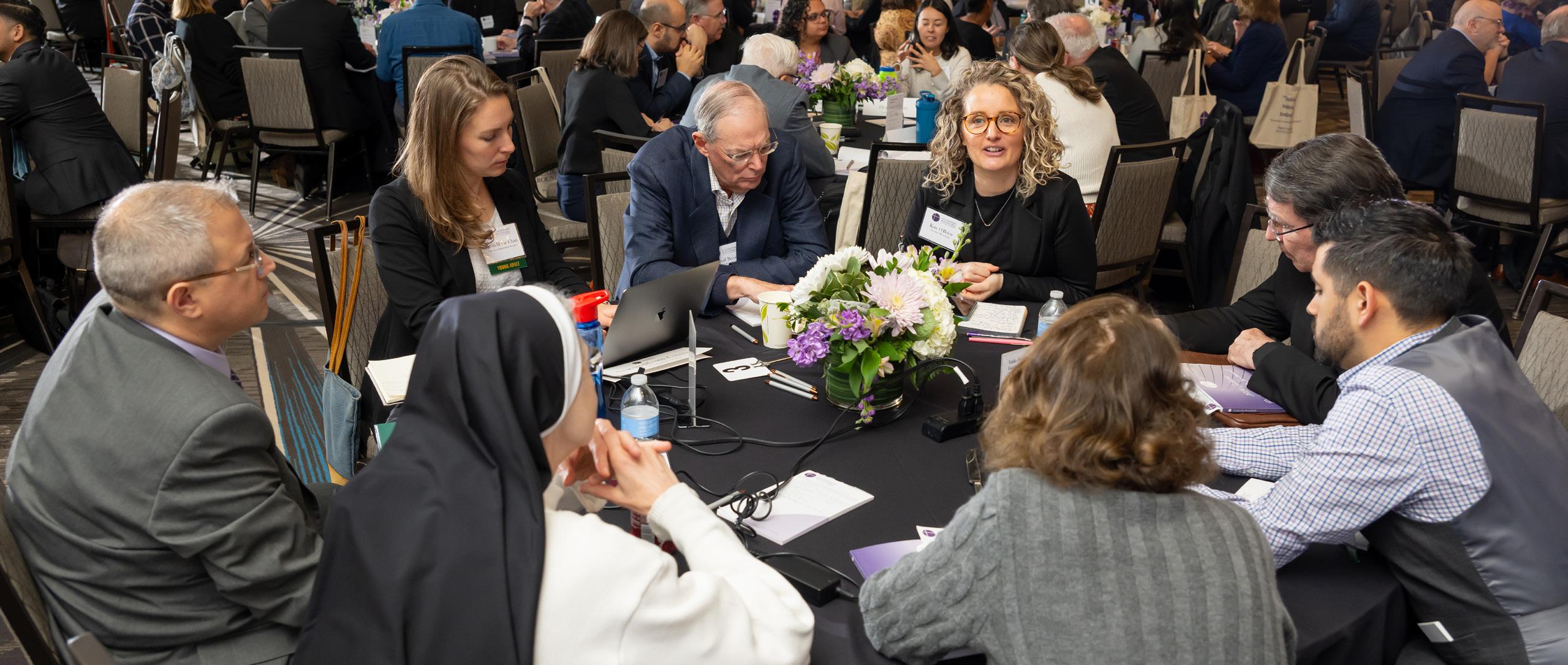
Throughout the Summit, many experienced a similar transformation — those whom they encountered first as strangers left as friends. And what began as an issue of concern and pain became a topic around which they now felt hope and joy. Such transformation only happens through the synodal conversations, moments of deep listening, and open dialogue —like those at the Summit, and those had in that eponymous encounter along a longlost road nearly 2000 years ago.
Just as those disciples in the Gospel returned to tell of their encounter, this report seeks to share the encounter of the Summit. It details the central themes that emerged
from the expert speakers and those seated at the round tables as they welcomed the Holy Spirit to guide their conversations. In it, are shared both the challenges and opportunities to further encounter, engage, include, and mentor young adults in the life and leadership of our Church.
As in prior reports, this report seeks to engage readers in the discernment of the Holy Spirit’s guidance, spark conversations, and offer leaders actionable recommendations to support building a healthy, thriving, co-responsible Church — a place where all are welcome!
IV V VI

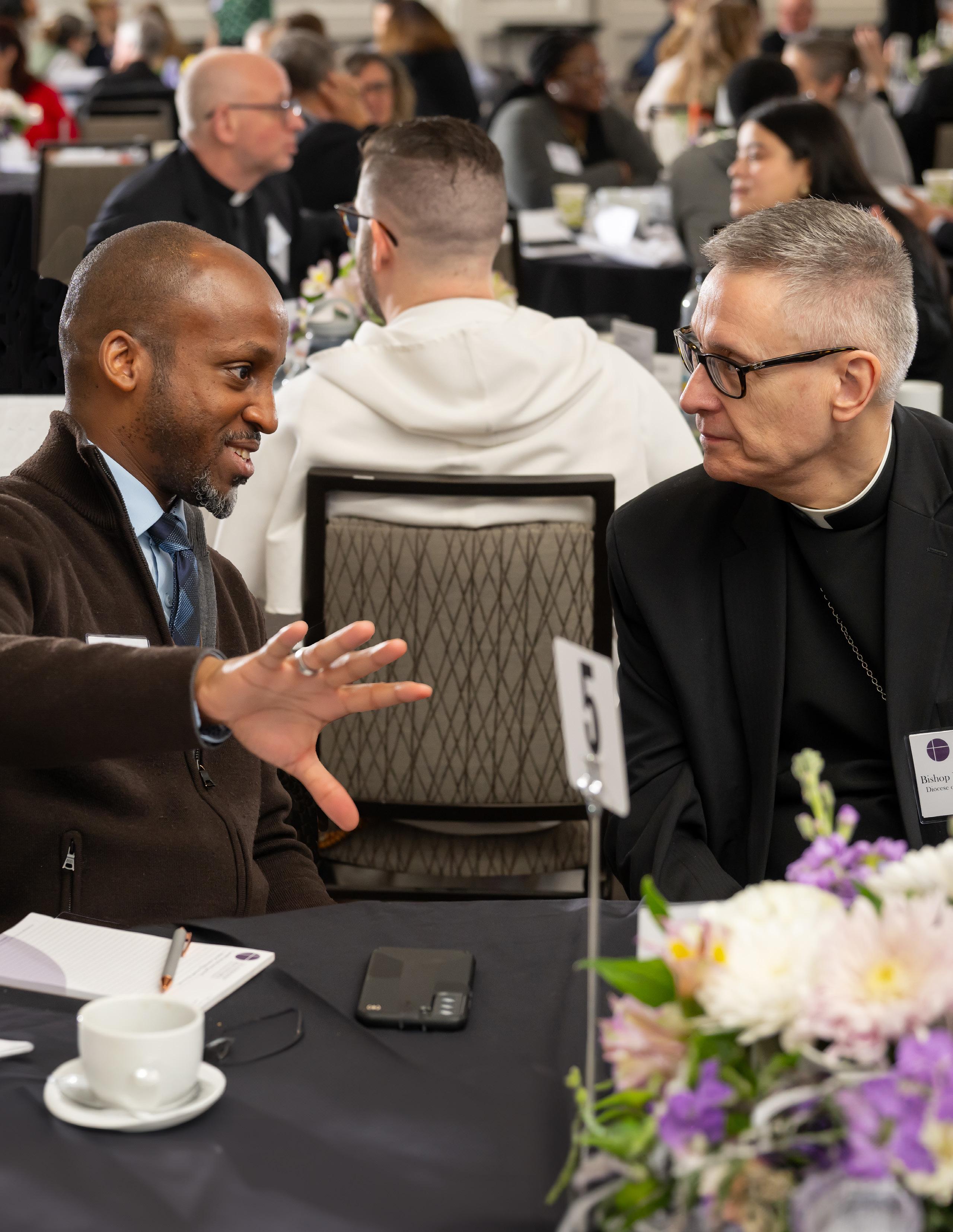

Across the world, Catholic leaders have identified a need for a deeper understanding of young adults within the Church today. Recognizing and affirming the struggles, challenges, and aspirations of young adults is integral to the Church fostering a more effective and meaningful ministry with and for them.
Throughout the 2024 Catholic Partnership Summit, speakers offered insight into the reality of young adults in today’s Church to help participants better understand, empathize, and connect with the young adult experience.
At the start of his pontificate in a series of interviews with the media, Pope Francis declared:
“The thing the Church needs most today is the ability to heal wounds and to warm the hearts of the faithful; it needs nearness, proximity. I see the Church as a field hospital after battle. It is useless to ask a seriously injured person if he has high cholesterol and about the level of his blood sugars! You have to heal his wounds. Then we can talk about everything else. Heal the wounds, heal the wounds. ... And you have to start from the ground up.”
Pope Francis’ invitation urged the Church to not remain stationary, but to be a living Church, as the body of Christ, to go to where there is hurt and pain, and to heal others. Young adults have expressed serious struggles with the Church. Many feel unheard, unseen, and unwelcome and have particular concern with how the Church encounters those on the margins who come
from various backgrounds, races, ages, orientations, and experiences.
For these young adults, their relationship with the Church is marked by hurt and pain, which may explain why many young adults no longer identify as Catholic. Yet according to Claudia Avila Cosnahan, mission and partnerships director at Commonweal and a contributing author to “Faith and Spiritual Life of Young Adult Catholics in a Rising Hispanic Church,” many who do not claim to be Catholic are also hesitant to completely abandon the Church. Avila Cosnahan spoke during the second session of the Summit titled “Today’s Catholic Young Adults: Engaged. Diverse. Questioning. Caring. Passionate.”
Among young adults, it’s common for some to openly share that they grew up Catholic when talking about faith, she said, even if they resist defining themselves as Catholic today.
“But they're still there, and they want to talk about their opinion,” Avila Cosnahan said. Even though they are upset and feel hurt by the Church, these young adults would rather stay silent than go somewhere else, she explained.
Despite the widespread pain and serious concerns with the Church, young adults continue to take part in gatherings, like the Summit, to share their experiences, concerns, and hopes for the Church. The 75 young adults who either attended or spoke at the 2024 Summit did so because they want to effect change in the Church, said John Grosso, a keynote speaker, during Session 1, titled “Young Adults in a Synodal Church.”
“Young people ask for a relational Church, an authentic Church ... a co-run Church, and they ask the Church just to be with them where they are on their journey.”
– SR. NATHALIE BECQUART, XMCJ
“There's so much room for hope,” he said. “There are so many young adults already in leadership that we can learn from, that we could grow with, and that we could continue to empower.”
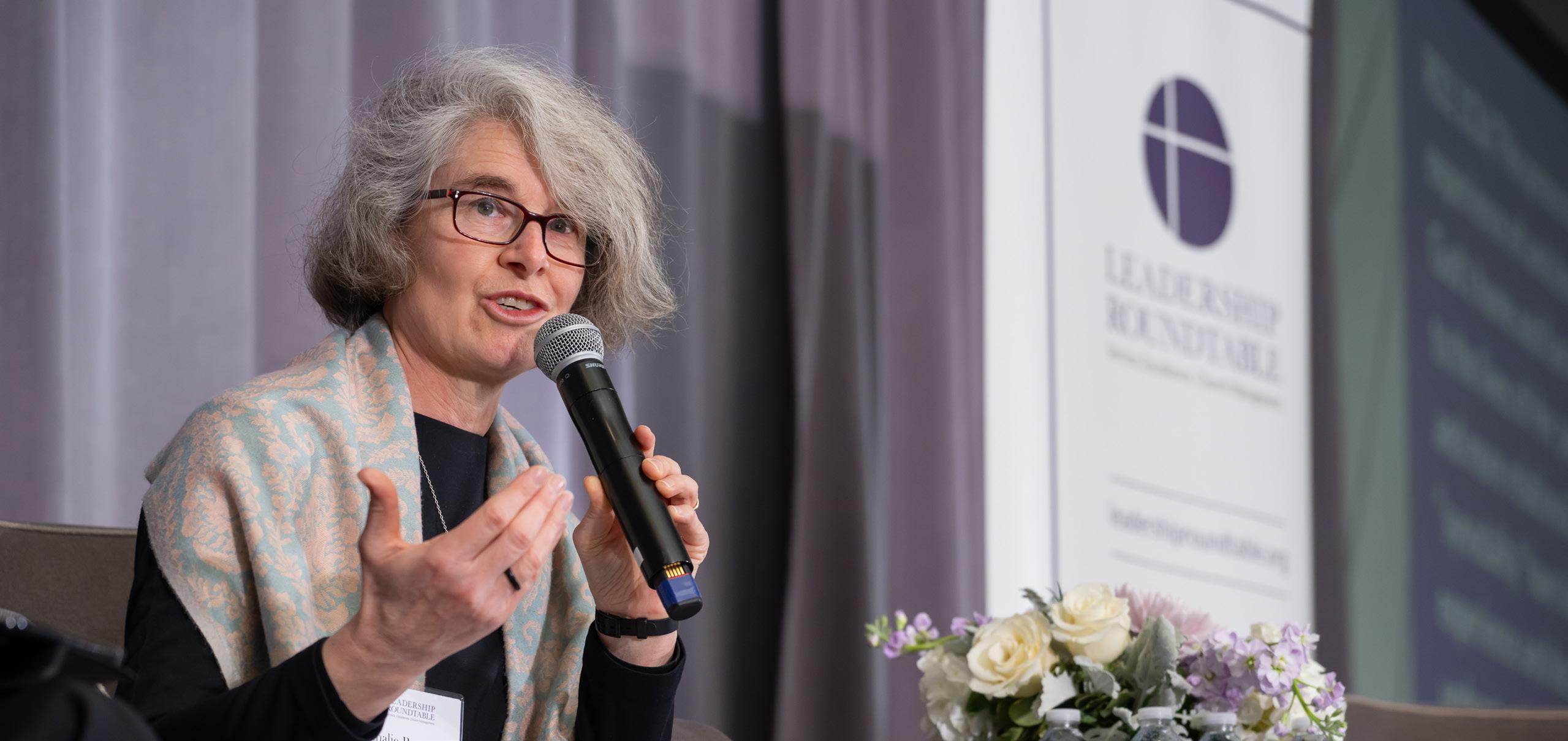
“Young people ask for a relational Church, an authentic Church,” said Sr. Nathalie Becquart, XMCJ. Becquart is the Undersecretary to the Synod of Bishops and was a keynote speaker at the Summit. Young adults, Becquart said, also want “a co-run Church, and they ask the Church just to be with them where they are on their journey.”
Throughout the Synod on Synodality and previous gatherings, young adults have expressed their desire to co-lead — and to lead now, not just in the future — in a Church that is also theirs.
“I am not the future. In fact, my pope, our pope, said, I am the now of God,” Cecilia Flores, stated during the third session of the Summit, titled “The Church We Want to Be: An Authentic Place for All to Belong.” “I have been a protagonist in this Church since I was 16 years old and started a youth ministry program at my church. And I'm a protagonist now,
20 years later, as probably one of the youngest, and only women of color, leading a national Catholic organization.”
In every session, speakers emphasized a point Pope Francis has made often: that young adults are protagonists of the faith.
Paul Jarzembowski, associate director for the laity at the United States Conference of Catholic Bishops (USCCB), encouraged Church leaders to understand the important and intentional distinction between “ministry with young adults” and “young adult ministry.” The former recognizes the contributions young adults currently make to the Church and ministers co-responsibly with them, as protagonists.
Jarzembowski moderated and spoke on the panel during Session 2 of the Summit.
As one of the top leaders in the ongoing Synod on Synodality and leader at the 2018 Synod on Young People, the Faith, and Vocational Discernment, Becquart has experienced personally the power of ministry with young adults.
“And I could tell you, with all the wonderful young adults I have encountered, all over the world, I am not at all worried for the future of the Church,” Becquart
said. “The Holy Spirit is working through young adults.”
From the parish to the Vatican, young adults should be welcome in positions of leadership, she said, and should be co-responsible in the mission of the Church.
“We should not lead young people as passive followers, but work alongside them, allowing them to be active participants in the journey,” she said. “There should be, also, young adults in all kinds of councils, at all levels of the Church.”
After all, young adults serving in leadership is a concept as old as the Church itself.
“Jesus was a young adult, you know,” Becquart reminded leaders.
Today, young adults currently hold many leadership positions throughout the Church and in the Vatican. Some lead organizations, like Flores, who heads Catholic Volunteer Network as Executive Director, or serve in senior leadership roles, like Grosso, who is Digital Editor at the National Catholic Reporter. Becquart noted that after the 2018 Synod, the Vatican
created an international youth advisory body comprised of 20 young people from all over the world.
Despite being founded by young adults, throughout recent history, the Church has struggled to engage younger generations. The ministry approaches once relied upon to engage young adults in the life of the Church have lost relevance, and leaders are seeking new paths.
“Everywhere, everywhere I have been, the main preoccupation of the bishops and so many people, it's the same. It's how to connect with young people,” Becquart said.
Research into religious affiliation among young adults has shown a trend toward disaffiliation, said Dr. Josh Packard, renowned researcher and then-vice president of strategy at the National Catholic Education Association. Packard spoke during the second session of the Summit. Across the board, not only is affiliation down, but attendance at Mass is also down, as is giving to the Church.
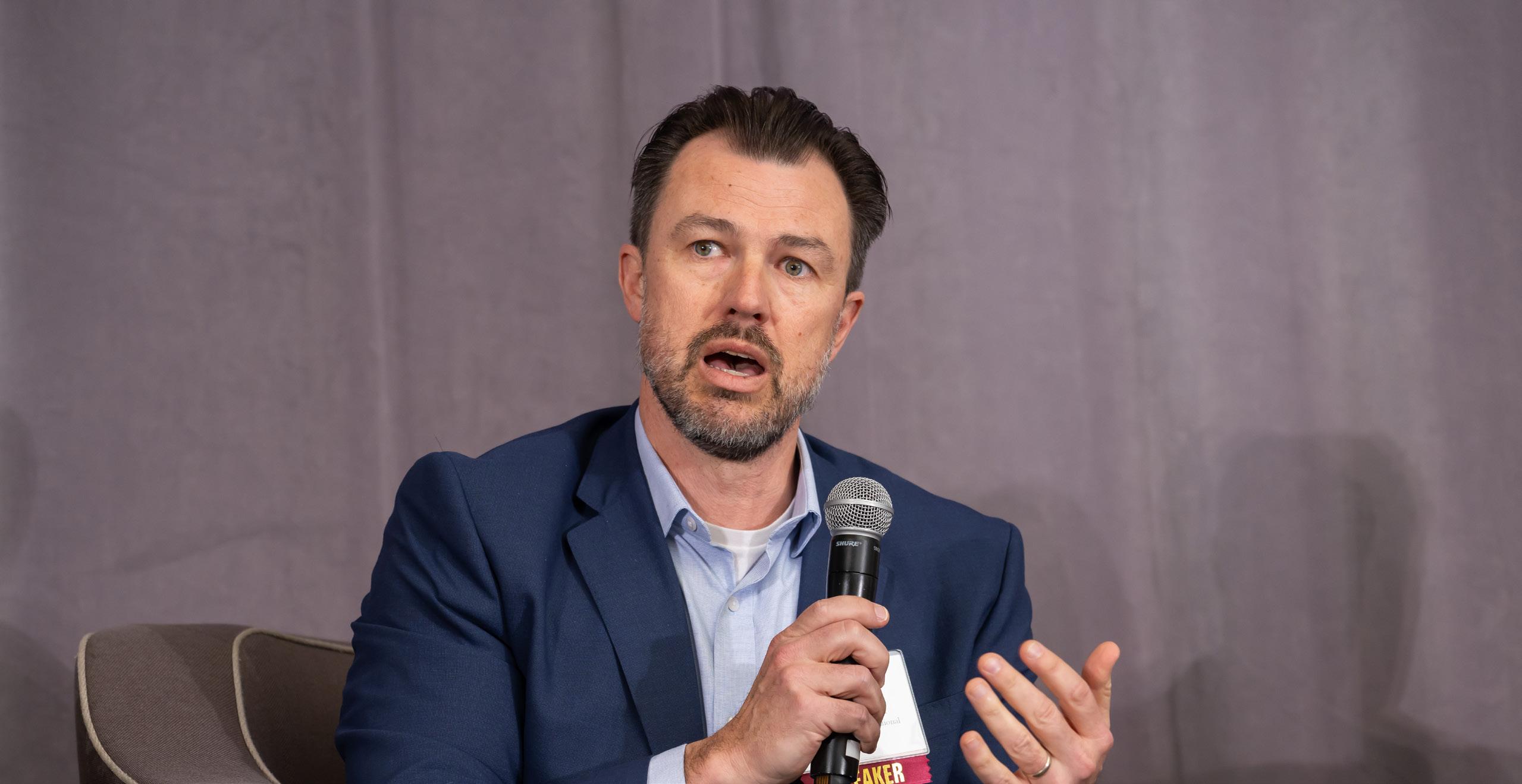
However, while the research shows a trend toward disaffiliation, it doesn’t directly point to a decline in spirituality among young adults. Other research has shown that for young adults, individual spiritual practice and ritual participation in prayer remain a stable part of their lives. Packard highlighted the important difference between the two, noting that attendance and affiliation are not indicators of the spirituality of young adults, but rather are indicators of institutional commitment.
Packard challenged Church leaders to broaden their perspectives of young adult Catholics, arguing that evaluating them solely based on their actions — such as Mass attendance or whether they identify as part of the Church — is insufficient. Instead, he said a more relevant indicator of their spiritual well-being and the Church’s success in engaging young adults lies in the depth of our relationships with them.
Jarzembowski suggested that the Church reframe its view from a “disaffiliation crisis” to instead an “opportunity surplus” — leaning into the situation by looking not at the fact that many young adults have pulled away from the Church, but instead at the many opportunities to engage or reengage those young adults who are not affiliated.
Now more than ever, leaders, including U.S. bishops, are speaking out about the importance of mental health and giving voice to an issue that, for years, was taboo, despite its pervasiveness.
Young adults today face a particularly unique set of challenges that generations before have not, many of them amplified by the recent pandemic, Jill Fisk, director of mission services for the Catholic Health Association, highlighted in Session 2. She noted that the USCCB’s new mental health campaign has set three objectives: to raise awareness of the mental health crisis, to combat stigma surrounding the topic of mental health, and to advocate for all those impacted by the crisis.
Rapidly changing technology and the constant saturation of news and awareness of what is happening in the world has led to a rise in mental health issues, including anxiety, isolation, stress, and depression. Loneliness, a desire to belong, and feelings of doom over the state of the world are among the top concerns of young adults today.
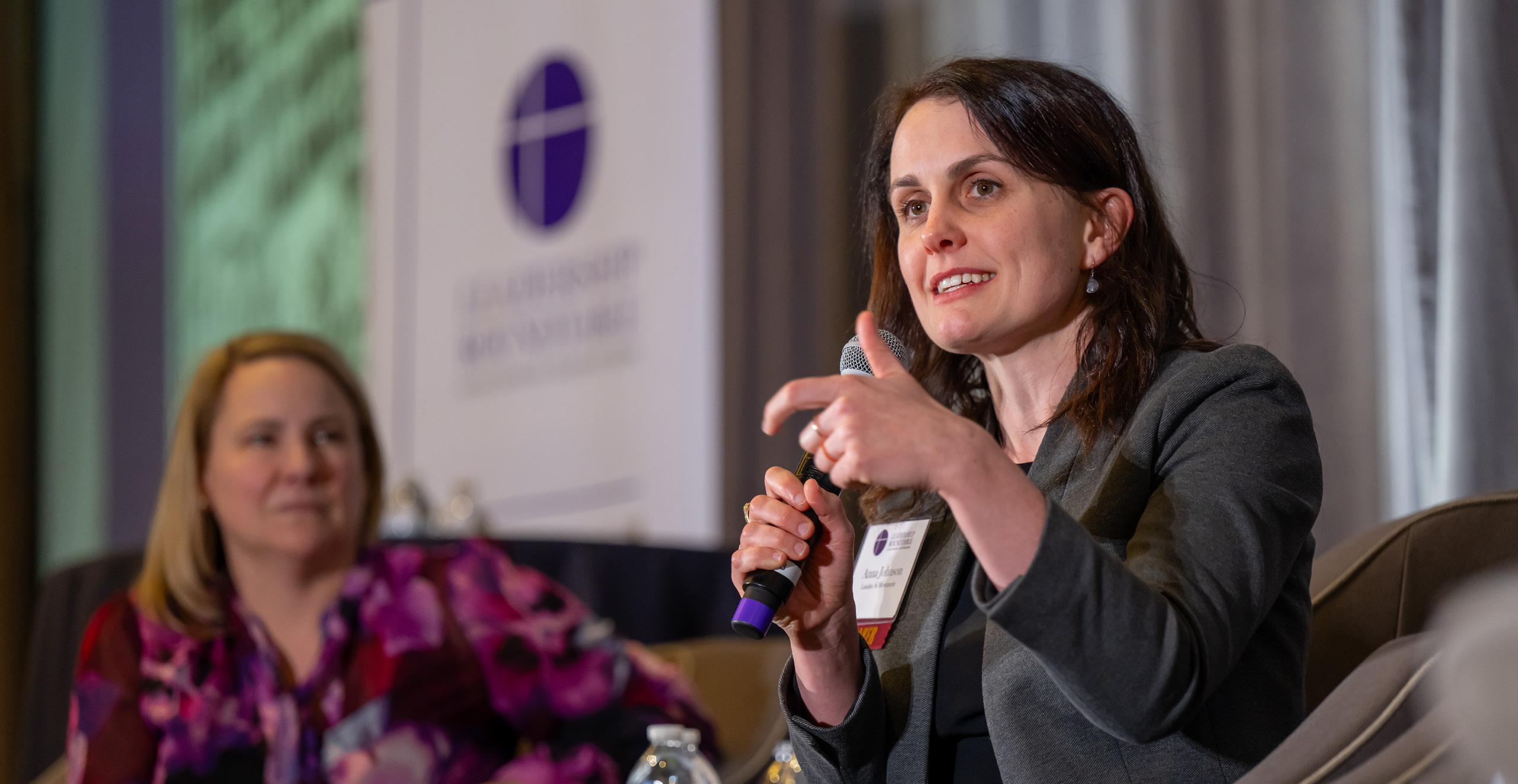

During the final panel on “An Expanded Tent: Church Beyond the Parish Walls,” Anna Johnson, North America senior program manager for the Laudato Si' Movement, cited a study by the University of Bath in 2021 that included 10,000 young people ages 16 to 25. The study found that when it comes to the climate, 55.6% of young people believe that humanity is doomed.
“Not just that they're hopeless,” she explained. “They believe that humanity is doomed.”
Despite data showing that today’s young adults are the most depressed generation in history experiencing a loneliness epidemic, as declared by the U.S. Surgeon General, they overwhelmingly believe they have value.
Stephanie Peddicord, president of Goodfaith, detailed in the final panel how recent research found that 93% of young adults ages 18-20 felt that they were very important and had value. That finding should encourage leaders.
“People are searching for meaning, for sense, for love, for the truth,” José Manuel De Urquidi, founder and CEO of Juan Diego & Co., a Catholic multimedia company that engages Hispanic audiences, said during the final panel. “And we have to introduce them to it.” He explained that we do so by creating a space where young adults feel like they belong, where their questions are heard, and where they can find compassionate support.
• Regularly review organizational structures, such as annually or in every strategic planning process, to identify and create leadership opportunities for young adults.
• For ministries and engagement targeted at young adults, ensure young adults are involved in the leadership, planning, and execution of those initiatives.
• Set defined benchmarks for young adult leadership, such as ensuring that, within the next five years, each parish or diocesan council will allocate 20 percent of its seats to young adults ages 18 to 40.
• Offer formation that creates exposure to leadership through active opportunities that allow young adults to shadow experienced leaders, such as an ad hoc seat on a board or parish council, to help them see their role in the leadership of the Church, both now and in the future.
• Encourage and support young adults to identify their leadership strengths through tools such as Strengths Finders, Meyers Briggs, Leadership Circle Profile, DISC and Catholic Leadership 360, and connect them to opportunities to lead in their areas of strength within the Church.
• Create entrepreneurial cultures that are willing to experiment with new ways of engaging young adults, such as professional networking, service opportunities, ministries centered on justice issues, and sportrelated ministries.
• Actively foster the Church as a “third-space” where young adults can find and build community beyond weekly Mass, through ministries, events, and activities that are inclusive of, and are held at times that accommodate, working adults and/or parents.
• Create spaces that mirror the diocesan synod consultation structure — where leadership was present, a guide was used, participants were gathered in circles, and multiple avenues for feedback were available — for young adults to dialogue with leaders where they can voice their thoughts and concerns in authentic conversations to ensure their needs are understood and being met by the Church.
• Offer ongoing formation in the art of preaching and public speaking to priests and homilists that immerses them in the realities facing young adults, allowing them to better connect with and engage young parishioners in the faith community.
• Leverage the resources available through the Association of Catholic Mental Health Ministers to provide pastoral care that supports young adults in their management of stress, isolation, past traumatic experiences, and anxiety.
• Make vetted mental health resources available through parish and diocesan channels, such as social media, video, and other digital spaces.
• Ensure those individuals, parents, and families who care for and support young adults have access to greater mental health resources for both themselves and those they support, such as access to diocesan family life offices and health care plans that cover mental health care.
• Train staff and volunteers to notice signs of mental health distress and utilize pastoral approaches, including anonymous and confidential avenues like a bulletin announcement, web page, or signs pointing to hotlines and other resources, to offer support to those in need.
• Incorporate mental health education and support into seminary formation to ensure future priests have experienced, and can better offer pastoral care for mental health.
• Provide ongoing education for Church leaders around what mental health is and the guidelines for responsible pastoral care that equips them with the language, knowledge, and skills to effectively speak to, address, and incorporate sensitivity to mental health in their leadership.
• Offer formation to interested mental health providers, or students pursuing a career in the field, that provides strategies for how faith can complement and integrate into a therapy or counseling practice.
• Pay attention to the pressures of today’s labor economy and the reality of burnout for those who work for the Church by reviewing roles and responsibilities to ensure manageable workload, leadership support, and work-life balance.
• Ensure compensation of employees of Catholic dioceses, parishes, and organizations is competitive, livable for the region, and aligns with the values of Catholic Social Teaching.
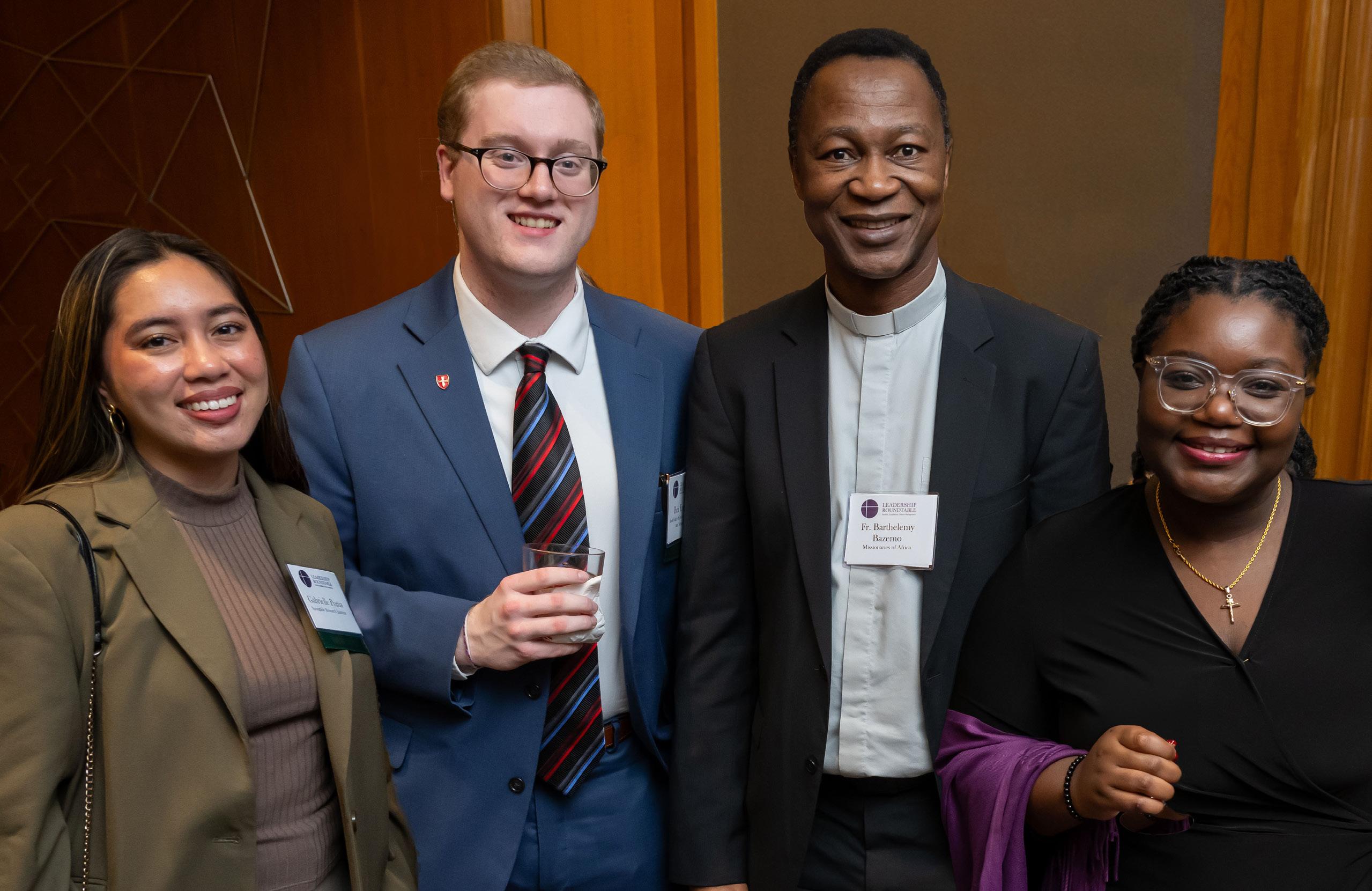

Throughout the ongoing Synod on Synodality, the global Catholic Church has actively sought to engage individuals, particularly those on the margins, to listen to their experiences and journey with them in their faith. As a whole, young adults are often among those viewed as marginalized from the Church.
For many young adults, including those raised in the Church or who attended Catholic schools, the ongoing Synod is the first time they’ve felt truly heard by the Church, and the experience is drawing them back, noted Dr. Tracey Lamont, director of the Loyola Institute for Ministry and associate professor of religious education and young adult ministry at Loyola University New Orleans. Lamont served as a speaker and moderator of the panel during Session 3, titled “The Church We Want to Be: An Authentic Place for All to Belong.”
“These synodal practices have really established so much sense of belonging that young adults are coming back now,” Lamont noted. “And what they say is, you know, ‘This was really great. I didn't think anybody cared what I thought about my faith.’”
People, regardless of age, desire to be heard and form connections. But to truly create that connection, synodal listening must be practiced with a goal to understand and encounter, not to fix, to save, or to judge, Lamont cautioned.
“The only way to transmit the faith today — in this world, in our society — is with this synodal style of listening, dialogue, encounter,” said Sr. Nathalie Becquart, XMCJ, the undersecretary for the Synod of Bishops, during the Summit keynote on “Young Adults in a Synodal Church.”
Synodality and listening also require authenticity and a bit of discomfort to be effective, John Grosso, digital editor at National Catholic Reporter, said during the keynote.
“There is an earnest authenticity and a palpable energy that young adults carry in whatever state of life they're in,” he said. “The only way synodality thrives is in open, honest, authentic conversations and real dialogue that sometimes makes us uncomfortable.”
While the recent shift in the Church toward synodality and listening has brought some young adults back to the fold, the historic lack of dialogue on challenging subjects is a major cause of what led them to leave initially. When there is no open, honest, dialogue on difficult issues, young adults, and particularly those of color, have walked away from the Church.
Claudia Avila Cosnahan, mission and partnerships director at Commonweal and a contributing author to “Faith and Spiritual Life of Young Adult Catholics in a Rising Hispanic Church,” noted that a large portion of young adult Catholics in the U.S. are Hispanic. But, much as the Church writ large, the Hispanic Church finds its youngest generation disaffiliating at a rapid pace. Avila Cosnahan spoke during the second session of the Summit on the panel titled “Today’s Catholic Young Adults: Engaged. Diverse. Questioning. Caring. Passionate.”
“They're struggling with the same political questions and the same economical concerns that the rest of the young people in this country are struggling with,” she said of Hispanic young adults.
Black Catholic young adults are also leaving the Church, due in large part to the lack of dialogue on issues relevant
“The only way synodality thrives is in open, honest, authentic conversations and real dialogue that sometimes makes us uncomfortable.”
– JOHN GROSSO
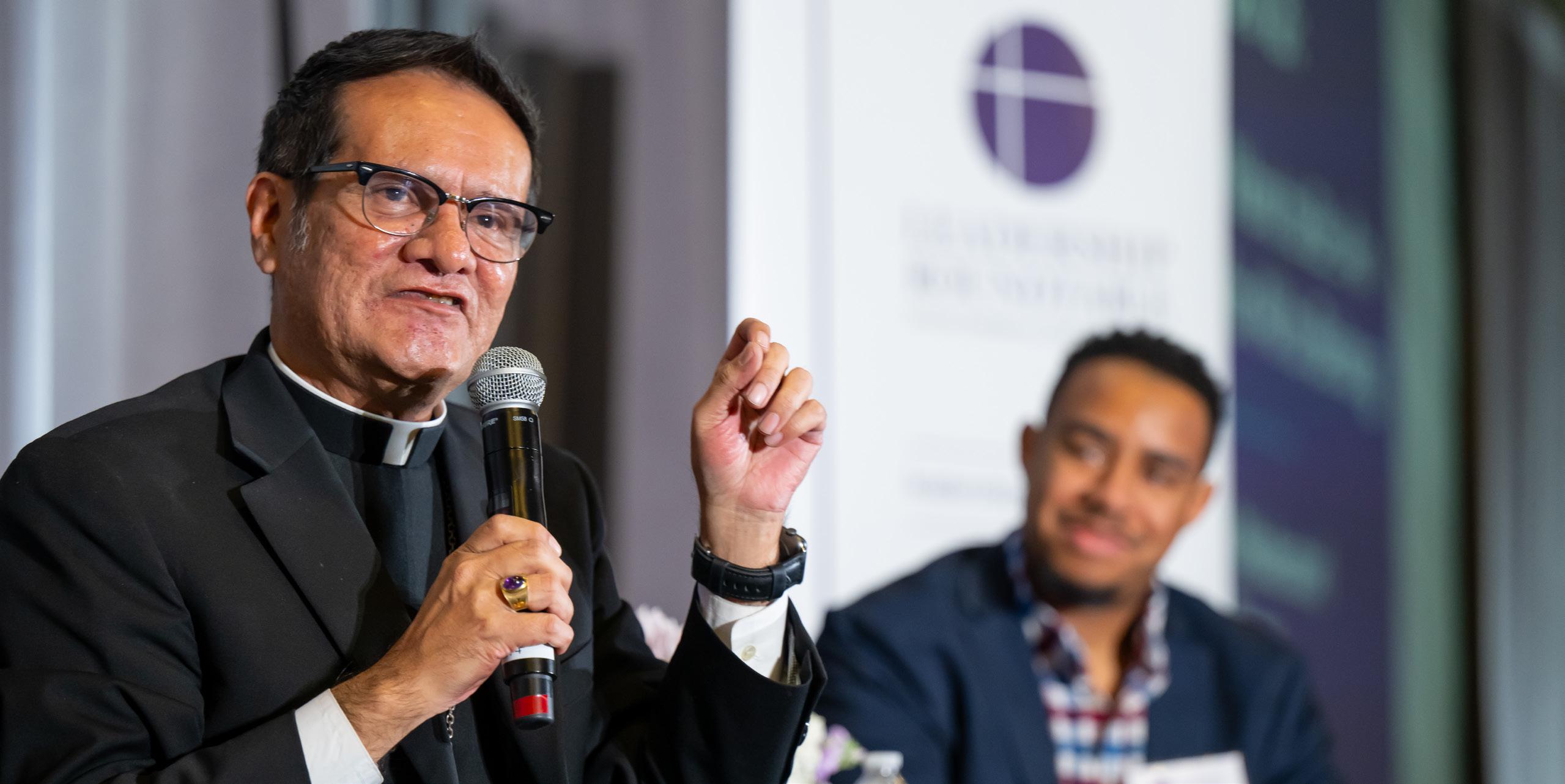
to their community. Dr. Craig Ford, assistant professor of theology and religious studies at Saint Norbert College in Wisconsin, said recent studies of Black Catholics found 75% identify a commitment to racial justice as essential or important to them, and that 50% of young Black Catholics leave when they become adults. Ford spoke during Session 3 of the Summit.
For those Black Catholics who have left, the lack of open conversations on issues like racial justice — issues that are uncomfortable and difficult to talk about — are driving their departure. Ford cautioned that more young adults will leave the Church unless leaders have the courage to confront realities around justice and ask difficult questions of their own structures and behaviors.
“Young adults can have conversations everywhere,” he said. “If we aren't having them in our churches, they will find them somewhere else.” If young adults go elsewhere to discuss these issues, Ford warned that they will continue to hear, and will repeat, the narrative that the Catholic Church is sexist, racist, homophobic, transphobic, hierarchical, medieval, and dying.
“Young adults want to have conversations about each of those words, and they want to have it with the frankness and the seriousness that those words imply,” he said. “We need to host them.”
As they seek to have difficult conversations in the Church, young adults have expressed a desire to have bishops and other leaders in the room and engaged in conversations with them. For the bishops who have engaged young adults, what they hear is moving.
Auxiliary Bishop Arturo Cepeda of the Archdiocese of Detroit, shared his personal experience of listening to young adults, in Session 3 of the Summit, saying he was “very, very, very much touched by their openness, their sincerity in sharing with us as bishops” and getting to know “their concerns and their dreams and their aspirations.”
Emphasizing the value of these conversations, Cepeda stressed the importance of providing safe environments for dialogue to take place.
“It’s so crucial for us as we face this new century, to be able to provide safe environments, safe platforms so that we can talk, so that then we can have the opportunity to begin to grow within ourselves and within the Church and for the Church and for our nation and for God,” he said. “We need to have a listening heart, especially when it comes to listening to our young adults.”
Unfortunately, not all attempts to create spaces for young adults to share and dialogue with leaders have led to open, honest, and fruitful conversations. Cecilia Flores, executive director at Catholic Volunteer Network, recounted during Session 3 the mixed emotions experienced at a gathering, where despite efforts to co-create a safe space, many young adults ultimately disengaged from the event or even had a negative experience.
For many leaders, these dialogues and the spaces to host them are new experiences, and there will be mistakes made and lessons learned. But these kinds of conversations are not new to young adults. Grosso noted that young adults have been practicing synodality and engaging in difficult conversations “before synodality was cool.”
In addition to listening and engaging in difficult conversations, leaders must also reflect on their experiences and their practices, Church structures, and beliefs, which will often be challenged or questioned during times of encounter.
Such reflection has been part of the U.S. bishops’ work as they discern a national pastoral framework for ministries with youth and young adults. During the second session, Paul Jarzembowski, associate director for the laity at the United States Conference of Catholic Bishops, explained that the focus for the framework is listening closely to young adults and “to teach more from the heart, as much from the head, as a response to those lived experiences, and to send them forth beyond the Church with their hearts burning for God and for the world.”
It is necessary for leaders to slow down and be receptive to what they are hearing and experiencing, as well as the needs of those around them.
“We can't respond, and we can't move in love and positive change without seeing as Jesus did,” Jill Fisk, director of mission services at the Catholic Health Association of the United States, said in Session 2. “We have to slow down.
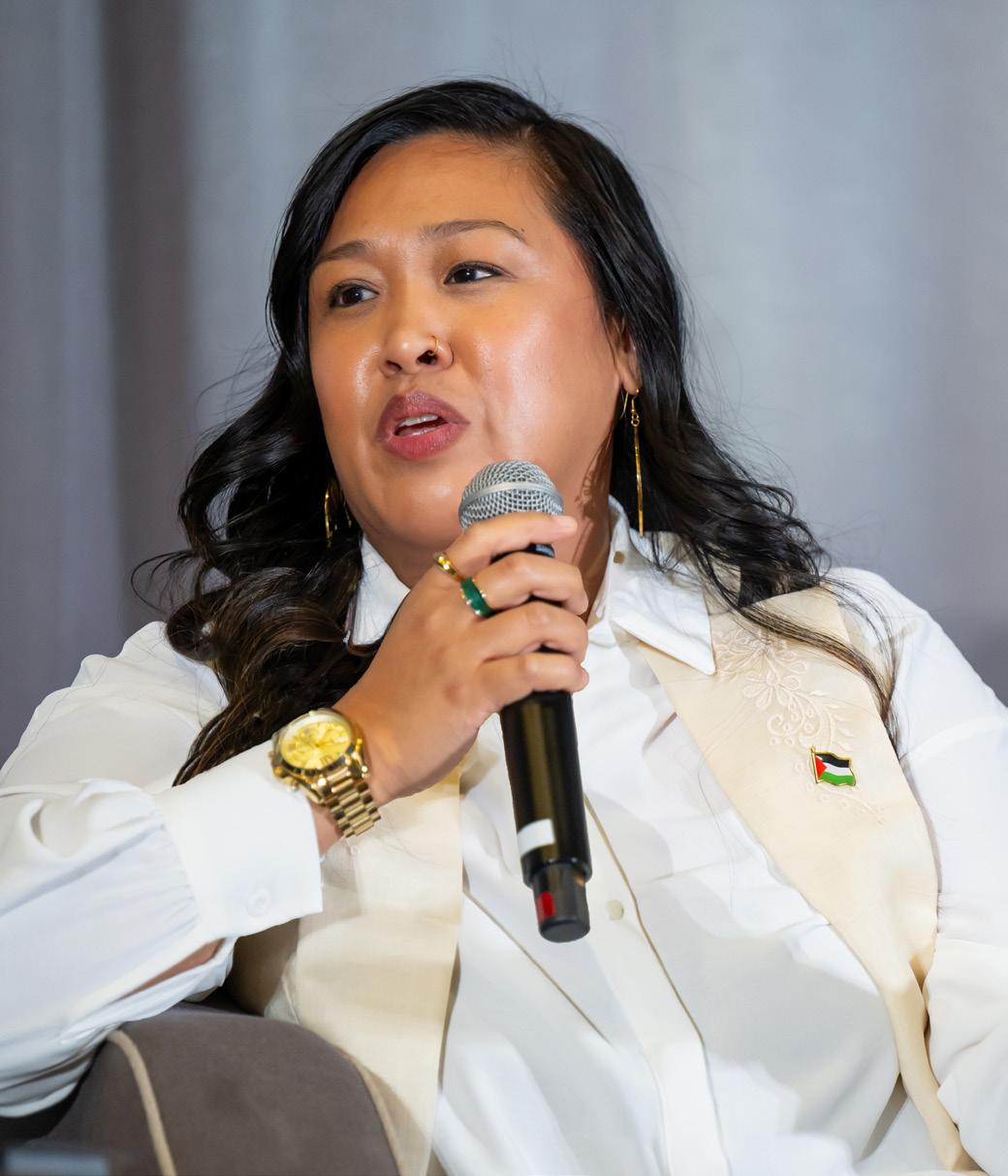
We have to be available to be rerouted, and we have to be willing to receive love.”
Fisk referred to a story in the Gospel of Luke where Jesus tells his disciples that many prophets and kings are called to see and hear what they, the disciples, now had the opportunity to see and hear from following Him. But those prophets and kings do not really see and do not really hear.
“They miss it,” she says of the prophets and kings. She asked participants to consider what they might see and hear around them if they take time to listen, as the disciples did.
Part of reflection is also asking who is not at the table — be it the discussion table or the leadership table. During the Session 3 plenary, a young adult participant highlighted how events like the Summit, despite efforts to achieve inclusivity and representation, still often exclude people of diverse lived experience — notably those experiencing poverty — from the conversation.
“My point is to recognize how privileged this gathering is and to ask who's not at this table today, because we're
presuming that we represent so many people,” the participant said.
Listening to young adults is, alone, not enough to engage them in the Church. Flores noted a fatigue among young Catholics who have been speaking up but seeing little come from their conversations. She encouraged leaders that action is also needed.
“I love being listened to. I love to talk, love to tell stories.” Flores said. “I am tired of being listened to. I want you to do something. Do something, anything.”
A key part of the action sought by young adults is to build relationships with them that are genuine and not merely transactional encounters. In each panel of the Summit, the importance of building authentic relationships surfaced, carrying through as a thread into subsequent
conversations. With each generation, the relationship between young adults and the Church continues to evolve.
As Avila Cosnahan noted, each generation invites the Church to be in better relationship with them.
Dr. Josh Packard, then-vice president of strategy at National Catholic Education Association, suggested that leaders look to other professions that have successfully built relationships with large groups of people, like salespeople or fundraisers, as examples of how to build those relationships, but to do so while keeping sight of the sacred and the spiritual aspect of the Church.
“In order to craft these individualized solutions, we have to be able to do it by listening deeply and intently to the person across from us and closing that gap between what we think we know about them and what they're actually experiencing,” he said during Session 2.
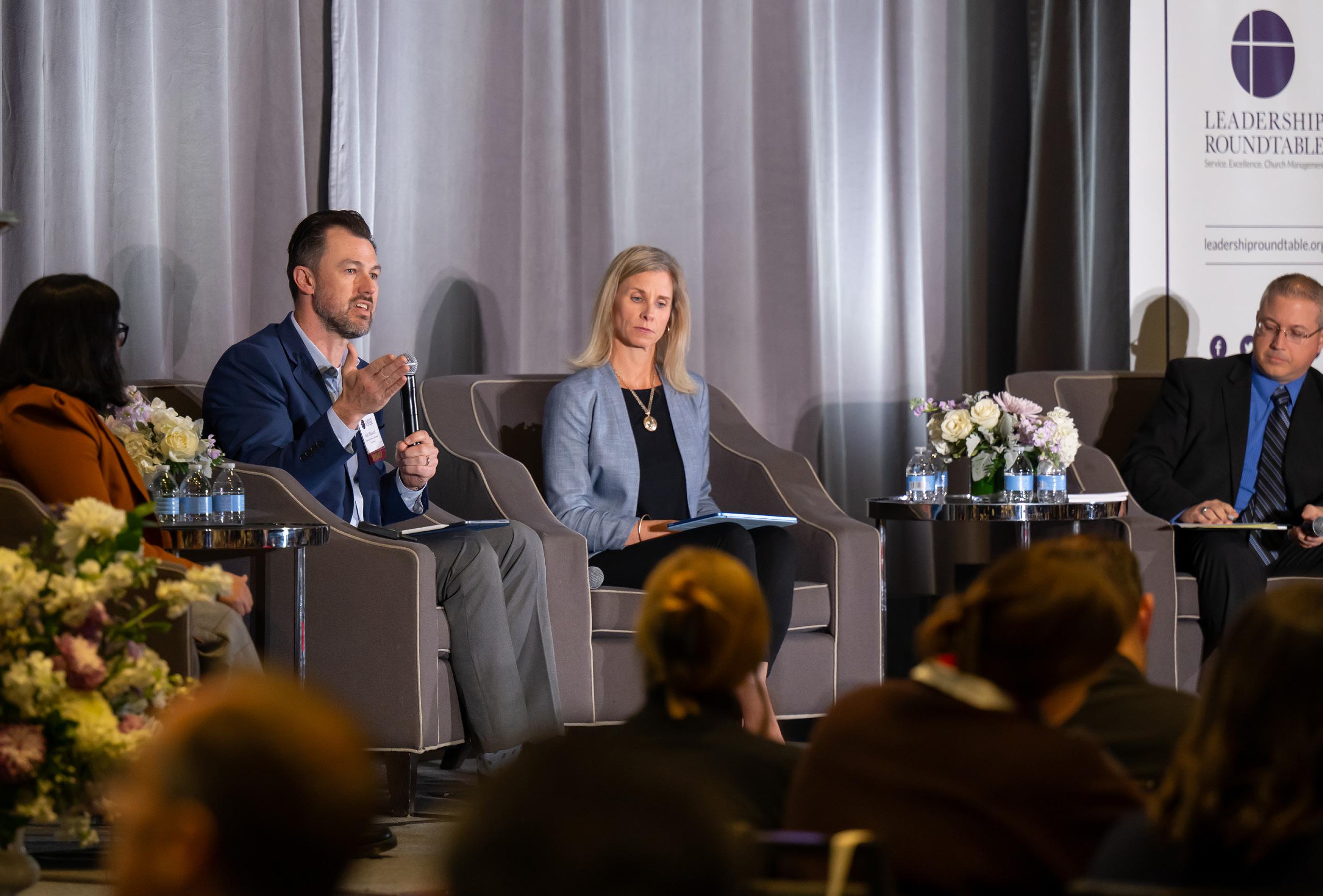
• Establish a regular practice, such as an annual listening session, where everyone in the faith community is welcomed to ask questions, offer feedback, hold leaders accountable, and propose actions that align with their values and lived faith experiences.
• Provide synodal leadership formation and training for Church leaders of all ages and levels of authority that prioritizes and teaches active listening to bridge generational gaps.
• Provide safe and welcoming spaces for those who have been marginalized by the Church, such as women, divorcees, victims of abuse, LGBTQ+ individuals, and others.
• Facilitate spaces for authentic dialogue, such as synodal circles or discussion groups, that welcome individuals to explore issues, including those that may be controversial or polarizing.
• Provide formation for all Church leaders to develop the ability to understand and manage their own emotions and the emotions of those around them, recognizing the importance of emotional intelligence in relating to young adults.
• Practice conversations in the Spirit by prioritizing human connection and approaching dialogue with an open heart and mind to the other person’s experiences, feelings, and to the Holy Spirit.
• Offer practical tools and training in the art of dialogue and how to have difficult conversations with people with whom we may disagree. To be synodal is not to convince the other, but to truly listen in open, respectful dialogue with each other even when we disagree.
• Work to build relationships with young adults in the faith community by prioritizing listening to understand before taking any steps to broach difficult topics.
• Provide leaders time and space for prayer, reflection, and discernment about their role in and actions they can take for accompanying and engaging young adults with compassion, love, and respect.
• Take steps to learn and understand the realities facing young adults in today’s world, such as the unique financial and social pressures they face, and seek to be conscious of those realities when making decisions.
• Provide avenues for engaging with other denominations and faiths to learn from their experiences and expertise in engaging with young adults and generate new ideas or approaches for the Catholic Church.
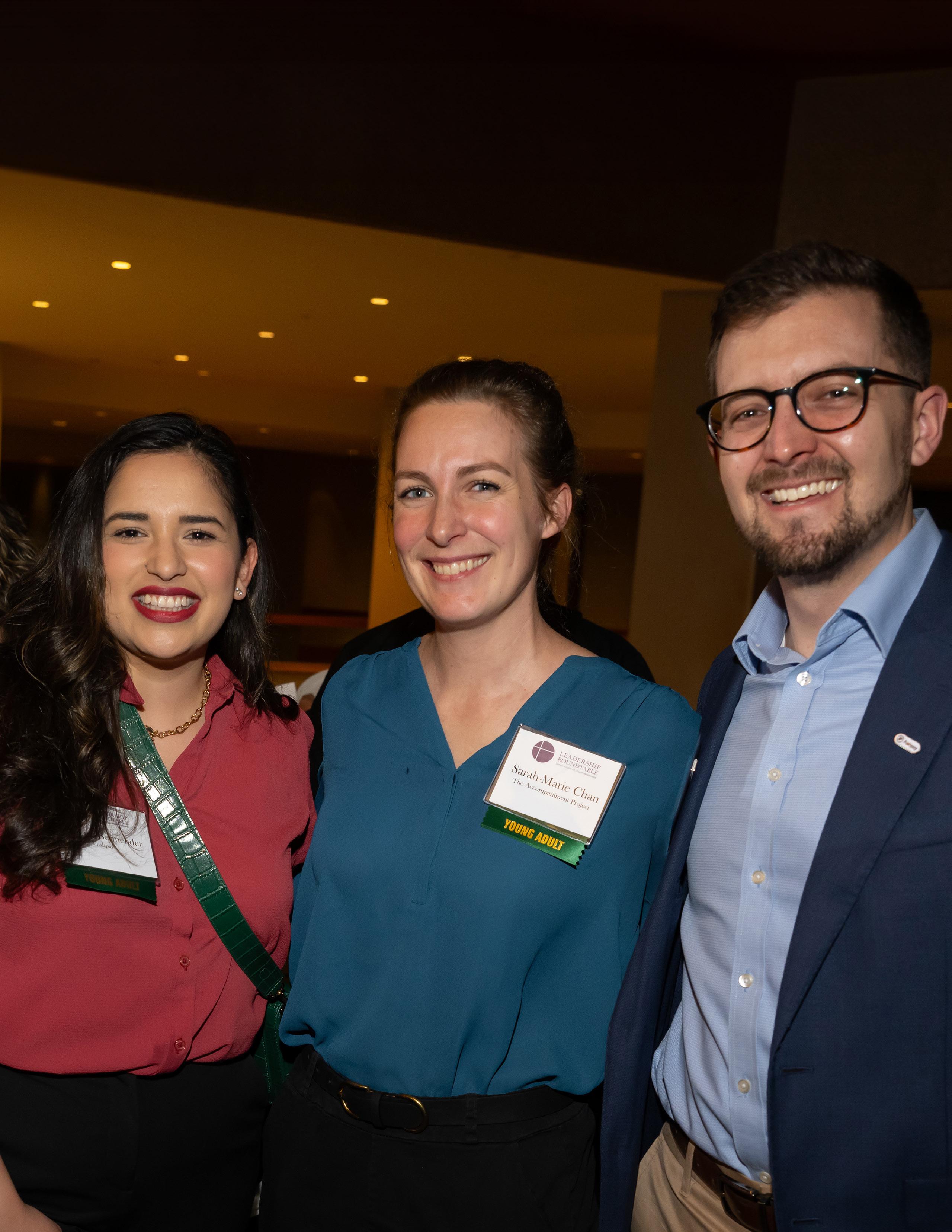
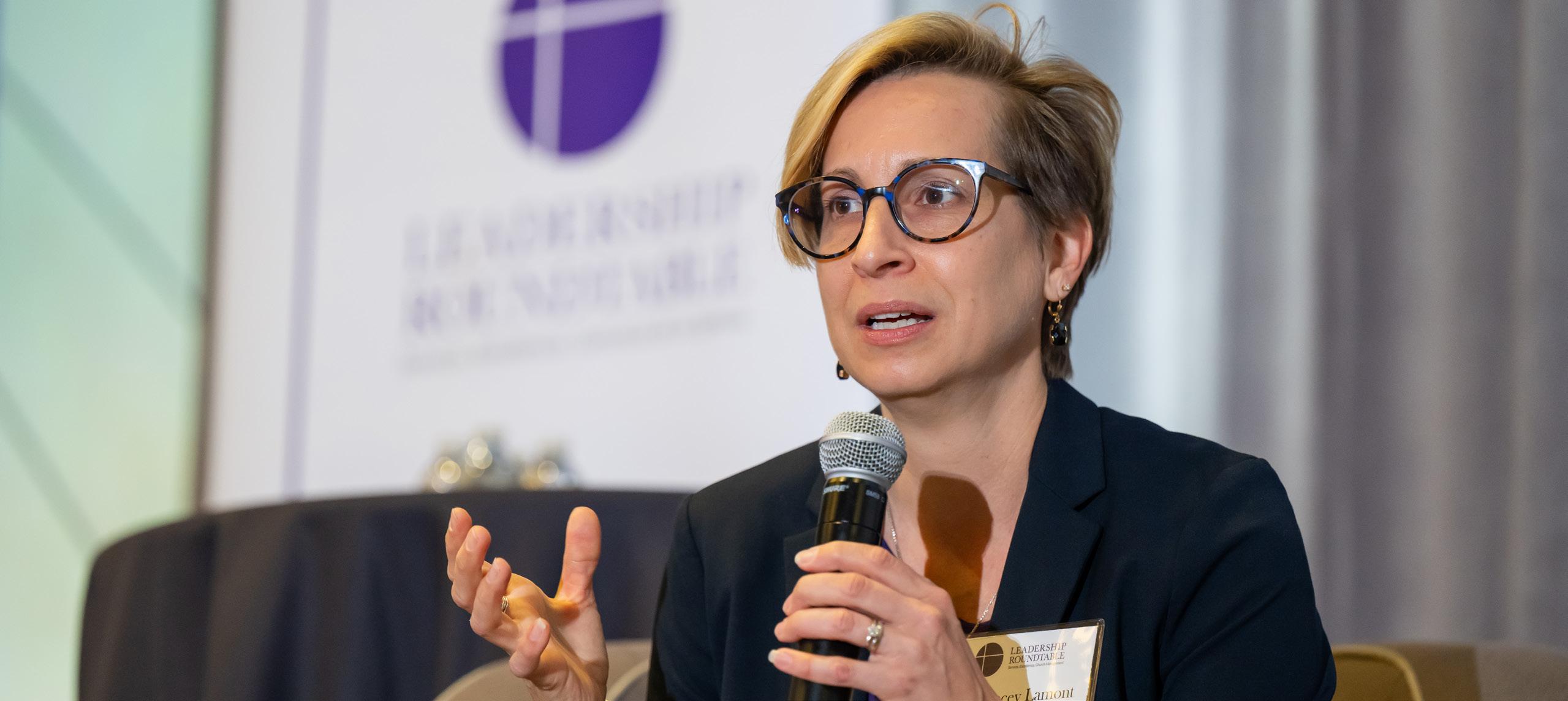
“It is a big Church. We need a big tent.”
– TRACEY LAMONT
In preparing for the 2024 Catholic Partnership Summit, the ten leaders who served on the Young Adult Advisory Committee noted repeatedly the importance of belonging for young adult Catholics.
While many different words are used to convey belonging, for young adults there is a distinction between being invited and being welcomed. And an even further distinction between being welcomed and truly belonging.
“Catholic means ‘here comes everyone,’” stated Dr. Tracey Lamont, director at Loyola Institute for Ministry, and associate professor of religious education and young adult ministry at Loyola University New Orleans. Lamont spoke during Session 3, titled “The Church We Want to Be: An Authentic Place for All to Belong.”
Lamont reflected on the Greek root of the word “Catholic,” which also means “universal,” and challenged those in attendance to consider if being
Catholic today, in lived experience, actually means everyone, universally, feels they belong.
To help participants understand why many young adults don’t currently feel they do belong in the Church, Lamont highlighted the various forms of exclusion young adults face, including social, family, cultural, institutional, and religious exclusions. She urged the Church to become a space where everyone belongs, free from any form of exclusion.
Without young adults and their contributions, the Church would be incomplete, said Cecilia Flores, executive director at Catholic Volunteer Network. Flores spoke during Session 3.
“I belong because God says I do,” said Flores, who is a young adult. “There's this heavenly banquet that God has prepared, and there's actually already a seat with my name on it. And actually, I've been invited to bring a dish, to share on the spread…even though it's not everyone's flavor, and this banquet is going to be incomplete without me.”
The United States Conference of Catholic Bishops (USCCB) defines young adulthood as ages 18 to 39. This time between adolescence and middle adulthood encompasses some of the most formative years of a person’s life. This time is also when many adults experience major life transitions.
Jill Fisk, director of mission services at the Catholic Health Association of the United States, noted the various critical milestones that occur during this period. From college to a first full-time job, as well as learning to manage personal finances and responsibilities like buying a car, learning how to pay taxes, to making their own doctors’ appointments, and jumping through insurance hoops, there are many responsibilities, milestones, and transitions that individuals encounter for the first time in young adulthood, said Fisk during Session 2 titled, “Today’s Catholic Young Adults: Engaged. Diverse. Questioning. Caring. Passionate.”
She also highlighted the varying personal developments that take place, from finding a spouse or settling into singleness, to rooting into a community and purchasing
a home, and experiencing parenthood, infertility, or loss. All of these events, Fisk explained, are laden with social, emotional, and spiritual complexities. And for today's young adults, these challenges have been compounded by the pandemic.
“Milestone rituals were interrupted,” she said of the pandemic. “Then we have the trauma of the times: political polarization, social isolation, racial injustice, hate, anger, all entangled [through] the lens of social media.”
Fisk emphasized that the combination of the pandemic and the trauma of the times with these transitions have led to a degree of developmental disruption for many of today's young adults. Delays in starting careers or families, or financial challenges such as struggles to purchase homes, are examples of how the timeline and experience for many young adults today are not the same as they were for prior generations.
For many young adults, the constant stream of transitions experienced in the current social, political, and economic climate has created an overwhelming pressure, leading some to describe a pervasive sense of pain and anxiety that leaves them exhausted, said Paul Jarzembowski, associate director for the laity at the USCCB, during the second session.
“Many young adults share how overworked, overcommitted, overwhelmed they are,” he said. Young adults seek support to navigate the transitions in life and often through the Church, but if they don’t feel it is a place where they belong, they turn elsewhere.
Those young adults who work for the Church frequently experience ministry burnout as well. Young adults have begun to speak up about their dissatisfaction with compensation, the lack of health and child care benefits, and even toxic work environments in the Church, where they face clericalism and fear of losing their jobs.
Despite the hardships, John Grosso, digital editor at the National Catholic Reporter, emphasized the dedication
of young adults to the Church. During the keynote titled “Young Adults in a Synodal Church,” he praised the young adults who work long hours for low, or even no, pay, describing them as “doing the Lord's work and making a better world for all of us here, and hopefully for the next generation like that of my daughter and beyond.”
There is not a one-size-fits-all approach when engaging and ministering with young adults, particularly in today’s world where the body of Christ and individual lived experiences are more diverse than ever before.
Reflecting the diversity of the Church in ministry with young adults through approaches that are targeted and specific will be key to helping them feel they belong in the Church, Jarzembowski noted.
“It is a big Church. We need a big tent,” said Lamont. “We keep saying that, but we have got to figure out what that looks like in practice. We can't just keep saying these words. Our young adults, they are just so challenged by how to be Catholic with people that don't feel accepted by the Church.”
According to a Boston College study, the largest demographic of U.S. Catholics under the age of 40 are Hispanics. Many of these Catholics are firstgeneration, having grown up in the U.S. with parents who emigrated here, but still face barriers to feeling they belong in the U.S. Church.
During Session 2, Claudia Avila Cosnahan, mission and partnerships director at Commonweal and a contributing author to “Faith and Spiritual Life of Young Adult Catholics in a Rising Hispanic Church,” described a phenomenon where often Hispanic young adults who grew up in the U.S. and in the U.S. Church are still treated as foreigners in their faith communities.
Sr. Nathalie Becquart, XMCJ, undersecretary of the Synod of Bishops, stressed in the keynote a need for a synodal approach with young adults that values the diversity of all individuals. She emphasized the importance of understanding young adults' cultures and languages. For Becquart, engaging with young adults means being “more and more bilingual.”
“We speak the language of the Church, of the tradition, and the spirituality of the Church. But if you want to really connect with young people … you need to speak their language, to learn about their hobbies, about what they care for,” she said.

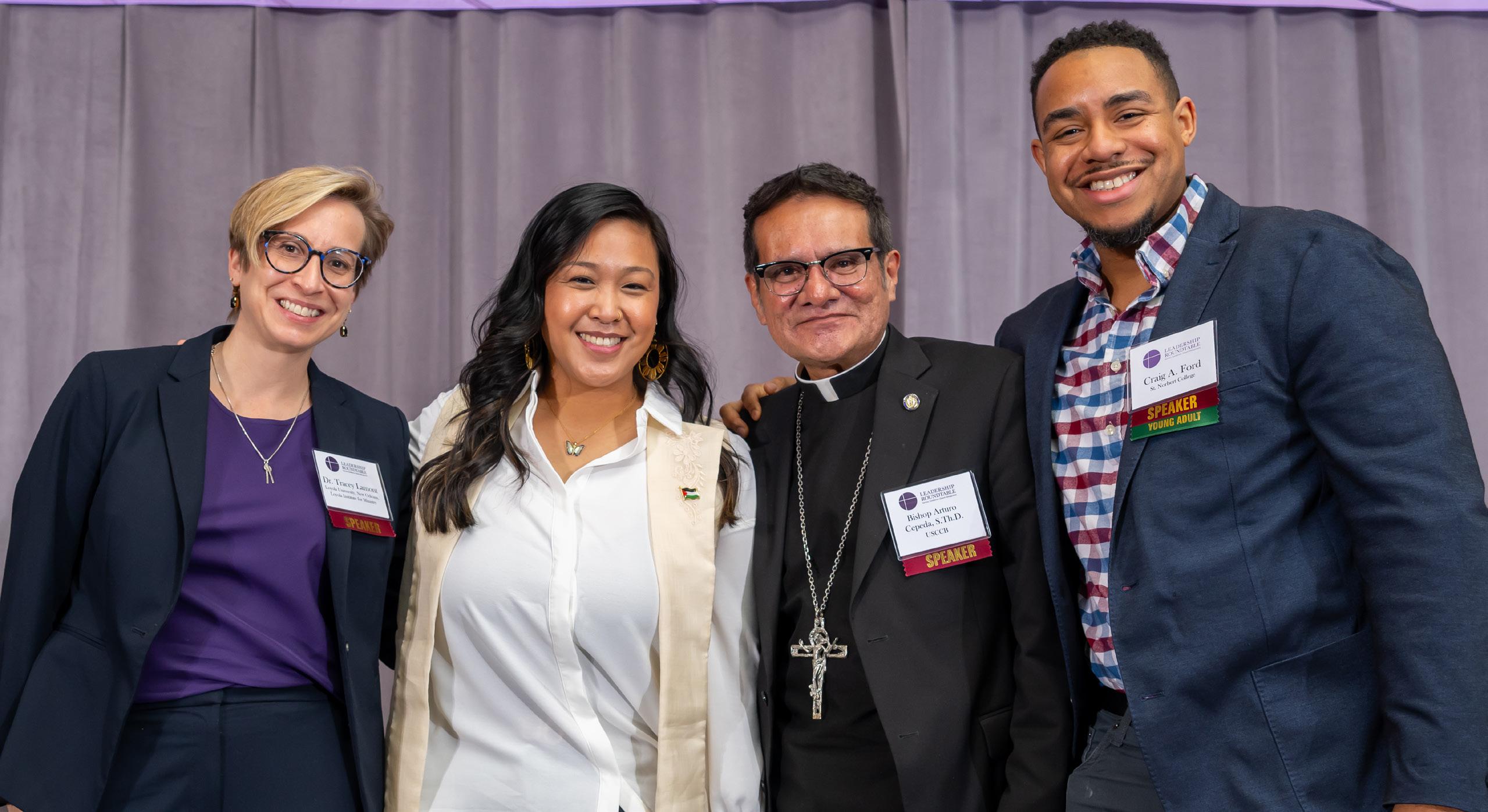
Belonging is deeply important to young adults and directly impacts their affiliation with the Catholic Church. Dr. Craig Ford, assistant professor of theology and religious studies at Saint Norbert College in Wisconsin, spoke during the third session and noted the important distinction his research has surfaced between a Church that thinks it welcomes, but is really just inviting young adults and others on the margins.
In speaking with young adults, Ford said, many have conveyed that they do not feel welcome, and therefore don’t belong in the Church. Ford, who researches issues of racial, sexual, and gender justice at the intersection of Catholic moral tradition and theology, noted that young adults have expressed that they don’t feel welcome in the Catholic Church, in no small part because of its teachings related to sexual orientation, and to the LGBTQ+ community.
“That is the reason why young people are not here,” he stated. Ford emphasized that young adults seek for the Church to be open, not only to engage in difficult conversations about sexual orientation, but to also welcome those who are LGBTQ+ as brothers and sisters in Christ.
“When you use the word welcome, your accent is on how the guest feels,” Ford explained. “What I'm
afraid we do more often is that we issue invitations. An invitation puts the accent mark on the inviter. If we think that LGBTQ+ people are welcome in our churches, and they aren't there, you're inviting them. If they are there, they're welcome.”
A key factor in whether someone feels they belong in the Church is safety. Lamont, who also researches young adults and faith, said that many young adults identify the Church as a place where they or their friends do not feel safe.
“They love their faith, but they have no idea how to express it with their friends because they think people that are Catholic are just judgmental,” she said. She added that many also don’t know how to be Catholic or how to talk about their faith with their LGBTQ+ friends because the teachings around sexuality and gender identity make people feel unsafe and unwelcome in the Church.
Genuinely welcoming young adults in the Church requires rethinking how we view, minister to, and lead together with young adults. Young adults are not a monolith, so it is vital to develop ministries and opportunities that value their life experiences, backgrounds, and talents, and that offer pathways to broader integration and leadership beyond just their peer group.
• Develop avenues to engage young adults that acknowledge and welcome their diverse range of life experiences, backgrounds, and talents, such as professional networking opportunities and communitybuilding events.
• Consider adopting ministerial approaches that have been successful in campus ministries and Catholic colleges, such as adapting spaces to serve the emerging needs of young adults, like remote work, lowercost housing, and offering sacraments and faith formation at additional times of the day.
• Look critically at how your parish, diocese, or organization defines "hospitality" or “welcome” and how it is put into practice, then ask where and how it could be refined to ensure that it is felt by young adults and those on the margins.
• Prioritize and provide ongoing formation for all Church leaders in radical hospitality, co-responsibility, diversity, inclusion, and equity, so that young adults feel they belong in all spaces where they encounter the Church.
• Ensure adult ministries encourage people of various ages, genders, and lived experiences to take part, such as those that focus on shared interests like Marian devotions or volunteer service.
• Prioritize using language in external communications, such as social media and outreach materials, that is positive and focuses on the values and virtues of Catholic Social Teaching, instead of just the "do nots."
• Consider using the term “ministry with young adults” instead of “young adult ministry” and recognize that the separation of young adults into their own siloed groups can lead to young adults disengaging.
• Invest in a well-designed, well-maintained digital presence, especially a website that is easy to navigate, up-to-date, and attractive.
• Adopt a generous, flexible paid family leave policy of ideally 12-weeks, for parents of newborns, adopted, and fostered children, as well as for those needing to care for a family member or themselves, that, in alignment with Catholic Social Teaching, allows employees to maintain their income while caring for themselves or their families.
• Foster an environment where young adults feel comfortable seeking help during crises by ensuring that information on food and housing assistance, child care, substance abuse and addiction services, and domestic violence resources are easily accessible online and visible on campus.
• Educate the faith community about the vastly different landscape of life experiences for young adults, recognizing they may not follow the same timeline or trajectory of traditional milestones, such as paying off student loans, living independently, pursuing higher education, getting married, or remaining single.
• Support young adult parents by adopting ministries that are flexible, such as offering the ability to teach
catechesis at home, offering child care at events, virtual bible studies, and meetings of leadership teams outside work hours.
• Ensure a livable, competitive compensation for early career positions and offer ministerial or professional development for employees.
• Make young adult formation and ministry a permanent line item in the budget, getting creative as needed, such as through partnerships with neighboring parishes or similar organizations, to provide engaging ministries.
• Offer intercultural competency training to Catholic leaders to increase their capacity to create a leadership culture that is truly co-responsible, one that is inclusive of various races, cultures, languages, genders, and other identities.
• Ensure that the language and images used in your faith community accurately represent and are inclusive of the different cultures, ethnicities, genders, and experiences of the people of God by incorporating diverse images of Christ and saints, adopting bilingual or multilingual communications and liturgies, and respecting the various cultural expressions of faith when producing materials or events.
• Utilize clear, welcoming language in external communications, especially outreach content, avoiding “insider language” that many may not understand.
• Create a leadership culture that fosters collaboration and unity by using “we” instead of "them" when referring to young adults, therefore avoiding marginalizing language.
• Avoid tokenism when engaging with young adults by working to ensure that a diverse representation of young adults are included in decision-making and other circles.


Globally, every institution — from government to big business to the Church — is experiencing a decline in trust. In the Church, the Synod General Assembly held in October 2023 noted that there remains also widespread “distrust in vital matters such as liturgical life and moral, social and theological reflection.”
“Pope Francis said that part of what we're doing here with synodality is to rebuild trust,” said Dr. Josh Packard, then-vice president of strategy at the National Catholic Education Association, during the second session of the Summit on “Today’s Catholic Young Adults: Engaged. Diverse. Questioning. Caring. Passionate.” The ongoing Synod seeks to recognize the causes of broken trust with the people of God and, through dialogue, undertake processes to rebuild it.
The rediscovery of synodality across the Church presents an opportunity to rebuild mutual trust with young adults, he said. Accountability, a theme that nearly every Synod synthesis report has identified as a concern on the hearts of Catholics, is of paramount importance to young adults, especially when trust in institutions has declined due to historical abuses, lack of accountability, and misuse of power.
During the plenary portion of Session 2, a young adult reiterated her generation’s “need for transparency, authenticity, and honesty from the more institutional standpoint of the Church.”
In response to the young woman, Packard suggested adding humility to the list of what young adults need from their Church.
Packard emphasized that rebuilding trust with young adults will require leaders to move beyond what he referred to as “high-trust tools” — tools that rely on an assumption of institutional trust, such as degrees and titles, to be effective — and instead embrace “low-trust tools,” which rely on a people-first approach, such as listening and relationships. High-trust tools simply don’t resonate with young adults today.
Fostering deep conversations where young adults feel safe to ask big question is what they seek in their Church, Dr. Craig Ford, assistant professor of theology and religious studies at Saint Norbert College in Wisconsin, emphasized during the third session on “The Church We Want to Be: An Authentic Place for All to Belong.”
“They have questions about doctrine, they have questions about moral teaching. And these are difficult conversations, a lot of times even for professionals, because they're very complex,” he said.
The Synod has presented a unique opportunity for the Church to actively work to rebuild trust with young adults, particularly those who have not completely walked away.
“This is a moment for reconciliation on our behalf [with] the institutional Church,” Claudia Avila Cosnahan, mission and partnerships director at Commonweal and a contributing author to “Faith and Spiritual Life of Young Adult Catholics in a Rising Hispanic Church,” said during the second session. “Young adults in this post-pandemic context are undergoing an artistic, spiritual, and communal renaissance. And so the question is, if we're ready to be a part of that or not.”
“Pope Francis said that part of what we're doing here with synodality is to rebuild trust.”
– JOSH PACKARD
Trust is not a one-way street. For many young adults, the broken trust is not just that they don’t trust the Church, but they also feel the Church does not trust them as leaders and as members of the body of Christ with gifts to offer. Young adults aspire to trust the Church and simultaneously seek to be entrusted with significant leadership roles. However, as Packard noted, it requires humility to be able to learn from the wisdom and expertise of one another, regardless of age.
John Grosso, digital editor at National Catholic Reporter, shared how he was fortunate to have leaders who trusted him as a young adult, noting that his being invited to keynote on “Young Adults in a Synodal Church” at the Summit alongside Sr. Nathalie Becquart, XMCJ, undersecretary to the Synod of Bishops was because, in part, of the opportunities afforded him early in his career.
“...when I was 22 years old, I was plucked out of 150 resumes by Bishop Frank Caggiano and my boss Brian Wallace, and told to make a mess, told that my opinions were valid, to go ahead and opine on major diocesan policy,” he said. “They believed in me. They mentored me. They were unafraid to let me stand up to them. Sometimes in a way that was very uncomfortable for all parties involved.”
Too often, instead of being given responsibility and allowed to make a mess, Grosso said that young adults in ministry get compartmentalized to roles in youth ministry or social media management simply because they are young. Unfortunately, when they seek to exercise or expand their skill set in other areas beyond those viewed as the purview of the young, few are given the opportunity.
“I think we need to remember that young adults are adults,” he said. “There are young adults that have an array of expertise and a number of things that can benefit the Church in some way, some of which I

don't even understand. And the only way we're going to understand what those gifts are is by walking with young adults.”
Grosso's experience demonstrates the value of coresponsibility for both the Church and the young adults included in leadership roles. Yet, for individuals currently in positions of leadership, entrusting young adults with decision-making can feel as if they are being asked to “exit stage right” and not be seen anymore, said Paul Jarzembowski, associate director for the laity at the United States Conference of Catholic Bishops. He suggested the Church not merely change who holds positions of leadership as it moves towards coresponsibility, but explore how to expand the leadership table.
Recognizing the leadership capacity of young adults and including them in decision-making does not always mean other leaders need to give up their seats. However, the resistance to entrusting young adults to lead shows that many leaders are struggling with their own identity and their own inability to grapple with aging, said Avila Cosnahan.
“And so power becomes an obsession — if I have power, then I have value,” she said. “And so I think that the Church perhaps needs to offer ways for our people to be able to unpack how they're dealing with life stages so that they can properly enter into relationships with the people that they're working with.”
Young adults yearn for radical accompaniment and belonging. However, the need for intentional accompaniment becomes even more poignant when leaders consider the experiences of young women in the Church, Dr. Tracey Lamont, director of the Loyola Institute for Ministry and associate professor of religious education and young adult ministry at Loyola University New Orleans, said in Session 3.
Lamont shared a story from a small group listening session, where a young woman shared how she wished someone would have helped her with her vocation. Unlike her male counterparts, who received financial and spiritual support during their discernment process, the young woman said no one helped her with her
calling from God, and it has been a struggle for her to navigate it alone.
The emotional weight of the young woman’s words resonated with other women in the room, bringing them to tears, Lamont recalled.
“I guess I just accepted that,” Lamont said of going it alone as a woman. “That it's up to me as a woman in the Church to figure this out for myself.”
Accompaniment cannot and should not be passive. Auxiliary Bishop Arturo Cepeda of the Archdiocese of Detroit, explained to attendees during Session 3 that bringing together people in a listening conversation, with an open heart, is active accompaniment.
Effective accompaniment of young adults requires audacity, creativity, and confidence – trusting that the Holy Spirit is working through them. Just as synodality can be a vehicle to rebuild trust in the Church, Becquart emphasized that it also can promote valuing the diversity of the charisms, which helps everyone to discern better his or her own vocation.
• Include young adults at decision-making tables that encourage them to share their expertise in areas where they naturally lead, such as digital culture, but also recognize and welcome their leadership across varied disciplines.
• Engage the leadership of young adults in developing, managing, and innovating the presence of the parish, diocese, or Catholic organization in digital spaces, such as the internet, social media, digital media, and publications.
• Cultivate opportunities for young adults to lead synodal conversation circles and discussion groups that promote open dialogue on difficult topics, encouraging them to take ownership of their faith.
• Allow young adults to help shape the future of the Church by trusting them in decision-making processes that may result in changes such as more diverse leadership, new ministries, different pastoral approaches, or revised organizational processes and procedures.
• Adopt restorative justice and communal reconciliation practices that recognize and take accountability for leadership failures and that take action to rebuild trust and relationships with those harmed.
• Take deliberate and consistent steps to establish a trust-building leadership culture that makes it safe for individuals to ask questions, to provide feedback, and propose changes without fear of consequences.
• Prioritize transparency in leadership by being open about challenges facing the faith community, such as financial hardship or allegations of abuse by a leader who served the community, welcoming questions and dialogue, and keeping members informed as to the actions being taken and why.
• Reorganize diocesan structures to provide resources to young adults as they discern their vocations, not just those discerning the priesthood, by broadening the role of diocesan vocation offices to serve all young adults and identify opportunities for leadership.
• Find creative ways to make spiritual accompaniment and direction accessible for young adults, such as through a sliding scale for payment or group direction, and make efforts to promote and normalize it as part of an active faith life.
• Offer avenues of support for young people as they discern their future, such as alumni/professional networks for college graduates, access to retreats, spiritual direction for discerning a vocation, or mentorship for those seeking a career working for the Church.
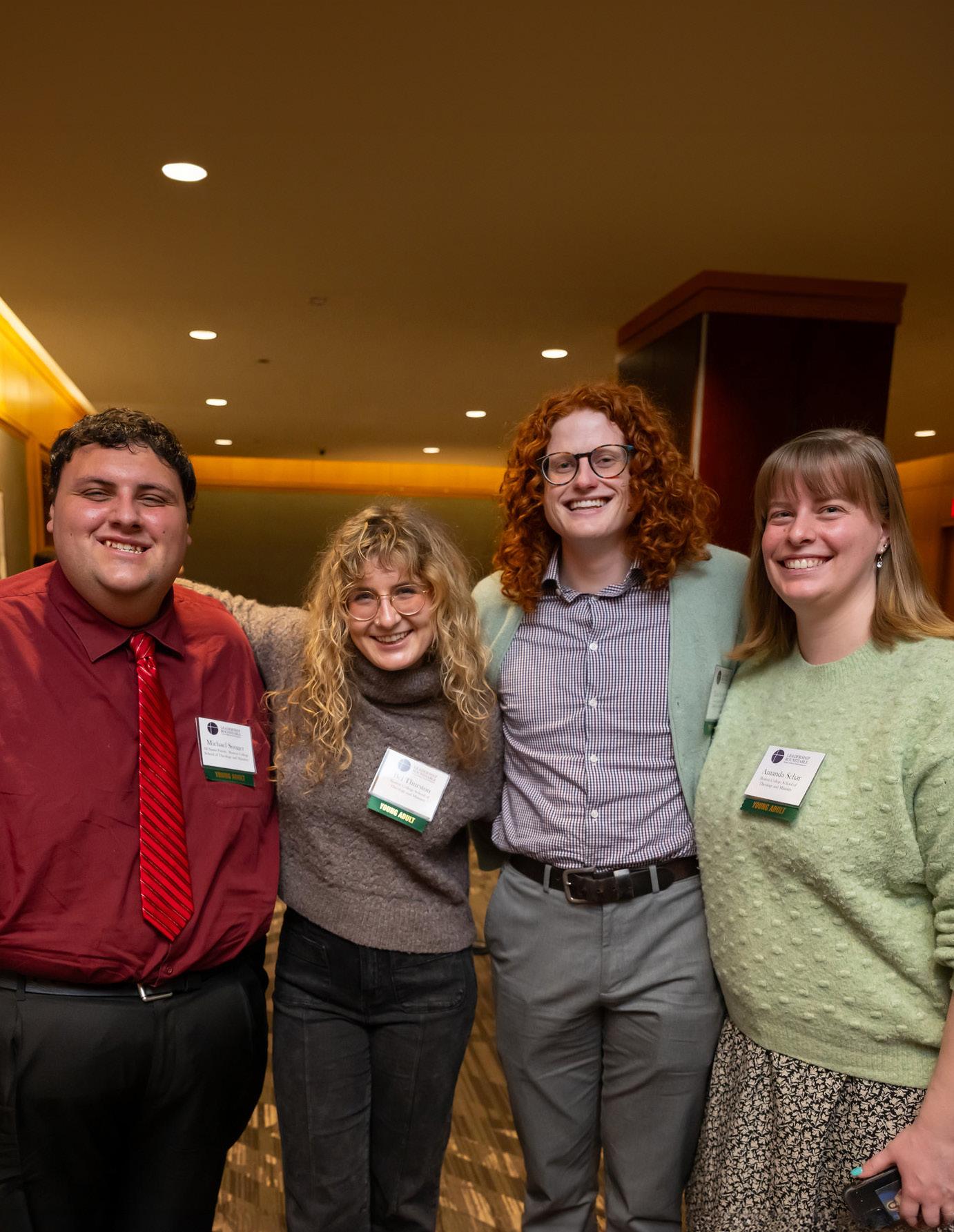
A common misconception about young adult Catholics is that those who are not attending Mass regularly are not practicing their faith. However, a recent study by the Center for Applied Research in the Apostolate (CARA) at Georgetown University indicates that 60% of young adult Catholics have participated in some kind of faith group outside of Mass. When comparing individuals ages 18 to 35 to those older than 35, the younger adults were more likely to participate in faith groups outside of Mass, showing their commitment to living out their faith in diverse new ways.
Young adults today care deeply for not just their own communities, but also the needs of the world. Recognizing and understanding the passion that drives many young adults to serve others in a lived expression of their Catholic faith is vital for the Church, said Claudia Avila Cosnahan, mission and partnerships director at Commonweal, who quoted the study during the second session of the Summit on “Today’s Young Adult Catholics: Engaged. Diverse. Questioning. Caring. Passionate.”
It is well documented that today’s young adults care more about creating social change than their own personal advancement, said Stephanie Peddicord, president of Goodfaith, during the final panel on “An Expanded Tent: Church Beyond the Parish Walls.”
“To them, social justice is not an issue. It's a person. It's the person sitting next to me. It's my neighbor. It's my brother and my sister,” she said. Peddicord noted that the Church has an opportunity to engage young adults around Catholic Social Teaching, which not only
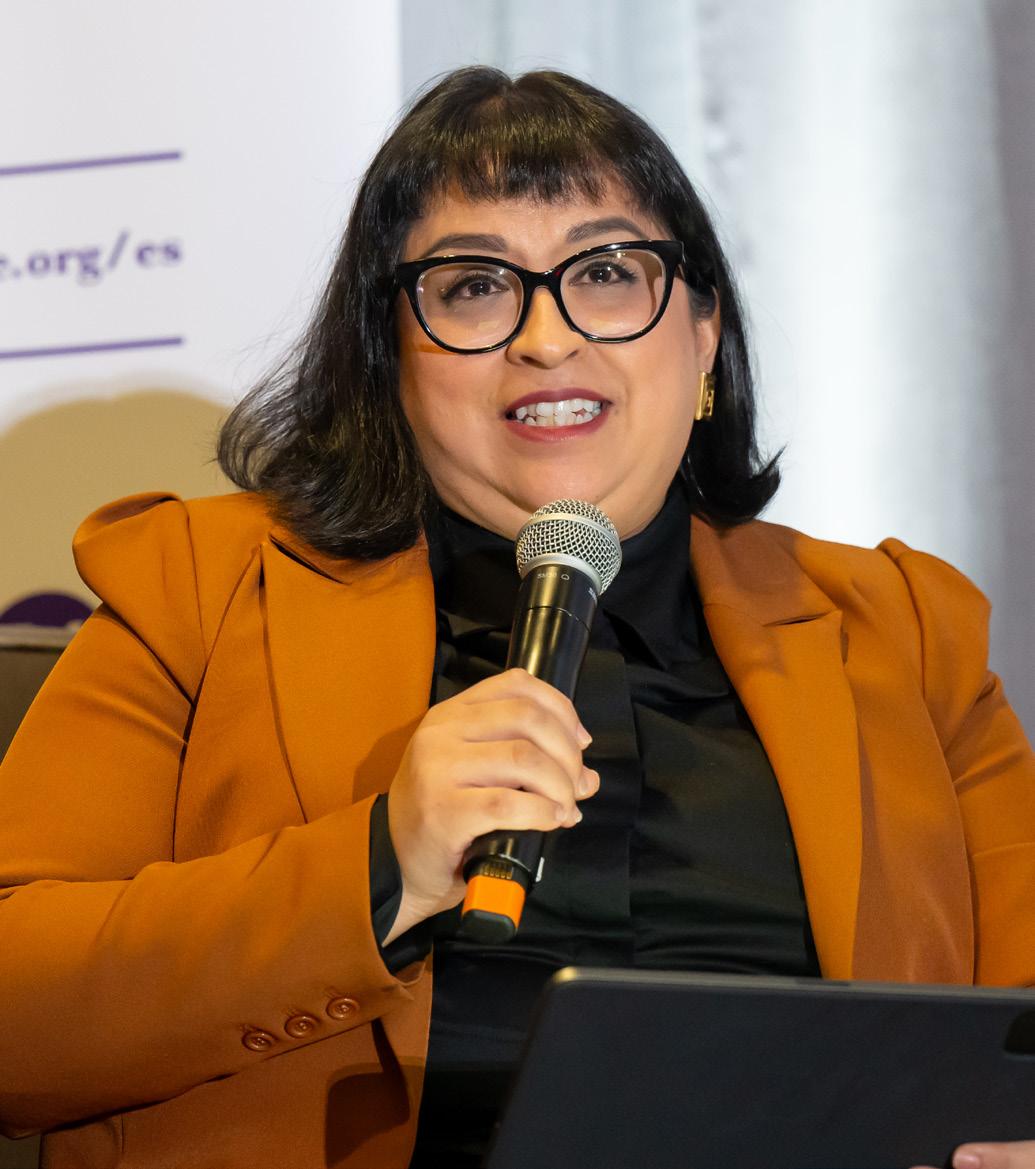
will appeal to what they care about, but would provide the language, knowledge, framework, and skills to help them actively confront issues in their community and the world head on.
She encouraged leaders to take this aspect of the Church, of our Catholic faith, to where young adults and those in need both can be found: beyond the parish walls.
Ministering on the streets of New York City has given Fr. Agustino Torres, CFR, founder of Corazón Puro, had many stories to share of how simple acts of support and encounter can be an expression of lived faith.
In the final panel, Torres told the story of a young man who he met on the streets of the Bronx desperately looking for financial support to get out of a gang by
“To them, social justice is not an issue. It's a person. It's the person sitting next to me. It's my neighbor. It's my brother and my sister.”
– STEPHANIE PEDDICORD
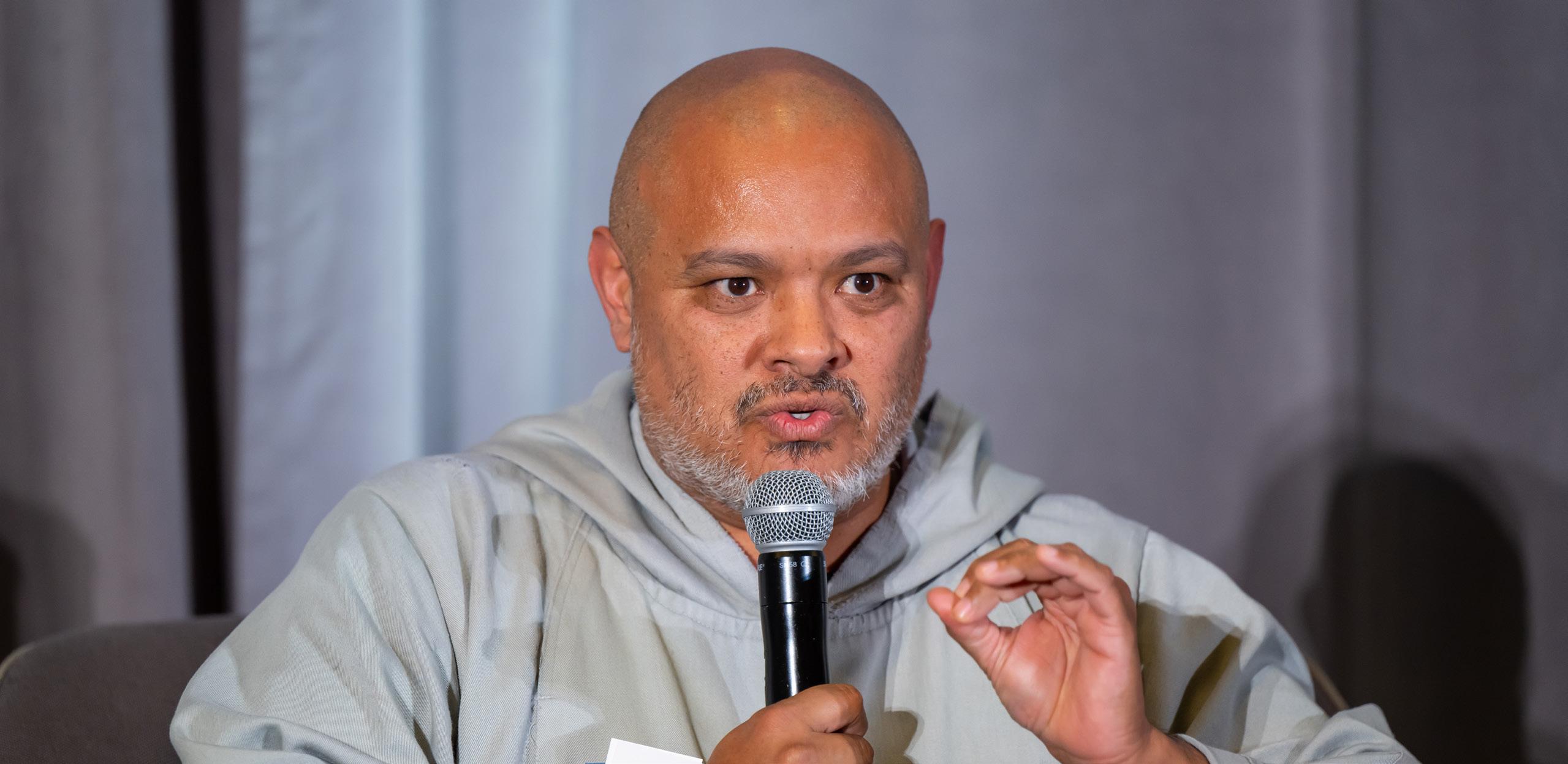
covering a gang tattoo on his inner lip. The man asked for $30 and when he was not met with an immediate yes, erupted with anger. Torres said the man ranted about how when he was in the gang he had everything, but since giving his life to God, he has nothing, and how every church he has asked for help has turned him away. Torres found a way to help and accompanied the man to the tattoo parlor to get the tattoo covered, and then invited him to attend a prayer meeting the next day. To Torres’ surprise, the man showed up at the prayer meeting. But the man, now free from the gang, also needed a place to stay. To Torres’ further amazement, a young father stepped up and offered to let the man stay with his family to get back on his feet.
A couple of months later, Torres encountered the former gang member again, and didn’t recognize him. But the man recognized Torres and thanked him for helping when no others would.
“We know that we need to go to where they are. We know that we need to help them stop the bleeding,” Torres said. “And then we need to give them good, real food. And I mean real food because, I mean, the amount of people that I've brought to Jesus by talking about tacos is insane, but also real spiritual food because they want to be nourished spiritually.”
When living their faith in the world, young adults often seek connection to organizations that align with their beliefs. As Catholics, we are called to be bridge builders, but to do so requires also going beyond the parish to know those in our community, not just those in the pews, stated Jill Fisk, director of mission services at the Catholic Health Association of the United States, during the second panel. Suggesting the Church partner with other organizations and local schools to reach young adults, Fisk encouraged leaders to inquire as to the resources that others are using to help meet the needs and desires of the community.
Building bridges with others in the community reflects the faith inside the parish walls, said Peddicord, who emphasized that it's important to also “build bridges, not walls, between different faith expressions within a community.”
Often the Church creates a dichotomy between what happens inside the parish walls — Mass, the Eucharist, doctrine, and orthodoxy — and what happens outside of it — service, faith practice, and encounter. And at times, it can seem like the Church considers what happens outside as secondary, or “just window dressing,” Peddicord said.
Yet, many young adults who have experienced pain from or have concerns with the Church will never set foot in a parish until leaders reconcile what happens inside with what happens outside the parish walls, she noted.
“So to the extent that we're able to bridge that gap for them is how we will become a Church, a nurturing and thriving and vibrant Church,” Peddicord said.
The majority of young adults today are concerned, if not already actively engaged, in addressing injustices such as racism, the climate crisis, and poverty. Paul Jarzembowski, associate director for the laity at the United States Conference of Catholic Bishops, noted during Session 2 that young adults are inherently relational and deeply care about people as well as issues.
Young adults also often find spiritual fulfillment and celebrate the love of God through creation. Anna Johnson, North America senior program manager for the Laudato Si' Movement, shared during the final panel how many young adults she encounters celebrate God, live their faith, and experience God’s love most profoundly through creation — whether that be their children, their friends, or nature.
“God shows up in nature — in a burning bush, in the quiet whisper of the wind, in a pillar of smoke,” she said, explaining why this is a common place of spiritual connection for young adults. “The Holy Spirit comes in wind and fire.”
Understandably, many of these same young adults are greatly concerned for the future of the planet and have responded to Pope Francis' call to care for creation. Others have responded to his call “go out and make a mess” by building inclusive communities centered on God's love and justice, according to Johnson, who shared examples of young adults building intersectional, welcoming, abundant communities.

“The young adults I work with have built neighborhood-based communities of faith and itemsharing cultures where they break open bread and scripture, and share goods in the manner of early Christian communities,” Johnson said. Challenging those in the room to also respond to the call, Johnson asked the room if they too will show up in these kinds of spaces.
By building bridges and taking part in communities outside the parish walls to meet with young adults where they are, the Church can seize the opportunity to engage a generation that is, in fact, actively spiritual. By recognizing and supporting their diverse expressions of faith, the Church can foster a more inclusive, vibrant, and dynamic faith community that resonates with the lived experiences of young adults today.
Young adults today are digital natives, immersed in an online world that extends far beyond traditional websites and newsletters. As John Grosso, digital editor at the National Catholic Reporter, aptly put it in the keynote address titled “Young Adults in a Synodal Church,” “These digital spaces are the ministerial frontier.”

Engaging with young adults in digital spaces is not just about utilizing technology, it's about understanding and embracing digital culture as a whole. Sr. Nathalie Becquart, XMCJ, undersecretary of the Synod of Bishops, emphasized in the keynote the importance of integrating online relationships into all aspects of pastoral work.
“With what we see today, the way to be in relationships, especially with young people, is that part of the relationship is online,” she said. “So for me, it's about, really, enculturation, it's integrating in all our pastoral work, in our way to be in relationship is that part of the relationship is online.” Becquart went on to explain that, in many ways, digital culture is the language of young adults.
“What we have to understand is that for young adults today, you know, their main language is first the language of image, video, and music,” she said. It’s important for the Church to learn to share the Gospel in the language of and using the tools of digital culture.
Digital culture is a dynamic ecosystem that fosters unique forms of connection and offers a constant exchange of information through social media, numerous interactive communities, and unique jargon. According to Johnson, young adults often form their own online communities to meet their personal, spiritual, or communal needs.
“To build welcoming communities, to celebrate the love of God, to grieve Christ's crucifixion, and to make the world a better place, many young adults are building community, both in-person and online, that do these same sacred things,” shared Johnson.
It is important to understand the digital world not as a mere collection of tools but a culture, as unique as any other. Digital culture is a place where young adults live, where they spend much of their waking hours, so José Manuel De Urquidi, founder and CEO of the Catholic multimedia company, Juan Diego & Co., encouraged leaders in the final panel to work to enculturate the Gospel in digital culture much as it has in cultures across the world. According to De Urquidi, to fully embrace this new digital and ministerial frontier, the Church must be willing to experiment, fail, and adapt.
“Digital missionaries are caring about the wounds of the people that are there on those ‘streets’ ... bringing them to Christ,” he said. “So it's an ongoing conversation that we need to be experimenting as a Church because that's where they are.”
By embracing digital culture, the Church can create a vibrant and inclusive online presence that resonates with young adults. This approach will help bridge the gap between traditional faith practices and the digital lives of young people, ensuring that the Church remains relevant and accessible in the modern world.
• Identify ways the Church can create environments and initiatives that meet the needs of young adults by understanding where young adults spend their time and why, such as social media platforms, nature preserves, and advocacy groups.
• Seek to collaborate between local Catholic high schools, college campus ministries, and parishes to learn from each organization’s successes and failures, and to establish an integrated pathway for young adults to remain engaged with the Church throughout various phases of their lives.
• Create opportunities for young adults to live their faith through service in the broader community by partnering with local nonprofit organizations whose work intersects with Catholic Social Teaching, such as those serving individuals experiencing poverty or working to care for the environment. Facilitate reflection on their time of service that is faith-based.
• Encourage and facilitate young adult leadership in organizing community service projects in environmental care, leading pilgrimages or retreats for prayer and reflection, or hosting workshops on issues that resonate with their faith, and build community with their peers.
• Provide ongoing training in digital culture that promotes the current best practices for digital integration with ministry.
• Shift communications channels from solely publishing printed newspapers and magazines to engaging in digital culture by developing an online presence that attracts younger generations, such as social media, video content, and podcasts.
• Utilize the strengths of the digital culture to build community that offers both online and in-person opportunities for engagement, such as a theology class that can also be attended virtually, and spaces of encounter among members of the faith community, such as an open hall that offers free Wi-Fi.


In the story of the disciples' encounter of Jesus on the Road to Emmaus, both Jesus and the disciples model the listening, presence, and relationships that are at the core of synodality and our call to journey with young adults. Sr. Nathalie Becquart, XMCJ, noted in the keynote titled “Young Adults in a Synodal Church” that the Gospel underscores the significance of empathy and understanding in ministry, synodality, and relationship-building.
Becquart, who is undersecretary to the Synod of Bishops, noted how in the Emmaus story that Jesus, while still appearing as a stranger, didn’t impose himself on the disciples. Rather, they invited him to stay with them and that encounter proves to be transformative for them.
“In a way it's a path of conversion, and they are reintegrating into the community,” Becquart said of how the disciples in the story hurry to tell others of their encounter with Jesus.
Any point of connection can be the beginning of a journey with young adults. For Becquart, who spent much of her vocation serving young adults, sailing was an unexpected point of connection that allowed her to build relationships with the young adults with whom she ministered. Recognizing the popularity of sailing among students in France, she shared that while leading a campus ministry, she organized a crew to participate in a sailing race, serving as the skipper.
“The first two days, you speak about the current, the wind,” she recounted. “After that, you know, all those young adults came to me to speak about God, the Christian faith, and for some it was sometimes
the first connection with the Church.” Highlighting the diversity among young adults, Becquart stressed that there is no single approach to ministry. Diversity requires the Church to adopt a variety of methods and proposals to effectively connect with young people.
“It can be football, it can be cooking, it can be music,” Becquart said of ways to encounter young adults. By engaging in shared interests, the Church can foster genuine relationships and become a witness to the Gospel. And while the timing of that relationship may not be our time, it may be a chance encounter along a road, without taking time to build a relationship first, transformation cannot occur.
“Everything is possible through the vessel of relationship,” said Cecilia Flores, executive director of the Catholic Volunteer Network, in Session 3 on “The Church We Want to Be: An Authentic Place for All to Belong.”
Often, with young adults, the relationship is one of accompaniment, especially if the young adult is facing challenging times. In the final session of the Summit on “An Expanded Tent: The Church Beyond the Parish Walls,” Fr. Agustino Torres, CFR, founder of Corazón Puro, said times of challenge are often an open door for leaders to deepen our understanding of the faith through the act of accompanying someone through their storm.
“We have to walk with people to answer their questions in those moments, and especially of our young adults who are asking so many questions,” he said. “People just need you to be there during that time. We're just trying to hold on as best as we could. You know, even though the boat was rocking, we were there with our people. And that's what we can do. And we continue to
“Everything is possible through the vessel of relationship.”
– CECILIA FLORES

walk with them.”
Just as the diversity among young adults requires differing methods of encounter, it also requires different approaches to coaching and mentoring young leaders. Becquart encouraged leaders to adjust their approaches when mentoring young adults to see it as more of a journey together.
“You can’t evangelize young adults without them. They are the first protagonist,” she said. “It's really about empowering them and co-leading with them.”
To give an example of what can happen when young adults are given leadership responsibility and accountability, John Grosso, digital editor for the National Catholic Reporter, recalled a pivotal moment in his career when, at age 23, he was asked by his bishop to lead a pilgrimage to Poland with 250 youth and young adults.
“I'm sure it was a moment of absolute necessity, knowing how diocesan structure works,” joked Grosso.
“But it was also a moment of grace because the bishop had identified something in me. To this day, I don't know what. Maybe he just wanted me to suffer, to
identify me as a co-leader in this important mission.”
Despite being a challenging pilgrimage, being asked to co-lead the mission was an empowering experience for Grosso as a young leader, one that pushed him out of his comfort zone and led others to discern a vocation in ministry. Grosso credits the leadership he was encouraged to take while at the Diocese of Bridgeport for opening doors to even greater leadership opportunities as a young adult. Were the Church to establish the pipelines and open the doors for others, Grosso said there is immense potential.
Young adults want to learn from those who are older than them, but also feel they have something to offer the Church now, as young adults.
Paul Jarzembowski, associate director for the laity at the United States Conference of Catholic Bishops, noted during the second session that some leaders can experience fear at the thought of young leaders sitting at the decision-making table of their parish, diocese, or organization. But he emphasized the need to address and alleviate underlying fears, noting that it is a long
and challenging process, not something that can be resolved overnight. To start, he invited participants to reframe the issue by asking how all generations can belong at a larger table.
“Let’s face it, young people want to belong, and so do older generations,” he said. “Everyone wants to belong.”
Yet, many young adults, even those who obtain traditional statuses like ordination or higher education, encounter age-related biases from those who view their age as a limitation. An attendee shared during the plenary of Session 1 about how not long after his ordination, some parishioners outright refused to call him “father” because of his young age.
“They would say, ‘Well, you're young enough to be my grandson!’” he said. “I would try my best to engage with them and say, ‘yes, I am young enough to be your grandson, but the Church has also asked me to be a spiritual father.’”
Learning and mentorship is a reciprocal process, and that the Church needs the infusion of energy and creative problem-solving that young people provide. Like the disciples along the road to Emmaus, leaders who accompany and support young adults often find themselves transformed.
“I couldn't do the work I'm trying to do at the Synod office without all I have received and experienced doing 30 years journeying with young people,” said Becquart. “They have transformed me.”
Becquart said her experience has shown that young adults want to lead co-responsibly and journey intergenerationally in the Church. And while many have a lot to learn, they also have a lot to teach the Church. Much of young adults’ wisdom comes from their experiences, which are not the same as what older generations experienced at their age.
“They want to be protagonists, to participate, they want to change the world and the Church for a better world and for a better Church,” she continued. “But they need guidance, and they also ask for accompaniment, but not from top-down teaching ways. They want us like we are here, just with this spirit of mutuality.”
Seeing intergenerational mentorship as a mutual relationship where both persons have something to learn from the other requires humility.
“Are we humble or bold enough to be mentored by a young adult?” Grosso asked attendees. “Sometimes wisdom is not like wine. It doesn't need to age a certain amount until it's ready. It can be found anywhere in any scenario, and anybody can benefit from it, whether you're 22 or 102.”
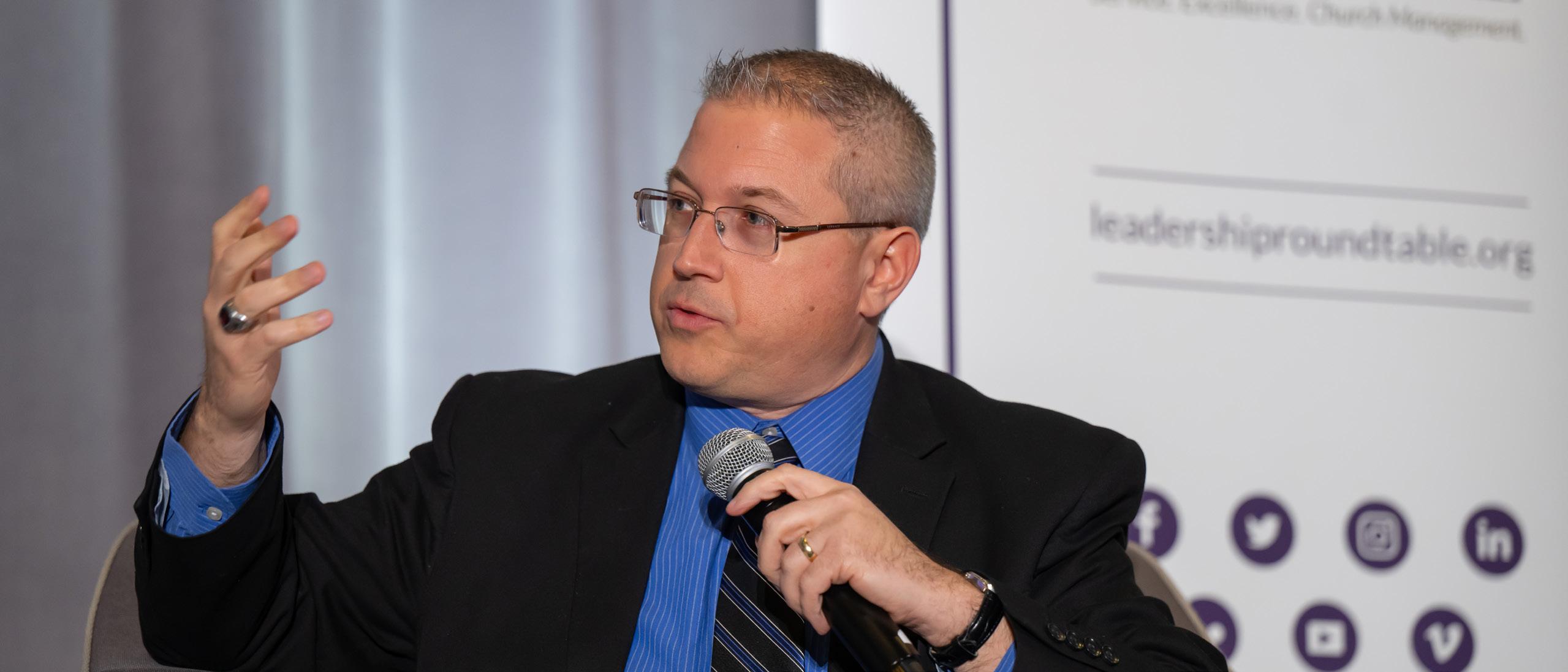
• Offer spaces, events, and ministries in the faith community where young adults can develop meaningful peer and intergenerational relationships, such as prayer partnerships and friendships.
• Promote intergenerational mentoring relationships where the mentoring runs both ways, skills are shared, and there is mutual respect and learning between young adults and others in the faith community.
• Structure small groups, ministries, advisory bodies, and leadership teams in ways that intentionally include individuals from different generations, taking steps to actively engage young adults to take part where they historically have not.
• Proactively plan for leadership succession in Church organizations, paying specific attention to providing young adults a pathway into leadership roles, and to fostering co-responsibility and commitment to shared mission.
• Assess parish, diocesan, and organizational leadership structures to ensure they reflect the ages and cultural diversity present in the bodies they lead.
• Establish clearly-defined leadership terms to allow young adults and other emerging leaders the opportunity to step into decision-making roles without displacing those who have historically served in such capacities.
• Create opportunities for and encourage participation in mentorship between those ending their term in leadership and incoming leaders.
• Promote and facilitate regional and national networks for young adults in the Church to support each other, such as helping open a chapter of an organization like Young Catholic Professionals, Catholic Association of Latino Leaders, Knights of Columbus, and The National Council of Catholic Women.
• Ensure Church leaders, from bishops to parish priests and lay leaders, have time to build relationships, offer spiritual direction, and administer sacraments to young adults by identifying ways to shift work responsibilities and prioritize this aspect of ministry.
• Adopt an accompaniment model that mirrors how Jesus journeyed with the disciples on the road to Emmaus, starting with meeting people where they are, then fostering relationships through dialogue and shared experiences, and culminating in a call to action.
• Provide tools and resources for those who are accompanying young adults, so that they feel supported, such as hosting small gatherings where individuals can ask questions and share experiences and expertise.
1 2 3 4 5 6 7 8

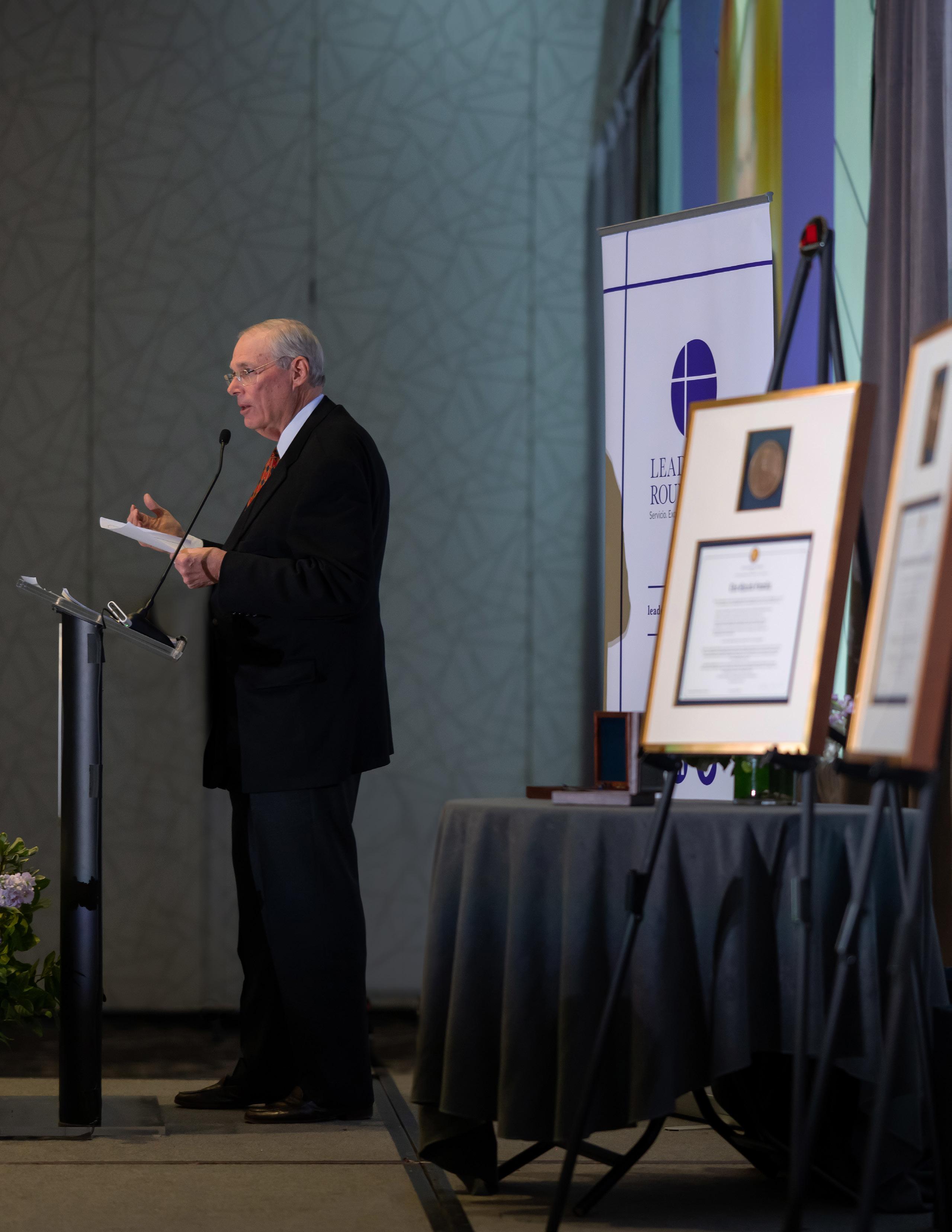
Leadership Roundtable honored three Catholic families with the 2024 J. Donald Monan Distinguished Catholic Philanthropy Medal — the Beeson Family of Chicago, the Kaneb Family of Boston, and the Quick Family of New York City — recognizing their generous giving to the Catholic Church and Catholic charitable causes. Leadership Roundtable awards the medal during its Catholic Partnership Summit, the preeminent gathering of Catholic leaders to address the pressing challenges and opportunities facing the Church.
During the 2024 ceremony, Leadership Roundtable also honored Kerry A. Robinson, current President and CEO of Catholic Charities USA and former founding Executive Director of Leadership Roundtable, for her nearly twenty years of service to the organization. Leading the ceremony as emcee, Leadership Roundtable Board Member Susan R. King presented the awards.
The J. Donald Monan, SJ Distinguished Catholic Philanthropy Medal (“Monan Medal”) is conferred to Catholic philanthropists who have invested generously and faithfully in the work to promote excellence in Church management and leadership, and whose giving reflects Fr. Monan’s deeply held belief in collaborative excellence and partnership.
“The Beesons, Quicks, and Kanebs exemplify the strong commitment to faith and the generosity of both resources and spirit that was the hallmark of Fr. Monan’s life,” said Geoffrey T. Boisi, founder of Leadership Roundtable.
Established by Leadership Roundtable, the Monan Medal seeks to honor and inspire philanthropists of the Catholic faith who emulate and personify the vision, character, creativity, and commitment to excellence of the late Fr. Monan, a member of the Society of Jesus. Fr. Monan was the longest-serving president of Boston College, and he dedicated his life to spreading Christ’s mission through the inclusive partnership of ordained, religious, and lay Catholic leaders.
All three families received the Monan Medal at a special gala event on Feb. 29 in Arlington, VA, where the Apostolic Nuncio to the United States, Cardinal Christophe Pierre, offered a blessing and made remarks about the generosity of Catholic philanthropists and the important work of Leadership Roundtable. The families were nominated to receive the medal by a committee of Catholic leaders, including Fr. Monan’s cousin and trustee of Boston College Cynthia Lee Egan; Georgetown University President John “Jack” DeGioia; Association of Jesuit Colleges and Universities President Rev. Michael J. Garanzini, SJ; Former Harvard Professor Rev. J. Bryan Hehir; Children’s Scholarship Fund President Darla Romfo; and Rose Mary Donahue, assistant to the president at Boston College.
The Beesons, Quicks, and Kanebs were introduced by the ordinaries of their dioceses, respectively, Cardinal Blase J. Cupich, archbishop of Chicago, Cardinal Timothy M. Dolan, archbishop of New York, and Cardinal Seán O’Malley, OFM Cap., archbishop of Boston.
“I was pleased to meet Fr. Monan while visiting Boston College, and I was impressed by how, as the 24th president, he brought the institution from financial crisis to a state of unparalleled academic and financial success,” said Cupich. “Those who are being honored in his name should be proud by the fact that they too are bringing about transformational impact inspired by their faith.”
“I know firsthand how the Beesons have stepped forward time and again with their generous service and philanthropy, whether to the Archdiocese of Chicago and their parish, through their leadership and support of Big Shoulders Fund, DePaul University, St. Gall School, Catholic Charities, Misericordia, and Marist High School, to name a few,” said Cupich, commending Gerald and Jennifer Beeson, as they received the medal bestowed on their family. More than just financial supporters, the Beesons give generously of their time and talent, particularly to Catholic education.
“To say the Quicks are legendary in the Archdiocese of New York is an understatement,” said Dolan.
Les and Regina Quick were among the first to lend support to the Inner City Scholarship Fund, and they were the first to provide an endowment through the
fund. Les was highly esteemed for his philanthropy and leadership in charitable, religious, and civic causes.
To this day, Les and Regina’s children continue their parents’ philanthropic and service tradition. Through her participation on multiple boards, daughter Mary Quick has been influential in helping children with learning differences succeed at home, school, and in community in meaningful and passionate ways. Along with serving on myriad hospitals, universities, school, foundations, and nonprofits boards and councils, the Quick family remains very active in the Knights of Malta, with sons Peter Quick and Christopher C. Quick, and daughter Nancy Quick Gibson, all being active in the lay religious order. Son Leslie C. Quick III serves as Knight of the Order of the Holy Sepulchre and has served on several boards and investment committees. Members of the Quick family are also active supporters and lay leaders in the Diocese of Metuchen in New Jersey, the Diocese of Rockville Centre in New York, and the Archdiocese of Boston in Massachusetts.
The late John Kaneb was known as the CEO and Chairman of HP Hood, owner of the Boston Red Sox, and real estate endeavors, but most dear to his heart was his Catholic faith and charitable causes and justice, including Catholic Charities of Boston.
“Each year during the Spring Celebration, Catholic Charities presents its Justice and Compassion Award, which they renamed to honor John and Ginny Kaneb,” said O’Malley.
The award is Catholic Charities’ highest recognition and was named in honor of the late John Kaneb, beloved former Catholic Charities Boston Board member who assisted the organization until his death in August 2021, and his wife, Virginia, to commemorate their decades of generous support of the agency. To this day, the Kanebs are involved in a vast array of philanthropy, continuing their legacy of faith-in-action.
“These families who were honored have demonstrated great generosity by sharing their time, talent, and treasures in ways that foster collaboration in the life of the Church,” said Cupich. “They are living witnesses of what it means to be a synodal Church, as Pope Francis has urged, by walking together in a way that reminds us all that each of us is co-responsible for the mission of Jesus.”
This spirit of co-responsibility is at the heart of Leadership Roundtable's mission. Over twenty years ago, founder Geoff Boisi and Kerry Robinson partnered to create what would later become Leadership Roundtable. Robinson became the founding executive director, serving until 2023, when she transitioned to a role on Leadership Roundtable's Board of Directors.
During her tenure, Robinson also collaborated with Boisi and the late Fr. Bob Beloin, then Catholic chaplain at Yale University, to co-found ESTEEM (Engaging Students To Enliven the Ecclesial Mission) fourteen years ago. Born out of a shared love for young adults and a conviction of their potential to lead, Robinson co-shepherded a program that cultivated the gifts young adults offer through the accompaniment of their campus ministers and other Catholic mentors.
Nicole Perone, national coordinator of ESTEEM, who was mentored by Kerry Robinson during her graduate studies, delivered heartfelt remarks about Robinson's impact on her personal and professional growth.
"Kerry became the consummate mentor,” Perone said. She shared that Robinson was always willing to address difficult questions and provide support during challenging times. Perone credits her successes, both personal and professional, to Robinson, attesting to the value of having a mentor.
"She championed me at every opportunity and thrust me forward to fly, because she knew I would soar,” Perone said.
Leadership Roundtable hosted the Monan Medal ceremony in conjunction with its Catholic Partnership Summit, a gathering of more than 275 leaders from across the U.S. on the theme of “Expanding the Tent: Young Adult Leadership and CoResponsibility in the Catholic Church.”
SCAN THE QR CODE TO LISTEN TO THE EPISODE
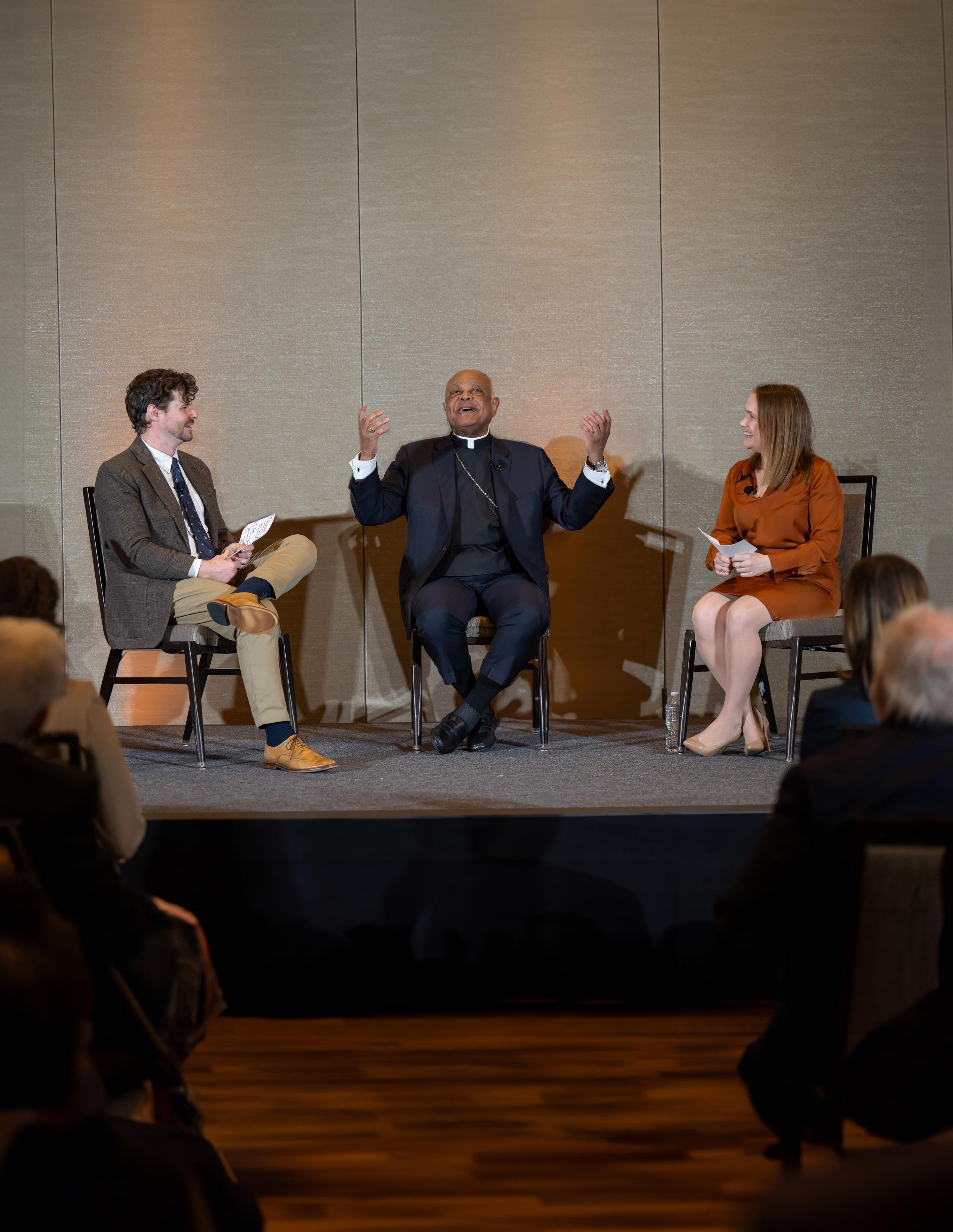
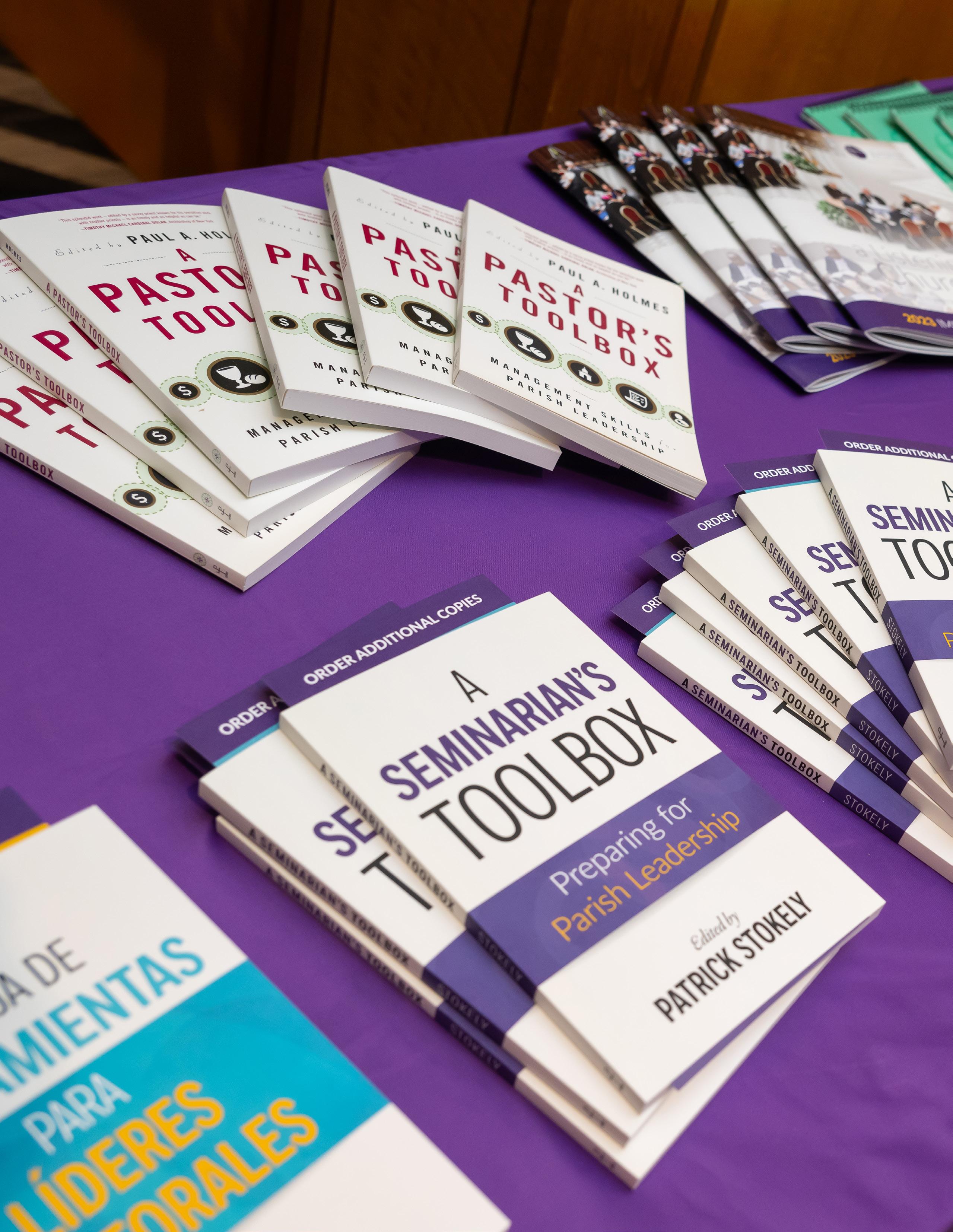


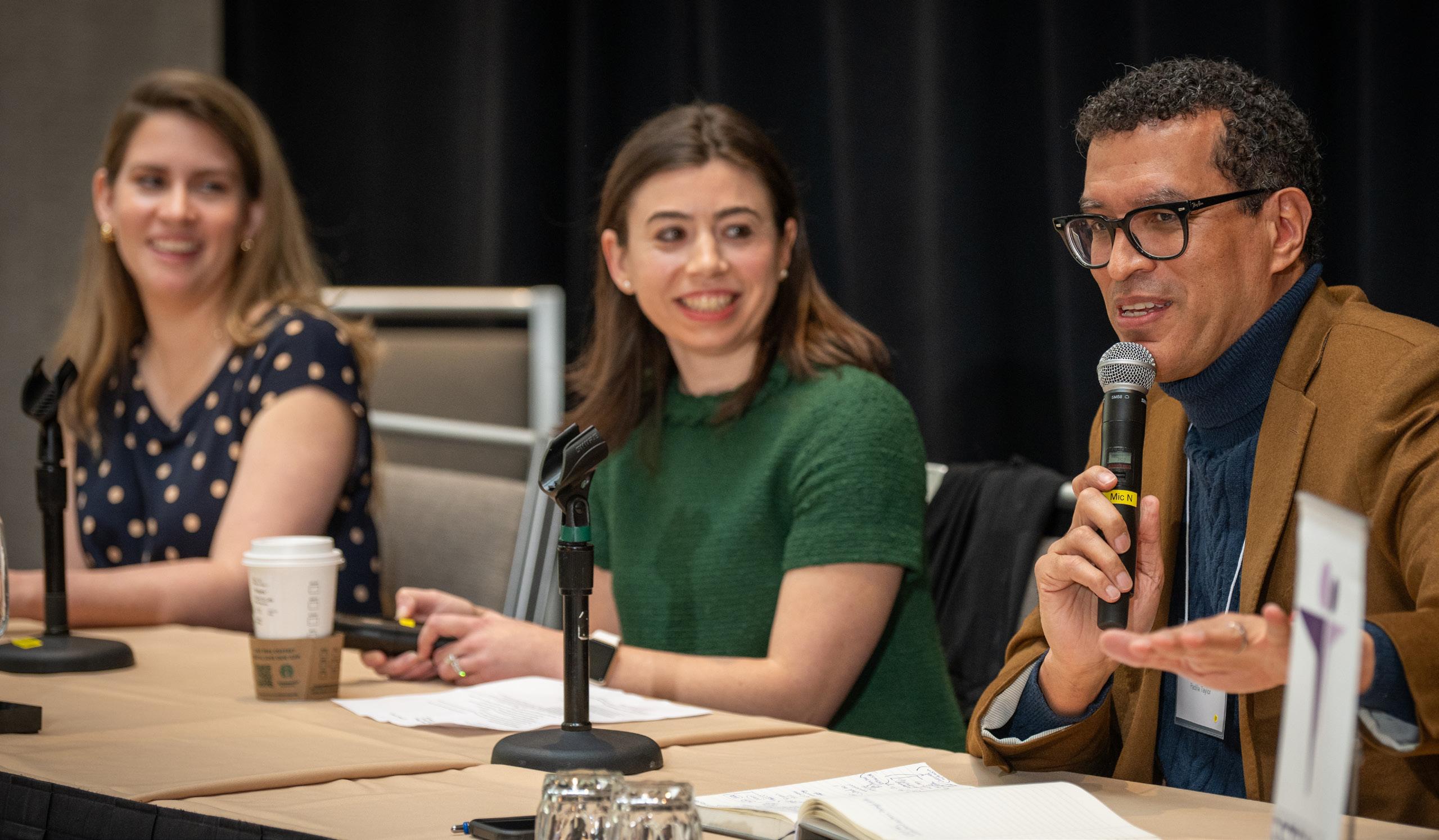
Catholic leaders must create a seat at the table of leadership and a voice in decision-making for young adults in the Church today. Leadership Roundtable is committed to promoting young adult involvement and leadership in the Church.
The idea of ESTEEM began in 2008 with a deep concern about the future of the Catholic Church following the exodus of many young adult Catholics, many of whom would go on to lead in various temporal spheres. What started as a series of conversations about the future of the Church is now the primary leadership formation program for young adult Catholics at over a dozen college and university campuses across the United States and the Caribbean.
ESTEEM is a joint partnership between Leadership Roundtable and Saint Thomas More Catholic Chapel and Center at Yale University that supports, encourages, and affirms the leadership of young adults in the Catholic Church and assists in their transition into parish life through education, community, faith formation, and mentorship.


Upcoming Cohorts:
Fall Bilingual Cohort
Fall Cohort
September 4 - October 23, 2024
September 5 - October 24, 2024
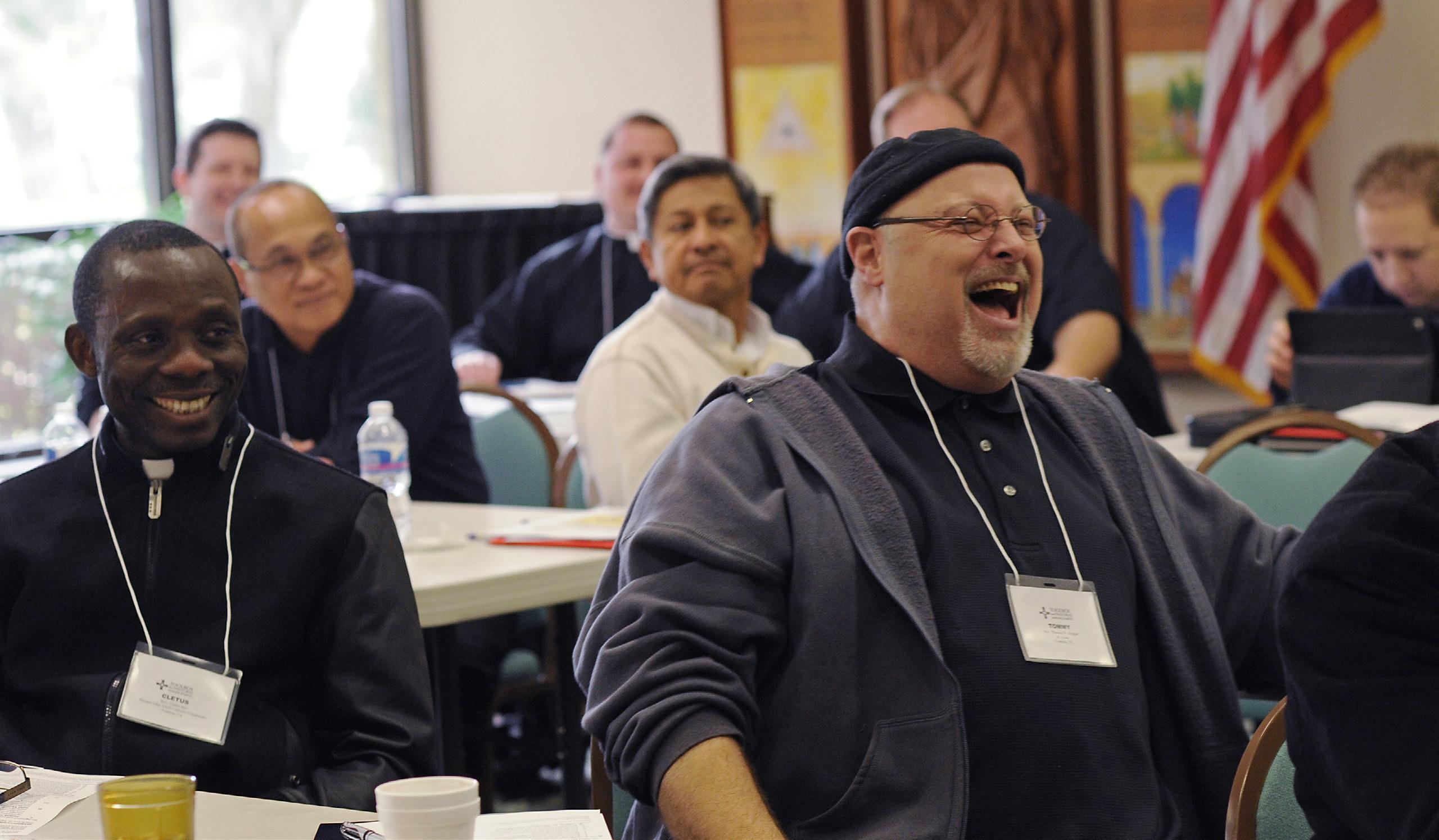
The Toolbox for Pastoral Management is a comprehensive program that introduces the key elements of pastoral leadership and management to priests, seminarians, and lay pastoral leaders. A residential program, the Toolbox offers a formational and education process that covers essential leadership and management topics critical to the pastoral role. Participants engage in a series of presentations that provide practical tools for the busy pastoral leader. Prayer, the sacraments, and fellowship round out this initiative.
Toolbox for Pastoral Management — Advanced Level is the next step for experienced pastors and pastoral leaders seeking to further sharpen their skills in ministry.

Geoffrey T. Boisi
Kenneth C. Griffin, Citadel, and Citadel Securities

Elizabeth McCaul and Frank Ingrassia
Peggy and Gene McQuade
Joseph Regan
Dan and Kathleen Denihan
B J Cassin Family
Dee and Kevin Conway
Kevin Fee
Tom and Meg Healey
The Carney Family Charitable Foundation
The Raskob Foundation for Catholic Activities
Richard Czaja
Gabriela Smith and the Crimsonbridge Foundation
Eric and Keri Carlstrom Family Foundation
Kevin K. Carton
Changing Our World
The Dagher Family
Frank and Janet DellaFera
Dominican Sisters of Peace
Fairfield University
America Media
Archdiocese of Louisville
Association of Jesuit Colleges and Universities
Association of U.S. Catholic Priests
Reverend John P. Beal, III
Big Shoulders Fund
Burnett Risk Control International, LLC
Edward D. Herlihy
The Lynch Foundation
Partnership Schools
Jim and Molly Perry
Debra and Claudio Del Vecchio
Dr. Peter and Peggy Steinfels
The Pontifical Mission Societies in the United States
Anonymous Donor
Mario J. Gabelli ParishSOFT by Ministry Brands Pushpay
Robert W. Postma
Sacred Heart Seminary and School of Theology
Brian and Patricia Shea
Anonymous Donor
Catholic Climate Covenant
The Hank Center for the Catholic Intellectual Heritage
Susan and Mike King
Kinsale Consulting
Kevin McLaughlin
Joseph Tarantino
Villanova University
For a full list of sponsors, please visit: summit.leadershiproundtable.org