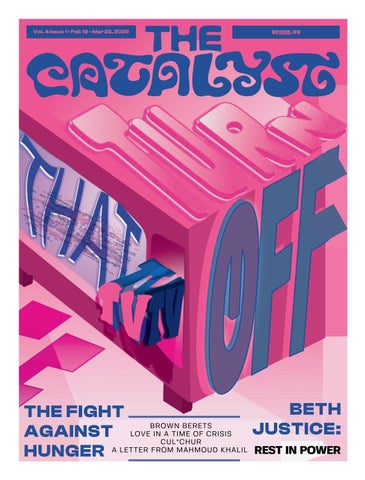
![]()


THE CATALYST IS AN AGENT FOR MAKING CHANGE. WE
may not find in the establishment media. We strive to illuminate truth and present Lubbock’s real diversity — even if it offends or embarrasses the irresponsible powers that be.
THE CATALYST began in 1969 as an underground student paper, bringing reporting on the Vietnam War, life at Texas Tech, state and local politics, reproductive rights, and so on. Texas Tech admin and the City of Lubbock tried countless times to shut us down — forbidding street sales, sending cops to the presses, even federal agents (allegedly) planting drugs on staff. Their most notable attempt was the Board of Regents’ ban on our sales in the Student Union. Our staff responded with a lawsuit, and the court ruled in our favor. Channing Club v. Board of Regents of Texas Tech Univ became a model case for student freedom of press.
53 years have passed since we last appeared, but things happening in Lubbock and the world have inspired us to revive THE CATALYST. In a time of shrinking faith in journalism and the mainstream press, we’ve decided to break the silence and resume this (dis)honorable rag right where it left off.
In these pages we hope you’ll find insight, inspiration, or (at the very least) a good laugh. If not, THE CATALYST like other local newspapers also works for toilet paper or for wrapping joints. So, put that in your hole and smoke it.


As of March 21, 2025
309 totalcasesinTXsinceJanuary
40 totalTXhospitalizationssinceJanuary
99% ofTXcaseshadunvaccinated/unknownstatus
Source: Texas Health and Human Services
August 1969
HE CATALYST WISHES TO take the freedom cause to the press by covering news and perspectives you -editor A S SUPERMARKETS
Free Speech Area as a wonderful step forward. On a campus the size of Tech’s, it is commendable to say the least, that a few square yards have been set aside wherein free speech will be tolerated so long as it does not interfer[e] with the flow of traffic.
“We acknowledge also the wisdom and foresight which went into the selection of the location for the Free Speech Area. Out in the lot behind the Union, large crowds can gather without bothering, or indeed, ever coming to the attention of uninterested students.

“There is, in fact, some question as to how goings on out back can come to the attention of interested students since the Union Snackbar thoughtfully keeps its curtains drawn.
“It was also thoughtful of someone to leave piles of old bricks and other garbage out in the designated area so that free speakers might have somewhere to sit.”
by Marcello Burdis • CATALYST
H-E-B and United expand
westward, East Side residents rely on East Point Market and three community fridges for groceries.
Feeding Texas reports hunger rates among Lubbock citizens rose from 15% to 17% between 2020 and 2022, with most foodinsecurehouseholdsconcentrated on the East Side. Residents often choose between a lengthy commuteforfreshfoodorsettling for pricey items at nearby corner stores and gas stations. Danielle Demetria East, executive director of the East Lubbock Art House, conceived the neighborhood fridgeinitiativeinNovember2020. “Irecognizebeinginafooddesert, whereEastLubbockArtHouseis,” East said. “And that it’s not only a food desert, but a cultural, education,opportunitydesert.”
murals covering the fridge doors reflect the Art House’s vision. Artists transform the functional appliances into landmarks and visual reminders of available resources, with new designs appearing annually. East leaned forward while describing the initiative’s importance. The fridges create a safe space to share food and art while beautifying the community,shesaid.
DaltonHenninger,whoisanintern at the Art House, agreed with the positive atmosphere. His duties include regular fridge maintenance, fromdailyrestockingtocleaning. Vehicles at full capacity arrive steadilythroughouttheday,hesaid.
The high demand reflects broader food access challenges. Resource constraints, language barriers and immigration status concerns contribute to hunger rates among Lubbock County families, according to a 2019 Children at Risk study.
regardless of income. Texas households discarded about 2 million tons of food in 2023, according to the nonprofit Rethink Food Waste Through Economics and Data. Landfills receive 53% of uneaten food, while produce accounts for more than one-third ofdisposals.
The fridges connect surplus food to community needs, said Latissha Bibbs, a frequent visitor and donor. There’s no sense in trashing good food when so many residents need it, she added.
CATALYST, Vol. 1 Issue 1, 1969. Image courtesy of Southwest Collection/ Special Collections Library
East’s organization provides accessibleproduce,arteducation and diverse literature. Exhibitions and events feature emerging local LGBTQ+, Black and multiculturalartists.Vibrant
The community fridges accept donations and visitors 24/7. For more information, visit eastlubbockarthouse.org. “T acknowledge the newly established
Unlike traditional food banks, fridges bypass common barriers: no paperwork requirements, transportation costs or assistance delays. I’ve been seeing a lot more people coming in droves,” Henninger said, smiling. “You’ll have a truck full of four or five people and they’ve all got bags prepared.” Community members maintain the supply through frequent donations of fresh produce and staples. East said the initiative succeeds because anyone can contribute, regardless of income. East said the initiative succeeds because anyone can contribute,
In East Lubbock, where most households live over a mile from the supermarket, the fridges offer walkable grocery access points. Since its 2020 launch at 405 MLK Jr. Blvd., the program has expanded to include a location at 1720 E. 4th St. Bibbs said limited public transit and delivery options make it difficult for unhoused people to reach the fridges. “We need more people to help drop off food,” she said. “Everybody deserves food.” Consistently cold storage remains another challenge for food preservation and meeting individual preferences, Bibbs added. In response to growing visitor traffic, the Art House plans to add more fridges across East Lubbock. “I feel it gives people autonomy to give and receive,” East said. “Nobody’s judging.”

BETH JUSTICE WAS A LOCAL activist and TTU student who was active in the TTU chapter of Young Democratic Socialists of America & the Lubbock chapter of the DSA. They were also a prominent supporter of Beyond Barriers and powerful fighter in the struggles of the working class. We dedicate this first issue of THE CATALYST to their memory, to the light of hope they brought into this world. May their flame live on with us.
by Bethany Justice
I WAS INJURED AT MY JOB. A hot oil gun slipped off the fryer and shot all
over my legs, feet, arms and face. I can hardly remember any details or how exactly it happened, but I remember what my employers did. Nothing. While I was screaming in pain, unable to take off the clothes soaked in hot oil, we waited for the salaried manager to come and unlock the door to the room that held the first aid kit. The hourly workers were the ones that came to my aid right away, with water and eventually the burn cream.
Then I went home. I drove my oily self back home, 10 minutes of scream crying on the phone with my partner the entire way due to the searing pain.
Maybe I should’ve gone to the ER, but the thought never occurred to me. People get burned at work all the time I’m sure it’s fine, I thought.
But it’s not fine. Thinking back, my employer should’ve had better safety measures, better reaction in the moment, and definitely should’ve called an ambulance. I sat on the floor of my job sobbing and shaking, body turning red, and they just watched. Until I had the inner strength, enough to get up and clock out, and finally take myself away from that place.
When I returned to work two days later, I was told I should’ve worn jeans and nonslip shoes, as if that would’ve prevented the accident. I didn’t have to file a report or even talk to the manager that was on that shift. At the time of writing this, it has been less than a week since the incident, and I am watching the large scar form
across my thigh from this massive burn.
The entire incident has brought not only many critiques of my job, but also the system that allows jobs like this to exist. My job said they “can’t afford” a safer fryer when the other stores have them. They said they can only give workers compensation if I pass a drug test, a sickening way for businesses to avoid paying their workers injury claims in this state. Many of the workers clock 40 hours a week, but when accepting an hourly wage, you give up all rights to healthcare, insurance, retirement, and security in your position. In socialist countries, they have job security and universal healthcare. I could have gone to the ER, got treated, avoided a scar and taken more than one afternoon off work. I could’ve trusted my bosses to take care of me and make things better in the workplace, rather than avoiding responsibility at all costs and trying to unjustly place the blame on me.
A socialist Lubbock could see real job growth (not petty small businesses) for the people who live in Lubbock. It would also cultivate a healthier, more productive city.
To change Lubbock will take a lot of working together, but changing my workplace will have to start with me. I’ve already started requesting a safer fryer, better emergency planning, and changes to the reporting system surrounding injuries. Many of my coworkers see this as a lost cause and are complacent with the way things are. However, I won’t be until all workers can feel safe at their jobs and not be at risk of being traumatized.
I encourage the reader to identify potential risks and bring them up before it’s too late and you or someone you care about gets injured, or worse.
The only difference between Sex work and all other labor Is that sex workers might get off early.
We all sell our bodies. We try to pretend its just our time But my hands are rubbed raw I arch my back To lift up to 60 lbs of product
I stand on my feet all day
Until theyre so sore it hurts to walk I work hard and i go home dirty And i look good the whole time Because im always performing
Because im still on camera. And every profession must Deal with horny men Who will ruin an entire day By saying one fucked up thing About my body. Like its theirs.
At least sex workers have fans. Drive through workers have customers. Sex workers have identity. We have a brand to represent. Sex workers can be their own boss. My boss fired me after A double shift with no warning.
Sex workers are naked But that doesnt spare them From uniformity. Putting on My work uniform to look like Everyone else feels similar To taking my clothes off And wanting to look like Everyone else.
All labor is the same really Pandering to the companies will, Keeping customers happy, and Most importantly, staying productive.
But also the unsaid labor Where we allow an inappropriate Comment or touch go for the sake Of a business relationship. When my coworker makes me Uncomfortable but i indulge him anyway Because a happy lustful man Is safer than an angry one.
id never judge a sex worker For their job. Maybe their partner, But never their source of income Because we all have to have one And some are softer on the body and mind But most will run you ragged For much less income.

February 24, 2025
by Amalia Agüero • EL EDITOR
I N THE TURBULENT ERA OF THE 1960s, a generation of young Chicanos took to the
streets, standing against injustice, systemic racism, and inequality. Out of this movement, the Brown Berets were born in 1966 in East Los Angeles, a militant activist group dedicated to civil rights, education reform, and defending their communities. Now, over half a century later, the Brown Berets are experiencing a resurgence— thistime,intheheartofWestTexas.
Jose Cazares and his brother, Javier, have committed to re-establishing the Brown Berets with a new chapter in Lubbock and another in Uvalde. For Cazares, this isn’t just about history; it’s about a legacy of resistance that still holds deep meaning in today’s political climate.
B ORN IN SAN JOSE, CALIFORNIA, Cazares grew up straddling two worlds—
migrating between California and Texas, where his family worked as farm laborers. It was during these travels that he first encountered racism. “I saw it firsthand,” Cazares said. “They accused my dad of stealing gas just because we had California plates. We had an old blue ’58 Ford pickup, and that’s all they needed to target us.”
As a child, Cazares absorbed the identity of being Chicano, a term that emerged in the 1960s as Mexican Americans rejected both assimilation and second-class status. But it wasn’t until later in life, after serving in the U.S. Army for 15 years, that he felt the full impact of racial injustice. One moment in particular fueled his activism— a personal violation that made him realize he needed to take action.
“I flew my flag proudly outside my home, and one day, it was stolen and burned by local high school kids. The police told me there was nothing they could do because they had the ‘right’ to do that. That was my nation’s flag,” he said.
“That was a hate crime.” The refusal of law enforcement to take action, coupled with his later experiences dealing with systemic injustices, solidified his decision to do something more.
F OR CAZARES AND JAVIER, THE finalpushcamewiththetragedyoftheRobb
Elementary School shooting in Uvalde in 2022.
“Javier’s daughter, my niece, Jackie, was killed in that school,” Cazares said.
“We watched as the government and law enforcement covered up their failures while our families were left in pain. We knew we had to take a stand.”
The deep frustration over the lack of accountability for the 21 lives lost in Uvalde motivated them to reach out to the Brown Berets, a movement they had long admired. When Javier made the call to the Brown Berets for the March and Rally his family organized in June 2022, he was contacted by Tommy Acosta Sr. out of San Antonio. From there, a collaboration formed with Gabriel San M

Jose and Javier Cazares.
Photo courtesy of El Editor.
Miguel (Carnalismo Brown Berets, San Antonio), Willie Rodriguez (South East TX Brown Berets, Houston), Rafael Avitia (Fresno, CA Brown Berets, their mentor), and Jorge Lopez (South TX Brown Berets, the Valle). Tommy Acosta was also part of Carnalismo and Homies United Network. Their collective support helped guide the establishment of the new chapter.
“
We’re not here just to protest. We’re here to serve.”
T HOUGH THE BROWN BERETS OF the past were known for their confrontations
with police and government officials, Cazares wants the modern movement to be proactive in the community in different ways.
“We’re not here just to protest. We’re here to serve,” he said. “We want to help clean up the barrios, assist with security at community events, provide aid during fundraisers, and educate young people about their rights.”
Cazares and his wife have already contacted Catholic Charities, offering their services for security and community initiatives. The group also plans to be visible at protests, demonstrating their presence while educating the younger generation about activism and the importance of voting.
“We have to lead by example,” Cazares explained. “We can’t just talk about it on social media. We need to be boots on the ground, cleaning up our neighborhoods, protecting our people, and showing that we are a positive force, not a negative one.”
“
Together,weareone powerfulvoice... Weneedtounite, organize,andensure wearethereforour people.”
W
ITH ACTIVISM COMES CONTROversy, and Cazares acknowledges that
the Brown Berets’ history carries a particular reputation. However, he is committed to ensuring their re-emergence in Lubbock is seen as a force for good.
“Some people hear ‘Brown Berets’ and think of communism or radicalism,” he said. “But we’re here to serve the community—no matter your faith, background, or beliefs. We are about unity and protecting those who have no voice.”
While they are still in the early stages of recruitment, Cazares and his brother hope to grow their chapters with committed members who understand the importance of service, activism, and self-defense. “Together, we are one powerful voice,” Cazares said. “We need to unite, organize, and ensure we are there for our people.”
F OR THOSE INTERESTED IN joining or supporting the Brown Berets,
Cazares encourages people to contact him by calling or texting 806-860-4094 to learn more.
“We’re here to help,” he said.
As the Brown Berets return to Lubbock, their message remains the same as in 1966: Stand up, organize, and fight for justice. And now, more than ever, their movement is growing once again.
This article was reprinted with permission from El Editor, a weekly bilingual newspaper published in Lubbock and Midland-Odessa, Texas. You can read more on their website, www.eleditor.org.
by Friend of Dusty
writing this from a crisis stabilization bed in so-called Canada, on the coldest night of the year—inauguration day in the so-called United states. This is a space I can access for free to avoid going to a hospital. I am lucky and fortunate but five beds for a community of hundreds of thousands is not going to stabilize our collective crisis.
Both then and now, in this space, for this moment, I am here. It is where I self-validate my own truth. I remember what led me here and what empowered my voice. The Catalyst, where I apply it, has appeared as a space of resilience, affirmation and transformation.
A N OPPORTUNITY TO DEFINE ourselves, our needs and our vision is
as critical as ever. The so-called government of your United States has turned against its people —against those who fight for free-speech, human rights, and against genocide. Activists are being silenced, erased, forcibly disappeared. THE CATALYST has been here before. It is here now.Ourvoicesmatterandhaveagency.
“uncrystallized apprehension of disruption cannot overcome the right to free expression” —Channing Club vs. The Board of Regents of Texas Tech University, 1970. —Somefuckingtruthforthedipshitsthatsupport agenocidalgovernmentwithdelicatefeelings.
This is how I found myself. I have struggled with anxiety issues my entire life, undiagnosed neurodiversity and a lack of understanding how I should exist in a World that makes me feel uncomfortable so frequently. Running from one crisis to the next throughout a life is exhausting. We know this even though our circumstances vary. This is how Lubbock saved my life. How a community encouraged me to exist—how one person allowed me to feel a genuine belief that Ihadalwayswantedtoexperience.
Ideservetobehappy.
We went to school together and for a moment there was, perhaps, a moment. We ended up in different places living different lives. During the most difficult phase of my adolescence, she was there—a friend who did not remind me of the things I did not want to think about. Someone that made me feel safe and planted a powerful ideathatwouldresonateyearslater.
When I began doing community justice work, facilitating spaces for young people referred through the criminal justice system, as I had been, I carried that feeling. I couldn’t yet articulate it, but I understood that the most incredible feeling I had encountered was having someone I valued offer me the space to simply be. That experience of empowerment has resonated throughout my wellness journey. It was not until I had my first suicide attempt that things crystallized. The lack of safety I felt both inside and out, the deterioration from monitoring the online spaces poisoned with local fascists, the exhaustion of processing thoughts—I hadneverallowedmyselftotrulyfeel.Logical,
rational minds can create too much noise at times. PerhapsIdidneedtocompletethispartofmystory,I could not keep living that way. I am ready to live my lifewithrespectandloveformyself.
A HORRIFIC INCIDENT OF HATEmotivatedterrorism atthe UniversityofWaterloo
2023. Worst fears realized for many that had recognized that the churning of ideological fascists coming out of Canadian universities. A community organized vigil was held a few days later. It was the first time in my life I felt my feelings in a way I could recognize and hold space for. I felt hurt and was not going to dismiss it.
We are hurting. We will not dismiss that pain. We will hold space for it. For you. For us. We will provide no space for the oppression of marginalized voices and the erasure of who we are. In these spaces, we will feel resonance.
I TTOOKMEOVERAYEARTOFEELREADY— fifteen, if you count the time spent in a life that I
barely survived. I was ready to be the person I wanted to be. I knew that I would feel new unexpected feelings and big adjustments. I would need practice. Repetition. Falling and getting back up.
I reached out. We began to talk. I learned to trust myself. I learned to follow my feelings, to not allow the fear of the unknown, prevent me from finding happiness.
The personal conversations we had, that reminded me of the person I knew all those years ago. A person that makes me feel safe enough to feel like myself. To have the confidence to express myself and take a chance. A Catalyst.
That I can be wrong. That I can fail, struggle, break, become lost, neglected and be in pain. That I can say so. That I am free from the shame, guilt and judgement of myself. Someone could see me and reflect that acceptance—radical love. This reciprocal dynamic, interconnection, can provide us resonance—the kind that sits with us in times of pain and lifts us up when we feel heard. Spaces and places. The opportunity to discover and create something that felt new. A blank slate of sorts. We can write our futures and we do not need the patterns and voices of the past to tell us to reconsider.
I SPENT SEVERAL WEEKS IN SEPTEMBER andNovemberexploringLubbockandWestTexas.
I had the privilege of time and ability, but nothing would have been possible if I had not been invited in, provided space, and allowed to exist.
I developed my own radical lens long before arriving. I had watched Toronto police illegally detain G20 protesters in temporary camps. I had seen a crack-smoking, drunk-driving populist elected mayor. I had watched Jordan Peterson recruit incels on campus. I did not know if Lubbock or West Texas would have space for my values.
I was ready. I asked to visit. I overcame a fear of flying and a decade of never spending a night
alone because of panic attacks. I did it just to get to Lubbock. I did it to get to see her. I did it to be myself. I will always remember looking into the eyes of another and seeing myself as they saw me. The gift of space and opportunity to meet someone when they are ready to meet themselves.
RADICALLOVEISRESISTANCE
RESONANCE IS POWERFUL. It can be felt. When we come together,
we find that our shared voice is not only more powerful but that we feel more ourselves and at home. Within these spaces we can transform our communities, fight for justice and empower those whoneedusjustasmuchasweneedthem.
The ideas we share, we advocate, that we live andpracticecanresonateoutintothecommunity. Theycanmakeasound.Theycangiveusavoice.
I met so many incredible people over those few weeks and got to have meaningful conversations about life as I navigated through. Discovering people and spaces that reflect my values, how I feel, exist even in the places we might not expect. The Catalyst is a space for resonance—an affirmation of our existence, our love, and our right to take up space.
We must keep one another safe, find our people and affirm our existence.
Remember the future. I began writing this as a sort of mediation while in crisis stabilization. It feels appropriate to finish now, during this season of Lent, having wandered the desert with old patterns tempting me.
I needed to collect my thoughts once again. Find my voice again. We must protect these spaces. We must take care of one another. We will not allow those who do not live just lives to dictate our future.
This is radical love.

The author of this work recommends that readers consider supporting the Texas Tech Canine Olfaction Lab, which encourages adoptions at the end of the program. For more information, see their website www.depts.ttu.edu/afs/people/nathanhall/CanineOlfactionLab/.
We must keep one another safe, find our people and affirm our existence.” “


Theft by Gil Caley
You can steal my body, you've enslaved it before You can steal my mind, you've controlled it before You can steal my confidence, you've broken it before You can steal my story, you've written over it before You can steal my money, & my things, you do it all the time
But you can never take my spirit, because my spirit is indomitable
My love and my hope are unbreakable And they will set me, and everything, and everyone else free, over and over and over again until we break you right back sharing with each other all that you have stolen from us
by Marcello Burdis
by Amberlynn Gonzales
There is a house burning down next door
And we are hearing the children scream And we are watching the neighbors fail to flee Andwearetellingourselvesfireisself-contained That our homes are not built to combust That our bodies are not built of the same stuff That the flames of fascism will not spread
There is a house beingburntdown next door

by Katie Rose Jensen
Ethnobotany by Jacq Taylor
1.
What is it about diaspora That leave folk yearning— Less for the soul of soil, ButthetextureoftheirMother'stongue, And how she nurtured that sound?
Thresholds covet, Bleeding, Leaving, Perpetual trenching, Never a scab made scar. What heals such a wound?
No language— Now foreign to our tongues
No.


Soil, oh, how estranged from our toil! Seeds woven in hair, Protected for future sowing.
Rooted: Reeps, Repairs.
What was once held deep, Her story to keep, Now, laid dormant no longer.
Strengthen: Smell, Share.
For futures to inoculate. To savor.

March 18, 2025
by Mahmoud Khalil • INTHESETIMES.COM
Khalil
and I am a political
prisoner. I am writing to you from a detention facility in Louisiana where I wake to cold mornings and spend long days bearing witness to the quiet injustices underway against a great many people precluded from theprotectionsofthelaw.
Who has the right to have rights? It is certainly not the humans crowded into the cells here. It isn’t the Senegalese man I met who has been deprived of his liberty for a year, his legal situation in limbo and his family an ocean away. It isn’t the 21-yearold detainee I met, who stepped foot in this country at age nine, only to be deported without so much as a hearing.
Justice escapes the contours of thisnation’simmigrationfacilities.
On March 8, I was taken by DHS agents who refused to provide a warrant, and accosted my wife and me as we returned from dinner. By now, the footage of that night has been made public. Before I knew what was happening, agents handcuffed and forced me into an unmarked car. At that moment, my only concern was for Noor’s safety. I had no idea if she would be taken too, since the agents had threatened to arrest her for not leaving my side. DHS would not tell me anything for hours I did not know the cause of my arrest or if I was facing immediatedeportation.At26Federal Plaza, I slept on the cold floor. In the early morning hours, agents transported me to another facility in Elizabeth, New Jersey. There, I slept on the ground and was refused a blanketdespitemyrequest.
My arrest was a direct consequence of exercising my right to free speech as I advocated for a free Palestine and an end to the genocide in Gaza, which resumed in full force Monday night. With January’s ceasefire now broken, parents in Gaza are once again cradling too-small shrouds, and families are forced to weigh starvation and displacement against bombs. It is our moral imperative to persist in the struggle for their completefreedom.
I was born in a Palestinian refugee camp in Syria to a family which has been displaced from their land since the 1948 Nakba. I spent my youth in proximity to yet distant from my homeland. But being Palestinian is an experience that transcends borders. I see in my circumstances similarities to Israel’s use of administrative detention imprisonment without trial or charge to strip Palestinians of their rights. I think of our friend Omar Khatib, who was incarcerated without charge or trial by Israel as he returned home from travel. I think of Gaza hospital director and pediatrician Dr. Hussam Abu Safiya, who was taken captive by the Israeli military on December 27 and remains in an Israeli torture camp today. For Palestinians, imprisonment without dueprocessiscommonplace.
I have always believed that my duty isnotonlytoliberatemyselffromthe oppressor, but also to liberate my oppressors from their hatred and fear.Myunjustdetentionisindicative of the anti-Palestinian racism that both the Biden and Trump administrations have demonstrated over the past 16 months as the U.S. has continued to supply Israel with weapons to kill Palestinians and prevented international intervention. For decades, anti-Palestinian racism has driven efforts to expand U.S. laws and practices that are used to violently repress Palestinians, Arab Americans, and other communities. That is precisely why I am being targeted.
While I await legal decisions that hold the futures of my wife and child in the balance, those who enabled my targeting remain comfortably at Columbia University. Presidents Shafik, Armstrong, and Dean YarhiMilo laid the groundwork for the U.S. government to target me by arbitrarily disciplining pro-Palestinian students and allowing viral doxing basedonracismanddisinformation— togounchecked.
Columbia targeted me for my activism,creatinganewauthoritarian disciplinary office to bypass due process and silence students criticizing Israel. Columbia surrendered to federal pressure by disclosing student records to Congress and yielding to the Trump administration’s latest threats. My arrest, the expulsion or suspension of at least 22 Columbia students some stripped of their B.A. degrees just weeks before graduation and the expulsion of SWC President Grant Miner on the eve of contract negotiations,areclearexamples.
If anything, my detention is a testament to the strength of the student movement in shifting public opiniontowardPalestinianliberation.
Students have long been at the forefront of change leading the charge against the Vietnam War, standing on the frontlines of the Civil Rights Movement, and driving the struggle against apartheid in South Africa. Today, too, even if the public has yet to fully grasp it, it is students whosteerustowardtruthandjustice.
The Trump administration is targeting me as part of a broader strategy to suppress dissent. Visaholders, green-card carriers, and citizens alike will all be targeted for their political beliefs. In the weeks ahead, students, advocates, and elected officials must unite to defend the right to protest for Palestine. At stake are not just our voices, but the fundamentalcivillibertiesofall.
Knowing fully that this moment transcends my individual circumstances, I hope nonetheless to be free to witness the birth of my first-bornchild.


OMarch 15, 2025
ver the past month, Nazi propaganda identified with the “Aryan Freedom Network” was scattered across town in Ziploc bags. They were ‘distributed randomly without malicious intent’ and weighed down with corn kernels.

But not all Nazis/neo-Nazis are as shy as the corn-baggers. Some like making empty threats at protestors and throwing around overused slurs. All equal levels of corny though! Just like the gentleman to the left, who tried intimidating antiICE protestors at the Tim Cole Memorial (with his pants unzipped).
Don’t be like our Fly-Down Fascist here — always remember to X-Y-Z!
Top: Ziploc bag containing a leaflet for the “Aryan Freedom Network” (Facebook/Cooper Hagy).
Left: Frame of video of March 15 protest confrontation with white supremacist. (Facebook/Anne Keel)
by Gil Caley • CATALYST
March 26, 2025 After all, what do they think he is? A public servant with over 770,000constituents?
Rep. Jodey Arrington finally musteredthecouragetohost his own concepts of a ‘town hall’ Wednesday night, after his office released a statement accusing “the activist Left” (oh no!) of “attempting to disguise a Democrat Party rally as one of my townhalls.”
The Lubbock Democratic Party Chair Margie Ceja said in a statement last week, “Thank you to Rep. Arrington for bringing this announcement to our attention. The Lubbock County Democratic Party had no role in creating this town hall announcement, nor was it a Democratic Party rally. Given that the Republican Party is too afraid to face their constituents, the Democratic Party is excited to hear from Texans across District 19 about what matters to them. Welookforwardtoaddressingthe important issues facing West Texas and all the vital members of ourcommunity.”
Ofcourse,itwasverynastyofthe Lubbock Democrats to imply that Jodey Arrington would be hosting arealtownhallinthefirstplace.
A member of the Lubbock County Democratic Party, who attended the March 26 call, said it was “an hour of rambling and professed love for President Musk and VP Trump.” Of the topics Arrington rambled about were ‘loop holes’ he wants to close (cuts hewantstomake)onfoodstamps and SNAP, ‘shoring up’ Social Security (which he claims will be insolvent in 8 years), deregulating energy (and Trump’s plan to open up over 600 million acres to offshore drilling), and the anticipated farm bill (which would provide disaster relief and commodity inflation subsidies to farmers). After a round of evading softballquestionsfrompre-chosen attendees, Propagandist Arrington retired to a dank cave to rest before being called upon for another round of high-energy politicalfellatio.
5th Annual Walk to End Racism at East Lubbock Art House
3rd Annual My Body My Voice Community Summit at First Unitarian Universalist of Lubbock
International Transgender Day of Visibility
April 2025
Arab-American Heritage Month
First Friday Art Trail
Hands Off! LUBBOCK Fights Back Rally at Tim Cole Memorial - Info: handsoff2025.com
LHUCA Un(Wined) w/ the Arts Gallery Walk
Buy Uncle Sam Another Fighter Jet Day Don’t forget to pay your taxes!

MANAGING ED | Gil Caley
ART DIRECTOR, COVER DESIGN | Marcello Burdis
FLUNKIES | Bethany Justice, Friend of Dusty, Jacq Taylor, Noah Lopez, Amberlynn Gonzales, Katie Rose Jensen
Interested in contributing to THE CATALYST? Send in your pitch, poem, story, art, letter to the editor, etc. to: