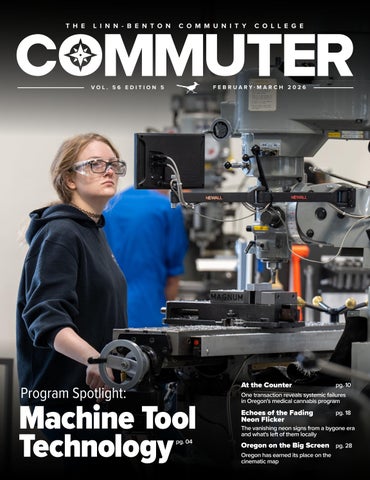
Program Spotlight: Machine Tool Technology
At the Counter
One transaction reveals systemic failures in Oregon’s medical cannabis program
Echoes of the Fading Neon Flicker
The vanishing neon signs from a bygone era and what's left of them locally
One transaction reveals systemic failures in Oregon’s medical cannabis program
The vanishing neon signs from a bygone era and what's left of them locally
from the

Hey, Roadrunners! We're over half way through the term and at this point things can start to feel a bit stressful. Make sure you're taking care of yourself as you study for exams.
Take a few minutes to enjoy what we have come up with for this edition.

Micah Teague Editor-in-Chief
about us join the team
The Commuter is the student-run magazine for LBCC, financed by student fees and advertising. Opinions expressed in The Commuter do not necessarily reflect those of the LBCC administration, faculty and students of LBCC. Editorials, columns, letters, and cartoons reflect the opinions of the authors. LBCC is an equal opportunity educator and employer.
The Commuter encourages readers to use its “Opinion” section to express their views on campus, community, regional and national issues. The Commuter attempts to print all submissions received, but reserves the right to edit for grammar, length, libel, privacy concerns and taste. Opinions expressed by letter submitters do not represent the views of The Commuter staff or the college.
Wanna get together? We’re really nice and fairly cool and we’d love to hear what you have to say. Not big on journalism but love to journal? Perfect. Are you a STEM major with major opinions? Let’s hear ’em. Like writing about ’80s film? Local animals? Snack hacks? Maybe you have a hefty folder of flash fiction on your laptop, just dying to be published and printed. Drop us a line. We’d love to meet you, read you, and support you. Think your ideas might be too weird or too niche for submission? Even better. The Commuter is an award-winning publication because of our wide range of contributions and our unique contributors. So reach out. We’ll be staring at our email inbox in the meantime, not an ounce of chill to be had.
editor-in-chief
MICAH TEAGUE
design editor
KAILYN MCQUISTEN
advisor
ROB PRIEWE
contributors
ANTHONY DREWS
ASHLIE SLOCUM
AYDEN HORTT
BRENDA AUTRY
EMILY KINKADE
GEORGE BENNETT
JESUS SANDOVAL-URIBE
KRYSTAL OVERVIG
MIKE MCREYNOLDS
RENÉE SILVA
SAVANNAH WEST
SID MYDLAND
SKYLAR WILKERSON
COMMUTER ARCHIVES
sticker contributor
JESUS SANDOVAL-URIBE
Machine Tool Technology
JULIA NEVIUS marketing director 04 10 18 22 28 24 06 14 08 16 Program Spotlight At the Counter
Behind the shift - how faculty reimagined statistics at LBCC
WANT TO SEE YOUR NAME HERE?
JOIN THE TEAM!
One transaction reveals systemic failures in Oregon’s medical cannabis program
LB Behind the Scenes The Plaza 50 Years Ago Bee an Oregonian
New and improved A peek into our past Calling all citizen scientists



The vanishing neon signs from a bygone era and what's left of them locally
Echoes of the Fading Neon Flicker A Bird's Eye View
Vision, metabolism, and the mysterious pecten
From afternoon tea at the Empress to strolling the storied halls of Parliament, Victoria, B.C. offers a slice of British tradition close to home
Oregon on the Big Screen A Taste of England in the Pacific Northwest
Oregon has earned its place on the cinematic map
words and photos by BRENDA AUTRY
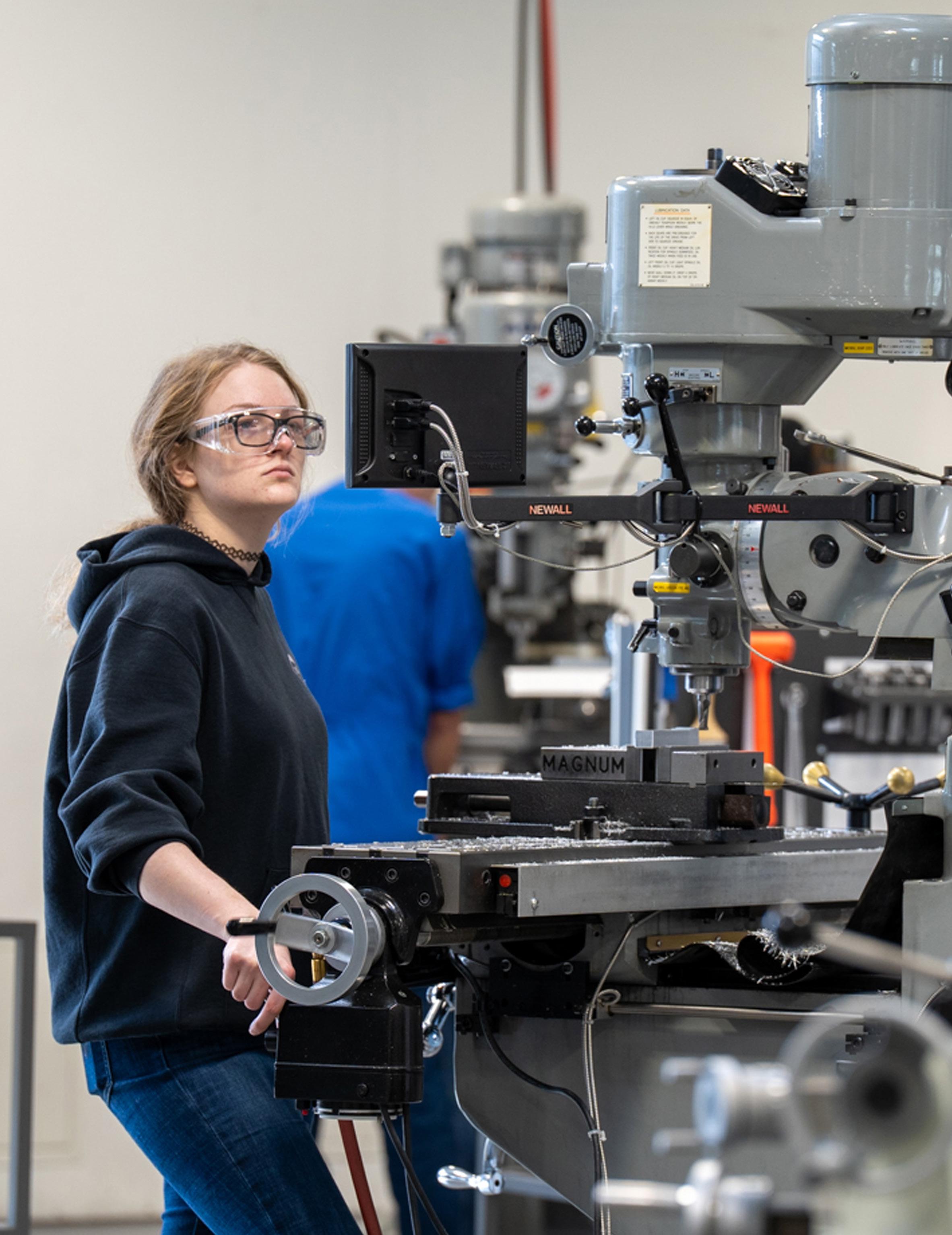
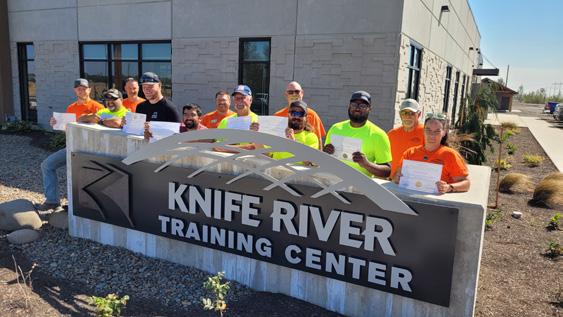
As demand for skilled trades rises across the state, Linn-Benton Community College’s Machine Tool Technology Program is expanding enrollment, modernizing training and helping close the region’s manufacturing skills gap.
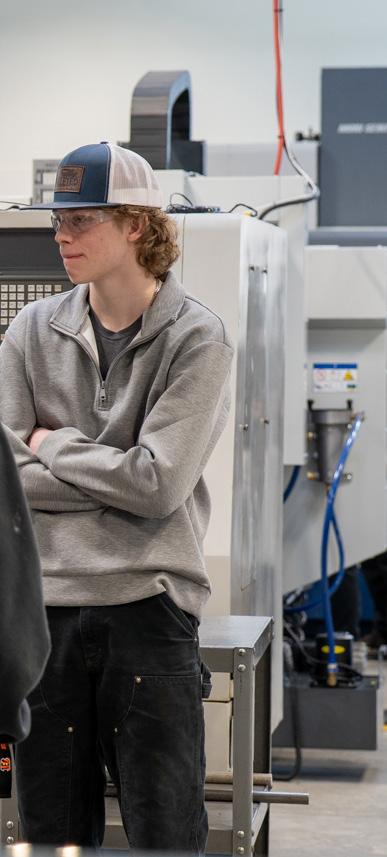
Linn-Benton Community College’s Machine Tool Technology Program is helping meet Oregon’s growing demand for skilled machinists. In keeping with industry demand, the program has grown significantly over the past few years.
LB’s Machine Tool program, one of the last machining programs in the region, is playing a vital role in closing the area’s manufacturing skills gap. Enrollment has grown significantly in each of the past three years (15%, 25%, and 33%), and program graduates continue to achieve strong job placement outcomes in high-paying positions.
While machining may not be as familiar to the public as other skilled trades, its influence extends throughout virtually every part of modern life. Machinists operate an array of machines and tools to shape raw materials into finished components, frequently managing the process from early prototype development to final production.
“Precision machinists create the parts, pieces and components that go into everything,” Chris Berry, Machine Tool faculty and department chair said. “The work is creative, challenging, technical, and satisfying. At the end of the day, you can see the results of your skills and effort.”
From automotive components to robotics, medical implants and even space technology, precision machining supports nearly every major industry. Thanks to rapid advancements in 3D modeling and automation, machinists are finding opportunities in areas previously thought impossible.
Many people who know what machining is, still have an antiquated vision of a machinist standing over a manual milling machine making parts. But like everything else, the technological advancements in machining have changed the way many processes are done.
In 2019, the program’s facility underwent a complete renovation and now offers state-of-the-art facilities and technology that reflects and supports
current industry practices.
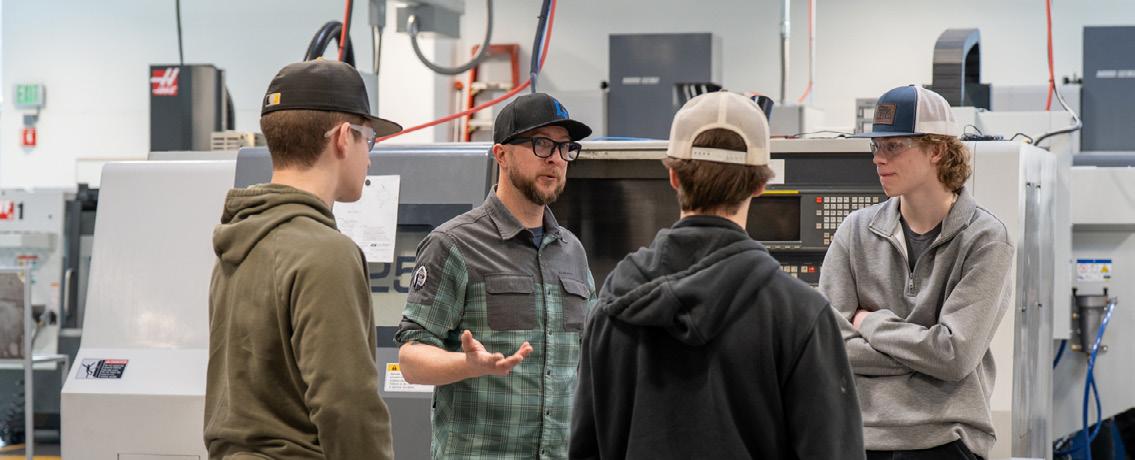
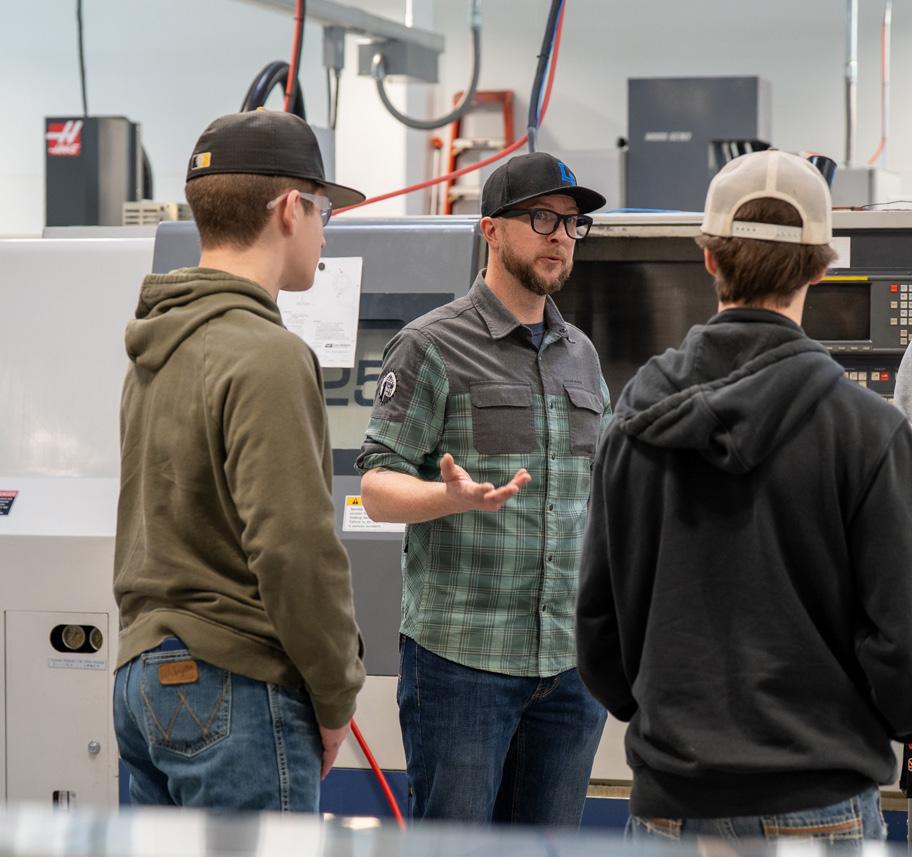
LB’s Machine Tool program offers courses in manual and CNC (Computer Numerical Control) machining, CAD (Computer-Aided Design) and CAM (Computer-Aided Manufacturing) software, precise measurement, print reading, materials and more. Students train on industry-standard manual equipment, advanced multi-axis CNC machines, a dedicated computer lab and a climatecontrolled precise measurement lab.
The faculty in Machine Tool have worked as machinists in fields such as: aerospace, semiconductor manufacturing, agriculture, mold making and other specialized sectors. Their industry expertise helps shape a curriculum that stays aligned with employer needs.
“A distinct advantage of our faculty is that we’re flexible and adaptable to modern technology,” Berry said. “We’re all technologically savvy which enables us to offer flexible teaching modes and content — which contributes to our program's success.”
The program also helps local industry by tailoring training for industry partners and offering accessible scheduling options for working adults. Students can complete an entire certificate through evening classes offered after 6 p.m., allowing those with full-time jobs to upgrade their skills or pursue new career opportunities.
By combining modern technology, industry expertise, and flexible training options, LBCC’s Machine Tool Technology Program is strengthening Oregon’s manufacturing workforce. The program’s continued growth and strong job placement reflect its value to both students and local employers, positioning LBCC as a leader in preparing skilled machinists for the demands of today and tomorrow.
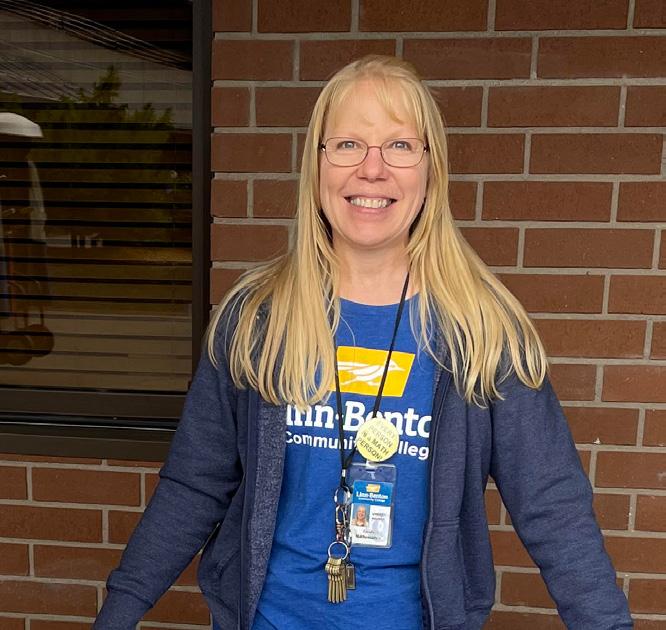

words by SAVANNAH WEST
For decades, statistics classes across the country followed a familiar script. The instructor lectured. Students copied formulas.
Exams measured how efficiently they could plug numbers into the correct test.
At LBCC, that familiar pattern has been reimagined behind the scenes.
In a growing number of STAT 265 and STAT 243 sections, students are not handed formulas on the first day. They are handed questions.
“Statistics is not a branch of mathematics. We have to abandon our assumptions, prejudices, and biases from math and approach the statistics course in a completely different way.”
– Vikki Maurer, statistics instructor at LBCC
Jeff Cabril, who has taught in the Math Department at LBCC for 35 years, has watched statistics evolve from what he calls a “quiet branch” of mathematics into its own field. He teaches STAT 265 for engineering students and has helped lead the department’s move toward simulationbased, investigative courses.
Vikki Maruer, a veteran statistics instructor at LBCC and longtime collaborator, emphasizes that statistics is a distinct discipline concerned with asking
questions, designing studies, and interpreting uncertainty. For students discouraged in traditional math settings, that distinction matters.
The change at LBCC was influenced by national conversations emphasizing statistical reasoning, real data, and full investigative cycles. Around 2016, these ideas gained traction. Jeff, Vikki, and colleagues decided to take them seriously.
On the first day of STAT 265, students do not review algebra. They step into a real case. Often, that case is the Flint water crisis. Students examine authentic data and confront questions that are as civic as they are statistical—Why was certain data excluded from decision making? What were the consequences? What would responsible analysis have looked like?
As Vikki Maurer explains, “I began my career assuming I was the center of knowledge.
Now I shift the center of mass of knowledge to the students. My students have just as much access to information as I do; my role is to rely on their sense-making capabilities.” Using software, students begin visualizing data immediately. Patterns appear. Distributions take shape. Outliers spark debate. By the end of the first class, they understand this course is about making sense of evidence, not memorizing formulas.
“Maybe the less I say, the better they learn.”
– Vikki Maurer, after watching students explain the central limit theorem
The Turn to Simulation Simulation provided that opportunity.
In class, Vikki has students repeatedly sample from a population to see the central limit theorem emerge. Soon they are explaining it back to her. The less she lectures, the more they articulate.
The Investigation Cycle in Action Units begin with scenarios, not definitions: Could a person swim through syrup? How does dung beetle data behave? How to evaluate engineering quality control?
Students start with foundational questions: What is the research question? Who or what is being sampled? How should data be collected? Only after designing the study do they receive data to analyze.
Core concepts such as the null hypothesis are constructed rather than delivered. Students shuffle cards, assign treatments, or run spreadsheet simulations hundreds of times. They observe outcomes under randomness before formal theory is introduced.
Probability is approached empirically. Rather than memorizing formulas, students conduct thousands of trials and estimate probabilities from repeated simulation. The Monty Hall problem is a favorite example. As Jeff Cabril emphasizes, “We need more scientists. We need more statisticians. Putting statistics in students’ hands and letting them see it’s accessible, and that they can excel at it, that’s critical.” This mirrors computation in modern research and industry practice.
Emphasis is on reasoning, not calculation alone. Students question assumptions, interpret variability, and revise conclusions when data contradict intuition.
Sidebar: The Monty Hall Problem
In the Monty Hall problem, a contestant selects one of three doors. One hides a prize;
two hide goats. After the initial choice, the host reveals a goat and offers the option to switch. Switching increases the probability of winning from one third to two thirds. Repeated trials challenge intuition, reinforcing evidence over assumption.
Randomness, Bias, and Long Run Thinking
To teach randomness, Jeff sometimes asks students to “pick randomly” from a list of words. Patterns emerge: showing certain words are chosen more often than chance dictates.
Confronting a truly random process highlights biases.
Early in the term, Jeff emphasizes that probability describes long-run patterns, not individual fates. Airlines oversell flights based on no-show probabilities, not because they can predict who will miss a flight, but because largescale patterns are stable. This distinction helps students grasp statistical inference’s power and limits.
As Vikki Maurer observes, “Being a member of society, we are inundated with information. We don’t know what to believe. Proficiency in data science and research methodology is critical for students—and for citizens in 2026.” Recognizing how data shapes decisions in marketing, medicine, and policy turns statistics into a tool for agency.
Anxiety and the “Not a Math Person” Story
Many students arrive convinced they are “not math people.” Vikki distinguishes uncertainty in data from self-doubt. Jeff challenges the belief that intelligence means instant correctness. Scientists fail repeatedly; toddlers learning to walk fall often. In a simulation-based classroom, uncertainty is not a
Not every idea has to be assessed on a high‑stakes, proctored exam. Assessment can be very creative.”
– Jeff Cabril
flaw but the point. Becoming statistically literate means becoming comfortable with that reality.
Rethinking Assessment
High-stakes exams are no longer the sole measure of learning. Projects, discussions, and design tasks play a central role.
Jeff notes, “We love to fail in calculus, because scientists and engineers fail most of the time. Failure gets a bad rep—it’s simply an opportunity to do something differently.” Vikki might ask students to create a first simulation to estimate a probability, evaluating reasoning rather than numerical answers. Jeff recalls a student discouraged by a non-significant result in a paired t-test, instead of treating it as failure, they reframed it as information. Perhaps the question needed adjusting. Perhaps the design needed revision. Statistics became a guide for next steps, not a verdict.
Both courses increasingly use simulationbased pedagogy. STAT 243 serves nonengineering majors and emphasizes social science applications. STAT 265 incorporates engineering examples, sometimes linking to calculus.
In both courses, computing tools handle calculation. The intellectual work lies in interpretation.
The old questions: Did I use the right formula? Is this the correct test?
The new questions: My simulation shows this pattern. Is the event more likely than expected? How should I interpret this result?
Focus has moved from procedural correctness to interpretation, design, and meaning.
For Jeff, designing investigative activities has reinvigorated his teaching. For Vikki, moving from sage on the stage to facilitator requires trust. She now crafts powerful questions and steps back.
Not every statistics section at LBCC has adopted this model, but momentum is visible. In a world saturated with data, statistical literacy is a civic skill. In more LBCC classrooms, statistics is no longer a quiet room of formula rehearsal. It is a laboratory of inquiry.
Behind the shift, faculty are reimagining not just how statistics is taught, but who sees themselves as capable of doing it.







he receipt said $0.00 in tax. That number was misleading. It was not proof of compliance, but the absence of evidence.
At a dispensary counter in Oregon’s MidValley, I watched as a routine purchase stalled. The customer presented a valid Oregon Medical Marijuana Program card. The receipt printed anyway, showing $0.00 in sales tax. The price had changed, but without any clear display of how or why.
A $6.00 edible marked for recreational sale quietly dropped to $5.00. Staff described the $1.00 difference as the medical exemption. But the math did not hold. A full medical exemption removes approximately 20 percent, which would reduce a $6.00 product to $4.80.
Neither the $1.00 reduction nor the missing $0.20 was itemized. It was not labeled as tax. It was not labeled as a discount or an exemption. The receipt simply showed a $5.00 total and $0.00 in tax, masking whether the exemption had been correctly applied at all.
One transaction reveals systemic failures in Oregon’s medical cannabis program
Compounding this opacity, many dispensary point-of-sale systems classify the price reduction not as a tax exemption, but as a discretionary discount. Once coded this way, the exemption becomes interchangeable with a sale or promotion, allowing staff to deny medical patients access to daily deals under the claim that exemptions cannot be “double stacked,” even though a tax exemption is a legal right, not a promotional benefit. When questioned, explanations shifted. The tax was already included. Exemptions could not combine with promotions. The city tax did not count. The state tax might.
None of it aligned.
“If the system allows it, it must be legal” became the standard justification by dispensary staff for practices that quietly violated the law.
When concerns were raised to management, responsibility was frequently deflected away from individual decisionmaking and toward the software itself. Managers often concluded with some version of “that’s just how the system works,” even when patients pointed out that these practices conflicted with state law. Staff and managers frequently noted that the software automatically rounds prices to the nearest dollar and insisted that if the system allows it, it must be legal. In reality, medical tax exemptions require the exact tax amount to be removed. Rounding to whole dollars is not a lawful substitute and results in patients being overcharged, even if only by small amounts on individual purchases. Because enforcement relies largely on civil complaints rather than routine licensing penalties, these errors carry little risk for dispensaries or employees, while placing
the burden of proof on disabled and low-income patients least able to pursue formal action.
That moment did not register as an error so much as a warning. Over the following weeks, I witnessed similar exchanges across multiple dispensaries throughout the Mid-Valley. Different locations. Different staff. The same outcome.
Medical tax exemptions were inconsistently applied, misunderstood, or outright refused.
What began as a casual observation became an investigation.
The problem was not confined to one business. At dispensaries across Albany, Corvallis, and surrounding Mid-Valley communities, medical patients encountered the same obstacles. Staff members appeared uncertain about exemption rules. Some claimed
On paper, many medical cannabis transactions appear compliant. Receipts routinely display $0.00 in tax, even when taxes have already been embedded into the sticker price. When a price changes at the register, the receipt often shows only a new total, without itemizing whether a medical exemption, a discount, or a rounding adjustment was applied.
Because dispensary point-of-sale systems frequently classify medical exemptions as discretionary discounts, receipts fail to record exemptions as legal actions. Automatic rounding further obscures whether the exact tax amount was removed. As a result, patients leave with no transactional proof that an


medical program. The Oregon Liquor and Cannabis Commission regulates production and sales. The Oregon Cannabis Commission issues recommendations but lacks enforcement authority.
This fragmented model has been repeatedly flagged as a root cause of enforcement failures. Advisory reports warn that divided oversight leads to confusion, delayed responses to complaints, and inconsistent application of patient protections.
Despite years of documented recommendations, meaningful reform has not followed.
The consequences extend well beyond tax disputes. Technical reports from state regulators reveal persistent issues with product testing, pesticide contamination, and inaccurate potency labeling across Oregon’s cannabis market. The
expansion of online ordering and delivery services has further increased risks of sales to minors due to inconsistent age verification.
For medical patients, these failures carry heightened risk. Inaccurate labels or unstable formulations can directly disrupt symptom management for individuals with epilepsy, chronic pain, or autoimmune conditions.
In interviews, patients described dispensary environments where staff lacked medical literacy, disputed legal exemptions, or treated medical users as recreational customers seeking discounts rather than care.
Other states demonstrate that this outcome was not inevitable. Research shows that states such as Colorado, New Mexico, Maryland, and Arizona maintained stronger medical programs alongside recreational legalization by preserving medical-only product lines, mandating staff training, enforcing labeling standards, and protecting tax exemptions.
Oregon did not adopt comparable safeguards. Instead, it allowed its medical program to erode without replacing it with equivalent protections in the recreational market.
This issue reaches campus more directly than many realize. Students work in dispensaries governed by insufficient training requirements. Students with disabilities rely on medical cannabis for symptom management. All students inherit the policy landscape shaped by these regulatory decisions.
This investigation did not begin with a research agenda. It began with witnessing a legal protection quietly ignored at a retail counter. Following that moment through state data, advisory reports, and patient testimony revealed a medical system no longer functioning as medical care.
Sometimes accountability begins not with outrage, but with paying attention.

words and photos by MIKE MCREYNOLDS
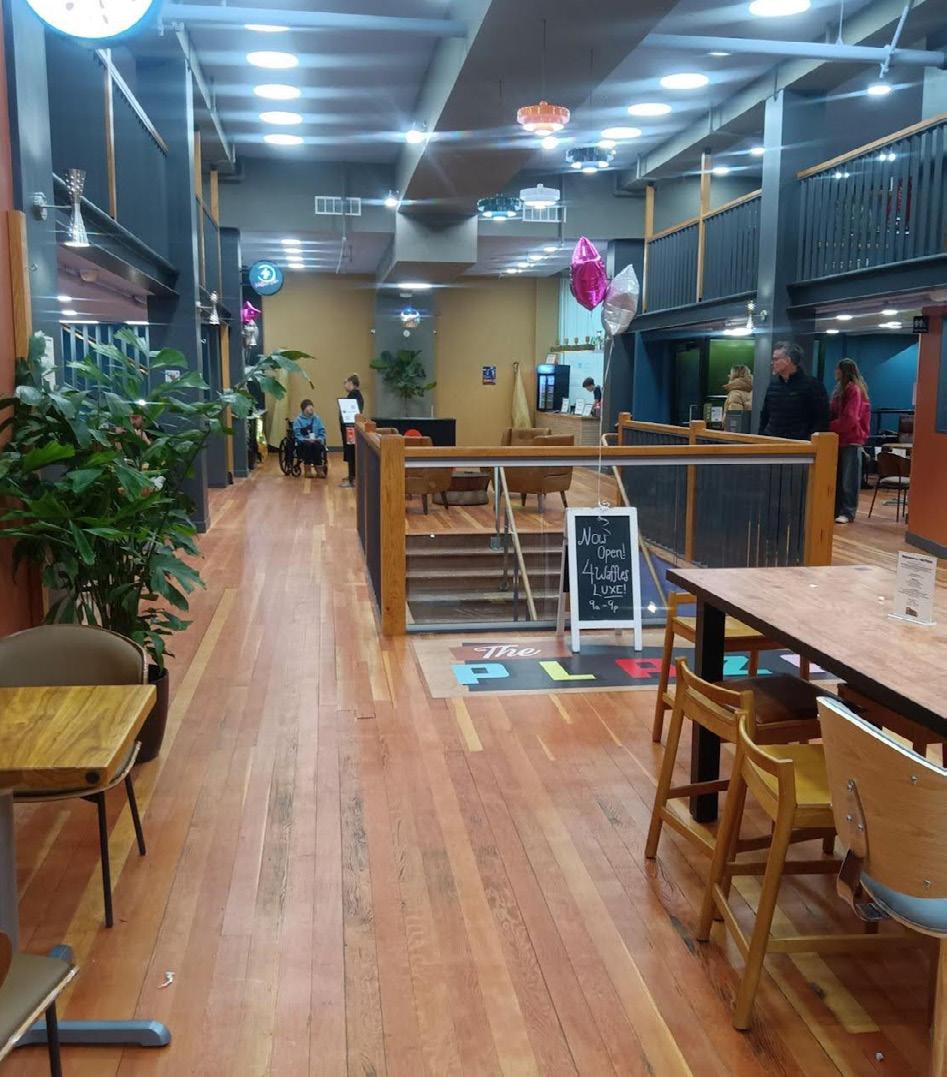
Walking down Fourth Street towards Madison Avenue in Corvallis you will notice a new sign on the corner of the original JC Penney building. The sign reads “The Plaza.” The glitzy neon-like sign outside reflects the amazing transformation that has happened inside, which is now open for business.
These are the original stairs from when the building opened in 1955. Both the steps and the handrailings have been refurbished but everything else is as it was since the beginning. What you find at the bottom of the stairs is opportunities to learn how to play the piano, to write poetry, to inspire art and to get an unwanted tattoo removed. There’s even a refurbished baby grand piano you can play that used to be on the street during the now defunct Da Vinci Days.
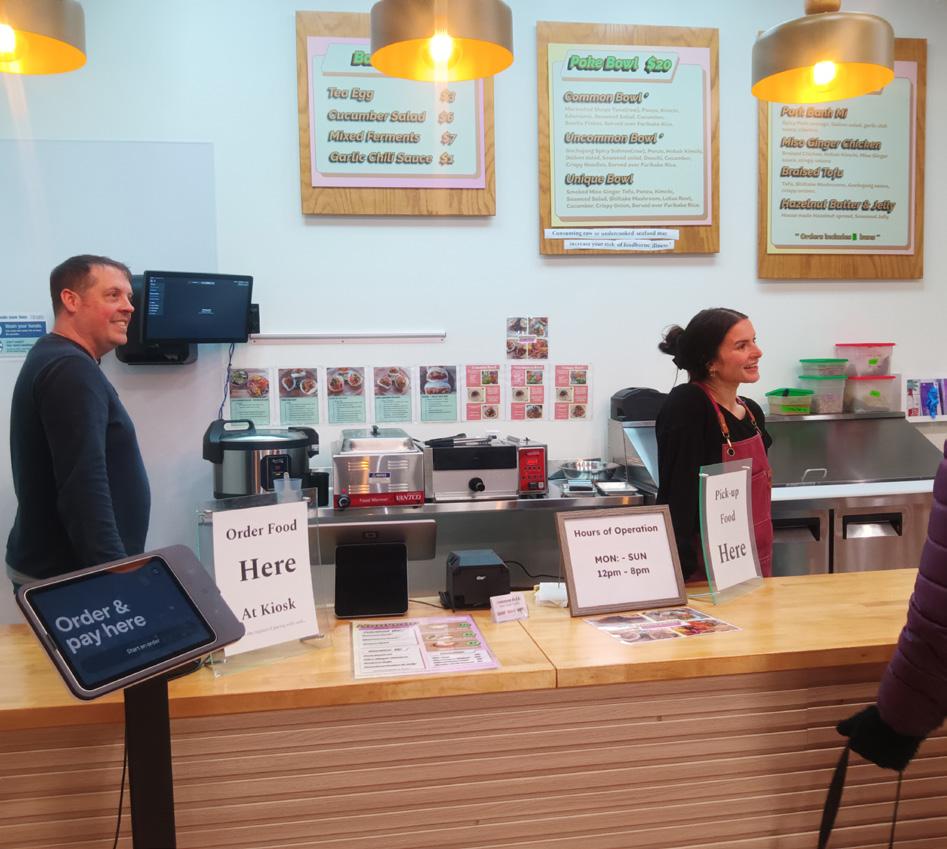
But the smells from above and the pull of your tummy will take you back upstairs. Stand on the top step and take a look around at your options. Straight ahead is Nouveau Poke Co., which features unique flavors crafted from quality ingredients. Drawing inspiration from Japanese and Korean cuisine, this locally owned company delivers a modern interpretation of the traditional Hawaiian dish. It is a nice compliment to the food truck they have at Common Fields a few blocks away.
The open air food court now features a taste of five different choices – from craft superfoods to tacos to poke to waffles paired with excellent local coffee.
After you enter the front door, stop to take it all in. The open air food court now features a taste of five different choices –from craft superfoods to tacos to poke to waffles paired with excellent local coffee. Walk further into the lobby and notice the plentiful table seating. That’s when you’ll see the stairs going downstairs.
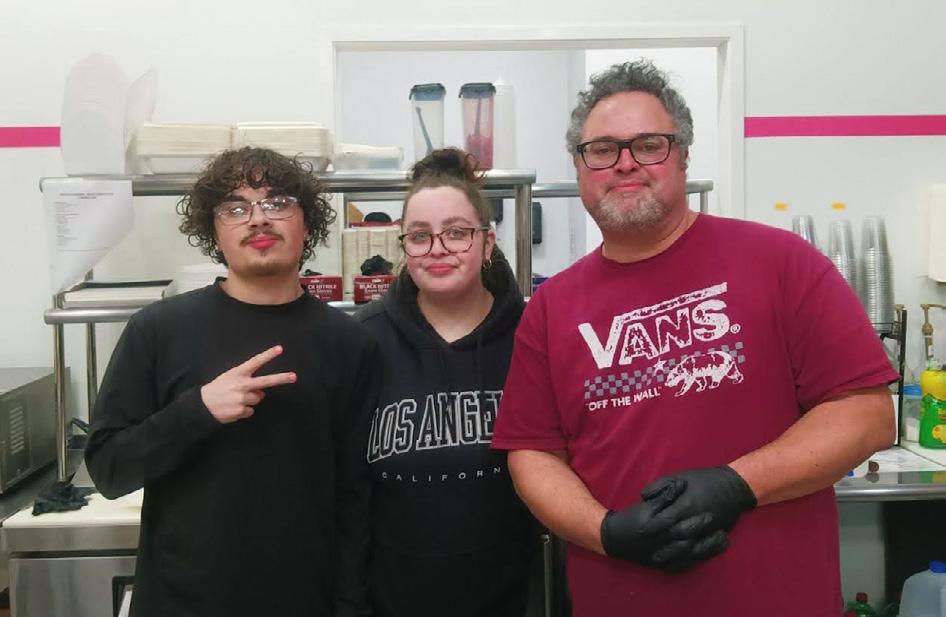
That’s just the first of the fine assortment of food options. Next up is 4 Waffles Luxe. They offer an elevated waffle experience with indulgent, beautifully crafted creations made to order. From sweet to savory, each waffle is gluten-free and dairy-free, thoughtfully topped and designed to feel both playful
“It is still a work in progress but I’m so proud of the job everyone has done and couldn’t be happier with the businesses that took a leap of faith and joined us.”
and luxurious. From sweet indulgences to savory masterpieces, enjoy safe-forceliac perfection. The owner has had celiac disease for 15-plus years and struggled to find a safe place to eat out. That’s why they do what they do. Their waffles are also sold at Market of Choice.
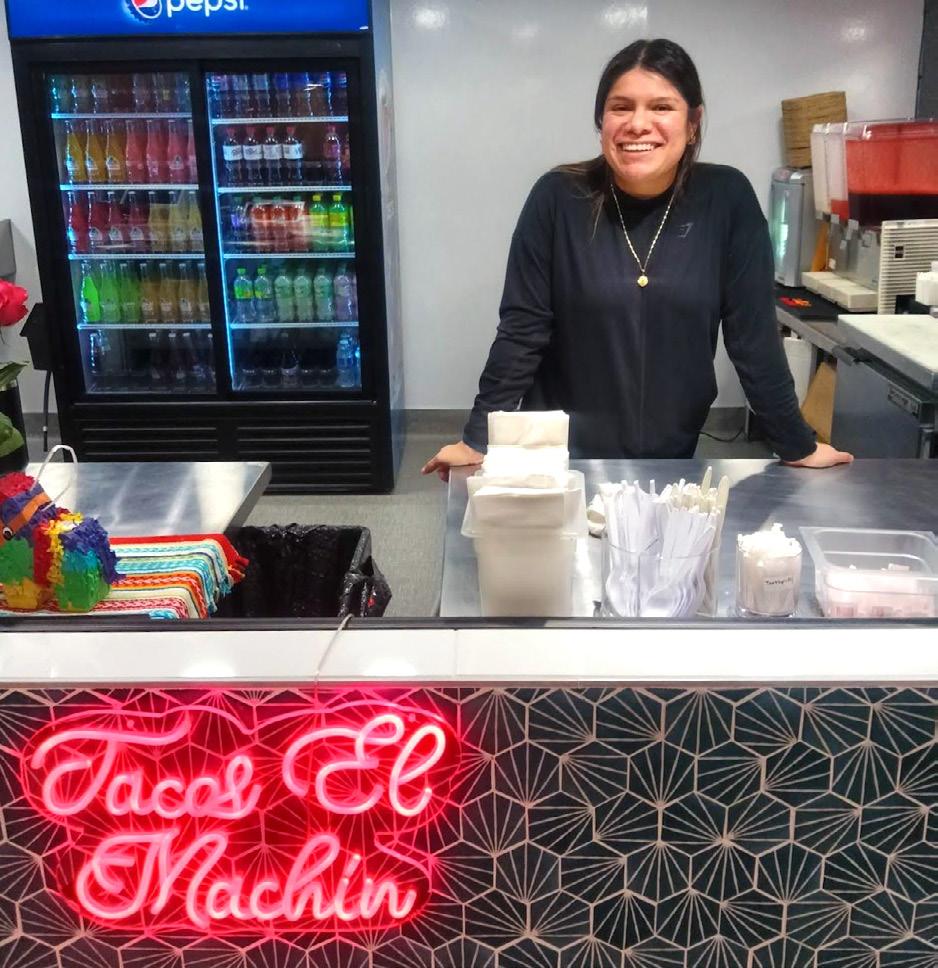
Next, walk about 20 feet to Tacos El Machin. The wonderful smells of authentic Mexican food will draw you in. They are known for their affordable and flavorful street tacos, with a reputation for generous portions, quick service, and a variety of house-made salsas. They were previously located on the nearby corner of Southwest Fourth Street and Western Boulevard. However, that location didn’t have an indoor kitchen for their bar customers. They had a food truck outside that served street tacos. Despite the inconvenience and the unpredictable weather, the setup had a steady customer base. The Plaza came calling at just the right time. The building they were renting was sold and they did not want to install a kitchen.
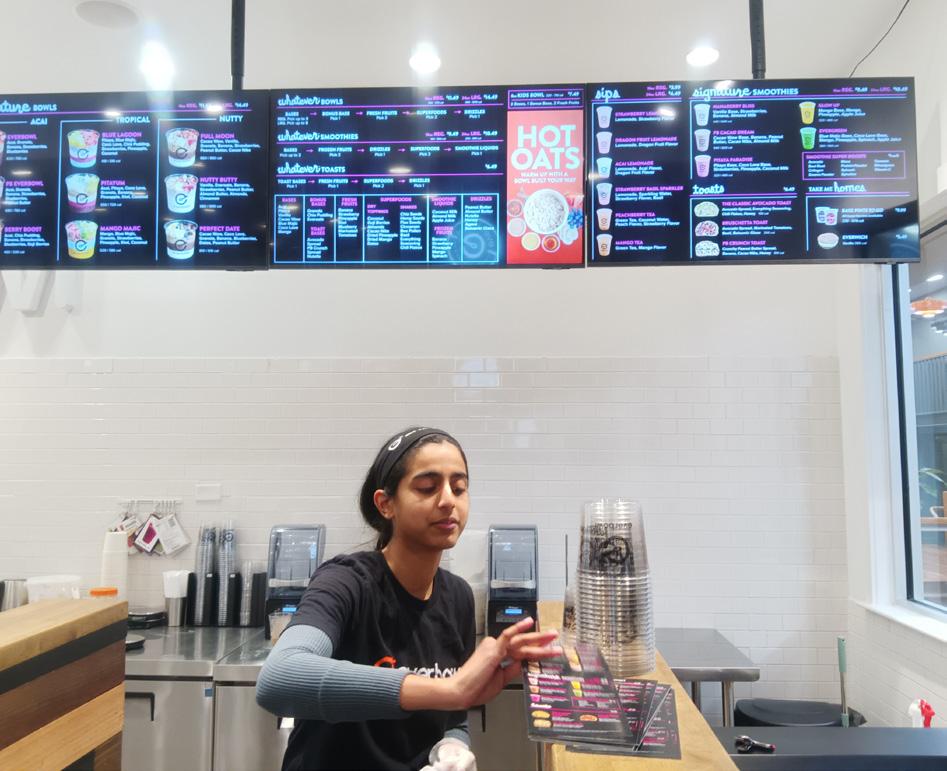
To finish off your Plaza food experience go another 20 feet to Everbowl, where the craft superfood is made from stuff that’s been around forever. Fruit-forward bowls and smoothies are made fresh to fuel your day and keep you moving.
Everyone in your group can craft their own food experience. With plenty of seating, diners and others can gather around and try everything. Look to finish off your meal with a great cup of Coffee Culture espresso and a pastry.
Being in a new space has been great so far, said everyone involved. This transformation with everything new and fresh has given every owner a little pep in their step.
In 2024, Lee Eckroth and Tony Pappas began transforming the historic JC Penney building into a bright, welcoming place for food, creativity, and community connection. Both of them are committed to carry on the belief of the original founder of JC Penney, James Cash Penney, in “Always First Quality.” This revitalization was supported in part by a $325,000 Oregon Main Street Revitalization Grant through the Oregon State Historic Preservation Office and the Oregon Parks and Recreation Department, with leadership from the Downtown Corvallis organization.
“We worked hard to keep the original feel of Mr. Penney’s vision,” said Eckroth. “By opening up the inside to make it more welcoming, reinforcing the bones and bringing the building into the 21st century while honoring that ’60s vibe,” Pappas added. “It is still a work in progress but I’m so proud of the job everyone has done and couldn’t be happier with the businesses that took a leap of faith and joined us.”
The Plaza is not the only building that this duo have revitalized. You might have noticed the two buildings on Third Street and Madison Avenue with new lights across the top. The building on the south side of Madison is the home of Koriander restaurant and Runway Fashion Exchange thrift store. Across Madison on the north side is Guardian Games and Grassroots. All of downtown is buzzing about the new addition to the variety of family-owned businesses, including book stores, art galleries, candy shops, jewelers, hairstylists, and more.
Oregon Bee Atlas | OSU Extension Service
https://extension.oregonstate.edu/bee-atlas
OREGON BEE PROJECT
https://www.oregonbeeproject.org
Oregon Bee Atlas | College of Agricultural Sciences
https://agsci.oregonstate.edu/bee-atlas
OSU Extension Service
https://extension.oregonstate.edu
Cooperative Extension System
The Cooperative Extension System (CES) is a nationwide publicly-funded informal education system in the United States. CES supports and delivers community education programs in subject areas such as agriculture, health and nutrition, family and consumer sciences, community development, natural resources, emergency preparedness, climate, volunteerism, and human sciences.
Source: Cooperative Extension System (United States) - Wikipedia
Land-grant Colleges and Universities
A land-grant university (also called land-grant college or land-grant institution) is an institution of higher education in the United States designated by a U.S. state to receive the benefits of the Morrill Acts of 1862 and 1890, or a beneficiary under the Equity in Educational Land-Grant Status Act of 1994.
Hatch Act and Smith-Lever Act
The mission of the land-grant universities was expanded by the Hatch Act of 1887, which provided federal funds to states to establish a series of agricultural experiment stations under the direction of each state's land-grant college.
In 1994, 29 tribal colleges and universities became land-grant institutions under the Improving America's Schools Act of 1994. As of 2008, 32 tribal colleges and universities have land-grant status in the U.S. Most of these colleges grant two-year degrees. Six are four-year institutions, and two offer a master's degree.
Source: Land-grant university- Wikipedia
words by RENEE SILVA
The Master Melittologist program with Oregon State University Extension trains volunteers to do a variety of citizen science with Oregon native bees. Volunteers receive extensive training and can participate in helping to map the North American Native Bee Genome.
Volunteers are highly trained and have access to bee gathering trips, training, and an annual conference that takes place on the OSU campus in Corvallis. The bees collected add to the Oregon Bee Atlas and the Native American Bee Genome project.
Volunteers contribute to the building knowledge and a conservation information base for native insects we all depend upon as foundations to pollinating our ecosystems.
OSU Extension is part of the long history of land grant universities and their responsibilities to extend the research and teaching of the university out to communities. Each county board of commissioners is responsible for ensuring that the Extension office is present and staffed in each county. The university also provides human resources and technical support for the country agents and their programs.
Master Melittologist at OSU is a relatively new Extension program and hosts many people from all over the United States and British Columbia virtually as the development of citizen experts in native bees is built one volunteer at a time.
Volunteers have extensive training using Canvas, which all LB students should be familiar with as the school year progresses. Like LB’s asynchronous classes, the Master Melittologist training is self-paced and online. There are required microscope classes, which are hosted in person throughout the state and online.
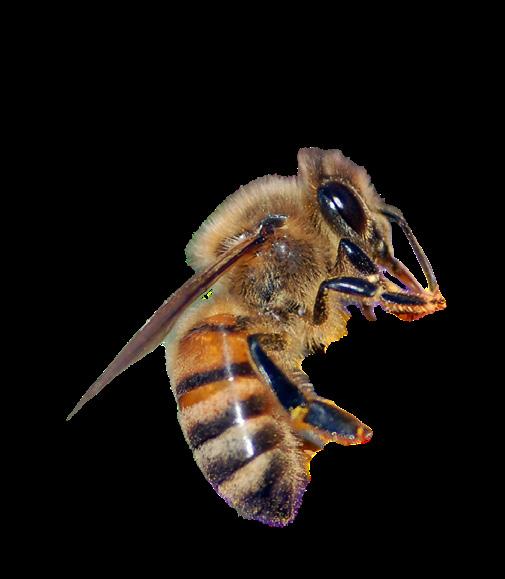
After some initial training, volunteers are encouraged to participate in field days. During field days, volunteers net native bees and deposit the bees in aptly named “kill jars.” Volunteers do not have to kill bees to participate and to contribute. All volunteers upload photographs and sighting information to iNaturalist, including geographic data.
Photographs of forage and bee locations are important and a great alternative to killing bees if the volunteer does not want to participate in killing bees. The bees are pinned and identified and then
mailed or delivered to OSU. Eventually, the bees are processed by staff who confirm the volunteer’s identification and send off most of the bee to get its genetic testing.
In addition to this training and activities, volunteers have opportunities for other learning. Monthly “Catch-a-Buzz” meetings over Zoom allow for specialized learning or presentations by other volunteers or experts. Subjects range from how to use iNaturalist GIS to presentations on particular bees or forage.
A yearly conference hosts keynote speakers with wide-ranging expertise from all over the United States. It is also an opportunity to learn about how our federal government programs and offices all weave together to create important infrastructure for conservation, agriculture, and climate resilience.
Over this winter, a special series about backyard habitat has been offered for volunteers. Each of these are online or offered online and are recorded for those who cannot make the meeting live. This method creates an opportunity for deep knowledge about native bees and a wide range of intersecting subjects.
For LB science metamajors, volunteering as a master melittologist provides knowledge, experience, and some important work to add to a resume. Volunteers are engaging in learning materials, microscope training, insect identification, materials processing, community outreach through speaking and tabling, field work, and more.
These skills and experiences also can help students apply for field work, lab work, and other specialized jobs at OSU or other four-year institutions. Student jobs at OSU are available to LB students, even without being a Dual Partnership Program participant. Building skills through volunteering with OSU Extension will add to your resume.
Citizen science is a critical component of increasing scientific knowledge. For example the U.S. Forest Service uses the iNaturalist data that master melittologists collect; not only pictures of bees but also pictures of forage or information about different species and different population levels changing due to weather or incidents such as fire. Volunteerism provides a vital community service and Extension volunteers receive an incredible education.






Neon signs, once commonplace on main streets of America, brought a bright glow to our eyes as it illuminated the storefronts of whatever curios or ephemera were being offered at the time, while also creating a nostalgic yet homey feeling to whatever town they graced.
We always see neon signs in the background of shows and movies such as Stranger Things (2016), Blade Runner 2049 (2017) and Miami Vice (1984).
However, what about real-world ones? Are there any left about the midWillamette Valley that are “true” neon gas-lit signs?
The answer is yes! There is, in fact!
Locally in Lebanon, neon has vanished slowly the last few years. However, there are a few places left along U.S. Highway 20: AutoZone, TacoTime, Kuhn Theatre, American Legion - Post 51, and off of 2nd Street, The Filling Station.
In Albany, neon fixtures include the Pix Theatre, Hasty Freez, Boda Furniture, The Venetian, Personal Barber Shop, Elmers, and Jordan Jewelers, all in the downtown area. Other places include Ping’s along the Highway 99E segment with U.S. 20.
As for Corvallis, you’ll find neon displayed at AutoZone, Market of Choice – both on Ninth Street as well as the Whiteside Theatre downtown.
“While the museum has some photos of neon signs in our collection, we don't have much information about them,” Albany Regional Museum educator Kerry Madden responded in an email.
The Albany Regional Museum has an extensive archive of neon signs in their online database. On the database you can find photos of Albany in the past, going back to the 19th century through its expansion as a “Hub City.”
At the Benton County Historical Society, exhibits preparator Rachael Oehler said, “We have some neon signs in our collection, including two on exhibit now – Jim the Fix'r at the Corvallis Museum and Corl's Book Store at the Philomath Museum.”
According to the National Institute of Standards and Technology website, the biggest reason why neon is vanishing is the rise of LEDs and how inexpensive they are along with the durability – they last longer than typical neon-glass tubing. As a consequence of using gas, eventually neon runs out and doesn’t hold the normal glow.
Likewise, there is also a lack of skilled craftsmen in the art of bending and blowing glass to make the tubes to hold the neon gas. All neon signs are made by a person rather than a machine. Along with that, there is the cost of repairing these signs, as they require specialized skills and materials,
making them expensive to build and maintain.
And of course there are the modern regulations. Many cities in the U.S. have enacted stricter rules on sign size, placement, and safety, leading to the removal of large, older neon signs. A lot of neon signs also use high-voltage transformers, making them prone to failure outdoors. Repairs often are expensive when they fail.
You might ask, how did neon even come about in the first place?
Neon signs were created in 1910 by French engineer Georges Claude, who publicly displayed his first neon “lamp” at the Paris Motor Show. Later in 1912, Claude made his first sale to a Parisian barbershop.
Three years later in 1915, Claude received the U.S. patent for his lighting system that involved passing an electric current through sealed glass tubes with rarefied neon gas, producing the vibrant reddish-orange glow base that we all know and recognize today.
What: Glass Tubed Neon Signs

Of course, neon gas wasn’t the only reddish-orange glow offered. Argon gas produces the blue color, helium produces the pale-yellow – almost white – hue, and hydrogen gives a pink-red color. Mixing these colors like paint, they can be combined to create a wide range of other colors.
Although, neon is facing a revival in some ways – not only in LED “flex” style that looks similar to neon, but also true glass tube that was once a staple of American businesses for decades.
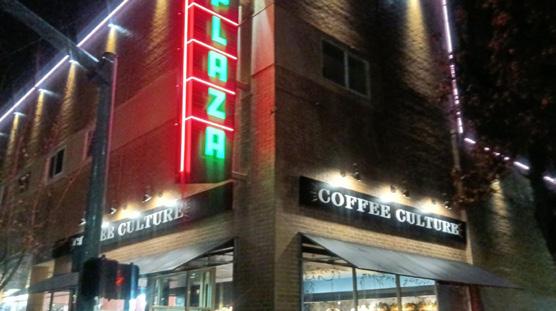
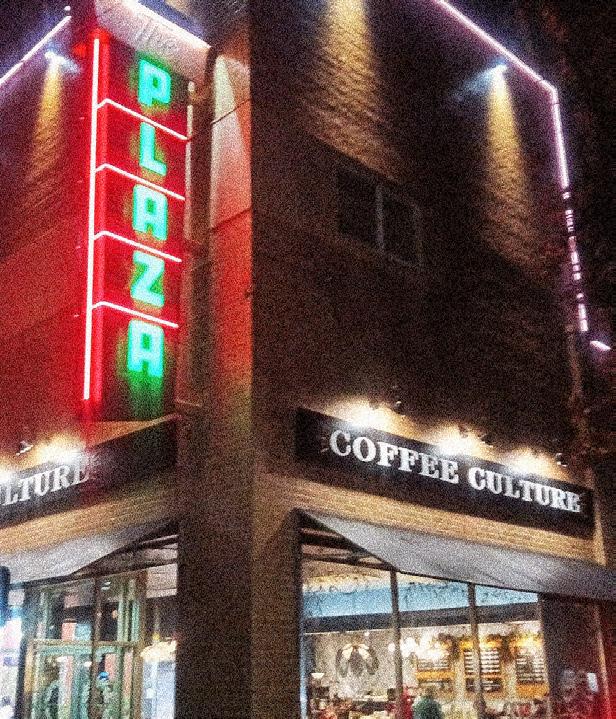
An example of this work is Coffee Culture in downtown Corvallis, which recently opened. They use a modern neon sign with LED.
Wherever you may be, a big city, small town, or even in a rural area, keep in mind the words of Matthew Broderick as Ferris Buller, “Life moves pretty fast. If you don’t stop and look around once in a while, you could miss it” – you could miss these neon signs if you don’t take a moment to admire them.
Cause: Every neon sign must be hand-bent by a person; there is a dwindling number of skilled glassblowers trained in the art. LEDs are significantly cheaper, more durable, and more energy-efficient than glass tubing.
What’s Next: Neon is making a return, except in the form of LED and in an “LED Flex”styling, paying homage to the original glass-tubed neon.
For More Information: armuseum.com and bentoncountymuseums.org


words by SID MYDLAND
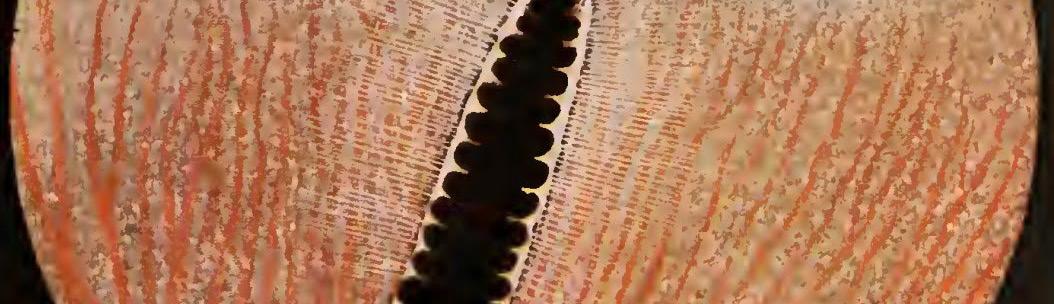
Sixty-six million years ago a meteor hit the Earth, a major extinction event that’s still talked about today. Before the destruction, ancestors of modern birds evolved a structure that has puzzled scientists for years. A new study may have cracked the code.
Birds’ eyes, among the most complex of warm-blooded animals, take a lot of energy to run. In mammals, this would mean the eyes need more air and blood, but birds’ retinas are different. The retina, a sensitive lining of the inner eye, functions with a severely limited blood supply in an oxygen-free space.
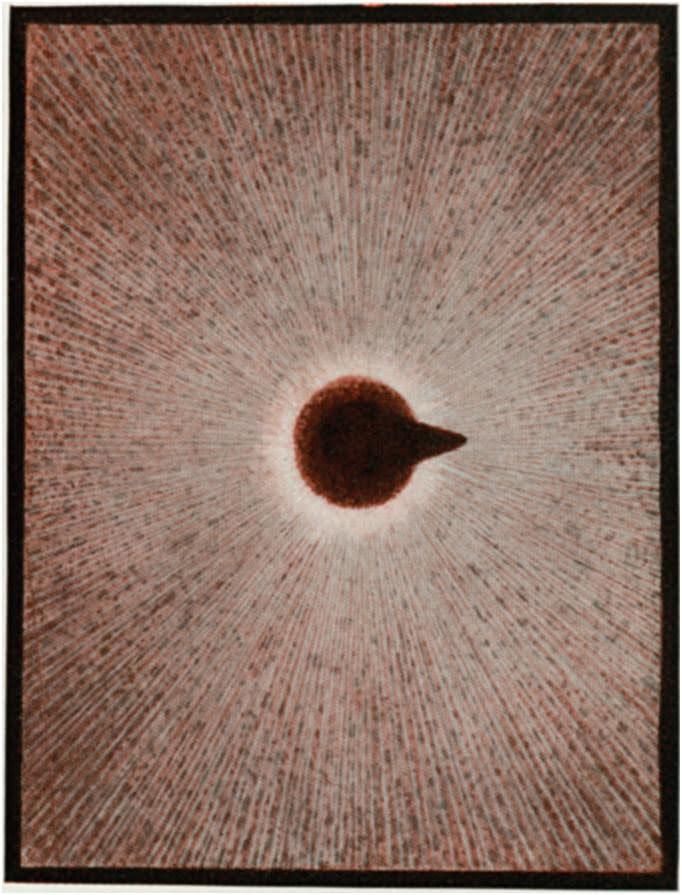
However, a structure in their eyes called the pecten, with a hotly debated function studied in the experiment, may reshape the way science views their vision. The peer-reviewed research, published in Nature, has the potential to change our current understanding of birds and how their unique eyes evolved.
“I was interested in how tissues get their oxygen and how they get rid of CO2,” said lead scientist Christian Damsgaard.
He explained how most tissues have a concentration of blood vessels, allowing them the nutrients and air they need. “But then there was this, I knew that … the retina within the eyes of birds, completely lacked blood vessels despite the retina [being] one of the most metabolically active tissues in the body.”
So Damsgaard and his team dove deeper into the contradictory idea.
For this study, the researchers

used both birds and reptiles because of the similarities in their eyes. While the pecten is wholly unique to birds, reptiles have a similar, but smaller structure called the conus.
“And then the … big question is, of course, are these the same structures, are they homologous?” said Damsgaard.
The team took this question and investigated it in two different ways, first seeing if the blood going to these structures comes from the same place. If that blood is coming from the same artery, it is a solid foundation to suggest that they could be the same structure, evolved over time.
The second way they approached the topic is by taking a close look at the gene expression. This turned out to be quite successful, showing that the structures are extremely similar, likely containing the same types of proteins and molecules.
While modern birds and reptiles appear to the untrained eye as complete opposites, they have a common ancestor: “Birds and lizards they diverged very, very deep in evolutionary time,” Damsgaard explained.
Lizards maintain the closest eye system to birds, while tests on turtles and caimans show they have lost this structure over time. Interestingly, turtles and caimans have the coding needed to make a conus, even though they do not develop one.
A bird’s pecten is able to do more than a lizard’s conus when it comes to transporting energy. This higher capacity lets the pecten function in its anoxic (oxygen-free) environment. But why is the pecten anoxic while the conus is not? Likely because a bird's eye needs to function high in the sky, where oxygen levels get lower.
“If we are at higher altitudes … it's more difficult to saturate the blood. So what we do to compensate is that our heart pumps harder … to deliver oxygen to those parts of the body.” Damsgaard said.
In a bird, the retina has no blood vessels. If their retinas needed oxygen, it would present issues as they fly higher above sea level.
“So if these birds' retinas were oxygen sensitive as all other retinas that we know of in the animal kingdom, they
would simply go blind and probably completely lose their vision after they have flown at higher altitude.”
Birds rely heavily on their eyes for navigation during migration, and not just through seeing. Birds have proteins in the retina that functionally allow them to detect Earth’s magnetic field. The invisible force that changes in strength based on distance from the equator and poles. In addition to visual
cues, some birds use their sense of these fields to navigate vast distances.
None of this would be possible without the pecten. Without it, the nutrients and waste that need to be exchanged would have no channel to use. There is so much more to learn about birds and these small bits of their anatomy, this new understanding of the pecten is just one piece of the great evolutionary puzzle.
(Credit:
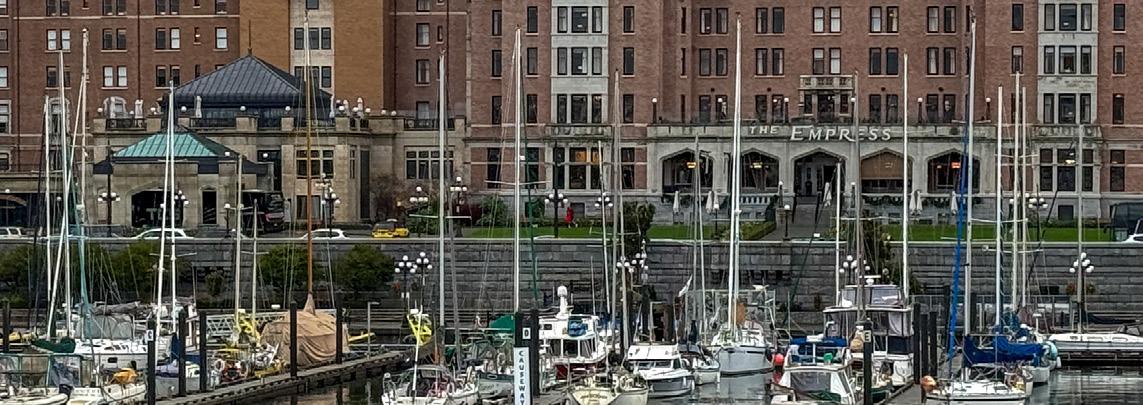
From afternoon tea at the Empress to strolling the storied halls of Parliament, Victoria, B.C. offers a slice of British tradition close to home.
Fancy a trip to Britain, but you’re not keen on the long (expensive!!) trip over the pond? Well, you’re in luck! Just a hop, skip and a jump over the Strait of Juan de Fuca will land you in a city that is often touted as “more British than Britain itself” — Victoria, B.C.
Perched at the southern tip of Vancouver Island in Canada’s westernmost province, British Columbia, Victoria feels worlds away, yet it’s just a quick ferry ride from Washington state. Sail 1.5 hours aboard the Black Ball Coho (fares from $48 per adult, round trip) from Port Angeles or opt for a three-hour ride on the FRS Clipper (fares from $175 per adult, round trip) from Seattle. Either way, you’ll step off the ferry and straight into your English-inspired fantasy.
I visited Victoria in December, which may seem strange given Canada’s reputation for frigid winters and the Pacific Northwest’s notoriously wet — though generally temperate — climate, but winter is actually a surprisingly great time to visit.
The city sits in the Olympic rain shadow, a dry zone created by the Olympic Mountains that blocks much of the Pacific’s storm moisture. As a result, Victoria receives roughly half the annual precipitation of Seattle. During my four days in Victoria, we had just a few light drizzles, and temperatures hovered around a comfortable 50 degrees — perfect for exploring.
A notoriously expensive city, one huge benefit of a winter visit to Victoria is the more reasonable accommodation prices. I had my heart set on staying at the famed Fairmont Empress Hotel, one of the world’s most iconic hotels and a favorite of British royals, including Queen Elizabeth II, who visited several times during her reign. Rooms can cost more than $700 a night during peak season, but in winter, rates drop to as low as $200.
Built in 1908, the Empress’s Edwardian Château-–style façade stands as the city’s iconic centerpiece, its turrets and ornate details visible from across Victoria’s harbor. The Empress is most famous for its afternoon tea service, Tea at the Empress — a
quintessentially British tradition. Since opening, it has served traditional afternoon tea to royals, dignitaries, celebrities, and everyday guests alike, embodying the elegance and ceremony of classic English tea.
Afternoon tea includes three tiers of scones, finger sandwiches and tea cakes, prepared with fresh, locally sourced ingredients and accompanied by a pot of meticulously curated tea from the hotel’s extensive menu. Served beneath glittering chandeliers in the Empress’s elegant lobby lounge — where harbor views spill through tall windows — the experience feels straight out of a Jane Austen novel. The service is presented on a faithful reproduction of the china pattern first commissioned for King George VI’s 1939 visit. Named one of the top 10 tea experiences in the world by Condé Nast Traveler, Tea at the Empress costs $109 Canadian dollars per person.

For those seeking a classic tea experience without the luxury price tag, Victoria is dotted with charming tea rooms that capture the same British tradition. Spots like The Willow’s Tea Room and Murchie’s Tea & Coffee offer afternoon tea often ranging from $25 to $45 Canadian per person. While smaller and cozier than the Empress, these tea rooms still deliver that quintessentially English ritual — china cups, clotted cream, and the slow, ceremonial pace of a proper afternoon tea.
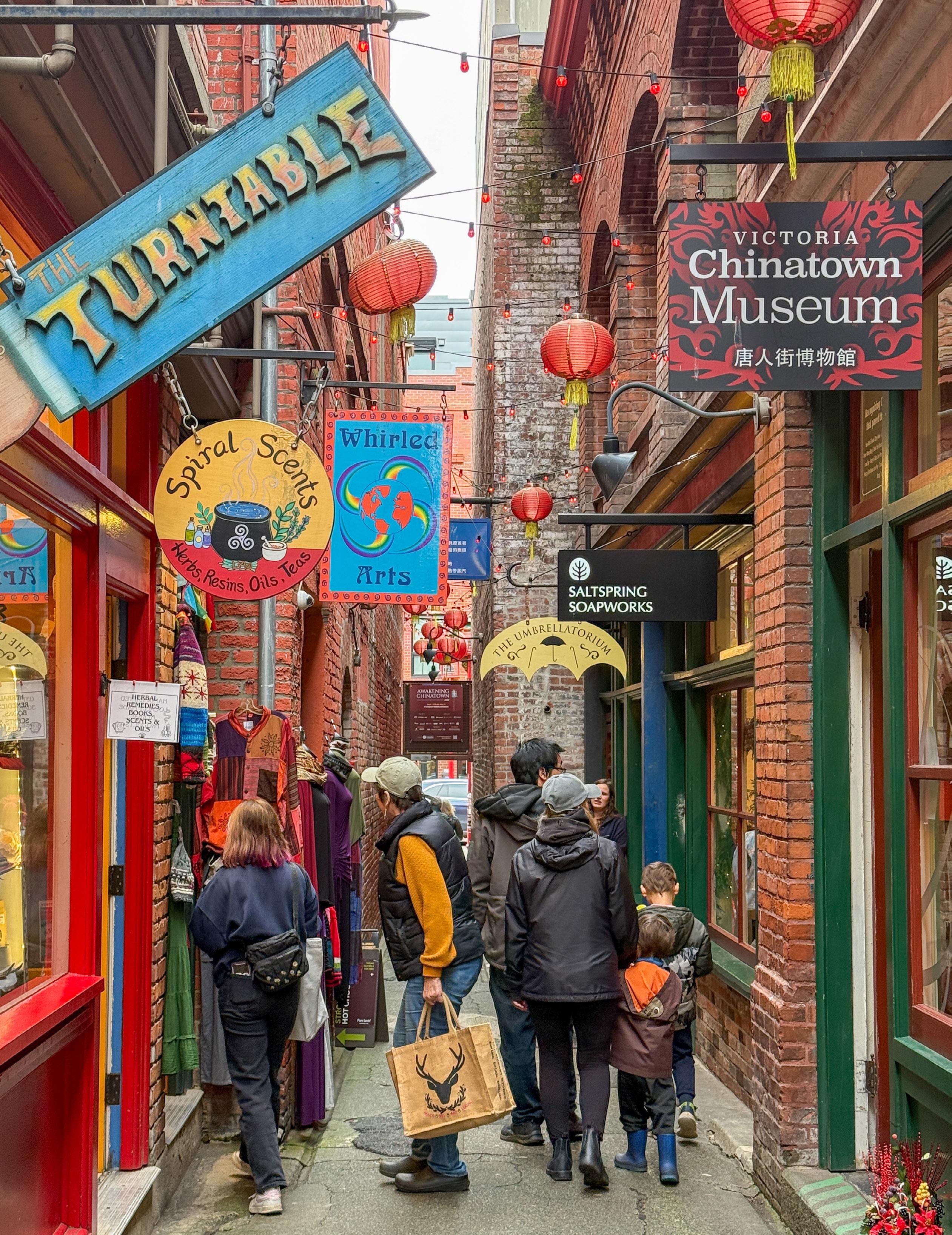
For a taste of tea’s origins, head to Victoria’s famous Chinatown — just a short stroll from the Inner Harbour. Pass under the Gate of Harmonious Interest and wander down the ultra-narrow Fan Tan Alley, or the quieter, equally narrow Dragon Alley, browsing shops that sell everything from traditional Chinese medicine to unique souvenirs.
Don’t miss Tam Kung Temple — one of Canada’s oldest — and the Chinese Canadian Museum, where you can explore the rich history of Chinese Canadians in the city. Oh, and of course, stop in a tea shop to sample some traditional Chinese tea.
Walk along Government Street through Old Town on your way back to the harbour. Stop into modern retailers and niche shops to escape any drizzle you may encounter. If you’re hungry, stop in at The Irish Times Pub or The Black Bear Pub to sample traditional British fare such as like fish and chips or shepherd’s pie.
The British influence in Victoria goes beyond tea and pubs. Originally a British territory and named for Queen Victoria, the city — and Canada as a whole — still maintains symbolic ties to its colonial past. Canada remains a constitutional monarchy, with the British monarch, King Charles III, serving as the country’s ceremonial head of state.
One of the best ways to see that British influence up close is at the Parliament Buildings. With their Gothic Revival towers, intricate stonework, and historic chambers, they bring a bit of London right to the Inner Harbour. You can take a guided tour of the halls and grounds, and along the way get a sense of how British traditions still shape Victoria’s government today.

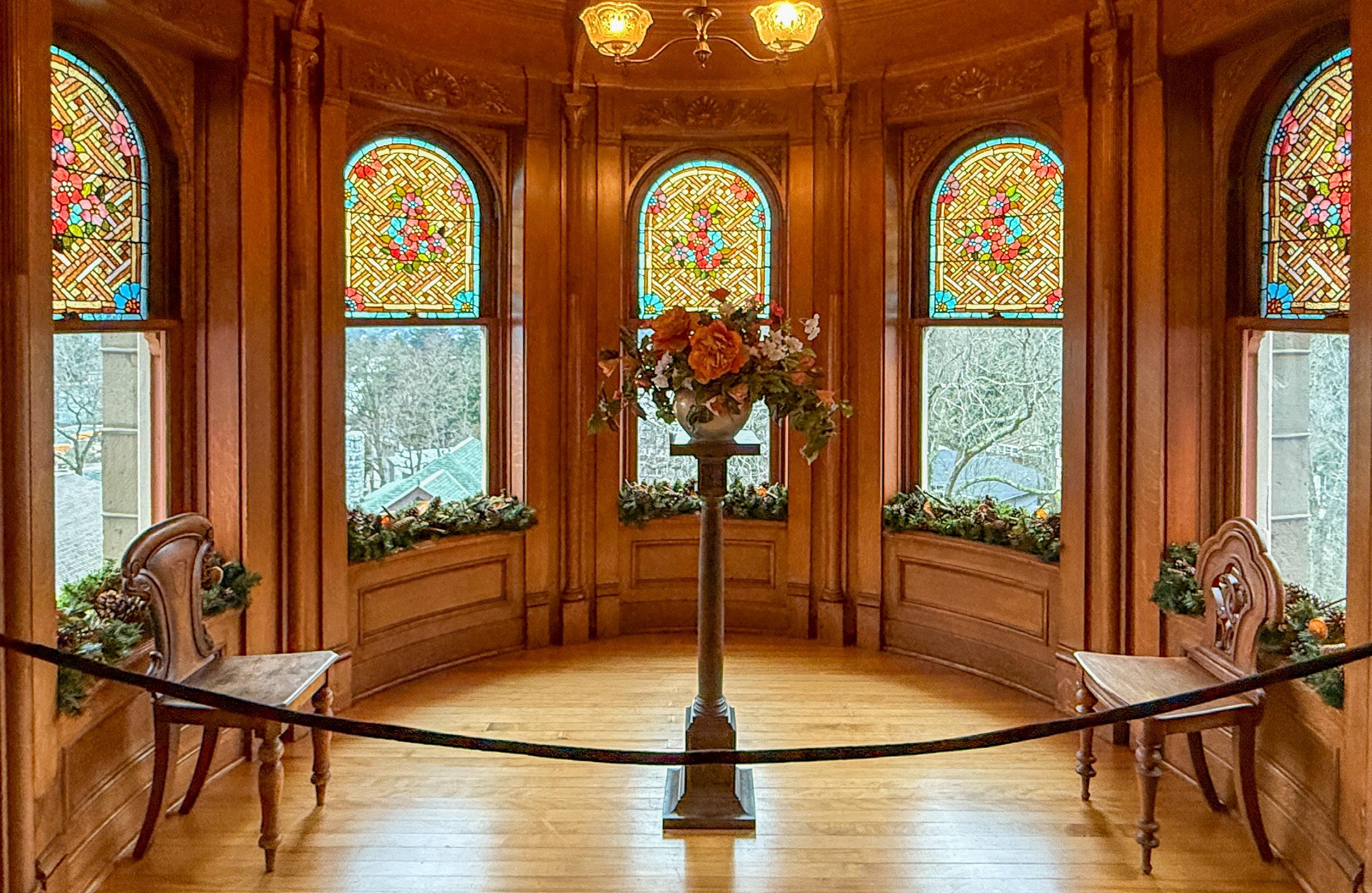
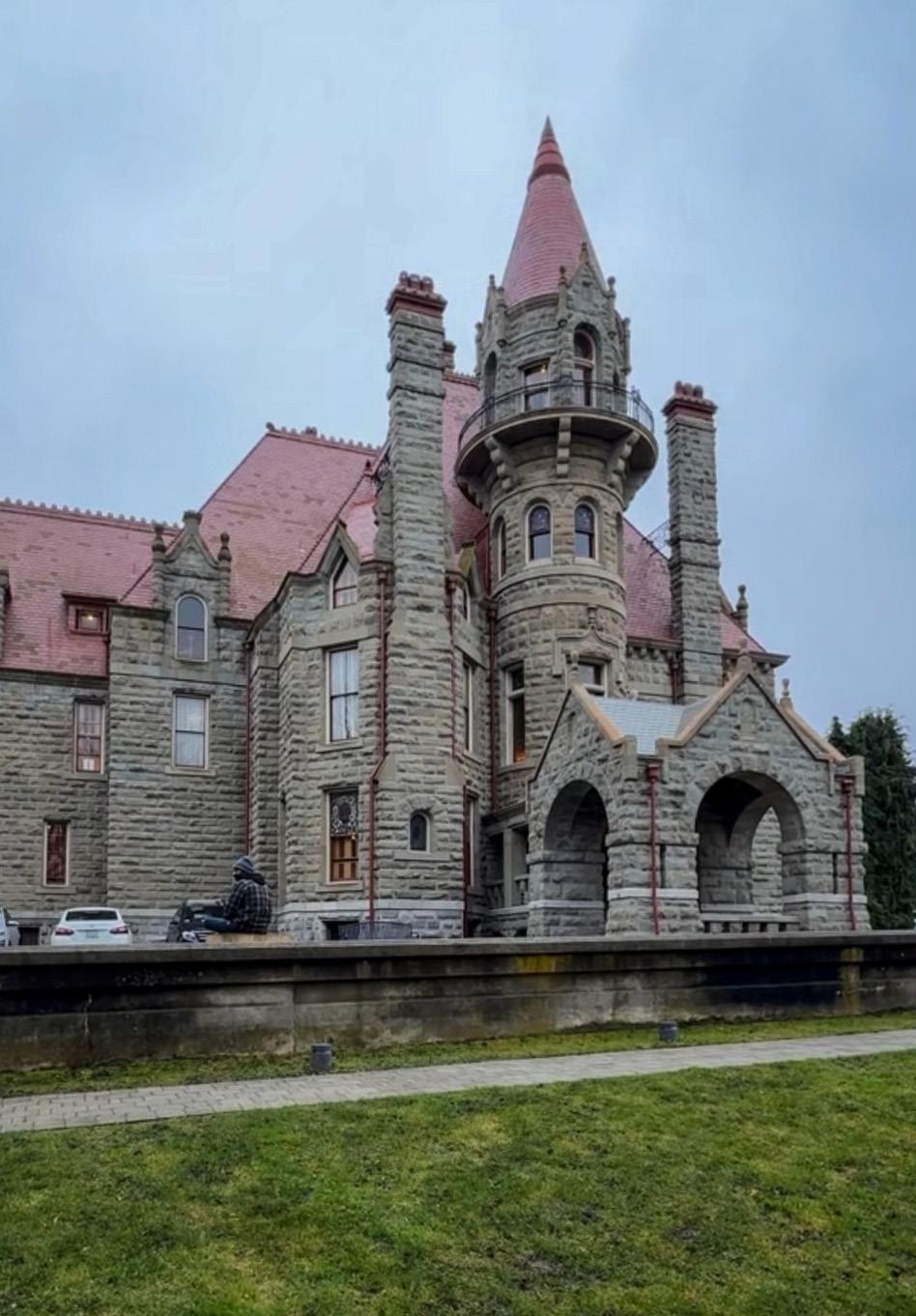
When you’re done exploring the Inner Harbour, hop on one of Victoria’s red double-decker buses — just like the ones you’d spot in London — for a short ride to Craigdarroch Castle, a true Victorian-era mansion right in the heart of the city. Built by wealthy coal baron Robert Dunsmuir during Queen Victoria’s reign, the castle is now a National Historic Site. Inside, ornate woodwork, stained glass, and grand staircases transport you back to a time when Victoria’s elite lived in lavish style, giving you a real taste of life in the city’s early days.
No trip to Victoria would be complete without a visit to the Butchart Gardens. Regularly hailed as one of the best gardens in the world, the 55-acre display contains five distinct areas: the Sunken Garden, Japanese Garden, Rose Garden, Italian Garden, and Mediterranean Garden. With its carefully planned flower beds, manicured lawns, and seasonal displays, the Butchart Gardens reflect the
influence of traditional British estate gardens, adding a distinctly Victorian touch to the city.
Even in winter, when fewer blooms are on display, the gardens are worth visitingvisitng — especially in December, when they transform into a Christmas wonderland. The “Magic of Christmas” runs after dark, featuring dazzling light displays, ice skating, carolers, and live music for a fully immersive experience. Bundle up, grab a cup of hot cocoa, and take a stroll through the twinkling gardens.
Whether you’re sipping afternoon tea at the Empress, strolling the festive Butchart Gardens, or wandering streets steeped in British charm, Victoria offers a uniquely English experience on Canada’s West Coast — a delightful getaway any time of year.

words by EMILY KINKADE
When you think about movies, what cities come to mind?
For many of us, it’s the “big three”— New York, Los Angeles, and Chicago. Whether it’s an action film, a thriller, or even an animated movie, it often feels like everything takes place in one of those major cities.
But while writing this article, I discovered something surprising. Oregon has had a much bigger role in Hollywood than many of us realize. With an impressive record of box office hits, cult classics, and even animated favorites, Oregon has firmly earned its place on the cinematic map.
Let’s start with a classic.
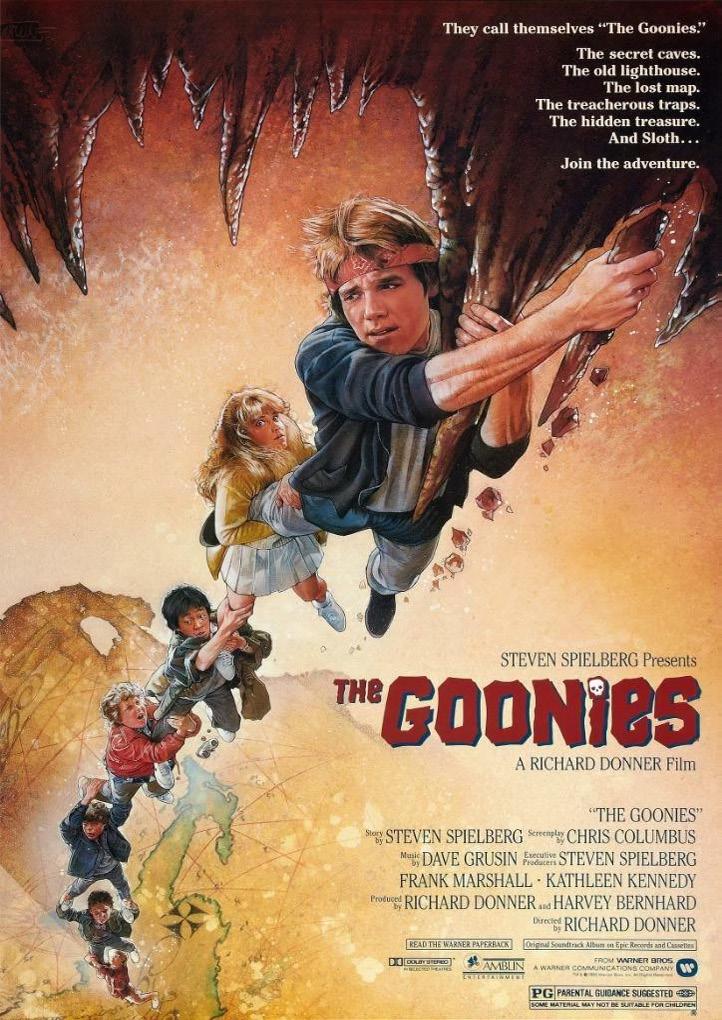
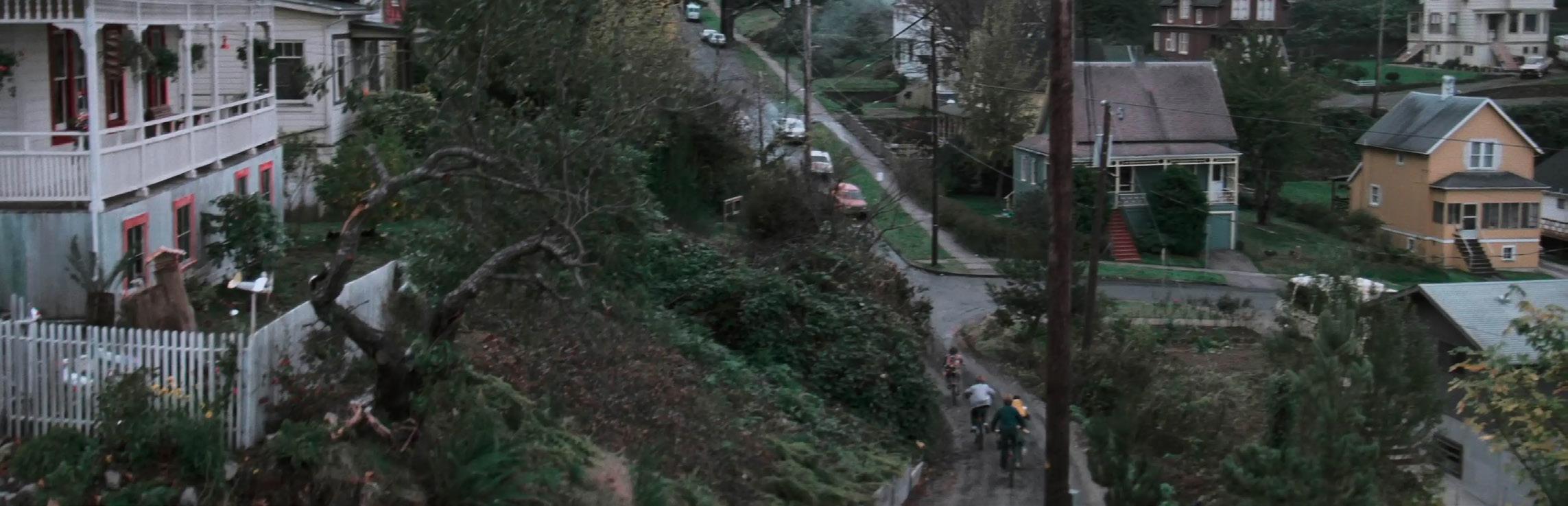
One of the most beloved adventure films of the 1980s, The Goonies was directed by Richard Donner and produced by Steven Spielberg. The film was shot over several months in Astoria and Cannon Beach.
Many of the outdoor scenes, including the Walsh family house and the breathtaking coastal landscapes, were filmed right here in Oregon. (The famous house in Astoria is still a popular tourist attraction today.) However, scenes such as the underground caverns and pirate ship were filmed on soundstages in California.

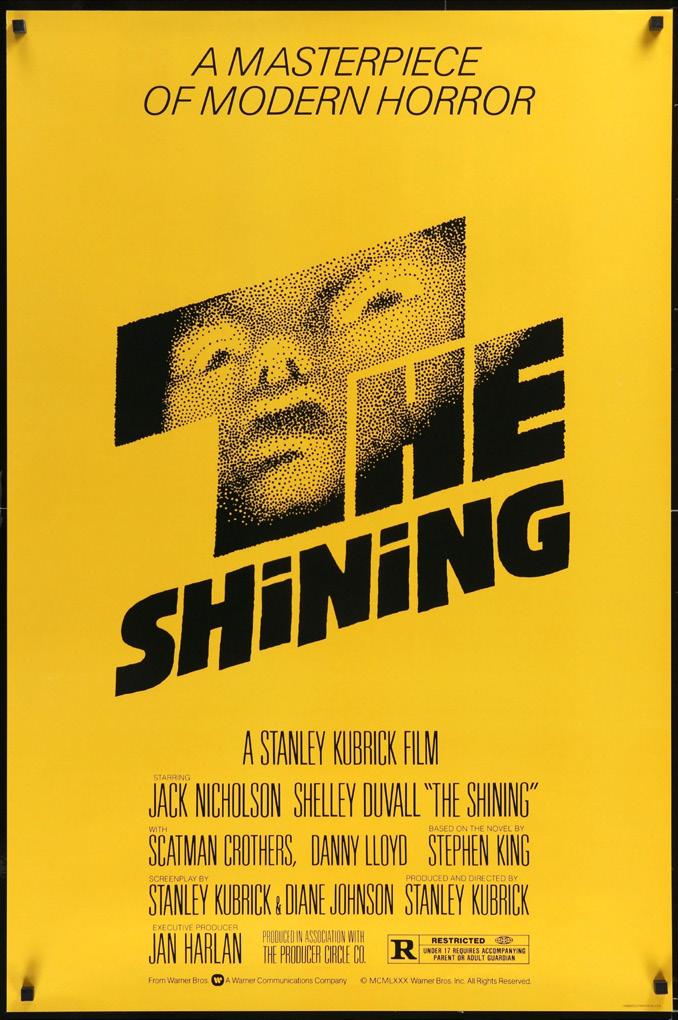
Another iconic film with Oregon ties is The Shining, directed by Stanley Kubrick and based on the novel by Stephen King.
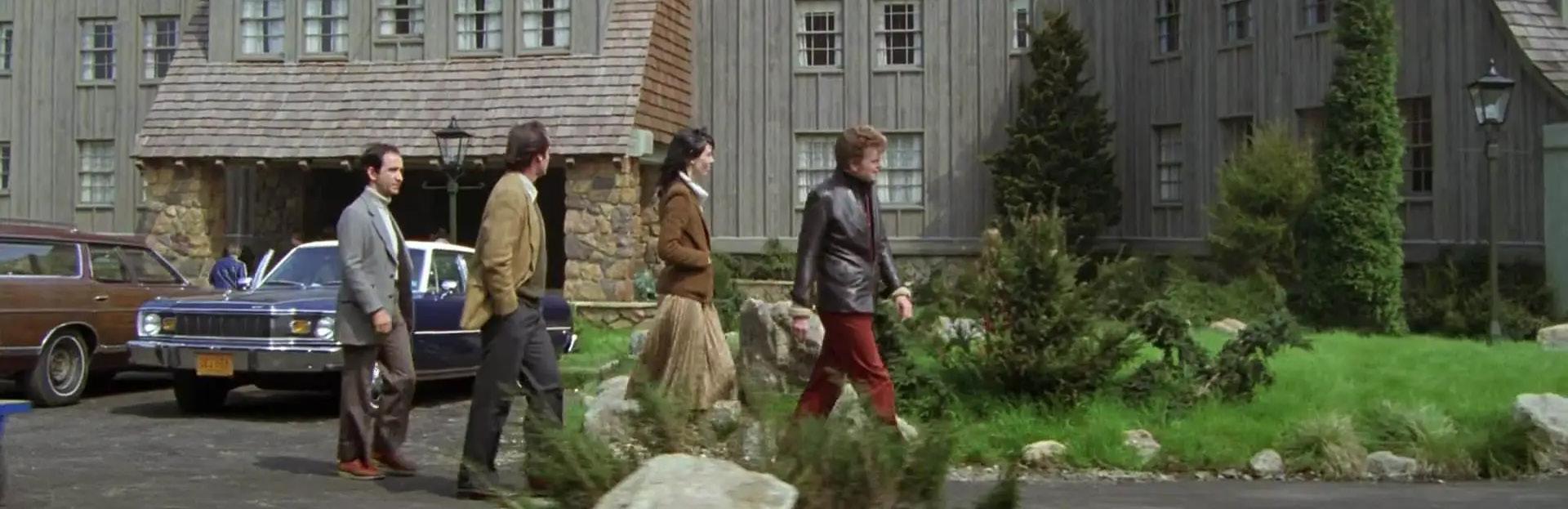
While parts of the film were shot in multiple locations, including Montana and England, the exterior shots of the Overlook Hotel were filmed at Timberline Lodge on Mount Hood. The snowy establishing shots of the hotel are unmistakably Oregon.
Interestingly, while writing the original novel, Stephen King was inspired by room 217 at the Stanley Hotel in Colorado. However, Timberline Lodge requested that the haunted room number in the movie be changed from 217 to 237, fearing guests might avoid staying there.
The famous hedge maze scenes, however, were not filmed in Oregon. They were constructed on soundstages at Elstree Studios in England.
Oregon has also inspired many animated favorites!
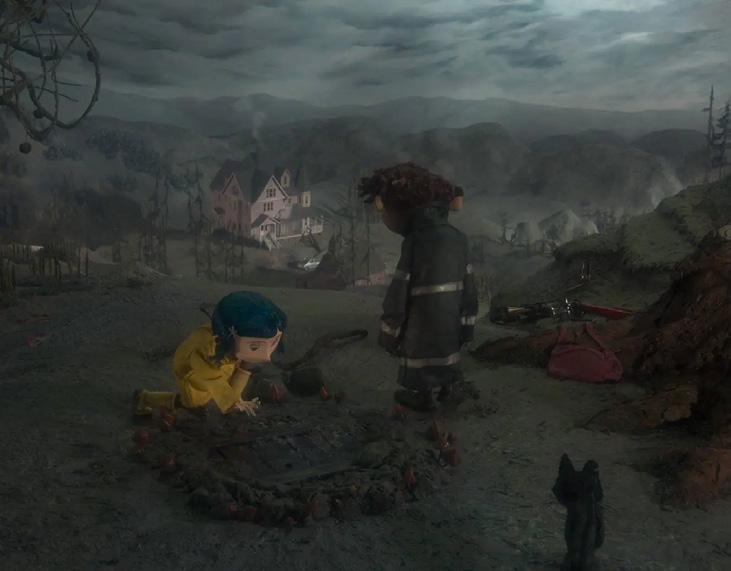
Coraline, based on a novel by Neil Gaiman, is set in Ashland, Oregon. While the film was produced by Laika Studios in Portland, the eerie Pink Palace apartment complex is depicted as being located in Ashland.
Gravity Falls, Another animated fan favorite with strong Oregon connections. Created by Alex Hirsch. Although the town of Gravity Falls is fictional, the show is set in Oregon and heavily inspired by the forests, small towns, and roadside attractions found throughout the state.
The series follows twins Dipper and Mabel Pines as they spend the summer with their great-uncle –or “Grunkle”– Stan in a
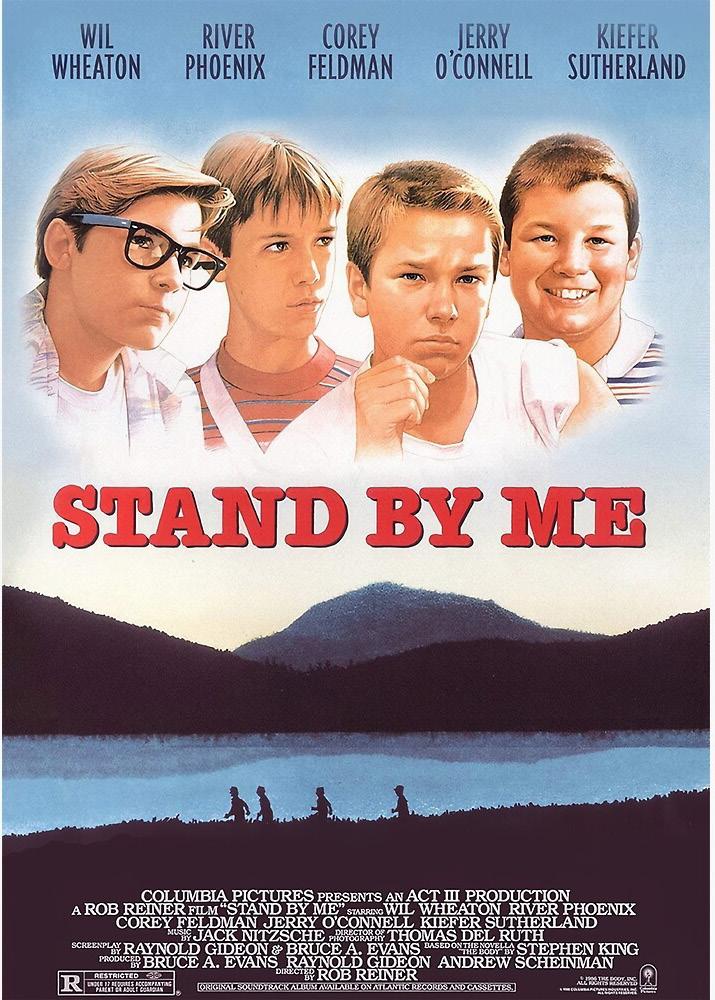
Another timeless film connected to Oregon is Stand by Me, directed by Rob Reiner and also based on a Stephen King story.
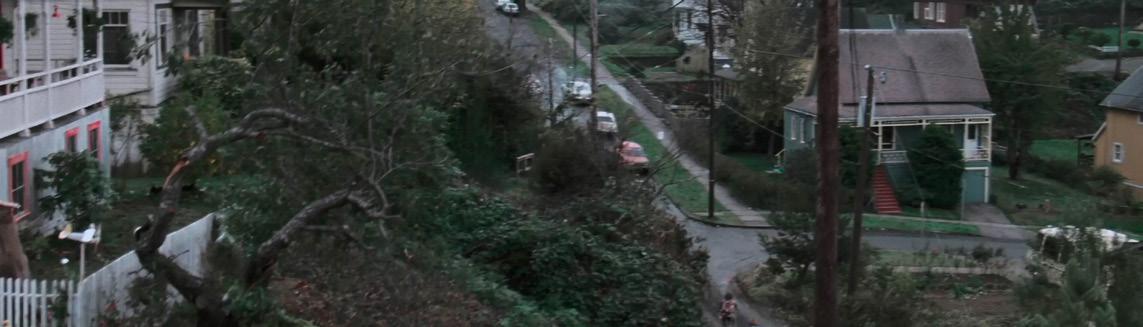
Much of the movie was filmed in Brownsville near Lebanon. In the film, the town takes on the fictional name Castle Rock. Memorable filming locations include the Blue Point Diner on Main Street and the treehouse scene on School Avenue.
While the famous train bridge scene was filmed in California, Brownsville continues to celebrate the film each July, and it remains a featured stop on the Oregon Film Trail.
Fun fact: The cigarettes the young actors smoked in the movie weren’t real, they were made from rolled cabbage leaves to create the visual effect without actual tobacco.
mysterious tourist trap called the Mystery Shack. The towering pine trees, misty landscapes, and quirky local legends all reflect the Pacific Northwest atmosphere that Oregon is known for.
And then there’s The Simpsons, created by Matt Groening. Groening has said he named Springfield after Springfield, although the town in the show is meant to represent “Anytown, USA” so that audiences across the country can relate to it.
From pirate ships and haunted hotels to coming-of-age adventures and animated classics, Oregon has played a surprisingly major role in film history. So next time you sit down to watch a movie, look a little closer, you might just recognize a piece of home on the big screen.


"Traffic" org.
Type of PC screen
Bedside recitations
____ gin fizz
Given as homework
Charmer's partner
26. Earl or Elizabeth 27. Mammoth
28. Priced separately
32. Chemical suffix
33. Spotted cats
34. "Ye shall receive" preliminary
37. Not hopeless, as a plan 39. Related 40. Escargots
42. Wane
44. Like retirement in the 50s
45. Bit of securing hardware
47. Notifications of overdraft (abbr.)
48. Labor day?
50. Nine-digit ID issuer
51. Discard seasoning
55. Musical gift?
56. Oktoberfest mug
57. Chopin piece
58. Novelist Grafton
59. Give a heads-up 60. Windows precursor down
1. "_____ in cat"
2. Sumerian sun god
3. Sleep phenomenon, for short
4. Bloodsucker
5. Become known
6. Sighed contentedly
7. Celtic deity
8. Walton and Waterston
9. Praise in verse
10. Disagreement over pickle seasoning
11. Repeat performance
12. From the mountains of Peru
14. Eye woe
17. Plunders
20. Arrange, as with a query
21. Court legend Arthur
22. Steer clear of
23. Brilliant Yorktown strategy by a seasoned general
24. Jam ingredients?
26. Faucet for H2O
29. Meadow
30. Priestly garment
31. KFC Sanders' rank
33. Paris Airport
35. Order of fries or slaw
36. Understood completely
38. Monet medium
39. Takes, as an offer
40. Feels
41. Bahamas port
43. Respect
45. Firm, as with a stone
46. Paradise
48. Facts
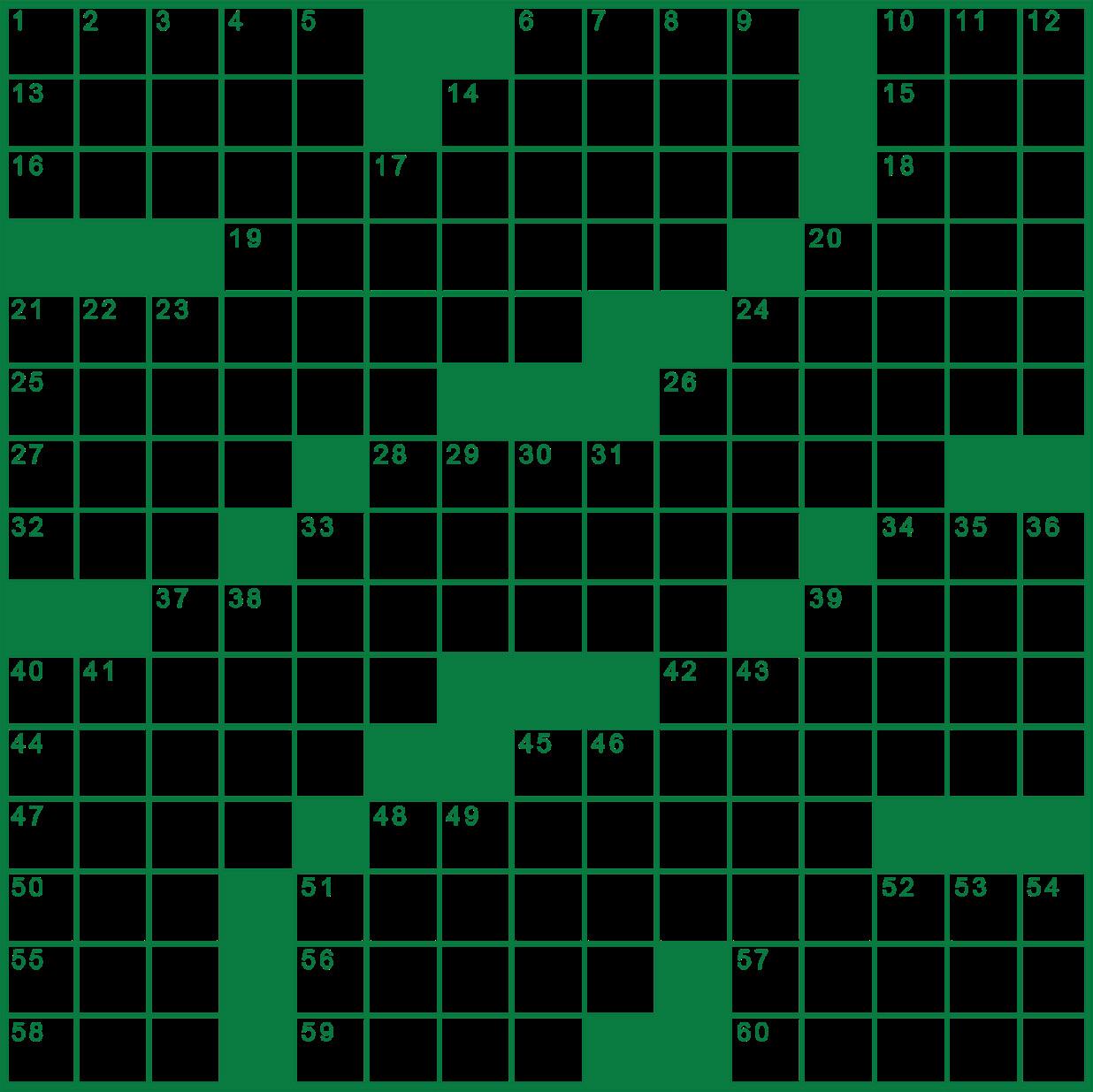
49. Computer operator
51. Savannah-to-Baton Rouge dir.
52. British dessert, for short
53. Old Tokyo
54. In medias _____


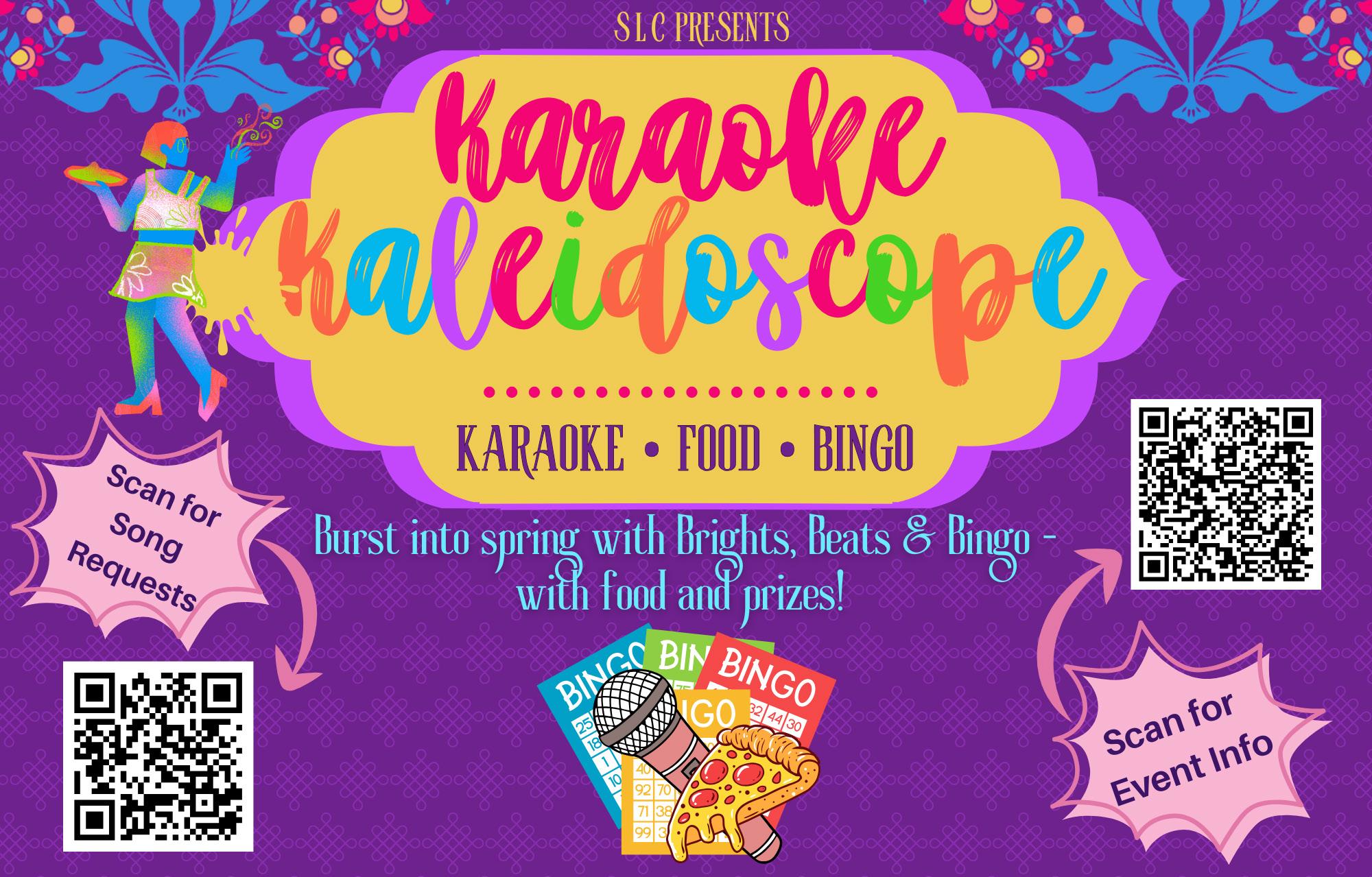

Hey Roadrunner, please Join us for this spectacular and colorful event!