OPINION
LAWRENCE JOURNAL-WORLD LJWorld.com Sunday, November 3, 2013
EDITORIALS
Closed KCC It may be inconvenient for the Kansas Corporation Commission to conduct its business in the public eye, but it’s part of the job.
N
o matter how much they might want to, the members of the Kansas Corporation Commission aren’t allowed to rewrite the Kansas Open Meetings Act to suit their purposes. Last spring, commissioners evaded public meetings requirements by talking individually with KCC staff to give their approval to a rate increase for a Salina water utility. Shawnee County District Attorney Chad Taylor subsequently filed a lawsuit that suspended the rate decision and alleged a violation of the Open Meetings Act. He then stayed the lawsuit to give the KCC time to review its procedures related to open meetings. Last week, just days before the DA’s deadline, KCC commissioners responded by adopting a 15-page document outlining how they intended to comply with the Open Meetings Act. The only problem is that their policies apparently still are in violation of the act because they allow for “deliberative meetings” to be conducted behind closed doors. The KCC regulates utility services within the state and is charged with ensuring that vendors provide adequate service at a reasonable rate for Kansas customers. Allowing discussions about those rates and services to take place outside the public eye could close off important opportunities to inform the public and allow public input. The policy as approved would allow the KCC to hold “deliberative meetings” in private although “any binding decision must occur in a commission meeting.” That means the commission could essentially hold all its discussions and reach a conclusion in private session and simply announce its decision in a public session. The new KCC policy drew immediate concern from the Citizens Utility Ratepayers Board, the state agency charged with representing the interests of consumers on utility issues. David Springe, consumer counsel for CURB, sees the policy as being clearly in violation of state law and plans to formally petition the KCC to reconsider its plans. Springe acknowledged that the KCC does have some authority to function in private as a quasi-judicial body, but considering utility rate issues clearly is a legislative function that is covered by the open meetings law. Allowing public comment and participation may not always be convenient for government entities conducting public business, but it’s part of the job, and the KCC can’t eliminate that duty by writing a policy. Thanks to CURB for monitoring the activities of this important body and protecting the public’s right to be involved in the business it conducts.
FOLLOW US Facebook.com/LJWorld Twitter.com/LJWorld
LAWRENCE
JOURNAL-WORLD
®
ESTABLISHED 1891
What the Lawrence Journal-World stands for Accurate and fair news reporting.
No mixing of editorial opinion with reporting of the news.
Safeguarding the rights of all citizens regardless of race, creed or economic stature.
Sympathy and understanding for all who are disadvantaged or oppressed.
Exposure of any dishonesty in public affairs.
Support of projects that make our community a better place to live.
W.C. Simons (1871-1952) Publisher, 1891-1944 Dolph Simons Sr. (1904-1989) Publisher, 1944-1962; Editor, 1950-1979
Dolph C. Simons Jr., Editor Julie Wright, Managing Editor Mike Countryman, Director of Susan Cantrell, Vice President of Sales Circulation Ann Gardner, Editorial Page Editor and Marketing, Media Division Ed Ciambrone, Production Manager
THE WORLD COMPANY Dolph C. Simons Jr., Chairman
Dolph C. Simons III,
Dan C. Simons, President,
President, Newspapers Division
Electronics Division
Suzanne Schlicht, Chief Operating Officer Scott Stanford, General Manager
11A
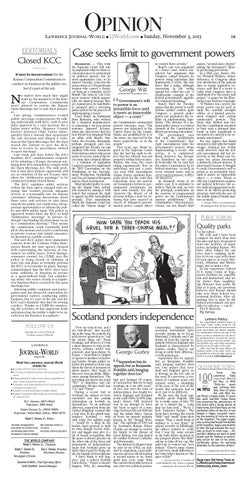
Case seeks limit to government powers WASHINGTON — This term the Supreme Court will rule on important subjects from racial preferences to restrictions on political speech, but its most momentous case, to be argued Tuesday, concerns the prosecution of a Pennsylvania woman who caused a chemical burn on a romantic rival’s thumb. The issue is: Can Congress’ powers, which supposedly are limited because they are enumerated, be indefinitely enlarged into a sweeping police power by the process of implementing a treaty? Carol Bond, an immigrant from Barbados, who worked for a chemical manufacturer, is contesting a six-year prison sentence imposed because, when she discovered that her best friend was pregnant from an affair with Bond’s husband, she became distraught, perhaps deranged, and contaminated her friend’s car and mailbox with toxic chemicals. Federal prosecutors, who seem prone to excess, turned this local crime into a federal offense — a violation of legislation Congress passed to implement the 1993 Convention on the Prohibition of the Development, Production, Stockpiling and Use of Chemical Weapons and on Their Destruction. Bond pleaded guilty to causing the thumb burn (which was treated by rinsing it with water) but retained the right to appeal on 10th Amendment grounds. That amendment, which the Supreme Court has called the “mirror image” of
George Will georgewill@washpost.com
“
Government’s will to power is an irresistible force until it meets an immovable object — a court.” the Constitution’s enumerated powers structure, says: “The powers not delegated to the United States by the Constitution, nor prohibited by it to the states, are reserved to the states respectively, or to the people.” Two years ago, Bond argued in the Supreme Court that she had the right to object that her offense was not properly within federal jurisdiction. She won, the court ruling unanimously that an individual, not just a state, can raise 10th Amendment claims. Justice Anthony Kennedy wrote for the court that federalism does not merely set boundaries between governmental institutions for their own benefit, but also “protects the liberty of all persons within a state by ensuring that laws enacted in excess of delegated governmental power cannot direct
or control their actions.” Bond’s case was remanded to a lower court, which considered her argument that Congress cannot broaden its powers using legislation that implements a treaty. She lost there. But a judge, although concurring in the ruling against her, called her case “a troublesome example of the federal government’s appetite for criminal lawmaking.” Bond’s brief for Tuesday argues that the power to ratify treaties neither confers upon Congress a general police power nor guarantees the validity of implementing legislation: “The absence of a national police power is a critical element of the Constitution’s liberty-preserving federalism.” The government says that only the prohibitions of the Constitution’s first eight amendments limit the government’s powers when implementing a treaty; otherwise, it is unfettered. Bond, however, has Alexander Hamilton on her side: In Federalist 84, he said that the entire Constitution, by its federal structure, “is itself, in every rational sense, and to every useful purpose, A BILL OF RIGHTS.” As Kennedy wrote in an earlier case, it is mistaken to believe “that the only, or even the principal, constraints on the exercise of congressional power are the Constitution’s express prohibitions.” The Constitution’s “structural provisions” are not, Bond’s brief
argues, “second-class citizens” among the document’s “liberty-protecting provisions.” In a 1920 case, Justice Oliver Wendell Holmes, whose deference to Congress often was dereliction of the judicial duty to stymie legislative excesses, said that if a treaty is valid, what Congress does to implement it is “necessary and proper.” A paper by the libertarian Cato Institute responds: “If Holmes was correct, the treaty power can be used to undo the carefully wrought edifice of a limited government assigned only certain enumerated powers. That those who drafted and ratified the Constitution intended to bury such a dormant time bomb in their handiwork is too much of a stretch to be seriously entertained.” No one argues that Bond intended to kill with the bright orange chemical her victim easily detected. And the federal government did not intervene in the Bond case because her action threatened a distinctly federal interest. It intervened because it thought it could: Government’s will to power is an irresistible force until it meets an immovable object — a court. Which is why our Constitution requires not judicial deference but active judicial engagement in defense of its liberty-protecting structure. And why the case of the mildly injured thumb matters so much. — George Will is a columnist for Washington Post Writers Group.
PUBLIC FORUM
Quality parks
Scotland ponders independence “You say tom-ay-toe, and I say tom-ah-toe” and according to the song, the remedy for such lovers’ quarrels is to, “call the whole thing off.” From breakups and divorces it’s but a short distance to riots in the streets, schisms, world war, genocide, and Apocalypse. So it goes — from fists to cudgels to spears to muskets to hydrogen bombs. People gather together for mutual security and, when the threat of invasion by aliens passes, they begin to discover irreconcilable differences among themselves. The next thing you know, the word “We” is forgotten and the community divides itself into “Us” and “Them.” During a recent visit to Scotland, the subtext of every encounter was the coming referendum on Scottish independence. To an unbiased observer, separation from the United Kingdom seemed like a bad idea. In the global marketplace, Scotland — with only some five million souls — would be a drop in the bucket, hard pressed to hold its own, though Scotch whiskey and haggis may give it a bit of brand recognition. But the grass is always greener on the other side of the fence and proponents of independence argue that Scotland gives up more than it gets by being under the thumb of Great Britain. “I don’t think it will happen,” said a retired Scottish truck driver. “I hope it doesn’t happen. Why fix something
George Gurley
“
Separation has its appeal, but as Benjamin Franklin said, hanging together does too.” that isn’t broken? Of course, it’s not perfect. But we’ve kept working on it for 600 years.” In fact, war over the issue of independence was fought between England and Scotland in the early 1300s. In 1550, England’s Henry VIII declared war in an attempt to force the Scots to agree to a marriage between his son Edward and the infant Mary, Queen of Scots, an episode quaintly known as the “Rough Wooing.” The uprising of 1745, led by Scotland’s Bonnie Prince Charlie, an attempt to restore his family to the throne of Great Britain, was also fueled by conflict between Catholics and Protestants. The instinct to disagree may be part of our DNA, an antidote to stagnation, a precondition for survival. Head-butting is second nature to us. Some good may even come from the current fireworks between our own two political parties.
Concerning independence, secession movements have recently sprung up in Texas, Maryland, Colorado and California. At least the current argument between England and Scotland is characterized by relative civility. They’re not trying to settle their differences with poison gas. Separation has its appeal, but as Benjamin Franklin said, hanging together does too. One matter that Scotland and England agree on is driving on the left side of the road. It’s perverse, a violation of common sense and rational order, a thumbing of the nose at the rest of the world. But someone had to do it, just to be different. By the way, the Scots supposedly speak English. But try to make sense of this: “I’ll gie ye a sketpit lug … Lang may yer lum reek … We’re a’ Jock Tamson’s bairins.” The Scots have stricken the words “little” and “small” from their tongue. Thus, a small drink of whiskey is “a wee dram.” At airport security in Edinburgh, the officer wanted to verify that I was the same person as the bald fellow pictured in my passport photo. She didn’t ask me to take off my cap. She asked me to remove my “wee bonnet.” There’s some charm in such wee, small differences. Isn’t that what’s known as “the spice of life?” — George Gurley, a resident of rural Baldwin City, writes a regular column for the Journal-World.
To the editor: My wife and I have been campers for more than four decades and have frequented state-run facilities in many states, including Kansas. We have often longed for our own state’s camping facilities to be on a par with those of such places as (yes!) Missouri, Arkansas and Mississippi, just to name a few. In our experience, federal (U.S. Army Corps of Engineers) facilities are superbly run and maintained, and are far better than neighboring (Kansas) state parks. Be that as it may, our governor believes that Kansas should take over those federal recreational facilities. After all, nothing that is done by the federal government can possibly be effective — can it? Piet R. Knetsch, Big Springs
Letters Policy
The Journal-World welcomes letters to the Public Forum. Letters should be 250 words or less, be of public interest and should avoid name-calling and libelous language. The Journal-World reserves the right to edit letters, as long as viewpoints are not altered. By submitting letters, you grant the JournalWorld a nonexclusive license to publish, copy and distribute your work, while acknowledging that you are the author of the work. Letters must bear the name, address and telephone number of the writer. Letters may be submitted by mail to Box 888, Lawrence Ks. 66044 or by email to: letters@ljworld.com
OLD HOME TOWN From the Lawrence Daily Journal-World for Nov. 3, 1913: YEARS “Sixty-six years AGO ago Lathrop BulIN 1913 lene, then 21 years old, and Miss Susan Read, a happy bride, 17 years old, were married. Today these two observed the anniversary of this event with a family dinner at their home, Elm Park Place, on the southeast limits of the city. It was indeed a happy occasion marking the passing of sixty-six years of life together. The aged couple, who so long had fought the battles of life together, happy and healthy in their old age enjoyed the occasion as much in every way. … Mr. and Mrs. Bullene are both in good health and Mr. Bullene is remarkably active for one of his years, continually giving his personal attention to his business affairs.”
100
— Compiled by Sarah St. John
Read more Old Home Town at LJWorld.com/news/lawrence/ history/old_home_town.