»
HOW IT WORKS
DIGITAL – Lightroom 101
The Library Module Previewing and sorting through your images with the Library module is key to knowing which images are keepers and losers. By Lawrence Alex Wu
With the previous issue, you will already have imported
HERE PHOTO
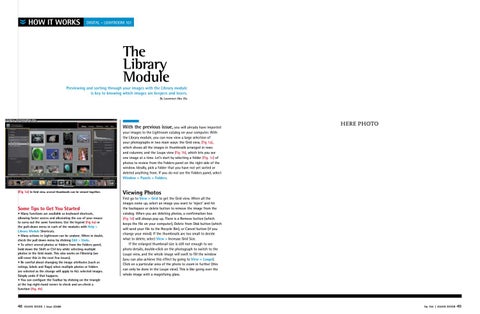
your images to the Lightroom catalog on your computer. With the Library module, you can now view a large selection of your photographs in two main ways: the Grid view, (Fig 1a), which shows all the images in thumbnails arranged in rows and columns; and the Loupe view (Fig 1b), which lets you see one image at a time. Let’s start by selecting a folder (Fig. 1c) of photos to review from the Folders panel on the right side of the window. Ideally, pick a folder that you have not yet sorted or deleted anything from. If you do not see the Folders panel, select Window > Panels > Folders.
(Fig 1a) In Grid view, several thumbnails can be viewed together.
Some Tips to Get You Started
• Many functions are available as keyboard shortcuts, allowing faster access and alleviating the use of your mouse to carry out the same functions. Use the legend (Fig 4a) or the pull-down menu in each of the modules with Help > Library Module Shortcuts. • Many actions in Lightroom can be undone. When in doubt, check the pull down menu by clicking Edit > Undo. • To select several photos or folders from the Folders panel, hold down the Shift or Ctrl key while selecting multiple photos in the Grid mode. This also works on Filmstrip (we will cover this in the next few issues). • Be careful about changing the image attributes (such as ratings, labels and flags) when multiple photos or folders are selected as the change will apply to ALL selected images. Simply undo if that happens. • You can configure the Toolbar by clicking on the triangle at the top right-hand corner to check and un-check a function (Fig. 4b)
48
ASIAN DIVER | Issue 2/2009
Viewing Photos
First go to View > Grid to get the Grid view. When all the images come up, select an image you want to ‘reject’ and hit the backspace or delete button to remove the image from the catalog. When you are deleting photos, a confirmation box (Fig 1d) will always pop up. There is a Remove button (which keeps the file on your computer), Delete from Disk button (which will send your file to the Recycle Bin), or Cancel button (if you change your mind). If the thumbnails are too small to decide what to delete, select View > Increase Grid Size. If the enlarged thumbnail size is still not enough to see photo details, double-click on the photograph to switch to the Loupe view, and the whole image will swell to fill the window (you can also achieve this effect by going to View > Loupe). Click on a particular area of the photo to zoom in further (this can only be done in the Loupe view). This is like going over the whole image with a magnifying glass.
No. 104 | ASIAN DIVER
49
»
HOW IT WORKS
DIGITAL – Lightroom 101
(Fig 1b) In the Loupe view, only the magnified image can be viewed.
(Fig 1d) A Confirm window will always pop up whenever you are deleting photos.
Sorting Your Images To sort your photos chronologically, select View > Sort > Capture Time. Usually for me, the initial shots are test shots. So I like to sort my images in a counter chronological order, reviewing my later shots first, making my decisions on ‘reject’ photos even easier. This is done by selecting View > Sort > Descending Order.
Organising Your Photos Lightroom has three main ways of organising photos – by using Flags, Ratings and Color Labels. All of these can be accessed from the Toolbar (Fig 2a) when an image has been selected. Using these attributes in conjunction with the sorting command will speed up the organisation of your ever-growing portfolio of images.
Flagging
(Fig 1c) How to select a folder from the Folder panel.
Your images can be flagged as either picked, rejected or unflagged, by selecting Photo > Set Flag > (desired) Flag. Rejected photos are destined to be deleted and when used together with the Refine Photos command is a fast and efficient way of sorting our more rejects from a large group of photos. This is especially useful for groups of photos from a similar shoot, for example, of dozens of shots taken of the same nudibranch. Before starting to Refine Photos, make sure that the File > Library Filters > Enable Filters command is checked. Then make sure that the File > Library Filters > Filter by Flag > Flagged and Unflagged Photos is checked too. This will hide photos you have already reviewed and show only the photos that still need reviewing. Go through your set of images and flag ALL the images that are keepers or possible keepers as picked. Essentially, this leaves a set of unflagged photos as non-keepers. Now, by selecting Library > Refine Photos, Lightroom changes all the unflagged photos (that is, your non-keepers) to rejected and has unflagged all your selected photos. In other words, the programme does the reverse. So that when you are ready to delete all the rejected photos, you can do it in one fell swoop by going to Photos > Delete Rejected Photos.
Rating your Photos Photos can be rated between one to five stars, very similar to rating your music files in most music programmes. The higher the rating, the ‘better’ the image, and these are the photos that you will be sending to competitions and magazines. To change the rating of a selected photo, go to Photo > Set Rating > (desired) Rating.
50
ASIAN DIVER | Issue 2/2009
How to use Colour Labels Similar to ratings and flagging, photos can also be labeled with one of five colours – red, yellow, green, purple or blue. However, unlike rating or flagging photos, there is no specific purpose for colour labels except for grouping images according to your own purposes. For example, you can label a particular dive trip with a certain colour, so you can post them onto Facebook, or label all the trips you’ve done with a particular set of dive buddies. The possibilities are endless. Changing and viewing a colour label is much like setting the ratings for photos. First select the image to be labeled, then select Photo > Set Color Label > (desired colour). Alternatively, while in Grid mode, select View > Grid View Style > Expanded Cells (Fig. 3a), then mouse click the colour label box, then go to View > View Options and make sure that the Include Colour Label is checked. Generally, I use colour labels as a ‘temporary’ grouping tool. Therefore, once I am done with the photos I’ve uploaded onto Facebook, for example, I can reset the colour labels and use them for other purposes. Also important to note is you can sort your photos according to Flagging, Rating and Color Labelling. If you select View > Sort > Label Color, you images will be sorted according to the Color Labels assigned to them. If you select View > Sort > Rating, your favourite photos will show first. And if you change your mind on the spot and decide to change the ratings of your photos, the programme will automatically re-sort the photos accordingly. These simple Lightroom tools help you organise and catalog your photos – paring them down into a usable size – so you can easily find that particular photo with a click of the mouse button. In the next issue, we will get right into the postprocessing features for images in the Develop module, where the power of Lightroom really shines through to get the ‘wow’ factor our of your photography efforts. AD
(Fig 2a) Change a photo’s Flag, Rating or Color Label by clicking on the appropriate item in the Toolbar.
(Fig 3a) In the Grid view, you can change the image’s color label directly from its label icon in the thumbnail border when in Expanded Cells view.
Lightroom is available for both Windows and Mac. For the shortcut key on the Mac, replace the Windows Ctrl key with the Mac’s Command key.
Lawrence Alex Wu is a freelance photographer and instructor based in Southeast Asia. Since 1996, he has dived into underwater photography with the digital camera revolution and has yet to come up for air. With over a dozen international underwater photographic awards since 2005, his underwater work has been shot with only digital compacts. LawrenceAlexWu.com Number of dives to date: ???+
No. 104 | ASIAN DIVER
51