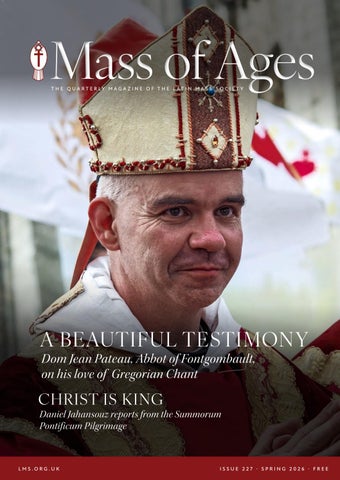

Mass of Ages
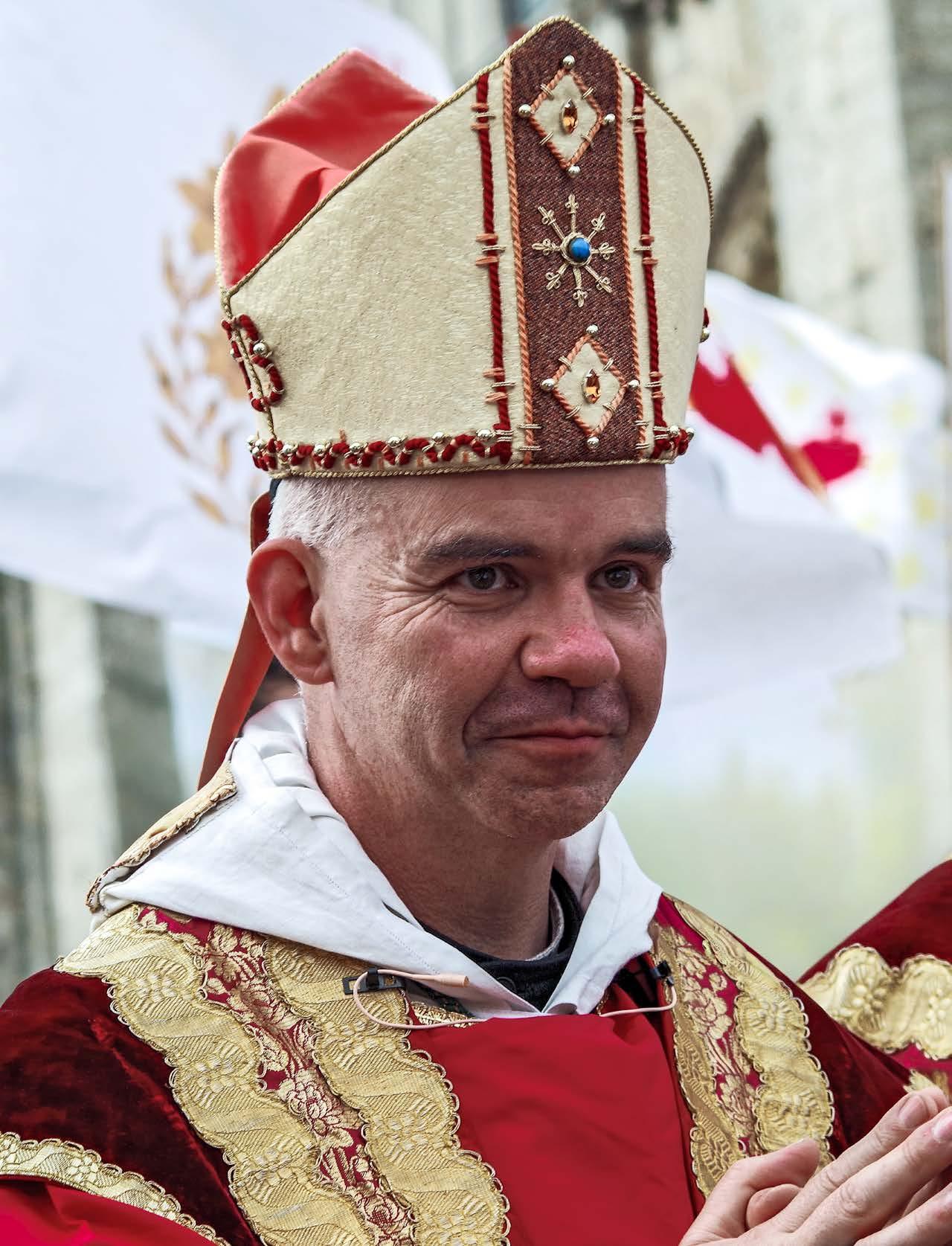
A BEAUTIFUL TESTIMONY
Dom Jean Pateau, Abbot of Fontgombault, on his love of Gregorian Chant
CHRIST IS KING
Daniel Jahansouz reports from the Summorum Pontificum Pilgrimage

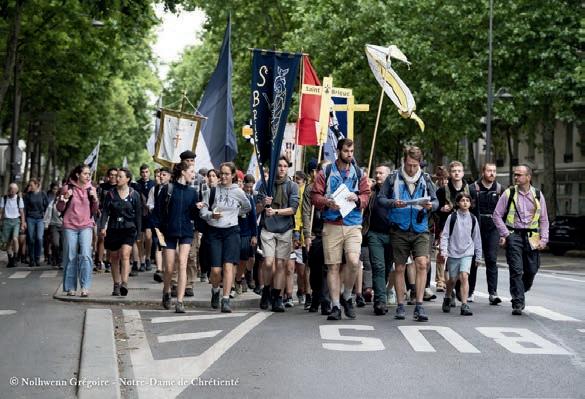
CHARTRES PILGRIMAGE
YOUNG ADULT BURSARIES
23-25 MAY 2026
The annual pilgrimage from Paris to the shrine of Our Lady at Chartres will take place over the Whitsun weekend, from 23 to 25 May 2026.
The Latin Mass Society is offering five bursaries of £150 each to UK-based pilgrims aged 18–35 who wish to join the ChartresUK Chapter.
Further information and application details at:
LMS.ORG.UK/CHARTRES2026

23
Chairman’s Message: Something to build on Joseph Shaw on busy days ahead
Year planner
Last Things First Bishop Marian Eleganti reflects on how faith in eternity reshapes the way we live, age, and die
Son of St Augustine A conversion story by Numair Raja
Christ is King Daniel Jahansouz reports from the Summorum Pontificum Pilgrimage
A beautiful testimony Dominic Bevan discusses Gregorian Chant with Dom Jean Pateau, Abbot of Fontgombault
Another country Daniel Beurthe reviews a collection of verse by LMS Patron Sir Edward Leigh
Architecture: Notre-Dame du Val-de-Grâce, Paris Paul Waddington looks at an impressive new venue for the Latin Mass in Paris
Wine: More than mere atoms Sebastian Morello on the delights of Sa redi 2019 Fattoria le Pupille
Sacred stillness Joseph Jarvis on encountering Christ’s presence
24 Spirituality: The meaning of sacrifice Fr Thomas Crean on Lent
27 Family matters: The old lamp post Traditional Catholicism must not be understood as an e ort to roll back compassion, as James Preece explains
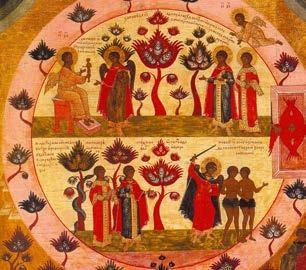
28 Art and devotion: Creation and Fall Caroline Farey on a remarkable 16th century Russian icon
30 Obituary: A magnet for tradition Fr Ray Blake, priest who was unafraid to air his views from the pulpit or in his blog
31 Deprived and imprisoned John Whitehead on the fate of the Marian Bishops
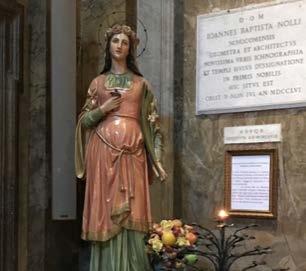
33 Virgin and Martyr Edward Dundon remembers Saint Dorotea, patron saint of gardeners, brewers and newly-weds
34 Reports from around the country What’s happening where you are
42 Faith, literature and politics Charles A. Coulombe remembers Douglas Francis Jerrold
44 Liturgical calendar
45 World News Paul Waddington takes a look at what’s happening around the globe. This time he reports from France
46 The philosophy of particularity Joseph Shaw reports from the launch of a new book on a much-loved priest, the late Mgr Alfred Gilbey
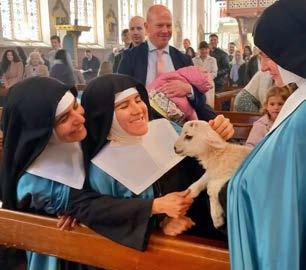
48 In Corde Regis - in the King's heart An appeal for funds for the Sisters Adorers
49 Modes of participation Matthew Hazell reviews a new book on liturgical reconciliation
50 Crossword
No.
MASS OF AGES MAGAZINE
Editor: Tom Quinn, editor@lms.org.uk
Design: GADS Ltd. & Selina Fang
Printers: Vyner Print Media Ltd.
Due to the considerable volume of emails and letters received at Mass of Ages, it is regrettably not always possible to reply to all correspondents.
DISCLAIMER: Please note that the views expressed in this publication are not necessarily those of the Latin Mass Society or the Editorial Board. Great care is taken to credit photographs and seek permission before publishing, though this is not always possible. If you have a query regarding copyright, please contact the Editor. No part of this magazine may be reproduced without written permission.
THE LATIN MASS SOCIETY
FOUNDED 1965
PATRONS
Sir Adrian Fitzgerald, Bt . The Rt Hon Lord Gill . The Rt Hon Sir Edward Leigh, MP
Sir James Macmillan, CBE The Lord Moore of Etchingham Prof. Thomas Pink John Smeaton
C OMMITTEE
C HAIRMAN : Dr Joseph Shaw
SECRETARY : Selina Fang
TREASURER : David Forster
H ONORARY OFFICERS : Ala stair Tocher
Paul Waddington
OTHER COMMITTEE MEMBERS :
Alan Gardner, Julia Jones, Kevin Jones, A ntonia Robinson, Aileen Seymour
N ATIONAL CHAPLAIN : M gr Gordon Reid
STAFF AND FREELANCERS
GENER AL MANAGER : Richa rd Pickett, richard@lms.org.uk
F INANCIAL ADMINISTRATOR : Ga reth Copping, gareth@lms.org.uk
OF FICE ASSISTANT : Ma u ricio Rodriguez, info@lms.org.uk
ADMINISTRATION OFFICER : H amish Rogers, hamish@lms.org.uk
ED ITOR, MASS OF AGES : Tom Quinn, editor@lms.org.uk
COMMUNICATIONS OFFICER : D aniel Beurthe, daniel@lms.org.uk
C REATIVE CONTENT PR ODUCER : Cl ive Watson, clive@lms.org.uk
LONDON DIRECTOR OF MUSIC : D ominic Bevan, southwell@lms.org.uk
V OL U NTARY ROLES
SAFEGUARDING : David Forster, s afeguarding@lms.org.uk
GUILD OF S T CLARE : Lucy Shaw, guildof stc lare@lms.org.uk
GREGORIAN CHANT NETWORK : Alastair Tocher, chant@lms.org.uk
SOCIETY OF S T TARCISIUS : Dr Joseph Shaw, tarcisius@lms.or g.uk
ED ITOR, LMS ORDO : Peter Day-Milne, ordo@lms.org.uk
LOCAL REPRESENTATIVES
ARUNDEL & BRIGHTON : Dr Emma-Louise Jay, arundel@lms.org.uk
BIRMINGHAM (City & Black Country) : Louis Maciel, birmingham@lms.org.uk
BIRMINGHAM (North Staffordshire) : Alan Frost, staffs@lms.org.uk
BIRMINGHAM (Oxford) : Dr Joseph Shaw, oxford@lms.org.uk
BIRMINGHAM (Warwickshire) : John Bradley, warwickshire@lms.org.uk
BIRMINGHAM (Worcestershire) : Alastair Tocher, malvern@lms.org.uk
BRENTWOOD (East) : Alan Gardner, brentwoodeast@lms.org.uk
BRENTWOOD (London) : Mark Johnson, brentwood@lms.org.uk
CARDIFF - MENEVIA (Cardiff) : Andrew Butcher, cardiff@lms.org.uk
CARDIFF - MENEVIA (Herefordshire) : Shaun Bennett, herefordshire@lms.org.uk
CARDIFF - MENEVIA ( Ledbury) : Alastair Tocher, malvern@lms.org.uk
CARDIFF - MENEVIA ( Menevia) : Tom & Elaine Sharpling, menevia@lms.org.uk
CLIFTON : James and Mari Carmen Osborn, clifton@lms.org.uk
EAST ANGLIA ( Walsingham) : Tom Fitzpatrick, walsingham@lms.org.uk
EAST ANGLIA ( West) : Gregor & Alisa Dick, cambridge@lms.org.uk
EAST ANGLIA ( Withermarsh Green) : Sarah Ward, withermarshgreen@lms.org.uk
HALLAM: Luke Collins, hallam@lms.org.uk
HEXHAM & NEWCASTLE: John Fagan, hexham@lms.org.uk
LANCASTER : John Rogan, lancaster@lms.org.uk
LANCASTER (Cumbria) : Nicholas Steven, warwickbridge@lms.org.uk
LIVERPOOL: Andrew Doyle, liverpool@lms.org.uk
LIVERPOOL (Warrington) : Alan Frost, warrington@lms.org.uk
MIDDLESBROUGH : Paul Waddington, middlesbrough@lms.org.uk
NORTHAMPTON : Barbara Kay, northampton@lms.org.uk
NOTTINGHAM : Jeremy Boot, nottingham@lms.org.uk
NOTTINGHAM (South) : Paul Beardsmore, nottingham-south@lms.org.uk
PLYMOUTH (Cornwall) : Stefano Mazzeo, cornwall@lms.org.uk
PLYMOUTH (Devon) : Patrick Oliver, devon@lms.org.uk
PLYMOUTH (Dorset) : Maurice Quinn, dorset@lms.org.uk
PORTSMOUTH : Carol Turner, portsmouth@lms.org,uk
PORTSMOUTH (Isle of Wight) : Peter Clarke, iow@lms.org.uk
SALFORD : Alison Fraser-Kudlowski, salford@lms.org.uk
SHREWSBURY (Cathedral) : Victoria Keens, shrewsbury@lms.org.uk
SHREWSBURY (Wirral) : Kevin Jones, wirral@lms.org.uk
SOUTHWARK (Chislehurst) : Christopher Richardson, chislehurst@lms.org.uk
SOUTHWARK (Clapham Park) : Thomas Windsor, claphampark@lms.org.uk
SOUTHWARK (Kent) : Marygold Turner, kent@lms.org.uk
SOUTHWARK (Thanet) : Dr Christopher Serpell, thanet@lms.org.uk
SOUTHWARK (Wandsworth) : Julia Ashenden, wandsworth@lms.org.uk
WESTMINSTER (Hertfordshire): Tom Short, herts@lms.org.uk
WESTMINSTER (Warwick Street): Nicolas Ollivant, warwickstreet@lms.org.uk
WESTMINSTER (Willesden) : Mauricio Rodriguez, willesden@lms.org.uk
Something to build on
Joseph Shaw on busy days ahead
Welcome to the New Year, and a new Mass of Ages. After the hectic timetable last year, our 60th anniversary, things will be a little quieter in 2026, but there are still plenty of things happening. As I write, we are organising a book launch, two Residential Latin courses (for the first time we’re holding one in the spring as well as one in the summer), the St Catherine’s Trust Summer School for children, five server-training events, two Guild of St Clare Sewing Retreats, plus a Guild training day in Hampton Court Palace. This year they will be learning about making mitres: as time goes on, we may not have to borrow quite so many for our Pontifical Masses, if we get our own Guild of needleworkers to make some for us. The Guild is also launching a new chapter, in Scotland, to add to the one in Belfast and six in England.
This is not enough, however, because this year we are organising a series of Gregorian Chant training days, and sponsoring several others. You will see adverts for these as the year goes on, and we also have a dedicated website (search for the Gregorian Chant Network) and email list (email chanttraining@lms.org. uk), which anyone can join.
We can be pleased with the progress we have made with Gregorian Chant, and with sacred polyphony. Today, the Latin Mass Society has an excellent affiliated choir in London, the Southwell Consort, which can be heard on Monday evenings in Corpus Christi, Maiden Lane, at many of our events around the country, and even occasionally on Radio 4. In addition, we give financial support to four chant groups singing at the Traditional Mass in different parts of the country. At our Walking Pilgrimage to Walsingham, we have an experienced cantor in each of the six chapters. Thanks to these developments, and to the patient work of our friends in the Schola Gregoriana founded by Dr Mary Berry, we are now in a position to promote chant in a bigger
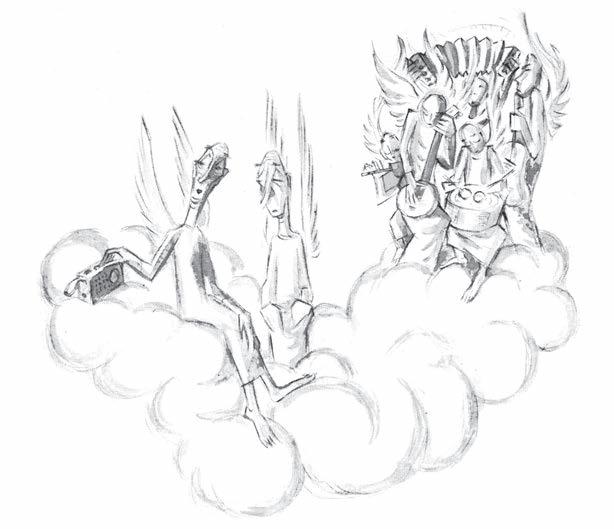
‘Even today you can still hear the harp occasionally - on the Welsh programme’
way. We are planning half-a-dozen chant training events this year, and supporting a number of others.
It is a paradox of this kind of work that when the need is greatest, the capacity to address that need is the smallest. It is because there are today, after years of hard work and modest growth, more scholas and more experienced singers, that there are enough people available to teach chant, and a critical mass of people interested in attending: either because they already sing, or because they have encountered it and want to learn more. The same is true of people teaching and learning Latin, how to serve Mass, or the techniques of ecclesiastical embroidery that are needed to make and mend vestments worthy of the liturgy.
Ex nihilo nihil fit: nothing comes from nothing. Before we can promote something in a big way, we have to build capacity. To do even that, we and similar organisations had to preserve the necessary skills through the lean times, the bottle-neck created by a harsh ecclesial environment and adverse fashions.
I hope readers can appreciate the value, in this context, of the Latin Mass Society: it is our institutional continuity, the nurturing of our network and human relationships, and our financial resources, modest as they are, that have brought us to the point that we can now do more than before. To keep on doing it, we need your help: as benefactors, as members, as activists, and as participants at our events.
Reflecting on those especially lean times of the past, we should recognise the importance of the work of our predecessors in the Society, even when they could do relatively little. It is because they held on, that we have something to build on today. As Milton put it, ‘They also serve, who only stand and wait.’
By contrast, we have the privilege and the consolation of being able to do things which have immediate and visible results. We should not fail to respond to this opportunity.
This issue’s cartoon is from the start of the lean days: Cracks in the Clouds (1976) by Dom Hubert Van Zeller OSB (erstwhile Brother Choleric).
YEAR PLANNER
At the time of going to press the following events are planned. For fuller details and other events see lms.org.uk
Gre gorian Chant Training Day
SATURDAY 28 FEBRUARY
An Ember Saturday Gregorian chant training day with D ominic Bevan of the Southwell Consort at St Dominic’s Priory – The Rosary Shrine, Southampton R oad, London NW5 4LB. Booking at lms.org.uk
Miniature Embroidered Mitre Course
S ATURDAY 14 MARCH
The Guild of St Clare is collaborating with the Royal School of Needlework to offer this one-day course at Hampton Court Palace.
R egistration at lms.org.uk/mitres20 26 C loses: 7 March. Cost: £196.
Society of St Tarcicius Server Training Days & Guild of St Clare Vestment Mending Days
SATURDAYS 21 MARCH, 9 MA Y, 19 SEPTEMBER
A ND 7 NOV EMBER
St Mary Moorfields, Eldon Street, London EC2M 7LS
f rom 10.30 am to 4 pm.
B oo k ing at lms.org.uk for server training.
L MS Residential Latin Courses
S TARTING MONDAYS 13 APRIL AND 29 JUNE
Courses offering expert tuition in liturgical Latin with d aily M a ss at the Boars Hill Carmelite Priory near Ox ford. Beginner and advanced streams.
B oo k ing at lms.org.uk
Chartres Pilgrimage
SATURDAY 23 TO MONDAY 25 MAY
Taking pl ace ov er the Whi tsu n w ee k end , thi s majo r pilgrimage from Paris to the shrine of Our Lady at Chartres is organised by Notre-Dame de Chrétienté: nd-ch retiente.com. See chartres u k.blogs pot .com or chartrespilgrimagescotlan d.c om for d et ails of UK cha pters.
Ch artres Bursaries – The LMS is offering five bursaries of £150 to young adults (18-35) attending with the ChartresUK Chapter. Deadline: 15 March. For details see lms.org.uk/chartres2026
Gregorian Chant Training Day
SATURDAYS 30 MAY AND 25 JULY
Gregorian chant training days on the Ember Saturday of Pentecost and the Feast of St James at Our Lady of the Assumption in London (Warwick Street, W1B 5LZ). Further details to be posted at lms.org.uk
St Birinus Festival
THURSDAY 9 TO SUNDAY 12 JULY
Festival of liturgical polyphony sung by the Southwell Consort accompanied by period instruments at Dorchester Abbey in Oxfordshire. Further details to be published at southwellconsort.com
LMS Walsingham Walking Pilgrimage
THURSDAY 27 TO SUNDAY 30 AUGUST
Annual walking pilgrimage from Ely to Walsingham. Booking at lms.org.uk opens in March.
Early bird discount for those booking before Pentecost.
Gregorian Chant Training Day
SATURDAYS 26 SEPTEMBER
An Ember Saturday Gregorian chant training day at Holy Rood Church in Oxford (Abingdon Road, OX1 4LD).
10 am for 10.30 am, with Sung Mass at 12 noon and Vespers at 4 pm. Booking at lms.org.uk
Rome Pilgrimage – Peregrinatio ad Petri Sedem
FRIDAY 23 TO SUNDAY 26 OCTOBER
Annual Rome Pilgrimage including Solemn Pontifical Mass at the Vatican. Details to be posted at: en.summorum-pontificum.org
LMS Election 2026
Two trustee positions on the LMS Committee are open for election: Treasurer and Committee Member. Nomination forms are available from election@lms.org.uk
See lms.org.uk/constitution . The results will be announced at the AGM, details of which will be posted on the website.
Last Things First
Bishop Marian Eleganti
reflects on how faith in eternity reshapes the way we live, age, and
die
The day that many fear as their last was for Seneca “the birthday of eternity”. “I am not dying, I am entering eternal life,” said Saint Thérèse of Lisieux before her death. “There I really will be a human”, wrote Ignatius of Antioch in his last letter to the Romans: “Do not prevent me from gaining life.”
“Live as people who die every day”, said the desert father Anthony the Great to his brothers before his death. The French sceptic Montaigne understood philosophising as practising dying. For Plato, too, philosophy had to do with the seriousness of death. His teacher Socrates already stood for this. Ironically and cheerfully, he asks his students, including Plato, to sacrifice a rooster to Asclepius, the god of healing, in gratitude, since he has now recovered from a “great illness” – life! – by death paving the way for him to transcendence and unveiled truth!
Whether we die with difficulty or ease, whether we die reconciled or unreconciled, in a terrible struggle or in peace, is often determined by how we have lived.
Francis dies naked on the floor of the Portiuncula, surrounded by his brothers; Benedict standing in prayer of the psalms, supported by two brothers; Seraphim of Sarov kneeling before the icon of Mother Mary of Joy. St Augustine devoted most of his time to prayer before his death. Since he did not want to depart from life without adequate penance, he had written down the shortest of David's penitential psalms and pinned them to the wall during the days of his illness. From his bed, he gazed intently at the pages, prayed those psalms and shed incessant tears until his death.
Nothing is as certain as death, and nothing as uncertain as the hour of death, as the saying goes. “All people must die, perhaps even I!”
The thought of unpredictable death is one of the tools of spiritual art recommended by Saint Benedict. Old age or growing old is a good time
to ask about the meaning of life, a question that is often pushed into the background by the urgency and meaningfulness of everyday affairs. Thomas à Kempis says: “What is your answer to the question: Why were you born into this world? It is good to ask yourself this question from time to time.” This is especially true for the last stage of life.
In Psalm 139:14-16 we read: “You created my inmost being; you knit me together in my mother's womb… Your eyes saw my unformed body; all the days ordained for me were written in your book before one of them came to be.”
So, God has looked upon and blessed all my days, including the last ones. Their meaning lies like a hidden treasure in the field of life and must be recovered.
Today, an entire leisure and consumer industry provides the answer to the classic question: “What is the purpose of human existence?” Their answer: Human happiness lies in the enjoyment of earthly goods! The Polish philosopher Kolakowski calls for a new seriousness in our secular culture, which is based on the unspoken agreement that pleasure and enjoyment are the highest, if not the only, goods. And for that we must be healthy. Old age today is dominated by a tyrannical obsession with youth. People want to live longer and longer but not grow old. There is talk of “young seniors”, “best agers” and “silver surfers” who do everything the young do as well.
For our contemporaries, health is the most important thing, even into old age, the highest of all worldly goods. In request shows, children wish their elderly parents on the radio “that you may enjoy life for a long time to come”! The thought of death is discreetly concealed. Eternal salvation is not an issue. Manfred Lütz quotes Plato in his polemic against the “health craze”: “Constant concern for health is also a disease.”
In insurance terms, old age is an expensive disease. A nurse told me about a terminally ill patient who, three weeks before her death, had replied to him: “Don't talk to me about dying!” Living longer and not dying for a long time: are we making good use of the time we have been given? Guardini spoke of the danger of, “filling the evershortening time with stuff”, with stuff, gossip, banalities, unfortunately not with wisdom and insight. Death is no longer the gateway to a better world, but its end. In contrast, a 90-year-old woman said to me on her birthday: “I am not old, I live forever.”
All human life is subject to constant change and – we must accept this –transience. The prospect of the end has an effect on the present: those who do not believe in God and in eternal life after death have their time shortened by an entire eternity.
In his encyclical on Christian hope (Spe salvi), Pope Benedict quotes an ancient epitaph in which there is an “unvarnished awareness” that with death “everything is over”, a death without hope! “In nihil ab nihilo quam cito recidimus!” - “How quickly we fall back from nothingness into nothingness!” it says there.
Today's Word of God proclaims a different message to us. We will live eternally in Christ.
Earlier generations spoke with faith about going home to God. They understood life as a great period of trial and preparation for perfection in God. This allowed them to look forward to the hour of death with confidence. Let us remember here the two men who were crucified with Jesus. How differently they died! One mocks Jesus. The other rebukes him: “Don't you even fear God? You have been condemned to the same punishment. We are getting what we deserve for our deeds, but this man has done nothing wrong.” Then he said, “Jesus, remember me when you come into your kingdom.” Jesus replied, “Amen, I say to you, today you will be with me in Paradise” (Luke
23:40-43). While one thief despairs, the other places his hope in Jesus. In doing so, he shows us the right way.
Romano Guardini characterises the wise person as one who knows his end and accepts it at the right time. Paradoxically, a happy life occurs in the face of death. Death dispels many illusions.
Suffering and illness, the experience of dying and death, therefore play an important role in transforming our perspective and freeing us from our entanglement in the world.
Robert Bellarmin writes in his 1621 work, Ascent of the Spirit to God:
"So, when you understand this, realise that you were created for
the glory of God and your eternal salvation… If you attain this goal, you will be blessed, but if you fail, you will be unhappy. Therefore, consider everything that brings you closer to your goal as good, and everything that leads you astray as bad.”
St Augustine advises, “Do not go out, but return to yourself. The truth dwells within man. So, strive for that which kindles the light of reason” (de vera religione 39,72).
“But how few turn inward and hear the call!” laments John Tauler.
“Today they want this, tomorrow they do that – depending on the calls and incentives that come from
outside or on whatever happens to come to mind. And so they rush here and there and stray from the path to which they are called.”
Finally, six pieces of brief advice:
1 The shroud has no pockets.
2 The most important thing is to become free.
3 Modesty means accepting what is given to us.
4 Let us consciously incorporate the thought of death into our lives!
5 To die well means to die in peace.
6 Prayer is the greatest aid in life and death.
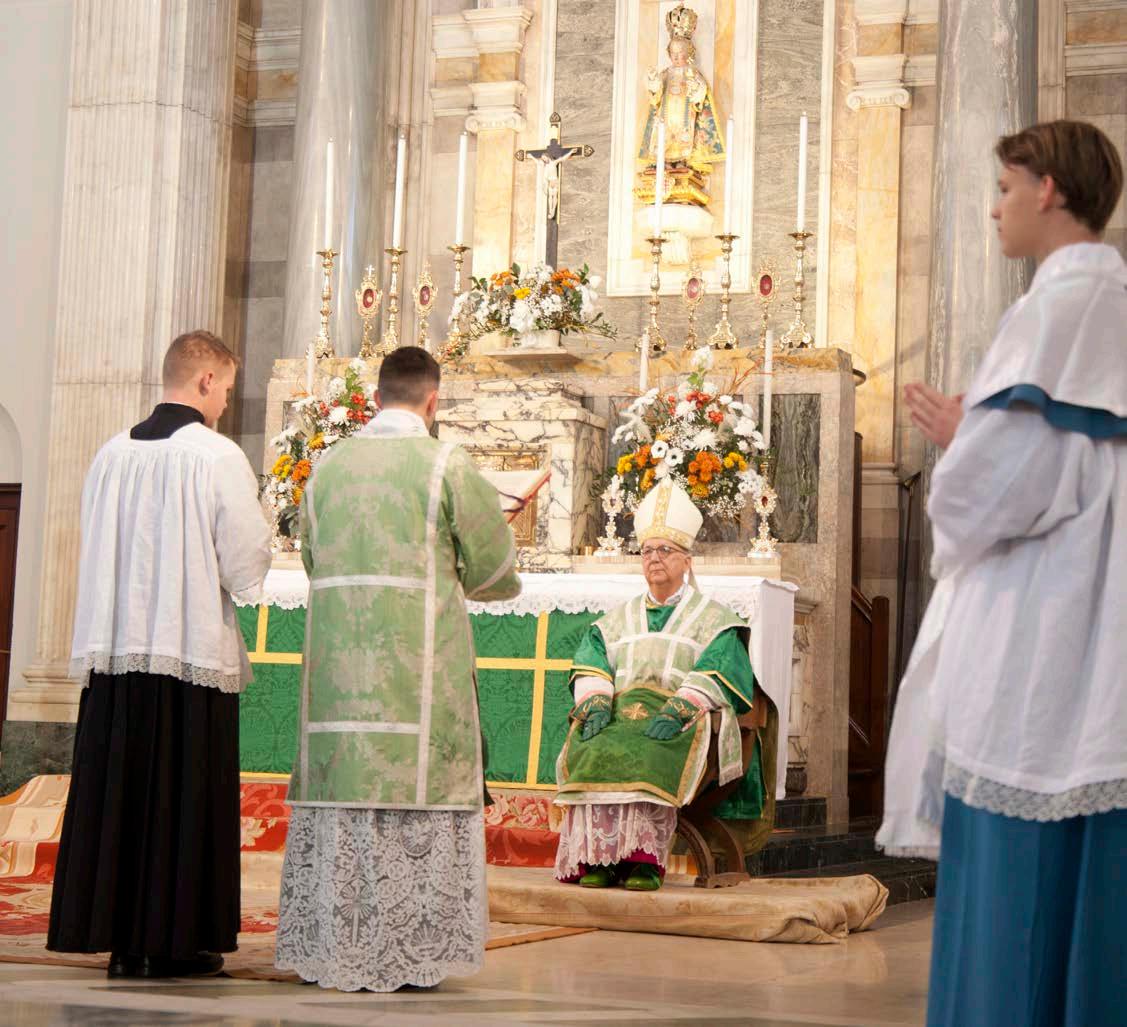
Bishop Eleganti at New Brighton
© Joseph Shaw
A LATIN COURSE FOR THE LATIN LITURGY
LATIN MASS SOCIETY RESIDENTIAL LATIN COURSE
SPRING COURSE: 13 – 17 APRIL 2026
SUMMER COURSE: 29 JUNE – 3 JULY 2026
A FACE-TO-FACE COURSE CREATED TO SUPPORT CLERGY AND SEMINARIANS, AND OPEN TO THE LAITY TOO:
80% discount for clergy (including deacons), seminarians, those about to enter seminary, and religious
Daily Traditional Mass Carmelite Retreat Centre at Boars Hill, near Oxford Focus on the Latin of the ancient Roman Missal Three tutors, allowing students to learn at their own pace
LMS.ORG.UK/LEARNLATIN Book through the LMS website today:

Son of St Augustine A conversion
story by Numair Raja
In the words of a very good Franciscan, I had a conversion without a soundtrack. Also, in the words of a now rather famous Augustinian, I am a son of St Augustine. But I am equally the son of a family of Sunni Muslims, and I was known in my youth to be quite religious. I had a strong desire to know more about my religion and to spread what I learned to anyone I could find. I had never thought about or studied Christianity in the past. To me, it was an absurd religion, though perhaps less absurd than the rest. After all, how could anyone justify belief in the Trinity or the deity of Christ? How could a man be God Himself?
So, when I was first exposed to St Augustine's writings while studying ethics, it was all entirely new to me - this St Augustine wrote well, and he wrote truthfully. Captivated, I set out to learn more about him. This man, caught up in the fire of his own lust and the chaos of the various religions of the Roman world, had found himself wandering almost aimlessly before his dramatic conversion to the Christian faith, of which he was then a staunch defender until his death. It was amazing, touching, and beautiful. I could really see myself in this man - he was not some untouchable hero from the myths of antiquity, but really and truly human, a man who struggled, but who turned his entire life around because of his commitment to the Christian faith.
That struggle was really quite endearing to me. St Augustine had become someone close to my heart, precisely because he struggled, he pondered, he was forced to make the anxiety-inducing decision between the major forces of his world that seemed simultaneously so small and so largemuch like myself.
I began to ask some serious questions. Just who was Jesus? What did He say about Himself? Why did everyone, even among the Christians themselves, seem to disagree on Him? I read anything I could get my hands on, every critical and objective study of the history of the Bible, which I had long believed to be corrupted, and the history of various Christian groups, and I lined it all up with the Christian views of who Jesus was, what He said, and what He propagated on earth, and the Muslim view. In doing so, I discovered an undeniable fact.
Christ really did appoint those who were to care for His followers after Him - that He really did institute a Church. And that the Church in question was none other than the Catholic Church, built upon that rock who is St. Peter. Once again, I found myself in agreement with that wonderful writer, St Augustine - ‘I should not believe the gospel except as moved by the authority of the Catholic Church.’ It was by this authority that I found the Gospels to
be reliable, by this authority that I conceded finally that Jesus claimed to be divine. It was by this authority that my heart yielded that the faith of my fathers was not true.
And so, I secretly began to attend Mass, was catechised, and was finally baptised on 18 July, 2024, taking the Christian name Stefan after the first one to give his life for the Lord I had decided to throw my comfortable life away for. It was his ceaseless intercession that finally gave me the courage to tell my family of my conversion, which of course was not easy. Once again, I found refuge in St Augustine, who at the cusp of his conversion no doubt felt great anxiety as I did, and was comforted (and perhaps somewhat convicted) by the voice of an angel. ‘Tolle, lege.’ Take and read. And so I did, and found comfort in the words of my patron. His face shining like an angel, full of the Holy Ghost, he cried out to his persecutors: ‘Behold, I see the heavens opened, and the Son of man standing on the right hand of God.’
I did not have a conversion with a soundtrack, a dramatic moment where I came to belief like St Augustine. Still, by his writing and witness, in my own uneventful way, I came to confess that Jesus Christ is Lord, and believe in my heart that God raised Him from the dead, and so I too can say - I am a son of St Augustine.
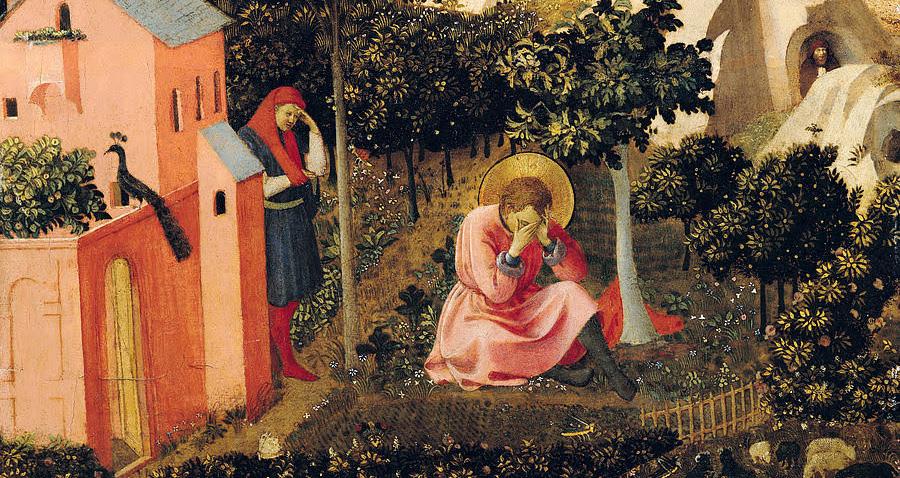
The Conversion of St Augustine by Fra Angelico (1395-1455)
Christ is King
Daniel Jahansouz reports from the Summorum Pontificum Pilgrimage
Last year as we commemorated the centennial anniversary of Quas Primas by Pope Pius XI, the Summorum Pontificum Pilgrimage promised to be special. The theme, emphasising Christ’s Kingship over creation, was echoed during the traditional pilgrimage to Chartres on Pentecost The history behind this feast is significant; Pius XI established it in response to the ‘plague of anti-clericalism, its errors and impious activities’. He wrote: ‘When once men recognise, both in private and in public life, that Christ is King, society will at last receive the great blessings of real liberty, well-ordered discipline, peace and harmony.’ How true these words ring now, and the Summorum Pontificum Pilgrimage highlighted this even further.
The Pilgrimage began with Pontifical Vespers at San Lorenzo in Lucina, with Cardinal Matteo Zuppi as the chief celebrant. Prior to the liturgy starting, people were already flooding the minor basilica. San Lorenzo is a unique church, not only in its history, but also its architecture and design. Its legendary past includes the matron of the basilica, Lucina, visiting Christian prisoners, paying for the burial of martyrs, and hiding Pope Marcellus from persecutions ordered by the Roman Emperor Maxentius.
The shimmering gold and white walls, adorned with intricate icons of saints, depict Christ reigning as King in the Resurrection icon on the ceiling. Pilgrims marvel at the designs and gaze at the main altarpiece, where Christ reigns as King on the Cross. The deep, rich black marble contrasts brilliantly with the rest of the basilica, especially at night. The pilgrim acknowledges God's strength and beauty while offering thanksgiving for redemption, singing with the Psalmist, ‘I have loved, O Lord, the beauty of thy house; and the place where thy glory dwelleth’.
Those familiar with Cardinal Zuppi may be surprised at his participation, but it is significant.
Before Vespers, His Eminence gave a sermon emphasising Pope Leo XIV’s message of unity and ‘fraternity amid divisions’. Cardinal Zuppi stressed that the liturgical tradition, the Traditional Roman Rite, is an ‘unmistakable mark to our local Church. It is a garden to be cultivated with renewed love and passion without ever resigning ourselves to weariness and laziness…’ A powerful moment followed his homily and Vespers when both Cardinal Zuppi
and Cardinal Burke processed together, giving their Pontifical blessings while the choir sang ‘Christus Vincit’ with such fervour that even those across the River Tiber could hear it.
The following day was the high point of the Summorum Pontificum Pilgrimage – Pontifical High Mass with Cardinal Burke as the chief celebrant, at the Chair of St Peter in St Peter’s Basilica. Although the liturgy was set to begin at 3pm, preparations
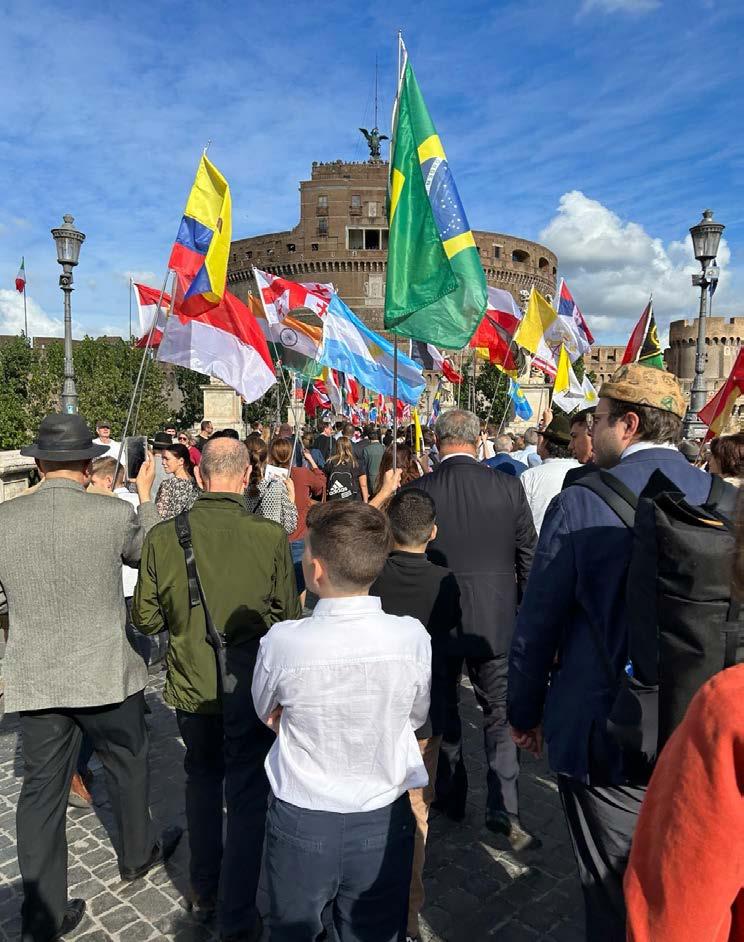
started early in Rome. As the pagans of Rome were hustling and bustling, faithful pilgrims were evangelising by preparing to meet their King in the Blessed Sacrament of the Altar. This preparation included praying the Holy Rosary publicly outside Saints Celsus and Julian, followed by the Summorum Pontificum procession all the way into St Peter’s Square.
After all, what faithful person does not prepare adequately when visiting their King? The Saints, in particular St Louis de Montfort, have exhorted public prayer, saying that it, ‘appease[s] the anger of God and call[s] down his mercy,’ as shown in the victory of the Battle of Lepanto. How powerful a tool is public prayer!
The procession also marked the ‘Catholicity’ of the Catholic Church, with pilgrims from Russia, Lebanon, Colombia, Denmark, Sweden, France, and Canada, all representing their faith and love for Jesus Christ and His Church. One is reminded of the words from the Offertory verse in the Feast of the Epiphany, which says, ‘All kings shall pay Him homage, all nations shall serve Him’.
Once all was ready, the faithful poured into the Basilica. The grandeur of St Peter’s, with its towering columns, intricate statues of the Virgins and Martyrs, and the vibrant stained glass reflecting the golden light of the sun, prepares one perfectly for what the pilgrim will encounter in the Mass. While it is tempting to stop and stare to admire one of humanity's greatest accomplishments, pilgrims still drove forwards, eager to see the Holy Sacrifice of the Mass. As St Maximilian Kolbe once said: ‘If angels could be jealous of men, they would be so for one reason: Holy Communion.’
The Mass that was to be celebrated was for Sanctæ Mariæ Sabbato, and after the prayers of the faithful, Mass began with the chanting of the beautiful introit taken from Sedulius: ‘Hail, holy Mother, who in childbirth brought forth the King Who rules heaven and earth world without end.’
The chanting of the Introit, the solemn cries of the choir with the ‘Kyrie Elaison,’ the rich theology from the readings, results in a cup that overflows for the Christian, filling them with grace, love, and peace.
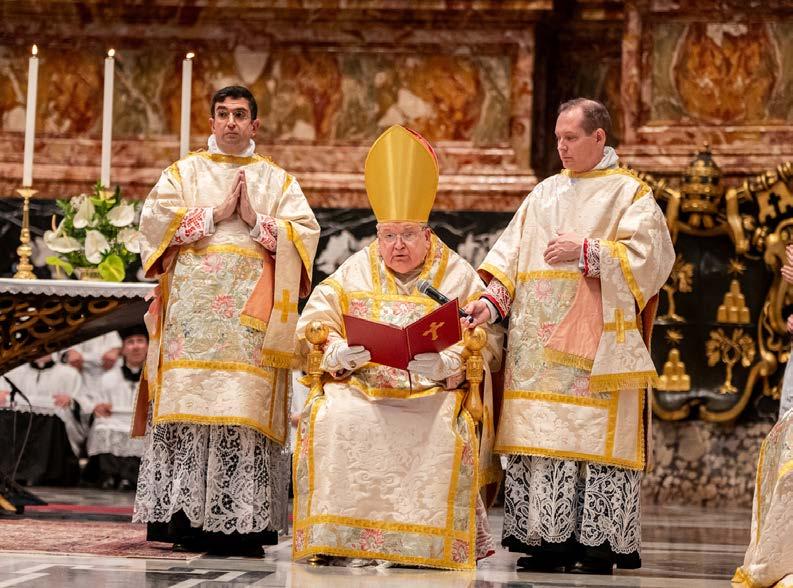
Cardinal Burke summarised these themes, offering the Mass for those who ‘safeguard and promote the beauty of the Usus Antiquior of the Roman Rite’. He continued, thanking God for the way this venerable form of the Roman Rite has deepened in the life of faith so many who have discovered its incomparable beauty. Linking the Immaculate Heart of Mary to Christ’s Kingship, he noted the anniversaries of the apparition of the Infant Jesus and Our Lady of Fatima, alongside the publication of Quas Primas by Pope Pius XI. He declared: ‘We, thereby, give witness to the truth that Our Lord Jesus Christ is the King of all hearts by means of the Mystery of the Cross and that His Virgin Mother is the mediatrix by which He brings our hearts to dwell ever more completely in His Most Sacred Heart.’
St Augustine reaffirmed the notion of growing closer to the Lord Jesus Christ through Mary, writing that the Virgin, ‘conceived in her heart before her womb’. For Cardinal Burke and the late Pope Benedict XVI, the liturgy goes beyond mere sentimental value; it is about adoring God ‘in spirit and truth’. Cardinal Burke continued, saying: ‘It [the Roman Rite] is the most excellent expression of our life in Him.’
The culmination of the liturgy, showcasing the fruits that the Roman Rite bears, was evident during the consecration of the Holy Eucharist This moment, marked by prayers
rooted in Apostolic times remaining unchanged since the era of Pope St Gregory the Great, drew pilgrims of all ages before Our Lord and King Jesus Christ, kneeling in adoration and awe. Seeing those of all ages kneel before the Lord to receive communion calls to mind Psalm 94, in which the Psalmist prays: ‘Come let us adore and fall down: and weep before the Lord that made us.’
After the reception of communion and the final Pontifical blessing, ‘Christus Vincit’ is chanted again, reiterating the fact that, ‘Christ conquers, Christ reigns, and Christ commands,’ as Cardinal Burke broke ranks and warmly embraced Cardinal Walter Brandmüller. This fraternal charity that unites us, particularly through the liturgy.
Unity is articulated by Pope Pius XI in Quas Primas. Let us repeat again his words: ‘Once men recognise that Christ is King, society will at last receive the great blessings of real liberty, well-ordered discipline, peace and harmony.’
This recognition of Christ as King births the Kingdom of God, as these words of His become true, ‘Take up my yoke upon you, and learn of me, because I am meek, and humble of heart: and you shall find rest to your souls. For my yoke is sweet and my burden light.’
A beautiful testimony
Dominic Bevan discusses Gregorian Chant with Dom Jean Pateau, Abbot of Fontgombault
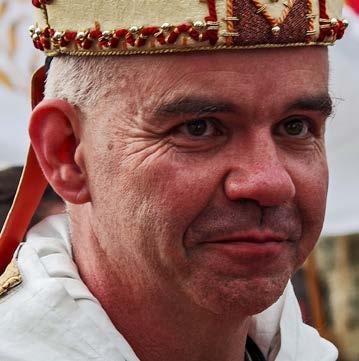
Father Abbot, could you describe your own musical journey from childhood, in particular concerning Gregorian Chant?
I was born in the Vendée, a place soaked in the blood of its people since the French Revolution; a people which asserted its freedom to practice Faith in God. From a young age I was imprinted with a Christian heritage that was clung to and lived daily by a practising Catholic family. Christian life was manifested by regular assistance at Mass, family prayers, and especially by Marian devotion. My brothers and I served Mass. I was educated in Catholic school and “Lycee” where the clergy made themselves available to the students.
Without being conscious of the fact, I received spiritual welfare during my teenage years which developed early on in my heart into a simple intimacy with God. My parents were not musicians, but my mother loved singing. On Sundays on returning from Mass the house was filled with music. My first real contact with music was the obligatory weekly hour at school. We learned the recorder. I was fascinated by the organ. We were friends with the parish organist who gave lessons. At 11 or 12 I began to learn the piano and then the organ at the local conservatoire. As soon
as possible I started to accompany the Mass at our parish church. At 15, I discovered that in our village an old priest was celebrating Mass sung in Gregorian Chant. As we were increasingly disappointed with our parish liturgy, the family decided to go along. The timing meant that I could do both. Then my brothers, my mother and I were asked to join the choir. We started then to learn Gregorian Chant and polyphony. The director of the choir was a friend of the Benedictine order and suggested that we visit a Benedictine monastery, and so I visited Fontgombault for the first time in June 1981. What are the fruits of those years? My brother is the current director of the Schola Saint-Grégoire in Le Mans, which is an international school of Gregorian Chant. For my part, I entered Fontgombault in July 1990 after postgraduate studies in Physics. Ordained to the priesthood in 1998, I was elected Abbot in August 2011.
In your experience, is there a difference between those brought up surrounded by sacred music and children and teenagers who listen to contemporary music?
To respond to this question, I would have to have had the experience of it. However, it is undeniable that the influence of Gregorian Chant and sacred music (Polyphony in particular) is much more positive than contemporary music. Gregorian chant
is a natural music. Its rhythm is natural, its melody simple and uncontrived; it speaks to men of all cultures, and is a profoundly humanising force. Instead of overexciting the senses and passions as does contemporary music, it spiritualises man, not by denying his nature but by sanitising it, simplifying it. Gregorian Chant doesn’t try to evoke our legitimate feelings of joy, sadness, doubt, tenderness, anger… these are considered to be the expressions of modern music. It does however express these feelings, not for themselves, but positioning them within the relationship between God and Man. It therefore rectifies them, giving them their true value. Deep down, the modern era can be characterised by living as if God does not exist, whereas Gregorian Chant re-centres Man towards God as his ultimate finality. And so, a question: do we wish to live on the surface of ourselves, or do we wish to go deeper, to that place where we might come face to face with God?
Could it be possible that early exposure to Gregorian chant influences people towards a monastic vocation, like yours for example or other monks in the community?
In my case there can be no doubt. Gregorian Chant is simple and humble. It forms a monastic heart. It is a simple song that has one purpose: addressing God by someone who seeks God. A monk, according to St Benedict, is a
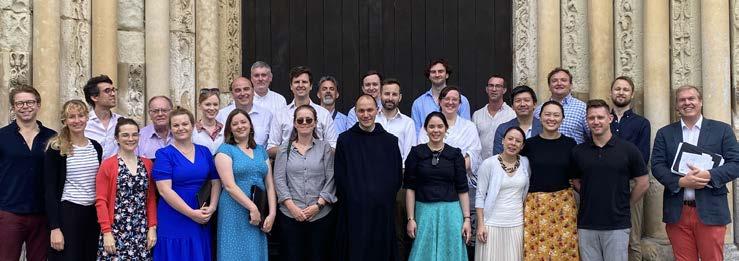
The Southwell Consort with the writer far right and Fr Jean-Baptiste Cazelle in the centre, Prior and Choirmaster of Fontgombault
Dom Jean Pateau
© William Edwards
© William Edwards
student in the school of service of the Lord. The two locations of this life are in the Divine Office and communal life. Gregorian Chant forms a major part of the Divine Office. So, day by day, it continues to mould the life of the monk and form him into a life of giving.
I find very apt the words of Dom Jean Claire during the 1985 international Gregorian Chant Congress, regarding the young people that had organised it:
These young people understand that to become sacred, music needs to be sacrificed to God, in both senses of the word sacrifice, which means both to destroy and to consecrate.
‘What needs to be destroyed is a certain consistency, a certain opacity of the sensitive element that constitutes precisely the seduction exerted on the soul by secular music, which focuses the attention and interest of listeners on itself. Sacred music, while remaining music, and beautiful music at that, must renounce being itself an object of admiration. What needs to be consecrated is the use, the destination, the sign value of this music, which will become the bearer of a spiritual message that goes far beyond itself, elevates it, raises it to the confines of the sacramental order, making it a powerful sacramental.
This is well said, and I believe it: Gregorian Chant is a true and powerful sacramental.
How would you describe the relationship between Gregorian chant and the liturgy? Interpretation, decoration, or something else?
Gregorian chant is an integral part of the liturgy; it is intrinsically linked to it. The liturgy is the prayer of the Church. Now, the Church is the Body of Christ, it is “Jesus Christ abundant and communicated,” according to Bossuet’s beautiful expression. At baptism, the Christian is grafted onto this Body; he becomes one with Christ and with the entire Body of Christ. His prayer is therefore called to unite, in the strict sense of the search for unity, with the prayer of the Church. Now, when she prays, the Church sings because, as Saint Augustine says, “singing is the characteristic of one who loves”. The Church sings in her liturgy to express
her faith and her love. And Gregorian Chant, “the proper chant of the Roman liturgy,” as Vatican II puts it, has been shaped over centuries in the Church to become the privileged means of this expression. It is the sung prayer of the Church. Gregorian Chant is closely linked, indeed essentially linked, to the Latin liturgy. Gregorian melodies were composed for the liturgy; they have no other reason for being. And they are composed to texts drawn primarily from the Word of God. It is God himself who speaks to us in the liturgy, who entrusts his Word to his Church to distribute to his children as the nourishment of their souls.
The proclamation of the Word of God is an integral part of the liturgical action. In the liturgy we have a Christian understanding of the Bible, in its most traditional and living commentary, and the liturgical use of Scripture illuminates it with a new light. Gregorian chant in turn contributes to this. One could say that Gregorian melodies give the Word of God its ecclesial interpretation. They make the Word “resonate” throughout our lives. Saint Augustine exclaimed: “My psalter, my joy!”
How would you describe the relationship between Gregorian chant and spirituality?
If by spirituality we mean the soul’s journey toward God, the way in which the soul, which is spiritual, encounters and unites with God, who is spirit, the relationship between Gregorian Chant and spirituality stems from its relationship with the liturgy. The purpose of the liturgy is to unite all the baptised to Christ, and through Christ to God. Gregorian chant is one of the great means the liturgy uses to achieve this. It is a matter of faith, charity, and theological life. By its simplicity, stripped back, Gregorian chant places us before God in an attitude of truth
and humility, pacifying our souls. This is perhaps the greatest service that Gregorian chant provides: it brings the peace that prepares us for the Lord’s visit.
But a beautiful testimony is perhaps worth more here than a long speech. I borrow it from Dom Gajard, the famous choirmaster of Solesmes, who reported the words of a laywoman: “To understand the benefits of liturgical life in my soul, you must know that I led a culpable life for a very long time. Thanks to plainsong and the liturgy, I have rediscovered a normal human life for twelve years. Slowly, progressively, there has been a disengagement from matter, from the senses, to arrive at the life of the spirit, at the knowledge of the Church, the Mystical Body. I have rediscovered the peace of balance that a life oriented towards its end gives. This balance came above all through rhythm. I rediscovered a human heart, I understood the meaning of the hierarchy of beings, their common dependence on God, and their subordination according to the divine plan.” Gregorian chant, by its very nature, introduces us to worship in spirit and in truth, the worship that the Lord demands.
How does Gregorian chant differ from other forms of so-called “sacred” music—polyphony? Viennese Masses (Mozart, Haydn and so on)? Traditional songs in vernacular? Chants in the “Taizé” style?
Gregorian chant is a musical genre in its own right, which is therefore immediately distinct from polyphony and other forms of sacred music. It is their ancestor; it is from it that these other forms of music were born. It is distinguished first of all by its musical line, monodic, stripped down, simple, which readily proceeds by conjoined degrees, which does not know chromaticisms. It is distinguished by its modality, very rich and varied. The ethos which emerges from it is much deeper and more spiritual than that of many modern melodies, because of the absence of all sentimentality. Gregorian chant does not seek emotion, but it reaches the soul in the deepest depths. It is further distinguished from more modern music by its natural and free rhythm.
All these technical aspects are at the service of the finality of the liturgy which is the sanctification of
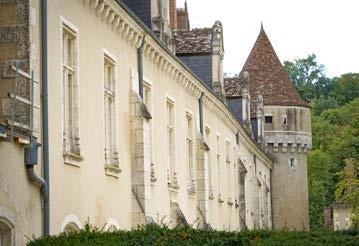
The abbey guesthouse, where the gentlemen of the choir stayed © William Edwards
men and the glory of God. Gregorian Chant excels in this regard, and all socalled sacred music can be of value in as much as it is inspired by Gregorian Chant, if not in its composition, then at least in its spirit.
This is not to exclude all other forms of music, but rather to keep in mind that Gregorian Chant remains the proper chant of the Roman liturgy, that is, the sacred song par excellence of the Latin Church, the chant that most surely leads us to the heart of the mystery being celebrated. Simone Weil stated: “Gregorian Chant is both pure technique and pure love, like all great art.”
How do you respond to critics who would say that Gregorian chant is inaccessible to modern man, to the modern child, and is unsuitable for the faithful to participate in the liturgy?
The three notes, according to the Magisterium of the Church, of all authentic sacred music are holiness, beauty, and universality. By universality, we must understand the ability of music to touch people of all times and places. Yet, it is clear that this is precisely what Gregorian Chant does. It is sung and enjoyed in Africa, Asia, America, and Europe. It has been attracting people for centuries, because through this chant, it is God himself that man encounters. It is not Gregorian chant that is inaccessible to modern man; it is modernity that cuts man off from this chant, because it cuts man off from the depths of spiritual life. It scatters him on the surface of himself. Modern man lives far from
humanity, from what would make his humanity truly great.
We live most of our time missing the essential. Gregorian chant is capable of awakening the sleepiest hearts and leading them to God. We just must not voluntarily close ourselves off. Modern man is dying of thirst, of a spiritual thirst. Gregorian Chant is a source of living water that can quench one’s thirst.
As for the active participation of the faithful, Gregorian chant is not an obstacle, nor is Latin either. Active participation should not be understood as an obligation to do something during the liturgy. The Latin expression participatio actuosa could be translated as actual, or active, participation, as opposed to passive attendance at the liturgy. This active participation essentially consists of making oneself present with one's whole being to the mystery being celebrated, drawing from the great prayer of the Church, the liturgy, the understanding of the mysteries of salvation that will deeply nourish the soul. The faithful therefore participate actively by singing but also by listening or praying in silence. If the goal of active participation is to draw the faithful deeper into the mystery being celebrated, Gregorian Chant, which involves singing the liturgy itself, is wonderfully suited to actively involve the faithful. A Gregorianist wrote: “The paradox of depriving the faithful of the very texts of the liturgy in order to increase their participation in it has something fundamentally contradictory and even totally irreconcilable about it.” And again: “The chants should be those of
the liturgical texts themselves, and not improvisations whose connection to the current liturgy is only distant and problematic.” In a word, Gregorian chant involves the faithful in the liturgy because it opens up to them the treasures of the liturgy itself.
Finally, what advice do you have for lay people seeking to promote Gregorian chant in their parish?
Two words: courage and patience. First of all, it takes courage to persevere, to learn Gregorian Chant. Gregorian Chant does not reveal its secrets at once. The ancient monks said that it took ten years to train a cantor. Gregorian Chant does not tolerate mediocrity, like all true music. Therefore, one must work hard and not become discouraged. Performing Gregorian Chant requires the acquisition of true knowledge. Patience too; it takes time. We could apply to Gregorian Chant what Saint Gregory said about spiritual pleasures. Unlike sensible pleasures, which are immediately desired, but once tasted, leave one unsatisfied, spiritual pleasures do not immediately provoke our desire, but once tasted, they are increasingly desired. Therefore, a certain education is required, not only in music, but especially in the spiritual life, to appreciate and make others appreciate Gregorian chant. But it is truly worth the effort. It is striking to note that lay people who regularly and seriously practice Gregorian chant in their parishes develop a profound Christian life. The purpose of Gregorian chant is not aesthetic, but is above all prayer.
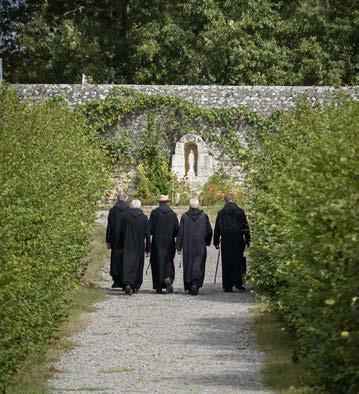
Monks on recreation after lunch, snapped by William Edwards during a tour by kind permission of the Abbot
© William Edwards
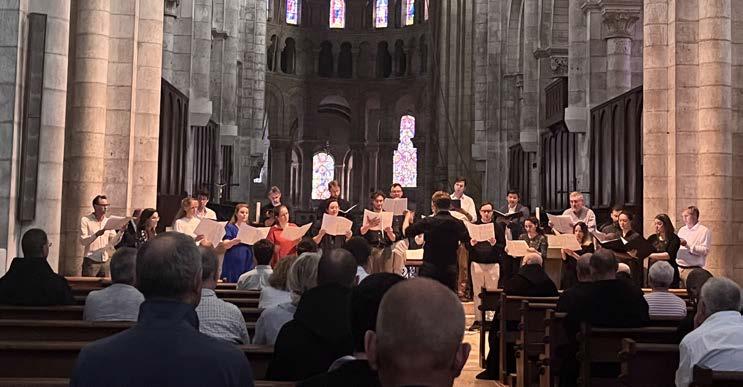
The Southwell Consort singing a recital of the music of Byrd for his 400th anniversary for the monks of Fontgombault, directed by Toby Ward
© William Edwards
Another country
Daniel Beurthe reviews a collection of verse by LMS Patron Sir Edward Leigh
Sir Edward Leigh’s life has been one of Churchillian amplitude. Currently Britain’s longestserving Member of Parliament, he nevertheless found time before embarking on his near half-century in the Commons to fit in careers at the Inner Temple, the Chartered Institute of Arbitrators, and the Honourable Artillery Company.
Storied as these accomplishments may be, one imagines him reflecting on them with a certain dissatisfaction, perhaps even looking to his wife and exclaiming the words of Prince Hal: “Fie upon this quiet life! I want work.” How else to explain the latest turn in his protean career: while continuing to serve his Gainsborough constituents, recent months have also seen him publishing a book of poetry.
Another Country is, in Sir Edward’s words, “a kind of meditative lectio divina within the discipline of the sonnet form”. For three years, he wrote a sonnet and a haiku every day, reflecting on the daily Mass readings. The book collects those written for Sundays, major feasts, and Easter seasons; the full corpus appears on his blog – anothercountry.edwardleigh. org.uk
Those approaching this work in search of sonnetic innovation à la Shakespeare or Petrarch will be disappointed. Leigh himself is disarmingly frank: “I claim no credit for poetic or literary skill.” But that is not the point of the book. Rather, its merits lie in its heartfelt engagement with Scripture’s poetic symbolism, and the application of this to everyday life.
On the day I called you answered
You increased the strength of my soul.
What is doubted should, but seldom I revered.
What wearies me should, but does not relieve my toil.
I had a nightmare in the night
My wife’s gentle touch had to calm me.
Long hours passed before a dim first light
When it came to hope, I could not hear or see.
The Mass today was barely understood.
The church at Combloux was crowded.
The Communion seemed to give no spiritual food.
Then I stared at the stained-glass window, light framed
And now in its Jesus translucence I seemed at last to see sense.
As throughout the collection, the opening couplet comes from the day’s Mass reading (here Psalm 137), with the next developing the idea. Subsequent stanzas may diverge into personal reflection before the final couplet returns to the scriptural source. The page then concludes with a haiku distilling the theme. In this instance:
I called, you answered
And you increased my soul’s strength
From doubt to some faith
This page is notable for inverting Leigh’s usual practice: the sonnet is loose in rhyme and syntax, while the haiku offers a simple benison. More typical is the adjacent poem’s winsome style:
The Latin Mass was beautiful
But barely audibly
It was all a bit dutiful
If thoroughly laudable
Leigh’s subjects throughout the anthology include everything from the debate around epistemological dualism, to the emotional toll of Covid restrictions, the transience of news cycles, and the workaday to-ings and fro-ings of life.
The significance of all this lies in the relation between Leigh’s musings and the readings from which they spring. By using the opening Scriptural couplet to illuminate both
philosophical meditations and the (often frustrating) minutiae of daily life, we see Leigh laying out a blueprint for how the Faith can be a source of guidance and consolation.
Leigh’s Catholicism is not just something confined to the formalities and rituals of Holy Mass, to be visited when occasion demands and then forgotten. Instead, it is what gives meaning, shape and profundity to even the most quotidian of events and feelings.
Givemeyourhand,putitintomyside. Doubt no longer but believe …
I woke with a feeling of happiness
After I had rested in the present now of being.
We can get rid of this eternal doubting restlessness
From past and future, a temporary freeing.
Here we see the most striking aspect of this collection: one of Britain’s preeminent statesmen, a former Minister in Thatcher’s Government no less, inviting us into his private life, sharing with us his triumphs and setbacks, his moments of doubt and disillusion.
Father of the House. That is the title given to the longest serving Member of Parliament. With the publication of Another Country, Sir Edward extends his paternal counsel beyond the limits of the Commons floor, reaching his readers as he lays bare his own troubles to show how Scripture, and a devotion to Daily Mass, can serve as instruments of sublimation, and as guides to life.
Factfile
Another Country by Sir Edward Leigh is published by St Pauls Publishing at £11.99. Copies are available from Amazon.
Half the proceeds of the book go to Aid to the Church in Need.
Notre-Dame du Val-de-Grâce, Paris
Paul Waddington looks at an impressive new venue for the Latin Mass in Paris
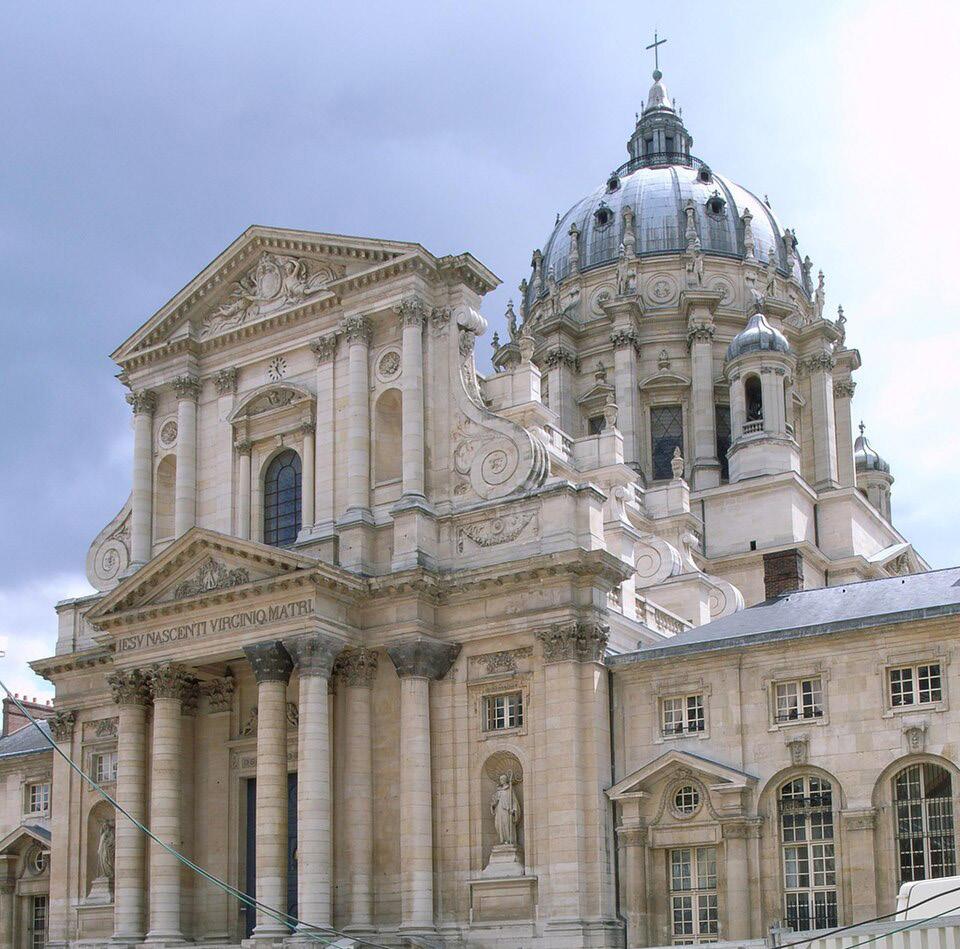
One of the most spectacular churches in the whole of France is the Église Notre-Dame du Valde-Grâce in the fifth arrondissement of Paris. It was built in an Italianate style between 1645 and 1665 for Anne of Austria, the Queen of France, and wife of King Louis XIII.
Anne of Austria was a Spanish Princess who became the Queen of France in 1615 when, at the age of only thirteen, she married Louis XIII. Six years later the queen purchased a chateau just outside Paris, so she could have a place of retreat away from the busy lifestyle and intrigue of the royal residence at the Louvre Palace. She installed a community of Benedictine nuns in the chateau, while retaining an apartment within it for her own use. In 1634, the queen decided to build a new abbey church for the community, but the project stalled because Anne had fallen from the King's favour, largely due to her failure to deliver him an heir. However, following several miscarriages, and after twenty-two years of marriage, Queen Anne gave birth to a son, the future Louis XIV. In gratitude for his birth, Anne pressed forward with the plan to construct the new abbey church, and added new conventual buildings for the growing community of nuns.
A few years later in 1643, Louis XIII died, and the four-year-old Louis XIV assumed the throne of France, with Anne becoming the Queen-Regent. In these changed circumstances, the Queen-Regent was free to realise her dreams of a spectacularly fine abbey church. The first stone of the new church was laid in 1645 by Louis XIV, then still a child.
Anne engaged François Mansart as the project's architect, but he departed after only a year in disagreement over the scope and cost of the project. Mansard's place was taken first by Jacques Lemercier, then Pierre Le Muet and finally Gabriel Le Duc, who eventually completed the project in 1665. Queen Anne moved into her
apartment within the rebuilt Convent of Val-de-Grâce after the birth of her first grandchild. She died a year later at the age of 65, no doubt rejoicing that a project that had occupied most of her adult life had been brought to a conclusion.
As a result of the French Revolution, the Benedictines nuns were expelled from the abbey in 1793, and it was ordered that all royal symbols and references be removed from the buildings. Much of the furniture, including the High Altar and the organ, were lost, although, perhaps surprisingly, the baldacchino survived. The convent was converted into a military hospital, and later into an institution for training doctors and nurses for military service. Finally, in the twenty-first century it was
converted into a museum of military medicine.
In the early years of the nineteenth century, control of the church was returned to the ecclesiastical authorities, eventually coming under the control of the Ordinariate for the French Military. The Emperor Napoleon III was responsible for restoring the church to its prerevolutionary condition, including the rebuilding of the High Altar.
Modelled on St Peter's
The dome of Val de Grâce reaches a height of 40 metres and dominates the skyline of the Latin Quarter of Paris. The design is the work of Jacques Lemercier, and very closely modelled on the great dome at St Peter's Basilica in Rome, although on a smaller scale.
Val de Grace showing part of the convent on the right
Like its Roman counterpart, it is surmounted by a lantern and cupola. The drum that supports the dome features no less than sixteen windows, which provide plenty of light for the central area of the church.
The other spectacular feature of the exterior of the abbey church is the western facade, which overlooks a wide paved area. It was modelled on the Church of the Gesú in Rome, which had been built in 1584. In both cases, the facade is arranged in two orders, each order having its own row of Corinthian columns which support an
entablature and triangular pediment. The upper order is braced by volutes (curved buttresses) in the manner of many Roman churches. In the case of Val-de-Grâce, the pediments are decorated with the royal coat of arms and the monogram AL, standing for Anne and Louis. The tall facade is flanked by the conventual buildings which have lower roof lines.
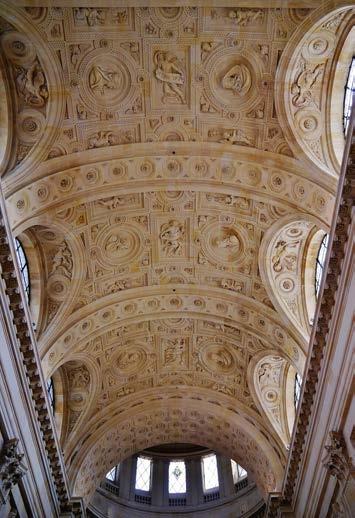
The interior of the church was built in an Italian baroque style. The nave has a floor of white, black and red marble from which rise colonnades formed of substantial square pillars with floriated capitals. The spandrels between the pillars are decorated with sculptures and reliefs. Above is an entablature from which springs a barrel ceiling. The plasterwork of this ceiling is one of the finest aspects of the whole church.
Baldachino
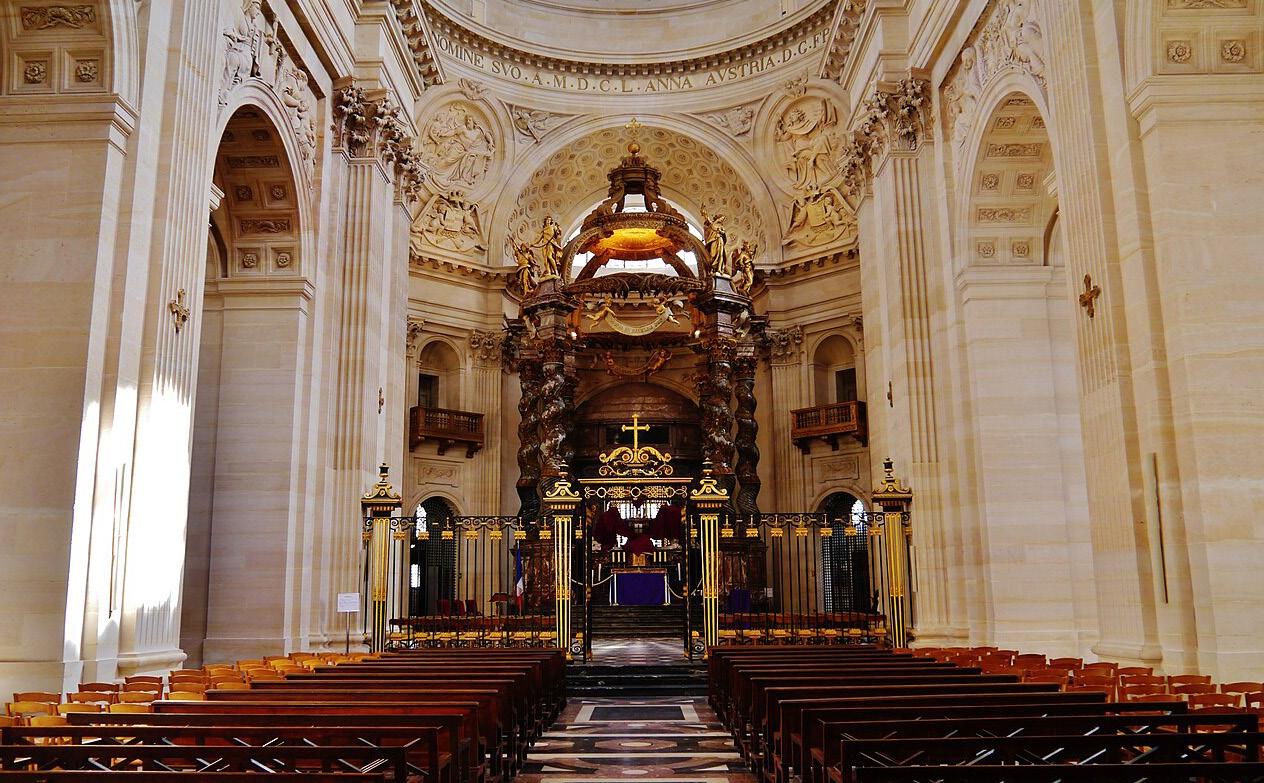
A semicircular apse at the east end provides the setting for the most spectacular and distinctive feature of the church's interior. Gabriel Le Duc designed a baldachino, which is clearly inspired by Bernini's masterpiece in St Peter's Basilica. It stands on a raised dais which extends into the crossing. The baldachino has six twisted columns of black marble supporting a domeshaped crown. It is heavily decorated and features four gilded angels.
Within the baldachino is the High Altar, which was restored by the Emperor Napoleon III; and on the
gradine behind the altar is a nativity scene, consisting of three sculptures depicting Our Lady, Saint Joseph and the infant Jesus in the manger. Carved in white marble, these figures are replicas of the originals, which were removed at the time of the French Revolution.

Above the crossing is the church's best-known piece of artwork - the fresco painted on the interior surface of the dome by Pierre Mignard in 1666. It depicts more than 200 characters gathered in heavenly glory. Among the characters are many identifiable saints, as well as Queen Anne herself.
It was announced in November 2025 that the abbey of Val-de-Grâce will host a Latin Mass every Sunday at the unusually late hour of 8.30pm. It will be offered by a priest of the French Military Ordinariate.
The Sanctuary with Baldacchino
© Myrabella
The Dome and Fresco viewed from below
© Zairon
The nave ceiling
© Zairon
More than mere atoms
Sebastian Morello on the delights of
Saffredi
2019 Fattoria le Pupille
Democritus in the 4th century BC was the first person in the West, as far as we know, to teach us that the world we experience is not what it appears to be, but is really lots of atomic formations in a continuous field of atoms.
In Democritus’s view, everything –us included – is just a conglomerate of scentless, colourless atoms contiguous with the great mass of atoms that make up the whole universe. When you eat something, therefore, whatever you taste is just a mental projection onto masticated lumps of atoms.
Such a view of the world received no notable following, for no one in the ancient world was stupid enough to believe this nonsense. Not until the modern age were people sufficiently senseless to find such a theory compelling.
It is surprising that Italy, a land celebrated among other things for its wonderful cuisine, should have given us a great champion of atomism. After all, as the food example above indicated, the atomist’s worldview renders gastronomical achievements mere feats of illusionism.
Modernity discarded from our account of reality all qualities in favour of pure quantity, consequently banishing all that is lovable, meaningful, and purposive about our world.
Why the atomist’s opinion should be trusted, given that the opinion itself is supposedly the product of predetermined atoms, was a problem yet to be addressed. This problem was solved a generation later, if indeed a solution it can be called. An arrogant and lazy Frenchman called Rene Descartes claimed that there was one entity that could not be reduced to quantitatively measurable atomic formations, and that entity was the “interior self”, for which his term of art was “the thinking thing”, or res cogitans.
The late Professor Wolfgang Smith devoted much of his life to showing
that the physical world – the world measured by the physicist – and the corporeal world of our experience should not be conflated, and how the latter is inestimably more real than the former.
Studying those robust arguments advanced by Smith and others will do those with inquisitive minds much good, as such studious undertakings have greatly aided me. But of late I have been reminded of the fast-track method to recovering the corporeal world of our experience, a world imbued with layer upon layer of qualitative dimensions by which we behold creation as God’s marvellous declaration of Himself. Obviously, I speak of wine.
Wine successfully disabuses us of the atomist’s error. It does so by revealing that matter is a bearer of qualities, so diverse and manifold that
we intuit – when drinking a good wine – that much of its intricacy remains hidden from us. When enjoying a fine wine, the complexity of the wine’s body and bouquet combine to place the giftee between an ecstasy and a swoon.
When imbibing a fine wine, we are in the presence of a concentrated form of the whole cosmos, because by some viticultural alchemy, quality upon quality has emerged from what is no longer grape juice but potion.
I have left behind me the years of drinking bad wine. Now, I only drink very good wine, which I generally cannot afford. In turn, I drink wine rarely. But when I do, boy is it good.
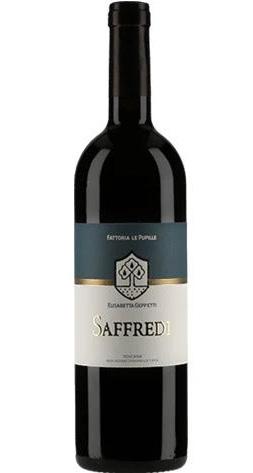
I was therefore delighted when I attended a dinner at a friend’s home recently during which a mutual friend who joined us delivered from his satchel a bottle of Saffredi 2019 Fattoria le Pupille. At around £100 a bottle, plonk it is not.
A Cabernet Sauvignon and Merlot blend with a drop of Petit Verdot mixed in, this is a classic, full-bodied, very Italian red. After 18 months of barrel ageing, when opened, dark berry aromas explode on the nose, tinted by complex notes of vanilla and aromatic herbs on its pure, long finish. Think black cherries and cream combined with all the spices that evoke Christmas celebrations. Those who take pompous wine-speak to the next level describe this wine as characterised by “crushed stone”.
However naked the emperor may be at the end of that description, such waffle nonetheless indicates something: wine is a drink capable of possessing such depth that it evades a precise report, with any attempt to convey its secrets making us all look silly. Indeed, were the taste of it a mere mental projection, supposedly the projecting mind would be capable of communicating it. Thus, behold, in the bottle is found the ultimate refutation of materialist reductionism. So, bottoms up!
Sacred stillness
Joseph Jarvis on encountering Christ’s presence
As St Augustine reflects in his Confessions: “You have made us for yourself, O Lord, and our hearts are restless until they rest in Thee.” This eternal truth reveals the deep longing of every human soul -a longing fulfilled in Christ, the Word made flesh, who continues to dwell among us in the Eucharist.
In Colossians 1:15, St Paul proclaims Christ as, “the image of the unseen God, the first-born of all creation, the first to be born from the dead”. Through the eternal Word, all things were made, and by His Cross, all things are reconciled.
At the Nativity, the shepherds bowed in wonder, and at the Epiphany, the Magi knelt in adoration. We too come before the same mystery: Et Verbum caro factum est (“And the Word became flesh,” John 1:14). At the Cross, sorrowful hearts knelt to behold the fullness of divine love: Et consummatum est (“It is finished,” John 19:30). Each event reveals Christ as the humble God who became man, the suffering Saviour who bore our sins, and the risen Lord who offers eternal life.
At every Mass, by the power of the Holy Spirit and the words of consecration spoken by the priest acting in persona Christi, the bread and wine are transformed into the true Body and Blood of Jesus Christ - a mystery the Church calls transubstantiation. Though the appearances of bread and wine remain, their substance becomes Christ Himself, fully present in His body, blood, soul, and divinity. The same Jesus who offered Himself on the Cross now offers Himself anew in love. He is not distant but continually makes Himself present to us in every celebration.
Each Mass is a living encounter with Him, inviting us to bring our hearts just as they are. The encounter we begin at the altar does not end with Mass - it continues in Adoration. In the midst of life’s fast pace, we can come before the Lord with all that fills our minds and hearts, opening ourselves to the peace only His presence can give. After Mass,
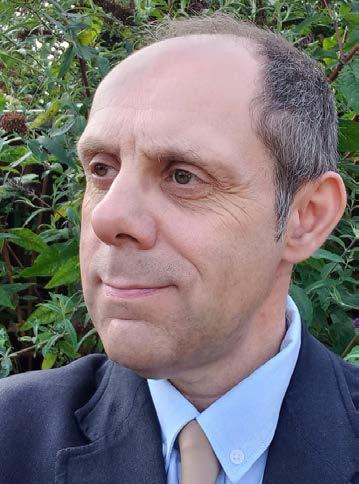
That encounter drew me back again and again, ultimately leading me to embrace the Catholic faith
we might linger a little longer with Him, letting His love quiet our hearts.
The Catechism of the Catholic Church (CCC 2628) teaches that: “Adoration is the first attitude of man acknowledging that he is a creature before his Creator. It exalts the greatness of the Lord who made us and the almighty power of the Saviour who sets us free from evil. Adoration is homage of the spirit to the King of Glory, respectful silence in the presence of the ever-greater God. Adoration of the thrice-holy and sovereign God of love blends with humility and gives assurance to our supplications.”
Adoration is more than simply spending time in church; it is an intimate encounter with the One who loves us completely, extending the encounter begun at Mass and inviting us into a personal, transformative communion with Christ.
When the consecrated Host is reserved in the Tabernacle or exposed in the monstrance, we are invited to draw near to the same Jesus who lived, suffered, died, and rose again - and who now dwells sacramentally among us.
I experienced this reality even before my conversion, during a visit to the Church of Our Lady of the Assumption and the English Martyrs in Cambridge. In that quiet, sacred space, I experienced something I had not known in the Anglican church: a gentle, unmistakable awareness of Christ’s presence. That encounter drew me back again and again, ultimately leading me to embrace the Catholic faith.
Love seeks presence. Just as we long to linger with those we cherish, our hearts yearn to rest in Christ. In a world full of noise and distraction, Adoration offers a sacred stillness where God speaks to the heart. In this quiet, His love reshapes us, allowing us to hear His voice and to open our hearts to His guidance. St John Vianney once noticed a man sitting quietly in church. When asked what he was doing, the man replied: “I look at Him, and He looks at me.” That simple gaze captures the essence of Eucharistic Adoration - encounter rather than accomplishment, love rather than duty.
In His presence, we may pray with Scripture, offer thanksgiving, present our spiritual and temporal needs, or contemplate Him for who He is: “I Am.” In the Eucharist, we encounter Christ’s presence, rooted in the eternal God revealed in the Old Testament. God’s declaration to Moses, “I am who I Am” (Exodus 3:14), echoes in Jesus' words, “Before Abraham was, I am” (John 8:58), affirming His divinity. Jesus, the bread of life (John 6:35), offers Himself as our source of eternal life.
As we encounter His presence in the Eucharist, may His love transform us, enabling us to radiate His light, love, and peace into every corner of the world.
The meaning of sacrifice
Fr Thomas Crean on Lent
The Council of Trent teaches us that, by the ordinance of God, “sacrifice has existed in every law” (Decree on the Sacrament of Orders, preamble). By “law”, here, they are referring not to human law-codes, but to the different stages of sacred history, or of salvation history, as people often say today. St Thomas Aquinas explains that we can know by reason alone both that we are subject to a higher Being on whom we depend, and that we should offer certain visible things to this Being, in token of our subjection (Summa Theologiae, 2a 2ae 85.1). In this sense, the duty of sacrifice belongs to natural law. Whether we think of the new covenant under which we Christians live, or of the law of Moses, or of the covenant made by God with Noah, or further back still, sacrifice has always been necessary. Theologians even consider that had Adam remained unfallen, he would still have had to offer sacrifices, in thanksgiving for paradise, and to glorify the God who had placed him there.
But what exactly is sacrifice? Aquinas observes that it is a more precise term than “offering”. In the Old Testament, some things were offered to God, which are not reckoned among the sacrifices, such as the first-fruits of the harvest. For example, in the Book of Numbers, the Lord says to Aaron the high-priest: “The first-fruits, which the children of Israel shall vow and offer, I have given to thee, and to thy sons, and to thy daughters, by a perpetual law. He that is clean in thy house, shall eat them. All the best of the oil, and of the wine, and of the corn, whatsoever first-fruits they offer to the Lord, I have given them to thee” (Num. 18:11-12). The Israelites would place all these things in a basket before the altar, but nothing more would be done to them. They were offerings to God, but not strictly sacrifices.
For an offering to become a sacrifice, something sacred must be done to it. The word itself indicates this: sacrificium, in Latin, comes from sacer, sacred, and facere, to do or make. Thus, in the Law of Moses, when an animal was
sacrificed, its blood was poured out at the base of the altar, and its fat was burned up; depending on the purpose of the sacrifice, some or all of the flesh might be burned too. Unbloody sacrifices were also offered in the tabernacle, and later in the temple: if grain, some would be burnt on the altar and the rest given to the priests; if wine, it was poured out at the altar’s base, “a divine odour to the most high Prince” (Ecclus. 50:17).
It is obvious that all these forms of sacrifice involved a kind of destruction. The flesh or wheat that has been burned can no longer serve as food; the wine that is poured out can no longer be drunk. Although the point is sometimes disputed, it seems that some element of destruction is intrinsic to sacrifice. The fundamental purpose of the act is to testify to God’s total sovereignty over creation, and how else can we do this except by taking hold of some created reality and then putting it irrevocably beyond our reach?
‘So, Christ came to achieve what the old sacrifices could not’
Our catechisms explain that sacrifice has four principal ends, all of which flow from this fundamental recognition of divine sovereignty. The first end is adoration, by which we yield ourselves without reserve to God as our maker. The second is thanksgiving, since every best gift, and every perfect gift, is from above (Jas. 1:17). The third is the expiation of sin, for without shedding of blood there is no remission (Heb. 9:22). The final one is to seek the further blessings that we need, or that we think worthy to be desired.
Accordingly, in the Law of Moses, many different kinds of sacrifice were instituted by God for these different purposes. There were the whole burnt offerings (‘holocausts’), especially indicative of adoration. There were the peace-offerings, of which some were made in thanksgiving for favours received, and other apparently petitioned for favours to come. All these were matters of voluntary piety. Then there were sacrifices binding on individual Israelites in certain circumstances: the sin offerings by which they atoned for various kinds of negligence, and the guilt offerings, when they had offended against holy things. And some sacrifices were made for the nation as a whole: the spotless lamb offered each morning and each evening, and the animals offered on the Day of Atonement each autumn. The Book of Leviticus describes these things in detail.
The Old Testament sacrifices were not pointless. God disposed that they would help protect His people from the temporal effects of their sins: if the Israelites had always been faithful to their law, they would not have suffered the disasters of exile and foreign occupation. And for those of the people who possessed the virtue of supernatural faith, these sacrifices expressed their hope that one day God would come to cast all our sins into the bottom of the sea (Mic. 7:19).
And yet, it is impossible that with the blood of oxen and goats sin should be taken away (Heb. 10:4). So, Christ came to achieve what the old sacrifices could not. In the book of psalms, we read: Sacrifice and oblation thou wouldest not: but a body thou hast fitted to me. Holocausts for sin did not please thee. Then said I: Behold I come. St Paul tells us that these words express the dispositions of our Lord’s heart when He first came into the world, that is, at the Annunciation (Heb. 10:5-7).
Jesus could have atoned for sins in many ways. Abstractly speaking, He did not need to suffer to do so. Since His human heart is the heart of a divine
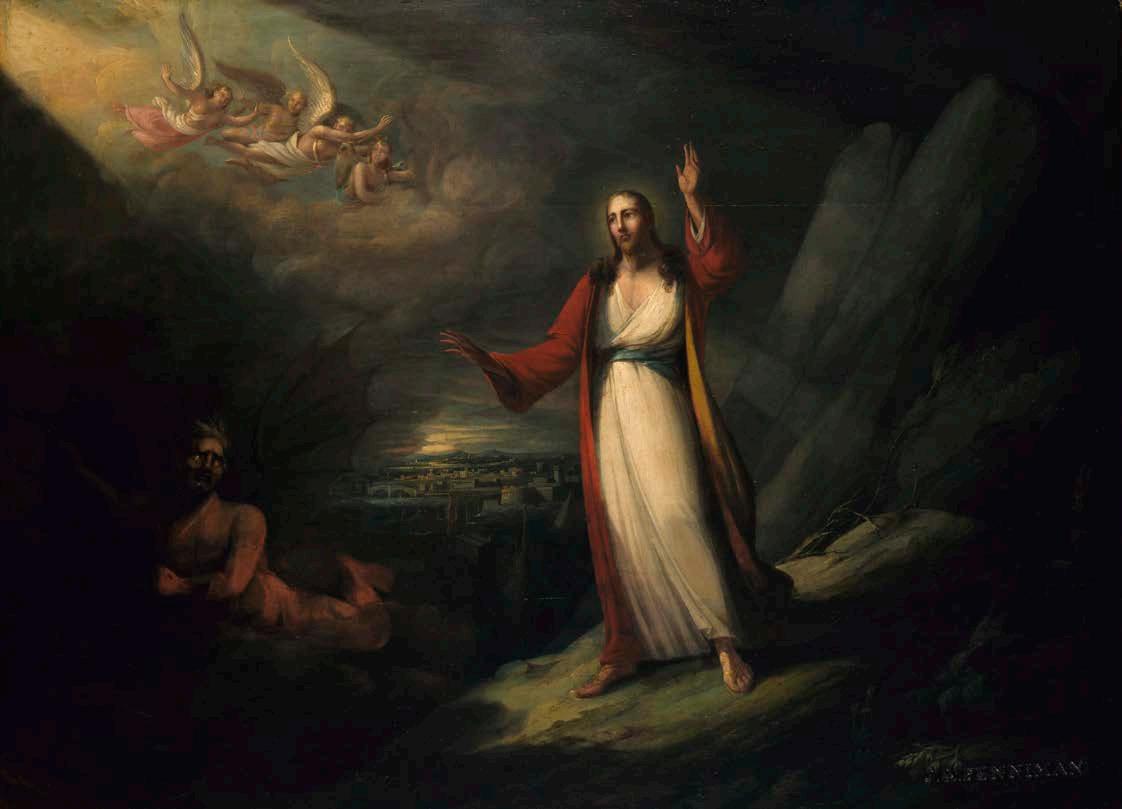
Person, one act of love on His part is more pleasing to His Father than all human sins are displeasing. One such act, therefore, even unaccompanied by suffering, would have been sufficient satisfaction for sin, had God so willed it.
Yet in fact, the will of God was that the Son should make satisfaction by both love and suffering: in other words, by sacrifice. The Lord was pleased to bruise him in infirmity, foretold Isaias: if he shall lay down his life for sin, he shall see a long-lived seed (Is. 53:10). Our Lord confirmed this ancient prophecy with His own lips: I lay down my life, that I may take it again. This commandment have I received of my Father (Jn.10:17-18).
Doubtless, we should beware of a caricature of this doctrine, which we find sometimes in Protestant circles. The New Testament does not tell us that God the Father “poured out His wrath” upon His beloved Son. And it would be blasphemous to say that Christ became a sinner instead of us. When St Paul says that God made him to be sin who knew
no sin (2 Cor. 5:21), he is playing on the two meanings of the word hamartia, which in biblical Greek can mean both sin and the sacrifice offered for it.
It was by charity that Christ made satisfaction. But God the Father willed that He should do this principally by surrendering the greatest thing that could be surrendered. What would this be if not His own sacred humanity, destroyed on the Cross? God spared not even his own Son, but delivered him up for us all (Rom. 8:32).
In Lent, more than at other times, we unite ourselves to this Sacrifice. Since Christ is the head of the mystical body, and we are His members, we naturally participate in His life and actions. Moreover, it’s a dogma of faith that not all the penalty due to our sins is always remitted when sins are forgiven in confession. It’s also a dogma that we can make satisfaction for the penalties that remain, through the merits of Jesus Christ, both by patiently accepting the sufferings of life, which come
ultimately from divine providence, and by other works that we voluntarily assume, in particular, by “fastings, prayers, almsdeeds [and] other works of piety”. For this reason, the Church has anathematized the claim that, “the best penance is merely a new life” (Council of Trent, Decree on Penance, canon 13).
Of course, penance is worthless without love. But just as even our Lord’s own charity did not in fact save us without the Cross, so we as His disciples take up our immeasurably smaller crosses in order to be saved. We must so to speak destroy some part of ourselves or of our possessions by sacrifice.
Finally, just as His Passion was not only an expiation of sin but also a supreme act of adoration, so also, Trent assures us, the penances by which we in Christ “redeem our sins” are themselves part of our “worship of God” (canon 14).
As Christ glorified His Father by dying, so may we glorify the Trinity by our sacrifices this Lent.
Self-denial helps us overcome temptation as Christ resisted the temptations of the Devil, re-imagined here by American artist John Ritto Penniman © Smithsonian American Art Museum

MINIATURE EMBROIDERED MITRES COURSE
14 March 2026. (Registrations close 7 March)

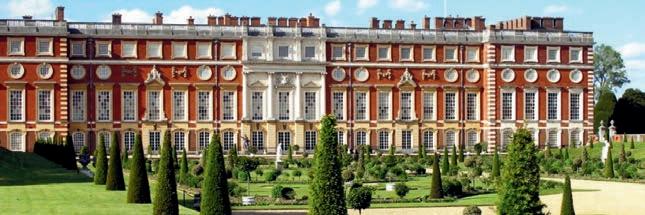
The Guild of St Clare is collaborating with the Royal School of Needlework to provide a special course making miniature embroidered mitres.
This is a unique opportunity to learn how to make a mitre using traditional hand construction techniques, in the beautiful setting of Hampton Court Palace.
The date is 14th March 2026, and the course will run between 10am and 4pm. The cost, including the materials, is £196.
Register through the LMS website today:
LMS.ORG.UK/MITRES2026
The old lamp post
Traditional Catholicism must not be understood as an effort to roll back compassion, as James Preece explains
Many readers will be familiar with GK Chesterton’s story about the crowd of people in the street who decide to pull down an old lamp post. The deed is done in just a few minutes but then they begin to run into problems - they all had different reasons for demolishing the lamp. Some of them wanted to take the old gas lamp down in order to replace it with an electric light, others wanted to use the old iron for something else. Some sought to improve it while others preferred darkness, because their deeds were evil. As they argue among themselves, Chesterton wryly concludes: “what we might have discussed under the gas-lamp, we now must discuss in the dark”.
You might expect me to quote this story in reference to the Second Vatican Council - and you would have a point. A great crowd of Bishops agreed to have a “liturgical reform”, but alas, did not appear to be entirely agreed on what such a “reform” might involve. Sacrosanctum Concilium said that “holy Mother Church desires to undertake with great care a general restoration of the liturgy” that “use of the Latin language is to be preserved” but, somehow, we ended up with clown Masses and communion in the hand. Clearly not everybody involved was on the same page.
The moral of the story is to always have an eye on one’s bedfellows and here I think Traditional Catholics need to be a little more discerning. A crowd in the street wishes to pull down the “lamp post” of 1960’s liturgical reform. Some of them because they miss the Octave of Pentecost, others because they appreciate the silence, or the orientation of liturgical prayer, or because they see the Mass primarily as a sacrifice rather than a meal, or just a general sense that the Novus Ordo Mass fails to provide a holistic experience that speaks to the soul on a sensory as well as intellectual level and the Traditional Mass is a richer experience.
‘…tradition carries forwards through the ages; it has something to say to the Saxons and something to say about Star Wars’
But there are others in the crowd. People who think the new Mass represents a level of mercy, forgiveness and loving our neighbour that simply goes too far. Some readers will be familiar with the Mitchell and Webb sketch “Are we the baddies?” in which two soldiers in a trench come to an alarming realisation about their uniforms. They’ve got skulls on them. I had a similar experience recently when I saw a Traddy article about the incoming Archbishop of New York Robert Hicks in which the good news was that he appears to be supportive of allowing the Traditional Latin Mass to continue in the diocese and the bad news was that he has called for the humane treatment of migrants. Yay Latin Mass! Boo Humane Treatment! Is that who we are?
Some Traditional Catholics will be annoyed that I’m approaching this subject. Do I not risk providing ammunition to opponents of the Latin Mass? It’s not our fault if a few racist, anti-semitic, misogynistic, conspiracy theory types call themselves Traditional Catholics. No, it’s not our fault - but it is our problem. If people are making fizzy grape juice and calling it Champagne then sooner or later the Champagne makers need to speak out.
It comes down to this: the Second Vatican Council did not invent forgiveness. Pope Francis did not have a monopoly on merc. It is simply not the case that the Church from St Peter to Pius XII existed to weigh down men with burdens until finally in the 1960s the Holy Spirit moved men to finally consider that they might be their brother’s keeper. It must therefore be said that Traditional Catholicism is not, cannot, must not ever be understood as an effort to roll back compassion. If you are under the impression that Traditional Catholicism is the excuse you need to hate Jews, Muslims, homosexuals or people with a different skin colour - I’ve got news for you. It isn’t. You can cut that out right now. To quote the Catechism of the Council of Trent: “every man, be he enemy, stranger or infidel, is our neighbour”.
We are not here to pull down the lamp post of the 1960s and get everything back the way it was warts and all. We do not yearn for racial segregation and polio. On the contrary - tradition carries forwards through the ages; it has something to say to the Saxons and something to say about Star Wars. We love the Old Mass because we love Our Lord Jesus Christ who said: “I was hungry and you gave me food, I was thirsty and you gave me drink, I was a stranger and you welcomed me”. “Truly, I say to you, as you did it to one of the least of these my brethren, you did it to me.”
Creation and Fall
Caroline Farey on a remarkable 16th century Russian icon
This Russian icon1 is an exceptionally rare depiction of the Genesis account of the creation and fall of our first parents. The great majority of paintings of this story follow literally the biblical text which says, ‘And the man and his wife were both naked and were not ashamed’ (Gen 2:25). Instead of portraying their nakedness, this icon painter has chosen t0 portray Adam and Eve dressed (one commentator mistakenly calls Adam and Eve angels watching in awe, so rarely are they depicted clothed).
Several stages of the story most often portrayed have been left out. There is no creation of Eve from Adam’s side, no apple being offered or eaten and Adam and Eve are not pictured ashamed or in hiding. The icon’s faithfulness to the Genesis text is nonetheless profound as we shall see.
The icon dates to around 1580 and is found on the iconostasis of the Annunciation Cathedral in the town of Solvychegodsk, Russia, now a museum. The iconostasis, or screen of icons, stands between the congregation and the sanctuary and depicts the history of salvation (sometimes beginning with Adam and Eve, as here) through to fulfilment in Christ.
This icon can be found on one of the two deacon’s doors which are situated either side of the central ‘Royal’ or ‘Holy’ doors. The deacon doors most often show deacon saints or ministering angels, since the deacon’s doors are for those who minister at the great sacrifice of the Mass. This roundel is the centre panel of the door, with the court of heaven above and the massacre of a saint (a consequence of Adam and Eve’s sin) below.
Notice the scenes depicted on two registers within the double circle of the garden of Eden. At the centre of both registers, upper and lower, we find the tree of life, larger and more noble than any other tree and with extra branches. In the top register it is already producing little offspring on the ground around its gloriously red trunk.
In the top register, Jesus Christ, the Son of God, ‘through whom all things were made’ is sitting on a throne on the far left holding the newly created Adam in front of him and showing him to a magnificent angel. This haloed angel is also, perhaps, protecting Adam from one of the trees positioned directly behind him. The Russian texts across the icon gives the key parts of the Genesis story. 2 Here it says: ‘The Lord made a man of earth according to his image and likeness.’
On the right-hand side of this top register, Adam and Eve are beautifully dressed in long garments with embroidered borders. They both have halos and are painted equal in size and in dignity. In a second portrayal of God on the right, also named as Jesus Christ, he hovers above and just behind Adam and Eve, pointing to them and to the text from Scripture telling them not to eat of the tree of the knowledge of good and evil or they will die.
Adam and Eve are both listening and following God’s will as they face and gesture towards the trees and God the Son seated on the throne. It is a scene of peace, obedience and complete harmony, while the scene below is the reverse.
We know Eve is in the red dress because we see her in the register below with the serpent whispering in her ear. In both registers Adam is in a darker garment equally decorated. Adam also wears a cloak of authority on his shoulders because it was to him that the Lord God first spoke, giving him ‘dominion’, that is, ‘Lordship’ over creation. This fine, embroidered clothing therefore signifies royalty.
God also gave Adam the responsibility ‘to till’ and ‘to keep’ the garden (Gen 2:15), sometimes translated as ‘to work’ and ‘to guard’ or ‘care’. In Hebrew these words have a double meaning. They are agricultural as they suggest, but Scripture scholars 3 have seen that these two words, when used together
in the Old Testament, most frequently describe the work of the priesthood of the Old Covenant.
The clothing is thus of Adam and Eve’s original ‘royal priesthood’, serving in the garden, not only with delegated authority (dominion) from the Lord God, but also as priests in a sanctuary, offering creation back to its creator in worship and thanksgiving. This mirrors the role of the clergy in the liturgy, hence this depiction on the deacon’s door used for entering the sanctuary of the church.
In the lower register, instead of listening to God, it is the serpent to whom they now listen, who tells them, as the script says, that if they eat of this tree, they will not die but become wise as gods, knowing good and evil. Notice that their halos have gone and they face in the opposite direction to their images above. The Catechism says it most poignantly, Adam ‘let his trust in God die in his heart’; he abused his freedom by using it to disobey the Lord (CCC 397).
The emphasis of this icon, then, is entirely on the one to whom man listens and then obeys. In the upper register Adam and Eve listen to the word of the Lord. In the lower register, they choose to listen instead to the lies of Satan.
The lower scene moves directly onto Gen 3:22 and portrays the reason God gives for having to remove Adam and Eve from the garden. Notice Adam and Eve now gesturing towards the tree of life, with Adam’s hand so close as to touch it. God is concerned lest Adam, ‘put forth his hand and take also of the tree of life, and eat, and live forever’ (Gen 3:22) in his chosen state of distrust and the misery it engenders.
Adam and Eve are driven out of the garden. They have lost the clothing that identified them with the dignity of royalty and priesthood, both of which they have abandoned and replaced with their own garments of leaves. They step over the red line that
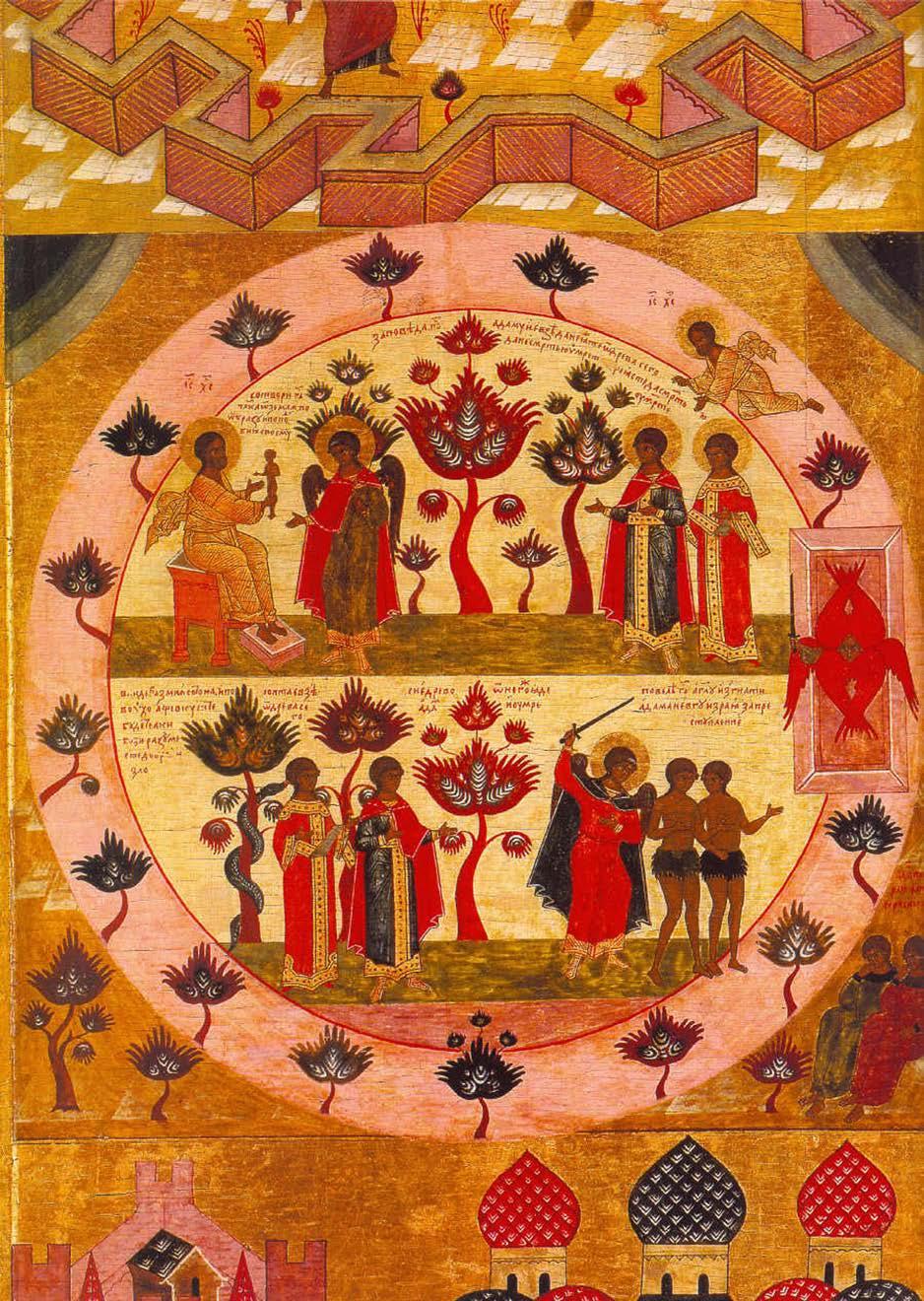
separates Eden and the outer world and above them we see a doorway guarded by the cherubim so that their return is barred.
Two sad figures in the lower righthand corner of the icon, outside the circle of the garden, are most
likely Adam and Eve. They are now dressed in garments made for them by the Lord God (Gen 2:21) with no decoration of any kind. They and the whole of creation must wait for the promised Saviour, Son of God and Word made flesh.
1. Paradise (Detail), Russian icon, Museum of History and Art, Solvychegodsk, Album: Alamy.
2. Russian text kindly deciphered and translated by David Coomler at https://russianicons. wordpress.com
3. See Bergsma and Pitre, A Catholic Introduction to the Bible, The Old Testament, 2018, Ignatius Press, San Francisco, p 103.
A magnet for tradition
Fr Ray Blake, priest who was unafraid to air his views from the pulpit or in his blog

Father Ray Blake, who has died aged 71, was a Catholic priest whose popular and controversial blog provided countless headlines for the local press in Brighton.
In 2017 his uncompromising style gained political attention when Catholics for Labour decided to hold its inaugural meeting at the party conference in central Brighton. Blake, priest of that parish, was duly invited to say Mass.
Instead of delivering the usual platitudinous welcome to the seaside town, Blake rained fire and brimstone on the congregation’s heads for 18 minutes, insisting that they both care for the poor and uphold Church doctrine. The cleric peered at the MPs in the front row and observed that “some of you have appalling records” on abortion and euthanasia. Amused locals, familiar with Blake’s preaching, reported that the visitors did not know what had hit them.
One of two brothers, Raymond Blake was born in Guildford on 17 November 1953. His father, Frank, ran a building company; his mother, Maria, was Italian and a Catholic, but she rejected her faith and her sons were brought up as Anglicans.
Those who met Ray later in life assumed he was a down-at-heel aristocrat; a spit for Denholm Elliott, he had accent and authority, and would say, even to friends, “well done, well done”,
as if commending the staff. In fact, he attended the local comprehensive and read English at Southampton University, graduating to work in a hotel.
To his mother’s disappointment, he converted to Catholicism and announced his intention to become a priest. After training at St John’s Seminary in Wonersh near Guildford he was ordained by Bishop Cormac Murphy-O’Connor in May 1981.
His first appointment was in Brighton, followed by St Leonards-onSea in 1986, and in 1991 Egham Hythe, where he befriended the parishioner and TV personality Frank Muir. There was a brief experiment in monastic living at Quarr Abbey on the Isle of Wight in 1999. A year later, he was appointed parish priest at St Mary Magdalen, a short walk from the beach at Brighton.
Blake physically and spiritually transformed St Mary’s, restoring the original neo-gothic design – tearing out hideous green linoleum in the process –and hosting a popular choir that helped attendance to soar. The election of Pope Benedict in 2005, and the Vatican’s easing of restrictions on the Latin Mass, encouraged him to experiment with the ancient liturgy.
St Mary’s became a magnet for tradition-loving Catholics, and his kitchen was an always an open salon, filled with cigarette smoke and the sound of Blake strumming a lute (he had one of the largest private collections of medieval instruments in England).
Bedevilled by pigeons, he would occasionally break from the conversation to fire a water pistol out of the window. He was intellectual yet sympathetic, and people would travel miles to have Blake hear their confession. His homilies were exemplary.
In 2006 he established his blog, credited with encouraging many converts and reassuring those struggling with their faith across the world. From his digital pulpit he denounced gay marriage, a brave stand in Brighton, and his candour was sometimes
misunderstood. Unfriendly journalists seized upon his description of the poor as “messy”, and one beggar who frequented his church as “an irritating little …” (he would hold out his cap and loudly demand money in the middle of Mass).
Blake, who far from being a reactionary had joined peace marches, was simply describing parish ministry as it is: a cross he carried with selfdeprecating humour. He ran a soup kitchen for the homeless and, for many years, permitted a refugee to sleep in his house without informing the diocese. As for his alleged homophobia, half the congregation was gay (at least).
Just as he declined to wash the feet of the homeless on Maundy Thursday because he saw it as “theatre” –conducted for the vanity of the priest – so he eventually fell out with his own choir because he judged it insufficiently pious: people were coming to his Masses, he fretted, for the spectacle rather than the religion.
Blake could be stubborn. He took the 2013 election of Pope Francis, Francis’s liberal theology and the clampdown on the Latin Mass, personally, and though lay conservatives appreciated his online resistance, he entered a deep funk.
His health failing, he nevertheless refused to see a doctor. When finally admitted to hospital because he awoke one day unable to move, the NHS discovered that he had been saying Mass with a broken back.
Blake left ministry in 2023 and retired to a flat overlooking the front. Diagnosed with lung cancer, in May 2025 he was moved to a care home, where his wit remained vital. The nurses began to suspect he was being smuggled e-cigarettes, and when one sister demanded to know what two guests in his room were doing there, he replied: “They are selling me life insurance.”
Fr Raymond Blake, born 17 November 1953, died 3 July 2025
Reprinted by kind permission of The Daily Telegraph
Deprived and imprisoned
John Whitehead on the fate of the Marian Bishops
The year 2025 saw the 175th anniversary of the restoration of the Catholic hierarchy in England and Wales. The previous diocesan episcopate had been displaced in 1559 by the Elizabethan Settlement.
The fate of those sixteenth century predecessors has received little attention. They are largely forgotten, both by Catholics and by modern historians. They very rapidly became yesterday’s men.
Queen Mary and Cardinal Pole died on the same day, 17 November 1558. Leadership of the episcopate fell to Archbishop Nicholas Heath of York, the late Queen’s Lord Chancellor.
In addition to Canterbury, other sees, Bangor, Gloucester, Hereford, Oxford, and Salisbury, were already vacant. The bad relations between Pope Paul IV and Cardinal Pole, and also with King Philip, were factors in the failure to appoint to them. Mary’s intended translations and promotions were put on hold.
It rapidly became clear, as indeed had been expected, that the new Queen was resolved to revive the Royal Supremacy and a Protestant religious settlement. Her closest advisors such as William Cecil were committed to that, and Elizabeth saw her right to the throne as dependent upon it.
The early months of the reign were a time of watching and waiting. Some of the episcopate were aged and the widespread epidemic of influenza may well have hastened their deaths.
The Bishop of Rochester died in November and in December so did John Christopherson of Chichester, having been placed under house arrest for defining Protestantism as “a new invention of new men and heresies” on 27 November. The Bishops of Norwich and Bristol also died in December.
Of the remaining bishops left to lead the Catholic community and attempt to withstand the Queen’s plans, a number had been first appointed under Henry VIII, and had accommodated themselves to his new system. A number had been deprived and imprisoned for resisting
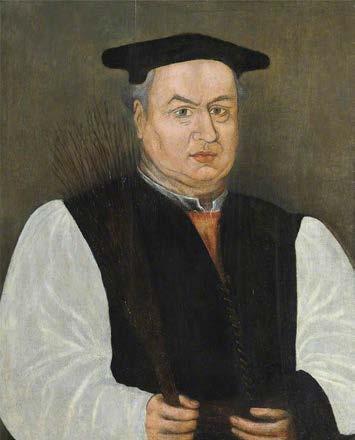
Bishop Edmund Bonner: ‘attempts to prosecute Bonner for refusing to take the required oaths, which could have led to his execution,failedorwereregularlypostponed’ © Luminarium.com
radical changes under Edward VI - in addition to Gardiner, who had died in 1555, there were Bonner, Tunstall and Heath. Mary released them from prison at her accession. Others such as Thirlby of Ely and Kitchin of Llandaff had managed to remain at liberty. Those who had conformed to the changes were anxious to receive absolution.
A sign of things to come was Bishop White of Winchester being confined to his Southwark residence for a month because of his funeral sermon for the late Queen on 14 December.
Christmas proved another liturgical lightening rod. Bishop Oglethorpe of Carlisle’s elevation of the Host at Mass in the Chapel Royal led the Queen to walk out and, as the only bishop being willing to crown her, he refused to omit it at the forthcoming Coronation. As a result, he performed the coronation but the Dean of the Chapel Royal celebrated the Mass, without the elevation. Oglethorpe, who had hoped to mollify the young Queen by crowning her, came to regret his decision.
Elizabeth met with Archbishop Heath who pleaded with her to remain in the barque of Peter. She, by contrast,
expected Heath and others such as Thirlby to bend to her will and serve her as they had her father, and hoped until late summer some would consecrate her choice for Canterbury, Matthew Parker. She was surprised to find they, like their late colleague Gardiner, had developed or rediscovered a Catholic backbone. She appears not to have realised the extent to which Catholicism had been reinvigorated under her half-sister.
Parliament met in January, its main business being to re-establish the Royal Supremacy and a Protestant ecclesiology. Inevitably there was a much-depleted bench of Bishops, although, unlike the scene in the film Elizabeth, the Catholic bishops in black mitres (!) were not locked in a cellar.
The hastily arranged Westminster conference with reformers of MarchApril 1559 was biased against them. The Bishops were insistent on the Mass and Transubstantiation and in consequence White of Winchester and Watson of Lincoln were sent to the Tower until summer, thus removing them from the crucial last votes on the Supremacy and Uniformity, which only passed by three votes. The ague that was to kill White a few months later may have begun then. Their formal deprivations and imprisonment for refusing the newly proscribed oaths followed that summer. Several were placed in the custody of the new London bishop Grindal at his palace adjoining St Paul’s.
Kitchin of Llandaff accepted the new establishment, dying in 1563, held in low esteem by both factions. So too did the absentee pluralist Thomas Stanley of Sodor and Man who died in 1568.
The deaths of the Hebrew scholar Bishop Baines of Lichfield in November and of Oglethorpe and Morgan of St David’s in December 1559, followed in January by that of White of Winchester while with relatives in Hampshire. He was apparently buried in his cathedral.
The idea that following deprivation the Marian Bishops had a relatively comfortable retirement was presented by the government, and is still claimed,
but was far from true. Apart from occasional times spent with family their lives were lived out as prisoners in the Tower, the Marshalsea or the Fleet, or under restrictive house arrest with their Anglican replacements.
The elderly humanist scholar and moderate Tunstall of Durham travelled from the north, tried to see Queen Elizabeth, and he was one, like York and Ely, she hoped to win over. The eighty-five-year-old did not cooperate and was deprived on 27 September. Sent to Lambeth as a detainee of Parker, unsuccessful attempts were made to get him to conform, before he died on 18 November, and was buried at Lambeth eleven days later.
In June 1559 Thomas Goldwell of St Asaph avoided detention, returning to Italy where he had lived for many years in Cardinal Pole’s household.
With the detention of the surviving bishops there was little likelihood of a parallel church as happened to an extent in Ireland, and Elizabeth was hardly likely to respond to the Emperor’s suggestion of assigning a church in each town for the use of her Catholic subjects.
Cuthbert Scott of Chester was held in the Fleet prison or under house arrest in Essex until spring 1563 when he escaped to the Low Countries, but died in Louvain in October 1564.
In late spring and early summer 1560 Heath, Thirlby, Watson, Turberville of Exeter, Pate of Worcester and Bourne of Bath and Wells were recalled to the Tower with Abbot Feckenham of Westminster and Dean Boxall of the Chapel Royal following an unsuccessful attempt to get them to attend, without communicating, the new liturgy. Later that year they were allowed to eat together, but that was subsequently revoked. They had their own servants, but boarding at their own expense they and their benefactors were increasingly impoverished.
There was some pressure for one or other to be executed, and their confinement became stricter. Legislation in the 1563 Parliament increased the threat to their lives, but the Queen, under diplomatic pressure from Philip II and Ferdinand I, deflected that. Militant Protestants called occasionally for their execution, but Elizabeth appears to have had no intention then or until much later of making martyrs. Meanwhile the Legates at the Council of Trent and the Papacy sought means to send financial assistance.
Fear of plague in 1563 resulted in the bishops being moved from the Tower to the houses of Protestant bishops. They were returned to the Tower in the summer of 1565 amidst fears arising from Mary of Scots marriage to Darnley.
Pate of Worcester died on 23 November of the same year in the Tower, conceivably from fever. The frail David Pole, whose residence in Staffordshire in 1563-4, was seen as a danger by the Anglican Bentham of Lichfield, was moved to the Fleet Prison. He died there in May 1568.
Bishop James Turberville of Exeter, went to the Tower but through the intervention of the Emperor was transferred to Grindal’s household in 1565. Recalled to the Tower, he apparently died in 1570. Thirlby was under house arrest at Lambeth Palace, dying in late August 1570, and buried in Lambeth church.
Meanwhile Edmund Bonner of London languished for a decade in the Marshalsea in Southwark, later described in its grimness by Fr John Gerard. Bonner was a figure of particular opprobrium to Protestant propagandists because of the number of burnings in the London diocese when he was bishop. That was despite his attempts to reconcile those charged with heresy, and indeed, his success therein with many may account for Protestant hostility to him.
During these years, attempts to prosecute Bonner for refusing to take the required oaths, which could have led to his execution, failed or were regularly postponed. Unbeknown to Bonner such moves were stalled by the Queen due to diplomatic pressure and her continuing aversion to make martyrs. He died on 5 September 1569. Buried in the churchyard of St George in Southwark his body was then surreptitiously moved to Copford near Colchester, close to his favourite episcopal manor, and there it still lies under the remarkable twelfth century wall paintings which distinguish the church.
Five days after Bonner, Gilbert Bourne of Bath and Wells died. When not in the Tower Bourne had been under house arrest with the Anglican bishop Bullingham of Lincoln and latterly with Carew, the new Dean of the Chapel Royal, who had managed to remain in possession of his preferments ever since the reign of Henry VIII. Bourne was buried in the church at Silverton in Devon.
In 1570 Regnans in Excelsis speaks of Bishops and others, “worn out by their protracted sufferings and sorrow, [they] have ended their days in misery” and of them being left “to pine away and die”. Pius V in a letter compared them to Becket.
Heath and Watson may have carried out secret ordinations, as well as blessing oils. Still a prisoner, Heath spent some time at his house at Chobham in Surrey in 1573-4 and offered Mass there.
Watson spent time in 1574 with his brother, away from the Marshalsea, and blessed the vestments and utensils used by the martyr St Cuthbert Mayne. Subsequently sent to the household of the Anglican Horne of Winchester, by 1577 he and Heath were both unable to exercise any episcopal functions. With increasing persecution faculties to bless were given to three mission priests.
Heath died in early December 1578 in the Tower and was buried at Chobham. Watson alone remained, in poor health, his eyesight failing, though not entirely lacking creature comforts, and was moved to the custody of the bishop of Rochester.
From 1580 Wisbech Castle, belonging to the Anglican bishop Cox of Ely, became his place of detention, along with Abbot Feckenham, and some other clergy. There Watson, his eyesight almost gone, died aged sixty-nine after a quarter of a century’s detention and imprisonment on 15 October 1584, a few days after Feckenham. They were both buried in the church at Wisbech.
The sole survivor of the Marian episcopate was the exiled Thomas Goldwell, “the one who got away”. The Theatine English bishop attended the Council of Trent, served St Charles Borromeo as Vicar-General and later in Rome as vicegerent to the Cardinal Vicar of the Lateran. In 1580 he set out with St Edmund Campion and others on their mission to England, but illness forced him to stop at Rheims and return to Italy. He died in Rome on 3 April, 1585 aged eighty-four.
Following Pope Leo XIII’s initial beatification of a number of the English martyrs some sought that status for the Marian episcopate, a hope still unachieved.
Maybe their cause is one today’s English Catholics should pray for.
Virgin and Martyr
Edward Dundon remembers Saint Dorotea, patron saint of gardeners, brewers and newly-weds
Rome has nearly a thousand churches and they are all stunning. Some stand as historic landmarks, while others thrive as vibrant parishes in the Eternal City.
Trastevere, renowned as the ‘Heart of Rome,’ stands out as one of the city’s most enchanting locales. The word is derived from Latin trans Tiberim (beyond the Tiber). It is a place where ancient and modern times meet. Along the narrow-cobbled streets of Trastevere sit extensive boutiques and many charming churches.
The Church of Santa Dorotea in Trastevere is dedicated to Saint Dorotea of Caesarea (Maraca), an ancient city in what is now Kayseri, Turkey. The precious relics of Saint Dorotea are stored in a bronze urn beneath the main altar of the church. During the Jubilee Year 2025, Saint Dorotea’s relics were displayed in front of her statue to the right of the altar on her feast day.
The church has a simple exterior, but its interior is beautifully decorated. Records indicate that the church was rebuilt twice and renovated in the 1750s. In its early years, the church was dedicated to Saint Dorotea and Saint Sylvester (Pope and Bishop of Rome from 314 to 335), and is sometimes referred to by this dedication. The inscription above the main entrance reads: Omnipotenti Deo in honorem S.S. Sylvestri Papae ac Dorotheae virginis et martyris (To Almighty God in honour of Saint Sylvester, Pope, and Saint Dorothy, virgin and martyr).
On entering the church, the visitor is immediately overcome by the effect of the profound quietness. The high altar captivates attention as it houses the relics of Saint Dorotea. Above the high altar hangs a magnificent painting by artists Michele Bucci and Gaetano Bochetti, depicting Saints Dorotea and Sylvester venerating an image of Our Lady.
Saint Dorotea, patron saint of gardeners, brewers and newly-weds, was martyred in the fourth century in Caesarea, during the Diocletianic
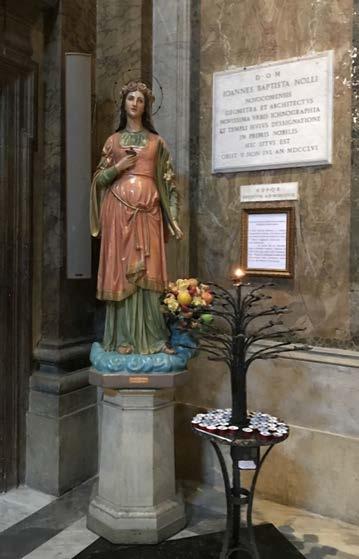
Persecution (284–311), the fiercest persecution of Christians in Rome when Emperor Diocletian ordered the destruction of churches, sacred literature and scriptures and a universal sacrifice to Roman idols.
Saint Dorotea was born in 279. Little is known about her early life. As a young woman, she converted to Catholicism. Dorotea was so impressed by Christ’s teachings that she resolved to dedicate herself entirely to Jesus and be guided by him. Dorotea's deep holiness and profound love for the poor inspired many to seek God, just as she did throughout her life.
Over the centuries, many stories have been told about Dorotea's courage and beauty. One account describes Dorotea’s encounter with a pagan nobleman as she fulfilled her duties of feeding the poor and caring for the sick. The nobleman, captivated by her beauty and kind nature, proposed to her. Dorotea declined his offer, explaining that she loved someone else. The nobleman felt humiliated by her behaviour and betrayed her to the Roman prefect, Sapricius.
In 311, Sapricius, who was also enhanced by Dorotea’s charm devised a plan to save her life. The plan was for Dorotea to make a sacrifice to the Roman idols. Dorotea, resolute in her dedication to Christ and his teachings, rejected the prefect’s proposal, sealing her fate with a death sentence when Sapricius condemned Dorotea to deter others from practising Christianity in his district. Upon hearing this, Dorotea declared she would soon stroll through God’s vibrant gardens of fruits and flowers.
Draped in bridal finery, on the day of her death, she stood amid a jeering crowd, her hair in a vibrant headdress. In the crowd was a pagan lawyer named Theophilus, who before her death sarcastically shouted at Dorotea: ‘O bride of Christ, send me some fruits from your bridegroom’s garden.’ Dorotea looked at him with love and compassion and promised: ‘You and I will meet in that garden.’
After delivering her speech, Dorotea tossed her headdress into a basket carried by a six-year-old boy. ‘Give it to Theophilus,’ she instructed the boy – thought to be an angel in disguise. As the boy navigated the crowd, he caught the sweet aroma drifting from the basket. The basket contained three golden apples and three roses. The boy offered the basket to Theophilus, who, entranced by its heavenly fragrance, knelt and begged forgiveness for his sarcasm. Holding the basket, he expressed his faith in Christianity and joined Dorotea at her execution. Theophilus was the first to enter the garden for Dorotea's wedding feast.
Dorotea's story of great courage was honoured in words and songs in the seventh century, earning her reverence. Some artists portrayed her in the centre of a walled garden, playing with the child Jesus as he climbed a tree.
On her feast day, 6 February, gardeners everywhere seek her blessings for a prosperous spring planting.
DIOCESAN DIGEST
Mass of Ages quarterly round-up
Arundel and Brighton
Emma-Louise Jay arundel@lms.org.uk
In November I had the pleasure of attending the Latin Mass Society’s annual local representatives meeting held in London. It was a lovely occasion to meet my fellow reps and learn about the situation for TLM provision from diocese to diocese.
We experienced the most atmospheric Low Mass at the Brompton Oratory celebrated by Fr Ronald Creighton-Jobe in the side chapel at the altar of St Philip Neri. I particularly liked Fr Ronald’s parting remark as he shuffled playfully towards a mysterious exit with his server: “same time next week?” It was the first time I had attended a Mass where the faithful were seated sideways, which felt somehow metaphoric. Outside the Oratory was a priest’s black motorbike with a crucifix on the back on the seat apparently ready to speedily deliver any requests for the Last Rites.
Many other beautiful images come to my mind from this late quarter. The contrast between the gentle shadows created by a dancing butterfly in the sanctuary during a rather serious sermon. The newspaper style black and white photographs from one of the earliest copies of an old Latin Mass Society magazine from decades ago gifted to me by dedicated TLM parishioner Mr John Burke. Also, the sight of a minivan speeding in next to me in the carpark before one Mass, full of young adults, their cottas swinging in the windows. The van doors were dragged back and people emerged of all ages in a happy chaos, running into the church in age order, the youngest boy rather tiny but being led by example following a guy in a Bavarian jacket who had everything in hand.
Finally, there has been the obvious development in Arundel and Brighton that The Right Reverend Richard Moth has been appointed Archbishop of Westminster by Pope Leo XIV. A few months before this, I was in someone’s house and an antique chair which resembled a sort of Bishop’s cathedra was sitting there all lonely with a pinecone positioned in the middle. In that moment I had quivered seeing this as a premonition of what was to come. When the news did indeed come, I immediately spun into what I am going to term ‘tradanoia’; panicking about what might happen to the old Mass in our diocese when with a new Bishop. A few weeks have passed now though, and I am trying to stay prayerful and optimistic. We extend our gratitude to Bishop Richard for the generous provision he has made for the TLM in this diocese and pray for him as he takes on his new and immense responsibility. We pray too for those priests diligently caretaking for us while we await our new Bishop, whomsoever he may be…
Birmingham & Black Country Louis Maciel 0739 223 2225
birmingham@lms.org.uk
birmingham-lms-rep.blogspot.co.uk
During Advent, Rorate Masses were celebrated at our local churches, with the option to attend one (or more) of four Masses on Christmas day itself, with three celebrated at the Oratory including Midnight Mass and one at Wolverhampton. As usual, the Oratory celebrated High Masses on its Patronal
Feast Day of the Immaculate Conception, at midday on the Octave Day of Christmas, and for the Epiphany and Candlemas. A High Mass was celebrated on the Friday after the Epiphany at Wolverhampton despite the icy conditions.
Birmingham: Oxford
Joseph Shaw oxford@lms.org.uk
Regular Masses continue as usual, on Sundays in the Oratory and Holy Rood. Please also look out for Holy Day Masses (not only days of obligation) which are often accompanied with polyphony in SS Gregory and Augustine’s. Don’t forget that some Oxford Masses are listed in the Portsmouth Diocese, the Sung Sunday Masses at Holy Rood in the Abingdon Road.
As usual we will, alas, not have the services of the Easter Triduum in Oxford; the closest services will be in Reading or Bedford, both with the Fraternity of St Peter, or London.
To join the local email list, or our regular chant schola, please email me.
Birmingham (Worcestershire)
Alastair J Tocher 01684 893332 malvern@lms.org.uk extraordinarymalvern.uk
Facebook: Extraordinary Malvern
Instagram: extraordinary_malvern
Traditional Masses continue as before across Worcestershire. For summary details see the Extraordinary Malvern website, but remember it is always best to confirm locally for the latest information if planning to attend any of these Masses.
Please remember in your prayers our local priests –Fr Douglas Lamb, Fr Jason Mahoney, and Fr Christopher Draycott – who celebrate Traditional Latin Masses for us and who support us in many other ways; also, Dom Thomas Regan OSB, parish priest at St Wulstan’s, Little Malvern; and last but not least Archbishop Bernard Longley who generously permits these Masses to continue.
Brentwood (East)
Alan Gardner
brentwoodeast@lms.org.uk
There remain some lovely pockets of excellence around the diocese, although for some that does mean considerable travel, I’m afraid – thank you to all those who are making special efforts to support our priests in their work. It is good to see Holy Name Chelmsford becoming a regular Sunday event, albeit demanding early rising!
With one honourable exception, the provision of sung Masses in this country part of the diocese remains rather sparse; do please contact me if you think there is any fertile ground in your own parish for a sung Mass, even on an occasional basis; support is available! Quite a few of us pop over the border to Withermarsh Green (see East Anglia section for detailed information) for some excellent provision (for
instance, looking ahead, there will be a full sung Triduum for Holy Week – glorious!).
We’re most grateful to Fr Neil Brett (TLM Diocesan Coordinator) for his hard work; I recommend getting on to his circulation list if you have not already done so.
Please pray for all relevant supporting laity, celebrating priests, parish priests, and for Bishop Alan Williams; their hard work / support are crucial for the continued flourishing of the Mass.
As always, a reminder that this is a large region with changes being made regularly, so do please keep me informed about developments in your own area so that I can circulate details. If you are not currently on my local email (bcc!) circulation list (you should be receiving something from me at reasonably regular intervals), do please feel free to contact me.
Cardiff-Menevia (Cardiff)
Andrew Butcher cardiff@lms.org.uk
A very happy and holy new year to you all. Traditional Masses continue to be offered around the archdiocese. Please continue to pray for our priests and the Holy Father, Pope Leo. For information or Mass times and locations, you can contact me on cardiff@lms.org.uk
Cardiff-Menevia (Ledbury)
Alastair J Tocher 01684 893332 malvern@lms.org.uk extraordinarymalvern.uk Facebook: Extraordinary Malvern Instagram: extraordinary_malvern
Regular 11.30 am Sunday Low Masses at Most Holy Trinity, Ledbury – the only weekly Sunday Traditional Masses in the three counties of Herefordshire, Worcestershire, and Gloucestershire – continue as normal. That said please contact us in advance to confirm local Mass times if you intend visiting the area.
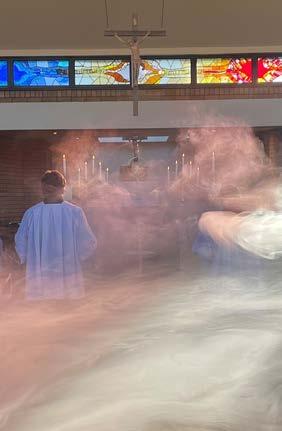
Swirling clouds of incense during a recent pre-Mass Adoration at Most Holy Trinity, Ledbury
Whilst our beloved parish priest, Fr Adrian Wiltshire, turned 75 back in June there is still no word from Cardiff as to when he might be permitted to retire, nor whether he will be replaced by a priest able to celebrate Mass according to the Vetus Ordo.
The local TLM website (see above) and social media accounts have been given a facelift for the new liturgical year, and daily mediations according to the 1962 calendar are now posted on both the Facebook page and the new Instagram account.
As always, please remember in your prayers our parish priest, Fr Adrian Wiltshire, Archbishop Mark O’Toole of Cardiff-Menevia, and all those attending Most Holy Trinity. Also, Dom Jonathan Rollinson OSB and Dom Joseph Parkinson OSB who, prior to Traditionis custodes, also celebrated public Latin Masses at Belmont Abbey near Hereford.
Cardiff- Menevia (Menevia)
Tom and Elaine Sharpling menevia@lms.org.uk 07702 230983
We continue to support Canon Jason Jones and Father Rod in their celebration of the Holy Mass in Sacred Heart Swansea and are pleased to see steady numbers in the congregation.
We were also delighted that we were able to have a sung Mass on Easter Sunday and are grateful to Andrew Butcher who travelled from Newport in order to serve. A new schola has been formed and we are just taking our first steps of singing the Mass – so prayers please!
Our Facebook page has a growing number of followers, and if you would like to connect with us in this way then please contact: StabatMaterMenevia, or give us a call.
We are also grateful to those people who travel long distances to the Holy Mass – you can always be assured of a warm welcome and we are delighted to see new faces.
However, before travelling, check the Facebook page or get in touch so that we can let you know of any changes.
East Anglia (West)
Alisa and Gregor Dick 01954 780912 cambridge@lms.org.uk
Sunday Masses at Blackfriars continue as normal. The dates of future sung Masses will be posted on the noticeboard in the cloister in due course. New singers and servers are always welcome.
East Anglia (Withermarsh Green)
Sarah Ward withermarshgreen@lms.org.uk 07522289449
Daily Mass continues at St Edmunds and Our Lady Immaculate, Withermarsh Green with two Masses on a Sunday at 9.15 am and 11 am. There is a Sung Mass on the last Sunday of the month (11am) and you are warmly invited to stay for Coffee after 11am Sunday Masses.
A huge thank you to everyone who helped to make the Christmas Masses so beautiful this year - the servers, singers and those who decorated the Church. Fr Whisenant celebrated 2 dawn Rorate Masses during Advent, which were well attended.
A reminder that it is particularly muddy at this time of year in the lanes around Withermarsh and the lower roads are prone to flooding, so it may be worth ringing ahead if you are coming from afar. The car park is also very muddy and you may wish to park a short walk up the road from the chapel.
Hexham and Newcastle
John Fagan
hexham@lms.org.uk
I am sure I am not alone when I say that I often feel greatly humbled by the legacy which has been handed down by those who trod the Traditional path before us. After all, in recent times we have had many incidences of what might be termed wake up calls both within Holy Mother Church, and indeed within society and the wider social culture. Very often the way forward is not clear, and it is the clarion voices of one or two individuals, who make the brave stand against a prevailing wind.
We can surely think of such characters as, in the words of William F Buckley Jr: “standing athwart history yelling STOP, when no one is inclined to do so.”
One such individual was surely Michael Davies, a pioneer of The Traditional Movement and defender of The Old Mass. I mentioned in my winter edition report that there was to be a
Missa Cantata at St Joseph’s Gateshead on Sunday 21 September, in memory of and for the happy repose of his Immortal Soul. Unfortunately, I could not attend in person, but I am informed that all went well with the beautiful Mass by Casciolini, Jesu Hominum Amator by Bach and Vias Tuas Domine by Pitoni.
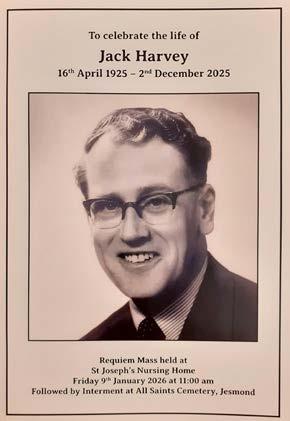
Although I never met Jack Harvey, from what others have told me of him, it sounds as though he was another great defender of tradition, albeit more locally. I am thankful to those who have sent me their own memories of Jack, who passed away on 2 December at the age of 100. Fondly recalled as “Mr Latin Mass…. He fought tirelessly for the [Old] Mass in this diocese… finding new venues, encouraging priests, meeting bishops, [and it appears a significant amount of] fundraising”.
I am told that one such campaign saw a fivefigure sum being donated to the ICKSP (Institute of Christ the King Sovereign Priest) Seminary at Gricigliano, Italy. So, we give thanks for the good fruit which has resulted from his work and indeed all those who like Jack have worked The Lord’s Vineyard before us, Requiescat in Pace.
Some readers may be aware that Fr Philips has been out of action recently having been injured in a road accident. The good news is (at the time of writing) Father tells me he is on the mend and anticipates that the Holy Mass Schedule for Whittingham should be back to normal by the time of publication. Thanks be to God for that and, as always, it’s advisable to check locally before travelling any distance.
I have been approached by some young men who would like to train as Servers. The issue is still at a preliminary and tentative stage so at the time of submission there is no firm date set; therefore, any other potential candidates please contact me as you may still be in time to get on the list.
Thanks be to God we are relatively well blessed with provision of the Old Rite across the diocese, and that certainly carried through the Advent and Christmas period including several Rorate Masses. I was not able to attend any of these within the diocese due to other commitments, but I did attend the Rorate Mass in Yarm which was wonderful. A hat tip therefore to Father Smith and those involved, albeit across the diocesan border. I am reliably informed that the First Mass of Christmas at St Joseph’s Gateshead was another wonderful Sung Mass with the congregation able to join the choir for carols beforehand. Music for Mass was by Bonfitto with Verbum caro factum est (anon) and Adeste Fideles. On Christmas morning we had a wonderful Low Mass at Thornley, and it was lovely to see several young families and their excited children.
We already have many good things going on in the Northeast, and much that is driven by younger people who are attracted to orthodoxy, all of which gives me great hope for the future. Tu Rex Gloriae Christe.
Lancaster John Rogan lancaster@lms.org.uk
In Preston it's been a fairly quiet quarter. Our six new Candidates for the House of Discernment duly arrived, including one from Preston itself who had only shortly before been a student at St Benedict's Cultural Centre. As well as their studies, they were soon taking an active part in the life of the Shrine, including organising the Christmas Fair.
There was a short delay in Canon Bunnens being able to join us and for a few weeks his confrére, Canon Malinowski, also ordained in July, assisted the Canons and got the choir off to an excellent start. Canon Bunnens joined us in November and has continued this good work. When he is celebrating the High Mass, the choir is ably led by Kieran.
Sadly, we said goodbye to Sister Jean-Marie in December after eight years with us. She has transferred to Naples where she will be helping Reverend Mother with the formation of the Novices. We will miss her greatly but our prayers are with her in her new role and we hope that the Naples climate will be kinder to her than Preston!
October saw the wedding of Tanner and Amy and there have been several baptisms during the quarter. Abbé Brabham has been with us on placement for a few months and during the Christmas holidays, Abbés Glębocki and Johnson visited us.
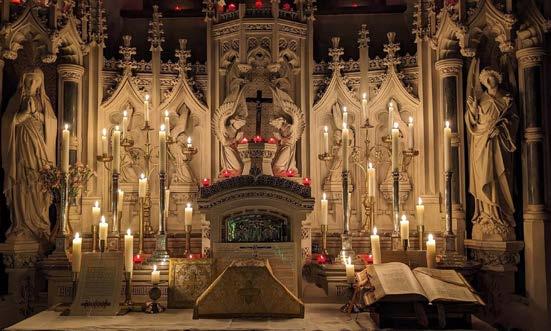
The annual Carol Service was well supported by schoolchildren and their families and the Christmas Masses were all well attended.
By the time this goes to print, St Benedict's Cultural Centre will have held its Open Day in January (see article in Winter 2025 Mass of Ages, page 33), which we hope will have been popular. Should anyone be interested in their children attending St Benedict's, please contact the Principal, Canon Post on 07856 720900 or saintbenedicts@icksp.org.uk
The new term sees the resumption of Masses at the University Chaplaincy, usually with exposition beforehand. The public are welcome to attend.
You can pay to park in advance, but be sure to choose the “from 6pm” option.
Mass continues to be celebrated at St Margaret Mary's Church, 75 Scalegate Road, Carlisle CA2 4JX, every Saturday at 10am. Usually it is a low Mass with one per month being sung. Thanks are due to Canon Luiz Ruscillo and Fr Paul Harrison, who faithfully celebrate these Masses despite many other demands on their time and attention. Our Schola, led by Andrew Plasom-Scott, recently lost one of its voices, Dawid Klewicki, to the Dominican novitiate and now seeks additional talent.
Jack Harvey: ‘Mr Latin Mass…’
The altar at Workington
Our annual sung Requiem Mass for souls enrolled in the Cumbrian Purgatorial Society www.prayforsouls.uk will be celebrated at Our Lady and St Wilfrid, Warwick Bridge at 10am on Saturday 8 November (and not at St Margaret Mary's). The Brampton Consort, led by Simon Mortimer, will sing a medieval polyphonic Mass and the propers will be sung by our Schola. A buffet lunch will be on offer, plus an uplifting address and Benediction of the Blessed Sacrament.
Canon Watson celebrated a Rorate Mass just before Christmas, and Masses continue there as usual. If you’re travelling from afar, unlike the Wise Men, you can phone in advance to check: 07588 209315
Liverpool (Warrington)
Alan Frost warrington@lms.org.uk
The outstanding event of recent times, of course, was the Midnight Mass at St Mary’s. Packed out as usual, we all stood in the recognisable warmth of the red heating bars as they shone between the sconces, the candles on the wall.
The year 2025 marked the tenth anniversary of St Mary’s as a Shrine Church under the ownership and guidance of the Priestly Fraternity of St Peter, the FSSP. The current Rector, the second, is Fr Matthew Goddard , following on from Fr de Malleray.
Along with Assistant Priest (from Hungary) Fr Homolya and Visiting Priest Fr Jolly, he celebrates three Masses on Sundays, and Mass each day during the week. It is a very active and parishioner-involved parish. There are numerous monthly groups including Juventutem and Youth Groups, as well as Ladies’, Men’s, Mothers’ and children’s.
Middlesbrough
Paul Waddington middlesbrough@lms.org.uk
Latin Masses continue at three locations in the Diocese of Middlesbrough. The Fathers of the York Oratory offer a Low Mass each weekday, and on Sundays a Missa Cantata at noon as well as Vespers at 4pm. On Holydays of Obligation and major Feast Days, there is an additional Mass (usually a Solemn Mass) at 6pm. The Sunday Mass attendance has grown to about 170, with a large proportion of students and young people.
On the Feast of All Souls, celebrated on 3 November, the York Oratory welcomed Bishop Marian Eleganti OSB, who preached at evening Mass. Not only were the congregation treated to the wise words of Bishop Eleganti, but they were also able to hear a superb rendition of Duruflé's setting of the Requiem Mass.
At the Church of St Mary and St Romauld in Yarm, Fr David Smith offers a Low Mass each Sunday at 2pm, followed by Benediction. He also offers Masses on Holy days of Obligation and some Feast Days. For the first time this year Fr Smith offered a Rorate Mass, which attracted a congregation of about 40. The Sunday attendance is usually in the range of 20 to 30. There are now four or five regular altar servers, and a group is being formed to learn to sing Gregorian Chant, with a view to introducing Sung Masses in the near future.
The Low Masses offered on Thursday evenings by Fr William Massie at the Church of Our Lady and St Peter Chanel in Hull are to continue. There was some doubt about these, as Fr Massie was expected to be moved to another location, but in a change of plan, he will be remaining in Hull, allowing these Masses to continue.
The congregation at this weekday Mass remains steady at around 15 to 20, which is boosted by students during the University term times.
It was announced just before Christmas that Pope Leo had accepted the resignation of Bishop Terence Drainey, who, by then, was well past retirement age. Bishop Marcus Stock of Leeds is to become the Apostolic Administrator for the Middlesbrough diocese. This is likely to mean that Middlesbrough will cease to be a diocese at some point in the future. During his time as Bishop of Middlesbrough, Bishop Drainey has done a great deal to ensure the continuation of Latin Masses in the diocese, especially by welcoming the Oratorians to York, for which we must be very grateful.
Northampton
Barbara Kay 07399 078959
northampton@lms.org.uk
The Bedford and Chesham FSSP apostolates continue to flourish, with an attendance of close to 400 at the Sung Masses over Christmas. Among these we welcomed back several former members who were visiting their families over Christmas, and also three seminarians, two from the FSSP seminaries in Germany and the USA, and one from the ICKSP seminary in Italy, who were taking a post-Christmas break with their parents and who were able to share in our Epiphany liturgies.
We have settled back now into our normal routine with the usual Masses and activities. Server training continues and First Holy Communion classes are under way. Our Trek group for single adults is well supported, and Fr de Malleray will be running one of his popular Men’s Vocation weekends at Buckden Towers on 13 – 15 March: see tinyurl.com/y7v92nve.
We have launched a new initiative, described by Fr de Malleray in a recent newsletter: “More people out there may feel just like you did perhaps one, two or ten years ago. Reading your story might be just what they need to look into the opportunity of the Traditional Latin Mass. Whether you are a family or a single person, email us your testimony. We will include it in a public presentation of our Gregorian Chaplaincy apostolate.”
We are looking forward to seeing the results in due course!
Paul Beardsmore has handed over the northern part of the Northampton diocese to me. This means I have a new email address as above. I am grateful to Paul for his long service and efforts to keep the Traditional Latin Mass going in that part of the world. I hope one day we will see it return.
For details of all our activities, as always please see fssp. org.uk/bedford. You will find a thriving and welcoming community.
Northampton
Paul Beardsmore
01858 434037
nottingham-south@lms.org.uk
As Northamptonshire members well know, there is currently no regular celebration of the traditional Mass in the county. When I became the local representative for the LMS twenty-three years ago there was also no regular Mass, but it was possible to import priests from other areas, and sung Masses were celebrated relatively frequently at Great Billing, Duston, Wellingborough, and indeed at the Cathedral. Alas
the current political situation makes this very difficult. Later, of course, Fr Byrne’s presence at Corby gave us a (semi-) permanent base for the Traditional Mass, for which we will always be grateful.
Whilst we await better times it seems an appropriate moment for me to hand Northamptonshire over to Barbara Kay, who has kindly agreed to take on the role as representative for the county in addition to her existing responsibilities for Bedfordshire and Buckinghamshire. This is a logical move which will lead to less confusion (not least for the LMS office!). My thanks to all those members who have supported the LMS in Northamptonshire, by serving, singing, or simply attending the Masses, and my especial thanks to the clergy who made these Masses possible.
Nottingham
Jeremy Boot
nottingham@lms.org.uk
07462-018386
With stable attendances, Masses continue at the Good Shepherd, Arnold, Nottingham, (Saturday before 2nd Sundays), Our Lady and St Patrick, Meadows (3rd Sundays), Nottingham, and the Cathedral, Nottingham (3rd Wednesdays). See Mass schedules for times. With the exception of the Cathedral, above Masses are usually sung.
At St Mary of the Annunciation, Loughborough, there are low Masses each Wednesday 6.30pm, unless otherwise stated. We had a sung Mass for All Souls on 2 November and also on 3 December for St Francis Xavier.
As ever our sincere thanks to our priests, organists, singers and servers, all of whose efforts are appreciated and essential to the maintenance of the Society’s work.
Nottingham (South)
Paul Beardsmore 01858 434037
nottingham-south@lms.org.uk
Canon Cahill continues to celebrate Masses on Sundays at Blessed Sacrament, Leicester, and on Saturdays at St Peter’s, Leicester. Masses were sung for the feasts of St Michael, All Saints and the Epiphany, and the dawn Mass of Christmas was also sung at Blessed Sacrament.
The Friday evening Masses at Exton Hall also continue, celebrated by Canon Dye, and there was a sung Mass there for the feast of the Immaculate Conception celebrated by Canon Vellacott.
Thanks are due to all the celebrants, and to the singers and servers who make these Masses possible. For Loughborough see report from Jeremy Boot. Please note new email address.
Portsmouth
Carol Turner 07983 092962
portsmouth@lms.org.uk
May I first start off by wishing all our readers a very Happy New Year! I do hope you all had a very blessed Christmas season and here’s to a happy, healthy and holy 2026.
I would also just like to acknowledge my predecessor, the late Peter Cullinane, whose third anniversary will be in February 2026. We continue to pray for Peter’s soul and may God grant him eternal rest.
Masses continue across the region. At St Joseph’s Copnor, we celebrated the beautiful feast day of St Francis with the Marian Franciscans, on 4 October 2025, together with the first Saturday
devotions. A Solemn High Mass was offered and we welcomed Fr Andrew Wagstaff as Deacon and Preacher, and Fr Laurence Lew from St Dominic’s, London. A celebratory reception lunch was provided in the hall afterwards and we thank everyone for their sincere contributions on the day.
We had a very blessed feast of All Saints at St Joseph’s, which coincided with the first Saturday devotions on 1 November. Two Masses were offered; a Low Mass at 7am and a Sung Mass at 10am. All Souls Day fell on Sunday, 2 November 2025 with the usual Sung Mass being offered at 11.15am. November also saw the launch of a new book on St Joseph by Fr Serafino Lanzetta entitled The SilentWitness of Nazareth. Copies are available from Amazon for those readers who are not local to Portsmouth!
Since November, Fr Lanzetta has been hosting a monthly series of formation talks on Faith & Reason at 2pm on the first Sunday of the month after tea and coffee/lunch etc. held after the 11.15am morning Mass. The talks are open to everyone, both parishioners, as well as members of the public who are not Catholic or are lapsed. They have attracted many people with very interesting Q&A sessions afterwards. The talks can be found on this link - tinyurl.com/3zwhfwy2).
On Monday 8 December, we celebrated the feast of the Immaculate Conception with a Low Mass at 7am together with a Solemn High Mass at 6pm.
As the season of Christmas drew closer, a Rorate Mass (Low) was offered on Monday 22 December and a Rorate Mass (Missa Cantata) on Tuesday 23 December. Both Masses were offered at 7am. On Christmas Eve, the friars chanted the beautiful Christmas Day Matins at 10pm at St Joseph’s. Then followed a very peaceful Midnight Mass which was very well attended. The Christmas Day Mass at St Joseph’s was at 11.15am with a Low Mass at 8am at St Agatha’s, Marketway, Portsmouth.
The St Stephen’s Day Mass was also at 11.15am at St Joseph’s and Masses continued thereafter, within the Octave, daily at 11am. We opened the New Year with Mass being offered at 11.15am on 1 January. On the feast of the Epiphany, 6 January, three Masses were offered at 7am, 11am and 6.30pm, the latter being a Sung Mass. Blessed chalk was made available from the friars.
To confirm, the normal TLM Masses at St Joseph’s, Copnor, Portsmouth continue with a Low Mass at the usual time of 7am, Monday to Saturday and a Sung Mass at 11.15am on Sunday. Confessions are usually available either before and/or after Mass. First Friday devotions commence with Mass at 6.30pm followed by the Men’s Group (which includes Rosary, Benediction followed by a shared meal/talk in the hall). We always welcome new members who appreciate the trip to the local for a drink afterwards! On the first Saturday, proceedings currently start at 9.30am with Rosary and 15-minute meditation, followed by Sung Mass at 10am (please check listings), exposition of the Blessed Sacrament in accordance with the request of Our Lady of Fatima. Confessions are also available. We then proceed to the hall for tea and coffee and lunch and then a Marian talk is given by one of the Franciscan priests. Do keep an eye out for up-to-date times of the first Saturday’s schedule by subscribing to the newsletter.
At St Agatha’s, Marketway, Portsmouth, a Low Mass is offered by the Marian Franciscans at 8am each Sunday. The last Sunday of the month is a Sung Mass.
Masses at Holy Family Church, Redbridge, Southampton continue and a Sung Mass is offered each Sunday at 9am. The beautiful schola continues to attract many new members here. A Low Mass is offered at 7.30pm on Thursday evening (Sung if it’s a Holy Day or feast day). Confessions are usually available at 6.45pm on Thursday evening before 7.30pm Mass. Rosary, Vespers and Benediction are held on Sunday at 4.30pm (please note new time!). All are very welcome! On the feast of All Saints (1 November), there was a Mass offered here at 12pm. Students
from Fr Benjamin Theobald’s University Chaplaincy were selling rosaries after Mass on 2 November to raise funds for their spiritual retreat. This was a great success and the students managed to sell all the rosaries. On 13 December, a Rorate Mass was offered at 6am and for the feast of the Epiphany (6 January), Mass was offered at 7.30pm.
For those of our readers in the Dorset/West Hants area, the Marian Franciscans also offer a Sung Mass at St Thomas More, 42 Exton Rd, Iford, Bournemouth, every Sunday at 12.30pm.
Salford
Alison F. Kudlowski salford@lms.org.uk
The Manchester Oratory continues to flourish since its canonical erection on All Saints Day, 2019. The main feature of this quarter, and certainly primary cause for celebration was the Ordination to the Sacred Priesthood of the Reverand Brother Fabian G. Trevithick which took place on Friday 12 December 2025 at the 5.30 Mass.
The ceremony was celebrated by the Right Reverand John Arnold, The Bishop of Salford.
Our sincere thanks and appreciation to our priests, deacons, servers, organists and choir for their commitment to and support of the faithful at the Manchester Oratory. Father Fabian will be celebrating the 1962 Rite (low Mass) on Sundays at 4.45pm preceded by Vespers and Benediction at 4pm. For the newsletter and updates please check the website at manchesterorator.org.
Shrewsbury (Wirral)
Kevin Jones wirral@lms.org.uk
The most significant event of the last quarter was the visit of Bishop Marian Eleganti OSB on Sunday, 2 November. Swiss Benedictine Bishop Eleganti, was the former Auxiliary Bishop of the Diocese of Chur from 2009 to 2021.
His Lordship arrived on the Wirral the previous evening, conveyed from Bedford by the Chairman, Dr Shaw, where he had celebrated another Mass as part of the Latin Mass Society’s 60th Anniversary events. The clergy of the Institute, ever generous in their hospitality, welcomed him warmly on Saturday night ahead of his full programme the following day.
On Sunday, the Bishop celebrated a Pontifical High Mass at the Faldstool for Dominica XXI Post Pentecosten, assisted by Canon Joseph Heppelle as Deacon and Canon Antoine Bunnens as Subdeacon. Canon Ryan Post served as Assistant Priest, while the Shrine Rector and GB Provincial, Canon Amaury Montjean, directed those on the sanctuary as Master of Ceremonies. The music - offered by Organist Christian Spence, the Sisters Adorers of the Royal Heart of Jesus, members of the Shrine Choir, and Terence Robinson -greatly enriched the liturgy. The Shrine’s serving team turned out in excellent numbers, ensuring that every role on the sanctuary was carried out with great reverence.
The Mass was a joyful and memorable occasion, with a larger than usual congregation listening attentively as the Bishop delivered his homily. As an unexpected but welcome blessing, those attending the 8.30am Low Mass were also able to hear Bishop Eleganti preach.
A large buffet lunch was provided at New Brighton Cricket Club, after which Patrick Connell kindly conveyed Bishop Eleganti to York. However, it had been evident during the liturgy that His Lordship was contending with a persistent cough, and we were saddened to learn later that he had developed a respiratory infection. This unfortunately prevented him from taking part in the remainder of the Society’s anniversary events, and he remained very much in our prayers as he recovered.
The work of the Institute is carried out under the patronage of the Immaculate Conception, to whom the Institute is solemnly consecrated each year on the feast. This annual act of consecration is not merely ceremonial; it expresses the Institute’s conviction that all its apostolic, liturgical, and pastoral endeavours are entrusted to Our Lady’s maternal protection and guidance.
In the days leading up to the consecration, the faithful were invited to enter more deeply into this spiritual preparation through a novena preached by the Canons. Each evening of the novena offered a moment of reflection, prayer, and instruction, helping the faithful to contemplate the mystery of the Immaculate Conception and to renew their devotion to the Blessed Virgin. During this special Marian period, those not yet enrolled in the Brown Scapular were encouraged to do so, and a good number responded to that invitation.
Dome regulars have remained active in the wider community, contributing generously to a collection of toy donations for local children in need, helping ensure that families facing hardship could still share in the joy of the season.
A craft group - led by former LMS Assistant Representative, Mrs Dorothy McCarthy - has been meeting regularly, providing a warm and creative space for parishioners to share skills, conversation, and companionship.
With Catechism sessions and First Holy Communion classes also underway, there are a great deal of supporting activities taking place, reflecting the Dome’s commitment to nurturing both the spiritual and practical needs of its families.
On Saturday 13 December, some of our community gathered for the annual preChristmas lunch at Wallasey Golf Club. This muchloved event offered an opportunity for fellowship, celebration, and the strengthening of friendships as we prepared to enter the final days of Advent.
The Christmas Masses took place as planned and were marked by very pleasing attendances. The Sung Midnight Mass celebrated by Canon Post, in particular, drew a notably large congregation and was conducted with great beauty and reverence, creating a profound sense of prayerfulness as we welcomed the Nativity of the Lord.
Twelve days later, we gathered for Mass to celebrate the Epiphany. This liturgy, too, was well attended and offered a fitting continuation of the festive season, drawing our focus to the manifestation of Christ to the nations.
Southwark (Chislehurst)
Christopher Richardson chislehurst@lms.org.uk
Our schedule of masses continues: Sung Mass on Sundays at 11am and in the evenings on Holy Days and other major feasts; and Low Mass on Thursday and Friday evenings. Of other major feasts we have celebrated recently, we had Sung Mass for the celebration of the Immaculate Conception of the BVM and a Midnight Mass on New Year’s Eve. All of these services were well attended.
Southwark (Clapham Park)
Thomas Windsor claphampark@lms.org.uk
Our Sunday sung Masses at St Bede’s continue but with the departure of a number of experienced singers from the choir we are doing less polyphony. On Christ the King the choir sang the Worcester Antiphonal AD 1230 setting of the Christus Vincit, the setting of Psalm 92 Dominus regnavit by Josquin des Prez, and we also sang a setting of the Domine Salvum fac by John Francis Wade from a manuscript of 1740 - this also contains the earliest edition of the Adeste Fideles.
For the Feasts of All Saints and All Souls, we sadly did not have our usual sung Masses due to a lack of a priest to sing Mass. On the following Sunday, the choir sang Missa O quam Gloriosum est regnum, by Tomás Luis de Victoria and after Mass we had our Traditional All Saints party with the children dressing up and giving short talks about their chosen saint.
On Remembrance Sunday the choir sang Missa Pro defunctis a 4 by Victoria. For the last Sunday after Pentecost the choir sang the usual Polyphonic Propers, Introit Dicit Dominus, Alleluia De profundis, and Communion Amen dico
vobis by Heinrich Isaac. On the 2nd Sunday of Advent, we once again had Polyphonic Propers, including the Alleluia and Communion by Isaac.
For the Feast of the Immaculate Conception we again had a Low Mass. On the 3rd Sunday of Advent the children’s choir joined us to sing the Missa super Dixit Maria, by Hans Leo Hassler.
Christmas was once again very busy with Fr Howell kindly singing Mass for us each day of the Octave. On Christmas midnight Mass we had the Byrd three-part Mass and the Alma Redemptoris by Palestrina. Christmas Day the choir sang Chant settings, with most of the singing being done over Christmas Octave by the younger members of the choir - all under 20 years of age!
On St Stephen’s Day we had our usual party for the growing numbers of boys serving our Masses; Sung Masses then followed for the feasts of St John, the Holy Innocents and St Thomas. We had our usual Benediction and Sung Midnight Mass to welcome in the New Year. This quarter ended with the Feast of the Epiphany and the usual blessing of large amounts of Chalk and Salt. I would like to thank our new Parish Priest Fr Sobol for performing the Blessing.
We are currently looking at what we will be able to do for Holy Week, with the various changes to how we celebrate the Liturgy. We are still looking for new members to join our choir, and members to join our chapter of the Guild of St Clare, who also have plenty of work to do. Our catechetical programmes continue including First Holy Communion and Confirmation classes for children and a programme for adults. Please check our website / newsletter stbedesclaphampark.org.uk/ for all our Mass times, catechetical programmes, talks and activities.
Southwark (Wandsworth)
Julia Ashenden wandsworth@lms.org.uk
At the Oratory of St Mary Magdalen we have had a splendidly musical quarter with four visits by David Guest’s Choir and one from the Southwell Consort while on all other Sundays and Holy Days we have our own choir providing excellent Missa Cantatas.
David Guest’s Choir sang Mozart’s Coronation Mass with Motets by Mascagnini for Rosary Sunday on 5 October and on Remembrance Sunday they sang the Fauré Requiem most beautifully. Their third visit was for Gaudete Sunday for which they sang Mozart’s Missa Brevis in D, the Gregorian Propers and two motets by Handel.
Midnight Mass was David Guest’s fourth visit and we were treated to Charpentier’s Messe de Minuit pour Noël together with various Motets in a beautifully decorated Church with a wonderful Crib. There was hardly a seat to be found.
To round off this musical report, the Southwell Consortthanks to the LMS - sang the evening Mass for Epiphany which was indeed beautiful and very well attended. We have been richly blessed.
In general, life continues at St Mary Magdalen with the usual timetable.
First Saturday Masses at 10.30am, preceded by Rosary at 10am and Confessions throughout the morning. In October Father Thomas Crean preached at this Mass.
Once a month on a Friday evening (usually the third week of the month) Father de Malleray celebrates Mass for Juventutem which is open to all, but the meeting afterwards is just for the members of Juventutem.
TLMs are sung on Sundays at 11am with Confessions heard throughout Mass by Father Peter Littleton. They are said on Tuesdays at 10.30am and Fridays at 7pm and on Holy Days are said or more generally sung, at 7pm.
It is a busy Parish where much goes on and great thanks as ever to Canon Martin Edwards.
Westminster (Maiden Lane)
The Monday evening 6.30 pm Sung Mass continues to be well attended. We are grateful to the Rector, Fr Alan Robinson, for taking on the lion’s share of these Masses following the retirement of Fr John Scott.
October saw a Sung Requiem Mass with Absolutions for Fr Patrick Hayward CRL, whose obituary appeared in the previous edition of this magazine. It was good to be joined by LMS National Chaplain Mgr Gordon Reid, Canon Stuart Foster and other clergy in praying for the soul of this zealous stalwart of the traditional Mass. LMS Treasurer Sarah Ward laid a wreath on behalf of the Society. Fr Hayward's Funeral (also in the vetus ordo) took place at Eltham the following day.
The Southwell Consort has concluded its year-long 2025 festival of Masses marking the 500th anniversary of Palestrina’s birth. Details of their forthcoming programme can be found at southwellconsort.com.
Westminster (Willesden)
Mauricio Rodriguez willesden@lms.org.uk
The final quarter of the year proved to be both busy and richly blessed for the Shrine of Our Lady of Willesden. In addition to our regular Sunday Low Mass, we also celebrated two High Masses during this period. Deogratias.
A particular highlight was our Jubilee celebration in November, marked by a solemn Mass for the Feast of the Presentation of the Blessed Virgin Mary. This was beautifully accompanied by the Southwell Consort, whose singing greatly enhanced the solemnity of the occasion. The Consort also returned during Advent to sing Compline. Christmas Day was especially joyful this year. Attendance was positive, and a number of individuals expressed their gratitude for the opportunity to attend an Old Rite Mass on such a great feast.
Looking ahead to the new year, plans are already underway for further visits from the Southwell Consort, who are expected to sing at a number of forthcoming Masses. Further details will be announced closer to the time. I remain available to be contacted should anyone require further details or confirmation of Masses for special feasts and Holy Days.
Society of St Tarcisius (Server Training)
Joseph Shaw, National Coordinator tarcisius@lms.org.uk tarcisius.org
We have dates confirmed for the calendar year on the LMS website and our dedicated website tarcisius.org, for training days on Saturdays in St Mary Moorfields. One has already taken place; the remaining ones are on 21 March, 9 May, 19 September, and 7 November.
I am very grateful to the young volunteer instructors who tirelessly attend these events to pass on their knowledge.
The Guild of St Clare takes the opportunity for a Vestment Mending Day in the basement on these occasions; parents who bring sons to the server training are welcome to join these – no previous experience is necessary.
I am always happy to facilitate events outside London, but I can’t personally lead them: due to some annoying but predictable laws of physics I can only be in one place at a time. If you would like one in your area please identify a date, a venue, a priest willing to do enrolments into the Society, a group of people wishing to learn, and someone able to teach them, and I will send medals and the necessary information by post.

Faith, literature and politics
Charles A. Coulombe
remembers Douglas Francis Jerrold
Douglas Francis Jerrold (18931964) was first and foremost a Catholic who attempted to apply his Faith to both literature and politics - and actually made a concrete mark on history. Born in Scarborough in 1893, he was the son of Sidney Douglas Jerrold and Maud Francis Goodrich, and a descendant of noted Victorian dramatist and writer Douglas William Jerrold, cofounder of Punch.
Growing up in London, he was raised in a family deeply tied to Gladstone and the Liberal Party. As he put it in his memoirs, his parents taught him that “the voice of the House of Commons majority was the voice of God, and that of the Lords was the voice of Satan”. Jerrold would describe his father thus: “My father knew the world without being of it and so combined wisdom with taste. By religion Catholic, by taste aristocratic, by tradition Liberal, he was sympathetic to many of the ‘idees Napoliennes’ and admired the brave effort to harmonize the incompatible which glittered over Europe for a few brilliant years before it petered out in the dull provincialism of the Third Republic. Equally at home in Liberal England, Catholic France or the Germany of the First Reich, my father encouraged no insular prejudices.”
Jerrold’s youthful Catholicism was very matter of fact: “…if Liberalism was a religion rather than a policy, religion as I knew it was a practice rather than a philosophy. I have never forgotten being rebuked, as a very small boy, rather mildly, for being late for early Mass on Sunday. I gave as my answer, in all good faith, the delay occasioned by the necessity of saying my prayers. It had not occurred to me that prayer and going to Church had any connection. Church was an ‘extra’ which happened on Sunday, and it would, in my simple opinion, have been rank cheating, to have achieved punctuality by scrapping my prayers.”
He carried these views with him to Westminster School, where as an active member (and president his last year, 1911-12) he argued the orthodox
Liberal side on everything from Home Rule and Lords Reform to the need for labour reform. In 1912 he went up to New College, Oxford, where he cofounded the Oxford Fortnightly. As arts reviewer he made his opposition to Modernism very plain. By then he had already discovered the set from which he would derive much of his historical and political analysis, as he relates in his memoir The Georgian Adventure: “Everything that has happened to the modem world was foreseen, explained and challenged by Hilaire Belloc long before the war broke out. The weakness of middle-class parliamentary democracy had been concealed behind an imposing facade. The new privileged aristocracy of the pen and the desk, with their retinue of renegade aristocrats and ambitious share pushers, was still at an outwardly respectful distance from the throne. But Belloc and the Chestertons and Orage changed the current of public opinion and taught us to look beneath the surface and examine the foundations of old loyalties.”
The outbreak of war in August of 1914 ended his Oxford career – he would never return to his studies. Serving as an officer in the Hawke Battalion of the Royal Naval Division, he saw action at Gallipoli and the Western Front. Jerrold would write histories of both Battalion and Division after the War. He was admitted to the Middle Temple on 20 November 1918, although not called to the Bar; he took a junior position in the Treasury instead. In 1923, he entered publishing with Victor Gollancz, and became a director of Eyre & Spottiswoode six years later. He ascended to the chairmanship in 1945, retiring in 1958.
This was alongside his political career. Under the influence of the Chestertons, Penty, Belloc especially, and others, he had become a real Tory, as opposed to a mere Conservative, in the mould of such as H.W.J. Edwards. But in 1931, the Conservative Central Committee rejected him as a possible candidate for Parliament. Never mind! He would carry on the struggle literarily.
That year, Jerrol took over editorship of the English Review. Started in 1908 by Ford Madox Ford, its first issue showcased Thomas Hardy, Henry James, Joseph Conrad, John Galsworthy, W. H. Hudson, R. B. Cunninghame Graham and H. G. Wells. For a long time, it continued this high quality; but the journal had declined considerably when Jerrold took the helm. In its pages, he and his collaborators put forth what they called “real Toryism as opposed to the plutocratic Conservatism represented by the official party”. Not too surprisingly, among his collaborators was noted NeoJacobite historian Sir Charles Petrie.
For the next four years, until relinquishing the helm in 1935, Jerrol praised such as Mussolini, Salazar, and Dollfuss; he initially took a favourable view of what he thought Hitler was trying to do in Germany, but became anti-Nazi with Dollfuss’ murder – and disenchanted with Mussolini following his allying with Hitler. Jerrold saw in Catholic Corporatism, Distributism, Guild Socialism and the like a way forward for Great Britain out of the political and economic morass it found itself in in the 1930s.
Meanwhile, events in Spain under the Second Republic, in power since 1931, continued to crumble, and local anti-Catholic persecution became worse and worse. It soon became apparent that either the Right or the Communists would revolt – the first to do so having the better chance of prevailing. On July 10, 1936, during lunch at Simpson'sin-the-Strand, with the journalist Luis Bolín, London correspondent of the monarchist newspaper ABC, a plan was hatched. General Francisco Franco had been moved to the Canary Islands by the Spanish government, in recognition of his being a danger to the regime. If he could be flown to Spanish Morocco, where the already disaffected Army of Africa (which he had commanded during the 1930s in the Rif War) was stationed, Franco might be able to play a decisive role in the upcoming conflict.
While a Spanish plane flying to the islands would immediately arouse Spanish government suspicion, a British plane carrying obvious tourists would not. Bolin declared that they needed to find “two blondes and a trustworthy fellow” to play tourists. Jerrold had a good friend, an ex-British intelligence officer, whom he thought would be perfect: Hugh Pollard (having spent time in Mexico, Pollard was fluent in Spanish). Ringing him from Simpson’s Jerrold asked Pollard if he could be ready to fly to Africa the following day, with two women as “cover”. Pollard in turn recruited his daughter Diana and her friend Dorothy Watson to accompany him. Jerrold chartered a de Havilland Dragon Rapide aircraft, piloted by Cecil Bebb. Pollard and the ladies aboard, it flew out of Croydon airport, London, at 7.15 the next morning, bound for the Canaries. After they arrived, Spanish right-wing opposition leader Calvo Sotelo was assassinated. In response, on 17 July, the Army of Africa rebelled, detaining their commanders. On 18 July, Franco published a manifesto, and the English party delivered him to Tetuan, capital of Spanish Morocco the following day. Franco began organising the local troops for the approaching conflict.
As might be expected, all through the ensuing Spanish Civil War, Jerrold organised both fundraising and publicity efforts for the Nationalist cause, while opposing Communism in general. An endless stream of books and articles came from his prolific pen. While opposing Hitler, he thought the Munich Treaty an equitable one- the only time he and Belloc had a major disagreement. He completely lost any faith he had held in the Axis, however, with the occupation of Prague in 1939. Jerrold’s disgust with the RibbentropMolotov pact was palpable.
Jerrold spent the War years in London, continuing his work as a writer, and supporting the war effort. He, Sir Charles Petrie, T.S. Eliot, and a number of other Conservative luminaries lunched regularly as members of the Burke Club. In 1945, with its support, he and Sir Charles Petrie started The New English Review. As the historian Gary Love put it: “Jerrold’s and Petrie’s ‘real Toryism’ was a ‘middle way’ that existed somewhere between the realities of the party’s Industrial Charter and its ‘freedom rhetoric’. A careful balance had to be struck between these competing versions of a ‘middle-way’ Conservatism, and the
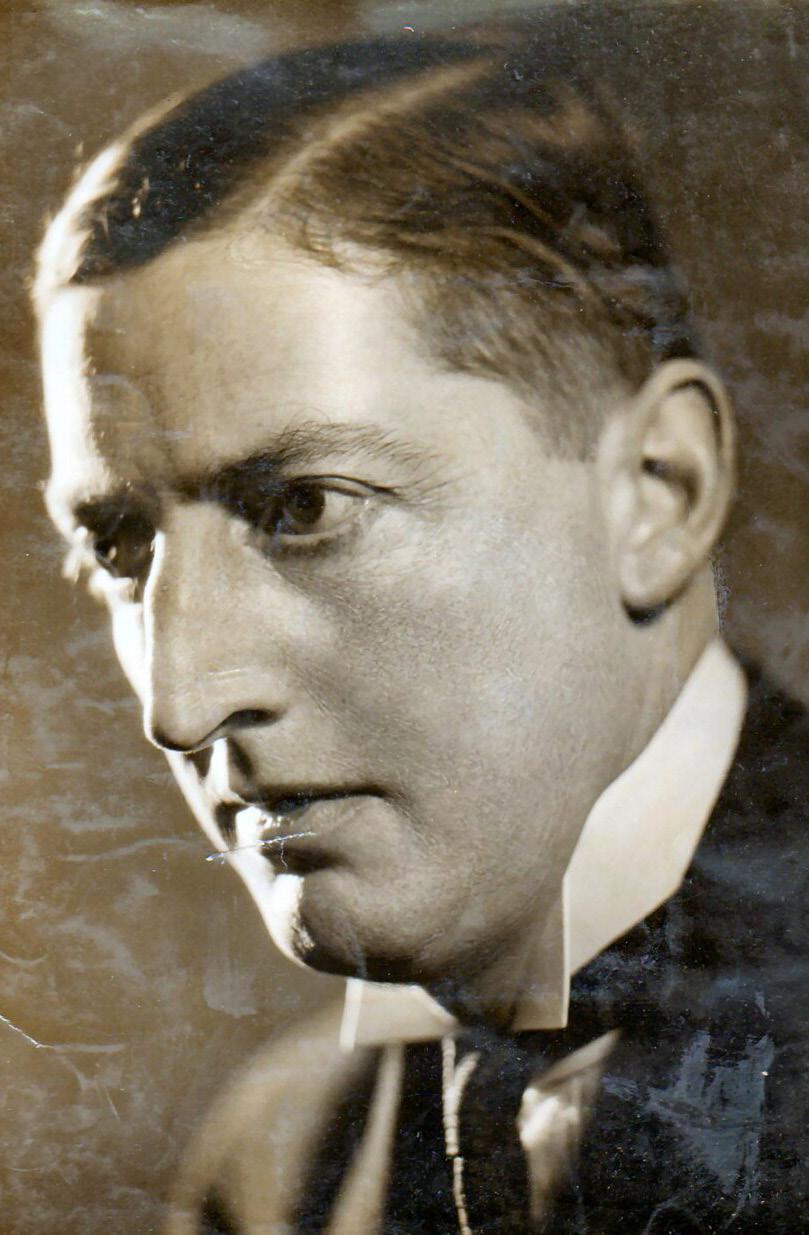
Jerrold: “religion as I knew it was a practice rather than a philosophy”
party’s emphasis on one or the other would be likely to determine its future electoral success. But they preferred a form of capitalism that could be made to incorporate distributism, corporatism and a minimal welfare state.”
In 1950, the magazine was merged with the National Review, which became the English and National Review, and folded ten years later. Through the
1950s Jerrold wrote several histories of England, and defended European and Christian civilisation in a noted exchange with Arnold Toynbee. He died on July 21, 1964, before Vatican II ended, and was buried at St. Mary’s Catholic Cemetery, Kensal Green, London. One can guess what he would have made of the PostConciliar Church by the reactions of his contemporaries, Tolkien and Waugh.
CALENDARIVM
FEBRUARY
Saturday 14 Our Lady on Saturday
Sunday 15 Quinquagesima Sunday
Monday 16 Feria
Tuesday 17 Feria
Wednesday 18 Ash Wednesday
Thursday 19 Feria
Friday 20 Feria
Saturday 21 Feria
Sunday 22 First Sunday in Lent
Monday 23 Feria
Tuesday 24 St Matthias Ap
Wednesday 25 E mber Wednesday of Lent
Thursday 26 Feria
Friday 27 E mber Friday of Lent
Saturday 28 E mber Saturday of Lent
MARCH
Sunday 1 Second Sunday in Lent
Monday 2 Feria (St David B C in Wales)
Tuesday 3 Feria
Wednesday 4 Feria
Thursday 5 Feria
Friday 6 SS Perpetua & Felicity MM
Saturday 7 St Thomas Aquinas C D
Sunday 8 T hird Sunday in Lent
Monday 9 St Frances of Rome W
Tuesday 10 Feria
Wednesday 11 Feria
Thursday 12 St Gregory I P C D
Friday 13 Feria
Saturday 14 Feria
Sunday 15 Fourth Sunday in Lent
Monday 16 Feria
Tuesday 17 Feria (St Patrick B C)
Wednesday 18 Feria
Thursday 19 St Joseph Spouse of the BVM
Friday 20 Feria
Saturday 21 St Benedict Ab
Sunday 22 Passion Sunday
Monday 23 Feria
Tuesday 24 St Gabriel Archangel
Wednesday 25 Annunciation of the BVM (Ladymas)
Thursday 26 Feria
Friday 27 Feria
Saturday 28 Feria
Sunday 29 Palm Sunday
Monday 30 Monday of Holy Week
Tuesday 31 Tuesday of Holy Week
APRIL
Wednesday 1 Wednesday of Holy Week (Spy Wednesday)
Thursday 2 Maundy Thursday
Friday 3 Good Friday
Saturday 4 Holy Saturday
Sunday 5 EASTER DAY
Monday 6 E aster Monday
Tuesday 7 E aster Tuesday
Wednesday 8 E aster Wednesday
Thursday 9 E aster Thursday
Friday 10 E aster Friday
Saturday 11 E aster Saturday (Sabbato in Albis)
Sunday 12 Low Sunday
Monday 13 St Hermenegild M
Tuesday 14 St Justin M
Wednesday 15 Feria
Thursday 16 Feria
Friday 17 Feria
Saturday 18 Our Lady on Saturday
Sunday 19 Second Sunday after Easter
Monday 20 Feria
Tuesday 21 St Anselm B C D
Wednesday 22 SS Soter & Caius PP MM
Thursday 23 St George M
Friday 24 St Fidelis of Sigmaringen M
Saturday 25 T he Great Litanies, St Mark Evangelist
Sunday 26 T hird Sunday after Easter
Monday 27 St Peter Canisius C D
Tuesday 28 St Paul of the Cross C
Wednesday 29 St Peter M
Thursday 30 St Catherine of Siena V
MAY
Friday 1 St Joseph the Worker, Spouse of the BVM C
Saturday 2 St Athanasius B C D
Sunday 3 Fourth Sunday after Easter
Monday 4 T he Holy Martyrs of England and Wales
Tuesday 5 St Pius V P C
Wednesday 6 Feria
Thursday 7 St Stanislaus B M
Friday 8 Feria
Saturday 9 St Gregory Nazianzen B C D
Sunday 10 Fifth Sunday after Easter
Monday 11 SS Philip & James App (Rogation Day)
Tuesday 12 SS Nereus, Achilleus, Domitilla & Pancras MM (Rogation Day)
Wednesday 13 Vigil of the Ascension (Rogation Day)
Thursday 14 T he Ascension
Friday 15 St John Baptist de la Salle C
Saturday 16 St Ubaldus B C
Sunday 17 S unday after the Ascension
World News
Paul Waddington takes a look at what’s happening around the globe. This time he reports from France
The Benedictine Monks of La Barroux
The traditionalist Benedictine Abbey of Sainte-Madeleine at Le Barroux in south-eastern France has established a daughter community in northern France. In October, twelve of their monks moved into the monastery of Our Lady of Bellefontaine in the Loire valley, which had formerly been the home of Trappist monks. The Trappists had moved out after their community had become too small to maintain the buildings and the associated land.
Bellefontaine is the third monastery to be formed from Le Barroux, since its founding in 1978 by a group of monks wishing to preserve the traditional
Benedictine lifestyle and liturgical practices. In 2002, eight monks left to found a daughter house at the Monastery of Sainte Marie de la Garde in south-western France, and in 2008 several of the Le Barroux monks left to found an independent monastery at Villatalla in Italy.
Opinion Poll Points to Popularity of Latin Mass in France
In December 2025, the French daily newspaper, La Croix, published the results of a survey into the practices of French Catholics conducted by polling firm, Ifop. The online survey was conducted in April, and is based on interviews with 2,159 Catholics, 1,004 of whom were regularly practising and 1,155 practising occasionally.
The survey, which covered a range of issues, challenged many widespread perceptions about religious practices in France. For example, it found that the average age of regular Mass-goers was just under 50, with slightly more than half being men. It also found that 50 percent of the country’s weekly Mass-goers attend confession with some regularity.
Of particular interest to us was the finding that nine percent of regular churchgoers say that the Latin Mass is their preferred Mass, and that 25 percent indicate that they like the Latin Mass as much as Mass in French. A majority (67 percent) of those surveyed said they had no objection to the Traditional Latin Mass, whilst 22 percent regarded it as a backward step.
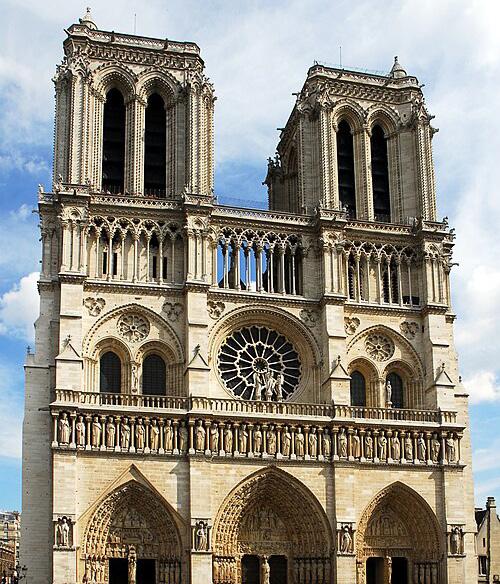
Notre Dame, Paris: a majority of those surveyed by a French newspaper said they had no objection to the Traditional Latin Mass
The finding that less than a quarter of those polled expressed any dislike or disapproval of the Latin Mass is highly significant. La Croix concluded that the figures point to, “a certain normalisation” of the Old Mass in France, despite the restrictions imposed on it by Traditionis Custodes, the 2021 motu proprio of Pope Francis.
New Location for the Latin Mass in Paris Regular Masses in the Ancient Form are now being offered at the Eglise du Valde-Grâce in the Latin Quarter of Paris at 8.30pm on Sundays. This church belongs to the French Military Ordinariate, and it seems that it has been chosen as a venue for Latin Masses because it is not a parish church. (See pages 20-21 of this issue for more on Val-de-Grâce.)
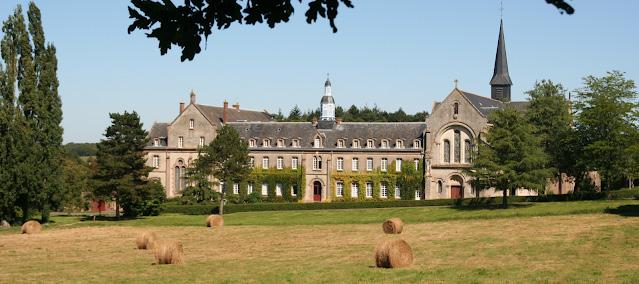
The philosophy of particularity
Joseph Shaw reports from the launch of a new book on a much-loved priest, the late Mgr Alfred Gilbey
Without having been a member of Mgr Alfred Gilbey’s circle – being too young – I was honoured to introduce this new book, The Absolute Uniqueness of Monsignor Alfred Gilbey, at its launch in London. It is a long interview, or series of interviews, with some explanatory notes, quotations from Gilbey’s own well-known catechetical book, We Believe, and some historical appendices for context, by Alexander Hayden. Reading this book, and hearing the reminiscences of many of his friends at the launch, was a privileged opportunity to hear this much-loved priest’s voice again: though without the difficulty of his well-known tendency to mumble.
‘Gilbey’ (1901-1998), as he was known, was the Catholic Chaplain to Cambridge University from 1932 to 1965, during which time he exercised a powerful influence over a generation of students and received many into the Church. For the remaining thirty-three years of his life, he remained active in very much the same role: giving consolation and advice to an everwidening circle, instructing converts, and celebrating the traditional Mass, from his base at the Travellers’ Club in London. He was given permission to continue with the old Missal, as were other ‘aged priests’, and while never a proselytiser for it, helped to keep the flame alive with his 7am weekday Masses in St Wilfrid’s Chapel in the London Oratory – to the right of the High Altar, and behind a thick curtain. In later life he would visit Cambridge and celebrate the Traditional Mass in the Chaplaincy once more, and after his death a Requiem for him there, in the Traditional form, has become an annual institution.
Haydon’s interviews cover a range of topics, though not the liturgy: the dispute that led to Gilbey’s departure from Cambridge; Faith and Reason; contraception; religious emotion; and many other things. Gilbey was uncompromising in his defence of the
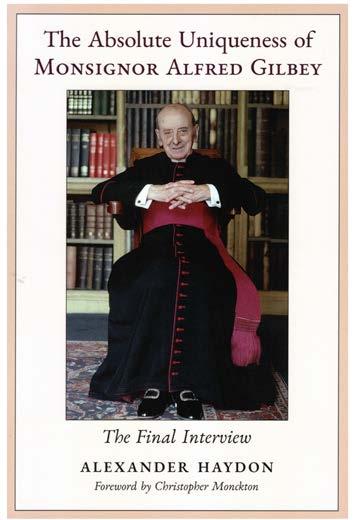
Faith, but he was no puritan. Reading of his appreciation of food and wine one might, in fact, imagine him to be a veritable Apostle of gracious living, but
this impression needs to be balanced by two other aspects of his character. One is his personal moderation: eating only one course at elaborate meals, never replacing worn-out and barely usable personal items, his spare physique, and so on. Another is his complete ease with all kinds of people, and his readiness to enter into their concerns: from taxi-drivers to strangers he met on the train. He was like St Paul: scio et humiliari, scio et abundare (‘I know how to be poor, and how to be rich’: Philippians 4:12).
His ability to connect with all kinds of people is related to something that emerges from many published and unpublished anecdotes about Gilbey: his great personal kindness. It also had a theoretical underpinning in his world-view, which is his concern for each person’s uniqueness, his or her particularity. He was fiercely opposed to egalitarianism, which he called a ‘cruel word’, but for Gilbey the alternative to equality was not a hierarchically-arranged set of social castes, fixing people to some subservient position or role, but a cosmic symphony of individuality. For Gilbey, as for St Teresa of Calcutta,
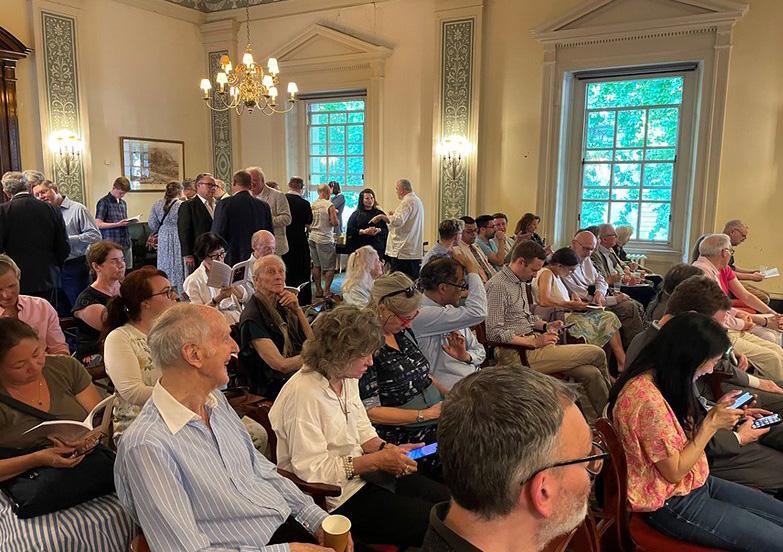
each and every person is worthy of unlimited time and attention because they are a creature of God. The salvation of the least of these was worth securing by the death of Jesus Christ, so it was certainly worth Gilbey crossing the country to attend a sickbed, or devoting a series of afternoons to a convert’s gentle instruction.
There is something child-like about this attitude, which in my address at the book launch I compared to the spiritual attitude of another wellknown traditional priest of Gilbey’s generation, the Jesuit Fr Hugh Thwaites. Some might object that it is inefficient to expend a valuable and limited resource, like the time of a saintly spiritual director, on random people he just happens to encounter. The logical conclusion of the drive to efficiency, however, would be to ignore all considerations of friendship, blood relationships, gratitude, and indeed justice, as well as physical proximity, to maximise the good one might do: ‘sorry, granny, the money for your Christmas present was more productively allocated to a complete stranger in Africa’. This is incompatible with the happenstance of Divine Providence, and the human relationships which are, in fact, the means chosen by God to build up His Kingdom.
The philosophy of particularity allowed Gilbey to appreciate not only each individual he met, but also traditions, whether divine, ecclesiastical, or human. Sherry, beagling, architecture, the antiquated clerical garb he wore, and above all personal friends, all received his affectionate attachment, not instead of more important things, but as reflections of them, and means to them.
It also lay behind his opposition to admitting women to the Chaplaincy in Cambridge, Fisher House. Women were still a very small minority of students in Cambridge, and had their own chaplaincy based in a convent. As they were being incorporated more fully into the University, the progressive view was to open Fisher House to them without delay. Gilbey, however, recognised that adding 10 percent women to a tightlyknit male society would transform it, but not to the benefit of the women. It was on this issue that he was forced to resign as Chaplain, a triumph of abstract theory over practical wisdom and insight into human nature.
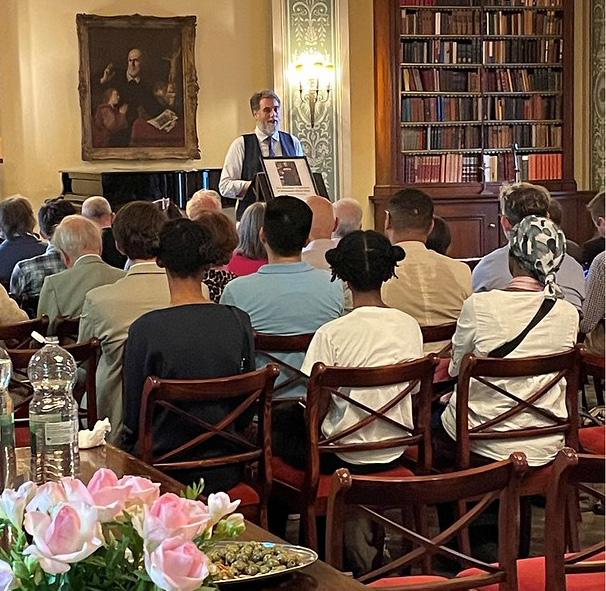
The idea that men and women are interchangeable social units has received its apotheosis in recent years, and sixty years after Gilbey’s departure from Fisher House it seems finally to be in retreat. It has been a bitter-sweet victory, to read feminists saying that, after all, perhaps they should have allowed men to keep their all-male institutions, such as working-men’s clubs, now that all-female spaces have come under threat, because so much damage has been done. But it is an interesting fact that, as Madeleine Beard wrote in an appreciation of Gilbey in 2005, after the initial savage ‘wreckovation’ of Fisher House, a succession of more sympathetic Chaplains has sought to put some of the pieces together again: and this process has its parallel in the Church as a whole.
The Latin Mass Society has organised a good number of book launches in recent years, and this one was the best-attended and most jolly yet, because it brought together so many of Gilbey’s old friends, many of whom contributed little personal anecdotes about him between the short talks we had. In addition to a talk from the author, we were particularly
honoured by a moving address given by Fr Ronald Creighton-Jobe of the Oratory.
Gilbey was not a great writer – even his book We Believe was based on a series of talks he had given – and were it not for the devotion of his friends he could soon have been forgotten. Instead, after his death, a number of them put together a collection of short personal recollections: Alfred Gilbey: A Memoir by Some Friends (2001), to sit beside his ever-popular We Believe (1983), which remains in print. Haydon’s short book is a valuable addition to this small bibliography. On the Day of Judgement, however, a far greater monument will be revealed: that of all the souls he helped, with wit, kindness, and patience, in the course of his extraordinary and long life.
Factfile
The Absolute Uniqueness of Mongsignor Alfred Gilbey: The Final Interview. By Alexander Haydon, with a Foreword by Christopher Monckton. Arouca Press, 2025; £14.95 from the LMS online shop.
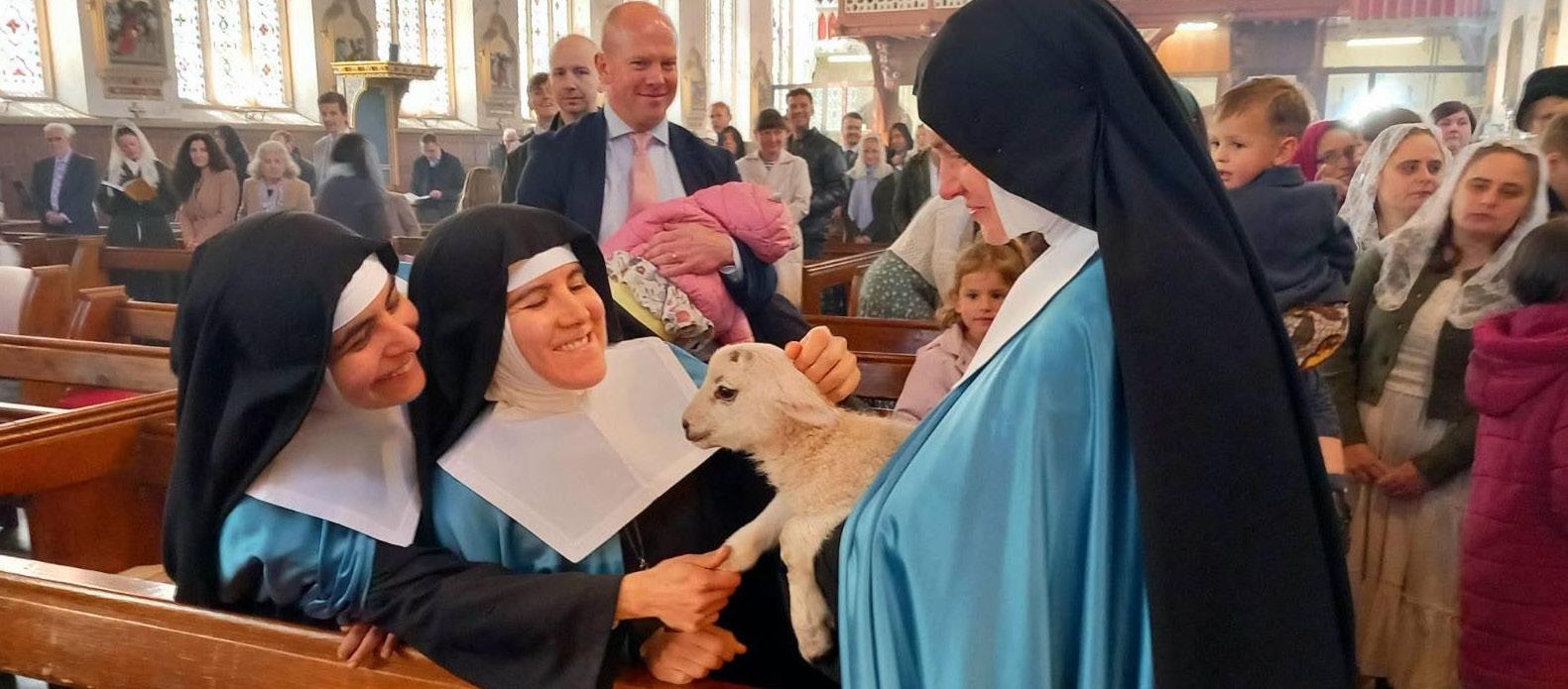
In Corde Regisin the King’s heart
An appeal for funds for the Sisters Adorers
The motto of the Adorers of the Royal Heart of Jesus Christ Sovereign Priest (female branch of the ICKSP) sums up the purpose of our lives: to adore God in His Sacrament of Love and to pay Him the homage that is due to Him is our first duty. Then, as if receiving it from a living source, we try to radiate this divine Love to the souls we encounter. Arriving in Preston in November 2017, at the request of His Lordship Bishop Campbell, then Bishop of the Diocese of Lancaster, our vocation is both contemplative and apostolic.
The contemplative aspect of our life is manifested through the adoration of the Blessed Sacrament exposed every evening in St Walburg’s Church, our shrine church; through the singing of Lauds, Vespers and Compline; through an interior life based on silent prayer and devotion to the Sacred Heart of Our Lord and to the Most Holy Virgin Mary. Living the spirituality of St Francis de Sales, the ‘little virtues’ of humility and meekness help us to put charity first.
St Benedict, another of our patron saints, teaches us to forget ourselves for the service of worship and ‘to prefer nothing to the love of Christ’. Following his example, the practice of Gregorian chant for sung Masses and services becomes our primary apostolate of prayer. Community life based on obedience and service to others before oneself is the main source of self-giving and therefore of great joy: as in a family,
our life is full of surprises and beautiful moments! With St Jane de Chantal and St Margaret Mary, we learn to trust completely in the power and mercy of the Heart of Jesus and to live each event through the eyes of His ‘ever wise and sweet Providence’.
The apostolic aspect of our work involves taking part in the life of the shrine, namely through catechism for the children of the shrine and through teaching at St Benedict’s Cultural Centre. Every summer, we also offer camps for young girls at our Irish convent in Ardee (Co Louth), which is also attended by some young ladies from Britain every year!
Since 2017, we have been living in the former presbytery of St Augustine's Church, a 15-minute drive from St Walburg's Church. When we arrived, it was not possible to live in the dilapidated building adjacent to the presbytery and the church, and Bishop Campbell very graciously lent us this house. Since then, we have been travelling every day between this house and the church: in the morning for Holy Mass and in the afternoon for Vespers followed by an hour of adoration. Several times a week, due to apostolic activities or the needs of the community, we make three or four trips back and forth each day.
In addition to the considerable loss of time, all these journeys are not conducive to silence and interior life, and we have been praying for several years that we might be able to set up a convent near
the shrine. And Providence has heard us! Thanks to a few benefactors, work on the roof was able to begin this summer, but the task is immense: this building, which has not been inhabited for decades, is in very poor condition and, as it is listed, we must scrupulously follow the architects' instructions to fulfil local heritage requirements. This is therefore a great adventure that is beginning for us which will last for several years, as the project is ambitious: the first phase of the work was estimated at £600,814, and we were able to raise the necessary funds. Once this phase is completed, we will be able to move into our new convent. However, the work will be far from being finished, and we will need help with the second phase.
Above all, dear friends, our proximity to the church will allow us to adore the Blessed Sacrament on the altar for longer in this sanctuary, which has always been dedicated to adoration of the Blessed Sacrament. As in the other houses of the Adorers, a sister will always be close to Our Lord to love Him and bring Him your intentions, your persons, the tragedies and joys of this world.
Dear friends, we thank you in advance for your generosity, which we greatly need, and we assure you of our prayers for each of you and for all your intentions. If you’d like to donate please go to adoratrices.icrss.org/en and click the ‘Donate’ button.
Modes of participation
Matthew Hazell reviews a new book on liturgical reconciliation
This book collects the proceedings of a webinar held in June 2022 at the Margaret Beaufort Institute of Theology in Cambridge on the topic of liturgical reconciliation. Given the pastoral reality of the supposed ‘synodal, listening Church’ being so at odds with how traditionalists have been treated, especially since Traditionis custodes, along with the rumoured openness of Pope Leo XIV to rethinking current liturgical issues, it is certainly well-timed.
The first two introductory chapters provide a short summary of the postVatican II liturgical reforms and their reception, even-handedly touching on the numerous conflicts that have arisen over the liturgy over the past 60 years, along with an exhortation to ‘deep, attentive listening’ and dialogue, a prerequisite for any kind of understanding and reconciliation.
Chapter three is where the dialogue begins in earnest. Nineteen transcribed video testimonies, along with four written ones, are presented as the ‘views from the pews’. The diverse testimonies are from a broad cross-section of the faithful, men and women, younger and older: those who attend the traditional liturgy, those who attend the Novus Ordo, and those who attend both. Each of these individuals, in their own words, succinctly express why they prefer one liturgy over the other, or explain why they find a particular feature (such as ad orientem, Latin, silence, beauty, etc.) fruitful and beneficial for them. Readers will no doubt find something of themselves reflected in these testimonies, alongside opinions and feelings they may very well disagree with. This chapter concludes with a contribution from Dr Joseph Shaw, chairman of the Latin Mass Society, which examines the contrasting modes of participation of the traditional and reformed liturgies.
The following chapters are the responses of the theologians to these ‘views from the pews,’ each taking a slightly different starting point: liturgical art and architecture, the multi-sensory liturgical experience, Eastern Orthodoxy
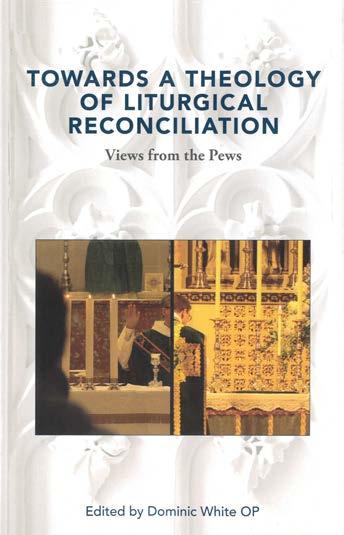
and ecumenism, liturgical participation and mystery, the non-verbal aspects of the liturgy. As perhaps is to be expected in a volume structured around dialogue and reconciliation, there is plenty of overlap and common ground between these contributions. The plurality of experiences and perspectives in these essays, however, provides plenty of food for thought. In particular, I found it striking that the recovery of the importance of non-verbal elements of ritual - such as silence, gesture, mystery, art, architecture and space - is a common desire of the theologians and lay faithful. Indeed, theologians and liturgists have had to play catch-up with those lay faithful who have long lamented the over-emphasis on verbal comprehension in the design and implementation of the liturgical reforms. As the editor of this volume, Fr Dominic White OP, says in his contribution: ‘Liturgical reform has done much to recover the Word, and it has recognized the importance of hearing, speaking and understanding: but as long as our theology of liturgy does not take sufficient account of gesture, silence and the cosmic, these distortions and conflicts are going to continue.’
The final chapter summarises the plenary discussion which followed the theologians’ contributions. The question of liturgical plurality is raised, but, of course, a certain ‘live and let live’ approach only goes so far in a Church with dogma and doctrine to which all must adhere. What the limits of such an approach might be are not answered in this book, but that is not really its aim. Without the full liberty to freely celebrate the traditional liturgy alongside the Novus Ordo, without the Catholic ‘both-and,’ without the diversity of liturgical rites and uses within the one Church, there is not even the space to discuss liturgical reconciliation in any meaningful way. In my opinion, the highly-restrictive and misguided approach of Traditionis custodes must be left behind, and the pastoral and theological solution that Benedict XVI (of blessed memory) gave the Church in Summorum Pontificum must be taken up again in some form.
Finally, there is an Afterword from Fr White, which, in the spirit of listening and dialogue that characterises the entire volume, bravely attempts to put the better aspects of Francis’s Apostolic Letter Desiderio desideravi to some use. He concludes that the Church has ‘a golden opportunity’ for liturgical reconciliation, and ‘for two, or indeed more, forms of the Roman liturgy to coexist and mutually enrich each other, in listening and humility’. I am not sure I entirely agree with this latter statement, but I hope and pray that the book’s vision of a Church in which there is space for genuine listening, healthy discussion and good faith debates about liturgical questions comes to pass in this new Leonine papacy.
Factfile
Towards a Theology of Reconciliation: Views from the Pews, edited by Dominic White, OP, (St Mary’s University Press) are available from the LMS bookshop at £17.99.
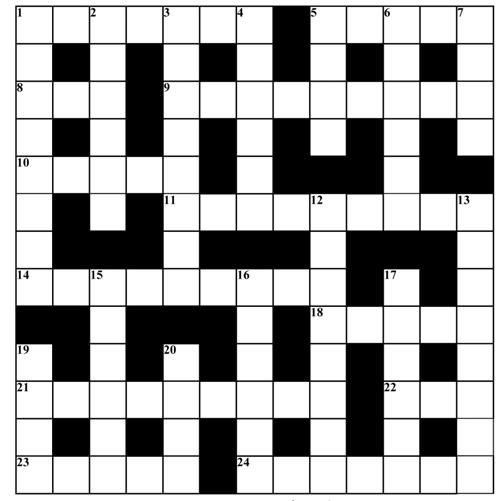
ANSWERS TO WINTER 2025 CROSSWORD
Across: 1 Walking 5 Muses 8 Cow 9 Etruscans 10 Genoa
11 Ennobling 14 Ephesians 18 Irina 21 Premontre 22 Axe
23 Miami 24 En Scene Down: 1 Wadowice 2 Lowing
3 Iranaeus 4 Gordon 5 Mise 6 Scampi 7 So-so 12 Business
13 Gadarene 15 Helena 16 Auntie 17 Pilate 19 Spem 20 Honi
Clues Across
1 Critical call for the fruit! (7)
5 & 13 Down: Formal High Mass in Latin (5,8)
8 Emergency call (1.1.1.)
9 Rare metal with a solar system link! (9)
10 International orchestra of Manchester (5)
11 Goes to extremes where the world is concerned (9)
14 Politically active Cardinal to King Louis XIII of France (9)
18 Towering feature of a church (5)
21 Belonging to a united body (9)
22 Large beer or wine barrel (3)
23 Plant used for making rope (5)
24 Charms worn to ward off evil (7)
Clues Down
1 Busy traffic time (4,4)
2 Patroness of schoolgirls and Germany, often depicted as shot with arrows (6)
3 Desirable order for the dessert chef? (5,3)
4 Extremely vicious (6)
5 Link between Othello and barren Yorkshire land (4)
6 David’s tools go with the arrows of misfortune (6)
7 Donations for the needy (4)
12 Provider of Social Contract for painter? (8)
13 See 5 Across
15 Mediterranean island (6)
16 Type of lizard (6)
17 Opposite of vice (6)
19 ‘---- and Galatea’, opera by Handel (4)
20 Nature of Satan (4)
The winner of the Winter 2025 Crossword is Dr Danuta Lithgow Smith of Rainford. She has won a copy of 'MerrieEngland' by Joseph Pearce.
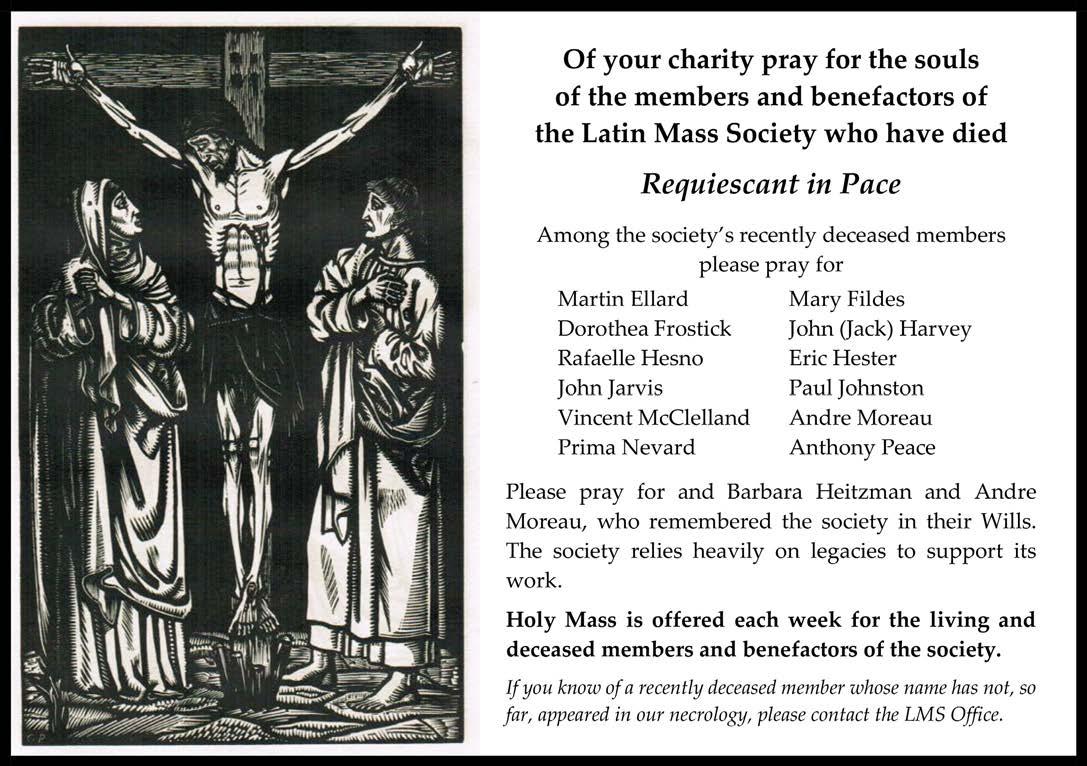
Alan Frost: January 2026