#16
issue 01
Streamlined ordering just a mouse click away Matt Finish at the
Spring Fair, NEC 2010, yes it’s Two Thousand and Ten!! A new year beckons and we are ready to put our recessionary woes behind us and look forward to the Spring. But the first sign of Spring does not come with nature but with a visit to the Spring Fair at the NEC. So said, we start our NEC tale. “The bitter wind bites deep into your bones as you lean forward, head bowed against its strength, the flakes of snow fighting for space in the air. Eyes narrow to avoid the effects of the cold, the mighty doors open into the furnace and again I step into the unknown.” Not a quote from Scott of the North Pole fame but the start of a story I used to tell my children on returning from a week at the NEC Spring Fair. They wanted to know why daddy had gone away for a week but came back looking five years older; had I been through some kind of time warp ageing process? So, the time for the Spring Fair comes around again. The children are older now and understand it’s probably the excesses of life that created this strange change in their father and it’s an annual event that he complains about before setting off for Birmingham and makes sure everyone knows how hard he has worked on his return. Yet the stories he tells seem to centre around the bar area – how strange. This year will be different; I am determined to drink more water, take more exercise and try to get at least seven hours sleep a night, so that’s covered the week before the Spring Fair. But seriously, it’s a hard slog from building the stand to taking the whole thing down at the end, when it’s the last thing you need. Dealing with product and customers can take its toll, you need a few beers at the end of the day to catch your breath.
13168_4walls_issue1 v3AW.indd 1-2
The Spring Fair has always been a meeting point for the trade, I often bump into people who I haven’t seen for years, yet it will only seem like yesterday since we stood on the corner of some stand, assessing just what the future holds for us all and who will still be around this time next year, or even try to guess which hall we will be in! The Exhibition has grown over the many years that I have been attending; halls added, trades added and recently they have given the inside a coat of paint. You can even buy food with foreign names. Not that we get time to eat, this special treat is reserved for the customers who are bussed in from a car park just outside Watford. So, I will give you five things I love about the Exhibition and five things I hate about it. Hate: being so hot in the exhibition halls. Love: being in the warm when across the car park you can see the driving snow. Hate: the late nights and early mornings and waking with a hangover. Love: the late nights and early mornings when I don’t awake with a hangover. Hate: standing for hours with no customers because a problem on the motorway has stopped them arriving. Love: the buzz when a large crowd of customers arrive and are ready for business. Hate: getting stuck with someone who wants to tell you how bad business is when you know they only have themselves to blame. Love: having a customer who has a new project and wants you to help develop it. Hate: the journey home in the dark, in heavy traffic and very exhausted. Love: the journey home to my own bed and a cup of tea with Mrs Finish.
From the designer clothes from boutique designers the other side of the world down to your weekly grocery shop, the internet has helped us to streamline our shopping habits. Forget the hassle of the high street on a Saturday afternoon – there’s a wealth of product information on-line to pour over whenever we want; the convenience of often knowing whether an item is in stock and when it is likely to be delivered – all just a mouse click away. To take this growing trend into account, throughout 2009 we’ve been working hard to improve our alreadypopular e-commerce facility. As well as ordering from our entire range, you can also manage your account online. Using your current log in details and password you can access your account, view prices, place orders and see your top ten favourite mouldings, mountboards and frames. Stock availability and ordering facilities are in real time, which means that all information is accurate and up to date. It offers faster delivery too, as customer orders placed on-line are also given shipping priority over telephone and fax orders. Once you have placed an order, you will receive an email confirmation, which details exactly what you have ordered and the expected delivery date. A new facility introduced for 2009 was electronic invoicing, which proved popular with many customers during the recent national postal strike. One of the main benefits of electronic invoicing is that you will know exactly what has been dispatched before the goods actually arrive, making budgeting and stock control easier and more efficient. It’s also environmentally friendly, reducing the amount of paper we use. Orders placed via the website will automatically receive an electronic invoice but all customers can now opt-in to this new system by simply contacting our accounts team.
the magazine for art and framing professionals
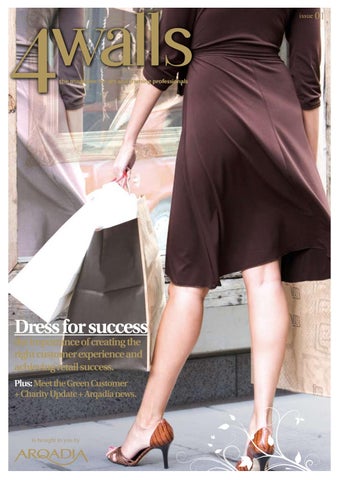
Dress for success the importance of creating the right customer experience and achieving retail success. Plus: Meet the Green Customer + Charity Update + Arqadia news.
is brought to you by
The sun WILL shine again and we will all look forward to a better time in 2010.
6/1/10 15:24:14
#02
#03
...
to 4walls magazine
Within these 4 walls...
If ever we’ve needed to share ideas, It’s now. Our aim is simple. To provide Britain’s framers with a forum for keeping bang up to date on the art and the science, the products and procedures and the challenges and solutions that face us in these testing times. What is the right format? What is the content you, the reader, really wants? To evolve into a truly valuable magazine we need your ideas, your issues and your feedback. Don’t hesitate to contact me at pauline.hutchinson@arqadia.co.uk Pauline Hutchinson
2008 winner, Frames and Galleries, Huddersfield
Up first:
Arqadia to provide Timecare® Range in 2010 We are pleased to announce that we will be supplying a range of storage solutions from Timecare®. This range is aimed at collectors, family history enthusiasts and keen photographers – a great way to add an extra income stream to your existing framing business. Most of us are collectors, even though we may not think of ourselves that way. And whether it’s baby keepsakes, family photographs, letters from old friends, important documents or simply a collection of postcards, it is important they are stored correctly rather than kept in an old shoe box under the bed or in a plastic bag in the loft. The Timecare® range offers conservation-grade protection from the harmful effects of light, moisture, temperature fluctuations, pests, pollution and handling – everything that could cause irreparable damage. A wide variety of solutions is available, including ringbinders, archival boxes, mounting boards, mounting strips, adhesive and even cotton gloves. Your customers already want to present and display their memories, so Timecare® is the perfect way to protect, long term, other items close to their hearts. Marketing and point-ofsale material for your store will be available when the range launches at the Spring Fair, as well as expert advice on how best to present the Timecare® proposition to your customers. A special ‘starter pack’ containing all the essentials will also be available. For more information on the Timecare® range prior to the official launch in 2010, visit www.timecare.co.uk.
13168_4walls_issue1 v3AW.indd 3-4
Is your business in need of attention?
Call in the Shop Doctor! Does your business need some TLC? Are you stuck in a rut and need a bit of a boost? Do you want to give your store a new look or expand into new products? Perhaps you feel you could be working smarter to increase profits but are not sure where to start? Well help is at hand with the Arqadia Shop Doctor Competition.
The competition offers a fantastic opportunity to revitalise your business. A team of retail consultants and visual merchandise experts will look objectively at your business and then work with you to find solutions that are right for you – whether it’s improving profitability and efficiency, reducing costs or enhancing the customer experience. Mike Brown, Arqadia’s Managing Director, said: “The Shop Doctor Competition has been extremely popular over the last few years and is an excellent way of helping our customers improve their business and boost sales. It’s a fantastic prize and I’m sure it will, once again, generate a lot of interest.” Previous winner John Laycock of Frames and Galleries, Huddersfield, said winning the competition could not have come at a better time:“I had purchased the business 18 months before and had been planning a major revamp for a while but, to be honest, I didn’t really know where to start. Having advice and help from experts gave me the added
incentive and confidence I needed to implement what I had in mind. The help they gave me was invaluable; covering everything from improving the way customers flowed through the building to making the buying process more comfortable and consultative and even creating a new e-commerce website.” The lucky winner of this year’s competition will also receive £500 towards the cost of revamping their store or implementing new processes and £250 of Arqadia product. The closing date for entries is 30th March 2010 and the winner will be notified by the end of April. Five finalists will also receive £50 worth of Larson Juhl chevrons. To enter the competition you must provide up to five photographs of your store together with a completed entry form, which is available from your Arqadia sales representative or can be downloaded from the Arqadia website, www.arqadia.co.uk.
How’s busines s? Couldn’t be better ? Ignore this leaflet Could be better . ? Please turn over...
6/1/10 15:24:19
#02
#03
...
to 4walls magazine
Within these 4 walls...
If ever we’ve needed to share ideas, It’s now. Our aim is simple. To provide Britain’s framers with a forum for keeping bang up to date on the art and the science, the products and procedures and the challenges and solutions that face us in these testing times. What is the right format? What is the content you, the reader, really wants? To evolve into a truly valuable magazine we need your ideas, your issues and your feedback. Don’t hesitate to contact me at pauline.hutchinson@arqadia.co.uk Pauline Hutchinson
2008 winner, Frames and Galleries, Huddersfield
Up first:
Arqadia to provide Timecare® Range in 2010 We are pleased to announce that we will be supplying a range of storage solutions from Timecare®. This range is aimed at collectors, family history enthusiasts and keen photographers – a great way to add an extra income stream to your existing framing business. Most of us are collectors, even though we may not think of ourselves that way. And whether it’s baby keepsakes, family photographs, letters from old friends, important documents or simply a collection of postcards, it is important they are stored correctly rather than kept in an old shoe box under the bed or in a plastic bag in the loft. The Timecare® range offers conservation-grade protection from the harmful effects of light, moisture, temperature fluctuations, pests, pollution and handling – everything that could cause irreparable damage. A wide variety of solutions is available, including ringbinders, archival boxes, mounting boards, mounting strips, adhesive and even cotton gloves. Your customers already want to present and display their memories, so Timecare® is the perfect way to protect, long term, other items close to their hearts. Marketing and point-ofsale material for your store will be available when the range launches at the Spring Fair, as well as expert advice on how best to present the Timecare® proposition to your customers. A special ‘starter pack’ containing all the essentials will also be available. For more information on the Timecare® range prior to the official launch in 2010, visit www.timecare.co.uk.
13168_4walls_issue1 v3AW.indd 3-4
Is your business in need of attention?
Call in the Shop Doctor! Does your business need some TLC? Are you stuck in a rut and need a bit of a boost? Do you want to give your store a new look or expand into new products? Perhaps you feel you could be working smarter to increase profits but are not sure where to start? Well help is at hand with the Arqadia Shop Doctor Competition.
The competition offers a fantastic opportunity to revitalise your business. A team of retail consultants and visual merchandise experts will look objectively at your business and then work with you to find solutions that are right for you – whether it’s improving profitability and efficiency, reducing costs or enhancing the customer experience. Mike Brown, Arqadia’s Managing Director, said: “The Shop Doctor Competition has been extremely popular over the last few years and is an excellent way of helping our customers improve their business and boost sales. It’s a fantastic prize and I’m sure it will, once again, generate a lot of interest.” Previous winner John Laycock of Frames and Galleries, Huddersfield, said winning the competition could not have come at a better time:“I had purchased the business 18 months before and had been planning a major revamp for a while but, to be honest, I didn’t really know where to start. Having advice and help from experts gave me the added
incentive and confidence I needed to implement what I had in mind. The help they gave me was invaluable; covering everything from improving the way customers flowed through the building to making the buying process more comfortable and consultative and even creating a new e-commerce website.” The lucky winner of this year’s competition will also receive £500 towards the cost of revamping their store or implementing new processes and £250 of Arqadia product. The closing date for entries is 30th March 2010 and the winner will be notified by the end of April. Five finalists will also receive £50 worth of Larson Juhl chevrons. To enter the competition you must provide up to five photographs of your store together with a completed entry form, which is available from your Arqadia sales representative or can be downloaded from the Arqadia website, www.arqadia.co.uk.
How’s busines s? Couldn’t be better ? Ignore this leaflet Could be better . ? Please turn over...
6/1/10 15:24:19
#04
#05
Top. L-R: Venice, Taranto, Bari Bottom. L-R: Rich Veneers, Sofia, Petite
Trends in frames
We all know frames can transform any room, helping to turn a house into a home with touches reflecting the personality of its owner. But tastes change season to season, so Arqadia introduces new mouldings every year to ensure we’re always on top of the very latest interior trends.
Whether it’s a picture destined for a grand home which would grace the pages of a glossy magazine or a more modest family property, we have introduced a number of mouldings recently which have already proven popular with customers.
Inspired by the ancient palazzos of Italy, Venice is a stunning new moulding range offering the ultimate in extravagant design. The two cushion profiles, with a hint of classic Italian flair, are ideal for framing fine art or more traditional images. The smaller moulding features a large, beaded ornamentation whilst the larger profile has a detailed rope work design. Venice features a classic antiqued finish and is available in three colours – gold, gold/black and silver – offering timeless splendour at an affordable price. Continuing the touch of class is Taranto – an impressive, new, large moulding which is perfect for creating an ornamented yet subtle look.
13168_4walls_issue1 v3AW.indd 5-6
With a decorative scoop profile measuring 114mm in width, Taranto’s understated grandeur will blend easily with either lavish or minimalist decors. Available in five colours – gold, silver, bronze, white and black, this versatile new moulding is a must have addition for a variety of interiors. Ideal for a wide range of framing needs, this stunning range is perfect for framing mirrors and blends beautifully with many different styles of artwork, from bold abstracts to landscapes and impressionist art. As canvas-based art continued to hold its popularity throughout 2009, we launched Bari – a new range of L shaped mouldings which are ideal for laying a canvas into.
Bari features an angled profile and measures 65mm in width. Designed to complement a wide variety of décor schemes, it is available in black and white, both with a smooth finish and the increasingly popular Wenge, which also features a grain effect. Now we’ve all started that New Year diet and rejoined the gym with fresh resolve, it’s time to reveal some of the exciting new mouldings we’re releasing for 2010.
antique walnut and grey – Rich Veneers will match almost any artwork, but are especially suited to traditional prints. All are reverse profiles and have a Burr Elm veneer. Rich Veneers is available in five sizes from 20mm to 70mm.
metallic finishes – iron and silver – and the hand-applied matte patina adds a subtle, soft antiquing. The five different profiles provide a variety of sizes for framing everything from small graphics to large canvas paintings.
Named after the capital city of Bulgaria, our new Sofia range of ornate, washed silver and pewter mouldings reflects the beauty of this ancient city.
Good things are often said to come in small packages, and that’s certainly true for our new Petite range. These mouldings are sultry stunners – delicate, with a snakeskin-effect finish.
Like the little black dress or starched white shirt, some classics never go out of fashion. Our new Rich Veneers colourways add a contemporary twist to our ever-popular veneers range.
The city of Sofia combines timeless, beautiful architecture with a cosmopolitan European culture and these traits are embodied in the collection of Sofia frames – a combination of classic and contemporary ornamented styles and finishes.
Offering three new finishes – walnut,
The collection is available in two, unique
This small-cushioned bevel profile is available in a variety of metallic finishes – silver, pewter, bronze, gold, copper and black – and this wide choice of colours means Petite is sure to suit all types of artwork. Petite measures 20mm in width, with a rebate of 13mm and is PEFC certified.
6/1/10 15:24:24
#04
#05
Top. L-R: Venice, Taranto, Bari Bottom. L-R: Rich Veneers, Sofia, Petite
Trends in frames
We all know frames can transform any room, helping to turn a house into a home with touches reflecting the personality of its owner. But tastes change season to season, so Arqadia introduces new mouldings every year to ensure we’re always on top of the very latest interior trends.
Whether it’s a picture destined for a grand home which would grace the pages of a glossy magazine or a more modest family property, we have introduced a number of mouldings recently which have already proven popular with customers.
Inspired by the ancient palazzos of Italy, Venice is a stunning new moulding range offering the ultimate in extravagant design. The two cushion profiles, with a hint of classic Italian flair, are ideal for framing fine art or more traditional images. The smaller moulding features a large, beaded ornamentation whilst the larger profile has a detailed rope work design. Venice features a classic antiqued finish and is available in three colours – gold, gold/black and silver – offering timeless splendour at an affordable price. Continuing the touch of class is Taranto – an impressive, new, large moulding which is perfect for creating an ornamented yet subtle look.
13168_4walls_issue1 v3AW.indd 5-6
With a decorative scoop profile measuring 114mm in width, Taranto’s understated grandeur will blend easily with either lavish or minimalist decors. Available in five colours – gold, silver, bronze, white and black, this versatile new moulding is a must have addition for a variety of interiors. Ideal for a wide range of framing needs, this stunning range is perfect for framing mirrors and blends beautifully with many different styles of artwork, from bold abstracts to landscapes and impressionist art. As canvas-based art continued to hold its popularity throughout 2009, we launched Bari – a new range of L shaped mouldings which are ideal for laying a canvas into.
Bari features an angled profile and measures 65mm in width. Designed to complement a wide variety of décor schemes, it is available in black and white, both with a smooth finish and the increasingly popular Wenge, which also features a grain effect. Now we’ve all started that New Year diet and rejoined the gym with fresh resolve, it’s time to reveal some of the exciting new mouldings we’re releasing for 2010.
antique walnut and grey – Rich Veneers will match almost any artwork, but are especially suited to traditional prints. All are reverse profiles and have a Burr Elm veneer. Rich Veneers is available in five sizes from 20mm to 70mm.
metallic finishes – iron and silver – and the hand-applied matte patina adds a subtle, soft antiquing. The five different profiles provide a variety of sizes for framing everything from small graphics to large canvas paintings.
Named after the capital city of Bulgaria, our new Sofia range of ornate, washed silver and pewter mouldings reflects the beauty of this ancient city.
Good things are often said to come in small packages, and that’s certainly true for our new Petite range. These mouldings are sultry stunners – delicate, with a snakeskin-effect finish.
Like the little black dress or starched white shirt, some classics never go out of fashion. Our new Rich Veneers colourways add a contemporary twist to our ever-popular veneers range.
The city of Sofia combines timeless, beautiful architecture with a cosmopolitan European culture and these traits are embodied in the collection of Sofia frames – a combination of classic and contemporary ornamented styles and finishes.
Offering three new finishes – walnut,
The collection is available in two, unique
This small-cushioned bevel profile is available in a variety of metallic finishes – silver, pewter, bronze, gold, copper and black – and this wide choice of colours means Petite is sure to suit all types of artwork. Petite measures 20mm in width, with a rebate of 13mm and is PEFC certified.
6/1/10 15:24:24
#06
#07
Arqadia customer commissioned by consultancy giant Arqadia customer Glen Irven was recently commissioned by Ernst & Young to create a unique piece of artwork for the company’s new office. Glen and two other artists, Richard Le Goupillot and George Prow, each produced artwork with Guernsey as its inspiration.
Green Customer
The
Putting Charity
Arqadia’s managing director, Mike Brown, looks at the growing importance of sustainability and the impact this has on the framing industry. A few years ago, we ran a series of on-line surveys to find out more about industry trends and how they affect framers and galleries. A number of questions posed related to conservation and sustainability. At the time, 35% of respondents said that their customers were concerned about the source of the timber used in mouldings and mountboard. This was a huge step forward in a relatively short space of time and demonstrates how consumers are changing. If we were to ask the same questions now, just a few years on, I’m sure we would see an even greater trend towards the need for sustainable materials and an understanding of the issues involved. With environmental concerns applying more and more to the framing industry, we were delighted to announce last year that many of our best selling mountboards are now FSC Chain of Custody certified. The FSC (Forest Stewardship Council) is an independent, non-profit, nongovernmental organization which promotes sustainably managed forests through independent third party certification. The schemes provide an assurance mechanism to purchasers of wood and paper products that they are
13168_4walls_issue1 v3AW.indd 7-8
promoting the sustainable management of forests. Products carrying the FSC label are independently certified to assure consumers that they come from forests that are managed to meet the social, economic and ecological needs of present and future generations.
in the Frame provides customers with the added reassurance and peace of mind about the environmental credentials of the products they are using.
The FSC certified mountboards are available in a variety of colours from neutral creams and whites to more striking bold shades. New products are Chain of Custody certification is the unbroken path which products take from being added regularly and customers can view the full range of FSC products by the forest to the consumer, including all using the search facility on the Arqadia stages of manufacturing, transportation website. and distribution. Chain of Custody certification provides evidence that Sustainability and green issues continue the certified product originates from to gain momentum, leading to a certified, well managed forests, and more savvy, educated customer who verifies that these products are not knows what they want. This change mixed with products from uncertified in consumers has an impact on the forests at any point in the supply chain. whole framing industry, from the level of information and transparency that is now Demand for Chain of Custody demanded by customers, to the services certification has grown dramatically in the past few years. Sustainability is a vital and products offered. As customers are demanding and knowing more, we need issue in all industries and the ability to to make sure we’re keeping up and can prove that products have been derived meet their changing needs. from a well-managed source is now an increasingly key factor in the specification of products such as mountboard. Arqadia is known for its innovation and commitment to continually raising the bar both as a company and across the framing industry as a whole. Our range of FSC certified mountboards
George Graham, Theo Walcott and Bob Wilson
“I am proud to be an ambassador for The Willow Foundation. Having seen the work they do first hand in helping seriously ill young adults, I was delighted to get involved with this art exhibition.” Theo Walcott Arsenal FC and Willow Foundation Ambassador
Arqadia was proud to support the Willow Foundation’s recent Art of Sport exhibition at the Catto Gallery in Hampstead. Sir Alex Ferguson, Theo Walcott, Thierry Henry, Joe Calzaghe and Shane Warne are just some of the sporting heroes whose artwork was on display to help raise money for the charity. The Art of Sport was an exhibition of unique artworks created by famous sportsmen using the tricks of their trade to apply paint to canvas with exceptional results. These stunning pieces of conceptual art have been created by stars from the worlds of football, snooker, golf, cricket, motor cycling and boxing and each has been signed by its creator. Included in the exhibition was artwork by Theo Walcott, Cesc Fabregas, Robin Van Persie, Thierry Henry, Dennis Bergkamp, Jens Lehmann, Ricky Hatton and Ronnie O’Sullivan, amongst others, and all proceeds from the sale of originals and prints go to the Willow Foundation. Charity co-founder, Bob Wilson, said: “The generous support and creativity of this great mix of sports personalities has produced a superb range of artwork
which ultimately helps the Willow Foundation to make a difference to the lives of people living with life threatening conditions at a time when they need it most.” Willow Foundation Ambassador and Arsenal striker, Theo Walcott, said: “I am proud to be an ambassador for The Willow Foundation. Having seen the work they do first hand in helping seriously ill young adults I was delighted to get involved with this art exhibition.” Mike Brown, Managing Director of Arqadia, commented: “As a nation we’re incredibly passionate about the endeavours of our sporting idols, which makes Art of Sport such a fantastic initiative to be involved in. Utilising their unique talents creates an exciting and bespoke piece of artwork which is not only highly desirable and collectable, but will also benefit a truly worthwhile cause.”
Glen, owner of Guernsey Picture Framers, has had an interest in photography since his teens and used the island’s famous granite for his piece. Self-taught, he is inspired by visiting new places and is currently exploring the themes of texture and pictures within natural forms. He has been an active member of PRISM photographic club, has had work featured in magazines and has won a number of awards, including the Harmon International Digital Print Competition in 2007. Ernst & Young invited local artists to present their portfolios and put forward their proposed sketches or visuals to follow a theme of ‘Guernsey Beauty’. All the works were displayed in an impromptu gallery in Ernst & Young’s existing office where employees were given two weeks to view the various artworks and select their preferred pieces through an anonymous ballot. The initiative is part of Ernst & Young’s sponsorship of the arts in the UK. In recent years, it has supported exhibitions of work by Renoir, Rodin and Monet at various galleries around the country.
Art of Sport has so far raised over £15,000 for the Willow Foundation, a national charity that provides special, morale-boosting and memorable days for seriously ill 16 to 40 year olds. For further information, visit www.willowfoundation.org. uk/artofsport.
6/1/10 15:24:26
#06
#07
Arqadia customer commissioned by consultancy giant Arqadia customer Glen Irven was recently commissioned by Ernst & Young to create a unique piece of artwork for the company’s new office. Glen and two other artists, Richard Le Goupillot and George Prow, each produced artwork with Guernsey as its inspiration.
Green Customer
The
Putting Charity
Arqadia’s managing director, Mike Brown, looks at the growing importance of sustainability and the impact this has on the framing industry. A few years ago, we ran a series of on-line surveys to find out more about industry trends and how they affect framers and galleries. A number of questions posed related to conservation and sustainability. At the time, 35% of respondents said that their customers were concerned about the source of the timber used in mouldings and mountboard. This was a huge step forward in a relatively short space of time and demonstrates how consumers are changing. If we were to ask the same questions now, just a few years on, I’m sure we would see an even greater trend towards the need for sustainable materials and an understanding of the issues involved. With environmental concerns applying more and more to the framing industry, we were delighted to announce last year that many of our best selling mountboards are now FSC Chain of Custody certified. The FSC (Forest Stewardship Council) is an independent, non-profit, nongovernmental organization which promotes sustainably managed forests through independent third party certification. The schemes provide an assurance mechanism to purchasers of wood and paper products that they are
13168_4walls_issue1 v3AW.indd 7-8
promoting the sustainable management of forests. Products carrying the FSC label are independently certified to assure consumers that they come from forests that are managed to meet the social, economic and ecological needs of present and future generations.
in the Frame provides customers with the added reassurance and peace of mind about the environmental credentials of the products they are using.
The FSC certified mountboards are available in a variety of colours from neutral creams and whites to more striking bold shades. New products are Chain of Custody certification is the unbroken path which products take from being added regularly and customers can view the full range of FSC products by the forest to the consumer, including all using the search facility on the Arqadia stages of manufacturing, transportation website. and distribution. Chain of Custody certification provides evidence that Sustainability and green issues continue the certified product originates from to gain momentum, leading to a certified, well managed forests, and more savvy, educated customer who verifies that these products are not knows what they want. This change mixed with products from uncertified in consumers has an impact on the forests at any point in the supply chain. whole framing industry, from the level of information and transparency that is now Demand for Chain of Custody demanded by customers, to the services certification has grown dramatically in the past few years. Sustainability is a vital and products offered. As customers are demanding and knowing more, we need issue in all industries and the ability to to make sure we’re keeping up and can prove that products have been derived meet their changing needs. from a well-managed source is now an increasingly key factor in the specification of products such as mountboard. Arqadia is known for its innovation and commitment to continually raising the bar both as a company and across the framing industry as a whole. Our range of FSC certified mountboards
George Graham, Theo Walcott and Bob Wilson
“I am proud to be an ambassador for The Willow Foundation. Having seen the work they do first hand in helping seriously ill young adults, I was delighted to get involved with this art exhibition.” Theo Walcott Arsenal FC and Willow Foundation Ambassador
Arqadia was proud to support the Willow Foundation’s recent Art of Sport exhibition at the Catto Gallery in Hampstead. Sir Alex Ferguson, Theo Walcott, Thierry Henry, Joe Calzaghe and Shane Warne are just some of the sporting heroes whose artwork was on display to help raise money for the charity. The Art of Sport was an exhibition of unique artworks created by famous sportsmen using the tricks of their trade to apply paint to canvas with exceptional results. These stunning pieces of conceptual art have been created by stars from the worlds of football, snooker, golf, cricket, motor cycling and boxing and each has been signed by its creator. Included in the exhibition was artwork by Theo Walcott, Cesc Fabregas, Robin Van Persie, Thierry Henry, Dennis Bergkamp, Jens Lehmann, Ricky Hatton and Ronnie O’Sullivan, amongst others, and all proceeds from the sale of originals and prints go to the Willow Foundation. Charity co-founder, Bob Wilson, said: “The generous support and creativity of this great mix of sports personalities has produced a superb range of artwork
which ultimately helps the Willow Foundation to make a difference to the lives of people living with life threatening conditions at a time when they need it most.” Willow Foundation Ambassador and Arsenal striker, Theo Walcott, said: “I am proud to be an ambassador for The Willow Foundation. Having seen the work they do first hand in helping seriously ill young adults I was delighted to get involved with this art exhibition.” Mike Brown, Managing Director of Arqadia, commented: “As a nation we’re incredibly passionate about the endeavours of our sporting idols, which makes Art of Sport such a fantastic initiative to be involved in. Utilising their unique talents creates an exciting and bespoke piece of artwork which is not only highly desirable and collectable, but will also benefit a truly worthwhile cause.”
Glen, owner of Guernsey Picture Framers, has had an interest in photography since his teens and used the island’s famous granite for his piece. Self-taught, he is inspired by visiting new places and is currently exploring the themes of texture and pictures within natural forms. He has been an active member of PRISM photographic club, has had work featured in magazines and has won a number of awards, including the Harmon International Digital Print Competition in 2007. Ernst & Young invited local artists to present their portfolios and put forward their proposed sketches or visuals to follow a theme of ‘Guernsey Beauty’. All the works were displayed in an impromptu gallery in Ernst & Young’s existing office where employees were given two weeks to view the various artworks and select their preferred pieces through an anonymous ballot. The initiative is part of Ernst & Young’s sponsorship of the arts in the UK. In recent years, it has supported exhibitions of work by Renoir, Rodin and Monet at various galleries around the country.
Art of Sport has so far raised over £15,000 for the Willow Foundation, a national charity that provides special, morale-boosting and memorable days for seriously ill 16 to 40 year olds. For further information, visit www.willowfoundation.org. uk/artofsport.
6/1/10 15:24:26
#08
#09
Dressed for success Eve Reid, Director of visual merchandise consultants, Metamorphosis and consultant on Arqadia’s Ask the Experts panel, offers framers and gallery owners some advice on the importance of creating the right customer experience in achieving retail success.
13168_4walls_issue1 v3AW.indd 9-10
In today’s competitive market, success is not just dependent on the right products at the right price. Shoppers have more options than ever before and how your store is designed and presented is key. You need to create the right ambience to entice customers and create interest. Shoppers aren’t just shopping for products, they’re buying experiences. The stores that put more effort into making an exciting, and emotional experience for customers, are the ones that will be successful. Long gone are the days of ‘Are you being served’ type displays; Visual Merchandising is a science and products are now being placed in relation to psychological patterns. We are all preprogrammed to certain behaviours; we may insist we’re not, yet when we land at Heathrow we all stand up with heads tilted, and aching necks until we are allowed to leave the aircraft – preprogrammed, with no real reason.
Clever retailers are tapping into our psychological behaviours and using them to influence our buying decisions. More and more we find retailers are adapting to the way consumers prefer to shop and are merchandising stock in relation to our life. For example, some shoe shops sell their shoes out in pairs for when we are too busy to hang around and wait. It’s not ground breaking, but it works! The customer experience doesn’t end with store design; one of the most important aspects of all is the level of service they receive. Good customer service is key to any successful business. All stores like to think their service is great. In reality, most stores fall far short. Any smart business owner will tell you that customers are gold and should be treated as such. Customer service isn’t just telling a customer hello, it’s about helping them to their car with their
packages and making sure they had a great experience whilst shopping in your store. Each customer should be treated the same and given equal attention whether they buy something or not. Treat your customers with respect and always go the extra mile for them – word of mouth is priceless. Listening and responding to customer feedback is equally important, especially when it’s less than positive! Customer comments are invaluable, listen to what your customers are saying and act on it. For any retail business, success usually comes from doing the simple things well. There’s no magic formula or complex plan, many people are tired of hearing about the basics of design and pricing. Everyone wants to find a magic idea that will revolutionise their business, but the truth is, getting the basics right is how you will have a strong foundation for building a successful retail business.
Top tips for visual retail success 1. Ban the back door; walk in through the front, as a customer would and make sure you’re seeing things from the customer’s perspective. 2. Use your windows to their max! This is your biggest marketing tool. 3. Make window stock easy to find; repeat the colour way and/or present it clearly so it can be seen from the entrance. 4. Space sells; don’t be afraid to leave some! Especially as you walk through the front door. 5. Make products easy to buy; group them in themes and types, so the customer understands and make sure everything is priced. 6. Keep best sellers at eye level; 64% of retail sales come from there. 7. Be aware of the atmospherics; music too loud? Store too cold? Adjust them accordingly to create a good atmosphere. 8. Think theatre; is there something you can do or demonstrate that will set you apart? 9. Lastly, retail is fun! If you are having fun, your customers are sure to.
6/1/10 15:24:31
#08
#09
Dressed for success Eve Reid, Director of visual merchandise consultants, Metamorphosis and consultant on Arqadia’s Ask the Experts panel, offers framers and gallery owners some advice on the importance of creating the right customer experience in achieving retail success.
13168_4walls_issue1 v3AW.indd 9-10
In today’s competitive market, success is not just dependent on the right products at the right price. Shoppers have more options than ever before and how your store is designed and presented is key. You need to create the right ambience to entice customers and create interest. Shoppers aren’t just shopping for products, they’re buying experiences. The stores that put more effort into making an exciting, and emotional experience for customers, are the ones that will be successful. Long gone are the days of ‘Are you being served’ type displays; Visual Merchandising is a science and products are now being placed in relation to psychological patterns. We are all preprogrammed to certain behaviours; we may insist we’re not, yet when we land at Heathrow we all stand up with heads tilted, and aching necks until we are allowed to leave the aircraft – preprogrammed, with no real reason.
Clever retailers are tapping into our psychological behaviours and using them to influence our buying decisions. More and more we find retailers are adapting to the way consumers prefer to shop and are merchandising stock in relation to our life. For example, some shoe shops sell their shoes out in pairs for when we are too busy to hang around and wait. It’s not ground breaking, but it works! The customer experience doesn’t end with store design; one of the most important aspects of all is the level of service they receive. Good customer service is key to any successful business. All stores like to think their service is great. In reality, most stores fall far short. Any smart business owner will tell you that customers are gold and should be treated as such. Customer service isn’t just telling a customer hello, it’s about helping them to their car with their
packages and making sure they had a great experience whilst shopping in your store. Each customer should be treated the same and given equal attention whether they buy something or not. Treat your customers with respect and always go the extra mile for them – word of mouth is priceless. Listening and responding to customer feedback is equally important, especially when it’s less than positive! Customer comments are invaluable, listen to what your customers are saying and act on it. For any retail business, success usually comes from doing the simple things well. There’s no magic formula or complex plan, many people are tired of hearing about the basics of design and pricing. Everyone wants to find a magic idea that will revolutionise their business, but the truth is, getting the basics right is how you will have a strong foundation for building a successful retail business.
Top tips for visual retail success 1. Ban the back door; walk in through the front, as a customer would and make sure you’re seeing things from the customer’s perspective. 2. Use your windows to their max! This is your biggest marketing tool. 3. Make window stock easy to find; repeat the colour way and/or present it clearly so it can be seen from the entrance. 4. Space sells; don’t be afraid to leave some! Especially as you walk through the front door. 5. Make products easy to buy; group them in themes and types, so the customer understands and make sure everything is priced. 6. Keep best sellers at eye level; 64% of retail sales come from there. 7. Be aware of the atmospherics; music too loud? Store too cold? Adjust them accordingly to create a good atmosphere. 8. Think theatre; is there something you can do or demonstrate that will set you apart? 9. Lastly, retail is fun! If you are having fun, your customers are sure to.
6/1/10 15:24:31
#10
#11
Celebrity lunch Gary Barlow and Lulu
“We are hugely grateful to Arqadia for their support in supplying quality moulding and mountboard for the project.” Epic Fine Art founder Tim Wakefield
raises £400,000 for music charity A ’Soundwave’ from the digital recording of The Killers song ‘’When You Were Young’, was one of the items auctioned at the 34th O2 Silver Clef Lunch, which raised £400,000 for the chosen charity of the UK music industry, NordoffRobbins Music Therapy. Sponsored by Arqadia, ‘Soundwaves’, is an artwork initiative by Epic Fine Art which uses computer graphic technology to produce fantastic contemporary art pieces of ‘music on canvas’ which are then personalised by the original artist. The Killers artwork is the latest piece to be auctioned for the charity and featured a hand written lyric and was signed by Brandon Flowers, Dave Keuning, Mark Stoermer and Ronnie Vannucci Jr. Denise Van Outen hosted the recent prestigious and star studded event at London’s Park Lane Hilton. Eight honorary awards were presented, kicking off with the coveted O2 Silver Clef Award which this year went to phenomenally successful British Boy Band, Take That, presented by Lulu. Gary Barlow was there to collect the award and made a surprise £50,000 donation, collected from special ticket sales at the recent sold out Take That concerts.
Arqadia marketing manager Pauline Hutchinson, was at the event and said: “When we were first approached by Epic Fine Art to get involved with the ‘Soundwaves’ project we jumped at the chance. It’s such a uniquely innovative and creative initiative plus we get to support a very worthwhile charity. Nordoff-Robbins Music Therapy is an amazing charity that helps make a big difference to the lives of thousands of children and adults across the UK each year.”
Introducing our new sundries brochure
Epic Fine Art founder Tim Wakefield, said: “We are hugely grateful to Arqadia for their support in supplying quality moulding and mountboard for the project. Their generosity means that even more of the money raised will go directly to Nordoff-Robbins Music Therapy. The framing has really helped to enhance the artwork and we cannot thank the team at Arqadia enough.”
To offer you information about all these products in one place, we have launched a brand new sundries catalogue to cover the items not listed in our main catalogue. The Products covered include ®Claryl glass, display fabric, backing boards, fastmount, foamboard, canvas bars, mounting and laminating film, aluminium frames, tapes, packaging film, D-rings, glass cleaner, picture cord, framer’s guns and points and adhesives.
For more information on the ‘Soundwaves’ project visit www. soundwavesart.com. For more information on Nordoff-Robbins Music Therapy visit www.nordoff-robbins.org.uk.
As a regular customer, you’ll be well aware of our comprehensive range of more than 2,500 different mouldings and frames. In addition to this, we also offer a full range of complementary products to help you tackle every framing job.
It also includes details on the products offered by our sister company, Conservation By Design (CXD), a leading conservation storage, equipment and display specialist. CXD offers a comprehensive range of high quality conservation storage and display products, equipment and furniture. To receive a copy of the new sundries catalogue or to order any of the products featured in it, call our sales team on 01234 852777 or International sales +44 1234 846307.
Top tips for getting publicity 1. Clear objectives – have clear goals about what you are looking to achieve, whether it’s an increase in visitors, awareness building, more sales or attendance at an event. 2. Make noise! Lots of framers are doing some great work but no one ever gets to hear about it. Take every opportunity to shout about what you are doing – send a press release to your local paper, send a mailer to customers, put up posters and displays in-store, tell customers – word of mouth is a very powerful tool.
Powerof PR
The
In any business, building awareness leads to increased sales and PR is one of the most cost-effective ways of letting potential customers know about your business. At Arqadia, we have been strong advocates of PR for a long time. We know that PR plays an integral part of any effective marketing campaign. No matter what size you are, PR can raise awareness, change perceptions, build brands and encourage loyalty. Appearing in your local newspaper can be a great way of raising awareness of what you offer and encouraging people in your area to visit your store.
However, we appreciate that many of our customers may not have the time or skills needed to use PR effectively. This is why we launched the Arqadia PR Toolkit, an online resource designed to give customers the support, knowledge, resources and skills needed to implement their own public relations programme. It contains a wealth of material to help customers promote themselves directly to consumers or to generate editorial coverage in the media. The PR Toolkit has been hugely successful, with lots of customers benefiting from the help it offers. Accessed through the Arqadia website,
it includes template press releases and competition ideas and copy; you can also request media contact lists for your local area.
PR isn’t just about achieving media coverage. The Toolkit also includes a variety of event/activity ideas for promoting your business directly to consumers, together with support material such as media calls, invitation letters and event management checklists. Each of the activities can be easily customised and adapted to suit your needs and know-how, from complete beginners to those with more experience utilising PR. The PR Toolkit is regularly updated and we will be introducing some exciting new features in 2010 so make sure you keep visiting the website to check out the latest additions. In today’s competitive market, framers not only have to be experts in picture framing, they also need to be keen business people. The PR Toolkit is designed to be a key tool in helping customers promote themselves and increase sales – which at the end of day, is what we all strive to do.
3. Localise – remember that local and regional newspapers, radio and TV are looking for stories which are specific to the local area. Make sure your story has a local angle – i.e. partner with a locally known artist or charity or get the local Mayor involved. 4. Events – holding an event is a great way to get people to your store who would not normally visit. Don’t forget to tell people what you are doing though. Send a press release to your local media in advance to make sure they have plenty of time to run the story before the event. Organise a photocall as part of the event and send a specific invite to the picture desk of your local paper. 5. Avoid jargon – the general public won’t understand technical framing terms and editors are unlikely to use stories that aren’t reader friendly. Remember the audience you are writing for – keep the jargon to a minimum and make sure your message is clear and concise. 6. Win friends – building relationships with journalists is very important and is the basis of your interaction with the media. These relationships take time to develop and this time should be viewed as a long-term investment. If you have not yet established a relationship with the local press, read the local publications and get the names of the journalists who cover your specific topic. Check out the online version of the publication and search for articles by those journalists. Give them a call and introduce yourself. Journalists are constantly looking for news and this is a great way to start a relationship with them. 7. A picture’s worth a 1000 words – a good photograph will go a long way in helping to secure coverage in your local paper; your story is much more likely to be picked up if there’s a good photo to go with it. Make sure you caption your photograph with the names of people featured. Check with your local paper what format they prefer to receive images – jpegs are usually best and make sure the quality is good enough for printing – 300dpi is normally sufficient. 8. Remember the 5 Ws – when writing a press release, make sure you get all the facts in the first paragraph – who, what, why, when and where.
Steve Burke and Denise Van Outen
13168_4walls_issue1 v3AW.indd 11-12
6/1/10 15:24:36
#10
#11
Celebrity lunch Gary Barlow and Lulu
“We are hugely grateful to Arqadia for their support in supplying quality moulding and mountboard for the project.” Epic Fine Art founder Tim Wakefield
raises £400,000 for music charity A ’Soundwave’ from the digital recording of The Killers song ‘’When You Were Young’, was one of the items auctioned at the 34th O2 Silver Clef Lunch, which raised £400,000 for the chosen charity of the UK music industry, NordoffRobbins Music Therapy. Sponsored by Arqadia, ‘Soundwaves’, is an artwork initiative by Epic Fine Art which uses computer graphic technology to produce fantastic contemporary art pieces of ‘music on canvas’ which are then personalised by the original artist. The Killers artwork is the latest piece to be auctioned for the charity and featured a hand written lyric and was signed by Brandon Flowers, Dave Keuning, Mark Stoermer and Ronnie Vannucci Jr. Denise Van Outen hosted the recent prestigious and star studded event at London’s Park Lane Hilton. Eight honorary awards were presented, kicking off with the coveted O2 Silver Clef Award which this year went to phenomenally successful British Boy Band, Take That, presented by Lulu. Gary Barlow was there to collect the award and made a surprise £50,000 donation, collected from special ticket sales at the recent sold out Take That concerts.
Arqadia marketing manager Pauline Hutchinson, was at the event and said: “When we were first approached by Epic Fine Art to get involved with the ‘Soundwaves’ project we jumped at the chance. It’s such a uniquely innovative and creative initiative plus we get to support a very worthwhile charity. Nordoff-Robbins Music Therapy is an amazing charity that helps make a big difference to the lives of thousands of children and adults across the UK each year.”
Introducing our new sundries brochure
Epic Fine Art founder Tim Wakefield, said: “We are hugely grateful to Arqadia for their support in supplying quality moulding and mountboard for the project. Their generosity means that even more of the money raised will go directly to Nordoff-Robbins Music Therapy. The framing has really helped to enhance the artwork and we cannot thank the team at Arqadia enough.”
To offer you information about all these products in one place, we have launched a brand new sundries catalogue to cover the items not listed in our main catalogue. The Products covered include ®Claryl glass, display fabric, backing boards, fastmount, foamboard, canvas bars, mounting and laminating film, aluminium frames, tapes, packaging film, D-rings, glass cleaner, picture cord, framer’s guns and points and adhesives.
For more information on the ‘Soundwaves’ project visit www. soundwavesart.com. For more information on Nordoff-Robbins Music Therapy visit www.nordoff-robbins.org.uk.
As a regular customer, you’ll be well aware of our comprehensive range of more than 2,500 different mouldings and frames. In addition to this, we also offer a full range of complementary products to help you tackle every framing job.
It also includes details on the products offered by our sister company, Conservation By Design (CXD), a leading conservation storage, equipment and display specialist. CXD offers a comprehensive range of high quality conservation storage and display products, equipment and furniture. To receive a copy of the new sundries catalogue or to order any of the products featured in it, call our sales team on 01234 852777 or International sales +44 1234 846307.
Top tips for getting publicity 1. Clear objectives – have clear goals about what you are looking to achieve, whether it’s an increase in visitors, awareness building, more sales or attendance at an event. 2. Make noise! Lots of framers are doing some great work but no one ever gets to hear about it. Take every opportunity to shout about what you are doing – send a press release to your local paper, send a mailer to customers, put up posters and displays in-store, tell customers – word of mouth is a very powerful tool.
Powerof PR
The
In any business, building awareness leads to increased sales and PR is one of the most cost-effective ways of letting potential customers know about your business. At Arqadia, we have been strong advocates of PR for a long time. We know that PR plays an integral part of any effective marketing campaign. No matter what size you are, PR can raise awareness, change perceptions, build brands and encourage loyalty. Appearing in your local newspaper can be a great way of raising awareness of what you offer and encouraging people in your area to visit your store.
However, we appreciate that many of our customers may not have the time or skills needed to use PR effectively. This is why we launched the Arqadia PR Toolkit, an online resource designed to give customers the support, knowledge, resources and skills needed to implement their own public relations programme. It contains a wealth of material to help customers promote themselves directly to consumers or to generate editorial coverage in the media. The PR Toolkit has been hugely successful, with lots of customers benefiting from the help it offers. Accessed through the Arqadia website,
it includes template press releases and competition ideas and copy; you can also request media contact lists for your local area.
PR isn’t just about achieving media coverage. The Toolkit also includes a variety of event/activity ideas for promoting your business directly to consumers, together with support material such as media calls, invitation letters and event management checklists. Each of the activities can be easily customised and adapted to suit your needs and know-how, from complete beginners to those with more experience utilising PR. The PR Toolkit is regularly updated and we will be introducing some exciting new features in 2010 so make sure you keep visiting the website to check out the latest additions. In today’s competitive market, framers not only have to be experts in picture framing, they also need to be keen business people. The PR Toolkit is designed to be a key tool in helping customers promote themselves and increase sales – which at the end of day, is what we all strive to do.
3. Localise – remember that local and regional newspapers, radio and TV are looking for stories which are specific to the local area. Make sure your story has a local angle – i.e. partner with a locally known artist or charity or get the local Mayor involved. 4. Events – holding an event is a great way to get people to your store who would not normally visit. Don’t forget to tell people what you are doing though. Send a press release to your local media in advance to make sure they have plenty of time to run the story before the event. Organise a photocall as part of the event and send a specific invite to the picture desk of your local paper. 5. Avoid jargon – the general public won’t understand technical framing terms and editors are unlikely to use stories that aren’t reader friendly. Remember the audience you are writing for – keep the jargon to a minimum and make sure your message is clear and concise. 6. Win friends – building relationships with journalists is very important and is the basis of your interaction with the media. These relationships take time to develop and this time should be viewed as a long-term investment. If you have not yet established a relationship with the local press, read the local publications and get the names of the journalists who cover your specific topic. Check out the online version of the publication and search for articles by those journalists. Give them a call and introduce yourself. Journalists are constantly looking for news and this is a great way to start a relationship with them. 7. A picture’s worth a 1000 words – a good photograph will go a long way in helping to secure coverage in your local paper; your story is much more likely to be picked up if there’s a good photo to go with it. Make sure you caption your photograph with the names of people featured. Check with your local paper what format they prefer to receive images – jpegs are usually best and make sure the quality is good enough for printing – 300dpi is normally sufficient. 8. Remember the 5 Ws – when writing a press release, make sure you get all the facts in the first paragraph – who, what, why, when and where.
Steve Burke and Denise Van Outen
13168_4walls_issue1 v3AW.indd 11-12
6/1/10 15:24:36
#12
#13
Got a problem? Ask the experts! Since its launch last summer, Ask the Experts has been enormously successful, with a wide variety of questions and problems being put to the team. Arqadia Managing Director, Mike Brown said “Ask the Experts is the latest move in our continuing commitment to add value to our customers and help them develop and grow their business where possible. In the current economic climate, small businesses in particular need to utilise every possible resource to maximise sales. Whether you are new to framing or a seasoned professional, our panel of experts offers a wealth of knowledge and experience, to help you ensure your business continues to thrive.” Here are a few examples of the kind of questions being asked and solutions suggested by our panel of experts: Q. I have been asked on a couple of occasions about museum quality glass and would like to enhance my business by stocking and promoting this product. I have read the FATG articles on it but would like to know which is the best brand and who supplies it. I want the best product so I can stand over it and have confidence that it will do the job it claims to do.
The museum aspect is that the glass of this type has a UV protection factor; this blocks a percentage of UV radiation, radiation that will, over time, cause a number of problems to the framing package such as; colours to fade, mountboard to become brittle and fabrics to degrade – all the fabrics in my collection are framed using glass with a UV filter. Probably, one of the most popular glass with a UV filter is True-Vue conservation glass. This has a protection factor of 98% and is available in both clear and non-reflective. This is at the cheaper end of the range; as the glass gets more expensive the clarity tends to improve and tends to be as a function of how the UV protection is applied to the glass. Schott MiroGuard Plus (84% UV Filter) is an example, the clarity of this glass is excellent; however, it is expensive and best to have it cut to size. In addition; Glass and Mirror WaterWhite Museum glass has a 90% UV filter and again this glass provides excellent clarity. My advice is that if you do not stock a WaterWhite glass then you should first consider this type of glass; this also is available in both clear and non-reflective. The clarity of this type of glass is excellent because the impurities within the glass (iron oxide) that causes the green tinge on normal float glass has been significantly reduced. Arqadia’s ® Claryl is such a glass.
A. There have been enormous improvements in the quality of glass available to framers over the past few years and in my view framers could Your supplier of glass should give you be missing a trick if they have not excellent advice on specialized glass and stocked one or more of these specialized provide point of sale samples free of glass products. charge; these are very useful in showing
13168_4walls_issue1 v3AW.indd 13-14
the customer the visible improvement of using, for instance, WaterWhite glass and showing the comparisons between differing types of glass. Certainly, I sell more WaterWhite glass than ordinary float. Initially you may like to get your conservation glass cut to size this will reduce wastage and you will know exactly what to charge. I started by purchasing one or two sheets of True-Vue but now I tend to buy this glass in packs. However, I am sold on the MiroGuard or G&M WaterWhite museum because of the clarity – but normally cut to size. Q. I have a customer who wants to effectively float mount a single ceramic hand-painted tile so that all the edges can be seen. The tile is about 200 x 250 x 5mm and they want a 25mm border (possibly mountboard) and then a standard moulding frame. As there will be no glass I would welcome suggestions on appropriate backing boards and adhesives to fix the tile to the backing board. A. I have effectively done a similar job with ceramic tiles. As the customer does not want any glass then it is not advisable to use mountboard as this will very quickly become grubby. What I have done in the past is to cut a piece of hardboard around 5mm larger than the tile. Then coat the hardboard and the back of the tile with EVACON – R or PVA, allow both to dry; once dry recoat and glue the tile centrally onto the hardboard leaving the 5mm border on all sides. Using a bare-face moulding such as
The panel (l to r): Arqadia’s Sales Director, Steve Burke; Mal Reynolds from Harlequin Framing; Eve Reid from visual merchandising consultants, Metamorphosis, and Stuart Welch, founder of conservation storage and equipment specialists, Conservation By Design.
200400000 (25mm wide) painted to suit, frame the tile – this in effect will replace the mount. Once complete use the chosen moulding to finish off. Q. We have been asked to frame a wedding dress. Any ideas on attaching it to the backing? The only way I can think of at the moment is to sew it with cotton. She does not want the dress damaging at all as it may be worn again in the future. A. I recall reading an article in the ‘framing and presenting textile art’ by Annabelle Ruston of the Fine Art Trade Guild; the book is available from the Guild and well worth purchasing. An interesting project from many points which need to be addressed; first, the size and sourcing materials i.e. essentially mountboard and glass/acrylic; second, moulding strong enough should you decide on glass and finally, reversibility and the method of supporting the dress. All materials and techniques used should be of conservation standard as the dress may be worn in the future and hence it shouldn’t be damaged in any way. You should use glass or acrylic with a UV coating to protect from fading and damage to the structure of the fabric from UV radiation. Glass of sufficient size and thickness will be heavy and hence the moulding must be carefully selected; acrylic is a consideration and, of course, is much lighter. Supporting the dress; the article allows the dress to float in the frame with a single support of a ‘Clear sports framing kit’ an excellent idea that requires very
little work to be done to the dress. The dress should be supported on mountboard and if not strong enough then glue the mountboard to 5mm foamboard. Should you wish to firmly hold the underside of the dress then a couple of very light stitches along the bottom and the sleeves would suffice. Obviously the depth of the framing package is important; under no circumstances should the dress touch the glass so box framing is the way forward unless you source a moulding with a very deep rebate. Consider lining the inside of the box with the same colour of mountboard used when supporting the dress. My advice to you would be to purchase the textile framing book from the Fine Art Trade Guild. Not only does this book cover all the techniques you need to frame textiles but has a number of very interesting and informative articles. Q. Hi. I met Ellie from Metamorphosis at some Visual Merchandising training at Chichester last year and my question is where can I get window props such as mannequins without buying them. I want to do a special ‘snow queen’ window and have no need of a mannequin normally. Answer from Eve Reid. “Collaboration is something that successful retailers are doing more and more. My first suggestion is a no-cost solution... scour the high street to see if there is anyone willing to collaborate jointly on the window... i.e. seamstresses... bridal shops... etc.
consider would be renting a mannequin. Mannequins are available to rent from £50 per week. Two points to note: 1) Cost justification: think about how much money the window is likely to bring you and if spending £50 per week is a viable option. 2) Projecting the right image: you will need to think carefully about the style of mannequin that will sit in-line with your brand, ensuring that it is projecting the right look/feel/quality and your brand personality.
Meet the experts at the Spring Fair Visitors to this year’s Spring Fair at the NEC in Birmingham; will be given the opportunity to meet our panel of experts and get help on a range of subjects. On Sunday 7th February at 2.30pm and Tuesday 9th February at 2.30pm, Steve, Mal, Eve and Stuart will all be available at the Arqadia stand in hall 3 stand C10/D09 to answer questions and offer advice. So, if you have a framing project which your not quite sure what to do with, need advice on boosting sales or how to improve your store, then come along to the Arqadia stand.
The next low-cost solution would be to
6/1/10 15:24:37
#12
#13
Got a problem? Ask the experts! Since its launch last summer, Ask the Experts has been enormously successful, with a wide variety of questions and problems being put to the team. Arqadia Managing Director, Mike Brown said “Ask the Experts is the latest move in our continuing commitment to add value to our customers and help them develop and grow their business where possible. In the current economic climate, small businesses in particular need to utilise every possible resource to maximise sales. Whether you are new to framing or a seasoned professional, our panel of experts offers a wealth of knowledge and experience, to help you ensure your business continues to thrive.” Here are a few examples of the kind of questions being asked and solutions suggested by our panel of experts: Q. I have been asked on a couple of occasions about museum quality glass and would like to enhance my business by stocking and promoting this product. I have read the FATG articles on it but would like to know which is the best brand and who supplies it. I want the best product so I can stand over it and have confidence that it will do the job it claims to do.
The museum aspect is that the glass of this type has a UV protection factor; this blocks a percentage of UV radiation, radiation that will, over time, cause a number of problems to the framing package such as; colours to fade, mountboard to become brittle and fabrics to degrade – all the fabrics in my collection are framed using glass with a UV filter. Probably, one of the most popular glass with a UV filter is True-Vue conservation glass. This has a protection factor of 98% and is available in both clear and non-reflective. This is at the cheaper end of the range; as the glass gets more expensive the clarity tends to improve and tends to be as a function of how the UV protection is applied to the glass. Schott MiroGuard Plus (84% UV Filter) is an example, the clarity of this glass is excellent; however, it is expensive and best to have it cut to size. In addition; Glass and Mirror WaterWhite Museum glass has a 90% UV filter and again this glass provides excellent clarity. My advice is that if you do not stock a WaterWhite glass then you should first consider this type of glass; this also is available in both clear and non-reflective. The clarity of this type of glass is excellent because the impurities within the glass (iron oxide) that causes the green tinge on normal float glass has been significantly reduced. Arqadia’s ® Claryl is such a glass.
A. There have been enormous improvements in the quality of glass available to framers over the past few years and in my view framers could Your supplier of glass should give you be missing a trick if they have not excellent advice on specialized glass and stocked one or more of these specialized provide point of sale samples free of glass products. charge; these are very useful in showing
13168_4walls_issue1 v3AW.indd 13-14
the customer the visible improvement of using, for instance, WaterWhite glass and showing the comparisons between differing types of glass. Certainly, I sell more WaterWhite glass than ordinary float. Initially you may like to get your conservation glass cut to size this will reduce wastage and you will know exactly what to charge. I started by purchasing one or two sheets of True-Vue but now I tend to buy this glass in packs. However, I am sold on the MiroGuard or G&M WaterWhite museum because of the clarity – but normally cut to size. Q. I have a customer who wants to effectively float mount a single ceramic hand-painted tile so that all the edges can be seen. The tile is about 200 x 250 x 5mm and they want a 25mm border (possibly mountboard) and then a standard moulding frame. As there will be no glass I would welcome suggestions on appropriate backing boards and adhesives to fix the tile to the backing board. A. I have effectively done a similar job with ceramic tiles. As the customer does not want any glass then it is not advisable to use mountboard as this will very quickly become grubby. What I have done in the past is to cut a piece of hardboard around 5mm larger than the tile. Then coat the hardboard and the back of the tile with EVACON – R or PVA, allow both to dry; once dry recoat and glue the tile centrally onto the hardboard leaving the 5mm border on all sides. Using a bare-face moulding such as
The panel (l to r): Arqadia’s Sales Director, Steve Burke; Mal Reynolds from Harlequin Framing; Eve Reid from visual merchandising consultants, Metamorphosis, and Stuart Welch, founder of conservation storage and equipment specialists, Conservation By Design.
200400000 (25mm wide) painted to suit, frame the tile – this in effect will replace the mount. Once complete use the chosen moulding to finish off. Q. We have been asked to frame a wedding dress. Any ideas on attaching it to the backing? The only way I can think of at the moment is to sew it with cotton. She does not want the dress damaging at all as it may be worn again in the future. A. I recall reading an article in the ‘framing and presenting textile art’ by Annabelle Ruston of the Fine Art Trade Guild; the book is available from the Guild and well worth purchasing. An interesting project from many points which need to be addressed; first, the size and sourcing materials i.e. essentially mountboard and glass/acrylic; second, moulding strong enough should you decide on glass and finally, reversibility and the method of supporting the dress. All materials and techniques used should be of conservation standard as the dress may be worn in the future and hence it shouldn’t be damaged in any way. You should use glass or acrylic with a UV coating to protect from fading and damage to the structure of the fabric from UV radiation. Glass of sufficient size and thickness will be heavy and hence the moulding must be carefully selected; acrylic is a consideration and, of course, is much lighter. Supporting the dress; the article allows the dress to float in the frame with a single support of a ‘Clear sports framing kit’ an excellent idea that requires very
little work to be done to the dress. The dress should be supported on mountboard and if not strong enough then glue the mountboard to 5mm foamboard. Should you wish to firmly hold the underside of the dress then a couple of very light stitches along the bottom and the sleeves would suffice. Obviously the depth of the framing package is important; under no circumstances should the dress touch the glass so box framing is the way forward unless you source a moulding with a very deep rebate. Consider lining the inside of the box with the same colour of mountboard used when supporting the dress. My advice to you would be to purchase the textile framing book from the Fine Art Trade Guild. Not only does this book cover all the techniques you need to frame textiles but has a number of very interesting and informative articles. Q. Hi. I met Ellie from Metamorphosis at some Visual Merchandising training at Chichester last year and my question is where can I get window props such as mannequins without buying them. I want to do a special ‘snow queen’ window and have no need of a mannequin normally. Answer from Eve Reid. “Collaboration is something that successful retailers are doing more and more. My first suggestion is a no-cost solution... scour the high street to see if there is anyone willing to collaborate jointly on the window... i.e. seamstresses... bridal shops... etc.
consider would be renting a mannequin. Mannequins are available to rent from £50 per week. Two points to note: 1) Cost justification: think about how much money the window is likely to bring you and if spending £50 per week is a viable option. 2) Projecting the right image: you will need to think carefully about the style of mannequin that will sit in-line with your brand, ensuring that it is projecting the right look/feel/quality and your brand personality.
Meet the experts at the Spring Fair Visitors to this year’s Spring Fair at the NEC in Birmingham; will be given the opportunity to meet our panel of experts and get help on a range of subjects. On Sunday 7th February at 2.30pm and Tuesday 9th February at 2.30pm, Steve, Mal, Eve and Stuart will all be available at the Arqadia stand in hall 3 stand C10/D09 to answer questions and offer advice. So, if you have a framing project which your not quite sure what to do with, need advice on boosting sales or how to improve your store, then come along to the Arqadia stand.
The next low-cost solution would be to
6/1/10 15:24:37
#14
#15
What’s inside? Blunders, Gaffes and Fixes
Mal Reynolds from Harlequin Frames and consultant on Arqadia’s Ask the Experts panel talks about some of the most common blunders and gaffes relating to artwork on paper and how, with the correct use of materials and a greater awareness of appropriate framing techniques, these can be avoided.
There are many occasions when poor framing techniques and inappropriate materials have irreversibly damaged artwork. The most common problems involve supporting artwork and its distance from the glazing. Without question, poor quality materials damage artwork and tapes used to support artwork can do irreparable damage. Tapes that come in direct contact with artwork should be in the form of a white paper gummed tape of conservation quality with no pressure sensitive adhesives that could irreversibly stain artwork. Plus it’s worth noting that pressure sensitive tapes are generally neither permanent nor easily reversible. (A) If linen tapes are used these are normally to hinge the window mount to the undermount, not for hinging the artwork as they are too strong and are not reversible without damaging the artwork. Arqadia’s Acid-Free Gummed Paper Tape 999000026 or Cotton Rag Paper Gummed Tape 999000031 are both suitable tapes for hinging. As an alternative, the use of Japanese papers and starch pastes should be considered. (B) The method of attaching artwork in the mount package is important. Primarily hinging should allow the picture to hang safely and it will influence whether or not the artwork cockles. (C)
13168_4walls_issue1 v3AW.indd 15-16
The artwork should be attached to the undermount with hinges applied to the top edge that are weaker than the artwork so that the hinge would tear rather than the artwork. The strength of the hinges will depend on whether or not they are shear or peel. Hinges that are in shear are far stronger than those in peel. Three types of hinge are commonly used by framers; the T or pendant hinge, the V hinge and, finally, the Z or S hinge. The T hinge is the most common form of hinging. They are applied to the top of the artwork and in most cases around 5mm of tape should be attached to the back of the artwork. (D) The T part of the hinge is normally applied fairly close to the art, however, if both hinges are close/tight to the art there is a possibility that cockling may occur. By putting one hinge close to the art and the second or subsequent further away this will allow movement and may prevent cockling. For heavier items additional hinges may be added and extra tape attached to the artwork. Both parts of the T hinge are in shear and hence it is a strong hinge. The V hinge is not commonly used as it is weaker than the T hinge because it is in peel. Finally, the Z or S hinge is a very effective method of hinging artwork that is either to be floated direct onto board or on a platform of foam or mountboard. (E)
As an aside, mounted artwork should always be stored with the hinges in shear i.e. upright. Store the frame with the picture upside down or on its side then the hinges change to peel and are consequently weak, with the risk that the hinges will fail. As previously mentioned it is important to distance artwork from the glass with the use of either window mounts or some form of spacer. Paper expands and contracts with changes in temperature and humidity and if there is insufficient air circulation across the face of the paper this may result in cockling, due to the slight differences in the paper’s humidity content. Proper airspace will allow the air to circulate and equalize the humidity across the face of the paper which will help prevent cockling. Air circulation will also inhibit the growth of mould and greatly reduce the incidence of ink transfer from the print to the glass. When using window mounts it is important that the mountboard in direct contact with the artwork is of either conservation or cotton museum standard and is sufficiently deep enough to ensure that the glass is not in contact with the artwork. (F) This may necessitate the use of thicker mounts or slips. When using the latter, a filler should be used made from foamboard to ensure the window mount lies flat. If wooden slips are used, one should
A
B
C
D
E
F
Tape away from artwork to allow for movement Tape tight to artwork
Hinge in ‘Shear’
Artwork
Undermount
G
H
I
ensure that any surface in contact with the artwork is sealed. (G) The use of thicker mounts is an excellent method of dealing with pastels; the use of strips of foam board placed around 10mm inside the aperture of the window mount will provide a dust trap for any particles falling off the pastel. If window mounts are not required, i.e. float mounting or close framing, then the artwork should not come into contact with either the glass or frame interior. The use of a spacer, hidden under the rebate assures a space between the glass and work. The spacer should be chemically stable and pH neutral. (H) Spacers can either be made by the framer or purchased. There are two main proprietary brands of spacer on the market, namely FrameSpace and EconoSpace each having differing qualities; however, home-made spacers provide an effective and more flexible option. Flexibility in that the spacers can be of the exact size, colour and standard of framing required. A common method used is to glue mountboard onto either 3mm or 5mm foam board and depending on the standard of mountboard and type of adhesive used. This could provide spacers up to and including conservation standards. (I) In addition, the use of Plastazote, cotton museum board
J
and EvaCon-R as the adhesive gives such spacers the potential for a higher standard. When using spacers the following points should be considered: • Artwork and materials used in framing will expand and contract at differing rates and, albeit this may be small, allowing for such differences will reduce the possibility of damage and problems that may be caused from bowed/broken glass, restriction of expansion and broken/cracked frame joints. • Lignin will in time, adversely affect pressure sensitive tapes with the increased possibility of failure. Sealing the rebate will help. • Fix the top and bottom spacers in first as these will be partially supported by those on the sides should the adhesives weaken or fail, thereby preventing the top spacer falling into the frame. An alternative to using a spacer would be to use a frame within a frame with the glass sandwiched between the two frames. Often the use of a linen-coated frame looks very attractive when used in this way.
K
from the backing board attacking the artwork. (J) Ideally any wood should be some distance from the artwork; however wood close to the object should be sealed using a barrier tape in the same way as wooden slips. (K) The frame should be deep enough to accommodate all layers so that the contents do not protrude behind the frame and touch the wall. Ideally, all layers are recessed within the frame so there is air space between them and the wall. Finally, the contents of the frame should be held firmly in place using Framers points and the frame sealed using licky sticky tape to keep out dirt and pollutants and to stabilize the interior against short-term fluctuations in temperature and relative humidity. Finally, the importance of bumpers should not be ignored; attached to the back bottom two corners will allow for air circulation behind and around the frame and also help prevent the transfer of any dampness from the wall to the frame.
If, for whatever reason, an undermount has not been used then a barrier board of at least 1100 microns should be added to prevent any acids leaching
6/1/10 15:24:41
#14
#15
What’s inside? Blunders, Gaffes and Fixes
Mal Reynolds from Harlequin Frames and consultant on Arqadia’s Ask the Experts panel talks about some of the most common blunders and gaffes relating to artwork on paper and how, with the correct use of materials and a greater awareness of appropriate framing techniques, these can be avoided.
There are many occasions when poor framing techniques and inappropriate materials have irreversibly damaged artwork. The most common problems involve supporting artwork and its distance from the glazing. Without question, poor quality materials damage artwork and tapes used to support artwork can do irreparable damage. Tapes that come in direct contact with artwork should be in the form of a white paper gummed tape of conservation quality with no pressure sensitive adhesives that could irreversibly stain artwork. Plus it’s worth noting that pressure sensitive tapes are generally neither permanent nor easily reversible. (A) If linen tapes are used these are normally to hinge the window mount to the undermount, not for hinging the artwork as they are too strong and are not reversible without damaging the artwork. Arqadia’s Acid-Free Gummed Paper Tape 999000026 or Cotton Rag Paper Gummed Tape 999000031 are both suitable tapes for hinging. As an alternative, the use of Japanese papers and starch pastes should be considered. (B) The method of attaching artwork in the mount package is important. Primarily hinging should allow the picture to hang safely and it will influence whether or not the artwork cockles. (C)
13168_4walls_issue1 v3AW.indd 15-16
The artwork should be attached to the undermount with hinges applied to the top edge that are weaker than the artwork so that the hinge would tear rather than the artwork. The strength of the hinges will depend on whether or not they are shear or peel. Hinges that are in shear are far stronger than those in peel. Three types of hinge are commonly used by framers; the T or pendant hinge, the V hinge and, finally, the Z or S hinge. The T hinge is the most common form of hinging. They are applied to the top of the artwork and in most cases around 5mm of tape should be attached to the back of the artwork. (D) The T part of the hinge is normally applied fairly close to the art, however, if both hinges are close/tight to the art there is a possibility that cockling may occur. By putting one hinge close to the art and the second or subsequent further away this will allow movement and may prevent cockling. For heavier items additional hinges may be added and extra tape attached to the artwork. Both parts of the T hinge are in shear and hence it is a strong hinge. The V hinge is not commonly used as it is weaker than the T hinge because it is in peel. Finally, the Z or S hinge is a very effective method of hinging artwork that is either to be floated direct onto board or on a platform of foam or mountboard. (E)
As an aside, mounted artwork should always be stored with the hinges in shear i.e. upright. Store the frame with the picture upside down or on its side then the hinges change to peel and are consequently weak, with the risk that the hinges will fail. As previously mentioned it is important to distance artwork from the glass with the use of either window mounts or some form of spacer. Paper expands and contracts with changes in temperature and humidity and if there is insufficient air circulation across the face of the paper this may result in cockling, due to the slight differences in the paper’s humidity content. Proper airspace will allow the air to circulate and equalize the humidity across the face of the paper which will help prevent cockling. Air circulation will also inhibit the growth of mould and greatly reduce the incidence of ink transfer from the print to the glass. When using window mounts it is important that the mountboard in direct contact with the artwork is of either conservation or cotton museum standard and is sufficiently deep enough to ensure that the glass is not in contact with the artwork. (F) This may necessitate the use of thicker mounts or slips. When using the latter, a filler should be used made from foamboard to ensure the window mount lies flat. If wooden slips are used, one should
A
B
C
D
E
F
Tape away from artwork to allow for movement Tape tight to artwork
Hinge in ‘Shear’
Artwork
Undermount
G
H
I
ensure that any surface in contact with the artwork is sealed. (G) The use of thicker mounts is an excellent method of dealing with pastels; the use of strips of foam board placed around 10mm inside the aperture of the window mount will provide a dust trap for any particles falling off the pastel. If window mounts are not required, i.e. float mounting or close framing, then the artwork should not come into contact with either the glass or frame interior. The use of a spacer, hidden under the rebate assures a space between the glass and work. The spacer should be chemically stable and pH neutral. (H) Spacers can either be made by the framer or purchased. There are two main proprietary brands of spacer on the market, namely FrameSpace and EconoSpace each having differing qualities; however, home-made spacers provide an effective and more flexible option. Flexibility in that the spacers can be of the exact size, colour and standard of framing required. A common method used is to glue mountboard onto either 3mm or 5mm foam board and depending on the standard of mountboard and type of adhesive used. This could provide spacers up to and including conservation standards. (I) In addition, the use of Plastazote, cotton museum board
J
and EvaCon-R as the adhesive gives such spacers the potential for a higher standard. When using spacers the following points should be considered: • Artwork and materials used in framing will expand and contract at differing rates and, albeit this may be small, allowing for such differences will reduce the possibility of damage and problems that may be caused from bowed/broken glass, restriction of expansion and broken/cracked frame joints. • Lignin will in time, adversely affect pressure sensitive tapes with the increased possibility of failure. Sealing the rebate will help. • Fix the top and bottom spacers in first as these will be partially supported by those on the sides should the adhesives weaken or fail, thereby preventing the top spacer falling into the frame. An alternative to using a spacer would be to use a frame within a frame with the glass sandwiched between the two frames. Often the use of a linen-coated frame looks very attractive when used in this way.
K
from the backing board attacking the artwork. (J) Ideally any wood should be some distance from the artwork; however wood close to the object should be sealed using a barrier tape in the same way as wooden slips. (K) The frame should be deep enough to accommodate all layers so that the contents do not protrude behind the frame and touch the wall. Ideally, all layers are recessed within the frame so there is air space between them and the wall. Finally, the contents of the frame should be held firmly in place using Framers points and the frame sealed using licky sticky tape to keep out dirt and pollutants and to stabilize the interior against short-term fluctuations in temperature and relative humidity. Finally, the importance of bumpers should not be ignored; attached to the back bottom two corners will allow for air circulation behind and around the frame and also help prevent the transfer of any dampness from the wall to the frame.
If, for whatever reason, an undermount has not been used then a barrier board of at least 1100 microns should be added to prevent any acids leaching
6/1/10 15:24:41
#16
issue 01
Streamlined ordering just a mouse click away Matt Finish at the
Spring Fair, NEC 2010, yes it’s Two Thousand and Ten!! A new year beckons and we are ready to put our recessionary woes behind us and look forward to the Spring. But the first sign of Spring does not come with nature but with a visit to the Spring Fair at the NEC. So said, we start our NEC tale. “The bitter wind bites deep into your bones as you lean forward, head bowed against its strength, the flakes of snow fighting for space in the air. Eyes narrow to avoid the effects of the cold, the mighty doors open into the furnace and again I step into the unknown.” Not a quote from Scott of the North Pole fame but the start of a story I used to tell my children on returning from a week at the NEC Spring Fair. They wanted to know why daddy had gone away for a week but came back looking five years older; had I been through some kind of time warp ageing process? So, the time for the Spring Fair comes around again. The children are older now and understand it’s probably the excesses of life that created this strange change in their father and it’s an annual event that he complains about before setting off for Birmingham and makes sure everyone knows how hard he has worked on his return. Yet the stories he tells seem to centre around the bar area – how strange. This year will be different; I am determined to drink more water, take more exercise and try to get at least seven hours sleep a night, so that’s covered the week before the Spring Fair. But seriously, it’s a hard slog from building the stand to taking the whole thing down at the end, when it’s the last thing you need. Dealing with product and customers can take its toll, you need a few beers at the end of the day to catch your breath.
13168_4walls_issue1 v3AW.indd 1-2
The Spring Fair has always been a meeting point for the trade, I often bump into people who I haven’t seen for years, yet it will only seem like yesterday since we stood on the corner of some stand, assessing just what the future holds for us all and who will still be around this time next year, or even try to guess which hall we will be in! The Exhibition has grown over the many years that I have been attending; halls added, trades added and recently they have given the inside a coat of paint. You can even buy food with foreign names. Not that we get time to eat, this special treat is reserved for the customers who are bussed in from a car park just outside Watford. So, I will give you five things I love about the Exhibition and five things I hate about it. Hate: being so hot in the exhibition halls. Love: being in the warm when across the car park you can see the driving snow. Hate: the late nights and early mornings and waking with a hangover. Love: the late nights and early mornings when I don’t awake with a hangover. Hate: standing for hours with no customers because a problem on the motorway has stopped them arriving. Love: the buzz when a large crowd of customers arrive and are ready for business. Hate: getting stuck with someone who wants to tell you how bad business is when you know they only have themselves to blame. Love: having a customer who has a new project and wants you to help develop it. Hate: the journey home in the dark, in heavy traffic and very exhausted. Love: the journey home to my own bed and a cup of tea with Mrs Finish.
From the designer clothes from boutique designers the other side of the world down to your weekly grocery shop, the internet has helped us to streamline our shopping habits. Forget the hassle of the high street on a Saturday afternoon – there’s a wealth of product information on-line to pour over whenever we want; the convenience of often knowing whether an item is in stock and when it is likely to be delivered – all just a mouse click away. To take this growing trend into account, throughout 2009 we’ve been working hard to improve our alreadypopular e-commerce facility. As well as ordering from our entire range, you can also manage your account online. Using your current log in details and password you can access your account, view prices, place orders and see your top ten favourite mouldings, mountboards and frames. Stock availability and ordering facilities are in real time, which means that all information is accurate and up to date. It offers faster delivery too, as customer orders placed on-line are also given shipping priority over telephone and fax orders. Once you have placed an order, you will receive an email confirmation, which details exactly what you have ordered and the expected delivery date. A new facility introduced for 2009 was electronic invoicing, which proved popular with many customers during the recent national postal strike. One of the main benefits of electronic invoicing is that you will know exactly what has been dispatched before the goods actually arrive, making budgeting and stock control easier and more efficient. It’s also environmentally friendly, reducing the amount of paper we use. Orders placed via the website will automatically receive an electronic invoice but all customers can now opt-in to this new system by simply contacting our accounts team.
the magazine for art and framing professionals
Dress for success the importance of creating the right customer experience and achieving retail success. Plus: Meet the Green Customer + Charity Update + Arqadia news.
is brought to you by
The sun WILL shine again and we will all look forward to a better time in 2010.
6/1/10 15:24:14