Rajiv Menon Contemporary is the first gallery in the western United States to focus on artists from South Asia. 8
WORD CAFE
But what about the design of @? ...In Spain, the twist on the lowercase “a” is called an “arroba.” 11
HANCOCK PARK • WINDSOR SQUARE • FREMONT PLACE • GREATER WILSHIRE • MIRACLE MILE • PARK LA BREA • LARCHMONT
There’s hope for our historic districts with ‘Approach B’
It is said that Advent, the weeks leading up to Christmas, is a season of hope. Well, this year preservationists and the tireless citizens who fought the good fight against Senate Bill 79 have been given a glimmer of hope in a recently released report by the Planning Department prepared for the City Council’s Planning and Land Use Management (PLUM) Committee. The report offers a way to delay implementation of SB79 over a wide variety of sites affected by the bill until 2030 and even a hint of a plan to last until 2037.
During a meeting of the PLUM Committee on Nov. 17, the Planning Department presented a set of options with regards to the implementation of SB79. These ranged from complete adoption of the new law to the adoption of an alternate plan for Los Angeles. Planning recommended Approach B: Partial Delayed Effectuation, which it defined as “…a delayed effectuation ordinance, the city can postpone SB79 until approximately 2030 on certain sites and station areas.”
Among the “certain sites” near stations identified by the law are Fire Hazard Zones, Historic Preservation Overlay
Zones, and Low Opportunity Zones.
During the discussions at PLUM, the ultimate goal was determined to get to Approach C: Delayed Effec-
…this year preservationists and the tireless citizens who fought the good fight against Senate Bill 79 have been given a glimmer of hope in a recently released report by the Planning Department…
tuation + Upzoning, which would allow a pause on the sites described but also specific locally tailored upzoning around stations to meet density thresholds and thereby exempt the station from SB79 until 2030. To achieve this goal, the department was requesting additional software and technical support to do the analysis needed to take action on Approach B and C. The department also warned that regardless of the approach, “significant increases on R1, R2, RD, (single family and low density residential) and some R3 (multifamily residential) sites in TOD zones will occur.” (Transit Oriented Districts are within a half-mile of major transit stations.)
The upshot of this for preservation is the exclusion of HPOZs (sadly not National or California Historic Districts) and Historic Cultural Monuments from use as SB79 sites until 2030. The push for “delayed effectuation” also allows the city to have more time to explore Approach D, a local alternative plan to SB79 which, if enacted, would be in effect until 2037. All this means is that the city is buying much needed time while mitigating the worst effects of SB79. This also allows time for the mobi-
lization of communities for a state legislative remedy. With
Preservation by Brian Curran
the bill’s main supporters, State Sen. Scott Weiner and Gov. Gavin Newsom, moving on to pursue higher office, the potential for state level assistance increases.
Like many I will be anxiously awaiting the drop early next year of the key piece of information missing from
these discussions: the official maps from SCAG (Southern California Association of Governments) of parcels affected by SB79. Then the work begins to analyze and strategize for the approaches described above.
So this Advent season, seeing how my neighbors and the city are marshalling their resources to meet the challenge we face, I am hopeful that having lost the battle to prevent SB79 from passing, we have not lost the war over local control.
Memoir and spiritual song Dec. 5 at WBT
Rabbi Angela Buchdahl, Senior Rabbi of New York’s Central Synagogue and the first Asian American to be ordained as a rabbi in North America, will discuss her new memoir at a free Shabbat service. It takes place on Fri., Dec. 5, at 6 p.m. at the historic Wilshire Boulevard Temple (WBT) in the Sanctuary on the Glazner Family Campus, 3663 Wilshire Blvd.
WBT Rabbi Joel Nickerson and Senior Cantor Lisa Peicott will join Buchdahl to discuss themes from her book, “Heart of a Stranger: An Unlikely Rabbi’s Story of Faith, Identity, and Belong-
ing.”
Register to attend at wbtla.org or tinyurl.com/ mr3257hk.
The memoir traces Buchdahl’s journey from outsider to influential spiritual leader. Also ordained as a cantor, she will join Peicott in song in the synagogue’s historic sanctuary for an inspiring evening, said Don Levy, director of marketing and communications at WBT.
A limited number of pre-
signed signed copies of Buchdahl’s book, a New York Times bestseller, will be available for purchase.
Buchdahl is the first woman to lead the Central Synagogue’s flagship congregation in its 185-year history. Under her leadership, it has grown to become one of the largest synagogues in the world, with congregants attending via livestream in more than 100 countries. Born in Korea to a Jewish American father and a Korean Buddhist mother, Rabbi Buchdahl was invited by President Barack Obama and President Biden
(Please turn to Page 8)
On
Enjoy these and any of the 800 museums in Greater L.A.
By Helene Seifer
The December holiday season is the busiest time of year for museums. Children are home from school, relatives often descend upon the household from out of town, and most people have time off from work, so a museum visit or two is a wonderful and enriching activity—if you match the museum to the interests of your group. With over 800 museums in the Greater Los Angeles area, there’s something for everyone.
Museums for art lovers
The Broad is celebrating its 10th anniversary through 2025, and its expansive contemporary art collection includes such art world luminaries as Jean-Michel Basquiat, Andy Warhol, and Yayoi Kusama. A crowd-pleasing special exhibit by Robert Therrien, “This is a story,” showcases the artist’s irresistible Goliath-sized tables and chairs, pots and pans, and stacked dishes, on view now through April 5, 2026. 221 S. Grand Ave.; 213-232-6200; thebroad. org. Free general admission; fee for special exhibits; timed reservations required. Closed Mondays.
California African Amer-
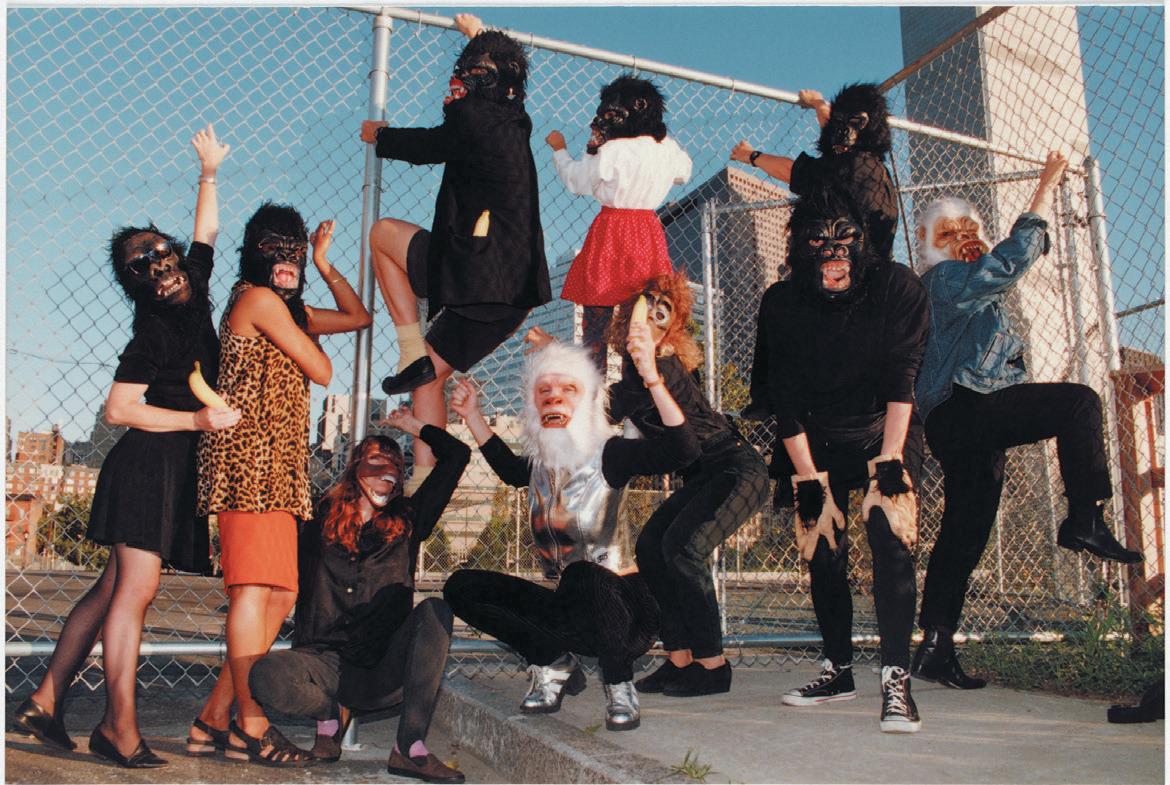
ican Museum in Exposition Park showcases Black artists and celebrates African American history. Fans of science fiction writer Octavia Butler will enjoy an exhibit examining her legacy, through March 1, 2026. 600 State Dr., Exposition Park; 212-7447432; caamuseum.org. Free. Closed Mondays. Separated from the quotidian world by a short tram ride, the Getty Center’s gardens and views are as spectacular as the art. The exhibit “How to be a Guerilla Girl” asks, “Do women have to be naked to get into the Met Museum?” through April 12, 2026, and marks the 40th anniversary of the women’s equity in the
arts advocacy group. 1200 Getty Center Dr., 310-4407300, getty.edu. Closed Mondays. Free reserved timed entry; fee for parking.
The Getty’s sister museum, the Getty Villa, exhibits Greek, Roman, and Etruscan antiquities in a facsimile of a Roman villa. 17985 Pacific Coast Hwy., Pacific Palisades, 310-440-7300,getty.edu. Closed Tues. Fee for timed parking.
The biennial survey of art in Los Angeles, “Made in L.A.” at the Hammer Museum is covered on page 7.
Recognizing craft as high art, Craft Contemporary bursts with the creative energy of artists who
often work with non-traditional materials. Through February 2026, a “Maker-in-Residence” program will encourage visitors to interact with ceramicists, woodworkers, metal shapers, and textile artists. 5814 Wilshire Blvd., 323-937-4230, craftcontemporary.org. Closed Mondays. Fee.
Many visitors never move beyond posing for selfies with the late artist Chris Burden’s streetlights installation, “Urban Light,” the Los Angeles County Museum of Art (LACMA), but there’s so much more. LACMA is the largest art museum in the western U.S., with over 140,000 pieces in its collections. Current
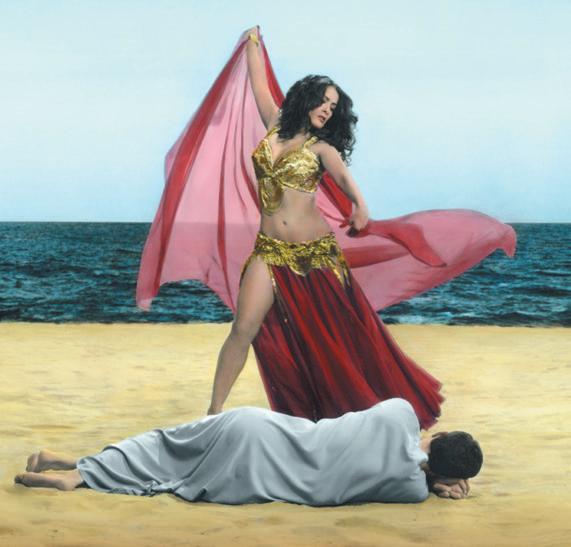
exhibits include the A.I.-generated sculpture “Diffuse Control,” by the artist Beeple, on view through Jan. 4, 2026, and Youssef Nabil’s video “I Saved My Belly Dancer,” star-
(Please turn to Page 4)
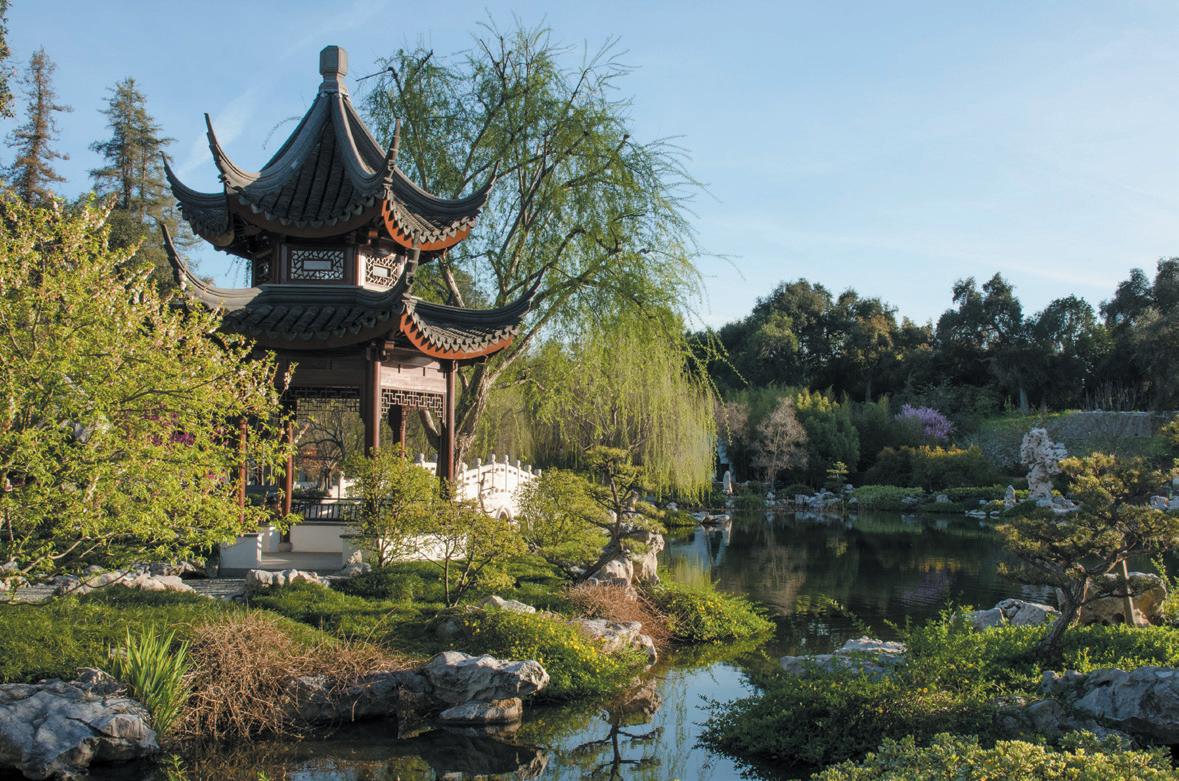
CHINESE GARDEN PAVILION within The Huntington Gardens.
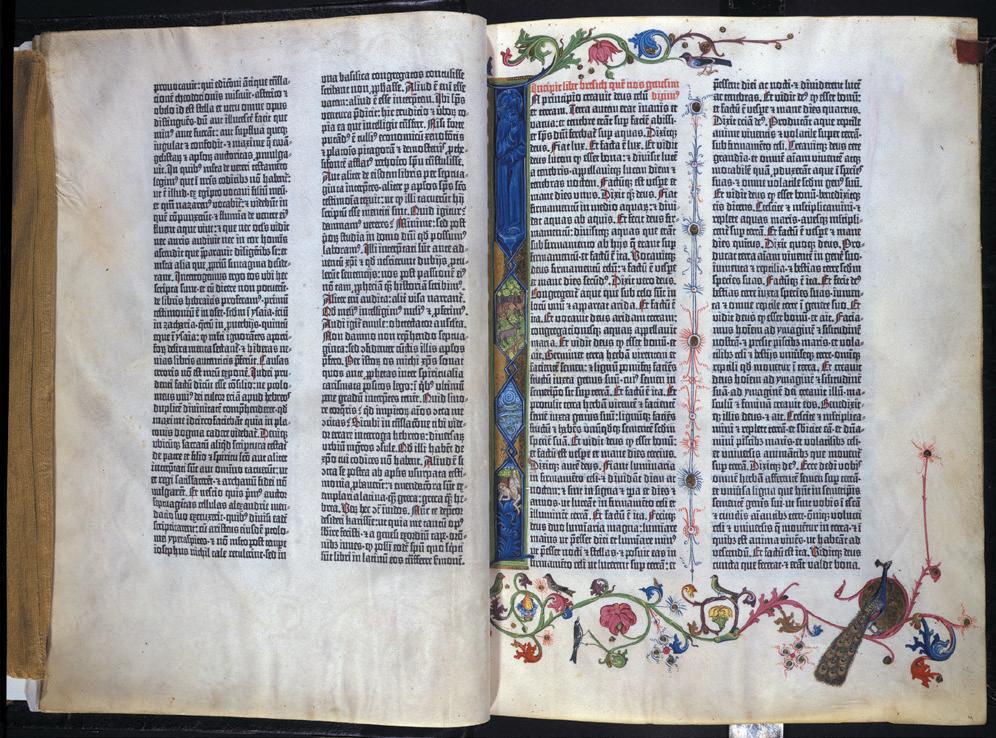
GUTENBERG BIBLE from The Huntington Library collection. Photos courtesy Huntington Library
YOUSSEF NABIL’S “I saved my belly dancer,” starring Salma Hayek, is on view at LACMA.
Photo courtesy of the artist
Museums
(Continued from Page 3)
ring Salma Hayek, viewable through Jan. 11, 2026. LACMA will open its new Peter Zumthor-designed Brutalist building in April 2026, 5905 Wilshire Blvd., 323-8576000, lacma.org. Closed Wednesdays. Ticket fee, except free to L.A. County residents 3 to 5 p.m. on weekdays and to those 17 and under.
The Marciano Art Foundation (MAF) is housed in a beautifully restored former Scottish Rite Masonic Temple designed by California painter and architect Millard Sheets. Specializing in contemporary art, current MAF exhibits include “Sorcery of Images,” an installation of activist artist Corita Kent’s slides (see
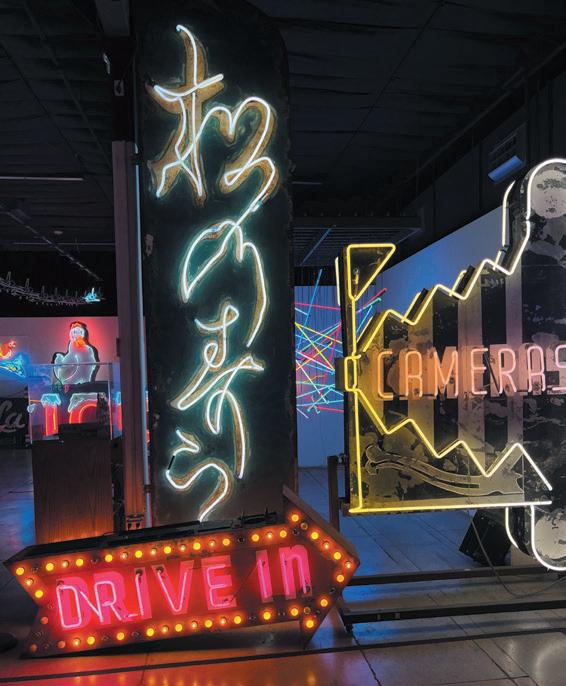
NEON ART titled “A panoply of vintage neon.”
Courtesy of Museum of Neon Art
“Sorcery of Images opens at Marciano,” November 2025, Page 21.) 4357 Wilshire Blvd.; 424-204-7555; marcianoartfoundation.org. Closed Sundays and Mondays. Free timed-entry reservation required.
The Museum of Contempo-
rary Art (MOCA) and Geffen Contemporary at MOCA are two halves of the same museum. Over the holidays MOCA is showcasing works from their permanent collection that imagine new worlds. In the exhibit “Diary of Flowers: Artists and their Worlds,” through March 1, 2026. “Monuments” at the Geffen Contemporary juxtaposes decommissioned monuments, many of them Confederate, with responses from artists including Kara Walker and Julie Dash, through May 3, 2026. MOCA, 250 S. Grand Ave.; 213-626-6222; moca. org. Closed Mondays. Free. Geffen Contemporary, 152 N. Central Ave. Fee, but free the first Friday of every month.
A recently completed $14
(Please turn to Page 6)
Museums
(Continued from Page 4)
million renovation—including careful restoration of the 115,000 handcrafted tiles by Edith Heath that clad the building and a reimagining of the exterior pathways, greenery, and pond—is reason enough to visit the Norton Simon Museum, but their art collection is stellar, too.
On exhibit is “Retrospect: 50 Years at the Norton Simon Museum” in celebration of their milestone anniversary.
411 W. Colorado Blvd., Pasadena. Fee, but free 4 to 7 p.m. on the first Friday of the month. Closed Tuesdays and Wednesdays.
Museums for film fans
You may never go in the water again after visiting the 50th anniversary “Jaws” exhibit at the Academy Museum of Motion Pictures through July 26, 2026. Afterward, immerse yourself in the world of production design with “Barbie to Anna Karenina: The Cinematic worlds of Sarah Greenwood and Katie Spencer,” through Oct. 25, 2026. 6067 Wilshire Blvd.; 323-930-3000; academymuseum.org. Fee for tickets. Closed Tuesdays.
Max Factor was known as the father of modern movie makeup. His former building, where the magic happened, is home to the Hollywood History Museum. Factor’s makeup ephemera fills the first floor. Upstairs, movie and television props, posters, and costumes in the museum’s collection are thematically displayed. 1660 N. Highland Ave.; 323-464-7776; theholly-
GUERILLA GIRLS EXHIBIT titled “Do women
to get into the MET Museum?” at the
woodmuseum.com. Fee. Open Wed. to Sun.
Museums dedicated to science and natural world
A kid favorite, the 17,000 square foot California Science Center is chock-full of engaging hands-on exhibits. Test your batting reflexes against a simulated 60 mph pitch in “GAME ON! Science, Sports & Play,” on view through the 2028 Olympics. Catch an IMAX movie, including an insightful look at medical miracles, in “Superhuman Body.” 700 Exposition Park Dr.; 323-724-3623; californiasciencecenter.org. Open daily. Free timed general admission. Fee for IMAX.
The Huntington Library, Art Museum, and Botanical Gardens has something for everyone: spectacular themed gardens (including the Chinese garden, dessert garden, and rose garden), rare books and papers in the library, two art museums (one for British and European art, another for American art), and a tea room serving traditional afternoon
tea, complete with finger sandwiches, scones, and clotted cream. 1151 Oxford Rd., San Marino; 626-4052100; huntington.org. Closed Tuesdays. Fee.
A visit to the La Brea Tar Pits and Museum usually comes with a free souvenir: blobs of tar stuck to one’s shoes. The repository of saber-toothed cat, mammoth, and dire wolf bones is planning an expansion by 2028 to better display over 3.5 million fossils and increase the interactive and educational components. Part of the Natural History Museums of Los Angeles County. 5801 Wilshire Blvd.; 213-763-3499; tarpits. org. Closed first Tues. of the month. Fee, but free for L.A. County residents from 3 to 5 p.m. Mon.-Fri.
Gawk at a 75-foot-long green-hued dinosaur at the Natural History Museum of Los Angeles County in their new NHM Commons addition. Then learn all there is to know about felines in “Fierce! The Story of Cats” through
Feb. 18, 2026. Spectacular rare minerals are on display in “Unearthed: Raw Beauty” from Dec. 13, 2025 through April 18, 2027. 900 Exposition Blvd.; 213-763-3466; nhmlacounty.org. Closed first Tues. of every month. Fee, but free to L.A. County residents from 3 to 5 p.m. Mon.-Fri.
Cars and cartoons
Los Angeles and cars are practically synonymous— and there’s a museum for that. The Petersen Automotive Museum offers both a historical perspective on the development of the automobile and jaw-droppingly gorgeous wheels. In “Performance & Prestige: A History of Aston Martin,” James Bond’s favorite vehicle is in the spotlight. 6060 Wilshire Blvd.; 323-930-2277; petersen.org. Fee. An additional fee includes access to the vault, where over 300 rare cars from around the world are stored. Open daily.
Nearly every family includes a member who would rather read comic books than hit the museums, but here’s a
way to make everyone happy. The Skirball Cultural Center is exhibiting the work of Jack Kirby, the comic book artist who created Captain America and co-created AntMan, the Black Panther, The Hulk, Iron Man, Thor, and X-Men, among others. “Jack Kirby: Heroes and Humanity” is on through March 1, 2026. 2701 N. Sepulveda Blvd.; skirball.org. Fee, free on Thursdays. Closed Mondays. Museums with specialized perspectives There are too many museums in Los Angeles to cover here, but the following specialized spaces should be noted. The Autry Museum of the American West embraces our western heritage. “Black Cowboys, An American Story” is on view through Jan. 4, 2026. Theautry.org. The Fowler Museum, on the UCLA campus, looks at art and culture through an anthropological lens. Fowler. ucla.edu. Institute of Contemporary Art is dedicated to emerging artist voices and important untold stories. Theicala.org.en. The Museum of Jurassic Technology is possibly the quirkiest museum on the planet. Professing to explore spirituality, metaphysics, mysticism, and science, with displays such as Soviet space dogs, vintage peach pit-carving tools, and ruminations on a futurist’s predictions, it’s impossible to tell what’s real and what is complete fabrication. In every family there will be at least one person who pores over every description—and some-
have to be naked
Getty Center.
Photo courtesy of Guerilla Girls
THE MUSEUM OF JURASSIC TECHNOLOGY’S “Lives of Perfect Creatures—Dogs of the Soviet Space Program.”
Photo courtesy of the museum and the artist M.A. Peers
(Please turn to Page 7)
Made in L.A. 2025: Hammer’s exhibition features diverse artists
By Helene Seifer
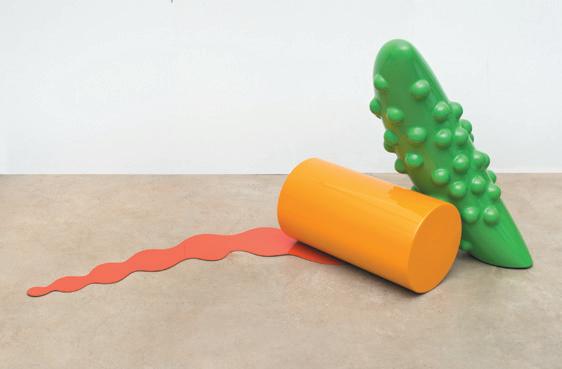
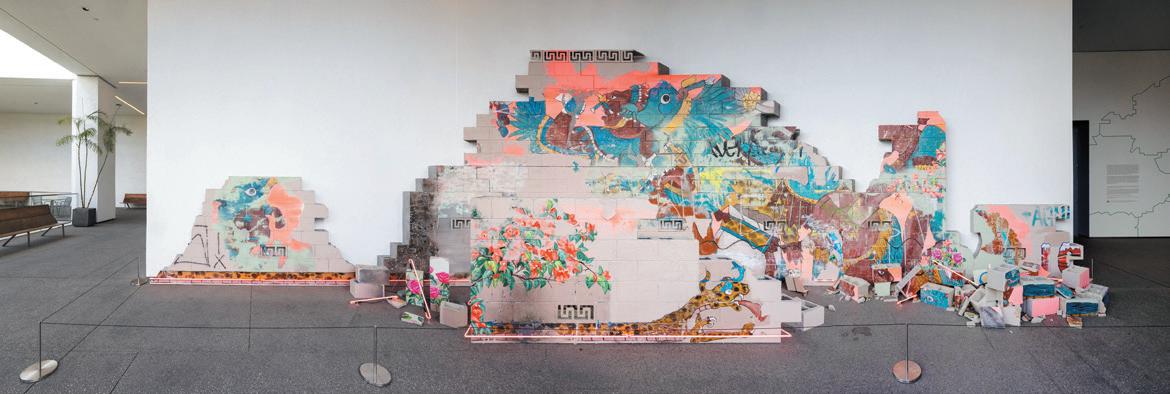
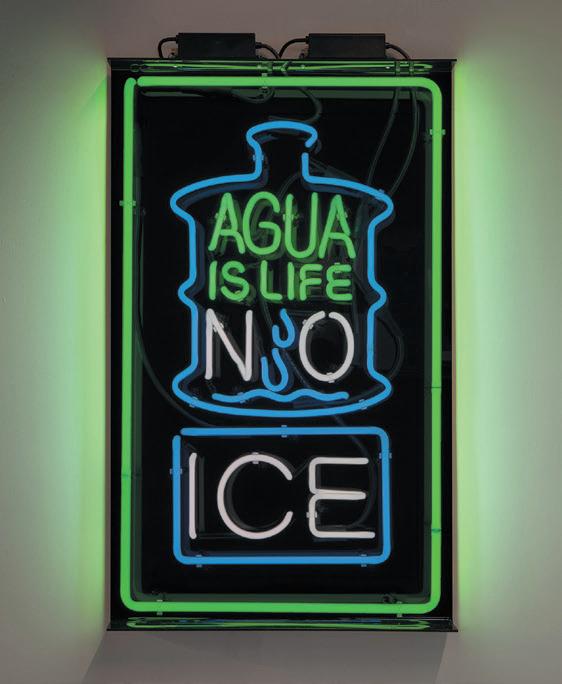
A giant pickle by artist Pat O’Neill, reminiscent of Los Angeles’ kitschy vernacular architecture, and a neon sign that reads “Agua is Life; NO ICE,” by Patrick Martinez, are among the artworks included in “Made in L.A. 2025,” the seventh edition of the Hammer Museum’s ambitious biennial exhibition.
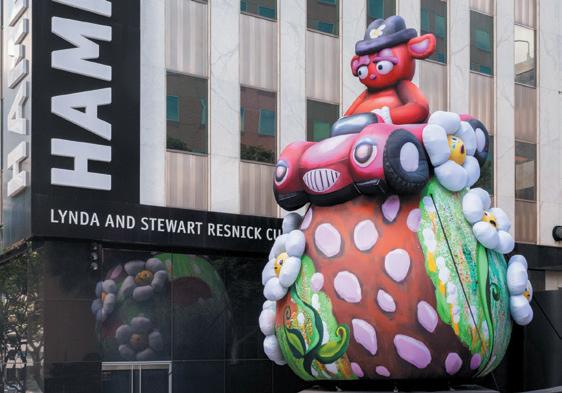
Outside the museum, a towering 25-foot inflatable sculpture of a cartoony bear in a hot pink convertible attracts attention from passengers crawling down busy Wilshire Boulevard. The piece, “Buggy Bear Crashes Made in L.A.,” by Alake Shilling, serves as the perfect introduction to the humorous, thought-provoking, disturbing, and engaging
Museums
(Continued from Page 6) one who will run screaming from the place within five minutes. Mjt.org. Museum of Neon Art provides a trip down memory lane with a rotating collection of restored vintage signs along with contemporary artists’ neon works. Neonmona.org. The Museum of Tolerance describes their
works inside.
This celebration of contemporary art and artists living and working in L.A. reveals diversity of perspectives, techniques, influences, and concerns, yet each canvas, sculpture, photograph, assemblage, dance performance, film, and video by the 28 included artists is imbued with a deep connection to our city. Even the artists born elsewhere, from as far as Haiti and Iraq, have made Los Angeles home and have contributed to the breadth and scope of ideas in L.A.’s vibrant arts community.
Artwork that captures some essence of this moment in our city are included, even if many of the individual pieces were made years ago. Mar-
program as, “using lessons of the Holocaust to build tolerance and learn to better understand our world.” Museumoftolerance.com. The Wende Museum approaches Cold War history from multiple perspectives: cultural, artistic, architectural, and emotional. The current exhibition, which runs through October 2026, examines Caribbean nations’ responses to the Cold War.
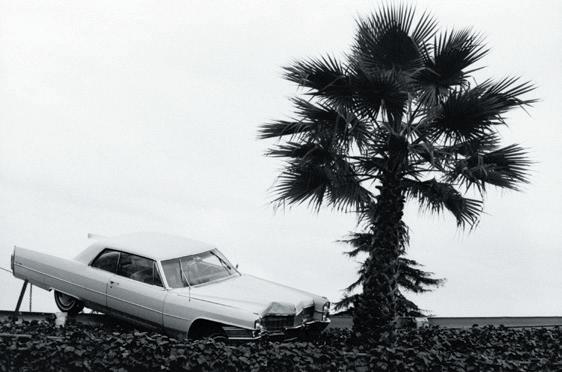
tinez’s neon on plexiglass “Hold the Ice” was fabricated in 2020, yet underscores the even more relevant immigrant raids our community faces now; a 1960s-era photograph of a dented car ditched next to a short, scrubby palm tree in Pat O’Neill’s “Los Angeles,” from his series “Cars and Other Problems,” rings just as true today.
“We looked for two years, looking for heterogeneity in media and materials,” said curator Paulina Pobocha. “Despite diversity, what binds these artists together is they’re reflective of Los Angeles.”
Hammer Museum, 10899 Wilshire Blvd;, hammer.ucla. edu; 310-433-7000. Open through March 1, 2026. Free admission. Parking $8 for the first three hours. The museum gift shop features items designed by “Made in L.A.” artists.
GIANT PICKLE SCULPTURE, “Safer than Springtime,” 1964, by Pat O’Neill. Courtesy of the artist and Philip Martin Gallery, Los Angeles.
ES MADE IN L.A,” by Alake Shilling. Co-presented by the Hammer Museum and Art Production Fund in association with Made in L.A. 2025. Installation view, Hammer Museum, Los Angeles.
Photo by Brian Forrest
“HOLD THE ICE,” 2020, by Patrick Martinez. Courtesy of the artist and Charlie James Gallery.
“BUGGY BEAR CRASH-
Photo by Sarah Golonka
“LOS ANGELES” from “Cars and Other Problems,” ca. 1960s, by Pat O/Neill. Courtesy of the artist.
“AND LOOK WHERE I WENT,” 2025, by Ali Eyal. Courtesy of the artist. Installation view, Hammer Museum, Los Angeles. Photo by Sarah Golonka
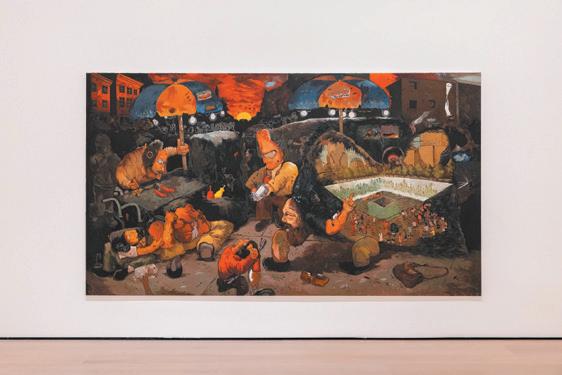
“BATTLE OF THE CITY ON FIRE,” 2025, by Patrick Martinez. Installation view, Hammer Museum, Los Angeles. Photo by Sarah Golonka
Modern South Asian art finds a home at Rajiv Menon Contemporary
By Helene Seifer
Contemporary art from South Asia and its diaspora has been underrepresented in North America. Newly opened in March, Rajiv Menon Contemporary is the first gallery in the western United States to focus on artists from the region. Rajiv Menon, the owner of the eponymous gallery, himself born to émigrés from India, believes in the importance of bringing the diversity and richness of art by South Asian artists into the conversation. “Art is a really important vehicle,” he said. “It’s at the crossroads of cultural understanding. It makes the story of a people.”
Concentrating on emerging and mid-career artists—and at a price point even new collectors can consider—Menon aims to make his gallery shows accessible. “It’s not just for South Asian people. It’s for everybody,” he maintained. “It can be a road to deepen humanity and universality.”
South Asia is not a monolith: India, Pakistan, Bangladesh, Nepal, Bhutan, Sri Lanka, and the Maldives are diverse, with divergent religions and customs, but Menon noticed a solidarity among them in Los Angeles. “Different communities support each other,” he said. Themes of spirituality and the sacred are commonly explored in their art.
The current exhibit, “Dhum Lokaya (Smoke World),” on view through Sat., Dec. 13,
the artist and Rajiv Menon Contemporary.
Photo by Simran Malik
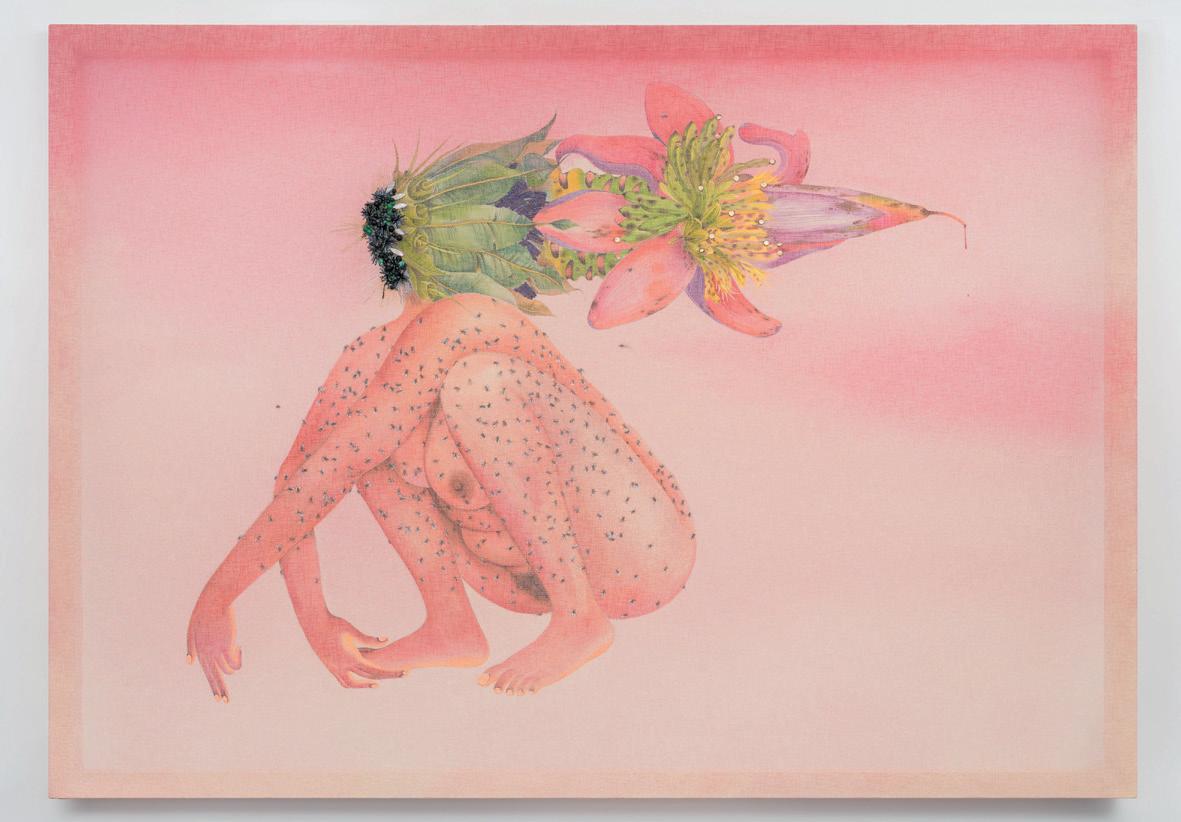
features Toronto-based, Sri Lankan-born artist Rajni Perera. Powerful sculptures and luminous canvases of paint and beading on translucent polyester explore the dichotomy of feminine fragility and forcefulness with images culled from science fiction and ancient mythology. The site-specific sculpture “Swampgirly” is a fierce swamp monster that seemingly breaks through the surface of the gallery’s polished concrete floor, symbolic of women’s hidden rage. The painting “Primitive,” of a crouching naked woman covered in flies, her head a mass of flowers and fruit, shows the powerful mix of sweet blooms and sickly decay that hits one in the face in tropical climates. Perera’s painting of
a figure with the skin of the prickly, stinky, soft-fleshed durian fruit, common in Asian countries, suggests this woman as an outsider whose layer of armor protects her from a threatening world.
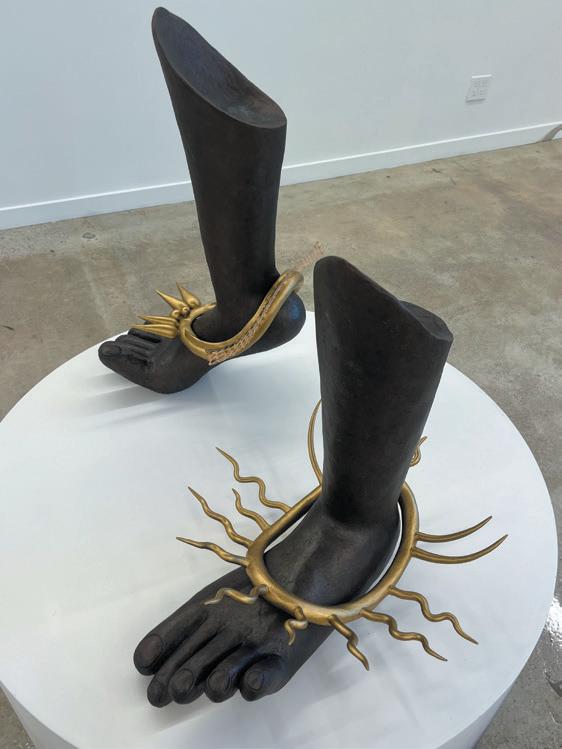
“Dance Dance Revolution,” a sculpture of feet mid-step in a traditional Sri Lankan
Memoir
(Continued from Page 2)
to share blessings at the White House for Hanukkah. She has been featured on the Today Show, NPR, and in the Wall Street Journal. Buchdahl and her husband live in New York City and have three children.
Joy-filled concert Dec. 14
Recording artist JoDavi (Joshua Washington) will perform a soulful, joy-filled concert on the first night of Hanukkah, Sun., Dec. 14, at 5 p.m. at the WBT Resnick Campus, 11960 W. Sunset Blvd. The concert is free.
He will premiere his new album, “Returning the Favor: A Night of Light, Soul, and Song.”
JoDavi’s songs honor both the spiritual depth of the Hanukkah story and the shared history between Black and Jewish communities through artistry, not ideology, Levi said.
The eight-song album is composed and performed by non-Jewish musicians who are allies of the Jewish com-
TROPICAL BLOOMS AND DECAY evoked by the painting “Primitive,” 2025. Courtesy of the artist and Rajiv Menon Contemporary.
dance, highlights decorative elements but also suggests a dance of war.
Menon is positioning the gallery as a South Asian cultural center. Besides art exhibitions, the space hosts music, dance performances, and talks.
Rajiv Menon Contempo-
munity and Israel. His tour concludes in Jerusalem.
Through this new body of work, JoDavi offers what he calls “a musical act of gratitude”—a thank-you across traditions, honoring the Jewish composers who gave the world its most beloved Christmas songs.
“Now it’s my turn to write something beautiful for the Jewish community,” he said.
“Music lets us heal together. It lets us see each other. This concert is about light, about returning love with love.”
The concert exemplifies the Temple’s commitment to community and collaboration, inviting neighbors of all backgrounds to celebrate light and music together.
“JoDavi’s concert embodies the spirit of community, compassion, and creativity we value most,” said Cantor Peicott. “It’s a gift to celebrate Hanukkah in a way that feels both deeply rooted and joyfully new.” For tickets and more information, visit wbtla.org/ returningthefavor.
Photo by Darren Rigo rary, 1311 Highland Ave., 310-424-0387, rmcontemporary.com.
Rajni Perera’s exhibition is on view through Sat., Dec. 13. An exhibition of work by New York-based Pakistani artist Sanié Bokhari will be on display Sat., Jan. 10 to mid-February, 2026.
Hanukkah feast, kibbitz, and baseball at HMLA
While Holocaust LA is closed until its grand reopeing in June 2026, the museum is offering several programs off-site and online.
Jake Cohen will kibbitze and cook Hannukah dishes from his new book, “Dinner Party Animal” at an online webinar Mon., Dec. 8 from 4 to 6 p.m.
“By The Grace of the Game: The Holocaust, a Basketball Legacy and an Unprecedented American Dream” is Sun., Dec. 14 at 11 a.m. at Barnes & Noble at the Grove, 189 The Grove Dr. Author Dan Grunfeld will present his multi-generational family epic detailing a journey from Auschwitz to the NBA. The talk will be moderated by HMLA Chief Impact Officer Jordanna Gessler. To RSVP or for more information on these and other programs visit holocaustmuseumla.org.
DANCE DANCE REVOLUTION, 2025. Courtesy of the artist and Rajiv Menon Contemporary.
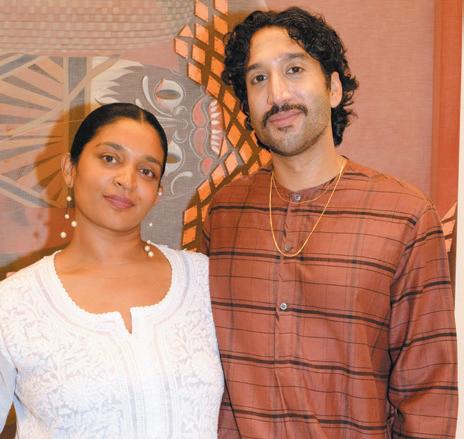
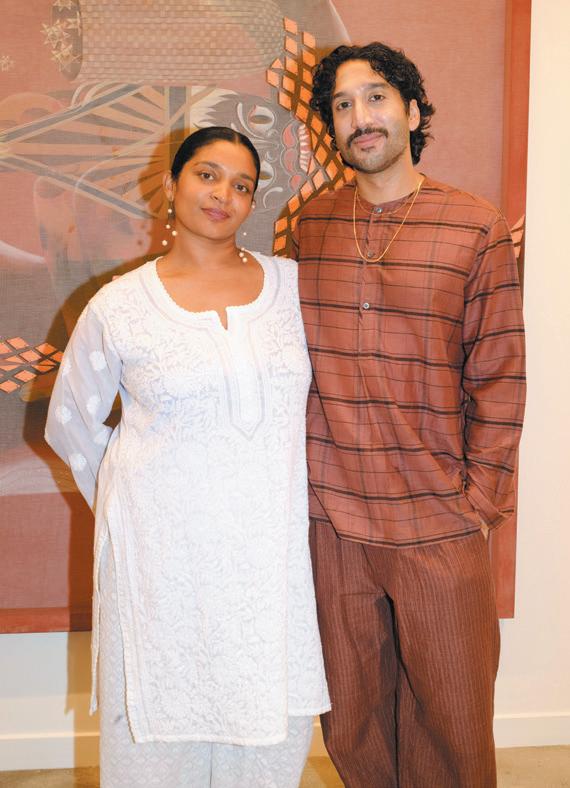
ARTIST RAJNI PERERA (left) and gallery owner Rajiv Menon in front of painting “Dark Matter,” 2025. Courtesy of
Library receives grant and teen librarian
By Barbara Sueko McGuire
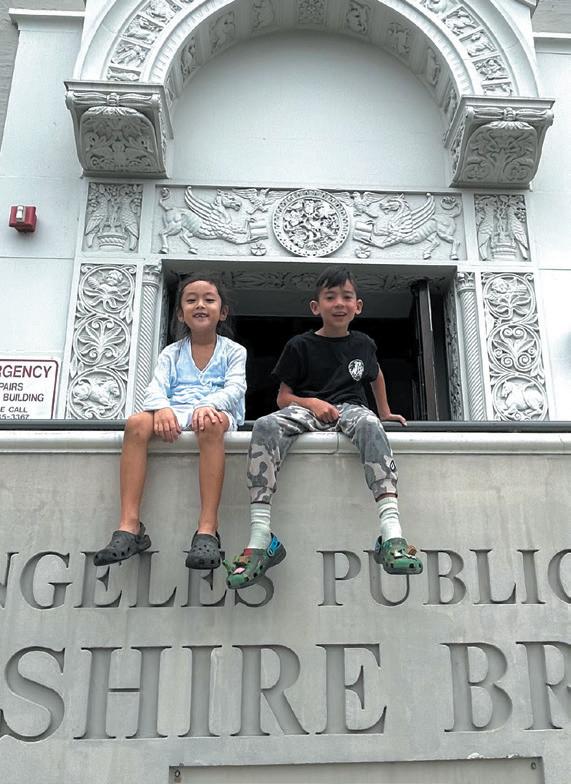
Inclusivity is getting a boost at the Wilshire Branch of the Los Angeles Public Library (LAPL). Tucked into the corner of North St. Andrews Place and Council Street, the cozy branch has been awarded funding specifically designed to help make the children and teen areas more welcoming for those with autism, sensory processing disorders, ADHD, and other disabilities.
“Youth-Empowering Sensory Spaces at the LAPL expands accessible library services for neurodiverse youth by creating sensory-friendly spaces, distributing sensory toolkits to branches and providing staff training and inclusive programming,” said LAPL Youth Services Librarian Kadie Seitz.
The Wilshire Branch already provides quiet nooks,
NEIGHBORHOOD CHIL-
DREN Ace Lee and Otis
Always McGuire sit outside their favorite library.
fidget toys, and soft seating for young patrons, along with books with prominently featured neurodivergent characters. With this support, the library will be even better equipped to reach its goal of creating a more comfortable,
dynamic, and welcoming space for youth across the spectrum.
The children’s section will remain open while the updates—including adding new seating options, adjustable and movable furniture, sound-controlling panels, sensory tools, play furniture, and updated lighting—are rolled out.
In addition to these upgrades, the library has also hired a new teen librarian.
“As a mom of two and an active part of this neighborhood, the Wilshire Branch Library has always been our safe, happy place,” said resident Lauren Breiding. “We see familiar faces every time we visit, and this funding means even more families will get to experience that same sense of belonging and comfort.”
Bake cookies for the holidays
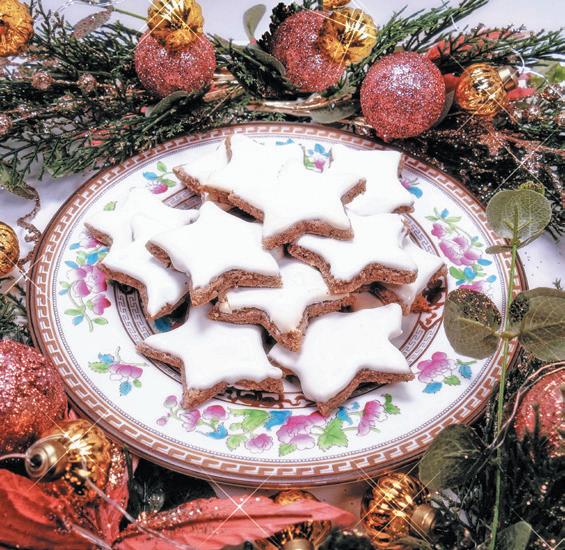
These Cinnamon Star Cookies are sure to sparkle on your holiday table. This recipe is among many from the book “German Heritage Baking” by Heidrun Metzler.
Ingredients for dough
3 egg whites
2 ½ cups powdered sugar
3 t potato starch
1 ¾ T lemon juice
3 c almond meal
2 ½ c hazelnut meal
6 t cinnamon
1/8 t ground cloves
2 t vanilla sugar or extract
2 t almond extract
Ingredients for icing
1 egg white
1 c powdered sugar
1 t cream of tartar
1 ¾ T lemon juice
For rolling dough
¼ to ½ c powdered sugar
¼ c nut meal
(this recipe has been modified for space)
Position rack in bottom third of oven and preheat to 325. Line each cookie sheet with a silicone mat or butter and line with parchment. In a large bowl, whip egg whites to be foamy. In a separate bowl, sift powdered sugar and potato starch, distribute over egg whites. Mix with an electric mixer, slowly at first to combine, add 1 T lemon juice, scrape sides and continue beating until thick. For the dough, in a large bowl, combine almond meal, hazelnut meal, cinnamon, and cloves. In a small bowl, combine vanilla, almond extract, and ¾ T lemon juice, and mix to combine. Add half of the nut mixture to egg white mixture; use a bendable dough scraper to mix carefully. Add
the second half of the nut meal and mix until fully incorporated. Refrigerate the dough for 30 minutes. Meanwhile, prepare the meringue topping. Whip the egg whites just enough to be foamy. In a separate bowl, sift the powdered sugar and cream of tartar, mix to combine and then distribute over the egg whites. Mix with an electric mixer on low speed
By Max Paek
ACROSS
1. Overly sensitive people
5. Overcome stage fright?
7. Festive son
9. Choice at the nursery
12. 16 across, en France
13. Egg _____
15. Fat home invader
16. Winter holiday abbr.
17. Little helper
18. Christmas ornament
20. Germanic tradition
21. They jingle
DOWN
2. Goosebumps from a saxophone solo?
3. It’s parked on a rooftop
4. Ring of cheer
6. Ground underlaying about 85% of Alaska
8. Comet
10. It can cut power
11. Striped treat
14. Holiday exchange
19. Treat for a good child
ANSWERS: Please turn to page 11. Answers will also be on our online edition in early December.
at first to prevent a cloud of dust from the sugar. Stop the mixer to add the lemon juice and scape down powdered sugar stuck on the sides, then continue beating until thick, about one minute. If the icing turns out too thick for brushing on cookies, add a few more drops of lemon juice. If the icing is too thin, add
more powder sugar. The consistency should be thick but spreadable to smooth over the cookies, with hardly any running down the sides, set aside. Roll and cut the dough: Divide the dough in half and return one half to the refrigerator. Visit larchmontchronicle. com to read the full recipe.
CINNAMON STAR cookies.
Happy tails in village build community
By Danny Corwin
When you walk the sidewalks of Larchmont Village, you can expect to see lots of happy dogs walking with their human friends all hours of the day, every day of the week. Dog walking is a treasured pastime.
We stay pretty consistent with our walking routes and times, and our dogs like it that way. Consistent paths, smells, and friends provide comfort and familiarity.
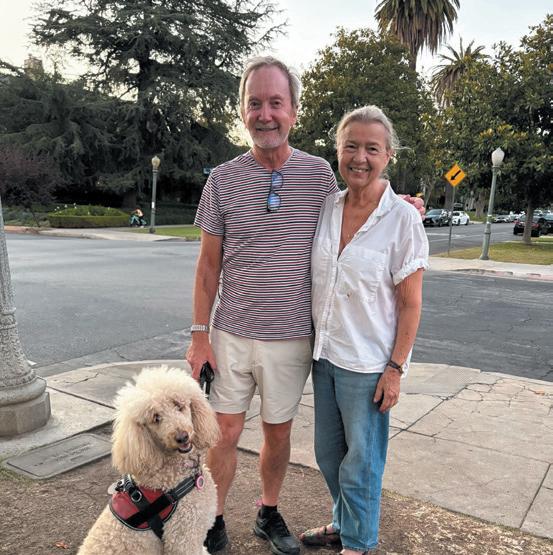
On the east side of the village, Beate Keller and Neil McDermott have been walking their family dogs in the neighborhood for more than 30 years. Their standard poodle, Daisy, commands the attention of her fellow canines and humans. And if you happen to catch princess Daisy the week she’s visited the groomer, you’re in for a treat!
“Daisy brings us so much joy. I often take her to Robert Burns Park where I’ve met so many great people from the neighborhood while the dogs run around and play,” McDermott shared.
Jeff Green walks two miles to the park every day to play Frisbee with his terrier, Scar-
let. “It’s good exercise for her, and for me. At my geezer age, you’ve got to keep moving.”
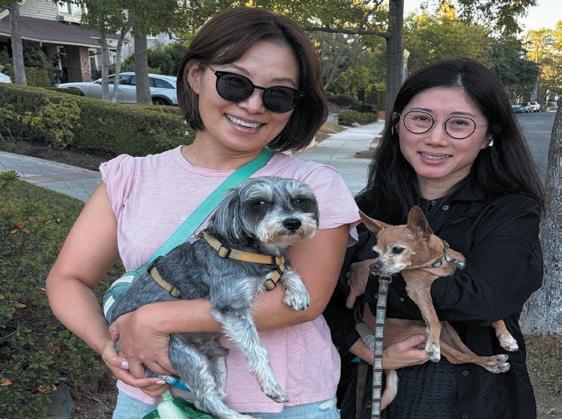
If you’re walking near Van Ness Avenue and Second Street at the end of a workday, you’ll likely bump into Hyejin Kim and Ann Kwan, with their cute dogs, West and Pequeño. Conversations typically start by checking on the health of the aging pups,
plus updates on any recent coyote sightings.
Seeing familiar faces throughout the week and simply “checking-in” is one of the beautiful things about living in our neighborhood. We keep an eye out for each other and our dogs and feel a sense of place and connection.
Are Your Gutters and Downspouts Ready for the Rainy Season?
By Nona Sue Friedman
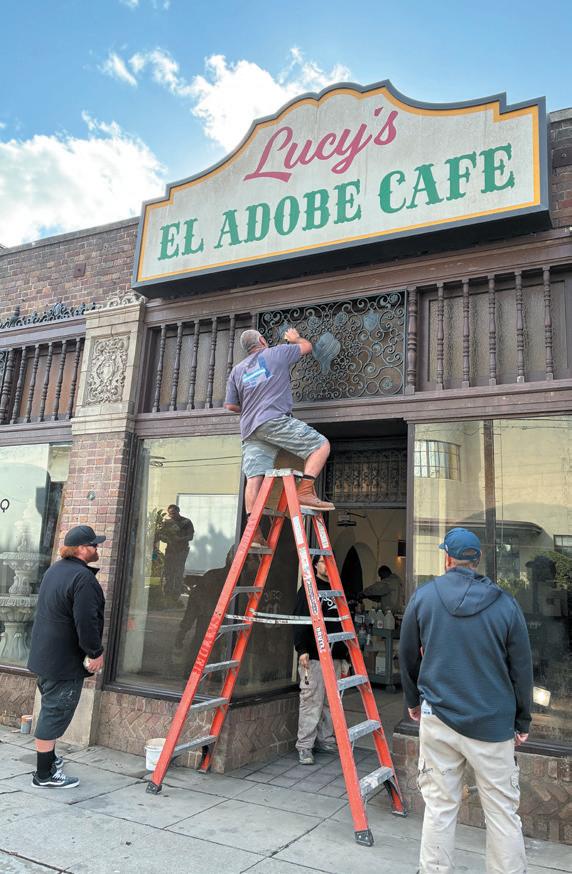
In the middle of November, Chronicle staff noticed construction work being done to the home of Lucy’s El Adobe, a neighborhood and entertainment industry restaurant staple for decades. It turns out Lucy’s is getting ready for its close up.
The restaturant’s exterior was being fixed by a Netflix film production company for filming starting soon. The crew has been repairing the restaurant for a month.
This was just the jumpstart the restaurant’s co-owner Patricia Casado said she needed to reopen the space which is directly across from Paramount Pictures at 5536 Melrose Ave.
Deaths and inheritance battles surrounding the beloved Mexican eatery and bar have kept it closed since the pandemic. During that time, it became rundown and a victim of vandalism. Since its closure, neighbors have been curious and hopeful that it will reopen, and soon. The Chronicle has received numerous inquiries regarding its opening.
Casado, who lives in
Wilshire Park, and her business partner, Jim Zaferis, are hoping to leverage the film crew’s attention and repairs to open the restaurant for business by the end of January.
Casado’s parents, Frank and Lucy, opened the restaurant in 1964. Over the decades, it has been frequented by celebrities, studio executives, government officials, and neighbors. Many are longing for another taste of their famous salad dressing.
NEIL MCDERMOTT, Beate Keller, and Daisy on Van Ness Ave. credit their daily walks for meeting interesting neighbors.
SCARLETT poses for her close-up on her way to Robert Burns Park.
GRACE, WITH WEST (left), and Ann, with Pequeño, report on coyote sightings of the moment.
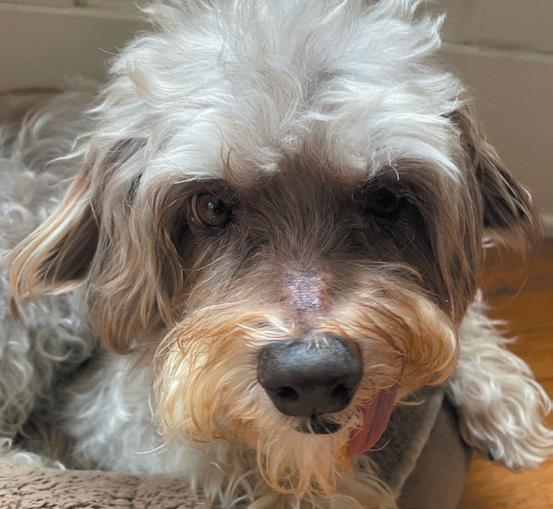
PATSY, on Van Ness Ave., loves to visit Robert Burns Park on Saturday mornings for an off-leash run and to help clean under the picnic benches.
A trip through Spain and sherry tasting gives
In October, my husband and I traveled to Seville, the capital of Spain’s southern Andalusia region. One evening, at a bar, while a pianist regaled patrons with his rendition of the James Bond theme song, we started chatting with a fellow traveler named Siobhan.
“You must go to Jerez for a sherry tasting,” she urged us. “You must do it at Bodegas Tradición,” she continued. “And,” she turned to me, “you must keep an eye out for the painting of the sexy bandit.”
Our interest was piqued. While I had sipped the fortified wine in the past, on our side of the Atlantic, it usually appears more in dessert recipes than bar menus. But drive about an hour south of Seville and you’ll land in Jerez de la Frontera, where sherry is quite literally synonymous with the city. Similar to champagne, Parmesan, or kalamata olives, the drink was named after the region, and, due to the European Union’s protected designation of origin, it can only truly be called “sherry” if produced there.
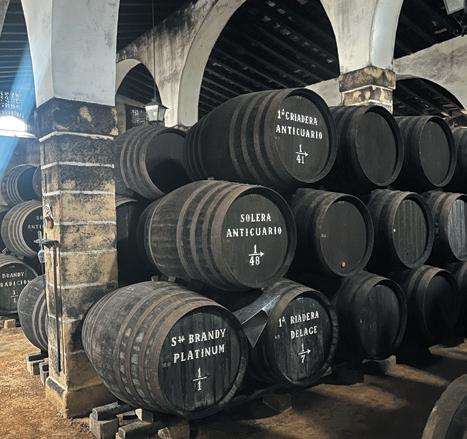
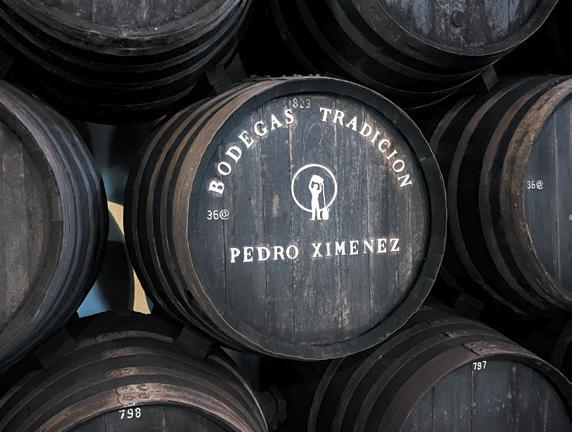
A few days later, we arrived at the front steps of Bodegas Tradición. Our guide, Ágata, led us through cavernous halls fragrant with the deep, sugary scent of raisins. Making our way along rows of darkened wood barrels aging dry, pale finos and sweet, velvety wines, Ágata paused at one of them to draw our attention to several chalk markings on its face. Toward the top was the barrel number, 920. Left of center, at the 9 o’clock position, was the marking “48@.”
“You may recognize the character here as the ‘at’ sign used in email addresses,” she noted, pointing toward the inscription. “In fact, I once led a tour group where a teenager asked why we had the symbol
Mara Fisher
from TikTok written on the barrels.”
She explained that in Spain, the twist on the lowercase “a” is called an “arroba” and is a historical unit of measurement equating to 16.67 liters.
“So the marking on this barrel tells us that it contains 48 arrobas, or about 800 liters, of sherry,” she said.
The name “arroba” originates from the Arabic “al-rub,” meaning a “quarter,” in this case of a quintal, another historical unit of mass. (“Al-rub” is also the root of the name for the number four in Arabic and Hebrew—”arba’a.”)
The symbol was used in commerce to denote weights of a particular good, such as in a May 4, 1536, letter penned by a merchant named Francesco Lapi and sent from Seville to Rome. Lapi recorded the sale of an amphora of wine for 70 or 80 ducats, with the name of the two-handled storage jar abbreviated simply as “@.” While amphoras fell out of use, @ remained, its use evolving over time to become shorthand for “at the rate of,” denoting the price at which an item would be sold.
But what about the design of @? While its true explanation remains a mystery, some linguists have theorized that the curious rendition of the small letter “a” is attributed to the French “à,” meaning “at,” having received its looped form from scribes who would write the accent over the “a” without lifting their pens.
The handy @ maintained its relevance in accounting for hundreds of years, becoming immortalized on the keyboard of the Underwood
typewriter in 1885, at which point it was known in the U.S. as the “commercial ‘a.’”
The icon was still a relatively obscure bit of business jargon when, in October 1971, Ray Tomlinson, an engineer at technology company Bolt Beranek and Newman (BBN), was working on developing a program that enabled users to send electronic mail between different hosts. Looking at the characters available to him on the keyboard of his Model 33 Teletype, Tomlinson selected @ to indicate the recipient’s system address, thereby securing it as the defining symbol of email, and ultimately, the digital age.
You’d be hard-pressed to find a corner of the globe where @ goes unrecognized, and the names for it across different languages are a veritable Rorschach test. In German, Polish, and Dutch, it’s named after a monkey’s tail, while in Norway it’s likened to a “grisehale,” or the tail of a pig. In nearby Denmark and Sweden, it’s called “snabel-a,” or “elephant trunk-a,” while the Hungarian term, “kukac,” translates simply to “worm.” In Italy, email addresses are never without their “chiocciola,” that language’s word for “snail,” also based on the character’s coiled form, and in Hebrew, it’s referred to as “shtrúdel” after the whirly filled pastry. The name for @ in Turkish is perhaps the most adoring: “gül,” the word for “rose.”
Beyond email, @ is now additionally used in conjunction with social media usernames and mentions on any number of digital platforms, including text and email. Even more recently, the thoroughly modern device has become a gender-neutral substitute to the feminine “-a” and masculine “-o”—so
“And now, I leave you,” said Ágata with a knowing smile. We then rounded a corner in the gallery and there he was—the painting of the bandit, sexy as promised, leaning casually against a wall with a cigar and an arrogant stare. Our journey now complete, we relished our final sips of sherry with a toast to @Siobhan, wherever in the world she may be.
chosen for its design, which encompasses both letters—in languages with a grammatical gender system, such as Spanish. For example, friends may be addressed as “amig@s,” or you may even write “l@s arrob@s” when referring to the character itself.
The “@” symbol’s ubiquity and, well, symbolism, even led to its acquisition by the Museum of Modern Art in 2010. Of the addition of @ to the museum’s collection, Paola Antonelli, senior curator of the Department of Architecture and Design, noted “It might be the only truly free—albeit not the only priceless—object in our collection.”
Spying the sexy bandit
Back in Jerez, after we finished our tour, it was time to taste. We sampled Tradición’s fino, amontillado, and cream (my favorite) with gusto, culminating in our final sip—a rich, syrupy wine called Pedro Ximénez, made with grapes of the same name. Ágata handed glasses to each of us, inviting us to walk over to a set of glass doors, through which we entered a long hall housing the winery’s private art collection. Eyes wide, we wandered around and took in the works on view, reading each placard to discover a true treasury of Spanish masters—Goya! Velázquez! El Greco!—in the unassuming space.
LIBRARIES
FAIRFAX
161 S. Gardner St. 323-936-6191
JOHN C. FREMONT 6121 Melrose Ave. 323-962-3521
MEMORIAL
4625 W. Olympic Blvd. 323-938-2732
WILSHIRE
149 N. St. Andrews Pl. 323-957-4550
HOURS
Mon. and Wed., 10 a.m. to 8 p.m.; Tue. and Thu., noon to 8 p.m.; Fri. and Sat., 9:30 a.m. to 5:30 p.m. The library will be closed Thu., Nov. 27 and Fri., Nov. 28 for Thanksgiving and Thu., Dec. 25 for Christmas.
CROSSWORD ANSWER
SHERRY BARRELS at Bodegas Tradición in Jerez, Spain, are marked with the “@” symbol, called the “arroba.”