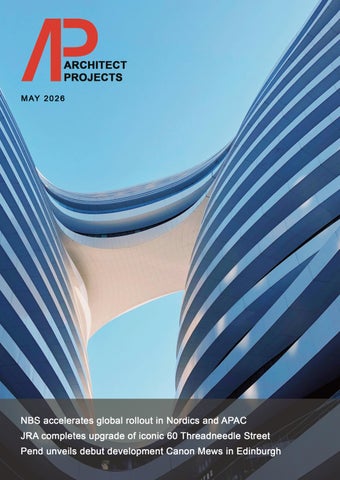
Architect Projects - May 2026

Page 1


Editor Maria Lapthorn editor@architectprojects.co.uk

Editorial Assistant John Reynolds editorial@architectprojects.co.uk

Production/Design

Laura Whitehead design@architectprojectsmagazine.co.uk

Sales Executive Maria Sutton maria.sutton@architectprojects.co.uk

Admin Assistant Jade Still jade@lapthornmedia.co.uk

Circulation Manager Leo Phillips subs@architectprojectsmagazine.co.uk

Accounts Richard Lapthorn accounts@architectprojects.co.uk

Lapthorn Media Ltd 5-7 Ozengell Place Eurokent Business Park Ramsgate, Kent, CT12 6PB

01843 808106

Every effort is made to ensure the accuracy and reliability of material published in Architect Projects magazine however, the publishers accept no responsibility for the claims or opinions made by advertisers, manufacturers or contributors. No part of this publication may be reproduced or transmitted in any form or by any means, mechanical, electronic (including photocopying) or stored in any information retrieval system without the prior consent of the publisher.

Featured Projects

Tabitha Isobel collaborates with Studio Multi on Conductor 12 - 13, 14

Lucent Lighting enhances Goldwin’s London flagship with discreet architectural illumination 24

Long Lake Cottage in Muskoka, Canada, designed by Dubbeldam Architecture + Design 26 - 27

Pend unveils debut development Canon Mews in Edinburgh City Centre 32 - 33

JRA completes the reconfiguration and upgrade of iconic Bank office, 60 Threadneedle Street 40 - 41

Featured

Latest News 04 - 05, 06

Company News 08 - 09, 30

Project News 16, 19, 26 - 27, 32 - 33

Opinion Piece: Increasing the speed of timber frame construction 17

Case Study: Designing reception spaces that make a strong first impression 28 - 29

Case Study: Reclaiming a Country Retreat with the help of architects MMKM and Interior Designer Hollie Bowden 38

People on the Move 46

TRILUX OPENS LONDON LIGHT STUDIO TO STRENGTHEN CUSTOMER COLLABORATION

TRILUX has opened a new Light Studio in Charterhouse Square, London, creating a dedicated setting where customers can experience lighting solutions, explore applications and collaborate on projects in a working environment.

Located in the heart of London’s design community, the TRILUX Light Studio has been developed to support closer engagement with customers across

the UK and beyond. The space reflects the company’s Light. Space. Dialogue. approach, combining inspiration, practical application and collaboration in one place.

A space for light, application and dialogue

The Light Studio brings together multiple functions within one environment, structured around a central ‘sphere of light’ feature. From this focal point, the space is organised into three key areas: a welcome zone, the inspiration stage and a collaboration space, each supporting a different aspect of the customer experience.

Visitors can experience lighting solutions in situ, explore different application scenarios, including office environments, and work alongside TRILUX teams on live projects.

In addition to installed solutions, the studio includes dedicated areas for hands-on collaboration, enabling customers to test ideas, review schemes and develop concepts in real time. The space is also designed to support workshops, events and knowledge-sharing through the TRILUX Akademie.

Supporting closer customer relationships

The opening of the London Light Studio reflects the growing importance of

SCHÜCO UK INTRODUCES SCHÜCO LOW CARBON ALUMINIUM AS STANDARD ACROSS ALL ALUMINIUM PROFILES

Schüco UK is advancing its sustainability strategy with the introduction of Schüco Low Carbon Aluminium as the standard material for all aluminium profiles supplied in the UK and Ireland. This change, effective from 1st April 2026 represents a significant step towards greener, more responsible manufacturing.

This proactive move dramatically cuts the environmental footprint of Schüco aluminium systems, empowering customers and the wider construction industry to accelerate progress toward ambitious carbon reduction targets.

Schüco Low Carbon Aluminium profiles have a GWP value of 3.84 kg CO2e/ kg. This is achieved through the use of materials with recycled content or green energy during production. Compared to standard Schüco

aluminium profiles, profiles made from Schüco Low Carbon Aluminium save around 3.27 tonnes of CO2 per tonne of aluminium profile – that’s around 46% of CO2 saved. We aim to continuously improve our supply chain to lower these values even more in the future.

Managing Director of Schüco UK, Benedikt Herweg commented, “This is an important milestone in our journey towards a more sustainable built environment. By making Schüco Low Carbon Aluminium our standard material, we are giving our partners the confidence that they can reduce embodied carbon without compromising on quality”.

With this change, Schüco UK continues to strengthen its long-term sustainability strategy and leadership in low impact, high performance façade solutions.

proximity and personal interaction in project development. By establishing a central London location, TRILUX aims to make it easier for customers to connect, collaborate and access expertise.

Based in Charterhouse Square, the studio provides a convenient and wellconnected meeting point, supporting more efficient project discussions and long-term relationships.

A strategic hub for the UK and beyond

The London Light Studio forms part of TRILUX’s wider approach to creating spaces that connect customers, projects and expertise across markets, acting as a central hub for both UK-based activity and international collaboration.

Phil Cross, Managing Director, TRILUX UK, comments, “The London Light Studio reflects both our commitment to the UK market and London’s role as an international design hub. With excellent connectivity, including easy access from Heathrow, it provides a natural meeting point for customers and partners working across multiple markets.”

It was officially opened at a VIP event attended by customers and representatives from TRILUX headquarters.

Leighton James, Product & Marketing Director, TRILUX explains, “The Light Studio is about bringing our customers closer to TRILUX in a very practical way. We wanted to create a space where people can experience light, explore applications and have meaningful conversations around their projects.

"Being in central London allows us to be more accessible and responsive, while giving our customers a place to meet, collaborate and develop ideas together. It’s not just about showcasing products; it’s about creating an environment that supports how projects are actually delivered today.”

ABLOY UK RELAUNCHES LONDON SHOWROOM TO SHOWCASE THE NEXT GENERATION OF SECURITY SOLUTIONS

Abloy UK has relaunched its showroom at The Building Centre in London, unveiling a newly renovated demonstration space designed specifically for architects, specifiers and security consultants seeking high end solutions for their designs and developments.

The showroom brings together Abloy’s extensive portfolio of access control systems, digital locking solutions, and integrations

with intruder detection in a fully operational environment.

The space has been designed as a resource for the industry, offering a space where professionals can experience security technology firsthand and better understand how solutions can be specified, integrated and applied across different building types in different applications and environments.

By providing a practical space where professionals can evaluate both technical performance and product aesthetics, the showroom helps to support projects at the earliest stages of design, allowing Abloy to work closely with customers in tailoring solutions that align with their needs.

To mark the relaunch, Abloy invited architects to an event at the showroom, giving attendees the opportunity to explore the newly refurbished space and see the latest security solutions in action. The event provided an opportunity for industry professionals to gain insight into how advanced access control and locking technologies can be implemented into contemporary building design.

On display are IP-based intercom systems including DoorBird, alongside wireless access control platforms such as Aperio and SMARTair. Visitors are also able to explore wired locking solutions with electric locks and the Escape Door System (EDS), as well as Abloy’s digital key solutions including, CLIQ, PULSE and CUMULUS.

The showroom also features a working demonstration door that shows how access control integrates with Abloy’s Escape Door System (EDS). The door highlights security as well as compliance with the latest building regulations, providing visitors with real-life examples of how the systems operate, showcasing functional implementation.

Pip Courcoux, Technical and Product Director at Abloy UK, said: “The London showroom is designed to help architects and specifiers see how security systems work in real-life scenarios and understand how they can be applied to meet both design and regulatory requirements.

“Our aim is to support the industry in making informed choices when it comes to security the built environment.”

ZJA ARCHITECTS & ENGINEERS AND LUIS VIDAL + ARCHITECTS APPOINTED AS NEW ARCHITECTS FOR SCHIPHOL

Amsterdam Airport Schiphol is working on renewal. At the end of 2024, an architectural selection process was launched amid the greatest international interest. Three of the four airport areas have now been definitively awarded to the Joint Venture Luis Vidal + Architects | ZJA Architects & Engineers; an international collaboration between the Amsterdam based international architectural studio ZJA Architects & Engineers and Luis Vidal + Architects, a global architectural studio headquartered in Spain.

Luis Vidal + Architects | ZJA Architects & Engineers: “A clear and recognizable home base for world travelers. That is the challenge we, as ZJA Architects & Engineers and Luis Vidal + Architects, will be working on in the years ahead. With our combined world-wide expertise in airports and passenger experience and local knowledge, we are very much looking forward shaping the renewal of Schiphol.”

Global expertise and local knowledge

Where Schiphol was once designed as a ‘one-terminal’ airport, the architects will now work on its renewal as ‘one team’. ZJA Architects & Engineers designs complex projects in the fields

of infrastructure, public transport and public facilities, including the large-scale renewal of Amsterdam Central Station, the Eurostar UK Terminal, Zuidasdok, the ringroads around Brussels and Antwerp and multiple parking structures for Schiphol. Luis Vidal + Architects has established a globally recognized track record in airport design and sustainable landmarks, with pioneering and worldwide multi-awarded projects including London Heathrow T2 (The Queen’s Terminal), New York JFK, Boston Logan, Denver, DFW, Pittsburgh International Airport, Madrid Barajas T4T4S and Santiago de Chile.

One team, one shared design vision

Luis Vidal + Architects | ZJA Architects & Engineers has been awarded three of the four airport areas, addressing the challenges of improving passenger experience, environmental performance and concession offering. These will be incorporated into Schiphol Plaza including the lounges; the airport piers, gates and flow areas and the landside passenger areas and parking facilities. For the landscape design the leading design practice in landscape architecture and urbanism DELVA Landscape Architecture | Urbanism joins Luis Vidal + Architects | ZJA Architects & Engineers.

In addition to Luis Vidal + Architects | ZJA Architects & Engineers, KAAN Architects has been appointed as lead architect for the overarching design vision; Paul de Ruiter Architects for the design of the departure halls, baggage halls, and security and customs filters, and Beacon (Benthem Crouwel Architects and NACO) as airport consultant.

Working together on a recognizable Schiphol

Following stand-alone renovations over the past decades, the characteristic simplicity, authenticity and distinct identity of Schiphol’s design DNA have faded into the background. In the years ahead, many parts of the terminal will be renewed, with the aim of gradually restoring Schiphol qualitatively to the top three European hub airports.

A shared design vision must ensure that the airport retains one recognizable identity throughout this process. Passenger experience, functionality and quality are central, so that the renewed areas align closely with what travelers need. At the same time, attention is being paid to costs, maintenance, modular construction and sustainability, so that buildings and facilities remain in good condition in the long term as well.

The next phase will focus on defining the conceptual development of the Area Development Plans, setting the foundation for a common design identity and coherence for Schiphol.

"With

our combined worldwide expertise in airports and passenger experience and local knowledge, we are very much looking forward shaping the renewal of Schiphol.”

NORRSKEN JOINS NBS SOURCE TO STREAMLINE SPECIFICATION FOR UK ARCHITECTS

Norrsken, a UK-based manufacturer of high-performance triple-glazed aluminium-clad timber windows and doors, has partnered with NBS to make its passive house certified products available on NBS Source, the UK's leading construction product specification platform.

The partnership gives architects, specifiers and designers free access to detailed technical specifications, CAD files and product data for nine of Norrsken's most specified products through the NBS Source platform, which is used by more than 5,000 architecture and engineering practices across the UK.

BIM objects in Revit and IFC formats for all nine products will roll out progressively over the next six weeks, with multiple opening configurations and timber or aluminium-clad variants available for each product type.

NBS Source allows architects to search, compare and select from more than 26,000 construction products, with direct integration into NBS Chorus specification software and plugins for Revit, ArchiCAD and Vectorworks.

Norrsken's listing includes comprehensive technical data for three passive house certified window ranges and six door ranges, all manufactured to bespoke specifications with U-values as low as 0.64 W/m²K.

"Architects need reliable partners who understand the technical demands of modern, low-energy building design,"

HERITAGE MANUFACTURER EMBRACES DIGITAL TECHNOLOGY WITH MADE SMARTER

Heritage craft manufacturers are embracing digital technology to protect traditional skills and scale their businesses, with support from Made Smarter North West.

From architectural ceramics specialists and glass studios to luxury clothing makers and blacksmiths, businesses rooted in craft are adopting tools such as digital design, 3D scanning and automated manufacturing through the government-backed technology and skills adoption programme.

For many heritage manufacturers, the challenge lies in balancing centuriesold techniques with the demands of modern production, including larger projects, tighter deadlines and rising material costs.

Digital tools are helping businesses improve efficiency, reduce waste and take on more complex work while keeping skilled craftsmanship at the heart of their operations.

Darwen Terracotta, the Blackburnbased manufacturer specialising

in architectural terracotta and faience used in the restoration of historic buildings and contemporary architecture, has combined heritage ceramic craftsmanship with digital technology to improve efficiency and scale production.

Since engaging with Made Smarter in 2018, the business has accessed digital strategy advice, skills programmes, a digital internship and technology consultancy to explore tools including 3D scanning, digital sculpting, additive manufacturing and robotics. As a result turnover has almost tripled to £6.7 million and headcount increased from 43 to 51.

Siddique Rasul, Digital Project Manager at Darwen Terracotta, said: “Made Smarter gave us the space, support and expertise to explore new technologies in a structured way, while bringing

said Alex Alsop, sales director at Norrsken.

"By joining NBS Source, we're streamlining workflows for architect practices of all sizes and making it easier for specifiers to access the detailed product information they need at the earliest stages of a project. This partnership reinforces our commitment to supporting architects with award-winning service from manufacture through to installation and aftercare."

The BIM objects in development reflect Norrsken's bespoke manufacturing capabilities, with configurations spanning tilt-and-turn windows, large-format sliding doors up to 8,500mm, French doors with side and top lights, and entrance doors in multiple styles.

our people with us on the journey. Digital transformation isn’t about replacing traditional skills. It’s about understanding what the tools can do, testing them properly and building confidence before scaling.”

Across the region, manufacturers rooted in traditional craft industries are beginning to adopt similar technologies.

Donna Edwards, Programme Director of Made Smarter North West, said: “Heritage craft manufacturers are a vital part of the UK’s industrial story. Many of these businesses are built on generations of skill, creativity and specialist knowledge, producing highvalue products where craftsmanship remains central to the process.

"What Made Smarter is showing is that digital technology can strengthen those traditions rather than replace them. It is about protecting those skills for the future and helping businesses grow, compete and pass their knowledge on to the next generation.”

Each product can be specified in timber or aluminium-clad variants, finished in any RAL colour, and customized with projectspecific hardware and options. All objects are authored to NBS standards with CAWS and Uniclass 2015 classifications, ensuring compatibility with standard UK specification workflows.

Norrsken manufactures premium aluminium-clad timber windows and doors at its production facility operated by Viking Window AS in Estonia, with technical support and installation services headquartered in Poole. The company specializes in passive house projects and low-energy residential builds, offering complete project management from initial survey through installation with singlepoint accountability throughout.

SWECO ACQUIRES BELGIAN ARCHITECTURE COMPANY

Sweco has signed an agreement to acquire CONIX RDBM Architects with offices in Brussels and Antwerp in Belgium. The acquisition will strengthen Sweco’s position in largescale sustainable urban development through the addition of some 50 experts.

The acquired company CONIX RDBM Architects delivers architecture, interior design and master planning projects across sectors including offices, residential, education, healthcare and mixeduse developments. The company’s turnover was approximately EUR 7.6 million in 2025, and its Belgian activities are expected to be consolidated into Sweco from 30 April 2026.

“It is with great excitement I welcome CONIX RDBM Architects to Sweco. This architectural firm has left its mark with high quality projects that combine contemporary design with impressive sustainability performance. Together, we will offer advice to public and private sector clients, covering the entire lifecycle of urban transformation,” says Erwin Malcorps, Business Area President of Sweco Belgium.

Sweco and CONIX RDBM Architects have previously been involved in joint client projects. One example is the award-winning Herman Teirlinck building in Brussels, a major project commissioned by the Flemish government, using digital twin technology to optimise sustainability performance.

“The addition of CONIX RDBM Architects means Sweco is now even better positioned in Belgium, where substantial public and private sector investments are being directed toward sustainable urban development. Market demand is being driven by national regulatory requirements and reinforced by EU climate and urban policy frameworks – accelerating the transition to low-carbon, resilient cities,” says Erwin Malcorps.

FIBO INTRODUCES NEW WALL PANEL DECORS DESIGNED TO SUPPORT FASTER INSTALLATION AND REDUCED MAINTENANCE ACROSS MULTIPLE SECTORS

Fibo has announced the launch of a new collection of wall panel decors, developed to support faster installation, reduced downtime and long-term durability across residential, hospitality, healthcare, education, commercial projects and beyond.

Designed and manufactured in Norway since 1952, Fibo’s wall panel system provides a fully waterproof wall solution for interior environments and is designed to offer a practical alternative to traditional tiling, particularly where programme time, ongoing maintenance and lifecycle performance are key considerations.

The new range introduces a series of contemporary stone-inspired finishes, expanding the design flexibility available to specifiers, contractors and installers. The new decors include Arctic Onyx (Non Tile) in an Extreme Matt finish, Arctic Onyx (Tile) in an Extreme Matt finish with grey grout, Pebble Granite (Non-Tile) in a Microdot finish, Pebble Granite (Tile) in a Microdot finish with black grout, Rustic Granite (Non-Tile) in a Silk finish, and Cloudy Onyx (Non-Tile) in an Extreme Matt finish.

Fibo wall panels are manufactured using a PEFC-certified seven-layer birch plywood core with a high-pressure laminate surface, creating a durable and hard-wearing wall finish suitable for wet and high-use environments. The panels incorporate Fibo’s Aqualock tongue and groove joint, which allows panels to be sealed, clicked together and installed efficiently, creating a 100% waterproof wall surface when installed with the approved sealant.

The system can be installed up to five times faster than traditional tiling and can be fitted onto timber frames, plasterboard or even over existing tiles. For installers, this helps to simplify the installation process and reduce time on site, while for clients and building operators it can significantly reduce downtime and disruption, particularly in refurbishment projects or environments such as hotels, healthcare facilities,

NOËL & MARQUET PRESENT MEZZALUNA, THE NEW

WALL

PANELS FROM THE “THE HARMONY OF LINES” COLLECTION

education buildings and residential developments where speed of installation is critical.

Tile-effect panels feature grout lines that are carved during the manufacturing process rather than printed onto the surface, creating a more realistic tile appearance while removing the need for grouting. This not only helps to speed up installation but also reduces ongoing maintenance and makes the surfaces easier to clean, which is particularly beneficial in environments where hygiene and durability are important.

Fibo’s wall panel system is supported by a full range of trims, sealants and accessories, providing installers with a complete system designed to install, seal and finish a waterproof wall efficiently and reliably. The result is a durable, easy-clean wall surface designed to perform over time while helping to reduce installation time, maintenance requirements and room downtime.

The new range is suitable for a wide range of applications, including bathrooms, kitchens and wet rooms in residential settings, as well as hospitality, healthcare, education, leisure and commercial environments where robust, hygienic and easy-to-maintain wall finishes are required.

The Belgian producer of high-end decorative elements NOËL & MARQUET presents MEZZALUNA, one of the new wall panels from the 2026 The Harmony of Lines collection. The design stands out for a concave “mezzaluna” motif that introduces a delicate and harmonious architectural rhythm onto surfaces.

The structured and linear design creates a refined balance between sculptural expression and visual clarity. The play of light and shadow generated on the surface adds depth and character, enhancing both minimalist and more expressive environments.

Available in two versions, MEZZALUNA S and MEZZALUNA L, the panel allows the creation of dynamic and layered compositions. The more expressive variant MEZZALUNA S can be paired with the more essential MEZZALUNA L, offering new design possibilities.

A sculptural expression of symmetry and structure, the MEZZALUNA S wall panel is characterized by the repetition of a concave crescent-shaped motif that enables the creation of soft and sophisticated surfaces on walls, ceilings,

or furnishings. The linear pattern introduces a delicate and relaxing visual rhythm, while the sharp transitions between forms create a rich and contemporary surface language. The play of light and shadow on the defined contours provides further depth and elegance, making it ideal for refined architectural compositions.

The MEZZALUNA L panel, on the other hand, introduces a broader and more relaxed architectural rhythm to interior surfaces. Its generous proportions and wider concave motifs express a structured and linear design that combines formal clarity with sculptural depth. The wide curves create a delicate play of light and shadow and a sophisticated visual texture, capable of enhancing both minimalist interiors and more theatrical spaces.

With a length of 2 m and 2.60 m and a thickness of only 9.5 mm, the panels allow full wall height coverage, minimizing joints and ensuring a continuous and flawless surface.

The panels are made of high-density polystyrene (HDPS), a material innovation that offers great design

· Water based - does not leach Allows wood to breathe naturally Internal/external application

· Colourless - Odourless EN 13501 – 1

EN 16755 (EXT1)according to EN 927-6

· Euroclass B-s1-d0

Non Toxic - No Solvents

BS 476 part 6 & BS 476 part 7

· Euro-class B-s1-d0 and C-s1-d0

BM TRADA ISO 9001 Certificate Meets the highest EU standards

Classification Reports & Certificates: Pine, Spruce, Scots Larch, Siberian Larch, Western Red Cedar, Oak, Thermowood, Birch, Birch Ply, and others, both Internal and External

www.fireretardantuk.com

0800 7833 228 sales@fireretardantuk.com

versatility to designers and installers. The material is impact-resistant, completely waterproof, and suitable for all types of environments, including humid spaces such as kitchens and bathrooms. Furthermore, all panels are factory pre-painted and ready to be painted in any color, allowing simple and complete customization.

A SANCTUARY OF LIGHT AND LAYERED MATERIALITY RESHAPES THE CONTEMPORARY WORKSPACE IN EAST LONDON AS Tabitha Isobel COLLABORATES WITH Studio Multi ON Conductor

Interior design studio Tabitha Isobel has collaborated with architect and lead designer Studio Multi on Conductor, a 3,400 sqm flexible workspace operated by IWG within URW’s Coppermaker Square development in Stratford, East London. Tabitha Isobel and Studio Multi developed the interior concept and material direction, translating the architecture into a layered workplace environment that blurs the boundaries between hospitality and office design.

The atrium created an opportunity to design something immersive – a space that shifts throughout the day and supports different ways of working.

At the heart of Conductor is a central atrium flooded with natural light, which became the conceptual starting point for the design teams at Tabitha Isobel and Studio Multi. Conceived as a light-filled sanctuary within its dense urban setting, the design draws on the spatial drama of historic palm courts and the textural intimacy of hospitality environments rather than conventional co-working cues. The colour palette was loosely informed by the copper heritage of the surrounding Coppermaker Works development, with rust, amber and deepened ochre tones guiding the material direction throughout. Planting and filtered light were treated not as decorative additions but as spatial devices, establishing a restrained biophilic sensibility that runs through the project. From bespoke joinery elements including the café counter, reception desk and conversation pit, and library, through to detailed material specification, the interior was carefully developed by Tabitha Isobel and Studio Multi to balance architectural clarity with atmosphere.

Upon arrival, the reception immediately establishes the project’s tone. Ceramic floor tiles by Solus in terracotta and warm white are laid in alternating brick and block formations, introducing rhythm underfoot and creating visual movement that plays against the exposed concrete columns and visible services of the base build. The façade of the reception desk is clad in Dzek volcanic ash glazed tiles, arranged in a patchwork of nuanced ochre tones interspersed with a deep brown. The composition introduces tonal depth and a strong graphic language at the threshold, punctuating the warmth of the surrounding terracotta floor. Soft sofas by &Tradition sit alongside lounge chairs by HAY, set over Nordic Knots rugs and paired with burl wood tables by Ferm Living, reinforcing the project’s hospitality-led intent from the outset.

Opposite, the café counter continues this material expression, also clad in a patchwork of volcanic ash glazed tiles. Above, a suspended timber canopy with integrated lighting lowers the perceived height of the café area, softening the

geometry of the open plan and creating a more immersive atmosphere within the wider volume. The canopy above the counter is formed from Plasticiet’s recycled solid surface material, introducing a warm, earthy hue and a gentle sheen that shifts under changing light. Seating here is deliberately varied, combining stacking chairs, stools and timber café chairs with walnut tables to support flexibility while maintaining warmth through natural material choices.

From here, the space opens into the central atrium where scale and light shift dramatically, a move central to the interior strategy. Generous planting rises from bespoke planters clad in Dzek volcanic ash glazed tiles laid in vertical bands of varying green tones, reinforcing the project’s graphic language while drawing the eye upward into the doubleheight volume. Integrated bench seating wrapped in soft green bouclé by Yarn Collective sits within the planting beds, paired with round walnut café tables and walnut dining chairs. Small &Tradition lamps introduce a warm, domestic glow, softening the exposed concrete

columns and visible services overhead. In front of this seating cluster, a breakout area layers vintage timber and leather armchairs with a HAY sofa upholstered in Kvadrat, and a sculptural mid-century table, bringing character and tactility to the atrium floor. Rugs by Nordic Knots anchor the seating here in sage green and nearby in and a rich wine red.

Set directly behind the green bench seating, vibrant orange sofas introduce a more energetic register within the same planted landscape. Paired with a richly textured table, the composition establishes a deliberate dialogue between warmer and cooler tones drawn from the copper- informed palette. Colour, material and orientation distinguish each territory while maintaining visual continuity across the volume.

Overhead, sheer cylindrical pendants float through the double-height space, their diffused glow shifting throughout the day. Variations in floor tile formations, including framed compositions that outline seating zones,

further articulate the atrium without enclosing it. The contrast between tactile finishes such as bouclé, velvet, timber and ceramic and the exposed concrete structure, visible conduits and steel staircase establishes a considered tension between robustness and refinement. Retractable sail-like blinds span the atrium glazing, helping to diffuse natural light and soften the architecture.

Framing the space, green-painted timber and glazed meeting rooms introduce a strong architectural grid while maintaining permeability into the planted interior. On an adjacent perimeter, a more focused working zone unfolds: a long communal table is paired with timber dining chairs, while an integrated desk runs alongside the planting and is punctuated with Muuto table lamps. A copper- toned sheer curtain filters views and softens this boundary, reinforcing the project’s nuanced material language.

A deliberate shift in scale occurs at the sunken conversation pit, which sits adjacent to the café, where floor level drops beneath a Symphonic Acoustic canopy by Arktura. Upholstered in a deep wine tone by Panaz, the integrated seating forms a cocooned setting for informal meetings and focused work, while carpet by Ege Carpets softens the step-down underfoot. Acoustic performance throughout was carefully resolved through considered material choices, including Troldtekt acoustic panels and sheer curtain partitions by Kvadrat.

Adjacent to the atrium, the library tempers the openness with a more enclosed atmosphere.

Celosia terracotta brick by Mutina forms permeable partitions that allow light to filter through while creating visual privacy, casting patterned shadows across the integrated walnut joinery. Built-in bench seating is upholstered in a small-scale green patterned fabric by Sekers, paired with walnut tables and chairs, while muted green carpet tiles by Tarkett soften the space underfoot.

Subtle shelving and decorative elements introduce softness without disrupting the architectural clarity of the space. Vintage books in tonal greens, creams and blues, alongside sculptural objects, add a curated layer of warmth. The palette of walnut, moss and clay tones reinforces a distinctly nature-inspired mood, offering a quieter interpretation of the project’s wider material language.

Ascending the steel staircase, the material language shifts underfoot to end-grain oak parquetry by Ted Todd, signalling a quieter register. From the mezzanine, planting below reads as a canopy, maintaining visual connection to the atrium while creating psychological distance from its energy. Upstairs, a series of glazed private offices of varying scale sit alongside back-to-back booths and informal lounge areas, supporting

focused work and smaller meetings. Light blue sofas introduce a softer tonal counterpoint to the warmth of the terracotta below. Linoleum flooring from Forbo Marmoleum and carpet tiles by Tarkett extend the project’s material language within these quieter zones.

Throughout the scheme, the interior reflects the teams instinct for multidimensional, non- homogeneous spaces, developed in dialogue with Studio Multi’s architectural framework. Rather than imposing a singular aesthetic, the design moves between scale, tone and texture, allowing each zone to hold its own character while remaining part of a cohesive whole. Hospitality references sit comfortably alongside retained industrial elements, and durable contract finishes are balanced with carefully selected furniture and bespoke joinery, a combination that speaks to the studio’s commitment to atmosphere as much as functionality.

On the project, studio founder Tabitha Organ comments: “We wanted people to walk in and be surprised that it was a workplace. The atrium created an opportunity to design something immersive – a space that shifts throughout the day and supports different ways of

working. By layering materials, lowering ceilings in certain zones and allowing light to filter through rather than blocking it, we were able to create intimacy without enclosure.”

In the interior design of Conductor, Tabitha Isobel reshapes expectations of the contemporary workspace, offering an environment that is neither neutral nor corporate, but deliberately layered and atmospheric. In doing so, Tabitha Isobel and Studio Multi signal a shift in how we define the workplace; not as a backdrop for productivity, but as an immersive environment where materiality, colour and spatial layering actively shape the experience of work.

At Martina Ltd, we are a specialist joinery manufacturer dedicated to delivering high-quality, bespoke joinery solutions. With expert craftsmanship and attention to detail, we create custom joinery, tailored to each client’s vision. Combining traditional skills with modern techniques, we take pride in producing beautifully crafted spaces.

RED CONSTRUCTION GROUP APPOINTED TO DELIVER OFFICE REFURBISHMENT OF THE BUCKLEY BUILDING IN CLERKENWELL

RED Construction Group, the specialist main contractor, has announced the appointment of its London division to deliver a substantial office refurbishment of The Buckley Building, located at the entranceway to Clerkenwell Green, Islington.

Originally a warehouse built in the 1930s, The Buckley Building will provide 89,000 sq ft of modern office space upon completion of the RED London team’s expansion.

Working alongside development managers, V7, RED London will deliver horizontal and vertical extensions to the existing upper floor plates, with the broader scope of works comprising of a full Cat A refurbishment of the open workspace. There will also be a refurbishment of the reception, an upgrade of the existing glazing units, new shower and WC facilities, as well as the introduction of a roof terrace and 4th floor external terrace.

The refurbishment has been designed with sustainability at the forefront, with the intention of maintaining the building’s BREEAM Outstanding status and targeting an EPC A rating. The works will also remain sensitive to the building’s heritage, upholding the sophisticated industrial aesthetic of the space.

Oliver O’Shea, Divisional Director at RED Construction London, commented:

“With huge experience in landmark office refurbishment across London, our team continues to be the contractor of choice for projects that set the bar for workspace standards in the city.

"Creating better working environments and making them future-ready has been a real focus for our business over the last few years, as leading landlords

see the benefits of investing in their offices. The Buckley Building’s history and sustainability targets align with RED Construction Group’s extensive skills, and we are proud to be facilitating these works for the landlord alongside V7.”

Shaun Simons, Founder of Compton, added: “The Buckley Building is arguably one of the best assets in the Farringdon district. It represents a genuinely rare opportunity, combining expansive floor plates of 16,000 sq ft with an authentic warehouse aesthetic, a combination that is very unique.

"Over the course of history, the building has consistently performed strongly and, with the proposed enhancement works, modernisation, and clear focus on sustainability, we are confident this project will deliver exceptional results for all parties involved."

"Compton, alongside CBRE, are incredibly excited to commence our pre-leasing campaign. We see a real opportunity to generate early momentum and create competitive tension ahead of completion, ensuring the building is positioned exactly as it deserves to be within the market.”

INCREASING THE SPEED OF TIMBER FRAME CONSTRUCTION

The UK faces a housing shortage and must cut building sector carbon emissions to hit net zero. Quick build, low eco-impact timber frame construction can help meet both challenges.

The urban development organisation, Centre for Cities estimates that, after years of failing to keep pace in house building with comparable economies, the country is short 4.3 million dwellings. The Labour government has pledged construction of 1.5 million homes in the next five years. In addition to this, the sector must build more sustainable homes too if the country is to stand a chance of meeting its 2050 net-zero environmental target.

Bio-based building products are the future

Faced with the need to build faster and greener, the growing consensus in the construction sector and among policy makers is that we should build more with bio-based materials, notably wood.

According to the UK timber frame sector body, the Structural Timber Association, building with timber offers multiple environmental benefits. Unlike energy intensive, finite material-based construction materials, such as steel and concrete, timber is renewable. It also absorbs CO2 from the atmosphere as it grows and stores it for the life of the

The UK government evidently sees the multiple merits of building more with wood. “

wood product. It provides the potential to turn the built environment into a major carbon sink and is an inherent insulant, helping deliver energy efficient homes.

Timber frame – the high-speed route to meet housing needs

The conference also highlighted speed of build - another inherent advantage and attraction of timber construction. Being strong and light, timber is easier to handle than concrete and steel, and generally more forgiving and flexible. It’s no coincidence that timber frame is used most in Scotland, accounting for over 90% of new build housing. The country’s challenging climate gives a narrower construction window and really puts the emphasis on getting a weather-tight building shell up as quickly as possible. This has helped make timber frame the default option.

These shorter site times allows for cost-savings – a critical factor as the industry seeks more budget-friendly solutions without compromising quality. Combined with timber frame’s ‘seamless alignment’ with revisions to Part L of the Building Regulations on building U-values and carbon footprint, it delivers a straightforward, cost-effective route to compliance compared to traditional brick and block methods.

Government looks to unlock timber frame construction potential at scale and speed

The UK government evidently sees the multiple merits of building more with wood. Working with the timber and building industries and academia it has drawn up the Timber in Construction Roadmap, updated in early 2025. This has a dual focus; how to increase domestic timber production and underpin that

by growing the timber building sector to use the wood. It sees the benefits of achieving these goals as environmental, economic and social. And it notes that, while timber frame construction is the prime approach in Scotland, it is still relatively underdeveloped in comparison to other countries in the UK. This creates an ‘opportunity to unlock this industry at scale and at speed’.

The UK government is supporting development of offsite, modular construction with a £10 billion project to increase its use in public buildings. A total of 29 firms have been selected by the Crown Commercial Service to be a part of its offsite construction framework, commissioned to supply prefabricated modular buildings to government departments. That includes social housing, schools, and healthcare facilities.

Product innovation to accentuate timber frame construction’s advantages

Products and technologies are being developed to accentuate timber construction’s inherent advantages and support market growth. Factory applied products such as resin-based Arctek® Dryshell™ offers an innovative factory-applied, weather resistant barrier for OSB and other wood-based panels. It’s designed to underpin timber construction, build quality and boost construction efficiency.

REDEFINING COMPACT ACCESS CONTROL FOR MODERN WORKSPACES

Joanne Milne-Rowe, Managing Director at

explores the role of access control in today’s workplaces.

Today’s workplaces are being asked to do more with less. They must be flexible enough to serve shifting business and user needs, sustainable enough to meet growing environmental expectations, and attractive enough to draw people in.

Within that context, access control has become a more prominent design consideration than it once was. Get it right and you can enable truly userfriendly, multi-functional spaces that can reduce waste or consumption through their design.

Destinations and destination offices

The need for smart, purposeful access control is most prominent in the rise of destination offices. Built with employee experience as a guiding principle, destination offices give staff a real reason to forego the benefits of home working and help to combat the UK’s high office vacancy rates.

Locker locks are crucial to the design of these environments, enabling the truly flexible and shareable features and functions that employees want.

These range from active commuter lockers providing storage for biking gear, tech libraries that make hardware sharing easy to manage, to multi-purpose pick-up points for parcels and food deliveries –something that is increasingly popular.

Coded locks – such as the KitLockFlex – that have public functions for shortterm, multiple occupancy applications, remove the administrative burden of managing access while keeping the experience straightforward for users. In co-working spaces and large multitenanted buildings, that time and effortsaver is the difference between wellmanaged access that delivers employee satisfaction and something cumbersome that doesn’t serve its purpose.

Retrofit and repurpose

Also increasing is the demand for sustainability. The built environment is one of the highest carbon-emitting sectors, and materials and energy consumption are now often front of mind when creating spaces.

With occupancy rates for office buildings at their lowest for decades, many commercial spaces are being refitted and reused. According to research cited in the UK Green Building Council Delivering Net Zero report, the rate at which commercial building stock is repurposed needs to reach around 5% annually to meet net zero targets – at least double the rate seen over the last decade.

Modern access-control solutions are increasingly retrofit-friendly, being modular, wireless, and incredibly powerefficient. Locks like the KitLockClassic G3 eliminate the need to replace entire locker units or even arrays, because they’re designed to be easily retrofitted, preventing waste while also upgrading locker functionality.

For large commercial buildings, the positive environmental impact of reusing materials for office furniture can quickly add up, reducing demand for virgin materials and the energy-intensive processes associated with extracting, manufacturing, and transporting them.

Form follows function

The design of any space is shaped by what it needs to do. Locker and cabinet access control, when considered as part of the overall brief, can support the functionality that makes flexible, shareduse environments work well. Whether the goal is to reduce waste through retrofitting or improve the experience and usability of modern workplaces, these systems offer a straightforward way to meet those needs. Explore the possibilities at KitLock.

For more information visit: www.codelocks.co.uk

RIVERSIDE AND VISTRY SECURE APPROVAL FOR MAJOR REGENERATION OF JUNIPER CRESCENT ESTATE IN CAMDEN

Following the submission of a full planning application to Camden Council, Riverside and Vistry have secured approval from the planning committee for a major regeneration project at the Juniper Crescent Estate in Chalk Farm, North London.

Designed by PRP Architects, the transformation will deliver 478 highquality, energy-efficient homes across a range of tenures, including social rent, intermediate rent and market sale. Importantly, at least 44% of all homes (50% by habitable room) will be Affordable Homes, helping to meet the London Borough of Camden’s ongoing housing needs.

Alongside the new homes, the approved plans introduce a range of community-focused improvements, including:

• New biodiverse green spaces designed to enhance the local ecology

• Dedicated children’s play areas

• Improved pedestrian routes, creating safer and more accessible movement through the neighbourhood

The regeneration project will provide modern homes, better public spaces and an improved environment for both existing and future residents.

The new plans, including prioritising larger homes to support multigenerational occupancy, have been shaped by extensive, ongoing engagement with residents.

All existing Juniper Crescent residents on social or intermediate rent contracts have a guaranteed right to return to a new home in the development once completed. These households will also receive a 10-year subsidy package for council tax and service charges.

Commencement of the project will begin this summer with the first homes set to be handed over in 2030.

Robert Marcantoni, Director of Development for London at Riverside, said: “We are delighted to see work beginning on this long-awaited regeneration project in the heart of

Camden. Throughout this process, resident consultation has been key and we are looking forward to continuing this close engagement as we build a vibrant and sustainable new neighbourhood at Juniper Crescent.

"Riverside is committed to providing high-quality, accessible homes and the delivery of 208 social and intermediate rent homes as part of this project is testament to this mission. We would like to thank our partners from Vistry Group, Camden Council, the London

Estate Regeneration Fund and the Mayor of London’s office without whom these new homes would not be possible.”

Rob Wilkinson, Regional Managing Director for Vistry South London, added: “Securing planning consent for the regeneration of Juniper Crescent at Camden Goods Yard marks an exciting milestone for the community and for our partnership with Riverside.

"This decision paves the way for delivering high-quality homes, vibrant new public spaces, and a genuinely sustainable neighbourhood shaped by extensive resident engagement."

"We are proud to be working, once again, alongside Riverside to bring forward a project that not only delivers much needed affordable housing but also creates long-term social value for the people of Camden. Together, we look forward to transforming this important site into a thriving, inclusive place for current and future generations.”

Alexandra Andone, Director at PRP, commented: “Through enduring collaboration with existing residents, local stakeholders, and a dedicated design team, our long-standing community and design-led approach has culminated in a high-quality and transformative masterplan for Juniper Crescent.

"Championed by Riverside and Vistry, this vision integrates high-quality public realm, innovative multi-generational flats, stepped massing, and flexible family duplexes, all meticulously crafted as co-production tools to meet the community’s diverse needs and transforming the area into a welcoming and inclusive place for all.”

THE BENEFITS OF UPGRADING TO LED LIGHTING IN THE OFFICE

Modern workplaces are constantly evolving, with companies seeking ways to improve efficiency, reduce costs and create healthier, more productive environments for their teams. One of the most effective upgrades an organisation can make is transitioning to LED lighting. While traditional fluorescent and incandescent lighting have been standard for decades, advances in LED technology offer a range of advantages that go far beyond simple illumination. Ironically most organisations are already aware of these benefits, but seem reluctant or unwilling to make the change until they have to - so here is a reminder - writes Phil Wiltshire, contracts manager at Pensdown, the electrical people.

Perhaps the most immediate benefit of switching to LED lighting is the reduction in energy consumption. LED lights use significantly less electricity than traditional fluorescent or incandescent bulbs while providing the same, or often superior, level of brightness. This efficiency translates directly into lower energy bills, which can be particularly impactful in large office spaces with multiple floors or open-plan areas. Over time, the savings accrued from reduced energy usage can offset the initial investment in upgrading fixtures, making LED a financially sound choice for organisations of all sizes.

LED lighting is also more responsive to dimming and automation technologies. By integrating LED systems with motion sensors, timers, or smart building controls, offices can ensure that lights are only in use, when necessary, further driving down energy consumption. These systems provide flexibility that older lighting types simply cannot match, allowing organisations to adapt lighting levels to varying tasks, times of day, or occupancy patterns.

LED lights are also designed to last far longer than traditional bulbs. While incandescent bulbs may last just a year or two, and fluorescent tubes typically around 10,000 hours, LEDs can operate effectively for 25,000 to 50,000 hours or more. This extended lifespan means fewer replacements and less maintenance overall, reducing disruption to daily operations and lowering ongoing

costs associated with maintenance schedules, waste disposal and labour.

In offices where lighting is extensive, the reduced maintenance frequency can have a substantial impact. Fewer bulb changes mean less reliance on inhouse maintenance teams or external contractors and fewer chances for errors or accidents during installations. This reliability contributes to a more seamless, productive work environment.

Improved lighting quality and employee wellbeing

We also know that the quality of office lighting has a direct influence on the wellbeing and performance of employees. LEDs offer consistent, flickerfree light that can reduce eye strain, headaches, and fatigue, all of which are common complaints in poorly lit offices. They also provide options for adjustable colour temperature, allowing offices to simulate natural daylight or create warmer tones depending on the activity or time of day.

Properly designed LED lighting can improve concentration, mood, and overall satisfaction among staff. Studies have shown that exposure to highquality lighting in the workplace can increase productivity, reduce errors and

even improve sleep patterns outside of work by supporting natural circadian rhythms. The ability to adjust light levels also allows teams to create comfortable environments that are appropriate for different types of work, from focused individual tasks to collaborative meetings.

In addition, transitioning to LED lighting offers clear environmental benefits. LEDs consume less energy and generate less heat than traditional lighting, which not only reduces electricity demand but also lessens the load on air conditioning systems. This reduction in energy consumption translates to lower carbon emissions, helping organisations meet sustainability targets and improve their environmental footprint.

Furthermore, LEDs do not contain mercury, unlike fluorescent tubes, making them safer to dispose of and less harmful to the environment. Reduced waste, combined with their long lifespan, means fewer resources are required for production, transport and replacement. For companies seeking to adopt greener practices, switching to LED lighting is a straightforward yet impactful step.

As an added bonus, LED technology allows for greater flexibility in lighting design than traditional options. Fixtures can be integrated into ceilings, walls, furniture, or architectural features, creating a visually appealing and functional workspace. Linear lighting, recessed downlights, panels and pendant designs are all possible with LEDs, enabling customised solutions tailored to the specific needs of an office.

Modern LED systems can also be integrated with smart building controls and Internet of Things (IoT) devices. Offices can create automated schedules, occupancy-based lighting adjustments, or even dynamic lighting scenarios that change throughout the day. This integration provides both operational efficiency and an enhanced employee experience, demonstrating that lighting is not simply a utility but a tool that

The good news is that LED lighting can be implemented both in new builds and retrofitted into existing spaces. “ “

can positively influence the workplace environment.

Why choosing the right electrical contractor matters

Upgrading to LED lighting is more than simply replacing old bulbs. The design, installation, and integration of a modern lighting system require technical expertise to ensure safety, efficiency and long-term performance. Choosing the right electrical contractor is therefore critical. A knowledgeable contractor, such as Pensdown, can assess the existing infrastructure, recommend suitable LED solutions, manage wiring and load considerations and integrate new systems with existing building controls.

Furthermore, experienced contractors understand compliance requirements and best practices, including energy efficiency standards, health and safety regulations and proper disposal of old lighting. By working with a professional electrical team, organisations can avoid common pitfalls such as overloading circuits, incorrect fixture placement, or compatibility issues with automated

systems. Ultimately, selecting a competent contractor ensures that the lighting upgrade achieves its intended benefits in terms of cost savings, energy efficiency, and workplace comfort.

The good news is that LED lighting can be implemented both in new builds and retrofitted into existing spaces. Retrofitting involves replacing existing fixtures or integrating LEDs into current infrastructure while minimising disruption to ongoing operations. This process requires careful planning to ensure compatibility with existing wiring, switches and control systems.

In new constructions, LEDs can be designed into the building from the outset, allowing for a more cohesive lighting strategy. Incorporating LEDs early enables architects and designers to take full advantage of the technology’s flexibility, creating spaces that are both energy-efficient and visually appealing.

We can see therefore, that investing in LED lighting is not just about current performance - it is also a step toward future-proofing the workplace. Advances in LED and lighting controls continue to improve efficiency, integration, and functionality. By adopting modern LED solutions now, offices can easily incorporate future innovations such as networked lighting controls, daylight harvesting and adaptive lighting schemes. This flexibility ensures that the workplace remains modern, sustainable and adaptable to changing needs.

LIGHTING TRENDS FOR THE GARDEN IN 2026

As the first warm days of spring arrive, so does the desire to spend long evenings outdoors. Lights.co.uk reveals how functional outdoor lighting is evolving this year and becoming more stylistically diverse, expressive and design-forward than ever before. Path, wall, ceiling and plinth lights are no longer limited to classic anthracite; instead, they now appear in bold trend colours, gleaming metallic finishes and natural, earthy tones from sand beige to deep brown. These palettes reflect the natural-look interiors we already enjoy indoors and translate them seamlessly into the garden atmosphere. A key highlight for the 2026 outdoor season: pendant lights for patios and covered balconies, which bring indoor cosiness outside. Decorative lighting also remains essential for adding personality— whether through luminous figures with RGB colour changes or flexible, batterypowered table lamps.

Functional and atmospheric: when colour and function merge

In 2026, functional outdoor lighting truly embraces colour. Apricot, blue, deep green and brick red make wall, ceiling and mast lights stand out as vibrant accents along façades and garden paths. Despite the bold aesthetics, the technology remains as reliable as ever: robust materials, high protection ratings and modern LED solutions ensure long-lasting performance. Especially in combination with lush greenery or minimalist façades, these colourful lamps create compelling contrasts. Functional lighting becomes more than a practical

necessity—it becomes a confident design statement in any outdoor space.

Functional and atmospheric: metallic chic conquers the garden

Shiny metallic surfaces bring a touch of glamour to outdoor spaces. Whether brass, bronze, copper or galvanised steel, these surfaces lend path and wall lights an elegant, contemporary aesthetic. Depending on how the light falls, they shift between warm glows and cool elegance, which creates striking visual accents along garden paths or at entrances. Metallic designs pair particularly well with modern façades, as well as glass and stone architectural elements. The result is a sophisticated interplay between functional lighting and luxurious materials, turning practical outdoor illumination into a stylish design statement.

Functional and atmospheric: natural shades from sand to dark brown

Natural colour palettes are making their way into the garden, creating calm and harmonious lighting concepts. From soft sand and warm beige to rustic rust tones and deep browns, wall, path and plinth lights blend effortlessly into their surroundings. These earthy hues echo materials such as wood, natural stone and gravel, reinforcing the popular natural-look aesthetic. Despite their understated appearance, the luminaires offer durable, weather-resistant

“ “

Pendant lights are becoming the highlight of covered terraces and balconies, turning them into inviting outdoor retreats.

construction and energy efficient LED technology. The result is outdoor lighting that feels subtle yet stylish—perfect for creating a serene, cohesive garden atmosphere.

A balanced feel-good atmosphere on balconies and terraces

Pendant lights are becoming the highlight of covered terraces and balconies, turning them into inviting outdoor retreats. From minimalist metal designs to rattan or seagrass weaves, and from modern plastic versions to solar-powered options, they offer a wide spectrum of styling possibilities. These luminaires create a cosy ambience and gently zone dining or lounge areas with soft, glare free light. Battery-powered or solar models add even more flexibility, allowing stylish illumination without complex installation. The result: an outdoor space that feels like a chic, comfortable extension of your living room.

Decorative

lights for balconies,

patios and gardens

Decorative lighting elements bring playful, creative highlights to outdoor spaces. Illuminated figures, stacked stone designs with colour changing effects or generously shaped patio lamps add individuality and charm to any garden ambience. With RGB colour transitions, it’s easy to create new lighting moods for any occasion—from gentle warm white to bold, vibrant accents. The selection is rounded off by portable, rechargeable table lamps in a wide variety of designs. They can be placed wherever needed and are intuitive to operate, offering both flexibility and convenience. The result is a perfect blend of decorative appeal and modern comfort—ideal for balmy summer evenings in your own outdoor oasis.

ONE WORKPLACE, MANY SPACES: A COHESIVE LIGHTING SCHEME FOR NG BAILEY

NG Bailey, the UK’s largest independent engineering and infrastructure services business, has marked a new chapter in its long-standing presence in Leeds by relocating to a modern headquarters at White Rose Office Park. The Grade A workspace brings together all operational businesses and support functions into a single, amenity-rich environment designed to support collaboration, wellbeing and future growth.

Selected for its high-quality infrastructure, transport connectivity and onsite amenities, the new headquarters reflects NG Bailey’s commitment to creating an exceptional working environment while supporting long-term sustainability ambitions.

A brief shaped by workplace quality and architectural intent

Think Architecture led the workplace strategy for the CAT B fit-out, developing a layout that balances focused work areas with meeting rooms, breakout zones and social spaces. NG Bailey required a lighting scheme that complemented the architectural language while delivering comfort, flexibility and clarity across a range of tasks.

KNG Building Services worked closely with the Zumtobel Group to develop a coordinated approach. A key challenge was defining a coherent luminaire selection across both Thorn and Zumtobel, ensuring each space met performance requirements while contributing to a consistent visual identity. Collaborative workshops and on-site demonstrations allowed both lighting performance and aesthetic intent to be refined together.

Developing a coordinated lighting approach

Detailed reviews enabled the team to establish a clear visual hierarchy across the office. A mix of recessed, suspended and continuous-row solutions was used to define each space while maintaining low glare and consistent lighting quality.

The reception combines Thorn Cetus downlights with Zumtobel SLOTLIGHT Round to create a clean, contemporary entrance. Across open-plan areas, Thorn IQ Beam provides uniform, low-glare illumination suited to all-day screenbased work.

Meeting rooms feature suspended SLOTLIGHT luminaires alongside TRAMAO fittings with micro-reflector optics, supporting collaboration, presentations and video conferencing. Breakout areas use layered lighting to define zones, with SLOTLIGHT introducing continuity, LINETIK adding contrast, and Novaline supporting circulation and informal seating.

Supporting different ways of working through light

Throughout the building, the scheme balances functional performance with spatial definition. Low-glare

optics support focused tasks, while architectural forms help distinguish collaborative and social areas.

Emergency lighting is delivered using Zumtobel RESCLITE PRO and Thorn Voyager Blade, ensuring compliant coverage without visual clutter. Controls play a key role, with presence detection and daylight dimming via a wired DALI system reducing energy use while maintaining consistent light levels.

Meeting rooms include scene-setting for presentations and video calls.

A collaborative process, a cohesive result

“From a Zumtobel Group perspective, this project was about bringing together the strengths of both Thorn and Zumtobel in a way that genuinely supported the client’s workplace vision,” says Martin Raper, Key Accounts Manager, Zumtobel Group.

“By working closely with NG Bailey, KNG Building Services and the wider design team, we were able to develop a lighting scheme that feels cohesive across the building while still responding to the very different demands of each space.”

Carl Nielsen, Managing Director, KNG Building Services, adds, “The brief asked for operational performance and architectural identity in equal measure. The joint Thorn and Zumtobel solution delivers both, creating a workplace that is comfortable, visually coherent and aligned with how NG Bailey’s teams use the space day to day.”

For more information visit www.thornlighting.co.uk or www.zumtobel.co.uk

Lucent Lighting ENHANCES Goldwin’s London flagship WITH DISCREET ARCHITECTURAL ILLUMINATION

Lucent Lighting have supplied architectural lighting solutions to the Goldwin London flagship store on Broadwick Street in Soho, helping to shape a refined retail environment where architecture and light combine to create an immersive customer experience.

Located in the heart of one of London’s most vibrant creative districts, the store blends contemporary retail design with subtle references to Japanese tradition.

The lighting design, developed by There’s Light in collaboration with Lucent Lighting, complements this setting through carefully layered illumination that enhances the environment while maintaining a minimal and considered aesthetic.

Lucent Lighting contributed with a combination of flexible track-mounted luminaires and discreet recessed fittings to achieve this balance.

The TubeLED Mini Quantum High Output for Mains Voltage Track was specified to deliver high-performance accent lighting throughout the retail space.

Installed on Mains Voltage Track, the compact luminaires provide the flexibility needed for a modern retail environment, allowing lighting positions to be easily adjusted as displays and collections evolve.

To create a seamless architectural finish, Oculus Trimless luminaires with LED50 One Quantum High Output modules were installed across the ceiling. Designed to integrate discreetly into the architecture, the trimless fittings sit flush within the ceiling plane, maintaining a clean visual line that supports the minimalist interior design.

Lucent’s Trimless Install Kits were used for both solid ceilings and full skim plasterboard ceilings, ensuring precise integration during installation. These kits allow the luminaire housing to be recessed into the ceiling structure before plastering, resulting in a perfectly flush finish once completed. By eliminating visible trims and shadow gaps, the system preserves the purity of the ceiling plane while delivering a high-quality architectural appearance.

In addition to their aesthetic benefits, the installation kits simplify the install process by providing accurate alignment and a secure fixing point for the luminaire. This reduces installation time for contractors and helps prevent issues such as plaster cracking around fittings, ensuring a durable and long-lasting finish.

Together, the lighting scheme provides a layered balance of accent and ambient illumination that highlights product displays while enhancing the natural textures and materials within the space.

Through the integration of flexible track lighting and discreet trimless luminaires, Lucent’s solutions support a lighting design that enhances the architecture while delivering the performance and adaptability required for a contemporary retail space.

LEDVANCE DELIVERS OUTDOOR LED LIGHTING BUILT TO WITHSTAND CORROSION IN EXTREME ENVIRONMENTS

LEDVANCE, one of the world’s leading companies in general lighting, is raising awareness of the often-overlooked importance of corrosion protection in outdoor luminaires, particularly in demanding environments.

Outdoor lighting is constantly exposed to harsh elements. Without sufficient corrosion resistance, luminaires can fail prematurely, leading to higher maintenance costs, reduced safety, and inconsistent illumination. To prevent this, LEDVANCE emphasises the role of corrosion classifications, such as C4 and C5, which indicate a product’s ability to withstand the most challenging conditions.

Outdoor luminaires face relentless exposure to rain, humidity, salt, and industrial pollutants. Over time, these harsh conditions can corrode metal components, degrade seals, and compromise electrical performance. Without adequate protection, lighting systems fail prematurely, leading to costly repairs, increased energy consumption, and potential safety hazards in critical areas such as ports, factories, and coastal facilities. High corrosion-rated luminaires, such as those meeting C4 and C5 standards, are essential to ensure long-term reliability, reduce maintenance costs, and provide

uninterrupted, safe illumination in the environments that need it most.

Engineered for Extreme Durability

LEDVANCE’s FLOODLIGHT FLEX luminaires are specifically designed to resist extreme weather. Features include a smart water flow system to prevent ingress, an integrated breather to reduce condensation, face-up installation capability, and removable rubber plugs for enhanced outdoor reliability. With a C5 corrosion rating, these luminaires are ideal for coastal or industrial environments.

Similarly, the FLOODLIGHT GEN 4 family offers robust performance with C4 corrosion protection. Watertight connections and adjustable brightness settings ensure consistent illumination in any weather, while the durable design supports a wide range of outdoor applications.

Leading the Way in Resilient Lighting Solutions

With outdoor conditions becoming increasingly challenging, corrosionresistant luminaires play a critical role in ensuring long-term performance, safety, and reliability. As our outdoor environments become more demanding, how can lighting systems be designed to withstand the test of time and the elements?

David Goddard, Head of Projects LEDVANCE UK said,

“By combining durability, efficiency, and ease of installation, LEDVANCE delivers lighting solutions that not only withstand the harshest outdoor conditions but also reduce maintenance costs and ensure safety around the clock. With advanced engineering designed for resilience and sustainability, LEDVANCE continues to provide reliable, high-performance illumination wherever it is needed mostgiving customers confidence that their lighting will perform, day after day”.

Long Lake Cottage IN MUSKOKA, CANADA, DESIGNED BY Dubbeldam Architecture + Design

An off-grid cottage on a forested peninsula combines natural materials with elevated living spaces amid the trees.

Located on a secluded peninsula along a pristine, motorboat-free lake in the Ontario wilderness, this off-grid retreat offers a serene escape for an urban couple with a deep love of nature – who spent weekends camping on the land for a year before deciding where and what to build. Their goal: a place deeply connected to nature, elevated among the trees, and designed to accommodate

accessible multigenerational living –a welcoming year-round refuge for gathering with family and friends.

Designed by Dubbeldam Architecture + Design, the two-level cottage maximizes views of the surrounding water and forest, while maintaining a light touch

on the environment it inhabits. Situated below a ridge of exposed bedrock, the lower half of the cottage is concealed from view on approach, while its upper floor is accessed via a bridge. The main living spaces are located on this upper level to fulfill the clients’ vision of a living room that “floats above the forest floor”. Expansive wrap-around windows and sliding doors open onto a generous upper deck with west and south-facing exposures, blurring the boundaries between indoors and outdoors and deepening the experience of nature for both owners and guests.

At the heart of the upper level is the open-plan living and dining area, where views of the lake are framed through the surrounding trees. A cast concrete hearth anchors the space, with generous seating arranged around it to encourage gathering. A built-in 17-foot-long window bench with integrated storage offers additional options for casual lounging or enjoying the view. The kitchen features white oak millwork paired with engineered stone counters and backsplash, while a long island with a bar sink and ample seating subtly defines the space. Overhead, a ceiling of continuous western hemlock boards softens acoustics and adds warmth and texture to the interior.

On the lower level, five bedrooms each open directly to the forest through floor-to-ceiling windows and dedicated exterior entrances, offering guests

privacy and a direct connection to the landscape. The primary bedroom faces west and opens fully to the outdoors, while the ensuite bathroom includes an outdoor shower – an homage to the family’s love of camping. A sixth bedroom and bathroom on the upper level that is fully accessible ensures that all family members can comfortably experience the cottage together.

“We designed the cottage with the living spaces upstairs and bedrooms below to preserve the natural contours of the site and ensure accessibility for the entire family,” says principal Heather Dubbeldam. “This slightly unorthodox arrangement emphasizes the retreat’s connection to nature, with communal spaces in the tree canopy and private areas within the forest floor.”

The two levels of the cottage are offset along their length to create a pair of generous outdoor spaces tucked into the building’s form. These decks extend the living areas outward into the natural surroundings, offering open-air lounging and dining opportunities. The main upper deck, adjacent to the living room, provides sweeping views of the forest and water on three sides. It features

retractable screens for protection from bugs, and an outdoor wood-burning fireplace that echoes the hearth inside, extending enjoyment of the outdoors into the colder months. The lower deck, shaded beneath the projecting upper floor and nestled against a bedrock outcropping, stays cool in summer thanks to the cooling effect of the stone and cross-breezes off the lake.

Built entirely off-grid, the cottage is powered by a large solar array and constructed from sustainably harvested wood species, including wood milled nearby. Wood is used throughout as both structure and finish: greyed cedar and charcoal-stained spruce clad the exterior, visually receding into the forest, while inside, a lighter palette of brush-finished oak flooring and oil-rubbed hemlock creates a warm, relaxed atmosphere. The hemlock ceiling boards continue uninterrupted from interior to exterior, reinforcing a sense of material continuity and connection to the landscape. Fully winterized, Long Lake Cottage is more than a summer escape – it’s a year-round retreat for slowing down and living in sync with nature, immersed in the shifting seasons, light, and sounds of the forest and lake.

ENVISION THE F UT URE OF POWDER COATINGS FOR ARCHITECTURAL PROJECTS

Scan to learn more about our Architectural coatings

DESIGNING RECEPTION SPACES THAT MAKE A STRONG FIRST IMPRESSION

A well considered reception strongly influences how visitors perceive an organisation from the moment they enter. From job candidates and new starters to potential business partners, suppliers and long-standing clients, every visitor forms their first impressions almost instantly.

Reception areas always work best when they project a clear identity. When the message is confused or cluttered, the whole space can lose impact.

Research suggests that visitors form an impression of a space in as little as seven seconds, which means the reception area carries considerably more weight than many organisations realise.

Yet despite this, it remains one of the most commonly overlooked elements of workplace design, according to Daniel Southern, Managing Director at Luminati.

“A well designed reception helps visitors feel oriented, welcomed and confident. Those first few seconds shape the entire experience,” Southern explains.

Below, Southern outlines practical ways for organisations to ensure their reception leaves a positive and lasting impression.

Shape the space around the message you want to send

Some organisations want their reception to feel calm and understated, while others want it to feel energetic, creative

or premium. Once this intention is clear, the design decisions become easier.

“Reception areas always work best when they project a clear identity. When the message is confused or cluttered, the whole space can lose impact,” according to Southern.

This clarity comes from being selective about what you keep in view. Reception areas often collect things that were never meant to be part of the design, and removing these competing elements instantly sharpens the space. One clear focal point, such as a welcome desk or a simple brand feature, helps visitors understand the room at a glance and creates a more intentional arrival experience.

Use lighting to shape the atmosphere

Lighting remains one of the most effective ways to transform a reception without having to make major structural

A purposeful seating area signals that visitors are genuinely welcome.

“ “

changes. Receptions lit with warm, soft and layered lighting create a more welcoming atmosphere than those relying solely on bright overhead panels.

Warm light at eye level helps people feel comfortable as soon as they enter, while gentle accent lighting can draw attention to key areas such as the desk or display features.

“Good lighting can make a reception feel calm, balanced and intentionally designed,” Southern says. “Even modest adjustments can have a significant impact on how visitors experience the space.”

Make technology part of a smooth and simple welcome

When placed well, digital displays can help visitors find essential information quickly. Digital signage and touchscreen displays work particularly well for sharing wayfinding information, meeting updates or welcome messages.

Simple gestures such as greeting a candidate by name, welcoming a visiting company or displaying a tailored message for a partner meeting create a sense of care and professionalism.

According to Southern, this personal touch can have a greater impact than more costly design changes because it shows that visitors have been expected and considered.

“Personalised communication makes people feel valued before a conversation has even started,” he says. “It turns a functional screen into something that feels genuinely welcoming, and that can make all the difference.”

Keep branding consistent and current

Branding plays an important role in helping visitors understand the character of an organisation, and the most impressive receptions use fewer brand elements but ensure that they are consistent and up to date.

“It is better to show one strong message than multiple outdated ones,” Southern explains. “Current and cohesive branding makes a reception feel confident, and shows that the organisation takes pride in its identity.”

This might involve a single brand wall, a simple graphic or a curated display that reflects the company’s present identity rather than its history of marketing materials.

Design a seating area that feels purposeful

Reception seating does not need to be extensive, but it should feel intentional. Comfortable, uncluttered furniture that is arranged in a way that feels natural can help visitors settle in quickly.

Seating that is placed with a bit of thought can also support the flow of the space, gently guiding people to where they should wait without making the area feel rigid or formal. Small touches such as a defined seating zone or somewhere practical to put a bag or coat can make a noticeable difference.

“A purposeful seating area signals that visitors are genuinely welcome,” Southern says.

Use displays to tell a concise story

Reception displays can be highly effective when they communicate something meaningful in a clear and digestible way. Southern advises focusing on one narrative, whether that highlights achievements, sustainability, innovation or people. Displays should also be updated regularly so they feel relevant and aligned with the organisation’s present direction.

“A display does not need to be large to be effective,” he says. “It just needs to be clear, current and useful.”

Small changes that create a lasting impression

The most impressive reception areas succeed because they are calm, coherent and easy to navigate. They make people feel welcome and confident within moments of arriving.

“Visitors notice when a space feels considered,” Southern concludes. “If a reception is thoughtfully designed and maintained, that positive impression carries into every interaction that follows.”

Pictured: Daniel Southern

BUREAU AND WEWORK PARTNER TO BRING PREMIUM PRIVATE WORKSPACES TO AIRPORTS, CONVENTION CENTERS AND PUBLIC SPACES WORLDWIDE

WeWork Go, launching globally in 2026, is built on Bureau’s expertise in soundproof, customized workspace design

Bureau, the soundproof workspace company, today announces its role as manufacturing and materials partner for WeWork Go, a bold new workspace product from WeWork, the global real estate platform.

If you’ve ever tried to take an important call in an airport terminal, or needed a quiet space to focus between sessions at a conference, you already understand the problem WeWork Go is solving. The workday no longer begins and ends at a desk. It happens in transit, between flights, in crowded hotel lobbies and convention centers. WeWork Go is WeWork’s answer to that reality: private, premium, bookable workspace pods designed for exactly those in-between moments. Bureau is the company that built them.

Bureau was founded on a single conviction: that the quality of your space directly shapes the quality of

your work. Since then, Bureau has become a global leader in designing and building soundproof, modular workspaces for some of the world’s most recognizable brands and organizations. What makes Bureau different is not just the product. It’s the approach. Bureau doesn’t manufacture booths off a shelf and ship them. Bureau works with each partner to design spaces built specifically for how, where and who they serve.

For WeWork Go, that meant engineering three distinct formats: a single-user pod for independent focused work, a multi-user configuration for collaboration of up to four people, and an ADA-compatible unit designed for universal accessibility. Every detail was built to Bureau’s standards, including architectural-grade framing, enhanced soundproofing, curated lighting, ergonomic seating and eco-friendly materials.

Adam Morgan, Co-founder of Bureau, commented:

“The old assumption about workspaces was that work happens in one place, at one desk, in one building. WeWork has understood before most that this just isn’t how people work anymore. Work happens in the gaps. In the loud places. On the move. WeWork Go is designed to meet people in those moments and give them a genuinely excellent solution. That’s the same challenge Bureau takes on every day. We believe the workspace around you shapes what you’re capable of, and that belief doesn’t stop at the office door.”

This is what Bureau calls an Elastic Space: the idea that great workspace shouldn’t be fixed, rigid or tied to one location. For decades, the office was a place you went to. The future of work is a quality environment that comes to you, adapting to wherever focus, collaboration or privacy is needed most. WeWork Go makes that idea real in airports, convention centers, and hotel lobbies around the world.

In March 2026, Bureau was recognised as the world’s first soundproof booth company to receive the ‘Works with WELL’ trademark licence from the International WELL Building Institute, independent validation that Bureau’s products meet rigorous standards for air quality, chemical safety and VOC emissions under the globally recognised WELL Building Standard.

WE PROTECT WHAT MATTERS

We’re huge stockists of fire and safety glass, offering fast delivery from local branches. Our team provides technical help and specification support, with options for supply-only or supply-and-fit to suit your project and budget needs.

Pend UNVEILS DEBUT DEVELOPMENT

Canon Mews IN EDINBURGH CITY CENTRE

Pend has completed Canon Mews, the practice’s debut development project which transforms an overlooked infill site in Edinburgh’s Canonmills into a pair of contemporary, design-led mews homes.

As an architect-led development, Canon Mews embodies Pend’s ambition to place design quality at the forefront, reimagining the much-loved mews typology to create two, three-bedroom homes that balance light, privacy and outdoor space within a modest urban footprint.

Built on a constrained brownfield site, Pend unlocked the site from within.

Rather than expanding upward or outward, the design maximises by carving light, outlook and space into the centre of each home.

Inspired in part by Tadao Ando’s Row House in Osaka, Pend has reinterpreted the mews house typology through a series of internal courtyards and terraces, using light as the primary architectural tool.

While traditional Edinburgh mews properties are often overlooked or lack usable outdoor space, Canon Mews turns its constraint into a defining feature.

Each home is wrapped around a private outdoor courtyard, providing natural light to living spaces, creating framed views and, crucially, offering residents privacy beyond what is typical in dense historic settings.

With deliberate design intent in every square metre, Pend’s internal planning sees each property accommodate generous living, kitchen and dining areas, three double bedrooms, and integrated garages, delivering a complete familyscale home within an unexpectedly modest footprint.

Canon Mews presents a moment of graduation for the practice, as the studio tends towards further ambitions within design-led development, in this instance delivered as part of a joint venture

with esteemed local contractor, Gloss Projects.

Gloss’ expertise as a high-end residential contractor has been key to delivering this ambition with both parties sharing a frustration with the lack of care and attention to detail typically afforded to new-build housing. Canon Mews is intended not as volume housing, but as an alternative for discerning buyers, prioritising longevity and thoughtful, considered design.

Material choices underscore this intent. The envelope of each home has been constructed from reclaimed brick found on site. Carefully removed, cleaned and reinstated the bricks were reassembled to suit the new arrangement. A key detail is the reuse of a curved, bullnose brick at each entrance, softening and marking the threshold, a small moment that highlights the level of care brought to the project.

Set slightly back from the brick facade, red zinc defines the upper storey and roofline, bringing a warm, contemporary contrast to the reclaimed masonry. The garages and recessed entrance vestibules are expressed in finely detailed timber cladding, continuing the pattern of timber clad garages on the quiet mews lane.

Internally, the ground floor is finished in a robust porcelain tile with underfloor

heating, solid timber treads form a sculptural stair with bespoke metal balustrade that leads you to a light, open kitchen dining space complete with roof terrace at first floor. Celebrating the various materials found on site, the courtyards are left as exposed existing brick and masonry that combine with the red zinc to provide a rich palette of materials.

Constructed as a highly insulated timber frame and complemented by solar PV and EV charging, the completed homes offer energy efficient properties within a dense, historic urban setting.

Internally, the homes are designed as turnkey properties, fully fitted and ready to inhabit. Pend and Gloss’ approach is motivated not by minimalism or extravagance, but by the belief that architecture at this scale should still feel authored and considered.

Pend has appointed emerging independent real estate agency Niksen to bring Canon Mews to market. Chosen for their collaborative, design-forward outlook and further reflecting Pend’s ambition to offer a fresh alternative to delivering contemporary, new build homes in Edinburgh.

Jamie Anderson, Director, Pend said; “Canon Mews presented a new opportunity for us as a practice. Taking on the roles of both architect and developer enabled us to explore every stage of the design and development process, and to demonstrate our strong belief that architects are uniquely equipped to unlock constrained urban sites.

“From acquisition through to delivery and marketing, we approached each step with intent and an academic curiosity (often naivety) that allowed us to question convention in delivering new build homes. Our joint venture with Gloss was fundamental to this,

ensuring a construction process that was collaborative, aligned and uncompromising in its pursuit of quality.

“With Canon Mews, we hope to open a broader conversation about the potential of small urban sites, prioritising thoughtful densification, material quality and everyday domestic delight. It stands as our own study in how to develop bespoke housing solutions and signals a direction we’re excited to continue pursuing.”

FM TENDERS: WHY GENERIC MOBILISATION TIMELINES ARE COSTING YOU POINTS

The UK facilities management sector contributes more than £65 billion to the UK economy each year, with over £13 billion coming directly from public sector contracts. With the market projected to grow significantly through to 2033, driven by government investment, net zero commitments and rising demand for energy efficient buildings, competition is building for FM tenders.

In public sector FM tenders, firms are increasingly losing marks for something surprisingly basic: their mobilisation plans. Following several high-profile contract transitions that failed to run smoothly, procurement teams now examine mobilisation sections far more closely. A recycled, one-size-fits-all timeline is no longer enough.

Executive Compass, a bid and tender writing specialist, examines how businesses can strengthen mobilisation responses to improve scoring and increase their chances of winning.

Why Mobilisation Sections Are Often Misjudged

Mobilisation is where the theory of a bid meets the reality of delivery. It covers everything from TUPE transfers and

supply chain engagement to compliance frameworks, staff inductions, technology set up and asset verification. For FM contracts, which are operationally complex and involve multiple workstreams running simultaneously, the tolerance for error is minimal.

The problem is that many businesses approach mobilisation questions with a standard template, adjusting a few dates and resubmitting. Evaluators, many with experience of overseeing difficult contract transitions, can spot a generic plan immediately.

“Mobilisation responses are one of the areas where we see the biggest gap between what businesses submit and what evaluators are actually looking for,” said Christian Rowe, CEO at Executive Compass.

“A vague timeline with broad milestones tells an evaluator very little. What they want to see is a structured mobilisation plan with clear timescales, defined task dependencies and resources aligned to the competency required at each stage.

“That level of detail shows the bidder has considered how the contract will transition in practice, rather than relying on a generic approach.”

What Evaluators Expect to See

A strong mobilisation response demonstrates an understanding of the client’s operational environment, acknowledges the complexity of the transition and presents a credible, sequenced plan with clear ownership and contingencies.

“Procurement teams have become far more sophisticated in how they evaluate mobilisation,” says Rowe.

“They are looking for specificity. What are the dependencies? What happens if a key subcontractor is delayed? How will you maintain service continuity for building users during the switchover? If your response does not address those questions directly, you are going to lose marks.”

Commercial clarity is another area where bids often fall short. Misalignment between the pricing model and mobilisation approach can quickly undermine evaluator confidence.

Strengthening Mobilisation Through Independent Review

With mobilisation questions carrying significant quality weightings in FM tenders, a generic response can be the difference between winning and losing.

An independent bid review before submission can identify where a mobilisation plan lacks the specificity evaluators expect, where risks have been overlooked and where the narrative fails to reflect the particular contract being bid for.

“A bid review gives businesses an objective view of their submission before it goes in,” advises Rowe. “It’s also an opportunity to build stronger habits for future tenders. The feedback from a thorough review does not just improve one bid, it raises the standard across the board.”

In a competitive market where evaluators know exactly what a credible transition plan looks like, specificity and contractfocused detail are what separate highscoring bids from the rest.

Christian Rowe, CEO at Executive Compass

FUTURE-PROOF LOGISTICS: RENOLIT ALKORPLAN ROOFING PRODUCTS SUPPORTS EVO PARK WEERT IN ITS JOURNEY TOWARDS BREEAM EXCELLENT CERTIFICATION

RENOLIT ALKORPLAN roofing products is proud to announce its central role in the EVO Park Weert project, a sustainable logistics hub in the Netherlands developed by EVOLUTIONRE.

For this 89,000 m² development, the company provided 80,000 m² of its FM-approved membrane, which was installed by its expert partner Kamildak. FM approval – issued by the international property insurer FM Global – certifies that the entire roofing assembly has passed rigorous tests for fire and wind resistance, ensuring the highest standards of safety and risk prevention. This high-performance solution was essential for achieving the project’s goal of a BREEAM Excellent certification.

A vision for the future of sustainable warehousing

Located on the historic site of the former Philips Lighting factory at the Businesspark Kanaalzone II in Weert, EVO Park Weert is not just a logistics facility; it is a blueprint for the next generation of industrial infrastructure.

Developed by EVOLUTIONRE, this 89,000 m² project was designed from the ground up to challenge the status quo of “grey” logistics. The park harmonises highcapacity industrial needs with a deep respect for the environment and the local community, as evidenced by a 25-metrewide “green buffer” zone.

Far from being merely decorative, this zone serves as a functional ecological corridor, where native planting and sophisticated water management systems integrate the facility seamlessly into the local landscape.

Even the aesthetic choices reflect this commitment, with the warehouse facades utilising varying shades of green to mimic a forest edge, reducing the visual mass of the building for the neighbouring residential area.

Innovation at EVO Park Weert is driven by a “Future-Proof” philosophy. The facility is entirely gas-free, utilising advanced heat pump technology and a 3-pipe VRF system (Variable Refrigerant Flow) for precision climate control.

Beyond thermal comfort, the park is designed for the modern supply chain, featuring 35-metre-deep loading bays specifically sized to accommodate longer, heavy ECO combi vehicles, and a comprehensive network of charging stations for electric car fleets.

This commitment to energy neutrality is reflected in the roof’s design: while it currently supports solar panels to offset office electricity consumption, the entire 80,000 m² surface – waterproofed with RENOLIT ALKORPLAN membranes –has been structurally and technically prepared to accommodate a massive solar expansion.

Every material used, including the RENOLIT ALKORPLAN synthetic membranes, has been selected for its durability and environmental performance, verified by Environmental Product Declarations (EPDs).

By combining these energy-saving measures with the high-performance roofing system, the project is on track to achieve the prestigious BREEAM Excellent certification, setting a new benchmark for sustainable development in the Netherlands.

Certified resilience: the value of FM-approved roofing

Central to the safety of EVO Park Weert is the 80,000 m² of RENOLIT ALKORPLAN FM-approved membrane. This certification, awarded by FM Approvals – the testing arm of the international

property insurer FM Global – is a rigorous mark of quality that signifies the entire roofing assembly has been tested as a unified system.

Unlike standard certifications, FM approval subjects the membrane, insulation, and fixings to extreme simulated conditions, including severe wind uplift and fire exposure.

“Choosing an FM-approved assembly means the developer is investing in the highest level of risk prevention available on the market,” explains Jennifer Witty Che, Sustainability Manager RENOLIT ALKORPLAN roofing products.

The installation of this high-performance system was managed by Kamildak, a RENOLIT ALKORPLAN roofing products’ partner, whose expertise ensured that every square metre was applied with the technical precision required for such a high-stakes industrial project.

METAL-WEB OR I-JOISTS - WHAT ARE THE CONSIDERATIONS?

Metal-web and I-Joists are two popular choices for new builds and both play an important structural role in buildings –supporting floors and roofs to transfer their weight evenly to the walls and beams below.

Metal-web and I-Joists are engineered joists that offer greater span lengths, improved strength and rigidity and more consistent quality when compared to their solid timber counterparts.

When deciding which joist type may be most appropriate for your project, the starting point is that each must deliver the required structural performance.

I-Joists, also known as engineered wood joists, consist of top and bottom flanges made from laminated veneer lumber (LVL) or solid wood. These are connected by a vertical web made of Natural Fibre Boards (NFB) or oriented strand board (OSB). They form a shape like the letter ‘I’ when viewed end-on that gives the joist its name.

Metal-web joists are made of two wooden flanges joined together with steel webs. This metal and wood combination creates a structural joist that offers an alternative to traditional solid timber joists.

What characteristics are important for joists and how do Metal-web and I-Joists compare?

The key characteristics for specifiers when considering the most suitable joist for a project are:

• Structural performance

• Ease of installation

• Cost

Structural performance of Metalweb vs I-Joists

Metal-web and I-Joists both offer very similar structural performance to each other, and both offer alternatives to traditional solid timber joists.

For standard housebuilding projects, a popular specification is either a 253mm Metal-web or a 240mm I-Joist. Both will provide similar structural performance.

Ease of Installation and effect on follow up trades fitting services and Insulation Metal-web joists are constructed to meet the exact requirements of each dwelling, so take longer to manufacture. The two wooden flanges are selected from graded timber and cut to size with stop blocks at each end. A metal web of the correct size is then fixed in place. This metal web has gaps that allow following trades to pass wires and pipes through the roof or floor void for lighting and building services equipment.

I-Joists are manufactured at volume offsite in a variety of depths and widths. They can be cut to exact lengths to fit each house type and are lighter in weight than both solid timber joists and Metal-web joists. Unlike Metal-web joists, holes need to be drilled to accommodate service penetrations and can be done on site. Some suppliers of I-Joists offer to pre-drill holes in appropriate positions to match each house type.

This can be an advantage where large ducting is required for ventilation systems situated within the structural zone. Where ducting runs through metalweb joists it has to be fed through the metal struts and with I-joists it can often run in pre-drilled holes up to 300mm wide.

How is insulation installed between Metal-web and I-Joists?

Where insulation is installed between joists it is important that no areas are left uninsulated. Metal-web joists have a gap between the two wooden flanges that should therefore be insulated. However, as the gap is covered by metal webbing it makes it a difficult task to fill that gap with insulation on-site.

I-Joists do not have this gap, and it is easier for insulation to form around the ‘I’ shape of the joist. Some manufacturers produce an insulated I-Joist to make this insulating task even easier. Insulated I-Joists may be used by manufacturers of the prefabricated and insulated timber panels that form roof cassettes.

Costs for Metal-web and I-Joists?

Metal web joists tend to have a cost premium due to increased production and assembly time. I-joists generally just need to be cut to their required length.

What projects are best suited to Metal-web and I-Joists?

For one-off houses or small developments both have equal merit. Larger developments allow I-Joists to be produced at volume and can bring project costs down. However, this does not preclude I-Joists from being used on smaller projects and specifiers can consider both products for a wide variety of projects.

To find out more about I-Joists contact STEICO’s expert team for advice.

For more information visit: www.steico.com/uk

SIKA SUPPLIES MATERIALS AND TRAINING SUPPORT FOR UK PRISON ROOFING COURSES, HELPING TACKLE INDUSTRY SKILLS SHORTAGE

Sika’s UK Roofing Division has partnered with training provider GLA Group, which delivers prison education programmes across the UK, to help tackle the national construction skills shortage and provide the opportunity to individuals in prison the chance to develop meaningful flat roofing skills that can help them secure employment upon release.

The partnership began in April 2024, when Mark Harris, Head of Sustainability

– Roofing at Sika, spotted a post on LinkedIn about GLA’s roofing training in prisons from Andy Bird, Director of the GLA Group. After recognising the shared values between GLA and Sika, specifically a commitment to social value and long-term community impact, Sika was inspired to support the initiative.

Initially launched by Andy Bird in 2017, the GLA Group training centre aimed to address the critical shortage of skilled roofers in the UK. After learning that two foremen within his own company had previously served time in prison, Andy saw the potential of offering structured training in prisons to provide opportunities for men who often struggle to secure employment upon release.

Sika’s involvement has been transformative for the programme, having supplied substantial volumes of single-ply and liquid applied roofing materials for free, as well as supporting the delivery of in-prison training at HMP Chelmsford and HMP Hollesley Bay, with discussions ongoing to extend the initiative to other prisons across the UK. Sika and the GLA Group has also welcomed trainers onto their own internal courses, ensuring that the tuition delivered in prisons mirrors the exact standard offered to their roofing contractor partners.

One recent project at HMP Hollesley Bay, a D Category open prison, saw learners replace a leaking felt roof on a disused shed, converting it into an “Art Shack” for music and creative activities.

Sika provided all roofing materials and offered on-site support, with GLA Group supplying scaffolding and the prison contributing labour from men who had recently completed the single-ply roofing course. The project went on to be shortlisted for a 2025 SPRA (Single Ply Roofing Association) Award.

But Sika’s contribution doesn’t stop at materials. Sika now offers all prison course participants access to free roofing training courses upon release, as many times as they need. Once learners are deemed work-ready, Sika can also fund their NVQ Level 2 qualification in roofing and connect them to its national network of employers. In fact, one recent prison leaver, is already in full-time employment after completing the course and earning their qualifications through Sika’s support.

“This is more than just giving people skills, it’s giving them hope, structure, and a real second chance,” said Andy Bird. “With Sika on board, this has become a full-circle strategy. We’re not just teaching roofing; we’re helping men rebuild their lives.”

The initiative is accessible to men in prison with 12 weeks or less remaining in their sentence. Unlike many prison education programmes, the courses have no formal entry requirements, removing barriers for those with limited prior education. Practical and written assessments focus on real-world skills, including quoting, method statements, and safety procedures. Expansion plans include branching into women’s prisons and offering rooftop safety training that includes a five-year ladder safety certification.

Mark Harris and Mark Dunn, Head of Training – Roofing, from Sika were instrumental in developing the partnership, driven by a desire to give back to the industry and create tangible social value. Their belief in the project’s potential has helped shape it into a sustainable and scalable model.

“Supporting this training aligns with everything we stand for at Sika,” said Mark Dunn. “It’s not just about tackling the skills gap; it’s about recognising potential and investing in people who are ready to make a change.”

RECLAIMING A COUNTRY RETREAT

Set within the Hampshire countryside, the owners of a large, detached house undertook a comprehensive renovation with the help of architects MMKM and Interior Designer Hollie Bowden. Seeking to bring harmony to the property’s previously irregular layout, the ground floor was reconfigured for improved flow and functionality. Hollie specified Lapicida, a leading expert in reclaimed antique stone, to supply flooring throughout, creating a cohesive foundation across the entrance hallway, kitchen, boot room, pantry, garden room and outdoor patio.

“When restoring the old house, we chose Reclaimed English flag stones because we wanted something that would feel sensitive to the history of the house, and as if it had always been there,” says Hollie. “The areas we chose to lay these stones (the entrance hall, kitchen, pantry, utility, bar, conservatory and garden terrace) were all high traffic areas and so we needed something durable and long lasting. The aged patina of the stones

caused by the many footsteps that had already passed over them in previous centuries also meant that any small new scuffs or scrapes would blend in seamlessly and only make them more beautiful with time.”

Lapicida’s English Flagstone is carefully sourced from locations across the UK and transported to its Harrogate headquarters, where each piece is expertly brushed and milled to achieve a consistent finish, making it suitable for modern living and compatible with underfloor heating systems.

Both client and designer travelled to Harrogate where Sophie Cooper, Project Consultant at Lapicida, worked closely with Hollie to select the desired tone and character of the stone. To refine the scheme, the flooring was dry laid at Lapicida’s warehouse, allowing Hollie to review and approve the composition to ensure the final result aligned with her original vision.

The English flagstone complements the home’s subdued colourway and vintage

elements, perfectly bridging the gap between traditional and contemporary styles. “The clients wanted the character, charm and inviting homeliness of an English country house but, very importantly, nothing that felt like it was from your grandmother’s house. We tried to balance everything feeling interesting, storied and beautiful without being too odd or jarring against a carefully restored historic envelope,” says Hollie.

“We wanted to put unexpected twists on classic country house elements by blending modern contemporary works, eclectic vintage furniture and art, and classic antiques.”

Rich in character, the flooring delivers the desired sense of continuity and authenticity − ready to begin a new chapter and age gracefully alongside the home.

JRA COMPLETES THE RECONFIGURATION AND UPGRADE OF ICONIC BANK OFFICE, 60 Threadneedle Street

John Robertson Architects (JRA), a London-based architecture practice specialising in the reimagining and retrofitting of legacy commercial assets, has completed works to repurpose parts of 60 Threadneedle Street, a prominent office building located in the City of London’s Bank district.

Occupying a highly visible curved frontage opposite the Royal Exchange and overlooking the Bank of England at the junction of Old Broad Street and Threadneedle Street, the building sits within the Bank Conservation Area, a historic zone that also includes landmarks such as Mansion House, with protected sightlines towards St Paul’s Cathedral and St Mary-le-Bow Church.

Originally designed by Eric Parry Architects and completed in 2009 for client Hammerson UK Properties PLC, the building is recognised for its striking façade and architectural quality, earning both the RIBA London Award in 2010 and Property Week’s City Development of the Year in 2009. Since completion, 60 Threadneedle Street has been home to several leading financial institutions, including USS, the UK’s largest private pension scheme, and Berenberg Bank, the world’s oldest merchant bank.

60 Threadneedle Street comprises a basement, lower ground and ground floor, and eight upper levels, providing approximately 19,810 m² (NIA) of office space.

JRA’s works focused on repurposing and upgrading key areas of the building to enhance functionality, user experience, and sustainability.

At ground level, the arrival experience has been completely reimagined. The existing sliding doors and entrance cladding were replaced to improve the building’s identity and street presence, while the large reception area was reconfigured to create a more welcoming and versatile space for tenants and visitors. The redesigned lobby now features a relocated reception desk with speed gates, a self-service coffee bar, and an adjacent lounge area offering informal seating and co-working opportunities surrounded by planting. The replacement of the former curved sliding doors with a revolving entrance door, as well as an adjacent pass door, helps maintain a comfortable internal environment during colder months.

JRA’s works focused on repurposing and upgrading key areas of the building to enhance functionality, user experience, and sustainability. “ “

At Level 8, which was vacated prior to the works, JRA delivered a comprehensive refurbishment including new access doors, balustrades, and highquality internal finishes. The previously underused roof area, once limited to maintenance access and a low-grade sedum roof, has been transformed into a vibrant roof garden designed in collaboration with Giverny Flowers. This new landscaped terrace incorporates planting and seating areas and relocates part of the sedum roof to Level 9, enriching the building’s biodiversity. The carefully curated planting scheme combines evergreen shrubs, trees, perennials, and ornamental grasses to attract pollinators such as butterflies and bees, while supporting ecological balance through natural pest control. A bespoke,

low-impact lighting scheme highlights the garden’s features without resorting to generic floodlighting, creating a calm and atmospheric evening environment.

At basement level, the former car and motorcycle parking areas have been repurposed into new end-of-journey facilities, including contemporary showers, dedicated changing rooms with lockers and ironing stations, and extensive cycle storage, promoting active travel and wellbeing for building users.

The result is a series of sensitive yet transformative upgrades that enhance the building’s environmental performance and amenity offering, ensuring 60 Threadneedle Street remains a best-in-class workplace within the City of London. The building is now fully let, with Level 8 successfully leased prior to completion of the fit-out.

Nathalie Bergvall, Director at John Robertson Architects, says: “While Eric Parry’s design is an iconic aspect of Bank’s heritage townscape, after 15 years of use, parts of the original design needed an additional layer of up-to-date facilities to allow it to be ready to future proof the building for the next 15 years.

“In line with our client and the City Corporation’s ESG commitments, we’re proud to have led on a design that brings this office up to contemporary standards while minimising carbon spend.

“Collaborating closely with the client and key consultants, we’ve made targeted, impactful updates to ensure the building better serves the needs of both new occupiers and visitors. Our interventions – especially the redesign of the reception space – will not only enhance the building’s appeal but also create dynamic spaces for collaboration and socialising within the heart of the City.”

SWITCH2 ENERGY AND VITAL ENERGI COLLABORATE TO LAUNCH THE NEXTGENERATION SMART METERING PLATFORM

Following on from the launch of the new G10 Smart Metering Hub for residential heat networks, Switch2 Energy has partnered with Vital Energi as its first independent operator that will adopt the G10 technology.

Collaboration across heat network suppliers and operators is key as the heat network industry navigates its newly regulated landscape. As such, Vital Energi is working with Switch2 Energy to deploy the first phase of their integration with the G10 Smart Metering Hub, with the goal of enhancing heat network customer experience, data visibility, and compliance and performance monitoring.

Vital Energi is one of the UK’s largest heat network developers, with 422 live and operational sites, and offers a full solution from concept development to consumption management.

The open access features of the G10 smart metering platform have enabled Vital Energi to adopt and integrate the G10 into their residential heat network billing and pre-payment collection services, demonstrating their continued commitment to improving customer experience.

The G10 includes a UK first for smart metering, introducing the tap and pay

feature using near field communications (NFC), allowing customers to pay securely with their smartphones in the comfort of their own homes.

The G10’s tap-and-pay function simplifies the payment process even more for residents and enables family members, carers or housing officers to support vulnerable residents with instant top-ups.

The smart metering hub also supports full regulation readiness, giving heat network operators the data, control, and transparency they need to meet evolving compliance requirements with confidence.

Furthermore, it allows operators to upgrade existing networks with minimal disruption, an area where the G10 consistently outperforms alternative solutions on the market.

Highly reliable, future proofed IoT (Internet-of-Things) based automatic meter readings and real-time monitoring of their heat interface units (the heat network equivalent to a gas combi boiler) enable operators to spot unusually low or high energy use and network control issues, helping landlords meet customer protection regulations and maintain the high performance of their heat networks, leading to reliable and low cost heat delivery for their residents.

By combining up to four utilities (heat, hot and cold water, and electricity) into a single platform, residents can easily manage prepayment options without

needing internet access or multiple accounts.

Vital Energi is leading the way in delivering innovative and customerfocused heat network solutions in the newly regulated industry.

Glenn Harrison, Business Development at Vital Energi, said: “Our adoption of Switch2’s G10 platform reflects the value of true collaboration across the heat networks market as we navigate the newly regulated environment.

“By working openly with technology partners, we can deliver smarter, more transparent systems that genuinely benefit residents and operators.

“The G10’s open access architecture, enhanced data visibility and simple, secure payment options enable us to deliver an improved experience for both residents and landlords. Crucially, this technology supports the industry’s evolving regulatory requirements while keeping customer experience at the heart of every decision we make.”

Kirsty Lambert, Business Development Director at Switch2 Energy, said: “Launching this new partnership with Vital Energi marks an important step for Switch2 and for the wider heat network sector, which continues to grow and increasingly relies on critical innovation to better support residents. Together, we’re driving improvements that make heat networks more transparent and responsive.

“The G10 has been built around people to offer a smarter, safer, and more sustainable future for domestic heating.

“Together with Vital Energi, we can continue to unlock new levels of insight that contribute to better quality housing and happier residents.”

For more information about Switch2 Energy and how its G10 Smart Metering Hub is transforming the future of domestic heating, visit www.switch2.co.uk.

NBS ACCELERATES GLOBAL ROLLOUT IN NORDICS AND APAC, FOLLOWING US LAUNCH SUCCESS

NBS (part of Hubexo), the platform for connected construction information, announces further international expansion of its specification and product information platforms, known outside the UK as Lattira Spec and Lattira Source.

The Lattira product suite is built on the established technological framework of the NBS Chorus and Source platforms, providing a robust approach to project specification and construction product research for architects, engineers and other construction professionals. As part of the expansion, specification content tailored to the USA has been developed, bringing added value for UK practices with projects in these regions.

Building on Lattira Spec’s successful US market entry in February 2026, Lattira Source will roll out across the Nordics throughout the first half of this year, with Lattira Spec and Source launching in Australia and New Zealand later on. This expansion addresses a key challenge the industry faces globally: balancing standardised design approaches with local market realities.

Lattira brings together trusted specification content and verified data in one clear, structured platform. As with NBS Chorus and NBS Source, the suite works as a unified system. Manufacturers can upload construction product information through Source, making products instantly discoverable for specifiers using Spec. This approach helps to keep products up to date across the entire platform with real-time updates.

Empowering architects with localised specification tools

Lattira Spec is the first global specification writing platform with integrated, region-specific content. It enables design teams to write specifications with locally relevant standards and product information, regardless of project location.

Key benefits for specifiers:

• Improves accuracy with access to highquality specification content, product data and the latest standards

• Enables seamless collaboration across project teams

• Reduces risk by providing a digital record across the project’s lifecycle

• Ensures construction specifications are connected and organised

• Enables specifiers to view manufacturers’ sustainability credentials, including Environmental Product Data, supporting more sustainable product choices

Connecting manufacturers with design professionals globally

Lattira Source connects construction product manufacturers directly with specifiers and architects across multiple markets, enabling them to showcase their products to design professionals worldwide through a single platform.

Key benefits for manufacturers:

• Deliver high-quality structured product data and third-party certification

• Spend less time on admin, more on results

• Places products in front of decisionmakers when they’re writing specs

• Enables collaboration with specifiers

• Facilitates market competitiveness by enabling manufacturers to list product sustainability information, which is increasingly sought by specifiers

Connecting UK expertise with global opportunities

The Lattira suite is built on international data standards and years of proven expertise in digital construction information management. It creates a global ecosystem that connects markets, streamlines workflows and drives stronger collaboration among professionals, suppliers and manufacturers worldwide.

Commenting on this milestone Joakim Percival, Chief Product Officer at Hubexo said: “Lattira Spec and Source are driving Hubexo’s ambition to create the world’s first global specification writing platform with fully integrated content.

“Lattira is changing the game in how the construction industry collaborates across borders. For UK-based NBS subscribers, this expansion means the ability to work on international projects with the same confidence they have domestically. Meanwhile, global manufacturers gain direct access to design teams across multiple markets, creating an interconnected ecosystem for the construction industry. When our teams across continents work together, it’s about transforming how construction professionals communicate and work together, regardless of where they’re based.”

With more than 50 years of history, NBS is a trusted specification system used by UK architects, engineers and manufacturers. In the UK, the platforms will continue to operate under the established NBS Chorus and NBS Source branding.

Inclusion in regional markets requires a separate subscription. For further information, please contact NBS.

Lattira Spec and Source are driving Hubexo’s ambition to create the world’s first global specification writing platform with fully integrated content.

UK FIRMS MOVE FROM AI EXPERIMENTATION TO MEASURABLE RESULTS AS THE PROJECT ECONOMY MATURES

New research from Deltek, the intelligent platform for project-based businesses, reveals that the UK’s projectbased businesses are entering a new phase of digital maturity. Organisations are moving beyond “experimenting” with artificial intelligence (AI) to embedding it throughout the project lifecycle, leading to measurable, realworld business impacts.

The proportion identifying as ‘advanced’ has fallen from 20% in 2025 to 15% in 2026, highlighting a shift in how organisations are approaching digital transformation, rather than a slowdown in progress.

The research, conducted across UKbased architecture, engineering and consultancy firms as part of Deltek’s 7th Annual Clarity Trends and Insights for Architecture, Engineering and Consulting Firms report, finds that 55% of UK organisations describe themselves as either ‘advanced’ or ‘mature’ in their digital transformation journeys.

The proportion identifying as ‘advanced’ has fallen from 20% in 2025 to 15% in 2026, highlighting a shift in how organisations are approaching digital transformation, rather than a slowdown in progress. Instead, digital transformation is increasingly being embedded into day-to-day operations through closer integration between business and IT systems. As the UK market matures, expectations around integration are rising, prompting some organisations to reassess their level of digital maturity.

AI shifts from experimentation to measurable results

As organisations build on these digital foundations, AI is becoming a central

strategic focus. The research shows that 29% of UK organisations identify operationalising and optimising AI as a strategic priority, as firms move beyond experimentation and begin embedding AI into areas like project forecasting, planning, reporting and resource management.

Early results are already emerging. Nearly half of UK organisations report moderate productivity or cost improvements from AI, with a growing group (12%) already seeing significant measurable return on investment as adoption scales across the business.

Alongside AI adoption, firms are also strengthening operational and financial management as projects grow more complex.

Many organisations are already seeing measurable ROI from AI investments, driving clear improvements in efficiency, insight, and overall business performance. As adoption becomes more consistent across organisations, that value is set to scale even further.

Financial discipline and project visibility remain key

Alongside AI adoption, firms are also strengthening operational and financial management as projects grow more complex. The research shows that implementation of AI is expected to be one of the biggest drivers of profitability in 2026, while better cost control is also seen as a key factor in improving financial performance as organisations manage increasingly complex project portfolios.

Confidence in project tracking is also high, with 85% of UK firms reporting high confidence in tracking project profitability, while around three quarters say they track key indicators such as utilisation and overhead rates successfully. This reflects the growing role of digital systems in supporting project visibility and performance management.

Building resilience for the next phase of the Project Economy

As AI adoption accelerates across the Project Economy, workforce capabilities are also evolving. The research identifies AI literacy as the number one skill organisations say will be needed over the next three years, while adoption of AI is identified as the number one project management challenge for firms, highlighting the importance of equipping teams with the skills needed to support increasingly digital project environments.

Neil Davidson, Group Vice President, Professional Services Sector at Deltek comments, “Architecture, engineering, and consulting firms are at a genuine inflection point. After years of steady growth and significant investment in digital foundations, the industry is now asking a harder question: how do we convert that investment into measurable productivity gains? The firms that

answer it decisively, embedding the right technology into the heart of how they run projects and serve clients, will set the benchmark for the next decade.

“Firms have spent the last few years building the digital foundations needed to modernise how they run projects. What we’re seeing now is a shift from experimentation to real results as AI becomes embedded into core business workflows. Many organisations are already seeing measurable ROI from AI investments, driving clear improvements in efficiency, insight, and overall business performance. As adoption becomes more consistent across organisations, that value is set to scale even further.

“For project-based businesses, the opportunity now is to turn that momentum into stronger project insight, better decision-making, and improved financial performance.”

Download the Report

Access Deltek’s 7th Annual Clarity Trends and Insights for Architecture, Engineering and Consulting Firms report here:

info.deltek.com/Clarity-AEConsulting

MARRONS STRENGTHENS URBAN DESIGN AND PLANNING TEAMS WITH THREE KEY HIRES

Planning, design and development consultancy Marrons has expanded its urban design and planning capabilities with three key appointments – further expanding its multidisciplinary offering to developers, landowners and public sector clients nationally.

Simon Wise joins as design director, with Rebecca Clark appointed as senior urban designer and Gabby Pennant as assistant planner. The trio bring a mix of strategic masterplanning, urban design and planning expertise to Marrons’ growing team.

Based in Milton Keynes, Simon joins Marrons from Barton Willmore (now Stantec), where he collaborated on new settlements and urban extensions, outline and detailed planning applications, and design codes for developments ranging from 180 homes to 4,000 homes. He has delivered projects for major housebuilders and land promoters across the UK.

At Marrons, Simon will play a pivotal role in growing the urban design team, mentoring staff, expanding the consultancy’s service offering, and supporting developers, landowners and public sector clients in Milton Keynes and beyond.

Rebecca, based in Sheffield, brings five years’ experience working in local government as an urban design officer, advising on a wide range of planning applications and helping applicants align proposals with council expectations and standards. Her experience spans largescale, mixed-use regeneration schemes, including the preparation of context appraisals, constraints analysis, concept plans and design guidance, as well as contributing to policy reviews and design frameworks.

Her responsibilities include producing design and access statements, character

appraisals, constraints plans and design codes, alongside client liaison.

Gabby – also based in Sheffield – joins following her graduation with a firstclass degree in urban studies and planning from the University of Sheffield. She previously gained consultancy experience with Carter Jonas while completing her studies.

In her new role, Gabby will be supporting the preparation of planning documents and undertaking research across a range of projects, with a particular focus on strategic land promotion.

GROUP CHIEF FINANCIAL OFFICER SUCCESSION

Balfour Beatty plc, the international infrastructure group, announces that Phil Harrison will step down from the Board later this year following more than 10 years as Chief Financial Officer.

Following an extensive search process and as part of the Board’s long-term succession planning, Myles Westcott, currently Group Financial Controller at BAE Systems plc, has been appointed to succeed him.

Subject to finalising his departure date from BAE Systems plc, Myles will join the Group later this year as Chief Financial Officer.

Myles, a chartered accountant, brings more than 30 years of finance leadership experience, including almost 25 years at BAE Systems plc, a c.£30 billion multinational defence and security corporation. As Group Financial Controller, Myles leads the Group’s financial reporting, planning, governance, and risk functions. Prior to that, he held a number of Finance Director roles across major business units, overseeing large scale operations, major international programmes and complex long-term contracts.

Philip Hoare, Balfour Beatty Group Chief Executive said, “I look forward to welcoming Myles to Balfour Beatty.

“He brings deep financial expertise and a strong track record of operating at scale within complex, international organisations, which will be critical as we continue to drive disciplined profitable growth. I would like to thank Phil for the significant contribution he has made over more than a decade. His leadership has been instrumental in building Balfour Beatty’s financial strength and resilience, creating substantial value for shareholders, and positioning the Group so well for the future.”

Myles Westcott, incoming Chief Financial Officer said, “I am delighted to be joining Balfour Beatty at such an important time for the Group. I look forward to working alongside Philip Hoare and the Board to support the Company’s profitable growth, ensuring strong financial performance, and continuing to create sustainable value for shareholders.”

Turn static files into dynamic content formats.

Create a flipbook
Architect Projects - May 2026 by Lapthorn Media - Issuu