
Issue 9.12 - FOR WEB

Page 1


LA PRENSA TEXAS Founded 1913 - Fundada en 1913

Publisher / Editora: Yvette Tello y.tello@laprensatexas.com

Community Liaison / Enlace Comunitario: Ramon Chapa Jr. r.chapa@laprensatexas.com

Layout / Maquetación: Nicodemus Gonzalez

Advertising & Production Coordinator / Coordinadora de Publicidad y Producción: Jessica Medrano

Contributors / Colaboradores: Dr. Ricardo Romo, Henrietta Hernandez info@laprensatexas.com

Editor Español: José I. Franco

Sales Representative / Representante de Ventas: Maria Cisneros

La Prensa Texas is a grassroots, bilingual publication that serves as a vital voice for the community — especially for those who are too often left out of mainstream media conversations. Since its founding, La Prensa Texas has been dedicated to providing relevant, accessible, and culturally rooted news that reflects the lives, struggles, and triumphs of the people of San Antonio and surrounding counties. Our mission is simple yet powerful: to inform, inspire, and empower our readers through storytelling that uplifts the diverse voices of our community. This publication continues to be the lifeline of local news, bridging the gap between the people and the stories that matter most.

Sales Info: Our Circulation

45,000 Printed And Distributed Weekly English And Spanish Send Press Releases And Advertising Inquiries To: Info@LaPrensaTexas.com 210-628-9611

from questioning… to canceling. Recently, conversations have resurfaced around Cesar Chavez—a man whose name is synonymous with farmworker rights, sacrifice, and one of the most important labor movements in American history. Allegations and criticisms have been circulating again, many of them debated for years, some without clear proof, others rooted in complex moments of leadership. And just like that, the question appears: Do we cancel the march? Do we erase the legacy? Let’s pause. Cesar Chavez was not a perfect man. No leader is. But what he did accomplish is undeniable. He helped organize farmworkers when no one else would. He gave a voice to the voiceless. He brought national attention to injustices happening in fields across this country. Because of him, countless families experienced dignity in labor for the first time. So now we ask—are allegations, especially those without clear evidence, enough to dismantle something that represents decades of struggle and cultural pride? Because here’s where it gets uncomfortable. We live in a time where public figures across the political spectrum face serious accusations. Yet many continue forward without losing their platforms, their support, or their influence. Donald Trump, for example, has faced numerous controversies and allegations—and still remains one of the most prominent figures in American politics. No one canceled the march for Martin Luther King Jr.—and they shouldn’t have. Allegations and questions surfaced over time, yet his life’s work, the progress he led, and the movement he helped build were never erased. And rightfully so. Because when you erase a legacy, you don’t just erase one person—you erase the thousands who marched beside him, who sacrificed, who are still here today carrying those memories into their later years. So what are we really doing when we cancel something rooted in history? It was a different time. Leaders were human. And many of them, like Dr. King, are no longer here to defend themselves, to explain, to deny, or to give context. So why does it feel like, when it comes to our own—our leaders, our history, our icons—we are quicker to tear down than to understand? Why do we sometimes lead the charge in dismantling our own legacy? Is it accountability… or is it something deeper? Is it pain? Division? A desire to be heard? Or have we become so conditioned to critique that we forget how to preserve? This isn’t about ignoring history or brushing aside valid concerns. We should absolutely examine our leaders—honestly and critically. But there’s a difference between reflection and erasure.

Cesar Chavez March Cancelled

Canceling a march that represents culture, history, and unity doesn’t just impact a name—it impacts a community. It impacts families who show up every year to honor where they come from. It impacts the younger generation who are still learning who Cesar Chavez was and why he mattered. If we take away the platform, do we lose the opportunity to educate? Do we lose the chance to tell the full story—the good, the complicated, and everything in between? Because maybe the answer isn’t canceling. Maybe the answer is context. Maybe the answer is conversation. Maybe the answer is owning our history instead of erasing it. Our stories—especially as a Hispanic community—are too important to be reduced to headlines and accusations. To judge Chavez solely through today’s lens without allowing for history, complexity, and truth is not accountability—it’s erasure. And that… is a shame. We have fought too hard to be seen, to be heard, to be remembered. So now that we are tearing down another piece of our history, who will benefit when we erase our own? What do you think about the cancellation of the march? Should it have gone to this extreme? Let’s talk about it... #letstalkaboutit

Mary Svetlik Watkins: “I don’t think the march should be cancelled. Look at the US Presidents since the 1940s. Almost all of them did immoral things FDR, JFK, Clinton, and Trump cheated on their wives. Biden’s kid had drug problems. Ford’s wife was an alcoholic. You have to separate what they did or do as leaders and leave their private lives out of it.”

Anastacia Lopez: “I don’t think the march should be suspended. Cesar Chavez fought so hard to give us a voice, his legacy should go on. Whoever came out with these negative allegations should show proof. They’re just trying to discredit Cesar Chavez and erase our history”

Chris Arocha: “Well said… Thank you for sharing!!!”

Christ Hollywood: “Shouldn’t be accusing people without proof! And their personal lives should be left out of the equation as long as they take care of business and do the job that they’re handed to do in a professional and proper manner and there shouldn’t be any issues let history be history”

Shannon Russell: “I mean they (lunatic Left) canceled Aunt Jemima, Uncle Ben’s, and the Washington Redskins years ago. I’m surprised it took them this long to get to Caesar!

No real proof, just allegations! Yet the LEFT had decided for the rest of us that Chavez was bad! The Left are a cancer in the 21st Century! Total legit and needed in the 20th century.

The suffragettes, the civil rights movement, the gay rights movement! All legit in my opinion!

Common sense “civil rights” that all people (not just Americans) should enjoy! But now the movement is a joke! They hate America. Hate our flag.Trying to force the rest of us to be cool with men in women’s places! (Sports, Bathroom, Panels&Boards, etc) Canceling anything that they decide is not “woke” enough! Without any proof at all! Opening up our borders! Something that was never done in the whole history of the USA! Google search murder rates in 2024, and then Google search murder rates in 2025. For any given big city here in America! Crime had skyrocketed over this open border policy! Then like all that’s not bad enough, they (lunatic left) ship in millions of third world immigrants so that they can subsidize their living here in America. For guaranteed votes! And if you are an immigrant that was brought over and have been given subsidized living, of course, you’re going to vote for those people giving you a living! America needs to cancel the LEFT! It’s now a poison! Celebrating a man’s assassination , who was doing his job and speaking on college campuses! “No kings” yet free good Ol’ Nicky Maduro! Free Palestine! Now they are pro Muslim (when the muslim Quran clearly states, there’s no place in the world for people on the left) and antisemitic, but of course it’s okay to be antisemitic because Jews are white people! The Left is a cancer nowadays!”

Richard Cortez: He’s no longer living to defend himself”

Norma Witherspoon: “I think we should rename the march honoring the farm workers. What they endured and contributed. What they still bring to the table in times like now. We should continue to lift up the message not the man although he was a catalyst in the movement. The message goes on forward.”

Ricardo Rodriguez: “If you look at our History the Mexican Americans have fought harder than any other Americans in all of the wars , this comes from the Dept. of the Army, keeping records. They let you know this when you join Combat Arms in the Military.”

Sa Lozano: “I say it’s easy to review history when u r way over on this side. Is it worth destroying our growth and progress? No one when we review their history will pass a 100% perfect behavior. Do we let that destroy our future? Mr Chavez was instrumental in bringing a sub level type of labor into focus and on the national front line. We honor him for that, not what may or may not have happened”.

Ricardo Rodriguez: “They Shouldn’t have cancelled the March. This is a crucial time for Latinos, with these Trump Racists coming out of the woodwork.It’s like the 60’s all over again!!!!”

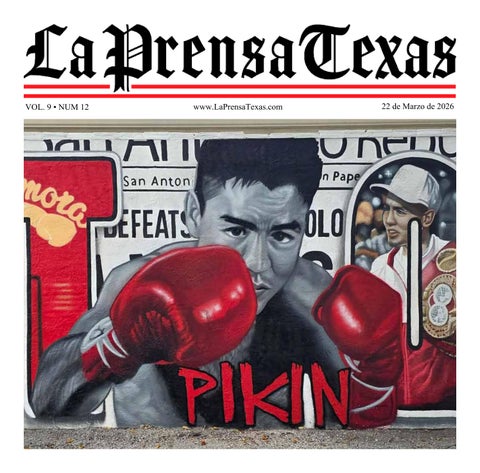
About The Cover Artist: Mike “Comp” Arguello

‘Mike “Comp” Arguello, a proud San Antonio native, is a full-time artist recognized for his powerful portraits and largescale murals. His work stands out for its ability to capture raw human emotion, blending realism with bold graphic elements that resonate with a

wide range of audiences and collectors.

Balancing life as both a painter and muralist, Mike has built an impressive portfolio of public and private commissions. Notably, he was commissioned by the City of San Antonio’s Department of Arts & Culture to create murals on four pillars at Historic Market Square—one of the

city’s most iconic cultural landmarks. He has also been honored as an “Ambassador of Visual Arts” by Visit San Antonio.

From custom canvases to expansive murals, his artwork can be seen not only throughout the United States but also internationally, with pieces showcased in London, England, and Frankfurt, Germany.

No Kings Rally Moves Forward in Austin as Organizers Push to Rename César Chávez Street for Dolores Huerta

Provided by Hands

Off Central TX

Organizers behind Austin’s March 28 No Kings rally are urging city leaders to launch a public process to rename César Chávez Street in honor of Dolores Huerta. The request comes in the wake of two major developments: the cancellation of this year’s Austin César Chávez & Dolores Huerta Marcha de Justicia & Celebration, and renewed scrutiny following a New York Times investigation outlining allegations of abuse tied to Chávez, along with statements from Huerta describing experiences of co-

ercion and sexual assault. Earlier today, organizers of the long-standing Chávez Huerta March confirmed that the annual event, originally scheduled for Saturday, March 28, would not move forward. “Right now, our priority is standing with survivors,” said Shelby Evans, HOCTX

Lead Organizer for the No Kings Austin rally. “We respect the decision made by the Marcha organizers and recognize the weight of this moment. Speaking out about sexual violence takes tremendous courage— especially after years of silence. No movement rooted in

justice should ever expect survivors to carry the burden of protecting a public figure.” Valerie DeBill, Vice President of Voter Services for the League of Women Voters of the Austin Area and a No Kings organizer, emphasized that the situation underscores a broader principle. “No individual should ever be elevated above the values they represent,” she said. “What’s come to light is a powerful reminder of why accountability matters.”Organizers say the conversation extends beyond one event and into how Austin chooses to honor its history in pub-

lic spaces.“Dolores Huerta’s impact on labor rights and civil rights is undeniable,” said Annie Compton of Indivisible Rosedale Huddle and a No Kings Austin organizer. “This is an opportunity for the city to recognize her leadership, resilience, and lifelong commitment to justice by renaming César Chávez Street in her honor.” Despite the cancellation of the Marcha, the No Kings rally at Auditorium Shores will proceed as planned on March 28. Organizers are also considering a community-led “March for Justice” earlier in the day, designed to center survivors and cel-

ebrate Huerta’s legacy—including her enduring call to action, “Sí, se puede.”

“In moments like this, we have to channel our grief and anger into purpose,” said Salvador Espinoza, HOCTX Board Member and No Kings Austin organizer. “Sí, se puede belongs to the people—and to survivors. It’s a reminder that we can challenge exploitation, confront abuse of power, and build a movement where everyone is treated with dignity and respect.”

Additional details about the potential march route and timing are expected in the coming days.

Comisión de Calidad Ambiental de Texas AVISO DE UN PERMISO FEDERAL PARA OPERACIÓN PRELIMINAR

Permiso Preliminar Número: O4791

SOLICITUD Y PERMISO PRELIMINAR. Vantage Data Centers TX11, LLC, 14720 Omicron Dr, San Antonio, TX 78245-5131, ha presentado una solicitud ante la Comisión de Calidad Ambiental de Texas (TCEQ, por sus siglas en inglés) para la expedición inicial de un Permiso Federal de Operación (en adelante denominado como Permiso) núm. O4791, Solicitud núm. 38602, para autorizar la operació n de Vantage TX 11, un Procesamiento de datos, alojamiento y servicios relacionado instalación. El área a la cual se refiere la solicitud está ubicada en 14720 Omicron Dr en la ciudad de San Antonio, Condado de Bexar, Texas 78245-5131. Este enlace a un mapa electrónico de la ubicación general del sitio o la instalación es proporcionado como una cortesía y no es parte de la solicitud o el aviso. Pa ra la ubicación exacta, consulte la solicitud. https://gisweb.tceq.texas.gov/LocationMapper/?marker=-98.788611,29.416944&level=13 Esta solicitud fue recibida por la TCEQ el 17 de julio de 2025.

El propósito de un Permiso Federal de Operación es mejorar el acatamiento general con las normas que gobiernan el control de la contaminación atmosférica, claramente definiendo todos los requisitos aplicables como están definidos en el Título 30 del Código Administrativo de Texas § 122.10 (30 TAC § 122.10, por sus siglas en inglés). El permiso preliminar, si es aprobado, codificará las condiciones bajo las cuales el área debe operar. El permiso no autorizará construcción nueva. El director ejecutivo ha concluido la revisión técnica de la solicitud y ha hecho una decisión preliminar para preparar el permiso preliminar para la revisión y comentario pú blico. El director ejecutivo de la TCEQ recomienda la expedición de este permiso preliminar. La solicitud de permiso, la declaración de fundamentos y el proyecto de permiso estarán disponibles para su consulta y reproducción en TCEQ Region 13 Office, 14250 Judson Rd, San Antonio, Texas 78233-4480 a partir del primer día de la publicación de este aviso. El proyecto de permiso y la declaración de fundamentos están disponibles electrónicamente en la página web de la TCEQ: www.tceq.texas.gov/goto/tvnotice. La solicitud (junto con cualquier actualización) está disponible través del siguiente enlace: https://www.tceq.texas.gov/permitting/air/airpermit-applications-notices. Es posible acceder a esta información electrónicamente en la Secretaría Oficial, ubicada en el Edificio F (planta baja) de las Ofi cinas Centrales de la TCEQ en Austin, Texas, así como en la Oficina Regional en San Antonio de la comisión. También es posible acceder electrónicamente a materiales de apoyo relevantes en estas ubicaciones (entre ellos los permisos de Revisión de Nuevas Fuentes que se han incorporado por referencia).

COMENTARIOS/NOTIFICACIÓN PÚBLICA Y AUDIENCIA. Cualquier persona puede entregar comentarios públicos sobre el permiso preliminar. Comentarios relacionados a la exactitud, lo completo, y lo apropiado de las condiciones del permiso pueden resultar en cambios al permiso preliminar.

Una persona que podría ser afectada por la emisión de contaminantes atmosféricos del área del sitio del permiso puede solicitar una audiencia de aviso y comentarios. El propósito de la audiencia de notificación y comentarios es para proporcionar la oportunidad para entregar comentarios sobre el permiso preliminar. El permiso puede ser cambiado en base a si los comentarios relacionados con el permiso permiten el cumplimiento con el Título 30 del Código Administrativo de Texas, Capítulo 122 (ejemplos pueden incluir que el permiso no tiene todos los requisitos aplicables que correspondan o que no se cumplieron los procedimientos de aviso público). La TCEQ puede otorgar una audiencia de aviso y comentarios con respecto a esta solicitud si una petición por escrito es presentada dentro de los treinta días después de la publicación del anuncio en el diario. La solicitud de audiencia debe incluir la base de la solicitud, incluyendo una descripción de como la persona puede ser afectada por la emisión de contaminantes atmosféricos del área de la solicitud. La solicitud también debería especificar las condiciones del permiso borrador que son inapropiados o especificar como la decisión preliminar para expedir o denegar el permiso es inapropiado. Todos los asuntos razonablemente verificables deben ser planteados y todos los argumentos razonablemente disponibles deben ser entregados a no más tardar al final del período de comentarios públicos. Si se concede una audiencia de aviso y comentario, todos los individuos que presentaron comentarios por escrito o una solicitud de audiencia recibirán confirmación por escrito de la audiencia. Esta confirmación indicará la fecha, hora y lugar de la audiencia.

Comentarios públicos por escrito y/o peticiones para una audiencia de aviso y comentarios deberían ser presentados a la Comisión de Calidad Ambiental (TCEQ), Oficina del Secretario Oficial (Office of Chief Clerk), MC-105, P.O. Box 13087, Austin, Texas 78711-3087, o por internet al www14.tceq.texas.gov/epic/eComment/, dentro de treinta días después de la fecha de publicación en el periódico de este aviso. Si se comunica electrónicamente con la TCEQ, favor de notar que su correo electrónico, tal como su dirección de correo doméstico, formarán parte del archivo público de la agencia.

Un aviso de la acción final propuesta que incluye una respuesta a los comentarios y denotando cualquier cambio al permiso preliminar, será enviado a todas las personas que hayan presentado comentarios públicos, una solicitud de audiencia o que hayan solicitado ser incluidos en la lista de correo. Este envío de correo también proveerá instrucciones para hacer peticiones públicas a la Agencia de Protección Ambiental (EPA, por sus siglas en inglés), para solicitar que la EPA se oponga a la expedición del permiso preliminar. Después de recibir una solicitud, la EPA solamente podrá objetar a la expedición de un permiso que no cumple con los requisitos aplicables o los requisitos del 30 TAC Capítulo 122.

LISTA PARA ENVÍO DE CORREO. Aparte de entregar comentarios públicos, usted puede solicitar ser incluido en una lista para envío de correo con respecto a esta solicitud al enviar su petición a la Oficina del Secretario Oficial (Office of Chief Clerk) a la dirección antes mencionada. Los que se encuentran en la lista para envío de correo recibirán copias de avisos públicos futuros (si hay) para esta solicitud enviados por correo por el Secretario Oficial.

INFORMACIÓN. Para más información sobre el proceso de tramitación de permisos, favor de llamar al Programa de Educación pública de la TCEQ sin costo al 1-800-687-4040, o bien visitar su sitio web, www.tceq.texas.gov/goto/pep. Para información en español, favor de llamar al 1-800-687-4040. También es posible consultar oportunidades de participación pública en nuestro sitio web, www.tceq.texas.gov/goto/participation.

Puede obtener más información sobre Vantage Data Centers TX11, LLC llamando a Mr. DJ Renslow al teléfono (515) 991-4765.

Fecha de Expedición: 27 de febrero de 2026

WAITLIST OPENS APRIL 3, 2026 | Wheatley Park Senior Living Opportunity Home San Antonio will open the Wheatley Park Senior Living Project-Based Voucher (PBV) waitlist for a limited time. One- and twobedroom apartments are available at 910 N. Mittman, San Antonio, TX 78202. Units are limited. Applicants must be 62+ (head of household or spouse/co-head), meet HUD requirements for citizenship/ immigration and income (at or below 50% of Area Median Income), and pass screening (criminal background and rental history). Additional eligibility criteria apply.

APPLY ONLINE: homesa.org/apply

Applications for PBV assistance are accepted online only through the Opportunity Home website. Learn more: WheatleyParkSeniorLiving.com

LISTA DE ESPERA ABRE EL 3 DE ABRIL DE 2026

Wheatley Park Senior Living Opportunity Home San Antonio abrirá la lista de espera del programa Project-Based Voucher (PBV) de Wheatley Park Senior Living por tiempo limitado. Hay apartamentos de una y dos recámaras en 910 N. Mittman, San Antonio, TX 78202. Las unidades son limitadas. Las personas solicitantes deben tener 62 años o más (titular o cónyuge), cumplir con los requisitos de HUD de ciudadanía o estatus migratorio e ingresos (no más del 50% del ingreso medio del área), y pasar la evaluación de antecedentes y del historial de renta. Aplican criterios adicionales.

APLIQUE EN LÍNEA: homesa.org/apply

Las solicitudes para PBV se aceptan únicamente en línea a través del sitio web de Opportunity Home.

Más información: WheatleyParkSeniorLiving.com

Todo un espectacular evento fueron las actividades deportivas ofrecidas por el pentacampeón

Los Spurs de San Antonio y la empresa financiera USAA, que para celebrar su tradicional evento anual con motivo del partido denominado Military

Appreciation Night patrocinado por USAA en la sede de Spurs el Frost Bank Center, el sábado 14 de marzo contra el equipo visitante Hornets de Charlotte.

Los Spurs Y USAA Tubieron Clínica Para Hijos De Militares

Ambas entidades se dieron a la tarea de organizar interesante clínica de baloncesto denominado Lil’ MVPs en el que participaron cuarenta niños hijos de militares en servicio. Contando con la participación de la Spurs Sports Academy (marzo 11 Frost Bank Center), así como miembros del cuerpo técnico de Spurs

Curtis Lewis, Jon Harris y el delantero jugador Kelly Olynyk, quienes enseñaron las

técnicas del deporte ráfaga ha los pequeños que a la vez fueron acompañados por familiares que disfrutaron del tour por el vestidor, sesión de autógrafos, oportunidad de tomarse fotos y competición de habilidades sobre la duela guiados por Kelly Olynik.

Todo esto de acuerdo a boletín oficial informativo de la empresa Spurs Sports and Entertainment (SS&E).

En el que dieron su agradecimiento y reconocimiento a militares activos locales, así como a Veteranos de las Fuerzas Armadas y sus familias. Durante el partido contra Hornets, se regalaron mil posters con la imagen de la mascota The Spurs Coyote ha militares con identificación oficial así como miembros de USAA quienes hicieron su entrada al estadio por el sector

USAA NE VIP, donde a la vez se exhibieron los cinco trofeos NBA donde se aprovechó para tomarse fotografías y llevarse emotivos recuerdos.

Los festejos cerraron con broche de oro, en los momentos en que a la mitad del partido 25 reclutas ofrecieron su juramento para servir en el Air Force, Coast Guard. Marine Corps, Navy, Space Force. Army y Texas Army National Guard. (Fotos de cortesía SS&E).

During a recent thunderstorm, I was reminiscing about my days growing up in my beloved Barrio El Azteca in Laredo, Texas when my beloved Mamá had the habit of covering all the mirrors. Her custom shows up in Mexican, Indigenous, and broader folk beliefs. Mirrors were believed to attract lightning and during times of fear or spiritual vulnerability, when reflective surfaces were thought to invite harmful forces.

This is not a mainstream or universal Spanish, Mexican or Mexican American practice today, but it did exist in certain regions and families. It is part of a larger pattern of protective folk customs that blended religion with local superstition, which often fits strongly with Mexican folk beliefs, which often mix:

• Indigenous worldviews

• Spanish Catholicism

• Local superstition

Covering Mirrors During Storms

In many Mexican households, and especially in our own home, Mamá covered mirrors during storms because she believed that:

• Mirrors were believed to draw lightning

• Lightning could “enter” through reflective surfaces

• Storms were seen as spiritually charged moments

This belief is especially common in older barrios and rural communities, and especially in our own home in the Barrio El Azteca. There is no direct Christian doctrine about covering mirrors during storms, but Christianity has long coexisted with folk beliefs about:

• Spirits during storms

• The danger of reflective surfaces

• The need to protect the home during natural events

So, while not “official,” it fits into a broader folk environment where storms were seen as moments requiring spiritual caution. Given the time, place, and cultural mix of mid - 20th - century South

Texas, my mother’s habit was probably a Mexican folk tradition with distant echoes of:

• Spanish superstition

•Indigenous beliefs

•Old - world Spanish and Mediterranean customs that filtered into Iberian culture centuries earlier

Traditions like these often survive because they feel protective, even if people no longer remember exactly where they came from.

In Jewish tradition, the practice of covering mirrors in a house of mourning is known as shiva mirror - covering, part of the broader customs observed during shiva, the seven - day period after a death. Mirrors are covered so mourners are not distracted by their own reflection and can focus on grief, memory, and prayer. It also reflects an old belief that moments of death and mourning create a spiritually charged space, one in which reflective surfaces might invite forces better left undisturbed. That idea—of mirrors as spiritually open

or vulnerable—echoes across many cultures, and it resonates deeply with the memories you carry from your own childhood.

During that recent thunderstorm, when I found myself thinking back to my days living in the Barrio El Azteca in Laredo, Mamá’s habit of covering the mirrors connected my home to that same ancient instinct for protection. In her case, it was not about mourning but about storms—moments when the world felt unsettled, loud, and spiritually alive. In Mexican, Indigenous, and broader folk traditions, mirrors were believed to attract lightning, to act as portals for danger, or to draw in forces that roam during moments of natural upheaval.

Even though this is not a universal Mexican or Mexican American custom today, it lived strongly in certain families and older barrios, shaped by a blend of Indigenous worldviews, Spanish Catholicism, and local superstition. In my home, storms were not just

weather events; they were moments when Mamá felt the need to shield the household, to close off anything that might invite harm—just as Jewish mourners cover mirrors to protect the spiritual space of grief.

My mother’s gesture, then, becomes part of a much larger human story: across continents and centuries, people have covered mirrors during times of vulnerability—whether after a death, during a storm, or in moments when the boundary between the everyday and the spiritual felt thin. Traditions like these survive because they offer comfort and protection, even when their origins fade. And in my memory of Mamá, standing in our Barrio El Azteca home as thunder rolled outside, her hands gently draping cloth over each mirror, I can feel how her belief carried echoes of ancient worlds— Spanish, Indigenous, Mediterranean—woven into the fabric of your family’s life.

“Wifredo Lam: When I Don’t Sleep, I Dream,” the first major U.S. retrospective of the famed Cuban artist, opened in November 2025 and runs through April 11, 2026 at the Museum of Modern Art (MoMA) in New York City. Known for his largescale paintings, which reference modernist aesthetics and AfroCuban imagery, Lam explored themes of social injustice and spirituality. The exhibition features over 130 works spanning six decades, and includes paintings, ceramics, and works on paper. In 1939, Lam was among the first Latin American artists collected by the MOMA. More than 100 solo exhibits worldwide established Lam as one of the important artists of the twentieth century.

Born in 1902, Lam resided in Sagua la Grande, Cuba, a municipality in central Cuba known for having the largest and most productive sugar plantations on the island. Lam’s father, a Chinese immigrant, came to Cuba in the 19th century to harvest sugar cane crops. His mother, of African and Spanish descent, traced part of her heritage to African slaves brought to the region to work in the plantations in the 1800s. Over his six-decade career, Lam’s mixed heritage would define much of his art.

In 1916, Lam and his family moved from the Cuban countryside to Havana. That year, at age fourteen, Lam enrolled in the Escuela Profesional de Pintura y Escultura, Academia de

Major Exhibition of Cuban Modernist Painter Wifredo Lam

San Alejandro in Havana. His exhibitions at the Salon de Bellas Artes convinced him to become a painter. His birth community of Sagua la Grande noticed his artistic talents and awarded him a grant to study in Spain. In 1923 Lam left Cuba to study in Madrid where he spent hours at the Prado Museum studying the great masters of Spanish painting, particularly Velázquez and Goya. While at the academy, Lam explored his personal and artistic identity. He also became part of a community of modernist intellectuals and artists, and MOMA curators noted that he “experimented with modern idioms like flattened space, bold outlines, and patterning.”

In Spain, he married, and his wife Eva gave birth to their son Wifredo Victor. Tragedy struck the Lam family when his wife and young son died of tuberculosis. His grief led to numerous paintings of mother and child. Lam also grew closer to his friendship network and joined a political organization connected to the Republican forces in the fight against Spanish General Francisco Franco. MOMA curators noted that after joining the Republican army to defend Madrid against the fascist forces of Franco, Lam engaged in creating propaganda posters against Franco’s fascist army.

War has never been good for artists. The Spanish Republican army forces placed Lam in a munitions factory where toxic fumes resulted in chemical poisoning. Sent to Barcelona to

recover, Lam composed one of his largest paintings, “Las Guerra Civil” [1937], which MOMA noted, “heralded his arrival as a modern and politically committed artist.” Forced to paint on kraft paper due to wartime scarcity, Lam responded creatively to the medium, using it to explore the boundary between painting and drawing. The interplay of material, scale, line, and blank space would become a hallmark of his practice. Lam wrote of this painting, originally commissioned for the 1937 Spanish Pavilion at the Exposition Internationale in Paris, “I am drawing a painting of big proportions... an anti-fascist subject, not very beautiful but very true and real.” The flat, churning scene depicts a violent confrontation during the Spanish Civil War in which figures with grimacing, masklike faces struggle against one another. Lam’s painting of the horrors of war reminded me of Pablo Picasso’s “Guernica,” completed in 1937 that was shown at the Spanish Pavilion of the Paris International Exposition and drew worldwide attention.

While in Barcelona, Lam also secured a letter from a friend of Picasso to introduce him to the famous artist in Paris. Lam fled Spain and arrived in Paris in 1938. He met with Picasso, who introduced him to his artist friends, including Joan Miro, Fernand Léger, and Georges Braque. Among Picasso’s vanguard art collective was Andre Breton, a key figure in the surrealist movement. Picasso also introduced Lam to his

gallery associates. One of Lam’s earlier paintings of a mother and child, completed in Madrid, was instrumental in his breakthrough to international status when the MOMA purchased the “Mother and Child” painting from a Paris dealer in 1939.

War continued to torment Lam and caused his exodus from Paris in 1940 when the Nazis invaded France. He fled to Marseille, France with Breton and friends and eventually found passage to the Caribbean island of Martinique.

A short video shown at the Lam exhibit, narrated by MOMA Director Christophe Cheriz and MOMA Latin American Curator

Beverly Adams, noted that both the United States and Mexico rejected Lam’s entry. After a short stay in Martinique, Lam returned to Cuba.

Back in Cuba, Lam reconnected intellectually with his new artistic crusade, a coupling of the influence of Oceanic art with that of African art. His works also touched on his opposition to colonialism. In March 1943, the MOMA exhibition, The Latin American Collection, featured Lam’s gouaches Mother and Child and Satan.

For his most famous painting, La Jungla, Lam glued together two large pieces of kraft paper. He first sketched the composition

Wifredo Lam, Mother and Child. Courtesy of the Museum of Modern Art. Photo by Ricardo Romo.

in charcoal and then used layers of thinned oil paint over the initial drawing. Lam’s figures feature faces reminiscent of African masks, handlike feet, elongated legs, and male and female attributes. Adams, who curated the MOMA exhibit, noted that Lam’s figures “are placed within a Caribbean landscape, intertwined with broadleaves, tropical fruit, and sugarcane. This setting recalls Cuba’s history of slavery and indenture, while also signaling the resilience of AfroCaribbean cultures.” La Jungla was acquired by MOMA in 1945. Referring to La Jungla painting, poet Aimé Césaire, whom Lam met in Martinique, wrote that “La jungla imagines a constant re-creation of figures and their context, a revolving, as if they were both entering and leaving the world made for them. Rather than being static plant/humans, they become, unbecome, and ultimately transcend the impenetrable space of the sugarcane field.”

During the late 1940s, Lam’s new success as an international artist allowed him to divide his time between Europe, Havana, and New York. Lam received major recognition in the 1950s and 1960s, including winning the Grand Prix of the Havana Salon and the Guggenheim International Award in 1964. These awards solidified his status as a leading figure of global modernism. Prestigious museums in Cuba, Haiti, the United States, France, Sweden, England, Mexico, Moscow, and Prague featured Lam’s solo exhibitions.

In 1954, Lam moved to Albissola, Italy. He established a studio there in 1960 with his wife, Swedish painter Lou Laurin, and began exploring ceramics and later metal sculpture, often reworking the same hybrid personages that populated his paintings. His son,

Eskil Lam, wrote, “Albissola, a traditional centre of Italian ceramics, was a hub of excitement, activity, and artistic exchange at the time my father was there. My mother called it ‘Albissolamania.’

It was this spirit of collaboration and friendship that first brought my father to the Italian coastal town of Albissola, just west of Genoa.”

During the 1970s, the last decade of his life, Lam collaborated with a Milan printmaker, Giorgio Upiglio, at the Grafica Uno workshop. His involvement with printmaking intensified through frequent working stays in Milan from the late 1970s onward. In these trips, he typically spent about a week at a time in Milan, experimenting with etching, aquatint, and lithography, which allowed him to sharpen the motifs of his mature style in graphic form. His love of poetry allowed him to maintain a sustained dialogue with poets through illustrated books and portfolios. He illustrated many journals and poetry books for friends and acquaintances.

Wifredo Lam passed away in 1982 and is remembered as a major 20th-century modernist painter whose career bridged Europe and the Caribbean. An art critic with the journal Artsy noted that Lam “fused Surrealism, Cubism, and AfroCuban spiritual imagery into a distinctive visual language.” It is exciting that Lam’s work is receiving the recognition it deserves.

Wifredo Lam, Portrait of Lydia Cabrera. Courtesy of the Museum of Modern Art. Photo by Ricardo Romo.
MOMA Book with Wifredo Lam on the back cover. Courtesy of the Museum of Modern Art.
Wifredo Lam, The Spanish Civil War. Courtesy of the Museum of Modern Art. Photo by Ricardo Romo.
Wifredo Lam. The artist frequently depicted hybrid female figures as priestesses or spirits connected to Santería and other Afro‑Cuban religions. Courtesy of the Museum of Modern Art. Photo by Ricardo Romo
MOMA Book with La Jungla on the cover. Courtesy of the Museum of Modern Art. Collection of Harriett and Ricardo Romo.

35 Years Lost, Justice FoundThe Exoneration of Cornel Jackie Drummer and the Nonprofit That Helped Restore His Life

There are moments that shake you—stories that force you to stop, reflect, and ask how something so unjust could ever happen. The story of Cornel Jackie Drummer is one of those moments. After spending 35 years behind bars for a 1992 murder he did not commit, Cornel Jackie Drummer was finally exonerated. Not released on a technicality. Not freed on a loophole. Exonerated—because the truth came out. Because he was innocent all along. Thirty-five years.Thirty-five years taken from a man’s life—his youth, his family, his opportunities, his freedom. And when he finally walked out, you would think that justice had been served. But it wasn’t that simple.Because when Cornel stepped back into the world, he wasn’t just trying to rebuild his life—he was trying to prove he existed. No first name. No middle name. No identity recognized by the system. After surviving decades of wrongful imprisonment, he faced another barrier: being invisible. A man proven innocent still fighting to be acknowledged.It was at the MLK March—a place that symbolizes justice, civil rights, and the ongoing fight for equality—that Cornel met Ramon Chapa Jr., a man who chose to act when it mattered most. Through

ReflectionsChristian Ministry, Ramon didn’t hesitate. He stepped in, not with promises— but with purpose.He provided transportation. He covered the costs. He walked alongside Cornel through a process that should have never been this hard to begin with. And on February 19, 2026, something powerful happened. Cornel Jackie Drummer received his Texas driver’s license. To many, it’s just a piece of plastic. To Cornel, it was everything. It meant identity. It meant the ability to work. It meant dignity. It meant a chance to finally begin again after 35 years of being denied that right.. Because while the system failed Cornel for decades, it was community that stepped in to help restore him. Reflection Christian Ministry, led by Ramon Chapa Jr., represents what real ministry looks like. Not just words spoken on Sunday— but actions carried out when no one is watching. It’s about meeting people where they are, especially those who have been overlooked, forgotten, or failed. Cornel’s journey is not just about one man—it’s about a system that must do better. How does someone lose 35 years to a wrongful conviction? How does someone walk out innocent, yet still have to fight for basic identity? And how many more stories like his are still waiting to be

heard? But in the midst of these hard questions, there is also hope.Hope in people like Ramon Chapa Jr.. Hope in ministries that don’t turn away. Hope in the belief that even after unimaginable injustice, restoration is still possible. Cornel Jackie Drummer’s words reflect a faith that carried him through the darkest moments of his life: God is good all the time, and all the time God is good. Today, those words carry new meaning. Because justice may have taken 35 years—but it arrived. And through the hands of a faithful servant and a ministry rooted in action, a man who was once erased is now seen, known, and standing on his own two feet. This is not just a story. This is a reminder.Justice is not complete when the prison doors open. Justice is complete when a life is restored.

UT San Antonio, Shellshock Records 3, and JMT Studios Announce “Sonidos de San Antonio 2026”

A Historic Celebration of Tejano and Conjunto Music

The University of Texas at San Antonio (UT San Antonio), in partnership with Shellshock Records 3 and JMT Studios, will present “Sonidos de San Antonio 2026,” a landmark musical celebration honoring the enduring legacy of Tejano and Conjunto music from 7 to 9 p.m. on Wednesday, April 15, 2026, at the historic Empire Theatre in downtown San Antonio. The event will showcase legendary performers in addition to supporting an inaugural scholarship for UT San Antonio students, reinforcing a shared commitment to preserving cultural heritage while investing in the next generation of Tejano artists and scholars.

The special concert, part of the newly launched Sonido Tejano initiative at UT San Antonio, will feature an extraordinary lineup of legendary artists who have shaped the sound of South Texas and beyond, including Little Joe, Shelly Lares, Ruben Ramos, Santiago Jiménez Jr., Ram Herrera, Patsy Torres, and Sunny Sauceda. Opening the evening will be a special performance by Mariachi Los Paisanos with musical direction by Michael Acevedo, bringing the spirit of traditional Mexican music

to the stage. “San Antonio has long been the heartbeat of Tejano music,” said Glenn Martínez, dean of the UT San Antonio College of Liberal and Fine Arts. “Through initiatives like Sonido Tejano, UT San Antonio is proud to help preserve, celebrate and elevate the musical traditions that reflect the culture, language and identity of our region. Bringing together these legendary artists at the Empire Theatre is a powerful tribute to the sound of our city.” Shelly Lares, UT San Antonio artist-in-residence and Tejano Ensemble codirector is the lead producer of Sonidos de San Antonio 2026.

“For me, this is a dream realized. To serve as the first Artist-in-Residence and now leading the first Tejano Ensemble is an incredible honor,” Lares said. “Tejano music represents generations of culture, pride, and storytelling. Our students have learned the instruments and musical elements that define the genre, but just as importantly, they are learning the cultural roots behind the sound. This is just the beginning of building the future of Tejano music.” The concert will serve as a vibrant cultural moment ahead of San Antonio’s annual Fiesta season, bringing

together generations of fans to celebrate the music that has defined the cultural identity of South Texas for decades. From the accordiondriven rhythms of Conjunto to the electrifying energy of Tejano music, Sonidos de San Antonio 2026 will showcase the artists who built the genre and continue to inspire audiences today.

“After building my career in New York City and returning home to Texas, producing this event for my alma mater is truly a full-circle moment,” said Jaclyn Tacoronte ’04, CEO of JMT Studios and co-producer of Sonidos de San Antonio 2026. “Tejano and Conjunto music are the heartbeat of San Antonio’s cultural identity. Being able to bring these legendary

artists together at the Empire Theatre alongside UT San Antonio is not only an honor, but a celebration of the music and community that shaped so many of us growing up.” The event represents a collaboration between UT San Antonio’s academic leadership, music historians, cultural institutions and community partners dedicated to preserving the cultural heritage of Texas. Through performances like Sonidos de San Antonio, organizers aim to spotlight the musicians whose work has carried the traditions of Tejano and Conjunto music across generations.

Tickets and additional event information will be available Wednesday, March 18, 2026.

https://us.atgtickets.com/ events/sonidos-de-sanantonio/empire-theatre/ Event Details

What: Sonidos de San Antonio 2026

When: Wednesday, April 15, 2026 | 7 p.m. – 9 p.m.

Where: Empire Theatre, San Antonio

Presented by:

UT San Antonio

Shellshock Records 3 JMT Studios

Featured Artists: Little Joe

Shelly Lares

Ruben Ramos

Santiago Jiménez Jr. Ram

Herrera

Patsy Torres

Sunny Sauceda

Opening Performance: Sonido Tejano

TRINITY TOWING VEHICLE STORAGE FACILITY (1ST NOTICE P3448794)

First Notice: Trinity Vehicles Storage Facility, Inc., 10644 N. IH 35, San Antonio, Texas, 78233 (210)960-1901

License#0656304VSF

2010 PIAGGIO VESPA 200L , plate# N/A, vin# N/A,

Impounded Date: MARCH 10, 2026, from: AUBURN CREEK, 4411 GARDENDALE

San Antonio, Texas,78240.

Total Due: $325.94

URL: http//www.tdlr.texas.gov

TRINITY TOWING VEHICLE STORAGE FACILITY (1ST NOTICE P3448803)

First Notice: Trinity Vehicles Storage Facility, Inc. 10644 N. IH 35, San Antonio, Texas, 78233 (210)960-1901

License#0656304VSF

2016 CHEVROLET AVEO

plate# (MX) STK6122, vin# 3G1TB5AF5GL133334

Impounded Date: MARCH 10, 2026

from: ELM CREEK , 2358 NW MILITARY HWY

San Antonio, Texas,78231.

Total Due: $325.94

URL: http//www.tdlr.texas.gov

TRINITY TOWING VEHICLE STORAGE FACILITY (1ST NOTICE P3448773)

First Notice: Trinity Vehicle Storage Facility, Inc. 10644 N. IH 35., San Antonio, Texas, 78233 (210)960-1901

License#0656304VSF

2020 TAOTAO LANCER(EAGLE) MOTORCYCLE plate# N/A, vin# L9NTCGPB5L1000399

Impounded Date: March 10,2026 from: LOFTS ON MAIN , 1415 N.MAIN AVE. San Antonio, Texas,78212. Total Due: $325.94.

URL: http//www.tdlr.texas.gov

USIO, Inc.

seeks F/T Jr Software Developer for their Shavano Park, TX location. Duties: Develop & Maintain Code – Write, test, and debug software applications. Troubleshoot Issues –Identify and resolve software issues and performance problems. Testing & Deployment – Assist in writing tests and deploying software updates. Version Control – Use Git and repositories for source code management. A U.S. Bachelor’s Degree or a Foreign Equivalent Degree in Cyber Security req. Interested applicants please submit resumes to Joshua Martinez at usioinc.tx@gmail.com.

Despos Vs Astros Clássico Master

Diablos Vs Tuzos El Clásico Abierta

Por Sendero Deportivo

Esté Domingo 22 de Marzo en el campo 1 y 2 se estará jugando la segunda jornada de las recién inauguradas temporadas categoría Abierta dominical Liga Potranco y Másters 50+ respectivamente.

Tras exitosas ceremonias del Playball en Abierta y Másters, Simón Sánchez presidente y compilador oficial en conjunto con el artista Eloy Rocha dueño del complejo deportivo y social Potranco, felicitaron a los equipos participantes y aficionados que estarán siguiendo las espectaculares acciones.

Los aficionados este domingo podrán disfrutar de los clásicos en abierta entre Diablos contra Tuzos en el horario de las 3:30pm [Estadio Potranco campo 1] y el debutante Despos contra Astros en el campo 2 (11am).

Los padrinos de temporada en ambas categorías respectivamente Santos Vaquera (Abierta), lanzó la primera bola teniendo de receptor a su hijo Jonathan y de bateador a su heredero Iván, quienes lo felicitaron y le agradecieron su apoyo que desde pequeños les ha dado en la práctica del béisbol en diversas ligas de la región de San Antonio.

Servando Hernández, realizó efectivo lanzamiento de la primera bola teniendo en el home plate a su hijo Sergio de bateador y su buen amigo JP Reza, con quien ha compartido glorias jugando para Rieleros. Servando recibió aplausos de su familia desde las tribunas, así como reconocimiento de José Sánchez, compilador y comentarista quien lo presentó.

“Agradecido toda nuestra gente, el presidente Simón Sánchez y mis hijos, deseo seguir contribuyendo con el béisbol, porqué estoy orgulloso de haber jugado buena pelota compartiendo honores con mis hijos en el equipo Longhorns lo cual me enorgullece”, dijo Santos Vaquera del campeón Piratas.

Servando, dijo lo siguiente.”Les doy gracias y agradezco al presidente Simón Sánchez, por haberme honrado con tan especial designación en ser

el padrino de la temporada 2026 en Másters. A los equipos que estarán participando les deseo todo lo mejor y seguiré apoyando el béisbol que es El Rey de los Deportes”.

Resultados en Abierta:

Diablos 5 Despos 4 en diez entradas. El campeón Piratas ganó 11 a 3 a Tuzos, José Ferrer pegó dos jonrones y Max Vega dio de 2-2 por Piratas, Miguel Rondon se adjudicó la victoria con relevo de José López [El Látigo]. White Sox noqueó 13-3 a Potros de Zacatecas.

Yankees con pitcheo de Jaime Guerrero, ganó a Rangers en Másters y Despos con pitcheo de

Hilario Álvarez doblegaron 5-2 a Los Rojos con derrota para Alfredo Obregón.

Yankees firman al valioso pelotero Mike Garza, quien en su historial tiene contribuciones en los campeonatos ganados por el equipo Astros en el circuito Colt 45, bajo el timón del gerente general Jaime Guerrero.

En las fotos aparecen Santos Vaquera contribuciones a sus hijos Iván y Jonathan. Servando Hernández con su hijo Sergio y JP Reza. Luis Velázquez, manager de Yankees y Mike Garza. [Fotos de Franco].

Construyendo Futuros, Derribando Barreras: Conoce la

historia del Alamo Colleges District

Celebremos juntos 80 años de ampliar oportunidades y fortalecer el desarrollo de la fuerza laboral en toda la región de San Antonio, a través de historias poderosas de exalumnos y reflexiones de líderes comunitarios, este documental inspirador honra el legado y el impacto de Alamo Colleges en nuestros estudiantes y en nuestra comunidad.

Mira el estreno televisivo en KLRN el lunes 23 de marzo de 2026 | 9:00 p. m.

Para más información, visite alamo.edu/80/share-your-story.

ESCANEA PARA COMENZAR

Turn static files into dynamic content formats.
Create a flipbook
Issue 9.12 - FOR WEB by laprensatexas - Issuu