Issue 8.43 - FOR WEB

Page 1


This grass roots publication is the life source for a community that is not easily afforded viable access to diverse and accessible media. San Antonio and the surrounding counties have become accustomed to relevant news brought to them in both English and Spanish since 1913.

Yvette Tello Publisher y.tello@laprensatexas.com

Ramon Chapa Jr. Community Liaison r.chapa@laprensatexas.com

Jessica Medrano

Graphic Designers

Dr. Ricardo Romo

Henrietta Hernandez Contributors info@laprensatexas.com

José I. Franco

Editor Español

Maria Cisneros

Sales Representative

Let’s Talk About It The Parallels Are Too Much to Ignore

Sales Info:

Our Circulation

45,000 Printed And Distributed Weekly

English And Spanish

Send Press Releases And Advertising Inquiries To: Info@LaPrensaTexas.com 210-628-9611

“Terrible things are happening outside…” Those are the words of Anne Frank, written in her diary on January 13, 1943 — a young girl describing the horror unfolding around her as innocent people were torn from their homes and families vanished overnight. Reading those words today, it’s impossible not to feel the sting of recognition. The parallels are too much to ignore. Once again, we live in a time when families are being separated, people are disappearing, and fear is becoming a language far too many understand. This moment — right now — is exactly why we were made to read The Diary of Anne Frank. Not just as a story of history, but as a warning, a mirror, and a test of our humanity. It teaches us that indifference is dangerous, and silence is never neutral. Anne’s words were written more than 80 years ago, but they echo louder than ever. So we have to ask ourselves: Have we really learned from history? Or are we watching it repeat itself — one heartbreak at a time ? Let’s talk about it…

Frank Burton: “ they are being roughed up, beaten up, hunted, shipped to countries they aren't from, separated from their families and persecuted all over lies to justify their treatment.Yes, people were deported by Obama but it was done legally and following due process. You should look into the difference if you think there is no difference. It’s not a matter of quantity but the actions themselves that are inhumane and unconstitutional. Jesus was 1 guy nailed to a cross that changed the world, was that less impactful because it was just 1 person? He was deemed a criminal. He was an immigrant.”

Thomas Achilles: “When some one chooses to break the law and they get caught, it happens. And yes families are broken left to suffer, poor or rich. So if

your shop is broken into and the thief gets caught but he has 3 kids at home, are you going to tell the cops to let him go?

Robert Vasquez: “Be honest. There was no media coverage, no propaganda or narrative being pushed on the American population. I’m a Muslim I don't do the whole Jesus thing. I don’t worship a man. There is only one Creator and a lot of confused believers. Obama deported over 5 million and not one word but the thousands “ omg this is so bad “ Let that sink in. Talk about bias bs. The only difference is that no one is dying in a gas chamber. They are being sent back home. What is the difference between 5 million and a one hundred thousand. Let’s hear this and don’t use useless emotions use facts”

Richard Cortez: “the left are trying their best distort that fact to fit their narrative most Americans are not that easily brainwashed and a lot are waking up to that and changing their mindset to the lies” Jaime McCormick: “another difference. Jews were completely innocent.”

Priscilla Cervantes: “So sad!”

Jazmin D Zuñiga: “People bring up Obama’s deportations as a way to avoid facing the reality of what’s happening today. But where do you see the justice in what’s going on right now? Trump’s zero tolerance policy started the separation of children from their parents — and many of those children are still missing. You see the injustice and still choose to look the other way.If this were like Obama’s time, the world wouldn’t be watching the way it is now — watching and calling out this cruelty. Tell me, how is it okay to go to your immigration appointment, have the judge deny your case, schedule a follow-up — and ICE is waiting for you outside? The vehicles they use look like trucks meant to pick up animals. We are all suffering the consequences, yet people still justify it with the same tired excuses. People are being sent to El Salvador or to detention centers that feel like Alcatraz — treated like hardened criminals when all they’ve done

is work hard to feed their families. They pick crops, wash dishes, cook, clean, and build homes. Where is the so-called “hardcore crime”? And please, don’t say, ‘They should come here legally.’ A co-worker of my son, who builds hospitals for a living, cut his finger badly this weekend. He was denied medical care because he didn’t have an ID — even though he had money to pay. The irony of life: the same people who build the hospitals can’t even be treated in them. But sure, they’re the criminals, right? La gente menciona las deportaciones bajo Obama como una forma de no aceptar la realidad de lo que está pasando hoy. Pero, ¿dónde ven la justicia en lo que está ocurriendo ahora? La política de tolerancia cero de Trump fue la que comenzó a separar a los niños de sus padres — y muchos de esos niños aún siguen desaparecidos. Todos ven la injusticia, pero deciden voltear la mirada. Si esto fuera como en los tiempos de Obama, el mundo no estaría mirando con tanta atención, denunciando y condenando lo que está pasando. ¿Cómo es posible que vayas a tu cita de inmigración, el juez niegue tu caso, te dé otra cita para regresar, y afuera esté ICE esperándote? Los vehículos que usan parecen camiones para recoger animales. Todos estamos sufriendo las consecuencias, pero la gente todavía lo justifica con las mismas excusas de siempre.Están deportando personas a El Salvador o a centros de detención que parecen Alcatraz — tratándolos como criminales peligrosos cuando lo único que hacen es trabajar duro para alimentar a sus familias. Ellos recogen cosechas, lavan platos, cocinan, limpian, construyen casas. ¿Dónde está el supuesto “crimen grave”? Y por favor, no digan: “Que vengan legalmente.” Un compañero de trabajo de mi hijo, que trabaja construyendo hospitales, se cortó gravemente el dedo este fin de semana. Le negaron atención médica porque no tenía una identificación — ¡y él tenía el dinero para pagar! La ironía de la vida: las mismas personas que construyen los hospitales no pueden ser atendidas en ellos. Pero claro, según algunos, ellos son los criminales, ¿verdad?”

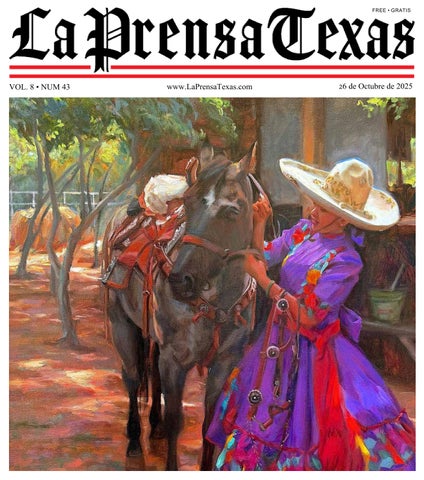
About The Cover Artist: Gladys Roldan de Moras

Since entering Western art shows, Gladys Roldan de Moras has become the first Latina inducted into the National Cowgirl Museum and Hall of Fame and the first woman and Latina to win the Prix de West prize from the National Cowboy & Western Heritage Museum.

Born in Monterrey, Mexico, Moras grew up visiting museums and admiring artists like John Singer Sargent, Mary Cassatt, and Joaquín Sorolla y Bastida. Though expected to study medicine, she pursued her passion for painting after earning a pre-med degree from the University of Texas at Austin. Her artistic path began in earnest when she studied under realist painter Dan Gerhartz at the Coppini Academy of Fine Arts in San Antonio. Moras’s career gained national attention after her 2013 American Impressionist Society “Best of Show” award.

Moras’s paintings celebrate Mexican heritage, notably the rich tradition of the Charros— Mexican horsemen whose equestrian culture influenced the American rodeo. Having deep family ties to this legacy—her grandfather co-founded the Federación Nacional de Charros—Moras

depicts their artistry, attire, and horsemanship with historical accuracy and reverence. Her work often portrays women Charros or Charras, emphasizing their grace and strength through elegant depictions of escaramuzas, women’s riding teams recognized by UNESCO as part of Mexico’s Intangible Cultural Heritage.

Her monumental painting “Escaramuza Blessing at Mission San Jose de Aguayo,” commissioned for Jefferson State Bank in San Antonio, captures the beauty of young Charras receiving a priest’s blessing at the historic mission.

Another lauded work, her “China Poblana,” earned the Frederick Remington Painting Award for Artistic Merit at the Prix de West, honoring Mexico’s iconic female figure and traditional costume.

Moras paints daily in her custom studio with 25-foot glass walls designed for abundant northern light. Committed to mentorship, she regularly opens her space to emerging artists. While she has declined some large-scale murals, Moras’s dedication to meticulous craft and cultural authenticity ensures that each canvas stands as a tribute to the shared heritage of Mexico and the American West.

Hey folks! Welcome back to another week of exploring San Antonio’s hidden gems and historic food treasures! This week, I’m visiting a true local legend — Eddie’s Taco House — where great food and tradition have been bringing people together for nearly 50 years!

Where’s Cleto? This Week: Eddie’s Taco House – 50 Years of Flavor!

Eddie’s has been serving up classic favorites for generations, and folks just keep coming back for more. I’ve been eating here for years myself, especially for their famous barbacoa tacos and their chorizo con huevo with beans — absolutely unbeatable!

I’ll never forget my first carne guisada with cheese taco at Eddie’s — man, that

was on point! And this week, we’re featuring their mouthwatering carne guisada and cheese enchilada plate — the perfect combo, the best of both worlds!

Their beef fajita plate is another musttry — tender, flavorful, and piled high with juicy fajitas. The flauta plate was also a hit; the meat inside was soft, seasoned

perfectly, and just melted in your mouth. And don’t even get me started on their puffy tacos — crispy, packed with meat, and bursting with that classic Fiesta flavor we all love!

But here’s the twist — Eddie’s doesn’t just do Mexican food. Their ¼-pound bacon cheeseburger and hand-cut fries are next-level good! Hon-

estly, I couldn’t decide which I liked more — the burger or the fries — they were both that good.

So if you’re craving great food, friendly faces, and a taste of San Antonio history, head over to Eddie’s Taco House at 402 W. Cevallos or their other location at 3755 Thousand Oaks Drive — and don’t forget to tell them Cleto sent ya!

This is Part Two of Two Parts of six notable people from San Antonio, Texas, for a total of twelve outstanding individuals. Through the encouragement and persuasion of my good friend, brother historian, and mentor, Dr. Félix D. Almaraz Jr., I joined the Bexar County Historical Commission in the 1990s, and served as Chairman of the Oral History Committee. We met on a monthly basis to discuss potential candidates who have made a positive contribution to the social, cultural, historical, political, and educational development of San Antonio and Bexar County, status of current and completed projects, interviewing tips, techniques, proper questions, correct use of recording equipment, some do's and don'ts, conferences, literature on oral history, and general information about conducting oral history interviews. The purpose of our committee was to interview people whose recollection added a human dimension, and a certain richness and flavor to our knowledge of important events. Otherwise, this valuable information would have been lost forever.

As per our agreement, I submitted the tapes and the signed release forms to the San Antonio Public Library for use by scholars, students, and the general public for future historical research. They are kept as part of the Texana Collection, located on the sixth floor.

During my tenure as Chairman, these are some of the notable people I personally interviewed:

(1) Archbishop Patricio Flores

He was born in Ganado, Texas, a very small Coastal Bend town and grew up in Pearland. As a young boy he traveled with his family to do migrant work throughout the state, from Corpus Christi to Lubbock. He was ordained a priest in Galveston in 1956. Early in his pastoral career, he directed the Christian Family Movement and the Bishop's Committee for the Spanish Speaking. In 1969, he joined forty-seven other Mexican American priests to create PADRES, an organization dedicated to addressing church, economic, and societal issues of the Mexican American parishioners. A year later, Father Patricio Flores was named auxiliary to the archbishop, and then he became the first Mexican American bishop in the United States at the age of forty, and nine year later, he was elevated to the post of Archbishop of San Antonio, a spiritual and religious position he held until 2004. In 1972, he established the Mexican American

Part Two--Notable People from San Antonio, Texas

Cultural Center in San Antonio. He helped organize and endorse the Federation of Guadalupanas in 1981. And, in the same year, he founded the Catholic Television of San Antonio, the first diocesan television station in the United States. I interviewed him on October 9, 1991, in his office at the Catholic Chancery in San Antonio. Five years later, he co-founded Teletón Navideño, designed to benefit abandoned women with children, the senior citizens, the unemployed, and the sick. Archbishop Flores received numerous awards, such as the Medal of Freedom, the Hispanic Heritage Award, the Ford Salute to Education, and the American Jewish Committee's Human Relations Award. In addition, he was presented honorary doctoral degrees from three major universities. Archbishop Patricio Flores passed away on January 9, 2017, at the age of 87.

(2) The Finck Cigar Company (Bill Finck Jr. and Rafaela G. Sánchez)

When I called Mr. Bill Finck Jr. to schedule an appointment for an interview, he suggested that I should also speak with Rafaela G. Sánchez, and that I could do both of them in his office. When I walked inside the factory on Veracruz Street, located in San Antonio's West Side, I noticed that most of the workers were women. I interviewed both of them at the Finck Cigar Company office on May 15, 1991. Rafaela Sánchez had worked for this company for seventy-two years and she was in her eighties. As a matter of fact, all the workers had been employed for several decades and started working when they very young, which speaks volumes for their loyalty to the Finck family. Bill Finck Jr. is the owner of Finck Cigar Co., a family owned business since 1893. She explained the process of making handrolled cigars, which she had been doing for decades. Since 1963, parts of the process became automated. He stated that their tobacco leaves come from North Carolina, Virginia, Connecticut, the Dominican Republic, Honduras, and Brazil. He credits the success of the company to a combination of tobacco blends and other techniques. At one time the factory had seventysix employees who operated the whole process for making a cigar. He said that they produce millions of cigars a year. Now, with the new technology, they have a website and also have a mail order service. The Finck Cigar Company is the last original cigar maker in Texas.

(3) Sister Mary Boniface O'Neill (Healy Murphy Center) She spent sixty years working at St. Peter Claver Catholic School/

Healy Murphy Center. The school was established in 1888 by Margaret Mary Healy Murphy to provide an education for Black students from San Antonio's East Side, who during this time were not getting an education due to segregation. While the school was in operation, she worked as a teacher and then as the school principal. It was during this time in the 1960s that I visited the school and their small gymnasium to play basketball against them. I attended St. Augustine High School in Laredo and we played St. Peter Claver twice every season. We were the Knights and they were the Trojans. In 1970, due to a decreased in the enrollment due to integration, the school was in danger of closing. Sister Mary Boniface O'Neill had the vision to start a nonprofit corporation and change the name to The Healy Murphy Center, the first alternative school for teenagers who were at risk of dropping out of school. She became the director of the center. Then, she opened a Child Development Center and clinic designed to help pregnant teenagers. I interview her on September 12, 1991, in her office at the Healy Murphy Center in San Antonio. She retired five years later. And, on Wednesday, April 23, 2003, she went to her eternal reward at the age of 87.

(4) Master Sergeant José M. López

When I was working as an associate superintendent with the South San Antonio Independent School District, the district's purchasing agent, Robert Pedraza, besides being my colleagues, we became very good friends. In one of our many casual conversations, he told me about Master Sergeant José M. López. In particular, I found out that Robert was the son-in-law of MSgt. López and Doña Emilia because he was married to Beatrice, one of their daughters. Immediately, I thought that it would be a great idea to do an oral history interview with his father-in-law. I mentioned it to Robert and he wholeheartedly agreed and made the necessary arrangements. Consequently, I interviewed him on March 7, 1992, in the living room of his house. His wife, Doña Emilia, was very courteous and offered me coffee and pan de dulce. Master Sergeant José M. López was born in Oaxaca, Mexico, and when his mother passed away, at the age of 8 years old, he was sent to live with a maternal uncle in Brownsville, Texas. During World War II, he enlisted in the U.S. Army and served in Company K, 3rd Batallion, 23rd Infantry Regiment, U.S. 2nd Infantry Division. He stood up from a comfortable position on the living room sofa to demonstrate to me in vivid details how he, during

the Battle of the Bulge, single-handed took it upon himself to defend his unit (Company K) that was under siege from German troops. Using a heavy machine gun, he risked his life and killed over 100 German soldiers. For his valor and gallantry, he was awarded the Congressional Medal of Honor, the nation's highest military accolade, and only one of twelve Mexican American soldiers during World War II to have received it. He also received the Purple Heart. He told me about his deep devotion to Our Lady of Guadalupe and how he prayed to her many times when he was in combat. Upon his return from the war, he took his wife and two children and made a pilgrimage to the Basilica of Lady of Guadalupe in Mexico City. Portions of Interstate Hwy 37 and 10 in San Antonio are named in his honor, as well as a street and a city park in Mission, Texas, a middle school in the Northeast Independent School District In San Antonio, and a statue was erected in Brownsville's Veterans Park. In 1996, I persuaded Robert Pedraza to invite his father-in-law to be our special guest at the district's celebration of Veteran's Day. He graciously accepted and his presence made the annual event extra special and memorable. Master Sergeant José M. López passed away on May 16, 2005, at the age of 94.

(5) Carmen Perry

While working as the archivist for the Spanish Archives of Laredo at St. Mary's University during the 1960s, she discovered the lost town records of the Spanish settlement of San José de Palafox, located north of Laredo along the Río Grande. She translated and edited the documents and publish them in a book entitled, The Impossible Dream by the Río Grande: A Documented Chronicle of the Establishment and Annihilation of San José de Palafox, published by St. Mary's University Press. It was during this time that she hired me as her assistant in cataloging the Spanish Archives of Laredo. Seventeen years later, on a Tuesday afternoon, November 22, 1988, after I got off work, Jo Emma and I went to visit her. The apartment was not too far from St. Mary's University. I also wanted Miss Perry to sign my copy of her new book, With Santa Anna in Texas: A Personal Narrative of the Revolution by José Enrique de la Peña, published by Texas A&M University Press. Two years later, on January 18, 1990, she moved to the Incarnate Word Retirement Community, and on several occasions I went to visit her. After we walked to the nearby Luby's for lunch, we returned and took the elevator up

to the thirteenth floor, Room 136G, and spent the rest of the time in her tiny room, reminiscing about our days at St. Mary's University, her two books, current events, Mexican history, and the death threats she had received in the mail and by phone when With Santa Anna in Texas was published. Some people felt that she was dishonoring the memory of Davy Crockett, a Texas hero. I interviewed her on May 22, 1997, in her room at the Incarnate Word Retirement Community, and lamentably two years later, on Friday, June 11, 1999, I was notified that she had passed away in the morning at the age of 93.

(6) Remigio Valdez Jr. I interview him on June 26, 1997, at his home in South San Antonio. He was born in San Antonio and a became a migrant worker. He knew the hardships migrant families have to go through every year to find seasonal work and affordable housing. Through his dogged persistence, perseverance, and persuasive efforts during the 1970s, in working with city public officials and the Mexican American Unity Council, the Bexar County Housing Authority, with financial support from the Farmers Home Administration through the United States Department of Agriculture, built a 75 housing unit exclusively for migrant families, the only one of its kind in the city of San Antonio. The rent was based on the tenant's income. In 1981, the city of San Antonio inaugurated the housing unit as the "Colonia Remigio Valdez Jr." The migrant families affectionately referred to him as "Don Remigio." He always felt that migrant families endured many injustices. What brings a smile to his face is to know that the housing unit is always full and that there is a waiting list. The Colonia Remigio Valdez Jr. was built on the city's south side.

Serving as the Chairman of the Oral History Committee was hard work, time consuming, but it was extremely rewarding. I had a wonderful time and I learned a lot about the people I interviewed and their contributions. It certainly was my pleasure and an honor to have met these outstanding men and women. The learning experience of conducting the oral history interviews was invaluable and added another educational dimension to my repertoire of knowledge for a better understanding and appreciation of these people's accomplishments. More importantly, I will never forget them for as long as I live. These fond and indelible memories will live in my mind and heart forever.

Por Sendero Deportivo

En Liga Potranco Abierta dominical temporada Shamu Calderón 2025, con sede en el estadio Potranco, los jugadores novatos y prospectos están teniendo buenos resultados defensivos ayudando a sus equipos en obtener buenos dividendos.

En la fecha cuatro, durante el clásico entre Dodgers y White Sox destacaron el gran prospecto Adrián Salazar en el montículo y el novato Danny

Ahora Fue Danny “Boy” Rodríguez Yankees Doblegó A Los Rangers 9-5

“Boy” Rodríguez. Salazar, en relevo de seis entradas se agenció la victoria por White Sox, sobreponiéndose en el cuarto episodio, con bases llenas y sin out dominó a bateador rival con rola para doble play y posteriormente ponchó al contrincante rival para de ahí en adelante salir airoso, con la ayuda del popular novato Danny “Boy” Rodríguez, quien dio jonrón solitario para así seguir a su hermano Junior

quien en la fecha tres descontó con doble vuela cerca.

Salazar, de 26 años nativo de Matamoros, Coahuila, celebró su segunda victoria con High Sox de los directivos Chuy Ramírez y Freddy García. Piratas de Sabinas, sigue invicto 4-0, al derrotar 8-1 a Texas Jay’s, al final celebraron el 17o cumpleaños de su jugador Max Vega, quien fue felicitado por sus padres Irma Garza y Max Vega, así como por sus compañeros y seguidores de esta potente franquicia, en cuyos uniformes rinden tributo a su señor abuelo Coco Vega (qepd). Max, disfrutó deliciosa cena y de su rico pastel. (Foto cortesía de su mamá Irma Garza).

Broncos de Linda Garza, dirigido por Martín Rodríguez y el coach José Pérez, doblegó a Diablos 8-4, con victoria para el abridor Leo Terán y derrota para Jarrett Flores. Resultados en categoría Masters 50+ temporada dedicada a “El Capitán” Erick Montes, short stop del pentacampeón equipo Yankees por el presidente

Simón Sánchez y su hijo José Sánchez, comentarista y compilador, quienes reconocieron su trayectoria jugando con diversos equipos en Liga Potranco. “Contento”, dijo Montes, por tan distinguida mención.

Resultados; Astros derrotó a Los Rojos con holgada pizarra, y victoria para su lanzador Ubaldo Montelongo y salvamento de Lee Mann. Por Reds, perdió el abridor derecho Hilario Álvarez con relevo de Carlos Cerda “La Chiva”, campeón pitcher de la pasada temporada.

Yankees de Luis Velázquez doblegó a Rangers de Benito

Martínez “El Venado”, con pizarra de 9-5, lo cual refleja qué Rangers sigue adelante en su plan de juego en la defensa y ofensiva.

La victoria fue para Gilbert Salazar con relevo de Moisés Cervantes. La derrota fue para Jorge Morales con relevo de Hugo Méndez, quien logró detener la ofensiva rival.

Rol de juegos domingo 26 de octubre campo 2, estadio Potranco: 11am Yankees vs Astros.

2pm Rangers vs Los Rojos. Fotos de Adrián Salazar es de Franco. Foto de Danny “Boy” Rodríguez, es de cortesía.

Por Conviva Senior Primary Care

A medida que se acercan las festividades de fin de año, muchos adultos mayores están ocupados en reuniones familiares. Pero antes de que comience el nuevo año, hay un paso más importante que añadir a la lista: programar su visita médica anual.

Esta cita anual, que es totalmente cubierta por Medicare y es una de las herramientas más valiosas para prevenir problemas de salud, usualmente se pasa por alto, lo que significa perder beneficios y oportunidades de prevención. En Conviva Senior Primary Care, vemos de primera mano cómo la atención preventiva puede cambiar el rumbo de la salud y mejorar la calidad de vida de nuestros pacientes.

A diferencia de una consulta médica típica, la visita anual no se trata de tratar una enfermedad o manejar una condición específica. Por el contrario, es una revisión integral de su salud, de sus factores de riesgo y de sus metas personales para envejecer saludablemente. Es su oportunidad de acercarse a su equipo médico, hacer preguntas y crear un plan que le ayude a vivir su vida de la manera más plena y saludable posible.

Para aprovechar

Guía práctica: 10 preguntas para su visita médica anual

máximo su visita médica anual, la preparación es clave. Llevar una lista de preguntas asegura que haya claridad, confianza y un plan que apoye el envejecimiento saludable. Aquí le compartimos 10 preguntas a considerar:

1. ¿Cómo ha cambiado mi salud en general este año?

Tome nota de cambios en el peso, la presión arterial, la movilidad o resultados de exámenes. Esto le da a usted y a su médico una referencia para el año que comienza.

2. ¿Estoy al día con todas las pruebas y vacunas recomendadas?

Exámenes para cáncer, diabetes y enfermedades cardíacas, junto con vacunas contra la gripe, la culebrilla y la neumonía, son claves para la prevención.

3. ¿Mis medicamentos siguen siendo los adecuados para mí?

La necesidad de medicamentos puede cambiar con el tiempo. Su médico puede revisar efectos secundarios, interacciones y posibles alternativas.

4. ¿Qué puedo hacer para fortalecer mi equilibrio y prevenir caídas?

Medidas simples como ejercicios, terapia o ajustes en el hogar pueden reducir el riesgo de caídas, una de las principales causas de hospitalización en adultos mayores.

5. ¿Qué pasos puedo dar para estimular la salud de mi cerebro?

Pruebas cognitivas, herramientas de memoria y elecciones de estilo de vida pueden ayudarle a mantenerse alerta e independiente por más tiempo.

6. ¿Qué cambios en mi estilo de vida tendrían el mayor impacto ahora mismo?

Ya sea en la alimentación, el movimiento, el sueño o el manejo del estrés, incluso cambios pequeños pueden tener un gran impacto.

7. ¿Cómo puedo manejar mejor mis condiciones crónicas?

Para afecciones como diabetes, presión arterial alta, EPOC o artritis, planes de cuidado personalizados pueden reducir complicaciones y mejorar la calidad de vida.

8. ¿Qué servicios preventivos están disponibles sin costo adicional?

Medicare cubre muchos servicios, desde densitometrías óseas hasta asesoría nutricional, pero muchos adultos mayores no saben lo que está incluido. Siempre es bueno preguntar a su médico o revisar su plan.

9. ¿Qué recursos existen para el bienestar emocional?

La salud mental es vital para un envejecimiento saludable. Pregunte sobre consejería, grupos de apoyo o programas comunitarios. Muchos centros Conviva también ofrecen centros de bienestar con clases de ejercicio suave, sesiones educativas y oportunidades para conectar con otros adultos mayores.

10. ¿Qué debo vigilar entre esta visita y la próxima?

Saber qué síntomas o cambios deben ser motivo para una llamada a su médico puede evitar que pequeños problemas se conviertan en grandes preocupaciones.

Con estas preguntas en mano, su visita médica anual se convierte en más que una rutina, se convierte en una conversación productiva sobre su salud y su futuro.

En Conviva Senior Primary Care creemos que envejecer debe significar vivir plenamente. Nuestros médicos y equipos de cuidado dedican tiempo para conocerle personalmente y diseñar planes de cuidado que reflejen sus metas. La visita anual medica es donde comienza nuestra relacion. Conviva cuenta con centros convenientemente ubicados en los condados de MiamiDade y Broward en Florida y en San Antonio, Texas, para atender las necesidades de nuestros adultos mayores a nivel local.

No deje que el año termine sin programar su visita médica anual cubierta por Medicare. Es el mejor regalo que puede darse a sí mismo: prevención, tranquilidad y un envejecimiento saludable.

Para obtener más información sobre Conviva, visite FindConviva.com o llame al 210-610-2089.

SOBRE CONVIVA

Conviva forma parte de CenterWell, una empresa líder en servicios de atención médica especializada en crear experiencias integradas enfocadas en el bienestar de los pacientes. El resultado es una atención médica de alta calidad que es accesible y, sobre todo, personalizada. Como el mayor proveedor de atención primaria para personas mayores, Conviva es uno de los principales servicios que ofrece atención médica a domicilio, farmacia especializada, de hospicio y minorista. CenterWell se enfoca en la salud integral y en abordar el bienestar físico, emocional y social de nuestros pacientes. CenterWell y Conviva son parte de Humana Inc. (NYSE: HUM). Obtén más información sobre lo que ofrecemos en CenterWell. com

Gladys Roldan de Moras: A National Award-Winning Mexican

and Western Art Painter

Gladys Roldan de Moras is La Reina [Queen] of American Western art. Since entering Western art shows, she has become the first Latina inducted into the National Cowgirl Museum and Hall of Fame. She is also the first woman and Latina to win the prestigious Prix de West prize awarded by the National Cowboy & Western Heritage Museum.

Moras grew up with family expectations that she would one day practice medicine. Her studies momentarily distracted her, but fortunately for art lovers interested in the American West and the Latino borderland legacy, she never gave up on her dream to become an artist. Her fascinating journey to becoming an artist began in Mexico.

Growing up in her native town of Monterrey, Mexico, Moras visited museums frequently and spent hours studying the published works of artists such as John Singer Sargent, Mary Cassatt, and Joaquín Sorolla y Bastida. Her parents’ desire for her to study medicine led her, at age sixteen, to enroll in premed courses at Monterrey Tech.

While in college, she met Rafael Moras, an engineering student whom she would eventually marry. After their marriage, they moved to Austin, where Rafael Moras enrolled in the University of Texas Engineering graduate program, and Gladys continued her studies in pre-med, eventually earning an undergraduate degree at UT Austin. Following

a complicated pregnancy, Gladys chose to give up on the study of medicine and pursue art.

When her husband accepted a post at St. Mary’s University in San Antonio, teaching engineering, Glady began her training at the Coppini Academy of Fine Arts. She found an excellent teacher and mentor in the notable realist painter Dan Gerhartz. Her first big breakthrough came in 2013 at the American Impressionist Society when she won a National Juried Exhibition “Best of Show.”

Charros are a part of Moras’s DNA, and many of her paintings are visual narratives of the Charro experience. The Charro tradition is a defining cultural symbol that originated in Mexico after Spain’s conquest in 1521. Charros, the iconic Mexican horsemen, initially appeared as ranch workers on haciendas, particularly in Central Mexico. The Charreria is rooted in equestrian competitions brought by Spanish colonizers and shaped by

indigenous communities.

Charros are known for their unique attire, embellished suits, leather chaps, and wide-brimmed sombreros. Moras has studied the paintings and drawings of early Mexico to make certain that her work represents them accurately. Her maternal grandfather, one of the founders of the Federación Nacional de Charros, taught Moras how practical ranch work over time developed into the sport of charrería, featuring skill-based competitions that celebrate horsemanship, roping, and livestock management. The charro tradition was initially designed for practicality but evolved into a source of national identity and pride. The charrería was institutionalized in the early twentieth century with the foundation of formal Mexican organizations.

Charro culture migrated to Texas in the early 1700s, as Mexican ranch workers introduced charrería practices, which influenced the rise of the American rodeo. Cities such as San Antonio maintain robust

charro associations, with regular charreadas woven into local festivities and bicultural identity. Moras’ painting of a young charra in a purple dress with a bright red shawl wrapped around her waist is striking.

The charra is shown about to place the reins on her horse. The leather and metal buttons are carefully shown.

The saddled horse stands still as the charra adjusts the reins.

Today, the charro and the charras stand as symbols of artistry and cultural linkage between Mexico and Texas. By preserving equestrian competitions, distinctive costumes, and family-based gatherings, the charreadas continue to unite communities across both sides of the border, marking a shared heritage of ranch life, community, and mutual respect.

In 2016, UNESCO recognized charreadas as an Intangible Cultural Heritage. Charreadas showcase ten official events, most of which are male-dominated, but the tenth, the escaramuza, features female riders called charras, who demonstrate their skills in choreographed sidesaddle riding while dressed in colorful Adelita outfits—an homage to the women of the Mexican Revolution.

Moras’s rendition of the San Antonio escaramuza [women charros] in front of the famed Rose Window of San Jose Mission reveals her exceptional attention to detail and her ability to present her subjects and their horses realistically. In the painting, the horses appear almost real, and every intricate detail of the girls’ blouses and sombreros is

Gladys Roldan de Moras, Mexican Dancer Series.
Photo by Ricardo Romo.
Gladys Roldan de Moras, “Annie Moras.” [Daughter of the Moras]. Photo by Ricardo Romo.

one of Moras’s works at the Jefferson State Bank lobby in San Antonio. Steve Lewis, CEO of the bank, acquired several of Moras’s paintings at Western art shows over the years. He was very familiar with Moras’s work, and when the bank built its new headquarters, Lewis contracted Moras to complete a large 10ft by 10ft painting. The painting, “Escaramuza Blessing at Mission San Jose de Aguayo,” hangs on a giant wall on the ninth floor of the bank’s headquarters. The Escaramuza depicts a priest at the entrance of the San Jose Mission Church delivering a blessing to nine young girls accompanied by their horses. The girls are dressed in traditional blue dresses, cowboy boots, and wide-brimmed Mexican sombreros with every detail exquisitely rendered.

carefully crafted.

Women’s inclusion in charreadas reflects both continuity and adaptation in the Mexican tradition. In her paintings, Moras frequently draws on nostalgic family memories and festive Mexican customs. She is

active in the local Charreria events in San Antonio. Although she is admired for her paintings, she is also known for supporting the purchase of the young girls’ escaramuzas costumes.

The escaramuzas costumes are beautifully painted in

Moras takes pride in painting women in traditional Mexican dresses, and her painting of the “China Poblana,” one of her most striking paintings, won the Frederick Remington Painting Award for Artistic Merit, the prestigious honor presented annually during the Prix de West Invitational Art Exhibition & Sale held at the National Cowboy & Western Heritage Museum in Oklahoma City.

The Mexican China Poblana represents both a historic cultural figure and a symbolic traditional dress originating from Puebla, Mexico, during the colonial and national periods. The term refers both to Catarina de San Juan, a 17th-century Asian or Filipina woman enslaved and brought to New Spain, and to her traditional dress. Her dress style became the 19th - century female archetype and costume that came to represent Mexican

identity and femininity. Although she was commonly called “China,” the term in that era referred broadly to people from Asia, not specifically China. Catarina de San Juan’s image evolved into a romanticized national symbol after she died in 1688.

By the late 1800s, the china poblana dress had become a recognizable style associated with working-class women of Puebla and later with Mexican nationalism. The china poblana wore a white, embroidered blouse revealing her neck and shoulders and a colorful skirt heavily decorated with sequins and embroidery.

The dress was formalized as a national icon to represent femininity in post-colonial Mexico. The costume was notably exhibited at the Paris Universal Exposition of 1889 as emblematic of Mexican womanhood and beauty. Today, the china poblana remains a staple in Mexican folkloric dance, especially in ballet folklórico

performances, and continues to serve as a visual emblem of Mexican heritage.

Moras paints daily in a fabulous studio with 25foot glass walls that she and her husband helped design. The glass walls face north for maximum sunlight, a preferred direction among artists. She invites emerging artists into her studio to encourage their work. Harriett and I visited her a day after she had hosted 15 local artists whom she had been mentoring.

In recent years, commissions for her large paintings have grown. Moras noted that she has had to decline some important mural commissions because she prefers not to work on a scaffold. The intense study and detailed representation in each work demand long hours in her studio. Each painting is a treasure that contributes to her goal of correctly and authentically representing her Mexican cultural heritage.

Gladys Roldan de Moras, the Bullfighter Series.
Photo by Ricardo Romo.
Gladys Roldan de Moras, Escaramuzas Series. Photo by Ricardo Romo.
Gladys Roldan de Moras at her studio. Photo courtesy of the artist.

A groundbreaking vision is taking shape in Southeast Bexar County — one that honors the heart, sacrifice, and spirit of those who’ve worn the uniform. Kasakreta, a subsidiary of Texas PMR, LLC, has announced the development of Defenders Village, San Antonio’s firstever 55+ veteran-exclusive rental community, designed to give our heroes the independence, dignity, and comfort they deserve. Led by Robert Ripley, President of Texas PMR, this project is more than just housing — it’s a promise fulfilled. In a city known proudly as

Defenders Village: A ‘Welcome Home’ for Those Who Have Served the Most

Military City USA, with over 250,000 veterans, there has long been a gap in housing options created exclusively for them. Defenders Village is stepping in to fill that gap with compassion, innovation, and purpose. Set in the peaceful surroundings of Southeast Bexar County, Defenders Village will offer 130 singlebedroom bungalows, each around 500 square feet — combining the privacy of a detached home with the ease of maintenance-free living. Every detail has been carefully designed with veterans in mind, from accessible amenities to spaces that foster connection, camaraderie, and pride. At

the heart of the community will stand a 3,500-squarefoot Clubhouse, featuring a multipurpose event room, commercial kitchen, library, game room, and business center. Outdoors, residents can enjoy walking and biking trails, community gardens, a flag ceremony plaza, and an outdoor pavilion perfect for gatherings and celebrations. There will also be a fenced pet park and a secure, gated perimeter — ensuring peace of mind for every resident. Defenders Village’s design also reflects forward-thinking sustainability. Construction will use modern Structural Concrete Insulated Panels

(SCIP) — known for strength, energy efficiency, and resilience against fire, flooding, and wind — providing safer, greener, and more affordable homes for residents. The location is strategically chosen near Joint Base San Antonio (JBSA), the Audie L. Murphy Memorial Veterans Hospital, and several VA outpatient clinics, ensuring residents have easy access to essential care and community services. “Defenders Village is more than just housing; it’s a ‘Welcome Home’ to those who have served our nation,” said Robert Ripley. “We are proud to launch a community that not only addresses a

Defenders Village: Un “Bienvenido a Casa” para Quienes Han Servido Más

critical unmet need but also sets a new standard for veteran-exclusive living. Our mission is to give our veterans a place they can truly call home.” As the project breaks ground, the message from Kasakreta and Texas PMR is clear: this is not just another development — it’s a heartfelt investment in the lives of those who have given the most. With faith, respect, and gratitude, Defenders Village stands as a tribute to service, resilience, and the unbreakable bond of community. Because here in San Antonio, we don’t just say thank you to our veterans — we build homes worthy of their legacy.

Una nueva visión de esperanza y gratitud está tomando forma en el sureste del condado de Bexar. Kasakreta, una subsidiaria de Texas PMR, LLC, ha anunciado el desarrollo de Defenders Village, la primera comunidad exclusiva de alquiler para veteranos mayores de 55 años en San Antonio. Este proyecto innovador y profundamente significativo fue impulsado por Robert Ripley, presidente de Texas PMR, con un propósito claro: servir a quienes han servido más. En una ciudad conocida con orgullo como Military City USA, donde viven más de 250,000 veteranos, hasta ahora no existía una

comunidad residencial diseñada exclusivamente para ellos. Defenders Village viene a llenar ese vacío con compasión, innovación y un firme compromiso con el bienestar de nuestros héroes. Ubicada en un entorno tranquilo del sureste del condado de Bexar, la comunidad ofrecerá 130 bungalós de una habitación, de aproximadamente 500 pies cuadrados cada uno, que combinan la privacidad de una casa independiente con la comodidad de un estilo de vida sin mantenimiento. Cada detalle ha sido cuidadosamente diseñado pensando en los veteranos, creando un espacio que fomente la independencia, la camaradería y el orgullo de

haber servido. En el corazón de la comunidad se encontrará un Clubhouse de 3,500 pies cuadrados, con salón de eventos, cocina comercial, biblioteca, sala de juegos y centro de negocios. Los residentes también disfrutarán de senderos para caminar y andar en bicicleta, jardines comunitarios, una plaza para ceremonias de bandera y un pabellón al aire libre para convivencias y celebraciones. Además, contará con un parque para mascotas y un perímetro seguro con acceso controlado para mayor tranquilidad. La construcción de Defenders Village utilizará un sistema moderno de paneles estructurales de concreto aislado (SCIP), reconocido

por su resistencia, eficiencia energética y durabilidad ante incendios, inundaciones y vientos fuertes. Este enfoque garantiza viviendas más seguras, sostenibles y con menor costo de energía para los residentes. La ubicación fue seleccionada estratégicamente cerca de Joint Base San Antonio (JBSA), el Hospital de Veteranos Audie L. Murphy, y varias clínicas ambulatorias del VA, lo que ofrece fácil acceso a atención médica y servicios esenciales. “Defenders Village es más que una comunidad; es un ‘Bienvenido a Casa’ para quienes han servido a nuestra nación,” afirmó Robert Ripley, presidente de Texas PMR. “Nos enorgullece

lanzar este proyecto que no solo responde a una necesidad crítica, sino que también establece un nuevo estándar para la vivienda exclusiva de veteranos. Nuestra misión es darles a nuestros héroes un lugar que realmente puedan llamar hogar.” Al iniciar la construcción, el mensaje de Kasakreta y Texas PMR es claro: este no es solo un desarrollo inmobiliario, es una inversión humana. Es una promesa cumplida con fe, respeto y gratitud hacia quienes lo dieron todo por nosotros. En San Antonio, no solo decimos gracias a nuestros veteranos — les construimos un hogar digno de su legado.

ALAMO COLLEGES DISTRICT

Purchasing & Contract Administration Office: (210) 485-0100 Fax: (210) 486-9022

ALAMO COLLEGES DISTRICT BID/PROPOSAL INVITATION

The Alamo Colleges District is releasing the Request for Qualifications (RFQ) on October 10, 2025, unless otherwise indicated, on the date shown.

RFQ# 2026-0077 Purchase of Architectural / Engineering / Master Planning Services

Proposal Deadline: November 10, 2025, at 2:00 PM

Specifications are available by visiting the Alamo Colleges District website: www.alamo.edu/purchasing or by emailing dst-purchasing@alamo.edu

Por Franco

Mitch Johnson, entrenador en jefe del equipo Los Spurs de San Antonio, tras finalizar invicto los cinco partidos de Pretemporada en la NBA, agradecí el apoyo de todos sus jugadores y personal técnico quienes lo estarán apoyando en su primera temporada en el mejor baloncesto mundial.

Spurs Finalizaron Invictos Pretemporada

SS&E Cumple Con Comunidad De Uvalde

Ahora Spurs será uno de los equipos que logren salir adelante tanto en su Conferencia del Oeste, como contra rivales de la Conferencia del Este. Serán 82 partidos con bastantes oportunidades para novatos y prospectos quienes estarán buscando seguir adelante aplicando sobre la duela sus respectivas habilidades.

La temporada regular

consiste en contemplar los adelantos en cada equipo de ambas conferencias.

Spurs en pretemporada dio cuenta del visitante equipo Loong-Lions afiliado a la Chinese Basketball Association (CBA), luego de visitante derrotó al Heat de Miami, de local ganó al Jazz con pizarra de 134-108. En su visita al Pacers de Indiana ganó 124-108, y en casa Frost Bank Center, Pacers volvió a caer con abultada pizarra de 133104.

Spurs abren temporada regular en casa el domingo 26 de octubre a la 1pm contra Nets de Brooklyn. Lunes 27 a las 7pm contra Raptors de Toronto.

Cabe anotar que Spurs en el medio tiempo ante Pacers, mediante su programa el Sport for Healing Fund, presentó alusivo cheque por la cantidad de $100,000 a St. Philip’s Episcopal School y el Children’s Bereavement Center, de la ciudad de Uvalde, Texas.

El donativo ayudará en la remodelación del gimnasio en dicha escuela, donde se respalda a la comunidad tras la tragedia sucedida en Robb Elementary School. Spurs mediante reporte oficial informativo, indicó que se continuará su compromiso en pro de la comunidad de Uvalde, recaudando fondos en su programa denominado “Community Ticket

Program”, mismo que apoyará programas en diversas organizaciones. En el partido contra Indiana Pacers, Spurs se encargó de invitar a familias para estar presentes en dicho encuentro, disfrutando comodidades en transporte y en elegante palco en el Frost Bank Center. Foto del cheque es cortesía de SS&E. Foto de acción es de Franco

Turn static files into dynamic content formats.
Create a flipbook
Issuu converts static files into: digital portfolios, online yearbooks, online catalogs, digital photo albums and more. Sign up and create your flipbook.