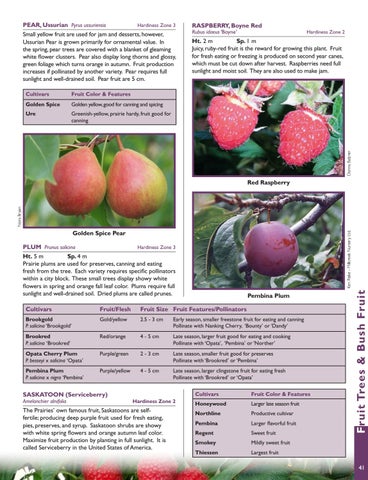
PEAR, Ussurian Pyrus ussuriensis Hardiness Zone 3 Small yellow fruit are used for jam and desserts, however, Ussurian Pear is grown primarily for ornamental value. In the spring, pear trees are covered with a blanket of gleaming white flower clusters. Pear also display long thorns and glossy, green foliage which turns orange in autumn. Fruit production increases if pollinated by another variety. Pear requires full sunlight and well-drained soil. Pear fruit are 5 cm. Fruit Color & Features
Golden Spice
Golden yellow, good for canning and spicing
Ure
Greenish-yellow, prairie hardy, fruit good for canning
Hardiness Zone 2
Ht. 2 m Sp. 1 m Juicy, ruby-red fruit is the reward for growing this plant. Fruit for fresh eating or freezing is produced on second year canes, which must be cut down after harvest. Raspberries need full sunlight and moist soil. They are also used to make jam.
Donna Balzner
Cultivars
RASPBERRY, Boyne Red
Rubus idaeus ‘Boyne’
Nora Bryan
Red Raspberry
PLUM Prunus salicina Hardiness Zone 3 Ht. 5 m Sp. 4 m Prairie plums are used for preserves, canning and eating fresh from the tree. Each variety requires specific pollinators within a city block. These small trees display showy white flowers in spring and orange fall leaf color. Plums require full sunlight and well-drained soil. Dried plums are called prunes.
Pembina Plum
Cultivars
Fruit/Flesh
Fruit Size Fruit Features/Pollinators
Brookgold P. salicina ‘Brookgold’
Gold/yellow
2.5 - 3 cm
Early season, smaller freestone fruit for eating and canning Pollinate with Nanking Cherry, ‘Bounty’ or ‘Dandy’
Brookred P. salicina ‘Brookred’
Red/orange
4 - 5 cm
Late season, larger fruit good for eating and cooking Pollinate with ‘Opata’, ‘Pembina’ or ‘Norther’
Opata Cherry Plum P. besseyi x salicina ‘Opata’
Purple/green
2 - 3 cm
Late season, smaller fruit good for preserves Pollinate with ‘Brookred’ or ‘Pembina’
Pembina Plum P. salicina x nigra ‘Pembina’
Purple/yellow
4 - 5 cm
Late season, larger clingstone fruit for eating fresh Pollinate with ‘Brookred’ or ‘Opata’
SASKATOON (Serviceberry) Amelanchier alnifolia Hardiness Zone 2 The Prairies’ own famous fruit, Saskatoons are selffertile; producing deep purple fruit used for fresh eating, pies, preserves, and syrup. Saskatoon shrubs are showy with white spring flowers and orange autumn leaf color. Maximize fruit production by planting in full sunlight. It is called Serviceberry in the United States of America.
Cultivars
Fruit Color & Features
Honeywood
Larger late season fruit
Northline
Productive cultivar
Pembina
Larger flavorful fruit
Regent
Sweet fruit
Smokey
Mildly sweet fruit
Thiessen
Largest fruit
Fruit Trees & Bush Fruit
Ken Riske - Millcreek Nursery Ltd.
Golden Spice Pear
41