The leading transport recruitment website, established, proven and most trusted since 2007
l Transportation Planning
l Transport Modelling
l Transport Engineering
l Passenger Transport
l Parking
l Rail
l Road Safety
l
After a five-year wait the government has set out a plan for pavement parking
T he long road to safer streets
Cars parked on pavements create barriers for parents with pushchairs, older people, the blind and partially sighted and wheelchair users. Obstructive parking limits their independence and makes everyday journeys harder and less safe. While a default ban on pavement parking exists in London, the lack of clear rules outside the capital means across the rest of England action is often limited to individual streets, and requires lengthy, complex processes.
The issue of pavement parking was the subject of a public consultation in 2020. Five years on, the Department for Transport has announced that local authority leaders across England are to be given powers to introduce pavement parking restrictions across their areas, allowing exemptions where needed. Campaign groups such as Living Streets and Guide Dogs have welcomed the decision to give local authorities clearer powers, but there is disappointment the UK will remain a place with a patchwork of approaches to pavement parking. The challenge will be ensuring local leaders actually use their new powers as limiting the ability of some residents and businesses to leave their cars, vans and lorries on the pavement is often regarded as politically risky. Hopefully, local politicians will recognise that they represent and have a duty of care to all the people.
Mark Moran Editor
Local leaders to get powers to tackle pavement parking
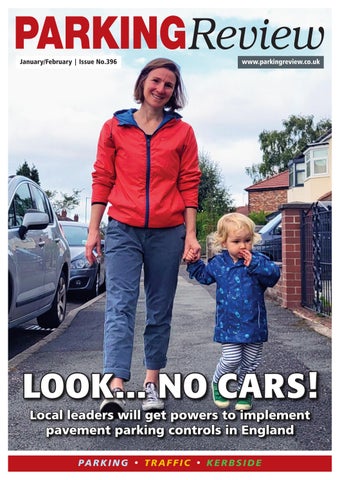
Sadly, keeping pavements this car-free is not child’s play
The North’s leading parking, mobility, and place management event
About the event
The North East Parking Show 2026 will explore how e昀ective parking management underpins local success, supporting clean air, active travel, tourism, and thriving high streets.
Through case studies, expert panels, and exhibitor showcases, the event will celebrate parking as a key part of place-making, bringing together local authorities, operators, and suppliers to share best practice, build partnerships, and discuss what's next for the sector.
The programme
If you have an idea for a talk contact the programme coordinator Gavin Manger, Strategic Partnership Manager at Landor LINKS: gavin.manger@landor.co.uk
Delegate Rates
/ 3rd Secor delegates
Authority additional delegates
* Maximum of two tickets per local authority – don’t delay, register your place online before all allocations are taken!
For further information and to book visit:
Tuesday 3 March 2026
Pre-event Networking Evening
Kick o昀 the event with a relaxed networking reception on Monday 2 March
Held at The Holy GrAle, 57 Crossgate, St Margarets Garth, Durham. This informal gathering o昀ers delegates, speakers and exhibitors a chance to meet, exchange ideas, and enjoy the atmosphere of one of England’s most historic and picturesque cities.
Exhibition/Supporter Opportunities
To secure your exhibition space at the annual North East Parking Show contact Jason Conboy at: jason@landor.co.uk
Exhibitors include:
Exorcising the ghosts
The All Party Parliamentary Group for Transport Safety advocates tackling the rise in illegal vehicle registration plates
Rhodri Clark examines how Cardiff Council’s Parking Action Plan addresses issues such as congestion and road safety
Keeping the city moving
Traffic and parking professionals gathered in Manchester to discuss the latest in street and kerb management
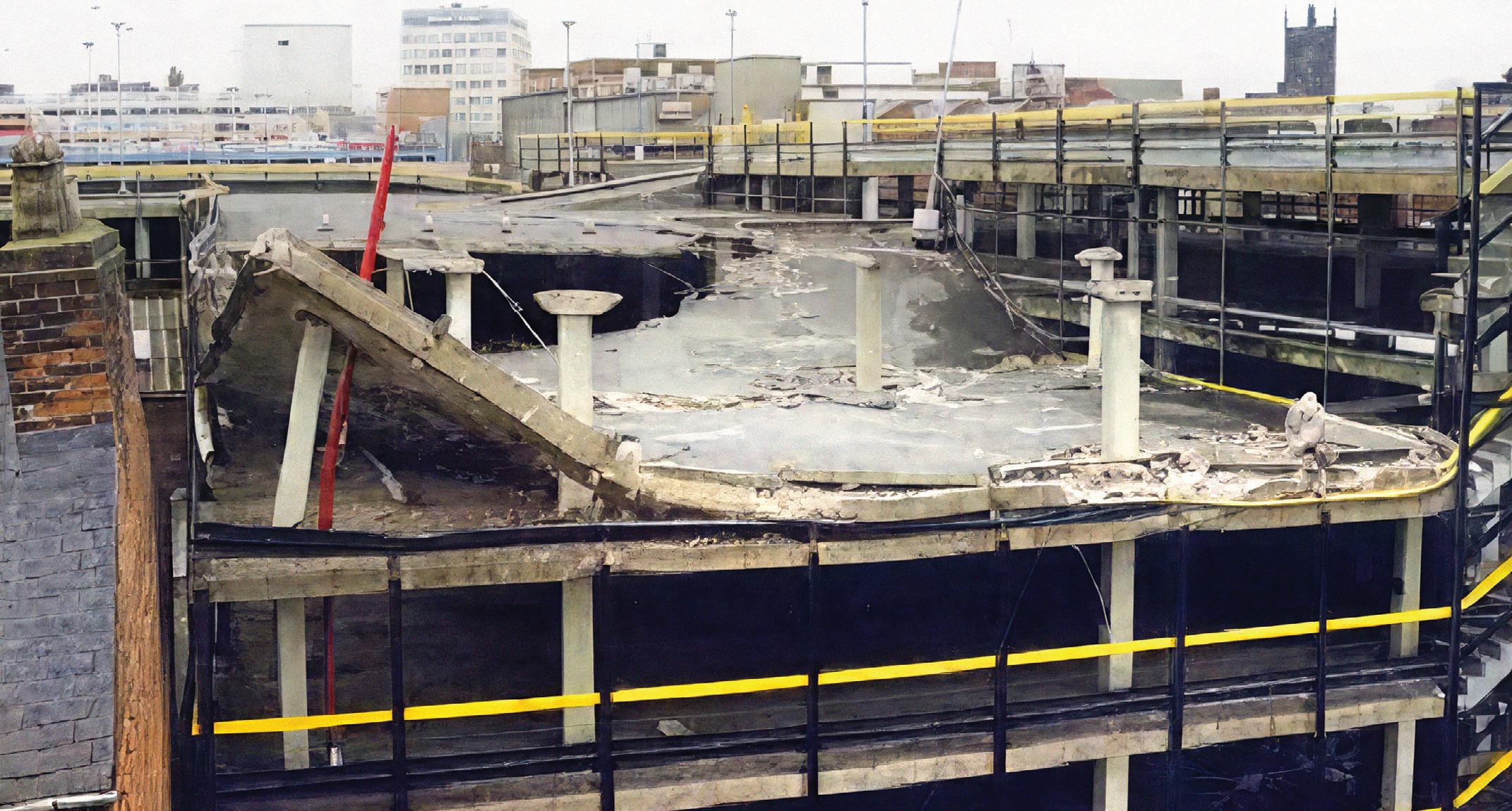
The secret of ageing well (for car parks)
Structural safety body CROSS-UK sets out the challenges and opportunities of extending the use of existing buildings
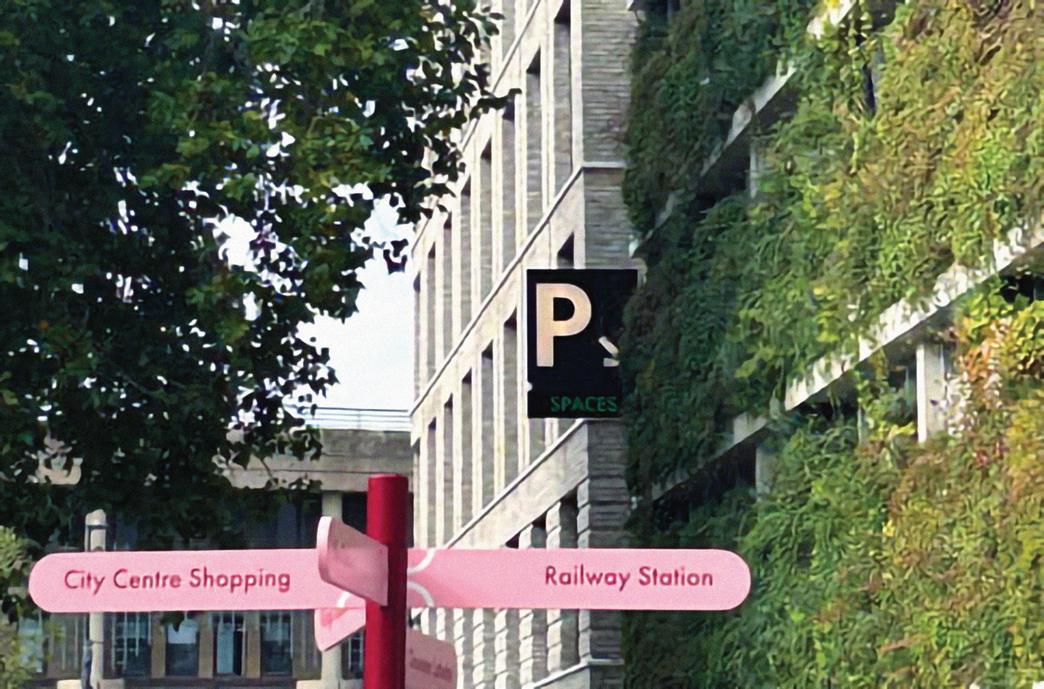
Planting green thoughts
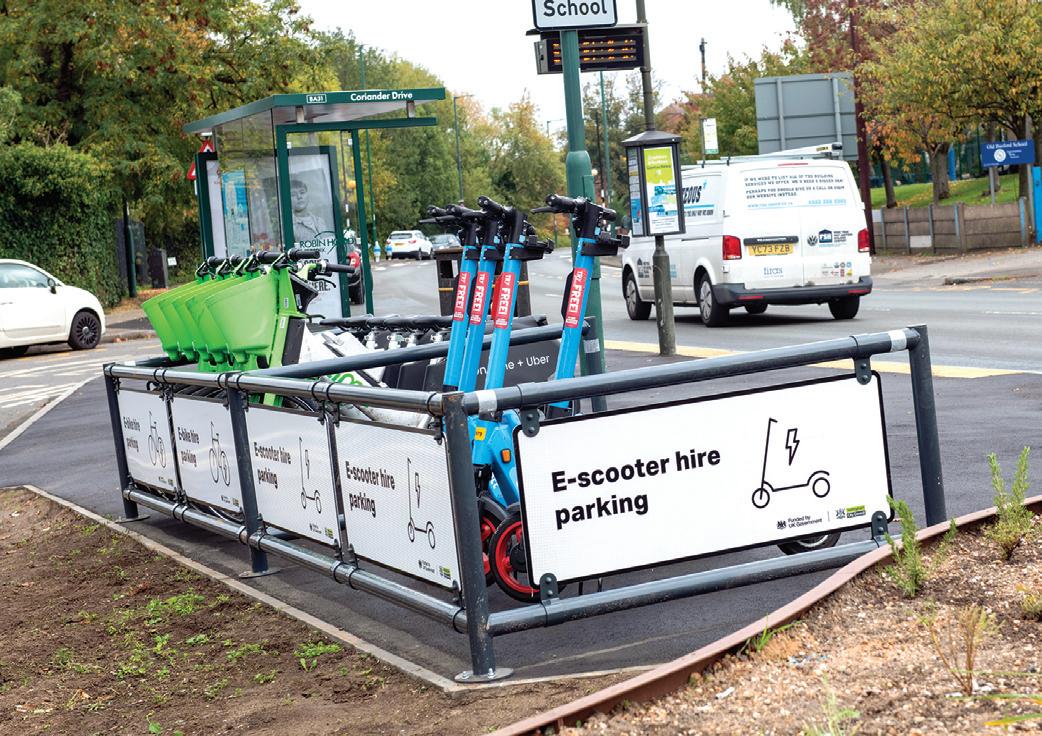
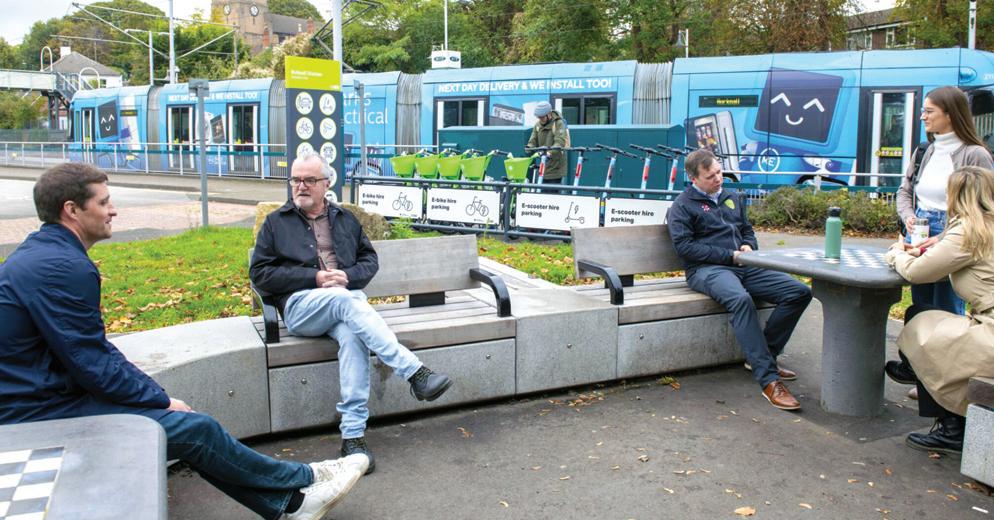
Nottingham’s new mobility hub network showcases spaces that enable connections between sustainable travel services
The
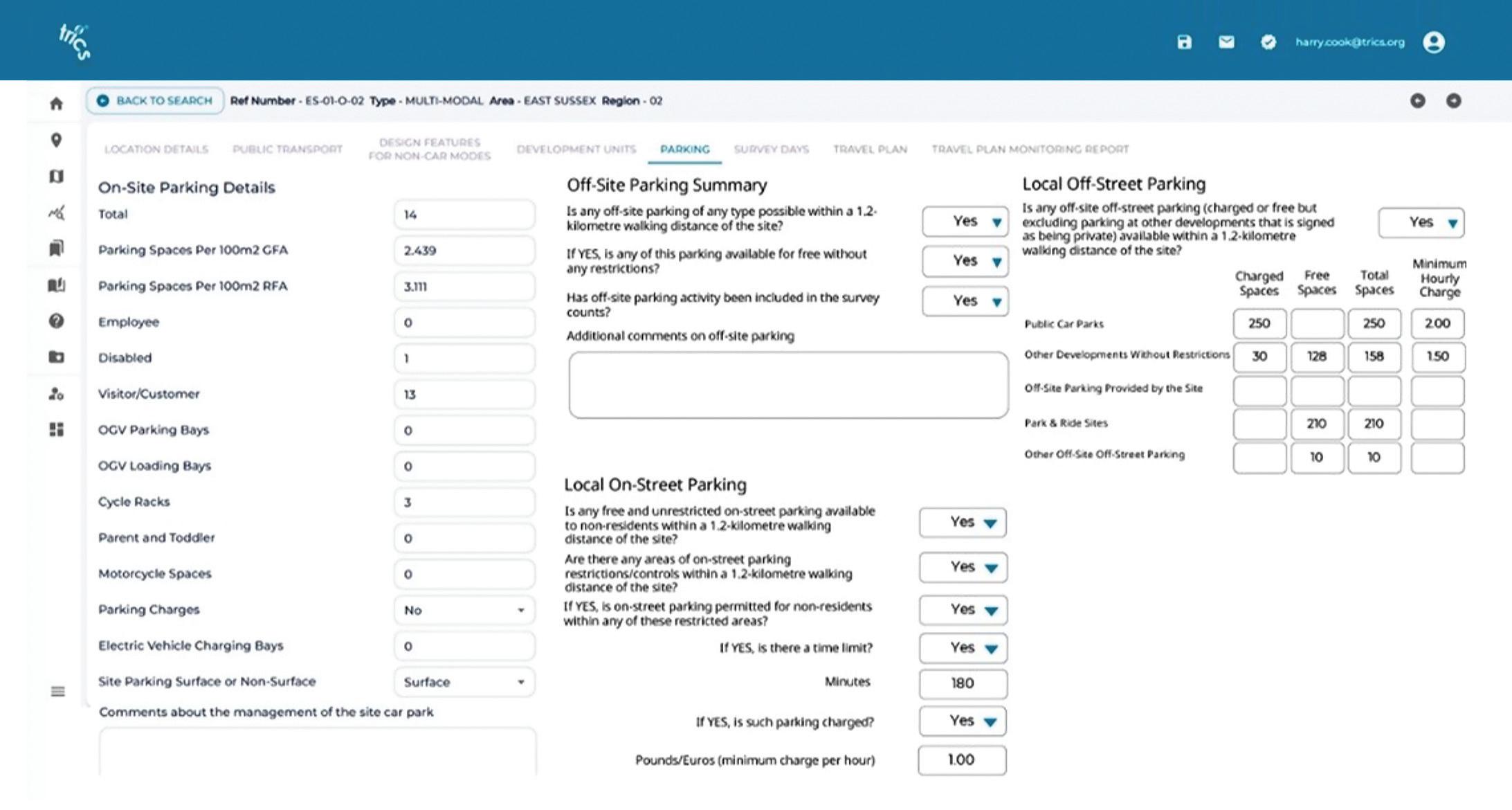
Ian Coles explains the importance parking information plays within the TRICS trip generation database
Writing rules for robots
The Department for Transport is consulting on a framework for self-driving vehicles as robotaxi operators plan London trials
EVolution Magazine
The latest developments in electric vehicle infrastructure
Huseyin
Design for a mobility hub in Nottingham
WAYMO arrives
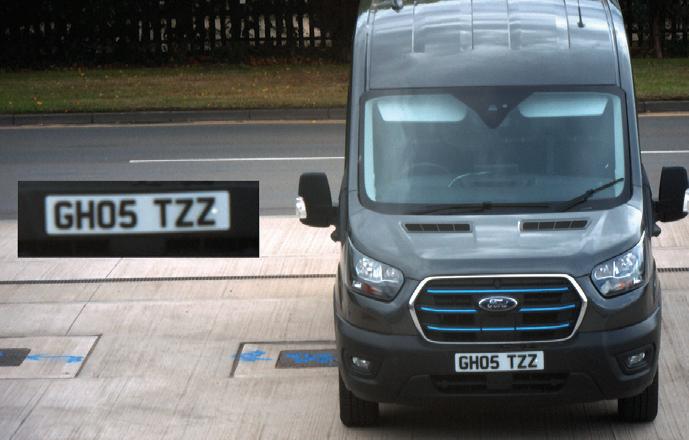
Tackling ghost plates
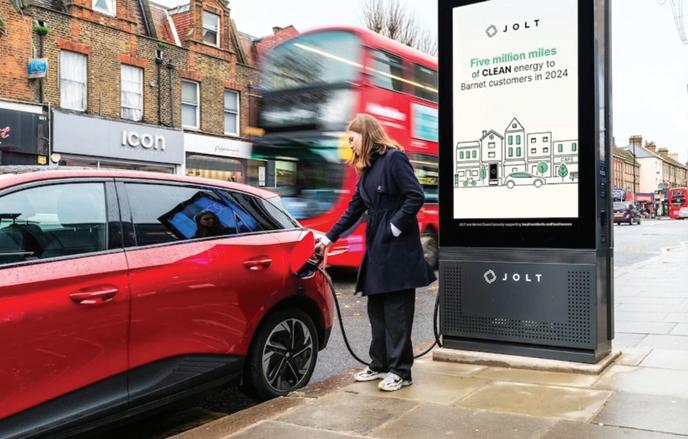
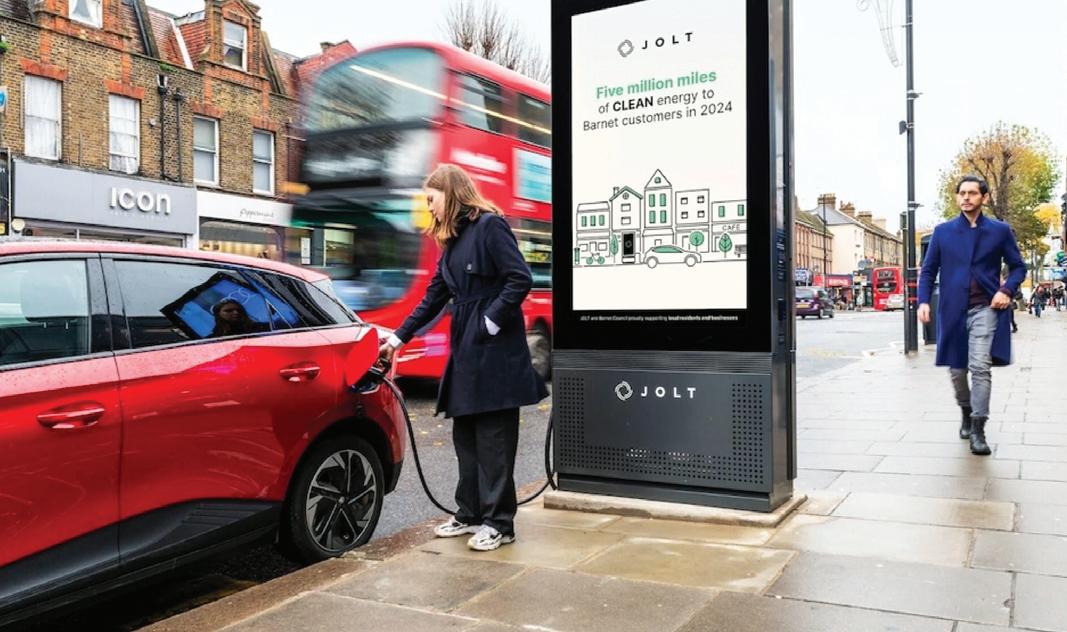
JOLT chargepoint
Design for Cardiff’s Atlantic Wharf car park
Movement on pavements
The Department for Transport reveals plan for managing pavement parking for England… five
years after consultation
It’s been a long time coming, but the UK government has finally made a decision about how to manage parking on pavements across England. More than five years after running a consultation on the subject, the Department for Transport (DfT) has announced that local authorities outside London are to be given powers to introduce pavement parking restrictions across their areas, helping keep them clear and accessible for everyone who uses them, while allowing exemptions where they deem pavement parking may still be acceptable. Deciding against a nationwide ban, the Department for Transport argues that local leaders know their streets best and are best placed to respond to the needs of their communities.
An evidence review conducted by the DfT last year identified two main options for possible legislative change: enabling local authorities to enforce against an offence of ‘causing an unnecessary obstruction of the pavement’, as deemed by the civil enforcement officer; or introducing a national prohibition on pavement parking, except at locations where local authorities choose to allow it.
Local transport minister Lilian Greenwood said: “Clear pavements are essential for people to move around safely and independently, whether that’s a parent with a pushchair, someone using a wheelchair, or a blind or partially sighted person. That’s why we’re giving local authorities the power to crack down on problem pavement parking, allowing more people to travel easily and safely and get to where they need to go.”
However, the adoption of a localised approach means that there will still be a variety of legal frameworks governing parking on the footway, with a different approach being applied in London, where pavement parking is prohibited unless explicitly allowed. There are also different approaches in Scotland, Wales and Northern Ireland.
Responses
Mayor of the West Midlands Richard Parker approved of the decision to empower local leaders. “Clear pavements matter,” he said. “For parents with pushchairs, wheelchair users and people who are blind or partially sighted, a blocked pavement is not a minor inconvenience – it can stop a journey altogether and is a risk to people’s safety. Most drivers want to park safely and considerately and these new powers help in areas where dangerous parking causes real problems. Giving decisions to local leaders means solutions that reflect how our streets actually work. It’s a practical step that helps people move around safely, confidently and independently in their own communities.”
The announcement of new pavement powers for local authorities in England was welcomed by some of the charities that have been campaigning for action. Guide Dogs’ chief executive Andrew Lennox said: “After years of campaigning, we welcome the announcement to give councils greater powers to tackle problem pavement parking. Cars blocking pavements are a nuisance for everyone, but especially dangerous for people with sight loss, who can be forced into the road with traffic they can’t see. Pavement parking is also a barrier that shuts people out of everyday life. When pavements are blocked, people with sight loss lose confidence, independence and the freedom to travel safely. This stops people accessing work, education and social opportunities. We look forward to working with the government and local authorities to ensure these changes are introduced quickly and consistently enforced so pavement parking becomes a thing of the past.”
However, other campaigners gave the announcement a more muted response. Catherine Woodhead, chief executive of Living Streets, said: “These new powers allow for some quick progress after years of inaction and stop many people putting their lives in danger just to get around. It’s disappointing not to see a nationwide prohibition, instead handing the power to local leaders to ban pavement parking. This will result in inconsistency for communities and drivers, which increases risks for everyone
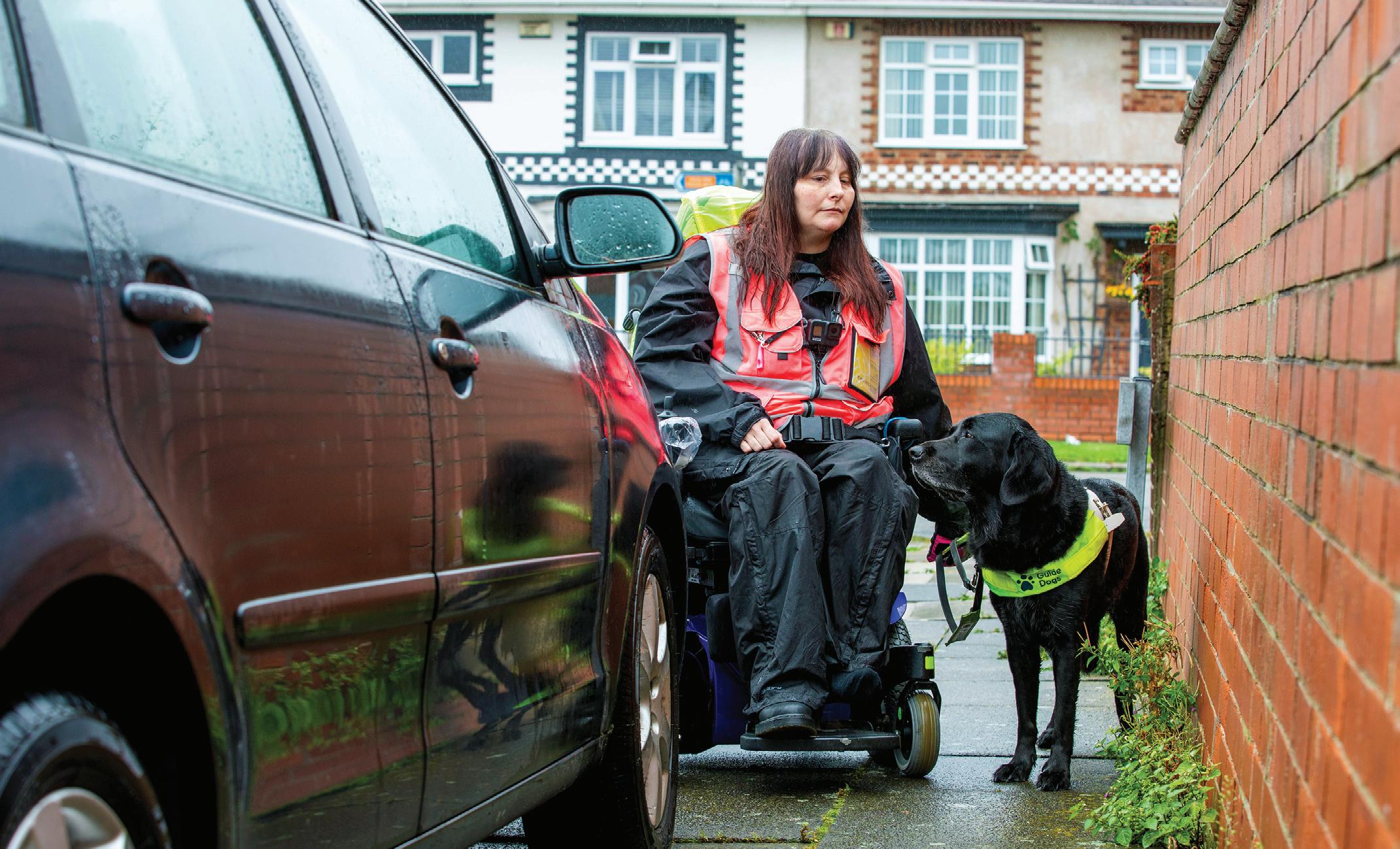
Pavement parking is a hazard to wheelchair users
using our streets. It makes it a political choice, but the fact is, pavement parking endangers lives of the most vulnerable. These new powers do not go far enough to protect pedestrians. Disabled people, parents with buggies and older residents shouldn’t have to depend on individual local authorities’ appetite and capacity to enforce. While national prohibition would offer a clear end to pavement parking, now we can only hope the government’s guidance strongly advises local leaders to act against pavement parking, and we will do our best to ensure this is the case.”
Oliver Lord, head of UK and strategy at Clean Cities, welcomed the announcement, but is keen to see rapid action after what has been an extended consultation period of five years. “It is great to see new powers for councils to end the blight of pavement parking in England,” he said. “This antiquated policy has severely affected people who use wheelchairs, mobility aids, are partially sighted and parents pushing buggies for far too long. The UK is finally pushing back on the ‘norm’ that cars can be plonked where we are all supposed to walk. This announcement comes at a critical time too given cars are getting heavier and wider every year making pavement parking even more untenable and dangerous. Maintenance costs increasing too.
“We shouldn’t have had to wait so long. It is astonishing that this was first consulted on five years ago by the previous government. City leaders will now have greater autonomy over how their streets should be managed for their community.
Edinburgh Council is already reaping the benefits from an end to pavement parking and showing how cities can continue to thrive. This government must ensure cities have the necessary funding and resources to use these powers. Taken together with their new Road Safety Strategy, I have greater confidence we will start to see serious changes to the safety and accessibility of our streets.”
From a motorist’s perspective, the proposal to allow local solutions was welcomed by Rod Dennis, the RAC’s senior policy officer, who said: “Our research shows a clear majority of drivers agree that no pavement user should be made to walk or wheel into the road because of someone else’s inconsiderate parking. These proposals should clear the way for councils to prevent pavement parking where it causes problems, but permit drivers to partially park on pavements where doing so helps keep traffic flowing and doesn’t inconvenience other people.”
Steve Gooding, director of the RAC Foundation, said: “This is good news. The clear and obvious principle is that pavements are for people and the new guidance should mean that anyone who wants to walk safely down a footpath can do so, as long as enforcement is rigorous. But it also recognises there are occasional instances where partial parking on paths is not a hindrance to pedestrians and also helps keep roads clear for emergency vehicles. Ultimately this change puts decision making in the hands of those who know local roads and pavements best, the councils who manage and maintain them.”
MPs welcome action on pavements
Transport Committee chair Ruth Cadbury says new powers need to be introduced without delay
The House of Commons Transport Committee’s chair Ruth Cadbury MP has welcomed the publication of the government response to the 2020 consultation on pavement parking. The Department for Transport has announced that local authorities leaders across England are to be given powers to introduce pavement parking restrictions across their areas, allowing exemptions where needed.
“Having waited for years to see a response to the consultation on pavement parking in England, I’m delighted that the government is now taking action to tackle this scourge,” she said. “We look forward to safer and more accessible pavements across the country in the future. Some questions remain –including how an approach based on making powers available locally will work for non-local drivers if there is inconsistency between neighbouring highway authorities. The Transport Committee will be watching closely to ensure that legislation is enacted without further delays.”
Government is taking action to tackle pavement parking
Lilian Greenwood says local authorities will get powers they need to address pavement parking
We are giving local authorities the powers they need to address pavement parking more effectively, while ensuring consistency, clarity and fairness for all road users. I am announcing the publication of the government’s response to the 2020 public consultation Pavement parking: options for change.
The response demonstrates our commitment to improve transport users’ experience, ensuring that our roads and pavements are safe, reliable and inclusive.
The government is taking forward a new, devolved approach to pavement parking, reflecting our commitment to decisions being made closer to the communities they affect. Local leaders know their communities best, so they are in the strongest position to meet local needs effectively. Our overarching objective to make pavements accessible and safe remains unchanged, but rather than introducing a ‘one size fits all’ national prohibition, which was one of the consultation options, we will instead enable local transport authorities to prohibit pavement parking across their areas at the next legislative opportunity.
In strategic authority (SA) areas outside London, the power will be vested in the SA as the local transport authority (LTA). In non-SA areas the power will be vested in the LTA, which is either the unitary authority or county council. This will support more responsive and inclusive transport planning in the interests of local communities.
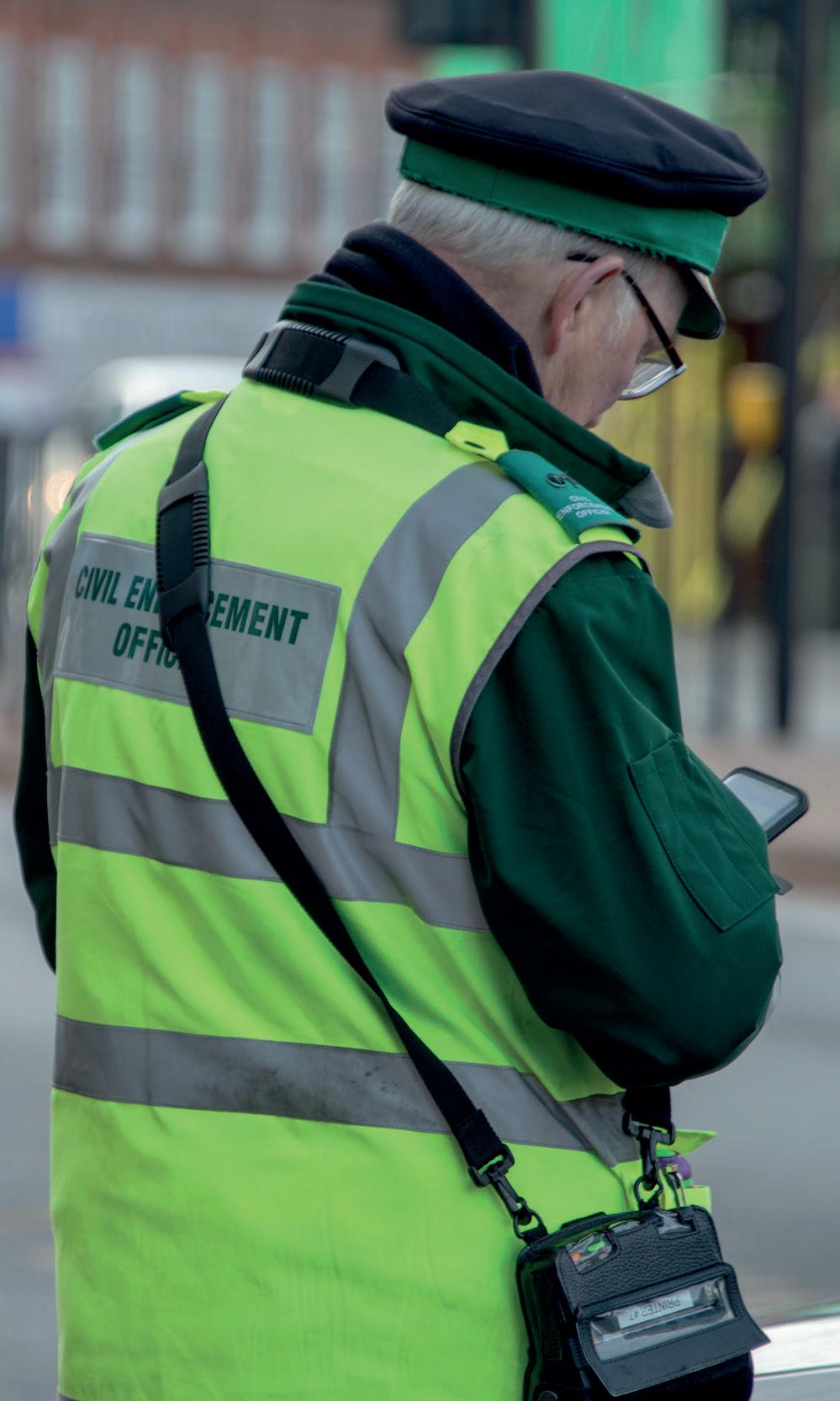
In the meantime, secondary legislation will be introduced in 2026 to enable local authorities to enforce against unnecessary obstruction of the pavement. This provides a practical and proportionate interim solution, allowing councils to act where pavement parking is observed by uniformed civil enforcement officers. This power will sit alongside existing traffic regulation order making powers, enabling councils to enforce pavement parking restrictions both where TROs are in place and in other areas where obstruction occurs. The department will issue statutory guidance to support local authorities in using this power.
Taken together, these steps will give local authorities the powers they need to address pavement parking effectively and fairly in their areas, and I commend the government’s response to the House.
Lilian Greenwood is local transport minister
Lilian Greenwood
Tower Hamlets’s plans to remove three Low Traffic Neighbourhoods (LTNs) in Bethnal Green, Shoreditch and Columbia Road without obtaining the approval of the Mayor of London was unlawful, the Court of Appeal has found. The court found that Tower Hamlets’ Mayor Lutfur Rahman had breached his duty to consider the council’s Local Implementation Plan (LIP) and that his actions did not align with Londonwide transport strategies.
The Court of Appeal’s decision overturns a High Court judicial review ruling in November 2024 which rejected all seven grounds brought by campaigners, who then launched an appeal.
The LTN schemes, which use cameras and bollards to restrict through-traffic, were implemented in 2020 under former mayor John Briggs. Mayor Rahman, who won the election in 2022 on a platform to “reopen our roads”, argued that the schemes increased congestion on surrounding main roads, disadvantaged working class residents and blocked emergency services. He decided to remove the routes in September 2023.
However, road safety groups, including Save Our Safer Streets (SOSS), argued removing the restrictions would violate air quality and safety obligations and would be expensive, unpopular, and harmful for residents’ health and safety.
Lord Justice Singh, Lord Justice Arnold and Lord Justice Miles all agreed that the London borough has breached a duty in relation to the implementation of a Local Implementation Plan which must be prepared by a London borough containing its proposals for the implementation of the Mayor of London’s transport strategy in its area. Lord Justice Singh said he was “particularly impressed” by the submissions from Transport for London (TfL), which appeared as an interested party in the proceedings. TfL argued that the High Court judge’s error in the original case was to ask himself the wrong question.
In his summary, Singh said: “His [the judge’s] analysis focussed on whether, if the Respondent had failed to implement the Scheme in accordance with the LIP either in time or at all, the Mayor of London could enforce its duty to implement the Scheme in accordance with the LIP pursuant to section 151 by obtaining a mandatory order by way of judicial review (as opposed to, for example, exercising his powers under section 152).”
The judge said that the “correct question” was whether Tower Hamlets was under a duty to retain the scheme by virtue of section 151, with the consequence that its decision to remove the scheme without obtaining the Mayor of London’s approval of a revised LIP was unlawful. “In other words that, as well as the positive duties in section 151, there is a negative duty not to act inconsistently with an LIP which has been approved by the Mayor of London,” the judge said. “The answer to that question turns on whether ‘implement’ in section 151 means ‘implement (but without any obligation to retain)’ or ‘implement (and retain)’. In my judgement, it is, obvious that the concept of ‘implement’ in its statutory context includes an obligation to retain an
Low Traffic Neighbourhood campaigners save schemes
Court of Appeal rules Mayor of Tower Hamlets failed to follow Local Implementation Plan when planning to scrap LTNs
approved scheme. Accordingly, the Respondent’s decision to remove the Scheme without going through the statutory process for revising it, including the approval of the Mayor of London, was unlawful,” he said. The appropriate remedy would be a quashing order. Judges Arnold and Miles both agreed.
Transport for London welcomed the court’s decision. A TfL spokesperson said: “We are very pleased with the court’s decision in this case, which provides welcome clarity on the scope of London boroughs’ legal duties to implement and retain schemes funded by TfL to implement the Mayor of London’s transport strategy. Walking and cycling infrastructure, such as low traffic neighbourhoods, plays an important role in making our streets safer.”
Despite the Court of Appeals ruling,Tower Hamlets Council has indicated it will appeal to the Supreme Court. A spokesperson said: “We are disappointed with the ruling, not least because previously the courts have ruled in our favour. We will review the judgment which has significant implications across London, and we will be seeking permission to appeal to the Supreme Court.”
While attempting to remove the main LTNs, Tower Hamlets Council has continued to maintain 33 timed School Streets closures and the Wapping bus gate.
Save Our Safer Streets welcomes judges’ decision
Ted Maxwell of Save Our Safer Streets said: “This is a victory for local people who came together when they saw that their community stood to lose the safer streets they really value. This means the Mayor of Tower Hamlets must now accept that our safer streets are here to stay and he should look for a better use of £2.5m of public funds. Things have changed a lot in the three and a half years since the mayor first wanted to rip out the LTNs. More and more people across Tower Hamlets appreciate the benefits brought by the calmer streets and at a time when so many of our fellow residents are struggling with the cost of living, there are so many better ways to spend public funds than on destroying community space and making our streets more dangerous and putting people’s health at risk.
“As things stand, Tower Hamlets is falling further and further behind other London boroughs when it comes to having healthy neighbourhoods and healthy streets. We have the second highest rates of childhood obesity in London, one of the highest rates of hit and runs in London, and 71% of our children live in poverty.
“Whenever they are asked, people say they want more help to walk, wheel or cycle around the borough. A 2023 survey by Sustrans showed that half of Tower Hamlets residents want to walk or wheel more, and almost as many want to cycle more. Half wanted more government funding for cycling and almost 60% wanted money spent on better walking and wheeling routes.
“We would like to see the council listen to the views of residents, schools, GPs, the Met Police and TfL and work with them to make transport policy decisions that people actually want.”
Save Our Safer Streets attended the appeal hearing
LTN infrastructure on the Old Bethnal Road
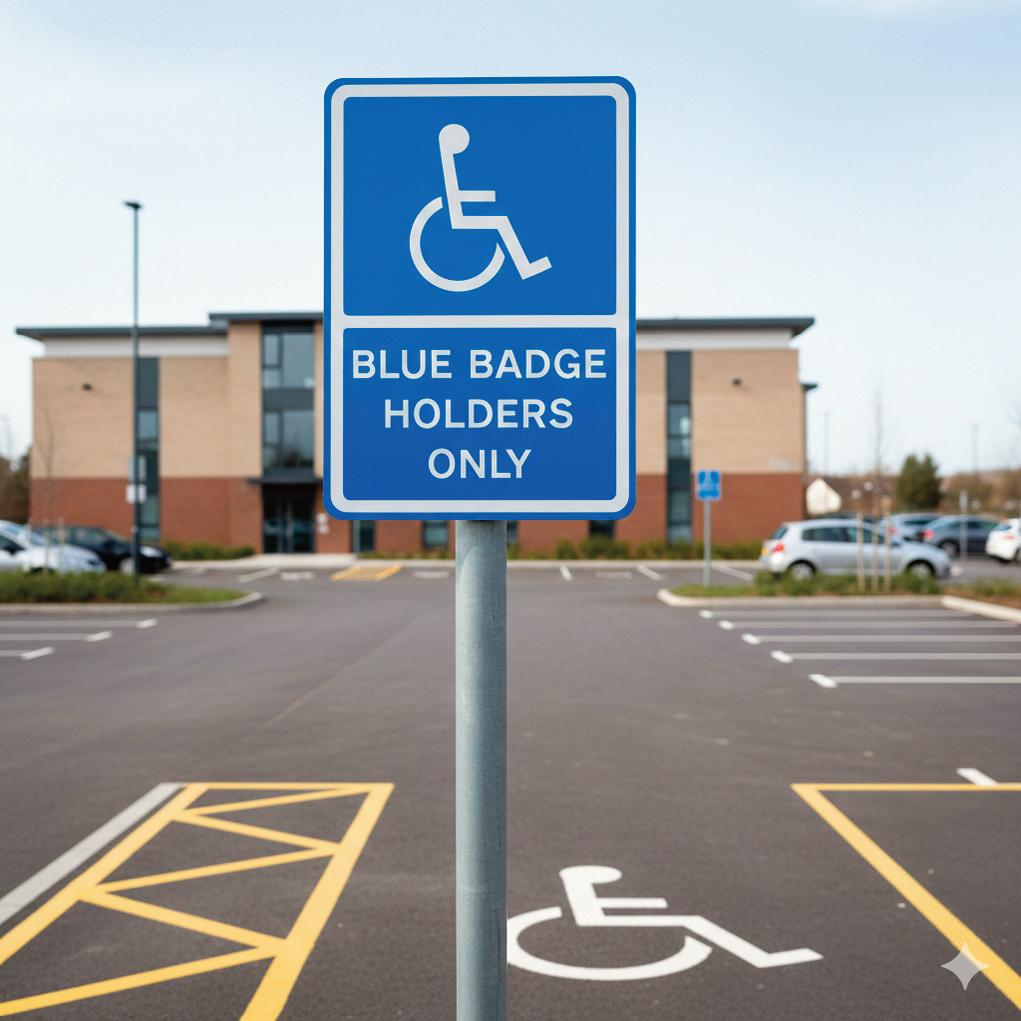
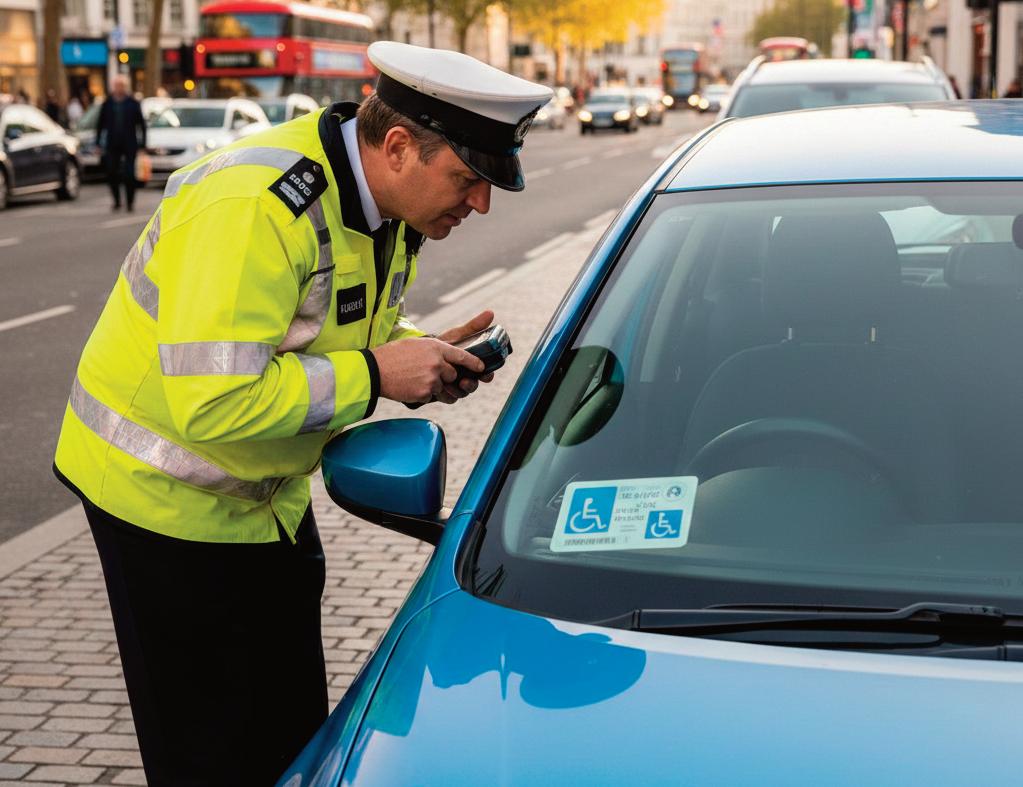
Local Authorities can offer the National Blue Badge Awareness Course for Blue Badge misuse.
Delivered on the Authority’s behalf, the course is offered to the individual before legal action is considered, helping them understand the impact of misuse and encouraging behaviour change.
Key benefits:
l Offered by the Local Authority prior to prosecution
l Delivered on the Authority’s behalf
l No cost to the Local Authority
l Protect spaces for genuine badge holders
l Reduces work volumes, time and costs on your staff and legal teams
l Supports a fair and consistent enforcement approach
‘Clampy’ is sad face of DVLA campaign
DVLA warns that ‘nobody wins’ as it targets tax evaders
The Driver and Vehicle Licensing Agency (DVLA) has launched a national Vehicle Excise Duty (VED) campaign. ‘Nobody Wins’ reminds motorists of the importance of taxing vehicles on time.
The campaign introduces a fresh creative concept led by ‘Clampy’, a down-on-his-luck talking wheel clamp. The ads focus on the disruption and consequences felt by drivers who have their vehicle clamped for failing to tax it.
By giving ‘Clampy’ a personality, the creatives seek to illustrate the real frustration of being stuck, quite literally, because a driver didn’t take a few minutes to tax their car. The message DVLA wants to convey is: “It’s quick and easy to tax your vehicle online, so don’t take the risk.”
The campaign will run across outdoor, audio and online channels until 31 March 2026.
Postcodes where clamping actions took place in 2025
Postcode
The most recent statistics estimate that 98.7% of vehicles used on the road are taxed. DVLA can take enforcement action direct from their records if it identifies an untaxed vehicle.
DVLA’s enforcement teams and wheelclamping partners travel across the UK as part of their day-to-day activity taking action against untaxed vehicles. Some local authorities and police forces can also clamp vehicles under DVLA’s Devolved Power Partner scheme.
Tim Moss CBE, DVLA chief executive, said: “Most drivers keep their vehicle tax up to date, but if you don’t tax your vehicle on time the consequences can be significant. We remind motorists when their vehicle tax is due and only clamp untaxed vehicles as a last resort. Having your vehicle clamped is avoidable, as taxing your vehicle is quick and easy to do. You can also pay by Direct Debit, which helps make sure you stay on top of renewals and lets you spread the cost if you want to.”
London Lorry Control Scheme brings in ANPR
Automatic number plate recognition (ANPR) cameras are to be introduced across London to support enforcement of the London Lorry Control Scheme (LLCS).
The LLCS is operated by London Councils, which is the collective of local government in London.
The LLCS is designed to manage the environmental impact of journeys made by heavy goods vehicles in London by restricting access to residential roads at certain times. The scheme serves to minimise traffic and noise pollution in residential areas during unsociable hours to protect the wellbeing of Londoners. The LLCS has been in place since 1985.
London Councils said the ANPR cameras will support enforcement of the scheme, complementing the work of enforcement officers. ANPR cameras will be deployed on specific routes where enforcement is required to support compliance with the LLCS. These locations have been selected based on traffic patterns, known issues with non-compliance, and operational priorities.
ANPR cameras automatically detect and record the number plates of HGVs using specific roads during restricted hours. Any potential breaches of the scheme are then checked by LLCS officers before the information is processed.
London Councils said the changes will allow for a more consistent, efficient, and fair level of enforcement, as well as provide London Councils with a better understanding of nighttime movement of HGVs during restricted hours.
London Councils is providing warning notices to hauliers for each location where cameras will be installed to help them manage the transition. Warning notices will be given for a period of two weeks at
each new camera location.
The income from penalty charge notices (PCNs) goes straight back into essential traffic and parking services, with any surplus reinvested into key transport initiatives like the Freedom Pass for older and disabled Londoners.
Mayor Brenda Dacres OBE, London Councils’ executive member for transport and environment, said: “The introduction of ANPR cameras will help the London Lorry Control Scheme make use of modern technology, supporting the work of enforcement officers on our streets and increasing compliance with the scheme across London.
“This change will allow enforcement to be applied more consistently, efficiently, and fairly, as well as minimise overnight disruption to London’s communities, allowing Londoners to live in a cleaner, quieter city.”
The operational hours of the LLCS remain unchanged, and operators should continue to follow the Excluded Route Network (ERN) during these hours, unless they have obtained a permit to use restricted roads at these times.
Croydon mobile CCTV tackles antisocial behaviour
Fifteen mobile CCTV cameras are being rolled out across Croydon to crack down on crime and antisocial behaviour in the south London borough.
The deployable cameras have been placed in areas where residents have reported ongoing issues with fly-tipping, drug dealing, knife crime, and other offences. Footage will support the council, and police, to identify offenders and take action.
Cameras are located in Selhurst, Broad Green, Woodside, Thornton Heath, South Norwood, East Croydon, West Croydon and the town centre. Following reports of ongoing antisocial behaviour, the council has also put cameras up in housing estates across the borough to protect residents and properties. Using data from Love Clean Streets, the council has identified fly-tipping hotspots. The council’s community compliance officers will be able to use footage as part of their investigations into fly-tipping and take action against those responsible.
Meet ‘Clampy’
in
(including by DVLA’s Devolved Power Partners)
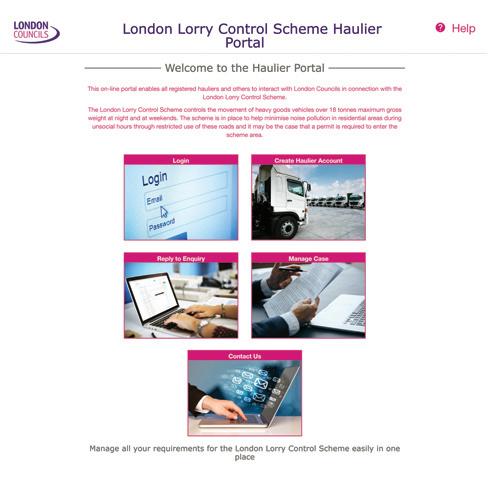
London Councils’ LLCS portal
Quarter of drivers have suffered car crime
RAC research reveals scope and impact of vehicle thefts
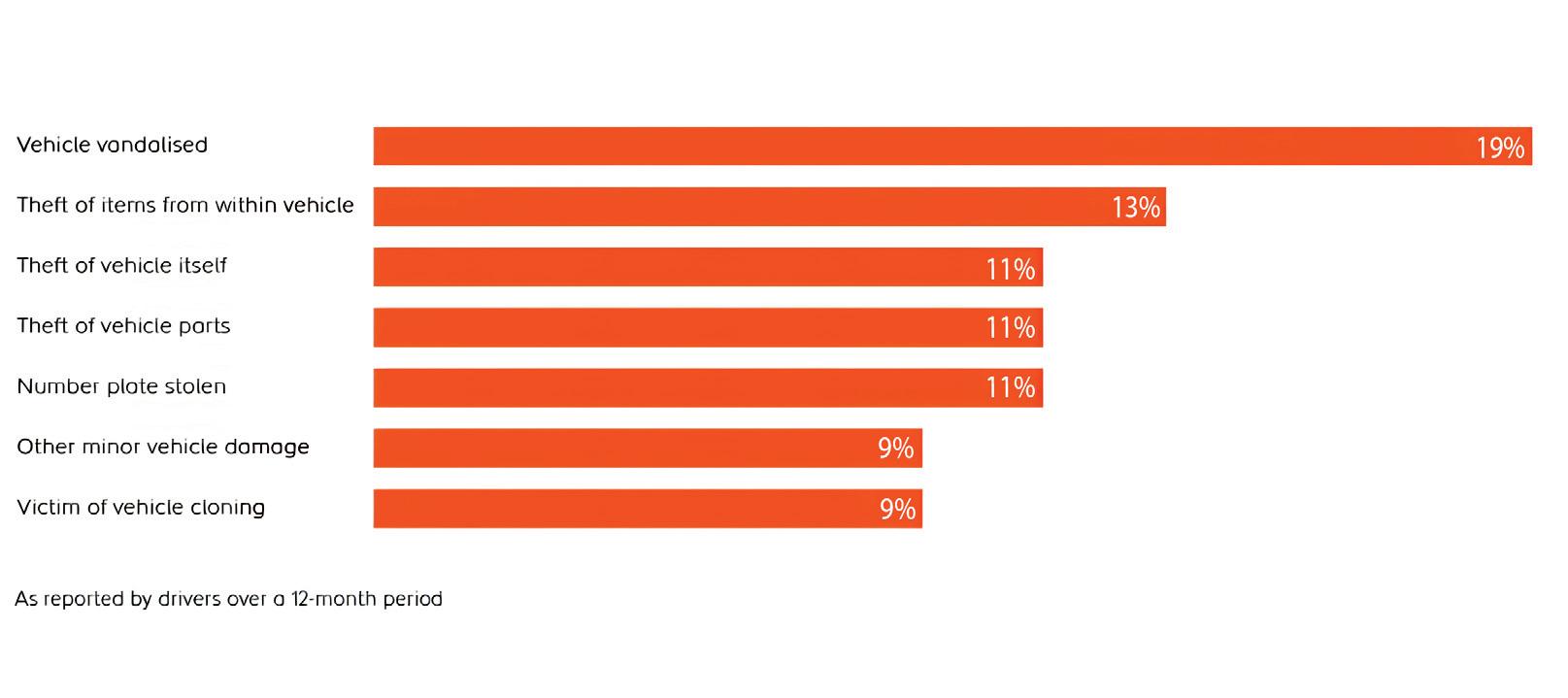
A quarter of drivers (26%) have fallen victim to vehicle crime such as theft or vandalism in the past 12 months, according to RAC research.
Those who live in towns and city centres are much more likely to have been targeted, with 45% of motorists in these areas experiencing vehicle crime compared to just 15% in rural postcodes and one-in-five (20%) in the suburbs or the outskirts of towns.
Almost a fifth (19%) of urban drivers say their car has been vandalised with deliberate scratches and dents over the past year, while 13% have had possessions stolen from their vehicles. In rural areas, the corresponding rates are just 7% and 2% respectively.
Other issues include vehicle theft (11% in urban areas and 6% overall); theft of vehicle parts such as catalytic converters, wheels or steering wheels (11% in urban areas versus 5% overall); other motorists failing to leave a note after causing minor
Source: RAC
Top vehicle crimes experienced by drivers living in urban areas
damage (9% in urban areas and 8% overall); and vehicle cloning, where a numberplate from one vehicle is illegally used on another (9% in urban areas versus 5% overall).
Despite the lower incidence of vehicle crime in rural areas, drivers outside of Britain’s towns and cities are equally, if not more, worried about being targeted by thieves and vandals.
Among drivers based in rural areas, 38% say they are concerned about their car being stolen, the same figure as urban drivers. Meanwhile, four-in-10 (39%) rural drivers are worried
about vandalism compared to 34% of those in town or city centres.
Drivers in rural locations are also considerably more concerned about other motorists failing to leave a note in the event they cause damage to a parked car: a worry for 34% of rural drivers but just 18% of those based in urban areas.
RAC Insurance spokesperson Simon Williams said: “It’s very worrying to see so many drivers have experienced some form of vehicle crime over a 12-month period. Having a vehicle vandalised is both unbelievably
Man jailed for assault on enforcement officer
Victim of vicious attack loses sight in one eye
A man whose attack on an APCOA patrol officer left the victim blind in one eye has been jailed for nine years.
Following a British Transport Police (BTP) investigation, Tim Greenaway, aged 49, was found guilty of Grievous Bodily Harm with Intent and sentenced at the Royal Courts of Justice on 22 January.
The court heard how, on16 June 2023, the victim was in the process of issuing a fixed penalty notice to a woman for littering outside Vauxhall Station when Greenaway interrupted, shouting at him and filming the interaction on his mobile phone.
The patrol officer walked away to avoid an altercation, but Greenaway followed him into the entrance of the station, shouting abuse at him. When the victim turned around to face Greenaway, the assailant shoved his phone in the officer’s face. The victim
pushed Greenaway’s hand away causing his phone to fall to the floor. Enraged, Greenaway attacked the victim knocking him to the ground with a punch before straddling him and repeatedly punching him in the face until a member of the public dragged him off.
Passers-by ran to the victim’s aid and restrained Greenaway with the help of an off-duty police officer until BTP officers arrived and arrested him.
The victim spent a number of days in hospital being treated for injuries which included an operation on a fractured eye socket and dislocated shoulder. Doctors say sight in the injured eye will never return.
BTP Detective Constable Steve Potter said: “Justice has now caught up with Greenaway thanks to our investigation. Sadly his victim continues to struggle with the consequences of this unprovoked attack over two years later. Greenaway’s frenzied attack has had a devastating impact on the
victim. He’s a family man who had to give up his job due to the injuries he sustained and must endure further operations to reconstruct his eye socket.
“A special mention must be given to those brave members of the public who intervened and no doubt prevented the victim from sustaining further injuries. Their continued support throughout the investigation helped secure Greenaway’s conviction.”
APCOA said: “Our officers carry out necessary enforcement duties on behalf of local authorities, rail operators, airports, hospitals and many other organisations –they don’t make the rules and neither do they benefit financially from issuing penalty notices. Violence or abuse towards our colleagues is completely unacceptable. APCOA has a zero-tolerance approach to such behaviour and will always pursue justice for those who are subjected to abuse or assault while carrying out their duties.”
annoying and expensive but having one stolen is a horrible violation, incredibly stressful to resolve and inconvenient to cope with, given how important cars are to our daily lives.”
Jonathan Hewett, chief executive of automotive risk intelligence organisation Thatcham Research, said: “Vehicle theft is no longer just opportunistic –it’s increasingly driven by organised criminal gangs using sophisticated methods. Tackling the threat means not only making cars harder to steal, but also disrupting the networks behind high-volume, tech-enabled theft.”
Milton Keynes patrol in groups
Parking officers in Milton Keynes are to patrol in groups because of threatening behaviour.
Milton Keynes City Council said staff issuing penalty tickets in Bletchley are faced with abuse, threats, intimidation and physical abuse from drivers. This means civil enforcement officers often work in groups for safety reasons.”
Cllr Pete Marland, Labour leader of Milton Keynes City Council, said: “It is completely unacceptable that the council is having to take extraordinary measures to protect staff due to the sheer amount of verbal and physical abuse experienced in this area.
“Officers are being deployed in teams of two and three for their own safety because they are doing work the local community is asking them to do. We know local people raise anti-social parking a lot when we talk to them.
“Milton Keynes City Council dedicates a lot of resource to dealing with illegal parking in Bletchley.”
£1.5m set aside to support free parking offers
Cambridgeshire and Peterborough Mayor sets out funding plan
Free parking schemes designed to support trade in Peterborough city centre and Huntingdonshire will be introduced at a cost of £1.5m by the Conservative Mayor of Cambridgeshire and Peterborough.
Free parking is part of the Mayor’s wider plans to revitalise and regenerate high streets, attracting more people in to support local businesses, create jobs and strengthen historic centres.
The funding for the free parking project was confirmed when Mayor Paul Bristow’s budget for 2026/27 was approved at a meeting of the Combined Authority Board on 28 January.
The Mayoral Precept, which forms part of Council Tax bills, will remain at £36 per year for a Band D household.
The budget will allocate £1.5m over two years to support free parking schemes run in partnership with Peterborough City
Council and Huntingdonshire District Council.
The two-year trial will assess how free parking can increase footfall, support high streets and help local businesses compete with out-of-town and online retail and leisure. The detail of the schemes will be developed and will be subject to further agreement, including the approval of detailed business cases.
The budget also confirms continued funding for the Mayor’s
Day Out scheme, which supports local schoolchildren to visit museums, heritage sites and cultural attractions across the region, helping schools where trips may otherwise be unaffordable.
Alongside the Mayor’s Budget, the Combined Authority Board approved its Budget and Medium-Term Financial Plan (MTFP), providing a balanced and affordable funding plan to support delivery of the Authority’s priorities over the
coming years. The MTFP aligns spending with the Combined Authority’s Corporate Plan and supports investment in transport, infrastructure, skills, homes and business growth, backing the Mayoral ambition to triple the size of the region’s economy by 2050, as set out in the recently launched Local Growth Plan.
Mayor Paul Bristow said: “This budget is about turning my pledges into action. I said I wouldn’t increase the Mayoral Precept, and I haven’t. I also said I wanted to make the role of the Mayor matter to people. That means backing policies that make a real difference on the ground. We need to test how free parking can give our town and city centres a much-needed shot in the arm, driving footfall, supporting jobs and giving people a reason to come back.
“At the same time, we’re continuing the Mayor’s Day Out because opening young minds to our history, culture and science is one of the best investments we can make in the future of this region.”
Reading introduces emission-based parking charges Tackling antisocial behaviour in Westminster
Good air quality is priority for council
Owners of higher polluting vehicles are now paying more for on-street parking in Reading. Since 2 February new emission-based charges have applied to pay & display onstreet parking and residents’ permits in Berkshire town.
The scheme is part of Reading Borough Council’s aim to improve air quality and health in the town and reduce carbon emissions by encouraging the use of public transport, low-emission vehicles and cycling and walking.
A sliding scale of parking charges applies depending on the vehicle’s CO2 emissions, with a tariff of 20% for petrol and 25% for diesel vehicles. However, the tariffs only apply to vehicles which have emission levels of 151g/km (grams per kilometre) or above, which means many petrol vehicles will escape any extra charge.
It is anticipated that around 50% of cars will fall into the lowest price category and see no increase, while a further
25% will fall into the first band, resulting in a small increase.
Motorists using on-street pay & display parking bays will be asked to enter their vehicle registration number and will be charged based on their vehicle’s emissions data held by the DVLA for road tax purposes.
New applications for resident parking permits, and other types of parking permits, are assessed using the emissionbased charging structure.
Similar schemes implemented by local authorities including Westminster, Lewisham and Bath and Northeast Somerset have resulted in positive impacts on air quality.
In Reading, emission-based charging will complement a
range of initiatives designed to reduce air pollution, including investment in improving local bus services, promoting active travel and a major programme of installing more on-street electric vehicle charging points in the coming months.
Cllr John Ennis, lead councillor for climate strategy and transport, said: “Good air quality is a high priority for the council and although we are seeing an improved situation in Reading there are still areas where pollution levels are too high. That impacts on the health and wellbeing of residents, particularly children, older people and those with heart and lung conditions.
“We know that transport accounts for around 30% of carbon emissions nationally and the introduction of emission-based parking charges is one way the council is working to reduce its impact. The council has invested heavily in improving local bus services and encouraging cycling and walking. A major programme rolling out public electric vehicle charging points will also get under way later this year.”
Westminster City Council has introduced a range of measures to crack down on persistent antisocial behaviour, including Public Space Protection Orders (PSPOs) giving council officers new powers, and a network of CCTV cameras targeted at crime hotspots. Evidence captured on council CCTV is being used by the police to support prosecutions and issue penalties. In response to complaints about illegal car meets and dangerous driving, the council expanded its Nuisance Vehicle PSPO, which covered Knightsbridge and St James’s, to the West End last year.
A Pedicabs PSPO designed to deter rogue drivers was launched in December 2025.
Westminster’s CCTV network has captured 800 incidents and helped secure 80 arrests, the city council has revealed.
More than 2,100 fines have been issued for illegally dumped waste since April 2025, with 600 fines for dumped dockless bikes and 196 fines handed out to rogue pedicab drivers since December.
Mayor Paul Bristow
The journey from car park to skate park
Roller skaters could soon be taking their skills to great heights thanks to a proposal to transform underused space at one of Swindon’s multi-storey car parks.
Swindon Borough Council has submitted a planning application to convert the top two floors of Whalebridge car park into a roller skating venue.
Operated by Swindon Skate Social, the facility would be used as a pilot to prove the viability of this concept in the area and help inform other leisure and creative concepts in similar locations. Similar schemes have been successful elsewhere, including in Bristol where a former Debenhams store was converted into ‘Shredenhams’, a space dedicated to skateboarding, as a meanwhile use.
Whalebridge is currently underused by visitors to the town centre so the opportunity is being sought to make it a
more vibrant and bustling location that can benefit the local community. The council’s Heart of Swindon vision aims to stimulate investment in order to transform the town centre over the next decade. In the vision, the council is calling on local land and property owners to bring forward new uses for their own underutilised assets, with the local authority leading the way with this work.
Cllr Jim Robbins, leader of Swindon Borough Council, said: “We know the town centre needs
a lot of love and it’s something local people want us to improve, which is why we are determined to do what we can to make that happen. Town centres are changing and we want to see a mix of housing, leisure, hospitality and
retail in Swindon as outlined in our Heart of Swindon vision.”
Cllr Kevin Small, cabinet member for finance, added: “These changes to Whalebridge car park will demonstrate how these types of activities can transform underused spaces into vibrant uses for the community. Should this be a success, it will be a shining example of how other landowners can improve their assets and use their buildings to bring life and vibrancy to the town.”
Gareth Davies, owner of Swindon Skate Social, said: “It’s a great idea. We’ve been looking for a safe place to skate for a while, we’ve got one regular booking but it took me two and a half years to find it. We’ve grown out of that, this is a safe environment, it’s outdoors, it’s fresh air and it’s a great community builder.
“We’re all friends through skating and we’re getting bigger. It’ll bring more people into the town centre, businesses will benefit from us being here, going to the restaurants and shops.”
Swindon Borough Council with Swindon Skate Social at the Whalebridge MSCP (below)
Exorcising the ghosts
The
All Party
Parliamentary Group for Transport Safety advocates tackling the rise in illegal vehicle registration plates
An outdated and poorly regulated number plate system enables criminals and organised crime groups to operate undetected on the UK road network, lets dangerous drivers off the hook, poses serious safety concerns, and leads to a significant loss of public funds. This is a warning from the All Party Parliamentary Group for Transport Safety (APPGTS), which has published a new report highlighting the problem of ‘ghost plates’.
The APPGTS published the Ghosts on the Road report following a cross-party inquiry into vehicle registration plates, after calls from MPs and experts had drawn attention to a brewing crisis in road safety.
The inquiry, led by Andy MacNae MP and Sarah Coombes MP, found the UK’s automatic number plate recognition (ANPR) systems,
which capture around 90 million reads each day across more than 18,000 cameras, is being undermined by weak regulation of number plate production, supply and a lack of enforcement.
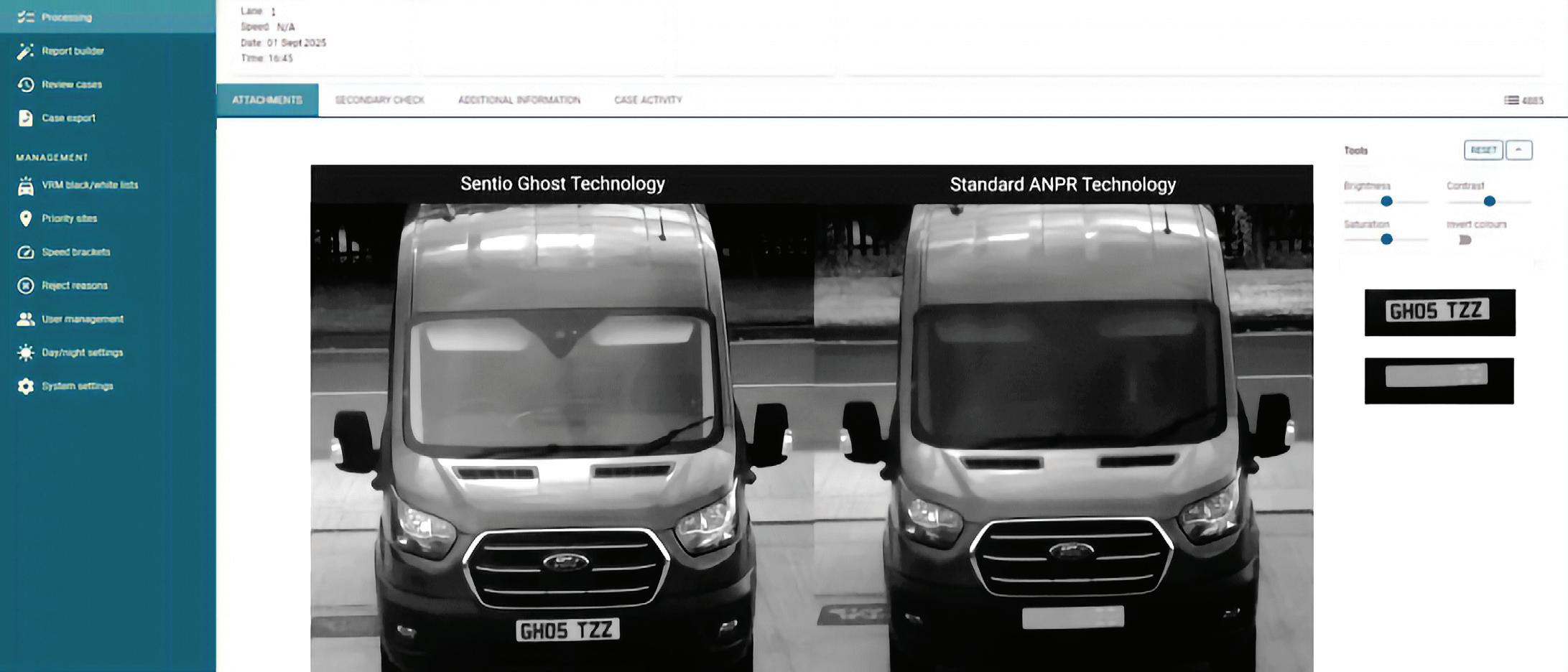
The MPs’ report reveals that as many as one in 15 vehicles may carry modified and non-compliant plates including ‘ghost’ and stealth plates designed to evade ANPR detection. These plates, often sold openly online by unregulated suppliers, enable drivers to avoid paying road charges, tolls, congestion fees and fines.
GHOSTS ON THE ROAD: TACKLING THE RISE IN ILLEGAL REGISTRATION PLATES
The problem extends far beyond traffic offences. Criminals are using ANPR-evasive plates to facilitate activities, including rogue trading, drug dealing and organised crime such as human trafficking and people smuggling.
The inquiry heard from National Trading Standards that ‘ghost plates’ pose a serious threat to counter-terrorism operations. Vehicles with stealth plates can bypass surveillance systems around critical infrastructure such as airports, government buildings, and transport hubs. This creates vulnerabilities that could be exploited by terrorist groups planning vehicle-borne attacks.
The APPGTS’s report exposes weaknesses in the number plate manufacturing ecosystem. Some 34,455 suppliers are registered with the DVLA to produce UK number plates, with many operating from private homes or small workshops, with no background checks in place. Some suppliers handling customers’ ID documents were found to have serious criminal convictions, including for violent offences and fraud.
Innocent motorists are increasingly being targeted by criminals who clone their number plates. Many have found themselves accused of offences they did not commit, facing fines, debt collection, and in some cases, police investigation.
The report highlights evidence that taxi drivers are tampering with plates en masse to avoid drop-off and road charges. The inability to trace these vehicles raises serious risks for women and girls’ safety, as well as for vulnerable passengers.
In London, this is an issue that is being tackled head on. Of 1,000 vehicle checks, carried out by Transport for London (TfL), using ‘ghost’ plate-defeating cameras, 41% of licensed taxis were found to have non-compliant plates. Since acquiring more of these cameras in July 2023, TfL has issued more than 4,200 fines. Subsequent deployments, checking around 800 vehicles, showed a reduced rate
Sarah Coombes MP
ANPR providers are developing systems to detect ghost plates
of 38% ghost or stealth plates, suggesting enforcement had an impact.
The report concludes that the current registration plate system represents a “gaping hole” in the UK’s security and policing infrastructure, one that can be exploited using nothing more sophisticated than cellophane, leaves or a marker pen.
The APPGTS advocates for wholesale revision of the registration plate system from production to supply, usage and management. Self-funding solutions exist that would tackle the flaws in the current system with relative ease – but changes need to be multipronged and to include all of the relevant stakeholders.
Key recommendations
• Standardise design of registration plates, with security features to bring the UK up to international standards. Ban the use of 3D and 4D plates.
• Significantly restrict the number of licenced sellers via annual fees, regular audits and removal of non-compliant sellers.
• Increase the fine and give offenders points for use of an illegal plate and seize vehicles of repeat offenders.
Sarah Coombes, who is MP for West Bromwich, said: “This explosive report lays bare the threat posed by ghost and cloned plates. It also makes clear how the whole system is failing. It’s totally wrong that people can commit terrible crimes and then set themselves up as number plate sellers with no questions asked. Those selling these illegal plates have gone under the radar for too long – but now they’ve been rumbled. I hope the government cracks down on them immediately.”
Responses
Martin Saunders, head of uninsured driving prevention of the Motor Insurers’ Bureau, said: “MIB exists to protect people from the devastation of uninsured and hit and run drivers. The increasing damage done by drivers of vehicles hiding in plain sight on our road system should not be tolerated. There is an urgent need for a partnership approach to implement the recommendations made in this report to make our road system safer and ensure every vehicle is able to be quickly and readily identified by the number plate it exhibits.”
Michael Flanagan, chairman of the British Number Plate Manufacturers Association (BNMA), said: “The BNMA fully supports the recommendations of the APPG. This report provides a valuable opportunity to strengthen compliance across our members’ customer base, ensuring that end consumers consistently receive a high quality, fully compliant product. The BNMA will support the proposed level of regulation during and after its implementation by providing compliant resources and enhancing its guidance to outlets, authorities, and the public, thereby safeguarding public safety through a secure and regulated supply system.’’
RAC head of policy Simon Williams said: “It’s clear from this report that urgent action must be taken to stop the widespread abuse of number plates, which has serious and far-reaching consequences for our society from road safety to national security. Ghost and cloned plates have no place on our roads as no one should be able to drive a vehicle that’s invisible to enforcement cameras or untraceable by the police. It’s vital we introduce new, higher security standards for number plates and those who produce them.”
NPED Services has supported the All-Party Parliamentary Group for Transport Safety’s inquiry into illegal registration plates. NPED Services contributed operational insight and advocacy expertise to ensure recommendations are practical and proportionate. NPED is also leading the Vehicle Compliance Management Act (VCMA) pilot, designed to deliver a robust compliance framework that addresses the weaknesses identified.
Alan Wood, chief executive of NPED Services, said: “The inquiry shines a light on a growing threat to road safety and public trust. The VCMA pilot offers a clear pathway to reform – one that is fair, enforceable, and sustainable. The APPG report makes clear that registration plates are critical to road safety and national infrastructure. Reform is urgent, and NPED will continue to champion solutions that protect motorists, strengthen enforcement, and safeguard public safety.”
New powers and penalties aim to tackle dangerous motoring
Department for Transport’s Road Safety Strategy sets out changes to motoring offences
Drivers who use altered or false number plates face receiving stiffer penalties as part of a government review of motoring offences. The government is consulting on a raft of new penalties for motoring offences as part of the launch of its new Road Safety Strategy.
There are a total of five consultations supporting the strategy:
• motoring offences
• introducing a minimum learning period for learner drivers (category B driving licence)
• introducing mandatory eyesight testing for older drivers
• improving moped and motorcycle training, testing and licensing (categories AM, A1, A2 and A driving licence)
• mandating vehicle safety technologies in GB type approval.
The Department for Transport (DfT) is reviewing the motoring offences framework, which has not been substantially changed since the introduction of the Road Traffic Act 1988, and the Road Traffic Offenders Act 1988. The aim is to bring the offences framework up to date, ensuring that penalties are appropriate to the harm caused, and that they act as a suitable deterrent.
“Holding a driving licence is not an automatic right,” states the Road Safety Strategy. “Effective use of the penalty points system, licence suspension and disqualification, and vehicle seizure, encourages better behaviours, and when necessary, removes the most serious offenders from the road.”
The government’s consultation is a response raised by police and road safety groups, who worry that some offences do not carry extra penalties, such as penalty points or vehicle seizure. These include offences related to:
• a vehicle’s roadworthiness (no MOT)
• no current keeper being identifiable
• incorrect, altered or false number plates that prevent justice from being done.
In particular, it has become harder for police to identify who is using a vehicle because some offenders go to great lengths to hide who owns it or who was driving. The DfT said that there is a significant amount of evidence of disguising a vehicle’s true ownership to avoid compliance with vehicle excise duty requirements and other payment requirements for the use of certain roads. This places an additional burden on law-abiding drivers when revenue shortfall to the treasury due to fraud has to be made up.
The police currently have the powers to seize a vehicle from those driving whilst uninsured, or not in accordance with their driving licence. The use of this power has to be proportionate and allows police to use their discretion not to seize where they feel that is an appropriate decision based on the merits of each situation.
In matters involving vehicle seizure, the government plans to mirror the no insurance seizure provisions, enabling discretion and proportionality to be at the forefront of any use of powers.
The public consultation is seeking views on changes to current motoring offences and the potential introduction of offences, including: drink and drug driving seat belt usage failure to stop and report driving unlicensed driving without a current MOT driving without motor insurance
use of illegal number plates, including ‘ghost’ number plates.
The consultation runs until 31 March.
Road Safety Strategy
Unity5 appoints Cooper as public sector MD
New role focusses on serving group’s local authority client base
Parking and enforcement software developer Unity5 Group has appointed Nicolina Cooper as managing director for the public sector.
Cooper joins Unity5 as a fulltime member of the senior leadership team.
She will lead a dedicated team that will be focussed on customer engagement and elevating the company’s product local government services roadmap. Unity5’s local authority base, significantly expanded following the 2025 acquisition of Chipside.
Mark Wilson, chief executive of Unity5, said: “Nicolina is a specialist who has spent years on the frontline of local govern-
ZZPS becomes an ABS law firm
Debt resolution company ZZPS has become an alternative business structure (ABS) law firm.
ZZPS was founded in 2011 to offer debt resolution services in sectors such as parking. Now, as an ABS law firm, ZZPS will operate under the regulatory oversight of the Solicitors Regulation Authority (SRA), enabling it to provide a broader range of legal services.
Gary Osner, chief executive of ZZPS, said: “This transition reflects our vision to lead the way in ethical enforcement and legal services. Becoming an ABS law firm allows us to integrate legal expertise directly into our operations, offering clients a seamless, compliant and more robust service. It’s a natural progression that aligns with our values and long-term strategy.
“The move comes at a time when the enforcement and legal sectors are undergoing rapid transformation, with increased emphasis on regulatory compliance, customer care and digital innovation.”
ment. She understands the pressure of managing public realm services because she has done it herself at the highest level. I’m delighted to bring Nicolina into the business, where her knowledge and experience will refine our strategy and help us innovate
in this important sector. Unity5 has led innovation in the private sector for years, and we’re bringing the same drive and ambition to the public sector.”
Cooper brings over two decades of experience within London local authorities, includ-
ing roles at Havering, Islington, Camden and Hackney. Her career includes roles such as head of service and assistant director for public realm.
Throughout her career, Cooper has specialised in digital and cultural transformation in the transport sector.
Nicolina Cooper said: “Having spent my career leading parking, highways, and transport initiatives within local authorities, I know exactly what it takes to drive efficiency and implement transformational change. I am incredibly excited to join Unity5 full-time. My goal is to use my experience to ensure our technology continues to align perfectly with the evolving needs of the public sector, helping our customers build smarter, more accessible, and more efficient communities for the future.”
APH voted best airport parking operator... again
Airport Parking and Hotels (APH.com) was named Best Company for Airport Parking for a 15th consecutive year at the British Travel Awards.
Taking place at Grosvenor House in London on 8 December 2025, the BTA event brought together people from across the travel sector.
APH’s managing director Nick Caunter received the award from Neil Swanson, managing director at TUI, in front of an audience of 800 guests.
The British Travel Awards is the UK’s largest consumer voted travel awards. Last year saw over 1.6 million votes cast across both the travel and leisure categories.
This year there were 81 award categories, encompassing areas of such as accommodation,
destinations, transport, cruise, customer service and travel extras.
Nick Caunter said: “The British Travel Awards are especially meaningful because they’re decided by the travelling public, and we’re
ILMG loves their millionth customer
incredibly proud to win for the 15th year running.
“It’s a real reflection of our team’s hard work and commitment to delivering excellent service every day.”
I Love meet and greet (ILMG) celebrated a milestone in November when it welcomed its one millionth customer since launching in 2012.
ILMG offers meet & greet parking at London Gatwick and London Stansted. To mark the occasion, the lucky customer was surprised with a luxury Christmas hamper from Fortnum & Mason of Piccadilly.
Sarah Anglim, founder and managing director of ILMG, said: “This celebration is a testament not only to the loyalty of our customers but also to the dedication of our team, who work tirelessly to deliver exceptional service every single day.”
Nicolina Cooper
The APH team
Gary Osner
Sarah Anglim with the lucky customer
Parking veteran Reynolds gets MBE
BPA stalwart’s career recognised in New Year’s Honours
Kelvin Reynolds was awarded an MBE in the New Year’s Honours List for delivering outstanding services to the UK traffic and parking management sector.
Reynolds has over 50 years of service to the sector, including serving in traffic engineering roles at Dartford Borough Council, Gravesham Borough Council and the Corporation of London.
In the private sector he worked as transport and infrastructure manager on LendLease’s retail projects, including Bluewater in Kent, followed by a stint at consultant Waterman Group.
During 2004 Reynolds commenced what became a 20-yearplus tenure as a member of the British Parking Association’s leadership team. He held a number of roles, including being head of the Safer Parking Scheme and director for corpo-
rate and public affairs.
Reynolds officially retired from the BPA last year, but remains an executive consultant to the association as well as being its company secretary.
Andrew Pester, chief executive of the BPA said: “A hugely welldeserved recognition for Kelvin and our sector. It’s been an absolute joy and privilege to be part of Kelvin’s journey – congratulations, we’re incredibly proud of you.”
Graham honoured
Traffic technologist and EV advocate Andy Graham was made an MBE for services to transport safety and efficiency. Graham, director of White Willow Consulting, said the award was “very pleasing as it reflects nearly 40 years of working in transport technology, moving whacky ideas from whiteboard to ‘what would we do without this?’
BPA raises funds for MND charity
The British Parking Association held its annual Members’ Dinner at Drapers Hall in the City of London on 26 November.
A silent auction raised over £7,500 for the MND Association, which supports Motor Neurone Disease sufferers and funds research into the condition.
Attendees were entertained by comedian Milton Jones.
The evening also saw Paul Kyte, business development director of TRACE Enforcement Group, recognised as a BPA Fellow. Terry New, a long time account director at RingGo and now a director of signage company NSIUK, received a long service award (pictured).
BPA president Mike Marrs said: “It’s fantastic to celebrate achievements, share laughter and strengthen the bonds that make our association so special.”
Kelvin Reynolds
Paul Kyte Terry New
BPA
Cardiff takes action
Cardiff Council’s City Parking Plan for the next 10 years has broader aims beyond just managing where cars park. The strategy seeks to discourage ownership of large vehicles such as SUVs for safety and environmental reasons, encourage a reduction commuting by car, and incentivise students not to bring cars when they go to university. Rhodri Clark reports
Parking made news headlines in October 2025 after Cardiff councillors voted to bring in higher charges for residential parking permits for owners of SUVs.
The news wasn’t a surprise, however, to residents or regular visitors who have observed decades of changes in the Welsh capital to improve mobility and air quality. The planned higher permit charge for vehicles weighing 2,400kg or more is part of a raft of parking policy measures the council intends to implement over the next 10 years.
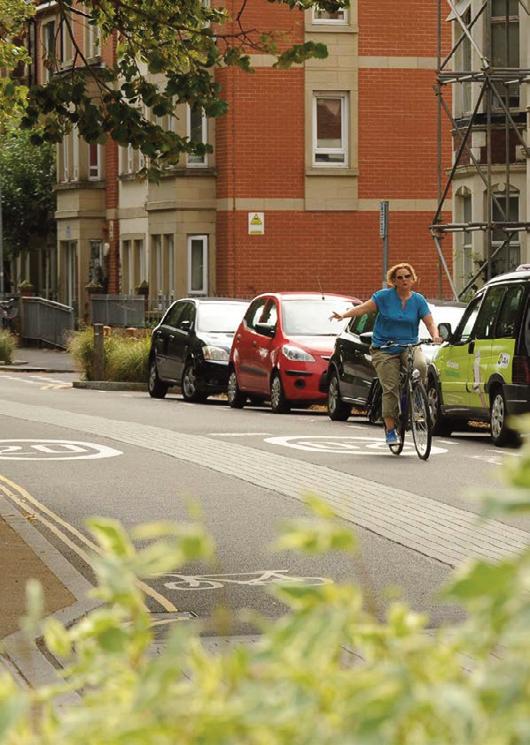
This package builds on years of reallocating road space to sustainable transport modes, including expanding the pedestrianised zone in the city centre and installing bus priority on many of the zone’s fringing streets and some key sections of suburban roads.
Continuous cycle tracks have been installed to encourage more cycling. More than two million rides were made on the city’s hire bikes from 2018 to 2023, when the service closed because of persistent vandalism. A new operator will launch an all-electric bike hire scheme in early 2026.
Trains play an ever-growing role in the city region. The Welsh Government is investing over £1bn in modernising local rail infrastructure, with contributions from the EU and UK government. The package includes new tram-trains and electric trains providing level boarding at stations and running more often on most lines.
A new station is being built at Butetown, in the former docklands. A station at Crwys Road will serve an inner northern suburb where students’ cars add to demand for on-street parking. Upgrading Cardiff Central station will include a new tram-train
link to Cardiff Bay. Pay As You Go ticketing, rolled out to 95 stations in the region in November 2024, offers large discounts and daily or weekly capping, as well as convenience. By December 2025, more than two million journeys had been made with PAYG.
Council-owned Cardiff Bus has electrified its depot and now operates 55 battery electric buses, which further contribute to improving air quality.
Cardiff leads the way
Long before the SUV parking policy made waves, Cardiff Council had built a reputation in transport circles for being a first mover. It was the first authority in Wales, and the first outside London, to take up powers to enforce moving traffic offences. While governments prevaricated on banning pavement parking, Cardiff introduced a trial in City Road.
Results from its 2022 trial of side road zebra crossings have prompted the Welsh Government to propose new legislation in February 2026 allowing all Welsh highway authorities to introduce such crossings, which will not have Belisha beacons and zigzag lines. Cardiff Council has even installed a miniature pelican crossing on a cycle lane beside a bus stop in the city centre.
In 2020, the council proposed to introduce a road user charge, possibly £2 per day, once key public transport initiatives had been completed. It envisaged the charge starting in 2024.
The council’s preferred model exempted Cardiff residents, triggering criticism that the relatively affluent city would impose additional costs on people travelling in from poorer communities.
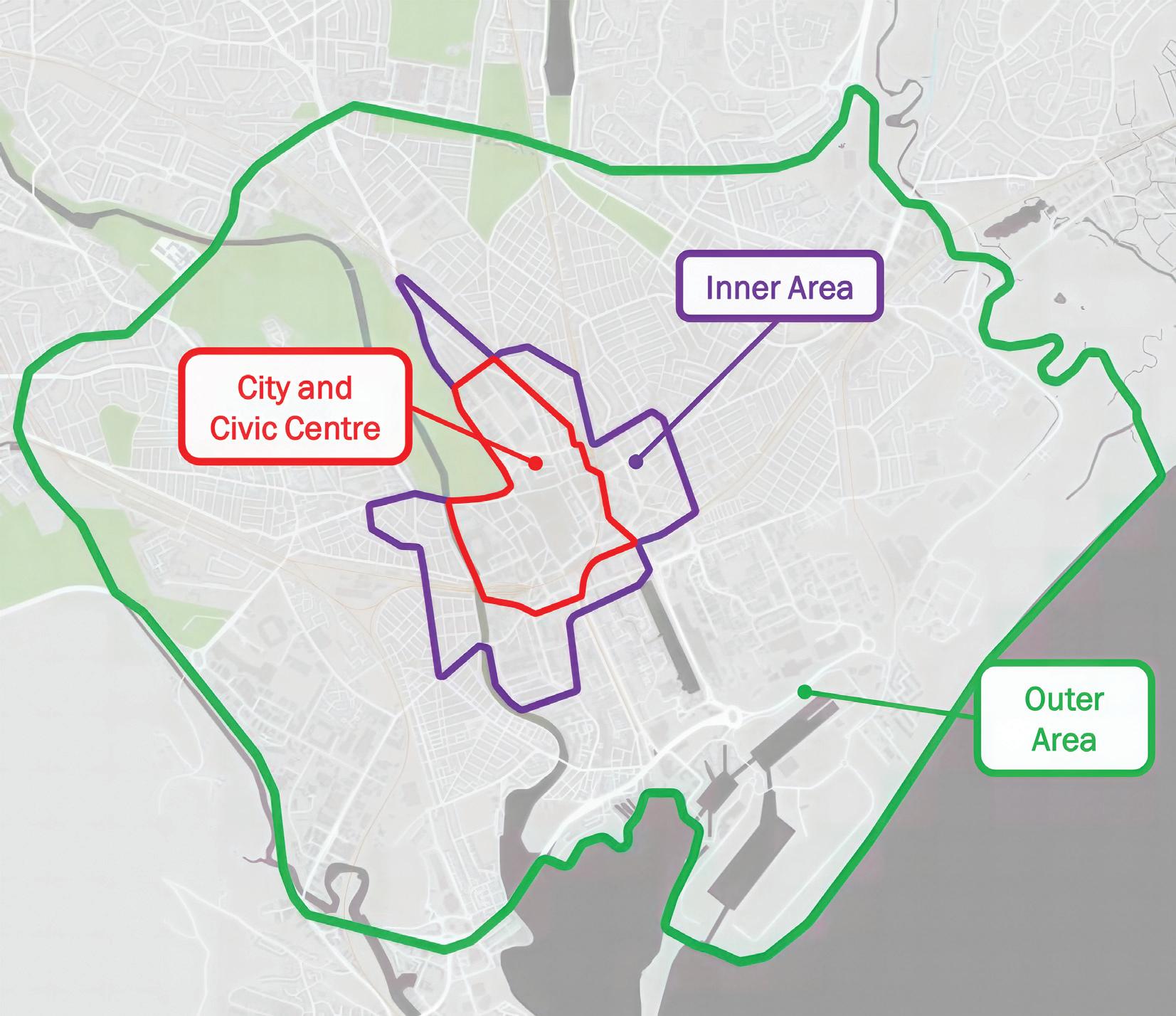
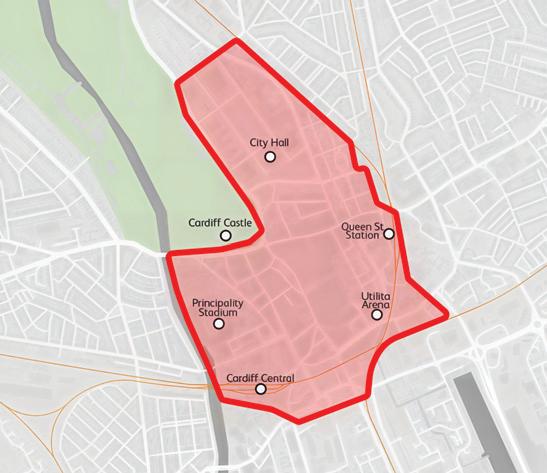
Parking Management Areas City and Civic Centre
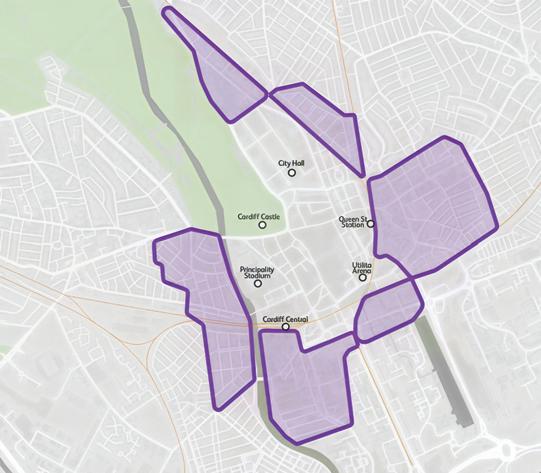
Inner Area
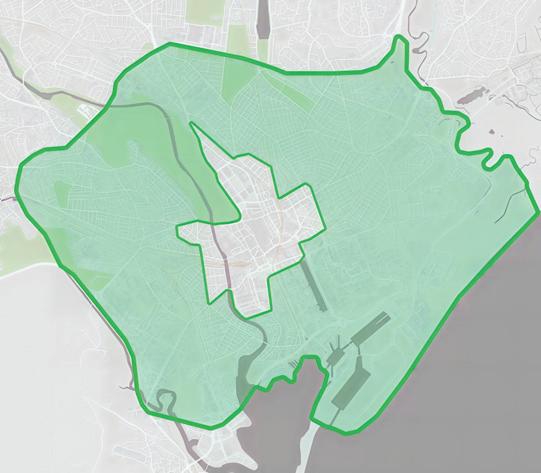
Outer Area
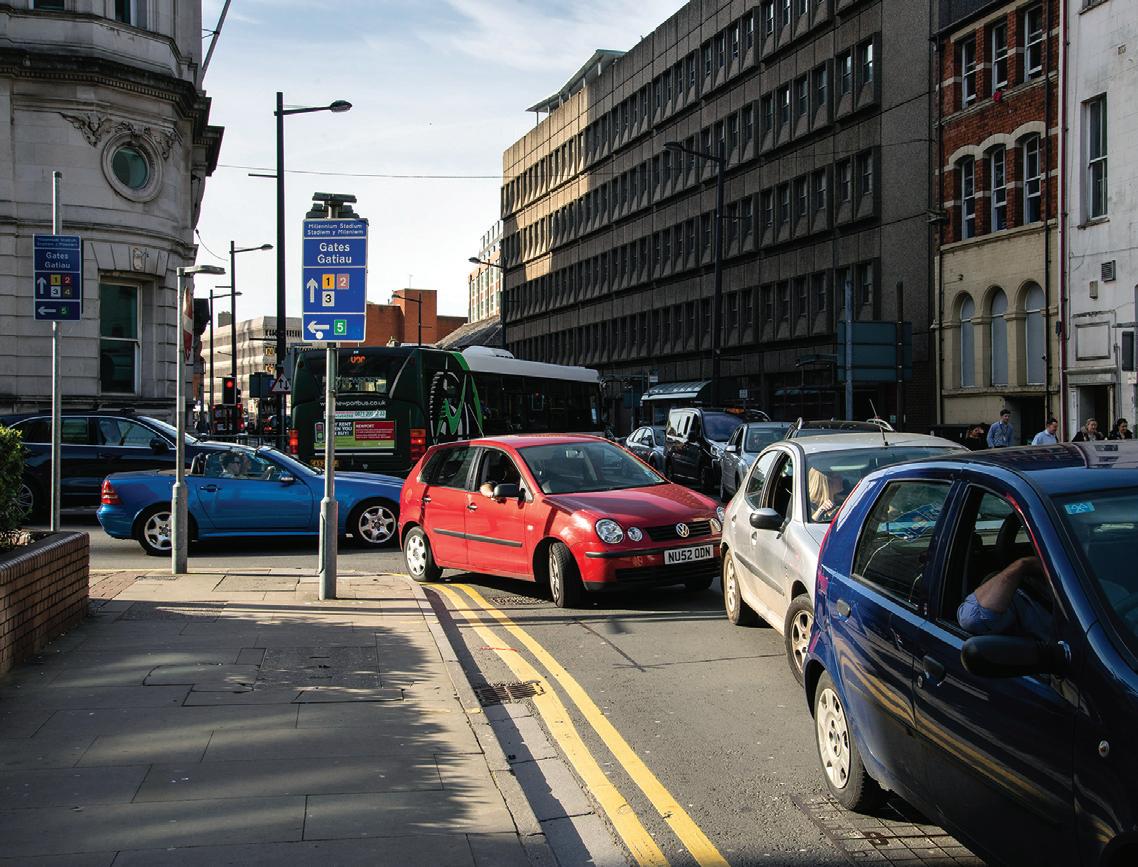
Traffic congestion was routine on Cardiff’s Westgate Street in 2015, although cars were smaller
The Welsh Government told the council to consider the proposal’s impact on the wider region, and commissioned its own study on demand management approaches.
Time for another parking review
With so many sustainable transport “carrots” in place or in the pipeline, parking policies were ripe for review to ensure alignment with the city’s direction of travel.
“Since the council’s last parking review in 2016, the city has experienced significant growth, with more people, housing and businesses,” said a council officers’ report for councillors in October. “With this growth comes an increased demand for parking spaces, leading to congestion, pollution, and reduced accessibility. Parking is a finite resource and consequently needs difficult choices, particularly when defining how to allocate parking space for different user groups with different needs. It is important that [how] such decisions are made is both transparent and applied with consistency.”
From October to December 2024, the council consulted the public on 30 proposed measures. Of the 6,381 people who responded, 92% were vehicle owners, 88% Cardiff residents and 38% existing holders of Cardiff Council parking permits, while 6% held Blue Badges.
Having analysed the responses, the council refined its proposals to produce an Action Plan which divides the city into three parking management areas: City and Civic Centre; Inner Area; and Outer Area. The council says that by simplifying parking rules, “we aim to make parking easier, promote cleaner vehicles, and encourage sustainable travel”. The changes will support its vision to “promote sustainable transport, better manage the highway network, and contribute to climate change goals”.
City and Civic Centre
The City and Civic Centre Area covers the central business district and extends northwards to cover Cathays, an area of civic and university buildings. One significant change under the new policy is that parking permits will no longer be issued for residents in this area. Although residents are relatively few in number, there is some high-end housing, including along Westgate Street (close to the Principality Stadium). Existing permits will remain valid until the holder moves home.
The council will prioritise parking for Blue Badge holders, buses, deliveries and taxis, using Traffic Regulation Orders (TROs) to introduce new bays. Parking controls will apply all day, every day, with loading allowed only in designated places.
The area will be signed as a formal controlled parking zone (CPZ), with a new system of waivers for “essential parking”.
Inner Area
The Inner Area comprises several CPZs immediately outside the City and Civic Centre, including Cathedral Road, west of the River Taff. Its geographical area was reduced in response to the
Ten years later, the same part of Westgate Street has bus gates, cycle priority, an enforced yellow box junction – and no queueing cars
consultation. Most of the streets are lined with terraced housing or large Victorian houses, some divided into flats. The northern area, close to Cardiff University, has many student lets.
Parking will mainly consist of permit-holder bays, short-stay ‘Pay and Stay’ bays, and short-stay ‘shared use’ bays. Long-stay parking will be converted to short-stay. A review will identify where Pay and Stay bays could became ‘shared use’, opening them to local permit holders.
At a minimum, parking controls will apply from 8am to 10pm every day, including prohibition of loading on most routes. Permits will be issued for residents and their visitors, students and community premises, but businesses will continue not to be entitled to permits.
Outer Area
The Outer Area covers other inner suburbs, bounded by the A48 in the north and the coast in the south. The area is predominantly residential but includes commercial and government buildings in Cardiff Bay, and edge-of-town retail premises along Newport Road. Parking will mainly consist of permit-holder bays, shortstay shared use Pay and Stay bays, and short-stay shared use Limited Waiting bays. Days and times of parking controls will be decided through engagement with local communities. All permit types will be available. Loading on most key routes will be prohibited during peak times.
“We recognise that the Outer Parking Management Area covers a large variety of different communities, each with their own parking requirements,” says the council. “What works for one area may not work for another area. We also want to ensure a consistent approach is applied, so most zones will be classed as either an Outer A, Outer B or Outer C zone.”
The costs of permits or Pay and Stay will be highest in Outer A and lowest in Outer C zones. Operational hours will commence at 8am in all zones but continue to 10pm in Outer A, 8.30pm in Outer B and 6.30pm in Outer C.
Outer A is for areas where it would be desirable to reduce commuter and all-day parking while allowing unrestricted parking for evening visitors, when parking is less pressurised and public transport less frequent. Outer B is aimed at areas which attract non-residents for sports events, restaurants or theatres, especially in the evenings. Outer C is likely to apply in areas where extensive parking by nonresidents occurs.
www.cardiff.gov.uk
Bigger fees for larger cars
Cardiff Council’s decision to make SUVs pay more to park was attention grabbing news
Parking made UK news headlines in October after Cardiff councillors voted to bring in higher charges for residential parking permits for owners of largers cars, such as SUVs.
“Pricing can be used to encourage parking usage in line with the council’s aims to support a modal shift towards sustainable and active travel, improve air quality, and help ease parking pressure and congestion by encouraging the use of underutilised parking locations in favour of those with higher demand,” says Cardiff Council. “Large heavy vehicles take up more parking space and are a danger to other road users. A surcharge for vehicles over 2,400kg Revenue Weight will be introduced to encourage drivers to switch to smaller vehicles.
“In time, this will be reduced to 2,000kg (for non-electric vehicles). Very large vehicles (vehicles over 3,500kg Revenue Weight) will not be entitled to permits.”
Revenue Weight is the vehicle’s weight when fully laden, so this surcharge will apply to many SUVs. Reducing the weight limit for non-EVs to 2,000kg later gives residents more time to trade in their big cars and makes an allowance for EVs’ battery weight.
The Single Impact Assessment of the parking plan highlights potential benefits to children if pricing policies result in reduced uptake of SUVs. “As vehicles get larger and heavier, so do the risks. The risk of fatal
Parking permits will no longer be issued for residents in the city centre, including Westgate Street (pictured here)
injuries for a pedestrian or cyclist hit by a car with a bonnet that is 10cm higher than average increases by 30%.”
However, it’s questionable whether an annual additional payment for an on-street permit would incentivise residents to buy smaller cars. Owners of SUVs accept at the point of purchase that their fuel and other costs will be relatively high. An annual parking surcharge is likely to feel insignificant in comparison with overall costs of SUV ownership.
Cardiff Council says the Action Plan prioritises “inner-city areas with a high density of terraced housing”. How many people who can afford SUV ownership live in such housing? Large vehicles are probably
Controlling local streets
The first controlled parking zones (CPZs) will be introduced in Cardiff over the next three years. Phase 2 will be in three to six years’ time, Phase 3 from then until 10 years’ time.
Phase 1 will prioritise areas with known parking problems adjacent to existing parking zones. Monitoring, including user satisfaction surveys, will enable the council to understand the impact of actions as implementation progresses.
One benefit of adopting CPZs on this scale is a reduction in signage, with some
restrictions indicated at CPZ entry points. However, the council acknowledges that with parking zones expanding to control 100% of the kerbside, there will be an overall increase in regulatory signs and therefore “street clutter”, potentially negatively affecting disabled footway users.
Limiting city centre parking to designated areas may adversely impact Blue Badge holders, but the council also says the city centre, by its nature, has very high footfall and the parking policy aims to ensure vehicles are parked safely and responsibly.
more prevalent in outer suburbs with low density housing and off-road parking.
The Action Plan also includes a diesel surcharge, intended to reduce diesel vehicle ownership. Vehicles which are Real Driving Emissions 2 (RDE2) compliant will be exempt.
The consultation found strong support for owners of larger vehicles such as SUVs paying more for permits, with 40.2% strongly agreeing and 25.7% tending to agree. Disagreement was highest among unpaid carers (36.0% disagreeing) and households with children (32.4%).
The principle of higher permit payments for vehicles which pollute more was supported by 47.1% and opposed by 38.8%.
Cardiff Council says: “It is expected that this would have a positive impact for disabled pedestrians by reducing instances of obstructive and dangerous parking.”
A financial plan will be developed before each zone is implemented. Funding is expected to come from parking reserves, developer contributions and grants. Future permits will be classified for: residents; residents’ visitors (capped annually to prevent misuse); businesses (but not for commuting or staff parking); community premises; students; and others, including NHS and care agencies, educational staff and tradespeople when working at properties in parking zones. Existing permits will run their course.
To discourage students from taking cars to university, there will be additional charges for student permits. The council will consider changes to permit eligibility and application criteria in a detailed review of student permits in the medium to long term.
Residents will need permits to park motorcycles in resident bays – a policy that received a resounding thumbs up in the public consultation, with 71.4% in agreement.
All parking fees and charges will be reviewed biannually.
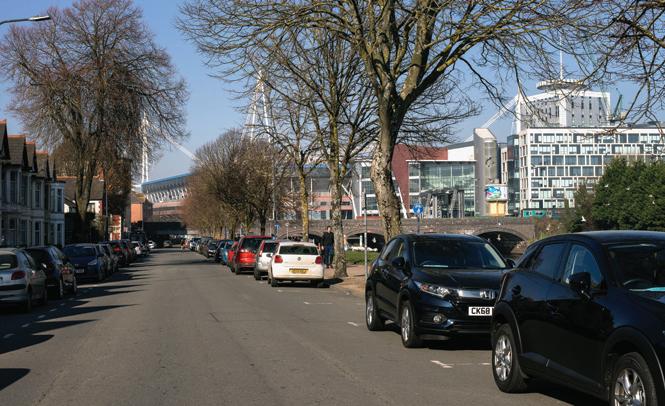
This Inner Area street, near the Principality Stadium and Cardiff Central station, will be covered by a Controlled Parking Zone
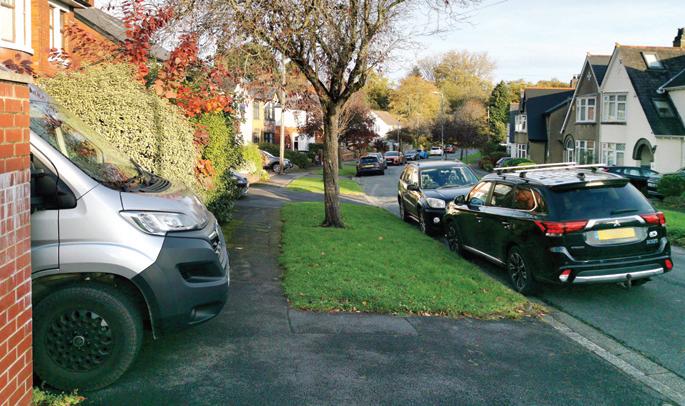
Affluent outer suburban streets, such as this one near Roath Park, are outside the area covered by the parking Action Plan, which includes higher permit charges for SUVs
Rethinking space in Cardiff Bay
Multi-storey will reduce parking footprint of Welsh capital’s political centre and cultural quarter
Growing leisure travel to Cardiff Bay has prompted Cardiff Council to commission a new multistorey car park, close to where a 16,500-seat entertainment arena is due to open in 2028.
Since the 1980s, the city’s original docks area has been redeveloped and is now home to the Wales Millennium Centre (a theatre and arts venue) and the Senedd. The area has long-established housing and, on regenerated land, newer apartments.
In January 2024 the council bought the
Q-Park’s multi-storey car park in Pierhead Street. Now it is in the process of replacing some of its surface parking in the area with a 900-space multi-storey. Stacking the parking will free up land for regeneration.
The multi-storeys will jointly provide more than 2,100 spaces under council control.
While car travel is convenient for many event-goers, exiting multi-storeys after a show can be time consuming, especially for those who parked on the upper decks! The council is also improving alternative
Life after death for P&R
Otransport modes to the Bay. It secured £100m from the UK and Welsh governments for Phase 1a of Cardiff Crossrail, which will provide a direct tramtrain shuttle between Cardiff Central and the Bay. This will simplify train travel to the Bay from the east and west, by removing a dog leg which involves two changes of train. The Welsh Government is rebuilding Cardiff Bay station with a wide platform and large reception area, anticipating crowd management after events at the new arena.
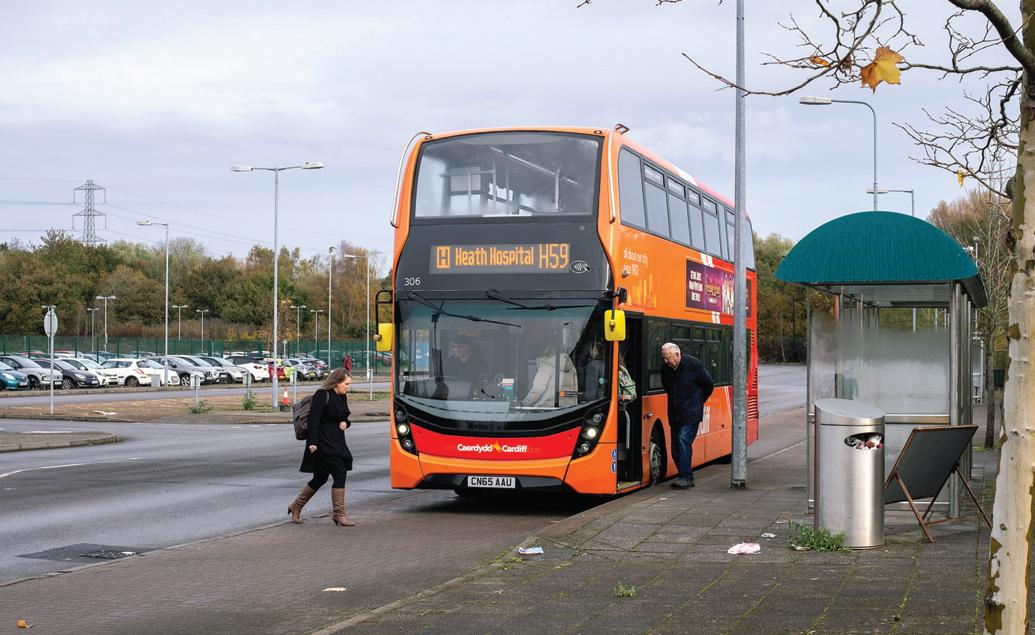
ne Cardiff initiative which has not stood the test of time is Cardiff East Park & Ride, opened in 2009 to give motorists arriving from the east an easy alternative to parking in the city centre. Almost 1,000 spaces were provided, alongside the A48 at Pentwyn, but the X59 P&R bus to the city centre was withdrawn in January 2023.
Today, however, hundreds of cars can be found at the site on weekdays, thanks to the popularity of the H59 free shuttle bus to the University Hospital of Wales, a little further west on the A48. The hospital draws people from a wide area and is not near a railway station. On-site parking capacity falls far short of demand.
The H59 bus service was launched in 2017 as the hospital prepared to remove parking charges for stays of under four hours, in line with Welsh Government policy. It operates every 20 minutes from 06.30 to 21.00.
In 2024, Cardiff Council drew up plans to reduce the number of spaces at Cardiff East and release some of the land for commercial uses. A proposed new bridge over the nearby river would enable re-routing of existing bus routes so that the P&R could be used again for travel into the city centre, without the expense of a bespoke P&R bus.
Cardiff East Park & Ride has healthy occupancy, despite no longer having buses to the city centre. The free hospital shuttle service started with a single decker bus but now requires a double decker
The Cardiff Bay plan
Keeping the cit y moving
Traffic + Parking explored the latest thinking in the worlds of street and kerb management
The annual Traffic + Parking conference provides a space in which local authorities, partners and stakeholders can share best practice, learn about policy developments and check out innovative systems and thinking that will enable them to deliver an excellent service.
Traffic + Parking 2025, which took place in Manchester, explored how the sector is embracing digital technologies via initiatives such as the National Parking Platform (NPP) and Digital Traffic Management Orders (D-TROs). Likewise, it looked at the work being done progressing the provision of electric vehicle (EV) infrastructure both in car parks and at the kerbside.
In parallel to the talks about technology, the conference took time to focus on the human dimension of parking. Expert panels discussed how to provide accessible parking for people with disabilities, delivering gender inclusive places and mobility services, and how to create safer environments for both the public and frontline staff as they carry out their roles.
Traffic +Parking is a Landor LINKS event.
Intelligent operations
Manchester City Council and NSL Manchester gave delegates a tour of their operation
Manchester is Traffic + Parking’s home town. Patricia Wilkinson, group manager at Manchester City Council, spoke alongside Pedr Davies, senior service delivery manager at parking services contractor NSL Manchester. They shared their experiences of devising and delivering policies that keep this vibrant city moving.
A new contract awarded in April 2023 included a commitment to proactive and intelligence-led enforcement. There is now an increased presence by parking officers in wards and a visit-based approach applied to deployment. This new approach has been enabled by the deployment of business intelligence systems such as BI Analyst. In terms of looking after communities, the city council has introduced resident parking schemes in Rusholme and Eastlands, near Manchester City FC’s Etihad Stadium.
In a commitment to decarbonising its operations, the parking team has introduced an all-electric fleet of 40 vehicles and scooters.
The parking team is also working closely with Manchester City Council’s debt recovery team in tackling persistent evaders, which has seen parking enforcement informed by identifying ‘vehicles of interest’.
Trish Wilkinson and Pedr Davies
Antonia de Winter
Paul Dawson
Susan Leadbetter
Dr Gareth Tilley and John Cooper
Caroline Hamilton
Gary Carr
Why parking matters
Parking isn’t just about cars. It’s where policy, mobility, and public space meet, says Tina Glover
Parking is more than providing provision for vehicles. it’s strategy in action. It’s where policy, mobility and public space meet. Parking can shape dynamic, inclusive, sustainable places. Every bay, permit, or line we manage reflects what our city values – be it access, fairness, efficiency, or environmental stewardship. And, let’s be honest, parking’s the only topic that can unite taxi drivers, cyclists and councillors in passionate debate and I’ve certainly been involved in plenty of those over the years. If you want to start a conversation at a party, just mention double yellow lines or parking charges.
Shaping communities
Parking helps us shape communities. When we get parking right, we create spaces that people actually want to spend time in. Places with benches, bikes, greenery – not just rows of bumpers and bonnets.
Parking is the difference between a street that’s just a thoroughfare and one that’s a destination. It’s about shaping communities, not just managing congestion. Parking is often overlooked, sometimes even vilified, but it’s a critical part of how we design liveable places. It’s where transport meets land use, where policy meets people, and where the everyday meets the strategic. Whether we’re talking about climate goals, accessibility, economic vitality, or urban design, parking is part of the story.
Parking is an important aspect not just to professionals like us, but to the communities we serve. And if you don’t believe me, try suggesting to a local business owner that you remove all parking from their street. You’ll see exactly how passionate people can get!
We know that parking revenue remains vital for many councils, but so does the need to reclaim space for people, for trees, for play. As parking professionals we have a duty to lead in striking the right balance. We’ve seen bold moves – from dynamic pricing to parklets and this must continue to evolve as technology advances. And we’ve seen backlash too. That’s okay.
The question we should all be asking is: Are we designing parking for yesterday’s needs, or tomorrow’s places?
While we’re all working hard to encourage modal shift – getting more people walking, cycling and using public transport – it’s important to remember that this shouldn’t spell the end for parking. Instead, it’s an opportunity to rethink how parking fits into our evolving urban landscape.
Parking still plays a vital role: supporting local businesses, enabling access for those who need it, and providing flexibility for a diverse range of journeys. As travel habits change, parking strategies need to adapt – not disappear. The goal isn’t to eliminate parking, but to make it smarter, more efficient, and better integrated with sustainable transport options.
Valuable revenue for reinvestment
Let’s talk numbers. In 2024, the total revenue from parking fines across England, according to analysis by the RAC Foundation, was £2.01 billion, which was a 15% increase compared to the previous financial year. But we all know that parking isn’t just about money –it’s how that revenue is reinvested that plays a crucial part in contributing directly to highway repairs, pavement upgrades, and sustainable transport initiatives.
So when someone asks: “Why does parking matter?”, we can say: “Because it funds the very streets we walk, cycle, and drive on.”
In Manchester, moving traffic enforcement generated over £1.1m for the council last year. I’m proud to have been part of that journey supporting Trish Wilkinson and the wider Manchester City Council team in implementing moving traffic enforcement. Enforcing moving traffic restrictions is providing money that can be reinvested into better streets, safer crossings, and better infrastructure. Without this vital revenue stream and with more and more pressures to deal with councils are struggling to maintain their assets and invest in future transport schemes.
Achieving compliance
Parking enforcement is often seen as the “bad cop” of urban management, but in reality, it’s a critical tool for keeping our streets safe, accessible, and efficient. Without it, things can unravel quickly. Imagine a city where enforcement is absent – no civil enforcement officers, no tickets, no deterrent. At first, it might sound like a driver’s paradise. But let’s look at what actually happens.
A few years ago, Ilford in East London experienced a period where parking enforcement was severely reduced due to industrial action. For several weeks, civil enforcement officers were off the streets. The results were immediate and dramatic and I’m sure none of what I am going to say now will be a surprise:
• Blocked footways: Cars parked on pavements, making it impossible for wheelchair users, parents with prams, or anyone with mobility issues to get by.
• Obstructed emergency routes: Fire engines and ambulances struggled to access certain streets, putting lives at risk.
• Unfair use of space: Residents found their driveways blocked, bus stops were occupied by private vehicles, and loading bays became free-for-alls.
• Increased congestion: With no one to keep order, double parking and illegal stopping became the norm, slowing down traffic and public transport.
• Public frustration: Complaints to the council skyrocketed, and local businesses reported a drop in footfall as customers couldn’t find legal places to park.
So, while no one loves getting a parking ticket, the alternative is far worse. Enforcement isn’t about punishment; it’s about fairness, safety and keeping our cities moving.
The challenges we face
Of course, it’s not all smooth driving. Parking in the UK faces real challenges:
• Budget and resource pressures
• Rising car ownership
• Outdated infrastructure
• Patchy transport and traffic management policies.
These are just a few of the challenges the parking industry faces. Let’s be honest, sometimes penalty charges are about as effective a deterrent as seeing a ‘Beware of the dog’ sign next to a sleeping Chihuahua! Instead they are seen more as the price of admission for a really good parking spot. A discounted parking penalty can translate into around £25 payment to park in a convenient location with prime access to a football match, which breaks down to £5 per person for a car of 5 people. How can this be seen as a deterrent?
So, to overcome these challenges we have to see the opportunities, to innovate, collaborate, and rethink what parking can be. We have to be the people that lead that change.
Tina Glover is WSP’s technical director (Liveable Places: regional lead)
Tina Glover
Transformative thinking
New technology has the potential to transform how public authorities and commercial operators manage parking, and how they interact with the public when providing this vital service. Gavin Manger, strategic engagement manager, Landor LINKS, chaired the session.
Digital Traffic Regulation Order (D-TROs)
Gareth Tilley, D-TRO stakeholder engagement manager, and John Cooper, senior engineer (Digital Projects), Department for Transport
The Department for Transport (DfT) discussed the move towards Digital TROs, highlighting progress to date, the transition of the service into ‘Public Beta’, and what this means for local authorities and the wider sector. The DfT also explored challenges for D-TROs and opportunities for improvement.
The Business Case for D-TROs
Olaseni Koya, technical director, Project Centre
The transition to D-TROs has significant opportunities for local authorities. They are a single source of truth, easily accessible by the public, on-street enforcement and officers that has potential to improve compliance, reduce the likelihood of
Shaping the future
Traffic + Parking showcased technologies set to transform parking and traffic management. Peter Lowe, managing director, RTA Associates, chaired the session.
Ghost Plates: You don’t know what you’re missing
Andy Fretcher, business development manager, Neology
A ‘ghost plate’ is an illegally modified number plate that has been rendered invisible to infrared-based ANPR systems by using reflective coatings or other treatments to obscure numbers and letters when hit by infrared light. Luckily, the latest generation of dual-sensor ANPR cameras can read a
appeals and provide significant resource efficiencies for local authorities. With further funding unlikely to be made available to support D-TROs, Olaseni Koya explored how local authorities can tap into funding opportunities, make a strong value-formoney case and deliver a cost-effective and efficient transition to D-TROs, which supports wider local authority services.
National Parking Platform: The next steps
Sarah Randall, chief executive, NPP Consortium
The National Parking Platform (NPP) is a sector-backed service whose development has been tracked by Traffic + Parking since its launch. Manchester City Council has played a key role in trialling the service, which will enable drivers to use the app of their choice when paying for parking. This presentation brought delegates up to speed on the new NPP Consortium’s plans for rolling the platform out nationally.
The Traffic Penalty Tribunal is the independent adjudicator for traffic appeals in England (outside London) and Wales. As part of its mission to make justice accessible and more understandable, the Traffic Penalty Tribunal has developed a website that provides access to key parking, moving traffic and clean air cases. Curated for their common facts, issues and points of law, these cases provide a reference for motorists who may have received similar penalty charges, local authorities or other interested parties, such as the media.
EV charging today and in the future
Antonia De Winter, technical director for Future Mobility, WSP
As ownership of electric vehicles grows, ensuring equitable access to parking and charging will become a challenge. While most EV owners currently charge at home, car parks will be pivotal in supporting EV adoption, especially for drivers without private driveways. The BSI’s PAS 1899:2022, which sets out how to make chargepoints accessible to people with disabilities, will now be mandated under the Planning and Infrastructure Bill. Looking to the future, we may see innovations such as wireless charging pads embedded in parking bays to allow cable-free charging and dynamic charging systems that see EVs recharged as they drive over specially adapted road surfaces.
number plate in the infrared, using both traditional methods and enhanced techniques such as AI vehicle detection to inform optical character reader (OCR) engines in order to generate clearer reads of altered registrations.
Data enhanced ecosystems
Sally Wheeler, head of account management, Arrive Cashless parking solutions enable parking operators to make data-driven decisions to maximise compliance, increase revenue and drive cost savings across their parking service. Payment specialist Arrive is working with clients to ensure they are maximising the benefits of using products such as RingGo and, in turn, are improving the end use experience.
Camera enforcement makes communities safer
Steve Dale, sales account manager, Intelliscape
An enforced School Street is a designated road or zone outside a school where motorised traffic is restricted during school drop-off and pick-up times, typically on weekdays during term time. Enforcement is carried out using ANPR cameras, civil enforcement officers or mobile CCTV units, depending on the local authority’s setup.
A collaborative technology partnership
Hannah Fuller, director of commercial strategy, Unity5 Oxfordshire County Council is using Unity5’s Zatpermit digital permitting software as part of its Central Oxfordshire Travel Plan and Local Transport & Connectivity Plan. A Congestion Charge and traffic filters work with other measures to: reduce traffic; make bus journeys faster; allow for improved bus routes; make walking and cycling safer; and reduce local air pollution.
Sally Wheeler, Hannah Fuller, Steve Dale and Andy Fretcher
Sarah Randall, John Cooper, Peter Lowe, Caroline Hamilton and Olaseni Koya
Transforming TROs
The Department for Transport is inviting local authorities to digitise Traffic Regulation Orders
The Department for Transport (DfT) is transforming road management across England with the launch of the Digital Traffic Regulation Orders (D-TRO) Service public beta. This initiative replaces traditional paper-based TROs with a centralised, standardised digital platform, making vital road data – like speed limits and parking restrictions – more accessible than ever. Following a successful private beta involving over 30 organisations, the D-TRO Service is now open to the public, paving the way for smarter navigation, reduced congestion, and future-ready innovations like connected and automated vehicles.
Key benefits
• Streamlined access to legal road data
• Enhanced support for mapping and navigation services
• Long-term environmental impact through smoother traffic flow
• Cost savings for local highway authorities.
The rules of the road are going digital. Traffic regulation orders (TROs) are the legal rules that shape how we use roads. Things like speed limits, parking restrictions, and one-way systems, essential for safety and flow. They have traditionally been paperbased and sitting in folders on shelves in highway authority offices, but they’re now being digitised to become D-TROs.
Paul Chandler, head of traffic management digital services, DfT, said: “We want to revolutionize traffic orders and bring them into the modern world. Have open data available to data consumers and to be able to share that information with citizens.”
The D-TRO service brings all those rules together in one place –digitally, consistently, and openly. It’s about making road regulation work for the digital age. “If you think about what’s coming down the line in cars, we’ve got autonomous vehicles. We’ve got connected vehicles. In the future D-TROs will be another source of information into that car – information about speed limits, road closures, and possible parking opportunities,” continued Chandler.
The new D-TRO service is built on a centralised database with what’s called an API first approach. That means local authorities can publish directly through their existing software and developers can plug into the data in real time to deal with fast changing transport requirements.
John Cooper, senior engineer at the DfT, said: “So whether it’s for real time routing or for the benefit of autonomous vehicles, we need an infrastructure system that can keep up with progress. So we use a digital first approach because it gives us the flexibility and reliability to support that.”
The team building the D-TRO solution have worked with a number of local authorities to test the concept and are now ready to move on to public beta testing across the country.
Dr Gareth Tilley, D-TRO stakeholder engagement manager, said: “So public beta now is very much about opening the service up to everyone. All councils across England can join meaning wider coverage and a much richer data set for data consumers.
“We’re seeing everything from better satnav routing, smarter road works planning to improving dispatching of emergency services.”
The system isn’t a top-down approach where authorities and data users get what they’re given. It’s been consistently improved by engaging with stakeholders and getting their feedback.
Isla Kilpatrick, user researcher and service designer, PA Consulting, added: “User research has been central from day one. We’ve worked with a wide range of user groups from local authorities and blue light services to well-known mapping and navigation companies to really understand their specific needs, painpoints, and potential use cases. And that insight has directly shaped how the service works and will continue to do so.”
The aim is to make digital road regulation the norm, not the exception. That means every local authority publishing digitally, every data consumer accessing it in real time and every road user benefiting from clearer, more consistent rules.
The DfT’s Paul Chandler concluded: “The long-term vision for the future of the service is that we’ll have a complete picture of the road network for England from the traffic orders. Initially, we’ll only have new orders, but soon we’ll start to bring in old orders and eventually have that full picture of England’s road network. And there’s also the potential for other nations to join as well and make it a service for the whole of Great Britain and Northern Ireland.”
The D-TRO project is not just a case of digitising old documents. It’s about creating infrastructure for a smarter, safer, more responsive transport system.
Looking after our people
The parking sector is a great place to work. It is full of committed people who are passionate about their teams, businesses and the communities they serve. However, there are challenges, especially around the impact of verbal abuse and physical aggression on staff morale.
At Traffic + Parking, Mike Marrs, chief executive, APN Group and president of the British Parking Association, led a debate exploring issues such as recruitment, skills development and creating a safe environment.
A call to action
Alexandra Hobbs, parking manager, South Tyneside Council
We all have a right to safety, dignity and respect in the workplace. Protecting frontline staff is an issue that is not just a professional concern, but a fundamental matter of safety, dignity and respect. The parking sector cannot, and should not, allow a culture where enforcement officers are seen as easy targets for frustration and aggression. Frontline staff need better training, police assistance and legal support. And the public needs to understand that enforcement officers serve the community.
Defending the frontline
Gary Carr, director, Empira
Debt recovery agents face verbal hostility and physical abuse on a daily basis. The parking and civil enforcement sector needs to work together to protect frontline professionals who are carrying out a task that ensures traffic and parking penalties are paid, providing revenues that support public services. It is no longer acceptable to say racist abuse, physical violence and sexual abuse are just an occupational hazard for public-facing staff. Enforcement teams also need support from creditors and
Places and spaces for all
Traffic and parking teams are working to design accessible, legible and safe streets, town centres and car parks. John Dales, co-founder of Urban Movement, led the discussion.
Gender
inclusive design
Susan Leadbetter, associate, WSP
Safety is a prominent area of debate regarding gender and transport. Women are more exposed to issues of gender-based violence on public transport. Concerns over safety imposes limits on women’s mobility and their independent use of public transport. Studies show males and females ‘see’ different things: female participants tend to focus on areas outside the walking path, such as bushes and dark areas: male focus is on the path ahead. A recognition of these differences in how women and men perceive space needs to inform the design of transport infrastructure such as car parks and footpaths.
its trade bodies. Gary Carr’s rallying call was: “We need to stick together. We need to prosecute people who lie and attack our staff. The public need to know the truth.”
Focus on why staff stay
Paul Dawson, group chief executive, Agena Group
Having spent more than a decade in parking, Paul Dawson believes parking is one of the most exciting and transformational services to be involved in. Agena Group has launched a comprehensive wellbeing strategy built around empathy, support, and meaningful connection. At the heart of this new approach is a shift in the company’s focus and energy. Instead of focussing on the reasons for some staff leaving, Agena’s energy is now invested is keeping the people the company wants and doing more of what it is that encourages them to stay. Instead of exit interviews it is now ‘stay interviews’ that define the way forward.
Creating fairer and safer streets
Sarah Baxter, democratic services and policy manager, PATROL Parking and Traffic Regulation Outside London (PATROL) supports initiatives that seek to make streets safer for the public and patrol officers. The PATROL Driving Improvement Awards champions campaigns such as ‘Beyond the Uniform’ that seek to reduce violence against parking patrol officers and raise awareness about abuse of the Blue Badge scheme.
Protecting the Blue Badge scheme
Richard Boultbee, parking consultant, National Blue Badge
The Blue Badge scheme enables people with mobility issues and other disabilities to access services and destinations in a fair and equitable manner. National Blue Badge Week is an annual campaign that sees local authorities across the UK focus on detecting and deterring abuse of Blue Badges.
Visualising better streets
Jon Little, co-founder, BetaStreets
BetaStreets is a purpose-built software design platform, made to change the way people design streets and places. BetaStreets combines photos of real street scenes with assets from a library of things to create a vision of the future in minutes.
Gary Carr, Alexandra Hobbs and Paul Dawson
Richard Boultbee, John Dales, Susan Leadbetter and Sarah Baxter
Jon Little
We deserve dignity and respect
Abuse of civil enforcement officers must not be tolerated, says Alexandra Hobbs
Protecting frontline staff is an issue that is not just a professional concern, but a fundamental matter of safety, dignity and respect. As a civil enforcement officer myself, and working alongside and managing public-facing staff, I know we play a crucial role in keeping our communities running smoothly. Whether it’s managing parking, maintaining public order, or ensuring compliance with local regulations, our work benefits everyone. But increasingly, those in the frontline are facing hostility, verbal abuse and even physical aggression simply for doing their jobs. This is not acceptable. We cannot, and should not, allow a culture where enforcement officers are seen as easy targets for frustration and aggression. I raise this issue not just to acknowledge the problem, but to push for real solutions.
Strengthened training
We need to ensure our officers are fully equipped to de-escalate situations and handle conflict effectively. But this cannot be left to enforcement teams alone. Local authorities and employers must invest in training that is practical, relevant and consistent. Training should focus not only on conflict management, but also on mental resilience and self-protection strategies.
Police assistance and legal support
A strong message must be sent that aggression towards enforcement officers will not be tolerated. This requires clear partnership working between enforcement teams and the police. When our officers are threatened or attacked, there must be swift action – whether that’s arrests, prosecutions or preventative interactions. We need a zero-tolerance approach, like the protections given to emergency workers.
Public awareness and accountability
The public must understand that enforcement officers are there to serve the community, not to be scapegoats for frustration. We need stronger awareness campaigns, highlighting the legal consequences of aggression towards enforcement staff. Additionally, employers must ensure that incidents are reported, recorded and followed up properly – no one should feel like they have to “just put up with it”.
A call to action
This is not just about safety; it is about fairness. Every enforcement officer, and every public-facing worker, has the right to do their job without fear of abuse. We should support action from policymakers, law enforcement and local authorities to protect those who serve our communities.
I urge everyone working in parking, whether you are an enforcement professional, a policymaker or a leader in your organisation, to take this issue seriously. Let’s push for stronger training, greater police support and a clear message: abuse of enforcement officers will not be tolerated.
Alexandra Hobbs is parking manager at South Tyneside Council
South Tyneside Council will be one of the first local authorities in the North East to adopt the PATROL-backed Beyond the Uniform campaign, which counters abuse of frontline workers by emphasising the real lives of civil enforcement officers
Alexandra Hobbs
Long live old buildings
Structural safety body CROSS-UK sets out the challenges and opportunities of extending the use of existing buildings
Our ageing built environment means many structures are now reaching, or even exceeding, their intended service life. The challenge lies in understanding, maintaining and safely extending the life of buildings whose materials may have degraded and for which documentation may be incomplete. If not properly maintained, or renovated and re-used in an uninformed manner, structures may deteriorate or even collapse.
A new Topic Paper from CROSS-UK examines the key factors and challenges involved in prolonging the service life of existing structures. An Ageing Built Environment: The challenge and opportunity of extended use and repurposing draws on experiences confidentially reported to CROSS by engineers, asset managers, and construction professionals.
The paper stresses the importance of understanding how the performance of construction materials changes over time, recognising the stresses caused by alternative use and climatic factors, and the importance of regular inspection and thoughtful design when structures are renovated or undergo changes of use.
Multi-storey car parks are among the building types considered by CROSS-UK, which flags up the risk of collapse due to factors such as material degradation and structural stresses.
Material deterioration and degradation
As structures age, materials change in ways that can compromise safety and performance. Deterioration and degradation, terms often used interchangeably, occur in all materials exposed to environmental conditions. In some cases, degradation is slow and has little impact on performance. In others, it can be significant and require intervention.
Modern structures are designed with a defined service life. This is outlined in BS EN 1990:2023 Eurocode: Basis of structural and geotechnical design as the assumed period for which a structure is to be used for its intended purpose with anticipated
maintenance, but without major repair being necessary. Importantly, reaching the end of this period does not necessarily imply a loss of functionality.
Deterioration and degradation may be influenced by:
• Environmental exposure (for example, water, temperature, humidity, acid rain, marine and coastal conditions)
• Lack of maintenance (such as failure to repair corrosion protection or waterproofing)
• Design deficiencies (including inadequate concrete cover or moisture-trapping details)
• Construction errors (such as poor application of protective coatings or waterproofing)
• Chemical attack (chlorides, sulphates, salts, or bi-metallic corrosion)
• Material defects (for example, alkali-silica reaction, nickel sulphide inclusions, laminar imperfections)
• Accidental or unplanned events (such as overloading, impact, chemical spills)
• Structural modifications (for example, additional storeys, new large openings, service holes).
Concerns about car parks
Predicting degradation rates is essential for prioritising interventions and managing risk, says CROSS-UK. In 1997, a localised failure of the top deck waterproofing system at Pipers Row car park in Wolverhampton led to water ingress into areas of poor-quality concrete repair. The prolonged exposure caused deterioration of the reinforced concrete, resulting in a punching shear failure and the collapse of a 120-tonne section of the top deck, states An Ageing Built Environment.
Car parks also provide an example of how contemporary use can present risks that were not envisaged in a structure’s original design specification, says CROSS-UK. Modern vehicles are heavier, larger, and more closely spaced than when many car parks were designed. Increased plastic content raises fire loads, and plastic tanks can fail during a fire, spreading fuel. Electric vehicles add further complexity, as they may burn for longer and are more difficult to extinguish than fires in traditional vehicles, according to the report.
Collapse of Pipers Row car park in Wolverhampton (1997)
An ageing built environment
The challenge and opportunity of extended use and repurposing, says CROSS-UK
Across the UK and beyond, the built environment is ageing. Many buildings and other structures have reached or exceeded their intended service life. Their continued use presents both a challenge and an opportunity. The challenge lies in understanding, maintaining, and safely extending the life of assets that were not designed with modern expectations in mind. Materials may have degraded, documentation may be incomplete, and design philosophies may differ from today’s standards.
Decisions about continued use must be informed by careful investigation, sound engineering judgement, and a clear understanding of risk. Safety must be central to this process. Structures that are not properly assessed or maintained can pose serious hazards, and the consequences of failure can be severe.
The opportunity is equally significant. Reusing or repurposing existing structures supports sustainability, reduces carbon emissions, and aligns with the principles of the circular economy. It helps to reduce the environmental and financial costs of demolition and new construction, and can preserve heritage and character in the built environment.
An Ageing Built Environment examines the key factors and challenges involved in prolonging the service life of existing structures. It draws on the experience of engineers, asset managers, and construction professionals, sourced from numerous CROSS reports to highlight best practices and common pitfalls.
The Topic Paper is aimed at:
• Policymakers, regulators and insurers considering the implications of ageing assets for both public safety and sustainability
• Asset owners and managers of buildings and other structures
• Facilities managers and maintenance organisations tasked with ensuring ongoing safety and resilience
• Engineers, architects, and surveyors involved in assessment, maintenance, or adaptation
• All those responsible for the safety, performance, and future use of ageing buildings and other structures.
Sections address the challenges of existing structures, the value of reliable data, the importance of inspection and maintenance, the case for reuse, and the constraints that must be acknowledged.
Doing nothing is not a viable option. By recognising both the potential and the limitations of existing structures, we can make choices that are safe, sustainable, and economically sound. This is a shared responsibility that requires collaboration and competence, as well as a long-term view.
Collaborative Reporting for Safer Structures UK (CROSS-UK) is a scheme for built environment professionals to report concerns about fire and structural safety. CROSS-UK was created by the Institution of Structural Engineers, Institution of Civil Engineers and Institution of Fire Engineers. It seeks to help create a safer built environment by improving competence through the sharing of technical knowledge. www.cross-safety.org/uk
Protecting our infrastructure
NEPC calls for urgent action to create climate resilient buildings, roads and bridges
The UK government and local authorities need to address the growing risks posed by deteriorating infrastructure, says a National Engineering Policy Centre (NEPC) report. The Reviving Ageing Infrastructure report highlights the need for investment in ageing infrastructure in the transport sector.
The report has been developed in collaboration with the Chartered Institution of Highways and Transportation (CIHT), alongside other institutions including the Institution of Civil Engineers, the Institute of Highway Engineers, the Institution of Mechanical Engineers, the Institution of Structural Engineers, the Institute of Water, the Permanent Way Institution, and the Institute of Asset Management.
Reviving Ageing Infrastructure draws attention to chronic underinvestment in maintenance despite increasing demand on transportation, water and wastewater networks, and flood-defence systems. Without action, the NEPC warns of risks to public safety, service disruption, and long-term economic costs.
The NEPC’s working group emphasises that maintaining and renewing existing infrastructure must become a strategic national priority, on a par with new construction. Reviving Our Ageing Infrastructure brings together the expertise of engineers, asset managers and policy professionals across the water, flood defence and transport industries to confront the ‘tipping point’ facing civil linear ageing infrastructure in the UK.
The report highlights that proper maintenance offers clear societal and economic benefits such as ensuring safety, reducing the likelihood of disruption, and avoiding the far greater costs that arise from emergency repairs or failures. Through quantifying these benefits, the NEPC aims to strengthen the case for sustained investment and long-term planning.
The NEPC calls on central, devolved, and local government to adopt a cross-sector approach covering transport, water, wastewater, and flood risk-defence to embed infrastructure maintenance in future policy frameworks. The report further highlights that sustaining the UK’s infrastructure is not optional, but essential for safeguarding public services, protecting communities, and supporting a thriving, resilient economy.
As pressures from climate change, public demand and other factors continue to grow, so does the urgency to ensure that these ageing assets can continue to serve society and economic growth. Investing now in proactive maintenance offers extremely high value for money (saving £5-£10 for every £1 spent) and safeguards essential services.
The report delves not only into the why but also the how, by identifying key enablers of change, from skills and capability to data and regulation, and sets out urgent actions to be taken. It builds on interviews and workshops with experts from industry, academia, civil society and policymakers to take a cross-sector approach toward long-term public value through better stewardship. https://nepc.raeng.org.uk
Headline Sponsor:Supported by:
CAR PARKS 2026
Thursday 16 April 2026 | 15 Hatfields, London SE1
The UK’s premier conference and exhibition dedicated to the design, construction, operation, maintenance and future of parking structures.
Key themes:
Expert panels and sessions at Car Parks 2026 will address the most pressing questions and opportunities in the sector on topics including:
l Car park design
l Managing and operating car parks
l Planning and development
l Funding car park projects
l Inspections and maintenance
l Renovation and refurbishment
l Pedestrian safety
l Disabled parking provision
l Fire safety
l Electric vehicle charging
l Payment systems
l Designing out crime
The conference is co-programmed by Mark Moran of Landor LINKS and Russell Simmons of Stripe Consulting.
Exhibition
Companies supporting the event include:
To find out how your organisation can be part of this sector leading event contact Jason on: 020 7091 7895 or email: jason@landor.co.uk
Wiltshire Council’s plan to transfer ownership of an ageing multi-storey car park to a shopping centre has fallen through.
The multi-storey at St Stephen’s Place in Trowbridge has more than 400 spaces and was officially opened in 1973. It was closed for a few months to allow for repairs that will keep it open into 2027.
The car park is subject to a covenant between its owner and the owner of the shopping centre. This guarantees the Castle Place shopping centre 400 free car parking spaces. Legal advice given to the council suggested challenging the covenant in court has a less than 35% chance of success, and losing the case would mean the council picks up legal costs.
The council said that repairing the car park would only prolong its life for a few years and demolishing could cost up to £9m.
The council had considered buying the shopping centre so it would have control over the whole site. However, a company called Patet, which acquired it in 2024, said it was not interested in selling the centre.
Disposal, demolition, development
The council then developed a plan that involved paying Patet £2.5m to take on the adjoining St Stephen’s Place car park. Patet would demolish both the shopping centre and car park in order to redevelop the site.
On 7 October, the council’s cabinet approved the freehold transfer of St Stephen’s multi-storey car park to Patet. This decision was called-in by 10 councillors, but ultimately the Overview and Management Scrutiny Committee resolved that it was taken in accordance with the council’s decision-making process.
In reaching an agreement in principle with the owner of the shopping centre, the terms of the final proposal sought to protect the council’s operation of the Castle Place Leisure Centre until the council chooses to close the leisure facility alongside the opening of a new leisure centre. To help inform the recommended approach, the council sought an independent valuation by Lambert Smith Hampton which sets out site’s liabilities exceed its value by £1.95m.
The council was to insist on an overage provision to be included in any transaction at all stages of negotiation. This means that if the site increases in value after the sale, the council will receive additional payment.
Proposed phased payments
The £2.5m phased payment was based on achievement of the following milestones:
• On transfer of the asset: £1m
• On permission to demolish the multi-storey car park and shopping centre – up to 18 months from transfer: £500,000
• On practical completion of demolition of the MSCP and shopping centre – up to 36 months from transfer: £500,000
• On grant of planning permission – up to 48 months from transfer, longstop date (contractual deadline) 60 months from transfer: £500,000.
Trouble in Trowbridge: What happens next?
Future of St Stephen’s Place multi-storey car park unclear after Wiltshire Council’s disposal plan blocked
The plan fails
The Liberal Democrat administration still needed agreement from the full council in order to release the funds. The proposal is that the first payment of £1m would be payable to Patet on transfer of the car park, and this would be funded by existing capital receipts generated from disposal of surplus assets.
However, a vote at an Extraordinary Full Council meeting in January saw the motion defeated by one vote when Conservative and Reform UK councillors voted against. The Liberal Democrats accused the opposition of leaving the council with an £8m car park repair or replacement bill. Council leader Ian Thorn said: “We’ll have to come back with some new ideas or a new approach and try to convince one more councillor that our position is the right way to go.”
The council now has to decide if it wants to bring it back to council or find a way to finance the work itself. If the council keeps the car park, it will have to finance the multi-storey which will not last much longer. To rebuild would be £8m or more.
Cllr Helen Belcher, cabinet member for economic development, said transferring ownership to the owner of Castle Place was the option with the lowest risk. She said: “We have a big building to maintain with no means of raising any income to meet the maintenance bills. It’s in a tricky location, so then we have fairly substantial costs associated with demolition let alone rebuild. Nobody in their right mind is going to pay to acquire this.”
Essential repairs
While the ultimate fate of the car park remains unclear, essential repairs were undertaken to ensure it is safe to reopen. The repairs have been essential because a previous engineers’ report stated: “Based on the current limited visual survey, parts of the structure such as levels 2A and 3A should not remain open through the winter months of 2025, without localised propping and/or repairs being undertaken.”
The works included the installation of fabricated steel back-propping, with the car park reopening in mid-January.
Commenting on the repair works, Cllr Mel Jacob, cabinet deputy leader of the council and cabinet member for communities, engagement and corporate services, said: “We’ve followed expert structural advice to carry out these essential repairs and make the car park safe.”
St Stephens car park
Four Seasons given new lease of life
Cemplas upgrades
Mansfield District Council multi-storey
Repair works on Mansfield’s Four Seasons shopping centre car park are expected to last around 40 weeks.
The works, which are due to start on 5 January, is estimated to cost around £2m.
They will include concrete frame repairs, re-tarmacking surfaces, a brighter environment and work to make the car park easier to navigate and use.
Shoppers will still safely be able to use the Mansfield District Council-owned car park which will be subject to only partial floor closures during the repairs.
Cllr Craig Whitby, deputy mayor and portfolio holder for corporate and finance, said: “It’s important that people can park their vehicles in a safe and secure place in Mansfield.
“These repairs will mean some short-term disruptions and dis-
turbance. However, when complete, the car park will be a much more user-friendly facility, and this will help to attract more shoppers into the town centre.
“The lighting will be better and there will be new signs and colour coded flooring to make the car park easier for users to navigate and find electric vehicle charging points. There will also be improved walkways for pedestrians and wider parking bays in some areas and, most crucially, the car park structure will
be fully repaired to secure its future safety and viability.”
The need for the work was recognised after a full structural survey in February 2024.
Extra checks were made at the car park following the partial collapse at the nearby Walkden Street car park in September, and before any decision was made on awarding the repairs contract for the Four Seasons car park.
These surveys confirmed the structural integrity of the Four
Q-Park The Forum opens in Gloucester
Seasons car park. Although the two car parks look similar to each other, the structural design of the reinforced concrete decks at the Four Seasons facility is different.
The work at Four Seasons is being funded through the council’s capital programme budgets for 2025/26 and 2026/27.
Cemplas Waterproofing and Concrete Repairs has been awarded the contract for the work. The contractor aims to mitigate noise and closure disruptions for residents, businesses and shops near the shopping centre with businesses being notified of potential noise disruption during the day.
All movement of materials will happen between 7am and 8.30am, Monday to Friday, with warning tones on vehicles turned off during these operations.
Partial car park closures will be a staged process with clear signage and directions for cars parking in the facility to avoid affected areas.
A new multi-storey car park is now operational at The Forum development in Gloucester.
The car park is a part of the £107m development by Gloucester City Council and developers Reef + Partners. The Forum offers a mix of apartments, retails offices, hotel and leisure.
The facility on Station Road, operated by Q Park, opened on 22 December. It offers 398 spaces and operates 24 hours a day, providing flexible access for residents, workers, and visitors.
Drivers benefit from ticketless, barriered entry, with online pre booking available. The site also includes 38 electric
vehicle charging points and 15 disabled spaces, alongside clear pedestrian routes into the city centre.
One of the car park’s most striking features is a green wall on its façade. The 600 square metre living wall is made up of 48,000 plants and has been designed to boost biodiversity and improve air quality. The installation captures the same amount of carbon dioxide as 32 mature trees, helping to create a greener city centre environment.
Cllr Jeremy Hilton, leader of Gloucester City Council, said: “The opening of the car park is an exciting milestone in our development. We know there’s
a huge demand for parking, and this new multi-storey will go some way to meeting that, as well as being modern, secure, and sustainable, with the ability to cater for electric vehicles.”
Peter Langly-Smith, managing director of Reef + Partners, said: “Q-Park has a strong reputation for delivering secure, clean, and innovative parking facilities, and they have delivered exactly that here at The Forum.
“With premium offices, coworking space, Hotel Indigo, residential apartments and retail space, all connecting to the wider Kings Quarter, it was vital that ample parking was available on site, and we’ve embraced this – Q-Park Gloucester supports accessibility, sustainability and connectivity.”
Adam Bidder, managing director of Q-Park UK, said: “We are thrilled to be able to open our first parking facility in Gloucester within the prestigious The Forum development. We look forward to welcoming our first customers into the car park where we can demonstrate the quality service that we offer.”
Nottingham rail station parking plan approved
Plans to build a multi-storey car park, hotel and apartments next to Northampton railway station have been given approval.
West Northamptonshire Council has given the go-ahead to Network Rail and developer Blockwork to create a new gateway to the town.
The project includes a six-storey car park with more than 850 spaces, cycle and pedestrian access links, cycle parking hub, and replacement bus service bays.
Outline approval has been given for the 100-room hotel and up to 280 flats, but they cannot be built until further planning permission is granted.
The station’s current car park would remain open while the multi-storey one was being built.
Four Seasons multi-storey
Q-Park The Forum
Wigan hospital multi-storey operational
Royal Albert Edward Infirmary car park open to patient and visitors
A new multi-storey car park for Wigan’s Royal Albert Edward Infirmary is now complete.
The car park was created by Noviniti for Wrightington, Wigan and Leigh Teaching Hospitals NHS Foundation Trust (WWL). The car park was built by Goldbeck and will be operated by Group Nexus.
The 356-space MSCP for patients and visitors was erected on Freckleton Street, adjacent to the Royal Albert Edward Infirmary (RAEI) site.
The development has created an additional 64 surface spaces for trust staff and enables the Trust to improve Blue Badge parking on the RAEI site, with 21 additional Blue Badge patient and visitor spaces for those who require close proximity to services, where possible.
The car park includes electric vehicle charging provision, supporting the trust’s progress to become net zero. The structure’s
external cladding has been designed to minimise glare by reducing light spill.
Mary Fleming, chief executive of RAEI, said: “Car parking is an important part of our patient and visitor experience, and we
recognise that struggling to park can be frustrating and worrying for our patients when they are attending our sites for a healthcare appointment or to visit loved ones. We are delighted that we can now open this long-
Whipps Cross Hospital car park completed
A 500-space multi-storey car park has been built at Whipps Cross Hospital in Walthamstow, east London.
The car park is owned, managed and operated by the Barts Health NHS Trust.
The multi-storey is part of the redevelopment of the hospital and will provide enhanced parking for staff and visitors.
The project was delivered under Integrated Health Projects (IHP) the joint venture between VINCI Building UK Building and Sir Robert McAlpine.
The steel-frame car park was built by Huber Parking UK.
Allan Harris, head of infrastructure at Barts Health NHS Trust, said: “We’re proud to share the final showcase of the new multi-storey car park at Whipps Cross Hospital, a major milestone in improving accessibility and patient experience.
“This project delivers: modern, efficient parking facilities; enhanced safety and convenience for patients, visitors and staff; and sustainable design aligned with future healthcare needs. A huge thank you to everyone involved, from design and compliance to construction and communications for making this vision a reality.”
The car park was officially opened by Sir Iain Duncan Smith MP in a ceremony which also marked The Whipps Cross
Hospital receiving Park Mark and Park Access accreditation.
Park Mark is the accredited logo of the Safer Parking Scheme and is given to parking facilities that have achieved the requirements of a risk assessment conducted by the police and the British Parking Association (BPA).
The Park Access accreditation is issued to parking facilities that pass a risk assessment conducted by the British Parking Association. This award recognises that the parking and driver facilities in place are accessible to all drivers regardless of their mobility needs.
Antony Powell, BPA area manager, said: “I am delighted that new multi-storey car park at the Whipps Cross Hospital in
awaited facility to patients, visitors and staff as this development has been very much needed for quite some time.”
Tabitha Gardner, RAEI’s chief finance officer said: “We have made great strides with our car parking provision at WWL over the last year, and we want to acknowledge the support we have received from our patients and visitors. We understand that parking at our RAEI site can be frustrating but we hope this fantastic new facility will greatly improve our patient’s experience of visiting the site.”
Jonathan Houlston, chief executive at Noviniti, said: “It has been a great pleasure for Noviniti to work with WWL and Goldbeck to deliver the new 356-space multi-storey car park at Royal Albert Edward Infirmary. This is a significant project for the Trust and will support them in improving the patient and visitor experience at the hospital with a greatly improved parking provision. We would like to thank all involved in the delivery of this exceptional project.”
north-east London has been awarded both Park Mark and Park Access accreditations following its recent assessment by the Metropolitan Police and the BPA. The new facility is very impressive. These two awards demonstrate the Barts Health NHS Trust’s commitment to provide an accessible and safer environment for all users of the facility.”
The trust’s Allan Harris, added: “We are proud that Whipps Cross Hospital’s new multi-storey car park has achieved both Park Mark and Park Access accreditations. These awards reflect our commitment to creating a safe, inclusive, and accessible environment for all visitors, patients, and staff. This facility is a key part of our vision to deliver excellence in infrastructure and support the community we serve.”
Community investment associated with construction of the car park included refurbishment of the Forget-Me-Not Dementia Hub Café in Leyton, creating a safe, welcoming space for people living with dementia and their carers.
Education and skills engagement with the community has included career guidance, mock interviews, and work experience placements for local students, plus accredited training opportunities. There has been local employment of two full-time hires, a technical apprentice, and multiple placements through Walthamstow Job Centre.
Cultivating connectivity
Nottingham’s mobility hub network will showcase sustainable travel services
School children helped to officially launch a hub which links different modes of transport in Nottingham and makes it easier for people to get around the city.
Pupils from Old Basford Primary School visited Nottingham City Council’s new mobility hub, in Percy Street, where they proudly showed off the community mural they helped to design. They then got their hands dirty by digging in with some planting activities, helping to green the space and make it more welcoming.
The facility is one of six initial sites that have been introduced across Nottingham using funding from the £16.7m Future Transport Zones (FTZ) programme, which is a joint project with Derby City Council.
The others are at Lambourne Drive, Wollaton; the Dales Central Library in Sneinton; Bulwell station; Winchester Street, Sherwood; and the Bridgeway Centre in The Meadows.
Mobility hubs are safe, accessible and highly visible spaces that bring together multiple transport options in one convenient location. They are designed to help people switch easily between walking, cycling, public transport and shared mobility services –reducing reliance on private cars and supporting cleaner, greener travel.
Each hub has been tailored to meet the needs of its local community and includes features such as e-scooter and e-bike hire, electric vehicle (EV) charging points, public bicycle parking and car club vehicles, with some also offering additional seating and planting. Road safety changes have also been made to improve crossings at the Percy Street and Lambourne Drive hubs.
Five of the sites are completed, with installation of EV chargers
at Percy Street currently under way and set to complete soon. Planting is being carried out over the coming weeks to further improve the space.
The mobility hubs aim to:
• make sustainable travel more convenient, accessible and attractive
• raise the profile of shared mobility services
• improve connectivity within residential areas and across the city
• enhance local public spaces
• support Nottingham’s carbon-neutral ambitions and improve air quality.
Cllr Linda Woodings, executive member for regional development, growth and transport, said: “We’re really excited to launch the six new mobility hubs and hope they will make a positive difference to residents and visitors to our city. I’d especially like to thank the staff and pupils at Old Basford Primary School for helping us with the launch and showing off their brilliant artwork.
“These hubs are a perfect example of the forward-thinking work we’ve been doing in Nottingham using the funding we secured from the Future Transport Zones (FTZ) project to give people real choices in how they travel.
“The city already benefits from a host of joined-up transport options such as a top-class public transport network, integrated ticketing through the Robin Hood Card, dedicated infrastructure to support cycling and scooting, as well as shared hire schemes.
“There has also been recent investment to support the rollout of electric vehicle chargepoint infrastructure, and our new Mobility Hubs bring all of these components together in a way that is practical and helpful. This is exactly what FTZ projects should be delivering and the reason why the city council was again successful in a bid for government funding.”
Pupils from Old Basford Primary School visited Nottingham City Council’s new mobility hub in Percy Street
Sustainable travel, safer spaces
What goes into a mobility hub?
A mobility network for Nottingham
Nottingham City Council is working to build a sustainable and integrated transport network that allows people to move around easily, quickly, and affordably. The council has a track record in trialling new transport technologies, being one of the first cities in the UK to pilot wireless charging for electric taxis, e-scooters and integrated ticketing. As part of this innovation, it is now trialling mobility hubs.
Funding for the mobility hubs was provided by the Future Transport Zone (FTZ) scheme. Nottingham City Council was successful in bidding for the grant funding from the Department for Transport and invested in a number of projects, including mobility hubs to improve connectivity and further encourage use of public transport. The grant is being used to trial new technology and keep Nottingham at the forefront of innovative travel.
The hubs bring together a variety of public, shared and sustainable transport modes in a convenient place, contributing to Nottingham’s integrated transport network. Facilities include e-bike and e-scooter hire, electric vehicle chargepoints, car club rental and public transport stops. Some of the hubs will also provide bike maintenance stations and public space improvements, including additional planting and seating to be used by the communities they serve.
The hubs are designed to be visible, safe and accessible spaces, tailored to meet local needs and improve the area.
The initial six sites are: Percy Street (Old Basford); Lambourne Drive (Wollaton); Dales Centre Library (Sneinton); Bulwell Station (Bulwell); Winchester Street (Sherwood); and Bridgeway Centre (The Meadows).
A number of reasons were considered when selecting the sites such as the need for further EV infrastructure, areas of high e-scooter and e-bike usage, ownership of land, proximity to public transport and opportunities to improve public space.
Mobility hubs are designed with safety in mind, including good lighting, clear signage and accessible facilities. They are maintained regularly to ensure a safe and welcoming environment. Nottingham City Council is responsible for maintaining the mobility hubs. A full inspection will take place on a monthly basis, alongside more regular spot checks and
Nottingham City Council’s new mobility hubs bring together a variety of public, shared and sustainable transport modes in a convenient place, contributing to Nottingham’s integrated transport network. The hubs aim to:
• promote a shift to sustainable travel
• promote a greater sense of place
• provide an accessible, safe and secure area.
What makes a hub?
As a minimum, each mobility hub will have:
• at least three modes of transport facilities co-located together (e.g. public transport access, car club, e-scooter parking and e-bike hire points)
• some form of community facility (e.g. a meeting space, seating with tables or other amenity)
• green or environmental features (e.g. through tree planting, planters, planting improvements)
• signage or markers identifying the hub (e.g. a totem or pillar).
Key benefits of mobility hubs
• improving connectivity between employees, businesses, public transport and public spaces
• expanding access to key services for the 38% of Nottingham households without access to a car or van
• providing health and wellbeing benefits associated with an increase in active travel
• reducing carbon emissions and local air pollution produced by the transport sector.
Services available at a mobility hub
Mobility hubs in Nottingham include a variety of transport modes and facilities, such as:
• e-bike hire
• e-scooter hire
• bus stop
• tram stop
• secure bike parking with the Nottingham Cycle Park scheme
• bike maintenance tools
• EV chargepoints
• Nottingham’s Enterprise Car Club
• seating and tables
• solar lighting
• signage to identify the hub (e.g. a totem)
• green spaces and planting improvements.
EV charging at a hub
Vision for a mobility hub
E-scooter hire at a hub
Relaxing at a hub
T he numbers that count
Ian Coles explains the important role parking information plays within the TRICS trip generation database
TRICS is not just a database used for trip generation analysis. It is also an excellent data source for examining levels of parking provision and utilisation at a wide range of development types. TRICS is the system of multi-modal trip generation analysis for developments in the UK and Ireland. Founded in 1989, it is a database which now contains almost 10,000 transport surveys covering a wide variety of development types. Analysis of development-specific trip generation rates is a fundamental part of the process of writing Transport Assessments, which in turn are important documents that become part of planning applications.
I have worked on this project for almost 35 years, meaning my entire employed life. I started in February 1991 as a technical assistant (office boy), and I am now, as managing director, tasked with running TRICS Consortium Limited, following some 20 years in the role of project manager.
TRICS is used by both transport planning consultants, who write Transport Assessments, and by local authorities, who are tasked with auditing these documents as they consider planning applications. TRICS users apply inclusion criteria to represent development scenarios, from which trip generation rates are calculated from a selected set of transport surveys. A good analogy is a hotel comparison website where people undertake filtering to get a shortlist of properties that match their needs. The general principle is the same.
A community interest
The ever increasing size of the TRICS database and the subsequent broadening of its selection options over time means that the system offers a great deal of flexibility. Each year, we commission over 300 surveys across the UK and Ireland, continuously adding to our evidence base and enabling the ongoing development and improvement of the system through an interactive partnership with everyone involved with TRICS, collectively known as the
TRICS community. This approach has been invaluable to us over the years. It is vital that we always listen, adapt, evolve and take big steps forward, and the involvement of the TRICS community allows this.
Parking data is key
From the earliest versions of our system, it was considered highly important that parking information, expressed in both quantitative and qualitative forms, was included in each of the survey records, with this information complementing various other numeric and descriptive data sitting alongside the inbound and outbound transport counts, these are broken down for multi-modal surveys into seven TRICS vehicle classifications plus cyclists, scooters, public transport users, vehicle occupants and pedestrians.
Over time, more detail has been introduced as much valued feedback has been received from the TRICS community, and these days a dedicated parking section within individual survey records is broken down into sub-sections showing on-site parking spaces, off-site parking accessibility, servicing vehicle parking types and information on parking restrictions. It really has become a thorough and data-rich information source for parking at a wide variety of development types, with the information provided for an individual record being applicable at the time when the survey took place.
The way that parking information is presented in TRICS depends on the development types being surveyed, with there being somewhat different approaches to residential and non-residential land uses. For residential developments, on-site parking spaces are broken down into on-street, driveway, garage, communal, allocated and electric vehicle charging bay spaces. There is also something important to consider when it comes to the recording of parking spaces at residential developments.
TRICS often undertakes specifically commissioned surveys, requested by transport planning consultants, at new residential builds that are at various stages of construction and occupation. These commissions are undertaken as part of our Standardised Assessment Methodology (SAM) for monitoring Travel Plans at developments, and further information on SAM can be found at our website. For these developments, the number of on-site parking spaces shown in the database record represents only
those at occupied dwellings or in shared areas. This is because in TRICS, all unoccupied dwellings are not included in the total used to calculate trip generation, to avoid underestimation in the results.
For non-residential development types the breakdown of parking spaces is different, with the categories being employee, disabled, visitor/customer, ordinary goods vehicle (OGV) parking bay, OGV loading bay, parent and toddler, motorcycle, and EV charging bay spaces. As these categories are broad, they cover all non-residential development types in a unified and consistent way.
Creating a context
Other parking information within our individual database records includes whether parking at a development is surface or nonsurface in nature (e.g. multi-storey or basement), the number of on-site cycle spaces, and the types of parking that can be undertaken by servicing vehicles. It is also important to note that parking is included as part of the TRICS filtering and selection process, so our users can set minimum and maximum levels of parking spaces at developments within their selection criteria, adding to the overall flexibility of this process. For residential development types this option goes further, with users able to select minimum and maximum parking space ranges per dwelling.
TRICS adds further context to its survey records by providing information on off-site parking accessibility plus local restrictions and charges. Combined with the on-site data, this provides a good overall parking picture. Information includes details of any local controlled parking zones (CPZs), the availability of onstreet and off-street parking external to the development, and information on local parking charges and time limits. There is also space for additional annotation to provide extra detail and context. For the new TRICS 8 system, a full redesign and upgrade which has taken place in 2024 and 2025, the off-site parking section has been fully reviewed, and all new surveys added to the database in 2026 will see a much improved and easier to interpret set of data displayed. This shows the commitment of TRICS to providing a comprehensive evidence base of parking data within its system, which has evolved, grown and improved since the system’s early days to the level of detail available today.
Collecting data
So how do we collect all of this information, and how do the physical TRICS surveys contribute towards it? TRICS has a longestablished survey methodology, which has evolved over time in the same way as the system itself. This is complemented by its comprehensive descriptive information, with all data fully defined through documentation that is supplied to our TRICS-approved data collection contractors, the suppliers who undertake the surveys for us. The collection of this supporting information is a desktop exercise and is something that our contractors fine-tune as they become accustomed to undertaking TRICS survey commissions over time. The recording of parking activity during a survey is where our survey methodology comes in. The seven TRICS vehicle classifications are:
1. Cars
2. Taxis
3. Motorcycles
4. LGV: light goods vehicles
5. OGV1 heavy goods vehicles with up to and including 3 axles
6. OGV2: heavy goods vehicles with over 3 axles
7. PSVs: public service vehicles
All vehicles visiting a surveyed development, split by these categories, are recorded separately arriving and departing. These counts, presented hourly inbound and outbound in the database, are obtained by observation, interview, or a combination of both. As it is important that records of all off-site parking associated with a development are also obtained, to achieve an accurate and representative record of all activity, interviews of people walking into and out of developments are also conducted wherever necessary. This is of particular importance for certain development types (e.g. schools and any developments where limited or no on-site parking is available).
There are many nuances and slight variations in our survey methodology which deal with a variety of different scenarios, but the end result is always the same: to obtain a full record of all trips undertaken, based on the main method by distance, both inbound and outbound throughout a survey’s duration. The method may differ for some development types and situations, but in the end there will always be consistency in the representation of the results. The TRICS Multi-Modal Methodology document explains everything in full detail, and is freely downloadable from the TRICS website.
Recording activity
The standard approach when it comes to the recording of parking activity is firstly, wherever possible, to record the number of vehicles on-site prior to the commencement of a survey. By doing this, we can obtain a running total of vehicles at a development by adding arrivals and deducting departures throughout the day. This is supplemented by interviews at a development’s access points to obtain off-site parking activity. This approach provides us with what we call parking accumulation, with this running total of vehicles at a development shown on an hourly basis alongside the inbound and outbound counts. This is an excellent means by which we can examine levels of utilisation of parking spaces at a development.
One of the count types that may be of additional relevance to parking is our vehicle occupants count. This is included in all multi-modal TRICS surveys, splitting the number of people within each vehicle recorded inbound and outbound into columns of one occupant, two occupants, etc, up to seven occupants.
Bus and coach passengers are excluded, as they are covered by other count types, and it is important to note that drivers of vehicles picking up and dropping off passengers at developments are also excluded wherever this is possible. Therefore, the results of a vehicle occupants count can provide a good indication of levels of car-sharing, and the variations between counts across a number of developments can provide additional and helpful context in this regard.
When undertaking trip rate calculations, our users can also select trip rates per parking space as one of a number of options, for many of our development types. This is another helpful way of examining parking activity levels and provides another example of how parking blends into our system in numerous different ways. I consider it vital that TRICS continues to remain an important evidence base for parking information, with this continuing to grow year on year as we add further survey data to our system and fulfil our role within the transport planning industry.
Ealing to digitise traffic orders with AppyWay
Traffic Suite will act as ‘single digital source of truth’ for council
Ealing Council is set to digitise and streamline its Traffic Regulation Order processes using AppyWay’s Traffic Suite.
The west London borough’s digitisation programme is designed to enhance public engagement and consultation by making it easier for residents to stay informed and have their say on proposals.
Ealing will be one of the first UK councils to adopt the TempO module for Temporary Traffic Orders. Because TempO sits within AppyWay’s Traffic Suite, Ealing Council employees will be able to utilise a single system for all Traffic Order types.
Where a temporary order impacts a permanent or experimental order, any suspensions can be managed within the same environment.
This is also the first AppyWay and local authority partnership to include consultant Project Centre as a key partner.
AppyWay said: “Our partnership hits the ground running with a clear mission: futureproofing Ealing’s streets. We are kicking things off with a comprehensive borough-wide survey to digitise existing orders, transforming scattered data into a definitive ‘single digital source of truth’ for the entire council.
Discounted stays for Parkrunners
The Nene Park Trust near Peterborough has launched a parking membership scheme for Ferry Meadows Parkrun .
The trust’s aim is to help reduce queues at the pay machines on Saturday mornings and improve the experience for all park users.
The scheme is part of a wider parking streamlining process for many of the groups who regularly use Ferry Meadows, helping to make sure parking discounts are used correctly,.
Up until now, Parkrunners have benefited from a discounted parking rate of £1 for a Saturday morning Parkrun using their Parkrun bar code. In order to benefit from the discount, there have been long queues at the trust’s Scheidt & Bachmann payment machines following the run.
The trust is now offering Parkrunners a discount managed via the Scheidt & Bachmann Smart Web Pay.
The new annual Parkrun membership costs £45 and can be used every Saturday morning 8am-11am.
For weekly park runners, this is less than £1 a week and in comparison to paying regular parking charges.
Occasional runners can continue to use the standard parking tariff, but are able to pay online to avoid visiting the pay machines.
Regular core Parkrun volunteers will still receive free parking on Saturday mornings from 7am-12pm, which will be organised by the Parkrun team.
Many other groups who use the park regularly, such as regular walking groups and those attending fishing matches, will have slightly different parking arrangements going forward.
The trust said: “We’re committed to supporting community groups to access the park and encouraging health, wellbeing and fitness activity but parking charges continue to be a vital source of income for the charity. Every day it costs Nene Park Trust around £8,000 to manage and look after Ferry Meadows and the wider Nene Park estate.
“As the trust receives no regular public funding, it depends on vital income from investments, rentals, fundraising and parking to keep the park welcoming, well-maintained and enjoyable for everyone.”
“This digital overhaul does more than just tidy up the map; it puts Ealing firmly ahead of the curve. By tackling this now, the borough is set to achieve full D-TRO (Digital Traffic Regulation Order) compliance in early 2026, beating the Department for Transport’s mandate to the finish line.”
In addition to D-TRO compliance the project will result in the adoption of digital maps and online forms, enabling quicker
processes for Traffic Management Orders (TMO) approvals, enabling faster deployment of assets like electric vehicle parking.
AppyWay says there will cost savings from quicker TMO design and approval, with less time spent on checking documentation. It is also predicted that fewer penalty charge notice appeals rejected due to missing TMO documents or signage inconsistencies.
The system will also give Ealing the agility to design, change, and publish TMOs quickly in line with policy needs. Planning processes will improve due to the sharing of TMOs to plan street works, check for legality and coordinate shared closures.
AppyWay has been expanding its Traffic Suite client base, with contracts having recently been signed with Blackpool, Cambridgeshire, Gateshead and Reading Councils.
More councils join parking platform
A trio of local authorities have joined the National Parking Platform (NPP), an initiative connects multiple parking service providers to hundreds of locations nationwide.
Welwyn Hatfield Borough Council, East Herts District Council and Stevenage Borough Council have joined the NPP. This brings the number of local authorities on the platform to 13.
Local authorities
The full list of local authorities on the NPP is:
• Buckinghamshire Council
• Cheshire West and Chester
• Coventry City Council
• East Herts Council
• East Suffolk Council
• Liverpool City Council
• Manchester City Council
• Oxfordshire County Council
• Peterborough City Council
• Stevenage Borough Council
• Sutton Council
• Walsall Council
• Welwyn Hatfield.
The NPP supports payments, live availability data, and shared policy frameworks to improve customer experience and mobility outcomes.
The NPP is run as a not-forprofit operation with a board
comprising representatives from the British Parking Association, parking payment providers and local authorities.
Sarah Randall, chief executive of the NPP, said: “Welcoming Welwyn Hatfield Borough Council, East Herts Council and Stevenage Borough Council to the NPP is an important milestone. Their coordinated approach shows real leadership and demonstrates how local authorities can work together to deliver more open, consistent and driver-focussed parking services.
“We’re delighted to be supporting them as part of the growing NPP community. A strong start to the year – and an even stronger momentum building.”
Payment providers
Caura has become the latest provider to join the NPP. The full list of providers now on the platform is:
• AppyParking+
• APCOA Parking
• Caura
• JustPark
• PayByPhone
• RingGo.
www.npp.org.uk
Ealing on Traffic Suite
In-car navigator locates parking
Hyundai AutoEver and Parkopedia showcase
Indoor Maps service
Parkopedia and Hyundai AutoEver have demonstrated an end-to-end in-car navigation and mapping service that provides a streamlined parking process for drivers completing their journeys in indoor locations.
The Indoor Maps service directs drivers to specific parking spaces, EV chargers or zones, helping them to navigate indoor or underground locations without the need for traditional GPS localisation.
Parkopedia believes Indoor Maps will become a key differentiator for automakers as drivers place ever more value in seamless in-car technology.
Duncan Licence, chief product officer at Parkopedia, said: “The service delivers value across parking, mobility and autonomous driving, helping drivers to easily navigate indoors as well as outdoors. Unlike current user journeys that finish at the car park
Twin launches Pay Any Time
Payment technology developer Twin has launched a new approach to parking payment flow.
Instead of requiring drivers to “pay on entry” or “pay on exit”, Twin’s Pay Any Time system gives them the flexibility to pay whenever it suits them.
entrance, seamless end-to-end navigation completes the journey by guiding drivers all the way to their exact parking space or zone, for use cases such as EV charging or for more efficient onward mobility.”
In contrast to relying on lowfidelity map data, Parkopedia utilises rich 3D point cloud data to create fully high-definition maps, capturing precise realworld details to deliver a safer, smoother, and more intuitive navigation experience. This means better contextual awareness, with map data, including walking routes, EV chargers,
accessible spaces and payment zones for a frictionless end-toend experience.
“Parkopedia has improved 3D visualisation and linked Indoor Maps to Parkopedia’s EV product,” said Licence: “This is an increasingly important consideration as EVs continue to make up a growing proportion of the global car fleet and drivers increasingly want to be able to conveniently charge while parked away from home.”
Parkopedia, acquired by Arrive in 2025, is a connected car services provider used by automakers, organisations and drivers.
With Pay Any Time, Twin integrates directly with a site’s automatic number plate recognition (ANPR) cameras.
Drivers can walk up to the machine at any time and enter a partial or full vehicle recognition mark (VRM) using “fuzzy matching” so that even 3character reads work. The system pulls up likely matches, shows the vehicle image and entry time on a large touchscreen. The driver then selects the parking duration they need and pays.
Pay Any Time
Indoor Maps
Road rules for robots
The Department for Transport asks public, charities and businesses for their views on self-driving technology framework
Road users, industry and disability groups have been invited to help shape a framework that will ensure self-driving vehicle technology is safely introduced on Britain’s roads. The public consultation is the next stage in implementing the Automated Vehicles (AV) Act. Under an existing code of practice for autonomous vehicles, driverless technology has been being used in the UK, including in Milton Keynes where self-driving road shuttles are being trialled, and Heathrow Airport, which has worked with Oxa and DHL to deploy self-driving cars to trial transporting baggage between terminals.
The government’s call for evidence asks people for views on how Britain’s AV laws can encourage strong safety features to be built into self-driving vehicles and ways ensure they remain future-proofed as the technology evolves. Other areas covered in the consultation include: how self-driving vehicles are authorised and licensed; incident investigation processes; and cybersecurity measures to guard against international threats.
The government is asking for views on the following aspects of the automated vehicles regulatory framework:
• type approval
• authorisation, user-in-charge and transition demands
• no-user-in-charge operator licensing
• insurance
• data collection
• cyber security
• in-use regulation
• monetary penalties
• incident investigation.
The government is also seeking to strengthen its understanding of accessibility, environmental and cost-benefit considerations. Once the new regulatory framework has been drafted, a further consultation will be launched in the second half of 2026 to ensure policy fully meets the needs of the road users, the disabled community, industry and wider stakeholders. The timeline is designed
to support the UK’s self-driving vehicles regulations being in place from the second half of 2027.
The plan has been backed by self-driving industry players, including Waymo, which is one of AV business have announced plans to bring self-driving ‘hail a ride’ services to London.
Simon Lightwood, roads and buses minister, said: “Self-driving vehicles represent a transformative opportunity for Britain –opening up independent travel for disabled people and older adults, whilst driving growth in a cutting-edge industry that will create high-skilled jobs across the UK.”
The UK government believes self-driving technology can help transform travel by strengthening road safety and improving accessible transport options – including access to essential services for disabled people, older people and vulnerable groups. Meg Barnett, senior policy and public affairs officer at Transport for All, said: “Everyday journeys to work, school or fun are essential to our lives, yet disabled people still face persistent barriers getting from A to B. Self-driving vehicles could open up exciting new possibilities for our independence and freedom – but only if accessibility, safety and inclusive design are at the heart of this new technology. We welcome the call for evidence as an important step towards this. We look forward to ensuring that disabled people’s voices and lived experiences shape the future of selfdriving technology from the outset.”
Self-driving vehicles are also regarded as a key element of the government’s growth mission, with the potential to enable businesses to transform how people and goods move across the country. It is being predicted that sector could create 38,000 jobs and unlock the potential of an industry estimated to be worth up to £42bn to the UK economy by 2035. Mike Hawes, chief executive of the Society of Motor Manufacturers and Traders (SMMT), said: “Safety is paramount for the automotive sector and this consultation is crucial to enable safe and responsible rollout of self-driving vehicles in Great Britain. Given the intricacies of Britain’s road network – especially in urban areas – it’s vital that industry works with government and other stakeholders to build confidence in this cutting-edge technology.”
Oxa and DHL have been trialling a self-driving system at Heathrow Airport
Waymo is bound for Britain
Autonomous ride-hailing service plans UK service
Fully autonomous ride-hailing service Waymo plans to run vehicles in London during 2026. Over the coming months, the US company says it will be laying the groundwork for a UK service in collaboration with fleet operations partner Moove. Waymo says it is currently engaging with local and national authorities to secure the necessary permissions for a ride-hailing service in London.
Waymo, which is owned by Google-parent Alphabet, is aiming to launch a fully driverless ride-hailing service in London by the fourth quarter of 2026. Passengers will be able to hail Waymo robotaxis via an app once the rules permit. They will not initially undertake airport drop-offs.
The Waymo Jaguar I-PACE vehicles use four sensor systems to gather data: lidar (light detection and ranging), vision, radar and microphone. The sensors enable the vehicles to be aware of its surroundings 360 degrees. Waymo reports that over 170 million miles have been driven by its cars fully autonomously in the USA, where it operates a fleet of 1,000 robotaxis in San Francisco and 700 in Los Angeles.
To prepare for conditions found on UK roads, Waymo vehicles have been undergoing training in London. A fleet of about 24 cars, each rigged with sensors, have been manually steered around the city to learn the nuances of UK roads.
Waymo says that it can help achieve London’s transport priorities, including targets for reducing the number of people killed or seriously injured on the city’s roads.
The Waymo plan is endorsed by a number of disabled organisations. “The planned introduction of Waymo in the UK represents the potential for the dawn of a new era in independent mobility options for blind and partially sighted people,” said Robin Spinks, head of inclusive design at the Royal National Institute of Blind People (RNIB). “As someone who’s been severely sight impaired since birth, I’ve long hoped for the day when technology can safely enable spontaneous autonomous travel. Autonomous vehicle systems should be accessible to everyone and we’re working with the community and our industry partners to ensure that the roll-out of this technology prioritises the safety and diverse needs of riders and pedestrians.”
James Gibson, executive director of Road Safety GB, added: “Autonomous vehicles, such as Waymo, hold the potential to significantly improve road safety because, quite simply, the human driver is removed. The data shows that the Waymo vehicles have performed far safer compared to human drivers across more than 100 million autonomous miles. Rolling out autonomous vehicles in a progressive yet measured way will be the best approach. The road safety profession and wider society should embrace it. It could lead to a future that our vision zero aspirations envision.”
Waymo, is not the only company seeking to launch robotaxis in London this year. Wayve and Uber are working together to launch in London, while rival Lyft is to deploy AVs made by Chinese firm Baidu. The UK capital is becoming a primary battleground for these companies following the implementation of the Automated Vehicles Act 2024, which established the foundation of a self-driving safety framework. The government still needs to enact secondary legislation to allow the vehicles to operate.
Lyft on the streets of London
Baidu robotaxis to be deployed in Britain
US ride-sharing app Lyft has announced its desire to pilot self-driving vehicles in London. Lyft is set to use Chinesebuilt Baidu vehicles. Baidu’s Apollo Go driverless robotaxi service already operates in dozens of cities, mostly in China. Lyft chief executive David Risher said: “Over the weekend, Lyft and Baidu signed a definitive agreement to bring autonomous vehicles to London. We’ve been working around the clock to make it happen, and now it’s official,” he wrote on LinkedIn.
“Riders in London will be the first in the UK to experience Baidu’s Apollo Go vehicles as part of the Lyft and @Freenow ecosystem, with plans to start testing in the months ahead with dozens of vehicles in 2026 pending regulatory approval and then scaling to hundreds from there.”
Transport secretary Heidi Alexander retweeted with a statement by David Risher on X, adding: “We’re planning for self-driving cars to carry passengers for the first time from spring, under our pilot scheme – harnessing this technology safely and responsibly to transform travel.”
In August, Lyft said it would look to deploy driverless taxis in the UK and Germany as part of a European agreement with Baidu. Lyft is targeting a 2026 launch to begin testing pending regulatory approval, leveraging its Freenow operations and local partnerships to bring Baidu’s Apollo Go vehicles to London riders.
Lyft already operates autonomous rides in the US city of Atlanta, where Uber also operates a robotaxi service through its partnership with Waymo.
Wayve and Uber travel together
Wayve and Uber have announced a plan to develop and launch public-road trials of fully autonomous vehicles in the UK. The trials will combine Wayve’s Embodied AI platform with Uber’s global mobility network. The public-road trials of Level 4 (L4) fully autonomous vehicles will take place in London.
The announcement was enabled by the UK transport secretary Heidi Alexander’s announcement in June 2024 of an accelerated framework for self-driving commercial pilots.
Wayve and Uber said they will collaborate with the UK government and Transport for London on the permitting and regulatory approval process prior to launch.
London and other UK cities represent complex driving environments, with significantly different road layouts and traffic laws compared to locations in the US, where a majority of global L4 testing has until now been conducted. The lessons learnt from the UK will therefore be a major step forward in the development of L4 technology for deployment in cities around the world.
In 2024, Wayve and Uber announced a multi-year collaboration to integrate Wayve’s Embodied AI into vehicles operating on the Uber platform. Wayve’s AI-first approach, known as AV2.0, moves beyond the constraints of traditional AV systems that rely on HD maps, hand-coded rules, or geofenced domains. Instead, Wayve’s end-to-end Embodied AI learns from experience like a human driver, enabling it to adapt to new roads, vehicles, and cities with unprecedented efficiency.
Adverts create a buzz around electric vehicles
The Department for Transport promotes the EV driving experience
Drivers are to be encouraged to make the switch to electric when they purchase their next car by a Department for Transport (DfT) advertising campaign.
Launching across TV, radio and digital outlets, the ‘Get that electric feeling’ campaign highlights how drivers can save up to £3,750 off the cost of a new electric vehicle (EV) thanks to the government Electric Car Grant, alongside up to £1,400 on annual fuel and maintenance costs and access to over 87,000 chargepoints across the UK.
Aviation, maritime and decarbonisation minister, Keir Mather, said: “Over 50,000 drivers have made savings of up to £3,750 off a new EV and £1,400 a year on running costs. Our campaign is here to show millions of Brits the benefits of making the switch, which could save their family budget thousands.
“With over 87,000 public chargers across the UK and thousands more on the way,
our message is clear – going electric has never been easier and under this government, you can save thousands when you do.”
The push comes as the government has helped over 50,000 drivers buy an EV, saving them up to £3,750 in the process through the Electric Car Grant. Some one in four of all new car sales are now electric, says the Department for Transport.
The campaign will reach people up and down the country, running across broadcast video on demand, connected TV, broadcast radio, digital audio (podcasts and spots), as well as out-of-home areas such as petrol stations, shopping centres,
motorway service areas and roadside, digital display, social media, influencers and partnerships.
Ian Plummer, chief customer officer at Autotrader, said: “With almost two-thirds of buyers now considering electric vehicles, according to our latest research, reinforcement of the benefits of electric car ownership is key to ensure consideration translates into buying. Electric cars are a great option for many drivers and with nine in 10 people who have already made the switch saying they won’t go back, now is a great time to find out more.”
Dominic Phinn, head of transport at Climate Group, said:
Transport Committee launches EV inquiry
The House of Commons Transport Committee has launched a new inquiry into how the government can accelerate the country’s transition to widespread use of electric vehicles (EVs). The launch of ‘Supercharging the EV transition’ follows an announcement in the Autumn Budget that a new mileage-based fee will apply to battery-electric and plug-in-hybrid cars from April 2028, called the Electric Vehicle Excise Duty (eVED).
The inquiry comes against the backdrop of manufacturers being mandated to end the sale of new pure petrol or diesel cars by 2030. By 2035 all new cars sold will have to be zero-emission. Ministers have also set an end to the sale of new pure petrol and diesel vans by 2035. These targets are part of the government’s policy to achieve netzero carbon emissions across the whole economy by 2050.
Transport Committee chair Ruth Cadbury MP said: “Are we really en route to a petrol and diesel-free future on Britain’s roads? After a major intervention in the Budget, this committee will look under the bonnet at the government’s policies to steer us through this period of major change to the way millions of us get around from day to day. We will kick the tyres and see what can be done to jump start the rollout of charging infrastructure and ask how else
government could remove barriers to broader uptake of EVs and incentivise their use.
Supercharging the EV transition
Terms of Reference
The inquiry will consider the range of factors influencing uptake, including the effectiveness of existing financial incentives (such as the Electric Car Grant), the potential effect of the recently announced Electric Vehicle Excise Duty (eVED), and the role of second-hand markets in shaping demand.
The inquiry will also examine the roll-out of charging infrastructure, issues of social and geographic equity in access to the charging network, the availability of grid connections to support increased uptake, and wider factors influencing consumer confidence.
The committee is seeking written evidence that addresses the following questions:
a. How effective have government policies been in driving EV adoption to date, and what further action is required to accelerate take-up?
b. How robust is the current rate of EV take-up relative to the government’s targets?
c. How effective are existing incentives
“The UK has positioned itself as a frontrunner in a fiercely competitive global race towards clean road transport. But myths and misinformation are holding the nation back from taking the next leap. Major UK businesses, like members of our EV100 network, have been leading on fleet electrification, but are warning that a much bigger perception shift in the population is now needed for them to keep driving the transition.
“The government’s new EV marketing campaign is a very welcome step towards galvanising the public around smarter, cheaper and cleaner road transport that benefits all.”
Andrew Miller, chief executive of Motability Operations, said: “Through the Motability Scheme, we’re helping thousands of disabled people make the switch to electric vehicles –unlocking greater freedom and independence. And once people switch, they stay. Our EV Transition Tracker found that nearly nine in 10 would choose an EV again. This campaign brings that to life, showing how EVs can make journeys easier, cleaner and cheaper.”
(such as the Electric Car Grant) in influencing EV take-up, and to what extent might further or different forms of support be required?
d. What are the likely implications of the introduction of Electric Vehicle Excise Duty (eVED) for the wider EV transition, and what factors should guide the government’s approach to its implementation? What has been the effect of the introduction of VED on zeroemission cars since April 2025?
e. How should the government support further development of the second-hand EV market?
f. What are the most significant factors affecting consumer confidence in EVs, including purchase and running costs, chargepoint availability, concerns about battery longevity, safety and fire risk, and what are the best steps government and the sector could take to address them?
g. What further action is required to ensure that the roll-out of EV charging infrastructure facilitates transition at the necessary rate?
h. How effectively is the Department for Transport addressing issues in the rollout of charging infrastructure such as affordability, geographic equity, accessibility, administration of funding, and the availability of grid connections?
i. What lessons should be learned from other countries’ successes or setbacks?
Charting the growth of charging
UK has over 87,000 public EV chargepoint devices, reveals latest Zapmap data
Drivers of electric vehicles in the UK can now charge at over 45,000 locations, according to Zapmap. There has been a 19% year-onyear increase across the board in the number of EV chargepoints available in Britain, say Zapmap, which has published new statistics on public chargepoint installations throughout 2025. The Zapmap database shows 14,097 new chargepoints were installed by the end of 2025.
EV charging infrastructure now encompasses 87,796 devices providing 116,052 chargepoint at 45,033 locations spanning en-route, destination and on-street charging.
The highest growth continues to be seen in ultra-rapid devices delivering charging speeds of 150kW and above, as well as in charging hubs typically located along the strategic road network and designed for drivers looking to recharge their vehicle as quickly as possible on longer journeys. There are now 9,893 chargers in this power band, 41% more than in December 2024.
The Zapmap figures reveal that 211 additional charging hubs have opened since the start of the year. The number of charging hubs across the country (defined as six or more rapid or ultra-rapid devices at a single location) now stands at 748, an increase of 39% over the past 12 months.
Zapmap’s statistics show strong regional growth taking place outside of London and the South-East throughout 2025, especially
with regard to rapid/ultra-rapid (50kW+) chargers: the North West has seen impressive year-on-year growth of more than 35% in these high-powered chargers, with the East of England, Wales and Northern Ireland all recording around 29% growth in this power band (albeit Northern Ireland starting from a low base).
Destination charging, where people charge when stopped, rather than stopping to charge, covers several use cases, and for those cases with a sub-four hour dwell time, such as gyms and supermarkets, whilst <50kw remains the majority there is a trend towards installing more rapid and ultra-rapid chargepoints at these locations.
Developments over the past quarter include:
• A collaboration between Zest and the Central Co-Op, to deliver EV charging facilities across stores in the Midlands, Lancashire and East Anglia. With speeds ranging from 30kW to 120kW, six sites have gone live, with another 20 in the pipeline
• Evyve’s installation of ultra-rapid EV charging at Ash Tree Farm, a Farmhouse Inn in Ashton-under-Lyne, providing charging facilities for families and commuters alike
• Zest’s deployment of 142 charging spaces, delivering a combination of fast 22kW and rapid 50kW chargers across 14 locations at the University of Warwick.
Many destination chargers are still low powered <50kw chargepoints and provide charging for longer stops, such as in car parks at tourist attractions, combined with on-street, also predominantly 50kW, there are 69,861 in this category representing just under 80 of the total.
On-street charging devices, designed for
overnight or full-day charging, are aimed at drivers who wish to charge close to home but do not have off-street parking – this category is likely to become increasingly significant as more drivers make the transition to electric vehicles. These chargepoints have seen 7,659 new additions in 2025 bringing the total to 33,177.
London continues to lead the way on both EV adoption and on-street charging, with the majority of these chargers (24,026) located in Greater London. The growth in on-street provision throughout both Greater London and the rest of the UK is very comparable at around 30% year-on-year for both.
The latter half of 2025 saw many announcements around the award of LEVI (Local Electric Vehicle Infrastructure) contracts, designed to deliver local charging, typically on-street, especially in areas where charging at home is not an option.
With the tender and commercial contract process for these awards taking longer than initially expected, Zapmap says it is yet to see these announcements translating into a significant impact on the figures.
Announcements of LEVI awards in the last three months of 2025 included:
• Blink Charging and the West Yorkshire Combined Authority: a £1.4m initiative covering local charging provision across all five of the authority’s district council areas
• Zest and Southend-on-Sea City Council: a £1.4m programme to install over 3,000 chargers across the area
• Believ and North Lincolnshire Council: a minimum of 470 chargepoints across onstreet and car park locations. www.zapmap.com
EVA England wants to bridge ‘charging divide’
Cross-pavement charging blocked by cost and council delays
Drivers without driveways are being locked out of affordable electric vehicle charging by cost, confusion and council delays, according to evidence EVA England has submitted to a government consultation on reforming planning rules for crosspavement charging.
The EV association’s latest driver survey is focussed specifically on cross-pavement charging solutions. The results show overwhelming unmet demand for technologies that allow drivers to charge safely from home, even when they park on the street. Of drivers without a driveway, more than nine in 10 (93%) do not currently have a cross-pavement solution. Nearly four in five (78%) say one could realistically work for their home.
Despite this, only eight drivers surveyed had been able to install a solution. Many described repeated refusals, months or even years of silence from councils, or being deterred by plan-
ning costs that in some cases added around £500 per household on top of installation costs approaching £3,000.
Drivers reported frustration at being told such solutions were unsafe, while being tacitly allowed to trail charging cables across pavements with mats –something many felt posed a far greater risk to pedestrians.
“We have sometimes run a cable across the pavement,” said one driver. “It doesn’t really feel like a solution – but nobody has ever commented on it.”
Where cross-pavement solutions had been installed, feedback was overwhelmingly positive. Drivers described them as safer, easy to use, and transformational in reducing charging
costs. One respondent said: “A cable gully would be ideal. I have solar and off-peak electricity. It’s cheaper for me, better for the grid, and avoids cluttering the street with chargers.”
Other drivers said they were delaying buying an EV altogether until such a solution was available.
EVA England’s consultation submission supports the government’s proposal to introduce new permitted development rights for cross-pavement charging and associated domestic chargepoints, removing the need for a planning application while keeping local authority control over highway safety and accessibility. Drivers told the association that planning complexity
‘Public lack confidence when buying EVs’
Better battery health and low-cost used car loans could boost EV adoption, says AA and Electrifying
The next phase of the UK’s electric vehicle transition will be won, or lost, in the used market, not the new car showroom, suggests new consumer research.
According to an survey of UK drivers conducted by The AA and Electrifying.com, there is a significant gap between perception and reality when it comes to electric vehicle (EV) batteries.
Just 2% of drivers believe a battery typically lasts longer than a petrol or diesel engine, despite growing real-world evidence that modern EV batteries often outlast their combustion equivalents. This lack of understanding is directly feeding into low confidence in the used EV market. Just 3% of drivers said they currently feel confident buying a used electric car – a figure that has slipped from a high of 8% in previous years. Concerns about battery life are influencing this, with 38% saying a formalised battery health certificate would give them more confidence.
Ginny Buckley, chief executive of Electrifying.com, said: “I’ve long argued that the real engine of the EV transition is the used market, yet policy continues to
focus almost exclusively on new cars. This data shows the next phase of adoption won’t be driven by grants for a select group of new EVs, but by building trust and confidence in the used cars that most drivers buy. If the government is serious about accelerating uptake, it needs to stop overlooking the used market and start supporting it properly. Practical measures like requiring standardised independent battery health checks, better consumer education and access to low-cost finance would do far more to unlock demand than continuing to prioritise new electric vehicle sales.”
While cost remains a significant barrier to EV adoption across the board, it is significantly lower for used electric cars than for new ones, pointing to confidence, understanding and perceived risk as the bigger challenge.
More than half of drivers (57%) say new electric cars cost too much to buy, compared with 30% who say the same about used EVs, suggesting that while price still matters, the used market is already far closer to what consumers consider achievable.
The research also shows that targeted, practical measures would have far more impact on behaviour than headline incentives for a small number of new electric cars – particularly given that used
and uncertainty alone was enough to stop them applying. The findings echo broader evidence from EVA England’s largescale annual driver survey, which shows the wider consequences of the charging divide. While most EV drivers with driveways find their cars cheaper to run, only half of those without offstreet parking do – and drivers reliant on public charging face costs that can be several times higher than charging at home.
Vicky Edmonds, chief executive of EVA England, said: “Drivers are telling us the same thing again and again: the technology exists, the demand is there, but the system is getting in the way. Cross-pavement charging could unlock affordable home charging for millions of households, yet too many drivers are stuck waiting, paying more, or putting off going electric entirely. This consultation is a real opportunity to remove one of the most frustrating and unnecessary barriers drivers face. We hope the government will act on it. For drivers without a driveway, these are real and positive steps.”
cars make up around 75% of annual sales. While a significant 9% of drivers say the government’s electric car grant has encouraged them to consider buying a new EV, support rises sharply when attention shifts to the used market. Some 44% of drivers say incentives towards the purchase of a used EV – such as the interest-free loan funded by Transport Scotland – would make them more likely to buy one.
Edmund King, AA president said: “The AA’s latest UK EV Readiness Index shows that the conditions that support drivers’ shift to EVs remain challenging for many. A big uptick in the sales of used EVs would be a game changer. AA/Electrifying.com research shows drivers need convincing on battery longevity before buying used EVs but should be reassured that the Zero Emission Vehicle (ZEV) Mandate requires manufacturers to provide an eight-year or 100,000-mile battery warranty which will cover most used EVs. The AA and Electrifying.com are committed to help give confidence to drivers to go electric.”
The findings are based on a nationally representative survey conducted by the AA in partnership with Electrifying.com in December 2025. The data was taken from 11,833 UK drivers who do not currently drive an electric vehicle as their main car, providing insight into attitudes among those yet to switch. Respondents were drawn from across the UK and reflect different age groups and genders.
Adverts subsidise charging costs
JOLT runs adverts on digital displays in Royal Borough of Greenwich
Residents of the Royal Borough of Greenwich without access to home charging will be given access to public EV charging partly subsidised by advertising. JOLT, an EV charging provider, is set to install 30 new chargers with 75-inch digital advertising screens across the borough under a 15-year partnership with the council.
In parts of London, up to twothirds of homes lack a driveway, leaving many residents reliant on public charging that can cost up to ten times more than home charging rates.
JOLT’s advertising-subsidised model seeks to close this cost gap by offering 7kWh of free energy to EV drivers every day, which provides around 30 miles of range.
Besides paid advertising, the chargers’ screens provide the Royal Borough of Greenwich with free public messaging about
local events and community announcements.
JOLT’s Greenwich network brings the same charging solution that’s already proving popular in North London.
The company says independent research found 77% of residents believe JOLT has positively impacted their area, with 92% of users saying they would choose JOLT over other on-street chargers.
JOLT’s own research shows 90% of their customers shop locally during charging breaks, with over 40% spending £10 or
Duracell E-Charge’s ultra-rapid service launches in Cheltenham
Duracell E-Charge has launched its first UK charging location at Bath Terrace Car Park in the heart of Cheltenham.
The Bath Terrace site features ten ultra-rapid (300kW) charging bays, getting drivers to over 80% power in less 30 minutes.
Bath Terrace is near Sandford Park, Cheltenham Town FC, The Brewery Quarter, local shops, cafés and pubs.
Duracell E-Charge drivers
receive free parking while charging for up to one hour. Standard tariffs apply once the charging session ends.
“We’re bringing reliable, ultra-rapid charging into busy urban spaces where drivers actually live their lives,” said Mark Bloxham, managing director. “Cheltenham is the perfect starting point. It shows how Duracell E-Charge sites will combine speed, reliability, and convenience with a brand people already trust.”
more per visit. Local businesses and charities also benefit from free advertising opportunities on the screens, helping independent retailers increase visibility and giving a valuable boost to local high streets.
John Rainford, UK country manager at JOLT, said: “The UK has a two-tier system for EV drivers, and it’s especially evident in London. If you can charge at home, going electric saves money. But if you’re relying on public charging – like millions
Dolphin becomes director of Gul-e
ODS has appointed Adam Dolphin as director of its cross-pavement charging service, Gul-e. He will work with local authorities to support the accelerated roll-out of crosspavement EV charging for residents without driveways and thus do not have the option of installing domestic chargepoints.
ODS said: “Highly regarded for building and leading highperforming teams, Adam has a strong track record of developing market-leading go-to-market strategies and consistently exceeding sales targets. His work has also been recognised across the industry, including a British Parking Awards accolade for community engagement.”
Adam Dolphin
Wednesday 13 May 2026
Organised by:Supported by: Headline Sponsors:
At School Streets North 2026, expert speakers and practitioners will explore the full range of issues shaping the design and delivery of successful School Street schemes, including:
l Funding and partnerships
l Enforcement and monitoring
l Health, wellbeing, and air quality benefits
l Consultation and community engagement
l Infrastructure design and technology
l Data, evaluation, and impact measurement
l Integration with active travel and Healthy Neighbourhoods
l Behaviour change and travel planning
l Traffic management and safety
Exhibition
To discuss exhibiting opportunities, contact Jason on: 020 7091 7895 or email: jason@landor.co.uk
Attendee rates
Private Sector Delegates £275 + VAT
Local Authority Delegates FREE*
Each additional local authority place - £145 +VAT
* The first 50 places for Local Authorities are provided for free courtesy of our sponsors