New Voices
2025 - 2026
Lander University Academic Journal

Design Team
• Ananda Addison
• Barlow Hoffman
• Danielle Langley
• Addie Stockman
![]()
2025 - 2026

• Ananda Addison
• Barlow Hoffman
• Danielle Langley
• Addie Stockman
• Belle Harmon
• Rida Hirani
• Elizabeth Ledbetter
• Calil Rich
Faculty Advisor: Laura Martin
• Tristan Barnes
• Alyssa Campbell
• Hannah Lovett
• Jasmine Millender
• Alexi Noriega

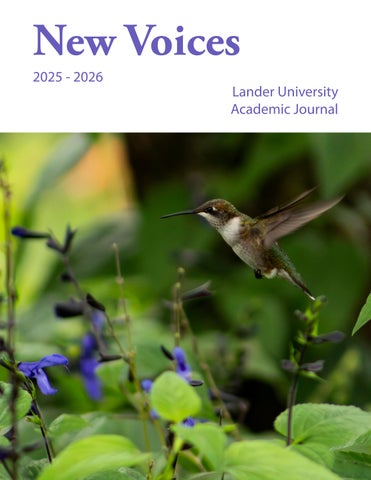
Cover Image
Archilochus Colubris
Barlow Hoffman
On page #59
We envision a literary journal that reflects the diversity, creativity, and spirit of the whole Lander community. Through poems, art, sculptures, music, and long-form pieces, we strive to create a space where every voice can be heard, and every idea can inspire connection, understanding, and emotion. This edition proudly introduces sheet music compositions, giving musicians and composers a platform to share their creative voices alongside our writers and artists.
Throughout the journal, many vivid themes are presented. Pieces include a range of concerns from issues of ethics and morality to nostalgic and lighthearted themes. Many of our works include references to nature, both in forms of self-expression and in nature-based storytelling. This journal has many works that represent the emotions, perspectives, and self-reflections of the student body of Lander University.
We would like to extend our sincere gratitude to our readers whose curiosity and engagement give life to our journal. Your engagement with the works published within this journal upholds our mission to promote thoughtful, creative, and meaningful pieces through literary and artistic expression.
We extend our utmost gratitude to our leading director, Professor Martin, for guiding us through the process of creating New Voices. Most of us walked into this class with little to no experience in creating a literary journal, but Professor Martin was with us every step of the way. Throughout the semester, they have filled this class with learning, laughter, and a space to build connections.
We would like to thank all the members of our editorial, design, and media teams for their countless hours and the hard work it took to bring our journal to life. The journal wouldn’t have been possible without our team’s help and dedication in perfecting the 2025-2026 edition of New Voices.
To all the students, we thank you for submitting your work and allowing us to be trusted in showcasing what you created. We are eternally grateful and humble to know that you believe your work is special for our journal. Your vulnerability and brilliance is the foundation this journal is built on. The journey of choosing each piece is a long and competitive process, one that made us consider both the emotional viewpoints and literary/artist aspects of each piece.
Edge of Departure by Emma Grace Avant
by Hallie Burrell.
Evangeline by Deja’ Kemena Helen Wilson
The Knit Collective by Brianna Sanaa Skeete
Scraps to Life by Alexi Esperanza Noriega
Contributors’ Bios
Hannah Lovett
Our creative writing award this year is going to “The Tragedy of Trauma” by Hannah Lovett. We loved that it was based on Greek mythology, but that you didn’t have to be familiar with the myth to get invested. It contains strong characters, and that allows for a strong emotional investment in the story itself. The changing perspectives were done clearly and expertly, perfectly allowing the reader to get the story from multiple perspectives and further strengthening the emotional depth. The ending was surprising and took us somewhere we could not have predicted. Overall, after lots of discussion of all our creative pieces, we found that this story was deserving of our creative writing award this year.
Connor McAbee
Our Dessie Dean Pitts Award this year is going to “Racecar” by Connor McAbee. This creative nonfiction piece won due to its many strong factors. The way the self-expression was handled and how the story was told felt very relatable and very real. We felt like we knew the author, like they were personally telling us a piece of their story. The piece felt very nostalgic and created a homely feeling in us, and we valued the vulnerability. Our team was emotionally invested, just because of the way the story itself was told. The ending was surprising and unpredictable but also satisfying. Overall, we had many good pieces for this category, but this one personally struck us as a natural award winner.
Nevaeh Harter
Our art and design award this year is going to “Blue Jay Way” by Nevaeh Harter. Its uniqueness and creativity made us feel that this was worth highlighting in this year’s edition. The swirly sense of movement in the paint strokes made the piece feel interactive and captivating. Not only that, but the technical skill shown amazed us. We appreciate the obvious investment of time required to achieve the level of detail and precision achieved. Overall, while we received many excellent art pieces this year, the use of color and movement in this piece made it a standout, which is why we chose it as the award winner for this year.
Connor McAbee
Some lucky teenagers get to choose the car they drive. Whether their parents purchase this vehicle for them or they have enough money to buy what they want, it is a privilege to drive the car of your choice. I, however, did not get this privilege. When my first car broke, my grandma happened to be getting rid of her 2008 Toyota Camry. My parents saw this as “right place, right time,” and while I told them I didn’t want to drive around a grandma car, they did not care. Reluctantly, I began driving around this grandma car, not knowing how much I would fall in love with it and what this car would mean to me one day. My Toyota Camry became a big part of my life, held so many memories, and stuck with me strongly the whole way through my senior year of high school.
As any broke teenager would do, I began looking for cheap ways to make my car “cool.” Day after day I googled, “How to make your car better for free,” and was always hit with the hard truth, that I could not “pimp out” my old Toyota Camry for under a hundred dollars. I ended up making the decision to spray paint my wheels black. Sanding off the old original silver paint, I sprayed several thin coats of black paint, trying to convince myself that it looked good. After painting the rims, getting the windows tinted, and adding a few little decorations here and there, the Camry was complete. The only thing it lacked was a name, which I soon decided to be “racecar.”
My racecar was finally ready to be driven, and buddy, I drove it. Finding out my racecar had a 3.5l V6 engine was like Christmas to me, and flying through traffic at high speeds became a new favorite hobby. I realized I needed to watch out for police, but I didn’t watch well enough, resulting in two separate speeding tickets. The first wasn’t too bad, just 10 mph over the speed limit, but the second ticket changed the way I drove forever.
As I cruised through traffic on highway 221, captivated by my high speeds and the loud music coming from my speakers, blue lights lit up behind me. My heart sank. I
had no idea how fast I had been going and as I pulled off, the cop followed. He walked up to my window and said, “I clocked you going 75 in a 45, any reason for that speed today?” Stunned by my own actions, I said, “No sir,” and he wrote me my ticket. As I held my ticket with shaky hands I read the words, “75mph in a 45mph zone, $550, 6 points.” I was lectured by my parents, other relatives, and even friends, that my bad driving habits needed to stop. From that day on, I drove safely everywhere I went, rarely ever going even 5 mph over the speed limit, in fear of another ticket. Though these experiences were very scary, foolish, and ignorant of me, they made amazing memories and taught me some very important lessons.
Along with teaching me these lessons, my racecar was my safe place for me during many tough times in my life. That car saw me at my lowest lows and my highest highs, and stayed the same comforting car every single time. From the loss of loved ones to the loss of friends, and the slow painful loss of a girl I thought I would be with forever, my car was there for me, speakers ready to drown out my thoughts and gray cloth seats ready to catch my fallen tears. The most significant transformation my racecar saw was how much I grew in my walk with Christ. When I began driving my racecar, I called myself a Christian. I went to church, put on the front, and did “the Christian things,” but in reality, I was very shallow in my faith. Over the course of a few months, I cleaned myself up, built new relationships, and started genuinely appreciating life. These small changes, along with several hardships I endured, ended up flipping a switch in me, a switch that changed me as a man. A switch that made me finally value my relationship with the Lord and legitimately walk in my faith. This car went from being a place where I memorized horrendous song lyrics, to a place where I rehearsed the sermon I would preach in my senior chapel speech. Hundreds of prayers soaked into the dated 2008 interior. My racecar became my new favorite place to separate myself from the world and talk to God. My racecar saw a boy who hated life, never prayed on his own, and never picked up his Bible, turn into a man who loved life, saw everything as blessing, prayed, journaled, and read his Bible daily.
May 6, 2024, on the way to school with my sister, I crashed my beloved racecar.
Two tractor trailers in front of me collided and sandwiched a smaller car, causing everyone to hit their brakes. I slammed into the back of a big work truck. My car was totaled, but by the grace of God, my sister and I were totally fine. Seeing the horrific aftermath of the wreck ahead of me, I remembered a prayer I had said that morning. Fifteen minutes before the accident, I felt the Lord tell me to pray. I prayed, “Please keep me and my sister safe as we drive to school this morning. Amen.” It clicked instantly that this was no coincidence, and that the Lord really did keep me and my sister safe that morning.
As I stood on the side of I-26, tears streaming down my face, I knew I would have to part ways with the car that made me who I am today. As I watched the tow truck pull away with my car, I didn’t see an old wrecked sedan. I saw the car that six-yearold me would look for in the elementary school carline, with grandma waiting inside of it. I saw the car that drove my sister and I to the movies when grandma wanted to go out with us. I saw the car all of my cousins would pile into to go to the park in the summertime. I saw the car that got me through my final year of high school. I didn’t see the dated interior or the spray-painted wheels; I saw the car that never quit on me or my family, in the seventeen long years of our ownership. Hundreds of unforgettable memories, countless songs sang, prayers said, and tears soaked into those old cloth seats would all be left behind in some scrap metal that only I could love. To others, I drove around a boring grandma car, but to me, I drove around a perfect, one-of-a-kind treasure, a best friend.
Victoria Kelly

It was early in the morning when I was outside trying to capture a picture of a cardinal. I ended up getting frustrated after failing so many times when I turn around. Then, I see it: a Robin, perched perfectly on a car. It had been watching me, and I took the chance to snap the picture.
Deja’ Kemena Helen Wilson

This piece is a photograph taken in front of an oil painting. The deep cyan and blues of the painting and the silhouette—both of which express darkness in a world of light—helped name the piece “Off the Deep End.” I’m proudest of the vignette effect on the fairy wing tattoo and how the painted clouds seem to glow. I noticed those details during editing and felt they would make the photo more dramatic and, therefore, make the message greater. This was achieved by increasing the contrast, darkening the image, and using another vignette. This piece’s message focuses on the human mind and how it lingers away from the “bright side.” Everything isn’t sunshine and rainbows—reality reminds you of such with constant back and forth— even when you try to stay positive. To be honest, I was with my class and taking pictures of everything that caught my eye or felt it had a greater meaning. When I went back through my photos during editing, I knew I captured a gem—creating one of my prized artworks.
Armani Canty
Unreliable narrators are a common element of many postmodern novels because it allows readers to be skeptical of the main character. The unreliability supports the common themes of death, paranoia, and identity that are seen in postmodern literature. However, the narrators’ perception of events can also be a result of mental illness. While not directly stated, the protagonists of some of the most influential works show symptoms of severe mental disorders, providing a possible explanation to many of their unconventional behaviors.
To begin, Kurt Vonnegut’s Slaughterhouse-Five follows the protagonist Billy Pilgrim throughout many phases of his life. Billy envisions an alien species—the Tralfamadorians—and supposedly time travels. It would be easy to categorize Billy as a schizophrenic suffering from delusions because of his creation of the alien planet that no one else seems to know about. After all, the introduction does say, “This is a novel somewhat in the telegraphic schizophrenic manner of tales of the planet Tralfamadore…” (Vonnegut). However, Billy’s post-war life is similar to someone living with post-traumatic stress disorder (PTSD). According to the Diagnostic and Statistical Manual of Mental Disorders (DSM), some of the diagnostic criteria for PTSD include exposure to actual or threatened death, intrusion symptoms, negative alterations in cognitions, significant impairment in important areas of functioning, and many others (American Psychiatric Association 301-303). Billy’s exposure to death is the main contributor to his PTSD, and the cause of the signature phrase “so it goes”. He witnesses the gruesome death of many friends and enemies alike and never shows any outlet for emotion, which only worsens his condition. Additionally, the structure of the novel further supports that Billy is experiencing intrusion symptoms, like dissociative reactions and intrusive memories (American Psychiatric Association 301304). Throughout the book, the readers get reminded of wartime, Billy’s childhood, Billy’s future, and his time on Tralfamadore, all of which are chronologically out of
order. This could be Billy’s way of piecing together what he does remember, as PTSD is also related to negative alterations in cognitions like distorted memory. Towards the beginning of the book, Vonnegut writes, “But not many words about Dresden came from my mind then—not enough of them to make a book, anyway…I think of how useless the Dresden part of my memory has been” (Vonnegut 3). The fragmented writing of the book could be interpreted as the author’s anxious scrawl, desperate to get what was remembered on the page. The most prominent diagnostic criteria are Billy’s dissociative symptoms. He seems to become new versions of himself in his delusions, imagining himself at different ages. In chapter 2, Vonnegut writes, “Billy Pilgrim has come unstuck in time. Billy has gone to sleep a senile widower and awakened on his wedding day” (Vonnegut 29). This is just one example of the multiple times throughout the novel where Billy supposedly travels through time. His condition and delusion also affect time perception, which is one of the main elements of Tralfamdorian philosophy. They believe that everything that happens was always destined to happen, eliminating free will. This alien planet is a manifestation of Billy’s condition, including the alien’s perception of time; this causes him to live through everything at once, which also contributes to the writing of the novel. Everything Billy experiences can also be seen in the author, Kurt Vonnegut, who is rumored to have PTSD from World War II. As the narrator, some of his symptoms can be seen in the writing of the book. Billy’s creation of Tralfamdore helped him escape his deep-rooted trauma by immersing himself in another reality. His symptoms mimic PTSD more than schizophrenia, although both are common features in postmodern literature.
Much like Billy Pilgrim, the protagonist in Piranesi was also thought to suffer from schizophrenia as a result of being locked in the labyrinth. One criterion of schizophrenia that Piranesi himself exhibits is delusions, especially when he believes the birds are communicating with him and sending him messages. He says, “Supposing my hypothesis to be correct, this is certainly the most elaborate communication that the birds have offered me” (Clarke 42). Once again, while there is the presence of some symptoms, Piranesi’s mental state closely reflects someone
with dissociative identity disorder (DID). The criteria for DID includes clinical distress in important areas owh his writing to comfort him…” (Clarke 126). While it is highly probable that the author is Piranesi, he doesn’t seem to recognize it as he separates from the person he once was. He is so far separated from his original identity that when he sees his name he doesn’t believe it. He wonders, “How could I possibly answer this question when I had no idea who Matthew Rose Sorensen was?” (Clarke 163).
While he doesn’t know who Matthew is, he’s not entirely convinced that he is Piranesi, and he knows that’s not his name. Throughout the novel, his identity begins to shatter more as he is increasingly confronted with multiple possibilities about who he is— and could be. At this point, Piranesi is already displaying DID criteria, such as gaps in recalling everyday events—like an inability to identify one’s handwriting. He is already split in half with two different personalities: Piranesi, a child of the House, and Matthew Rose Sorensen. Towards the end of the book, he introduces a new unnamed identity. When looking at his clothes, he says, “This, I suppose, is where I differ from both of them—from Matthew Rose Sorensen and Piranesi; I find I do not care greatly about clothes” (Clarke 238). At this point, whoever he is now is different from both Piranesi and Matthew. While creating a new identity isn’t a requirement for a DID diagnosis, discontinuity of oneself is.
On the other hand, White Noise differs from the other novels. Jack Gladney does suffer from an identity crisis, but his opposition to and fear of death gets worse throughout the novel until it becomes debilitating. According to E. Mansell Pattison’s book The Experience of Dying, there are four main attitudes towards death: death denying, death defying, death desiring, and death accepting (qtd. in Mousa 70). Jack employs most of these feelings—except acceptance—to confront his relationships with dying. His whole life is a series of death-denying actions to put dying out of his mind. For example, Jack spends his leisure time learning German and throwing himself into his role as a professor, trying everything to fit in and seem normal. According to James B. McCarthy, these efforts are called “manic defenses” (qtd. in Mousa 65). These defenses are ways for people to occupy their time with something else besides the Armani Canty
suffocating weight of dying. This could be refusing to be left alone and desiring to fill any leisure time with some activity to occupy the mind. For Jack, this manifests itself in his obsession with Hitler, which is another way for him to disguise his fear and find purpose. Jack uses his role as a professor to occupy his time, but he doesn’t realize that obsessing over Hitler is another example of a manic defense. McCarthy says, “Total identification of a group…all give the individual member a false sense of self through a shared identity. Death anxiety and purposelessness vanish as the self is surrendered to the cult” (qtd. in Mousa 66). Jack presents Hitler as a grandiose figure, much like a cult leader. Centering himself around a figure responsible for the death of millions would provide him with a sense of security and control. It might give him the illusion that if Hitler could decide the lives of so many, surely he should be able to control his own death. Later, his viewpoint changes when his life was threatened by factors outside of his control. Before the Airborne Toxic Event, Jack had a death-denying perspective and believed that nothing would happen to him, ignoring the rules of death. He says, “These things happen to poor people who live in exposed areas. We live in a neat and pleasant town near a college with a quaint name. These things don’t happen in places like Blacksmith” (DeLillo 114). Jack cannot seem to fathom anything bad happening to him, especially not death, until the SIMUVAC worker says Jack could die in about 15 years. His confrontation with the possibility of dying eventually developed into mental illness. This disorder is called thanatophobia—a specific phobia of dying. While Jack has experienced this feeling since the beginning of the book, being forced to confront his own mortality only worsened his fear. One example is his physical reaction when he mistakenly thought he would die. He says, “How does it feel to see Death in the flesh, come to gather you in? I was scared to the marrow. I was cold and hot, dry and wet, myself and someone else” (DeLillo 243). His physical reactions mimic those of a severe panic attack. The DSM also states that active avoidance is a criterion for thanatophobia. Jack shows this all throughout the book by saying things like, “I want it to go away for seventy or eighty years” (DeLillo 284). Jack’s intense fear of death severely impairs his way of thinking and everything else around him, including his marriage, his family, his
possessions, his friends, and everything else. Thanatophobia can be thought of as the suffocating white noise of life—some just hear it louder than others, Jack included.
The paranoia of postmodernism can be portrayed through unreliable narrators, whose unpredictable actions can be explained through mental illness. While Vonnegut, Clarke, and DeLillo’s protagonists all suffer from different mental disorders, they all contribute to the same postmodern theme: identity. All the main characters struggle with their sense of identity and death, only making their diagnosis worse. Their diagnosis is something that the protagonists are mostly unaware of, which gives the reader a chance to separate the main characters’ mental health struggles from the actual story. It also helps determine the reliability of the narrator and contributes to the skepticism in the story, a staple of postmodern literature.
American Psychiatric Association. Diagnostic and Statistical Manual of Mental Disorders. 5th ed., Text Revision, American Psychiatric Association, 2022.
Clarke, Susanna. Piranesi. Bloomsbury Publishing, 2021.
Delillo, Don. White Noise. Penguin Books, 1985.
Mousa, Nedal Al. “A Critical Study of the Theme of Death in Don Delillo’s White Noise from an Intertextual Perspective.” Journal of American Studies of Turkey, vol. 21, 2005, 65-76.
Vonnegut, Kurt. Slaughterhouse-Five. The Random House Publishing Group, 2009.

Soon will be the break of day, sitting here in Blue
Shine Sein Kim

The baby whale is waiting for its parents to come back with food. They went to the ocean on a very cold day to find food for the baby whale. The baby whale is waiting on the pink clouds; pink is meant to represent the warmth of spring. I used jeans for the whale to add interesting dimensions and used chunky yarns for the clouds.
Ananda Addison
She silenced me in the wind, Took our bond and broke it in half.
A hollow echo new resides, I have no say. She is my right.
My dreams, like dust, are crushed, I’ll never grow old, it seems, Nor smile because of joy within, Because she is my right.
I’ll never learn who I am, Or gain true bonds with others, Family’s embrace should be my sole retreat, Because she is my right.
I do the work, bear every task, I’m always respectful, head held high, But inside, I’m shattered, though none shall know, Because she is my right.
Who is she to predict my path?
I yearn to stand and just be me, But then, she is my right.
No, I’m not afraid, not truly,
But yes, I crave a change so deep,
Yet how can I, with so few rights?
I am adrift, alone, unseen,
Lost in the shadows, deep and vast, Who will protect me from the storm? Who will be there if I shall fall?
Can’t cry for help, there is no friend.
I must “hush up, child, avoid the fray,”
She is my greatest foe, it seems, But then again, Grandma, you are my right.
Mia Orams

The idea for this piece came from a feeling that I had in the moment. I don’t quite recall exactly what I was feeling, but looking back at what I drew, I can sense that I felt relaxed. The sketch depicts two small birds enjoying the warmth of the light near an abandoned swing. I like to think it’s a little spot they dedicated for themselves to meet up and talk about their days.
Shine Sein Kim

This work is meant to represent being calm and relaxed. The image shows a freshly-cracked egg, shells framing the liquid contents. Clay is a very relaxing medium to work with, and it showcases the feeling of eating breakfast on an easy morning.
Hannah Lovett
Orpheus lay across a rock nestled on the bank of a river. He sat so still that anyone who walked by him would’ve mistaken him for a statue, if not for his beautiful song. He strummed his lyre slowly, thrumming the strings in a melody that could only be understood as heartbreak. It has been years since the unfortunate tragedy of Eurydice, and still, his tune never changes. Day in and day out, he lies by the water and mourns the loss of his beloved. Although a snake bite is the real cause of Eurydice’s death, Orpheus still blames himself. His impossible task has left him feeling like a failure and doomed to die alone, forever heartbroken.
So, every day passes the same. His haunting song rings throughout the forest and down the river until he eventually succumbs to the night’s sleep. Then, one morning, he wakes against the rock to find a slip of paper tucked into his lyre strings.
I’ve been watching him for a while now. It started one day when I was out too early. The sun had just set, and I was aching to be free from my prison. Staying inside all day to avoid being seen takes its toll on a girl, even if I know it’s best. I was strolling through the trees when I heard the melancholy trickle of music coming from the river. As I approached the sound, I reached the edge of the wood and found a beautiful man there. I watched him, mesmerized. I have spent my entire life longing to be loved only to be cursed for it. So, when I heard this stranger play a song weaved with such heartbreak and loss, I couldn’t help but feel like he understood what it was like. To experience a tragic love struck down by the gods.
I returned each evening to watch him play. It was never long until he would fall asleep, taken away dreaming about the object of his woe. Still, I stayed through the night and watched his chest rise and fall, wondering what it would be like for him to see me.
I spent my days alone writing letters to him. But no matter how hard I tried, I could never deliver my message. I just wanted him to know that he wasn’t alone; I was out there, and I understood his pain. So, last night, I left him a letter. To him, it was an anonymous nobody sharing in his pain. To me, it was my heart etched into paper. It is an impossible feeling to have the body of a monster but the heart of a girl.
It’s a strange feeling, waking up on a rock with a note tucked into your most prized possession, knowing you’ve been intruded upon in your sleep. But feeling anything other than despair is welcome; so, I open the letter and begin reading.
Dear Orpheus,
I know of your misfortunate tale. I feel your pain through your song and can see that the gods have damaged your heart beyond repair. If it is any consolation, the gods have broken me too. Even though I can never reveal myself, you must know that you are not alone. The absence of love is a wretched beast that spares no one.
The letter contains no sender, no address, no hint of who placed it there. Who is this mystery sympathizer? And why do I care? I’ve spent the past few years of my life apathetic to those around me. Women try to seduce me, but none compared to my beautiful Eurydice. So why now does this letter sender pique my interest?
I decided to respond in the only way I know how; my music was obviously the lure for this stranger, so I began to play. But, instead of the same solemn tune I have played every day, I start to strum a higher chord, one full of hope and empathy.
As the days pass, I don’t receive any more letters. I’m not even sure if they hear me. Nevertheless, I continue to play my new song, feeling better about my circumstance than before. I continue to play and sing, and each day I wake up hoping to find a new letter from the mystery sender. The camaraderie I feel with this stranger settles in me. I almost started to believe that knowing someone out there understands me is enough. I don’t need to know who it is; I’m not alone anymore. But I wake up the next morning to another letter, and the questions reappear. I must discover the enigmatic scribe who haunts my songs. The Tragedy of
I can’t stop. I told myself one letter was enough to quench the thirst for companionship, but I was wrong. When I returned the dusk after the first letter, I expected the solemn tune I have grown to love. Instead, I heard new notes drifting down the river. His song was light, almost peaceful, a sharp contrast from his sorrowful song of the past. Why the sudden change now? What could have inspired this new tune? I held myself back, not writing to him again like I told myself I wouldn’t. But the more days that passed and the longer I listened, the more intrigued I was by him. What could one more letter hurt? He never had to know it was me writing.
So, just as the sun starts to fall in the sky, I venture back to our spot in the woods. As the gurgling of the stream fills my ears, something new joins in with the water. A verse—short and sweet—loops as I approach. My heart feels like it’s beating out of my chest. He’s singing for me. Proclaiming his desire to meet me. I never meant for him to reciprocate my desire—he can’t love me. My last opportunity at love left me scarred for eternity, shunned by society.
To be loved by a god is beyond any girl’s dreams. Yes, the gods aren’t known to be faithful, monogamous lovers, but I was young and stupid. Neither of my Gorgon sisters had ever experienced the love of a beautiful man, so when Poseidon pursued me, I fell into his careless arms. When Athena found what we did in her temple, Poseidon didn’t try and protect me from her wrath. He left me to have my beauty stripped and replaced with snakes—cursed to never be close to another.
Then why now do I suddenly want to try again? I know how devastating love can be; look at Orpheus. His songs have morphed at my words. But it could never work; I would turn him to stone at first glance.
Orpheus
I never thought I would be praying to the gods again. But at this point, I am desperate. My mysterious writer has been silent ever since I gifted them with my song. How could a person who claims to understand my former despair not feel my current desperation? So here I am, pacing the forest, sending pleas to Mount Olympus. The Hannah Lovett
gods and I don’t have a pleasant history, but if a mortal were to ever be in a position to ask favors, it would be me.
Days pass. I cannot bear to play my lyre or hum a tune. I’ve come full circle, back to when I spent my days in lazy despair; only now, I have lost my music too. I’m taken back to the day I lost her, when all the joy in the world was stripped away from me.
It was our wedding night, supposed to be the happiest day of our lives and it ended up her last. I had never once considered how death could slither beneath your feet and strike in an instance. Snakes: cold, unfeeling beasts that ruin even the most joyous of times. And now it feels like I have been struck—my song seized in my throat like venom in my heart. Why could the gods not spare me this time? They must know how desperate I am to meet the sender of these letters. If I was to see her, I just know it would thaw my frozen heart.
I’m spending another day, locked away in my room, hiding from the vulnerable eyes of mortals. Hiding from him. His song only brings me despair now. I’ve stopped hoping for a miracle, knowing that my fate lies in heartbreak. Scribbling away at my papers, wishing I could write anything worth not immediately throwing in the fire, I’m suddenly struck by the most blinding flash.
Athena, the donor of my curse, appears before me in all her raging glory. I never won’t fear her radiance. Her reputation is well earned as the goddess of strategy, every move she makes calculated and cold. What could have brought her here to torment me further?
“Gorgon, I did not anticipate having to deal with you again. I assumed my initial punishment would scorn you from the sight of the gods permanently” Athena derided.
“But, word of your situation has reached Mount Olympus, and I have unfortunately been called to interject.”
“I swear to you goddess; I bear my sorrows alone. I accept my unfortunate fate with endurance” I plead to her, knowing her wrath is not one someone survives twice.
“Silence, I know it was not you who called. Orpheus has been quite distraught at the
absence of a certain intriguing scribe. He wishes only to meet them” she reveals.
I can’t believe what she’s saying. She must have come to hurt me further than I thought possible before now. My second chance—well not even a chance—at love and she comes to remind me why it will never happen. “You must know it will never work. Orpheus will solidify the moment we meet” I sigh. Her reply comes instantly: “Ah, but that is where I come in. I admire the tenacious Orpheus and am willing to put his devotion to the test. But I shall not make it easy for either of you.”
I stay silent, waiting for the other shoe to drop. Everything I wanted to badly is now within reach, but the gods never give anything freely; the price of my former beauty is far too high. And what test could she possibly concoct? As if she could read my thoughts, she answers.
“I shall not return you to your former beauty, but I will bless Orpheus with vision unaffected by your stony gaze. If he can see past your monstrous exterior, then you may both have an opportunity for second love, albeit an unconventional one.”
Her promise rings in my ears. “Another chance at love?” I repeat. But she is gone as quickly as she came. There is no time to question the validity of her statement, so I begin writing. Suddenly, I find the words stuck in my pen for the past few days. After scribbling a quick note, I head out the door, not caring if sunset had just begun.
I sprint to the rock, checking over my shoulder for any sight of him, and find it empty. Perfect. I leave my letter and slink back to my spot behind the bushes. I shouldn’t be here, it’s still so light outside and he could see me if he looked hard enough. I must know he sees my letter, then I’ll leave. Right then, as if on cue, he cuts through the tree line.
He looks sadder than when I last saw him, worn down by something. But, when he sees my letter, his face lights up. I shift, my relief too much to contain. Although I should’ve kept still, as his eyes flit to where I’m hidden by just a few thin leaves. I bolt, no time to think that he might chase me, just knowing that I can’t be seen…just yet at least.
Orpheus
I can’t believe it. It feels like the gods have answered my prayers. I intended to retire early tonight, lay against my rock, and succumb to mind-numbing sleep. But, as I entered the bank where I spend most of my days, I noticed the paper immediately. As I step towards it, a rustle of branches catches my ear. I shift away from the blessed letter to glimpse a brief flash of movement before I hear the brisk pitter-patter of steps running through the forest.
I almost chase them, hoping it might be my mysterious writer, but the tangibility of the letter is too much to resist. I approach the rock, and snatch it up, the feeling of the paper beneath my fingers as euphoric as the strings of my lyre.
Dear Orpheus,
I thought my anonymous affections were enough to dull the ache in my chest, but I was foolish. A Goddess’ intervention has given us a chance. Meet me at midnight in the temple of Athena to unmask your muse. Love, M.
The words shocked me more than the first letter, which I did not think possible until now. How am I going to wait until midnight to meet them? And why at the temple of Athena? I would understand Aphrodite or Eros, but what could the goddess of war have to do with our love?
Time passes slowly as I piece together a melody for them. But eventually it’s close enough to midnight, and I make my way to the Temple of Athena. As I approach, unease settles low in my stomach. I don’t know who to expect when I enter. It could be a man, a woman, a nymph, I wouldn’t mind. The person who brought me out of my despair already has my heart.
I begin to climb the stone steps, every stair heavy under my feet. A figure appears in the center of the Parthenon. The moon casts a faint light across their silhouette, but I see them finally, the object of my hope. M is obviously a woman, the curve of her back visible through her dress. I step forward, clearing my throat to prepare it for her beautiful song. But the lyrics never come, frozen in my chest for eternity.
Medusa
He stood as still as stone. I almost thought Athena had played an evil trick on us, drawing us out to create a statue of a songbird—and a mockery of me. But no, he has not been turned to marble, just frozen in a state of shock.
“Orpheus,” I whisper. “Is it true? Are you still made of muscle and skin? Does blood still beat through you heart even after holding my gaze?”
But it is an unnecessary question. I see the pallor of his usually flushed face. I see the tense of his shoulder, usually so relaxed while lounging by the river. Although my experience in face-to-face interactions is limited, I’ve watched people long enough to know something is wrong. He must not understand how surprising it is that he is still breathing.
“I know I wrote you of an intervention from the gods. Let me explain. My name is Medusa. Athena cursed me with sight that turns men to stone after I fell for Poseidon. I thought I would be alone forever…” His face contorts, and I see him begin to understand my initial distance. “But she has answered your prayers and gifted us each other” I finish hopefully.
His eyes are shining with something I don’t understand. Being a monster has an innumerable number of disadvantages, but the one I hate the most is not experiencing the soft touch of someone’s soul. People say the eyes are the window to the soul, and, for me, the blinds have always been shut; shutters drawn close the second I peer in. But with him now, the curtains are blown aside by the wind, and I see straight through. I thought he would be joyful, finally unmasking me, but he is not. I just want to hear him; just speak, or sing, or whistle; anything but silence.
“Medusa” he broaches. My name. How sweet it sounds from his lips.
“I can’t love you” he says as he turns and walks away.
Orpheus Snakes. All I see when I think of her is snakes. How could the gods be so cruel? Before seeing her, she was all I could’ve wanted; and I didn’t care who she was. But they make her the one thing I can’t stomach. How could I be expected to love her? She
Hannah Lovett
is the personification of my tragedy.
I recognize it now. That look I couldn’t put my finger on. I have seen it in the way people look at the mice that burrow in their grain bin or the birds picking at a dead man’s corpse. But now I know you can feel disgust for people too. Orpheus certainly did.
I don’t know why it didn’t occur to me that my snakes would be the deciding deterrent. They had become a part of me, like my arm or thigh. But his fleeting glance at their slithering bodies was evidence enough. I knew of the poor Eurydice and what had befallen her, so I should’ve deduced this dream was fruitless. I mean, the gods must have known. That’s why Athena offered her aid. Her wrath did not diminish with time. Her temple became the stage for another amusing show, and this was just a sequel starring her most hated mortal. My woes are not the concerns of the divine. I am, just like I feared, fated to spend the rest of my mortality alone, with the only possible partner disgusted by the mere sight of me.
Just like their first stories, there is no happy ending for Orpheus and Eurydice. The gods are not known to regret their decisions on the fate of mortals, especially not the goddess of wisdom. She knew from the beginning that the only thing more powerful than love was hate, and a hate forged in tragedy is even stronger than the gods themselves.
Ozzalyn Jade Jacks

My inspiration for this piece was my battle through hardships. Throughout the the semester, I have faced many hardships that have repeatedly torn me down. I created this piece of a girl and her dragon standing in the chaos of life and thriving rather than crumbling under the pressure. This idea of crumbling under pressure is symbolized by the crumbling cliffs. The chaos of life is symbolized by the volcano overflowing. The smoke in the sky represents how dark and grey life can get, especially when battling with depression. But the embers floating around symbolize that there is still light to be found in the chaos and darkness.
Kate Elizabeth Martin

Using graphite on 14” x 11” sketch paper, I drew this figure that presents a beast-like appearance. By combining my general understanding of human anatomy and exaggerating certain traits, I was able to transform what would be an average figure into a grotesque creature. Hair, lumps, and wrinkles were added to create a texture on the surface of the creature’s skin. It remains genderless due to both male and female traits being presented, and the proportions on it make it look dwarfish or elf-like. I decided that the best pose for the creature would be a kneeling position, like how a dog does to its owner, and since I associate elves and dwarves with obedience. I reflected that thought onto this creature.
Masks clutter the room.
Victoria Kelly
Hung on the walls, stuffed in boxes—
Anywhere they can be.
Too much time gets spent rummaging.
Mistakes cannot be risked. It must be perfect.
They swap throughout the day.
Someone says hi— They switch.
I run into a friend— They switch.
A phone call from a family member— They switch.
Alone. Finally alone.
The masks are tossed aside.
Something is off.
I take in the room,
Eyes searching each mask. Which one was the original?
Nevaeh Harter


This painting is of my neighbor’s old, rusted truck that he has been driving since well before I was born. I felt that its worn-down look carried lots of stories and conveyed the feeling of an old memory. I used this as an exploration of color and texture, greatly exaggerating both of these elements to intensify the nostalgic, reminiscent feeling of the piece.
Ezbel Danku
Ever wonder what it’s like to basically start life over in a new place where you don’t know anyone and barely understand how things work? That’s the reality for a lot of international students.
At first, it’s all exciting and full of new experiences. But then the loneliness kicks in—whether it’s dealing with school stress, feeling left out socially, or missing your family. You end up feeling like you don’t really fit in anywhere, not back home and not in this new place. And before you know it, you start wondering if moving was the right call after all.
My name is Ezbel, and this is my story.
I’m from a small town in a country in West Africa. I won’t mention a name just because I don’t see the need for it. I left home two years ago to study in the United States of America. Ever since then it feels like I’m stuck in this loophole between the two countries. I’m too foreign to fit into the American life and not cultural enough to fit back home.
I remember vividly the first few months I moved to the States. Everything was going smoothly, from spending time with my family and friends over the phone to trying to fit in. Then suddenly, everything stopped. The feeling of loneliness crept in. I would wake up some mornings and just feel this heavy silence pressing down on me. Back home, there was always noise — neighbors arguing, children running around, someone blasting music way too early in the morning. But here, even when people were around, I felt like I was on the outside looking in.
At first, I tried to ignore it. I told myself it was just part of the adjustment. But the more I tried to blend in, the more I noticed how different I was. The jokes I didn’t always get, the foods that didn’t taste like home, the awkward pauses when I said something that didn’t quite land the way I meant. I would smile through it, but inside, I felt like a visitor in a place I was supposed to be calling home.
And when I visited home during the holidays, that didn’t feel simple either. My friends had moved on, creating inside jokes and memories that I wasn’t a part of. The food was the same, but I always felt something was missing. The culture, the people, everything had changed. I felt like a stranger in my own home. My family treated me differently. They claimed I’m no longer one of them but a better version. How can I be a better version when it feels like I don’t fit in? When it feels like I’ve missed out on a lot and I’m now being treated like a guest in my own home? I’d scroll through social media and feel like I was watching a movie I used to be in but got cut from halfway. The streets I grew up on felt slightly different — like they had shifted in my absence. Like I was the only thing needed to be out of the way, like I had disappeared from sight and memory.
It’s strange, really. You think moving abroad is going to be about culture shock, about adjusting to new systems, about school and opportunities. No one really tells you how it feels to live in-between. How your identity starts to blur — not quite here, not quite there.
I spend most of my time alone, especially here in the States. I tell people I have friends, but it doesn’t really feel like it. I’m always walking alone, eating alone, sitting in class alone — just like a shadow moving through a space that isn’t really mine. Everyone else seems to have their circle, their group, their little worlds where they belong. I don’t.
Sometimes I stare at my phone, hoping for a message from friends or family back home, but nothing comes. Everyone has moved on, and it feels like I’ve been forgotten. Even the food reminds me that I don’t belong here — and yet, I’m too far to fully feel at home. I try to cook dishes from back home, but they never taste the same. It’s like flavor itself is lost, just like me.
Whenever I talk to someone, the first question is almost always, “Where are you from?”
Can’t I just have a normal conversation without my identity being reduced to a country, a place, a label? My accent seems to have trapped me between two worlds
— too foreign for here, not home enough for back there. Even my friends back home tease me now for being “too American.”
It’s like I exist in this invisible space, trying desperately to belong everywhere and nowhere at the same time. My personality, my sense of self, feels stretched thin, pulled by forces I can’t control. Some days I feel lost and trapped in a small space. A space with no escape no matter how hard I try.
Everything is different in this new world. The market is quieter; the people are not as friendly. I don’t hear the laughter of neighbors echoing through the walls or the screams of children playing outside. It’s like I’m lost. Back home, the noise—the shouting, the chaos—kept me awake sometimes, yet now its absence feels heavier. Even the smell of rain, one of the things I miss most, seems to irritate me. The loud chaos of the market now frightens me.
Then I ask myself: why can’t I be me again? Why am I this new kind of monster, irritated by things I used to love, depressed about a place I can’t fit into? Why am I suddenly trapped in this hollow space? Am I the only one who feels this way, or are there others who feel the same?
Being away from home makes it impossible to fit back in. It’s like I’m no longer one of them, as if I’ve missed centuries of events. No matter how hard I try, I no longer belong. And in this new place, it feels like I am forced to become someone I’m not, forced to make connections, forced to form relationships. It’s like being an uninvited guest at an event: everyone stares, notices you, and yet it feels as if you’ve vanished.
You are invisible to the world.
All these experiences have shaped me into someone new. A girl who no longer worries about the opinions of others. A girl whose aim is to strive harder than anyone ever has.
A girl who wants her name known to the world, even if she is different and stuck between two worlds. I try my hardest, always giving my best, because I refuse to be defined by this feeling of displacement.
I’ve learned that most students who are far from home feel the same, though few admit it. With this understanding, I imagined creating a small group—a sanctuary for people like us. A place where everyone knows what it feels like to be trapped between worlds, to feel that nothing belongs entirely to you. A space where we can breathe freely, where there is comfort and emotional safety, where no one is left out.
A home for the displaced, even if only in spirit.
Yet even with this dream, the feeling of being stuck is relentless. I cannot shake it. I wander through my days trying to find where I belong, but the answer eludes me. Can I ever find my circle of people? Can I return to being myself—no longer anxious, no longer sad, no longer feeling like a stranger in every space I occupy? Can I belong anywhere again, or am I condemned to drift between worlds forever?
I keep asking myself these questions, searching for an answer, for a sign, for a light in the darkness. But what if I never find it? Will I remain trapped in this illusion of space, surrounded by shadows, haunted by the strange monster I have become? And yet, even in the fear and the loneliness, I hold on. I hold on because I must—because one day, maybe, I will find the place where I am both seen and safe, the place where the echoes of laughter and the scent of rain bring me home.
Until then, I exist between two worlds, a girl who refuses to disappear, a girl who continues to strive, hope, and finds a place where she can finally belong.


“Machatta Skin and Beauty Website” addresses the e-commerce UX/UI which transforms an all-natural skincare brand into a user-friendly online experience. Challenges that came up when designing this piece included understanding the navigation of the website, learning more about the brand, and making purchases easier for the user in the e-commerce beauty market. Focusing on a mobile, clean, and minimalist design with an earthy color palette and typography captures the brand’s clean product and aesthetic. The checkout process, simple home page, menu bar, and detailed product page categorize the description, ingredients, and benefits were all important design features. My process included prototyping in Adobe XD and making this design interactive. The final design focuses on clarity, user-friendliness, and journeying from browsing to purchasing a website.
Carly Renee Lentz

In this piece, I worked to capture the beauty of Roman architecture in watercolors. I think the soft colors and lines created by watercolor help contrast how the actual structure was made—solid and strong enough to survive the test of time. While the watercolor base allowed paint to flow and create fluid shapes, the line work on top helps add back some rigidity to the piece.
Mia Orams

The idea for this illustration came from a friend of mine. They told me to sketch out a room with a big window and then decide how it looks and what I should include in the piece. I wanted to go for a lonesome, sentimental mood with a creature playing a piano in the middle of the room. I wanted you to feel their music echo in the spacious room. Even though they are in a city, it feels like it’s just the creature and the tunes that are playing instead of the noise from outside.
Gavin Langley
A hall made of only mirrors reflecting everything in an endless abyss. Mirrors that see everything; the souls they capture in the mesmerizing repeating movements. Reflecting life and death, reflecting love and loss, reflecting beauty and flaws for all to see. Nothing can escape the mirror’s image.
Barlow Hoffman

Insects are often thought of as annoying, scary things you swat away. While exploring, I was able to take a closer look and realized that they are very intriguing and otherworldly. Through enhancing this ladybug, you can see their eyes, antennae, and details on their wings that your eyes cannot see unless you get close. They are like aliens living amongst us.
Deja’ Kemena Helen Wilson


This piece was named to give the work a lighthearted, endearing impression. “Larry the Snail” is a mediumsized clay snail flowerpot whose natural yet mythical theme is conveyed through the details and texture. The details I’m most proud of are the curious eyes and the etched light-blue effect within its shell. I started off with shell since it was heavier and had the most details. Then, I worked on the rest of the body, keeping to the nature theme by using a snail and its shell as the flowerpot. Making this pot required a lot of patience and caution. If I were to rush, an antenna may have fallen off or the dye may have bled into unwanted areas. This project taught me a lot. The final piece came out exactly as I imagined: adorable and strong.
Brandon Simmons

This heraldic achievement is a reflection of me and my family. In the center of the achievement is a shield separated in quarters. Each section displays my life’s journey. In the bottom left is a set of comedy and tragedy masks to represent my art journey. In the top right is a symbol of a galaxy that represents my love of cosmic themes. In the bottom right is a symbol of mountains and the Loch Ness Monster; this represents my interest in mysteries. The center of the shield displays a butterfly that represent the psyche and soul and also my late mother.
Selitah Burns

Self-portraits have always been one of my favorite ways to express myself. As someone who has a hard time constantly envisioning what I look like to others, self-portraits give me an aid. For this portrait specifically, I wanted to focus on values and not necessarily on hues. Using one hue allowed me to focus more on brush strokes and details that I wanted to address. This self-portrait might not be identical to my face, but it captures the essence of who I am and for that reason, I am proud of it.
Brooke Raymond
“Everything I Wish I Was,”
I write at the top of a notebook paper, Edges torn, asymmetrical, how ironic. A couple of things jotted down, All simple, all so in reach. The only thing that’s stopping me is, well, I guess it’s me.
As I write these things, Just new ideals and schedule changes. My mind begins to wander off To different, far-off places.
I see myself in a home filled with yellow lights, Not those bright, white, blinding ones
That slowly melt your mind.
No, it feels so comforting, so peaceful, it’s a home.
There are extra linens in the cabinets
And more room than just my own.
I’m baking in the kitchen
Lots of something I don’t even eat. I bring it to the table
To many friends that fill the seats. They say “Ah, this is our favorite!”
And I wonder if they know That I always make it for them
Because I love them so.
How can this house feel so warm? And no, not from the sun,
But by the way that we all laugh, When each game is finally won.
Yes, I want to be a better person, I know I wrote it down.
But I realize that I’ve only written things “That actually will count.”
Like “wake up early, exercise, maybe try something new.”
All the things that people say Make a better person of you.
But maybe that’s never what I truly meant, Never truly what I wanted.
Just the message that the world sent That left our ideals haunted.
No, I want to give warmer smiles, And offer cups of tea.
I want to have space in my heart
For every person I meet.
I want to have space in my home
So that friends can stay.
I want them to know my doors are open Every night and every day.
So yeah, I want to be a better person Not to fit this perfect picture I’ve dreamed of But really, I want to change my heart Because I want to embody love.
Barlow Hoffman

While getting lost in the streets of Venice, I wanted to capture this serene feeling of taking in your surroundings. This particular image perfectly encapsulates Venice, in my opinion. The colors of the buildings, the exposed brick, the boats, and the pride flag take me back to the feeling of putting everything away and exploring the streets. There are no cars in Venice, so I wandered around for hours, taking in every detail I could before I had to leave this beautiful place.
Pat Madison

“His Name Is Jabón” is a sharpie drawing of my Kiwi plush Jabón consisting of a semi-realistic depiction of Jabón surrounded by smaller doodles of him including a nametag: “Hello my name is Jabón Estrada.” There is also a repeated pattern of Jabón’s name, written text in the background to fill negative space, and collage elements. I went for a stylized approach, while still drawing from life. I enjoy drawing this character.
This was early in the semester, while many of us were still trying to figure out when we had free time. This piece was created in one of those free moments. I began to draw my little buddy Jabón. To me, Jabón has so much personality that I know others may need a visual aid to understand, which is the purpose of this piece. Hopefully, you can learn why I love him, and love him just as much.
Alexi Esperanza Noriega
In writing, the technical definition of revision is “to ‘see again’ or to look at something with a new perspective” (“Revising Drafts”). Then why is there confusion about what revising really means? The definition provided sounds self-explanatory and yet there is still speculation as to what revision is.
Jeffrey Wilson, a professor at Harvard University, claims, “To revise is to see again, to re-envision the core ideas of a paper. Revision is a re-thinking of both the reading that went into an interpretation and the writing that went into a paper.” Much like the definition in the introduction, Wilson explains how revising is a helpful way of viewing one’s work in a new light. Laura Giovanelli writes, “Revision is not the thing writers do when they’re done writing. Revision is the writing.” Both authors give clear explanations of what revising means, but why do students in academia still struggle to understand?
Nancy Sommers, a professor at Harvard University, did a case study in the 1980’s on students at Boston University and the University of Oklahoma. She had two groups: student writers and experienced writers. Each writer wrote three essays and rewrote each essay twice. After each revision of the essays, she conducted interviews and asked them how they revised: “Most of the students I studied,” Sommers writes, “did not use the terms revision or rewriting. In fact, they did not seem comfortable using the word revision and explained that revision was not a word they used, but the word their teachers used” (380). By reading this over, we can see that students are intimidated by both the word and definition of revision. And if we analyze this quote further, students and teachers have two different definitions of revising.
Sommers wrote, “one student said, ‘Redoing means cleaning up the paper and crossing out.’ The remarkable contradiction of cleaning by marking might, indeed, stand for student revision as I have encountered it,” (381). To revise means to “see
again” and rethink the stance of a paper, but these students believe that to revise means to edit.
The difference between editing and revising is that one reviews grammar and structure, and the other is still being debated.
Bruce Ballenger and Kelly Myers wrote an article titled “The Emotional Work of Revision” discussing how revision emotionally drained one of their students: “Revising an early draft of the prospectus left Avery feeling ‘inadequate’ and ‘very small.’ She felt stuck between ‘not feeling like I have the right to say what I’m saying, and also very strongly believing in what I’m saying’” (591). Ballenger and Myers then go on to say how bright of a student Avery is, and that her work is exceptional, so they didn’t understand why she was so anxious. Avery then says, “There’s added pressure because I care a lot about it” (591).
For writing students, there is a never-ending fear that their writing will never hold authority. When asked to revise their work, it may feel like a punch to the gut for some because of the fear that our writing will never amount to anything. Ballenger and Myers state that students’ writing insecurities can lead “to uncomfortable emotions about their writerly identities, a tension between who they are and who they want to be as writers” (592). Student writers, it seems, feel that if they are asked to revise their work that means it is inadequate. However, this is not what teachers are saying when asking their students to revise. Even Nancy Sommers, after looking back on a piece she wrote, stated “…I disguised myself behind the authority of “the researcher,” attempting to bring in the weighty authority of Wayne Booth to justify my own statements, never gazing inwards, never trusting my own authority as a writer.” Sommers wrote this while she was still trying to find her own authority and, after finding it, is now a successful professor.
Wilson states, “…revision is not about improving a paper that has already been written; it’s about writing a new paper.” If someone were to tell a writing student this, they might just rethink their stance as a writer. Teachers will give advice to students and communicating that the student should revise is one of them. They’re not stating
the student’s work is bad, just that it, depending on circumstance, needs to be thought out more. But for most student writers, it is hard to place their work to the side and start anew with a different perspective: “…although they are using different words,” Sommers states, “they are sometimes merely restating the same idea with different words. Such blindness, as I discovered with student writers, is the inability to ‘see’ revision as a process: the inability to ‘re-view’ their work again, as it were, with different eyes, and start over” (382).
The love-hate relationship for revision will always have an impact in academia, but if we approach it with an open mind, it will not be as distressing. Wilson and Giovanelli are correct that revising is writing, but for students this can be overwhelming and stress-inducing. All of these researchers know the importance of revision—they were students at one point—but that does not take away from the impact it can have on developing writers.
The definition of revision is “to ‘see again’ or look at something with a new perspective” (“Revising Drafts”), this being confirmed by Wilson. But even though this is the definition, that does not mean everyone agrees, shown by Sommers experiment. It would be most beneficial for a student to ask their instructor to clarify what they mean by ‘revision’ to better understand their expectations.
Works Cited
Ballenger, Bruce and Kelly Myers. “The Emotional Work of Revision.” College Composition and Communication, vol. 70, no. 4, June 2019, pp. 590-614. JSTOR, https://www. jstor.org/stable/26772586. Accessed 19 Nov. 2024.
Giovanelli, Laura. “Strong Writing and Writers Don’t Need Revision.” Bad Ideas About Writing, 2017. Accessed 19 Nov. 2024.
“Revising Drafts.” University of North Carolina at Chapel Hill. https://writingcenter.unc.edu/ tips-and-tools/revising-drafts/. Accessed 19 Nov. 2024.
Sommers, Nancy. “Between the Drafts.” College Composition and Communication, vol. 43, no. 1, Feb. 1992, pp. 23-31. JSTOR, https://www.jstor.org/stable/357362?seq=5. Accessed 19 Nov. 2024.
--. “Revision Strategies of Student Writers and Experienced Adult Writers.” Yale University. https://psychology.yale.edu/sites/default/files/sommers_onrevisionstrategies. pdf. Accessed 19 Nov. 2024.
Wilson, Jeffrey R. “Aphorisms on Revision.” Harvard University. https://wilson.fas.harvard.edu/ aphorisms/revision. Accessed 19 Nov. 2024.
Barlow Hoffman

Hummingbirds are my favorite birds. I used to sit outside on my grandparents’ back porch watching them eat from their hummingbird feeders. Every time I would see one and point it out, it would quickly leave— being startled by my high-pitched child voice. So now when I see a hummingbird, I try to pause it in time with my camera before it can make its exit.
Maren Penn

Quiet, serene, a seemingly endless abundance of surrounding marvels. But to an outsider, it’s not easily accessible.
Belle Harmon

In my photography, I tend to enjoy capturing the world around me, which is what I believe this piece does. I want it to convey the emotions of nostalgia and melancholy of visiting your small town as an adult.
Adley Shelton
“And who are you?” asked the vulture. The vulture had been dealing with a murder on the other side of the tree and, having lost his patience with the crows (who, pedants by nature, were incredibly frustrating to deal with), decided to turn his attention to the boy sitting under the canopy.
“Me?” asked the boy. He had just sat down, having been lured to the tree by the sounds of fowl discourse. “I’m just a boy.”
“Just a boy? What business have you here, boy, under my tree?” crowed the vulture. He twisted his head to the side and peered down his beak at the boy, his scrunched eyebrows giving the impression of someone looking in disgust at gum they’d stepped in.
“I heard you fighting with the other birds and thought I would listen,” replied the boy. “There is very little for me to do otherwise.” The boy gave the vulture an inquisitive look. For a vulture, he was a dashing bird. His beak was sleek and black, his head was full of white feathers, and his body was covered in neatly kept brown and black feathers. His voice was harsh, and his mannerisms were smooth but contrived, like he had learned how to behave by watching actors in movies. Behind him, the canopy of the tree rustled in the wind. The trunk and branches were mostly gray, hardly brown, and were full of ugly gnarls and knots, holes and ridges. The leaves on the tree were gray and dead.
“Very little for you to do, hmm?” the vulture said as though talking to himself. “I see, I see, I see,” he chuckled. Then turning toward the boy, he said, “Well, if you have nothing better to do, you must stay awhile under my tree.” The vulture crept along the length of the branch upon which he perched and looked away from the boy, out across the field.
The boy agreed to stay under his tree for some time. He was unsure of how he had made it there, but he was also unconcerned with how he had made it there. The
boy had left his home with no direction other than to find something that entertained him. He seemed to be chronically bored, and his only interest was finding a way to be less bored. This is not to say that the boy was lazy or incapable. He worked very hard at being less bored. In fact, he worked so hard at being less bored that the people in his town swore that if he applied himself to anything else with the same degree of effort, he could be a master in no time. But the boy’s only interest was being not bored.
Sitting under the tree for a while, the boy observed his surroundings carefully and intensely. The tree was positioned in the middle of a vast field of tall grass. The grass close to the tree was gray and dying but quickly became lush and green as you traveled away from the tree. From his spot under the tree, the sky took on an odd hue, a haze settled on the horizon. The boy wondered if a storm would move in but thought it unlikely. The weather had been wonderful on his way to the tree.
“Say, vulture, why is your tree gray but the field is green?” the boy asked after pondering the oddities of the landscape. The vulture did not reply. He remained facing away from the boy, wings tucked in, head craned low. The boy waited patiently, then less patiently, and then irritably before becoming outright bored with the vulture’s unresponsiveness. He continued sitting on the ground and crossed his arms and figured that if the vulture had not responded the first time, he probably wouldn’t respond the second time. Upon reaching this conclusion, the boy resigned himself to the misery that was being unentertained and twiddled his thumbs in front of his face.
-----
“My, my, what a sad sight!”
The boy, after twiddling for nearly an hour, started at the sound of the voice, poking himself in the eye with his thumb. He stood up, partially and temporarily blinded, and stumbled over the roots of the tree before falling face-first onto the ground, slamming his head on a rock. He lay there dazed, listening to the laughter of the crows in the tree.
“Oh-ho-ho!” one crow chirped. “The boy can’t see! The boy can’t walk! The boy hit his head on a big ol’ rock!”
Adley Shelton
They laughed and bantered between each other, making fun of the boy’s condition while he picked himself up off the ground.
“What’s your problem?” groaned the boy. “What did you do to my eye?”
“Haha! He doesn’t know! He doesn’t know!” squirreled a second crow. “Boy, you poked yourself in the eye! It’s a wonder it didn’t happen sooner, with the way you move those thumbs of yours!”
“Entirely titillating, the way you move those thumbs!” mocked a third crow.
“I couldn’t have,” squealed the boy. “Even if I did, it would be your fault. You startled me!”
“If true, my dues I pay to you,” began a fourth crow. “If not, you look as if a certain fool!”
The boy finished picking himself up and waved his arms at the crows.
“What do you even want? Why did you interrupt me?” he asked.
“To entertain you! To entertain you! Boy, if you were any more bored, I’d start hammering nails into you!” jeered the second crow.
“So much fun, hammering nails into you!” chimed the third.
The boy stood there in disbelief.
I must have hit my head really hard, he thought. These birds are crazy…but this is more interesting than twiddling my thumbs.
“All right, fine. Being entertained is better than being bored. I think we can work this out,” said the boy. “Do you have names?”
“They won’t tell you.”
The boy turned and looked up, coming face to face with the vulture.
“They have names, but they won’t say them,” the vulture said. Then, gesturing toward the third crow, he added, “I call that one the Twit. He’s not the brightest.”
“You’re awake,” said the boy.
“I am, thanks to you. You’re awfully noisy for doing nothing at all,” replied the vulture. “You did meet the crows, however, and I’m glad you did. They will keep you entertained, if you can stand being around them, and for a boy like you, why, you said
it yourself: being entertained is better than being bored.”
“I think so,” said the boy. “But what is it you do around here anyway? I stayed under the tree like you told me to, but I only wound up twiddling my thumbs for an hour.”
“I will show you what we do. As for the wait, you have my sincerest apologies. Only time can judge man’s character,” said the vulture, chuckling.
“Oh! It was a test. You were testing me, weren’t you?” exclaimed the boy.
“All the time, it was a test!” added the Twit.
“Yes, boy, I was testing you. Now I can share with you everything I have to offer. However, the night is approaching, and I suggest you go home and come back tomorrow,” said the vulture, feigning concern.
The boy nodded his head a few times and looked at the crows.
“The boy cannot stay to play at night, else his parents will be given a fright!” said the first crow.
“We’ll be here! We’ll be here! Boy, we’ll be waiting for you tomorrow!” said the second.
“Tonight, the boy will leave to go on home,” said the fourth.
“Quickly, leave to go on home!” added the Twit.
The boy, taking the crow’s comments for what he could, turned back to the vulture and thanked him before departing from the tree and returning to his village. -----
The following day, the boy returned to the tree to be greeted by the same sounds that had lured him there in the first place. The vulture sat above the crows, squawking indelicacies down at them while they fought over a worm.
“It’s mine, I looked and found it at the marsh!” cried the fourth crow.
“Nonsense! Nonsense! The worm must be mine!” shouted the second crow.
“Nonsense, this is!” argued the Twit.
“If we tear it, we can share it!” said the first crow, trying to steal the worm from the fourth.
Adley Shelton
“I’m back!” announced the boy proudly as he stepped under the canopy, taking in the babel of birds above him. The birds continued with their squabbles, paying no attention to the boy. He stood there passively, unsure what to do. The situation escalated. The fourth crow had been dispossessed by the first and resorted to gnawing on the leg of the second. The Twit was literally in the mouth of the vulture. The first crow had started eating the worm, his beak turned up to the sky, while the second looked up at him, mouth foaming, eyes glazed over. The boy looked on at the scene, expectations building. Time seemed to slow down. The Twit had been let go by the vulture and was flailing around as he plummeted to the ground. The vulture began moving toward the first crow. The clouds shifted, and sunlight illuminated the branches of the tree. The first crow gulped down more of the worm, tears forming in his eyes. The second crow poked at the eyes of the fourth, and the fourth broke off the second crow’s leg in his mouth. Awe filled the boy’s eyes, and he now gazed reverently at the spectacle.
A shadow flew in front of the boy’s face, obscuring his view for a split second, and an eruption of feathers blasted in every direction. When the feathers settled, the second crow, fourth crow, Twit, and vulture all stared at the place where the first crow had been eating the worm. The first crow was no longer on the branch. Slowly, as what the birds had just seen registered, they each turned their head to the sky. An owl flew off to another tree with the first crow in its talons.
“I don’t regret the decision I have made; only a fool would not have stayed! The worm was a wonderful last meal. It was fun while it lasted—it’s been real!” said the first crow between gasps for air, the owl’s talons tightening around his neck.
“What’s he saying? What’s he saying?” asked the second crow, looking at the vulture.
“I don’t know, but it’s no matter; look at our boy down below,” replied the vulture, turning his head to look at the boy. With stars in his eyes and mouth wide open, the boy sat staring at the place where the first crow had been perched.
“That was incredible!” he exclaimed, then babbled, “I’ve never seen anything no, Vulture
so downright interesting in my entire life! I’ve burnt ants with magnifying glasses, tried smoking and gambling, and I’ve watched my neighbor through the window! I’ve stolen from homeless people, tipped cows, tied rabbits’ legs together and left them outside, and I’ve released fish on dry land! Not to mention the hay I set fire to and the time I spit in the family soup. I’ve even given alcohol to children, stolen money from the dairy farm, swapped labels on medicines, and I’ve cut in line at the store, but never have I ever seen something that entertaining!”
Oh, thought the vulture, shuddering. He’s worse than I thought. He looked at the boy distastefully. For me to find someone like this…he’s perfect.
The Twit stared at the boy, mouth agape. Concerned, the second and fourth crows looked at the vulture.
“Well, boy. It was entertainment we promised and entertainment we delivered. What do you say? Will you stay at the tree with us?” asked the vulture.
“Of course I’ll stay! I’ll never be bored again!” replied the boy.
-----
So, the boy stayed at the tree. It was a decision so easy for him to make that he forgot entirely about his village. Nobody ever came looking for him. They thought him to be a waste. Maybe if he had ever applied himself to something meaningful, he could have been successful. At the tree, the boy had found his true calling: he was meant to live to satisfy his boredom. Staying at the tree, the vulture revealed many wonderful things.
“There is always plenty to eat,” said the vulture. “You can take whatever you like from anyone else, do anything you want, see whatever or whomever you want, and go wherever you please.”
The vulture wasn’t lying to the boy, and he did enjoy these perks for some time, but eventually the boy began to feel poorly about his circumstances. To entertain himself, he stole worms from the remaining three crows, laughing at them while they looked at him hungrily, and while he enjoyed getting their reaction, he soon realized that he didn’t like the taste of worms. The boy also found a place where the village a Adley Shelton
girls gathered to picnic, and he watched them until, one day, he was spotted, and they stoned him. One time, he went to another tree in the field and picked the fruit from it, but he picked so much that the pile he kept rotted and stunk before he could finish it. The vulture also frequently invited him to dinner, but he stopped attending after he became tired of getting hair and bones stuck in his teeth.
With his spirits low and regret setting in, the boy resorted to watching the field. One day, he spotted a wolf prowling through the grass. He looked closer. Far away in the field he saw a sheep. The boy, anticipating what was about to occur, climbed the tree for a better view.
This is it, he thought. This is what I’ve been missing. Since the day I saw the owl eat the crow, I haven’t seen anything like it! He sat in the tree and eagerly waited. The wolf crept up on the sheep and, once within striking distance, pounced at its neck. The sheep fell, its wool stained red.
“Yes!” the boy exclaimed. “This is what I’ve been missing!”
A thrill ran through his body as he watched the wolf eat. After filling itself, the wolf left the carcass and lay sleepily in the field. A few moments later, the vulture left the tree and descended on the sheep. He ate like a boy who had been denied food as a toddler. When he returned to the tree, he spoke to the boy.
“Boy, it’s apparent to me you enjoy watching the natural course of things. But have you ever considered being a part of it?”
“Not until now, but now I want to try!” replied the boy.
“Very well,” said the vulture. “Go out into the field and take a sheep for yourself, then a deer, and then a cow. Be wary of the wolves—they are more experienced than you—but take advantage of this opportunity.”
“Seriously, be wary of the wolves!” echoed the Twit, far off in the tree’s branches.
The next day, the boy traveled into the field. He killed a sheep, then a deer, and then a cow. The vulture ate after him each time, becoming fat and slow. The boy felt good and stayed in the field, looking for other animals. An hour passed, and the weather changed, clouds rolling in from every direction. It didn’t rain, but the grass,
blown by the wind, whipped the boy’s face. The boy began to hear animals around him and looked through the tall grass. He couldn’t see anything. He heard growls and snarls behind and in front of him.
“Vulture! Can you see the animals around me?” the boy yelled.
“Boy! There are wolves around you!” responded the vulture from the tree. The boy’s heart dropped.
“You must help me kill them!” he pleaded. “Or they will eat me!”
“I can’t help you kill the wolves,” yelled the vulture. “I’m fat and slow!”
The boy didn’t have time to respond again. The wolves surrounded him, and over their feast you could hear the boy’s regrets. The crows and the vulture looked on at the scene from the tree.
“Oh no, oh no! Boy, you must put up a better fight than that!” cried the second crow.
“The boy is not equipped to fight the wolves!” said the fourth, “Oh no, oh no, oh no, oh no, oh no!”
Eventually the boy’s screams stopped, and the wolves went their way throughout the field. The wind blew through the branches of the tree. It was quiet.
Adley Shelton
Selitah Burns

I never considered myself “good” at drawing. I always struggled to get my proportions right. Even with this portrait, I restarted a good 10 times. But once I stopped looking at it like a face and more like shapes and values, everything clicked. Charcoal has been one of my favorite mediums for a while, mainly because of how expressive and impermanent it is. The harsh shadows and highlights make the piece satisfying and cohesive. This portrait of Andy Warhol works because of the imperfections and the swift gesture lines. It reminds me that just because something isn’t perfect, doesn’t mean it isn’t successful.
Emma Grace Avant

Edge of Departure explores the delicate tension between leaving and staying—the quiet, uncertain space that exists between endings and beginnings. The photograph captures a fleeting moment of stillness, where the subject hovers at the threshold of change. Through the intentional use of light, texture, and negative space, the image evokes both fragility and freedom, suggesting that transition itself can be a form of grace. The black-and-white palette removes distraction, allowing the viewer to focus on emotion and form rather than color, emphasizing the universality of the experience it portrays. The bird, poised in mid-flight, becomes a visual metaphor for human vulnerability in moments of decision and transformation. Edge of Departure reflects an ongoing interest in how photography can translate intangible emotions—hesitation, release, hope—into visual language. Ultimately, the work invites viewers to pause within that liminal moment, to find quiet beauty and meaning in uncertainty itself.
Hallie Burrell
My garden usually blooms in late spring and wilts quickly into fall. It started yearround but it dwindled down and then it barely existed. Last summer’s sunflowers were tiny and left me wondering what went wrong. This year with the weather, the timing, and patterns I forgot to plant them at all. Instead in March they haunted me and the daffodils echoed my name. Forget me nots nipped at my heels, but their pleading was in vain. Nothing new bloomed in April. The showers were twice as long. In May the flowers wilted until each one was gone. The entrance fell down and the well ran out and there was no one left to call. I’ve been dying politely since girlhood. A silent mountain of a trail. Not a whisper or rumor or window. Not a hint of the trouble that was there. But lately the weather’s been rougher, and I tumbled off the path. Spinning in rounds of chaos with no way to turn back. Politeness got lost in the wind as the weeds grew wild around me. No more control and the river dam broke, and the water was rising quickly. Drenching all I had pride in and ripping me from home. Years of slowly dying and all at once I was lost. I landed face down in a valley, coughing on dirt and rocks. Time went by and the flood waters dried, and I was ready to walk. Early summer began and I relearned how to survive. There were new plants I didn’t know of, and they seemed to give me new life. Some tender care and some sunlight and I’m starting to feel some peace. The soil has moved for a tiny green shoot and suddenly I can breathe. There’s a tiny green leaf at my feet now. A sprout breaking into the air. Promises of a revival, whispers of blossoms in the air. I’m unsure yet how she’ll make it and in time, I guess I’ll see.
A new garden now feels possible. Hope has returned to me.
Deja’ Kemena Helen Wilson

This piece is a nature photograph that plays with field-of-depth. Having the flowers that come closer to the camera become blurred while the ones farther back are clear makes the piece fun to take a closer look at. I achieved this effect by using a wide aperture on the camera. The inspiration for this piece came from Disney’s The Princess and the Frog as the title of this piece came from there. I wanted to create a warm, peaceful swamp atmosphere—even without seeing a body of water. It almost feels like a daydream: a place that might evoke warm and familiar memories. During this project, I learned a lot about aperture and how it can instantly change the whole mood and meaning of a piece.
Brianna Sanaa Skeete
Primary/Secondary Logos
Pinyon Script Pinyon Script Pinyon Script

The “Logo and Branding Visual Identity Project” was establishing the brand—The Knit Collective by London Stitch Industries—which hand stiches and combines vintage Grandpacore and modern London fashion styles to create a cohesive aesthetic. This aesthetic evokes a sense of nostalgia for hand-crafted knits and contemporary London.
I focused on developing a custom emblem logotype, combining a logo and watermark, classic serif font paired with classic script font, traditional, detailed knot logo, and other elements. The brand’s identity is eye-catching with the subtle brown and cream heritage color palette capturing the vintage aesthetic.
The brand’s identity is further cemented with the custom-designed patterning taken from the logo and mockups. As a result, the identity is a layered style that brings authenticity, quality, and emotional connection to the tradition of knitting and vintage-modern clothing to fast fashion.
Alexi Esperanza Noriega

This piece’s purpose is to show how even small amounts of something—like yarn—can create a unique and beautiful thing. “Scraps to Life” is a crochet sweater that is composed entirely of scrap yarn. Nothing can truly be labeled as “perfect,” but that doesn’t mean one can’t make the most out of what they have.
Victoria Kelly

I took 3D composition last year for my major. Our final project was to make an abstract sculpture out of matches, but there was a catch. We had to make it based on one of our fears. So, I picked venustraphobia: the fear of beautiful women. When brainstorming, my professor mentioned Nefertiti, an Egyptian queen. This reminded me of Aphrodite. The process of making the sculpture was rather tedious, but the hard work was reflected in the final results.
Ananda Addison is a musician and emerging writer from Hartsville, SC. Trained on the cello, she has spent much of her life exploring rhythm, melody, and the blurred lines between music and language. That same sense of cadence informs her writing, where language becomes another kind of music. Ananda began writing poetry as a way to translate emotion into words, blending lyrical movement into an inward gaze and the gentle unburdening of grief. Her work often explores themes of emotion, memory, sound, or identity, drawing inspiration from music, nature, and family. When not listening or writing, Ananda can be found performing live, teaching music, or wandering with a notebook. She believes that both song and poem share the same heartbeat, a desire to make meaning out of sound, reflecting her deep affection for the Romantic era’s expressive spirit.
Emma Grace Avant is a senior graphic design major at Lander University. She was born and raised in Greenville, SC. With a passion for creativity, she enjoys photography, reading, and listening to music. After graduation, she plans to pursue a career in graphic design, hoping to find herself back at Disney as a character attendant or at her own business combining her artistic talents with technical expertise to contribute to the visual arts industry. She also finds a passion for editing and posting videos about her experience, hoping to help people learn about their opportunities.
Born and raised in Charleston, SC, she was the first of 4 children, and being the eldest daughter has shaped who she has become today. As she got older, school became one of her first loves. Her parents and the people around her would often call her a perfectionist. She would spend hours perfecting her handwriting and studying
because a B simply wasn’t good enough. When she got to college, she couldn’t decide on what to major in, changing her major at least 3 times until she finally decided on visual arts. For her, it was terrifying to major in something that she didn’t consider herself good at, but art touched her in a way nothing else could. Since then, art has become her passion. She loves the process of learning something new, and for once in her life, perfectionism wasn’t needed.
Hallie Burrell is a creative writing major, photography minor, and a member of the Honors College. This is her first year at Lander. She is very passionate about all creative things and has been captivated by writing since 1st grade. She is inspired by the events and people of her life, but also by other creative works. She has had art and writing published in the annual Union County District Anthology in Union, SC. During the spring 2025 semester, she had one poem and several photographs published in the Bantam Gazette as a dual enrollment student at USC-Union. She also has two artworks published in the June 2025 issue of the online literary journal, Blue Marble Review. When not in the midst of her creative endeavors, she can be found watching TV with her roommates or traveling with her family.
Armani Canty is from Cottageville, SC. She is a junior English major with a Professional Writing emphasis with a minor in Public Relations. She takes pride in being involved on campus as the Editorial Assistant for the Office of Marketing and Communications, a Presidential Ambassador, and a member of multiple honor societies and clubs. After graduation, she hopes to work at a public relations firm on the East Coast.
Ezbel Danku is a nineteen-year-old student from Ghana currently pursuing a degree in Nursing at Lander University. Growing up in Ghana instilled in her strong values
of compassion, perseverance, and community service—qualities that continue to guide her life and career path. Her volunteer work with the Ghana Red Cross Society deepened her understanding of empathy and the importance of giving back. These experiences laid the foundation for her passion and commitment within healthcare and helping people. Moving to the United States for her education marked a significant turning point in her life. Living away from home taught her independence, adaptability, and resilience. Through this journey, she has grown not only as a student but also as a person learning to navigate between two different worlds. Outside her academic life, Ezbel has a deep love for reading and writing. She is currently working on a novel titled Between Two Worlds, which she hopes to publish soon. Ezbel’s story is one of growth, courage, and vision—a young woman building a bridge between her Ghanaian roots and her dreams in the United States.
Keegan Finnerty is a senior Biology and Environmental Science major from Rock Hill, SC. He is an officer in Lander’s Environmental Science Student Organization and TriBeta Biological Honors Society. He loves spending time outdoors learning about nature, and he plans to attend graduate school for ecology. He has had a love for drawing and painting since he was a child and has spent his free time exploring that interest throughout his time at Lander.
Belle Harmon is a senior English major at Lander University who will graduate in December of 2025. One of her favorite hobbies is photography, specifically film photography; usually, she carries a small digital or film camera around with hopes of capturing the world around her. She hopes to continue her education and earn a master’s degree in education. She hopes to work one day with schools in helping raise literacy rates.
Nevaeh Harter
Nevaeh Harter was born in Ninety-Six, a small town nearby Greenwood which fostered a love for nature and the small things that most often pass us by. She is a senior at Lander, studying 2D art; however she likes to experiment and incorporate many different mediums and styles into her work. She often explores themes coming from nature, nostalgia, memories, and the human form. At Lander, she has been able to learn and practice photography, painting, sculpture, ceramics, and drawing. Doing a little bit of everything keeps the creative energy flowing and opens options for experimentation without judgement or the crippling fear of failure.
Barlow Hoffman is a senior graphic design major with a minor in entrepreneurship and photography from Myrtle Beach, SC. She has been photographing since middle school. By attending Lander, she has learned the intricacies of macro photography, film photography, and landscape and portrait photography.
Ozzalyn Jacks (goes by Jade) is an American-born artist who specializes in both artistry and storytelling in her pieces. She is an aspiring artist who wishes to make art for the world to see. She states that she has been practicing art since before she can remember, always having a natural draw towards art. Through the years, she has improved by leaps and bounds. Having gone through many hardships, such as periods of depression, anxiety, and other disorders, to get to where she is now. That is what led her to create this piece, to represent those troubles in life. Not just for herself, but for others and for others to feel understood.
Victoria Kelly is a sophomore visual art major. She has been interested in the arts for many years. Drawing, writing, sculpting, animation, photography — she does it all.
Being featured in New Voices is an honor. She is so happy that her work will be seen by others.
Shine Kim
Shine Kim is a senior at Lander University. She is a 3D BFA major and is planning on attending graduate school at Lander to pursue her master’s in teaching. She started pottery in her sophomore year in high school after her mom started pottery back at home, and when she took ceramics 1 at Lander, that’s when she started to fall in love with ceramics. When she started college, she didn’t really know what she wanted until she took 3D classes, and she realized that she loved building things more, so that’s when she chose to be a 3D BFA major. In her junior year, noticing her love for ceramics, she decided that she also wanted to own a ceramics club for kids, teenagers, and adults. She has been involved in the ceramic sale in the previous semester.
Gavin Langley is a freshman music major at Lander University. He started playing instruments in fifth grade but wasn’t very serious about it since he wasn’t naturally talented. Instead, with dedication and perseverance, he paved a path. By his junior year in high school, he had completely dedicated everything to music and started to see improvement and started to get the hang of things. He moved up in his seat in orchestra; he made it into higher-level orchestras, and he started to see the music he was playing as more than just notes and saw how it all fit together to form the bigger picture. Music has always been a huge part of his life. Whether it be playing an instrument, writing music, or simply listening to music, it not only changed his life but also brought him passion. Now he strives to pave a path in life through music.
Carly Renee Lentz
Carly Lentz is an artist whose focus is on using watercolors and linework in her art. She is also a Secondary Education, History major at Lander University and plans to be a
high school history teacher in her future. In her art, she combines her love for history and art by taking inspiration from ancient architecture and art for her own works. She finds joy in showing the beauty of old works of human creativity in her own art and hopes for others to appreciate what we can learn from exploring the past through art. She also hopes her works will make people learn more about the inspiration behind it and that people will then learn more about our past, so we can get a better understanding of the future.
Hannah Lovett
Hannah Lovett is a senior at Lander University. She is majoring in English with a Professional Writing emphasis and double minoring in Public Relations and Business Administration. She works part time at the Lander Writing Lab and enjoys being involved in campus life. She enjoys reading, cooking, doing puzzles, and playing tennis. She plans to work in the publishing field after graduation in the spring.
Hannah has been previously published in the Lander Forum; however, this is Hannah’s first creative publication. She hasn’t previously considered creative writing as a passion, but plans to write more in the future.
Pat Madison
Pat is an 18-year-old Lander University freshman majoring in Visual Art. He was born in Fountain Inn, SC and has been an artist ever since. Art has been in everything Pat has ever done; it has gotten into everything from random sheets of math homework to school district award ceremonies. Even as he began to get into the workforce, he managed to bring his creativity into his work and launched his artistic career. Art has always been incredibly important to how Pat has gone about life, because while Pat has never been as inclined in social situations, he has made up for it by being able to communicate through visual representations of his thoughts and feelings. These representations, in turn, have helped him into places that have allowed him to become
allowed him to become better with said social situations by surrounding himself with wonderful people.
Much of Kate’s work originates from qualities or memories in her life. She often thinks about how her personal experiences can resonate with others and how she can make a piece of art in response to that. Humor is an aspect that she tends to employ the most because the reactions of smiles and laughter impact her the most. The subject matter in her art can deviate, but she usually finds herself drawing figures. Whether it is a somewhat anatomically correct human or a semi-abstracted creature, figures have always been the most intriguing to her. Drawing from observation is also an interest of hers. Since she has had a history of painting, she considers it one of her favorite mediums. In addition, she also draws with graphite and charcoal, and sometimes she will engage with three-dimensional mediums.
Connor McAbee was born in Spartanburg, SC in 2006. He grew up in the Spartanburg/ Laurens area and grew up creating. With what started as making short videos and movies with his cousins and friends, he developed a love for creating and expression. His version of “creating” took different forms throughout his life, like movie making, photography and writing. Now, as a student at Lander University, Connor finds himself creating in new ways he hadn’t even considered before. With immense new opportunity, Connor is able to create much more willfully, passionately, and freely, and enjoys finding new ways to express himself daily.
Alexi Noriega is a current junior at Lander University and is planning to graduate in May ‘27; her degree is English with a Professional Writing emphasis and a minor in History. Alexi currently works on campus at both the Writing Lab as a tutor and at the
Print Shop. She is currently the Vice President of Lander’s English Club and a social chair in the Honors College Leadership Council. She enjoys writing, reading, and crocheting as her main hobbies. Her career goal is to seek higher education to become an English professor while also publishing her own novels. In the spring, she will be studying abroad in Winchester, England.
Mia is a senior at Lander University, majoring in Graphic Design with a minor in Photography. She tends to sketch surreal environments, landscapes, character designs, and story/music-driven concepts. For years, she has been interested in different techniques and media that she can use in her own work or for her own interest. Even though she mainly works in digital sketching, she admires working with her hands and doing crafts. Her work’s purpose is to have the audience interpret their own stories and the connections they come up with. Even if some do have their own stories, it’s always appealing for her to know how they view her art.
Maren Penn is a Greenwood native and fourth generation Lander student pursuing a BFA in Visual Arts. Familiar with a wide array of media and eager to learn more, they aspire to embrace the creative challenges presented by working with different materials and constantly strive to improve. Maren is twenty-one years old and loves animals, cartoons, finding shark’s teeth, spending time with family and friends, and of course, making art. They want their career to center around art, and while still unsure of exactly what direction to take, they are leaning towards illustration and commission work in a variety of mediums.
Brooke is a freshman at Lander University and is majoring in Psychology. She plans to graduate early from Lander and then pursue a career in ministry using her Psychology
degree. Brooke has always had a passion for writing and has been creating short stories and poems since she was very young. While she is not interested in fame, she hopes that one day her works will be available for many people to hear and see. She intends to share pieces that are moving and remind people of the important things in life. Her poem “I Want to be a Better Person,” is her first piece published in New Voices, and she is thrilled to have it on display in this year’s school journal!
Brandon Simmons is a student at Lander University who’s on his way to gaining his degree in Graphic Design. Inspired by many talented artists both from the past and in the present, he strives to learn from all forms of art – from the traditional methods of painting, drawing, and other media to the digital methods of designing. He hopes to find new ways to incorporate traditional art and digital art together and create some fresh and interesting artwork. His love of coding and art blends his left brain’s logic and right brain’s creativity together in a harmonious collage of code and sketches that allows him to be so flexible into various fields of creativity. He hopes to achieve his dream job of becoming a video game designer and developer and als
Adley Shelton is a third-year student at Lander University and is pursuing a degree in exercise science. He is a member of the soccer program and a peer tutor, and he frequently attends FCA and bible study on campus. He enjoys research, writing, and philosophy; in his free time he plays the piano, guitar, and trumpet, frequently working on various musical projects. Adley also has a passion for chess, cooking, physical activity, and drawing. He is interested in careers in medicine and research and one day hopes to start his own brand in the health science and fitness industry.
Brianna Sanaa Skeete
Sanaa Skeete’s design career began at Lander University, where she’s earning her
Bachelor of Design (BDes) degree in Graphic Design as a senior. This program focuses on the skills needed for the design field. She spent her college years understanding the three main curriculum for a designer. She first gained an understanding of core design theory, visual principles, and how to construct strong design compositions. Sanaa has also become skilled in key design software and has the technical ability to work on complex and accurate projects. Lander’s BDes program has successfully combined creative thinking with real-world goals. With this, Sanaa is finishing a strong portfolio of work that showcases the balance of the artistic and technical sides of graphic design and is confidently prepared for graduate study or working in the design field.
Deja’ Kamena Helen Wilson
Deja’ Wilson is a junior Graphic Design major from Columbia, SC. Her thought process when it comes to her creative pieces may seem simplistic, but it is a lot more complex. Deja’ is an artist who uses her experience, her views, and her emotions to create the ideal piece, and she even favors the happy little accidents. Growing up in Columbia, Deja’ was an athlete and a hard-working student, but art was always her happy place and something she continued to run back to. Art-wise, Deja’ loves photography, oil painting, and the very broad, but fantastic graphic design field. Her strengths prove that she continues to work hard and turns her past weaknesses into something very meaningful!