LAMWYK JOURNAL
HYDROGEN AIRWAYS
WANT MORE GROWTH? LEARN A NEW LANGUAGE SHARING YOUR KNOWLEDGE SAFELY
ARE WE NEARLY TH YET?
Marina Abel Smith, Guest Columnist








WANT MORE GROWTH? LEARN A NEW LANGUAGE SHARING YOUR KNOWLEDGE SAFELY
ARE WE NEARLY TH YET?
Marina Abel Smith, Guest Columnist
It gives me immense pleasure to edit this Winter Edition of our Lamwyk Journal This would not have been possible without the support of our brilliant Lamwyk team Have you ever thought of your personality as a stock portfolio? Stanford University’s world-leading longevity expert Annie Coleman explores how we can all grow those assets which truly sit at the heart of our lives This edition also explores the ups and downs of travel through Europe and the joys of just putting your phone down and enjoying the world around you Whether you’re driven by a love of portfolios or Paris, there’s plenty to ponder in this edition
Lamwyk began as a series of illuminating roundtable think-tank sessions convening leaders in business, scientific and civic spaces. Our members enjoyed intriguing discussions where these experts offered solutions to some of the most daunting challenges facing us all. The reinvigorated Lamwyk Journal continues in that vein.
If you enjoy reading to explore new realms of this wonderful thing we call life, hopefully the Journal will contain at least one article that lights your fire I sincerely wish to thank the 90,000 of you who subscribe quarterly to our Journal Your enthusiasm encourages us to research an ever greater range of topics for each edition This Winter Edition also highlights the fantastic work of the Teenage Cancer Trust in helping young people to get through one of the toughest parts of their lives and rebuild their futures
I hope that you all enjoy a safe and wonderful Christmas, however you choose to spend this uniquely special time of year.
TomO’Brien
EDITOR
Curious minds will always find a happy home here.

Every business is always looking for new opportunities. These opportunities may not always take the form of onboarding new clients. Sometimes you need new partnerships to improve your offering and take your business to the next level. The more markets your business can access, the wider and more exciting the range of opportunities available to you becomes This is why language learning is such a pivotal tool for company profitability and growth
While you might do business or collaborate on partnerships abroad without speaking a foreign language, there will always be nuances in negotiation techniques, business culture, and local customs which
don’t translate well into English. So for example, in certain countries, it is considered immensely rude to start talking business as soon as you begin a meeting. A period of small talk around a wide variety of topics is considered a standard courtesy. Elsewhere in the world, business conversations should be limited exclusively to meetings and should never extend to meals or drinks taking place after those meetings have formally concluded
Knowing local languages will help you to find interesting general conversational topics and read the body language of those you’re spending time with Avoiding misunderstandings and faux pas then becomes significantly easier

Language learning is also a crucial gesture of respect when dealing with prospects, clients and partners abroad. If you expect them to learn English, what does that say about your respect for them or the level of effort which you are willing to invest in your relationships with them? Curiosity is a highly desirable quality in any aspect of life and especially in business Yes: people work with people, but more specifically, people want to work with interesting people Learning a language is a fantastic way of demonstrating the sort of curiosity that earns respect and goodwill with other professionals, and naturally earns you access to a wider range of opportunities
It’s also important to appreciate that lack of confidence in speaking English may stretch to entire towns or cities. In order to reach certain agreements, it may therefore be essential to go to places where people will refuse to speak to you in English. That makes those agreements almost impossible unless you or one of your colleagues speaks more than one language well. Relying on universal fluency in English will just leave your business on the backfoot.
That false assumption might also leave your business lagging behind in emerging markets If you can spot opportunities early and use foreign language skills to build genuine relationships, rapport and goodwill, then you will be miles ahead of businesses who only enter foreign markets after their growth potential has hit the news. People always prefer to work with people who share their interests and appreciate their culture. Those simply chasing a quick buck will always come second (at best).
If you believe that your business could go global, imploring your team to learn foreign languages (and delving into the grammar books yourself) will give you the greatest possible chance of building lucrative longterm partnerships in multiple countries


According to the International Energy Agency, between 2000 and 2019 (before COVID-19 sparked global lockdowns) aviation’s contribution to global carbon emissions grew more quickly than that of rail, road or shipping. In 2023, with many people deeming the pandemic ‘over’ and flying around the world for holidays, aviation’s contribution returned to 2.5%.
Decarbonising aviation is therefore essential for tackling climate change effectively and ensuring that we can still visit friends and loved ones overseas without jeopardising our children’s futures. A solution may well prove to be hydrogen-powered aircraft. While there are many different designs of hydrogen-powered aircraft, one of the most promising seems to profit from fuel cell technology
Once hydrogen is fed into fuel cells, these remarkable objects split the hydrogen to produce electricity and water The electricity acts as fuel while the water is a notably less harmful byproduct than the carbon dioxide or nitrogen oxides which today’s jet fuel produces as it burns in copious quantities.
As pioneering as this technology could be for cleaner air travel, there are significant obstacles to its commercialisation. Firstly, the hydrogen fuel cells which are currently available are all far too heavy (and large) for commercial aircraft. A number of companies such as aerospace giants Airbus are working tirelessly with partners to create hydrogen fuel cells of an acceptable weight and have already completed some successful tests It seems only a matter of time until these fuel cells are given the wings they need to help protect our climate
Decarbonising aviation is essential for protecting our planet.


A further challenge is that these fuel cells can’t just be powered by any old hydrogen. They require ‘green’ hydrogen, which currently only exists in finite quantities around the world. This supply is so small because renewable hydrogen must be created exclusively from other renewable energy sources, such as solar panels or wind turbines. Electricity generated from these sources can then split water into hydrogen and oxygen in a process that has no harmful emissions at any stage.
Additionally, it remains unclear how the aviation industry would liquefy, distribute and store ‘green’ hydrogen in a safe and sustainable manner The entire industry combined with its suppliers and partners will need to pool their talents and resources to make hydrogen-powered flights a reality However, when the future of our planet is at stake, ‘no’ cannot be an option


Groundbreaking technological innovations often can’t happen without collaboration When several or even multiple organisations pool their talents and resources through knowledge transfer partnerships (KTPs), great things can be achieved on limited budgets
Innovate UK alone added between £1.7 and £2.3 billion in gross value to the UK economy in just 10 years from 2010-2020 through their KTPs.
These collaborations involve sharing knowledge (and potentially intellectual property), skills and talented staff between different organisations, perhaps even stretching across national borders.
Protecting your company’s talent and intellectual property is an imperative feature of these partnerships, which therefore require meticulous planning Don’t be tempted to rush into a knowledge transfer It is certainly worth taking legal advice before entering into this type of partnership, to ensure that the terms of the transfer are crystal clear to all parties This is not a DIY job or something to leave to chance. Just as a retailer wouldn’t leave their shop unlocked, open and unstaffed overnight, you don’t want to give another organisation unauthorised backdoor access to your company’s commercial value.
Focus these transfers on common ground too. If there are areas where your interests align with another
organisation’s, then sharing expertise can only be beneficial Perhaps you are trying to solve the same problem, but not succeeding because you are both approaching each section of the problem in silos Breaking down those silos can benefit all parties involved for decades to come. Just as you would ensure that your marketing team only advises on business growth, focus these transfers so that you are only collaborating on specific areas which need strengthening.
Pay careful attention to encryption and cyber-sec too. The last thing that any business wants is to collaborate with a partner, who, however well meaning, exposes high value data to theft due to poor internal cyber-sec processes and controls Shielding all communications behind encrypted platforms makes it nigh-on impossible for even the platform itself to discover what you were discussing, let alone third-party miscreants
Take note of international laws as well If the law in a partner’s home country declares that they are duty bound to provide data they hold to their government, then that puts your intellectual property at serious risk of interception and even replication. Working with partners who not only share your values, but who also base their businesses in countries which share your values can ensure a knowledge exchange which generates significant value while keeping your business safe.


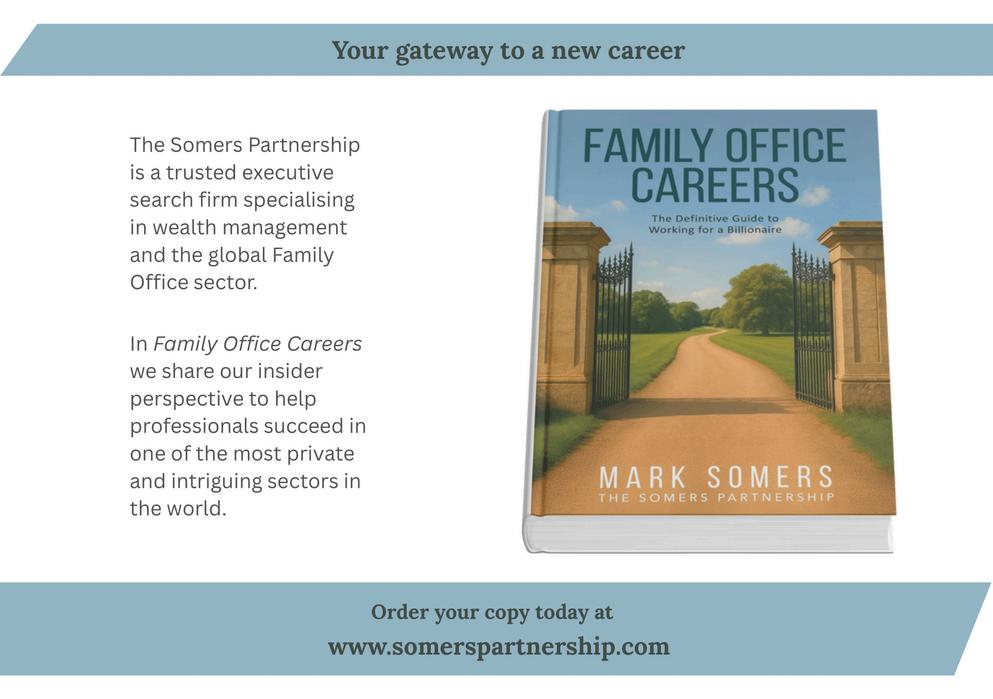
Mark Somers Guest Columnist
In our twenty years of family office recruiting, we’ve found that only a few family officers truly excel In the distinctive world of family offices - where personal and financial interests converge - the role of a family officer is both strategic and deeply human Beyond managing assets, they must navigate complex family dynamics, safeguard legacies, and foster generational cohesion
A great family officer combines strong technical expertise with refined professionalism. They possess deep knowledge in investment management, tax planning, legal compliance, and governance -skills essential for handling complex financial structures and regulatory challenges. Experience across succession planning, cross-border issues, and governance adds further value. Yet technical skill alone isn’t enough. The best officers maintain professionalism amid informal family settings, balancing accessibility with objectivity to ensure the family’s best interests always come first.
Emotional Intelligence and Interpersonal Skills
High emotional intelligence (EQ) is indispensable Family offices are inherently emotional environments, shaped by relationships, personal values, and conflicts A great family officer mediates tensions, empathizes deeply, and manages sensitivities with discretion Often serving as both advisor and confidant, they must earn trust while upholding clear professional boundaries
Trust is the foundation of effective family office management. A great family officer must demonstrate both technical competence and unimpeachable ethics. Handling vast wealth and private information demands complete discretion and moral integrity. Trust, built on consistent capability and aligned values, allows the officer to act as a reliable steward of both wealth and relationships.
Family offices are inherently emotional environments, shaped by relationships, personal values, and conflicts
Operating with a fiduciary mindset - anchored in care, loyalty, and impartiality - is essential. Exceptional family officers act selflessly in the family’s best interests and are often driven by a higher purpose, whether serving the family’s mission or advancing its philanthropy This sense of purpose inspires resilience and commitment
Family offices evolve constantly with shifting priorities, market changes, and generational transitions Great family officers are flexible, agile thinkers who can address everything from complex tax issues to family disputes Their creative problem-solving ensures stability and continuity amid uncertainty.
Family officers must embody humility - recognizing themselves as custodians, not owners, of the family’s wealth. This perspective fosters a service mindset and adaptability. The role is demanding, requiring resilience, stamina, and the courage to offer candid advice, even when it’s unpopular. Families need strategic partners, not “yes” people.
Family dynamics can be volatile Effective family officers act as diplomats, bridging generational and interpersonal divides Their calm, impartial communication and conflict-resolution skills help maintain harmony and enable thoughtful decision-making
Given their access to sensitive personal and financial information, discretion is non-negotiable By modeling confidentiality, the family officer sets the tone for a culture of trust and respect throughout the organization.
A great family officer is far more than a financial professional. They are a trusted advisor, diplomat, and steward of legacy - balancing technical mastery with empathy, judgment, and integrity. Their ability to manage complexity while preserving trust and unity makes them indispensable to the long-term success of any family office.
Nutraceuticals, like probiotics, vitamins and low-calorie sugars can give your health some extra support. Historically they have been manufactured commercially through environmentally damaging processes. Now a new era of genetically engineered microbes (such as yeasts and bacteria) allows for not just much cleaner nutraceutical production processes, but for personalised nutrition.
Scientists are exploring the possibility of building tailored vitamins and other supplements to help fight against chronic health conditions and even regional health imbalances Better still, as this technology develops, there is even the possibility of individuals enjoying access to ‘made-to-measure’ supplements alongside tailored dietary advice Increasingly, scientific research suggests that the development of a number of chronic health conditions (such as diabetes) may be linked to how your own gut processes certain foodstuffs. Knowledge of exactly how that processing occurred could spark a revolution in public understanding of healthy eating, with general advice around ‘5 a day’ evolving into specific plans to reduce individuals’ personal risk of ill health.
Some people may be reluctant to pursue tailored nutrition, because of the level of data which would need to be shared with scientists in order to engineer microbes to perform certain functions assisting that individual’s digestion and conversion of food into energy. Furthermore, governments at both local and national levels will need to provide citizens with clear options to ‘opt-out’ of data collection designed to promote personalised nutrition at a regional level. While health is crucial for life, many people rank their privacy with equal importance.
Much research is still needed before these new nutraceuticals could become a regular part of official medical guidance for healthy living and individual prescriptions However, these magic microbes have the potential to transform both the treatment and prevention of metabolic diseases It will be fascinating to see how this research progresses.



With competition growing globally, it is vitally important for the London Stock Exchange to remain a premier destination for the world’s most innovative companies. With that in mind, the announcement of a three-year holiday from stamp duty for newly-listed companies on the London Stock Exchange in the UK's Autumn Budget (first reported some weeks beforehand in the Financial Times and The Guardian) is excellent news for investors around the world and the UK's economy. This holiday will spare buyers of these shares from paying the 0 5% tax which is currently obligatory when purchasing £1,000 or more of shares of any UK-listed company Investors are not required to pay such a tax when buying shares listed in the USA, Germany or China, meaning that the UK has rather been an outlier in this regard until now
Sadly, international destinations are seeming more attractive than London lately. Indeed, some of the world’s largest companies have preferred listing in New York to London over recent years. ARM Holdings, world-renowned chip manufacturers and one of the most innovative companies that the UK has ever produced, listed on the NASDAQ in 2023, preferring a $54.5 billion valuation in New York to anything on offer in the UK. Meanwhile, shareholders of fintech giant Wise, which enables £12 billion of money transfers every month, voted in July to shift their primary listing from London to New York, seeing more profitability across the pond America is not the only country attracting LSE listed companies Food giants Unilever and Just Eat have moved their primary listings from London to Amsterdam Other companies such as Petershill Partners, dissatisfied with the performance of their shares in London, are simply delisting and returning money to their investors.
It is hoped that this stamp duty holiday will attract much needed funds to high-growth British companies and also boost the London Stock Exchange’s liquidity too.
However, tax cuts, while helpful, cannot always fix problems entirely on their own. One reason why international markets are so attractive to British businesses is that it is much easier for them to secure the significant finance required to support high-risk projects overseas than at home For example, innovations in medication can often cost over £1 5 billion (Deloitte) per asset The UK needs a banking system that thinks like an entrepreneur Without funding and credit solutions which go the extra mile to support innovative businesses across the UK, those businesses will scale abroad
HM Treasury can’t do everything. Banks need to work much more closely with both government and innovators to restore London’s Stock Market to its former glory.
Sometimes, people don't feel safe calling from their own phones.
Telephone boxes have been a fixture of UK high streets for generations. If people didn’t have a mobile phone, couldn’t afford a landline in their home or needed to call emergency services, phone boxes and the payphones they provided were crucial connectivity tools
In today’s digital world, where almost everyone has a smartphone and some of us even make calls through our watches, BT is modernising their traditional payphone estate New ‘Street Hubs’ are already being rolled out across the UK While they may look like just another billboard, these hubs are so much more than that They include touchscreens with information on everything from local weather to important updates from local authorities. These hubs also have emergency buttons connecting directly to emergency services and waterproof USB ports to charge mobile devices quickly. They also provide free WIFI connectivity as well as both 4 and 5G calling capabilities.
Combined with the copious opportunities that these hubs provide for businesses to advertise, many people see them as an upgrade on those old-fashioned telephone boxes. You can even now buy a classic old, red telephone box from BT as a unique cultural souvenir.
But there’s a problem
Sometimes people don’t just use phone boxes because they haven’t got a mobile phone to hand - they use them because they don’t feel safe making certain calls from their own phones Thousands of people across the UK make calls from phone boxes to report abuse to emergency services, and also to contact suicide prevention charities if they find themselves in a mental health crisis.

In the first five months of 2020, as the UK was emerging from its first COVID lockdown, these phone boxes were still widely used, facilitating 25,000 calls to Childline and 20,000 to Samaritans People were only permitted outdoors for one hour per day during three of these months The fact that so many calls were nonetheless made from phone boxes highlights the desperate situations that an unacceptably high number of people find themselves in A local phone box could save someone’s life
A key advantage of a phone box is that its cover offers a private space to speak. People may well not feel comfortable sharing their trauma with an LED screen in the middle of the pavement, where any passerby can hear them.
Moreover, there are parts of the country which simply lack high-quality mobile phone and internet connectivity Phone boxes using traditional phone lines may be the only way for people living in these areas to speak to their friends and loved ones
It’s important that policymakers do everything they can to ensure that Britain doesn’t lose its phone boxes What might be a quaint souvenir of a bygone era for some, remains a vital lifeline for others.


Annie Coleman Guest Columnist
Today, with longer lives, better health and rising ambition within reach for so many of us, the retirement model, and the mindset that goes with it, needs, well, retiring It’s time to update it with “re-inspirement” And the challenge I hear most is what, after a successful career, is an individual’s purpose during their third-chapter of life, and is it possible to make that purpose meaningful and longlasting?
We have spent decades managing our financial portfolio. We’ve diversified, sought returns and hedged against risk. But few of us have approached our purpose with the same discipline, despite scientific evidence showing a sense of purpose helps us live longer and remain healthier. So, what if we thought of purpose as a portfolio too, one made up of intangible assets that create a balanced, fulfilling next chapter? I believe three core assets comprise a Purpose Portfolio.
The first is Productive Assets (akin to growth stocks). Your skills and talents don’t disappear when your job title does, but they do need a new outlet What are the things you love doing; not just what you’re good at, but what energises you? What skills do you want to develop next? Lifelong learning isn’t a luxury; it’s a longevity imperative
Next on the list are your Vitality Assets (or blue-chip stocks) These include your relationships, caring for your health and emotional resilience Who challenges you to be your best self? What activities, experiences or sports do you want to be doing in the future? What can you do now to make that possible? Your career may have brought status and stimulation, but it also provided structure, social interaction and rhythm. They need replacing. Neglect this part of the portfolio and burnout or boredom can sneak in.
What do you want to stand for and who do you want to serve?”
And finally, your Transformation Assets (or long-term stocks). What do you want to stand for and who do you want to serve? Often, your deepest purpose isn’t new, it’s something you’ve always known and are ready to act on. Transformation assets show up in mentorship, activism, creative work or entrepreneurship. Some of today’s most successful entrepreneurs are in their 50s and 60s with decades of experience, wisdom and intelligence that improve their odds
This good news is you don’t have to be perfect to get started, any more than you can be expected to pick only winners in the stock market You will rebalance the assets in your purpose portfolio over time as conditions and priorities evolve, just as you do with your financial plan
So how best to start First, audit your assets; what skills, connections, interests or passions have you underused? Next, diversify your time Experiment with different types of engagement paid, unpaid, solo or communal Make space for relationships and vitality. Finally, rebalance your portfolio regularly. Life changes, and so should your purpose mix.
It may feel uncertain at first. But as we learn to reimagine our 60s and 70s as a launchpad, we can build portfolios that grow not only wealth, but purpose, connection and joy.
Annie Coleman is an Ambassador for Stanford University’s Center on Longevity, and the Founder of RealiseLongevity, which provides strategic advice to organisations seeking to cap-ture the trillion-dollar longevity opportunity by integrating age diversity into their growth strategies, talent management, and market approach She also advises CEOs and senior leaders as they leave long, successful careers, about their hopes, dreams and ambitions for their “third chapter” of life

Based in Portsmouth, the Royal Navy Rum store once held the Navy’s entire stock of rum in one building Since the Navy’s rum ration was ended in 1970, that building has sadly declined into disrepair This has led to a huge part of the UK’s culture just sitting there and not providing jobs, skills or lifelong memories to the local community. That disrepair ends now.
Gosport Borough Council recently greenlit plans to transform the Royal Navy Rum Store into an ambitious mixed-use employment space for maritime, retail and leisure businesses. The centre-piece of this refurbished site (potentially reaching 7,000 sqm in size) will be a rooftop bar
It is hoped that this exciting development will bring 200 jobs to the area and join other local developments such as Gunwharf Quays as major attractions, bringing visitors from around the world to Portsmouth
The refurbished Royal Navy Rum Store can also offer an excellent work-life balance to those who work there From great places to have quick lunch catch-ups with friends to ideal relaxation spots after work and spaces for a bit of retail therapy, the site will cater to a whole range of interests.
The £11 million of additional revenue which these refurbishments are expected to bring to the area annually will easily repay the project’s £22 million cost. Half of that £22 million will be covered by a 2023 award of £11 million to Gosport Borough Council from the Government’s Local Regeneration Fund and match-funding of £11 million from UK Docks
Special care will be taken to preserve the site’s heritage and historic significance It is wonderful to see Portsmouth thriving and the announcement of this latest of the city’s exciting developments


Marina Abel-Smith Guest Columnist
We all know that flying is bad for the environment. We don’t really want to think about it though, and we certainly don’t want to curtail our many travel plans, especially as we’ve got so used to hopping on planes whenever we want.
Reading novels set in the 20th Century (most recently Still Life by Sarah Winman and Winter in Madrid by CJ Samsom), the characters seem to jump across Europe from London to Florence or Madrid, seemingly at a drop of a hat. So, two years ago, after a lengthy climate debate with my now-fiancé, we decided to try holidaying by train. Since 2023, we have enjoyed a long weekend in Lyon, a tenday adventure to Vienna and back, and most recently, we went all the way to Rome I am now a fully-fledged ‘slow travel’ convert
A few things to acknowledge before I wax lyrical Organising train travel takes a lot more time than booking a cheap flight The headspace required to work out timings, think about what’s realistic and finding a system to save the different tickets for the variety of train networks is an investment It can also be much more expensive on the face of it.
However, once you’ve committed and you know your Eurostar time, the adventure really begins (on the topic of price – trains can also be the same price as flights, especially once you take into account the expense of getting to and from airports etc).
From the UK, every train journey to the continent begins at St Pancras International. Nothing fills me with more joy than getting through security and border control and buying the first holiday cappuccino It will of course be an early train as you will have much of Europe to travel across that day if you are to get to your chosen destination In 2024, we travelled through Paris during the Olympics and found ourselves chatting to a proud mother who was hoping to watch her son win gold in Taekwondo (Bradly Sinden no less – the first British male World Taekwondo champion) I’m not sure such an interaction would have happened in a frantic airport terminal
Travelling by Eurostar means an obligatory lunch stop in Paris. Is there a better city in the world for an obligatory lunch stop? I don’t think I’ve been happier than when in May 2025 en route to Milan, we met with a Parisian friend, who took us to Le Bota (32 Rue de Lyon) in between trains. I ordered a glass of Deutz champagne to accompany my French fries in the late Spring sunshine. That sort of thing can’t happen 36,000 feet in the air, can it?
What if we thought of purpose as a portfolio too?
From Paris, the world is your oyster. Lyon is just two hours away on a TGV line so fast, it sometimes doesn’t feel real. We’ve made it to Nuremberg and Milan in a day, for overnight stops with a chance the next day to soak up the culture and history of both cities before heading to our ultimate destinations We’ve chatted to a German family travelling to Croatia with their string
Young people face an increasing number of challenges in today’s uncertain world. However, one word obliterates all of those challenges and turns their worlds upside down. It’s a word that nobody, whether young or old wants to hear: cancer.
Knowing that you might lose your life before it’s properly started is absolutely terrifying To make matters worse, much cancer care and treatment is designed either for much older or younger people, who don’t have to navigate teenage life and adolescence while also battling cancer This is where Teenage Cancer Trust plays a pivotal role in making so many teenagers’ and young adults’ cancer journeys so much more manageable
Founded in 1990, this unique charity mixes specialist events with specialist medical staff and expert oncologists to help some very special individuals to manage the greatest challenge of their young lives, while still enjoying those lives as much as possible One of the charity’s most remarkable achievements is to have concentrated that expertise into specialist cancer units across the UK that resemble trendy apartments far more than medical spaces Nestled inside some of the country’s leading hospitals, these relaxed spaces include TV & gaming facilities, free wi-fi and laptops, and cosy, friendly kitchen spaces which are perfect for visiting friends and family members to hang out with patients
Hospitals can often be hugely intimidating spaces for young people Homely units that remove so much of this stress and worry make such a difference to individuals’ wellbeing as they undergo essential and potentially life-saving hospital treatments
Teenage Cancer Trust also goes out of its way to provide advice and support around the clock to young people as they battle cancer The charity’s youth workers are available to discuss any non-clinical issues which people may be experiencing as they live with cancer As the charity’s services are available to young people aged from 13-24, these issues could range from fitting in at school to asking employers for extra support while working or navigating issues around paid leave
Free events at the Royal Albert Hall are also another way in which the charity endeavours to ensure that cancer doesn’t take all the fun out of life for young people While cancer impacts every individual differently, the Teenage Cancer Trust is here to help young people get through cancer and rebuild their own futures





The views expressed in this document are not intended as an offer or solicitation for the purchase or sale of any investment or financial instrument. Information contained within this document has been compiled from sources believed to be reliable but have not been independently verified; no representation is made for accuracy or completeness, no reliance should be placed on it and no liability is accepted for any loss arising from reliance on it.
Readers are advised that Lamwyk & Co Ltd has accepted articles and advertisements for publication in good faith but should be advised that Lamwyk & Co Ltd cannot accept any responsibility for views expressed nor the advertisements published Lamwyk & Co Ltd reserves the right to withdraw any article or any advertisement at any time The views expressed are not necessarily those of Lamwyk & Co Ltd
Principal place of business: Quantum House, 22-24 Red Lion Court, London EC4A 3EB
Registered number: 08039221
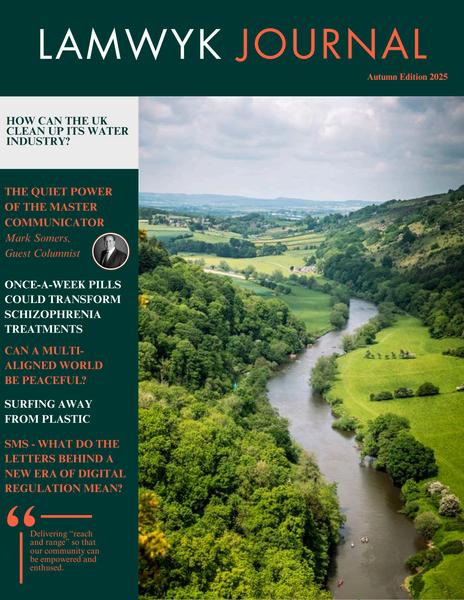
Front Cover Editorial credit: Shutterstock